nios mo na go leor
(More Than Enough)
October 2025 Issue 4
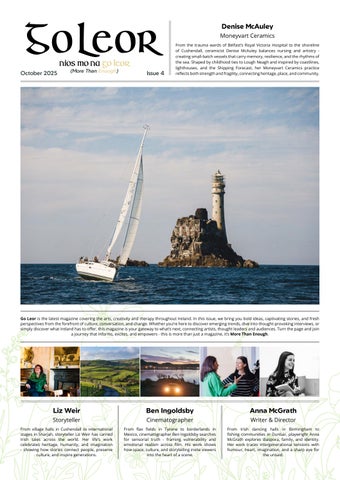
From the trauma wards of Belfast’s Royal Victoria Hospital to the shoreline of Cushendall, ceramicist Denise McAuley balances nursing and artistrycreating small-batch vessels that carry memory, resilience, and the rhythms of the sea. Shaped by childhood ties to Lough Neagh and inspired by coastlines, lighthouses, and the Shipping Forecast, her Moneyvart Ceramics practice reflects both strength and fragility, connecting heritage, place, and community.

Go Leor is the latest magazine covering the arts, creativity and therapy throughout Ireland. In this issue, we bring you bold ideas, captivating stories, and fresh perspectives from the forefront of culture, conversation, and change. Whether you’re here to discover emerging trends, dive into thought-provoking interviews, or simply discover what Ireland has to offer, this magazine is your gateway to what’s next, connecting artists, thought leaders and audiences. Turn the page and join a journey that informs, excites, and empowers - this is more than just a magazine, it’s More Than Enough
Liz Weir Storyteller
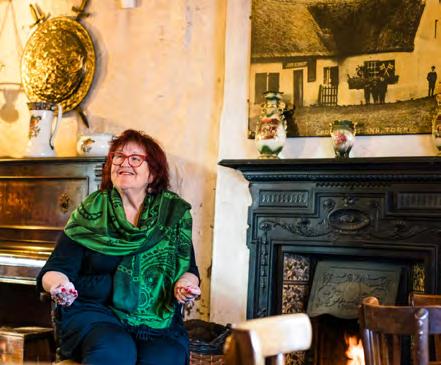
From village halls in Cushendall to international stages in Sharjah, storyteller Liz Weir has carried Irish tales across the world. Her life’s work celebrates heritage, humanity, and imagination - showing how stories connect people, preserve culture, and inspire generations.
Ben Ingoldsby Cinematographer
From flax fields in Tyrone to borderlands in Mexico, cinematographer Ben Ingoldsby searches for sensorial truth - framing vulnerability and emotional realism across film. His work shows how space, culture, and storytelling invite viewers into the heart of a scene.
Anna McGrath Writer & Director
From Irish dancing halls in Birmingham to fishing communities in Dunbar, playwright Anna McGrath explores diaspora, family, and identity. Her work traces intergenerational tensions with humour, heart, imagination, and a sharp eye for the unsaid.
Issue 4 - October 2025
Liz Weir Storyteller
Denise McAuley
Moneyvart Ceramics
Anna McGrath Writer & Director
Ben Ingoldsby Cinematographer
We’re always on the lookout for fresh voices, bold ideas, and stories that matter. If you have a topic you’re passionate about, a request for something you’d love to see featured, or an idea you think deserves a platform, we’d love to hear from you. Go Leor is built on conversation and collaboration, and your input helps shape the future of the magazine. Get in touch with the editor via aidan@goleor.co.uk - let’s create something great together.
Interested in advertising with Go Leor? Partnering with us puts your brand in front of a vibrant, engaged audience of curious minds, creative thinkers, and culturally-aware readers who value authenticity and innovation. Our publication reaches a diverse mix of young professionals, artists, changemakers, and trendsetters who are always seeking what’s next. With a focus on creativity, events and exploration, whether you’re launching a new product, promoting an upcoming event, or building brand awareness, we offer tailored advertising opportunities to help you make a meaningful impact. To explore how we can work together get in touch with us at advertising@go-leor. co.uk
© Go Leor 2025. All rights reserved. No part of this publication may be reproduced, stored, or transmitted in any form without prior written permission from the publisher. Visit us at go-leor. co.uk. The views expressed in this magazine are those of the contributors and interviewees, and do not necessarily reflect the views of Go Leor or its editorial team. For all queries or correspondence, please contact support at support@goleor.co.uk
A short note from the editor
From Liz Weir carrying Irish stories from Cushendall to Sharjah, to Ben Ingoldsby framing sensorial truth between Tyrone and Mexico, each artist reveals how culture and connection are kept alive in different forms. Ceramicist Denise McAuley balances the intensity of nursing with the rhythms of clay, shaping vessels that echo shoreline and resilience, while
playwright Anna McGrath traces identity and diaspora through Irish dancing halls, fishing communities, and the theatre stage.
Together, their stories remind us how art - whether spoken, performed, written, or craftedroots us in who we are, while inviting us to see the world anew.
Aidan McGrath
Liz Weir Storyteller
From Belfast libraries to Guinness World Records and global awards - Liz shows how stories, shared with care, can enchant, connect, and heal across cultures, ages, and unexpected places.
When Covid came, I was stuck up here on top of the mountain. Nobody here. So I started doing it online, and we had up to 80 people coming every Saturday night. Now we’re down to about 20, but they’re still there from Ohio and San Diego and Prague and Scotland and Derry and all over the place.”
What began as a necessity became proof that storytelling could thrive in virtual spaces. “People say you can’t build community online… We have a really strong storytelling community
online, you know, which pleases me. There are people in their 90s… come on every Saturday night. So amazing. Just amazing. I really believe if you build it, they will come.”
Choosing the Right Story
“For me, being a good storyteller isn’t just about being able to tell stories. It’s about choosing the right story for the right audience at the right time. Am I in a church group, in the pub on Saturday night, in school, in a library? There has to be a really good match.”
That philosophy has shaped her fifty-year career, where she has built a vast repertoire drawn from folklore, nursing homes, and the stories passed down through generations. “It’s a life’s work building up stories… I go into nursing homes and older people tell me stories. It’s just lovely to bring those people out in front of an audience.”
Stories of Magic, Love, and Folklore
Weir delights in stories of enchantment and superstition. “Last Saturday night, I told one
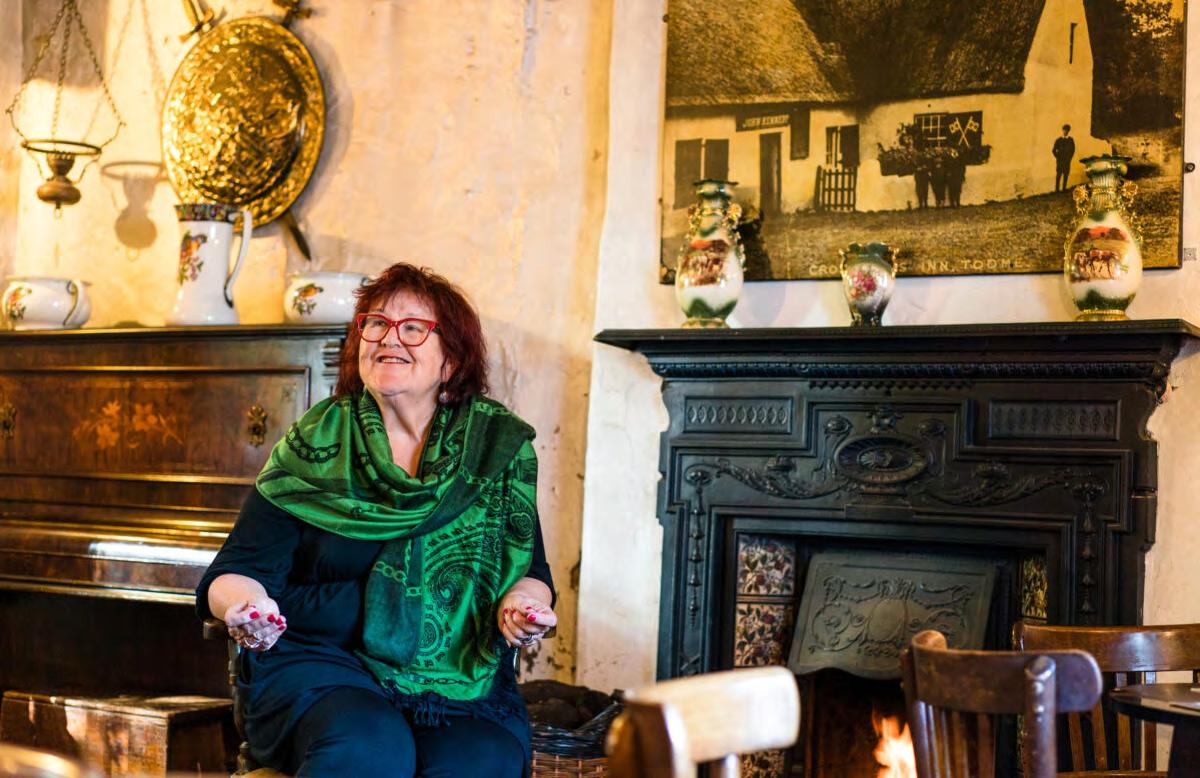
Liz Weir, Photographed by Elaine Hill
of my favorite stories, which is a story from Rathlin Island, from the telling of the late Thomas Cecil. There’s a story about a boy who gets taken by the fairies, but they bring him back because he’s got a thorn trapped under his finger.”
“I like stories of magic and enchantment. I like stories about love. Stories from folklore really, cures and superstitions, magical pieces and ghost stories.”
From Queen’s to the World
Her path began in Belfast. “I did an English degree at Queen’s, and I did a post-grad in librarianship… I was set my first task of telling the story at Falls Road Library, Belfast. And I had the book, and the book was shaking and I was shaking because I’m actually a really shy person. But the kids liked it - that made me feel good about myself.” She had expected librarianship to be about books alone, not performance. Yet that first shaky telling opened a door: “I thought it was all just books, you know? But the audience gives you confidence.” Over time she grew into the role, shedding the book as a barrier between herself and her listeners and learning, as she says, “to tell stories out of my mouth with no book between me and them.”
The shy librarian became an international storyteller. “That was 1973. That’s a long time… 50 years probably.”
Storytelling for Understanding
Stories are not only entertainment but tools for empathy.
“Part of my philosophy as a storyteller is… to have stories that make people think. If I’m doing anti-bullying work in a school, you do stories of friendship. Nowadays, what’s very relevant in Northern Ireland is multicultural work… we’re collecting
stories from Syrian women now living in Belfast, publishing a collection of their stories in English and in Arabic, so that people will gain a greater understanding.”
Weir’s current role as storyteller-in-residence for the Armstrong Storytelling Trust reflects this mission. “I think stories can promote conflict resolution, promote understanding.”
Stories Without Borders
Her travels have taken her across five continents. “Years ago I went to Israel to tell stories and we had Arab, Bedouin, Druze, Palestinian, Israeli storytellers all together doing the storytelling for peace.”
In Marrakesh, she joined more than 100 storytellers for the International Storytelling Festival. “We decided to go for the Guinness Book of World Records… 80 hours of storytelling… storytellers telling in over 40 languages. That’s really special.”
She recalls sitting in a tent at 4:00 in the morning surrounded by Moroccan storytellers, keeping the audience awake. “This time Guinness insisted you had ten people all awake listening at any one time… it was a very interesting trip.”
Ballyeamon Barn and the Yarn Spinners
Closer to home, Weir has created hubs for stories. “Every Saturday is Ballyeamon Barn. I have a hostel here in the Glens of Antrim. We do performances and workshops… If we’ve got visitors here we do it live, a hybrid. Some people on the big screen and some people present in person.”
Her long-standing project, The Yarn Spinners, has grown from
a dream into a movement. “We started off with one storytelling session, which is still going after 33 years… now we do monthly sessions in Tullycarnet, Lisburn City Library, Bangor Library as well. And there’s lots of new sessions in Tyrone, Armagh, Fermanagh, Cork, Kilkenny, and Derry. So my dream’s pretty much come to fruition.”
Collaborations and Creativity
For Weir, collaboration is essential. “Last month we were up in Portstewart in Agherton Church, doing this new piece that we’re performing at the Seamus Heaney Homeplace, called A Cloak of Wisdom. That’s Women’s Stories Reimagined, where I’m collaborating with Anne Harper, who plays harp and clarinet. We got funding from the Arts Council to perform, and we’re touring that around at the minute, including The Duncairn in October.”
Weir has also co-authored 15 books with illustrator Corrina Askin for the Education Authority, placing them in every school in Northern Ireland. “It’s just lovely to collaborate with somebody as talented as her.”
Technology and the Future of Storytelling
Covid expanded storytelling’s reach. “During Covid, we got to hear the best storytellers in the world online… From an Irish perspective, it’s brought Irish storytelling all around the world.”
Hybrid models continue to thrive. “I do concerts in America online… people pay to watch a storytelling concert. It’s great for storytellers and great for audiences.”
Weir celebrates innovation: “Corrina’s working at the minute with Vicky McFarland, a great
storyteller. She’s got a geodesic dome… she tells the stories, the kids are watching Corrina’s animation… real sensory storytelling. So again, storytelling is very much part of the future.”
Recognition and Legacy
Despite setbacks - including a recent injury - Weir continues to be celebrated. One of her proudest moments came in as part of her time in Marrakesh - while recovering from her accident, she was honoured with the Sharjah International Award for Cultural Heritage in Best Narrators and Heritage Bearers (Living Human Treasures). Unable to travel, her friend Sahar accepted the award on her behalf in the United Arab Emirates. “While I was in the hospital, I got this award for my services to storytelling… It was lovely to
be acknowledged for your work in different countries.”
As she looks to the future, she keeps returning to the same truth: storytelling is not just for children. “My very first session that I organized at the Folk Museum in Cultra in the 80s, called Yarn Spinning: Who Says Storytelling is Just for Kids?we had over 100 people turned up. And I think we’ve made the point really well. Now storytelling is for all age groups.”
The Armstrong Storytelling Trust remains central to her work, alongside her open house at Ballyeamon Barn, which continues to welcome storytellers from around the world. “I think storytelling can promote understanding really well… It’s not always about talking. You need to be a good listener. If you listen to another person’s
story, even though you diametrically oppose it, you’re paying them respect. Listening is as important as talking.”
Liz is the Storyteller in Residence for the Armstrong Storytelling Trust armstory.org.uk
Find out more about The Ballyeamon Barn Hostel via their website: ballyeamonbarn.com
Keep up with Liz on social media: @lizstoryteller
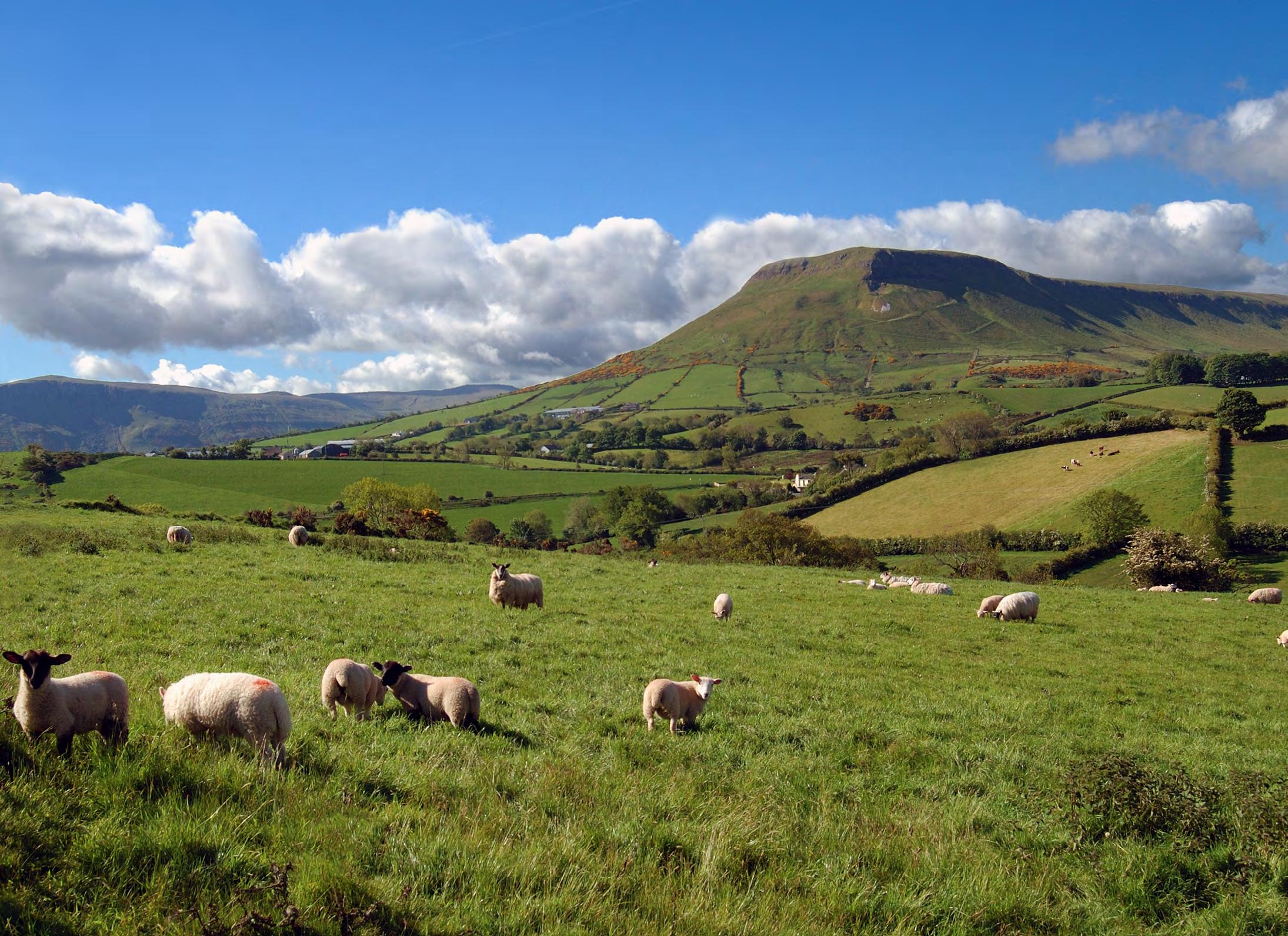
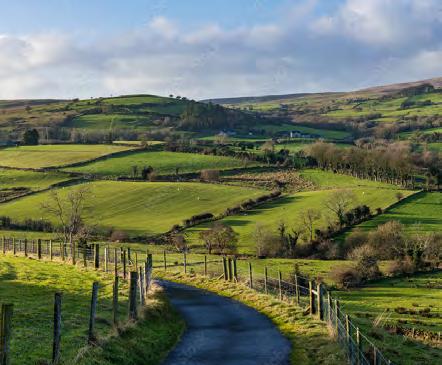
The Glens of Antrim, Near Cushendall

Denise McAuley Moneyvart Ceramics
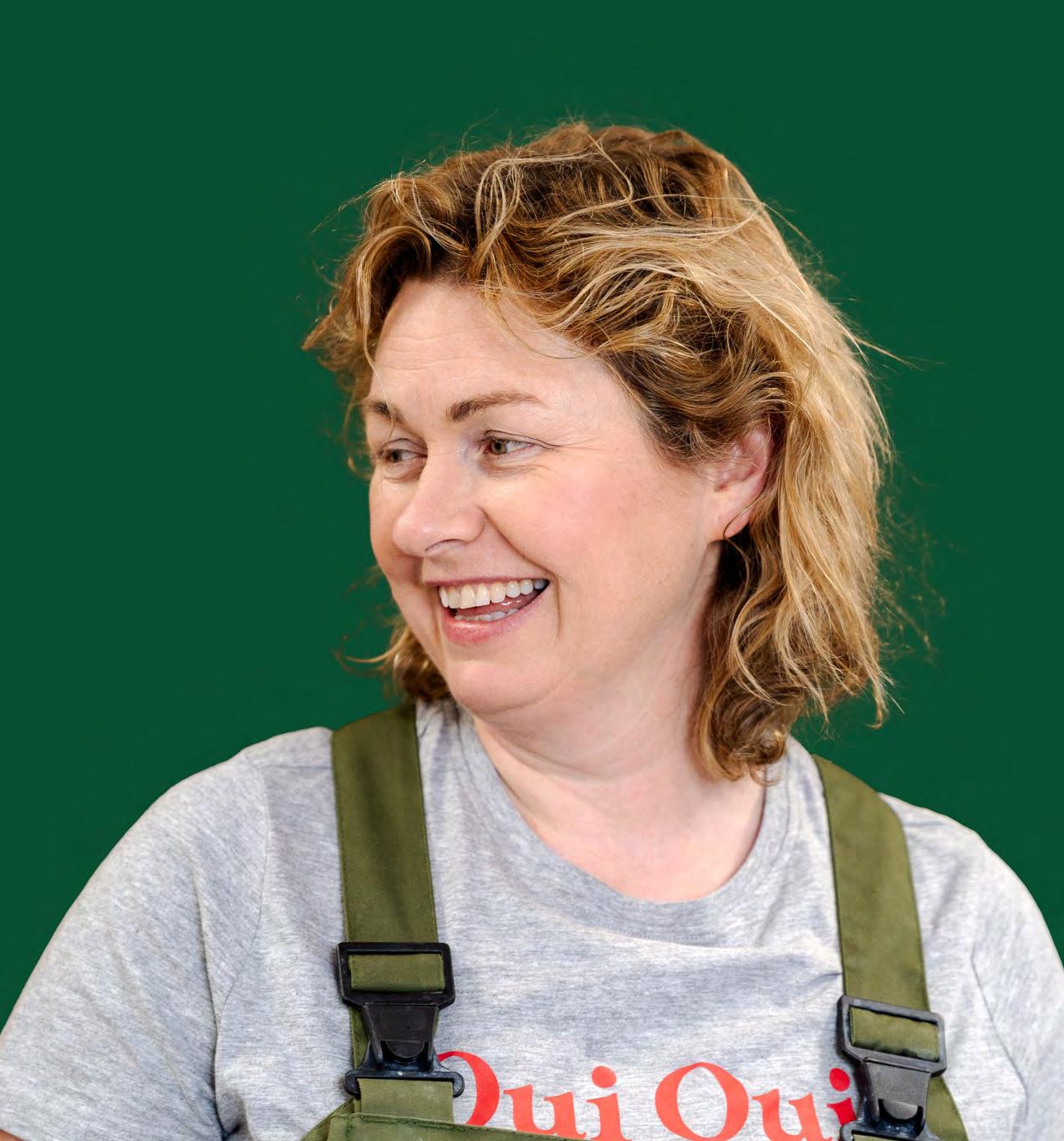
From the trauma wards of the Royal to the shoreline of Cushendall, Denise balances nursing and artistry, creating small-batch ceramics that carry memory, resilience, and the rhythms of the sea.
It’s good to have some time for throwing. It’s been a busy morning. I’ve taken the kids away to school and I’ve managed to catch up with everything at home after working three shifts over the weekend. It’s exhausting.”
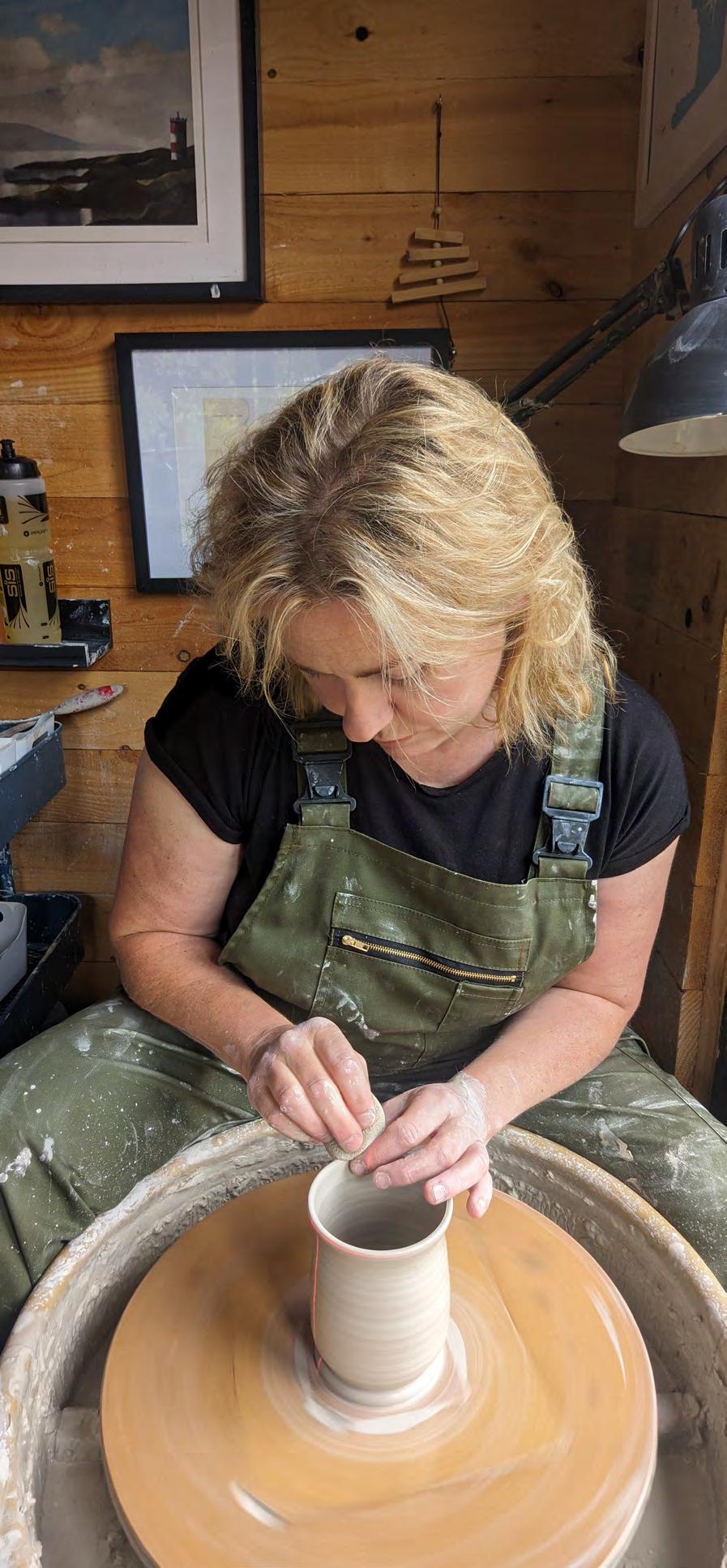
Alongside her demanding role as a trauma coordinator at the Royal Victoria Hospital, Denise McAuley has nurtured a second vocation as a ceramicist under
the name Moneyvart Ceramics. Balancing these worlds is no small task. “The work never stops. I find myself working all the hours in the day. But I love it.”
The rhythm of her week is fluid, divided between nursing shifts, family life, and time in the studio. Markets and fairs often fill her weekends. “I’m always trying to find the right balance between making the work that
is in demand in the fairs and shops I supply and still find time to develop my ideas of new works that I want to design and create.”
Early Fascination, Later Spark
Her fascination with clay stretches back to childhood. “As a child, after being presented with a toy potter’s set for Christmas, I was intrigued by the ability to create forms from mud and clay. At museums, exhibitions and craft shops I was always drawn to pottery and ceramics whether as a functional tool or as a piece of art.”
The real spark came decades later. “In 2017 I accompanied a friend to a birthday party in South Belfast where I met a potter and we got chatting. I was completely intrigued. She suggested I apply for a parttime nightclass course under the tutelage of Derek Wilson that Autumn at the University of Ulster. I followed her advice and enrolled just a few weeks later.”
For the next three years, McAuley juggled four children, work, and evening classes. “Each Autumn, for the next three years I spent each Wednesday evening for 10 weeks at the York Street campus. I adored the feel of the clay… Although initially alien to me, I quickly felt at home amongst the wheels, pugmill, slab rollers and kilns. It was such a creative and inspirational
space to be in and I felt like I belonged. That was the beginning of the adventure.”
Clay as Escape During Covid
In 2020, another encounter shaped her path. “I met ceramicist Tracey Johnston. We talked pottery, Covid and lockdown and it was Tracey who suggested I invest in my own wheel. It was Tracey who was instrumental in encouraging me to take that extra step. Over the worst of the pandemic the wheel served as my escape from the stresses of the hospital and it was during those lockdown evenings that I worked hard honing my craft. I invested in my first kiln later that year and the rest is history.”
Clay became both outlet and anchor. “Certainly it feels like I’m on an adventure. A ride of some sort.”
The Pull of Landscape
McAuley’s work is steeped in the natural world. “Everything comes from the landscape that I’m familiar with living on the coastline between Belfast Lough and Cushendall. My grandmother was from Ardboe in County Tyrone, and I spent a lot of my childhood on the shores of Lough Neagh. My family was part of the fishing community there. I find myself drawn to the shore, the countryside and open spaces; the natural environment.”
Textures, tides, and unpredictability mirror her processes. “In ceramics we often refer to the kiln gods. There’s an unpredictability in the process. We find ourselves trying to recreate the results of a happy accident… It’s exciting. It feels like you’re constantly chasing something.”
Photography helps her capture inspiration. “The process
has awakened something in me. Where previously I saw pavement or stone, suddenly i’m seeing forms, shapes and patterns and thinking how I can use them in my work. I find myself looking to the sky, sunsets, sunrises, moonlit nights - everything. Everywhere I’m seeing shape, form and glaze. It’s changed how my brain interprets the world I see around me.”
Lighthouses and the Shipping Forecast
“I’ve always been drawn to the shoreline… I’m fascinated by its shifting tides, its textures and its sense of both safety and danger. I’m fascinated by lighthouses and the Shipping Forecast inspires me, not just
for the weather it records, but for its poetic quality and the way it reflects mood and emotional state.”
She sees parallels between the nightly broadcast and the rhythm of clay. “It begins with the rhythmic melody of Sailing By and it’s like a lullaby and while you’re lying in bed listening, snug and warm you can’t help but think of the sailors who are out in those rough seas in Fastnet, Rockall, Malin or the Irish Sea.”
These themes find their way into the motifs in her work like her Shipping Forecast range or her Luna cups and other vessels. “I’m capturing the images and emotions in the form and the glaze. Like a moonlit night.”
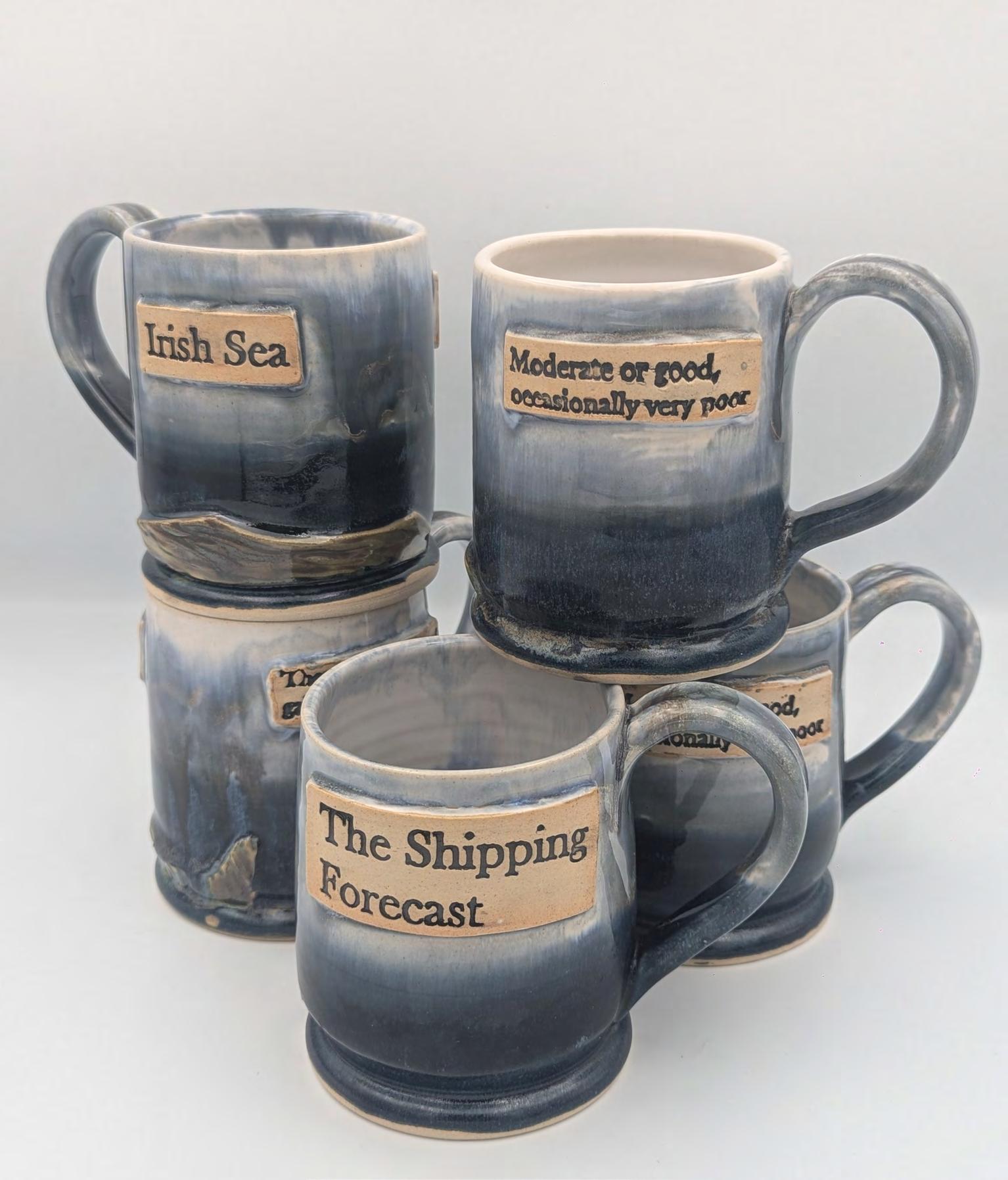
Shipping Forecast
Materia Medica
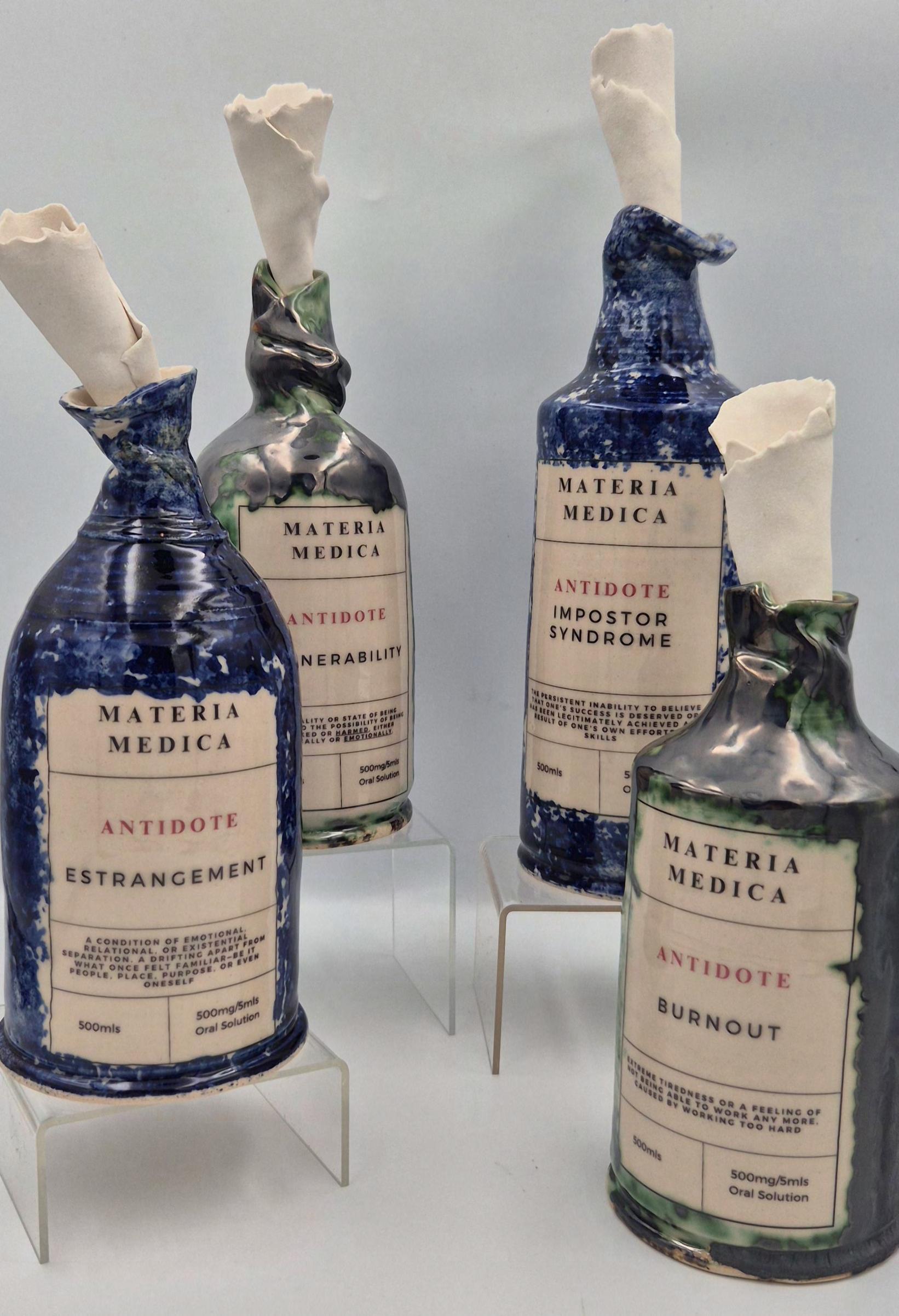
McAuley’s most ambitious project to date is Materia Medica, a series of four ceramic bottles inspired by antique pharmaceutical vessels, created for her HND in Product Design at Belfast Metropolitan College.
“These works are shaped not only by my personal journey but also by my experiences with patients and colleagues in the NHS trauma service. Feelings such as impostor syndrome, burnout, vulnerability, and estrangement are rarely individual; they are shared human experiences. Clay allows me to explore and express these states through a medium that, like us, embod-
ies both strength and fragility, resilience and fracture.”
Each bottle is distorted to represent tension, labeled with the ailments of modern life, and contains a delicate porcelain scroll. “As vessels, these bottles embody the human form, fragile yet resilient. Speaking to the strength and vulnerability that coexist within us all.”
Accepted into the Royal Ulster Academy exhibition, the series is a milestone. “Having never studied art beyond third year, and without a GCSE or A-level in the subject, my 18-year-old self could never have imagined seeing her work accepted into such a prestigious exhibition. To say I’m thrilled to be chosen is an understatement.”
Small-Batch Philosophy
McAuley describes herself as a small-batch potter. “Being a ‘small-batch potter’ is about intention and care. I make each piece by hand, often in limited numbers. Doing so allows me to focus on detail, form, and surface. I recycle my clay and whenever possible, use solar energy to fire my kiln. It’s a small but meaningful way to work sustainably.”
“It’s a philosophy as much as a process, valuing quality over quantity; allowing the material to guide me. I aim to create work that endures, vessels to be treasured and passed down through generations”
Community and Collectives
Beyond her studio, McAuley is active in the County Antrim Open Studios network, where she serves as secretary alongside artists like Rosanne Cecil and has connected with fellow ceramicists such as Paul Birch “It’s wonderful to see people working in different homes or
creative spaces, producing so much within such a small area.”
She is also part of the Cré Collective, formed with fellow graduates. “We’ve reconnected recently and are preparing to apply for exhibitions again, creating new work with the aim of sharing it more widely.”
Moneyvart Ceramics
Her practice takes its name from a place deeply tied to family. “I’m often asked about the name Moneyvart. It’s a townland in Cushendall. It comes from the Irish Móin a Mhairt which loosely translates as Hill of the Miracle. My connection to Cushendall comes through my husband’s family, the McAuleys, and we’ve always felt a strong link to the Glens of Antrim, its landscape and folklore. It’s a magical place, a place apart.”
Looking Ahead
McAuley is clear-eyed about the challenges of balancing art, family, and work. “I have many ideas I want to explore; I just need the time in the studio to bring them to life. I’m currently planning a broader series of works inspired by the Shipping Forecast.”
Recognition is building, but the motivation remains deeply personal. “Clay has opened a voice within me I didn’t know existed. It’s a versatile, expressive material, and I have so many ideas and concepts I’m eager to keep exploring.”
Check out Denise’s latest products via her website: moneyvart-ceramics. sumupstore.com
And keep up with her latest news and projects via social media: @moneyvartceramics
Anna McGrath Writer & Director
A Playwright tracing the tension and tenderness between generations, Anna McGrath explores diaspora, identity, and performance with heart, humour, and a deep eye for the unsaid.
Iwas just down in Bob and Berts doing my redraft of Feis. I had notes on it last week, and I’ve just made some tweaks,” says playwright Anna McGrath. “I’ve been doing it every day for a couple of hours and I’ve finally worked through some of it. Feeling quite relieved about that.”
“My schedule depends on the project, and it depends on the availability of childcare in my own life,” she adds. “Feis, that I’ve working on currently, I’m trying to make sure that it makes sense with the characters and tightening up the story.” Anna’s production of Feis
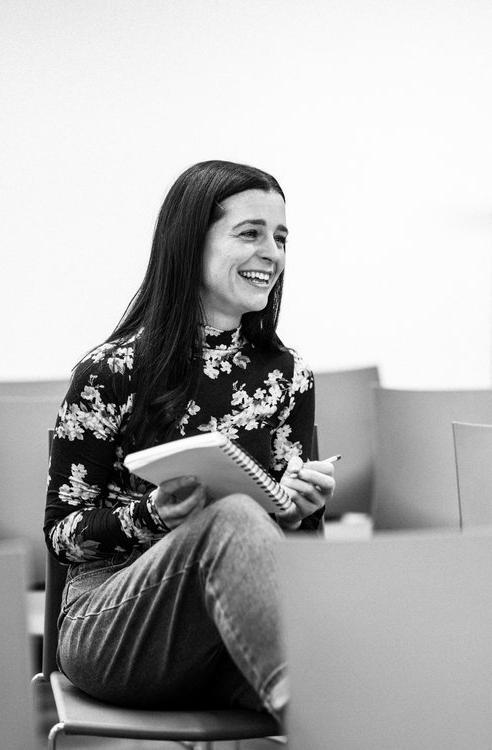
will be presented as part of the autumn season at A Play, A Pie and A Pint, Oran Mor Glasgow - a lunchtime theatre that is renowned for new writing and launching the careers of emerging playwrights.
It will also be co presented at The Traverse Theatre Edinburgh “I’m thrilled to have my play being produced by two theatres that put so much precedence on new writing and giving emerging playwrights a platform”
Irish Dancing and Diaspora
“I’m really interested in the diaspora community... the Irish community living abroad. That’s something that I’m really interested in because that’s really linked to my upbringing living in Birmingham and spending a lot of my childhood travelling back and forth on holidays and extended breaks.”
Feis, set in the UK and rooted in Irish diaspora communities, centres on Irish dancing both as a performance world and as a site of cultural identity. “I used to Irish dance as a child myself. And I think it’s a really strong community of people that are representing your Irishness when you’re not in Ireland.”
The inspiration came partly from a real-world controversy. “There was a documentary about a cheating scandal that happened in the Irish dancing
community a few years ago...” It was, she says, a moment that exposed how “fragile” the system was - and how deeply Irish dancing matters to Irish communities globally.
“That was an early inspiration for the play, it really lit the fuse for me,” she explains. Still, Feis is not about the scandal. “It’s really about relationships with identity, with family and with a love of Irish dancing. The scandal is relevant - let’s call it thematic in my play - but not the focus.”
Three Generations, One School
At its heart, Feis is about intergenerational identity. “It’s about a grandmother, her daughter who runs the Irish dance school, and then her daughter.” The central character, Deirdre, will go to great lengths to keep the McGuire School of Irish Dance afloat - even at the cost of her relationship with her own daughter.
“I’m really interested in relationships between the female familial characters, and the differences in the generations between grandmothers to their daughters, and to the daughters after them.” In Irish diaspora communities, accents and experiences shift between generations.
But Irish identity doesn’t necessarily weaken over time. For
many, McGrath says, that sense of cultural identity becomes more urgent abroad. “It’s symbolic - just like sport and music - it’s a symbol of your Irishness.”
Last Light and the Sea
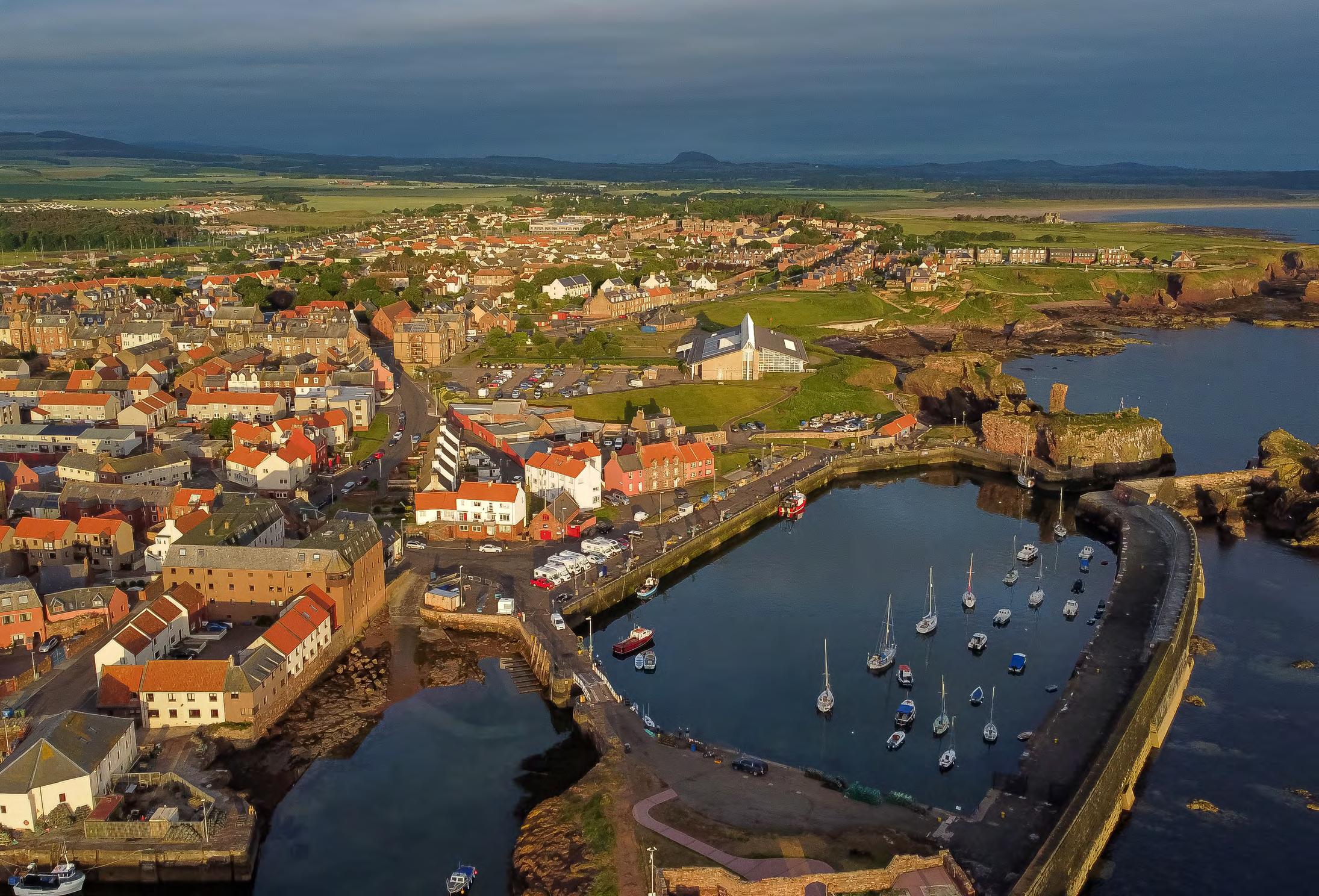
McGrath’s interest in generational tension also runs through Last Light, a play about respect, memory, and the sea. “It’s about how we approach things. So in that context, it’s about how the characters approach their relationship with the sea and the fishing community.”
The play follows multiple generations living in Dunbar. Some, like Sarah, fundraise for the RNLI after losing a relative at sea. Others, like Fionn, chase TikTok fame by tombstoning off dangerous cliffs. “He’s trying to show off... and it’s about how he doesn’t really understand what the big deal is.”
“There’s a boy called Declan who’s really respectful... he goes out fishing with his grandfather.” Then there’s Douglas, that grandfather: “he’s always out there fundraising for the RNLI, but gets frustrated that young people don’t seem to understand.”
McGrath says the RNLI’s presence in Dunbar is huge: “people volunteering and putting their lives at risk to do that... it’s a thing that weighs heavily on that community because it has saved lots of people’s lives.”
Writing for Young People
While she writes plays for adult audiences - with “dark comedy and really strong, provocative themes” - McGrath is equally passionate about writing for children. “My whole other agenda as a playwright is writing for young people... I think theatre in schools could be a lot better.”
Access is key: “a lot of children don’t get to see the theater through a variety of reasons, often socioeconomic... it’s lovely to go to a theatre, but with the reality of funding for schools, it’s much more manageable to get a play into a school.”
She directs young people regularly and draws from this work in her writing. “You need to care about your characters... children really respond to comedy and heartwarming characters.” Though their interests may differ, they still know when a story rings true. “A good story is still a good story. And children recognize that.”
Meaning and Subtext
For McGrath, the ultimate aim is resonance: “My ideal audience member would be somebody sat in the audience and they’re laughing, but they’re also not sure whether they want to cry
and both responses can work alongside one another.”
She wants the audience to be engaged, not spoon-fed. “Don’t give them everything at once. The audience don’t want to have it handed on a plate. Make them work for it.” Her acting background helps her shape dialogue and drama. “I can picture myself doing that, you know, reading the dialogue in a dramatic way.”
Much of her work is grounded in the dynamics of family. “There’s usually some element of conflict somewhere, because everybody has their own bias or perspective. But also we’re loaded with this kind of feelings around family links. People have perceptions of who you are and how you’re perceived within a family. I think that’s interesting, especially with intergenerational relationships, every individual sees everyone else through a
different lens and then that creates its own drama in itself. The different roles that people play within their own family.”
Loneliness is another recurring theme. “It’s in Feis, actually... you could be in a room, but you’re acting like strangers.” The play is about those things left unsaid. “What’s not being said here? And then eventually it might come out and it just sparks a fire, which I enjoy.”
Space, Place, and Performance
McGrath embraces unconventional theatre spaces in both her professional and educational work. “I quite enjoy interesting spaces and making unconventional spaces into theatrical spaces. I do that a lot in the school that I work in. They don’t have a theatre, so I transform a lot of spaces into theatres.” She once staged a Shakespeare perfor-
mance across multiple outdoor sites: “I did a whole Shakespeare using a big garden at my school, and I did a whole Shakespearean roving performance.”
One memorable staging involved blending The Tempest, Midsummer Night’s Dream, and Romeo and Juliet in a single outdoor production. “The play starts off at the swimming pool... we had all the children diving into the pool in the scene... and then the heavens opened and there was a storm. I was like, this is a Tempest.” While the weather disrupted the rest of the play, it brought an intense theatrical realism to the storm scene. “It was really theatrical.”
Looking Ahead
Beyond theatre, McGrath is now working on a TV Drama pilot with her friend Lauren Hurwood, a recent graduate of the Channel 4 TV Writer’s Programme. “I’m really enjoying the collaborative process and I’m excited to pitch our screenplay to producers soon”
Whether writing for young audiences or tackling the intricacies of diaspora, identity, and loss, Anna McGrath keeps circling the same human truths: what we pass down, what we hold back, and what we fight to keep alive.
She continues to be inspired by space and place. “I like redefining spaces and creating a space where you can make anywhere performative very quickly with the right setting, in the right performance.” And she’s not finished: “I really want to do a play in a boat. I want to get something out at sea. Or in a dock or a harbour.”
Find out about Anna’s work via her website: annateresamcgrath.com
Dunbar, Scotland
Ben Ingoldsby Cinematographer
From flax fields in Tyrone to borderlands in Mexico, Ben explores culture, vulnerability and sensorial truth - framing human connection across documentary and narrative film.
In Tyrone, the story begins with a Flax Meitheal - a community gathering organised by Fibreshed Ireland and centred on flax for the making of linen. Ben Ingoldsby was among those taking part. Although the weather prevented harvesting, the day unfolded as one of talks and shared knowledge, setting the tone for what followed.
For Ben Ingoldsby, a cinematographer working between Ireland and Mexico, these moments of shared experience carry weight. From flax fields in Tyrone to film sets across Dublin, Mexico City, and the American Midwest, his work is rooted in the intersections of culture, space, and emotion.
A Sideways Step
“My trajectory over the last couple of years has kind of taken a
turn. I stepped kind of sideways, I suppose. I actually came off my bike in Mexico and slipped a disc in my neck.”
That accident forced Ingoldsby to pause his camera work and rethink his practice. “I wasn’t able to carry a camera for a bit and in the meantime, I started to get asked out on set as a camera assistant.”
The change gave him unexpected insight: working closely with other cinematographers, he was able to watch in detail how they solved problems, managed crews, and lit complex scenes. “It’s been really interesting to see how other DPs will make choices and problem solve and how they manage sets and choose to light. Usually you’re the only one doing it on set, so it was inspiring to have that kind of perspective.”
Learning From Others
“I’ve been able to be on set with people who I would have looked up to before… unofficially shadowing them. I was able to take a lot from those experiences. It’s been really, really inspiring to see - on a different scale than I would have shot previously.”
On larger productions, Ingoldsby observes the constant balancing act of cinema. “It’s all about trade-offs. You’re constantly having to deal with compromises or finding some other way of getting to the same place. That’s been really interesting to see and then to take into my own practice.”
Managing Recovery and Tools of the Trade
“I’m now at a place where I can work again… I know it’s some-
thing I’ll have to manage from now on, but thankfully I’ve been able to keep on top of it, so it hasn’t stopped me.”
He also reflects on the differences between industries. “Here in Ireland, there’s a real imperative for cinematographers to own their own camera package in a way that hasn’t been the case in Mexico or in England, where I studied. I’m now among the cost of getting my own camera package sorted. Which will give me the freedom to work how and where I want.”
Mexico as a Hub
“Mexico is really the biggest filmmaking hub in the Spanish-speaking world… by size, Mexico City is the biggest in Latin America. I was ble to get on jobs that involved both Mexico and the US. I feel really privileged to be able to witness those kinds of stories.”
Ingoldsby rejects the clichés
of how Latin America is represented on screen. “You’re not in Mexico if you don’t have the sepia filter on,” he laughs. Instead, he insists that what he encounters is a shared familiarity. “It really feels that way when you’re there… the spaces are designed maybe differently, but it really feels very familiar. I think that’s just kind of responding to that truth.”
Shared Histories
The shared familiarity of space often comes through in Ingoldsby’s imagery - like an establishing shot of a wall dedicated to Catholic iconography in a family home, echoing similar walls in Ireland. It was in this context that he reflected on deeper cultural ties. “There’s a long-standing connection. Are you aware of the San Patricio’s - the Saint Patrick’s Battalion? They were a battalion of mostly Irish conscripted soldiers during the US invasion of Mexico… they abandoned the American army
and joined the Mexican side. That is kind of the basis of Mexican-Irish diplomatic relations ever since.”
These threads of cultural solidarity continue to inspire him. “Being in those spaces is really special. It’s really inspiring. And it feels very familiar.”
A Personal Journey
“I studied with a lot of people from Mexico who spoke really highly of the the diverse industry there, (including my partner!), so I always had this curiosity to explore this other culture I was already absorbing.” Making that step opened up new creative ground and exposed him to different ways of seeing and telling stories.
Sensorial Truth
“For me, work on set is about being able to react to a scene from the most childlike, vulnerable place that I can put myself

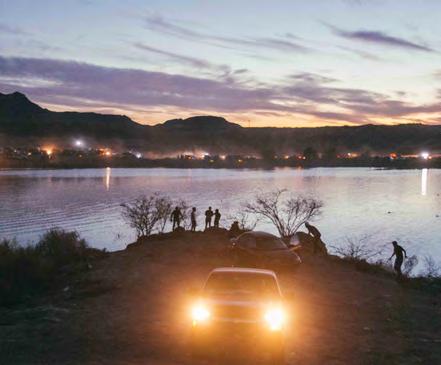
El Paso City
in. I’m always looking at how to create the conditions to get myself there. That’s something I learned through working as a documentary filmmaker - many times you’re just showing up for the first time in a new environment, and it’s all about how you react to something unfolding in real time.”
That ethos now shapes his narrative work. “I like to have that as an invitation for the viewer to participate in the image emotionally, as I’ve been participating in the scene emotionally. How can I subvert the conventional way of coverage? I’m always looking at how to subvert ending up in those kinds of situations.”
Expanding Sensorial Truth
Ben reflects more deeply on what sensorial truth means for him in practice. “As the director of the image, I see my primary responsibility as creating a window for the viewer to come into the scene and the characters’ stories as an active participant, forming their own connections and reactions to what’s unfolding before them, to tune into the humanity of the moment in the story. If that invitation isn’t created through devices of camera movement, framing, lighting and lens choice and even the length of the shot, in response to the blocking of the scene and the characters’ needs, fears, wants and desires, then I see the characters’ experience as still being untold.”
“The sensorial truth has not been externalised, the underlying emotional realism that every scene potentially has is not engaged with by me and as a consequence, the viewer and the experience is passive and in my opinion, a failure. Being in search of that is really what has informed my image-making and in turn how I work on a practical
level on set, across narrative and documentary formats.”
This search also ties to his personal history. “I’m really interested in the emotional experience because of my own lived experiences and traumas, particularly around a lack of communication and having needed to approach many everyday situations in my own context through emotional analysis first. I feel the need to make a comment and communicate that through my art, and to tell stories - which is to do something my ancestors didn’t.”
“To bring that approach to the container of someone else’s story and be in service of others’ stories and ideas is a way for me to constantly keep learning and discovering different ways of seeing and understanding.”
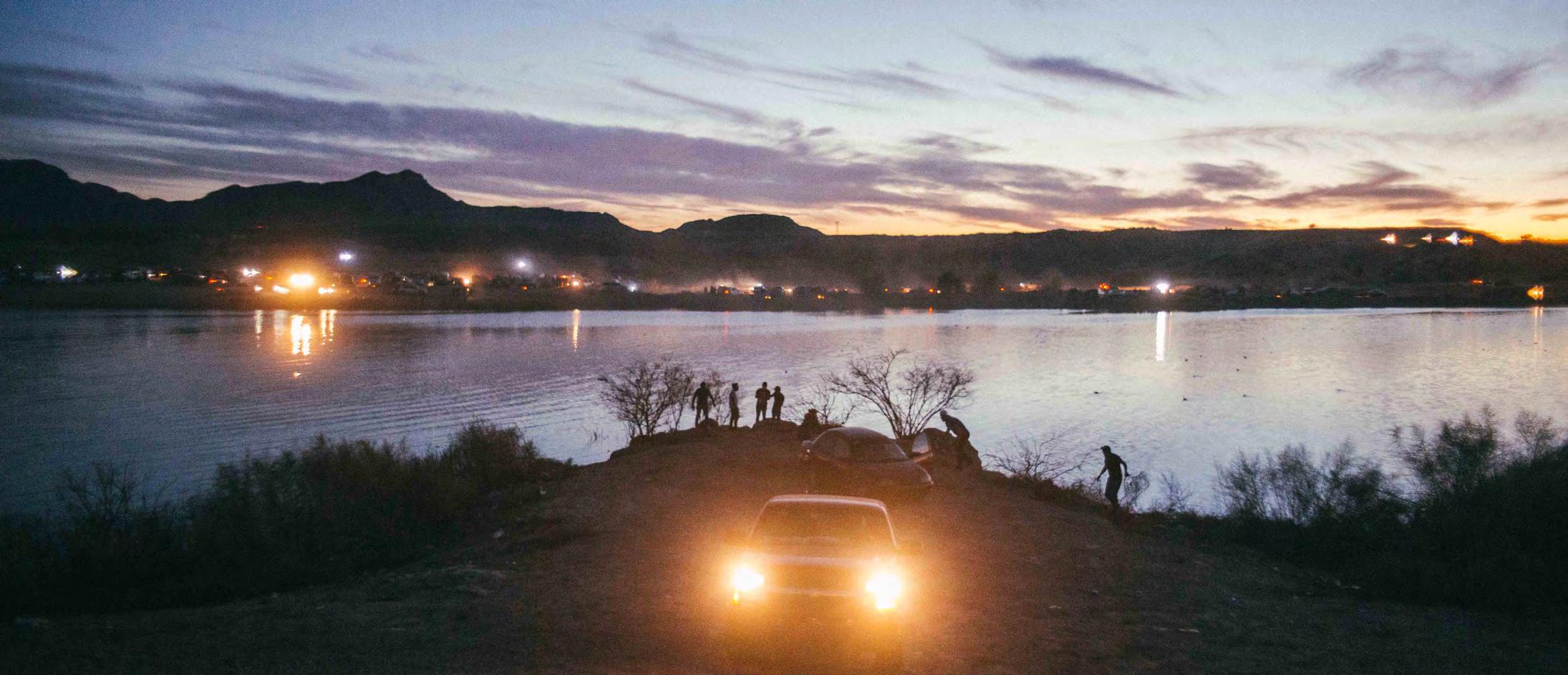
The Bridge
In 2021 Ben worked on The Bridge a short documentary - “It really started with the wedding officer, who conducts civil ceremonies all over El Paso, Texas. There’s a local statute that you can get married anywhere within the city limits, which includes half of the International Bridge. He’s been marrying people there for maybe 10 or 15 years.”
Through him, Ingoldsby and the director connected with a Mexican-American couple. “When you see a wedding in the middle of a border bridge - it’s obviously pretty unusual. But then I asked: who could this film be for? It’s a very specific local context, but it’s also universal.”
His own life gave him an anchor to the project. “I suppose I had this connection through my own experience of being in an international relationship. That meant I was really able to see myself in the story, which was
really cool - because then you’re just hooked.”
Vulnerability on Screen
Using vulnerability has paid off for Ben in the moments he captures. “We were in the living room in Iowa long enough that the veneer dropped. The mum just had enough, and we were able to really see the challenges of what was going on. It wasn’t voyeuristic. It was like they hadn’t had that conversation before. By showing up with vulnerability, we triggered vulnerability in them.”
For Ingoldsby, these moments carry across formats. “I’m always kind of looking to see how can I tune in to those deeply human moments in narrative work. Is it possible to get to that kind of space?”
Returning Home
“I’m really excited to tell more stories from here, from my own community. Even before I came off my bike, I felt a longing of, oh wow, I’m doing it here so far away, but I’d love to bring myself to tell stories where I grew up.”
He cites influences like Pat Collins, director of Song of Granite and That They May Face the Rising Sun. “His storytelling really resonates with me. Stories from here, told with that kind of lyricism, are some of the most exciting to me.” Spending more of the year in Ireland feels like a new beginning. “In many ways, it feels like finding my voice allover again and I’m really excited for what that can look like.”
Find out more about Ben’s work via his website: beningoldsby.com
And keep up with him on social media: @ingoldsbyben