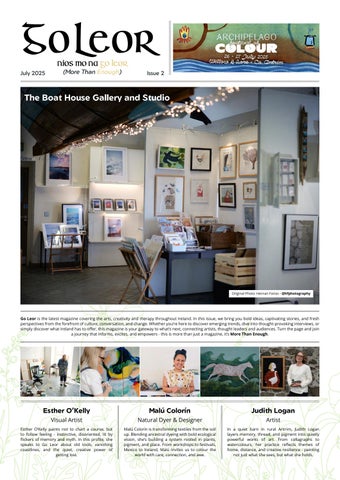
Go Leor is the latest magazine covering the arts, creativity and therapy throughout Ireland. In this issue, we bring you bold ideas, captivating stories, and fresh perspectives from the forefront of culture, conversation, and change. Whether you’re here to discover emerging trends, dive into thought-provoking interviews, or simply discover what Ireland has to offer, this magazine is your gateway to what’s next, connecting artists, thought leaders and audiences. Turn the page and join a journey that informs, excites, and empowers - this is more than just a magazine, it’s More Than Enough
Esther O’Kelly
Visual Artist
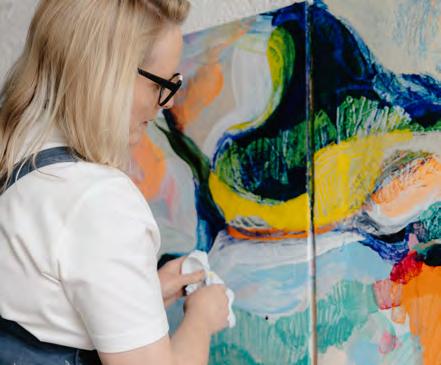
Esther O’Kelly paints not to chart a course, but to follow feeling - instinctive, disoriented, lit by flickers of memory and myth. In this profile, she speaks to Go Leor about old tools, vanishing coastlines, and the quiet, creative power of getting lost.
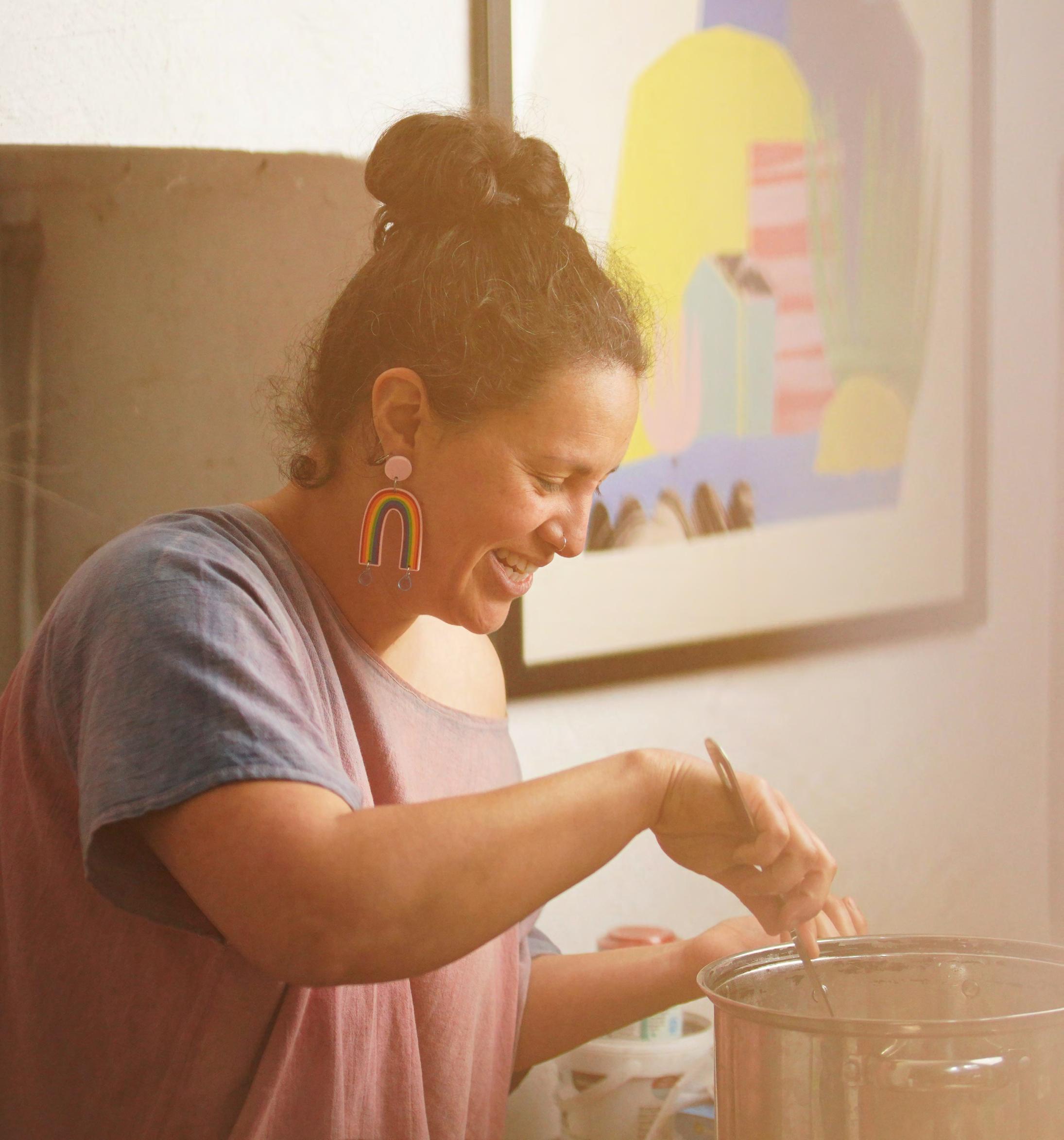
Malú Colorín Natural Dyer & Designer
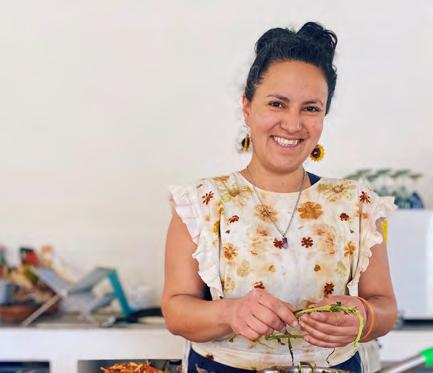
Malú Colorín is transforming textiles from the soil up. Blending ancestral dyeing with bold ecological vision, she’s building a system rooted in plants, pigment, and place. From workshops to festivals, Mexico to Ireland, Malú invites us to colour the world with care, connection, and awe.
Judith Logan Artist
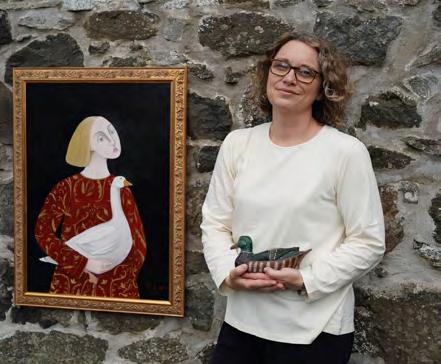
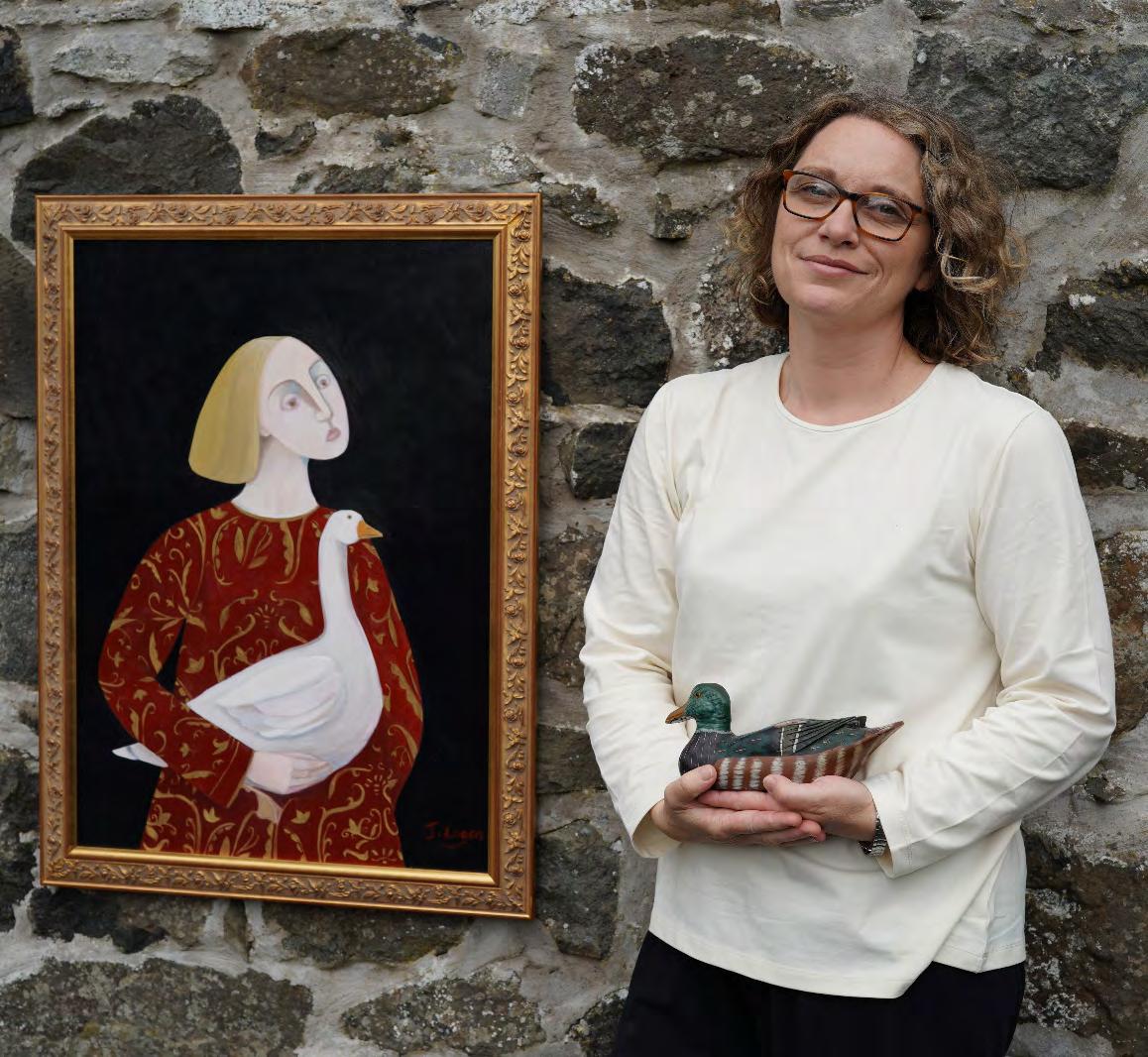
In a quiet barn in rural Antrim, Judith Logan layers memory, thread, and pigment into quietly powerful works of art. From collagraphs to watercolours, her practice reflects themes of home, distance, and creative resilience - painting not just what she sees, but what she holds.
Original Photo: Hernan Farias - @hfphotography
Issue 2 - July 2025
Judith Logan Artist Page
Esther O’Kelly
Visual Artist
Malú Colorín
Natural Dyer & Designer
We’re always on the lookout for fresh voices, bold ideas, and stories that matter. If you have a topic you’re passionate about, a request for something you’d love to see featured, or an idea you think deserves a platform, we’d love to hear from you. Go Leor is built on conversation and collaboration, and your input helps shape the future of the magazine. Get in touch with the editor via aidan@goleor.co.uk - let’s create something great together.
Interested in advertising with Go Leor? Partnering with us puts your brand in front of a vibrant, engaged audience of curious minds, creative thinkers, and culturally-aware readers who value authenticity and innovation. Our publication reaches a diverse mix of young professionals, artists, changemakers, and trendsetters who are always seeking what’s next. With a focus on creativity, events and exploration, whether you’re launching a new product, promoting an upcoming event, or building brand awareness, we offer tailored advertising opportunities to help you make a meaningful impact. To explore how we can work together get in touch with us at advertising@go-leor. co.uk
At the centre of Go Leor Issue 2 are three extraordinary women whose work - in paint, pigment, and print - quietly reshapes how we think about creativity, care, and place.
Esther O’Kelly, Malú Colorín, and Judith Logan don’t just make art; they make meaning. Across vastly different practices, each one invites us to slow down, to look closer, and to consider the deeper systemsemotional, ecological, culturalthat shape what we create and how we live.
Esther’s work embraces disorientation as a method, trusting the strange paths that lead somewhere true. Malú brings ancestral knowledge and environmental insight into every workshop and dye bath, treating colour as both story and strategy. And Judith, in the stillness of rural Antrim, reminds us that the domestic, the seasonal, and the personal are not separate from art - they are its very material. Each story has left me deeply inspired - not just by what they create, but by how they move through the world.
Aidan McGrath
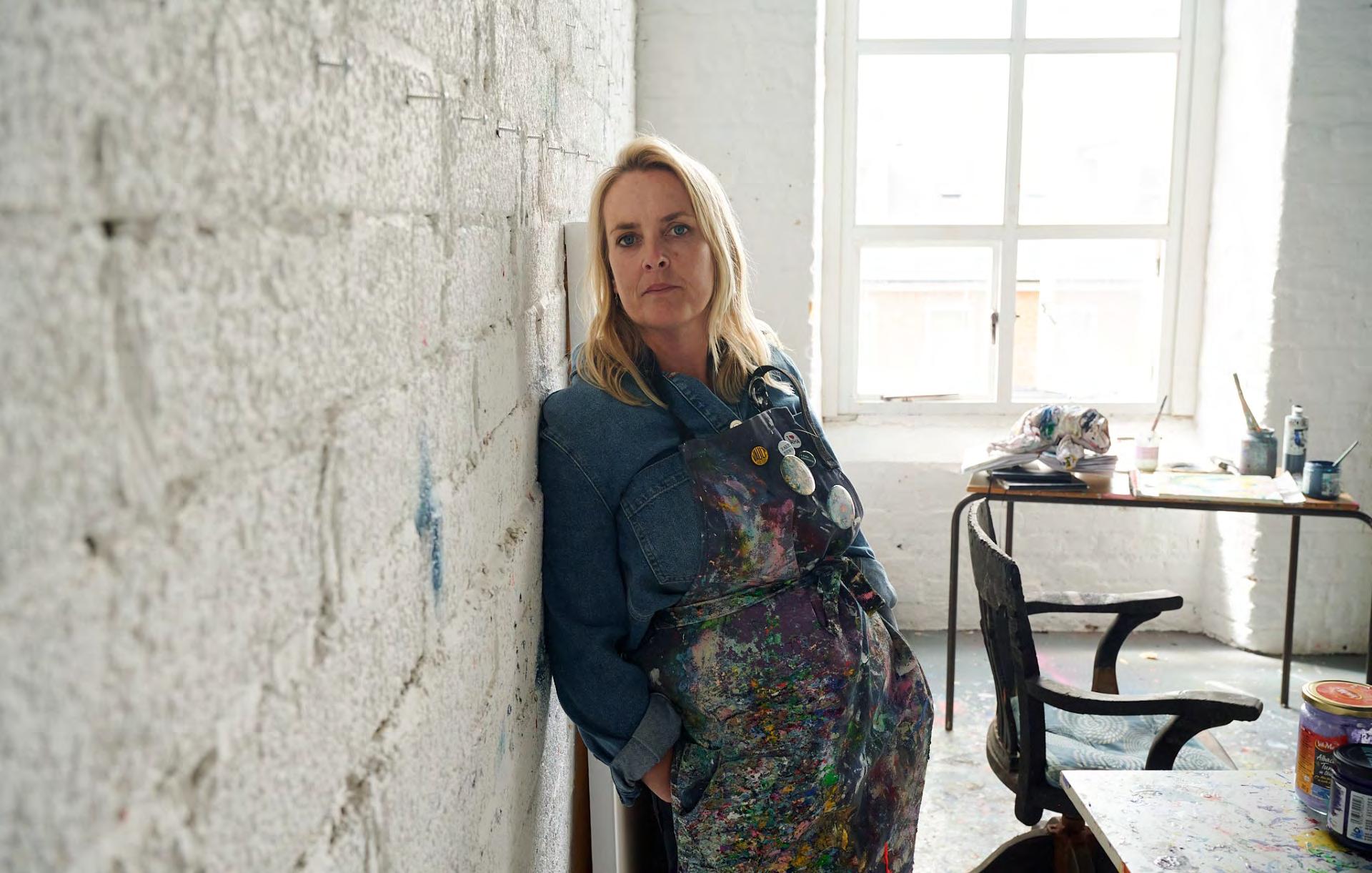
Esther O’Kelly Visual Artist
Out of the Field and Onto the Canvas: Esther O’Kelly on Creative Disorientation, Confidence, and the Path Through The Stray Sod and Seachrán Sí
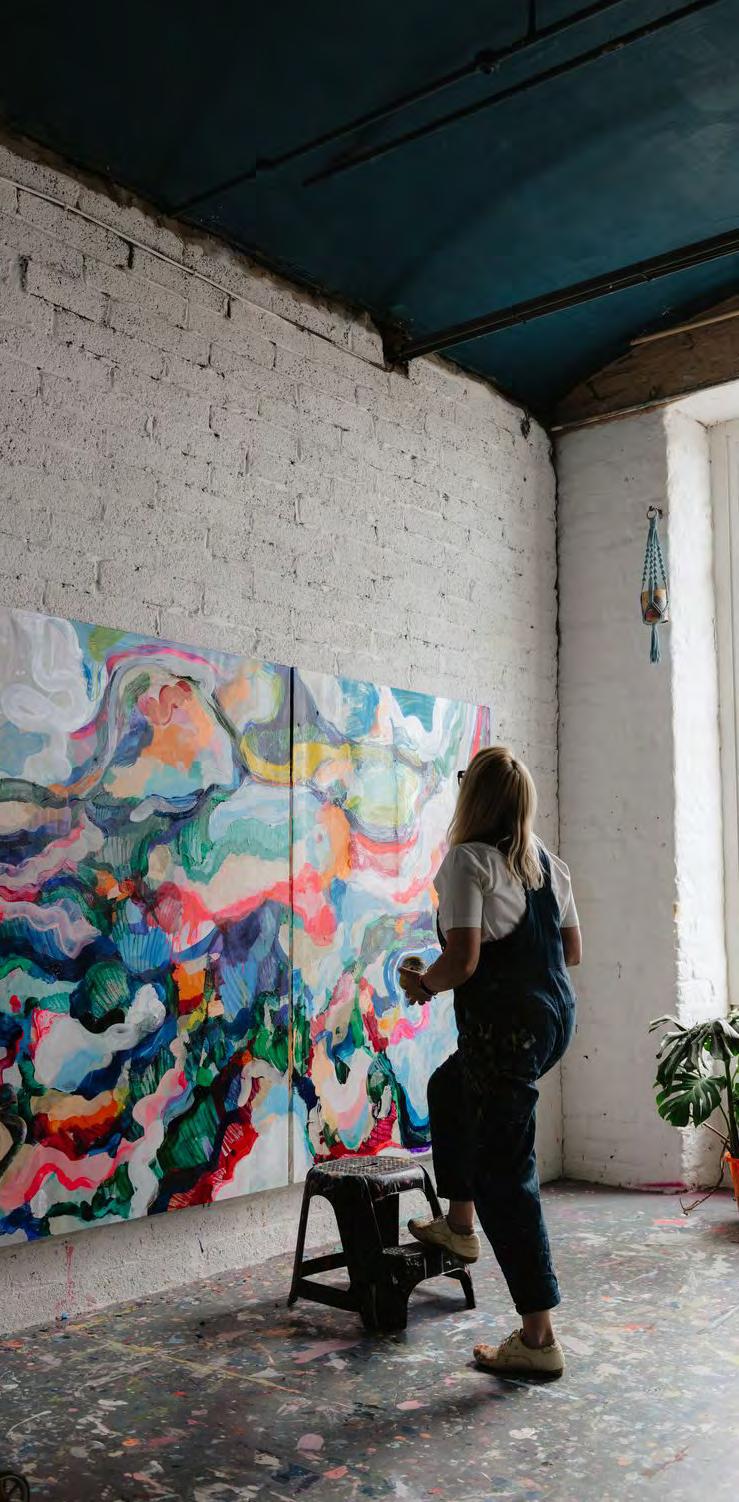
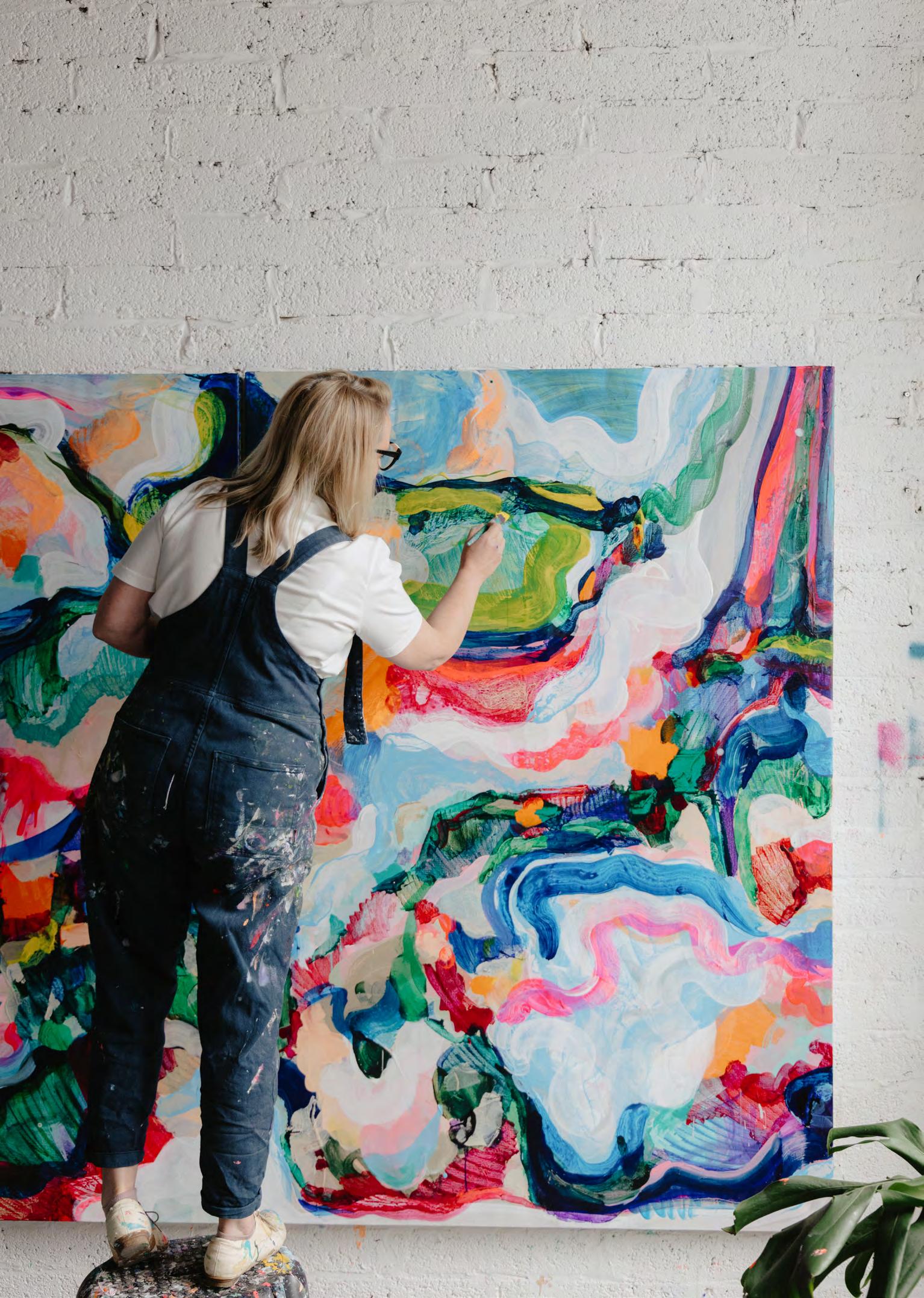
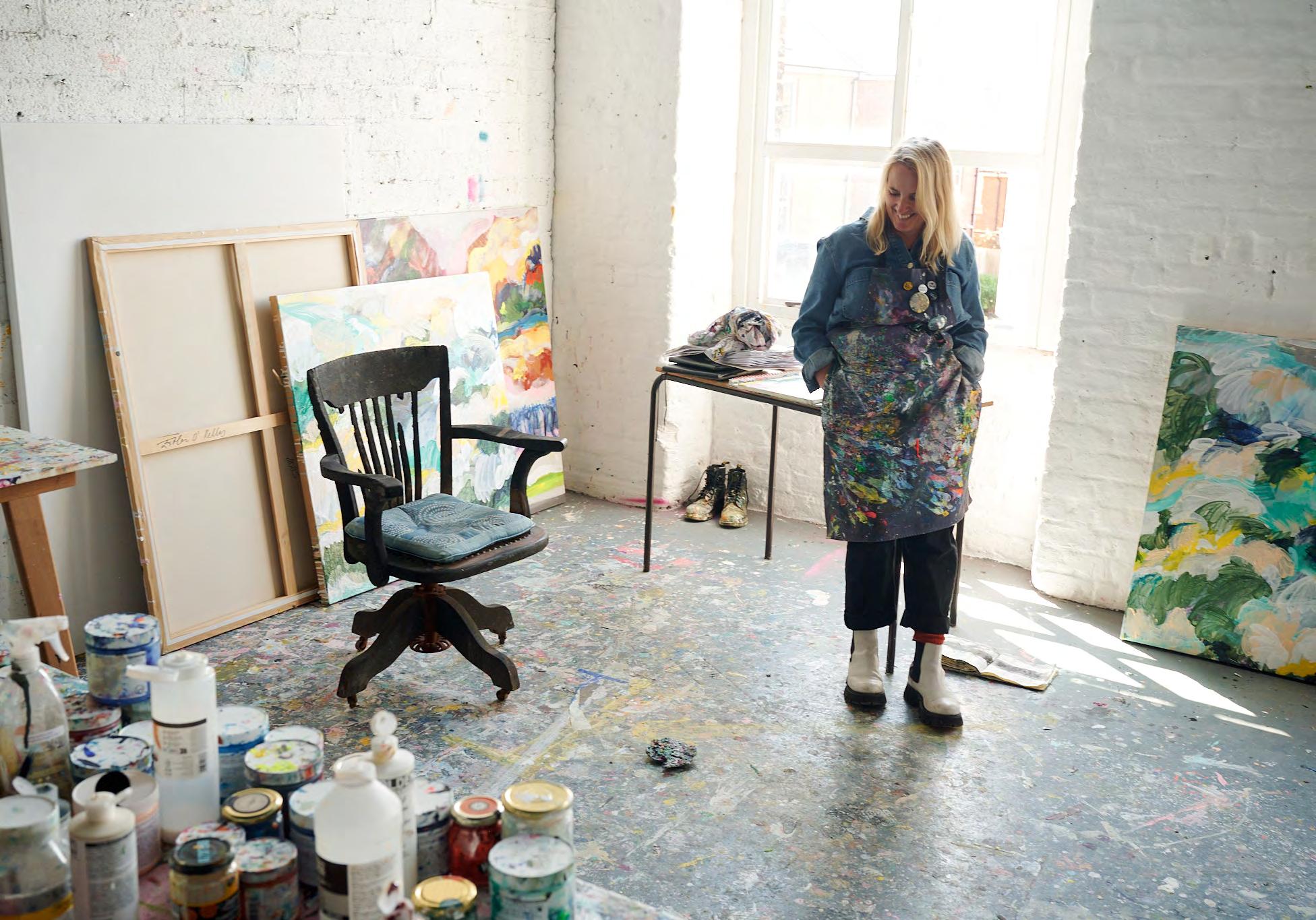
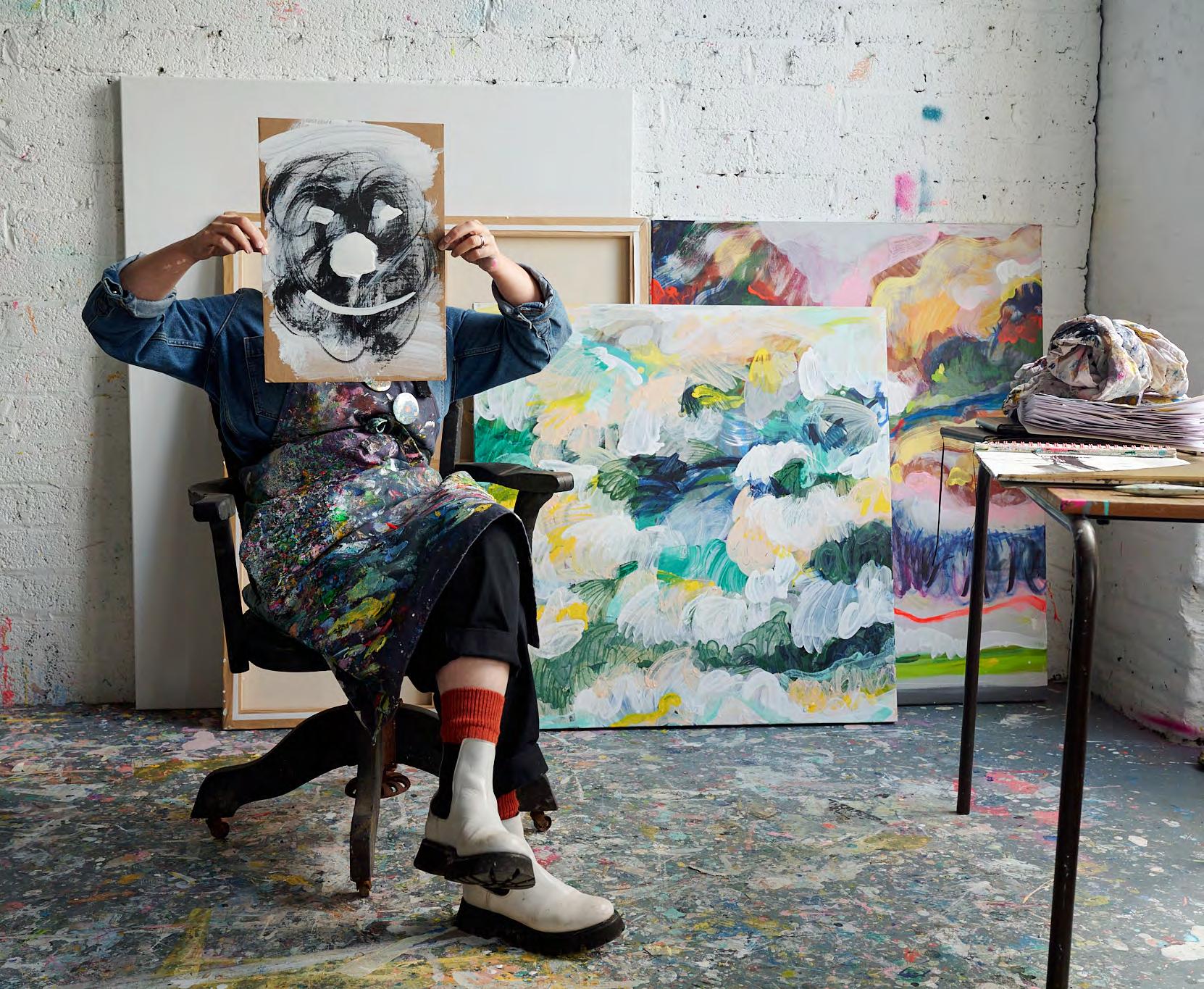
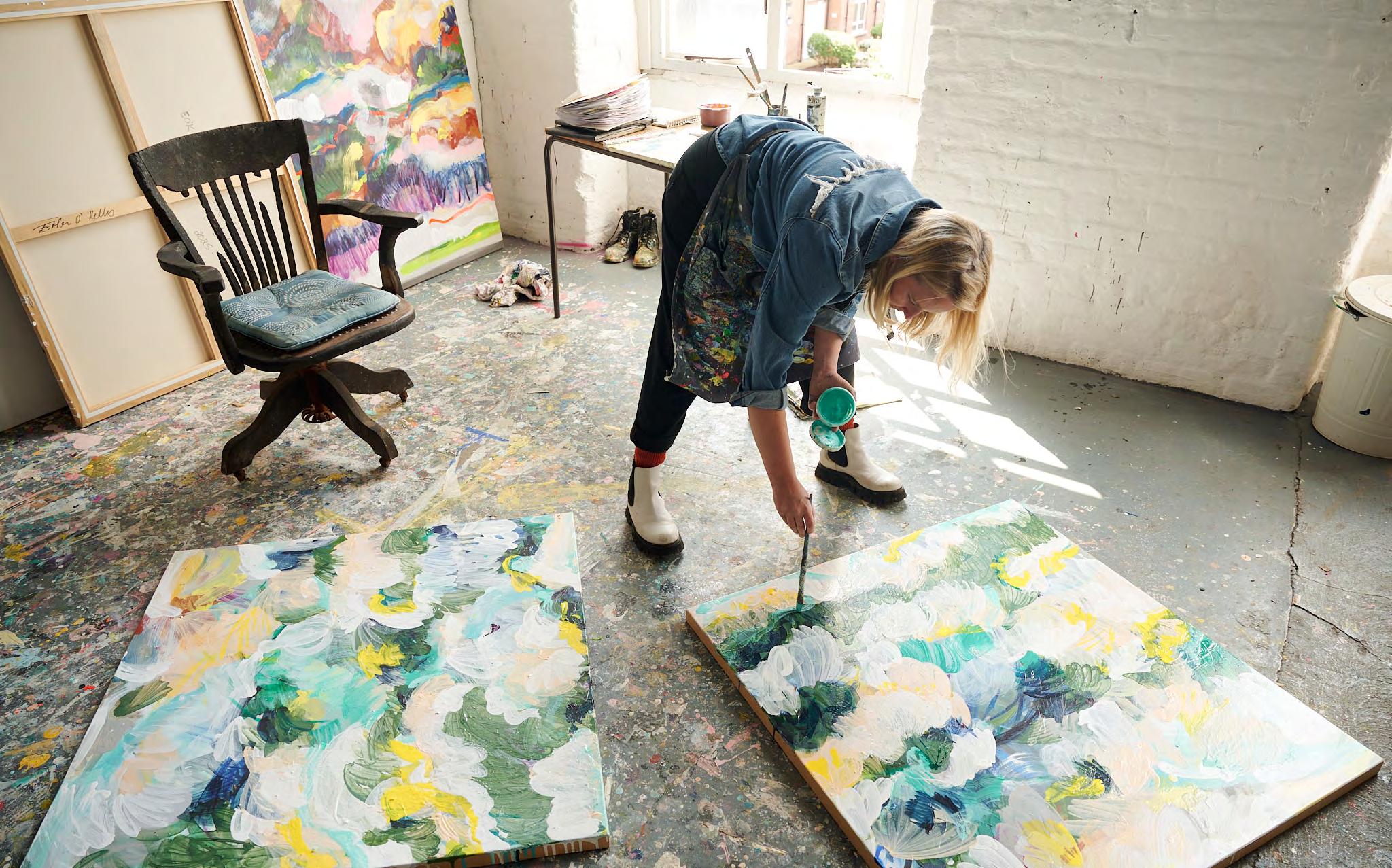
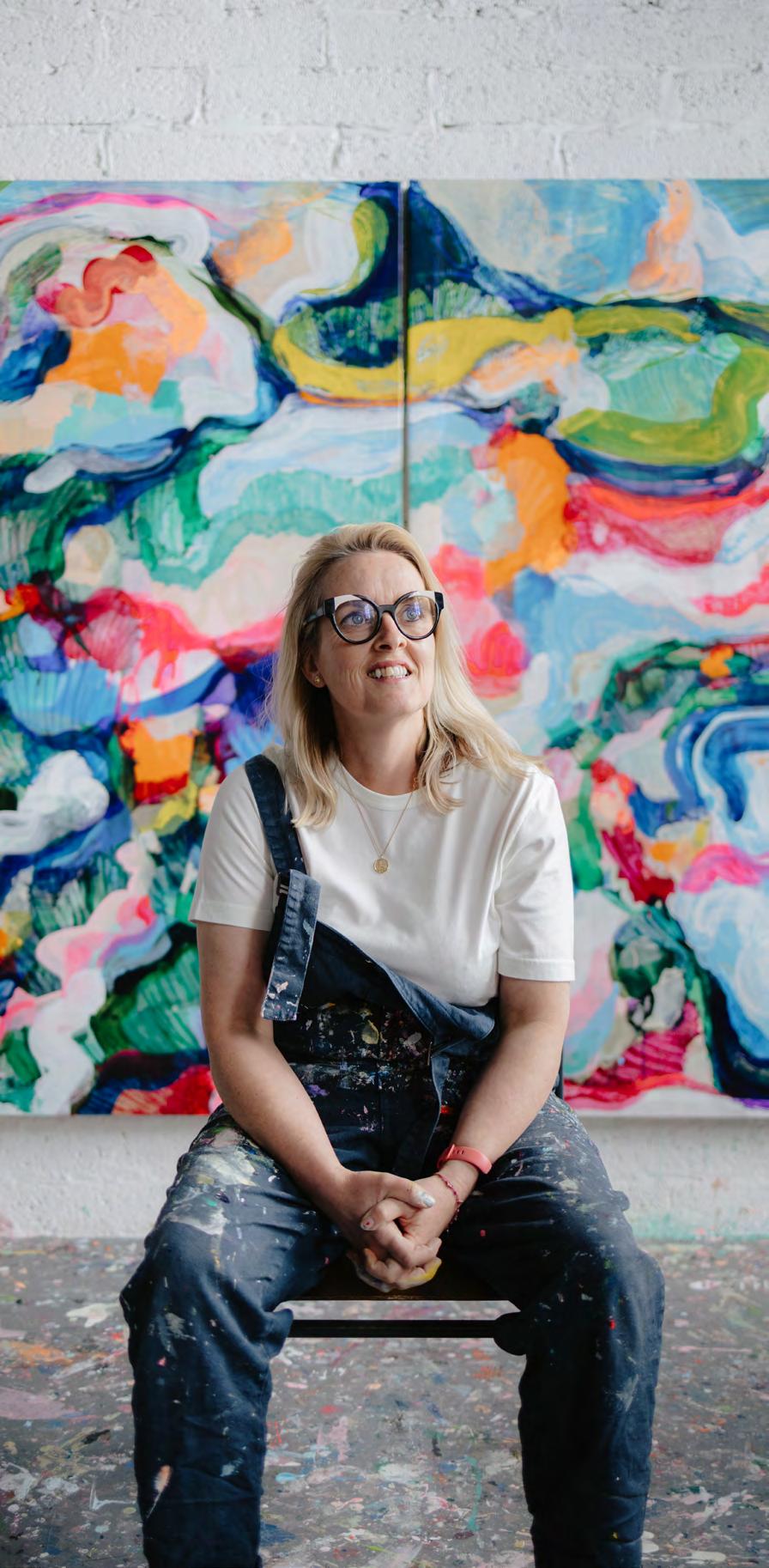
Esther O’Kelly doesn’t paint like she’s following a map. She paints like she’s gotten lost - and likes it. Her practice, rooted in paint and landscape, moves with the logic of instinct, weather, and memory.
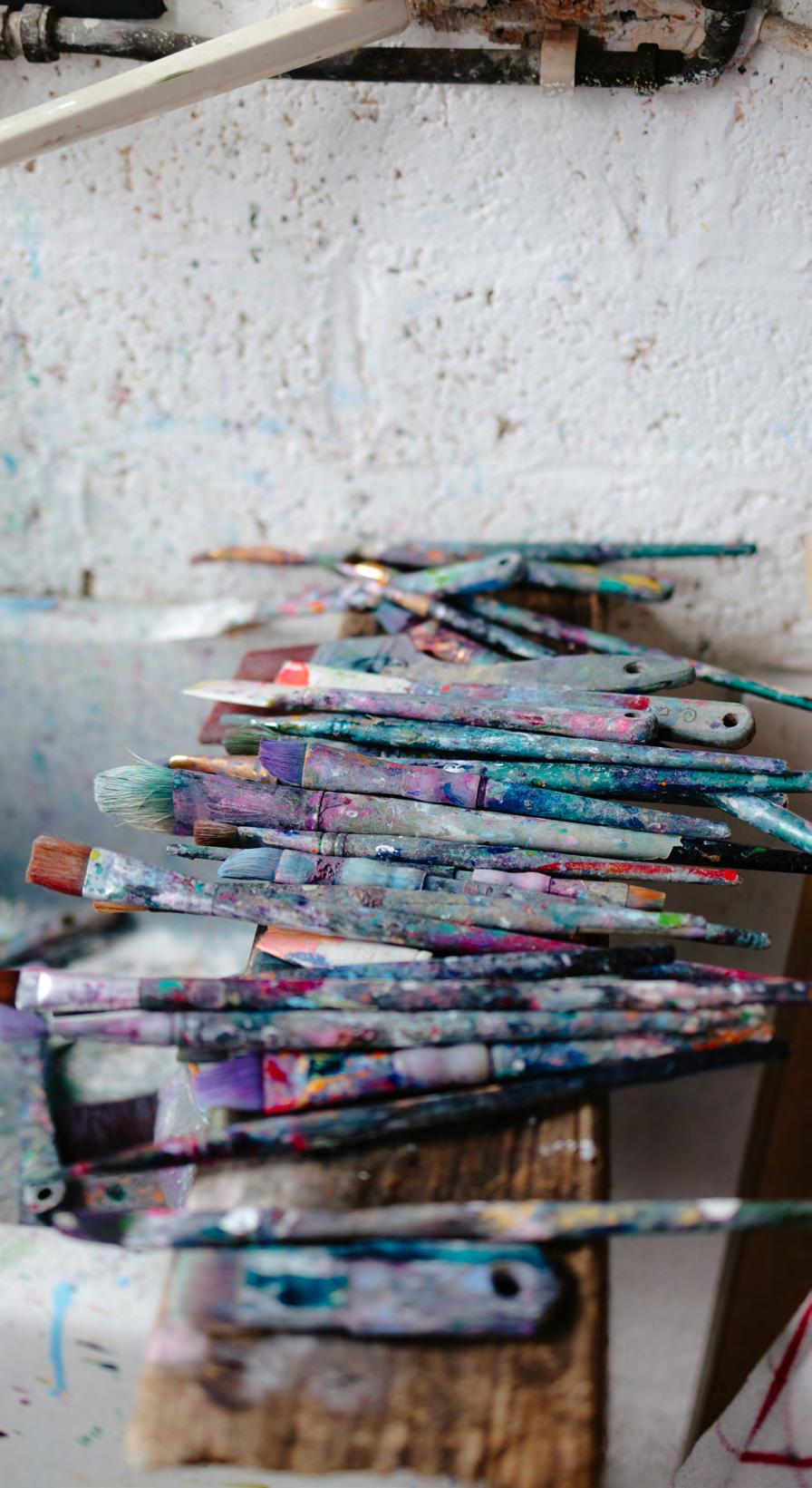
Some of her earliest tools were gathered not from art shops, but from her mother’s kitchen drawer - old icing spatulas that proved unexpectedly useful in shaping and scraping her work. Later, she turned to her father’s Opinel knives, originally used for fishing net repairs, discovering their perfect balance of sharpness and flexibility for
pulling paint. These inherited tools, filled with memory and function, became part of her unique mark-making language. From her home in Belfast, she spoke to Go Leor about what it means to work within disorientation, the discipline of letting things sit unfinished, and why she’s still in the field, looking for the light.
“The practice is very much about disorientation and discovery”
“I had this idea for a show, but I’m not finished yet,” she says. “I still… it’s still kind of like in
my head and it’s still where I’m at with the practice.” That idea - The Stray Sod - has recurred across multiple exhibitions and continues to guide her studio practice. One such iteration appeared at the Pig Yard Gallery for the Wexford Opera Festival, but the concept has remained central and generative. “It’s ironic really,” she adds, “because the whole concept of that… you know what that’s about, you know, people getting stuck in fields.”
Known in Irish folklore as Seachrán Sí, this idea of becoming disoriented or led
Photo Credit Jack McGuire
astray - sometimes by spirits, sometimes by a flickering light - offers Esther both a visual and emotional framework: a metaphor for the artistic process itself.
“That’s actually just such a strong metaphor for the studio practice,” she says. “The idea of people following lights - like in Wales, where they call it the will-o’-the-wisp or ‘Pwca’ or ‘Ellylldan’ - those flickering lights in marshes that are said to lead people astray. I think that’s how artists work anyway - If there’s no light in the work, it’s just a void.”
For Esther, light becomes both literal and metaphorical - a visual anchor and a navigational tool within the emotional terrain of painting. The folklore of the Seachrán Sí, in which a person might become lost in a field unless they find and follow a mysterious light, maps precisely onto her relationship with creative progress. “You kind of do follow the light in the painting,” she reflects. “The practice is very much about disorientation and discovery in the work… it keeps my head in it and occupied. And it also makes me laugh, you know, because I have been stuck in a fair few fields in my life.”
Her paintings emerge from that process - the following, the uncertainty, the pull toward some faint glimmer. “My work is about people and place and landscape… I find that like a really kind of fruitful ground for the work at the minute.”
Seasonal change plays a profound role in how Esther experiences and creates her work. She speaks of winter as a time when the world contracts - when the absence of light can provoke both introspection and instability. During a residency in The Tyrone Guthrie Cen-
If there’s no light in the work, it’s just a void.
Photo Credit Kate Donaldson
tre, she encountered Brendán Begley, master of traditional Irish accordion playing and a native Irish speaker from Kerry, who described January with the phrase “síos síos síos” - down, down, down - capturing the spiral so many experience in the darker months. For Esther, this idea resonated deeply. “In the winter,” she says, “I go really feral in the studio,” describing periods of creative chaos and internal disorientation. But these spirals are not voidsthey are the undergrowth, the buried seeds of spring. Out of this seasonal descent comes
eventual renewal, a return to light and canvas.
“It’s like a health farm for artists”
Time and space are necessary to her process - and hard won. “I’ve got a family, so I haven’t really had the opportunity to leave home much,” she shares. But a recent residency in Monaghan changed something. “What was really incredible about it was how central the artist is to the place… there’s a real nourishing, homely kind of atmosphere about it.”
She describes the experience with a kind of wonder: “Everyone says your name over and over… you’re at the centre of the table and there’s conversation all around you… you go through your life feeling like it’s not a valued profession… then you go to these places and you realise actually it’s a really important job.”
That contrast is stark. Back in Belfast, she says, “We have this phrase… ‘Suitable for Artists or Storage,’” referencing a project started by her friends Neal Campbell and Jane Morrow in response to the state of artist studios in the city. And yet, even with such limits, she’s built a career with stubborn generosity - opening her studio to her children and their friends, despite the chaos it sometimes brings.
She also mentions artist Eimear Maguire, whose profile in Go Leor she had read and who she personally knows. Esther speaks with clear admiration: “She’s been around a while and she works on her own from home, and she’s got an awful lot going for her, like, you know.” Reflecting on the transformative effect of Eimear’s recent residency, she adds, “You could see what happened to her when she went on residency. You can see how it transformed her work so quickly… it just allowed her then to kind of flourish.” Esther’s appreciation is both personal and artistic: “She’s one of these people that is just like, you know, buzzing all the time… you can see her a mile away, like she’s just so radiant and just, you know, just has all this incredible stuff going on in their head.”
“I don’t want to show you what it looks like - I want to show you what it feels like”
“I have climate anxiety just like the next person,” she confesses. “So I think half of the time, how
Photo Credit Kate Donaldson
I’m coping with it is I’m escaping into the landscapes.” But these aren’t gentle escapes. “They’ve always been supernatural and quite intense and not calm places… there’s a little bit of turmoil in them, you know?”
Growing up in Rosslare’s shifting coastal terrain, that feeling has been lifelong. “We were constantly anxious about my father’s house, my auntie’s house… pretty much a king moon and high tide would take them.” Some parts, like The Fort, have already disappeared, swallowed by nature’s relentless reshaping. Until the mid-1920s, a long sand-spit extended north from Rosslare, ending with a small fort - Rosslare Fort - protecting Wexford Harbour. But a severe storm in the winter of 1924–25 breached the spit, and progressive erosion washed both the fort and its land away. Today, the only trace visible is a lonely island revealed at low tide.
The loss of The Fort stands as a stark reminder: the land that nurtured generations can vanish in a heartbeat, and with it, the memories it held.
She mentions her husband, Paul, co-founder of Brink! a platform for discussion, education and action centred on the issues of climate breakdown, who is deeply involved in climate and sustainability. “That’s why I say I have to be careful when I talk about environment,” she says, “because it’s so complex. But I feel like my work is reacting to it.”
Her response isn’t documentation - it’s emotional cartography. “It doesn’t make sense for me to document a landscape. I want to talk about how it feels.” She works from sketchbooks made while walking. “I draw while I’m moving… I just want to kind of feel and hear everything.”
When it comes to finishing a painting, she holds herself to a
Photo Credit Jack McGuire
Photo Credit Kate Donaldson
particular kind of resolution: “It needs to end on a high note… but I’m not done with this notion yet, so I have to move it on to the next piece.”
“You go through school thinking you’re a bit thick”
Esther speaks candidly about her struggles with dyslexia and school in the 80s and 90s. “You go through school thinking you’re a bit thick… then you arrive in art college and realise, ‘Oh, I’ve found my people.’”
In spaces where her way of thinking made sense, Esther began to realise she wasn’t lacking - she’d simply been in the wrong room. School had underestimated her, even discouraged her from applying to NCAD (National College
of Art and Design), saying no one from her school ever got in. But she did. That shift in environment didn’t erase the challenges - but it reframed them.
Numbers, she says, were “double Dutch,” and writing coherently never came easily. “So for those reasons, it’s taken me a long time to get over being in front of people and speaking with any authority. Actually, I would find presentations and talks quite a challenge.” But she’s reached a point where that no longer stops her.
Finding her place among artists didn’t just affirm her abilities - it gave her the confidence to speak, share, and teach, even if that journey took time. Art college wasn’t
just a change of direction. It was a change in atmospherewhere difference was not just accepted, but essential.
She credits the artist Joy Gerrard , who mentored her, with helping shift her perspective. “She’s very generous,” Esther says. “She would say, just ring me if you ever want to talk anything through.” When she doubted whether she was qualified to present her work publicly, it was Joy who reminded her: “Maybe they want to know about your practice.”
Esther’s still learning to speak about her work with confidence. “It’s taken me a long time to get over being in front of people… but the reason I do them now is because I just don’t give a shit anymore.” Her
Photo Credit Jack McGuire
humour and honesty crackle. “You start seeing people around you, half your age… confidently embracing their space and you just go, ‘Oh, I’m holding myself back here.’”
“It starts with pacing - and storytelling”
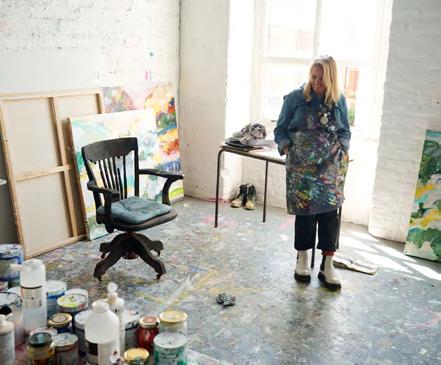
Esther’s studio process is as instinctive and layered as her paintings. “I cycle down, go in, open all the windows. And I literally, I pace,” she says.
Her studio rituals are quiet and sensory - filled with brushes, textures, light, and sound. In the past, she had a coffee machine there. Now she prefers to arrive gently, take her time, and prepare internally before making a mark.
A key part of her preparation is sound. “I can’t read or anything when I’m painting,” she says, “so I listen to a book usually.” She’s drawn to writers like Robert Macfarlane, Nan Shepherd, Roger Deakin, and Elif Shafak - storytellers of land,
water, and time. One recent painting was inspired directly by Shafak’s There Are Rivers in the Sky, a poetic imagining of a single drop of water’s life across centuries.
When not listening to books, she gravitates to musicians who work with narrative and atmosphere: Joshua Burnside, Junior Brother, and Lankum Their songs, she says, help her “go on a journey,” tracking feeling and pace. “It has to be narrative for me… almost like a journey.”
And then, sometimes, when the painting is done - and only then - the tone shifts. “If a painting was good, it’s a bit of techno maybe,” she laughs. “A lap of honour.”
Discover Esther’s recent work, along with the latest news via her website: estherokelly.com
Keep up with her on social media: @estherokelly
Photo Credit Jack McGuire
Photo Credit Kate Donaldson
Malú Colorín Natural Dyer & Designer
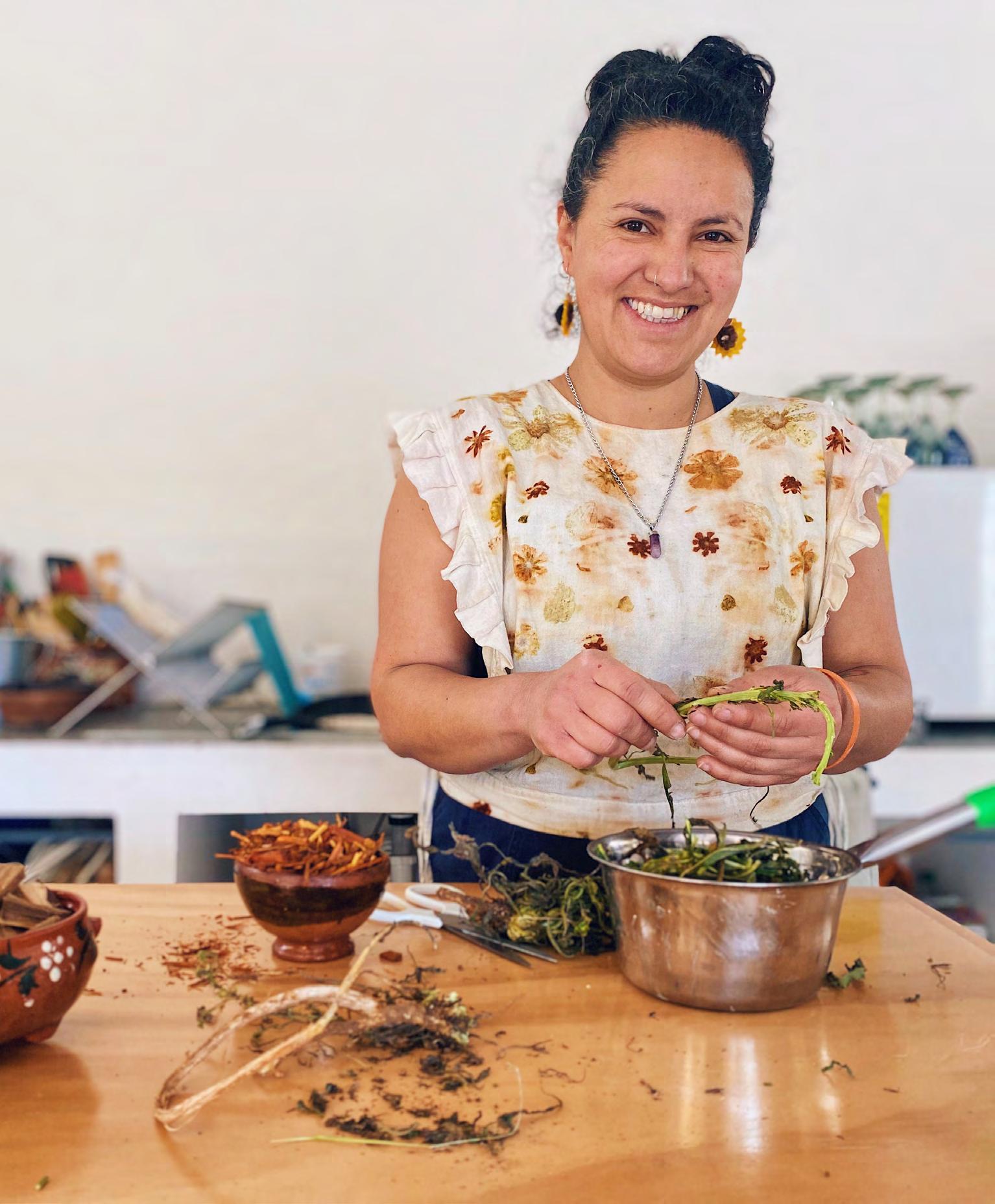
Malú isn’t just changing how we dye clothes - she’s redesigning the textile ecosystem, one plant, one pigment, one workshop at a time.
From her work across Ireland to her roots in Mexico City, Malú Colorín brings together ancestral textile knowledge, ecological commitment, and creative energy in a way that feels deeply contemporary. As founder of Talú and co-founder of Fibreshed Ireland, she leads a movement
that is at once tactile and transformative - offering workshops, festivals, and advocacy work rooted in land, colour, and community.
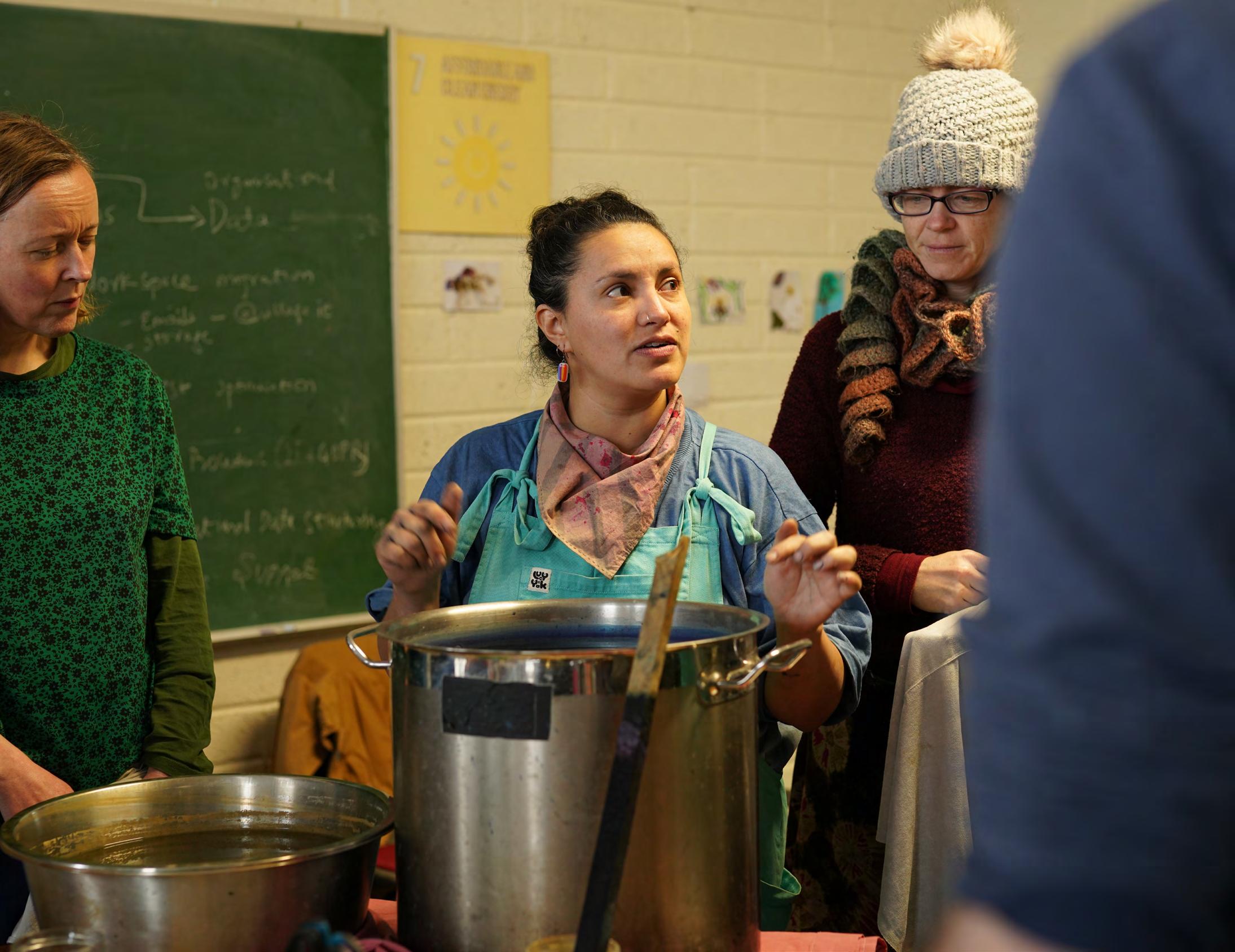
When we spoke to Malú after she had delivered an introduction to natural dyeing at Brink! in Belfast, she explained that
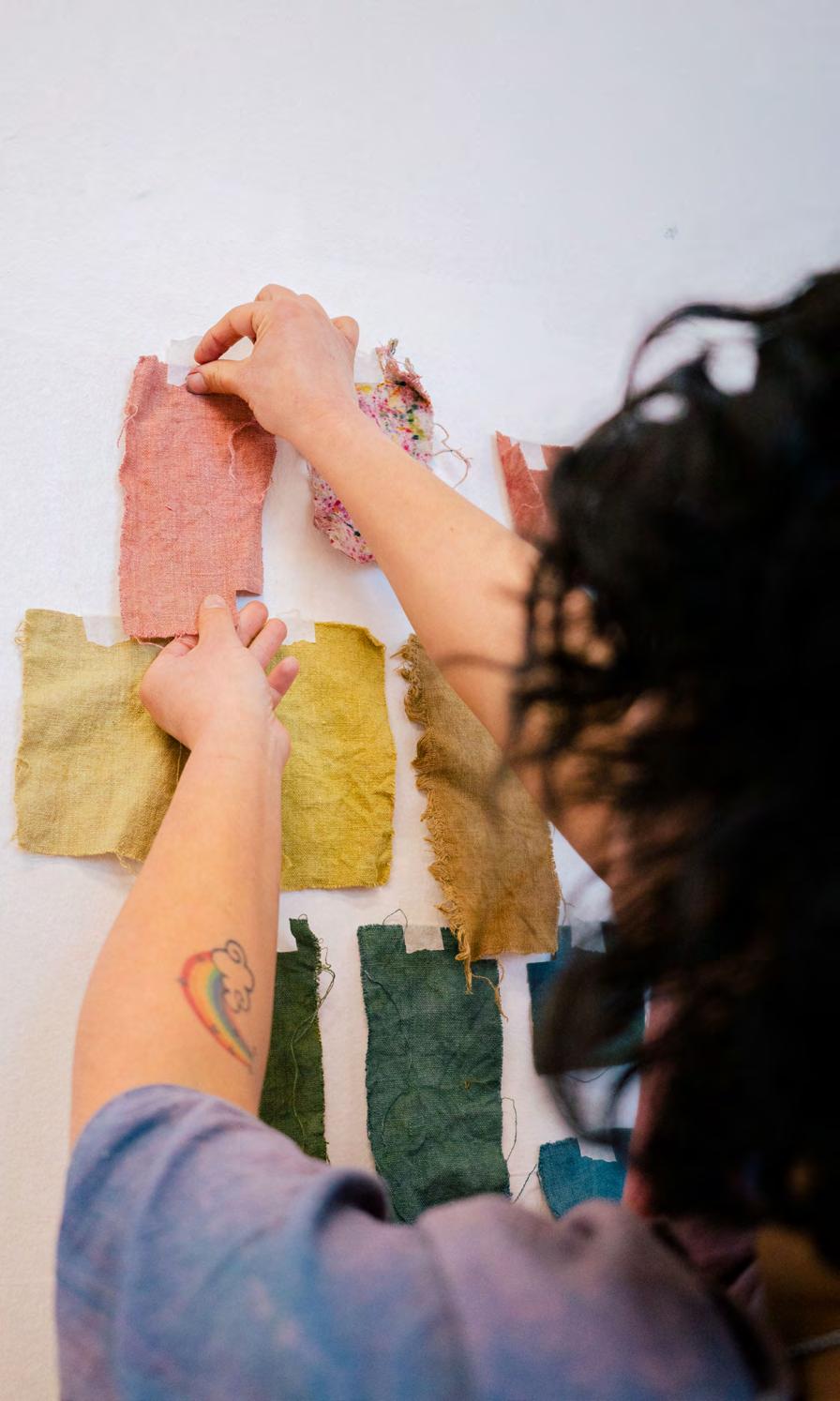
the workshop was about getting people curious about what plants can do, what colours they can achieve, and what might already be growing around them unnoticed. For her, colour offers a playful entry point into deeper environmental awareness. “Colour can be amazing - it’s like a gateway into being interested in the natural world around you,” she explained.
One of her favourite things about teaching is witnessing the joy people experience when immersed in the process. She described the transformation that happens when adults enter what she called “a childlike state of awe” - a moment when they stop worrying about the outcome and simply enjoy creating.
That particular workshop involved dyeing kerchiefs on vintage Irish linen, repurposed from surplus donated to the Linen Biennale.
The event was also the first in a wider initiative: the Flax Meitheal, a collaborative project co-organised by Fibreshed Ireland, Talú, Brink!, Mallon Linen, the Linen Biennale, and Artpark in Germany. This series of events, taking place across Ireland and concluding with an exhibition in Germany, centres flax as both cultural heritage and ecological opportunity. “We’ll bring some of the Irish things over there,” Malú noted, speaking about the final exhibition planned by Artpark.
All Photo Credit Ben Ingoldsby
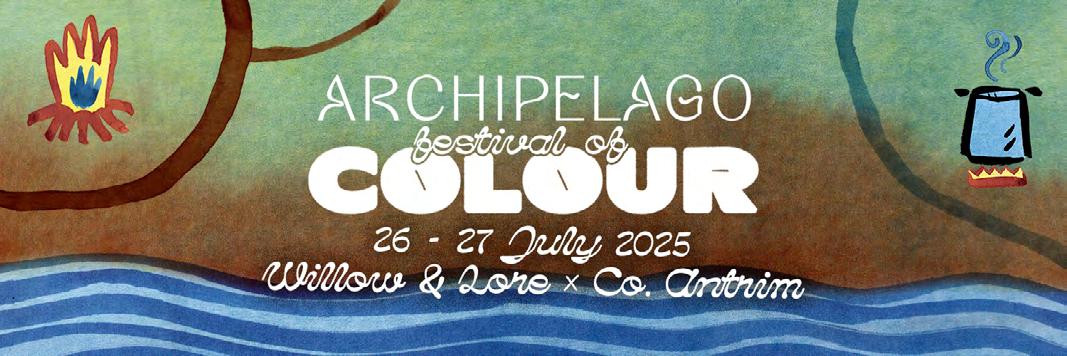
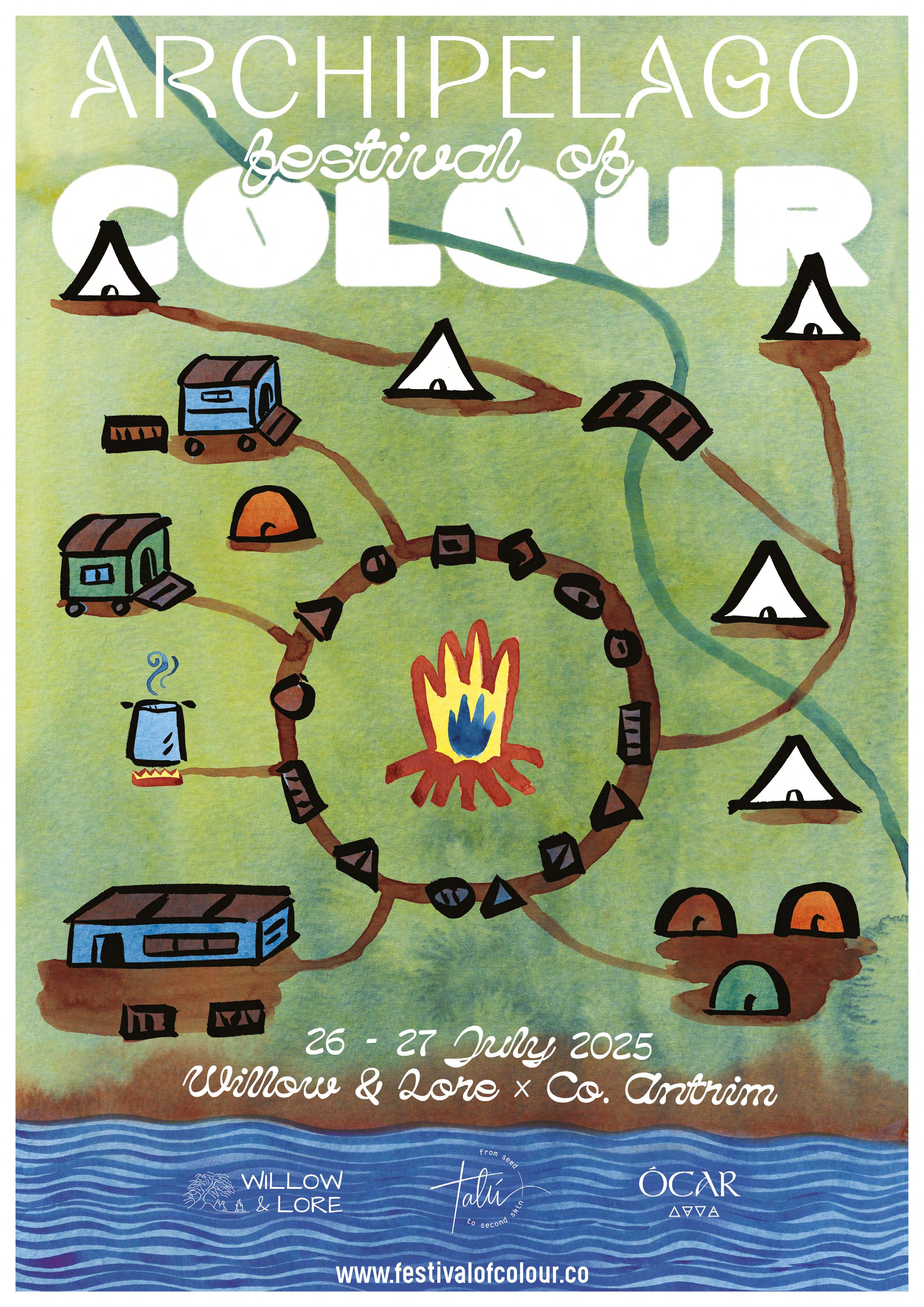
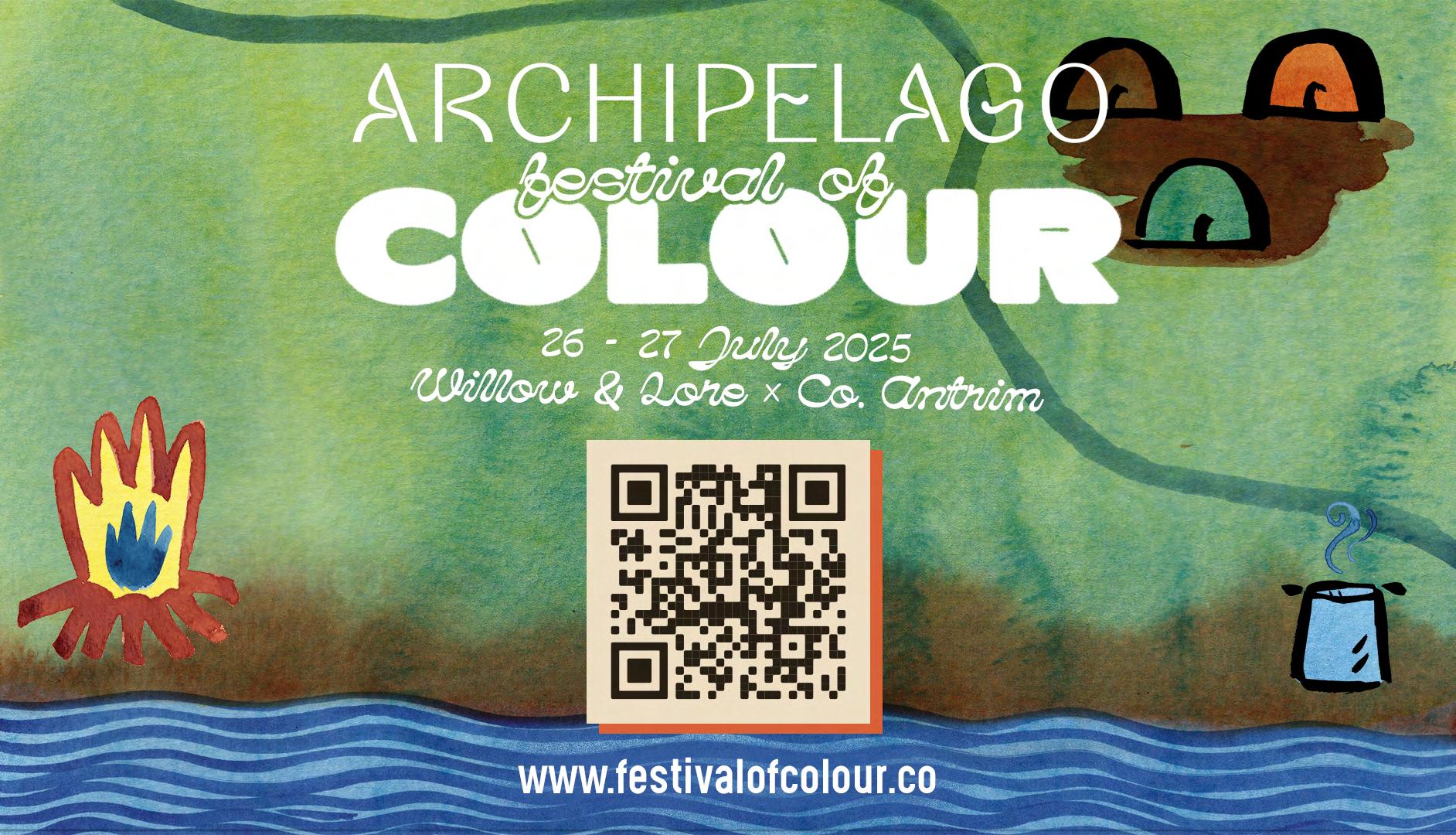
The Archipelago Festival of Colour, Willow & Lore County Antrim, 26th & 27th July
Go Leor
The Festival of Colour: An Intimate Celebration of PlantBased Pigment
Before that, however, comes one of the most distinctive events in the natural colour calendar. Taking place this July on a farm in County Antrim, the Festival of Colour is now in its second year. It began, as so many good things do, with a conversation. During one of her online natural dyeing courses, a student mentioned that she had a farm and proposed the idea of painting tents and celebrating natural colour. Malú’s response: “Oh yeah, it would be nice. And you have a farm - let’s do it.”
Hosted at Willow and Lore, the weekend event is kept intimate, with around 50 attendees. It includes workshops, talks, and a family-friendly Sunday programme featuring forest school
activities, a colour-themed treasure hunt, and hands-on learning about plants and dyes. One highlight from last year was a Brazilian illustrator painting one of the site’s bell tents using pigments made from plants - an illustration of flora created with flora.
“It’s a very intimate weekend celebration of all things natural colour,” Malú explained. A film screening, focused on a woman in the UK who grew her own pair of jeans and dyed them with plants she cultivated herself, reflects the kind of story the festival wants to champion. Children are welcome on Sunday, and guests can camp or stay in a nearby B&B reserved for the event.
Learn more or book tickets at: talu.earth/archipelago-festival-of-colour
Colour, Culture, and Responsibility
Although rooted in creativity, Malú’s work has always carried a strong ecological focus. Her concern for the environment dates back to childhood, when she dreamed of becoming a biologist to protect animals. That instinct now informs her critique of global textile supply chains and her advocacy for regional, regenerative alternatives.
Through Fibreshed Ireland, she promotes the use of fibres that grow well in local conditions. “Here in Ireland, traditionally, linen and wool would have been the main fibres - and they grow really well on this island,” she noted. Yet today, even wool from Irish sheep is often sent abroad for processing. Linen weaving still happens on the
island, but the flax fibre itself is imported. Farms like Mallon Linen in County Tyrone are working to change that, but spinning infrastructure remains a challenge.
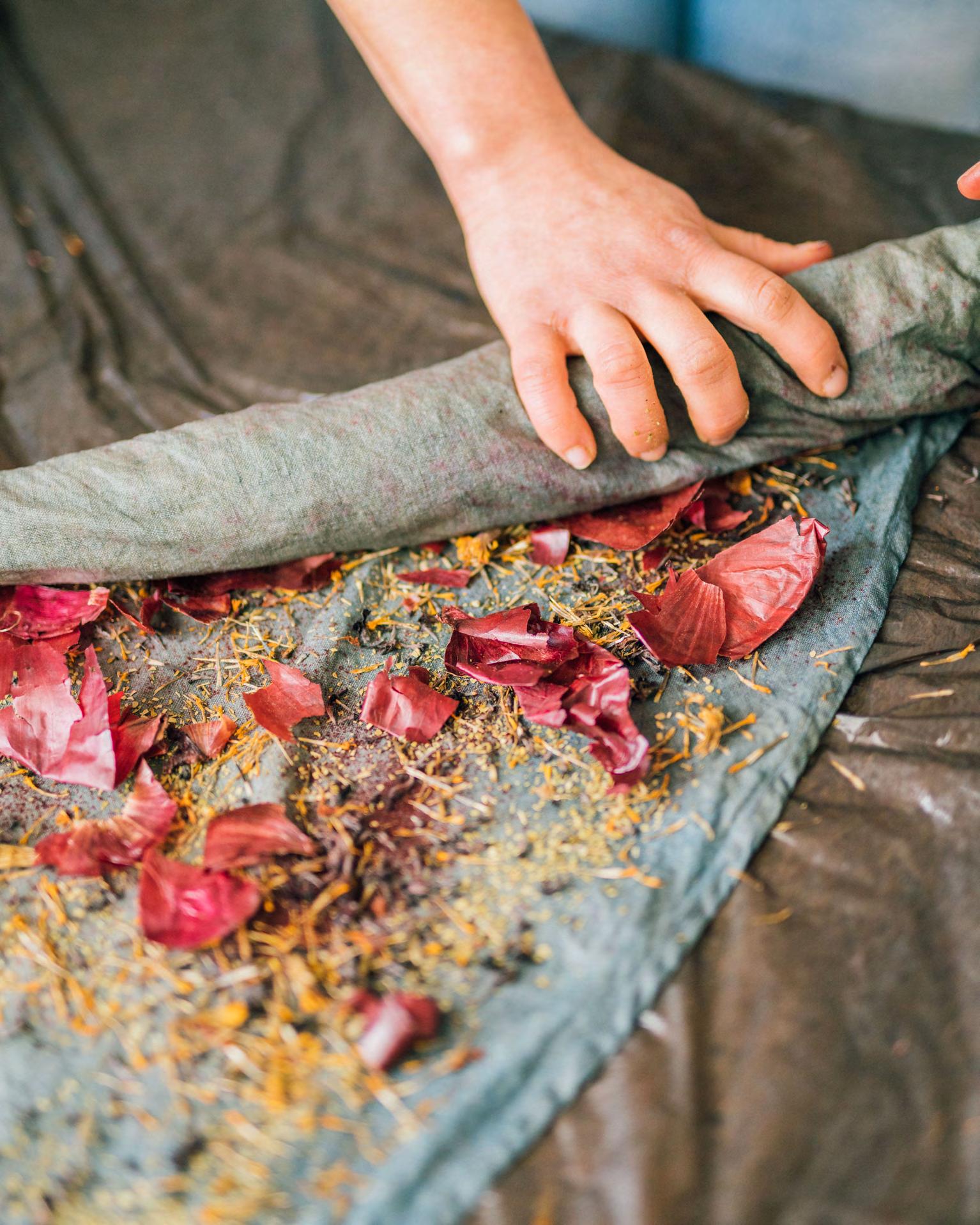
In her workshops, Malú brings in local and foraged materials like oak, hazel, alder, horse chestnut, and bramble. She also encourages people to use kitchen scraps - onion skins, avocado pits, even tea - to reveal the unexpected richness of domestic waste. For vivid results, she supplements with plants like weld and madder, as well as cochineal, a red dye derived from insects native to Mexico.
Her approach is both practical and poetic. “If you’re going to raise an animal that you’re going to eat, you should honour that animal by using all of what
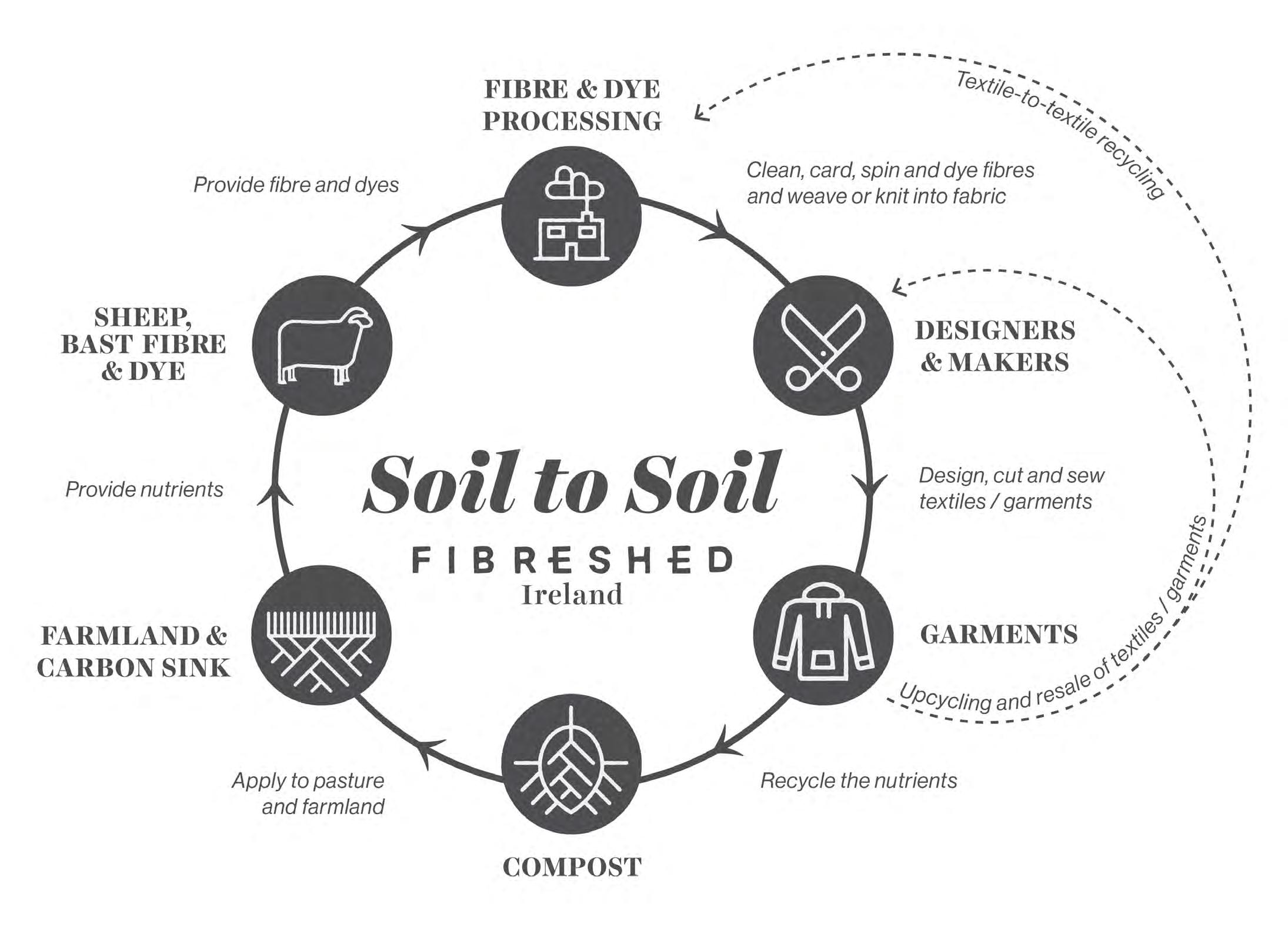
Fibershed’s Soil-to-Soil Model for Textile Production, adapted by Fibreshed Ireland
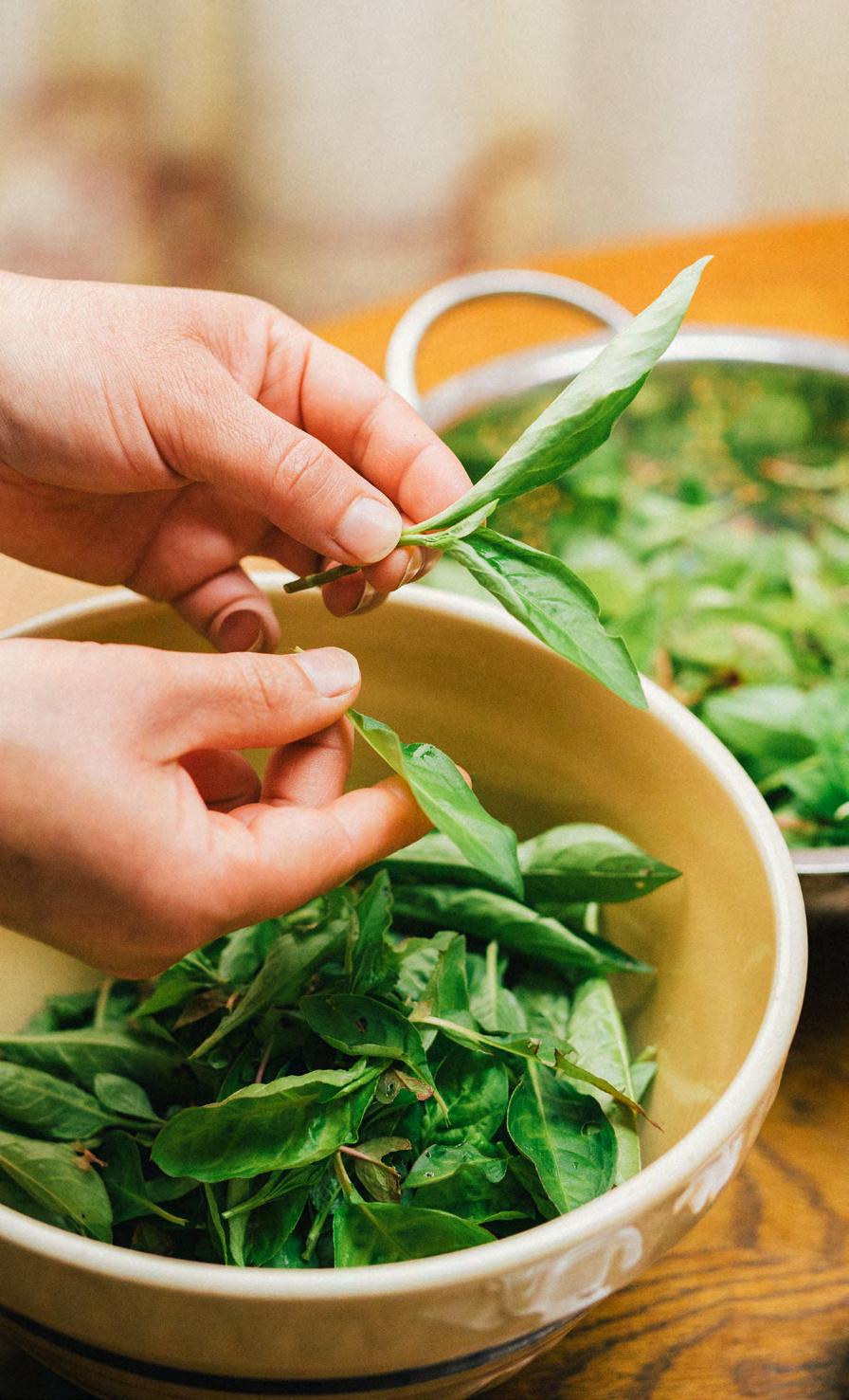
Japanese Indigo
it has to offer,” she said, citing the Indigenous principle of respecting every part of the animal or plant. In Ireland, she sees potential in reviving that mindset: using sheep for wool as well as meat, growing flax in rotation with vegetables, and even recovering leather from the beef industry.
Generational Threads
Malú’s love for textiles is rooted in her upbringing in Mexico City. Her grandmother taught pattern cutting and sewing to elderly women in a community centre, while her mother, a dedicated quilter, taught workshops of her own. Though Malú initially thought of pursuing fashion design, she found it too glamorous, shifting instead to graphic design - a field that now informs her work in unexpected ways.
She grew up immersed in traditional clothing and still wears it proudly. “Every time I have a chance, I’ll wear traditional clothes or at least something, just because I love them so much,” she said. It’s a quiet cele-
bration of heritage that complements her work in natural dyeing and local textiles.
A Systemic Lens
With a background in graphic design, Malú brings a systems-oriented perspective to her textile work. She sees textiles the way she once saw brand systems - where every component must work together. “Your logo, your fonts, your
colours - they’re all part of one system,” she said. “So you can extrapolate that to anything.”
This mindset has helped her think critically about the textile ecosystem: how fibres are grown, processed, distributed, and valued. Through Talú, Fibreshed Ireland, and now the Festival of Colour, Malú isn’t just helping people rediscover natural dyes. She’s building a network - rooted in care, communi-
ty, and colour - that invites us all to reimagine how we relate to the materials around us.
Find out about the latest events and workshops via her website: talu.earth
The Festival of Colour: Saturday 26th to Sunday 27th of July at Willow and Lore: talu.earth/archipelago-festival-of-colour
Judith Logan Artist
Meeting the Artist: At Home and in the Boathouse with Judith Logan, One of Antrim’s Quiet Originals, Who Threads Memory, Landscape, and Personal History into Every Layer of Her Work
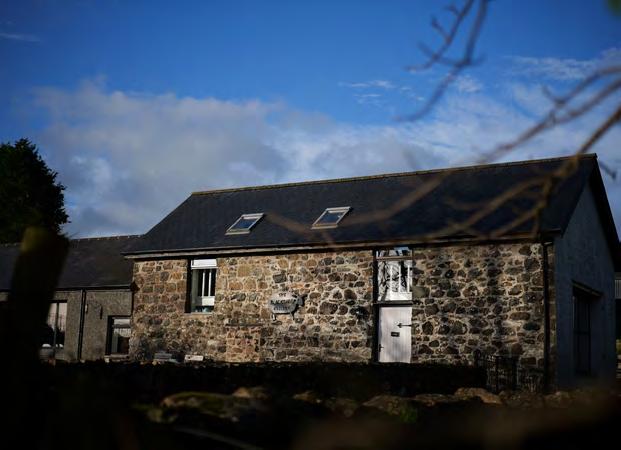
In a converted barn nestled deep in the Northern Irish countryside, Judith Logan paints with a kind of reverent patience. Her practice is unhurried and deeply rooted - not just in place, but in memory, in weathered textures, and in the long arc of personal experience. It’s no surprise that her work speaks in earthy tones and recurring motifs - swallows, starlings, ochres, and solitary female figures - all reflective of a life that has taken unexpected detours but never lost its creative thread.
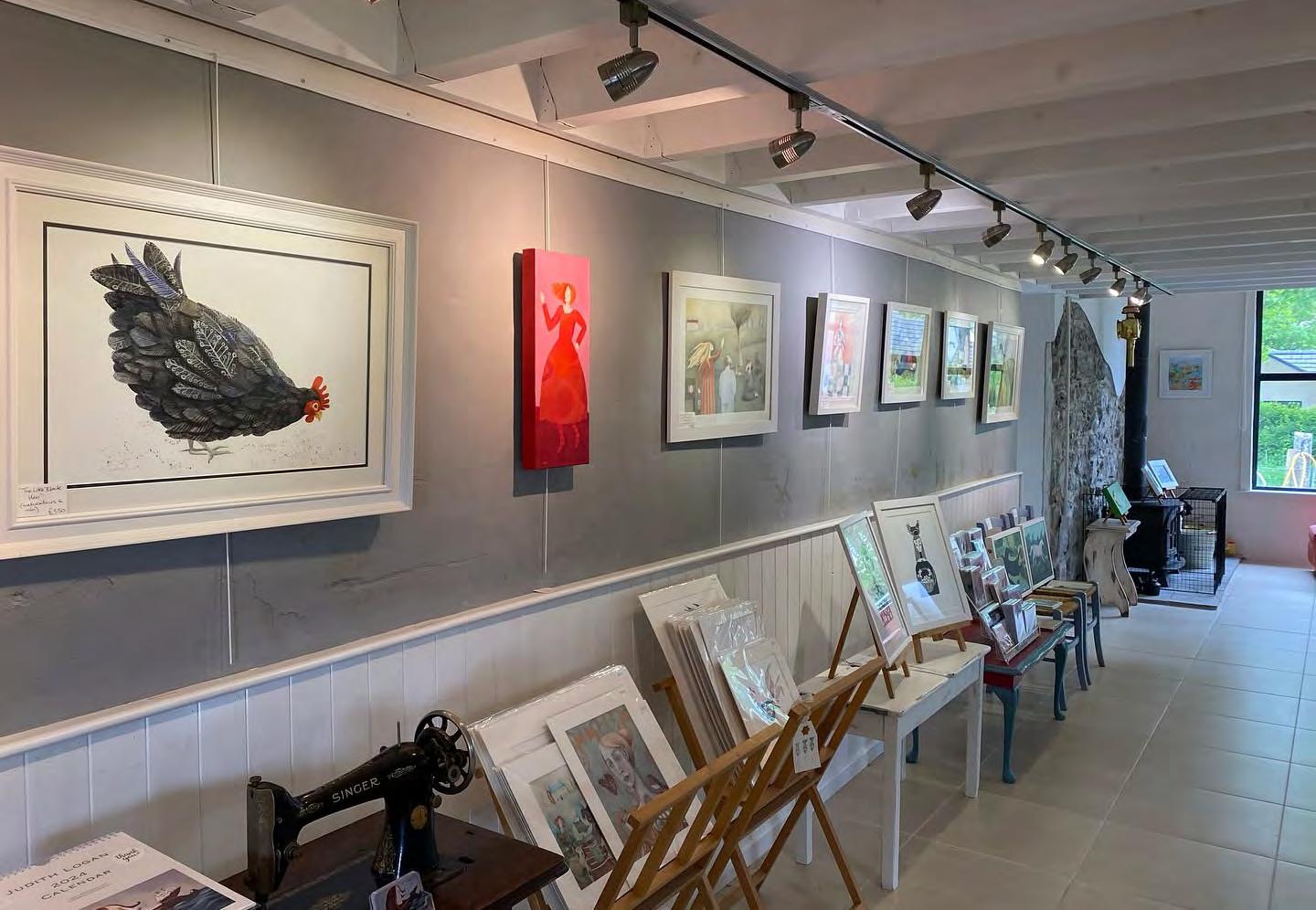
Logan is the kind of artist who works with what’s around her. Her home studio - affectionately known as the Black Sheep Gallery - is housed in a restored barn on her property, a space she and her family restored after moving back to Northern Ireland 16 years ago. In the early days, she opened the doors to the public a few days a week, but over time, the demands of family life and caregiving made that rhythm unsustainable. “Family to me comes first,” she says, recount-
ing the years spent caring for her children and family.
Then came COVID, and with it, a new reality. “It’s kind of hard to push my own gallery, to be honest,” she admits. These days, visits to her studio are by appointment only - a choice that preserves both her time and her process. “If people really want to come, we do viewing by appointment and there’s no pressure. They have a wee look around.” It’s a quieter way of working - but one that suits the
The Blacksheep Gallery, Ballymena
slow, thoughtful rhythm of her art.
Her voice never wavers between the practical and the poetic. The rural quiet may limit footfall, but it feeds her work in other ways: “It’s a great source of inspiration. It’s peaceful and quiet. Very conducive to making the art.”
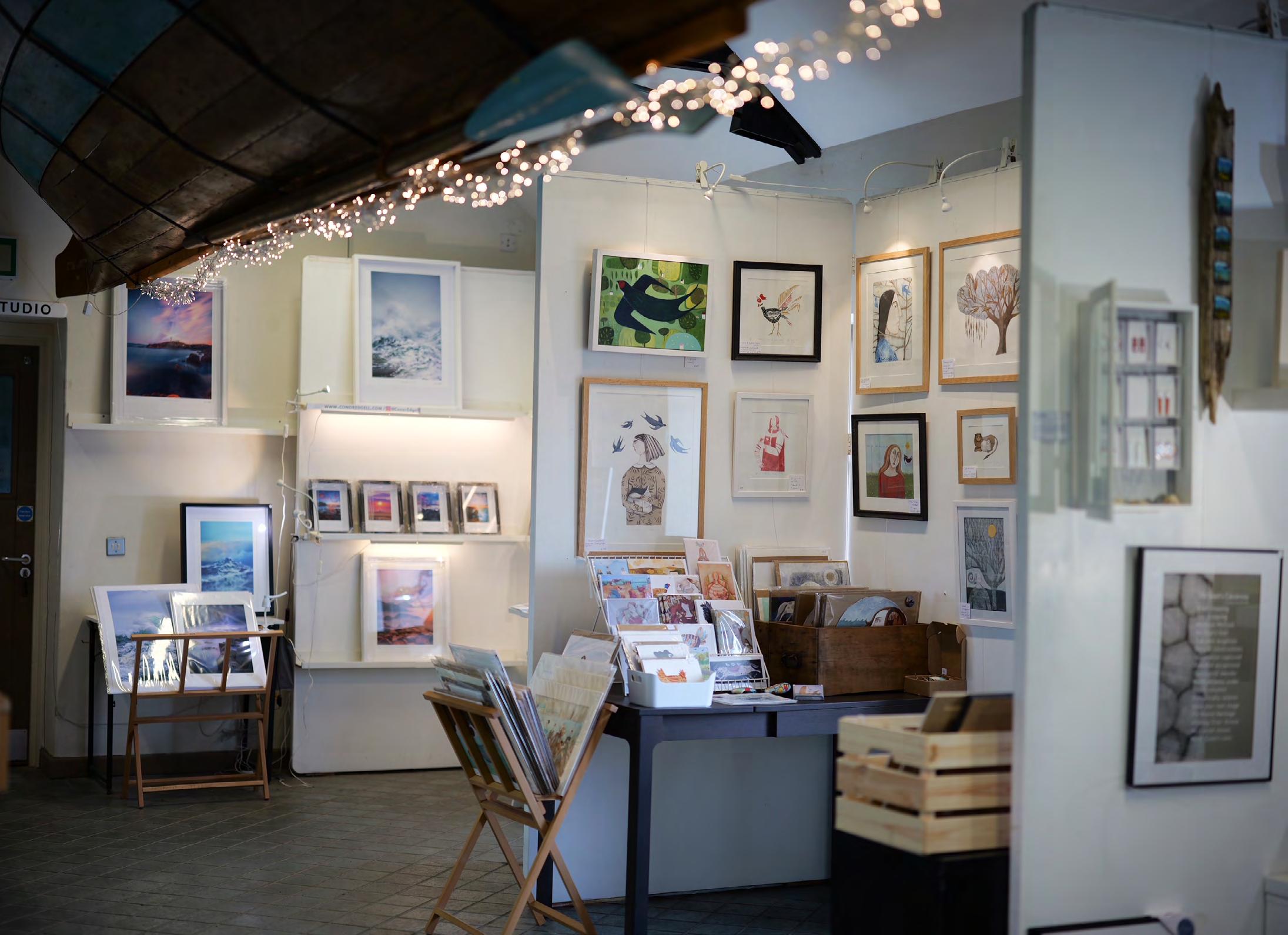
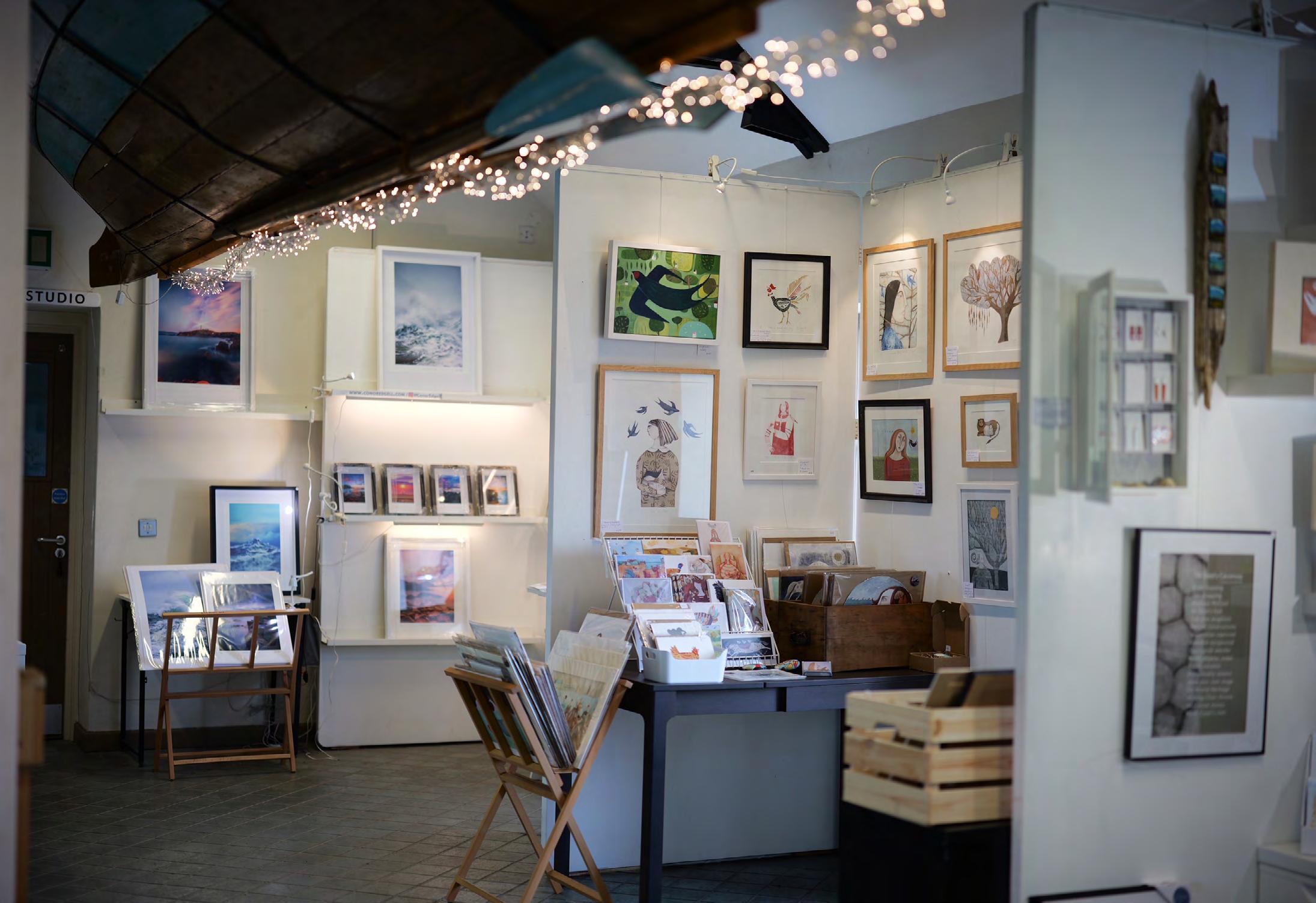
Today, Logan splits her time between several galleries: her home studio, the Boathouse Gallery near the Giant’s Causeway - a National Trust rental shared with five other artists - and the Doghouse Gallery in Comber, where she sells her collagraphs alongside the work of jeweller Pamela Crawford Her art also features in the Yard Gallery in Holywood and with Gallery 545, run by curator Francesca Biondi.
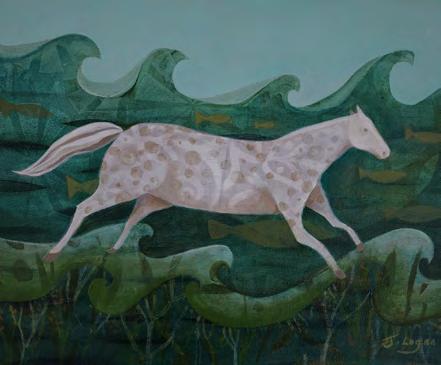
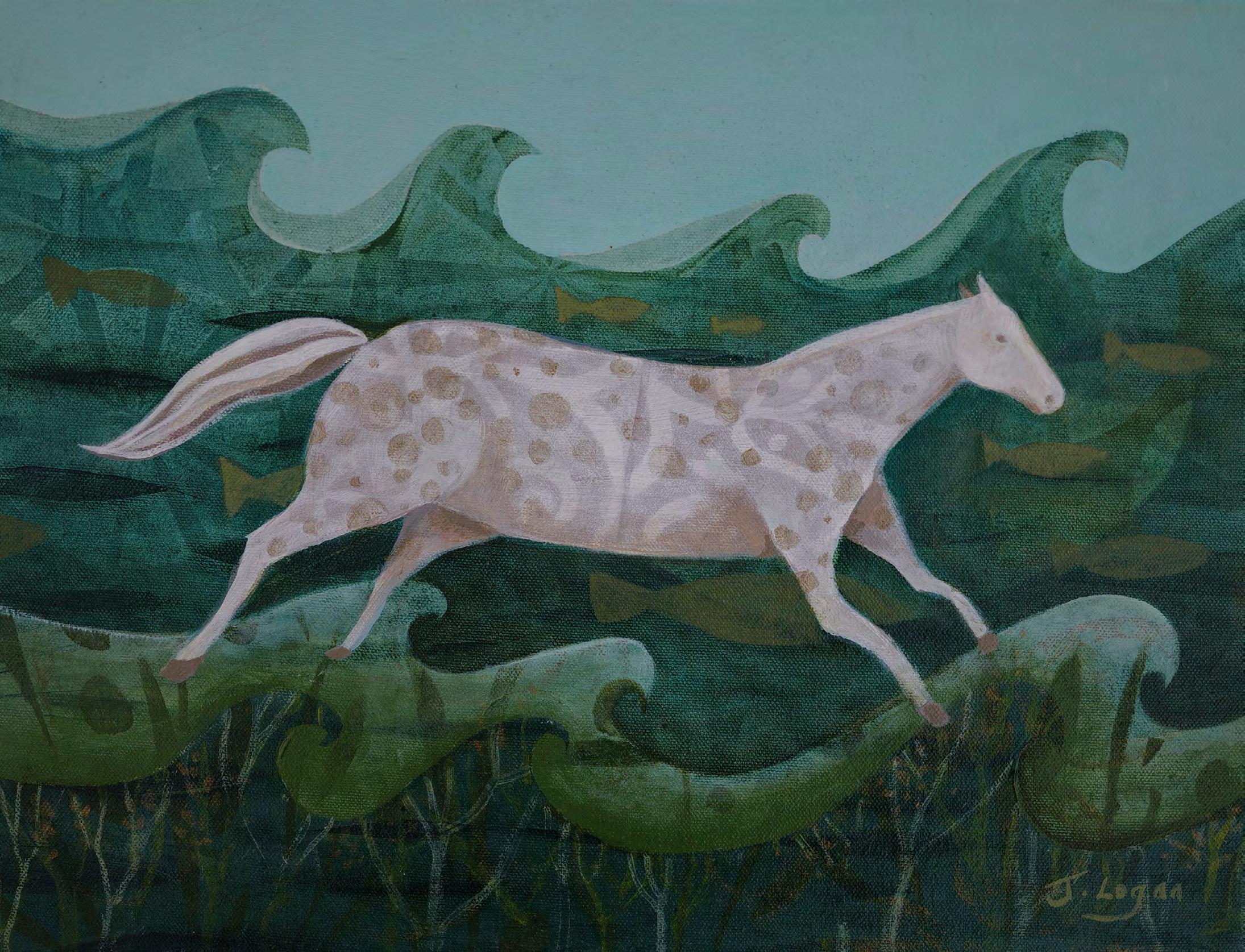
Lesser Spotted Seahorse, Acrylic Painting
At the Boathouse, she’s had to adapt her approach to suit a tourist-heavy audience - “You’re trying to think of smaller pieces they can take” - but insists on staying true to herself. “I don’t want to be making Giant’s Causeway memorabilia,” she laughs. “You still have to be true to yourself. But at the same time, you have to make sales. That’s every artist’s kind of quandary.”
Material Instincts
Watercolour is Logan’s medium of choice, though she hesitates to commit too narrowly. “I tried all the media,” she explains. “I don’t want to say I’m a multimedia artist - I just work in different media, which is slightly different.”
“There’s a very traditional way of working with it,” she says, “but if you let it do its own thing, it can be really interesting. I love
the unpredictable nature of watercolour.” That unpredictability often leads her to take creative risks - washing away layers, building them back up, and allowing accidents to shape the final image. “I’ll do layers and then I’ll actually put it under the tap and remove a lot of paint,” she explains. “Which seems a bit counterproductive, but then you’re left with… it’s like a history of the painting that once was there.”
This embrace of unpredictability runs through much of her work. She’s not afraid to take riskssewing onto finished paper, for example, adding thread and fabric where it might all fall apart. “It’s a big risk… you can end up destroying the whole piece. But I like the added texture it gives.”
Logan is quick to challenge the boundaries between fine art and craft. “There’s quite a
snobbery in the art world about the whole fine art versus craft thing,” she observes. “A lot of our work overlaps. We don’t really know what we are.”
It’s perhaps this openness that drives her continual experimentation. A watercolour might become a drypoint print, then a collagraph - a technique she’s particularly fond of. One started with a discarded painting: “I didn’t like it, so I cut out the shape I did like and transformed the whole piece into a collagraph plate. Sometimes those happy accidents… they’re my favourite pieces.”
She likens her process to cooking. “I make art like I cook - I like to use up my leftovers.” That spirit of resourcefulness and reinvention runs through much of her practice. “If I do a watercolor and I like the composition, I might try a print of that, redo it, change it around,
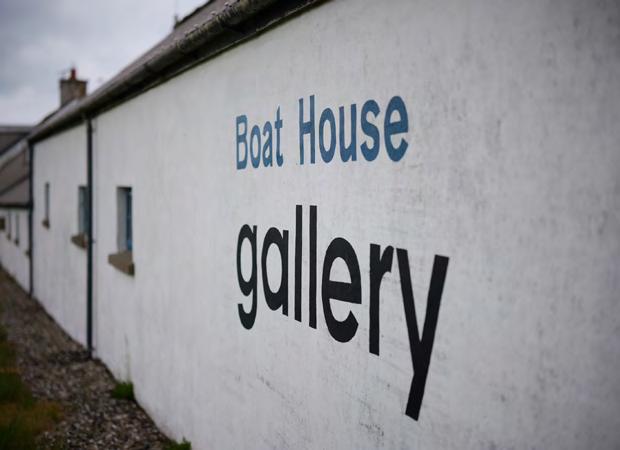
The Boat House Gallery and Studio, The Giant’s Causeway
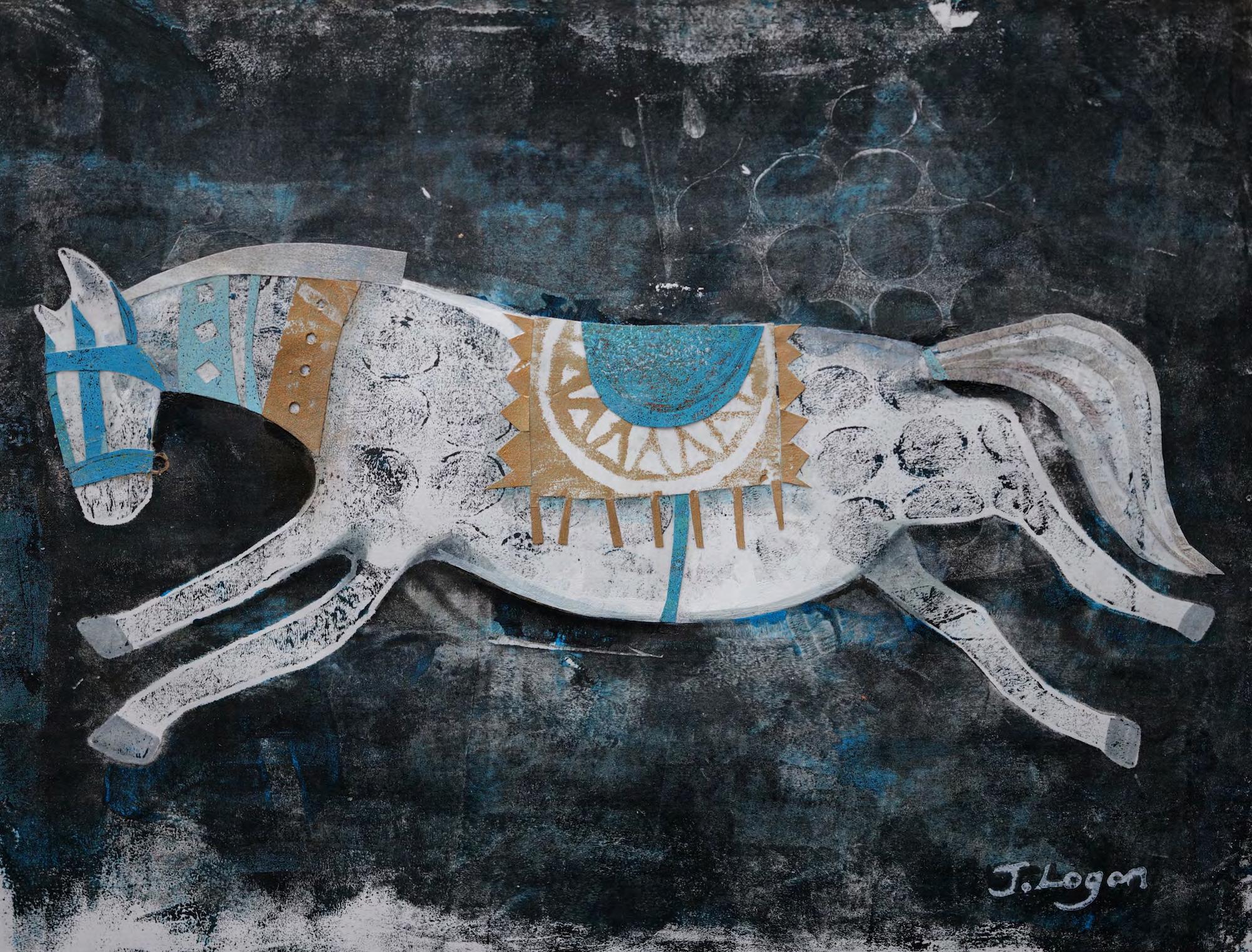
Equus Albus, Monoprint
and then maybe try and make a Drypoint,” she explains.
She also integrates locally sourced materials into her work - including natural pigments like red ochre. “The ochre actually, was through Instagram,” she explains. “It’s ocar.ie. She makes her own pigment from red ochre that’s found around the north coast, around the Causeway area.” Using these handmade pigments, Logan brings even more of her surrounding landscape into her practice.
Landscape, Migration, and Memory
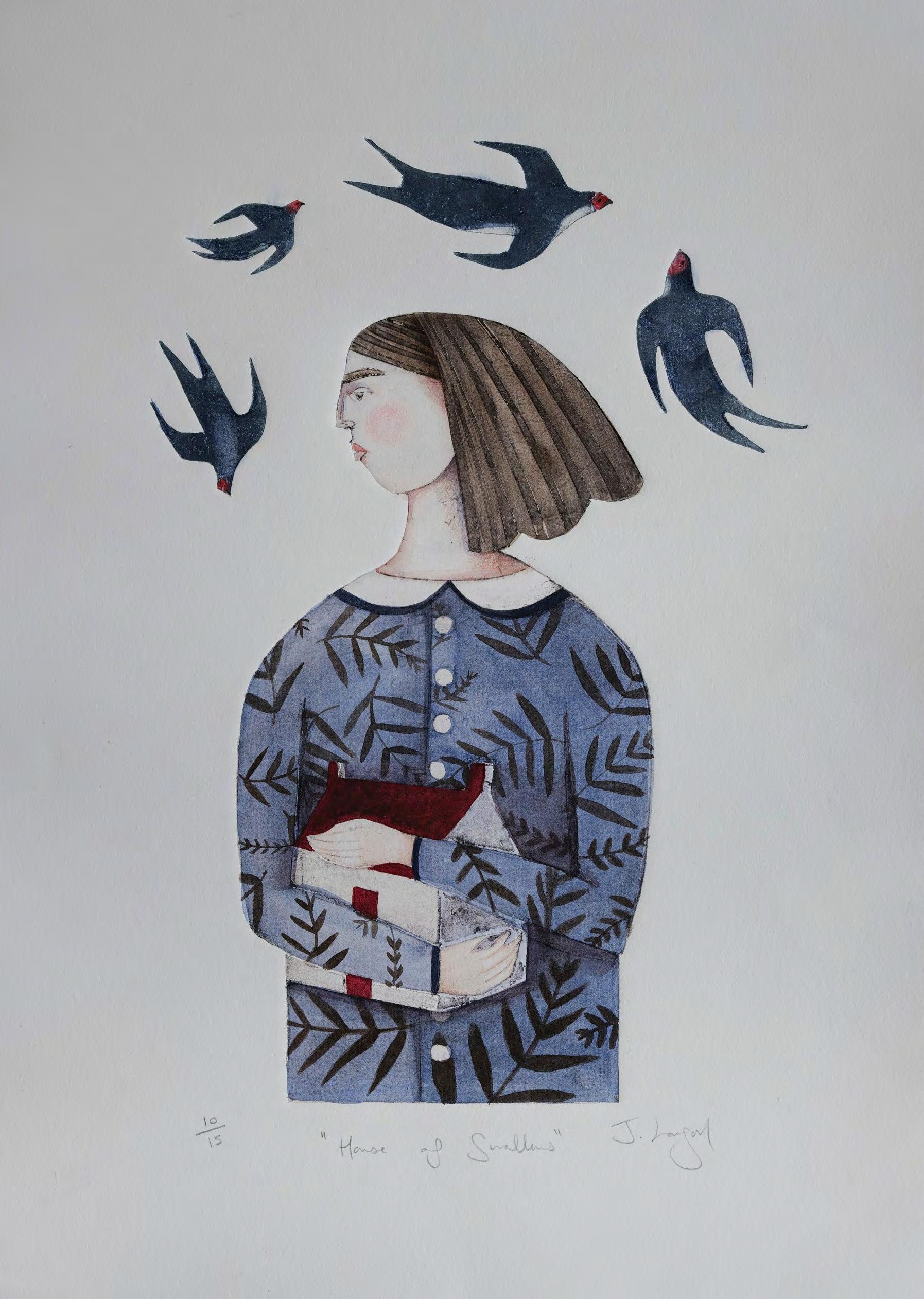
There’s a sense of continuity and return in Logan’s work, much like the migratory birds she so often paints. Swallows appear again and again. “I look for them every year when
summer’s coming,” she says, describing how they nest under the eaves of her house. “I love swallows. And I love the word in Spanish, golondrina, and hirondelle in French.”
The connection isn’t just aesthetic. Logan lived in Chile for several years, and the sense of being between places lingers. “When I was in Chile, I probably didn’t appreciate it as much as I should have. I was yearning to be back home. And then when we came back to Ireland, I struggled - I wanted to be back in Chile.”
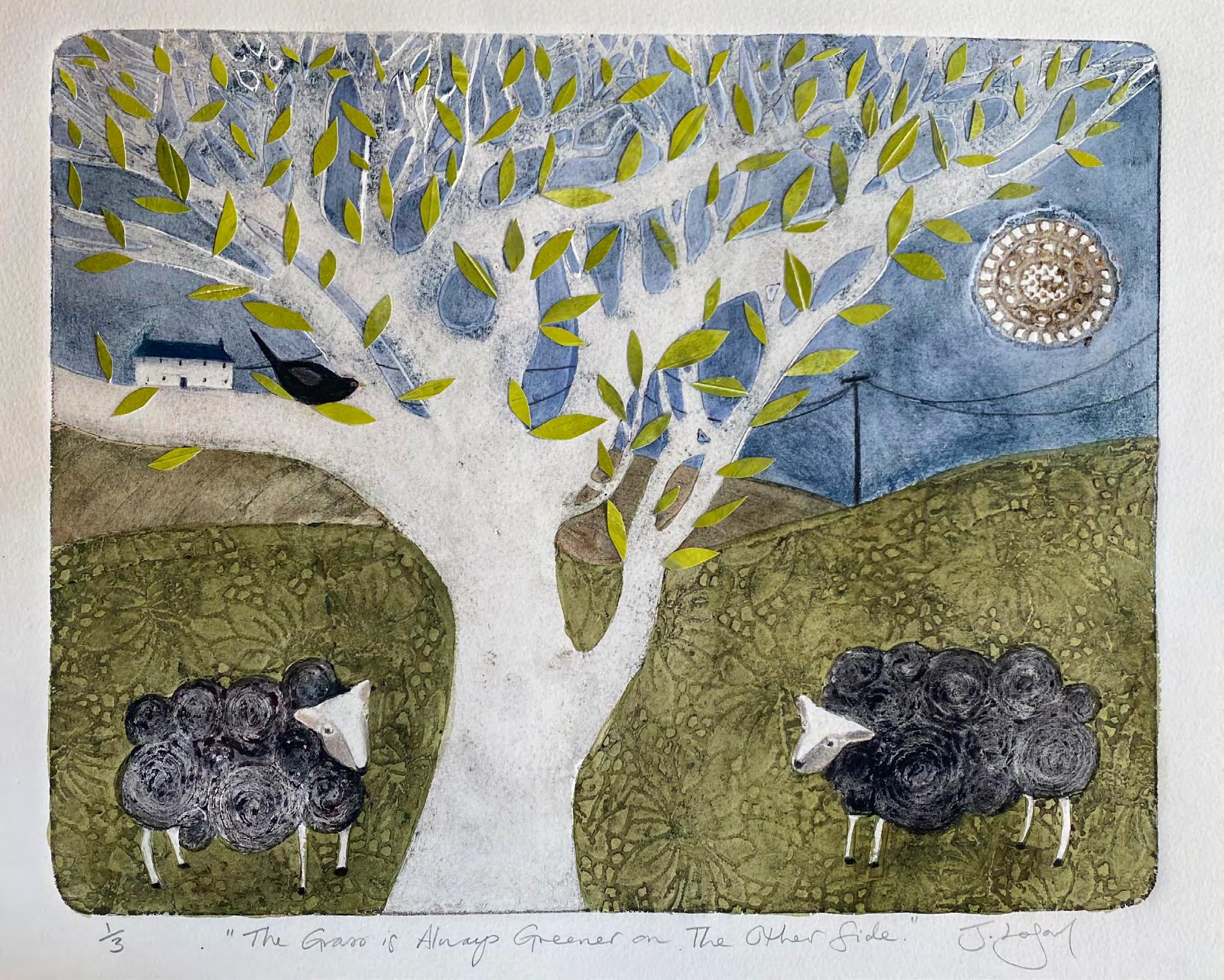
That duality, the longing for elsewhere while being rooted at home, gives her work a reflective, melancholic edge. “In my work you’ll maybe see the theme of ‘faraway fields look green’ quite a lot as well,” she
says, pointing to how certain landscapes in her paintings mark moments of homesickness and shifting identity. “People say my figures look sad,” she notes. “But I don’t think they are. They’re just pensive. I mean, if I painted a woman with lots of smiling teeth, it just wouldn’t look right.”
Those figures - often women, stylised and quiet - are central to her compositions. Are they self-portraits? “Perhaps in some pieces,” she admits, “but it’s not something I consciously consider. When I’ve made the figure, it nearly always reminds me of someone I know.”
From the Studio to the Soil
When she’s not painting, Logan tends to a large vegetable garden beside her home. “Growing
something from a seed and watching it grow… it’s kind of an art form in itself,” she says. There’s a rhythm to it, one that mirrors the cycles in her practice: layering, reworking, letting time pass before returning to a piece.
Recently, she’s been exploring new themes. She’s also working on a calendar featuring small original paintings, which she plans to auction. Starlings“murmurations,” as she calls them - have featured heavily in recent work alongside horses and the circus. “Maybe it’s all reflective of what’s going on in the world right now. I don’t know.”
Meeting the Artist
For all her quiet introspection, Logan values connection
- especially in spaces like the Boathouse Gallery, where she sometimes meets buyers in person. “They like to meet the person behind the work,” she says. “It creates a connection.”
To encourage more of that, she’s become involved with County Antrim Open Studios, a grassroots initiative that opens artists’ workspaces to the public.
“We don’t really do craft trails like they do in England. There’s still this idea that galleries are intimidating - too intellectual, or out of people’s price range. This kind of thing helps bring it down to a human level.”
Still, pricing is a constant battle. “I’ve been told to put my prices up and I’ve been told to put them down,” she says. “It’s hard
because we just want to make. But you also have to cover your costs. Who decides what something is worth?”
It’s a question with no clear answer, but Judith Logan continues anyway - layering watercolour, thread, and meaning into everything she makes.
She may live quietly, but the work speaks with resonance and depth - part memory, part migration, always returning home.
Keep up with the latest news from Judith via her instagram: judithlogan.art
Find out about the latest exhibitions and explore her shop via her website: judithloganart.com
The Grass Is Always Greener On The Other Side, Collagraph Print