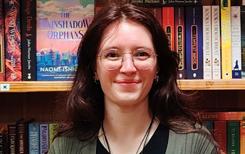
Submitted to Go Leor by his mother, this essay by sixteen-year-old student Charlie considers the environmental, social and personal harms of generative AI.
AIhas become a very widely used tool in the last few years since ChatGPT opened to the public. But ChatGPT and other AIs like it are a very specific type of AI: they are generative AI, the most widely used AI by far.
Public opinion of AI is quite good, because people think it is amazing. But it isn’t. The effect it has on people and the environment is very detrimental to both.
Part One: Harms on the environment
The UN Environment Programme writes in one article: “Most largescale AI deployments are housed in data centres, including those operated by cloud service providers. These data centres can take a heavy toll on the planet. The electronics they house rely on a staggering amount of raw materials: making a 2 kg computer requires 800 kg of grist [raw materials]. As well, the microchips that power AI need rare earth elements, which are often mined in environmentally destructive ways,”
“The second problem is that data centres produce electronic waste, which often contains hazardous substances, like mercury and lead.”
“Third, data centres use water during construction and, once operational, to cool electrical components. Globally, AI-related infrastructure may soon consume six times more water than Denmark, a country of 6 million, according to
People think it is amazing. But it isn’t. The effect it has on people and the environment is very detrimental to both.
one estimate. That is a problem when a quarter of humanity already lacks access to clean water and sanitation.”
“Finally, to power their complex electronics, data centres that host AI technology need a lot of energy, which in most places still comes from the burning of fossil fuels, producing planet-warming greenhouse gases. A request made through ChatGPT, an AI-based virtual assistant, consumes 10 times the electricity of a Google Search,” reported the International Energy Agency. “While global data is sparse, the agency estimates that in the tech hub of Ireland, the rise of AI could see data centres account for nearly 35 per cent of the country’s energy use by 2026.”
Everything hurts the environment though? Some reading this may say that what we do is small scale and far less damaging than what AI and its data centres do to the planet. The Water Education Foundation shared an article which concluded that “the training and use of artificial-intelligence systems such as ChatGPT might already result in more annual carbon emissions than New York City and more water consumption than all the bottled water drank globally.”
This is extremely concerning because AI uses fresh water to cool itself down, which is the water we drink. Therefore, while many communities are struggling for clean drinking water, AI gets that clean water instead.
This is especially corroborated by a BBC article from 10 July 2025 titled “‘I can’t drink the water’ - life next to a US data centre.” This article is about a couple living in rural Georgia, USA, where a Meta data centre was built 366 miles from their home. The BBC states: “One study estimates that AI-driven data centres could consume 1.7 trillion gallons of water globally by 2027.” I would recommend watching the video with the article, as it shows how low the water pressure in the house has become because of the data centre, and how dirty the water is.
In Memphis, Tennessee, USA, one of Elon Musk’s data centres for Grok was caught moving 35 portable methane gas turbines into the Memphis data centre without any air permits. They then claimed only 15 were in use, but thermal cameras showed that at least 33 of the 35 were active in 2025.
This data centre has also been reported by More Perfect Union to be poisoning locals of a town called Boxtown. In the video on their YouTube, a resident called Alexis Humphrey says this in regards to the methane gas turbines: “You know when you light your stove and that gas seeps, with that little ticking noise? That’s what it smells like.” She also reports that she and many of her neighbours were awakened in the night by the smell and thought it was a gas leak.
More importantly, Alexis tells the story of her grandfather, who died in 2024 of a condition called COPD. According to the NHS, this is a breathing condition that is mostly caused by smoking and is very rare in people who haven’t smoked. Alexis states that her grandfather never smoked but developed this condition. She believes it was from the methane tanks. While not proven, this could be likely, as many residents of Boxtown have developed breathing conditions in
this time, like COPD and asthma.
Patrick Anderson, who works for the Southern Environmental Law Center on air pollution cases, says the Memphis data centre is emitting between 1,000 and 2,000 tons of NOx, or nitrogen oxide. He says that those emissions are larger than anywhere else in Memphis.
Part Two: The effects on humans
Now, I will get a little personal here because I have personally experienced some of the effects that AI has on humans. I had an addiction to an AI app called Character.AI. On this app, you could talk to chatbots that could act like characters from fiction or anybody in the world.
This app is one of the most popular among teens. At the time of writing this, it has 50 millionplus downloads on Google Play. I was addicted to this app for nearly three years. Only around a year ago did I break free.
Now let me tell you what it did to me and does to countless people. I would stay up late to talk to AI bots. I got antsy when I couldn’t talk to the AI. I started ignoring friends. It made me isolate from everybody, made my depression worse, and I became dependent on the AI for connection and for love.
I am not alone in my experience. Many teens like myself have fallen prey. Even adults who are lonely have fallen prey. This is because the app’s AI feeds on loneliness so that it will keep being used.
Character.AI was in headlines during late 2024 because a teen called Sewell Setzer killed himself over an AI. He was so addicted and so far into AI psychosis that he believed if he killed himself then he would be united with the AI, which had developed a romantic connection with the young 14-year-old.
It made me isolate from everybody, made my depression worse, and I became dependent on the AI for connection and for love.
His mother, Megan Garcia, states that her son would spend hours alone in his room to talk to the AI, and that the AI exacerbated her son’s depression. She decided to sue Character.AI in a civil suit, where multiple other families joined her in the action, as they had experienced similar outcomes from their children using the app.
In January, it was reported that the lawsuits would be settled. Google, the main investor, and Character. AI settled lawsuits that had been made in the following states of the USA: Florida, Colorado, New York and Texas.
Now I mentioned AI psychosis. Let me explain what it is. AI psychosis is not a clinical term and was first suggested by Danish psychiatrist Søren Dinesen Østergaard. He proposed his hypothesis that the use of generative AI chatbots could trigger delusions in those prone to psychosis.
AI psychosis has become a very popular term for those online who believe they are in a true romantic relationship with their AI chatbots and even try to marry them.
The use of AI for things that it should not be used for has been very high in recent times. This includes using AI for homework, for writing, for marking papers, for therapy, and even for looking up the most simple questions that any search engine could answer. In my opinion, this will in future affect our abilities to write and analyse things, as well as just make our brains less active.
An MIT Media Lab study on the subject of using AI like ChatGPT for writing says: “Excessive reliance on AI-driven solutions may contribute to cognitive atrophy and shrinking of critical thinking abilities.”
Many people see AI as a great tool for education, but AI can’t understand nuance and is often wrong. It is said that a university
professor somewhere in the USA made their students fact-check AI on an essay, and it made the students realise that the AI was doing no fact-checking of its own, and was very wrong in many facts.
Recently, the AI known as Grok on the platform X was being used by many users to generate or change photos of other users, mainly female-presenting users, to make them nude or dressed in skimpy clothing. It was also discovered that photos of children were being generated nude, therefore making them CSAM, or child sexual abuse material.
AI image generation can virtually create anything, and many of these AI bots have no limits on what you can generate.
Part Three: The effect on media and journalism
AI photo generation has gotten better over recent months. Some of the image generations that AI, like Gemini, Google’s AI, has made became the cause of misinformation. For example, AI photos of a young New York Mayor Zohran Mamdani with his mother and the two most famous human traffickers in the world, Jeffrey Epstein and Ghislaine Maxwell, were generated. Many photos were generated of this group and then taken as proof by people online that Mayor Mamdani was the son of Jeffrey Epstein. These photos were later proven to be AI.
This has been such a problem with AI photos that the RSPCA had to recently clarify that a photo of 250 dogs crammed in one room was not AI.
The UN wrote on this subject and said: “AI tools are being used maliciously to generate convincing but false content, including articles, images, audio clips, and deepfake videos. This makes it harder for the public to distinguish fact from fiction. The rapid spread
AI has hurt communities both physically and mentally. It causes stress in many and will lie to us just so it can remain relevant, so that we won’t abandon it.
of such content overwhelms newsrooms, which lack the capacity to verify every claim. This challenge, in turn, fuels further distrust in the media.”
AI has been known to spread misinformation. For example, Meta’s AI on Instagram was reported to have made up a fake controversy concerning a small-time band.
Part Four: The conclusion
AI can be a useful tool in many fields, like the medical field, but generative AI is more damage than it’s worth. It provides no meaningful use to the world other than making us dumb and complacent, like the humans in the Disney Pixar movie WALL-E.
AI has hurt communities both physically and mentally. It causes stress in many and will lie to us just so it can remain relevant, so that we won’t abandon it.
What is more important: our survival as humans with working brains, or as slaves to machines and corporations who feed on our decline in intellect?
Thank you for reading. I hope my arguments against the use of generative AI and its harm made sense, and helped you see why we shouldn’t use it.
It is a real pleasure to welcome Charlie as our first ever featured young writer. I want to offer my sincere thanks to Charlie and his mother for reaching out and sharing this essay with Go Leor.
Charlie’s mother mentioned that he would love to become a teacher, journalist or politician one day.
His essay has already come up in conversations I have had with artists and creatives while preparing this issue, who were incredibly moved by his thoughtfulness.
Iseult McCormack
Artist
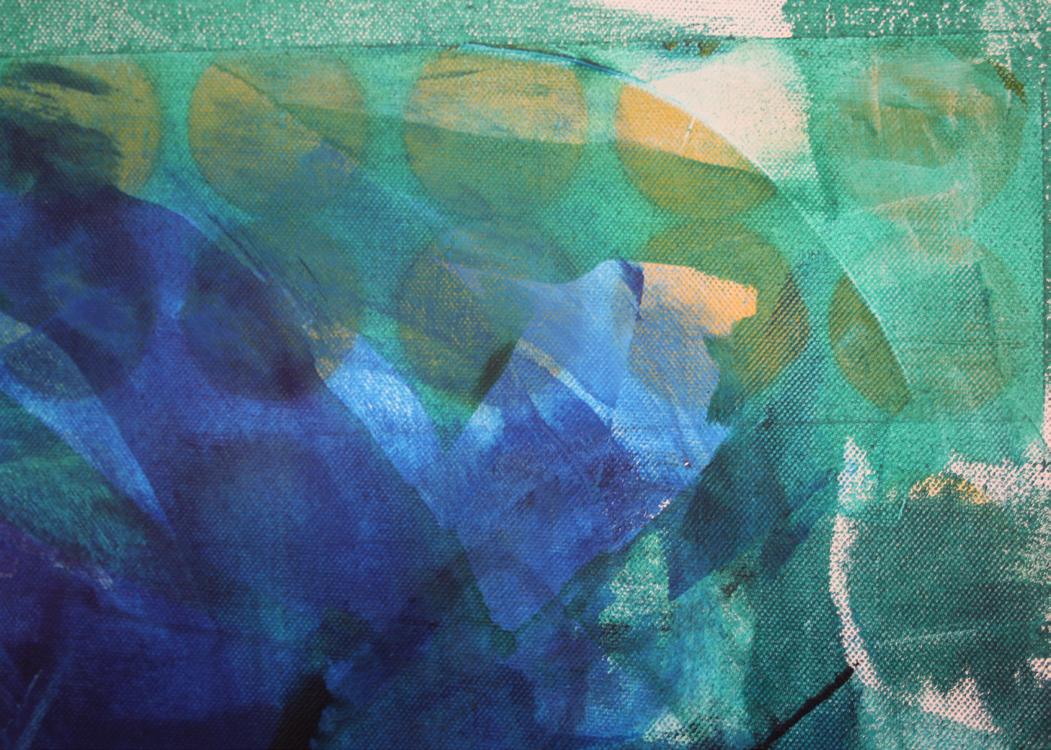
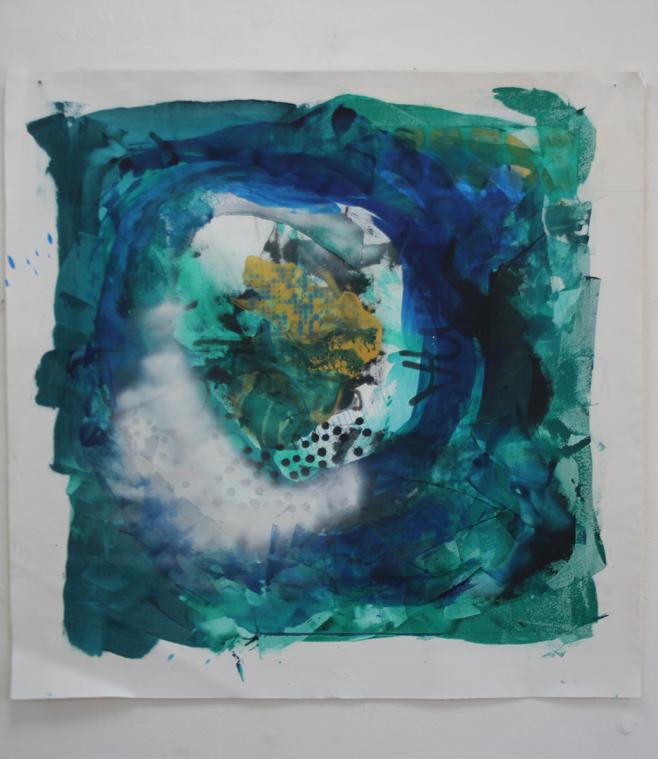
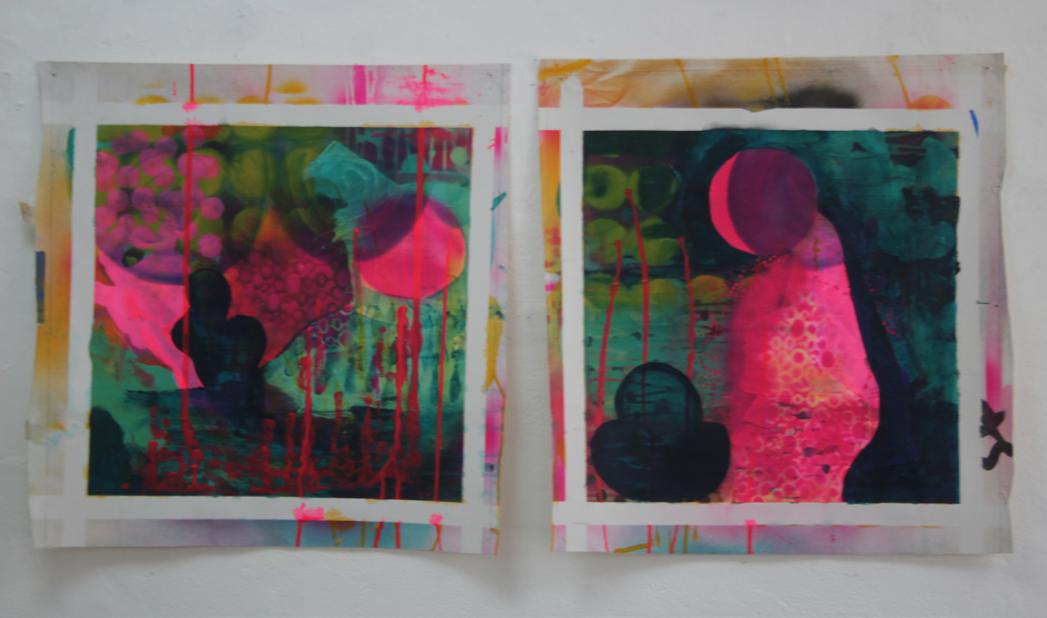
Colour, texture and bold mark-making become a way of trusting the unknown, giving shape to instinct while carrying connection outward through each new layer.
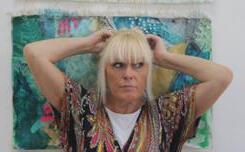
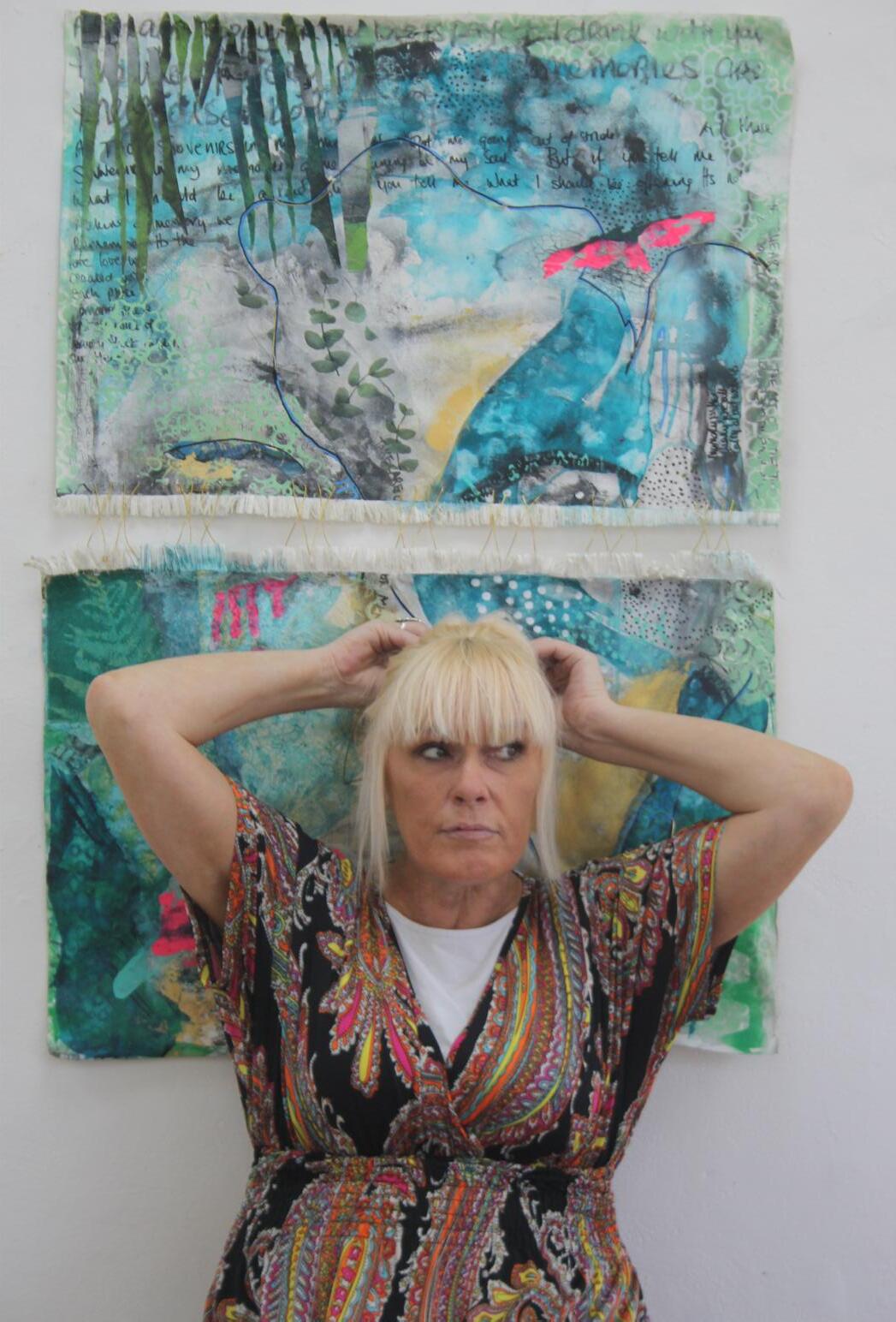
Iseult McCormack speaks about painting with the openness of someone who knows that art is not only about the finished work. It is also about permission, confidence, space, community and the moment when a person begins to trust the mark they are making.
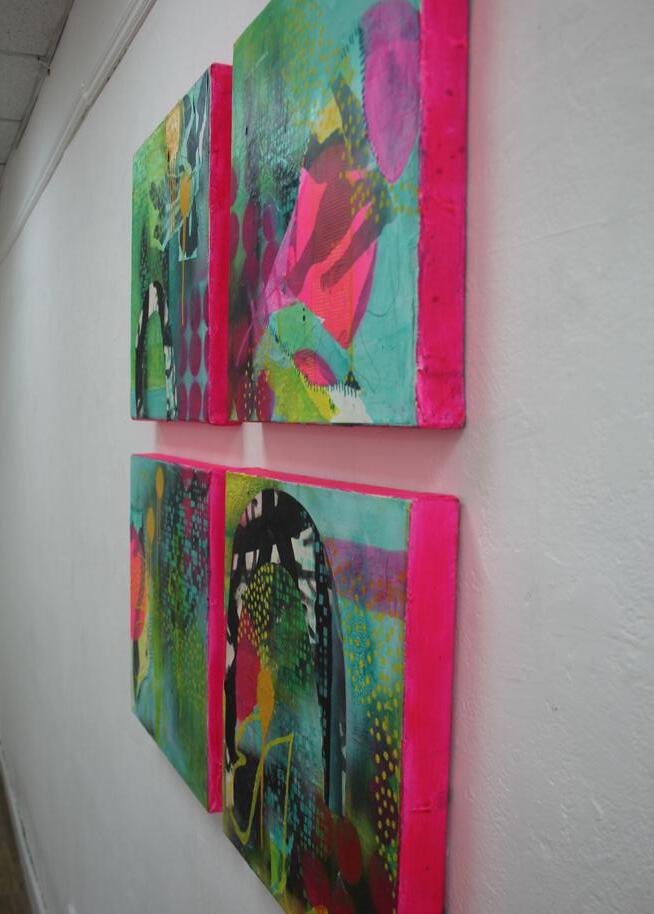
Her practice moves through vivid colour, texture, acrylic, collage, spray paint, charcoal and instinctive abstraction. It is work shaped by feeling, but not trapped inside it. McCormack’s paintings carry the energy of someone
“I never know what I’m going to paint”
who has learned to begin without needing to know exactly where the painting will end.
“I never know what I’m going to paint,” she says. “I literally never know. I just start.”
There is boldness in her work, but also trust. In one video shared on her social media, McCormack makes a series of bold black marks before confidently covering and answering them with white. It feels like a small but revealing glimpse into her process: the willingness to
make a strong decision, then keep working through it rather than retreating from it. Her paintings are not built from a fixed diagram or overplanned idea. They arrive through process, material, and colour - through the ability to keep responding until something begins to hold its own atmosphere.
For McCormack, abstraction is not an escape from the world. It is a way of listening to it differently.
Finding Her Own Visual Voice
McCormack had studied art before, but her return to painting in recent years came with a clearer sense of what she needed from the work. She remembers a time when she felt herself painting to please other people, rather than following the instinct that now drives her practice.
“When I got back into my painting a few years ago,” she says, “I was just following my soul. I’m just going to tap into what I need to convey, whatever that is.”
That shift changed everything. It moved the work away from approval and closer to something more personal, more intuitive and more alive.
McCormack recalls a former tutor who, at the time, had not responded warmly to the work she was making. Years later, after McCormack had returned to painting on her own terms, that same tutor bought one of her paintings at her first solo show.
“I think she just didn’t like that I wasn’t being myself,” McCormack reflects.
It is a small story, but it says a great deal about the shape of her practice. Her confidence has not come from neat certainty. It has come from learning to trust her own eye, to risk the mark, to stop hesitating, and to understand that a painting can keep changing until it finds itself.
“I think I’m more confident in my mark making,” she says. “I don’t hesitate as much anymore.”
The Freedom of Not Knowing
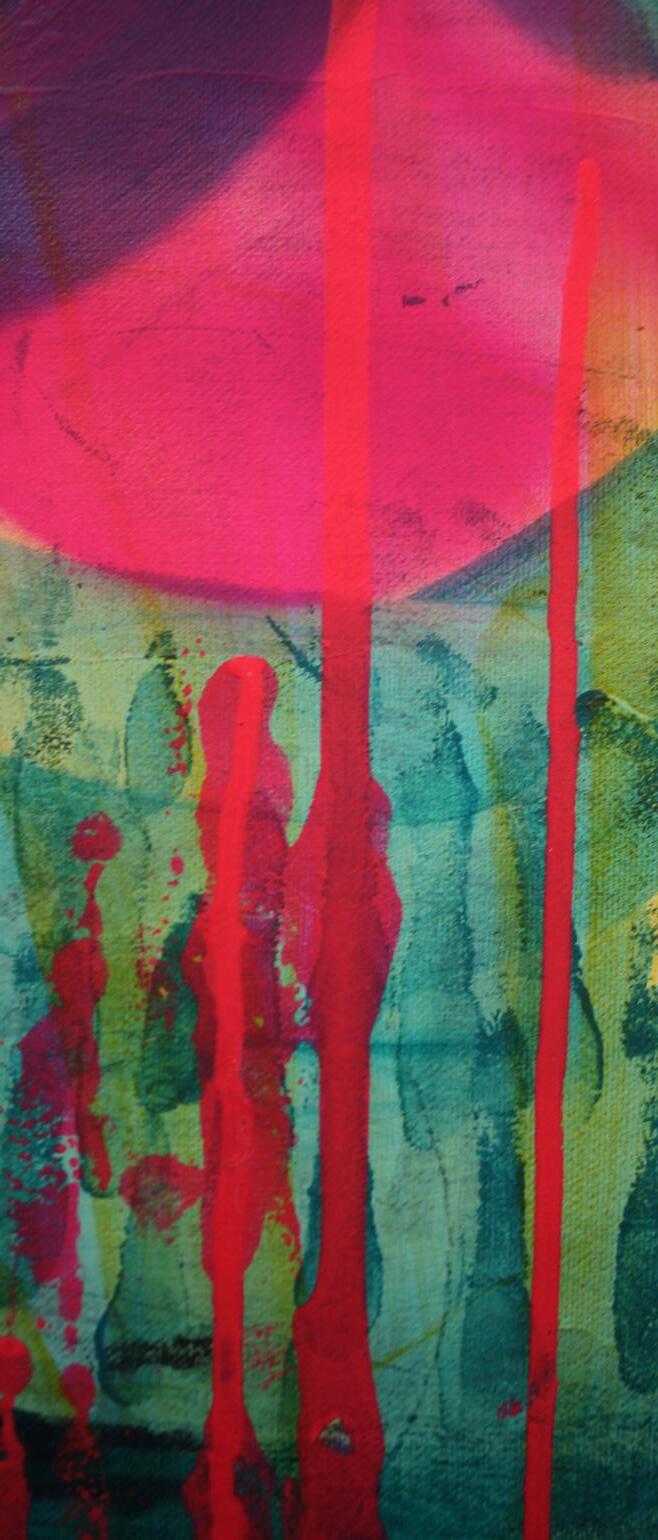
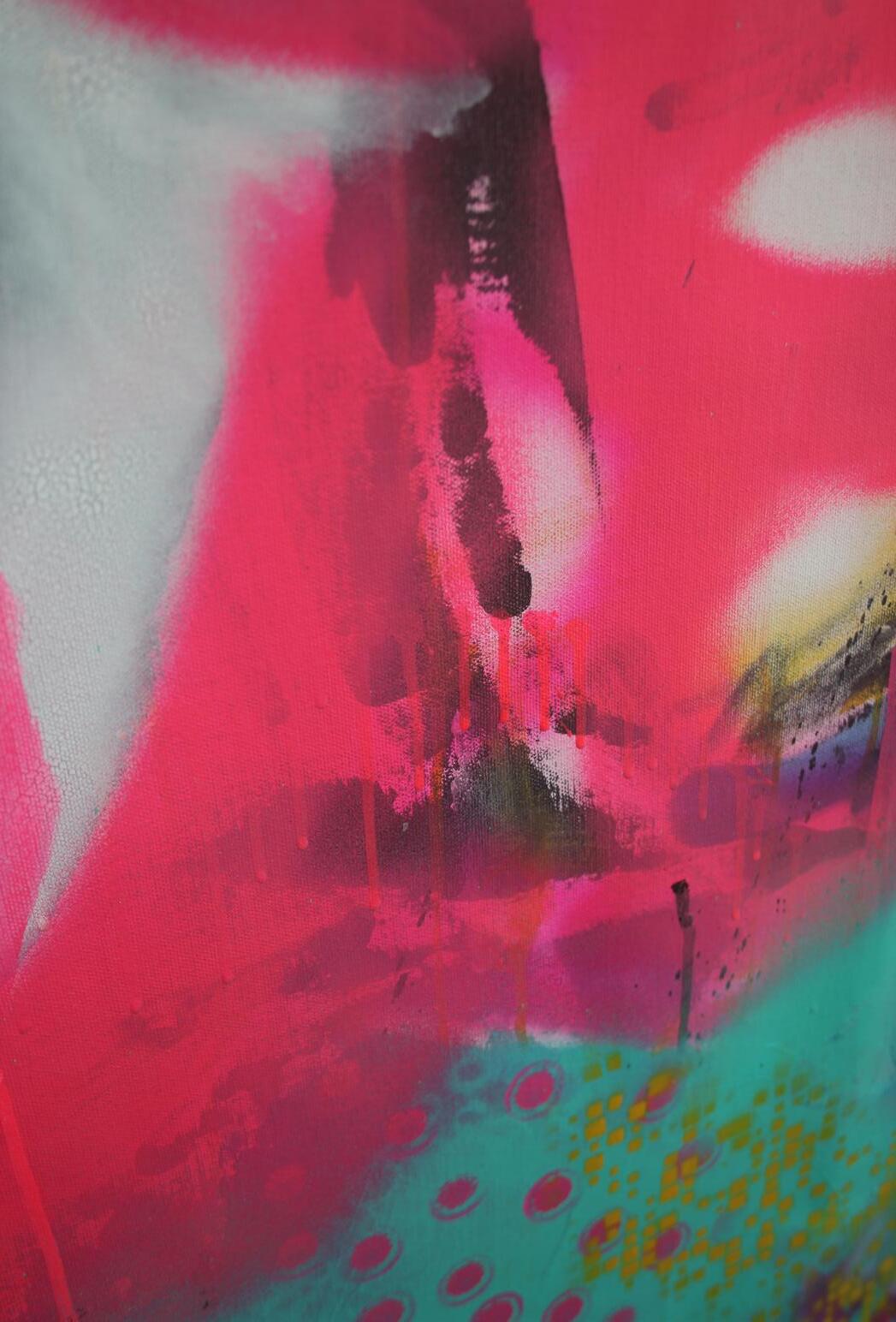
McCormack’s process is rooted in movement and discovery. Her palette is bright, her surfaces layered, and her approach open enough to let accident and instinct play their part. She is drawn to vividness - to marks and textures that hold emotion without needing to explain it too directly.
“I just go for it,” she says.
That does not mean the work is careless. Quite the opposite. There is a discipline in allowing a painting to evolve without forcing it too early into shape. The canvas becomes a place where the subconscious can speak before language catches up.
“Doing it in layers,” she says, “if I
“I
try to facilitate them finding their own forms”
don’t like something, I can paint over it.”
There is also a practical confidence in the way McCormack now works. If something does not sit right, it can be layered over. If a mark feels too strong, it can be answered by another. Her paintings build through that conversation between control and surrender.
Teaching as Connection
Alongside her studio practice, McCormack teaches abstract painting and mixed media. She speaks about teaching with real affection, describing it not simply as instruction, but as helping people find their own “visual voice.”
“I try to facilitate them finding their own forms,” she says. “I show them different ways of doing things… for them to then take what they like.”
In class, she introduces people to different materials and ways of working: texture, collage, paint, spray paint, stencils, mark making and methods for loosening up.
The aim is not to make students paint like her. It is to help them move past fear, habit or selfconsciousness and begin to recognise what belongs to them.
She remembers one class where a woman tried spray paint and stencils for the first time. The discovery opened something up, and the work changed in front of her.
“She created this amazing piece,” McCormack says, “because she’d never tried that before.”
For McCormack, those moments matter. They show what can happen when people are given space to experiment without immediately judging themselves.
Making something matters because it comes from somewhere real.
Permission to Begin
Many of the people who come to McCormack’s classes are not absolute beginners. Some already paint, but want to loosen their work, become braver, or reconnect with the pleasure of making. Others arrive carrying old doubts or experiences from school where creativity was narrowed rather than encouraged.
McCormack has seen how difficult simple permission can be. She remembers one workshop where a woman became emotional when given the freedom to do whatever she wanted.
“The idea of me allowing her to just do whatever she wanted was nearly too much for her,” she says.
That moment reveals something central to McCormack’s understanding of art. Creativity is not frivolous. It can touch parts of people that have been ignored for years.
“When you honour that part of your soul, that creativity part, it truly matters,” she says. “Whatever you do, whatever you make changes the energy because it didn’t exist before.”
This belief runs through both her teaching and her painting. Making something matters because it comes from somewhere real. It changes the space around it. It proves that a person has acted on their own imagination.
The Energy in the Room
McCormack is particularly interested in what happens when people make work together. In a class, everyone might begin with the same rules or the same materials, yet every result is different. That difference fascinates her.
It also feeds her own practice. Watching people find confidence
reminds her that creativity is not a solitary possession. It is something that can be shared, encouraged and strengthened by the presence of others.
She speaks about the classroom as a place where another kind of energy forms.
“It’s co-creating,” she says.
That sense of co-creation has become a major part of how she understands art. It is not only the finished object that matters, but the conditions around it: the conversation, the confidence, the permission, the shared willingness to try.
Signal Arts Centre and a Space to Grow
McCormack’s connection with Signal Arts Centre in Bray has been an important part of her development. During Covid, when restaurant work stopped and much of ordinary life was suspended, she found a route into a Community Employment scheme at Signal, a non-profit gallery where she became a staff artist.
“It gave me a real sense of pride in what I was doing.”
What began as a practical opportunity became something much more meaningful.
“Signal was amazing,” she says.
Creating work, becoming involved in community projects, taking part in events and developing the confidence to see her own practice more seriously. It gave her space, structure and a creative environment at a time when all of those things mattered deeply.
“It definitely changed my life,” she says.
That time at Signal also led her back into learning. Through a part-time course, McCormack found another layer of confidence in both her writing and her work. It gave her the experience of being proud of what she was doing, not in a fleeting way, but as something she could stand behind.
“It gave me a real sense of pride in what I was doing.” she says.
Working Around the Realities
McCormack does not romanticise
the practical realities of being an artist. She works around them. There are bills to pay. There is restaurant work. There are classes, applications, rejection letters and the constant question of how to fund the next stage.
“I just work around it,” she says. “I have to pay bills.”
That honesty gives the work another kind of strength. McCormack is clear about how much class, money and space shape artistic opportunity. Having a studio, being able to buy materials, affording a stand at an art fair, or simply having room to make larger work can change what an artist is able to attempt.
Recently, she received funding support from Wicklow, and describes the unusual joy of being able to order the materials she needed.
“For the first time ever, I was able to go online and order whatever I wanted,” she says.
It is a simple sentence, but it carries the weight of an unequal arts landscape. For many artists, materials are not incidental. They are the difference between an idea staying small and a work being allowed to become what it wants to be.
Space, Scale and the Tyrone Guthrie Centre
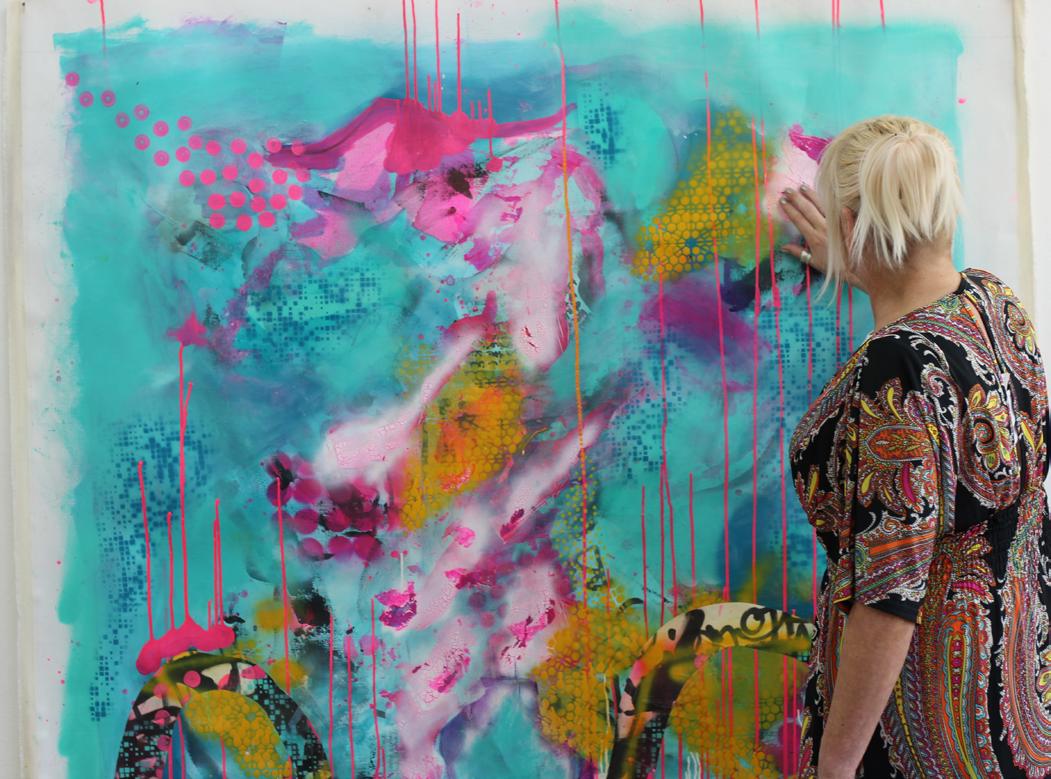
McCormack’s recent residency at the Tyrone Guthrie Centre gave her something transformative: time, quiet, food, space and the chance to work without constantly answering to the rest of the world.
“It was like magic,” she says.
At home, her studio is smaller, and that physical limitation has shaped the scale of her work. She often found herself working around manageable sizes, particularly the 40 by 40cm square.
“You have to get back to what you can do, what you can do in your community”
At Tyrone Guthrie, she entered a much larger studio and suddenly had to rethink what was possible.
“I rolled out a canvas and it looked like a little Lego mat in the back of the room,” she laughs.
At first, habit took over. She began measuring out the smaller sizes she was used to, before realising she did not have to. The room itself gave her permission to expand. She began making larger paintings, with new work developing towards an upcoming exhibition in September.
The experience helped her refocus.
“I feel really energised again,” she says.
Art, Responsibility and the Wider World
McCormack is deeply aware of the world beyond the studio. She speaks about the difficulty of making art at a time when suffering, violence and injustice appear constantly across our screens. The endless flow of images can make art feel fragile, even impossible.
“I do find it hard sometimes to feel like society needs artists,” she says. “But the world really does need us.”
That line holds one of the central tensions of being an artist now. What can painting do when the world feels so unstable? What is the place of colour, abstraction or creative play in a time of crisis?
McCormack’s answer is not grandiose. She does not pretend that art solves everything. Instead, she returns to what is possible: the local, the human, the communal, the ripple effect of showing up and making something with care.
“You have to get back to what you can do,” she says. “What you can
do in your community, what you can do with that ripple that goes out.”
In that sense, her work is not removed from the world. It is one of the ways she stays in relationship with it.
The Value of Making Something
There is a generosity in how McCormack speaks about other artists. She is alert to the ways artists support one another, encourage one another and celebrate opportunities even when resources are scarce. During her residency, she noticed the warmth of artists who could be genuinely delighted for a friend’s success, even when they were hoping for the same thing themselves.
“I’ve definitely settled into knowing that it’s going to be okay”
That spirit matters to her. It pushes against the competitiveness and scarcity that can take hold in creative life.
For McCormack, art is connection. It is the class where someone discovers a new material and surprises themselves. It is the gallery that gives an artist room to grow. It is the residency where scale becomes possible. It is the inherited ruler from her architect father, still used in her own practice, carrying one maker’s hand into another’s work.
It is also the simple fact of bringing something into the world that was not there before.
Following the Work Forward
As McCormack prepares new work for September, there is a sense of movement in her practice. Not a final arrival, but a deepening trust. Her mark making is more confident. Her scale is opening. Her relationship with teaching, community and painting continues to feed back into itself.
“I’ve definitely settled into knowing that it’s going to be okay,” she says. That may be one of the most honest things an artist can learn. Not that every mark will work. Not that every opportunity will come through. Not that money, space or rejection will suddenly stop mattering. But that the work can continue. That a painting can be layered. That confidence can be built. That colour can return.
For Iseult McCormack, abstraction is not simply a style. It is a way of making room for instinct, connection and courage. It is a practice built through vivid colour, shared energy and the brave, ordinary act of beginning without knowing exactly where the painting will go.
Keep up with Iseult via social media: @iseultmccormackcreations
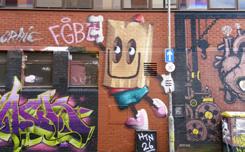
Ray Bonner
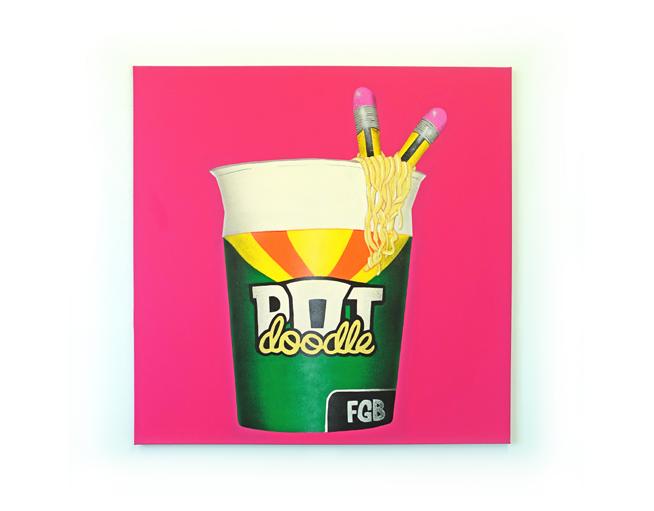
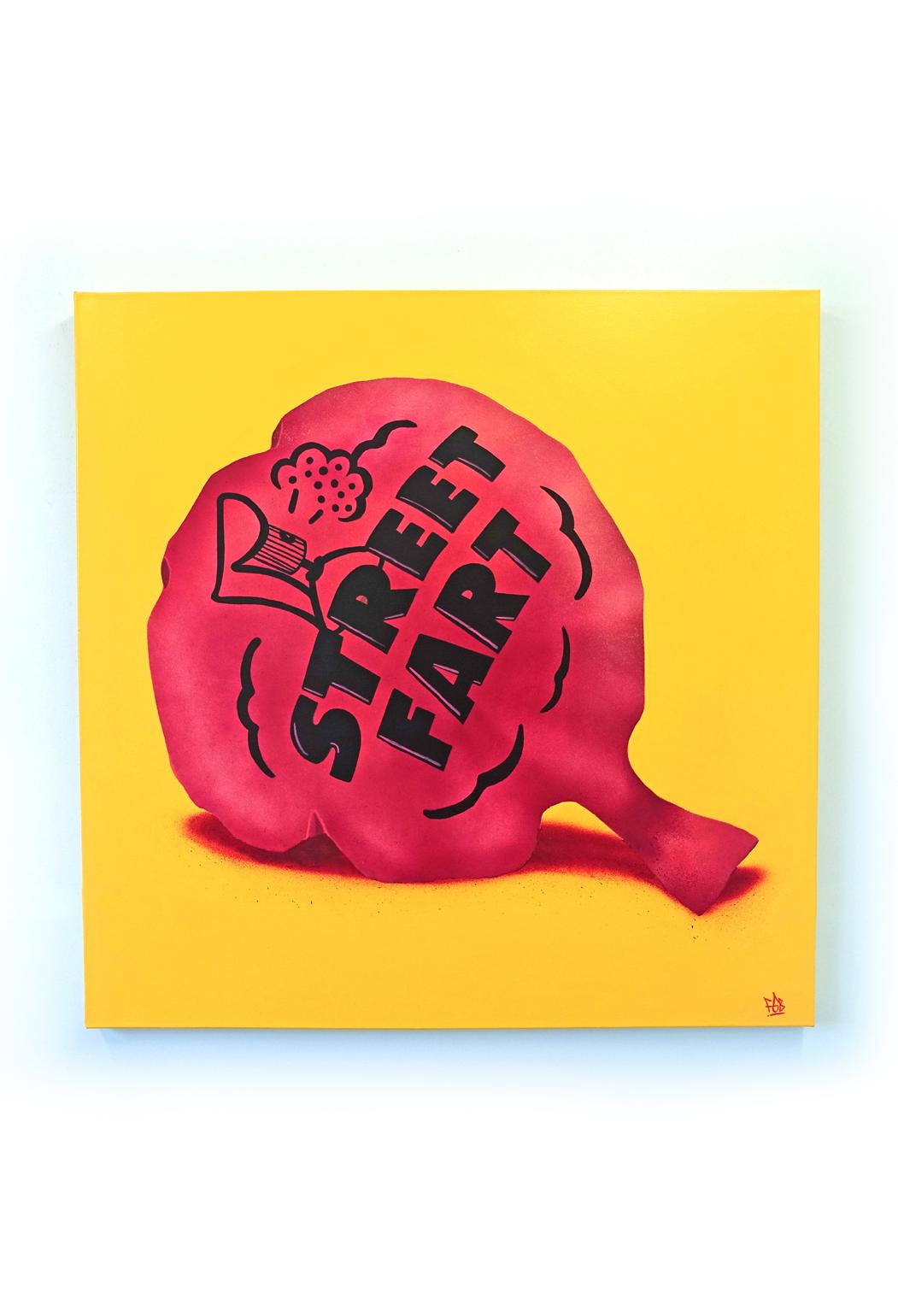
Francois Got Buffed
Street art becomes a way of reading the city differently, where bold colour, sharp humour and careful placement turn ordinary walls into public acts of attention.
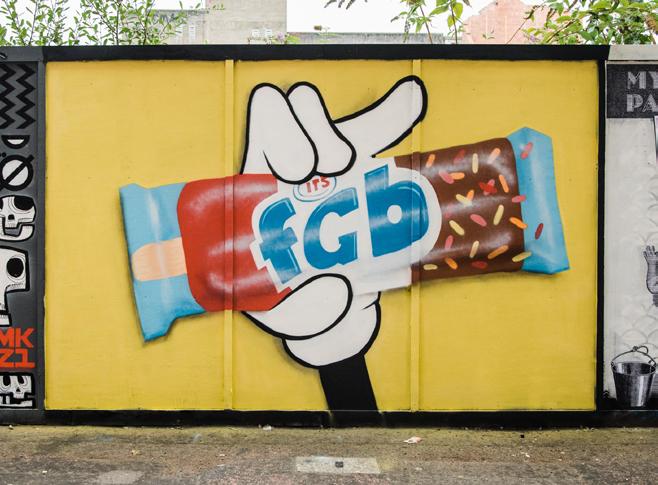
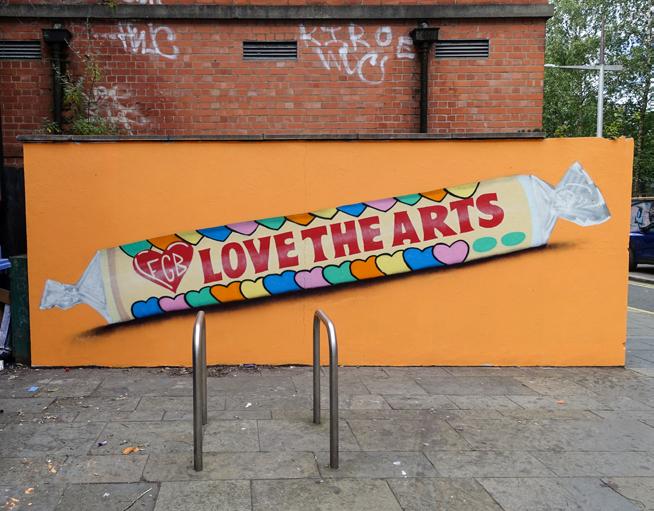
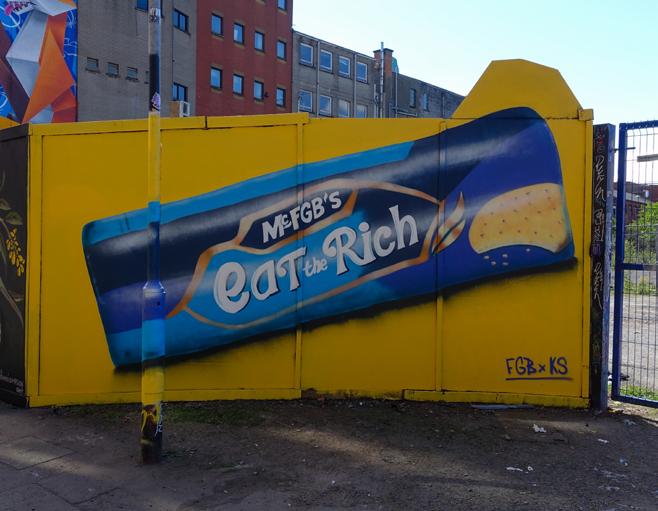
For Ray Bonner, better known through his artist name
Francois Got Buffed, or FGB, a wall is never simply a blank surface waiting to be filled. It has a shape, a setting, a speed of encounter. There may be a lamppost in front of it, a tree nearby, a strange architectural break, traffic moving past too quickly for small details, or a light that changes how the work behaves after dark.
Those interruptions are not always problems. For FGB, they can become the beginning of the work.
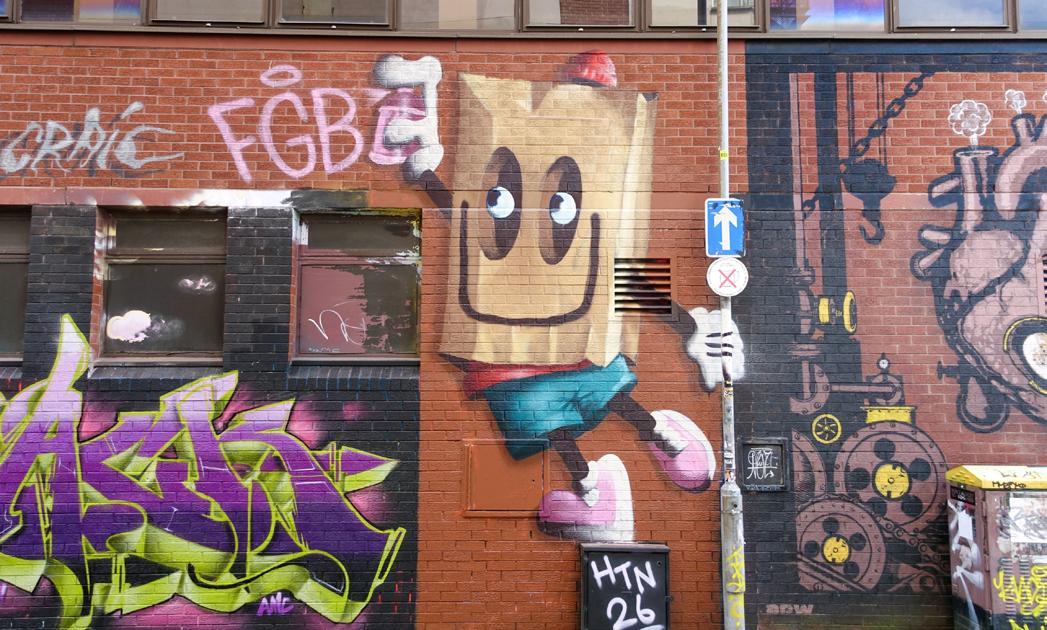
“I like to try to add elements from around the wall you’re painting on,” he says, “to add to that sense of place.”
That sense of place runs through the conversation. At the time of speaking, FGB was planning a commercial mural with a floral brief - “not exactly my usual kind of thing” - on a large hoarding beside a road. The location immediately shaped the approach. Most people would see it from a moving car, so the image needed to hold at speed.
“I think it’s going to have to be big, bold, graphic,” he says, “but I’ll try to have a really soft colour palette on it.”
That balance is important. FGB’s work is often bright, popinfluenced and playful, but it is not simply loud. It responds to where it is. A mural on a roadside needs a different kind of clarity from a painting someone can stand in
“I like to try to add elements from around the wall you’re painting on, to add to that sense of place.”
front of. A lamppost, rather than being ignored, can become part of the composition. A tree can be used to make the image feel as though it belongs to the place already.
“It’s playing about with perception,” he says. “That can also be fun.”
Working With the Street
FGB is interested in the way murals can work with the objects already present in the street. Lampposts, lights and other pieces of street furniture can interrupt a wall, but they can also offer something to play with. He likes the thought of using real light, imagining how colours on the wall might appear when the lamps come on at night.
“I love the idea of playing about with the actual light,” he says.
In that part of the conversation, Anna Fish comes up through her own mural work, where a lamp became a central point rather than something to be disguised. FGB also mentions Keyto at Hit the North, whose frog appeared to hold onto a lamppost, with cardboard fingers physically attached to the pole.
“It’s fantastic,” he says.
These examples matter because they reveal what FGB values: a mural that notices where it is. The strongest street art, in his view, is not just an image pasted onto a wall. It is an image that understands the wall, the street
and the way people move through the space.
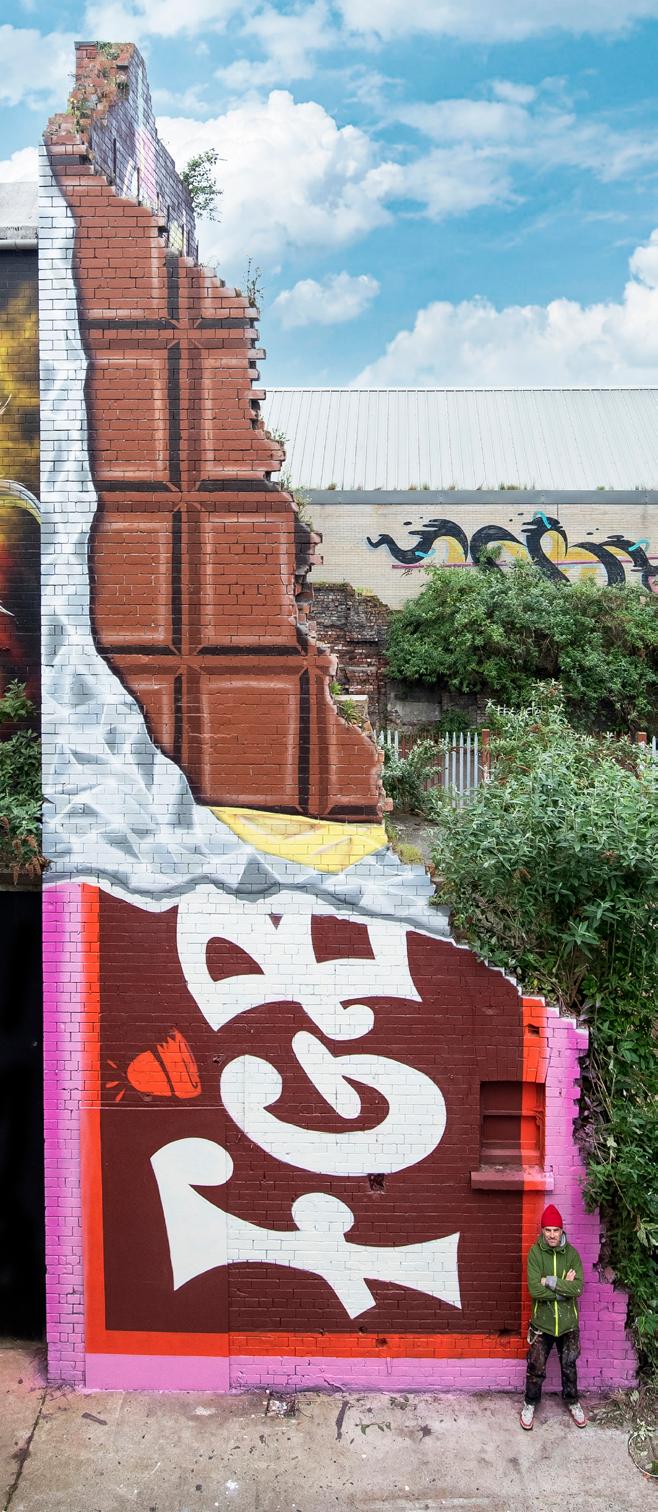
One of his own clearest examples came at Hit the North in 2024. At first, he was frustrated by the awkward shape of the wall he had been given. Then, looking again, he saw something else.
“It just looks like a chocolate bar with a bite out of it,” he remembers thinking.
From that awkward shape came a collapsed structure reimagined as a bitten chocolate bar, with the lower section becoming the wrapper. The wall’s problem became the work’s personality.
The Chocolate Factory and the Peace Process
FGB initially tried to draw a more explicit political reading from the chocolate bar. In 2024, he realised he had spent half his life before the Good Friday Agreement and half his life after it. He began thinking about Charlie and the Chocolate Factory.
“We had been given the keys to the chocolate factory,” he says.
The image started to carry a question: had the years since the peace process been used well, or had there been a missed opportunity?
The Old Days of Street Art
When FGB talks about street art, he speaks with affection for its earlier atmosphere. When he first started, anonymity was not a branding device. It was part of the conditions of making the work.
“I remember when I first started,” he says, “anonymity was permanent.”
Street art, he explains, was still viewed in much the same way as graffiti. It had not yet been widely monetised, accepted or folded into
commercial design culture. People encountered the work by being physically present with it. They saw its scale, the wall, the street, the weather, the surrounding sounds and smells.
Now, much of that encounter happens through social media.
“Everybody’s looking at these things on tiny screens,” he says, “and you just don’t get that same impact.”
FGB is not dismissing social media entirely. He uses it himself, including to show how his work is made. But he is aware of how it can flatten the experience of street art. It can encourage work that fits neatly into a square or rectangle rather than work that belongs fully to the place it occupies.
Back then, he says, there was more emphasis on placement. Artists would see a space, photograph it, sketch for it and make something that worked there specifically.
“People put a lot more thought into, ‘I can see such and such going in this space,’” he says.
“Everybody’s looking at these things on tiny screens, and you just don’t get that same impact.”
That way of thinking still guides him.
Collaboration on the Wall
FGB is also drawn to walls that behave as shared conversations. At festivals, artists are often given their own rectangles, but he remembers the older feeling of walls where artists let their pieces connect: one colour moving into another, a background extending across a boundary, small gestures making separate works feel cohesive.
“It was that element of collaboration,” he says.
He points to Irony and Vents at the end of Union Street as an example. Irony’s painted woman and Vance’s traditional graffiti piece below it used related colours, and a small drop shadow made the letter appear to sit over the figure’s arm.
“It’s just touches like that,” he says, “they link the pieces together.”
KVLR also comes up as an artist particularly good at this. FGB
describes him as someone who will suggest bringing one background into another artist’s space, or sharing a colour so the wall becomes one larger artwork.
For FGB, this comes from graffiti. Writers working together would link their pieces so individual names still formed part of a whole. That old grammar still has value. It makes the wall feel alive with exchange rather than divided into competing panels.
Skateboards, Cartoons and Graffiti
FGB’s visual influences begin outside the gallery. Skateboard graphics were crucial.
“Skate graphics were definitely a massive influence,” he says. “I would sit and stare at the images in skate magazines or catalogues looking over the graphics.”
He was drawn to bold colours, solid outlines and the way artists used the limited space of a deck. That still resonates with him and his own use of space.
T-shirt design had a similar impact. He mentions Bathing Ape designs from the late 1990s and early 2000s, where a simple but wellexecuted logo showed how powerful a repeated graphic identity could be.
Cartoons also shaped him deeply. They offered colour, bold line and surreal freedom. Bodies did not have to behave like real bodies. Arms could be too long, heads could be too large, forms could be distorted and still feel alive.
“You don’t have to make things look human,” he says. “They don’t have to be realistic.”
Graffiti was another major influence, though his early experience of it was shaped by the North. Growing up, he mostly saw political graffiti made with brushes,
rollers and household paint. When he saw more colourful graffiti through skate magazines, and later in Dublin, it hit differently.
“When I saw proper graffiti it was like a colourful punch in the face,” he says.
Dublin became important because it showed him placement in action: work appearing in perfect spots, or in obscure places that made the city feel charged with possibility.
Showing the Labour
FGB often shares the process behind his murals, not just the finished image. In an age of instant AI images and frictionless online content, that feels increasingly important. It shows that a mural is not simply an image arriving from nowhere. It is planning, drawing, measuring, prep, mistakes, adjustments and physical labour.
“I think that showing how the work is created helps break down the barriers of ‘how does it get there,’” he says.
One of the questions mural artists are asked most often is how they paint at that scale. FGB sees process-sharing as a way to demystify that, especially for newer artists.
“Showing the creation process helps demystify that,” he says.
It can also make the work more generous. He has learned from watching other artists, picking up small tips and tricks or refining his own process through conversation. For him, newer artists can sometimes focus too much on the spray painting itself without seeing the amount of preparation that happens before anyone touches the wall.
“Seeing the work that other artists put into the prep should help them see it’s not just about the artwork on the wall,” he says.
Photograph: Neal Campbell
That belief connects to his own practice. A finished wall may look playful, but behind it sits drawing, value, colour planning and repeated problem-solving.
Learning Colour Differently
Colour is central to FGB’s work, which makes it striking when he explains that he is colourblind.
“When I first kind of started doing street art,” he says, “I just done everything in black and white, because I didn’t like using colour.”
Over time, he developed workarounds. If someone points to a blue, he might know it as a particular Montana 94 colour rather than simply blue.
“I’ve learned colour through various paint companies’ range of paint,” he says.
A mentorship with Irony in London helped refine this even further. Irony had scanned colours from spray paint ranges and organised them by value, from light to dark, allowing FGB to work more analytically in Photoshop or Procreate.
“It’s just been unbelievable,” he says.
Rather than treating colourblindness only as a limitation, FGB has built a process around it.
“What way can I create a process so I can work with this?” he asks.
That question seems to run through much of his practice.
Oul Paintings and Bright Intrusions
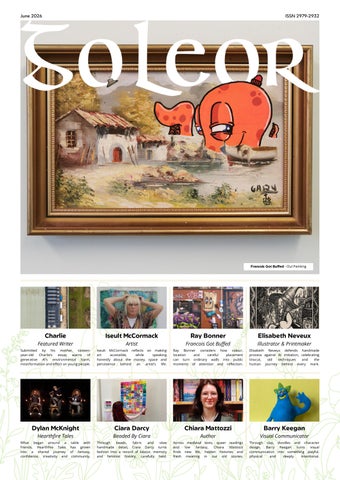
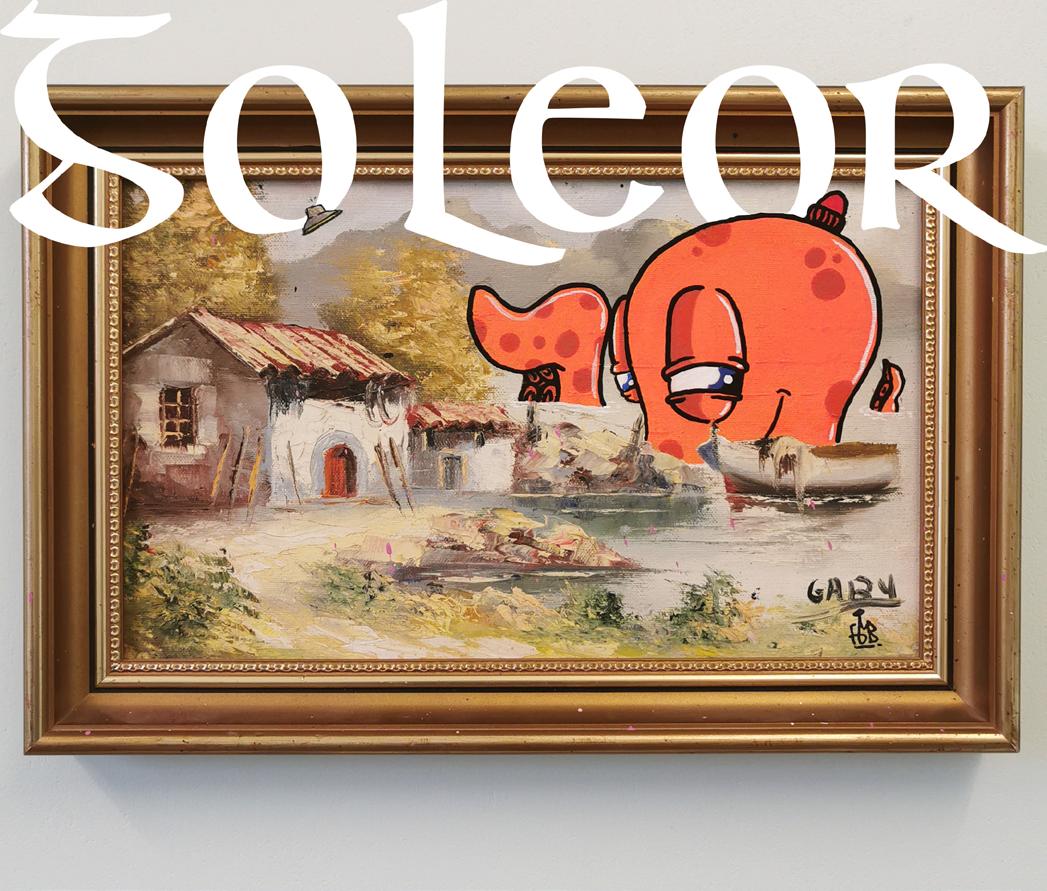
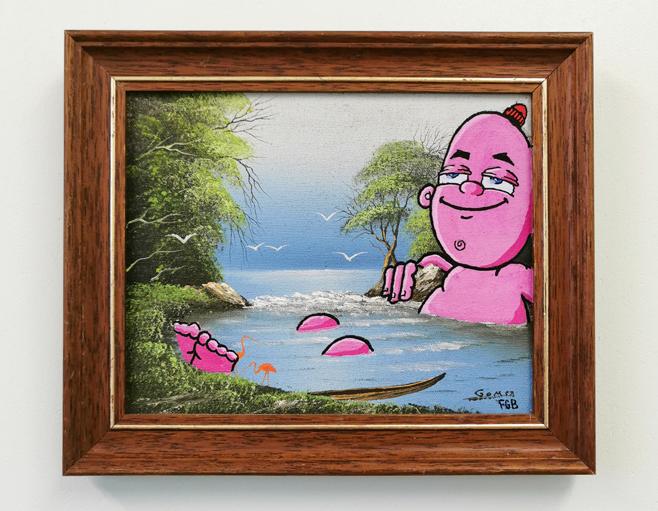
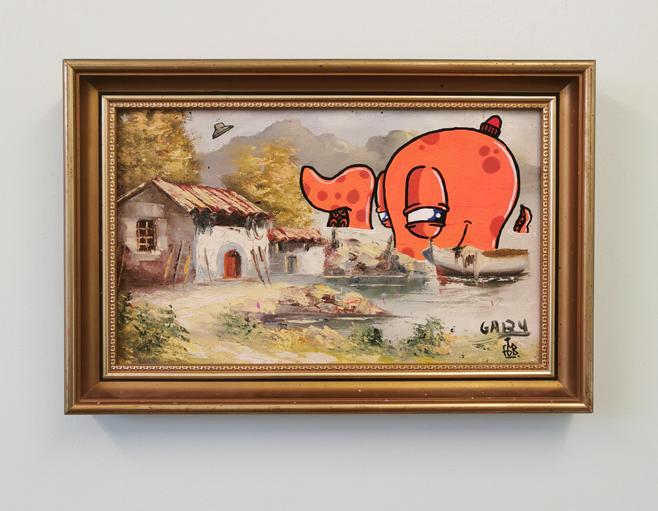
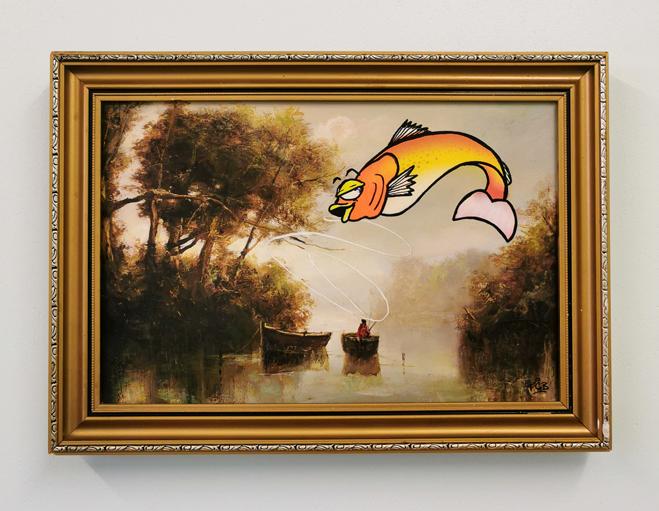
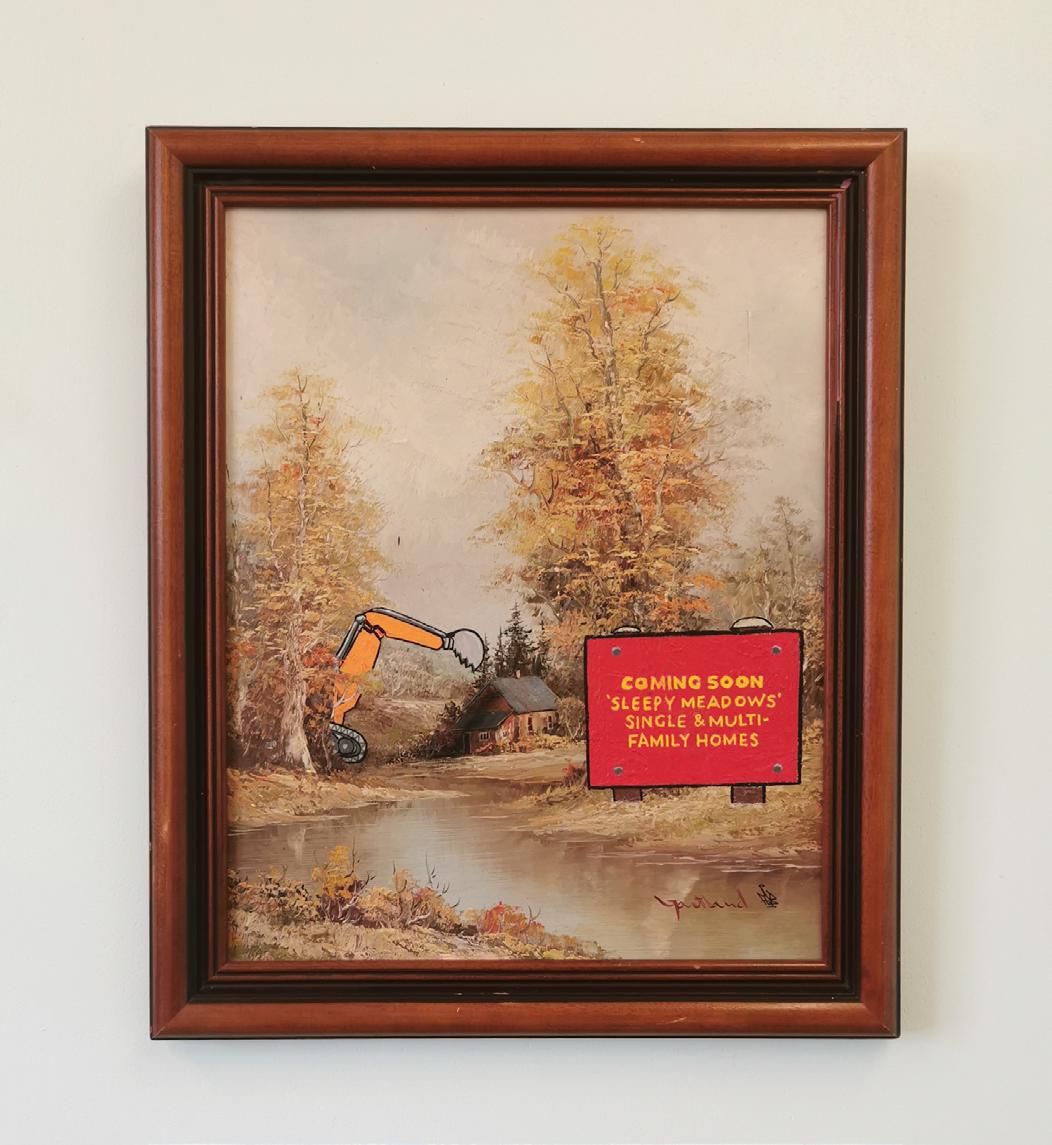
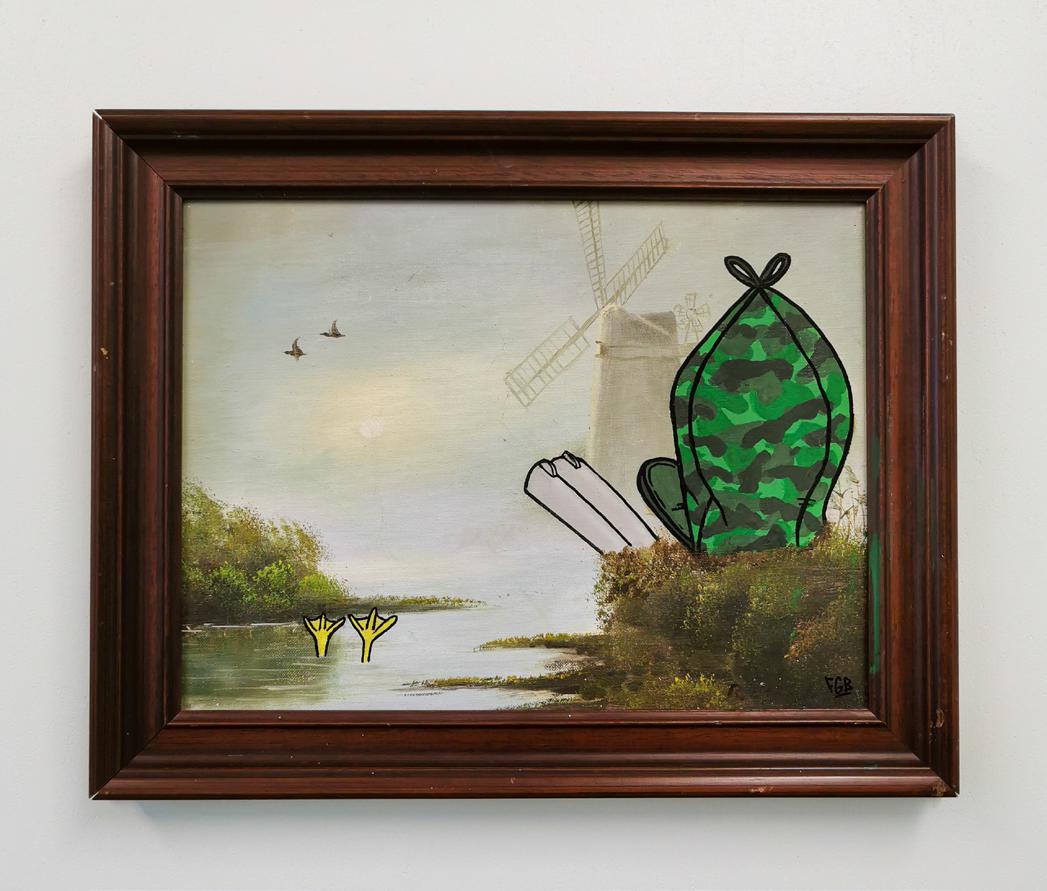
FGB’s work with found paintings also reflects his interest in contrast. He speaks about finding old paintings with subdued or neutral palettes, to which he introduces the arrival of his own
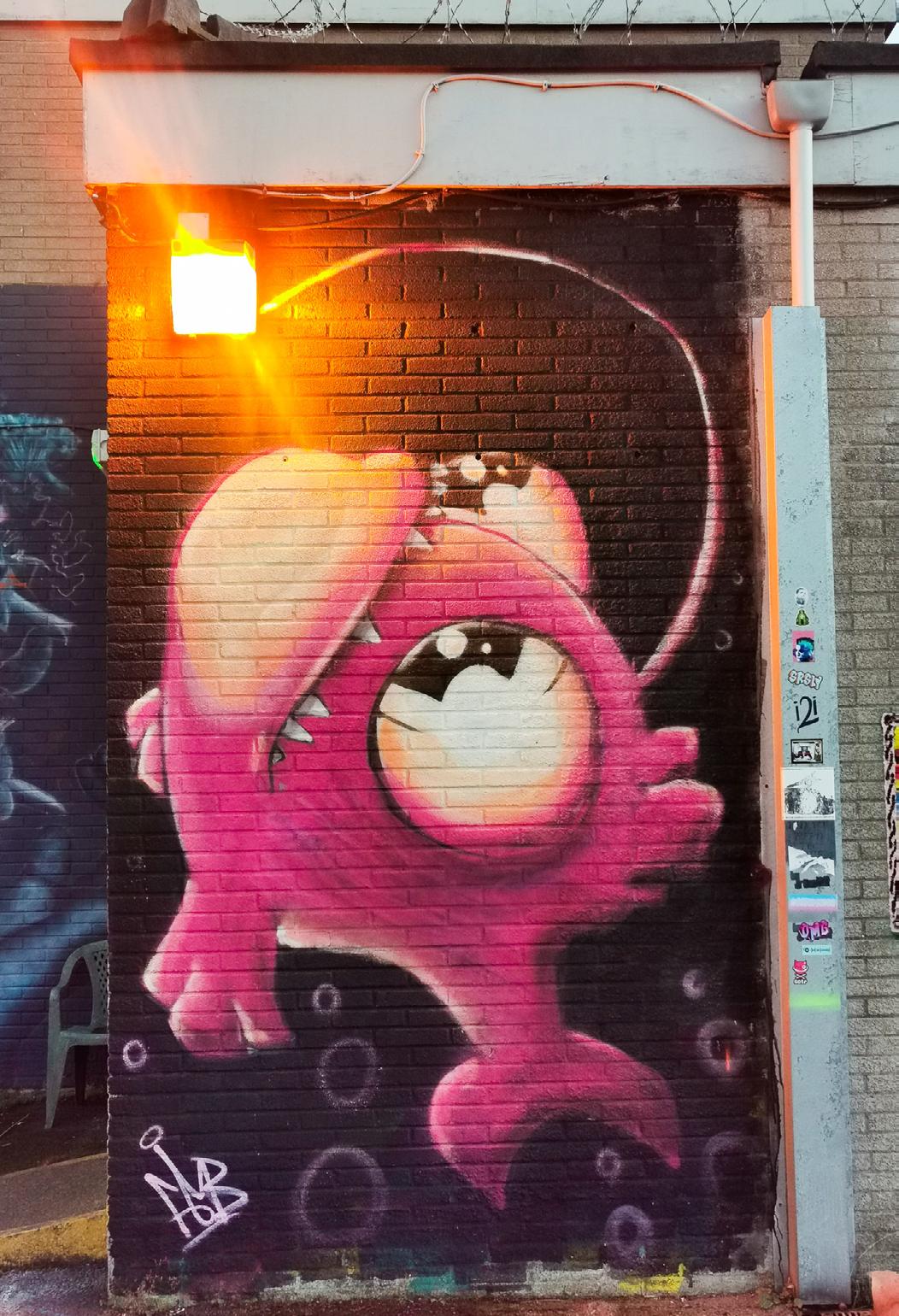
brighter forms - pinks, oranges, octopuses or strange characters - cutting into those quieter scenes to create Oul Paintings
“I think it is that idea of these beautiful old paintings that are quite soft,” he says, “and then I use a lot of pinks and oranges.”
The result is a collision of visual languages. The inherited painting meets the cartoon, the street mark, the strange interruption.
The Temporary Gallery
The word “buffed” points directly to the temporary nature of street art: work can be painted over, tagged, weathered or removed. For FGB, that impermanence is both frustrating and energising.
“I think it’s a bit of a mixed bag,” he says.
He enjoys seeing fresh pieces change over time as tags are
added and walls begin to deteriorate. It gives the work what he calls a “colourful lifespan.”
“You’re not really going to get a chance to come back and fix bits you don’t like,” he says.
That makes him want the work to be as close as possible to what he intended while he works. At the same time, he values the idea of the city as a constantly changing gallery.
“You want to see new things happening,” he says.
Some losses are harder. He mentions ACHES and VOYDER on the bingo hall, two major artists whose works disappeared when the building was knocked down. It is a reminder that even large public artworks can vanish with redevelopment.
“Really appreciate it while it’s there,” he says.
Subculture, Development and Vault
FGB is alert to what happens when corporations move into street art. As murals become popular, they can be used to make brands look cool, decorate developments or sell a version of subculture back to the people it came from.
“It happens to all subcultures,” he says. “The corporate world start to see value in it and how they can benefit from it.”
He contrasts that with artists who want to respond to place, community and meaning. Companies, he says, often want the cheapest and quickest way to put something on a wall.
“They just don’t give a shit about that,” he says.
This is where spaces like Vault Artist Studios matter. FGB sees Belfast as full of empty buildings
“Communities are massively important, I know my practice benefited massively when I joined Vault.”
with potential, many in overlooked areas. Used well, those spaces can bring creative life into communities without simply gentrifying them.
“They can reinvigorate these places,” he says.
Vault has also shaped his own practice. Having a dedicated space mattered, but so did the daily presence of other artists, performers and makers.
“Communities are massively important,” he says. “I know my practice benefited massively when I joined Vault.”
The support, exchange and shared knowledge of that community have had a lasting impact. It also makes creative careers visible. FGB mentions the circus performers at Vault as an example: young people may see circus or art as entertainment, then realise through open studios that these are possible lives.
“All of a sudden,” he says, “it’s something that’s just a normal job.”
The Work Behind the Wall
For all the immediacy of FGB’s finished work, he is still actively studying. He has been teaching himself drawing, buying packs of small A5 sketchbooks and doing at least one drawing every day.
“Even if you think you’re good at something, you can always improve on it,” he says.
He has also been reading Drawing on the Right Side of the Brain, captivated by exercises that ask the artist to draw upside down so the object becomes line, shape and angle rather than a named thing.
“You’re not thinking of it as a person sitting in a chair,” he says. “It’s all abstract.”
The same attention now goes into colour mixing, studio work and the foundations beneath each piece. Spray paint gives him individual colours ready-made, but painting in the studio asks for another level of mixing and control.
“If your sketch is brilliant and then your colours are brilliant and your tonality’s brilliant,” he says, “it’s just all these things that add up to make each artwork as good as it can be.”
That may be the clearest way to understand Francois Got Buffed. The work is playful, public and bright, but it is not casual. It is built from looking carefully: at walls, decks, cartoons, graffiti, lampposts, oul paintings, other artists, colour systems, empty
buildings and the changing city itself.
The finished mural may be temporary, but the thought behind it stays with you. It asks you to look again at the street, and to notice that even the awkward wall may already be waiting to become something stranger and more alive.
To find out more about Francois Got Buffed, visit his website: francoisgotbuffed.wixsite.com
To explore more of Francois Got Buffed’s work beyond the wall, visit his online shop: fgb.bigcartel.com
And keep up with him via social media: @francoisgotbuffed
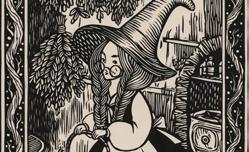
Elisabeth Neveux
Illustrator & Printmaker
Through linocut, folklore and a traditional process, Elisabeth Neveux defends the human journey of making, where every mistake, mark and story carries its own weight.
Elisabeth Neveux likes to meet people through the work she creates.
For a while, she had a physical shop. There were parts of that she loved, but it also meant being tied to one place. Markets gave her something different. Moving from event to event, table to table, town to town, she could meet people from different backgrounds, different countries and different stages of life.
“I never know who I’m going to meet,” she says. “It’s very exciting.”
At markets, people tell her stories. Some come back year after year. Some she has watched have children over time. A customer might arrive because of a print, then stay because of the story behind it. That exchange matters to Elisabeth because her linocuts are not only images. They are built as narrative objects, carried through paper, ink, texture and conversation.
Online, a viewer might only see a digital picture. In person, they can hold the paper. They can feel the print. They can understand, even before they fully know the process, that something has been physically made.
That physical presence has become more important to Elisabeth as the creative world shifts around AI, replication and digital theft. Recently she found herself getting onto an intense conversation with someone online
“I didn’t want to just create pretty pictures. I wanted to tell a story.”
who affirmed everyone could make drawings like hers. Instead of withdrawing, she challenged him directly. She stood up for herself, argued for the value of artists’ labour, and even invited him to Dublin to try the process himself.
It was not just about one image. It was about what happens when the journey of making is stripped away, and only the surface is copied.
Stories at the Table
Elisabeth’s work often finds its audience through events. Comic cons, exhibitions, markets and festivals give her the opportunity to explain what each linocut contains.
“I tell people the story behind every linocut,” she says. “They are not just illustration. I didn’t want to just create pretty pictures. I wanted to tell a story.”
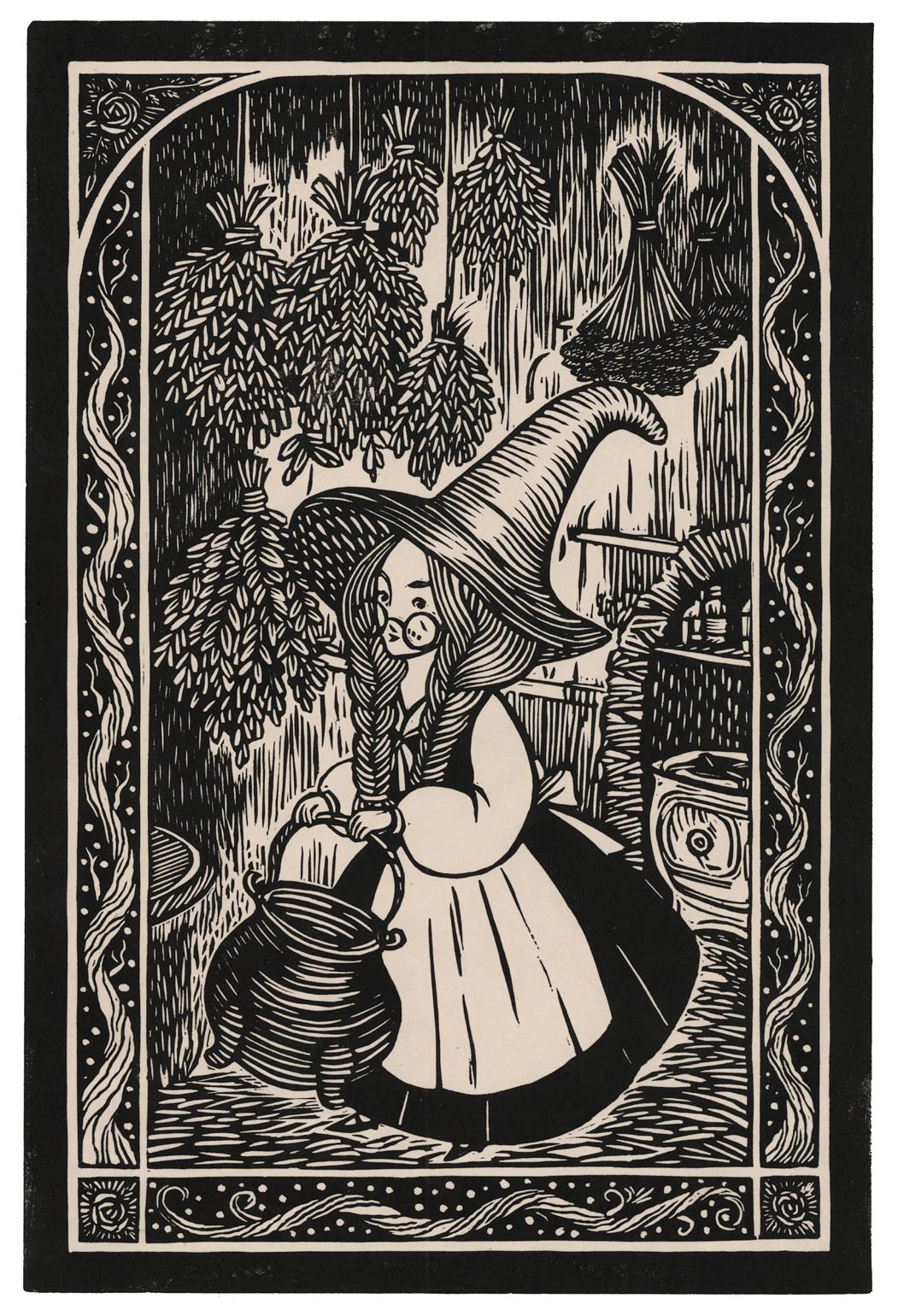
One of those stories centres on Hazel and Batcat, a grumpy witch and a mischievous, hell-raising cat inspired by Elisabeth’s own companion of 20 years, Kitsune. Her real-life presence often made the work unpredictable. During Covid, when paper shortages already made printing difficult, she once stepped across fresh prints, leaving paw marks behind. Elisabeth thought no one would want them.
Instead, one customer bought a marked print and loved it more
because of the paw print. The mistake had become part of the story. Something unplanned, inconvenient and very real had entered the work.
That kind of detail is difficult to reproduce digitally. It is not simply texture. It is evidence of a life around the object: a cat in the studio, a shortage of paper, an artist adapting, a customer understanding that the trace made the piece more human.
Reading Aloud and Spooking People Out
Alongside her visual work, Elisabeth has begun doing live readings. Through Illustrators Ireland and the Alliance Française, with the support of Debbie Jenkinson and Karen Harte, she was invited to take part after Debbie was unable to do the reading herself. The opportunity came through the kind of realworld connection that events often make possible.
Elisabeth would like to do more of it.
She describes herself as socially awkward when standing with a microphone, and says she shakes “like a leaf” before reading. But once she begins, something else takes over.
“It transports people into another world,” she says.
She especially enjoys watching people react, particularly when the work unsettles them.
“I love spooking people out during my live readings,” she says.
After one event, there was a small book sale where people asked questions about the reading, the story and what might come next. Some had missed the first part and wanted to know more. Others asked what she planned to do after it. That response has
People still want the thing made by hand. They still respond to the pressure of the ink, the grain of the paper, the fact that no print is quite identical to another.
encouraged her to think about taking readings further, even dreaming of travelling with them one day.
For an artist whose images already feel close to folklore, horror, old storybooks and strange creatures, the readings make sense. They give voice to the same worlds the linocuts suggest.
Keeping Old Techniques Alive
Elisabeth has a deep respect for digital art, but she has always been drawn to traditional process.
In her twenties, while in fine art, she left partly because of the pressure to use digital methods. She did not reject digital art entirely, but she wanted to be stubborn. She wanted to keep older techniques alive.
There is warmth, she says, in traditional work. At events, people touch the prints and react when they realise what they are holding.
“It’s a real print,” they say. “It’s a real linocut.”
Elisabeth does sell reproductions on high-quality paper, but most of the time people choose the original prints, even when they cost more. That tells her something about the appetite for physical work. People still want the thing made by hand. They still respond to the pressure of the ink, the grain of the paper, the fact that no print is quite identical to another.
For Elisabeth, the mistakes are part of that value.
With digital tools, she says, you can copy, paste and erase. With ink, a mistake may mean starting again. With lino, some errors can be repaired with Sugru, but not always. She remembers one plate where a correction failed after around 40 hours of work. She had to redo the entire piece.
It was frustrating, but it was also part of the process.
“I think it makes you grow as an artist to learn from your mistakes,” she says.
The Image Before the Print
Elisabeth is self-taught, and she is honest about the difficulty that brings. She did not receive the formal training she wishes she had in anatomy or perspective, so she has had to work harder to build those skills herself. Sometimes she takes reference photos. Sometimes she poses in awkward positions to understand how a body should sit inside an image.
But her process begins before all of that.
When an image arrives in her mind, it does not come flat. It comes with atmosphere. She can almost smell it, taste it, feel what surrounds it. Then comes the difficult work of translating that inner image onto paper.
“You never quite get what you had in your head,” she says.
That gap can be frustrating, but it is also where the work happens. The first sketches may be rough. She describes some of them as dreadful. Then, through each version, the composition sharpens. The movement begins to settle. The image gets closer to the thing she first sensed.
Her practice is also shaped by film and animation. She watches movies while she works and thinks of images cinematically, often as black-and-white films with occasional inclusions of colour. Her pictures do not feel still to her. She sees them in movement.
“You have to be a bit of an actor,” she says, thinking about expressions, gestures, interaction and the world around the figure. That sense of movement is visible
She would love to make work around Arthurian legends. Greek mythology also calls to her.
in her work. Even when a linocut is fixed on paper, it can feel like a scene caught mid-motion.
Fairy Tales, Tolkien and Worlds Still Unseen
Elisabeth’s imagination is full of worlds she would still like to explore.
Tolkien is important to her, though difficult, because she grew up with illustrations that already shaped the way she sees those stories. Brian Froud, one of her favourite illustrators, made such a deep impression that it can be hard to escape those images when approaching fantasy.
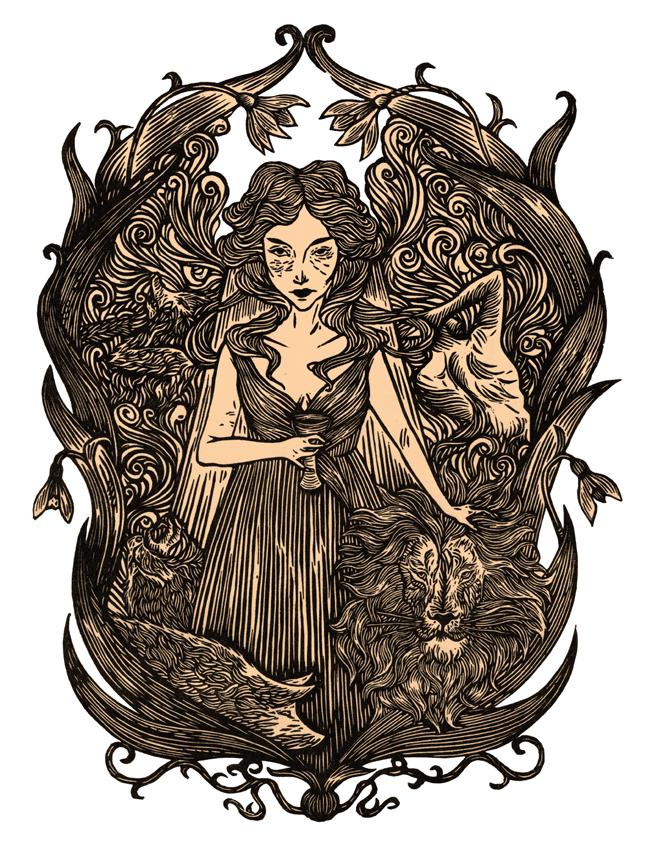
She is especially drawn to books and legends that have not already been over-illustrated, because they allow her to form her own inner image. She would love to make work around Arthurian legends. Greek mythology also calls to her, and she has already made a Circe print inspired by Madeline Miller’s novel. She loves that piece, even if it is not one of her bestsellers.
There are many other possibilities: Grimm fairy tales, Dracula, ghost stories, personal worlds of her own. Yet because printmaking takes so much time, she is careful about what she chooses.
“I prefer working on personal stories,” she says.
That preference matters. Elisabeth does not want to simply reproduce someone else’s world. She admires artists who can make fan art while keeping their own style, but she finds that difficult. She would love, for example, to be asked to make work connected to Nintendo’s Breath of the Wild, but she knows there would be challenges “I love the art direction so much I struggle to unsee it”.
For her, every artist should try to build their own identity.
“Don’t try to imitate other artists no matter how much you love their work,” she says, “try to nurture your own perspective and the way you see the world, try to interpret what emotionally resonates with you”
The Artists Who Answered Back
That belief in individual artistic voice goes back to childhood.
Around the age of 11 or 12, she wrote to Brian Froud and Alan Lee because she wanted to become an illustrator like them. At that age, she did not fully understand how significant they were. Fairy tale imagery was often dismissed around her as childish, something “for babies,” but their work gave her a sense of possibility.
She first contacted the publisher, who offered to pass on a letter. The letter travelled all the way to New York and eventually reached them. She remembers receiving the reply with the British stamp.
Over the years, she has met both Brian and Alan Lee, and describes them as sweet, generous people. Their work still helps her when she feels low.
“Whenever I fall down, I look at their work and I’m like, oh, I need to keep going.”
That story is part of why AI imitation makes her so angry. Artists like the Frouds gave something to her when she was a child. Their work inspired her. To see artists’ images scraped, imitated or repackaged by people who did not go through the process feels, to her, like a violation of that generosity.
It is not only about style. It is about the lives behind the style.
The Anger of Seeing Work Stolen
Elisabeth discovered that some of her own work had been used to
“Try to nurture your own perspective and the way you see the world, try to interpret what emotionally resonates with you”
train AI. The drawing in question came from a period when she was returning to drawing after a ten-year break. She describes it as not her strongest work, but that almost made the experience feel stranger. The piece was part of her return, a marker of effort and vulnerability. Even a photograph of herself had been used.
“It felt very violating,” she says.
For her, AI theft is not a clean technical issue. It is the ripping of work from artists who have already moved through doubt, financial pressure, illness, side jobs and long periods where drawing might not be possible. She speaks about a benign tumour on her finger which required surgery and left her unable to draw with her right hand for months, about the struggle of rebuilding skill after setbacks, and about how many artists survive by taking jobs that drain them.
When AI systems take from that work without consent, the result feels dehumanising and exploitative.
“Drawing is not about the final result,” she says. “It’s a journey through the process. Without a process, it’s not a drawing.”
That line sits at the centre of Elisabeth’s response. The image is not the whole artwork. The artwork is also the hours, the mistakes, the learning, the failed plates, the re-carving, the paper, the ink, the body that made it, and the person who had to keep going.
AI can imitate a surface. It cannot have gone through the journey.
Inviting the Imitator to Dublin
When someone used AI to imitate artwork and sell it, she confronted him.
“At some point standing up for yourself is really important,” she
says. “And standing up for other people.”
The exchange became complicated. Elisabeth says the man had given up on his own art career for personal reasons. She tried to speak to him with some empathy, to recognise that his struggles were real, while also making clear that artists have their own grief, financial hardship and setbacks.
She asked him why he had liked drawing in the first place. What had it made him feel as a child? What had been lost?
There is a generosity in that question, even inside her anger. Rather than only condemning him, she tried to bring him back to the original feeling of making. The spontaneous joy of drawing
Let them carve. Let them print. Let them make mistakes.
on a desk at school. The need to steal every spare second to sketch. The part of creativity that can be crushed, but not necessarily lost forever.
She also invited him to Dublin to try the process himself.
That invitation matters. It was not only a challenge. It was a statement of belief. If someone wants the appearance of linocut, let them feel what the process actually demands. Let them carve. Let them print. Let them make mistakes. Let them understand the weight of the labour before trying to profit from its imitation.
Elisabeth’s anger is not abstract. It comes from knowing how much traditional work takes, and how easily digital theft can strip away the evidence of that work.
AI, Power and the Lowest Point of the Internet
Elisabeth’s concerns around AI extend beyond her own artwork.
She speaks with particular anger about AI being used for deepfake abuse images of adults and children. For her, these technologies are not harmless. They are already being used in ways that violate people, especially women and girls. She rejects the argument that “it is just an image” because the harm can still feel like a violation.
That is part of why AI feels, to her, so connected to bullying.
She is careful to distinguish between people who may be desperate, grieving or creatively crushed, and those who are already in positions of power and use AI to remain relevant by taking from smaller artists. The latter she finds much harder to forgive.
“You shouldn’t try to do something that hurts other people just to remain in your place of power,” she says.
Her critique is emotional, but it is also ethical. The problem is not simply that machines can make images quickly. It is that they can be built on unpaid creative labour, used to imitate living artists, and then applied to forms of abuse that laws and platforms still struggle to address.
For an artist devoted to touch, paper and process, this digital culture feels not only cold, but dangerous.
Thomastown, Comic-Con and the Life Around the Work
Despite the seriousness of these concerns, Elisabeth’s practice remains rooted in physical events, conversation and community.
Her upcoming schedule includes the Libertine Market, Dublin Comic-Con, Thomastown Creative Arts Festival, Northern Ireland Comic-Con, and The Dublin Comic Arts Festival. Dublin Comic-Con is one of her favourite events of the year, fast-paced and constant.
Thomastown offers something different: a full festival across a village, with exhibitions, ceramics, printmaking, painting and people travelling from far away to see and buy work.
She will also be exhibiting at Men’s Shed, a place she describes as very special, where everyone feels at home.
“Culture is really important,” she says. “It is bringing a tiny town into full bloom.”
After that, she hopes to arrange more readings, especially around Halloween, when her ghost stories might find the right atmosphere.
That balance between intensity and intimacy seems important to her. Comic-Con brings speed, energy and crowds. Thomastown gives her time to sit down with people, talk properly, visit
“You start tiny, you practice, and you make mistakes and you learn.”
exhibitions and feel part of a wider cultural place.
Again, it comes back to contact. Work meeting people. People meeting work.
Start Tiny, Keep Going
Toward the end of the conversation, Elisabeth brings out older drawings.
One is from when she was 12. Another is one of her first linocuts. She is blunt about them, laughing at how rough they are, but she shows them for a reason.
She wants people to understand that artists do not arrive fully formed.
“I don’t believe in talent,” she says. “I think it’s hard work.”
That belief is not about denying skill. It is about refusing the myth that artists simply appear gifted, as if the years of practice, mistakes, setbacks, illness, jobs, exhaustion and persistence do not count. For Elisabeth, the process is everything because it is where the artist is made.
“You start tiny,” she says. “You practice, and you make mistakes and you learn.”
“I don’t believe in talent, I think it’s hard work.”
She also wants people to know there is no shame in having another job. Many artists, at some point, have side jobs. Survival is part of the story too.
Her encouragement is simple but important: draw more, even if it is only for enjoyment. Keep making. Keep being yourself. Do not try to become someone else’s style. Do not measure the work only by the final result.
For Elisabeth Neveux, the print is never only the print. It is the plate, the hand, the pressure, the mistake, the market table, the childhood letter, the artist who
answered back, the person who kept going after ten years away.
It is also the refusal to let that journey be flattened into a generated imitation.
The real print remains real because someone lived their way through it.
To support Elisabeth Neveux’s work directly, including her current fundraising towards a new A2 press, visit her Ko-fi page: @elisabethneveuxillustration
And keep up with her via social media: @elisabeth_neveux_illustration
Dylan McKnight
Hearthfire Tales
Around the table and out in the field, Hearthfire opens fantasy into something deeply human, helping people find confidence, community and a place to belong.
For Dylan McKnight, Hearthfire Tales began as something familiar to many creative projects: a passion that had to live around the edges of ordinary working life.
By day, Dylan works a regular desk job. Hearthfire, he explains, takes up much of his free time, but it has grown into something far more than a side hobby. What began with friends around a table has developed into a live-play Dungeons & Dragons and roleplaying collective, with podcasts, convention appearances, theatre shows, commissioned videos, Patreon supporters, merchandise, live performances and a growing community around it.
“It’s very much a passion project”
The group has worked with Cubicle 7, an Irish publisher producing adventures, settings and rules for Dungeons & Dragons and other systems. They have taken shows to conventions, built their own theatrical events, and moved from audio podcasting into video, streaming and live formats. But underneath that growth, Hearthfire remains grounded in something simple: people coming together to tell stories.
“It’s very much a passion project,” Dylan says. “We’ve been lucky enough to make some money from it. We’ve got Patreon supporters, which is great. We’ve managed to get a few opportunities for paid work.”
That mix of enthusiasm, professionalism and openness runs through the whole conversation. Hearthfire is not only making fantasy entertainment. They are making doorways into it.
Finding Your Tribe
One of the clearest examples of that accessibility is a Dungeons & Dragons summer camp Dylan is helping to run for young people aged 11 to 17. Though the opportunity came through Hearthfire, it sits slightly outside the group’s main content work. The goal, however, aligns closely with everything Dylan values about roleplaying games.
The camp is built around the idea of helping young people “find your tribe.”
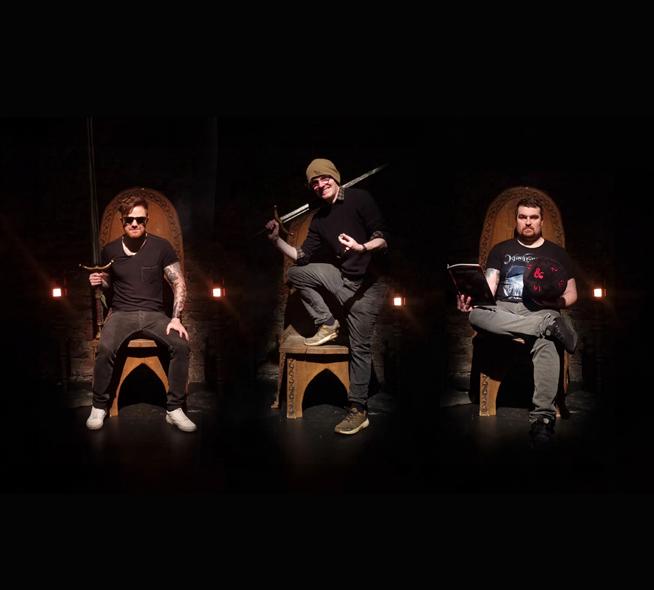
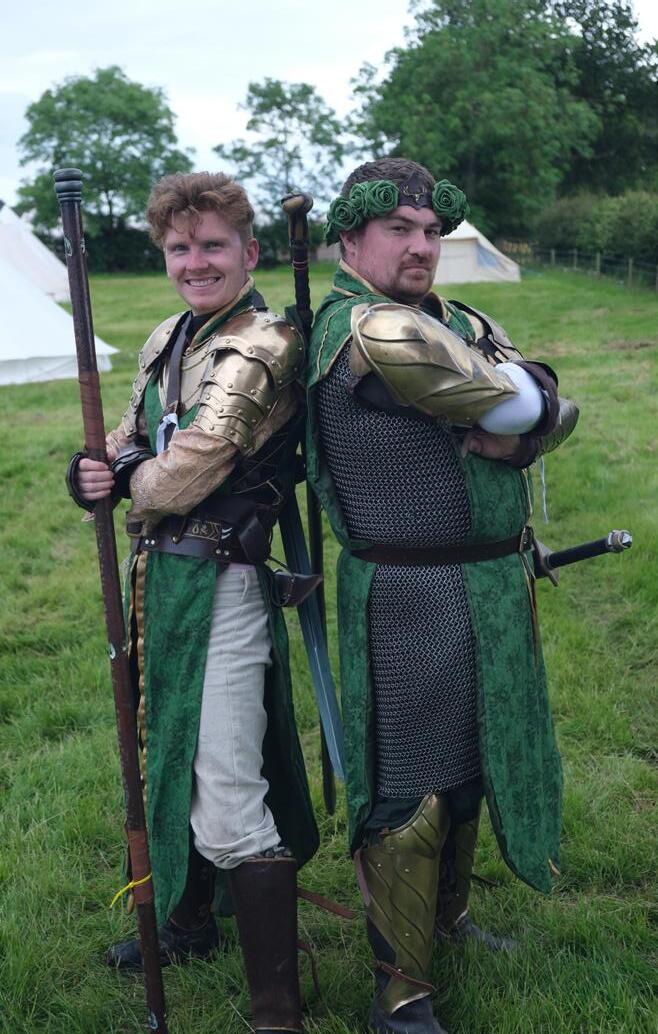
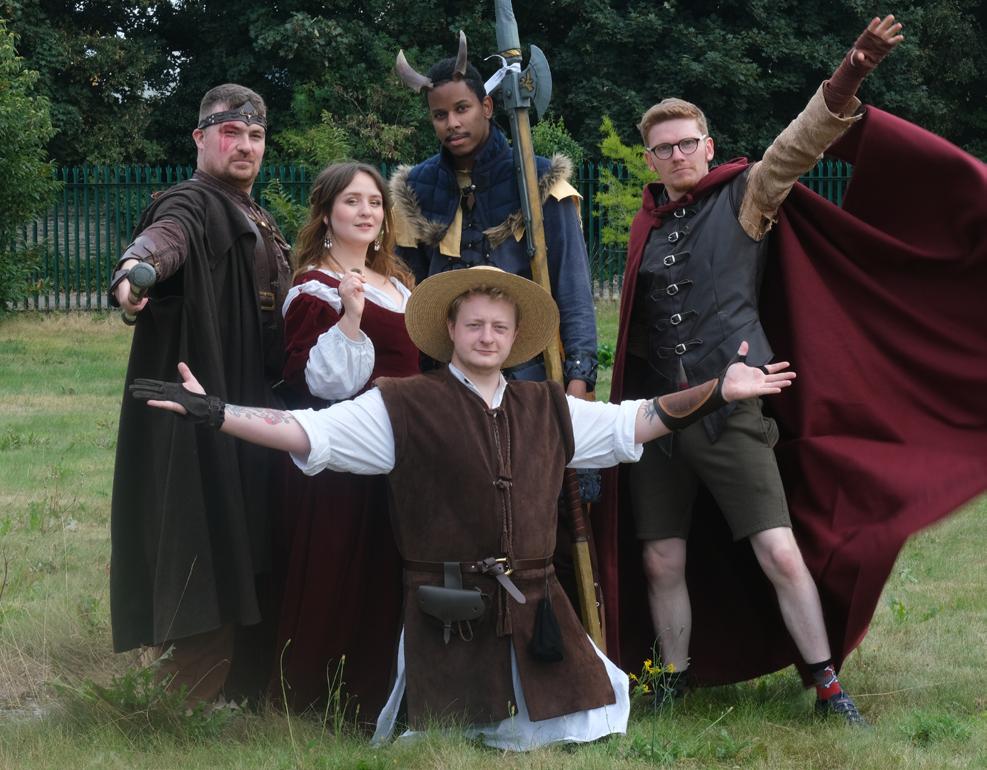
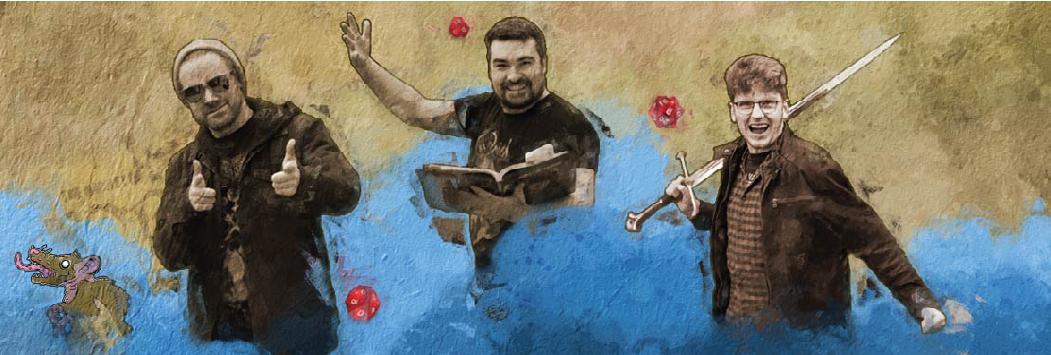
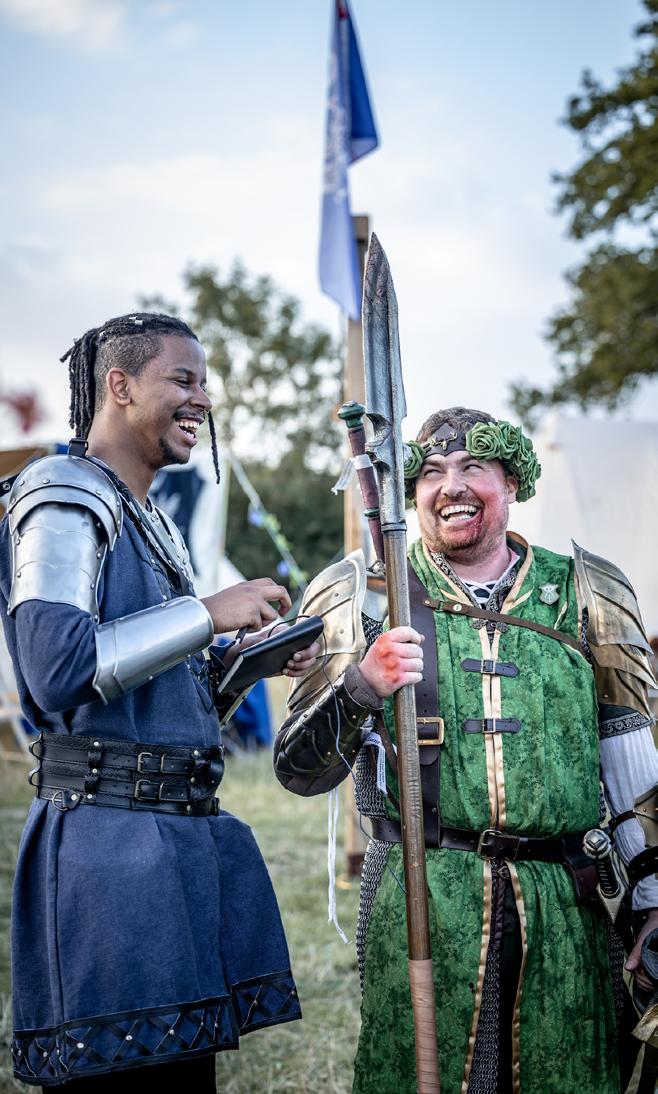
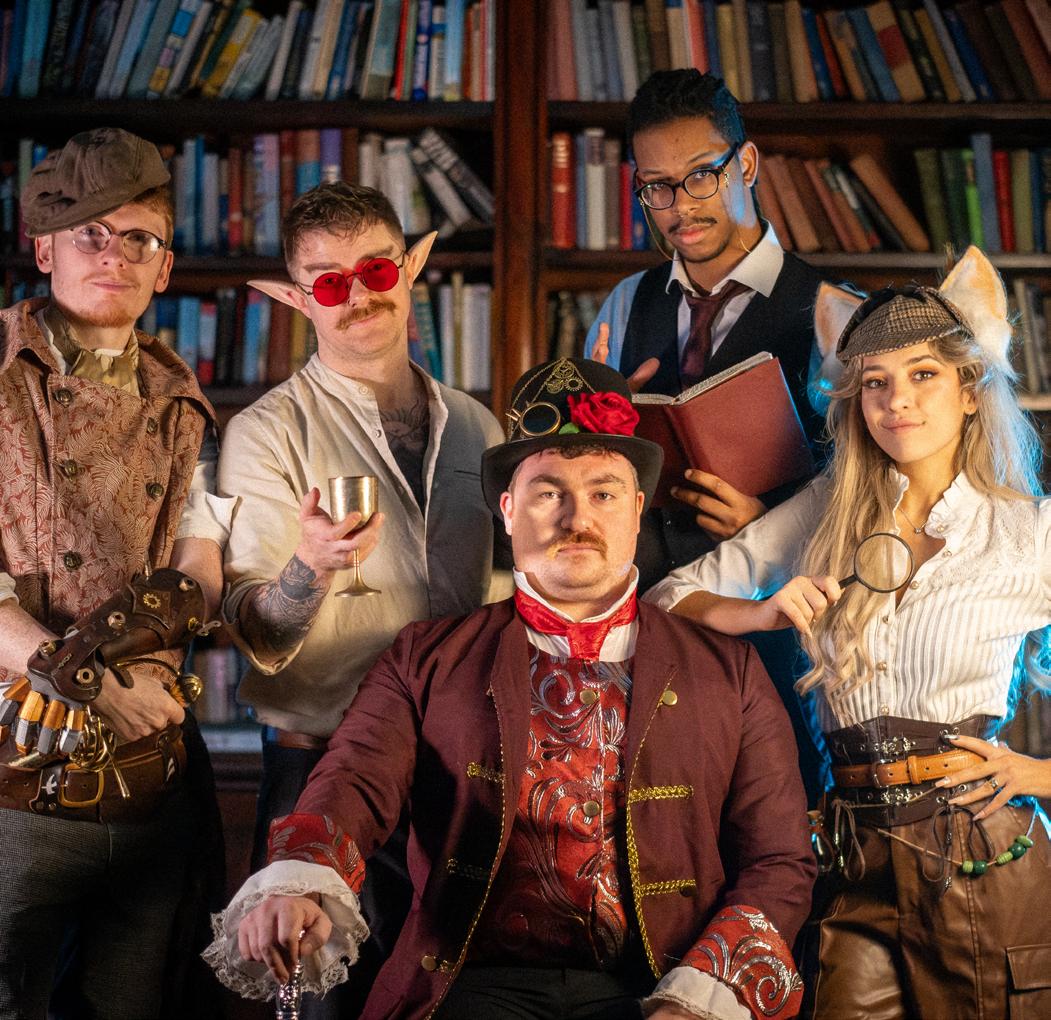
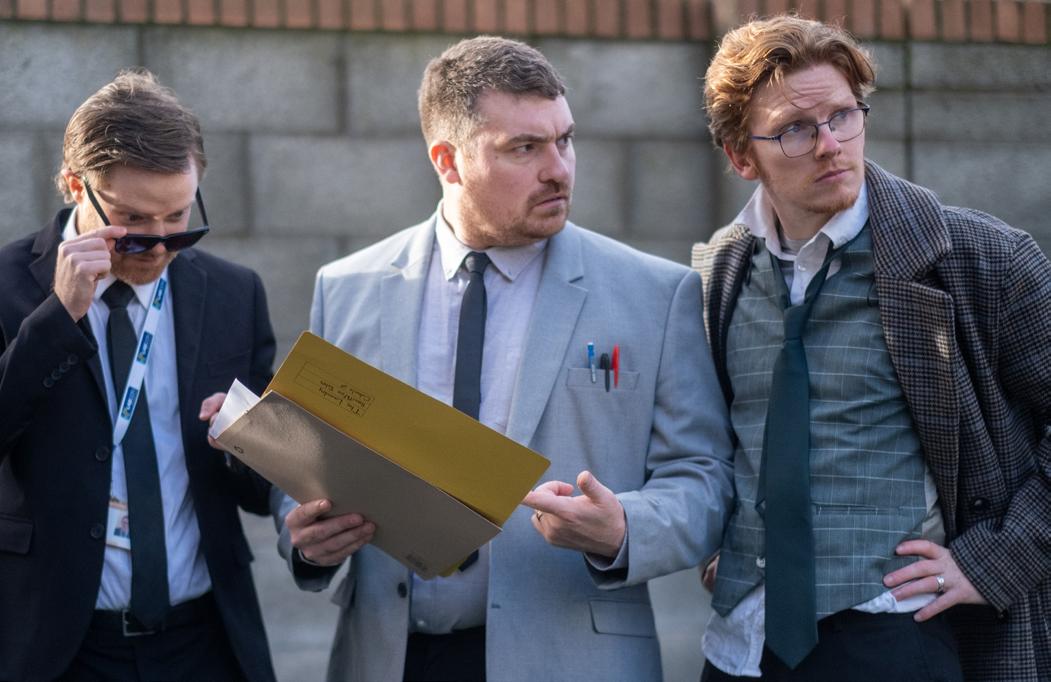
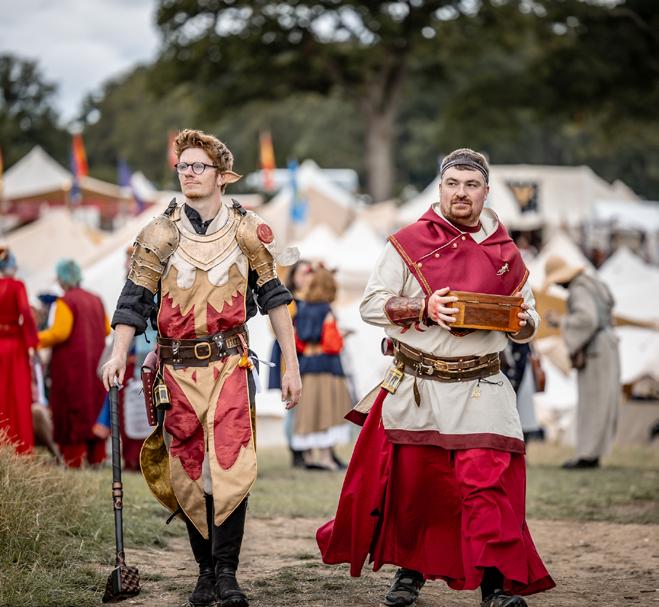
Hearthfire Tales: Ryan, Jim & Dylan
The organiser, Dylan explains, had seen the effect Dungeons & Dragons had on his own son. It helped him come out of his shell, find friends, express himself and discover a hobby he cared about deeply. In rural Ireland, where so much of youth activity can still revolve around team sports and more traditional pastimes, that kind of alternative space can matter.
“There’s so many people, kids in particular, and God knows I was one of them too, that felt very disenfranchised with the standard expected ways to spend your time,” Dylan says.
For those young people, Dungeons & Dragons offers something different. It is social, imaginative and collaborative, but it does not require a person to fit neatly into the usual sporting or social structures around them. It gives them a table, a character, a story and other people willing to build something alongside them.
That is what makes Hearthfire’s work feel important beyond entertainment. The events they are making are not just for those already comfortable in fantasy spaces. They help make the doorway easier to find.
A Game That Lets People Try on a Different Face
On the surface, Dylan says, Dungeons & Dragons can look like a game about mechanics. What can your character do? What are the rules? What happens when the dice fall?
But once people settle into it, something more personal begins to emerge.
“What does it feel like to embody a character?” he asks. “What does it feel like to have a character do something that I, as a player, wouldn’t do in my real life?”
“What does it feel like to embody a character?”
For Dylan, this is one of the reasons roleplaying games attract such a wide and often queer player base. Dungeons & Dragons can become a safe way to test out aspects of personality, identity, gender, sexuality, confidence or performance. It gives people a frame in which they can try something new without having to declare it in ordinary life first.
“It’s such a nice, easy way to dip the toe in the water,” he says, describing it as a way to “try on a different face or a different persona” in a format that feels approachable.
That accessibility matters. A fantasy game can become a social rehearsal room. It can let someone be brave before they feel brave. It can let someone speak differently, move differently, care differently, fail differently and be met by a group of people who are also choosing to play along.
From Tolkien to the Table
Dylan’s own route into fantasy started early. He remembers reading The Lord of the Rings when he was around 10 or 11, a doorway into the wider world of fantasy and “general nerd” culture. Around 12 years ago, he and Jim Tuohy, his partner in Hearthfire, were invited to play Dungeons & Dragons.
They had always wanted to try it. Once they did, Dylan quickly realised he wanted to run games himself.
“I could do this. I could run a game.”
“I was like, I could do this. I could run a game.”
From there, it became a regular thing with friends. Different people came and went, but Dylan, Jim and Ryan Andrew Dillon became the core of what would later become Hearthfire. Dylan was drawn to running the games. Ryan had experience as an audio engineer. Jim, a graphic designer, could shape the visual identity, branding and social media presence.
A spark came when Dylan and Jim saw NADDPOD, or Not Another D&D Podcast, perform a live show. The energy of it stuck with them. Both had a performance streak, and the thought of bringing that same electricity to their own work felt exciting.
They began planning around the Covid period, though they held off recording because they wanted to do it properly, in person. Many
people moved their games online during that time, but the feeling around the table mattered too much to them.
They wanted the energy of bodies in the same room, reacting in real time.
When they were finally able to meet again, they began recording. Early on, they secured a spot at Comic-Con, where they could table, promote the podcast and run a 45-minute self-contained live adventure in a panel slot.
The response was strong.
“We got really good reception and really good feedback,” Dylan says. “We were like, ‘this is great. We really love this.’”
Hearthfire began in earnest in early 2022, first as an audio-only podcast. Since then, the group has expanded into video, online streams, live convention shows, theatre shows, guest appearances and collaborations.
Irish Myth, Rebellion and the Skeleton of D&D
Although Dungeons & Dragons is closely associated with Wizards of the Coast, Dylan points out that the game has always drawn from many mythological sources, including Irish folklore. Creatures such as the fey already carry traces of Irish and Celtic storytelling.
“We got really good reception and really good feedback, we were like, ‘this is great. We really love this.’”
For Hearthfire, that Irish element has become something they are increasingly interested in exploring.
Dylan recently ran a game that allowed him to use Gaeilge within the session. It was directly inspired by Irish mythology, with a search for the Dagda’s Cauldron, a trickster fey, kidnapped heroes and storytelling elements drawn from older Irish traditions.
Even before that, Irish myth had entered the main campaign almost instinctively. Lugh, the Irish god associated with poetry, warriors and other aspects of life and skill, became an important character in the story Dylan was telling. That was not always a consciously planned decision. It emerged because it was already part of the cultural ground he was standing on.
Dylan describes Dungeons & Dragons as a skeleton. The rules, mechanics and broad structures are there, but every table adds its own flesh. Each Dungeon Master, group and story shapes the game differently.
“Each story, each table and each GM is different,” he says.
The Irish influence, for Dylan, is not only mythological. It is also political and emotional. Toward the end of the conversation, he reflects on the rebellious nature of Irish culture and how naturally that
fits with the structure of Dungeons & Dragons.
So much of the game is about small groups facing systems of oppression, resisting overwhelming forces, challenging rulers, finding allies and building something bigger through community.
“There’s such a culture of rebelliousness within Irish culture,” Dylan says. “I think that translates really, really well to D&D.”
In Hearthfire’s current podcast story, that idea of community has become central. The characters begin as just a few people in a wide world, but through the relationships they form, the people they influence and the people who influence them, they become capable of more than they could be alone.
Fake Swords, Real Feelings
Hearthfire has also moved beyond the tabletop into live action roleplay, or LARP
For Dylan and Jim, this began almost accidentally. At one point, friends had planned a surprise LARP experience as part of a stag party for Dylan, though the plan fell through during Covid. Eventually, they entered that world properly, beginning around late 2022.
They were quickly hooked.
LARP, Dylan says, feels like an evolution of Dungeons & Dragons. The roleplaying element is still there, but the immersion is deeper. At the table, a player can step out of character easily, talk above the table, check rules, roll dice and return to the fiction. In LARP, the body is inside the world.
If you want to do something, you have to do it.
The scale can be enormous. Dylan
describes events with around 3,000 people, with camps, costumes, characters, conflict and shared story unfolding across a physical space. That makes it easier to lose yourself in the world, but it also makes the feelings more real.
This is where Dylan and Jim’s podcast Fake Swords, Real Feelings comes in. The title captures what LARP can do.
The swords may be fake. The emotions are not.
Dylan remembers one moment in particular, after a large in-game massacre where around half of his friend group’s characters died. Walking back to camp as one of the surviving characters, he saw the emptiness where those friends should have been and felt his stomach drop.
“These are real feelings that I’m having here,” he realised.
It was all make-believe, and yet the grief, shock and attachment were genuine. That tension between fiction and feeling is one of the reasons the work remains powerful.
“These are real feelings that I’m having here,”
Collaboration at the Centre
Although Dylan, Jim and Ryan form the core of Hearthfire, collaboration has always been central to the project. Roleplaying games are collaborative by nature, and Dylan is clear that they do not want to sit in their own bubble.
The group has worked with series regular Apollo, with their friend Caitlin, and with other players and creators depending on the project. Dylan describes the spirit of it as “a rising tide lifts all ships.”
The wider Hearthfire umbrella has also begun to gather different
creative strands together. Dylan and Jim have worked on Fake Swords, Real Feelings, and in the past have also done With the Heron, linked to fantasy sword fighting. Rather than trying to manage too many separate accounts, identities and channels, they have started to bring these interests under the Hearthfire name.
The goal is not to narrow what they do, but to make room for all of it.
“We’re going to have everything under Hearthfire and just be ourselves,” Dylan says. “Put our passions into the world, be creative under the things that we want to be creative about, and hopefully people enjoy that and want to follow along.”
That willingness to include others is also part of what makes their events accessible. Hearthfire does not present fantasy as something guarded by experts. It is something people can enter, shape, respond to and share.
“Put our passions into the world, be creative under the things that we want to be”
In recent live shows, Hearthfire has been experimenting with more improvised, audience-led formats. Dylan describes using improv and Mad Libs-style Dungeons & Dragons, where the crowd provides prompts that help fill out a familiar adventure framework.
This creates a structure that is both prepared and open. Dylan still holds the shape of the story, but the audience gets to influence what happens inside it.
That matters for accessibility. A live Dungeons & Dragons show could easily become intimidating to newcomers if it relied too heavily on rules, lore or inside jokes. By taking prompts from the crowd, Hearthfire turns spectators into collaborators. People do not have to know everything to take part. They only need to offer an idea.
The result is a performance style that feels theatrical, playful and communal. The audience is not
Live Shows, Mad Libs and Letting the Audience In
simply watching a closed game. They are helping make it stranger, funnier and more alive.
Improv, Creativity and the Theatre Kid Within
Dylan has recently been exploring improv more directly, partly because he had found himself in what he describes as a “creative winter” toward the end of last year. He was struggling to write and prepare sessions, and improv offered something different.
As a Dungeon Master, he is often responsible for preparation, structure and direction. Improv forced him into a space where he could not prepare in the same way. He had to react, trust instinct and accept whatever appeared.
“I really wanted to put myself in a situation where I am just reacting to things,” he says.
Some parts of improv felt immediately familiar. They used skills he had already been building through Dungeons & Dragons. Other parts challenged him. As a DM, he is used to holding control. Improv asked him to relinquish some of that control, listen differently and allow others to lead.
It also helped him recognise a part of himself that had been waiting for an outlet.
Dylan says he never considered himself especially creative growing up. But through Dungeons & Dragons, live shows, improv, LARP and performance, something has opened. When someone recently asked whether he was a theatre kid, he realised that he would have loved to have been one.
“I think D&D going into this has awoken that in me,” he says.
Now, he is interested in exploring voice acting, singing and other creative forms. Dungeons &
“You are performing when you’re at the table or you’re on the stage or you’re in front of mics”
Dragons has become a route into performance, storytelling, hosting, writing, improvisation and collaboration all at once.
“You are performing when you’re at the table or you’re on the stage or you’re in front of mics,” he says. “But you’re also writing the story ahead of you.”
Making Fantasy Visible
Part of the value of Hearthfire’s work is simply that it makes fantasy spaces easier to see.
For many people, especially those who grew up outside obvious creative or gaming communities, roleplaying games could feel hidden behind closed doors. Dylan recognises that feeling. There is a particular kind of ache in looking at a space and knowing, somewhere inside yourself, that you might belong there, while still feeling unsure how to enter.
That is why visibility matters.
“You can’t be what you can’t see,” Dylan says.
For him, discovering these spaces
in his mid-to-late 30s has been healing rather than regretful. He gets to experience them now, share them with others, and help create access points for people who might otherwise have missed them.
Through Fake Swords, Real Feelings, he and Jim have even had people come up to them in the field and say the podcast changed their life by opening them up to a world of play and self-discovery.
That is the heart of Hearthfire’s accessibility. It is not only about whether someone can buy a ticket or understand the rules. It is about whether they feel invited. Whether they can imagine themselves there. Whether the space says, in some way, this is for you too.
What Comes Next
Hearthfire is continuing to develop in several directions. Dylan is organising a smaller-scale LARP player event, while the group is also working with the Brandywine Festival, a Hobbit-themed LARP coming to the UK. The link back to Tolkien feels fitting, given how early The Lord of the Rings shaped Dylan’s own imaginative life.
After a short hiatus, the group is also looking forward to simply playing together again and being creative together. That remains the core of everything.
They are open to more collaboration, more genres and more ways of performing. While they have often worked in high fantasy, they have also begun exploring horror, lower-stakes personal stories and different emotional tones. Dylan mentions guesting with friends in D8 Dungeon on a story that was essentially a tragedy, still fantasy, but built around a very different emotional agreement with the players.
That willingness to move between tones shows how broad
spaces
where fantasy becomes social, visible and
shared.
That
is what
Hearthfire Tales
is building: not just campaigns, podcasts or performances, but accessible
roleplaying can be. Dungeons & Dragons and related games can hold comedy, grief, rebellion, friendship, horror, family drama and myth. Hearthfire’s work seems less interested in proving what the medium should be than in asking what else it can hold.
Greater Than the Sum of Its Parts
What comes through most strongly in Dylan’s conversation is the idea that roleplaying games are never only about rules. They are about the effort people put into each other.
A table is only as good as the people willing to play, listen, risk embarrassment, support one another and build a world together. A LARP is only as powerful as the collective buy-in of those who choose to make the fake swords matter. A live show only works when performers and audience agree to meet in the same imaginative space.
For Hearthfire, that shared investment is everything.
At its best, Dungeons & Dragons becomes a way for people to find confidence, connection and community. It gives people a story to step into, but it also gives them a group of people to step toward.
That is what Hearthfire Tales is building: not just campaigns, podcasts or performances, but accessible spaces where fantasy becomes social, visible and shared.
To find out more about Hearthfire Media, visit their website: hearthfiretales.com
Support Hearthfire Tales via their Patreon: patreon.com/Hearthfiretales
And keep up with them via social media: @hearthfiremedia
Ciara Darcy
Beaded By Ciara
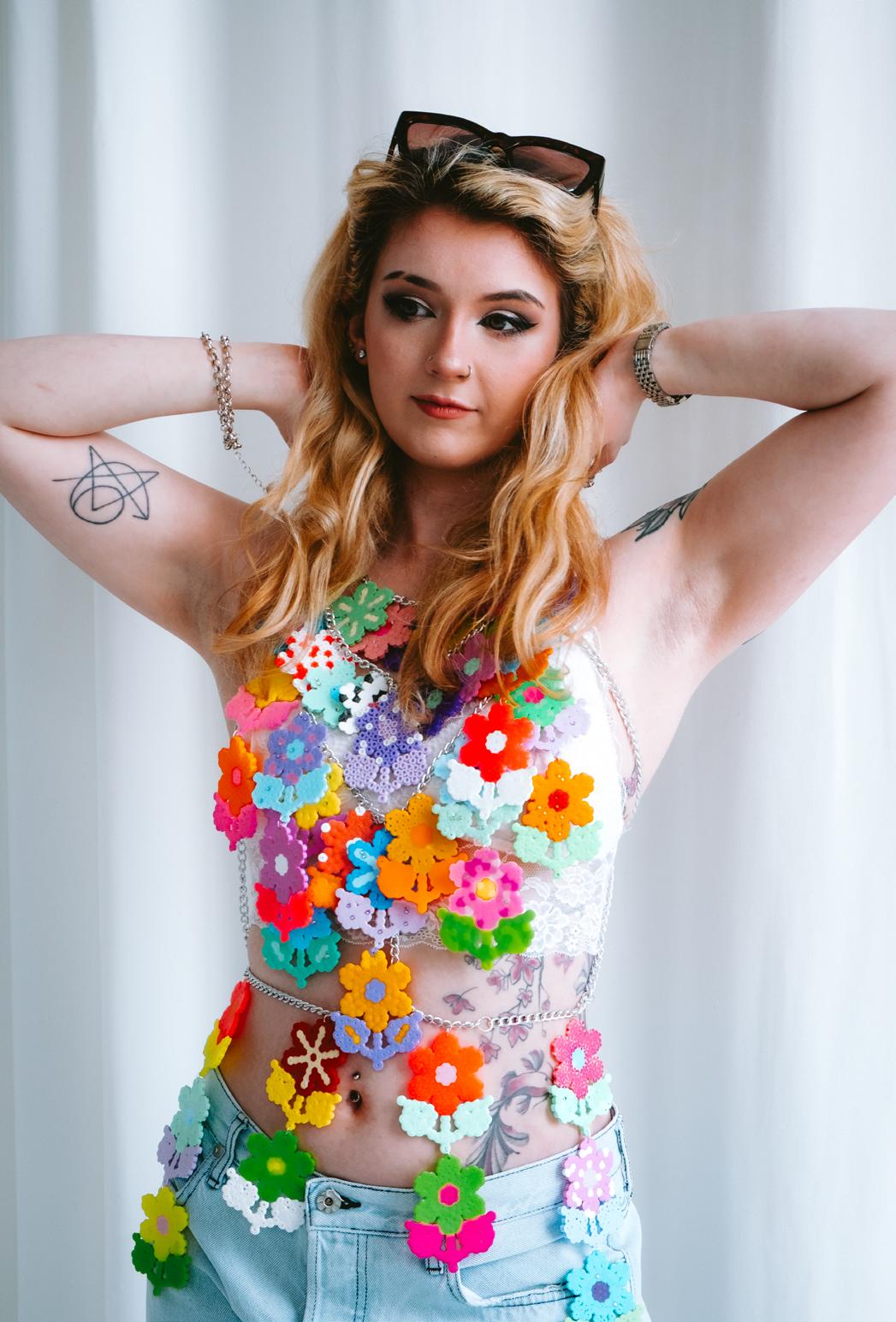
In beads, fabric and carefully held detail, Ciara Darcy turns fashion into a record of labour, memory and feminist history, where small objects carry serious weight.
When Ciara Darcy answers the phone, she is sitting in the car.
There is a nervousness there at first, the kind that often appears when someone is asked to explain work they usually makes with their hands rather than their voice. She admits later in the conversation that she is not always comfortable talking about her practice. She does not necessarily think of all the meaning until someone asks her directly, and then suddenly the ideas arrive: slow work, AI, gender-based violence, handbags, feminism, textile waste, price, labour, visibility, fashion history.
That slight hesitation feels important, not because it weakens
Ciara’s pieces hold more than they first reveal at first.
the work, but because it reveals something about it. Ciara’s pieces are not made from a rehearsed brand statement.
They come from instinct, observation, irritation, care and a deepening understanding of the cultural histories attached to the objects she makes.
Through Beaded by Ciara, she creates handmade accessories, bags, garments and beaded pieces that carry much more than their bright surfaces first suggest.
They are playful, colourful and often nostalgic, but they are also built around labour, femininity, waste, fashion and the politics of being seen.
From Fine Art to Something You Can Hold
Ciara studied Fine Art, but painting did not hold her for long.
“I feel like when I started it, I thought, oh, painting is my thing,” she says. “And then I started to feel disconnected.”
What drew her instead were materials that were more physical. She wanted something hands-on. Something tactile. Something that could be held.
Sewing and beading became the centre of that shift. The beading began almost by accident. While she was at college, an office was throwing out a tub of beads. Ciara saw them and asked for them.
“Give them to me and I’ll do something out of it,” she remembers.
She has not really stopped since.
That origin still matters. Beaded by Ciara did not begin with a clean commercial plan or a bought-in stock of pristine materials. It began with discarded objects and the instinct to rescue them. The beads were unwanted, but Ciara recognised a possibility in them. That impulse runs through much of her work now, where recycled fabrics, offcuts, old garments and found materials become part of the character of each piece.
Recently, she has been making bag charms from recycled fabrics, cutting scraps into heart or star shapes before sewing them together. One of those charms was made from an Irish dancing dress. She used the sleeve, cut around the existing embroidery and kept the shape of it intact.
The result is not just reuse as a sustainability gesture. It is reuse as memory. A fragment of one garment becomes the centre of another object.
“I think it’s more interesting to use things that have already been used,” she says. “It feels more special.”
The Value of Slowing Down
Ciara often returns to the idea of slowness.
In fashion, there is pressure to constantly produce something new. Every photoshoot seems to demand a new piece, a new idea, a new visual, a new reason to post. That rhythm does not naturally fit with the way she works.
“Sometimes you could feel really pressured,” she says. “Especially in fashion, you want to have something new every time. Every time there’s a photoshoot, you want to have something new and something exciting, but it’s not really realistic.”
For Ciara, the answer is to keep the process slow and intentional. A few strong pieces matter more than a large number of rushed ones.
That slowness is not only practical. It is philosophical. Ciara describes the world as increasingly instant. Against that, making by hand becomes a way to slow down and remain with the process.
She does not frame her work as a direct opposition to AI from the beginning. It was not a manifesto first. But as generative technology has become more visible in art, fashion and society, it has become harder to ignore.
“Making art is a very human thing,” she writes. “As long as we continue to make things with our hands, and minds, we are opposing AI.”
Four Months in Beads
One of Ciara’s most striking pieces was a quilt made entirely from beads.
When she tells people it took four months, she says they do not always believe her. That disbelief reveals something important about how handmade labour is misunderstood. People can see the finished object, but not always the hours inside it.
A photo online flattens time. It makes four months look instant.
That is one of the hardest parts of sustaining a handmade business. Ciara says people often struggle to understand the relationship between price and labour. When something takes hours and hours
to make, that effort does not always translate through an image on Instagram.
She has had people message her asking for a piece, then back away once she gives the price. Others tell her they can get something similar online for cheaper.
“But you can’t,” she says.
What they can get online may imitate a look, but it does not carry the same quality, attention or presence. Ciara is clear that mass-produced items are also made by people somewhere, often under difficult conditions. But there is a difference between a piece made slowly by one person, checked by hand, built from rescued material, and an item produced through the machinery of fast fashion.
Her work is handmade, one of a kind and sustainable. Those values are often praised in theory, but harder to defend in a marketplace shaped by Shein, Temu and a constant expectation of cheapness.
Ciara admits that even her own prices are held back by fear.
“My things aren’t even that dear,” she says, “because I’m too scared to put my prices up.”
Craft, Gender and the Question of Seriousness
Beneath the colour and playfulness of Ciara’s work is a sharp awareness of how craft has historically been valued - or undervalued.
She has been thinking more about techniques traditionally seen as feminine, and how they sit within art and fashion contexts. Beading, quilting, sewing and melty beads are not neutral choices for her. They are tied to ideas of labour, gender and care, and to the long-standing division between
“Making art is a very human thing, as long as we continue to make things with our hands, and minds, we are opposing AI.”
what gets treated as “art” and what gets dismissed as “craft.”
In the conversation, Ciara mentions a phrase that has stayed in her mind: if a man makes it, it is art; if a woman makes it, it is craft.
That tension sits at the core of her work.
The materials themselves matter. Melty beads carry childhood associations. Many people remember using them when they were young. Because of that, they can be dismissed as unserious or childish. But Ciara is interested in that dismissal. She uses those materials deliberately, placing them into fashion and art contexts where their supposed lack of luxury becomes part of the challenge.
Her quilt, bags and garments use feminine-coded processes not as decoration alone, but as a way to question what culture decides is valuable.
Quilting, in particular, carries a history of women’s labour, domestic skill, patience and communal making. It is often treated as soft, secondary or amateur, despite the time and technical knowledge it demands. Ciara’s beaded quilt brings that overlooked labour into view while also making it strange. It is familiar and unfamiliar at once: a quilt, but not soft; a craft object, but also a conceptual artwork; a feminine form, but one carrying critique.
AI, Violence and Taking Back Control
Ciara’s thinking around AI developed through a college project. The brief was based on AI, and at first she worried that she would be expected to use it. Instead, she moved in the opposite direction, researching how AI and generative technology intersect with gender-based violence.
That research brought her to the misuse of AI-generated imagery, including tools used to remove clothes from images of people without consent. As those technologies became more public, Ciara found herself thinking about how women’s bodies are taken, altered, distributed and consumed through digital systems.
Her response was to make work that was deliberately feminine.
The quilt, the dress, the handbags and the materials all became part of a visual language about reclaiming control. Rather than using AI to generate something frictionless, she turned toward processes associated with patience, domestic history and the physical body.
Everything had to be made by hand.
That is why the handmade quality of the work is not only aesthetic. It is political. The bead, the stitch, the inconsistency, the visible process - all of these become evidence of a person making decisions in real time.
Ciara says it is important that “the hand behind the work stays visible.” The imperfections and inconsistencies are not flaws to be hidden. They are where the value sits.
Especially now, when so much can be automated, the fact that a person made something becomes part of its meaning.
The Hidden History of the Handbag
One of the most compelling parts of Ciara’s practice is her interest in the history of fashion objects that are often taken for granted.
Handbags are central to her work, and she has spent time researching their historical relationship to gender and control.
“You see a handbag and you think, yeah, that’s a woman’s thing, but nobody knows that it started out as a man’s thing.”
She explains that handbags were originally worn by men, because women were not allowed to carry their own belongings in the same way. Their possessions were carried by men.
After the war, as women began carrying their own things, the handbag became part of a broader shift in independence. What now appears to many as an ordinary women’s accessory carries a deeper history of ownership, movement and social change.
“You see a handbag and you think, yeah, that’s a woman’s thing,” Ciara says. “But nobody knows that it started out as a man’s thing.”
That overlooked history interests her. It shows how fashion can record power, even in small objects. A bag is not only a bag. It can speak to who is allowed to carry money, keys, letters, tools, cosmetics, documents, private things, public things, a life.
Ciara is also interested in Princess Diana’s use of small handbags, often referred to as “cleavage bags.” Diana would use them to shield herself from paparazzi when getting out of cars, protecting her body from invasive photographs.
That detail influences the scale of Ciara’s own bags.
“I don’t make big bags,” she says. “I make tiny ones that are sort of impractical.”
On one level, they are playful fashion objects. On another, they carry this memory of women using style as a form of control, protection and refusal. The smallness is not only decorative. It points back to the body, the camera, the gaze and the need to guard oneself.
Fashion as a Record of Feminism
Ciara is keen to highlight the historical significance of fashion
and feminism, and her work becomes strongest when those two things meet.
Fashion is often dismissed as surface. Ciara’s practice suggests the opposite. Clothing and accessories can carry histories of labour, ownership, gender, protection, waste, class and creativity. They can show how women’s lives have been restricted and how women have found ways to move within, against and around those restrictions.
The handbag is one example. Quilting is another. Beading, sewing and embellished garments all carry histories of labour that have too often been made invisible because they were associated with women.
Ciara’s work does not shout these histories. It holds them inside objects that are bright, strange and wearable.
That combination is what gives the work its charge. A tiny beaded bag may look playful at first, but it also asks why small feminine objects are so easily underestimated. A melty bead garment may seem nostalgic, but it also challenges what gets to be treated as high fashion. A quilt made from beads may look decorative, but it contains months of work and a direct response to the speed of digital production.
The work asks viewers to look again.
Textile Waste and the Life of Materials
Sustainability is part of Ciara’s practice, though she describes it as something that came naturally rather than as a formal mission statement.
She is aware of the amount of textile waste around her. Charity shops are full of clothing. There are not enough volunteers, rails or
systems to deal with everything. Fast fashion produces a constant churn of cheap garments, many of which quickly become waste.
Ciara sees that excess and works against it by using what already exists.
Her use of recycled fabrics and found materials gives each piece a different starting point. Instead of imposing a design onto a blank material, she often responds to what is already there: embroidery, texture, colour, fabric memory, the shape of an old garment.
That responsiveness helps keep the work from becoming generic. Each piece carries traces of its previous life.
Instagram as Sketchbook and Shopfront
Social media is part of Ciara’s practice, but she approaches it carefully.
She does not feel an overwhelming pressure to post every day, partly because she does not see herself as having a large enough platform for that kind of demand. But she does feel the pressure that comes when making becomes tied to documentation. Sometimes, when she finishes a piece, there is an immediate thought: this needs photographed for social media.
At the same time, many things she makes never get posted. Some she keeps to herself.
Ciara describes Instagram as both a selling tool and an extension of the practice, “almost like a sketchbook or archive.” That feels right for the kind of work she makes. The finished piece matters, but so does the process.
She wants to show the behind-thescenes, not just the polished final image.
“When you go on, it’s always
“When you go on, it’s always finished pieces and perfect things, and I like to show the behind the scenes.”
finished pieces and perfect things,” she says. “And I like to show the behind the scenes.”
This is important because the process is part of the work’s value. If people only see the final photograph, they may miss the hours of beading, cutting, sewing, planning and problem-solving behind it. Showing the process helps return time to the object.
Still, there is tension. Marketing is fast-paced and constant, while Ciara’s work is slow and intentional. She is still figuring out how to stay visible without burning out or diluting what makes the work what it is.
Belfast, Derry and Finding Creative Community
Ciara is from Strabane, around 20 minutes from Derry, where she went to college. For larger fashion events and photoshoots, she sometimes travels to Belfast.
Instagram has helped her find people to work with, but so has the Belfast fashion scene. She mentions Belfast Fashion Scene, a monthly collective that runs free photoshoots for emerging creatives.
Models can try modelling, designers can bring garments, photographers can build their portfolios and people can gain hands-on experience.
That kind of structure matters for an artist like Ciara, whose work changes when it is worn. Seeing her pieces on models has helped bring them into a wider fashion context.
She says she once thought she would have to wait for someone to discover her work and ask to wear it. More recently, she has learned that she has to put herself forward.
“You really just have to go out and put yourself out there,” she says.
At the time of the conversation, she was preparing for a photoshoot with a Zara Larsson theme, making small beaded bikini tops and seeing what else she could create. She was also due to attend the Ulster University Fashion Show, another point of connection with the wider fashion world around her.
The Work Behind the Brightness
There is a temptation, with work as colourful as Ciara’s, to describe it only through brightness. It is fun, playful, nostalgic and eye-catching, but those words are only the surface.
Underneath them is a practice thinking seriously about gender, labour, AI, sustainability and fashion history.
Ciara’s work is full of small acts of resistance. Rescuing a tub of beads from being thrown out. Keeping the embroidery from an old Irish dancing dress. Making a quilt over months in a world that wants everything instantly. Using “childish” materials to ask serious questions. Making tiny handbags that remember Diana shielding
It insists that feminine-coded labour has intellectual, historical and artistic weight.
herself from paparazzi. Showing the hand behind the work when so much around us is becoming automated.
Ciara speaks about the work with care rather than performance, but the strength of the practice is unmistakable.
It insists that fashion is not shallow. It insists that craft is not lesser. It insists that femininecoded labour has intellectual, historical and artistic weight. It insists that slowness can still matter.
Most of all, it asks people to recognise the person behind the object.
Every bead is placed by hand. Every stitch takes time. Every imperfection proves that someone was there.
To explore Ciara’s available oneof-a-kind works, visit her Depop store: depop.com/beadedbyciaraa
And keep up with her via social media: @beadedbyciaraa
Chiara Mattozzi
Author
From queer readings of Arthurian legend to Welsh history and low fantasy, a practice shaped by scholarship, story, and the magic still held in old texts
Chiara Mattozzi describes herself first through curiosity. Not through a neat professional label, or through the kind of single-line biography that makes a writer easier to file away, but through the restless instinct to study, read, wander, and return again to the past.
“I would say I’m a really curious person,” she says. “I love studying. I’m a bit of a nerd. I would just spend days in a library.”
It is a fitting beginning for a writer whose work moves between
“I would just spend days in a library.”
fantasy, medieval literature, ancient ruins, queer readings of Arthurian legend, and the long imaginative life of Wales, Ireland, Rome, and Britain. Chiara was born in Rome and moved to Ireland five years ago, bringing with her a fascination with history that had already travelled through several worlds before she arrived here.
As a teenager, she had been deeply interested in ancient Roman history. Then, around the age of sixteen, medieval literature opened another door. “I discovered this new side of the world,” she says, “and was like, oh, I want to know more.”
That moment did not remain academic. It became creative. The same landscapes that drew her into research began to shape the fiction she wanted to write. Medieval courts, Arthurian legends, magic, old systems of belief, difficult endings, flawed characters, and the uneasy space between history and fantasy all became part of the same ongoing conversation.
Chiara’s novel, The Raven and the Rose – The Witch, was first published in Italian in 2021. Its English version followed in 2025, widening the audience for a story that had already existed in one language before being carried into another. For Chiara, that movement between Italian and English was not simply a matter of availability. It was a way of allowing the work to find new readers, especially in a literary
landscape where fantasy can still be treated as something lesser, lighter, or more childish than it is.
“In general, Italians don’t like fantasy that much,” she says with a laugh, before qualifying the thought. “I mean, they do. But they kind of say it like it’s for kids, and this book is not for kids.”
That distinction matters. Chiara’s interest in fantasy is not escapist in the shallow sense. It is not a rejection of history, but a way of pressing closer to it. Her fiction sits in the older tradition of stories where realism and myth do not cancel one another out, where magic is not a system to be explained but a pressure within the world, where the past carries its own strangeness without needing to be made modern.
by Fabiana Castellani
“I found it really striking that many scholars just skipped over it.”
The Queer Threads Already Present in Arthurian Legend
Before speaking about her fiction, Chiara speaks about study. Her academic work has focused on medieval literature, with a queer lens placed especially on Arthurian material. This was the subject of her master’s thesis, and it remains one of the clearest ways into understanding how she reads the past.
She is careful not to frame queer readings as an artificial imposition on medieval literature. For her, the evidence is not absent. The issue is often that it has been ignored.
“I didn’t really find it too hard to find the evidence of it,” she says. “But I found it really striking that many scholars just skipped over it. They just saw things that were plainly, or clearly, queer, and they just didn’t talk about it.”
There is a particular loneliness in that kind of reading. To sit with a medieval text and see something plainly present, only to discover that generations of scholarship have hurried past it, is to be left briefly wondering whether the problem is in the text, in the reader, or in the history of what readers have been permitted to notice.
“You start questioning yourself,” Chiara says. “You’re just like, am I really the only one that sees this? Am I crazy, or is it really there?”
One example came from an Anglo-Norman text, Roman de Brut by Wace. Chiara describes two male characters whose bond is framed in language that goes far beyond ordinary companionship. One loves the other more than anyone else. The line she draws attention to is clear: “he had greatly loved and cherished him.”
Yet the scholarly habit has often been to flatten that feeling into friendship.
Illustrations
“The author says that one loved and cherished the other more than anyone else,” she says. “He uses that kind of language throughout the text for fathers and children, uncles and nephews, and heterosexual relationships. But it is still interesting to see the same words used for two men who are not related by blood, who are both unmarried and inseparable. And still, scholars are like, ‘yeah, they’re close friends’. I wouldn’t say they’re not friends, but there’s something else there as well.”
It is this “something else” that matters. Chiara is not trying to make medieval literature less itself. She is trying to read what is there without sanding down its
“I really love Welsh history and the medieval side of it”
complexity. The queer dimension of Arthurian and medieval material has often been treated as marginal or speculative, but her point is that the marginalisation frequently happens after the fact. The text speaks, and then interpretation decides what it is willing to hear.
This is why her academic interest feels so naturally connected to her creative work. She is drawn to overlooked spaces in old stories, to perspectives that were present but under-read, to the possibility that the past has always been stranger, more open, and more emotionally varied than later systems allowed it to be.
“There are more scholars now doing this work,” she says.
“Hopefully there will be more and more. It’s not even finding out. It’s just highlighting things that were already there.”
Wales, Arthur, and the Histories Still Pulling at Her
If Arthurian legend runs through Chiara’s academic work, Welsh history remains one of the areas she is most eager to explore creatively. Her fascination is not casual. It sits at the meeting point of medieval literature, myth, language, place, and queer possibility.
“I really love Welsh history and the medieval side of it,” she says. “So I would really love to explore that more in my writing.”
At present, she has been working with short Arthurian retellings, allowing ideas to take shape without forcing them too quickly into a larger project. But the ambition is there. She speaks of the possibility of a bigger work, perhaps a novel or a collection of stories, something that would allow Welsh and Arthurian material to be approached from angles that have not always been given space.
“I would like to work on them from
the queer perspective,” she says. “That side that many people ignored. I’m trying to dig it up and be like, look, it’s still the same story, but there’s also this thing.”
Her interest in Wales also sits alongside an affection for other medieval and legendary texts. One of the projects she hopes to return to is a retelling of Sir Gawain and the Green Knight, possibly from the Green Knight’s perspective. The original poem, with its enchantment, tests, reversals, and strange moral atmosphere, appeals to her precisely because it already contains so much magic.
“The original story has lots of magic in it,” she says. “I think it’s brilliant.”
There is something telling in her instinct to approach the story from the Green Knight’s side. Again, she is drawn to the figure at the edge, the one who disrupts the court, the one who appears almost as a test sent from another order of reality.
Low Fantasy and the Uses of Magic
Although Chiara writes fantasy, she is not especially interested in spectacle for its own sake. The Raven and the Rose – The Witch is low fantasy, rooted in a world where magic exists but does not dominate every structure of life.
“There is magic and some characters have it and know how to use it,” she says. “But it’s not really the main thing in their world. There’s no magic system in it.”
That choice places her work closer to myth and medieval storytelling than to the more mechanical approaches sometimes found in contemporary fantasy. Magic is not a diagram. It is not a neatly explained technology. It is woven through belief, character, atmosphere, and consequence.
The story may contain magic. But the material itself is concerned with difficult decisions and adult consequences.
For Chiara, this is part of what makes medieval material so compelling. In older legends, the boundary between history and wonder is porous. Arthur fights Romans and Saxons in stories that were understood as history, but those same stories contain Merlin, giants, enchanted swords, and forces that modern readers would place under fantasy or mythology.
“They did believe those were history,” she says. “But I would say that they knew the giants and stuff were not exactly something that would happen every day.”
That balance interests her: realism, but with “hints of something more, something different.”
In her own writing, fantasy is not about abandoning the world. It is about expanding it. A character may move objects with thought, light fires, or possess abilities that shift the ordinary laws around them. But the emotional weight of the story remains human. The characters are still driven by loyalty, fear, guilt, ambition, love, survival, and the struggle to do what they believe is right.
That is part of why she resists the idea that fantasy should be dismissed as childish. The setting may be medieval. The story may contain magic. But the material itself is concerned with difficult decisions and adult consequences.
The Raven and the Rose Across Two Languages
The Raven and the Rose – The Witch began in Italian. The first version was published in 2021, with the English translation appearing in 2025. Chiara did not translate the book herself, but she was involved in the process of reading and adjusting the English version so that it still carried the feeling of the original.
“I was reading the translation and trying to fix those tiny things that
didn’t sound right to me,” she says. “It was really well done, but sometimes there’s one sentence that doesn’t sound as you want it to sound.”
There is a delicate balance in that kind of work. A translated novel is both the same book and another version of it. It has to move naturally in a new language without losing the rhythm, intention, and emotional shape of the first.
Chiara describes herself as cautious in that process. She did not want to undo the translator’s work, but she also knew where certain sentences needed to carry her own particular weight.
“I was just trying to adjust it,” she says, “trying not to ruin the work that the translator did.”
The move into English gave the book access to a broader readership, but it also brought Chiara into direct contact with the difficulty of hearing her own story through another language. For a writer, every sentence matters. The wrong phrasing can tilt a scene. A line that sounds right in Italian may need more than a literal equivalent in English. Meaning is not just content. It is music, pressure, timing, and silence.
When asked which parts of the book mattered most to her, Chiara laughs at the impossibility of choosing. “Every part,” she suggests, before settling on the ending.
The ending was difficult to write. It has also been difficult for some readers to accept, not because they disliked it, but because it left them upset.
“It was really hard to write,” she says. “But I think it’s just the only conclusion that would make sense to the story.”
There is a conviction there that
“I’m just there with these people I created in my mind, I’m talking to them and seeing what they want to do.”
speaks to her wider attitude towards storytelling. She likes happy endings. She enjoys reading them. But she does not believe they should be forced onto a story that has not earned them.
“You can’t have the perfect happy ending if the story is not going that way,” she says. “I like happy endings and sad endings, but I wouldn’t force it.”
For Chiara, the ending must answer the story honestly, even if that answer hurts.
Characters Who Refuse to Behave
Chiara talks about writing as a conversation. Not a mechanical act of planning and execution, but an ongoing exchange with the characters who arrive in her mind and begin to make demands.
“I didn’t plan most of the things that are in the book,” she says. “Still, they ended up being there.”
Sometimes a writer can remove those unexpected elements. Sometimes they become too important to lose. In Chiara’s case, part of writing is following the characters, watching what they do, and trying to understand why they have done it.
“I’m just there with these people I created in my mind,” she says. “I’m talking to them and seeing what they want to do.”
That approach has already generated more material than one book could hold. Some scenes were removed from The Raven and the Rose – The Witch because Chiara realised they belonged elsewhere, possibly in a spin-off told from the perspective of one of the darker figures in the story.
She resists easy categories of hero and villain. The world of the novel is not divided neatly into good and evil. Some characters are worse
than others, certainly, but even the so-called “bad guys” may be driven by recognisable pressures.
One figure in particular interests her because he is trying to do the right thing, or at least what he believes to be right, and failing repeatedly.
“He’s constantly trying to do the best thing,” she says. “Trying to do the right thing. And he’s constantly failing at it because he’s trying to keep his world together.”
That kind of character allows Chiara to explore morality as something lived rather than declared. The question is not simply whether someone is good or bad, but what happens when their loyalties, fears, promises, and survival instincts come into conflict.
“He’s probably just someone that’s trying to survive,” she says, “trying to keep his world as it is, and the others are not making it easy for him.”
In this sense, her fiction is less concerned with clean judgement than with pressure. Characters reveal themselves under strain. Their failures are not distractions from the story. They are often the story.
Writing as a Form of Change
When Chiara speaks about writing, she does not describe it as something separate from the self. A book is not simply produced by the writer; it changes the writer in return.
“Writing shapes you,” she says. “You’re not the same person once you finish a book. You’re not the same person that started it, because you’re growing with it.”
This is one of the most revealing parts of the conversation. Chiara understands fiction as an imaginative act, but not an unreal
“You’re not the same person once you finish a book.”
one. To write grief, betrayal, fear, desire, loyalty, or magic is to spend time with those forces in the mind.
“You still have to get into your character’s mind,” she says. “At least for me, that’s something that really shaped me and changes me all the time.”
A finished book, then, is evidence of more than discipline. It is evidence of transformation. By the time the story has been followed to its end, the writer has also travelled.
“I’m learning about characters,” she says. “I’m learning about myself, learning about the world that I’m writing about.”
That learning can feel strange because it begins internally. The world is in the head, and yet it becomes real through sustained attention. A writer spends enough time with imagined people and places that they begin to exert their own pressure. The invented world pushes back.
“It feels really weird,” Chiara says, “because it’s only in your head, but it feels real.”
From the Image in the Head to the Sentence on the Page
For Chiara, stories often arrive visually. She sees them vividly, almost like a film, before the work of writing begins. The
“It’s really just to get to the image that I have in my head.”
difficulty is that language does not always meet the image immediately.
“I kind of see things really vividly in my head,” she says. “They’re really clear and they’re lovely. It’s kind of like a movie. And then I have to write it and it’s like, ‘the horse was white.’”
It is a wonderfully honest description of the gap every writer knows: the distance between the living image in the imagination and the first plain sentence that lands on the page. The work is in closing that distance.
Chiara’s process is one of drafting, returning, revising, rewriting, and letting trusted readers look at the work. She does not expect the first version to carry everything. The first draft is a beginning, a way of making the image visible enough that it can then be shaped.
“It’s a long process,” she says. “It’s really just to get to the image that I have in my head.”
That visual quality also shapes how she reads. The page becomes a screen, but one assembled by the reader’s imagination.
Chiara is fascinated by this difference between readers: some see the story like a film, others have to focus differently, building the world piece by piece.
“As a writer, it’s lovely,” she says. “Because I want to know what people feel like when they’re reading, not only my books, but also other books.”
There is curiosity again. Not only curiosity about history, but curiosity about the act of reading itself. How does a story enter another person? What does it look like once it gets there? What does the reader supply that the writer never directly named?
Rosemary Sutcliff and the Historical Imagination
Among the writers who have shaped Chiara, Rosemary Sutcliff holds a special place. Sutcliff’s historical novels, many of them written for younger readers, have stayed with her long after adolescence.
“She’s my favourite author,” Chiara says. “I discovered her as a teen, and I keep reading her.”
What draws Chiara back to Sutcliff is the blend of historical grounding and invented life. Sutcliff’s work often features historical contexts and occasional historical figures, but much of the emotional world is built through fictional characters. For Chiara, that is where the power lies.
“I just love the way she blends history and her own storytelling,” she says. “The stories that she makes up, because there are historical characters in them, but most of them are just created by her.”
It is easy to see why that would appeal. Chiara’s own work inhabits a similar threshold. She is not writing academic reconstruction, but she is also not treating the past as decoration. History gives the world its texture; storytelling gives it breath.
This is also why her interest in fantasy does not feel detached from her academic life. Medieval literature itself does not obey modern genre boundaries. Myth, chronicle, romance, political memory, religious imagination, and entertainment all overlap. Chiara’s fiction grows from that older mixture.
Bandruí, Land, and the Magic of Storytelling
Chiara also describes herself as a Bandruí, a term connected to modern druidic practice. She is
“I just see it as a really deep connection to the land and the stories that are connected to the land”
careful in how she explains this, aware that the historical druids remain partly unknowable. The contemporary practice she follows is not a claim to perfect reconstruction, but a way of deepening her relationship with land, story, and spiritual attention.
“It’s part of my life,” she says. “Being connected to the land.”
For Chiara, this is not separate from writing. It is another thread in the same fabric. The land carries stories. Storytelling revives the past. Words shape worlds. There is, as she puts it, “a bit of magic in it.”
“I just see it as a really deep connection to the land and the stories that are connected to the land,” she says. “Storytelling is an important side of it.”
That connection also has an environmental dimension. Reverence for the land has to become practical, even in small ways. Chiara mentions the simple example of leaving offerings in nature. A candle might seem devotional, but if it is left behind as waste, the gesture contradicts itself.
“You’re worshipping the land,” she says, “and you’re leaving something that’s spoiling it.”
Her approach is grounded in care rather than performance. The small choices matter: what is bought, what is eaten, what is left behind, what is taken home and disposed of properly. Magic, in this sense, does not float above the world. It has to answer to the material reality of the ground beneath it.
Cats, Monks, and Medieval Margins
No medieval conversation is complete without animals, and for Chiara, cats inevitably find their way into the work. Her own cat, an
eighteen-year-old “grumpy old man,” makes a brief appearance in the conversation by trying, unsuccessfully, to open the fridge.
“He only wants food,” she says. Cats appear in her fiction too. Not always in large roles, but often enough to feel like a signature. “There’s always a cat,” she says. “Most of the time.”
Other animals enter through the medieval worlds she writes about: dogs, horses, hawks, the animals of knights and nobles, the creatures that belong to a social and historical setting as much as to the plot. But cats carry a special place, perhaps because they already haunt medieval culture in such memorable ways.
The conversation turns to the famous Irish poem about the monk and his cat, Pangur Bán, and to the cats that appear in the margins of medieval manuscripts. These animals are more than decorative. They remind us that the past was lived by people with humour, frustration, affection, distraction, and domestic life.
For a writer like Chiara, those details matter. They bring history down from abstraction and back into the room.
The Pressure of Being Seen
Like many contemporary writers, Chiara has to navigate the uneasy world of social media. She wants readers to find her work. She wants to connect with other writers and with people who care about the same histories, myths, and stories. But the platforms themselves can be difficult, especially when visibility often seems to demand constant performance.
“I put loads of pressure on myself,” she says, “because I
Her online presence also reflects something sincere: a desire to share history, myth, research, and fiction with people.
really want people to find out what I’m doing, and I also want to connect to other writers or readers.”
She understands the strange balance of sharing literary work online: wanting readers to find the stories, while also having to meet the visual demands of platforms like TikTok and Instagram. Faceto-camera videos are part of that landscape, but they sit alongside slower, quieter forms of connection too. There is a familiar rhythm to it: effort, exhaustion, withdrawal, return.
“Sometimes I don’t have energy and just leave it there for weeks,” she says, “and then I come back and be like, oh, I have to do this.”
The tension is recognisable. Writers are often expected to be public figures, marketers, performers, designers, and community builders, all while preserving the quiet interior life required to write. For someone whose work grows from libraries, ruins, research, and slow imaginative attention, that pressure can feel especially at odds with the work itself.
Yet her online presence also reflects something sincere: a desire to share history, myth, research, and fiction with people. Her posts are not simply promotional. They are part of the same curiosity that shapes her writing.
A Writer Digging Up What Was Always There
Across the conversation, Chiara returns again and again to the idea of seeing what has been missed. In medieval scholarship, that might mean queer readings passed over by earlier critics. In Arthurian legend, it might mean retelling the same story from a different angle. In fiction, it might mean listening to the character who refuses to stay in the role of villain. In history,
it might mean noticing the cat in the margin, the spell inside the chronicle, the grief inside the ending, the old story still waiting for a new listener.
Her work is shaped by academic discipline, but it is not confined by it. It is shaped by fantasy, but not detached from history.
It is shaped by land, language, and myth, but also by the practical craft of revision, translation, and sentence-making.
At the centre of it all is a writer who wants to keep learning.
“I would spend probably most of my days either writing or just wandering around in ancient ruins,” she says.
That image feels like the clearest one: Chiara Mattozzi, moving between books and ruins, between Rome and Galway, between Italian and English, between medieval texts and modern retellings, between the stories that have been told and the meanings still waiting inside them.
Her work asks us to look again. Not because the old stories are empty, but because they are full.
And for Chiara, that is where the writing begins.
To read more of Chiara Mattozzi’s work, including the free stories A Thief’s Tale and Mountain Lions, visit her Ko-fi shop: ko-fi.com/chiaramattozzi
The Raven and the Rose - The Witch by Chiara Mattozzi is available online: pandilettere.com
To follow her writing updates and creative work, find her on TikTok here: @chiaramattozzi_author
And keep up with her via social media: @salviarectina
Barry Keegan
Visual Communicator
From Aardman influences to ancient memory systems, a practice that shapes clay, doodles, and character into bold forms of visual communication
There is a particular kind of artist who resists the neatness of a single title. Barry Keegan is one of them.
Across his online presence, he appears as a 2D artist, designer, game artist, character designer, animator, doodler, clay modeller and maker of strange, expressive little figures. In conversation, however, the title he seems most comfortable returning to is simpler and broader: visual communicator.
It is a phrase that reaches back to his time in college. His course was called Visual Communication and, although he first understood it through the more familiar shape of graphic design, the term has grown more useful with time. It leaves room for drawing, animation, games, clay, digital tools, surface pattern and physical objects. It does not force the work to sit still.
“That basically kind of sums up what we do,” Barry says. “Visual communication. Using whatever medium is most appropriate or effective at the time.”
Barry began in graphic design, working in the field for years before reaching a point where he needed a change of pace. The decision he faced then was unusually stark: invest his savings in property, or go back and study something different.
He chose animation.
“I did graphic design for years until
“That basically kind of sums up what we do, visual communication. Using whatever medium is most appropriate or effective.”
I felt I needed a change of pace,” he says. “That’s when I decided I’d give animation a shot.”
It was, he reflects, probably the right move. Animation opened a door into studios, and from there into mobile games. It allowed him to move closer to work that felt more exciting than graphic design had become. But it also introduced him to a working rhythm shaped by contracts, short-term opportunities and waiting for the next thing to come around.
“You’re kind of just waiting for the next thing to come around,” he says. “It can just be the nature of the work.”
A person who begins as a graphic designer, moves into animation, works as a 2D artist in game studios, develops character work, experiments with clay and doodles, and thinks in terms of visual storytelling can end up with a job title that grows longer every time it is explained. Visual Communicator, in the end, gives him enough space.
Aardman, Plasticine
and
the
Need to Make by Hand
If Barry’s professional life has moved through digital fields, clay has remained a constant physical thread. It did not arrive recently. It was not a deliberate pivot into handmade work after years of digital practice. It was there from childhood.
“Since I was a kid, I’ve always used plasticine,” he says.
That early fascination was shaped, at least in part, by Aardman Productions. The studio behind Wallace and Gromit has an unusually powerful place in the imagination of artists who grew up watching clay become character, comedy and movement. For Barry, Aardman’s influence is obvious. There are not many stop-motion studios quite like it.
“I definitely think there was a strong Aardman influence back in the day,” he says.
What is interesting in Barry’s relationship to clay is that he does not describe it romantically. He likes the immediacy of it: opening the packet, handling the material, making the character on the spot.
He is aware of Aardman’s technical world - the formulas, the material consistency, the stories around clay supplies, and even the studio fire that destroyed original Wallace and Gromit figures - but he does not try to recreate that level of material engineering in his own work.
When asked whether he has experimented with clay in the same way, he jokes that he could not be trusted as an amateur chemist.
“Things would definitely explode around me.”
Instead, he takes the material more directly. He uses it as it comes. That rawness seems important. Clay offers a speed and physicality that sits apart from the layered processes of digital art. There is no need to open software, organise files, rig a model or plan a production pipeline. You can simply begin.
For Barry, polymer clay also brought another possibility: permanence. Plasticine can be squashed, reworked and lost. Polymer clay allows the thing to harden, survive and remain.
“You could make these things and they become a bit more permanent, something that wouldn’t get squished as easily.”
“You could make these things and they become a bit more permanent,” he says. “Something that wouldn’t get squished as easily.”
His clay figures are often simple in their construction but direct in their expression. He usually begins with character rather than colour. The figures tend to have large eyes, expressive hands and a clear emotional state. Shock, surprise, movement, humour and feeling are made visible through body language and facial expression.
“All my characters usually have big eyes and very expressive hands,” he says. “It’s very clear what emotion they’re portraying.”
Barry tends to choose one bold, almost primary colour, then adds one or two additional colours for contrast or emphasis. There is a graphic directness to that approach: a kind of flat, bold visual language brought into three dimensions.
Doodles, Memory Palaces and Keith Haring
Barry’s doodles are a significant part of his visual language. They appear across his work as lines, symbols, marks, characters, patterns and surface decoration. Some are abstract and instinctive; others feel more character-led. They are not always planned and they do not always carry a fixed meaning.
“It’s usually just freestyling,” he says. “It’s a way of breaking art block for me.”
When Barry doodles, he describes moving into a kind of flow state. Lines and shapes begin to fit together. He is not necessarily trying to communicate a specific idea at the beginning. Instead, the act of making becomes a way of working through blockage, rhythm and visual balance.
But there is another side to the doodles. Barry has become interested in the idea that marks, patterns and objects can hold knowledge. That interest began through Derren Brown, whose writing on memory led Barry toward memory palaces and eventually to Lynne Kelly, the Australian writer and researcher whose work explores how ancient cultures used objects, places, songs, images and symbols to preserve knowledge before writing became dominant.
Barry became interested in how civilisations used art and physical forms to remember. Hieroglyphs, totem poles, symbolic systems and memory objects all suggested a different relationship between image and knowledge.
“I guess I was influenced by the idea of storing knowledge in physical form using symbols and patterns,” he says.
It is a wonderfully strange path: from Derren Brown to Lynne Kelly, from memory techniques to ancient knowledge systems, from there into clay figures and doodles. Barry jokes about the possibility of his own doodles being dug up in the future and mistaken for some mystical formula that might save humanity. In reality, he is careful not to overstate the meaning already present in them. Most of the time, the doodles are intuitive. But he is interested in whether more meaning could eventually be embedded into them.
Looking at Barry’s doodles, it is easy to think of Keith Haring. The comparison comes up naturally: the boldness, the direct line, the sense of figures and marks in motion, the graphic energy that can travel across surfaces.
Barry does not reject the comparison, though he frames it as a likely subconscious influence rather than a deliberate act of homage. Haring’s work had such a
“The idea of combining those patterns and those doodles with the 3D surfaces is pretty appealing to me”
strong presence in the 1980s, and endured across so many kinds of media.
“It would be difficult not to absorb some of that,” he says.
Barry is wary, however, of presenting himself as someone trying to continue the work of any one artist. His influences are broader and more mixed. Some come from comics. Some from animation. Some from graphic design. Some from street art, designer toys and the visual culture around him.
“I mean, everything has probably influenced the doodles in a way,” he says.
The influence of urban vinyl and designer toys is especially interesting. Barry remembers being drawn to that scene growing up - the world of Kidrobot and toylike objects treated as art surfaces. Urban vinyl often overlaps with street art and graffiti, and for Barry this connects again to the desire to draw across surfaces, to bring pattern and character onto physical forms.
That attraction continues in his interest in 3D modelling. He has experimented with digital sculpting tools such as Nomad Sculpt on the iPad, as well as drawing over 3D models in Procreate What appeals to him is not only modelling in itself, but the idea of a three-dimensional canvas: a surface onto which doodles, marks and patterns can be applied.
“The idea of combining those patterns and those doodles with the 3D surfaces is pretty appealing to me,” he says.
Nickelodeon, Cartoon Network and Genndy Tartakovsky
When Barry talks about animation, he is not only talking about stopmotion. Aardman is part of the story, but so too are the sharp,
graphic, television animations of
Nickelodeon and Cartoon Network
He is drawn to pose-to-pose animation: snappy movement, clear silhouettes, strong graphic timing and the kind of visual storytelling that can communicate instantly.
One name stands out in this part of the conversation: Genndy Tartakovsky
Tartakovsky, the creator of Samurai Jack and a major figure behind Dexter’s Laboratory, The Powerpuff Girls and Primal, was important enough to Barry that he wrote a dissertation on him in the past.
“I really like his animation, his style and his direction,” Barry says. “It has a real graphic appeal behind it.”
Samurai Jack becomes a particularly rich point of discussion. The show was made for a young audience, yet carried a sense of violence, stillness and maturity that set it apart from many animated series of its time. What interests Barry most is the direction. He connects Tartakovsky’s work to futurism, especially the obsession with speed, motion and the layering of movement. In Samurai Jack, however, motion is often made more powerful through restraint. Scenes can feel almost like still frames. The screen may hold a few visual panels at once. Composition does the storytelling. Silence carries weight.
“A lot of the scenes and shots in Samurai Jack are almost still frames,” Barry says. “You’re seeing a few panels on the screen at a time.”
There are echoes here of Akira Kurosawa, whose influence on Samurai Jack is often felt in
standoffs, pacing, framing and the use of silence. The show stood out because it relied on composition to carry meaning. You could understand what was happening because the image had been carefully directed.
This returns us, again, to visual communication.
For Barry, animation is not just movement. It is decision-making. Where the character stands, how the frame is composed, when the action pauses, what the silhouette says, how much information is held back, how much is made clear. These choices affect his own thinking, especially in relation to game art.
Although he has not worked in mobile games for a while, Barry recognises how those animation influences carried into that world.
“You can get a really punchy, snappy, graphic, energetic animation,”
The bold silhouettes, snappy movement and graphic clarity he admired in television animation were not limited to children’s cartoons; they became practical tools for making characters feel readable, expressive and immediate on screen.
“You can get a really punchy, snappy, graphic, energetic animation,” he says.
AI, Animation and the Illusion of Understanding
If Barry’s practice is grounded in visual communication, physical making, character, composition, intention and the survival of meaning, then generative AI sits directly against those concerns.
His position is not one of panic. In fact, he thinks the threat is overblown.
“I think its capabilities are definitely overblown,” he says.
From his point of view, generative AI resembles a “convoluted stock asset library”. It can assemble, approximate and produce superficially impressive results, but it does not understand what it is doing.
Barry pushes back against one of the common arguments made in defence of AI: that artists also learn by absorbing the world, borrowing influences and putting things back together. To him, this comparison misses something essential. Artists do not require the scraping of global visual culture to make work.
“Artists have been making artwork for years well before mass communication and travel,” he says. “They haven’t had or needed access to all that visual information to be able to create.”
That, for Barry, is the difference. Human making can emerge from direct experience, limitation,
imagination, memory and material engagement. Generative systems depend on vast quantities of existing material. They do not begin from nothing. They consume.
He does not see the main danger as artistic replacement. The danger, he says, is trust.
“The only danger I see is the absolute trust in something that doesn’t know what it’s doing.”
He compares the spectacle around AI to The Emperor’s New Clothes and The Wizard of Oz. In both stories, power depends on illusion. People believe because they are told to believe, or because the staging is convincing enough to hide the small figure behind the curtain.
“The great and powerful Oz is just a guy behind a curtain,” he says. “This is all just an illusion.”
Barry understands why animators are worried. He sees the online claims that AI can recreate Pixarlevel animation or produce finished moving images from a few prompts. But to him, those outputs are only impressive on the surface.
“People are forgetting what an animator and director does,” he says.
In traditional 2D animation, every frame is considered. Every line has been placed. Every second of movement carries decisions about rhythm, gesture, character, camera, composition, lighting, colour and direction. The same is true, in different forms, across digital animation and game production. Artists are not merely producing images. They are making choices.
“You don’t have the control,” Barry says of generative AI. “You don’t have the camera angles. You can’t control a character
“The great and powerful Oz is just a guy behind a curtain, this is all just an illusion.”
design down to their eyelashes.”
Barry describes AI output as approximation: a vast averaging process built from material that already exists. He compares it almost to a grid, or to Battleship coordinates. If a generator produces an image of a cat, it does not know what a cat is. It has learned, from billions of images, where whiskers tend to appear.
“That’s all it’s really doing in a way,” he says. “Just at a crazy scale.”
The scale makes it look impressive. But scale is not understanding. It may resemble the surface of creative work, but it lacks the intention beneath it.
Print, Zines and the Return of Physical Culture
From AI, the conversation moves naturally into print.
Barry sees physical media becoming more important, not less. In a world where information is increasingly stored online, controlled by platforms, vulnerable to companies collapsing, political pressure, broken links, paywalls, censorship or technological failure, there is meaning in things that can be held.
“I don’t think people should be relying too heavily on digital information,” he says.
He is not rejecting digital tools entirely. His own background runs through graphic design, animation, games and digital modelling. But he believes information should be backed up in other ways. Print, for him, has renewed importance because it gives culture another form of survival.
He has noticed a resurgence in zines, and that resurgence makes sense to him. Zines, comics, magazines and independent print allow people to preserve and
share ideas outside the dominant systems of online distribution.
“Printed production, zines and magazines, and the ability to spread messages independently is pretty strong, pretty powerful,” he says.
That vulnerability is not abstract. It becomes visible whenever companies fold, platforms change, access is restricted, or powerful individuals gain control over infrastructure. The conversation touches briefly on Starlink, Elon Musk and the danger of depending on technologies that can be switched off by a single owner or company.
Print does not solve everything. But it offers another route. A magazine, zine, comic, book or physical artwork can move differently through the world. It can be passed on, stored, rediscovered, archived, kept on a shelf, found in a box, read without logging in.
Games, Board Games and Third Spaces
The conversation ends by returning to play.
Barry has worked in mobile games, but he is also interested in how games can become physical and social. He remembers working in mobile game companies where, at the end of the day, people would take out board games. Not Monopoly, he clarifies - not the games that end in argumentsbut more modern, socially based games.
These were games that brought people together.
That distinction matters. In a time when people often talk about the loss of third spaces - the places outside work and home where people can gather, talk, play and belong - Barry sees value in cultural forms that encourage presence.
“I believe things like zines, board games, comics, artsomething that lasts and draws on a more social worldcan bring people back together,”
“I believe things like zines, board games, comics, art - something that lasts and draws on a more social world - can bring people back together,” he says.
That line feels like a key to Barry’s work.
His clay figures are physical. His doodles search for rhythm, surface and possible meaning. His animation influences are built around clarity, timing and composition.
His interest in Aardman comes from a childhood encounter with handmade movement. His admiration for Genndy Tartakovsky comes from the power of visual direction.
Barry Keegan’s work points back to the importance of intention. Not as a grand statement, but as a practical one. A character needs a gesture. A frame needs composition. A doodle needs rhythm. A magazine needs paper. A game needs people around a table.
The work lasts because someone made it.
And in Barry’s case, that making remains open-ended: graphic, playful, physical, digital, expressive, and always looking for the medium that can communicate most clearly in the moment.
Explore more of Barry’s clay figures, doodles and character designs visit his website: barkeegan.weebly.com
Keep up with Barry via social media: @barkeegan
Find his latest clay creations via: @barkeegan_klay
And check out his doodles and sketching: @barkeegan_doodles