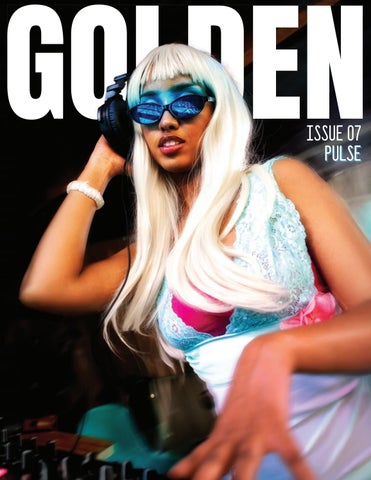
GOLDEN GOLDEN


![]()


LETTER FROM THE EDITOR
04


CONTEMPORARY DANCE


MIDWESTERN MUSICIANS MAKE THE BLEAK BEAUTIFUL
06 124
22


INSIDE MINNEAPOLIS’ THRIVING DIY MUSIC SCENE
28
122

CREATIVE DIRECTOR SIGN-OFF
114

OUTKAST’S “STANKONIA” IS AN INFLUENTIAL DIRTY SOUTHERN CLASSIC

ONE MONTH, THREE ICE SHOOTINGS IN MINNEAPOLIS: HOW ART MEETS A MOMENT


106


BJÖRK’S LETTER HOME IS SENT FROM THE FUTURE
100


HIP-HOP BEYOND THE BEAT A DIVE INTO AN ARTIST’S MOST PRIVATE SPACE DANCING THROUGH THE PAIN
38 44 58

68
94


UNDEFINABLE,

UNDEFINABLE, UNMISTAKABLE: THE CHURCH OF PRINCE


82
82


ETHIOPIAN STUDENT ASSOCIATION BRINGS RHYTHM, CELEBRATION TO CAMPUS WHERE IN THE WORLD IS TYLER, THE CREATOR?


Golden is much more than just a magazine; it’s a community for self expression. The college experience is a huge transition and opportunity for self reinvention. When I rst came to college, I had been searching for a place that celebrates belonging and creativity, a place where everyone felt free to be bold, ambitious, and unapologetically themselves. I found that place in Golden.
With this issue, we wanted to dive into what exactly makes Golden special by highlighting
the rich art scene both at the University of Minnesota and across the Twin Cities, as well as deepening our connection with our community. So much of what makes our local community vibrant is expressed through art and movement; this issue offers a small glimpse into that energy. Issue 07 became an opportunity to celebrate creative expression through the connection of music and dance. From this idea, our theme was born.
Pulse is the movement that lives inside all of us. It is the heartbeat behind physical expression. It is the rhythm of a dance, the driving force of a song. Pulse re ects how much of artistry can’t be conveyed standing still; it is ever changing and always in motion. Issue 07 could not have been actualized without Golden’s incredibly creative and hard working teams. Golden’s sta members are truly the reason any of this was possible. Their dedication throughout the year brought this vision to life, and I could not be more proud

of what we have accomplished together. This issue is truly a testament to what a group of students can accomplish when they come together with a shared vision.
As you continue reading, I hope you are inspired by the amazing artistry within these pages. I am incredibly grateful to have gotten to contribute to Golden over the past couple years and am very proud of what we have created. I am in awe of the raw talent this community continues to show, and I am so excited to see where it goes in the future.

OLIVIA KRONZER Editor-in-Chief


boredom spells of Midwestern living don’t stunt creativity; they birth it.
By Audrey Hanson and Emily Lemmenes
Creativity is found in small gestures and familiar routines, just as much as it is in exciting changes and vibrant lives. Few understand the artistry of a desolate day in January better than Minnesota musician Adrianne Lenker. As a songwriter and lead vocalist of the indie rock band Big Thief, Lenker’s ability to create art was deeply a ected by the time she spent tucked inside during the frigid winters she grew up in. Winter boredom gave Lenker no choice but to put her thoughts on paper, cwreating the hauntingly beautiful lyrics that now de ne her songs.


Growing up in and around Minneapolis, Lenker described the profound seasonal changes as a necessary transformation that a ects the earth as much as the people living through it. This interpretation of the seasons validates how many Midwesterners feel; every winter is an opportunity to crawl into a chrysalis and emerge new and beautiful on the other side.
Lenker described the profound seasonal affects many Midwesterners feel; every


Even in subzero temperatures, the Midwest is not simply a barren tundra lacking warmth and Claire, the small diverse genres since ing connections that make numb ngers and gray skies

Even in subzero temperatures, beauty. Justin Vernon, the frontman of the band Bon Iver, attributes much of his inspiration to Eau Wisconsin town where he grew up and started his band. According to Vernon, the unassuming town has a flourishing music scene that kept him surrounded by unique venues and childhood. The love Vernon expresses for his hometown is an inspiring reminder that the Midwest’s beauty runs deep, rooted in findfingers seem unimportant.


the country, windswept willow trees and thousands of lakes, the Midwest’s beauty doesn’t reveal itself fluorescent in the night, knowing the season by the height of the corn fields, laughter leaving

Aside from lush, green, summer drives through the country, windswept willow trees and thousands of lakes, the Midwest’s beauty doesn’t reveal itself easily. It shows itself to those who know it well. Winter winds turning a sunset blue instead of orange, fresh snow shining uorescent in the night, knowing the season by the height of the corn elds, laughter leaving mouths like smoke in freezing temperatures; the things overlooked by many are kept secret in the middle of America.


Illinois musician John Prine expresses a finding flat fields ing of his attention. Instead, his folksy style celebrates a nostalgic and peaceful life in the rural Midwest. Where Prine finds peace in this environment, Midwest emo bands often turn to desperation. and pensive lyrics perfectly encapsulates the yearning felt lonesome

Elliott and the Appleseed Cast sing of hometown nostalgia in a Midwestern culture, writing ballads in flannels and old Conout “goodbyes.”
Illinois musician John Prine expresses a love for life’s small details in his music, never nding at elds and farmhouses undeserving of his attention. Instead, his folksy style celebrates life in the rural Midwest. music out of desperation. The deep ache in their whining, twangy guitars and pensive lyrics perfectly encapsulates the yearning felt on lonesome nights watching the stars through smogless skies. Artists like American Football, Elliott and the Appleseed Cast sing of hometown nostalgia in a dreary, wistful way, making every song into a beautiful tragedy. Yet they maintain their dedication to Midwestern culture, writing ballads in annels and old Converse while they stretch out their songs like Minnesotans with “goodbyes.”


It is a special experience growing up in the dichotomy of bleak and beautiful land and weather.

Though the region’s music and art aren’t easily con ned to one or a few genres, the wry humor, humility and angst that are special to the Midwest always leave a mark. Living somewhere often labeled as boring and barren can feel su ocating in your formative years. Still, beneath the surface, it deepens


an artist’s ability to re ect thoughtfully on a slower, quieter existence and to express it as either a peaceful blessing or a limiting connement. Either way, Midwest musicians nd a voice that carries them anywhere they want to go, but the heartland will always be home.


Community support

Minneapolis artist Anita Bauer spent much of 2023 and 2024 touring through the United States and Canada. Near the end of her tour, a thought struck her.
“ Tw C i sc e, p cul ly DIY u rgr sc e, some g special t I k not comp ab y o r c y c ry,” she said. “They’re going to bury me in Como because I’m never leaving here.”
Bauer creates music under the name Anita Velveeta, experimenting with both heavy and electronic sounds. Almost a decade has passed since she rst found herself involved in the local music scene, a place where she has found warmth and, as a trans woman, representation.
“You can go to a couple of shows alone, but after three or four, you will never go to a show alone ever again,” she said.
Nen Ramirez moved to the Twin Cities from Michigan in 2020 without knowing anyone. At their rst local show, they heard the band Virginia’s Basement and quickly formed a friendship with its members. Now, they do synth and spoken word for the band.


“That night was really special to me,” they said. “That’s where we all became best friends, and that’s where I met all of my favorite people who keep me grounded.”

On any given night, there’s a show happening in Minneapolis, they said.
“I’ve never lived in a place where, if you want to go to a show, you can always nd one,” Ramirez said. “It is so active.”

Ramirez, a poet, writes and performs spoken word for the ÿ ve-member band Virginia’s Basement. ° e band that draws inspiration from


bands like Remo Drive and Title Fight, said Santana Vigil, the band’s vocalist and guitarist. Their songs, while often loud and energetic, are marked by lyrical vulnerability.

While traveling around Minnesota on tour in 2025, the band relied on the trust they’ve built to get through their emotional sets in unfamiliar places.

“The songs, they really do hurt, and they are really important to us,” Vigil said.
“It is hard to be that vulnerable in front of people who might not ever understand you.”

It makes playing their Twin Cities shows all the more beautiful, he said.
“The love and support the fans, bands, and the family that supports us show when we’re coming back home from tours, that is so huge,” he said.
“ lo i eplac b Tw C i , s usly, ’s impoßib place.”

A part of that love and mutual support is a steady ow of bene t shows for di erent causes and community members. In November, Virginia’s Basement and other local bands hosted a show to raise funds for a community member’s rent.


“We were able to raise $1,200 for them, and now they won’t be evicted, which is beautiful,” Vigil said. “So consistently, you see the power of doing a show for a good cause. People really come out, and they show love and support. It’s a really safe scene, and there’s so much kindness.”
Bauer routinely participates in bene t shows. She works with organizations such as Southside Harm Reduction Services and Twin Cities Trans Mutual Aid, helping to raise $3,700 this summer for the TCTMA.
and make it a stronger, better ame than it’s ever been.”
One of Bauer’s favorite places to play is Pillar Forum in northeast Minneapolis. She estimates she’s performed there around a dozen times just in 2025.
Ramirez and Vigil echoed that appreciation for Pillar Forum.
“All the employees are tremendous,” said Vigil. “They’re insanely beautiful to the scene. And they take care of us.”

When Corey Bracken opened Pillar Forum in 2020, a co ee and skate shop by day, there was no intention of turning it into a music venue, he said. The rst show was meant to be a one-o , but word spread. Nine months later, Bracken expanded into the space next door and opened the official venue.
Bracken, who played in bands in his 20s, said it is important to him that he carry the opportunity forward for a new generation and maintain a space for all ages to play and experience shows.

“It’s part of the culture. When people need money, we can throw a show and raise a surprising amount of money. I think it’s pretty awesome,” she said.
It’s a scene marked by safety and kindness, Vigil said. Bauer, who is transgender, has watched the representation in the scene transform.
“I can’t go to a show without seeing some younger trans woman singing her heart out,” she said. “That’s been incredibly special for me to watch. Just seeing the next generation kind of like take the torch

“To see that another new generation can have fun in their way and see the bands that they like, whether it’s a friend’s band or just a band they’ve been following,” he said. “It’s really important to get the youth excited about it and going to see live music, and then all of a sudden say, ‘Hey, maybe I can start a band and meet people in that community.’” lo s t space s s a e g e a typ b s, welcom g e ry l exp i ce.


“We’ve had some touring bands come through, which is really cool to see, or sometimes it’s just 10 people on a Tuesday, and it’s someone’s rst time up on stage, we can be that place as well, and then everything in between,” he said.
What makes the Minneapolis music scene unique in Bracken’s eyes is not only the support the community shows bands, but the support bands show each other.


“Everyone’s trying to raise each other up,” he said. “I think that’s really important for any music community is that you’re all kind of looking out for each other.”
Ramirez felt isolated after moving to the Twin Cities, but the music scene here has changed that.
“There’s a huge sense of solidarity and care,” Ramirez said. “Beyond just the music in the scene, the people are really, really good.”


MINNEAPOLIS ARTIST XOMAGNIFICENT SHARES HIS EXPERIENCE PAINTING AT THE SCENE OF THREE ICE SHOOTINGS IN MINNEAPOLIS, USING HIS WORK AS A MIRROR AND TRANSMISSION OF GRIEF.
Yellow caution tape flutteed in Minneapolis’ frigid air as Xomagnificentsteadied his easel in front of it and sat down on the sidewalk.
Less than an hour earlier, Alex Pretti, an ICU nurse and U.S. citizen, had been fatally shot at least 10 times by two U.S. Immigration and Customs Enforcement agents. Now Xo sat just yards away from the scene and began to paint, the harsh winter sun glaring into his eyes as a 6-foot-4-inch agent holding a military-grade riflewatched from behind the tape.
A large and growing crowd of about 200 gathered. Xo continued painting. About 25 minutes later, he sensed commotion. Roughly 50 federal agents in
riot gear were marching toward him and other observers; without time to move back, pepper spray filled the ai.
“I don’t know the right way to handle a situation like that,” Xo said. “I just think that the violence needs to be recorded.”
Xo believes healing begins with creativity, saying that creating his art publicly offes him the opportunity to grieve alongside a community. So at Pretti’s vigil the day after the shooting, he set up his easel while the crowd’s solemn hush hung over a growing pile of flwers.
A man with a scruffywhite beard held an American flagwhile another, younger man yelled at him. The two debated whether the police were protecting or part of the problem. Xo painted the exchange, hoping to capture the need for public grief, disagreement, and conversation.
“It was all done without any violence,” Xo said. “It was all done in deep, sincere grief and deep, sincere well wishes for the country. That’s where the rubber meets the road for me, in the individual hearts of those people as they’re trying to come together and understand and grieve together, that’s the way forward to me.”
The site of Pretti’s death was not the fist place Xo painted as ICE activity intensifiedin Minneapolis. Xo was at the scene of all three January shootings at the hands of ICE agents.
“They are each unique,” he said. “In my experience of them, they are compounding in their effecton the community.”
When Renee Good was shot in the face by ICE agent Jonathon Ross in front of her wife on Jan. 7, Xo arrived less than an hour later. He saw anger, tempered by shock and uncertainty.
When ICE agents shot Alfredo Alejandro Aljorna in the leg through the front door of his home on Jan. 14, Xo went to the scene where a protest ensued. Anger bubbled to the surface as pro- testers chased ICE agents from the area and defaced their vehi- cles, he said.
When two ICE agents shot Pretti on Jan. 23, people were at and beyond their breaking points. Anyone who could go seemed to show up and denounce the shooting. There was so much anger and fear, Xo said, but sitting amid chaotic scenes is a way for him to move through those emotions.
“I am trying to deliver my fear in the form of lov-
ing accountability onto the paper,” he said. “I am expressing it as love, as truth, and as something that can bring accountability. Something that I can say, I know that person stood in front of me with that gun.”
Xo does not expect everyone to experience his art through the same lens of grief and healing he does. He said he encountered ICE agents and their supporters watching him paint. His art captures moments in time that people can meet wherever their heart is, he said. How they interpret and learn from it is up to them.

“I’M PAINTING YOU, ICE OFFICER, holding a gun so that you feel the experience of being painted, of being im- mortalized in this form,” he said. “You can wonder whether this is good. And the rest of the world can wonder, is this what we see as power? Is this what golden love and opportunity look like?”


BY RAMIRO DURAN


by gaoMong Xiong


BY AUDREY HANSON & EMILY LEMMENES


espite hip-hop dominating today’s music landscape, the multifaceted genre’s roots are often overlooked. Hip-hop’s cultural seeds planted by Black and Brown pioneers of the genre have sprouted into nearly every aspect of pop culture today. However, mainstream adoration for hip-hop often fails to acknowledge its history or its diversity of sound and style.


Hip-hop emerged in the 1970s in the Bronx, New York, as a response to the government’s systematic neglect of minority communities that often resulted in economic hardship and social marginalization. The music, rooted in resilience and protest, became both an artistic outlet for frustration and a cultural identity for communities that lacked representation in mainstream pop culture, dominated by white artists. By the 1980s, record labels recognized the genre’s explosive growth and signed rap groups like Run-DMC, The Beastie Boys, and Salt-N-Pepa, skyrocketing the sound to


Music catapulted hip-hop into the mainstream, but de ning it solely as a musical genre paints an incomplete picture. Hip-hop is a cultural movement that encompasses many forms of artistic and self-expression. During its conception, Black, Latino and Caribbean communities who pioneered the genre weren’t largely accepted into the white American cultural political zeitgeist. Its original sound and style formed in community with those whom the mainstream rejected.
As soon as the music became a cultural obsession, the movement’s distinct clothing style followed suit, creating a fashion revolution that still definespop culture today. If music is the face of the portrait, art, dance and fashion are the body that complement it. From the start, hip-hop fashion has been built on innovation. Styles that may have originated from necessity and limited resources were transformed into new, fresh, and deliberate looks.


The way people wore these clothes earned them an iconic reputation; it was casual when needed, and dressed up with layered jackets and accessories. This style was carried through to the ‘80s as artists performed for large audiences in streetwear, athleisure, and baggy outfit. In 1986, Run-DMC and Adidas collaborated on one of the fist major endorsement deals between a rap group and a mainstream clothing brand, resulting in the group’s iconic Adidas with no laces trend.
Although streetwear is often the classic definitionof hip-hop style, this risks oversimplifiction. Treating hip-hop as a monolithic category ignores the movement’s emphasis on individuality. No single sound or style can represent the culture.
Few artists embody the genre’s inability to be boxed in better than the rap duo OutKast. Unafraid to challenge expectations with a contrasting, yet still cohesive style, member Andre 3000 donned bright colors, wigs, extravagant suits, and sometimes incorporated preppy pieces like polos and golf caps. His partner, Big Boi, shared this passion for bold looks but had a more subtle and sleek approach to styling. He experimented with well-tailored suits, large fur coats, monochrome outfit, and a similar love of golf caps.


Now, their in uence can be traced across both hip-hop and high fashion, where gender- uid silhouettes and vibrant tailoring are increasingly celebrated. Rappers today, such as Lil Uzi Vert and Young Thug, openly wear dresses on mixtape covers and in international performances. Hip-hop artists like Outkast paved the way for those in and out of the genre to express themselves freely.

Iconic by today’s standards, Outkast’s style choices were scrutinized in the 1990s and early 2000s. Andre 3000 wearing traditionally feminine pieces led some to question his sexuality, as expressions of femininity in male fashion were not as widely understood then.


Innovation in hip-hop is far from over. One modern artist revolutionizing the genre is Tyler Okonma, known as Tyler, The Creator. Tyler incorporates the gender-bending boldness of Andre 3000 and combines it with the dapper style of Big Boi to form an undeniable presence in the fashion world. His casual out ts are often characterized by skate shoes, baseball hats, and colorful polo shirts, while his formal looks are bold and tailored. He displayed his duality by attending the 2020 Grammys in a bright pink bellhop suit, a year after winning the WSJ magazine innovator award in a classy grey suit, fur hat, and pink purse. The rst out t was loud with a humorous twist, while the second was classic and dapper, creating a contrast that encapsulates the stylish comedy in his music and fashion.
Once it became clear to mainstream listeners that hiphop was here to stay, luxury brands wanted to participate. These brands have been borrowing elements of hip-hop for decades. In 1991, Chanel debuted a runway show that creative director Karl Lagerfeld described as the “rapper look,” dressing models in baseball caps and gold chains. Examples like Chanel’s show spark debate over who is celebrating hip-hop and who is appropriating it.
Commodifiction is never a celebration; it perpetuates a one-dimensional image of a multidimensional movement. This raises the question of whether high fash-


ion’s adoption of the style is a tribute to the culture or merely commodifying it without understanding its significanc. What began as a creative outlet for groups experiencing marginalization is now a multibillion-dollar industry that profitssome brands that fail to understand or appreciate the movement’s roots.
However, this style deserves to be seen and appreciated with the same weight as high
fashion. Work by designers and artists personally connected to the culture should be amplifiedin pop culture, not one-dimensional representations from outsiders. Whether hip-hop fashion is on the runway or at its birthplace at block parties in the Bronx, it maintains its roots of individuality, creativity, and the refusal to be boxed in.


BY GEORGE FASEEMO


with brooms, and games of hide-and-seek during long summer days on family vacations in Brainerd.
When I walked into the stark white art room where I interviewed Iamjoy, I found exactly what I expected. Iamjoy’s eyes beamed at me with all the star power you want to findin the face of a new local act. When I was in high school, the only thing I hated about art class was sitting on the wooden stools that were in every art room. I took a seat on a stool in front of her and began our conversation. Here’s what happened.
Rosie. In her closet, she’s Rosie, but to the world she’s Iamjoy: an indie pop act that relishes mixing funky basslines with ethereal vocals. In her closet, we explore the diffeence. When she’s Rosie, her style is extremely functional and cozy. Being cozy ignites her creative spark, allowing her to create without limitations. When she’s performing, though, her fashion principles are very diffeent.
As she’s grown into the role and realities of being a performing artist, Iamjoy has progressively found herself wearing brighter statement pieces to captivate bigger audiences. Iamjoy is Rosie stepping out of the crowd and onto the stage, and her clothes re ect that shift. Initially, she wore darker pieces, making it hard to tell her apart from the audience. The brighter pieces she wears now mark her onstage persona as the center of attention. Her interest in bold colors and unique silhouettes is inspired by the music and fashion of emerging UK artist RAYE, who often dons silky dresses reminiscent of a bygone era of classy jazz musicians.
Talking about what silhouettes she’s drawn to made Rosie laugh, then pause. Our time in the closet was getting introspective. She said that generally triangles are a draw for her, but boxy, rectangular pieces often find their wy into her style.


These silhouettes are not perfect; rather, they re ect her music's uninhibited free-flowing spirit. Rosie wants her music and style to form a cohesive performance that is both expressive and authentic. The name change to Iamjoy exempli es this. Despite the new moniker, the music she makes isn’t like the polished pop sound that’s dominated recent charts. Her


de nition of joy is all-encompassing: the joy that comes from family, from sadness, from relationships, from the human experience.
As I rose from the uncomfortable wooden stool and went about the rest of my day's tasks, I couldn’t help but notice the buoyant mood our conversation left me with. In retrospect, I found her philosophy laid bare: Iamjoy wants to spread the exhilarating, all-encompassing joy of being alive.


Jae’s earliest memory is of being on a boat in Korea owned by a friend of his grandfather’s. He said this memory reminds him of the strong connection he has with those waters.
While my journey into Iamjoy’s closet revealed an artist who explores her identity through life's contrasts, my look into Jae Fontane’s closet revealed something diffeent: an artist who has mastered creation in the face of contrast.
Jae Fontane and I lounged on the large, slanted black chairs outside the photoshoot studio. Imagine a beach chair’s shape clad in leather. While watching Jae’s photoshoot, I eyed the clothing he had brought: simple and baggy, yet with a glittered flair reminiscent of Michael Jackson's bedazzled glove. I had questions, and I would ask them from the chair I was sliding out of.
Fontane explained that due to the dictates of our modern world, there isn’t much separation between himself as an artist and as a person. When you work a 9-5 job, it’s hard to create a closet or persona that differs from what you wear to work. So Jae keeps it simple, focusing on minimalism and subtlety, but adds a splash of flash and color here and there to definehis presence on stage.


Overall, his wardrobe is filledwith pieces he can easily mix and match, because his on-the-go lifestyle requires it. Despite the triteness of the principle, Fontane truly believes that being yourself is the best way to inspire your personal taste. Growing as a person and artist has meant becoming familiar with this truth. Naturally, though, I had to ask: what does it mean for Fontane to be himself? He answered with a story.
Imagine it’s 2008 — maybe 2009. You’re a kid who’s recently moved from Korea, standing at a skate park while baggy jeans and chunky shoes blur past you, and Odd Future is blasting from a nearby boombox. This is the scene where Fontane emerged. The music he makes and the clothes he wears now stem from the artists and clothes his friends were listening to and wearing then. Fontane reminisced on some of the fist pieces of clothing that caught his eye: the oversized, double-hand-me-downs he wore in elementary school; his cousin’s skull-covered Sean White shirt. His roots grew with him, branching offinto practicality with buds of pizzazz, making the interplay of his layered identity apparent in his style.


Then, Jae shared another story, this time about ying back to Korea for the rst time in years. He recalls wearing a t-shirt and shorts. When he landed, he saw that nearly everyone was wearing button-ups and suits — formal wear. When he left, his suitcase was lled with dress clothes. Unlike in America, Koreans aren’t insistent on standing out in a crowd. This manifests in many ways, but fashion makes it clear to the eye.
Korean culture, like many collectivist cultures, prioritizes harmony and communal beauty. Wearing the same thing as somebody else is a sign of successful conformity, not a threat to your individuality, like it is in American culture. In Fontane’s wardrobe, a blend of Korean minimalism and American individuality shines through;


despite this, he’s often uncomfortably sandwiched between his dueling identities. Yet through fashion, Fontane is free to blend his Korean and American identities in a way few other forms of expression allow.


by Oscar Carabell


Dance-pop’s uptempo beats and catchy melodies make it uniquely palatable for both mainstream radio and dance clubs. The genre’s melting pot of sounds is an eclectic mix of R&B, techno, disco, synthpop, house and funk. Its accessibility to mainstream audiences catapulted icons like Michael Jackson, Madonna and Prince into global stardom in the 1980s, making a gray economic era vivid again. Recessions always impact working-class people and the music they listen to, but none before


in 2009 by the Irish Independent in an interview with Lady Gaga, the term refers to a recurring phenomenon in which, during times of strain and economic hardship, people want to listen to high-energy, escapist music. While the term often refers to music released around the 2008 financial crisis, Dance-pop with a fast BPM first emerged in the early 1980s, during the 1981-82 economic recession.


Blinding Lights’ popularity in 2020 is part of a phenomenon called “Recession Pop.” First coined


When Barack Obama won the 2008 presidential election, I sat on my parents’ bed to watch his victory speech. My dad lost his job during the financial crisis, and my family had to cut back on spending. I don’t remember the speech; I was 4, but I remember Obama’s iconic red, white and blue poster telling me to have hope. didn’t understand the recession’s effect on my family and the country until the 2020 lockdown hit when I was older. During COVID-19, the unemployment rate peaked at 14.8%, the highest in recent history. To date, the long-term effects on those who were isolated from work and school during the pandemic remain unknown. isn’t surprising, then, that the biggest song globally in 2020 was The Weeknd’s 80s-inspired, synthpop song “Blinding Lights” set to a staggering 171 beats per minute (BPM) while most pop songs are set near 120 BPM.


When Barack Obama won the 2008 presidential election, I sat on my parents’ bed to watch his victory speech. My dad lost his job during the ÿ nancial crisis, and my family had to cut back on spending. I don’t remember the speech; I was 4, but I remember Obama’s iconic red, white and blue poster telling me to have hope.
I didn’t understand the recession’s e˛ ect on my family and the country until the 2020 lockdown hit when I was older. During COVID-19, the unemployment rate peaked at 14.8%, the highest in recent history. To date, the long-term e˛ ects on those who were isolated from work and school during the pandemic remain unknown.
It isn’t surprising, then, that the biggest song globally in 2020 was ° e Weeknd’s 80s-inspired, synthpop


Blinding Lights’ popularity in 2020 is part of a phenomenon called “Recession Pop.” First coined in 2009 by the Irish Independent in an interview with Lady Gaga, the term refers to a recurring phenomenon in which, during times of strain and economic hardship, people want to listen to high-energy, escapist music. While the term o˝ en refers to music released around the 2008 ÿ nancial crisis, Dance-pop with a fast BPM ÿ rst emerged in the early 1980s, during the 1981-82 economic recession.

Dance-pop’s uptempo beats and catchy melodies make it uniquely palatable for both mainstream radio and dance clubs. ° e genre’s melting pot of sounds is an eclectic mix of R&B, techno, disco, synthpop, house and funk. Its accessibility to mainstream audiences catapulted icons like Michael Jackson, Madonna and Prince into global stardom in the 1980s, making a gray economic era vivid again.


Recessions always impact working-class people and the music they listen to, but none before could match the crushing loneliness and economic hardship so many people experienced during the pandemic. ° e stars of the 80’s could still hold concerts to bring people together, while stars in lockdown could not.

Dance venues have survived and thrived during many economic recessions. But the pandemic posed a unique threat to third-party spaces, forcing many to close permanently. Minneapolis’s iconic First Avenue shi˝ ed gears, though, broadcasting its 50th-anniversary celebration in 2020 by temporarily turning the venue into a vaccine clinic.


First Avenue is one of the longest-running independently owned concert venues. It prides itself on its connection to Prince but has built a legacy beyond the late artist. In 2020, the venue’s owners lobbied Congress and received a $16 billion relief grant to support independent concert venues nationwide.

For other Minneapolis venues, like Dinkytown’s ° e Kitty Cat Klub, the pandemic was the ÿ nal blow. Before permanently closing in 2020, the club hosted a variety of theme nights, providing those around campus with new high-energy sounds to dance to and escape the weight of life and school each week.


:


:


4/4 BPM 122 KEY B TIME SIGNA-


The Ethiopian Student Association (ESA) has been building community through dance and cultural celebration since its establishment in 1993.
BY SHAY
This year, ESA’s 29th annual showcase on May 29 at Northrop Hall will feature a host of performances. The event will bring together dancers, keynote speakers, spoken-word artists, comedians, and skits based on the country’s folklore.
Often called the cradle of humankind, Ethiopia is home to one of Africa’s oldest civilizations. Having never been formally colonized by a European power, the country serves as a symbol of African independence for many. Now home to over 80 cultural groups and languages, the country’s rich history is expressed in many forms.
ESA’s showcase features performances originating from all over Ethiopia. “It’s just a full representation and celebration,” ESA president Kidus Yeshidagna said.
Dance is a focal point of the show, according to Yeshidagna. With performances representing multiple groups, a variety of stories and emotions will be expressed through rhythmic movements unique to diffeent regions of the country.


“Sometimes it’s slower and more somber, then there’s a faster movement which is more celebratory,” Yeshidagna said.
From deliberate shoulder and chest shakes to graceful hip movements, to intricate footwork, Ethiopian dance moves through the whole body.
Eskista, the name of an iconic Amharic dance from Ethiopia’s northwestern region, means “dancing shoulder.” Eskista Dancers use their chest, neck and shoulders to tell centuries-old cultural stories of the Amharic people. The dance can be sped up or slowed down depending on the mood of the performance.
Gurage dance, from Ethiopia’s central region, is a celebratory dance that features quick, often synchronized footwork.
Ethiopian dances like Gurage and Eskista are closely tied to traditional instruments, whose distinct sounds guide the onstage energy from upbeat celebrations to heartfelt ceremonies.

No matter the mood, many Ethiopian dances are communal, often performed in groups rather than individually.
Each year, dance practices for the showcase begin in January and con-
tinue until May, allowing members to get to know each other, said Nahome Elias, the board’s cultural student development chair.
“It feels like a community; it feels like a family,” Elias said. “When it gets to show dates, everyone’s just having fun.”
ESA provides a way to stay connected to Ethiopian culture while in college, even from a continent away, Yeshidagna said.
“Sometimes it gets a little hard to still stay rooted and still have that continuity of culture,” Yeshidagna said.
“It’s like something we want to pass on to our kids. It’s important to keep your heritage and know where you’re from.”
ESA has grown signi cantly in recent years, with its board expanding and events drawing large numbers of participants. Regardless of the student association’s size, the space it creates has always been marked by fun and community building.
“It’s a unifying thing, something that can bring joy to people’s lives,” Elias said.
“It’s a unifying thing, something that can bring joy to people’s lives.” s


“ESA PROVIDES A WAY TO STAY CONNECTED TO ETHIOPIAN CULTURE WHILE IN COLLEGE, EVEN FROM A CONTINENT AWAY.” ETHIOPIAN CULTURE WHILE IN COLLEGE, EVEN FROM A CONTINENT AWAY.”


BY GEORGE FASEEMO


Tyler, The Creator reinvents himself once again on his 2021 album “Call Me If You Get Lost,” inviting listeners to follow him on a journey across the world, through his eyes.
Tyler Okonma wears his scandals on his sleeve in this album – or more accurately, deliberately holds them in his hands. “Call Me If You Get Lost” is a homecoming for one of rap’s most provocative and inventive wonderboys.
Tyler, The Creator, has never been my favorite artist. Of the ODDFUTURE alums, I’ve always had a preference for Frank Ocean’s melodic R&B magic and a soft spot for Earl Sweatshirt’s dark, downtempo world. Regardless, Tyler has been a persistent force in pop culture ever since he released the profanity and controversy-laced album “Goblin” in 2011.
To understand “Call Me If You Get Lost,” rst accept that this project is not “Flower Boy.” There is no soft strumming from Rex Orange County or laments about being Mr. Lonely. Aside from the saccharine “SWEET,” the hardened hip-hop sound of Tyler’s early work boomerangs back in full force from the top of the album to the bottom.

Before launching into bangers “CORSO,” “JUGGERNAUT,” and “LEMONHEAD,” Tyler opens the album with the globe-trotting “MR. BAUDELAIRE,” a song recounting his world travels. While “WUSMYNAME,” the track following those hits, reveals a more laid-back, topdown convertible vibe with verses from NBA Youngboy and Ty Dolla $ign.
“Call Me If You Get Lost” maintains its energy throughout. Tyler’s verses are con-


sistently strong but not too boundary-pushing, and the production is top-notch – an expectation for any modern Tyler, The Creator project. While most of Tyler’s softness is withdrawn at rst, his contemplative side comes out as the album continues.
ing, and the production is top-notch – an first, reflection flexing


The song “WILSHIRE” is a nearly 9-minute re ection on a doomed love for a friend’s girlfriend. The introspection on this track makes it interesting edgewise, compared to the boisterous exing that dominates much of the album. Tracks like “RISE” play with the idea that Tyler is still rising to the top of the music industry, and he just doesn’t “see any ceilings”.


reflective defined an expressive accounting of Tyler’s colos-
Tyler’s re ective side persists as he grapples with the edgy lyrics and tweets that de ned his public persona in the 2010s on “MASSA” and “MANIFESTO”. The songs are an expressive accounting of Tyler’s colossal personality and the ways it’s gotten him into and out of trouble. At no point does he apologize for his past actions nor claim to have all the answers.


It appears as though “Call Me If You Get Lost” is a synthesis of all of Tyler’s work. He takes the hardcore elements of his early years and softens them with the self-aware lyricism heard on IGOR and Flower Boy. If lost in his discography, this album can always be a North Star.

self-aware lyricism heard on IGOR


BY CASEY O’BRIEN


A deep royal purple uniform paired with sharply tailored, colorful suits and jet-black hair that seemed to change by the day. His presence was impossible to ignore— even when he tried to disappear into the streets of Minneapolis.
Prince Rogers Nelson moved as if the sidewalks themselves were part of his stage: riding his bike, slipping into record stores, or passing cafes, blending in yet somehow drawing every eye. Every detail, fabric, color and shimmer of jewelry was intentional, re ecting the precision and experimentation that de ned his art.

He was the king of sound, a Prince who transcended time. The myth often obscures what he was truly capable of—and how many people quietly agreed on just how extraordinary he was.


People didn’t always place Prince in the same conversation as traditional ‘guitar greats,’ but the people who mattered noticed. Eric Clapton once joked that when people asked him what it felt like to be the best guitarist in the world, his answer was, “I don’t know—ask Prince.” Carlos Santana praised the emotional depth of his playing. John Mayer has pointed to him as an example of total musical command. Even Dave Grohl has talked about watching him and realizing he was operating on a di erent level entirely.


When you actually listen and interact with his music, it makes sense. On “Let’s Go Crazy,” the solo doesn’t feel rehearsed—it feels necessary. Fast, slightly chaotic, but never out of control. On

“Purple Rain,” he slows everything down, letting notes stretch and bend almost to the breaking point. It builds not through speed but through weight. On “When Doves Cry,” he strips everything back—no bassline, just space and sharp guitar ri s that cut through it. Most artists would try to ll that silence. Prince lets it sit.
That’s where his playing stands out. He understood when to do less—and when to experiment. Across albums like “1999” and “Sign o’ the Times,” the guitar isn’t always front and center, but it’s always doing something important. On “Little Red Corvette,” it shifts the song’s tone without overwhelming it. On “I Could Never Take the Place of Your Man,” it stretches out, moving seamlessly between rhythm and lead. He didn’t treat the guitar like a spotlight—he treated it as part of the architecture, a tool of de nition.


That approach didn’t come from a traditional music scene. It came from Minnesota.


More than just his studio, Paisley Park was a self-contained world. He recorded constantly, brought in other musicians, and shaped entire projects from the ground up. Minneapolis bands like The Time and The Revolution weren’t just Prince’s side acts. He built a scene there that included them.
Before Prince, no one saw Minneapolis as a city de ning music culture. After him, it couldn’t be ignored. He didn’t just create a sound—he created infrastructure. He gave musicians a reason to stay, to collaborate, and to take the city seriously. The “Minneapolis Sound” wasn’t just about synths and drum machines—it was about control, precision, and independence. It proved that you didn’t need to relocate to make an impact. You could build something where you already were and make the world come to you.


There’s a certain distance in his sound— clean, controlled, sometimes almost isolated. Not cold, just precise. He wasn’t surrounded by the same kind of industry pressure you’d nd in Los Angeles or New York, where everything pushes toward bigger, louder, faster, and brighter. In the land of 10,000 lakes, Prince wasn’t driven by fancy parties, complex cocktails, or showy ambiance. The music drove him. The lack of outside noise, the freedom from demanding labels, and the distance from industry competition gave him space to experiment, fail privately, and build something that didn’t have to make sense to anyone else right away. As Prince said, Minnesota is so cold that it keeps the bad people out.
That space became physical at Paisley Park.


That idea—total creative control, refusing to wait for permission—might be his biggest in uence. You hear it now in artists who produce their own work, blur genres without explaining themselves, and treat image and sound as one. You see it in musicians who build studios in unexpected places, who stay rooted instead of moving to industry centers. Prince lived that mindset, and in doing so, he showed that true artistry doesn’t require comfort—it thrives in it.

Even with everything—albums, in uence, mythology—it comes back to moments. A solo that cuts through a song. A note held just a little longer than expected. A decision to leave space where no one else would. He didn’t play guitar, write emotionally rich lyrics, or create an avant-garde sound to prove he was the best. He did it in the only way he knew how.

He didn’t just create music: he made Minneapolis sing.


BY EMILY LEMmENES


Icelandic singer-songwriter Björk’s genre-bending second studio album, “Post,” is so otherworldly that it is a humbling task to ground it in any piece of writing. Music that probably felt like a beam from the future when she released the record in 1995 remains dynamic today.
Reminiscent of greats like Bob Dylan or Nina Simone, the cadence of Björk’s voice is part of what makes her sound so irreplaceable. Vocals on “Post” range from theatrical shouts to intimate whispers to guttural throat noises to chirping shrieks, inviting listeners into an intensely animalistic world in uenced by a childhood in Iceland’s rugged climate.
“Walking 40 minutes to school, a young Björk entertained herself by singing: sneaking down to the moss on the ground to whisper a verse, running up a hill to unleash a chorus loudly against the wind,” Pitchfork reported in a review of “Post.”
The relatability of Björk’s lyrics’ sharp ferocity and raw vulnerability is what centers “Post’s” wildly surreal vocals and instrumental sounds, keeping the album both musically surprising and emotionally resonant with each fresh listen.
During “Post’s” release, Björk was 29 and had been living in London for two years. The album re ects on the life she left behind in Iceland, serving as a musical letter posted home to her country and loved ones.
The record’s rst track, “Army of Me,” makes a erce entrance with a heavy, crashing beat and lyrics that make you want to both dance and claw at anyone who’s wronged you.
The song’s catchy chorus, “and if you complain once more, you’ll meet an army of me,” feels like a wakeup call not to carry unnecessary emotional baggage from others, driving the point home with the cutting lyrics “you’re on your own now, we won’t save you, your rescue squad is too exhausted.”


“theatrical shouts to intimate whispers to guttural throat noises to chirping shrieks, inviting listeners into an intensely animalistic world influenced by a childhood in Iceland’s rugged climate”


Letting “Army of Me’s” message lead, the album shares a personal narrative covering love, longing, new beginnings, and ambivalent endings as she explored London’s underground electronic dance scene in the 1990s.
Björk grapples with missing the simplicity of home while feeling magnetized by a fastpaced life in London on the album’s fourth track, “Enjoy.” She wishes she were content with life in Iceland, but ultimately has no fear or shame about reaching into the unknown.
Björk’s “Post” is a reminder that new beginnings come with both emotional turmoil and exciting opportunities alike. Longing for familiarity while navigating new roads is a natural progression of change, but as “Post” champions, embracing growth is a gift. Björk remains true to her heart on this album, yet allows fresh blood to pump into its sound.


BY George Faseemo


“Stankonia,” Outkast’s fourth studio album, has had a rm grasp on the hip-hop zeitgeist for the entire 21st century and has rede ned what people expected from Southern rappers.
What makes a truly classic album? Is it its hit singles? Earworms? Slow burns? Does a classic album need to be made for mass market audiences? Whatever the answer is, the question seems to have crossed the minds of Outkast members Andre 3000 and Big Boi when they released “Stankonia” in 2000.
The album invites you to a new world of warbling synths and energy you can’t help but follow, brought to you by Outkast. Outkast created this new world at the landmark Stankonia Studios in Midtown Atlanta, a spot with a little privacy, where the band could let its freak ag y.
Hailing from Atlanta, Georgia, Outkast’s “Stankonia” is a distinctly Southern record with a ow that blew the door open for Southern rappers from Migos to Glorilla. The “Dirty South” sound is especially clear on “We Luv Deez Hoez featuring Backbone & Big Gipp” and in quirky interludes like “Kim & Cookie” or “Cruisin’ In the ATL.”
Two of this century’s most popular songs, “So Fresh, So Clean” and “Ms. Jackson,” open the album with Andre 3000’s charismatic crooning and are held up by Big Boi’s unique ow. Big Boi’s verses give the entire album a distinct vocal bend that still hits the ear in new ways in 2026. In fact, the whole album has a sonic ngerprint that feels different from anything else from this era.
The record’s 11th track, “B.O.B.,” or Bombs Over Baghdad, raised the pro le of Southern rap. With the energy of a psychedelic head rush, Andre 3000 plows through his verse at a speed that leaves you wondering how you

got to the chorus. Then, the cheerily sung refrain “Bombs over Baghdad” reveals an element of why the entire album is so catchy; the presence of vocal harmonies normally reserved for either gospel music or the doo-wop groups of the 1950s.
Stankonia isn’t just a population of two: a murderers’ row of talent backs up the album with impeccable features. Killer Mike, Gangster Boo and Erykah Badu show out for the South and offersome of the strongest and most fun verses in Stankonia.
When Stankonia was released, American audiences had grown used to East and West Coast hip-hop dominating the charts and definingrap culture. Now, some of the biggest names in rap are either from the South or heavily influencedby it. A$AP Rocky’s iconic 2011 debut album “LIVE. LOVE.A$AP” sounds like it was mixed somewhere between his home in New York and Outkast’s in Atlanta. “Stankonia’s” influenceon “LIVE.LOVE.A$AP’s” is seen on A$AP’s black flagcover photo, and felt all the way down to its laidback production style. Even A$AP’s delivery is reminiscent of Big Boi’s frenetic, musical flw on songs like “Palace” and “Purple Swag.”
Outkast broke the mold and birthed a classic, introducing the country to a world of fun, highly musical, stankadelic bops that anyone can have a great time with, no matter the time period. “Stankonia” now stands as an eternal celebration of Black Southern life - crafted with as much love and stank as possible.


. Movement. Motion. Music. Dance.
Everyone, everywhere, at all times, is connected through movement.
Our theme this year is to explore that connection, and to show how the art and creativity of motion connects and shapes us all. Across genres, across artists, and across performance.
Each shoot draws from both history and imagination, and we hope that with every image, every page, you can feel the connection of these concepts.
We couldn’t be happier with the teams we lead and the ways they have beautifully portrayed our vision and expanded it, and we are so very grateful to everyone who has given their time and energy to make this issue possible.
We hope what we have created echoes the importance of creating art with intention, and highlighting what connects us as we move through a world of uncertainty…
Without a pulse, there is no movement.
ADA AND ZOEY Issue 07 Creative Directors


Chase Grivna* (not pictured), Lauren Adamson, Madelyn Churchill (not pictured), Mabel Dow (not pictured), Libby Karol, Rory McNamara, Selihom Megerssa, Anabel Perez-Kocis (not pictured), Lydia Weber (not pictured)


Elsie Dempsey-Rice*, Rowena Snow*, Trevor Dunning, Ellie Halverson, Yahya Khalif, Vivienne Paulson, Oliver Viscoli

Skylar MacLennan*, Josepha Da Costa, Zoey Her, Solana Jeffrie, Phoenix Krzykowski, Mara Maraia (not pictured), Molly O’Neill, Tvisha Soria, Sirianna Stortroen

Gaomong Xiong*, Samantha Noemi Cortez, Tre Guilmant, Sophie Hodena, Julia Humphrey (not pictured), Abby Johnson (not pictured), Alli Lamppa, Owen Peters (not pictured), Ayman Roba (not pictured), Oudamseiney UL, Gabriella Van Zandt

Oscar Carabell, George Faseemo, Audrey Hansen, Casey
Shay Scanlan

Teams Not Pictured:
Henry North*, Ella Seboe*
BLOG TEAM
Sonia Heliarisoa, Maggie Lewis, Karida Tashakor
Chloe Bechard*, Fleur Buchholtz, Anna French, Hank Hellen, Eva Karner, Anh Pham
Eleanor Becker*, Nabil Hussien
VIDEOGRAPHY TEAM
Oliver Viscoli, Noah Maks
Thank you to our partners


MODELS: MIDWEST EMO: CONTEMPORARY/ STREET DANCERS: ROCK/METAL/ALT:RAP/HIP-HOP:
Kulmiye

ARTIST WARDROBE:DANCE POP:ESA DANCERS:ALBUM COVER:
PROTEST CONTENT ARTIST SUBMISSIONS:
Ramiro Duran

GOLDEN MAGAZINE CELEBRATES UNFILTERED VOICES AND EXPERIMENTAL IDEAS THAT GO BEYOND THE MAINSTREAM. BY CULTIVATING A DIVERSE COMMUNITY OF WRITERS, ARTISTS, PHOTOGRAPHERS, MUSICIANS, AND DESIGNERS, WE OFFER A RAW, AUTHENTIC SPACE FOR CREATIVE EXPRESSION. WE AIM TO UPLIFT UNDERREPRESENTED VOICES, CHALLENGE CONVENTIONS, AND INSPIRE OUR GENERATION TO QUESTION, EXPLORE, AND CREATE FREELY.