Headlines & History since 1879 Goldendale, Washington
WEDNESDAY, MARCH 25, 2026
Rodger Nichols For The Sentinel
Top: contributed. Above: file photo.
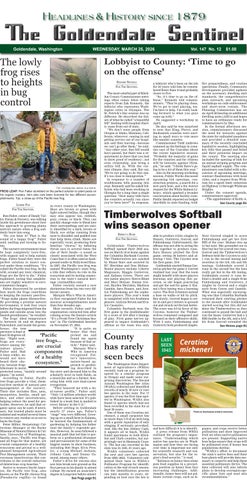
FROG LEAP: Ron Falter stumbled on the perfect solution to plant pests on his organic nursery. He’s also now been honored for two different accomplishments. Top: a close-up of the Pacific tree frog.
Ron Falter, owner of Dandy Valley Farms & Nursery, was talking inside his greenhouse about how his approach to growing plants mirrors nature when a frog suddenly burst into song. “Do you hear it? That is the sound of a happy frog!” Falter said, smiling and turning to listen. The nursery environment must be kept completely toxic-free, with organic soil to help sustain frogs. Falter found they were the perfect solution to insect control under these conditions. “It’s called the Pacific tree frog. In the wild, around any toxic chemical, frogs are the first to die,” Falter explained, noting that amphibians are highly sensitive to environmental changes. Falter discovered by accident how much the frogs contribute to keeping the nursery pest-free. “Frogs make plants disease-free. By providing a pristine natural environment, it took four years before the frogs migrated from the ponds and outside areas into the heated greenhouses,” he recalled. The frogs’ ideal temperature is between 50 and 68 degrees Fahrenheit, and inside the greenhouse, the temperature is kept at least 50 degrees all day. “Right now, frogs are everywhere among the indoor plants,” Falter said. Had it been colder, we would not have heard their chorus, because frogs hibernate in moist, protected areas, “mainly around plants,” he noted. According to Falter, Pacific tree frogs provide a vital, chemical-free method of natural pest management at the nursery. Their diet includes flies, ants, mosquitoes, beetles, small spiders, and other invertebrates, helping reduce the need for pesticides. However, he said that organic spray can be used, if necessary, but treated plants must be isolated and washed several times to remove any residue so as not to harm the frogs. Peter Miller, Herpetology Collections Manager at the Burke Museum of Natural History & Culture, University of Washington, Seattle, says, “Pacific tree frogs, and all frogs for that matter, are crucial components of a healthy ecosystem and pivotal to a wellplanned Integrated Agricultural Pest Management system. Their ravenous insectivorous diet contributes to the overall reduction of deleterious crop beasties.” Native to western North America, the Pacific tree frog—also known as the Pacific chorus frog (Pseudacris regilla)—is found
$1.00
Lobbyist to County: ‘Time to go on the offense’
The lowly frog rises to heights in bug control
Lorrie Fox For The Sentinel
Vol. 147 No. 12
in every county in Washington. Most are brown or green with light-colored bellies, though they may also appear tan, reddish, gray, cream, or black. They can quickly change color to blend into their surroundings and are easily identified by a dark, brown or black, eye stripe running from nose to shoulder and padded toes that help them climb. Males are especially vocal, producing their familiar “chorus” by inflating throat sacs to several times the size of their heads—a sound so closely associated with the West Coast that it is often used as background audio in Hollywood films. In 2007, the Pacific tree frog was named Washington’s state frog, a title that reflects its role in the ecosystem and its lasting connection to the state’s natural heritage. (Animalfiles.com) Falter recently earned a rare distinction from his two very different careers. Marquis Who’s Who in America first recognized Falter for his musical accomplishments more than four decades ago. Most recently, Falter said the organization contacted him after coming across the feature article “It’s a Fresh-Tree Christmas Season” in The Goldendale Sentinel on November 27, 2024. “It is quite an honor that they picked me and found me again because of that article,” Falter said. Marquis Who’s Who in America recognized Falter’s innovative, nature-based approach to gardening described in the story and elevated him to the scholarly level in both fields, as a musician and as a farmer, honoring him with rare dual-career recognition. “They honored me with a dual-career profile,” Falter said. “Only 1.6 million scholars worldwide have been selected. It’s published in a book that is mailed to every library in the U.S.” Before settling in Goldendale nearly 37 years ago, Falter’s “stage” was very different. Growing up on a small farm in Kalama, he learned the fundamentals of gardening by helping his father tend the family’s vegetable garden. However, he soon followed a musical path that led him to perform as a professional drummer and percussionist for some of the biggest names in show business, including Bob Hope, Elvis Presley, a young Michael Jackson, Johnny Cash, and Donny Osmond, among many others. Falter’s drive for success also saw him break new ground as the first person in his family to attend college. He earned an associate’s degree in Longview before attend-
‘Pacific tree frogs... are crucial components of a healthy ecosystem.’
See Frogs page B1
The most colorful part of Klickitat County Commissioner meetings often comes when taking reports from Zak Kennedy, the lobbyist who represents Washington cities in Olympia. The St. Patrick’s Day session was no different. He described the failure of what he called “a beautiful bill” dealing with hospital charity cases from out of state. “We don’t want people from Oregon or Idaho, Montana, California, wherever, coming in and getting service out of our hospitals and then leaving—because we can’t go after them,” he said. “Any other year, that bill would have passed, but there was a requirement in there that you had to show proof of residency—not even citizenship, just bring a utility bill in. With the current climate, they said, flat out, ‘We’re not going to do this one. It’s too close to immigration.’” In response to a number of troublesome bills passing this year, Kennedy said he asked lobbyists who had been working in Olympia for a long time a single question: “How many bills have the counties actually run since you’ve been here?” In response,
a lobbyist who’s been on the job for 30 years told him he remembered fewer than 10 and probably closer to five. “So, it’s time to go on the offense,” Kennedy told commissioners. “They’re playing chess. We’ve got to start playing, too. I’m here to help. I’m really looking forward to what you guys come up with.” He suggested a workshop in April. He also said he was surprised to note that King, Pierce, and Snohomish counties were starting in small ways to vote more like smaller counties. Commissioner Todd Andrews summed up the feelings in counties east of the Cascades about the recent legislative session: “Probably the majority of gains for the counties and for citizens will be lawsuits against Olympia,” he said. “I think there’s going to be a lot of them this year.” Also in the morning workshop session, Public Works discussed upcoming bid openings, construction projects, a search for a new park host, and a fee waiver request for the White Salmon Library, which sparked a broader conversation about facility costs. Public Health reported on budget shortfalls in state funding, wild-
fire preparedness, and routine operations. Finally, Community Development provided updates on the accessory dwelling unit standards, the comprehensive plan outreach, and upcoming workshops on code enforcement and short-term rentals. The Planning Commission has set an April 20 hearing on additional dwelling units (ADUs) and hopes to have an ordinance ready for commissioners by May. In the formal afternoon session, commissioners discussed the need for lawsuits against the state for unfunded mandates and provided a detailed summary of the recently concluded legislative session, highlighting key bills that passed and failed and their potential impact on the county. The meeting also included the opening of bids for an annual striping program and liquid asphalt supply. The commissioners concluded with a discussion of upcoming meetings, contract finalizations with local cities, and a request from Wishram for a speed limit reduction on Highway 14 through Wishram Heights. Under the consent agenda, commissioners approved: • The appointment of Keith A.
See County page B1
Timberwolves Softball wins season opener Rebecca Bare For The Sentinel
Goldendale Timberwolves Softball opened their 2026 season on March 16 at home against the Columbia Burbank Coyotes. The Timberwolves are coached by Shane Bare and assisted by KC Sheridan and Don Molnar. Senior players include: Liberty Magnuson, Maggie Gutierrez, and Zallana Green. There are two junior players: Sierra Blunt and Maci Molnar. Emma Gorrod, Hayden Sheridan, Madison Gamble, Sara Hussey, and Jocelyn Fahlenkamp are the sophomore players. This year’s team is completed with two freshmen players: Aizlynn Struck and Evalyn Casamiro. Columbia Burbank won the first game in the doubleheader by a score of 18-0 after 4 innings of play. First game nerves appeared to impact Goldendale’s offense as the team was only
able to produce 4 hits; singles by Hussey, Gutierrez, Gorrod, and Fahlenkamp. Unfortunately, the offense was not able to string the hits together to produce runs. Sara Hussey pitched the first game, seeing 36 batters and allowing 7 hits. The Coyotes won the first game, 18-0. Goldendale started Emma Gorrod as pitcher for game 2. Gorrod realized last year that the team might benefit with more players learning and playing this position, so she began practicing and got the nod for game 2. Emma’s first inning was a learning curve. The first 10 batters earned a base on walks or hit by pitch. But slowly, Gorrod began to settle in and got 2 hitters to ground out and struck out the last batter. The score was 0-9 in favor of the Coyotes, however the Timberwolves remained composed and focused on their offensive skills. With 2 outs, Fahlenkamp and Gutierrez both produced singles.
Next Gorrod singled to score Fahlenkamp and get her first RBI of the year. Molnar was up to bat next. She grounded out to first but her hit scored two runs. Gorrod and the Timberwolves’s Defense held the Coyotes to only 1 run in the second inning and scoreless in the 3rd, 4th and 5th innings. Goldendale scored 2 runs in the second but the bats really got hot in the 4th inning. Goldendale scored 11 runs behind a double and a single from Fahlenkamp and Gutierrez, 2 singles by Gorrod and a single each from Green and Gamble. What was especially encouraging was that Columbia Burbank returned their starting pitcher to the mound after Goldendale started scoring but this did not deter the Timberwolves as they continued to pound the ball and run the bases. Gutierrez had a 2 RBI double in the 5th, and a SAC hit from Gorrod extended the
and how difficult it is to identify. A press release from WSDA outlined the program’s importance. “Understanding which native bee species are in Washington and how they are faring over time is important not only for scientific research and conservation, but also for the region’s food security,” it read. ”Reliance on honey bees alone puts food supplies in a precarious position as honey bees face increasing challenges. Additionally, honey bees will not pollinate certain crops, such as le-
gumes, and crops receive better pollination and show improved fruit set when native pollinators are present. Supporting native bees helps ensure that crops will be pollinated even if honey bee populations decline. ”WABA’s effort to document the state’s native bees and their host plants will provide data necessary to conserve and help these essential pollinators thrive. The data collected will also inform plans to develop ecoregion-specific plant lists and seed mix recommendations.”
See Wolves page B1
County has rarely seen bees
The Washington State Department of Agriculture’s (WSDA) recently took on a program inspired by a similar program in Oregon and made some surprising discoveries. The Second Annual Washington Bee Atlas (WABA) collected and identified records of nearly 30 new or rare bee species in the state. For 17 species, it was the first time spotted in Washington. WABA also found 12 species which had not been recorded in the state for at least 50 years. One of them was Ceratina micheneri, a small carpenter bee no more than 3/8 of an inch long with a gentle reputation of only stinging if seriously provoked. And, like the late Johnny Cash, it appears all in black. WABA found specimens in both Klickitat and Clark counties, but surprisingly not in Skamania County. The last one recorded in the state was in 1945, 81 years ago. WABA volunteers collected the new and rare bee species from 2023–2025. Volunteers submitted their bees to WSDA’s Pollinator Program for identification at the end of each season, but the identification process can take months to years, depending on how rare the bee is