Headlines & History since 1879 Goldendale, Washington
WEDNESDAY, JUNE 10, 2026
Vol. 147 No. 23
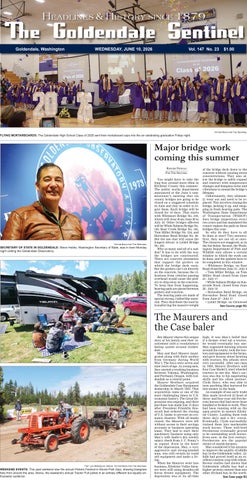
FLYING MORTARBOARDS: The Goldendale High School Class of 2026 sent their mortarboard caps into the air celebrating graduation Friday night.
$1.00
Victor Baca for The Sentinel
Major bridge work coming this summer Rodger Nichols For The Sentinel
Victor Baca for The Sentinel
SECRETARY OF STATE IN GOLDENDALE: Steve Hobbs, Washington Secretary of State, was in town Monday night visiting the Goldendale Observatory.
You might have to take the long way around more often in Klickitat County this summer. The public works department announced at the June 2 commissioner’s meeting that six county bridges are going to be closed on a staggered schedule in June and July in order to repair them. Each bridge will be closed for 10 days. That starts with Whitmore Bridge No. 319, which will close from June 26 to July 10. Other bridges affected will be White Salmon Bridge No. 104, Bear Creek Bridge No. 103, Tom Miller Bridge No. 216, and Horseshoe Bend Bridge No. 20. But the one that will cause the longest detour is Leidel Bridge No. 201. Why so many and all of a sudden? It has to do with the way the bridges are constructed. There are concrete abutments that support the girders on which the bridge deck rests. But the girders can’t sit directly on the concrete, because the vibrations from vehicles passing overhead would cause the girders to chip away at the concrete. To keep that from happening, bearing pads are placed between girders and concrete. The bearing pads are made of special strong, rubberlike material. They distribute the load by transferring the massive weight
of the bridge deck down to the concrete without causing stress concentrations. They also allow the bridge to safely expand and contract with temperature changes and dampens noise and vibrations to extend the bridge’s lifespan. Unfortunately, they ultimately wear out and need to be replaced. This involves closing the bridge, jacking it up, and swapping in fresh bearing pads. The Washington State Department of Transportation (WSDOT) does bridge inspections every two years and has mandated the county replace the pads on these bridges this year. So why do they have to all be done at once? Two answers: first, they are not all at once. The closures are staggered, as in the list below. Second, the Washington Department of Fish and Wildlife only allows a certain window in which the work can be done, and the updates have to be completed in this window. • Whitmore Bridge, on East Road closed from June 15 - July 3 • Tom Miller Bridge, on Tom Miller Road closed from June 21 - July 17 • White Salmon Bridge on Sunnyside Road, closed from June 26 - July 10 • Horseshoe Bend Bridge, on Horseshoe Bend Road closed from June 27 - July 17 • Leidel Bridge, on Glenwood
See County page B1
The Maurers and the Case baler
Top: Lou Marzeles. Above: Victor Baca for The Sentinel
WEEKEND EVENTS: This past weekend saw the annual Pickers Festival in Ekone Park (top), drawing bluegrass fans from around the area. Above, the weekend’s annual Tractor Pull pulled in an entirely different but equally enthusiastic audience.
Rex Maurer shares this unique story of his family and their involvement with a revolutionary baling system around Goldendale. Max and Karl Maurer immigrated along with their mother from Germany during World War I. The boys were seven and nine years of age. As young men, they started a trucking business between Yakima, Washington, and Portland, Oregon, with Goldendale as a central point. Maurer Brothers acquired the Goldendale Case Equipment dealership in March 1933. That acquisition came at one of the most challenging times in U.S. economic history. The Great Depression was ongoing, and their purchase was made just 15 days after President Franklin Roosevelt had ordered the closing of U.S. banks to prevent an economic disaster. With all banks closed, the Maurers were left without access to their savings accounts or business operating loans. They had to start their machinery business using only Max’s wife Sadie’s $15 weekly salary check from J. C. Penny’s as capital. Even in the heart of the depression, Max, a very aggressive and strong-minded man, was still certain he could sell equipment and make a living. When the Maurers went into business, Klickitat Valley farmers were still using decades-old horse drawn equipment. The depression was at its all-time
high. It was Max’s belief that if a farmer tried out a tractor, he would eventually buy one. Max organized farming schools around the county, took the tractors and equipment to the farms, and gave lessons about farming with tractors. His schools were very successful. After one class in 1939, Maurer Brothers sold four Case Model L steel wheeled tractors in one day. Max’s success was due to his negotiating skills and his silent partner, Clyde Story, who was able to turn anything Max bartered for into money in the bank. An example of one early trade Max made involved 23 head of three- and four-year-old Percherons horses that had never been handled or broken to work. They had been running wild on the open prairie in eastern Klickitat County. Loading them took three days and a dry corral. Eventually, Clyde successfully trained them into marketable work horses. These well-bred Percherons eventually proved to be outstanding work horses. Even now, in the 21st century, Percherons are the popular choice of Amish farmers. Max considered it his mission to improve the quality of alfalfa hay in the Goldendale valley. Alfalfa had proved itself as an excellent rotation crop with wheat. Recent studies had shown that Goldendale alfalfa hay had a higher protein content than any other dryland hay in the north-
See Case page B1