Headlines & History since 1879 Goldendale, Washington
WEDNESDAY, JULY 8, 2026
Vol. 147 No. 27
$1.00
Why aren’t our gas prices falling?
Fire foremost on meeting agenda
Lou Marzeles Editor
For The Sentinel
As crude oil prices have eased in recent weeks, motorists across much of the country have begun seeing relief at the gas pump. Not so much in Washington. While gasoline prices have declined modestly in the Evergreen State, they remain among the highest in the nation and have not fallen nearly as much as prices in many other states. That has left many drivers asking a simple question: If oil prices are coming down, why isn’t the price on the pump following suit? The answer turns out to be considerably more complicated than the price of a barrel of crude oil. According to AAA, the national average price of regular gasoline has been trending downward following lower crude oil prices and easing tensions in the Middle East. Washington, however,
Rodger Nichols
continues to rank among the nation’s most expensive states for gasoline, typically trailing only California and Hawaii. Several factors contribute to the difference. One of the most visible is Washington’s fuel tax. On July 1, the state’s gasoline tax increased from 55.4 cents to 56.5 cents per gallon, making it one of the highest state gasoline taxes in the country. That tax is added before motorists even begin paying for the fuel itself, refining, transportation, or retail markup. Another significant factor is Washington’s Climate Commitment Act, the state’s carbon cap-and-invest program. Under the law, fuel suppliers purchase
carbon allowances, costs that are generally passed along to consumers. Exactly how much the program adds to the price of gasoline remains the subject of considerable debate. Various studies have estimated the increase at anywhere from roughly 20 to 50 cents per gallon, while critics of the program argue the impact is even greater. Although there is disagreement over the precise amount, economists generally agree the program contributes to Washington’s higher gasoline prices. Washington’s geography also plays an important role. Unlike much of the country, the Pacific Northwest operates
within a relatively isolated fuel market. West Coast states require specialized gasoline blends that meet stricter environmental standards, limiting where replacement fuel can be purchased. If supplies tighten, fuel often must come from farther away and at greater expense. That makes the region especially sensitive to refinery disruptions. Washington relies heavily on a small number of refineries. Routine maintenance or unexpected outages at even one facility can reduce available supply and keep wholesale gasoline prices elevated longer than they might remain elsewhere in the country.
See Gas page B1
The evolution of phishing Lou Marzeles Editor If you’re still looking for obvious warning signs like poor grammar, flashing red fonts, or promises of millions of dollars from foreign princes, you’re fighting yesterday’s battle. Today’s phishing emails have evolved. A recent email received by The Sentinel provides a good example. On the surface, it looked almost harmless. It contained no links, no attachments, no demands for immediate action, and no glaring spelling mistakes. Instead, it simply stated that the sender had “recently switched pay institutions” and wanted to update payroll information before the next pay cycle. The message invited the recipient to respond so new banking information could be provided. That’s all. Cybersecurity experts refer to this type of attack as a Business Email Compromise, or BEC scam. Rather than trying to infect your computer with malicious software, the criminal is trying to start a conversation. If the recipient replies, the scammer’s next message would likely include fraudulent banking information, hoping future payroll deposits would be redirected into the criminal’s account. In many ways, this represents the new face of phishing. The email didn’t pretend to come from a bank. It didn’t ask the recipient to “verify your account.” It didn’t contain a suspicious web link. Instead, it relied on something far more powerful: human trust. A review of the email’s technical routing information showed another interesting twist. The message originated from a legitimate email account hosted by a privacy-focused email service and successfully passed modern authentication checks that email providers use to verify messages. It was then redistributed through a legitimate Google Group associated with the newspaper, making it appear at first glance as though it had come from within the organization’s own email system. In other words, nothing about the email’s technical journey looked obviously fake.
See Scam page B1
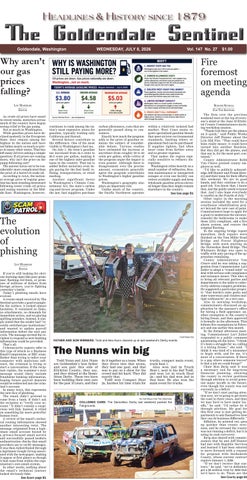
FATHER AND SON WINNERS: Todd and Alex Nunn cleaned up at last weekend’s Derby events.
Contributed
The Nunns win big Todd Nunn and Alex Nunn are Goldendale’s best father and son pair this side of Klickitat County, they say, and they shined at the Demolition Derby. These two have been building their own cars for the past 10 years, and they
do it together as a team. When they drove into that arena, they had one goal, and that was to put on a show for the crowd and hit hard. They did exactly that. Todd won Compact Heat 2a, hardest hit time trials for
trucks, compact main event, truck heat 1. Alex won 2nd in Truck Heat-1, next to his dad Todd, and won 1st in truck Heat 2a—and his dad won 2nd in that heat. He also won the main event for trucks.
Victor Baca for The Sentinel
COLLIDING CARS: The Demolition Derby last weekend packed the Fairgrounds.
The fires over the previous weekend were at the top of everyone’s mind at the June 30 Klickitat County Commissioners morning workshop session. “Thank God they got the planes on it quick,” said Public Works Director Jeff Hunter about the Lyle Hill Fire. “That could have been really messy; it could have turned into another Burdoin. But they did get the planes, and that one is, for the most part, contained.” County Administrator Robb Van Cleave praised county employes as well. “I’d like to publicly acknowledge Jeff Hunter and Frank [Hewey] and their team for their efforts this weekend. We are in good hands, and they continue to do a good job. You know that, I know that, and the public needs to know that. And I also hope everybody is careful on the Fourth of July.” Other topics in the morning session included the need for a courthouse rehabilitation project beyond the new coat of paint. Commissioners hope to apply for a grant to modernize the elevator, remodel the bathrooms to make them ADA compliant, add a fire alarm system, and restore the original flooring. In the ongoing bridge repair marathon, deck repairs were finished on the Tom Miller Road Bridge and Forest Highway Bridge, with work starting on the Horseshoe Bend Bridge. The Whitmore Bridge was open to traffic with only paving of the approaches remaining . County Administrator Van Cleave said he was taking a suggestion from Commissioner Lori Zoller to adopt a “round table” to deal with serious code compliance and nuisance issues. This idea is to bring all relevant parties and departments to the table to collectively address complex problems. He suggested a particular property “that borders state parks and state waterways and violates multiple ordinances” as a test case. Also in morning workshop, commissioners discussed an application by the assessor’s office for hiring a field appraiser, another exemption to the county’s hiring freeze, and then approved it formally in the afternoon. This follows five exemptions in February and one earlier this month. In the formal afternoon meeting, Commissioner Lori Zoller responded to a public comment questioning all the hires. “I think it’s been a struggle for us, calling it a hiring freeze,” she said. “I think it was kind of a misnomer to begin with, and for me, it’s more of a conversation. If there is a gap where someone leaves? Is that a job we could forego?” Chair Ron Ihrig said it was a necessary tool for long-term financial planning, allowing the county to review positions through attrition to avoid potential major layoffs in the future, even though the county was not currently in a deficit. “If we don’t start paying attention now, we’re going to get down the road in three years, and then we may have to have major layoffs,” he said. “I’d rather do it through attrition. My goal for this first year is just getting departments to ask themselves how they can do business differently.” Inflation, he pointed out, goes up quicker than county revenues, and he stressed the county was not running a deficit, but it is using its cash carryover. Ihrig also shared with commissioners that he and Jeff Hunter had met with Republic Services and learned it had been selected to move forward with a request for proposal with Snohomish County, whose current contract expires January 1, 2028. “If we don’t receive that contract,” he said, “we’ve definitely got a $2 million trim by 2028 that we’d have to do. Those are the
See County page B1