Headlines & History since 1879 Goldendale, Washington
WEDNESDAY, JULY 15, 2026
Vol. 147 No. 28
$1.00
Sophisticated long con unfolds in Goldendale
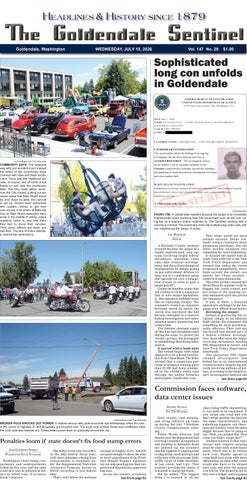
Victor Baca for The Sentinel
COMMUNITY DAYS: The weekend was wild and wonderful and marked the return of the Community Days Carnival with rides and fresh excitement. There was the traditional parade, of course, and all kinds of fun things on and near the courthouse lawn. The only major glitch: somehow the City missed putting out advance notice that Main Street would be shut down to allow the carnival to set up. Drivers were ambushed with sudden notices to get their cars moved. It hit diners at Bake My Day on Main Street especially hard, since in the middle of eating, police suddenly came in and told them they had to move their vehicles. Then some officers sat down and had food. The lack of notice definitely marred the celebrations.
Contributed
PHONY FBI: A Goldendale resident became the target of an incredibly sophisticated scam involving fake FBI documents such as this one, citing her as a suspect (name redacted by The Sentinel) working with a notorious criminal. The scammers even did multiple long video calls with her, heightening the sense of reality.
Lou Marzeles Editor A Klickitat County resident recently became the target of a highly sophisticated, long con scam involving forged federal documents, marathon video calls, fake criminal investigations, and days of psychological manipulation by people posing as law enforcement officers. (A long con is a confidence game that sprawls out over a long period of time in order to gain a larger payoff.) Unlike the familiar scams that ask victims to click a suspicious link or wire money immediately, this operation unfolded more like an espionage thriller. The scammers created an elaborate fictional world in which the victim was convinced she had become entangled in a massive federal investigation into international money laundering and cybercrime. The Sentinel obtained copies of chat logs and documents used during the scam. To protect the victim’s privacy, the newspaper is withholding identifying information. It started with a bank alert The ordeal began with what appeared to be a fraud notification from Chase Bank. The letter warned that a suspicious purchase of weapons totaling more than $7,200 had been attempted on the victim’s credit card through the online firearms marketplace GunBroker.com.
That alone would not have seemed unusual. Banks routinely contact customers about suspicious purchases. But the letter quickly escalated into something far more frightening. It claimed the matter had already been referred to the New York Police Department and warned that unless the victim cooperated immediately, every bank account she owned—not merely her Chase account— could be frozen nationwide. The letter further claimed her Social Security number could be flagged, her credit ruined, and her access to the banking system eliminated until she proved her innocence. It was, in effect, a financial apocalypse packaged in the language of an official fraud notice. Becoming the suspect Instead of portraying the recipient simply as an identity theft victim, the scammers did something far more psychologically effective. They told her she herself had become part of a federal criminal investigation. Soon afterward she began receiving documents bearing FBI, Department of Justice, and New York Police Department letterheads. One purported FBI report claimed investigators had linked her to an international cryptocurrency laundering network involving millions of dollars. According to the forged report, investigators believed she
See Scam page B4
Commission faces software, data center issues Rodger Nichols For The Sentinel Victor Baca for The Sentinel
BROKEN POLE KNOCKS OUT POWER: A vehicle-versus-utility pole encounter last Wednesday when the pole, at the corner of Highway 97 and Broadway, got knocked over. The south side of Main Street was unaffected while the north side was blacked out. Crews rolled power back on gradually around the city.
Penalties loom if state doesn’t fix food stamp errors Jake Goldstein-Street Washington State Standard Washington’s food stamp overpayments and underpayments ticked up this year, and the state could face tens of millions of dollars in added costs if accuracy doesn’t improve.
The state’s error rate was 6.98% in the 2025 federal fiscal year, with most mistakes coming from overpayments to recipients under the Supplemental Nutrition Assistance Program, known as SNAP, according to new federal data. That’s well below the national
average of roughly 10.6%, but still not good enough to allow the state to avert punishment from President Donald Trump’s signature tax cut and spending law that congressional Republicans approved last year. Across the country, erroneous
See Errors page B1
Data centers, road striping, and dying software all came up during the July 7 Klickitat County Commissioners meeting. Public Works Director Jeff Hunter said the department had received a number of requests to add striping to Snowden Road but pointed out the standard manual suggests it’s appropriate to edge stripe rural arterials and collectors with an average daily traffic count of 3,000. Snowden, at last count, had 1,331. That wouldn’t preclude the county if it wanted to spend the funds. But he added, “The biggest thing I’ve learned in all my
years doing traffic engineering, is you need to be consistent. If you stripe one road and you don’t stripe another one that has the same characteristics, and something happens out there, then the liability issue becomes bigger because they’re going to say, ‘Well, you striped that. How come you didn’t stripe this?’” Another concern is that regulations now require striping must be done with water-based paint, which has to be redone each year. Hunter agreed to come back next week with more information on what other roads would also have to be striped each year and what the annual cost will be. The project is not in this year’s budget, and no grants
See County page B1