For many residents of Klickitat County, the annual Home & Garden Show is one of those dependable community traditions that signals something deeper than just springtime shopping: warmer days ahead, new projects on the horizon, and a chance to reconnect with neighbors and local businesses in one lively place. The 3-day event will take place at the Goldendale Fairgrounds over Mother’s Day weekend, May 8–10, on Friday from 11 a.m. to 6 p.m., Saturday from 10 a.m. to 6 p.m., and Sunday from 11 a.m. to 4 p.m.
This year, the long-running Home & Garden Show is also marking something new behind the scenes.
After more than a decade under the direction of the Goldendale Chamber of Commerce, the event is now being produced by Monica McLaughlin, owner of McLaughlin Events & Marketing, in partnership with her husband. For McLaughlin, stepping into the role is both an opportunity and a responsibility—to preserve what the community has come to expect while also building a foundation for the show’s future.
“We are honored to take on the Home & Garden Show and continue its legacy,” McLaughlin stated. “This event has been a staple in the community for so long, and we’re excited to help it grow.”
While the shift in organizers is new, the mission remains familiar: bring together vendors, service providers, and residents for a day of ideas, learning, conversation and commerce, all in support of the local economy. On the surface, the Home & Garden Show is exactly what it sounds like: a gathering of businesses and artisans who offer products and services related to homes, landscaping, gardening, remodeling, repairs, decor, and outdoor living. But anyone who has attended in past years knows the show functions as something more than a marketplace. It serves as a networking hub for local businesses. It gives residents direct access to contractors and service providers they may otherwise see online or through word-of-mouth. It helps local entrepreneurs connect with customers and new partners. And perhaps most importantly, it draws people out of winter routines and back into community life.
McLaughlin said balance is one of the strengths of a show like this: it can serve both the casually curious and those arriving with measurements, budgets, and to-do lists.
For the previous decade, the Home & Garden Show was organized under the umbrella of the Greater Goldendale Chamber of Commerce, which managed vendors, logistics, promotion and planning year after year. That continuity helped the event become a stable fixture, even as communities across the region watched long-running traditions
fade, shrink, or become difficult to staff in a post-pandemic world. Now, the Chamber has passed the organizational baton, and McLaughlin is working to ensure the handoff results in a show that remains recognizable and trusted.
McLaughlin’s goal, she said, is to provide professional event coordination while keeping the show grounded in the priorities of the community. It will continue to be held at the Klickitat County Fairgrounds, a venue that McLaughlin described as well-suited for the event and filled with possibilities. She said she appreciates having options within the venue, including the possibility of incorporating the Dooley Barn and outdoor areas depending on layout needs and weather.
One of the most notable points for attendees is that the Home & Garden Show will continue to be free to the public. That is not a small decision. Across the region, admission fees are increasingly common for vendor fairs and expos, especially as costs for venues, equipment, insurance, marketing, staffing, and setup continue to rise.
McLaughlin said keeping the show accessible was a core value for her team. The goal is to ensure the event remains welcoming, not only to longtime regulars, but also to families, seniors, and residents who may be watching budgets closely.
“Free entry is something we wanted to preserve,” she said. “It keeps the community included—and the more people who attend, the better the experience is for vendors too.”
McLaughlin is coming into the Home & Garden Show as someone who not only understands events from the organizer’s side; she and her husband also operate Among the Trees Botanical Lavender Farm, formerly known as McLaughlin Lavender, and they regularly participate in markets and vendor shows. That experience, she said, shapes her approach.
“We’ve been on the vendor side,” she explained. “So, we know what it’s like to invest in a booth fee, prep your display, transport product, set up, and hope the crowd comes.”
For vendors, an event lives or dies by several practical considerations: how clear communication is before the event, how smooth the setup process is, whether attendance is strong, and whether the crowd is a good fit for their products and services. McLaughlin said her team is focused on creating an atmosphere where vendors feel supported, informed, and valued—not just “booked.” McLaughlin brings extensive events and tourism experience from her prior work in Oregon, where she helped coordinate and grow multi-vendor community events. She previously served as the Executive Director for La Grande Main Street Downtown, where she was responsible for organizing and supporting major public gatherings, including
NEARING ACTION: The Federal Energy Regulatory Commission last week issued a 40-year license for the Goldendale Pumped Storage project. The Yakama Nation issued a strong statement of opposition.
Federal agency issues license for Pumped Storage project
RodgeR Nichols
FoR The seNTiNel
“This is a landmark moment for the Pacific Northwest.”
That statement came from Erik Steimle of Rye Development on news that the Federal Energy Regulatory Commission (FERC) approved a 40-year license for the Goldendale Pumped Storage facility.
Steimle and Rye Development have been working on the project for seven years, but the idea first surfaced in Klickitat County half a century ago in the 1970s. Pumped storage facilities are nothing new. They have been around for 100 years, mostly overseas, and there are 43 of them in the United States across 18 states. They are not as familiar, because the closest one is in southern California, and a new facility hasn’t been licensed in 30 years.
The concept of this “water battery” is simple. Two ponds, one high above the other, are connected through an underground
passage between them. At times of excess energy production from wind and solar - which would be otherwise wasted, with no place to put it—this excess is used to pump water from the lower lake to the upper lake. Then when the sun isn’t shining or the wind isn’t blowing, the water in the upper lake can be sent through generators in the underground connection on its way down to the lower lake.
The site of the old Goldendale Aluminum plant has been described as one of the best possible locations in the United States. The bluff above is 2100 feet above the base, offering a tremendous amount of pressure and volume for generation. Construction will involve creating both lakes and cleaning up some of the brownfield property left by the aluminum company to create the lower lake. Each lake is planned for 60 acres. They will be filled at the beginning from the Columbia, using some of the water right from the
aluminum plant, which Klickitat PUD had secured years ago for this possibility. Once that’s done, the system will be a closed loop, only adding water occasionally to replace any lost to evaporation. The project can store and deliver 1.2 gigawatts of power. “That’s essentially enough to provide 12 hours of on-demand capacity to every residence in Seattle,” said Steimle.
It is also expected to generate more than $10 million annually for Klickitat County, supporting schools, public health, roads, emergency services, and other essential needs. What are the next steps?
“Over the next 12 to 15 months, we’ll be finalizing the project and moving through the pre-construction phase,” Steimle said. “As part of the license, the project needs to begin construction in the next 24 months. Our goal at this point is to begin construction in 2027.” This project will put jobs back at the site of what was once the
Yakama Nation calls federal agencies ‘bad actors’
Following is a statement issued by the Yakama Nation regarding the Federal Energy Regulatory Commission (FERC) and its decision to license the Goldendale Pumped Storage project. [Friday], Trump-appointed FERC Commissioners in Washington, D.C., praised foreign and developer-based interests in the largest and most expensive pumped storage project proposal in Washington State. The socalled Goldendale Pump Storage proposal would be located adjacent to the Columbia River and the John Day Dam at a polluted aluminum smelter site. The proposed project’s water storage reservoirs target the destruction of sacred sites that have great significance to food and medicinal gathering practices. Project developers have benefited from Trump-era rollbacks of federal clean water act protections and
pulling-out of discussions with the state Department of Archaeology and Historic Preservation on destructive impacts to traditional cultural properties.
“Today, federal agencies are rewarding bad actors who have spent years finding loop-holes to target a new wave of industrial development on top of indigenous sites that have religious and legendary significance to the Yakama People and many others who don’t have political connections or deep pockets” said the Yakama Tribal Council Chairman Gerald Lewis. He continued, “Elected Yakama leadership have met with tribal leaders in Oregon who face similar challenges—regulators in D.C. who do not hold private developers accountable to the laws that are meant to protect the environment, our foods, or important historical sites, and instead issue incomplete licenses with only
an afterthought of losses and destruction to Yakama resources.” Yakama Nation and aligned environmental non-profits have submitted written comments to state and federal agencies for years to advocate for the higher environmental consideration along the Columbia River. Two Environmental Impact Statements have found that the proposed project will lead to detrimental resource impacts. Corporate investors have contracted with local municipalities and unions to pay for some development impacts but continue to ignore and downplay the harm identified by Yakama Nation. “They know it’s wrong. if a small Christian shrine sat on this site, the decision-makers would understand what ‘sacred’ means. During his last days in office, Gov. Inslee encouraged FERC to consider damage costs
CKCD case filed in Superior Court
lou MaRzeles
ediToR
A tort action against the Central Klickitat Conservation District (CKCD) and its executive director, Loren Meagher, has escalated to the Klickitat County Superior Court in a filing made Friday demanding a jury trial. The defendants responded Monday with a Notice of Appearance. The suit alleges a pattern of sexual harassment, safety violations, fraud, and retaliatory termination. The complaint outlines a timeline of events beginning in 2024 that describes an allegedly hostile work environment. According to court documents, the events began in mid-2024
when Meagher recruited Megan Taylor, who was then working for the Klickitat County Building Department. During her recruitment, Taylor says she disclosed a chronic medical condition, for which she states Meagher assured her the district would provide flexibility. The complaint alleges that in early December 2024, shortly after Taylor began her employment, Meagher made an unwanted sexual advance toward her at the Simcoe Cafe in Goldendale. Taylor claims Meagher opened her jacket and touched her without consent in a public setting. Following Taylor’s rejection of this advance, the suit alleges Meagher began to isolate her professionally, micromanage her work, and mandate that all Human Resources complaints be routed directly through him. Tensions escalated regarding operational compliance in 2025, according to court documents. Taylor claims that on multiple occasions, Meagher instructed staff to bypass cultural-resource obligations and safety regulations. Specifically, in June 2025, during the Lummio Wildfire Recovery Project, Meagher allegedly ordered a crew to use a large tracked chipper to remove trees, despite a compliance plan that authorized only a small tow-behind chipper. On June 19, 2025, Taylor
Sheriff raises concerns over emergency management restructure
Lou MarzeLes Editor
The Klickitat County Sheriff’s Office has formally raised concerns with the Klickitat County Board of Commissioners over a recent decision to move the county’s Department of Emergency Management (DEM) under the supervision of the Department of Public Works.
In a letter dated January 13, Sheriff Bob Songer outlined what the Sheriff’s Office describes as serious procedural, legal, and public safety issues stemming from the change.
According to the letter,
the Sheriff’s Office contends that the decision was made without adequate transparency or consultation with key stakeholders involved in emergency response. The letter states that the Emergency Management Executive Board was not convened prior to the restructuring and argues that the move bypassed procedures outlined in state law and the county’s Comprehensive Emergency Management Plan.
The Sheriff’s Office asserts that the plan, which was previously signed by county commissioners, establishes a joint decision-making
structure intended to ensure coordination among agencies responsible for emergency preparedness and response.
The letter warns that unilateral decisions affecting emergency management could undermine public trust and weaken the collaborative framework relied upon during disasters. In addition to procedural concerns, the letter emphasizes potential impacts on inter-agency relationships.
The Sheriff’s Office notes that emergency response in Klickitat County has historically depended on close cooperation among law enforcement, fire districts,
Democrats’ plan to revamp
CornfieLd Washington statE standard
Majority Democrats in the state Legislature are pushing changes they say will restore integrity to Washington’s venerable initiative process.
Opponents contend the moves will effectively block residents’ direct path to the ballot to pass laws of their own making.
Bills introduced in the House and Senate would bar paying a person for each signature they collect. And they would allow legal action against those suspected of violations.
The legislation also would add a new step at the front end of the process by requiring a person, at the time they fill out paperwork and pay the fee for an initiative, to also submit signatures of 1,000 registered voters as a show of support for a proposed measure.
The debate, which played out in Senate and House committees last week, appears to be a byproduct of Democrats’ and their allies’ vexation with Let’s Go Washington and its multi-millionaire founder Brian Heywood.
Two years ago, the conservative political group, largely underwritten with Hey -
wood’s money, sent six initiatives to the Legislature, each aiming to repeal or revise a major policy enacted into law by Democrats over the objections of Republicans.
Two more dealing with parental rights and transgender athletes are on track to reach the ballot this year. Democratic leaders say they won’t hold hearings on this year’s measures.
Sen. Javier Valdez, D-Seattle, said he drew up Senate Bill 5973 out of concern that this form of direct democracy has been co-opted by big money interests.
“Anyone with enough money to bankroll their way through the initiative qualifying process can force statewide votes on any issue that’s personal to them,” he said at a hearing on the bill in the Senate Committee on State Government, Tribal Affairs and Elections. Valdez is the committee chair.
The allure of making money for each signature incentivizes gatherers to use “aggressive, misleading tactics” to pad their totals to boost their compensation, he said.
Rep. Sharlett Mena, D-Tacoma, sponsor of the House legislation, said initiatives are a powerful tool of the cit-
public works, and non-governmental partners. According to the letter, relocating DEM within Public Works risks disrupting those relationships by placing emergency coordination within a department already tasked with substantial operational responsibilities.
The letter also raises concerns about staffing and resource strain, particularly during major incidents such as wildfires. The Sheriff’s Office cites past wildfire seasons in which Public Works staffing shortages limited the department’s ability to assist with road closures and emergency infrastructure needs.
initiative
izenry and the bill is about making the initiative process “more perfect.”
“It is more important to me that the initiative process remains accessible to members of the community to exercise their power and their voice,” she said at a public hearing of the House State Government and Tribal Relations Committee that she chairs.
Former Secretary of State Sam Reed, a Republican, denounced the legislation as a “voter suppression bill.”
“It’s an attempt to make it even more difficult for citizens to participate in the government process. You’re doing this because you think there’s fraud? Frankly, you’re wrong,” he said.
Secretary of State Steve
As a result, sheriff’s deputies were required to take on additional duties, including long-distance travel to retrieve equipment needed for overnight operations. Placing Emergency Management under Public Works, the letter argues, could exacerbate those challenges during future emergencies by stretching limited personnel across two critical functions simultaneously.
The Sheriff’s Office is asking the Board of County Commissioners to pause further implementation of the change and to convene a formal meeting of the Emergency Management Exec -
utive Board, as outlined in state regulations. The letter also calls for a broader public discussion involving local fire chiefs, police chiefs, and other affected agencies.
“As elected officials, the residents of Klickitat County rely on your informed decision-making for public safety,” the letter states, adding that a public and comprehensive review of the decision is necessary to ensure the county remains prepared for emergencies.
As of press time, county officials had not issued a public response to the Sheriff’s Office letter.
process stirs backlash
Hobbs, a Democrat, opposes the legislation, saying it would further burden those pursuing an initiative.
He told lawmakers he’s responded to concerns about frivolous filings with steps like hiking the fee to $156 from $5. If there’s concern with misbehaving signature gatherers, increase penalties for breaking the law, he said.
On Friday, the Senate committee advanced Valdez’s bill on a 4-3 party-line vote. Before the vote, they removed the requirement for 1,000 signatures for referendums, which send bills approved by the Legislature to the ballot.
Republican senators offered 12 amendments, most seeking to remove the requirement for pre-filed signatures or prescribe limits on
citizens taking legal action over alleged violations. They did not oppose the ban on paying by signature. Democrats rejected them all.
“Basically, I hate this bill with a passion,” said Sen. Phil Fortunato, R-Auburn, author of half the amendments.
Sen. Bob Hasegawa, D-Tukwila, teetered but said that while he didn’t like the mandate for providing 1,000 signatures upfront, removing the potential issues created with the pay-per-signature method needs addressing.
“I hate raising barriers to the (initiative) process but I think getting money out of politics is the most important thing right now,” he said, before voting for the bill.
Let’s Go Washington’s Hey-
wood told the Senate panel that because Democrats have been unable to deter or derail the group’s endeavors, they came up with this bill to “destroy the process.”
There’s no evidence of fraud with signature-gatherers, he said. “We have no incentive to pay for invalid signatures because it’s wasted money.”
House Bill 2259, sponsored by Mena, received a hearing last Wednesday. No date for a committee vote has been announced.
Checking addresses
This isn’t the only Democrat-sponsored bill targeting the initiative process.
House Bill 2260 would add a requirement for individuals gathering signatures to sign each petition they submit.
Jerry
G oldendale ’ s a ttic
This week’s Goldendale’s Attic Mystery Picture
This is a hoop’s eye view picture of some basketball. We’re going to
guess they were called the Eagles. Probably before they became a band and
recorded “Peaceful Easy Feeling.” Do you know who these people are? We don’t.
All we know is that it ran in The Sentinel in some longago forgotten yesteryear.
L ooking Back
January 26, 1926 – 100 Years Ago
Another important business change is taking place in Goldendale, following the deal made last Friday by J. C. Penny Company with the Golden Rule Store. The two organizations had been working toward a deal for a couple of days but on Friday an arrangement satisfactory to both parties was closed. The J. C. Penny company will take over the lease and fixtures of the Golden Rule Store, on or before July 1st, 1926. The J. C. Penny Company is a chain store organization of nearly 700 stores.
January 24, 1946 – 80 Years Ago
It won’t be too long before Goldendale residents will have an opportunity to purchase “top Quality” New Hampshire Red fryers, thanks to members of the local FFA class, who recently purchased 300 chicks, which are being housed in brooder houses constructed a few years ago by members of the class. That the class members know the “how” when it comes to brooding chicks is shown by the fact that the loss is less than 2% to date. The chicks are now past the “danger” stage, being one month old, and in all probability the class will have an exceptionally fine record when the chickens are placed on the market.
January 19, 1956 – 70 Years Ago
Dick Spiekerman, local Ford Dealer, was discussing the weather the other day at his shop with an Indian woman. Dick observed that the Indians were supposed to be good at predicting the weather. “Do you think it’s going to snow?” asked Dick. The Indian woman hesitated a moment and then replied, “Could be—it’s winter.”
January 20, 1966 – 60 Years Ago
The Montgomery Ward catalog sales agency in Goldendale has been remodeled to make space for the appliance area, according to Paul Williamson. The additional space will enable the store to show most major appliances in a single grouping.
January 24, 1974 – 52 Years Ago
Goldendale High School: the past week has been a very gratifying one for the student body and faculty at the High School. We were presented with a new mascot—a beautiful mounted Alaskan Timberwolf. Four alumni of GHS—Roger, Karl, and Stan Marlow and Dan Dollarhide—donated the wolf to the school. Roger and Karl came down from their home in Ketchikan, Alaska, and made the presentation. The high school pep staff wrote and produced an impressive ceremony to retire our original mascot and to initiate the new one. The ceremony was made between the varsity and junior varsity basketball game with Royal City.
January 24, 1974 – 52 Years Ago
Bickleton residents were surprised to see a Greyhound bus come through town Tuesday, which stopped at the Effort’s Stop restaurant and grocery store so the passengers could eat. The reason: the flooding of Satus Creek between Goldendale and Toppenish, forcing Greyhound drivers to take alternate routes.
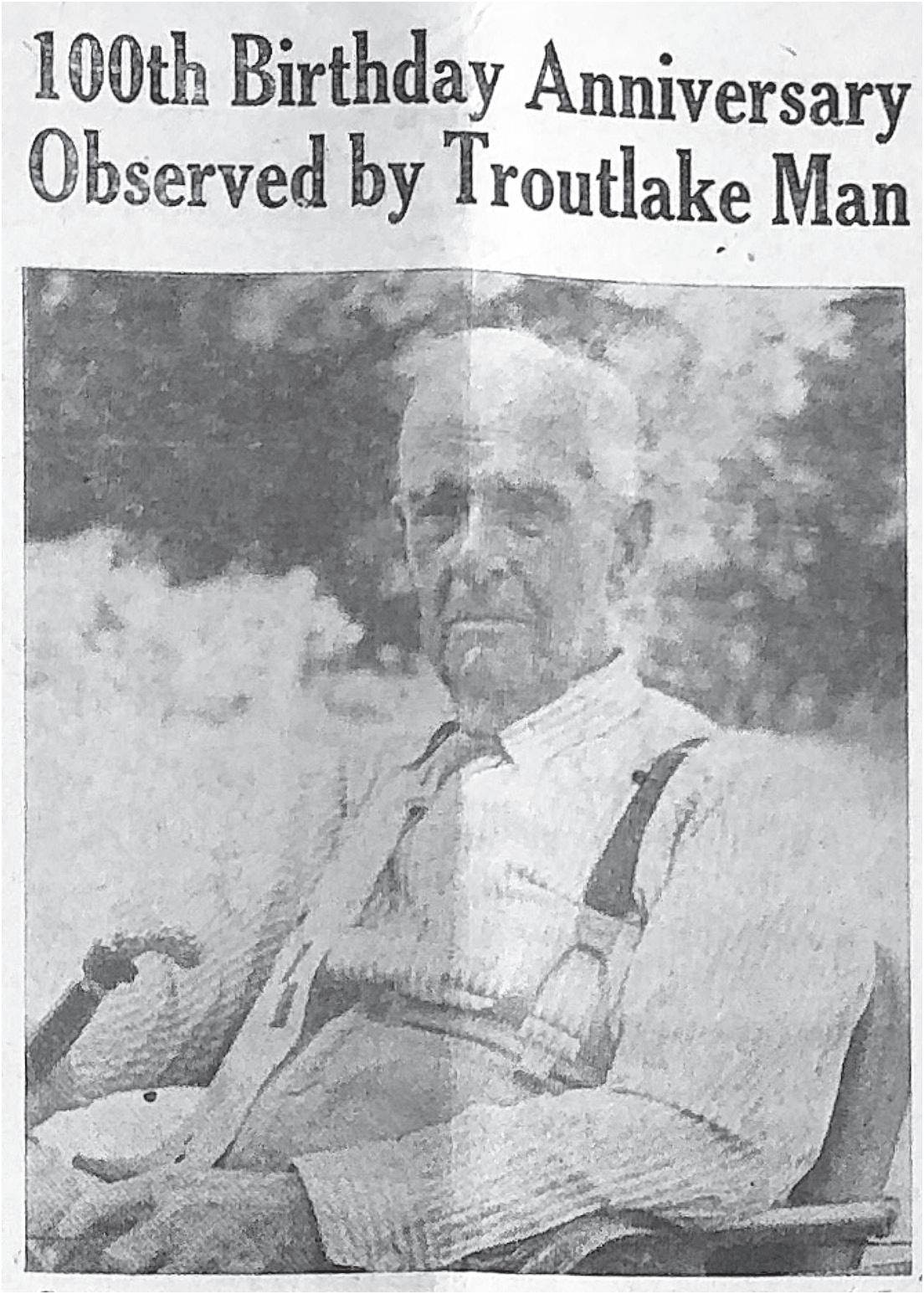
100th Birthday Anniversary Observed by Troutlake Man
August 22, 1957
C. M. Cutting of Troutlake celebrated his 100th birthday Tuesday. The anniversary was observed by the entire community and many friends from other areas who gathered Sunday at the Troutlake Grange to extend birthday greetings.
In the morning Mr. Cutting, who loves to sing, participated in a duet at the Troutlake Community Church.
When asked how long he had lived at Troutlake, Mr. Cutting replied, “I’ve lived here a long time, a long, long time.” Statistics show he and Mrs. Cutting, who died in 1934, came to
Troutlake in 1910, after operating a hotel in Seattle for a number of years. Prior to that they had been at Okanogan for a year or so on a cattle ranch. Before coming west, they had lived from 1890 in Lake Forest, Ill., where he operated a coal and cement business. He was a member of the city council while there.
C. M. Cutting was born at Princeton, Mass., on August 20, 1857. His father was a Methodist minister. “He was at Appomattox when Lee surrendered, I believe,” Mr. Cutting said. Continuing in the vein he remarked “I remember
Answer to last week’s Mystery Picture
This picture has been colorized. No one responded to this picture from last week. This is Fred Naught
in 27 minutes and 59 seconds.
Points to ponder:
To the man who invented zero: thanks for nothing.
Why is an elephant big, gray, and wrinkled? Because if it was small, white, and round, it’d be an aspirin.
What was big and gray and wrote gloomy poetry? T. S. Elephant.
traveling through the South when there wasn’t a soul to be seen for miles, every farm deserted.”
Mr. Cutting was married “when I was about 21.” The Cuttings had no children of their own, but their niece, Ada Alford, lived with them for many years. Miss Alford was postmaster at Troutlake for a number of years. During her illness and after her death, Mr. Cutting was acting postmaster.
Mr. Cutting is as active as many a man much
— Richard Lefever Klickitat
County Historical Society
winning the 7K in the second annual Maryhill Loops Run. He did it
younger. He walks from the George Pearson place, where he has made his home since 1935, to Keith’s Sandwich Shop and other Troutlake points almost daily. His hearing is good, and he frequently amuses himself by singing or reciting poetry, of which he has always been fond. He is a member of the Masonic Lodge, the Methodist Church, and Troutlake Grange No. 210. He is said to have changed very little during recent years.
OpiniOn
If Senate Bill 5974 or HB 1399 becomes law, it will completely destroy the right of our citizens to choose who they want to run for the elected office of Sheriff. The State will decide who can run for sheriff, and our citizens will have no say on who can file to run for Sheriff. However, the citizens get to vote for whoever the state decides is qualified to run for sheriff. If the new sheriff who was selected by the state takes office and does not perform to the standards set by the governor, the state can remove the sheriff from office, and the citizens will have no say in the removable process. The citizens’ rights to remove a sheriff through the election process or to recall the sheriff would no longer be allowed by the state because the State Government would have the authority to remove a sheriff from office.
If Senate Bill 5974 and House Bill 1399 pass, the state will do away with the Klickitat County posses and the Sheriff’s K-9 Program. We will not be able to use dogs to track and apprehend criminals or use dogs to search out illegal narcotics, which creates an officer safety problem. These two bills also contain the following wording: “There is a County Sheriff who is using uncertified volunteers for posse hound hunts, is violating wildlife protection laws, and putting the county at risk of bankruptcy. Sheriffs and their posse hound hunts are undermining the state’s wildlife laws. These posse hound hunts go against state law and against state wildlife specialists.” The state forgot to mention that state law allows the sheriff to use hounds to hunt problem predators such as cougars, bears, and bobcats.
The legislator drafting Senate Bill 5974 and House Bill 1399 flat lied in these two bills. The current law under RCW 77.15.245(2)(a) states the following: “Nothing in this subsection shall be construed to prohibit the hunting of black bear, cougar, or bobcat with the aid of a dog or dogs by employees or agents of county, state, or federal agencies while in their official capacities for the purpose of protecting livestock, domestic animals, private property, or the public safety. A dog or dogs may be used by the owner or tenant of real property consistent with a permit issued and conditioned by the director.”
It should be further noted that Senate Bill 5974 and House Bill 1399 would require sheriffs, police chiefs, and marshals to go through background investigations, polygraph testing, and psychological testing that would be conducted by the Washington State Patrol and would only apply to county and city jurisdictions. The state agencies such as state law enforcement officers, state correctional facilities, and correctional officers would be exempt from these two Bills. I need to point out that currently the elected sheriff’s boss is the people (citizens) of the county from which he or she is elected. These two bills would change that to the governor being the sheriff’s boss. I am 100 percent against Senate Bill 5974 and House Bill 1399. In my opinion, these two bills violate the
THE GOLDENDALE SENTINEL
Official newspaper of Klickitat County, Washington
Established 1879 • Published every Wednesday from offices at 117 W. Main Street • Goldendale, WA 98620 • Telephone: (509) 773-3777
Classifieds @goldendalesentinel.com (Classified ads and inquiries)
Ads @goldendalesentinel.com
(Display advertising information and inquiries)
Legals @goldendalesentinel.com (Legal and public notices)
Payables@goldendalesentinel.com
Receivables@goldendalesentinel.com
Events @goldendalesentinel.com (Events and activities)
Editorial: Lou Marzeles, Editor & Publisher
Business and office staff:
Owned by Tartan Publications, Inc.
Leslie Geatches, President, Financial management, Special Section production, Ad Design Naomi James, Bookkeeping
U.S. Constitution and the Washington State Constitution in so many ways.
There is another Senate Bill, 5066, that if it passes, SB 5066 would give power to the Attorney General to investigate all complainants against law enforcement officers and correctional officers in counties and cities. This would not apply to state law enforcement officers or state correctional officers within the State of Washington.
The State of Washington currently has the Office of Independent Investigations that investigates all anonymous complaints against county and cities officers and correctional officers. In my opinion, this violates the U.S. Constitution under Amendment VI, that the accused be informed of the nature and cause of the accusation; to be confronted with witness against him; to have compulsory process of obtaining witnesses in his favor, and to have the assistance of counsel for his defense.
Senate Bill 5066 would give the Attorney General too much power over local law enforcement officers and correctional officers by investigating anonymous complaints.
I am also 100 percent against Senate Bill 5066.
If Senate Bill 5974, Senate Bill 5066, and House Bill 1399 pass into law, then I believe all elected officials in the State of Washington—which would include the governor, state attorney general and other state elected officials, county elected officials, and city elected officials—should be required to go through a background investigation and complete polygraph (lie detector) testing, psychological testing, and illicit drug screening. If the individual passes all the testing, then they would be allowed to file for an elected office.
The State of Washington is attempting to violate your constitutional rights for you to select a sheriff.
Burn-out has got to go
The Festival of Wheels gave it another try this year. It seems the attendance has dwindled to much lower levels than when the event was new, 10 years ago. There are a lot of competing car shows this time of year, so it doesn’t surprise me .
This year Goldendale Motorsports Association and ABATE brought back the burn-out, which was tried several times in the past with questionable benefits to the town. This year someone had the brilliant idea to use the old skateboard park as a place to stage the return of the burnout. It was held on the concrete slab, a tempting medium for anyone inclined to bum rubber. Rednecks of many degrees, punk kids or maybe the little old lady from Pasadena.
I personally was left with a bad taste in my mouth and lungs. Even though I made it a point to stay away from the burn-out and was at my home where I thought I would escape the noise and smoke, when the toxic cloud rose from the park and drifted over the Little Klickitat River Park (the swimming pool) on to the kids and families at the pool and on to me while I was sitting on my property. We were contaminated by the toxins in the smoke, and my eyes and throat were imitated, and my lungs filled with carbon monoxide and other cancer causing toxic compounds
for three hours.
I think the city of Goldendale needs to rethink supporting burnouts in our park. Next year don’t issue a permit to any group that wants to burn-out. There are places in the county where it could be held, just not in the city please. I hate toxic smoke, and you should too. On Sept 4 I will be asking the mayor and his administration to make an ordinance forbidding anyone from reckless unsafe burnouts in any ones neighborhood or any street in the Goldendale city limits. I would appreciate some support from like-minded citizens at the council meeting. Let them know how you feel.
Ken McKune Goldendale
I contacted the bank for an explanation. The answer was essentially that “we wouldn’t do that.” Then why is it in your documents, I asked. The answer was to send me up the chain of command. The second person gave the same answer as the first and then was to have me contacted by some-one higher up. That person has not contacted me after more than a week so I am following through on what I told the bank contacts I was going to do—write a letter to the editor to be sure local folks are aware of how Columbia Bank is choosing to deal with its account holders.
My concern is that a comment as broad as this opens the door for abuse. I have had no difficulties with our local branch and am sorry that the headquarters has decided to take such a hard line. It ap-pears I will need to look for a bank that does not behave in this manner.
Ken Margraf Goldendale
Letters from the community
They make us safer
A large part of our country has been hit with snow and ice storms that have caused a lot of damage to lives and property. We are very fortunate that our part of the country was spared. Over the past few years, I have observed the Klickitat PUD and Klickitat County crews making sure there are not trees over our power lines. As an aside, it also provides better visibility on our country roads. I’m grateful for them making our lives safer.
I recently received an updated “Terms for Business and Deposit Account Agreement” from Columbia Bank. I am not in the habit of reading the fine print but for some reason this time I did. I came across an “added” line that I found very concerning. Again, this line is both for personal and business accounts. It reads: “We may refuse to open and account and may close your account at any time for any reason or for no reason at all.”
“For No Reason At All” I particularly found offensive.
experts who have worked together to provide the most efficient management of their resources and manpower. Why would you take such an important task and hand it to the Department of Public Works, which has a completely different role? Their job is to manage roads, water supply, waste management, and public buildings.
Kathy Moco Goldendale
What were they thinking?
Experience and know-how are what the Emergency Management Executive Board is made up of. This board of professionals has dealt with planning, training, coordinating resources, and ensuring public safety during emergencies.
To move the Department of Emergency Management to the unqualified, untrained Department of Public Works is irresponsible and inconsiderate. It is necessary to have people with the capability and experience to respond at a moment’s notice to natural disasters or other man-made disasters. When action in an emergency is required, the best chance for the best possible outcome is a well-coordinated team of
You just have to wonder why the commissioners would want to make such a drastic move. This is a threat to public safety. This decision appears to have been made in secret without any notice to allow the executive board of Emergency Management to present a reasonable perspective on what risks were in making such a change.
Has the County Board of Commissioners decided they know more than anyone else and that they do not need to reach out for additional input on critical decisions that affect public safety?
Delmer Eldred Goldendale
We can’t afford them
Six school districts across Klickitat County are asking voters to approve new school levies. These levies are for the extras, not the essentials. With the cost of living rising across every corner of our county, many families simply cannot afford another tax increase.
Guidelines for Letters
In rural communities like ours, every added expense hits harder. Many residents drive long distances to work. Fuel costs more. Groceries cost more. Utilities and insurance cost more. When everything is going up at once, even a “small” levy becomes a real burden on households that are already stretched thin.
Voting No on these levies is not a vote against education. It is a vote for financial reality and responsible budgeting. Taxpayers already fund the core responsibilities of our school districts. Before asking for more money, the districts need to focus on doing the job we already pay them to do—without adding extras like extra-curricular activities, music and arts programs, field trips, and food services that many families can no longer shoulder. Seniors on fixed incomes, young families trying to stay afloat, and working people who are already paying more for everything deserve a break. A levy may look minor on paper, but for many in Klickitat County, it’s the difference between staying ahead and falling behind. We can support our schools while still expecting accountability, an increase in measurable results and fiscal discipline. A No vote sends a clear message: we can’t afford the extras, and It’s time to say enough.
Erin Hartford Lyle
Letters to the editor should be original and comment on an issue. Deadline for letters is noon Monday for the same week’s paper.
Requests to keep letters exactly as written when published cannot be honored. All letters are subject to editing for grammar, spelling, clarity, and/or brevity.
There is a suggested length limit of about 300 words.
Unsigned letters (including anonymity requests), letters with fictitious signatures, letters with multiple signatures, or letters to public officials are not accepted.
Please keep the tone of letters free of rants, wild speculation, unsubstantiated claims, or pointedly personal comments. Letters that go overboard in these directions will be refused publication.
Writers must include name, city/town of residence, and phone number for verification purposes. (Street address is not required, only city or town.)
FFA Teddy Bear Toss She started her own herd
Ashley Villalobos is a sixyear 4-H member of the Bickleton Hilltoppers. She writes this story of her unique experiences with 4-H in Klickitat County and nearby areas.
Hello everyone, my name is Ashley Villalobos. I am 13 years old and live in Toppenish, Washington. I live with my mom and step-dad, Joel & GeGe Knapp. I am an 8th Grader at Zillah Middle School.
future I look forward to my new role as a “Breeder,” producing high quality boer market goats.
Thank you to Greg and Heather Gallagher, Bert Perish, Amanda Wilson, Tina Goodnight, and Danielle and Jordan Jelinek for your support and dedication! You are all a wealth of knowledge, and I appreciate everything you have taught me.
Maggie guitierrez
GHS FFA PreSident
On January 16, the Goldendale FFA and Goldendale Fire Department teamed up to host the annual Teddy Bear Toss during halftime at the varsity boys basketball game. Thanks to the generosity and spirit of the Goldendale community, 400 new and gently used stuffed animals were collected for children experiencing crisis.
GHS Greenhand Reporter, Lili Oswalt shared her excitement about the tradition, saying, “I enjoy this event so much. It is fun, everyone at the game gets involved, and we get to partner with emergency responders to help others in our community.”
This year’s event once again highlighted the power of community involvement and the impact that can be made when local organizations come together for a shared purpose.
What’s in the Sky
JiM White
For tHe Sentinel Jupiter continues to shine bright in February’s evening skies, and the winter constellations Orion and Taurus are bright on clear nights. But let’s focus on something else this winter month, called circumpolar constellations.
As the Earth spins, we are used to seeing stars rise in the east and set in the west, just as the Sun and Moon do. But did you realize that there are some stars, like insomniacs, that are up all night? They are called circumpolar stars, there to be seen in the evening, midnight, and early morning.
What makes a star circumpolar? It all relates to our latitude. The farther north (or south) you are from the equator, the more stars you have that are always above the horizon. In our area, slightly closer to the north pole than the equator, we have a good number of circumpolar stars and their associated constellations.
Probably the most famous circumpolar star in the northern hemisphere is Polaris, the north star. Polaris is located almost exactly over Earth’s north pole, and occupies an almost exact, fixed location in our skies year-round. If you go out at night, look due north, and up about 45 degrees in the sky, you’ll see Polaris. The north star is fairly bright and is at the end of the handle of the Little Dipper, Ursa Minor. It shows you where true north is, and also how far you are above the equator. Mariners have long used it as a means to tell how far north they are; if Polaris is 30 degrees above the northern horizon, you are
30 degrees north of the equator.
Ursa minor’s neighbor, Ursa Major and its included Big Dipper, are also circumpolar, always in the night sky at our latitude. Actually, the great bear’s feet dip below the horizon at times, but the Big Dipper never sets for us. Here in February, in the evening, the Dipper is on the northeast, with its handle pointing down. Brave the chill at midnight, and you’ll find it high overhead. Just before sunrise, at 6am, you’ll find the Dipper in the northwest, with the handle pointing up. The Dipper has a number of bright stars, including Alkaid and Mizar, in the handle, and Dubhe and Merak, on the far side of the Dipper’s bowl.
Another bright, circumpolar constellation is the familiar “W” shape of Cassiopeia. The Greek mythology queen lies on the other side of Polaris from the Big Dipper. On February evenings it lies in the northwest, to the left of Polaris as you face north. At 6am it will be low in the northern sky, but still above the horizon.
Three other relatively faint constellations in our sky are also circumpolar. Cepheus, the King, lies just to the left of Ursa minor in February evenings, when facing north. Draco the dragon lies below Ursa Minor, and just to the left of the Big Dipper. Camelopardalis, the giraffe, lies high in the evening sky, above Cassiopeia.
Another couple of bright stars are circumpolar even though parts of their constellations are not. Mirfak, in Perseus, and Deneb, in Cygnus, are bright stars that are always above our horizon. Enjoy February’s night skies!
I enjoy riding my horse and having fun at rodeos. I like going to Rodeo Bible camps, meeting new friends, and learning more about God. I enrolled in the BreakaWay and Goat Tying Events. At the Goldendale Rodeo Bible camp, I received the JR allaround cowgirl award! While in Walla Walla I was the Reserve Champion Goat Tyer. I compete in pole bending with the Yakima County Barrel Racing Association. I am on the eighth-grade varsity volleyball team, a member of the Sunnyside Volleyball Club, and six-year 4-H member showing market goats in Grandview and Goldendale. I have recently started my own goat herd.
When I was a Cloverbud 4-H member, I enrolled in cooking and sewing projects. I also showed my brothers market hogs and breeding gilts in Pee Wee showmanship all over the Pacific Northwest. I was first in the Central Klickitat, Horse n Around, and Goldenhills 4-H Clubs. In 2023 I joined the Bickleton Hilltoppers 4-H Club. I served as the club Treasurer for the 23-24 & 24-25 4-H year. When I was old enough to start showing market animals, my mom said I could show any animal except for a market steer. They cost a lot of money, and we feed them for nine months. With my brother showing hogs, I thought about market hogs. And then my friends and neighbors talked to me about showing market goats. I have had fun and learned many things about the goat-showing world, achieving many goals and coming home with Grand Champion Market Goat and/or Breeding Doe as well as Champion Goat Showman in various Age Divisions. Goats have a mind of their own at times. They are fun, and I have enjoyed every minute of the past five years showing market goats and breeding does. Into the
Last fall my family started J & A Goats. (Joel & Ashley). Three does had babies last year, one of them being one of my former show does, Emilie. We now have 17 does, two doelings, and two bucks. We are going to be busy with babies come February! I’m looking forward to a great season with my Breeding Goat Project. We just purchased a 2,000-pound Universal Self Feeder from JDJ Farms out of Richland, Washington. We are excited to see how the baby goats grow this spring.
In 2026 I’m excited to show goats bred by 4W Livestock, Bert Perisho, and B2 Goats. If time allows with my rodeo queen duties, I plan on attending a couple Jackpot shows with my wethers and doelings.
In April of last year, I was selected as the 2025 Klickitat County 4-H Representative. I traveled many miles around the northwest promoting 4-H and all it has to offer. Pendleton, Bickleton, Glenwood, Grandview, Kennewick, Top-
penish, Goldendale, and Zillah are just a few of the towns I visited.
4-H is for everyone, and we strive to “Make the Best Better.” Parades, rodeos, city events, car shows, you name it, I have attended it. I thank the Klickitat County 4-H Leaders Council for the
opportunity to represent 4-H in Klickitat County. I’m looking forward to the 2025-2026 4-H Year and what it has in store for me! Bring on the baby goats, Jackpot shows, and county fairs. Reach for the stars, and be true to yourself.
OVERALL CHAMP: Ashley Villalobos is an award-winning
participant.
ANIMALS FOR KIDS: 400 stuffed animals were collected for kids in need.
E xtra
KVH breaks ground on grant-funded project
Construction crews broke ground last week at Klickitat Valley Health, as part of a major capital project designed to overhaul the hospital’s aging heating and cooling infrastructure.
The project, centered around a state-of-the-art Ground Source Heat Pump (GSHP) system, represents a significant investment in the rural hospital’s long-term operational resilience and financial stability.
Arrow Drilling is scheduled to begin the primary phase of construction next week, drilling 44 vertical boreholes, each about 400 feet deep, to access the stable underground temperatures beneath the hospital campus.
Hospital leaders pursued the project as aging natural gas boilers and conventional chillers approached the end of their useful life. Rather than replace outdated equipment with similar systems, KVH sought a solution that would reduce long-term financial risk.
CASE from page A1
says she suffered a concussion and other injuries when a large branch kicked back from the prohibited equipment.
Following her injury report to Washington Labor & Industries (L&I), Taylor alleges Meagher intensified his retaliation by stripping her of supervisory duties and publicly reprimanding her. She further alleges that Meagher began characterizing her medically approved absences as “attendance problems.”
In July 2025, a dispute arose regarding financial records. Taylor claims she discovered unauthorized alterations to her timesheets
FERC from page A1
Goldendale aluminum plant. It’s estimated that it will employ up to 3,000 construction workers for the four to five years it will take to complete the construction and bring millions in tax revenue.
With a memorandum of understanding (MOU) to build the project under a labor agreement with the Washington State Building & Construction Trades Council and the Columbia Pacific Building & Construction Trades Council, all Gol-
“Our primary obligation is to ensure this hospital remains a stable, reliable resource for the community,” said Jonathan Hatfield, CEO of Klickitat Valley Health. “By moving to a ground source system, we are effectively locking in our heating and cooling costs for the next generation. We are controlling our costs so we aren’t at the mercy of volatile fuel markets. This is about district stability, ensuring our budget goes toward patient care rather than utility bills.”
KVH successfully secured 100 percent of the project funding through external sources, ensuring no impact on local taxpayers. The funding stack includes:
• Washington State Dept. of Commerce: Funding provided via the Climate Commitment Act (CCA). The CCA supports Washington’s climate action efforts by putting cap-and-invest dollars to work reducing climate pollution, creating jobs, and improving public
and that on July 9, 2025, Meagher angrily pressured her to sign inaccurate records. Taylor alleges this was part of a broader pattern of mismanagement involving grant funds. On July 14, 2025, Taylor submitted a written request for direct access to HR, citing her discomfort with bringing complaints to the director she was accusing of misconduct. Meagher allegedly denied this request and provided Taylor with a letter backdated to July 2, 2025, which Taylor claims was fabricated to justify adverse employment actions.
Taylor went on protected medical leave beginning July
dendale contractors will be required to hire union workers. Per the MOU, they will prioritize hiring local workers. Given the four- to five-year construction timeline, apprentices would have the opportunity to learn a trade while earning a competitive wage.
Klickitat County Chair Ron Ihrig said he was delighted at the news and wanted to make sure Randy Knowles, now retired from Klickitat PUD, was credited for having the initial vision
health. Information about the CCA is available at www.climate.wa.gov.
• Federal Investment Tax Credit (ITC): KVH is leveraging the “Direct Pay” provision of the Inflation Reduction Act, which allows tax-exempt nonprofits to receive clean energy tax credits as direct payments.
How the system works The Columbia Plateau’s geological conditions make it well suited for ground source heating and cooling. The new system will circulate water through a closed loop of pipes buried deep underground. Because the earth maintains a constant temperature year-round, the system can heat the hospital in winter and cool it in summer with a fraction of the energy required by conventional systems.
Once operational, the system is projected to reduce natural gas use by approximately 93 percent and lower long-term maintenance costs compared with
16, 2025. While on leave, she filed a discrimination complaint with L&I on August 19, 2025, and a charge with the U.S. Equal Employment Opportunity Commission (EEOC) on August 29, 2025. The EEOC issued Taylor a “Notice of Right to Sue” on September 11, 2025. The complaint states that on September 12, 2025—one day after the EEOC notice was issued—Meagher and CKCD terminated Taylor’s employment via a Reduction-in-Force (RIF) letter, citing budget cuts. Taylor’s attorneys allege this reason was pretextual and that the district had actual notice of her legal representation and
for the project and for shepherding it through the decades at KPUD. It should be noted that the Yakama Nation has opposed the project, saying that it will harm several indigenous sites that have religious and legendary significance to the Yakama People.
In approving the project at the January 22 FERC meeting, several commissioners praised the Goldendale pumped storage project.
“Pumped storage hydro-
GSD superintendent to retire
Goldendale School District
Superintendent Ellen Perconti plans to retire. She sent the following statement to district staff last week.
At last night’s Board meeting (January 21), I let the Board know that I will be retiring at the end of this school year. This decision was made after careful thought and consideration and is accompanied by profound appreciation for the opportunity to learn and lead in the Goldendale School District. Together we have made
strides in increasing collaboration throughout the system and holding students at the forefront of decisions. The strategic plan’s focus on wellbeing, learning, and the whole child will continue to influence how Goldendale’s students are sup-
traditional boilers.
As part of the construction project, the employee parking lot will also be paved. A future phase is planned to install solar carports over the parking area and integrate the geothermal system with the hospital’s existing microgrid and backup power infrastructure.
KVH approached this project by framing energy
protected activities at the time of the firing.
On January 23, 2026, Taylor filed a Complaint for Damages seeking a jury trial for claims including sexual harassment, retaliation, disability discrimination, and wrongful discharge.
Three days later, on January 26, 2026, the Seattle-based law firm Keating, Bucklin & McCormack, Inc., P.S. filed a Notice of Appearance on behalf of Defendants CKCD and Loren Meagher. The notice indicates the defendants have retained counsel but reserves their right to object to jurisdiction and venue as the legal process moves forward.
power is a uniquely valuable reliability resource,” said Commissioner Lindsay See. “It’s able to store energy and respond quickly and sustain output for long durations when the grid needs it most.”
And Laura Swett, FERC Chair, praised the project. “Goldendale is designed to generate up to 3 and a half million megawatt hours a year,” she said. “Thank you to Goldendale for rising to the occasion.”
ported and educated. While in many ways, my timing is not great, in many others it is the right time. Throughout my career, I have put public education above the needs of my family and myself. It is time for me to switch those priorities.
systems as critical patient support, essential for patient safety and comfort. By securing grants and utilizing creative capital stacking, KVH is demonstrating that small, rural hospitals can implement advanced infrastructure often reserved for large urban centers.
“This project strengthens our ability to operate reliably every day, especially during
H&G from page A1
Crazy Days, a long-established event that has been part of that community for more than 60 years. She also worked on events like the Eastern Oregon Beer Festival and helped create a women’s networking group known as La Grande Women in Business, a group that continues today. Later, McLaughlin served as Events and Tourism Coordinator for the Union County Chamber of Commerce, where she created and managed recurring events, including Sip, Shop, Repeat, and helped develop Touch-A-Truck, a family-friendly event that draws crowds in many communities. More recently, she and her husband produced the first annual Mother’s Day Spring Market in The Dalles. McLaughlin estimated the new event attracted 400 to 500 attendees, and she described feedback from vendors and participants as strongly positive.
McLaughlin said promo-
YAKAMA from page A1
of $25 million, but developers rejected all specific commitments and hoped to keep building the energy grid on still more sacrifices to the Yakama way of life,” stated
I am committed to finishing strong and supporting a smooth transition to the next leaders of the District.
In the next few days, the Board will contract with a superintendent search firm. The firm will do surveys to gain an understanding of
extreme weather or utility disruptions,” said Jonathan Lewis, director of support services at Klickitat Valley Health. “Modernizing our systems directly supports patient care, staff safety and the long-term sustainability of this hospital.” Construction is expected to continue through the coming months, with the system coming online in June.
tion will be a significant focus this year, and the show will be advertised through a mix of local visibility and regional outreach. That includes posters around the community, digital promotion on Facebook and Instagram, and support from both the Goldendale Chamber and the Dalles Area Chamber of Commerce. “We want to promote this in The Goldendale Sentinel as well,” she said. For McLaughlin, the success of the Home & Garden Show won’t be measured only by how many booths are filled. It will be measured by how engaged the public is—how many people walk through the doors, ask questions, take business cards, sign up for services, book appointments, and connect.
“The better the crowd, the better the vendor experience,” she said. “That’s what makes vendors want to come back.” ChatGPT was used to transcribe the recorded interview used for this story.
Chairman Lewis. Information about project impacts are available at: https://yakamafishnsn. gov/goldendalewaterpumpproject.
the desired traits for the next superintendent and establish a timeline for screening, interviews, and hiring.
Thank you for the opportunity to serve Goldendale School District’s students, staff, and community.
GRANT FUNDED: KVH is getting new infrastructure to aid its heating and cooling.
IN THE SUPERIOR COURT OF THE STATE OF WASHINGTON
IN AND FOR THE COUNTY OF KLICKITAT
Case No.: 25-2-00127-20 SUMMONS BY PUBLICATION
CONNIE J. HOLCOMB (AKA
CONNIE JEANNE HOLCOMB AND FKA CONNIE J. WILSON), SUCCESSOR TRUSTEE (OR ANY OTHER SUCCESSOR TRUSTEE) OF THE
MARY M. HOLCOMB TRUST UNDER AGREEMENT DAT-
ED AUGUST 18, 1982, AS AMENDED &
CONNIE J. HOLCOMB (FKA
CONNIE J. WILSON), SUCCESSOR TRUSTEE (OR ANY OTHER SUCESSOR TRUSTEE) OF THE REXFORD D. HOLCOMB CREDIT
SHELTER BY-PASS TRUST UNDER AGREEMENT DAT-
ED AUGUST 18, 1982, AS AMENDED Plaintiffs,
vs. THE ESTATE OF HOMER
GOULET AND THE ESTATE OF ADELE S. GOULET, AS HUSBAND AND WIFE; THE ESTATE OF GARRET GOULET, AS THE HEIR OR DEVISEE OF THE ESTATE OF HOMER GOULET AND THE ESTATE OF ADELE S. GOULET; THE ESTATE OF PHILLIP GOULET, AND JANE DOE PHILLIP GOULET AND THEIR MARITAL COMMUNITY COMPRISED THEREOF, AS THE HEIRS OR DEVISEES OF THE ESTATE OF HOMER GOULET AND THE ESTATE OF ADELE S. GOULET; HEIDI GOULET, INDIVIDUALLY AND ON BEHALF OF ANY MARITAL COMMUNITY, AS THE HEIR OR DEVISEE OF THE ESTATE OF HOMER GOULET AND THE ESTATE OF ADELE S. GOULET; GREG GOULET AKA JEANPAUL GOULET INDIVIDUALLY AND ON BEHALF OF ANY MARITAL COMMUNITY, AS THE HEIR OR DEVISEE OF THE ESTATE OF HOMER GOULET AND THE ESTATE OF ADELE S. GOULET; DEE ANN GOULET, INDIVIDUALLY AND ON BEHALF OF ANY MARITAL COMMUNITY, AS THE SURVIVING SPOUSE OF GARRET GOULET AS THE HEIR OR DEVISEE OF THE ESTATE OF HOMER GOULET AND THE ESTATE OF ADELE S. GOULET; KIM PULEO INDIVIDUALLY AND ON BEHALF OF ANY MARITAL COMMUNITY, AS THE HEIR OR DEVISEE OF THE ESTATE OF HOMER GOULET AND THE ESTATE OF ADELE S. GOULET; THE ESTATE OF DAVID GOULET, AS THE HEIR OR DEVISEE OF THE ESTATE OF HOMER GOULET AND THE ESTATE OF ADELE S. GOULET; KATHERINE GOULET, INDIVIDUALLY AND ON BEHALF OF ANY MARITAL COMMUNITY, AS THE SURVIVING SPOUSE OF DAVID GOULET AS THE HEIR OR DEVISEE OF THE ESTATE OF HOMER GOULET AND THE ESTATE OF ADELE S. GOULET; NICOS GOULET INDIVIDUALLY AND ON BEHALF OF ANY MARITAL COMMUNITY, AS THE HEIR OR DEVISEE OF THE ESTATE OF HOMER GOULET AND THE ESTATE OF ADELE S. GOULET. VIVIAN GOULET INDIVIDUALLY AND ON BEHALF OF ANY MARITAL COMMUNITY, AS THE HEIR OR DEVISEE OF THE ESTATE OF HOMER GOULET AND THE ESTATE OF ADELE S. GOULET. CAMERON PHILLIP GOULET INDIVIDUALLY AND ON BEHALF OF ANY MARITAL COMMUNITY, AS THE HEIR OR DEVISEE OF THE ESTATE OF HOMER GOULET AND THE ESTATE OF ADELE S. GOULET.
JUSTIN DAVID GOULET, AKA JUSTIN BONIFACE INDIVIDUALLY AND ON BEHALF OF ANY MARITAL COMMUNITY, AS THE HEIR OR DEVISEE OF THE ESTATE OF HOMER GOULET AND THE ESTATE OF ADELE S. GOULET. BRANDON GOULET INDIVIDUALLY AND ON BEHALF OF ANY MARITAL COMMUNITY, AS THE HEIR OR DEVISEE OF THE ESTATE OF HOMER GOULET AND THE ESTATE OF ADELE S. GOULET. THE ESTATE OF SAMUEL RAYMOND KERR, AKA RAY KERR AND THE ESTATE OF CATHERINE CONSTANCE VAN DE WIELE KERR, AKA
N otices
CATHERINE C. KERR, AS HUSBAND AND WIFE, ESTATE OF ROGER KERR AND JANE DOE ROGER KERR AND THEIR MARITAL COMMUNITY COMPROSED THEREOF, AS THE HEIRS OR DEVISEES OF THE ESTATE OF RAY KERR AND THE ESTATE OF CATHERINE C. KERR; ESTATE OF CHARLENE KERR WEATHERS AND JOHN DOE CHARLENE WEATHERS AND THEIR MARITAL COMMUNITY COMPRISED THEREOF, AS THE HEIR OR DEVISEE OF THE ESTATE OF RAY KERR AND THE ESTATE OF CATHERINE C. KERR; GARY WEATHERS, INDIVIDUALLY AND ON BEHALF OF ANY MARITAL COMMUNITY, AS THE HEIR OR DEVISEE OF THE ESTATE OF RAY KERR AND THE ESTATE OF CATHERINE C. KERR ; BRIAN T. WEATHERS INDIVIDUALLY AND ON BEHALF OF ANY MARITAL COMMUNITY, AS THE HEIR OR DEVISEE OF THE ESTATE OF RAY KERR AND THE ESTATE OF CATHERINE C. KERR; CARLA GENZ INDIVIDUALLY AND ON BEHALF OF ANY MARITAL COMMUNITY, AS THE HEIR OR DEVISEE OF THE ESTATE OF RAY KERR AND THE ESTATE OF CATHERINE C. KERR; GREGORY KENNETH WEATHERS INDIVIDUALLY AND ON BEHALF OF ANY MARITAL COMMUNITY, AS THE HEIR OR DEVISEE OF THE ESTATE OF RAY KERR AND THE ESTATE OF CATHERINE C. KERR; LISA BALLINGER INDIVIDUALLY AND ON BEHALF OF ANY MARITAL COMMUNITY, AS THE HEIR OR DEVISEE OF THE ESTATE OF RAY KERR AND THE ESTATE OF CATHERINE C. KERR KENNETH WEATHERS INDIVIDUALLY AND ON BEHALF OF ANY MARITAL COMMUNITY, AS THE HEIR OR DEVISEE OF THE ESTATE OF RAY KERR AND THE ESTATE OF CATHERINE C. KERR THE UNKNOWN HEIRS AND DEVISEESS OF THE ESTATE OF HOMER GOULET AND THE ESTATE OF ADELE S. GOULET, AS HUSBAND AND WIFE; THE ESTATE OF GARRET GOULET; THE ESTATE OF PHILLIP GOULET; AND THE ESTATE OF DAVID GOULET; THE UNKNOWN HEIRS AND DEVISEES OF THE ESTATE OF RAY KERR AND THE ESTATE OF CATHERINE C. KERR, AS HUSBAND AND WIFE; THE ESTATE OF ROGER KERR; AND THE ESTATE OF CHARLENE KERR WEATHERS; ALL OTHER PERSONS OR PARTIES UNKNOWN CLAIMING ANY RIGHT, TITLE, ESTATE, LIEN, OR INTEREST IN THE REAL ESTATE DESCRIBED IN THE AMENDED AND RESTATED COMPLAINT Defendants
The State of Washington to the said: OTHER HEIRS AND DEVISEES OF HOMER GOULET, DECEASED; OTHER HEIRS AND DEVISEES OF ADELE S. GOULET, DECEASED; OTHER HEIRS AND DEVISEES OF GARRET GOULET, DECEASED; OTHER HEIRS AND DEVISEES OF PHILLIP GOULET, DECEASED; OTHER HEIRS AND DEVISEES OF DAVID GOULET, DECEASED; OTHER HEIRS AND DEVISEES OF RAY KERR, aka, SAMUEL RAYMOND KERR, DECEASED; OTHER HEIRS AND DEVISEES OF CATHERINE C. KERR, aka CATHERINE CONSTANCE VAN DE WIELE KERR; DECEASED; OTHER HEIRS AND DEVISEES OF ROGER KERR, DECEASED; OTHER HEIRS AND DEVISEES OF CHARLENE KERR WEATHERS, DECEASED; OTHER PERSONS OR PARTIES UNKNOWN CLAIMING ANY RIGHT TITLE, ESTATE, LIEN, OR INTEREST IN THE REAL ESTATE DESCRIBED IN THE AMENDED AND RESTATED COMPLAINT FILED OF RECORD. HEIRS AND DEVISEES OF ALL OTHER PERSONS OR PARTIES UNKNOWN CLAIMING ANY RIGHT TITLE, ESTATE, LIEN, OR INTEREST IN THE REAL ESTATE DESCRIBED IN THE AMENDED AND RESTATED COM-
This Just In....
• Notice of State’s Intent to Negotiate Lease: 10-D60216, and 10-E60351 - Washington Department of Natural Resources Notice of Public Hearings: Klickitat County Zoning Ordinance, Section 3.10 (Title 19.54.110) Accessory Dwelling Units (ADUs) and Shoreline Management Program (SMP) - Klickitat County Planning
Department
Public Notice: Klickitat County Affordable Housing Advisory Committee meeting 2/9/26 - Klickitat County Economic Development Department
KLICKITAT County Determination of NonSignificance: SEPA 2026-01 Klickitat CountyKlickitat County Planning Department
• Notice of Request for Proposals: Historical Preservation Funds - Klickitat County Commissioners
• Public Notice: Small Works and Professional Services Rosters - Port of Klickitat
• Public Notice: Applications to Change Water Rights Creation of Trust Water Rights for Douglas County Water Conservancy Board - Column Express
PLAINT FILED OF RECORD. You are hereby summoned to appear within sixty days after the date of the first publication of this summons to wit, within sixty days after the 26 day of November, 2025, and defend the above entitled action in the above entitled court, and answer the Amended and Restated Complaint of Connie J. Holcomb (aka Connie Jeanne Holcomb and fka Connie J. Wilson), Successor Trustee (or any other Successor Trustee) of the Mary M. Holcomb Trust, under Agreement dated August 18, 1982, as amended, and Connie J. Holcomb (fka Connie J. Wilson) Successor Trustee (or any other successor Trustee) of the Rexford D. Holcomb Credit Shelter By-Pass Trust under Agreement dated August 18, 1982, as amended (“Plaintiffs”) and serve a copy of your answer upon the undersigned attorneys for Plaintiffs at their offices below stated; and in case of your failure to so do, judgment will be rendered against you according to the demand of the Amended and Restated Complaint, which has been filed with the clerk of said court. Plaintiff is seeking (1) a judgment declaring that a Sale Agreement dated December 10, 1975, recorded in Klickitat County, Washington under Auditor File Number 155081, and Volume 173 Page 32, collectively from the sellers Homer Goulet, Adele S. Goulet, Ray Kerr, and Catherine C. Kerr, to, Plaintiffs’ predecessors, the buyers Edward L. Uecker, Pearl D. Uecker, Delvin C. Woody, and Laura Woody is fully satisfied and said Sale Agreement as invalid to encumber the subject real property, (2) a decree quieting title to the subject real property free from any claim of Homer Goulet, Adele S. Goulet, Ray Kerr, Catherine C. Kerr, and their known and unknown heirs, successors, and assigns in Plaintiffs, as the successor in interest to the buyers of the Sale Agreement pursuant to a fulfillment deed from Edward L. Uecker, Pearl D. Uecker, Delvin C. Woody, and Laura Woody to Plaintiffs’ predecessor, Rexford Dale and Mary Marie Holcomb, recorded in Klickitat County Washington under Auditor File Number 214071 and in Volume 254, Page 877-878; and (3) any other relief as deemed proper by the Court.
Plaintiffs’ attorneys: Paine Hamblen, P.S.
Attn: Tricia D. Usab# 38547
717 W. Sprague Avenue, Suite 1200 Spokane, WA 99201
DATED this 6th day of January 2026. PAINE HAMBLEN, P.S.
/s/ Tricia D. Usab
Tricia D. Usab, WSBA # 38547
Attorneys for Plaintiff 717 W. Sprague Avenue, Suite 1200 Spokane, WA 99201 4934-7438-8839, v. 4 (0207, 0302, 0401, 0501, 0601, 0701)
IN THE SUPERIOR COURT OF THE STATE OF WASHINGTON FOR THE COUNTY OF KLICKITAT
STEVE JOHNSTON, a single person, and LYLE PROPERTIES, INC., a Washington chartered corporation Plaintiffs v. UNKNOWN HEIRS, SUCCESSORS AND/OR ASSIGNS OF JEANIE DAVIDSON, DECEASED, AND ALL
dered against you according to the demand of the complaint, which has been filed with the clerk of said court. This is a Complaint for Judicial Foreclosure of Deed of Trust.
DATED: January 13, 2026
ZBS LAW, LLP
By:/s/ Tom B. Pierce
Tom B. Pierce, WSBA# 26730
Attorney for Plaintiff ZBS Law, LLP 11335 NE 122nd Way, Suite 105 Kirkland, WA 98034
PERSONS OR PARTIES CLAIMING ANY RIGHT, TITLE, ESTATE, LIEN OR INTEREST IN THE REAL PROPERTY AT 515 JOHNSTON AVE., LYLE WASHINGTON, 98635, COUNTY OF KLICKITAT, PARCEL NO. 0312-3454-010500 Defendants Case No.: 25-2-00291-20 SUMMONS THE STATE OF WASHINGTON to the said HEIRS, SUCCESSORS AND/OR ASSIGNS OF JEANIE DAVIDSON, DECEASED, AND ALL PERSONS OR PARTIES CLAIMING ANY RIGHT, TITLE, ESTATE, LIEN OR INTEREST IN THE REAL PROPERTY AT 515 JOHNSTON AVE., LYLE WASHINGTON, 98635, COUNTY OF KLICKITAT, PARCEL NO. 0312-3454-010500
You are hereby summoned to appear within sixty days after the date of the first publication of this summons, to wit, within sixty days after the 14th day of January, 2026 and defend the above entitled action in the above entitled court, and answer the complaint of the Plaintiffs Steve Johnson, and Lyle Properties, Inc., and serve a copy of your answer upon the undersigned attorney for plaintiffs, at his office below stated; and in care of your failure to do so, judgment will be rendered against you according to the demand of the complaint, which has been filed with the clerk of said court, seeking to quiet title to the said real property at 515 Johnston Ave, Lyle W 98635, Klickitat County Parcel No. 0312-3454-010500, and establish plaintiffs’ sole ownership of said property. Dated this 12th day of January 2026 . SHAW LAW GROUP /s/ David D. Shaw
David D. Shaw, WSB No. 25959 P.O. Box 12050 Portland, OR 97212 503.221.4260 (tel); 503.221.4267 (fax) david@shaw-law.net
Attorney for Plaintiff (0208, 0303, 0402, 0502, 0602, 0702)
IN THE SUPERIOR COURT OF THE STATE OF WASHINGTON IN AND FOR KLICKITAT COUNTY FREEDOM MORTGAGE CORPORATION, Plaintiff, vs. STEVEN D. CHARD, widower of Marilyn J. Chard; ALL UNKNOWN HEIRS AND DEVISEES OF MARILYN J. CHARD, deceased; SECRETARY OF VETERANS AFFAIRS, AN OFFICER OF THE UNITD STATES; and OCCUPANTS OF THE PREMISES, Defendants. CASE NO.: 25-2-00123-20 SUMMONS FOR PUBLICATION (60 DAYS) TO THE DEFENDANTS ALL UNKNOWN HEIRS AND DEVISEES OF MARILYN J. CHARD, DECEASED:
You are hereby summoned to appear within sixty days after the date of the first publication of this summons, to wit, within sixty days after the 21st day of January, 2026, and defend the above entitled action in the above entitled court, and answer the complaint of the plaintiff FREEDOM MORTGAGE CORPORATION and serve a copy of your answer upon the undersigned attorneys for plaintiff, ZBS Law, LLP, at their office below stated; and in case of your failure so to do, judgment will be ren-
/s/ Dave Barta, Chairman (0405)
PUBLIC NOTICE KLICKITAT COUNTY Economic Development Department
Klickitat County Affordable Housing Advisory Committee will be holding a meeting Monday, February 9th, 2026 at 10:00am at the Klickitat County Services Building at 115 W. Court Street, 1st floor, Mt. Adams Conference Room, Goldendale, WA. Contact Klickitat County Economic Development Department at 509-773-7060 if you have questions. (0406, 0504)
PUBLIC NOTICE
Department of Natural Resources will begin negotiation of expiring leases with existing lessees on the following parcels. All leases are subject to third party bids by interested parties. Lease terms and bidding information is available by calling the Southeast Region at 1-800-527-3305 or by appointment at the Region Office at 713 Bowers Road, Ellensburg, Washington 98926. The leases expire June 30, 2026. Grazing Lease, All/Part,Sec, Twp, Rge 10-D60216, Part, 16,04.0, 19.0E
10-E60351, Part, 16, 04.0, 19.0E
Written request to lease must be received by March 2, 2026 at the Department of Natural Resources, 713 Bowers Road, Ellensburg, Washington 98926. Each request to lease must contain a certified check or money order payable to the Department of Natural Resources for the amount of any bonus bid, plus a $100 deposit. The envelope must be marked “Sealed Bid” and give the lease number, expiration date of lease applied for, and give the applicant’s name. The applicant must be prepared to purchase any improvements that belong to the current lessee. For details and qualifications to submit a request, contact the Ellensburg office or call 509-925-8510.
DAVE UPTHEGROVE, Commissioner of Public Lands (0404)
NOTICE OF PUBLIC HEARINGS
NOTICE IS HEREBY GIVEN that the Klickitat County Planning Commission will hold two public hearings at its regular meeting on February 17, 2025 at 6 p.m. The meeting will be held both in person and virtually: Participation in person: The meeting will be held at the Klickitat County Services Building, 115 West Court St, Room 200, Goldendale, WA Participation in this meeting will also be offered virtually via Zoom. To join the meeting: https://us06web.zoom .us/j/85782372047?pwd = WcV8P4l5C1aTxa O71ZIpRJW7NaCsNb.1 Or call: 669-900-6833
THE PURPOSE of said hearings is to hear all interested parties who wish to provide written or oral testimony on the following proposals:
• Klickitat County Zoning Ordinance, Section 3.10 (Title 19.54.110) Accessory Dwelling Units (ADUs): consider making a recommendation to the Board of Commissioners to change ADUs from an administrative conditional use to an outright permitted use.
• Shoreline Management Program (SMP): consider amending the recommended SMP to replace the outdated draft Critical Areas Ordinance (CAO) with the current draft CAO that was formally recommended by the Planning Commission. THE PLANNING COMMISSION may make recommendation to the Board of County Commissioners for approval or denial; or continue the matters to a set date and time. Information on the proposals are available at the Klickitat County Planning Department, 115 West Court St, Room 301, Goldendale, WA, 509 7735703 or on our website: https:// www.klickitatcounty.org/272/ Planning-Department BY ORDER of the Klickitat County Planning Commission dated this 23rd of January, 2026
DOUGLAS COUNTY WATER CONSERVANCY BOARD PUBLIC NOTICE OF: APPLICATIONS TO CHANGE WATER RIGHTS; CREATION OF TRUST WATER RIGHTS
TAKE NOTICE: That AFC Ranch 1, LLC of Orondo, Washington, a Washington state limited liability company, filed the applications described below which together comprise a single water conservation and banking project, all within Douglas County, Washington: Applications for Change: The following applications were accepted for processing by the Douglas County Water Conservancy Board on December 8, 2025 to change the purpose of use to either, or a combination of, groundwater preservation for mitigation and/ or instream flow for mitigation, and change the place of use to either, or a combination of, a groundwater aquifer in direct hydraulic continuity with the Columbia River and the reach of the Columbia River between the current authorized point of withdrawal/diversion and the Bonneville Dam. CS4-23308@1 (DOUG-2503): Surface water certificate S423308C with a priority date of July 1, 1974 authorizes the withdrawal of 1,974.8 gallons per minute (gpm) and 13 acrefeet per year (afy) from a well within the NW¼ SW¼ Sec. 34, T. 26 N, R. 21 E.W.M. (at approximately river mile [RM] 488.2) for the frost protection of 57 acres within Sec. 33 and 34, T. 26 N. and a portion of Sec. 3, T. 25 N., R. 21 E.W.M. from March 1 to June 1.
CG4-23189@1 (DOUG-2504): Groundwater certificate G423189C with a priority date of June 22, 1974 authorizes the withdrawal of 1,000 gpm and 512 afy from two wells within the SE¼ NE¼ Sec. 33, T. 26 N., R. 21 E.W.M. (RM 488.5) for irrigation of 100 acres within Sec. 34 T. 26 N., R. 21 E.W.M. from April 1 to October 31.
CG4-29281@1 (DOUG-2505): Groundwater certificate G429281C with a priority date of May 14, 1987 authorizes the withdrawal of 2,850 gpm and 50.4 afy from two wells within the SE¼ NE¼ Sec. 33, T. 26 N., R. 21 E.W.M. (RM 488.5), for frost protection of 90 acres within Sec. 27, 28, 33, and 34, T. 26 N., R. 21 E.W.M. from March 1 to April 30.
CG4-30100@1 (DOUG-2506): Groundwater certificate G4-30100C with a priority date of October 20, 1989 authorizes the withdrawal of 1,000 gpm and 17.7 afy from two wells within the SE¼ NE¼ Sec. 33, T. 26 N., R. 21 E.W.M. (RM 488.5) for frost protection within Sec. 34, T. 26 N., R. 21 E.W.M. from March 1 to April 30.
CG4-CV2P650@1 (DOUG25-07): Groundwater certificate of change G4CCVOL2P650 with a priority date of May 7, 1924, authorizes the withdrawal of 350 gpm and 100 afy from two wells within the SE¼ NE¼ Sec. 33, T. 26 N., R. 21 E.W.M. (RM 488.5), for irrigation of 25 acres within Sec. 28 and 33, T. 26 N., R. 21 E.W.M. from April 1 to October 31.
CG4-CV2P651@1 (DOUG25-08): Groundwater certificate of change G4CCVOL2P651 with a priority date of May 1, 1931, authorizes the withdrawal of 540 gpm and 260 afy from two wells within the SE¼ NE¼ Sec. 33, T. 26 N., R. 21 E.W.M. (RM 488.5) for irrigation of 65 acres within Sec. 27 and 28, T. 26 N., R. 21 E.W.M. from April 1 to October 31.
CG4-CV2P652@1 (DOUG25-09): Groundwater certificate of change G4CCVOL2P652 with a priority
date of May 1, 1929 authorizes the withdrawal of 950 gpm and 200 afy from a well within the NW¼ SW¼ Sec. 34, T. 26 N, R. 21 E.W.M. (RM 488.2) for irrigation of 50 acres within Sec. 33 and 34, T. 26 N., R. 21 E.W.M. and Sec. 3, T. 25 N. R. 21, E.W.M. from April 1 to October 31. The changed water rights described above will be managed in the Washington State Trust Water Right Program. Any protests or objections to the approval of these applications may be filed with the Department of Ecology and must include a detailed statement of the basis for objections; protests must be accompanied by a fifty dollar ($50) recording fee and filed with the Department of Ecology Cashiering Unit, P.O. Box 47611, Olympia, WA 985047611 within thirty (30) days from February 4, 2026. Any interested party may also submit comments, objections, and other information
to the board regarding the above change applications. The board may receive written comments or information through March 6, 2026, at P.O. Box 608 Waterville, WA 98858 or by emailing: carol. cowling@gmail.com. Notice of Hearing: the Douglas County Water Conservancy Board will hold a public hearing for the purpose of affording an opportunity for interested persons to comment upon the applications. The public hearing will be held on February 12 at 4:00 p.m. (or if continued or rescheduled then at such time as may be designated by the Board) at Waterville City Hall, 104 East Locust, Waterville, WA. Comments may also be submitted during the Board’s regular meetings to be held on the second Monday of each month at 4:00 PM at Waterville City Hall until the Board renders a decision on the application. (0407, 0505)
c lassifieds
KLICKITAT COUNTY DETERMINATION OF NON-SIGNIFICANCE
Notice is hereby given that Klickitat County issued a Determination of Non-significance (DNS) on January 22, 2026 under SEPA Rules (Chapter 197-11 WAC) and the Klickitat County Environmental Ordinance Number 121084, as amended, for the following proposals: SEPA 2026-01. Applicant: Klickitat County. The purpose of the project is to update the Klickitat County Solid Waste Management Plan as mandated by RCW 70.95.110. The plan covers unincorporated areas within Klickitat County and is not site specific After review of the completed environmental checklists and other information on file, the Klickitat County Responsible Official has determined that this proposal will not have probable significant adverse impacts on the environment.
Floor. For more information, please contact Chad @ 541340-0142.
DEMENTIA Support Group every 2nd Monday of the month at the Oregon Veterans Home, 10:30am - 11:30am 541-296-7190 for info.
for anyone in need. Columbus Avenue Baptist Church crew will load for you. Please call Ric Stone at 509-250-1332 for details and appointment.
FRESHLY CUT and limbed pine logs, FREE, on Box Canyon Rd 509-773-4497
RECLINER in good shape
$50 509-773-4497
P225/60R17 TIRES, legal tread $10/ea 509-261-2758
RC CARS, 1 electric 1 fuel powered, + extras $100 each OBO 509-773-5494
FISHING REELS 3 unused, make an offer 509-773-5494
CHROME RIMS. Ford 6 lug. $100 or B/O. 509-773-5227. SLIDE-IN STOVE. Samsung double oven, propane/ gas. $250 or B/O. 509-7735227.
2 SOAPSTONE rocks for carving $25 each 509-2612115
HARLEY DAVIDSON vest and chaps, LIKE NEW $125 for the set 509-261-2115
MOTOR HOIST – 2 ton $125 509-393-6230 QUART CANNING JARS –2 dozen @ $12/dozen 509773-5666
PROPANE TORCHES, 4, 2 with hoses, & 1 oxy-propane torch with many accouterments $75
STIHL 18” MS290 chainsaw with Oregon skiptooth chain $300 907-252-1593
IN SEARCH OF old-style ground drive manure spreader, working or repairable 509-439-1158
ENCYCLOPEDIA Full set of 1966 World Book Encyclopedias $100 509-773-5666 leave a message
BLUE FIG ROLLING SEWING MACHINE CART, purple, 24” x 12” x 20” big enough for two machines $130 509-261-2038
ATTENTION READERS: Readers respond to ads at their own risk. If in doubt about a particular offer, check with the Better Business Protection Agency @ 503-3784320 before investing any money. This publication assumes no liability over advertisers.
Loans IT’S ILLEGAL for companies doing business by phone to promise you a loan and ask you to pay for it before they deliver.
A public service message from the Federal Trade Commission and Columbia Gorge News. Support Groups ALCOHOLICS ANONYMOUS meetings please go to gorgeaa.org.
RECOVERING COUPLES ANONYMOUS
10:45am11:45am in
2nd
YOUNG Parents Support Group: ages 15-21, Tuesdays @ 7pm, call Tess @ 541-298-5104.
NAMI|Oregon National Alliance on Mental Illness
NAMI is the largest education, support and advocacy organization on mental health in the nation. The Mission of NAMI Oregon is to improve the quality of life of persons with mental illness and of their famillies through support, education and advocacy.
Under NAMI Oregon sponsorship, NAMI-Gorge providees a monthly support group meeting for caregivers, friends, and family members of persons with mental illness.
Monthly NAMI Gorge inperson meetings are being conducted the first Thursday of every month from 6 to 7:30pm at the Gloria Center at 2505 W. 7th Street, The Dalles. For information on local NAMI Resources, please contact Barbara Telfer: at 541-980-7264 or by email: booklovinbarbarian@ gmail.com.
For other NAMI information or resources: NAMI Oregon Support Line 1-800-3436264.
HAVEN: Weekly counseling groups for victims of domestic/teen dating violence or sexual assault. Biweekly educational classes given in Spanish and English for domestic violence. Call Haven, 541-296-1662.
NA MEETINGS
Every Wednesday. 6:30 - 7:30 at the Casa Guadalupe House, 1603 Belmont, Hood River, Oregon.
AA in MAUPIN (open), Maupin Community Church, 490 5th St., Thursdays @ 7pm.
Alcoholicos Anonimos Reuniones
Jueves 7:30 pm to 8:30 pm St. Paul Episcopal Church 1805 Minnesota St. The Dalles, OR 97058
AL-ANON in The Dalles: The Dalles Serenity meeting every Monday at 7pm @ Gateway Presbyterian Church, 1111 Dry Hollow. For more info, call 541-2962677.
AL ANON FAMILY
GROUPS
(Support for family and friends of alcoholics) meets Mondays at noon Pathways to Recovery Riverside Community Church 317 State St. Ruth Wells Room Tuesdays at 7pm St. Mark’s 11th & Eugene Hood River
TOPS - Taking Off Pounds Sensibly meets upstairs at Columbia Bank in White Salmon at 10am on Tuesdays. Join us at 90 NE Tohomish St., White Salmon, WA 98672. No meetings during severe weather. 541980-0251.
AA in WAMIC (open): Tuesdays @ 7pm, NEW LOCATION! Molly B’s @ 57740 Main St., Tygh Valley, Oregon. DO YOU HAVE HURTS, HABITS, HANG-UPS?
Attend CELEBRATE RECOVERY, a faith-based 12 step pro-
Copies of the DNS are available at the Klickitat County Planning Department during normal business hours. Comments on the above environmental review will be accepted until 5:00 pm February 12, 2026. Appeals on the DNS will be accepted until 5pm on February 19, 2026. Appeals must be made to the Board of County Commissioners and filed with the Klickitat County Auditor’s office. Appeals shall not be deemed complete without payment of the applicable appeal fees payable to Klickitat County Planning Department. (0408)
NOTICE OF REQUEST FOR PROPOSALS TO USE KLICKITAT COUNTY HISTORICAL PRESERVATION FUNDS
The Klickitat County Board of Commissioners has discretionary funds, generated by recording fees, which are
WANTED
MENTORS
gram, every Thursday night at Hood River Alliance Church 2650 W. Montello (Off Rand Road) Dinner provided at 5:45pm and large group meeting at 6:30pm For more info. call 541-386-2812
Survivors of Suicide Loss S upport Group Meets in person at Columbia Gorge Community College, Hood River campus, across from Rosauers, on the second Tuesday of each month from 5:30-6:30pm. Support group participants have all lost someone to suicide and strive to help each other with their grief journeys and advocate for suicide prevention. Contact Brent and Shawnee at bsemmons@hrecn.net or 541-806-2790.
24 HOUR AA HOTLINE and meeting information: District 14. 1-833-423-3683
TOPS OR #942 meets at Gateway Presbyterian Church, The Dalles, Thursdays, 5:30-6:30pm.
TOPS OR #443 meets Thursday mornings, 8:30- 10 am. @ Zion Lutheran Church, use elevator entrance only. 10th and Union St., The Dalles, OR.
RIVERVIEW Al-Anon Family Group in The Dalles: Episcopal Church of St. Paul, 1805 Minnesota, Taylor Hall. Meets every Thursday, 12:30-1:30pm. This meeting is free and open to anyone in the community who is interested in attending.
NARCOTICS Anonymous: Goldendale United Methodist Church, 109 E Broadway, Thursdays @ 7pm.
MAC Lung Disease Support Group: for details, please call 541-483-2253 or 541-805-5068.
STROKE SURVIVORS
SUPPORT GROUP Mid Columbia Senior Center 1112 W 9th Street The Dalles 3rd Thursday of the month 1:30pm-3pm Questions, 541-980-8633
GRIEF SUPPORT Establishing a Grief Support Group. Please call Natasha 702-755-0778
Volunteers Gorge Youth Mentoring (G.Y.M.)
a program of The Next Door, is seeking a positive, adult role model for a 7-year-old boy in The Dalles, who is outgoing, talkative, and fun. He enjoys playing basketball, riding bikes, and building things with Legos. He has been waiting to spend a couple days a month with a mentor who could expose him to more outdoor activities and help expand his reading skills. For more information on how to get involved with G.Y.M., please call Kateel at 541-399-0259.
Gorge Youth Mentoring (G.Y.M.)
a program of The Next Door, is seeking a positive, adult role model for a 12-year-old girl in The Dalles, who enjoys arts and crafts, animals, and going for walks. She has been waiting to spend a couple days a month with a mentor who could get her out of the house and expose her to more outdoor activities. For more information on how to get involved with G.Y.M., please call Kateel at 541-399-0259.
intended to promote historical preservation or historical programs, which may include the preservation of historic documents. Klickitat County is currently seeking proposals for projects to use these funds. The total amount to be awarded in 2026 is $5,000. Projects may be to acquire or preserve local historic buildings, artifacts, or documents; to develop and present local historical programs or events, or to perform research into local history. Applicants must be non-profit or governmental entities which perform educational, interpretive, or preservative activities within the boundaries of Klickitat County which promotes or preserves the County’s local history. Descriptions of the program, along with applications, are available in the County Commissioners Office at 115 W. Court Street, Room 201 in Goldendale. You may also call the office at (509) 7734612, or email Bocc@klicki-
tatcounty.org Applications must be completed in full and received in the Klickitat County Commissioners’ office on or before 5:00 PM on Friday, March 6, 2026 (fax submissions will not be accepted).
Dated this 16th day of January 2026. BOARD OF COUNTY COMMISSIONERS /S/ Ron Ihrig, Chairman (0409, 0506)
PUBLIC NOTICE
The Port of Klickitat is updating its Small Works and Professional Services Rosters. Service providers wishing to be added to either roster must submit an application to the Port. Application forms may be requested by calling the Port at 509-493-1655, emailing lcunningham@portofklickitat.com, or downloading the PDF form on the Port’s website at www.portofklickitat. com (0410, 0507)
Would you enjoy building a meaningful friendship with a child or teen? If so, become a mentor! Gorge Youth Mentoring, a program of The Next Door, provides children and teens with community based, one-on-one mentoring relationships with adult volunteers. Right now, 18 youth ages 6 to 21 are waiting to make a new friend. Mentors and youth plan their own activities based on their own schedules, meeting at least twice a month, for one year or more. For more information, visit www.nextdoorinc.org/gym or email gym@nextdoorinc.org
$500 or Less COUCH. Medium-sized
ART Glass Wall Plate. 26” x 18 x 6” with hardware for hanging. $195. 541-4907254. LENNOX China Service for 12. 68-piece service for 12 Lenox China. Belvidere pattern. $400. 541-490-7254.
embarqmail.com or call/text: 541-705-0342.
Antiques & Collectibles Art Glass Wall Plate. 26” x 18 x 6” with hardware for hanging. $195. 541-490-
JACOB Doll Antique Upright Piano. Needs to be cleaned and tuned. Free. You Haul. 541-806-0859.
TRUMPET. Jupiter CXL CTR-60. Used. Valued new at $850, selling for $350. Comes w/ hard case and music stand. Email: ljcarac-
This Calendar of Events listing is FREE! Email your event to events@goldendalesentinel.com or call 509-773-3777.
Are you in need of an eyecatching display ad to highlight your event? Email us at ads@ goldendalesentinel.com. Our friendly, helpful staff would love to help you find an advertising package that works for your needs and fits your budget! We offer online ads as well—with roughly 22,000 unique hits on our website each month, this is a great way to reach even more people.
February6, Art for the Heart: 6 - 9 p.m at the Goldendale Grange Hall on East Darland. Get heart smart while making art! Keynote speaker Joel Rhyner, PC-C Cardiology. Tickets are $30 February 7, Galentines
Soiree: 3 - 7 p.m. at the Field of Starq Boutique, 4 Bickleton Hwy Goldendale. An Open-House Self-Care Celebration Grab your besties (or come solo and make new soul sisters)
Community Events
and join us for a cozy, creative Galentine’s Day Soirée—an open-house style celebration centered around self-love, creativity, and connection.
Admission: $5 Your ticket includes entry to the event plus food and drinks to enjoy while you mingle, create, and relax. Create Your Own SelfCare Magic Throughout the day, you’ll have access to 10 self-care stations, where you can make and customize items that nourish your body, mind, and spirit. Each item is priced à la carte, so you can choose exactly what calls to you. Hands-On Craft Experiences (À La Carte): Beauty Mirror Craft – decorate and personalize your own mirror. Custom Smudge Stick or Selenite Wand – intuitively choose and create. Flower Candles – decorate a pair of taper candles with gorgeous pressed flowers
This is a come-and-go, open house—stay as long as you like, explore at your own pace, sip something yummy, and soak in
a scam. Please be cautious! High-Paying Postal Jobs! No Experience Required! Don’t pay for information about jobs with the Postal Service or Federal Government. Call the Federal Trade Commission toll free @ 1-877-FTC-HELP, or visit www.ftc.gov to learn more. A public service message from Teh Dalles Chronicle and the FTC.
COLUMBIA GORGE NEW IS HIRING AN OUTSIDE MARKETING REPRESENTATIVE Outside Marketing Representative: Columbia Gorge News is hiring a marketing advisor to service businesses in the area. This position is outside sales for the weekly newspaper in print and online plus niche publications. You must live in the Columbia River Gorge to perform this job. If you are outgoing and like to talk through ideas, this position is for you. The candidate will work from both home and the office. They will need reliable internet, computer, and a smart phone. A vehicle and valid driver’s license with insurance is a must. The candidate will work one on one with small businesses in our community to help them find ways to effectively market their business. The sales position will allow the person hired to work their own schedule to fit the needs of the customers. Weekly sales meetings and trainings required. Must have the ability to multi-task and be selfmotivated. The ability to handle basic excel or word documents, perform math calculations and the willingness to communicate well with customers in person and over the phone are needed. Sales experience a plus but will train the right candidate. This position is mainly MonFri but is somewhat flexible with part-time or full-time hours. Hourly, mileage, plus commissions. Email resume and references to: ChelseaM@GorgeNews. com Columbia Gorge News P.O. Box 390, Hood River, OR 97031. If you have questions, leave a message: 541386-1234 Ext. 100.
the loving Galentine’s energy. Whether you’re celebrating friendship, self-love, or just craving a creative night out, this soirée is all about honoring you.
February 7, Winter Book Sale: 10 a.m. - 5 p.m. at the Goldendale Community Library. Join us for a pop up book sale to celebrate reopening the Basement Bookstore. If you’d like to volunteer or donate books call Betty 509-250-3746
February 14, 2026 Queen Trynity Flores’s Coronation: 6 p.m. at the Bickleton School, 3626 Bickleton Hwy. Join us on Saturday, February 14th for 2026 Alder Creek Pioneer Rodeo Queen Trynity’s Coronation! We’ll have a silent auction, and dinner/ticket information will be announced soon. It’s going to be a night to celebrate — we hope to see you there!
February 14, Mardi Gras Parade and Dance Party: 7-11 p.m. at The Bingen Theater, 210 Oak Streete Bingen. Get your heart on! Join Funkship and
nance of water and wastewater infrastructure, meter and daily flow readings, equipment and facility maintenance, snow removal, street maintenance, lifting up to 50 lbs., and working outdoors in all weather conditions. Compensation is based on qualifications and experience. Benefits include medical, dental, and vision insurance, as well as retirement. For a complete job description and application, visit Dufur City Hall at 175 NE Third Street, Dufur, OR 97021, or visit CityofDufur. org. Submit all applications to the City of Dufur. The position remains open until filled.
TUESDAY DELIVERY
DRIVER • Approximately 6 hour shift from 7am-1pm • Company Van Provided Local newspaper delivery driver needed on Tuesdays. Job is to pick up delivery in Hood River early morning and take to post offices and then deliver to all newsstands and stores in The Dalles. Company van provided. The delivery driver oversees weekly delivery of the newspaper and keeping newsstands in clean and good working conditions. Must have clean driving record with valid local driver’s license. Requires the need to drive-in all-weather conditions. Ability to easily lift 25lbs required. Minimum wage, part time. To inquire send job history and references to: ChelseaM@Gorgenews.com or call 541-386-1234 ext. 100. Address: Columbia Gorge News, 1812 Belmont Ave., Hood River, OR 97031.
LOOKING for a new job? Browse employment ads from throughout the Gorge on our classified website: ColumbiaGorgeNews.com
NOW HIRING
FOSTER
PARENTS!
The Next Door, Inc. (TNDI) is hiring full-time foster parents to work with youth, ages 6-18. Applicants must live in Hood River or Wasco Counties. TNDI provides 24-hour support, free training, paid days-off and up to $1800 tax-free/month, for each youth. Bonus also offered for completion of certification! Contact 541-308-2207 or visit www.nextdoorinc. org/fosterparent to apply.
CHEFS DONG XI LYLE MERC, LLC dba LYLE MERCANTILE seeks CHEFS (multiple positions available) in Lyle,
WA to cook Chinese styled food, plan menus, dev. new dishes & sup’v culinary staff. Min. Req: 24 mos. exp. as Chef, Cook or rel. Resume to Wai Dung Au, 615 State Street, Lyle, WA 98635.
POSTSECONDARY
PATHWAYS
ADVISER
We are hiring a Postsecondary Pathways Adviser to serve students in Klickitat County. This position supports equitable access to postsecondary advising, planning, career exploration, and work-based learning experiences aligned with each school’s unique needs and the region’s workforce opportunities. Full-time, 240 days per year. $57,945.17 - $70,501.87 annual. Apply online: www.esd112.org/ takeroot
MARKETING
SALES
REPRESENTATIVE Columbia Gorge News is seeking a sales and marketing representative for the news media territory. Sales experience preferred. Candidate should have the ability to meet multiple deadlines, communicate clearly and effectively, be outgoing and have the ability to want to work with a variety of customers. Small businesses are the heart of our clients, and the job will require travel to businesses throughout The Gorge area. Office and remote work available. Weekly newspaper sales, niche print publications and online website are many of the products to market. Pay will be hourly during 60-day training and work towards salary and commissions. PTO/retirement match. Health insurance not currently available. Full or part time offered. Contact publisher, ChelseaM@GorgeNews.com to apply.
Air Conditioning & Heating
NOTICE Oregon Construction Contractors Law (ORS 701) requires that all businesses that advertise remodeling, repair, home improvements or new construction be registered with the Construction Contractors Board. Registration means contractors have a bond and insurance. Home inspection businesses also must be certified which means the inspector has passed a test and must comply with standard of practice and behavior. For your protection, call 503-378-4621, ext. 4900 to check an inspector’s certification.
Notice to Contractors Washington State Law (RCW 18.27.100) requires that all advertisements for construction-related services include the contractor’s current Department of Labor and Industries registration number in the advertise-
Samba Hood Rio for the Valentine’s Day edition of our annual Mardi Gras Parade and Costume Dance Party!
Doors at 7, join the parade at 7:30 then stay for the dance party!
February15, Galentine’s Wine & Chocolate Pairing: 1 - 5 p.m. at the Maryhill Winery, 9774 Hwy 14 Goldendale. Celebrate friendship, great wine, and exceptional chocolate at our Galentine’s Event in Goldendale. Enjoy a guided wine and chocolate pairing featuring Maryhill’s award winning wines and custom bonbons from Alexander’s Artisan Chocolates. Expect hand-crafted heart shaped chocolates, wine infused creations, and a relaxed afternoon of flavor and fun. Regular food menu also available. Members $30 | Non members $40. Book your spot today! 21+ to purchase and participate.
February 18, Growing Minds Connection Collective Open House: 12 - 3 p.m. at the
United Methodist Church in Goldendale. Coe check out our homeschool co-op! register at gmconnectioncollective@gmail. com
February 19, Tools for
Recovery: 1 - 3 p.m. at the Goldendale Public Library on Burgen Street. Learn how a community health worker can support you and your family as we discuss the three pillars of recover. Contact Lindsay Dzikowski 509-7722693 or ldzikowski@kvhealth. net
February 21 & 22, After the Storm: 7 p.m. at the Bingen Theater on Oak Street in Bingen. After the Storm Saturday, February 21, 7 p.m. Sunday, February 22, 2 p.m. & 5:30 p.m.
From a shipwreck caused by a mighty storm, a magical aerial adventure begins. Using playful movement and imaginative theater, performers swing, climb, and soar through a sea-shaped world where silks transform into waves, masts, and hidden paths.
ment. Failure to obtain a certificate of registration from L & I or show the registration number in all advertising will result in a fine up to $5000 against the unregistered contractor. For more information, call Labor & Industries Specialty Compliance Services at 1-800-647-0982 or check L & I’s
thedallechronicle.com 541-296-2141 whitesalmonenterprise. com 509-493-2112 Construction
OREGON Construction Contractors Law requires that all those who advertise remodeling, repair, or construction services be registered with the Construction Contractors Board. Registration means contractors have bonds and insurance on the job site. For your protection, be sure any contractors you hire are registered. Contact the Construction Contractors Board in Salem at 503-378-4621. To verify a contractor’s CCB license through the CCB Consumer Website, visit: hirealicensedcontractor.com
CORTES Yard Service & Construction, LLC Yard Maintenance, Excavation, Drainage Work, Retaining Walls, Blocks, Pavers, Stonework, Fencing, Delivery of Gravel, Bark Dust and Topsoil & SNOW REMOVAL FREE ESTIMATES AFFORDABLE PRICES 25 Years Experience Licensed & Bonded WA: CORTEYS876BP OR CCB: 199393 Alfredo Cortes 509-493-8814 cortesland@yahoo.com CHAPIN Landscaping on the Cutting Edge All Season Clean Ups & Maintenance Flowerbeds and pathway design, mowing and edging, trimming/pruning trees & shrubs. Also retaining walls, decks, fences and blackberry & ivy removal. Call Lopez 360-998-7326 lopezrosalio35@gmail. com
Along the way, they meet curious creatures and unexpected helpers, discovering bravery, resilience, and the strength within themselves. This unforgettable journey is an adventure you won’t want to miss.
February 21, 2026 Glenwood Ketchum Kalf Rodeo Queen Coronation: 5 p.m. at the American Legion off of Broadway. Please join us in celebrating our 2026 Queen Taryn Miller. Enjoy a delicious dinner out on by the Goldendale American Legion, and bid on some great auction items to support Taryn! Dinner is at 6, tickets are $25 each.
March 14, Barrel Racing Fundraiser: 9 a.m. at the Klickitat County Fairgrounds. This is a fundraiser race for the Klickitat County Fair & Rodeo Queen program! Time onlies 9am-10:30am, pee wee’s start at 11am with the open immediately following $50 open entry fee
$10 pee wee entry fee 10 & under
SYS LANDSCAPE SERVICE
BONDED – INSURED FREE ESTIMATES Lawn Mowing and Maintenance Landscaping Excavation Work Soil Removal Tree and Shrub Trimming Sprinkler System Service Aeration – Power Raking Paver Stone Patios Lawn Fertilizing and Weed Control Snow Removal Rock Retaining Walls Fencing – ETC GUARANTEED
STATEWIDE Classifieds:
Consumer Cellular - the same reliable, nationwide coverage as the largest carriers. No long-term contract, no hidden fees and activation is free. All plans feature unlimited talk and text, starting at just $20/ month. For more information, call 1-833-462-1801
Replace your roof with the best looking and longest lasting material – steel from Erie Metal Roofs! Three styles and multiple colors available. Guaranteed to last a lifetime! Limited Time Offer - up to 50% off installation + Additional 10% off install (for military, health workers & 1st responders.) Call Erie Metal
Roofs: 1-844-800-9166
Donate your car, truck, boat, RV and more to support our veterans! Schedule a FAST, FREE vehicle pickup and receive a top tax deduction! Call Veteran Car Donations at 1-877-225-8568 today! No more cleaning out gutters. Guaranteed! LeafFilter is backed by a no-clog guarantee and lifetime transferable warranty. Call today 1-866489-4496 to schedule a FREE inspection and no obligation estimate. Get 15% off your entire order. Plus, Military & Seniors get an additional 10% off. Limited time only. Restrictions apply, see representative for warranty and offer details.
Check It Out
Beth Wood, Collection Librarian
Fort Vancouver Regional Library District
Contact Beth Wood with questions about this column: 360-906-4996 or bwood@fvrl.org
In Pursuit of Self Awareness Bookstores have a section of titles commonly referred to as “selfhelp”. The word “help” in this context means aid; whether that is in understanding ourselves or understanding humans and their behavior in general. Often these books are geared to helping us change our perspective, encouraging thinking in a different way, or just thinking more positively. A new year generally re-ignites interest in self-help (or selfawareness) books. In the library, these books are classified in the 100s - Philosophy and Psychology, an area which also includes ethics and Eastern philosophy. Listed below are recent titles; subtitles are included, and often indicate the audience who might appreciate the book. • “Are You Mad at Me?: How to Stop Focusing on What Others
Think and Start Living for You” by Meg Josephson (2025)
• “Beyond Anxiety: Curiosity, Creativity, and Finding your Life’s Purpose” by Martha Nibley Beck (2025)
• “Everyday Intuition: What Psychology, Science and Psychics Can Teach Us About Finding and Trusting Our Inner Voice” by Elizabeth Greenwood (2025)
• “How to Be Enough: Self-acceptance for Self-critics and Perfectionists” by Ellen Hendriksen (2025)
• “How to Love Better: The Path to Deeper Connection Through Growth, Compassion and Kindness” by Yung Pueblo (2025)
• “It Begins with You: The 9 Hard Truths about Love That Will Change Your Life” by Jillian Turecki (2025)
• “Joyspan: The Art and Science of Thriving in Life’s Second Half” by Kerry Burnight (2025)
• “The Next Conversation: Argue Less, Talk More” by Jefferson Fisher (2025)
• “Secrets of Adulthood: Simple Truths for Our Complex Lives” by Gretchen Rubin (2025)
• “Shift: Managing Your Emotions - So They Don’t Manage You” by Ethan Kross (2025)
• “Talk: The Science of Conversation and the Art of Being Ourselves” by Alison Wood Brooks (2025)
• “We Can Do Hard Things: Answers to Life’s 20 Questions” by Doyle, Wambach & Doyle (2025)
• “Don’t Believe Everything You Think: Why Your Thinking Is the Beginning & End of Suffering” by Joseph Nguyen (2024)
• “The Let Them Theory” by Mel Robbins (2024) - This bestseller is about not wasting energy on what you can’t control, and focusing on what you can control.
• “Make Change That Lasts: 9 Simple Ways to Break Free from the Habits That Hold You Back” by Rangan Chatterjee (2024)
• “Open When: A Companion for Life’s Twists and Turns” by Dr. Julie Smith (2024)
• “8 Rules of Love: How to Find It, Keep It, and Let It Go” by Jay Shetty (2023)
• “Build the Life You Want: The Art and Science of Getting Happier” by Arthur C. Brooks and Oprah Winfrey (2023)
• “Hidden Potential: The Science of Achieving Greater Things” by Adam Grant (2023)
If your interests lie in financial goals, health and wellness, or social/relationship areas, there are books on these topics in other parts of the library. Happy hunting!
Beth Wood is a senior collection development librarian for Fort Vancouver Regional Libraries. Email her at readingforfun@fvrl.org.
New at the Library
FICTION
“Evelyn in Transit” by David Guterson
“No One Would Do What the Lamberts Have Done” by Sophie Hannah
“Fire Must Burn” by Allison Montclair
NONFICTION
“The Conspiracists: Women, Extremism, and the Lure of Belonging” by Noelle Cook
“Everyday Elixirs” by Blair Horton
“Mayo Clinic Guide to Arthritis”
CHILDREN
“The Wildest Thing” by Emily Winfield Martin
“Frog: A Story of Life on Earth” by Isabel Thomas
“The Firefly Crown” by Yxavel Magno Diño
This is just a small sampling of the many new titles added each week to the Fort Vancouver Regional Library District collection. Visit the district’s 15 locations, our website at www.fvrl.org, or call (360) 906-5000 to reserve titles or find additional listings.
•
•
•
•
•
1
simmer 15 minutes. Serve with sour cream and sliced avocado, if desired.
It takes a long time to write a book.
Actually, writing a book does not take that long. Getting a book sold and edited and published takes far more time than I imagined. But my waiting is finally over as this book, “Loon Point,” that I started writing two and a half years ago, will be released at the end of the month.
I was sure I would be completely terrified on the eve of my first novel’s release. I was sure that there would be a million things I still had to do, and a thousand regrets for things I should have done sooner, and at least a hundred things on my to-do list every single day. This has not proven to be the case.
The process has been remarkably smooth, and I have panicked far less frequently than I imagined I would. Instead, I have been touched by how sincerely folks have welcomed my first little novel. I’ve had quite a few newspapers review “Loon Point,” and—for me—this is the hardest part. If the reviews were bad, I could say, “They make an excellent point. I could have done a better job!” But when the reviewer says nice things about my writing, I find it hard to read. When the early reviews came out, I made my husband, Peter, read them first.
“What do they say?” I asked Peter.
“It’s all good,” he told me.
“That’s what I was afraid of!” I find the whole thing terribly embarrassing. But I love to hear from readers. I had a few early readers, and when they told me they stayed up late to finish or stopped before they read the last chapter so the book wouldn’t be done so soon—those comments made me want to cry.
The world doesn’t need any more books— that’s what many people will tell you. There are more books printed every day than anyone could possibly read. I have piles of books I intend to read, and the possibility of ever getting to the bottom of the pile seems remote. I am more than a little aware that there is no shortage of reading material.
And yet, I’m glad I wrote this book. Because, two and a half years later, I still believe the book will make people happy and perhaps feel a little better about the world they live in, or their neighbors, or their lives. And I still think it is funny. There will never be another first book. This experience will soon be over and, with any luck at all, there will be another book and one after that. The uncertainty will be less pronounced. The fears will diminish.
But I don’t think the excitement will ever end. Because telling a story never grows old. If I’d been born in a different place and time—if I’d been born long ago—I can easily imagine myself sitting by a fire at night and, when things seemed a little dull, or a little gloomy, or perhaps the folks gathered around the fire were a little scared, I would tell a story. My story would not be important. It would not change anyone’s life or change the world. But I think there must be an evolutionary advantage to a sense of humor. I think it somehow helps us to survive the hard times. For a few minutes that night, the darkness might not seem as impenetrable, the future might seem a bit less ominous, and we would find things to laugh about together.
Carrie
To see photos, check out CarrieClassonAuthor on Facebook or visit CarrieClasson.com.
Can you imagine being held inside a prison surrounded by water? A place where the wind seems to blow all the time? A hopeless place where the real world seems a lifetime away? Imagine you are outside exercising and you look across San Francisco Bay toward land which is over a mile away. Icy water, big waves and strong, dangerous rip currents stand between you and freedom. Even with good food and clean cells, Alcatraz felt mentally exhausting. The constant noise of metal doors, the cold air, and the sound of waves never stopped. Alcatraz is the name of the island in San Francisao Bay, and it became known as the toughest prison in the United States. It was not just a prison, it was a federal penitentiary that held some of the most notorious criminals.
Alcatraz
Mobster Al Capone spent four years in Alcatraz in the 1930s
The children of staff members lived on Alcatraz Island. What was that like? Find out by watching these videos on our website! Point your phone at this code.
Videos!
Nicknamed “The Rock”, Alcatraz opened in 1934prisoners lived in small cells with iron bars, ate simple meals, and followed tight rules. It had to be the toughest prison because it held some of the toughest prisoners. Infamous inmates like Al Capone, Mickey Cohen, Alvin “Creepy” Karpis and “Machine Gun” Kelly were sent there after they were captured. These were old-fashioned mobsters known for bank robberies, kidnappings and murder. People like this were sent to Alcatraz because they were too dangerous to keep at any other federal prison.
Frank Morris and brothers John and Clarence Anglin were all three sent to Alcatraz not because their crimes were that bad, but because they had escaped or tried to escape from other prisons. The three became famous for their 1962 escape from Alcatraz. It took them six months of planning and work to make the escape happen. They sharpened spoons to dig through walls and they painted cardboard to cover the holes while they made the holes big enough. They made dummies to lay in their beds so they could have enough time to get off the island. Last, but not least, they made a raft to get them safely from the island to the mainland shore. It took time, but they stole 50 raincoats and waterproof glue. One of the biggest mysteries of modern times is what happened after the escape. They were never seen again. No one knows if the three made it to shore alive. Some say they did and others think they didn’t. What do you think?
Alcatraz was closed in 1963, mainly because it was expensive and too hard to run. Everything on the island had to be brought in by boat. They had to ship in food, fresh water, fuel, and supplies. That was way more expensive than other prisons. Another cost was maintaining the buildings. The salty ocean air caused metal to rust and concrete to crack and fixing the prison would have cost millions of dollars. The famous 1962 escape didn’t help either. Even though the prison claimed no one could escape, the breakout made officials question whether Alcatraz was really doing its job.
Why didn’t the comedian make jokes about criminals?
He didn’t want them to get stolen.
Today, Alcatraz isn’t a prison at all. Instead, visitors can take a ferry boat out to the island and walk through the cellhouse on guided and self-guided tours. The same isolation that once made Alcatraz so hard to run is now part of the experience, with views of the San Francisco skyline, audio tours narrated by former inmates and guards, and a chance to see exactly how the prison operated. What was once a symbol of punishment is now one of the most popular historical tours in the country.