Headlines & History since 1879 Goldendale, Washington
WEDNESDAY, FEBRUARY 4, 2026
Vol. 147 No. 5
$1.00
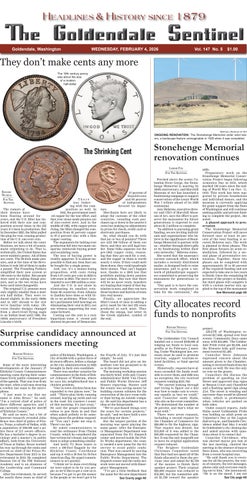
They don’t make cents any more The 18th century penny was about the size of a modern half-dollar
Maryhill Museum of Art
ONGOING RENOVATION: The Stonehenge Memorial under wind towers, a landscape feature unimaginable in 1929 when it was completed.
Stonehenge Memorial renovation continues Lorrie Fox For The Sentinel
Rodger Nichols For The Sentinel The rumors of their demise have been floating around for years, and the U.S. Mint has tinkered with their size and composition several times in the 232 years it’s been in production. But in December 2025, the Mint pulled the plug for real, ceasing production of the U.S. one-cent coin. Before we talk about the ramifications, we have a bit of numismatic nitpicking to do. That is, technically, the United States has never minted a penny. All of them are cents. The British make pennies, and at the time of the Revolution it took 240 of them to make a pound. The Founding Fathers simplified their new system at 100 cents to the dollar. But people were used to calling things pennies, and so the two terms have been used interchangeably. The original U.S. pennies were only slightly smaller than a modern half dollar. They were reduced slightly in the early 1800s and in 1857 shrank to the size we’re familiar with today. Obverse (heads) designs changed from a short-lived flying eagle to an Indian head until 1909, the 100th anniversary of President Lincoln’s birth.
There was tinkering with the composition as well. In 1943, the government needed copper for the war effort, and that year alone made pennies out of zinc-coated steel. And in the middle of 1982, with copper prices rising, the Mint changed the composition from 95 percent copper to 97.2 percent zinc with a thin copper coating. The arguments for halting cent production fall into two main categories: miniscule buying power and escalating costs. The loss of buying power is readily apparent. It is almost impossible to find any item that can be bought for a single penny. And, yes, it’s a money-losing proposition, with costs rising from 3.07 cents per coin in 2023 to 3.69 cents in 2024. The move is estimated to save $56 million a year. And the U.S. is not alone in eliminating its smallest coin. Some 86 countries, from Albania to Zambia have done so with little or no problems. When Canada’s parliament held hearings on eliminating their cent in 2013, not one witness supporting the cent came forward. Casting out the cent is a rare bipartisan issue. A recent poll showed 59 percent of Democrats,
57 percent of Republicans and 60 percent of independents favored its depar-
ture. Merchants here are likely to adopt the customs of the other countries, rounding cash purchases up or down to the nearest 5 cents but making no adjustments in prices for check, credit card or electronic purchases. So, what should you do with that jar or box of pennies? There are still 300 billion of them out there, and they are still legal tender. Some folks separate out the pre-1982 copper coins, reasoning that they got each for a cent, and the copper in them is worth nearly 4 cents. If they could melt them down, they could quadruple their money. That can’t happen now, thanks to a 2005 law that prohibits melting down pennies and nickels. But now that there will be no more cents, hoarders are hoping that repeal of that legislation is next, and they can turn those buckets and barrels of cents into real money. Finally, we appreciate the Mint’s touch of class in adding a privy mark for the last 232 cents produced at each mint. They chose the omega, last letter in the Greek alphabet, symbol of the end.
Surprise candidacy announced at commissioners meeting Rodger Nichols For The Sentinel Some of the more interesting developments at the January 27 Klickitat County Commissioners meeting came during their sometimes lively public comment part of the agenda. That was true from the start, when a tall man wearing a cowboy hat came to the microphone. “I just want to say that my name is John Bruce.” he said. “I’m a retired chief of police of three different agencies, and I am currently running for sheriff of Klickitat County.” He said no more, but a bit of Internet research revealed John Bruce was chief of police of Frisco, Texas, a suburb of Dallas, with a population of 200,000 and a police force of 215 sworn officers. He has a bachelor’s degree in sociology and a master’s in public affairs, both from the University of Texas at Dallas. Bruce worked his way up through the ranks and served as chief of the Frisco Police Department from 2013 to his retirement in 2019. He completed Session 216 of the FBI National Academy and is an alumnus of the Leadership and Command College. After his retirement, he served for nearly three years as chief of
police of Richland, Washington, a city of 64,000 with a police force of 65 sworn officers, before a change in the city administration in 2022 brought in their own candidate. There was another surprise for commissioners in the form of Robert Johnson of Wishram, where he says his neighborhood has a chicken problem, “Our in-town chicken farm has expanded to two places now,” he said. “Thirty-plus birds running around, tearing up yards and out in the road. Six roosters I counted this morning. It’s just crazy.” He said the people responsible refuse to pen them in and that when asked politely to do something about the problem responded “You can’t make me stop it. There’s no law.” He asked commissioners to read the ordinance from Chelan County, which he considered the best version he’s found, and urged them to adopt something similar. And lastly Ty Ross wants to erect a 200-foot flagpole by the Klickitat County Courthouse and top it with a 30 foot by 50 foot American flag. He urged commissioners to act quickly. “I think we’ve done everything we were asked to do by you people, so we’d like to get a vote on it, because I’ve got to get the money to the people or we won’t get it by
the Fourth of July. It’s just that simple,” he said. The board did not give an immediate vote but promised to do so in the near future. The morning workshop session was fairly brief. with only County Administrator Robb Van Cleave and Public Works Director Jeff Hunter reporting. Hunter said the county was saving money by building custom cabinets for the renovation of the jury room rather than hiring an outside company. He said his department has a shop at the fairgrounds. “We’ve purchased things over the years for certain projects,” he said, “and we have built a nice wood shop out there.” But the largest portion of the morning was spent playing the name game. After the Emergency Management Department was separated from the 911 dispatch center and moved inside the Public Works department, the county needed a new name for the 911 service to avoid public confusion. That was caused by moving Emergency Management into the Public Works Department. The dispatch center and the radio network were not moved with Emergency Management. “I’ve got a little feedback that the name for the new department
See County page A6
Perched above the scenic Columbia River Gorge, the Stonehenge Memorial is nearing its 100th anniversary, and Maryhill Museum of Art has launched a fundraising campaign to support conservation of the iconic World War I tribute ahead of its 2029 centennial. Amy Behrens, executive director and CEO of Maryhill Museum of Art, says the effort to preserve the monument for future generations is expected to cost about $1.5 million to complete. “In addition to pursuing grant funding, we are inviting individuals and organizations who believe in the significance of Stonehenge Memorial to partner with us—whether through direct gifts or by fundraising within their own networks,” Behrens states. She noted that the museum’s current outreach effort, which includes a recently distributed mailer, is designed both to raise awareness and to grow a network of philanthropic supporters committed to preserving the monument for generations to come. “Our goal is to have the conservation work completed in time for the centennial,” she
adds. Preparatory work on the Stonehenge Memorial Conservation Project began following Armistice Day in 2018, which marked 100 years since the ending of World War I on Nov. 11, 1918. This work has been supported by private foundations and individual donors, and the museum is currently applying for grant support from the State of Washington and will continue seeking public and private funding to complete the project, she noted. A phased approach to preservation The Stonehenge Memorial Conservation Project will move forward once at least 50 percent of the total funding is secured, Behrens says. The work is planned in three phases. The first phase focuses on acute remediation, followed by a second phase of preventative restoration. Together, these two phases can be completed with approximately 50 to 60 percent of the required funding and are expected to take one to two years to finish. Once the remaining 50 percent of the project is funded, the third phase will complete it with a custom mortar mix applied to the top of the monument
See Memorial page A6
City allocates record funds to nonprofits Rodger Nichols For The Sentinel
The Goldendale City Council handed out a record $100,900 of lodging tax funds to local nonprofits at its February 2 meeting. Under Washington law, revenues must be used to promote tourism, support tourism-related facilities, or fund special events. Historically, requests have always exceeded the funds available to cover them, and 2026 was no exception; the city received requests totaling $121,750. “We started looking through and trying to figure out a fair way how to make cuts to everyone equally as best we could,” said Councilor Andy Halm, who sits on the event committee. “We determined the number at 20 percent, and that’s what we went with.” There were seven requests, including a second request by the Chamber of Commerce for $20,000 to fix the highway sign. That request was denied, but $10,000 of it was added to the $40,000 requested by the Chamber. It was the only nonprofit not to have its original application request reduced. The Brighter Goldendale Christmas Committee noted that they had not spent all of the funds allocated to them the previous year and asked for $2,799 of the monies to finish their speaker project. Their original $20,000 request was reduced to $18,000, but the committee added $1,500 toward the speaker
project. ABATE of Washington received $17,600, spread over four events. Community Days came away with $12,000. The Goldendale Pride event got $2,400, and the Kiwanis kids golf tournament received $1,400. Councilor Steve Johnston expressed concern about the amount given to the Chamber, noting it received funds from the county as well. He was the only no vote on the grants. Councilors did discuss the problem of speeding on 21st Street and approved stop signs at Benson Court and Chatsfield and a flashing speed sign along 21st. The street is winding and narrower than would be allowed today, which is problematic when vehicles are parked on both sides. Under council reports, Andy Halm noted Goldendale Pride was holding an adult prom on Valentine’s Day at the Legion Hall at 6 p.m., and Danielle Clevidence added that May 2 would be Goldendale’s city cleanup day and asked anyone with questions about it to contact her. Councilor Clevidence, who was elected mayor pro tem at the last meeting, chaired the meeting in the absence of mayor Dave Jones, who was recovering from a recent hospital stay. “He said thank you to everyone for all the prayers, the voices of concern, the text messages, phone calls and everyone reaching out to him,” she announced. “He is on the mend. I am not
See City page A6