Passionate arguments made at FVRL meeting
Paul Valencia
clark county today
A standing room only crowd gathered February 17 at the monthly meeting of the Fort Vancouver Regional Libraries Board of Trustees, with many people stepping up during public comment to discuss the new language in the board’s Vision, Mission, Values, and Priority Statements for its Strategic Plan.
Those on the right of the political aisle showed up to thank and praise the trustees who last month voted to soften language on its strategic plan statements. Those speakers also appreciated that the board agreed to adapt procedures regarding intellectual freedom, and therefore, in their opinion, protect children.
Many more from the left gathered to show their disappointment in the trustees for “removing equity” from the mission statement and describing the intellectual freedom caveat as “censorship.”
The meeting took place in a conference room at Cascade Park Community Library in east Vancouver.
Some on the right wore T-shirts stating “Keep the library safe for our children.”
Many on the left brought signs, requesting to “Build a Better Board.”
Gary Wilson, who is an elected school board member with Evergreen Public Schools, spoke during public comment.
He noted that while adults should have access to all materials in the library, “when it comes to children, we should protect them.”
He said 6-year-olds cannot go to a movie theater and walk into an R-rated movie on their own.
“Someone has to be the adult in the room and help guide them,” Wilson said. “Likewise, (children) shouldn’t be able to access similar content here in the library without parents or guardians approving that.”
He held up a stack of papers, noting that he has close to 5,000 signatures from Fort Vancouver Regional Libraries residents who are “in favor of protecting our children in our libraries.”
(Interestingly, he brought those signatures to the Clark County Council on Wednesday. More on that exchange below.)
To the trustees who agreed last month to make changes, Wilson said: “I appreciate you stepping back, looking at the strategic plan, and protecting the children.”
Jamie Bair spoke on behalf of the American Federation of State, County, and Municipal Employees, local 307L.
She said the board adopted language that had not been shared or reviewed by the public, and that the board removed equity and equitable access from the library’s mission, vision, and values “despite overwhelming public support to retain that language.”
“They also reframed intellectual freedom through the lens of parental rights, undermining a core public library principle. … These actions have raised serious concerns across Southwest Washington.”
Among the changes, the plan went from “we champion equitable access to literacy and lifelong learning …” to replacing equitable access with “we champion fair and inclusive access to literacy …”
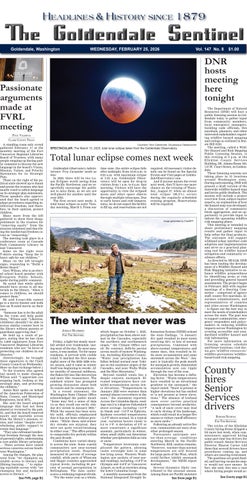
SPECTACULAR: The March 13, 2025, total lunar
Total lunar eclipse comes next week
Goldendale Observatory Administrator Troy Carpenter sends us this:
In 2026, there will be two Lunar Eclipses worth seeing from the Pacific Northwest, and we respectfully encourage the public not to miss them, as we are not well-placed for another until the year 2033. The first occurs next week: A total lunar eclipse on early Tuesday morning, March 3. From our
time zone, the entire eclipse falls after midnight, from 12:44 a.m. to 6:23 a.m. with maximum eclipse at 3:33 a.m. Goldendale Observatory will be open for drop-in visitors from 1 a.m. to 6 a.m. that morning. Visitors will have the opportunity to view the eclipsed moon and other space objects through multiple telescopes. Due to early hours and cold temperatures, we do not expect the facility to fill up, and reservations are not
required. All necessary visitor details can be found on the Special Events and Visit pages at GoldendaleObservatory.com.
And if anyone misses the event next week, they’ll have one more chance on the evening of Thursday, August 27, when an almost total eclipse (96.2%) occurs during the regularly scheduled evening program. Reservations will be required.
DNR hosts meeting here tonight
The Department of Natural Resources (DNR) will host a public listening session in Goldendale today to gather input from community members, local emergency managers, building code officials, fire marshals, planners, and other interested stakeholders regarding wildfire hazard mapping and ratings as outlined in Senate Bill 6120.
The meeting, called a Wildfire Hazard and Risk Mapping Public Listening Session, is this evening at 6 p.m. at the Klickitat County Services Building, Mt. Adams Room 100, 115 W. Court Street, in Goldendale.
These listening sessions are taking place in 16 locations around Washington state. During each meeting, DNR will present a draft version of the statewide wildfire hazard map and invite public feedback. The session will include a project overview from subject-matter experts, an explanation of how the hazard map was developed, a discussion of community block aggregation, and an opportunity to provide input to inform the upcoming wildfire risk mapping phase.
This meeting is intended to share preliminary mapping results and gather input to help refine the final products. The outcomes will support wildland-urban interface code adoption and implementation and serve as a practical planning tool for wildfire hazard mitigation and community resilience efforts.
The winter that never was
For the sentinel
Friday, a light but steady snowfall settled over Goldendale, lasting most of the day. By most measures, it was modest. Yet for many residents, it arrived with visible relief. It marked the first meaningful snow of the 2025–2026 winter season, and it came as winter itself was beginning to recede. After months of unusual mildness, the flakes felt less like decoration and more like reassurance. The subdued winter has prompted growing discussion about both its causes and its consequences.
In a recent statement, the Washington State Climate Office acknowledged the public mood: “Some may feel a sense of dejà vu as they recall our eerily similar dry streak in January 2025.” While the season has been notably mild, officials emphasized that it has not been without precedent. “While these mid-winter dry streaks are atypical, they were not quite record-breaking in either year.” The office pointed to comparable dry periods within the past decade. Conditions have varied sharply across the state. Some coastal communities saw near-normal precipitation totals. Hoquiam measured 84 percent of average rainfall, while parts of Whatcom and Skagit counties approached typical levels, including 96 percent of normal precipitation in Bellingham. The data underscores a widening regional divide. “For the water year as a whole,
which began on October 1, 2025, precipitation has been above normal in the Cascades, especially the northern and northeastern slopes,” the Climate Office noted. By contrast, deficits persist across much of eastern Washington, including Klickitat County. “Water year precipitation has fallen behind normal near Yakima on the southeast slopes of the Cascades, and near Walla Walla and the Blue Mountains.” Beyond rainfall totals lies a deeper concern: snowpack. Elevated temperatures have curtailed accumulation across lower elevations. “Temperatures in January 2026 were warmer than normal almost everywhere in the state,” the statement reported. Across the Columbia Basin, readings ran 2 to 4 degrees Fahrenheit above average, including +4.5°F in Omak and +3.0°F in Ephrata. Spokane recorded temperatures +2.4°F above normal. In a typical year, variation hovers closer to 0.5 to 1°F. A deviation of 3°F or more constitutes a significant anomaly, particularly in winter, when small shifts can determine whether precipitation falls as rain or snow. Temperature inversions complicated the pattern, allowing cooler overnight lows in some low-lying areas. Western Washington saw pockets of near-normal readings, including +0.9°F in Olympia and -0.6°F at Vancouver Airport, as well as stretches along the lower Columbia Gorge.
A monthly assessment from the National Integrated Drought In-
formation System (NIDIS) echoed the state findings. “A January dry spell resulted in most states receiving 50% or less of normal precipitation. Combined with above-normal temperatures and sunny days, this resulted in little snow accumulation and some snowmelt across the West.” January is typically the peak month for snowpack growth; diminished accumulation now can ripple through the rest of the year. Elevation has become a defining factor. “Warm temperatures have resulted in an elevational gradient to the snowpack,” the report stated. “Snow is present at higher elevations but has melted or is not present at lower elevations.” The absence of lowland snow cover carries practical consequences beyond aesthetics. “A lack of snow cover may lead to early drying of the landscape, which could result in a longer fire season or reduce runoff efficiency as snow melts.” Following an already active fire year, communities are wary of another prolonged season. Forecasters anticipate wetter-than-average conditions entering March in the Pacific Northwest. Still, caution remains. “However, warmer-than-normal temperatures are still favored for large parts of the West, which could further inhibit snowpack development,” the NIDIS report warned. Several dynamics likely contributed to the unusual season. Among them are Pacific moisture
As directed by SB 6120, DNR has been leading the development of a Wildfire Hazard and Risk Mapping initiative to enhance wildfire preparedness by identifying areas at risk and providing general hazard assessments. The project began in February 2025 with regular meetings of a Steering Committee – comprised of agency staff, county fire marshals, insurance commissioners, and representatives of counties and cities across Washington – to figure out the best way to meet the needs of stakeholders across the state. The goal was to support communities, emergency responders and policymakers in reducing wildfire impacts across Washington by creating accessible and standardized wildfire hazard and risk information. For more information on listening session schedule and future locations, visit dnr. wa.gov/wildfire-resources/ wildfire-prevention/wildfirehazard-and-risk-mapping.
County hires Senior Services drivers
rodger nichols
For the sentinel
The icicles of the Klickitat County hiring freeze dripped a bit more last week, when commissioners approved hiring some part-time bus drivers for public transit. Senior Services Director Sharon Carter told them that several drivers have procedures coming up, and others are nearing retirement. The positions are grant-funded, and leaving vacancies empty would not save money. In fact, she said, this was a case where hiring people would ac-
Courtesy Troy Carpenter, Goldendale Observatory
eclipse taken from the Goldendale Observatory. Goldendale,
Jordan Mayberry
Image generated by ChatGPT

Lyle arson fire results in an arrest
About 10 p.m. last Tuesday, February 17, a Klickitat County Sheriff’s Office (KCSO) deputy returned home from an outing with his wife and young children. They noticed a strong odor of gasoline. While trying to determine where the smell was coming from, their barn erupted in flames, and dispatch was called. KCSO deputies and the fire department arrived shortly thereafter, and the flames were extinguished. The Klickitat County K9 team arrived, and while walking around the barn, K9 Zeus got a scent. Zeus followed the scent directly to the neighbor’s house. Contact was attempted, but despite seeing someone
inside the residence, no one came to the door. Arrangements were made for the deputy and his family to stay in a motel since their home was now an active crime scene. Arson investigators were called in and collected evidence. Local Washington State Patrol (WSP) offered to call WSP detectives to help with the investigation. That offer was accepted, and two detectives from WSP started their investigation alongside the Arson investigation team. Based on probable cause, the WSP detectives wrote a search warrant for the neighbor’s property that was signed by a local judge. A plan was in motion for WSP SWAT to
In the early afternoon on February 13, Klickitat County Sheriff deputies were called to the area of Mile Post 1 on Naught Road near Bickleton. The reporting party called about a vehicle that was unlocked with personal items in the front seat but no one in the vehicle. While looking around the area, a body was discovered in the field. K9 Deputy Zach McBride, Deputy Sergeant Adam Dyment, and Detective Sergeant Tony Warren responded to the scene. The area was secured and an investigation began. Nothing was found to indicate a struggle or a crime. The deceased was identified as Christopher
execute the search warrant on the neighbor’s residence to search for evidence of arson. Despite numerous attempts, the permission to execute that search warrant was not granted by upper level (not local) WSP supervisors. At the direction of Klickitat County Sheriff Bob Songer, all available deputies, including the KCSO Warrant Service Team, were called into service on February 19 to serve the warrant and collect any evidence found. After an operations and safety briefing, KCSO deputies served the search warrant at 6 LyleSnowden Road in Lyle.
During the clearing of the buildings on the property, a
Muller, age 53. Mr. Muller had been reported missing earlier in the day by his parents, who live in Richland, Washington.
The Coroner’s office arrived and will conduct further investigations as to the cause of death. At this time, it appears to be a medical episode.
pickup truck came from the back of the property, driving toward deputies at the main house. Deputies gave the driver commands to stop. The vehicle came to a brief stop, and a female and a baby attempted to exit the passenger side of the vehicle. The driver, 35-year-old Kiva Dobson, hit the gas in an attempt to flee. The truck door swung open as Dobson turned a corner quickly, and the female with the baby almost fell out of the truck. Despite multiple commands to stop, Dobson increased speed. At the end of the driveway were two more deputies with their vehicle blocking the exit. One deputy had to run out of the way of the truck
to avoid being hit. The truck came to a stop when it ran into the front of the patrol car. The female exited with the baby and was cooperative. Dobson would not obey commands from the deputies. He finally exited out the passenger side, put his hands in the air, and said, “Shoot me!” multiple times. The two deputies told Dobson he was under arrest. He resisted, and a struggle ensued. Additional deputies arrived, and Dobson was taken into custody.
Two deputies received injuries during the struggle, one a sprained wrist and the other a compression fracture to the spine. Both are expected to make a full recovery.


Dobson was transported to the Klickitat County Jail. His charges include Arson in the 1st degree, Residential Burglary, and Reckless Burning in the 1st degree. Songer expressed appreciation for local Washington State Patrol troopers and their detectives; the Arson investigation team from Q Global Fire Investigators; firefighters from Lyle Fire; KCSO detectives, supervisors, and patrol deputies; the Drone Team from Klickitat County Department of Emergency Management; Portland Fire and Rescue; and volunteer Posse members who helped secure the property on very short notice until the family could return to their home.


G oldendale ’ s a ttic
Answer to last week’s Mystery Picture
This picture has been colorized. Several people were able to identify several people in this picture, and David Telford sent us this complete lineup of the Goldendale 1987 basketball team: Back row left to right - Matt Counts, Matt Hardy, Mark Ladiges, Scott Fitzgerald, David
This week’s Goldendale’s Attic Mystery Picture
This is a straightforward picture of two very nice people. Wedding? Could be. If we knew, we wouldn’t be asking you
about this photo. All we know is this picture ran in The Sentinel sometime, lost in the annals of yesteryear. If you know
anything about it, please send us an email (info@ goldendalesentinel.com), or give us a call (509-7733777), or drop in at the
office—and remember, you’re welcome to come in and take a look at the original photograph.
L ooking Back
January 19, 1939 – 87 Years Ago
A complete transition in methods of handling alfalfa hay is now under way in the Klickitat valley, according to Max Maurer. With Klickitat rapidly becoming an important exporter of baled hay, farmers are realizing the need for better curing methods. This demand is reflected in the installation of new types of equipment such as side delivery rakes, hay loaders, and modern stackers. Among those Klickitat valley farmers who have purchased new hay equipment during the past few months are Arie Van Aelst, W. F. Hornibrook, Beyerlin Brothers, and George Coffield. An estimated 7,000 tons of baled hay have been shipped out of the Klickitat valley this fall and winter.
January 19, 1939 – 87 Years Ago
Are School Teachers Overpaid? Do Washington school teachers get paid too much under the state’s minimum wage law, which assures them $1,200 a year. Yakima county thinks $100 a month is too much. Senator A. M. Martin of Sunnyside has introduced a bill to the legislature to repeal the minimum wage law. Senator Martin, the Democratic publisher of the Sunnyside Times, incidentally, has served on the school board of his hometown.
March 3, 1966, – 60 Years Ago
A team of Huskies pulling a dog sled (on wheels for lack of snow) provided a day’s entertainment for many area youngsters in Goldendale on Saturday. The dogs gave free rides from 11 a.m. until after 4 p.m. in the Safeway parking lot as part of the Dog Days promotion of the retail merchants committee of the Chamber of Commerce.
February 18, 1968 – 58 Years Ago
Goldendale’s Burgen Street: John and Susan Burgen settled in Klickitat County in 1870, homesteading south of town on what was later known as the Chuck Gronewald place. Mr. Burgen was the first superintendent of schools and is also credited with being the first farmer in the county to produce wheat in sufficient quantity for threshing.
February 25, 1968 – 58 Years Ago
Joe Sellers, son of Mr. and Mrs. Dick Sellers, left for Fort Lewis on Sunday to begin his Army training. A group of his young friends was at the bus depot to see him off.
February 19, 1976 – 50 Years Ago
People may sing about tumbleweeds or swear at them, burn them or decorate them, but no one living on the western plains can ignore them. The mobile monstrosities thrive where other plants die, grow to impressive size, proliferate at an astonishing rate, and driven by a good breeze can cover tremendous distances at a fast clip. The brush-balls that gambol so freely across the countryside are known variously as saltwort, Russian thistle, prickly glasswort, wind-witch, and tumbling thistle. The dry, prickly bush contains up to 60 feet of thin, tough branches intertwined into a ball that can measure anywhere from 2 to 10 feet in diameter. By autumn the plant is dead. The wind twists it off its stem, and it embarks on its aimless journey. One tumbleweed can scatter some 20,000 hardy seeds along its trail, assuring a generous crop of weeds next year.
Points to ponder:
After I die, they will read through my Tweets and see that my life was not wasted.
The waters receded, the Ark settled, and Noah told all the animals to go forth and multiply. He was cleaning out the Ark, and he noticed a couple of snakes still there. “Didn’t I tell you to go forth and multiply?” he asked. They said, “We can’t. We’re adders.”
Leif Erickson returned home from a voyage and found his name missing from the town register. His wife insisted on complaining to the local civic official, who apologized profusely, saying, “I’m sorry, Mrs. Erickson, I must have taken Leif off my census.”
What do you call the cabs lined up at the Dallas Airport? The yellow rows of taxis.
A doctor liked to stop at a bar after work and have an almond daiquiri. One day, Dick the bartender ran out of almonds and used hickory nuts instead. The doctor took a sip and said, “Is this an almond daiquiri, Dick?” And Dick said, “No, it’s a hickory daiquiri, Doc.”
There was a man who entered a pun contest. He sent in 10 different puns, in the hope that at least one of the puns would win. Unfortunately, no pun in 10 did.
June 22, 1944
Hornibrook Has Musical Future
Self-styled as a “pianoplaying farmer,” Wally Hornibrook, 19-yearold son of Mr. and Mrs. William F. Hornibrook, has shown remarkable talent in the music field.
Wally started his music lessons in earnest while in the sixth grade. He studied for over two years with Mrs. Minni Meyers, who came from The Dalles to give lessons. Upon entering high school, Wally took lessons from Miss Verna Frederickson of Toppenish, who had studios here. Since Wally’s junior year, he has found it necessary to travel to Toppenish every other week to study from Miss Frederickson.
Is Pupil of Balogh
At present, he is a pupil of the famous Stephen Balogh, who is Dean of the Cornish School of Music in Seattle. On Fridays and Saturdays Balogh is in Yakima, teaching advanced students of the Wilson School of Music, where Wally is going now. Balogh is a graduate of the National Conservatory, Budapest, Hungary and studied from many masters, including Claude Debussy and Ernst van Dohnanyi. Balogh, a great believer in finding out what the people want and like, arranged and played the music for the Zeigfeld Follies for several years
Hornibrook has studied for nearly two years from this great teacher, taking time out to work in the ship- [sentenced not finished in original story].
A great moment in his life occurred in Yakima when he was a senior. He entered the Fifth Annual Central Washington Music Competition Festival, where he was given a superior rating, the highest given, during the afternoon’s contest. That evening, those who had rated superior in the afternoon, were to be on the program. To his surprise, Wally was introduced as the outstanding musician of the day.
everyone squirming in his chair or hopping around the room. He can play practically any piece he is asked.
When a high school sophomore, he organized a dance band known as “Wally’s Swingsters,” which played for several years. Hornibrook is also versatile; not only is he of professional caliber on the piano, but also he plays the trombone, saxophone, clarinet and trumpet. When he goes to Yakima to take his lessons, he works three hours or more taking private lessons and studying with a class in harmony and counterpoints then he turns around and spends the evening playing the sax for Saturday night dances at Playland park.
To Play in Yakima He has been presented in concert upon three different occasions in Yakima. Tomorrow evening he will appear there in concert, playing three different two-piano numbers.
When asked what he expected to do in later life, he said, “I want to get my Doctor’s degree in music and eventually be a conductor and instructor for those who will teach music.” It is his ambition to get more musical education for the public schools.
It has been said that music critics have remarked that it seems inevitable that Wally will go on the concert stage and become one of the nation’s best pianists. Will Appear Here
Of special interest to Klickitat county people, is the news that the Wilson School of Music is presenting a joint recital July 1 in the high school auditorium of Goldendale, featuring Miss Mary Lou Deaver, of Yakima, and Wallace Hornibrook. Miss Deaver is studying for the concert stage.
— Richard Lefever Klickitat
County Historical Society
Plays a Mean Boogie Wally not only plays classical music but can tickle the ivories with a boogie-woogie that has
This will be the last opportunity Goldendale people will have to hear Wally, as he is entering the Army in July.
Telford, Chris Sager, Chris Whitmore. Middle row left to right - Chuck Matthews, Cape Powers, Matt Jaekel, David Ross, Dan Larson, Ken Thompson. Front row left to right - Jason Berry, Chip Olson, John Garner, Mark Goodwin, Clive Reeves, and Jeff Baldwin.
OpiniOn
Is
One year later, it should be obvious to Americans who believe in democracy, the rule of law, truth, and our Constitution and Bill of Rights that Donald Trump is not making America great again. His obvious cognitive decline, ignorance about history, economics, and international affairs, his overt racism and misogyny, and his transparent grift and corruption are, to use his favorite phrase, “unlike anything we have ever seen.”
His international policies have plunged our country into one of the most mistrusted countries on the planet. His disrespectful and bullying treatment of our allies, along with his inconsistent and illegal tariff policies, is isolating us from other democracies. He campaigned against US war mongering, yet in his first year, he is demanding regime change in Venezuela, Cuba, and Iran. Our trading partners and allies are leaving us behind as they develop new alliances and trade partnerships. His international ignorance has opened the door for China to replace the US as a global economic leader.
Guest Column Sue Kusch, White Salmon
His physical and mental decline are obvious. If your elder regularly showed confusion, made up stories and lies, fell asleep in televised meetings, slurred his words, used makeup to cover large bruises, regularly insulted your friends and family members, complained non-stop that people are trying to harm him, spends his nights sending out childish and racist memes, saying people are lying about everything, was obsessed about a singular past event, only wanted people around him who would hide his decline, and told you that his obvious physical and mental decline were not real, you would drive them to the doctor’s office to seek a diagnosis and help.
The world is asking what’s wrong with Americans: why are they allowing this demented man to lie to his country and to the world? Meanwhile, Putin, who desperately wants NATO to break up, leaving individual European countries vulnerable to invasion, must be laughing in his Russian palace as Trump does the work for him.
One of the most amazing tricks Trump has employed is convincing a large group of Americans that America is a horrible place to live. That our neighbors are criminals, our communities are cesspools, and our positive economic recovery after the pandemic was not real, while the rest of the world declared it an amazing success. He told us the country was in terrible shape. Nothing has worked for decades, perhaps ever, until Trump came along. The services the government provided to us every day were all a sham, filled with outrageous waste. Our national history, shaped by the freedoms of civil and women’s rights, is being eliminated and retold with lies. The concept of public lands owned by citizens has been increasingly protected by environmental laws, which are now being stripped away from Americans and offered up for corporate raping and pillaging. When confronted with facts about our country, he tells us it’s all fake news.
THE GOLDENDALE SENTINEL
Official newspaper of Klickitat County, Washington
Established 1879 • Published every Wednesday from offices at 117 W. Main Street • Goldendale, WA 98620 • Telephone: (509) 773-3777 Emails: news@goldendalesentinel.com (News, editorial, Letters)
Obits@goldendalesentinel.com (Obituaries)
Classifieds @goldendalesentinel.com (Classified ads and inquiries)
Ads @goldendalesentinel.com
(Display advertising information and inquiries)
Legals @goldendalesentinel.com (Legal and public notices)
Payables@goldendalesentinel.com
Receivables@goldendalesentinel.com
Events @goldendalesentinel.com (Events and activities)
Editorial:
Lou Marzeles, Editor & Publisher
Business and office staff:
Owned by Tartan Publications, Inc.
Leslie Geatches, President, Financial management, Special Section production, Ad Design
Naomi James, Bookkeeping
The only truth we are to believe is what he tells us.
He has proven he is a dealmaker; unfortunately, he has used his skills to enrich himself and his family’s businesses, not to benefit our country or working Americans. Trump, who has claimed bankruptcy six times, was facing significant financial problems as he sought his second term. He has used his powerful position to profit as much as $4 billion dollars in 2025. In 2025, U.S. taxpayers have paid a record $127 million dollars for his 91 days of golf outings at his private golf courses. This week, he filed for two trademark rights that would require any airports named after him to pay an annual licensing fee, and then he continues his demands that several airports be named after him. In two lawsuits, Trump is shaking down American taxpayers for $10 billion and $230 million. His Department of Justice has become his retribution machine, spending millions of taxpayer dollars on vengeful investigations with no basis in fact.
Experts are warning us that in his first year, Trump has moved us quickly into an authoritarian state. There has been a huge surge in Americans seeking passports as they prepare to possibly leave. Last year, a poll found that 40% of young women aged 15 to 44 want to leave the U.S. permanently. Is this what Americans voted for? How do any of his radical actions help working Americans economically? Is this the country you want to leave to future generations?
Letters from the community
Allow the flag
Burn-out has got to go
There is nothing quite like seeing an extra-large American flag flying high above the landscape to induce heartfelt gratitude for our freedoms that have been so hard fought for over the last 250 years. At this time in our history, it is most important to encourage patriotism among the residents of our county and our great nation, since it has been especially waning the last few decades.
The Festival of Wheels gave it another try this year. It seems the attendance has dwindled to much lower levels than when the event was new, 10 years ago. There are a lot of competing car shows this time of year, so it doesn’t surprise me . This year Goldendale Motorsports Association and ABATE brought back the burn-out, which was tried several times in the past with questionable benefits to the town. This year someone had the brilliant idea to use the old skateboard park as a place to stage the return of the burnout. It was held on the concrete slab, a tempting medium for anyone inclined to bum rubber. Rednecks of many degrees, punk kids or maybe the little old lady from Pasadena.
accepted.
for three hours.
I think the city of Goldendale needs to rethink supporting burnouts in our park. Next year don’t issue a permit to any group that wants to burn-out. There are places in the county where it could be held, just not in the city please. I hate toxic smoke, and you should too.
In this age of declining respect for authority, law enforcement, and our country, it is imperative we demonstrate that even though we may have differences of opinions and philosophies, we are still able to unite in our pride to be Americans. What better way to physically show our thankfulness and patriotism as a citizenry than to fly a large American flag high above the Klickitat County Courthouse?
I personally was left with a bad taste in my mouth and lungs. Even though I made it a point to stay away from the burn-out and was at my home where I thought I would escape the noise and smoke, when the toxic cloud rose from the park and drifted over the Little Klickitat River Park (the swimming pool) on to the kids and families at the pool and on to me while I was sitting on my property. We were contaminated by the toxins in the smoke, and my eyes and throat were imitated, and my lungs filled with carbon monoxide and other cancer causing toxic compounds
I was extremely disappointed to learn that the offer was declined due to concerns about maintenance costs and a county hiring freeze. According to publicly available information, the Ross family has clearly stated they would cover all expenses and establish funding for future upkeep. Given that commitment, it is difficult to understand how maintenance or staffing concerns could be used as excuses to reject such a generous gift.
On Sept 4 I will be asking the mayor and his administration to make an ordinance forbidding anyone from reckless unsafe burnouts in any ones neighborhood or any street in the Goldendale city limits. I would appreciate some support from like-minded citizens at the council meeting. Let them know how you feel.
At the same time, we will be honoring and showing our support to the military, veterans, law enforcement, first responders, and public servants who devote, or have devoted, their lives to make our nation a better place to live than any other country. With as large a flag as is being proposed, perhaps it will remind us that it is “to the Republic for which it stands. One nation, under God, indivisible, with Liberty and Justice for all.” And maybe it will prompt us to treat each other with a bit more charity.
Since this project will not be a financial burden at all to Klickitat County residents, as all the costs connected to seeing it to completion have been so generously donated, plus having a special fund for future flags and maintenance put in place, it seems this can only be a win-win for our county and its people.
A properly installed American flag is a unifying symbol that reflects shared values of respect, service, and community pride. Accepting this donation would demonstrate gratitude, common sense, and appreciation for citizens who wish to give back to the city they love.
I contacted the bank for an explanation. The answer was essentially that “we wouldn’t do that.” Then why is it in your documents, I asked. The answer was to send me up the chain of command. The second person gave the same answer as the first and then was to have me contacted by some-one higher up. That person has not contacted me after more than a week so I am following through on what I told the bank contacts I was going to do—write a letter to the editor to be sure local folks are aware of how Columbia Bank is choosing to deal with its account holders.
I respectfully ask the county commissioners to accept the Ross family’s most generous gift.
Ken McKune Goldendale
C
A good man
Mari Amstutz Goldendale
I recently received an updated “Terms for Business and Deposit Account Agreement” from Columbia Bank. I am not in the habit of reading the fine print but for some reason this time I did. I came across an “added” line that I found very concerning. Again, this line is both for personal and business accounts. It reads: “We may refuse to open and account and may close your account at any time for any reason or for no reason at all.”
payer money. This is because progressives mainly control the library system at all levels. Simply moving “X” rated materials to an alternate place in the same library is akin to a person who is told he has lung cancer and then is temporarily relieved to discover the cancer is actually in his brain. In either organ, the cancer is terminal because both occupy the same body. The same can be said for child pornography in any form or location within the library. The only solution in either case is to excise it. No matter how promoters dress it up, the behavior of those who say they have the best interests of kids at heart is far too often to exploit them. The object is always for a political agenda.
Like drugs and alcohol, porn is an ugly addiction to beat once it gets the upper hand. The earlier in life that a person is purposely exposed and desensitized, the less likely recovery is possible. Yet we never hear about those who suffer from this habit.
My concern is that a comment as broad as this opens the door for abuse. I have had no difficulties with our local branch and am sorry that the headquarters has decided to take such a hard line. It ap-pears I will need to look for a bank that does not behave in this manner.
We have an excellent candidate in our district running for Congress. John Duresky is a retired Air Force Major with extensive government experience. See his website (johnduresky4congress.com) for more details. Come to his town hall meeting this Thursday [tomorrow] at 6 p.m. in the downstairs meeting room of the Goldendale Library to hear him answer your questions.
“For No Reason At All” I particularly found offensive.
I would ask the Klickitat County Commissioners, who represent our county populace, to please approve this project.
Peggy Woodard Goldendale
Let it fly
My husband and I moved to Goldendale to spend our retirement years in what we believed to be a quiet, welcoming, and patriotic community, and we are proud of our choice.
Recently, I read about the most generous offer made by Ty and Barb Ross to donate, install, and fully fund the ongoing maintenance of a flagpole on the county courthouse lawn—the very heart of Goldendale. This proposal represents a meaningful and respectful gift to our community, offered at no cost to the city or its taxpayers. I strongly believe it should be welcomed and
Ken Margraf Goldendale
This hefty price is paid by the child and their family to advance the worldview of the left. Luckily, reasonable people are present locally to challenge the issue. They perhaps know by now that compromise can’t be made with people who consciously place these materials within the public system despite the costs to others.
Carol Hicks Goldendale
There can be no compromise
Compromising with liberalism on most any issue has proven largely hopeless. This includes race, crime, and illegal immigration.
Full-blown graphic pornography targeting children using kids as cartoon characters has been present at public libraries for years. The same is true at public school.
At times, honest people appear to step into a snare in an effort to cooperate. A single example is to agree to transfer child pornography to a library location apart from the children’s section.
Many things are wrong with this remedy. First, the materials that specifically involve children, if removed at all, sometimes will magically migrate back to their original location. Such books are also added weekly by woke Fort Vancouver Regional Libraries employees who purchase them by spending tax-
Guidelines for Letters
Supporters use trite slogans including “freedom to read” and “intellectual freedom.” These terms are red herrings designed to disarm and disable parents, the public and taxpayers. It’s also telling that local officials, self-described community leaders, and many others have a history of silence on the situation. For good reason, the word morality seldom enters the debate, except as abstract human rights. Those who promote graphic porn for kids at taxpayers’ expense are unlikely to accept anything other than their original goals.
Mike Goodpaster
Goldendale
He was somebody
I am Somebody! [That is the title of a poem Rev. Jesse Jackson often recited.] Rest in Peace Jesse Jackson. You gave us the Rainbow Coalition, and I belong. It will live on in Goldendale, Washington. I will think of you whenever I see a rainbow in the sky. The Peace Train is still making stops. All aboard.
Thomas Wilson Goldendale
Letters to the editor should be original and comment on an issue. Deadline for letters is noon Monday for the same week’s paper.
Requests to keep letters exactly as written when published cannot be honored. All letters are subject to editing for grammar, spelling, clarity, and/or brevity.
There is a suggested length limit of about 300 words.
Unsigned letters (including anonymity requests), letters with fictitious signatures, letters with multiple signatures, or letters to public officials are not accepted. Please keep the tone of letters free of rants, wild speculation, unsubstantiated claims, or pointedly personal comments. Letters that go overboard in these directions will be refused publication.
Writers must include name, city/town of residence, and phone number for verification purposes. (Street address is not required, only city or town.)






Superintendent set to retire this year
Catherine Couture For the Sentinel
With the 2025-2026 school year coming to an end this spring, Goldendale’s Superintendent, Ellen Perconti, is planning on retiring after over 30 years of working in education. While she will miss the students she has gotten to know and work with over the past years, she states that, overall, she’s reached a point in her life where it’s a good time to hang up the hat and focus on her family. It was not an easy decision to make, as it tends to be with all major life decisions, she says. “There are always things I wish that I could have finished or gotten into a better position before walking away, but that will always be the case. “So I just feel like this is a good time for my family, a good time for me to try something different.”
Perconti describes herself as a woman who has dedicated her life to education. During her time with this community, she wanted to always put her best foot forward when providing children with the education they deserve. She states that she’s always had a passion for learning and that the driving force behind everything was that passion. Asked what her favorite part of the job was, she states that it was mostly the diversity of the community. While new challenges did arise, she loved getting to know and work with people and students from all walks of life. She states, “You never know what your day is going to bring. So all of that is part of what I really enjoy about being a superintendent, as well as feeling like I can influence the learning of children.”
Perconti has been work-
ing in education for some 35 years. However, education was not something that she thought she would get into when she entered the workforce. She originally went to school to be a physical therapist. At the time, it was not really a job where women were all that present. She didn’t shift avenues entirely at first, instead finding a niche that seemed like a perfect fit for her—music therapy, and musical education. As an undergraduate, she found many different opportunities that led her down the path towards working in education. It was her love for children and her background in musical therapy that helped open up the path to education, she recalls.
The path towards administration started when she shifted from music education to assisting with curriculum development. She began
offering input and direction for music education specifically and she slowly branched out into other areas. It was in that role that she was presented with the opportunity to become a superintendent. During her time with curriculum development, her main focus was making sure material was up to date and supporting teachers. In her mind, this assisted her once she made the shift to superintendent. She states that experience
WAGAP launches search for new leader
Washington Gorge Action Programs (WAGAP) Monday announced the departure of Executive Director Jennifer Pauletto after years of leadership service to communities throughout the Columbia River Gorge region. The organization’s Board of Directors has initiated a comprehensive recruitment process to identify the agency’s next executive director.
Pauletto has served WAGAP since 2022, first as associate director and then as the executive director. She guided the organization through expanded programming, enhanced community
partnerships, and found ways to sustain services in a challenging funding climate. During her tenure, WAGAP deepened its impact across housing stability, food security, energy assistance, and supportive services for families and individuals facing economic hardship.
“Jennifer has been an incredible asset for WAGAP and will be sorely missed,” said David Quesnel the Chair of WAGAP’s Board of Directors. The Board is committed to a smooth transition for the staff and community. Under Pauletto’s direction, WAGAP developed cross-sector partnerships,
strategic initiatives, and made decisions to position the organization for long-term sustainability. “It
helped her ensure both staff’s and students’ needs were properly met. While only being in Goldendale for a little under 10 years, Perconti shares a strong sentiment towards the community as a whole and a sense of duty towards it. She says she always thought the staff were dedicated to their mission at Goldendale and that the smaller scale of the community allowed her to properly meet the needs of everyone around her. In her opinion, the bigger the district, the wider the gap between student and educator. She feels that smaller districts afford more opportunities to connect with students one on one, furthering connection with the community in her eyes.
Perconti says she had no preference for age groups of students. She states that different experiences come with
each group. She says she loves the youthful energy of the elementary kids as well as the thoughtfulness of the older kids. Asked if she felt the education being provided to the older students properly prepared them for the real world, there was zero hesitation in her voice: “I do.”
She adds, “When we talk to students, for example, when they do their senior presentations or when I talk to kids as they come back, they tell us they’ve had a good foundation. I think that’s the education we’re always striving for. We’re always looking at what is happening in the workforce, and we are preparing them for it.”
As she readies for retirement, she hopes to spend more time with her family and her hobbies, such as photography and playing guitar.
E xtra
DoveScapes finds its footing
Lorrie Fox
For The Sentinel
When Dove Owen surveys a newly finished patio or freshly graded gravel road, he sees land carefully shaped into a beautiful space that serves the needs of the people who live there.
DoveScapes, a landscaping business owned by Dove and his wife, Shayla Owen, was launched in Goldendale in 2017. Today, with 15 years of landscaping experience behind him, Owen says there’s nowhere he’d rather work than Klickitat County.
“Shayla and I moved here after I spent about five years landscaping in Portland,” Owen said. “I worked three years for Dennis’ 7 Dees and then
tually save money, since the hires would be for “casual” (part-time) and would not be eligible most benefits. And there’s another reason.
“I’d actually be worse off,” she said, “because I’m going to run into overtime, trying to fulfill the contract obligations with fewer people.”
In the morning workshop session, Public Works Director Jeff Hunter said crews were working on brushing roadsides. Occasionally, he said, people would ask them to spare, for example, blackberry bushes.
“What we tell people is, ‘You brush it, or we will,’” he said. “If they don’t brush it, we have areas where we get long grass or brush when you get snow in the road, it becomes a hazard. We will work with people. If they want to hand-brush their area, that’s fine, but they need to do it before we come through. Because if it’s there, we’ll cut it.”
Additionally, Hunter noted the county is looking
Mary Williams abruptly resigned from the board of trustees in protest after January’s meeting.
The board, which is supposed to have seven trustees, now has two vacancies. When all positions are filled, the board has three Clark County atlarge representatives, two from Vancouver, one from Skamania County, and one from Klickitat County.
Wilson told Clark County Today he is concerned that the Clark County trustees who voted to protect children could be in danger of losing their spots on the board of trustees. They were recommended to the board by the Clark County Council.
He visited the Clark County Council on Wednesday during Council Time to talk during public comment. He presented the 5,000 signatures from people who want “to protect children from inappropriate programs and material for their age group in the library.” Wilson said there are books in the library system that he described as pornographic, and those items should not be available to children.
“The vast majority of your constituents care about protecting the children in the county,” Wil-
two years on my own. But I didn’t officially start my own business until we got to Goldendale.”
Owen specializes in hardscape and landscape installation, including paver patios, retaining walls, French drains, gravel roads, custom walkways and paths, sod and planting, demolition and property clean-up. He added gravel road installation three years ago and expanded into demolition work last year.
While Portland provided valuable experience— much of it in residential landscaping—Owen said the move east changed the scope and feel of his work.
Owen expressed that building a name in Goldendale took time, but he values the setting. He par-
ahead to deal with housing for the 3,000 construction workers expected for the Goldendale Pumped Storage project recently approved by the Federal Energy Regulatory Commission.
“We are surveying the property next to the fairgrounds in preparation to look for dollars. Then we’ll start putting together designs to see how many employee housing spots we can get. This will be 10 times what it was back in 2008 and 2009 when the windmills started going in. You couldn’t find an apartment, a motel room, or anything in this town because everything was taken up.”
And county staff will draft an ordinance to charge wind and solar companies for false alarms. County Administrator Robb Van Cleave explained:
“If deputies are at the other end of the county, and a false alarm goes off on a wind farm, it’s a hour and a half to get there,” he said. “Then they get there,
son said. “Please do the same. Do not attempt to remove our Clark County library (trustees).”
Later in Council Time, the council made a request to have members of the Fort Vancouver Regional Libraries give an update to the councilors on the libraries as well as the process for modifying the language in the mission statements.
“I thought it would be worthwhile for the council to understand what our role is and how things unfolded,” Clark County Chair Sue Marshall said. “It would be good to get an update.”
At Tuesday’s FVRL meeting, there was a dis -
ticularly enjoys taking on projects in the small town of Lyle and areas such as High Prairie. “I love working in Klickitat County because of the country feel. In Portland I did a lot of residential jobs,” he said. “Here, a large portion of my business is out in the open country. The views are lovely. I love the clean air and wide-open landscape.”
Beyond the scenery, it’s the people that make the work rewarding. “I love working with other contractors in town like Brandon Whalley, Chad Moody, and Andrew Malcolm, to name a few,” Owen said. “It’s fun to buddy around on equipment and get the job done at the same time. Anything to do with outdoor living. If I don’t do it
and either the company’s boys are standing around or the door wasn’t secured. It can take a deputy off the road for hours, and that’s just not a good use of their time.”
Commissioners discussed significant financial concerns related to the county landfill. They noted that a new landfill in Adams County creates competition that would likely result in the loss of contracts from eastern Washington counties, impacting a major source of county revenue. Under the consent agenda, commissioners approved:
• Authorization to advertise for a payroll analyst in the Auditor’s Office
• A certificate of appreciation for Klickitat County EMS board of directors
• The appointment of Brian Andrews as an alternate commissioner to the Klickitat County Water Conservancy Board
• Verification of the list of county assets for
play of passionate arguments on both sides of the issue.
While on two occasions, some on the left literally laughed at comments made from those on the right, there was no swearing and no threatening language that could be heard by this reporter. It was nothing like what has been witnessed recently at Clark County Council meetings.
In fact, long after public comment, both sides applauded presenters who were giving updates on the successes throughout the FVRL. That included an update on the strong attendance numbers and interactions at the Cascade Park Regional Library.
myself, I can recommend a quality contractor locally in Klickitat County.”
DoveScapes is a family business. Owen handles design work, bidding, advertising, ordering materials, and day-to-day operations himself. “I’m pretty much a one-man show on the business side of things,” he said.
The business is closed annually from November to February while Owen and his family spend the winter months serving as part-time missionaries in Oaxaca, Mexico—a commitment they have kept for the past six years. This year, Owen reopened on February 9 and is already booked through mid-March.
He currently employs one worker, Michael, and
2025 and directing the Auditor to file it as a public record
• Supplement #3, expanding the deliverables, and adding $26,000 to the consultant agreement with AKS Engineering and Forestry, LLC for the Goldendale fuel station
Finally, commissioners unanimously agreed to send letters of support for the White Salmon Valley pool’s funding request, Skyline Health’s project funding, and Senate Bill 6239, which aims to streamline the claims process for the Washington County Risk Pool.
expects family involvement to grow. His oldest son, Napoleon, worked alongside him for several years before entering the Navy, and his son Jeremiah will soon join the business. Owen operates out of a
streams, often called atmospheric rivers, that transport warm, moistureladen air from tropical regions across the ocean. When these systems strike mountain terrain, they rise and release precipitation. In recent months, much of that precipitation fell as rain rather than snow at mid-elevations, contributing to December flooding in parts of Washington while limiting snow accumulation. The floodwaters have receded, but elevated temperatures have lingered.
Goldendale’s late-February snowfall thus stands as both a seasonal milestone and a reminder of shifting
winter patterns. Whether it signals stabilization or merely a brief interruption remains uncertain as the region looks toward spring and the demands of summer.
As NIDIS summarized, “Snowpack is of critical economic and ecological importance to Western communities. Consequential economic impacts have already occurred, especially for the recreation sector and the communities that rely on it. Water supply concerns continue to increase, impacting key economic sectors like agriculture, recreation, and energy.”






FVRL
SNOW from page A1
NOWHERE BETTER: Landscaper Dove Owen says Klickitat County is his favorite place to work.
IN THE SUPERIOR COURT OF THE STATE OF WASHINGTON
IN AND FOR THE COUNTY OF KLICKITAT
Case No.: 25-2-00127-20 SUMMONS BY PUBLICATION
CONNIE J. HOLCOMB (AKA
CONNIE JEANNE HOLCOMB AND FKA CONNIE J. WILSON), SUCCESSOR TRUSTEE (OR ANY OTHER SUCCESSOR TRUSTEE) OF THE MARY M. HOLCOMB TRUST UNDER AGREEMENT DATED AUGUST 18, 1982, AS AMENDED & CONNIE J. HOLCOMB (FKA
CONNIE J. WILSON), SUCCESSOR TRUSTEE (OR ANY OTHER SUCESSOR TRUSTEE) OF THE REXFORD D. HOLCOMB CREDIT SHELTER BY-PASS TRUST UNDER AGREEMENT DATED AUGUST 18, 1982, AS AMENDED Plaintiffs, vs. THE ESTATE OF HOMER
GOULET AND THE ESTATE OF ADELE S. GOULET, AS HUSBAND AND WIFE; THE ESTATE OF GARRET GOULET, AS THE HEIR OR DEVISEE OF THE ESTATE OF HOMER GOULET AND THE ESTATE OF ADELE S. GOULET; THE ESTATE OF PHILLIP GOULET, AND JANE DOE PHILLIP GOULET AND THEIR MARITAL COMMUNITY COMPRISED THEREOF, AS THE HEIRS OR DEVISEES OF THE ESTATE OF HOMER GOULET AND THE ESTATE OF ADELE S. GOULET; HEIDI GOULET, INDIVIDUALLY AND ON BEHALF OF ANY MARITAL COMMUNITY, AS THE HEIR OR DEVISEE OF THE ESTATE OF HOMER GOULET AND THE ESTATE OF ADELE S. GOULET; GREG GOULET AKA JEANPAUL GOULET INDIVIDUALLY AND ON BEHALF OF ANY MARITAL COMMUNITY, AS THE HEIR OR DEVISEE OF THE ESTATE OF HOMER GOULET AND THE ESTATE OF ADELE S. GOULET; DEE ANN GOULET, INDIVIDUALLY AND ON BEHALF OF ANY MARITAL COMMUNITY, AS THE SURVIVING SPOUSE OF GARRET GOULET AS THE HEIR OR DEVISEE OF THE ESTATE OF HOMER GOULET AND THE ESTATE OF ADELE S. GOULET; KIM PULEO INDIVIDUALLY AND ON BEHALF OF ANY MARITAL COMMUNITY, AS THE HEIR OR DEVISEE OF THE ESTATE OF HOMER GOULET AND THE ESTATE OF ADELE S. GOULET; THE ESTATE OF DAVID GOULET, AS THE HEIR OR DEVISEE OF THE ESTATE OF HOMER GOULET AND THE ESTATE OF ADELE S. GOULET; KATHERINE GOULET, INDIVIDUALLY AND ON BEHALF OF ANY MARITAL COMMUNITY, AS THE SURVIVING SPOUSE OF DAVID GOULET AS THE HEIR OR DEVISEE OF THE ESTATE OF HOMER GOULET AND THE ESTATE OF ADELE S. GOULET; NICOS GOULET INDIVIDUALLY AND ON BEHALF OF ANY MARITAL COMMUNITY, AS THE HEIR OR DEVISEE OF THE ESTATE OF HOMER
GOULET AND THE ESTATE OF ADELE S. GOULET. VIVIAN GOULET INDIVIDUALLY AND ON BEHALF OF ANY MARITAL COMMUNITY, AS THE HEIR OR DEVISEE OF THE ESTATE OF HOMER GOULET AND THE ESTATE OF ADELE S. GOULET.
CAMERON PHILLIP GOULET INDIVIDUALLY AND ON BEHALF OF ANY MARITAL COMMUNITY, AS THE HEIR OR DEVISEE OF THE ESTATE OF HOMER GOULET AND THE ESTATE OF ADELE S. GOULET. JUSTIN DAVID GOULET, AKA JUSTIN BONIFACE INDIVIDUALLY AND ON BEHALF OF ANY MARITAL COMMUNITY, AS THE HEIR OR DEVISEE OF THE ESTATE OF HOMER
GOULET AND THE ESTATE OF ADELE S. GOULET. BRANDON GOULET INDIVIDUALLY AND ON BEHALF OF ANY MARITAL COMMUNITY, AS THE HEIR OR DEVISEE OF THE ESTATE OF HOMER GOULET AND THE ESTATE OF ADELE S. GOULET. THE ESTATE OF SAMUEL RAYMOND KERR, AKA RAY KERR AND THE ESTATE OF CATHERINE CONSTANCE
N otices
VAN DE WIELE KERR, AKA
CATHERINE C. KERR, AS HUSBAND AND WIFE, ESTATE OF ROGER KERR AND JANE DOE ROGER KERR AND THEIR MARITAL COMMUNITY COMPROSED THEREOF, AS THE HEIRS OR DEVISEES OF THE ESTATE OF RAY KERR AND THE ESTATE OF CATHERINE C. KERR; ESTATE OF CHARLENE KERR WEATHERS AND JOHN DOE CHARLENE WEATHERS AND THEIR MARITAL COMMUNITY COMPRISED THEREOF, AS THE HEIR OR DEVISEE OF THE ESTATE OF RAY KERR AND THE ESTATE OF CATHERINE C. KERR; GARY WEATHERS, INDIVIDUALLY AND ON BEHALF OF ANY MARITAL COMMUNITY, AS THE HEIR OR DEVISEE OF THE ESTATE OF RAY KERR AND THE ESTATE OF CATHERINE C. KERR ; BRIAN T. WEATHERS INDIVIDUALLY AND ON BEHALF OF ANY MARITAL COMMUNITY, AS THE HEIR OR DEVISEE OF THE ESTATE OF RAY KERR AND THE ESTATE OF CATHERINE C. KERR; CARLA GENZ INDIVIDUALLY AND ON BEHALF OF ANY MARITAL COMMUNITY, AS THE HEIR OR DEVISEE OF THE ESTATE OF RAY KERR AND THE ESTATE OF CATHERINE C. KERR; GREGORY KENNETH WEATHERS INDIVIDUALLY AND ON BEHALF OF ANY MARITAL COMMUNITY, AS THE HEIR OR DEVISEE OF THE ESTATE OF RAY KERR AND THE ESTATE OF CATHERINE C. KERR; LISA BALLINGER INDIVIDUALLY AND ON BEHALF OF ANY MARITAL COMMUNITY, AS THE HEIR OR DEVISEE OF THE ESTATE OF RAY KERR AND THE ESTATE OF CATHERINE C. KERR KENNETH WEATHERS INDIVIDUALLY AND ON BEHALF OF ANY MARITAL COMMUNITY, AS THE HEIR OR DEVISEE OF THE ESTATE OF RAY KERR AND THE ESTATE OF CATHERINE C. KERR THE UNKNOWN HEIRS AND DEVISEESS OF THE ESTATE OF HOMER GOULET AND THE ESTATE OF ADELE S. GOULET, AS HUSBAND AND WIFE; THE ESTATE OF GARRET GOULET; THE ESTATE OF PHILLIP GOULET; AND THE ESTATE OF DAVID GOULET; THE UNKNOWN HEIRS AND DEVISEES OF THE ESTATE OF RAY KERR AND THE ESTATE OF CATHERINE C. KERR, AS HUSBAND AND WIFE; THE ESTATE OF ROGER KERR; AND THE ESTATE OF CHARLENE KERR WEATHERS; ALL OTHER PERSONS OR PARTIES UNKNOWN CLAIMING ANY RIGHT, TITLE, ESTATE, LIEN, OR INTEREST IN THE REAL ESTATE DESCRIBED IN THE AMENDED AND RESTATED COMPLAINT Defendants
The State of Washington to the said: OTHER HEIRS AND DEVISEES OF HOMER GOULET, DECEASED; OTHER HEIRS AND DEVISEES OF ADELE S. GOULET, DECEASED; OTHER HEIRS AND DEVISEES OF GARRET GOULET, DECEASED; OTHER HEIRS AND DEVISEES OF PHILLIP GOULET, DECEASED; OTHER HEIRS AND DEVISEES OF DAVID GOULET, DECEASED; OTHER HEIRS AND DEVISEES OF RAY KERR, aka, SAMUEL RAYMOND KERR, DECEASED; OTHER HEIRS AND DEVISEES OF CATHERINE C. KERR, aka CATHERINE CONSTANCE VAN DE WIELE KERR; DECEASED; OTHER HEIRS AND DEVISEES OF ROGER KERR, DECEASED; OTHER HEIRS AND DEVISEES OF CHARLENE KERR WEATHERS, DECEASED; OTHER PERSONS OR PARTIES UNKNOWN CLAIMING ANY RIGHT TITLE, ESTATE, LIEN, OR INTEREST IN THE REAL ESTATE DESCRIBED IN THE AMENDED AND RESTATED COMPLAINT FILED OF RECORD. HEIRS AND DEVISEES OF ALL OTHER PERSONS OR PARTIES UNKNOWN CLAIMING ANY RIGHT TITLE, ESTATE, LIEN, OR INTEREST
This Just In....
• Notice to Contractors: 2026 Annual Striping Program
RN 642-26 - Klickitat County Public Works
• Probate Notice to Creditors: Linda L Mathieus - Law Office of Justin D. Leigh
Public Notice: Lead Entity Technical Committee
Meeting March 10, 2026 - Klickitat County Natural
Resources Department
Public Notice for State Environmental Policy Act: State Environmental Policy Act Determination of Nonsignificance issued under WAC 197-11-340(2) for the Auvil Orondo Ranches Water Bank - Washington
State Department of Ecology
Probate Notice to Creditors: Michael Lee WhitePhillips Reynier Sumerfield Cline & Smith, LLP
IN THE REAL ESTATE DESCRIBED IN THE AMENDED AND RESTATED COMPLAINT FILED OF RECORD. You are hereby summoned to appear within sixty days after the date of the first publication of this summons to wit, within sixty days after the 26 day of November, 2025, and defend the above entitled action in the above entitled court, and answer the Amended and Restated Complaint of Connie J. Holcomb (aka Connie Jeanne Holcomb and fka Connie J. Wilson), Successor Trustee (or any other Successor Trustee) of the Mary M. Holcomb Trust, under Agreement dated August 18, 1982, as amended, and Connie J. Holcomb (fka Connie J. Wilson) Successor Trustee (or any other successor Trustee) of the Rexford D. Holcomb Credit Shelter By-Pass Trust under Agreement dated August 18, 1982, as amended (“Plaintiffs”) and serve a copy of your answer upon the undersigned attorneys for Plaintiffs at their offices below stated; and in case of your failure to so do, judgment will be rendered against you according to the demand of the Amended and Restated Complaint, which has been filed with the clerk of said court. Plaintiff is seeking (1) a judgment declaring that a Sale Agreement dated December 10, 1975, recorded in Klickitat County, Washington under Auditor File Number 155081, and Volume 173 Page 32, collectively from the sellers Homer Goulet, Adele S. Goulet, Ray Kerr, and Catherine C. Kerr, to, Plaintiffs’ predecessors, the buyers Edward L. Uecker, Pearl D. Uecker, Delvin C. Woody, and Laura Woody is fully satisfied and said Sale Agreement as invalid to encumber the subject real property, (2) a decree quieting title to the subject real property free from any claim of Homer Goulet, Adele S. Goulet, Ray Kerr, Catherine C. Kerr, and their known and unknown heirs, successors, and assigns in Plaintiffs, as the successor in interest to the buyers of the Sale Agreement pursuant to a fulfillment deed from Edward L. Uecker, Pearl D. Uecker, Delvin C. Woody, and Laura Woody to Plaintiffs’ predecessor, Rexford Dale and Mary Marie Holcomb, recorded in Klickitat County Washington under Auditor File Number 214071 and in Volume 254, Page 877-878; and (3) any other relief as deemed proper by the Court.
Plaintiffs’ attorneys:
Paine Hamblen, P.S.
Attn: Tricia D. Usab# 38547
717 W. Sprague Avenue, Suite 1200
Spokane, WA 99201
DATED this 6th day of January 2026.
PAINE HAMBLEN, P.S.
/s/ Tricia D. Usab
Tricia D. Usab, WSBA # 38547
Attorneys for Plaintiff 717 W. Sprague Avenue, Suite 1200 Spokane, WA 99201
4934-7438-8839, v. 4 (0302, 0401, 0501, 0601, 0701, 0801)
IN THE SUPERIOR COURT OF THE STATE OF WASHINGTON IN AND FOR KLICKITAT COUNTY FREEDOM MORTGAGE CORPORATION, Plaintiff, vs. STEVEN D. CHARD, widower of Marilyn J. Chard; ALL UNKNOWN HEIRS AND DEVISEES OF MARILYN J. CHARD, deceased; SECRETARY OF VETERANS AFFAIRS, AN OFFICER OF THE UNITD STATES; and OCCUPANTS OF THE PREMISES, Defendants. CASE NO.: 25-2-00123-20 SUMMONS FOR PUBLICATION
(60 DAYS) TO THE DEFENDANTS ALL UNKNOWN HEIRS AND DEVISEES OF MARILYN J. CHARD, DECEASED: You are hereby summoned to appear within sixty days after the date of the first publication of this summons, to wit, within sixty days after the 21st day of January, 2026, and defend the above entitled action in the above entitled court, and answer the complaint of the plaintiff FREEDOM MORTGAGE CORPORATION and serve a copy of your answer upon the undersigned attorneys for plaintiff, ZBS Law, LLP, at their office below stated; and in case of your failure so to do, judgment will be rendered against you according to the demand of the complaint, which has been filed with the clerk of said court. This is a Complaint for Judicial Foreclosure of Deed of Trust.
DATED: January 13, 2026
ZBS LAW, LLP
By:/s/ Tom B. Pierce
Tom B. Pierce, WSBA# 26730
Attorney for Plaintiff ZBS Law, LLP 11335 NE 122nd Way, Suite 105 Kirkland, WA 98034
Ph. 206-209-0375
Fax 206-260-8870 (0307, 0403, 0503, 0603, 0703, 0802)
IN THE SUPERIOR COURT OF THE STATE OF WASHINGTON IN AND FOR THE COUNTY OF KLICKITAT. SHERIFF’S PUBLIC NOTICE OF SALE OF REAL PROPERTY. LAKEVIEW LOAN SERVICING, LLC Plaintiff v. JASON GATES ERWIN, SARA ANNE ERWIN; THE WASHINGTON STATE HOUSING FINANCE COMMISSION, SECRETARY OF HOUSING AND URBAN DEVELOPMENT, OCCUPANTS OF THE PROPERTY OF 609 5th Ave, Dallesport, Washington 98617, Defendants, No. 25-2-00096-20. TO: Jason Gates Erwin, Sara Anne Erwin, The Washington State Housing Finance Commission, Secretary of Housing and Urban Development, 609 5th Ave, Dallesport, Washington 98617. The Superior Court of Klickitat County has directed the undersigned Sheriff of Klickitat County to sell the properties legally described as follows to satisfy a judgment in the above entitled action: Property Description: Street address: 609 5th Ave, Dallesport, Washington 98617. Legal Description: LOT 5 AND THE SOUTHEASTERLY HALF OF LOT 6, BLOCK 1, DALLESPORT ACCORDING TO THE PLAT THEREOF, RECORDED JUNE 4, 1946 IN BLOCK 3, PAGE 19, AUDITORS FILE NO. 31814, KLICKITAT COUNTY PLAT RECORDS, IN THE COUNTY OF KLICKITAT AND STATE OF WASHNGTON. Assessor’s Property Tax Parcel/Account Number: 02133360010500. The sale of the above described properties is to take place: TIME: 10:00 A.M. DATE: March 4, 2026 Rescheduled to March 27, 2026, PLACE: Klickitat County Courthouse. The Judgment Debtor can avoid the sale by paying the judgment amount of $355,448.98, together with interest, costs and fees, before the sale date. For the exact amount, contact the Sheriff’s office at the address stated below. KLICKITAT COUNTY SHERIFF, 205 S Columbus, Room 108, Goldendale, WA 98620, 509-773-4455. (0513, 0607, 0705, 0803) IN THE SUPERIOR COURT OF THE STATE OF WASHINGTON FOR THE COUNTY OF KLICKITAT, Troy Bryan, Plaintiff, vs. No. 26-2-00028-20 Christopher Wirges, Defendant.
The State of Washington to the said Christopher Wirges: You are hereby summoned to appear within sixty days after the date of the first publication of this summons, to wit, within sixty days after the 11th day of February 2026, and defend the above entitled action in the above entitled court, and answer the complaint of the plaintiff Troy Bryan, and serve a copy of your answer upon the undersigned attorney for plaintiff Troy Bryan, at their office below stated; and in case of your failure so to do, judgment will be rendered against you according to the demand of the complaint, which has been filed with the clerk of said court. The object of the action is to quiet title to real property located in White Salmon, WA. Andrew J. Myers Plaintiff’s Attorney. Davies Myers Sandri, PC PO Box 417, Hood River, OR Hood River County, Oregon. (0609, 0707, 0804, 0901, 1001, 1101)
CALL FOR BIDS
2026 Klickitat County Fire Protection District 5 Building Remodel Seeking bids for the next phase of Remodel to the Fire Station at 2297 Centerville Hwy. The current phase is 3 exterior walls with Metal siding, the back half of the roof of the old building, and two new electric rollup doors. The Issuing Office for the Bidding Documents is: Klickitat County Fire Protection District 5, 2297 Centerville Hwy, Centerville, WA 98613, 5419800535, klick5chief@ gorge.net. Prospective Bidders must contact the chief for a meeting time for project estimates. Final bids need to be received by 3/6/2026 and will be granted at the following commissioner meeting. Klickitat County Fire Protection District 5 reserves the right to reject any and all bids, and to waive informalities. Klickitat County Fire Protection District 5, in accordance with Title VI of the Civil Rights Act of 1964, 78 Stat. 252, 42 U.S.C. 2000d to 2000d-4 and Title 49, Code of Federal Regulations, Department of Transportation, subtitle A, Office of the Secretary, Part 21, nondiscrimination in federally assisted programs of the Department of Transportation issued pursuant to such Act, hereby notifies all bidders that it will affirmatively insure that in any contract entered into pursuant to this advertisement, disadvantaged business enterprises will be afforded full opportunity to submit bids in response to this invitation and will not be discriminated against on the grounds of race, color, or national origin in consideration for an award.
Dated this 13th day of February 2026
Klickitat County Fire Protection District 5 Commissioners Brent Cameron Dan Rhoades Kurt Cosner (0708, 0805)
CITY OF GOLDENDALE
NOTICE OF FILING AND PUBLIC HEARING SPEED LIMIT CHANGE ON CITY STREETS
NOTICE IS HERBY GIVEN that the City Council is reducing the speed limit to 25 mph on North Columbus from the bridge overpass for the Little Klickitat River to the North City limits within the City Limits has been recommended to protect the public health, safety and welfare. The City Council of the City of Goldendale has scheduled public hearings on March 2nd at 6:00 p.m. in the Council Chambers of City Hall, 1103 S Columbus Ave, Goldendale WA. The purpose of the public hearing is to discuss reducing the speed limit to 25 mph on North Columbus from the bridge overpass for the Little Klickitat River to the north city limits. All interested parties shall have an opportunity to be heard at such time and place. Shelly Enderby Clerk-Treasurer (0712, 0806)
SUPERIOR COURT OF THE STATE OF WASHINGTON FOR YAKIMA COUNTY
Estate of LEO DAVID DAY, Deceased. No. 26-4-00084-39
PROBATE NOTICE TO CREDITORS RCW 11.40.020, 030 ERICKA DAY has been ap-
pointed as personal representative (“personal representative”) of this estate. Any person having a claim against the decedent must, before the time the claim would be barred by any otherwise applicable statute of limitations, present the claim in the manner as provided in RCW 11.40.070 by serving on or mailing to the personal representative or the personal representative’s attorney at the address stated below a copy of the claim and filing the original of the claim with the court in which (1) 30 days after the personal representative served or mailed the notice to the creditor as provided under RCW 11.40.020(1) (c); or (2) four months after the date of first publication of the notice. If the claim is not presented within this time frame, the claim is forever barred, except as otherwise provided in RCW 11.40.051 and RCW 11.40.060. This bar is effective as to claims against both the decadent’s probate and non-probate assets.
Date of First Publication: February 18, 2026
ROSA E. BONEWELL, Personal Representative Rickey C. Kimbrough, WSBA# 5230 Attorney for Personal Representative (0713, 0807, 0902)
NOTICE TO CONTRACTORS
Sealed bids for the 2026 Annual Striping Program, RN 642-26, will be received by the Board of County Commissioners at the reception desk located in the Klickitat County Public Works Department, 115 West Court Street, Room 302, Goldendale Washington. Mailing address 115 West Court Street, Mail Stop 303 Goldendale Washington 98620 until 1:15 p.m. on March 17, 2026 for performing the work described below. Sealed bids received will be opened at the Commissioner’s Chambers and publicly read aloud on Tuesday, March 17, 2026 at 1:30 p.m. or shortly thereafter. Bids received after 1:15 p.m. March 17, 2026 will not be considered. The county reserves the right to reject any and all bids, and to waive informalities that are not, in the opinion of the County Commissioners, material. Bid envelopes shall be appropriately marked on the outside “Bid opening 1:30 p.m. March 17, 2026, 2026 Annual Striping Program, RN 642-26”.
This Contract provides for the improvement of the 2026 Annual Striping Program: The work to be performed under these specifications includes but not limited to, the installation of yellow skip, no-pass, white edge pavement markings, painted and plastic pavement markings. Paint lines and/or markings shall be applied with paint that complies with the Specifications for low VOC waterborne paint and plastic pavement markings shall be Type A. Phase 1 is to be completed early summer 2026, work will consist of restriping all lane lines, striping some newly paved or seal coated surfaces and installing new painted and/or plastic pavement markings in specified locations. Phase 2 consists of striping the remaining newly paved or seal coated surfaces, striping areas that were not previously striped or areas that have been determined to need another coat of paint, finishing new plastic pavement markings and other work, all in accordance with the attached Contract Plans, these Contract Provisions, and the Standard Specifications. The improvements are located throughout Klickitat County. Bid proposals shall be accompanied by a bid proposal deposit in cash, certified check, cashier’s check or surety bond in the amount equal to five percent (5%) of the amount in the bid proposal. Should the successful bidder fail to enter into such contract and furnish satisfactory performance bond within the time stated in the specifications, the bid proposal deposit shall be forfeited to Klickitat County. Approximate project cost is estimated to be between $400,000 and $650,000. The
and the Regulations, hereby notifies all bidders that it will affirmatively ensure that any contract entered into pursuant to this advertisement, disadvantaged business enterprises will be afforded full and fair opportunity to submit bids in response to this invitation and will not be discriminated against on the grounds of race, color, or national origin in consideration for an award.
Obtaining Bid Documents: Free of charge: Plans, Specifications, addenda, bidders list, and plan holders list for the project are available though the Klickitat County’s on-line plan room. Free of charge access is provided to Prime Contractors, Subcontractors and Venders by going to http://bxwa.com and clicking on: Posted Projects; Public Works; Klickitat County; and Projects Bidding. Bidders are encouraged to “Register” in order to receive automatic email notification of future addenda and to place themselves on the self registered “Bidders List.” This on-line plan room provides Bidders with fully usable online documents; with the ability to: download, print to your own printer, order full / partial plan sets from numerous reprographic sources (on-line print order form), and a free on-line digitizer / take-off tool. Contact Builders Exchange of Washington at 425-2581303 should you require assistance.
Dated this 24th Day of February, 2026. BOARD OF COUNTY COMMISSIONERS Klickitat County, Washington Ron Ihrig
cChairman Todd Andrews
Commissioner Lori Zoller
Commissioner ATTEST: LeeAnn Burgin Clerk of the Board Klickitat County, Washington (0810, 0904, 1002)
IN THE SUPERIOR COURT OF THE STATE OF WASHINGTON IN AND FOR THE COUNTY OF KLICKITAT Estate of, LINDA L. MATHIEUS, Deceased. Case No.: 26-4-00007-20 PROBATE NOTICE TO CREDITORS (RCW 11.40.030) PLEASE TAKE NOTICE
The above Court has appointed Kaaren J. Caraway as Personal Representative of Decedents’ estate. Any person having a claim against the Decedent must present the claim: (a) Before the time when the claim would be barred by any applicable statute of limitations, and; (b) In the manner provided in RCW 11.40.070: (i) By filing the original of the claim with the foregoing Court, and (ii) By serving on or mailing to me at the address below a copy of the claim. The claim must be presented by the later of: (a) Thirty (30) days after I served or mailed this Notice as provided in RCW 11.40.020(1) (c), or (b) Four (4) months after the date of first publication of this Notice. If the claim is not presented within this time period, the claim will be forever barred except as provided in RCW 11.40.051
lassifieds
#199YHP. Any infor
509-281-
mation
and leave
Lhasa-Apso spayed 7 years old, Loving and protective. Moving and can’t keep 360-702-8124
FREE Electric Wheelchair, needs a battery 360-7028124
FIREWOOD – FREE – you cut and haul, Goldendale, Jim 541-980-4082
GENERATOR Coleman Powermate ProGen 5000
$500 used 509-250-6154
TOOLS Benchtop drill press
$250, 16” delta scrollsaw $175. More – mechanic tools, hand tools, portable saws, etc 509-365-5203
METAL ROOFING, used, Brown 21’ legnths x 18” wide.
$1.00 per foot 509-773-3636
YARD EQUIP: pressure washer Karcher 2500 Honda motor $150. DR Walk behind string trimmer B&G 8.25 motor $150 503-515-5665
BIKE EQUIP Stationary bike trainer, Deuter MT-04, use your won bike $40 503-5155665
FIREWOOD free (rounds) for anyone in need. Columbus Avenue Baptist Church crew will load for you. Please call Ric Stone at 509-250-1332 for details and appointment.
FRESHLY CUT and limbed pine logs, FREE, on Box Canyon Rd 509-773-4497
RECLINER in good shape
$50 509-773-4497
P225/60R17 TIRES, legal tread $10/ea 509-261-2758
RC CARS, 1 electric 1 fuel powered, + extras $100 each OBO 509-773-5494
FISHING REELS 3 unused, make an offer 509-773-5494
CHROME RIMS. Ford 6 lug. $100 or B/O. 509-773-5227. SLIDE-IN STOVE. Samsung double oven, propane/gas. $250 or B/O. 509-773-5227.
2 SOAPSTONE rocks for carving $25 each 509-2612115
HARLEY DAVIDSON vest and chaps, LIKE NEW $125 for the set 509-261-2115
MOTOR HOIST – 2 ton $125 509-393-6230
QUART CANNING JARS – 2 dozen @ $12/dozen 509773-5666
PROPANE TORCHES, 4, 2 with hoses, & 1 oxy-propane torch with many accouterments $75
STIHL 18” MS290 chainsaw with Oregon skiptooth chain $300 907-252-1593
Announcements & Notices Classified Deadlines: MONDAY 9AM Mid-Week Editions: ATTENTION READERS:
and 11.40.060. This bar is effective for claims against both the Decedent’s probate and non-probate assets. First Publication of this Notice: February 25, 2026
Justin D. Leigh (WSBA No. 55307)
Attorney for Kaaren J. Caraway LAW OFFICE OF JUSTIN D. LEIGH
106 N. Grant St. | P.O. Box 855 Goldendale, WA 98620 (509) 426-4415 (0811, 0905, 1003)
PUBLIC NOTICE
Klickitat County Lead Entity Technical Committee Meeting March 10, 2026
The role of the Klickitat County Lead Entity Technical Committee (TC) is to provide technical advice to the Klickitat County Lead Entity Citizens Review Committee on the identification, sequencing, and prioritization of projects for salmonid recovery and the evaluation of the technical merits of candidate projects submitted to the Citizens Review Committee.
This meeting will be held on Tuesday, March 10th, 2026 from 9am-11am at the Pioneer Center in White Salmon. The Pioneer Center is located at is located at 501 NE Washington St, White Salmon, WA 98672. This open public meeting will also be accessible online using Google Meet via the link provided below. Other meeting dates will be announced in future notices.
Meeting Links: Google Meets
Loans IT’S ILLEGAL for companies doing business by phone to promise you a loan and ask you to pay for it before they deliver.
A public service message from the Federal Trade Commission and Columbia Gorge News.
Support Groups
TOPS OR #942 meets at Gateway Presbyterian Church, The Dalles, Thursdays, 5:30-6:30pm.
RECOVERING COUPLES ANONYMOUS Meets 2nd & 4th Sundays at 10am. 216 Cascade St., Suite 26 Hood River
NAMI|Oregon National Alliance on Mental Illness
NAMI is the largest education, support and advocacy organization on mental health in the nation. The Mission of NAMI Oregon is to improve the quality of life of persons with mental illness and of their famillies through support, education and advocacy.
Under NAMI Oregon sponsorship, NAMI-Gorge providees a monthly support group meeting for caregivers, friends, and family members of persons with mental illness.
Monthly NAMI Gorge inperson meetings are being conducted the first Thursday of every month from 6 to 7:30pm at the Gloria Center at 2505 W. 7th Street, The Dalles. For information on local NAMI Resources, please contact Barbara Telfer: at 541-980-7264 or by email: booklovinbarbarian@ gmail.com. For other NAMI information or resources: NAMI Oregon Support Line 1-800-3436264.
NA MEETINGS Every Wednesday. 6:30 - 7:30 at the Casa Guadalupe House, 1603 Belmont, Hood River, Oregon.
DO YOU HAVE HURTS, HABITS, HANG-UPS?
Attend CELEBRATE RECOVERY, a faith-based 12 step program, every Thursday night at Hood River Alliance Church 2650 W. Montello (Off Rand Road) Dinner provided at 5:45pm and large group meeting at 6:30pm For more info. call 541-386-2812
Alcoholicos Anonimos Reuniones
Jueves 7:30 pm to 8:30 pm St. Paul Episcopal Church 1805 Minnesota St. The Dalles, OR 97058
meet.google.com/gav-udiv-zti
Join by Phone (US) +1 929-266-1495 PIN: 453 625 411# SIP Address 5724599579768@video. klickitatcounty.org
If there are any questions, please contact: Klickitat County Natural Resources Department
Email: alisa.grumbles@klickitatcounty.org
Phone: 509-773-2410
Office: 115 W Court St, Room 204, Goldendale, WA 98620 (0812, 0906)
WASHINGTON STATE DEPARTMENT OF ECOLOGY PUBLIC NOTICE FOR STATE ENVIRONMENTAL POLICY ACT
February 24, 2026: The Washington State Department of Ecology (Ecology) seeks comments on a State Environmental Policy Act Determination of Nonsignificance issued under WAC 197-11-340(2) for the Auvil Orondo Ranches Water Bank.
Proposal: The following actions will result in creation of a private water bank:
• 30 applications to change existing water rights, accepted by the Douglas County Water Conservancy Board on 12/08/2025, which will, if approved, result in the creation of trust water rights
• 6 applications for new water right permits, accepted by Ecology on 01/23/2026, to be mitigated by the trust water rights created through approval of the change applications.
• A water banking agree-
ment between Ecology and the Proponents that will document the terms under which Ecology will hold the trust water rights in the State Trust Water Rights Program and process applications for new permits mitigated by the water bank
Location of proposal: At and around 21902 State Highway 97, Orondo, Douglas County, Washington Proponents: AFC Ranch 1, LLC; AFC Ranch 3, LLC; AFC Ranch 5, LLC; and AFC Ranch 7, LLC; all Washington limited liability companies managed by Auvil Fruit, LLC, a Delaware limited liability company (Applicants) Lead Agency: Washington State Department of Ecology To request more information contact: Scott Turner at Scott.Turner@ecy.wa.gov or call (509) 454-4238
Submit Comments to Scott Turner at Scott.Turner@ecy. wa.gov or Department of Ecology, Office of Columbia River, 1250 W. Alder Street, Union Gap, WA 98903-0009. Comments must be submitted by March 26, 2026 at 11:59 PM. (0813)
IN THE SUPERIOR COURT OF THE STATE OF WASHINGTON IN AND FOR KLICKITAT COUNTY
In the Matter of the Estate of MICHAEL LEE WHITE, Deceased. Case No. PROBATE NOTICE TO CREDITORS
RCW 11.40.030
The personal representa-
tive named below has been appointed as personal representative of this estate. Any person having a claim against the decedent must, before the time the claim would be barred by any otherwise applicable statute of limitations, present the claim in the manner as provided in RCW 11.40.070 by serving or mailing to the personal representative or the personal representative’s attorney at the address stated below a copy of the claim and filing the original of the claim with the court in which the probate proceedings were commenced. The claim must be presented within the later of: (1) thirty days after the personal representative served or mailed the notice to the creditor as provided under RCW 11.40.020(1) (c); or (2) four months after the date of first publication of the notice. If the claim is not presented within this time frame, the claim is forever barred, except as otherwise provided in RCW 11.40.051 and 11.40.060. This bar is effective as to claims against both the decedent’s probate and nonprobate assets.
Date of first publication: February 25, 2026. /s/ Kimberly Floyd, Personal Representative Estate of Michael Lee White PO Box 758 Hood River, OR 97031 /s/ Robert Floyd, Personal Representative Estate of Michael Lee White PO Box 758 Hood River, OR 97031 (0814, 0907, 1004)
tion assumes no liability over advertisers.
Floor. For more information, please contact Chad @ 541340-0142.
STROKE SURVIVORS SUPPORT GROUP Mid Columbia Senior Center 1112 W 9th Street The Dalles 3rd Thursday of the month 1:30pm-3pm Questions, 541-980-8633
RIVERVIEW Al-Anon Family Group in The Dalles: Episcopal Church of St. Paul, 1805 Minnesota, Taylor Hall. Meets every Thursday, 12:30-1:30pm. This meeting is free and open to anyone in the community who is interested in attending.
DEMENTIA S upport Group every 2nd Monday of the month at the Oregon Veterans Home, 10:30am - 11:30am 541-296-7190 for info. 24 HOUR AA HOTLINE and meeting information: District 14. 1-833-423-3683
Survivors of Suicide Loss Support Group
Meets in person at Columbia Gorge Community College, Hood River campus, across from Rosauers, on the second Tuesday of each month from 5:30-6:30pm. Support group participants have all lost someone to suicide and strive to help each other with their grief journeys and advocate for suicide prevention. Contact Brent and Shawnee at bsemmons@ hrecn.net or 541-806-2790.
ALCOHOLICS ANONYMOUS meetings please go to gorgeaa.org.
AA in MAUPIN (open), Maupin Community Church, 490 5th St., Thursdays @ 7pm. MAC Lung Disease Support Group: for details, please call 541-483-2253 or 541805-5068.
AL ANON FAMILY GROUPS (Support for family and friends of alcoholics) meets Mondays at noon Pathways to Recovery Riverside Community Church 317 State St. Ruth Wells Room Tuesdays at 7pm St. Mark’s 11th & Eugene Hood River
AL-ANON in The Dalles: The Dalles Serenity meeting every Monday at 7pm @ Gateway Presbyterian Church, 1111 Dry Hollow. For more info, call 541-2962677.
TOPS
PARKINSON’S Support Group: 1st Thursday of every month, 10:45am11:45am in the Deschutes Room at Waters Edge, 551 Lone Pine Blvd., 2nd
HAVEN:

C
lassifieds
20”
Starter/Weed Burner Propane Torch. $15. 541705-0342.
STIHL Chainsaw, MS 250, 18 inch bar. Near new condition. Comes w/ hardcase and additional unused chain. $300. 541-705-0342.
JACOB Doll Antique Upright Piano. Needs to be cleaned and tuned. Free. You Haul. 541-806-0859.
TRUMPET. Jupiter CXL CTR-60. Used. Valued new at $850, selling for $350. Comes w/ hard case and music stand. Email: ljcaracciolo@embarqmail.com or call/text: 541-705-0342.
BING and Grondahl’s Danish Christmas Plates, 197079. No chips, excellent condition. $100 for set of 10. 541-490-7254. Carson.
MOVING Boxes from Home Depot. 25 small (12”x10”x16”), 27 medium (15”x16”x20” and 11 large (15”x16”x26”). $1 each. 310980-0055.
TELESCOPE. Meade 2.4 equatorial refracting telescope with paperwork. $200. 541-806-1215.
WANT to sell something in the Budget Classifieds section? If you’re selling ONE item for $500 for less, we’ll place your five-line ad for free for one week! See the $500 or Less Box for exclusions. Call our newspaper to place your ad: Columbia Gorge News 541-386-1234
LENNOX China Service for 12. 68-piece service for 12 Lenox China. Belvidere pattern. $400. 541-490-7254.
MYSTIC Mud 12” serving platter and 9” bowl, pear pattern. $60. 541-490-7254. ART Glass Wall Plate. 26” x 18 x 6” with hardware for hanging. $195. 541-4907254. FOOD Dehydrator, 9 shelves. $15. 541-354-1748.
Antiques & Collectibles ART Glass Wall Plate. 26” x 18 x 6” with hardware for hanging. $195. 541-4907254.
Furniture
COUCH. Medium-sized couch with hide-a-bed. Brown and tan fabric. $45. 541-354-1748.
BISTRO/High Counter Swivel Chairs. 47” tall, seat at 30”, seat width 21”. $50 each. 2 available. 541-4907254.
TABLE. Two tier round mahogany claw foot table. Top 26 “ diameter, lower shelf 20” diameter and 13 “ above floor level. $195. 541-4907254.
Heating & Air Conditioning
WOOD Stove. Attractive with brass framed window and stove pipe & chimney sweep accessories. 1/3 cord of wood also included. $350. 541-386-3363
Household Merchandise
CLEAR Glass Dinner Plates, set of 15. 10 inch diameter. $45. 541-490-7254.
LENNOX China Service for 12. 68-piece service for 12 Lenox China. Belvidere pattern. $400. 541-490-7254.
MYSTIC Mud 12” serving platter and 9” bowl, pear pattern. $60. 541-490-7254.
Miscellaneous
MOVING Boxes from Home Depot. 25 small (12”x10”x16”), 27 medium (15”x16”x20”and 11 large (15”x16”x26”). = $1 each. 310-980-0055.
BING and Grondahl’s Danish Christmas Plates, 197079. No chips, excellent condition. $100 for set. 541490-7254.
TELESCOPE. Meade 2.4 equatorial refracting telescope with paperwork. $200. 541-806-1215. FOOD Dehydrator, 9 shelves. $15. 541-354-1748. TV. Panasonic Smart TV. 45 inches. $100. 541-8061215.
Musical Items
TRUMPET. Jupiter CXL
CTR-60. Used. Valued new at $850, selling for $350. Comes w/ hard case and music stand. Email: ljcaracciolo@embarqmail.com or call/text: 541-705-0342. Tools
TOOLS. Table saw, power tools, sander, hand tools. Many to choose from. Make an offer. Call to view. 541386-3776.
STIHL Chainsaw, MS 250, 18 inch bar. Near new condition. Comes w/ hardcase and additional unused chain. $300. 541-705-0342. FIRE Starter/Weed Burner Propane Torch. $15. 541705-0342.
Sporting Goods NOTICE
Certain laws and restrictions, as well as registration requirements, apply to the sale of firearms. For more information, contact the Seattle Field Division of the Department of Alcohol, Tobacco and Firearms at 206204-3205. This field division is responsible for Washington, Idaho, Oregon, Alaska and Hawaii. You may also go to www.atf.gov for FAQs and information.
Pet Accessories & Supplies
DOG Accessories. 2 Stainless steel dog bowls, small/
large chain training collars, short & long leashes, animal shampoo . $15 for all. 541705-0342. Auctions NOTICE OF PUBLIC IN-PERSON AUCTION at COLUMBIA STOWAWAY Saturday, March 7, 2026 at 9am Columbia Stowaway, 1821 W. 2nd Street, The Dalles, Or. Sale to the highest bidder. Must remove entire contents within 14 days of sale. No checks. $100 refundable cash cleaning deposit in addition to purchase price.
Columbia Stowaway Units: #34 Roger Christoperson, #404 Kara Lewellyn, #423 Julie Mobley, and #503 Jayne Anderson. All personal items (pictures personal papers, etc.) in unit need to be returned to our office.
Garage/Yard
Sales
Advertise Your Garage Sale Up to 10 lines Print and Online $25 Prepaid To place your ad contact us.
Columbia Gorge News 541-386-1234
ColumbiaGorgeNews.com Click Classifieds
Cars Wheels Deal Advertise Your Car, Truck, Boat, Motorcycle, Motorhome • 10 Lines • 4 Weeks • Print & Online • 10 Online Photos • Online Map Only $25
ColumbiaGorgeNews.com
Click on “Classifieds” Click on “Place An Ad”
SELL your automobile quickly in our Gorge Classifieds. Place your ad through one of our websites or call one of our newspapers: hoodrivernews.com
541-386-1234 thedalleschronicle.com
541-296-2141 whitesalmonenterprise. com
509-493-2112
Boats & Motors Honda Outboard Motor, BF20 4-cycle. Comes with manual. Runs great. $500. 541-806-1215.
Apartments for Rent
PUBLISHER’S NOTICE
All real estate advertised herein is subject to the Federal Fair Housing Act, which makes it illegal to advertiser any preference, limitation or discrimination based on race, color, religion, sec, handicap, familial state or national origin, or an intention to make any such preferences, limitations or discriminations. Familial state includes children under the age of 18 living with parents or legal custodians, pregnant women & people securing custody of children under 19.
This newspaper will not knowingly accept any adverting for real estate which is in violation of the law.
All persons are hereby informed that all dwellings advertised are available on an equal opportunity basis. To complain of discrimination call HUD toll-free at 1-800669-9777, TTY/TDD: 1-800927-9275.
Rentals Wanted SEEKING SECURE
SPACE Need room urgently in exchange for housework, cooking, yard work, etc. Clean, non-smoking hard
worker. Marissa at 360-3556970.
Help Wanted PT CUSTOMER SERVICE & ORDER ENTRY
ASSOCIATE
Hood River Distillers is seeking a part-time associate capable of delivering first-class customer service to our nationwide customers and in-house sales team. Candidates should be skilled at time management and multi-tasking; have problem solving ability; and pleasing phone etiquette. Must have strong competency in Excel and other Microsoft Office Suite programs; have true attention to detail and accuracy; and have the ability to work in a fast paced, manufacturing environment. Experience within a manufacturing or specifically the spirits industry a plus. Apply at hrdspirits.com
MARKETING SALES
REPRESENTATIVE
Columbia Gorge News is seeking a sales and marketing representative for the news media territory. Sales experience preferred. Candidate should have the ability to meet multiple deadlines, communicate clearly and effectively, be outgoing and have the ability to want to work with a variety of customers. Small businesses are the heart of our clients, and the job will require travel to businesses throughout The Gorge area. Office and remote work available. Weekly newspaper sales, niche print publications and online website are many of the products to market. Pay will be hourly during 60-day training and work towards salary and commissions. PTO/retirement match. Health insurance not currently available. Full or part time offered. Contact publisher, ChelseaM@GorgeNews.com to apply.
LOOKING for a new job? Browse employment ads from throughout the Gorge on our classified website: ColumbiaGorgeNews.com
NOW HIRING
FOSTER PARENTS!
The Next Door, Inc. (TNDI) is hiring full-time foster parents to work with youth, ages 6-18. Applicants must live in Hood River or Wasco Counties. TNDI provides 24-hour support, free training, paid days-off and up to $1800 tax-free/month, for each youth. Bonus also offered for completion of certification! Contact 541308-2207 or visit www.nextdoorinc.org/fosterparent to apply.
TUESDAY DELIVERY
DRIVER
• Approximately 6 hour shift from 7am-1pm
• Company Van Provided Local newspaper delivery driver needed on Tuesdays. Job is to pick up delivery in Hood River early morning and take to post offices and then deliver to all newsstands and stores in The Dalles. Company van provided. The delivery driver oversees weekly delivery of the newspaper and keeping newsstands in clean and good working conditions. Must have clean driving record with valid local driver’s license. Requires the need to drive-in all-weather conditions. Ability to easily lift 25lbs required. Minimum wage, part time. To inquire send job history and references to: ChelseaM@Gorgenews.com or call 541-386-1234 ext. 100. Address: Columbia Gorge News, 1812 Belmont Ave., Hood River, OR 97031.
THE TICKET to a dream job might be a scam. Please be cautious! High-Paying Postal Jobs! No Experience Required! Don’t pay for information about jobs with the Postal Service or Federal Government. Call the Federal Trade Commission toll free @ 1-877-FTC-HELP, or visit www.ftc.gov to learn more. A public service message from Teh Dalles Chronicle and the FTC.
CHEFS
DONG XI LYLE MERC, LLC dba LYLE MERCANTILE seeks CHEFS (multiple positions available) in Lyle, WA to cook Chinese styled food, plan menus, develop new dishes & supervise culinary staff. Min. Req: 24 mos. exp. as Chef, Cook or rel. Resume to Wai Dung Au, 615 State Street, Lyle, WA 98635.
COLUMBIA GORGE NEW IS HIRING AN OUTSIDE MARKETING REPRESENTATIVE
Outside Marketing Representative: Columbia Gorge News is hiring a marketing advisor to service businesses in the area. This position is outside sales for the weekly newspaper in print and online plus niche publications. You must live in the Columbia River Gorge to perform this job. If you are outgoing and like to talk through ideas, this position is for you. The candidate will work from both home and the office. They will need reliable internet, computer, and a smart phone. A vehicle and valid driver’s license with insurance is a must. The candidate will work one on one with small businesses in our community to help them find ways to effectively market their business. The sales position will allow the person hired to work their own schedule to fit the needs of the customers. Weekly sales meetings and trainings required. Must have the ability to multi-task and be selfmotivated. The ability to handle basic excel or word documents, perform math calculations and the willingness to communicate well with customers in person and over the phone are needed. Sales experience a plus but will train the right candidate. This position is mainly MonFri but is somewhat flexible with part-time or full-time hours. Hourly, mileage, plus commissions. Email resume and references to: ChelseaM@GorgeNews. com Columbia Gorge News P.O. Box 390, Hood River, OR 97031. If you have questions, leave a message: 541386-1234 Ext. 100.
EXPERIENCED ENGINEERING
TECHNICIAN
Hood River County is seeking an experienced ENGINEERING TECHNICIAN to advance the construction, maintenance, and management of the county Public Works system. Learn more and apply at www.hoodrivercounty.gov/employment
Air Conditioning & Heating
Business & Service Directory 4 Weeks Up to 10 Lines Print and Online Only $45 $5 per additional line. Contact your local newspaper or place your ad online using our fact and easy online entry system. hoodrivernews.com 541-386-1234 thedallechronicle.com 541-296-2141 whitesalmonenterprise. com 509-493-2112
NOTICE Oregon Construction Contractors Law (ORS 701) requires that all businesses that advertise remodeling, repair, home improvements or new construction be registered with the Construction Contractors Board. Registration means contractors have a bond and insurance. Home inspection businesses also must be certified which means the inspector has passed a test and must comply with standard of practice and behavior. For your protection, call 503-378-4621, ext. 4900 to check an inspector’s certification.
Notice to Contractors
Washington State Law (RCW 18.27.100) requires that all advertisements for construction-related services include the contractor’s current Department of Labor and Industries registration number in the advertisement. Failure to obtain a certificate of registration from L & I or show the registration number in all advertising will result in a fine up to $5000 against the unregistered contractor. For more information, call Labor & Industries Specialty Compliance Services at 1-800-647-0982 or check L & I’s Internet site at www. wa.gov
Construction
OREGON Construction Contractors Law requires that all those who advertise remodeling, repair, or construction services be registered with the Construction Contractors Board. Registration means contractors have bonds and insurance on the job site. For your protection, be sure any contractors you hire are registered. Contact the Construction Contractors Board in Salem at 503-378-4621. To verify a contractor’s CCB license through the CCB Consumer Website, visit: hirealicensedcontractor.com
STATEWIDE Classifieds:
Consumer Cellular - the same reliable, nationwide coverage as the largest carriers. No long-term contract, no hidden fees and activation is free. All plans feature unlimited talk and text, starting at just $20/ month. For more information, call 1-833-462-1801
Replace your roof with the best looking and longest lasting material — steel from Erie Metal Roofs! Three styles and multiple colors available. Guaranteed to last a lifetime! Limited Time Offer — up to 50% off installation + Additional 10% off install (for military, health workers & 1st
HARDSCAPE CONSTRUCTION Northstar Hardscapes, LLC CCB #: 257816 Licensed-Bonded-Insured
Our Services: • Paver Patios & Walkways • Retaining Walls • Water Features • Fire Pits & Seating Areas • Gravel & Base Prep Free Estimates Website: northstar hardscapesllc.com Call or text: 509-281-2131 Email: northstar hardscapesllc@gmail. com
Landscaping CHAPIN
responders.) Call Erie Metal Roofs: 1-844-800-9166
Prepare for power outages today with a Generac Home Standby Generator. Act now to receive a FREE 5-Year warranty with qualifying purchase. Call 1-888-6747053 today to schedule a free quote. It’s not just a generator. It’s a power move. No more cleaning out gutters. Guaranteed! LeafFilter is backed by a noclog guarantee and lifetime transferrable warranty. Call today 1-866-489-4496 to schedule a FREE inspection and no obligation estimate. Get 15% off your entire order. Plus, Military & Seniors get an additional 10% off. Limited time only. Restrictions apply, see representative for warranty and offer details. We Buy Houses for Cash AS IS! No repairs. No fuss. Any condition. Easy three step process: Call, get cash offer and get paid. Get your fair cash offer today by calling Liz Buys Houses: 1-888-7203848
Donate your car, truck, boat, RV and more to support our veterans! Schedule a FAST, FREE vehicle pickup and receive a top tax deduction! Call Veteran Car Donations at 1-877-225-8568 today!
•
Check It Out
Beth Wood, Collection Librarian Fort Vancouver Regional Library District Contact Beth Wood with questions about this column: 360-906-4996 or bwood@fvrl.org
Thriller. Paris Peralta, suspected of killing her husband, must confront her dark past.
• “The Book of Cold Cases” by Simone St. James (2022): Detective fiction. A true crime blogger befriends and interviews a woman acquitted of two cold case murders.
• “The Paragon Hotel” by Lyndsay Faye (2018): Historical thriller. In 1921, a gun moll flees Harlem and takes refuge in Portland’s only black hotel.
• “Love and Other Consolation Prizes” by Jamie Ford (2018): Historical fiction. At the 1909 Seattle World’s Fair, a half-Chinese orphan is offered as a raffle prize.
• “The Orchardist” by Amanda Coplin (2013): Historical fiction. A gentle farmer forms a family with two pregnant, runaway teenagers.
• Where’d You Go, Bernadette” by Maria Semple (2012): Domestic
Savory, satisfying ideas for lunch and dinner
(Family Features) When cold and flu season calls for savory and satisfying meals, remember you don’t have to be sick to enjoy the best this time of year has to offer. Skip the same old soups and stews, though, and level up your comfort food cache with the flavor and versatility of pearl couscous.
Distinguished from traditional Moroccan couscous by its slightly larger and rounder shape, plus its less dense, firmer consistency, pearl couscous is thoroughly versatile and a perfect fit for cold weather classics. With Success Boil-in-Bag Pearl Couscous, you get high-quality semolina wheat pearl couscous made just right. After the water boils, it’s ready in under 7 minutes and prepared similarly to pasta.
It features a slightly nutty flavor on its own but can absorb any flavors of soups and salads while retaining its density and chewy texture. You can use it in your family’s meals to complement a range of greens, veggies, fish, meats and stews, making it a pantry staple to keep on hand throughout the year.
A hearty solution, this Italian Penicillin Soup is ideal for those feeling under the weather or simply craving a filling meal after a chilly day. It’s loaded with rotisserie chicken, tender veggies and pearl couscous simmered in broth then finished with fresh lemon, Parmesan cheese and parsley for a meal that’s as satisfying as it is appetizing.
Elegant in its simplicity, this Simple Lemon Butter Pearl Couscous is a perfect partner for grilled seafood, chicken or vegetables. Easy to serve as a standalone dish or a savvy side that practically cooks itself, you can
add this highly versatile grain to your family’s menu any day of the week –whether you’re cooking for a crew or just two – and enjoy steamy leftovers for a light lunch. Don’t let the cold sap your creativity in the kitchen; turning to versatile, flavorful ingredients can make winter meals a cinch. Discover more pearl couscous-inspired dinner ideas by visiting SuccessRice.com.
Italian Penicillin Soup
Prep time: 10 minutes
Cook time: 15 minutes
Servings: 4 • 2 bags Success Pearl Couscous • 4 cups low-sodium chicken broth
• 1 cup carrots, sliced
• 1 cup celery, sliced
• 2 cloves garlic, minced
• 1 cup rotisserie chicken, shredded
• 1 teaspoon Italian seasoning
• 1 teaspoon salt 1/2 teaspoon pepper 4 lemon wedges shredded Parmesan cheese, for garnish
• chopped fresh parsley, for garnish Prepare pearl couscous according to package directions. In large pot, bring broth to boil. Add carrots, celery and garlic.
fiction. Teenage Bee goes to the literal ends of the earth to find her volatile, troubled mother when she disappears.
• “Mink River” by Brian Doyle (2010): Literary fiction. The lyrical biography of a fictional town on the Oregon coast.
• “Hotel On the Corner of Bitter and Sweet” by Jamie Ford (2009): Historical fiction. Heartwarming story of Henry Lee, set in Seattle and the Japanese American internment camps of WWII.
• “My Abandonment” by Peter Rock (2009): Psychological fiction. Based on the true story of a homeless father/daughter who lived in Portland’s largest urban park for years.
• “The Art of Racing in the Rain” by Garth Stein (2009): Experimental fiction. An old dog tries to bring his family back together before his time on earth is finished.
• “The Highest Tide” by Jim Lynch (2005): Bildungsroman (coming of age fiction). A teenage boy grows up and learns about marine biology in Puget Sound.
• “Snow Falling on Cedars” by David Guterson (1995): Legal fiction.
A courtroom drama centered on the history of residents of a small island in the Puget Sound.
Beth Wood is a senior collection development librarian for Fort Vancouver Regional Libraries. Email her at readingforfun@fvrl.org.
Reduce heat to medium-low and cook 5 minutes until vegetables are slightly tender. Add chicken and Italian seasoning; simmer 5 minutes. Add pearl couscous and cook 5 minutes. Season with salt and pepper.
Ladle soup into four bowls and squeeze fresh lemon wedge into each bowl. Garnish with Parmesan and parsley.
Simple Lemon Butter Pearl
Couscous
Prep time: 5 minutes
Cook time: 10 minutes
Servings: 4
• 1 bag Success Pearl Couscous
• 3 lemons, juice only, plus 1 teaspoon zest
• 2 tablespoons butter
• 1 small shallot, finely diced
• 1 tablespoon fresh parsley, finely chopped
Prepare pearl couscous according to package directions, adding lemon juice to water. In small pan, melt butter over medium heat. Add shallots and lemon zest. Cook 3 minutes. Stir pearl couscous into pan.
Divide pearl couscous into four bowls and top with parsley.



New at the Library
FICTION
“The Jilted Countess” by Loretta Ellsworth
“Warning Signs” by Tracy Sierra “Cold Zero” by Brad Thor NONFICTION
“A Hymn to Life: Shame Has to Change Sides” by Gisèle Pelicot
“Guilt Free: Reclaiming Your Life from Unreasonable Expectations” by Jennifer Reid
“The Forever Strong Playbook” by Gabrielle Lyon CHILDREN
“Hummingbird’s Big Trip” by G. Brian Karas “Big Feelings, Little Feelings: Get to Know Your Emotions” by Andrea Mills
“The Mysterious Magic of Lighthouse Lane” by Erin Stewart This is just a small sampling of the many new titles added each week to the Fort Vancouver Regional Library District collection. Visit the district’s 15 locations, our website at www.fvrl.org, or call (360) 906-5000 to reserve titles or find additional listings.
My husband, Peter, and I have landed in San Miguel de Allende, Mexico, and already the strange seems familiar again. One of the things that impresses me every time I am here is the attention given to jobs that I don’t always think of as needing a lot of attention. Masonry work is meticulous and crafted to last centuries. Cloth is woven one thread at a time, creating utterly unique works. Gardening is done with such patience and consistency that there are blooms every month of the year. But this morning, I was noticing the street sweepers.
The street sweepers are legion. I have no idea what their actual numbers are, but in the center of the old town, where we stay, you cannot walk down a street from the first light of morning until well after dark without encountering a person dressed in red, with a homemade broom and a sturdy dustpan affixed to a stick. Litter does not stand a chance in this town. Stray leaves are corralled as they fall. And, to me, the most amazing thing is how they sweep up the confetti.
In San Miguel, there are a lot of reasons to celebrate. There are weddings every weekend, the city throws a party every week, and quinceañeras—the special 15th birthday party celebrations for girls in enormous poofy dresses—occur nearly every day. And most of these events involve confetti.
But between Valentine’s Day and Easter, cascarones are sold on the street by the boxful. Cascarones are just ordinary eggs with the insides blown out, filled with confetti. Children throw them at each other. Lovers smash them over each other’s heads. Everyone runs and laughs, hurling confettifilled eggs at one another. It is a huge amount of fun. It is also terribly messy.
And so, every evening without fail, the street sweepers are out, sweeping every fleck of confetti and eggshell off the streets, a job that would be tricky under any circumstances, but is made much more difficult because the streets are made of brick and cobblestones.
They sweep up after parades and wedding processions. After the young quinceañera has hiked up her hoop skirt and moved on (usually revealing a pair of sensible sneakers beneath her voluminous skirts), the sweepers move in.
This morning, I was out earlier than usual, and I saw a pickup truck filled with street sweepers. There was a white fence around the pickup bed, and the sweepers were standing in the moving truck, talking and laughing as they were deposited at whatever street corner they were scheduled to start work. And I thought how much I have to learn from the street sweepers.
It is easy to sweep up the big messes. A lot of folks do it, in one way or another. They get paid for doing the bare minimum and that is the end of it. But to do a job—particularly a job that few people truly appreciate—to do that job really well takes a special kind of dedication and, I believe, repays the sweeper in a special way.
Showing up earlier than absolutely necessary, smiling at the person I am working with, doing a bit more than is required just to make the next person’s work a little easier— there is an intrinsic value to these things that brings joy and a sense of accomplishment.
The sweepers show me the value of a job well done, whether one is creating something that will last for decades, or sweeping up the confetti that will surely fall again later that day.
To see photos,check out CarrieClassonAuthor on Facebook or visit CarrieClasson.com.

Sweeping Confetti

The Forbidden City
Imagine pushing open enormous red gates and stepping into a place so huge it feels like its own secret universe. That’s exactly what it would be like to enter the Forbidden City in Beijing, China. For nearly 500 years, this massive palace was home to China’s emperors during the Ming dynasty and the Qing dynasty. Regular people couldn’t just visit. In fact, entering without permission could cost you your life. That’s how serious “forbidden” really was.
The design of the Forbidden City wasn’t random. Everything followed ancient ideas about balance and harmony. The first thing you’d probably notice is this place is enormous. How would you like having a home with nearly 1,000 buildings and more than 8,000 rooms? The most important building, the Hall of Supreme Harmony, sits high on a marble platform that has dragons carved into the stone. When the emperor sat on his throne there, he looked larger than life, almost untouchable. The number nine is everywhere because to the Chinese people that number symbolizes supreme power. Along the rooftops tiny animal statues watch what is happening. The Forbidden City has a deep moat around it and behind the mote tall walls surround the complex. This was a fortress. The Forbidden City was designed to protect the imperial families.
Videos!

We’ve got some super cool videos for you on our website. Come explore the Forbidden City with us!
There’s more than one way through the Forbidden City. Several are through the main palace and another avoids it. Can you find both ways?
But the Forbidden City wasn’t just about impressive buildings. It wasn’t just a center of power. It was the center of some serious drama. Emperors made decisions that affected millions of people. Palace life was filled with strict rules, secrets, and political struggles. Some palace workers who became advisors to emperors, gained so much influence and power that they were the ones who were really running the country. China’s last emperor, Puyi, became the emperor when he was just a toddler. Crazy that a two-year-old would be in charge of a huge dynasty like China. Puyi was never really in charge though. Instead, powerful adults called regents took control. He was allowed to live at The Forbidden City until he was 21 years old.


Today, the grand palace is no longer off-limits. It is now a museum and millions of visitors explore the same courtyards once walked by emperors. Jewels, jade, pottery and more are on display for everyone to see. One particular wall seems to be a favorite of visitors. Just outside one of the buildings is the Nine Dragon Wall. The wall is decorated with carved dragons and while the wall keeps people from seeing into the building, it’s also believed to keep out evil spirits. The Chinese believe that spirits can only travel in a straight line, so having to go around the wall keeps them away. Standing there next to the dragon wall, you’re not just looking at old buildings, you’re stepping into centuries of power, mystery, and incredible architecture. It’s a kind of magical place that makes you realize history isn’t boring at all. It’s epic.
You Made It!