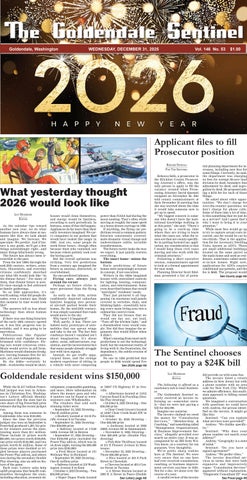
As the calendar tips toward another new year, we do what humans have always done at moments like this: we look ahead and imagine. We forecast. We speculate. We predict. And if history is any guide, we’ll get a few things astonishingly right—and many things hilariously wrong.
The future has always been irresistible to the past.
From the late 1800s through the mid-20th century, writers, scientists, illustrators, and everyday citizens confidently sketched out what life would look like “in the distant future.” For many of them, that distant future is now. Or close enough to feel awkward at family gatherings.
So as 2026 approaches, it’s worth asking: what did people decades, even a century ago, think this moment in time would look like?
The answers tell us less about technology than about human nature.
If there was one thing futurists of the early 20th century agreed on, it was this: progress was inevitable, and it was going to be marvelous.
Publications like Popular Mechanics and Popular Science brimmed with confidence. Flying cars would crisscross cities. Meals would arrive in pill form. Machines would eliminate drudgery, leaving humans free for leisure, art, and contemplation. By the 2020s—certainly by 2026—workweeks would be short,
While the $1.817 billion Powerball jackpot was won in Arkansas on Christmas Eve, Washington’s Lottery officials Monday announced that the state had its own share of big Powerball prize winners during the recent jackpot run. Among them was someone in Goldendale who won $150,000. Since the time the previous jackpot was won on September 6, Powerball produced 1,267,751 prizes for winners across the state, totaling more than $11 million. These include 21 prizes worth $50,000, two prizes worth $100,000, one prize worth $150,000, and two prizes worth $1 million. Some of these prizes were doubled or tripled because players purchased the Power Play add-on, and others won during the secondary Double Play drawing, also an add-on feature of the game. Each year, Lottery sales help uplift programs that benefit communities throughout the state, including education, economic de-
houses would clean themselves, and energy would be limitless, according to such periodicals. In fairness, some of that did happen. Appliances do far more than their early inventors imagined. We carry computers in our pockets that would have looked like magic in 1926. And yes, some people do work fewer hours—though often because their jobs vanished, not because robots politely took over the boring parts.
But the overall optimism was striking. Very few predictions from a century ago imagined the future as anxious, distracted, or overwhelmed.
No one predicted inboxes.
Flying cars: always just around the corner
Perhaps no future cliche is more persistent than the flying car.
As early as the 1910s, artists confidently depicted suburban families hopping into personal aircraft parked beside their homes. By the mid-20th century, it was simply assumed that roads would move to the sky.
Why hasn’t it happened?
Well, partly, it has. There are indeed early prototypes of automobiles that can sprout wings and take to the air. The fact that roadways haven’t vanished isn’t about imagination. It’s about safety, noise, infrastructure, regulation, and the inconvenient fact that many people already struggle just with turn signals.
Instead, we got traffic apps, carpool lanes, and the strange modern experience of sitting in a vehicle with more computing
power than NASA had during the moon landing. That’s often while moving at roughly the same speed as a horse-drawn carriage in 1890.
If anything, the flying car predictions reveal a common pattern: futurists consistently overestimate dramatic visual change and underestimate subtle, invisible transformation.
The future rarely looks the way we expect. It just quietly rewires everything.
The smart home—minus the buttons
Early predictions of future homes were surprisingly accurate in concept, if not execution.
Writers in the 1920s imagined houses with centralized controls for lighting, heating, communication, and entertainment. Some even described homes that would “anticipate” residents’ needs.
They just pictured it all happening via enormous wall panels covered in switches, dials, and blinking lights—essentially turning every main living area into a submarine control room.
They did not foresee that we would one day say, out loud, “Turn off the kitchen light,” and a disembodied voice would comply. Nor did they imagine the arguments that would follow when it didn’t.
What’s missing from most early predictions is not the technology itself, but the emotional reality of living with it: the frustration, the dependency, the subtle erosion of patience.
No one in 1926 predicted that people in 2026 would spend five
resident wins $150,000
velopment, responsible gambling, and more. More information on where the money goes and why it matters can be found at www. walottery.com/WhoBenefits.
The retailers that sold each winning ticket were:
• September 10, 2025 Drawing –One $1 million prize o Rockety located at 15119 Pacific Avenue S in Tacoma
• September 21, 2025 Drawing –
One $50,000 prize o Safeway located at 17230 140th Avenue SE in Renton
• September 27, 2025 Drawing –
One $100,000 prize (included the Power Play add-on, which was 2x on draw night, turning the $50,000 prize into $100,000) o Fred Meyer located at 101 Wellsian Way in Richland • September 29, 2025 Drawing –
$1 million prize o Safeway located at 210 Washington Avenue S in Kent • October 4, 2025 Drawing – Two $50,000 prizes o Super Duper Foods located
33607 US Highway 97 in Oroville
Albertsons located at 11012 Canyon Road E in Puyallup (Double Play drawing) • October 8, 2025 Drawing – One $50,000 prize o Clear Creek Grocery located at 14367 Clear Creek Road NW in Silverdale
• October 25, 2025 Drawing –One $50,000 prize o Jacksons located at 2936 228th Avenue SE in Sammamish
• November 8, 2025 Drawing –One $50,000 prize (Double Play drawing)
o Pick-Rite Thriftway located at 211 E Pioneer Avenue in Montesano
• November 22, 2025 Drawing –Three $50,000 prizes
Hico
rodger NichoLs For the seNtiNeL
Rebecca Sells, a prosecutor in the Klickitat County Prosecuting Attorney’s office, was the only person to apply to fill the vacancy created when Prosecuting Attorney David Quesnel resigned on November 26. She told county commissioners at their December 23 meeting that she was worried about the time it would take someone new to get up to speed.
“My biggest concern is someone who doesn’t have the institutional knowledge walking in at this point,” she said. “There’s going to be a catch-up time where they are trying to learn what the cases are, what the issues are that are county-specific. So in putting forward my application, my consideration is that I would keep those civil cases moving and also work with the criminal attorneys.”
Following a short executive session, commissioners agreed to look at a formal appointment for next week.
Planning Director Scott Edelman presented a list of poten-
tial planning department fee increases, including new fees for some filings. Currently, he said, the department was charging no fees for exempt 80-acre land division by deed, boundary line adjustment by deed, and segregation by deed. He proposed adding a $132 fee for each of those filings. He asked about other opportunities: “We don’t charge for over-the-counter questions; we don’t charge for phone calls. Some of those take a lot of time. Is this something that we just do as a service? And I guess that’s why I want to bring it to your attention.”
While most fees would go up to try to capture actual costs incurred, one fee would be cut by two-thirds. That is the application fee for Accessory Dwelling Units, known as ADUs. Those are small additional buildings located on the same parcel as the main home and used as residences, sometimes called mother-in-law homes. Right now, applications for ADUs require conditional use permits, and the fee is $660. The proposal would
Lou MarzeLes editor
The following is offered as a cautionary tale to local businesses. The Goldendale Sentinel recently received an invoice informing us—somewhat sternly—that we were late paying a bill for $24,090. Imagine our surprise. The invoice claimed we owed the money for “Consultation Services,” “Membership & Coaching,” and something called “Management, Organizational, & Business Improvement Services,” allegedly provided over nearly an entire year. It was accompanied by an IRS form W-9. You know, as a courtesy for tax purposes. Very thoughtful. We’re pretty sharp cookies here at The Sentinel. We were very aware that no one here had ever received consultation, coaching, or business improvement services anytime in 2025. Not for a day, let alone over the course of a year.
Sentinel: “Can you explain what services were provided?”
Andrea: “We dislike specificity.”
Sentinel: “Why does your phone number not match your address?”
Andrea: “Geography is a state of mind.”
Sentinel: “Do you have a signed agreement?”
Andrea: “We prefer vibes.” The invoice described services in terms that were both expansive and impressively vague. “Consultation Services” appeared without explanation. “Diagnostic Consultant III” was
A careful review of the invoice did provide us with some fun. The invoice listed a return address in New Jersey but with a phone number with an area code for New York City. While we admire efficiency, this multistate approach to billing raised questions. We imagined a conversation with questions we could have with Andrea, the person identified on the invoice. It might go like this:
Immigrationarrestsinstatesurgedinrecentmonths
JAKEGOLDSTEIN-STREET about 40% and 18%, respec- Trump retook office, comWASHINGTONSTATESTANDARD tively,intherestoftheyear pared to about 800 over the Washington Sen Patty sameperiodlastyear InSep-
The arrest figures come Federal officials are now Ina letterTuesday, many from the Deportation Data using some of the money of the Democrats in WashProject out of the Univer- to buy a half-dozen Boeing ington’s congressionaldelesity of California, Berkeley, planesfordeportationflights, gation urged theactingICE where researchers received instead of relying on char- directortoreleasethoseheld theinformationviaFreedom tered jets, accordingtoThe at the detention center who ofInformationActrequests WashingtonPost
don’t pose a public safety indicates
It provides a rare statis- Local advocacy group La threat due to concernsover tical look into the Trump Resistencia has seen the deterioratingconditionsfrom administration’sdeportation increaseinarrestsasitmoni- crowdingthere programhereandacrossthe torsdeportationflightsinand Thestatefoughtfor years outofBoeingFieldinSeattle, in court with the facility’s
nation arrested morethan950peo- ornot
The Trump administra- Murray, a Democrat, this tember alone,federalimmition’s immigration crack- month cited the case of a grationauthoritiesarrested down intensified across Clark County man who over350inWashington Washingtoninthelatesum- wasmauledbya dogduring Brenda Rodriguez Lopez, merandearlyfall,newdata hisarrestbyICEasanexam- executive director of the pie of howfederalimmigra- WashingtonImmigrantSoliBetweenJuly29andOcto- tionauthoritiesare “terror- darityNetwork,saidthedata ber 15, US Immigration izing everyone,” whether “affirms what our commuand Customs Enforcement theyhaveacriminalrecord nities have experienced for months pieinWashington Thepace “Thisshouldshockthecon-
“This represents nearly ofarrestsduringthosetwo- science of every one of us,” 2,000familieswhohavehad and-a-half months far sur- shesaidinastatement “Ido alovedonetakenawayfrom passes increases earlier in notwanttoliveinanAmer- them;2,000communitieswho theyear FromInauguration icawherefederalagentscan have suddenly lost a neighDay in January to the end sic attack dogs on peaceful bor, a coworker, a friend; of July, arrests totaled just residentswithimpunityand 2,000peoplewhohavehadto facenoconsequences
over1000
facebrutalconditions while Butevenhavingacriminal indetentionandthepossibil-
And as detainments have increased,theshareofthose history still doesn’t justify ityof permanentseparation with criminal records has allegedly abusing people’s duetodeportation,”shesaid dropped This despite fed- rights, said Vanessa Torres inastatement eral authorities claiming Hernandez, the integrated The spike in arrests in that they’retargetingimmi- policydirectorat theAmer- Washingtonmirrorsnational grantswithviolentcriminal ican Civil Liberties Union’s trends The Trump adminhistories Washingtonchapter
Just over 31% of those arrested in Washington campaign has more than efforts in major American betweentheendofJulyand doubled deportation arrests cities, but hasyet tospecifimid-October had criminal comparedtolastyearunder cally target Seattle, despite convictions Roughlyanother PresidentJoeBiden Nearly officialsfrequentlymention17% had pending criminal 2,000 people in Washington ing Washington’s biggest charges That’scomparedto have been arrested since cityasontheirradar
So the arrest figures for saidJosefinaMora-Cheung, Washington are likely an organizingdirector
But its not comprehen- toeither bedeported, trans- operator, The GEO Group, sive Forone itonlyincludes ferred or heldat the North- to inspect it Despite a ICE administrative arrests, west ICE ProcessingCenter recent appeals court rulexcludingCustomsandBor- inTacoma Thismonth, the ing in the state’s favor, derProtection And,insome organizationisseeingthree inspectorsstillhavent been cases no state is listed for orfourflightsperweek com- abletogetin accordingtothe individual arrest records paredtooneaweeklastyear, stateDepartmentofHealth Thedetentioncenterhasa historyofallegationsofmisundercount Theyalsodon’t “The movement of people treatment abuseandneglect accountfortherest ofOcto- and the targeting of people of detainees A green card berandNovember
While previous datasets that La Resistencia has not GreggySorio, had tohavea have included more com- seen since we werefounded toeamputatedduetomedical plete information on each 11yearsago,” Mora-Cheung issuesheexperienced while arrestee’scountryoforigin, said thelateststatsarelackingon Theincreasedarrestshave The question of how to stirredworriesofovercrowd- further protect immigrants
isatan unprecedentedlevel holderfromthePhilippines, beingheldthere istration has ramped up its PresidentDonaldTrump’s immigration enforcement thatfront
The jump in enforcement ingattheTacomadetention in Washington is expected followedCongressearmark- center As of November 28, tobeamajortopicofdiscusing$170 billion tocarryout the 1,575-bed facility was sion when the Legislature Trump’simmigrationagenda holding just over1,300 peo- meets starting next month in the Republican-backed pie, according to Detention for a 60-day legislative session
“big, beautiful bill” in July Reports
Fergusonproposes$244Mboost forhousing
work with lawmakers early two decades It’s estimated timehomebuyers,and$20mil- would largely come from WASHINGTONSTATESTANDARD
budget proposal and some There is also $6 million moneyfrom carbon auction to speed up development by proceedsunderthestate’sCli-
The governor also signed inthelegislativesessionthat that half of those homes lion would gotoacquireand statebonds A smallamount anexecutiveorder toget the begins next month to open needtobeaffordabletothose preservemobileandmanufac- is included in the operating Washington Gov Bob Fer- ballrollingonestablishinga up that money quickly The makinglessthanhalf of the turedhomecommunities gusonisaskinglawmakersto newcabinet-levelDepartment governorcalledthefundinga medianincome “down payment”asthestate The sum Ferguson is prohousinginvestmentsaspart “I’m enormously gratified determines the scope of the posingbuildsupon$760milof abudgetproposalreleased to stand here today and be flood damage Itllalsoserve lion in spending on affordable to make the following asabridgeasthestateworks ablehousingthatlawmakers Hisplancomesasthestate statement: We have a hous- to get disaster aid from the authorized in Washington’s grapples with an ongoing inggovernor,”Lt Gov Denny federal government in the construction budget this shortageof affordable hous- Heck, who has advised Fer- aftermath ing,andafterlawmakershave gusononhousingissues,said “Whenyouaskfordisaster directedtotheHousingTrust alreadypumpedhundredsof duringapressconferenceat relief, the stateis sayingwe Fund That’supfrom$527milmillionsofdollarstowardthe an affordable housing com- can’thandlethescopeof the lionshoveledintothefundin statesmainhousingaccount plexinsouthSeattle overthepastfewyears Some Of that $244 million, $50 Ferguson said “But we re of the funding Ferguson is million is for housing pres- workingtomakesure wedo proposing would go to help ervation,includingtorepair everythingwecanintheshort millionFergusoniscallingfor people whose homes were flood-damagedhomes Fergu- termtohelpfolksout tomake wouldgotowardtheHousing damaged in record flooding son said Another$5million sure we get support during TrustFund overthepasttwoweeks willgospecificallytoagrant thisreallycriticaltime”
Almost all of the money programtohelplow-income wouldbefromthestate’scap- homeowners with flood-re- alsareinresponsetoanesti-
Ferguson’shousingpropos- develop
affordable housingunits, he matedmillion-homeshortfall said Another $73million to Ferguson said he would thestatefacesover the next build over600unitsforfirst-
G oldendale ’ s a ttic
Answer to last week’s Mystery Picture
This week’s Goldendale’s Attic Mystery Picture
If only we could make out what it says on whatever it is this guy is holding in front of his truck. No doubt that would reveal all we need to know. It’s a nice looking
Studebaker and clearly well cared for. But who is this? Why was this picture taken? When? Where? So many questions, so few answers. All we know is this pic -
ture ran in The Sentinel sometime, lost in the annals of yesteryear. If you know anything about it, please send us an email (info@goldendalesentinel.com), or
give us a call (509-7733777), or drop in at the office—and remember, you’re welcome to come in and take a look at the original photograph.
L ooking Back
December 12, 1935 – 90 Years Ago
The new White Creek Grange was organized last Friday night at the Oak Grove School house with 36 Charter members. Charles Gains was elected Master of the new Grange, and the organization work was done by Chester Hill, Deputy Master of Klickitat County. White Creek Grange eventually moved into the former Dot Grange Hall, originally the Presbyterian Church site.
December 13, 1945 – 80 Years Ago
A fire that occurred on Monday night resulted in the complete destruction of The Oasis Café, including both the structure and its equipment.
November 17, 1955 – 70 Years Ago
The phonograph record familiar to more than a generation of listeners is on its way to oblivion. Early next year at least one major record company will stop cutting 78s—those records, which revolve around the turntable 78 times per minute. But watch the progress of the record making only 16 revolutions. It is used mostly for “talking books” now, but it is about to catch on for other types of material, too. A new record player installed in automobiles uses the 16 exclusively.
December 22, 1955 – 70 Years Ago
Klickitat County’s largest sawmill operated by the J. Neils Lumber Company, is in Klickitat and cuts approximately 100,000 board feet of pine and fir lumber every eight-hour shift. Employment is given to approximately 400 workers, including those employed in the mill and in the woods. The company owns some 100,000 acres of standing timber and does their own logging. The logging is done on a sustained-yield basis, and the logging camp is maintained near Draper Springs in the Mount Adams region. The company operates its own railroad, which was acquired with the original purchase of the mill from Western Pine Lumber Company. The railroad and equipment have been kept in excellent operating condition and has a length of eighteen miles from Klickitat into the woods. A box factory is also a part of the operation, with pine fruit boxes being manufactured, which are supplied to the fruit growers in the Pacific Northwest.
December 22, 1955 – 70 Years Ago
Seven of the large Christmas bells hung over Main Street were damaged recently by three local juvenile boys with snowballs. When caught by Police Chief Bill West, the snowball marksmen said they did the damage on three different nights. Two of the bells, put up by the Chamber of Commerce, were completely ruined. The other bells had one or more holes punched in them.
December 30, 1975 – 50 Years Ago
The most distinctive building in Klickitat County, possibly in all of Washington State, is set to receive a new roof following action by the community and county at a recent Klickitat County Park Board meeting in Appleton. The old log hall at Appleton, built about 1912, has suffered in recent years. The roof leaks badly and threatens to ruin the huge 36 by 36 ft. floor. The building is made of logs 18—24 inches in diameter and laid up in a notched-corner or log cabin style. A new shake roof was agreed at the meeting. The park board offered to match any contributions to build a fund of $1,200 to purchase shakes.
Joe
Barker Knows His Basketball
The Goldendale Sentinel –December 28, 1944
Coach E. R. “Joe” Barker, who has piloted his basketball team to eight straight victories this season, has several hobbies besides athletics. The gentleman is artistic and enjoys monkeying around making drawings for the mimeograph. He is also a home-movie enthusiast, and has made a hobby of history, particularly American and Northwest.
Has Paper Published Barker has also had a mild fling of authorship, having written a paper for his Master’s degree, which was adopted by the state of Idaho for use in the CCC. He also had an article published in the Washington Education Journal entitled “Basketball by Mail.” With the beginning of the war, many schools were unable to send teams into competition in other towns. Barker hit upon the idea of having competition based upon timing of what he termed the six skills: passing, dribbling, dribbling and shooting, foul shooting, field goal shooting, and reaction time. The Journal became interested in his new system, snapped it up, and Barker found himself gazing at his article in the magazine.
The coach attended Kellogg, Idaho, High School where he earned 12 athletic letters in a school of about 400 students. He also held the North Idaho and the state pole-vaulting record which, ironically enough, was later broken by a youth whom Barker coached in the art of pole-vaulting during his first year of coaching.
On Winning Team
Also during his high school days, he was on a YMCA team which played
during a tournament at Everett, Washington. The team won the championship of Oregon, Washington, Idaho, California, Montana, and western Canada.
Barker received an athletic scholarship to Whitman, which he attended for one semester, playing on the varsity football squad. He quit school to work, later entering the University of Idaho. When he turned out for basketball, it was discovered he would be ineligible for two years on the basis that he had played conference ball at Whitman and could not make the transfer.
His first teaching and coaching job took him to Kingston, Idaho, a very small school where there were not enough boys for two basketball teams. Barker found himself refereeing and playing at the same time during practice. To his confusion, he had his first and last girls basketball team.
“All they did was giggle every time they missed the ball or the basket, which was most of the time,” Barker reminisced.
He coached at Kamiah and later went to Sandpoint, where he devised the “shifting ball defense” which the Goldendale basketball squad now is using so successfully. Before coming here, he coached at Waitsburg. Oregon’s center; 6-foot 7-inch Ken Hays played ball for him at Waitsburg.
Barker’s team was on the short end of the scoring during the football season, but since he came here, his basketball team has won 23 out of 28 games, three of the lost games being in tournament competition.
This picture has been colorized. So far no one has been able to identify these three impish kids. If it helps, we do know the picture was taken in 1959.
Points to ponder:
A woman walked up to a little old man rocking in a chair on his porch. “I couldn’t help noticing how happy you look,” she said. “What’s your secret for a long, happy life?” “I smoke four packs of cigarettes a day,” he replied. “And I drink a case of whiskey a week, eat fatty foods, and never exercise.” “That’s amazing,” the woman said. “How old are you?” “Twenty-six,” he answered.
Have you heard about the new existential breakfast cereal? It’s called Raisins D’etre.
Little Johnny is performing in the school play when he falls through a large crack in the floor. Johnny’s father turns to his mother and says, “Don’t worry, it’s just a stage he’s going through.”
A beggar walks up to a well-dressed woman on a street in Beverly Hills and says, “I haven’t eaten in four days.” She looked at him and says, “Boy, I wish I had your will power.”
There’s been a falling-out between Madonna and Cher. Apparently they’re no longer on a first-name basis.
Did you hear about the invisible man who married an invisible woman? Their kids aren’t much to look at.
OpiniOn
January is School Board Appreciation Month
At the Goldendale School Board’s regular December meeting, two members were sworn into office and the board reorganized, establishing the board president and vice president for 2026. Heather Wilder was sworn into her first term, replacing John Hoctor as director from the 4th District. Chris Siebert was sworn in for his second term representing the 5th District. Although school directors are elected from specific areas of the district, their responsibility extends far beyond those boundaries. They represent the entire community and are tasked with serving the best interests of the district as a whole. Board members must consider the diverse needs of all students—regardless of background—so that no student is overlooked. Their work touches every part of the community, including students, families, staff, local businesses, and community organizations.
Guest Column
School boards govern school districts. They set strategic direction, hire and evaluate the superintendent, adopt policy, and oversee the district budget. School directors hold no legal authority as individuals; their authority exists only when they act together. They operate as a team, making decisions centered on what is best for the district. This concept is clearly stated in the Board’s Operating Protocol:
Ellen Perconti, GSD Superintendent
“Individual board members do not have authority. Only the board as a whole has authority. We agree that an individual board member will not take unilateral action. We agree that once a vote is taken and the board has made a decision, we will stand by that decision. The board president will communicate positions of the board on controversial issues.”
During the December meeting, the board elected Chris Twohy as board president and Deborah Heart as board vice president. The board president leads the board’s work, manages meetings, serves as the primary liaison with the superintendent, and helps ensure a professional, productive environment for governance. While the board president facilitates the team’s work, they—like all board members—hold no individual legal authority. Decision-making authority rests with the board acting as a unified body.
A helpful way to understand this distinction is to think of the school board as architects designing the blueprint for the district’s future. The board president serves as the lead architect, coordinating the team and working closely with the superintendent—much like a general contractor—to ensure the shared plan is carried out.
The board’s role is complex and deeply important. We are grateful for the leadership, time, and commitment our school directors invest on behalf of Goldendale students—throughout the year, and especially during January, School Board Appreciation Month.
THE GOLDENDALE SENTINEL
Official newspaper of Klickitat County, Washington
Established 1879 • Published every Wednesday from offices at 117 W. Main Street • Goldendale, WA 98620 • Telephone: (509) 773-3777
Classifieds @goldendalesentinel.com (Classified ads and inquiries) Ads @goldendalesentinel.com (Display advertising information and inquiries)
Legals @goldendalesentinel.com (Legal and public notices)
Payables@goldendalesentinel.com
Receivables@goldendalesentinel.com
Events @goldendalesentinel.com (Events and activities)
Editorial: Lou Marzeles, Editor & Publisher
Business and office staff: Owned by Tartan Publications, Inc.
Leslie Geatches, President, Financial management, Special Section production, Ad Design Naomi James, Bookkeeping
Burn-out has got to go
The Festival of Wheels gave it another try this year. It seems the attendance has dwindled to much lower levels than when the event was new, 10 years ago. There are a lot of competing car shows this time of year, so it doesn’t surprise me . This year Goldendale Motorsports Association and ABATE brought back the burn-out, which was tried several times in the past with questionable benefits to the town. This year someone had the brilliant idea to use the old skateboard park as a place to stage the return of the burnout. It was held on the concrete slab, a tempting medium for anyone inclined to bum rubber. Rednecks of many degrees, punk kids or maybe the little old lady from Pasadena. I personally was left with a bad taste in my mouth and lungs. Even though I made it a point to stay away from the burn-out and was at my home where I thought I would escape the noise and smoke, when the toxic cloud rose from the park and drifted over the Little Klickitat River Park (the swimming pool) on to the kids and families at the pool and on to me while I was sitting on my property. We were contaminated by the toxins in the smoke, and my eyes and throat were imitated, and my lungs filled with carbon monoxide and other cancer causing toxic compounds
for three hours. I think the city of Goldendale needs to rethink supporting burnouts in our park. Next year don’t issue a permit to any group that wants to burn-out. There are places in the county where it could be held, just not in the city please. I hate toxic smoke, and you should too.
On Sept 4 I will be asking the mayor and his administration to make an ordinance forbidding anyone from reckless unsafe burnouts in any ones neighborhood or any street in the Goldendale city limits. I would appreciate some support from like-minded citizens at the council meeting. Let them know how you feel.
Ken McKune Goldendale
I recently received an updated “Terms for Business and Deposit Account Agreement” from Columbia Bank. I am not in the habit of reading the fine print but for some reason this time I did. I came across an “added” line that I found very concerning. Again, this line is both for personal and business accounts. It reads: “We may refuse to open and account and may close your account at any time for any reason or for no reason at all.”
“For No Reason At All” I particularly found offensive.
I contacted the bank for an explanation. The answer was essentially that “we wouldn’t do that.” Then why is it in your documents, I asked. The answer was to send me up the chain of command. The second person gave the same answer as the first and then was to have me contacted by some-one higher up. That person has not contacted me after more than a week so I am following through on what I told the bank contacts I was going to do—write a letter to the editor to be sure local folks are aware of how Columbia Bank is choosing to deal with its account holders.
My concern is that a comment as broad as this opens the door for abuse. I have had no difficulties with our local branch and am sorry that the headquarters has decided to take such a hard line. It ap-pears I will need to look for a bank that does not behave in this manner.
Ken Margraf Goldendale
Letters from the community
It’s too much
I was stunned to see the article in the Sentinel regarding the idea of installing a 200-foot flag pole and huge flag at the courthouse. If this is a “gift,” the cost of maintaining the flag and pole are not reasonable, considering all the other expenses this county is in need of.
The massive structure of a base to secure it is also a problem, considering the wind we get in Goldendale.
But the most important consideration is what it will do to the aesthetics of the courthouse and the lovely lawn and park in front of it.
The courthouse is one of the architectural beauties of this county. This installation would dwarf and detract from it since it would be so out of scale. It is an inappropriate and ostentatious idea.
Here in Goldendale, there are plenty of appropriate displays of our country’s flag—at government
buildings, at the American Legion, and on the street lights on holidays.
There are better ways to display patriotism, such as gifting this money to organizations that help our fellow citizens in need.
Carol Hicks Goldendale
Who ya gonna subsidize?
It bears repeating, over and over again, that the health care subsidies the Democrats have been fighting to reinstate are expensive: an estimated $350 billion over 10 years. So, between now and 2035, it would cost that much to make sure that over 4 million people would not lose their healthcare. Many millions more will have their premiums double or more, at a time when costs for most things are increasing, thanks in
Guidelines for Letters
large part to Trump’s taxes (tariffs) on imported goods.
In contrast, the “Big Beautiful Bill” that the Republicans passed continues the tax breaks to the billionaires to the tune of $4 trillion of our tax money over the same 10 years. Now that’s a subsidy!
The pool of wealthy individuals benefiting from those tax breaks is far smaller than the millions of people affected by the loss of the health care subsidies. That’s almost 11 and a half times more expensive of a payout to people who already have too much of the money in the system.
What’s it gonna be? Millions more people in the debtors pool, or the rich swimming in their pools of money, like Scrooge McDuck? Call your Congress people!
Mark Browne White Salmon
Letters to the editor should be original and comment on an issue. Deadline for letters is noon Monday for the same week’s paper.
Requests to keep letters exactly as written when published cannot be honored. All letters are subject to editing for grammar, spelling, clarity, and/or brevity.
There is a suggested length limit of about 300 words.
Unsigned letters (including anonymity requests), letters with fictitious signatures, letters with multiple signatures, or letters to public officials are not accepted.
Please keep the tone of letters free of rants, wild speculation, unsubstantiated claims, or pointedly personal comments. Letters that go overboard in these directions will be refused publication.
Writers must include name, city/town of residence, and phone number for verification purposes. (Street address is not required, only city or town.)
H ometown
Christmas lights contest big success
Wow. How did December fly by so quickly? Here we are already on New Year’s Eve. We’re all going to have to get used to saying 2026 instead of 2025.
December brought the wonderful tradition of the Glenwood School dinner, with announcements of best holiday sweaters and door decorations, entertainment by the elementary students, and announcement of the Glenwood High School homecoming court.
Princesses this year are Jocee Hoctor, Kerryna Thompson, Brooklyn
Branson, and Dahlyla Rains. Princes are Hunter Walker, Sebastian Williams, Anthony Avila, and Wyatt Patterson. Because Glenwood has no football program, they celebrate homecoming after the final Glenwood/Klickitat (Klickwood) home basketball game, when the court will be presented and the king and queen will be crowned. The second annual Glenwood Community Christmas Lights contest
was a wonderful success this year. This year’s winners were KyAnn Kessinger and Andrew Dechand in first place, Justin and Kim Holly in second, and Kathy and Jim Roth in third. Besides all those who entered, many other residents lit up their homes and yards, too, and they all brought so much enjoyment to little kids and even big kids like me. Some were so beautiful and bright we could see them from where we live on one side of the valley
across several fields to the Trout Lake Highway. Congratulations to the winners and to all who donated prizes or monetary gifts to help with prizes. And, again, a huge thanks goes to Jennifer Throop for taking the lead in this fun event. Start thinking about Christmas 2026, everyone. I hope all students and staff are enjoying their Christmas break to the fullest. School will resume on Monday, January 5, and the Klickwood High School basketball team will have three games that week. In
Whole milk back on school lunch menus
Shauneen M iranda
W a S hington S tate Standard
School cafeterias got a step closer to seeing whole milk again after the U.S. House passed a measure Monday to restore the dairy staple to school lunches.
The bill unanimously passed the Senate back in November.
The bipartisan effort— which passed the House by voice vote—came after whole milk was barred from school meal programs for more than a decade amid a broader push to curb childhood obesity.
Under the bill, schools that participate in the U.S. Department of Agriculture’s National School Lunch Program would be
allowed to offer “flavored and unflavored organic or nonorganic whole, reducedfat, low-fat, and fat-free fluid milk and lactose free fluid milk” as well as “nondairy beverages that are nutritionally equivalent to fluid milk and meet the nutritional standards established by the Secretary.”
The bill also would exempt milk fat from being considered saturated fat as it applies to schools’ “allowable average saturated fat content of a meal.”
The measure allows parents and guardians, on top of physicians, to offer a written statement for their student to receive a nondairy milk substitute.
GOP Sens. Roger Mar -
shall of Kansas and Dave McCormick of Pennsylvania, along with Democratic Sens. Peter Welch of Vermont and John Fetterman of Pennsylvania, introduced the measure in the Senate in January.
Republican Rep. Glenn “GT” Thompson of Pennsylvania and Democratic Rep. Kim Schrier of Washington state brought corresponding legislation in the House.
‘An essential building block’
During floor debate Monday, Thompson, who chairs the House Agriculture Committee, said the bill’s purpose is to “restore students’ access to a wide variety of milk options, ensuring students have the necessary nutrients to
learn and to grow.”
Thompson said, “Milk is an essential building block for a well-rounded and balanced diet, offering 13 essential nutrients and numerous health benefits,” but that “unfortunately, out-of-touch and outdated federal regulations have imposed restrictions on the types of milk students have access to in school meals.”
Thompson pointed out that the bill “does not require any student to drink or any school to serve whole milk” and instead “simply gives schools the flexibility to serve a broader variety of milk in the school lunchroom.”
But Rep. Bobby Scott, ranking member of the House Committee on Edu-
Schlegel named to Honor List at Cedarville University
Kiana Schlegel of White Salmon was named to the Dean’s Honor List at Cedarville University for Fall 2025. This recognition requires the student to obtain a 3.75 GPA or higher for the semester and carry a minimum of 12 credit hours.
Cedarville University, an evangelical Christian institution in southwest Ohio, offers undergraduate and graduate residential
and online programs across arts, sciences and professional fields. With 7,265 students, it is among Ohio’s largest private universities and is ranked among the nation’s top five evangelical universities in the Wall Street Journal’s 2026 Best Colleges in the U.S. Cedarville is also known for its vibrant Christian community, challenging academics and graduation and retention rates.
addition to away games in Goldendale and Dufer, Klickwood boys will play Trout Lake on the Glenwood court on Friday, January 9. Klickwood is having an awesome season so far, ranked 5th in the State as of this writing. Let’s hope for a huge turnout to show our support for our team. The middle school basketball team, Little Klickwood, has no games scheduled to take place in the Glenwood gym for the rest of the season, but we wish them great success as they travel for the remainder of their
games.
Klickwood does not have a girls high school team this season, but if you want some exciting girls basketball, the Trout Lake girls, with our Glenwood girl Emma Patterson, will play at home in Trout Lake on January 3. Emma is a leading scorer, not only for her team, but among all the players in the Big Sky 1A league this year. As I finish this last Glenwood News of 2025, I wish everyone a safe and fun New Year’s celebration and a very good 2026.
cation and Workforce, voiced his opposition, saying that while the bill “does make some improvements to the whole milk debate with its inclusion of better options for students seeking non-dairy alternatives,” he remains “disappointed that the bill overall would make school meals less healthy.”
The Virginia Democrat said the bill “goes against the dairy industry’s stated commitment to ensure that students have access to the healthiest dairy options” consistent with USDA’s and the U.S. Department of Health and Human Services’ Dietary Guidelines for Americans.
Milk industry praise
The top five milk-producing states in 2023 were
California, Wisconsin, Idaho, Texas and New York, according to the U.S. Department of Agriculture’s Economic Research Service.
Michael Dykes, president and CEO of the International Dairy Foods Association, celebrated House passage of the bill, which he dubbed a “defining victory for children’s health and for the dairy community that has fought for more than a decade to restore whole and 2% milk for our nation’s students.”
Dykes urged Trump to sign the bill into law so that USDA “can begin working with state governments and school districts across the country to make this law a reality.”
Adventist Health reopens clinics following Water’s Edge storm closure
Just three business days after extensive storm damage closed its largest clinic building, Adventist Health Columbia Gorge reopened about 80% of its affected clinical services on December 22 by relocating them to its other facilities in The Dalles and Hood River. That included the reopening of Immediate Care, which served more than 20 patients on its first day at its new location in the Family Medicine clinic building at 1620 E. 12th St.
Internal Medicine reopened in the Columbia Crest building on Monday, December 29, while plans for the ENT (Ears, Nose, and Throat) Clinic are still being determined.
“The way our staff and providers responded is nothing short of heroic,” said Nick Dills, administrative direc-
tor of clinical operations for Adventist Health Columbia Gorge. “From phones and computers to exam tables and office supplies, they had to source and move everything for multiple clinics.”
One important source was sister hospital Adventist Health Portland, which sent equipment to The Dalles to support the relocated clinics. “We were able to send a number of pieces of equipment, including a high-low table, bike ergometer, exercise benches, etc. to help Adventist Health Columbia Gorge establish rehabilitation therapy treatment rooms in the hospital to continue seeing outpatients,” explained Larry Soule, Adventist Health Portland rehabilitation services administrative director. Adventist Health Oregon Network President Kyle King
visited The Dalles last Tuesday to view the Water’s Edge damage and see the rapid redeployment of clinical services firsthand.
Patients are encouraged to reach out to the clinics if they have questions about scheduling their appointments. As of today, the automated appointment reminder system and MyChart patient portal have not updated with the new clinic locations, so patients are encouraged to reach out to their clinics. The clinic phone and fax numbers are unchanged.
The Water’s Edge building owner is managing the repairs. A temporary roof has secured the building from the elements, and remediation has begun. The date for reopening has not been determined.
County road safety virtual open house now live
Klickitat County is ready to share recommendations on key transportation safety improvements as part of the update to its Road Safety Plan. This plan is intended to guide the County on addressing safety issues on county-maintained roads, with the goal of reducing fatal and serious injury crashes. This phase of public engagement focuses on
LOTTERY from page A1
Play drawing)
• November 24, 2025 Draw-
ing – Two $50,000 prizes
o Fred Meyer located at 6305 Bridgeport Way W in University Place
o Jacksons located at 13138 Interurban Ave S in Tukwila (Double Play drawing)
• November 26, 2025 Draw-
ing – One $50,000 prize
o Chevron located at 119 Interstate Avenue in Chehalis
• December 6, 2025 Drawing
– Two $50,000 prizes
o Handy Mart located at 500
gathering input on safety strategies and priority locations.
A virtual open house is now live and will be available through January 21. Community members can review crash trends, explore proposed emphasis areas and strategies, and provide feedback on where safety improvements are most needed.
Visit the virtual open
E State Street in Sedro Woolley
o Safeway located at 121 W Walnut Street in Newport
• December 10, 2025 Drawing – One $50,000 prize and one $150,000 prize
o $50,000 prize:
o Fred Meyer located at 5502 Point Fosdick Drive NW in Gig Harbor
o $150,000 prize (included the Power Play add-on, which was 3x on draw night, turning the $50,000 prize into $150,000)
o Market Fresh located at 622 E Broadway Street
house at https://arcg. is/1CDuCX1.
This planning effort is funded through the state’s Highway Safety Improvement Program. While not all improvements identified in the plan can be built right away, the Road Safety Plan will help the County apply for funding and focus limited resources where they will make the greatest impact.
in Goldendale
• December 13, 2025 Drawing – One $50,000 winner and one $100,000 winner
o $50,000 prize:
• Evergreen Food Store located at 7306 Evergreen Way in Everett
o $100,000 prize (included the Power Play add-on, which was 2x on draw night, turning the $50,000 prize into $100,000):
o QFC located at 1009 Monroe Avenue in Enumclaw
• December 15, 2025 Drawing – Two $50,000 prizes
o Thanh Thanh Café located
COUNTY from page A1
change that to outright permitted uses, and in that case, the fee would drop to $198. Any adjustments will be taken up early in 2026.
Undersheriff Carmen Knopes and Chief Civil Deputy Karen Elings reported on the Sheriff’s Department in place of Sheriff Bob Songer, who was out sick. Knopes said during the recent storms that slammed the county, she made multiple trips through the county, checking on things and taking pictures. “We fared pretty well, compared to other counties,” she said. “For that, I’m pretty grateful. There are a lot of downed trees in Trout Lake. I saw a very large shop that was being built that was destroyed by a very large pine tree. And there’s a number of residences whose yards are completely underwater.”
Other folks embraced the downpour.
Public feedback remains a critical part of this effort and will help shape final recommendations aimed at saving lives on Klickitat County roads.
For questions about the project or to request updates, please contact Kevin Leis, Klickitat County Public Works Department, at kcpublicworks@klickitatcounty.org or (509) 773-4616.
at 6033 Martin Luther King Jr. Way in Seattle
o Chevron located at 804 South Hill Park Drive in Puyallup
• December 20, 2025 Drawing – One $50,000 prize
o Delighful Neighborhood Market located at 4818 N 45th Street in Tacoma
• December 24, 2025 Drawing – Two $50,000 prizes
o Great American Casino located at 12715 4th Avenue W in Everett
o ARCO located at 3002 Old Fairhaven Parkway in Bellingham
“There are a number of kayakers who are taking advantage of the swift water,” she said. “They’re stoked. Their adrenaline is rushing. But there are a lot of logs and debris in the water. The dangers are real, and there’s a risk of Search and Rescue being called out for a swift water rescue.” She also said the office was checking the impound yard. “There are a number of items up there that can go to surplus,” she said. “We’re getting all that together. Our goal is to have all the documentation in by the end of February and submit it to the Treasurer’s Office for a spring sale.”
Under the consent agenda, commissioners approved:
• A second amendment to the Indian Hill Public safety radio site lease.
• Budget transfers to ensure that departments do not exceed their budget allocations and to accommodate
from page A1
mentioned, though no one could identify what levels I or II might involve, or when any diagnosis occurred.
There was no contract number, no staff contact, and no detail on what work was done—only a balance due and a reminder that paper checks were no longer accepted, and payment should be made electronically.
That detail alone was enough to trigger every fraud alarm bell in the building.
After confirming the bill was not legitimate, we decided the best response was not just to ignore it— but to share it.
Fraudulent invoices like this one are increasingly common, and many are designed to look official enough that a busy office might pay them without a second look. Large dollar amounts, authoritative language, and urgent timelines are all part of the strategy.
What this invoice did not include was equally telling:
changes in departmental need.
• A third amendment to Senior Transportation Services with the Area Agency on Aging and Disabilities of Southwest Washington (AAADSW).
• A third amendment to the disease prevention health promotion agreement with (AAADSW) for 2026.
• Renewal of the family caregiver support services contract with AAADSW for 2026.
• Amendment no. 1 to the agreement for MTD: MAC/TSOA with AAADSW for 2026.
• Amendment no. 7 to the senior nutrition services with AAADSW for 2026.
• Vacation carryover for a Senior Services employee.
• Purchase of ProForce equipment for the Sheriff’s Office 2025-1223.
• Purchase of RMA Armament for the Sheriff’s Office.
• A signed agreement
• A known point of contact
• A clear explanation of services
• Any prior correspondence In short, it had everything a scam needs—except credibility. After careful review, we made the difficult decision (hardly) not to remit $24,090 for services we never received, from a company we never hired, located in places we never contacted. Instead, we are investing that money in reckless pursuits such as:
• Printing newspapers
• Paying real vendors
• Continuing to ask inconvenient questions
We share this story not just for a laugh (though laughter is warranted), but as a reminder to local businesses and residents alike: Read before you pay. Verify before you wire. And when something doesn’t add up—trust your instincts.
FRAUD
2026 from page A1
minutes rebooting a device just to make coffee. Predictions of leisure
(and the absence of it)
One of the great ironies of historical futurism is how consistently it promised us more free time. Machines would do the work. Automation would handle the boring stuff. Humans would relax.
In 1930, economist John Maynard Keynes famously predicted that by the 21st century, people would work about 15 hours a week.
He was wrong—but not because productivity didn’t rise. It did. Dramatically. What futurists failed to predict was that we would simply invent new kinds of work, new forms of urgency, and entirely new ways to feel busy. We didn’t eliminate labor. We rebranded it, digitized it, and made it portable. The future didn’t free us
Lou MarzeLes Editor
As the calendar turns and a new year begins, millions of Americans pause to take stock of their lives and make resolutions—small or ambitious promises to themselves about what they hope the year ahead will bring.
While resolutions often start with good intentions, studies show many fade by February. Experts say the key isn’t making fewer resolutions, but making better ones—clear, realistic goals paired with practical strategies.
Here’s a look at the most common New Year’s resolutions, grouped by category, along with tips to help turn good intentions into lasting habits.
Health and wellness
Most popular resolutions:
• Exercise more
• Lose weight
• Eat healthier
• Improve sleep These remain the most common resolutions year after year, reflecting a growing awareness of physical and mental well-being.
Tips for success:
• Start small: Ten minutes of walking a day beats an unused gym membership.
E xtra
from work. It moved work into our pockets. The moral future that never arrived
Many early predictions assumed that technological progress would naturally lead to moral progress. As machines advanced, humanity would become wiser. War would become unthinkable. Education would flourish.
Reason would prevail.
In 1926, the trauma of World War I still haunted Europe and America. Many believed it had been so devastating that civilization would surely never repeat the mistake. History, of course, disagreed. By 2026, we have more information than any generation before us—and arguably less consensus. We have instant communication and endless misunderstanding. We can fact-check anything
• Focus on habits, not outcomes: “Move daily” is easier to sustain than “lose 30 pounds.”
• Track progress simply: A calendar checkmark can be surprisingly motivating.
Financial goals
Most popular resolutions:
• Save more money
• Reduce debt
• Create (or stick to) a budget
After the holidays, financial resolutions often feel urgent—and achievable with structure.
Tips for success:
• Automate savings, even if it’s just $10 per paycheck.
• Set one clear target: emergency fund, credit card payoff, or vacation savings.
• Review spending monthly, not daily, to avoid burnout.
Personal growth and mental health
Most popular resolutions:
• Reduce stress
• Practice mindfulness or gratitude
• Read more
• Learn something new These quieter goals often reflect a desire for balance and meaning rather than dramatic change.
Tips for success:
yet often choose not to. This isn’t a failure of technology. It’s a reminder that tools amplify whatever values humans bring to them.
The future didn’t necessarily make us better people. It did make us louder.
Fiction saw it coming (sort of)
Some of the most unsettling predictions came not from engineers, but from novelists.
Jules Verne imagined astonishing technologies but maintained a faith in human ingenuity. Later writers were less optimistic.
In 1949, George Orwell published 1984, envisioning a future of constant surveillance, manipulated truth, and language stripped of meaning. Orwell got the year wrong. But many readers today find the feeling uncomfortably familiar. What Orwell didn’t predict
• Attach goals to existing routines (reading before bed, journaling with morning coffee).
• Replace “all or nothing” thinking with consistency.
• Celebrate showing up, not perfection.
Relationships and community
Most popular resolutions:
• Spend more time with family
• Strengthen friendships
• Volunteer or give back
Many resolutions reflect a longing for connection— especially after years of social disruption.
Tips for success:
was that much of the surveillance would be voluntary and often enthusiastically adopted. We would carry tracking devices willingly. We would broadcast our lives publicly. We would trade privacy for convenience and call it freedom.
The future, it turns out, didn’t force itself on us. We invited it in.
The predictions no one made
Perhaps the most revealing aspect of historical futurism is what it missed entirely.
No one predicted social media. Or smartphones. Or the psychological effects of constant, but distant, connectivity. No one imagined that a device meant to save time would become the primary way time disappears.
Even fewer predicted the emotional landscape of the modern age: the loneliness,
• Schedule connection like any other priority.
• Start with one relationship or one cause.
• Look local: schools, libraries, food banks, and community groups always need help.
Work, career, and life organization
Most popular resolutions:
• Improve work-life balance
• Get organized
• Reduce screen time
• Pursue a career change or side project
These resolutions often signal a desire for clarity and control.
Tips for success:
the comparison, the sense of being everywhere and nowhere at once.
Technology advanced. Human needs remained stubbornly unchanged.
People in 1926 worried about belonging, purpose, and meaning just as we do in 2026. They simply assumed the future would solve those problems automatically. It didn’t.
So what will we get wrong about 2126?
If history is any guide, our own predictions about the future will age just as badly.
We will overestimate the visibility of change and underestimate its subtlety. We will imagine dramatic breakthroughs and miss the quiet shifts that actually reshape daily life.
We will assume technology will fix problems that are, at heart, human. And someone a hundred
• Declutter one space at a time.
• Set phone-free hours rather than eliminating screen time altogether.
• Break large goals into quarterly or monthly steps.
Why most resolutions fail—and how to beat the odds Experts point to a few common pitfalls:
• Goals that are too vague (“be healthier”)
• Too many changes at once
• Relying on motivation instead of routine
What works instead:
• Clear, specific goals
• Built-in accountability
• Self-compassion when
years from now will look back at our confident forecasts—our charts, our headlines, our certainty—and smile gently at how sure we were. A New Year’s lesson from the past Looking back at old predictions isn’t about mocking the past. It’s about humility. Every generation believes it stands at the edge of something final—some culmination of history where the big questions will be answered and the future will settle into place. It never does. The future arrives not as a destination, but as a continuation. Messy. Surprising. Occasionally miraculous. Often inconvenient.
As 2026 approaches, perhaps the most honest prediction we can make is this: it won’t be what we expect. And that may be exactly the point.
setbacks happen
Research consistently shows that people who view setbacks as part of the process—not as failure—are far more likely to succeed long-term.
A gentler approach to the New Year
Not everyone feels inspired by resolutions. Some prefer a single word for the year—balance, kindness, or focus—or choose to reflect rather than reinvent. Whatever the approach, the new year doesn’t require perfection. It simply offers another chance to begin again.
Contributed: troy Carpenter
NOTICE TO CONTRACTORS
Sealed bids for the CGRA Business Park Training Facility Project, will be received by the Board of County Commissioners at the reception desk located in the Klickitat County Public Works Department, 115 West Court Street, Room 302, Goldendale Washington. Mailing address 115 West Court Street, Mail Stop 303 Goldendale Washington 98620 until 1:15 p.m. on January 6, 2026 for performing the work described below. Sealed bids received will be opened at the Commissioner’s Chambers and publicly read aloud on Tuesday, January 6, 2026 at 1:30 p.m. or shortly thereafter. Bids received after 1:15 p.m. January 6, 2026 will not be considered. The county reserves the right to reject any and all bids, and to waive informalities that are not, in the opinion of the County Commissioners, material.
Bid envelopes shall be appropriately marked on the outside “Bid opening 1:30 p.m. January 6, 2026 CGRA Business Park Training Facility Project”.
This contract provides for the construction of a 10,000 s.f. Training Facility and lot 17 site development. Specific work includes, but not limited to concrete foundation, building construction, excavation, utilities, base/top course, HMA roadway, all in accordance with the Plans, Contract Provisions and the Standard Specifications
Bid proposals shall be accompanied by a bid proposal deposit in cash, certified check, cashier’s check or surety bond in the amount equal to five percent (5%) of the amount in the bid proposal. Should the successful bidder fail to enter into such contract and furnish satisfactory performance bond within the time stated in the specifications, the bid proposal deposit shall be forfeited to Klickitat County. Approximate project cost is estimated to be between $2,300,000 and $3,500,000.
The Klickitat County Public Works Department, in accordance with the provisions of Title VI of the Civil Rights Act of 1964 (78 Stat. 252, 42 US.C. §§ 2000d to 2000d-4) and the Regulations, hereby notifies all bidders that it will affirmatively ensure that any contract entered into pursuant to this advertisement, disadvantaged business enterprises will be afforded full and fair opportunity to submit bids in response to this invitation and will not be discriminated against on the grounds of race, color, or national origin in consideration for an award.
Obtaining Bid Documents: Free of charge: Plans, Specifications, addenda, bidders list, and plan holders list for the project are available though the Klickitat County’s on-line plan room. Free of charge access is provided to Prime Contractors, Subcontractors and Venders by going to http://bxwa.com and clicking on: Posted Projects; Public Works; Klickitat County; and Projects Bidding. Bidders are encouraged to “Register” in order to receive automatic email notification of future addenda and to place themselves on the self registered “Bidders List.” This on-line plan room provides Bidders with fully usable on-line documents; with the ability to: download, print to your own printer, order full / partial plan sets from numerous reprographic sources (on-line print order form), and a free on-line digitizer / takeoff tool. Contact Builders Exchange of Washington at 425258-1303 should you require assistance.
Dated this 2nd Day of December, 2025. BOARD OF COUNTY COMMISSIONERS
Klickitat County, Washington
Ron Ihrig, Chairman
Todd Andrews, Commissioner Lori Zoller, Commissioner
ATTEST: LeeAnn Burgin Clerk of the Board Klickitat County, Washington (4912, 5005, 5102, 5201, 5301)
CITY OF GOLDENDALE
NOTICE OF PUBLIC
HEARING
NOTICE IS HEREBY GIVEN that the Goldendale Hearing Examiner on January 7, 2026 at 2:00pm in the Council Chambers at City Hall, 1103 S. Columbus, Goldendale, Wash-
N otices
ington 98620 Also accessible via zoom https://us02web. zoom.us/j/ 3732905204?
omn=86541073808 You can go to our website for instructions on how to get on Zoom. THE PURPOSE of said hearing is to hear all interested parties who wish to testify for or against the following proposal: a variance request VAR # 2502 by Ty & Barbara Ross. Said proposal is on the following described property: LOTS 1-16 BLK 20 GOLDEN 2nd NENE 20-4-16, Parcel # 04162054200000, Commonly known as 205 S Columbus (Courthouse).
The Goldendale Hearing Examiner may act on this matter to approve, deny, approve with conditions, table, or continue these issues to a set time and place.
The application is available for review at Goldendale City Hall, 1103 South Columbus Avenue, Goldendale, WA 98620
Robert Thompson Building Official/ Code Enforcement City Planning (5106, 5204, 5302)
NOTICE TO CONTRACTORS
Sealed bids for the Bundle #2 – Preventative Maint. –Bearing Repairs, CRP 378, will be received by the Board of County Commissioners at the reception desk located in the Klickitat County Public Works Department, 115 West Court Street, Room 302, Goldendale Washington. Mailing address 115 West Court Street, Mail Stop 303 Goldendale Washington 98620 until 1:15 p.m. on January 13, 2026 for performing the work described below. Sealed bids received will be opened at the Commissioner’s Chambers and publicly read aloud on Tuesday, January 13, 2026 at 1:30 p.m. or shortly thereafter. Bids received after 1:15 p.m. January 13, 2026 will not be considered. The county reserves the right to reject any and all bids, and to waive informalities that are not, in the opinion of the County Commissioners, material.
Bid envelopes shall be appropriately marked on the outside “Bid opening 1:30 p.m. January 13, 2026 Bundle #2 –Preventative Maint. – Bearing Repairs, CRP 378”. This contract includes jacking the existing superstructure to replace/reset the existing deficient bearing pads, repair damaged bearing seats as required and other work on structures 08665000, 08581700, 08211300, 08157300 and 08045300, all in accordance with the Contract Plans, Contract Provisions, and the Standard Specifications.
Bid proposals shall be accompanied by a bid proposal deposit in cash, certified check, cashier’s check or surety bond in the amount equal to five percent (5%) of the amount in the bid proposal. Should the successful bidder fail to enter into such contract and furnish satisfactory performance bond within the time stated in the specifications, the bid proposal deposit shall be forfeited to Klickitat County.
Approximate project cost is estimated to be between $900,000 and $1,500,000. The Klickitat County Public Works Department, in accordance with the provisions of Title VI of the Civil Rights Act of 1964 (78 Stat. 252, 42 US.C. §§ 2000d to 2000d-4) and the Regulations, hereby notifies all bidders that it will affirmatively ensure that any contract entered into pursuant to this advertisement, disadvantaged business enterprises will be afforded full and fair opportunity to submit bids in response to this invitation and will not be discriminated against on the grounds of race, color, or national origin in consideration for an award.
Obtaining Bid Documents:
Free of charge: Plans, Specifications, addenda, bidders list, and plan holders list for the project are available though the Klickitat County’s on-line plan room. Free of charge access is provided to Prime Contractors, Subcontractors and Venders by going to http://bxwa.com and clicking on: Posted Projects; Public Works; Klickitat County; and Projects Bidding. Bidders are encouraged to “Register” in order to receive automatic email notification of future addenda and to place themselves on the self registered “Bidders
This Just In....
Public Notice: Communications tower Klickitat WACalifornia Newspaper Service Bureau Cal for Bid: Tree Trimming - Public Utility District No. 1 of Klickitat County
Klickitat County Mitigated Determination of NonSignificance: SEPA2025-23 Richard Patterson, SEPA2025-24 Mikal Rahman - Klickitat County Planning Department
Notice of Public Hearing: Amendment to 2026 County Planning Fee Schedule - Klickitat County Planning Department
Notice of Planned County Force Work: 2026 Road Projects - Klickitat County Public Works Notice of Meeting: Klickitat County Solid Waste Advisory Board January 7, 2026 - Klickitat County Solid Waste
• Notice of Election: February 25, 2026 - Eastern Klickitat Conservation District
• Probate Notice to Creditors: Wayne L. Cox - Brian H. Wolfe, P.C.
List.” This on-line plan room provides Bidders with fully usable on-line documents; with the ability to: download, print to your own printer, order full / partial plan sets from numerous reprographic sources (on-line print order form), and a free on-line digitizer / takeoff tool. Contact Builders Exchange of Washington at 425258-1303 should you require assistance.
Dated this 16th Day of December, 2025. BOARD OF COUNTY COMMISSIONERS Klickitat County, Washington Ron Ihrig Chairman Todd Andrews Commissioner Lori Zoller Commissioner ATTEST: LeeAnne Burgin Clerk of the Board Klickitat County, Washington (5108, 5206, 5303, 0101) IN THE SUPERIOR COURT OF THE STATE OF WASHINGTON IN AND FOR THE COUNTY OF KLICKITAT Estate of, JERRY L. MOSS, Deceased. Case No.: 25-4-00082-20
PROBATE NOTICE TO CREDITORS (RCW 11.40.030)
PLEASE TAKE NOTICE
The above Court has appointed Jeri L. Sanchey as Personal Representative of Decedents’ estate. Any person having a claim against the Decedent must present the claim: (a) Before the time when the claim would be barred by any applicable statute of limitations, and; (b) In the manner provided in RCW 11.40.070: (i) By filing the original of the claim with the foregoing Court, and (ii) By serving on or mailing to me at the address below a copy of the claim. The claim must be presented by the later of: (a) Thirty (30) days after I served or mailed this Notice as provided in RCW 11.40.020(1) (c), or (b) Four (4) months after the date of first publication of this Notice. If the claim is not presented within this time period, the claim will be forever barred except as provided in RCW 11.40.051 and 11.40.060. This bar is effective for claims against both the Decedent’s probate and nonprobate assets.
First Publication of this Notice: December 17, 2025
Justin D. Leigh (WSBA No. 55307) Attorney for Chad L. Fleischer
PHILLIPS REYNIER SUMERFIELD CLINE & SMITH, LLP P.O. Box 758 Hood River, OR 97031 (541) 386-4264 justin@phillipsreynier.com (5109, 5207, 5304)
IN THE SUPERIOR COURT OF THE STATE OF WASHINGTON IN AND FOR THE COUNTY OF KLICKITAT
Estate of, LINDA L. FLEISCHER, Deceased. Case No.: 25-4-00081-20
PROBATE NOTICE TO CREDITORS (RCW 11.40.030) PLEASE TAKE NOTICE
The above Court has appointed Chad L. Fleischer as Personal Representative of Decedents’ estate. Any person having a claim against the Decedent must present the claim: (a) Before the time when the claim would be barred by any applicable statute of limitations, and; (b) In the manner provided in RCW 11.40.070: (i) By filing the original of the claim with the foregoing Court,
State of Washington who are qualified to perform any of the above listed categories and wish to be included please call 1-800-583-8074 or (509) 7734616 for an application. Applications are also available on our web site at https://www. klickitatcounty.gov/DocumentCenter/View/15217/SmallWorks-Application-2026 (5214, 5307)
NOTICE OF ELECTION Resolution # 12.11.2025-1 December 11, 2025
WHEREAS, the Board of Supervisors of the Central Klickitat Conservation District (“District”) operates under the laws of the State of Washington applicable to conservation districts.
and (ii) By serving on or mailing to me at the address below a copy of the claim. The claim must be presented by the later of: (a) Thirty (30) days after I served or mailed this Notice as provided in RCW 11.40.020(1) (c), or (b) Four (4) months after the date of first publication of this Notice. If the claim is not presented within this time period, the claim will be forever barred except as provided in RCW 11.40.051 and 11.40.060. This bar is effective for claims against both the Decedent’s probate and nonprobate assets.
First Publication of this Notice: December 17, 2025
Justin D. Leigh (WSBA No. 55307) Attorney for Chad L. Fleischer PHILLIPS REYNIER SUMERFIELD CLINE & SMITH, LLP P.O. Box 758 Hood River, OR 97031 (541) 386-4264 justin@phillipsreynier.com (5110, 5208, 5305)
IN THE SUPERIOR COURT OF WASHINGTON FOR KLICKITAT COUNTY
In Re The Estate of: JAMES LAWRENCE SMITH, Deceased. No. 25-4-00079-20
PROBATE NOTICE TO CREDITORS RCW 11.40.030
The Personal Representative named below has been appointed as Personal Representative of this Estate. Any person having a claim against the Decedent must, before the time the claim would be barred by any otherwise applicable statute of limitations, present the claim in the manner as provided by RCW 11.40.070 by serving on or mailing to the Personal Representative or the Personal Representative’s attorney at the address stated below a copy of the claim and filing the original of the claim with the court in which the probate proceedings were commenced. The claim must be presented within the later of: (1) Thirty days after the Personal Representative served or mailed the notice to the creditor as provided under RCW 11.40.020(1)(c); or (2) four months after the date of the first publication of this notice. If the claim is not presented within this time frame, the claim is forever barred, except as otherwise provided in RCW 11.40.051 and 11.40.060. This bar is effective as to claims against both the Decedent’s probate and nonprobate assets. Date of First Publication: Wednesday, December 17, 2025.
MICHAEL ERNEST HENDRICKSON
Personal Representative PO Box 933 White Salmon, Washington 98672
VanKOTEN & CLEAVELAND LLC
VICTOR W. VanKOTEN
Attorney for Personal Representative 417 Sherman Avenue, Suite 7 Hood River, Oregon 97031 Telephone: (541) 436-3422 (5111,5209, 5306)
PUBLIC NOTICE
KLICKITAT COUNTY is in the process of updating its’ Small Works Roster (SWR) for 2026. Only contractors that fill out the County’s SWR application can be added to the roster. Contractors/Vendors that are on the SWR will be eligible to bid on county projects. Categories of work include road and building construction, snow removal, renovation, remodeling, alteration, repair, or improvement of real property. Contractors licensed in the
WHEREAS the District is governed by a five-member board, as set out in RCW Chapter 89.08 and WAC Section 135-110. It is RESOLVED that a pollsite election for an open position on the District board of Supervisors will be held on February 12, 2026 from 9:00 a.m. until 1:00 p.m. at the Centerville Grange 2288 Centerville Hwy Centerville, WA 98613. The elected position whose term is expiring in May 2026 is currently held by Miland Walling. The appointed position whose term is expiring in May 2026 is currently held by Marty Hudson.
Interested candidates must be registered voters who reside within the boundaries of the District. Candidates may be required to be landowners or operators of a farm, depending on the current composition of the District board of supervisors. The filing deadline for candidates to file their candidate information is January 12, 2026 at 4:00 pm. Interested candidates must file their candidate information at the following location: 1107 S. Columbus Ave., Goldendale WA 98620. The election supervisor will be Courtney Tatro. A conservation district supervisor is a public official who serves without compensation and who sets policy and direction for the conservation district. The published election procedures can be viewed at the District office and are available from the Washington State Conservation Commission at http://scc.wa.gov/. Adopted at a board meeting of the District Board of Supervisors on December 11, 2025. (5215, 5308)
PUBLIC NOTICE
Cellco Partnership and its controlled affiliates doing business as Verizon Wireless (Verizon Wireless) proposes to collocate wireless communications antennas at a top height of 107.8 feet on a 129-foot selfsupport telecommunications tower at the approx. vicinity of Unassigned address, Klickitat, Klickitat County, WA 98635 (lat: 45-42-42.85; long:-1216-55.12). Public comments regarding potential effects from this site on historic properties may be submitted within 30 days from the date of this publication to: Trileaf Corp, Taylor Blackbourn, t.blackbourn@ trileaf.com, 2121 W Chandler Blvd, Suite 108, Chandler, AZ 85224, (480) 850-0575. 12/31/25 (5309)
CALL FOR BID
Sealed bids will be received by the Commission of Public Utility District No. 1 of Klickitat County for Tree Trimming and Right of Way Clearing Bid 2026 with the option for one (1) one (1) year extension. Bids will be received until January 14, 2026 at 2:00 P.M., Pacific Time, at the District’s office at 1313 South Columbus, Goldendale, Washington, 98620, at which place the proposals will be publicly opened and read at 2:15 p.m. The bid documents and specifications may be obtained at the District’s office. Each bid shall be accompanied by a certified or cashier’s check on a bank that is a member of the Federal Deposit Insurance Corporation payable to the order of the Commission of Public Utility District No. 1 of Klickitat County, or by a bid bond with a corporate surety licensed to do business in the State of Washington in an amount not less than 5% of the amount of the bid. Each bid to be firm and binding for 60 days after
the time set for the bid opening. The District reserves the right to reject any and all proposals, and to waive minor irregularities and errors. Dated this 23rd day of December, 2025. PUBLIC UTILITY DISTRICT NO. 1 Of KLICKITAT COUNTY. Dan Gunkel, President (5310, 0102) KLICKITAT COUNTY MITIGATED DETERMINATION OF NON-SIGNIFICANCE Notice is hereby given that Klickitat County issued two Mitigated Determination of Non-significance (MDNS) on December 26, 2025 under SEPA Rules (Chapter 197-11 WAC) and the Klickitat County Environmental Ordinance Number 121084, as amended, for the following proposals: SEPA2025-23. Applicant: Richard Patterson. A Short Plat application requesting to subdivide 1 acre into two lots. The proposed short plat is located in a portion of the NWSW of Section 34, T2N, R13E, W.M. Klickitat County, WA (Dallesport vicinity) on tax parcel 02-13-3455-0101/00. SEPA2025-24. Applicant: Mikal Rahman. A Short Plat application requesting to subdivide approximately 18 acres into three lots. The proposed short plat is located in a portion of S2NW of Section 2, T6N, R12E, W.M. Klickitat County, WA (Glenwood vicinity) on tax parcel 06-12-02092903/00. After review of the completed environmental checklists and other information on file the Klickitat County Responsible Official has determined that these proposals will not have probable significant adverse impacts on the environment. Copies of the MDNS are available at the Klickitat County Planning Department during normal business hours. Comments on the above projects are due by 5:00 pm January 9, 2026. Appeals on the above environmental review will be accepted until 5:00 pm January 16, 2026. Appeals must be made to the Board and filed with the Klickitat County Auditor’s office. Appeals shall not be deemed complete without payment of the applicable appeal fees payable to Klickitat County Planning Department. (5311)
NOTICE OF PUBLIC HEARING AMENDMENT TO 2026 COUNTY PLANNING FEE SCHEDULE In accordance with RCW 36.70.795, the Board of County Commissioners will hold a public hearing on an ordinance to amend the 2026 Planning Fee Schedule. The intent is to add and increase fees for certain projects in order to ensure all costs to the county are paid for by the applicants. For more information or to get a copy of the proposed fee changes, please contact the Planning Department at 509-773-5703 or via email at planning2@ klickitatcounty.org. The public hearing is scheduled for Tuesday, January 13, 2026 and will be held at 1:30 p.m. in the Klickitat County Services Building, 115 West Court Street, Room 200, Goldendale, Washington. Any person desiring to express their views on the matter is invited to join the hearing to provide testimony. Participation in this meeting will be offered as follows: A. To attend the meeting in person. B. To join the meeting via Zoom. Type in https://us02web.zoom. us/j/586587651 in your browser or use one of the call-in numbers below and Meeting ID: 586 587 651. 669-900-6833 346-248-7799
929-205-6099
Written testimony may also be submitted to the Board of County Commissioners, 115 West Court St, Room 201, Goldendale, WA 98620, or email to BoCC@klickitatcounty.org. BY ORDER of the Klickitat County Board of County Commissioners dated this 24th day of December, 2025. /s/ Ron Ihrig, Chairman, Board of County Commissioners (5312)
KLICKITAT COUNTY PUB-
LIC WORKS DEPARTMENT
NOTICE OF PLANNED COUNTY FORCE WORK
2026 ROAD PROJECTS
Notice is hereby given in accordance with RCW 36.77.070 that the County intends to use County force labor on the following road projects. The projects and estimated costs are included on the Adopted 2026 Annual Road Plan. CRP, ROAD PROJECT, ACTIVITY, COUNTY FORCE
ESTIMATE
RC383, Centerville Town Roads, Overlay, $100,000
RC391, Fish Hatchery Road, Culvert, $200,000
TOTAL $300,000
Dated this 30th day of December, 2025
BOARD OF COUNTY COMMISSIONERS
Klickitat County, Washington Ron Ihrig, Chairman Todd Andrews, Commissioner Lori Zoller, Commissioner
ATTEST: LeeAnn Burgin Clerk of the Board Klickitat County, Washington (5313)
NOTICE OF MEETING A Solid Waste Advisory Committee Meeting will be held January 7, 2026 at 12:00 p.m. in the Klickitat County Services Building in the Commissioner’s Chambers. A virtual link is available at https:// www.klickitatcounty.gov/374/ Solid-Waste (5314)
NOTICE OF ELECTION Eastern Klickitat Conservation District 1107 S. Columbus Ave. – Goldendale, WA 98620Phone (509) 773-5823 ext. 102 – CourtneyT@CentralCD.org Resolution # 12.23.2025-1 December 23, 2025 WHEREAS, the Board of Supervisors of the Eastern Klickitat Conservation District
c lassifieds
foot 509773-3636
YARD EQUIP: pressure washer Karcher 2500 Honda motor $150. DR Walk behind string trimmer B&G 8.25 motor $150 503-5155665
BIKE EQUIP Stationary bike trainer, Deuter MT-04, use your won bike $40 503515-5665
FIREWOOD free (rounds) for anyone in need. Columbus Avenue Baptist Church crew will load for you. Please call Ric Stone at 509-250-1332 for details and appointment.
FRESHLY CUT and limbed pine logs, FREE, on Box Canyon Rd 509-773-4497
RECLINER in good shape
$50 509-773-4497
P225/60R17 TIRES, legal tread $10/ea 509-261-2758
RC CARS, 1 electric 1 fuel powered, + extras $100 each OBO 509-773-5494
FISHING REELS 3 unused, make an offer 509-7735494
CHROME RIMS. Ford 6 lug. $100 or B/O. 509-7735227.
SLIDE-IN STOVE. Samsung double oven, propane/gas. $250 or B/O. 509-773-5227.
2 SOAPSTONE rocks for carving $25 each 509-2612115
ATTENTION READERS: Readers respond to ads at their own risk. If in doubt about a particular offer, check with the Better Business Protection Agency @ 503-3784320 before investing any money. This publication assumes no liability over advertisers.
(“District”) operates under the laws of the State of Washington applicable to conservation districts. WHEREAS the District is governed by a five-member board, as set out in RCW Chapter 89.08 and WAC Section 135-110. It is RESOLVED that a pollsite election for an open position on the District board of Supervisors will be held on February 25, 2025 from 9:00 a.m. until 1:00 p.m. at the Alder Creek Grange Hall #890, 304 E Market St. Bickleton, Washington 99322.
The elected position whose term is expiring in May 2026 is currently held by Jason Blain. The appointed position whose term is expiring in May 2026 is currently held by Karen Van de Graaf-Erickson.
Interested candidates must be registered voters who reside within the boundaries of the District. Candidates may be required to be landowners
24 HOUR AA
or operators of a farm, depending on the current composition of the District board of supervisors. The filing deadline for candidates to file their candidate information is January 26, 2026 at 4:00 pm. Interested candidates must file their candidate information at the following location: 1107 S. Columbus Ave., Goldendale WA 98620. The election supervisor will be Courtney Tatro. A conservation district supervisor is a public official who serves without compensation and who sets policy and direction for the conservation district. The published election procedures can be viewed at the District office and are available from the Washington State Conservation Commission at http://scc. wa.gov/.
Adopted at a special board meeting of the District Board of Supervisors on December 23, 2025.
(5315, 0103)
IN THE SUPERIOR COURT OF WASHINGTON FOR KLICKITAT COUNTY
In the Estate of: WAYNE L. COX, Deceased. NO. 25-4-00078-20
PROBATE NOTICE TO CREDITORS RCW 11.40.020, 11.40.030
The Personal Representative named below has been appointed as Personal Representative of this estate. Any person having a claim against the decedent must, prior to the time the claim would be barred by any otherwise applicable statute of limitations, present the claim in the manner as provided in RCW 11.40.070 by serving on or mailing to the Personal Representative or the Personal Representative attorney at the address stated below a copy of the claim and filing the original of the claim with the Court. The claim must be presented within the later of: (1) Thirty days after the Per-
AA in WAMIC (open):
sonal Representative served or mailed the notice to the creditor as provided under RCW 11.40.020(3); or (2)
Four months after the date of first publication of the notice. If the claim is not presented within this time frame, the claim is forever barred, except as otherwise provided in RCW 11.40.051 and RCW 11.40.060. This bar is effective as to claims against both the probate assets and nonprobate assets of the decedent.
DATE OF FIRST PUBLICA-
TION: January 31, 2025
Irma G. Cox
Personal Representative
Brian H. Wolfe, WSBA #04306
Attorney for Personal Representative
Brian H. Wolfe, P.C. 2210 W. Main St., Suite 107238 Battle Ground, WA 98604 Phone: (360)903-8177 (5316, 0104, 0201)
Chronicle and the White Salmon Enterprise.
IT’S ILLEGAL for companies doing business by phone to promise you a loan and ask you to pay for it before they deliver.
A public service message from the Federal Trade Commission and the Hood River News, The Dalles Chronicle and the White Salmon Enterprise.
Support Groups
TOPS - Taking Off Pounds Sensibly meets upstairs at Columbia Bank in White Salmon at 10am on Tuesdays. Join us at 90 NE Tohomish St., White Salmon, WA 98672. No meetings during severe weather. 541980-0251.
Survivors of Suicide Loss Support Group Meets in person at Columbia Gorge Community College, Hood River campus, across from Rosauers, on the second Tuesday of each month from 5:30-6:30pm. Support group participants have all lost someone to suicide and strive to help each other with their grief journeys and advocate for suicide prevention. Contact Brent and Shawnee at bsemmons@hrecn.net or 541-806-2790.
YOUNG Parents Support Group: ages 15-21, Tuesdays @ 7pm, call Tess @ 541-298-5104.
GRIEF SUPPORT Establishing a Grief Support Group. Please call Natasha 702-755-0778
AL-ANON in The Dalles: The Dalles Serenity meeting every Monday at 7pm @ Gateway Presbyterian Church, 1111 Dry Hollow. For more info, call 541-2962677.
DEMENTIA Support Group every 2nd Monday of the month at the Oregon Veterans Home, 10:30am - 11:30am 541-296-7190 for info.
STROKE SURVIVORS
SUPPORT GROUP Mid Columbia Senior Center 1112 W 9th Street The Dalles 3rd Thursday of the month 1:30pm-3pm Questions, 541-980-8633
TOPS OR #942 meets at Gateway Presbyterian Church, The Dalles, Thursdays, 5:30-6:30pm.
PARKINSON’S Support Group: 1st Thursday of every month, 10:45am11:45am in the Deschutes Room at Waters Edge, 551 Lone Pine Blvd., 2nd Floor. For more information, please contact Chad @ 541340-0142.
HAVEN: Weekly counseling groups for victims of domestic/teen dating violence or sexual assault. Biweekly educational classes given in Spanish and English for domestic violence. Call Haven, 541-296-1662.
AA in MAUPIN (open), Maupin Community Church, 490 5th St., Thursdays @ 7pm.
ALCOHOLICS ANONYMOUS meetings please go to gorgeaa.org.
YOUNG Parents Support Group: ages 15-21, Tuesdays @ 7pm, call Tess @ 541-298-5104.
TOPS OR #443 meets Thursday mornings, 8:30- 10 am. @ Zion Lutheran Church, use elevator entrance only. 10th and Union St., The Dalles, OR.
AA in MAUPIN (open), Maupin Community Church, 490 5th St., Thursdays @ 7pm.
HOTLINE
and meeting information: District 14. 1-833-423-3683
GRIEF SUPPORT
Establishing a Grief Support Group. Please call Natasha 702-755-0778
TOPS - Taking Off Pounds
Sensibly meets upstairs at Columbia Bank in White Salmon at 10am on Tuesdays. Join us at 90 NE Tohomish St., White Salmon, WA 98672. No meetings during severe weather. 541980-0251.
Survivors of Suicide Loss Support Group
Meets in person at Columbia Gorge Community College, Hood River campus, across from Rosauers, on the second Tuesday of each month from 5:30-6:30pm. Support group participants have all lost someone to suicide and strive to help each other with their grief journeys and advocate for suicide prevention. Contact Brent and Shawnee at bsemmons@ hrecn.net or 541-806-2790.
NAMI|Oregon National Alliance on Mental Illness
NAMI is the largest education, support and advocacy organization on mental health in the nation. The Mission of NAMI Oregon is to improve the quality of life of persons with mental illness and of their famillies through support, education and advocacy.
Under NAMI Oregon sponsorship, NAMI-Gorge providees a monthly support group meeting for caregivers, friends, and family members of persons with mental illness.
Monthly NAMI Gorge inperson meetings are being conducted the first Thursday of every month from 6 to 7:30pm at the Gloria Center at 2505 W. 7th Street, The Dalles. For information on local NAMI Resources, please contact Barbara Telfer: at 541-980-7264 or by email: booklovinbarbarian@ gmail.com.
For other NAMI information or resources: NAMI Oregon Support Line 1-800-3436264.
AL-ANON in The Dalles: The Dalles Serenity meeting every Monday at 7pm @ Gateway Presbyterian Church, 1111 Dry Hollow. For more info, call 541-2962677.
DO YOU HAVE HURTS, HABITS, HANG-UPS?
Attend CELEBRATE RECOVERY, a faith-based 12 step program, every Thursday night at Hood River Alliance Church 2650 W. Montello (Off Rand Road) Dinner provided at 5:45pm and large group meeting at 6:30pm For more info. call 541-386-2812
MAC Lung Disease Support Group: for details, please call 541-483-2253 or 541805-5068.
ALCOHOLICS ANONYMOUS meetings please go to gorgeaa.org.
MAC Lung Disease Support Group: for details, please call 541-483-2253 or 541805-5068.
RIVERVIEW Al-Anon Family Group in The Dalles: Episcopal Church of St. Paul, 1805 Minnesota, Taylor Hall. Meets every Thursday, 12:30-1:30pm. This meeting is free and open to anyone in the community who is interested in attending.
RIVERVIEW Al-Anon Family Group in The Dalles: Episcopal Church of St. Paul, 1805 Minnesota, Taylor
Hall. Meets every Thursday, 12:30-1:30pm. This meeting is free and open to anyone in the community who is interested in attending.
24 HOUR AA HOTLINE and meeting information: District 14. 1-833-423-3683
Survivors of Suicide Loss Support Group
Meets in person at Columbia Gorge Community College, Hood River campus, across from Rosauers, on the second Tuesday of each month from 5:30-6:30pm. Support group participants have all lost someone to suicide and strive to help each other with their grief journeys and advocate for suicide prevention. Contact Brent and Shawnee at bsemmons@ hrecn.net or 541-806-2790.
AL ANON FAMILY
organization on mental health in the nation. The Mission of NAMI Oregon is to improve the quality of life of persons with mental illness and of their famillies through support, education and advocacy.
Under NAMI Oregon sponsorship, NAMI-Gorge providees a monthly support group meeting for caregivers, friends, and family members of persons with mental illness.
Monthly NAMI Gorge inperson meetings are being conducted the first Thursday of every month from 6 to 7:30pm at the Gloria Center at 2505 W. 7th Street, The Dalles. For information on local NAMI Resources, please contact Barbara Telfer: at 541-980-7264 or by email: booklovinbarbarian@
December 31, Noon Years
Eve Party: 10:30 a.m. - 12:30 p.m. at the Goldendale Comminity Library. 11 a.m. at the White Salmon Valley Community Library. Join us for a family friendly party with a countdown to NOON! Crafts, music, dancing and more.
Upright Piano. Needs to be cleaned and tuned. Free. You Haul. 541-806-0859.
$500 OR LESS Ads run 1 Week FREE! • Private Party Only • No Commercial Ads • Items $500 or less • 5 Lines Free • Includes print & online Excludes: Food, produce, hay, animals, firewood, fuel, automobiles and garage sales.
STUDDED Hankook Winter Tires (4) on 5-lug Subaru rims. 175/65-R14. $95. 541300-0069. WANT to sell something in the
Community Events
Refreshments provided by Friends of Goldendale Community Library. January 1, New Years Day Polar Plunge: Check in at 9: 30 a.m, plunge at 10 sharp. Dont be late! $15 donation Register at https://centralklickitatparksandrecreation.com/commu -
Very good condition & fabric. $30. Please call 541-490-6466. Miscellaneous FOOD Dehydrator, 9 shelves. $15. 541-354-1748.
Sporting Goods NOTICE Certain laws and restrictions, as well as registration requirements, apply to the sale of firearms. For more information, contact the Seattle Field Division of the Department of Alcohol, Tobacco and Firearms at 206204-3205. This field division is responsible for Washington, Idaho, Oregon, Alaska and Hawaii. You may also go to www.atf.gov for FAQs and information.
Garage/Yard Sales
Advertise Your Garage Sale Up to 10 lines Print and Online $25 Prepaid To place your ad contact your local newspaper. Hood River News 541-386-1234 hoodrivernews.com Click Classifieds The Dalles Chronicle 541-296-2141 thedalleschronicle.com Click Classifieds White Salmon Enterprise 509-493-2112 whitesalmonenterprise.com Click Classifieds
Advertise Your Car, Truck, Boat, Motorcycle, Motorhome
nity-events/polar-bear-plunge/
January 19, Stitch a Block : 10 a.m. - 12 p.m. at 3c’s Fabric. I will have a block pattern ready for you. Come into the shop and pick up the pattern for the quilt block,,,, the 3rd Monday bring in your fabric . machine. smile and we will sew-sew-sew.
national origin, or an intention to make any such preferences, limitations or discriminations. Familial state includes children under the age of 18 living with parents or legal custodians, pregnant women & people securing custody of children under 19. This newspaper will not knowingly accept any adverting for real estate which is in violation of the law. All persons are hereby informed that all dwellings advertised are available on an equal opportunity basis. To complain of discrimination call HUD toll-free at 1-800669-9777, TTY/TDD: 1-800927-9275.
Discover Your New Home at Fox Ridge Apartments in Troutdale, Oregon! Welcome to Fox Ridge Apartments, where comfort meets convenience in the heart of Troutdale, Oregon. Our community is now offering spacious 1 bedroom, 2 bedroom, and 3 bedroom apartment homes, designed with your lifestyle in mind. Nestled in a picturesque setting, Fox Ridge is the perfect place to call home.
Apartment Features: • Spacious Layouts: Enjoy the comfort of large living spaces, perfect for entertaining or relaxing.
• Modern Amenities: Each apartment is equipped with contemporary finishes, including a fully-equipped kitchen and in-unit washer and dryer.
• Natural Light: Large windows ensure your home is always filled with natural light, creating a warm and inviting atmosphere. Community Amenities:
• Location: Situated in the charming city of Troutdale, known for its beautiful parks, shopping, and dining options.
• Pet-Friendly: Your furry friends are welcome here, with plenty of space for them to explore. Dog bathing room with key card access is available.
• Convenience: With easy access to major highways and public transportation, commuting has never been easier. EV chargers available.
Special Offer: For a limited time, take advantage of our special move-in promotion! Contact our leasing office for more details. Why Choose Fox Ridge? At Fox Ridge Apartments, you’re not just finding an apartment, you’re discovering your new home. Our community is part of Carla Properties, Ltd., a name synonymous with quality housing in the Portland metro area. We’re committed to providing our residents with a living experience that exceeds expectations. Ready to Make the Move? Don’t miss out on this opportunity to make Fox Ridge Apartments your new home. Visit us today at 673 SW Halsey Loop, Troutdale, Oregon, or call our leasing office at 503-489-5630 to schedule a tour. Your new home awaits!
Help Wanted
COLUMBIA
GORGE NEW IS HIRING AN OUTSIDE MARKETING
REPRESENTATIVE
Outside Marketing Representative: Columbia Gorge News is hiring a marketing advisor to service businesses in the area. This position is outside sales for the weekly newspaper in print and online plus niche publications. You must live in the Columbia River Gorge to perform this job. If you are outgoing and like to talk through ideas, this position is for you. The candidate will work from both home and the office. They will need reliable internet, computer, and a smart phone. A vehicle and valid driver’s license with insurance is a must. The candidate will work one on one with small businesses in our community to help them find ways to effectively market their business. The sales position will allow the person hired to work their own schedule to fit the needs of the customers. Weekly sales meetings and trainings required. Must have the ability to multi-task and be self-motivated. The ability to handle basic excel or word documents, perform math calculations and the willingness to communicate well with customers in person and over the phone are needed. Sales experience a plus but will train the right candidate. This position is mainly Mon-Fri but is somewhat flexible with part-time or full-time hours. Hourly, mileage, plus commissions. Email resume and references to: ChelseaM@GorgeNews.com Columbia Gorge News P.O. Box 390, Hood River, OR 97031. If you have questions, leave a message: 541-386-1234 Ext. 100.
NOW HIRING
FOSTER
PARENTS!
The Next Door, Inc. (TNDI) is hiring full-time foster parents to work with youth, ages 6-18. Applicants must live in Hood River or Wasco Counties. TNDI provides 24-hour support, free training, paid days-off and up to $1800 tax-free/month, for each youth. Bonus also offered for completion of certification! Contact 541308-2207 or visit www.nextdoorinc.org/fosterparent to apply.
TUESDAY DELIVERY DRIVER
• Approximately 6 hour shift from 7am-1pm • Company Van Provided Local newspaper delivery driver needed on Tuesdays. Job is to pick up delivery in Hood River early morning and take to post offices and then deliver to all newsstands and stores in The Dalles. Company van provided. The delivery driver oversees weekly delivery of the newspaper and keeping newsstands in clean and good working conditions. Must have clean driving record with valid local driver’s license. Requires the need to drive-in all-weather conditions. Ability to easily lift 25lbs required. Minimum wage, part time. To inquire send job history and references to: ChelseaM@Gorgenews.com or call 541-386-1234 ext. 100. Address: Columbia Gorge News, 1812 Belmont Ave., Hood River, OR 97031. THE TICKET to a dream job might be a scam. Please be cautious! High-Paying Postal Jobs!
January 11, The Beatles Mystical Experience - Live Beatles Music - Movement - Soundbath: 6:30 p.m. 177 W Jewett Blvd, White Salmon. Join us for a celebration of the Beatles music and the mindfulness they shared with the world after their time in India. The Rock of Conscious-
ness Beatles Mystical Experience is a tribute to the legendary music the Beatles created while in India in 1968. Songs are set to energizing movement, breathwork, and stillness to open up to a deeper state of awareness. This opened state is then carried into a Dreamstate Soundbath for deep
No Experience Required! Don’t pay for information about jobs with the Postal Service or Federal Government. Call the Federal Trade Commission toll free @ 1-877-FTC-HELP, or visit www.ftc.gov to learn more. A public service message from Teh Dalles Chronicle and the FTC.
MARKETING SALES
REPRESENTATIVE
Columbia Gorge News is seeking a sales and marketing representative for the news media territory. Sales experience preferred. Candidate should have the ability to meet multiple deadlines, communicate clearly and effectively, be outgoing and have the ability to want to work with a variety of customers. Small businesses are the heart of our clients, and the job will require travel to businesses throughout The Gorge area. Office and remote work available. Weekly newspaper sales, niche print publications and online website are many of the products to market. Pay will be hourly during 60-day training and work towards salary and commissions. PTO/retirement match. Health insurance not currently available. Full or part time offered. Contact publisher, ChelseaM@GorgeNews.com to apply.
LOOKING for a new job?
Browse employment ads from throughout the Gorge on our classified websites: thedalleschronicle.com hoodrivernews.com whitesalmonenterprise. com
LOOKING for a new job?
Browse employment ads from throughout the Gorge on our classified websites: thedalleschronicle.com hoodrivernews.com whitesalmonenterprise. com
SENIOR TRAFFIC
ENGINEERING
TECH
Public Works – Goldendale, WA. Full-Time - Salary set by the Union, Step 1, $28.98/Hr. First review 1/2/2026, Open until filled. Visit www.klickitatcounty. org for details & application or contact HR Dept. 509773-7171
SPECIAL EDUCATION
NURSE (LPN or RN) Now hiring a Special Education Nurse (LPN or RN) for Goldendale Middle School. 40 hrs/week, school year schedule. $32.89 - $51.82 hourly rate. Details and application online: www.esd112.org/ takeroot
Air Conditioning & Heating
NOTICE Oregon Construction Contractors Law (ORS 701) requires that all businesses that advertise remodeling, repair, home improvements or new construction be registered with the Construction Contractors Board. Registration means contractors have a bond and insurance. Home inspection businesses also must be certified which means the inspector has passed a test and must comply with standard of practice and behavior. For your protection, call 503-378-4621, ext. 4900 to check an inspector’s certification.
Notice to Contractors Washington State Law (RCW 18.27.100) requires that all advertisements for construction-related services include the contractor’s current Department of Labor and Industries registration number in the advertise-
istered
Construction Contractors Board. Registration means contractors have a bond and insurance. Home inspection businesses also must be certified which means the inspector has passed a test and must comply with standard of practice and behavior. For your protection, call 503-378-4621, ext. 4900 to check an inspector’s certification.
Business & Service Directory 4 Weeks Up to 10 Lines Print and Online Only $45 $5 per additional line. Contact your local newspaper or place your ad online using our fact and easy online entry system. hoodrivernews.com 541-386-1234 thedallechronicle.com 541-296-2141 whitesalmonenterprise. com
509-493-2112
Cleaning
Gutter Cleaning, Moss Removal & Window Cleaning
Gutter Cleaning, Moss Removal, Roof Cleaning and Window Cleaning Services for the Gorge. Washington/ Oregon Chimney Cleaning. 509-767-7489
Construction
OREGON Construction
Contractors Law requires that all those who advertise remodeling, repair, or construction services be registered with the Construction Contractors Board. Registration means contractors have bonds and insurance on the job site. For your protection, be sure any contractors you hire are registered. Contact the Construction Contractors Board in Salem at 503-378-4621. To verify a contractor’s CCB license through the CCB Consumer Website, visit: hirealicensedcontractor.com
OREGON Construction Contractors Law requires that all those who advertise remodeling, repair, or construction services be registered with the Construction Contractors Board. Registration means contractors have bonds and insurance on the job site. For your pro-
relaxation and reset. No experience needed. All body types and belief systems welcome. Bring a yoga mat, blanket and eye cover for maximum comfort. Learn more at https://soundshala.com/ rock-of-consciousness
tection, be sure any contractors you hire are registered. Contact the Construction Contractors Board in Salem at 503-378-4621. To verify a contractor’s CCB license through the CCB Consumer Website, visit: hirealicensedcontractor.com
J&J JUNK REMOVEL & HAULING, LLC
My business has grown over the last four years and I am now a general contractor, licensed, bonded and ensured CCB#255344. Located in Hood River, where I was born & raised, I offer junk removal, leaf removal, demolition, land clearing, site prep for new houses, building fences, handyman work and much more! Give me a call if you have any questions or for a free quote. (541) 806-0158
Landscaping Dennis’ Lawn Maintenance Lawn mowing, hedge trimming, pruning, rototilling, hauling, bark dust, brick walls, river rock and snow removal. Call today! 541-993-0090 541-417-6903
STATEWIDE Classifieds: $$ Paying Top Dollar $$ for sports card collections & Pokemon. Premium pay for vintage. Please leave detailed message and number. Corey (541) 838 0364. Consumer Cellular - the same reliable, nationwide coverage as the largest carriers.
Check It Out
Beth Wood, Collection Librarian Fort Vancouver Regional Library District
Contact Beth Wood with questions about this column: 360-906-4996 or bwood@fvrl.org
Enger, Stieg Larsson, Ragnar Jonasson, and Jo Nesbo.
• “Son” by Thomas Enger (2025) - in the village of Son, two murders are not what they seem, and neither is the village itself
• “Dead of Winter” by Darcy Coates (2023) - a storm forces strangers to take shelter in an abandoned hunting cabin
• “Dissolved” by Sara Blaedel (2023) - the Danish police investigate the disappearance of two people
• “The Overnight Guest” by Heather Gudenkauf (2022) - a writer at an isolated farmhouse finds a small child alone outside in the snow
• “The Sanatorium” by Sarah Pearse (2021) - a party takes place in a remodeled sanatorium in the remote Swiss Alps, and a woman goes missing
• “The Hunting Party” by Lucy Foley (2019) - on an isolated estate in the Scottish Highlands, a group of college friends harbors a secret - and one of them will snap
• “No Exit” by Taylor Adams (2019) - a stranded motorist discovers a kidnapped child at a rest stop
• “An Unwanted Guest” by Shari Lapena (2018) - snowed-in guests at a remote lodge start to turn up dead
• “Rupture” by Ragnar Jonasson (2016) - a young married
New Year, new better-for-you breakfast
(Family Features) Whether you’re preparing to power through workouts or recharging for a day of play, a filling, satisfying breakfast is a fitting way to start the morning. Shaking off the sleepiness can begin with the meal of your dreams, one that’s loaded with complex carbohydrates, electrolytes, antioxidants, and protein.
For a healthier form of “carb loading,” turn to Sweetpotato Blueberry Baked Oatmeal for a quick, nutritious, better way to kickstart the day. It offers complex carbohydrates through oats and sweetpotatoes, providing a perfect base for adding yogurt, peanut butter or pairing with eggs for a protein boost. Plus, anthocyanins found in blueberries pack an antioxidant punch to take breakfast to the next level.
Don’t let their sweet nature fool you—sweetpotatoes are a wholesome option for children, adults and anyone interesting in a nutritional boost. They’re used in cuisines all over the world as a satisfying and versatile vegetable, with many surprised to learn a medium sweetpotato contains about 100 calories when baked in the skin, along with 2 grams of protein and 25 grams of carbohydrates. Their carbs may have a bad reputation, but they’re made up of complex carbohydrates (which provide energy) that are released at a steady pace. Furthermore,
they include a myriad of healthpromoting antioxidants—like vitamins A and C—that play a role in immunity, skin health and eye health. Plus, sweetpotatoes are a good source of fiber, which helps you feel “full” and can aid in digestion, and potassium. To learn more and discover better-for-you recipes for the new year, visit ncsweetpotatoes.com.
Sweetpotato Blueberry
Baked Oatmeal
Recipe courtesy of Sarah Schlichter on behalf of the North Carolina Sweetpotato Commission
Prep time: 10 minutes
Cook time: 30 minutes
Servings: 6
• Butter, oil or nonstick cooking spray
• 2 cups uncooked rolled or oldfashioned oats
• 2 teaspoons cinnamon
• 1/4 teaspoon salt
• 1 1/2 teaspoons baking powder
• 1 1/2 cups 1% milk
• 2 large eggs
• 1 cup mashed sweetpotato
woman dies mysteriously on an isolated fjord in 1955, and a young policeman tackles the cold case years later
• “The Winter People” by Jennifer McMahon (2014) - a woman’s mother vanishes at a remote farmhouse where a tragedy occurred years earlier
• “The Girl with the Dragon Tattoo” by Stieg Larsson (trans. 2009) - a journalist and a hacker are hired to investigate a 40 yr. old case
• “The Terror” by Dan Simmons (orig. 2007) - the crew of the HMS Terror is trapped in the Arctic ice…and something is out there
• “The Bat” by Jo Nesbo (trans. 2012) - first in the Harry Hole detective series
• “In the Bleak Midwinter” by Julia Spencer-Fleming (2002) - a search for the mother of a baby left on a church doorstep in the Adirondacks leads a priest and police chief to work together
• “Murder on the Orient Express” by Agatha Christie (orig. 1934) - a snowstorm stops a luxury train on the tracks overnight, and in the morning a passenger has been killed Beth Wood is a senior collection development librarian for Fort Vancouver Regional Libraries. Email her at readingforfun@fvrl.org.
New at the Library
• 1 1/2 tablespoons butter, melted
• 1/3 cup maple syrup, plus more for drizzling
• 1 teaspoon vanilla extract
• 2/3 cup blueberries (fresh or frozen)
Preheat oven to 350 F.
Coat inside of 2-quart baking dish with butter, oil, or nonstick cooking spray.
Mix oats, cinnamon, salt, and baking powder.
Beat in milk, eggs, sweetpotato, butter, 1/3 cup maple syrup and vanilla extract.
Mix together, saving blueberries for last to prevent staining or crushing, and spread inside dish.
Bake 30-35 minutes until oats are tender and moisture has been absorbed. Drizzle with maple syrup to taste.
CHILDREN
Yesterday I saw a friend, Bridget, whom I had not seen for a full year. “How have you been?” she asked.
“I have learned a lot about myself this year,” I told her. But at the time it was hard to say just what I’d learned.
It’s the time of year when we think of what we’ve learned in the year behind us and make resolutions for the new year. I try not to make New Year’s resolutions. All the studies show that motivation wanes by February—if we’re lucky. Changing my life by flipping a switch on December 31 is not a feasible plan. I remind myself that it is the small changes that matter. It is the daily habits that add up. It is the incremental improvements I make every day and week that result in lasting change.
But not this year. This year, I’m making a New Year’s resolution.
And the only reason I don’t think I’m being foolish about the whole thing is that this year, I’m not making a resolution because I feel I’ve failed at something or need some kind of serious improvement. I’m making a resolution to do more of the same—a lot more.
Because sometimes, as I sift through my life for the things I wish I did better, I miss what really matters. I forget how good my life is—how strong my relationships are, how fortunate I am to have the friends and family I have, how lucky I am to have a mind that still works and a body that does what I need it to do.
This year, for whatever reason, I spent a lot more time doing things I truly enjoy, and I spent a lot less time beating myself up for not doing things I thought I should do.
I decided not to worry too much about what I ate and, instead, ate a lot of things I really love, and—to my surprise—I stayed exactly at the weight my body likes to be. I knew that writing brings me joy, and worrying about what will happen after I’ve written causes a lot of stress. So I let go. I worried less. And I discovered that worrying less left a lot more time for writing. I spent more time with friends. I reached out more often. I said “yes” to invitations. I listened to my husband Peter’s advice and, if I felt like sleeping in, I did. I talked to more dogs. I ate more cake. I listened to more music.
This year, I just got a little better at living in my own skin, at trusting myself, at letting myself enjoy what I was doing and spend more time doing it.
Since retiring, Bridget has taken up diving. She discovered she has a talent for taking beautiful photos of tiny fish that are seldom seen and almost never photographed. She loves it. She does it whenever she can. She hopes that she might be able to do it for another 20 years. And that is her resolution: to stay healthy enough to keep doing this new thing she loves for as long as she can.
That is my New Year’s resolution—and my New Year’s revelation as well.
Maybe I work hard enough right now.
Maybe I’m healthy enough, fit enough, smart enough today. Maybe the self-improvement projects can be put on indefinite hold to make more time to do all the things I love.
And Bridget and I agreed: we needed to see each other before another year had passed. To see photos,check out CarrieClassonAuthor on Facebook or visit CarrieClasson.com.
People all around the world celebrate the New Year because it marks the start of a fresh calendar year. It is a time when many people think about the past and make plans for the future. Families and friends often gather together to count down the final moments of the old year and welcome the new one. The date for New Year celebrations was decided long ago. In ancient times, different cultures began their year at different times based on seasons or the moon. In 46 BC, the Roman leader Julius Caesar created a new calendar called the Julian calendar. He chose January 1 as the first day of the year to honor Janus the Roman god of beginnings and doors. This decision later influenced the modern calendar used by much of the world today.
Many countries celebrate the holiday with truly weird, unusual and fun traditions. Many believe that bad luck from the old year can follow people into the new one unless it is chased away. In some cultures, people believe in something called the evil eye which is thought to be negative energy caused by jealousy or unkind thoughts. To protect themselves, families may light candles, make loud noises or wear special charms at New Years. These traditions are meant to clean the slate so the new year begins with safety, hope and positive energy rather than fear.
New Years Traditions From around the world!
In Greece, people hang blue eye symbols or charms to block bad luck.
In Brazil, many people wear white and jump seven waves at the beach for luck.
In Japan, temples ring bells 108 times to welcome a clean start.
In Romania, villagers dress in real or fake bear costumes and dance to chase away bad spirits.
In Denmark, it’s considered good luck to smash plates and leave the broken pieces on your neighbor’s doorstep.
In the Philippines, people wear polka dots because circles are believed to attract wealth.
In Spain, at midnight, people eat 12 grapes, one with each chime of the clock.
In Siberia, divers swim under frozen lakes to plant a tree at the bottom for good luck.
In many European countries, bread is made with a coin hidden inside. Whoever gets the coin will have luck for the coming year.
Follow this QR to our website to watch videos about more New Year’s Traditions!
a teaching worksheet all about New Years!
As the New Year arrives, it is fun to think about the traditions your own family follows. Do you stay up late, count down the seconds together, or enjoy a special food that only appears once a year? Cultural influences often shape how people celebrate because traditions are passed down through families and communities. Some customs come from long ago while others are created at home and shared with pride. As you learn about celebrations from other countries, you may notice differences and similarities. Thinking about these traditions can help you appreciate your own culture while also respecting and enjoying the many ways people around the world welcome a new year.