Headlines & History since 1879 Goldendale, Washington
WEDNESDAY, AUGUST 27, 2025
Vol. 146 No. 35
Running a food truck is no walk in the park
County approves hiring fire recovery facilitator
Melissa Uhles For The Sentinel Fourteen years ago, Karen E. Bernal started serving tacos, burritos, and quesadillas at fairs, Community Days, and at fundraisers. After four years of running a food stall set up at events, fans of her scratch-made Mexican food wondered if she’d start a restaurant. Instead, with a loan from a friend, she found a place in Portland that would build and design a food truck for her. Initially, she was nervous about starting a business while she had two young kids at home. Aaron and Eduardo had never been left with a babysitter before. That wasn’t the only thing that worried her. She mentioned that her imperfect English and lack of business experience was also a concern, but she took the leap anyway. While she waited for the truck to be completed, she began working on getting permits. Taqueria Veracruz’s first location was at the Bible Baptist Church. She parked there for five years. Bernal had to grapple with unexpected issues, like pipes freezing and breaking in winter. Luckily, she had insurance to help fix the obstacles that came up. Sometimes there were weeks when she had no days off. There were days she’d wake up at 5 a.m. and work until midnight. She mentioned that the sacrifice of family time was also a hardship and that people seem to think it is easy to run a food truck—but it’s not. “Some days I was in tears, almost wanted to quit because of
Rodger Nichols For The Sentinel
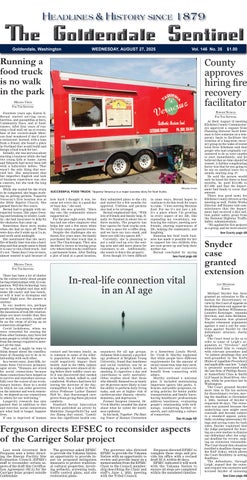
SUCCESSFUL FOOD TRUCK: Taqueria Veracruz is a major success story for food trucks. how hard I thought it was, because not every day is a good day or busy day,” she said. Still, she was grateful. “Since day one, the community always supported us.” For the past eight years, Bernal has had one other employee who helps her and a few more when the truck caters at special events. Despite the challenges she endured, five years later, the family purchased the blue truck that is now The Chuckwagon. They also decided to invest in buying property where both trucks could have a permanent home. After finding a plot of land in a good location,
they submitted plans to the city and waited for a few months for approval. Utilities and permits also had to be arranged. Bernal emphasized that, “With lots of friends and family help, finally we finished in about two or three months. The property has four spaces for food trucks now. We rent a space for a coffee shop, and we have my taco stand, and there are still two spaces left.” Currently, she is planning to put a solid roof up over the seating area and add more places for customers to sit. Additionally, she wants to fence the property. Even though it’s been difficult
Melissa Uhles
in some ways, Bernal hopes to continue to do this work for years to come. “I love serving Mexican food. For me it’s not just a job. It’s a place where I’m growing in every aspect of my life, like expanding my vocabulary, embracing the culture, meeting new friends, sharing experiences of life, helping the community, and laughing.” Running her food truck business has made it possible for her to support her two children who are now grown up and help their mother out. Bernal concluded by saying
See Food page A8
Melissa Uhles For The Sentinel
There has been a lot of chatter in the culture lately about people having relationships with AI companions. Will this technology turn out to be a helpful tool that will make life easier and less lonely, or will it lead to dystopian end times? Right now, the answer is unclear. In our modern era, perhaps people are beginning to wonder if the messiness of real-life relationships are more trouble than they are worth. As a society, could we be on the verge of giving up on connection altogether? Covid lockdowns, when we were rewarded for staying far from other humans, may have led some people to relish the reprieve from the energy required to interact all the time. That said, it might be time to think deeper about the ramifications of choosing not to be in relationship with each other. In a recent essay, Joan Silk, Arizona State University primatologist wrote, “Humans are wired for social connections because these connections have helped us to survive and reproduce successfully over the course of our evolutionary history. Even in a world in which we can order groceries on the internet and work remotely, we depend on our connections to others for our well-being.” Longevity research has also posited that in addition to diet and exercise, social connections are what lead to longer, happier lives. If one is deprived of human
In-real-life connection vital in an AI age
contact and becomes lonely, as is common in some of the elderly population, for example, this could negatively impact their health. And in the 1920s, infants in orphanages were almost all dying before their toddler years until it was discovered they needed to be held, rocked, talked to, and comforted. Workers had been following the doctrine of the day, exemplified by a leaflet by Pediatrics Professor Luther Emmet Holt Sr., that discouraged caregivers from giving these physical comforts. Stanford Social Innovation Review published an article by Madeline Dangerfield-Cha and Joy Zhang that stated, “Loneliness has significant health con-
sequences for all age groups. Julianne Holt-Lunstad, a psychology professor at Brigham Young University, found that loneliness and social isolation can be as damaging to people’s health as smoking 15 cigarettes a day and contributes to early mortality. Other studies show that those who identify themselves as lonely are 59 percent more likely to lose the ability to perform daily living tasks, and are at higher risk of cardiovascular disease, obesity, dementia, and depression.” Former Surgeon General, Dr. Vivek Murthy sounded the alarm about what he called the loneliness epidemic. In his book, Together: The Healing Power of Human Connection
in a Sometimes Lonely World, Dr. Vivek H. Murthy explained that while people have different requirements for the amount of social connection time they need, both introverts and extroverts benefit from connecting with others. Murthy outlined a national plan. It included maintaining important spaces like parks, libraries, and public programs, enacting policies for better public transportation and family leave, having healthcare professionals address loneliness, evaluating people’s relationship with technology, conducting further research, and cultivating a culture of connection.
See AI page A8
Ferguson directs EFSEC to reconsider aspects of the Carriger Solar project Last week Governor Bob Ferguson sent a letter directing the Energy Facility Site Evaluation Council (EFSEC) staff to reconsider certain aspects of the draft Site Certification Agreement (SCA) for the Carriger Solar project outside Goldendale.
$1.00
The governor asked EFSEC to provide the Yakama Nation an opportunity to provide input on proposed mitigation measures to protect traditional cultural properties, involving setbacks, screening tools, traffic control plans, and site restoration plans.
The governor also directed EFSEC to provide the Yakama Nation with an opportunity to review and provide input on a memorandum from the EFSEC Chair to the Council membership describing the Chair and staff’s June 4, 2025, meeting with the Tribal Council.
Ferguson directed EFSEC to complete these steps and provide his office with a revised draft SCA within 60 days. EFSEC indicated it will work with the Yakama Nation to ensure all steps are completed within the mandated timeline.
At their August 19 meeting Klickitat County Commissioners approved a request from Planning Director Scott Edelman to hire someone on a temporary basis to facilitate the creation of a long-term recovery group in the wake of recent local fires. Edelman said that people who had originally volunteered to do so were unable to start immediately, and he believed that no time should be wasted. A further complicating factor was that he was going to be out on medical leave for a month, starting Aug. 27. He said the person would only be hired for three to four months, be paid $13,000 to $17,000, and that the department had funds to cover that amount. There was good news for Klickitat County drivers at the meeting as well. Public Works Director Jeff Hunter told commissioners that the department had received a $2.6 million public safety grant from the National Highway Traffic Safety Administration. “We applied for five projects as a group, and we were award-
See County page A8
Snyder case granted extension Lou Marzeles Editor
Michael Snyder has been granted an extension to file a motion for discretionary review by the Court of Appeals in his defamation suit against defendants Darlene Williamson, Leandra Kessinger, Amanda Derchon, and Julia Skillman. The extension was granted despite vehement arguments against it and a call for sanctions against Snyder by the defendants’ attorney, Justin Leigh. The Court went so far as to refer to some of Leigh’s arguments as “frivolous” and admonished him to comply with relevant procedure and “to submit pleadings that are well-grounded in the RAPs [Rules of Appellate Procedure] and applicable case law.” Leigh is presently associated with the law firm of Phillips Reynier Sumerfield Cline & Smith LLP based in Hood River, Oregon, while he practices law in Washington. The Court granted Snyder more time to file his motion for discretionary review, moving the deadline to November 3, 2025, instead of Snyder’s requested 90 days. The extension was granted because the underlying case might soon conclude and become subject to a standard appeal, potentially avoiding unnecessary filings and saving costs for both sides. Snyder explained that the judge postponed the hearing on a new motion to dismiss one defendant after the original deadline for review, making an extension reasonable. The Court found this situation justified a deadline change under RAP 18.8(a), which allows the Court flexibility in setting deadlines. The defendants, through Leigh, argued that the extension request was excessive and accused Snyder of misusing
See Case page A8