Headlines & History since 1879 Goldendale, Washington
WEDNESDAY, APRIL 8, 2026
Vol. 147 No. 14
$1.00
Lou Marzeles
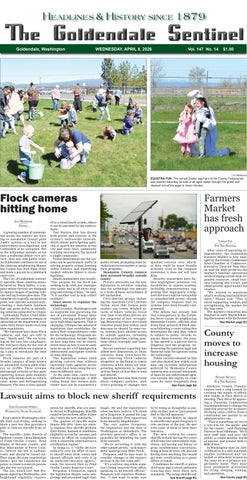
EGGSTRA FUN: The annual Easter egg hunt at the County Fairgrounds was packed Saturday as kids of all ages swept through the grass and cleaned out all the eggs in mere minutes.
Flock cameras hitting home Lou Marzeles Editor A growing number of communities across the country are turning to automated license plate reader systems as a tool in law enforcement investigations, and Goldendale is no exception. But as the technology spreads, so too does a widening debate over privacy, data use, and public trust. As Goldendale continues its use of the cameras, neighboring Skamania County has shut them down and made a payout in a landmark court case. The City of Goldendale currently operates three cameras manufactured by Flock Safety, a company whose devices are designed to capture images of passing vehicles and log license plate data. The cameras are typically mounted on poles and operate continuously, creating a searchable database that can assist police in identifying vehicles connected to crimes. Goldendale Police Chief Mike Smith said the cameras remain in operation as the department evaluates their future under evolving state regulations. “We currently have three Flock cameras, and they are still in use,” Smith said. “We are working on the new law compliance. We will have them for the rest of the year, and when our contract is up, I plan to reevaluate the need per cost.” Flock cameras are part of a broader category of tools known as automated license plate readers, or ALPRs. These systems photograph vehicles as they pass, capturing license plate numbers along with details such as vehicle color, make, and distinguishing features. The data is then upload-
ed to a cloud-based system, where it can be searched by law enforcement. One feature that has drawn both praise and concern is the system’s nationwide network, which allows participating agencies to search for vehicles across city and state lines, potentially tracking movements far beyond a single community. Police departments say the systems can be particularly useful in solving property crimes, locating stolen vehicles, and identifying suspect vehicles linked to investigations. Smith emphasized that locally, “Our purpose for the flock has nothing to do with any immigration issues and is all about stopping and solving crimes,” he said. “It is another tool to help collect evidence.” State moves to regulate the technology Until recently, Washington had no statewide law governing the use of automated license plate readers, leaving policies largely up to individual agencies. That is changing. Olympia has advanced legislation that establishes the state’s first comprehensive rules for the technology. Proposals under consideration include limits on how long data can be stored, restrictions on how it can be used, bans on use for civil immigration enforcement, and tighter controls on data sharing. The legislation comes amid growing concern that, without consistent rules, agencies across the state have been using the systems in different ways. At the same time, courts have influenced the landscape. A 2025 ruling found that license plate reader data can be considered a
Farmers Market has fresh approach Lorrie Fox For The Sentinel
public record, prompting some jurisdictions to reconsider or pause their programs. Skamania County camera data accessed broadly outside county Privacy advocates say the new legislation is overdue, arguing that the technology can amount to a form of mass surveillance if left unchecked. Civil liberties groups, including the American Civil Liberties Union, warn that license plate readers can create detailed records of where vehicles travel over time, even when drivers are not suspected of any wrongdoing. Researchers have also raised concerns about how widely such data may be shared. In some cases, systems have allowed access by outside agencies, including federal authorities, raising questions about oversight and transparency. Recent national reporting has added new dimensions to those concerns. Some cities have begun removing Flock cameras altogether or declining to renew contracts, while others are renegotiating agreements to impose stricter limits on how data is used and shared. Questions have also been raised about company policies, with critics pointing to changes that
sparked concern over whether data could be more broadly accessed, even as the company maintains it does not sell user data. Security researchers have further highlighted potential vulnerabilities in camera systems, including demonstrations suggesting that improperly configured devices could be susceptible to unauthorized access, though the company disputes that its systems have been broadly compromised. The debate has already had real consequences in the Columbia River Gorge. In neighboring Skamania County, officials shut down their network of Flock cameras following a court ruling that determined the data they collect is subject to public records requests. More recently, the county has agreed to a payout tied to litigation over the program, underscoring the potential legal and financial risks for agencies using the technology. Public records released in that case also showed how widely such data can circulate. Information gathered by Skamania County cameras was accessed thousands of times by law enforcement agencies outside the region, in some cases far more frequently than
See Flock page B1
Lawsuit aims to block new sheriff requirements Jake Goldstein-Street Washington State Standard Four eastern Washington sheriffs filed suit Friday seeking to block a new law that provides a path to remove sheriffs from office. The sheriffs—John Nowels of Spokane County, Glenn Blakeslee of Pend Oreille County, Brad Manke of Stevens County, and Ray Maycumber of Ferry County—believe the law is undemocratic and should be tossed out. They argue the state constitution doesn’t give the Legislature the power to create a removal process like the one envisioned. The law, which Gov. Bob Ferguson signed last Wednesday, sets heightened eligibility require-
ments for sheriffs, who are mostly elected in Washington. Sheriffs could be forced from office if they don’t meet the new standards. The quartet of sheriffs argue Senate Bill 5974 “does not merely regulate how sheriffs perform their duties. Instead, it conditions eligibility to run for, assume, and remain in office on compliance with a statewide administrative certification regime.” In doing so, it “shifts decisive authority over the office of county sheriff away from voters and elected officials and vests it in an unelected executive agency,” reads the lawsuit filed in Pend Oreille County Superior Court. Ferguson, a Democrat, signed the legislation despite some misgivings and presumed legal chal-
lenges. He and the legislation’s other backers believe it’ll stand up to litigation. It passed the Legislature despite firm opposition from minority Republicans. The suit names Ferguson, the Legislature and the state of Washington as defendants. The attorney general’s office is responsible for defending the state from lawsuits. “We’re reviewing it with the other named parties,” said department spokesperson Mike Faulk. Ferguson said he may want to consider changes to the vacancy process in the law come 2027. “It’s a serious step when someone’s being removed from office, speaking as an elected official,” Ferguson told reporters Wednesday. “I just want to make sure
we’re being as thoughtful as possible on that, and so I just pressed that to the bill sponsors.” In the weeks before he signed it, sheriffs had urged Ferguson to veto sections of the law. He met with some of them to hear their concerns. The new criteria for county sheriffs include having five years of full-time law enforcement experience, not having any felony or gross misdemeanor convictions, being at least 25 years old, and not having done anything that would get state certification as a peace officer revoked. Candidates for sheriff or police chief must sign a sworn statement ensuring they meet these new standards. The suing sheriffs call
See Sheriff page B1
After years of operating independently, the Goldendale Farmers Market is now managed by the Greater Goldendale Area Chamber of Commerce. Executive Director Teja Hanna said the shift preserves the market’s familiar operations while bringing a fresh look, expanded resources, small business training, new events, and added growth opportunities for vendors. “We wanted to maintain what’s working and build from there,” Hanna said. “This is about supporting vendors and strengthening the market for the long term.” The market’s transition was finalized in early March following discussions with the former
See Market page B1
County moves to increase housing Rodger Nichols For The Sentinel
Klickitat County Commissioners took a step toward increasing the supply of affordable homes at their March 31 meeting. They did so by approving a Planning Commission recommendation to change the approval process for accessory dwelling units (ADUs) from a conditional use permit to an administrative one. “This is something we see as a win-win for the public and for the county,” said Planning Director Scott Edelman. “We’ll save staff time and save the public a couple months worth of process and around S450 to $500 of fees.” In Washington state, an ADU is defined as is a self-contained, smaller residential unit (attached or detached) located on the same lot as a primary single-family home. They must have permanent provisions for living, sleeping, cooking, and sanitation.
See County page B1