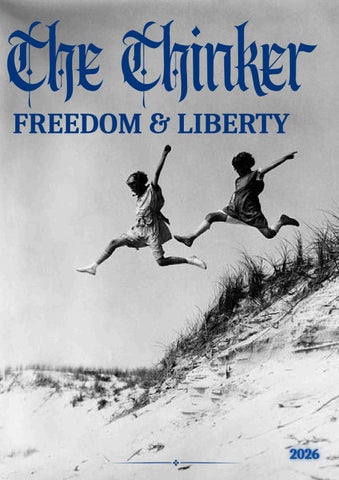
The Thinker FREEDOM & LIBERTY
2026
Playlist:
1
FREEDOM & LIBERTY WORD SEARCH WREIBBRJWEUYPDASJPPO KFBIPDCMPCYMONOTUASU EECNEDNEPEDNIHOBBESV KCONSTRAINTECITSUJBE CEMODEERFZSJCHDRYNTT OZTHYQTNAKMOFREEWILL LO J S N J S T B T X D Y G U G I LYV C FH FR N O I C R E O C C E FI TAN OWTPJYHCRANABMHBNJWJ M W O C V H I Z Z N U SAV E G Z G N D IROUSSEAURINHRIUEIEY L C L B F Z J T X S C LA E J O D O W C LJIWMIQRPIOTRSTHGIRN CTBBNXKTPIIEAECHVSSE AY E V I S BAY O VY F PB Q U O I G FS R N U PT C N O PLN K K V D FKA NWTPJIVMSYRBOCKIKDYM QAYV O R E N LI G H T E N M E N T O N B G N Q LTYPU OYSAR T R E B G IRVOLITIONLIBERALISM
FIND THESE TERMS: AGENCY JUSTIC E ANARCHY KANT AUTONOMY LIBERALISM BERLIN LIBERATION COERCION LIBERTY CONSTRAINT LOCKE EMANCIPATION MILL ENLIGHTENMENT RIGHTS FREEDOM ROUSSEAU FREEWILL SARTRE HOBBES SOVEREIGNTY INDEPENDENCE VOLITION
CONTENTS 3 6 10 14 16 19 22
‘The Freedom of Faith and the Problem of Evil: Is the Hiddenness of God a Blessing or a Curse?’ Luis Escobar, LVI ‘Freedom against Equality: Why it’s One or the Other’ Emma Togi, Year 8 ‘Does Belief in Free Will give you Free Will?’ Emma Chen, Year 10 ‘Can Consent Exist without Freedom’ Gabby Tenorio, LVI ‘Liberté, Freiheit, Libertad: What the Languages of Europe can tell us about Freedom’ Anni Salzmann, LVI ‘Do Christian Principles Restrict Bodily Autonomy?’ Aryana Bhuchar, LVI ‘Is Moral Law an Unreasonable Restriction of Freedom?’ Anna Ponticos, LVI ‘The Questioning of Freedom’ Olive Jogiya, Year 8
2
The Freedom of Faith and the Problem of Evil: Is the Hiddenness of God a Blessing or a Curse? By Luis Escobar, LVI In this essay, I will explore the problem of evil in relation to the hiddenness of God. It has been argued that God’s hiddenness is one of the evils which indicate his non-existence. Conversely, some see God’s hiddenness as a blessing, bringing about greater goods, such as the freedom of faith— to choose a God independent of external coercion. Because the world’s evil contributes to the hiddenness of God, the argument from divine obscurity has been used to counter the problem of evil. I will argue that the hiddenness of God causes more harm than good in the world and thus cannot overcome the problem of evil. The problem of evil is a challenge to theism based on the argument that the existence — or the amount and distribution — of evil in the world is incompatible with the existence of an all-loving and omnipotent God. Theists in reply have proposed that God allows evil to exist in order to make himself hidden, and to allow believers to choose to follow him completely freely. It is argued that the world contains the perfect amount of evil for the existence of God to be reasonably doubted, which provides us with important deliberative freedom. According to Richard Swinburne, ‘a deep conviction of the existence of God inhibits someone’s ability to choose freely between good and evil.’ This is because, for anyone with a strong desire to please God and achieve salvation in the afterlife, it would become too easy to choose the good. Arguably, we would also be unable to show true virtue through unwavering faith in God regardless of what the prevalence of evil suggests about his existence. In this way, it can be argued that the evil in the world brings about the greater good of God’s hiddenness, which in turn provides us with the freedom of faith that deepens our relationship with him.
3
However, I would argue that the hiddenness of God cannot compensate for the world’s suffering because it itself produces significant suffering which is not compensated for by the freedom of faith. This is because God’s hiddenness not only means that his existence cannot be asserted using reason, but also that his nature is obscure. Throughout history, an inordinate amount of suffering has been caused by conflicts between religious groups with contradictory beliefs about God. For example, the Crusades of 1095-1291 between the European Christian forces and Middle Eastern Muslim forces were motivated by religious tensions and death toll estimates are between 1 and 9 million. If different groups have different beliefs, this means that God’s hiddenness leads people to honestly misinterpret him and what obedience to him entails. I believe that an all-loving and omnipotent God would not allow this to occur, because here, his hiddenness is not serving the purpose of strengthening people’s relationships with him. Instead, there is immense suffering caused by conflict between groups equally convinced they are fighting in the name of God. Therefore, the argument from the hiddenness of God is an unsatisfactory response to the problem of evil, as his hiddenness not only does not compensate for evil, but exacerbates it. Another problem with the argument from the hiddenness of God is that not all humans are capable of choosing faith over agnosticism or atheism. This means that a hidden God cannot be all-loving, because he excludes many people from the possibility of a relationship with him. What prevents atheists from choosing faith is the allure of reason and empirical observation as a method for understanding reality. To overcome this allure, we must act contrary to our rational nature. Father Mapple states in Herman Melville’s Moby Dick that ‘if we obey God, we must disobey ourselves.’ I believe that an all-loving God would not make the choice of faith so difficult; the freedom of faith is a burden too great for all rational creatures to accept, so it leads to the evil of unattained relationships with God. There are many theists who appear to have freely chosen their faith position, however it might be argued that they have not fully accepted the burden of the freedom of faith. Perhaps theists have given in to the allure of religion rather than the allure of rational arguments and empirical observation. Ivan’s Grand Inquisitor in Dostoevsky’s The Brothers Karamazov asserts that ‘man has no preoccupation more nagging than to […] surrender the gift of freedom.’ Some surrender their freedom to the authority of reason, while others might surrender it to religious institutions, leaders and doctrines—potentially allowing their beliefs to be dictated by others. It could be argued that this is different from using the freedom of faith to follow God, as it is not an authentic choice. God is hidden, so theists must rely on religion to teach them about him. Admittedly, insightinto God’s nature might be claimed because of the religious experiences of historical figures or modern theists themselves. Nevertheless, I would argue that because religious experiences have led to contradictory beliefs about God’s nature, they cannot be treated as reliable indications of it.
4 4
I believe that the extent to which human nature truly allows for the authentic choice of faith has been overstated. The beliefs of many theists are influenced by those around them. Having said this, we must not reduce religion to the allure of authority. Theists do not lack agency. They are not being controlled, but they are choosing to be influenced by others. Religion provides meaning, direction and community, but commitment to a preexisting tradition of beliefs about God might be one way to escape the freedom of faith. Therefore, the freedom of faith might not be a good which compensates for evil, but instead a burden which humanity cannot bear. Moreover, if the purpose of evil is to make God hidden, then the price of his hiddenness is too great. Even if the freedom of faith truly is a great good, it cannot compensate for the sheer horror of life on earth. According to Richard J. Bernstein, after Auschwitz it is obscene to speak of evil as something to be reconciled with a benevolent cosmological scheme. In the best of all possible worlds, God would make his existence known to each of us through reason or empirical evidence. This would promote unity and peace among us and give us all an opportunity to cultivate a relationship with him. We would act morally out of a desire to please God; moreover, we would know what is moral because God would make his wishes clear. If an all-loving God would create the best of all possible worlds, then an all-loving God cannot have created a world in which he is hidden. In conclusion, the argument from divine hiddenness fails to refute the problem of evil. The hiddenness of God causes religious conflict and extreme immorality which undermine any good which might be brought about by the freedom of faith. In any case, the freedom of faith is a burden too great for humans to bear. Therefore, the existence of an all-loving and omnipotent God is unreasonable, given that the world could be significantly improved if God was not hidden, especially if his hiddenness was not achieved through the appalling amount of evil which the world contains.
5
Freedom against Equality: Why it’s One or the Other By Emma Togi, Year 8 Imagine a perfect utopian society. Among other elements, many will think of a world where everyone is treated fairly and equally, and has individual freedom. Now, think about the closest we have ever come to that. It's not very close, is it? But why- we’ve had more than 7000 years to figure it out, why haven’t we achieved this ideal society yet? Because it’s not an issue of skill or time; it's a logical contradiction. Firstly, we need to sort out the differences between equality and equity. According to the Oxford Dictionary, equality is the state of being equal, especially in status, rights, or opportunities and equity is when resources or opportunities are offered in different amounts to different people according to their starting point, which levels the playing field. This is better illustrated by this picture:
However, in the imperfect world that we live in it is not possible to truly achieve equity. With the limits of our human capabilities, we simply cannot tailor everything for each of the eight billion people and counting in the world to create a level playing field for everyone. So, for the purposes of this article, we will stick with the term and idea of equality, which is at least remotely possible. Now to the logic. The first thing we must understand is that equality is not natural. Not in nature, nor human nature, and certainly not in society. If you look around, this is very obvious. Not all plants have the same have the access to water and sunlight, not all birds have the same opportunities to pass on their genes. There is inequality even in our psychology; not everyone (if anyone) can completely overcome the inherent biases that determine how differently they treat different people. Not every person you see on the street is teated the same, and many disabled people don't have the same opportunities as those who aren’t. And unless society undergoes drastic change, it is likely to stay this way. So, we see that equality isn’t natural. In fact, at least in the natural world, inequality is one of the most important driving forces for survival and the success of life, crucial in its essential processes such as evolution and natural selection. However, what that means for society is that, in order to achieve equal opportunities and resources for everyone, equality must be created. Or in other words, enforced.
6
There are three ways, theoretically, to bring about equality in society: firstly, to bring the level of opportunity and resources higher, so that everyone receives the same as what those who are the most welloff currently have. Secondly, to bring the level of opportunity and resources down to match the level of those who are the least well-off. The third option is to evenly distribute these, so that the whole of society receives the same as what those who are neither the most, nor least privileged currently have. (Here, this privilege, or being ‘well-off’ refers to their level of opportunity and resources etc., not just in the financial sense.) In other words, either we lift everyone up, drag everyone down, or do half and half and have everyone meet somewhere in the middle. However, that only applies in a theoretical world where we have an infinite supply of these resources and opportunities to allocate and distribute however we wish. In the real world, those things are rather limited, and consequently the first theoretical way of achieving equality, the one ( the most utopian one, if I may add,) where we lift everyone up to where the most well-off currently are, is not possible, simply because we don’t have enough for everyone to receive the current top level. So only two ways remain; both of which involve decreasing benefits for at least some people. The consequences of this are such that those who must have their access to opportunity, resources and more, decreased in the process of achieving equality lose at least part of their freedom to pursue their own interests- and ultimately happiness. And, since this pursuit of happiness is the foundation of individual liberty, giving us the ability to make decisions that we perceive to be in our best interest, those people by extension also have their individual liberty and freedom limited, at least to a certain extent. As John Locke stated, freedom does indeed depend on this ability to choose wellbeing, ‘Thus we have to give each person liberty: the freedom to live as he pleases, the freedom to experience his or her own kind of happiness … Thus we derive the basic right of liberty from the right to pursue happiness’. By his standards, even a partial limitation is a limitation- and therefore, to achieve equality in society, individual liberty must be suppressed. So, even though many people use the terms freedom and equality almost interchangeably as hallmarks of an ideal future that we strive for, these two things can never really coexist in the society of our world. Logic forbids it. The question, though, is which do we choose?
7
Does Belief in Free Will By Emma Chen, year 10
For much of our time, philosophy has centred itself around a singular point—free will. The capacity to make choices and control your actions independently of outside influences, fate, or physical determinism, has been ruthlessly debated since the 4th century BCE. Now, a new question has emerged; does inherently believing in free will change anything? While some believe in free will’s benefits merely to do with the uncovering of knowledge, (which alone would make free will important enough to argue about) research has shown that those in favour of free will may be rewarded beyond just that. Not only can the belief in free will provide a sense of autonomy in life, it can also be seen to improve mental health. For instance, disorders such as obsessive compulsive disorder, addiction, and Tourette’s syndrome are all relevant when discussing the importance of free will. American philosopher Harry Frankfurt comes to the same realisation in his essay ‘Freedom of the Will and the Concept of a Person’, where he compares the person with no sense of freedom to an unwilling addict, who may appear to choose to take drugs, but is not in control of said choice. With this label of an addict, we essentially strip them of free will, emphasising that it is the feeling of hopelessness that causes pain, not the act itself. This same feeling of being trapped within the constraint of reality, without a potential way out can lead to depression or anxiety—as we can see in younger generations, and can thus make one act as though they seemingly have free will, just as the ‘addict’ does. Free will is overwhelmingly the more popular belief when compared to determinism—the theory that all events are already prearticulated, and therefore inevitable. In the measurement of beliefs, the Free Will Inventory, more than 78% of the general public agreed to free will. Therefore, not only can those who do not believe in free will lose a sense of agency and self, but they may also stray away from societal norms; facing social exclusion and isolation that ultimately results in issues surrounding mental health. For example, renowned 16th century French theologian, pastor, and reformer John Calvin taught that God, before the creation of the world, unconditionally elected some people for eternal salvation—the elect—and others for damnation or the reprobate based solely on His own will. Through his teachings on double predestination, the idea that people are chosen both for heaven and hell, Calvinism emphasises how a higher power ultimately makes our decisions for us. Whilst belief in the elect was not in itself an issue, circumstances of the time ultimately lead to Calvin’s persecution for his subsequent insightinto a lack of free will. In 1534, he fled for Geneva in fear of imprisonment after his separation from the Pope. This doesn’t equate determinism, or Calvinism, to immorality, but instead highlights how the lack of belief in free will catalyses an experience of punishment and backlash. Whilst logically, the absence of free will may mean a limited control over our own lives, restricted by government or religious authorities, the ignorance of such a fact is a reason why those who still believe in free will live more happy and successful lives.
8
give you Free Will? Psychologically, the confirmation bias supports this statement. Confirmation bias is the psychological tendency to search for, interpret, and recall information that aligns with our preexisting beliefs that directly enhances our ability to become selective of the information that we analyse and interpret. For example, if you believe in free will, situations where behaviours seem unpredictable and go against the status quo are more easily forgotten than ones where decision paralysis is key. Moreover, because Frankfurt argues that a person acts freely when acting on desires which they endorse at a second-order volition (those chosen from a hierarchy), confirmation bias could be arguably more beneficial than the lack of, since the belief in free will increases the efficiency in the self-reflection of desires. Additionally, there are also other benefits from believing in free will. A societal belief in free will might negate excuses surrounding moral and legal responsibility, with those who rely on determinism finding it easier to lose their moral compass. No matter how corrupt humanity may be, it is necessary to bring justice through punishment and the overall legal system. The idea that having rights is proportional to having responsibility is reflected by Sartre's quote that “man being condemned to be free carries the weight of the whole world on his shoulders; he is responsible for the world and for himself as a way of being”, again conveying not only that same loss of sense of self, but a straying away from society, and choosing nonconformism. In this way, believing in free will doesn’t metaphysically give free will, but does provide a more profound moral and social experience of freedom. It should be noted that it is typically those who believe in fatalism, that choices make no difference in the overarching course of life, that become passive and unwilling; this does not mean that all determinists lack self worth. Overall, there are many reasons one may want to believe in free will; whether for the sake of their own ego and satisfaction, or because they succumb to societal pressure.
9
BY Gabby Tenorio Who gets to decide what happens to your body - and your life? At first glance, this seems like one of the easiest philosophical questions imaginable. Most people would answer: I do! After all, your body is yours. Not your parents’. Not your friends’. Not your partner’s. Yours. However, once we start thinking a bit more carefully, the question becomes surprisingly more complicated. What does it actually mean to make a free choice? How do we know whether a decision is genuinely our own? And what if someone says ‘yes’ without really wanting to? These questions arise across many areas of life; imagine somebody pressures you into lending them money, exploiting your fear of losing their friendship. Or, suppose a company persuades you to accept terms and conditions while hiding important information. In each case, the issue is not simply whether somebody agreed, but whether that agreement was genuinely free. These questions also lie at the heart of autonomy - the right to make your own free and informed choices, and to have those choices respected by others. One particularly important example is sexual autonomy, which is the right to make your own free and informed choices about your body and intimate relationships. Most of us support sexual autonomy, but the real disagreement begins when we ask what it requires…
Ca Can Con Exi Exist WF
The idea of autonomy
Freed
The word autonomy comes from the Greek word autonomia, meaning “self-rule”. Philosophers such as Kant use it to describe the ability to govern your own life and make decisions for yourself. Consider a simple example: suppose somebody threatens you into handing over your phone. You may technically choose to give it to them, but most of us would hesitate to call that a genuine choice. Equally, if somebody tricks you into agreeing to something by hiding important information, your decision is not fully free. Many philosophers believe that autonomy is one of the most important human values. To wholly respect another person is to recognise that they have their own thoughts, desires, and goals, and that they matter. The same principles apply to sexual autonomy; it suggests that nobody is entitled to another person’s body, affection, nor attention - such things can only be freely given
10
Is consent enough? Traditionally, discussions about consent focused on a simple principle: “no means no”. The idea is clear enough - if somebody says no, or clearly communicates refusal, then their decision must be respected. Many people support this approach because it emphasises the importance of respecting rejection, and challenges the assumption that silence, passivity, or a failure to resist can be treated as agreement. But over the past decade, many philosophers, activists, and legal scholars have argued that this approach misses something important. If we only focus on whether someone resisted, we risk ignoring a more important question: did they actively want to participate?
onsent ithout om?
This concern popularised the idea of affirmative consent, also known as the “yes means yes” debate. According to this view, consent is not merely the absence of a “no”, but instead, it requires some positive indication of willingness. Rather than asking, “did they refuse?”, the question becomes, “did they freely agree?”.
The feminist challenge Initially, affirmative consent seems to solve this issue. If somebody freely says yes, what more could autonomy require? For some feminist philosophers, however, this question opens up a deeper problem. Legal scholar Catharine MacKinnon argues that consent cannot always be understood independently of social context. People do not make decisions in isolation; their choices are shaped by cultural expectations, power balances, relationships, and assumptions about how they ought to behave...
This raises a difficult possibility: what if a person agrees to something they do not truly want? What if they consent because they fear disappointing a partner, damaging a relationship, or being judged for their refusal? In such cases, the question is no longer simply whether consent was given, but becomes whether the choice was genuinely autonomous Similar concerns arise outside intimate relationships. A worker may agree to excessive hours because they fear losing their job, or a teenager might go along with something simply to avoid social exclusion. This issue is not coercion in the obvious sense. Nobody may have issued a threat or used force, yet many philosophers argue that freedom can be limited by more than physical coercion alone
11
The feminist challenge to traditional accounts of consent can therefore be stated quite simply: is saying yes enough? Some feminist philosophers argue that discussions of consent often focus too heavily on individual decisions and not enough on the conditions under which those decisions are made. British feminist and Political theorist Carole Pateman, for example, argued that ideas of freedom and consent have historically developed due to the unequal power of men and women, leading to the institutionalised subordination of women. If social expectations shape what people see as possible, acceptable, or normal, then autonomy may be more complicated than it first appears. In this view, protecting autonomy requires more than obtaining agreement - it requires attention to the social conditions that make meaningful agreement possible.
A Different View: Nonetheless, not everyone agrees: Utilitarian philosopher John Stuart Mill argued that individuals are generally the best judges of their own interests. To respect a person’s autonomy is to respect their capacity to make choices for themselves, even when those choices are influenced by others, or appear unwise. From this perspective, however, there is a danger in questioning consent too aggressively. If every decision shaped by social expectation is treated as insufficiently free, then very few choices would qualify as genuinely autonomous. More importantly, we risk treating people as instrumental, passive products of their circumstances, rather than active agents capable of making decisions. In attempting to protect autonomy, we may end up undermining it. Here lies the philosophical tension: MacKinnon stipulates that consent can disguise unequal power, whilst Mill argues that questioning consent can undermine individual agency. Both are concerned with autonomy, yet they disagree about what autonomy demands…
12
Can you consent without being free? The debate over sexual autonomy ultimately leads to a deeper question: how free must a choice be before we consider it genuinely our own? Many philosophers agree that complete freedom from outside influence is impossible. Every decision we make is shaped by our upbringing, relationships, experiences, and culture, but autonomy seems to require something more than simply making a choice. A person who acts under threat is not autonomous. A person who is deceived is not fully autonomous. But many situations are not as clear as this. Sometimes people feel pressure from friends, relationships, or society, even when nobody is forcing them to do anything. Somewhere between complete freedom and complete coercion lies the difficult territory that we continue to debate. This is why sexual autonomy remains such a fascinating concept. It appears seemingly simple: people should control what happens to their own bodies. However, once we begin asking what genuine control looks like, the answers become much less obvious. Perhaps, the most important question is not whether somebody said yes or no, perhaps it is whether they were truly free to choose in the first place.
13
Liberté, Freiheit, Libertad: What the Languages The word freedom contains an oddness most native speakers never notice: its meaning is almost identical to liberty, yet the former is reached for more often, guided by a difference that is instinctively felt but rarely articulated. The simple fact that native English speakers have two near-identical words and have never needed to be taught which to use is itself a philosophical clue, and one that becomes clearer when viewed through three other languages: French, German, and Spanish. Liberté Within the French tradition - born of the Enlightenment and violently challenged by the Revolution freedom is tightly coupled with equality and fraternity. ‘Liberté ’ is rarely a solitary pursuit. When Rousseau declared that 'man is born free but is everywhere in chains', he wasn't describing an individual feeling but attacking a political and social order. Freedom is not the absence of constraint but obedience to laws one prescribes collectively. For Rousseau, liberty is only possible 'together', via the ‘general will' (the collective political will of society), in a paradox which insists that true freedom consists in adhering to the law one has helped to write. Later French thinkers extended this social conception of freedom beyond the state itself. Simone de Beauvoir takes a slightly different approach, arguing that your freedom cannot be genuine if it is contingent on the enslavement of another — a man who is truly free while the woman next to him is not truly free, and he has mistaken tyranny for selfmastery. French philosophy takes the notion that liberty can't be a mere personal extravagance seriously. Freiheit In Germany, the debate moves to a more philosophical level. From Kant through to Hegel through to the existentialists, Freiheit is an existential category that does not relate primarily to political systems but to rational selfhood. For Kant, you aren't free when you do what you will, as mere impulse can achieve that. You are free, however, when you bind yourself to law through reason, be that through your own autonomy or the categorical imperative. Freedom is thus an exercise in self-restriction. Hegel develops this idea in terms of the historicity of spirit: The family, civil society, and the state, in his Philosophy of Right, become concrete expressions of Geist - roughly put, the collective spirit or mind and therefore of freedom itself: to oppose them is to fall back into an adolescent dream of an abstract or isolated freedom. This emphasis on freedom as formation rather than mere independence also profoundly influenced German Romantic ideas about Bildung, self-formation and self-mastery through culture and learning, seeing it as a path towards freedom through self-determination, rather than simply liberation.
14
of Europe can tell us about Freedom Libertad Spanish offers yet a third conception. The tradition of the Spanish Civil War gave us a literary exploration of freedom at its most visceral: Lorca writing in the face of state murder, Hernández composing poetry from behind prison bars under Franco's regime. Here, ‘libertad’ is not an abstract concept, but the name of an absence, of something brutally and violently suppressed. In Latin America, this suspicion toward abstract liberalism develops into an explicit philosophy of liberation. Thinkers such as Dussel argue from the perspective of the oppressed. For centuries, the colonial project has used the idea of liberal freedom as cover for subjugation, and so any true freedom must first establish intellectual and political autonomy for those who have been denied it – the ability to think from one's own place in the world. Taken together, liberté, Freiheit, and libertad suggest three distinct, albeit interconnected, kinds of freedom: the French ask who you are free with; the German, from what internal constraint are you free; The Spanish ask at whose expense one is free, and who isn't free at all? Each raises a blind spot when compared with the others: the French ‘general will’ might silence the individual; Kantian rational autonomy is potentially disembodied; and the philosophy of liberation could, if taken to its extreme, find itself waiting for a resolution of historical injustices that will never fully arrive. The most obvious conclusion, however, is that freedom is not monolithic but rather a family of interlinked demand - for political power, for individual autonomy, for justice through history - whose ongoing tension is something we must live within, not something that can be decisively 'achieved.' If a political program tells you it has achieved total freedom, you should be skeptical. Freedom survives in the tension between liberté, Freiheit, and libertad, precisely because no single tradition can fully define it.
By Anni Salzmann, L Vi
15
Do Christian Principles Restrict Bodily Autonomy? Humans supposedly have bodily autonomy — meaning we have complete freedom and control over our bodies — however, for the 30% of humans who identify as under a Christian denomination, is this still the case? The main Christian principle which can be seen to restrict a human’s bodily autonomy is the ‘sanctity of life’ principle. ‘Sanctity of Life’ refers to the concept of a human life being so intrinsically valuable and also a gift from God, and therefore only God can take human life. This principle is often used in political and religious arguments when determining if voluntary euthanasia and abortion should be legalised. However, is condemning voluntary euthanasia and abortion due to this Christian principle a restriction of a human’s bodily autonomy, or beneficial for society? Euthanasia: Euthanasia refers to the concept of someone's life being ended to relieve them of their suffering — sometimes called ‘assisted dying’. Voluntary euthanasia is when this assisted dying takes place with the consent of the patient. Many European countries have already legalised euthanasia, such as Switzerland and Spain. Patients who are experiencing extreme suffering, both mental and physical, may have a desire to end their suffering. This was seen in the Netherlands where a 29 year old woman, Aurelia Brouwers, who was extremely mentally troubled, drank poison administered by a doctor to end her life. Prior to her death, she states that ‘every breath I take is torture’. In this instance, this woman was able to end her unimaginable suffering which therefore should be considered a moral and fair decision.
16
The sanctity of life principle is interpreted to strictly condemn this. This means that Aurelia Brouwer's decision would be deemed as immoral according to Christian principles, and meaning her suffering would have been prolonged. For people in a similar situation to Aurelia, whether it is an extremely difficult mental state or physical state, euthanasia should be an option for them as a way to end their suffering and Christian principles such as sanctity of life can be seen to be a restriction of their bodily autonomy. However, not all arguments against euthanasia come from Christian belief. Some people argue that legalising euthanasia will allow for the elderly, and terminally ill people, to be taken advantage of. It can be difficult to determine whether or not they have been coerced into agreeing to euthanasia. Some may try to coerce these people for financial gain, for example, family may want to receive their inheritance or to stop paying hospital bills. Therefore, arguably, a restriction of euthanasia can actually be beneficial to society as it would prevent exploitation of the vulnerable. It is important to consider the extensive legal protections that can be put around euthanaisa - a clear criteria which a patient must meet in order to be euthanised can restrict the ability for their death to be decided for the gain of others. When people are suffering so greatly,they should be provided with an option to end this suffering which, the sanctity of life does ultimately restrict and therefore, Christian principles do restrict bodily autonomy. Abortion: Abortion is a medical process or procedure used to end a pregnancy and is legal in around 77 countries in the world. However, even though it is legal, it is still condemned in the bible and under the same principle of the sanctity of life. Abortions are often used to end an unwanted pregnancy, or used to end a pregnancy if it poses harm to the mother. It is considered a human right in many countries and should be given to women as a freedom to control their body. Although the Bible never addressed abortion, Christians have drawn on certain passages to argue that it implies the practice is condemned. The most commonly cited is from Jeremiah: "Before I formed you in the womb I knew you." This implies that a life begins at conception which presents abortion as the taking of a life. However, it is scientifically proven that a fetus cannot survive on its own outside its mother’s womb until at least 22-24 weeks, so to argue that an abortion before this time is a taking of a life is contentious. Pregnancies can often be unplanned and a mother may not always be financially or mentally able and willing to take care of a baby and therefore, to respect a woman's bodily autonomy would be to allow her to abort it. Additionally, the same sanctity of life principle condemns abortion — by taking the idea that life begins at conception, the bible presents abortion as a taking of a life and according to the sanctity of life, only God can take a life and therefore, abortion should not be allowed. This again restricts women's bodily autonomy as being forced or pressured into keeping an unwanted pregnancy, which could bring harm to the mother, is a restriction of freedom of her body and freedom of choice.
17
We can also see secular arguments against abortion, such as those of philosopher Don Marquis, who argued that killing a human foetus is wrong because it deprives them of their future all the experiences and projects they would have had. He argues that a fetus, possessing a "future-like-ours," is deprived of that same value if aborted. In his view, an abortion deprives a fetus of a future and life, and should not be allowed. Therefore, it could be argued that banning abortion would be beneficial to society, not necessarily a negative restriction. Whilst some people agree with this, it is a very heavily contested view. If the preservation of the fetus would lead to the death or harm of the mother, how can we determine if a fetus’s future, which it would not have the chance to have without its mother, is more valuable than the mothers future? Ultimately, maximising the mother’s bodily autonomy would be to let her decide whether or not she would want to end her pregnancy. A restriction of a woman’s ability to make that choice to end her pregnancy if a restriction of her bodily autonomy. Therefore, christian principles seen in the bible which condemn abortion do restrict a woman's bodily autonomy. When examining the restrictions of Christian principles on bodily autonomy, it is important to acknowledge that many modern Christians do not follow these principles to the extreme and many do not condemn abortion and euthanasia. However, the principles themselves which are seen through biblical scripture do condemn several actions like abortion, euthanasia, sex before marriage, sexual orientation and more. These are all examples of choices which humans should be allowed to make when exercising their freedom over their body and the rejection of these actions and choices which are seen in the bible do restrict a person’s bodily autonomy.
by Aryana Bhuchar, LVI
18
Is Moral Law an Unreasonable Restriction of Freedom? Suppose you were to wake up tomorrow and none of your moral, or immoral, actions would face any repercussions. This is the dilemma in Plato’s thought experiment, ‘The Ring of Gyges’, which takes place in the world of his ‘Republic’. Here, the wearer of this ring gains the power of invisibility- and thus all his crimes go unpunished. When author Julian Baggini proposes this same scenario in his collection ‘The Pig That Wants to be Eaten’, the narrative is a more personal one, which follows the internal dialogue and reasoning of the wearer; and the man’s mind is frayed at the edges by guilt for the actions he has not yet committed. Faced with the curiosity and desire for transgression, and with complete freedom at his fingertips, he still feels the grip of moral law clasped around his neck. It is clear that the imprint of societal structure is pressed incredibly deeply upon him- even when he himself is hidden from its view. As the philosopher Glaucon argues here in Plato’s ‘Republic’, many people would feel no obligation towards the shadow of morality that had once held them. He insists that the general population has no consideration for morality beyond what is legal or illegal- or, more pointedly, the punishments or rewards they will reap. This is a view widely supported in the modern day; psychologist Lawrence Kohlberg’s ‘theory of moral development’ outlines six stages of awareness of morality, in which all, aside from the sixth and final- which Kohlberg claims is rarely accessible to the average person - are based almost solely on obedience. Considering these theories, it does not appear to be in our nature or be moral. There seems to be no inherent drive towards the ethics we hold ourselves to, and instead, our frameworks, structures and laws are inherently unnatural and incompatible with our essence. The natural progression in this reasoning is therefore to question the validity of these impositions. It is by no means unreasonable to argue that by the standards of these philosophers, moral law appears to be a constraint to the freedom of our nature. In turning back to Baggini’s holder of the ring, this restriction becomes clear; even when faced with the freedom which many of us are evidently lack, the sensation of where our shackles had once been is still noticeable, and some semblance of them still keeps us chained in place through moral deliberation. This question of our freedom is deliberated by philosopher Richard Swinburne. In his principle of ‘significant freedom’, Swinburne stipulates that freedom of any consequence is that which allows us to actionably choose between conflicting moral ideas. Theoretically, the wearer of the ring of Gyges is able to pick immorality once bestowed with invisibility, however, if he is constantly weighed upon by the guilt of the rules he knows he is breaking, which would stop him choosing evil, he is not significantly free. Similarly, under the widely adopted concepts of positive and negative freedom, first proposed by philosopher Isaiah Berlin, in order to hold true liberty one must be both positively free, with the agency to take whichever action they desire, and negatively free- able to act independent of interference.
19
Once it is established, therefore, the restraint which moral law imposes, there is the question of its response; and one such solution seems to be proposed in Absurdist philosopher Albert Camus’ ‘Ethic of quantity’. In his essay ‘The Myth of Sisyphus’, Camus sets out his theory of absurdism, wherein the truth of the universe is its chaos and meaninglessness- and as a result, the same is thought of its artificial structures, including moral law. In an extension of this, Camus sets out that the purpose of life is not to go about living a life of quality- of utmost morality and virtue and their subsequent constrictions, but one of quantity, absolute freedom and the adoption of meaninglessness. In ruminating on his ethic of quantity, Camus says that the absurd man ‘does not understand the notion of sin; that perhaps hell is in store … but that seems to him an idle consideration… he feels innocent.’ He examines the rejection of any moral responsibility, and the true freedom which accompanies this; the duty of man, he says is not to ‘wonder if [his actions] are vulgar or revolting, elegant or deplorable’, but to bask in the freedom of knowledge that none of his actions are bound by legitimate structures of society- a knowledge that greets the wearer of Plato’s ring, too. However, whilst Camus’ philosophies do indeed seem to bring about an extraordinary sense of release and freedom, they cannot be said to translate to a wider society. Absurdism is, in its very nature, incredibly isolationist; time and time again, it is described as the feeling of alienation between man and the world around him, which can be often seen to include his peers. In his works of fiction, such as ‘The Outsider’ Camus portrays the difficulty facing the absurd man in his navigation of a world which is not similarly driven in ideology. His protagonist, Mersault, is ultimately punished for his independence to society, and his relationships with those close to him suffer similarly. However, almost by its very definition, absurdism does not seem a theory which can be adopted en masse by its sense of ostracisation. It brings the wonderful relishing of amorality for its solitary believer, but the effects of these actions are unfairly cast on those around him, who are not free to join in the same way. It is clear, therefore, that this idea of a freedom from moral constraint is not one that can be adopted by a society. This sentiment of the inefficacy of the ethic of quantity is expressed too in the first formulation of Immanuel Kant’s categorical imperative. Here, Kant dictates that an ethical action is one which can be universalised. He says that the way in which one acts must be the way in which they would want everyone else around them to act- that one should behave as if each action they were to take would become an absolute moral law for all. The result of the abandoning of this formulation is, to Kant, equal to becoming animals, and surrendering ourselves to primal instinct. Humans, as the intermediary species of the realm of animals, instincts and desires, and the realm of the perfect reasoning of angels, exist upon the foundations of our morality. Under Kant’s theory, from there develops our reasoning, our abilities to more meaningfully connect with one another and the entirety of any society we may occupy. To Kant, life without moral duty or law is an incomparable descent of mankind. It is losing completely our sense of ourselves, and losing everything which sets humanity aside as a species. Whilst there are many, like philosopher Hobbes, who would argue that this brutalistic, chaotic and selfish behaviour, unbound by moral rule, is indeed humanity’s inherent ‘state of nature’, in Kant’s eyes, the wearer of the ring is in practice no longer human, so long as he surrenders to the sinful individualism and anonymity of his newfound power. The phantom shackles about his wrist are the sole tether to his personhood.
20
It becomes clear, therefore, the impossibility of the abandonment of these moral laws and structures, no matter how restrictive they may be. With the failure of this ‘ethic of quantity’ for widespread adoption, the sacrifice for freedom becomes not simply one of morality, but of the very essence of what makes us human. The question becomes not whether moral law restricts freedom, but whether our freedom should be valued above all else. Perhaps our structures of morality are indeed a cumbersome restriction upon our nature, but they cannot be said to be unreasonable. Considering both Kant and Hobbes, by surrendering our absolute freedom we shed one of our natures for the other. In this case, it may well be that we sacrifice the original- and perhaps innate and intended- disordered violence that is at the core of humanity, but to Kant this sacrifice is inconsequential. The human who exists in this feverous state of anarchical freedom, is not human at all. What the question of this essay asks us to consider more deeply is whether our true nature is an inherent quality of our creation, which precedes any mold of society (as Hobbes- and even Camus present), or if it is all that is born out of our structures. In the former, moral law becomes something that tears us away from our point of origin - in the latter, it is the anchor that moors us to ourselves. Whilst this tether, by its very nature, is something confining, it offers us what the state of nature cannot; a simultaneous new freedom that emerges in the potential of growth and development. In the reason, community, education and structure which stems from Kant’s morality, the true man steps forth not into a prison of regulations, but unbound opportunity.
BY ANNA PONTICOS, LVI
21
THE QUESTIONING OF FREEDOM EVERYTHING IN LIFE MUST BE QUESTIONED... Is freedom a tool for chaos, unity or simply an illusion? Freedom in all its different forms is something that people can take for granted, fight for, or abuse. Acting, speaking, and thinking the way one chooses to is the basic definition of freedom, however it can also mean so much more. In order to understand and assess the value of freedom, we must define its different versions. Social Responsibility: Should freedom be externally moderated? Social pressure, laws, and religious scripture act as natural constraints to individual liberty. The judgement of others often forces people into not expressing themselves truly. The negative effects of bullying those who do not fit in is one of the many examples of how society fails to use the power of social pressure to control, and instead to force people to follow normalities, and those who have the freedom to set them. The freedom that comes with a lack of social pressure is shown also through freedom’s association with childhood. The Latin word for children, liberi, shares the same stem as the word for freedom, libertas. In this direct link, the innocence and ignorance of social influence and expectations that comes with childhood is associated with a true, original freedom. Lyrical Freedom: Does the idea of a deity or a “Big Brother” concept affect the way we think as we believe we are being watched? Here, restriction of privacy in the context of this gaze, is the same as a restriction of freedom. This provokes the question of the correct balance of privacy and safety. Privacy is vital, but governments have a duty to ensure the safety of the people. Without privacy, humans would be driven apart, sceptical of one another. This links to the instinctive behaviour of self preservation. By shielding our thoughts from the world around us, we mask our personalities, especially regarding deities that have omniscient figures. One may be frightened to be their true self, which is no fault of the omniscient figure but in fact the fault of the mind, which was designed to inquire and learn but prioritises self preservation which can lead to a block of all potentially disrespectful thoughts - although subjective thinking is not harmful to those around somebody, but maybe in fact to oneself. Freedom of Animals: Animals exhibit a level of freedom unlike humans. However, animals still have order; they commonly display hierarchical values or are expected to fulfill a specific role within their society. Animals in captivity or even domestic animals crave freedom. This could suggest that even a freedom free from human societies is not a true freedom.
22
Human Freedom: Humanity operates as one which, in terms of freedom, is their downfall . The hierarchy grants more freedom to those at the top, driving the need for power and money, which in today’s society is synonymous with equated with freedom, leaving those at the bottom forced to work for money and yet never gaining power. Instead of working as one and prioritising equality in freedom, humans are driven by individualism, prioritising themselves and their interests. There is nothing fundamentally wrong with this but it is an interesting idea in the context of humanity’s natural desires. An example of this is fashion here in the UK: most of us have the highest benefits of teh fashion market, but somewhere around the world, someone needs to make it. There is also a balance that must be maintained where individuals producing the clothing, the owners, and the consumer all want to maximise their freedom represented by maximising profits for producers and minimising costs for consumers but this often leads to exploitation. Freedom of Choice: Freedom of choice is potentially the most powerful and important freedom there is. The freedom to say yes or no is desired by many. Freedom of choice is a mental barrier, it's testing your own limits yet also the limitations of free will. Your own personal limits cannot be controlled but should be maintained, however free will isn’t exactly the most free. The fault of free will lies in philosophy: if life is predetermined then no human is in charge of anything, except for in the moment so we never choose freely - we just think we do. Though this debate has largely been inconclusive, the discussion shows just how highly people value freedom, especially in their everyday lives and decisions. Existentialism: Existentialism is the concept that a person can create their own meaning within a world of meaninglessness. Having a sense of purpose in creating ones own meaning, provides freedom from a world that teaches us to conform to normality. Whilst we have discovered many forms of freedom, is it even possible to understand them all? False Freedom: A false freedom is where you have the illusion of choice and therefore you feel free, but the choice is predetermined. Is freedom a concept made by the human brain for comfort behind our lack of control? The creation of a false freedom is in the mind although the mind is heavily influenced by others. This is especially interesting as when humans themselves execute their freedom of speech they often tend to display the positives powerfully and overtly, while completely failing to acknowledge the weaknesses, which instinctively we tend to linger on and generally sway them to one side. That questions the very integrity of freedom that we all have and use.
BY OLIVE JOGIYA, YEAR 8
23
THANK YOU FOR READING!!!