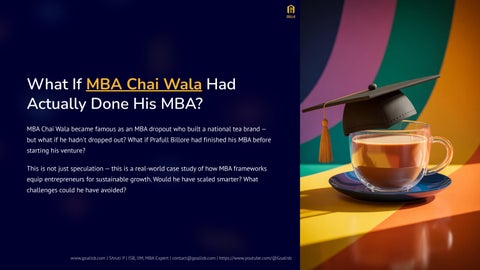
MBA Chai Wala became famous as an MBA dropout who built a national tea brand 4 but what if he hadn't dropped out? What if Prafull Billore had finished his MBA before starting his venture?
This is not just speculation 4 this is a real-world case study of how MBA frameworks equip entrepreneurs for sustainable growth. Would he have scaled smarter? What challenges could he have avoided?
The Thought Experiment: MBA Chai Wala
When you hear the name "MBAChaiWala,"an image comes to mind: a tea entrepreneur whose brand cleverly fuses street-side chai with corporate aspiration. Prafull Billore, a young MBA aspirant, dropped out after multiple failed CAT attempts, took a modest ¹8,000, and built what is now a national franchise of over 100 outlets.
But here's the twist: despite the name, Prafull never completed an MBA.
His journey captured India's imagination precisely because of this paradox 4 a college dropout who used sharp instinct, charisma, and creative branding to disrupt one of the country's oldest and most unorganized sectors: the humble chai stall.
This Case Study Explores
The specific obstacles MBA Chai Wala faced as a fast-scaling franchise
How business school tools could have helped navigate those challenges
What this means for entrepreneurs and MBA applicants charting their own path
A note on perspective: This is not a prediction of what would have happened 4 it's a thought experiment exploring how MBA frameworks might have intersected with entrepreneurial instinct and branding ingenuity.
The Hustler's Path vs. The MBA Founder's Path
The rise of MBA Chai Wala is now part of modern Indian entrepreneurship folklore. In 2017, Prafull Billore found himself disillusioned after repeated failures in cracking CAT. Disheartened but determined, he moved to Ahmedabad with nothing more than ¹8,000 and a burning desire to create something of his own.
Instead of spending years chasing an MBA degree, Prafull set up a small roadside tea stall. But this wasn't just any tea stall. He called it "MBA Chai Wala" 4 a bold, cheeky name that instantly sparked curiosity. Here was a tea seller who spoke English to his customers, kept his stall immaculate, and used Instagram posts and storytelling to build his following.
Single Stall
Started with ¹8,000 in Ahmedabad
Viral Growth Social media storytelling built following National Brand 100+ outlets across India
His tagline, "Har-HarStartup,Ghar-GharStartup", became a rallying cry for young Indians eager to break free from the corporate grind. Prafull didn't just sell tea; he sold aspiration.
Key Facts and Figures About MBA Chai Wala
Founder Prafull Billore
Year Founded 2017
Place of Origin Ahmedabad, Gujarat, India
Initial Investment
Educational Background
¹8,000
MBA aspirant; dropped out before completing MBA
Business Concept Modern café-style tea chain with youth-oriented brand
Number of Outlets
Franchise Model
Unique Selling Proposition
Founder's Motto
100+ across India
Yes 4 rapid expansion through franchising
Clean, hygienic chai cafés with diverse flavors and strong social media branding
"Har-Har Startup, Ghar-Ghar Startup"
Target Demographic Young, urban Indian consumers seeking affordable but modern café experiences
But Rapid Rise Brought Growing Pains
Franchisee Complaints
Unmet profit expectations and disputes over agreements
Quality Control Issues
Hygiene inconsistencies as outlets mushroomed
Reputational Risks
Social media backlash over customer experience
Market Saturation
Allegations of misrepresentation tarnished brand image
Imagine a Different Scenario
What if Prafull had completed his MBA first?
Challenges Faced 4 and How an MBA Could Have Helped
As MBA Chai Wala expanded rapidly from a humble Ahmedabad tea stall into a national franchise, it encountered classic scaling challenges. What makes this case interesting is that many of these challenges are precisely what an MBA education is designed to help entrepreneurs anticipate and manage.
Challenge: Inconsistent Quality & Hygiene
MBA Solution: Operations Management
(OM) 4 Total Quality Management (TQM), Six Sigma principles, and Service Blueprinting could have ensured every outlet adhered to uniform standards, protecting the brand promise.
Challenge: Franchisee Dissatisfaction & Disputes
MBA Solution: Franchise Management & Business Law 4 Robust franchise agreements with clear revenue-sharing models, dispute resolution clauses, and realistic financial projections.
Challenge: Poor Site Selection
MBA Solution: Marketing & Market Research 4 Location Analysis, Demographic Profiling, and Footfall Estimation for smarter location decisions.
More Challenges and MBA Solutions
Cash Flow Strain
Challenge: Rapid expansion stretched finances
MBA Solution: Corporate Finance 4 Working capital management, scenario planning, and sustainable scaling frameworks
Brand Dilution
Challenge: Identity weakened as chain expanded
MBA Solution: Brand Management 4 Brand audits, core identity preservation, standardized training
High Employee Turnover
Challenge: Service quality affected by staff churn
MBA Solution: Organizational Behavior (OB) 4 Motivation theory, HR strategy, and incentive alignment to build stronger internal culture
The key takeaway: Even though MBA Chai Wala emerged as an entrepreneurial success story without a degree, the very issues that later threatened to erode its brand were exactly the kinds of problems MBA frameworks are designed to solve.
For any aspirant or early-stage entrepreneur: It's not about needing an MBA to get started 4 it's about realizing that MBA frameworks give you a toolkit for navigating complexity when scale happens.
Key Takeaways 4 Would an MBA Have Helped?
So, would an MBA have made a difference for MBA Chai Wala? The answer is nuanced 4 and that's exactly what makes this case study valuable for aspiring entrepreneurs and MBA applicants today.
What an MBA Cannot Guarantee
Hustle
Raw determination and work ethic
Storytelling Instinct
Natural ability to connect emotionally
Fearlessness
Audacity to turn failure into a brand
Emotional Connection
Ability to resonate with an audience
These are rare and precious entrepreneurial traits 4 and in fact, part of what made MBA Chai Wala so relatable to millions of young Indians.
www.goalisb.com | Shruti P | ISB, IIM, MBA Expert | contact@goalisb.com | https://www.youtube.com/@Goalisb
Where MBA Frameworks Add Value
But as soon as the business moved beyond a single roadside stall into a franchise-led national expansion, the very absence of formal management knowledge began to show.
Franchisee Disputes
Eroded trust and damaged relationships
Quality Inconsistencies
Weakened brand value and customer experience
Poor Site Selection
Impacted unit economics and profitability
Negative Media Coverage
Dented reputation and public perception
Operational Inefficiencies
Stretched resources thin across locations
This is precisely where MBA frameworks could have helped 4 by offering a structured roadmap for sustainable growth, stakeholder management, and brand protection.
An MBA wouldn't have replaced hustle 4 but it would have supplemented instinct with rigor.
The MBA Advantage in Practice
The Core Lesson
The story of MBA Chai Wala is a reminder that great ventures don't always begin in classrooms 4 sometimes they begin with personal struggle, a ¹8,000 investment, and the courage to take a risk.
But it's also a case study in what happens when a brilliant, instinctive entrepreneur begins to scale without formal systems, governance, or strategy.
You don't need an MBA to build a brand. But if you want to scale that brand responsibly, preserve its value, manage risks, and lead teams sustainably 4 MBA frameworks can be your greatest asset.
Without MBA
Rapid viral growth
Franchise disputes
Quality control issues
Vulnerable brand reputation
With MBA
Slower but sustainable growth
Stronger franchise relationships
Better governance frameworks
Protected brand equity
At its best, an MBA isn't about credentials 4 it's about mindset and mastery: mastery of frameworks for growth and governance, mindset for thinking at scale, and skillsets that help founders move from intuition to institutionalization.
Frequently Asked Questions
What is the use of an MBA?
An MBA equips professionals with leadership, management, financial, and strategic skills to advance careers, pivot industries, or build and scale businesses.
Is MBA really worth it?
An MBA is worth it for professionals seeking structured thinking, leadership readiness, career growth, or scaling entrepreneurial ventures responsibly.
Can I become CEO after MBA?
An MBA significantly improves leadership readiness and provides networks that accelerate your journey to CEO, though experience and drive remain critical.
Which MBA job has the highest salary?
Consulting, investment banking, and private equity typically offer the highest starting salaries for MBA graduates globally.
What is the scope of MBA course?
The scope is broad 4 graduates pursue roles in finance, marketing, consulting, operations, entrepreneurship, and leadership across sectors.
Is 70 percent good in MBA?
Yes, 70% is generally considered good. However, MBA success is evaluated holistically 4 including internships, leadership, networking, and career outcomes.
Additional MBA Resources
Explore our comprehensive guides to help you navigate your MBA journey: Application Process
How to Get into an MBA Program
ISB Application FAQ School Selection MBA Best Colleges in India MBA Colleges in Hyderabad Test Preparation GMAT Quantitative Skills Program Types 1-Year vs 2-Year MBA General vs Specialized MBA
More Resources MBA Admission 2025 MBA: The Ultimate Guide Top Deferred MBA Programs Is 1-Year MBA Worth It?
Ready to chart your path from hustle to mastery? Book a personalized profile evaluation with GOALisB today and let's explore how an MBA can equip you to think bigger, lead better, and scale responsibly.