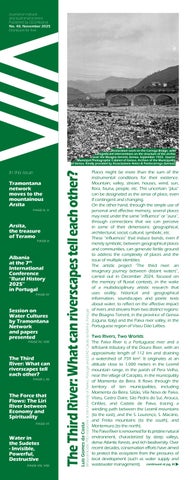
Restoration work on the Carrega Bridge, with significant interventions on the structure of the arches over the Bisagno torrent, Genoa. September 1923. Source: Municipal Photographic Cabinet of Genoa. Archive of the Municipality of Genoa. Kindly provided by Associazione Amici di Pontecarrega (Genoa).
Places might be more than the sum of the instrumental conditions for their existence. Mountain, valley, stream, houses, wind, sun, flora, fauna, people, etc. This uncertain “plus” can be designated as the sense of place, even if contingent and changing. On the other hand, through the simple use of personal and affective memory, several places may exist under the same “influence” or “aura”, through connections that we can perceive in some of their dimensions: geographical, architectural, social, cultural, symbolic, etc. These “influences” that induce bonds, even if merely symbolic, between geographical places and communities, can generate fertile ground to address the complexity of places and the issue of multiple identities. The artistic project “The third river: an imaginary journey between distant waters”, carried out in December 2024, focused on the memory of fluvial contexts, in the wake of a multidisciplinary artistic research that uses orality, historical and geographical information, soundscapes and poetic texts about water, to reflect on the affective impact of rivers and streams from two distinct regions: the Bisagno Torrent, in the province of Genoa (Liguria, Italy) and the Paiva river valley, in the Portuguese region of Viseu Dão Lafões.
Two Rivers, Two Worlds The Paiva River is a Portuguese river and a left-bank tributary of the Douro River, with an approximate length of 112 km and draining a watershed of 759 km². It originates at an altitude close to 1,000 meters in the Leomil mountain range, in the parish of Pera Velha, near the village of Carapito, in the municipality of Moimenta da Beira. It flows through the territory of ten municipalities, including Moimenta da Beira, Sátão, Vila Nova de Paiva, Viseu, Castro Daire, São Pedro do Sul, Arouca, Cinfães, and Castelo de Paiva, tracing a winding path between the Leomil mountains (to the east), and the S. Lourenço, S. Macário, and Freita mountains (to the south), and Montemuro (to the north). The Paiva River is renowned for its pristine natural environment, characterized by steep valleys, dense Atlantic forests, and rich biodiversity. Over recent decades, conservation efforts have aimed to protect this ecosystem from the pressures of local development (such as water supply and wastewater management). continued at pg. III