Journal on built & natural environment Published by GO2 Albania
No. 39, September 2025 Distributed for free
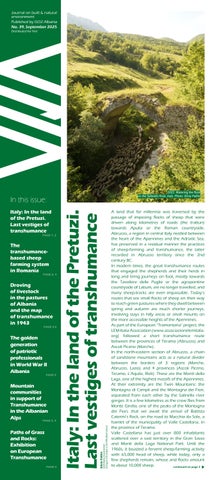
2022. Watering the flock on the Salinello River, Italy. Photo: Silvia Pallini
In this issue: Italy: In the land of the Pretuzi. Last vestiges of transhumance
PAGE 1, 2
The transhumancebased sheep farming system in Romania
PAGE 3, 4
Droving of livestock in the pastures of Albania and the map of transhumance in 1943
PAGE 5,6
The golden generation of patriotic professionals in World War II Albania
PAGE 5
PAGE 4
Silvia Pallini
Paths of Grass and Rocks: Exhibition on European Transhumance
LEM-Italia Association (Lingue d’Europa e del Mediterraneo)
Mountain communities in support of Transhumance in the Albanian Alps PAGE 2, 4
A land that for millennia was traversed by the passage of imposing flocks of sheep that were driven along kilometres of roads (the tratturi) towards Apulia or the Roman countryside, Abruzzo, a region in central Italy nestled between the heart of the Apennines and the Adriatic Sea, has preserved in a residual manner the practices of sheep-farming and transhumance, the latter recorded in Abruzzo territory since the 2nd century BC. In modern times, the great transhumance routes that engaged the shepherds and their herds in long and tiring journeys on foot, mostly towards the Tavoliere delle Puglie or the agropontine countryside of Latium, are no longer travelled, and many sheep-tracks are even impassable. Today’s routes that see small flocks of sheep on their way to reach green pastures where they dwell between spring and autumn are much shorter journeys, involving stays in hilly areas or small mounts on the more accessible heights of the Apennines. As part of the European “Tramontana” project, the LEM-Italia Association (www.associazionelemitalia. org) followed a short transhumance route between the provinces of Teramo (Abruzzo) and Ascoli Piceno (Marche). In the north-eastern section of Abruzzo, a chain of sandstone mountains acts as a natural divider between the borders of 3 regions (Marche, Abruzzo, Lazio) and 4 provinces (Ascoli Piceno, Teramo, L’Aquila, Rieti). These are the Monti della Laga, one of the highest massifs of the Apennines. At their extremity are the Twin Mountains: the Montagna di Campli and the Montagna dei Fiori, separated from each other by the Salinello river gorges. It is a few kilometres as the crow flies from Monte Girella, one of the peaks of the Montagna dei Fiori, that we await the arrival of Battista Caterini’s flock, on the road to Macchia da Sole, a hamlet of the municipality of Valle Castellana, in the province of Teramo. Valle Castellana has just over 800 inhabitants scattered over a vast territory in the Gran Sasso and Monti della Laga National Park. Until the 1960s, it boasted a fervent sheep-farming activity with 65,000 head of sheep, while today, only a few shepherds remain, whose and flocks amount to about 10,000 sheep. continued on page 2