Journal on built & natural environment Published by GO2 Albania No. 37, June 2025 Distributed for free
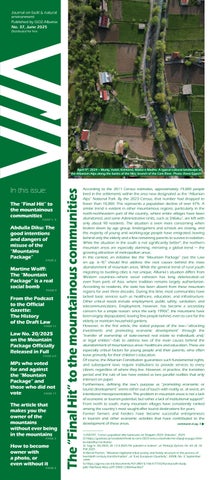
April 9th, 2024 – Muriq, Vukël, Kelmend, Malësi e Madhe. A typical cultural landscape of the Albanian Alps along the banks of the Nikç branch of the Cem River. Photo: Rand Eppich
In this issue: The “Final Hit” to the mountainous communities
FAQE 1, 3
Abdulla Diku: The good intentions and dangers of misuse of the “Mountains Package” FAQE 2 Martine Wolff: The “Mountain Package” is a real social bomb
FAQE 5
From the Podcast to the Official Gazette: The History of the Draft Law
FAQE 11
Law No. 20/2025 on the Mountain Package Officially Released in Full
FAQE 6-9
MPs who voted for and against the “Mountain Package” and those who did not FAQE 11 vote The article that makes you the owner of the mountains without ever being in the mountains FAQE 2
How to become owner with a photo, or even without it
FAQE 5
According to the 2011 Census estimates, approximately 19,000 people lived in the settlements within the area now designated as the “Albanian Alps” National Park. By the 2023 Census, that number had dropped to fewer than 10,000. This represents a population decline of over 47%. A similar trend is evident in other mountainous regions, particularly in the north-northeastern part of the country, where entire villages have been abandoned, and some Administrative Units, such as Shllaku1, are left with only about 90 residents. The situation is even more concerning when broken down by age group: kindergartens and schools are closing, and the majority of young and working-age people have emigrated, leaving behind only the elderly and a few remaining parents to survive in isolation. While the situation in the south is not significantly better2, the northern mountain areas are especially alarming, mirroring a global trend — the growing attraction of metropolitan areas. In this context, an initiative like the “Mountain Package” (see the Law on pp. 6–9)3 should first address the root causes behind the mass abandonment of mountain areas. While the general trend of rural youth migrating to bustling cities is not unique, Albania’s situation differs from Western countries—where social cohesion has long deteriorated—or even from parts of Asia, where tradition remains largely authoritarian. According to residents, the state has been absent from these mountain regions for over three decades. During this time, most communities have lacked basic services such as healthcare, education, and infrastructure. Other critical needs include employment, public safety, sanitation, and telecommunications. Employment, however, has become a secondary concern for a simple reason: since the early 1990s4, the mountains have been largely depopulated, leaving few people behind, even to care for the elderly or maintain household gardens. However, in the first article, the stated purpose of the law—“attracting investments and promoting economic development” through the “transfer of ownership of state-owned real estate to individuals and/ or legal entities”—fails to address two of the main causes behind the abandonment of mountainous areas: healthcare and education. These are especially critical factors for young people and their parents, who often leave primarily for their children’s education. Of course, the Albanian Constitution guarantees such fundamental rights, and subsequent laws require institutions to provide services to every citizen, regardless of where they live. However, in practice, the transition period and the rule of law have existed as two parallel realities that only intersect on paper. Furthermore, defining the law’s purpose as “promoting economic or tourist development” seems either out of touch with reality or, at worst, an intentional misrepresentation. The problem in mountain areas is not a lack of economic or tourism potential, but rather a lack of institutional support5. From north to south, many mountain villages have consistently ranked among the country’s most sought-after tourist destinations for years. Former farmers and herders have become successful entrepreneurs in tourism and other economic activities that have contributed to the development of these areas. continued at pg. 3 1) INSTAT, “Censi i popullsisë dhe banesave në Shqipëri 2023: Shkodra”, 2024 2) https://gazetasi.al/rezultatet-finale-te-cens-2023-veriu-u-boshatis-me-shpejt-se-jugu-cfareka-ndodhur-ne-tirane/ 3) “Ligj nr. 20/2025, dt. 13.3.2025 Për paketën e maleve”, at “Fletorja Zyrtare, Nr. 69, dt. 18 Prill 2025 4) Bernd Fischer, “Albanian highland tribal society and family structure in the process of twentieth century transformation”, at “East European Quarterly”, XXXIII, No. 3, September 1999 5) https://pjp-eu.coe.int/documents/42128013/106317733/Rural-youth-study. pdf/1fde9ee6-48ce-a2f7-2985-124b44ae46e7