LAST CHANCE FOR SUMMER.
Not ready to say bye-bye to summer?
Then go where the sun is still out. Where the party’s still going. Where there’s plenty of sizzle. Scan the code to book now and you’ll enjoy 20% off your stay.
 3000 S Las Vegas Blvd, Las Vegas, NV 89109 | rwlasvegas.com


PUBLISHER MARK DE POOTER mark.depooter@gmgvegas.com
EDITOR SPENCER PATTERSON spencer.patterson@gmgvegas.com
EDITORIAL

Senior Editor GEOFF CARTER (geo .carter@gmgvegas.com)
Editor at Large BROCK RADKE (brock.radke@gmgvegas.com)
Deputy Editor SHANNON MILLER (shannon.miller@gmgvegas.com)
Sta Writer GABRIELA RODRIGUEZ (gabriela.rodriguez@gmgvegas.com)



Sta Writer AMBER SAMPSON (amber.sampson@gmgvegas.com)
Contributing Writers GRACE DA ROCHA,HILLARY DAVIS, MIKE GRIMALA, CASEY HARRISON, KATIE ANN MCCARVER, TERESA MOSS, RHIANNON SAEGERT, DANNY WEBSTER











Contributing Editors RAY BREWER, JUSTIN HAGER, CASE KEEFER, DAVE MONDT

O ce Coordinator NADINE GUY
CREATIVE




Art Director CORLENE BYRD (corlene.byrd@gmgvegas.com)
































Senior Designer IAN RACOMA
Photo Coordinator BRIAN RAMOS
Photographers CHRISTOPHER DEVARGAS, STEVE MARCUS, WADE VANDERVORT
DIGITAL


















Publisher of Digital Media KATIE HORTON
Web Content Specialist CLAYT KEEFER
ADVERTISING & MARKETING



Publisher of Branded Content & Special Publications EMMA WOLFF
Special Publications Editor SIERRA SMART
Senior Advertising Managers MIKE MALL, ADAIR NOWACKI, SUE SRAN
Account Executives MARY CHARISSE DIMAIN, DEREK EIGE, LAUREN JOHNSON, ANNA ZYMANEK
Sales Executive Assistants APRIL MARTINEZ, NANCY RAMOS
Events Director SAMANTHA PETSCH
Events Manager HANNAH ANTER
Events Coordinator ALEXANDRA SUNGA
PRODUCTION & CIRCULATION


Vice President of Manufacturing MARIA BLONDEAUX
Production Director PAUL HUNTSBERRY
Production Manager BLUE UYEDA
Associate Marketing Art Director BROOKE EVERSON
Marketing Graphic Designer CARYL LOU PAAYAS
Production Artist MARISSA MAHERAS
Senior Tra c Coordinator DENISE ARANCIBIA
Tra c Coordinator ALEX HAASE
Distribution Relations Liaison JIDAN SHADOWEN
Fulfillment Operations Coordinator CASANDRA PIERCE
Route Administrator KATHY STRELAU
GREENSPUN MEDIA GROUP










































































































































































































































































































































































































































































































































CEO, Publisher & Editor BRIAN GREENSPUN
Chief Operating O cer ROBERT CAUTHORN
LAS VEGAS WEEKLY
2275 Corporate Circle Suite 300 Henderson, NV 89074















702-990-2550






















lasvegasweekly.com facebook.com/lasvegasweekly twitter.com/lasvegasweekly
All content is copyright Las Vegas Weekly LLC. Las Vegas Weekly is published Thursdays and distributed throughout Southern Nevada. Readers are permitted one free copy per issue. Additional copies are $2, available back issues $3.
ADVERTISING DEADLINE EVERY THURSDAY AT 5 P.M.



















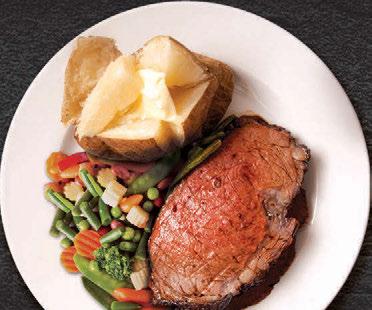



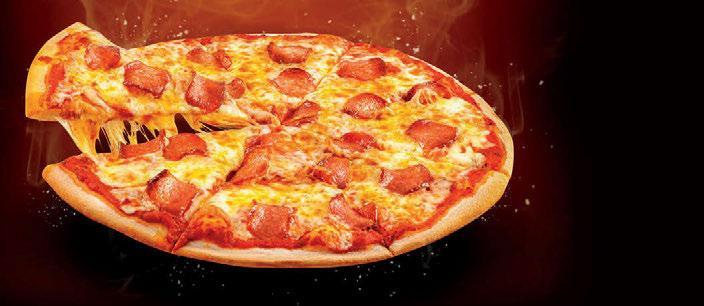

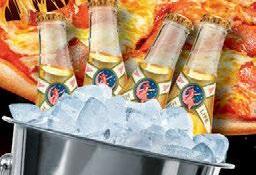























MORE FUN STEAK & SHRIMP $21 WEEKEND DEALS PRIME RIB PIZZA & BEER Visit SilverSevens.com/Dining for Details. AUGUST LIVE MUSIC PRESENTED BY SATURDAY 8/26 FRIDAY 8/25 JET VELOCITY 8:30PM - 12:00AM FREE ADMISSION KELLY VOHNN COUNTRY SUPERSTARS Room & Party Packages ON SALE! RACE WEEKEND NOVEMBER 16 -18 OFFERS
IN THIS ISSUE
Your daily events planner, starring Beyoncé, Beetlejuice, The Knocks, Lamb of God and more.
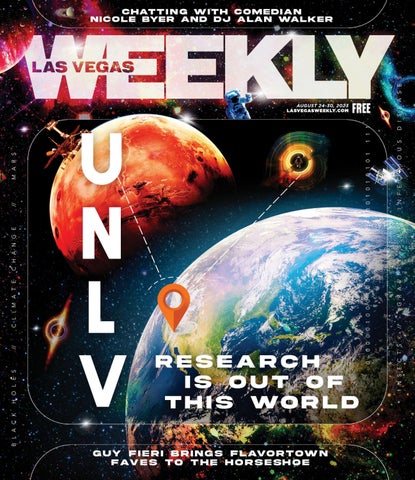
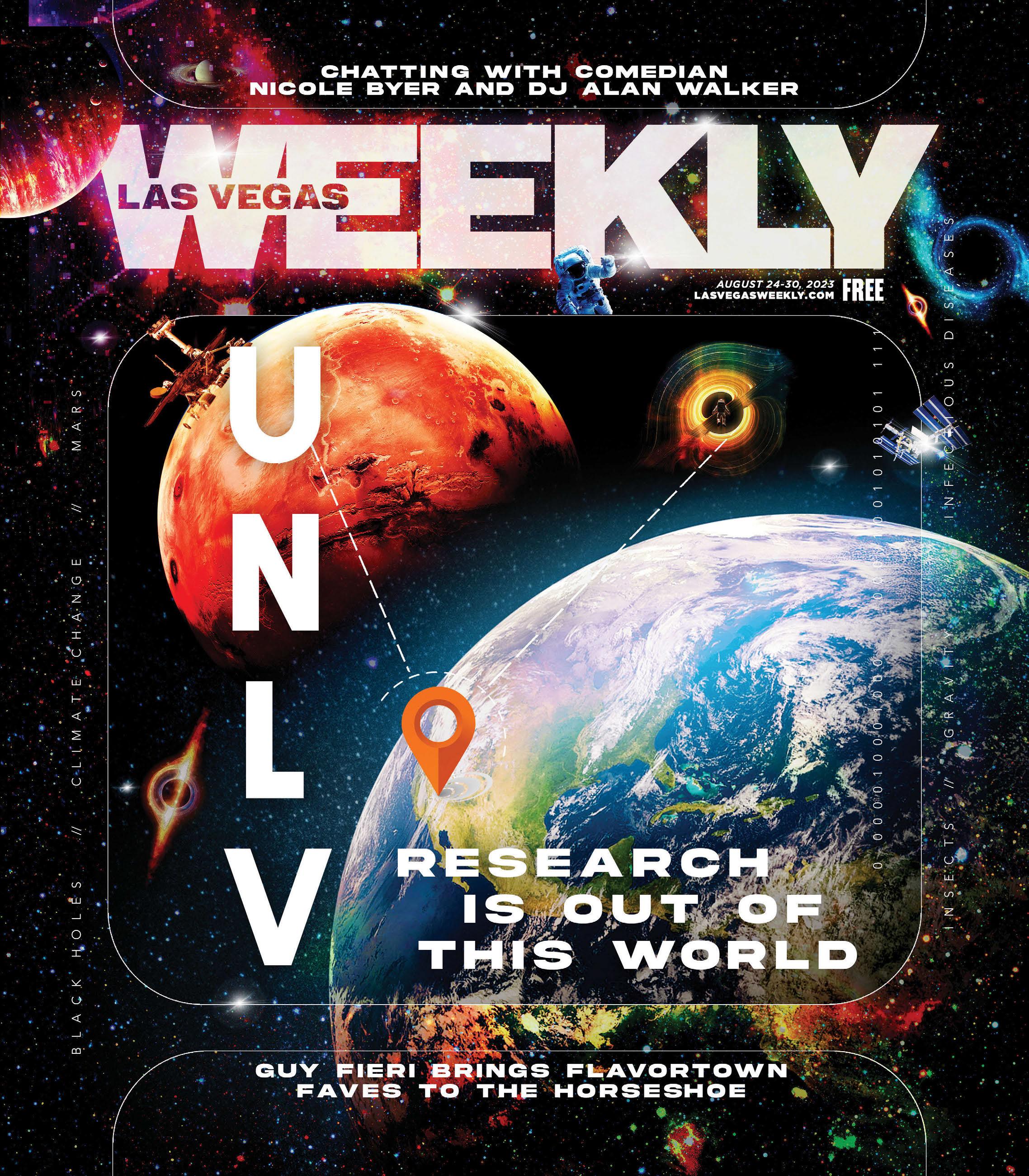
As UNLV resumes classes, its campus is also home to some amazing research about black holes, climate change and insect-borne illnesses. NEWS
What are Nevada colleges and universities doing to keep top graduates working in the state?
video game podcast The Other Castle explores the art of video game storytelling.
How high can UNLV’s football team climb this year, and what might its conference look like going forward?
SUPERGUIDE
COVER STORY
Vegas-based
& DRINK
Talking
32 18 28 08 40 42
SCENE
FOOD
Restaurateur—and UNLV grad—Guy Fieri brings big, bold flavors to the Horseshoe. COMEDY
pole dancing, dating and more with funny lady Nicole Byer.
46 SPORTS
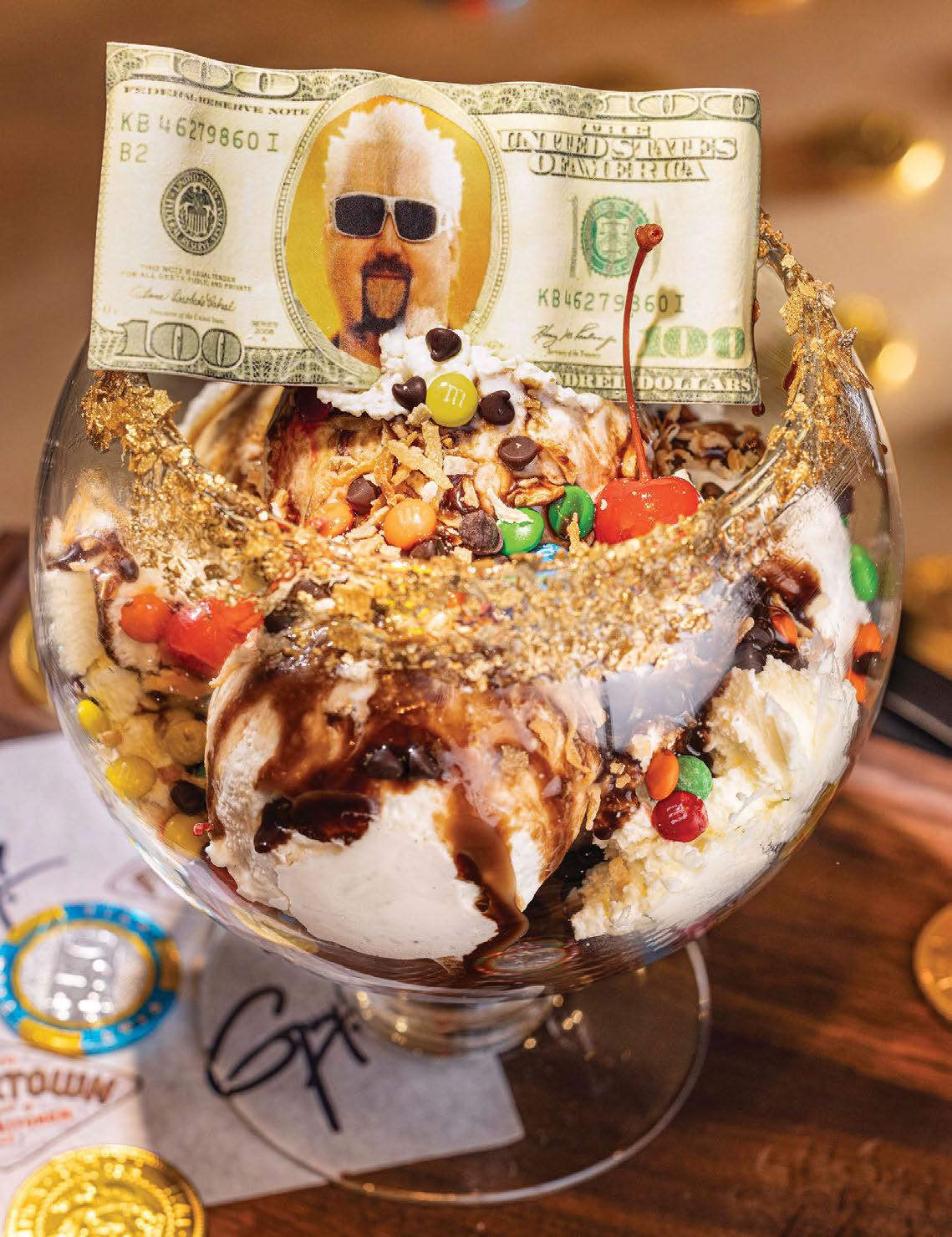
UNLV RESEARCH Photo Illustration ON THE COVER The OG Flavortown
Fieri’s Flavortown Sports Kitchen (Courtesy/Caesars Entertainment) WANT MORE? Head to lasvegasweekly.com. LAS VEGAS WEEKLY 7 I 8.24.23
Sports Sundae at Guy
MUSIC
THURSDAY
THE ENGLISH BEAT 8 p.m., 24 Oxford, etix.com.
GUTTERMOUTH
PARTY
With The Line, Guilty by Association, El Naba, 8 p.m., Backstage Bar & Billiards, seetickets.us.
DUSKY With Paluma Sound, 8:30 p.m., the Wall at Area15, area15.com.
SPORTS
NIKKI CARR 7 p.m., Vegas Stand Up & Rock, vegasstandup androck.com.

NERVO With Zen Freeman, 10:30 p.m., Zouk Nightclub, zoukgrouplv.com.
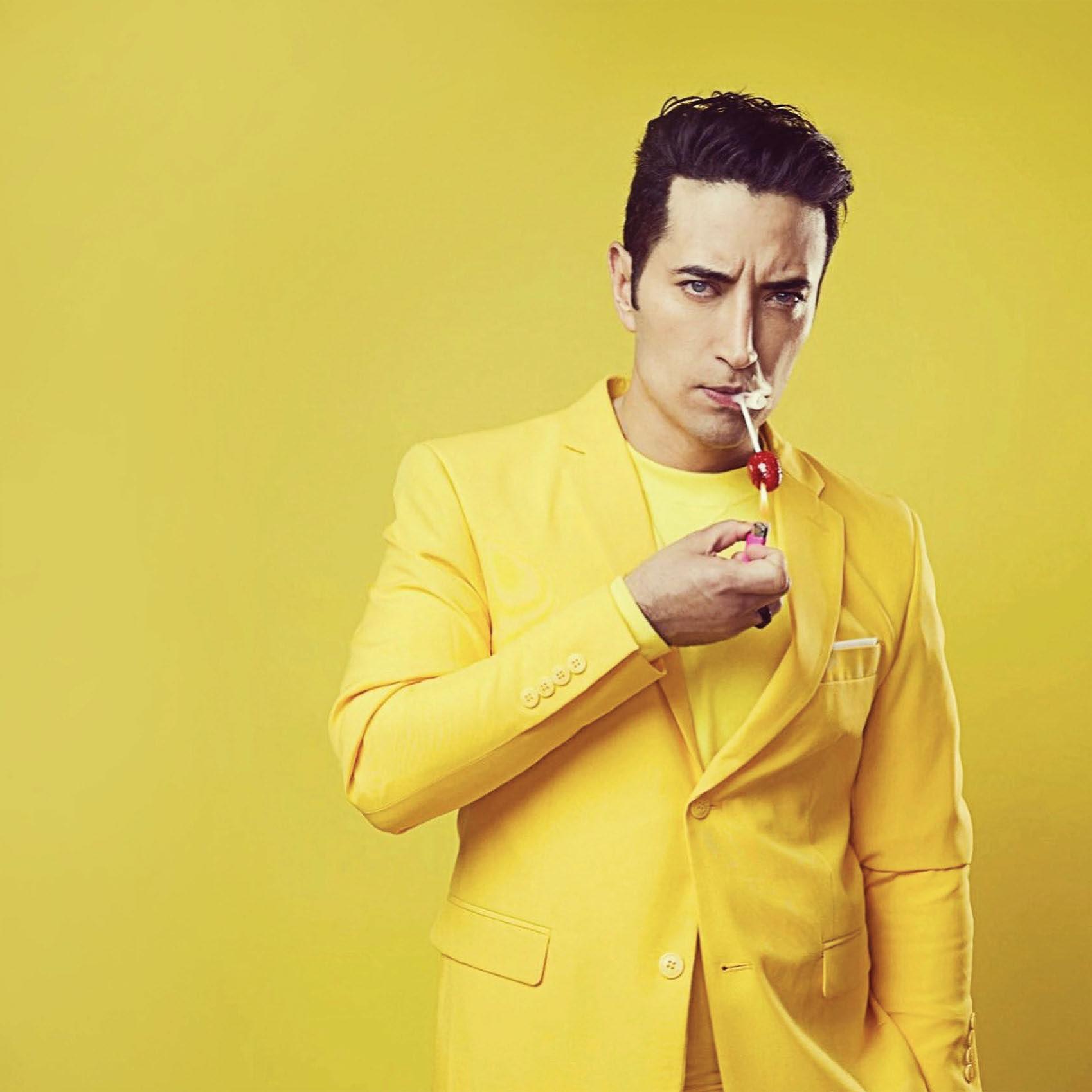
ARISTOTLE ATHARI
7:30 p.m., thru 8/27 (& 8/25-8/26, 9:30 p.m.), Jimmy Kimmel’s Comedy Club, ticketmaster.com.
ARTS
FOOD + DRINK
SPAG HEDDY With Soltan, Dr. Ushuu, 9 p.m., Hard Rock Live, seetickets.us.
DJ ROMEO 10:30 p.m., Tao Nightclub, events.taogroup.com.

CANDLELIGHT: HANS ZIMMER 6 p.m., Industrial Event Space, theindustrial vegas.com.
ORIGINAL SIN 9 p.m., Count’s Vamp’d, vampdvegas.com.
COMEDY
LIL TEXAS With Collelo, Lvcid, 10 p.m., We All Scream, seetickets.us.
AE:THER 10 p.m., Commonwealth, seetickets.us.
MISC
AUG.
SUPERGUIDE 24
8 LAS VEGAS WEEKLY 8.24.23 SUPERGUIDE
PLAN YOUR WEEK AHEAD
(Photo courtesy)
FRIDAY
ERIKA JAYNE 7:30 p.m., & 8/26, House of Blues, concerts.live nation.com.
JIM GAFFIGAN 8 p.m., & 8/26, Encore Theater, ticketmaster.com.
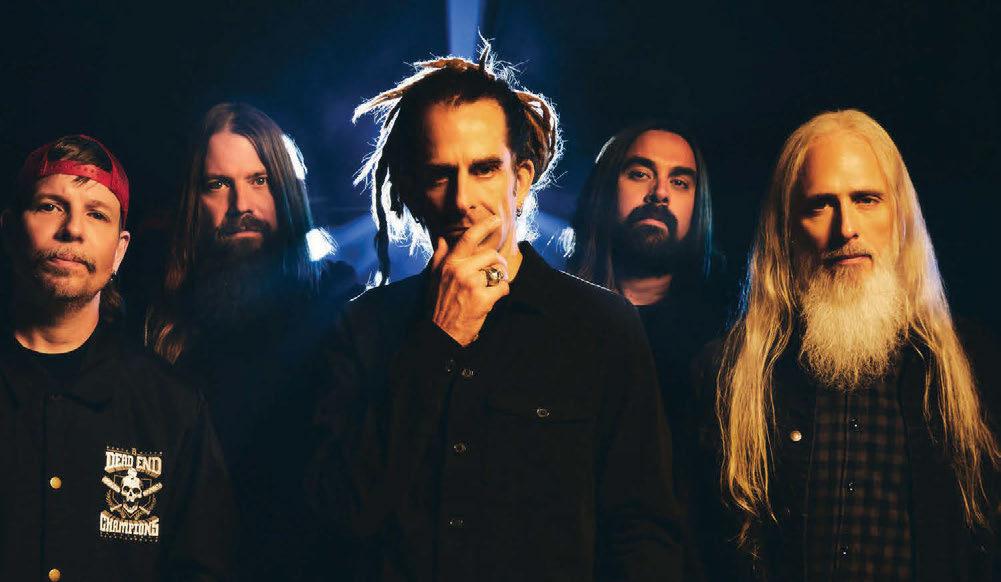
LAMB OF GOD
With The Acacia Strain, Suicide Silence, 7 p.m., Pearl Concert Theater, ticketmaster.com.
JUNIOR H 8 p.m., Bakkt Theater, ticket master.com.
GORDO 11 a.m., Tao Beach Dayclub, events. taogroup.com.
DANCE GAVIN
DANCE 6 p.m., Brooklyn Bowl, ticketmaster. com.
ADELE 8 p.m., & 8/26, the Colosseum, ticketmaster.com.
BRUNO MARS 9 p.m., & 8/26, Dolby Live, ticketmaster.com.
THE B-52S 8:30 p.m., & 8/26, 8/30, Venetian Theatre, ticketmaster.com.
TRUTH
With Shlump, Basura, 9 p.m., the Portal at Area15, area15.com.
THREE BAD JACKS
With Frankie Lee & The Infernos, Wyatt & The Ashes, War Peggy, 8 p.m., Dive Bar, eventbrite.com.
NOCHE BELICA With Nuevos Escoltas, Los Amigueros, Grupo Expansivo, Llamarada, 10 p.m., Discopussy, etix.com.
AMY LAVERE & WILL SEXTON 6 p.m., Sand Dollar Lounge, thesand dollarlv.com.
KENNEDY & JIMMY FAILLA 7 p.m., Grand Events Center, ticketmaster.com.
ZEDD 10 p.m., Zouk Nightclub, zoukgrouplv.com.
ALESSO 10:30 p.m., Omnia Nightclub, events. taogroup.com.
ACRAZE 10:30 p.m., XS Nightclub, wynnsocial.com.
THE KNOCKS
What Las Vegas lacks in beaches, it makes up for in sprawling day pools and unforgettable night swims. Circa’s year-round Stadium Swim is a bastion of both, and this Friday, it’ll kick off its After Dark Concert series, a poolside party featuring multi-platinum electro-funk duo The Knocks with support from Las Vegas-bred DJs Dos Lonely Boys, Z and a joint set from Evan Durant and Parra. “We the Beat has hosted a ton of cool shows in Downtown Las Vegas, so we loved the idea of partnering with them for Stadium Swim’s first EDM concert,” Circa CEO Derek Stevens said in a statement. “This is the first time Stadium Swim’s full screen will be utilized for something of this caliber, and we look forward to this being the start of more music events for the venue.” The night swim concert will offer a whirlwind of dance across Stadium Swim’s six pools and two spas, with a silent disco station and tastings from Casamigos Tequila and Cointreau. 7 p.m., $15-$20, Stadium Swim, circalasvegas.com.
–Amber Sampson
GREGORY PORTER
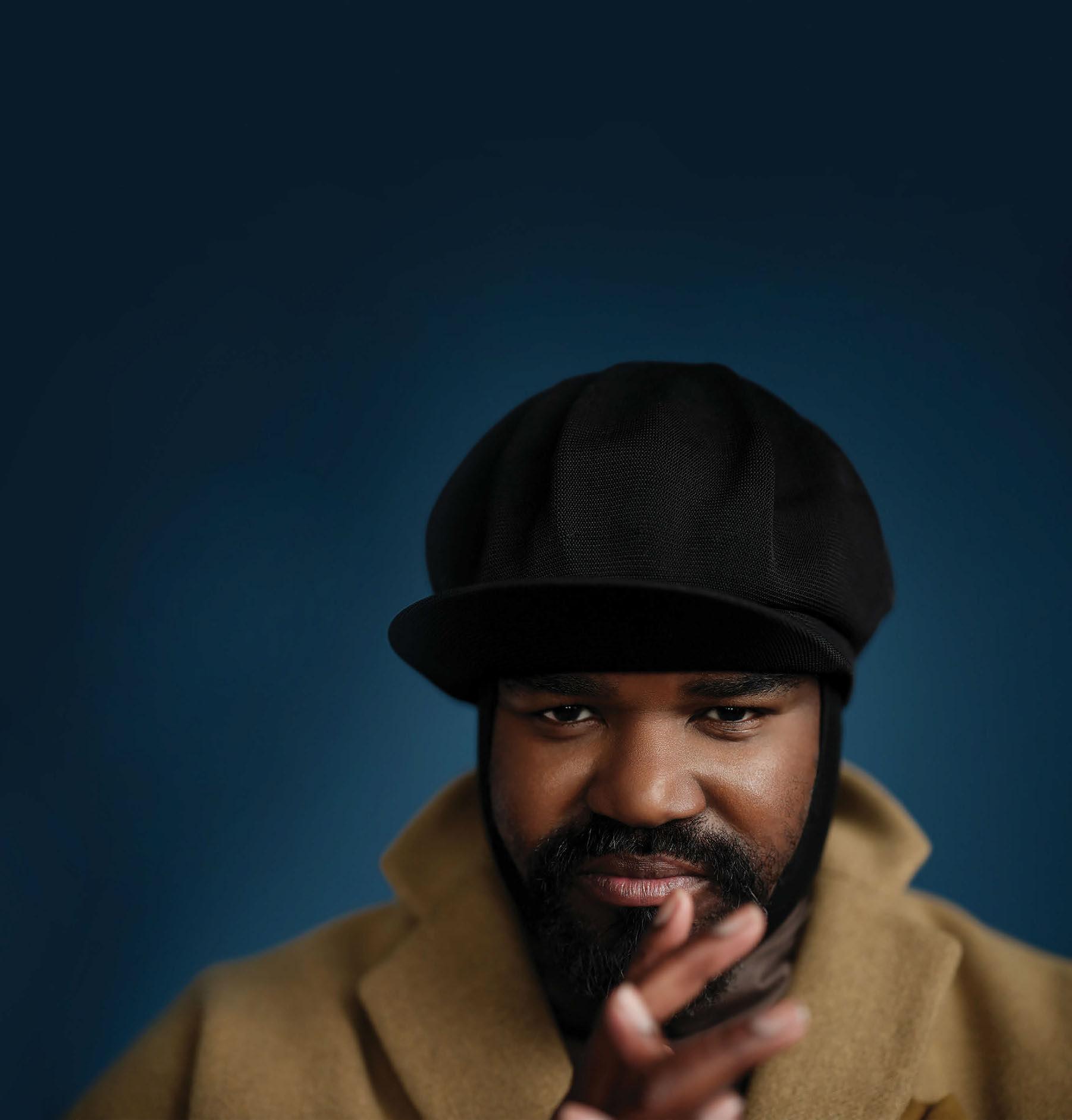
With Alonzo Bodden, 7:30 p.m., Reynolds Hall, thesmithcenter. com.
FOR MORE UPCOMING EVENTS, VISIT LASVEGASWEEKLY.COM.
25
AUG.
SUPERGUIDE
LAS VEGAS WEEKLY 9 I 8.24.23
(Courtesy/Erik Umphery)
FOR MORE UPCOMING
EVENTS, VISIT LASVEGASWEEKLY.COM.
SUPERGUIDE
DURAN DURAN
With Nile Rodgers & Chic, Bastille, 7 p.m., T-Mobile Arena, axs.com.

LAS VEGAS LIGHTS VS. PHOENIX RISING

7:30 p.m., Cashman Field, lasvegaslightsfc.com.
GODSMACK & STAIND
7 p.m., Bakkt Theater, ticketmaster.com.
NICOLE BYER 8 p.m., the Chelsea, ticketmaster.com.
RANDY HOUSER 8 p.m., Sunset Station Amphitheater, ticketmaster.com.
ILLENIUM 11 a.m., Tao Beach Dayclub, events.taogroup.com.
MY LIFE WITH THE THRILL KILL KULT
With Adult, Kanga, 9 p.m., Artifice, artificebarlv.com.
LIKE ROSES
With Dropped Out, The Core, 9 p.m., Red Dwarf, reddwarflv.com.
QUITAPENAS 7:30 p.m., Water Street Plaza Amphitheater, cityofhenderson.com.
ALAN WALKER Noon, Ayu Dayclub, zoukgrouplv.com.
IMPERIAL TIDE
With Talons, Erasermouth, Annelida, 6 p.m., Eagle Aerie Hall, seetickets.us.
BRASS KNUCKLE VOODOO
With Sloka, Children of Eden, NepCali, Anxious Annie, 10 p.m., Double Down Saloon, double downsaloon.com.
ASTROLOGER
With Desert Island Boys, Rhythm Ace & The NuTones, 6 p.m., the Gri n, eventbrite.com.
SUMMER OF SKA
With Space Amalgamated, Los Ataskados, Trinidad Suave, Ugly Boy, more, 4 p.m., the Space, thespacelv.com.
BROKE IN VEGAS
With Desert Degenerates, Dana Plato, Half Ast, Negative Nancys, 9 p.m., Founder’s Club, eventbrite.com.
THE CHAINSMOKERS 11 a.m., Encore Beach Club, wynnsocial.com.
STEVE AOKI 10:30 p.m., Omnia Nightclub, events.taogroup.com.
LUDACRIS
With Tay James, 10 p.m., Zouk Nightclub, zoukgrouplv.com.
MARSHMELLO 10:30 p.m., XS Nightclub, wynnsocial.com.
TYGA 10:30 p.m., EBC at Night, wynnsocial.com.
26 AUG. SATURDAY
10 LAS VEGAS WEEKLY 8.24.23 SUPERGUIDE MUSIC PARTY SPORTS ARTS FOOD + DRINK COMEDY MISC
(Courtesy/Mason
)
Poole
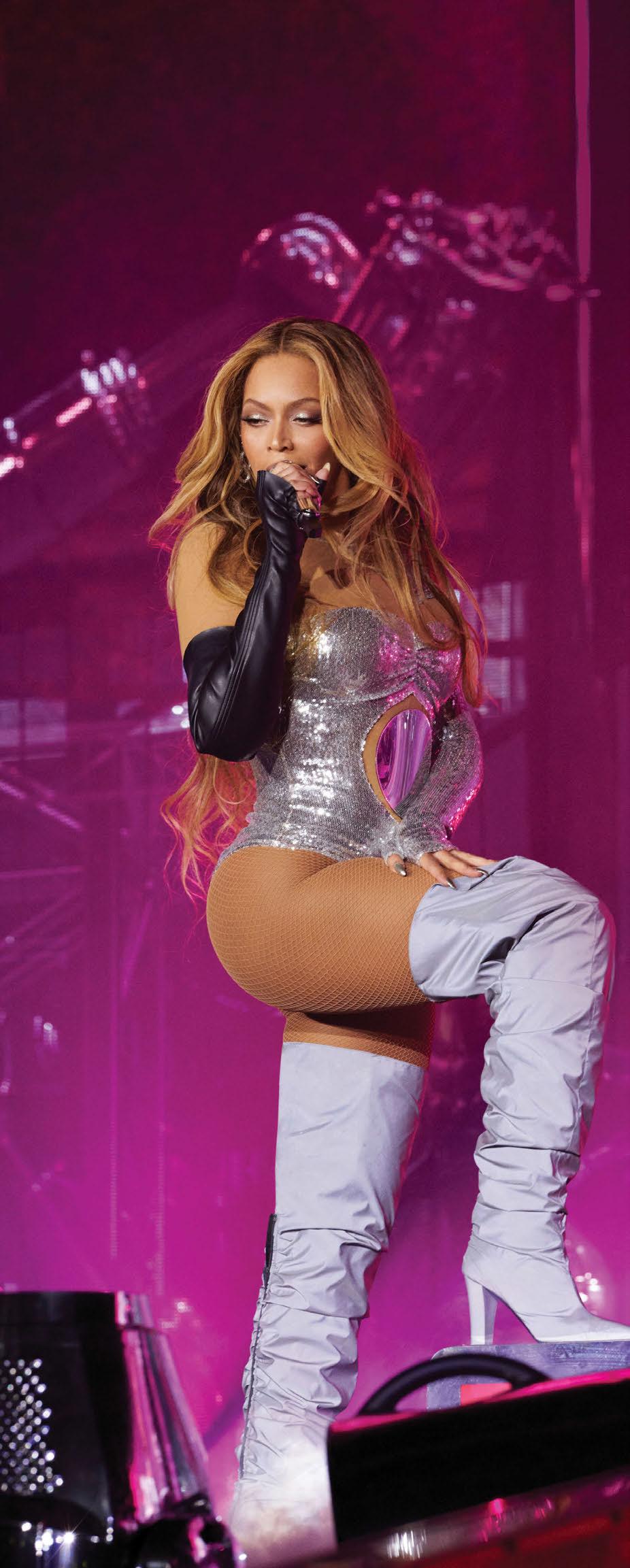
BEYONCÉ


“Single Ladies,” “Love on Top,” “Cu It”—if we’re thinking in terms of Beyoncé’s eras, each one of them has been golden. She perfected the art of the surprise album with 2016’s Lemonade. She redefined the girl group with Destiny’s Child. And she made history recently as the most-decorated Grammy Award winner of all time. Beyoncé’s work on the award-winning house music masterpiece Renaissance stunned the masses in 2022, bringing light to the Black luminaries and gay community that forged the genre into existence. She’s a wonder to some, a queen to many and easily one of the brightest stars of our generation. With her Renaissance World Tour, Beyoncé is on the road for the first time in seven years, o ering three hours of sheer, soul-touching spectacle The Guardian called “a spangled supernova of joy.” And when this vocal powerhouse makes her way to Allegiant Stadium, she’ll do it with the highest-grossing tour of any Black performer. If that isn’t something to celebrate with 65,000-plus people in Las Vegas, we don’t know what is. 8 p.m., $162+, Allegiant Stadium, ticketmaster.com
–Amber Sampson
TOO SHORT
Noon, Daylight Beach Club, daylightvegas. com.
TWO FRIENDS
Noon, Encore Beach Club, wynnsocial. com.
SOULS OF MISCHIEF
7 p.m., Backstage Bar & Billiards, seetickets.us.
MONDAY
YAMANEIKA SAUNDERS
With John Joseph, Dustin Ybarra, Michael Yo, thru 8/31, 7 & 9:30 p.m., Comedy Cellar, ticketmaster.com.
ATREYU
With Memphis May Fire, 5 p.m., House of Blues, concerts. livenation.com.
THE HAVANA EXPRESS 7 p.m., Easy’s Cocktail Lounge, easysvegas.com.
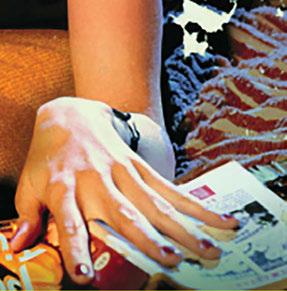
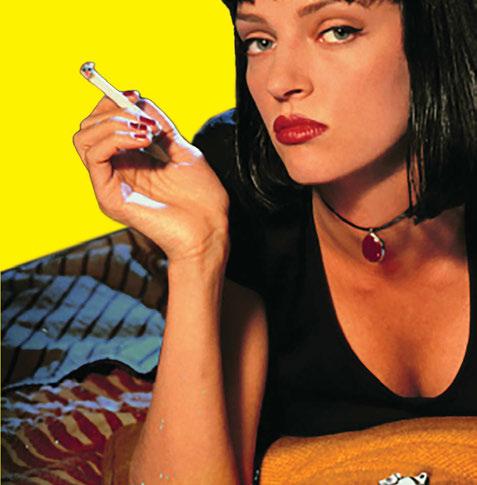
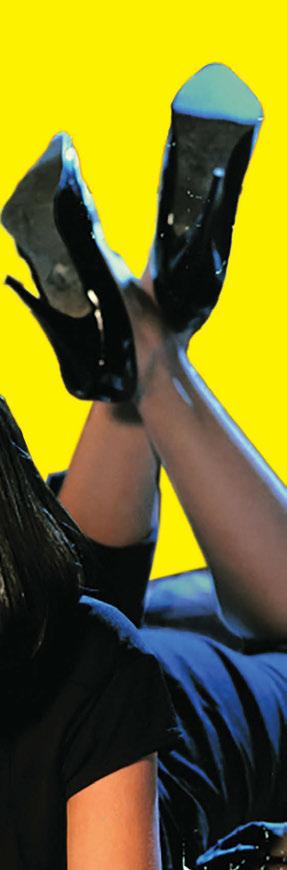
DIVE-IN MOVIES: PULP FICTION


8 p.m., Boulevard Pool, ticketmaster. com.
(Courtesy/Miramax)
OUTTA POCKET
With Hold My Own, Sector, Sea of Sorrow, Thousand Wayz
2 Die, 6 p.m., American Legion Post 8, seetickets.us.
WILL HAVEN
With Spirit in the Room, Haddonfield, Algorerhythm, The Hate, 7 p.m., Dive Bar, eventbrite.com.
DIPLO & DILLON FRANCIS
10:30 p.m., XS Nightclub, wynnsocial.com.
CAM’RON
10:30 p.m., Drai’s Nightclub, draisgroup.com.
GLAM 7 p.m., Ghostbar, palms.com.
WILLIE FRATTO FARRELL
Thru 9/3, 8 p.m., LA Comedy Club, bestvegascomedy. com.
DJ SOURMILK 10:30 p.m., Jewel Nightclub, events.taogroup. com.
27 AUG. SUNDAY
FOR MORE UPCOMING EVENTS, VISIT LASVEGASWEEKLY.COM. SUPERGUIDE LAS VEGAS WEEKLY 11 I 8.24.23
LAS VEGAS AVIATORS VS. SALT LAKE BEES
Thru 8/31, 7 p.m., Las Vegas Ballpark, ticketmaster. com.
CYBORG OCTOPUS
With Kallias, Sorrowseed, Luciefr, 8 p.m., the Gri n, eventbrite.com.













HARPER BIG BAND
With Naomi Mauro, 7 p.m., Myron’s, thesmithcenter. com.
AERIAL GREY
With Andrew Sterling, Aura Jaubertt, Badbeat, 10 p.m., La Mona Rosa, mntra.vegas.
KUMARION 10 p.m., Discopussy, BRUCE discopussydtlv. com.
BEETLEJUICE
You wouldn’t know it to look at it, but Tim Burton’s creepy comedy Beetlejuice is 35 years old. (OK, a fresh-faced Alec Baldwin is a bit of a giveaway.) Burton’s tale of a recently deceased couple, the disa ected teenage girl whose family moves into their home and the “bio-exorcist” the ghostly couple hire to scare the family away has a timeless charm, one that should translate nicely to the stage in a musical version haunting Reynolds Hall this week. With a book by Scott Brown and Anthony King and a bunch of songs written by Australian comic Eddie Perfect, the musical Beetlejuice takes all the stu you love—yes, even “Day-O”—and makes it sing. Hurry—like most things related to the spirit realm, tickets are vanishing. Thru 9/3, times vary, $50-$160, Reynolds Hall, thesmithcenter. com. –Geo Carter
30 AUG. WEDNESDAY

LUKE BRYAN





8 p.m., Resorts World Theatre, axs.com.

HOAXED With Spelling Hands, The Guilty Party, 8 p.m., the Usual Place, eventbrite.com.




MONSTERWATCH
With Spoon Benders, Headwinds, Spring Breeding, 8 p.m., Artifice, eventbrite.com.



CHASE MATTHEW
7 p.m., Fremont Street Experience, vegasexperience. com.




SLLASH & DOPPE
10:30 p.m., Marquee Nightclub, events. taogroup.com.
29 AUG. TUESDAY
12 LAS VEGAS WEEKLY 8.24.23 SUPERGUIDE MUSIC PARTY SPORTS ARTS FOOD + DRINK COMEDY MISC PLAN YOUR WEEK AHEAD SUPERGUIDE FOR MORE UPCOMING EVENTS, VISIT LASVEGASWEEKLY.COM.
(Courtesy/Robby Klein)
SUPERGUIDE
• MEET YOUR FAVORITE CELEBRITY CHEFS AND ENJOY AN ENDLESS SIGNATURE FEAST DEVELOPED EXCLUSIVELY FOR THE EVENING OF HOPE GALA
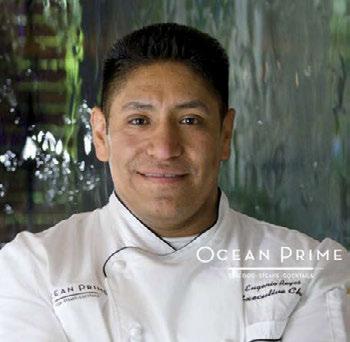
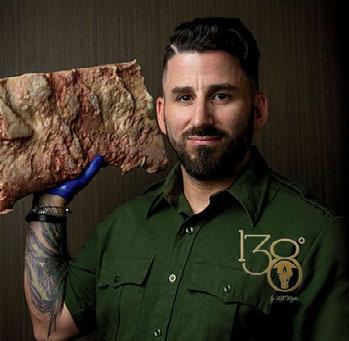
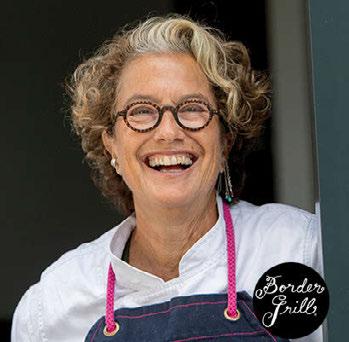
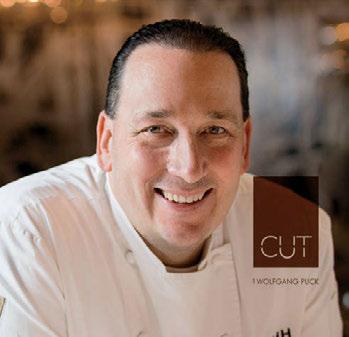
• PERFORMANCES BY TONY AWARD WINNER IDINA MENZEL AND GRAMMY NOMINEE ALOE BLACC






• SIGNATURE COCKTAILS CRAFTED BY LAS VEGAS’ HOTTEST MIXOLOGISTS, COURTESY OF BREAKTHRU BEVERAGE



• ONE-OF-A-KIND EXPERIENCES INSPIRED BY “THE CITY THAT NEVER SLEEPS”

















SIGNATURE
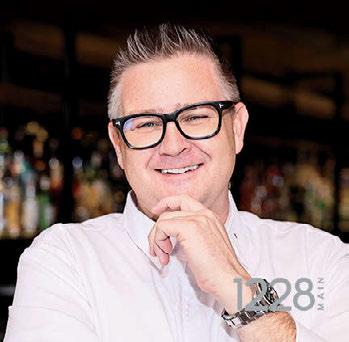
FROM CHEF SUSAN FENIGER BORDER GRILL CHEF MATT HURLEY CUT BY WOLFGANG PUCK CHEF MATT MEYER 138⁰ CHEF EUGENIO REYES OCEAN PRIME LAS VEGAS CHEF DUSTIN LEWANDOWSKI 1228 MAIN
CULINARY CREATIONS
CELEBRITY
PURCHASE YOUR TICKETS TODAY! UMCSN.COM/GALA OCTOBER 13, 2023 | PARIS LAS VEGAS
DISHES
THE BIG APPLE COMES TO LIFE IN LAS VEGAS! DELIGHT IN
FROM TOP
CHEFS
BATTLING BACK-TO-SCHOOL ANXIETY
Hope Means Nevada’s Ciera Bellavance helps teens with mental health
PEOPLE
Q+A THE WEEKLY Q&A
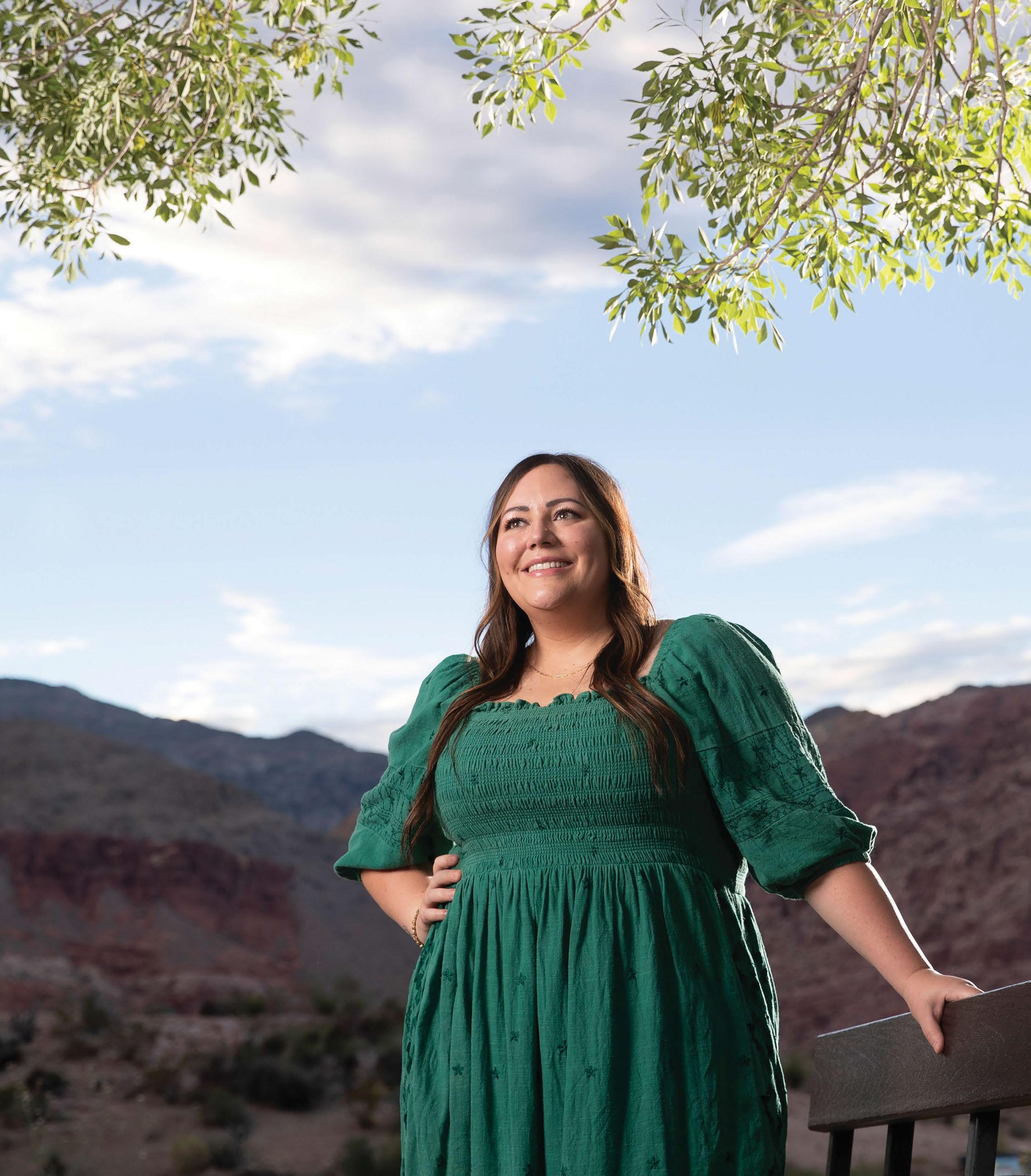
Ciera Bellavance (Steve Marcus/Staff)
14 LAS VEGAS WEEKLY 8.24.23
BY JORDAN VALLENDER
Hope Means Nevada is dedicated to normalizing conversations about mental health among students. The nonprofit started in 2020 during the COVID-19 pandemic, and since then, it has added a teen committee so local teens can make an impact in their schools. Hope Means Nevada also hosts events and roundtables to discuss mental health-related topics and help teens feel mor e heard in the community.
As students prepared to return to school, the Weekly spoke to Ciera Bellavance, Hope Means Nevada’s executive director, about her organization’s mission and how to have a smooth transition back to campus.

Why focus on youth mental health? When it comes to mental health, specifically youth mental health, Nevada ranks towards the bottom of the list, [with a] high rate of attempted suicides and completed suicides and a low rate of care. … We talked to some teens who said things like, “I’ve been wanting to figure out stuff with my mental health, but I didn’t even know it was called behavioral health.” So [we’re] opening the door to those conversations and then providing the resources so that they can find support, if needed.
Do you think the effects of COVID-19 and the pandemic shutdowns are still being felt among adolescents? We still have reports of students saying the anxiousness doesn’t go away. The CDC has also reported the highest levels of teens that report feeling deep sadness and hopelessness. So I don’t think that that’s gone away.
How many volunteer youth ambassadors are on the teen committee? How does that system work? We currently have over 100 teens that have signed up on our website, and that’s basically all through word of mouth. They’re really advocates in their schools, with their peers, and they do a lot of interviews. We have our campaign slogan #Ask5. We challenge everyone, but teens specifically, to reach out and ask at least five of their friends or family how they’re doing and really listen for the response. We also know that peer-to-peer connection is much more valuable and stronger than adults trying to attempt to talk to teens. I don’t think it would be very effective if we didn’t have those teen advocates. We’re very grateful for them.
What can the community do to help with the goal of better mental health for adolescents and teens? I think that the biggest thing that we can do as a communi-
ty is to be kind to one another and be an example. If we want better mental health, we should try and practice that.
I also think that it’s important to talk to the people in your lives about mental health. We talk with some teens who say they’re completely comfortable talking about their mental health, but their parents kind of clam up and get nervous to talk about it, which makes sense. On our website hopemeansnevada.org , we have tips for parents on how to talk to their teens about mental health. I would say make that a normal conversation, just like you would talk about their physical health.
Social media is obviously a huge factor in adolescents’ mental health these days. What tips does Hope Means Nevada offer when it comes to that? I think social media can be a really great thing … but we call it “doomscrolling.” Stop the doomscroll! … It’s not bringing you any joy or happiness, or you’re looking at things that cause anxiety or make you nervous. So we always say, follow accounts that make you feel good and make you feel positive. It’s OK to unfollow things that aren’t serving you.
What would you say to someone feeling anxious or nervous upon returning to school? I think preparing yourself—know where you’re going, your clothes are laid out, you have enough sleep and you’re setting an alarm at a reasonable time—can help reduce anxiety and uncertainty.
I also think that it’s important to recognize that change can be scary and uncertain, but it doesn’t mean that it’s a bad thing; recognize that it’s OK to feel feelings of anxiousness or nervousness. Those are all normal and healthy.
LAS VEGAS WEEKLY 15 I 8.24.23






✔ Lose up to 20% of your body weight ✔ Powerful appetite suppressant ✔ Regulates blood sugar ✔ Weekly SQ injections SEMAGLUTIDE PROGRAM 3365 E. Flamingo Road, Ste 2, Las Vegas, NV 89121 | 4966 S Rainbow Blvd STE 100, Las Vegas, NV 89118 WEIGHT LOSS www.iuventusmedcenter.com (702) 919-1099 SPECIAL OFFER: $$215 215 ✔ Consultation with a Licensed Medical Provider ✔ Physical Examination ✔ Full Body Composition Analysis ✔ Initial Dose of Medication ON TAP CRAFT BEERS ARCADES * CONSOLES * PINBALLS * 21 & ALL YOU CAN PLAY ARCADE GAMING! www.PLAYER1VEGAS.COM 2797 SOUTH MARYLAND PKWY * LAS VEGAS, NV 89109 STRAIGHT TO YOUR INBOX BIGGEST NEWS THE DAY’S Sign-up Now at LVSun.com/Optin

SWEET SCIENCE
A lot of the time, when someone mentions the University of Nevada Las Vegas, they’re speaking of its renowned School of Hospitality, its fast-growing medical school or its Jerry Tarkanian-era men’s basketball teams. But UNLV is also one of the nation’s top research universities, awarded an R1 classification (“very high research activity”) from the Carnegie Classification of Institutions of Higher Education. Join the Weekly as we peek into the laboratories where world-changing scientific research is ongoing.
SPACE ODDITIES



Professor Bing Zhang advances our understanding ofblack holes


An astrophysicist of 30 years, Bing Zhang sees his job a bit di erently than most.

“Our job is like a detective’s job,” says Zhang, a distinguished professor at UNLV, who also leads the Nevada Center for Astrophysics. “What we get are some ngerprints, footprints, occasionally some smoking guns, and then you try to gure out the crime scene. It’s a lot of fun.”
Recently, Zhang and a team of international scientists observed the jet activity of a black hole, one of the universe’s most magnetically powerful entities. With a solar mass three to more than 10 times that of the sun, a stellar black hole has the gravitational strength to swirl around the fabric of time and space, and eat material from nearby stars. As star material gets sucked into the orbit of the black hole, an extremely hot accretion disc forms, and the black hole unleashes a jet of plasma, purging itself of its stellar leftovers at nearly the speed of light.





“The jet is very powerful,” Zhang says. “If
there is a star along the jet axis and it’s close enough, it would be destroyed or pushed away.”









Using China’s Five-hundred-meter Aperture Spherical Telescope (FAST)—a highly sensitive machine located in a natural depression in that country’s southwest region—scientists detected a quasi-periodic oscillation ( uctuation in radio signal) never observed before in the jet. Every 0.2 seconds, the signal would modulate, suggesting to Zhang that changes within the jet were produced by a misalignment between the jet direction and the black hole’s rapidly spinning axis. This observation, published in Nature this summer, highlights a compelling new feature for black holes.
Fast radio bursts (FRBs) have been another area of study and discovery for Zhang. First detected in 2007, these deep-space explosions last only milliseconds and were thought to exist outside of our galaxy exclusively. In 2020, the rst FRB in our Milky Way was detected.

“It was super, super bright,” Zhang says.
“That one was a million times brighter than the others because it was nearby, and so because that happened in our Milky Way galaxy, we were able to gure out where it came from.”




we were able to gure out where it came from.”
2020 Top 10 Break-
In one of Science’s throughs of the Year, it was determined that magnetars—exceptionally strong and compact neutron stars that are the size of a city— had produced the Milky Way’s FRB.



Zhang and a team of astronomers wasted little time using FAST again to monitor the same magnetar from 2020 after a larger burst. Together, they discovered that magnetars were responsible for two emission modes seen in space: They could create intensely bright bursts at random or faint pulses during narrow “phase window” periods, and that happened within di erent regions of the magnetar’s magnetosphere, Zhang says.
Those ndings, published in vances in 2023, have advanced our knowledge of magnetars and the signals they’re capable of sending.

Together, they discovered that magnetars magScience Adof magnetars and the signals they’re capable Amber Sampson

 -Amber Sampson
Researchers at UNLV are protecting us from disease, cooling our cities and watching the stars
18 LAS VEGAS WEEKLY 8.24.23
(Courtesy/Wei Wang)
Zhu discovers a new way planets can form
Professor Zhaohuan
G R A V I
T




The secret to giant planet formations like Jupiter is quite literally written in the stars.





“By studying these young stars, we will be able to understand how our solar system formed billions of years ago,” says Zhaohuan Zhu, an associate professor in the department of physics and astronomy at UNLV.
In the galaxy, there are molecular clouds full of interstellar dust and hydrogen. As a cloud grows more dense, it collapses under its own gravity. The material at the cloud’s core then heats up, eventually becoming a star.
“Our universe is continuously doing this,” Zhu says. “Young stars form from a cloud, the stars will evolve, stars will explode and then disperse all the gas back into the interstellar medium and have a new generation of stars born from these clouds. Stars have their own life cycle.”
So do planets. Not all cloud matter lands in the star at collapse, Zhu says. Dust grains and gas might gather around it to form a spinning protoplanetary disc. The leftover matter continues to coagulate, eventually snowballing into planet size. That process, known as core accretion, is the most common form of planet creation.
But in 2012, Zhu predicted that if researchers utilized Chile’s Atacama Large Millimeter/submillimeter Array (ALMA) telescope, they could eventually detect a previously unseen stage of a protoplanetary disc growing so massive, it becomes unstable against gravity.
“The disc now becomes subject to something called gravitational instability,” Zhu says. “It starts to form these spirals in the discs, and sometimes these spirals fragment and clump. These clumps
At the time of his prediction, Zhu says the ALMA didn’t have a high enough resolution to con rm this theory. But Chilean astronomers later reached out to him after discovering the spirals in a young star roughly 5,000 light years away while deploying ALMA and the European Southern Observatory’s

star roughly 5,000 light years away while deploying Very Large Telescope (VLT).

This is the rst observation of clump formation from gravitational instability of this scale. And Zhu says new radio telescopes in development, such as the Next Generation Very Large Array, will o er even greater resolution to capture such remarkable proof
of planet origins. –AS
E F Y I N GD U N L V R E S E A R C H
could eventually form giant planets.”
SWEET SCIENCE
WATCHING MARS
Professors Libby Hausrarth and Arya Udry study the Red Planet’s future potential
Was there life on Mars? UNLV geoscientists Elisabeth “Libby” Hausrath and Arya Udry are working with NASA to find out.

The professors were selected to join NASA’s Mars 2020 Mission, a project that has given them a rare look at the Red Planet—both its geology and its potentially habitable past. NASA’s Perseverance rover has been on Mars since 2021, examining native rocks and soil samples in preparation for an eventual human landing.
“In order to really make a definitive statement, we would need to have samples in hand to examine potential evidence of past life, but life leaves organic molecules,” says Hausrath, an aqueous geochemist and astrobiologist. “It leaves changes in the isotopes, in trace metals,

in the morphology. All of those can be potential bio signatures of past life.”
The evidence of water on Mars is especially exciting to her. “I’m really looking forward to when we arrive outside the crater, because this is a completely different environment, one that has a lot of aqueously altered minerals,” Hausrath says. “They look, from orbit, like potential soils on Earth. So this is a really exciting change that we’re approaching in terms of the rover.”
Udry, who studies planetary magmatic rocks and martian meteorites, was amazed to find lava flows in the exploration’s first year via rover images, and magma that had crystallized into the planet’s crust.
“What I love is seeing some of the images I was
able to process, being one of the first humans to ever see this part of this planet,” she says. “That’s so cool, especially when the rocks are very interesting to me. Us geologists have our favorite rocks.”
Currently, Perseverance is packaging rock samples to be shipped back, and a helicopter will be launched to Mars to retrieve them. Samples are expected to return to Earth around 2033. Until then, the scientists are studying the mineral chemistry of found rocks and determining how “minerals and micro organisms can interact to preserve potential bio signatures,” Hausrath says.
As the only university besides MIT with two Participating Scientists selected for this project, UNLV is leading by example. “It’s a real privilege to be on the mission,” Hausrath says. –AS
20 LAS VEGAS WEEKLY 8.24.23
A 2022 image from NASA’s Perseverance Mars rover (Courtesy/NASA/ JPL-Caltech)
It’s getting hotter. The nonpro t scienti c research organization Climate Central reports that average summer temperatures in Las Vegas have risen nearly six degrees since 1970, and Southern Nevada remains one of the fastest-warming metropolitan areas across the west—getting hotter faster than Phoenix, Salt Lake City and El Paso. Finding and promoting new ways to cool o —and ultimately, build a more sustainable and e cient desert city for the future—is the focus for UNLV professor of architecture and urbanism Ste en Lehmann, an internationally recognized researcher, educator and designer. Originally from Stuttgart, Germany, he has been in Las Vegas for almost six years, having previously worked in the U.K. and Australia. “My idea is always to go where you have real problems and challenges to solve,” he says, and Las Vegas has proven to be a fertile place for his expertise.
For the past 25 years, Lehmann has researched mitigation strategies for the built environment in relation to the urban heat island e ect, to help these cities cope with global warming and climate change impacts. His recent studies and published papers run the gamut: contrasting Las Vegas with Adelaide, Australia, and optimizing urban cooling strategies surrounding the many parking lots in both cities; exploring the evolution of mass timber construction and how current innovations can be expanded to create a more energy-e cient home-building and general construction industry; and honing in on the research methods behind urban design in the hopes of building a stronger foundation of sustainability and “the resiliency of places.”
“What I try to do in my research is [go beyond] the design aspects and emphasize that the economic and health impacts are the drivers,” Lehmann says. “I always say to the team that we need to communicate a positive message, not a doomsday message, but what can be done—a message of hope, never alarmism. Our research is always based on signs, grounded in common sense, practical solutions, and we try to work with industry [sources] as much as possible.”
Las Vegas needs solutions speci c to its unique climate and geography, he says, urban cooling innovations that go beyond air-conditioning our homes, schools, casinos and o ces. “Solar really is the future and there’s more solar available than any other place, so we should do






more with it. But we also need to think about surfaces that do not store heat and do more research on re ective coatings on new construction products. How do we do white pavement? How do we integrate vegetation and greenery to lower surface temperatures? What trees are giving us the biggest bang for the buck?”







As detailed in the mass timber paper, modular o site manufacturing of houses—in which components of a new home are built assembly-line style at a factory, like cars or computers, then shipped to the site—is becoming successful in the Paci c Northwest and Canada and could be a meaningful innovation in Southern Nevada, one that could bring less expensive, more energy-e cient homes to the region while producing much less construction waste.
The vast suburban sprawl that makes Las Vegas such a fascinating young city also contributes to the urban heat island e ect. Our reliance on cars steadily elevates air pollution in the Valley, while new construction continues to spread to the edge of our borders.

“More suburbs, more isolated people sitting in fully air-conditioned houses,” Lehmann says. “One thing we can learn is that urban in ll is the future, because it’s much more economical to develop new housing in already built-up areas where the infrastructure already exists rather than green eld development outside the city [core]. We need to stop creating sprawl, to say enough is enough—the footprint of the city doesn’t need to grow outward but to grow, compact, inwards.”
Lehmann and his collaborators are starting to work with Nevada lawmakers—and with o cials and researchers across the west—to revamp construction codes in order to encourage builders and city planners to better incorporate such sustainable materials and combat heat and climate change. He cites a recent ve-year National Science Foundation urban heat island study of six U.S. cities and ve in Australia as a model for a similar project he’d like to conduct looking at desert cities in the southwest, and that process has started, though funding hasn’t been secured.

“We have grand challenges and architects alone cannot solve them,” he says. “We have to work together, scientists, experts, builders, everybody contributing something. A city is complex, and not one profession alone can x it. It requires an interdisciplinary approach, just like research.” –Brock
Radke












U N L V R E S E A R C H
COOLING
We need to stop creating sprawl, to say enough is enough … to grow, compact, inwards.”
LAS VEGAS WEEKLY 21 I 8.24.23
Professor Steffen Lehmann works to solve Las Vegas’ climatechange challenges
CATCHING BUGS


U N L V R E S E A R C H
Profs Chad Cross and Louisa Messenger work to cut the spread of insect-transmitted diseases
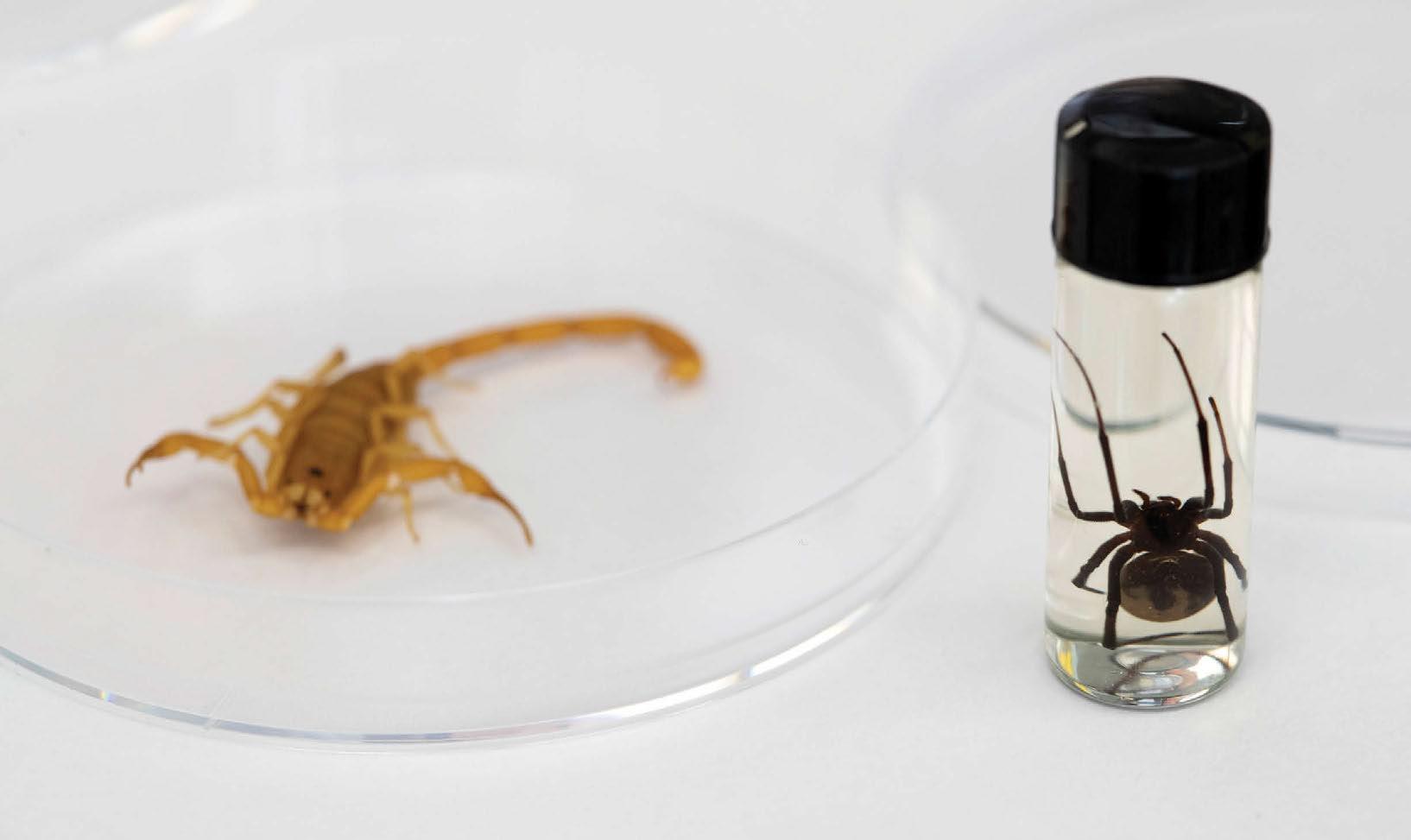
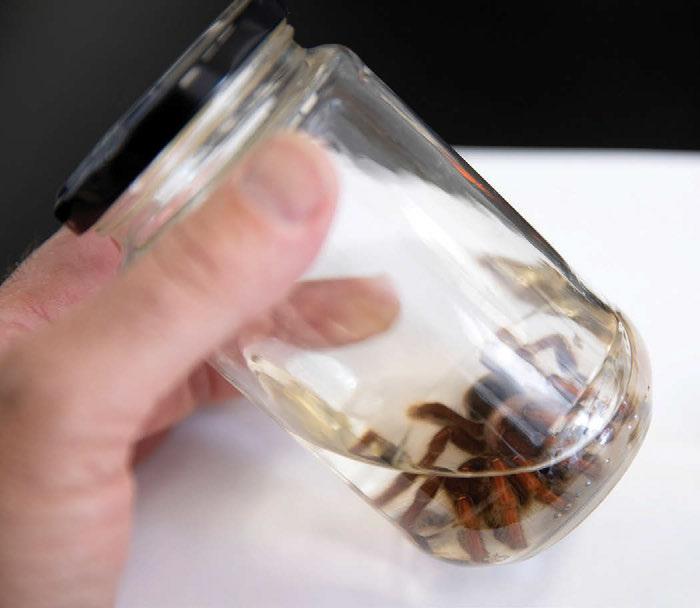
A bark scorpion (left) and a black widow spider
A tarantula from Utah
Bed bugs (not from Nevada)
(Photographs by Steve Marcus/Staff)
22 LAS VEGAS WEEKLY 8.24.23
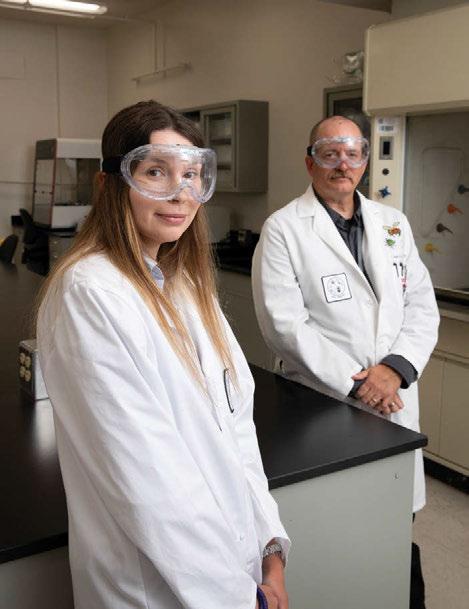
UNLV professors Louisa Messenger and Chad Cross in the Molecular Lab
“What is the most dangerous animal in the world?”
The answer might surprise you, according to Chad Cross and Louisa Messenger, professors with the UNLV School of Public Health.
“In terms of the number of associated diseases and deaths that are transmitted by them … it’s the mosquito,” Cross says.
Cross and Messenger teach parasitology and medical entomology courses focusing on diseases that can be transmitted, especially to humans, by insects. Bugs pose a larger public health risk than people perceive, the scientists say. “About 17% of all of our infectious diseases are transmitted by some kind of insect,” Messenger says.
From the morphology lab at UNLV, Messenger displays a collection of triatomine bugs, better known as kissing bugs. The beetle-like specimens vary in size, with most about the size of a thumbnail. Although they could easily be mistaken for harmless, the bugs actually spread a parasite that causes Chagas disease, which affects the heart and can develop into lifelong and threatening complications if left untreated.
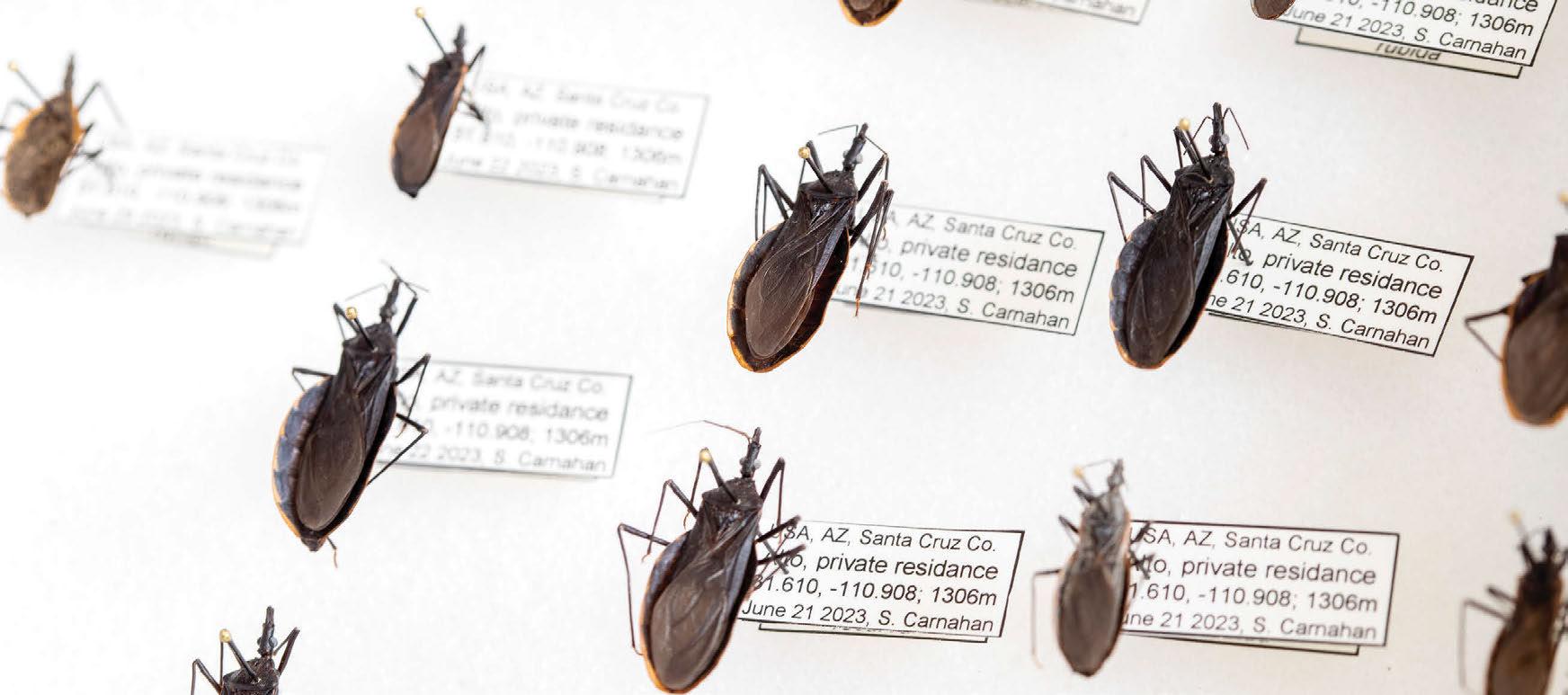
“It’s probably the leading cause of infectious heart disease in the world. It’s one of those ones that you don’t think about when you think about infectious diseases. But, it’s getting this parasite that is a really big problem, because these bugs can live in peoples’ houses,” Messenger says. “[They’re] not so much an important public health problem in the U.S., because a lot of the time these bugs are found out in the wild. But down in Central and South America, these bugs are found infesting human homes.”
So far, they’ve collected more than 300 specimens from five states in one of the citizen science initiatives to come out of UNLV’s Parasitology and Vector Biology labs. Rather than collect the bugs themselves, they scout out contributors on iNaturalist, a user-based online database of living things.
“Basically, anyone who had reported seeing one of these bugs in the last few months this year, we reached out to directly,” Messenger says “And we said, ‘If you see some in the future, would you be willing to collect for us? We’ll pay your postage. We’ll send you some tools. Just keep us posted.’ We’ve had more than 15 contributors.”
Vector biology, or the study of the transmission of infectious diseases from insects to humans or animals, and parasitology are important for educating and informing the public of risks and whether precautionary action or controls are needed; for example, doing “blood meal analysis” to find out whether kissing bugs have been feeding on humans, pets or livestock, and studying bed bugs to develop best practices for hotels to prevent and monitor them.
Through citizen science initiatives, Cross and Messsenger are looking to get the entire community involved in these types of studies and make them participants in public health as it relates to insects. In one such initiative, the community can participate in mosquito surveillance by collecting their DNA. It sounds complicated, but one of their students is perfecting an easy, efficient way for anyone to do that.
“If you’ve ever watched Forensic Files, they catch people because we leave DNA behind everywhere we go. Insects do the same thing. They shed; they defecate in the water, leave the saliva in the water,” Cross explains. “And so what we can do is go out into the environment, take a sample of water … and on the end of that syringe goes a little filter., and you just pass the water through that filter two or three times. And in that filter now will be DNA from things which have been living in that water, including mosquito eggs, mosquito larvae, adult mosquitoes who have landed in that water, for example.”

That DNA can be analyzed in UNLV’s Parasitology and Vector Biology molecular lab to determine whether mosquitoes are present,
and what species of mosquito have been in that water. Knowing the areas where mosquito larvae are present can help the Southern Nevada Health District’s mosquito surveillance identify the best areas to sample for adult mosquitoes that can then subsequently be tested for viruses like West Nile and Zika.

What’s more, Messenger says this type of sampling is accessible on multiple levels. “We’re then looking to set up another citizen science initiative where we can give out these kits. They’re less than a buck, the syringe and the filter,” Messenger says. “We’re looking to give them to communities and families and say, ‘Have you got any standing water in your back garden or in your swimming pool that you’re worried about? Send us the water samples.’ It takes about a minute to collect.”
Not only does the community get to be involved in its own public health experience, but also, sampling could become more comprehensive and less labor intensive. “Hopefully we should be able to get several thousand samples that will cover all of Clark County. … We can get anybody–whole schools, whole classes, submitting samples. So then, people know what lists of mosquitoes are breeding in their environment [and whether] they need to take any precautions or controls,” Messenger says.
“Public health is all about how your world impacts you, and how you impact your world,“ Cross says. “The citizen science initiative that we’re doing and trying to involve people in any way that we can, I think is hugely important not just for students, but just for the community at large to have an appreciation for the world around them.”
Anyone interested in participating in UNLV Parasitology and Vector Biology’s citizen science initiatives can get in touch with Dr. Cross and Dr. Messenger on their website paravec.sites.unlv. edu or by emailing paravec@unlv.edu.
–Shannon Miller
We’re looking to set up a citizen science initiative … whole schools, whole classes, submitting samples.”
LAS VEGAS WEEKLY 23 I 8.24.23
Kissing bugs collected by citizen scientists, mostly from Arizona (Steve Marcus/Staff)









































for show times and tickets NOW PERFORMING IN THE CABARET THEATER Every Friday - Sunday Every Wednesday - Sunday NEW RESIDENCY SHOWS AT WESTGATE LAS VEGAS OCTOBER 26 - 27 ADDITIONAL SHOWS IN 2024 JAN 12 - 14 APR 4 - 6 JUL 3, 5 & 6 OCT 24 - 26 OCTOBER 5 - 7 ADDITIONAL SHOWS IN 2024 FEB 9 & 10 MAY 24 & 25 AUG 2 & 3 OCT 4 & 5 UPCOMING SHOWS IN THE LEGENDARY INTERNATIONAL THEATER September 2 October 28 November 2 3000 PARADISE ROAD, LAS VEGAS, NV 89109 | 702.732.5111 | WESTGATELASVEGAS.COM
IN THE NEWS
POLITICS
Confusion surrounds 2024 presidential process for Nevada Republicans
Nevada’s Republican voters could be faced with two nominating processes to elect their preferred presidential candidate for the 2024 election, raising concerns it will be confusing to voters wanting to participate in one of the nation’s oldest political traditions.

The Nevada Republican Party will hold its “First in the West Caucus” on February 8, which the party maintains will mark a “crucial step” for the GOP’s nominating process and amplifies the state’s role in the national political landscape, according to a news release sent August 21. But that’s two days after Nevada’s Presidential Preference Primary, which will be conducted by the Secretary of State’s office in conjunction with each of the state’s 17 county clerks.
The Nevada GOP is warning that candidates who participate in the primary will not be able to participate in the caucus—the nominating contest party officials assert will be used to cast state’s delegates ahead of the Republican National Convention, which is scheduled for July 15-18 in Milwaukee.
Additionally, candidates must also pay $55,000 to participate in the caucus, of which $20,000 can be rebated if the candidate campaigns with the state party, according to one source.
“Candidates who wish to earn delegates for the presidential nomination are limited to caucus participation — they cannot participate in a state-run beauty contest that is not sanctioned or approved by the party and expect to earn legitimate Republican delegates,” Sigal Chattah, one of Nevada’s two representatives on the Republican National Committee, said in a statement to the Las Vegas Sun. “The GOP caucus has been running in Nevada since 1981, so it’s a historical, well-established election process.” –Casey
Harrison08.18.2023
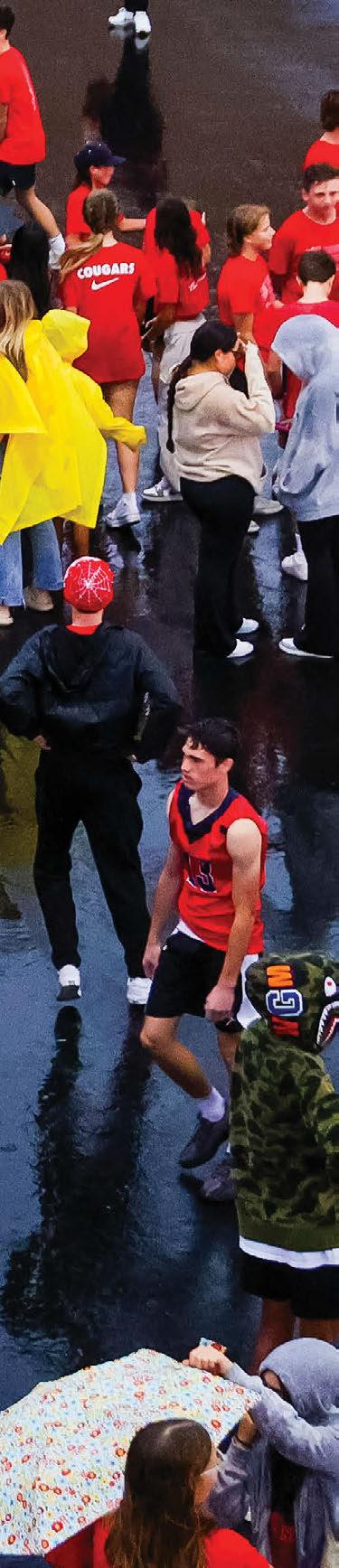
Students gather at Coronado High School after the cancellation of a football game due to a rainstorm. Parts of the Southwest experienced significant rainfall due to Hurricane/ Tropical Storm Hilary, but the Las Vegas Valley was mostly spared the worst of it.
 (Wade Vandervort/Staff)
26 LAS VEGAS WEEKLY 8.24.23 NEWS
SPORTS
A’s select construction team for Las Vegas baseball stadium
The Athletics have retained a pair of industry-leading construction firms to lead the development of the team’s proposed $1.5 billion baseball stadium on the Las Vegas Strip.
The Mortenson | McCarthy Joint Venture—the same partnership that built Allegiant Stadium—will be responsible for “overseeing all construction-related activities,” the A’s announced August 21. That includes preconstruction estimations, scheduling and logistics planning, bidding, coordination and management of the project’s labor and community engagement.
The hiring of Mortenson | McCarthy is contingent upon approval by the Las Vegas Stadium Authority.
The A’s did not detail specific dimensions or capacities for the ballpark. But state lawmakers this year approved a $380 million public financing package for a roughly 30,000-seat stadium on nine acres at the site of the Tropicana.
“Mortenson | McCarthy brings an exceptional level of expertise and experience to our project,” A’s President Dave Kaval said in a statement. “Their focus on innovation, safety and efficiency makes them the best in their field.”
–Casey HarrisonRTC rolls out Southern Nevada’s first hydrogen-powered buses
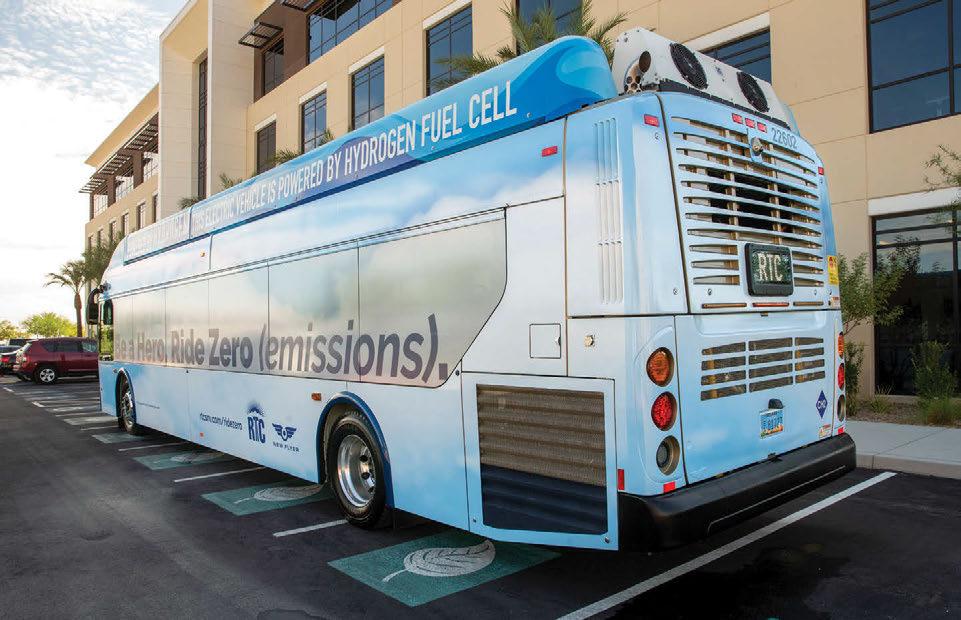
Transportation officials celebrated Southern Nevada’s first hydrogen-powered buses by toasting with glasses of water—the engines’ only emission—from the vehicles’ tailpipes.
The two buses, built by New Flyer, are equipped with tanks of hydrogen and an electric fuel cell. The cell generates power through a reaction between the hydrogen and oxygen that produces water vapor as its only byproduct.
Regional Transportation Commission CEO M.J. Maynard said the vehicles were the first of 16 the commission plans to purchase by 2025 with the help of $18 million in federal funding. The first two buses were largely funded via a $3.8 million Low or No Emission Grant from the Department of Transportation that covered 95% of the cost of equipment, infrastructure and training for the new technology, officials said.
“The grant funding is there, so the goal is to ensure that our entire fleet is either electric or hydrogen,” Maynard said. “The biggest challenge right now is … getting the buses, because everybody wants to do it.”
Maynard said the commission started investigating the switch to hydrogen fuel cell buses about three years ago and planned to replace all of its roughly 400 large buses with either electric or hydrogen buses by 2050.
One hydrogen-powered bus costs about $1.2 million; electric buses cost about $1 million, she said. “Buying the bus is the easy part. It’s really looking for those federal grant opportunities for the needed infrastructure,” she said.
–Rhiannon SaegertENVIRONMENT
Lake Mead levels rise, but concerns persist for Colorado River
Water levels in the drought-stricken Colorado River have improved because of a wetter-than-normal winter, but water from Lake Mead will be alloted under federally mandated reductions for a third consecutive year, according to a report released Tuesday by the Bureau of Reclamation.
The water level at Lake Mead is projected to be 20 feet higher at the end of the year than it was in January, according to the report.
But while the winter precipitation and resulting snow melt brought some immediate drought relief to the Colorado River Basin, experts say the challenges of a hotter, drier climate in the future and overuse of the river remain.
“The above-average precipitation this year was a welcome relief,” Reclamation Commissioner Camille Touton said Tuesday. “However, the two largest reservoirs in the United States—and the two largest storage units in the Colorado River system—remain at historically low levels.”
Nevada typically receives 300,000 acre-feet of water annually from the Colorado River, according to the bureau. It will have 279,000 acre-feet of water available from the river in 2024, a 7% cut, although it traditionally has not used its full allotment because of conservation efforts and recycling water used indoors. Southern Nevada used 224,000 of its 300,000 acre-foot allocation from Lake Mead last year, according to the Southern Nevada Water Authority. – Rhiannon Saegert
STUFF YOU SHOULD KNOW ABOUT LAS VEGAS WEEKLY 27 I 8.24.23
TRANSPORTATION
What colleges are doing to keep graduates working in Nevada
BY SHANNON MILLERHigher education is an investment, and the Legislature this year approved more than $74 million in budget restorations for the Nevada System of Higher Education (NSHE), according to NSHE’s website.

Any investment of that scale begs the question, what’s the return? Are these institutions developing a workforce that will bene t Nevada, or just move elsewhere?
According to the Las Vegas Global Economic Alliance 2022 Workforce Blueprint, 73.7% of recent graduates are employed in Nevada. But that gure can vary depending on eld. Students in hospitality are more likely to stay in Las Vegas, for example, than students in engineering.
“When you do have any brain drain, it’s often because they have to go elsewhere to nd opportunities. So you have to have a lot of opportunity within the state, as well,” says Eileen McGarry, executive director for UNLV Career Services.

She says an estimated 55% of STEM and engineering students stay in the state after graduation. “If they’re going out of state, there was much more prevalence in California [and] Washington,” McGarry says.
And according to a press release from the Governor’s O ce of Economic Development (GOED), “Talent in science and engineering is scarcer to begin with in our state, but also there is also a much lower retention rate within a year after graduation, compared to other elds of study.”
To get more engineers to stay in the state after graduation, UNLV received $4 million from the GOED for a program that helps students obtain paid internships with startup and tech companies. The StepUp & StartUp Internship Program launched in February and now includes 28 students—mostly juniors and seniors and some master’s students—in computer science, computer engineering or electrical engineering, earning $18 per hour in paid internships.
“The more internships our students get, the more likely they’ll be successful when







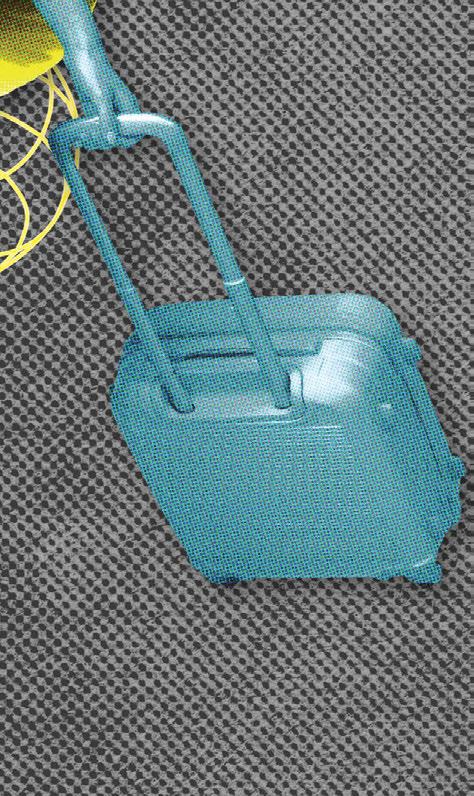


SLOWING THE BRAIN DRAIN














EDUCATION
28 LAS VEGAS WEEKLY 8.24.23
they leave UNLV,” says College of Engineering internship coordinator
Alejandro Chacon
“Now, because these are all local businesses, these businesses already are considering, right when the students graduate, already hiring them.”

Pushing and incentivizing internships is just one strategy among many that local colleges use to try to retain talent. The Weekly also spoke with o cials at the College of Southern Nevada and Nevada State University to nd out what’s being done to slow the brain drain.
“Many of these experiences, especially in the Career Technical Education space, STEM [Science, Technology, Engineering and Mathematics], certainly the skilled trades from HVAC to welding to automotive to health sciences, they all have on-the-job training components to the curriculum,” says Dr. James McCoy, College of Southern Nevada’s vice president of academic a airs. “It manifests in a few di erent ways. In the health science eld … every one of these programs has a clinical requirement. … From a workforce development perspective, it’s key.”
Clinicals are one example of “onthe-job training” that ultimately should encourage students to stay in the state after they earn their degree, McCoy says. “In the context of health sciences … they’re required to spend X number of hours every week under the supervision of a faculty member. And they’re actually on the oor at the hospital or at the clinic, with real patients. … They’re connected with the local industry with real jobs right here in Southern Nevada,” he says.
As for apprenticeships, local unions can get a student’s foot in the door even before graduation, making it more likely they’ll stay in Nevada, McCoy says. “If a student is engaged in construction trade, and they’re connected in a pathway for apprenticeships, now they’re earning and learning at the same time—they’re being supported by their union.”

Nevada State University interim provost and executive vice president Dr. Tony Scinta agrees that making connections with local employers prior to graduation is key to retaining graduates.
“[The School of] Education works pretty hard to force strong connections with schools in the area,” he says. “[These] partnerships can serve multiple objectives. One of them is that you forge a connection in familiarity, that can increase your likelihood that that continues after a student graduates.
“It also gives us good information from the partner,” he continues, “about what they would like to see in their prospective employees.”
Knowing which jobs are needed

“That’s something we try to do in our program development—examine statistics and information and perspectives from employers on what’s really needed,” Scinta says.
In recent years, Nevada State University has added programs in speech pathology and data science. “We talked to area employers like MGM and Switch and the Southern Nevada Health District. And they all reinforced this idea that, yes, if you had people who graduated with this knowledge and skill set, we can hire them.”
Scinta says 81% of Nevada State University grads go on to work in the state. And they’re going into diverse, growing elds, along with elds experiencing shortages, like nursing and education.
“I think part of our success with students staying in Nevada after they graduate is that we do try to build programs that lead to viable career pathways in the region,” Scinta says. “Education and nursing … are two of the biggest [programs] at our institution. And of course, they address some pretty signi cant shortages in the region.”
At the College of Southern Nevada, new grant funding from the GOED will help expand advanced manufacturing and computer Information Technology programs. McCoy says before CSN applied for the funding, it provided “no less than 10 local businesses and corporations that said, ‘If you build it, we will be waiting for the students on the other end.’”
Then in June, the GOED announced more than $2.8 million for the College of Southern Nevada to expand instructional capacity and support for new certi cate and
degree pathways in advanced manufacturing, and to expand training access and capacity in computer information technologies. The announcement also mentions 12 Nevada employers looking to hire graduates in these programs.
Creating opportunities for graduates

Asked how to keep talent in the state after graduation, Lauri Perdue, vice chair for the Las Vegas Global Economic Alliance (LVGEA), says the answer is a little complicated. “The rst thing that comes to my mind is, what comes rst, the chicken or the egg? How do we retain those students who are pursuing speci c degree programs and skills in areas that we don’t have businesses and organizations to support?” Perdue asks.
About 35% of businesses that don’t come to Southern Nevada aren’t here because they perceive de ciencies in our education and workforce, she adds. “And we want to counteract that.”
“If we want our students and our youth to grow skill sets in things like health care and STEM, we need to have places for them to go to work. Those two things really have to build in a parallel manner: We need the opportunities in the Valley, just at the same time that we’re building the workforce with our youth.”
To build opportunities for employers and graduates, the LVGEA has established a talent pipeline council comprising leaders in economic development, private and public higher education, Workforce Connections and the charter and public K-12 school systems. The rst meeting is scheduled for October.
Perdue, who also serves as the National Workforce Director for the University of Phoenix, says such coordination is necessary to create opportunities for graduates in the state.
“As a higher education system, we have not had a platform [where] we can all come together and work to build those opportunities and build that workforce together as an ecosystem. … We want to have a nexus for workforce and economic development. We want to be able to map the skills that workforce opportunities call for right now. … But we also want to be meeting needs of organizations that haven’t even come here yet,” Perdue says.
NEWS (Shutterstock/Photo Illustration) LAS VEGAS WEEKLY 29 I 8.24.23
THE STAGES OF CANNABIS CULTIVATION



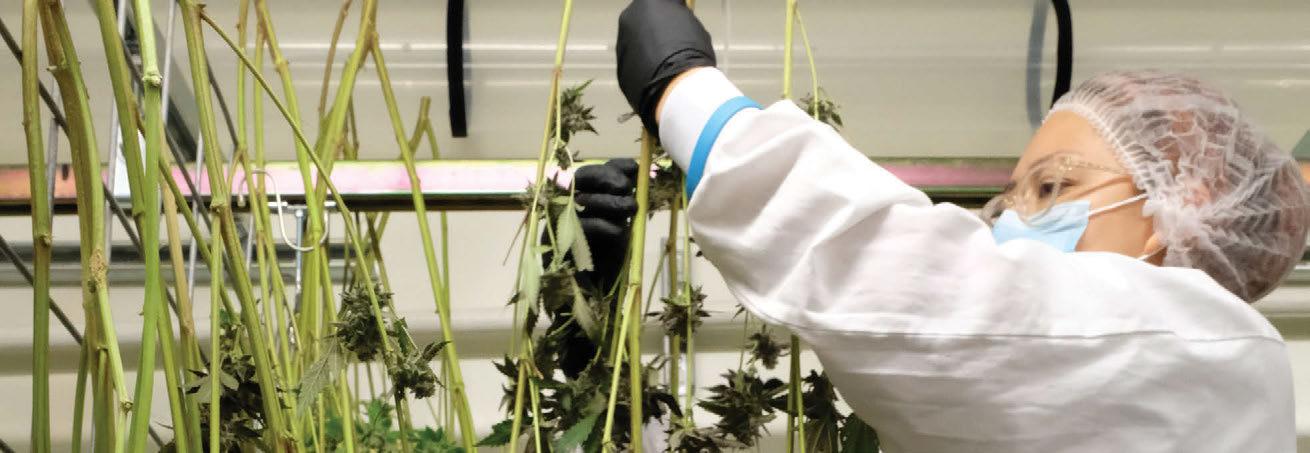


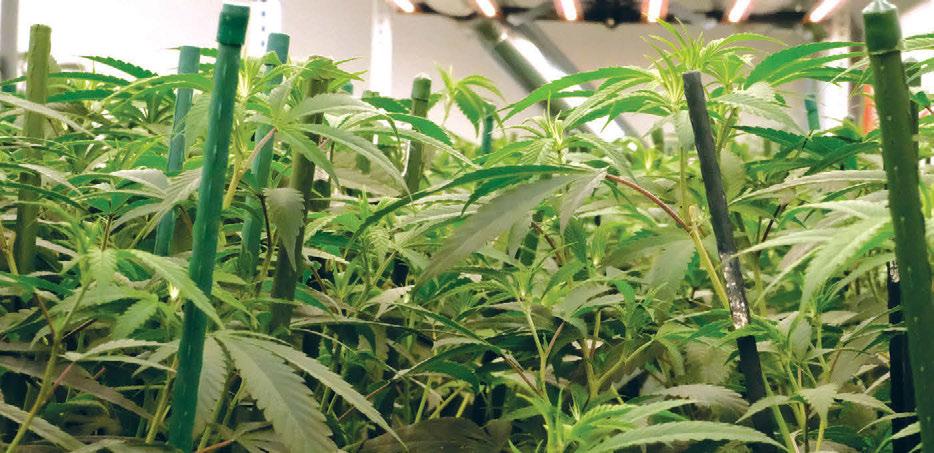
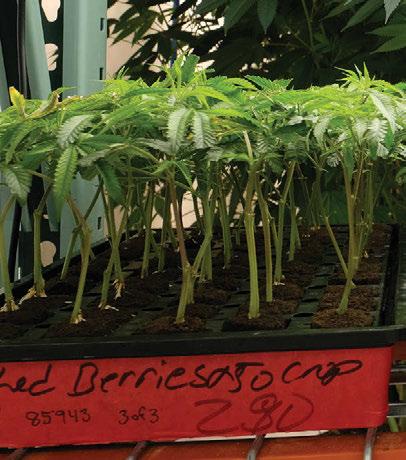



Cannabis available at a dispensary is prepackaged and ready for use, but the process of getting that product to consumers requires many stages. Starting from seed, cannabis is cloned, cultivated, harvested, dried, cured, tested and packaged for consumption. It can take several months for a plant to reach its owering stage, and growing conditions play a large role in the length of this timeline. Because of controlled conditions and lighting, indoor grows can cultivate ower in three to six weeks, whereas growing outdoors can take as long as eight months. Here’s a look at the process of planting and growing ower.

Most commercial cultivation facilities use a cloning process instead of planting seeds to bypass the seed germination stage. Cloning is a method of reproducing plants using an existing plant. Growers cut a clipping from the parent plant, creating a genetic copy. That clipping begins to develop roots, and jumps straight to the vegetative stage of cultivation. This is an e cient way of guaranteeing genetic consistency across strains.
After being carefully hand-harvested, flower buds are dried and cured. The drying process takes 12-14 days, during which the chlorophyll in the plant degrades. The rate at which this breakdown occurs can be influenced by environmental factors such as heat, light and humidity. Optimal conditions allow for a slow, controlled degradation of chlorophyll and better flavor, as it also permits the degradation of other harsh-tasting compounds in the plant.
+
30 LVW NATIVE CONTENT 8.24.23
ADVERTORIAL PRESENTED BY DEEP ROOTS HARVEST







SEED GERMINATION is the process of planting mature seeds that will sprout and become seedlings. Germination takes three to 10 days.
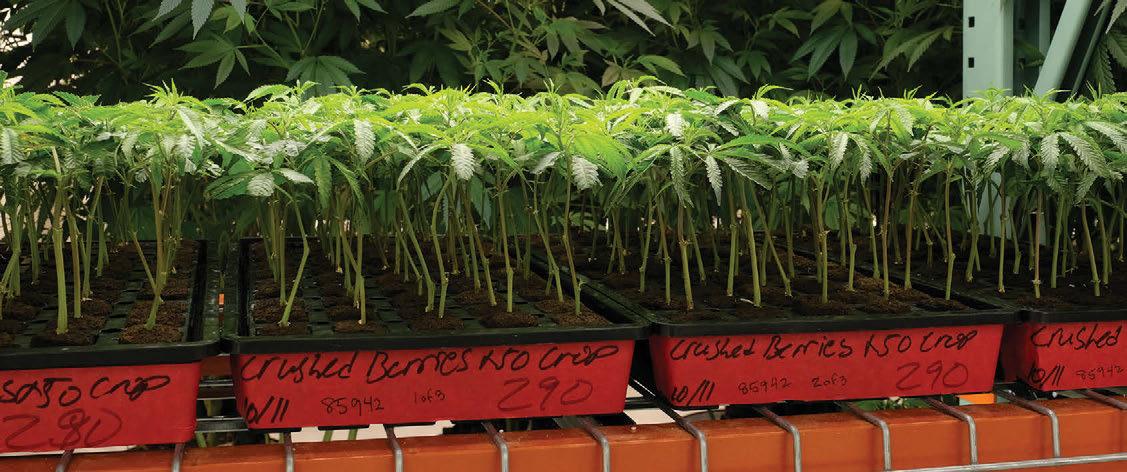
Vegetation is a stage of accelerated growth where the plant is moved to a larger pot, allowing it to root comfortably and firmly. During this time, the plant requires more water, light and nutrients to facilitate growth.

Flowering is the stage where the plant develops its buds and has it’s final growth spurt before being harvested. Like the vegetation stage, flowering requires a very controlled environment to optimize growth. Depending on the strain, this stage can take three to 16 weeks. Sativa strains tend to flower more slowly than indica strains. Once the buds are developed and resinous, they’re ready for harvest.

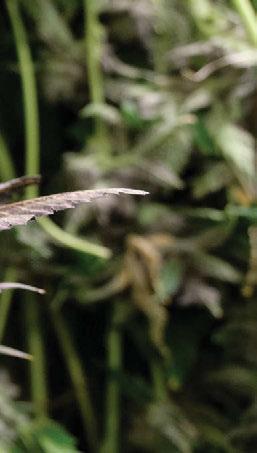
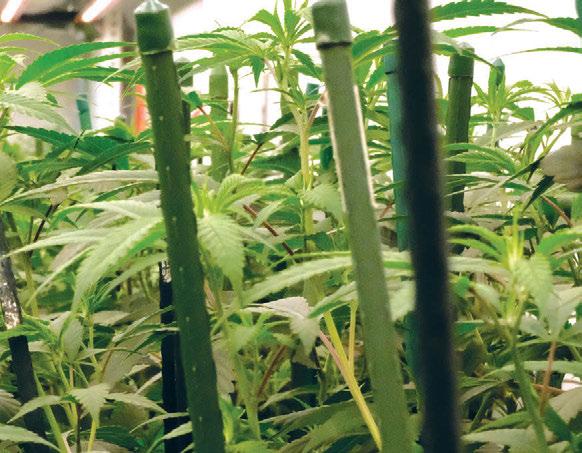


Once the plant is fully grown and ready to harvest, it goes through a series of other processes . If the plant is to remain a fl ower product, it will be dried and cured before being tested and packaged for sale. If it’s to become a distillate concentrate, it will be cured and dried before being processed to create a potent distillate oil. If it’s to be live resin concentrates, the buds will be fl ash frozen after harvest and processed into fl avorful oil.

31 I 8.24.23
COMEDY
COMEDY AND CONFIDENCE
Nicole Byer brings her multitude of talents to the Strip
 BY AMBER SAMPSON
Amid hosting Netflix’s reality TV bake-off show Nailed It!, launching a new plus-size bikini line, starring in television shows and anchoring four podcasts, Nicole Byer has taken up pole dancing. Just don’t expect her to be any good at it.
“I think we need to normalize being mediocre or bad at our hobbies,” the comedian tells the Weekly. “I can climb up a pole. I’m very strong, and it’s cool. I don’t want to be sexy. I just want to scare people.”
Since the days of starring in MTV’s Girl Code, Byer has thrived as one of the most refreshing voices in comedy. How many comics could make a book out of their bikini photos, as Byer did with 2020’s #VeryFat #VeryBrave, and have it become a humorous instruction manual for body acceptance? “That was such a dumb labor of love,” she laughs. “But I’m really proud of that book.”
As the first Black woman to be nominated (four times) for a Primetime Emmy Award for Outstanding Host for a Reality or Competitive Program, this comedian is breaking ground and doing it the Byer way. “I don’t do sh*t that’s not fun,” she says. “If it’s not fun, I make it fun.”
We caught up with her ahead of her stand-up gig at the Chelsea to talk dating stories, her love for Vegas girls’ trips and why unscripted TV needs to be unionized.
You were in Vegas not too long ago for Magic Mike Live. How was that trip? Oh, yeah, I did a whirlwind of a trip with my friend. We went to Usher, Criss Angel Mindfreak, Cirque du Soleil and Magic Mike. I drove a Ferrari at some racetrack. We did go-karts. That’s how I like to do it. I don’t gamble; I don’t understand it. Last time I gambled, I was absolutely sh*tfaced with my friend’s sister, and I was sitting at one of the slots, and I was banging on a button like, “This is how they get you. They get you by sitting here. You just press the same button.” Then a man walked by and said “You have to put money in it.” (Laughs)
Why Won’t You Date Me?, a podcast in which you discuss wild dating stories, is one of my favorites. It’s been said that men don’t like dating funny women. Is that something you’ve experienced in your dating misadventures?
I think I’ve got other stuff going on. But I think men do like to be the funnier one. I dated one guy who said to me, “I’m the funny one in my group.” He would say something, and I would say something to build on it—because all my friends are funny, we just end conversations with a cacophony of laughter—and he would get mad at me if I made a joke that was funnier than his. That’s just one person. But I’m not traditionally beautiful, and I’m funny and I’m Black and I’m in LA. I got a lot of things working against me. I’m not saying any of these are negative. It’s just my truth.
CULTURE
32 LAS VEGAS WEEKLY 8.24.23
What’s the most surprising place you’ve ever been hit on before? This is hard because sometimes I don’t know I’m being hit on. I was just hit on at the airport by, like, a 60-year-old man in a neck brace. The whole situation was weird. I thought I fell in love in Denver, because this guy was flirting with me at this sandwich shop. Then I invited him to my show and then he brought his girlfriend, so I was like, maybe he was just trying to sell me a f*cking sandwich. My radar is so off.
Have you always had as much confidence as you do now? Was that something you ever wrestled with? When I was younger, yeah. I grew up in an all-white town where I was like the only Black girl. It was me,

my sister and three other people, and I was fat and zitty. I never really felt pretty. But I worked at Lane Bryant, which is a fat lady store. I remember my manager … said to me, “Your clothes are too tight. You can’t wear things that are that tight.” And I was like, “What? Are we afraid that the other fats are gonna know I’m fat?” From that moment on, I was like, I’m gonna wear my arms out. I’m gonna wear belly shirts. I’m gonna wear shorts, because what am I hiding for? Who am I hiding for? My body is not for everybody else’s consumption. My body is for me to get from point A to point B. I can look in the mirror and choose to like what I see. If I don’t, I can change it.
On Twitter, you’ve spoken about unscripted shows needing more union protection. Can you talk a bit more about that? I will say this as someone who’s paid very well and is very thankful for their job: I do not think anything that is on television should be non-union. I was paid $500 an episode for my first season of Girl Code, and that ended up being a hit that they aired over and over. I never saw a penny in residuals. A lot of people’s reasoning is exposure, and it’s like, sure, I did start touring and doing stand-up, but why am I doing double the work to make the money that I could have just made being on television?

More comedians—like yourself—are starting to tour during the strike, as long as they’re not taping specials. Do you think we’ll see more of that? Oh, yeah, baby. People who like to work like to work. Honestly, there’s nothing like a live audience. I get why comics who predominantly work in television are like, “Let me f*cking hit the road and see what’s up there again.” I don’t think it’s gonna end.
To read more of this interview, visit lasvegasweekly.com.
(Courtesy/Robyn Von Swank)NICOLE BYER August 26, 8 p.m., $32-$87. The Chelsea, ticketmaster.com. 8.24.23
LAS VEGAS
WEEKLY 33 I

Wellness This National Wellness month, prioritize your self-care. Relax, rewind and rejuvenate as you experience one (or several) spa treatments designed to bring well-being to the mind, body and soul. SCAN TO BOOK NOW Or Call: 702-693-5520
COUNTING CROWS



































GEORGE BIRGE SEPTEMBER 3
25 4321 W Flamingo Rd, Las Vegas, NV 89103 Scan & see how Palms does entertainment.
LAMB OF GOD AUGUST
HERE TO COUNTRY SUNDAY
AT
SEPTEMBER 2
POOLSIDE
Alan Walker makes the most of his new Zouk Group residency

A TASTE FOR VEGAS
CULTURE
36 LAS VEGAS WEEKLY 8.24.23
NIGHTS
BY BROCK RADKE
Twenty-five-year-old future house and electro-pop phenom Alan Walker has constructed a big dance music career in a short period of time, and connecting with listeners on a deeper level has always been the blueprint. He was just 18 when his breakthrough track “Faded” made a global impact, and the U.K.-born Norwegian producer DJ’d his first U.S. gig in 2017 at Wynn Las Vegas.
“Las Vegas is one of my favorite places to travel to, and it’s such a surreal place to be—especially for me to come from Norway. There’s nothing like it,” Walker tells the Weekly. “It’s a unique opportunity to have the chance to be in Las Vegas and perform, and it’s a unique way to connect with fans, because you have so many international travelers so some of your audience has probably heard the music before.
“I’ve noticed during my shows there’s a lot of core [fans], but also some new ones, which is very cool, to people from all around the world coming to this one location in Las Vegas to watch me live.”

This year, that location has been Resorts World Las Vegas. Walker made his new residency debut at Zouk Nightclub in May, and his first show at Ayu Dayclub is set for August 26. His new Vegas headquarters was a logical choice considering an existing relationship with the Zouk Group at its venues in Malaysia. “So far it’s been amazing,” he says. “The whole experience has been great.”
This week’s visit should present fuller experience for Walker, who’s taking a few extra days to explore Vegas with friends and family who are traveling for the show. It might be the perfect summer vacation, which aligns with the perfect summer track Walker just released


with vocalist and songwriter Zak Abel. “Endless Summer” is a sticky-sweet dance-pop gem, one of those songs that sounds so comfortable and familiar, it feels like it’s been around for several summers already. Expect to hear it closing out sunny sets at Ayu and other pool clubs through Labor Day.
“We wanted to make a song that gives you that feeling of what summer is,” Walker says. “It was a very quick process to write and produce and get Zak on it, and then I invited him to a festival show in Norway and we performed it for the first time live and it was really well-received. He did an amazing job [on the vocals], and it’s just a match made in heaven for the music.”
He’s looking forward to additional future collaborations with Abel, just as he’s ready to schedule more Vegas shows (Walker is back at Zouk on October 13). Emotional anthems like “Endless Summer” and a steady tour schedule are essential ways to maintain those human connections, the ties that make fans feel like friends and transform social interactions into real-life experiences.
Walker has noticed the shift in taste and style in dance music in recent years, the surge of house and techno and a mainstream acceptance of those classic genres. He’s enjoying it, but he’s also staying on his own creative course and staying true to his own sound. “It’s noticeable on the main stages of different festivals, and very interesting and cool, a nice way to implement that old-school house music that has been with us for so many years,” he says. “I don’t think it’s changing my shows or how my music is perceived, but it’s been great. I’ve always thought my music can fit anyone, any style, any taste.”
The countdown to Life Is Beautiful’s 10th anniversary is on, and it’s time to get ready for a milestone year of festival magic in Downtown Las Vegas, Sept. 22-24. From navigating the festival grounds to planning your schedule, to discovering hidden gems within the artist lineup, and embracing the unique atmosphere - we’ve got you covered!
SCAN THE QR CODE TO LEARN MORE ABOUT THIS UNFORGETTABLE CELEBRATION AND FOR THE CHANCE TO WIN 2 VIP TICKETS TO THE FESTIVAL!
 Alan Walker (Courtesy/Hakon Jorgensen)
LAS VEGAS WEEKLY 37 I 8.24.23
ALAN WALKER August 26, noon, $20-$30+. Ayu Dayclub, zoukgrouplv.com.
SCENE
NARRATIVE HUNTERS
Las Vegas podcast The Other Castle explores video game storytelling
 BY AMBER SAMPSON
As Microsoft Gaming CEO Phil Spencer once famously put it, “There’s never been a better time to be a gamer.”
There’s more choice in video games than ever before, more redeeming arcs, more characters, more cheek-slapping plot twists. And if HBO’s record-breaking run of The Last of Us proved anything, it’s that there’s more space for video game stories to be told on a grander scale.
On video game podcast The Other Castle, Las Vegas couple Andrea Carter and Tom McLaughlin explore the art of video game storytelling through a series of in-depth episodes, peeling back the production history of a game and its surrounding lore. But where other podcasts might skirt around the full game story, The Other Castle never loses sight of the plot, colorfully retelling it like the craziest audiobook you’ve ever heard.
Listening to these hosts re-set the scene of BioShock’s mystifying underwater world or an outlandish bank heist gone wrong in Grand Theft Auto V is an entertaining ride—and a testament to their own storytelling chops.
“Things that I love are learning about how things get made, how stories get told, how characters come together,” says Carter, a former podcast ad buy manager. “And at the time, I didn’t have the dexterity to play a lot of video games. I was a voyeur of the world, but I was curious about it. So I joked with Tom about doing a podcast and a couple of days later, he said ‘What if we did that?’”
Earlier seasons of The Other Castle
focused on older games the couple loved from their childhood. For Carter, who used to voice instructional audiobooks, those were the classics. “I got a Nintendo for Christmas in ’88, and never looked back,” he says. “Super Mario Bros. was the very first for me, but the one I would say forever held its claws in me is Final Fantasy VI on Super Nintendo.”
Meanwhile, Pokémon Blue was Carter’s first big catch ’em all. “I fell into the Pokémon craze because I grew up in the ’90s. How could you not?” she says. “But then I put it down and never picked anything up until my mid 20s, when I was scrolling through IGN and saw a free download for the first episode of The Wolf Among Us. I demoed it and lost my mind that that’s what video game storytelling could evolve into.”
A spin on the award-winning Fables comic book series, The Wolf Among Us was a triumph of choice-based storytelling when it debuted, and through wry humor and sharply timed quips, Carter and McLaughlin add a whole new dimension to it on The Other Castle Episodes are ambitious for a two-part team with full-time jobs in the cannabis industry. McLaughlin says it takes eight hours to write a two-hour episode, and that doesn’t include actually playing the game or recording the show, which adds anywhere from two to three hours to the process. It’s an obvious labor of love, or as Carter calls it, “an eccentric hobby joke that has become so much of our lives.”
As video games like The Last of Us successfully cross into new mediums, with all-star casts no less, this truly is the best time to be a gamer.
“We’re about to see Ghosts of Tsushima as a movie, and it’s coming from the John Wick director. Like, that’s incredible,” McLaughlin says. “We saw it a little bit when the comic book movies first started happening. Once they started getting more and more closer to the adaptations of the actual source material … that’s when they started actually being good. And we’re seeing that now with the translation of video games.”
Since 2017, The Other Castle has blown up, especially on Spotify, where it has a 4.8 rating and more than 120 reviews. But to the hosts, it’s still just an “eccentric hobby joke,” between two passionate gamers.
“We’re still doing it for us. That’s the important part,” McLaughlin says.
CULTURE
38 LAS VEGAS WEEKLY 8.24.23
THE OTHER CASTLE Available on all platforms, linktr.ee/ theothercastle. Season 7 premiers August 30.

LAS VEGAS WEEKLY 39 I 8.24.23
Andrea Carter and Tom McLaughlin, hosts of The Other Castle, at Player 1 Video Game Bar (Wade Vandervort/Staff)








INCLUDES: www.iuventusmedcenter.com (702) 919-1099 ✔ Initial Medical Consultation ✔ Full Body Composition Analysis ✔ EKG (if required) ✔ RX For (3) Month Phentermine Tablets ✔(12) Weekly B12 Injections ✔(12) Weekly Lipotropics Injections ✔ Bi-Weekly Body Composition Analysis ✔ Medication For (3) Month Treatment WEIGHT LOSS PROGRAM THE ULTIMATE $$575 575 NEW PATIENTS ONLY, CANNOT BE COMBINED WITH OTHER OFFERS. 3365 E. Flamingo Road, Ste 2 Las Vegas, NV 89121 4966 S Rainbow Blvd STE 100 Las Vegas, NV 89118 CONVENIENT LOCATIONS 2 2 SPECIAL OFFER











YOU ARE NOW ENTERING FLAVORTOWN


ups his game
BY AMBER SAMPSON
If we’ve learned one thing about Food Network star and charismatic celebrity chef Guy Fieri, it’s that, “I don’t do anything half-assed,” he says. “Everything I like to do, I like to do full throttle.”






The Mayor of Flavortown made that clear at June’s grand opening of his Flavortown Sports Kitchen at Horseshoe Las Vegas, where the Vegas Golden Knights’ drum line set the scene for his grand, and so very Fieri, entrance.
Fans trained their sights and cameras on the TV personality, who strolled out in his signature shades, fresh cigar in hand, waving to onlookers from the cherry-red 1968 Chevy Camaro convertible from Diners, Drive-ins & Dives, wheeled in for this very night.
And if you think that’s excessive, just wait until you try the food.

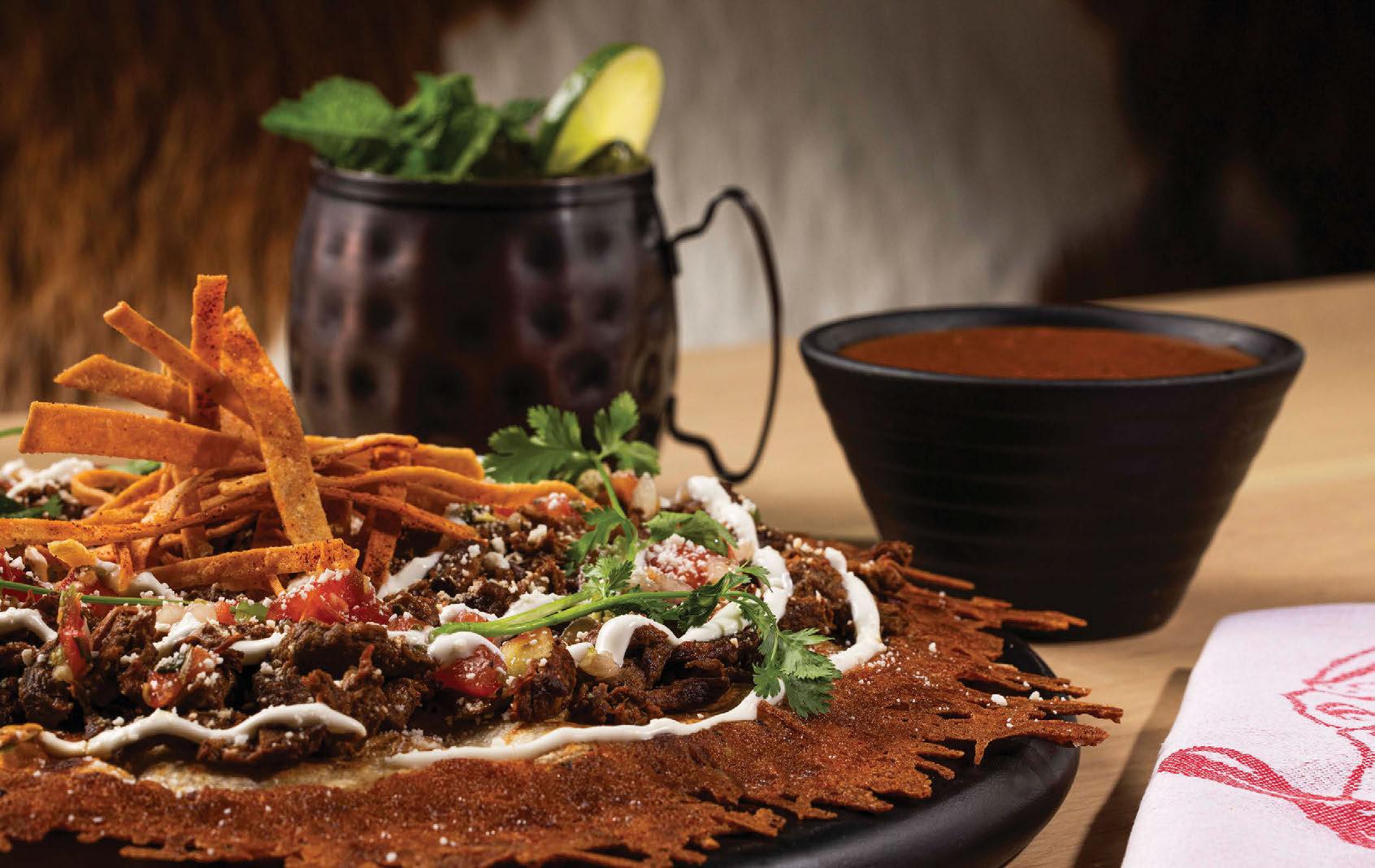
“We have everything from a tequila watermelon salad to a birria quesadilla pizza. The great thing about this is there’s no boundaries, just as there’s no boundaries inside of Horseshoe,” Fieri said at the grand opening. “If you can’t nd a good time here, you’re not lookin.’”
The former Burger Brasserie made way for Flavortown Sports Kitchen when it shuttered in 2022. And though the chef’s El Burro Borracho

closed at the Rio last year, Guy’s Vegas Kitchen & Bar at the Linq is still going strong, along with the newly opened Chicken Guy inside Caesars Palace’s Forum Food Hall.
Drawing on Fieri’s love for sports and wow-worthy fare, the new eatery takes the average game day snack and maximizes it to full potential. Burgers are the linemen of the menu, as beefy and diverse as their football counterparts. There’s even a deepfried doughnut burger ($26) if your palate wrestles between salty and sweet.
Shareables are also out of bounds in a tasty way, like the Pepperoni Pizza Pops ($20), which resemble lollipops, except that these unassuming pastry pu s are packing avorful savory meats and provolone cheese. Guy’s Awesome Pretzel Pull Apart bites ($18), slathered in maple-bacon aioli, are also the jam. Heck, the aioli’s so good, it should be a jam. Jar this up, and we’ll take it home.
Fieri’s infamous Trash Can Nachos also return— but with two game-changing alterations: cheeseburger ($25) and smoked brisket ($26). It’s like nacho Jenga trying to keep these chip towers upright under the mounds of meat and melted cheddar, and when things get messy, wash them down with one of Fieri’s full-bodied margaritas ($22), served classic, spicy or tart to kick o a good game day.
“This project right here embodies everything I’m into,” Fieri said, gesturing to the sportsbook-style TV walls and jerseys hanging near the Flavortown bar. “I’m a big sports guy.” It’s true. He maintains a concession stand on the top level of Allegiant Stadium, and he’s a longtime Raiders fan.
“When I went to UNLV, we won the NCAA [championship],” he said. “But it was still this thing of like, ‘Oh yeah, a little basketball team from Vegas, with [coach Jerry] Tarkanian.’”
Thirty-three years later, Fieri’s college town has turned into a destination city with two championship teams and the Big Game on the way. “I go to the Super Bowl every year; I go to the NBA Finals, because I love sports so much. [And] there’s probably no better city to go and experience it [than Vegas],” he said. “We have the best hotels in the world, the best restaurants in the world. Not everybody gets to make it to the Super Bowl, but everybody does get a chance to have a good time and feel the energy of the Super Bowl [here].”
At the grand opening of Flavortown Sports Kitchen, Fieri promised to bring his famous tailgate party to Vegas in celebration of the city hosting Super Bowl 58 in February. Judging by the enthusiasm, this won’t be the last we hear from this MVP.
CULTURE
GUY FIERI’S FLAVORTOWN SPORTS KITCHEN Horseshoe, 702-946-4346, caesars.com. Sunday-Thursday, 7 a.m.-10 p.m.; Friday & Saturday, 7 a.m.-midnight.
From quesabirria pizza to deep-fried doughnut burgers, Guy Fieri
FOOD & DRINK
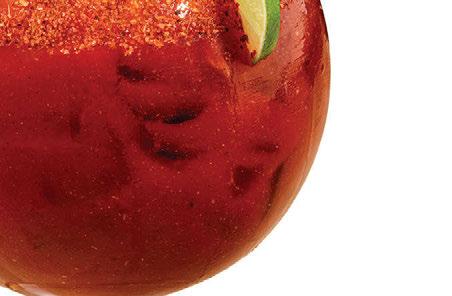
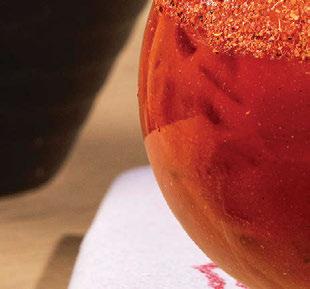
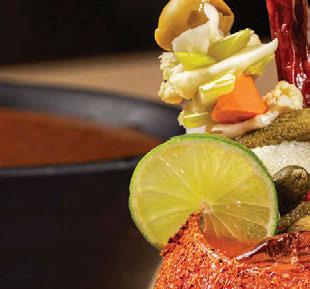
A quesabirria pizza and bloody mary bowl at Guy Fieri’s Flavortown Sports Kitchen (Courtesy/Caesars Entertainment)
42 LAS VEGAS WEEKLY 8.24.23
POUR IT UP AT TAPS & BARRELS

TAPS & BARRELS BEERHOUSE
6111 S. Bu alo Drive #110, 725-204-9384, tapsbarrelslv. com. MondayThursday, noon-10 p.m; Friday-Saturday, noon-11 p.m.; Sunday, 10 a.m.-10 p.m.

Las Vegas has become a sanctuary for craft beer enthusiasts in recent years, and the expanding number of breweries and beer-centric bars around town can make it hard to choose from increasingly dynamic options. But the southwest Valley’s newest destination, Taps & Barrels Beerhouse, already stands out.
The concept taproom opened in May and gives guests the chance to be their own bartender with self-pour service and an assortment of options to sample. The list of 36 beers, ciders, seltzers, wines and sakes are sure to satisfy your thirst. It’s the perfect place to jump from a hoppy IPA to a malty stout or a refreshing cider. Or, if you’re feeling especially menacing, you could build your own sake bomb.
Upon your arrival, a payment card is collected and connected to one of the Beerhouse tap cards. They’re used to track anything you eat or drink during a visit. Libations are sold by the ounce, and prices vary depending on the type of beverage you choose.


The variety of the food menu o ers bites that pair nicely with any drink. Beerhouse wings ($16) are made to order and come out perfectly crisp with your choice of sauce, and the charcuterie board served in a Bavarian pretzel ($30) is an easy table-pleaser.
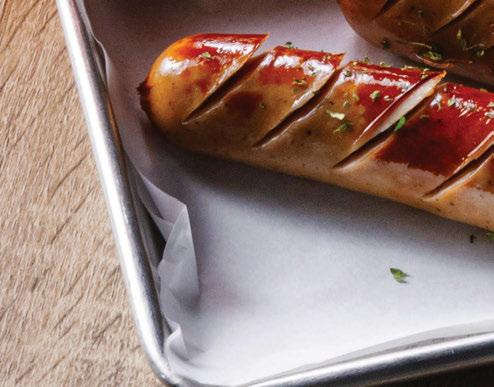
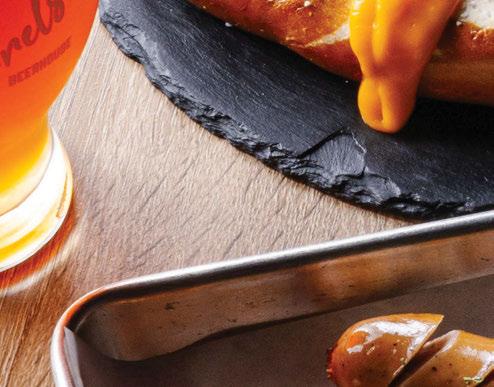



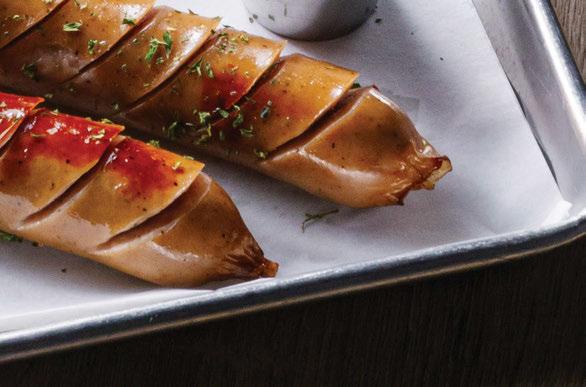
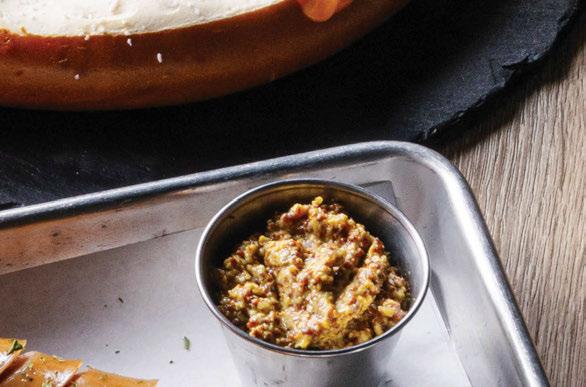
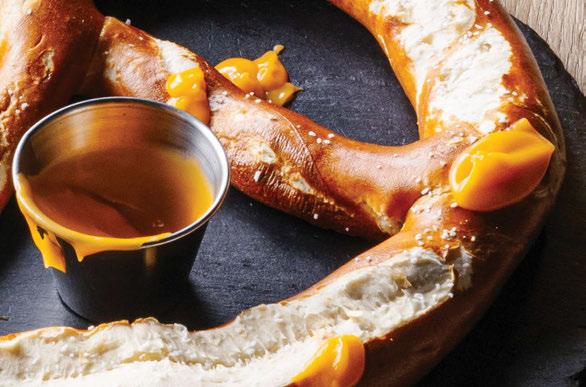


Happy hour runs Monday through Friday from 3 until 6 p.m. and discounts several beers 20%-40%. As part of Evora’s mixed-use community, the bar and eatery ful lls the play part of the development’s “live, work and play” design ethos. The space is clean, open and bright, and the oversized windows make it a perfect spot to watch the sunset on the outdoor terrace or catch a game inside.
–Gabriela Rodriguez

 The Butter Board, bratwurst and giant Bavarian pretzel plus brews at Taps & Barrels (Wade Vandervort/Sta )
LAS VEGAS WEEKLY 43 I 8.24.23





























































































900W | 8 BAR 700W | 6 BAR 2494 1899 μmol/s μmol/s 900W & 700W The Pisces' innovative design is perfect for hobbyists and home gardeners alike. This fixture can be folded and stored with ease and optimized for hanging in grow tents. FIND A DEALER NEAR YOU LAABBOR LABOR S SaleDAYl DAY LA D Sept1st-4th *Online&Instore* SpiritsandSpice.com SPIRITS&SPICE VENETIANGRANDCANALSHOPPES 3377S.LASVEGASBLVD,UNIT2035 LASVEGAS,NV89109 (888)807-7474EXT.5 20%OFF selectAmericanWhiskeys&Bourbon TryBeforeYouBuy inthestore.Mustbe21+ "Today'sgoodmoodis sponsoredbyWhiskey"
12 WAYS TO WIN!
11 IN SEASON CONTESTS PLUS OVERALL CHAMPION
100% PAYBACK
$1,000 ENTRY FEE UP TO 7 ENTRIES ENTER TODAY!

DO YOU HAVE WHAT IT TAKES?
SELECT 5 GAMES EACH WEEK AGAINST THE SPREAD DURING THE PRO FOOTBALL REGULAR SEASON.
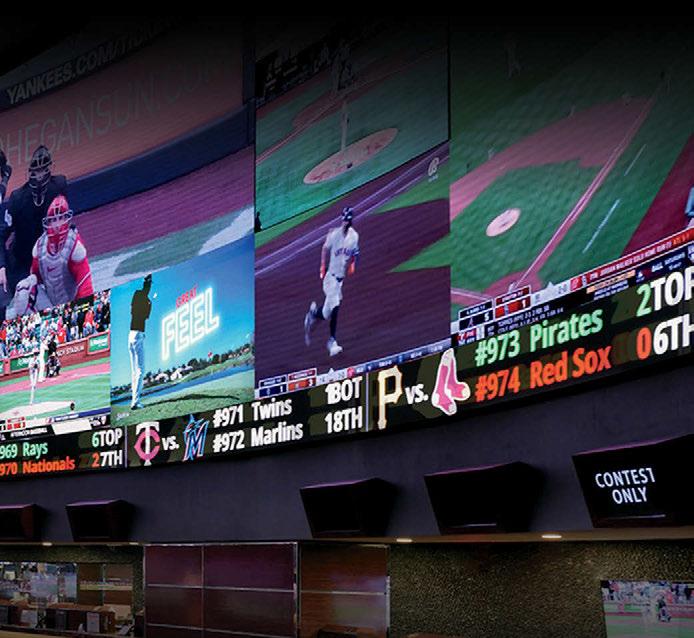

WINNER TAKES ALL!
$5,000 ENTRY FEE
GAMBLING PROBLEM? CALL 1.800.522.4700.


 THE ULTIMATE FOOTBALL HANDICAPPING CHALLENGE
3000 PARADISE ROAD, LAS VEGAS, NV 89109 | 702.732.5111 | WESTGATELASVEGAS.COM
FAST START?
UNLV could have one of its best recent football teams in coach
Barry Odom’s first year
BY MIKE GRIMALAIs this the year for UNLV football? The Scarlet and Gray have a new head coach, an exciting new offense and a talented quarterback who appears poised for a breakout season. Add it all up, and this looks like the best squad UNLV has fielded in a long time … if everything goes right.
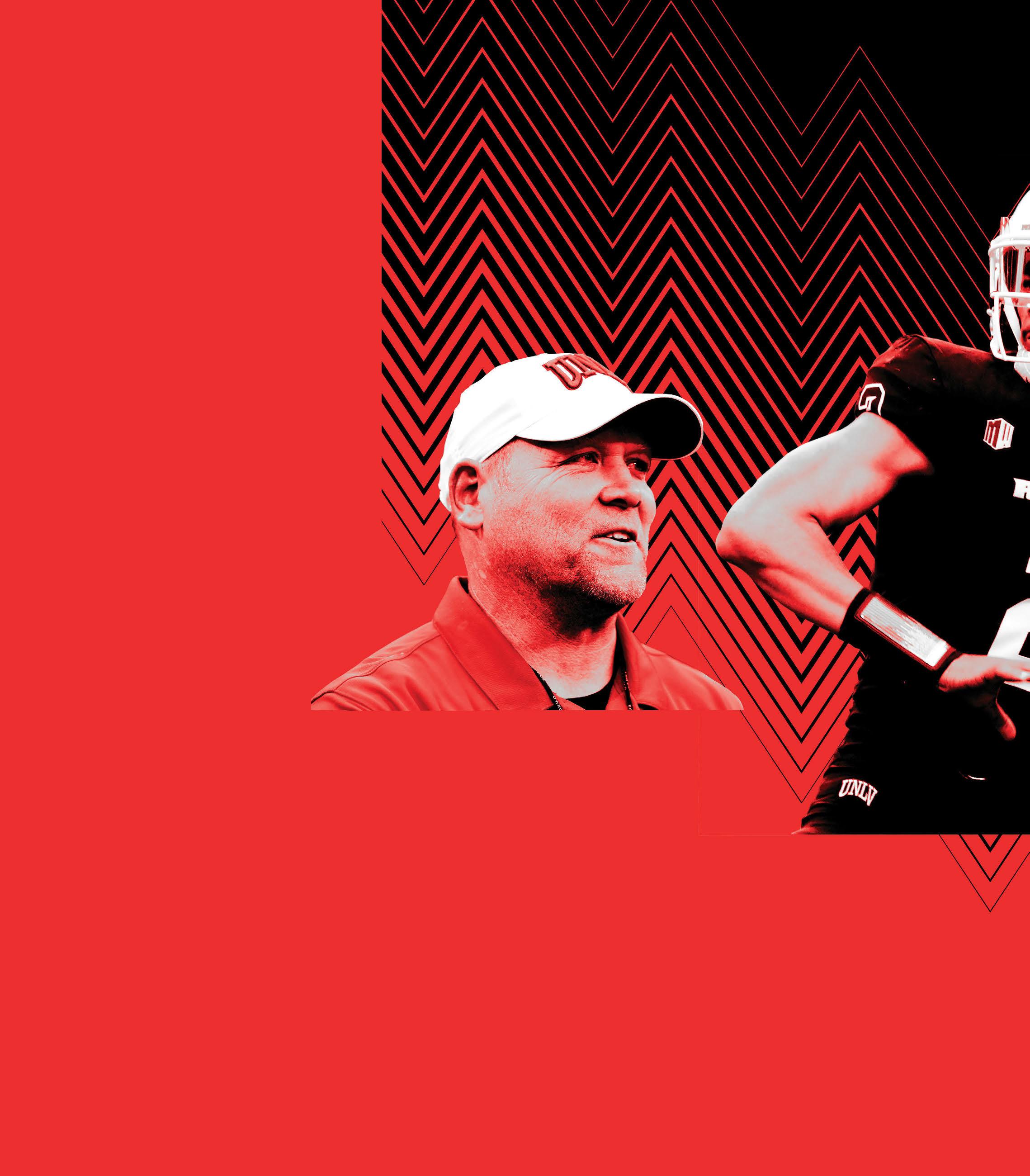
Here are five of the top storylines to follow as UNLV embarks on its 2023 season.
1
QUARTERBACK STABILITY
The last time UNLV went into a season with an undisputed No. 1 quarterback was 2019—two head coaches and five starting quarterbacks ago.
It appears the Scarlet and Gray has finally found an answer at the game’s most important position, however, as all signs point to junior Doug Brumfield being the man behind center.
Brumfield was close to stardom last year, when he led UNLV to a 4-1 start and looked like an All-Mountain West performer through the first half of the season. Injuries derailed his campaign, and he finished with a modest 1,898 passing yards and 10 touchdowns, but now, he’s ready to pick up where he left off.
The 6-foot-6 lefty has been
consistently hitting big plays in training camp, looking comfortable in the new system installed by offensive coordinator Brennan Marion.
Marion says Brumfield is carrying himself like the leader of the program, and that counts for a lot—especially at a place like UNLV, where franchise-caliber quarterback play has been fleeting at best.
“The hardest part about being ‘the Guy’ is, you have to be the guy every single day,” Marion says. “He’s not a kid anymore, and he’s playing to win. It’s not just ‘I’m happy to be out here.’ Now we’re looking at you to go win the game.”
Brumfield added about eight pounds in the offseason, mostly by working out and incorporating steak into his diet (he prepares
it himself, cooked medium, in a cast-iron skillet).
Now he’s focused on turning up the heat and bringing the UNLV offense to a sizzle. “I want to be able to make this offense go in any situation,” Brumfield says.
2IT’S GO-GO TIME
One of the biggest decisions made by new head coach Barry Odom was hiring Marion as offensive coordinator. That’s because Marion’s scheme is one of a kind.
The “Go-Go Offense” features heavy run blocking, multiple running backs (deployed in unusual, unbalanced formations), speedy wide receivers who can stretch the field and, most importantly, a blinding tempo.
UNLV isn’t going to huddle much
this season. Marion wants his guys to rush to the line on every play, and snap the ball before 13 seconds have elapsed on the play clock. He figures that will add up to at least 73 offensive plays per game, which would put the Scarlet and Gray somewhere around the top 30 nationally.
Bottom line: UNLV’s offense is putting a premium on speed.
“If you look at my track record, I always get fast players,” Marion says. “We want fast people that can score in one play. We don’t want to have to call 12 perfect plays; we
CULTURE SPORTS
46 LAS VEGAS WEEKLY 8.24.23
want to call four or five plays, because guys can take it to the house.”
3 BALLHAWKS
Odom is regarded as one of the top defensive strategists in the country, and he’s bringing his 3-3-5 alignment to UNLV. So far, so good.
The Scarlet and Gray will play with five and sometimes six defensive backs on the field, and the team has the depth in the backfield to pull it off. Junior cornerback Cameron Oliver has had a strong camp, and senior nickel Jerrae Wil-
2023 UNLV FOOTBALL SCHEDULE
SEPTEMBER 2 VS. BRYANT
1 p.m., Mountain West Network
SEPTEMBER 9 AT MICHIGAN
12:30 p.m., CBS
SEPTEMBER 16 VS. VANDERBILT
4 p.m., CBS Sports Network
SEPTEMBER 23 AT UTEP
6 p.m., ESPN+
SEPTEMBER 30 VS. HAWAII
1 p.m., Silver State Network
OCTOBER 14 AT UNR
2 p.m., Mountain West Network
OCTOBER 21 VS. COLORADO STATE
4 p.m., Mountain West Network
OCTOBER 28 AT FRESNO STATE
Time TBD, Fox Sports Networks
NOVEMBER 4 AT NEW MEXICO
3 p.m., Mountain West Network
NOVEMBER 10 VS. WYOMING
7:45 p.m., Fox Sports 1
NOVEMBER 18 AT AIR FORCE
12:30 p.m., CBS Sports Network
NOVEMBER 25 VS. SAN JOSE STATE
Noon, Mountain West Network
Home games at Allegiant Stadium. Single-game tickets $24+, season tickets $150+, unlvtickets.com.

liams has emerged as a core leader of the group.
Defensive coordinator Mike Scherer calls Williams the toughest, hardest-working player on the defense. And that’s saying something, considering how many interceptions the secondary has snagged in practice.
The feeling is mutual on Williams’ end. “I love Odom and coach Scherer,” he says. “The defense that they brought, I love it. It allows me to play my type of ball—fast, physical. If you want to go, go.”
4
2013? The oddsmakers believe it will come down to the wire, as the Scarlet and Gray’s over/under win total is pegged at 5.5 wins (it takes six to qualify for a bowl).
BOWL HOPES
Does UNLV have any hope of making it to a bowl game for the first time since
FUTURE OF THE MWC
With conference realignment throwing the basic
The first four contests could prove pivotal. A road date at No. 2 Michigan on September 9 is probably a bridge too far, but the other three games—vs. Bryant (September 2), vs. Vanderbilt (September 16) and at UTEP (September 23)— all appear to be winnable. With a good start, UNLV could put itself on track for an elusive postseason appearance. 5
structure of college football in flux, there’s a possibility that 2023 could be the final season of the Mountain West as we know it. A rebuilt Pac-12 could entice UNLV to relocate to a new league, or a merger between the two conferences could make the MWC a thing of the past entirely. If UNLV stays and other teams leave, the Mountain West could be reshuffled to the point where it becomes unrecognizable. Anything is on the table.
UNLV has never won the Mountain West, or really even risen above being an afterthought. If the Scarlet and Gray is going to make a dark-horse play at contending, it might be now or never.
LAS VEGAS WEEKLY 47 I 8.24.23
Left to right: Coach Barry Odom, quarterback Doug Brumfield, defensive back Jerrae Williams (Steve Marcus/Staff/Photo Illustration)
INDEPENDENT BUSINESS A CORNERSTONE OF LOCAL ECONOMY AND COMMUNITY
BY KATIE ANN MCCARVER VEGAS INC STAFFWhen Makers & Finders opened in the Las Vegas Arts District nearly a decade ago, the locally owned coffeehouse and restaurant was missing a key component—a walk-in refrigerator.
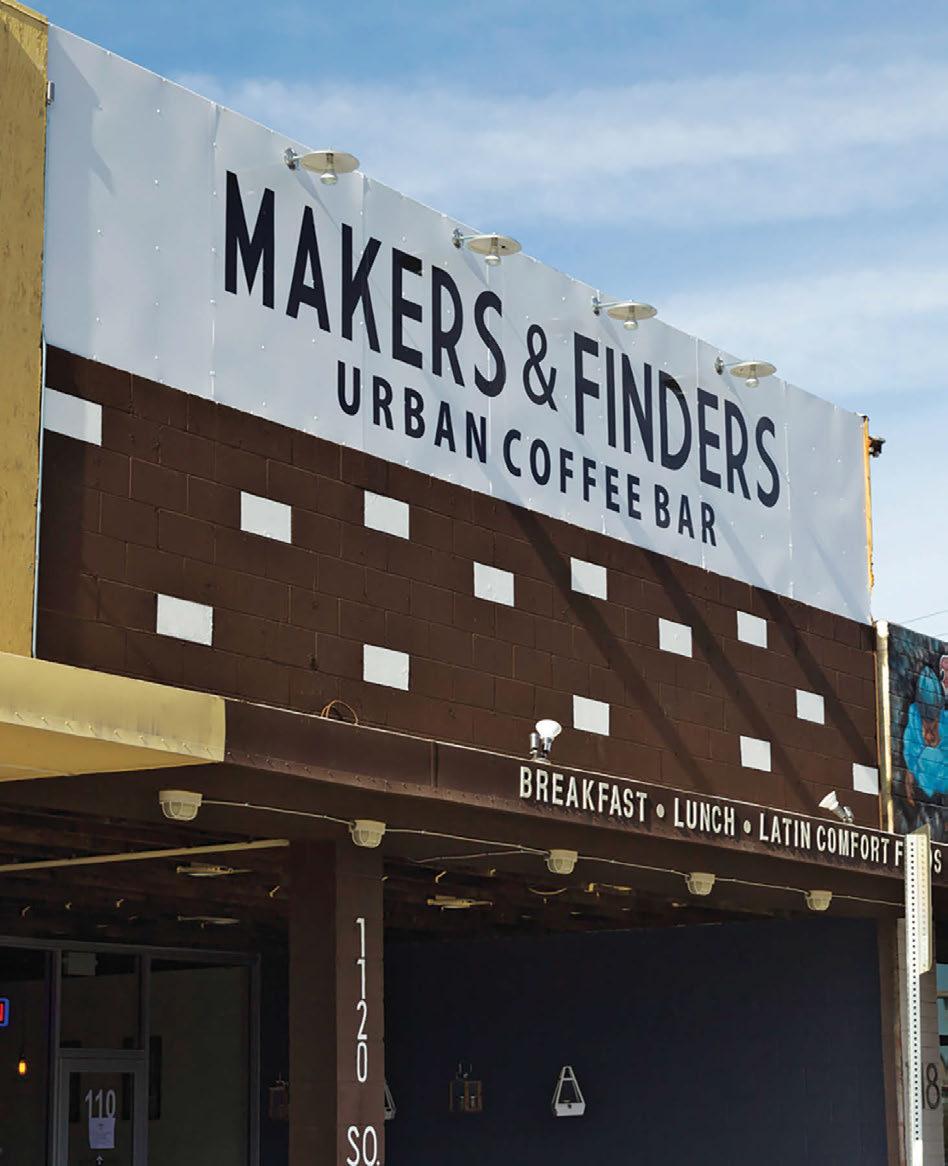
Nevertheless, with hard work and community support, the eatery eventually took off and has expanded to two other locations in the Las Vegas Valley, becoming a destination for locals and tourists alike.
“The fact that we were able to build our business in such a humble and grassroots effort, I think, says a lot about how we operate and why being an independent restaurant—there are obvious disadvantages, but I think there are many advantages by being independent,” said CEO Josh Molina.
Over 45% of Nevada businesses, not including restaurants, are independent and locally owned. According to a new study, however, the remainder—more than 54%— are retail chains.
Nevada ranks sixth in the country for its percentage of retail chains to independent businesses, based on a recent report from Merchant Machine. By comparison, New Hampshire took the list’s top spot with almost 63% of its businesses being retail chains, and Michigan was at the other end of the list, with about 73% of its businesses being independent.
Ryan Smith, director of Economic and Urban Development at the City of Las Vegas, said the number of retail chains to independent stores could be skewed simply because big brands are so abundant in casinos and resorts.
“Vegas is such an identifiable city that a lot of identifiable brands probably latch on to the notion of Vegas,” he said, noting that just one Strip property is likely home to dozens of chain retailers. “People from all over the world come here, and then they are familiar with a Starbucks or whatever these brands are.”
His department is dedicated to growing business, creating jobs and fostering success for Las Vegas locals, Smith said. While chains can provide residents with stable employment, he said, local businesses have a more unique understanding of the community’s needs.
Tina Quigley, president and CEO of
the Las Vegas Global Economic Alliance, called economic development a “competitive sport.” Cities all work to attract businesses to diversify and grow the economy.
In Southern Nevada, the LVGEA is primarily working to connect with mid-size companies that bring high-skill, highwage jobs.
She compared the local economy to a bucket, which is filled with money that swirls around as it’s transacted between businesses. Las Vegas has many holes in its bucket, however, where money used to purchase items not manufactured locally goes to their place of origin—whether that’s another U.S. city or an entirely different country.
“So you need businesses to keep filling up your bucket with outside money,” she said. “Money from somebody else’s economy needs to enter into all those transactions. So that’s why we’ve been really lucky to have … hospitality and gaming, because those people are bringing in truckloads of money from outside; from somebody else’s economy and dumping it into our bucket.”
But even hospitality and gaming have their limits, as proven by the economic impact of the COVID-19 pandemic and resulting shutdowns. Las Vegas must therefore attract “primary” companies beyond just those industries, Quigley said, if it’s going to continue to bring out-ofstate money into its own bucket.
Chain stores, for the most part, are not primary businesses.
“They are a central part of an economy. You must have these retail chains—your grocery stores, your sandwich shops, your dry cleaners, etc.,” she said. “But they are just the money swirling in the bucket. They’re not a new source. They’re not a new spigot of money filling up the bucket.”
For Molina, running a successful business is all about embracing the independent identity, and understanding what sets local business apart.
Chain and corporate companies have more resources and funding, he admitted, but the latter have their own advantages—from creative freedom to opportunities for growth. “I think that’s a huge advantage,” he said. “Because where there may be a lot of red tape and checkboxes to check with a corporate company, you don’t have that with a small business.”
ENTREPRENEURSHIP
BUSINESS 48 VEGAS INC BUSINESS 8.24.23
Makers and Finders in 2014 (Steve Marcus/Staff)












curious. FREE TO BE What are you searching for? What are you searching for? Your neighborhood library helps you to explore the unknown and look beyond. It is the place where all are invited and everything is free. You will find learning and personal growth, technology skills, homework help, small business and career support, community, culture, art galleries, and live performances. Visit us in person or at TheLibraryDistrict.org and discover the power of a library card.
BY VEGAS INC STAFF
Though best known for large corporate gaming entities that power the state’s economy, Nevada is also home to 313,000 small businesses that create about two-thirds of the jobs, said Saul Ramos, district director of the Nevada Small Business Administration.
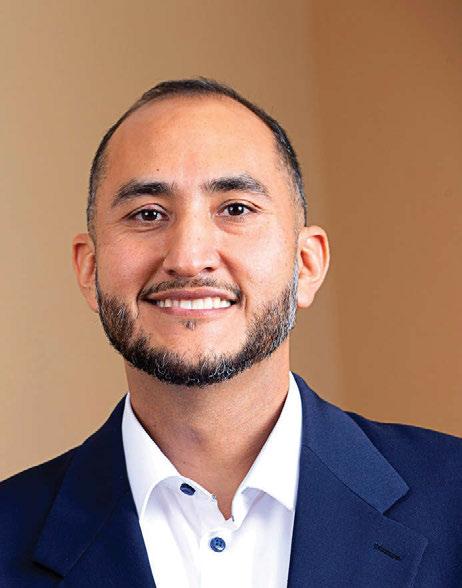
He works to help those businesses access capital and technical assistance programs that help them, and by extension the state, thrive.
“I’ve been blessed to meet amazing individuals and business owners throughout Nevada, from Elko, Ely, Reno, Fallon, Hiko, Pahrump, Mesquite, Boulder City and, of course, Las Vegas,” Ramos said. “When I talk to and look at these amazing individuals, I see courage, I see hope, I see resilience. I see champions.”
What’s the bird’s-eye view of the current state of small-business entrepreneurship here?
More than two years from the pandemic, businesses are now dealing and adapting with economic uncertainties, global disruptions, employee attraction and retention, challenges of inflation and securing debt. It’s also a good time for small-business owners to turn toward their local and national resource networks for possible solutions. Many of these resources, including SBA and resource partners, offer free
Q+A: SAUL RAMOSto thrive
marketing, accounting and record keeping, loan applications, new business start-up, capital formation, technology development assistance, business planning and more.
What’s something people need to know about SBA, but probably don’t?
Every year SBA offers a free THRIVE Emerging Leaders Reimagined program. It is an executive-level training series intended to give ambitious small-business leaders a challenging opportunity to accelerate their growth through targeted training led by motivating leaders in small-business development.
Since its inception in 2008, SBA’s Emerging Leaders has trained over 5,000 small-business owners, creating over 11,000 jobs, generating nearly $1 billion in new financing, and securing over $4 billion in government contracts.
As a result, SBA Emerging Leaders help build sustainable businesses that promote economic development within their communities.
A perfect example of a local SBA Emerging Leader alumni is Juanny Romero. Juanny opened her first café and grew the Mothership Coffee brand in Las Vegas by learning every angle and job. She was her company’s first and only barista and now employs and manages a team of more than 50 employees. Juanny has applied the lessons she’s learned from SBA’s Emerging Leaders program to
nurture a lean staff and stay connected to her local Las Vegas community.
Juanny is an incredible SBA success story and reminds us that when we power entrepreneurs to overcome barriers, they create jobs and build a community to advance our nation and economy.
What would you say to someone who thinks Southern Nevada has already grown too much?
Southern Nevada’s growth involves complex trade-offs along with striking a balance between economic development and quality of life. Growth can create jobs, attract businesses and stimulate the local economy. On the other hand, it can also lead to challenges like strain on resources, increased traffic and changes to local culture or environment. Engaging local authorities and discussing ways to ensure sustainable growth that benefits everyone can be a productive topic and it is essential to consider various perspectives on this matter.
Compare the business climates between Nevada and California. What can they learn from each other?
Each state’s business climate is influenced by various factors, both have unique strengths and challenges in their business climate. Nevada’s tax-friendly and regulatory environment has attracted businesses, while California’s diverse economy and innovation ecosystem has propelled its growth. Each state could learn from
the other by creating more favorable environments for economic growth and small business success. For example, streamlining regulations and reducing bureaucratic hurdles to make it easier for small businesses to start and operate.
What is the best business advice you’ve received?
Some of the best advice I received has come from small-business owners and quotes they have shared with me. For example, hockey star Wayne Gretzky famously said, “I skate to where the puck is going, not where it has been.” This has taught me the importance of always looking toward the future, incorporating innovation, understanding and anticipating customer needs, and delivering personalized, seamless experience across various touch points.
If you were king of Southern Nevada for a day, what’s one thing you’d do to improve the community?
Give everyone free ice cream so they can enjoy a beautiful day with their loved ones. I would also give all teachers a huge salary increase they very much deserve.
Who inspires you?
My mother. She taught us to stay humble and be kind. At a very young age, my mother taught us to offer our seats to elderly or disabled individuals, to hold the door for others and always say please or thank you.
ENTREPRENEURSHIP
Nevada SBA director gratified by rebound of state’s businesses post-pandemic, eager to help them continue
50 VEGAS INC BUSINESS 8.24.23
A perfect example of a local SBA Emerging Leader alumni is Juanny Romero. Juanny opened her first café and grew the Mothership brand in Las Vegas by learning every angle and job. She was her company’s first and only barista and now employs and manages a team of more than 50 employees.”



VEGAS INC NOTES




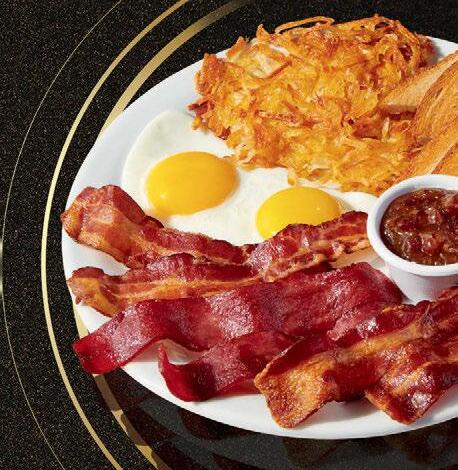




Virgin Hotels Las Vegas, part of Curio Collection by Hilton, named Cliff Atkinson president. He has played a leading role in the success of several high-profile hotels across the country including Luxor, Mandarin Oriental Hotel Group and Gramercy Park Hotel, and in a corporate capacity at MGM Resorts International, where he led their hospitality center of excellence.
The Nevada Bankers Association announced its newly elected 2023-24 board of directors. BJ North, executive vice president and chief banking officer at Plumas Bank, is the new chairwoman. She accepted the gavel from immediate past chair Ken Mundt, senior vice president at
Town & Country Bank. Other officers include: Joyce Smith, chair-elect, Bank of Nevada; H. Scott Johnson, vice chair, Valley Bank of Nevada; David Navarro, treasurer, Enterprise Bank & Trust; Ivan Ferraz, secretary, Wells Fargo Bank Directors are: Spencer Hafen, Nevada Bank & Trust; Mara McNeill, Toyota Financial Savings; Rick Thomas, Nevada State Bank; Al Welch, Bank of America
Jackson McAlindon has joined American Nevada Company as director of construction. He brings more than 20 years of technical and administrative experience within the largescale real estate development, general construction and real property asset management
industries.


The Atomic Museum hired Matt Malinowski as director of education. Before joining the museum, Malinowski held several positions at the Shark Reef Aquarium. Most recently, he served as a biologist educator.
Stately Home Staging, which assists luxury home sellers with staging and design services, hired Kelly Long as lead designer. She will provide clients with custom design recommendations. Long has worked in several capacities, including sales at luxury retail venues where she managed selling high-end home furnishings, as well as design with independent home renovation projects.
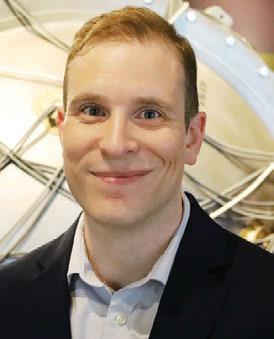
Loaded Pancake Breakfast Baconalia Premium Bacon © 2023 DFO, LLC. Printed in the U.S.A. At participating restaurants for a limited time only. Selection and prices may vary. While supplies last. *See restaurant for details. Offer expires 9/7/23. FREE DELIVERY DENNYS.COM 177793_Las Vegas Weekly_Print Ad_R2R.indd 1 8/10/23 2:34 PM LAS VEGAS PAIUTE TRIBAL SMOKE SHOP & CIGAR SHOPPE M-Sat 7AM-7PM • Sun 8AM-5:30PM 1225 N. Main St. Las Vegas, 89101 SNOW MOUNTAIN SMOKE SHOP & GAS STATION M-Sun 6AM-7PM • Pay-At-The-Pump Open 24/7 US 95N @ Exit #99 NEVER PAY ADDITIONAL TAX! - GO TO LVPAIUTESMOKESHOP.COM FOR COUPONS PREMIUM CIGARS & ACCESSORIES LAS VEGAS PAIUTE CIGAR SHOPPE/SNOW MOUNTAIN SMOKE SHOP 15% OFF PER CARTON* (CIGARETTES ONLY) LAS VEGAS PAIUTE/SNOW MOUNTAIN SMOKE SHOP $2 OFF *Must be 21 years of age or older. Excludes filtered cigars. Cannot be combined with other offers or discounts. Limit 1 discount given per customer per day. Must present this coupon for redemption. Cannot be redeemed for cash. No photocopies accepted. EXPIRES 8/31/2023 LVW *Cannot be combined with any other offers or discounts. Must be 21 years of age or older. Excludes sampler packs. Excludes bundles & individual sticks from bundles, cigarettes, mass market and pipe tobacco. Must present this coupon for redemption. Not valid on alcohol purchases. Cannot be redeemed for cash. No photocopies or digital copies accepted. EXPIRES 8/31/2023 LVW $50.20* FINAL PRICE WITH COUPON $5.49 PER PACK $49.99* FINAL PRICE WITH COUPON $5.45 PER PACK Process Engineer for James Hardie Building Products, Inc., in McCarran, NV. Understand waste, speed & delay design for product. B.S.+1 year.
LISTING
to hillary.johnston@jameshardie.com - must ref job title. EOE.
JOB
Resumes
Spotlighting the best in business
BJ North, Plumas Bank
52 VEGAS INC BUSINESS 8.24.23
Matt Malinowski, Atomic Museum
16TH ANNUAL WOMEN’S LEADERSHIP CONFERENCE

INSPIRE FUTURE LEADERS
The Women’s Leadership Conference, the #1 ranked women’s conference in Las Vegas, is coming to the MGM Grand Conference Center on September 18 & 19, 2023. This acclaimed event is the premier destination for women leaders at all levels to enhance their skillsets, learn new insights and methods, and collaborate with a diverse network of professionals.




WLC features inspirational keynote speakers, curated competency-based education sessions and other enriching events - all aimed at elevating the confidence and know-how of women leaders and expanding their networks.
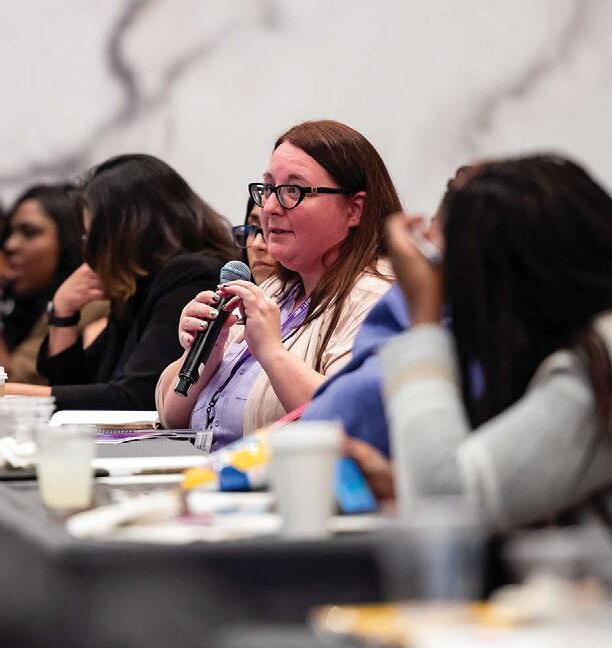
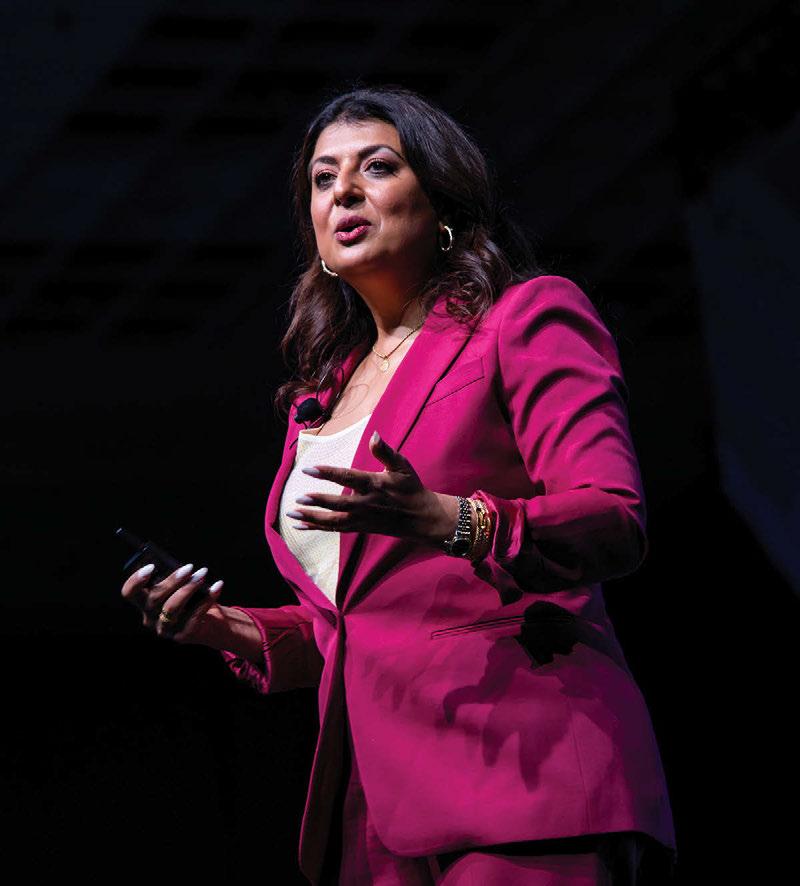
SEPTEMBER 18-19, 2023 | 8:45 AM - 5 PM MGM GRAND CONFERENCE CENTER LAS VEGAS
“Inspiring, motivational, empowering, uplifting, amazing women and sisterhood.”




– 2022 WLC Attendee
“If you want to advance your career or meet other leaders, this is a must attend.”
– 2022 WLC Attendee



































REGISTER TODAY AT FWLE.ORG/CONFERENCE

HURRICANE WEEKEND | AUGUST 18, 2023 There was something about the overcast skies and wet streets that followed Hurricane Hilary that can only be called magic. The lights came on in midafternoon. The scent of petrichor lingered. And special occasions—like, say, a wedding—felt even more momentous in this rainswept Vegas, because our view of the city was doubled, and we couldn’t look down without falling into the big sky. –Geoff Carter
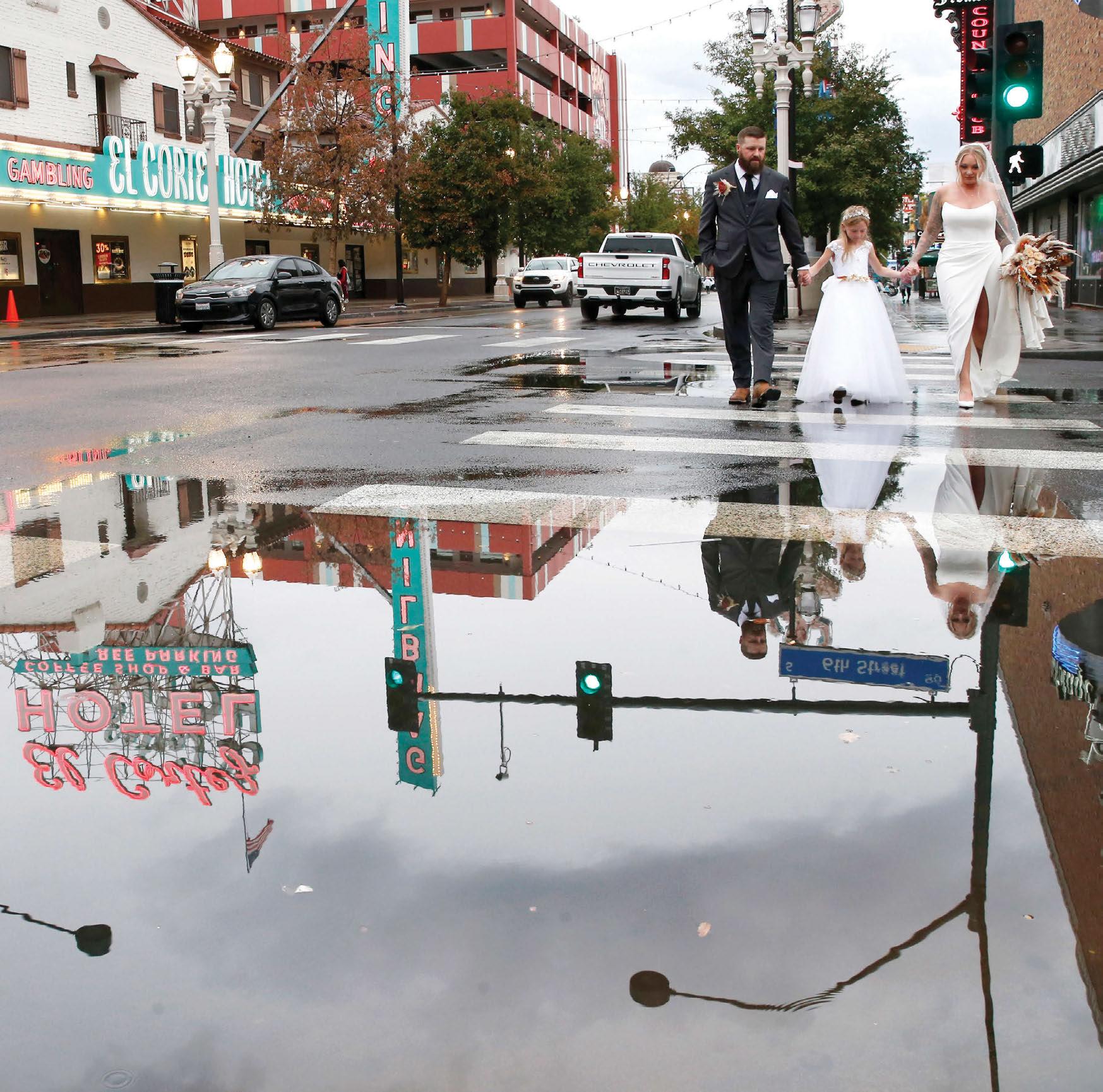
PHOTOGRAPHY
BACKSTORY
54 LAS VEGAS WEEKLY 8.24.23
(Steve Marcus/Staff)




















































































































ENTER IN NEVADA. PLAY FROM ANYWHERE. $ 14 MILLION IN GUARANTEED PRIZES $8 MILLION GUARANTEED. $6 MILLION GUARANTEED. Can you pick the winner? How about 20? Select one team each week straight up with no repeat selections. Last the longest to win it all. $1 million top prize guaranteed. $6 million in total prizes. Pick five teams against the spread every week. Quarterly and full season payouts. 100% payback to players. Circa | Sports bets can only be made while physically located in the state of Nevada. Must register in person to use the Circa Sports app. Must be 21 or older with valid photo ID. All rights reserved. Circa Resort & Casino, Golden Gate Hotel & Casino and the D Las Vegas encourage you to gamble responsibly. For problem gambling information and assistance, call the 24-hour confidential Problem Gamblers HelpLine at 1.800.522.4700. @CircaSports | CircaSports.com 6 CONVENIENT LOCATIONS!