The newsletter of Guildford Model Engineering Society
Chairman’s Chatter
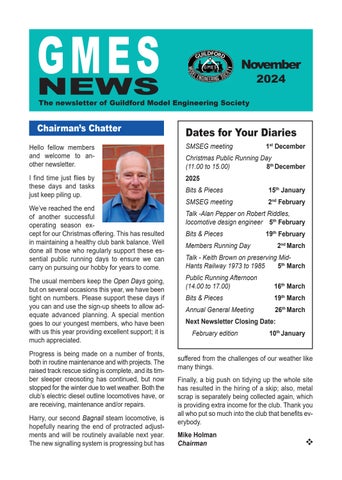
Hello fellow members and welcome to another newsletter.
I find time just flies by these days and tasks just keep piling up.
We’ve reached the end of another successful operating season except for our Christmas offering. This has resulted in maintaining a healthy club bank balance. Well done all those who regularly support these essential public running days to ensure we can carry on pursuing our hobby for years to come.
The usual members keep the Open Days going, but on several occasions this year, we have been tight on numbers. Please support these days if you can and use the sign-up sheets to allow adequate advanced planning. A special mention goes to our youngest members, who have been with us this year providing excellent support; it is much appreciated.
Progress is being made on a number of fronts, both in routine maintenance and with projects. The raised track rescue siding is complete, and its timber sleeper creosoting has continued, but now stopped for the winter due to wet weather. Both the club’s electric diesel outline locomotives have, or are receiving, maintenance and/or repairs.
Harry, our second Bagnall steam locomotive, is hopefully nearing the end of protracted adjustments and will be routinely available next year. The new signalling system is progressing but has
Dates for Your Diaries
SMSEG meeting 1st December
Christmas Public Running Day (11.00 to 15.00) 8th December
2025
Bits & Pieces 15th January
SMSEG meeting 2nd February
Talk -Alan Pepper on Robert Riddles, locomotive design engineer 5th February
Bits & Pieces 19th February
Members Running Day 2nd March
Talk - Keith Brown on preserving MidHants Railway 1973 to 1985 5th March
Public Running Afternoon (14.00 to 17.00) 16th March
Bits & Pieces 19th March
Annual General Meeting 26th March
Next Newsletter Closing Date: February edition 10th January
suffered from the challenges of our weather like many things.
Finally, a big push on tidying up the whole site has resulted in the hiring of a skip; also, metal scrap is separately being collected again, which is providing extra income for the club. Thank you all who put so much into the club that benefits everybody.
Mike Holman Chairman
The Society’s 70th Anniversary
The Guildford Model Engineering Society was founded in 1954 with the objectives of ‘promoting fellowship between members, developing, encouraging and providing facilities for the hobby of model engineering including the construction and operation of models of all kinds including tools, apparatus and equipment to any scale’.
In 1958 the Society moved to Burchatts Farm, Stoke Park, Guildford, which has been leased from Guildford Borough Council ever since.
On 1st April 1983 the Society became a ‘Private Company Limited by Guarantee’.
What is this?
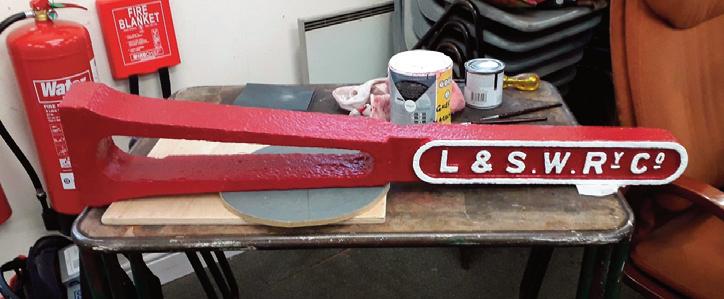
The more observant of you will have seen a rusty lump of cast iron recently brought in to GMES by Alan Malby. After much discussion and Internet investigation about colour schemes, it was decided to clean it up and repaint in red and white with a view to planting it in the ground visible to our visitors.
Alan got on with painting the red paint, and we were wondering how to do the lettering when Mark Wakelin brought in one of his models which had some lettering painted by his daughter Laura, and after a phone call, Laura offered to do the lettering on the post. On its return, Mike Wood did a bit of paint fettling and its now ready for installation.
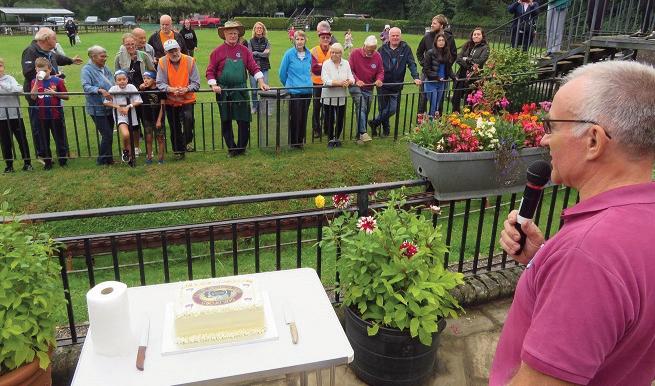
On Saturday 7th September between 14:00 and 17:00 the Society held a Families and Friends event to celebrate its 70th anniversary and to thank the families of our members who are involved in any way with the public events that take place at GMES.
Matthew Clark
For those of you who are wondering what it is, it is a London & South Western Railway (L&SWR) boundary marker. A Google search yields little information about them, but there is one in the Science Museum collection and its catologue entry has this to say about it.
"Boundary markers like this were used to clearly identify the limits of railway land and to distinguish them from adjacent property. They were typically used where it was difficult to install a fence or hedge, where there was a risk of encroachment by other landowners, or where there had been a dispute over land ownership. They also delineated one railway company’s territory from another’s, for instance to make it clear who was responsible for maintaining a particular stretch of line.”
The boundary marker is a practical design in cast iron, probably made in the foundry at the L&SWR’s works at Eastleigh in Hampshire. Our example came from around the Guildford area; the exact location is unknown.
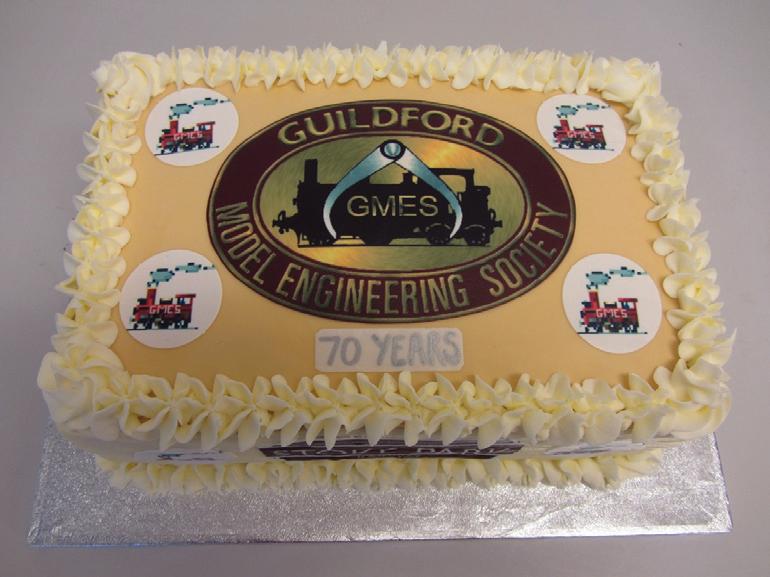
A 70th celebration cake was made to mark the occasion and was consumed with ethusiasm by those members who attended.
Exeter Garden Railway Show
The Garden Railway Group has been invited several times to take the club’s portable layout, Mwch Grumblyn, to participate in the Exeter Garden Railway show. This is held in the Matford Centre, just outside Exeter.
This year we were invited again, so on Friday 25th October, I collected a van from Kendall’s, in Camberley and headed off to GMES to load it up. Mwch Grumblyn has grown over the years, so we have to use an extra-long wheelbase, high top, panel van. As we had to hire this van for a full weekend, we decided to stay an extra night and travel back home on Sunday.
Our journey down the A303 was much worse than normal, probably due to the start of half term holidays. We later learnt, the M5 was closed.
The Exeter show is a multiscale event with layouts that encompass Gauge O, Gauge 1, Gauge 3, LGB which is 1:22.5 and 16mm to the foot. Mwch Grumblyn which is 16mm scale, fits in nicely. Also, there is an excellent heritage stand and layout. Over the years we have met a lot of
Graham White
people at the show, so it has also become a really good social event. Trade support is very good, especially as it is the only show of its type in the Southwest.
It’s a fair old trek from Guildford to Exeter for a one-day show, but it has such a good friendly atmosphere it is worth the effort and a highlight of our running calendar. Some of our wives came too and went off to RHS Rosemoor while we played trains. We had a good team taking part, so I would like to express my thanks to Bill Read, Chris Webster, Kim Jackman, Gerald Janes, Charles Hanniford, Adrian Rogers, Rob Golding, Vinny Gretzer and Richard Consterdine
If you want to see the layout in action and see what else was at the show, please look at Rob Golding’s excellent Bayfields Light Railway video production on YouTube at: https://www.youtube.com/watch?v=_Y2vkfmum-U
On Sunday we decided to return home along the A30 and visit the Gartell Railway which had a public open day. This is a private, 2ft gauge line which runs onto the former Somerset and Dorset track bed near Templecombe. They also had a model tram exhibition. The railway rolling stock is similar to the Groudle Glen Railway that runs on the Isle of Man.
As a group we are known as GMES (Guildford Men’s Eating Society) which by default meant we had to visit the excellent tearoom, which is highly recommended.
Looking forward to next year’s outings with Mwch Grumblyn, there is a good chance we will be going to Exeter again.
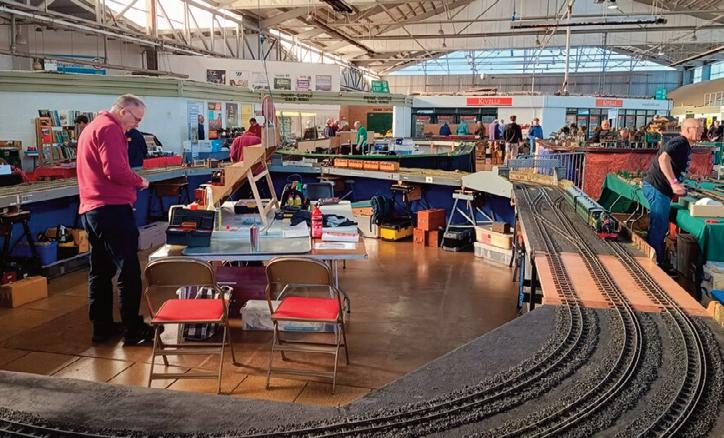
Mwch Grumblyn provides an impressive layout
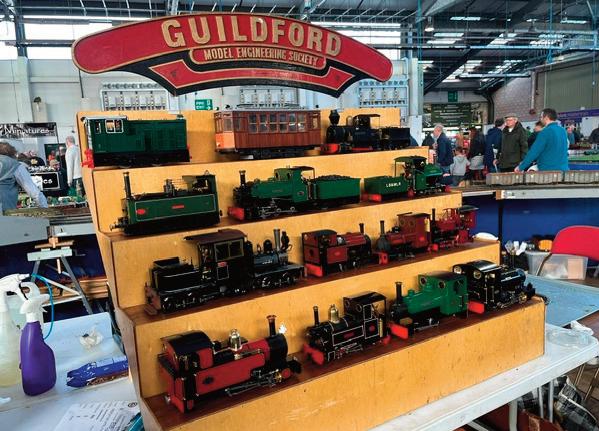
A fine display of locomotives at Exeter
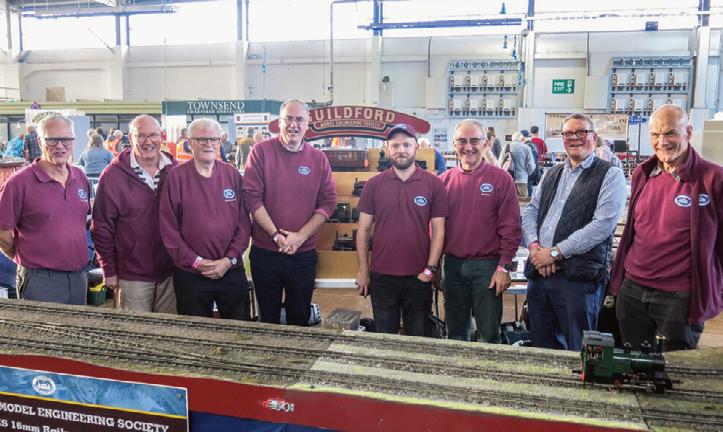
The Garden Railway team
Editorial Peter Shakespeare
Welcome to the December edition of the GMES Newsletter.
Those of you who subscribe to the GMES Groups IO ‘Mailing Group’ received an email from me in early September regarding a survey asking for views regarding my proposal to the Committee of Management (CoM), that the Society puts GMES News onto a new flipbook digital platform provide by ISSUU (pronounced issue).
It is now common practice, for commercial publishers, companies and associations to use these flipbook platforms for the digital version of their publications as it is generally accepted, they make reading magazines and newsletters online a more user-friendly experience than scrolling through a PDF format. Zooming in and out is easier, and like PDFs they enable live links from emails and web addresses. Uniquely they allow you to embed video within articles. I attached a link to ISSUU’s free flipbook viewer containing the September GMES News so members unfamiliar with flipbooks could get a feel for it. The free demo version had marketing content from ISSUU in the viewer, which was unavoidable. Paid for options can turn this marketing content off. There are around 145 members signed up to the mailing group and I received feedback from a grand total of ten members – eight via email and two verbally. I can only say this was extremely
White Elephant Sales
Many members will remember the annual White Elephant sales in December. These were basically a mechanism for members to offload stuff they didn't want by selling it to other members with the sales proceeds going to GMES funds. The popularity of the sale dwindled and Covid restrictions finished it off.
We still get items being donated for disposal, and an electronic catalogue was created to advise members of what is available.
disappointing and suggested to me that most members don’t have an opinion about how their society’s newsletter is managed.
Of the handful who did take the time to respond –thank you - opinions were split 50/50. Given this impasse, at the October CoM, the committee decided it would vote on whether the proposal was taken forward. Two-thirds of the CoM voted (14) – 50% (7) in favour, 35% (5) not in favour, with two abstentions. In view of the cost of adopting the flipbook platform - £192 per year – and the lack of an overwhelming mandate it has been decided to put this proposal on ice, so more awareness can be raised. It is probable the proposal will now be put to a vote at the AGM in March 2025.
Adding to my rather deflated mood concerning this newsletter, and members’ engagement with it; only four people came forward with suggestions and offers of articles for this and future editions, following my request in the email mentioned above, My thanks go to Bill Read, Matt Clark, Martyn Harrold and Dave Thompkins for their articles.
Producing an engaging, informative and worthwhile newsletter for a club or society principally relies on input from its readership. GMES has around 200 members and no doubt you have a wealth of model engineering interests, engineering expertise and related experiences between you. We produce four editions a year so if twelve of you a year could find some time to put pen to paper, it would be a start and a welcome addition to the publication.
Bryan Finch
The catalogue is accessible via the link below and several items have been added recently. Prices shown are indicative and we are open to sensible offers. 100% of the proceeds goes to GMES, unless an item offered by a member is of significant value and the members asks for a percentage of the sale.
https://tinyurl.com/u6ea8rua
If you have items that you'd like to donate, please let me know.
Treasurer’s Report
Open Days
We have run thirteen Open Days so far this year. The gross takings so far are in excess of £21,000, with April, August, March and May all providing record takings.
Charity Day
Our Open Day in September is designated as our Charity Day. All the ticket sales on this date are donated to our adopted charity, this year as in previous years, is our neighbours Challengers who provide play and leisure for disabled children and young people.
Our ticket income this year was £983 and the Council of Management have agreed to donate £1,000 to this charity.
As well as our efforts to raise money for charity, we welcome charities to attend and raise funds on their own account. This year Challengers attended as did the Phyllis Tuckwell Hospice.
These Open Days can only happen with your active participation and support, so well done to all and thank you to all that turn-up to help. These events are essential to support the finances of the society as well as providing a visible benefit to the community who, in turn, support our events.
Rubbish
As you will have noticed if you have been on site recently, we have had a large (10yd) skip delivered into which the hardcore unearthed whilst digging the trench for the signalling ducts has been loaded plus a lot of other “this might be useful stuff” that seems to accumulate on site. This skip has cost us £434.
At the same time, Neil Heptonstall has been coordinating the collection of scrap metal from around the site, especially the loads of cable that had accumulated in the carriage shed and in the workshop mezzanine. The money raised by taking this to the scrapyard is £520 so far, with an-
Chris Phillips
other load to come. This has more than offset the cost of the skip.
So thank you all who for your efforts with the rubbish and the ‘recycling’ and thanks again to Neil for organising and making multiple trips to the scrapyard in Liphook.
Subscriptions
Now that the Season of mellow fruitfulness is now behind us and the Festive Season looms, can I respectfully remind members that subscriptions are due at the end of December.
2025 Subscription
The current subscription is £60, There are several ways of making subscription payments:
Cash
If you want to pay cash, please try to catch me at GMES on a Thursday or at one of our events.
Cheque
This is my least favourite payment method! We now get charged 80p for each cheque we pay into the account and someone (thank you Sue) has to go into town to pay it in.
Bank Transfer
The GMES bank details are:-
• Payee: Guildford Model Engineering Society Ltd. (The full name is required by some banks to prevent payments to the wrong account)
• Bank Sort Code: 40-47-08
• Account No: 01641603
• Reference: please insert your initials and sur name.
Cards
We now have the facility to accept payments by card (Credit, Debit, even Amex!).
This can be done in person if you see me or Bryan Finch at GMES.
Chris Phillips Treasurer v
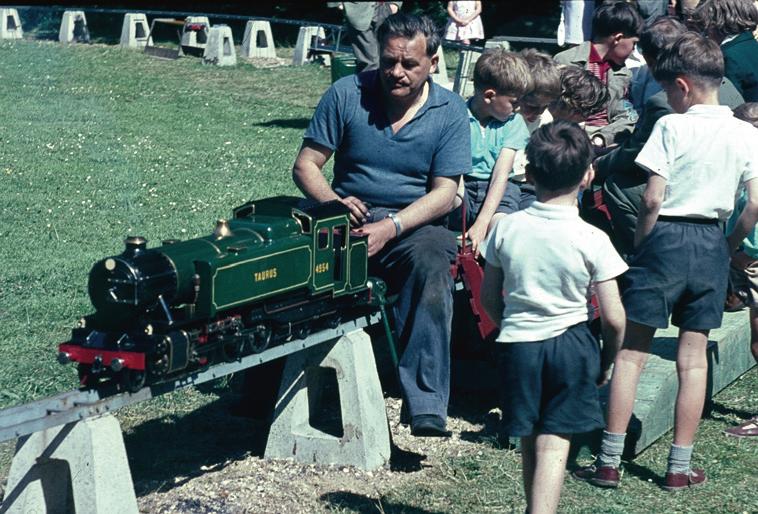
The History of the Halton Tank Taurus
Our club engine Taurus is a freelance locomotive which was designed by Henry Greenly to be made by apprentices at Halton.
Ours was built by Harry Taylor between 1948 and 1954 hence the number 4854 that it carried. Why it was called Taurus is lost in the mists of time but as far as GMES is concerned it has always been called Taurus
I found a photograph of it on eBay, some years ago, which I subsequently bought only to find that it was a photograph originally sold by GMES presumably to raise money for the club.
At some point Harry Taylor donated the locomotive to the club on the condition that it was only to be used for public passenger use and not for driver training or for members use.
One day when being driven by George Lorryman the boiler failed, and the club could not afford the cost of a replacement. This left the club without a passenger hauling locomotive and in a bit of a predicament.
Geoff Morris was building a Super Simplex or an extended Simplex as the term Super Simplex
Martyn Harrold
didn’t exist at the time, and he was going to build two, keeping one and selling the other and the club also decided to build one at the same time as a passenger hauling engine. That was the beginning of our club locomotive Alice, which was named after Alice Jensen the wife of Alan. The second locomotive that Geoff built was Serendipity, now owned by Mike Holman.
When Geoff reached the point of buying the boilers for his engines, he visited the boiler manufacturer Moorwoods and explained what he was doing and why. He was told that the manufacturer had a boiler for a Halton tank which needed new tubes as they had been cut too short. Geoff reported this back to the CoM who agreed to buy the boiler for its scrap value of £30. This was around 1987.
Len Steel then retubed the boiler and Taurus was put back into service. At a later date Len
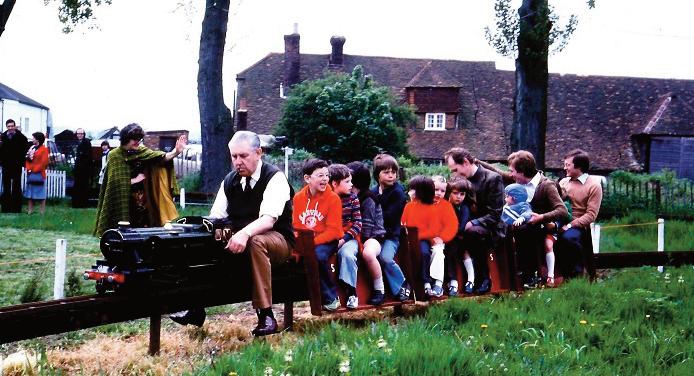
In the early 70s with Station Master Mike Baigent
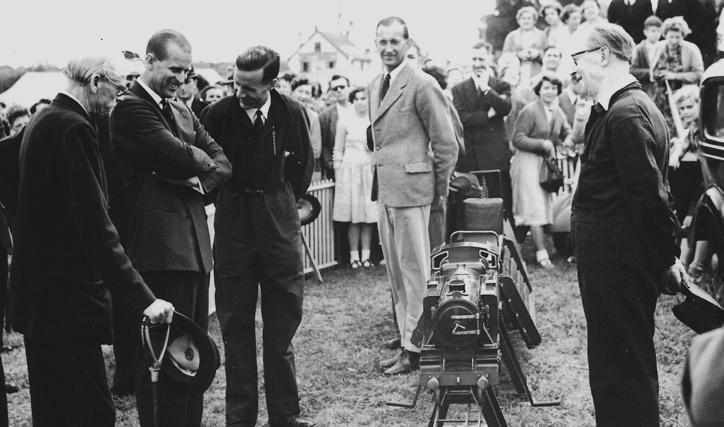
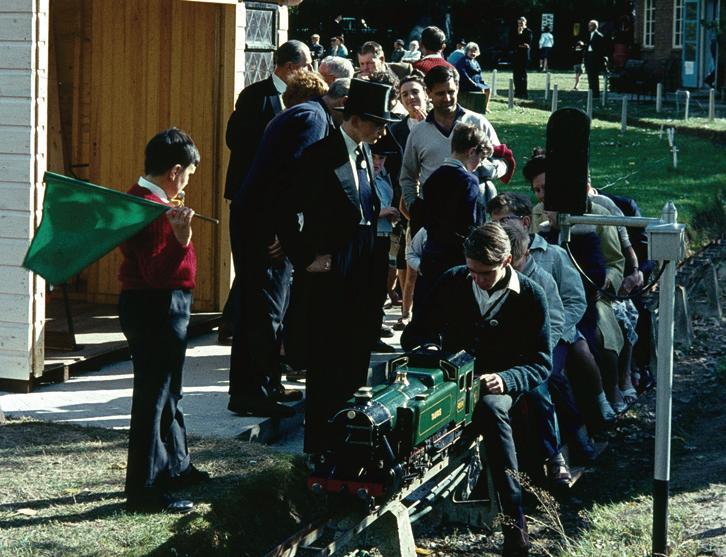
Taurus being presented to HRH Duke of Edinburgh
Taurus in its early days being loaded with excited chidren
Taurus in the early days of the Society
The History of the Halton Tank Taurus (concluded)
also renewed the firebox stays and later still the crown stays.
Around 2003/4 Taurus needed an overhaul and Len again undertook the task. During the rebuild it was discovered that the two cylinders were considerably different in size. It was during this rebuild that Len fitted steel tyres to the wheels and Taurus was again put back into service.
Shortly after this the Chairman decided to drop the condition imposed when it was donated and allowed the locomotive to be used for driver training. Thus, Taurus continued in passenger service for some years until around 2014 when the return crank moved probably due to a hydraulic lock, being a piston valved engine.
The engine developed a habit of slipping and the centre of gravity being in the wrong place was suspected as no other fault could be found. The club’s weighing system was used, and it was es-
timated that 18 lbs of weight needed to be added to the front buffer beam in order to move the centre of gravity over the centre driven wheel. It proved to be impossible to add that much weight but as much as possible was added by casting various shaped pieces of lead and the result was considered as being satisfactory.
Again, it was sent to Len’s works where the crank was reset and the locomotive retimed. However, on its return it was found that the front tubeplate was leaking next to the boiler barrel. This time despite being shot blasted and soaked in strong pickle for a couple of days the leak could not be sealed, and the boiler was condemned.
This time Paul Tompkins came to the rescue and offered to make a new boiler for free with the club buying the materials but on the condition that the club committed to honour the original conditions when it was given to us that it would only be used for passenger hauling and not for driver training or members use. This the CoM committed to.
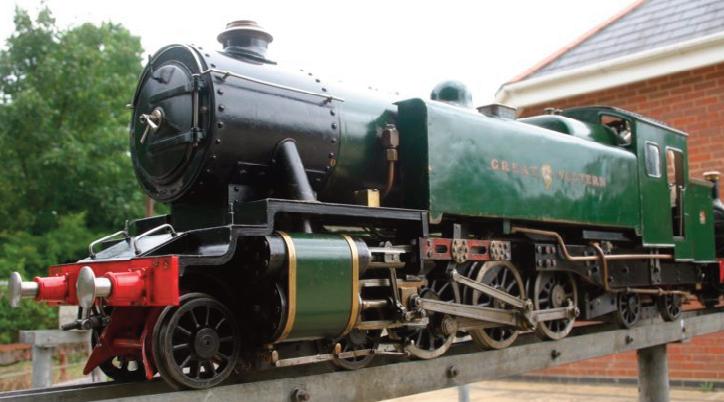
Since then, Taurus has remained in the workshop undergoing bits and pieces of renovation and modifications to fit the new boiler and has now been repainted, soon to have the transfers applied to the tanks so that it will look like the Taurus that Harry Taylor would recognise.
We expect her to return to traffic next season, she is a fine old lady which we hope will soldier on for many more years. Taurus is 70 years old
Taurus should return to traffic in 2025
Steaming up for public running in 2007
Bits & Pieces
18th September 2024
The start of a new season of Bits & Pieces and first up tonight was Martyn Harrold who continues to build his GWR 15XX 0-6-0 tank locomotive. After a twenty-one month wait, the casting for the dummy safety valves arrived and Martyn has started work on it.
Work also continues on the pannier filler covers. These are silver soldered fabrications made to tight tolerances that are then soft soldered to the panniers.
On the prototype, the balance pipe which connects the two pannier tanks together is an ellipse shaped, seven-inch copper pipe. The model drawings by David Adams differed to make life easier for construction in the smaller gauge. Martyn's design utilised approximately fifty percent from each design.
On a different subject Martyn has been looking out for a smoke generator for Big Ugly, his American diesel electric. He found one made for model tanks that uses vape oil that smells of diesel.
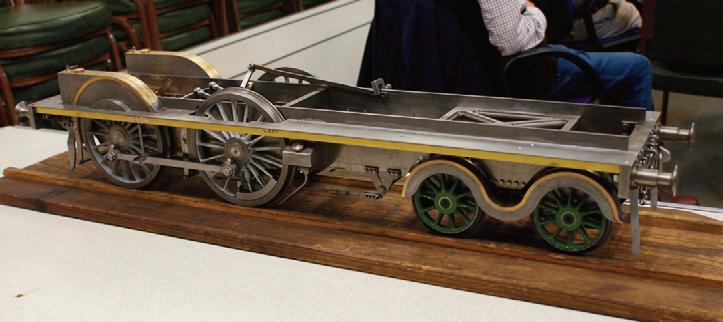
Peter Wardropper is building a Martin Evans designed Adams T6 0-4-4T Harringay locomotive in five inch gauge. Its construction was serialised in Model Engineer, but Peter has no drawings for it. It is currently a running chassis, and the boiler is well on the way to completion.
As a long-term project Peter is also building a Lancashire and Yorkshire 0-4-0 tank engine using works drawings. The nearest pattern wheels were
bought from Reeves but were under size in diameter, so the tyres were turned down and new tyres of the correct size fitted.
Another innovation was to fit thin graphite loaded PTFE piston rings into deep grooves to cope with the expansion of the PTFE.
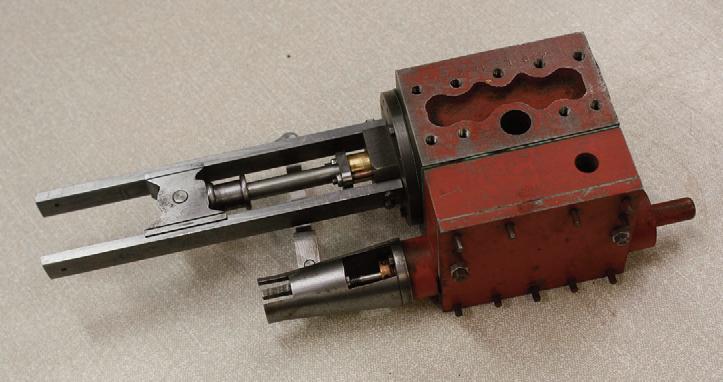
Ken Little continues to build his five-inch gauge GNR 2-8-0 locomotive. Tonight, he brought in a cylinder and piston assembly. The piston is five thou. under the bore size and the piston rings are made from one-eighth inch square PTFE yarn. The same yarn was used for piston valve packing after squashing it to three-sixteenth by one-sixteenth cross section.
16th October 2024
Dave Tompkins continues to work through the components of his seven-and-a-quarter inch gauge Bagnall 0-4-0 T. The current item is the smokebox door which "won't fit by a mile".
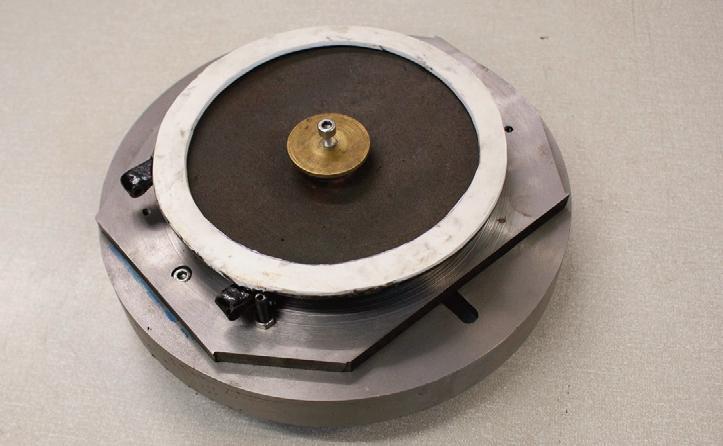
To resolve this Dave made a jig consisting of a round slice of mild steel bar the diameter of the door with a stud in the centre and three more equally spaced (120 degrees) on a radius around the central stud. Having drilled a hole in the middle of the door, it was then fastened down on the central stud with the convex side facing the jig
Matthew Clark
One of the Pannier filler covers shown by Martyn
Running chassis for Harringay
The cylinder and piston assembly for Ken’s GNR 2-8-0
and the jig clamped to the lathe faceplate. The flat side of the door was then levelled by screwing the three outer studs in or out and the door faced off. Once this was finished, a thick silicone sheet gasket was attached to the door with silicone sealer which will hopefully make an airtight seal with the smokebox.
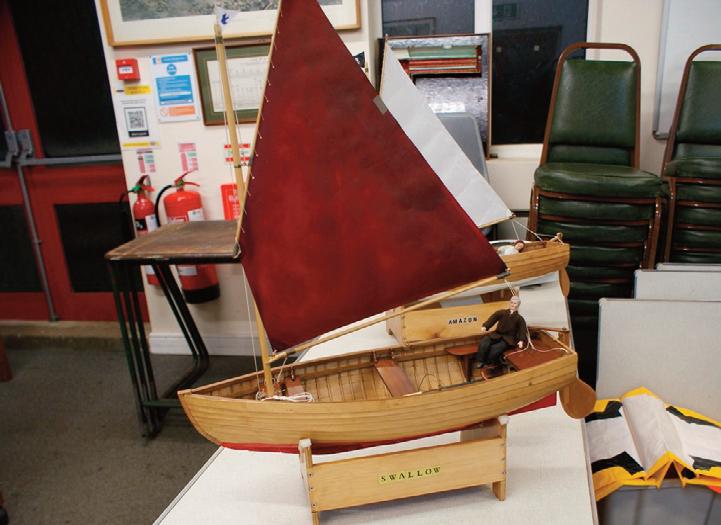
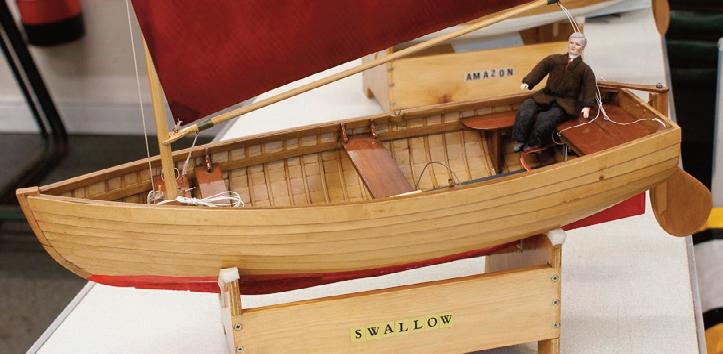
Peter Shires has hit on a cheap, novel way of carrying his smaller boats like Swallow and Amazon: Sainsbury's bags for life. The trestle base fits nicely onto the bottom panel of the bag and if you slit down the ends the hull can fit in quite nicely.
Peter has now sailed both boats individually and together. Simultaneous sailing is achieved by purchasing a two-joystick transmitter with eight channels. One joystick and two channels are used for each boat.
After the test sailing some tweaks were made. Different shaped sails were cut out and fitted. To keep the area of the new sails the same area as the current ones, Peter laid the sail on the sail cutting table and put a pin in the board at each
corner of the sail. A cord was then strung around the pins. The area of the sail then equalled the area within the cord. Thus, you can play around with the pins to change the shape whilst keeping the same area. The sails were made from offcuts of sailcloth from Jeckells, sailmakers, based in Hoveton on the Norfolk Broads. The red colour of the sails was eventually achieved with two coats of wood dye after trying a dark red artist's paint.
Martyn Harrold explained how he put together the parts for the balance pipe described in the September Bits & Pieces. The pipe is copper, the cover is brass.
The parts were initially delicately spot welded with a Tig welder and then silver soldered. Martyn reports that the soldering went very well as surface tension pulled the solder along the joints in a very satisfying manner..
Swallow displayed complete with character
The completed balance pipe v
Similar to above but with Amazon displayed
Dave’s jig to provide an airtight seal to the smokebox
Red sail for Swallow and white for Amazon Bits & Pieces (concluded)
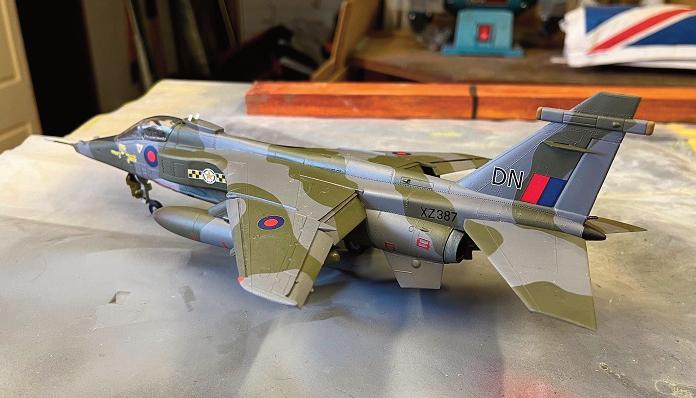
A 42-year model build
Way back in 1982, I had gained my RAF Wings and subsequently completed the Tactical Weapons Unit course at RAF Brawdy in Wales flying the Hawk.
I was then posted to the Jaguar Operational Conversion Unit at RAF Lossiemouth, the course starting in January 1983. That left me with a couple of months during which time I held at RAF Coltishall on 54 (Fighter) Squadron, generally acclimatising myself to the Jaguar environment, before travelling to Scotland.
I found a model shop in Norwich and bought an Esci 1/48 scale kit of a Jaguar that I commenced building. I decided to modify the kit, cutting off the flaps and slats, intending to replace them with scratch-built styrene parts in the extended position and constructing an ejector seat that looked like the Martin Baker seat fitted to the RAF aircraft, replacing the French seat supplied with the kit.
I got as far as applying some filler to the gaps between the wings and the fuselage before the model got put away to be completed later.
After moving house last year, I converted half of the garage to be my new workshop. I now have space to have more than one model in progress at any one time, so the Jaguar finally reappeared. The filler was finally rubbed down and the flaps and slats previously constructed were fitted.
In the years since I started the model, the aftermarket for replacement/updated/detailed parts and decals has increased quite remarkably.
I was able to acquire decals for my first squadron (No31) and a resin model of a WE177 tactical nu-
Bill Read
clear bomb to depict the Jaguar as being on Quick Reaction Alert at RAF Brüggen in 1983-84. (Hannants.co.uk of Lowestoft is the place to go for mail order decals and accessories I’ve found, and they now have a physical shop in Colindale, not far from the RAF Museum at Hendon).
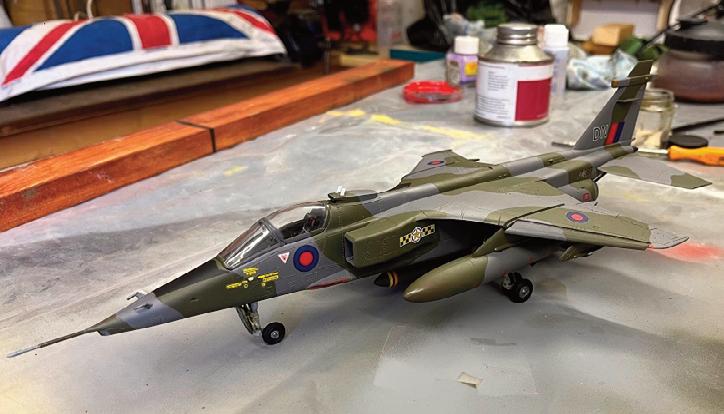
For the first time, I attempted to use my airbrush to paint a model aircraft. The overall camouflage grey was straightforward enough, providing enough care was taken to get into the corners between the wings and fuselage; for example using well thinned paint and low air pressure for several coats. A lot of masking tape and very careful cutting was required to mask off the grey before spraying the green.
One problem was that although the RAF had designed the paint scheme, the RAF painters didn’t follow the scheme exactly - no two aircraft were exactly the same, as witnessed sometimes if panels were ‘robbed’ off a long-term unserviceable aircraft to replace a panel on another jet, as the grey/green didn’t always match up. Clear photos from all angles of one jet just don’t exist, so to some extent the camouflage scheme is a best guess.
Once the decals had been applied, the model was given a light coat of varnish to seal the decals.
As I realise that plastics kits don’t readily fall into the Model Engineering category, I only offered the model for display at the Gala as I was told we were very short of models, so I was delighted to find I was awarded a Very Highly Commended for the paint finish!
Bill’s model Jaguar took twenty-one years to finish
No two RAF paint schemes were identical
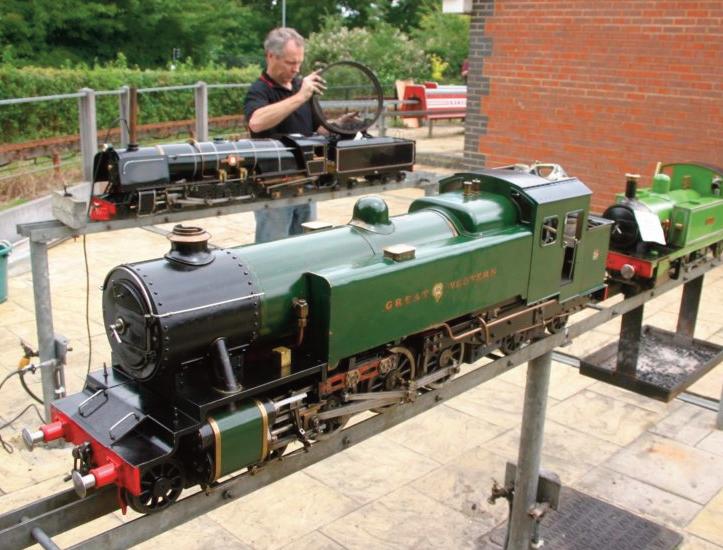
Club loco Thompson B1
It was at a Public Open Day in 2004, when a few members told me a visitor had told them he had recently suffered a stroke and was not able to carry on building the 5” gauge B1 Loco he had started. He asked whether there was anyone in our club he could give it to, who could finish it?
Somehow our members had me in mind and told me to come to the next Public Day (which I did) and I was introduced to Mr Paul Wheatcroft of Farnborough. I walked with him to his car wondering what sort of thing I had let myself in for. He opened the car boot, and I thought, strewth! That’s good. I closed his car boot as I didn’t want anyone else seeing what he wanted to give me… On the understanding that I would finish the model and have it running.
I told him he wasn’t going to give it to me, and I was going to give him £250 to buy it off him. He was happy to accept but once again he said I had to finish the loco.
My nephew Paul had just started a boiler making business so that’s where I placed my order. The Thompson B1 (Springbok) design by Martin Evans will produce a very good running loco but is not much of a scaled job. The plate work and tender are far too wide so as I had to make a complete tender I chose to work to the 5” gauge Green Arrow design. Paul, although an engineer by trade, wasn’t too well up on loco building and the several things I had to change. One being the pistons which he had made from two pieces of
Dave Tompkins
brass bolted together to allow for 1/2” PTFE rings. The cylinder blocks were gunmetal which wouldn’t be my choice so once I had finished work on the cylinders, I made three sets of bobbins. I say three as with a colleague we spent a day getting as good a fit in the liners as possible. Then I knocked on Len Steel’s door asking him to put some oil grooves in the valves. I wasn’t going to have piston rings.
Len also timed the valve motion for me. The advantages of cast iron is it retains oil due to its graphite nature. When a loco is run the gunmetal cylinders must have lubrication or they will seize. Paul would be driving it so with IMLEC in mind I decided not to fit an axle pump, just two Len Steel injectors. Until recently the loco didn’t have a hand pump in the tender.
Regarding the tender, while I was finishing the loco, I was made redundant from my printing job, because the firm was closing down. With permission I took the aluminium covers off one of the machines and they are now the B1 tender. If that sounds odd - and some think so - well Concord was made from aluminium! A week after I had cut the metal up the Print Company phoned me to ask for the covers back as they had a buyer for the machine. “Err, sorry”, I said, “they are now part of a steam loco!”
Concluded on Back Page /...
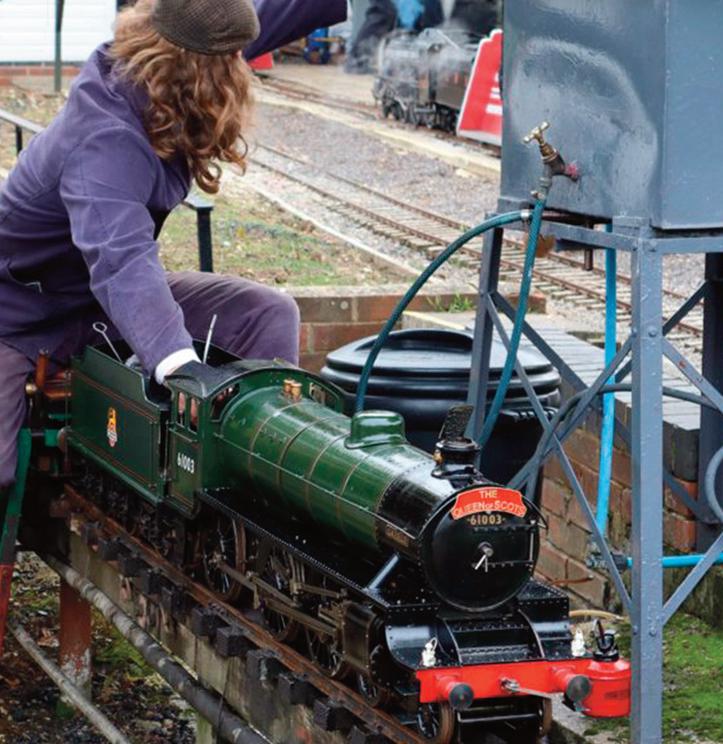
The B1 on its way to winning the Welsh IMLEC
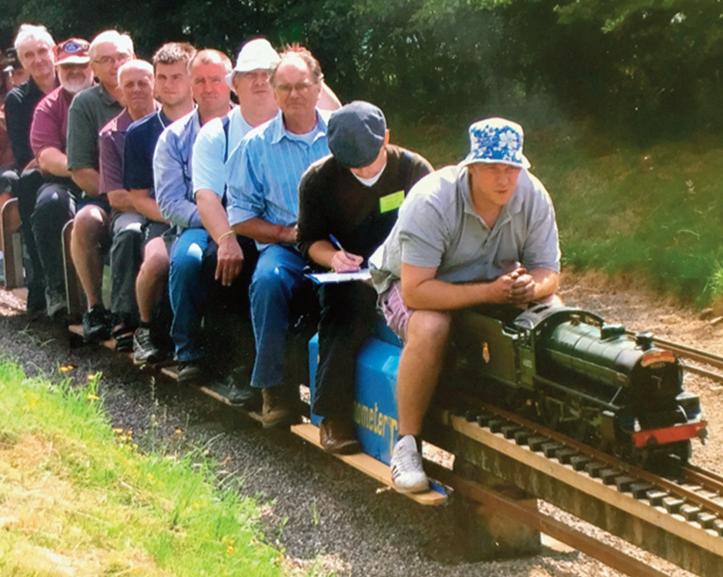
In GMES ownership the B1 has hauled thousands of fare paying passengers
Club loco Thompson B1 (concluded)
So, the day came for its test runs and although I wrote to Mr Wheatcroft, he didn’t feel able to come and watch.
The loco went on to win the Welsh IMLEC and a place at the main IMLEC, which was staged at Southport. I was very pleased to take photos and videos around to his house and he was quite emotional to see his engine running and to a good standard. I’ve never claimed that it’s my work entirely. Paul must be congratulated for the high standard of his work. Time has moved on, and Paul now works full time making boilers. He was financially forced out of his Surrey premises
and needed £8,000 to move his workshop to cheaper factory units in Devon.
The club needed another 5” gauge loco so with mixed feelings I sold it to the club, which some way helped with his moving cost. I say mixed feelings but I’m extremely pleased when I see the loco performing well on the club’s Public Open Days with all the smiling faces of the kids.
I have never forgotten when Paul Wheatcroft patted his rolling chassis goodbye as I put it in my car boot or him saying once again, I had to finish it for him. Collectively. I think we owe him a debt of gratitude.
Nation Trust - Model engineering books available
Gail Davies, a volunteer at the National TrustDapdune Wharf (behind the cricket ground) has contacted the Society. Members might be interested to know their charity shop generally has 200-400 books on trains, models, model engineering and railways in general. They are open every day except Tuesdays and Wednesdays.
If there are no National Trust volunteers in attendance Gail says speak to someone in the ticket hut or tearoom (entry is free but there are parking charges for non-NT members). They have boxes and boxes of stock in the back room.
Membership Subscriptions for 2025 are due on January 1st
A respectful reminder that subscriptions are due at the end of December. The renewal form is accessible from the member's side of the GMES website -http://www.gmes.org.uk/members/documents.htm
Cheques and cash are increasingly difficult for us to get paid into the bank with so many local branches being closed. Consequently, we would ask that members consider paying by online banking. This is quick and efficient.
Quite a lot of our members already use online banking, but if you don't, we'll happily accept payment by card, cash or cheque either person to person on Thursday mornings, or through the post in the case of cheques.
The process for payment by Online banking: Set-up a payment for £60 from your favourite Online banking account. The GMES bank details are:-
• Payee: Guildford Model Engineering Society • Bank Sort Code: 40-47-08
• Account No: 01641603
• Reference: please insert your initials and surname. In addition, please send an e-mail to renewals@gmes.org.uk, which will go to the Treasurer and Membership Secretary so that you can advise them of your payment. Please also include details of any changes to your postal address, e-mail address or telephone numbers.
Your Membership Card will then be forwarded to you by the Membership Secretary.