The newsletter of Guildford Model Engineering Society
Chairman’s Chatter
Dates for Your Diaries
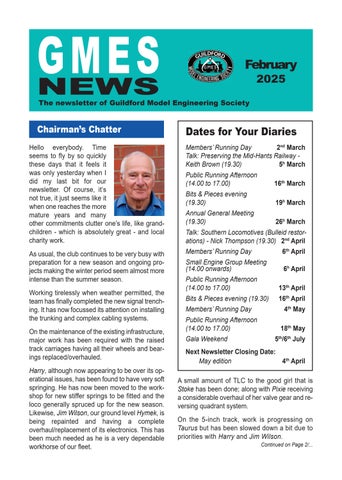
Hello everybody. Time seems to fly by so quickly these days that it feels it was only yesterday when I did my last bit for our newsletter. Of course, it’s not true, it just seems like it when one reaches the more mature years and many other commitments clutter one’s life, like grandchildren - which is absolutely great - and local charity work.
As usual, the club continues to be very busy with preparation for a new season and ongoing projects making the winter period seem almost more intense than the summer season.
Working tirelessly when weather permitted, the team has finally completed the new signal trenching. It has now focussed its attention on installing the trunking and complex cabling systems.
On the maintenance of the existing infrastructure, major work has been required with the raised track carriages having all their wheels and bearings replaced/overhauled.
Harry, although now appearing to be over its operational issues, has been found to have very soft springing. He has now been moved to the workshop for new stiffer springs to be fitted and the loco generally spruced up for the new season. Likewise, Jim Wilson, our ground level Hymek, is being repainted and having a complete overhaul/replacement of its electronics. This has been much needed as he is a very dependable workhorse of our fleet.
Members’ Running Day 2nd March
Talk: Preserving the Mid-Hants RailwayKeith Brown (19.30) 5h March
Public Running Afternoon (14.00 to 17.00) 16th March
Bits & Pieces evening (19.30) 19h March
Annual General Meeting (19.30) 26h March
Talk: Southern Locomotives (Bulleid restorations) - Nick Thompson (19.30) 2nd April
Members’ Running Day 6th April
Small Engine Group Meeting (14.00 onwards) 6h April
Public Running Afternoon (14.00 to 17.00) 13th April
Bits & Pieces evening (19.30) 16th April
Members’ Running Day 4th May
Public Running Afternoon (14.00 to 17.00) 18th May
Gala Weekend 5th/6th July
Next Newsletter Closing Date: May edition 4th April
A small amount of TLC to the good girl that is Stoke has been done; along with Pixie receiving a considerable overhaul of her valve gear and reversing quadrant system.
On the 5-inch track, work is progressing on Taurus but has been slowed down a bit due to priorities with Harry and Jim Wilson.
Continued on Page 2/...
Chairman’s Chatter (concluded)
The B1 is having its tender water tank overhauled. The inside has been completely stripped and cleared of all residues of paint. This will hopefully stop the temperamental injector operation due to erratic water supplies from filter blockages. A new replacement hand pump with a modified unobtrusive access is also being made for its operation.
With all our club locomotives requiring new boiler steam certificates before our first Open Day it is an intensive period for our loco maintenance team. Site preparation for the new year is being carried out in between signaling and track work to enable us to maintain the usual high standard of our grounds throughout the coming season. A lot of general clearance took place over the earlier part of the winter including a large amount of rubble which resulted in a skip being hired and filled to capacity.
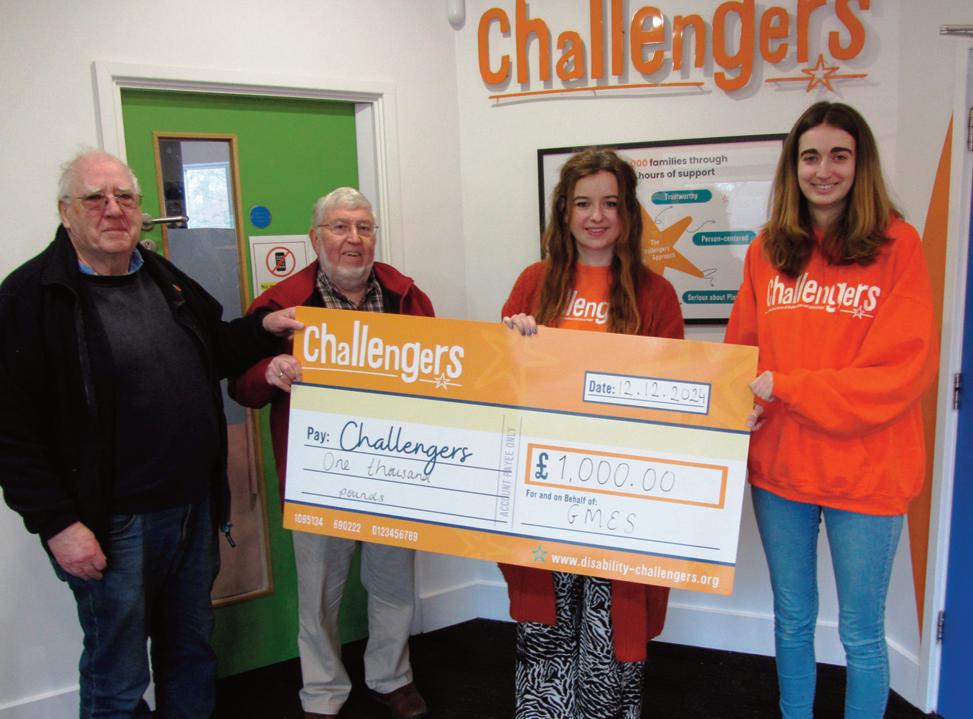
2024 Challengers Presentation
The planning for our steaming bay canopy is progressing and an issue with the raised track tunnel roof, due to water ingress, is being dealt with at the moment.
In fact, the wet weather has had a major impact on the efforts of all the working members, but they’ve been doing an absolutely exceptional job under the circumstances.
There are many other areas where work has been going on in the background, including electrical and plumbing work, a kitchen refresh and general ground maintenance, to name but a few.
I could go on to fill the whole Newsletter with all that is being done but this is enough for now. I would just like to thank everyone who has given up their time to help.
Mike Holman Chairman v
On 12th December 2024, GMES presented Challengers with a cheque for £1,000. Their Community & Events manager, Becky Cox has thanked the Society saying: “We just wanted to say a HUGE Team Orange thank you for your incredible support in 2024 and for the recent cheque of £1,000! It is hugely appreciated by us
all at Challengers. In 2024 we delivered 77,197 hours of play and fun for the young people that use our services, and important respite for our families - thank you for being part of this vital service for 773 young people and their families across the South East!
We wanted to share a quote from one of our Challengers’ parents, as without your support, the below would simply not be possible.”
‘Challengers was the only place willing to take on the challenge of my son, and after years of hearing how difficult, dangerous and impossible he is, I’m now hearing that he is a delight to look after – words that heal my heart. I was on the verge of a breakdown last year, and there’s no exaggeration in me saying that Challengers is the only thing that keeps me sane. We are both so grateful to have Challengers in our lives.’ – A Challengers Parent
Editorial Peter Shakespeare
Since my last editorial the CoM decided to put the November newsletter onto the ISSUU flipbook platform to further trial member uptake. I am pleased to report that it and the September newsletter have had 60 and 95 reads respectively, which is encouraging. This newsletter will be uploaded to ISSUU and a link circulated, prior to a vote at the AGM, whether to sign up to the paid-for enhanced version of the platform.
Freezing temperatures and damp aside, over the last three months I have managed to finish my 3-inch scale Marshall S-Type traction engine, which is now resplendent in its Marshall Crimson livery with black, red and yellow lining. I have also built a driving trailer, so I look forward to bringing it to Stoke Park to support GMES events later in the year.
This completion has created a void in my model engineering life – it has been a happy distraction from work for the last seven years! So what next?
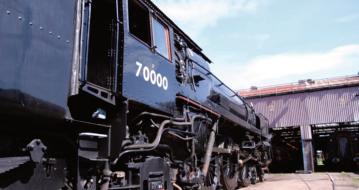
As I have explained previously, prior to joining GMES I was a driver on the Mid-Hants Railway and my favourite locomotives were the BR Standards – the railway had 73096, 76017 and 92112 and I have also driven an 80000 tank and 70000. So, when I heard Alan Pepper was giving a talk about Robert Riddles, the man who designed them, I had to go.
Riddles had vision and a real insight into what was required of enginemen and fitters. His locomotives were designed with ease of maintenance and ease of operation firmly at the top of the list. Some of their motion was on grease so reducing the time taken to prep the loco and two classes had roller bearings on the drive axles. If you know how long it takes to oil up a GW Castle, SR Lord Nelson or LMS Duchess, you will understand this.
On the footplate all the driver’s controls can be easily reached from the driver’s seat. On some locos with pole regulators, you need the strength
of Sampson and arms of an ape to operate it if needing to look out of the cab at the same time. The driver’s brake valve on most of Riddles’ designs is mounted at elbow height on a pedestal, negating the need to try to control the subtle movements required at shoulder height while the loco lurches around crossing point work entering a station.
Everything the fireman needs is neatly tucked away in the right corner of the cab, unlike Bullied and Gresley six-coupled locos with their injector steam valves mounted high on the backhead above the fire hole. And the tender coal plate is at the same height as the fire hole. Shovelling six tons of coal from near floor height takes twice the effort – ask anyone who has spent a day firing a Great Western loco.
So, to answer my own question, my next project will be a BR Standard, ideally in 71/4-inch gauge. Good luck I hear you say. Just how I will find the space to build it – I’m leaning towards a Standard 5 - is another question now my modest workshop is full of traction engine.
Thank you to everyone who has contributed to this edition of GMES News, and I hope you enjoy reading it.
editor@gmes.org.uk
We regret to report that Neil Frost passed away in late January. Neil had been a GMES member since 1983 and was significantly involved with the 4mm layout in the Clubhouse until failing health prevented his involvement in recent years.
Our thoughts are with his family and friends at this difficult time.
Neil Frost
Treasurer’s Doodlings Chris Phillips
Insurance Reminder
Guildford Model Engineering Society has insurance under the Federation of Model Engineering Societies Scheme to cover our Property and our Liabilities.
This year this has cost £9,100. This is a lot of money, however it covers:
• £5 million public liability insurance to cover the risks to us as members and the society in the event of claims including from those to whom we offer train rides
• Indemnities for our Boiler Inspectors
• Loss or theft of our Locomotives and rolling stock
• Damage to or theft from our buildings (currently valued at £739,000)!
• Cover for you, our members, when you use your models away from GMES.
This part of the policy (one of the benefits of being a GMES Member) covers individual members for Public Liability (excluding Road Traffic Act), when undertaking model engineering activities, whether as a GMES activity or on their own, anywhere in the UK up to the GMES limit of indemnity, currently £5 Million.
Should you need to provide evidence of insurance (perhaps when visiting an event in the future) certificates are available from the Treasurer or Secretary.
However, the GMES policy does not cover your models and other property at any time even while they are at GMES. You need to arrange cover for these yourself.
You may be able to add these to your household insurance, or set-up a stand-alone policy.
Subscriptions
Now that the Festive Season is behind us, can I respectfully remind members that subscriptions were due on the 1st of January. Thank you to all
those who took note of my notes in the last newsletter and paid their subscription by BACS.
The 2025 subscription is:
• £60 for Senior members
• £30 for Distant members (over 60 miles away)
• £15 for Associate members
• £5 for Students & Juniors
There are several ways of making subscription payments:
Cash
If you want to pay cash, please try to catch the Membership Secretary – David Hughes or myself at GMES on a Thursday or at one of our events.
Cheque
This is my least favourite payment method! We now get charged a flat 40p plus 60p value related for each subscription cheque we pay into the account and someone has to go into town to pay it in.
Bank Transfer
The GMES bank details are:-
• Payee: Guildford Model Engineering Society Ltd. (The full name is required by some banks to prevent payments to the wrong account)
• Bank Sort Code: 40-47-08
• Account No: 01641603
• Reference: please insert your initials & surname.
Cards
We now have the facility to accept payments by card (Credit, Debit, even Amex!).
This can be done in person if you see myself or Bryan Finch at GMES.
Thank you
Chris Phillips Treasurer
Bits & Pieces Matthew Clark
November 2024
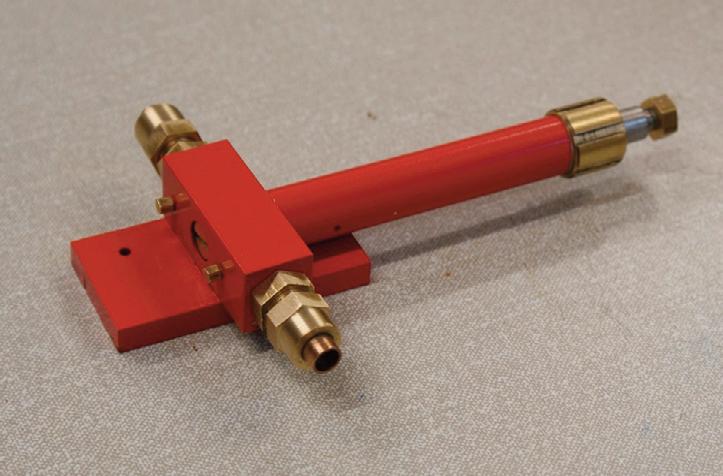
Dave Tompkins was the first speaker this evening. He brought in a home made crosshead pump for his Bagnall locomotive and gave a demonstration of it working just to prove it could. The locomotive will also have two injectors, so he views the pump as a backup and does not see it being used that often, although an alternate view was it would be nice if it could be left on all the time to keep the boiler topped up when the loco was moving.
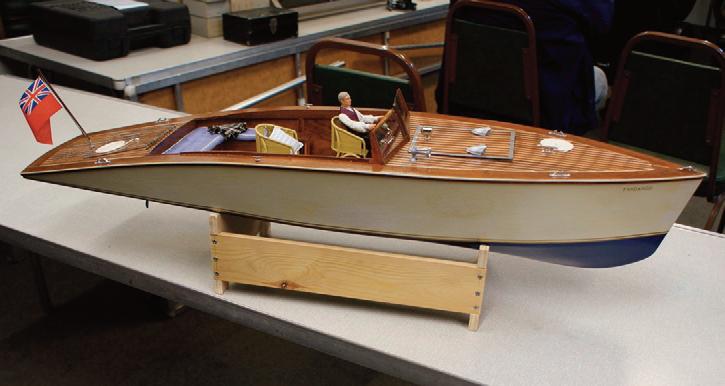
Peter Shires has been gifted a slipper launch, which is a traditional River Thames pleasure boat that he thinks was built from a kit. It came with a motor, speed controller but without any radio gear. He has since put in a receiver and battery pack and got the electronics working.
On the mechanical side, the steering link had fallen apart. The rudder seems undersized and is very chewed up. The motor is situated up near the bow, so a very long propellor shaft runs almost the whole length of the hull.
It also came with some furniture including padded
benches and what looks like some 3D printed wicker chairs.
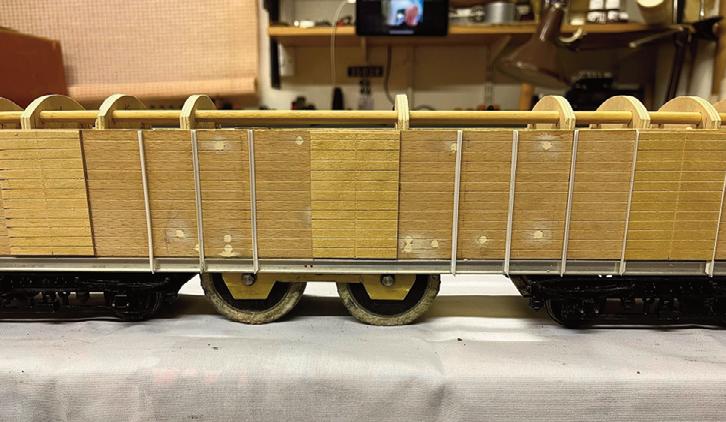
Bill Read is building a gauge 1 track cleaning van, cunningly disguised as a bogie parcels van, based on an idea he saw at the North London Club. The cleaning mechanism consists of two paint rollers cut to the width of the van, mounted under the chassis, so the rollers rotate from the friction of touching the rails.
A third roller is rested on the two lower rollers so as to form a triangle when viewed from the side.
The van has been tested using white spirit as the cleaning medium and seems to work well. Since the test run, the inner sides of the van have been lined with brass sheet to protect the plywood from the white spirit.
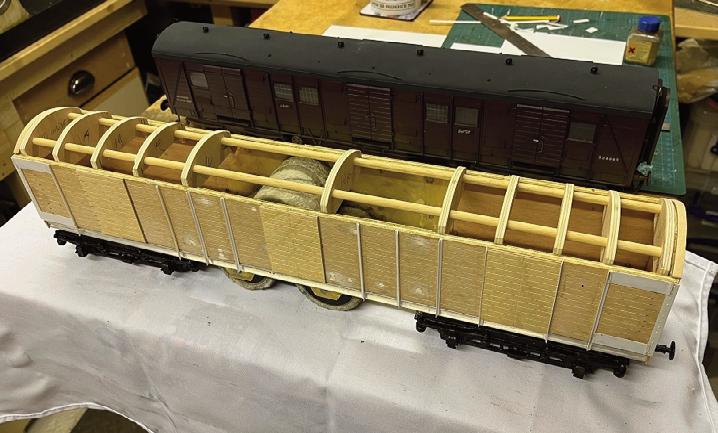
The frame of the roof has been started and depending on experience two tanks may be added, one for water and one for white spirit.
Coincidently, as I type this, I see the latest FMES newsletter contains an article for a self-propelled version which uses similar concepts for a larger scale track.
Dave’s crosshead pump for his Bagnall
The gifted slipper launch complete with wicker chairs
Side view of the Gauge 1 track cleaning van
Only the roof needs to be completed on the van
Bits & Pieces (continued)
Mark Wakelin brought in a two wheeled knurling tool built from a Hemingway kit.
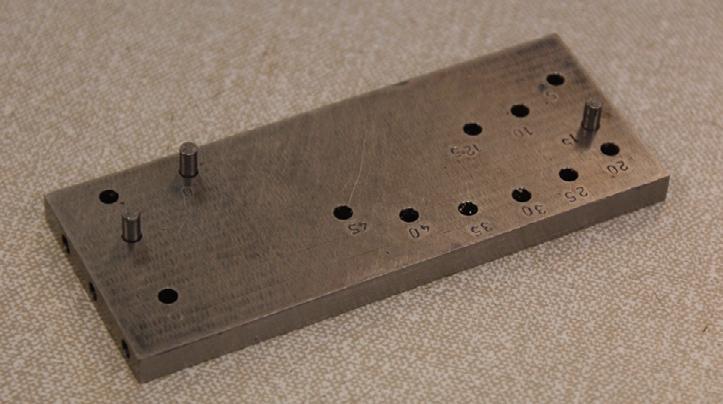
The kit was fairly simple to put together, the only testing bit was a problem caused by his tilting vice tilting in the wrong direction so, inspired by a YouTube video, he made an adjustable quick set angle plate. This consisted of a quarter inch plate with some holes to take three three-eighths inch pins in precisely drilled holes so the pins made a triangle incorporating the angle required. The part was then rested in the pins, clamped in the vice and the the correct angle milled on the part.
It was simple but time consuming to make and needed a bit of trigonometry to work out where to put the pin holes.
Martyn Harrold is fitting smoke generators to his Santa Fe locomotive. The exhaust chimneys are made from curtain rail with an inner copper tube soldered to the outer steel chimney.
The water filler caps for Paddington have been finished. Some 10BA stainless screws have been turned from some 10BA stainless rod.
Filters have been made from gauze to fit in. Martyn was going to make a press tool, but
found that cutting to shape and pushing them in to form correct shape was sufficient.
Martyn has decided to add a pressure gauge as a visual aid to see when the axle pump is running.
Ken Little brought in a GNR C1 4-4-2 Atlantic three and a half inch gauge locomotive built to the LBSC Maisie design.
It was the first loco he built in the late seventies and ran very well, but has not run since the early nineteneen eighties. After languishing on various shelves and benches Ken is trying to get it going again for sentimental reasons.
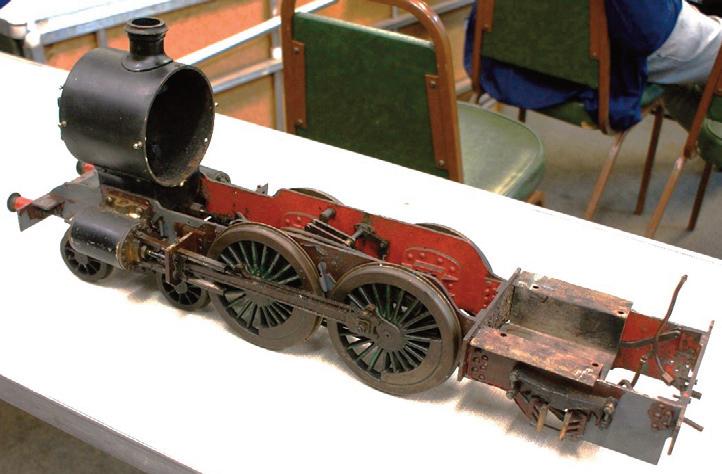
Ken has started stripping it down and the boiler and rear pony truck has been removed. The first job it to test the boiler. The result will determine whether it is a cosmetic restoration or a return to running.
January 2025
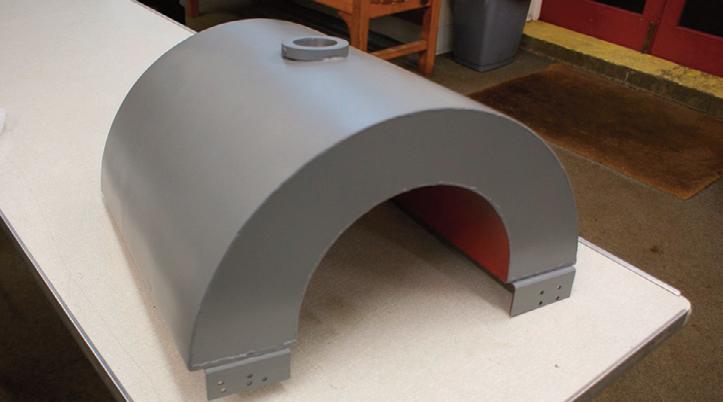
Dave Tompkins started the first meeting of the New Year and brought along the newly constructed saddle tank for his Bagnall tank locomotive. It is a TIG welded sixteen-gauge mild steel fabrication and was professionally made.
Dave admitted that he had not thought ahead enough during construction and is pondering how to get internal sealant past the baffle plates and how to connect the necessary piping to the tank.
Although more expensive he may have to construct another one from brass, as he is worried about corrosion.
Adjustable angle plate, inspired by a YouTube video
The finished water filler cap with lever
A complete strip down to the 4-4-2 Atlantic locomotive
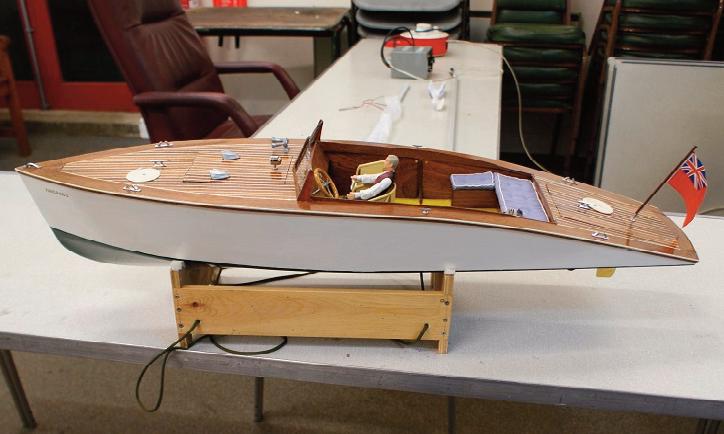
Peter Shires has finished the Thames launch he was given and that was described previously. He is still convinced it was built from a kit but has not tracked down who produced it.
He has changed the rear servo to one of a more standard design and replaced the rudder arm as the original was a bit of a bodged job. Also, the lead from this servo to the battery positioned at the front was replaced with a longer one to make it easier to unplug the cable for maintenance.
Whoever built the original kit made extensive use of superglue that had started to fail in places, mainly the side panels of the cockpit. By judicious prodding and running a blunt blade along the glue seam, these were freed and saved for reuse.
A trial run showed the launch to be quite speedy but a bit low at the bow, so Peter moved the battery pack to the compartment behind the cockpit which fixed the problem.
Peter is reusing the original cushions and fixed them down with Velcro. The felt carpets have been replaced and cut to dimension using card templates which has proved the floor is not quite square.
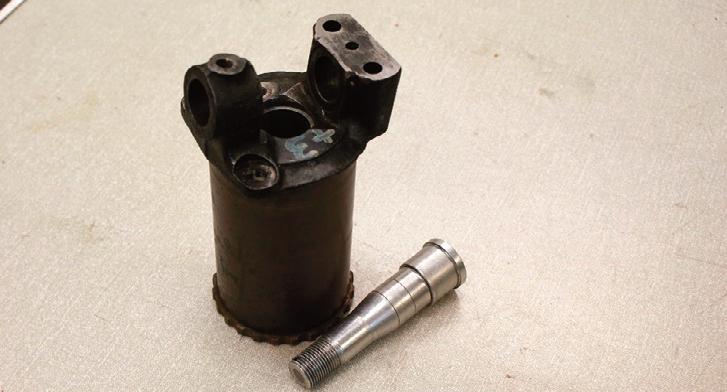
Eric Worpe has owned a 1940's MG TC since he was nineteen years old. Because these cars have a solid front axle, they are prone to the root of the spindle cracking where it meets the stub axle. He described how he went about repairing the root cracking of the spindles. The repair is to split the stub axle and spindle into two components, so the broken spindle is removed and a new one turned up using high tensile steel.
The stub axle is bored to receive the spindle, and the spindle is heat shrunk into the stub axle. The interference fit should be one-and-a-half to two thousandth of an inch. This is achieved by heating the axle to two hundred degrees and freezing the spindle.
To aid alignment of the parts before pressing them together, Eric made a jig which holds them in alignment on the press tool.
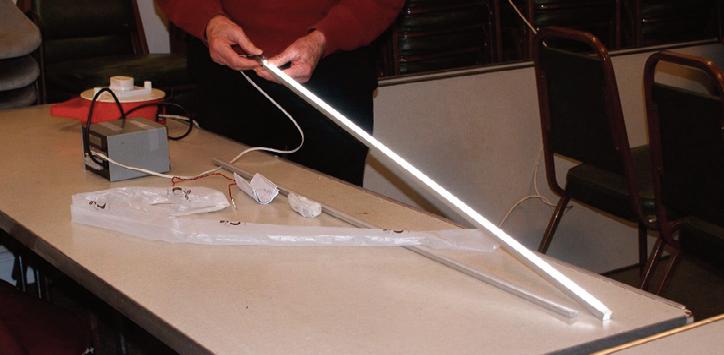
Alan Malby has been revamping the station on the 4mm club layout by installing LED lights under the station canopies. The LEDs are bought in strips and can be cut to length with scissors.
Ivan Hurst gave us a short slide show of his latest trip to India where he visited the hill railway at Shimla. This included a visit to the Tibetan parliament in exile building and chatting with the Speaker
The Thames launch thought to be built from a kit
The TIG welded saddle tank for Dave’s Bagnell
The repaired stub axle and new spindle for the MG TC
Alan demonstrating the new 4mm layout strip lighting
Talks
6th November 2024
Reported by Matthew Clark and Peter Skakespeare
An outline of the development of Armour
Given by Paul Fenne
In this talk Paul described his lifetime career in the field of defensive armour ranging from tanks, through civilian vehicles and body armour. To prove his credentials to us, Paul explained that his family has a long history of model engineering going back one hundred and twenty-five years to his Great Grandfather, mainly steam locos and traction engines.
Paul started his career as an apprentice at the Fighting Vehicles Research and Development Establishment (FVRDE) at Chertsey.
From Chertsey, he then joined the Metropolitan Police Transport Group responsible for armouring various vehicles, such as category A police prison vans. Paul described how these commercial vehicles must be sealed from any bullet penetrating the vehicle and all the potential openings (e.g. gaps between doors and van body must be sealed to stop bullets entering). This involves retrofitting 40 mm bullet proof windscreens and six-millimetre steel plate with a Rockwell hardness of 50 - 60. This can add fifteen hundred kilograms to the weight of the vehicle.
The latest vehicle is designed to protect against suicide blast attacks. During testing the blast against the side of the van warped it six inches but the van survived the attack.
Paul then moved on to explain how the armour is tested against firearms. Paul first explained that cartridge cases are pressed from a block of brass in a steel mould for pennies but can withstand ten thousand pounds per square inch of pressure when fired and the bullet travels at eight hundred metres per second. When the bullet hits the target there will be a transfer of energy from bullet to target. This is why tough armour that bends, not cracks, is needed on vehicles.
To get consistent test results the engineering firm that produces them, manufactures on a lathe rifle barrels one metre long with a five-and-a-half millimetre bore with two-and-a-half turns of rifling.
To test armour, six-millimetre steel balls rated at sixty Rockwell hardness are fired at the plate at a maximum of ten thousand psi.
When fired at one thousand psi (four hundred metres per second) the steel ball punches a twenty-millimetre hole through three-millimetre armour, as at those energy levels of ball hitting plate, the plate becomes malleable.
Paul then moved on to body armour as it assumed more importance. Paul concentrated on protection against cutting weapons rather than firearms. Up to that point there had only been one book on the science of cutting, so Paul had to teach himself.
He designed and built a device to measure sharpness and in time became an expert on wounding and injuries, appearing in court cases as an expert witness.
He has also designed and built a ballistic helmet using results from experiments on an aluminium head fitted with transducers to measure the energy levels of a bullet hitting the head.
Not the subject matter we are used to, but interesting, nevertheless. Our thanks to Paul for taking the time to put this talk together and presenting it to us.
5th February 2025
Robert A. Riddles CBE MIMechE, MinstLE
Given by Alan Pepper
Robert Arthur Riddles CBE (1892–1983) was one of the most influential British railway engineers of the 20th Century. He is best known for his work in designing the Standard Class locomotives for British Railways (BR) in the post-war era.
Alan Pepper kindly returned to deliver his talk to GMES members following his most interesting talk entitled Steamships on the Atlantic in February 2024.
Alan, a retired mechanical engineer, was born into a railway family in South Wales. His father was a shunter at the Newport Ebbw Junction
steam shed and he has childhood memories of ‘spotting’ the ‘highly exciting’ brand new BR Standard locomotives working London to Cardiff expresses in the 1950s. So began his interest in their designer Robert Riddles.
Most interesting was the way Alan explained how Riddles’ vision for electric motive power to take over from steam was conceived in his early twenties a year before the world went to war for the first time.
Formative years
Riddles was born into a well-off middleclass family on May 23, 1892, in Staffordshire. He developed an early interest in engineering, which lead him to pursue a career on the railway. He began his journey as a premium apprentice at the London and North Western Railway (LNWR) works in Crewe. Here, he gained a solid foundation in locomotive engineering, working under the then CME CJB Cooke.
While at Crewe, Riddles developed a love for the footplate and learnt to fire and drive a locomotive, which would be a significant factor as his career developed. On Fridays he would study electrical engineering which had a major influence on his vision for Britain’s railways in later years.
ily involved with the design and development of the Royal Scot class and was present on the footplate during the world record setting non-stop run of 6113 Cameronian from Euston to Glasgow –legend suggesting he did some of the driving. By the mid 1930s, he had established himself as a key figure in locomotive development, working under the CME Sir William Stanier as his principal assistant.
Riddles saw military service as a commissioned officer in France with the Royal Engineers during WWI, where he was badly wounded. He returned to Crewe works and following the formation of the London, Midland and Scottish Railway (LMS) in 1923, Riddles continued to rise through the ranks.
His talent for engineering and his leadership skills became evident, and he was appointed to significant roles within the LMS mechanical engineering department.
A notable achievement was his work on re-organising Crewe works and the introduction of a belt system production line. In 1928 Riddles moved to the LMS works at Derby where he would work under the superintendent HG Ivatt. He was heav-
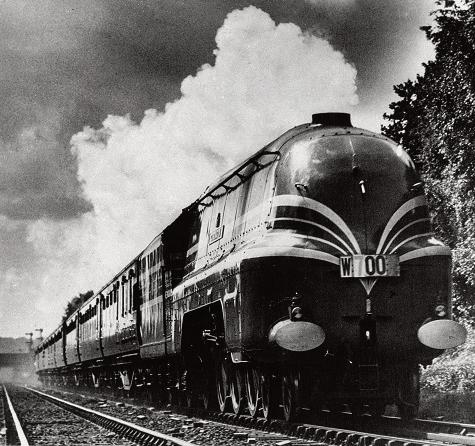
Riddles was on the footplate of 6220 Coronation when she set the, albeit short-lived, world record speed for a steam locomotive of 114mph in 1937. Later that year he accompanied 6229 Duchess of Hamilton on her tour of the USA. When the driver was taken ill and returned to the UK, Riddles drove her for the rest of the visit.
World War II Contributions
During World War II, Riddles played a crucial role in the war effort by designing and overseeing the production of locomotives suited for military operations.
In 1939 he was appointed Director of Transportation Equipment at the Ministry of Supply, responsible for the creation of the War Department (WD) locomotives. These included the Stanier 8F-
6220 Coronation at speed on the WCML in 1937
based Austerity 2-8-0 and 2-10-0 steam locomotives, which were built in large numbers to support military logistics and railway operations across Europe and beyond.
The WD locomotives were designed to be robust, easy to maintain, use poor quality coal, while capable of handling heavy loads in difficult wartime conditions. Their success demonstrated Riddles' ability to design functional and effective steam engines under pressing circumstances.
BR and the Standard Class Locomotives
After the war, Riddles was appointed as the Chief Mechanical Engineer (CME) of British Railways upon its formation in 1948. In this role, he was responsible for overseeing the standardisation of locomotive designs to suit the newly nationalised railway system.
Riddles spearheaded the British Railways Standard Class locomotive program, aimed at creating a series of steam engines that could be efficiently maintained and operated across the country.
The Standard locomotives drew upon the best design elements from the former Big Four railway companies (LMS, LNER, GWR, and SR) while ensuring uniformity, modularity and ease of production. As part of the design process and prior
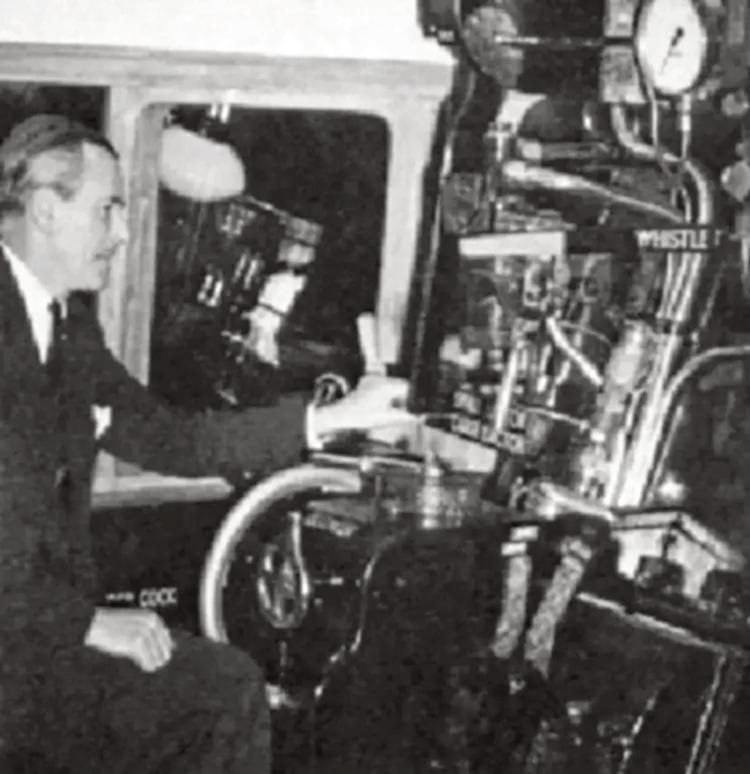
to the launch of 70000 Britannia, Riddles drew on his footplate experience and mocked up a cab and footplate and invited enginemen to contribute ideas on how to introduce improved ergonomics into locomotive design.
Although Riddles’ locomotives were well-designed and widely regarded for their reliability and efficiency, they were introduced at a time when the British Railways Board was eying the transition to diesel and electric traction. Riddles, unlike
Riddles at the controls in the mock up of 70000’s cab
70000 at Southall in 2011 in outshop livery
the CMEs of the BR regions - Bullied and Ivatt, Peppercorn and Hawksworth - was not a fan of diesel traction.
His vision was his Standards should serve until the nation could afford to roll out electrification across the network. His view was widely opposed on cost and personal interest grounds. As a result, diesels were introduced as part of the BR modernisation plan and by the late 1950s were operating across most of the network.
As diesels were rapidly taking over from steam traction, his final steam locomotive 92220 was built at Swindon in 1960. Sadly Riddles’ steam locomotives were withdrawn from service far earlier than their design life.
Twilight years
Riddles, seeing the writing on the wall, retired from British Railways in 1953, shortly after the introduction of his Standards.
In recognition of his contributions to British engineering, he was appointed a Commander of the Order of the British Empire (CBE).
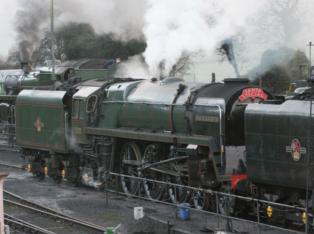
73096, 71000 and 92212 in steam together in 2011
On leaving BR, Riddles became chairman of crane manufacturer Stothert & Pitt and he finally retired in 1967 aged 75. Riddles passed away in 1983 at the age of 91.
His legacy lives on with his first Standard Class locomotive, 70000, still operating rail-tour trains on the mainline today and thanks to many examples of his other locomotive designs running on preserved railways across the UK.
We must thank Alan for a most interesting and insightful talk on a subject close to many model engineer’s hearts – the story and man behind the BR Standard.
A call for Sweet Pea Rally Helpers
On 14th and 15th June this year, GMES will be hosting the 2025 Sweet Pea Rally
Held annually for over thirty years, the event is for owners of the Sweet Pea locomotive and its variants.
While the event is not open to the public, it should attract many visiting model engineers so we are asking GMES members to sign up for various roles that will help the event run smoothly. Roles
Bryan Finch
include track marshalls, steaming bay, car park and exhibition stewards, catering and general background helpers.
A few visitors will be arriving on Friday and will probably like to run their locos that afternoon, so we need to provide for this also.
To volunteer your help either use the online Sweet Pea Rally Helpers sign-up sheet: https://tinyurl.com/3f4ja85j or email me: bryanfinch@ntlworld.com or talk to me at GMES. v
Signalling Upgrade update January 2025
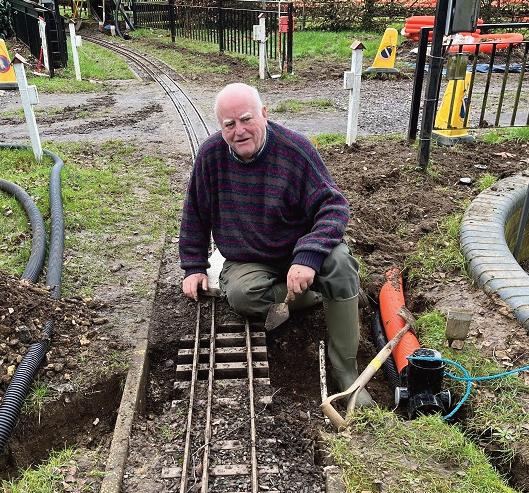
Digging the tranches around the GMES tracks for the signal cable ducting has taken a mammoth effort. Trenching is now complete and by the time you read this most of the ducting will have been installed and trenches back filled. As can be seen here, Roger Oates had to use digging techniques more normally employed archaeologists to get the trench under the 71/4” gauge track without disrupting or damaging it.
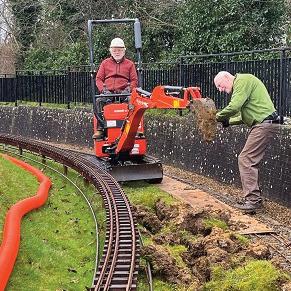
While Neil Heptonstall and his mini-excavator have taken some of the back-breaking work out of digging the hundreds of metres of trenching around the GMES site, our local geology (clay) and the weather have meant plenty of manpower and elbow grease has been needed to keep things on track. Here Peter Milner unclogs Neil’s bucket for the umpteenth time.
This year’s AGM will take place in the GMES Clubhouse at 7:30pm on Wednesday 26th March 2025
We also plan to provide a Zoom video connection for those unable to come to the meeting in person.
Postal voting will also be available to those who are unable to attend and do not have the Internet.
The AGM Document Pack comprises:Calling Notice, Agenda, 2024 Accounts Summary, and 2024 AGM draft minutes These are being distributed by e-mail, and with this GMES Newsletter for those who do not have e-mail.
These documents are also available on the
Documents page in the Members Section of the GMES website.
As usual with the AGM, there will be a number of statutory matters that need your votes, and we propose to achieve this by a combination of methods:
n Voting in person at the meeting
n Polling Facility within Zoom
n Polling Facility in the Notices e-mail group, an e-mail will be sent out prior to the meet ing with the polling options
n Paper voting slip enclosed with this newsletter.
For any questions please contact Bryan Finch or Chris Phillips if it is a financial question.
Guildford Model Engineering Society AGM 26th March 2025