The newsletter of Guildford Model Engineering Society
Chairman’s Chatter
Hello everybody.
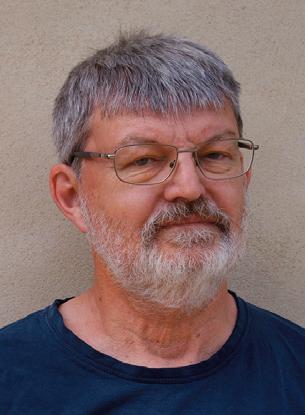
Welcome to my first Chairman’s Chatter as your new Chairman.
My first job, of course, is to thank the outgoing Chairman, Mike, for his efforts and for teaching me the ropes. Hopefully the transition will be a smooth one. My second job will be to introduce myself to all those who attend the club and make myself known to you. I know most of the Tuesday and Thursday crowd but there are members whose path I seldom cross. If we do end up having a chat, I see part of my role as listening to suggestions for projects large or small to improve the club.
I think it is customary for the Chairman to champion a new project as part of his tenure, but in the short term I will putting this on the back burner, as I think the signaling project and steaming bay canopy will take up all our spare volunteers’ time for now after you have added the site maintenance into the mix.
There are aspirational projects the CoM is aware of, and these will be reviewed as the current projects progress.
We have had a busy summer with the usual open afternoons, pop up school holiday Thursdays, the Sweet Pea Rally and the Gala. All have been successful, albeit some with minor problems that did not affect the events.
The Sweet Pea Rally was an interesting event.
Dates for Your Diaries
Families & Friends Day (11.00-16.00) 7th September
Bits & Pieces (19.30) 17th September
Public Open Afternoon including Heritage Day (14.00-17.00) 21st September
Visiting Clubs Day including SMEE Day (09.30-18.00) 27th September
Talk - Details TBA (19.30) 1st October
Members Running Day (10.00 onwards) and Small Model Steam EG (14.00) 5th October
Bits & Pieces (19.30) 15th October
Public Open Afternoon (14.00-17.00) 19th October
Mid Week Open Day (10.00-13.00) 30th October
Members Running Day (10.00 onwards) 2nd November
Next Newsletter Closing Date: November edition 10th October
Although the locos were all built to the same design, I do not think I saw two identical ones. There were many good ideas that could be applied to any loco. It was obviously a time for regulars to this event to catch up with old friends and a good time was had by all. We have received appreciative emails from attendees who came as far as field as the Midlands and Kent.
Concluded on Page 2 /...
Chairman’s Chatter (concluded)
There was a good turnout of volunteers for the Gala which was good to see and meant more people could take a break and visit the stalls. We also had compliments from visitors regarding the catering and the quality of the food.
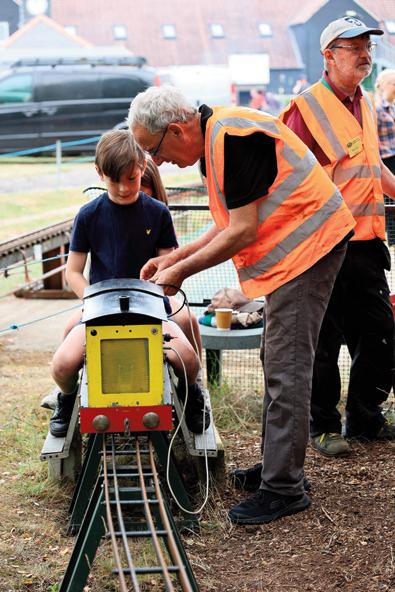
Volunteers are always required for these events, so any time you can spare to help, even if it is only only an hour, is always welcome as we have had some members putting in three-hour stints without a break on some days. Anyone who is having trouble getting their daily 10,000 steps is welcome to have a turn on the Have-a-Go track.
Thank you to all who give their time up to volunteer.
Now the signaling trenches have been filled in the site is returning to its former appearance and the next stages can start. Distribution boxes are being installed round the site. Volunteers are still required to put together the signal lever kits, construct the signals and wires need pulling through the ducting. This will have to be done manually, unless anyone has a highly trained ferret…?
If any of the above sounds like something you would be interested to get involved with, I’m sure the Signaling Team would be glad to hear from you.
On the loco front, I must thank Mike Turner on the club’s behalf for his generous donation of a 7¼” gauge Hymek electric to add to our stock. This means we have enough locos on the ground level to be quite flexible and have sufficient backup if we have any breakdowns on open days.
We are not quite as resilient on the raised track. On some Open days we have struggled to provide a two or three train service. To mitigate this shortfall, I am pleased to report that the Society has purchased a 5” Gauge HS4000 Kestrel loco from Tony Milne; a member of the Rugby MES.
Lastly, a cautionary tale. We have thieves on site! Do not leave food unattended. I recently lost a whole packet of biscuits to a Crow and a Magpie who demolished them as soon as my back was turned.
Matthew Clark Chairman
In a summer with a series of heatwaves we were perhaps fortunate that our Gala weekend was more temperate and the old short shower did not deter our visitors. Once again, the grounds were very well prepared and looking good even though we have been digging up sections to lay ducts for the new signaling system.
The Thursday before the Gala we had a good turnout of helpers to set up the marquees and boating pools and erect the stand in the clubhouse for the exhibition. The catering team were also getting on with setting up and ordering and collecting the food. Locomotive facilities were being prepared for two days of running. The Gar-
den rail, Gauge 1 and the 4mm teams were making preparations. The power supplies were being laid on to where they were needed and the public address system was installed.
By Friday lunchtime there was a quiet calm as we waited for our guests and traders to arrive. The field had been transformed and this was a reflection of the hard work and dedication of the members and their friends and families who come
Gala 2025 Report
Andrew Clayton
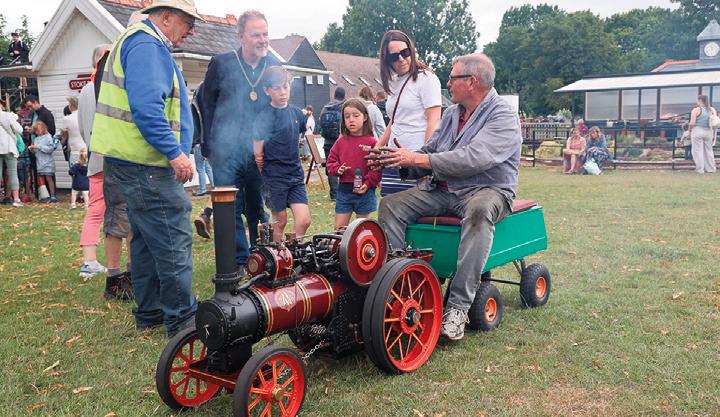
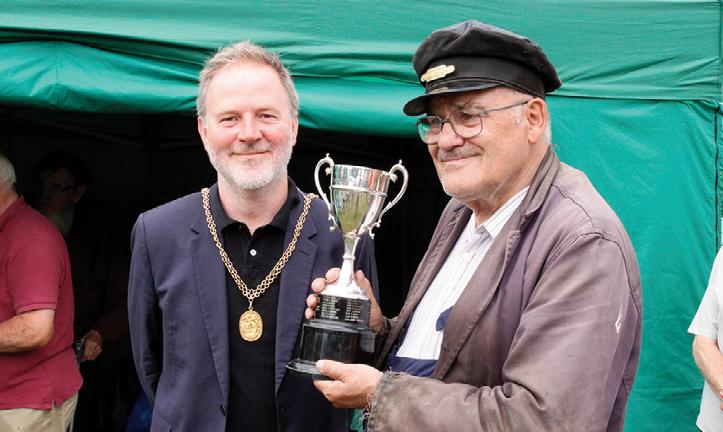
The Mayor (of Guildford) and a Marshall Traction Engine
Gala 2025 Report (continued)
together to make this happen. Well done and thank you.
The traders who have supported us in recent years turned up, many of them camping overnight. We also welcomed and enjoyed the company of several supporters like the Surrey Association of Woodturners, Astolat Model Railway Club and the Phoenix Marine Model Club who put on very good displays of their craft.
We also welcomed and are very grateful to our visitors who bring their locomotives to run over the weekend. Not only are there some magnificent locomotives on show but we enjoy their company and share our engineering knowledge. Some of these visitors travel some distance and put in a day’s work: we appreciate this very much.
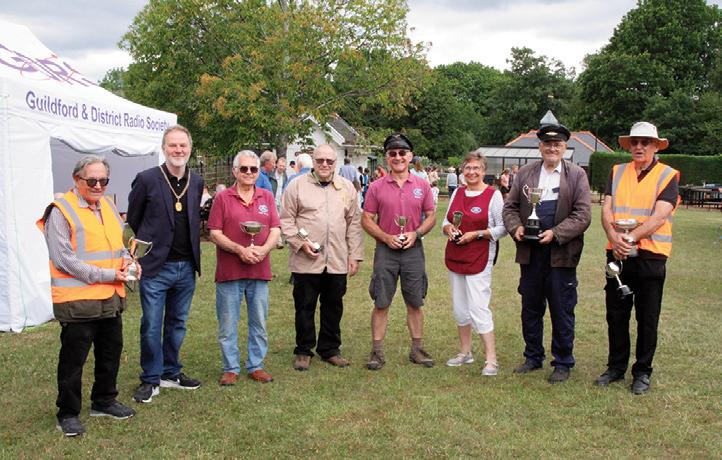
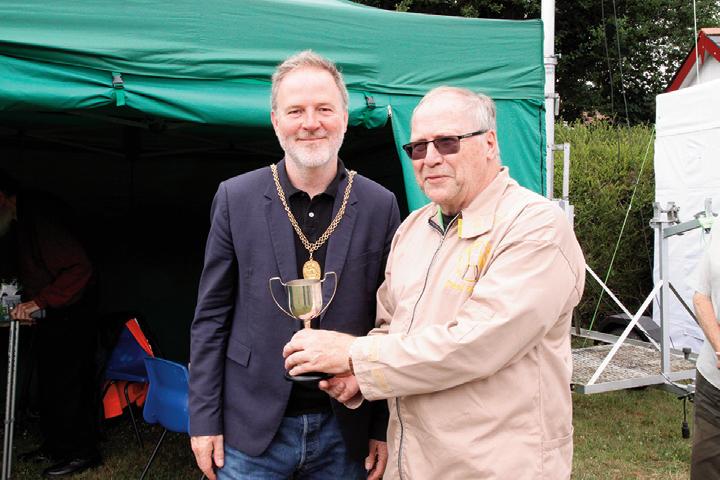
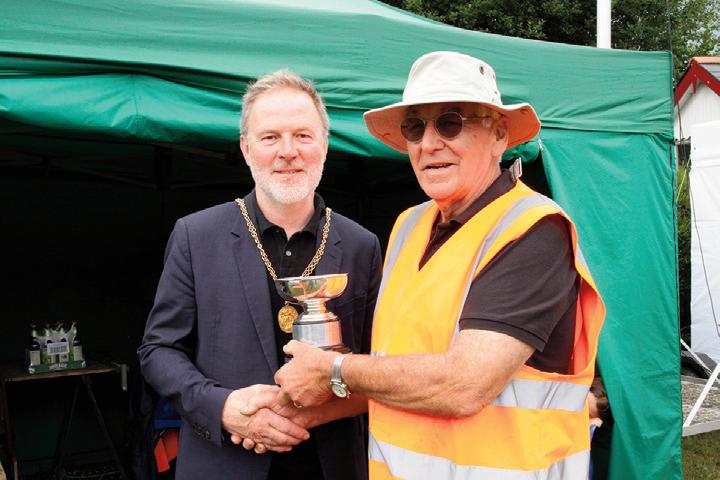
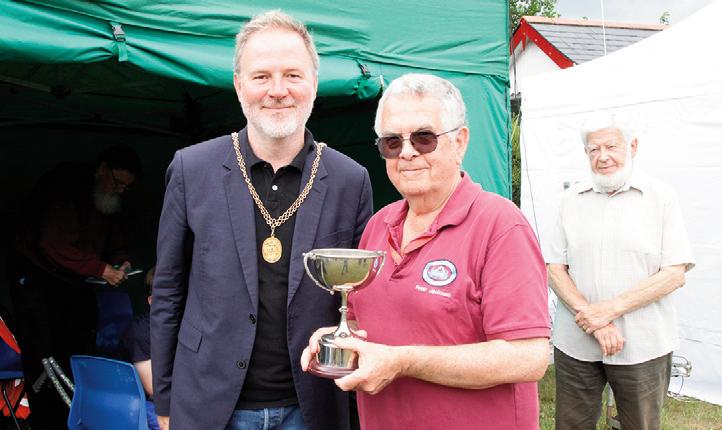
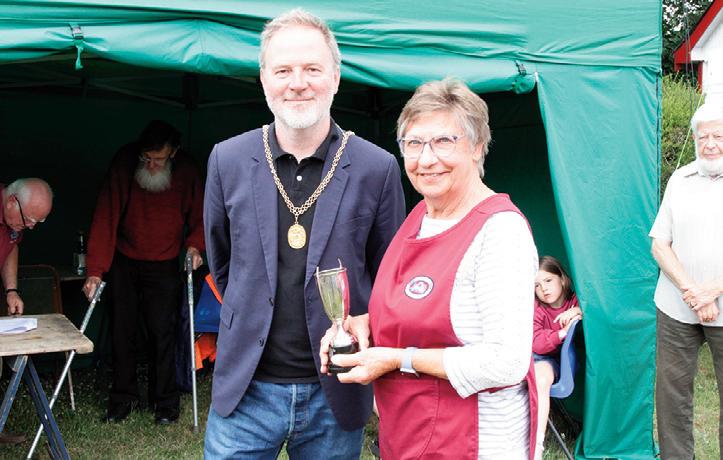
As always, we were able to put on an exhibition of members work and we are again very grateful for the expertise of Mike Chrisp in judging the exhibits. A list of the winners is on Page 4. The presentation of the awards and cups was made by Howard Smith, the Mayor of Guildford. He
was accompanied by his family and recalled his own childhood when he was brought along to ride on our trains. We very much appreciate the annual visit of the Mayor to our Gala and to experience and see first-hand our involvement with the local community.
We do not charge entry, but we make our income from the sale of tickets for train rides and from selling barbeque food and teas. This means we owe a huge debt of thanks to the catering team and their supporters. It is sometimes a struggle to get enough committed helpers early on in the planning, so if you are able to help next year even for an hour or so, please don’t be shy.
It is often risky to highlight someone for fear of offending others, but I am going to make an exception and say how much the event has benefitted for many years by the work of Dave Tompkins who has behind the scenes been quietly organising rubbish collection and disposal. Well done Dave and thank you.
At the end of the weekend, we said goodbye to our friends and supports and cleared up on the Monday.
We were able to check the figures and I am pleased to say it was the best result for many years, so I think for now, we will be carrying on! Lastly, it can not be said enough, thank you.
Andrew Clayton Gala Chairman
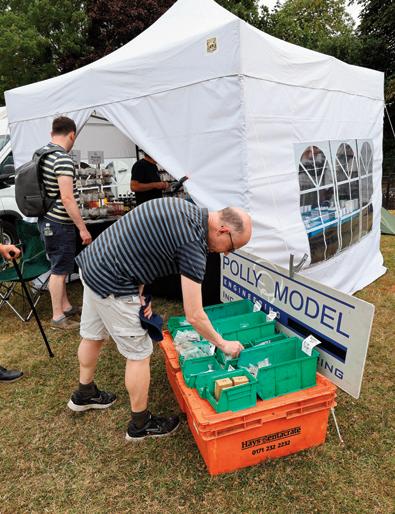
The Polly Model Engineering stand
A magnificent visitor from South Africa
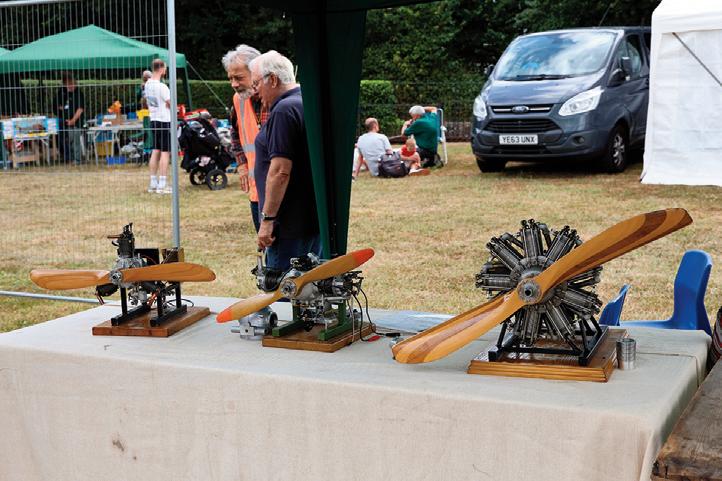
Some of the superb aero engines on display
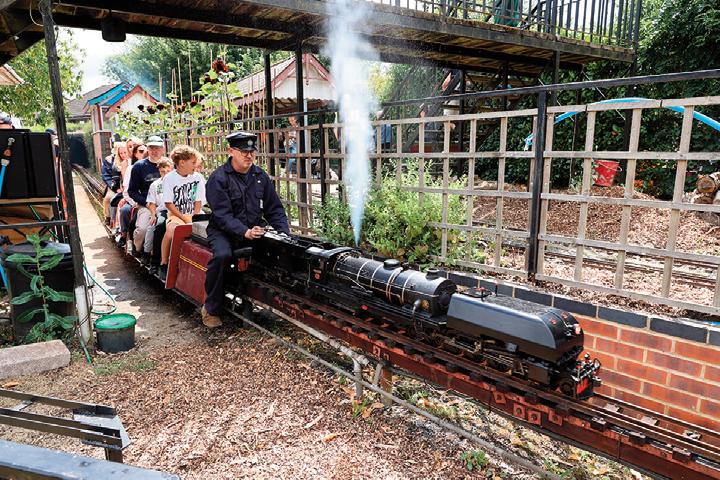
Getting the steps in on the Banana Track
Gala 2025 Report (concluded)
Award Winners at the 2025 Gala
Hodgkiss Cup
Jim Bamford Cup
Bill Percy Cup
Tony Lake G1 Cup
Warco Cup
Arts & Crafts Cup
Brian Barrow Cup
Streeter Cup
Martyn Harrold Fittings for GWR 15xx Class 0-6-0 Locomotive
Bill Read
Track cleaning wagon for Guage 1
Martyn Harrold Pipe bending tool
Peter Jackman Set of three scratch designed and built four wheeled coaches, c. late 1800s, Gauge 1
Peter Shires Rebel One part built sailing yacht on its building jig
Maureen Phillips Pen and wash painting of a Hebridean fishing boat
Surrey Association of Woodturneers
Dave Tompkins Netta 5” Gauge locomotive
The Mike Comben Cup, Graham Pole Cup, 16mm NG Cup, Jim Wilson Trophy, Tracy Tools Trophy and the Freddy Love Trophy were not awarded in 2025, due to lack of entries.
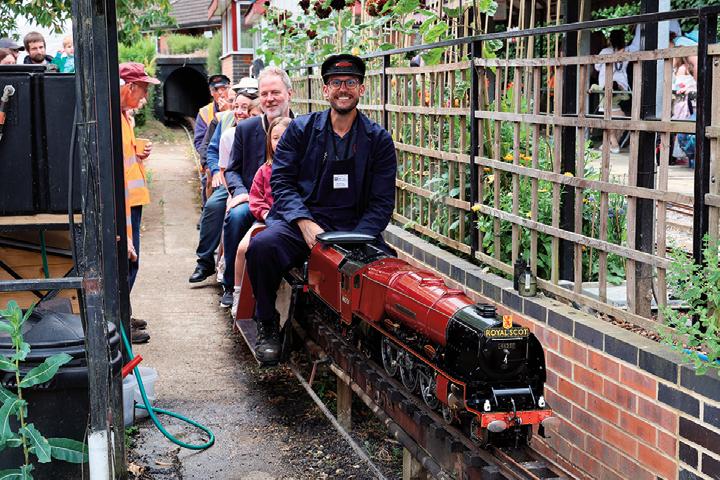
A royal visitor from Harrow & Wembley
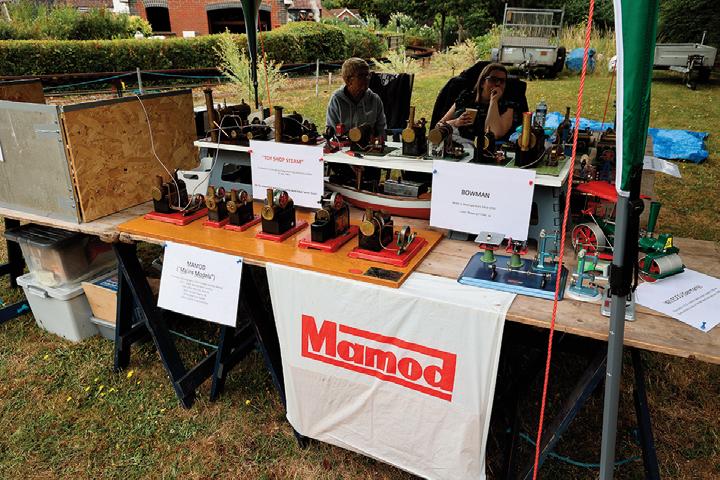
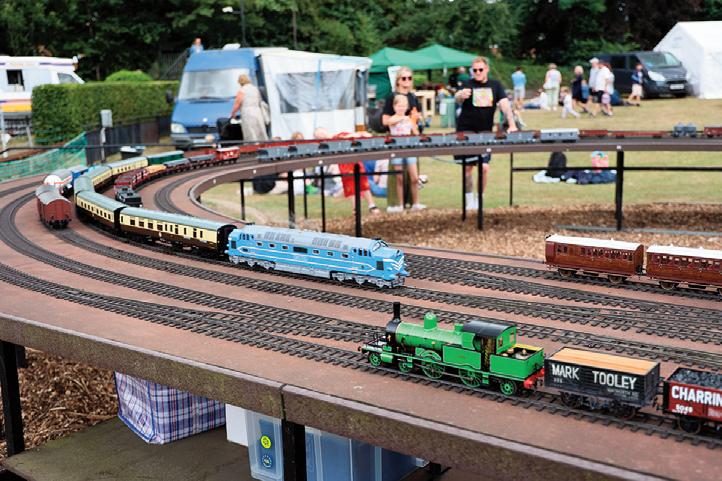
Mamod - gone but never forgottenPrototype Deltic on the Gauge 1 track
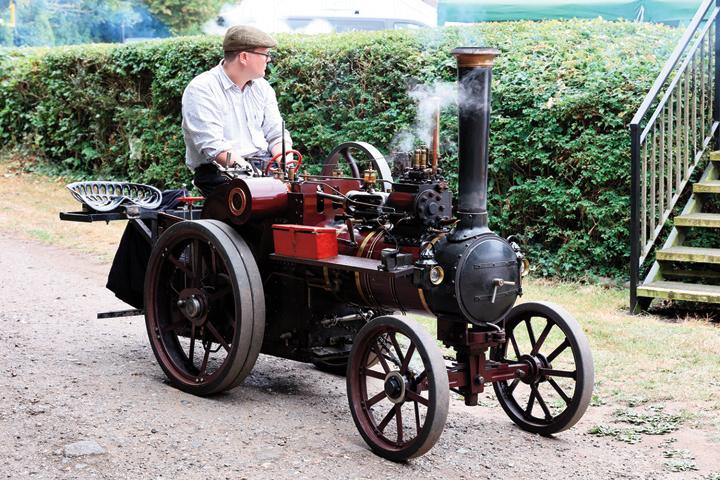
Andy Sleigh's 6" Little Samson TE
Gala 2025 - Cup Winners
Hodgkiss and Bill Percy Cups - Martyn Harrold
Brian Barrow Cup - David Stratton, Surrey Assc. of Woodturners
Tony Lake G1 Cup - Peter Jackman
Group photo of all recipients
Warco Cup - Peter Shires
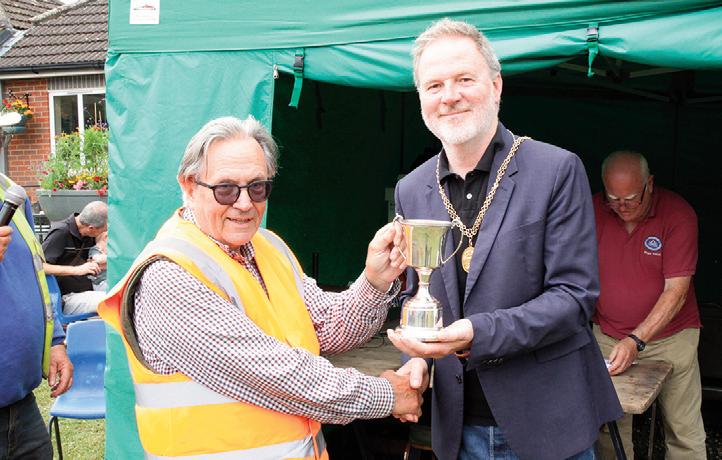
Streeter Cup - Dave Tompkins
Arts & Crafts Cup - Maureen Phillips
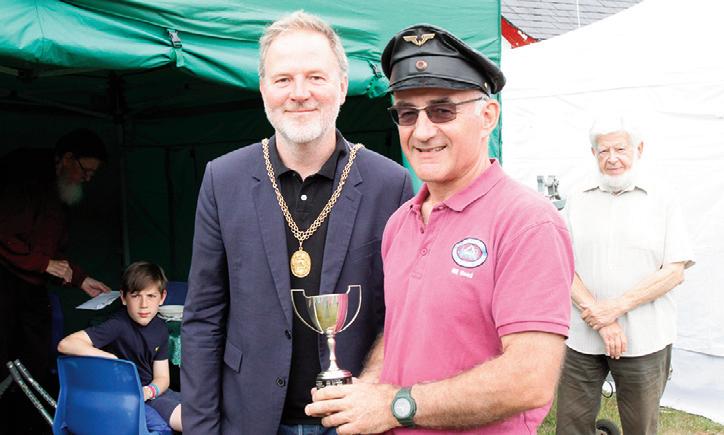
Jim Bamford Cup - Bill Read
Treasurer’s Doodlings Chris Phillips
Open Days
Open Days are now our largest source of income and so as well as being enjoyable to run, the success of these events are crucial to our ability to pay for all the all the other stuff we want and need. So far this year we have run seven open days and these have been well supported by the public, regular visitors and new faces alike.
We have had mixed weather for these, but our visitors do not seem to mind and the takings have boosted our finances considerably with takings this year, so far, of £14,469.
Well done to all and thank you to all that turn-out to help.
Gala
We had a very successful Gala this year the details of which are reported elsewhere.
This year the Gala income increased to £9,458up from £7,910 last year.
Income
Tickets
BBQ & Catering
Boats
Driver Experience
Traction Engines
Ice Cream & Traders
Public Donations
Total Income
£ 4,409
£ 3,509
£ 802
£ 334
£ 15
£ 360
£ 29
£ 9,458
The costs of the event increased slightly mainly due to the restocking needed to meet the demand for BBQ items:
Costs
BBQ & Catering
Administration
Total Costs
£ 1,327
£ 203
£ 1,575
This gives us a very creditable profit of £7,883 to add to the budget for 2025-26.
Thank you to all those who came along to make the event ‘happen’. Without all your efforts before, during and after the event, we could not put on an event that made a very happy day out for our visitors (and members) and a useful contribution to the funds that we need to run the society.
Locomotives
The CoM decided that the Metre Maid locomotive that was generously donated by GMES member Tim Kilpatrick, was not ideal for passenger hauling and so this was sold for £4,600. This sum was allocated for the purchase of another passenger hauling locomotive.
I am happy to say that we have recently completed the purchase of a very well detailed and unique 5” gauge model of the Kestrel – a prototype locomotive that was supplied by Hawker Siddley for evaluation by BR. This locomotive was brought along to past Galas by its owner and proved to be an excellent passenger hauler.
The money received for Metre Maid has paid for Kestrel and its updating to GMES standards.
Budgets
As a result of all this activity and fund raising, we are now in the happy situation that I have been able to submit a budget to the CoM with increased levels of funding both for the Committed Costs of running the society - £25,781 and the Discretionary Budgets to maintain and improve the facilities and layouts - £49,386.
This includes the cost of the new Kestrel locomotive and the next stage of the re-signalling project that aims to have the new signalling system on the raised track operational by Gala 2026.
The major new projects that we can fund this year are the provision of a canopy to protect members preparing, repairing and cleaning locomotives in the Steaming Bay and a new hydraulic loading/unloading traverser to simplify transfer of locomotives from cars and trailers to the main traverser.
Chris Phillips, Treasurer
Editorial Peter Shakespeare
Welcome to the September 2025 edition of GMES News.
I am delighted that I am able to include in this edition ‘Chapter One’ of the build story of Martyn Dix’s 7¼” gauge re-built SR Merchant Navy Class Pacific (Canadian Pacific). As some of you might know, Martyn is working with professional model loco builder Andrew Giffen to complete this ambitious project. Andrew is working from BR drawings and in this edition he describes how he spent around six months using CAD software to 3D model the loco’ s running chassis and all its components to ensure the scaled down versions will fit together correctly, work as intended using animation and crucially can be assembled and maintained easily, while ensuring the external appearance remains as close to the full sized original as possible. Given the vast amount of work involved in this build, I must thank Andrew and Martyn for taking the time to write up the build for all of us to enjoy.
I have been having hours of ‘fun’ getting started on my own 7¼” gauge loco build. My first venture into a larger scale model build was the 3” scale Marshall traction engine that many of you saw running around the field at this year’s Gala. That took me eight years to complete. My first railway locomotive will be a BR Standard 5 to the Jim Vass (Horley Miniature Locomotives) drawings. “You don’t believe in doing things by halves!” I
Puffing-a-Wey
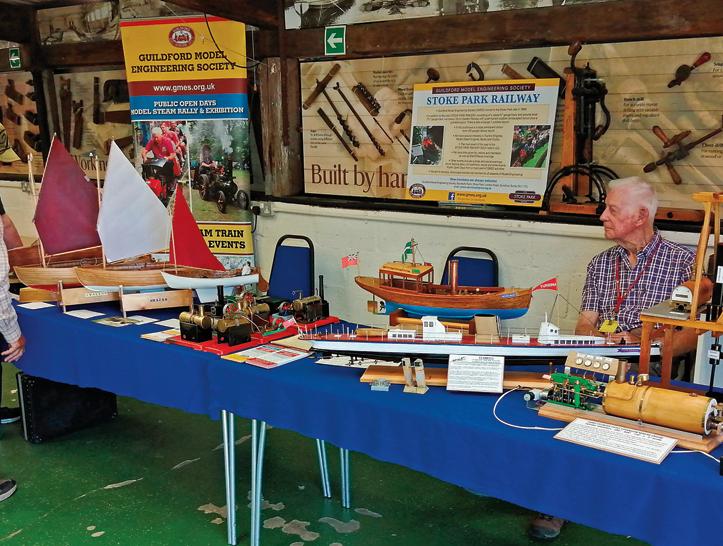
GMES was part of the Steam Boat Association’s event held at Dapdune Wharf in Guildford on 12 July 2025. We had a display in the Barge Shed along with the Astolat Model Railway Club and a group of ship modellers. Our tables mainly had boat models, along with a few examples from our Small Model Steam Engine Group
Despite the hot weather a good number of visitors to look at the Steamboats and at the exhibits. It’s always worth attending outside events to promote the society and our activities - with a number of people saying that they will come to our Open Days!
hear you say. Yes, it’s a big model, but a comparatively simple one. I was advised to start with the tender for various reasons, one of which being it would enable me to “get into Mr Vass’ head” before starting on the loco’s running chassis. Wise words because the drawings do rely on a thorough knowledge of the loco you are building in terms of how it fits together, the engineering operations required and clearances etc. and he only specifies the essential dimensions of parts.
I am sixty-one so my aim is to complete the loco, so I am still fit enough to use it. My aim therefore is five years to completion, so I will admit that to save time and overcome the fact I have a small workshop and don’t possess machines to help with sheet metal work, or welding equipment, I sourced laser cut and pre-drilled frames and prefabricated drag boxes and stretchers for the tender. On initial inspection the supplier had done a good job, but as the build progresses, I am finding more and more errors. So far nothing that cannot be ‘engineered out’ but this is proving costly in terms of time. As far as the loco frames are concerned, it will be laser cut blanks, with only my ineptitude to blame if there are errors with it all lining up as it should. For the full story come to the next Bits & Pieces evening.
Anyway, I hope you enjoy this edition of GMES News and if you have a build story to share, I will welcome your contribution.
Peter Shakespeare editor@gmes.org.uk
Bits & Pieces
April 2025
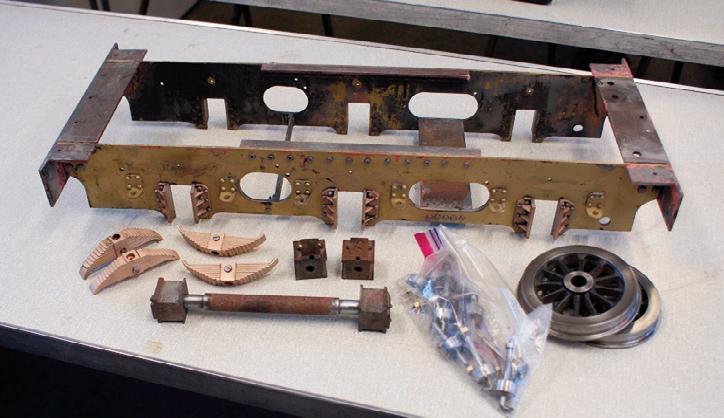
First up tonight was Nigel Valvona who gave an update on the strip down and improved rebuilding of his Crampton locomotive. Since the last meeting the strip down has been completed and the first job of rebuilding the chassis has been started.
The rear buffer beam came with unconvincing countersunk screws. Some more convincing bolts have replaced the screws in the rear buffer beam, but to achieve this Nigel had to reverse the whole plate first. As a consequence of this the side brackets were reversed and did not fit. So Nigel had to make new brackets.
One hundred, one inch 4BA bolts have been purchased and shortened to the required length for the inner and outer frame brackets.
The front buffer beam has been reprofiled to fit the curvature of the boiler.
The piece of angle iron used to stiffen the inner frames has been replaced with a dog bone shaped piece of plate fitted across the top of the frames,
The paint has been stripped and some red oxide remains to be removed.
A frame stand is being constructed comprising of two scissor jacks with fabricated brackets to allow rotation of the frames.
Nigel has also had the twenty five year old boiler non-destructive tested (NDT) and found there is some material wastage at the bottom front end but is still safe.
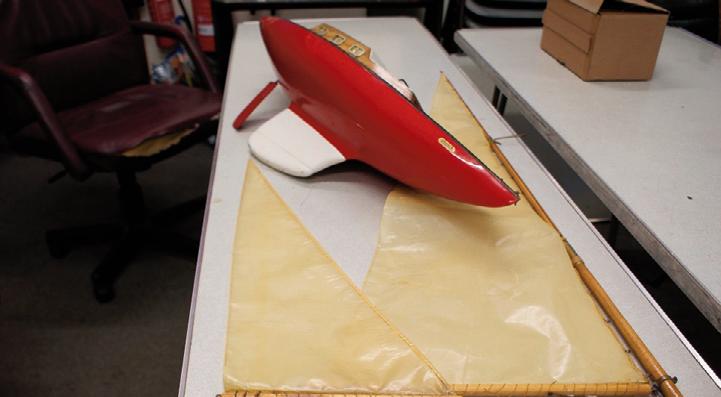
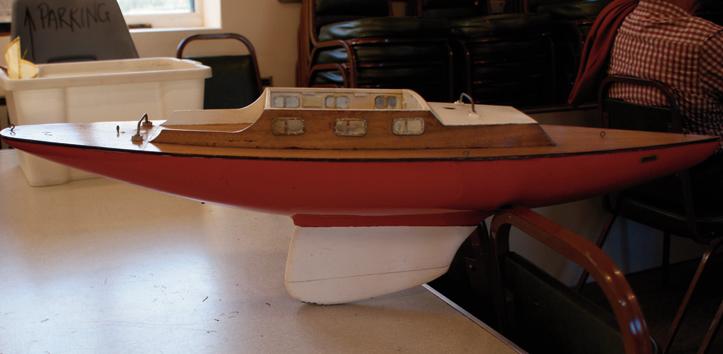
Peter Shires brought in the second freebie boat he was gifted, a yacht which he thinks is a 1960's kit marketed by Marinecraft which has the distinc-
Matthew Clark
tion of being the first boat to be retailed with a glassfibre hull.
It was originally built as a free sailer, radio control being fitted at a later date.
Peter is planning a complete refit of the below deck radio control and fittings and will rearrange them to suit his preferences. Another minor detail is that the rudder looks like it has been fitted back to front so better to start again.
The original sails are quite thick material and could be oiled silk. The masts will be replaced. The modern way to rig the sails is to use braided fishing backing line or as Peter discovered recently; builders' line. Another source is rope whipping line from a chandlers. Peter is also experimenting with dye to make the rigging look more realistic and so far has discovered wood dye is best.
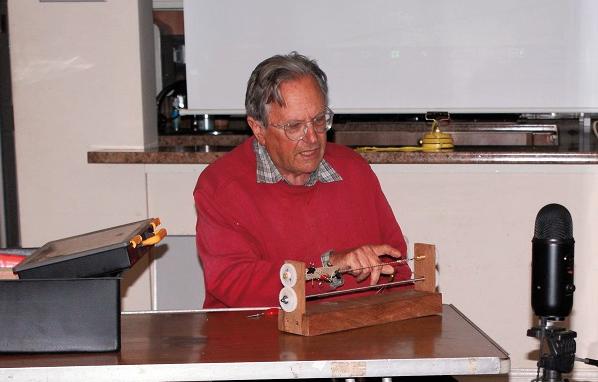
All the rigging ropes are whipped which Peter wanted to reproduce. To do this Peter has made a wooden "U" shaped frame that looks like a woodworkers frame saw with the rope where the saw blade would be. One end of the rope is fixed, the opposing end is looped over a wire hook. That was Mark 1. Mark 2 has geared shafts which allows the whipping to wind round the rope and hide the knot in the rope.
Jig being demonstrated for whipping the ropes
For wire rigging Peter uses fishing trace wire. He gets a small bore piece of tubing the diameter of which should only allow three wires through it. The wire is looped through the tube, a second pass through the tube with the wire to lock it and the tube is crimped. The tube is hidden by the whipping.
Hull, sails and mast as given to Peter
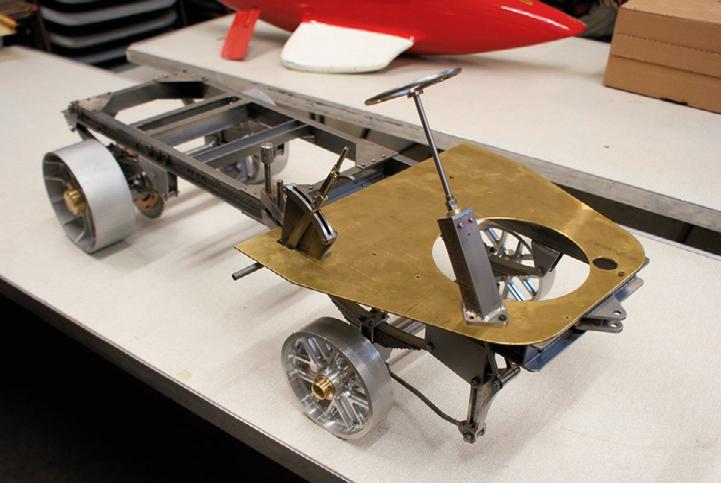
Ray Parker is building a two inch scale Clayton Steam Wagon and brought along the chassis to this evening's meeting. Mainly scratch built with the exception of the differential gears and a 5/16th diameter silver steel four start screw thread and nut in the steering column that only cost £3.00. So these were a bit of a no brainer. Amazingly the wheels were CNC machined from solid billets of aluminium, although Ray admits it would have been quicker and cheaper to use castings.
The steering wheel was also carved from the solid.
Ken Little noticed a tender chassis for sale on Marketplace that looked like a good match to fit with his Gresley locomotive. The general consensus was that it was the tender for a LNER B1 locomotive. There are minor differences in dimensions to the correct tender but will not be noticeable. The frames are brass. The axleboxes and axles will need to be fettled, but overall Ken thinks he has a bargain that has saved him a lot of work.
Martyn Harrold has been pondering the best
way to make the lubrication pipe cover on his GWR 15xx 0-6-0T. He has finally tracked down a fellow modeller of this locomotive and obtained a dimensioned drawing of the item.
The cover is cut out of 20 gauge (0.91 mm) brass to shape using templates and will be profiled by hand.
May 2025
Peter Shires continues to restore and upgrade the yacht he was given.
All the old radio gear has been stripped out. At a model show at Popham he bought a "proper" server motor that can pull ten kilograms that should be capable of winding in the main sail and jib. The mast needed attention. As this breaks into sections to make transport easier, the new one will do the same. Peter is currently deciding whether to keep or replace the sails. Other parts needing attention include a bent rudder. As Peter said "it still needs a fair bit of work to get it going".
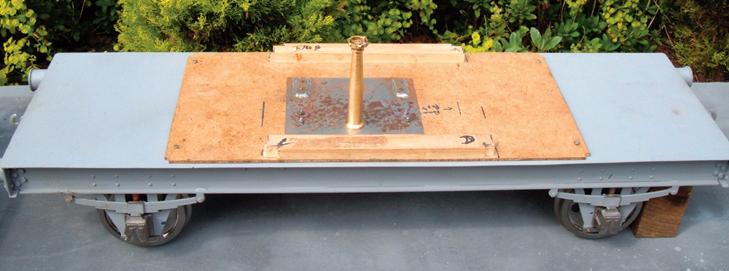
Ivan Hurst revealed his new project: a Southern Railway 25 ton brake van, the last one the South Eastern built for the Southern.
The chassis has been started. The brake standard has been fitted to the body base. The working brakes are compensated and working, copying the prototype. The first compensation mechanism is directly under the brake standard and equalises the force that is transferred to the
Tender chassis purchased by Ken to match his Gresley
Mainly scratch built Clayton Steam Wagon chassis
The model yacht stripped of its old radio gear
25 ton Brake Van chassis
Bits & Pieces (concluded)
second compensation mechanism that equalises the pressure on the brake blocks. The brake blocks are currently being constructed.
The drawbar has an anti-snatch arrangement whereby the drawbar is connected to a sprung shock absorbing block that stops the buffer beams from receiving any tension or compression.
Simon Bisson inherited a 1933 LSBC designed two-and-a-half-inch gauge Princess Royal loco from his grandfather and is now attempting to
A
This is the first instalment in an occasional series written by Andrew Giffen about the construction of a 7.25” gauge Bulleid Merchant Navy class locomotive that will detail all the trials and tribulations faced along the way. Chapter one details why planning and preparation was key before metal was cut. Ed.
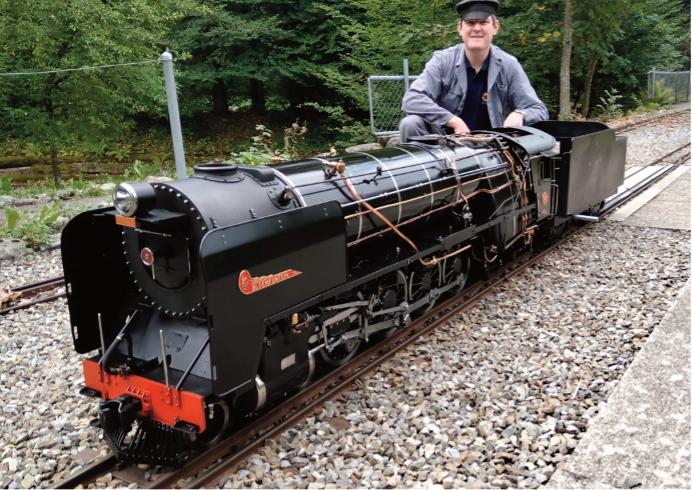
The late Arron Homewood has a lot to answer for and so did standing around at the GMES Gala in Guildford in July 2023, chatting about a wish list for a new-build locomotive. At the time, I had just brought my latest creation down to the Gala, the 9-foot long South African 15F, to be delivered to its new owner Remo Bussola, and make its way back to Switzerland.
Murphy’s law had the new loco drop a gudgeon pin, which moved a return crank! But it went home anyway and justified a very pleasant later remedial visit to the Winterthur area, (I wonder how many model engineers have packed a selection of tools and explained it all to security at
build another one himself. LBSC only built the chassis and valve gear and never finished a working model.
Simon has been working on this for a couple of years now producing CAD drawings to try and fit everything into a very restricted space whilst, at the same time upgrading various components to more modern standards, for example, Simon has altered the lubrication pump design to the Jim Ewins design to make construction easier.
Luton airport?) but those mishaps didn’t prevent a very interesting conversation between Arron Homewood, Martyn Dix and myself, around the question… What next?
Now from my side, I had a leaning to the BR Standard class 9F. Yes ok, there are plenty about, but knowing the 15F was built pretty much at the upper limits of my mill and lathe capacity, I knew I could turn down 8” diameter castings - a 7.25” gauge, 1:8 scale 9F has the same diameter wheels as the 15F, and is similar in many waysso I was confident I could predict all those things that sensible buyers would be wanting to know. As a professional builder, I find it is wise to avoid unknowns where possible - they make it hard to set expectations of time and cost, and expectations mismatch causes problems as ever.
Martyn was fairly keen on the 9F, and sensible, until Arron started talking about the Merchant
Our test run at the stunning track in Staufen Switzerland
new Merchant Navy Locomotive
Andrew Giffen
A new Merchant Navy Locomotive (continued)
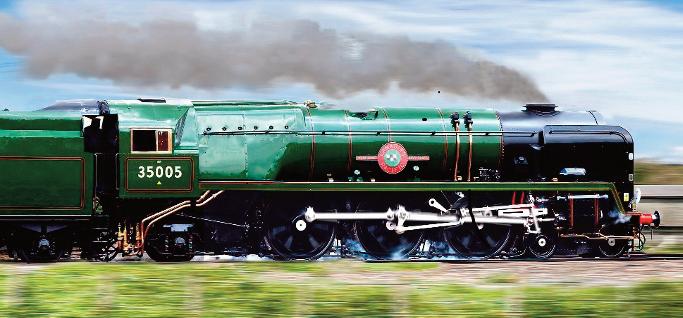
Navy. Of course, the modeller can choose between the original Spam Can and the rebuilt version, but we more or less unanimously preferred the look of Jarvis’ rebuild, not to mention the same advantages that justified the rebuild apply just as much to the model - amongst others improved access to all the valve gear, especially the outside obviously, and using conventional valve setups all helps to keep things a bit more predictable.
So suddenly we were in the realm of not-so-sensible driving wheel diameters that my lathe could not handle, a crank axle, something I’d not tackled before, and another cylinder. But wow, what a challenge, and it would push my model engineering up a level or two. Also, as far as we know, there is only one other rebuilt version on 7.25” gauge out there, Clan Line, built by John Morgan and now owned by Andy Gelson, so it would be a rarity in the extreme.
So that gave some food for thought on my drive back up to Lincolnshire. Further chats with Martyn started setting up our very effective modus operandi, which was to stand us in good stead when it came to lateral thinking to prepare for the unknowns this would mean.
As you can imagine, both of us needed to have the same mindset, of where on the scale between gold medal winner scale museum replica at the one extreme, and cheapest possible caricature on the other. It was an easy one in that we both naturally lean towards very accurate external appearance, although open to consider changes where they make sense from a practical point of view, and internally freelance to favour robustness, speed of assembly and ease of maintenance, without going so far as to drop the middle cylinder as had been done before.
Needless to say, there are no modeller’s drawings of this out there for 1:8 scale on 7.25” gauge. There is, of course, Keith Wilson’s 5” gauge Ariel, of which numerous examples are around, but just as well known is that the design has a lot of errors - one look on the very useful builders’ website www.bulleidlocos.org.uk shows 11 detailed pages of them.
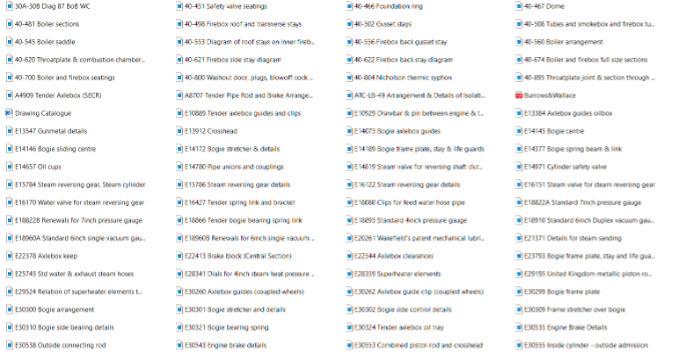
As luck would have it, I got hold of a very complete set of SR/BR drawings, in fact, too complete, as they were over 4,000 drawings of all the versions mixed in together of both Light Pacific versions and Merchant Navies, and streamlined and rebuilds of them all: but at least I found they were all there after a lot of sifting through a very interesting collection, and historical record. Here a small sample of what I faced:
I wondered whether Keith Wilson was in possession of the same bewildering set of drawings, and that might explain how the Ariel design is a mix of MN and light pacific components.
After having a good look, I was able to whittle down over 4,000 drawings to 208 (so far at the time of writing, without having tackled the tender chassis yet) in twenty-six folders, arranged by the sections that I find logical when building a loco. The sections are assemblies, such as the complete main frame, stretcher and motion bracket assembly, which are broken down into sub-assemblies and usually also sub-sub-assembles and so on, down to each component part. At this stage there was no longer any doubt about using the Keith Wilson drawings, not only would I have to consider and correct all the known errors, but also scale everything up from 5” to 7.25” gauge, so there seemed to be no disadvantage to simply going straight to the works drawings, not to mention the enjoyment of going to the source.
So, it was time to begin.
Martyn’s investment was going to be considerable, and what we both needed was peace of mind that the parts we made and bought would fit, and the engine would run. Every experienced
A new Merchant Navy Locomotive (concluded)
builder knows how often things have to be remade, and when the project is seen as a hobby, that is OK, time is often not a factor, parts can be binned and remade trial and error fashion, and a loco can be built over twenty years. It is a little different for me, although there is some leeway built in, my time has to be paid for, and mistakes are painfully reflected at the bottom line. Industrial practice would be a prototype, but here I am building a one off anyway, the prototype IS the production model, so thank goodness for 3D CAD.
The more effort you put into faithfully transposing everything into 3D CAD at this stage, the more the 3D model will serve as a valid prototype, and the more time and trouble it will save you once the metal arrives. Ideally even bolt heads and nuts should be modelled and placed in position on the screen - why? you may ask.
CAD has one big downside - it will happily allow you without any warning to blindly copy a bolted bracket between the frames that a scaled-down fitter would be able to access by climbing in, and it is all too easy to draw that without realising that it will be difficult, if not impossible, to get the bolt there on the model or tighten it up. So, modelling in 3D is not just copying from the original drawing, there is a lot of simplifying and thought given to how to put things together in the workshop.
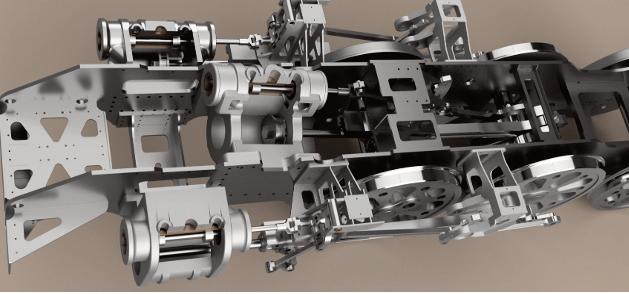
My original estimate for the loco build was five years, based on my experience of four years with the similar-sized, but much less complex 15F. The first year of that five certainly could be taken up by non-stop drawing work, but I wanted to start having something to show for our efforts in metal after six months or so, so the drawing marathon would finish at the running chassis stage, i.e. the main frames, all three cylinders, driving wheels and all the rods and motion running as a simulation on the screen at all cut-offs, in forward and reverse.
This little account would get very boring were I to show each stage of the drawing process, but after
about six months, the simulator looked something like this:
So, with the main function of CAD being to allow you to make sure everything fits before making anything, the logical next level is to cut away the steam chest, and ‘manually’ turn the driving wheels degree by degree to plot exactly what is happening in each steam chest. So of course, I isolate each cylinder in turn and chart steam admission, expansion (port closing to steam) and exhaust moments for the revolution. Were they all perfect from the start? Nope, but close.
No explanations are needed for the huge advantage in being able to make the necessary changes to the interlinked dependencies of return crank/eccentric position, length and eccentric rod length, to achieve pinpoint accuracy. I take my time at this stage, as this is the most critical part, and worth being ambitious about perfect valve events.
A video clip of the simulator in motion can be seen here: https://www.youtube.com/watch?v=ux0c98m3bFw
So, six months down the line, the computerless model engineer might well have had the main frames already complete, while we still had nothing in metal. But the many unfinished model Bullied Pacific chassis gathering dust around the world are at least, in part, testimony to the importance of preparing the groundwork.
I can at least promise a lot more photos in the next instalments, as things start to come together.