The Lyceum
A Publication of The Committee on Masonic Education



Brethren and Friends,
It is my distinct pleasure to welcome you to this edition of The Lyceum, the official Masonic Education publication of the Grand Lodge of Illinois Ancient Free and Accepted Masons. As we embrace the theme of renewal—a timeless Masonic principle echoing the cycles of rebirth in our rituals, from the symbolic raising in the Third Degree to the alchemical transformation of the self—this issue arrives amid Illinois’ harsh winter grip. With extreme cold warnings and heavy snowfall blanketing the state—forecasts across central Illinois this weekend, and wind chills plunging—stay warm, safe, and vigilant, my Brothers. Just as the Craft teaches resilience amid trials, let this season remind us to tend our inner lodge, drawing closer to the warmth of fraternal bonds while nature renews itself beneath the frost.
This edition delves deeply into Masonic Renewal. Our Chairman starts it off, setting the stage for the issue, focusing on our Masonic Tools and how they apply practically self-renewal and beyond. WB Jason Richards of Virginia tells us about his annual habit of reflecting on the year and how he moves forward philosophically to make the next year better than the previous. WB Randy Sanders of Missouri writes about our connections as Brothers and the benefit of reflection. RWB Dan Lort sets the stage for overcoming complacency. Additionally, RWB Chad M. Lacek gives us some real transformative magic we can apply in our lives. What is it? Read on to start changing your life! There’s a lot to discover and I hope you enjoy!
May this new year of 2026 bring you and your families health, prosperity, and ever-greater light. Let us renew our vows to Brotherly Love, Relief, and Truth, building better Masons and a stronger Illinois Freemasonry. Fraternally yours,
Fraternally yours, R.H. Johnson,

Editor-In-Chief
The Lyceum
The Grand Lodge of Illinois, Committee on Masonic Education

by WB:. Dr. Bernard Davis Jr., Chairman- Masonic Education Committee
Each January, the world pauses to consider resolutions, promises we make to ourselves about who we hope to become. In Freemasonry, this impulse is not confined to a single month. The Craft has always taught that self-improvement is a lifelong labor, carried out with patience, discipline, and the steady chisel of habit. As we begin a new year, I am reminded that the Masonic journey is, at its heart, an educational one. We do not simply learn lessons; we live them. We do not merely declare resolutions; we build them into our character, one deliberate action at a time.
Long before modern psychology told us that habits shape identity, our rituals teach us the same truth. The working tools of Masonry: the 24-inch gauge, the common gavel, the plumb, and the level, are more than symbols. They are reminders that improvement comes through repeated, intentional practice.
• We divide our time wisely not once, but daily.
• We chip away our rough edges not in a single stroke, but through steady effort.
• We stand upright not by proclamation, but by habit.
Education in the Craft is not confined to lectures or degrees. It is the ongoing formation of habits that align our conduct with our principles.
Every Lodge meeting is, in its own way, a classroom. We gather to study ritual, symbolism, history, and philosophy — but also to practice patience, civility, leadership, and brotherly love. These are not abstract virtues; they are habits we
cultivate through repetition and example. Just as a student becomes a scholar through consistent study, a Mason becomes a better man through consistent application of the teachings he receives. The Lodge gives us the structure, the tools, and the fellowship to make those habits endure.
The new year often tempts us to think in grand gestures. Yet Freemasonry teaches the power of incremental progress. A Brother who reads a few pages of Masonic education each day will grow more than one who waits for inspiration. A Lodge that improves one practice each month will advance further than one that attempts sweeping change all at once.
This year, let us embrace the Craft’s quiet wisdom: Great edifices are built stone by stone. Great men are built habit by habit.
If we are to make resolutions as Masons, let them reflect our highest aims:
• To strengthen our habits of study, reflection, and self-examination.
• To model the virtues we hope to inspire in others.
• To make our Lodges true centers of learning and personal growth.
• To remember that the work of making good men better is never finished.
• These are not resolutions for a month, but commitments for a lifetime.
As we step into this new year, I am grateful for the dedication of our Brethren and the shared pursuit that binds us. Let us approach 2026 with the steady confidence of craftsmen who know that every day offers a new opportunity to shape
our character and refine our work. May our habits reflect our values, may our resolutions become actions, and may our actions bring honor to the Craft we cherish.
Fraternally,
Bernard Davis Jr,
WB Dr. Bernard Davis Jr, ChairmanCommittee on Masonic Education Grand Lodge of the State of Illinois

by WB:. Jason M. Richards
From the Editor: In this article, I am reprinting two companion pieces that originally appeared in different years, now presented back to back for the first time. Read together, they trace a single thread of reflection across time and show how the same Masonic themes continue to challenge and inspire us in new ways. By combining them in this format, my hope is that you will not only enjoy each article on its own but also appreciate the continuity of thought and growth that emerges when they are viewed side by side.
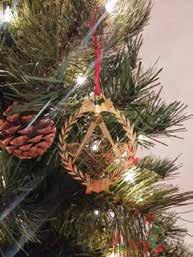
Late December is, for many people, a time of introspection and self-reflection. For me, Christmas Eve is particularly sacred in that regard. As long as I can remember, I stayed up extra late on Christmas Eve--not to wait for Santa or in anticipation of opening gifts the following morning--but to allow myself time to reflect on how my life has changed since the previous year's Christmas Eve and muse as to how my life might change before the next one rolls around. As I reflect, I always attempt to thank God for the blessings, lessons, and difficulties of the past year and also for the hope that comes with the next.
This past year, Masonically, I've been blessed with many new friendships with breth-
ren across the world through The Masonic Roundtable and the lodges I’ve been honored to present at around the United States, not to mention, I’ve been granted increasing responsibility in Lodge.
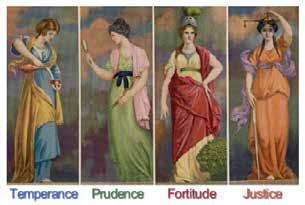
But Christmas Eve isn't just a time for self-reflection and poor attempts at forecasting the future; for me, it's always been the time to set my resolutions on how to live and act the next year. Resolutions, while often carrying negative connotations for being broken soon after they're made, can be a useful tool for sanctification whereby we chip at our own rough edges in hopes of one day becoming that elusive, idealistic "perfect ashlar." As I was pondering my previous resolutions, the four cardinal virtues of Masonry about which we learn in the Entered Apprentice degree (temperance, fortitude, prudence, and justice) stood out in my mind. As they necessarily touch all parts of our lives as men and Masons, these virtues formed the perfect framework for what I resolve to accomplish this next year:
1. Temperance: Spend more time with family.
Masonry is a vast, complex machine with many moving parts; however, it has relatively few workers to keep those parts moving and may have fewer in the future if current Ma-
sonic membership trends persist. As a result, Masonry has no shortage of work for those men who choose to be active--even to the point where family life suffers as a result. This year, I resolve to give my family the quality time they need.
2. Fortitude: Put all I can into my lodge.
Spending more quality time with my family doesn't mean that I slack off on my Masonic duties. Masonry should be about quality, not quantity. As such, I resolve to give my Masonic endeavors my all (within the length of my cable tow) this year, recognizing that I cannot (and should not) do everything; but what I do, I should do exceptionally well.
3. Prudence: Exercise more patience.
We all know brethren who drive us nuts for whatever reason (if you're on Reddit or Facebook, you probably know several). While our obligations may keep us from completely writing them off or telling them where to shove it (or may not, depending on how you frame them), disharmony in the Craft can still abound in cases where brethren rub each other the wrong way. This year, I resolve to exercise more patience with brethren I find difficult to befriend and relieve.
4. Justice: Be as good a man as I can be. All the time.
We've heard it time and time again. Masonry makes good men better. Why else would we join? You can read the rituals online. A non-Mason can buy a Masonic bumper sticker to put on his car or a lapel pin for his jacket if he wants to do so. We're here to build each other into men of high values and character; as a Mason, it is my duty to be as good of a man as I can be, as I resolve to do the same to the best of my ability throughout the next year.
As we move forward into the new year, I wish all brethren wheresoever dispersed a joyous new year filled with temperance, fortitude, prudence, and justice--four virtues upon which our craft was built, all of which are essential tools to master as we go forth and attempt to carry out our end goal as Masons: to make good men better.
Last year, I wrote a piece entitled Virtuous Resolutions, in which I resolved to act in accordance with the fraternity’s four cardinal virtues (temperance, fortitude, prudence, and justice) for the ensuing calendar year. Having found that the four cardinal virtues provided a great framework for self-betterment, I resolved to exercise temperance by spending more time with family, embody fortitude by putting all the effort I could spare into building up my lodge, show prudence by exercising patience, and model justice by working to be the very best man possible.
Last year, I focused heavily on actively bettering myself through giving time, service, and energy to others. While I plan to keep my new resolutions, I’m turning my focus inward for this year. As Masons, we lead busy lives with obligations that take many different shapes and forms. In an effort to fulfill those obligations, I have found that, at times, our spiritual health can suffer. Being a Mason means taking care of one’s own spiritual needs just as much as caring for the needs of others. For this reason, I resolve to focus on Masonry’s three theological virtues: Faith, hope, and charity in an effort to better myself spiritually.
Faith: Devote dedicated time to the improvement of spiritual health
Faith, as Mackey explains in his encyclopedia, is meant to be synonymous with trust. As such, he alludes to a candidate’s trust in God
being emblematical of a well-founded faith. As Masons, our respective faiths are left up to our discretion, but the tie that ultimately binds men together in Freemasonry is a shared trust in the Creator of all things. As previously mentioned, it is the duty of every Mason to nurture his own spiritual health. This year, I resolve to take the time to do so for myself by setting dedicated time aside each week for meditation and spiritual/religious introspection.
Hope: Translate desires for the future state of the fraternity into a plan as Master of the lodge
Hope is often conceptualized as the second rung of the ladder of theological virtues.
A.E. Waite conceptualizes hope both as the foundation of faith (for example, one trusts in God because one hopes in immortality) and a catalyst for action. Essentially, hope—termed as “aspirations of the heart and mind” by Waite—is the force that compels one to act, trust, and love. Each Mason sees the fraternity in a different light, just as each member has his own respective hopes and aspirations for the future of the organization, both at the macro and micro levels. This year, I resolve to channel my aspirations for the fraternity in general and my lodge in particular into the planning of my year as Master, which will— God and lodge brethren willing—begin in December of this year.
Charity: Endeavor to do good unto all and love everyone as best as possible.
Charity is a concept often misused and misunderstood in our fraternity. While many assume charity to mean the act of giving to those less fortunate, Mackey argues that, going back to I Corinthians 13, the original use of the word came from the Greek word agape, meaning love and signifying a “kindly state of mind which renders a person full of good will and affectionate regard toward others." Colloquially, agape love today is referred to as “unconditional love” as often used to denote
the love between Creator and creation. With this context in mind, I resolve to endeavor to harbor goodwill toward all and love everyone—more especially the household of the faithful—as best as possible.
As we look forward to this year, I wish you all a wonderful year filled with trust, hope, and love. Take the time this year to trust in your God, your brethren, and your Masonic leaders. Allow your hope for the future of Masonry to drive you to implement initiatives and changes in your lodges and Grand Lodges. But above all, love your brethren as best you can. If we all strive toward these ends, then we can all look forward to a great year!

The arrival of a new year has a way of inviting reflection. Calendars change, resolutions are made, and for a brief moment, many of us pause long enough to ask whether we are living the life we intended to live. By the time February arrives, most of those intentions have quietly faded. This is not because we are lazy or insincere. It is because meaningful change has never been driven by the calendar. It is driven by identity, attention, and recommitment.
As Freemasons, we are fortunate to possess a framework that was designed precisely for this purpose. Freemasonry does not promise novelty. It does not offer quick fixes or dramatic reinvention. What it offers instead is something far more durable. It is a system of reminders, symbols, and obligations that point us, again and again, toward the kind of men we are trying to become. The turning of the year is not an opportunity to become someone new, but to return to who we said we would be.
When we were first initiated, we were given tools and lessons that seemed simple enough at the time. Be upright. Be square in your dealings. Subdue your passions. Improve yourself. Serve others. These ideas are easy to agree with. They are much harder to live consistently, especially once the novelty of initiation has worn off and the distractions of daily life take over. Careers demand attention. Families need us. Fatigue sets in. The working tools are quietly set aside, not out of rejection, but neglect. The beginning of 2026 offers us a chance to pick them up again.
It’s tempting at the start of a new year to focus on outcomes like losing weight, making more money, reading more books, and attending more meetings. There is nothing wrong with goals, but Freemasonry teaches us something more fundamental. Outcomes are the byproduct of character. If we want different results, we must recommit to being the kind of men who naturally produce them.
A Mason who is truly governed by the plumb does not need a resolution to act uprightly. A Mason who lives by the square does not struggle to justify ethical behavior when it becomes inconvenient. A Mason who understands the working tools does not wait to be corrected by others. He measures himself regularly and adjusts quietly.
Recommitment begins with honesty. It requires us to step back and ask uncomfortable questions. Have I been improving myself, or merely maintaining? Have I been attending Lodge out of habit or out of intention? When I give my word, does it still mean something to me? Have I been practicing brotherly love, or merely tolerating those I find agreeable? These are not questions meant to induce guilt. They are tools for alignment. Freemasonry does not demand perfection; it recommends awareness. One of the great lessons many of us eventually learn is that willpower is a poor substitute for identity. We cannot force ourselves to be better men indefinitely. We either become them, or we revert. The rituals we repeat, the language we use, and the symbols we surround ourselves with all serve to shape that identity… if we allow them to. When we disengage, when we attend without listening, when we recite without reflection, the lessons lose their power.
The new year is an invitation to begin again. Recommitment does not require grand gestures. It often begins with small, deliberate acts. Managing your time so that you’re comfortably punctual rather than rushed. Learning a piece of ritual well enough to internalize its deeper meaning. Speaking kindly when irritation would be easier. Offering help without waiting to be asked. Guarding our thoughts as carefully as our actions. These are quiet disciplines, largely invisible to others, but they are the substance of real Masonic work.
Freemasonry also reminds us that we do
not walk this path alone. The Lodge exists precisely because improvement is difficult in isolation. We sharpen one another, sometimes gently, sometimes with discomfort. We are reminded by the presence of our Brothers that the work is ongoing, and that complacency is always waiting for an invitation. The new year is an excellent time to renew not only our personal commitments, but also our responsibility to one another.
It is worth remembering that the lessons of Freemasonry are not seasonal. They are meant to be applied on ordinary days, in traffic, at work, at home, and in moments when no one is watching. The world does not need us to be perfect Masons on meeting nights. It needs us to be better men everywhere else. As 2026 begins, we are not asked to reinvent ourselves. We are asked to remember who we are already supposed to be. The tools are already in our hands. The obligations have already been taken. The path has already been laid out with remarkable clarity. All that remains is to walk it again… deliberately, humbly, and with purpose.
If we do that, this new year will take care of itself.

by WB:. Randy Sanders
The late Fall and Winter seasons give us a unique opportunity to use our Masonic work to connect with those absent and reflect upon our own temple. As we look at the trestle board for next year, I’m reminded of my own trestle board for last year, and I am grateful for my friends and Brothers in this Fraternity. This isn’t about my gratitude, though; this is about our adaptation to the seasons. Maybe we shouldn’t adapt so much, and maybe we can use the seasonal energy for our own benefit.
Just as bears hibernate, our lodges may not go dark, but they change. We take into account our members’ traveling, planning our own holiday parties, including St. John the Evangelist, or simply focusing efforts toward the new year. Side note: I always had trouble remembering which St. John was on which day until I realized nobody wants to get baptized in winter with a bunch of snow on the ground. Since then, I’ve never forgotten that summer equals baptisms, and Winter points toward evangelizing to others. Personally, I’m not into the so-called arctic plunge.
The hibernation of the bears and the change toward a festive spirit in November and December through the New Year warrant more introspection and, yes, reflection. We use the New Year for resolutions, but why? I’m sure there’s history as to when someone decided something like “new year, new you”, but as Masons, we already view the world in that manner. We look at the cycles of nature and the cycles of life as lessons of becoming
a “new you” many times over. We examine our lives against what we did yesterday and contemplate what it means to become better.
As we connect with old friends and family through the holidays, let’s take a moment to reach out a bit further. The old friend you may not have seen in a decade, for instance. Someone you met at a conference and always meant to reach out again to connect. The roommate with whom you’ve lost contact over the years is only a phone call away. It’s worth your time to sit down and reconnect if only for a short time, and you can bring a bit of light and joy into their life. Do it.
As we reflect upon our lives and maybe connect with those whom we’ve let slip away, remember that those two items are not so separate. We are meant to live and thrive through the cycles of nature, and we can take advantage of that time in connection and reflection to reset our own trestle boards. Call it resolutions, call it a return to our Great Work as Masons, call it simply a rebirth or reforming of ourselves to our higher self. Connect with others both near and far, reflect upon your own existence and changes, and adjust your trestle board for what you want to work toward next year. Call it what you like, we experience something unique to Freemasonry in connecting our degree experience with our daily experience, and nothing is as powerful as yourself fully realized.

By RWB Dan Lort
In a recent short essay, I expounded on the word “convenient” as it relates to our duty and obligation of heading out on any particular evening to attend a lodge meeting. What drives us to go or what holds us back, one might ask.
Perhaps at the core of what makes a Lodge thrive or what contributes to their slow and deliberate death, we should look at why our Brothers are staying home. Why are they resisting their duty to answer and obey a regular summons to a meeting? Could it be that, outside of our wonderful degree work and ritual, we’ve become BORING? Is every meeting a RERUN of the last one?
Every day, we witness the consolidation of Lodges and Masonic Districts as they shrink in size. Why are we seeing Masonic districts comprised of 15-20 lodges 20 years ago, with 5 now remaining? What makes a Lodge of 40+ members ask to turn in their Charter? What causes a Lodge that had 150 members 10 years ago to wither to 30 members today?
Across every jurisdiction, we hear Grand Masters, District Deputies, Staff Officers, and Worshipful Masters talking about the work on their Trestle boards. How many trestle boards are distributed with the date of the meeting followed by “TBD” for the work of the evening? To Be Decided. An acronym for “beats me”, “I’ll wing it”, or “we’ll make it
a business meeting only”? Who among us has worked through the “convenient” hurdle as we watch our early evening TV or dine on an early dinner and decided it’s time to get suited up and head to lodge, only to arrive, sit through an opening, business meeting, and closing, and be home and back at the TV within an hour? We then ask ourselves the question, “Why”? A great many Lodges have taken this to heart and are presenting interesting and diverse programs at each meeting. Many others struggle to have one or two speakers or programs during their lodge year.
Yes, it was good to see my brothers who, like me, came out tonight to attend Lodge. We had plenty of time for some sort of program. Not even a Short Talk Bulletin. Maybe Bro. James is talking about his beekeeping. Hey! What about asking the local precinct commander to come and speak about crime-fighting efforts in our neighborhood? So many possibilities. How do we make these happen?
One very simple but underutilized word--PLANNING. Interesting and engaging events seldom happen on their own. Sure, every now and then we’ll look on the sidelines and see a brother who has a particular skill or vocation that we could ask him to speak about “off the cuff”. As Worshipful Masters, we owe it to the Brothers who have elected us and to the Lodge as a whole to do everything in our
power to see the Lodge not just survive but to thrive and grow. To do this, we need to exert a certain amount of EFFORT. This effort may involve everything from putting together a Trestle Board during the summer before our Lodge comes back in session to personally calling our officers the day before a meeting to let them know the plans for the evening (and to gently remind them of the importance of their attendance). Perhaps a summer meeting with the Wardens to put together a Trestle Board and brainstorm about programs for evenings with no degree work.
Of course, we sometimes hear comments from some long-time members saying things such as “We don’t need to do something special every meeting,” or “Some of us...” just like to have a meeting and get home. The Brothers we don’t hear this from are the ones who are so bored with the program-less meetings that they stop coming to Lodge in lieu of other options. These are the Brothers we need to target. They are the future of our Fraternity. They are the ones who will take the place of our senior members as infirmity and the Celestial Heavens take over.
Keeping our meetings vibrant, contemporary, and interesting is vital if we are to keep our new and seasoned members engaged. Being now enabled in the NY jurisdiction to open and close our Lodges on any degree has become a wonderful tool to maintain the connection with our EAs and Fellowcrafts as they progress through the degrees. Keeping our regular communications interesting is a mandate we need to understand and put into practice if we are to stem the flow of those leaving us because we’ve become “boring”. NO MORE RERUNS! What could be easier?
by RWB:. Robert H. Johnson, FILOR
The new year is around the corner, and with that comes renewal. Renewal of things both old and maybe not so old. Another beginning. As humans, we see the world and time in an odd way; we see things linearly. That is, we need a beginning, a middle, and an end. From death springs new life. Life is, after all, an amazing cycle. In Masonic philosophy, this cycle mirrors the doctrine of regeneration or “eternal becoming,” where the soul undergoes perpetual renewal through trials, self-conquest, and initiation—transforming the profane into the spiritual, much like the serpent shedding its skin or the sun’s daily rebirth symbolized by Harpocrates.
Although you may think at this point in this piece I am going to tell you to renew your Masonic something rather for the new year, rest easy. I’m not going to do that. But I will regale you with the tale of Harpocrates, or as he may have been known to ancient Egyptians, Har-Pi-Krati. He was a god-like child figure, often depicted in the nude and sitting on a lotus flower. He is considered in the Egyptian culture as most likely representing a renewal and new year because of a yearly consecration of peach blossoms, which were given to his busts and carvings. Also, because he was the representation of Horus as a god-child, Horus represented the newborn sun at each new dawn. The lotus flower upon which Harpocrates sits symbolizes spiritual rebirth and elevation, emerging from primordial waters to represent the soul’s ascent from material darkness to enlightenment—a motif echoed in Masonic teachings on purification and light. Philosophically, Freemasonry teaches that true renewal comes via the unity of God and soul immortality, with
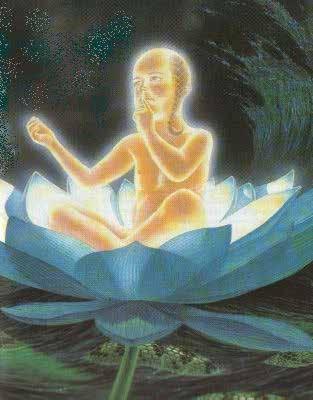
Harpocrates embodying the aspirant’s journey from ignorance to wisdom, guarded by silence until inner light dawns.
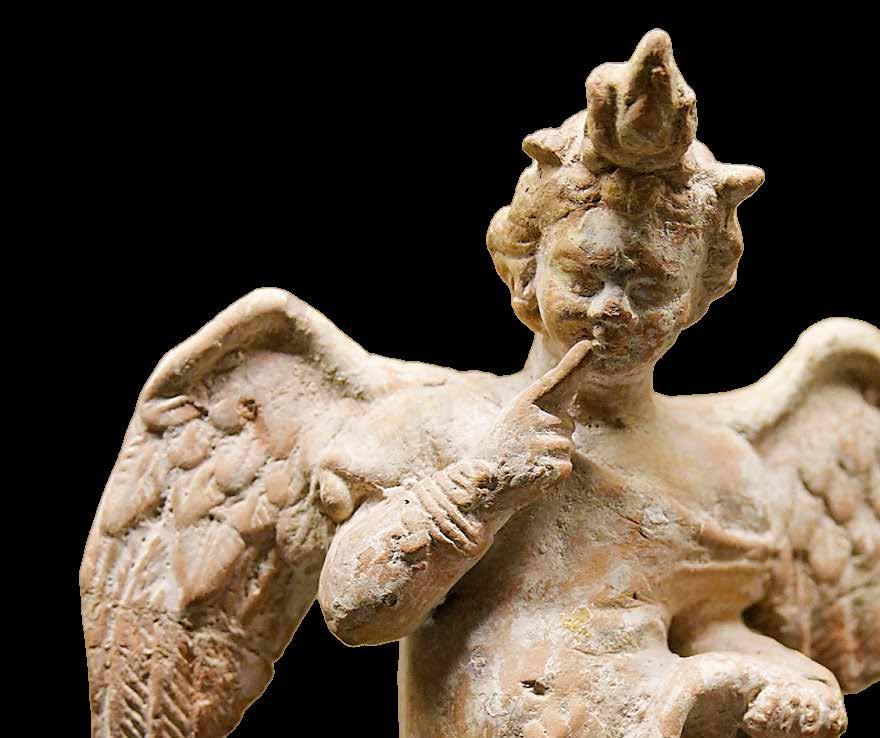
Masonically, there is a cooler connection, which is that of secrecy. Typically, in his depictions, Harpocrates was shown with his finger to his lips, as if telling us to keep a secret. This gesture, originally a hieroglyphic sign for “child” in Egyptian iconography, was misinterpreted by Greeks and Romans as a sign of silence, and it evolved into a core Masonic emblem of discretion and the obligation to guard esoteric knowledge. In Freemasonry, Harpocrates appears on jewels like the Stewards’ jewel, often with a cornucopia (horn of plenty) and the motto “Audi, Vide, Tace” (“Hear, See, Be Silent”), reminding Brethren of their vows during initiation rites where silence is a primary virtue for the Entered Apprentice. Some lodges even incorporate Harpocrates into their names or
rituals, linking him to the Hiram Abiff legend as a “Widow’s Son” figure akin to Horus, son of Isis and Osiris, symbolizing resurrection and the restoration of lost wisdom—philo sophically underscoring Freemasonry’s core tenets of moral rebirth and the eternal quest for divine truth.
So, when the Romans conquered Egypt and adopted this god, they gave him the name we have today, Harpocrates or Heru-pa-khered, which meant Horus the Child. At some point, they lose the idea of renewal and focus on the outward appearance, and subsequently asso ciate him with representing secrecy, some thing all Freemasons value. So, remember to keep the secrets, Brothers! For the Lyceum reflect on how Harpocrates bridges renewal and silence: just as the newborn sun renews daily, the Mason renews his commitment to sacred silence, protecting the “ truths until worthy light reveals them—echo ing the speculative philosophy that initiation fosters an “ tion, where silence suffered in apprenticeship births profound understanding.

by RWB:. Ira Gilbert,†
“Auld Lang Syne”, the song usually sung at New Years, that says, ”we will drink a cup of kindness dear, for Auld Lang Syne”. The lyrics of the song celebrate the use of intoxicating beverages. Just how does this relate to Freemasonry, one might ask? The song lyrics are from the poem written by Bro. Robert Burns, the renowned Scottish poet. Robert Burns was initiated into St. David Tarbolton Lodge in Scotland on July 4, 1781.
The history of the use of intoxicating liquor and freemasonry is fascinating. The use of intoxicating liquor in a lodge hall is covered by Code 485 in the Book of Constitution and By-Laws of our Illinois Grand Lodge. This Code states, “A lodge shall not, on any pretense, introduce intoxicating Liquors at any official lodge function in the building where the lodge is meeting during such an event”. Code 486 goes further, stating, “Masons are prohibited from appearing in drinking saloons in their Masonic clothing, and any Mason thus offending shall be disciplined”. This is the state of the current Masonic law regarding intoxicating liquors in Illinois.
But it was not always thus. When I became a Mason, anyone in the business of dealing with intoxicating liquors could not become a Mason. Thus, tavern or bar owners, liquor store owners, distributors, etc., were forbidden from petitioning a Masonic lodge. However, the history of our fraternity discloses that in earlier times, this prohibition
of intoxicating liquors and the holding of Masonic meetings in establishments that sold these beverages was not only tolerated, but it was the rule.
Prior to the year 1717, groups of operative and later speculative Masons met together as individual lodges. On St John the Baptist Day, June 24, 1717, four lodges got together in the City of London to form the first Grand Lodge. These four lodges met at The Goose and Gridiron Ale House in St. Paul’s Churchyard, The Crown Ale House in Parker Lane near Drury Lane, The Apple Tree Tavern in St Charles Street, Covent Garden, and at The Rummer and Grapes Tavern in Channel Row, Westminster. As can be seen, all four of the original lodges that formed the Grand Lodge of England meet in venues that served alcoholic liquor.
In the year 1716, these four lodges, along with some other “old Brothers,” met at the Apple Tree Tavern and formed the Grand Lodge pro tempore, placing the oldest Master Mason in the chair. These brethren resolved to hold an Annual Assembly and feast. This culminated in the formation of a Grand Lodge as set forth in the preceding paragraph. The meeting on June 24, 1717, took place at the Goose and Gridiron Ale House. These facts were set forth by Dr. James Anderson, who wrote the Anderson Constitution in the year 1723.
When the fraternity of Freemasons emigrat-
ed to the United States, the first lodges were formed as Provincial Lodges in the colonies. Some of these lodges were loyal to the King, and others were formed of patriots who were some of the signers of the Declaration of Independence and writers of our United States Constitution.
Prior to becoming a Mason, Benjamin Franklin wrote, in his Philadelphia Gazette, for December 8, 1730, “that there were several lodges of Freemasons in this Province ….”. Franklin became a Mason about two months after this article appeared. This fact in our Masonic history was recorded in Libre B, the oldest Masonic document for this county still preserved. Libre B also recorded, in June 1731, that there was a lodge that met at the Tun Tavern in Philadelphia. This lodge met at the Tun Tavern monthly from June 24, 1731 until June 1737. After a year passed, the final meeting at Tun Tavern was in June 1738.
The only lodge remaining today of the approximately 100 early lodges is St. Andrew’s Lodge of Boston. Among the brethren of St. Andrew’s Lodge were Paul Revere, John Hancock, and others who were signatories to our founding documents. St. Andrew’s Lodge met at the Green Dragon Tavern, another establishment serving intoxicating liquors. In fact, the minutes of St. Andrew’s Lodge for one meeting in 1773 state that, “the consignees of Tea took up the brethren’s time.” On December 16, 1773, the minutes of St. Andrew’s Lodge are filled only with large capital “Ts”. This happened to be the date of the Boston Tea Party.
The history of Freemasonry in the United States is silent as to its association with drinking establishments until it was re-established as a result of the Morgan Affair. The disappearance of Captain William Morgan resulted in an anti-Masonic sentiment in the United States. For many years, anti-Masonic feeling was strong in the United States. An
anti-Masonic political party was formed, which actually ran candidates for public office.
But the desire for banding together in fraternal organizations did not go away. Freemasonry was still present, although it could successfully re-establish itself. It was the result of this re-establishment that the Grand Lodges did not wish to anger the anti-Masonic populace. During the 1840s, in an effort to rebuild the image and public confidence in the fraternity, the Grand Lodges passed regulations prohibiting the use of alcoholic beverages in Masonic buildings and meetings in order to diminish the possibility of boisterous behavior that often took place in the lodge meetings prior to the Morgan affair.
During the early 1800s, there was also a growing temperance movement in the United States. Temperance associations were formed, and the populace produced a growing animosity against the use of alcoholic liquor. This reached its zenith when the 18th Amendment to the Constitution was passed in 1920, ending in 1933. Use of alcoholic beverages was not only banned in lodge halls by order of the many Grand Lodges, but it was also illegal throughout the United States. This prohibition against the use of intoxicating liquors has existed to the present time in various forms throughout Freemasonry in our country.
The Auld (old) Acquaintance with intoxicating liquors has, indeed, “been forgot” in the United States. The Codes cited at the beginning of this paper are still in existence. The words, "auld lang syne”, translated from the old Scotch, literally means, from times long ago. We, in Freemasonry, have forgotten the times long ago when the use of intoxicating liquor was not only condoned, but also our lodges met in drinking establishments.
By RWB:. Chad M. Lacek, 33˚
Did you make any New Year’s resolutions? By now, you’ve had a chance to test their permanence. How’s it going so far? Are you hanging in there, or have you already abandoned some of them?
Don’t feel too bad. Change is hard. In fact, lasting change is almost impossible unless you apply it the right way. Most people try to use an act of willpower to resist the behaviors they are trying to eliminate, or to add the habits they wish to begin. You can visualize what is happening in this case by imagining a powerful magnet pulling you in the direction of what you are trying to avoid and pushing you away from where you want to be. This invisible force is always there. It’s always pulling and pushing, constantly, relentlessly.
To achieve your goals, you will have to fight it every second, every day, forever. That’s asking a lot of our poor willpower.
Let’s consider an example of a man who wants to lose a few pounds. We all know the many benefits of maintaining a healthy body weight. It’s a worthy goal. One major component of his weight loss will be decided by the foods he eats. Every time he passes that box of doughnuts someone brought to the Lodge meeting, he must resist the desire to eat one if he hopes to achieve his goal. The problem is that he has to fight that desire and win every time. Just like water that wears away at solid rock, so too will that doughnut eventually end up in his stomach.
So how do we make lasting changes? First, we must admit that wanting something and denying it to ourselves is not a long-term solution. The secret to success is to work towards not wanting it in the first place. We can achieve this by reshaping our identity. “I want to lose a few pounds” becomes, “I’m the kind of person who enjoys keeping fit.” This works with anything you wish to start doing or something you want to eliminate. “I want to write a book” becomes, “I’m the kind of person who writes every day.” “I want to pay off my debts” becomes, “I’m the kind of person who lives debt-free and within my means.”
I know what you’re thinking. It’s easier said than done, right? Yes, but no. Every action we take is really a vote for the kind of person we want to be. At first, you will need to tell yourself what kind of person you are. After a while, you will start to believe it. Eventually, you will become it. You might be surprised how much faith you have in your own voice, and how much your opinion of yourself matters. If you find yourself saying things like, “I’m terrible with names” or “My memory is awful”, your subconscious will believe you.

Start telling yourself that you are the kind of person you want to be. You will be amazed at how quickly you can transform your will, without the need for willpower. For a step-by-step, simple, practical guide to implementing this practice in your life, I highly recommend reading Atomic Habits by James Clear (https://jamesclear.com/atomic-habits). Please trust me. You won’t regret it. With a little practice and persistence, you will master the art of change.


https://tinyurL.coM/TMR520
Masonic Week – February 3-8, 2026, Crystal City, VA www.MCME1949.org

Midwest Conference on Masonic Education – April 24-26 - 2026, Omaha, NE, www.MCME1949.org

Esotericon - June 20th, 2026, Manassas, VA at Manasseh Lodge
Yes! Masonic Con Chicago will be back in September of 2026.

For more visit, MasonicConferences.com
If your lodge or organization is having an Educational Event (not related to instruction or charities), please let us know. Email the details to: Admin@wcypodcast.com
Please give us at least a month notice so that we can ensure it is added.