!e Lyceum
A Publication of !e Committee on Masonic Education



A Publication of !e Committee on Masonic Education
Brothers all,
As the dynamic warmth of June settles across the state of Illinois, nature stands before us in the full splendor of its creation. Yet, in the midst of this radiant transformation, the mysteries of the Cra invite us to step away from the glare of the profane world and enter a quiet classroom of structured introspection. !is month, !e Lyceum turns its attention to an o en misunderstood dimension of our moral architecture: !e Study of Imperfection. In our lodges, we routinely speak of the Rough Ashlar as if it were merely a milestone for the beginner—an entry-level relic to be discarded at the earliest opportunity. But as our Grand Chairman, Dr. Bernard Davis Jr., beautifully reminds us in his opening message, the rough stone is our lifelong companion. In incompleteness, we do not $nd a mark of personal failure, but rather a universal summons to labor that makes human development possible.
!is internal perspective completely shi s how we view our daily lives, and this issue is intentionally mapped to trace that transformation across our individual habits, our archival history, and our modern communities:
e Psychology of Error: In Necessity of the Super uous, Brother Chad M. Lacek frames our missteps not as failures, but as vital, directional indicators revealing where our habits are misaligned with our intentions. !is is further enriched by our Esoteric Sidebar highlighting Lesson One of Paul Foster Case’s foundational B.O.T.A. text, illustrating that human error is simply an inversion of consciousness—a misreading of the inner trestleboard that can be corrected calmly and without shame.
e Archival Ledger: To show how these principles materialize across time for the nation's 250th anniversary, Brother Kaleem Kamboj’s center spread, !e Un$nished Stone, recovers George Washington not as a static marble monument, but as an instructive, heavily worked stone who pioneered greatness by explicitly inviting the corrective tools of his peers. Following this, our Classic Lyceum Reprint uncovers the powerful 1860 Grand Oration of Brother Stephen A. Hurlbut, defending our symbols as cognitive instruments designed to guide us through the " un nished holy of holies" within our souls.
e Civic Lab: Finally, we address the reality that re ection must bear fruit in external action. Our issue concludes with the Grand Lodge of Illinois' operational toolkits, detailing how mapping our paths on "Personal Trestleboards" and deploying our three "Tactical Ashlars"—Be Visible, Tell Our Story, and Inspire Pride—bridges the gap between personal alignment and civic service.
As you navigate the tasks of this summer season, I extend my most heartfelt wishes for your health, prosperity, and continuous progress in the quarries of the self. May the hearth of fellowship within your lodges burn brightly, and may we all $nd the courage to embrace our incompleteness not as a burden, but as a blessing—mindful that the Great Architect is not $nished with us, and that we are never $nished becoming.
Fraternally,

R.H. Johnson, Editor-In-Chief, !e Lyceum Committee on Masonic Education

by WB:. Dr. Bernard Davis Jr., Chairman- Masonic Education Committee

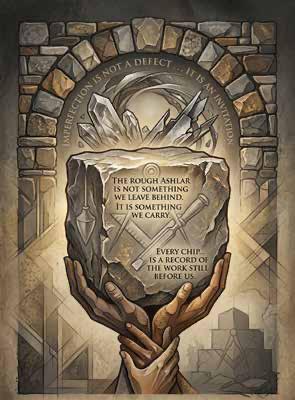
In Freemasonry, we o en speak of the Rough Ashlar as if it were merely a symbol of early progress, a stone awaiting re$nement, and a metaphor for an Entered Apprentice. But for this month’s theme, ""e Study of Imperfection", I want us to sit with that stone a little longer. Not as a relic of the beginning, but as a companion throughout our entire masonic journey. !e Rough Ashlar is not something we leave behind. It is something we carry.
In a world obsessed with polish, mastery, and the illusion of awlessness, Freemasonry dares to a&rm that imperfection is not a defect in the human design, it is the very condition that makes growth possible. !e Rough Ashlar reminds us that incompleteness is not a failure, it is an invitation. Every chip, every uneven surface, every stubborn edge is a record of the work still before us, and the work already done.
Failure, too, has its place in our Cra . Not as a mark of shame, but as a teacher. A Brother who has never stumbled, has never stretched himself. A Lodge that has never faced di&culty, has never tested its strength. A man who has never confronted his own limitations, has never truly known himself. Imperfection is not the opposite of progress, it is the raw material from which progress is shaped.
Our ritual speaks o en of transformation, but it never promises that the process will be clean or linear. !e chisel slips, the stone cracks, and the work must be revisited. Yet, through persistence, re ection, and the steady hand of fellowship, we continue shaping the best version of ourselves.
!is month, I encourage each of us to examine our own Rough Ashlar with honesty and without fear. What aws have we been hiding from? What failures have we refused to learn from? What un$nished edges still call for our attention? And just as importantly, how can we support one another in this lifelong labor of re$nement? In the end, the beauty of the Perfect Ashlar is not that it is awless, but that it bears the memory of every imperfection that shaped it.
May we embrace our incompleteness not as a burden, but as a blessing, and as a reminder that the work continues, and that we are never $nished becoming.
Fraternally,
Dr. Bernard Davis Jr., Chairman Grand Lodge AF&AM Illinois




by RWB:. Chad M. Lacek, 33˚
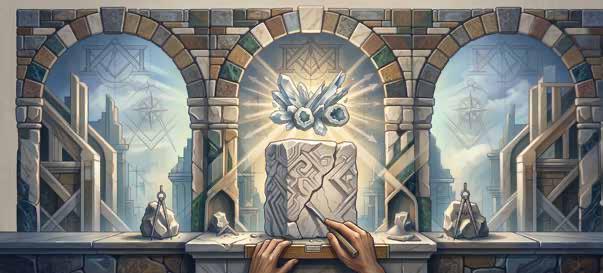
Freemasonry is o en described as a system of improvement. We are taught to re$ne ourselves, to bring our conduct into alignment with higher principles, and to move, however gradually, toward a more complete version of who we are meant to be. It is an appealing idea. Most men, if asked, would say they want to be better tomorrow than they are today.
Yet there is a di&culty built into that aspiration. Improvement requires a starting point, and that starting point is rarely attering. We do not emerge as $nished work. We are incomplete, uneven, and in need of adjustment. !is is not a aw in the system. It is the condition that makes the system necessary. !e language of Freemasonry makes this clear. !e rough ashlar is not an accident. It’s where we all begin.
Still, there is a tendency to resist this reality. We prefer to think of ourselves as mostly formed, requiring only minor adjustments. When we make mistakes, we are inclined to treat them as interruptions rather than information. We excuse them, minimize them, or move past them as quickly as possible. In doing so, we overlook their value.
Mistakes are not merely failures of execution. !ey are indicators. !ey reveal where our understanding is incomplete, where our habits are misaligned, and where our intentions have not yet been translated into consistent action. !ey are, in a very real sense, directional.
A man who never examines his mistakes will struggle to improve, no matter how sincere his intentions may be. He may repeat the same patterns, encounter the same obstacles, and wonder why progress remains elusive. !e problem is not a lack of e"ort. It is a lack of attention. Freemasonry encourages a different approach.
We are given tools that are meant to be applied not only to the external world, but to our own conduct. Measurement, re ection, and adjustment are not abstract ideas. !ey are practices. When a stone is found to be out of square, it is not discarded in frustration. It is examined. !e irregularity is identi$ed. !e necessary corrections are made. !e same principle applies to our character.
When we speak harshly and regret it later,
there is something to be learned. When we fail to meet an obligation, there is something to be examined. When we act out of impatience, pride, or carelessness, we are being shown, quite clearly, where our work remains.
!is is not always comfortable. !ere is a natural desire to avoid looking too closely at our own shortcomings. It is easier to move on, to focus on the next task, to reassure ourselves that the moment has passed. But the moment has not passed if it has not been understood.
Freemasonry does not ask us to dwell on our mistakes, but it does ask us to learn from them. !e distinction matters. Dwelling leads to discouragement. Learning leads to progress. To learn from a mistake requires honesty. Not the kind of honesty that acknowledges an error in general terms, but the kind that examines it speci$cally. What happened? Why did it happen? What assumption led to that decision? What habit supported it? !ese are not questions of blame. !ey are questions of structure.
It is o en said that human beings learn more from failure than from success. !ere is truth in that, but it is incomplete. We learn from failure only when we are willing to study it. Otherwise, failure becomes repetition rather than instruction. Freemasonry provides a framework for that study. It reminds us that we are engaged in a process, not an event. !ere is no single moment at which improvement is complete. !ere is only the ongoing work of re$nement.
!is perspective changes the way we view imperfection. Instead of seeing it as something to be hidden or avoided, we begin to see it as something to be used. Each imperfection points to a place where growth is possible. Each mistake highlights a gap between intention and action. Each failure provides information that success o en conceals. In this way, imperfection becomes a guide.
It tells us where to focus our e"orts. It shows us where our understanding is weakest. It directs us toward the areas where improvement will have the greatest e"ect. !is does not mean that mistakes are desirable in themselves. No one seeks to fail. But when failure occurs, as it inevitably will, it need not be wasted. It can be examined, understood, and incorporated into future conduct.
!ere is also a broader dimension to consider. Within the Lodge, we are surrounded by men at di"erent stages of this same process. Some have learned lessons we have not yet encountered. Others are working through di&culties we may have already faced. In either case, there is an opportunity for mutual bene$t. !e mistake of one man can become the instruction of another.
!is requires a certain posture. It requires us to listen without judgment, to observe without dismissiveness, and to recognize that the struggles of others are not so di"erent from our own. It also requires a willingness to be transparent about our own imperfections, not for the sake of confession, but for the sake of shared growth.
Freemasonry is not a gathering of perfected men. It is a gathering of men committed to improvement. !at commitment is what gives meaning to the work. It is also what sustains it. !e desire to be better tomorrow than we are today is not a passing impulse. It is a steady inclination, rooted in the recognition that we are capable of more. Not perfection, but progress.
Mistakes, when properly understood, support that progress. !ey prevent complacency. !ey challenge assumptions. !ey remind us that the work is not $nished. !ey also remind us of something else. Improvement is possible.
If we were $xed in our nature, if our habits
were unchangeable, then mistakes would serve no purpose. !ey would simply be evidence of limitation. !e fact that we can learn from them, that we can adjust, re$ne, and improve, is itself an indication that growth is built into our condition. Freemasonry does not promise that this growth will be easy. It does not suggest that mistakes will disappear. It o"ers something more realistic and more useful. It o"ers a way to use them.
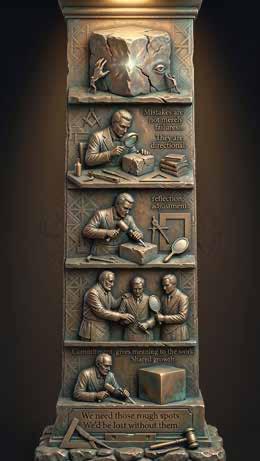
!e rough ashlar can never be perfected by a single e"ort. It is worked gradually, deliberately, and with attention. Each strike of the tool is informed by the remaining imperfections. Each correction brings it closer to its intended form. We need those rough spots. We’d be lost without them.

"From the exhaustless riches of its Limitless Substance, I draw all things needful, both spiritual and material."
— !e Pattern on the Trestleboard, Statement 4, Brother Paul Foster Case
In his foundational course !e Master Pattern (1950), Paul Foster Case details the architecture of human thought on page 6 of Lesson One. He notes that the primary error that enslaves human consciousness is getting cause and e"ect inverted—believing that external conditions, failures, or limitations dictate our internal capacity.
Case aligns Statement 4 with Chesed (Mercy), the fourth emanation on the Tree of Life, framing it as the expansive, adaptive blueprint of universal supply. In a Masonic sense, this teaches us that our current "roughness" or material limitation is never a permanent structural defect. Rather, an error is simply a signal that we have misread the diagram on our inner trestleboard. By applying the tool of disciplined intention, any mistake can be calmly erased, calculated correctly, and redrawn.

Washington, the Rough Ashlar, and the Study of Imperfection
A Re ection for the 250th Anniversary of the United States
by Brother Kaleem Kamboj, 32˚
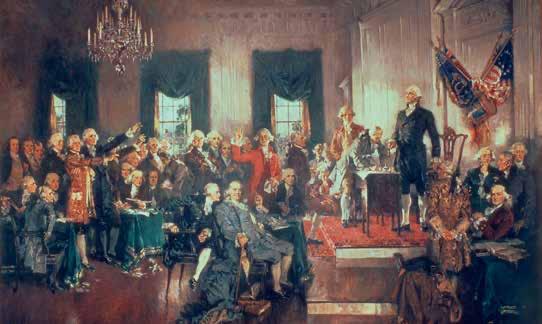
e rough ashlar is not a rejected stone. It is a promised stone.
In the symbolism of the Cra , the rough ashlar stands before us not as an object of shame, but as a truthful representation of the human condition. It is uneven, un$nished, and unadorned. It bears the marks of the quarry. It has not yet received the full discipline of the working tools. Yet within it lies possibility. !e rough ashlar is not valuable because it is already perfect. It is valuable because it may be worked upon.
!is is one of the profound mercies of Freemasonry. It does not begin with the fantasy of human perfection. It begins with labor. It begins with a man as he is, not as he pretends to be. It asks whether he is willing to be measured, corrected, shaped, and made useful. As the United States approaches the 250th anniversary of its independence, it is $tting for Masons to re ect not only on the found-
ing of the nation, but also on the imperfect men through whom that founding came to pass. Among them stands Brother George Washington: soldier, surveyor, planter, revolutionary commander, president, and Mason. Yet Washington is most useful to the Mason not when he is treated as awless marble, but when he is studied as a worked stone.
We o en inherit Washington as a monument. !e portraits, statues, schoolroom legends, civic rituals, and patriotic commemorations can make him appear $nished from the beginning – silent, upright, polished, almost beyond human struggle. But the Washington who emerges from the historical record is more instructive than the Washington of marble. He was formed through limitation, correction, failure, duty, silence, discipline, and the long apprenticeship of public respon-
sibility.
To study Washington through the theme of imperfection is not to diminish him. It is to recover him for Masonic re ection. !e Cra does not teach that greatness consists in never having been rough. It teaches that roughness may be brought under rule.
Sidney Hayden, in Washington and His Masonic Compeers, o"ers one of the most useful images for this study. Writing in the nineteenth century, Hayden acknowledges that Washington’s Masonic history did not survive in perfect completeness. Records were brief. Some were lost. Some incidents had already passed into uncertain tradition. Rather than pretending to possess a awless account, Hayden compares the surviving record to a beautiful column in ruins, its parts broken, scattered, and moss-grown. He then describes his own labor as the gathering of fragments, using the gavel, the square, and the trowel in the work of Masonic memory. !at image is central to this re ection. Washington himself is not the only rough ashlar before us. Washington’s memory is also a rough ashlar. !e historical record is incomplete. Later generations have polished, chipped, claimed, defended, exaggerated, and contested his image. !e Mason approaching Washington must therefore bring not blind admiration, but disciplined reverence. We do not honor the Cra by turning men into idols. We honor it by bringing square, level, and plumb to memory itself.
Hayden’s own preface makes this point in another way. He writes that biography is incomplete when it neglects the domestic, moral, religious, and social in uences that shape a life. !e public man cannot be understood apart from the hidden formation of the private man. Character has roots. Public virtue has a workshop. !e statesman seen
by history was $rst the child, the son, the student, the surveyor, the young o&cer, the disappointed lover, the defeated commander, the disciplined correspondent, and the Brother among Brethren.
Washington’s early life gives us the $rst lesson in imperfection. He did not come into the world as a polished leader. His father died when he was young. His formal education was limited compared with many of the classical minds of the founding generation. He was not a university philosopher like some of the men whose writings shaped the age. He was trained in the practical arts of measure, land, distance, account, and conduct. He became a surveyor.
!is fact is symbolically rich for a Mason. Before Washington measured a republic, he measured land. Before he helped set civic boundaries, he walked forests, rivers, ridges, and unsettled territory. !e surveyor learns that the world does not conform easily to imagination. Lines must be checked. Angles must be corrected. Distances must be paced, marked, and recorded. !e $eld teaches humility because the $eld resists abstraction. We have his own record of those years. !e Journals show us a young surveyor of sixteen, in March of 1748, riding into the Shenandoah Valley with George William Fairfax to lay o" lands for Lord Fairfax. !e voice in those pages is unguarded. He measures land by day and meets unfamiliar conditions by night. A er his $rst attempt to sleep in a frontier cabin, he records his discovery that the bed was nothing but a little straw, matted together without sheets or anything else, with one threadbare blanket carrying double its weight in lice and eas. !e future commander of armies, the future president, was at this moment a young man learning that the world does not conform to expectation. He notes the discomfort plainly and resolves, from that
night forward, to sleep before a $re in the open air rather than crawl into another such bed.
!is is rough-ashlar testimony in its most literal sense. !e polish of later monuments is nowhere in the journal. !e young Washington is hungry, cold, infested, and present. He records what he encounters because he is being formed by what he encounters. !e forest, the cabin, the surveyor’s chain, the unfamiliar tongues he hears spoken on the frontier – all of these are working tools. None of them atter him. All of them shape him.
!ere is a Masonic lesson here. !e rough ashlar is not improved by dreaming of perfection. It is improved by contact with reality. !e gavel does not atter the stone. !e square does not excuse it. !e plumb does not ask what the stone intended to be. !e working tools reveal, correct, and guide. So too with experience. Washington’s early life was a school of measurement, and measurement is one of the $rst disciplines of moral life.
He entered Freemasonry as a young man, not as an icon. Hayden records that Washington
o"ered himself as a candidate at Fredericksburg Lodge in 1752, was passed to the degree of Fellow Cra in March 1753, and was raised a Master Mason in August 1753. !e records are concise, almost stark. !ere is no grand narrative in the lodge minutes, no prophetic announcement that this young Brother would one day command armies and preside over a new nation. !ere is only the plain record of Masonic progression.
!at plainness is itself instructive. !e Lodge receives men before history knows what to do with them. It does not initiate monuments. It initiates candidates. A young man comes forward, imperfect and un$nished, and places himself within a discipline of moral architecture. In that sense, Washington’s Masonic beginning belongs not to national mythology, but to the ordinary mystery of the Cra : a man seeking light.
But formation does not proceed without blows.
!e Washington who would later become a symbol of steadiness $rst passed through failure. His early military career included severe tests, misjudgments, reversals, and dangers. Fort Necessity, in 1754, ended in surrender. It
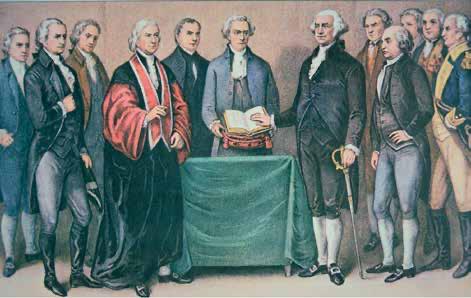
was the only time Washington would capitulate to an enemy, but it was not the end of his usefulness. It was part of his apprenticeship. Braddock’s defeat in 1755 exposed him to chaos, fear, death, and the collapse of imperial con$dence. Frontier war taught him that courage alone is not wisdom, and that command requires more than ambition.
A lesser understanding of human development treats failure as disquali$cation. Freemasonry o"ers a deeper view. Failure may become the blow of the gavel. It may reveal what pride concealed. It may remove what cannot stand. It may awaken a man to the need for discipline, patience, counsel, and restraint.
!e rough ashlar does not become smoother by avoiding contact. It becomes smoother by being worked.
But the most striking testimony to Washington’s imperfection comes from his own mouth, on the day he accepted the command that would de$ne his life.
On June 15, 1775, the Continental Congress appointed him Commander-in-Chief of the armed forces of the united colonies. His brief reply on that occasion ought to be read by every Mason who has ever felt unequal to a charge. He told the Congress that he was sensible of the high honor done him, but that he felt great distress from a consciousness that his abilities and military experience might not be equal to the trust. He pledged to enter upon the duty and to exert every power he possessed. And then, with a candor that belongs entirely to the rough ashlar, he asked that his words be remembered:
I beg it may be remembered by every gentleman in the room, that I this day declare with the utmost sincerity I do not think myself equal to the command I am honored with.
!is is not false modesty. It is not the rhetorical humility of a con$dent man. It is the recorded testimony of a Brother who knows what is being placed upon him and who refuses to pretend otherwise. !e Mason who hears these words hears the rough ashlar speaking. !e stone is un$nished. !e stone knows it is un$nished. And the stone still steps forward.
!e lesson is not that Washington’s self-doubt was incidental to his greatness. !e lesson is that his self-doubt was constitutive of it. He did not lead because he was certain. He led because he was willing.
Six months into his command, in January of 1776, Washington wrote to Joseph Reed and asked for something that very few public men ever ask for. He asked to be told his faults.
I can bear to hear of imputed or real errors. "e man, who wishes to stand well in the opinion of others, must do this; because he is thereby enabled to correct his faults, or remove prejudices which are imbibed against him.
A Mason cannot read these words without recognition. !ey are the working-tools philosophy in Washington’s own pen. !e gavel does not atter the stone. !e square does not excuse it. But Washington went further than the symbolic implication. He invited the gavel. He requested it. He understood that without truthful correction, no man can become workable, and no leader can become trustworthy.
!is is the di"erence between a vain man and a Masonic man. !e vain man defends his roughness. !e Masonic man invites the tool that will reveal it. Washington’s correspondence shows him repeatedly inviting that tool – from Reed, from his closest o&cers, from Congress itself. He dra ed, redra ed, sought counsel, accepted dissent, and corrected what
could be corrected.
!ere is also a deeper kind of imperfection in Washington’s life: the imperfection of speech, judgment, and public expression. Julius F. Sachse’s Washington’s Masonic Correspondence is useful here because it gives us Washington not merely as a public symbol, but as a careful writer. Sachse notes that Washington preserved much of his Masonic correspondence and that letters sent to him by Masonic bodies, along with his replies, were o en copied into his private letter books. More importantly for our theme, Sachse describes Washington’s method: he would o en make a rough copy of a reply, then digest, alter, correct, or change its parts before a fair copy was made and sent.
!at is a perfect image of Masonic formation. !e mature Washington did with words what the Mason is taught to do with character. He dra ed. He reviewed. He corrected. He restrained. He did not treat the $rst impulse as the $nal form. He allowed deliberation to intervene between feeling and expression. !is is not merely literary discipline. It is moral discipline.
But the discipline did not always reach completion before the moment demanded action. In the dark autumn of 1776, a er the loss of New York and the army’s retreat to Harlem Heights, Washington wrote a long letter to the President of Congress in which he set forth, with painful candor, the di&culties of his command and his doubts about his own ability to surmount them. At the close of that letter, he added a sentence that no marble Washington could have written:
I must apologize for the liberties taken in this letter, and for the blots and scratchings therein, not having time to give it more correctly.
!e Commander-in-Chief, in the midst of
disaster, sending Congress a letter he himself describes as imperfect, blotted, and uncorrected. !e rough dra , sent because the moment did not permit a fair copy. !e Mason notes the moral architecture of that admission. !ere are seasons when a man must o"er his work un$nished because the labor cannot wait. To do so without pretense, to name the un$nished as un$nished and o"er it anyway, is itself a form of integrity. In our time, when speech is o en immediate, reactive, and unmeasured, Washington’s practice o"ers a quiet lesson. A rough dra is not a failure. It is the beginning of responsibility. !e problem is not that the $rst form is imperfect. !e problem is when we refuse to revise it, or when we pretend that what is un$nished is $nished.
!e Mason’s life is a dra under correction.
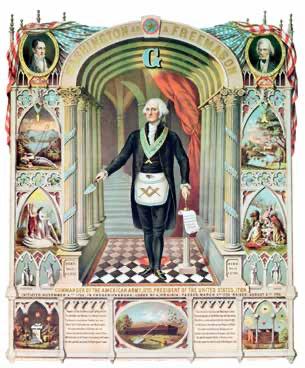
Sachse’s work also helps place Washington’s Masonic identity on $rmer documentary ground. !e correspondence he gathers includes addresses and replies involving Alexandria Lodge, King David’s Lodge in
Rhode Island, lodges and Grand Lodges in several states, and the later exchanges connected to debates about Masonry and public life. Sachse emphasizes that these materials were found among the Washington Papers in the Library of Congress and that photostatic copies had been secured for the Grand Lodge of Pennsylvania.
!is documentary care matters. It reminds us that truth is not preserved by sentiment alone. It requires records, archives, patience, and humility before evidence. !e study of imperfection includes the imperfection of memory. What is not recorded may be exaggerated. What is recorded may be misread. What is cherished may be embellished. What is opposed may be distorted. !e Mason must therefore be both reverent and careful.
Among the documents Sachse gathers, two letters in particular allow us to hear Washington’s voice not as a public man addressing his country, but as a Brother addressing his Brethren. !ey give us his Masonic register at the height of his presidency, and they speak directly to our theme.
In January of 1792, the Grand Lodge of Pennsylvania sent a delegation to call upon him at the presidential mansion in Philadelphia. He replied in the formal language of fraternal correspondence, but the substance is more than ceremony. He thanked his Brethren and o"ered, in turn, his earnest prayers for their happiness while they should remain in this terrestrial mansion, and that they might therea er meet as brethren in the Eternal Temple of the Supreme Architect.
!e Mason will recognize at once what is happening in that sentence. !e terrestrial mansion is the un$nished work. !e Eternal Temple is the work as it shall be. !e Supreme Architect is the principle by which the
work is squared. Washington places himself, his correspondents, and the public o&ce he then held within the Cra ’s most ancient image of labor, formation, and completion to come. He does not present himself as the builder. He presents himself as one of the brethren in a building whose plan is not his to draw.
!e fuller statement comes four years later, in December of 1796, when the same Grand Lodge sent its address near the close of his presidency. His reply, written and signed in his own hand and now preserved in the archives of the Grand Lodge of Pennsylvania, is among the most directly Masonic statements he ever set down. !e exchange has been reproduced in fac-simile more widely than any other Masonic letter of his pen, sometimes by reverence, sometimes by misuse, but the original speaks plainly when it is allowed to:
To have been, in any degree, an instrument in the hands of Providence, to promote order and union, and erect upon a solid foundation the true principles of government, is only to have shared with many others in a labour, the result of which let us hope, will prove through all ages, a sanctuary for brothers and a lodge for the virtues. Permit me to reciprocate your prayers for my temporal happiness, and to supplicate that we may all meet therea er in that eternal temple, whose builder is the great architect of the Universe.
Read with the rough ashlar in mind, this letter is theological autobiography. Washington does not claim authorship of the republic. He claims only to have shared in a labour. He does not call the result $nished. He calls it a sanctuary and a lodge – symbols of work in progress, places where Brethren continue to gather and build. He ends not with the satisfaction of completion, but with the supplication that the labor will be brought, beyond this life, into the presence of the Architect
who alone can $nish it.
!is is the Masonic register of imperfection. It is not the rhetoric of false modesty. It is the disposition of a worked stone that knows itself to be only one stone in a Temple it cannot complete alone. !e man who declared at the foot of his command in 1775 that he did not think himself equal to the trust, and who at the close of his command in 1783 had asked the Almighty to bind the citizens of the new nation in fraternal a"ection, here closes his presidency with the same testimony in Masonic dress: I have shared, I have laboured, I am still a Brother, and the Temple is not yet built.
!ere is no monument in those sentences. !ere is a Brother.
!ree months a er the Pennsylvania reply, in March of 1797, the Brethren of Alexandria Lodge No. 22 – his own Lodge, the Lodge in which he had served as Worshipful Master –wrote to congratulate him on his retirement from public service. !ey addressed him as “the Master Workman in erecting the Temple of Liberty in the west,” and assured him that during his presidency he had “acted on the square with foreign Nations.” His reply, also preserved in his hand, declined the language of personal greatness and returned the Brethren’s salutation in the same Masonic register. He described himself once more as “an humble instrument” of the Supreme Architect, and accepted with gratitude the assurance that he had acted upon the square in his public capacity, calling that assurance among his principal enjoyments in this terrestrial Lodge. !at phrase repays attention. Washington’s own Brethren had measured him by the Masonic working tools and pronounced him true. Washington received that judgment not as attery, but as the verdict that mattered most to him. !e presidency had been Masonic labor. !e square had been applied.
!e work had been received. A worked stone is one that the Brethren are willing to set in the wall.
!is brings us to Joseph Ritner’s Vindication of General Washington, a work from the Anti-Masonic period. Ritner’s pamphlet is not useful because it gives a $nal account of Washington’s Masonry. It is useful because it shows Washington’s memory under dispute. In Ritner’s framing, Washington’s connection to Freemasonry is treated as a stigma from which his character must be vindicated. !e pamphlet tries to use Washington’s Farewell Address and warnings against dangerous combinations as evidence against secret societies, including Freemasonry.
A Masonic article should not accept Ritner’s polemic uncritically. But neither should it ignore him. Ritner represents another kind of roughness: the roughness of public controversy. Washington’s name became a stone over which others struck their own tools. Masons claimed him. Anti-Masons contested him. Patriots revered him. Partisans used him. Biographers shaped him. Institutions preserved him. Critics tried to rescue him from associations they disliked.
Sachse, writing within the Masonic tradition but with the discipline of an archivist, documents the precise mechanism by which this contestation worked. During the Anti-Masonic agitation of the late 1820s and early 1830s, the political leaders of the movement turned to two letters above all: the December 1796 reply to the Grand Lodge of Pennsylvania, which they argued was undated and therefore not authentic, and the brief 1798 correspondence between Washington and the Lutheran minister G. W. Snyder of Fredericktown, in which Washington responded to Snyder’s warnings about the Bavarian Illuminati. Both letters were marshaled to
argue that Washington had distanced himself from the Cra . Sachse’s photostatic record, secured for the Grand Lodge of Pennsylvania, was assembled in part to put such misuse on a documentary footing where it could be examined rather than merely repeated.
!e Snyder correspondence repays close examination, because it became the principal Anti-Masonic ammunition of the period in which Ritner wrote. Sachse, drawing on contemporary church records, identi$es Snyder as an unstable agitator twice driven from his Reformed congregation in Frederick, Maryland, and ultimately decided against in civil court in 1800. In the summer of 1798, Snyder wrote to Washington enclosing John Robison’s pamphlet Proofs of a Conspiracy, which alleged that Freemasonry had been in$ltrated by the Bavarian Illuminati. Snyder labored under the false impression that Washington was a kind of Grand Master General presiding over all American Lodges, who could therefore investigate and purge them. Washington replied a month later, taking the rare precaution of pressing a copy of his answer, a precaution he did not always observe in his Masonic correspondence. Sachse, who examined the original press copy in the Library of Congress, reads this care as evidence that Washington recognized the letter could be misused.
!e sentence Anti-Masons would later seize upon was Washington’s correction of Snyder’s misimpression: that Washington presided over no Lodge and had been in one only once or twice within the last thirty years. Sachse’s documentary work shows what those words actually meant. “Preside over none” referred to the present moment, as Washington had been Worshipful Master of Alexandria Lodge No. 22 in 1788 and 1789, and remained a member of that Lodge to the end of his life. “Once or twice within the last thirty years” referred to regular weekly Lodge attendance, not to all Masonic activity. During those
same thirty years, Washington had walked in the Pennsylvania Grand Lodge procession of 1778 with three hundred Brethren; he had attended Masonic festivals with American Union Lodge in 1779, 1782, and 1784; he had been escorted by his own Lodge to and from a public Masonic dinner in 1797; and most famously, on September 18, 1793, he had laid the cornerstone of the United States Capitol in full Masonic regalia, wearing the Apron presented to him by Lafayette and processing publicly with his Brethren in the sight of the federal city.
But the most important sentence of Washington’s reply to Snyder is the one Anti-Masons rarely quoted. Having corrected Snyder’s misimpression about his Masonic o&ces, Washington concluded with a defense of American Masonry that the disciples of Robison could not absorb:
I believe notwithstanding, that none of the Lodges in this Country are contaminated with the principles ascribed to the society of the Illuminati.
!is was, as Sachse rightly emphasizes, a defense of American Masonry, not an abandonment of it. Washington was telling a stranger that whatever Robison alleged about secret societies abroad, the Lodges of his own country – the Lodges in which he had been raised, in which he had served as Master, in which he had stood at the cornerstone of the Capitol – were not contaminated by such doctrines. !e letter ended where Anti-Masonic readings preferred not to begin.
!e pattern of the misuse is as instructive as the misuse itself. Sachse documents that Anti-Masonic publications italicized the words “thirty years” while suppressing the closing defense of American Lodges; treated the press copy as evidence of secrecy rather than care; and weighted a single sentence against the documentary record of Washington’s
Masonic public appearances. Italics replaced evidence. Correction of a misinformed correspondent was treated as renunciation. Ritner did not invent this reading; he inherited it. He participated in it. His pamphlet is therefore useful to the Mason today not as historical authority, but as a case study in how a contested memory becomes detached from its evidentiary base.
!is, too, belongs to the study of imperfection.
No great life passes into memory untouched. Once a man becomes a symbol, he is no longer interpreted only by evidence. He is interpreted by need. Each generation asks him to serve its anxieties. For Masons, the danger is hagiography. For opponents, the danger is distortion. Both can be forms of untruth. !e square must be applied to admiration as well as accusation.
Ritner’s use of the Farewell Address is especially relevant as the nation approaches its 250th anniversary. Washington’s Farewell Address is among the mature expressions of his public philosophy. It warns against faction, disorder, the manipulation of public passions, and associations that seek to control or overawe constitutional deliberation. Ritner quotes this warning and argues that Freemasonry falls within it; he also admits that Washington did not name Freemasonry directly in the Farewell Address, but claims that the general principle applies.
Here again, the Mason must read carefully. Washington’s warning against faction is real. His concern for the republic’s moral architecture is real. But the application of that warning to Freemasonry was Ritner’s interpretation, formed in the heat of Anti-Masonic controversy. !e value for us is not that Ritner settles the matter. !e value is that he forces us to confront the fragility of public
memory and the need for disciplined interpretation.
!e Farewell Address itself may be read, in a Masonic spirit, as the counsel of a man who had spent a lifetime learning the cost of disorder. !e young surveyor measured land. !e young o&cer learned through defeat. !e commander learned to govern ambition under necessity. !e president learned the di&culty of holding union together among competing passions. By the time of the Farewell Address, Washington was no longer merely measuring $elds or armies. He was measuring the moral dangers of a republic. What is striking, when one reads the Address with the rough ashlar in mind, is that Washington never abandons the language of his own limitation. He tells his fellow citizens that he has, with good intentions, contributed to the government the best exertions of which a very fallible judgment was capable. He admits that he was not unconscious in the outset of the inferiority of his quali$cations. He notes that experience has, in his own eyes, perhaps still more in the eyes of others, strengthened the motives to di&dence of himself. And he closes the public chapter of his life by saying that every day the increasing weight of years admonishes him more and more that the shade of retirement is as necessary to him as it will be welcome. !ese are not the words of marble. !ey are the words of a worked stone speaking to those who must continue the labor. Here the rough ashlar becomes civic.
Freemasonry teaches that the improvement of the individual is not an isolated private exercise. !e point is not to polish oneself for vanity. !e point is to become $t for use. A stone is perfected not for display alone, but for the building. A Mason is improved not merely for his own satisfaction, but so that he may better serve his family, his Lodge, his neighbor, and the commonwealth.
Washington’s life reveals this movement from self-command to public usefulness. His imperfections were not erased; they were governed. His ambition was not absent; it was disciplined. His temper was not imaginary; it was restrained. His judgment was not born complete; it was formed by experience. His words did not emerge $nished; they were dra ed and corrected. His memory did not remain uncontested; it had to be defended, examined, and squared by evidence. !is is why Washington remains useful for the June theme. He does not teach us that the Mason must be awless. He teaches that the Mason must be workable.
!ere is a temptation in commemorative years to polish history until it no longer breathes. !e 250th anniversary of the United States will bring speeches, ceremonies, patriotic recollections, and renewed attention to the founding generation. Much of this will be worthy. But the Masonic contribution should be deeper than celebration alone. We can o"er a language of formation. We can say that nations, like men, are not born perfect. !ey are quarried in di&culty, shaped through con ict, corrected through law, and judged by their willingness to apply the tools of truth to themselves.
!e American founding itself may be understood as a rough ashlar. It declared principles greater than its practices. It spoke of liberty while tolerating bondage. It proclaimed equality while leaving many outside the full protection of that promise. It created constitutional forms that required later generations to labor, amend, struggle, and correct. To commemorate 250 years honestly is not to deny the roughness. It is to ask whether the work continues.
Freemasonry is well suited to such a commemoration because it understands imperfection without despair. !e rough ashlar
is not an insult. It is a summons. It tells the initiate: here is the truth of your present condition, and here also is the hope of your improvement.
Washington’s life, read through Hayden, the Journals, Sachse, Ritner, the gathered correspondence of his command and presidency, and the Farewell Address, gives us a layered meditation on this truth. Hayden shows us the broken column of Masonic memory. !e Journals show us the young man before the polish. !e wartime letters show us the Brother who declared himself unequal to his charge and yet stepped forward, who invited the correction of his friends, who apologized for the blots in a letter sent in the night because the morning would not wait. Sachse shows us the mature Brother correcting his words and preserving his correspondence –and addressing his Brethren, near the close of his presidency, in the language of one who had only shared in a labour, and who supplicated to be brought, with them, into the Eternal Temple of the Architect. Ritner shows us the contested surface of public reputation. !e Farewell Address shows us the worked stone speaking to an un$nished republic, still in the language of his own fallibility.
Together, these works prevent us from making Washington either an idol or an object of dismissal. He was neither perfect marble nor useless stone. He was a man under discipline. And perhaps that is the most Masonic way to remember him.
!e rough ashlar is central to our symbolism because imperfection is central to our humanity. Every Brother brings into the Lodge some unevenness of temper, judgment, habit, fear, pride, ignorance, or wound. !e question is not whether the stone is rough. !e question is whether it can receive the tools. Washington’s example suggests that the
answer may be yes – not easily, not instantly, and not without failure, but yes. A young man may become measured. A defeated o&cer may become steadier. A doubting commander may continue when certainty does not come. A public servant may become more restrained. A rough dra may become a fair copy. A contested memory may be brought back to evidence. A nation may continue to labor toward its own professed ideals.
!e work is never $nished in this life. !at, too, is part of the lesson. !e perfect ashlar is an aspiration, not a boast. !e Temple is built by men who know they are still being worked upon.
In this June issue, as we study imperfection, Washington should not stand before us as a distant statue. He should stand beside us as a Brother in formation – a man of measure, trial, correction, restraint, and service. His greatness lies not in the absence of roughness, but in the lifelong submission of that roughness to duty.
!e un$nished stone became useful.
!at is enough to make him worthy of study.
And enough to remind us that our own work continues.
REFERENCES
Hayden, Sidney. Washington and His Masonic Compeers. New York: Masonic Publishing and Manufacturing Co., 1869.
Ritner, Joseph. Vindication of General Washington from the Stigma of Adherence to Secret Societies. Boston: Ezra Lincoln, 1841.
Sachse, Julius F. Washington’s Masonic Correspondence as Found Among the Washington Papers in the Library of Congress. Compiled from the original records, under the direction of the Committee on Library of the Grand
Lodge of Pennsylvania, with annotations. Philadelphia: Grand Lodge of Pennsylvania, 1915. Includes Washington’s correspondence with Watson and Cassoul (1782), Alexandria Lodge No. 39 (1783, 1784), King David’s Lodge of Newport (1790), the Grand Lodges of South Carolina, Georgia, Pennsylvania (1792, 1796), Massachusetts (1792, 1797), Maryland (1798), Alexandria Lodge No. 22 (1797), and the 1798 exchange with G. W. Snyder.
Washington, George. George Washington’s Farewell Address. New York: Krill Press / Firework Press, 2015. Originally delivered September 19, 1796.
Washington, George. "e Journals of George Washington. Madison & Adams Press / e-artnow, 2017. Comprising Journal of My Journey Over the Mountains, 1747–1748, and "e Journal of Major George Washington, 1753–1754.
Washington, George. Washington on Leadership: Lessons and Wisdom from the Father of Our Country. New York: Skyhorse Publishing, 2015. A compilation of Washington’s letters, addresses, and speeches across the Revolutionary and Presidential years, including the Acceptance of Appointment (June 15, 1775), the Letter to Joseph Reed (January 14, 1776), the Letter to the President of Congress (September 24, 1776), the Newburgh Speech (March 15, 1783), the Circular to the Governors (June 8, 1783), and the Farewell Address (September 19, 1796).
Kaleem Kamboj is a Master Mason of Wilmette-Evans Lodge No. 524, Illinois, professor at Parsons School of Design, !e New School University, and a researcher in Masonic symbolism, Su$ philosophy, and global intellectual history.
by RWB:. Stephen A. Hurlbut, Grand Orator
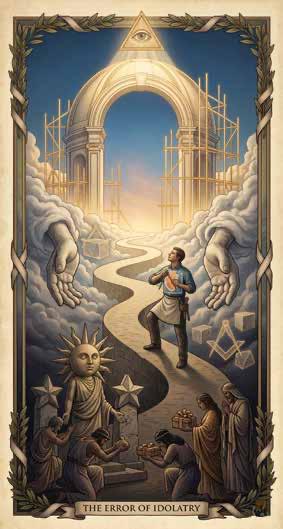
"Religion then everywhere, at all times, and in all places, uses symbols—idolatry abuses them. Freemasonry professes to recognize this distinction and acts upon it." — Bro. Stephen A. Hurlbut, Grand Orator (Spring$eld, IL, 1860)
Editors Note* In his 1860 Annual Oration to the Grand Lodge of Illinois, Brother Stephen A. Hurlbut delivered a strict warning against treating Masonic forms as static idols. He noted that the untutored tribes of antiquity fell into error whenever they substituted the material symbol (like the material sun or stars) for the divine unity and order they were meant to represent.
For the modern Speculative Mason, Hurlbut argues that our tokens, grips, and words are not decorative prizes or rigid checklist items. !ey are a "technology of consciousness" meant to make great truths adhere to the memory by connecting them with palpable images. !e tools are designed to look through our current, broken human architecture, guiding the initiate to actively work upon the "un nished holy of holies" within his own soul.
!e following oration was pronounced by the grand orator, Brother. Stephen A. Hurlbut, in Spring$eld, Oct. 3, 1860, upon the occasion of the installation of the o&cers of the grand lodge.
At this recurring anniversary, brethren of the grand lodge of Illinois, the duty has devolved on me to deliver the annual address and to vindicate and illustrate before this audience, somewhat of the principles and practices of that beloved Order which we justly hold in $lial veneration.
In this age of ours, when publicity seems to be the rage and passion of the time, when even the sacred privacies of domestic life are rashly intruded upon by a sensation making press for a sensation loving people—it does seem strange that there stands forth in our own country, and in all countries, an institution whose vast bulk challenges notice, whose admirable proportions invite admiration—but whose closely guarded portals provoke while they repel that eager curiosity that would gladly penetrate and publish the interior economy that pervades the massive structure.
Ba'ed in the vain attempt, this same eager and prurient curiosity, repelled because its aim and ends are valueless, indulges occasionally in the cheap luxury of attack upon principles of which it is ignorant, and forms and modes of thought and action which it cannot comprehend. But to the earnest and the thoughtful, to those who desire to look beneath the surface and to trace in form and symbol, in old rites, in token, and type, the interior beauty and value of the substance that is behind the form of the reality that is imaged in the symbol—of the actual facts that resulted in the commemoratory rite—of the covenant of promise that is bound up with the token and the type—to all this class of observers and of thinkers Freemasonry o"ers an attractive study—and if they come worthy and well quali$ed, throws wide her doors and admits them within her sacred vestibules.
!is method of teaching great truths by visible signs—and making them adhere to the memory by connecting them with palpable images—this symbolism, which is one of the chief characteristics of masonry, is of
an antiquity that antedates the deluge and is contemporary with created man. Like every other good tiling, it cometh down from on high—it claims the Supreme Architect and Bene$cent Father for its Original Source, and vindicates its derivation by its beauty, simplicity, and power. It is his method of teaching his system of impressing great ideas on the soul and heart of his creature, and because it comes from him, because he hath given to all His children the capacity to be impressed with these visible manifestations and the faculty of associating the thing signi$ed with the symbolism apparent in all nations, kindreds, tongues, and people over the whole Earth. And yet, like all other great and useful things, this faculty, this power, this association of ideas is liable to abuse, and is in fact abused.
!e glorious sun which an all wise father placed in the heaven above us, the most beautiful and perfect token and sign of that unwearied aid unsel$sh benevolence that shines alike upon the just and unjust—in whose warmth and light the material world bathes daily in the most perfect luxury of life, this great symbol that should inevitably lead the soul of man beyond the great orb of light, to the Father of all Light—became, in the darkness of our race, substituted into the place of the great Being whom it signi$ed, and to whom it led—and the pure faith that came forth from the ark rapidly degenerated on the mountains of Persia into an idolatry, where the material symbol and not the spiritual thing signi$ed became the object of unenlightened worship.
So too on the plains of Chaldea, while Abraham yet uncalled of God mingled among the people from whom he was soon to be set apart—the starry host of heaven, the $rmament which is His handiwork, and to which He appeals as the heralds of his in$nite glory—those unnumbered orbs which sang
together when this new created Earth of ours sprang into living beauty by the $at of Jehovah—these stars whose harmony of movement are the most perfect symbol and representative of the divine unity and order—even they in the gross imaginations of the untutored shepherd tribes of Mesopotamia—became living powers, and were worshipped as gods themselves instead of being held as the creatures and evidences of a Great Creator.
And as the light of the early, simple, patriarchal faith faded more and more away —as violence, crime, rapine, lust of dominion, and all kindred wrongs, usurped sway over mankind and swept the stormy and unregulated passions of the human race still farther and farther away from the source of all light, and out upon the very verge of thick and utter darkness—this distinction between symbolism and idolatry—became more and more vague until at last almost the whole human family became the slaves of their own dark and abused imaginations, and crouching and shivering in their self-created horror, bowed in slavish adoration before the representatives of their own vices and passions. !en faded almost utterly from Earth the Old God-given religion of Love—and in its place was substituted the human worship of terror.
Nor has this darkness yet passed away—nor can it pass until the human race once more enlightened by the progress of revelation shall learn again the early lessons, $rst taught in the primeval time, and which ever since have whispered in the breezes of Heaven, have gently fallen with the cool dews, have sounded in music wherever has been heard the voice or waters, have been uttered in the splendors of every dawning day and every declining sun, have spangled heaven every starlit night—have echoed in every free and loving human speech, and thrilled in all the holy relations of parent and child, of husband and wife—and which consummated, ful$lled and completely symbolized and made man-
ifest on calvary—shall teach a willing world that God is love. Religion then everywhere, at all times, and in all places, uses symbols — idolatry abuses them. Freemasonry professes to recognize this distinction and acts upon it. Freemasonry uses her symbols and her tokens—but looks through them and teaches her initiates the grand lessons of which the material tokens are but remembrances.
Many centuries ago—while yet the newly risen Earth was moist with the waters that had overwhelmed it—when the patriarch descended from his ark of refuge and gazed upon a new and strange Earth—while the tremendous destruction was still fresh and vivid in the hearts of the remnant saved from the ancient world— while the solid mountains and the wild slopes of America bore the visible traces of the great disaster—it pleased the Creator to enter into a covenant with the survivors, and of his own free will and pleasure to pledge the faith of the Almighty against the recurrence of a similar event. !is covenant was “with all esh that is upon the Earth”—and then that all men forever a er while the Earth endured, might be free from the fearful looking for of another deluge—the Great Creator and teacher set his token in the heavens, and the rainbow, God’s token in the sky, has become in all languages and among all people the symbol and emblem of safety and of hope.
In humble imitation of this teaching, masonry makes her covenants and enforces the memory of obligation and of duty by her tokens and emblems, all full of meaning and valuable lessons. !e whole Sacred Volume of the word of God is full of illustrations of this method of conveying instruction, and we who are masons know that the moral and religious lessons of our institution, as well as the illustrations by which they are enforced, are naturally and beautifully drawn from that great fountain of truth and instruction. In
fact, the whole fabric of symbolic masonry has been constructed and is historically stated in the VoSL. Nor is this universal passion in the human heart for symbolic teaching con$ned to things of religion only. It pervades all ranks, penetrates all classes, mingles in all occupations, animates and gives grappling and hold to all feelings. In monarchial countries, the crown is a sacred thing—not that the mere golden coronal bedecked with gems, of itself takes any hold upon the reverence and a"ections of the people—but because around it cluster associations of national power and glory—because it is the emblem, token, and symbol of national existence and authority.
What is the national ag? It is, but so many yards of bunting of various colors—and in itself of no value or use—but men die for it and die willingly, rejoicingly, and we call them heroes, and call them justly heroes. Many a bold breast has dashed un inchingly upon the serried bayonet, or stood like a tower before the $ery hail of shot, that the ag of our country might not go down in the shock of battle; many a gallant arm has cloven its bloody way through opposing masses because the gleam of the stars and stripes beckoned him to follow and sustain it; why? Because that starry ag was the symbol, emblem, and token of his country’s honor. !e wedding ring, what is it? Nothing but a simple circle of gold. But it binds two lives into one—within its tiny measure, it holds an untold wealth of precious memories and exquisite hopes. It is the witness and the seal of the holiest of human relations, the pledge of plighted faith, the evidence of complete and perfected womanhood.
Earth’s treasures cannot buy it. Even when gaunt hunger and pinching penury wring bitter tears from the widow’s eyes, weary with labor and watching, she will not part with it. Nothing but the fear of starvation for his children will make her give up the last mem-
ory of the husband she lost long ago. It is the token, the symbol, the emblem of all the joy of her life. Our child that god gave us, to bring sunshine into our home, and to make us feel that a new heaven and a new Earth were around us—so perfectly did its presence Lighten up all nature; our child that he only lent us for a while is taken home again, and tender hands have gently laid him away—and out of the utter wreck of our hopes and our joy, we have saved but one tress of sunny hair, that used to wave over his brow and once in a while vail the light of his glad eye.
Can you buy that memorial? It is the symbol of the dead boy—and as we gaze on it so vividly does memory recall the past, that we almost wait with breathless anxiety for the glad sound of the joyous voice that on Earth we shall never hear again. !e world has been busy all its life in ministering to this feeling. !e cultivated nations of the early time — Egyptian, Phoenician, and Assyrian — wrought out their symbols in their architecture. !ey chiseled out their ideas in stone; did they wish to express duration in contrast with life?
!ey piled the massive pyramid over the sarcophagus of the king. !e slender obelisk, pointing ever to the sky, represented the soul’s aspiration; and over all they carved the wisdom of the time and its history, in characters. !us, the architect became the scholar. !e mere builder and mason was compelled and required to understand the secret import of the carvings that adorned and gave value to the building; and operative masonry became indissolubly connected with what there then was of science, religion, and literature. !e Hebrew people bore with them from the land of bondage much of the learning that prevailed, and the constant intercourse between them and the nations above named gave scope for the development of the people, and the whole history of the nation shows that they were in the constant habit of using
the forms of symbolical teaching and expressing great truths by signs.
Tablet and monument sculptured stone, or rude pillar, gathered in its materials from some river over which the people passed dryshod, everywhere and in all places over the favored land, there rose these memorials of the past. But when the fullness of time came, when from every quarter of the known world Instructed skill and diligent labor were gathered around the throne of Solomon, When east and west, and north and south became tributary to his will and obedient to his summons, on the hill of god, the mount long since dedicated by the sublimest o"ering that nature knows, uprose that wonderful creation of high art and devotional skill—the $rst temple of stone within whose walls the Almighty deigned to dwell.
Peace spread her azure wings beneath the sky of Jerusalem. Reduced under one single will, the $ery tribes of the desert planted their pennons in the sands. Infant commerce stretched her sails from the ports of Tire and Sidon, and Ezion Geber on the southern sea, opened its glad harbor for the bold cra that tempted the dangers of the Indian Ocean. Long caravans of patient camels pressed with unwavering feet through the Syrian desert. Tadmor in the wilderness, and many another old historic city, marked the wisdom and the power of the Hebrew monarch. From remotest corners of the then known world, ocked to the court of the son of David, all that was highest, wisest, best, of the sons of men.
Ethiopia and Egypt, Sheba and Arabia, and the very isles of the sea, rendered their tribute. !e cedar forests that for centuries had waved in colossal grandeur upon the summits of Lebanon, by the aid of the willing Tyrians, were swept from the mountain's brow to swell the triumph of the time. Quarries of rare stone, long unvisited, gave up their precious deposits to the skill of man.
Hewn, squared, and numbered in the quarries where they were raised, each massive block, august in its magni$cent proportions, or glorious in its elaborate carving, moved on to swell the triumph and to become a component part in the grand whole which crowned the brow of Mount Moriah with glory and with beauty.
Up sprang the wonderful edi$ce. No sound of axe or hammer, or any tool of iron was heard, but the grand whole, solid in its foundation as the rock-ribbed hills themselves—perfect In its proportions as the divine work, with many a turret and pinnacle sheathed with beaten gold, re ected back to heaven some portion of the glory that it gave, and became $t dwelling place for Him whose presence $lls all space, but who chooses to dwell among the children of men. And then the capstone was brought home with shouting and praise—when the glory of the Lord descended and $lled the whole house—when the king and all the people fell upon their faces before the exceeding brightness, and the very priests of the living God ed for their lives from before his visible presence.
What Mason of the higher degrees does not know, the profound signi$cance of these great facts, the important lessons embedded in this history? With the completion of this august structure, and the traditional record of the events which preceded, accompanied, and followed it, commences the dissemination of masonry. From Palestine to Phoenicia, and thence by easy and natural stages to each several nation distinguished by its love for arts and sciences, the instructed eye of the well-taught mason sees in dim traces that still survive the devouring tooth of time, the dim pathway of our order.
!e great principles of association bind all its elements together. !e need of help, and the readiness to bestow aid, the one as far spread as the human Family—the other the
child and creature of liberal education and trained humanity, were and are the springs and sources of the masonic brotherhood, and the close alliance of the mystic tie, invented and enforced for the defense and support of the operative mason, became at length the distinguishing beauty and the peculiar characteristic of the speculative. And thus down the rushing current of time, sometimes submerged and out of sight In the whirlpools that engulfed empires, and made nations their play-things—sometimes stamping its existence in the minsters and abbeys, cathedrals and palaces, which piety or luxury loved to erect— we trace the foot-prints of the successors of those who erected the pillars, one on the right and one on the le of the beautiful porch that yielded access to the temple of God.
Kilwinning and Melrose, York and Westminster, Strasbourg and Notre Dame are memorials of our fathers in this great society, and are each canonized and made holy by all the gentle o&ces of kindness that distinguish and adorn the fraternity. !ese strong old days have gone. No longer now does the free and accepted mason in very deed work out his apprenticeship, and hew out his testimonials from the solid rock. No longer now does the fellowcra adjust with square, plumb, and level, the rough work of the apprentice. No longer does the master or overseer of the work supervise the actual labor of his inferiors. But modern masonry, abandoning all these grosser elements of toil, teaches all the great principles of religion and morality, of common brotherhood and universal charity, through the medium of these symbols and tokens of an elder time. Deep in the mystic vaults of her representative temple, she rehearses the lessons of bygone ages. From the very ground- oor on which her acolyte presses his $rst step—on through the glorious porch, the winding stairs, the middle chamber, the un$nished holy of holies—every footprint of the initiate is on hallowed
ground. !e absolute and $nal belief in God, which admits him, is deepened and intensi$ed as he goes on, and the life that is within the man is cultivated, educated, and $tly taught in lessons of never-dying import, until the immortality that has been enforced upon his soul by indelible impressions becomes his actual and unquestionable belief.
Along with this faith in God and hope in himself and mankind, masonry teaches its followers the largest charity for all—charity in that true and original sense, which means unsel$sh love—that a"ection of the soul which survives the wreck of matter and the crush of worlds, and is nearest akin to deity. !e system of words, signs, tokens, grips, and symbols, which were the protection and the evidence of the operatives who traveled in foreign lands, remains, but is realized and spiritualized into a higher meaning, a more e"ective union. Masonry is meant to be as universal as the world, its love all-embracing, extending wherever the cry of su"ering and of innocence goes up to heaven. No miserable percentage of pro$t contains it; no petty calculation of life and health insurance bounds it. It combines the largest liberty of individual benevolence with the advantages of association, rendering strength to each and dwar$ng neither.
Fully combining in its own existence this great original system of teaching by symbols, and this other great element of enlightened and systematic charity, masonry survives today, in all the magni$cence of its superb proportions, glorious in its original beauty, enriched by the labors of twenty centuries, $lled with the spoil of all nations and tongues, founded on the solid rock, course upon course of Solomonian masonry, bearing alo the glorious fabric, with doors inexorably closed against the base, the cowardly, and ever opening for the true and faithful; there stands the edi$ce of modern masonry.
What son of hers that has ever penetrated the sacred portal and ranged along the mighty walks but bids her godspeed. Advance then fearlessly on thy mission of mercy—call in from all haunts of crime and of su"ering the broken-hearted and the weeping children of the Great Father.
Inaugurate again in this world of ours the reign of love, and in the pathway which religion opens before thee—press on noble order of our a"ections, and as the heaping harvest of good deeds crowns thy progress, each humble, grateful heart of thy children shall say— amen, so mote it be.
by Darin A. Lahners, PM, FILOR
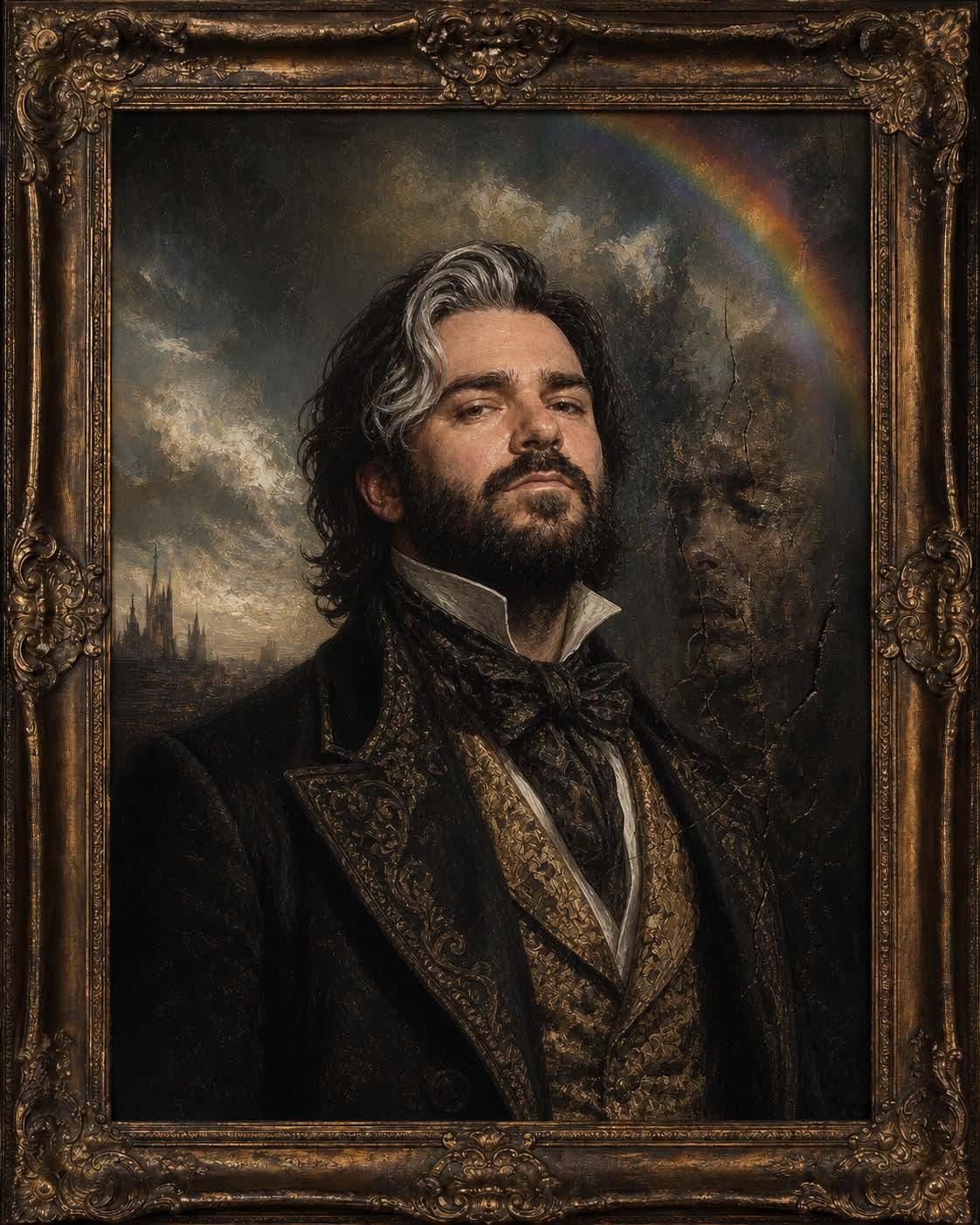
rother scar il e s The Picture of Dorian Gray is a no el hose the e is concerne ith the conflict et een aesthetic eauty an oral res onsi ility as ell as the nature of the hu an soul. t e oses a hiloso hical ara o the se aration of e ternal eauty an internal corru tion. Dorian Gray s unchanging hysical a earance contrasts ith the grotes ue i age in his hi en ortrait hich re uires the rea er to uestion their ie s on the eaning of selfhoo conscience an ethical e elo ent. hen ie e through a asonic stan oint one consi ers the conce t of the rough ashlar an the sy ol re resenting the i erfect hu an that ust e sha e an refine through oral isci line the no el eco es allegorical. Rather than refining his ashlar Dorian a an ons all atte ts at oral self i ro e ent. is life eco es not a rocess of sha ing an olishing the self ut a eli erate surren er to eca ence the antithesis of the i ea of rough ashlar.
The rough ashlar in ree asonry can e thought to sy oli e the hu an con ition rior to the or of our oral an s iritual self i ro e ent ra i erfect an in nee of sha ing through the lessons of the asonic Degrees. Through our ersonal la or in the uarries of life the in i i ual ree ason see s to transfor this unrefine stone into a erfect ashlar re resenting oral co letion an har ony ith higher rinci les here y e ight eco e a li ing stone for that house not a e ith han s eternal in the hea ens. The rough an erfect ashlars are eta hors for ethical rogress a hiloso hy of life as a rocess of refine ent.
n il e s no el Dorian Gray egins as a erfect e o i ent of the rough ashlar young i ressiona le an orally unfor e . o e er the tra ectory of his life is not one of refine ent ut of corru tion a ing hi a ee ly ironic in ersion of the asonic i eal.
At the eginning of the no el Dorian is characteri e y innocence. asil all ar sees in hi oth hysical erfection an an uns oile soul re ar ing on the rofoun influence Dorian s eauty e erts u on hi . This initial state corres on s to the rough ashlar s latent otential. Dorian is not yet orally for e ut ossesses the ca acity for goo ness an e elo ent. ro a asonic ense Dorian coul e thought of as an ntere A rentice. i e an ntere
A rentice stan s in the ortheast corner of the o ge Dorian stan s at the threshol of oral life. oth a aiting the instruction that ill eter ine their ethical irection.
e are then intro uce to or enry otton the chisel that egins to car e Dorian s character. or enry es ouses a he onistic orl ie groun e in sensation an aesthetic in ulgence is issing tra itional orality as re ressi e. is or s ca ti ate Dorian ho eco es increasingly con ince that the ursuit of leasure is life s highest ai . nstea of gui ing Dorian to ar self i ro e ent or enry encourages self in ulgence an oral eca ence. The sha ing of Dorian s rough ashlar thus eco es a rocess of estruction rather than i ro e ent.
The i otal o ent in the no el hen Dorian ishes to re ain eternally youthful hile his ortrait ages can e un erstoo as a sy olic re ection of the asonic rocess. y i orcing his out ar a earance fro his inner reality Dorian e a es the conse uences that oul naturally gui e his oral an s iritual e elo ent. n asonic sy olis the or ing of the ashlar e en s u on recogni ing i erfections an learning fro the to chisel the into erfection. i e a a y ho is learning to al reco ering fro failure is the only ay to learn an to gro . Dorian ho e er su resses this rocess entirely. The ortrait a sol es hi of such allo ing hi to re ain aesthetically erfect hile his soul ecays in secrecy.
The ortrait itself functions as a in of anti ashlar a surface u on hich the truth of Dorian s soul is eli erately sha e y his ego. ach act of cruelty selfishness or eca ence lea es a isi le ar transfor ing the ainting into a grotes ue reflection of Dorian s ethical an s iritual state. nli e the asonic crafts an ho consciously sha es his stone to ar erfection Dorian refuses to engage in any such la or. e neither ac no le ges his oral fla s nor atte ts to correct the . The ortrait eco es a assi e recor of egeneration not an instru ent of i ro e ent.
Dorian s relationshi ith i yl ane further illustrates his failure to engage in oral refine ent. nitially enchante y her artistic talent an e otional e ressi eness Dorian is ra n not to her as a erson ut to hat she re resents aesthetically. hen her acting falters ecause she has fallen genuinely in lo e ith hi Dorian re ects her cruelly. e is una le to reconcile his authentic e otions ith his i eals of eauty. is callous is issal lea s to her suici e ar ing the first a or stain u on his soul.
At this uncture Dorian riefly feels re orse suggesting the ossi ility of oral a a ening. o e er he uic ly su resses this i ulse influence once again y or enry s rationali ations.
During our asonic la ors the rocess of refining the rough ashlar re uires intros ection re entance an a co it ent to ethical gro th. Dorian s fleeting guilt coul e ie e as the first stri e of the chisel against his fla e character the o ent hen transfor ation ight egin. et he refuses to ursue it. nstea he chooses to re el in his ne foun free o fro conse uences allo ing the ortrait to ear the ur en of his actions. This ecision ar s a turning oint Dorian consciously a an ons the ath of refine ent an e races a life of oral ecay.
As the no el rogresses Dorian s in ulgences gro increasingly e tre e. e i erses hi self in a lifestyle of aesthetic e eri entation collecting rare o ects ursuing illicit leasures an culti ating an aura of ystery an scan al. hile il e resents these e eriences in his tra e ar lush rose you can feel the un ercurrent of e tiness to arallel Dorian s con ition. Dorian s life has eco e a series of sensory istractions e oi of genuine eaning or oral su stance. Perha s fittingly or ro hetically il e s rose as a criti ue on o ernity. Again e can see the allusions to the hat the he onistic lifestyle of Dorian is oing to his ashlar.
The ur er of asil all ar re resents the enith of Dorian s oral colla se. asil ho once a ire Dorian s eauty an innocence confronts hi a out the ru ors of his he onis . n a o ent of es eration an rage Dorian ills hi silencing the oice of conscience that asil re resents. This act is articularly significant ithin the asonic fra e or .
asil can e seen as a figure atte ting to gui e Dorian to ar self recognition an oral accounta ility the ery rocesses necessary for refining the rough ashlar. A further allusion ight e seen hereas asil coul e seen as ira an Dorian as the Ruffians. asil ira sy oli ing integrity an a irtuous life hereas Dorian Ruffians sy oli e ishonesty an ice.
After asil s eath the ortrait eco es increasingly efor e an horrific reflecting the cu ulati e eight of his co oun e oral failures. t is grotes ue age an t iste a co lete in ersion of the youthful eauty Dorian resents to the orl . This uality un erscores the no el s central the e the i ossi ility of esca ing the conse uences of one s actions. en though Dorian e a es e ternal unish ent his inner self ears the full i rint of his oral an s iritual corru tion. oul e re iss to not oint out the i ea of the uality that the osaic a e ent sy oli es here ith Dorian s life eing also chec ere ith goo an e il.
et Dorian is not entirely e oi of the esire for re e tion. To ar the en of the no el he atte ts to refor hi self y s aring a young o an fro his usual attern of e loitation an a use. e ho es that this act of ercy ill i ro e the ortrait signaling a re ersal of his oral ecay. o e er hen he e a ines the ainting he fin s it unchange or e en ore horrifying. This o ent re eals a crucial insight to the rea er an to Dorian that genuine oral refine ent cannot e achie e through su erficial gestures or self ser ing oti es. asonically e un erstan that the la or of transfor ing the rough ashlar re uires sincerity isci line an sustaine lifelong effort. Dorian s atte t at refor is insincere oti ate y anity rather than true con iction.
Dorian s final act estroying the ortrait re resents his es erate atte t to esca e the truth of his o n soul. elie ing that the ainting is the source of his tor ent he see s to annihilate it. o e er this act results in his o n eath his o y is foun age an isfigure hile the ortrait re erts to its original eauty. This ra atic re ersal un erscores the no el s oral logic. The self cannot e i i e in efinitely the soul ine ita ly reclai s its rightful for . n asonic ter s Dorian s refusal to refine his rough ashlar lea not to free o ut to estruction. e has faile to sha e his oral character an instea allo e it to eco e irre ara ly corru te . e is not fit to e a li ing stone for lace ent in the uil ing of that house not a e ith han s eternal in the hea ens.
Through this lens The Picture of Dorian Gray can e rea as a cautionary tale a out the angers of neglecting oral e elo ent. Dorian egins as an unfor e soul ith the otential for gro th an refine ent ut he chooses a ath of in ulgence an enial that lea s to his estruction. is refusal to engage in the rocess of oral self i ro e ent transfor s hi fro a figure of otential into a sy ol of oral failure. il e s no el therefore ser es as a o erful re in er that true eauty lies not in out ar a earance ut in the isci line rocess that culti ates the ethical self li e the sha ing of the rough ashlar re uires effort honesty an a co it ent to ethical i eals.
by RWB Wayne Spooner Grand Lodge, Membership Committee Chairman
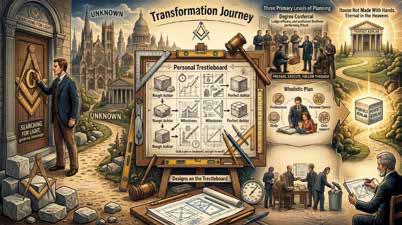
Good men, who the Rough Ashlar symbolically represents, knock on the door of Freemasonry in search of self-improvement and being useful to others. !ey are primarily seeking to be transformed and purposefully embark on that faithful journey to become the best version of themselves, a destination symbolically represented by the Perfect Ashlar. !ose rough stones, who are made of quality material, choose, "of their own free will and accord," to step forward into the unknown in search of Light, guidance, knowledge and support on that life-changing road ahead. For those perfect stones to be revealed, it takes a plan of action and a de$ned roadmap to make purposeful progress toward that desired destination. To understand the transformation just highlighted, we must thoroughly consider a third Masonic symbol: the Trestleboard.
Grounded in the skill and discipline of architecture and geometry, our fore-brothers employed a plan or design to transform an idea or vision into a $nished building, castle or cathedral. !e Trestleboard represents that plan, design or map, which outlines the steps and milestones along with the talents, skills
and resources needed to successfully bring their vision to life. As Speculative Freemasons, the Trestleboard remains a critical symbol in our lives as we seek to plan the future for ourselves and the fraternity.
As Freemasons, how are we using the symbol of the Trestleboard today to transform our lives and advance the legacy of our ancient and honorable fraternity? Keep in mind that the designs or plans outlined on the Trestleboard delineate the e&cient and e"ective use of resources (e.g., worker talents, strengths and abilities along with time and money) to generate desired outcomes and positive results. We begin by asking these foundational questions, "why are we embarking on this journey?" or "What is the purpose?" Another valuable question in our arsenal is, "What does success look like?"
With those answers gathered, we can address "How" to get from where we are now and arrive at that envisioned future or de$ned outcome. We develop ideas, ask additional questions, and evaluate options regarding the exact steps or actions needed. With all that preparation work done, we can $nalize the
designs to place on the Trestleboard and get to work building.
To illuminate this concept further, let's dive into the ""ree Primary Levels of Planning" that bene$t our Brethren, Lodges and fraternity.
Planning Level #1 – Individual Tasks, Projects, Events and Meetings
At this level, we are focused on getting things done that have a clearly de$ned beginning and end. For example, to have successful degree conferral experience, the Lodge o&cers must assemble a team of pro$cient Brethren who can execute the various roles to deliver a quality experience for the candidate on the date and time selected. !e required materials and equipment must be identi$ed and provided so the ceremony progresses smoothly. All of the details must be planned and executed to achieve a successful degree conferral experience for the candidate and Brethren present.
An important discipline should be implemented at this planning level – Prepare, Execute, and Follow Up or Follow !rough. To complete every task, project, event or meeting, draw the designs on the Trestleboard for the details on how to prepare, then those needed to execute the speci$c actions during, and $nally outline the follow-up steps a erward. Using those three planning phases will increase the probability of repeatable success.
Planning Level #2 – You (including your combined Professional, Personal and Civic Life)
As good men who seek to live purposefully and productively, we have several priorities that span the professional, personal and civic parts of our lives. Each of those areas require plans to progress toward our life's goals. A best practice is managing all of those priorities and the associated planning work from
one combined Trestleboard or plan. Why? Because you are a whole person, and all your allocation of scarce resources (including time and money) are best managed through one wide lens. Here, we invoke the symbol of the 24-inch gauge, a valued Masonic working tool. Regardless of our periodic desire for more, we all have just 24 hours per day.
Assuming that we get 8 hours of sleep daily, we are le with 16 waking hours to allocate toward advancing the various priorities in our lives. Let's widen that lens. A best practice is to view your time allocation or "capacity to produce" weekly; therefore, you are working with 112 waking hours (16 hours times seven days a week). With that bigger bucket of time to allocate, you have more mental room to plan. You can better see the space to consistently dedicate 5 hours per week to study and practice your ritual work and use 10 hours per week for general reading activities that incorporate career, work, and Masonic topics, amongst many more. Next, if you have a family, then include those priorities and activities in your wholistic plan and time allocation outlined on your Personal Trestleboard. Further, as you take on and advance in Masonic leadership roles, it is critical to get the support of your family so that you can allocate the required time needed for your ongoing learning and development, management activities, and leadership responsibilities.
Planning Level #3 - Your Lodge and the Fraternity
At this level, you are dealing with signi$cantly greater complexity. Why? Because you have increased the number of people involved, you have an additional entity that needs to thrive and survive and a larger volume of tasks, projects, events and meetings to execute. Embrace that complexity and use your Masonic or organizational Trestleboard as a valued tool and discipline.
First, since "Hope" is not an e"ective strategy,
create a written plan to document and manage that complexity. Share a dra of that plan with the key people involved in executing the work outlined in the plan. In a Lodge, share the plan with the Brethren and welcome their feedback. Your plan or Trestleboard is not a document you frame and put on a wall; it is alive and should be updated and refreshed regularly. !erefore, monitor and track the progress of the priorities, activities, events, projects and meetings outlined on this Trestleboard. Provide updates on the plan's progress through regular update communications, especially during Lodge meetings.
Lastly, celebrate success as a team for the positive results achieved; don't overlook that last step! Remember, there are no small jobs, just work that needs to get done per the designs on the Trestleboard. !e Brother who took out the trash a er dinner and the other who performed a long lecture during the degree ceremony both contributed to making the overall Masonic event a true success. Recognize the work done by all.
Planning is a skill that is improved by acquiring knowledge and through dedicated practice! !e time investment to learn and develop planning skills is critical to the positive advancement of your personal Masonic Journey of Self-Improvement. It is a cornerstone of the exceptional work we accomplish together as Freemasons that bene$ts our families, workplace, communities and beloved fraternity.
!roughout the ages, the Master Architects did the work to draw the designs on the Trestleboard for fellow cra smen to read and execute. Only those Brethren who attained true mastery in the skills of building, planning, design and resource allocation were entrusted with this valuable work. In our progress in Freemasonry, we are taught the timeless lesson of what occurs when the Master Architect is unavailable, and no designs are placed on the Trestleboard. We encourage
you to elevate your planning skill; it is essential to your future personal success and the longevity of our Speculative Cra of Builders.
Lastly, to achieve the positive outcomes that we envision for every project we undertake, the priority aspects of our lives and the work of Illinois Freemasonry require us to thoughtfully and skillfully plan the future. We want to chart a transformational course to drive and achieve successful results. Invest the time and resources to improve your knowledge, skill and ability by executing the abovementioned planning levels. !rough the powerful use of our Personal and Masonic Trestleboards, the future of Illinois Freemasonry will be built square, level and plumb.
Now, grab a pen or keyboard, and get to work!
R.W.B Wayne Spooner Grand Lodge, Membership Committee Chairman
by !e Grand Lodge of Illinois
In Illinois Freemasonry, we are always looking for men of $ne character to join our brotherhood. One way we do so is through our Illinois Masonic Awareness Ashlars –three tactics lodges across the state have used to attract good men to our fraternity. !ose are:
1.Be Visible
2.Tell Our Story
3.Inspire Pride and Respect
!ese three things will help us expand our fraternity and connect with good men who would make an invaluable addition to our Brotherhood, and this past month, we heard from Lodges across the state about putting these tactics into action.
Keep reading to learn how!
Ashlar #1: Be Visible
Since 2018, Cary-Grove Lodge No. 1157 has organized a car show on the Sunday before Memorial Day. Soon entering the 7th year, the car show has continued to grow annually. On average, the show features 250 cars and draws crowds of around 500-800 additional spectators.
Cary-Grove Lodge promotes the show throughout the Masonic community, with help from the entire 3rd Northern District -the Widows Sons attend the show along with the Shriners Aviator Club, who sell ra'e
tickets at the event.
In collaboration with Nunda Lodge No. 190, the two Lodges had professional banners printed to advertise the shows. Additionally, the show features professional and local DJ Rudy K, a live performance of the national anthem by the McHenry Middle Choir, and even more special guests!
Along with professional banners, the show is advertised on social media, newspapers, radio, and printed yers – reaching thousands annually. !e funds raised are used to support Cary-Grove’s College Scholarship Program, and portions are donated to various charities.
Ashlar #2: Tell Our Story
Since 1849, Scott Lodge No. 79 has been telling the story of Illinois Freemasonry through their actions in the Carlyle community. Currently, they o"er three $1000 scholarships to high school seniors and support the Caring4Carlyle food program, which sends home food bags to the unfortunate students of the Carlye School District. Last year, they also participated in the Bikes for Books Program o"ered through the Grand Lodge of Illinois
A. F. & A. M. For these reasons, they’ve had members ask to be reinstated, saying that these actions are what Masons are supposed to be doing.
Another example of their charitable actions? When a Scott Lodge Brother su"ered a stroke and was in the nursing home, his Lodge
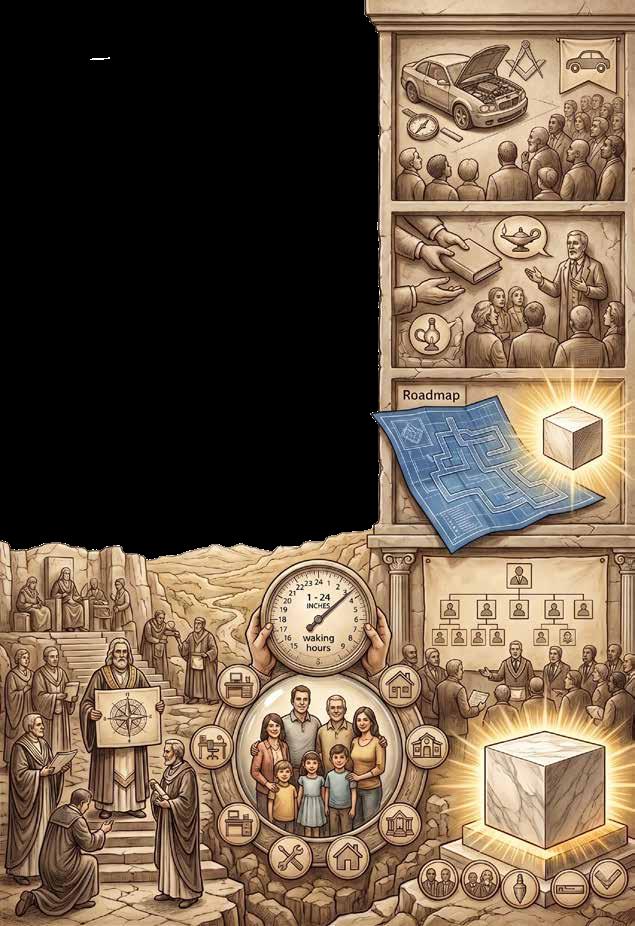


Put it iNtO PraCtiCE:
listeN tO it:
EpisODE: 0003
ThE ROugh & PerfECt Ashlar
https://tiNyurl.COM/MAPshOw0003

EpisODE: 0532
MasONiC Values iN thE WOrkplaCE
https://tiNyurl.COM/TMR0532
EpisODE: 0464
ThE 4th Pt. OF a CirClE: AstrOlOgiCal eDitiON Pt. 2
https://tiNyurl.COM/WcY0464
Midwest Conference on Masonic Education – April 24-26 - 2026, Omaha, NE

Esotericon - June 20th, 2026, Manassas, VA at Manasseh Lodge
Kansas Masonic Con - July 17th and 18th, 2026 Mission, KS at Rosedale Lodge No. 333
Masonic Camp - August 28-30, 2026 Erhard MN Moccasin Valley Camp
Yes! Masonic Con Chicago will be back in Spring 2027.
If your lodge or organization is having an Educational Event (not related to instruction or charities), please let us know. Email the details to: Admin@wcypodcast.com
Please give us at least a month notice so that we can ensure it is added.