Table Of Contents A Letter From Our Grand Master
04 By Joseph B. Ferrell
Annual Grand 23 187th Lodge Communication
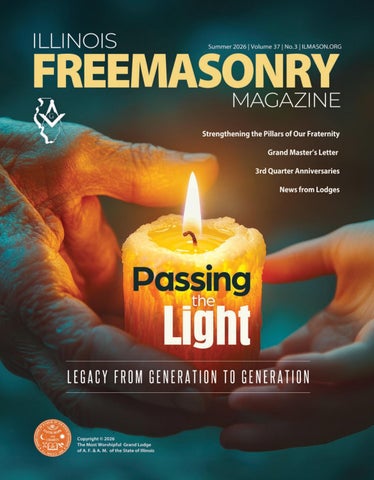
Passing the Light: Legacy from Generation to Generation
26
Legacy from Generation to Generation: One Story at a Time
28
Hidden in Plain Sight: How HERO Is Bringing Education, Awareness, and Hope to Communities Across Illinois
By Jeni Martin
What is Our Legacy?
12 By Joe Logsdon 14
22 By Patrick Grubbs
Strengthening the Pillars
Our Fraternity 06 of By David Lynch
10
Talking It Out: Town Halls Deliver Results
Passing the Light: A Legacy from Generation to Generation By Angelo S. Deserio
Memory, Mental Health,
Freemasonry 18 and By Darin A. Lahners
“Guarding the Digital West Gate…”
20 By Todd Thorson EDITORIAL EDITOR Edward Walker, R.W.B. glccnews@ilmason.org
ASSOCIATE EDITOR Mark Schmidt, W.B. GRAPHIC DESIGNER Kirsten Riedl
By Edward Walker
By Gale Vyncke
31 3rd Quarter Anniversaries 32 Latest Lodge News CONTRIBUTORS R.W.B. Ángelo S. Deserio, Senior Grand Deacon B. Joseph B. Ferrell, Most Worshipful Grand Master R.W.B. Patrick Grubbs, Junior Grand Warden W.B. Darin A. Lahners, FILOR R.W.B. Joe Logsdon, Past Master B. David Lynch, Most Worshipful Past Grand Master Jeni Martin, Director of IMOS and IMCAP Todd Thorson, PM/Secretary Gale Vyncke, Director of Illinois Student Assistance Program (IMSAP)
Illinois Freemasonry (ISSN 1091-2258, USPS 014656) is published February, May , August and November by the Most Worshipful Grand Lodge of Ancient, Free and Accepted Masons of the State of Illinois, 3731 Wabash Ave., Springfield, IL 62711; main phone (217) 529-8900. Periodical postage paid at Springfield, IL and additional mailing offices. POSTMASTER: Send address changes to ILLINOIS FREEMASONRY, 3731 Wabash Ave., Springfield, IL 62711. Printed in the U.S.A. Permission to reprint articles appearing in this publication will be granted to recognized Masonic publications. Such permission can be requested by writing to the Grand Secretary, 3731 Wabash Ave., Springfield, IL 62711: by faxing to 217-529-0242: or by email at GS@ilmason.org
C.L.I.
C ERT IF IED LO D G E I N ST RU C TO R
R EQ UIRE ME N TS
Open and Close in form and short
■
Purging with and without an assistant
■
■ ■
Five challenges and four wrong passes
■
Dispense / Merge / Test Oath
■
Labor to Refreshment and back All ceremonies except reception of G. M. and P. G. M. First section of all three degrees
■
Secretary’s interrogatories
■
If you have interest in becoming a Certified Instructor, see the Master of your lodge or your DDGM who will point you in the right direction.
A LETTER FROM OUR
GRAND MASTER significance for all involved. For the new Brother, it marks the beginning of a valuable Masonic journey— one rooted in self-improvement, making genuine friends, and serving others. For the Lodge, it is a confirmation that the timeless principles and tenets of our ancient and honorable fraternity still resonate in the current age. For the young men putting their high school or college years behind them and striking out on a new career path, joining the Lodge feels less like a single act and more like a rite of passage woven into the fabric of their lives. Like the invigorating days of summer, these new Brothers contribute fresh perspectives, new energy, and evolving aspirations for themselves and Freemasonry. With that continuity and push forward, our legacy is not static; it is a living thread that adapts, grows, and evolves with the addition of each new generation.
Brethren, The Hourglass is a powerful symbol in Ancient Craft Masonry. It reminds us to live our lives intentionally and maximize our positive impact during the brief time allotted to us here. As we progress through the chapters of our lives, we embrace the legacy and follow the traditions of our families and fraternity. In particular, the summertime every year inspires reflection and renewal. The air is warm, the days linger long into golden evenings, and Brothers gather with their friends and families to celebrate milestones both personal and shared. These treasured moments occur on porches, in parks, and within the walls of our Lodges.
As Freemasons, we are seekers of Light—knowledge and wisdom. We have the distinction of being both students and teachers. Of particular note is the importance of our Masonic mentors and teachers. These faithful friends and guides are critical to the active perpetuation of our treasured knowledge and practices across time. The passing of that Light from mentor to mentee or teacher to student is some of the most important work that we do as Freemasons. Said simply, mentorship lies at the heart of Freemasonry! It is through patient instruction, shared experience, and personal examples that our Masonic values are communicated and transmitted. Mentors do not simply teach ritual or Lodge procedures; they model integrity, humility, and dedication. Letting go and supporting the thoughtful ideas, talents, and drive of the next generation of officers, committeemen and Brethren are challenging, yet so rewarding for our mentors and teachers. Ask these Brothers how they measure success and a common response will be getting others to truly learn and advance our Masonic work forward.
For our families, communities and fraternity, summer marks a season of graduations and transitions. It is a time when sons step forward to follow the paths laid before them and mentors step back after years of guidance to let others lead. Within Freemasonry, this seasonal rhythm takes on a deeper symbolic meaning. Summer becomes not just a period of celebration, but a living expression of continuity—of knowledge passed down, of values preserved, and of bonds strengthened across generations. Tears readily fall when a father or grandfather is handed a petition for Masonic membership by a son or grandson to join the Lodge. Words do not capture the emotion and joy of that moment. Truly, few traditions capture the spirit of continuity more vividly than the sight of a son entering the same Lodge as his father, or even his grandfather before him. These moments are rich with personal
4
As we progress through the chapters of our lives, we embrace the legacy and follow the traditions of our families and fraternity.”
Historically, Freemasonry traces its roots to the operative stonemasons who were the master craftsmen who built castles, cathedrals, and other monuments of antiquity, some of which are still standing today. In modern or Speculative Freemasonry, we focus on building better men who exhibit good moral character to emulate, inspire genuine friendships forged with mutual trust, and demonstrate fortitude and perseverance towards achieving goals and a collective purpose. Even in the warmth of summer, we are still at work building. It just looks a bit different—we exchange warm hugs and greetings at the Lodge picnic, we march together in the community parade, we split up the time manning the Lodge booth at the community fair or festival, we let the conversations stretch longer sitting around a backyard fire pit, or we pool our talents on projects to refresh the Masonic temple. All the while, we are intentionally moving the work of our fraternity forward and enjoying that quality time invested together.
passes the reigns of leadership to a new capable committee chairman, a Brother delivers his first lecture during a degree ceremony, and many more. Our legacy endures through these deliberate actions done repeatedly in all seasons by dedicated, upright and honorable men. Fundamentally, as Brothers of Illinois Freemasonry, we will continue to inspire the good men around us to live a more intentional and engaged life filled with purpose, learning, and Brotherly Love.
Similar to the sand particles moving through the hourglass, summer will transition to cooler weather. The Brethren will be back at labor if the Lodge went dark during July and August. If your Lodge Officer Installation event occurred during the summer, then the new officers are ready to lead and further the plans outlined on the Lodge Trestleboard. Weaving our Masonic practices and activities into the fabric of our lives provides support, structure, and consistency as we advance through the years and decades ahead. We genuinely look forward to moments when a son or grandson transforms into “Brother,” a candidate successfully delivers his proficiency exam, the mentor
Enjoy the rest of summer! Fraternally and sincerely, Joseph B. Ferrell Grand Master Grand Lodge of Illinois A.F. & A.M.
5
PILLARS Fraternity STRENGTHENING THE
of Our
By David Lynch
“Our Legacy is passing along Masonic teachings to all Masons, established or new Masons in our Lodges.”
6
O
ur Grand Master’s theme of “Legacy and Fellowship” brings something to mind, that I have been toiling over for some years now. What is our “Legacy”? Our Legacy is passing along Masonic teachings to all Masons, established or new Masons in our Lodges. Masonry has existed for hundreds of years, and those teachings and Masonic rituals have been recited and passed by word of mouth as long as we have been making men Masons. How are they passed along by Masons learning, memorizing, and conferring the degrees and lectures to the new Masons? In learning the work, you will become not only a better Mason and man, but you will learn what Masonry is teaching you. When you learn from a lecture, the words will stick in your mind, and you start to realize what they are saying to you and what you need to learn from them. I look around our Masonic Fraternity today and what do I see, degrees that cannot be done within the Lodge without asking members from other Lodges for assistance. (if you can do them within your Lodge, I congratulate you). I see degree examinations not being completed, Lodges reading the lectures and members who just sit and not learn. They use their cell phones in Lodge reading the ritual without learning it. In this age with instant answers, knowledge is easily gained by typing it into your computer or asking your cell phones. The information is instantly provided to us. We have gotten lazy and away from what we are, Masons. Our work, conferred by memory, is what sets us apart from other organizations or fraternities. Yes, I am an older Mason who learned my catechism by word of mouth, and guess what, I remember it after all these years. There was no “Short Form,” you learned the catechism if you wanted to progress in the Lodge. My opinion, and mine only, I think the short form is hurting our Fraternity more than it helped. I have heard all the reasons or excuses for not learning the work, “I cannot memorize, or I have a tough time remembering ritual, etc... This may be true of some of our members, but many of our members are using excuses and too many Lodges are allowing it to happen.
the lectures when I was going through my degrees and I asked him to teach me. The Book of Standard Work just came out, and he gave one to me. He worked with me; he told me to start out easily with the Charge to the Candidate in the First Degree. I learned it and after I gave it a couple of times, he told me to learn the Senior Deacons Lecture in the Second Degree. I looked at it and said are you crazy, he said to me, and I will never forget these words, “Brother understand that there is nothing in this book you can’t learn.” So, I kept learning the work and conferring what I could when I could, my goal at that time was to become a Grand Lecturer. That is where I failed, no excuses, many years later I passed my CLI exam and never went any further. Yes, I regret it but there is still a glimmer of spark within me to finish it. We need not to just consume information, to learn from it, not just know it, but to be able to use and grow because of it, yes become better every day with it. Unfortunately, people have a false belief about learning, they think that is a factor of IQ or some inherited trait like eye color or hair color, you get what you got and that is all. You are either born a quick learner, or you are not, but that is not true at all. While some might find it easier, just like some might find talking to people easier, everyone can do both with the right training and practice. Know this for sure that researchers repeatedly state that, “Learners are made, not born.” I will give you some tips that will significantly improve your learning capacity.
FIRST You need to become comfortable with the struggle of learning something new. The struggle that comes with learning anything new. In our overly convenient instant access information world we live in today, we have become insanely lazy, anything that requires us to try hard or think deeply, almost seems like a violation, like having to do long form math when we have a calculator in our phone or computer. (I am guilty of this also), as soon as something gets hard, we give up. Why bother when we could just “Google” or say, “Alexa.” When you are learning something new, your brain is physically rewired, it is working hard, the brain is having to break new ground and pave new pathways. It is building new neurotransmitters and connections in your brain. This is equivalent of your brain muscles doing bicep curls in the gym to make your arms bigger, in the moment it might be painful, but your biceps grow. The pain is what makes the gain of learning grow. We have all heard,” No pain, no gain.”
Sometimes this is an excuse for being lazy and social media is making us lazy. I will inform you of something that I failed at and I still regret it. I became a Master Mason in 1987, and I was so impressed when receiving the lectures, I wanted to start learning some of them. I had a challenging time memorizing the work, job, young children and all the other outside distractions, but I stayed with it, until I learned what I wanted to. A Brother in Lodge, Howard Norton, gave some of
7
Your brain is a muscle and needs exercise. If you quit exercising, what happens, you lose everything you worked for, so it is the same with your brain, it needs exercise. I know Masons over the years who were in their mid-tolate nineties giving lectures and many of them told me it keeps them sharp. Get the idea now, exercise your brain and your brain will pay you back!
FIFTH Reflect, revisit and review to improve. If you really want to learn and retain something, it requires you to revisit and review it several times. This is done every time you confer a degree or give a lecture; you must review it to make sure you remember it. Our brain pays less attention the first time we are experiencing anything, Repeating information over longer intervals sends a stronger signal to the brain. It says, hey, we are serious about this, please store this and be ready to recall it. Like any new path, you must travel repeatedly until the path becomes known and comfortable. That is what is going on inside your brain.
SECOND Have a goal for learning what you want to study, a focus, what exactly is it you are trying to learn. Without a focus our reticular activation system is intentionally filtering it all out, deleting it so it does not fry our system. You must tell your it what it is that you want to learn, so it will find it for you, show it to you, and store it for you. Consider it like giving instructions to Google, without telling it what you are looking for, it stares back at you with a blank white screen. Now when you do give your mind a learning goal, wow, it is even better than google.
FINALLY, be ready to teach it to someone. To really know and understand something you must teach it to someone else. Explain it to them as you are teaching it. Discuss what you have learned with them. Then you will have a better understanding of what it is you have learned. One last tip I learned from a Grand Lecturer when I was studying the work and presenting it. Before you give any part of our degrees or our lectures take two to three very deep breaths. In through your nose slowly and exhale out of your mouth. This has a dual purpose; one it fills your brain with oxygen and clears your mind, secondly it relaxes you. Try it, I know it will help.
THIRD Learn in sessions. Studies have proven that concentrated sessions of 30 to 60 minutes of learning new materials is best. Anything less is not enough to cement the learning in and anything more is too much for your brain to take in at one time. Try only a 30-minute learning session every morning when driving to work or when drinking your coffee instead of watching the news. Personally, I must be alone in a room with no interruptions. Remember, to space the repetition. What do you think would be better? Water your lawn three times a week for 30 minutes or water your lawn for 90-minutes once a week. By spacing the watering of your lawn over the week it will produce a greener lawn and so it will produce a growing mind. When you learn a little bit at a time it gives the nerve transmitter enough time to reset themselves.
I do not believe that you want to see all our work in a video or a DVD. The Grand Lodge of Michigan has put the lectures on DVDs. I have a copy of them and although they are not bad, the candidate does not get the same experience when it is done in Lodge by a fellow Mason, it is done perfect on the DVD but there is a personal touch missing. Brethren I hope that you all would commit yourself to our Fraternity and make sure our Legacy of passing down the principals and lessons of Masonry continues forever and not be swallowed up by modern day convinces. Study the work and become a Certified Lodge Instructor or better yet a Grand Lecturer. You will have a deeper sense of accomplishment. We need more Brethren in Illinois to become commissioned instructors; we are desperately losing more than we are gaining. Please learn the work and encourage new and current Masons to learn the work. Remember our number one job as a Mason is not only to make a man better but also to make new Masons.
FOURTH Effectively learn some, not all the work at one time. It is better to learn one lecture or one part of a degree than to try and learn all the parts of Masonry at one time. You want to avoid over learning and subjecting your brain to all sorts of topics and rituals. Stick to learning one thing at a time, it avoids overloading your brain with more than you can manage. In trying to learn too much, it stunts the learning process and the ability to retain it. This is like overtraining a muscle, you take it from muscle building to muscle destroy. The muscle starts to break down. Which people are doing all day on social media. Everything I am describing about learning is against all behavior of internet and social media reading.
Keep Our Legacy Moving On! Brother David Lynch Most Worshipful Past Grand Master
8
9
PASSING THE LIGHT
Legacy
from Generation to Generation not designed to provide general classroom supplies for teachers. While a backpack filled with notebooks, pencils, folders, and other necessary items may seem simple, for some families it can mean the difference between starting the school year with confidence or uncertainty. By ensuring that each backpack contains the supplies specifically required by the student's school, Lodges can maximize the impact of their support and help set children up for success from the very first day of school. Through these efforts, you help remove barriers and create opportunities for students to focus on learning and success.
By Jeni Martin
A
s the Director of the IMOS and IMCAP Charities, I have the privilege of seeing firsthand the incredible impact our Lodges have on their communities. Time and again, I am reminded that one of the greatest gifts we can offer is not simply financial support or material assistance, it is opportunity. By investing in the next generation, we are truly passing the light from one generation to the next. With the start of a new school year just around the corner, I want to encourage every Illinois Master Mason to consider how your Lodge can make a difference through programs such as Bikes 4 Books, the Lodge Backpack Connection, IMCAP Lodge Scholarships and Youth Organization Connection initiatives. These programs are more than charitable initiatives; they are opportunities to change lives.
Every year, participation in Bikes 4 Books continues to increase. By rewarding students in kindergarten through fifth grade for their reading achievements, you are helping young people discover the value of education, perseverance, and personal accomplishment. Every bicycle awarded represents more than a prize, it represents encouragement. It tells a child that hard work matters and that someone in their community believes in them. Likewise, the backpacks filled with school supplies provided through the Lodge Backpack Connection program give students in need the essential tools to begin the school year prepared and confident. If you are unsure which supplies are required, reach out directly to the local school to obtain the student's official school supply list. This program is intended to provide needy students with the personal supplies they need for success in the classroom; it is
10
As Masons, you often speak about building better men. I believe that process begins by helping build a better future for our youth. When you support educational programs in your community, you are putting your principles into action. You are demonstrating Brotherly Love through your concern for others, Relief through your charitable efforts, and Truth through your commitment to education and personal growth. I believe one important step to ensure the future strength of your fraternity is to remain visible as a force for good in your communities. The children who participate in Bikes 4 Books today may not know much about Freemasonry, but they will remember who encouraged them to read. The families who receive backpacks filled with school supplies may not know the details of your traditions, but they will remember that Illinois Masons stepped forward when help was needed.
Your Grand Lodge offers these programs because it is the right thing to do. It is impossible to overlook the lasting impression these acts of kindness leave behind. Years from now, some of these young people may become community leaders, parents, educators, first responders, veterans, or perhaps even Masons themselves. Their positive memories of Freemasonry may have begun with a bicycle earned through reading or a backpack received at the start of the school year.
When you help a child succeed today, you are helping build the foundation for a stronger community tomorrow.”
That is legacy. Every time your Lodge sponsors a reading program, fills a backpack, volunteers at a school, or supports a youth community program through service or donations, you are helping pass the light forward. You are demonstrating that Freemasonry is not simply a fraternity that preserves traditions, it is a fraternity that actively invests in the future. As we prepare for another school year, I challenge each of you to look for ways your Lodge can participate. Whether through Bikes 4 Books, a Backpack Connection program, volunteer service, or partnerships with local educators or youth community programs, your efforts matter. Together, we can touch the lives of thousands of children across Illinois.
The light entrusted to us by those who came before must never be extinguished. It is our responsibility to share it through service, compassion, and education. When you help a child succeed today, you are helping build the foundation for a stronger community tomorrow. That is how we pass the light. That is how we create a legacy. And that is the lasting impact Illinois Masons can continue to make for generations to come. Jeni Martin Director of IMOS and IMCAP
By Joe Logsdon
D WHAT IS OUR
Legacy? [leg-uh-see] Noun
ictionary.com defines legacy as: an existing system, process or state of affairs inherent from the past. Let’s consider this for a second. Our predecessors have left us a legacy of Ritual, Ceremony, floor work, and a standard of Charity to our community. But what legacy will we pass on to the next generation of Masons? Will it be a legacy of traveling through the chairs while letting other members conduct our meetings, or possibly a legacy of video meeting so that we don't have to go out to attend, or how about we just let Freemasonry disappear completely. That way we don't have to worry about any of it. I challenge each Brother to just look around the lodge during your next stated meeting. Consider what your lodge was like when you were initiated, passed, and raised. Were there more Masons in attendance then, has the attendance at lodge decreased since then? Are we just sitting back and letting the legacy of our ritual dissipate into a lost art? Or are we trying to learn some of it to make ourselves feel like we're contributing? Or are we truly trying to learn it.
an existing system, process or state of affairs inherent from the past.
I mean absolutely no disrespect to anyone. I know that we are all struggling to raise and support our families and must consider how tired we are after our long laborious workdays. However, we petitioned our lodge for membership for a reason. What is that reason? As for myself, I was looking for a place where I could be accepted without worrying about being myself. A place where what I have to say means something to someone. No matter how outlandish it might be. A place where respect is given when earned and graciously received when given.
12
Please permit me to reminisce for a minute. Maybe it might inspire others to consider their membership commitments. I petitioned for membership in July of 2007 and was raised on October 7th, 2007. When I petitioned, I was a real mess. I was recovering from alcoholism, and drug addiction. I had been sober for a few years. Three, I think. Anyway, I was looking for something to help me focus on my sobriety, and possibly inspire me to find out who I really am. The truly encouraging reception into this organization was really inspiring to me. I felt as though I belonged.
MY FRIEND, I THINK, IS THE TRUE LEGACY OF FREEMASONRY. However past experiences created a hidden fear that these experiences were only temporary. Fear that I would be lifted up to just have everything fall apart. However; my new Brothers were continually contacting me, encouraging me to learn some more ritual, or go with them to meetings, and degrees. Continually encouraging me to seek more light. For lack of better words. Eventually I began to see that these gentlemen truly had faith in me. As though they could see in me what I couldn't see in myself. I started finding faith in myself. A faith that had always been stripped from me by almost everyone I knew. Those who only came around when I could do something for them or needed something from me. So called friends who could never find time when I needed help. I began to see how my
new Brethren were really interested in what they could do for me. By calling to just ask if I was okay, or if I needed anything, or even to just chat for a while. A complete reversal of associations. No one asked for anything from me. In turn granting me a legacy of encouragement, and faith, a legacy I have always tried to pass on. I began to try conveying the information I was being given. As I learned an aspect, or lesson of Freemasonry discovered by my experiences within the craft, lessons which give us a completely different standard of community, and personal involvement, I noticed a change within myself. I would also strive to pass on the ceremonial procedures, and floor work as I learned them. In my own personal attempt to keep it all alive. Because to me the ceremony and ritual are just so beautiful when performed properly. I began to understand the importance of the legacy of Freemasonry. I understood how by practicing those lessons conveyed to us through our ritual, and work, I could in turn create a better person within myself. In turn creating a
legacy of self-growth, self-improvement, and self-respect. Not only for our descendant members, but also for myself, my family, and my community. I think that is what is meant by the phrase; making good men better. That my friend I think is the true legacy of Freemasonry. A legacy that has survived since the time of King Solomon. It demonstrates how the lessons, and teachings of our most Ancient Grand Masters strived to exemplify, and document these teachings through Allegorical Imagery, Ceremony, and Sacred Ritual. These practices have survived and grown throughout almost every country. Yes, ritual translations, and ceremonies have been updated, and converted to satisfactorily benefit society, and personal growth, and I have no doubt that it will continue to transform to fit societal needs. R.W.B. Joe Logsdon Past Master
PA S S I N G
light
the
A LEGACY FROM GENERATION TO GENERATION The light we receive in Freemasonry is not ours to possess, it is ours to preserve, to live, and to pass on.”
By Angelo S. Deserio
E
very Mason can remember that moment when darkness gave way to Light. While each of us experienced it in our own unique way, the meaning has never changed. That first glimpse of Masonic Light was not simply the beginning of membership in an organization. It was the beginning of a lifelong journey of learning, reflection, service, and personal growth. It was an invitation to become a better man—not only for us, but for our families, our communities, and the generations that would follow. As I have reflected on my own Masonic journey over the years, I have come to appreciate that the greatest gift Freemasonry offers is not found in titles, offices, or honors. It is found in legacy. Legacy is what remains after the meetings have adjourned, after the gavels have been passed to another Master, and after our own names become part of a lodge's history. Legacy is measured not by what we accomplished for ourselves, but by what we inspired in others. It is the Light that continues to shine because someone cared enough to pass it forward. That, more than anything else, explains why Freemasonry has endured for centuries. Buildings have been erected and replaced. Lodge rooms have moved. Customs have evolved. Generations have come and gone. Yet the principles of Brotherly Love, Relief, and Truth remain as relevant today as they were when our fraternity first began because faithful Masons have never allowed the Light to end with themselves. They passed it on.
14
We Are All Products of Someone's Example Every Mason can likely identify the Brother who made the greatest difference in his journey. Perhaps it was the Brother who first encouraged you to seek the degrees. Perhaps it was the instructor who spent evening after evening helping you memorize the ritual. Maybe it was the Past Master who quietly demonstrated patience, humility, and dignity in every meeting. Or perhaps it was simply the Brother who remembered your name on your first night in lodge and made you feel like you belonged. Rarely do these men realize the impact they have. They simply live Masonry. Their lessons are not always delivered from the East. Many are taught over coffee after lodge. Some are learned while setting up tables before dinner. Others come during long conversations while driving to a district meeting or working side by side on a charitable project. Those moments often become the lessons we remember most. Freemasonry has always been an educational institution, but its greatest classroom has never been the ritual itself. Its greatest classroom has always been the lives of good men.
A Personal Moment I will Never Forget Among all the memories my years in Masonry have given me, one stands above every other. I had the incredible privilege of obligating my own son into the fraternity. There are moments in a Mason's life that words cannot adequately capture, and this was certainly one of them. Standing beside my son as he took the same obligation that had been administered to countless Brothers before him—and to me years earlier—I experienced a depth of emotion I had never anticipated. There was immense pride, certainly. There was gratitude. There was humility. But above all, there was an overwhelming awareness that I was witnessing something much larger than either of us. At that moment, I was not simply welcoming my son into a fraternity. I was watching another generation receive the same Light that had shaped my own life. The lessons that had been entrusted to me were now beginning to take root in someone I loved most.
Ritual Gives Us Words. Brothers Give Them Meaning. Our ritual is among the most beautiful traditions preserved anywhere in the world. Its language connects us with generations of Masons who have spoken those same words across centuries and continents. Yet ritual alone cannot build character. It points toward virtue. Living Brothers demonstrate what virtue looks like. A lecture may teach us about integrity. Watching a respected Brother keep his word despite personal cost teaches us integrity in action. A degree may teach charity. Watching a lodge quietly support a widow or provide relief to a struggling family teaches the true meaning of relief. A lecture may encourage tolerance. Seeing Brothers of different occupations, backgrounds, races, generations, and political opinions sit together in harmony demonstrates tolerance in its highest form.
As I listened to the familiar words of the obligation, I could not help but think of the Brothers who had invested in me. The mentors who patiently taught the ritual. The Past Masters who corrected me when I stumbled. The friends who demonstrated through their actions that Masonry was never confined to the walls of the lodge room. Those men never imagined that their influence would one day reach my own son. Yet it had. That is how the Masonic legacy works. It moves quietly from one generation to another, often without fanfare, carried by example more than instruction. Watching my son begin his own journey reminded me that while every Mason must discover the deeper meanings of our Craft for himself, none of us walk alone. Every generation begins because another generation chose to invest in it.
Young Masons are always watching. Long before they become officers, they observe how experienced Brothers conduct themselves. How disagreements are managed. How visitors are welcomed. How candidates are treated. How mistakes are corrected. How success is shared. Whether we realize it or not, every Mason becomes an instructor simply by the way he lives.
15
Passing the Light Beyond Our Families
Legacy Is Built One Conversation at a Time
Although I was blessed to share Masonry with my son, I have also come to realize that every candidate entering our lodges is someone's son. Someone's grandson. Someone's husband. Someone's father. Someone's friend. When they cross the threshold of our lodge, they become our Brothers. Our responsibility toward them is no less significant. Some arrive knowing several members. Others know no one.
When people think about legacy, they often imagine great accomplishments. Historic buildings. Major charitable donations. Long lists of offices held. Those achievements certainly matter. But the greatest Masonic legacies are usually much quieter. A Brother patiently coaching ritual. A phone call to someone who has missed several meetings. An invitation to sit together at dinner. A ride to the lodge for an elderly member. Encouragement offered after a difficult degree. A handshake that says, "I'm glad you're here."
Some come with generations of Masonic history behind them. Others are the first in their family to knock on the lodge door. Each deserves the same encouragement.
These moments rarely appear in annual reports. Yet they often determine whether a new Mason remains active for decades. People remember how we made them feel. Long after they forget the business discussed at a stated meeting, they remember who welcomed them. Legacy grows through relationships.
Each deserves patient instruction. Each deserves genuine friendship. Every time we mentor a new Mason, we honor the Brothers who once mentored us. In that sense, every Mason becomes part of a much larger family tree.
Our Greatest Challenge
Illinois Masonry Has Always Been About People
Every generation believes its challenges are unique. Perhaps they are. Technology has transformed communication. Families face increasing demands. Communities are changing. Volunteer organizations compete for people's limited time. Freemasonry is not immune. Yet these challenges also present opportunities. The world is hungry for authentic relationships. Young men continue searching for purpose.
Throughout Illinois, our Lodges have stood as places where men from every walk of life meet upon the level. Within a single lodge room may sit farmers, police officers, teachers, engineers, physicians, mechanics, veterans, small business owners, students, and retirees. Outside the lodge, they may have little in common. Inside, they share timeless principles. That may be one of Freemasonry's greatest gifts today. We live during an era when people increasingly separate themselves into groups of similar age, occupation, political philosophy, or social background.
Families still value integrity. Communities still need servant leaders. Freemasonry possesses exactly the kind of environment where these needs can be met—but only if we intentionally invest ourselves in one another. The future of our fraternity will never depend solely upon membership numbers. It will depend upon the quality of our relationships. A lodge filled with genuine mentorship, meaningful education, sincere fellowship, and active service will always remain attractive.
Freemasonry quietly does the opposite. It teaches us to appreciate perspectives different from our own. The experienced Mason learns from the enthusiasm of youth. The younger Brother benefits from the wisdom that only decades can provide. Neither generation completes the lodge by itself. Together they strengthen it.
16
Every time we mentor a new Mason, we honor the Brothers who once mentored us.”
Stewardship, Not Ownership
Will they inherit lodges known for unity? Will they inherit traditions strengthened by purpose rather than preserved by habit? Will they inherit Brothers eager to mentor, teach, and encourage? Or will they inherit buildings where the Light has slowly dimmed because no one chose to carry it forward? The answer depends on what each of us does today.
One lesson becomes increasingly clear with time. None of this belongs to us. The Lodge we call our own was built by Brothers we never knew. The traditions we cherish were preserved by generations long before ours. The ritual we perform has been entrusted to us—not invented by us. Even the chair we occupy today will soon belong to someone else. We are not owners. We are stewards.
Passing the Light When I think back to the evening my son entered the fraternity, I realize that my pride had little to do with family tradition alone. It came from seeing the continuity of something much larger than myself. I understood more deeply than ever that the Light entrusted to me was never mine to keep. It belonged to those who came before me. It belongs equally to those who will come after me. Someday my son—and thousands of other younger Brothers across Illinois—will become the mentors, teachers, Worshipful Masters, District Deputy Grand Masters, and quiet examples that another generation will remember. They will pass forward what we choose to give them. That realization should inspire every one of us.
For a brief period of history, we have been entrusted with something precious. Our responsibility is to leave it stronger than we found it. That responsibility extends far beyond maintaining buildings or balancing budgets. It includes preserving the culture of kindness, respect, learning, and brotherhood that defines a healthy lodge. Future generations deserve nothing less.
The Light Is Seen Through Our Actions One of the greatest misconceptions about Freemasonry is that its influence ends when a meeting closes. Nothing could be further from the truth. The real work begins when we leave the Lodge. The honesty we demonstrate in business. The patience we show our families. The compassion we extend to neighbors. The respect we offer strangers. The service we provide to our communities. These are the places where Masonic Light becomes visible.
Whether we have been Masons for fifty years or five months, each of us has something to contribute. A lesson. An encouraging word. A helping hand. A patient explanation. An example worth following. These are the true building stones of our fraternity. Long after our names are forgotten, those investments will continue to bear fruit.
People may never attend one of our meetings. They may never read our ritual. But they will always observe our character. Our communities form opinions about Freemasonry by watching Freemasons. That is both a privilege and a tremendous responsibility.
The greatest monuments in Freemasonry are not carved from marble or granite. They are built in the hearts of good men. And every time one Brother helps another grow in wisdom, character, faith, and service, another light is kindled that may illuminate generations yet unborn. The Light we received was never intended to end with us. It is our sacred privilege—and our enduring responsibility—to pass it on.
Looking Toward Tomorrow Someday another generation will inherit our lodges. Young officers will occupy stations we once held. They will open meetings. Conduct degrees. Welcome candidates. Comfort grieving families. Support charitable causes. Celebrate anniversaries. Face challenges we cannot yet imagine. The question is not whether they will continue the work. The question is what kind of inheritance we will leave them.
Fraternally and respectfully, R.W.B. Ángelo S. Deserio Senior Grand Warden
17
Memory,
By WB Darin A. Lahners, FILOR
Mental Health, and FREEMASONRY
18
G
randmaster Ferrell saved my life. He doesn’t know that he did, well, he does now. There was a recent Facebook post where he pointed out that we had lost a brother to suicide, reminding brethren to seek help by using the resources here: Suicide Prevention — Illinois Freemasonry. While many brothers may have just scrolled past it, I stopped and I read his post. I stopped because I identified with that dear departed brother. For as long as I can remember, I’ve dealt with depression. Depression and other Mental Health issues are a silent killer, because there are no outward symptoms unlike other health issues. In fact, you can be sitting next to a lodge brother who outwardly appears normal; but is fighting a battle internally. Mental health issues have a stigma, and worse yet, men normally have a very difficult time discussing these issues with other men.
According to the CDC’s suicide statistics, Suicide Data and Statistics | Suicide Prevention | CDC, which was recently updated with 2024 statistics, the suicide rate for men was four times higher than it was for women. People aged older than 80 had the highest suicide rate. Racially, NonHispanic Native Americans and Non-Hispanic Whites were the highest percentages of suicide per 100,000 people. In Illinois in 2024, there were 1,426 deaths by suicide or a rate of 10.8 per 100,000 people.
Suicide Rate SEX AGE-ADJUSTED RATE PER 100,000 POPULATION Males
22.23
Females
5.58
AGE RANGE CRUDE RATE PER 100,000 POPULATION 85+
21.43
80-84
21.67
75-79
17.66
70-74
15.86
65-69
14.74
60-64
17.95
55-59
19.28
50-54
19.7
45-49
17.95
40-44
18.82
35-39
18.58
30-34
17.37
25-29
17.04
20-24
16.99
15-19
9.41
RACE/ETHNICITY AGE-ADJUSTED RATE PER 100,000 POPULATION Non-Hispanic American Indian/Alaska Native
22.45
Non-Hispanic White
17.16
Non-Hispanic Native Hawaiian/Other Pacific Islander
13.67
Non-Hispanic Multiracial
10.1
Non-Hispanic Black
8.66
Hispanic
7.96
Non-Hispanic Asian
6.43
In my case, I’ve been seeing a therapist to help me with my issues. I consider myself lucky because I am getting care, but it’s still been a battle for me. One of the things I’ve recently been exploring in therapy is how I have a difficult time setting boundaries for myself and sticking to them. It is a recurring theme in my life. When I was a child, I didn’t have a say. I developed a people-pleasing personality because I didn’t think I had any other option. It took therapy to help me discover that I was choosing not to use my voice because I didn’t want to let others down. So, I am constantly sacrificing my own happiness and well-being for others and suffering personally for it due to the anxiety and depression that comes along with that sacrifice. You see, like so many other active Freemasons, I am a member of multiple lodges and appendant bodies. Because I can’t say no, I became secretary in both my lodges, and one of the appendant bodies. Freemasonry became another job for me, one that was adding anxiety to my life, which was in turn manifesting as depression. Instead of the joy and happiness I once felt about going to lodge, degrees and Masonic events, I began to feel the opposite. I felt a crippling sense of dread. The worst part? I didn’t feel like I could talk about it with my brethren, so I didn’t. Even my good friend and mentor had no idea what I was dealing with. Many of them will read about it here for the first time. So, how did Grandmaster Ferrell help me? His post made me realize that my personal mental health and well-being is something that I need to prioritize. He reminded me that I was important, and that my life was important. So, I recently made the very difficult decision to step away from being active in most of the lodges and appendant bodies I belong to in Freemasonry. While I feel terrible, because I feel that I have let down my brethren in those lodges and bodies where I was active; I know that I’d let them down even more by continuing to pretend everything is okay when it is not and ending up in a casket. I realized that I needed to focus on healing myself, work on setting boundaries and holding them, and rediscovering those things in Freemasonry that used to bring me joy, which are Masonic writing and research. If I get back to a place where I feel I can become active again, I will, but only after I’m satisfied that I am well enough mentally to do so. Part of the process going forward is to have my own personal mission statement, of what I want out of Freemasonry, and aligning my Masonic experiences with those. I’ve developed a mantra to help with the guilt I’m feeling over feeling like I’ve let my brethren down, I remind myself that “It’s okay to take care of yourself.” Listen, if this article resonates with you, and you’re feeling similar or you just need an empathetic ear; I am here. You can message me on social media or email me at: darin.lahners@gmail.com. I can promise no judgement, just advice. Don’t suffer alone. Use the resources linked above or email me directly. Get help, and don’t be afraid, you’re not the only one dealing with this. Trust me, if I can address my struggles with brethren across the state, then you can address them with someone.
19
“Guarding the Digital West Gate…”
A NEW CYBERSECURITY SERIES FOR ILLINOIS FREEMASONRY By Todd Thorson, PM/Secretary – Elmhurst Lodge No. 941 & Green Dragon Lodge No. 821 CTO, TANJ Cybersecurity & Technology – Yorkville, IL | tthorson@tanjtech.com
B
rethren, welcome to the first installment of what will be a recurring series on a topic that affects every lodge, every officer, and every Brother who has ever clicked “I forgot my password” at 11:59 PM: Cybersecurity. And its one most of you likely aren’t paying attention to! Yes, I know — we’re a fraternity built on ancient landmarks, timeless virtues, and traditions much older than the systems we use to operate our lodges today. But while our ritual may be eternal, our technology… is not. And if we want to protect this fraternity for the next generation, we must secure our digital trestleboards just as carefully as we secure our physical ones. This series will take two topics at a time from my lodge cybersecurity training — the same one summarized in the handout many of you have seen. (Come see me at Grand Lodge in October and attend these trainings in
person!) Each article will break down the concepts in plain English, with a little humor, a little practicality, and a whole lot of “Brothers, we really need to fix this.” If you get stuck – find me, I will help you. And remember: If your lodge or district is within 90 minutes of Yorkville, I’m happy to come onsite for a live cybersecurity or AI training. I can also present via Teams or Zoom for any lodge/ district/area elsewhere in the state. Let’s get started.
Topic 1 Get Your Lodge Its Own Domain Using a shared Gmail account for lodge business is the digital equivalent of leaving the lodge checkbook sitting on the treasurer’s desk between meetings, and hoping no one notices. It works… until it doesn’t.
20
A lodge domain gives you: • Professional lodge email addresses • Better security • Control over officer transitions • Protection from impersonation • A more trustworthy and consistent public presence
Simple StepByStep: Getting a Lodge Domain 1 | Pick a registrar Choose a reputable provider like: • IONOS.com • GoDaddy.com • Namecheap.com 2 | Search for your lodge name – I really recommend sticking with .com, its what everyone expects, and if you buy the .org, you better buy the .com anyway because of squatters that will grab it. Try not to make thenametoolongoritshardtotype.com either.
We must secure our digital trestleboards just as carefully as we secure our physical ones.” Try formats like: • ElmhurstLodge.com • Elmhurst941.com • GreenDragonlodge.com • YourLodgeName.org • YourLodgeName.com 3 | Buy the domain – Expect $10–$20 per year. Make sure the ID and Password to login is complex, and known by at least 2 officers! 4 | Set up email address forwarders – and adjust each election. I recommend the following – just forward them to each officers personal email – makes it simpler and no new passwords for that 5x past master to remember, allowing him to save his “head shaking in frustration” for degree nights. • secretary@yourlodge.com • treasurer@yourlodge.com • wm@yourlodge.com • sw@yourlodge.com • jw@yourlodge.com • info@yourlodge.com 5 | Turn on the “big three” protections (this is a little more advanced, reach out if you need help with this part. These prevent spoofing and impersonation) • SPF – proves your email is allowed to send • DKIM – cryptographically signs your messages • DMARC – tells other servers how to handle suspicious mail Your registrar should hopefully have a simple setup wizard for these. 6 | Turn on 2FA/MFA for every officer who logs in
Topic 2 Turn On 2FA/MFA for All Social Media Accounts If your lodge’s Facebook page gets hacked, you won’t just lose access — you may end up posting things that would make the Grand Master call you personally for a special disciplinary dispensation. And as personable and entertaining as MWGM Joe is, nobody wants that!
Simple StepByStep: Turning on MFA
5 | Google Business Profiles If your lodge uses Google for maps or search listings: • Go to myaccount.google.com/ security • Turn on 2Step Verification
GOLDEN RULE If your lodge posts there, logs in, or has money there, 2FA/MFA belongs there.
1 | Facebook / Meta • Go to Settings & Privacy • Select Password & Security • Choose TwoFactor Authentication • Turn on Authenticator App (recommended) or Text Message • Add at least two officers as page admins (never just one) 2 | Instagram • Go to Settings ➞ Accounts Center ➞ Password & Security • Turn on TwoFactor Authentication • Use an authenticator app for best security (watch out – use Google Authenticator – some charge, this should be free) 3 | X (Twitter)
Next Installment Preview In the next article, we’ll cover: Tip #3 – Banking Safety Why debit cards are dangerous, how to spot skimmers, and why “Positive Pay” is your new best friend. Tip #4 – Password Safety Why 12character complex passwords and a password manager are the new minimum, and how to safely share credentials between officers.
Be SAFE out there – Fraternally Yours,
• Go to Settings ➞ Security & Account Access ➞ Security • Turn on TwoFactor Authentication • Choose Authenticator App (SMS is less secure, but better than nothing) 4 | TikTok (if your lodge is hip) • Go to Settings ➞ Security • Turn on 2Step Verification
This is nonnegotiable.
21
Todd Thorson tthorson@tanjtech.com
TALKING IT OUT Town Halls Deliver Results By Patrick Grubbs
A
The most popular and most discussed topic was the background check program for new candidates for our great fraternity. They are becoming more necessary due to the Lodge simply not knowing or being familiar with candidates that are submitting petitions. Any lodge can use the current agency at this time, and it is required that it must be completed on every candidate, not just the ones no one knows. There is no liability for the Grand Lodge or the individual Lodges that are participating in the background checks. The candidate agrees to it and pays the fee for it. The Grand Secretary will then receive the results and if there is an event, issue, or concern, he will notify the Lodge secretary as soon as possible.
nother season of Town Hall meetings have come and gone throughout the state with the Grand Lodge Officers visiting fifteen lodges that hosted the meetings in 2025-2026. Some were attended very well with over one hundred brethren and guests while some were attended with smaller groups. Most of the town halls started at 6pm with some sort of fellowship, a dinner, snacks, and coffee with the town hall meeting starting at 7pm sometime during the week. One Lodge had the distinct reputation of changing the schedule up and that was Matteson Lodge No. 175 located in Joliet, Illinois. They broke from tradition and started by hosting a town hall meeting on a Saturday with the DeMolay youth group serving breakfast as a fundraiser for them. It is always a huge crowd and normally ends up being the most attended town hall.
Illinois Masonic interest is BOOMING, and many lodges are recording growth throughout the state. The IMCAP program is another popular program due to the scholarships that are being given out to the Lodges through matching funds, additional funds, and vocational scholarships. A lodge could receive $4,000 worth of scholarships if the right situation arises. Many Brethren participated in the town halls this year and most left with useful information for their Lodges to help them get out into the community and to serve. The biggest program that has shown success and helps Lodges grow is the Grand Masters Award of Excellence where Lodges receive points for challenges/planks for activities. During each town hall our Grand Lodge has received many promising ideas to improve and to expand the program, and we always look forward to the
Normally the town hall meetings start at 7pm with the pledge, prayer and of course introductions of guests. If a guest speaker has been scheduled or assigned to a town hall they will speak first by fielding questions. Some guest speakers have been Grover Garrison with Veterans Affairs, Jeni Martin from Masonic Charities, Eastern Star, Jobs Daughters, and many others speaking about their organizations. Many topics were discussed but not limited to Masonic Charities and their programs. Their most popular topics have been the Bikes for Books program that has taken off very quickly and the Backpack program. IMOS is always featured and discussed in detail, recognizing how they assist our fraternity, our Brethren, and of course our widows.
Grand Lodge Annual Communications to present the Gold level Lodges their certificates and pins for their achievements.
IMSAP is a popular topic also covering the additional FREE training for schoolteachers and support staff throughout the state of Illinois including home school parents. The IMSAP Golf Scramble scheduled for later in July was a terrific way to support this charity plus the sub programs in IMSAP which include the Academic Bowl, which is continually growing and getting better, and the Coins for Children Program that assists children in many areas. The Illinois Masonic Family Identification Program continues to grow, and it is a fantastic way to protect not only small children but high school and collage students leaving home or traveling abroad plus IMFID can protect the elderly in identification if problems or issues arise.
Many exceptionally good memories, ideas and suggestions come from the town hall meetings. Every year the Grand Lodge Officers look forward to traveling throughout the state, meeting the Brethren and simply sitting down, talking, and most important, listening to the craft. From A.O. Fay Lodge No.676, to Vienna Lodge No.150, it is always a pleasure and honor visiting and taking suggestions to help build our great Fraternity. R.W.B. Patrick Grubbs Junior Grand Warden
22
187
TH
Annual
GRAND LODGE COMMUNICATION Early Bird Registration Thursday afternoon and early evening in the lobby of the Crowne Plaza Springfield – Convention Center, 3000 S. Dirksen Parkway, Springfield, IL 62703 October 9-10, 2026 Crowne Plaza Springfield – Convention Center
Friday, Oct. 9 • 7:00 a.m. Coffee, Tea & Donuts Crowne Plaza - Plaza A
• 3:00 p.m. * Grand Lecturer/CLI Meeting * Leader Development *Groupable/M2 Training
Ladies Schedule of Events Friday, Oct. 9th
• 8:00 a.m. Grand Lodge Session Opens Crowne Plaza - Plaza Level
*Cyber Security Training *Lodge of Research
• 1 1:30 a.m. Ladies Luncheon & Program Ruby Ballroom
• 12:15 p.m. Men’s Luncheon Crowne Plaza Ballroom
• 5:30 p.m. “No Host” Reception Crowne Plaza Ballroom (Attire: Black/Dark Suits; Ladies dresses or pants suits)
•5 :30 p.m. “No Host” Reception Crowne Plaza Ballroom (Attire: Black/Dark Suits; Ladies dresses or pants suits)
• 6:30 p.m. Grand Banquet Crowne Plaza Ballroom (Attire: Black/Dark Suits; Ladies dresses or pants suits)
•6 :30 p.m. Grand Banquet Crowne Plaza Ballroom (Attire: Black/Dark Suits; Ladies dresses or pants suits)
• 1:30 p.m. * Membership Development Workshop * Illinois Masonic Family Identification Program * Illinois Masonic Charities * Groupable/M2 Training
Hospitality rooms open following banquet and installation
* Cyber Security Training * MSA Field Agents
* Room locations for these meetings have not yet been assigned. Locations will be announced at a later date.
Saturday, Oct. 10 • 8:00 a.m. Coffee, Tea & Pastries Crowne Plaza - Plaza A • 9:00 a.m. Grand Lodge Session Opens Crowne Plaza - Plaza Level • 12:00 p.m. Completion of Business
23
Hospitality program
Saturday, Oct. 10th •8 :00 a.m. - 10:00 a.m. Ladies’ Complimentary Breakfast Ruby Ballroom Additional meetings and seminars will be announced during Grand Lodge Sessions. Times of some events are subject to change.
187
TH
Annual
GRAND LODGE COMMUNICATION LADIES LUNCHEON: A Luncheon and Program will be held for the Ladies on Friday, October 9th at 11:30 a.m. in the Ruby Room at the Crowne Plaza. All ladies are invited to attend. Tickets will be $35.00 each and advance reservations are required. MEN’S LUNCH: Lunch will be served following the Friday morning Session in the Crowne Plaza Ballroom. Tickets for the lunch will be $35.00 each and advance reservations are required. GRAND LODGE BANQUET & AWARDS: The Grand Lodge Banquet will be held in the Crowne Ballroom on Friday, October 9th at 6:30 p.m. with a “No Host” reception at 5:30 p.m. Tickets for the banquet will be $50.00 each and advance reservations are required. Attire will be Black/Dark Suits and for the Ladies, dresses or pant suits. LADIES COMPLIMENTARY BREAKFAST: A complimentary continental breakfast for all Ladies will be provided on Saturday from 8:00 a.m. – 10:00 a.m. in the Ruby Room at the Crowne Plaza. Tickets are required to attend and may be ordered free of charge at the bottom of this form. To order online, visit the Grand Lodge website – ilmason.org to obtain the link or detach order form below and mail to: The Grand Lodge A.F. & A.M. of the State of Illinois • 3731 Wabash Avenue • Springfield, IL 62711
RESERVATIONS CAN BE MADE VIA THE LINK OR ON THE FORM BELOW & RETURNED BY SEPTEMBER 17, 2026
MEAL TICKET ORDER FORM Payment must be included with reservations. _______ ticket(s) for the Ladies Luncheon at $35.00 each . . . . . . . . . . . . . . . . . . . . . . . . . . . . . . . . . . . Total $ __________ _______ ticket(s) for the Men’s Lunch at $35.00 each. . . . . . . . . . . . . . . . . . . . . . . . . . . . . . . . . . . . . . . . Total $ __________ _______ ticket(s) for Grand Lodge Banquet at $50.00 each. . . . . . . . . . . . . . . . . . . . . . . . . . . . . . . . . . Total $ __________ Baked White Fish. . . . . . . . . . . . . . . . . . . . . . . . . . . . . . # __________ 8 oz. Grilled Sirloin . . . . . . . . . . . . . . . . . . . . . . . . . . . . . # __________ Stuffed Red Pepper (Vegan) . . . . . . . . . . . . . . . . . . .# __________
Vegetarian option available with the Ladies Luncheon. Please indicate any dietary restrictions:
_______ ticket(s) for the Ladies Complimentary Breakfast Total amount enclosed $ ________________ PROVIDE YOUR: Name: _________________________________________________Office/Lodge_________________________________________________ Address: _____________________________________________________________________________________________________________ City: ___________________________________________________ State: ________________ Zip: __________________________________
24
The Most Worshipful Grand Lodge of A.F. & A.M. State of Illinois Annual Meeting – October 9th & 10th, 2026
HOTEL INFORMATION
All hotel reservations will be placed directly with the hotel. Hotel reservations can be made online or by phone, both requiring a credit card. Reservations must be made no later than September 17, 2026, to secure the room. Reservations are filled on a first come, first serve basis. All rooms and hotel properties are smoke free (except in designated areas). Cost per room is $113.00 plus tax. If you wish to stay extra dates before or after the event, please contact the sales manager at the appropriate hotel. Follow the below instructions on how to make your reservations. Please contact the hotel of your choice to make your reservations.
Crowne Plaza Springfield – Convention Center
Holiday Inn Express & Suites Springfield
3000 S. Dirksen Parkway, Springfield, IL 62703 217-529-7777 Group Code: B7C Online reservation link available at ilmason.org.
3050 S. Dirksen Parkway, Springfield, IL 62703 217-529-7771 Group code: D9Y Online reservation link available at ilmason.org.
Please note: No rooms can be held without a credit card. Cancellations must be made one day prior to arrival. Failure to cancel will result in a $113 plus tax no show fee applied to your credit card on file.
25
Legacy from Generation to
GENERATION one story at a time
By Edward Walker
Scott Lodge No. 79, in collaboration with the IMCAP Backpack program, donated $1,000 worth of
backpacks and school supplies to Carlyle School District No. 1. Carlyle Grade School Principal, Mrs. Frak, expressed her gratitude for the generous donation. She also expressed her satisfaction with the Bikes for Books program and is looking forward to continuing it in the upcoming school year.
26
Fifth Northeast District Lodges, along with Tattler American Legion Post No. 973, joined forces to participate in the Rosehill Cemetery Memorial Day Parade. Those Lodges participating include Hesperia Lodge No. 411, Lux Lunae Lodge No. 1181, Paul Revere Lodge No. 998, Poseidon Lodge No. 1184, Oriental Lodge No. 33, and Trident Chapter DeMolay.
Anthony Doherty Lodge No. 1111, Cisne, Illinois,
recently awarded bikes to two grade school students in Mt. Eris and Johnsonville Elementary Schools. The Bikes for Books program encourages students to read a book and each time a book is completed they are entered to win a bicycle. Mt. Erie students read a total of 1,527 and Johnsonville students read 1,466. Great job kids. Looking forward to next year.
27
HERO
H I D D E N
I N
P L A I N
S I G H T
How HERO Is Bringing Education, Awareness, and Hope to Communities Across Illinois By Gale Vyncke
To Our Illinois Masonic Family,
T
he opioid epidemic has touched nearly every community in America. It impacts individuals, families, schools, workplaces, and entire communities. Substance Use Disorder (SUD) is a brain disease. While one person may struggle with substance abuse, everyone in their life is affected. SUD cannot be cured, only treated.
As Masonic charities, we are called to serve others through compassion, education, and hope. The work being done through HERO reflects these same values by providing awareness, support, and advocacy to communities across Illinois. As Director of IMSAP, it is my honor to share the following article and help highlight the important impact HERO continues to make throughout our state. Questions? Please feel free to contact me.
Although recent years have shown encouraging declines in overdose deaths in some areas, the crisis is far from over and incidents of overdose continue to remain high. Synthetic opioids such as fentanyl continue to drive overdose fatalities across the nation. In Illinois, thousands of families have experienced the devastating loss of a loved one to substance use disorder, and communities continue to face emerging challenges including counterfeit pills, vaping, high-potency THC products, kratom, and other substances that are becoming increasingly accessible to youth.
Gale Vyncke Director | IMSAP
At HERO (Heroin Epidemic Relief Organization), we believe that one of the most powerful tools available to combat this crisis is education.
28
there's always hope
A Different Approach to Prevention One of HERO's most impactful educational initiatives is the Hidden in Plain Sight Trailer Program. At first glance, the trailer appears to be an ordinary teenager's bedroom. However, participants (18 years and older) quickly discover that many seemingly harmless objects can actually conceal substances or indicate potential warning signs of substance use. Adding to this is the ease of access and inexpensive price, appealing to many. The trailer program allows parents, grandparents, educators, school staff, first responders, and community members to walk through a realistic environment and to learn how to identify "red flags" that may otherwise go unnoticed. The goal is not to create fear, but rather to encourage awareness, conversation, and early intervention. Trailer program attendees learn about: • Current drug trends affecting youth and adults • Concealment methods commonly used by teens • Vaping devices and THC products • Counterfeit pills and fentanyl risks • Over-the-counter medication misuse • Kratom and 7-Hydroxymitragynine (7-OH) • Signs and symptoms of substance use • Resources available for prevention, treatment, and recovery Many parents leave the trailer saying, "I had no idea." That realization often becomes the beginning of important conversations at home.
29
Feedback from attendees in 2025
“I thought I was aware of things like this having two teens at home, but walking through the trailer blew my mind. I had no idea. I’m grateful to have learned so much, but worry for all of our kids now!”
“We need more resources like this. I walked through the trailer to educate myself because I had concerns about my 17 year old son. Had I not gone through the and gotten a free Narcan kit, my son may not be here. Two months after seeing the trailer, my son overdosed in our home. Having the Narcan kit from HERO saved his life. No parent should go through a situation like that.”
“I just took a tour of the HERO trailer and wanted to see if you could come to my daughter’s high school to present to the students and if possible, bring the trailer for adults? We have had a few students overdose already this last year.”
The goal is not to create fear, but rather to encourage awareness, conversation, and early intervention.”
Bringing Education Directly Into Communities HERO provides much more than the Hidden in Plain Sight Trailer.
Family Support Groups – Support and education for families who have a loved one struggling with active substance use or recovery. Grief Support Groups – Compassionate support for individuals and families grieving the loss of a loved one to substance use disorder. Community Outreach Events – Programs such as Coffee & Conversation, community resource fairs, health expos, and collaborative events with schools, law enforcement, healthcare organizations, and local businesses. HERO’s mission is simple: To bring education, awareness and resources to families and communities about the opioid epidemic, substance abuse and mental health struggles.
Our programs include: Community Education Presentations - Educational programs for parents, community organizations, faith communities, workplaces, and civic groups covering current drug trends, overdose prevention, mental health, and recovery resources. School Presentations – Ageappropriate educational programs for students, faculty, and families that focus on prevention, awareness, decision-making, and current substance use trends impacting youth. Narcan Training and Distribution – Free overdose response education and Narcan distribution events throughout Illinois communities.
30
We believe that in order to save lives and see a drastic decrease in numbers of overdose and deaths, we need to combat this epidemic through collective efforts in every community. HERO website: www.theherofoundation.org HERO Facebook: www.facebook.com/HEROsTogether Junethe Hidden Gale Vyncke Director IMSAP
2026 3rd Quarter Anniversaries
Congratulations Charles Formhals
Macomb
17
Charles Henry Ashley
Empire
126
Willard Jay Kinney Jr
River Forest-Austin
850
Randal Keith Johnson
Bodley
1
Joseph Aubert Wright III
Matteson
175
Douglas Lyle Stockley
Marseilles
417
Gary Lee Hutchison
Harmony
3
Gerald Len Bork
Cyrus
188
Delbert George Kueker
Red Bud
427
Carl Jacob Buehler
St. Clair
24
Franklin Eugene Donath Jr
Farmington
192
Ronald Emmanuel Muzzillo
Chicago
437
Ronald Ray Wilkerson
Franklin
25
Robert Berl Neal
Farmington
192
Allen M Steinberg
Chicago
437
Donald Eugene Walker
Junction
48
Steven Frederick Neal
Farmington
192
John Thomas Vance
Denver
464
James Mitchel Fox
Cambridge
49
Jerry La Verne Crabill
La Harpe
195
Jim Kassner
Barrington
522
Kenneth Leroy German
Mt. Moriah
51
Wallace Westfield Utley
Flora
204
William C. Tuttle
Barrington
522
Robert James Camacho
Belvidere
60
Terry Phillip Coleman
Ipava
213
Randal Jay Miller
Plainfield
536
Terry Michael Crisp
Rend Lake
64
Bobby Joe Simmons
Cairo
237
Larry Thomas Wisecup
Camden
648
David Brent Garavalia
Rend Lake
64
Allen Clyde Trinkle
Mt. Carmel
239
Michael Robert Borrill
A. O. Fay
676
William Arthur Nettles
Scott
79
Robert Emmet Klein
Illinois
263
CURT LAMP
Enfield
677
Pat L Samples
Fellowship
89
Mark Alan Sanders
Illinois
263
Stanley Milton Hanks
Burnside
683
Rickey Maurice Bunch
Metropolis
91
Helio Zapata
North West
271
William Lewis Richey
Galatia
684
Paul David Burton
Taylor
98
Robert Kruse Hoernecke
Byron
274
Martin Junior Mansfield
Riverton-Lavely
786
Hy Eugene Bergsten
Rockford
102
Philip Gayle Yeoman
T. J. Pickett
307
Robert George Nielsen
Mazon
826
Lonnie Dean Ford
Lancaster
106
Kenneth Ray Franks
Doric
319
Thomas William Hawksworth Jr
Riverside
862
Robert Lee Suever
Trenton
109
John Edward Schneck
Doric
319
Bruce Wayne Peebles Jr
Marissa
881
Mickey Lee Cameron
Oquawka
123
David Eugene Businaro
Harrisburg
325
George Thomas Perry
Anchor
980
Leslie Earl Trinkle
Marion
130
Gary Dale Scott
Tuscola
332
Joseph Nicholas Schiro
Loyal
1007
George Ebla Huth
Marengo
138
Randy Lee Jividen
Tuscola
332
Dale Edward Hubbard
Zeigler
1048
Benjamin Edgar Dragoo
Alpha
155
Gary Wayne Chambers
Wenona
344
Gary Dwayne Hale
Hilton
1143
David Willard Ewing
Alpha
155
Steven Robert Larson
Shabbona
374
Ronald Joseph Christopher
Morton Grove
1146
Curtis Eugene Hoover
McHenry
158
Bruce Allen Fairbanks
Batavia
404
Howard R James
Neighbor
1169
Raymond Matthew Hornung
Nunda
169
Charles Joseph Anderson
Bethalto
406
William Arthur Chamlee
Neighbor
1169
31
Landmark Lodge Donation Supports Riverside Hospital’s Adolescent Unit Riverside Hospital in Jody Thatcher, a licensed Kankakee, IL, offers child and Special Education Teacher adolescent behavioral health with an LBS1 endorsement as services for children and teens a Learning Behavior Specialist, ages 5–17 who are facing is a Learnwell Education emotional and behavioral employee based on Riverside challenges. The program Hospital’s Adolescent Unit. helps young patients build Each day, Jody provides two resilience, confidence, and a hours of educational services path toward wellness. April to patients, divided into two Balzhiser, MA, LCP, ICDVP, sessions to keep class sizes Director of Behavioral Health smaller. The program has Pictured from left to right: April Balzhiser, at Riverside Hospital, oversees proven successful at Riverside Tiffany Vanek, Jody Thatcher, John Gron, Tony Cracco the Senior, Adult, and Hospital, helping reduce Adolescent Units. She works behavioral outbursts among closely with Tiffany Vanek, MSN, RN, PMH-BC, Nurse patients. Jody’s primary goal is to coordinate with Manager of the Adolescent Unit, to ensure patients patients’ home districts and families so students receive high-quality care and treatment that supports can stay current with their schoolwork while their success. Together, April and Tiffany serve roughly receiving treatment. 600 adolescent patients each year, which is no Because Learnwell Education follows a typical small feat. school calendar, students have holidays, breaks, and A typical day for an adolescent patient begins with summers off. During the summer, this leaves patients breakfast and hygiene between 7 and 9 a.m., followed with four additional hours of downtime each day— by a structured schedule designed to keep patients time April and Tiffany work to fill with meaningful, engaged in behavioral and mental health services engaging activities. Recognizing the challenge, Jody for much of the day. Patients have an hour break reached out to her father, Tony Cracco, Past Grand for lunch and free time in the evening after dinner, Master and current Treasurer of Landmark Lodge No. when they can relax with games, puzzles, coloring, 422, to ask whether the lodge could provide a $500 and journaling. Programs throughout the day are led donation for coloring books, markers, crayons, colored by licensed therapists, social workers, psychologists, pencils, puzzles, and games for the Adolescent psychiatrists, activity therapists, and recreational Unit. The supplies would help keep patients active therapists. and engaged during the summer months. Tony immediately supported the idea and contacted John One unique advantage of Riverside Behavioral Gron, Worshipful Master of Landmark Lodge No. 422, Health is its partnership with Learnwell Education. who brought the request to the board of directors for Learnwell partners with hospitals and treatment approval. Together, Tony and John secured approval facilities in more than 29 states and continues to for the donation and purchased the items. grow. The organization provides integrated academic and mental health services for students and their Thanks to the generous donation from Landmark families throughout the continuum of care, helping Lodge No. 422, Riverside Hospital Behavioral Health’s address emerging mental health needs, promote Adolescent Unit is ready for the summer. Many academic wellness during treatment, and support thanks to everyone involved in making this a true each student’s transition back to school following success story! treatment.
32
The Illinois Academic Bowl: A Showcase of Knowledge and Community Support
Fremd High School Academic Bowl team after winning the Barrington sectional and advancing to the state finals.
Awards presented at the Illinois Masonic Academic Bowl sectional tournament.
The Illinois Academic Bowl is a quiz-based academic competition that challenges high school students across the state to demonstrate knowledge, quick thinking, and teamwork. The fast-paced, buzzer-style format encourages both individual excellence and team collaboration.
Volunteers, including members of local Masonic lodges, played an important role in supporting the event by keeping score and time. Palatine Lodge No. 314 also provided pizza for the participating schools, contributing to a welcoming and supportive environment.
The program began in the early 1980s, with the first tournament held in 1983 after initial planning in 1982. Originally known as the Northern Illinois Academic Bowl, it was renamed the Northern Illinois Masonic Academic Bowl in 1988, before expanding statewide in 1989 as the Illinois Masonic Academic Bowl. Today, it is known as the Dale and Lorna Thayer Illinois Masonic Academic Bowl Tournament and has grown into one of the state’s premier academic competitions.
Participation in the Academic Bowl strengthens critical thinking skills, builds confidence, and fosters a lifelong appreciation for learning. It also brings together schools and community organizations in a shared effort to celebrate academic achievement.
Students compete in a wide range of subjects including mathematics, science, literature, history, fine arts, and current events. Matches include toss-up questions for individuals and bonus questions that require teamwork, reinforcing both quick thinking and collaboration. In 2026, Palatine Lodge No. 314 proudly sponsored Palatine High School, Fremd High School, and Schaumburg High School in the competition. The sectional tournament took place on February 21, 2026, at Barrington High School, one of thirty-two sites across Illinois. Fremd High School earned first place at the sectional tournament and advanced to the state finals held on March 7, 2026, in Bloomington, Illinois, where the team achieved an impressive fourth-place finish.
Barrington High School Academic Coach appearing on Jeopardy! on June 29, 2026.
Conclusion The Illinois Academic Bowl is more than a competition—it is a celebration of knowledge, teamwork, and community support among high schools across Illinois.
33
Rainbow Camp 2026 By Jalyn Kiefer Hello everyone! My name is Jalyn Kiefer, and I was the Grand Worthy Advisor for the International Order of the Rainbow for Girls in Illinois for the 2025-2026 Grand Year. On Tuesday, June 16th, Illinois Rainbow was honored to host the Most Worshipful Grand Master, Mr. Joseph Ferrell, at our Rainbow Leadership Camp. Rainbow Leadership Camp is like a Rainbow boot camp open to any member, ages 10-20. Campers learn about leadership, ritual, floor work, membership, special events, and personal development. We also have daily workshops on topics ranging from preparing for college to organizing fundraisers. The camp offers recreational activities, crafts, other special programs, and delicious home-cooked meals. Rainbow Camp is an annual, week-long event at the Scottish Rite Recreational Center in Bloomington. We are so grateful for the financial support from the Illinois Grand Lodge for Rainbow Camp as well. Among the many memorable moments of camp this past summer, one of the most anticipated was welcoming the Most Worshipful Grand Master. We were grateful for the opportunity to interview him during one of our hour-long workshops, which began with a set of questions I asked, then opened the floor for a Q&A session with the girls. I had done a bit of homework ahead of time by reading the October 2025 Illinois Freemasonry Magazine article, which included a Q&A with the Grand Master. In the article, he discussed his theme of legacy and fellowship along with other topics such as traditions and values, so I made sure to include some of those themes in the interview. The discussion was both engaging and insightful, giving our campers the chance to ask thoughtful questions, learn more about Freemasonry, and hear
firsthand the importance of the partnership between our organizations. One of the most memorable answers came when I asked him, “What was a lesson you’ve learned as Grand Master that you didn’t anticipate learning?” He responded that the greatest lesson had been patience, learning that not every situation requires an immediate response, and that waiting a few hours before replying often leads to a more thoughtful and effective outcome. This answer captured the key takeaway from our conversation: patience is essential to thoughtful leadership. After the workshop and interview, Grand Master Ferrell was very gracious and joined us for lunch as well. We all enjoyed some corn dogs and a chat together. We took a group picture, and we all said goodbye. We were excited as we would see him soon at Illinois Grand Assembly a couple of weeks later. We are so thankful to the Grand Master for sharing his time, wisdom, and fellowship with us. With Gratitude, Jalyn Kiefer Junior Past Grand Worthy Advisor (25-26), Illinois Rainbow
34
Brothers of the Northeast Coming Together By Nicholas Kalfas
I will start by saying that every Third Degree is special in its own way and everyone takes away something different from their experience. I have seen Fathers raise Sons, Sons raise Fathers, childhood friends get raised together, and for me being raised on my birthday, so I can say I was born and raised on the same day! At the April 2026 Stated Meeting of Widows Sons Lodge No. 2319 I was asked by their Past Master if I could assist them with putting together a slate for a Third Degree on Saturday May 16, 2026. When I asked what Officers were needed, I received a smile and was told everything. Not being one to shy away from a challenge I accepted and began putting together the slate for this degree. As it turned out there were several other Masonic events happening on the date of the Third Degree which added to the challenge of filling the slate with
Brothers who were proficient in their ritual. But with any challenge in life, there is a solution and in this case the solution involved Brothers from ten different lodges to complete the slate. We had CLI’s, DDGM’s, Past Masters, and current Masters, all step up to assist with bringing a new Brother to Light. A great degree was put on that Saturday morning for a newly raised Master Mason by Brothers who had never worked together before and in some cases had never even met before and I thank them all for showing what we can do when we work together as Brothers. The lodges that assisted with this Third Degree were Waukegan No. 78, D.C. Cregier No. 81, Rising Sun No. 115, Millburn No. 127, Wauconda No. 298, Palatine No. 314, A.O.-Fay No. 676, Ben-Hur No. 818, Sequoit No. 827, and Widows Sons No. 2319. R.W.B. Nicholas Kalfas District Deputy Grand Master 1Northeast District
35
Brotherhood on Parade: Columbia Lodge No. 474 Honors Nation's 250th Birthday By Kendall Iglehart Columbia Lodge No. 474 celebrated our country's 250th birthday in style. Brothers participated in the community's 4th of July parade. Following the parade, members manned a booth providing the community with a chance to win our annual meat raffle and learn more about Free Masonry. Although inclement weather eventually arrived, it did not dampen our enthusiasm. We also teamed up with a local ice cream parlor and provided the purchase of Marie's Ice Cream. We also had a presentation for our scholarship awards for this year prior to our stated meeting on July 9th. We utilized the Illinois Grand Lodge IMCAP program for a scholarship to Caraline Denny, and a matching scholarship to Cambry Johnson, and a third scholarship to Katelyn Hunter from Columbia Lodge No. 474. Presenting these scholarships were Columbia's Worshipful Master Mike Blankenship and Columbia Mayor and Fellowcraft Bob Hill. Congratulations to this year's scholarship awardees. Brother Kendall Iglehart Secretary, Columbia Lodge No. 474