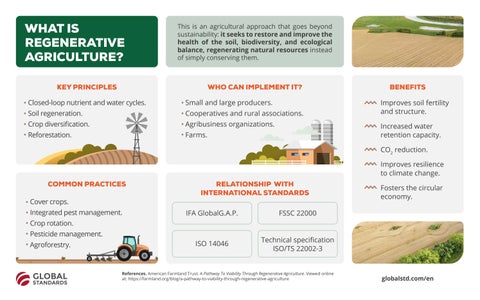
WHAT IS REGENERATIVE AGRICULTURE?
This is an agricultural approach that goes beyond sustainability: it seeks to restore and improve the health of the soil, biodiversity, and ecological balance, regenerating natural resources instead of simply conserving them.
KEY PRINCIPLES
WHO CAN IMPLEMENT IT?
Closed-loop nutrient and water cycles.
Small and large producers.
Soil regeneration.
Cooperatives and rural associations.
Crop diversification.
Agribusiness organizations.
Reforestation.
Farms.
BENEFITS Improves soil fertility and structure. Increased water retention capacity. CO2 reduction. Improves resilience to climate change.
COMMON PRACTICES Cover crops. Integrated pest management.
RELATIONSHIP WITH INTERNATIONAL STANDARDS IFA GlobalG.A.P.
FSSC 22000
ISO 14046
Technical specification ISO/TS 22002-3
Fosters the circular economy.
Crop rotation. Pesticide management. Agroforestry.
References. American Farmland Trust. A Pathway To Viability Through Regenerative Agriculture. Viewed online at: https://farmland.org/blog/a-pathway-to-viability-through-regenerative-agriculture
globalstd.com/en