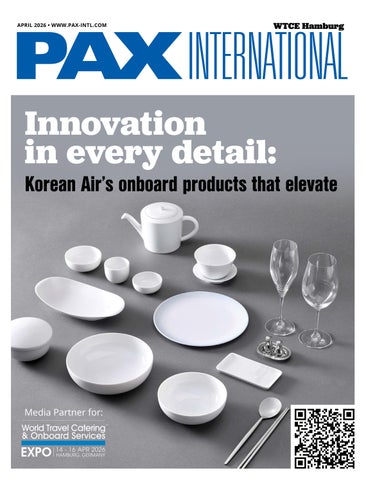
Next week, the global onboard services community gathers in Hamburg for the World Travel Catering & Onboard Services Expo—an event on the calendar that always brings with it lots of momentum. As suppliers, airlines and innovators meet on the show floor, conversations turn to what lies ahead. For this issue of PAX International, we asked a simple question: what will define the inflight passenger experience in 2026?
Across interviews with industry CEOs and leaders, a clear theme emerges— passenger experience is evolving through a renewed focus on well-being. In catering and F&B, that means meals that balance indulgence with nourishment. Airlines seek fresh, vibrant menus that reflect global diversity. Inclusivity— through plant-forward, dietary-conscious or culturally thoughtful options— is becoming essential to delivering hospitality in the air.
“Eating habits are evolving, with flexible formats influencing onboard food design,” Tom Lay, Marketing and Creative Director at En Route, tells PAX International in a preview of the company’s latest F&B trends report.
Health and comfort are also shaping product innovation beyond the meal tray. Airlines and suppliers are rethinking amenities through creative reuse and luxury brand collaborations that feel exciting and authentic. When done well, these partnerships extend the brand beyond the flight, creating items passengers keep long after landing—and strengthening loyalty in the process.
“[Passengers] are looking for thoughtful design, quality materials and products that support their well-being throughout the journey,” says Michele Ragonesi, Senior Regional Director, Americas & Europe at FORMIA, discussing the company’s recent partnership with American Airlines to celebrate its centennial in 2026.
In onboard comfort, wool is gaining renewed attention for blankets and bedding thanks to its durability, temperature regulation and naturally antimicrobial properties, John Horsfall tells us. It is a reminder that rediscovering classic materials can sometimes drive the most effective innovations.
We also turn our attention to the youngest travelers in these pages. Children’s amenities are being redesigned with storytelling, creativity and practicality— helping airlines create memorable experiences for families while supporting smoother journeys for crew.
Taken together, the innovations featured in this issue reflect an industry refining the details that matter most. Whether through nourishing meals, meaningful amenities or thoughtfully designed comfort items, the goal remains the same: helping passengers feel cared for from departure to arrival.
ISSN 1206-5714
Key title: Pax International
We look forward to seeing you in Hamburg where conversations on the show floor will surely shape the ideas that define the year ahead.
See you there!
JANE HOBSON Managing Editor PAX International
22
Iberia is redefining onboard hospitality by closing the long-haul catering gap, expanding pre-order personalization and embedding comfort into every detail of the journey
26
David Pacey, Executive Vice President and Chief of In-flight Service and Lounges at Korean Air talks to PAX International about the airline’s commitment to an elevated travel experience 30
In this Verified PAX Perspective Airline Review, PAX evaluates an Iberia Business Class multi-city flight from Heathrow to Madrid to Doha
42 PAKISTANI PLATES TAKE FLIGHT
KC Flight Catering Managing Director Ali Raja reveals the caterers’ plans to expand across Pakistan, bringing authentic flavors and culinary innovation to airline passengers worldwide
ONBOARD RETAIL
46 CURATING THE CART
Robin Padgett of dnata shares how curated products, data-driven insights and integrated catering strategies are shaping the next generation of inflight retail
48 EXIT THROUGH THE GIFT SHOP
In this guest column, Daniel Haller, Program Director, Omnevo, highlights the benefits of an “exit via the gift shop” strategy for ancillary retail F&B
50 THE RECIPE FOR INNOVATION
Green Gourmet and MarfoFMA discuss strengthening partnership to elevate inflight dining
54 FROM EVIAN TO EVERYTHING
Jeremy Parsons, CEO at AMI Group, shares a behind the scenes look at the evolution of AMI Group and its inspiring plans for the future
FIX
As the world’s largest airline caterer enters a new phase of growth, gategroup CEO Christoph Schmitz outlines how technology, culinary innovation and strategic partnerships will shape the company’s next chapter
Celebrating 25 years in airline catering, GIC International leverages operational excellence, strategic partnerships and innovation to drive its next phase of growth
Capital Catering’s Director Commercial Sabahuddin Imran discusses how innovation, sustainability and precision combine to deliver world-class airline catering from Abu Dhabi
ON THE COVER
Korean Air First Class tableware. Read more about the airline’s commitment to elevating the passenger experience in interview with Executive Vice President and Chief of In-flight Service David Pacey on page 26.
Departments
En Route’s Tom Lay reveals how airlines can leverage the key food and beverage trends shaping 2026–27, based on insights from the company’s latest report 62 FOCUS ON FLAVOR
Novel Foods is expanding its allergen-friendly Indulge snack range and showcasing the latest flavors in its Primadeli lineup, amid uptake on global carriers
64 TOASTIES, TASTE AND TOMORROW
Snackbox To Go highlights its latest innovations at WTCE 2026, including premium grilled toasties, creative snack concepts and a sustainabilityfocused approach to airline catering
BUBBLY, BITTER AND BRILLIANTLY 0%
Bottega is showcasing its expanding alcohol-free portfolio at WTCE 2026, from sparkling-style wines to herbal bitters and citrus aperitifs, designed for passengers seeking trendy, flavorful alternatives
BITE-SIZED STRATEGY
Amy Jullien of Intervine discusses the operational, flavor and packaging considerations shaping today’s airline snack programs
A FRESH PERSPECTIVE
Optimum Solutions’ COO John Allard discusses how the supplier is helping airlines elevate passenger experience with ready-to-serve, fresh and health-focused meals
DESIGNING WITH CARE
PAX International explores deSter’s vision for the future of travel, where care is at the heart of every journey, in a Q&A with Director Design House Ruud Vanderheyden and Design Director Daniel Knies
91 KITS THAT CLICK
Sintu Guasch, Managing Director at Texia, discusses My Drap’s new identity and its impact onboard
RMT Global Partners’ Richard Tuttle highlights the sustainability and service advantages of the onboard supplier’s double-wall stainless steel product line
WESSCO and LATAM discuss how the Altitude amenity kit collection brings a true sense of place to
American Airlines and FORMIA translate a century of aviation history into a limited-edition amenity kit collection inspired by three iconic liveries
Linstol highlights the unseen journey behind its onboard products, combining innovation, reliability and eco-conscious solutions at WTCE 2026
Janet Gibson, Chief Commercial Officer at Buzz, unearths the serious side to creating inflight fun for kids
At its WTCE 2026 booth, Plane Talking Products highlights how thoughtful design, advanced materials and sustainability expertise come together to elevate the onboard experience
White Glo’s Isabella Chen discusses how the dentist-developed formulas and lightweight packaging support premium cabin dental kits
Zoe Telfer, Managing Director at Milk, shares how the company’s latest portfolio transforms amenity kits into design-led, sensory experiences
92 LITTLE FLYERS, BIG COMFORT
Bayart Innovations reveals how comfort, care and sustainability come together in in its latest infant kit for Air Astana
93 NEXT-GEN CABIN COMFORT
John Horsfall’s Oliver Platts reveals how natural fibers and advanced textile technologies are reshaping airline bedding and providing better comfort in the cabin
VIETNAM REPORT
94 A CULINARY JOURNEY THROUGH VIETNAM
In this guest column, Keerthi “HappyK” Hapugasdeniya, CEO of happyK solutions, reflects on his decades-long connection to Vietnam, shaped by culture, hospitality and evolution across the airline catering and aviation sectors
98 SASCO’S NEXT COURSE
Balancing precision, culture and sustainability, SASCO turns inflight meals into memorable passenger experiences
101 RELIABILITY AND GROWTH
In an interview with PAX International, Bamboo Airways CEO Truong Phuong Thanh says the airline is focused on consistency as it plans for growth
102 DESTINATION MEETS DEMAND
FLC Group outlines how its integrated resort model helps airlines serving Vietnam balance leisure and business travel, support route performance and drive repeat demand
106 BEYOND THE BOARDING GATE
SH Airport Lounge transforms waiting into experience, combining Vietnamese cultural cues, personalized service and premium amenities
LOUNGES
109 INSIDE THE VISION AND HEART OF PPG
Plaza Premium Group Founder and CEO Song Hoi See shares how a single lounge in 1998 became a global network transforming the airport experience
EVENTS
111 UNLOCKING ANCILLARY FOOD REVENUE
During this WTCE virtual roundtable, produced in partnership with PAX International, panelists discuss why digitalization is essential to maximizing ancillary food revenue opportunities
112 PAX READERS CHOOSE EXCELLENCE
The PAX Readership Awards return to celebrate the achievements of the industry, as voted by loyal readers
EXHIBITOR
Automatic Cutlery Sorter makes banging impression at WTCE
After turning heads on last year’s WTCE showfloor, Diskomat and Wexiödisk are bringing the Automatic Cutlery Sorter back to booth 1G10.
With the pandemic firmly in the past and airlines moving away from disposable cutlery—even in Economy—demand for automated sorting solutions is on the rise, says Tomas Jämtander, Marketing Director, Flight catering solutions at Diskomat.
“Beyond its short ROI, caterers appreciate the ACS400HC for improving staff ergonomics and eliminating repetitive, monotonous tasks,” Jämtander adds.
The ACS400HC sorts up to 5,000 cutlery pieces per hour and can be programmed for up to 30 different airlines, cabin classes or cutlery designs.
Also on display at the booth will be the classic WD-18CW cart washer, which cleans airline carts using minimal water and energy thanks to its unique centrifugal technique.
The automatic cutlery sorting machine boasts durability, hygiene and efficiency
FULL PAGE AD
FULL PAGE AD
EXHIBITOR
Zibo Rainbow partners with Ethiopian Airlines on children’s amenity kit Global-c to unveil latest airline partnerships and product developments in Hamburg
Zibo Rainbow has partnered with Ethiopian Airlines to introduce a children’s amenity kit designed to enhance the inflight experience for young travelers while prioritizing sustainability and thoughtful design.
Developed in close collaboration with the airline, the kit was conceived not simply as a product but to create memorable moments for children onboard. According to Zibo Rainbow, Ethiopian Airlines approached the project with a vision of building a meaningful connection with its youngest passengers, prompting the supplier to focus on both functionality and responsible sourcing.
At the center of the kit is a soft backpack made from recyclable fabric. Lightweight and durable, the bag can be reused beyond the flight, serving as a practical companion for children throughout the journey and beyond. The contents include activity books produced using sustainably managed forest paper and non-toxic soy-based inks, crayons and a stuffed plush toy.
More than a collection of onboard items, Zibo Rainbow says the collaboration represents a shared effort to strengthen the relationship between the airline and its youngest passengers.
Global-c will showcase a series of recent airline collaborations and product innovations developed over the past six months at WTCE, reflecting the company’s continued focus on creative work.
Working closely with airline partners, Global-c has launched programs with Scandinavian Airlines, LATAM Airlines, Saudia, Thai Airways and Philippine Airlines. The projects highlight the company’s design capabilities and its understanding of how onboard products complement airline hospitality and inflight dining concepts to deliver distinctive customer experiences.
Alongside these collaborations, Global-c is introducing several developments aimed at addressing common airline challenges, including ‘vertical rest’ and performance coatings that provide non-slip functionality across a range of onboard products.
The company is introducing an expanded team that includes new product designers and the recently appointed Head of Product Development Kristine Tan, who joins from Qatar Airways, bringing additional airline experience to Global-c’s design and development initiatives.
The children’s kit features a backpack with activity books, crayons and a toy
Global-C to showcase latest airline collaborations and onboard product innovations at WTCE
EXHIBITOR
A Fresh Standard for Inflight Dining.
Bagasse Dishware and Bamboo
Cutlery: a smarter alternative to plastic for modern travel.
Connect with RMT Global Partners to learn more.
Aeroméxico reimagines Business Class experience with tableware by NewTerritory
Aeroméxico has partnered with hospitality design studio NewTerritory to introduce a new dining and glassware collection for its Premier One Business Class service, designed to reflect modern Mexican culture while enhancing the onboard dining experience.
The bespoke collection includes more than 15 pieces— plates, bowls, glasses and mugs—created to balance aesthetics with the operational realities of aviation. According to NewTerritory, the designs draw inspiration from Mexican craftsmanship, with porcelain pieces referencing traditional ceramics through terracotta reds and deep black tones inspired by Oaxacan clay. Bluetinted glassware nods to the recycled glass traditionally used in tequila bottle production.
Alongside the cultural influences, the collection has been engineered for inflight performance. Lightweight materials and space-saving designs help reduce weight and support more efficient service for crew.
The new dining concept is part of Aeroméxico’s broader effort to refine its onboard experience following upgrades to cabins, seating and textiles across the fleet. The collection will roll out across the airline’s 787 Dreamliner aircraft throughout the year.
EXHIBITOR
Food Accademia brings Italian fine food and beverage brands to WTCE 2026
Food Academia represents Italian brands across confectionery, fine foods, wines and spirits
Food Accademia is continuing its push into the travel retail and onboard catering sectors, positioning a portfolio of Italian food and beverage brands for international airline customers.
Founded in 2016, the Italy-based distributor sources products from across the country, focusing on small and mid-sized producers alongside established names. The company says its strategy is centered on representing Italian brands spanning confectionery, fine foods, wines and spirits, with an emphasis on quality, packaging and brand positioning suited to passenger expectations.
“Our role and unquenchable curiosity to discover and bring to market only the very best of what the Italian food and beverage industry has to offer makes us absolutely unique in the sector,” the company tells PAX International
Food Accademia will exhibit at booth 1D88.
Its confectionery and dessert portfolio includes ALAJMO, Domori, Fiasconaro, Pistì, Vincente Delicacies and Grondona. In fine foods, the distributor represents Tartufi Jimmy, Caviar d’Eden, Accademia Olearia, La Casa del Grano, Fox Italia Snacks and Acetaia Guerzoni. Wine and spirits brands in its portfolio include Angelo Molinari, Ceci and OrodiAmalfi.
The Aeroméxico dining and glassware collection for Premier One Business Class by NewTerritory
EXHIBITOR
Procurall Solutions advances wellness and sustainability in onboard design
.
Procurall Solutions is advancing a holistic approach to onboard product development, combining sustainability, passenger well-being and operational efficiency across multiple inflight categories.
The company’s portfolio includes amenity kits, regenerative materials, premium textiles and performance-driven sleepwear and bedding enhanced with Biocrystal® technology, designed to support relaxation and improved sleep quality while helping create more restorative inflight environments. Procurall says it evaluates every material, fiber and formulation for environmental impact, circularity potential and longterm performance.
Alongside comfort solutions, the company is integrating wellness-focused innovations aimed at improving rest and reducing fatigue throughout the passenger journey. According to Procurall, these
developments reflect a growing industry focus on wellness as a core element of the travel experience.
In the onboard dining space, Procurall is also developing premium serviceware and lightweight disposable alternatives using circular materials, biobased polymers and weight-reduction strategies. These programs are designed to help airlines lower environmental impact while maintaining a high-end presentation.
Procurall’s approach combines global brand partnerships with disciplined sourcing and measurable sustainability strategies, helping airline customers deliver onboard programs that balance passenger comfort with responsible design.
Procurall offers a portfolio of amenity kits, regenerative textiles, premium bedding and performance-driven sleepwear aimed at creating more restorative inflight environments
EXHIBITOR
Onboard Logistics simplifies inflight waste management for airlines
Onboard Logistics continues to support airlines with products designed to simplify waste management in the aircraft cabin and galley, helping crew handle one of the most operationally challenging aspects of inflight service.
With more than two decades of participation at airline catering industry exhibitions, the company has developed a portfolio of solutions aimed at making waste handling more efficient during flights. Its products are designed specifically to assist cabin crew with the collection, storage and organization of waste generated throughout the service flow.
Onboard Logistics also works with airline partners to develop inflight products that improve waste management processes in both the cabin and galley areas. A key focus is enabling easier waste segregation onboard, supporting airline sustainability initiatives while reducing complexity for crew during busy service periods. According to the company, practical design and close collaboration with airlines remain central to creating solutions that help streamline inflight operations. Onboard Logistics can be found at booth 1E111.
Flying Food Group celebrates growth and new airline partnerships
Flying Food Group is marking a year of strong growth in 2025, with airline business now exceeding pre-COVID levels across its North American operations.
The caterer launched strategic partnerships mid-year with Virgin Atlantic, serving flights from New York, Washington, Orlando, Miami, San Francisco and Los Angeles, and with Air New Zealand from San Francisco, Los Angeles and JFK. The collaborations expand Flying Food Group’s reach while reinforcing its focus on delivering high-quality culinary experiences for passengers.
Operational enhancements continue across the company, with new technologies helping streamline production and improve service efficiency. Sustainability remains a priority, with the company unveiling a new environmental initiative brochure, available at booth 1A81 during the show.
Flying Food Group tells PAX International its ongoing commitment to culinary excellence, operational innovation and environmentally responsible practices positions it to support airline partners as passenger traffic continues to rise.
Onboard Logistics will showcase products designed to simplify cabin and galley waste at WTCE 2026
Flying Food Group launched a partnership with Air New Zealand recently, serving flights from San Francisco, Los Angeles and JFK
EXHIBITOR
DFMi
and Around Noon bring fresh, chef-crafted solutions to inflight menus
Around Noon, represented by DFMi, delivers chef-crafted, ready-to-serve food solutions designed for today’s fastpaced travel environment. Known for premium fresh sandwiches and wraps, the brand combines quality ingredients, thoughtful recipes and convenient individual or bulk options that perform seamlessly across airline cabins and travel channels.
The portfolio extends beyond sandwiches to fresh salads, indulgent bakery items and a selection of hot pre-landing snacks aimed at providing comfort and satisfaction during the final stage of flight. From flaky pastries to warm handheld options, each product is developed with both taste and operational efficiency in mind.
With a focus on freshness, consistency and scalable production, Around Noon helps airline partners elevate onboard menus while simplifying service for crew. Its versatile range supports multiple dayparts, enabling highquality meal and snack solutions throughout the journey. Visit Around Noon at WTCE booth A1G88.
SUPPLIER
Global Inflight Products reinvents onboard service with compostable fiber casserole
As airlines intensify efforts to reduce single-use materials in the cabin, Global Inflight Products (GIP) introduced three years ago a plant fiber pulp casserole designed to support more sustainable inflight meal service.
Made from 100 percent renewable plant fibers, the casserole is oven-safe and heat-resistant, enabling dishes to be baked, reheated or served directly in the container without compromising performance. The lightweight and durable construction is designed to withstand the demands of high-volume airline catering operations, maintaining its shape even with heavier or sauce-based meals. The products are available in several shapes and sizes.
The containers are food-safe and odorless, ensuring that flavors remain unaffected across a range of cuisines, says Zine Badissy, CEO of GIP. The sturdy design also supports efficient handling across the catering cycle—from kitchen preparation through to onboard service. After use, the casseroles are compostable and biodegradable, with the plant fiber material delivering a clean, natural aesthetic.
Around Noon’s portfolio extends beyond sandwiches, including fresh salads, indulgent bakery items and a selection of hot pre-landing snacks
The plant fiber pulp casserole from GIP is ovenable and available in several shapes and sizes to support more sustainable inflight meal service
CATERING
Emirates redefines plant-based dining with minimally processed focus
Emirates has confirmed it is moving away from engineered plant-based meats and substitutes in favor of more minimally processed vegan meals. New concepts are now in development that celebrate real, whole, farmto-fork ingredients, the airline says.
The shift will see Emirates’ culinary team create dishes that are “authentic, vibrant and rooted in culinary tradition,” without relying on engineered meat alternatives. The move reflects growing global consumer interest in nutrition, health and overall well-being. The dishes are expected to be introduced onboard in 2027.
“Our focus now is on legumes, grains, nuts, seeds and seasonal vegetables as the heroes of the plate,” said Doxis Bekris, Vice President of Food & Beverage Design at Emirates. “These ingredients offer natural depth of flavor, texture and nutrition without relying on ultra-
processed alternatives. Instead of replicating meat, we want to draw from cuisines that have always been plantforward like Mediterranean mezze, Levantine grain salads, Asian noodle bowls and African stews. In our view, this approach feels genuine and culturally rich.”
Emirates currently has 488 vegan recipes in rotation across 140 destinations—representing a 60 percent increase since 2024—underscoring its commitment to vegan travelers. The airline now serves approximately half a million vegan meals each year.
Emirates’ vegan zucchini tart
Where Business is pleasure
Fly in a space designed for your comfort and privacy
Rooted in Spain, designed for the future
Iberia is redefining onboard hospitality by closing the longhaul catering gap, expanding pre-order personalization and embedding comfort into every detail of the journey
by JANE HOBSON
Spain’s flag-carrier has distinguished itself as the culinary leader amongst other regional airlines, but now Iberia is taking its ambitions to new heights. Chief Customer Officer Beatriz Guillén tells PAX International this spring that the airline is leveraging cultural identity, hospitality and personalization to redefine the premium travel experience.
“Gastronomy is one of the most immediate and tangible expressions of our brand,” says Guillén. “It allows us to create a distinctive onboard experience that competitors cannot easily replicate, because it is rooted in identity rather than in generic premium positioning.”
New benchmark for culinary concepts
Historically, long-haul has set the benchmark for culinary standards, but Iberia is closing the gap between flight segments: curated menus that feature dishes such as arroz meloso with
cuttlefish, prawns and piquillo peppers — traditionally associated with a Spanish premium dining context — are now available through pre-order on shorter routes.
“Personalization has become essential,” Guillén says. “The expansion of pre-order services on short- and medium-haul routes, alongside the refresh of our long-haul menus, allows us to align product delivery more closely with demand. This improves passenger perception while increasing planning accuracy and reducing inefficiencies.”
She says this also represents a shift in mindset. Rather than adapting catering to operational constraints, Iberia is designing the service model around passenger choice and predictability, moving from reactive provisioning to demand-driven planning, reinforcing consistency and execution quality across all segments.
A notable shift is increasing preference for healthy meal choices across its passenger base. As a result,
“As Spain’s flag carrier, we see food not as an ancillary service, but as a tangible expression of our identity.”
BEATRIZ GUILLÉN, CHIEF CUSTOMER OFFICER, IBERIA
Iberia is responding to rising demand for healthy options with popular dishes such as its salmon poke bowl
Beatriz Guillen, Chief Customer Officer, Iberia
Iberia offers dishes such as the salmon poke bowl, which has quickly become one of its most popular offerings, Guillén shares.
“Around half of our passengers are international, and we are fully aware of the diversity of tastes and expectations this implies,” she says. “Our menus therefore combine internationally recognizable dishes and high-quality local products with a distinctive Spanish touch.”
Spanish ingredients and Mediterranean culinary concepts can be found on every menu across all cabin and flight lengths. Onboard delights include Spanish tapas with cold cuts, olives and almonds, and the use of Spanish olive oil for all recipes.
“We see food not as an ancillary service, but as a tangible expression of our identity,” says Guillén.
Iberia works closely with catering partner DO & CO to design and deliver its onboard culinary concepts. It also keeps its menus fresh by rotating ingredients based on seasonal availability.
Relax, rest and enjoy
Defining the high standard of sustainability and quality, Iberia has prioritized comfort and well-being on each aircraft to create a fully integrated experience. This can be seen in the intuitive layout of the Business cabins
and overall design: from accessible personal storage areas to lighting, bedding and seat design.
“Our objective is straightforward: to deliver consistent, high-quality comfort where every element contributes meaningfully to the overall experience,” says Guillén. “This allows us to build a more complete experience in which passengers can truly relax, rest and enjoy the journey.”
This ethos extends to amenities kits for Business and Premium Economy cabins, which are made with care and consideration. Designed by Teresa Helbig — the brand that also designs cabin crew uniforms — and developed in collaboration with Uvas Frescas, it incorporates materials derived from surplus grapes from the wines served onboard, transforming a by-product into a design element.
“Our approach is not to multiply branded items, but to provide products that are purposeful, high quality and aligned with our hospitality standards,” Guillén says. “This model allows us to integrate environmental and social impact into the product itself, rather than treating sustainability as an add-on.”
The packaging is produced from sugarcane-based material, and the kits are assembled by Envera, a social organization that supports the employment of people with disabilities. At the end of each flight, unused kits are collected and, where appropriate, returned to circulation.
From essentials such as moisturizer, lip balm, oral care items and eye mask to soft products such as blankets, pillows and mattress toppers, Iberia
tailors products to each cabin to provide comfort and ease to longhaul journeys.
By weaving together a continuing commitment to its Spanish roots, Iberia is effectively re-architecting the passenger experience. It is a strategic pivot that blends personalization, sustainability and gastronomy into a single, seamless hospitality experience.
Iberia customizes amenities from skincare to blankets and pillows to enhance long-haul comfort in every cabin
Iberia’s Business and Premium Economy amenity kits, designed by Teresa Helbig with Uvas Frescas, use materials from surplus grapes to create thoughtful, sustainable luxury
Iberia’s A321 XLR
Care fueled journeys
Elevating every journey with thoughtful amenities.
Modern Korean luxury
David Pacey, Executive Vice President and Chief of In-flight Service and Lounges at Korean Air talks to PAX International about the airline’s commitment to an elevated travel experience
by ALEX PRESTON
In September 2025, Korean Air won Best Cabin Service at the APEX Best Awards 2026 and was named a Five-Star Global Airline for the ninth consecutive year. The honors reflect its updated corporate identity, unveiled March 2025, and a focus on refined inflight dining and elevated service offerings.
As David Pacey, Executive Vice President and Chief of In-flight Service and Lounges explains to PAX International, “Whether a passenger is in our Seoul lounge or flying at 35,000 feet, the experience should feel like an invitation into a sophisticated Korean home.”
He notes that the through-line of the airline’s culinary strategy is “traditional roots, modern refinement.”
Authentic voice
What makes it unmistakably “Korean Air” is what Pacey says is a commitment to authentic flavors presented with contemporary elegance.
“From our iconic Bibimbap to our recently introduced Korean style vegan meals, we focus on seasonal ingredients and the ‘Jeong’ (warmth and affection) of Korean hospitality,” he says.
To support this, the airline looks for uncompromising quality and innovative agility when selecting catering partners. The airline works with partners that understand the technical demands of preserving flavor at altitude and share its commitment to quality, maintaining high standards through ongoing collaboration to
deliver a consistently premium inflight dining experience.
This includes reflecting the latest health trends and passenger feedback. Last autumn, Korean Air renewed its selection of special inflight dietary meals on flights departing from Korea following a six-month development process.
“We believe a special dietary requirement should never feel like a compromise on taste. Our philosophy is to treat these not as ‘restricted meals,’ but as ‘curated wellness options,’” says Pacey.
To achieve this balance, the airline partnered with clinical experts from Inha University Hospital to ensure every meal meets strict nutritional and medical parameters.
David Pacey, Executive Vice President and Chief of In-flight Service and Lounges, Korean Air
Korean Air First Class tableware
Conscious Kitchen reimagines special meals as thoughtfully designed, contemporary inflight dining experiences— crafted from the start, not adapted as an afterthought Setting new standards for inflight dining by streamlining operations, reducing waste
At the same time, its in-house chefs use techniques such as lowtemperature cooking and natural umami-rich ingredients to enhance flavors without excess salt or fat, ensuring health-conscious dining remains central to the journey.
Pacey says the airline’s brand partnerships—including Graff, Armani/Casa and Bernardaud—bring passengers’ lifestyle preferences into the cabin.
“They embody a timeless elegance that aligns with our new brand identity,” he explains. “When a passenger uses Bernardaud or Armani/ Casa plates, the meal feels less like inflight catering and more like a true fine dining experience.”
He adds, “We partner with brands that prioritize craftsmanship and environmental responsibility. It is not about a famous logo—it is about a design language that reflects the elevated Korean aesthetic we strive to deliver.”
Scaling luxury
With Korean Air’s recent lounge expansions, Pacey says the challenge is preventing these massive spaces from feeling like crowded cafeterias. Maintaining a boutique, hotel-style atmosphere at scale r equires meticulous spatial and operational design.
While food remains a key draw, Pacey says passengers increasingly seek lounge environments that support their physical and mental well-being before a flight. He notes that varied seating, acoustic zoning and biophilic elements can create distinct areas for families, solo travelers and diners while maintaining privacy.
Pacey also stresses that luxury is fragile.
“High-quality upholstery, custom millwork and premium carpets require aggressive, specialized upkeep. Operators maintain the illusion of effortless luxury by scheduling deep cleaning and maintenance during strict off-peak hours or overnight, ensuring the space always feels pristine,” he says.
Behind the scenes, Pacey acknowledges that data is doing the heavy lifting to ensure the luxury experience does not buckle under high passenger volume.
For Korean Air, this includes automated rules engines that instantly verify a passenger’s eligibility (via airline status or corporate contract) in milliseconds. This eliminates front-desk bottlenecks, allowing staff
to focus on hospitality rather than administrative checks.
By integrating with automated entry gates, operators can track real-time occupancy and display crowd levels on passenger apps. This empowers passengers to choose less congested wings or alternative lounges before they even arrive at the door.
Data enables digital waitlists for high-demand amenities.
“Passengers can reserve a shower suite or a premium dining table via their phone and receive an alert when it is ready, entirely removing the stress of physical lines,” Pacey says.
By analyzing incoming flight schedules, historical capacity trends and real-time transit data, lounge managers can predict exactly when a rush will hit. This allows them to dynamically adjust staffing levels, food preparation and cleaning cycles to match demand.
For Korean Air, modern comfort is defined as “intuitive and seamless serenity.”
“It is no longer just about a plush seat or a quiet room; it is about an environment that anticipates a passenger’s needs before they ask,” Pacey says, describing a space defined by ergonomic precision, tactile comfort and a calm, uncluttered warmth.
By blending high-tech efficiency— such as smart lighting and noise reduction—with attentive Korean hospitality, the airline aims to create a sanctuary where passengers can truly recharge.
Bibimbap and Korean-style vegan meals bring seasonal flavors and the comforting spirit of Korean hospitality onboard
The Graff Prestige Class amenity Kit
THE ART OF REST
Luxury linens, reimagined for the skies.
WTCE 2026 | Booth 4E30
PAX Perspective Verified Airline Review:
Iberia Business Class
In this Verified PAX Perspective Airline Review, PAX evaluates an Iberia Business Class multi-city flight from Heathrow to Madrid to Doha
by AIJAZ KHAN
The first flight
Iflew Iberia from Heathrow (LHR) to Madrid (MAD) onboard the airline’s new A320neo aircraft in December 2025. This was the first leg of my journey before connecting at Madrid to Doha (DOH). Flight time for this short-haul segment was approximately 2.5 hours.
Iberia Business Class passengers receive access to the British Airways Club Lounge North at LHR before boarding. The lounge offered a pleasant start to the trip with excellent food and drink and a cheerful holiday atmosphere. My light breakfast of fresh fruit and pastries set the tone for the day. After some time to unwind, I headed for the gate.
Seating and interior configuration
The A320neo features 186 seats. In Business Class, the cabin is divided by a curtain, and the middle seats remain unoccupied, giving passengers extra room to stretch out. The cabin felt polished and open with 18-inch seat width, 30-inch pitch and 3-inch recline. The familiar three-by-three layout suits short-haul flying and my mid-morning seat was comfortable. With fewer travelers up front and blocked middle seats, overhead bin space was plentiful, adding to the spacious experience.
Iberia tells PAX International that the A320neo is one of the newest additions to its fleet. The aircraft operates at 50 percent lower noise levels than other single-aisle models and reduces CO2 emissions by 5,000 tons annually, delivering a more sustainable way to operate short- and medium-haul routes.
Inflight entertainment and connectivity
Iberia offers complimentary Wi-Fi for messaging apps to Business Class passengers, and to all Iberia Club
Business Class seats onboard flight from Madrid to Doha
members regardless of the cabin they are flying in. It worked consistently throughout the flight, which I appreciated.
Parent company International Airlines Group (IAG) announced an agreement with Starlink last month that will introduce high-speed connectivity to all Iberia flights. It will be available free of charge to all passengers in all cabins, marking a major step forward in the airline’s onboard experience. Implementation is expected to begin this year.
Food and beverage
After takeoff, the crew served breakfast, available on European short-haul flights departing before 11:00 a.m. The meal included an egg omelet with vegetables, a selection of breads and pastries, and a chia seed pudding topped with fresh fruit. The hearty spread, served on ceramic tableware, made the quick flight feel more premium.
The second flight
After relaxing in the Iberia Velázquez Premium Lounge at MAD, I boarded the long-haul Business Class flight to Doha. This final leg was seven hours. Before departure, the crew offered a welcome drink of water, Cava or orange juice. The orange juice was a refreshing choice as I settled in.
Seating and interior configuration
Iberia’s A330-300 Business Class cabin features 29 lie-flat seats arranged in a 1-2-1 configuration with curtains separating the cabin from Economy. I settled into my suite where a mattress topper, pillow and duvet were waiting for me.
The seat offered generous living space with a 78.7-inch pitch, 25-inch width and full 180-degree recline. A large tray table and a small side counter held the amenity kit and other essentials.
Inflight entertainment and connectivity
The 15.4-inch touch screen featured the Panasonic Avionics eX2 system. What caught my attention was the 4.2-inch touch-screen controller placed beneath the side counter. Instead of the usual handheld remote with buttons, this felt more intuitive and modern. The crew also provided comfortable headphones for an enjoyable viewing experience.
Once in the air, I connected to Iberia Wi-Fi again for complimentary messaging.
Food and beverage
The inflight menu, catered by DO&CO, highlighted a mix of international flavors and Spanish culinary touches using local and seasonal ingredients. Service began with tapas-style hors d’oeuvres, including artisan cheeses and nuts, olives and a bag of Obando Artisan Picos Utreranos.
For the starter, I chose the baby zucchini, broccoli and spinach with Tudela lettuce hearts and sun-dried tomato salad served with creamy lemon yogurt sauce. It was a flavorful vegetarian option.
My main dish was the grilled cod in a creamy green sauce with spinach, raisins, pine nuts and roasted potatoes. It delivered a satisfying balance of richness and freshness.
Amenities and comfort
Amenity kits on this route are designed by Teresa Helbig and produced by
Kaelis. Introduced last summer and inspired by Iberia’s cabin crew uniforms, the pouches feature vibrant blue, red and yellow hues.
Inside, I received socks, an eye mask, a toothbrush, toothpaste, earplugs and skincare items from Spanish brand Uvas Frescas. The kits are made from rPET, produced using 7.5 million recycled 550-milliliter plastic bottles.
The PAX Perspective
The crew’s attentiveness throughout both flights delivered a smooth and enjoyable journey. Details from DO&COs thoughtful menu to the amenity kits by Kaelis and Uvas Frescas showcase Iberia’s strong sense of identity and hospitality. We highly recommend Iberia’s Business Class cabin for travelers flying between Europe and the Middle East!
Breakfast en route Heathrow to Madrid
The kits contain socks, an eye mask, a toothbrush, toothpaste, earplugs and skincare items from Spanish brand Uvas Frescas
A new chapter for a global leader
Delivering meals to aircraft around the world, gategroup’s global logistics network is designed to ensure consistency, efficiency and reliability at scale
As the world’s largest airline caterer enters a new phase of growth, gategroup CEO Christoph Schmitz outlines how technology, culinary innovation and strategic partnerships will shape the company’s next chapter
by JANE HOBSON
This month, gategroup returns to the World Travel Catering & Onboard Services Expo with a presence that reflects both the scale of its operations and the ambitions of its leadership. WTCE 2026 features an expanded show floor, including the addition of a third hall at Hamburg Messe—Hall A2—which will be exclusively dedicated to gategroup and its brands.
For CEO Christoph Schmitz, the expanded footprint signals more than industry growth. It reflects the company’s evolving role in the aviation ecosystem. PAX International spoke with Schmitz ahead of the event to discuss leadership, technology and the strategic priorities guiding the world’s largest airline caterer through its next phase of development.
“When we spoke [with PAX International] in Amsterdam last year, the focus was on moving the business from recovery into transformation,” Schmitz says. “Today, that transformation is firmly underway and increasingly visible in how we operate.”
Over the past several years, the company has focused on strengthening its organizational fundamentals— simplifying structures, investing in digital capabilities and aligning culinary, operational and commercial teams more closely with airline partners. The result, Schmitz says, is a more agile organization capable of delivering consistent service across a global network.
“We have sharpened our portfolio across catering, onboard retail and hospitality solutions, ensuring each
area has a clear strategic direction and stronger collaboration with airline partners,” he says.
Leadership at scale
Leading a company with hundreds of kitchens and operations across dozens of countries requires a shift in mindset.
“For me, leadership this year is not about top-down commands; it is about stewardship,” he says. “It is my job to cultivate an environment where ethical integrity and high performance are not just goals, but our natural state of being.”
A central theme of Schmitz’s leadership philosophy for this year is empowering teams throughout the organization to act as innovators within their own operations.
Christoph Schmitz, CEO, gategroup
“In 2026, I define leadership as the ability to empower our people to be intrapreneurs,” Schmitz explains. “We have built a best-in-class executive team that does not just manage scale—they understand the operational heartbeat of a galley and the complexity of global logistics.”
The approach allows local teams to remain agile while operating within global standards designed to ensure consistency.
“At our scale, my decisions for 2026 really come down to a single promise: that we will deliver the same worldclass excellence whether a meal is served in Zurich or Sydney,” he says.
Schmitz sees this shift as part of a broader transformation in how airline caterers position themselves within the aviation value chain.
“I am moving us away from the old-school ‘caterer’ mindset to become a true strategic partner that is woven into the very fabric of our airlines’ operations.”
Schmitz’s leadership role recently expanded beyond gategroup with his appointment as president of the Airline Catering Association. He views the position as an opportunity to drive broader industry progress.
“Taking on the presidency of the ACA does not change my mission at gategroup; it simply amplifies it,” he says. “I see this role as a natural extension of our commitment to move beyond being a provider and becoming a true strategic partner to the entire aviation ecosystem.”
Many of the challenges facing airline catering today—particularly those related to sustainability, infrastructure and regulatory complexity—require collective action, he notes.
“We are at a critical inflection point where urgent, industry-wide collaboration is the only way forward,” Schmitz says. “We must work together to build a transparent ESG framework that actually supports a circular economy.”
Setting the pace for the industry
The scale of gategroup’s global network places it in a unique position within the industry—one Schmitz believes carries significant responsibility which extends across operational resilience, sustainability commitments and technological innovation.
“Our scale gives us a unique duty to provide through-the-cycle resilience,” he explains.
At the strategic level, the company’s long-term roadmap is guided by its 2030 vision, which includes investments in artificial intelligence, automation and digital infrastructure designed to improve efficiency across the global network.
Schmitz adds that maintaining financial stability remains critical as the company scales these capabilities.
“By focusing on steady, de-risked growth and smart, inflation-linked pricing, I am making sure gategroup is not just the biggest player in the game, but the most resilient and reliable one for the long haul.”
Operating at global scale, gategroup sees its kitchens and teams as central to delivering resilience, advancing sustainability commitments and driving innovation across the airline catering industry
Technology meets culinary craft
At the operational level, technology— particularly artificial intelligence—is becoming an increasingly important driver of efficiency and consistency across gategroup’s network. Applications range from forecasting and production planning to inventory management and disruption recovery. In onboard retail, AI can also help predict demand, optimize product assortments and connect sales data directly to loading decisions.
“Done well, AI improves accuracy, reduces substitutions and cuts waste while making choice feel more personal,” Schmitz says.
Yet he emphasizes that technology will never replace the human expertise at the heart of inflight dining. Instead, data systems are designed to support the culinary process—ensuring that dishes developed in test kitchens can be executed consistently across hundreds of global hubs.
“Data does not replace the chef’s craft—it protects it,” Schmitz explains. “It provides the global framework that ensures a chef’s creative vision is delivered with absolute consistency.”
Increasingly, data science is also shaping menu development. Rather than relying on broad averages, the company can analyze patterns by route, cabin, seasonality and passenger demographics
“That allows airlines to balance choice with operational discipline,” Schmitz says. “By predicting uptake with greater precision, we can design menus that perform better while reducing waste.”
Engineering the next decade
Looking ahead, Schmitz says airline catering is entering a period of rapid evolution. Over the next decade, technology will connect passenger demand more directly to production through systems such as pre-order platforms, predictive forecasting and real-time operational visibility.
“That will allow the industry to move away from broad estimates toward much smarter planning,” he says.
He also expects supply chains to evolve as airlines and caterers place greater emphasis on resilience, responsible sourcing and transparency around environmental impact.
“Travelers will expect meals that feel lighter, more thoughtful and more aligned with their preferences, without sacrificing reliability,” Schmitz says.
He sees gategroup as a central part of this changing landscape.
“Our role is to help engineer that system,” he explains. “By combining culinary expertise, operational scale and digital capabilities, we aim to make inflight dining more personalized, more efficient and more responsible It is a turning point for both the group and the industry.
“Ten years from now, I would like my leadership to be remembered for the moment we transitioned gategroup from a service provider into an indispensable strategic partner,” he says.
For Schmitz, that vision is rooted as much in culture as it is in technology.
“We have used the recent years to reset our DNA, ensuring gategroup is not just the biggest player, but the most ethical and resilient employer-ofchoice in the industry.”
As the company steps into the next decade, the focus is clear.
“We are not simply chasing growth; we are working to be the kind of partner our airline customers can truly lean on,” Schmitz says. “We feel a genuine duty to help guide this industry through its next great inflection point—and we are approaching that challenge with a lot of energy and a lot of heart.”
gategroup chefs are supported by a global structure designed to deliver quality, consistency and agility
Unique textiles designed for premium onboard dining
Quiet presence. Elevated onboard.
Milestones and momentum
Celebrating 25 years in airline catering, GIC International leverages operational excellence, strategic partnerships and innovation to drive its next phase of growth
by JANE HOBSON
This year marks the 25th anniversary of GIC International Catering, a milestone reflecting a quarter-century of progress, operational excellence and enduring airline partnerships.
Speaking with PAX International, Managing Director Goeksel Yildirim and Commercial Director and QMS Lead Bongi Tshazi shared insights into the company’s defining milestones, strategic direction and approach to meeting evolving airline expectations.
“GIC’s 25-year milestone reflects disciplined, sustainable growth,” Yildirim explains. “Key phases include expanding production capacity, diversifying our airline portfolio and investing in infrastructure, technology and menu innovation to scale without compromising standards.”
The pandemic proved to be a defining period for the caterer. Yildirim says the crisis became an opportunity to strengthen internal systems, improve operational flexibility and reinforce team structures, ultimately leaving GIC more resilient and better positioned for future growth.
“The first 25 years were about building trust and capability. The next chapter is about scaling intelligently and creating long-term value for our airline partners,” he adds.
A significant milestone in this journey is GIC’s recent achievement of ISO 9001 certification, a move that formalizes its commitment to structured quality management and continuous improvement.
“ISO 9001 is not just a certificate on the wall; it reflects the discipline behind our processes and the
Bongi Tshazi, Commercial Director and QMS Lead, GIC International Catering
GIC is celebrating 25 years of culinary partnerships and operational excellent this year
Goeksel Yildirim, Managing Director, GIC International Catering
accountability within our teams,” explains Tshazi. “It gives our airline partners confidence that quality is embedded at every stage, from supplier approval to final uplift, and ensures continuous improvement as their needs evolve.”
In today’s highly competitive catering landscape, GIC differentiates itself through a combination of disciplined operational systems and agile, responsive decision-making.
“Airlines today need more than a supplier — they need a partner who understands operational complexity and can respond quickly without compromising standards,” says Yildirim.
Tshazi adds that airlines now demand simultaneously higher quality, tighter cost control and more refined premium offerings. GIC has responded by strengthening quality oversight, expanding staff training and enhancing internal audits to ensure full traceability and consistency.
Smarter menu engineering, portion optimization and packaging innovation also help the caterer support efficiency goals while elevating the premium passenger experience.
“The challenge is balancing premium passenger expectations with operational efficiency. Our role is to help airlines achieve both,” says Tshazi.
Looking ahead, WTCE Hamburg offers GIC an opportunity to showcase its progress and reinforce relationships. The company will host its Oyster & Champagne evening, celebrating both its 25-year milestone and long-term customer partnerships, alongside promotional raffles for Business Class travel.
“Our success has always been built on partnerships. WTCE gives us the opportunity to thank our customers
personally and discuss the future face-to-face,” says Yildirim.
He underscores that GIC’s partnership philosophy is built on shared success. “Celebrating together is important. It sends a clear message that our achievements are shared and so is our future.”
GIC’s message to customers is clear. It is a quality-driven, agile partner ready to support airline growth. With 25 years of operational experience and ISO 9001 certification in place, the company is focused on consistency, flexibility and practical innovation.
“We are entering our next phase with confidence,” Yildirim concludes. “Our systems are strong; our team is experienced and our commitment to our airline partners remains absolute.” At GIC International Catering, menu engineering, portion optimization and packaging innovation support efficiency while enhancing the premium passenger experience
Globally inspired
LOCALLY ROOTED
Capital Catering’s Director Commercial
Sabahuddin
Imran discusses how innovation, sustainability and precision combine to deliver world-class airline catering from Abu Dhabi
by AIJAZ KHAN
As aviation hubs across the Middle East continue to expand, Capital Catering has emerged as a cornerstone of Abu Dhabi’s aviation and hospitality ecosystem. Established following the strategic acquisition of Etihad Airport Services Catering, the company combines decades of airline catering expertise with the extensive hospitality infrastructure of ADNEC Group, positioning itself as the exclusive caterer at Zayed International Airport.
“For millions of travelers, Capital Catering is the first taste of the UAE,” says Capital Catering’s Director Commercial Sabahuddin Imran. “Our
mission is to deliver not just meals, but a seamless extension of Abu Dhabi’s renowned hospitality.”
Every meal matters
Operating from one of the largest catering facilities in the region, Capital Catering’s 30,000-square-meter headquarters in Abu Dhabi has the capacity to produce more than 90,000 meals daily. A robust supply chain, supported by a fleet of more than 250 chilled trucks, enables the company to mobilize complex contracts with speed and efficiency. In 2025 alone, the caterer served more than 29 million meals and supported nearly 80,000 international flights, underscoring its operational resilience and scale.
Capital Catering’s headquarters in Abu Dhabi has the capacity to produce more than 90,000 meals daily
Sabahuddin Imran, Director Commercial, Capital Catering
While aviation remains central to its operations, Capital Catering’s reach extends beyond the tarmac. Its customer base includes more than 20 international airlines, as well as healthcare, energy and corporate sectors across the UAE. The company serves a wide range of operations— from high-frequency commercial flights to bespoke VIP services— offering tailored solutions for largescale or premium requirements.
“Flexibility and attention to detail are what set us apart,” says Imran. “Whether it is a high-volume operation or a VIP flight, we ensure every meal meets the highest standards.”
Consistency at the core
Capital Catering leverages technology to maintain industry-leading efficiency and precision. AI-driven planning systems integrate real-time flight data with production schedules, while advanced tray assembly systems and precision dosing equipment enhance consistency and speed.
“Our investment in automation and digital tools ensures that every passenger receives the same highquality experience, every time,” says Imran.
Culinary innovation is central to the company’s philosophy of being “globally inspired, locally rooted.” Its
multicultural team of chefs creates menus that satisfy international tastes while celebrating UAE heritage. Signature dishes such as traditional Emirati Machboos offer travelers an authentic local experience, complemented by Arabic, Mediterranean and international options.
The caterer has also redefined kosher offerings with its Fresh Kosher Meal Concept, presenting fully certified, fresh meals served on elegant chinaware.
Waste, not wasted
Safety and trust underpin operations at Capital Catering, says Imran. The company is fully halal-certified and adheres to HACCP, ISO 22000, and ISO 14001 standards. Its facility features dedicated production zones, including a supervised kosher kitchen, and rigorous quality control systems that monitor every stage of production.
Sustainability is a key pillar of the company’s strategy. Capital Catering processes up to 1,200 kilograms of food waste daily into compost and converts used cooking oil into biodiesel. Eco-friendly packaging made from innovative materials such as date palm leaves further reduces environmental impact. These initiatives have earned recognition at the Gulf Sustainability
Awards 2024, where the company won Gold for its Water and Waste Management program and Bronze for its Zero Food to Landfill initiative.
“Environmental responsibility is central to our operations,” notes Imran. “We aim to reduce waste, optimize resources and lead by example in sustainable aviation catering.”
Redefining global standards
Capital Catering is now focused on the next phase of growth. Expansion at Zayed International Airport, entrance into new markets and strengthened presence in VIP lounges and Fixed Base Operator sectors are priorities over the next three to five years, Imran shares. Automation and sustainable food technology will play a critical role, with advanced robotic systems and AI-driven resource management enhancing efficiency and precision.
“Our vision is not just to feed passengers, but to create experiences that reflect Abu Dhabi’s world-class hospitality,” says Imran. “Through innovation, sustainability and operational excellence, we aim to redefine airline catering standards globally.”
For millions of travelers, Capital Catering is more than a meal provider—it is a gateway to the warmth, culture and sophistication of the UAE. By combining scale, culinary expertise and technology, the caterer helps cement Abu Dhabi’s position as a global aviation and hospitality hub.
Capital Catering’s multicultural team of chefs create menus that satisfy international tastes while celebrating UAE heritage
Capital Catering leverages technology to maintain industryleading efficiency and precision
Pakistani plates take flight
KC Flight Catering Managing Director Ali Raja reveals the caterers’ plans to expand across Pakistan, bringing authentic flavors and culinary innovation to airline passengers worldwide
by AIJAZ KHAN
Over the last two decades, KC Flight Catering (KCFC) has become the largest private inflight catering provider in Pakistan. This year, the aviation culinary powerhouse is expanding its services with a new unit at Allama Iqbal International Airport in Lahore, alongside plans for two more locations.
“KC Flight Catering has truly national coverage, which no other airline caterer in Pakistan can say,” Ali Raja, KCFC’s Managing Director, tells PAX International. “We have recently made significant investments in infrastructure, technology and people to support both growth and operational efficiency across our network.”
In addition to the Lahore unit, Raja says the company is planning new facilities in Multan and Karachi.
“We are bolstering our culinary teams and expect to add more diversity, range and innovation to our menus,” he adds. “We have also developed an inflight retail product line which we will look to roll out with partner airlines.”
KCFC prides itself on its team of development chefs and comprehensive catering services, offering everything from tailored menu development and meal service design to inflight retail products, cabin amenities and logistics management. Its contracts extend to Asian, Middle Eastern and European carriers, such as Air China, British
A core strength of KCFC is its ability to adapt authentic Pakistani cuisine for international palates
Ali Raja, Managing Director, KC Flight Catering
Airways and Fly Jinnah — the latter featuring a first-ever buy-on-board service model, according to Raja.
In 2019, KCFC served the Duke and Duchess of Cambridge, Prince William and Princess Kate, on their visit to Pakistan. “We received a glowing letter of recommendation,” says Raja, noting that KCFC also routinely caters flights for Heads of State and foreign dignitaries.
A core strength for KCFC is its ability to adapt authentic Pakistani cuisine for international tastes. The company’s internationally qualified development chefs conduct dedicated research and frequent organoleptic evaluation sessions to assess taste, texture, aroma, appearance and holding performance. Airline
representatives and customer teams are invited to participate so feedback is immediate.
Menu trials, seasonal ingredient planning and passenger feedback analysis are built into KCFC’s refinement cycle to ensure dishes perform consistently onboard. “The result is a menu portfolio that delivers global appeal while preserving authentic local flavors,” says Raja. “Good menus with good quality food cannot be understated.”
Menu design is increasingly strategic in a competitive travel industry. “As a caterer, menu design becomes very important in winning that front for the airline with their passengers,” says Raja. “Pakistanis take food very seriously.”
Technology also plays a growing role in ensuring consistency and quality. Access to data allows KCFC to forecast demand, drive efficiencies, reduce waste and lower costs. “We hope to reach a point where we can integrate our ordering platform with airlines and offer more pre-order options to passengers,” says Raja.
Sustainability is another pillar of KCFC’s strategy. The company has introduced practical measures to reduce waste and replace single-use plastics wherever feasible, including wooden and biodegradable cutlery and recyclable paper cups. Its flagship production unit in Islamabad has transitioned to solar power, significantly reducing carbon impact and energy consumption.
“In addition, we are strengthening portion control, menu forecasting and production planning to cut food waste at source and expanding staff awareness programs so sustainability becomes a daily habit, not just a poster on the wall,” says Raja.
Menu trials, seasonal ingredient planning and passenger feedback analysis help KCFC ensure dishes perform consistently for airline customers
KC Flight Catering’s chicken biryani with potato cutlet and zeera raita
Security and safety are the most important values an airline can offer. A great number of checks are required before the captain and cabin crew are finally able to welcome the passengers on board. This includes making certain that travellers will receive a clean and hygienic service. With our professional warewashing systems for inflight catering, we at MEIKO are guaranteed to reach the recommended level in purity, hygiene and cleanliness. Sustainable, economic and efficient. From small business airports to large international traffic hubs: discover the versatility of our tailor-made warewashing systems.
. www.meiko-global.com
Curating the cart
As airlines refine onboard retail strategies, the focus is shifting from simply expanding product choice to delivering curated, brand-aligned propositions that balance passenger appeal with operational efficiency. According to Robin Padgett, CEO of Catering & Retail at dnata, airlines today are asking for more thoughtful retail programs that combine creativity with disciplined execution.
“What we are seeing clearly is that airlines, whether full service or retail, are asking for smarter, more curated propositions,” Padgett says. “They want the right balance between choice,
Robin Padgett of dnata shares how curated products, data-driven insights and integrated catering strategies are shaping the next generation of inflight retail
by JANE HOBSON
brand storytelling and operational discipline.”
One of the most visible trends is the rise of premium snacking and light-meal concepts that bridge the gap between traditional inflight meals and buy-on-board offerings.
“These products are positioned as intentional culinary moments rather than cost plays,” explains Padgett.
Airlines are also showing increased interest in curated F&B pairings and signature products that emphasize provenance and authenticity. In many cases, this includes bringing well-known consumer brands onboard while also introducing local or niche products that reflect the airline’s identity.
dnata recently expanded its collaboration with Aer Lingus in
Ireland, introducing a refreshed onboard retail experience built around a curated mix of recognizable global brands and locally inspired products tailored to the airline’s routes and passenger base. Padgett notes the importance of balancing trusted products with more niche options to add authenticity.
Passenger preferences are also influencing menu development. Airlines are increasingly requesting wellness-focused options such as lighter meals and plant-forward dishes, although these must be carefully integrated to ensure reliability across complex catering operations.
“At dnata, we help airlines translate passenger trends into premium solutions that actually work at scale,” Padgett says.
Airlines are showing increased interest in curated F&B pairings and signature products that emphasize provenance and authenticity
Robin Padgett, CEO of Catering & Retail, dnata
At the same time, many airlines are seeking to integrate catering and retail more closely, creating a cohesive passenger experience rather than treating the two areas as separate service elements.
“Food, beverages and retail items are curated together so quality, presentation and brand messaging are aligned,” Padgett says of the shift.
Behind the scenes, data is playing a larger role in shaping onboard retail strategies. dnata’s retail platform supports more than 40 million onboard transactions annually and manages a global retail stock portfolio valued at more than US$200 million, helping airlines analyze performance and refine product selection.
“Our focus is on practical, execution-led digital tools rather than experimental tech,” Padgett says. “The data helps us understand what is selling, when and why—and that insight feeds directly back into menu refinement and retail decisions.”
Looking ahead to World Travel Catering & Onboard Services Expo, dnata plans to highlight how this integrated approach supports both passenger experience and commercial performance.
“Airlines are asking us to support brand expression, not just supply,” Padgett says. “Food, retail and service rituals all come together to reinforce their identity and elevate the end-toend passenger experience.”
ABOVE AND BEYOND
One of the most visible trends is the rise of premium snacking and light-meal concepts that bridge the gap between traditional inflight meals and buy-on-board offerings
Exit through the gift shop
In this guest column, Daniel Haller, Program Director, Omnevo, highlights the benefits of an “exit via the gift shop” strategy for ancillary retail
Almost every visitor to a museum, gallery or theme park knows the experience of exiting through the gift shop. It is not just about souvenirs, but extending the journey, creating one last moment of discovery and capturing value that adds to the overall experience.
What if airlines thought the same way? What if every flight did not just end at the destination, but with a seamless opportunity for passengers to engage with personalized retail? That is the essence of our Exit via the Gift Shop strategy, powered by Omnevo’s Pre-Order Pre-Select product.
Facing the challenge
Onboard retail has too often been treated as a bolt-on. The result? Low engagement, inconsistent passenger experience and missed revenue opportunities.
The exit via the gift shop strategy is enabled by Pre-Order, Pre-Select, launched by Omnevo at the end of last year. Pre-Order, Pre-Select presents a new way forward, treating ancillary retail as a connected ecosystem across the journey.
It offers retail opportunities everywhere, enabling seatback, mobile and crew-led sales, all part of one flow, and personalized experiences linked to loyalty, preferences and profiles. This strategy also delivers end-to-end fulfilment, ensuring the right product is in the right place at the right time. Simply, integrating retail into moments when passengers are already engaged.
For the industry, this marks the first time retail has been integrated directly into the complimentary F&B journey, transforming a simple pre-order into a natural upsell. This results in convenience for passengers and a powerful new revenue stream for airlines.
Service, not sales
Ancillary retail is no longer an afterthought. It is fast becoming the future of how airlines engage passengers, build loyalty and unlock commercial opportunities. The more personalized the experience, the more it feels like service, not sales.
There is also a powerful ripple effect: when a passenger logs in to choose their complimentary meal, they are already one step inside the airline’s retail ecosystem. That simple click-through drives organic traffic to the duty free store, turning a routine task into an invitation to explore. Once they are browsing, the chances of conversion skyrocket.
At Omnevo, we see this as the blueprint for the next evolution of inflight commerce: a retail experience that feels natural, personal and connected across the journey. This is just the start of how the “exit via the gift shop” strategy–anchored by preorder and pre-select–will reshape the way airlines think about retail.
Daniel Haller, Program Director, Omnevo
Pre-Order, Pre-Select presents a new way forward, treating ancillary retail as a connected ecosystem across the journey
The recipe for innovation
by JANE HOBSON
Green Gourmet and MarfoFMA discuss strengthening partnership to elevate inflight dining
As airlines continue to rethink the role of food and beverage in shaping the passenger experience, suppliers are evolving strategies to deliver more creative, scalable and commercially viable solutions. A growing partnership between Green Gourmet and MarfoFMA aims to do exactly that—combining culinary creativity with manufacturing strength to help airlines enhance inflight dining across multiple regions.
With North America identified as a key growth market, Green Gourmet is working closely with MarfoFMA to introduce globally inspired products designed to meet the changing tastes of airline passengers while supporting operational realities for carriers.
Tom Kanchanawat, Managing Director – Travel at Green Gourmet, says the partnership emerged from a clear opportunity to bring greater innovation to the region’s airline catering landscape.
“North America is an incredibly dynamic market, but one where innovation in onboard food can still be difficult to scale,” he tells PAX International in a spring interview. “Many carriers are looking for products that are globally inspired, operationally robust and aligned with evolving passenger expectations—yet the supply landscape often feels either fragmented or overly traditional.”
Closing the innovation gap
Recognizing this gap, Green Gourmet saw the potential to introduce a more agile product development approach grounded in real-world consumer behavior. The company focuses on international food trends that are influencing North American dining habits, translating them into inflightfriendly formats for airline service.
“Our approach is driven by popular international food trends shaping the North American market,” Kanchanawat says. “By tapping into
these influences, we want to deliver modern, globally inspired products that meet evolving passenger tastes and airline expectations in the region.”
To bring those ideas to market, the company needed the right partner—one with exceptional regional relationships and operational expertise.
Tom Kanchanawat, Managing Director – Travel, Green Gourmet
Dawn O’Neill, Global Head of Sales, MarfoFMA
For MarfoFMA, the collaboration with Green Gourmet expands its expertise in airline meal solutions into a broader culinary offering
“MarfoFMA was the natural partner for us,” Kanchanawat says. “They bring exceptional manufacturing experience, strong relationships across the region and an absolute commitment to product integrity. When you combine that with Green Gourmet’s culinary creativity and category understanding, you get a partnership that can close the innovation gap for North American airlines in a meaningful and commercially powerful way.”
Snack attack
A key area of focus for the partnership is the rapidly growing snacking category, which is becoming an increasingly important part of airline commercial strategies. From buyon-board offerings to premium complimentary items, snacks play a vital role in ancillary revenue and brand differentiation.
“The snacking category is now a strategic lever for airlines—it drives ancillary revenue, it differentiates the brand and it plays into the modern ‘grab and go’ behavior we all recognize from everyday life,” Kanchanawat says.
He underpins the strength allows it to extend its capabilities across the Atlantic with dual market execution and consistency.
“Together we can develop concepts that feel contemporary and commercially smart, while also manufacturing them efficiently in the region where the airline needs them.”
Cohesive menu supply solution
For MarfoFMA, the collaboration expands its long-standing expertise in meal solutions into a broader culinary proposition for airline customers.
“MarfoFMA has built its reputation as a culinary-led business, focused on delivering authentic, high quality meal solutions that airlines are proud to serve on board,” says Dawn O’Neill, Global Head of Sales at MarfoFMA.
“The partnership with Green Gourmet expands this value proposition well beyond core meals by enabling us to offer a broader, more creative range of products while maintaining the strong culinary tone of voice that our airline customers expect.”
Green Gourmet’s strengths in areas such as bakery, handheld formats and snack innovation complement MarfoFMA’s established production capabilities in Europe and North America.
“By integrating these capabilities into our overall proposition, we can provide airlines with a cohesive,
end-to-end menu supply chain that goes beyond tray meals and reflects a unified culinary identity across their entire inflight program,” O’Neill says.
The partnership is also supported by MarfoFMA’s transatlantic manufacturing footprint, which enables airlines to maintain consistent menu offerings across continents while strengthening supply chain resilience.
“With production capability on both sides of the ocean, supply chains become more agile and less vulnerable to regional disruptions,” O’Neill explains. “Flexibility between facilities allows programs to remain stable even when conditions fluctuate.”
Looking ahead, both companies plan to increase visibility within the airline industry through joint concepts and direct engagement with carriers.
“My focus has been on aligning innovation pipelines, building shared category strategies and ensuring our customer engagement is joined up and proactive,” Kanchanawat says. “Airlines do not just want products; they want partners who understand their commercial pressures, their brand ambitions and their operational realities.”
As the partnership gains momentum, the goal is clear: to create modern, scalable inflight food solutions that help airlines deliver a more cohesive and memorable onboard dining experience.
MarfoFMA’s transatlantic manufacturing footprint enables airlines to deliver consistent menus across continents while strengthening supply chain resilience
From Evian to everything
Jeremy Parsons, CEO at AMI Group, shares a behind the scenes look at the evolution of AMI Group and its inspiring plans for the future
by JANE HOBSON
When AMI Group
Founder Thierry Leduc introduced Evian water to American Airlines in 1989, marking the first bottled water sold on a U.S. domestic flight, he was not just launching a product. He was igniting an idea. That pioneering moment sparked the creation of AMI Group and set the tone for a company built on curiosity, partnership and the belief that food and beverage elevate the travel experience in meaningful ways.
What began as a focused brokerage has, over more than three decades, evolved into one of the industry’s most trusted food and beverage solutions
partners. Today, AMI supports airlines, rail lines, cruise lines and the Caribbean market with end-to-end programs designed to perform globally, reliably and creatively at scale.
Humble brokerage turns global leader
AMI’s story is one of steady evolution. From its early days representing select brands, the company expanded alongside the needs of the industry, building deep operational expertise and long-standing supplier relationships. With a global footprint spanning three continents and a team of more than 85 professionals, AMI has grown into a solutions driven organization.
“The company’s mantra, ‘From Evian to everything,’ captures that transformation,” Jeremy Parsons, CEO at AMI Group, tells PAX International
Today, AMI delivers holistic programs that integrate culinary design, sourcing, logistics and co-packing, helping partners navigate complexity while elevating onboard experiences worldwide.
That approach has earned industry recognition, including receiving the PAX Readership Award for Best Solutions Company in both 2024 and 2025.
AMI delivers end-to-end food and beverage programs for cruise, airlines, rail and the Caribbean market, combining global reach with reliable, scalable execution
Jeremy Parsons, CEO, AMI Group
Powered by people and partnership
At the heart of AMI Group is a team representing more than 50 nationalities. Parsons says this is not incidental but foundational.
Reviewing a cross section of AMI’s talent profile reveals the depth of skill that powers its. Among the team are nine former airline leaders; eight former caterer leaders; eight distribution specialists, nine professionally trained chefs and eight certified wine professionals.
“That collective expertise allows AMI to think like its partners, anticipate needs and design solutions that are as practical as they are inspired,” Parsons shares proudly. “It is also why we view our clients not simply as customers, but as collaborators; true partners in building programs that last.”
Strategic expansion
As global demand for turnkey travel food and beverage solutions accelerates, Parsons tells PAX AMI is sharpeing its focus on European and Middle Eastern markets.
This strategic growth includes a Barcelona based operations hub and a multi disciplinary team focused on long term airline partnerships, competitive sourcing and supply chain reliability. Parsons notes these expansions solidify AMI’s commitment to delivering innovative solutions to a rapidly growing international client base.
Left to right: AMI Group’s Thierry Leduc, Founder and Chairman, Denise Poole, Partner, and Etienne Siouffi, Partner
AMI’s solutions are anchored in four integrated pillars: culinary design, sourcing and supplier management, logistics and program management. Together, it forms a flexible, end-toend model that transforms ideas into scalable realities.
Whether refreshing onboard menus, launching new product programs or managing complex global logistics, AMI blends creativity with operational discipline.
“Every solution is designed with performance in mind; how it tastes, how it travels and how it works within the realities of the global supply chain,” Parsons says.
The next chapter
Reflecting on AMI Group’s 35+ year journey, Leduc shared this sentiment with PAX International: “AMI’s original vision to become a global partner to the travel industry has not only been achieved but exceeded.”
Sustainability, long-term partnerships and continuous improvement remain central to AMI’s vision. Guided by humility, passion and a belief in the power of collaboration, the company is positioning itself not just to adapt to the changing travel landscape, but to help shape it.
Parsons echoes this, sharing that AMI Group sees the coming decade as an exciting period of growth, focused on expanding its global presence, enhancing culinary and beverage innovation, and investing in sustainable, technology-driven solutions to enrich the passenger experience
“Our vision is bold, but our commitment is simple: to remain the most trusted and effective partner in travel food and beverage, built on service, innovation and the incredible people who make AMI what it is today,” he concludes.
Today, AMI supports airlines, rail lines, cruise lines and the Caribbean market with end-to-end programs designed to perform globally, reliably and creatively at scale
One Pouch Many Lives
More than an inflight amenity kit, a pouch designed to last beyond the journey. At Bayart, we create solutions that extend the life of onboard products, turning a simple kit into an everyday essential.
Foodie fix
Pleasure, authenticity, wellness and responsibility are set to define the next wave of onboard food and beverage innovation, according to En Route International’s latest trends report, launching at WTCE.
Ahead of the event, PAX International caught up with Tom Lay, Marketing and Creative Director, to explore the report’s findings and what they mean for airlines looking to elevate the passenger experience.
En Route’s Tom Lay reveals how airlines can leverage the key food and beverage trends shaping 2026–27, based on insights from the company’s latest report
by JANE HOBSON
PAX INTERNATIONAL: Why did you develop this report?
TOM LAY: With more than two decades of experience specializing in airline food and beverage, we know it has become one of the most powerful tools for shaping the passenger experience and strengthening brand credibility.
At the same time, consumer expectations around food evolve rapidly. What people want from food today – emotionally, culturally and nutritionally – is constantly shifting. This report was developed to bridge those two worlds. Our aim was to assess the broader cultural and behavioral shifts shaping food right now and in the coming year and interpret them through an airline lens.
Importantly, we also wanted to highlight areas of opportunity for the wider industry in a way that feels both relevant and realistic for onboard environments.
PAX INTERNATIONAL: What are the biggest shifts shaping the food and beverage landscape as we move into 2026–27?
LAY: The report identifies several key shifts shaping the food landscape. Firstly, emotion is emerging as a major driver. Consumers are increasingly seeking emotional value from food, whether that is comfort, nostalgia or simple enjoyment. This is particularly significant during periods of uncertainty and complexity.
Tom Lay, Marketing and Creative Director, En Route International
Focusing on serving highquality baked goods is one way airlines can do the basics brilliantly, says En Route
We are also seeing a renewed appreciation for familiarity. In previous years, reinvention and novelty drove much of food innovation, but now consumers are gravitating toward well-executed classics – dishes built on quality ingredients and thoughtful preparation.
Authenticity continues to play an important role. Provenance and regional sourcing act as signals of trust, with food that is culturally rooted or regionally inspired resonating strongly with consumers.
Finally, eating habits themselves are evolving. Traditional meal structures are becoming more fluid, leading to increased snacking behaviors and flexible formats that will influence how food is designed and served onboard.
PAX INTERNATIONAL: The report suggests consumers no longer separate indulgence from health. How is this changing the way brands approach food innovation?
LAY: The report highlights that indulgence and health are no longer seen as opposing ideas. Instead, consumers are looking for food
that delivers enjoyment while still supporting a balanced lifestyle.
As a result, we are seeing a more considered approach to menu development. For example, proteinforward dishes, lighter meals that still deliver bold flavor, or products that combine indulgent taste with more nutritious ingredients.
Ultimately, it is about creating food that aligns with everyday life: something that feels enjoyable yet nourishing at the same time.
PAX INTERNATIONAL: There seems to be a renewed appetite for joy and nostalgia in food. What is driving this trend and how is it showing up on menus?
LAY: Food has always had a strong emotional connection, but consumers today are increasingly turning to it for small moments of pleasure.
That is showing up in the return of nostalgic flavors and familiar formats, from classic desserts making a comeback to simple comfort foods that evoke positive memories.
At the same time, there is growing interest in sensory experiences, such as thoughtful pairings or dishes that feel indulgent but approachable.
Overall, we are seeing a shift away from overt extravagance toward simpler, well-crafted experiences that are memorable and emotionally satisfying.
PAX INTERNATIONAL: Why are well-executed classics making a comeback, and what does “doing the basics brilliantly” look like in practice?
LAY: Familiarity has always been comforting, particularly during uncertain times.
Doing the basics brilliantly is not about moving backwards. It is about elevating classic formats through quality and attention to detail. This could look like airlines focusing on serving high-quality baked goods such as all-butter French croissants, or classic sandwiches like a Club prepared with premium ingredients and careful layering. The focus is on executing well-known favorites exceptionally well.
According to the En Route report, consumers are seeking foods that feel enjoyable yet nourishing at the same time
PAX INTERNATIONAL: Authenticity and regional identity appear to be gaining importance. How can food brands communicate a genuine sense of place through their offerings?
LAY: Authenticity is closely tied to credibility for both food brands and airlines. It can be communicated through careful curation of ingredients and formats that clearly connect to culture or place, such as regional breads, traditional condiments or distinctive spice blends.
Products like ciabatta, focaccia or sourdough instantly signal heritage, while formats such as bao buns or hoisin-based dishes showcase culturally specific flavors and traditions. These details help create a more genuine sense of place within a menu.
PAX INTERNATIONAL: Eating habits are becoming more fluid, with mini meals and snackable formats on the rise. What factors are driving this shift in consumption patterns?
LAY: We are already seeing this shift in everyday life. Modern routines are increasingly flexible, fast-paced and fragmented, which means people are eating more frequently but often in smaller portions.
For airlines, this trend is particularly relevant among younger travelers. Handheld and snackable formats are often the preferred choice onboard – especially when they offer strong flavor options and the flexibility for passengers to personalize ingredients.
These formats also fit well with the practical realities of onboard dining, making them both appealing and functional.
PAX INTERNATIONAL: Sustainability and responsible sourcing continue to influence consumer expectations. How are these values shaping the way food is developed and presented?
LAY: Consumers are increasingly conscious of how their food is produced, and transparency is becoming more important, particularly as legislation such as the EU Deforestation Regulation (EUDR) brings greater scrutiny to sourcing practices.
Clean labels, plant-forward dishes and whole ingredients are all gaining popularity. Foods that are recognizable and minimally processed tend to build greater trust with consumers.
At the same time, clearly communicating sourcing practices and ingredient responsibility is becoming an essential part of how brands demonstrate credibility.
PAX INTERNATIONAL: From an airline perspective, how can these emerging trends translate into a more engaging onboard dining experience?
LAY: For passengers travelling in an increasingly fast-paced world, the time spent onboard often provides a rare moment of pause. Food therefore becomes an opportunity to create small but meaningful moments of enjoyment.
Many of the trends highlighted in the report translate naturally into the onboard environment - from elevating everyday classics such as premium sandwiches and high-quality baked goods, to introducing regionally inspired handheld dishes and flexible meal solutions.
Together, these approaches allow airlines to move beyond food being purely functional and instead create experiences that are memorable and reflective of their brand.
The En Route report highlights indulgence and health as no longer opposing ideas. Instead, consumers are looking for food that delivers enjoyment while still supporting a balanced lifestyle
Focus on flavor
Novel Foods is expanding its allergen-friendly Indulge snack range and showcasing the latest flavors in its Primadeli lineup, amid uptake on global carriers
by ROBYNNE TRUEMAN
Puyan Moslehi, Sales Director, Novel Foods
As a family-run business that works with ethical partners, Novel Foods puts a focus on flavor innovation and creating memorable moments for passengers through onboard snacks at the forefront.
Novel Foods’ Indulge Corn Snacks are currently served onboard Emirates, Virgin Atlantic, Etihad and American Airlines, while the Primadeli range is flying with Delta Air Lines.
“We are proud to partner with some of the world’s leading premium airlines, providing snacks that are thoughtfully crafted and suitable for a wide range of dietary preferences,” Puyan Moslehi, Sales Director at Novel Foods, tells PAX International.
He says that presently, Novel Foods is primarily focused on expanding its presence across both European and U.S. markets, while also preparing for
its official retail launch in the U.K.
Last year, the Primadeli Authentic Italian Bites range introduced several new flavors, including Coffee Bites, Maple & Smoked Pecan Twists and Cranberry & Sage Twists, the latter two forming part of Novel Foods’ Seasonal Flavours range.
“These were developed in collaboration with a talented NPD team of more than 30 specialists who help us explore new flavor concepts,” Moslehi explains.
“Development is guided by our own research into emerging flavor trends, as well as feedback and requirements from airlines.”
Feeding inclusivity
With a growing demand for allergenfree snacks onboard, Novel Foods emphasizes that its Indulge Corn Snacks are vegan, gluten-free and do not contain nuts.
“By removing common allergens while maintaining strong flavor and texture, the Indulge range offers airlines a snack that can be served
Indulge Corn Snacks are currently served onboard Emirates, Virgin Atlantic, Etihad and American Airlines
confidently to a broad passenger base,” Moslehi says.
He adds that Novel Foods sees this inclusivity as an important part of the future of onboard snacking.
“The goal is not only to meet dietary requirements but to ensure that allergen-friendly products still deliver on taste and indulgence,” Moslehi tells PAX
Snacks on the show floor
At WTCE 2026, Novel Foods will showcase the continued evolution of its snack portfolio, including the latest flavors in the Primadeli Authentic Italian Bites range and new packaging formats for Indulge Crunchy Corn Nibbles. It will also introduce an addition to the Indulge brand: new and improved Tortilla Mini Chips.
“We want the industry to see Novel Foods as a partner that truly understands the needs of airline catering, from portion control and shelf stability to dietary inclusivity and premium presentation,” Moslehi concludes.
Bottega will showcase its growing nonalcoholic beverage range in Hamburg, tapping into rising demand for alcohol-free options
Flexible and scalable
Our dishwashing room designs are based on modules with an array of dishwasher models, equipment, and automation levels, to best fit each customers’ unique requirements.
Toasties, taste and tomorrow
Snackbox To Go highlights its latest innovations at WTCE 2026, including premium grilled toasties, creative snack concepts and a sustainabilityfocused approach to airline catering
by JANE HOBSON Kees
At WTCE 2026 in Hamburg, Snackbox To Go is showcasing a fresh wave of innovation with its range of premium Grilled Toasties. Backed by its advanced production line, these toasties arrive to airline customers fully grilled, cutting down reheating time onboard while maintaining excellent taste and texture. Available in fully printed flow-wrap film or premium luxury carton boxes, both packaging options are ovenable for a perfectly hot and fresh passenger experience.
The toasties come in a variety of flavors including Triple Cheese, Ham & Cheese, Chicken Chimichurri and Pesto-Ricotta with Grilled Courgette. Snackbox To Go invites customers to collaborate in creating exclusive, tailored flavors that align with the brand and passenger preferences.
Snackbox To Go is also presenting
new sandwich flavors alongside a playful new snackbox concept featuring mini pizza, fries and popcorn chicken. Already popular in retail, the snackbox is positioned as an engaging onboard meal option. Asian-inspired concepts are also on the horizon, reflecting the company’s growing focus on culinary diversity and experiential snacking.
Snackbox To Go is increasingly emphasizing “concepts over products,” Sales Director Kees Verschuure tells PAX International. Its “country range,” for example, transforms a simple snack into a culinary story, offering passengers a taste of global destinations and a more memorable onboard moment.
Sustainability is central to the brand’s strategy. The company’s Snackbox To Go Carbon Footprint Monitor enables airline partners to
evaluate the environmental impact of each product, with ratings for the most sustainable options down to higher-impact items. The monitor is built around four pillars: Insight, Compensation, Reduction and Optimization, providing actionable data to help airlines make smarter menu choices while reducing carbon output at the product level.
This year, Snackbox To Go is also proudly part of the WTCE ‘Steps to Sustainability’ program, Verschuure shares. The program highlights its commitment to practical, data-driven environmental action.
“The initiative reflects years of internal sustainability work and offers both Snackbox To Go and our customers a tangible path toward lowerimpact catering solutions,” he says.
Throughout WTCE, visitors can taste Snackbox To Go latest concepts, experiencing how innovation, flavor and sustainability are coming together to redefine the onboard snacking experience at booth 1G20.
Verschuure, Sales Director, Snackbox To Go
Snackbox To Go is unveiling new sandwich flavors alongside a snackbox concept featuring mini pizza, fries and popcorn chicken
Bottega will present its expanding non-alcoholic beverage range in Hamburg, reflecting the budding demand for alcohol-free options.
“Non-alcoholic products are now alongside traditional ones and represent a constantly growing niche market. Young people of Generation Z seem to prefer these products, not only for health reasons, but also for their informal and trendy consumption patterns, closely linked to the world of mixology,” Sandro Bottega, President of
Bubbly, bitter and brilliantly 0%
Bottega is showcasing its expanding alcohol-free portfolio at WTCE 2026, from sparkling-style wines to herbal bitters and citrus aperitifs, designed for passengers seeking trendy, flavorful alternatives
by JANE HOBSON
Bottega S.p.A., tells PAX International
The brand began developing alcohol-free alternatives more than two decades ago, before the category gained global recognition.
“Bottega anticipated this trend and began researching and experimenting in this sector some 20 years ago, at least a decade before non-alcoholic became a recognized category. The first launch dates back to the mid-2000s with a non-alcoholic bitter, well ahead of its time both commercially and culturally,” Bottega says.
Today, the company offers a focused portfolio covering aperitif, digestive and refreshment occasions, including two sparkling-style beverages, a lemonbased drink and an alcohol-free bitter designed for standalone consumption or mocktail creation.
The flagship Bottega 0 range brings passengers the joy of sparkling wine without the alcohol. Made from grape must and kept chilled to prevent fermentation, it is gently carbonated to create a fresh, lively drink with a smooth, balanced sweetness. Available in both white and rosé, it is designed
for celebrations and onboard service where alcohol-free options are required and desired.
A new 20-cl format has been introduced to support individual servings in inflight, lounge and catering environments, providing portion control and reduced waste while maintaining the sensory style of larger bottles.
The range also includes Limoncino 0.0, a non-alcoholic evolution of Bottega’s lemon liqueur made from Femminello Siracusano and Verdello lemons. The drink retains citrus aromas through controlled extraction techniques and is intended for aftermeal service or mocktail preparation. Elixir Amaro 0% completes the line as a non-alcoholic herbal bitter inspired by traditional Italian Amari.
Bottega says the collection enables airlines and caterers to expand alcoholfree beverage programs in response to shifting passenger preferences and regulatory or cultural considerations around alcohol consumption.
The products will be displayed at booth 4C51 during WTCE 2026.
Bottega will showcase its growing nonalcoholic beverage range in Hamburg, tapping into rising demand for alcohol-free options
Sandro Bottega, President, Bottega
Bottega’s alcohol-free Limoncino
Bottega 0, a non-alcoholic drink made from grape must, available in white and rosé
Bite-sized strategy
also plays a central role. She notes that airlines favor compact formats that cube efficiently in trolleys and use lightweight materials to help reduce fuel burn. Recyclable or compostable packaging is always more attractive, supporting sustainability initiatives.
Amy Jullien of Intervine discusses the operational, flavor and packaging considerations shaping today’s airline snack programs
by JANE HOBSON
For airlines, the humble snack has evolved into a strategic element of onboard service.
Today’s successful selections must do far than satisfy hunger. A snack must support efficient service, maintain cabin cleanliness, meet diverse dietary needs and still deliver a sense of quality for passengers.
“Airlines balance revenue goals with operational realities,” says Amy Jullien, Corporate Vice President at Intervine. Snack programs are often structured with those priorities in mind, with assortments designed by cabin class and price point. In premium cabins, a more elevated snack reinforces the overall experience and complements beverage offerings. Jullien points to Torres Black Truffle Chips served in
Jullien, Corporate Vice President, Intervine
a U.S. airline’s premium cabin as an example of a product that pairs well with onboard wine selections and signals quality. In Economy, premium snacks are typically offered as buyon-board items or as part of bundled meal deals.
Operational practicality is equally important. Snacks that crews can distribute quickly help keep service flowing smoothly. Products that can be opened easily in limited seat space or handed out in seconds are often preferred, particularly on short-haul routes where timing is tight.
Cabin cleanliness is another factor. Low-crumb, low-grease formats reduce mess in passenger areas and help minimize clean-up time for crew.
According to Jullien, packaging
Shelf stability and reliability across catering cycles are essential considerations as well. Snacks must maintain quality through long storage periods, temperature fluctuations and extended aircraft turns. Jullien notes Serious Pig grilled olives as a shelf-stable example that performs well across conditions while offering passengers something different.
Flavor is another key consideration. The cabin environment can mute sweet and salty notes, so bold options, such as ramen-flavored popcorn from Nomad, can stand out more than simply salted snacks.
Airlines are also placing greater emphasis on inclusivity. Jullien highlights Creative Nature snack bars as an example of clear labeling, indicating they are “gluten-dairynut-free” and “top 14 allergen safe,” to help passengers and crew make quick decisions.
Route considerations remain critical when shaping snack assortments. Passenger expectations vary significantly across markets, and airlines tailor selections accordingly. On Middle East routes, halal-certified snacks, such as Otto Snacks Roasted Turkish Chickpeas, may replace more traditional Western options.
Ultimately, the most effective snack programs combine operational ease with thoughtful product selection. For airlines, the right snack can quietly support efficiency while still delivering a moment of enjoyment for passengers, Jullien says.
Creative Nature snack bars with clear labeling indicating they are gluten-dairynut-free and top 14 allergen safe help passengers and crew make decisions
Amy
A fresh perspective
Introducing fresh items such as salads, grain bowls and fruit cups onboard requires seamless coordination across sourcing, logistics and handling
Optimum Solutions’ COO John Allard discusses how the supplier is helping airlines elevate passenger experience with ready-to-serve, fresh and health-focused meals
by JANE HOBSON
With experiential travel and wellness trends on the rise, John Allard, Chief Operating Officer at Optimum Solutions, tells PAX International that many airline customers are prioritizing fresh, healthy meals.
“Travelers today expect higherquality food similar to what they experience in restaurants,” he says. “Because fresh options are perceived as healthier and less processed, airlines are increasingly moving toward fresh offerings to improve passenger satisfaction, meet evolving health and wellness trends, expand menu variety
and strengthen brand identity.”
Allard adds that fresh onboard offerings can also leverage improved catering and supply chain capabilities that make it operationally feasible to deliver consistent quality across all stations.
Introducing fresh items such as salads, grain bowls and fruit cups onboard requires seamless coordination across sourcing, logistics and handling. Optimum addresses this challenge through its partnership with Taylor Farms, a leading fresh food supplier supporting largescale foodservice programs across North America.
“Optimum combines its airline expertise with Taylor Farms’ exceptional production capabilities to bring the fresh foods passengers love on the ground into the inflight experience,” Allard explains.
“The inflight environment demands a unique combination of high volume, strict safety standards and precise operational timing. An established partner with a reliable supply chain, strong supplier relationships and pricing stability helps reduce operational risks by bringing expertise in high-volume foodservice operations, regulatory compliance and time-sensitive distribution logistics,” he adds.
Fresh food programs also open opportunities for airlines to differentiate onboard offerings while responding to shifting passenger
expectations around not only health, but quality and convenience.
According to Allard, carriers may increasingly adopt grazing-style menus, allowing passengers to enjoy lighter items throughout the flight, such as fresh snacks, small plates and grab-and-go options. At the same time, he suggests that familiar comfort foods should be maintained to satisfy travelers’ cravings, especially on longer journeys.
Furthermore, Allard notes, fresh food programs also rely on products sourced locally, reducing logistics and supporting environmental goals.
Furthermore, Allard notes that fresh food programs often rely on locally sourced ingredients, allowing airlines to reduce logistics complexity while supporting environmental goals and strengthening regional supply chains.
“Optimum will help facilitate the shift toward fresh, comfort-driven and health-focused products that guide airline dining toward a more modern, flexible and wellness-oriented experience, closer to what passengers expect on the ground while still meeting the operational constraints of flying,” Allard assures.
By combining airline expertise with large-scale fresh food capabilities, Optimum Solutions’ partner with Taylor Farms aims to help carriers deliver a more elevated, healthconscious and passenger-focused inflight dining experience across North America.
John Allard, Chief Operating Officer, Optimum Solutions
FULL PAGE AD
Designing with care
PAX International explores deSter’s vision for the future of travel, where care is at the heart of every journey, in a Q&A with Director Design House Ruud Vanderheyden and Design Director Daniel Knies
by JANE HOBSON
Passengers increasingly seeking comfort, emotional balance and experiences that resonate on a deeper level when traveling. Forward-thinking carriers recognize that care is no longer optional—it is a strategic driver of loyalty, brand differentiation and long-term value. PAX International spoke with deSter’s Ruud Vanderheyden, Director Design House, and Daniel Knies, Design Director, to explore how the company is placing care at the heart of onboard experiences and what visitors can expect at its WTCE 2026 showcase.
Daniel Knies, Design Director, deSter
Ruud Vanderheyden, Director Design House, deSter
PAX INTERNATIONAL: What is the theme of deSter’s WTCE 2026 booth?
RUUD VANDERHEYDEN: The theme is called ‘Care Fueled Journeys.’ Travelers today seek more than transport—they want recreation, emotional balance and meaningful experiences. Our theme offers airlines a blueprint to nurture passengers, making care a transformative driver of loyalty.
PAX INTERNATIONAL: Can you give us a glimpse of the experience concepts you are presenting at WTCE?
VANDERHEYDEN: While we are keeping the full framework under wraps, the experience centers on the shifting needs of travelers. Sometimes passengers crave extraordinary care; other times, they want space and quiet. One concept emphasizes pure comfort, another focuses on intuitive, effortless design, and the third highlights meaningful human connection. Together, these concepts reflect what today’s travelers value most.
PAX INTERNATIONAL: Which innovation or highlight are you most excited to showcase at WTCE?
DANIEL KNIES: We are thrilled to introduce a collaboration with designer Gert Voorjans who will create a dedicated space within our booth. He will explore how color, material and atmosphere influence comfort and well-being, and will give a keynote on April 14 at our booth in Hall 2. Visitors can expect a distinctive, creative world brought to life through form, craft and emotion—our first-ever collaboration of this kind at WTCE.
PAX INTERNATIONAL: Are there any products or concepts you are especially proud to highlight?
KNIES: Our ‘A Tray That Cares’ product is a good example. Optimized for crew efficiency and passenger comfort, the tray is fully customizable in size, color and material, addressing diverse operational and traveler needs.
PAX INTERNATIONAL: What is the biggest challenge for airlines when designing next-generation travel experiences?
KNIES: Airlines face constraints of space, time, and cost alongside rising passenger expectations. The challenge—and opportunity—lies in delivering meaningful experiences through material innovation, crosssector collaboration and smart use of technology for personalization at scale.
PAX INTERNATIONAL: How do you see care shaping the future of onboard travel?
KNIES: We believe that care will define premium and mainstream travel alike. Curated environments, wellbeing rituals, AI-driven personalization and emotional connections will impact the transformation of the passenger experience. We look forward to connecting with everyone in Hamburg.
deSter’s WTCE 2026 booth theme, “Care Fueled Journeys,” highlights recreation, emotional balance and meaningful experiences as drivers of passenger loyalty
My Drap’s compostable, 100 percent cotton single-use textiles offer a sophisticated alternative to disposable paper or traditional reusable linens
Subtle touches, big impact
Sintu Guasch, Managing Director at Texia, unveils My Drap’s new identity and its impact onboard
by JANE HOBSON
In the modern cabin, where every detail counts, brands are increasingly measured not by visibility, but by the subtle impact they have on the passenger experience. Enter My Drap—a quiet partner in service, now stepping into a new chapter with a refreshed identity that reflects its enduring purpose.
The brand’s updated look is more than a visual refresh,” Sintu Guasch, Managing Director at Texia, tells PAX
“No laundering, no excess handling — just refined functionality and responsibly sourced materials.”
SINTU GUASCH, MANAGING DIRECTOR, TEXIA
International. It is a statement of intent, rooted in the philosophy “traces of presence.”
“My Drap is not here to dominate the moment, but to support it— refining the service experience with care, precision and a sense of understated elegance,” says Guasch.
My Drap elevates the in-cabin experience with refined single-use table textiles made from 100 percent cotton, bringing subtle elegance and a sense of luxury to every journey.
“Visit us at booth 1E89 to discover our latest developments, including innovative tray liners featuring nonskid compostable materials designed to enhance both presentation and functionality onboard,” Guasch shares.
For airlines, where service must balance perception, hygiene, efficiency and cost, this approach resonates. My Drap’s compostable textiles offer a sophisticated alternative to disposable paper or traditional reusable linens.
Airlines benefit from simplified operations—no laundering or return cycles—ensuring effortless service, consistent presentation and improved
Sintu Guasch, Managing Director, Texia
efficiency. Naturally biodegradable and compostable, the products help reduce environmental impact.
“Over time, this operational clarity becomes a cost advantage—achieved thoughtfully, not by compromise,” Guasch explains. “By simplifying logistics and reducing hidden operational costs, My Drap delivers value through intentional design— never at the expense of quality.”
Sustainability is woven into every fiber. Biodegradable and compostable, My Drap’s textiles return to the earth, sidestepping the environmental impact of repeated laundering. Designed and produced in Barcelona, Spain by Texia, a family-owned textile house with more than a century of expertise, the brand embodies precision, durability and responsible production. The result is a product that mirrors the experience it enables onboard: elegant, functional and intentional.
“Subtle yet impactful, My Drap proves that in the cabin, sometimes the quietest details leave the most lasting impression,” concludes Guasch.
Simplifying service, driving sustainability
RMT Global Partners’ Richard Tuttle highlights the sustainability and service advantages of the onboard supplier’s double-wall stainless steel product line
by JANE HOBSON
Supporting airlines and cabin crew in delivering consistent, seamless onboard service is a key part of RMT Global Partners’ product offerings. The supplier’s double-wall stainless steel products, including its coffee and soup carafes, simplify inflight service and help crew optimize efficiencies.
“RMT’s double-wall stainless steel construction delivers exceptional heat retention, which is critical for longhaul service cycles where beverages must remain at optimal temperature from galley to aisle,” Richard Tuttle, Founder and CEO, RMT Global Partners, tells PAX International.
The vacuum-insulated walls maintain temperatures for extended periods and ensure a consistent pour
temperature to support premium coffee, tea and soup programs for airlines.
Among its Business Class serviceware is RMT’s impact-resistant, stainless steel cocktail shaker, with a condensation-free exterior that ensures clean handling.
RMT collaborates closely with its customers to ensure products streamline onboard processes.
“We work directly with airline partners to fully understand at a higher level the functional requirements and needs of the airline staff in order to exceed customer expectations,” says Tuttle.
Also designed to simplify catering operations onboard, RMT’s stainless steel serviceware features dishwashersafe components.
Durability driving sustainability
Sustainability is a driving force for RMT Global Partners. The onboard supplier says it prides itself on prioritizing environmental responsibility while maintaining a “gold standard” for passenger experience.
“We deliver high-quality, sustainable products that minimize our ecological footprint,” Tuttle says, noting that the design and weight of the company’s
stainless steel products are part of this impact. “The lightweight construction of our double-wall stainless steel products supports airline weight reduction goals.”
Designing for durability is also a crucial part of minimizing the ecological footprint of onboard products, with Tuttle emphasizing that the long service life of RMT’s stainless steel products reduces replacement frequency and, as a result, environmental impact.
“Airlines rely on these products to maintain beverage quality without repeated reheating, reducing galley workload and energy use,” he explains.
Richard Tuttle, Founder and CEO, RMT Global Partners
RMT Global Partners’ double-wall stainless steel range includes carafes designed to maintain temperature and ensure a consistent pour
Free to sparkle. Free to enjoy.
Non-alcoholic sparkling drink.
The designs and storylines of the kits create an emotional connection, encouraging passengers to engage beyond the functional aspects
Altitude in action
WESSCO and LATAM discuss how the Altitude amenity kit collection brings a true sense of place to passengers
by JANE HOBSON
In December 2025, LATAM Airlines launched its Altitude Collection amenity kits in partnership with Costa Brazil, facilitated by WESSCO International. The move is part of the airline’s refreshed Premium Business cabin experience, offering passengers more than comfort—a curated journey through South America’s landscapes, colors and culture.
The Altitude Collection features six collectible kits inspired by iconic South American regions and their defining altitudes, from the Amazon rainforest to Salar de Uyuni and Vinicunca. Each design reflects the landscape through its materials and color palette, creating a meaningful connection to place. First envisioned by design agency New
Territories, the concept was brought to life by WESSCO in collaboration with LATAM and Costa Brazil, translating the narrative into a tangible onboard experience.
“Passengers are not just seeing South America—they are experiencing it,” Petros Sakkis, Chief Marketing Officer at WESSCO, tells PAX International. “We worked closely with LATAM and Costa Brazil to translate the brand’s ethos into the amenities, reflecting the region’s landscapes, materials, ingredients and culture.”
Storytelling through design
Costa Brazil, founded by Brazilian designer Francisco Costa, is grounded in sustainability and nature-inspired beauty. Its philosophy, “the spirit of
beauty is inseparable from the health of the Earth,” aligns with LATAM’s mission to connect the world to South America in a responsible, authentic way.
WESSCO played a key role in bringing this narrative to life through kits featuring Costa Brazil’s vegan, dermatologically tested essentials. The kits include a nourishing lip balm, restorative hand and body cream, and refreshing cleansing towel. Formulated with Amazonian botanicals such as murumuru butter, buriti oil, copaíba resin and passion fruit seed oil, each product is designed to nourish, comfort and reconnect travelers with the natural richness of South America.
“It is not just co-branding,” Sakkis emphasizes. “By integrating
Costa Brazil’s ingredients, ethos and storytelling, we created a cohesive, authentic experience that is connected to the region.”
Creativity at scale
Creating six distinct kits while keeping the collection visually and conceptually unified demanded meticulous coordination. WESSCO’s approach combined rigorous sampling, material standardization and close collaboration with LATAM and Costa Brazil to ensure each kit met design and quality standards.
“A program like this succeeds when collaboration is paired with execution,” says Sakkis. “Each design feels unique but part of a seamless, collectible series that resonates with travelers.”
Sustainability and conscious travel were central to the project, Sakkis explains. WESSCO ensured responsible materials and eco-conscious formulations were embedded throughout, enhancing passenger wellness while reinforcing LATAM and Costa Brazil’s environmental commitments.
“Every choice was intentional,” he says. “From material sourcing to product selection, the result is an experience that feels thoughtful and connected to nature.”
Collectibility with emotional impact
Collectible amenity kits are increasingly popular among Premium Business travelers, and the Altitude
Collection taps into that trend. The designs and storylines create an emotional connection, encouraging passengers to engage beyond the functional aspects of the kit.
“The most successful collections create meaning,” Sakkis shares. “When passengers understand the story, the kit becomes more than an item. It becomes a keepsake of the journey.”
A partner in elevated experiences
The Altitude Collection showcases WESSCO’s capabilities as a long-term partner for airlines seeking designled, operationally seamless amenity programs. From conceptualization to delivery, the collaboration demonstrates the company’s expertise in translating brand stories into tangible, passenger-facing experiences.
“This project is a great example of true partnership,” says Sakkis. “We helped bring LATAM’s Premium Business experience to life in a way that feels authentic to their brand.”
The Altitude Collection features six collectible kits inspired by iconic South American regions and their defining altitudes
The designs and storylines of the kits create an emotional connection, encouraging passengers to engage beyond the functional aspects
Homage to the eras
American Airlines and FORMIA translate a century of aviation history into a limited-edition amenity kit collection inspired by three iconic liveries
by JANE HOBSON
Before a passenger settles into their seat, opens a menu, or slips on a pair of cozy socks, the details of the inflight experience quietly begin telling a story. This year, for American Airlines, that story spans a full century of aviation.
In 1926, an aircraft departed Chicago bound for St. Louis. That flight marked the beginning of what would become one of the world’s most recognizable airline brands: American Airlines.
One hundred years later, the carrier is marking its centennial with a series of commemorative touches—from multiple special 737 liveries to curated inflight dining, celebratory pajamas and a collection of limited-edition amenity kits.
Facilitated by FORMIA, American Airlines’ amenity kit supplier since 2018, the kits are designed to engage the senses and deepen the emotional connection to the journey.
“The centennial amenity kit is a centerpiece of our 100-year celebration and a tangible expression of how we are elevating the onboard experience from every angle,” Rhonda Crawford, Senior Vice President of Customer Experience Design & Strategy at American Airlines, tells PAX International. “Together with our special menus, celebratory touches in premium cabins and thoughtfully refreshed service elements, the kits help create a cohesive centennial journey that feels both commemorative and contemporary.”
The collection draws inspiration from three distinct American Airlines liveries— Astrojet, Silverbird and Forward—each represented through color palettes, textures and design details
Rhonda Crawford, Senior Vice President of Customer Experience Design & Strategy, American Airlines
Wilbert De Louw, Co-CEO, FORMIA
Three eras, one story
Crawford describes the kits as “physical storytellers” in the cabin.
The collection draws inspiration from three distinct American Airlines liveries—Astrojet, Silverbird and Forward—each represented through color palettes, textures and design details. The result is a trio of pouches that place different chapters of the airline’s history directly in passengers’ hands while delivering a fresh, relevant experience.
The vibrant orange lightning bolt of the Astrojet pouch recalls the optimism of the early jet age.
The Silverbird kit, distinguished by its iconic silver finish and tribar stripe, channels the refined glamour that shaped a golden era of air travel. The Forward era kit, with angled stitching echoing the airline’s flight symbol and newest seat designs, represents American’s modern design direction.
“The Forward era kit, in particular, embodies our future-focused mindset, mirroring design cues from our newest seats and our flight symbol,” Crawford says.
These visual cues align with other centennial touchpoints across the passenger journey, from airport lounges and digital channels to onboard content and messaging.
Designing a centennial
Translating the centennial story into a physical product that honors American’s legacy without feeling too nostalgic or dated required close collaboration between the airline and FORMIA.
“A project marking 100 years of flight requires a deep level of trust and understanding between partners,” says Wilbert De Louw, Co-CEO at FORMIA. “Our long-term relationship with American allowed us to work closely with their team to interpret key eras in the airline’s history and translate them into a design that feels premium, contemporary and relevant for today’s
traveler. Being entrusted with such a significant milestone was both an honor and a huge responsibility.”
“The goal was to honor those references while translating them into materials and finishes that feel premium and contemporary today,” adds Michele Ragonesi, Senior Regional Director, Americas & Europe at FORMIA.
Each era’s design language—colors, textures and patterns—evokes a distinct moment in American’s history, while tactile elements such as soft leather textures, angled stitching and refined finishes create an immediate sense of quality.
“FORMIA’s expertise in premium travel amenities helped us strike the
right balance between collectability and everyday usability,” Crawford shares. “The result is a trio of kits that feel like keepsakes yet are practical and relevant for today’s traveler—perfectly reflecting our brand’s blend of heritage and forward momentum.”
Designed for today’s traveler
While the design reflects American’s history, the contents focus firmly on the modern passenger.
“[Passengers] are looking for thoughtful design, quality materials and products that support their wellbeing throughout the journey. For the centennial kits, that meant elevating the bags themselves to feel like lifestyle
The vibrant orange lightning bolt of the Astrojet pouch recalls the optimism of the early jet age
accessories, designed as keepsakes that passengers will want to keep and reuse long after their trip,” Ragonesi says.
Across cabins, the kits include comfort items designed to help passengers relax and refresh.
Passengers in Flagship First & Flagship Suites Preferred will find new Joanna Vargas cosmetic sheet masks and under eye patches in the kits, while Flagship Business & Flagship Suites will also receive the newly added under eye patches with the current amenities.
“The inclusion of Joanna Vargas skincare — from facial mists and masks to eye patches and lip balm — reflects the growing importance of premium, purposeful products that help passengers rest, refresh and feel their best in flight,” Ragonesi explains.
Special-edition centennial socks and eyemasks are included in all kits, adding another commemorative touch to the onboard experience.
Looking to the next century
As American Airlines celebrates its 100-year journey, the centennial kits give passengers a tangible connection to the eras that shaped the airline’s identity.
“The centennial amenity kit is both a celebration and a signal of where we are headed. By revisiting our heritage through a modern lens, we are reinforcing American’s identity as an airline that has always pushed the industry forward—and will continue to do so in its second century,” Crawford says.
The Forward era kit, with angled stitching echoing the airline’s flight symbol and newest seat designs, represents American’s modern design direction
The Silverbird kit, distinguished by its iconic silver finish and tribar stripe, channels the refined glamour that shaped a golden era of air travel
Through its partnership with Plastic Bank, Linstol helps airlines cut down on virgin plastic while creating economic opportunities for coastal communities by turning collected plastic waste into a valuable resource
Craft meets cabin
Linstol will debut its latest collection, The Art of Delivery, at WTCE 2026—a showcase celebrating the craftsmanship behind every product’s journey from concept to cabin. The collection emphasizes how onboard products are defined not just by final form, but by precision engineering, responsible sourcing, quality control and intentional design.
From audio technology to premium comfort solutions and responsibly designed amenities, every detail is curated to enhance the passenger
Linstol highlights the unseen journey behind its onboard products, combining innovation, reliability and ecoconscious solutions at WTCE 2026
by JANE HOBSON
experience while supporting airline operational efficiency and measurable sustainability goals.
“The Art of Delivery is about recognizing the expertise, care and craftmanship that sits behind every product we create,” says Paula Wines, Creative Director at Linstol. “For our airline partners, delivery is more than logistics. It is reliability, sustainability, performance and experience coming together seamlessly. This collection represents our commitment to the unseen journey behind every product.”
Visitors to WTCE 2026 will see how Linstol combines innovation with artistry, highlighting both product design and the quiet moments of refinement, collaboration and craftsmanship that define exceptional solutions.
Platinum EcoVadis recognition
Linstol tells PAX International it has earned a Platinum rating in the 2026 EcoVadis sustainability assessment, scoring 86 percent and placing the company in the top 1 percent of more than 150,000 companies worldwide. This recognition underscores Linstol’s leadership in responsible business practices, from environmental stewardship and ethical operations to sustainable sourcing.
“Achieving Platinum status from EcoVadis is a significant milestone for Linstol,” says Steve Wickham, Global Head of ESG. “Sustainability is not a standalone initiative for us, it is embedded in how we design, source and deliver our products. This recognition reflects the dedication of our global teams and partners who are committed to driving meaningful, measurable impact across the aviation industry.”
Offsetting plastic at WTCE 2026
Partnering with Plastic Bank, Linstol is offsetting the equivalent of 100 plastic bottles per WTCE attendee, preventing an estimated 365,000 bottles—more than 7,300 kilograms of plastic—from polluting oceans and coastlines.
“Sustainability must move beyond intention to measurable impact,” shares Wickham. “By partnering with Plastic Bank for WTCE 2026, we are not only preventing plastic waste from entering our oceans but also supporting ethical collection communities. It is about creating environmental progress while delivering social value and ensuring our actions are as meaningful as our commitments.”
Steve Wickham, Global Head of ESG, Linstol
Paula Wines, Creative Director, Linstol
At Buzz, designing for kids means seeing the world through their eyes, using research, toy trends and focus groups to spark inspiration
Putting joy in every journey
Janet Gibson, Chief Commercial Officer at Buzz, unearths the serious side to creating inflight fun for kids
by JANE HOBSON
Traveling with kids brings excitement and anticipation.
At Buzz, the focus is understanding what engages kids by looking at the world from their perspective.
PAX International caught up with Janet Gibson, Chief Commercial Officer at Buzz, to learn how the company develops children’s programs—whether through partnerships with recognized brands that spark instant excitement or bespoke concepts created exclusively for airline partners.
Licensed brands: Instant magic
Partnerships with leading kids’ brands creates instant “wow” moments through the unexpected delight of seeing recognized and beloved characters inflight, Gibson explains. But successful licensed programs go beyond logos or characters by bringing the stories and spirit of the brand to life, transforming the journey into an immersive experience.
“Some of Buzz’s longest-standing brand partnerships are in the kids’ sector, including more than 12 years
partnering with Disney, with many more exciting first-to-market brands coming soon,” she says.
A current branded program is Saudia’s award-winning kits with Illumination’s Minions, the first to feature the popular characters inflight following the global success of the movie franchise. With playful engagement and thoughtful design, the kits feature buildable characters and games, and reusable items such as backpacks, pencil tins, keyrings and charging cables, all designed with postflight reusability in mind.
Create your own fun
Custom brands offer the opportunity to turn young passengers into lifelong brand ambassadors, says Gibson.
“Custom brand programs open up a world of possibilities,” she explains. “Characters can change environments, aesthetics or geography. Our design team loves reimagining and evolving beloved characters and taking them on new adventures.”
Qatar Airways’ Oryx Kids Club exemplifies this approach; a bespoke program refreshed annually for more than six years. The characters
have traveled the globe, from Qatar’s World Cup to underwater adventures and a digital transformation in the metaverse.
Bespoke programs also allow flexibility beyond the cabin, offering marketing activations, digital or IFE integration, creating a cohesive journey, Gibson adds.
Inspired and innovative design for kids
At Buzz, designing for kids starts with seeing the world through their eyes. Alongside research and toy trend insights, the team regularly hosts focus groups with children of all ages to discover what sparks their imagination.
“As children’s brands and products evolve, Buzz continues to invest in innovation, trend intelligence and brand partnerships, leading the way at turning insight into experiences that delight kids,” says Gibson.
At WTCE 2026, the Buzz PLAYLAB will unveil the latest concepts and programs for kids.
Janet Gibson, Chief Commercial Officer, Buzz
Step into The Plane Gallery
At its WTCE 2026 booth, Plane Talking Products highlights how thoughtful design, advanced materials and sustainability expertise come together to elevate the onboard experience
by JANE HOBSON
The right blanket, pillow or amenity can elevate the journey—passengers feel it, even if they do not realize the effort behind it. At WTCE 2026, Plane Talking Products (PTP) will spotlight the thought, craft and creativity behind every detail. Its latest innovations across dining, sleeping and well-being will be on display in a gallery format at booth 4C70.
The booth Gallery, themed “The art of innovation,” demonstrates how creativity, materials science and aviation expertise combine to turn concepts into airline-ready solutions.
“Turning ideas into reality is our craft. Inspired design may spark a concept, but expert craftsmanship brings it to life, and this is where Plane Talking Products is a driving force in the industry,” Alison Wells, CEO of Plane Talking Products, tells PAX International
Leading the display is “The art of layers,” where PTP’s tableware specialists translate modern restaurantstyle dining concepts into practical inflight products. The collection pairs refined aesthetics paired with technical durability, ensuring each piece meets operational demands while elevating onboard meals.
In “The art of texture,” PTP highlights advancements in inflight bedding. From temperature-regulating quilts to tech materials that reduce jet lag, PTP’s textile innovations aim to deliver comfort across all cabin classes. Premium duvets, upgraded
Economy blankets and differentiated fabrics show how thoughtful material choices can enhance rest throughout the journey.
“Our advanced materials and manufacturing methods keep us ahead in emerging trends in inflight bedding,” says Wells. “We have the right product for every class, every journey and every passenger.”
Well-being also takes center stage with “The art of self-care,” where PTP has introduced a new K-Beauty range created to offer soothing skincare moments onboard.
Sustainability is a key pillar. With a Platinum EcoVadis rating, the company prioritizes responsible sourcing, circular design principles and reduced environmental impact, “a promise reflected in every project we deliver,” says Wells.
“I am thrilled for the industry to see what we are unveiling this year at WTCE booth 4C70,” she adds. “The PTP team has worked tirelessly to bring together the very best in onboard products—combining cutting-edge innovation, emerging trends and genuine inflight expertise.”
For airlines visiting the Gallery, the message is clear: when thoughtful design meets practical aviation knowhow, even the smallest onboard details can leave a lasting impression.
At WTCE booth 4C70, Plane Talking Products’ Gallery display, “The art of innovation,” will highlight how creativity, materials science and aviation expertise come together to create onboard solutions
Alison Wells, CEO, Plane Talking Products
The premium cabin smile
White Glo’s Isabella Chen discusses how the dentistdeveloped formulas and lightweight packaging support premium cabin dental kits
by JANE HOBSON
For airlines refining the details of the premium passenger experience, even the smallest amenity can carry brand significance. Dental kits are one such detail, and Australian oral care brand White Glo is positioning itself as a supplier that aligns clinical credibility, passenger comfort and operational efficiency.
Originally developed in 1995 for professional makeup artists working with actors and models, White Glo was designed to ensure talent appeared “screen-ready” on set. Today, those roots carries a particular resonance in premium cabins, where travelers often move directly from the flight to meetings, events or public appearances.
“Our heritage is rooted in the highstakes environment of professional film and television sets, where visual perfection is the baseline requirement,” says Isabella Chen, Head of Airline and Travel Partnerships at White
As airlines continue
Glo. “Today’s premium passengers no longer view travel as just transit; they view it as an extension of their lifestyle.”
For airlines, the shift toward wellness-oriented luxury has created new expectations for onboard amenities. Dental care products must perform in a uniquely challenging environment while delivering the polished experience passengers associate with premium travel, Chen elaborates.
Due to extremely low humidity, dry cabin air can increase oral sensitivity and affect enamel, making conventional formulations less ideal during long-haul journeys. White Glo’s dentist-developed formula uses a calcium carbonate base rather than hydrated silica abrasives commonly found in other toothpastes.
“Calcium carbonate is a softer mineral that cleans effectively without the harshness of standard abrasives,” Chen explains. “We bridge clinical credibility with passenger comfort, ensuring whitening results are achieved through science, not force.”
The brand has also developed patented Evercool Technology®, designed to extend breath freshness throughout the journey by stimulating thermoreceptors in the mouth to create a longer-lasting cooling sensation.
Meanwhile, White Glo’s Three-Layer Sachet® packaging replaces traditional plastic tubes with a kraft paper exterior. The design reduces weight and volume of dental kits—an advantage that can scale across millions of onboard amenity items annually.
For airlines balancing brand experience with sustainability goals, Chen says the solution reflects a broader shift in procurement priorities.
“Airlines do not have to choose between luxury branding and measurable sustainability,” she notes.
As airlines continue refining premium cabin details, White Glo is making the case that a confident smile belongs on the premium amenity checklist.
Isabella Chen, Head of Airline and Travel Partnerships, White Glo
refining premium cabin details, White Glo is making the case that a confident smile belongs on the premium amenity checklist
As storytelling, materials and passenger interaction are guiding the next generation of amenity kits for adults and children alike, amenity kit specialist Milk is positioning its latest portfolio as part of a broader creative and strategic evolution. Ahead of WTCE, the company is emphasizing design-led collections that move beyond functional travel essentials toward more experiential, retailinspired concepts.
According to Managing Director Zoe Telfer, the shift reflects changing passenger expectations.
“Travellers no longer view amenity kits as mere functional giveaways but as meaningful extensions of their journey and brand experience,”
Kits that click
Zoe Telfer, Managing Director at Milk, shares how the company’s latest portfolio transforms amenity kits into design-led, sensory experiences
by JANE HOBSON
she explains. As a result, Milk has introduced cleaner silhouettes, tactile materials and collectible formats intended to create “emotional value” and extend an airline’s brand story beyond the cabin.
Airlines are responding positively to the approach, Telfer says, particularly as amenity programs increasingly serve as strategic brand touchpoints rather than purely operational items. The company is also incorporating behavioural insight into product development, analyzing how passengers interact with materials, sensory cues and storytelling elements during travel.
One emerging focus is sensory-led design. By combining tactile finishes with subtle fragrance cues, Milk aims to create moments of calm during the journey.
“Pairing tactile finishes that invite touch with gentle fragrance cues can help create moments of calm, encouraging mindfulness and helping to reduce travel-related anxiety,” Telfer notes.
The concept also supports more inclusive design thinking, recognizing that sensory engagement can benefit some neurodiverse passengers.
This philosophy extends to the company’s children’s engagement kits, where educational specialists help guide activity design, color contrast and storytelling formats to ensure accessibility and intuitive interaction.
Sustainability remains a key priority, but Telfer emphasizes that responsible materials must also align with airline cost realities. Milk continues to explore recycled, recyclable and compostable substrates, alongside modular design strategies that reduce waste and improve operational efficiency.
Looking ahead, the company sees amenity kits as part of a broader “passenger journey ecosystem.”
Referencing a 2025 American Express Global Travel Trends report, Telfer notes that 70 percent of Gen Z and millennial travelers plan trips focused as much on the journey as the destination. Milk aims to help airlines enhance that journey while strengthening Net Promoter Score.
Zoe Telfer, Managing Director, Milk
Milk is emphasizing design-led collections that move beyond functional travel essentials toward more experiential, retail-inspired concepts
Little flyers, big comfort
Bayart Innovations reveals how comfort, care and sustainability come together in its latest infant kit for Air Astana
by JANE HOBSON
Air Astana has introduced a new infant kit, designed exclusively by Bayart Innovations, to enhance the inflight experience for its youngest passengers. The kit combines practicality, comfort and quality design to support families traveling in premium cabins.
“Designing for infants requires a unique sensitivity,” says JeanGuillaume Pollet, Managing Partner at Bayart Innovations. “Our goal was to create a kit that is as practical for parents as it is reassuring for babies, ensuring every element contributes to well-being and ease during the flight.”
The kit includes essential hygiene items, soft comfort products and premium care products, all presented in a structured, reusable travel pouch. Designed with both functionality and style in mind, the pouch reflects Bayart Innovations’ approach of delivering more impact with less waste.
Albert Facques, President of Bayart Innovations, tells PAX International,
“Our goal is to provide a high-quality amenity that can also be reused at home, supporting sustainability while improving the passenger experience.”
Beyond practicality, the kit’s design focuses on passenger comfort and aligns with Air Astana’s premium service standards.
“This is more than an amenity,” Pollet adds. “It is a way to show care and attention to family travelers.”
The collaboration highlights that airlines can elevate family travel with thoughtful, well-designed amenities, Facques emphasizes, adding that by combining careful selection of materials, textures and components, Air Astana ensures that both infants and parents feel supported throughout the flight.
Bayart Innovations brings significant experience to this area, supplying children’s and baby kits to airlines such as Royal Air Maroc, Air Caraïbes, Air Tahiti Nui and Turkish Airlines.
“Family travel is evolving, and so are passengers’ expectations,” Facques says. “Through partnerships like this, we help airlines translate premium service into tangible experiences that resonate with every generation of traveler.”
The Air Astana infant kit bear design by Bayart Innovations
John Horsfall’s Oliver Platts reveals how natural fibers and advanced textile technologies are reshaping airline bedding and providing better comfort in the cabin
by JANE HOBSON
As airlines continue to refine the onboard passenger experience, comfort items such as bedding are becoming an increasingly important area of innovation. Once viewed primarily as functional necessities, blankets, pillows and sleepwear are now being reimagined through new materials, textile technologies and design approaches that support both passenger wellbeing and operational efficiency.
One area gaining renewed attention is wool. U.K. textile specialist John Horsfall is helping reintroduce wool-based bedding solutions that leverage the fiber’s natural performance properties.
cabin comfort
As
“As airlines place greater emphasis on passenger well-being and sleep quality, natural fibers such as wool offer a compelling solution,” says Oliver Platts, Commercial Director at John Horsfall. “Wool is naturally temperature regulating, breathable and antimicrobial, which makes it particularly well suited to the unique conditions of an aircraft cabin.”
As a natural, renewable and biodegradable fiber, wool also aligns with airlines’ growing focus on more sustainable onboard products. The material also reflects the heritage of the U.K. textile sector, where wool has long played a central role in fabric innovation.
Alongside natural fibers, advanced textile technologies are also aiming to enhance sleep quality at altitude. Phase change materials (PCMs) are being incorporated into bedding and pillows to absorb, store and release heat
as body temperature fluctuates during sleep. Cooling textiles and collageninfused fabrics are also emerging, designed to improve skin comfort during long-haul journeys, says Platts. Innovation is extending to onboard sleepwear as well, Platts shares.
Airline sleepsuits made from natural materials prioritize breathability, softness and sustainability, offering a premium alternative to traditional synthetic options.
Textile construction techniques are evolving, too, he notes. Knitted blankets combined with innovative pattern techniques can improve softness, durability and thermal performance while reducing weight—an important operational consideration for airlines.
At this year’s show, John Horsfall is showcasing these and other textile innovations at booth 1F58.
airlines focus on passenger well-being and sleep quality, natural fibers such as wool offer breathable, temperatureregulating comfort
Oliver Platts, Commercial Director, John Horsfall
A culinary journey through Vietnam
In this guest column, Keerthi “HappyK” Hapugasdeniya, CEO of happyK solutions, reflects on his decades-long connection to Vietnam, shaped by culture, hospitality and evolution across the airline catering and aviation sectors
More than 25 years ago, my relationship with Vietnam began far from its shores, in the busy airline catering kitchens of Melbourne, Australia. At the time, I was responsible for Vietnam Airlines Caterers through Ansett Australia Catering Centre. What began as a professional role quickly became something far more meaningful, a gateway into Vietnamese culture, hospitality and an enduring passion for its food.
The aviation world looked very different then. Vietnam Airlines was the sole player in the skies and the idea of traveling to Vietnam felt both distant and exciting. When I finally boarded a flight to Ho Chi Minh City, the experience was transformative. The city was low-rise and unhurried; its skyline dotted with only a handful
of tall buildings. From my hotel window, I could count the skyscrapers—each one hinting at a future that was still unfolding. What struck me immediately was the food. From street stalls and local markets to family-run eateries, every meal told a story. Vietnamese cuisine revealed itself through fragrant herbs, delicate spices and balanced flavors that were both comforting and complex. Food was not simply nourishment; it was culture, memory and identity served on a plate.
Meals were often shared, and through those moments, I came to understand how deeply food is woven into Vietnamese life. Cooking was an act of care, hospitality a point of pride. Whether it was a humble bowl of pho or a communal feast, the warmth behind the food was unmistakable.
Spending extended time in Central Vietnam further reinforced this sense of hospitality. Relationships formed easily, ideas were exchanged openly and invitations to lunch were frequent. I was welcomed not as a visitor, but as a guest.
Years later, my connection to Vietnam deepened again when I worked on establishing a second airline catering center at Tan Son Nhat International Airport in Ho Chi Minh City. Collaborating with SASCO Ground Services on a large-scale, modern production kitchen offered insight into how rapidly Vietnam’s aviation and catering sectors were advancing. Vietnam Airlines, once without competition, was now part of a growing and increasingly sophisticated market.
Fresh ingredients are central to Vietnamese cuisine, with many dishes built around crisp vegetables, fragrant herbs and freshly prepared components that highlight natural flavours
Navigating change in Vietnam’s culinary and airline industry
Today, Ho Chi Minh City tells a very different story. Its skyline is modern and ambitious, reflecting the country’s economic and cultural momentum. While contemporary cafés, fusion restaurants and global brands have arrived, the heart of Vietnamese cuisine, street vendors and family-run kitchens remains firmly intact.
Building airline catering operations miles from the airport presented complex logistical challenges, requiring precision, consistency and strict adherence to global standards. These demands mirrored broader changes in Vietnam’s aviation industry, which evolved by blending Western operational models with Asian service philosophies.
Brands such as Starbucks, McDonald’s and KFC have found enthusiastic audiences, particularly among younger consumers, but they coexist alongside traditional dishes like pho and banh mi. This fusion reflects a confident, global outlook that still honors local identity.
For airlines, Bamboo Airways has emerged as a distinctive player, combining boutique-style service with high-end offerings. Supported by its parent company, FLC Group, Bamboo delivers an integrated travel experience encompassing flights, ground transport, hotels and resorts. This holistic approach has earned strong loyalty and positioned the airline uniquely within Vietnam’s competitive landscape.
The evolution of Vietnamese culinary experiences
in air travel
Vietnamese airlines have increasingly brought local flavors onboard, transforming inflight dining into a cultural experience. Dishes inspired by street food—pho, banh mi and regional specialties—connect passengers to home.
During the pandemic, this localization became even more important as travelers sought familiarity and comfort. Airports evolved into culinary destinations, and airlines embraced menus that celebrated Vietnamese heritage. VietJet Airlines has stood out with bold positioning, creative marketing and strong regional ambitions.
A journey of locality and hospitality in the skies
Flying in Vietnam today is about more than transportation. It is an extension of the country’s culture defined by warmth, authenticity and pride. Whether traveling with Vietnam Airlines, Bamboo Airways, VietJet or emerging carriers, passengers encounter a journey shaped by local flavor and genuine hospitality.
In Vietnam, hospitality is a way of life, and that spirit carries seamlessly from the streets to the skies. Every flight offers not just a destination, but an invitation to experience the country’s culture, cuisine and character before you even land.
Vietnamese cuisine is known for its balance of fresh herbs, vegetables, rice and noodles, creating dishes that are both aromatic and vibrant
Vietnamese food often combines sweet, sour, salty and spicy elements, creating a distinctive balance of flavors in each dish
Street food is an essential part of Vietnamese food culture, with bustling markets and roadside stalls serving freshly prepared dishes
SASCO’s next course
Balancing precision, culture and sustainability, SASCO turns inflight meals into memorable passenger experiences
by AIJAZ KHAN
Inflight catering carries a built-in contradiction: It is one of the most operationally demanding parts of airline service, yet for passengers, it appears as a brief, delightful moment. A meal can reinforce brand identity, reflect cultural roots and shape how service quality is remembered.
For Vietnam-based inflight catering provider SASCO Flight Service Center, managing that balance between precision and meaning has become an important opportunity in modern inflight catering. SASCO operates on the foundation that meals are more than just an onboard offering.
“Signature dishes reflecting cultural or target-market preferences integrate brand identity,” says a SASCO spokesperson. In practice, this means building menus around foods passengers immediately recognize.
Dishes such as mezze for Middle Eastern carriers, miso soup for Japanese airlines and pho for Vietnamese carriers anchor the inflight experience in familiarity and cultural identity, the spokesperson explains.
But brand expression does not stop at the menu itself. The spokesperson notes that airlines increasingly rely on “customized tray layouts, packaging and labeling aligned with the airline’s branding” to carry that identity through the entire service. Premium carriers often invest in custom tableware and presentation details so that what passengers see and touch is consistent with the brand. From coloraccented china to lacquer-style bento boxes, the meal tray becomes part of the cabin environment, not just a way to deliver food.
Behind what passengers see is a tightly controlled operation built around safety, timing and consistency. As a HACCP-, ISO-, and halal-certified inflight catering provider, SASCO knows that food quality depends on disciplined processes.
Sustainability adds another layer of responsibility. SASCO’s initiatives focus on “reducing plastic waste through environmentally friendly packaging, optimizing energy consumption in our kitchens and increasing the use of local ingredients to minimize transportation-related emissions,” according to the spokesperson. These efforts affect daily decisions, from packaging selection to sourcing and kitchen operations, and are implemented without disrupting food safety or delivery timelines.
SASCO IFSC delivers carefully prepared inflight meals for Lao Airlines, ensuring quality and consistency on every flight
SASCO’s signature dishes reflect each airline customer’s cultural and brand identity
Technology plays a key role in making these priorities work together.
SASCO uses AI “to forecast meals based on seasonal schedules and historical data,” says the spokesperson, to better align production with actual demand. This is paired with the use of QR codes for meal traceability to improve operational efficiency across preparation, handling and delivery. These tools help reduce waste while supporting reliable service performance.
These investments keep pace with changing passenger expectations. According to the spokesperson, “Menu personalization, healthier options, premiumization of Business/First Class and a strong sustainability focus” are main trends shaping inflight catering today. Passengers increasingly look for low-fat, low-sugar and plant-based options, while premium cabins place more value on seasonal menus and refined presentation. Sustainability remains top of mind across packaging, sourcing and menu planning, not just behind the scenes.
Looking ahead, SASCO expects inflight catering to become even more data-driven and automated. The spokesperson anticipates “deeper personalization enabled by passenger data and pre-order meal systems,” along with “green standardization to reduce plastics, minimize cabin waste and adopt biodegradable packaging.” At the same time, “smart kitchen systems, automated packaging lines and real-time meal tracking” are expected to reshape how catering operations are managed at scale.
SASCO knows that the true work of inflight catering happens long before a tray reaches the cabin. It happens in efficient kitchens; systems built for traceability and in decisions that balance brand expression with strict operational demands. The passenger sees a finished product, but behind it is discipline that makes that inflight moment feel special. That is where SASCO sees the value of inflight catering: In the work passengers never see but always feel.
SASCO IFSC provides Bamboo Airways with signature inflight meals designed for taste, safety and passenger experience
SASCO sees every meal as a chance to reflect cultural and brand identity, both onboard and in the lounges it caters
Reliability and growth
In an interview with PAX International, Bamboo Airways CEO Truong Phuong Thanh says the airline is focused on consistency as it plans for growth
by AIJAZ KHAN
For Vietnam’s Bamboo Airways, credibility comes from doing things reliably. A simple premise, but one that passengers can trust.
“Officially launched in 2019, Bamboo Airways positions itself as a full-service airline with a strong focus on service quality, fostering a warm and attentive hospitality culture deeply rooted in Vietnamese values, together with a strong commitment to on-time performance,” CEO Truong Phuong Thanh tells PAX International.
At Bamboo Airways, on-time performance is not treated as a goal to chase, but as a baseline requirement.
“To date, Bamboo Airways is widely remembered by passengers as an airline known for hospitality and punctuality, with its On-Time Performance (OTP) consistently ranking among the top in the Vietnamese aviation industry from 2019 to the present,” says Truong.
From the airline’s perspective, the
same discipline that underpins OTP is what builds lasting passenger loyalty. Through Bamboo Club, Bamboo Airways concentrates on recognizing loyalty rather than driving short-term engagement. That includes offering status matching with equivalent programs worldwide and providing access to services across the Bamboo Airways–FLC Group aviation and resort ecosystem.
With plans for expansion, Bamboo Airways aims to add eight to 10 aircraft per year, with the goal of restoring the fleet to a scale of 30 aircraft. The airline positions this to maintain stable schedules, increase frequencies where demand is proven and reopen routes without putting pressure on operational performance.
Sustainability is handled in a similarly practical way. Internally, this includes a dedicated committee focused on fuel-saving solutions to reduce emissions. Bamboo Airways
also partners on environmental programs. To mark the airline’s seventh anniversary, it launched the “Van Dam Xanh” project with a community organization, planting thousands of bamboo trees in Yen Bai, Vietnam. Looking ahead, Bamboo remains focused on what it sees as nonnegotiable: “Ensuring operational safety, which is always our number one priority at Bamboo Airways,” says Truong, while preserving “our culture of dedicated hospitality and on-time performance, which have become the ‘signature identity’ of Bamboo Airways.”
Investments are meant to protect what already works, because for Bamboo Airways, trust comes from consistency passengers can count on.
Truong Phuong Thanh, CEO, Bamboo Airways
Bamboo Airways combines Vietnamese hospitality with a strong focus on service quality and on-time performance
DESTINATION MEETS DEMAND
FLC Group outlines how its integrated resort model helps airlines serving Vietnam balance leisure and business travel, support route performance and drive repeat demand
by AIJAZ KHAN
For many travelers, accommodations are just as important as the journey itself. For airlines carrying a mix of leisure and business travelers, what happens on the ground affects demand, route performance and repeat travel. Vietnam-based FLC Hotels and Resorts has built its portfolio with that relationship in mind.
“Located in one of Vietnam’s most iconic destinations, FLC Ha Long exemplifies a large-scale, fully integrated resort approach—where landscape, infrastructure and experience converge with a single destination. FLC Hotels and Resorts is a system of integrated resort complexes under FLC Group—one of the few large-scale, multi-industry private conglomerates in Vietnam,” says Vinayak ‘Vinny’ Razdan, General Manager of FLC Ha Long.
The group’s portfolio spans key tourism regions, with two properties in the north and four in central Vietnam. But size alone is not the differentiator.
“What truly differentiates FLC Hotels and Resorts is not only scale or location, but our ability to deliver a complete, immersive, memorable journey—one that guests will cherish and be eager to return to,” says Razdan.
Each FLC property is built as a complete destination, with the aim to concentrate guest needs into one convenient footprint.
“We focus on creating fully integrated all-in-one destinations. Places where guests can enjoy a complete experience encompassing five-star hotels, villas, golf courses, convention centers, amusement parks and a comprehensive ecosystem of supporting services within a single destination,” says Razdan.
FLC resorts are designed for mixed arrivals and different expectations with its multi-layered and multi-experience model, Razdan explains. “Hospitality products are designed based on the needs and characteristics of each specific customer segment, while still ensuring consistent service quality across the entire system.”
For value-focused guests, this includes standard rooms paired with five-star dining. The group also offers a range of premium accommodations, from rooms and presidential suites to private pool villas. Each room category comes with flexible layouts, such as number of bedrooms, panoramic-view balconies and in-room sauna facilities.
Aijaz Khan, Publisher, PAX International (left) with Vinayak ‘Vinny’ Razdan, General Manager, FLC Ha Long
The picturesque FLC Ha Long
Premium guests are also offered exclusive breakfast areas with private spaces.
Amenities also support different stays.
“For guests seeking deep relaxation and wellness, such as golf travelers, we offer tailored treatment and therapy programs,” Razdan says. The resorts also include family-oriented attractions, from a semi-wild Safari park to indoor and outdoor swimming pools that operate year-round, as well as special holiday celebrations.
Business travelers come with different demands, and FLC treats them as such. FLC Ha Long, FLC Sam Son and FLC Quy Nhon serve as the group’s core MICE (Meetings, Incentives, Conferences and Exhibitions/Events) hubs, with proven experience in hosting hundreds of national and international events.
“For business travelers, FLC Hotels and Resorts places a strong emphasis on convenience and efficiency,” Razdan says. “Corporate and MICE guests have very clear expectations: speed, precision and modern conference infrastructure are essential. Professional event management teams, large-scale meeting spaces and stateof-the-art facilities are therefore non-negotiable.”
Across its resorts, FLC operates thousands of guest rooms alongside convention centers with capacity for up to 1,500 guests.
“This enables our hotels to serve three to four large groups simultaneously,” Razdan says. As a result, “major domestic and international MICE groups with stringent requirements consistently prioritize FLC as their destination of choice.”
While FLC’s resorts serve many types of travelers, guest loyalty is shaped by much more than just amenities.
“What truly stays with guests after each stay is not only the architecture or
facilities,” Razdan says, “but the feeling of being warmly welcomed, genuinely cared for and deeply respected.
For airlines carrying mixed passenger loads, that sense of trust influences how the journey is experienced. Destinations that can absorb volume, support varied itineraries and still deliver an exceptional experience fit easily into repeat travel plans. FLC’s resorts function less as endpoints and more as stabilizers when it comes to Vietnam travel: destinations that not only receive passengers but sustain return demand.
View of the property at FLC Ha Long
FLC Ha Long Golf Club
BEYOND THE BOARDING GATE
SH Airport Lounge transforms waiting into experience, combining Vietnamese cultural cues, personalized service and premium amenities
by AIJAZ KHAN
Vietnam’s aviation market is growing fast, and with that growth, airport lounges now play a very different role. What used to be seen as a peripheral comfort reserved for elite travelers is now one of the few environments in the terminal where experiences can be carefully shaped. Lounges influence how passengers feel before boarding, how long they stay, and increasingly, how they remember
the airport itself. It is in this space that SH Airport Lounge is redefining its position, shifting from a contract lounge operator to what it sees as a scalable hospitality brand inside Vietnam’s airports.
Operated by Noi Bai Aviation Services Joint Stock Company, the network has evolved from the company’s earlier Sông Hồng lounges. Those facilities were functional and well used, but brand expression was fragmented. The rebrand to SH Airport Lounge in April 2025 marked a move away from standalone contract lounges toward a coherent hospitality brand designed to scale across airports.
The emphasis moved from running individual sites to building a repeatable lounge product with consistent service standards and a clear identity — a model that mirrors hospitality groups more than traditional airport service providers.
The timing reflects wider changes in the terminal environment. Airports are looking at lounges less as overflow solutions and more as tools that shape perception and contribute to non-
SH Airport Lounge infuses Vietnamese culture into both lounge design and cuisine
SH Elite Lounge operates on an exclusive, reservation-based model, designed for privacy, personalized service and a quieter environment
aeronautical value. In that context, the lounge becomes part of the airport’s brand ecosystem, not just a place to sit before departure. SH’s response has been to introduce two distinct formats under a unified brand.
“SH Premium Lounge serves highvolume premium travelers — frequent flyers, cardholders and program members seeking comfort, dining and productivity before departure,” Dong Pham Quang, General Director at SH Airport Lounge, tells PAX International
Alongside that is a private concept.
“SH Elite Lounge operates on a more exclusive, reservationbased model, designed for privacy, personalized service and a quieter environment,” says Dong.
The distinction speaks to a maturing passenger base. While premium volumes remain high, there is also a growing group of travelers looking for space, calm and a more personalized experience as part of the journey itself.
SH’s independence shapes how the network operates day to day. Without being tied to a single airline brand, the lounges work across multiple carriers.
“SH Airport Lounge’s customers
are the most reputable five-star international airlines such as Singapore Airlines, Japan Airlines, Cathay Pacific and Starlux, and domestic airlines such as Vietnam Airlines, Bamboo Airways and Sun Phuquoc Airways,” says Dong.
SH now operates more than 26 locations across Vietnam. The model allows the company to maintain its unique service philosophy and design direction, rather than inheriting the constraints of any one airline identity.
“Where many contract lounges adopt neutral international designs, SH integrates Vietnamese cultural elements into spatial design and culinary direction,” says Dong.
For international passengers, this introduces a clearer sense of place; for domestic travelers, it reinforces familiarity. As lounges take on a stronger experiential role, those cultural cues become part of the overall hospitality offer, not just decoration.
Facilities within the lounges underline the shift from passive waiting to active preparation. At SH Premium Lounge Ha Noi 3, the company offers integrated spa services designed for airport travel needs.
“Treatments focus on quick recovery for neck, shoulders and
feet, supporting passengers on longhaul or high-frequency journeys,” explains Dong.
Other selected lounges include shower rooms, luggage storage, flight information displays and extensive power access. Additional features such as prayer room, meeting rooms, a quiet zone, a Halal corner and a media hub support various travel needs within a single space.
The company understands that lounges are environments that help passengers transition from the pace of the terminal to the journey ahead. It is a buffer against congestion, a place to work or reset before boarding. In fastdeveloping aviation markets, where passenger volumes can rise faster than infrastructure, those controlled environments carry increasing weight in how the airport is perceived.
As passenger expectations continue to evolve and airports seek to unlock greater value from terminal space, lounges are increasingly positioning themselves as hospitality brands.
SH Airport Lounge is building its network around this shift — where the lounge is no longer a transitional space, but a defining part of the airport experience.
SH Airport Lounge shares that Airports are redefining lounges as brand experiences that shape perception and drive non-aeronautical value, not just spaces to wait
INSIDE THE VISION AND HEART OF PPG
Plaza Premium Group Founder and CEO Song Hoi
See shares how a single lounge in 1998 became a global network transforming the airport experience
by JANE HOBSON
When interviewing Song Hoi See, Founder and CEO of Plaza Premium Group (PPG), he responds with the conviction of someone who built a global enterprise by being closely attuned to the needs of travelers. His story begins not in an airport lounge but in a moment of contrast: At one time a senior investment banker enjoying Business Class travel; later, traveling as an entrepreneur in Economy.
“I spotted an inefficiency gap,” he tells PAX International, explaining how the realization that 85 percent of passengers had no refuge in the airport environment for work and rest before flying led him to launch the world’s first independent airport lounge in Hong Kong and Kuala Lumpur, Malaysia in 1998. His concept was simple but transformative.
“My vision was to democratize comfort at the airport and to make premium airport experiences accessible beyond Business Class,” he says.
Today, PPG operates as the largest independent airport lounge network in the world, spanning 600 airports across 150 countries and serving 30 million travelers annually. Its accolades include nine consecutive years of Skytrax recognition.
Yet as Song reflects on this growth, the company’s expansion remains grounded in the principles he relied on at the beginning.
“It is important to focus on your personal strengths and be observant,” he says. That same observation continues to shape the evolution of PPG’s portfolio today.
Leading with innovation and honoring a legacy
Much of Song’s leadership centers on
balancing the company’s roots with the demands of modern travel.
“Having been in the business for almost three decades, we have had a front-row seat to the evolution of travelers’ needs,” he says.
PPG’s agility has become a defining strength, particularly during the pandemic, when global aviation ground to a halt. Instead of retreating, Song continued forward with transformation.
“We decided to embark on a tech transformation journey, because we believed this was the right thing to do for the future of the business,” he says.
PPG invested heavily in proprietary digital platforms, streamlined processes and new ways of working.
Song Hoi See, Founder and CEO of Plaza Premium Group
Plaza Premium Lounge caters to all travelers, including families, with the goal of making travel better for all
Today, innovation touches every part of the organization, from AI predictive rostering to robotics and autonomous mobility solutions. Purpose-built platforms such as oneTECO, Smart Traveller and the PPG lounge management system connect operations, revenue and guest experience under one digital ecosystem. Song views this willingness to challenge convention as fundamental to long-term success.
“Entrepreneurs must always be prepared to challenge the status quo and find new business opportunities,” he says.
Creating experiences that feel
both global and personal Consistency is essential for a brand operating on multiple continents. But Song emphasizes that cultural nuance and local authenticity matter just as much. Travelers carry different
With demand rising for premium experiences, PPG is expanding Plaza Premium First while diversifying into dining, transit hotels and passenger services
identities depending on their journey, and PPG designs its lounges with this versatility in mind.
“Our success has been driven by our quest to provide an end-to-end experience that prioritizes passenger well-being and satisfaction,” he says.
Product differentiation is central to this. From caviar bars in the Middle East to curated art programs and tasting experiences, each lounge reflects both brand standards and a sense of place.
Localization is intentional and deeply rooted in community. The ‘Proudly Local’ hospitality initiative helps to highlight and celebrate local food and culture. In Hong Kong, for example, PPG showcases signature dishes like fish ball noodle soup and its homemade XO sauce, connecting travelers to the destination through flavor.
The airport as a destination
As airports evolve into experiential hubs, Song sees significant opportunities for expansion.
“We believe that airports are destination hubs, where experiences are taking center stage,” he says.
With travelers willing to invest more in elevated moments, PPG is broadening its Plaza Premium First portfolio and diversifying into dining, transit hotels and passenger services. The next five years will focus on demand-driven growth, digitalization and deeper partnerships with airports worldwide. PPG’s strategy balances strategic investment with long-term value creation.
“It is about striking a balance between significant capital expenditure and long-term returns,” Song says.
At the heart of this forward-looking approach is a commitment to people and to the mission that has guided the company from day one: making travel better.
In Song’s words, PPG aims to create experiences “that travelers can emotionally resonate with,” supported by technology that enables personalization at scale.
In interviewing Song, it becomes clear that PPG’s story is as much about heart as it is about strategy. He continues to dream big, observe closely and build with purpose—the same pillars that carried a single lounge in 1998 to global prominence today.
PPG sees the airport as a destination itself, with a focus on localization that is intentional and deeply rooted in community
At WTCE 2026, the show floor will spotlight more than 100 new exhibitors alongside returning favorites such as the Tech Trail, showcasing the latest digital innovations
Innovation takes flight at WTCE 2026
Returning to Hamburg, WTCE 2026 brings together the global onboard hospitality industry to explore new revenue opportunities, sustainability solutions and wellness-focused passenger experiences
by JANE HOBSON
The World Travel Catering & Onboard Services Expo (WTCE) returns to Hamburg, Germany this month, setting the stage once again as the premier global marketplace for airline and rail hospitality. This year’s event promises a dynamic mix of innovation, collaboration and inspiration across every aspect of the onboard experience.
PAX International caught up with Shona Thomson, Event Manager for WTCE 2026, to learn more about the upcoming event.
“We have been able to really embed sustainability and passenger wellbeing into the show,” she says. At the same time, the event will spotlight how airlines can maximize ancillary revenue opportunities through smarter, tech-driven onboard retail.
Building on the success of previous years, WTCE 2026 introduces several features designed to reflect the industry’s evolving priorities.
The Journey Circle, a new advisory group made up of airline buyers from Ethiopian Airlines and Austrian Airlines ensures that the show’s content and exhibitors align closely with realworld challenges and opportunities.
The event’s show floor will feature more than 100 new exhibitors, with fresh ideas waiting in the First Time Exhibitor Village. Hall A3 will be dedicated exclusively to gategroup and its market-leading brands, while the new Drinks Zone in Hall A4 will spotlight premium and emerging beverage suppliers—and serve as the setting for the official WTCE Happy Hour.
Visitors will also find returning favorites like the Tech Trail, guiding buyers toward digital innovators such as Omnevo and Retail inMotion. Complementing these are the Steps to Sustainability and Wellbeing WalkThrough trails, which highlight ecofriendly materials, nutritious foods and wellness-focused amenities shaping the future of travel.
“WTCE 2026 will ensure airline buyers can source everything—from cutting-edge galley equipment and technology to food, beverage and amenity products—while caterers are supported with solutions to drive down costs and maximize partnership opportunities,” Thomson says.
Taking place from April 14 to 16, WTCE 2026 will once again serve as the industry’s meeting point, where innovation, sustainability and collaboration come together to define the next era of onboard hospitality.
Shona Thomson, Event Manager for WTCE 2026
PAX readers choose excellence
The PAX Readership Awards return to celebrate the achievements of the industry, as voted by loyal readers by PAX MAGAZINE STAFF
The travel industry’s most prestigious awards ceremony will take place on April 15 at the Radisson Blu Hotel in Hamburg, Germany. The PAX Readership Awards recognize outstanding achievements across the aviation industry, as voted by readers of PAX International and PAX Tech. By invitation only, the ceremony brings together nominees, winners and select industry leaders for an evening of recognition.
“These awards truly reflect the voice of our readership,” says PAX Publisher Aijaz Khan. “With participation from suppliers, buyers, service providers, executives and key decision-makers across the industry, we are thrilled to celebrate the innovation and achievements of this year’s winners at the ceremony in Hamburg.”
This year’s sponsors and supporters
AMI Group is the 2026 PAX Readership Awards ceremony wine sponsor. AMI is a global food and beverage solutions company for the travel industry.
“Supporting moments that celebrate excellence across our industry is something we truly value and showcasing our globally recognized wine portfolio is the perfect pairing for the 2026 PAX Readership Awards,” says Jeremy Parsons, CEO of AMI Group.
GIC International Catering is the exclusive airline caterer sponsor.
“As a German airline caterer operating in a highly international market, we view our support of the PAX Readership Awards as a meaningful commitment — especially with the event being hosted in Hamburg,” says Göksel Yildirim, Managing Director, GIC International Catering. “Our boutique philosophy is rooted in German standards of quality and precision, combined with international expertise. We believe this approach allows us to contribute to an environment where innovation and craftsmanship are recognised and celebrated.”
Bayart Innovations joins 2026 PAX Readership Awards ceremony as the amenity sponsor. An inflight amenity specialist, the company designs and supplies premium comfort products
— from stylish amenity kits and cozy textiles to children’s kits and branded accessories — all crafted to elevate the onboard passenger experience and make every flight more enjoyable. Its support of this year’s ceremony underscores a shared commitment to celebrating innovation and excellence in passenger comfort.
“At Bayart Innovations, passenger comfort is at the heart of everything we design. Supporting the 2026 PAX Readership Awards as amenity sponsor is a natural extension of our commitment to elevating the onboard experience and celebrating the creativity and innovation that move our industry forward. We are proud to stand alongside partners who share our passion for thoughtful design, quality craftsmanship and delivering meaningful moments of comfort in the cabin,” Bayart’s Jean-Guillaume Pollet tells PAX.
For the first time, PAX is welcoming an association supporter: the Airline Catering Association (ACA).
“We are delighted to support the world-renowned PAX Readership Awards this year. We firmly believe that peer and customer recognition of excellence is among the strongest forms of encouragement, and ultimately a powerful driver for the industry to continuously raise standards and innovate. As an international trade association dedicated to representing the interests of its members – inflight caterers worldwide – initiatives such as these fully align with ACA’s mission and objectives,” says Fabio Gamba, Managing Director of ACA.
AMI Group is the 2026 PAX Readership Awards wine sponsor
GIC International Catering is the 2026 PAX Readership Awards airline caterer sponsor
Hamburg like a local
Beyond the sights and spring blooms, Hamburg’s local life is rich with hidden gems, vibrant neighborhood culture and worldclass industries. Whether you are visiting for WTCE or AIX, explore how locals work, play, eat and relax in this dynamic Hanseatic city.
Aviation at the heart of the city
Hamburg is one of the world’s leading civil aviation hubs, with tens of thousands employed across Airbus, Lufthansa Technik and hundreds of aerospace suppliers. The city’s aviation cluster drives innovation from aircraft design and final assembly to maintenance and engineering.
Spring at Fischmarkt
Every Sunday morning, locals and visitors mingle at the historic Fischmarkt, lively since the 1700s. It is the place to sample fresh seafood, pick up flowers or antiques and soak up Hamburg’s portcity tradition.
Bikes, lakes and picnic culture
For many Hamburgers, spring means grabbing a rented StadtRAD, cycling around Außenalster and picnicking by the water. The walking and cycling paths here are local favorites for a scenic escape right in the heart of the city.
Outdoors everyday
Locals flock to Stadtpark for brunch, jogging or outdoor concerts, while Planten un Blomen offers a leafy retreat with gardens and shaded benches — perfect for a spring coffee break or a lazy afternoon (for non-conference goers, of course!).
Hidden gems
Skip the usual tourist route and explore Treppenviertel Blankenese with its cliffside stair trails overlooking the Elbe, or wander along the Elbstrand for a beachlike stroll beside the river. Wilhelmsburg’s canal paths and creative spaces are emerging localfavorite hangouts.
Neighborhood vibes
St. Pauli’s Schanze district is packed with cafés, craft breweries and latenight music — where locals gather well past sunset. Meanwhile, the Portuguese Quarter offers authentic tapas and Mediterranean eats.
Eat like a Hamburger
Start with a local Fischbrötchen at the St. Pauli piers, then try traditional Labskaus or a buttery Franzbrötchen pastry at a neighborhood bakery. Seek out familyrun bistros in Ottensen or Eimsbüttel for authentic flavours away from tourist crowds.
Hamburg after dark
Beyond the bright lights of the Reeperbahn, smaller music venues — from jazz bars to indie clubs — host local bands and keep Hamburg’s music culture buzzing long after dark.
READERSHIP AWARDS 2026
RETURN TO
HAMBURG!
From onboard caterers to connectivity and all the latest in aircraft cabins, the PAX Readership Awards will once again recognize those in the industry that go above and beyond.
The award winners will be announced on Wednesday April 15, 2026 at the Radisson Blu Hotel in Hamburg.
Award winners will be featured in our May 2026 special post-Hamburg Awards digital issue.
FULL PAGE AD
Celebrating our past, igniting the future.
gategroup invites you to experience the future of airline catering and hospitality at the World Travel Catering & Onboard Services Expo 2026, 14–16 APRIL AT HAMBURG MESSE, HALL A2.
Discover how we’re redefining the passenger experience through culinary creativity, technology, and sustainability as we mark our 95-year milestone.