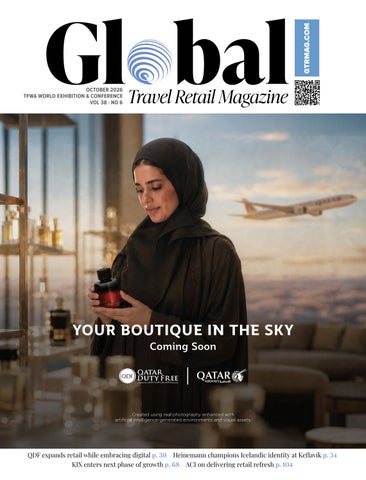
GTRMAG.COM OCTOBER 2026 TFWA WORLD EXHIBITION & CONFERENCE Front Cover.pdf 1 06/09/2026 2:50 pm VOL 38 · NO 6
QDF expands retail while embracing digital p. 30 Heinemann champions Icelandic identity at Keflavík p. 34 KIX enters next phase of growth p. 68 ACI on delivering retail refresh p. 104
MOROCCANOIL.COM
THE HYDRATION OF YOUR DREAMS NEW Overnight Leave-in Mask
Letter from the Editor
Keeping pace
W
e in travel retail have spent the past few years adjusting to a very different operating environment. Passenger flows have shifted, digital habits are now woven into every stage of the journey, and younger consumers are bringing new expectations to the channel. Recognizing the change is the easy part; responding to it quickly enough is the real challenge. Gen Z travelers are resetting the industry bar. Research from ACI Asia Pacific & Middle East shows this generation is already spending more in airports than older travelers, but what gets them to open their wallets looks nothing like what worked before. Experience, authenticity and discovery matter more than price. Static assortments and slow refresh cycles can make an offer feel out of date far earlier than was once the case. Data is one way to ensure the offer is always relevant, and Qatar Duty Free has invested heavily in gathering and using this information. Its proprietary 36Q platform helps the retailer see where passengers spend their time, what catches their attention, and where new opportunities may be hiding. Those insights are shaping category decisions, activations and new concepts. Qatar Duty Free’s growing e-commerce and loyalty strategy goes further, aiming to reach passengers at more points along their journey, not just once they’re through security. In China, that journey starts even earlier — often before consumers realize they’re shopping at all. Younger beauty enthusiasts move easily between social content, comments, recommendations and checkout. AI has quietly become part of that process, helping them compare products, check ingredients and decide whether something’s worth buying. For this generation, discovery can happen anywhere, making the path to purchase more fluid than ever. Retailers can’t script that kind of behavior, which is exactly why Gebr. Heinemann’s Nico Reifkogel thinks business needs to catch up. In his guest column, Reifkogel argues that commercial partnerships need to build in more flexibility, enough to respond quickly to new passenger demographics, emerging brands and shifting expectations. Heinemann’s direct retail operation at Keflavík Airport shows what that flexibility looks like in practice. The stories in this issue show companies across travel retail finding these and other new ways to understand travelers better and respond more quickly to what they want. That momentum will be front and center as the industry gathers once again in Cannes. With no shortage of new concepts, products and technology to discover, it’s clear the pace of change may be accelerating, but so is the industry’s ability to meet it. We look forward to seeing what comes next.
Kindest regards,
OCTOBER 2026 · VOL 38 · NO 6 Global Travel Retail Magazine (ISSN 0962-0699) is published seven times a year by Paramount Publishing Company Inc. The views expressed in this magazine do not necessarily reflect the views and opinions of the publisher or the editor. October 2026, Vol 38. No. 6. Printed in Canada. All rights reserved. Nothing may be reprinted in whole or in part without written permission from the publisher. Paramount Publishing Company Inc.
GLOBAL TRAVEL RETAIL MAGAZINE Tel: 1 905 821 3344 www.gtrmag.com PUBLISHER Aijaz Khan aijaz@globalmarketingcom.ca EDITORIAL DEPARTMENT EDITOR-IN-CHIEF Hibah Noor hibah@gtrmag.com DEPUTY EDITOR Laura Shirk laura@gtrmag.com SENIOR CORRESPONDENT Atoosa Ryanne Arfa atoosa@gtrmag.com SENIOR EDITOR Wendy Morley wendy@gtrmag.com SENIOR WRITER Alison Farrington alison@gtrmag.com ART DIRECTOR Kristie Weekes
ADVISORY BOARD Gary Leong Thomas Henningsen Nick King
CIRCULATION & SUBSCRIPTION MANAGER accounts@globalmarketingcom.ca
HIBAH NOOR Editor-in-Chief hibah@gtrmag.com
8 GLOBAL TRAVEL RETAIL MAGAZINE OCTOBER 2026
HAILEE STEINFELD
THE NEW EAU DE PARFUM
Contents
WHAT’S INSIDE
34 Top Stories 30 Building momentum
Qatar Duty Free posted 9% sales growth in the year to March 2026 as it expanded its retail and F&B footprint and stepped up its focus on e-commerce, loyalty and passenger data
34 Breaking the ice
Gebr. Heinemann and Isavia put Icelandic brands and storytelling in the spotlight at Keflavík Airport, where local brands now make up a record 30% of the retailer’s airport assortment
68 More than a makeover
Kansai Airports Corporate Executive Vice President, Chief Commercial Officer (Non-Aeronautical) Fumio Owada discusses the completed Terminal 1 renovation at Kansai International Airport and the next phase of KIX’s growth
104 Discovery over discounts
ACI’s Stefano Baronci says static assortments and slow refresh cycles are costing airports a generation that spends more but shops differently
48 A lesson in loyalty
Avolta’s Nicolas Girotto reveals how Club Avolta connects the traveler journey, unlocks smarter data and puts AI to work behind the scenes
54 Game plan
Reflecting on the 2026 FIFA World Cup taking over North America this summer, Avolta COO Jordi Martin-Consuegra highlights the role of exclusive merchandise and real-time cultural activations in capturing fan enthusiasm
ASIA OVERVIEW 58 Selamat datang
Under Malaysia Airports’ Senior General Manager of Commercial Services, Hani Ezra Hussin, KLIA demonstrates how cultural identity can influence commercial strategy
64 Full circle
Lotte Duty Free’s return to Incheon Airport completes its network across Korea’s four major airports, as the retailer targets renewed growth at the DF1 concession
74 Indian expansion
Features
As GMR Aero Duty Free builds its duty free presence across India, new developments show how growing scale and local character can share the shelf
ON LOCATION 38 On the clock
MIDDLE EAST OVERVIEW 78 Building forward
The 2026 Italian Grand Prix in Monza, Milan, provided the backdrop for a closer look at the next chapter of the ZYN x Ferrari partnership. Global Travel Retail Magazine reports from the PMI-hosted event
RETAILER NEWS 42 Gulf expansion
With Abu Dhabi adding immediate luxury scale and Ras Al Khaimah extending its Gulf reach, Duty Free Americas is expanding its wider Middle East and Africa strategy as it targets a place among the world’s top five travel retailers
MEADFA President Abdeslam Agzoul on the association’s milestone anniversary, evolving traveler behavior across the Middle East and Africa, and what to expect heading into Rabat
80 A shared journey
PAC Beirut Duty Free’s new brand signature “Between Home and Away” reflects the emotional moments of leaving Lebanon and returning home
82 Betting on Basrah
Iraq Duty Free opens two new stores at Basrah International Airport and grows its Baghdad business as the country’s travel retail market recovers from a lengthy airport closure 12 GLOBAL TRAVEL RETAIL MAGAZINE OCTOBER 2026
Contents
126 AMERICAS OVERVIEW 86 Hub ambition
TECHNOLOGY 118 Small spend, big pull
90 Inclusive impact
122 Predictive advantage
94 Beyond the counter
AIRPORT NEWS 126 Reinventing the terminal
Record tourism growth and expanding air connectivity are strengthening the Dominican Republic’s role as a regional gateway and creating new retail opportunities for Punta Cana Airport and Arajet
London Supply Group’s María Taratuty explains how sustained community programs, accessible travel environments and inclusive leadership shape the company’s approach to social impact
CHANEL’s new standalone boutique at Toronto Pearson Airport reflects Avolta’s vision that the future of airport luxury lies in mono-brand destinations built for discovery, not just transactions
96 Crossing new ground
Frontier Duty Free Association and The Duty Free at Peace Bridge provide insight into U.S.-Canada relations and the ongoing recovery of the land border duty free sector
CONSUMER INSIGHTS 100 Silver lining
More freedom to travel and strong spending potential are putting the mature, older “silver traveler” demographic on travel retailers’ radar
ASSOCIATION NEWS 108 Relevance by design
Against a backdrop of volatility and cost pressures, Sarah Branquinho outlines TFWA’s focus on stronger platforms, sharper industry insight and keeping pace with changing travelers
112 In the name of change
In this Q&A, Global Travel Retail Magazine speaks with newly appointed IAADFS Executive Director Natalie DeHart about her vision for the association and the priorities shaping its next chapter
14 GLOBAL TRAVEL RETAIL MAGAZINE OCTOBER 2026
China’s youngest beauty consumers control little disposable income but are already dictating which products go viral and which brands earn a second look
As airports connect operational and commercial intelligence, SITA’s Nick Batchelor says AI is creating new ways to predict passenger movement and support non-aeronautical revenue
Frankfurt Airport Retail details its vision for Frankfurt Airport’s new T3, where function, design and engagement redefine the passenger journey
132 Coming soon
Scheduled to open its first phase by year-end and ultimately double passenger capacity, Puerto Vallarta Airport’s T2 expansion sets a new benchmark for sustainable airport design
GUEST COLUMN 134 New partnership mindset
As passenger expectations and market conditions evolve, travel retail needs commercial models built around flexibility, shared investment and long-term value creation, argues Gebr. Heinemann’s Nico Reifkogel
138 More than a “grab-and-go” moment
Following the recent launch of Pi Insight’s rebranding, Managing Director Stephen Hillam details the psychology of the last purchase opportunity and how brands and retailers can create differentiated propositions to successfully convert travel retail shoppers
EDITOR’S PICKS 140 From the shop floor
Our editors select the standout products, launches and innovations capturing attention across global travel retail
AIRPORT EXCLUSIVE
Only available for those who fly.
For Trade Only. Not for Distribution to Consumers.
This product is not risk free and contains nicotine, which is addictive. Only for use by adults.
NEW
Unleash the intense freeze 11 MG
For Trade Only. Not for Distribution to Consumers.
NEW
T R A
F L AVOURS
STRONGER* TASTE INTENSITY
#1
BEST-SELLING CLOSED-POD VAPE IN 5 EU MARKETS*
* Compared to other offers in the VEEV ONE portfolio. *PMItotal totalvolume volumeofftake offtakeestimates estimatesobtained obtained from from third ofof *PMI thirdparty partyretail retailaudit auditmeasurements measurements closed pod Slovakia / Bulgaria / Portugal / Romania / Greece as of as Q4of 2025 closed pode-liquids e-liquids(in (inml) ml)inin Slovakia / Bulgaria / Portugal / Romania / Greece Q4data. 2025 data.
For Trade Only. Not for Distribution to Consumers.
This product is not risk free and contains nicotine, which is addictive. Only for use by adults.
Contents
176 BEAUTY 142 Built before boarding
166 Pouch position
144 Island momentum
TRAVEL ESSENTIALS 168 Small but mighty
Coty’s Diego Artola says social discovery is redefining the beauty path to purchase, while the airport remains critical to converting intent into sales
Rising tourist numbers, a breakout year for Fenty Beauty and Avolta’s new majority stake in Penha Duty Free Group are reshaping the Caribbean beauty landscape for master distributor Essence Corp
148 Beauty boom
Moroccanoil’s Sebastien Levi on how the iconic beauty brand is building momentum across travel retail and advancing its multicategory strategy
149 Scent of discovery
Dubai-born fragrance house ARMAF showcases its Club De Nuit and Odyssey lines at TFWA World Exhibition & Conference, while actor John Abraham fronts a global campaign for its latest launch
150 Pivot point
BEAUTE LUXE GROUP CEO David Dayan reveals how a swift shift from Dubai to Paris is helping keep Sol de Janeiro and other brands moving into Cape Verde and across Africa
152 The brand builder
From long-established relationships in the Middle East to a new generation of brands and consumers, Patrick Malek is taking Tradeluxe’s marketbuilding model into a very different beauty landscape
SPIRITS & TOBACCO 154 Serving the future generation
Global spirits producers are transforming the airport aisle into a playground for the legal-drinking-age Gen Z crowd. By pairing exclusive digital drops with immersive IRL cultural collaborations, brands are catching the vibe of travelers who value genuine connection
160 Spirit of Siberia
Alex Kurapov, Head of Global Business at Solex Europe, discusses the provenance, positioning and path forward for Solex Group’s premium vodka portfolio
164 The perfect blend
One year after launching a dedicated travel retail strategy, Heaven Hill is responding to market shifts driven by meaning-led purchasing and the need for greater traveler relevance 20 GLOBAL TRAVEL RETAIL MAGAZINE OCTOBER 2026
With more than one-third of U.S. adult nicotine consumers now using smoke-free products, Altria International Sales is introducing the premium on! PLUS™ pouch to a global audience through travel retail
Knirps CEO Bernhard Lindner discusses how innovation and design are helping the heritage umbrella brand connect with today’s international traveler
170 Rain or shine
doppler’s Head of International Sales, René Schwarz, explains how the brand is transforming the humble umbrella into an award-winning, compact lifestyle essential for modern travelers
172 Small stuff, big spend
Travel accessories used to be what shoppers purchased when something broke or was left at home. Heys, Mandarina Duck and Sudio explain why they are now driving some of duty free’s highest-value impulse purchases
FASHION & ACCESSORIES 174 Lion’s share
From handmade production in a Stuttgart workshop to duty free counters around the world, Coeur de Lion is using travel retail to reach new customers and build its presence in younger markets
CONFECTIONERY & FOOD 176 Sweetening the journey
In this Confectionery Report, four brands from across the category explain how provenance, immersive tasting experiences and destination relevance are creating new ways for travelers to engage with confectionery beyond the product itself
184 A slice of Italy
Food Accademia’s Fabrizio Canal dishes on brand curation, the role of storytelling and how the company has evolved from distributing regional brands to creating authentic Italian experiences in travel retail
186 Crystal clear conversion
Mondelēz WTR’s Joost Rosmuller discusses its Toblerone “The Ultimate Gift” campaign and how collaboration, exclusivity and emotional connection can help close confectionery’s conversion gap
NEWS
Shilla Duty Free broadens fashion portfolio to meet diversifying FIT traveler demand Shilla Duty Free is expanding its fashion portfolio across its Jeju and Seoul locations as it responds to more diverse brand preferences and shopping needs among free independent travelers (FITs). The retailer opened Jeju Island’s only standalone AMI store at Shilla Duty Free Jeju on September 1 and has also added PLAY COMME des GARÇONS to its Seoul store. The AMI store offers apparel featuring the French designer brand’s signature heart logo, including T-shirts, sweatshirts and hoodies, along with accessories such as bags and baseball caps. Founded in Paris, AMI is known for its signature logo and refined designs and has gained popularity among customers worldwide. Shilla Duty Free said the Jeju location gives domestic and international visitors to the island an additional shopping option. The casual line from global fashion house COMME des GARÇONS is known worldwide for its signature heart logo with slightly upturned eyes. The Seoul store carries cardi-
The AMI store at Shilla Duty Free Jeju is the brand’s only standalone location on Jeju Island
gans, long-sleeve tops and T-shirts featuring variations of the brand’s heart patches and prints, as well as sneakers.
Avolta extends long-term travel retail contracts across four Mexican airports Avolta has further strengthened its partnership with Grupo Aeroportuario del Pacífico through long-term travel retail contract extensions across Guadalajara, Puerto Vallarta, Los Cabos and Bajío International Airports in Mexico. The extensions secure Avolta’s continued presence at four of Mexico’s most important business and leisure travel gateways, which together welcome more than 30 million passengers annually. The agreement reinforces Avolta’s position in one of its most established and strategically important markets in Latin America. In addition to securing Avolta’s existing operations, the agreement supports future growth opportunities through
planned terminal expansions at Guadalajara and Puerto Vallarta airports. Avolta is expected to expand its commercial footprint in both developments, including a minimum of three additional duty free stores in each new terminal as they become operational. Across the four airports, Avolta will continue to offer a retail proposition combining globally recognized brands with locally relevant products and experiences. The stores will showcase key duty free categories alongside a carefully curated assortment reflecting Mexico’s heritage, culture and gastronomy, creating a strong sense of place for domestic and international travelers alike.
BOTTLED BEYOND THE NEW PEONY-MAPLE SYRUP FRAGRANCE
BO SS REC O GN IZ E BOS S
NEWS
Visa and Duty Free Americas expand partnership across Central America & Caribbean Visa and Duty Free Americas have renewed and expanded their agreement for the fourth consecutive year. The alliance includes special benefits for Visa cardholders across travel retail stores, convenience stores, restaurants and bars operated by Duty Free Americas in some of the busiest airports and border crossings in Central America and the Caribbean. The agreement includes Terminal 1 and 2 at Tocumen International Airport in Panama, the Duty Free Americas store in Paso Canoas – located on the border between Panama and Costa Rica, one of the region’s busiest and most important border crossings for commercial activity – and Punta Cana International Airport in the Dominican Republic, where benefits will be available to both departing and arriving travelers. Dov Falic, Vice President of Duty Free Americas, said, “Our collaboration with Visa is redefining airport and border retail. As we enter our fourth consecutive year of partnership, we are proud to expand the program into border stores for the first time, bringing Visa cardholder benefits
The partnership includes special benefits for Visa cardholders at travel retail stores operated by Duty Free Americas across airports and border crossings
to travelers across Latin America. We look forward to continuing to grow this partnership and delivering greater value to our customers.” As part of the agreement, Visa and Duty Free Americas are strengthening their value proposition for travelers with a 10% discount on purchases over US$200 made at participating stores.
Adora Cruises taps Starboard for luxury, vintage retail aboard Flora City Adora Cruises has partnered with Starboard to develop the duty free retail offer aboard Adora Flora City, the second Chinese-built large cruise ship, ahead of its maiden voyage from Guangzhou Nansha on November 22. The Starboard-curated space will span more than 600 square meters and feature nearly 100 Chinese and international brands across 12 categories, including fine jewelry, Swiss watches, luxury handbags, fashion jewelry and premium fashion. Brands will include Prada, Miu Miu, Balenciaga, Fendi, Vivienne Westwood, Mikimoto, Longines and Polo Ralph Lauren.
Adora Flora City will also become the first Chinese-built large cruise ship to feature luxury vintage retailer What Goes Around Comes Around. The offer will include preowned handbags from brands including Hermès, Chanel and Louis Vuitton. Adora Flora City is scheduled for delivery on November 6 before beginning its maiden voyage. The ship will use flowers as a theme throughout its hull, cabins and public areas and incorporate Chinese cultural elements across its dining, entertainment and services.
BOTTLED BEYOND THE NEW ORANGE BLOSSOM-LEATHER FRAGRANCE
BO SS RECO G NI ZE BOSS
NEWS
Unifree Duty Free brings the story of BIO products to life beyond the shelf Unifree Duty Free has introduced a new BIO-focused in-store experience at one of its arrival stores, bringing together selected BIO products, dedicated visual merchandising and an interactive sustainability initiative designed to extend the story of BIO beyond the shelf. Built around the idea that “The story of BIO products doesn’t end on the shelf,” the initiative creates a dedicated space where passengers can discover selected organic wines and teas while engaging with a simple and tangible sustainability concept. The specially designed BIO display brings the category to the forefront through dedicated visual materials, while plantable seed cards add an interactive element that allows the experience to continue beyond the airport. As part of the initiative, selected BIO wines displayed at the dedicated arrival store stand feature specially designed plantable seed cards in the form of bottle neckers. Made with embedded seeds, the cards are designed
This initiative forms part of the retailer’s broader approach to incorporating sustainable practices and meaningful experiences into its retail operations at Istanbul Airport and beyond
to be planted in soil rather than discarded after use, giving passengers the opportunity to turn a simple purchase into a small act of reconnecting with nature.
Avolta launches first direct wallet-to-wallet stablecoin payments pilot Avolta has launched a pilot program enabling customers to pay with stablecoin at its level 2 duty free store at Zurich Airport. From September 2 to 25, 2026, travelers can make purchases directly from their digital wallets through a simple QR code payment process. The pilot introduces a payment model in which transactions are settled directly between the customer and Avolta, without relying on traditional card networks or intermediary payment providers. Funds are transferred within seconds using blockchain technology. Yves Gerster, CFO of Avolta, said, “For decades, the consumer payment experience has evolved, but the
underlying principle remained largely unchanged. This pilot tests a fundamentally different approach: direct value transfer between customer and merchant. Wallet-to-wallet payments have the potential to meaningfully change the payment infrastructure and we look forward to learning from customers in a live retail environment.” The initiative forms part of Avolta’s broader innovation agenda, exploring how emerging technologies and solutions can further enhance the traveler experience and shape the future of retail payments. The solution was designed and developed by Avolta in collaboration with DevelopX.
NEWS
JFKIAT advances JFK T4’s commercial transformation with four new restaurant openings JFKIAT — the operator of Terminal 4 (T4) at John F. Kennedy International Airport — has opened a selection of locally rooted, chef-driven concepts: FIELDTRIP, Bessou, Chopt, and Dos Toros Taqueria, further expanding Terminal 4’s dynamic food and beverage portfolio. The restaurants mark the newest additions to T4 as JFKIAT drives forward the total reinvention of T4’s commercial program, focused on bringing New York City’s unique, diverse culture to travelers while elevating the passenger experience. These concepts join a growing lineup of locally driven food and beverage offerings at the terminal, including Villa Russo, The Brooklyn Counter and Brooklyn Tea & Market. These new dining offerings are part of JFKIAT’s partnership with the HMSHost-led joint venture announced last year, to bring a curated mix of local and diverse businesses into T4. Selected through a competitive process, these local business enterprises are debuting at the terminal to introduce
Chopt ribbon-cutting celebrates the arrival of the locally rooted salad concept
travelers to authentic New York flavors, bringing distinct, culturally driven flavors shaped by heritage, storytelling and community. The local businesses selected as joint-venture partners to HMSHost include: Tamalito Inc., Neat Rules Hospitality Group LLC, Kintaro Foods LLC, Kismet Cocktails, Corlis Stone-Littles LLC, SHCAIR LLC and Fresco’s Cantina.
Air4casts ranks Seoul Incheon as the world’s busiest international airport Air4casts has named Seoul Incheon as the world’s busiest international airport for the first half of 2026. The report notes it is the first change at the top since the pandemic recovery settled. Highlights include: • Incheon handled 38.4 million international passengers, up 6.3% • Heathrow, second, handled 37.8 million passengers, up just 0.2% • The margin is 0.6 million passengers, under three days of Incheon traffic • Dubai, first a year ago, is eighth “The top ten as a group carried 2.4% fewer international passengers than in the first half of 2025,” Air4casts stated.
“Remove Dubai and the other nine grew by 2.4%. That single substitution is the story of the first half.” A year ago, Heathrow led Incheon by 1.6 million passengers. It now trails by 0.6 million, a swing of 2.2 million in twelve months. Incheon added 2.27 million passengers over the first half this year; Heathrow added 0.08 million. Incheon reports 4.24 million transfer passengers in the half, up 18.1%, and transfers on European routes up 63.2%, with the airport. As the transfer function of Middle Eastern airports such as Dubai was weakened by the US-Iran conflict, existing air travel demand centered on Dubai — including routes between Dubai and Europe — shifted toward direct and connecting services through Incheon Airport.
NEW AMBER VANILLA THE REFILLABLE FRAGRANCE
NEWS
Harding+ expands K-beauty offer with first-at-sea launches Harding+ further strengthened its Korean beauty (K-beauty) offering with the launch of three sought-after skincare brands — Medicube, Biodance and Thank You Farmer — onboard European ships late August 2026. Launching as a first-at-sea, the expansion reflects growing guest demand for innovative, ingredient-led skincare and reinforces Harding+’s commitment to bringing the latest global beauty trends to cruise retail. The new additions build on the successful introduction of K-beauty onboard earlier this year, marking the next phase of the category’s growth. As Korean skincare continues to reshape the global beauty market with its focus on effective formulations and accessible routines, Harding+ is making it easier than ever for cruise guests to discover. Rather than merchandising products by brand alone, the onboard experience has been designed around a simple skincare journey, guiding guests through cleansing, toning, treatment, moisturizing and SPF. Whether guests are discovering K-beauty for the first time or already loyal to the category, the approach makes shopping intuitive, educational and enjoyable.
Biodance’s Real Deep Mask (1x4 sheets); Medicube’s Zero Pore Pad 2.0 (70 pieces)
The launch features some of the category’s most recognizable hero products, including Medicube’s Collagen range and viral Zero Pore Cleansing Pads, Biodance’s bestselling collagen sheet masks, and Thank You Farmer’s renowned SPF collection.
Sydney Airport sets course for future growth with new Master Plan Sydney Airport’s Master Plan 2045 has been approved by the Australian Government, setting the long-term vision for how Australia’s busiest airport will grow over the next two decades. The Master Plan forecasts Sydney Airport will welcome more than 72 million passengers annually by 2045, including 36.4 million international passengers and 36.2 million domestic and regional passengers. The airport’s annual economic contribution is expected to grow to around AU$70 billion, while direct employment at Sydney Airport is projected to increase to more than 105,000 jobs.
THE NEW EAU SO EXTRA
The Master Plan provides the framework for future investment in terminal capacity, transport connections and passenger facilities needed to support forecast growth. Central to the plan is the proposed redevelopment of Sydney Airport’s domestic precinct, including plans to bring together domestic, regional and international services through a new integrated terminal experience. The Master Plan also incorporates Sydney Airport’s fiveyear Airport Environment Strategy, which outlines actions to reduce emissions, build climate resilience and support more sustainable airport operations.
NEWS
Etihad brings together premium travel enhancements under Etihad Wellbeing Etihad Airways has introduced Etihad Wellbeing, a new program bringing together the airline’s latest product and service enhancements designed to help guests travel more comfortably and arrive feeling rested and refreshed. Etihad Wellbeing gives guests the opportunity to maintain their healthy lifestyle habits throughout their journey through a growing collection of products and experiences that promote a restful and restorative travel experience. The program encompasses all touch points, from dedicated quiet spaces and relaxing pre-departure spa treatments in the Etihad Lounges at Zayed International Airport, to luxury amenities, natural bedding, nutritious dining options and hydrating vitamin and electrolyte beverages inflight. Jyotsna Chowdhry, Vice President Product and Hospitality, Etihad Airways, said, “Research shows that as people fly more frequently, they are increasingly looking at ways to maintain a healthy lifestyle while they travel. Etihad Wellbeing is our commitment to making the flying experience as restorative and restful as possible. We’re bringing
Eithad’s new wellbeing program promotes a restful and restorative travel experience
together a range of practical improvements across our cabins and service, all designed to help guests rest better and arrive feeling refreshed.”
Emirates helps customers travel with greater confidence Aiming to offer its customers greater flexibility and more choice, as well as the ability to tailor travel plans for more peace of mind, Emirates has highlighted five measures to help customers travel with greater confidence. From August 10, 2026, customers traveling to Dubai can change their travel dates as many times as they need, free of charge, across every type of fare. Unlimited, free of charge changes run across Saver all the way through to Flex fares in Economy, and for Special, Saver and Flex fares in Business Class. An applicable fare difference may apply. Economy Flex Plus, Premium Economy, Business Flex Plus and First Class fares remain fully flexible.
Emirates has also substantially reduced refund fees on flights to Dubai to US$50 on Saver fares and US$25 on Flex fares in Economy. In Business Class, refund fees will be US$50 on Special and Saver fares and US$25 on Flex fares. No show fees remain unchanged. Customers traveling anywhere on the Emirates network receive one free date change on tickets booked from April 2, 2026, including journeys connecting through Dubai. Customers can also hold a fare for 24 hours at no charge while they finalize their plans.
the new elixir collection worn by Rosalía
Top Story
Building momentum Qatar Duty Free posted 9% sales growth in the year to March 2026 as it expanded its retail and F&B footprint and stepped up its focus on e-commerce, loyalty and passenger data by HIBAH NOOR
Q
atar Duty Free (QDF) recorded sales growth of 9% in the 12 months leading up to March 2026, outperforming passenger growth during a year in which the retailer continued to expand its retail and F&B offer at Hamad International Airport (HIA). QDF introduced 15 new retail concepts and 16 F&B destinations during the financial year, adding approximately 2,700 square meters of retail and dining space across Concourses D and E. The openings included POP MART, Aesop, Lancôme Café and the Assouline Travel Series Kiosk. According to Qatar Airways Chief Retail and Hospitality Officer Thabet Musleh, the sales performance was driven by continued investment in the offer alongside the use of QDF’s proprietary 36Q data platform to identify changes in passenger behavior and demand. “Qatar Duty Free’s performance over the past year has been driven by continued investment in our offering, guided by a clear application of our proprietary insight into passengers,” he says.
30 GLOBAL TRAVEL RETAIL MAGAZINE OCTOBER 2026
36Q guides category investment
QDF is using 36Q to determine where passengers are spending time, what they are engaging with and which categories or concepts may have further potential at HIA. One example was a festive Charlotte Tilbury activation after 36Q identified make-up as a strong opportunity. According to Musleh, the activation resulted in 700% year-on-year growth for Charlotte Tilbury and contributed to a 36% uplift in cosmetics. The data is being used not only to support established categories but to identify opportunities elsewhere in the offer. “We do not start by asking how to fill a space. We start by looking at what passengers want and where there is a clear opportunity,” Musleh says.
Thabet Musleh, Chief Retail and Hospitality Officer, Qatar Airways
POP MART generated more than 1,100 transactions during its first 72 hours at HIA after QDF introduced a Middle East-first concept with Qatarexclusive elements. Musleh says the
Expansion continues across retail and F&B
QDF’s development program has continued into the current financial year, with New Balance among the additions and further retail and F&B openings planned. Details of the next openings have not yet been announced, but Musleh says concepts must add something distinctive, respond to QDF’s passenger insight and strengthen the overall experience rather than simply fill available space. Brand collaboration forms part of that development process, with QDF looking for partners prepared to shape concepts jointly from the outset and bring their own expertise to the HIA environment. “The strongest partnerships are those where the brand brings its expertise and identity, and we bring our knowledge of our passengers and airport environment,” Musleh says.
POP MART brings the global collectibles trend to Hamad International Airport with a Middle East-first concept featuring Qatar-exclusive elements
Toblerone campaigns broaden the shopper base
New Balance is among the latest additions to Qatar Duty Free’s expanding retail offer
decision reflected wider international demand for collectibles, adapted to the HIA passenger and airport environment. “In other cases, we respond to a wider global trend,” he says. “For example, POP Mart recognized the global growing demand for collectibles, which we adapted for Hamad International Airport through a Middle East first concept with Qatar-exclusive elements.” Beauty remains one of QDF’s strongest categories and has continued to develop
through both new brands and formats. Aesop has strengthened the premium skincare offer, while the Dior Luxury Beauty Retreat provides personalized treatments and services. QDF has identified growing interest in more interactive and experience-led beauty formats, particularly in Asian markets. “Our response was the Lancôme Café — a hybrid concept that brings beauty and F&B together, allowing passengers to shop and indulge within the same experience,” Musleh says.
QDF has used passenger data in its longstanding partnership with Mondelēz World Travel Retail, including for the development and promotion of Toblerone Pink Crush. Data showed that Toblerone was being purchased more frequently by men, leading the partners to identify an opportunity to broaden the brand’s appeal. Following the launch of Pink Crush and an influencer-led campaign, female shoppers accounted for 55% of spend. “The partnership works because we both bring something different to the table. Mondelēz World Travel Retail knows the confectionery category incredibly well, while QDF brings our proprietary passenger insights and daring spirit,” Musleh says. The partners most recently worked together on the Toblerone Crystal Bar, one of nine Swarovski-crafted pieces produced globally. QDF displayed Bar No. 1 at HIA and auctioned it in support of Education Above All Foundation. The Doha auction received the highest winning bid among the nine airports taking part in the initiative.
www.gtrmag.com GLOBAL TRAVEL RETAIL MAGAZINE OCTOBER 2026 31
Top Story
Qatar Duty Free displayed Bar No. 1 of nine Swarovski-crafted Toblerone Crystal Bars at Hamad International Airport before auctioning it in support of Education Above All Foundation
“The beauty and rarity of Bar No. 1 immediately caught people’s attention, but the purpose behind the auction gave the experience more meaning,” Musleh says. “Passengers could discover something they would rarely see in an airport and take part in an initiative supporting Education Above All Foundation.”
Passenger flows shift during regional disruption
Regional geopolitical disruption and temporary airspace closures affected QDF sales earlier this year, while connecting traffic through Middle Eastern hubs fell by around 53% year-on-year in March and April, according to McKinsey figures cited by Musleh. The disruption changed the flow of passengers through HIA, affecting both the mix of travelers in the terminal and the amount of time they had there. Musleh says 36Q has become particularly important in that environment, giving QDF a more current view of passenger behavior as conditions shift. “That’s where 36Q comes in – we use it to understand where passengers are spending their time, what they are engaging with and how their preferences are changing,” he says.
32 GLOBAL TRAVEL RETAIL MAGAZINE OCTOBER 2026
Sales were affected in March, but QDF saw a recovery as airport operations improved. By July, sales were approaching the previous year’s levels even though operations had not yet been fully restored. “The recovery has been encouraging,” Musleh says. He remains cautiously optimistic about the remainder of 2026 as traffic continues to recover.
E-commerce and loyalty extend the QDF offer
Looking ahead to 2027, QDF is preparing to expand its e-commerce and loyalty activity while moving from isolated marketing activations toward a connected, year-round strategy. The e-commerce platform will allow passengers to browse before traveling, reserve products up to 90 days in advance and collect purchases at HIA, with gate delivery also planned. Qatar Airways’ Starlink-enabled, gate-to-gate Wi-Fi will extend access to QDF during flights. The retailer says the more consistent connection will support greater flexibility for brands as well as added convenience for passengers. Musleh says QDF sees digital shopping as complementary to the physi-
cal retail environment rather than a replacement for it. “We don’t see digital and physical retail as competing experiences. Physical retail will remain central to QDF because it is where passengers can discover products and engage with our teams. E-commerce will make that experience easier to access throughout the journey.” Qatar Airways Privilege Club will form another part of the strategy. Penetration is currently just above 40%, which Musleh describes as a tipping point for the retailer. “We see this becoming the connective thread of every shopping journey, with Avios set to become the currency of choice as e-commerce becomes increasingly loyalty-led.” The longer-term plan is to bring marketing, loyalty, e-commerce and the physical retail offer into closer alignment across the wider Qatar Airways journey. “What comes next is a more connected QDF experience,” Musleh says. “Through our focus on elevating our year-round marketing, e-commerce and loyalty offerings, we want passengers to encounter QDF earlier and engage with us across more of their journey.”
On Location
Breaking the ice Gebr. Heinemann and Isavia put Icelandic brands and storytelling in the spotlight at Keflavík Airport, where local brands now make up a record 30% of the retailer’s airport assortment
G
ebr. Heinemann and airport operator Isavia have officially opened three revamped ÍSLAND Duty Free shops at Keflavík Airport, completing a redesign of the arrivals, departures and gate stores. Icelandic brands now account for 30% of Heinemann’s brand mix at the airport, the highest share across its airport operations. The partners marked the opening with a press conference and ribbon-cutting ceremony at the airport on September 9. The stores combine international and Icelandic brands, with design elements inspired by the country’s geothermal lagoons, flowing water, lava fields and newly formed terrain.
34 GLOBAL TRAVEL RETAIL MAGAZINE OCTOBER 2026
by ALISON FARRINGTON
“Today, we are here at Keflavík Airport celebrating the opening of what we hope will be considered a new benchmark in our industry,” Max Heinemann, Co-CEO of Gebr. Heinemann, said at the press conference. Heinemann secured the duty free concession with Isavia through an international tender and began redesigning the stores after taking over operations in spring 2025.
Perfect partners
For Isavia, the partnership was an opportunity to support Icelandic businesses and enhance the passenger experience. Ómar Svavarsson, Chief
Commercial Officer, Director Airport Operations, Keflavík Airport, said the airport sought a partner that could bring international expertise while supporting both priorities. “We were looking for a long-term partner who could combine international expertise with genuine appreciation for Iceland, its culture, its products and its people. We wanted a partner capable of strengthening the position of Icelandic brands and supporting the continued development of the airport,” he said. “Keflavík Airport is Iceland’s main international gateway, welcoming millions of travelers every year and serving an important connection between
Iceland and the world. The experience passengers have here shapes not only the perception of the airport, but also the impression of Iceland as a destination.” Max Heinemann highlighted the importance of stable partnerships amid global uncertainty. “You need to be agile in partnerships and collaboration, but you need to present a certain stability, especially in values and how you conduct business in the world. This is why we feel incredibly comfortable to be here,” he said. “A strong duty free offering plays an important role in the airport’s competitiveness,” added Sveinbjörn Indriðason, CEO of Isavia. “With Heinemann’s industry knowledge and expertise, we look forward to further enhancing the customer journey for travelers while creating value for Icelandic brands and the country as a whole.”
On solid ground
Gebr. Heinemann and Isavia representatives mark the official opening of the revamped ÍSLAND Duty Free stores at Keflavík Airport on September 9
The 30% Icelandic brand share exceeds the original target of 20% and is the highest across Heinemann’s airport operations, according to Inken Callsen, Chief Commercial Officer at Gebr. Heinemann. “We have seen that this is a very good choice for attracting people into the stores. It’s far above everything we have,” she said, noting that their second-highest local brand share is 24% in Italy.
COME AND SEE US AT TFWA CANNES 27.09.2026 - 01.10.2026 FIND US AT F49 YELLOW VILLAGE PREMIUM STAINLESS STEEL
100% WATERPROOF
www.gtrmag.com GLOBAL TRAVEL RETAIL MAGAZINE OCTOBER 2026 35
On Location
ning of a story that we are about to tell. Our role is the representation of the local brand stories internationally as well.”
Two sides of the story
The revamped ÍSLAND Duty Free stores at Keflavík Airport combine international brands with a strong Icelandic assortment across the arrivals and departures experience
Local brands move into the spotlight at Keflavík Airport, where Icelandic names now represent 30% of Heinemann’s brand mix
More than 370 square meters is dedicated to Icelandic products, regional storytelling and local brand experiences, including four dedicated brand environments. The Icelandic assortment sits alongside international brands, including several being introduced to the local market. Callsen said the local assortment is contributing well to sales. “It’s not about having those brands and showing them because they are coming from the country. They are relevant for the turnover,” she shared, adding that three
36 GLOBAL TRAVEL RETAIL MAGAZINE OCTOBER 2026
Icelandic beauty brands rank among the category’s top 10. Jens Wolf, Director Sales Nordics at Gebr. Heinemann, highlighted the involvement of local producers in developing customer experience. “The suppliers here are very much involved,” he said. “They are doing the training and doing the tasting. So, there is very close collaboration.” Max Heinemann also pointed to opportunities for Icelandic brands beyond Keflavík. “It is obviously just the begin-
Heinemann operates a 2,000-squaremeter arrivals shop, a 1,600-squaremeter departures shop and a gate shop. Across the three locations, the assortment covers tobacco, confectionery, beauty, spirits, fashion, accessories, gifting and convenience products. The larger arrivals footprint reflects the importance of return-journey shopping among Icelandic passengers. Berglind Snæland, Director Commercial at Isavia, explained that locals are the primary customers of the arrivals store, with alcohol a particularly important purchase due to lower prices. The arrivals shop is designed around speed and convenience, with clear allowance information, direct routes toward baggage claim and a liquor-led assortment. Beauty, confectionery, tobacco, gifting, accessories and travel essentials complete the offer, while a regional fixture showcases Icelandic products and a selfie point features work by Icelandic mural and street artist Juan Arctic. “For arrivals, it has to be more convenient, and it has to be clear. People want to get their luggage and leave the airport,” Wolf said, adding that Icelandic design remains part of the experience. The different shopping missions are also reflected in sales. “Looking into the numbers, alcohol is far stronger in the arrival shop, whereas beauty is far stronger in the departure shop,” Callsen said. “You see the different reason to go into the store and the different reason to buy. Now, we can grow every category in both shops with the right assortment approach.”
Lava and behold
In departures, an open shopfront and multiple access points lead passengers into the core categories. At the center, a
dedicated regional area showcases Icelandic products in a setting developed with Icelandic design studio Basalt Architects. The space features a pale blue floor referencing the Blue Lagoon, a ceiling installation inspired by geothermal steam and 3D-printed sculptural elements that draw on Iceland’s landscape. Wolf noted the area is encouraging passengers to spend more time in the store. “When I see the flow into the shop, people are really spending more time in this area,” he said. “They calm down, they look around and they enjoy.” Svavarsson said the local focus was incorporated throughout the concept. “Iceland is represented throughout the concept not as an add-on, but as an integral part of the customer experience,” he stated. “Icelandic brands, products and stories play a central role and provide
Local art joins the retail mix, with a selfie point featuring work by Icelandic mural and street artist Juan Arctic
travelers with meaningful connections to the country, but at the beginning and the end of the journey.” Opening exclusives and promotions include a limited “Hæ from Iceland”
Toblerone travel retail edition and a Blue Lagoon Skin Science Grand Opening offer exclusive to ÍSLAND Duty Free.
1/2 Horizontal L E T C H A R D ON NAY TA K E YOU F U RT H E R D I SCOVER TH E LI M ITED ED ITI O N I N TR AVEL R E TAI L larochewines.com
PLEASE ENJOY RESPONSIBLY
www.gtrmag.com GLOBAL TRAVEL RETAIL MAGAZINE OCTOBER 2026 37
On Location
On the clock
The 2026 Italian Grand Prix in Monza, Milan, provided the backdrop for a closer look at the next chapter of the ZYN x Ferrari partnership. GTR Magazine reports from the PMI-hosted event
E
arlier this month, Global Travel Retail Magazine (GTR Magazine) attended the Italian Grand Prix race weekend (September 5-6) at Monza in Milan to learn more about Philip Morris International’s (PMI) long-standing partnership with Scuderia Ferrari HP. The next phase of the collaboration centers on the introduction of ZYN branding across team assets at select races in 2026 and beyond. During a PMI-hosted media panel at the event, James Ryan, PMI’s Senior Director Category Marketing Oral Products, said as the world’s leading nicotine pouch brand, ZYN’s role in the partnership is shaped by “presence, intention and purpose.” He then spoke to GTR Magazine at the ZYN lounge about the activation, its international reach and travel retail opportunity.
38 GLOBAL TRAVEL RETAIL MAGAZINE OCTOBER 2026
by ALISON FARRINGTON
GTR Magazine: Tell us more about the ZYN branding opportunity with Ferrari at this year’s event in Monza. How does Formula 1 (F1) fit into ZYN’s global marketing strategy? Ryan: For ZYN, Monza represents a powerful moment to talk about this new chapter with Scuderia Ferrari HP in one of the most iconic settings in the world of motorsport. The expanded partnership builds on more than five decades of history between PMI and Scuderia Ferrari HP, while reflecting where our business and our portfolio are today: focused on offering better, smoke-free alternatives to adults who would otherwise continue to smoke. For us, it is important to meet adult consumers where they are — in the moments, interests and cultural spaces
that matter to them — and to do so in a way that feels relevant, responsible and connected to the experience around them. At Monza, we are using that context to introduce the idea of “The Power of a Second” — a story that is rooted in racing, but meaningful beyond the track. In Formula 1, a second can change the outcome of a race. For ZYN, it becomes a way to talk about intention, presence and the moments adult consumers choose for themselves. GTR Magazine: How do you see “The Power of a Second” translating to the travel retail consumer, and how can the concept strengthen ZYN’s brand positioning? Ryan: In travel retail, I think this has a very natural role to play because the chan-
Turning Insights Turning Insights into Impact into Impact The future of travel retail The future of travel retail is built on collaboration. is built on collaboration.
When retailers, brands, airports and innovators combine expertise, When retailers, action, brands,ideas airports and innovators combine expertise, data becomes become experiences and insights data becomes action, ideas become experiences andwe insights create real value for travelers. At Gebr. Heinemann, believe create real value for travelers. At Gebr. Heinemann, we believe the strongest partnerships create the strongest results. the strongest partnerships create the strongest results. Visit us at Booth D21. Visit us at Booth D21.
www.gebr-heinemann.com www.gebr-heinemann.com
On Location
GTR Magazine’s Alison Farrington sits down with James Ryan, PMI’s Senior Director Category Marketing Oral Products to talk about the importance of this historic partnership
nel is built around movement, discovery and education. People are often in a different mindset when they travel — they are more open to exploring new brands, noticing new experiences, and engaging with something that feels international and relevant to the journey they are on. For ZYN, the partnership with Scuderia Ferrari HP helps bring that to life in a strong way. Ferrari is a world associated with precision, performance, design and emotion, and that gives ZYN a powerful context to tell a broader story — not just about visibility, but about innovation, progress and better smoke-free alternatives for adults who would otherwise continue to smoke. GTR Magazine: How is the ZYN x Ferrari partnership building on the brand’s
Ferrari driver Charles LeClerc made an appearance at the ZYN lounge on the morning of the race
position within F1 and broader sporting communities, while extending visibility and reach across global markets? Ryan: ZYN is already entering this partnership from a position of real strength. It is one of the world’s leading nicotine pouch brands, present in more than 60 markets and used by more than seven million adult consumers globally. So, for us, the partnership with Scuderia Ferrari HP is about building on the strong equity, visibility and momentum the brand already has. What makes this particularly exciting is that ZYN is still writing its story. It has grown very quickly, but it also has the qualities you need to build something long-lasting: a clear product role, strong consumer adoption, a distinctive
For ZYN, Monza represents “The Power of the Second” — a concept that resonates both on and off the track
40 GLOBAL TRAVEL RETAIL MAGAZINE OCTOBER 2026
identity, and a very relevant place within PMI’s broader smoke-free portfolio. The Ferrari partnership gives us a powerful way to express that next stage of growth — with more cultural resonance and a stronger connection to moments that people value. GTR Magazine: Could you share your thoughts on the role of travel retail in brand storytelling, and how the channel brings this iconic partnership to life? Ryan: I believe travel retail has an important role to play in what comes next for brand storytelling. The industry is going through a profound transformation, shaped by changing traveler expectations, new technologies and increasing global mobility. For many years, duty free was largely defined by convenience and price advantage, but today’s travelers are looking for something more meaningful — experiences, discovery, education and connection. Ultimately, if travel retail wants to stay relevant, it cannot rely only on yesterday’s model. It needs to help shape the next one — and iconic partnerships, when done responsibly and with the right storytelling, can be a very strong part of that evolution.
Retailer News
Gulf expansion With Abu Dhabi adding immediate luxury scale and Ras Al Khaimah extending its Gulf reach, Duty Free Americas is expanding its wider Middle East and Africa strategy as it targets a place among the world’s top five travel retailers by HIBAH NOOR
D
uty Free Americas (DFA) has moved quickly through 2026, accelerating an international expansion already well underway. Having taken over the Los Angeles and San Francisco airport concessions from DFS Group earlier this year, the Falic Group-owned retailer has now acquired DFS’s luxury travel retail business at Abu Dhabi’s Zayed International
42 GLOBAL TRAVEL RETAIL MAGAZINE OCTOBER 2026
Airport, adding an established portfolio that includes Gucci, Hermès and Bvlgari. The deal adds a substantial piece to a Gulf business taking shape across several fronts. Falic Group is preparing to open Blush, its high-end perfumes and cosmetics concept, at Wynn Al Marjan Island in September 2027, while DFA has secured the retail concession at Ras Al Khaimah International Airport.
A scaled entry into the Gulf
The Abu Dhabi acquisition marks a significant step in Falic Group’s wider regional expansion, linking its new Gulf operations with recent developments at Los Angeles International Airport (LAX) and San Francisco International Airport (SFO). Leon Falic, President of Falic Group, says, “It gives us an immediate, scaled presence and a strong
Falic Group’s acquisition of DFS Group’s luxury travel retail business at Zayed International Airport brings leading brands including Hermès, Gucci and Bvlgari into its portfolio
platform from which to further develop and accelerate our strategy across the Middle East and Africa, building on the momentum of our recent developments at LAX and SFO.” That momentum is also being supported by strong passenger growth at LAX, driven not only by increased connectivity with Latin America but also by new flights to the Middle East, bringing an increasingly affluent international passenger base with strong spending potential. The Abu Dhabi business brings an established portfolio of luxury concessions and the former DFS team into Falic Group, adding specialist expertise
and capabilities as the Group develops luxury retail more broadly. “Luxury retail is a critically important category for Falic Group, and this acquisition gives us a strong foundation from which to further develop it,” he states. The changeover will be visible to passengers at Zayed International Airport. Plans include new flagship brands, expanded footprints for existing top performers, and open-air retail areas designed to create a more flexible passenger experience and drive conversion. “Duty Free Americas and Abu Dhabi Airports share an ambitious vision to further develop and elevate the luxury travel retail offering together,” Falic says.
Ras Al Khaimah and the Wynn opportunity
In Ras Al Khaimah, Falic Group is expanding across two complementary channels. DFA will redevelop the retail offer at Ras Al Khaimah International Airport, while Blush, the Group’s highend perfumes and cosmetics concept, is due to open at Wynn Al Marjan Island in September 2027. Both developments are tied to the emirate’s broader tourism growth, with Wynn expected to draw new international visitors as the airport adds routes and expands its own reach. Together, the airport concession and Blush give Falic Group a broader platform in Ras Al Khaimah as tourism
www.gtrmag.com GLOBAL TRAVEL RETAIL MAGAZINE OCTOBER 2026 43
Retailer News
DFA’s experience at major U.S. gateways including Los Angeles is helping shape its approach to destination-led luxury retail in the Gulf
and air connectivity expand. “The Ras Al Khaimah Airport opportunity is part of a multi-layered strategy. First, we see the Middle East as a very important growth driver for the Group and, as you have seen, we are investing heavily in the region,” Falic notes. Wynn is expected to change the profile of visitors coming into Ras Al Khaimah, but DFA’s airport plans are not built around resort guests alone. Ras Al Khaimah International Airport has its own expansion ambitions and is adding international routes, creating the potential for a broader customer mix as the emirate grows. “The airport opportunity is highly complementary to our business with Wynn, and we will undoubtedly develop further opportunities within this ecosystem,” Falic says. Duty Free Americas is preparing for that shift with a complete refurbishment of the airport stores and a broader offer across tobacco, wine and spirits, beauty and confectionery. The redevelopment is designed to serve the airport’s existing customer base while adapting the offer for the new travelers expected as Wynn develops, and
44 GLOBAL TRAVEL RETAIL MAGAZINE OCTOBER 2026
additional international routes are launched. The assortment will also draw on Falic Group’s international scale, with a wider mix of brands and products for different types of travelers. Rather than replicate an existing format, DFA is using the refurbishment to reshape both the retail environment and product mix for Ras Al Khaimah’s changing passenger profile, introducing a new RAK Duty Free identity, destination-led design and a broader assortment aimed at existing travelers and the higher-value international customers expected as Wynn opens and new routes are added.
A destination-led approach
The Group’s experience spans concessions in Los Angeles, San Francisco, New York, Miami and Panama, with brands including Hermès, Chanel, Dior, Burberry, Bvlgari and The Macallan. “We know that luxury retail cannot be one-size-fits-all. Store design, product mix and customer experience need to reflect the destination and passenger profile,” Falic says.
Leon Falic, Falic Group President
Duty Free Americas also plans to apply its experience in luxury activations and targeted programs for international travelers tailored to each location. Blush takes Falic Group’s beauty retail expertise into a hospitality setting at Wynn Al Marjan Island, extending that business beyond the airport channel. A resort environment gives the group a different context in which to apply its luxury beauty experience as its Gulf presence expands.
Retailer News
Recent expansions at Los Angeles and San Francisco form part of Falic Group’s wider push to strengthen its global luxury travel retail footprint
Dubai is an important base for Falic Group’s international distribution business. Global Embassy Supplies (GES) serves diplomatic missions using the Group’s product portfolio and distribution infrastructure, supported by a specialist team familiar with the requirements of diplomatic customers. Since its launch, GES has expanded into new markets and gained new customers, while Dubai’s connectivity across the Middle East and Africa supports its broader international reach. “The ambition is to build GES into a global, one-stop diplomatic supplier, offering personalized, reliable service and locally relevant product ranges to diplomatic missions worldwide, with further expansion across Europe and Asia,” he notes.
Growing at speed, executing at scale Duty Free Americas now spans more than 330 stores in over 20 countries,
46 GLOBAL TRAVEL RETAIL MAGAZINE OCTOBER 2026
distributing brands across perfumes and cosmetics, fashion and leather goods, confectionery, news and gifts, wine and spirits, watches and jewelry and tobacco. The Falic Group is the world’s largest border operator by number of locations, while maintaining a presence at some of the world’s most important airports. It is pursuing further growth through domestic distribution and luxury retail, supported by a new global luxury team, while developing and launching more of its own wines and spirits and beauty brands and exploring opportunities in media and real estate. “Our ambition for DFA is to become one of the top-five travel retailers in the world and the largest, most respected family-owned travel retailer,” Falic says. “Our mission is simple: to double the size of the Falic Group while creating long-term value.” The rapid expansion has shifted some of Falic Group’s attention toward integration and execution, even as it continues to
consider new investment opportunities. “Having acquired a number of businesses recently, our priority now is to integrate them, execute our plans and ensure they reach their full potential,” he continues. The Group is continuing to invest despite geopolitical uncertainty, concentrating on markets where it sees passenger growth and attractive long-term potential. Its geographic spread gives the business flexibility as conditions change from market to market. “International travel continues to create significant opportunities, and our diversified geographic footprint gives us flexibility and resilience as market conditions evolve,” Falic says. That same balance is shaping how the Falic Group handles its recent growth, with integration and execution running alongside further expansion. As Falic notes, “There’s a time to accelerate and a time to consolidate and execute, and we are focused on doing both well at the same time.”
Retailer News
A lesson in loyalty Avolta’s Nicolas Girotto reveals how Club Avolta connects the traveler journey, unlocks smarter data and puts AI to work behind the scenes
C
lub Avolta has expanded to more than 20 million members since its October 2024 launch, with average member spending running nearly three times that of non-members, according to Nicolas Girotto, Chief Commercial Officer at Avolta. Girotto says this illustrates that Club Avolta is not only attracting new members but also changing how travelers interact with and spend money with Avolta. Members who linked other loyalty accounts to Club Avolta grew 90% year-on-year in the first quarter, which he describes as a clear signal that
48 GLOBAL TRAVEL RETAIL MAGAZINE OCTOBER 2026
by HIBAH NOOR
travelers want the programs they already use to work better together. It is a notable result for a channel where most travelers pass through an airport only a handful of times a year, making sustained engagement historically difficult to build. “The biggest lesson is simple; loyalty has to be useful,” says Girotto. “Travelers do not want another complicated program to manage. They want benefits they can understand and use easily, whether they are shopping, having a meal or planning their next journey.” The focus now is making Club Avolta more useful every time a member travels.
Recognition without the walls
That linking behavior points to what Girotto sees as the program’s real differentiator: treating a traveler’s scattered interactions as a single relationship rather than a series of unconnected transactions. “A traveler may have breakfast with us in Milan, shop with us in Madrid and use Reserve & Collect before flying from Toronto,” he explains. With the traveler’s consent, Club Avolta recognizes that pattern as continuous rather than starting from zero at each stop. “Travelers increasingly expect loyalty to be portable,” Girotto says. “They want
Retailer News
Through partnerships including Aeroplan and King Power, Club Avolta is extending loyalty beyond individual stores and airports to create a more connected traveler experience
to be recognized wherever they travel, receive relevant benefits, and connect the programs they already use.” Part of the reason repeat business looks different in travel retail, according to Girotto, is that Avolta isn’t relying on any single traveler coming back to the same airport shop on a regular basis. “Our extensive network, diverse business offerings and multiple digital touchpoints allow us to connect with travelers repeatedly during each trip, rather than trying to anticipate the number of trips they will take,” he says.
Partnerships improve the traveler experience
What has impressed Girotto most is the speed at which travelers have begun connecting Club Avolta with other programs they already use. “Partnerships are essential because a traveler’s journey
50 GLOBAL TRAVEL RETAIL MAGAZINE OCTOBER 2026
does not begin and end at a single store,” he points out. Avolta’s partnership with Aeroplan puts that principle into practice. Members who link their accounts earn points on eligible purchases across Avolta’s North American travel retail network, including through Reserve & Collect and the Club Avolta app, with the partnership set to extend into Avolta’s food and beverage (F&B) outlets during 2026. Once it does, the combined footprint will cover close to 1,900 retail and dining locations across North America. “That scale matters because it gives travelers more opportunities to benefit from purchases they are already making,” Girotto notes. “Loyalty becomes part of the wider journey rather than an occasional interaction in one shop.” A parallel arrangement with King Power offering reciprocal recognition between
Nicolas Girotto, Chief Commercial Officer, Avolta
Club Avolta and Power Pass applies the same logic to link two travel retailers’ networks rather than one retailer and one airline program. “We are not trying to replace the loyalty programs travelers already value,” Girotto says. “Club Avolta should act as a bridge between different parts of the travel experience, not as another destination the traveler has to manage.” Partnerships will keep driving that progress, he adds, as long as they deliver a tangible benefit to travelers and create sustainable value for everyone involved.
Retailer News
Club Avolta has attracted more than 20 million members since its launch in October 2024
From assumptions to actual behavior
Club Avolta’s data is reshaping decisions on store layouts, product assortments and promotions largely by replacing broad demographic assumptions with a clearer picture of how individual travelers move through an airport. “Two people may be the same age and traveling to the same destination, but one may be flying with children for a weekend break and the other traveling alone for business,” Girotto says. “Their needs, their available time and the way they use the airport will be very different.” By combining purchasing behavior with destination, time of travel, passenger flows and local demand, Avolta can make more targeted calls on which products to stock and where to place them. “That helps us answer practical questions: which products should be available, where should they be placed and what will be most relevant to the traveler at that moment?” says Girotto. He is careful to frame the data as a starting point rather than a substitute for expertise on the ground. “The value of our data is in making better decisions and adapting the offer to the people actually passing through a location rather than relying on a standard formula,” he says. “It does not, however, replace local
52 GLOBAL TRAVEL RETAIL MAGAZINE OCTOBER 2026
expertise or human judgment. Rather it gives our teams and partners a stronger starting point.” One area of untapped potential is connecting retail with F&B more closely within the same traveler journey. “A traveler might begin with a coffee, buy something for the flight and later visit a duty free store,” shares Girotto. “Rather than three isolated transactions, Club Avolta allows us to build one connected relationship and offer benefits that make sense across the journey.” Avolta also sees potential in extending that relationship earlier, through Reserve & Collect, travel planning tools and new partnerships that engage travelers before they reach the airport at all, effectively starting the loyalty relationship before the trip itself begins.
AI in the background
Girotto expects artificial intelligence to sharpen Club Avolta’s relevance without adding friction. “AI should make the experience more relevant, but also simpler,” he says. For travelers, that could mean a recommendation shaped by destination, time of day, past preferences or how long they have before departure. “The aim is not to send more messages, but to make each interaction more use-
Club Avolta is using loyalty data to better understand travelers, personalize experiences and drive engagement across Avolta’s network
ful,” he adds. Much of AI’s value, though, will be invisible to the traveler entirely: forecasting demand, improving product availability, managing stock and staffing, and giving frontline staff better information when advising customers. That work draws on a commercial and digital platform that already combines transactional, loyalty, passenger, operational and customer-sentiment data, which Girotto says AI can turn into sharper decisions on assortment and availability. He believes the measure of success is the traveler’s perception. “Technology should work in the background,” Girotto states. “The traveler should simply feel that the experience is easier. Our guiding principle is that AI should make travel more human, not less. That requires responsible data use, clear governance and human oversight.”
REAL NICOTINE PLEASURE DIFFERENT FLAVORS. DIFFERENT MOMENTS.
T H E S E P R O D U C T S A R E N O T R I S K- F R E E A N D A R E A D D I C T I V E . F O R A D U L T U S E O N L Y.
Retailer News
Game plan Reflecting on the 2026 FIFA World Cup taking over North America this summer, Avolta COO Jordi Martin-Consuegra highlights the role of exclusive merchandise and real-time cultural activations in capturing fan enthusiasm by ATOOSA RYANNE ARFA
B
y the time the final whistle blew on the 2026 FIFA World Cup this summer, the tournament had brought millions of international and domestic football supporters through North American gateways. Avolta brought the tournament into its airport stores and restaurants, using merchandise, popups and fan experiences to capture the excitement surrounding the event. Reflecting on the summer tournament, Avolta’s Chief Operating Officer for North America, Jordi MartinConsuegra, spoke with Global Travel
54 GLOBAL TRAVEL RETAIL MAGAZINE OCTOBER 2026
Retail Magazine about how the company brought the World Cup atmosphere to travelers. “Travelers arrived with builtin anticipation,” explains Martin-Consuegra. “They wanted to engage with the occasion the moment they stepped into the terminal.” Avolta’s World Cup program featured activations across its North American airport network, including at major host-city hubs such as Miami International Airport (MIA), Los Angeles International Airport (LAX), Toronto Pearson (YYZ) and Vancouver International Airport (YVR).
Jordi Martin-Consuegra, Chief Operating Officer, North America, Avolta
Retailer News
Martin-Consuegra notes. “When visiting international supporters went viral online after trying American ranch dressing for the first time, our teams reacted within days. We stocked bottled ranch dressing in airside shops at Boston Logan, Seattle-Tacoma, and New York JFK so travelers could take it through security without confiscation.” Pulling it all together required close cooperation between Avolta, airports and brands. “The campaign succeeded because Avolta, airport authorities, and brand owners worked in sync,” Martin-Consuegra adds. “That alignment allowed us to build spaces that felt natural to each specific terminal.”
Localizing the fan experience
A Reese’s-sponsored fan experience gave travelers a chance to join the World Cup action at Seattle-Tacoma International Airport
Bringing the stadium to the terminal Avolta gave travelers several ways to get into the World Cup spirit before boarding their flights. “We chose not to rely solely on standard retail displays for a major global event,” Martin-Consuegra explains. “Instead, we collaborated with brand partners to curate exclusive inventory and design moments that resonated with fans throughout their journey.” The program included official FIFA World Cup 2026-licensed merchandise in Avolta’s existing stores, along with dedi-
56 GLOBAL TRAVEL RETAIL MAGAZINE OCTOBER 2026
cated pop-up shops in cities such as Los Angeles, Miami, Toronto and Vancouver. In Miami, Avolta also opened three World Cup-branded bars. Travelers could take part in interactive fan experiences featuring tournament sponsors and supporters, games and entertainment, as well as personalized experiences such as custom engraving. Avolta also tapped into some of the unexpected trends that emerged during the tournament. In one case, the surprise star was ranch dressing. “Agility was key,”
What worked in one airport did not necessarily work in another. “There was no single template for success,” says Martin-Consuegra. “Each activation reflected the specific passenger mix and regional role of the individual airport.” Major U.S. gateways such as Miami and Los Angeles utilized heavy fan traffic to merge retail with dining and create immersive airport destinations. In Canada, Toronto Pearson and Vancouver International set up highly visible pop-ups to attract everyday commuters alongside international tourists. And it wasn’t only match-bound supporters getting involved. Families, business travelers and leisure passengers also bought merchandise, played the virtual football simulator and spent time in the themed spaces. Sales were one measure of success, but Avolta also looked at how travelers responded to the experiences. The company tracked foot traffic around its popups, along with conversion, transaction performance and customer engagement, while gathering feedback from its retail and food and beverage teams.
Passing the torch
Avolta plans to apply what it learned from the World Cup to other major events across North America. “The
primary takeaway is that major global events deliver maximum commercial impact when integrated directly into the travel experience,” Martin-Consuegra says. The World Cup gave Avolta a chance to see how stores, pop-ups, bars and fan activities could work together, while collaboration with airports, brands and event partners helped the company tailor what it offered to each location. The company is already leaning on these lessons as North America prepares for other global sporting events, including the 2028 Olympic Games in Los Angeles. “We will apply these operational insights to design airport environments that are commercially effective, locally tuned, and genuinely enjoyable for travelers,” Martin-Consuegra concludes.
Avolta gave its World Cup activation a local touch with Boston-themed branding at Boston Logan International Airport
1/2 Horizontal
www.gtrmag.com GLOBAL TRAVEL RETAIL MAGAZINE OCTOBER 2026 57
Asia Overview
Selamat datang Under Malaysia Airports’ Senior General Manager of Commercial Services, Hani Ezra Hussin, KLIA demonstrates how cultural identity can influence commercial strategy by ATOOSA RYANNE ARFA
W
hen Hani Ezra Hussin joined Malaysia Airports in 2016, she saw an opportunity to elevate a standard transit hub into a culturally immersive destination. “We knew we could do more than fill retail spaces; we could create genuine engagement,” Hani, who serves as Senior General Manager of Commercial Services at Malaysia Airports, told Global Travel Retail Magazine. “We wanted to reimagine the fit-out to reflect our national character.” Ten years later, she and her team have built an environment at Kuala Lumpur International Airport (KLIA) that gives travelers a compelling reason to arrive
58 GLOBAL TRAVEL RETAIL MAGAZINE OCTOBER 2026
early and shop. This transformation also aligns with the government’s flagship tourism campaign, “Visit Malaysia 2026.” Recently extended through 2027, this major national initiative aims to draw millions of travelers to experience the country’s diverse heritage.
Designing for discovery
The commercial redesign reorganized KLIA’s retail around the premise that the airport must be unmistakably Malaysian. Hani and her team asked each international tenant to incorporate Malaysian elements into their store design. “Half our passengers are Malaysian; the other half want to see Malaysian culture.
Hani Ezra Hussin, Senior General Manager of Commercial Services at Malaysia Airports
Asia Overview
The “ShopLAH” campaign includes colorful limited-edition duty free bags that were created in partnership with Malaysian artists
“Passenger traffic grew 26% year-onyear as of March, and our revenue grew about 18%. Our Chinese passenger recovery is at 109%.” These travelers look for an experience rooted in the destination. “Even though the location is tucked away, we have long queues the moment they open,” she adds. “Before the pandemic, many international brands were less accessible domestically in China. Now, travelers already have those at home. They want something unique, so even on a short transit in KLIA, you can feel the vibe of Malaysia.” Malaysia Airports also recently launched the “ShopLAH” campaign. For the uninitiated, “lah” is a lively conversational particle Malaysians attach to the ends of sentences for emphasis. “To say ‘shop lah’ is to say, in the most Malaysian way possible, just do it,” Hani laughs. The campaign features limited-edition foldable duty free bags created with Malaysian artists Hsieying, Kideika, Daisy Dalia and Afi Sulaiman. Each design draws inspiration from Malaysian culture, heritage, urban life and food. “Passengers seek these bags out to happily carry a piece of Malaysian art across the globe,” she shares.
Creating a local identity At KLIA, Borneo Pearls offers sustainably harvested cultured sea pearls, with an additional presence in Kuala Lumpur’s city center.
The brands understood,” Hani explains. “Even Jamie Oliver’s restaurant features ‘Selamat Datang’ on one of its walls. This means ‘welcome’ in Malay.” Over time, traditional retail formats gave way to sweeping open-concept layouts featuring high ceilings and spacious walkways. Today, international brands such as Hermès, Charlotte Tilbury, Läderach and Hugo Boss share expansive floor space with prominent local names. Kapten Batik takes its name from the Malay word “kapten” (“captain”), which reflects the idea of leading a heritage
60 GLOBAL TRAVEL RETAIL MAGAZINE OCTOBER 2026
craft forward. Travelers can browse these tailored shirts, linen pieces and accessories in vivid block prints directly at the airport. Nearby, Borneo Pearls operates a dedicated boutique where shoppers discover cultured sea pearls sustainably harvested off the Sabah coast. In the food and beverage category, Oriental Kopi, a halal chain specializing in Nanyang-style cuisine, offers a fusion of Southern Chinese culinary traditions adapted with Southeast Asian ingredients. “Chinese visitors, who are KLIA’s second-highest-spending nationality, are seeking this local food,” says Hani.
Hani describes her role as closer to a retail partner than a property owner. “I don’t see us as a landlord,” she says. “I work closely with our business partners to make sure they get the most effective option. Sometimes an idea works; sometimes it doesn’t. But you try first, and then you see what happens.” That philosophy sparked concepts such as Sense of Malaysia. By rotating about 50 small and medium-sized enterprises every six to 12 months, Malaysia Airports provides a platform for heritage goods that otherwise lack major international exposure. Hani’s team collaborates with relevant government agencies to vet these businesses and ensure that they showcase genuine Malaysian craftsmanship. “The Sense of Malaysia shop gives travelers an authentic
Corporate Social Responsibility Program of the Year in Mexico, the Caribbean & Central and South America
An international recognition of the work we carry out through the London Supply Group Foundation with “Supersanitos”, a comprehensive pediatric healthcare program that transforms the lives of hundreds of children in Puerto Iguazú, Misiones. Thank you to our partners and supporters across the industry for making it possible to continue contributing more where there is less.
Learn more about our social work
Asia Overview
cultural connection while supporting local businesses,” she notes. This curation creates an eclectic local showcase of national creativity. Travelers can find unique tea perfumes blended from regional leaves in vintage-style bottles, alongside affordable reversible jackets featuring traditional wax-dye batik patterns, freeze-dried durian, cheese-dusted salmon skin chips and patterned socks. This commitment to local culture also influences the airport’s architecture through projects such as RIMBA, a 970-square-meter indoor forest boardwalk where passengers can relax before their flight, surrounded by greenery inspired by Malaysia’s tropical rainforests. “RIMBA brings you back to nature, away from the skyscrapers,” Hani says. “You're breathing oxygen, and you’re in a happy place. The impulse to shop has to come from a place of comfort.”
Specializing in halal Nanyang-style cuisine, Oriental Kopi draws long lines of international travelers. Its success highlights the recovery of Chinese passengers’ preferences for authentic Malaysian flavors
The essentials of comfort
Before introducing travelers to these cultural touchpoints, the Malaysia Airports team ensures the fundamental hospitality infrastructure exceeds expectations. “When we deliver a flawless foundation of service and comfort, passengers feel energized and excited to explore our retail spaces,” Hani explains. “Business partners co-invested in lounge design and operations, showing a commitment to enhancing the hospitality offering,” Hani points out. The first-class Global Lounge features an exclusive, spacious design with a private bar, dedicated kitchen and lowdensity seating. The layout evokes the comfort of a luxurious private home, which grants VIP passengers a sense of exclusivity and tranquility. Meanwhile, the business class lounge keeps culinary offerings fresh by rotating its buffet every two weeks. Standout offerings include assam laksa, the famous sour tamarind-and-mackerel noodle soup hailing from Penang. Dessert counters also tempt travelers with colorful kuih, bite-sized steamed rice-flour sweets flavored with pandan, gula melaka and
62 GLOBAL TRAVEL RETAIL MAGAZINE OCTOBER 2026
KLIA’s premium lounges use residential design philosophies with spacious, low-density seating to provide passengers with a sense of privacy and quiet before departure
fresh coconut. These delicate pastries represent generations of Malay, Nyonya and Chinese culinary traditions. By perfecting these foundational elements of hospitality, the team establishes a baseline of exceptional care. “We call our travelers guests because we are both the first and last touchpoint of a traveler’s journey,” explains Hani. “We must deliver the warmth expected of anyone entering a country.”
Leading with vision
The true engine behind KLIA’s commercial evolution remains the forward-thinking team championing these initiatives. “Aviation is a maledominated industry,” Hani notes. “The company gives us the opportunity to break that trend and provides a chance
to grow and shatter that glass ceiling.” This inclusive environment translates into the innovative retail concepts visible across the terminals today. It fosters a workplace culture defined by a willingness to experiment, fix problems quickly, be creative, and apply global ideas in authentically Malaysian ways. “The most satisfying part of this job is how we constantly improve and evolve to bring our vision to life,” Hani concludes. “Today, there is a story behind every item our travelers browse. When they touch the fabric or hold a pearl, they know it is Malaysian. That is the impression I want them to leave with. The next phase of our redesign will continue expanding on these engaging experiences, so our guests remember Malaysia wherever they travel.”
Asia Overview
Full circle Lotte Duty Free’s return to Incheon Airport completes its network across Korea’s four major airports, as the retailer targets renewed growth at the DF1 concession
L
otte Duty Free has returned to Incheon International Airport after a three-year absence, taking over the DF1 concession across 15 stores and 4,094 square meters of retail space. The operation spans cosmetics, fragrances, liquor and tobacco and includes more than 240 brands. The concession agreement gives Lotte a renewed presence across Terminal 1, Terminal 2 and concourse areas. Incheon is Korea’s leading gateway, and Lotte sees DF1 as a strategically important opportunity because its core categories play directly to the retailer’s product sourcing capabilities and global operating experience. Lotte secured a rental fee per depart-
64 GLOBAL TRAVEL RETAIL MAGAZINE OCTOBER 2026
by ATOOSA RYANNE ARFA
ing passenger approximately 40% lower than that paid by the previous operating contract. The company expects the DF1 area to generate an estimated annual sales increase of KRW 600 billion (US$423.9 million), while supporting profitability. The win completes Lotte Duty Free’s coverage of Korea’s four major international airports: Incheon, Gimpo, Gimhae and Jeju. Together with eight overseas airport stores in markets including Singapore, Vietnam, Australia and Japan, Lotte says it has established a platform connecting major airports in Korea and overseas. “This will enable us to strengthen joint promotions and customer connectivity between airport stores, improve
logistics and product operations, and expand synergies with our overseas airport locations,” a Lotte Duty Free spokesperson says. “In this respect, DF1 represents a strategically important business opportunity.”
Rebuilding around profitability
The return follows a year of restructuring at Lotte Duty Free, with the company focusing on profitability by reducing its reliance on daigou sales and fixed costs, improving the efficiency of its overseas operations and expanding sales to multinational free independent travelers (FIT). The company has since recorded six consecutive quarters of operating profit.
The perfect travel companion for a world of goodness!
VISIT US at the TFWA World Exhibition & Conference Cannes YELLOW VILLAGE -1 BOOTH AA11 Pure goodness!
Asia Overview
The spokesperson says those changes have put it in a position to maintain a stable profit base while expanding sales again. At Incheon, sustainable growth will center on strengthening product competitiveness, diversifying the customer portfolio and continuing to improve operational efficiency.
Korean identity and luxury
Growing the multinational FIT customer base across a wider range of nationalities is one of Lotte Duty Free’s main commercial priorities at DF1. The retailer plans to strengthen its global luxury brand portfolio while expanding products and content that can only be experienced at the airport.
Recent exclusives include the Hennessy X.O Spirit of Travel Seoul Edition, the BTS-linked K-food brand ARIH and Lotte Hotel kimchi. Lotte also plans further expansion in Korean categories including K-beauty, K-food and red ginseng, alongside other exclusive products popular with travelers, as it seeks to capture demand from a broader international customer base. That diversification goes beyond the traditional market of China. Crosspromotions connecting Lotte’s airport stores, downtown locations and online duty free business will support efforts to attract FIT travelers from Japan, Taiwan and Southeast Asia as well as China, backed by stronger K-content and global marketing.
From transaction to experience
Lotte Duty Free plans to make the Incheon offer more experiential, using fragrance sampling and liquor tasting programs to increase dwell time and customer satisfaction. Brand and product zones will reflect current consumer trends, while digital experiential content is intended to encourage customers to spend more time exploring and engaging with the offer beyond making a purchase. The offer will also become more tailored, with product assortments and digital content adapted more closely to customers’ nationalities and travel purposes. Technology already tested elsewhere in Lotte’s network could form part of that approach. The company points
Lotte Duty Free marks 100 days since returning to Incheon International Airport
66 GLOBAL TRAVEL RETAIL MAGAZINE OCTOBER 2026
to the robot bartender and biometric authentication payment service introduced at Gimpo Airport as examples that could be adapted to Incheon’s environment and customer characteristics. “Lotte Duty Free aims to develop its Incheon Airport operation not simply as a large-scale sales hub, but as a leading travel retail platform showcasing differentiated brands, Korean content and new retail technologies to global travelers,” the company spokesperson says. Over the longer term, Lotte plans to make Incheon a flagship hub for its domestic and international airport business, building on its experience across Korea and overseas while leaning into its relationships with global brands. The company is targeting balanced growth in sales and profitability while continuing to expand products and services tailored to travelers from different markets.
Liquor is a core category supporting the retailer’s strategy to strengthen product competitiveness and drive profitable growth at Incheon
1/2 Horizontal
www.gtrmag.com GLOBAL TRAVEL RETAIL MAGAZINE OCTOBER 2026 67
Asia Overview
More than a makeover Kansai Airports Corporate Executive Vice President, Chief Commercial Officer (NonAeronautical) Fumio Owada discusses the completed Terminal 1 renovation at Kansai International Airport and the next phase of KIX’s growth by ATOOSA RYANNE ARFA
K
ansai International Airport (KIX), the international gateway to Osaka and Japan’s wider Kansai region, completed its five-year Terminal 1 renovation in June, increasing capacity to approximately 40 million international passengers annually. Fumio Owada, Corporate Executive Vice President, Chief Commercial Officer (Non-Aeronautical) at Kansai Airports, says the project focused on international capacity, the airside environment and passenger experience. “By redesigning the terminal while making maximum use of the existing building, we have delivered these objectives in an integrated way and created a platform for the airport’s future growth,” he explains.
Room for growth
Changing passenger patterns prompted Kansai Airports to shift Terminal 1 space
68 GLOBAL TRAVEL RETAIL MAGAZINE OCTOBER 2026
from domestic to international operations. “This allowed us to better align the terminal with current and future traffic patterns,” Owada says. The reconfiguration expanded and consolidated the international terminal area by 25% and increased international flight stands from 34 to 40. Kansai Airports also connected the north and south international zones into one area. The central international departures area is now 60% larger. The expanded space supports a broader retail and hospitality strategy built around a mix of global brands and Japanese and Kansai-rooted concepts. “We wanted the commercial offer to reflect a strong sense of place while meeting the needs of a wide range of international passengers,” Owada says. A 2,500-square-meter walk-through duty free store — one of the largest at a Japanese international
Fumio Owada, Corporate Executive Vice President, Chief Commercial Officer (Non-Aeronautical) at Kansai Airports
airport — sits alongside the PLAZA, an open waiting area inspired by Japan and the Kansai region. Four surrounding “mood” areas organize shopping and dining around fun, curious, active and peaceful atmospheres. KIX now offers 50 retail and dining outlets across international departures, including 24 added in June. The mix spans ISSEY MIYAKE, Gentle Monster and Moncler, Kawaii Buzz, a Universal Studios Japan merchandise shop and Kobe beef concept KOBIST — Bifuteki Kawamura. “The expanded offering gives
Asia Overview
KIX’s international departures area features a 2,500-square-meter walk-through duty free store
passengers more choice and encourages them to spend their time more actively before boarding. Families and groups can explore different shopping and dining options before meeting again in the central departure area. This creates a more flexible and enjoyable airport experience,” Owada shares. Kansai Airports consolidated international security into a 6,300-squaremeter area with 18 smart lanes, raising screening capacity from around 4,500 to 6,000 passengers per hour. Airlinespecific lounges were replaced by two common-use facilities, KIX Lounge Kansai and KIX Lounge Premium, while credit card and membership lounges were centralized near the commercial area. A Call to Gate system also integrates retail, dining, relaxation and passenger services around the PLAZA. “By bringing these functions together, we aim to make the airside journey more seamless and convenient while increasing the overall value of our non-aeronautical
70 GLOBAL TRAVEL RETAIL MAGAZINE OCTOBER 2026
The expanded Terminal 1 brings together global brands with Japanese and Kansai-rooted retail concepts
Visit us at the TFWA World Exhibition Mediterranean Village, P8
Asia Overview
The PLAZA serves as a central waiting area surrounded by themed shopping and dining zones
business,” Owada says. “This shift is supported by more efficient airport processing that allows passengers to spend more time enjoying the commercial offer with confidence,” he notes.
Renovating an airport in motion
Terminal 1 remained operational throughout the five-year project. “The greatest challenge was maintaining safe and stable airport operations while carrying out major construction works and transitioning critical terminal functions,” Owada explains. “Each transition had to be carefully coordinated against passenger demand, processing capacity and stakeholder readiness.” Kansai Airports phased the work over five years, opening the relocated domestic area in 2022 and international central departures in 2023. Security, immigration and lounge upgrades followed in March 2025 ahead of the Osaka-Kansai Expo, with the commercial expansion completing the project in June 2026.
72 GLOBAL TRAVEL RETAIL MAGAZINE OCTOBER 2026
The COVID-19 pandemic added another variable. “Although the outlook for aviation demand was highly uncertain at the time, maintaining a long-term perspective allowed us to undertake major transitions during a period of lower traffic and be ready for the recovery in international travel,” Owada says. The experience also gave Kansai Airports a playbook for future projects. “The experience reinforced the importance of phased development, flexible planning and close coordination among airport operations, airlines, government authorities, commercial partners and contractors,” Owada says. “It is essential to consider not only the capacity required at project completion, but also the interim capacity and alternative passenger flows needed throughout construction.”
Building on the investment
With the overhaul complete, Kansai Airports is turning to passenger behavior
and commercial performance, though Owada notes it is too early to assess dwell time or spending. “We will continue to enhance operational quality across security, immigration, passenger information, lounges and commercial facilities, ensuring that the airport can efficiently accommodate future growth while maintaining a high level of passenger comfort,” he explains. “We intend to further develop the value of the expanded airside environment by analyzing passenger feedback and usage patterns, refining the retail and dining offer, and working closely with airline and commercial partners.” For Kansai Airports, completing the renovation marks the beginning of KIX’s next phase. “Over the longer term, we aim to strengthen KIX’s position as a globally competitive gateway to Japan and the Kansai region while supporting sustainable growth in inbound tourism and regional development,” Owada concludes.
w e N
Visit our Booth at TFWA World Exhibition Bay Village B39
Asia Overview
Indian expansion As GMR Aero Duty Free builds its duty free presence across India, new developments show how growing scale and local character can share the shelf by ATOOSA RYANNE ARFA
I
ndia’s international travelers are on the move, and GMR Aero Duty Free is growing alongside them. After taking over Delhi Duty Free operations in July 2025, GMR Aero has continued to build its travel retail presence across India. Its latest developments include a new duty free operation at Visakhapatnam International Airport and a revamped departures store at Rajiv Gandhi International Airport in Hyderabad. The expansion comes as India takes on a larger role in international travel. GMR Airports reported its highest-ever monthly passenger traffic in January 2026, serving approximately 11.1 million passengers across its network, reflecting a 3.9% year-on-year increase. Meanwhile, Delhi Duty Free and Hyderabad Duty Free both recorded their highest-ever monthly sales in December 2025. For Rajesh Arora, President & CEO, Commercial & Growth at GMR Airports
74 GLOBAL TRAVEL RETAIL MAGAZINE OCTOBER 2026
Limited, travel retail is part of the wider airport experience. “At GMR Aero, we are building a future-ready travel retail ecosystem that goes beyond shopping to become an integral part of the airport experience,” Arora says. “Our approach is anchored in three core principles: delivering exceptional customer service, creating world-class retail environments, and offering a
carefully curated assortment of global brands and authentic local products supported by compelling customer propositions.”
Going local
That global-local mix is especially visible at Visakhapatnam International Airport, where Vizag Duty Free now operates across both arrivals and departures.
Vizag Duty Free brings together international brands and regional products in a store inspired by the culture and coastal heritage of Andhra Pradesh
BOOTH LOCATION: #14 IN BEACH VILLAGE 2
Asia Overview
GMR Aero Duty Free has revamped its departures store at Rajiv Gandhi International Airport with updated design, visual merchandising and an expanded perfumes and cosmetics offer
Developed around the theme “Where Coastal Heritage Meets Global Discoveries,” the store takes cues from Andhra Pradesh through Kalamkari art and coastal textures. Its assortment combines international brands with regional products, including Araku Coffee, Etikoppaka toy art and Kondapalli handicrafts. Ashish Chopra, CEO – Group Duty Free Business at GMR Aero, says the expansion reflects the company’s ambitions for airport retail in India. “Vizag marks the beginning of an exciting new chapter, one that celebrates the rich cultural heritage and unique identity of Andhra Pradesh through a thoughtfully curated retail offering.”
“Hyderabad exemplifies our continued commitment to elevating flagship destinations through innovation, premium brand partnerships and exceptional customer experiences,” Chopra says. The retailer is also giving passengers more ways to shop. Click & Collect allows customers to order online, while Shop & Collect supports advance bookings for departure purchases. The Hyderabad development comes as GMR expands its airport-related businesses beyond its core airport operations. Its wider platform includes duty free, retail, food and beverage, cargo, car parking and other services.
Room to grow
Vizag and Hyderabad join a duty free business that has gained significant scale over the past year. GMR Aero officially began operating Delhi Duty Free in July 2025, adding the operation to its existing presence in Hyderabad, Goa and Kannur. At the time, the company said the addition made it the largest duty free operator in India and South Asia. “As we expand our travel retail footprint across our airport network, our focus remains on creating destination-led experiences that celebrate the unique identity of every location while setting new benchmarks in passenger experience,” Arora concludes.
More in store
In Hyderabad, GMR Aero Duty Free is building on an established operation at one of the company’s largest airports. Rajiv Gandhi International Airport handles more than 29 million passengers annually. The retailer has revamped the airport’s departures store with updated design and visual merchandising, an expanded perfumes and cosmetics offer, exclusive product launches and a selection of Indian products. The space takes inspiration from the heritage of Hyderabad and Telangana and complements Hyderabad Duty Free’s 2,400-squaremeter arrivals store.
76 GLOBAL TRAVEL RETAIL MAGAZINE OCTOBER 2026
Hyderabad Duty Free serves travelers at Rajiv Gandhi International Airport, one of GMR Aero’s key travel retail locations in India
NEW
Scan to visit our website Say Yes to Fresh at Stand M59, Green Village
Middle East Overview
Building forward by ATOOSA RYANNE ARFA
MEADFA President Abdeslam Agzoul on the association’s milestone anniversary, evolving traveler behavior across the Middle East and Africa, and what to expect heading into Rabat
T
wenty-five years after its founding, the Middle East & Africa Duty Free Association (MEADFA) enters its anniversary year with 74 member companies and record conference attendance behind it. Led by President Abdeslam Agzoul, the association will bring the 2026 MEADFA Conference to the Four Seasons Hotel Rabat at Kasr Al Bahr in Morocco from November 15 to 17. “Following the record attendance of 736 delegates at the 2025 Conference in Dubai, we have a strong platform on which to build,” Agzoul says.
Recovery on radar
Connectivity and passenger confidence are gradually recovering across parts of the Middle East and Africa, according to Agzoul, although conditions vary by market as airline capacity, route restoration
78 GLOBAL TRAVEL RETAIL MAGAZINE OCTOBER 2026
and geopolitical developments continue to produce very different conditions. MEADFA is monitoring passenger traffic, airline schedules, tourism demand, spend per passenger and supply chain conditions for signs of where the region is heading. Amid the uncertainty, Agzoul sees opportunities in regional travel, digital engagement, local and regional products, accessible premium offers and more targeted retail propositions.
Purposeful over impulsive
Agzoul is cautious about generalizing across a region where passenger profiles and category performance vary considerably by airport, but points to a few consistent trends. “Travelers are becoming value-conscious and selective,” he says. Convenience, trusted brands, gifting and confectionery remain important, while premium purchases need to
Abdeslam Agzoul, President, MEADFA
justify themselves through exclusivity, quality or a sense of place. Agzoul also notes greater attention to customer service and customer care. Recent disruption across the region has reinforced the value of close cooperation between airports, retailers and brands. Agzoul cited the resumption of operations at Kuwait International Airport following a temporary airspace closure as an example of the value of coordination across the airport community, describing the response as a measurable demonstration of resilience
and the value of established stakeholder relationships. Agzoul also points to Zayed International Airport’s “Airport Pass” as a creative response to disruption. The program allowed UAE citizens and residents access to selected airside retail and dining without a boarding pass. “By opening these facilities to non-travelers, the initiative created an additional customer base for retailers and food and beverage operators at a time when passenger numbers were under pressure,” he says. This type of creativity, he adds, demonstrates how airports and their commercial partners can support airport businesses while exploring new sources of non-aeronautical revenue.
Building on a record year
In Africa, countries such as Morocco or Egypt are benefiting from tourism growth, airport investment and expanding international connectivity,
while Kenya, Rwanda and Ethiopia carry longer-term potential as regional aviation and connecting hubs. Progress across the continent will depend on airport infrastructure, political stability, tourism development, a growing traveling middle class and stronger intra-African connectivity, tempered by regulatory complexity, supply chain costs and market accessibility. Beyond membership growth, MEADFA ran eight training programs for members in 2026, launched the fifth edition of the MEADFA Awards and made progress on a regional data index. The association also strengthened engagement through its committees and industry task forces. Delegates gathering in Rabat this November can expect sessions on aviation and tourism recovery, changing traveler behavior, African growth opportunities, regulation, data, sustainability and stronger industry partnerships. Agzoul identifies Morocco’s position between Africa, the Middle East
and Europe, along with its growing tourism and aviation sectors, as key reasons for hosting this year’s conference in Rabat.
Advocacy as a constant
Advocacy remains MEADFA’s central focus for the rest of the year, as the association continues to engage governments, regulators and partner associations on issues affecting the legitimate duty free and travel retail industry. Alongside the Rabat conference, Agzoul identified advancing the MEADFA Data Index with participation from retailer members, expanding training and sustainability activities, and strengthening engagement across African markets as key priorities. “I would like MEADFA to have strengthened its position as the region’s recognized platform for advocacy, reliable industry information, professional development and cooperation between airports, retailers, brands and other stakeholders,” he concludes.
1/2 Horizontal
www.gtrmag.com GLOBAL TRAVEL RETAIL MAGAZINE OCTOBER 2026 79
Middle East Overview
The campaign film First & Last brings PAC Beirut Duty Free’s new brand platform to life by capturing the emotional moments of departure and return
A shared journey PAC Beirut Duty Free’s new brand signature “Between Home and Away” reflects the emotional moments of leaving Lebanon and returning home
P
AC Beirut Duty Free recently unveiled “Between Home and Away,” its new long-term brand signature, marking a shift in focus from products and promotions to travelers and the experiences surrounding every journey through Lebanon. The signature draws on a familiar
80 GLOBAL TRAVEL RETAIL MAGAZINE OCTOBER 2026
by WENDY MORLEY
truth for Lebanese travelers. Leaving is rarely a simple departure, and returning is rarely just an arrival. Each journey carries the people, places and memories left behind, as well as the anticipation of coming home. Positioned at both ends of that journey, PAC Beirut Duty Free is present
at two deeply personal moments: the final moments before leaving Lebanon and the first moments upon return. “Between Home and Away” gives that role a lasting expression and will guide the brand’s communications, customer experience, retail initiatives and digital presence in the years ahead.
First & Last, the campaign film
Leading the platform’s launch is First & Last, a brand film created by VIP MINDS US LLC and directed by Samir Syriani. It premiered on July 21 and is rolling out across cinemas, television, digital platforms and PAC Beirut Duty Free’s social channels. In Lebanon, travel has long been shaped by changing circumstances, new opportunities and the need to adapt. Almost every family has someone living abroad, someone preparing to leave or someone waiting for a loved one to return. Behind every departure is something difficult to leave behind. Behind every return is someone waiting. First & Last brings this shared reality to life through two travelers at Beirut Rafic Hariri International Airport: a man leaving Lebanon and a woman returning home. Their stories capture the emotions on either side of the journey, from the final goodbye before departure to the first welcome upon return. The title reflects PAC Beirut Duty Free’s place in both journeys: the last
familiar encounter before leaving Lebanon, and the first upon returning home. The full film runs two minutes, accompanied by two shorter cuts — one following the departure story, the other the return. For much of the Lebanese creative and production team behind the film, the story was not an abstract brief. The goodbyes, distance and homecomings portrayed were experiences many of them understood personally, and that familiarity carried through from concept and script to direction and production. “PAC Beirut Duty Free has long been part of these moments, whether someone is leaving Lebanon or coming home to it. First & Last reflects a role we have quietly played in people’s journeys, and it means a great deal to see that story told with such honesty,” says Antoine Massé, General Manager, PAC Beirut Duty Free.
A refreshed identity across every touchpoint Alongside the new brand signature, PAC Beirut Duty Free is introducing an updated visual identity — includ-
ing a redesigned logo and a color palette inspired by Lebanon — across its retail environment, digital platforms, packaging, signage, staff uniforms and customer communications. The refresh builds on a retail experience that has become a familiar part of the journey for generations of Lebanese travelers, bringing together leading international brands alongside a selection of Lebanese products celebrating the country’s heritage and craftsmanship. Over the years, the retailer has been recognized with several industry accolades — among them the Quality Champions Silver Award for Best Duty Free, the Clarins Award and the Sunglasses Award for Best Marketing — and has been selected by a number of international brands to debut new retail concepts in the region. Going forward, PAC Beirut Duty Free plans to continue expanding its retail spaces, services and digital offering to keep pace with travelers’ changing needs, with “Between Home and Away” now anchoring that vision.
www.gtrmag.com GLOBAL TRAVEL RETAIL MAGAZINE OCTOBER 2026 81
Middle East Overview
Betting on Basrah Iraq Duty Free opens two new stores at Basrah International Airport and grows its Baghdad business as the country’s travel retail market recovers from a lengthy airport closure
I
raq Duty Free is rebuilding its business following a roughly two-and-a-half-month closure of the country’s airports earlier this year, while continuing plans for two new stores at Basrah International Airport, according to a spokesperson for the retailer. The disruption follows a period of heightened geopolitical uncertainty across the Middle East since the end of February, which has reshaped travel patterns throughout the region. “Travel retail in the region has faced major difficulties, low traffic and reluctance from travelers to make plans, not knowing if they will be able to come
82 GLOBAL TRAVEL RETAIL MAGAZINE OCTOBER 2026
by HIBAH NOOR
back to their destination,” the spokesperson says, adding that tourism across the country was affected too. For Iraq Duty Free specifically, the closure of all the country’s airports hit sales and turnover directly, pushed some confectionery stock close to its expiry date, and set back both the year’s inventory and its sales targets.
Confidence slow to return
According to the spokesperson, air traffic in and out of Iraq collapsed to virtually nothing during the closure, and passenger numbers remained low even once the airports reopened, because travelers had little confidence
they would be able to return to the country or continue on to their original destination. Flight numbers have not fully recovered for some airlines, and a few carriers have delayed their return to Iraqi airspace. Iraq Duty Free has not benefited from any of the passenger rerouting seen elsewhere in the region during the disruption, since the country is not a connecting or transit destination. Collaboration with airport authorities and airlines in Iraq has always been good, the spokesperson says, but it has intensified further during the disruption to keep information flowing between all parties.
Middle East Overview
The setback pushed the company off its original growth target for the year, which had been 10% growth from existing business and 16% with new brand additions factored in. “The closure took us back a step, but when travelers started again to have confidence, the shortage in target started to be reduced,” the spokesperson says. Iraq Duty Free has since revised its targets for 2026.
Tapping into a new consumer base
Despite the disruption, Iraq Duty Free opened two new stores at Basrah International Airport at the end of August, timed to coincide with the opening of the airport’s new terminal. At this terminal, the retailer will have one departure store of approximately 150 square meters and one arrival store of around 45 square meters, both carrying the same branding as its existing locations. The stores will serve passengers flying Emirates specifically, a customer base the retailer has not previously reached through its existing shops. “This will give both the airport authorities and Iraq Duty Free the opportunity to expand our presence and exposure,” the spokesperson says, adding that tapping into Emirates passengers who have never visited existing stores should support stronger sales.
Tobacco takes a prominent position within the new Basrah store
The retailer’s downtown duty free store in Baghdad, a relatively unique concept for the region, continues to grow. It targets visitors and returning citizens to Baghdad who missed the chance to shop at the airport, giving them a follow-up opportunity in the city while operating within the standard per-traveler purchase quota. Business has been on the rise there for several years, with liquor, tobacco and fragrances remaining the strongest categories.
A hopeful outlook
Looking three to five years ahead, the spokesperson expects an easing of UN regulatory controls and sanctions on
P&C is featured within the new travel retail environment, extending Iraq Duty Free’s offer to passengers using the airport’s new terminal
84 GLOBAL TRAVEL RETAIL MAGAZINE OCTOBER 2026
Iraq, in addition to growing collaboration between the United States and Iraq, to drive an increase in travel and support further expansion of travel retail across the country. International European airlines are expected to begin flying into Baghdad, giving visitors and Iraqi immigrants direct access to the country. The renovated airport in Mosul is also seen as part of the longterm picture, though the retailer has yet to confirm any retail plans there. Easier travel could open Iraq to a broader style of tourism beyond its established religious tourism draw, the spokesperson notes. “The future holds a great development for both Iraq and Iraq Duty Free.”
It is reported business has been on the rise for several years with liquor and tobacco remaining the strongest categories
BOARDING SOON?
and meet us in Cannes! TFWA World Exhibition 2026 Cannes, France B12 - Bay Village
Americas Overview
Hub ambition Record tourism growth and expanding air connectivity are strengthening the Dominican Republic’s role as a regional gateway and creating new retail opportunities for Punta Cana Airport and Arajet by LAURA SHIRK
T
he Dominican Republic welcomed a record 11.68 million visitors in 2025, 8.86 million of them by air, with air arrivals up 3.8% year-over-year and nearly 24% higher than in 2022. The country’s tourism offering has broadened well beyond its beaches to include culture, gastronomy, nature, adventure, wellness and sports, a diversification supported by an Open Skies policy and new carrier growth. Punta Cana Airport (PUJ) closed the year with complementary growth, reaching 900 weekly flights in December and monthly passenger traffic of more than 1.08 million, an 11.5% increase over December 2024. But the larger shift is in how that traffic is being built. Expanding direct connectivity, Arajet’s bases in Santo Domingo and Punta Cana and the airline’s growing focus on connecting
86 GLOBAL TRAVEL RETAIL MAGAZINE OCTOBER 2026
passengers are moving the Dominican Republic beyond a predominantly pointto-point tourism model toward a more connected regional gateway.
Building capacity ahead of demand
With passenger volumes at PUJ growing an average of 10% per year over the last four years, Alberto Smith, Director of Operations Landside at Punta Cana Airport, says none of that growth can come at the expense of how the airport feels to travelers. “Our investments need to address three priorities simultaneously: capacity, passenger experience and commercial value,” he states. The first expansion of Terminal B added roughly 35,000 square meters and seven boarding gates, along with jet bridges, new security technology, Fast Track and VIP facilities, and additional food and bev-
erage and retail space. Digital investment is running in parallel, with biometric processing, self-service check-in, automated border control and e-gates already in place, plus a new Punta Cana Airport app for wayfinding and passenger flow. The airport’s investment strategy is increasingly built around continued growth rather than current volumes alone. “The challenge is therefore no longer simply accommodating growth. The challenge is anticipating it,” Smith says.
Traveler engagement builds retail growth
On the commercial side, confectionery is leading category growth, up 25% in sales in 2025 and now accounting for a fifth of total sales, while electronics, toys and new handbag brands are earmarked for expansion.
Americas Overview Arajet’s expanding network is helping connect markets that may lack convenient or affordable nonstop service, supporting the Dominican Republic’s development as a regional aviation hub
Punta Cana Airport is expanding ahead of continued passenger growth, with Terminal B adding roughly 35,000 square meters, seven boarding gates and additional passenger and commercial capacity
Premium facilities are part of Punta Cana Airport’s broader Terminal B investment, while duty free, F&B and other concessions are treated as part of the passenger journey rather than simply sources of nonaeronautical revenue
With around 99% of PUJ’s passengers traveling internationally, Smith sees that international mix as an opening for brands to build a presence beyond the point of sale. “Travel retail is becoming increasingly experiential, and passengers are looking for more than traditional duty free transactions,” he notes. “We want to create spaces where international brands can tell their stories, engage with travelers and connect the retail experience with the destination.” The airport was named Skytrax’s 2026 Best Airport in Central America and the Caribbean and entered the global top 100 for the first time. Smith credits the airport’s private ownership model for the long horizon behind those investments, saying it lets management plan for what
88 GLOBAL TRAVEL RETAIL MAGAZINE OCTOBER 2026
the airport and the destination will need five, ten or twenty years out rather than react to current volumes. That same long view shapes PUJ’s sustainability push: the airport recently achieved Airport Carbon Accreditation Level 3 and joined Fundación Grupo Puntacana’s initiative, “Puntacana Circular,” aimed at turning airport waste management into a circular economy model for the region.
Connecting traffic widens the opportunity
Arajet’s own numbers track the same curve: roughly 1.2 million passengers in 2024, 1.48 million in 2025, and already more than 1.4 million in the first half of 2026 alone.
José Cabrera, Vice President of Communications and Public Relations at Arajet, ties that growth directly to the airline’s dual bases at Las Américas International Airport in Santo Domingo and Punta Cana Airport. “Arajet is contributing to the Dominican Republic’s evolution from a predominantly point-to-point tourism destination into a more connected regional aviation hub,” he shares. Point-to-point travel remains a significant part of the airline’s business, but Cabrera says connecting passengers, linking North, Central and South America and the Caribbean through its two Dominican bases, are becoming a bigger part of the network strategy, one aligned with Arajet’s positioning of the country as “The New Hub of the Continent.” As Arajet’s connecting traffic grows, retailers gain access to passengers who spend longer in departure areas and come from a broader mix of markets. “Transit passengers typically spend more time in departure areas than arriving passengers, providing greater exposure to duty free, food and beverage, convenience and specialty retail offerings,” Cabrera says. A passenger base drawn from across Latin America, the Caribbean and North America could also encourage retailers toward a broader assortment suited to different markets across both Dominican gateways. The impact of connecting traffic extends across the airport ecosystem. “More passenger flows can translate into greater activity for airports, retailers and service providers, while supporting the Dominican Republic’s growing role as a regional gateway,” Cabrera concludes.
Americas Overview
Inclusive impact
London Supply Group’s María Taratuty explains how sustained community programs, accessible travel environments and inclusive leadership shape the company’s approach to social impact by LAURA SHIRK
F
or London Supply Group, social impact is measured less by individual initiatives than by what those initiatives achieve over time. That philosophy, instilled by President Teddy Taratuty, runs through the company’s work in community health, accessibility and inclusion, with an emphasis on continuity, measurable outcomes and integration across the wider business. International recognition from The Stevie Awards has brought greater visibility to Supersanitos, London Supply Group’s long-running health prevention and monitoring initiative for children at the Barrio 1° de Mayo Educational Park
90 GLOBAL TRAVEL RETAIL MAGAZINE OCTOBER 2026
in Puerto Iguazú. But María Taratuty, Director of Sustainability and Strategic Communication at London Supply Group, says the recognition is valuable primarily because it validates a longterm model in which social impact is treated as part of the company’s operations rather than a separate activity. “Awards give us visibility, but they aren’t the goal; they’re the consequence of a job well done and are part of the journey and the process,” she explains. “The true recognition comes from seeing that a company can grow, be competitive, and, at the same time, use that growth to positively transform the world around it.”
María Taratuty, Director of Sustainability and Strategic Communication at London Supply Group
Community care builds over time
What began as a campaign providing ophthalmological care at Barrio 1° de Mayo has expanded over nine campaigns into a broader prevention and monitoring program serving 1,500 students. The
START YOUR TASTE JOURNEY
at TFWA CANNES •N18 •Mediterranean Village
Americas Overview
Supersanitos has grown across nine campaigns into a broader health prevention and monitoring program serving 1,500 students at the Barrio 1° de Mayo Educational Park
initiative now includes pediatric screenings, vaccinations, nutrition, ophthalmology, speech therapy and dental care, with follow-up provided throughout the year for diagnosed cases and referrals and treatment where needed. “Genuine impact requires continuity. Isolated actions can be meaningful, but profound transformation requires strategy, measurement, commitment, and time,” she says. “We don’t believe in isolated campaigns; we believe in establishing lasting resources, measuring results continuously, and witnessing the impact of positive actions.” The program is supported by publicprivate partnerships and industry collaborators, which Taratuty sees as essential to extending its reach. “When different organizations stop thinking only about what they can contribute individually and start asking themselves how they can bring about change together, the impact multiplies.”
Accessibility shapes the journey
The company recently introduced a Sensory Support Kit at Duty Free Shop Puerto Iguazú, developed with Fundación Socialmentik to help neurodivergent consumers and those with sensory sensitivities navigate aspects of the retail environment including noise, lighting and fragrance. The initiative builds on the sensory room London Supply Group introduced at Trelew International Airport earlier this
92 GLOBAL TRAVEL RETAIL MAGAZINE OCTOBER 2026
María Taratuty has used international forums including GLI Forum LATAM to advance London Supply Group’s approach to inclusion, accessibility and long-term social impact
year, as the first tangible element of its broader London Accessible program. “Traveling can be an extremely challenging experience for a neurodivergent person and their family,” Taratuty comments. “An airport is a place filled with noise, lights, crowds, waiting, and constant sensory overload.” London Supply Group’s response has been to build practical support into the journey itself. The sensory room creates a controlled environment away from the intensity of the terminal, while the support kits extend that assistance into the retail space. The effect can extend to dwell time, with travelers who feel safe and welcome able to move around, stay and enjoy the experience more fully. “When a family that once faced a trip with fear feels that an environment is prepared to welcome them, their connection to the experience changes radically,” she says. “Confidence increases, anxiety decreases, and naturally, a more comfortable relationship with the airport and our commercial spaces emerges.” The Trelew space and Puerto Iguazú kit address different parts of the passenger journey, extending the program from terminal infrastructure into duty free retail. “Accessibility isn’t just about making room for someone. It’s about designing from the very beginning with the understanding that everyone is part of our audience.”
Inclusive leadership starts from within Taratuty will take that broader message to the UN Women Unstereotype Alliance Summit in October, where she is set to represent London Supply Group as a key speaker. She has previously addressed inclusion and leadership at international forums including the GLI Forum and the Women’s Economic Forum. “Stereotypes aren’t broken down simply by changing what we communicate to the outside world; they begin to change when we examine how we think, how we lead, and how we make decisions internally,” she says. Taratuty argues that diverse teams bring different perspectives, ask more questions and are better equipped to understand the people they serve. For travel retail, she sees particular relevance in an industry that brings together people of different nationalities, ages, backgrounds, identities and worldviews every day. “It’s not enough to say that we represent a diverse world: we have to reflect that in our campaigns, in our teams, in who holds decision-making positions, in how we design our spaces, and in the way we treat every person who goes through them,” she says. Across these initiatives, London Supply Group’s approach is defined by the same principle, that social impact carries more weight when it is embedded in business strategy, decision-making and day-to-day operations.
THE NEXT CHAPTER OF MASTERY A NEW TRAVEL EXCLUSIVE P L E AS E D R I N K R E S P O N S I B LY
Americas Overview
Beyond the counter by WENDY MORLEY
CHANEL’s new standalone boutique at Toronto Pearson Airport reflects Avolta’s vision that the future of airport luxury lies in mono-brand destinations built for discovery, not just transactions
A
mono-brand boutique inside an airport terminal asks something different of travelers than a shared beauty hall does: slow down. That is the premise behind CHANEL’s new Fragrance & Beauty boutique in the Terminal 1 Domestic Departures Hall at Toronto Pearson International Airport, and for Avolta, it is also a statement about where luxury travel retail is headed. “The traditional luxury retail model has evolved from a primarily transactional environment into a true destination built around discovery, experience and engagement,” says Kate Herzig, Executive Vice President, Duty Free North America and Canada Retail Operations at Avolta. “For us, it is increasingly about combining the right assortment with the right environment and service, creating a more curated experience around the needs of the traveler.”
A brand’s universe, uninterrupted
The Pearson boutique gives CHANEL a dedicated footprint that spans fragrance
94 GLOBAL TRAVEL RETAIL MAGAZINE OCTOBER 2026
and beauty alongside LES EXCLUSIFS DE CHANEL and a curated eyewear selection, categories that would typically be split across a multi-brand store. Herzig says bringing those elements together in one space gives travelers a different way to experience the brand. “A mono-brand format creates a more intimate setting where travelers can slow down, explore, and engage with the brand,” she explains. “This range creates real opportunities for cross-category discovery and lets the guest relationship extend well beyond a single purchase.” Joe Daiello, Director of Concessions and Partnership Development at Toronto Pearson Airport, positions the boutique’s arrival in terms of what it adds to the airport’s broader retail mix. “Bringing in iconic brands like CHANEL gives our travelers access to worldclass beauty and fragrance products whether they’re looking for a special gift, a travel essential, or a moment of indulgence before takeoff,” he says.
For Avolta, the ambition extends past any single boutique. “This reflects a broader ambition for travel retail: to create spaces that aren’t simply places to shop on the way to a destination, but destinations within the journey itself,” Herzig says.
Personalization before product
Airports compress the usual rules of retail: a traveler might have ten minutes or two hours, deep familiarity with a brand or no connection to it at all. Herzig sees that unpredictability as the starting point for personalization, before any tool or technology enters the picture. “In an airport, that means recognizing that every traveler arrives with a different need, level of familiarity with the brand, and amount of time to spend,” she says. “The role of the retailer is to use that understanding to make the experience as relevant as possible.” Inside the boutique, that plays out through consultative service built around discovery rather than a quick transaction. “Travelers can discover
fragrances, explore textures and shades, and receive expert recommendations based on their preferences,” Herzig adds. “Sampling and product discovery matter because they transform the experience from picking up something familiar into finding something new.” Data plays a supporting role rather than a starring one. Avolta’s loyalty platform, Club Avolta, feeds into how the company reads traveler behavior across the journey, but Herzig is careful to draw a line between what technology can do and what it cannot. “The most powerful experiences combine digital enablement with genuine human expertise,” she comments. “Technology can facilitate personalization, but our teams create an emotional connection.”
Avolta’s wider luxury beauty strategy is increasingly centered on turning airport retail into a destination
Earning a second visit
A “must-visit” designation has to be earned through what Herzig describes as close collaboration between airport and brand partners across design, storytelling, exclusivity and service. The result has to do more than just selling products on a single trip. “It has to offer travelers something special and distinct to draw them in — something that adds value beyond a purely transactional or digital shopping experience,” she says. “Each gives a traveler a different reason to visit and, just as important, a reason to return during their next trip.” Herzig frames the payoff as shared across the three parties involved. “The strongest concepts create value for everyone involved: a more memorable experience for the traveler, deeper engagement for the brand, and a stronger retail proposition for the airport,” she says.
Personalized service, storytelling and expert guidance remain central to Avolta’s approach, with technology supporting rather than replacing the human connection that shapes luxury beauty experiences
Discovery becomes remembrance
Herzig breaks the formula into four parts: immersive design draws travelers in, personalized service adds relevance, exclusives create urgency and storytelling makes the experience memorable. “Storytelling creates the emotional connection that allows a traveler to remember not just what they purchased, but how the experience made them feel,” she says. The value of combining those elements compounds in an environment as varied as an airport. “That’s especially powerful in travel retail, where airports
connect brands with an exceptionally diverse international audience,” Herzig shares. She also points to the commercial upside of that engagement, from cross-category discovery to deeper traveler relationships over time. Herzig ties the philosophy directly back to Pearson’s new boutique. “The future of luxury airport retail isn’t about offering more products. It’s about creating more reasons to engage,” she says. “That’s the opportunity we see with our new CHANEL boutique at Toronto Pearson: to make discovery part of the journey.”
www.gtrmag.com GLOBAL TRAVEL RETAIL MAGAZINE OCTOBER 2026 95
Americas Overview
Crossing new ground Frontier Duty Free Association and The Duty Free at Peace Bridge provide insight into U.S.-Canada relations and the ongoing recovery of the land border duty free sector by LAURA SHIRK
W
hile the ongoing trade war between the United States (U.S.) and Canada has dominated headlines across North America over the last 18 months, tensions have re-escalated in recent weeks. The cancellation of the joint opening ceremony for the Gordie Howe International Bridge in July served as a visible sign of the strained relations between the two countries. The border crossing connects Windsor, Ontario, with Detroit, Michigan. At the center of the conversation now is the bigger picture and questions surrounding the future of the U.S.-Canada economic relationship.
96 GLOBAL TRAVEL RETAIL MAGAZINE OCTOBER 2026
At the time of writing, following the collapse of trade negotiations, the U.S. imposed an additional 50% tariff on about CA$28 billion of Canadian goods. Canada then announced retaliatory measures, which are set to take effect on September 8. For travel retail, the discussion returns to the trade war’s impact on cross-border traffic, land border stores, consumer spending, tourism and the wider U.S.-Canada supply chain.
Data indicates travelers are on the move
According to Frontier Duty Free Association (FDFA) Executive Director
Barbara Barrett, following a prolonged period of significant decline, the association has seen encouraging movement this year. Statistics Canada’s preliminary July 2026 data shows that Canadianresident return trips from the U.S. by air and automobile are up 10.2% year-overyear, while U.S.-resident trips to Canada increased 6.5%. The association is pushing for more than simply a return to previous traffic levels, says Barrett. “Our stores were created to keep spending in Canada that would otherwise occur immediately across the border in the United States,” she notes. “There is an opportunity to modernize this model, expand the
Designed for Luxury Brands. Built for Private Aviation. Executive Retail Shops partners with the world’s leading luxury, fragrance and spirits brands to create elevated retail experiences for one most exclusive traveler audiences in the world
PRIVATE AVIATION Purpose-built retail experience for private aviation travelors
THREE FLEXIBLE
EXPERIENTIAL
RETAIL CONCEPTS
ACTIVATIONS
Full Store
Modular Valise
PREMIUM BRAND PARTNERSHIPS
Immersive brand experiences
Collaborating with leading
designed to drive engagement.
luxury,fragrance , and spirit brands
executiveretailshops.com
Scan to learn more
Americas Overview
Barbara Barrett, Executive Director, Frontier Duty Free Association
Justin Guay, President, The Duty Free at Peace Bridge
products and services available to travelers, such as fuel and EV charging, and ensure that a regulatory framework is put in place that allows Canadian operators to compete fairly with their U.S. counterparts.” The Frontier Duty Free Association is currently advancing a targeted excise tax alignment proposal that would correct inconsistencies affecting land border duty free business compared with other Canadian exporters. Separately, she adds, while the federal Regional Tariff Response Initiative has been expanded to CA$1.5 billion to help businesses respond to trade disruption, such programs do not necessarily fit the export-only nature of the duty free sector. “We also see an opportunity to reinforce the role our family-run businesses play in the broader tourism economy. In many smaller border communities, our stores are significant employers and economic anchors. A healthy land border means healthy border communities,” says Barrett.
entered receivership last year before being acquired by the family owners of Importations Guay Limitée, which operates three Canada-U.S. border stores in Quebec. The Fort Erie business resumed trading on June 1 under its new name, The Duty Free at Peace Bridge. Located at the Niagara River Crossing, which connects Fort Erie, Ontario, with Buffalo, New York, the store was historically one of the largest duty free businesses on the land border between Canada and the United States. Speaking on the reopening of the store under new leadership, The Duty Free at Peace Bridge President Justin Guay, tells Global Travel Retail Magazine that the vision is to create a fresh start for a business with a strong location and significant potential. Following a team rebuild, restored shopping experience and pointed messaging, early indications show that the store has surpassed previous sale levels for August. It has also noted a 6% increase in passenger traffic heading to the U.S. through the Buffalo point of entry. “The Peace Bridge is an exceptionally important gateway that serves passenger vehicle, commercial and motor coach traffic,” says Guay.
New leadership, new vision
The acquisition of Ontario land border retailer Peace Bridge Duty Free, exemplifies the evolving role of family-run businesses at the border. The retailer
98 GLOBAL TRAVEL RETAIL MAGAZINE OCTOBER 2026
The most recent addition to the store is its 24-hour restaurant, The Bridge Market. Described as elevated highway dining, it features a made-today-only menu curated by a local chef. Alongside new food and beverage offers and experiential retail activations, The Duty Free at Peace Bridge is also working to strengthen its digital presence to transform visitor engagement. “One of our most significant communication tools is our website. In the background we have been building a new digital experience for customers at dutyfree.ca,” comments Guay. “This website includes local ticket and vacation packages, information on currency exchange and a fully integrated, AI-powered click and collect system. In concert we have already built our social media channels which will launch alongside this digital experience. Live streaming events and a new way to shop duty free is coming soon.” With the NFL season expected to be a major driver of traffic through the holiday season, time will tell how travelers react to the ongoing tensions between the countries. Either way, The Duty Free at Peace Bridge is stocked with gameday essentials, with targeted promotions in place to capture this traffic.
Consumer Insights
Silver lining
More freedom to travel and strong spending potential are putting the mature, older “silver traveler” demographic on travel retailers’ radar by ATOOSA RYANNE ARFA
G
en Z gets plenty of attention in travel retail, but older travelers — also affectionately known as “silver travelers” — are giving the industry a lot of reasons to pay attention, too. For many entering their 60s and beyond, retirement or flexible working offers more control over when and how long they travel, giving them time for long-awaited trips and more opportunity to spend along the way. Global Travel Retail Magazine recently spoke with The Future Laboratory, ARI and China Trading Desk for insight into later-life travel and how older consumers shop before and during their journeys.
100 GLOBAL TRAVEL RETAIL MAGAZINE OCTOBER 2026
From retirement to reinvention
The Future Laboratory links the rise of the silver traveler to changing ideas about midlife and later life, particularly among Gen X and boomer cohorts. Seyi Oduwole, Senior Foresight Analyst at strategic foresight consultancy The Future Laboratory, points to its New Codes of Value report, which explores consumers’ growing focus on emotional fulfillment and memorable experiences. For Gen X and boomers, greater flexibility can allow them to pursue postponed trips. “A growing awareness of life’s fragility can make those priorities more immediate,” says Oduwole.
In its Optimized Odysseys report, The Future Laboratory explores the concept of “Golden Gap Years,” when older consumers embrace extended travel, bucket-list adventures and reinvention. “Rather than retreating into comfort, many midlife consumers want what they’ve always wanted: adventure, novelty and self-discovery,” Oduwole explains. “Older consumers are embracing experiences once associated with younger generations.” Oduwole connects this behavior to The Future Laboratory’s “Transformation Economy,” where people prioritize experiences that deliver personal growth
ADVERTORIAL
and lasting memories over passive consumption. The consultancy’s Reframing Aging and Redefining Mid-Life reports explore how Gen X is changing expectations of midlife, while its Gen X: Now & Next macrotrend introduced “middlescence,” which Oduwole describes as “a second adolescence that reframes middle age as a period of growth, reinvention and possibility rather than decline.” For women in midlife, Oduwole points to the term “queenager,” popularized by Eleanor Mills, founder of UK midlife platform Noon, to challenge outdated perceptions and celebrate confidence, vitality and self-determination. “Combined with greater financial freedom and significant household purchasing power, Gen X women are becoming a key audience for brands,” she says. “Rather than marketing around aging, businesses should embrace age-inclusive messaging that recognizes this generation’s desire to have fun, try new things and make the most of a new chapter in life.”
TFWA CANNES · O CTOBER 2026
Greta Group, On the eve of 50. Nearly five decades in beauty across South America. Now serving the Americas Travel Retail business from Miami. Family-owned, family-operated and now in its third generation, Greta Group represents and distributes fragrance, cosmetics and hair care across Argentina, Uruguay, Chile and Peru, where it also runs nine of its own stores under the Lucatmi banner. In 2022 it established Greta US & Caribbean in Miami to serve the Caribbean and the Americas Travel Retail channel.
Shopping with purpose
Retired travelers stood out in ARI’s Future Customer Initiative for valuing trusted advice and purchases with a genuine sense of place. “One of the biggest shifts we’re seeing is that travelers are becoming harder to define by age alone,” says Deirdre Roache, Group Head of Research & Insights at ARI. “Our research suggests retired travelers are looking for many of the same things as other international travelers: authenticity, confidence in their purchasing decisions and meaningful human interaction.” Research cited by ARI from m1nd-set found that the boomer-age demographic planned their duty free purchases more than any other generation, with nearly a third knowing the exact brand and product they intended to buy before entering a store. Yet even with that preparation, the person behind the counter can still influence a purchase. Foresight Factory research cited by ARI found almost three-quarters of international travelers wanted to make some purchases only in person, while more than half would pay more for advice from a human expert than AI. ARI calls this the “Human Advantage,” emphasizing knowledgeable staff as technology takes over more functional parts of the airport journey. Its “Meaningful Localism” strategy also highlights local makers, regional craftsmanship and the stories behind purchases.“Technology will continue to reshape travel retail, but we don’t see it replacing great retailing,” says Sarah-Jane Lynch, Global Head of Marketing at ARI. “The strongest experiences will combine digital convenience with knowledgeable people, local relevance and a genuine understanding of what matters to each passenger.” ARI sees premium wines and spirits, destination gifting, local products and beauty as best suited to this interaction, especially when staff can explain provenance or guide a considered purchase. Foresight Factory also found interest in food and drink as a holiday motivation among travelers in their
Martin
Ricardo
1st generation
Tomás
3rd generation
Renato
2nd generation
Valentina
3rd generation
2nd generation
Franco
3rd generation
Bruno
3rd generation
Three generations of the Saphir family — Greta Group, founded by Martin Saphir in 1977.
H E R I TAGE
Founded in 1977 by Martin Saphir, the privately held group employs some 450 people across five subsidiaries and operates on a unified regional platform: brand equity development, marketing investment, distribution discipline and consistent in-channel execution for some of the industryʼs most prestigious houses. TR AVE L R E TAI L
Gretaʼs duty-free experience dates back to 1985, when its Uruguayan subsidiary began operating the iconic Chuy and Rivera border corridor, later joined by Iquique, Chile. From Miami, the wholly owned subsidiary covers international airports, cruise lines and onboard concessions, border and downtown duty free, and the Caribbean retail and tourism network. AT CAN NE S 2 0 2 6
Greta Group is introducing itself to the Travel Retail community with the same commitment that defines every Greta market: to establish, to build, and to stay for the long term.
www.greta-group.com fransaphir@greta-group.com
www.gtrmag.com GLOBAL TRAVEL RETAIL MAGAZINE OCTOBER 2026 101
Consumer Insights
ARI’s research highlights the continued importance of human interaction, local relevance and personalized service for silver travelers
60s rose from 18% to 23%. Personalization offers another opportunity: 58% of international travelers would pay more for products tailored to their needs, according to ARI’s research. Motivations also vary within the same age bracket. Foresight Factory groups travelers aged 60+ into categories ranging from Traditional Tourists and Family-Oriented Travelers to Relaxation Seekers, Experience Lovers and Adventurers. Roache notes that variation is why ARI looks beyond age when thinking about the customer. “The opportunity for travel retail is not to create experiences for a particular age group, but to create experiences that feel genuinely relevant to people’s motivations for traveling.”
A considered consumer
China Trading Desk offers a closer look at Chinese outbound travelers aged 50 and above. Its Q2 2026 research found that 44.7% were likely to shop at the airport. “Silver travelers are encouraging travel retail to become more considered and service-
102 GLOBAL TRAVEL RETAIL MAGAZINE OCTOBER 2026
led,” says Subrahamian Bhatt of China Trading Desk. “They are less impulsive than younger travelers, but the conversion opportunity is substantial.” More than four in five were retired, semi-retired or working flexibly, and travel ranked as their highest-value consumption category. Over half expected to travel or spend more, while almost a third planned trips of at least 11 days. “Their travel and shopping journeys are more structured and trust-led,” Bhatt says. Group tours were especially popular among this audience, while recommendations from friends and family played an important role in planning. More than half had participated in customized domestic or international travel, with a similar share taking self-drive or independent deep-travel trips. Bhatt identifies wellness stays, cruises, cultural itineraries and learning journeys as relevant opportunities for this audience. Bhatt says souvenirs and destinationrelated products perform well by connecting purchases to memory and gifting. Fashion, leather goods, watches and jewelry also appeal through value, exclu-
sivity, quality or personalization. Beauty offers another opportunity, particularly premium skincare, active-aging products and scientifically credible formulations. Interest also extends to fashion and image management, jewelry, gold and collectibles, with brand authority and trusted recommendations influencing purchases. Bhatt cautions against treating this audience as a single group. “Silver travelers are not one homogeneous segment, so age alone is not an effective segmentation tool,” he explains. “Our report identifies consumers with major differences in income, confidence and willingness to try new products.” He says the same nuance applies to assumptions about spending. “They should also not be treated as either universally wealthy or highly price-sensitive,” he says. “They are selective buyers who value price, authenticity, quality, service and suitability for gifting.” Communication is equally important. “We recommend avoiding language that portrays older consumers as frail or defined by age,” Bhatt explains. “Stronger propositions recognize them as active, capable customers making informed choices.” The research also challenges the idea that older travelers rely mainly on offline channels. “Digital discovery is now common, even when the final purchase takes place in a physical store,” Bhatt states. Many respondents used travel apps, destination websites and Douyin, China’s short-video platform. At the airport, more than threequarters valued staff assistance, along with Chinese-language and personalized shopping support. Bhatt sees an opportunity to connect that in-store experience with the research travelers conduct before they arrive. “Silver travelers may use AI, travel applications, social content and family recommendations to build confidence, but still prefer to inspect the product and speak with someone before buying,” he concludes. “Retailers need to link these stages rather than treating digital and physical retail separately.”
REP A
IR
VE SA
CARE
knirps heat shield® 4 in 1 Protection Heat Protection
UV Protection 99.95% | UPF 50+
Light Cut Glare Reduction
Rain Protection
Consumer Insights
Asia Pacific and the Middle East show contrasting recovery patterns, with passenger spend outpacing traffic recovery in parts of Asia Pacific, while the Middle East sees stronger traffic growth
Discovery over discounts ACI’s Stefano Baronci says static assortments and slow refresh cycles are costing airports a generation that spends more but shops differently by HIBAH NOOR
G
en Z travelers already outspend Gen X and boomers at airports, but the retail formats built to capture that spending have not kept pace with what actually drives it, according to Stefano Baronci, Director General at Airports
104 GLOBAL TRAVEL RETAIL MAGAZINE OCTOBER 2026
Council International Asia Pacific & Middle East (ACI APAC & MID). Baronci refers to the association’s “Travel Retail Study in the Post-Pandemic Era,” which indexes retail spend per passenger at 312 for Gen Z against 100 for boomers and 189 for Gen X. “Gen
Stefano Baronci, Director General at Airports Council International Asia Pacific & Middle East
Z cannot be approached in the same way as previous generations,” he says. “They remain highly price-aware and compare value closely, but they are not principally price-led. They are also more trendsensitive and less willing to engage with retail that feels repetitive or generic.”
Spending power, different motives
The study’s breakdown of purchase motivation explains the shift. Store experience and engagement account for 40% of the younger generation’s decision, authenticity for 30% and price for just 23%. Boomers show close to the opposite pattern, with price driving 48% of their choices, and the study finds the conversion moment remains predominantly after security even when discovery and price comparison begin online. “The issue is not demand,” Baronci says. “Our study says Gen Z is already
spending more than older travelers. The challenge is making the offer relevant.” Members of this generation want products that feel current; they want brands with strong provenance and stores that offer discovery and a clear identity. Local and destination-linked products can differentiate the offer, while sustainability matters most when quality and price remain competitive. “What airports and retailers are still getting wrong is the persistence of static assortments, fixed brand lineups, generic global offers and slow refresh cycles,” he points out. Traditional duty free formats lose relevance when they cannot respond quickly to trends or offer a strong sense of place. Baronci’s suggestion to retailers is not more space but passenger-led category planning, flexible or pilot formats, more frequent assortment refreshes and stronger
inclusion of credible local and emerging brands.
Luxury spending shows greatest shift
The difference is particularly pronounced in luxury, where Gen Z travelers are 2.5 times more likely than boomers to buy, a gap Baronci traces to category preference data, which shows luxury accounts for 10% of Gen Z choices versus 4% for boomers. Within Gen Z retail spend, luxury takes the largest share at 51%, followed by beauty at 16% and electronics at 15%. “They [Gen Z] are more willing to spend on premium categories such as beauty, luxury goods and electronics, driven less by price and more by experience, authenticity and discovery,” he says. Winning that spending, Baronci adds, is not about offering deeper discounts; it is
1/2 Horizontal
Bringing the Best of Italy around the World
Access to premium Italian confectionery, fine foods and wines & spirits through a single trusted partner.
www.gtrmag.com GLOBAL TRAVEL RETAIL MAGAZINE OCTOBER 2026 105
Consumer Insights
Luxury goods lead travel retail spending across both Asia Pacific and the Middle East, followed by perfumes and cosmetics, and electronics
about creating engaging retail environments, regularly refreshing product ranges, offering authentic local and exclusive products and designing stores that encourage exploration. Electronics show a similar pattern on a smaller scale. Gen Z travelers are four times more likely than boomers to purchase electronics or travel accessories, with the category accounting for 12% of Gen Z preferences compared to 3% for boomers. “Greater pre-trip price transparency means convenience alone is insufficient,” he states. “The offer must be travel-relevant, competitively positioned and easy to purchase.” When it comes to technology brands, the strongest opportunities are curated travel accessories and devices, exclusive travel-retail editions, seamless pre-order or click-andcollect options and engaging displays that make products easy to understand and explore. Deeper product ranges and more differentiated assortments can help capture additional spend, especially where practical travel utility meets novelty and discovery.
106 GLOBAL TRAVEL RETAIL MAGAZINE OCTOBER 2026
A sense of place
The study shows that local products are a genuine differentiator; an item tied to a destination is something no other airport can offer. Across Asia Pacific and the Middle East, it groups local products and souvenirs into a single category, finding them a consistent, meaningful part of what passengers buy. The category accounts for 17% of Gen Z preferences, tied with millennials and ahead of the 15% recorded among Gen X and boomers. Baronci links the interest to authenticity and destination identity rather than simple familiarity with global brands, and the broader appeal, he says, lies in gifting value and a genuine sense of place. The study recommends giving local and regional products greater prominence as a source of differentiation, with strong storytelling seen as a way for airports and brands to stand out. “Local products should not be treated as a small souvenir section,” Baronci says. “They deserve stronger visibility and should be presented with the same care as international brands.”
Closing the experience gap
Despite their digital fluency, Gen Z passengers still convert largely in the terminal after security, reinforcing the importance of store experience within that 40% share of purchase motivation. Digital adoption is highest among Gen Z of any generation, Baronci notes, but remains relatively low overall. “Digital should reduce friction and help passengers discover and plan purchases through pre-order and clickand-collect, mobile loyalty, contactless checkout and digital promotions,” he says. “The store should do what digital cannot: provide an engaging environment, establish provenance and authenticity, showcase trending or exclusive products and convert discovery into a purchase.” A similar gap shows up around sustainability. According to the study, only around one in five airports describe it as fully central to their retail strategy, while most say it is important but still developing. “Gen Z’s stated willingness to pay a premium for sustainable products is high at 65%, but the qualitative
research shows that this weakens when real price differences emerge,” shares Baronci. Closing the gap requires moving from broad claims to visible, operational measures. These include credible local and ethical sourcing, lower plastic or responsible packaging, waste reduction, efficient fit-out standards and meaningful ESG criteria in concession tenders. Sustainable products still must compete on quality and price, he notes, and airports should make their credentials easy to identify while tracking whether they move conversion and spend. “For most passengers, sustainability is now part of the buying decision, rather than the only reason for the purchase.”
Testing, not scaling
Baronci expects airport retail to shift toward a model built around passenger mix rather than traffic growth alone over
the next five years. The mechanism is straightforward, he says: demand may exist, but conversion and incremental spend are constrained when the assortment, format or message does not match passengers’ changing expectations. Retail spaces will become more modular and easier to refresh, with areas set aside for pilot formats or lighter fit-outs that can be tested before rolling out more widely. Retail media and promotions will become more data-led, drawing on passenger profiles, travel purpose and behavioral insight to shape digital promotions and social media engagement rather than broadcasting a single offer to every passenger. “The strongest performers will combine quantitative spend data with qualitative passenger insight, improve airport-retailer collaboration on data and analytics and use performance feedback to adjust category mix, space allocation, refresh
ACI Asia Pacific & Middle East examines how passenger behavior, spending patterns and evolving travel trends are reshaping the region’s travel retail landscape in the post-pandemic era
timing and concept testing,” concludes Baronci. “That creates a genuine testand-learn model rather than a fixed retail estate.”
STYLE THAT KEEPS UP
SUN, SEA & SWEAT APPROVED
1/2 Horizontal
WEAR ALL DAY, EVERYDAY!
www.gtrmag.com GLOBAL TRAVEL RETAIL MAGAZINE OCTOBER 2026 107
Association News
Relevance by design Against a backdrop of volatility and cost pressures, Sarah Branquinho outlines TFWA’s focus on stronger platforms, sharper industry insight and keeping pace with changing travelers
Sarah Branquinho, President, Tax Free World Association
by HIBAH NOOR
S
arah Branquinho, President of Tax Free World Association (TFWA), is putting relevance at the center of her agenda, with a focus on strengthening dialogue with members, sustaining and enhancing TFWA’s platforms and ensuring the association reflects the industry’s evolving priorities. Member input across regions and sectors is already informing decisions around events, content and broader activities, she says. That agenda is taking shape against a backdrop Branquinho expects to be defined by volatility and adaptation. Geopolitical uncertainty and cost pressures are demanding greater agility and discipline, while evolving traveler expectations and technology are creat-
108 GLOBAL TRAVEL RETAIL MAGAZINE OCTOBER 2026
ing new opportunities for the channel. For TFWA World Exhibition & Conference in Cannes, Branquinho sees a firmly established role. This year’s event is developing positively, she tells Global Travel Retail Magazine, with strong exhibitor commitment and sustained visitor demand. The focus is on ensuring the exhibition and conference deliver practical, relevant value and that the scale of the global gathering translates into substance.
Agility is crucial on multiple fronts Geopolitical uncertainty will continue to shape travel flows abruptly, through airspace restrictions, sanctions, supply chain volatility and sudden shifts in key markets, according to Branquinho.
“The combination of challenges we have seen recently has tested resilience,” she says. “The pace and frequency of disruption are clearly increasing, making agility a critical capability for the years ahead.” Cost pressure compounds the picture, putting retail concepts, brand investment and event participation under scrutiny. TFWA is reviewing participation structures and program design, with an emphasis on quality, efficiency, relevance and tangible business outcomes. Technology, including AI, will continue to transform how the channel understands and engages travelers. Branquinho sees significant opportunity in smarter use of data to improve
Association News
internal efficiencies and better curate the customer offer. “Technology should enhance, not replace, the experience,” she states. “The physical dimension of travel retail, where customers can touch, taste and discover products in person, remains fundamental.”
Sharpening the platform
TFWA is undertaking a brand positioning exercise that will help define where it can offer the greatest support and how it represents the industry globally, with the aim of strengthening engagement with members, stakeholders and partners. “TFWA World Exhibition & Conference in Cannes remains the industry’s undisputed global meeting point, with a clearly established role and value,” she says. “The priority now is to ensure that our other events and services are equally purposeful and clearly differentiated.” Companies are becoming more selective about events, prioritizing par-
ticipation where they see clear return. While TFWA itself has not seen softer attendance, Branquinho notes budget constraints and a proliferation of events are forcing businesses to make choices. “Time is under greater pressure, and participation must deliver clear outcomes,” Branquinho says. “The event in Cannes continues to be the one moment each year when the global industry convenes at scale and we are committed to ensuring that this scale translates into substance.” Beyond events, TFWA is expanding insight-led workshops and webinars available at no cost and placing greater focus on ongoing dialogue and continuous engagement with members.
Making retail a must-have
For the wider industry, Branquinho sees travel itself as the foundation for continued opportunity. The outlook for air travel remains positive, with some movement toward intra-regional
TFWA World Exhibition & Conference in Cannes remains the industry’s global meeting point, with TFWA focused on ensuring its scale continues to deliver meaningful business value
110 GLOBAL TRAVEL RETAIL MAGAZINE OCTOBER 2026
journeys, while cruise demand is growing more rapidly from a smaller base. The challenge is to keep the retail offer relevant to evolving traveler profiles and expectations. Younger travelers, in particular, are seeking experiences that feel authentic, local and shareable, with implications from product development to store design and storytelling. Food and beverage is also growing rapidly within the wider commercial offer, driving engagement and spend while creating cross-selling opportunities as category boundaries become more fluid. “Our collective challenge is how to ensure that our retail offer is so enticing that it becomes a ‘must-have’ element of every passenger’s journey,” she says. “It needs to go beyond simply the product, to offering an experience.”
Closing the data gap
Branquinho identifies regulation, including product restrictions, duty free frameworks and wider trade policy, as a critical focus. She also points to the need to better articulate travel retail’s contribution to airport revenues, tourism growth and employment. While TFWA is not itself an advocacy body, it plays an active role within the Duty Free World Council (DFWC). TFWA is working with the DFWC and regional associations on a comprehensive reporting framework covering region, channel and category to address the lack of robust, industry-wide data. Progress depends on retailer participation, but engagement is underway. “Our role is to provide a multidimensional platform for meaningful connection that supports industry growth,” explains Branquinho. “The industry’s resilience lies not only in the continued growth of global travel and sustained consumer spending, but our ability to convert travelers into customers. Those who remain closely attuned to the traveler will be best positioned to succeed.”
114. 115.
Technology: Simplyflying Ad. Perfetti (Laura) 2026 http://www.pvm-gtr.com/
to be moved under page 65 170. 171.
Confectionery: Ghiradelli (Laura) 2026 Ad. Hershey’s (Laura) 2026
to be moved under page 67
Association News
In the name of change In this Q&A, Global Travel Retail Magazine speaks with newly appointed IAADFS Executive Director Natalie DeHart about her vision for the association and the priorities shaping its next chapter
I
n June, the International Association of Airport and Duty Free Stores (IAADFS) announced Natalie DeHart as the new Executive Director. In her role, DeHart will partner with the IAADFS Board to deliver new member benefits, lead strategic planning and enhance advocacy resources for the travel retail industry. In a statement, the association shared, “As IAADFS looks “As IAADFS looks ahead, this transition represents an opportunity for the organization to evolve into a more modern, forwardthinking trade association — one that
112 GLOBAL TRAVEL RETAIL MAGAZINE OCTOBER 2026
by LAURA SHIRK
continues to honor its strong foundation while embracing innovation, enhancing membership value, and adapting to the changing needs of our industry. With fresh leadership, we are well-positioned to enter our next chapter focused on growth, relevance, and long-term impact for our members.” The 2027 Summit of the Americas will take place March 7–10 in West Palm Beach, Florida, at the Palm Beach Country Convention Center. To learn more about DeHart’s experience and the future of the association, Global Travel Retail Magazine (GTR Magazine) connected with the industry newcomer.
GTR Magazine: What attracted you to the role of Executive Director at the IAADFS, and what excites you most about leading the association at this stage in its evolution? DeHart: What attracted me to IAADFS was the opportunity to lead an organization that has played such an important role in the growth and success of duty free and travel retail across the Americas for nearly six decades. IAADFS has a strong legacy, a passionate membership, and a reputation as a trusted advocate for the industry.
A TRAVEL EXCLUSIVE, 10 YEARS IN THE MAKING.
Elijah Craig® Kentucky Straight Bourbon Whiskey. Bardstown, KY 47% Alc./Vol. © 2026
Association News
Exhibitors at this year’s IAADFS Summit of the Americas in Orlando showcase the latest in travel retail
What excites me most is the opportunity to help shape the next chapter. Our industry is evolving rapidly, driven by changing traveler expectations, new technologies, and the expansion of travel retail well beyond its traditional boundaries. IAADFS is uniquely positioned to bring operators, brands, airports, and industry partners together to address those changes and create new opportunities. I believe the association’s greatest strength is its ability to convene the industry. By fostering collaboration, advancing advocacy, and encouraging innovation, we can help ensure our members are not only responding to change but helping lead it. This is an exciting moment for the organization and the industry, and I am energized by the opportunity to help build a stronger, more connected, and future-ready membership community. GTR Magazine: This position is responsible for enhancing member value and engagement. What new initiatives can members expect under your leadership? DeHart: My focus is ensuring that the association delivers meaningful value throughout the year, not just at major industry events. Members can expect a stronger emphasis on engagement, education and insight-sharing. We are exploring new opportunities to provide timely industry intelligence, facilitate peer-to-peer collaboration, and create more frequent
114 GLOBAL TRAVEL RETAIL MAGAZINE OCTOBER 2026
My focus is ensuring that the association delivers meaningful value throughout the year, not just at major industry events.
Natalie DeHart
Executive Director, IAADFS
touchpoints that help members navigate business challenges and opportunities across the region. We’re also looking at ways to strengthen connections between operators, brands, and strategic partners. The industry’s future depends on collaboration, and IAADFS can play an even greater role as a platform where ideas, partnerships, and solutions come together. In addition, we will continue to evaluate how technology, data, and emerging trends can be incorporated into our programming and resources. Our goal is simple: to ensure members see IAADFS as an indispensable yearround partner that helps them grow, innovate, and succeed. GTR Magazine: How can IAADFS play a stronger role in advocating for the interests of the Americas duty free and travel industry with governments and regulators?
DeHart: Advocacy has always been an important responsibility of a trade association, and I believe IAADFS has an opportunity to strengthen its role as a unified voice for the industry across the Americas. Our industry touches tourism, international trade, customs policy, transportation, and economic development. As regulations evolve, it is essential that policymakers understand the value duty free and travel retail bring to travelers, airports, destinations, and local economies. A key priority will be strengthening relationships with government agencies, customs authorities, industry stakeholders, and partner organizations throughout the region. Effective advocacy is most impactful when it is collaborative and focused on shared outcomes. IAADFS can help bring together diverse voices from across the travel
Association News
Beyond event networking, the association is exploring new ways to strenthen peer-to-peer collaboration across the industry
members come together to understand emerging trends, share best practices, and explore innovative solutions. Whether the topic is digital transformation, consumer behavior, sustainability, evolving retail formats, or geopolitical developments, our role is to help members anticipate change rather than react to it. I also believe the association can play an important role in elevating travel retail as an essential part of the traveler journey. The most successful businesses will be those that create memorable experiences and meaningful connections with travelers, and IAADFS can help facilitate the conversations that move the industry in that direction. GTR Magazine: Looking ahead to the next three to five years, what would success for IAADFS – and for its members – look like with you in this role?
The Summit’s conference program gives delegates the opportunity to hear from leading voices across the industry
retail ecosystem to identify common priorities and advocate for policies that support growth, investment, operational efficiency, and enhanced traveler experience. By working collectively, we can ensure the industry’s perspective is represented in important policy discussions that affect our members. GTR Magazine: The industry is navigating shifting traveler demographics, digital transformation and geopolitical uncertainty. Where do you believe IAADFS can have the greatest impact?
116 GLOBAL TRAVEL RETAIL MAGAZINE OCTOBER 2026
DeHart: I believe IAADFS can have the greatest impact by helping members prepare for the future while remaining connected to the realities of today’s marketplace. Travelers are seeking more personalized, seamless, and experience-driven journeys. At the same time, technology is changing how consumers discover, engage with, and purchase products before, during, and after travel. These shifts create both opportunities and challenges for operators and brands. IAADFS can serve as a forum where
DeHart: Success starts with members feeling that IAADFS is delivering measurable value and helping them achieve their business objectives. Over the next three to five years, I would like to see an even more engaged membership, stronger participation across the region, and a growing reputation for IAADFS as the leading organization for travel retail collaboration, advocacy, and industry advancement in the Americas. I want our members to view IAADFS as their trusted partner for insights, connections, and representation. Success means helping operators and brands build stronger relationships, adapt to changing traveler expectations, navigate regulatory challenges, and identify new opportunities for growth. More broadly, success means contributing to a travel retail industry that is profitable, resilient, innovative, and future-ready. If IAADFS helps bring the industry together, strengthening its collective voice, and supporting the creation of exceptional traveler experiences, then we will have achieved something meaningful for our members and for the industry as a whole.
THE PERFECT WAY TO ENJOY PATRÓN IS RESPONSIBLY.
©2026. PATRÓN, ITS TRADE DRESS AND THE BEE LOGO ARE TRADEMARKS.
Technology
Small spend, big pull China’s youngest beauty consumers control little disposable income but are already dictating which products go viral and which brands earn a second look by WENDY MORLEY
A
monthly beauty budget of 1,500 to 3,000 RMB, roughly US$220 to US$450, does not sound like much buying power. But China’s Gen Alpha shoppers are already shaping what older consumers discover, discuss and eventually buy, according to Jing Daily. Cost is not the variable that determines whether something spreads online; attention is. Members of this group often purchase without planning in advance. The shopper spots a product mid-scroll, checks other users’ comments without leaving the app, and completes checkout minutes later, having never set out to buy anything in the first place. This cohort is not simply a younger slice of Gen Z. The so-called “Zalpha” segment, born roughly between 2008 and 2013, is entering the beauty category years earlier than Gen Z did, often around age eight to 10 rather than 12 to 15, with parental influence and safety concerns still shaping much of the relationship. This age group latches onto trends fast and drops
118 GLOBAL TRAVEL RETAIL MAGAZINE OCTOBER 2026
them just as quickly, and brands able to steer that impulse constructively rather than cash in on it for a quick sale stand a better chance of winning over both the child and the parent footing the bill.
A market built for low commitment
Small formats and sample sizes are driving much of how this generation shops. A miniature size lets someone try a product for a moment rather than commit to finishing it, suiting a shopping style built around rotation rather than loyalty. Mintel research found that 57% of Chinese beauty and personal care consumers regularly use sample-sized products at home.
The pattern extends beyond China. In South Korea, teenagers accounted for 43% of transaction value in the first half of 2025 on fashion platform Ably, while budget retailer Daiso saw basic cosmetics sales climb 240% year-onyear between January and October 2024 as color cosmetics rose 130%. Jing Daily reports that collectible packaging and blind-box mechanics are drawing some of this spending away from beauty in its conventional sense and toward products that function more like toys. Flower Knows leans on elaborate box and case design to drive that appeal, while Girlcult builds its products to be
Meet us at TFWA Cannes Blue Village, Stand 3C
Technology
Gen Alpha’s taste for beauty with a collectible edge is reflected in Girlcult’s elaborate, customizable packaging
On the Ably app, entertainment is built into the path to purchase through character tie-ins, personalized recommendations and randomized promotions
altered or personalized after purchase. Chinese children’s skincare brand Hi!papa was also cited for engineering play directly into functionality, using
120 GLOBAL TRAVEL RETAIL MAGAZINE OCTOBER 2026
packaging that visibly changes color in response to temperature or UV exposure so a child can see the product working.
39% read posts from other shoppers before buying, far outpacing reliance on any single influencer’s recommendation.
Retail as content
AI is an important checkpoint
Discovery itself has become as much a competitive battleground as the product. YSL’s use of robotic store staff, star-themed installations and blind-box mechanics in its China retail spaces, have all been aimed at giving shoppers something worth filming rather than simply something worth buying. Ably in South Korea takes a similar approach online, layering character tie-ins, algorithmic suggestions and randomized promotions on top of its core shopping function so browsing itself becomes a form of entertainment. Despite the appetite for entertainment, these younger shoppers are unusually resistant to heavily produced marketing. Unpolished, user-submitted content, including posts that admit a product did not work as expected, tends to land better with this audience than a flawless influencer post, because it shows how something actually behaves in ordinary use. Mintel survey findings show that among 18- to 24-year-olds, 42% turn to e-commerce reviews and
A survey of 1,200 Chinese beauty consumers born after the year 2000 found more than three-quarters had turned to AI at some point in a beauty decision, most often to check an ingredient, compare products or settle whether something was worth the money. Among the sources these shoppers consult before buying, AI tools ranked above beauty counter staff and even professional advisers, and more than half credited AI with talking them out of a purchase that would not have suited them. That trust has limits, though. Roughly a third of respondents were skeptical of what AI told them, and close to 30% still trusted a human review over an algorithmic one, with most landing somewhere in between, cross-checking AI against other sources rather than treating it as the final word. While entertainment opens the door for these consumers, proof, whether from a reviewer, a comment section or an AI tool, is what gets a product across the line.
Technology
Predictive advantage As airports connect operational and commercial intelligence, SITA’s Nick Batchelor says AI is creating new ways to predict passenger movement and support non-aeronautical revenue by HIBAH NOOR
A
irport operators have traditionally treated operational data — used to manage areas such as flight delays and gate assignments — separately from the commercial data retailers use to drive sales. SITA, whose systems support day-to-day airport operations worldwide, is among those working to close that gap, something the travel retail industry has been asking for. According to Nick Batchelor, Vice President of Innovation, Apps & Data at SITA, operational and commercial intelligence are becoming increasingly interconnected. “When operational and commercial data are combined, airports can gain a much clearer understanding of how passenger movement influences purchasing behavior,” Batchelor says. “In the future, we expect operational intelligence and commercial intelligence to become
122 GLOBAL TRAVEL RETAIL MAGAZINE OCTOBER 2026
increasingly interconnected, helping airports improve both passenger satisfaction and non-aeronautical revenue.”
From ops floor to shop floor
Passenger flow prediction, built by analyzing historical patterns alongside realtime operational data, is where Batchelor sees one of the clearest applications for travel retail. Knowing where passengers are likely to be, how long they may stay in different areas and where congestion could occur gives airports and retailers a stronger basis for planning. “Better visibility into passenger movement allows airports and retailers to understand dwell times, identify peak retail opportunities and deliver more relevant offers at the right moment,” he says. Layering in destination data adds another dimension, helping retailers better understand passenger prefer-
Nick Batchelor, Vice President of Innovation, Apps & Data, SITA
ences and tailor offerings accordingly. More accurate predictions of departure times and passenger flows can also help airports optimize dwell time in retail areas, creating greater opportunities for engagement while maintaining a smooth journey through the terminal. Applied to the commercial side of the business, operational data that airports have traditionally used to improve efficiency and on-time performance can also inform store locations, staffing levels, promotions and inventory planning. As predictive capabilities mature, Batchelor expects airports to use these
LIGHTER THAN A BAR OF CHOCOLATE 99 GRAMS
80 KM/H WINDTUNNEL TESTED
WARRANTY
ONLY
99
S M A R G
dopplerschirme.com/en/
Technology
SITA uses predictive intelligence to help airports better understand passenger flows and dwell times
insights to create more personalized retail experiences while improving commercial performance.
Closing the passenger experience gap
Batchelor sees prediction and personalization as the biggest opportunity for AI over the next three to five years. He expects the technology to play a growing role in forecasting passenger demand, optimizing queues, personalizing communications and helping airports deploy resources more effectively. “AI can help turn that data into real-time decisions that reduce friction throughout the journey,” he explains. “Combined with biometric technologies and digital identity solutions, AI can help deliver a journey that is more seamless, with fewer delays and less uncertainty for travelers.” Accessibility is another area where Batchelor sees great potential. He cites multilingual natural language interfaces, conversational assistants and real-time translation as tools that can help travelers navigate airports more easily, access information in their preferred language and receive personalized support regardless of where they are traveling from. SITA’s own role, Batchelor says, is built around pulling data from multiple
124 GLOBAL TRAVEL RETAIL MAGAZINE OCTOBER 2026
Digital identity and biometric technologies are enabling airports to create a more seamless passenger journey
airport systems into a single operational view. “Our solutions combine data from multiple airport systems to provide a comprehensive view of operations and support more effective management of resources and passenger flows,” he shares. That shift is intended to move airports beyond simply monitoring what is happening toward predicting what comes next, whether that means forecasting congestion, improving gate and stand allocation, optimizing staffing levels or supporting faster recovery when disruption occurs.
The untapped toolkit
Despite the pace of adoption, Batchelor believes airports are still leaving value on the table. He points to digital twins, biometric identity management and integrated operational data platforms as technologies with considerable untapped potential. But the larger opportunity lies
in what airports do with the information available to them. “Many airports collect vast amounts of data but are not yet fully leveraging it to generate predictive insights across departments,” he says. Airports are already operating under growing passenger demand, increasing complexity and continued resource constraints. At the same time, they are managing congestion, coordinating multiple stakeholders, responding quickly to disruptions, maintaining security and trying to deliver a consistent passenger experience despite fluctuating demand. Batchelor sees automation and seamless passenger processing becoming more important as airports handle higher passenger volumes. The challenge will be to scale operations without a corresponding increase in infrastructure or staffing, while maintaining resilience and efficiency.
LEGO, the LEGO logo and the Minifigure are trademarks of the LEGO Group. ©2026 The LEGO Group. The F1 logo, FORMULA 1, F1, GRAND PRIX and related marks are trademarks of Formula One Licensing BV, a Formula 1 company. All other trademarks, logos and copyrights, including those of the teams featured, are the property of their respective owners. All rights reserved. OFFICIAL LICENSEE OF FORMULA 1®
Airport News
Reinventing the terminal Frankfurt Airport Retail details its vision for Frankfurt Airport’s new T3, where function, design and engagement redefine the passenger journey by LAURA SHIRK
D
escribed as marking a new chapter in its development as one of Europe’s leading aviation hubs, the opening of Frankfurt Airport’s Terminal 3 earlier this year offers insight into the airport’s long-term commercial and retail strategy. Setting new benchmarks for design and experiential retail at the airport, Frankfurt Airport Retail (FAR) — the joint venture between Fraport AG and Gebr. Heinemann — showcases more than 3,000 square meters of duty free space as part of the infrastructure project. Terminal 3 is initially designed to handle up to 19 million passengers annually and features a comprehensive retail landscape. Frankfurt Airport Retail operates a diversified portfolio of duty free, travel value and mono-brand shops across the airport’s Schengen and non-Schengen zones.
126 GLOBAL TRAVEL RETAIL MAGAZINE OCTOBER 2026
“From a commercial perspective, it gives us the opportunity to bring together retail, gastronomy, media and passenger services in a more integrated way, creating a seamless experience that reflects evolving passenger expectations while proving the flexibility to adapt to future travel trends,” says a Fraport AG spokesperson. The terminal’s marketplace concept, digital media infrastructure and customer-centric design enable Fraport AG to create new touchpoints for engagement, support innovative commercial partnerships and deliver a more connected passenger journey from check-in to boarding. With this in mind, Terminal 3 is not only considered additional infrastructure, but also a platform for innovation, customer experience and sustainable commercial growth.
The power of art and design: Where aesthetics meets navigation
Featuring large open layouts, flowing sightlines and design inspired by the region surrounding Frankfurt and the Main River, Terminal 3’s central marketplace delivers a strong sense of place, inviting travelers to discover, explore and engage. According to Karl Grünewaldt, Managing Director at FAR, art and design play a central role in shaping the terminal, transforming the marketplace from a transactional retail space into an engaging destination within the passenger journey. “Beyond their aesthetic function, they also support orientation and ease of movement. By combining intuitive wayfinding with thoughtful design, they help passengers navigate the terminal with confidence while creating a welcoming atmosphere,” he says.
Airport News
Art and design play a central role in shaping the terminal
A defining element of the environment is the Liquor, Tobacco and Confectionery Beacon — a cross-category activation concept developed specifically for travel retail and presented for the first time at Frankfurt Airport. Strategically placed, the Beacon is designed to draw travelers into the retail space and guide them from first contact to conversion. A scalable concept, it combines a tasting bar with supplier activation tools, a gifting area and sampling opportunities to create curated sales moments and drive cross-category upselling. “The LED ring that encloses the Beacon further enhances the experience by adding a dynamic storytelling layer,” adds Grünewaldt. “Through flexible content it brings brand worlds, product themes and destination-inspired narratives to life, crafting moments that are visually impactful and emotionally engaging.” Built based on simplicity and passenger comfort, the terminal’s short walking distances, clear orientation, efficient processes and centrally located marketplace help create a more relaxed travel experience. The takeaway: when passengers have more time, less stress and a greater sense of place, they are
128 GLOBAL TRAVEL RETAIL MAGAZINE OCTOBER 2026
For operators and brand partners, the terminal creates opportunities for stronger engagement and innovative brand activations
naturally more open to discovering retail and various dining offers. “For operators and brand partners, this creates opportunities for stronger engagement, innovative brand activations and more immersive concepts. The combination of a central marketplace, generous space, high visibility and the terminal’s spectacular architecture provides a unique stage for brands that goes beyond traditional airport retailing,” comments Fraport AG.
Integrating airport retail into the travel experience
With international travelers expected to be a major driver of traffic in Terminal 3, its curated retail assortment includes a premium offering across categories and a particularly high-quality selection in areas such as spirits and cigars, where demand is traditionally strong. For a closer look, Grünewaldt cites the shop GATEZERO, which combines luxury, lifestyle and travel exclusives. The
V O YA G E R ‘ S S E L E C T I O N C R A F T E D F O R YO U R J O U R N E Y
TAILORED FOR TRAVEL CONVENIENCE DISCOVER MORE
Smoking seriously harms you and others around you
Airport News
The terminal’s curated retail mix features a premium selection of spirits and cigars, reflecting strong demand
multi-channel hub targets a young audience and displays a trend-driven range of international brands, as well as pre-loved items. “The concept reflects the growing demand for elevated retail experiences among international travelers and complements the broader marketplace approach at Terminal 3,” he says. Through concepts like GATEZERO, FAR engages audiences across social media which often serves as travelers’ first touchpoint before they enter the airport. With the help of platforms such as TikTok and Instagram, it looks to create awareness, inspiration and product discovery ahead of the journey. Digital channels also provide valuable feedback on customer preferences and interests. By understanding which products, brands and collaborations resonate most strongly, retail concepts and content can be continuously refined. “Beyond social media, personalization is supported by data-driven communication and our loyalty program, Heinemann x ME. For example, members can share their upcoming travel details with us, enabling tailored predeparture communications with offers
130 GLOBAL TRAVEL RETAIL MAGAZINE OCTOBER 2026
and content relevant to their route and departure airport,” notes Grünewaldt “Our goal is to make the airport retail experience part of the travel planning process rather than a spontaneous stop.” He continues, “In-store, we complement the physical shopping experience with digital touchpoints that enhance relevance, guidance and inspiration. At Terminal 3, interactive solutions developed with our brand partners help customers discover products in a more engaging way, whether through product finders, quizzes or other digital experiences that support both exploration and purchase decisions.” Through Heinemann x ME, FAR works to continue building the con-
The GATEZERO store is a multi-channel hub aimed at a young target audience with a trend-driven assortment of international brands
sumer relationship after travelers return home. Personalized communications and follow up offers help to strengthen loyalty and create a seamless retail journey before, during and after every trip. Speaking on performance tracking, during the first year of operation, Fraport AG will closely monitor indicators including retail performance, traveler satisfaction, dwell time, operational quality and passenger flow patterns to better understand how passengers use the terminal and whether further optimization opportunities exist. “This demonstrates our ambition to create a next-generation airport experience that is attractive for passengers, airlines and commercial partners alike,” it says.
Airport News
Coming soon Scheduled to open its first phase by year-end and ultimately double passenger capacity, Puerto Vallarta Airport’s T2 expansion sets a new benchmark for sustainable airport design by LAURA SHIRK
E
ntering its final stage of completion, Puerto Vallarta Airport’s Terminal 2 expansion is scheduled to open in phases, beginning in December 2026. As outlined by airport operator Grupo Aeroportuario del Pacífico (GAP), once complete, the terminal will span over 119,000 square meters and feature eight contact gates and four remote aircraft positions. Representing a total investment of MXN$9.2 billion (US$527 million) and a 134% increase in space, the expansion is designed to add capacity for 8 million travelers annually, effectively doubling passenger traffic. As Latin America’s first net-zero terminal, Terminal 2 will also consist of renewable energy systems and responsible water management practices. With operational sustainability built
132 GLOBAL TRAVEL RETAIL MAGAZINE OCTOBER 2026
into the terminal’s day-to-day systems, it is designed to be 100% energy selfsufficient. The building is set to become a national benchmark for green airport infrastructure, marking a new era of connectivity in the region, says GAP.
Delivering an elevated commercial strategy
According to Luis Villaseñor, Director of the Puerto Vallarta Tourism Board, the terminal provides the scale needed to elevate the airport’s commercial strategy in a meaningful way. “The expanded infrastructure creates a smoother, more intuitive flow, allowing us to position premium duty free, specialty retail and food and beverage where passengers naturally spend more time,” he shares. “The focus is on creating moments of discovery that would ultimately increase dwell time and
Luis Villaseñor, Director, Puerto Vallarta Tourism Board
translate into higher spend per traveler through a mix of convenience, quality and sense-of-place experiences.” With larger commercial areas, modern facilities and improved passenger flow, GAP is on a mission to bring premium brands and more diverse food and beverage options into the mix, while also creating space for offerings that highlight local cultural and regional flavors. “This expansion allows us to curate a mix that feels contemporary and efficient, while still rooted in the
The iconic Malecón Boardwalk in Puerto Vallarta, Mexico
destination’s identity, reinforcing a true sense of arrival for both domestic and international travelers,” says Villaseñor.
A gold-level sustainable design
Designed by renowned architect Benjamín Romano, Terminal 2’s “Matatena” design is inspired by the traditional Mexican game of jacks. Romano’s innovative approach to airport design via the terminal’s three-level, vertical structure, helped to reduce the building’s footprint by half, successfully preserving the surrounding landscape. This sense of forward-thinking is also demonstrated by the terminal’s strong commitment to sustainable development. “Sustainability guides every major design and construction for Terminal 2,” Villaseñor states. From the use of locally sourced materials for construction, alongside a formal wastemanagement program, to the application of rainwater harvesting, solar panels and energy-efficient systems to reduce its environmental footprint, Terminal 2 is on track to meet LEED (Leadership in Energy and Environmental Design) certification. “For passengers, these measures translate into a cooler, brighter, more comfortable terminal with smoother
Record visitor numbers and major airport expansion projects are reinforcing Puerto Vallarta as one of Mexico’s fastest-growing international travel destinations
operations and a noticeably cleaner environment,” he says. On the new opportunities Terminal 2’s sustainable design will create for travel retail operators and brands looking to showcase eco-friendly concepts, Villaseñor points out this sustainability framework gives operators a platform to highlight responsible practices. “Brands focused on ethical sourcing, reduced packaging and low impact materials will find strong alignment with the terminal’s design,” he notes. “The terminal garden, renewable energy systems and water efficient infrastructure also create opportunities for retailers to tell sustain-
ability stories that resonate with today’s travelers.” When it comes to the commercial side and reflecting the interests of the Puerto Vallarta Airport’s key international markets, Villaseño notes the airport’s connectivity to 22 U.S. routes and 16 Canadian routes. “As the terminal expands, there is an opportunity to create a passenger experience that reflects what international travelers value most, including quality, convenience and opportunities to discover local products and experiences, while complementing the broader destination experience,” he concludes.
www.gtrmag.com GLOBAL TRAVEL RETAIL MAGAZINE OCTOBER 2026 133
Guest Column
New partnership mindset As passenger expectations and market conditions evolve, travel retail needs commercial models built around flexibility, shared investment and long-term value creation by NICO REIFKOGEL
F
or decades, travel retail has been built on a relatively straightforward premise: landlords provide the space, retailers operate the business, and commercial success is measured largely through concession returns. This model has served our industry well. But today, the environment in which we operate has fundamentally changed. Passenger behavior is evolving faster than ever. Geopolitical uncertainty, economic fluctuations, regulatory developments, digitalization and changing traveler expectations are creating a market that is more dynamic and less
134 GLOBAL TRAVEL RETAIL MAGAZINE OCTOBER 2026
predictable than in the past. At the same time, landlords and retailers face growing pressure to invest in better customer experiences, more innovative concepts and new digital capabilities. Yet many commercial frameworks were designed for a different era. In my view, the traditional concession approach is increasingly reaching its limits. Too often, tender processes are primarily focused on financial commitments rather than long-term value creation. While commercial performance remains essential, selecting partners mainly based on the highest bid can restrict the very investments
Nico Reifkogel, Director of Business Development Sales, Gebr. Heinemann
that are needed to make travel retail attractive for tomorrow’s travelers. They increasingly expect experiences that are personalized, relevant and digitally connected.
Guest Column
On Cruise Saudi’s AROYA cruise ship, Heinemann has developed a tailored partnership model designed to meet the specific needs of the cruise retail environment
From competition to collaboration Such agility cannot be achieved through rigid frameworks. Instead, retailers and landlords need commercial models that allow them to invest jointly in innovation and adapt together when circumstances change. Success should not depend on which party can absorb the most risk. It should come from creating value together. But creating value together requires something else: flexibility. For many years, flexibility was viewed as an operational advantage. Today, it has become a strategic necessity. The pace of change in travel retail means that landlords and retailers can no longer rely on one-size-fits-all solutions or business models that remain unchanged throughout the duration of a contract. Whether it is introducing emerging brands, responding to shifting passenger demographics, investing in digital services, adapting assortments or redesigning retail spaces, innovation requires room to maneuver. Commercial structures must enable change rather than discourage it.
One market, one model?
This is why flexibility should start with the partnership model itself. Every
136 GLOBAL TRAVEL RETAIL MAGAZINE OCTOBER 2026
airport, port, border shop, airline, ferry or cruise business operates under different conditions. Passenger profiles, commercial objectives, market maturity and growth ambitions vary significantly from one location to another. Yet our industry has often approached these diverse realities with relatively standardized frameworks. Over the years, we at Gebr. Heinemann have developed one of the broadest partnership portfolios in travel retail, ranging from wholesale and distribution models to concession agreements, joint ventures and profit-sharing arrangements. Rather than promoting a single approach, we focus on identifying the model that creates the greatest long-term value for a specific location and its stakeholders. Recent examples demonstrate how different markets require different solutions. In Iceland, we became the direct retail partner of Keflavík Airport through our own retail operation. In Turkey, we further expanded our longstanding joint venture model through ATÜ Duty Free at Antalya Airport. In the Baltic region, we have introduced a combination of a concession agreement and a profit-sharing approach for Scandlines’ ferry and border shop business,
while in Saudi Arabia we developed a tailored partnership model with Cruise Saudi for the AROYA cruise ship. Each partnership is structured differently, but the principle is the same: creating sustainable growth through collaboration, shared commitment and operational excellence.
A shared interest in long-term growth
This flexibility benefits all stakeholders. With Gebr. Heinemann, landlords gain a partner that can adapt to changing market realities and support long-term development goals. We gain the ability to invest more effectively, respond faster to consumer trends and continuously evolve the customer experience. Most importantly, travelers benefit from more relevant, engaging and innovative retail environments. In a market defined by constant change, stability remains important. But true partnership today also means having the flexibility to adapt, innovate and grow together. The future of travel retail should not be defined by who takes on the most risk, but by how effectively landlords and retailers can share investment, respond to change and create value together.
*Mint & Wintergreen varieties not available in flavor ban geographies. © Helix Innovations LLC 2026 TZ120-2 Trade Ad
FOR TRADE USE ONLY
Guest Column
More than a “grab-and-go” moment Following the recent launch of Pi Insight’s rebranding, Managing Director Stephen Hillam details the psychology of the last purchase opportunity and how brands and retailers can create differentiated propositions to successfully convert travel retail shoppers by STEPHEN HILLAM
T
ravel retail is home to a diverse range of shopper missions and behaviors. Some travelers are on a clear path, entering the store with a specific product or brand already in mind. Others are browsing for inspiration, searching for gifts, looking for value, or simply passing time before their flight. However, one segment that is often overlooked or misunderstood is the “last-purchase shopper.” These travelers might have little or no intention of purchasing before arriving at the airport. But the realization that this is their final opportunity to buy a duty free exclusive, destination-specific product, forgotten gift, or simply take advantage of airport pricing creates a powerful sense of urgency. The airport is one of the few retail environments where the phrase “buy now or miss out” is genuinely true.
Time pressure: Simplicity wins
With the last purchase moment generally
138 GLOBAL TRAVEL RETAIL MAGAZINE OCTOBER 2026
being relatively unplanned, decisions are often made under time pressure. On average, duty free shoppers spend around 20 minutes in the store and, therefore, do not have the time to evaluate dozens of brands, compare extensive assortment ranges or research unfamiliar travel retail exclusive or limitededition products. The result is that purchase decisions are frequently simplified with travelers gravitating toward products they recognize, understand or value. This places a premium on clear communication in-store through effective signage, straightforward pricing, compelling promotions and merchandising that helps shoppers navigate the range and avoids overwhelming them. Equally, supporting the decisionmaking process shouldn’t begin at the airport. Pre-trip communications offer an increasingly valuable opportunity to reduce cognitive effort by making travelers aware of available products, duty
free exclusives, pricing and key promotions before they depart. By arriving with greater familiarity and confidence, the last-purchase shopper can spend less time evaluating options and more time making purchase decisions.
Behavioral back to basics
However, impulsive purchasing is central to the last-purchase shopper, not only at an item-level, but in driving the initial decision to enter a duty free store. Many travelers have no fixed intention to shop before reaching departures, meaning brands and retailers must firstly capture attention and provide a compelling reason to step inside stores. Once that initial footfall is generated, the focus shifts to converting interest into purchase by making product selection quick, easy and compelling. Achieving this requires a strong emphasis on the key purchase drivers that consistently influence travel retail shoppers and drive that buying intent.
The last-purchase buyer should not be seen as a standalone shopper segment. Instead, it reflects a behavioral mindset that overlaps with many other purchase missions
Trusted and well-known brands, clear communication of product quality, a compelling value proposition, travel retail exclusives and limited editions all help reduce uncertainty and build confidence in the decision. Equally important is connecting products to relevant purchase occasions, be it a last-minute gift, personal treat, sharing with friends and family, or commemorating a trip. By combining strong storelevel triggers that encourage footfall with product-level messaging that reinforces the reasons to buy, brands can maximize store conversion and item-level sales during the short window of opportunity that travel retail provides. Differentiation can also play a crucial role in amplifying the last purchase mindset. Destination-specific products, airport exclusives, locally inspired ranges and limited-edition releases all reinforce the idea that these are items that travelers cannot easily purchase elsewhere. This uniqueness strengthens the fear of missing out, encouraging shoppers to act now.
PHOTO CREDIT: LUKE BARRAS-HILL
The last-chance-to-buy perspective provides the catalyst to act. Realising how it intersects with broader shopper motivations enables brands and retailers to tailor their messaging more effectively, whether by reinforcing product quality, highlighting premium credentials, demonstrating value or encouraging larger basket sizes.
Stephen Hillam
Managing Director, Pi Insight
Importantly, the last-purchase buyer should not be viewed as a standalone shopper segment. Rather, it is a behavioral mindset that overlaps with many other purchase missions. A traveler can simultaneously be a last-purchase shopper and a quality seeker looking for premium products from trusted brands; a trade-up shopper exploring a higher-tier product encouraged by attractive pricing or exclusive editions; or a route stock-up buyer purchasing larger quantities for the journey ahead or to take advantage of duty free value before arriving at their destination. The last-chance-to-buy perspective simply provides the catalyst to act. Recognizing how it intersects with these broader shopper motivations enables brands and retailers to tailor their messaging more
effectively, whether by reinforcing product quality, highlighting premium credentials, demonstrating value or encouraging larger basket sizes.
The departing takeaway
The last-purchase shopper highlights what makes travel retail such a unique retail environment: success is not simply about offering attractive products, but about understanding the psychology behind decisions made under time pressure, with limited opportunities and a heightened sense of urgency. Brands and retailers that reduce decision friction, leverage impulse triggers, communicate clear value and quality, and create genuinely differentiated propositions will be best placed to convert these shoppers.
www.gtrmag.com GLOBAL TRAVEL RETAIL MAGAZINE OCTOBER 2026 139
Editor’s Picks
Editor ’s Picks 1
2
1
Moschino Toy 2 Yummy Euroitalia’s new fragrance captures the spontaneous spirit of the Moschino woman. The scent opens with yellow mandarin and bergamot, accented by spicy Mystikal. At its heart, geranium, sambac jasmine and Timut pepper create a floral signature, warmed by black pepper. Bulgarian rose, Haitian vetiver and Serenolide musk form a soft base. The iconic teddy bear-shaped bottle reflects Moschino’s colorful, pop-inspired aesthetic, with green, blue and red accents and a gold logo.
140 GLOBAL TRAVEL RETAIL MAGAZINE OCTOBER 2026
2
Wonder Look Reloaded Eyeshadow Palette Naj Oleari Beauty introduces a new eyeshadow palette available in three colorways: Blackout, Brown Matter and Raw Rose. Each palette combines matte, shimmer, frost and metallic finishes, with shades designed to create both natural and more defined eye looks. Matte textures offer rich pigmentation and a velvety finish, while shimmer and metallic shades add luminosity. Hybrid formulas provide a silky texture with a subtle wet-look effect. The palettes are designed to offer options for daytime and evening looks, while the compact format makes the palette suitable for on-the-go use.
3
Stainless Steel Collection Kurate International showcases its expanded stainless-steel jewelry collection, with new designs across necklaces, earrings and bracelets. Leading the launches is a multi-piece set featuring five pairs of earrings and three necklaces, debuting in the inflight channel. Building on the success of Kurate’s existing multi-piece formats and strong-performing stainless-steel bangles, the set is expected to become a hero product within the company’s travel retail portfolio. The new collection strengthens Kurate’s offer of accessible, giftable jewelry for the global travel retail market.
3
6 4
5
7
4
Edit 57 Building on the momentum of its renewed global brand vision, Joseph Ribkoff introduces Edit 57, a new contemporary line named in honor of the brand's founding year. Created as a platform for creative expression, Edit 57 introduces seasonal capsule collections featuring fresh silhouettes, styling and ideas while remaining unmistakably Joseph Ribkoff.
5
NARS Oversized Light Reflecting Setting Powder – Pressed NARS is launching its “Get Away With NARS” TREX campaign with a limited-edition collection designed exclusively for travel retail. The range features the NARS Oversized Light Reflecting Setting Powder – Pressed, offering the brand’s bestselling formula in an
enlarged format. Powered by Light Reflecting Complex and Photochromic Technology, the powder sets makeup with a translucent, luminous finish while creating a soft-focus effect and adapting to changing light. The no-flashback formula is designed to maintain a natural appearance both in person and on camera. It will launch across Asia Pacific, Japan, Europe, the Middle East and the Americas from January 1, 2027.
6
Silk Stories by Kashka Leading the showcase is Silk Stories, a new collection of silk scarves designed as wearable souvenirs. Each design is inspired by the destination in which it is sold, offering travelers a meaningful keepsake that goes beyond the traditional souvenir while also
serving as an elegant gift. By celebrating local culture through contemporary design, the range creates a memorable connection between destination and traveler.
7
Santa Margherita Valdobbiadene Prosecco Superiore DOCG Produced by the family-owned Herita Marzotto Wine Estates, this premium Italian sparkling wine is known for its fine bubbles, crisp fruit flavors and floral aromas. The travel retail-exclusive, which offers a light, refreshing tasting profile has continued to build momentum since its launch in the channel last year, reflecting growing demand for the segment. Celebrating the brand’s historic regional roots, its packaging and label design pay homage to Venice.
www.gtrmag.com GLOBAL TRAVEL RETAIL MAGAZINE OCTOBER 2026 141
Beauty
Built before boarding
Coty’s Diego Artola says social discovery is redefining the beauty path to purchase, while the airport remains critical to converting intent into sales by LAURA SHIRK
A
round six in 10 beauty shoppers now discover products on social media, and roughly one in two say a creator they follow makes them more likely to buy, according to Diego Artola, Vice President and Head of Travel Retail Americas at Coty. But discovery is not the same as a decision. Some 75% of travelers plan a duty free purchase before they fly, yet only about 23% have settled on a specific product or brand, leaving real
142 GLOBAL TRAVEL RETAIL MAGAZINE OCTOBER 2026
BOSS Bottled Beyond’s airport activation brings Coty’s pre-trip demand strategy into the physical retail environment through a coordinated omnichannel campaign
room for the airport store to shape the outcome. “Today, the path to purchase begins in people’s social media feeds,” he says. “The beauty shopper typically moves from social discovery, to search and reviews, to a wish list, and finally to the airport basket.” Artola points to generative AI as a further accelerant, changing how people discover and engage with beauty products and trends regardless of age. “This is a behavioral shift that cuts across age
groups, with existing consumers also discovering, researching, and buying differently,” he adds. “For travel retail, the physical store’s role is evolving from creating demand to converting intent built before the traveler arrives.”
Building demand before the trip “Our response is coordinated across three stages: building demand before the trip, activating contextually while traveling, and converting through an
elevated retail experience at the point of sale,” Artola says. Pre-trip, that strategy combines creator-led campaigns carrying explicit travel retail calls to action with early access to new launches, what he calls the brand’s avant-première approach. “Launches such as BOSS Bottled Beyond, which debuted in travel retail two months ahead of the wider launch, provided the informed shopper with early access and generated excitement for one of our most ambitious omnichannel campaigns,” Artola says. The challenge is making sure that pre-trip interest carries through to the point of purchase at the airport. “Complementing the shift means brands and retailers co-creating pre-trip digital plans, being intentional about pre-trip engagement, activating geolocation thoughtfully, and strengthening clickand-collect and pre-order,” he explains.
Where the beauty advisor’s job changes
The store still has considerable influence over the final purchase. Artola notes 51% of shoppers engage a beauty advisor, 74% of those interactions convert and 45% cite the in-store experience as a key purchase driver. “For a better-informed shopper, the beauty advisor’s role shifts from introduction to explanation and elevation, confirming what the consumer has seen online, then adding the sensory and expert dimension that physical retail delivers best,” he says. That changes what the store itself needs to do. Rather than simply presenting products for purchase, Coty is using the physical environment to give already-engaged shoppers something new to experience, test and respond to. “At the point of sale, our 360-degree ‘retailtainment’ approach — immersive, multi-sensory activations blending digital gamification, product discovery, and dynamic brand storytelling across categories — converts that primed intent into purchase and emotional connection,” Artola says. The relaunch of Marc Jacobs Beauty
Marc Jacobs Beauty’s airport relaunch combines product discovery, digital visibility and a more experiential approach to engaging better-informed shoppers
in travel retail in June at New York JFK Terminal 8 and Palma de Mallorca Airport, featured a campaign anchored in a concept Artola calls “Joyride Sensoriality.” At JFK Airport, beauty advisors offer personalized consultations and flash makeovers inside a dedicated services area, alongside a central discovery zone, signature brand charms and terminal-wide digital placements, with an exclusive makeup bag offered as a purchase incentive.
Partners close the gap between feed and flight
Partnerships give Coty a way to extend that connected journey beyond its own channels. Retailer loyalty programs can sharpen location-specific engagement, while online travel agencies allow brands to reach consumers on either side of the airport experience. The BOSS Bottled Beyond rollout across the Americas shows how those partnerships can connect pre-trip awareness with activity at the point of sale. A tailored Club Avolta digital
activation used banners, targeted social content and e-mail newsletters to build anticipation ahead of travel, while an exclusive raffle offered top-tier members the chance to win bottles signed by brand ambassadors Maluma and Vinicius Junior. Flagship podiums carried the campaign into the store through fragrance bars and themed photobooths. Creator campaigns with travel retail calls to action across Spain, Argentina, Brazil and the United Kingdom involved more than 60 creators and reached around one million consumers. For Artola, the value comes from treating those digital and physical touchpoints as parts of the same campaign rather than separate stages. “The partnership demonstrated that demand built pre trips converts most effectively when the in-store experience continues the story, that loyalty and OTA (Online Travel Agency) data enable precisely targeted engagement before departure, and that the strongest results come when brands and retailers plan the digital and physical journey together,” he says.
www.gtrmag.com GLOBAL TRAVEL RETAIL MAGAZINE OCTOBER 2026 143
Beauty
Island momentum Rising tourist numbers, a breakout year for Fenty Beauty and Avolta’s new majority stake in Penha Duty Free Group are reshaping the Caribbean beauty landscape for master distributor Essence Corp by HIBAH NOOR
C
aribbean tourism is climbing 3% against 2025 figures, driven by new hotels, renovated airports and expanded cruise terminals, and Essence Corp is positioned to capture that growth from five counters across St. Maarten, Curaçao, Martinique, Guadeloupe and soon The Bahamas. The Miami-based master distributor, founded in 1988 and still family-owned, backs the Caribbean network with a team of 25 and holds more than 50% market share in perfume and cosmetics across the region, a position built on longstanding retailer relationships that stretch back decades. The Caribbean has been core to Essence Corp’s business since the company’s earliest days, predating its later expansion into the broader travel retail Americas. That regional depth gives the distributor a wide runway as airports and cruise terminals across the islands compete for a growing share of North American travelers.
A new chapter with Avolta
That retailer landscape shifted this year when Avolta acquired 51% of Penha Duty Free Group, which operates perfumeries throughout the Caribbean. Essence Corp had already been
144 GLOBAL TRAVEL RETAIL MAGAZINE OCTOBER 2026
Fenty Beauty’s rapid Caribbean growth has taken the brand past US$7 million in retail sales, with a 25% market share reached within 15 months
working alongside Avolta as agent and distributor before the deal closed, and Antoine Bona, Vice President Sales at Essence Corp, says the relationship is positioned to deepen. “Essence Corp has been working closely with the Avolta team, as agent and distributor, and we look forward to continuing to grow the brands we represent with Avolta and Penha,” he says. The acquisition gives Avolta a contractual pathway toward full ownership of Penha over time. For Essence Corp, the shift reinforces rather than disrupts an existing working relationship, with the distributor continuing
Antoine Bona, Vice President Sales at Essence Corp
Beauty
in its established role supplying and supporting the brands it represents on Penha’s shelves.
Following the US lead
Roughly 65% of Caribbean tourists arrive from North America, and Bona says brand rankings across the islands closely track what is selling in the US. Niche fragrance has become a proof point. “Niche brands perform well in the US, and the Caribbean’s local population is eager to find them on their islands,” he says. Essence Corp has already built out that category with Parfums de Marly and Initio; Mind Games, a brand gaining traction stateside, is next in line for launch. Younger consumers are increasingly part of the purchase decision, whether they are shopping for themselves or influencing what their parents buy. That gives fast-moving beauty trends another route into Caribbean stores. “The younger clientele gravitates towards trends which change rather quickly,” Bona says.
Fenty’s breakout year
Fenty Beauty generated more than US$7 million in retail sales across the Caribbean last year and captured 25% market share within 15 months of launch, according to Bona. Rihanna herself headlined Barbados’ Crop Over festival this year, giving the brand a homecoming moment in the market where its founder was born and putting Essence Corp’s distribution network on display at one of the region’s largest annual gatherings. “Caribbean locals, including teens, are crazy about the brand,” Bona says. Fenty’s performance reflects a combination few brands can match in the Caribbean: major visibility in the US alongside Rihanna’s deep connection to the region. That gives the brand both international momentum and a level of local cultural recognition that has helped drive unusually rapid uptake.
146 GLOBAL TRAVEL RETAIL MAGAZINE OCTOBER 2026
Fenty Beauty’s Caribbean success combines strong international momentum with Rihanna’s deep connection to the region, helping the brand resonate strongly with local and younger shoppers
Cruise lines chart a course south
Cruise ships have become an important part of Essence Corp’s business. Miami serves as the operational base for most major cruise lines, tying the industry directly to the Caribbean routes Essence Corp already covers. While cruise represents about 3% of total industry weight regionally, it accounts for roughly 8% of Essence Corp’s business. New ships are steadily expanding available shopping space, and newer entrants including Four Seasons, Ritz-Carlton and Margaritaville are adding fresh cruise lines to the mix. That fleet caters largely to US passengers, and Bona says Essence Corp’s
portfolio is built to match. “We have a lot of brands which rank within the US Top 20 which caters perfectly for this channel,” he says. The company is also rolling out special pricing under US$50 alongside niche brands on select ships, giving cruise retailers both accessible price points and the discovery-driven assortment younger shoppers are chasing on land. As new cruise lines add ships and existing operators expand shopping square footage, Essence Corp expects the channel’s share of its business to keep climbing ahead of the broader industry average.
Beauty
Moroccanoil expanded its signature argan oil-infused line at the start of 2026 to include a dedicated Moroccanoil Lip Balm collection
Beauty boom Moroccanoil’s Sebastien Levi on how the iconic beauty brand is building momentum across travel retail and advancing its multi-category strategy by LAURA SHIRK
F
ollowing the success of the brand’s first-ever fine fragrance, L’Originale Eau de Parfum, Moroccanoil launched its Lumière du Jour Eau de Parfum this year in global travel retail. Described as capturing the essence of a Mediterranean dawn — luminous, calm and bright — the release represents Moroccanoil’s continued expansion and strong momentum in an evolving global marketplace. “We are pleased with the results of our fragrances, both L’Orginale and Lumière du Jour Eau, which have found their audience,” comments Sebastien Levi, Vice President of Global Travel Retail at Moroccanoil. “It is especially gratifying to see people repurchase L’Orginale, and at the same time see the strong results of Lumière du Jour. This combination of loyalty and curiosity is
148 GLOBAL TRAVEL RETAIL MAGAZINE OCTOBER 2026
truly exciting, and it bodes well for the future of this category, with new initiatives about to take place.” As reported, Moroccanoil is seeing solid growth across the channel. Following its debut at Dubai Duty Free in 2025, the beauty brand has expanded its presence across the Middle East this year. In Europe, activations for the fragrance L’Originale at key airports — including Madrid, Barcelona, Milan Malpensa, Zurich and London Heathrow — in partnership with Avolta delivered strong results. Across Asia, the brand expanded at Singapore Changi Airport with Shilla Duty Free, launched at Fukuoka and Chubu airports in Japan, and entered new markets including Sri Lanka and the Maldives. It has also confirmed upcoming openings at New York JFK Airport with Aer Rianta and Interna-
tional Shoppes, Santiago de Chile Airport with Avolta and Charlotte Douglas International Airport with 3Sixty.
Locking in on lip care
Moroccanoil has evolved from a professional haircare brand into a broader beauty portfolio spanning body care, fragrance and lifestyle. This multi-category approach has led to a boost in cross-category engagement and purchasing among travelers. “When Moroccanoil expanded into other categories, our loyal customers decided to follow it, based on their trust and their connection with the brand,” notes Levi. “It is therefore an opportunity to increase the average basket, and also to create some ‘multi-category routines,’ for instance in travel sets.” Delivering on its multi-category strategy and success in the impulse-purchase segment, Moroccanoil expanded its signature argan oil-infused line at the start of 2026 to include a dedicated Moroccanoil Lip Balm collection. “The idea for us is to have multiple touchpoints at the point of sale: the full brand experience at the counter, where consumers can browse from one category to the next, but also in additional sections like the fragrance category, travel sizes or travel sets sections,” he says.
Beauty
Evarist Rego, Director - Strategy & Business Development, ARMAF
bergamot and tangerine with oakmoss, vanilla flower and plum, resting on a base of patchouli, amber and tonka bean. The launch is backed by “The Timeless Heist,” a campaign fronted by Indian actor and producer John Abraham, newly named global brand ambassador for the fragrance. The campaign is rolling out across Europe, the US, Latin America, the GCC and Southeast Asia.
Fragrance as personal discovery
Scent of discovery Dubai-born fragrance house ARMAF showcases its Club De Nuit and Odyssey lines at TFWA World Exhibition & Conference, while actor John Abraham fronts a global campaign for its latest launch
A
RMAF is heading to this year’s TFWA World Exhibition & Conference in Cannes to introduce its travel retail proposition, arriving as a globally relevant fragrance house with a presence in more than 140 countries and one product sold every second worldwide. At its stand in M30, Red Village, the brand is framing its presentation around the traveler mindset, with themes of discovery, destination, memory, identity and self-expression.
Club De Nuit expands
Key launches on show include Club De Nuit Intense Overdose, Club De Nuit Elite, Odyssey Wheel, Odyssey Nexus and French Kiss, spanning the breadth of ARMAF’s portfolio for international consumers. The stand will also host a press event and an evening cocktail reception, giving retailers and media a closer look at the ideas behind the collections. Club De Nuit Intense Overdose, the newest addition to ARMAF’s Club De Nuit franchise, combines top notes of pineapple,
Evarist Rego, Director – Strategy & Business Development at ARMAF, says travelers are increasingly looking for craftsmanship and differentiation in fragrance, rather than price or brand recognition alone, with scent serving as a form of self-expression. Having established a strong position in the Middle East and Asia, ARMAF is looking to balance global consistency with local relevance as it pursues further international opportunities. “We see a big opportunity for travel retail to reclaim its role as the place where consumers discover something first, and being a Dubai-born fragrance house confers many natural advantages,” Rego says. “Dubai has already established a powerful global reputation across aviation, hospitality, architecture, retail and luxury experiences, and we believe fragrance can become part of that story.” Rego adds that ARMAF wants travelers to associate the brand with “the confidence, modernity and energy of Dubai,” describing the GCC as the foundation of the brand’s story and travel retail as the channel through which it is carried to a global audience.
www.gtrmag.com GLOBAL TRAVEL RETAIL MAGAZINE OCTOBER 2026 149
Advertorial Sol de Janeiro’s arrival in Africa reflects BEAUTE LUXE Group’s ability to keep partner brands moving, even amid a year of supply chain upheaval
Pivot point BEAUTE LUXE GROUP CEO David Dayan reveals how a swift shift from Dubai to Paris is helping keep Sol de Janeiro and other brands moving into Cape Verde and across Africa
B
EAUTE LUXE GROUP is proving that speed and agility can be as valuable as scale. A long-standing distributor of beauty and fragrance brands across African travel retail, the group heads to TFWA World Exhibition & Conference in Cannes looking back on a year marked by global logistical challenges and continued expansion of its brand portfolio across the African continent. This African expansion includes the recent launch of Sol de Janeiro at Amílcar Cabral International Airport in Cape Verde, confirming the group’s ability to support its partner brands even in some of the continent’s most demanding points of sale.
A hub cut off overnight
That momentum was tested this year when the closure of the Strait of Hormuz, a direct consequence of tensions
150 GLOBAL TRAVEL RETAIL MAGAZINE OCTOBER 2026
between the United States and Iran, cut off BEAUTE LUXE’S Dubai warehouse — its historic distribution hub for Africa — paralyzing logistics flows almost overnight. “We faced a complete halt to our supply and shipping capacity from Dubai within a matter of days,” says David Dayan, CEO at BEAUTE LUXE GROUP. “This is the kind of situation that truly tests an organization’s resilience.” Rather than simply endure the crisis, Dayan chose to respond swiftly and decisively. Within weeks, its entire African distribution operation had shifted to the group’s Paris warehouse, restoring supply to customers with minimal disruption. “We’re fortunate to have an organization flexible enough to carry out this kind of shift. Our teams mobilized to ensure our customers experienced almost no disruption to their supply
David Dayan, CEO, BEAUTE LUXE GROUP
chain. This ability to reinvent ourselves quickly is what makes the group strong today,” he adds.
Rebuilding for resilience
Beyond the emergency response, the disruption gave BEAUTE LUXE the opportunity to rethink its internal organization and distribution model in depth, with the aim of achieving greater operational efficiency across its African operations. “This crisis allowed us to accelerate a transformation we had already set in motion: simplifying our processes, bringing our teams closer to our customers and building a more resilient distribution model for the long term,” concludes Dayan. “BEAUTE LUXE has never been better positioned to support the growth of its partner brands in Africa.”
®
Beautifully United to Help End Breast Cancer
Since 1992, The Estée Lauder Companies and its charitable foundation have funded more than $156 million for research, education, and medical services globally.
#TimeToEndBreastCancer Learn more: ELCompanies.com/BreastCancerCampaign
Beauty
The brand builder
From long-established relationships in the Middle East to a new generation of brands and consumers, Patrick Malek is taking Tradeluxe’s market-building model into a very different beauty landscape
P
atrick Malek, Founder and Managing Director of Tradeluxe, has built the firm around the market knowledge, relationships and local understanding needed to develop beauty and luxury brands internationally. The international business development and distribution firm works with brands entering and expanding across global markets, combining market-entry expertise with distribution, retail development and local execution, supported by an extensive network of distributors and retailers across the Middle East, Africa, the Indian Subcontinent, Russia and CIS, Asia and Europe. “What I am probably most proud of today is that many of the strong relationships and partnerships I started building during those early years have lasted throughout my career,” Malek says. “That long-term network of trust, with both retailers and distributors, has ultimately become an important part of the DNA of Tradeluxe.”
152 GLOBAL TRAVEL RETAIL MAGAZINE OCTOBER 2026
by HIBAH NOOR
Malek joined his father’s international watches and jewelry licensing business in 1990, working with brands including Nina Ricci, Chanel and S.T. Dupont. From the very beginning, he was exposed to international markets, traveling across the Middle East, the US and Asia, while also attending the TFWA Exhibition in Cannes for the first time that same year. He later joined Balmain, where he was responsible for the international development of fragrances and accessories, before working across Ferrari, Chopard, Trussardi and Atkinsons at Selective Beauty/Parfum Holding. He subsequently founded Tradeluxe, bringing together his international experience, market knowledge and network.
The one constant across every market
Tradeluxe works directly with retailers as well as distributors. For Malek, those relationships depend on understanding how people operate in each market.
Patrick Malek with Paris Hilton, whose fragrance portfolio is part of Tradeluxe’s current brand roster
Celebrity fragrance, heritage, skincare
Dubai Duty Free’s Ramesh Cidambi with Patrick Malek, reflecting the long-standing industry relationships that have shaped his career
“International business has always been about people,” he says. “You can have an excellent product and a strong marketing strategy, but if you don’t understand the people you are working with and the culture of the market, it is very difficult to build something sustainable.” He points to Dubai, Riyadh, Mumbai, Johannesburg, Paris and New York as markets with distinct business cultures, expectations and ways of working. Their commercial potential also differs significantly. The Middle East has developed into one of the most sophisticated fragrance and beauty retail environments, attracting leading international retailers and offering brands world-class retail platforms, with Dubai in particular serving as an international showcase. India’s modern beauty retail and e-commerce businesses are also growing quickly. Across the Indian Subcontinent, Africa, Russia and CIS, Malek sees significant opportunities driven by increasingly sophisticated and internationally connected consumers. Success, however, requires a market-specific approach, with the right positioning, partners and distribution strategy for each market.
With Billie Eilish Fragrances, Malek has seen how global awareness and authentic storytelling, combined with a strong product, can translate into a blockbuster success and top-ranking retail performance when backed by the right positioning and close work with distribution and retail partners. “Celebrity alone is not enough,” Malek says. “Ultimately, the product has to perform, and the brand Patrick Malek with Biju Kassim of GSSBB/Shoppers Stop Beauty, reflecting a long-standing relationship in the Indian beauty needs the right distribution, market positioning and execution across both physical and digital channels. Authenticity remains essential. And, of course, you Discovery has no channel always need a touch of luck!” Social media, digital content and Tradeluxe’s long-standing clients e-commerce have accelerated brand include Parlux Fragrances, whose discovery and blurred the distinction portfolio features brands such as Billie between physical and digital retail. They Eilish Fragrances, Better World Frahave also allowed new and independent grance House by Drake and Paris Hilton brands to compete quickly when they Fragrances. Malek is also an investor in establish an authentic connection with FRÉ Skincare, a natural beauty brand consumers. with a solid presence in the US and now A shopper might encounter a fraexpanding into international markets. grance on social media, buy it online Together, these activities reflect a portand see it again at a domestic retailer or folio that crosses generations, categories, while traveling. “Consumers don’t think channels and stages of development. in terms of channels,” Malek says. For brands entering Tradeluxe’s Tradeluxe takes a 360-degree approach core regions or extending an estabto the consumer journey, from go-tolished presence into e-commerce and market strategy and distributor and omnichannel retail, Malek returns to retailer negotiations to marketing the importance of adapting the strategy investment, digital and PR campaigns, to each individual market. e-commerce development and retail “There is no one-size-fits-all approach,” execution. he says. “The key is to understand where Travel retail remains important a brand belongs, identify the right partwithin that mix. Airports give brands ners and build the right go-to-market access to consumers from different strategy across brick-and-mortar retail, countries and cultures, creating oppore-commerce and travel retail.” tunities for visibility, discovery and Based in Dubai, Tradeluxe remains experience. Malek says that when travel focused on what it does best: turning retail is integrated into a wider strategy, international brands’ potential into it can support long-term brand building successful market stories. as well as sales.
www.gtrmag.com GLOBAL TRAVEL RETAIL MAGAZINE OCTOBER 2026 153
Spirits & Tobacco
Serving the
future generation
Global spirits producers are transforming the airport aisle into a playground for the legaldrinking-age Gen Z crowd. By pairing exclusive digital drops with immersive IRL cultural collaborations, brands are catching the vibe of travelers who value genuine connection by ATOOSA RYANNE ARFA
T
oday’s Gen Z travelers want to discover products that feel authentic and engaging. According to recent Q1 2026 data from m1nd-set, these younger drinking-age consumers walk into duty free stores at the same 10% rate as the broader market, but they outspend the average buyer and tend to purchase an average of US$82. While some still map out their shopping ahead of time, with 36% arriving with a specific plan and 33% having a partial one, the majority are
154 GLOBAL TRAVEL RETAIL MAGAZINE OCTOBER 2026
mostly reactive. 59% are motivated to buy when they see a promotion, outpacing the general market by five percentage points, while 31% purchase on impulse, showing an eight-point jump over the average traveler’s willingness to buy on the spot. This new wave of travelers is bringing fresh energy to international airport terminals as they look for beverage brands that match their lifestyles. In response, global spirits makers are rolling out interactive concepts and flexible formats that speak directly to Gen Z. To
explore how the industry is adapting, Global Travel Retail Magazine caught up with four global suppliers injecting serious life into the airport shopping aisles.
Sunshine in a glass
To connect with younger travelers, spirits brands are leaning into heritage while dialing up brighter, more playful flavors. Mast-Jägermeister SE has understood the assignment, building innovation around what works for Gen Z while staying close to its core identity.
Jägermeister Orange positions a playful expression of the brand, designed as an accessible entry point for younger legal-drinking-age travelers
“Gen Z is a core focus for us,” says Tobias Witte, SE GTR Vice President, Mast-Jägermeister. “We launched Jägermeister Orange a year ago to answer their specific preferences. The expression’s success validates this approach while boosting demand for our wider portfolio.” Witte calls the new expression an easy entry point for younger legaldrinking-age consumers, made to feel more flexible in how it shows up in their memorable moments. “It acts as a perfect introduction for younger drinkers,” he adds. “We call it ‘sunshine in a glass.’ It’s a vibrant, delicious shot that reveals a lighter, fruity side of our iconic identity.” “Serving Jägermeister Orange as an ice-cold shot stays true to what our brand is known for,” Witte continues.
By listening to this generation, the brand also designed the liquid to also work perfectly as a long drink with tonic. “We stay close to our audience and observe their habits to remain completely authentic to them.” To keep that localized connection locked in, the brand is also providing travelers with a link to their destination. This June, the limited-edition City Labels range dropped across European and Asian travel retail spaces. The collectible one-liter bottle features an integrated QR code that lets travelers instantly unlock highly rated local bars and restaurants to keep the momentum going IRL (in real life). “Gen Z is paving its own path,” Witte believes. “How brands participate in their lifestyle choices determines how relevant we remain in a fast-paced world.”
The City Labels limited-edition series links Jägermeister bottles to local nightlife through integrated QR codes
www.gtrmag.com GLOBAL TRAVEL RETAIL MAGAZINE OCTOBER 2026 155
Spirits & Tobacco
Grey Goose Altius brings an experiential dimension through immersive activations such as Ascend, which explores its alpine inspiration
Intentional premiumization through cultural platforms
The biggest misconception is that Gen Z is drinking less, asserts Darragh Ryan, Marketing Director, Bacardi Global Travel Retail. “They are drinking differently and more intentionally, moderating when and how they drink while trading up to premium, experience-led choices.” Bacardi’s 2026 Bacardi Cocktail Trends Report highlights this behavior, showing 51% of young consumers in France and 34% in the U.S. shifting their social calendars toward earlier, lighter occasions. It also shows continued momentum in cocktail culture, with the margarita leading global rankings alongside staples such as the mojito and rum & coke. Bacardi is also leaning into agave-led growth through Patrón El Alto, linking
156 GLOBAL TRAVEL RETAIL MAGAZINE OCTOBER 2026
the expression to cultural programming such as its partnership with Ushuaïa Ibiza. The approach reflects broader consumer behavior, with 77% of this generation reportedly checking ingredient provenance before purchase. “Gen Z doesn’t separate what they consume from what they stand for,” Ryan says. “Seventy percent of respondents cited emotional engagement as the primary driver of loyalty. That’s shaping our ‘Liquid Experience IP’ approach: evolving brands beyond the liquid into cultural platforms spanning music, travel and design.” The strategy was recently showcased at Dubai International Airport for the Grey Goose Altius launch, where travelers engaged with the Ascend virtual reality activation exploring the vodka’s alpine origins.
“Travel retail is a powerful discovery channel,” Ryan adds. “Gen Z is one of the most culturally fluent cohorts the industry has seen. We’re seeing this as an opportunity to ensure our brands earn relevance through craft and authentic cultural connection.”
Speed and spark
Gen Z is influencing Brown-Forman’s travel retail strategy with its preference for immersive experiences, digital connectivity and story-driven products, according to Oscar Camargo, Director, Global Travel Retail, BrownForman. “We are prioritizing experiential retail and using technology to strengthen engagement across the traveler journey.” The company is leaning into global passion points to create shared
Est.2006
MONARQ Group
is the leading independent regional import, distribution & marketing group of premium alcoholic beverages in the domestic and duty-free markets of Latin America & the Caribbean as well as the USA duty-free channel.
CONNECT WITH US monarqgroup www.monarqgroup.com
Spirits & Tobacco
cultural moments, spotlighting collaborations such as the limited-edition 2026 McLaren Mastercard F1 Team x Jack Daniel’s Tennessee Whiskey and the Halo MK1 bottle. Motorsport, in particular, continues to resonate with younger audiences, with the 2025 Global F1 Fan Survey showing 70% of U.S. Gen Z respondents engage with Formula 1 content daily. “We do not view Gen Z as driven only by price, but rather by authenticity, digital engagement and personalization,” Camargo adds. “Our approach reflects how younger legal-age travelers discover and purchase brands today.” The brand positions the young passenger as a traveler rather than a tourist. “Reflecting Gen Z’s demand for ‘retailtainment’, we’ve developed activations that move beyond traditional sampling to deliver immersive brand experiences celebrating both our brands and the destinations of our travelers,” Camargo shares.
Cultivating connection
Suntory Global Spirits’ research shows Gen Z consumers are looking for spirits that feel approachable and personally relevant, according to Shomita Sah, Senior Marketing Manager. “They are drawn to tequila, rum, vodka and gin because they are perceived as more social and versatile, while whisky can be perceived as premium but intimidating.” To bridge that gap, Suntory is focusing on occasion-led innovation, including miniatures, pre-mixed serves and travel-exclusive packaging. Japanese whisky is positioned for cultural intrigue, American whiskey for sweeter, familiar profiles and Scotch for its established premium credentials. “One of the biggest misconceptions is that Gen Z is not interested in premium spirits,” Sah says. “In reality, they are curious, but they want categories to feel relevant and accessible. Brands sometimes over-index on heritage and
Brown-Forman’s Jack Daniel’s x McLaren collaboration taps into motorsport culture that connects global F1 fandom with limitededition innovation
158 GLOBAL TRAVEL RETAIL MAGAZINE OCTOBER 2026
technical information, whereas Gen Z is looking for guided discovery, authenticity and experiences that feel interactive and socially engaging.” The company is building playful discovery spaces and lounge-style environments in terminals to complement digital efforts. Another misconception, Sah notes, is that digital engagement alone would drive conversion. “While social media plays a major role in discovery, Gen Z consumers still rely on the physical retail experience to validate purchase decisions,” Sah explains. “The in-store environment and ease of navigation determine whether they ultimately buy or disengage.” Suntory’s approach ensures the physical store matches the digital hype. “We see the future opportunity in lowering barriers to entry and creating meaningful moments that Gen Z travelers genuinely want to engage with,” Sah concludes.
Suntory Global Spirits focuses on making whisky more approachable for Gen Z travelers through lighter flavor profiles and discovery-led retail experiences
DRINK RESPONSIBLY
T F WA C A N N E S S TA N D A 1 1 , B LU E V I L L A G E
www.bottegaspa.com
I TA L I A N S PA R K L I N G L I F E
Spirits & Tobacco
Spirit of Siberia Alex Kurapov, Head of Global Business at Solex Europe, discusses the provenance, positioning and path forward for Solex Group’s premium vodka portfolio by ATOOSA RYANNE ARFA
W
hite Birch and Siberian Express share a Siberian identity, but Solex Group has given the two premium vodkas very different stories. One takes its name from the birch sap used in its recipe, while the other looks to a journey across Siberia for inspiration. Now, Solex Group is looking to take both brands further in travel retail, building on their existing presence in India with plans for growth across Asia and the Middle East. “Consumers are looking for highquality products that offer authenticity and uniqueness, and this trend appears in the travel retail channel, where consumers are especially selective,” says Alex Kurapov, Head of Global Business at Solex Europe. “Transparency through storytelling, origin and production methods helps to build trust and stronger emotional connections with current travelers.”
160 GLOBAL TRAVEL RETAIL MAGAZINE OCTOBER 2026
Two Siberian stories
“White Birch vodka’s name pays tribute to the unique Siberian recipe used for its production. This is the story of where classic meets organic,” explains Kurapov. The vodka combines premium wheat spirit and natural water, which undergo multiple stages of filtration before organic birch sap is added during distillation. “Being a natural toner and source of antioxidants, the birch sap is low in sugar and contains fructose rather than sucrose,” says Kurapov. When concentrated, he explains, the sap can be used in place of traditional sugar sweeteners in the recipe. Kurapov describes White Birch as full-bodied, with delicate wheat aromas, a smooth and balanced taste and a clean, long-lasting finish. “As a final touch, organic birch sap is added in a traditional distillation process to deliver remarkable smoothness,” he says.
Alex Kurapov, Head of Global Business at Solex Europe
Siberian Express takes a different route. “Its name is inspired by one of the most powerful journeys on earth: almost 10,000 kilometers across Siberia, spanning eight time zones, extreme climates and human stories,” shares Kurapov. Distilled and bottled in what Solex Group describes as Kazakh Siberia, the vodka is produced from selected grain crops, including wheat and malt cultures, combined with Siberian water. “Crystal clear and transparent, this vodka offers a full-bodied, refined aroma,” says Kurapov, who describes its taste as smooth and balanced with a delicate finish. The
Spirits & Tobacco
Siberian Express takes inspiration from a journey spanning almost 10,000 kilometers across Siberia and eight time zones
branding reflects the scale and conditions associated with the region. “To carve a path through something as boundless, untamed and harsh as Siberia requires strength and power,” he continues.
Beyond the bottle
Solex Group is also considering broader consumer trends as it develops its travel retail portfolio. Kurapov points to what he calls “Conscious Wellbeing” as one area the company is watching. “People across the globe are placing greater emphasis on their personal wellbeing, including not only physical health but also their psychological, emotional and social wellbeing,” he says. The company is also considering sustainability in how the brands are presented in travel retail. “We stay up to date with the latest sustainability trends, which influence our decisions when producing POSM materials, permanent furniture and temporary popup installations,” says Kurapov. “When designing and building pop-ups, we ensure they are reusable for future promotions and activations, minimizing waste and extending their lifecycle.” He adds that their product packaging is made from 100% recyclable materials.
162 GLOBAL TRAVEL RETAIL MAGAZINE OCTOBER 2026
White Birch incorporates organic birch sap into its Siberian recipe alongside premium wheat spirit and natural water
Next stop: Asia, Middle East
White Birch and Siberian Express are currently available in travel retail stores in India, including Mumbai, Ahmedabad, Mangalore and Trivandrum, with additional locations expected to be announced this year. “We are now focusing on travel retail in Asia and the Middle East as two of the most promising and prospective regions in terms of sales potential,” says Kurapov. Solex Group plans to widen its geographic footprint in 2027. “We plan to enter additional markets, driven by
the continued success and growing brand awareness of Siberian Express and White Birch vodkas,” he notes. As Solex Group looks to introduce the portfolio to more international travelers, Kurapov returns to the qualities the company has emphasized across both brands. “Consumers are looking for high-quality products that offer authenticity and uniqueness, and we believe that White Birch and Siberian Express vodkas meet these expectations,” he concludes.
Spirits & Tobacco
perfect blend
One year after launching a dedicated travel retail strategy, Heaven Hill is responding to market shifts driven by meaning-led purchasing and the need for greater traveler relevance
by LAURA SHIRK
F
ounded in 1935 in Bardstown, Kentucky, Heaven Hill Brands is one of the largest producers of bourbon and American whiskey in the world. With decades under its bottle, the family-owned company established its first dedicated global travel retail strategy in 2025. According to Heaven Hill Brands Managing Director Salvador Blanco the strength of global travel retail is that it gives the company a high-visibility platform to introduce its brands to travelers at moments of discovery, exclusivity and gifting. “Today, the strongest opportunities sit in premium American whiskey, led by Elijah Craig, alongside growing interest in provenance-driven tequila such as Tequila Ocho,” he says. Created exclusively for the channel, the Elijah Craig 10-YearOld Travel Edition is now complemented by the rare Elijah Craig 21-Year-Old Single Barrel Bourbon which launched with Duty Free Americas in June.
Standing out from the crowd
As consumers increasingly seek authenticity and discovery in premium spirits, the rise of small-batch, high-status alcohol is moving the category beyond price-led
164 GLOBAL TRAVEL RETAIL MAGAZINE OCTOBER 2026
Photo by Jacqueline Leon
The
Elijah Craig brand activation at JFK Airport Terminal 7
premiumization toward more meaning-led purchase decisions. “Travelers are increasingly selective and want to understand why a product is special, how it was made and what makes it different from the alternatives already available,” comments Blanco. “That is why travel retail exclusives, age statements, craftsmanship and provenance are becoming so important.” Blanco explains Heaven Hill’s hero brands represent this shift: Elijah Craig brings heritage and age-stated bourbon credibility, while Tequila Ocho offers a single-estate tequila story rooted in terroir and harvest. The company’s position is that heritage builds credibility, innovation keeps the portfolio current and exclusivity works best when it genuinely enhances the consumer experience rather than acting as a marketing exercises. “In practical terms, that means offering authentic stories, age-stated bourbons, distinctive tequila expressions and retail experiences that go beyond shelf presence through education, sampling and premium merchandising,” he continues. “That combination is what allows a legacy house to remain compelling for today’s travelers while still feeling fresh to the next generation.”
In a milestone initiative for the company, Heaven Hill’s activated a brand display at JFK Airport Terminal 7 with Duty Free Americas at the end of last year to coincide with the Ryder Cup golf tournament. With Elijah Craig the Official Bourbon and a Worldwide Supplier of the Ryder Cup, the brand activation gave travelers a way to discover the brand through enhanced visibility and storytelling. “More broadly, it reflects Heaven Hill’s view that airports remain one of the most visible and influential part of travel retail because they combine scale, a diverse traveler base and a strong environment for gifting, discovery and premium brand building,” says Blanco.
Elijah Craig 10-YearOld Small Batch Bourbon features a rich profile of sweet oak, vanilla and caramel
C E L E B R AT I N G
of E XC E L L E N C E
Spirits & Tobacco
Altria International Sales is entering the premium on! PLUS™ pouch into the travel retail channel as part of its broader smoke-free portfolio
Pouch position With more than one-third of U.S. adult nicotine consumers now using smoke-free products, Altria International Sales is introducing the premium on! PLUS™ pouch to a global audience through travel retail — a channel it sees as uniquely placed to turn curious airport browsers into committed category converts
A
ltria’s operating companies have long held leading positions in the U.S. tobacco market with brands including Marlboro and Copenhagen. Today, the company is applying that experience to its “Vision of Moving Beyond Smoking” through a portfolio that includes oral nicotine pouches and e-vapor. One focus within that portfolio is on! PLUS™, a premium nicotine pouch from
166 GLOBAL TRAVEL RETAIL MAGAZINE OCTOBER 2026
Altria’s Helix Innovation, which is now being introduced to global travel retail shoppers.
The channel opportunity
Altria International Sales (AIS) is entering the premium on! PLUS™ into the travel retail channel as part of its broader smoke-free portfolio. “The channel gives us an opportunity to reach a wide range of adult tobacco
and nicotine consumers 21+ in a retail environment where they are often open to learning about new products,” says Krista Rapatski, Senior Director & General Manager, AIS. “The objective is to continue supporting our core business while expanding the range of smokefree options available to adult tobacco and nicotine consumers who are 21+.” Travel retail can be an effective channel for product discovery because
The travel retail shopper is often mobile, seeking convenience and open to considering alternatives to their usual routine, which can make the channel well suited to this type of product
it reaches domestic and international adult tobacco and nicotine consumers 21+, who may have time to browse and compare options. For on! PLUS™, AIS will support retailers in the channel with point-of-sale materials designed to clearly communicate the product’s attributes. Of the 55 million adult nicotine consumers 21+ in the U.S., it is estimated that more than one-third now use smoke-free products. This shift suggests smoke-free products are becoming an increasingly important part of the tobacco category and presents an opportunity to work with travel retailers as they evaluate how best to meet that demand.
Communication with shoppers
Nicotine pouches have become a significant part of the U.S. oral tobacco market, and continued innovation in pouch formats has helped support that growth. For travel retailers, the category should be considered part of a broader
adult tobacco and nicotine assortment strategy rather than being treated as a secondary offer, but the retail environment needs to quickly communicate what the product is, how it is used and what makes it different. The opportunity is strongest when the product has clear visibility, appropriate point-of-sale support and enough context for shoppers to understand its role within the category. AIS sees that as the foundation for building the category in travel retail over time. on! PLUS™ features proprietary NICOSILK™ technology, designed to provide a soft pouch experience without sharp corners or edges, along with a built-in compartment for responsible disposal. Clear signage, appropriate placement and concise product education can help shoppers understand those attributes at the point of purchase. In consumer research, roughly 95% of adult nicotine consumers 21+ surveyed said they were “very likely” or “somewhat likely” to repurchase.
Krista Rapatski, Senior Director & General Manager, Altria International Sales
Altria’s operating companies market their products responsibly and compliantly to existing adult tobacco and nicotine consumers age 21+. *For trade use only.
www.gtrmag.com GLOBAL TRAVEL RETAIL MAGAZINE OCTOBER 2026 167
Advertorial
Small but mighty Knirps CEO Bernhard Lindner discusses how innovation and design are helping the heritage umbrella brand connect with today’s international traveler
From sunshine to sudden showers, Knirps designs its umbrellas for changing conditions on the go
G
erman umbrella brand Knirps has compact design in its DNA. Founder Hans Haupt developed the telescoping pocket umbrella in the late 1920s, naming it “Knirps” — German for “little guy” — for its small size. Nearly a century later, the brand continues to put a new spin on staying under
168 GLOBAL TRAVEL RETAIL MAGAZINE OCTOBER 2026
Bernhard Lindner, CEO of Knirps
cover, from providing shade to stepping in when the skies suddenly open. “Today’s travelers are looking for products that are compact, reliable and multifunctional,” says Knirps CEO Bernhard Lindner. “Knirps umbrellas are designed to be easy to carry while offering premium quality and long-lasting performance.”
Knirps Heat Shield® technology has travelers covered four ways, with protection against heat, UV radiation, glare and rain. Knirps also packs plenty into its smaller formats. The 130-gram X4U comes with an absorbent microfiber Knirps Dry Case® to keep a wet umbrella away from other belongings, while the ultra-slim US.050 weighs 115 grams, folds to 21 centimeters and has been wind-tunnel tested at 100 kilometers per hour. “Our umbrellas are a natural fit for the travel environment: lightweight, compact and designed to protect against both rain and sun,” Lindner says. “Travel retail is an important channel for Knirps because it connects us with international travelers from around the world and strengthens our global brand presence. Travel hubs are the ideal place to introduce our products to new customers who may not encounter the brand in traditional retail.” The forecast can quickly move an umbrella up a traveler’s shopping list. “Since many travelers do not pack an umbrella, changing weather conditions at their destination often create an immediate need,” Lindner explains. “Knirps offers a reliable, high-quality solution exactly when it matters most.” The brand’s collaboration with MINI also introduces new designs for travelers to discover. “Combined with our 5-year warranty, award-winning product design and eyecatching point-of-sale displays, Knirps offers travel retail partners a premium and distinctive brand experience,” Lindner says. “Travel retail partners can expect a continued focus on innovation, functionality and strong brand collaborations,” Lindner concludes. With more innovation still to unfold, Knirps is showcasing that the future of the umbrella category is anything but under the weather.
bl u
ed
og -g
ro u
p. c
om
25 years of expertise in retail, live, digital, public relations and creative work
Advertorial
Rain or shine
doppler’s Head of International Sales, René Schwarz, explains how the brand is transforming the humble umbrella into an award-winning, compact lifestyle essential for modern travelers
N
o one packs for a trip hoping for rain, yet a reliable umbrella can quickly become an unexpected travel essential. With travelers facing everything from sudden downpours to intense sunshine along the way, European umbrella specialist doppler sees an opportunity to rethink portable protection for global travel retail. For René Schwarz, Head of International Sales at doppler, fitting into modern travel means taking up as little luggage space as possible. “Today’s travelers look for products that are lightweight, compact and multifunctional,” Schwarz explains. “That’s why we develop umbrellas that are lighter than a bar of chocolate or smaller than a can of soda, making them easy to carry wherever the journey leads.” doppler takes traveling light seriously. The zero99 weighs just 99 grams, while the Compact Nano folds down to 12.5 centi-
170 GLOBAL TRAVEL RETAIL MAGAZINE OCTOBER 2026
meters — both small enough to disappear into a pocket or carry-on. The Compact range also includes the automatic Compact Magic, with an open-close mechanism in a 177-gram format. Plenty of additional engineering also sits behind these featherlight formats. doppler tests its products for wind resistance, while the 99-gram zero99 has earned a Red Dot Design Award for functionality and design. Rain, however, is only half the forecast. Sightseeing under the Madrid sun, hiking in the Alps or spending a day at the beach can make portable shade every bit as welcome as shelter from a shower. doppler’s zeroSun collection combines sun and rain protection, blocking 99% of harmful UV rays. Travel retail gives the often-forgotten umbrella its moment to shine. Travelers may leave home under blue skies only to arrive under an entirely different forecast. Airports, cruise terminals and
René Schwarz, Head of International Sales at doppler
other travel hubs offer an ideal setting for compact protection on the move. doppler supports the channel with compact floor and countertop displays, while interactive QR codes give shoppers a closer look at product features. The Compact Nano, Compact Magic and fresh zeroSun designs form part of doppler’s growing travel retail assortment, alongside additional compact and superstrong models. Its private label program also allows retail partners to develop exclusive collections that complement their brands and customer experience. “We continue to position umbrellas as lifestyle products rather than seasonal necessities,” Schwarz concludes. “We like to say there’s an umbrella for every moment, and no matter where you’re traveling, it’s always a good idea to bring one.”
Where operators and brands connect, opportunity follows. A major announcement for the travel retail and duty-free community across the Americas will be revealed September 29.
Sign up to be one of the first to hear the news
Travel Essentials
Small stuff, big spend Travel accessories used to be what shoppers purchased when something broke or was left at home. Heys, Mandarina Duck and Sudio explain why they are now driving some of duty free’s highest-value impulse purchases
H
by WENDY MORLEY
eadphones or chargers once sat firmly in the replacement-purchase category, something bought out of necessity rather than desire. That is no longer the case. Across luggage, bags and travel audio, brands say design has pushed accessories out of the “practical extra” bracket and into something closer to a lifestyle purchase — one that shoppers are choosing to buy rather than being forced to. That makes accessories better suited to impulse and add-on purchases.
From necessity to identity
“When a product looks good enough to be part of someone’s outfit rather than
172 GLOBAL TRAVEL RETAIL MAGAZINE OCTOBER 2026
hidden in a bag, the purchase decision moves from need to want, and want has a much higher ceiling on price,” says Carl Sundqvist, Co-Founder at Sudio. That thinking is built into Sudio’s Scandinavian design-led approach, where visual appeal is intended to register first. In travel retail, Sundqvist notes, a traveler already primed to treat themselves is comparing an accessory less against the cheapest option and more against their own sense of what fits the trip. Mandarina Duck places distinctive aesthetics and storytelling alongside function in making accessories more desirable. “Travel accessories have evolved significantly; they are no longer considered only practical items, but
Good design does some of the selling before travelers ever get to the specs, helping move Sudio audio accessories beyond pure necessity and toward more considered, higher-value purchases
products that can enrich the travel experience,” shares Silvia Rossi, Global Travel Retail and Franchising Manager, and Cristina Rivas, Marketing and Communication Manager. The brand points to Logoduck+ Aurora, inspired by the shifting colors of Northern European skies, as one example.
Aesthetics, versatility and personal expression are becoming part of the travel accessories brief, a shift Mandarina Duck is addressing through products designed to feel as considered as the journey itself
In line with the broader shift toward lifestyle purchases, Sudio’s Scandinavian minimalist, design-led approach combines understated style and functionality for travelers on the go
Younger, more varied travelers are setting the pace
“Accessories are where [travelers] allow more of their personality to show,” says Emran Sheikh, President and CEO of Heys, pointing out that shoppers tend to pick classic, timeless colors for a suitcase they will use for years, then use smaller items to express something more personal. He highlights the Heys Nexus Collection, where matching packing organizers, a shoe bag, a garment bag and a laptop sleeve are designed around the Nexus One suitcase, turning what starts as a single purchase into a coordinated system. The Canadian brand, which is celebrating its 40th anniversary this year, continues to introduce products that help redefine modern luggage, beginning with its xCase in 2003 — one of the world’s first lightweight polycarbonate composite luggage styles.
Merchandising built around the trip, not the category Sheikh argues that the strongest displays are not merchandised in terms of luggage, electronics or beauty but
are instead grouped around the way travelers actually think about a journey: packing, staying organized and getting through the airport with less friction. “An open suitcase showing a shoe bag, packing organizers and a garment bag immediately communicates the big picture,” he says. The right placement can turn an accessory from an afterthought into an easy add-on. “A charger placed near the electronics counter close to the departure gate performs differently than the same product buried in a general accessories wall,” Sundqvist says. He also cautions against pre-built bundles, since travelers respond better to a soft suggestion at checkout that lets them feel they assembled their own kit, and notes visual consistency across a small accessory range can pull a second sale without any added promotion. Mandarina Duck puts greater emphasis on design and storytelling, using visual appeal to give functional accessories a stronger emotional role in the travel experience.
The three brands point to a traveler base that looks different than it did even a few years ago. Sheikh cites the rise of carry-on-only trips and blended business and leisure travel as reasons Heys has pushed toward lighter, more compact and more versatile products, alongside sustainability moves like its Nexus accessories made from Ecotex oceanrecycled nylon. Sundqvist points to two distinct shifts: younger travelers are now buying audio gear as much for self-expression as for functionality, and an entirely new customer segment has emerged — parents shopping for children traveling with them. That is why Sudio developed a dedicated kids’ audio line rather than simply downsizing an adult product. Expectations have also risen on the functional side, he adds, with travelers wanting real battery life and durability rather than marketing numbers, since a product that fails mid-trip has no easy fix the way it might at home. Mandarina Duck frames its response around sustainability as much as functionality, citing its ECODUCK™ project including Eco Coated and Revival 2.0 lines, whose foldable construction increases carrying capacity when needed and collapses flat when it is not, addressing space-conscious travelers without asking them to compromise on function.
www.gtrmag.com GLOBAL TRAVEL RETAIL MAGAZINE OCTOBER 2026 173
Fashion & Accessories
Lion’s share From handmade production in a Stuttgart workshop to duty free counters around the world, Coeur de Lion is using travel retail to reach new customers and build its presence in younger markets by HIBAH NOOR
C
oeur de Lion is taking a brand built on distinctive design and craftsmanship into a much broader international marketplace, with travel retail playing a growing role in reaching new customers across the Americas and Asia Pacific. For CEO Markus Lampe, that expansion does not require the German jewelry brand to loosen its grip on what made it stand out in the first place. “Our heritage is our foundation, not a constraint,” he shares. “Every piece is still handmade in our Stuttgart workshop, and that commitment to craftsmanship, color and quality will never change.” This year Coeur de Lion launched its Fine Edition collection, pairing silver pieces with natural stone elements as it looks to reach new customer segments without losing the design identity that defines the brand. A further line is now in development, extending that evolution in a new direction.
174 GLOBAL TRAVEL RETAIL MAGAZINE OCTOBER 2026
A gateway to the world
Travel retail puts Coeur de Lion in front of a broad international audience while helping the brand build awareness in newer markets. Lampe sees that exposure, rather than sales volume alone, as the channel’s greatest advantage. “What makes the channel so valuable isn’t just the volume, it’s the exposure: our jewelry
The iconic GeoCube collection is giving Coeur de Lion a distinctive point of entry into Asia Pacific, where the brand is building relationships with retailers across mainland China, South Korea and Southeast Asia
Markus Lampe, CEO
reaches a broad, international audience of travelers who discover us at an airport, on a cruise, or on board an airline,” he says. The strongest momentum is coming from the Americas and Asia Pacific. Through its partnership with Avolta, the brand has opened new points of sale in the Dominican Republic, Jamaica, Brazil and Mexico, while its European business continues to grow through hubs including Frankfurt, Hamburg, Munich and Stuttgart. Asia Pacific remains the newest frontier, as the scale and diversity of travelers moving through the region provide the basis for its long-term potential.
Strengthening the in-store experience
In Europe, the immediate work is happening within existing airport, river cruise and ocean cruise business, according to Ana Vassallo, Head of Travel Retail Europe.
Ana Vassallo, Head of Travel Retail Europe
Refreshed boutiques, more activations and stronger on-board training are all part of the push, while long-term partners are helping identify locations in regions where the brand is not yet present. “Our staff are central to communicating the brand’s values to travelers,” she says. The ability to compare prices and shop online has raised expectations, so Coeur de Lion sets its pricing strategy centrally and aims to maintain an advantage over domestic prices while tailoring assortments by point of sale. Exclusive sets and curated collections add products travelers may not find at home, while merchandising and staff training are designed to use that extra time to tell the story behind the design rather than simply make a sale. “Travel retail gives people time and space they don’t have in everyday shopping; on a cruise or in an airport lounge, browsing is more relaxed and open to discovery,” Vassallo says.
Points of connection across Asia
In Asia, Coeur de Lion is using its GeoCube collection as a point of entry while learning how different markets respond to the brand. It has presented its collections to retailers across mainland China, South Korea, Thailand, Malaysia and Singapore, with the strongest connections varying by country. Birthstones carry cultural weight in Thailand, where yellow sapphire is
Gary Leong, Business Developer for Asia
associated with prosperity and success. In mainland China, demand for crystals, feng shui-inspired jewelry and other symbolic accessories is growing. “Gen Z consumers are spending more on ‘lucky’ accessories,” says Gary Leong, Business Developer for Asia. The region is also changing how Coeur de Lion considers the importance of the journey before a purchase. Asian travelers often plan shopping and activities through Xiaohongshu (RedNote), reading other travelers’ recommendations before they arrive, while documenting the trip on social media is part of the experience itself. “Asian travelers are very much in exploration mode — they want to take in as much of a destination’s landmarks, culture and cuisine as possible, and the photo moment matters,” he adds. Coeur de Lion launched its own Xiaohongshu account earlier this year and has since opened a store on the platform, where its buyers are typically aged 31 to 35 — noticeably younger than in Europe. Mainland China, South Korea and parts of Southeast Asia are the markets Leong notes as showing the most promise, with China standing out after the brand exhibited at April’s China International Consumer Products Expo in Hainan and met most of the country’s duty free retailers in one setting. The event gave buyers the opportunity to see Coeur de Lion’s craftsmanship first-hand.
www.gtrmag.com GLOBAL TRAVEL RETAIL MAGAZINE OCTOBER 2026 175
Confectionery & Food
Sweetening
the journey
In this Confectionery Report, four brands from across the category explain how provenance, immersive tasting experiences and destination relevance are creating new ways for travelers to engage with confectionery beyond the product itself by LAURA SHIRK
W
hile gifting, sharing and planned purchases have long been important aspects of confectionery sales, impulse has traditionally been thought of as perhaps the biggest driver to purchase. Now, however, brands are increasingly looking at how the airport environment can encourage travelers to go beyond the counter and spend more time discovering what is on offer.
176 GLOBAL TRAVEL RETAIL MAGAZINE OCTOBER 2026
For Bateel, Cartwright & Butler, Lindt & Sprüngli and Venchi, that means bringing provenance, craftsmanship, regional relevance, sampling and presentation into the retail experience, so the reason to choose one product over another is clear before the traveler reaches the till. These concepts are shaping everything from guided tastings and destination-inspired flavors to channel exclusives and retailer collaborations,
giving shoppers more reasons to explore the category rather than relying on impulse alone.
Making quality visible
For premium confectionery, provenance, ingredients, craftsmanship and presentation help establish why one product deserves attention — and often a higher price tag — in a category where shoppers may be choosing among dozens of familiar names.
Confectionery & Food
Heritage is most valuable when connected to something tangible. Cartwright & Butler points to five generations of baking, but the more immediate advantage is keeping product development, design and marketing in-house, preserving traditional recipes while moving quickly on flavors and formats. “As an independent, family-owned brand, agility is one of our greatest strengths,” says Charlotte O’Neill, Commercial Director at Cartwright & Butler. “With product development, design and marketing all managed in-house, we’re able to respond quickly to emerging trends, while working closely with our retail partners to develop new products, flavors and formats that reflect changing traveler preferences.” A more literal expression of provenance sits behind Bateel’s offer. Its dates are grown on the company’s organic farms in Al Ghat, Saudi Arabia, then harvested, graded and carried through production under the same vertically integrated model. “Each date is treated like a jewel, carefully selected according to its size,
Destination-inspired flavors allow Lindt & Sprüngli to connect product discovery with the journey itself, supported by travel retail campaigns designed to create stopping power and engagement
appearance, texture and flavor before reaching customers around the world,” comments Rupali Arora, Director – Travel Retail at Bateel. “The product becomes more than a confectionery purchase; it becomes a story of Arabian agriculture, hospitality and craftsmanship that can be experienced, gifted and shared.” Ingredients and recipes provide another route to distinction. Venchi’s Piedmont Hazelnut, selected cocoa blends and signature Chocoviar,
Cremino and Gianduia give the brand a recognizable Italian core, while selected recipes and flavor profiles are adapted for markets including the Middle East and Asia. Destination can become part of the product story itself. Lindt & Sprüngli uses flavors and campaigns built around the travel environment to make that connection more immediate. “At Lindt & Sprüngli, we respond by creating premium experiences built around evolving
Premium gifting has long been central to Bateel’s travel retail offer, with collections designed for personal, celebratory and corporate occasions and supported by travel-exclusive and destination gift sets
178 GLOBAL TRAVEL RETAIL MAGAZINE OCTOBER 2026
Confectionery & Food
Sampling remains an important part of Lindt & Sprüngli’s travel retail strategy, giving travelers a direct way to discover new flavors alongside activations and digital touchpoints
consumer preferences, destinationinspired flavors and strong shopper insights, supported by engaging pointof-sale campaigns that bring together product, storytelling and retail theater to create memorable brand experiences,” says Peter Zehnder, Head of Global Travel Retail at Lindt & Sprüngli. Across the four brands, heritage, provenance and local relevance matter when they are visible in the recipe, packaging, assortment or experience at the counter — turning brand history into something a shopper can understand.
Tasting makes the difference
If provenance helps establish value before the sale, tasting lets shoppers test that promise for themselves. Sampling can explain why a product is different, introduce unfamiliar varieties, and give travelers confidence to spend more. That is particularly important when
180 GLOBAL TRAVEL RETAIL MAGAZINE OCTOBER 2026
the product needs context. Differences among Bateel’s date varieties in texture and sweetness are less obvious until experienced directly, while guided tastings let staff explain where they are grown, how they are harvested and which varieties suit different occasions. “Experiential retail is essential, because a premium date is best understood when it is tasted,” Arora notes. “Our teams are trained not simply to serve, but to explain — where the dates are grown, how they are handharvested and graded and which varieties suit which occasion.” For Cartwright & Butler, the tins already attract attention, so tasting has to prove that the product inside lives up to the presentation. “Tastings in particular remain our number one priority, because they allow shoppers to experience the quality of our products for themselves and encourage consumers to trade up with confidence,”
O’Neill explains. “While our distinctive tins capture attention on-shelf, it is the premium quality of the products inside that converts interest into purchase and builds repeat business for the brand.” At the more immersive end, tasting becomes part of the format rather than a separate activation. Venchi’s boutiques combine live gelato scooping, Chocoviar sampling, pairing suggestions and staff guidance. “Our boutiques invite travelers into a multi-sensory journey where they can taste our gelato, explore pairing suggestions and discover our recipes, guided by our staff,” says Paolo Prina Cerai, Travel Retail Manager EMEA at Venchi. “Live gelato scooping and Chocoviar tastings elevate the in-store experience, sparking curiosity, while refined merchandising reinforces Venchi’s elegance and Italian authenticity.” The same principle can work without rebuilding the counter. Lindt &
Confectionery & Food
Sprüngli, which has long treated tasting as a core part of the shopper experience, combines sampling with activations and digital touchpoints. “Engaging activations, sampling and digital touchpoints play an important role in encouraging travelers to explore and discover something new,” Zehnder states. What tasting needs to accomplish varies by brand. It can establish quality, teach shoppers about something unfamiliar, make a premium price easier to understand, or turn a passive display into a more engaging experience.
Built for the channel
Travel retail partnerships become most valuable when they shape more than placement. The strongest examples affect the assortment, presentation or product itself, responding to how and where travelers shop rather than simply transferring a domestic offer into travel retail. Bateel’s relationship with Dubai Duty Free began around two decades ago and has developed into a significant gourmet food presence, supported by dedicated spaces, seasonal activations and gifting ranges. “Rather than treating gourmet food as an impulse purchase, we worked together on dedicated, well-positioned retail spaces, seasonal activations around Ramadan, Christmas and the year-end gifting period, and a curated assortment that spans accessible gifting formats through to premium collections designed for special occasions,” Arora says. For a newer travel retail player, collaboration can test how well the brand travels across channels. Cartwright & Butler entered the channel in earnest just over two years ago with airports as its initial focus, then moved into ferry, cruise and rail. Its first cruise listing with Diamonds International in December 2025 quickly expanded, with three new shortbread flavors added and distribution growing to six ships by the end of May 2026. In other cases, collaboration becomes visible in the product. Venchi has integrated its ChocoGelateria format
182 GLOBAL TRAVEL RETAIL MAGAZINE OCTOBER 2026
Venchi’s travel retail assortment combines iconic recipes with channel-exclusive collections, seasonal gifting and flavor profiles tailored to markets including Asia and the Middle East
Destination-specific design can turn confectionery into a souvenir, as Venchi demonstrated in Hong Kong with personalized sleeves created exclusively for the location
with live gelato counters and premium gifting, while localized details make products specific to the destination. In Hong Kong, personalized sleeves featuring city-inspired design elements turned an existing product into a travel retail exclusive and souvenir. “By partnering with local retailers, we can also leverage exclusivity and scarcity, offering limited-production products available only in selected locations and encouraging travelers to feel part of a unique discovery — a ‘be one of the lucky ones’ experience,” Prina Cerai says.
Lindt & Sprüngli takes a broader view, arguing that the opportunity lies in how airports, retailers and brands build the environment together. “The future lies in creating compelling retail experiences rather than simply displaying products,” adds Zehnder. “Travel retail is uniquely placed to connect the excitement of travel with premium food discovery, and there is a real opportunity for airports, retailers and brands to work together to create environments that encourage travelers to explore.”
Great British Taste. Made to Travel.
DISCOVER OUR collection of beautifully presented British biscuits, perfect for gi�ting, sharing and savouring around the world. Vi s i t u s a t Me d i t e r ra n e a n Vi l l a ge, S t a n d P 1 4 T F WA W E , 2 0 2 6 .
Confectionery & Food
A slice of Italy Food Accademia’s Fabrizio Canal dishes on brand curation, the role of storytelling and how the company has evolved from distributing regional brands to creating authentic Italian experiences in travel retail by LAURA SHIRK
O
n a mission to give international travelers an authentic taste of Italy as part of their journey, Food Accademia brings together selected Italian producers across confectionery, fine food, wine, spirits and coffee to design complete Italian experiences rather than individual brand representations. The goal is to create a clear, contemporary and accessible expression of Italian food culture, says Founder & CEO Fabrizio Canal. “We curate brands and products according to the travel retail environment selecting formats, price points, gifting solutions and stories that can work internationally,” he explains. “In my view, less assortment with stronger meaning can ultimately create greater value — for the traveler, the retailer and the brands.”
Sense of place: The next stage
Described as having extraordinary potential in travel retail, food is one of the most immediate ways to connect
184 GLOBAL TRAVEL RETAIL MAGAZINE OCTOBER 2026
people with a place. “We remember destinations through flavors, ingredients, rituals and the stories behind them,” says Canal. With this in mind, he encourages the channel to move beyond simply placing regional products on a shelf in an attempt to establish sense of place. Citing Italy as a perfect example, Canal points out that a strong food culture can itself become a destination experience. “An authentic Italian retail concept does not necessarily belong only in an Italian airport,” he notes. “It can be successfully exported to an airport in Asia or the Middle East, a cruise ship, ferry or airline environment. The location changes, but the traveler’s desire to discover Italy through its food remains universal.”
A new kind of storytelling
In an effort to combine provenance, storytelling and hospitality, Food Accademia is built on the belief that while each product has its own identity, together they tell the story of Italy.
Whether through a permanent retail space, a seasonal pop-up or a destination-inspired collection, the concept is modular and adaptable to different travel environments. “Food Accademia’s role is to curate that ecosystem and make it operationally accessible to the retailer through one specialized travel retail partner,” says Canal. “For me, this represents an evolution from distributing Italian brands to curating Italian experiences for travelers.” Looking ahead, Canal sees the next generation as being defined less by adding choice and more by creating relevance. Alongside the evolution of the term “exclusivity,” he says potential lies in the convergence of retail and hospitality. “Airports, airlines, cruise lines and ferries should not necessarily think about food retail, catering and gastronomy as completely separate worlds. They can reinforce each other,” he concludes.
Confectionery & Food
Crystal clear conversion Mondelēz WTR’s Joost Rosmuller discusses its Toblerone From bringing something home to giving something back “The Ultimate Gift” campaign and how collaboration, Today’s travelers are more selective exclusivity and emotional connection can help close about what earns their attention, and confectionery’s conversion gap Rosmuller says limited editions alone by WENDY MORLEY
R
ecently, Mondelēz World Travel Retail (Mondelez WTR) held “The Ultimate Gift” campaign, built around 10 simultaneous activations across key airports on four continents, marking what the company calls a first for the travel retail channel. Toblerone Crystal Bars crafted by Swarovski anchored the campaign, individually numbered and certified, alongside a charity auction that donated 100% of winning bids to local community organizations, according to Joost Rosmuller, Vice President & Managing Director at Mondelēz WTR. The success of this campaign demonstrated what helps convert. “Rarity creates attention, but it must connect meaningfully back to the shopper,” he says. “That combination of theater and accessibility is where conversion lives.”
186 GLOBAL TRAVEL RETAIL MAGAZINE OCTOBER 2026
Rarity grabs attention, connection drives sales
Collaboration across the industry is essential, Rosmuller notes, because the channel’s biggest opportunity lies in the travelers who walk past confectionery. “Only 8 in 100 shoppers buy a confectionery product today,” he says. “The headroom is enormous and offers great opportunity.” Unlocking it requires brands, retailers, airports and media partners to work together across the full traveler journey. On “The Ultimate Gift,” each partner carried a distinct role: Swarovski brought craft and luxury credentials, retail partners delivered prime positioning and operational excellence, airports provided the stage and local community connections, and media partners and influencers extended the story beyond the terminal, building advance anticipation.
aren’t enough. The charity auction was designed to give the campaign something more durable: emotional depth that turned a moment of desire into a moment of giving, tying it closely to Toblerone’s role as a gifting brand.
Making the airport a destination
The campaign sits inside Mondelēz WTR’s Destination: Value strategy, which pushes purchase drivers in airports beyond price and toward emotion, exclusivity and storytelling. Rosmuller calls “The Ultimate Gift” the vision brought to life at its boldest scale, but says the ambition extends further still. Mondelēz WTR’s goal is to grow the entire category by creating theater that stops travelers and makes the airport feel like a destination rather than a point of transit. “The airport has always been a place that people pass through,” he concludes. “We are making it a place that they remember.”
EXPLORE OUR LATEST COLLECTIONS
EXCLUSIVE OFFERS NEW BRANDS BEFORE
YOU FLY. DISCOVER IRAQ DUTY FREE
ONLINE VISIT US ONLINE www.iraqdutyfree.com
SCAN HERE
TO STAY TUNED WITH US