ADVERTISING SUPPLEMENT
globalheroes.com
September • 2026
ADVERTISING SUPPLEMENT
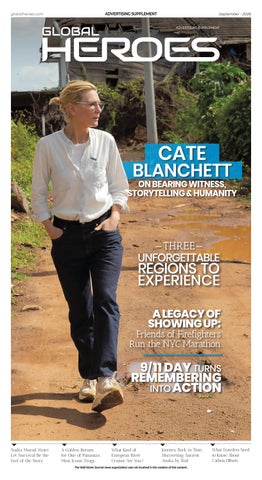
CATE
BLANCHETT
ON BEARING WITNESS, STORYTELLING & HUMANITY
— THREE—
UNFORGETTABLE
REGIONS TO EXPERIENCE A LEGACY OF SHOWING UP:
Friends of Firefighters Run the NYC Marathon
9/ 11 DAY TURNS REMEMBERING INTO ACTION
Nadia Murad Won’t Let Survival Be the End of the Story
A Golden Return for One of Panama’s Most Iconic Frogs
What Kind of European River Cruiser Are You?
Journey Back in Time: Discovering Ancient Asuka by Rail
The Wall Street Journal news organization was not involved in the creation of this content.
What Travelers Need to Know About Carbon Offsets
ADVERTISING SUPPLEMENT PUBLISHER Amir Shirazi
BUSINESS OPERATIONS MANAGER Jonathan Ramlal
EDITOR IN CHIEF Denise Koprich Shirazi
CONTRIBUTORS Raye Mocioiu, Holly Cambruzzi, Sydney Lake, Mia Taylor
EDITOR Raye Mocioiu
Published by IVY HOUSE MEDIA LIMITED. Headquarters: 2660 Sherwood Heights Drive, Suite 202, Oakville, Ontario • L6J 7Y8 Office: 289-837-2921 • Email: info@globalheroes.com
ADVERTISING Annie Adams, Stephen Fletcher, Barbara Lamarche, Rick Morris
CHIEF CREATIVE OFFICER Sergio D. Spadavecchia
Cover Photo Cate Blanchett on a visit to Brazil in 2024 to meet refugees hardest hit by floods in the region. © UNHCR/Hector Perez
ART DIRECTOR Kelly Laufer PRODUCTION MANAGER Holly Cambruzzi
September • 2026
globalheroes.com The power of positive, solution-based journalism.
CATE AND JAMAL KALIFA HAVING A CONVERSATION AT JAMAL KALIFA'S HOME IN NIGER. © UNHCR/HECTOR PEREZ
CATE BLANCHETT SPEAKS TO ALEKIIR © UNHCR/HECTOR PEREZ
UNHCR GLOBAL GOODWILL AMBASSADOR CATE BLANCHETT ADDRESSES UNHCR STAFF WITH UN HIGH COMMISSIONER FOR REFUGEES. © UNHCR/SUSAN HOPPER
UNHCR GLOBAL GOODWILL AMBASSADOR, CATE BLANCHETT, TRAVELS TO NIGER. © UNHCR/HECTOR PEREZ
UNHCR GLOBAL GOODWILL AMBASSADOR, CATE BLANCHETT, SETS THE STAGE, OPENING THE UNHCR’S 2025 NANSEN REFUGEE AWARD CEREMONY. © UNHCR/ANNE-LAURE LECHAT
WHAT WE OWE EACH OTHER
CATE BLANCHETT ON BEARING WITNESS, STORYTELLING, AND HUMANITY GH: During your address to the European Parliament, you spoke about compassion, shared humanity, and protecting the right to seek asylum. Are you hopeful that global attitudes toward refugees can still change?
RAYE MOCIOIU
C
ATE BLANCHETT is many things: an Academy Award-winning actress, producer, mother, and, for the past decade, a UNHCR Global Goodwill Ambassador. It’s in the latter that she’s taken on what she sees as one of her most important roles: a witness. Through her work with the UN refugee agency, Blanchett has spent years meeting families displaced by conflict and persecution, listening to stories of unimaginable loss alongside extraordinary resilience. The responsibility that comes with this role means that she cannot look away—but she doesn’t want to, either. Instead, she wants to urge others to watch and listen as well. “When we talk about ‘refugees,’ we are talking about people,” she said. “Mothers, fathers, children, each with their own story and potential. Those stories deserve to be told truthfully, so people understand not just the suffering refugees have endured, but the impossible choices that force them to leave home.” For Blanchett, bearing witness is only the beginning. The greater responsibility is making sure those stories continue to be heard. It’s the driving force behind the Displacement Film Fund (DFF), which helps displaced filmmakers bring their own stories to the screen, in their own voices. We sat down with Blanchett to look back on a decade of impact with the UNHCR. Global Heroes (GH): This year marks a decade for you as a Global Goodwill Ambassador for UNHCR. Looking back over those years, which moments have stuck with you? CB: It has been one of the great privileges of my life. My experience as a Global Goodwill Ambassador for UNHCR, the UN Refugee Agency, has changed my perspective on the world. I’ve had the honor of meeting with refugees around the world—in Lebanon, Egypt, Jordan, Bangladesh, Brazil, Niger, and South Sudan. I have met families who’ve lost everything, individuals who’ve endured unimaginable hardship, and yet still they hold onto hope. I've seen the worst of what people can go through, but also the best of what people can give. So many individuals have inspired me. Izdehar, a Syrian refugee I met in Jordan, fled Syria in 2013. As the mother of the family, she took a job and became the primary breadwinner after her husband was left unable to work due to a disability. Then there’s Alekiir, a passionate young student from Sudan. She was in the middle of her studies when conflict erupted, forcing her to drop everything and flee in search of safety to build her life again. I saw early on that there is an enormous gap between those who are heard and those who are not. Today, ensuring that refugees’ stories are heard remains essential, so that their experiences cannot easily be overlooked or denied. GH: You've said that meeting refugees and hearing their stories has been the highlight of your work with UNHCR. Is there one person across your travels that continues to stay with you years later? It is very hard to pick out one story or individual. As a mother, I can sometimes feel like I’m seeing my own children in every refugee child I meet. I see myself in the parents I have spoken to. In my early days working with UNHCR, in 2017, I went to Bangladesh and had
photos courtesy of UNHCR
CATE MEETING WITH REFUGEE STUDENTS AT GOROM REFUGEE CAMP. © UNHCR/HECTOR PEREZ
the opportunity to see the massive humanitarian situation unfolding there. That trip remains with me years later. Nothing could have prepared me for the extent and depth of the suffering. There was an 18-year-old woman, one of the 720,000 stateless Rohingya refugees who had just fled unthinkable violence and abuse in Myanmar’s Rakhine State. She had run from her burning village with her infant son, Yousuf. Her husband was forcibly taken from their village and disappeared whilst her home was set on fire. She had to flee with her baby. She saw her uncle killed by men with knives, and she simply ran, hiding in a forest, surviving off plants and trees. She ended up in Bangladesh, where another refugee family took her and her baby into a cramped shelter. As I sat with her, a small child was playing behind me, and I noticed some terrible scars on his leg. His family told me that he had been caught in the flames when their home had been torched. They pulled him free, but the scars will always remain—both the physical and the psychological. I wish such stories were atypical, but I have heard so many stories that tell of the worst of humanity. Of torture, of women brutally violated, of people witnessing loved ones killed before their eyes. I have listened to the devastating memories of children who have seen their grandparents set alight. Children who have lost parents during war. These stories remind me that we have an obligation to bear witness. I recognize my own privilege of safety and stability. I don’t take it for granted. Nobody should. GH: Many conversations about refugees focus on statistics, yet you've consistently brought the discussion back to individual human stories. Nobody can visualize 41.6 million refugees. Such vast numbers overwhelm. Statistics act like an invisibility cloak that hides human stories and prevents empathy. Real stories about real people who have been displaced give humanity to those statistics and help people to see that refugees are human beings with hopes and ambitions, just like anyone else. Helping to shift perceptions through storytelling can be incredibly powerful, sparking empathy and understanding. Working with the UNHCR to find ways to bring attention to the plight of refugees, the hope is that people may listen, reflect, and then do what they can. Storytelling drives action. I have seen it myself; sharing stories inspires people across all walks of life. I’m reminded of when I traveled to
Azraq in Jordan in 2016 and met a young schoolteacher. He and his wife were living in a UNHCR tent, having fled Syria with their newborn daughter. This new father had set up a small courtyard in which he planted a seedling tree to grow and provide shade for his daughter in the future. It moved me greatly—this is a quintessential image of hope: a father tirelessly hopeful for his tiny daughter to grow up and play in the shade. He was taking every waking moment to give support to his daughter as well as others—giving math lessons to older girls in the camp, conscious of the next generation not losing access to education. There is no way anyone would see his personal resilience and commitment through hearing just statistics. People need to hear individual stories. And that is one of the factors that led to setting up the Displacement Film Fund (DFF), with the Hubert Bals Fund of the International Film Festival Rotterdam as the management partner and UNHCR as a strategic partner. GH: The DFF has two key aims: to support displaced filmmakers to tell stories and to bring those stories to a far wider audience. What inspired you to create it, and why did you feel the film industry needed something like this now? The idea for the DFF was born at UNHCR’s Global Refugee Forum in Geneva in 2023, where together with fellow UNHCR supporters including Ke Huy Quan, we came up with the idea of a specific fund that would champion the work of displaced filmmakers, or filmmakers with a proven record in creating authentic storytelling about the experiences of displaced people. It has always surprised me that despite displacement being one of the biggest stories of our times, so few stories are told in cinema from that unique perspective. In a relatively short time, film industry experts, philanthropists, people with a personal connection to displacement, and great partners—the Amahoro Coalition, Droom en Daad, MasterMind, the SP Lohia Foundation, the Tamer Family Foundation, UNHCR, UNIQLO—have helped bring the DFF vision to life. The pace at which it has all come together is a powerful reminder that there is a real desire to engage with refugee stories. GH: Rather than simply telling refugee stories, why was it important that these voices lead the conversation themselves? The DFF filmmakers have free rein to
make whatever type of short film they like. While many will express themselves through fiction, some may choose to tell their own stories. Take Allies in Exile, by Syrian directors Hasan Kattan and Fadi Al-Halabi. This astonishing piece gives audiences an intimate view into the lives of two friends navigating the UK asylum system after fleeing unimaginable loss in Syria and then Turkey. Audiences don’t see “refugees” in the abstract, but instead become totally invested in the journey of these two young men dealing with trauma with humor, frustration, resilience, and hope. By turning the camera on their own lives over months and years, they offer viewers opportunities to understand what life is like for so many. It’s a great example of why refugees must lead the conversation: their voices challenge stereotypes, restore humanity, and have the power to shift how people see displacement. GH: What have you learned from the filmmakers you've worked with through the DFF that perhaps surprised even you? You know, when people are forced to leave their homes, they leave everything behind. They lose the most basic things like their homes, education, their jobs. I have learned that when artists and filmmakers find themselves forced to flee, many lose the means to create and work at a time when it is more vital than ever. But they absolutely do not lose the drive to tell stories. We can see from the DFF films that somehow people are driven, even in the most inhumane, impossible situations, to tell stories. This level of human resilience and spirit in the darkest of times never fails to surprise me across my UNHCR work and with the Film Fund. GH: The first films supported by the fund have already received incredible acclaim. What has it been like watching audiences connect with these stories? It has been so inspiring to see audiences connect with the first cohort of films by Maryna Er Gorbach, Mo Harawe, Hasan Kattan, Mohammad Rasoulof, and Shahrbanoo Sadat. Each brings a distinct, deeply personal voice, yet their stories speak to universal experiences—courage, friendship, love, frustration, and loss. In a world shaped by division and misinformation, film can be a powerful antidote: opening a window onto realities people may not know and inviting them to bear witness too.
"BEING A REFUGEE IS JUST A CHAPTER IN A LIFE, NOT THE WHOLE STORY."
We have to hope. I am hopeful in this work because I have seen attitudes change, especially when people are given the opportunity to hear refugees speak for themselves. When I met Nada, a young Sudanese refugee in Egypt, she shared with me some letters written by displaced people to their homeland. These were letters full of longing for familiar streets, neighbors, and the people they had left behind. I find that these personal words and stories cut through and change attitudes: we learn that refugees are not refugees by choice; refugees do not want to live in exile; they want to go home. But hope requires action. I'm always struck by the remarkable patience and compassion of the UNHCR personnel I meet in the field. As humanitarian funding is cut and life-saving services are scaled back, refugees need protection now more than ever. And their stories should not end at finding safety; they must be able to thrive. To continue their stories in classrooms, workplaces, communities, and homes where they can rebuild their lives. Most refugees stay as close to their home countries as they can, often in communities already facing immense pressure. That is where we need to start—not only with aid and shelter, but with opportunities that allow refugees to rebuild their lives with dignity. Seventy-five years since the 1951 Refugee Convention came into being, it remains a vital promise for the world: a critical, cross-generational promise of safety, dignity, and opportunity for everyone forced to flee. With UNHCR, I stand by that promise until everyone is safe. GH: If there is one misconception about refugees that you wish everyone could let go of, what would it be? There is a misconception that refugees are somehow fundamentally different from everyone else. Refugees are mothers, fathers, children, doctors, plumbers, students, filmmakers, footballers—people like any of us, whose lives have been violently interrupted. Being a refugee is just a chapter in a life, not the whole story. There is also a misconception about how much difference to people’s lives each of us can make. We must hold fast to the promise of safety. Many people who have fled terrible violence eventually do find protection, a helping hand, and a reason to go on. When we decide to act, we can make a difference and use whatever we have—our platforms, our money, our networks, our ideas. The doors we can all open, the messages we can spread, the funds we can raise—these things are invaluable. I have seen how powerful every donation is for the UNHCR, every act of support and solidarity. It is now more crucial than ever that we do our part to make that force stronger. If there is one thing this work has taught me over the last decade, it is that compassion is not optional; it is essential. You can make a difference. Learn more and donate at unhcr.org
As long as refugees are in need, we’ll be there.
ADVERTISING SUPPLEMENT
September • 2026 ADVERTORIAL
No One Should Have to Struggle Alone: How Active Minds Is Building a Culture of Connection September brings new classrooms, new schedules, unfamiliar faces, and the promise of a fresh start. But for many young people, back-to-school season can also bring something less visible: the worry of finding where they belong. Who will I sit with? Will I make friends? Is everyone else handling this better than I am? Those questions may seem ordinary, but connection can have a profound impact on a young person’s well-being. Feeling known, welcomed, and supported by peers and school communities serves as an important protective factor against depression, anxiety, isolation, and suicidal thoughts. That need for connection feels especially important in September. As school begins, Suicide Prevention Month offers a timely reminder that prevention can begin long before moments of crisis, in the everyday connections that help youth and young adults feel seen, supported, and less alone.
A MOVEMENT BORN FROM LOVE
Active Minds’ commitment to connection is deeply personal. Founder and Executive Director Alison Malmon established the organization as a college student after losing her older brother and only sibling, Brian, to suicide in 2000. Brian was smart, funny, and well-liked. During college, however, he began experiencing depression and psychosis. For years, he concealed what he was going through from the people around him. Even as his mental health deteriorated, the stigma and isolation surrounding mental illness made it difficult to speak openly. “After my brother’s death, and knowing how preventable it was, I resolved, no matter what, to do something to change the way we approach mental health in this country,” she said. As a student at the University of Pennsylvania, Alison created a space where students could speak openly about mental health and encourage one another to seek support without shame. The idea soon grew beyond Penn. As more students recognized the need for these conversations on their own campuses,
500+
ACTIVE MINDS CHAPTERS ARE CREATING CHANGE IN HIGH SCHOOLS AND COLLEGES NATIONWIDE.
young people she served and had even considered paying for programming herself. Through the Program Fund, her school was able to host an Active Minds Speaker. What followed was exactly the kind of cultural shift these programs are intended to spark. Emily reported more students requesting services, more conversations with trusted adults, and parents reaching out to thank the school for helping their children feel more comfortable asking for help when they needed it.
WHEN STUDENTS FEEL SEEN, CHANGE FOLLOWS
STRESS-LESS WEEK © ANDRE MAGS PHOTOGRAPHY
the youth-led effort evolved into Active Minds, now the largest nonprofit in the United States mobilizing youth and young adults to change how we think about, talk about, and support mental health in our society.
STUDENTS LEADING THE CHANGE
Rather than treating youth and young adults as only recipients of mental health services, Active Minds equips them to shape the communities, conversations, and systems that affect their lives. Today, students lead more than 500 Active Minds Chapters in high schools and colleges across the country. Through discussions, peer education, wellness events, advocacy campaigns, and other activities, they make mental health part of everyday school life. In 2025 alone, chapters held more than 8,000 activities, directly reaching more than 411,000 youth and young adults. The impact is personal, too. A student who attends an event may hear someone describe an experience that sounds like
411,700
YOUTH AND YOUNG ADULTS REACHED THROUGH CHAPTER-LED PROGRAMS, MEETINGS, AND EVENTS IN 2025.
their own. A classmate may learn how to recognize when a friend is having a difficult time. Someone who believed they were the only person struggling may realize they are not alone. That peer-to-peer support is also at the heart of Active Minds’ initiative called A.S.K. A.S.K. stands for Acknowledge, Support, Keep-in-Touch, giving young people an approachable framework for being there for someone they care about. Nearly 70 percent of young people surveyed said they did not believe they had the knowledge to help a friend. After engaging with A.S.K., nine out of 10 participants reported feeling confident that they could provide emotional support to a friend. One young participant captured why those skills matter: “I spent a lot of time thinking that people never cared, but never considered that they just didn’t know how to ask if I was OK.” The quote captures a simple truth: caring and knowing how to show that care are not always the same thing. A.S.K. helps young people bridge that gap.
4.5 MILLION+
YOUTH AND YOUNG ADULTS IMPACTED ACROSS SCHOOL COMMUNITIES WHERE ACTIVE MINDS CHAPTERS ARE PRESENT.
MAKING SUPPORT POSSIBLE IN EVERY COMMUNITY
Building a culture of connection requires more than willingness. For many schools and youth-serving organizations, limited funding can place meaningful mental health programming out of reach. The Active Minds Program Fund helps communities access f ree programs that can change how they talk about mental health through programs like Active Minds Speakers and Live A.S.K. Workshops, as well as Send Silence Packing®, an interactive exhibit that teaches students and communities how to take action for mental health. The Fund is designed to expand access for K-12 schools, colleges, rural communities, communities of color, and youth-serving organizations where limited budgets can stand between students and potentially transformative programming. For Emily, a high school counselor in Ohio, that support changed what was possible. Facing district-wide budget cuts, she was searching for new resources for the
9 IN 10
A.S.K. PARTICIPANTS REPORTED FEELING CONFIDENT THEY COULD PROVIDE EMOTIONAL SUPPORT TO A FRIEND.
Research highlighted in Active Minds’ 2025 Impact Report reinforces the importance of the environments students encounter every day. A RAND Corporation study across six campuses found that students with more positive perceptions of their campus mental health climate reported lower psychological distress and stronger intentions to seek help from friends, family, and professionals. The finding reinforces a principle central to Active Minds’ work for more than two decades: culture matters.
BEYOND THE REPORT CARD
A new school year is measured in many ways. Grades matter. Attendance matters. Achievement matters. But so does belonging. Every conversation, invitation, and act of support can help create a community where young people feel seen, supported, and connected. More than two decades after Alison Malmon transformed the loss of her brother into action, young people across the country are continuing that work by building cultures of connection and changing how mental health is understood, discussed, and supported. B ecause connection can change everything. To find or start an Active Minds Chapter, bring mental health programming to your school, or apply for the Active Minds Program Fund, visit ActiveMinds.org
72%
OF ORGANIZATIONS SURVEYED SAID LIMITED FUNDING PREVENTED THEM FROM ACCESSING MENTAL HEALTH RESOURCES.
ADVERTISING SUPPLEMENT
STUDENTS JOIN 9/11 DAY AT NASDAQ IN TIMES SQUARE TO MARK THE SEPTEMBER 11 NATIONAL DAY OF SERVICE
DAVID PAINE AND JAY WINUK
September • 2026
VOLUNTEER AT 9/11 DAY MEAL PACKS FOR FEEDING AMERICA AFFILIATED FOOD BANKS © IMAGES COURTESY OF 9/11 DAY
Turning Remembrance Into Action: 9/11 Day Marks 25 Years of Doing Good Six months after the September 11 attacks, David Paine and Jay Winuk began asking how a day associated with unimaginable loss might also become a force for good. For Winuk, the question was deeply personal. His younger brother, Glenn Winuk, an attorney and volunteer firefighter/EMT, died in the line of duty at the World Trade Center after running toward danger to help others. Together, Paine and Winuk set out to “take back the day,” transforming the anniversary of 9/11 into a national day of service, unity, and remembrance. Nearly 25 years later, that grassroots idea has grown into 9/11 Day (911day.org), one of the country’s largest annual service movements. On September 11, 2026, the nonprofit is calling on millions of Americans to “Unite for Good” through volunteer projects, charitable acts, and community service across all 50 states.
FROM GRIEF TO A NATIONAL MOVEMENT
9/11 Day began in 2002 with a simple
conviction: a meaningful way to honor those who were killed, injured, or forever changed by the attacks was to carry forward the spirit of service that emerged in their aftermath. “Our goal is to transform the 9/11 anniversary, for all time, into an annual moment of national reflection, unity, and doing good,” said Paine, president and co-founder of 9/11 Day. “We want to reclaim the day.” The movement steadily gained national support. In 2007, Paine and Winuk received the President’s Call to Service Award. Two years later, Congress and President Barack Obama formally established September 11 as a National Day of Service and Remembrance through the bipartisan Edward M. Kennedy Serve America Act. Since then, tens of millions of Americans have annually participated in acts of service. The organization’s first largescale meal-packing event, held in New York City in 2016, brought together 1,600
volunteers who assembled 503,000 meals. By 2025, the program had expanded to 24 cities, where more than 27,000 volunteers packed 9.4 million meals. When the COVID-19 pandemic halted in-person gatherings in 2020, the organization launched "9/11 Day at Home," drawing millions of people into safe, meaningful acts of service from their homes and communities.
17+ MILLION MEALS, 50 CITIES
For the 25th anniversary, 9/11 Day is planning its largest initiative yet. More than 50,000 volunteers from over 800 companies are expected to pack more than 17 million shelf-stable meals in 50 of the nation’s largest cities. Organizers believe it will be the largest single day of corporate volunteerism in U.S. history. The meals will be donated to Feeding America-affiliated food banks and other hunger-relief organizations serving local communities. U.S. Hunger, Kids Around the World, and
Meals of Hope will help source supplies and manage logistics. Professional sports organizations will also play a major role. Teams and representatives from the NFL, MLB, NHL, NBA, and MLS are expected to host or join 9/11 Day's meal-packing events. Major League Baseball and the New York Mets plan to co-host a flagship meal-packing event on September 11 at Citi Field before that evening’s Mets-Yankees Subway Series game at Yankee Stadium. “My brother Glenn, like so many courageous first responders, sprang into action to save people he didn’t know on 9/11,” Winuk said. “But you don’t have to run into a burning building to be heroic in your community or in the lives of others.”
REACHING A NEW GENERATION More than 100 million Americans alive today are too young to remember the attacks or the period of unity and service that followed. To help bridge that gap, 9/11 Day has
expanded its youth education efforts with free lesson plans, teacher guides, and classroom resources. The organization has also launched a $3 million grant program, funded by AmeriCorps and the Popeyes Foundation, to support service projects, many of them by and for students. A new volunteer platform developed with Eventbrite will allow people to find local opportunities or create projects for family, friends, and colleagues. A national “Unite for Good” campaign will launch in August, encouraging Americans of all ages to pledge acts of service. An independent documentary from filmmakers Greg Jacobs and Jon Siskel will also trace the movement’s 25-year journey. On September 11, 2026, 9/11 Day will mark almost a quarter-century of turning remembrance into action. The next chapter will be written by the people who choose to serve. SOURCE: 9/11 Day
© COURTESY OF FRIENDS OF FIREFIGHTERS
The Long Run: Showing Up for New York’s Firefighters RAYE MOCIOIU
Twenty-five years ago, just days after 9/11 shook the world, New Yorker Nancy Carbone set out to find a way to help. In the days following the attacks, Carbone traveled from firehouse to firehouse asking what she could do to help firefighters who were simultaneously working at Ground Zero, attending funerals, grieving colleagues, and continuing to serve their communities. The requests ranged from funeral services to memorial supplies, but there was a dire need for counseling amongst the first responders to help process the tragedy, the loss, and the impact of the disaster—and it needed to be done in a way that firefighters, notorious for keeping their vulnerabilities hidden, would feel comfortable. Although Carbone had
no experience in counseling, she took the request seriously. Within months, she created a space where firefighters could seek help privately. Actor and former FDNY firefighter Steve Buscemi, a longtime supporter and Advisory Council member, has shared that for firefighters, those whose primary identity is one of a protector, seeking support can be very difficult. It’s important for them to have a place to go outside of the official fire department. Friends of Firefighters eventually found a fitting home in an old Brooklyn firehouse, transformed by hundreds of active and retired firefighters into a familiar and welcoming place where members of the FDNY community could access support in the form of free, confidential counseling, peer support, and wellness services to active and retired
FDNY firefighters and their families. Ever since, that space has been a lifeline for thousands of firefighters and their families. Now, as Friends of Firefighters marks its 25th anniversary and prepares for a new chapter, its mission is being carried into the streets of New York City in a new way. This fall, Friends of Firefighters will participate as an Official Charity Partner of the 2026 TCS New York City Marathon, with ten runners turning each of the race’s 26.2 miles into support for the FDNY community. Taking place November 1, the race marks the 50th anniversary of the iconic five-borough course, which debuted in 1976. To celebrate, New York Road Runners (NYRR) is expanding its Official Charity Partner Program to more than 670 organizations, the largest group in
A PHOTO OF THE FDNY CYCLING TEAM DURING THE SECOND ANNUAL RIDE FOR RESILIENCE, WHICH TOOK PLACE IN IRELAND IN 2025.
the program’s history. “We are so grateful to have these ten runners representing Friends of Firefighters in the TCS New York City Marathon,” said Julie Smith, Community & Donor Engagement Manager at Friends of Firefighters. “They each have their own connection to the fire service, first responder community, or military, and they understand the importance of showing up for the people who spend their lives showing up for others.”
EVERY MILE HAS AN IMPACT
The marathon offers a fitting stage for that work. Much like the fire service itself, distance running is built around endurance, community, and the willingness to keep moving when the road becomes difficult. Every mile counts, and NYRR’s charity program has demonstrated how significant those miles can become. Since launching in 2006, the Official Charity Partner Program has raised nearly $700 million for more than 1,000 nonprofits worldwide. In 2025 alone, more than 14,000 charity runners raised a record-breaking $80 million for more than 600 organizations, causes, and missions. For 2026, NYRR has set its sights even higher, aiming to raise more than $100 million. Ride for Resilience, an annual Friends of Firefighters event, takes a similar approach and puts it on two wheels. Held during the week leading up to September 11 to honor those who can no longer ride, the ride brings together approximately 150 first responders from across the United States and Ireland, raising funds for the organization in the process.
THE FUTURE OF FRIENDS OF FIREFIGHTERS CIRCLE: NANCY CARBONE; BELOW: INCOMING FRIENDS OF FIREFIGHTERS LEADERSHIP: CHRISSY & KEVIN NEAFSEY
THE FLORIAN KNIGHTS FDNY MOTORCYCLE CLUB, WHICH PRIORITIZES PEER SUPPORT AND MENTAL HEALTH, HONORS FIREFIGHTER AARON CLARK ALONG WITH FRIENDS OF FIREFIGHTERS & THE MEMBERS OF FDNY RESCUE 1. © IMAGES COURTESY OF FRIENDS OF FIREFIGHTERS
This year also represents a changing of the guard for Friends of Firefighters, with Carbone preparing
to step away from its day-to-day leadership. She will transition to the role of Founder and Advisor while expanding her advisory work to support first-responder mental health organizations nationwide. Stepping forward to lead Friends of Firefighters into its next era are FDNY couple Chrissy and Kevin Neafsey. Chrissy will serve as Executive Director, bringing 20 years of strategic business leadership to the role, while Kevin will serve as Director, Firefighter Culture & Operations, following a 20-year career as a New York City first responder, retiring as a UFA Delegate out of Engine 45 in the Bronx. Peer-to-peer connection, of course, remains the anchor of the organization through the Aaron Clark Peer Support Team, named in honor of the Rescue 1 firefighter and Marine veteran who fiercely advocated for mental health within the firefighting and military communities before passing from cancer in 2025. The team keeps Clark’s legacy alive through peer-led services focused on suicide prevention, sober recovery, grief support, and equine-assisted wellness. To safeguard this mission for the future, the organization is also establishing the Friends of Firefighters’ Legacy Endowment, designed to secure resources for a projected 10,000 counseling sessions annually by 2030 without impacting its core operating budget. It is a future built on the same principle that inspired Carbone to walk into New York City firehouses 25 years ago: the people who show up for everyone else need someone willing to show up for them. On November 1, ten runners will carry that promise for 26.2 miles, helping Friends of Firefighters sustain the mission Carbone began and carry her legacy forward for generations to come.
ADVERTISING SUPPLEMENT
September • 2026
Nadia Murad Won’t Let Survival Be the End of the Story RAYE MOCIOIU
There is a stark difference between living and surviving. Iraqi human rights activist and Nobel Peace Prize winner Nadia Murad has done both, and for the last decade, she’s been working to help the rest of the world understand the difference. In 2014, ISIS attacked her Yazidi community in northern Iraq, killing members of her family and abducting Murad along with thousands of other Yazidi women and girls. She endured captivity and sexual violence before escaping. In the years since, Murad has become one of the world's most prominent advocates for survivors of genocide and conflict-related sexual violence, using her own story not only to demand justice, but to challenge the systems responsible for helping survivors rebuild. “People often speak about my courage, but survival was not a choice I made—it was something that happened to me,” Murad shared. “The choice came afterward: whether to carry my story in silence, or to use it.” She chose to use it.
HER TESTIMONY IN ACTION
Murad went on to serve for more than eight years as the United Nations Goodwill Ambassador for the Dignity of Survivors of Human Trafficking—the first survivor of atrocities appointed to the role. She stepped down in 2024 while committing to continue her broader human rights advocacy. In 2018, Murad and Congolese physician Denis Mukwege were jointly awarded the Nobel Peace Prize for their efforts to end the use of sexual violence as a weapon of war and armed conflict. But recognition, she has repeatedly stressed, is not enough. Through Nadia's Initiative, the organization she founded and leads, Murad has focused on helping communities devastated by war and mass atrocities rebuild while advocating
for stronger responses to conflict-related sexual violence, and, ultimately, the belief that survivors should help shape the decisions that affect their futures. “What this journey has taught me is that lasting change does not come from sympathy,” Murad said. “It comes from survivors being trusted with power over their own recovery, their
own communities, their own futures.” In 2025 alone, Nadia's Initiative completed 18 projects in Sinjar, each developed in response to the needs of survivors and returnees. Among the most significant was the Sinjar French Medical Center, a purpose-built hospital in a region where healthcare infrastructure had been
devastated by ISIS. The NI Women's Center also served more than 1,300 women, girls, and survivors of conflictrelated sexual violence, while Nadia's Initiative reached more than 16,000 people through its programs in 2025. “Recovery is never only about responding to what was destroyed,” she said. “It begins with recognition
People often speak about my courage, but survival was not a choice I made—it was something that happened to me. The choice came afterward: whether to carry my story in silence, or to use it.
of what happened. It requires justice and accountability for the crimes committed—because justice for survivors today is prevention for those who might suffer tomorrow.” In November 2025, a Belgian court convicted an ISIS member of genocide and crimes against humanity against the Yazidi community. Nadia's Initiative supported the process and also helped train 220 women and survivors to advocate for justice and reparations. “My greatest hope is that the world stops treating survivors as symbols and starts treating them as leaders,” Murad said. “Too often, we are asked to tell our stories and then step aside while others make the decisions. I want Nadia's Initiative to help end that pattern— to show that survivor-led recovery, survivor-led justice, and survivor-led policy are not idealistic notions but the most effective path we have.”
I CHOOSE MY BEGINNING
What comes after survival? For Murad, it’s using her voice. On September 15, 2026, she will publish her new memoir, “I Choose My Beginning: A Story of Courage and Activism”, with a foreword by Gloria Steinem. The book follows her bestselling first memoir, “The Last Girl”, and turns toward the decade that followed her escape. “That, to me, is what it means to turn pain into change: not to forget what happened, but to refuse to let it be the end of the story,” she said. “It is why I titled my new book, 'I Choose My Beginning,' because that choice belongs to every survivor, and it is a choice the world can help make possible. “If a young woman somewhere decides to raise her voice because she saw that survivors before her were heard—and that speaking out led to real change—then our work will have mattered,” she said. “But my deepest wish is simpler than that. I hope the next generation of leaders will not have to be survivors at all. Until then, we keep working.”
—NADIA MURAD
NADIA MURAD © COURTESY OF NADIA'S INITIATIVE
ADVERTORIAL
Celebrating Independence: Volunteer to Raise a Puppy and Change a Life Puppy raisers provide everyday experiences that prepare exceptional dogs to become life-saving partners. For many across America, independence often means moving confidently through crowded sidewalks, transit hubs, office buildings, and unfamiliar neighborhoods. For a person who is blind or has low vision, or for a veteran, active-duty service member, or first responder living with a physical or emotional disability such as PTSD, that independence may begin with a highly trained guide or service dog.
But long before an assistance dog is ready to transform someone’s life, a volunteer must first help the puppy understand the world. The Guide Dog Foundation and America’s VetDogs, sister national nonprofit organizations with more than 80 years of impact, are seeking volunteer puppy raisers to provide that essential beginning. The organizations’ guide and service dogs become trusted partners and symbols of freedom for the people they serve. All services are provided free of charge to recipients.
PREPARING PUPPIES FOR THEIR FUTURE ROLES
© IMAGES COURTESY OF GUIDE DOG FOUNDATION FOR THE BLIND
Future assistance dogs cannot be raised in kennels. They need thoughtful socialization and regular exposure to the environments they may one day navigate with their handlers. Puppy raisers introduce young dogs to everyday experiences, from active city streets and public places to quiet parks, rural farmland, and time at home. They teach basic obedience commands such as “sit,” “stay,” and “come,” reinforce good house manners, and help each puppy learn to remain calm, confident, and focused around new people, sounds, and distractions.
No previous dog-training experience is required. Volunteers receive guidance as they lay the foundation for the puppy’s later work with certified Guide Dog Mobility Instructors and Service Dog Instructors. Depending on where they live, volunteers may participate through full-time, weekend, or part-time puppy-raising opportunities across the United States.
FROM EVERYDAY ROUTINES TO LIFELONG PARTNERSHIP
The commitment is meaningful because the result is tangible. After approximately 14 to 16 months with their volunteer raisers, the dogs return to America’s VetDogs and Guide Dog Foundation national training center in New York. There, expert program staff guide them through three to four months of formal training, using positive training methods to build and strengthen the skills they will need. When the dogs are between 18 months and two years old, they meet their new partners for two weeks of team training held on the organization’s Long Island campus. Puppy raisers are invited to Celebration Saturday, a special graduation ceremony that is also streamed
live on Facebook. It is the moment when months of ordinary routines—morning walks, patient repetition, new experiences, and quiet encouragement—reveal their extraordinary purpose. Saying goodbye to a puppy is emotional. Yet puppy raisers are not simply
giving up a dog. They are giving another person greater independence, confidence, joy, and hope. And for many individuals served by America’s VetDogs and the Guide Dog Foundation, their new custom-trained, internationally accredited guide or service dog gives them purpose, saves their life, and gives them the opportunity to Live Without Boundaries. The impact of volunteer puppy raisers goes well beyond the handler to their family members, friends, colleagues, and communities nationwide. For busy professionals, families, retirees, students, and others looking for a hands-on way to make a lasting difference, puppy raising offers a rare opportunity: to help shape a life-changing partnership from its very first steps. Accredited by Assistance Dogs International and the International Guide Dog Federation, both organizations earn the top ratings from the leading charitable watchdog organizations, including Candid, Charity Navigator, and the Better Business Bureau’s Wise Giving Alliance. To learn more about becoming a volunteer puppy raiser or donating, visit VetDogs.org/GH or GuideDog.org/GH.
ADVERTISING SUPPLEMENT
September • 2026
New York Council Navy League Continues to Honor 9/11 Heroes On the morning of September 11, 2001, 71 law enforcement officers from eight local, state, and federal agencies were killed when terrorist hijackers working for the al Qaeda terrorist network crashed passenger jets into the World Trade Center towers in New York City, the Pentagon, and a field near Shanksville, Pennsylvania. After the impact of the first plane into the World Trade Center’s North Tower, New York City police officers, firefighters, and EMS personnel put the safety of others before their own, rushing to the burning “Twin Towers” to aid victims and lead them to safety. Two of those heroes who made the ultimate sacrifice were also U.S. Coast Guard Reservists. In 2026, the New York Council Navy League, a nonprofit military support organization founded in 1902, is recognizing the service and sacrifice of these heroes by celebrating the commissioning of two USCG cutters named in their honor—USCGC Vincent Danz and USCGC Jeffrey Palazzo.
CARRYING THEIR LEGACIES FORWARD
After successfully commissioning NYPD officer Vincent Danz’s namesake ship in May, the New York Council is proudly
ADVERTORIAL
IN MAY 2026, USCG LEADERSHIP LED THE CEREMONY TO COMMISSION THE FIRST OF TWO CUTTERS NAMED AFTER 9/11 HEROES. © USCG
honoring fallen FDNY firefighter Jeffrey Palazzo and the cutter named after him during September’s 25th anniversary of the 9/11 tragedy. You can honor these heroes and their legacies by donating in support of the commissioning celebrations and the ongoing morale fund for the Coast Guard crews serving on board the ships. For corporate or foundation sponsorship opportunities, please contact info@nynavyleague.org or visit us online.
SUPPORTING THOSE WHO SERVE
B eyond our history of hosting ship
commissioning celebrations, our events and programs serve approximately 10,000 service members and 2,000 local youth annually. From large-scale events such as the New York Maritime Security Conference and Fleet Week New York to smaller gatherings like our National Security Briefing Series and honoring top enlisted individuals at our adopted units, our nearly 750 members support those who serve all year. These activities not only provide direct support to military units, personnel, and families, but also educate the public about the crucial role of the sea services in national and economic security.
JOIN A LEGACY OF SERVICE
Anyone looking for ways to honor and celebrate the sea services is invited to visit our website to learn about our mission. Our work and funding are member-driven, so we encourage everyone to visit our website, attend an event, consider donating, and become a member. There is no cost to sign up for the Basic Membership, and joining the New York Council Navy League means joining a legacy of support and dedication to those who serve our nation at sea. NEW YORK COUNCIL NAVY LEAGUE HAS A LONG TRADITION OF HOSTING USCG AND USN SHIP COMMISSIONINGS, LIKE THE USCGC VINCENT DANZ IN MAY 2026. © FRANK GORMAN
Visit nynavyleague.org to learn more and get involved.
After Donating $8 Billion, Steve and Connie Ballmer Create Three Regional Philanthropies So People Closest to the Work Can Decide How the Money is Spent SYDNEY LAKE
Steve and Connie Ballmer have given away more than $8 billion during the past two decades, and founded the Ballmer Group in 2015. Now they’re changing who gets to decide where the next donations go. The couple’s economic-mobility philanthropy, Ballmer Group, is spinning its three regional offices into separate, independent nonprofits for their regional grantmaking. The organizations, including MoveUp Southeast Michigan, MoveUp LA, and MoveUp Washington, will operate on their own but stay funded by the Ballmers. Steve was the CEO of Microsoft from 2000 to 2014 and has an estimated net worth of $177 billion, making him the ninth-richest man in the world, according to the Bloomberg Billionaires Index. Some of the Ballmer Group’s largest gifts include a $425 million gift to the University of Oregon to establish the Ballmer Institute for Children’s Behavioral Health, a $237.5 million gift to Blue Meridian Partners for its Place Matters Initiative, and an up-to $165 million pledge to Communities In Schools to scale its student-support
model to 1,000 new schools. Each of the Ballmer Group’s new regional philanthropies has significance to the couple. Steve grew up in Southeast Michigan; the couple owns the Clippers in Los Angeles County; and Washington
STEVE AND CONNIE BALLMER © GETTY IMAGES—RODIN ECKENROTH/FORTUNE
is home. So their logic behind splitting their philanthropy into three is to put decision-making about donations closer to the people doing the work. “How do we keep staying close to the work, and how do we empower our leaders?” Ballmer Group CEO Terri Ludwig told Fast Company in an interview published Monday, August 10, adding she sees the new entities as startups, not spinoffs. Each organization will build its own board and keep running its existing regional work while adjusting to fit local needs, according to a release from the Ballmer Group on July 1. Ballmer Group staff in each region will transition to the new organizations during the next year. Current grantees keep their commitments without disruption, according to the group. Ludwig will serve as a founding board member for all three while continuing to lead Ballmer Group, which will narrow its own focus to a smaller set of large, scalable national initiatives. “Our intention is to ensure that these local philanthropies can be permanent, ongoing resources in each region, while we concentrate our national efforts on advancing economic mobility in
SEASONS
ONE & TWO
new ways,” Steve and Connie Ballmer said in a joint statement. The financial structure of the new organizations is still being worked out, but an endowment is one option under consideration, GeekWire reported.
ABOUT THE BALLMER GROUP
Connie Ballmer began the couple’s philanthropy about 25 years ago, long before Steve’s Microsoft options turned into billions. Her early work was rooted in Washington State’s foster-care system, and she used to write checks from their kitchen table, according to Fast Company. She and Steve later founded Ballmer Group in 2015, but the couple has kept a relatively lower profile than peers like other billionaire philanthropists such as MacKenzie Scott, who is frequently in the headlines for her massive giving sprees and cumulative $26 billion in giving. (To be sure, Scott doesn’t publicize her gifts herself.) Her ex-husband, Jeff Bezos, and his new wife, Lauren Sánchez Bezos, are also very prominent philanthropists, running the Bezos Earth Fund and making other major gifts that garner a lot of attention. But Connie has stepped further into
NOW STREAMING
on Prime Video, Tubi, & The Roku Channel
EXPERIENCE THE AWARD-WINNING JOURNEY ALONG THE AMAZON RIVER WITH JEFF FUCHS & GLOBAL HEROES
view more recently. In April, she donated $80 million to NPR, which was one of the largest gifts in public media history, after the Trump administration pushed Congress to slash roughly $1.1 billion from public broadcasting. That gift was personal, not a Ballmer Group grant, as Connie is an avid NPR listener. “We need fact-based journalism, and we need local journalism,” Ballmer told the Wall Street Journal in an interview published in April. Ludwig came to her role at the Ballmer Group in 2019 from Enterprise Community Partners, the national housing-development nonprofit, and worked in finance before that. Like the Ballmers are doing, Ludwig advises newly minted billionaires from the AI boom to start giving and not wait for the perfect strategy. “Start with the problem you deeply care about,” Ludwig told Fast Company. “Find the people who are closest to the challenge, learn from them, and begin. Refine your approach over time.” That’s the main idea behind the Ballmer Group’s new strategy: Move the money toward the people who already know the work. —Fortune via Reuters Connect
ADVERTISING SUPPLEMENT
September • 2026
Landmark Legislation Strengthens the Fight to Rescue Exploited Children A landmark piece of U.S. legislation is bringing renewed momentum to the fight against online child sexual exploitation and human trafficking. Spearheaded by Senator Josh Hawley (R-MO) and supported by child protection advocates, including the Tim Tebow Foundation, the newly signed Renewed Hope Act makes a historic investment in Victim Identification—one of the most critical yet often unseen aspects of child protection. “The number of unidentified child victims continues to grow, and if unchecked, this imbalance only gets worse, exacerbated by the introduction of AI and the ease of which criminals are able to create child sexual abuse material (CSAM) with deepfakes,” said Derek Benner, a former HSI Executive Associate Director and current CEO of Our Rescue (OurRescue.org), a U.S.-based global nonprofit dedicated to ending human trafficking and child exploitation. Signed into law as part of a broader legislative package, the measure funds 200 additional law enforcement positions dedicated to Victim Identification. These highly specialized investigators analyze CSAM to identify the children depicted, determine their locations, and help bring them to safety.
WHY VICTIM IDENTIFICATION MATTERS
While investigators often recover thousands of images and videos of abuse, many children remain unidentified, leaving them vulnerable to ongoing exploitation. These specialists include investigators, intelligence analysts, and forensic experts who carefully examine every available detail in that material, searching for clues that can reveal who a child is and where they may be found.
CSAM. He later chaired INTERPOL's Specialists Group on Crimes Against Children and spent more than two decades investigating child exploitation and digital forensics.
ONE CHILD'S STORY
During testimony before the House Judiciary Subcommittee on Crime and Federal Government Surveillance in 2024, Cole shared one case that underscored the importance of Victim Identification. Investigators spent weeks analyzing every frame of CSAM involving a toddler, searching for seemingly insignificant details like background objects, reflections, product labels, and playground equipment. Eventually, those clues led investigators to a specific playground in a city in the American South. Working alongside local agents in real time, they located the home, arrested the child's father, recovered additional evidence, and rescued the little girl. "She couldn't ask for help. She didn't know she needed to be rescued. She just needed someone with the skills and resources to find her," said Cole.
RENEWED HOPE FOR CHILDREN STILL WAITING EARLIER THIS YEAR, RETIRED HOMELAND SECURITY SUPERVISOR JIM COLE (PICTURED AT LEFT) AND TIM TEBOW GAVE POWERFUL TESTIMONY IN WASHINGTON, D.C. TO ADVOCATE FOR THE BIPARTISAN RENEWED HOPE ACT. THEIR ADVOCACY SUCCESSFULLY HELPED DRIVE THE LEGISLATION TO PASSAGE AND ENACTMENT INTO LAW, DRAMATICALLY EXPANDING FEDERAL RESOURCES TO COMBAT ONLINE CHILD SEXUAL EXPLOITATION. © PHOTO COURTESY OF DAILY SIGNAL
Before the legislation, Homeland Security Investigations (HSI) had roughly 20 specialists assigned to an estimated 89,000 unidentified child victims across the United States—a gap that child protection experts warned was becoming increasingly difficult to overcome as artificial intelligence and deepfake technology made it easier for offenders to create and distribute abusive content. "Law enforcement needs training, resources, and personnel to keep pace with the evolving threat of online child exploitation," said Benner. Child
protection advocates estimate that the Renewed Hope Act could increase investigative capacity by approximately 2,800 percent.
BUILDING THE RESOURCES TO SAVE MORE CHILDREN
"In addition to increasing headcount across the HSI teams that combat child sexual exploitation, the bill establishes the first dedicated training program to improve coordination on victim identification between federal, state, and local law enforcement," said Jim Cole, Senior Advisor for Cyber
Strategy and Child Protection at Our Rescue. "Training, partnerships, and coordination are 'force magnifiers' that help increase impact, with greater speed and efficiency to help identify, locate, and bring children to safety." For Our Rescue, the legislation carries particular significance because of the work of Cole. Before joining the nonprofit, he founded the Victim Identification Program and Laboratory at the HSI Cyber Crimes Center, helping establish one of the nation's leading programs dedicated to identifying children depicted in
Stories like this demonstrate why advocates believe the Renewed Hope Act represents far more than additional funding. The 200 newly funded positions will expand the nation's ability to identify children who cannot advocate for themselves and who urgently need to be found. For the children still waiting to be identified, Renewed Hope is more than the name of a law. It represents a commitment to bring more trained professionals, better resources, and stronger partnerships to support the fight against child exploitation and human trafficking. SOURCE: Our Rescue
ADVERTORIAL
A Place to Heal After Combat: Bringing Hope to Veterans and Families The PTSD Foundation of America | Camp Hope is dedicated to bringing hope and healing to Combat Veterans and their families living with the invisible wounds of war. Through faith-based, peer-driven support and evidence-based clinical care, we help Veterans overcome the effects of combat-related post-traumatic stress and rediscover purpose, stability, and hope. We believe every Veteran deserves to be treated with dignity, respect, and compassion as they begin their journey toward healing. Foun ded in 2005, th e PTSD
Foundation of America began with a small group of volunteers reaching out to homeless Veterans on the streets of Houston. What started as a grassroots effort has grown into a national organization committed to reducing Veteran suicide through comprehensive programs, education, outreach, and advocacy. Our mission remains simple: to ensure no Combat Veteran fights the battle after the battle alone.
HEALING THE WHOLE PERSON
Located in Northwest Houston, Camp Hope is the Foundation's flagship
program and one of the nation’s leading healing communities for Combat Veterans experiencing combat-related PTSD. This six-to-nine-month program provides peer-to-peer mentoring, professional counseling, case management, life-skills development, spiritual encouragement, and opportunities for personal growth. Rather than simply addressing symptoms, Camp Hope focuses on healing the whole person— mind, body, and spirit—while equipping Veterans with the tools needed to build healthy, productive lives. Recognizing that not every Veteran
requires Camp Hope, the Foundation has expanded its reach through f ive Outreach Chapters located in Houston, Dallas, San Antonio, Atlanta, and Tampa. These chapters offer Warrior Groups where Combat Veterans gather in a safe, confidential environment to connect with peers who understand the realities of military service and combat trauma. Through shared experiences, honest conversations, and mutual support, Veterans discover they are not alone and build meaningful relationships that foster healing. Because PTSD affects entire families, the Foundation also offers Family Warrior Groups for spouses, children, parents, siblings, and caregivers. These groups provide education, encouragement, practical resources, and peer support to help families better understand combat-related PTSD while learning healthy coping strategies and strengthening their ability to support their loved one.
EXPANDING THE CIRCLE OF SUPPORT
© IMAGES COURTESY OF THE PTSD FOUNDATION OF AMERICA
Our new Female Veteran Warrior Group provides a dedicated community for women who have served our nation. This specialized program offers a welcoming space where female
Veterans can connect with peers who understand their unique military experiences, build lasting friendships, and f ind encouragement through shared understanding and support. The Female Warrior Group meets in person at Camp Hope in Houston, Texas, while also offering virtual participation, allowing female Combat Veterans from across the United States to access support, connection, and healing regardless of their location. Today, the Foundation continues to expand its impact through residential care, Outreach Chapters, Warrior Groups, Family Services, and specialized programs that meet Veterans wherever they are in their healing journey. Together, these programs create a comprehensive network of support that restores hope, strengthens families, and transforms lives while advancing our mission of reducing Veteran suicide. If you or a Combat Veteran you know is struggling, help is available. Call the Combat Trauma Help Line at 1-877-717PTSD (7873) or visit ptsdUSA.org to learn more about our programs and services. No Combat Veteran should have to face the invisible wounds of war alone. Hope and healing are possible.
ADVERTISING SUPPLEMENT
September • 2026
A Golden Return for One of Panama’s Most Iconic Frogs For more than 20 years, the Panamanian golden frog has survived largely behind protective walls, cared for by conservationists working to prevent one of Panama’s most recognizable species from disappearing forever. Now, in El Valle de Antón, Panama, that long effort has reached a meaningful new stage.
Critically endangered Panamanian golden frogs are living outdoors for the first time in more than two decades, a major milestone in the ongoing work to eventually return the species to the wild. Conservationists at El Valle de Antón have moved frogs from indoor holding into carefully monitored open-air enclosures, where they can experience
elements of their native environment while remaining protected. The project focuses on Atelopus zeteki, the iconic yellow-and-black frog that is a national symbol of Panama, as well as Atelopus varius. Frogs are being studied from the tadpole stage as they develop into morphlets, or small firststage froglets, and then into juveniles. Throughout the process, conservation teams are tracking growth, weight, and other indicators that may help determine how captive-bred frogs adapt to seminatural conditions. “This is the first time since the early 2000s that golden frogs have been allowed to experience the natural elements of El Valle,” said Heidi Ross, Project Manager at the EVACC Foundation. “We're carefully monitoring how variables like temperature, rainfall, and UV exposure affect their development—information that could be vital for reintroduction efforts.”
FROM EMERGENCY RESCUE TO OUTDOOR RESEARCH
FROGS IN THE NEW OUTDOOR ENCLOSURES ARE BEING CLOSELY MONITORED FOR GROWTH, WEIGHT, AND OTHER FACTORS AS THEY MATURE. © THE EVACC FOUNDATION
The Panamanian golden frog was last seen in the wild in 2009. Like amphibians around the world, the species was devastated by chytrid fungus, or Batrachochytrium dendrobatidis, a deadly disease that threatened to wipe out wild populations. In response, conservationists rescued a small group of frogs and brought them into secure indoor facilities, where they could be protected, bred, and studied. That emergency action helped keep the species alive, but long-term survival depends on more than maintaining frogs in captivity. Conservation teams must understand what it will take for future generations to survive beyond controlled indoor environments. The new outdoor study is designed to answer some of those questions. The shaded, screened enclosures allow frogs to encounter natural conditions such as changing temperatures, rainfall, humidity, and sunlight exposure, while
ATELOPUS ZETEKI FROGS ARE LIVING OUTDOORS FOR THE FIRST TIME IN MORE THAN TWENTY YEARS. © THE EVACC FOUNDATION
researchers continue to monitor them closely. The information gathered through this phase could help shape future reintroduction plans and improve the chances of safely returning the species to its native habitat.
A SHARED EFFORT ACROSS BORDERS
The study is led by local conservation teams at the EVACC Foundation, with support from the Maryland Zoo, Fort Worth Zoo, Detroit Zoo, Zoo Atlanta, Seneca Park Zoo, and Project Golden Frog, the Association of Zoos and Aquariums Species Survival Plan for the Panamanian Golden Frog. “It is incredibly exciting to see the efforts we have made over the past two decades to keep this species healthy in both North America and Panama now moving closer to a day when they are
back in the wild in the El Valle de Anton region,” said Ellen Bronson, the senior director of Animal Health, Conservation, and Research at the Maryland Zoo. The progress reflects years of international collaboration, scientific care, and commitment. Conservation partners have worked through emergency rescue, captive breeding, disease mitigation, habitat protection, public education, and long-term planning. Support from Hotel Campestre and the Hincapié family has also helped make this next phase possible by providing safe, natural space for the study. For a species once feared lost from the wild, the sight of young golden frogs developing outdoors is more than a scientific milestone. It is a sign that careful conservation can create new possibilities, even after decades of uncertainty. —Source: Maryland Zoo
ADVERTORIAL
From Permafrost to Planets: Make Your Next Discovery in Bridgeport What do Big Bird, Ice Age fossils, and distant galaxies have in common? This fall, they all become part of the adventure at the Sacred Heart University (SHU) Discovery Science Center & Planetarium. Located in Bridgeport, Connecticut, just off the highway, Discovery makes it easy to turn an ordinary day out into something fun and exciting. Whether you are traveling with a preschooler fascinated by the stars, a teenager who wants to dig deeper into science, or an adult fascinated by the mysteries of space, this is a destination designed for curiosity at every age.
A DESTINATION THAT GROWS WITH YOU
Part of Discovery’s appeal is that no two visits look the same. Across three floors of exhibits and programming spaces, guests can move from handson science and live demonstrations to interactive experiences and journeys through space. That same spirit is shaping Discovery’s new membership experience, designed to grow alongside visitors, with new reasons to return, explore, and discover at every stage. Children can begin with
playful, age-appropriate experiences, families can return as interests evolve, and older visitors can explore more advanced subjects, special programming, and new attractions throughout the year. “The SHU Discovery Science Center & Planetarium is a place where curiosity comes alive for visitors of every age,” said Sacred Heart University President Dr. John J. Petillo. “With dynamic exhibits, immersive experiences, and new attractions throughout the year, there is always something exciting to explore.”
in the North. The immersive exhibition even incorporates fossils and organic features representing what can be preserved within permafrost.
LOOK TO THE STARS
GO UNDER THE ARCTIC
© IMAGES COURTESY OF SACRED HEART UNIVERSITY DISCOVERY SCIENCE CENTER & PLANETARIUM
One of those discoveries is UNDER THE ARCTIC: DIGGING INTO PERMAFROST, a traveling exhibition opening this fall that brings a rarely seen environment into vivid, hands-on focus. Created with the University of Alaska Fairbanks and the Oregon Museum of Science and Industry, the exhibition explores the hidden world beneath Arctic landscapes, connecting climate science with the people, places, and ecosystems affected by thawing permafrost. Visitors can step inside a replica permafrost research tunnel, examine fossil fragments with a video microscope, explore a scientist’s field lab, and discover remarkable features preserved in frozen
• Explore the universe in our immersive planetarium shows. • Get hands-on with interactive, all-age exhibits. • Enjoy live science demonstrations that wow, spark, & inspire curiosity!
SHUdiscovery.org
203-416-3521
4450 Park Avenue, Bridgeport, CT 06604
MARC WITH TELESCOPE
ground. Stories from Alaska Native communities also bring a deeply human perspective to the science, sharing experiences of change, resilience, and life
For many visitors, however, Discovery’s biggest star remains the Henry B . duPont III Planetarium. The 33-foot digital full-dome theater can turn an afternoon in Bridgeport into a journey through planets, star systems, and far beyond. Programming stretches across generations, from One World, One Sky: Big Bird’s Adventure for preschoolers to live astronomy experiences and Astronomy After Dark, designed for ages 13 and up. It continues a tradition of immersive science experiences at Discovery, where visitors can encounter everything from planetary exploration to simulated space missions. “For many children, the planetarium is where a lifelong interest in science and exploration begins,” Petillo said. And that may be the best part of a visit to Discovery: you never quite know which experiment, exhibit, story, or star-filled moment will become your next big discovery. Plan your visit at SHUdiscovery.org or call 203-416-3521
Conveniently located right off the highway with free parking!
ADVERTISING SUPPLEMENT
TRAVEL
September • 2026
© UNSPLASH/ALEX AVILA
TRAVEL HAS A WAY OF REMINDING US THAT EVERY PLACE HAS A STORY. Some stories are written in mountain trails, historic downtowns, quiet rivers, and dramatic coastlines. Others are found in the people who welcome visitors, preserve local traditions, protect natural spaces, and keep communities thriving. To travel responsibly is to recognize that the places we visit are not simply destinations. They are homes, histories, ecosystems, and communities with futures worth supporting. In this issue, our travel section begins with that spirit of discovery. Los Cabos shows how hospitality and sustainability can work together, with travelers, hotels, and local nonprofits helping generate meaningful support for environmental protection, community development, animal welfare, and education.
Across North America, fall offers countless ways to travel with intention. Ontario’s Blue Coast welcomes U.S. visitors across the border for craft drinks, country roads, Great Lakes scenery, and added value for the travel dollar. In Maine, the Kennebunks pair brilliant fall color with coastal charm, local dining, shops, galleries, and ocean views. Herkimer County stretches from the Mohawk Valley to the Adirondack Mountains, offering history, leafpeeping, outdoor adventure, and a longer foliage season, while Cayuga County invites visitors to walk through powerful stories of freedom, courage, abolition, and innovation. Other destinations remind us that memorable travel does not have to take us far from major cities. Putnam County offers farms, foliage, historic sites, and Hudson Valley beauty just north of Manhattan.
MetroWest Boston turns a weekend into a choose-your-own-adventure getaway, with outdoor recreation, cultural attractions, craft beverages, local farms, and distinctive places to stay. In Pennsylvania’s Oil Region, visitors can hike, bike, float, fish, and explore the birthplace of the modern petroleum industry, where museums, trails, music, and one-of-akind attractions bring history to life. Responsible travel also means thinking about the impact of where we stay and how we move through the world. Humanitarian Hotels shows how hospitality can become a force for good, turning hotel stays, weddings, meals, and gatherings into support for charitable causes. A look at carbon offsets reminds travelers that every journey has an environmental footprint, and that small, informed choices can help balance impact with care.
For travelers drawn to deeper exploration, this issue also looks outward. America’s Tennessee River Valley encourages curiosity, detours, music, waterways, and unexpected discoveries. Camp Joy Retreats offers women the chance to reconnect with themselves through purposeful travel. Kintetsu Railway carries visitors into the ancient history of Asuka, Japan, while Spotsylvania County, Ellicottville, river cruises, yacht journeys, and Hurtigruten’s Norwegian coast all offer different ways to experience history, culture, nature, and community from a new perspective. The best trips do more than move us from one place to another. They help us notice more, support local, protect what matters, and return home with a deeper sense of connection.
STOKES COUNTY, NC / LOS CABOS, MX / SARNIA-LAMBTON, ON / THE KENNEBUNKS, ME HERKIMER COUNTY, NY / CAYUGA COUNTY, NY / PUTNAM COUNTY, NY / METROWEST BOSTON, MA OIL REGION, PA / TENNESSEE RIVER VALLEY / JAPAN / SPOTSYLVANIA, VA / ELLICOTTVILLE, NY / NORWAY
Whether you’re exploring the great outdoors, delving into the area’s heritage, or enjoying its vibrant community events, Stokes County offers an unforgettable experience for all. SCAN ME!
@StokesCounty
336.593.2496
HangingRock.com
ADVERTISING SUPPLEMENT
TRAVEL
September • 2026
BY MIA TAYLOR
ONE MILLION & COUNTING
LOS CABOS HITS MONUMENTAL MILESTONE FOR RESPONSIBLE TOURISM ASUPMATOMA (SOUTHERN BAJA CALIFORNIA ASSOCIATION FOR THE PROTECTION OF THE ENVIRONMENT AND SEA TURTLES OF LOS CABOS) © PEDRO FDEZDELA VEGA
S
panning the southern tip of the 1,000-milelong B aja Peninsula, Los Cabos is a destination renowned for its striking natural beauty, abundant marine life, and dedication to environmental protection and sustainable, responsible tourism. On the environmental protection front, efforts include an impressive 42 percent of Baja California Sur territory designated as a protected natural area. There are also numerous conservation-focused accommodations throughout the region, as well as an abundance of eco-conscious tour operators. In addition to these highlights, in November 2024, Los Cabos
Tourism joined forces with Kind Traveler (KindTraveler.com) to participate in its Every Stay Gives Back (ESGB) program, further advancing responsible tourism throughout the region. As part of the partnership, a portion of the cost of every guest stay at participating hotel partners in Los Cabos, including Solmar Hotels & Resorts, Pueblo Bonito Golf & Spa Resorts, Cabo Villas, Drift San Jose del Cabo, Hotel El Ganzo, and Flora Farms (new), supports local charity beneficiaries. That, in turn, positively impacts the overall well-being of Los Cabos and helps to create a more vibrant, sustainable future. But here's the most exciting part about the partnership: Since joining the ESGB program less than two years ago, Los Cabos has become the first destination in Kind Traveler's network to surpass $1 million in donations. That's a truly monumental milestone, representing tremendous support for local charity beneficiaries, all thanks to travelers who
book stays at participating hotels. "The Every Stay Gives Back program creates a direct connection between the visitor experience and local impact, making it easy for travelers to contribute…helping to support the people, organizations, and natural resources that are so important to us at Los Cabos Tourism," Los Cabos Tourism Board's Managing Director, Rodrigo Esponda, told Kind Traveler. Many travelers want to give back to the places they visit around the world, but don't always know how best to do so. The ESGB partnership with Los Cabos offers a vivid example of how that dilemma can be addressed in a way that's effortless for travelers and extremely effective for the destination. In honor of the $1 million milestone Los Cabos has reached, we spoke with some of the ESGB participants to discuss their experiences and the impact the program has had.
THE INSPIRATION BEHIND THE PARTNERSHIP
ACCOMMODATION PARTNERS FIND AN EASY PATH TO SUSTAINABLE GOALS One of the accommodation partners that has chosen to embrace ESGB is Cabo Villas, a luxury villa vacation rental company in Cabo San Lucas. In fact, Cabo Villas was the first company in Los Cabos to join the program. "I had been searching for a way to create a more sustainable and organized giving program that would allow both our company and our guests to make a real difference in the community," said Julie Byrd, President of Cabo Villas. "When the Los Cabos Tourism Board introduced us to Kind Traveler and the Every Stay Gives Back program, it felt like the perfect fit. We were proud to become the first company in Los Cabos to join the program and help pioneer a new model of responsible tourism in the destination." For Byrd, Los Cabos has given so much to Cabo Villas over the company's 35 years in business. Supporting the destination through ESGB is one way the team has intentionally given back to the community that has given them so much. Over the years, Cabo Villas has supported a variety of causes—from tree planting initiatives and ocean cleanups to conservation efforts for the vaquita marina. But, as Byrd explains, those efforts were often independent initiatives without a longterm framework or a way to measure their collective impact. Kind Traveler's ESGB program, on the other hand, has made giving back much more streamlined. "It couldn't be easier. Kind Traveler created a simple, transparent framework that allows us to integrate giving directly
ABOVE AND LEFT: CABOS VILLAS © COURTESY OF KIND TRAVELER MIDDLE: FLORA FARMS © JESUS GARIBALDI RIGHT: GRAND SOLMAR PACIFIC DUNES GOLF & SPA RESORT © MATHIEU FIOL LIER
into the guest experience," continued Byrd. "The program provides accountability, reporting, and a clear connection between travel and community impact, making it easy for both our team and our guests to participate." Reflecting on the progress made as one of the program's early adopters, Byrd said she's fortunate to have witnessed firsthand how a small contribution from each guest stay can create meaningful results over time. "The Every Stay Gives Back program makes supporting local nonprofits simple, measurable, and meaningful," she said. "Guests increasingly want to travel with purpose, and this program allows hospitality companies to create a positive impact without adding complexity to their operations. When businesses, travelers, and local organizations work together, everyone benefits, and most importantly, the destination benefits." The leaders of Solmar Hotels & Resorts offer similar praise for the ESGB program and its benefits. Founded 50 years ago, Solmar Hotels & Resorts' growth story parallels that of Los Cabos. As the region was emerging as a popular destination for travelers half a century ago, Solmar was also building its brand and offerings. As a result, Solmar's growth over the years has been closely tied to the community's trajectory. Solmar's founder, Don Luis Bulnes, also believed that "the success of Los Cabos should create opportunities and improve quality of life for the people who call this destination home," said Leslie Herrera, marketing manager for Solmar. The
Solmar Foundation was established to bring Bulnes' philanthropic vision to life. "Joining Kind Traveler's Every Stay Gives Back program was a natural extension of that commitment," Herrera explained. "The program allows us to connect tourism with meaningful community impact by giving travelers an easy way to contribute simply through their choice of accommodations. It reflects our belief that hospitality should not only create memorable vacations, but also leave a positive and lasting impact on the destinations we serve." The ESGB program has provided a simple, transparent, and highly effective way for Solmar to expand its community impact while engaging guests in the process, Herrera adds. The program, she said, integrates seamlessly into the travel experience and allows visitors to become part of the positive change taking place in Los Cabos. And here's perhaps the most remarkable part of Solmar's membership in ESGB: Since joining the program back in January 2025, Solmar Hotels & Resorts and its guests have generated more than $370,000 for the Solmar Foundation. Those funds have helped provide the equivalent of more than 24,700 monthly educational scholarships for underserved students throughout Baja California Sur. "It is incredibly rewarding to see how small contributions from individual stays can collectively create such meaningful outcomes for our community," said Herrera.
At its core, tourism is about connection: The connection between people and places, cultures, and communities. At its best, tourism can also create a meaningful, positive impact for the places travelers visit. Those realities are what attracted Los Cabos Tourism to join the ESGB program, said Esponda. "In Los Cabos, we've always believed that the success of a destination should be shared by the community that makes it special," Esponda explained. "Every Stay Gives Back provides a simple and transparent way for travelers to support local organizations doing important work in areas like environmental conservation, community development, and social well-being." The impact of Los Cabos' membership thus far has been remarkable. In less than two years of participating in the ESGB program, more than $1.2 million has been generated for five local charitable organizations. That figure represents 6,390 students receiving art materials for one month from La Playa Centro Comunitario, and 15,609 pouches of wet food
supplied to rescued animals by Flora Farm's Corazon Flora Animal Welfare Department. The $1.2 million generated by ESGB also paid for seawater quality monitoring at 560 sites, with the service provided by Amigos para la Conservación de Cabo Pulmo, and protected 8,220 sea turtle hatchlings so they could return safely to the ocean with ASUPMATOMA. And still that's not all. The Letty Coppel Foundation provided nearly 140,000 breakfasts per week to children in need, and the Solmar Foundation awarded a onemonth university scholarship to 24,727 underserved students. These numbers, along with the $1.2 million raised, are an accomplishment that Los Cabos is extremely proud of. "What's most meaningful, however, isn't just the number itself. It's what that number represents," said Esponda. "It reflects thousands of travelers choosing to support local causes, hotels embracing responsible tourism, and nonprofit organizations receiving resources that help them continue their work."
ABOVE: FLORA FARM'S CORAZÓN DE FLORA, ANIMAL WELFARE DEPARTMENT; BELOW: LETTY COPPEL FOUNDATION © IMAGES COURTESY OF KIND TRAVELER
NONPROFIT BENEFICIARIES A story about the progress being made in Los Cabos would hardly be complete without a look at the programs that benefit. The five chosen nonprofits that benefit from ESGB funding include La Playa Centro Comunitario, Flora Farm's Corazon Flora Animal Welfare Department, Solmar Foundation, Fundacion Letty Coppel, and ASUPMATOMA. Collectively, these organizations work to address a broad spectrum of needs and issues in the Los Cabos region, including fostering environmental awareness and sustainable practices, protecting and studying marine turtles, addressing critical issues related to the health and welfare of children, the elderly, and animals, and supporting vulnerable families. The ESGB funding has provided valuable, meaningful support for those efforts. At Flora Farms, where the Animal Welfare Department is dedicated to improving the lives of animals throughout the Los Cabos community through rescue, rehabilitation, veterinary care, and responsible adoption, the ESGB funding supports critical programming. "Support from the Kind Traveler Every Stay Gives Back program has a direct and meaningful impact on the work of Corazón de Flora," said Gloria Greene, owner of Flora Farms. "These funds help provide essential veterinary services, including vaccinations, spay and neuter procedures, medical treatments, emergency care, food, shelter, and ongoing rehabilitation for rescued animals." Funding from ESGB also supports
Corazón de Flora's outreach and educational initiatives designed to promote responsible pet ownership and reduce animal homelessness throughout the community. "This support is especially important because it provides a reliable source of funding that allows Corazón de Flora to address immediate needs while continuing to invest in long-term animal welfare initiatives," continued Greene. "Every contribution helps ensure that more animals receive the care they need and gives the team the resources to expand its impact across Los Cabos." At the Letty Coppel Foundation, meanwhile, every dollar from ESGB goes directly toward the organization's Social Assistance Centers and the free services provided to hundreds of families each month, from medical attention and psychological support to food baskets, school supplies, clothing, and support for people living with disabilities or cancer. "When you consider that we raise approximately $520,000 annually and that something as concrete as a food basket costs $20, the scale of what this kind of sustained support makes possible becomes very real," said Sofia Estrada, director of the Letty Coppel Foundation. "What makes ESGB especially significant to us is that it connects travelers to the community that lives here yearround," Estrada added. "That connection matters. Tourism and community wellbeing are not separate things. They are deeply linked, and programs like this one make that visible.”
ADVERTISING SUPPLEMENT
TRAVEL
September • 2026 ADVERTORIAL
Cross the Border for a Taste of Ontario’s Blue Coast This fall, turn a weekend road trip into an international getaway f illed with craft drinks, country roads, and spectacular Great Lakes scenery—with the added bonus of having your U.S. dollar go further. Just across the Blue Water Bridge from Michigan, Sarnia-Lambton is home to Ontario’s Blue Coast, where Lake Huron meets rolling farmland, orchards, and welcoming small towns. With a favorable exchange rate, U.S. visitors can find added value on accommodations, dining, drinks, and experiences—leaving a little more room in the budget to make the most of a Canadian getaway. This fall, let the Cheers to the Coast Drink Trail be your guide.
FRIDAY: CROSS THE BORDER TO THE BLUE WATER
Begin your getaway in Sarnia, where the St. Clair River meets Lake Huron beneath the Blue Water Bridge. After checking in, discover the city’s growing craft beer scene. Refined Fool Brewing Company, Imperial City Brew House, River Run Brew Co., and Point
Brewing Company offer everything from creative small-batch releases to local favorites and relaxed taproom experiences. Pair your pint with dinner before taking an evening walk along Sarnia’s waterfront as freighters pass beneath the bridge.
accommodations available on the estate. Finish your day in Grand Bend, exploring the community and Lake Huron shoreline before finding the perfect spot to watch one of the lake’s famous sunsets.
SATURDAY: COUNTRY ROADS, CIDER, WINE & WELLNESS
Before heading home, stop at Munro Honey & Meadery in Alvinston, where locally produced honey is transformed into distinctive meads at this family-run operation. That variety is what makes the Cheers to the Coast Drink Trail different. Rather than one traditional wine region, it’s a journey through the farms, communities, and waterf ront landscapes of Sarnia-Lambton. So grab your passport and cross the border for a Canadian getaway that’s close to home, refreshingly different, and offers more value for your travel dollar. A different country. A Great Lakes getaway. More value for your travel dollar.
Head into the countryside and begin at Alton Farms Estate Winery, SarniaLambton’s f irst winery, for locally crafted Ontario wines in a peaceful rural setting. Continue to Twin Pines Orchards & Cider House, where generations of agricultural tradition go into award-winning cider made f rom apples grown right on the farm. Nearby, Shale Ridge Estate Winery & Cidery combines wine country with wellness. Sample small-batch wines and ciders before trading your tasting glass for a robe at the new Shale Ridge Nordic Spa & Stay. Its thermal experience includes sauna, steam, thermal pool, cold plunge, and relaxation spaces, with private
SUNDAY: TAKE THE SCENIC ROUTE
Plan your trip at tourismsarnialambton.com
POINT BREWING COMPANY © DUDEK PHOTOGRAPHY
The Kennebunks: Where the Colors of Maine Meet the Coast Imagine all the colors of fall—scarlet, gold, and russet—with sunlight filtering through the trees. Now add the deep blue of the Atlantic as a backdrop, and you have the Kennebunks in autumn. The Kennebunks—Kennebunkport, Kennebunk, and Arundel—truly shine in fall, when cooler temperatures, gorgeous scenery, and plenty to do make this one of the best times of year to experience coastal Maine.
SAVOR THE SEASON
Of course, fall in Maine is meant to be savored, too. Stop for a warm cup of coffee before setting out for the day. Find a cozy spot for lunch, sample a local craft beer or cocktail, or settle in for an unforgettable dinner. The Kennebunks' nationally recognized dining scene ranges from lobster enjoyed within sight of the water
FALL FROM A NEW PERSPECTIVE
Start outside. Get out on the water, whether it’s on a boat tour or in a kayak, and take in the changing leaves along the shore. The crisp air and brilliant foliage offer an entirely different perspective on a coastline that has been drawing visitors for generations. Prefer to stay on land? Rent a bike or walk the many wooded paths created by the Kennebunkport Conservation Trust, Kennebunk Land Trust, and Arundel Conservation Trust—hundreds of acres waiting to be explored. Around every bend, you may find another quintessential Maine scene: a weathered barn framed by fiery maples, a quiet salt marsh, a winding river, or a glimpse of the ocean through the trees.
© MARK PIZZA ART
to creative farm-to-table cuisine and sophisticated fine dining. And fall brings its own flavors to the table, as chefs make the most of Maine's seasonal harvest. Then spend an afternoon exploring Dock Square in Kennebunkport and Lower Village in Kennebunk. Browse locally owned shops and galleries filled with fine art, jewelry, clothing, home décor, and handcrafted gifts. Without the
heat of midsummer, autumn is made for wandering, taking your time, stepping inside somewhere that catches your eye, and discovering something you didn't know you were looking for. There’s history around every corner, too. The grand homes of sea captains and shipbuilders recall the region’s maritime past, while Cape Porpoise remains a working fishing village where
generations of families have made their living from the sea. Follow the coastline, and you’ll pass Walker’s Point, the iconic summer home of the Bush family, dramatically situated on a rocky peninsula overlooking the Atlantic. Framed by brilliant fall foliage and deep blue water, it’s part of a scenic drive that feels especially spectacular this time of year. And when you're ready to slow down, you can do that here, too. Find a chair overlooking the ocean, book a relaxing spa treatment, linger over dinner, or simply watch an autumn sunset turn the sky shades of pink, orange, and gold. Perhaps that's the real secret of fall in the Kennebunks. You don't have to choose between a quintessential New England foliage getaway and a coastal Maine vacation. Here, you get both. Come for the brilliant colors. Stay for the food, art, shopping, history, outdoor adventures, and unmistakable coastal charm. And let the Kennebunk-Kennebunkport-Arundel Chamber of Commerce help you plan your visit. Discover the Kennebunks this fall, where the colors of Maine meet the coast at GoKennebunks.com
ADVERTISING SUPPLEMENT
September • 2026
TRAVEL
ADVERTORIAL
Herkimer County: New York’s Tallest County Ready for Nature’s Fall Festival of Color? How about a doubleheader in upstate New York? Stretching from the Mohawk Valley to the Adirondack Mountains, historic Herkimer County offers autumn adventures from outdoor recreation to leisurely leaf-peeping tours. Plus, foliage season is almost a month earlier in the northern mountains than in the southern valley region. “Peak Foliage” season lasts longer in Herkimer County.
A COUNTY SHAPED BY HISTORY
Herkimer County was long the home of Mohawk Native tribes before the Revolutionary War, and a popular Herkimer village still bears the Mohawk name. Many battle sites and historic landmarks dot the
farmlands there. The county was named for General Nicholas Herkimer, who led American troops in the 1777 Battle of Oriskany. The Mohawk tribal legacy laid the foundation for tourism deeply connected to woods and waters, especially in the Adirondacks. The allure is summed up in three words: “It’s Our Nature.” B y 1830, the Erie Canal traversed southern Herkimer along what would become the New York State Thruway. Herkimer history was being written anew by sportsmen traveling f rom southern Herkimer to the North Country. The Adirondack Park, established in 1892, included northern Herkimer. The vast six million-acre Adirondack Park, with thousands of lakes and mountains, soon became world-famous. The
Vanderbilt family and their counterparts built luxurious “Great Camps” there, and also railroads to access their vacation homes. The northern Herkimer town of Old Forge, at the foot of the Fulton Chain of Lakes, became a major gateway to the Adirondacks.
FROM THE ERIE CANAL TO HERKIMER DIAMONDS
Residents and visitors are writing new chapters of Herkimer County history, enjoying historical icons in new ways, such as the Erie Canalway Trail from Frankfort to Little Falls. Erie Canal Cruises in Herkimer offers tours on the canal, where passengers pass through historic locks. A little farther north is Herkimer Diamond Mines, where modern-day “miners” of all ages can collect the quartz crystals formed millions of years ago.
ADVENTURES ALONG THE WAY
®NYSDED
Herkimer County roads wind northward along the West Canada Creek, a gold medal fishery, and the Moose River, tumbling out of the mountains. Towns along the way offer unique histories of their own, while serving modern travelers. Old Forge and neighboring communities of Eagle Bay, Big Moose, Stillwater, and Beaver River are also served by the Adirondack Scenic Railroad. Here, family-friendly hiking is king in autumn. A favorite hike is Bald Mountain, with its historic fire watch tower. McCauley Mountain’s scenic chairlift provides the best fall views all the way to Lake Placid.
HERKIMER COUNTY, NY. NATURAL, UNHURRIED, TRADITIONAL.
Situated at the crossroads of history and modernity, the county beckons with its charming communities, vibrant culture, and a rich tapestry of experiences waiting to be discovered.
Whether you’re following the changing leaves, exploring local history, or heading into the Adirondacks for an outdoor adventure, Herkimer County offers plenty of reasons to make the journey.
ExperienceHerkimerCounty.com
Explore all the options and plan your fall trip online at ExperienceHerkimerCounty.com
MCCAULEY MOUNTAIN © COURTESY OF HERKIMER COUNTY TOURISM
Walk Through History in Cayuga County: Where Freedom, Courage, and Innovation Endure As New York prepares to commemorate 200 years since the legal abolition of slavery through Freedom 2027: New York State’s Abolition Bicentennial, Cayuga County offers a powerful setting for discovery and reflection. Here in the Finger Lakes, stories of freedom, equality, courage, and innovation are preserved where they unfolded. At the center is Auburn, affectionately known as “History’s Hometown” and chosen by Harriet Tubman as her hometown for more than half a century.
HARRIET TUBMAN’S AUBURN
Tubman settled in Auburn in 1859, establishing a home and community after years spent guiding freedom seekers on the Underground Railroad. At the Harriet Tubman Home, visitors can walk the property where her life in freedom took root and where her humanitarian work continued through care for family and others in need. Her vision ultimately led to the creation of the Harriet Tubman Home for the Aged, established to provide refuge and care for elderly African Americans. Nearby, Harriet Tubman National Historical Park preserves another deeply personal part of her Auburn story. Thompson Memorial A.M.E. Zion Church
HARRIET TUBMAN HOME © COURTESY OF TOUR CAYUGA
was Tubman’s place of worship. She contributed to its construction, and her funeral was held there in 1913. Restored to its historic appearance and now open to the public, the church invites visitors to stand within a place deeply meaningful to Tubman.
A NEW ROUTE THROUGH THE STORY OF FREEDOM
The new Harriet Tubman Underground Railroad Byway extends her story across New York. Its newly designated first phase begins in Auburn and travels west to Niagara Falls, where many freedom seekers crossed into Canada. When the
planned second phase is complete, the route will extend eastward from Auburn through Syracuse, Albany, and the Hudson Valley to New York City. With Tubman’s chosen hometown as the meeting point of its two phases, the completed Byway will connect a statewide corridor interpreting the stories of freedom seekers, abolitionists, and the communities that aided them.
ABOLITION, EQUALITY, AND EDUCATION
That broader history is visible throughout Cayuga County. Just up the road, the Seward House Museum preserves the home of William H. Seward, Lincoln’s
Secretary of State, and his wife, Frances. Both opposed slavery, and their home was a part of the Underground Railroad. Their connection to Tubman was personal; Frances Seward sold Tubman the seven-acre farm where she would build her life in freedom. Filled with original family furnishings and collections, the Seward House is often described as the nation’s most complete historic home. In the Sherwood Equal Rights Historic District, discover Emily Howland, a Quaker educator, abolitionist, philanthropist, and women’s rights advocate. During the Civil War, Howland taught freed people to read and write, equipping them with skills essential to greater independence and self-determination. She later established and supported schools for African Americans across the South. At the Howland Stone Store Museum and the family’s restored Opendore home, explore a legacy devoted to education, racial equality, and suffrage.
INNOVATION THAT CHANGED THE MOVIES
Cayuga County’s national influence also reached into the modern age. At the Cayuga Museum of History & Art, step
inside the original research laboratory of Theodore “Ted” Case, where experiments conducted in an Auburn backyard helped usher in the era of sound film. Case developed the first commercially successful sound-on-film system, transforming how audiences experienced motion pictures.
DISCOVER A REMARKABLE CHAPTER OF THE AMERICAN STORY
Few destinations bring so many nationally significant stories within such close reach. In Auburn and across Cayuga County, visitors can move from the home Harriet Tubman chose to places connected with abolition, equal rights, education, and groundbreaking innovation. With Freedom 2027 on the horizon and a new statewide Harriet Tubman Byway taking shape, there has rarely been a more meaningful time to discover why this corner of the Finger Lakes holds such an important place in the American story. Plan your visit to Cayuga County and experience the places where stories of freedom, equality, and innovation continue to inspire generations today. TourCayuga.com
ADVERTISING SUPPLEMENT
TRAVEL
September • 2026
RESPONSIBLE TRAVELER
Fall Into Putnam County: Farms, Foliage, and Living History An hour north of Manhattan, nestled between the Hudson River and the Connecticut state line, is a wonderful gem in the Hudson Valley: Putnam County. Putnam is a small but mighty treasure trove of crystal lakes, beautiful hiking trails, historic sites, art and cultural experiences, and quaint restaurants and shops. You do not have to stay cooped up inside all winter long. With five Metro-North stops, Putnam makes day trips hassle-free and offers a truly easy getaway.
EXPERIENCE THE CHARMS OF OUR LOCAL FARMS
Enjoy a delightful escape into the world of local farms, f resh produce, and hands-on agricultural experiences. Visitors can explore charming family-owned farms, pick seasonal f ruit, and meet family-friendly farm animals while enjoying the county’s breathtaking landscapes. Interact with goats and Highland cows at Ridge Ranch Farm. Buy freshcut pork and chicken at Lobster Hill Farm. Buy freshly picked sweet produce and their famous apple cider donuts at Salinger's Orchard.
ENJOY THE MESMERIZING FALL FOLIAGE
Putnam County has beautiful locations
that provide perfect picturesque views of the changing colors. Take a relaxing drive along Route 301 from Carmel to Cold Spring. Along the way, make a pit stop and experience a bit of Zen at the Chuang Yen Monastery, home of the largest indoor Buddha in the Western Hemisphere. Explore the seasonal flowers at Stonecrop Gardens. Stroll the grounds and learn about Putnam’s history at Boscobel House & Gardens and the West Point Foundry. At both venues, you will enjoy stunning views of the majestic Hudson River, Constitution Marsh, and the United States Military Academy at West Point. Be sure to stop by the Cold Spring Bandstand along the waterfront. For outdoor enthusiasts, hike the amazing trails at Michael Ciaiola Conservation Area, Fahnestock State Park, Hudson Highlands State Park, or Arden Point. If you are not afraid of heights, climb to the very top of the 80-foot-tall Nimham Fire Tower and soak in the different shades of red, orange, and yellow leaves. You may be able to get a clear view of the Catskills. Or take a bike ride down the Putnam County Trailway (part of the Empire State Trailway) and watch the foliage change near some of our county’s pristine waterfronts.
EXPLORE THE HISTORY, PLACES, AND PERSONALITIES THAT BUILT A NATION
Our nation’s Founding Fathers believed
that all men were created equal and had certain unalienable rights: life, liberty, and the pursuit of happiness. This area of New York, along the east
ADVERTORIAL
side of the Hudson River, saw bloodshed, espionage, resilience, bravery, and determination—playing a vital role in creating the United States. Putnam’s history comes alive through a new audio tour, Revolutionary Road to Putnam County, narrated by Putnam County resident and philanthropist George Carroll Whipple. The tour will guide visitors to key historic sites, including Boscobel House & Gardens— once home to a wealthy Loyalist— and the Daniel Nimham memorial at Putnam County Veterans Memorial Park. Visit RevolutionaryPutnam.org to learn more.
YOUR PUTNAM COUNTY ADVENTURE AWAITS
Putnam County’s natural beauty sells itself. Visit us. Your adventure awaits. New York's Putnam County offers something for everyone to enjoy. Whether you are a resident or visiting for a day or more, you'll find plenty of adventures and unique experiences to savor. Learn more about Putnam County and plan your visit by calling the Putnam County Tourism Department at 845-808-1015 or visiting VisitPutnam.org
BOSCOBEL HOUSE AND GARDENS © COURTESY OF VISIT PUTNAM
More Than a Room: How Humanitarian Hotels Turns Stays Into Service they helped turn it into more than 30 complete bed sets for a nonprofit serving survivors of domestic violence.
HOLLY CAMBRUZZI
A hotel room can be many things: a place to rest, a setting for celebration, or the starting point for a family adventure. At Humanitarian Hotels, every stay has the power to become something more meaningful—a simple act of hospitality transformed into lasting good. Created by the Pulte Family Charitable Foundation, Humanitarian Hotels operates on a distinctive model. One hundred percent of net profits from its properties support charitable causes, while the hotels themselves serve as platforms for inclusive employment, education, community partnerships, and direct assistance. The goal is not only to do good with the proceeds of hospitality, but to build that purpose into the way each property operates.
A LEGACY BUILT TO LAST
The model is rooted in the life and values of Bill Pulte, founder of Pulte Homes and the Pulte Family Charitable Foundation. Pulte spent his career building communities, but he believed business could accomplish more than financial success. It could serve people, strengthen neighborhoods, and create something that endured. Today, that belief continues through
HOSPITALITY AS A FORCE MULTIPLIER
THE INN AT STONECLIFFE © IMAGES COURTESY OF HUMANITARIAN HOTELS
a foundation that reports more than $215 million in giving, support for 362 nonprofit organizations, and an impact reaching 16 million people across 47 countries. Humanitarian Hotels carries that mission into experiences people already cherish: a room booked, a meal shared, a wedding celebrated, or a round of golf played. A room night can help support tutoring, shelter, food, or transportation for a family attending therapy. A wedding can contribute toward new roofs for families in need or help a military family move toward a permanent home. Each experience becomes part of a wider story of support, dignity, and possibility.
© FOOD RESCUE DETROIT
PURPOSE AT EVERY PROPERTY Stonecliffe pairs historic beauty with a Each Humanitarian Hotel reflects its setting while advancing the same mission. At Saint John’s Resort in Plymouth, Michigan, guests find historic architecture, championship golf, refined dining, and expansive event spaces within a beautifully restored former seminary. The resort also creates dignified employment for adults with intellectual and developmental disabilities, mentors high school students, and works with Food Rescue Detroit to redirect surplus food. Since 2022, it has donated more than 14,000 pounds of food, providing over 28,000 meals. On Mackinac Island, The Inn at
Choose Your Own Adventure Want a unique weekend adventure? Look no further than MetroWest Boston—just outside the city but a whole different world!
ACTIVE ADVENTURES
Take a deep breath of fall at one of MetroWest’s eight recreation areas, like Hopkinton State Park’s 1,500 acres crisscrossed by hiking, riding, and mountain biking trails around a lake with boat rentals, beaches, stocked fishing, and more. Then head to Level99 to test yourself on 50+ mental and physical challenges, or get a little competitive at Puttshack, where mini golf meets high tech—and craft cooking meets full bar! Stay overnight at the Warren Conference Center & Inn, set on a lake with woods to hike through, a beach to play at, and boats to float in. In the morning, challenge your f riends to
pickleball at B osse or Clock Tower, or kayak, paddleboard, or hike along the scenic Sudbury River, excellent for birding. Animal lovers should visit Southwick’s Zoo, the largest zoo in New England, or meet 225 rescued farm animals at Unity Farm Sanctuary. Or grab a bike and head to the region’s rail trails, offering 50+ miles of paths for all mobility levels.
CULTURAL ADVENTURES
Explore the American Heritage Museum, named to National Geographic’s top 10 WWII museums in the world. Immersive exhibits and living history events feature one-of-a-kind antique planes, tanks, and cars, plus fascinating stories from WWI to today. Take in a fabulous play, concert, workshop, or special event at Hopkinton Center for the Arts, TCAN, or The Umbrella Arts Center. Visit Danforth Art Museum,
SEE "FAIRY HOLLOW: NATURE-INSPIRED FAIRY HOUSES" AT TOWER HILL THROUGH OCT 25. © TROY B. THOMPSON PHOTOGRAPHY
a jewel box featuring groundbreaking sculptures by Harlem Renaissance artist Meta Vaux Warrick Fuller. Grab a scavenger hunt at check-in to The Verve Hotel Boston/Natick, a Tapestry Collection property decorated in colorful pop art from the 1960-90’s. In the morning, wander Garden in the Woods, showcasing stunning native wildflowers, or stroll through New England Botanic Garden at Tower Hill or the Garden at Elm Bank, where lovely shops, creative classes, and special events add more to explore.
TASTY ADVENTURES
MetroWest Boston is known for fantastic craft beverages. Plan a tour of the region’s 15 craft breweries, like Jack’s Abby, CraftRoots, or Rushford & Sons. Have a bite and a glass of award-winning wine at La Cantina Winery, or a gourmet meal, tour, and tasting at GlenPharmer Distillery, where the menu features incredible spirits housed in a historic mill building with a fabulous copper bar. Perhaps farm-to-table is more your scene? Tour the region’s sensational farms to pick your own fruit, indulge in homemade baked goods, buy farmmade preserves and more. Don’t miss Nourse Farm, famous for raspberries and chocolate bottom pies, or tour Goodnow Farms Chocolate, the most decorated chocolate maker in North America. Sign up for delicious cooking classes at Duck Soup, offering everything from pasta-making to baking. Stay at the charming Inn at Fireside Tavern, pairing an incredible dinner with a night in their newly renovated rooms. Download the free visitor's guide at metrowestvisitors.org/guide, then go explore! For more inspiration, check out the site’s monthly itineraries, too.
deep investment in its workforce. More than $13 million has been directed toward safe, family-ready employee housing, including homes for asylum seekers and families beginning new lives in the United States. By prioritizing stable, year-round roles, the property also helps strengthen the island community. At Hilton Garden Inn Laramie, located on the University of Wyoming campus, the mission comes to life through hospitality internships, veteran wellness stays, and local partnerships. When student interns noticed lightly used bedding being discarded during room refreshes,
Humanitarian Hotels describes hospitality as a “force multiplier.” A guest’s choice helps fund charitable work, but it also supports workplaces where inclusion, mentorship, sustainability, and care are part of daily operations. That approach extends beyond the properties. In 2026, Humanitarian Hotels became a formal partner of Catholic Charities USA, a network of 169 diocesan agencies serving more than 15 million people each year. The broader Pulte Family Charitable Foundation also supports housing, hunger relief, education, faith communities, and global development. The impact of this model is measured not only in dollars donated or meals served, but in the lives given room to move forward: a student discovering confidence, a veteran finding a place to regroup, a family gaining stability, or an employee receiving the opportunity to build a future. By weaving generosity into the everyday rhythms of hospitality, Humanitarian Hotels turns meaningful experiences into lasting change.
ADVERTISING SUPPLEMENT
TRAVEL
September • 2026
What Kind of European River Cruiser Are You? It’s been said that the journey is more important than the destination. When you’re traveling via river cruise, this couldn’t be more true—but you might find you like it better this way! Europe’s rivers have long connected some of its most celebrated cities. However, they also wind through vineyard-covered hills, medieval villages, and countryside where centuries-old traditions still shape daily life. For travelers drawn to comfort, culture, cuisine, and a more unhurried pace, river cruising offers a way to experience these destinations, and each river tells a different story. From the capitals of the Danube to the culinary heart of France, here’s how to find the European river journey that matches your travel style.
DANUBE RIVER: FOR THE FIRST-TIME RIVER CRUISER
Often called the heart of Europe, the Danube connects three capital cities: Vienna, Bratislava, and Budapest. A typical week-long sailing runs either direction between Regensburg and Budapest, blending big-city energy with charming small towns along the way. The Wachau Valley delivers one of the journey's most picturesque stretches, its terraced vineyards, medieval abbeys, and hilltop castles unfolding in postcard fashion past the ship. Your travel match: You want to see a little of everything. With grand architecture, historic capitals, and storybook villages, the Danube is particularly well-suited to first-time river cruisers looking for a highlight-rich journey.
RHÔNE RIVER: FOR THE FOOD AND WINE LOVER
If discovering a destination through what you eat and drink is your idea of a great vacation, southern France is the place to go. The Rhône layers destinations such as Lyon, Avignon, and Arles with smaller riverside towns, vineyards, and countryside, offering a genuine sense of the region beyond its most famous attractions. In Lyon, widely known as France’s gastronomic capital, travelers can explore a food culture deeply connected to the surrounding landscape, including experiences such as farm
visits and truffle tastings. Near Arles, Provence’s lavender fields offer another taste of local life, with opportunities to visit organic farms and learn about the region’s aromatic traditions. Then there is the wine. Sailing through the Rhône Valley means passing vineyards responsible for some of France’s most celebrated bottles, with the Côtes du Rhône appellation providing opportunities for guided tastings and visits with local producers. Depending on the itinerary, travelers can also explore markets, hike through vineyards, or cycle through the countryside. Your travel match: Food and wine are as important to you as sightseeing. The Rhône is ideal for travelers who want cities, countryside, and culinary indulgence in equal measure, all at an easygoing pace.
RHINE RIVER: FOR THE ACTIVE SIGHTSEER
A journey along the Rhine typically stretches from Amsterdam to Basel, blending Dutch waterways, German castle country, and wine regions into one varied route. Rolling vineyards and fairy-tale castles line portions of the river, while the scenery and culture shift as travelers move between countries. There’s plenty to see from the ship, but the Rhine also rewards getting out and exploring. Mix active excursions such as biking and hiking with slower-paced visits to historic towns, vineyards, and
EIFFEL TOWER OR TOUR EIFFEL ON THE CHAMP DE MARS IN PARIS, FRANCE © COURTESY OF NEWS CANADA
cultural landmarks to get the best of both worlds. Your travel match: You don’t want to choose between iconic sightseeing and more active, immersive experiences. The Rhine provides opportunities for both, making it particularly appealing to travelers who like variety in their days.
SEINE RIVER: FOR THE HISTORY AND CULTURE LOVER Beginning in Paris, the Seine carries travelers into Normandy through landscapes that have inspired generations of artists. Half-timbered villages, apple orchards, and pastoral countryside give way to places deeply connected to both French culture and world
history. Normandy is known for its cider and cheese, while the beaches of the Second World War offer a powerful connection to the past. On the coast, Honfleur brings another side of the region to life through its picturesque harbor, colorful facades, galleries, and fresh seafood. Your travel match: Museums, history, art, and regional food all make your must-do list. The Seine offers plenty of each, making it a strong choice for travelers who want cultural variety without having to cover vast distances. Whichever river suits your travel style, part of the appeal lies in the pace. Instead of moving constantly between hotels and transportation, you can
simply unpack once and watch the landscape change around you. You’re only ever steps away from the shore for everything from historic landmarks and bustling markets to vineyard walks and local cuisine. River cruise lines such as Emerald Cruises & Tours and Scenic Luxury Cruises & Tours offer excursions and onboard experiences designed to bring these experiences closer, from guided outings to culinary explorations. It’s a different way to experience Europe—one that makes the journey between destinations as much a part of the adventure as the destinations themselves. —NC
Where History Struck Oil: Discover Pennsylvania’s Oil Region As the birthplace of the modern petroleum industry, Northwest Pennsylvania’s congressionally designated Oil Region National Heritage Area has a deep history you might expect, but also outdoor recreation, arts, and cultural opportunities that may surprise you. Fascinating stories of innovation, perseverance, and fortunes won and lost endure here in the quaint communities of Franklin, Oil City, Titusville, and Emlenton, alongside oil field relics and magnate-built Victorian-style mansions. But this region’s history doesn’t start with the 1859 oil boom.
A HISTORY THAT RUNS DEEP
Indigenous People left their mark, quite literally, with Indian God Rock, a boulder covered in petroglyphs dating back hundreds of years, located along the Allegheny River. In the 1700s, this region was the American f rontier and was fought over by the French, British, and Native Americans. A 21-year-old George Washington traveled through here, demanding the evacuation of the French, which included Fort Machault. Today, you can follow his journey by car on Washington’s Trail 1753. Other well-known names connected to the Oil Region include Standard Oil
of the Mississippi,” but today, you can stop by the Visitor Center with little risk to your life and reputation.
ADVENTURE IN THE VALLEY THAT CHANGED THE WORLD
© COURTESY OF RAILS TO TRAILS CONSERVANCY
Company founder John D. Rockefeller, famed investigative journalist Ida Tarbell, infamous Lincoln assassin John Wilkes Booth, folklore legend Johnny Appleseed, and John Heisman, the player and coach who revolutionized football and lent his name to the trophy for the top college athlete in the sport. The Oil Region draws similar parallels to the Wild West, as lawless towns sprang up around oil wells and thousands of people, many fresh off service in the Civil War, flooded the region to strike it rich or swindle others who had. Petroleum Centre was known as the “wickedest town east
In time, the boom died down, and nature reclaimed “the Valley that Changed the World,” creating an outdoor recreation paradise with the 6,000+ acre Oil Creek State Park and 35 miles of the Allegheny River at its heart. More than 70 miles of paved bike trails, many of which are part of the Erie to Pittsburgh Trail system, and hundreds more for hiking, gravel or mountain biking, horseback riding, fishing, and boating offer adventure for every age and skill level.
MUSEUMS, MUSIC, AND ONEOF-A-KIND ATTRACTIONS
The Artist Relocation Program recruits creatives from across the country and beyond, promising affordable studio space, ample opportunities to exhibit, a high quality of life, and easy access to metropolitan markets. Scenic grounds and state-of-the-art exhibits on how the PA oil boom grew into a global enterprise await visitors to Drake Well Museum and Park. Historic Pithole City commemorates an oil boomtown
turned ghost town whose population rose to 15,000 and all but vanished within 500 days. The Venango Museum offers changing exhibits and a silent film series scored with its own Wurlitzer organ. If that piques your fancy, you’ll definitely want to visit DeBence Antique Music World, home to more than 100 mechanical musical instruments from the mid-1800s to the 1940s. And if the 1940s are more your timeframe, plan a stop at the Vintage Wings hangar museum for displays of WWII artifacts, memorabilia, and the “Beach City Baby,” a C-53 whose cabin and flight compartments serve as a time capsule, complete with crew in period uniforms. Another unusual mode of transportation is the Oil Creek and Titusville Railroad excursion train, which takes passengers through the oil valley from Perry Street Station. It’s home to the only operating railroad Post Office car in the nation and hosts wine tastings and murder mystery dinners, too.
ARTS, ENTERTAINMENT, AND EVENTS
If a live performance is what you’re after, look no further than the Barrow Civic Theatre. This 497-seat theater stages a variety of locally cast plays
and musicals, as well as some touring company productions. Adding to the nightlife is Titusville Iron Works, a former oil boom machine shop turned live music venue, outfitted with clawfoot bathtub fire pits, exhibits of its industrial past, mid-century furnishings, and plenty of neon. The ever-evolving Wildcat, an oil baron’s mansion built in 1900 and later converted to a convent, is now a unique arts space with lodging, special events, retail, and more on-site. Summer festivals, farmers markets, free outdoor concerts, and regular street fairs celebrating a multitude of interests keep things lively. Competitions including a Boston-qualifying marathon, trail races such as the 100-mile ultramarathon, gravel bike races, an international archery event, and even the state stone-skipping competition call the Oil Region home and make for an unparalleled trip.
EXPERIENCE THE OIL REGION
Plan your visit to see why the Oil Region is a museum you can hike, bike, float, and fish! Plan your getaway at ExperienceTheOilRegion.com or call 814.677.3152.
ADVERTISING SUPPLEMENT
September • 2026
TRAVEL
Why More Women Are Choosing Travel That Feeds the Soul RAYE MOCIOIU
There comes a point when many women realize they've become experts at looking after everyone but themselves. Between careers, raising children, supporting partners, caring for aging parents, volunteering, managing households, and keeping up with life's endless responsibilities, it's easy to forget what it feels like to simply be. Vacations can be a welcome escape, but just as easily can become another itinerary to manage. However, Camp Joy Retreats (campjoyretreats.com) has a different itinerary in mind—one with space to breathe, meaningful conversations, genuine connection, and the chance to return home feeling renewed. In short, they want to put joy on the calendar. Founded by sisters Marea and Monique Kavanagh, Camp Joy was born of the belief that the world is meant to be explored. Having spent a lifetime exploring the world together, the sisters agree that, even more than the destination, it's the people we meet and the conversations we have that stay with us the longest. But while the inspiration was clear, the path towards creation was shaped by life's unexpected turns. Her 15 years in the hospitality industry taught Marea how thoughtfully crafted experiences can bring people together. Her experiences as the mother of a son with special needs led her to a career as a homeopathic practitioner, supporting individuals and families on their healing journeys. She later started on her own journey learning practices such as yoga, meditation, and holistic wellness. In 2024, a serious car accident brought home the truth that “life is not a dress rehearsal, it’s meant to be lived fully, with intention and joy.” Monique arrived at Camp Joy by a different path. After unexpectedly leaving her 25-year career in financial services, she suddenly found herself with something she hadn't had in
years: time. While embracing new adventures, writing a children's book, traveling across the United States by rail, and spending time with her father, she also had far more space to continue as caregiver for her mother, who was living with dementia. Having the time to do both—caring for herself and the ones she loves—made her realize how uncommon that was for many women. The two sisters, from their different experiences, arrived at the same question: What if women had a place where they could finally put themselves first? The answer came in the form of Camp Joy Retreats: thoughtfully
curated retreats in destinations ranging from the hilltop villages of France and the rolling English countryside, to the sun-soaked shores of Zihuatanejo, the coastal charm of Bald Head Island, and the misty, magical Blue Ridge Mountains. Each location offers its own unique character, but every retreat shares the same philosophy: beautiful surroundings create the space for meaningful transformation.
YOUR JOY, YOUR CHOICE
There’s no wrong way to be at Camp Joy Retreats. Each day is entirely your own. There is no pressure to fill every hour. In fact, the opposite is encouraged. Camp
MAREA AND MONIQUE KAVANAGH © IMAGES COURTESY OF CAMP JOY RETREATS
Joy embraces flexibility, allowing every guest to experience the retreat in the way that feels right for them. Guests might begin the day sipping coffee as the sun rises over the countryside, ease into gentle yoga or meditation, wander through local markets, sample regional wines, or enjoy leisurely meals prepared with fresh local ingredients. Guests might spend one day joining every excursion and the next spending an afternoon with a book by the pool. One activity that Camp Joy does encourage is participating in the Inner Joy program, led by Marea. Through open conversations and guided reflection, participants can take the time to consider what truly brings them joy and what they want to carry forward when they return home. You won’t find quick fixes or grand promises here, but instead you’ll find honest dialogue, shared experiences, and the reassuring realization that you’re not alone—many women are asking the same questions. As the day comes to a close, everyone gathers around beautifully prepared meals featuring local ingredients. Like any good dinner party, stories are exchanged, laughter fills the table, and friendships begin to form, often among women who arrived as strangers just days before. That might just be the greatest gift of purposeful travel. The destinations are undoubtedly extraordinary, but the lasting memories come in the form of unexpected laughter, a new friend, and most importantly, the confidence that comes from trying something new or the comfort of feeling truly seen. That belief in the transformative power of travel also inspired Monique and Marea to create Circle of Joy (circleofjoy.love), a nonprofit that provides a fully funded place at every Camp Joy retreat for a caregiver who would not otherwise have the opportunity to attend. Every Camp Joy retreat begins with a journey to somewhere beautiful, but the most meaningful destination is often the one waiting within.
UPCOMING RETREATS
BLUE RIDGE MOUNTAINS, NC October 7 – 11, 2026
ZIHUATANEJO, MEXICO February 27 – March 5, 2027
COTSWOLDS, ENGLAND May 22 – 27, 2027
COTIGNAC, PROVENCE September 12 – 17, 2027
Follow Your Curiosity Through the Tennessee River Valley The Tennessee River Valley is best experienced with a little curiosity. Across the region, familiar Southern landscapes of mountains, forests, rivers, and small towns are filled with discoveries that can turn an ordinary trip into a story worth bringing home. One day might begin beside a waterfall or on a quiet trail and end with live music, local barbecue, or a stop at a museum you never expected to find. That variety is part of what makes America’s Tennessee River Valley so rewarding. The river connects communities with distinct histories and personalities, giving travelers countless reasons to venture beyond the most familiar attractions and see what is waiting around the next bend.
FIND THE STOPS YOU DIDN’T EXPECT
Some of the Valley’s most memorable experiences are also its most unexpected. Along the Natchez Trace Parkway, travelers can stop in Iuka, Mississippi, home to America’s Apron Museum, before continuing to Hohenwald, Tennessee, where The Elephant Sanctuary provides another distinctive chapter in a road trip. Farther south, Sheffield, Alabama, connects visitors to the legendary Muscle
TASTE THE CHARACTER OF THE VALLEY
ELAN ACADEMY CHARTER SCHOOL © CHRIS GRANGER
CHATTANOOGA © COURTESY OF TENNESSEE RIVER VALLEY TOURISM
SHANGRILA FALLS © COURTESY OF TENNESSEE RIVER VALLEY TOURISM
Shoals music story through Muscle Shoals Sound Studio. In Kentucky, Paducah brings creativity to the riverfront. Recognized as a UNESCO Creative City, the community offers art, heritage, and colorful murals alongside the broader natural beauty of the region. Nearby, Land Between the Lakes National Recreation Area offers another change of pace, including the chance to see roaming bison. The result is a destination where the detour can become the highlight.
TRADE THE SCHEDULE FOR THE OUTDOORS
spend the day outside. In North Alabama, Little River Falls marks the beginning of Little River Canyon, while Tennessee’s Sequatchie Valley pairs farmland and winding waterways with stops such as Foster Falls. Mountain landscapes offer still another experience, from the Smokies to the southern Appalachians. Whether you paddle, hike, fish, photograph wildlife, or simply find a scenic place to stop, the Valley rewards travelers willing to slow down.
Nature provides plenty of reasons to leave extra room in the itinerary. The Tennessee River Valley offers extensive waterways for paddling, including designated blueways that lead through some of the Southeast’s scenic and ecologically rich landscapes. Hiking trails, public campgrounds, birdwatching areas, waterfalls, and wildlife-viewing opportunities provide options for travelers who would rather
exploretrv.com
Local flavor offers another way to understand the communities along the river. Knoxville’s coffee scene includes independent stops where locally roasted coffee, baked goods, and artisan f inds make an easy morning part of the adventure. In Alabama, barbecue traditions take center stage, from hickory-smoked pork and the state’s famous white sauce to family-run restaurants that have been feeding travelers for generations. These experiences may seem small compared with mountains, rivers, and historic landmarks, but together they reveal what makes the Tennessee River Valley distinctive: the people and places between the major attractions.
MAKE THE VALLEY YOUR OWN
There is no single way to experience America’s Tennessee River Valley. Follow the water, wander through a downtown, chase a waterfall, discover an unexpected museum, or linger over a meal that gives you another reason to stay awhile. Start exploring at ExploreTRV.com
AMERICA’S TENNESSEE RIVER VALLEY
ADVERTISING SUPPLEMENT
THE ISHIBUTAI TUMULUS FEATURES A STONE CHAMBER BUILT WITH OVER 30 MASSIVE STONES. VISITORS CAN GO INSIDE THIS UNIQUE STRUCTURE. © COURTESY OF KINTETSU RAILWAY CO.,LTD.
TRAVEL
September • 2026
YOU CAN RENT ANCIENT COSTUMES AT THE ASUKA TOURISM ASSOCIATION, LOCATED IN FRONT OF KINTETSU ASUKA STATION. © COURTESY OF KINTETSU RAILWAY CO.,LTD.
Journey Back in Time: Discovering Ancient Asuka by Rail Long before Kyoto became an imperial capital, and centuries before Tokyo grew into the metropolis it is today, the foundations of Japan were taking shape among the green hills and ancient monuments of Nara Prefecture. Now, this remarkable chapter of Japanese history has received new international recognition. On July 26, 2026, the Ancient Capitals of Asuka and Fujiwara were inscribed on UNESCO’s World Cultural Heritage List, becoming Japan’s 27th World Heritage Site. To celebrate, Kintetsu Railway has launched a commemorative train that makes the journey into Japan’s past part of the experience itself. Spanning Asuka Village, Kashihara City, and Sakurai City, the newly designated World Heritage Site brings together archaeological ruins, temples, tombs, and former palace grounds dating primarily to the sixth and seventh centuries. During the Asuka period, the
region was Japan’s political center, predating the later capitals of Heijokyo and Heian-kyo. It was here that a centralized government under the emperor gradually emerged through major political and social reforms associated with figures including Prince Shotoku. The area’s importance in shaping the country has earned Asuka an evocative nickname: “the birthplace of Japan.” Today, visitors can explore remnants of that formative era at sites such as the Asuka Palace Site and the Fujiwara Palace Site, as well as centuries-old temples and mysterious burial mounds. At Asuka-dera Temple, the Great Buddha of Asuka is considered Japan’s oldest surviving gilt-bronze Buddha statue. Nearby Okadera Temple is home to another extraordinary work: a roughly 4.85-meter-tall Nyoirin Kannon, the largest surviving clay statue in Japan.
Some of Asuka’s most fascinating treasures, however, are hidden underground. The Kitora and Takamatsuzuka tumuli are renowned for their beautifully preserved murals, which offer tantalizing glimpses into the beliefs and artistic traditions of ancient Japan. Then there is the Ishibutai Tumulus. One of Japan’s largest burial mounds, its stone chamber was constructed using more than 30 massive stones weighing over 1,000 tons combined. Visitors can even step inside the chamber, coming remarkably close to a structure created more than a millennium ago.
MAKING HISTORY PART OF THE JOURNEY
On August 1, Kintetsu Railway marked the UNESCO designation with the Asuka-Fujiwara Shijin Liner, a specially designed train inspired by the region’s ancient heritage. Its design draws on the “Four
Symbols,” guardian spirits traditionally associated with the four cardinal directions: Seiryu, the Azure Dragon of the East; Byakko, the White Tiger of the West; Suzaku, the Vermilion Bird of the South; and Genbu, the Black Tortoise of the North. These figures famously appear in the murals of the Takamatsuzuka and Kitora tumuli. Other motifs inspired by AsukaFujiwara and the area’s peaceful rural scenery appear throughout the train’s interior and exterior, transforming transportation into an introduction to the destination. Kintetsu’s extensive rail network makes Asuka accessible from major cities including Osaka, Kyoto, and Nagoya. International visitors can also use the KINTETSU RAIL PASS to explore destinations throughout the Kansai and Chubu regions, combining ancient landmarks with bustling cities and some of Japan’s most beautiful natural scenery.
BEYOND THE RUINS
Asuka offers plenty of ways to experience its history beyond archaeological sites. Visitors can rent ancient-style costumes near Kintetsu Asuka Station and explore the village dressed as though they have stepped back into the Asuka period. Traditional houses have also found new life as restaurants and cafés, providing atmospheric places to sample local cuisine between sightseeing stops. Depending on the season, travelers can head into the countryside for fruit-picking experiences featuring the region’s prized Asuka Ruby strawberries. The UNESCO inscription may introduce Asuka and Fujiwara to a much wider audience, but the allure lies in the region's history—the palace ruins, temples, mysterious tombs, farmland, and villages. Aboard the Asuka-Fujiwara Shijin Liner, would-be historians can see it all. Source: Kintetsu Railway Co., Ltd.
Discover History, Adventure & Beyond in Spotsylvania County Conveniently located along Interstate 95, midway between Washington, D.C., and Virginia’s capital city of Richmond, Spotsylvania County offers a mix of history, relaxation, outdoor recreation, and lively entertainment. Whether you’re planning a long weekend escape or a multigenerational family vacation, Spotsylvania makes it easy to create a getaway all your own.
STEP INTO HISTORY
Walk in the footsteps of history across Civil War battlefields within Fredericksburg & Spotsylvania National Military Park, among the most heavily fought-over landscapes in North America. Beyond the park boundaries, explore even more historic sites that illuminate this pivotal chapter in American history. Spotsylvania’s rich heritage extends beyond the Civil War. Discover history trails and museums that explore American aviation, rail history, African American education, visual arts, and Spotsylvania’s own story across the centuries.
destinations for boating, fishing, swimming, and watersports. At Lake Anna State Park, rent a yurt or cabin, and hike, bike, or ride horseback along more than 15 miles of scenic trails.
FIND THE PERFECT PLACE TO STAY
Spotsylvania offers a full spectrum of accommodations, f rom modern hotels to specialty lodging. Unwind at Stevenson Ridge, a secluded 87-acre retreat featuring restored 18th- and 19th-century cottages, wooded paths,
and Civil War earthworks. Wilderness Presidential Resort offers fishing, an adventure park, watersports, cabins, and events. Whether you’re looking for a romantic retreat, a family-friendly home base, or a convenient stop along your road trip, you’ll find a welcoming place to settle in and stay awhile.
SIP & SAVOR
Raise a glass to Spotsylvania’s acclaimed craft beverage scene. Be sure to tour Virginia’s oldest operating distillery, A . Smith B owman, and sample
world-famous bourbon. Idyllic vineyards and craft pours await at local wineries and breweries, complemented by restaurants serving everything from casual favorites to memorable dining experiences.
MAKE IT A NIGHT OUT
Catch high-octane NASCAR racing and live events at Dominion Raceway, enjoy performances at The Groove Music Hall, or try your hand at axe throwing, indoor golf, and bowling. Looking for family entertainment? Arcades, an escape room, and indoor playgrounds provide fun for all ages.
EXPERIENCE LAKE LIFE
From a day on the water to an evening beneath the stars, Spotsylvania provides endless ways to enjoy the outdoors. Escape to the shores of Lake Anna, one of Virginia’s most popular freshwater
LAKE ANNA © COURTESY OF VISIT SPOTSY
A. SMITH BOWMAN DISTILLERY © COURTESY OF VISIT SPOTSY
NEW ADVENTURES AWAIT
With the opening of its f ifth resort in November 2026, Kalahari Resorts & Conventions will soon bring a major attraction to Spotsylvania County. This expansive, Af rica-inspired destination features year-round waterpark fun, more than 900 guest rooms and suites, an amusement park, signature on-site dining, and a state-of-the-art convention center—all under one roof.
THE SPOTSYLVANIA EXPERIENCE
What makes a Spotsylvania vacation distinctive is the range of experiences you can have in a single day. Walk the grounds of a Civil War battlef ield in the morning, then browse local shops and indulge in a towering milkshake creation at a popular country store. Spend the afternoon touring scenic wineries or boating before retreating to a historic cottage or convenient hotel. With centuries of history alongside contemporary amenities, Spotsylvania offers the f reedom to make your getaway exactly what you want it to be. Discover curated itineraries and map out your stay at VisitSpotsy.com. Make Spotsylvania Your Spot!
ADVERTISING SUPPLEMENT
TRAVEL
September • 2026 ADVERTORIAL
Ellicottville Isn't Just a Place to Visit; It's a Place to Experience Nestled in the rolling hills of Western New York, Ellicottville is a four-season destination where outdoor adventure, unforgettable events, exceptional dining, and mountain-town charm come together year-round, offering experiences that keep visitors coming back season after season. At its heart is a lively, walkable downtown filled with boutique shops, cafés, breweries, and locally owned restaurants. Start your morning with a handcrafted coffee, spend the day exploring unique shops, and gather with friends and family for dinner, drinks, and live entertainment. The village's relaxed atmosphere and genuine hospitality creates an experience that feels both exciting and comfortable.
© COURTESY OF ELLICOTTVILLE CHAMBER OF COMMERCE
© MIKE BASHER
ADVENTURE IN EVERY SEASON resorts by SKI Magazine, and HoliMont, For outdoor enthusiasts, Ellicottville is a year-round playground. Spring and summer bring endless opportunities for adventure, f rom teeing off on Holiday Valley’s scenic golf course to hiking trails that wind through the Enchanted Mountains. Mountain biking enthusiasts can explore the terrain at HoliMont Bike Park, where downhill and cross-country trails challenge riders of all abilities. Thrill-seekers can take on the aerial obstacles and zip lines at Sky High Adventure Park, while anglers, paddlers, and nature lovers enjoy the region’s breathtaking natural beauty. As autumn arrives, the landscape transforms into a stunning display of red, orange, and gold. Scenic drives, hiking trails, mountain biking, horseback riding, and chairlift rides provide unforgettable views of the season’s spectacular foliage. Fall is also the season of Ellicottville’s iconic Fall Festival, recently ranked the #12 Best Fall Festival in America by Country Living magazine. The event attracts thousands of visitors for a weekend filled with live entertainment, arts and crafts, local food vendors, family activities, and mountain views that stretch for miles. Winter transforms Ellicottville into one of the Northeast’s premier snow destinations. Home to Holiday Valley, ranked among North America’s top ski
the largest private ski resort in the United States, Ellicottville welcomes skiers and snowboarders from across the U.S. and Canada. B eyond the slopes, tubing, snowshoeing, cozy f ireside gatherings, and a vibrant après-ski scene create a mountain-town atmosphere that is both energetic and inviting, making winter one of the most memorable times to visit.
MORE TO DISCOVER, ALL YEAR LONG
Throughout the year, Ellicottville’s calendar is filled with festivals, live music, sporting events, and seasonal celebrations. Spend the morning on the slopes, trails, or golf course, enjoy an afternoon of shopping, relaxing, and sightseeing, then cap off the day with exceptional dining and entertainment. From award-winning festivals and world-class skiing to mountain adventures, vibrant nightlife, and unrivaled scenery, Ellicottville offers something special every day of the year. It's more than a destination—it's a place where memories are made in every season. Ready to experience Ellicottville for yourself? Plan your getaway, explore upcoming events, and discover more at EllicottvilleNY.com
What Travelers Need to Know About Carbon Offsets seems small but makes a big change. By taking conscious steps to reduce, offset, and sequester emissions, we can contribute to a significant positive change for our planet.
RAYE MOCIOIU
From business trips to leisurely adventures, travel has become an integral part of our lives, and the impact of our journeys extends beyond the memories we create. Responsible travelers leave nothing behind except footprints, but savvy travelers keep an additional footprint in mind as they embark on their adventures: the carbon footprint. Travel leaves behind a sizeable footprint, and as climate change becomes an increasing concern each year, there is a need for solutions that go beyond the norm. While recycling and conservation play key roles in caring for our planet, there is an even more effective way to mitigate our carbon footprint: balancing our impact through carbon offsets—a vital tool for mitigating the environmental impact of our voyages.
WHAT IS A CARBON OFFSET?
A carbon offset is a measurable action designed to counterbalance the release of carbon dioxide into the atmosphere due to human activities. Whether it's industrial operations or our daily commute, carbon offsets are a remedy, measured in metric tons of carbon
HOW DO YOU DO IT?
© PEXELS/COTTONBRO STUDIO
dioxide equivalents (mTCO₂e). The idea is to reduce, avoid, or sequester emissions elsewhere to compensate for those generated during our journeys. "Carbon offset" and "carbon credit" are often used interchangeably. While a carbon credit represents the removal of one ton of carbon from the atmosphere, the term "carbon offset" is commonly associated with the action taken to achieve this reduction. This reduction is crucial not
only in the compliance market, where companies can make an impact by adapting and lowering their emissions, but also in the voluntary market, where individuals, organizations, and everyday heroes can proactively offset their carbon footprint.
WHY IS IT IMPORTANT?
The reality is that every human has a carbon footprint. Our daily activities contribute to releasing carbon
3 Unforgettable Regions to Experience From the Water One of the best parts of traveling is experiencing new destinations in new and exciting ways. If half the fun is deciding where you’ll go, the other half is deciding how. Some of the world’s most memorable destinations are also among the most complex to explore. Remote coastlines, far-flung communities, and vast distances can make it difficult to experience everything a region has to offer in a single trip. And if you’re looking for an especially unique kind of adventure, you might consider taking to the waters. Whether sailing aboard a luxury yacht in the Mediterranean, exploring South America by sea, or following the waterways of South Asia, traveling by water can offer access to places harder to reach by land while connecting travelers with local culture, cuisine, and landscapes along the way. Here are three regions worth considering for your next adventure.
emissions into the atmosphere, creating an ecological debt that demands attention. From the energy we consume to how we travel, our actions play a role in the rising carbon pollution that has disrupted the planet's natural carbon cycle. The consequences of our escalating carbon emissions are becoming more noticeable, with temperatures soaring to unprecedented levels. Carbon offsets offer a solution that
The road to a sustainable future involves individual responsibility and collective action. We can curb our carbon footprint by making mindful choices in our daily lives. Reducing reliance on red meat, reconsidering our commuting habits, and being mindful of energy consumption are all steps in the right direction. Still, it’s possible to make an even more significant impact. Planting trees, for example, is an easy way to impact your carbon footprint. In addition, organizations like TenTree, Cool Effect, and Less, among others, offer online carbon offset calculators, accessible ways to see how much your travels will impact your carbon footprint, and even allow visitors to donate the amount to finance worthy carbon projects, from reforestation efforts to conservation initiatives. As travelers, we have the power to explore the world responsibly. From reconsidering our travel habits and consumption patterns to supporting sustainable practices, every effort counts.
DISCOVER ANOTHER SIDE OF THE MEDITERRANEAN The Mediterranean may be one of the world’s best-known vacation destinations, but exploring it by yacht can reveal places beyond the familiar tourist routes. Smaller ports and harbors make it possible to see both iconic destinations and charming coastal towns. In southern France, travelers can move beyond the glamour of Nice and Monaco to historic Marseille, local markets, and the rugged landscapes and traditional villages of Corsica. Spain offers another
contrast, from Barcelona’s architecture and energy to Andalucía’s Moorish influences and the ancient port city of Cádiz. Then there’s Malta, where European and Arabic influences have shaped the island nation’s architecture, cuisine, heritage, and language. In Italy, dramatic landscapes accompany the journey from the Italian Riviera to the Amalfi Coast and Capri, with picturesque harbors, seafood, handmade pasta, and local limoncello adding to the experience.
EXPERIENCE SOUTH AMERICA’S WILD SIDE For travelers craving nature and adventure, South America offers a dramatically different journey. Its vast coastline encompasses glaciers, fjords, rainforests, and rugged shores, with some destinations difficult to access by land. Traveling by sea can open up lesservisited places such as Paracas in Peru and Manta in Ecuador, while farther south,
the glaciers of Chile create an entirely different landscape. Culture is equally central to the experience. Chiloé Island offers a glimpse into distinctive local folklore and architecture, while sailing through the Strait of Magellan and around Cape Horn connects travelers with waterways that played an important role in the history of exploration.
EXPLORE INDIA AND SRI LANKA
KATHGOLA RAJBARI PALACE – HISTORICAL ARCHITECTURE OF JAGAT SETH, MURSHIDABAD, WEST BENGAL © MANISHANKAR PATRA
AERIAL DRONE VIEW OF THE ENTIRE GALLE FORT, A UNESCO WORLD HERITAGE SITE LOCATED ON THE SOUTHERN COAST OF SRI LANKA. © RUSH S.
TIGER IN RANTHAMBHORE NATIONAL PARK © LIFE BEHIND THE LENS
In India and Sri Lanka, traveling by river offers an opportunity to experience everyday life and centuries of tradition from a unique vantage point. Along India’s Hooghly River, temples, historic towns, and communities unfold along the riverbanks. In Murshidabad, travelers can enjoy high tea at Kathgola Palace, while elsewhere, journeys can include classical Bharatanatyam performances and visits to architectural landmarks such as the approximately 1,200-year-old stepwell in Abhaneri. The experience can extend far beyond the river. Travelers may visit Agra and Jaipur or venture into Panna National Park in search of Bengal tigers. In Sri Lanka, excursions can
showcase the country’s natural side at the Muthurajawela Wetlands and Bird Sanctuary and Minneriya National Park, known for its elephants and birdlife. Traditional Kandyan dance offers another connection to the island’s cultural heritage. Scenic Luxury Cruises & Tours pairs these experiences with ultra-luxury river cruising, allowing you to explore the region while avoiding some of the logistical challenges of navigating such vast destinations independently. There’s an adventure out there for every kind of traveler, and the journey only makes the destination that much more exciting. —NC
ADVERTISING SUPPLEMENT
TRAVEL
September • 2026 ADVERTORIAL
BEYOND THE NORTHERN LIGHTS: DISCOVER NORWAY THIS WINTER
MS RICHARD WITH RAFTSUNDET © STIAN KLO / HURTIGRUTEN
This summer, Norway captured the world's attention during the World Cup. Beyond the headlines, many were drawn to the country's unmistakable sense of community, quiet confidence, and warmth. That same spirit can be found along Norway's rugged coastline, where generations of families have built their lives around the sea. For more than 130 years, Hurtigruten has been part of that rhythm. Since 1893, its ships have connected dozens of coastal communities from Bergen to Kirkenes. Today, travelers have the opportunity to journey alongside local passengers who continue to use this historic route as part of everyday life, becoming participants in a service woven into the fabric of coastal Norway.
remaining rooted in its heritage. Above the Arctic Circle, winter brings another remarkable experience. During the Polar Night, the sun never fully rises above the horizon, yet the landscape never feels completely dark. Instead, mountains, fjords, and villages are bathed in soft shades of blue and violet that linger for hours, creating a dreamlike light found in very few places on Earth.
WHERE THE SEA REVEALS NORWAY
There may be no better way to understand Norway than from the water. The country's dramatic geography was shaped by the sea, and nowhere is that more evident than during winter. Snow-covered mountains rise directly from deep fjords. Red fishermen's cabins stand beneath towering peaks in the Lofoten Islands. Frozen waterfalls cling to dark cliffs, while sea eagles circle high above narrow channels carved by glaciers thousands of years ago. Every stretch of the coast offers something different. One morning might bring broad Arctic horizons scattered with tiny islands. By afternoon, the ship glides into sheltered waterways where small villages appear beneath blankets of fresh snow, their lights reflecting across still water as dusk settles early over the landscape. Unlike a traditional cruise that simply visits destinations, Hurtigruten follows a route that continues to serve the people who live here. At each port, residents board alongside travelers, supplies are unloaded, and the ship quietly continues north or south, just as it has for generations. The experience feels less like following an itinerary and more like becoming part of Norway's everyday story. For those seeking a more premium journey, Hurtigruten's Signature Voyages offer an elevated way to explore the Norwegian coast aboard MS Trollfjord. All Hurtigruten ships carry fewer than 500 guests, including MS Trollfjord. These all-inclusive sailings combine premium accommodation, exceptional regional cuisine, selected beverages, and extended
A COUNTRY YOU CAN TASTE
© UNSPLASH / THOMAS LIPKE
TROMSO, NORWAY © SHUTTERSTOCK
stays in handpicked destinations. Longer time in port allows guests to venture farther ashore, while an expanded Expedition Team shares insights into Norway's wildlife, geology, history, and coastal traditions, adding context to every landscape that unfolds beyond the windows.
WINTER LIVED, NOT OBSERVED
Watching Norway from the deck is only part of the experience. The country's character is discovered most fully by stepping ashore. Throughout winter, Hurtigruten's optional excursions invite guests into landscapes and communities that reveal a different side of Arctic life. In Alta, known as the City of the Northern Lights, teams of eager Alaskan huskies wait impatiently for the signal to run. Moments later, the only sounds are the sled gliding
across untouched snow and the steady rhythm of paws carrying guests through silent forests and open valleys. Back at the husky farm, the adventure ends inside a traditional Sámi lavvo, where hot drinks and conversations with experienced mushers offer a glimpse into a way of life built around partnership with these remarkable dogs. Elsewhere, winter invites exploration at a gentler pace. Snowshoe trails weave through forests near Tromsø and Narvik before opening onto sweeping views of mountains and Arctic waters, while snowmobile safaris cross frozen valleys and windswept plateaus where experienced local guides share stories of the landscape, the wildlife, and the people who have long called this remarkable corner of Europe home. Many voyages also create opportunities to spend time with the Sámi, the Indigenous people of northern Europe, whose culture remains deeply connected to the land. Gathered inside a warm lavvo, guests hear the haunting melodies of joik, learn about centuries-old traditions of reindeer herding, and discover how one of Europe's oldest living cultures continues to evolve while
Through Norway's Coastal Kitchen, Hurtigruten has built a culinary program around the same philosophy that shapes its voyages: bringing guests closer to the places they are visiting. More than 70 farms, fisheries, bakeries, cheesemakers, and artisan producers supply ingredients from communities along the route, allowing each daily menu to reflect the region outside the window. The result is a journey that changes course not only through the landscape, but on the plate. Breakfast might begin with freshly baked bread, smoked salmon, local cheeses, seasonal berries, and traditional Norwegian specialties before a morning ashore. Later, dinner may feature Arctic char from northern waters, fresh cod landed along the coast, tender reindeer, or regional cheeses and herbs that tell their own story of place. On Signature Voyages, the culinary experience becomes even more immersive. All-inclusive dining and selected beverages allow guests to savor each meal as part of the journey, whether enjoying beautifully prepared regional cuisine in the restaurant, lingering over coffee and pastries, sampling traditional food crafted with local ingredients, or ending the evening with a glass of wine in the panoramic bar as another snow-covered harbor slips quietly past.
WHEN THE SKY TAKES CENTER STAGE
As extraordinary as the landscapes, food, and experiences may be, winter always seems to save something for last.
For many travelers, the Northern Lights are the moment they have dreamed about long before stepping aboard. Yet nothing quite prepares you for seeing them with your own eyes. Some evenings begin beneath a sky filled only with stars. Then, almost without warning, a faint ribbon of green appears above the mountains. Slowly it begins to move, stretching across the darkness before shifting into waves of emerald and violet that ripple overhead. No two displays are ever the same, and that sense of unpredictability only makes the experience more remarkable. Sailing Norway's coastline offers some of the world's f inest opportunities to witness the aurora. Far from the light pollution of larger towns and cities, guests enjoy uninterrupted views from the open decks while the Arctic landscape slips quietly by beneath the night sky. The aurora follows no timetable, and that unpredictability is part of its wonder. For travelers on qualifying voyages of 11 days or more between September 20 and March 31, Hurtigruten’s Northern Lights Promise provides peace of mind: if the lights are not off icially sighted, guests are invited back on a complimentary select Coastal Express Classic voyage.*
BOOK YOUR WINTER VOYAGE
For generations, winter has shaped life in Norway, influencing its traditions, celebrations, and enduring relationship with the sea. A winter voyage with Hurtigruten is more than a holiday. It is an opportunity to experience a way of life shaped by the coast and carried forward through the communities that call it home. This winter, discover a side of Norway few travelers ever see. Visit Hurtigruten.com to begin planning your journey. *Terms and conditions apply.