Industrial Competitiveness Programme (ICP) was launched by the Ministry of Industry and Mineral Resources to help companies in the kingdom reach for global benchmarks



April - June 2026
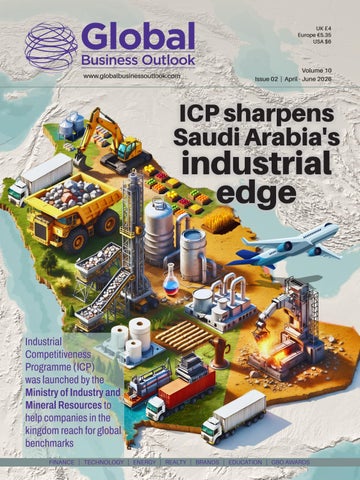
Industrial Competitiveness Programme (ICP) was launched by the Ministry of Industry and Mineral Resources to help companies in the kingdom reach for global benchmarks
April - June 2026
Block, the fintech company co-founded by Twitter’s founder, Jack Dorsey, has reportedly carried out significant layoffs, cutting its workforce from 10,000 employees down to 4,000. The firm cited the use of new productivity solutions like artificial intelligence (AI). On the surface level, this can be seen as a normal approach adopted by firms to streamline themselves in the AI age. But some experts have warned that this trend could pose dangers for humans as AI becomes ubiquitous.
Meanwhile, Tim Cook-led Apple is facing a significant issue with malware. Experts have discovered a new malware called DarkSword that is targeting iPhones. Russian hackers created the malware to spy on users, and it is being used by commercial firms and state-sponsored cybercriminals to smear their rivals.
In terms of the economy, Greece faces difficulties despite having managed to avoid the sovereign debt crisis. Many bad debts are hampering its growth. Millions of people and small companies lack access to loans that could help them recover and grow financially.
The cover story of the April-June edition of Global Business Outlook will highlight the Industrial Competitiveness Programme (ICP) of Saudi Arabia. The programme is helping to develop the Kingdom’s industries, as well as transition them to sustainable energy sources. Introduced in January 2024, the programme is a comprehensive national project developed in partnership with over seven government partners and private-sector experts to facilitate industry growth within Saudi Arabia in line with ’Vision 2030’ and ‘Net-Zero 2060’.
Thomas Kranjec Editor kimberly@gbomag.com



Editor's
Director & Publisher
Krushikesh Raju
Editor
Thomas Kranjec
Production & Design
Brian Williams
David Brenton
lan Hutchinson
Shankara Prasad
Editorial
Stanley Rogers
Rachel Taylor
Lucas Cooper
Tom Hardy
Business Analysts
Adam Fagoo
Arthur Salt
Jerry Thomas
Sumith Jain
Business Development Manager
Benjamin Clive
Head of Operations
David Pereira
Marketing
Danish Ali
Research Analysts
Richard Sam
Sophia Keller
Accounts Manager
Edyth Taylor
Press & Media Contact
Craig Penn
Registered Office
Global Business Outlook Magazine is the trading name of
Business Outlook Media Ltd
Congress House, 14 Lyon Road, Harrow HA1 2EN.
Phone: +44 203 642 0805
Fax: +44 (0) 203 725 9247
Email: media@gbomag.com
Decarbonisation
GBO Correspondent
Hydrogen is one of the most important aspects and problems of the decarbonisation challenge
The central problem industries face in the mid-2020s is coming to terms with the fact that going green is costing more money than previously anticipated. The price difference between a cleaner technology and the fossil fuel alternative it is meant to replace is labelled the "green premium." As of now, that premium is so large that companies are hesitating, stalling, or abandoning their climate commitments altogether.
To exacerbate the situation, AI has emerged with an insatiable energy demand. That is taking a toll on the world's energy grids, which were never really designed to handle such a scenario. On the bright side, renewable energy capacity is tripling globally. However, when you look at industries that are hardest to clean, like steel, shipping, aviation, and hydrogen production, things don't look so good.
The World Economic Forum found that average emissions intensity in heavy industry fell by just 4.1% between 2019 and 2023. At this pace, the world is not going to reach net-zero targets anytime soon.
Aviation is where the gap is the widest. Sustainable aviation fuel (SAF) is the most realistic way to reduce carbon emissions from flying; however, SAF costs approximately $5.35 per gallon, compared to $2.22 per gallon for conventional jet fuel.
It is a 140% price premium, which means an average customer would be paying more than double. Global SAF production is expected to reach 1.9 million tons in 2025, but it still only covers about 0.6% of total jet fuel demand globally.
The European Union and the United Kingdom have responded by mandating that airlines use at least 2% SAF in their fuel supply in 2025. That is a good start, but the gap remains in the aviation industry, as it would mean that players would face an additional $4.5 billion in fuel costs by 2026 to meet these early mandates

Shipping is another sector that struggles to meet green premiums. While cleaner fuels exist to replace heavy fuel oil, such as those mixed with green ammonia and biomethanol, they remain far more expensive than conventional fuel. In Northwest Europe, the 2025 pricing illustrates this gap clearly, with green ammonia priced at $2,830 per ton on an equivalent energy basis and biomethanol priced at $2,318 per ton.
The challenge is that these green alternatives still cannot compete financially with conventional options such as BioLNG or GreyLNG. Even with the International Maritime Organisation imposing carbon penalties of up to $380 per ton of CO2 equivalent on ships that continue burning the dirtiest fuels, many players are willing to pay the penalty because it remains cheaper than paying the green premium.
Green steel and the hydrogen problem
Steel production remains one of the world's most polluting
industries. The standard blast furnace-basic oxygen furnace (BF-BOF) method generates approximately 2.3 tons of carbon dioxide per ton of steel produced.
A cleaner alternative exists in hydrogen-based direct reduced iron paired with electric arc furnaces (H2-DRIEAF), which could potentially reduce emissions by 65%-83% However, scaling this technology is challenging due to the massive investment required for new infrastructure and the current lack of an affordable, industrial-scale supply of green hydrogen.
The mixed signal in the market, with projects that mix natural gas and transitional fuel struggling to find buyers, highlights a complex landscape. However, fully green hydrogen-based steel products are actually managing to charge 20%-30% premiums from large manufacturers who need verified low-carbon materials to meet their own climate commitments.
While the public bears the cost of this transition, the
Global energy transition investment reached $2.3 trillion in 2025. The money is flowing, but without stronger international coordination and mechanisms to reduce the financial risk of pioneering new technologies
specific impact depends on the project. For example, supporting green steel development through government subsidies or carbon pricing can cost anywhere between $110 to $1,160 per tonne of carbon dioxide avoided. This price range indicates that the technology still requires significant maturation and demonstrates that carbon pricing alone is insufficient to drive the green industry's transition.
Hydrogen is one of the most important aspects and problems of the decarbonisation challenge. Green hydrogen is produced by splitting water using renewable electricity, but it remains currently more expensive than grey hydrogen, which is derived from natural gas without capturing carbon dioxide emissions.
To address this price disparity, the US Inflation Reduction Act (IRA) introduced the 45V tax credit, offering up to $3 per kilogram. The effectiveness of this credit depends heavily on "matching," a technical requirement that dictates how closely an electrolyser must be tied to specific renewable energy generation.
The stringency of these matching rules will have significant financial consequences for the industry. Under a lenient matching rule, the levelized cost of hydrogen (LCOH) could fall to $2 per kilogram by 2025 and reach $1.50 per kilogram by 2030, making green hydrogen highly competitive with its grey counterpart.
decarbonisation trap
They call it the decarbonisation trap for a reason. Between 2019 and 2021, hundreds of large companies proclaimed that they would cut emissions by 50% by 2030. They even pledged a Scope 3 emission where everything from raw material sourcing to the point after the customer has bought it would be included in the cuts. Scope 3 emissions are 11.4 times larger than the company’s own emissions. This requires
granular data and constant tracking to meet commitments.
New regulations aren’t making things easier for enterprises. The European Union’s “Corporate Sustainability Reporting Directive” and “California’s Climate Corporate Data Accountability Act” now require companies to report their emissions with a level of precision that spend-based estimates, which essentially guess emissions from invoices, can no longer satisfy.
Companies are realising that the 2019 targets, made at a time before supply chain fractures and energy price spikes, are impossible to meet.
Parties are retreating from the Paris Agreement by pivoting to cap and invest models, which set a ceiling on emissions while continuously investing in reductions, rather than chasing a fixed target that may no longer be realistic.
All of this is happening despite record spending. Global energy transition investment reached $2.3 trillion in 2025. The money is flowing, but without stronger international coordination and mechanisms to reduce the financial risk of pioneering new technologies, the green premium will continue to slow the deployment of the solutions the world needs.
Where AI and climate policy collide
AI is the new biggest issue that industries have to deal with. It makes business easier, but its thirst for energy is insatiable. Hyperscalers like Amazon, Meta, and Google account for 49% of all corporate clean energy purchase agreements globally, with many of those contracts specifically targeting nuclear and geothermal power to guarantee firm supply in 2025.
In regions where electricity demand is growing faster than the grid can handle, companies are being forced to install natural gas backup generators, directly

undermining the climate progress being made elsewhere.
The age of electricity is poised to be an era of productivity, as energy will be more efficient than ever. In 2024, the US economy grew by 2.8% while energy consumption rose by only 0.5%. It’s the highest energy productivity ratio ever recorded.
Some companies are beginning to treat the green premium not as a tax, but as an investment in market leadership. The €75 million raised by Rondo Energy and the growth of book and claim accounting systems in shipping are early signs of this shift in thinking.
It will take some time to resolve both the green premium issue and the energycompute crisis, as cheap digital growth and cheap fossil fuel are coming to an end in the mid-2020s. To address this, data centres must maximise efficiency through liquid cooling, model compression, and smarter workload scheduling to measure and cut
overhead energy use by 84%
Simultaneously, governments should track public capital, harmonised carbon pricing standards, and international risk-sharing agreements to make first-ofa-kind green hydrogen and steel projects financially viable.
While a net-zero powered economy is still possible, it requires deep coordination between technology sectors, energy producers, heavy industry, and governments. Ultimately, the countries and governments that establish this coordination first will define the industrial and technology landscape of 2030 and beyond.
Fossil fuel consumption per capita worldwide from 2020 to 2024 (In Kilowatt-Hours)
Source: Statista 2020 16,548.56 2021 17,241.69 2022 17,326.77 2023 17,430.11 2024 17,449.00

Huawei has filed more than 12,000 6G-related patent applications, which is by far the largest any single entity has filed
GBO Correspondent
Telecom and tech headlines would like you to believe that 5G is yesterday’s news and 6G is right at your doorstep. However, on closer inspection, it becomes rather obvious that 5G is only midway through its deployment and monetisation curve.
In late 2024, almost 54% of the global population was covered under a 5G network, according to ITU and GSMA-linked analyses. Ericsson claimed that almost 2.3 billion people had a 5G subscription in late 2024, and that number was going to hit 2.9 billion by the end of 2025. This represents massive growth, amounting to about one-third of all mobile subscriptions on Earth. Most experts believe that, even by 2030, 5G is going to be the dominant mobile tech, accounting for 57% of all connections with over 6.3 to 6.4 billion subscribers worldwide.
Of course, there is a massive global inequality in access to data. Regions that are technologically advanced and economically welloff, like North America, Northeast Asia, and parts of the GCC, have seen 5G penetration that exceeds 60%-70% of mobile subscriptions. In poorer regions with poverty and conflict, such as Africa and low-income Asia, the coverage is still in single digits.
GSM estimates that 3.1 billion people still do not use 4G or 5G despite living within a coverage area. The situation highlights
the ’usage gap’, which is primarily driven by challenges related to affordability, high device costs, and a lack of digital skills.
Ericsson had estimated 394 million 5G subscribers by the end of 2025 in India (32% of total mobile subscriptions). Astonishingly, 5G coverage area in India is already accessible to about 90% of the population, and prepaid smartphone data usage was over 30 GB per month in 2025, which is the highest in the world.
Operators are not as enthusiastic as they were before. Dell’Oro Group reports that global telecom capex began declining in 2023, with a steeper 8% drop materialising in 2024. This was the first sustained decline since 2017. It occurred because carriers slowed down on their 5G investments due to flat revenues.
The slowdown didn’t stop there. It continued throughout 2024, with the world telecom capex falling 10% year-on-year in the first half. Analysts now believe the decline is stabilising, with capex broadly flat year-on-year through 2025, and modest recovery expected through 2026, rather than a continued negative CAGR.
Source: Statista Number
Also, 5G providers in North America and other advanced economies are convinced that the initial 5G build-out wave is at its pinnacle, and further expansion will not yield expected profits.
Why has the 6G race started so early?
The race has started early, not because 5G isn’t enough, or because it failed, or because it’s not profitable, but because developing a new technology is a decade-long commitment at the very least. It takes a long time for R&D and commercial launch, and no major player in the market wants to feel left behind.
The International Telecommunication Union (ITU) designates 6G as IMT-2030, following 5G’s IMT-2020 framework. The International Telecommunication Union is the global rule maker for mobile networks. It is the organisation that gives a code name to every generation of mobile technology and sets technical standards that companies must meet.
A group of radio experts working at the ITU, known as Working Party 5D, have already agreed on a draft list of performance goals for 6G. These objectives focus on how fast the speeds will be, how low the delay or latency will be, and how many devices can connect at once.
Different companies across the world will propose their own 6G radio technologies to the ITU from 2027. The ITU will test and evaluate its proposals against the minimum requirements that were proposed between 2027 and 2029, and officially standardise the technology in 2030 before a global launch.
In short, we’ll have a working 6G that can be used by everyone around 2030. ITU Secretary-General Doreen Bogdan-Martin has framed the stakes plainly: “By agreeing on a way forward on 6G, ITU member states have taken an important step toward ensuring that technical progress is synonymous with affordability, security, and resilience, supporting sustainable development and digital transformation everywhere.”
On the other side of the technology is
3GPP, which is an industrial body that proposes specifications for cellular systems on your devices. The organisation is trying to realign its roadmap to meet ITU’s pace.
In 2024, Release 18 was complete, marking the beginning of advanced 5G, and the development of Release 19 and Release 20. Major vendors like Ericsson believed that 6G-related R&D would begin with Release 19, and expand into 20 and 21, with concrete 6G specifications targeted around 2028, enabling commercial launch around 2030. Companies don’t want to substitute 5G with 6G in one swift move. They’re looking at a smoother, refined upgrade where 5G-Advanced and early 6G work in tandem. It’s when 5G slowly matures and evolves into 6G.
Ericsson CEO Börje Ekholm said, “I encourage you not to think of 6G as a normal new generation. The 6G, if you think about it as a technology, will probably get introduced around 2030 as an evolution of 5G, not a wholesale replacement.”
The 6G networks will be able to communicate and sense (which means that they can see and sense the environment, not just send data). It has been made possible by building AI and machine learning directly into networks to manage traffic and boost performance more smartly. This could make telecom exponentially more profitable because it is going to use less energy per bit of data.
In November 2025, Ericsson published a mobility report suggesting that 6G deployments could appear in 2030 in pioneering markets, such as the US, Japan, South Korea, China, India, and GCC nations. It will arrive in Europe a year later. ITU’s own IMT-2030 timeline is congruent with early developments at the end of the decade, once the standard is signed off and presented.
Another reason why 6G is getting such a powerful push is that governments look at 6G the same way they look at semiconductors and AI. It’s a crucial technology, and they don’t want to make the same mistakes

they did in the 5G era.
One of the most successful pioneers of the technology is China. Its IMT-2030 (6G) Promotion Group, which was established in 2019, helps operators, government, vendors, and academia coordinate seamlessly. There are claims that China has already poured $5 billion into 6G-related R&D funding. Among Chinese companies, Huawei is the most aggressive in pushing for patents and standardising bodies. Huawei alone filed more than 12,000 6G-related patent applications, which is by far the largest any single entity has filed.
The 6G drive in the US is founded on their strength in chip software and cloud, with the Next G Alliance under ATIS convening partners, hyperscalers, and vendors to execute a coordinated national strategy. Public funding exceeding $3 billion has been funnelled into these programmes through organisations such as the NSF, DARPA, and various CHIPS-related initiatives.
The stakes have been made explicit at the highest level of government. A White House National Security Presidential Memorandum issued in December 2025, titled
Winning the 6G Race, stated, “The next generation of mobile communications networks (6G) will be foundational to the national security, foreign policy, and economic prosperity of the United States. It is the policy of the United States to lead the world in 6G development.”
The investment aims to synchronise wireless technology with AI, edge cloud, and secure open RAN architectures to ensure continued US leadership across the broader digital stack.
Among the three major global O-RAN members, two are in Europe, namely Nokia and Ericsson, which are leveraging their traditional strengths in R&D for the European 6G push. Hexa-X and Hexa-X2 are flagship projects under Horizon Europe that coordinate Pan-EU 6G research, supported by an EU commitment of over €900 million for 6G-related programmes, and a call for an additional €100 million in funding for 2025 alone.
Through these initiatives, Brussels views 6G as a vital means to achieve digital sovereignty and sustainability while addressing European priorities regarding infrastruc-
“I encourage you not to think of 6G as a normal new generation. The 6G, if you think about it as a technology, will probably get introduced around 2030 as an evolution of 5G, not a wholesale replacement”
Börje Ekholm CEO, Ericsson
India had also accelerated its 5G rollout into a fast two-year window, and doesn’t want to miss the 6G window either. The government has announced a Bharat 6G Alliance, and participates in international India is forecasted to have more than a billion 5G subscribers by 2031. Because 5G penetration is over 50%, it makes an attractive testbed for low-cost, high-density 6G architectures with spectrum and investment policies assigned
ture, energy efficiency and, most importantly, privacy by design.
In the Far East, Japan and South Korea are striving to maintain their status as wireless powerhouses through several strategic initiatives. Japan’s ’Beyond 5G’ Promotion Consortium is synchronising major operators and vendors like NTT and NTT DoCoMo, supported by multi-year R&D funds exceeding ¥66 billion and various grants.
Additionally, Japan and the United States have launched a joint $4.5 billion initiative to co-develop 6G technologies. Meanwhile, South Korea is leveraging its early lead in 5G and dense urban markets to position itself as a pilot zone for 6G and emerging technologies, such as holographic communications and integrated sensing.
6G collaborations led by major vendors.
Dr. Neeraj Mittal, Secretary of the Department of Telecommunications, has outlined the timeline: “Developing a skilled workforce and collaborating with global academic institutions will be critical as we implement 6G over the next six to eight years.”
India is forecasted to have more than a billion 5G subscribers by 2031. Because 5G penetration is over 50%, it makes an attractive testbed for low-cost, high-density 6G architectures with spectrum and investment policies assigned.
For operators and vendors, the 6G push is important. They want to keep innovation happening, which would give them an advantage over their competition. However, the transition is going to be more complex than one “g” immediately transforming into another.
In 3GPP Release 18, Release 19, and

Release 20, 5G is advancing as planned and is unlocking advanced capabilities, which will be the foundation stones of 6G.
In Release 18 in particular, there have been powerful enhancements, including network slicing, improved support for time-sensitive industrial communications, tighter integration of AI for radio optimisation, and better energy efficiency. Releases that will follow will expand on these capabilities while also building integrated sensing and support for non-terrestrial networks, such as satellites and high-altitude platforms, which are integral to the 6G equation.
So far, 5G hasn’t proven to create revenue opportunities, aside from the fact that smartphones are slightly faster.
Alok Shah, VP of Networks Strategy at Samsung Electronics America, acknowledged this unpredictability in March 2024.
He noted, “Technology continues to improve, performance in the network continues to improve, and what’s always happened in prior generations is we build a network, we think we know some of the interesting use cases, we’re usually wrong about that, and something else becomes what really expands the value of networks for operators.”
Peter Jarich, Head of GSMA Intelligence, was even more direct at the ETTelecom 5G/6G Congress.
He said, “The promise of 5G was that it was going to unlock new revenues and new capabilities that we could monetise. As we have seen across the world, we haven’t quite done that.”
Dell’Oro claims global carrier revenues will rise by 1% CAGR over the next few years. However, operators are already facing rising spectrum, energy, and maintenance costs.
To navigate this crisis, operators are leaning on software-centric, cloud-native networks, which could be later upgraded from 5G Advanced to 6G through software and modular hardware, instead of another ripand-replace cycle. Moving towards 6G allows vendors to map out the migration path and reduce confusion on design well in advance.
In this sense, the early 6G narrative is partly a hedge. It tells investors and policymakers that the industry has a roadmap beyond the current capex slowdown, even as much of the near-term value will have to be wrung from 5G and 5G-Advanced over the remainder of the decade.
In all practicality, most enterprises will be investing in 5G and 5G Advanced in the next 5-7 years. By 2027, 5G will overtake 4G as a dominant technology worldwide, but only after 9 years since its commercial debut.
ITU and GSMA are confident that by 2030, the majority of mobile connections will be under 5G, and 6G adopters will be mostly wealthy and highly urbanised markets. Smart factory upgrades, logistics tracking, and FWA-based branch connectivity will all be done with 5G and 5G-Advanced technology, and not with 6G in the 2020s.
However, 6G is still going to pique the interest of governments and investors because of its surveillance capabilities and energy efficiency.
Organisations that build infrastructure meant to last for decades believe that their new industrial campuses, ports, and transportation corridors should take into account the technology of the future so that they don’t become stuck in bottlenecks a decade from now.
Investors need to parse the 6G narrative carefully. It is very unlikely that 6G will trigger an immediate global CapEx supercycle in the early 2030s. Instead, we’ll be seeing a slow, staggered, software-driven upgrade path, with early 6G appearing as an extension of 5G Advanced in some leading markets before broader global expansion. The move will benefit vendors and operators with strong software, AI, and cloud integration capabilities, rather than those focusing completely on hardware.
Finally, policy and inclusion matter: 5G reaches 50% globally, but only 4% in low-income countries; inclusive 6G reduces gaps.
ITU
and GSMA are confident that by 2030, the majority of mobile connections will be under 5G, and 6G adopters will be mostly wealthy and highly urbanised markets. Smart factory upgrades, logistics tracking, and FWAbased branch connectivity will all be done with 5G and 5G-Advanced technology, and not with 6G in the 2020s



Cover Story
Energy
Industrial
Competitiveness Programme

Industrial Competitiveness Programme (ICP) was launched by the Kingdom's Ministry of Industry and Mineral Resources to help industrial facilities enhance operational efficiency, reduce costs, and sustain competitiveness in a changing global market
GBO Correspondent
The Kingdom of Saudi Arabia is entering a new phase in its industrial journey, one defined by efficiency, sustainability, and innovation. Spearheaded by the Industrial Competitiveness Programme (ICP), this transformation is reinforcing the strength of Saudi industries while supporting their transition to clean, efficient energy sources.
Industrial Competitiveness Programme
The ministry is offering resources and benefits to industry stakeholders to create an appealing environment for investments
Launched in January 2024 by the Ministry of Industry and Mineral Resources, the Industrial Competitiveness Programme was designed to help industrial facilities enhance operational efficiency, reduce costs, and sustain competitiveness in a changing global market.
The programme represents a unified national effort, developed with over seven government partners and private-sector experts, to drive the Kingdom’s industrial growth in line with socio-economic diversification and climate goals like "Vision 2030" and "Net-Zero 2060."
Over the past five decades, Saudi Arabia’s industrial sector has expanded steadily, supported by strong government backing and a focus on high-potential industries including chemicals, food processing, and advanced manufacturing. These efforts form part of a wider strategy to diversify the economy and stimulate investment in nonoil sectors.
The National Industrial Strategy plays a central role in this transformation by creating new investment opportunities, strengthening value chains, and encouraging innovation across multiple industries.
In supporting the goals of "Vision 2030" and "Net-Zero 2060," the Ministry of Industry and Mineral Resources is focused on strengthening the industrial and mining sectors as key engines of non-oil economic growth.
"It (the Gulf nation) strategically chose these two sectors to diversify the national economy and increase its overall national contributions through a national industrial programme and logistics services to establish the Kingdom as a leading industrial and mining powerhouse, as well as a global platform for logistics services," the authority told the Global Business Outlook
As of 2026, the ministry is offering resources and benefits to industry stakeholders to create an appealing

environment for investments. Most importantly, it aims to establish an effective governance framework that enhances the competitive capabilities of its partners and improves the efficiency of utilising the industry leadership's assets. Its strategy is based on these pillars, including organisational structure and


capacity development, regular and effective interactions with industrial and mining sector players, centralisation of the investor, the establishment of a professional and change-oriented work culture in both industries, and, most importantly, accelerated digital transformation.
Since its launch, the ICP has begun delivering tangible
results across the industrial sector. Hundreds of industrial establishments have engaged with the programme, with a significant number already benefiting from financial, technical, and operational support.
These efforts have helped both large manufacturers and small and medium-sized enterprises improve operational efficiency, optimise energy consumption, and strengthen their long-term competitiveness.
At the national level, the programme contributes to safeguarding the industrial sector’s economic value while supporting the Kingdom’s broader environmental ambitions through improved energy efficiency and emissions reduction.
Within the private sector, the initiative has also supported workforce development by providing specialised training programmes focused on energy management and industrial
Industrial Competitiveness Programme
efficiency. Thousands of professionals have already participated in these initiatives, strengthening technical capabilities within the sector.
The programme’s reach now extends beyond large corporations. By expanding eligibility criteria, the ICP has opened opportunities for SMEs operating in sectors such as food production, leather, paper, and metal industries. This expansion enables smaller companies to modernise their operations and remain competitive as energy markets evolve.
Through partnerships with national institutions such as the Saudi Energy Efficiency Centre and the National Academy for Industry, the programme has also introduced professional certification and capacity-building initiatives aimed at developing a skilled industrial workforce.
Beyond training, the programme addresses operational challenges faced by smaller enterprises by analysing energy consumption patterns and recommending solutions such as upgrading inefficient equipment and adopting modern technologies. This targeted approach ensures that efficiency gains and cost savings extend across the broader industrial ecosystem.
Collaboration has been a key factor behind the programme’s progress. Partnerships with organisations such as MODON have enabled factories in industrial cities to access energy audits, consulting services, and efficiency improvement programmes.
Through these initiatives, many factories have assessed their energy performance and implemented practical measures to improve operational efficiency and reduce production costs.
The programme has also encouraged participating companies to adopt structured energy management systems and integrate efficiency practices into their daily operations. These improvements not only enhance operational performance but also strengthen financial resilience and long-term sustainability.
Additionally, the initiative has helped foster a growing ecosystem of collaboration among government entities, industrial operators, and specialised service providers, creating a

supportive environment for continuous improvement across the sector.
Not resting upon the laurels earned so far, ICP is now preparing to enter a new stage of development. The second phase of the programme will expand its scope beyond energy efficiency to encompass a comprehensive cost competitiveness framework, focusing on evaluating

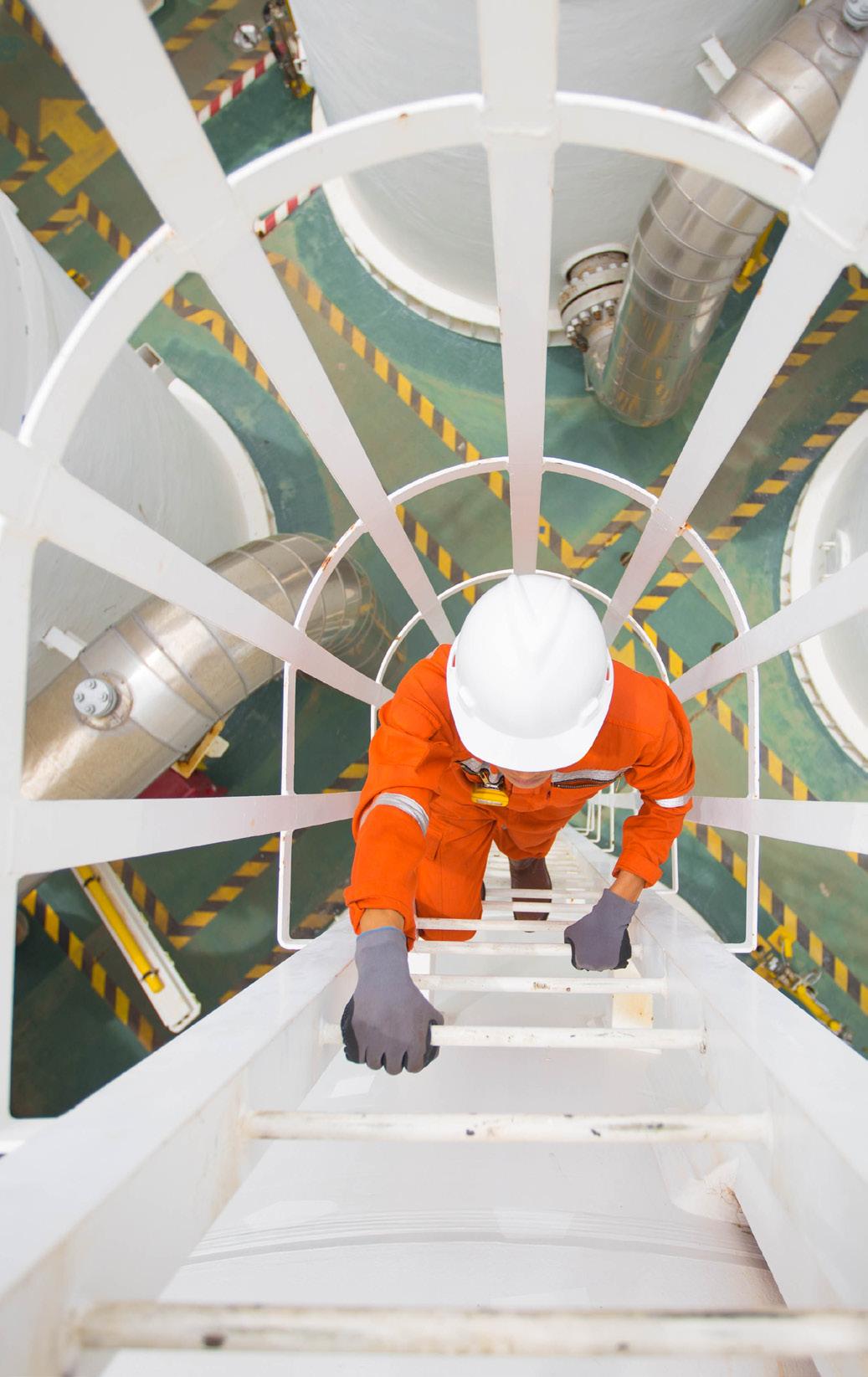

labour, material, and logistics costs, apart from identifying key challenges and opportunities to improve overall industrial cost structures.
The findings from this phase will form the foundation for "Phase Three," which will deliver holistic solutions to optimise working capital, production utilisation, and value chain integration across the sector. These forwardlooking efforts will ensure that Saudi Arabia’s industrial sector not only sustains its current momentum but continues to evolve as a regional and global benchmark
in efficiency, sustainability, and competitiveness.
As Saudi Arabia advances toward a diversified and knowledge-based economy, the ICP will continue to be a key enabler of sustainable industrial growth, reinforcing the Kingdom’s global reputation as a competitive, efficient, and forward-looking industrial powerhouse.

Airlines which have adopted a 3D printing approach have cut the time to resolve Aircraft on Ground events by 70%
GBO Correspondent
Additive manufacturing is changing the physical reality of warehousing. Management of spare parts was always seen as a logistics and storage issue. It was a cumbersome exercise where companies would stock up "just in case."
In 2026, all that's going to change as Chief Financial Officers transition from passive budget gatekeepers to central figures in technology strategy. As they recognise the importance of 3D printing, it is moving from being a gimmick to a workable tool that will optimise working capital and risk mitigation.
Inventory, once perceived as a free or neutral asset, is significantly

draining agility and mounting costs (somewhere between 20%-35% of inventory value annually). By converting physical stocks into digital libraries of Computer-Aided Design (CAD) files, enterprises are effectively liquidating their warehouses. This frees up millions of dollars in tied-up capital sitting on warehouse shelves that can now be used for expansion and R&D.
Adieu to physical, hello to digital
Let's introduce ourselves to a concept called Digital Inventory. It is a modern approach where designs of products are filed and stored as digital files instead of physical components.
Whenever there is demand, manufacturing happens immediately rather than retrieving something from a warehouse. It's a fundamental change in balance sheets for
CFOs. Physical inventories are depreciating assets that incur storage fees, insurance premiums, and handling overhead, while digital inventories are just intellectual property assets. These assets can be deployed instantly across a decentralised network of printers and don't cost the company liquidity.
Additive manufacturing has matured to an industrial level where it can reliably produce hundreds of thousands of parts. No more bulk batch deliveries; there is only going to be on-demand printing.
This is especially useful in industries such as aerospace and heavy industry, where downtime costs can run up to hundreds of thousands of dollars per day.
The ability to produce a functional, longterm replacement part in a matter of hours (instead of waiting for weeks for an original equipment manufacturer shipment) is an economic revolution.
Redefining adoption as a clear chronolog-
ical trajectory, starting from the 1980s and leading to the 2020s, positions it as a driver of sustainable on-demand production.
Decentralised production is becoming more common now. It helps manufacturers be closer to the point of consumption and minimise transportation costs and carbon footprints associated with global logistics.
In today's environment of geopolitical instability and rising interest rates, working capital has become a vital risk management tool. Consequently, CFOs are increasingly holding supply chain and procurement leaders accountable for inventory management decisions.
The objective for 2026 is to optimise resources and enhance predictive capabilities by leveraging real-time financial technologies to secure sustainable, profitable growth. Modern CFOs have evolved into technologists and strategists who must navigate significant challenges, including fluctuating

raw material prices, spiking transport costs, and persistent supplier instability.
Solutions found include 3D printing, cash flow forecasting, integrated financial analytics, and scenario-based financial modelling, which provide predictive insights during economic uncertainty.
Industrial-grade additive manufacturing requires a comprehensive ecosystem of hardware, software, and facility infrastructure. The initial investment for hardware and software can be significant; for instance, while an FDM printer may cost $150,000, it must be supported by post-processing stations and CAD workstations valued at approximately $25,000 and $30,000, respectively. High-throughput technologies, such as selective laser sintering, require even larger outlays and are considered very expensive, starting at $200,000 per machine.
Beyond the machinery, infrastructure hardening is a non-negotiable requirement that can add another $50,000 to initial budgets. This includes specialised ventilation for powder handling, electrical service upgrades to support dozens of machines, and safety compliance measures for temperature-controlled environments.
Finally, stakeholders must account for recurring operational expenses. Ongoing costs include materials, which range from $1.30 per kilogram for ABS to over $100 per kilogram for aerospace-grade PEI/ULTEM. Other continuous expenses involve energy consumption and the labour required for both printing preparation and post-processing. Tooling often dictates production volume in traditional manufacturing. An injection moulding can cost $25,000, which means a company would need high minimum order quantities to amortise the cost per part.
However, additive manufacturing (AM) eliminates this upfront barrier. Since everything is in a digital file, the cost per unit remains relatively constant regardless of volume, making single-unit production eco-
nomically feasible. While the cost per part in isolation might be higher (for example, $310 versus $210 or $220 for a traditional casting), the systemic savings are profound.
Traditional methods would take 14 weeks' lead time for tooling and production, but additive manufacturing can deliver it in three weeks, allowing companies to bypass inventory costs associated with stocking physical parts for years while waiting for demand to materialise.
CFOs are also focusing on the total cost of ownership for spare parts. Traditional models do not take into account the expenses associated with holding physical stock, such as capital opportunity costs and obsolescence. Inventory carrying costs typically range between 20%-35% of inventory value annually, consisting of cost of capital (25%), storage at (3%) and obsolescence risk (3%-15%).
A digital inventory will save the company 25%-40% of its current inventory holding costs. ROI (return on investment) is typically achieved within the first year, often after just two or three major breakdown events, where the printer eliminates the massive cost of production downtime. Speed allows companies to bypass inventory costs by stocking physical parts for years while waiting for demand to materialise.
This business case serves as a strategic justification for prioritising investments in Asset Integrity Management (AIM), focusing on three primary drivers of operational cost and efficiency. First, it addresses the frequency of equipment downtime, aiming to minimise the cascading financial losses that occur when critical assets fail.
Second, it accounts for high hourly line rates, where even brief interruptions result in significant revenue leakage and reduced throughput. Finally, a robust AIM strategy facilitates proactive maintenance, allowing the organisation to avoid the substantial express procurement premiums typically charged by Original Equipment Manufacturers (OEMs) for emergency parts and expedited shipping. By targeting these three
A digital inventory will save the company 25%-40% of its current inventory holding costs. ROI (return on investment) is typically achieved within the first year
What is the top focus related to 3D printing in 2021?
areas, the investment ensures a more stable production environment and a significant reduction in avoidable overhead.
Imagine if a plane never took off because a single part failed or was missing, and there was no replacement to be found. The nearest supplier is a few thousand kilometres away in another country, and it would take about a couple of weeks to ship.
Each passing day that the plane sits idle costs the airline around $150,000 in revenue. Multiply that across dozens of airlines and hundreds of aircraft, and you will understand why the aviation maintenance industry is worth $96 billion globally and is desperate for smarter ways to manage spare parts.
The answer is increasingly becoming what most people once saw as a hobby or a way to make novelty trinkets. 3D printing, also known as additive manufacturing, is revolutionising aerospace.
Airline maintenance teams have stacked their warehouses with spare parts. Although logically, you need replacements when something breaks, thousands of very expensive components end up lying on shelves. That money is tied up in inventory that cannot be used elsewhere.
Some parts stay in warehouses for so long that they become useless. Sometimes suppliers discontinue production, and when a genuinely rare component does fail, the wait can stretch into weeks. The phenomenon is called AOG (aircraft on ground), where a plane earns nothing but costs money every idle hour.
There are categories of parts that are simply no longer made by anyone. Around 28% of grounding events involve components for older aircraft where the original manufacturer has stopped production. In these cases, 3D printing is not just faster; it is the only option possible.
Organisations using this approach are reporting a 35%-40% reduction in the cost of keeping inventory within the first year alone.
Even the regulators are on board. Despite aviation being one of the industries with the most demanding safety standards, where every part on a commercial aircraft must be certified as airworthy, 3D printing has overcome obstacles and made its way into mainstream practice.
Lufthansa Technik, one of the world's largest aircraft maintenance companies, received a certificate from European aviation authorities that allows it to design, produce, and install 3D-printed parts without requiring additional external rules. This certification covers various cabin components, including seat parts, overhead bin latches, and emergency markings.
Honeywell, the aerospace giant, is also producing the first certified flight-critical engine part using 3D printing, specifically a bearing housing that sits inside a jet engine. These are not decorative or low-stakes parts. They are components whose failure could endanger lives. The fact that regulators approved the manufacturing of such crucial parts speaks to the advancements that 3D printing has made. Furthermore, the resulting reduction in the number of individual parts also leads to better performance.
Source: Statista
Storing digital inventories frees up physical inventory and the money tied to it. Now, there is no need for expensive warehouses, no wait times, and no parts that go obsolete over the years.
Airlines which have adopted a 3D printing approach have cut the time to resolve Aircraft on Ground (AOG) events by 70% What used to take 14 days can now be fixed in 48 hours.
Traditional manufacturing has physical limits. With 3D printing, we can now make complex pieces that were largely impossible to create before. Processes that would have required nuts, screws, and soldering can now be 3D printed as one single part. GE Aviation used 3D printing to create a nozzle as a single piece that would have otherwise taken 20 separate parts, cutting its weight by 25%. They also reduced 855 individual

engine parts down to just 10.
Lighter aircraft burn less fuel, and the savings from the redesigned nozzle alone are estimated to be $3 million per aircraft per year. Over the lifetime of a fleet, that figure becomes extraordinary.
Global supply chains have faced significant disruptions over the last few years, beginning with the pandemic and continuing through trade wars and the Persian War. In response to these challenges, seven in ten businesses worldwide are now reshoring their operations by bringing production closer to their home markets.
3D printing is a primary driver of this trend because it overcomes the limitations of traditional manufacturing. While conventional methods rely on large factories, expensive tooling, and high-volume production runs to remain cost-effective, 3D printing enables the economical production of small quantities of complex parts in any location. This technology allows factories in Europe or North America to manufacture parts locally that previously required sourcing from Asian suppliers, effectively eliminating long lead times and geopolitical risks.
Furthermore, companies can secure digital blueprints within their own internal systems to protect against intellectual property
theft. By producing their own components, businesses also gain independence from the restrictive schedules and pricing of original equipment manufacturers.
Modern printing systems are equipped to inspect parts layer-by-layer during production, while digital records have replaced traditional paper logs. These advancements have significantly streamlined operations, reducing error rates by 40% and cutting the time required for regulatory audit preparation by up to 80%
The industry operates on the 1-10-100 rule, which posits that correcting an error at the point of entry costs a single unit of effort, while fixing that same error after a faulty part has been produced costs a hundred times more.
Organisations that embrace this shift are developing a level of operational resilience that is increasingly vital amid shifting geopolitical pressures and technological advancements. Ultimately, the future of aircraft maintenance and other industries depends less on the size of warehouses and more on the quality of data.
Lufthansa Technik, one of the world's largest aircraft maintenance companies, received a certificate from European aviation authorities that allows it to design, produce, and install 3D-printed parts without requiring additional external rules
With an ageing housing stock and long winters, the challenge in the United Kingdom is hard to ignore
GBO
Correspondent
Imagine stepping into a newly built home somewhere in the United Kingdom in 2028. The lights are running on electricity generated from the roof. There is no familiar hum of a gas boiler. Instead, a heat pump quietly does its job in the background. The house feels warm, but not stuffy. Bills are lower than expected. This is the kind of everyday reality the European country is trying to create through its low-carbon housing programme, built around what is known as the “Future Homes Standard.” It is not being pitched as a futuristic concept. Rather, it is being framed as the new normal.
But as with most big policy shifts, the story is not as neat as it sounds. Beneath the surface, there are compromises, industry pressures, and some uncomfortable gaps that could shape how effective the programme really turns out to be.
A change is coming
For years, climate conversations in the United Kingdom tended to focus on energy generation, transport, and heavy industry. Housing was part of the discussion, but not always front and centre. That has changed.
The reason is fairly straightforward. Homes are a major source of emissions. Heating alone accounts for a significant share, and much of that still depends on fossil fuels. In a country with an ageing housing stock and long winters, the scale of the challenge is hard to ignore.



The real question is what happens next. Will the loopholes be tightened? Will standards be strengthened over time? Or will the current compromises become permanent?
So instead of relying only on retrofitting old homes, which is slow, expensive, and often messy, the government is trying to fix the problem at the construction stage. Build better homes now, and you avoid bigger problems later.
From March 2028, new homes are expected to be far more energy efficient and significantly lower in emissions, around 75% less compared to older standards. Solar panels are expected to become a standard feature on most new homes. Not every single property will have them, but the direction is clear: rooftop solar is moving into the mainstream.
The shift will also change the relationship people have with energy. When a home generates part of its own electricity, even in small amounts, it subtly alters behaviour. People start to think about when they use appliances, how much they consume, and what they can save.
There is also the practical side. Energy bills have been a source of anxiety in recent
years. A home that can offset some of its own electricity use offers a kind of built-in resilience. Still, critics have pointed out that the flexibility in the rules, allowing developers to skip solar panels in certain cases, could weaken the impact if not monitored carefully.
You might not notice it at first, but the real change is happening inside the home, where gas boilers are quietly being phased out. For decades, gas heating has been the default in British homes. It is familiar, relatively straightforward, and embedded in the country’s infrastructure. Replacing it is not just a technical adjustment, but a cultural one.
The "Future Homes Standard" essentially ends the installation of gas boilers in new homes. In their place come heat pumps and other low-carbon systems.
Heat pumps are often described in simple terms, but they represent a different way of thinking about heating. Instead of creating
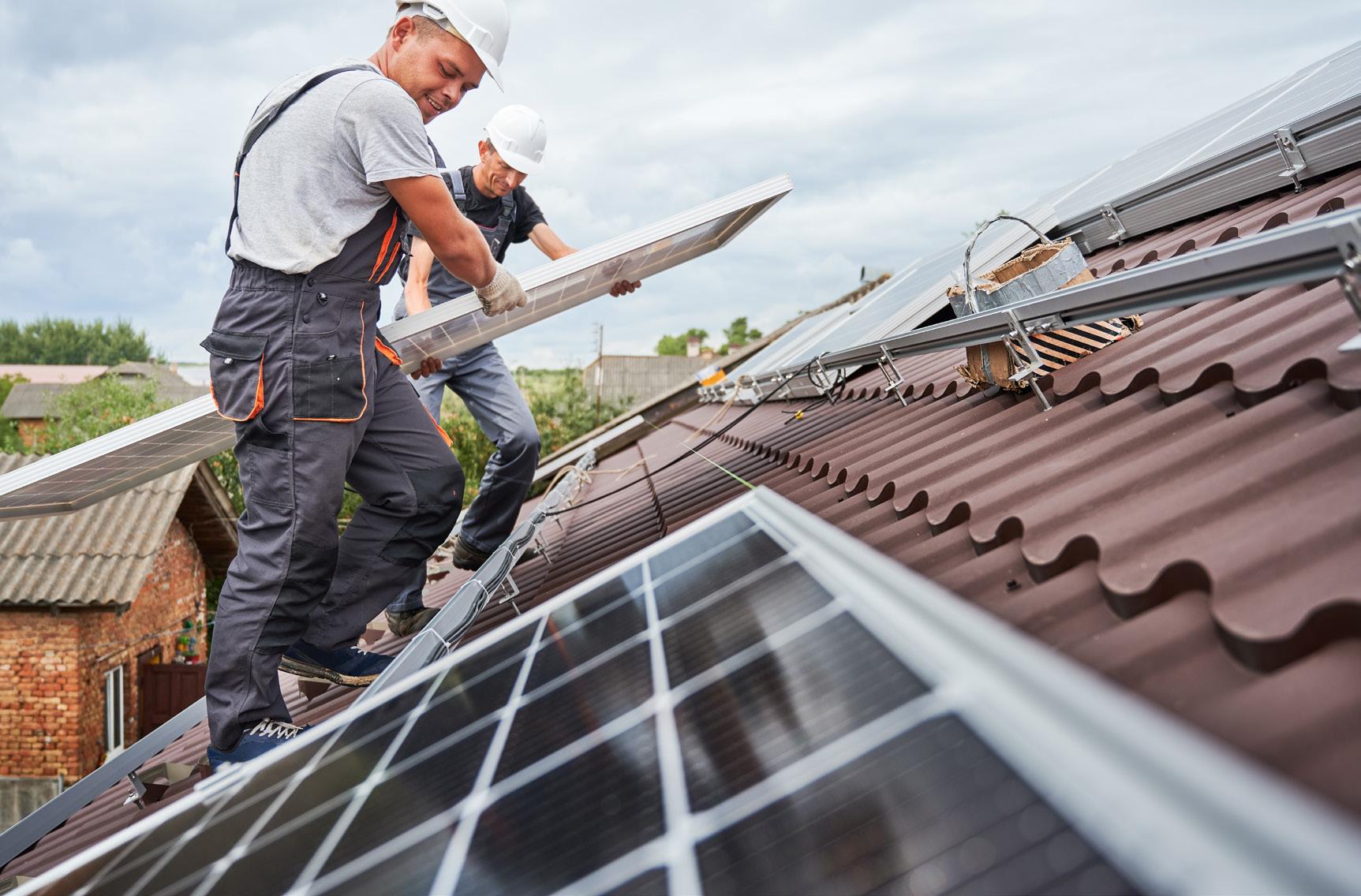
heat by burning fuel, they move heat from one place to another. It is more efficient, but also more dependent on how well the home is designed. That is where things can get complicated.
It is easy to focus on solar panels and heat pumps because they are tangible, visible changes, but much of the real progress will come from less noticeable improvements. Better insulation, tighter construction, smarter layouts. These are not the kinds of features that grab headlines, but they matter.
A home that holds heat effectively does not need as much energy in the first place. That reduces emissions, lowers bills, and makes everything else, from heating systems to energy generation, work more efficiently.
This is where it stops being purely about better homes and starts getting a bit political. Behind the scenes, there’s been pushback from developers, and many believe the government under Keir Starmer has had to soften some of its earlier plans.
Builders say stricter rules could make homes more expensive and slow things down, and in the middle of a housing shortage, that’s hard to ignore. Reuters noted that industry voices have influenced timelines and the strictness of the rules.
Wood-burning stoves look cosy and traditional, and they’re often sold as 'eco-friendly.' But in reality, they produce a lot of air pollution, sending tiny particles into the air that can be harmful to our health. From a carbon perspective, they still release emissions, even if the fuel is technically renewable.
Allowing them in homes that are otherwise designed to be low-carbon raises obvious questions. Can a home really be considered 'future-ready' if it includes a feature that adds to pollution? Critics believe this signals a willingness to compromise, which may undermine the policy's overall credibility.
Another issue that keeps coming up is timing. The full rollout of the standard
has now been delayed until 2028, and that extra time could have bigger consequences than many realise. Homes built before the deadline may not meet the new requirements. And once they are built, they are not easily changed. Retrofitting is possible, but it is rarely as effective, or as cheap, as getting things right from the start.
The government, for its part, has tried to frame the programme as a realistic step forward rather than an all-or-nothing solution. There is an emphasis on affordability, both for builders and homeowners. There is also a broader package of measures: grants for heat pumps, insulation support, and efforts to expand renewable energy access.
Officials have also pointed to the benefits beyond emissions. Lower energy bills, more stable indoor temperatures, and reduced reliance on imported fuels are all part of the argument. Whether that message resonates fully will depend on how the policy plays out in practice.
The real question is what happens next. Will the loopholes be tightened? Will standards be strengthened over time? Or will the current compromises become permanent? For now, what is clear is that the way homes are built in the United Kingdom is changing. Maybe not as quickly or as cleanly as some would like, but changing nonetheless.
The "Future Homes Standard" proves that the United Kingdom is making an attempt to build cleaner and better homes. The new houses will consume less energy, won't use gas boilers, and might even generate their own power. This might save money and help the environment. However, there are still issues such as delays, weaker rules, and pollution-producing features. Builders also have concerns such as cost and speed. Therefore, it might not succeed as intended. In the end, it is a step in the right direction. But the success will depend on how strict the rules become and how well they are followed.
Source: Worldometer Carbon
(In Million Metric Tons Of Carbon Dioxide)
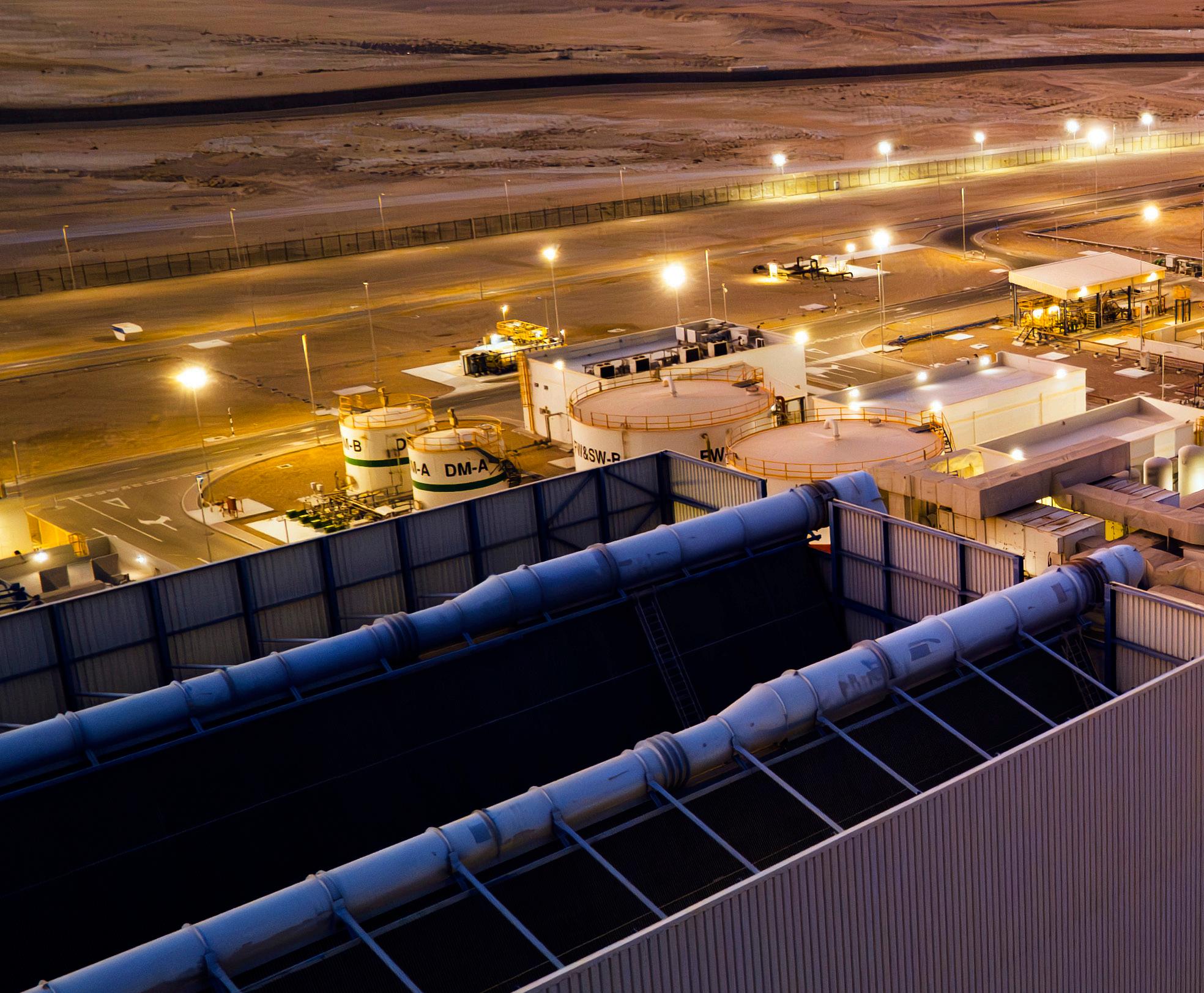
From an ambitious vision to the world economic gateway, utilities venture Marafiq has become the invisible engine that keeps Duqm’s transformation running cleanly, efficiently, and sustainably. Before dawn, Duqm awakens not to the sun but to the grid. Streetlamps trace the roads to the Port of Duqm, cranes begin their rotations at OQ8, and turbines hum across the industrial plain. Behind this rhythm stands Marafiq Duqm’s integrated energy and utilities provider, a joint venture between OQ Group and Gulf Energy, quietly orchestrating the Oman town's flow.
In a region once powered by scattered diesel plants and water tankers, Marafiq has built an ecosystem designed for scale from day one. Its remit spans electricity, water, wastewater, steam, and industrial gases, all delivered through a unified network that treats utilities not as background
services but as strategic enablers of growth.
From vision to network
When the Special Economic Zone at Duqm was first mapped, the greatest uncertainty for investors was utilities. How could a remote coastline sustain power and water for industries spread across 2,000 km²? Marafiq was established to answer that question.
"Its system is anchored by Duqm Power Company, which operates a 326-megawatt power generation facility and a seawater treatment plant producing 36,000 m³ of desalinated process water per day. Together, these assets ensure a secure, reliable, and 100% available power and water supply to OQ8. A high-voltage corridor extends from the plant to Ras Markaz, linking storage terminals, port zones, and emerging
In a region once powered by scattered diesel plants and water tankers, Marafiq has built an ecosystem designed for scale from day one

manufacturing clusters. Every kilometre is digitised, monitored, and managed from Marafiq’s central control room, a quiet suite of screens and sensors translating the pulse of a city into data," the utility player explained about the infrastructure.
Marafiq’s operating model is built on predictability. Long-term offtake agreements with industrial clients ensure stable revenues, while shared infrastructure eliminates duplication across the zone. The results are measurable: consolidated generation and distribution have lowered average power costs by approximately 30%, while water-recycling systems recover 95% of wastewater, and integrated heat-recovery processes cut emissions by about 90,000 tons of CO2 annually.
Behind the visible network lies a closed-loop design. Steam from OQ8’s process units is captured and reused. Compressed air, nitrogen, and cooling water circulate through shared pipelines serving multiple tenants. Each
circuit conserves both cost and carbon.
In a strategic coastal landscape where sea, cliffs, sand, and expansive horizons shape one of the region’s most promising economic areas, reliability is embedded by design. Redundant circuits stabilise the grid, while automated sensors isolate faults within seconds.
"At the desalination plant, dual intake systems ensure uninterrupted operation even under changing marine conditions. Predictive analytics enable maintenance to be scheduled before issues arise, allowing Duqm’s infrastructure to perform with the confidence and resilience of a mature national utility supporting long-term investment, growth, and industrial development," Marafiq told GBO. What began as a backbone for Duqm has now
become a regional reference when it comes to cutting-edge technology powering nextgeneration utility infrastructures. Delegations from Sohar, Salalah, and East Africa have already studied Marafiq’s integrated design as a replicable model, with the company operating as both provider and advisor, exporting planning and digital-network expertise.
The ongoing "Phase 2 Expansion Project" includes a new SWRO water treatment plant to serve emerging industrial customers. Pipeline corridors are being prepared for future industrial gases and renewable integration from Duqm’s solar and wind fields.
By night, Duqm’s skyline glows evenly, refinery towers, cranes, and apartment blocks sharing the same quiet current. Beneath the cables and pipelines lies a design philosophy that measures success in continuity. The assuraNce that Duqm’s transformation rests on systems built to endure.
"At Marafiq’s headquarters, engineers speak of sustainability as a formula, not a philosophy. Every cubic metre of water and every kilowatt of power is tracked, recycled, or recovered. The outcomes are tangible. Around 90,000 tons of CO₂ are avoided
annually, 95% of industrial wastewater is recovered, and non-revenue water is reduced to below 11%. The same unit of energy serves multiple purposes. Steam recovered from OQ8’s refining processes provides district heating, while treated desalination brine is reprocessed to extract industrial salts," the company noted.
Behind every control panel and turbine are engineers who grew up in the same landscapes they now electrify. Over 75% of Marafiq’s workforce is Omani, with many belonging to Al Wusta Governorate and neighbouring towns. Many joined as apprentices and now lead control, maintenance, and safety units.
In the operations room, a young technician from Haima monitors load curves across the network.
"My father was a fisherman. He followed the tide. I follow the demand," he told the Global Business Outlook while adjusting a dial.
Marafiq’s training institute has partnerships with Sultan Qaboos University and German technical colleges, blending local knowledge with international precision. Graduates emerge fluent in both the language of kilowatts and the logic of sustainability. For Duqm, this local expertise is no less vital than steel or fuel; it is the foundation of self-sufficiency.
What begins as effluent in the industrial zone ends as

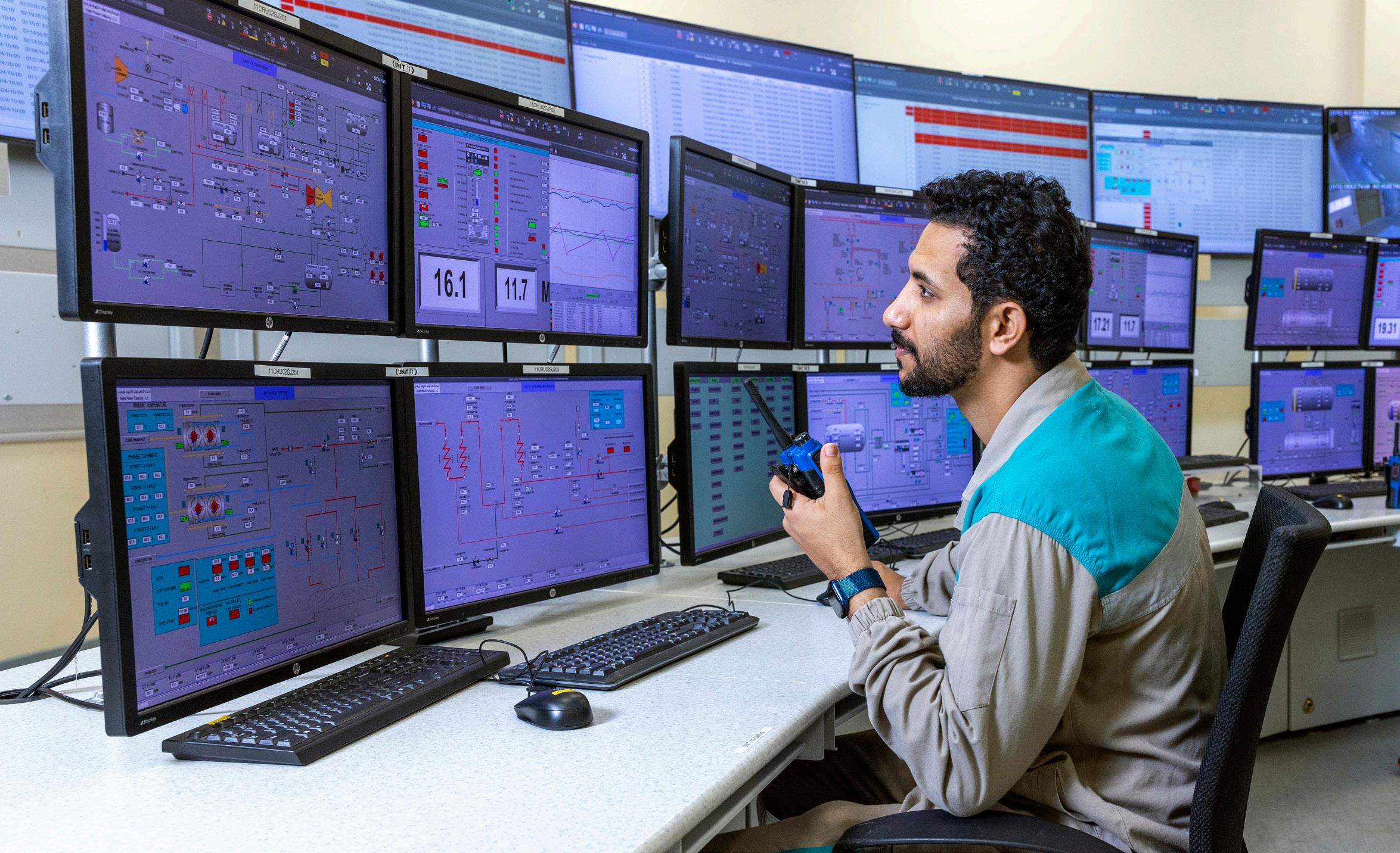
At Marafiq’s headquarters, engineers speak of sustainability as a formula, not a philosophy. Every cubic metre of water and every kilowatt of power is tracked, recycled, or recovered
irrigation in the city’s green belts. The "Duqm Wastewater Treatment Plant," operated by Marafiq, recovers and recycles water for landscaping, construction, and industrial reuse. Treated sludge becomes a soil stabiliser, while recovered brine provides materials for construction additives. Each cycle reduces desalination demand and carbon intensity. Across the utility network, this philosophy of reuse extends to heat, air, and process fluids. It is a system where nothing leaves before it has served its purpose twice.
Marafiq’s impact extends far beyond its perimeter fences. Its integrated utility model is studied by planners from Sohar, Salalah, and Al Mazunah, as well as delegations from East Africa and the Indian Ocean rim. The company has evolved from operator to advisor, exporting Oman’s expertise in energy-water integration and smart-grid management.
Within OQ Group, Marafiq now contributes to the design of utility clusters for hydrogen, ammonia, and green-steel projects, embedding digital infrastructure from inception. The logic of centralised supply, modular expansion, and data-driven maintenance has become one of Oman’s quiet exports: proof that well-designed efficiency travels farther than pipelines.
"For Marafiq, energy transition is not a marketing phrase but a management discipline. Its five-year strategy aligns with Oman Vision 2040, integrating emissions reduction, local content, and digitalisation. Each ton of carbon reduced within Marafiq’s facilities multiplies across client operations," the utility player stated.
New projects already reflect this nextgeneration approach. Hydrogen corridors and renewable-integration hubs are being designed to operate on data-driven efficiency rather than subsidies. The same systems that manage Duqm’s gas-fired grid today will balance renewable loads tomorrow.
Beyond pipelines and substations, Marafiq’s influence is social. Local contractors manage logistics and maintenance; school programmes promote water conservation and energy literacy. Company-supported housing and health facilities are now serving nearby communities, blending industrial and civic infrastructure. For Duqm’s residents, Marafiq is part of the city’s fabric, the system that keeps both industry and daily life in motion.
The Australian Competition and Consumer Commission (ACCC) has granted interim authorisation to Qantas and American Airlines to continue their transpacific joint business before their current approval ends on April 16, 2026.
The partnership involves services between Australia, New Zealand, and North America, focusing on connectivity via Dallas/Fort Worth and other US gateways. The decision means the airlines can continue coordination of schedules, capacity, and revenues while the regulator considers an application for a new five-year authorisation lodged in November 2025.
Qantas and American Airlines operate a joint revenue-sharing deal that aligns fares, schedules, and capacity, integrates frequent flyer programmes, and jointly manages seat inventory to control how many seats are sold at each fare level. Some commercial data also
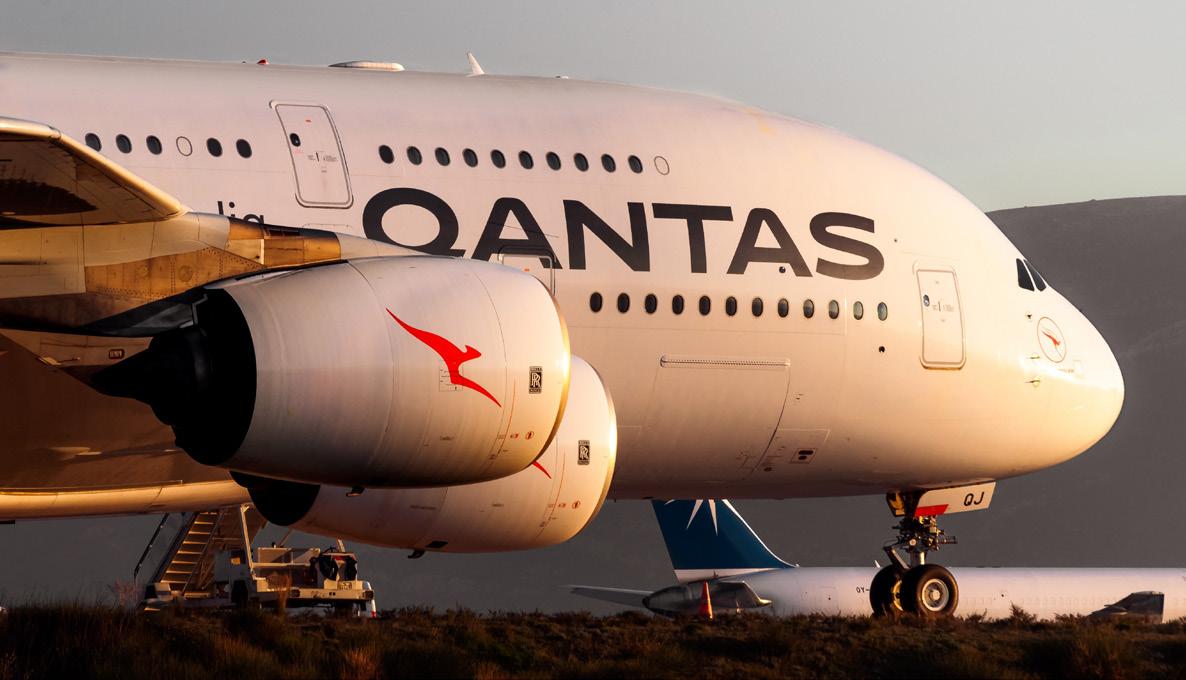
gets shared. Back in November 2025, Qantas and American applied to renew the pact for another five years.
The ACCC is still investigating the deal, which covers revenue splits, tariffs, and information sharing, to clear any antitrustrelated concerns. The regulatory body will likely issue its draft ruling in May 2026, with a final decision due in June. Approval would lock in another five years for the American–Qantas alliance.
Elon Musk-led Tesla has had a horrid start in 2026, with its quarterly deliveries facing their weakest year, as fading US incentives and intensifying global competition strain the automaker's core electric vehicle business.
The EV maker has produced
Qantas and American Airlines operate a joint revenuesharing deal that aligns fares, schedules, and capacity
50,363 more vehicles than it delivered during the quarter, the widest gap in at least four years, signalling a build-up in unsold inventory. In 2025, the world's most valuable automaker lost its EV sales crown to China's BYD amid intense

competition in the world's secondlargest economy.
Still, Tesla's China-made vehicle sales rose for a second consecutive quarter. For the January-March period, sales increased 23.5% from a year earlier. However, the expiry of a $7,500 federal tax credit in the United States dealt a blow to the electric vehicle demand, stripping away a key incentive for the purchase of a newenergy vehicle. To complicate matters further, approval of Tesla's "Full SelfDriving System" in Europe has also been delayed.
As per Visible Alpha, in the Q1, Tesla delivered 358,023 vehicles, missing analysts' estimates of 368,903.
American entertainment
conglomerate Paramount Skydance is in discussions to obtain signed equity commitments of about $24 billion from three sovereign wealth funds led by Saudi Arabia to support its acquisition of Warner Bros Discovery.
The media giant announced in February that it had reached an agreement to buy its peer in an $110 billion deal, an equity value of $81 billion, that they expect to complete in the third quarter.
The merger would combine major studios and networks like CNN and CBS, allowing them to compete more aggressively as streaming takes viewers away from linear TV.
Saudi Arabia's Public
Investment Fund (PIF) has reportedly agreed to provide around $10 billion. The other backers are likely to include the Qatar Investment Authority and Abu Dhabi's L'imad Holding. However, the Gulf backers will not have voting rights in the new Paramount-Warner entity.
Paramount executives do not expect the funds' involvement to trigger a review by the Committee on Foreign Investment in the US or the Federal Communications Commission.
Paramount has also confirmed that equity distribution activities will not push back the closing date, which remains scheduled for July 2026 pending approval from European regulators.


UAE Fintech sector set to reach $5.71B by 2029
According to the "FinTech 2025 Industry Report" by Emirates NBD and PwC, FinTech startups in the UAE attracted nearly $265 million in investments in 2024, equivalent to one-third of the total funding granted to startups in the Gulf country.
The report also expects the Emirati fintech market to grow from $3.16 billion in 2024 to $5.71 billion by 2029. This growth is supported by widespread consumer adoption of innovative tools, investor confidence in local market opportunities, and strong public-private sector partnerships.
"Digital assets provide a wide range of uses, such as faster settlements, more efficient cross-border payments, programmable finance, and advanced financial services. In this field, the UAE is setting global standards to be emulated," the report noted.
The sector has two main growth hubs: the Dubai International Financial Centre (DIFC) and Abu Dhabi Global Market (ADGM), which are home to hundreds of companies operating in fintech, AI and innovation.
As per the industry experts, the next phase will see an acceleration in the use of digital payments, the cashless economy, digital banking services, embedded finance, digital assets, and blockchain technologies.
Economy
South Africa
Analysis
GBO Correspondent
Energy shortages have been one of the most critical constraints on South Africa's economy in recent years, as load shedding crippled productivity and deterred investment
The May 2024 general election marked the emergence of a new government equation in South Africa, as the African National Congress (ANC), led by incumbent President Cyril Ramaphosa, lost its parliamentary majority for the first time in 30 years.
The re-election of Cyril Ramaphosa necessitated a coalition known as the Government of National Unity (GNU), which included the Democratic Alliance (DA) and other political parties. ANC’s electoral setback was unexpected, as South Africa has been mired in issues such as chronic economic underperformance and structural weaknesses, along with other issues like social strains.
Have things improved under the ANC administration?
After a decade in which growth barely kept up with a growing population, expanding by just 0.7% per year between 2015 and 2024, the economy finally managed to cross the 1% mark. It expanded by roughly 1.1%-1.3% in 2025, which by international standards is low but still a significant step-up. However, the ratio still falls short of the analysts' expectations of 1.4%, with issues like fiscal pressures and soaring unemployment still haunting the African major.
The data also comes on the eve of the coalition government completing its two years (to be marked in June this year). The administration took over with the promise of stabilising the economy, apart from restoring confidence, and unleashing the growth machine. While the new data calls for celebration, it should be a muted one, with cautious optimism ruling the roost. Global Business Outlook will further lay bare the real picture of the South African economy.
The terms “South African Economy” and “weak performance” have become synonymous since 2010, with low growth failing to generate jobs and uplift the living standards. When OECD (Organisation for Economic Co-operation and
GBO Correspondent
Qatar’s economic model rests on aggressive LNG expansion and the accumulation of a massive sovereign liquidity buffer. In early June 2026, the foundations of both of these pillars have been shaken.
Military strikes on Ras Laffan Industrial City followed the closure of the Strait of Hormuz, bringing immense pressure on the domestic banking sector. The attack, which happened on March 2, resulted in the Gulf country suspending its LNG production.
The Ras Laffan complex, located 80km (50 miles) northeast of Doha, is the world’s largest LNG production facility and produces about 20% of the global LNG supply, playing a major role in balancing both Asian and European markets’ demand for the fuel. However, post the strike, Qatar’s LNG export capacity has now
Feature \ Ras Laffan
reduced by 17%, resulting in a potential $20 billion annual revenue loss. Repairs may take three to five years, causing massive disruption to global energy supplies.
The volatile geopolitics have also transformed Qatar’s financial reserves from an instrument of intergenerational equity into a guard against national insolvency. Qatar’s estimated $500-$547 billion sovereign wealth fund, managed by the Qatar Investment Authority (QIA), and the $72 billion in central bank reserves might not be sufficient to prevent a financial crisis.
There are two complementary levels to Qatar’s safety net. As the first line of defence, the Qatar Central Bank (QCB) maintains the riyal’s peg to the US dollar at 3.64. As of the end of
Source: Statista
December 2023, the QCB held $72 billion in international reserves and foreign currency liquidity.
This is a deliberate strategic positioning that covers roughly 10.1 months of imports, exceeding international benchmarks. Notable shifts in the Qatar Central Bank’s strategy include gold holdings surging by 73.1% year-on-year to QR 58.5 billion, indicating that Qatar no longer believes in holding purely dollar-denominated assets.
Additionally, foreign bonds and treasury bills stood at QR 120.4 billion, while balances with foreign banks plummeted by 39.6%, signalling a move toward consolidated liquidity.
The second level is the Qatar Investment Authority (QIA). Established in 2005, the QIA is one of the world’s largest sovereign wealth funds, valued at approximately $557 billion as of August 2024. It serves as a deeper reserve for the nation. In 2023, its mandate was updated under “Amiri Decision Number 34” to include stabilising the local economy alongside creating long-term value.
Key aspects of the QIA include a diverse portfolio with investments spanning healthcare, infrastructure, technology, and financial services across global markets. This
includes strategic investments such as the Series C instrument in the AI firm Anthropic, which has been part of the portfolio since early 2024.
Despite this robust architecture, the system is currently facing a challenge. There is a growing dichotomy between growth and survival, a phenomenon economists call “the great liquidation.”
While oil markets experienced crashes in 2014 and 2020, the 2026 crisis stems from the literal destruction of production infrastructure. On March 18 and 19, targeted strikes on LNG trains at Ras Laffan caused critical damage to Train 4 and Train 6, resulting in long-term force majeure declarations. This event removed 12.8 million tons of annual export capacity from the market, effectively eliminating 70% of the total LNG output.
Beyond the LNG trains, gas-to-liquid facilities sustained moderate damage and operations at primary export terminals were paused. The collateral impact on helium units has further extended the crisis, leading to disruptions across all global technology supply chains.
As per Saad al-Kaabi, QatarEnergy’s CEO and state minister for energy affairs, The Gulf country imposing force majeure will not only see massive revenue losses due to now-suspended long-term contracts for LNG supplies bound for Italy, Belgium, South Korea, and China, American oil major ExxonMobil, a partner in the damaged LNG facilities, along with Shell, a stakeholder in the damaged GTL facility, will have to undergo financial burdens due to repairs.
The economic consequences of these events are dire, with annual revenue losses estimated at approximately $20 billion. Furthermore, the cost to restore Ras Laffan is projected at $26 billion and is expected to take between three and five years. By 2030, the cumulative revenue shortfall will exceed $100 billion, rendering the previously planned expansion of the North Field projects highly unlikely.
The situation has been exacerbated with the closure of the Strait of Hormuz on March 4. Although Iran is permitting passage to non-hostile ships, transit has reduced to a trickle. The dual blow of infrastructure damage and maritime blockade has dampened production capacity and the ability to export resources.
The Qatari Bank demonstrated strong performance and stable foundations in the fourth quarter of 2025. During this period, the bank maintained a capital adequacy ratio of approximately 20% and a Tier 1 capital ratio of 19.5%. Furthermore, it reported a system-wide liquidity coverage ratio of 190%, a non-performing loan ratio of 3.57%, and a return on equity of 14.5%
However, the net debt was at $121 billion, which meant that it was highly sensitive to international credit market disruptions. Qatar knows well about banking stabilisation. In 2017, during a diplomatic blockade, Qatar repatriated approximately $20 to $43 billion in QIA assets into the domestic system to offset the withdrawal of
non-resident deposits.
This is being done again. With non-resident deposits totalling approximately $19 billion, the QIA’s $500-plus billion pool gives the state the theoretical capacity to effectively buy out every foreign creditor and prevent a banking crisis.
Real estate is a major component of the bank loan portfolio, and occupancy rates have collapsed by 71% alongside tourism revenue, which means there might be a sharp rise in NPLs.
The same instruments that were deployed during the 2020 pandemic are being redeployed, including a QR 75 billion QCB support package, zero-interest repo facilities, and national guarantee programmes for SMEs.
Despite the Ras Laffan disruption, Qatar’s fiscal break-even oil price remains among the lowest in the world, estimated at $43.1 per barrel in 2024 and $44.7-$45.1 in 2025, against a conservative budget assumption of $60.
With oil prices spiking toward $150 in crisis scenarios, the theoretical margin is enormous. The problem is execution. The break-even calculations assume the ability to produce and export. With 17% capacity offline and the Hormuz passage effectively closed, Qatar must shift from current-revenue financing to drawing down the QIA’s principal.
A basic fiscal model illustrates the pressure. Assuming a 2026 pre-crisis revenue target of $60 billion, a $20 billion revenue loss from Ras Laffan, a $26 billion repair cost, and non-discretionary government expenditure of $56 billion, the projected 2026 deficit approaches $42 billion. This represents approximately 8% of QIA’s total assets, manageable for one year, but a five-year prolonged crisis would produce a cumulative $210 billion drain, nearly half of the estimated fund liquidity. Qatar’s already projected pre-crisis deficit of $13.2 billion
Feature \ Ras Laffan
With non-resident deposits
totalling approximately
$19 billion, the QIA’s $500-plus billion pool gives the state the theoretical capacity to effectively buy out every foreign creditor and prevent a banking crisis
Manufacturing faces feedstock disruption, as Ras Laffan supplies the ethane, condensates, and naphtha for Qatar’s petrochemical sector; condensate exports alone are expected to fall 24%
(revised upward from an initial $3.6 billion estimate based on $60 oil) now looks modest by comparison.
Revenue diversification measures, long delayed by post-World Cup economic optimism, are now urgent. A 5% VAT, recommended repeatedly by the IMF, could generate an additional 1.2%–1.5% of GDP annually, providing a meaningful non-hydrocarbon floor. The 15% global minimum corporate tax under "BEPS Pillar Two" should similarly be accelerated to late 2026 or early 2027.
The Third National Development Strategy (NDS3, 2024-2030) was designed as the final push toward “Qatar National Vision 2030,” targeting 4% average annual GDP growth and $100 billion in FDI. The IMF had forecast 6.1% growth for 2026; that projection is now severed from reality. Across every key sector, the post-strike outlook is significantly worse than the trajectory entering 2026.
Tourism, which had recorded 71% occupancy growth in the first half of 2025, faces severe contraction due to regional security risk. Construction, which had grown 8.7%–9.6%, must now redirect capacity toward Ras Laffan reconstruction rather than new development. Manufacturing faces feedstock disruption, as Ras Laffan supplies the ethane, condensates, and naphtha for Qatar’s petrochemical sector; condensate exports alone are expected to fall 24%
The ICT sector, projected at 11.6% CAGR, faces constraints from a 14% drop in helium production, which has global implications for semiconductor fabrication. Financial services, previously growing at 11.1%, must now adopt a defensive posture. Expenditures on mega-projects like the $5.5 billion Simaisma tourism city must be suspended in favour of the Ras Laffan restoration.
If hostilities persist through late 2026 and beyond, the QIA’s capacity to fund domestic deficits without triggering global market dis-
ruptions becomes the critical variable. The fund holds significant stakes in European banks, London real estate, and US technology companies.
Forced liquidation of these assets could destabilise equity markets and deflate the AI-driven asset bubble. More broadly, any large-scale Gulf sovereign selling of US Treasuries to cover domestic expenditure would push yields higher, complicating Federal Reserve policy at a moment of potential hyper-stagflation driven by record energy prices. The feedback loop is self-reinforcing. Asset sales depress portfolio values, which reduce the effective size of the buffer, which compels further sales.
Qatar’s survival toolkit has been tested before. In 2017, a four-nation blockade was defeated through a combination of QIA asset repatriation, import rerouting via Oman and Turkey, rapid commissioning of the $7.4 billion Hamad Port, and private sector subsidisation through rent reductions and direct financial support.
The 2020 COVID-19 response demonstrated that the Qatar Central Bank could deploy a QR 75 billion package to protect SMEs and maintain credit stability without a systemic banking failure. These experiences have hardened institutional crisis management capacity, and the same levers are being pulled again.
The 2026 crisis is more severe in two respects. The physical destruction of infrastructure creates a multi-year production constraint that cannot be resolved through diplomacy alone, and the maritime blockade multiplies the revenue impact of the facility damage. No amount of reserve repatriation addresses the fundamental problem of having less to sell and less ability to ship it.
The strikes on Ras Laffan, part of a broader campaign involving the North Field–South Pars infrastructure shared with Iran, have exposed the structural vulnerability of Qatar’s mediator role.
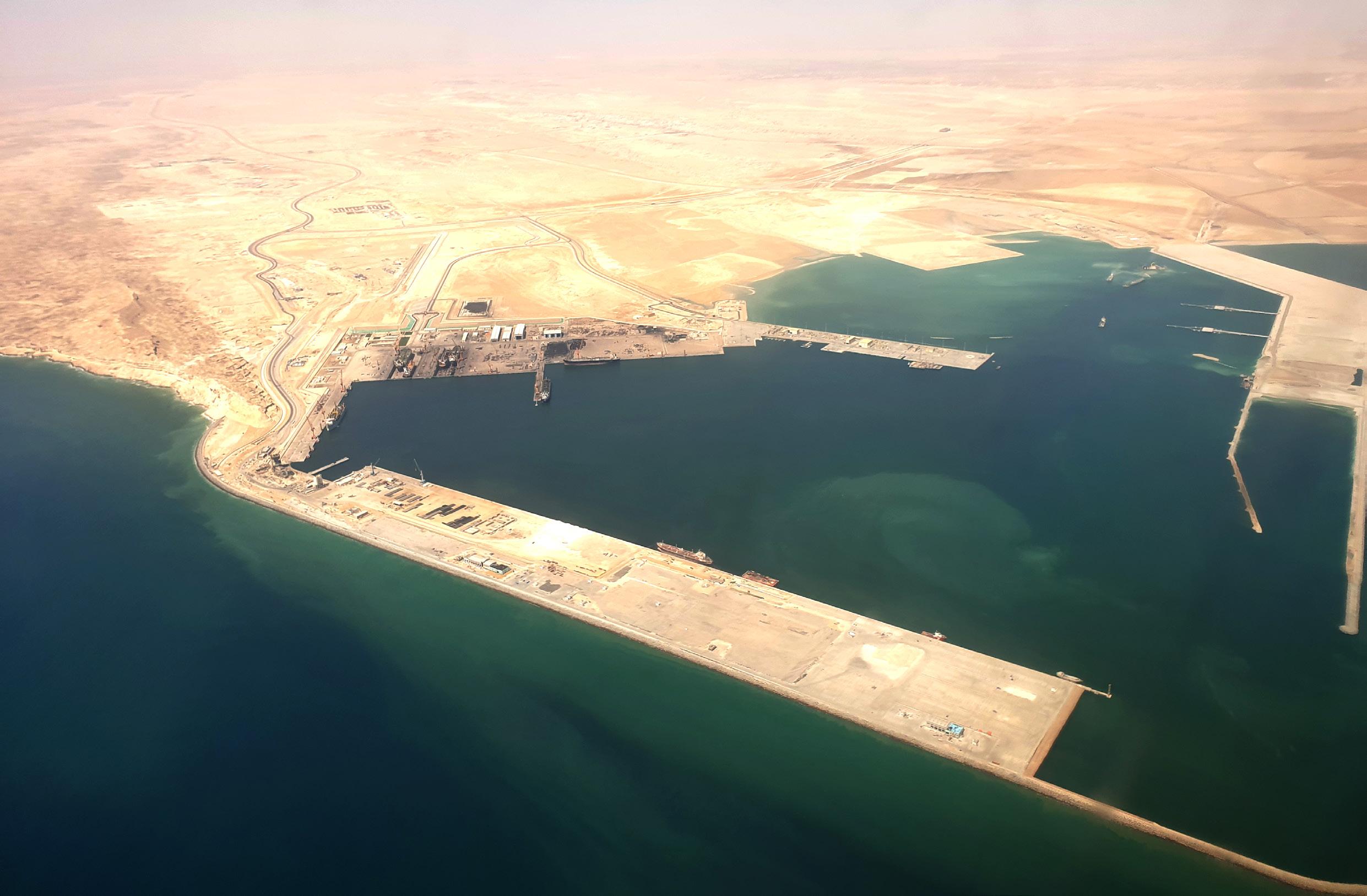
By positioning itself as an intermediary between Israel, Hamas, the United States, and Iran, Qatar arguably drew attention to its national infrastructure. Following the March strikes, Qatar formally paused its mediation efforts. The United States has presented a 15-point proposal to Iran, but hostilities continue.
In the longer term, the 2026 Gulf energy shock may function as an accelerant for the global energy transition in the same way the 1973 oil embargo reshuffled energy security priorities. Asian economies are already rationing energy and curtailing fuel exports. Qatar’s LNG expansion, premised on gas as a bridge fuel through mid-century, has been materially undermined.
Force majeure declarations extending to five years will redirect long-term buyers toward US and Australian LNG suppliers, eroding Qatar’s market share in ways that cannot be recovered simply by repairing infrastructure.
The evidence supports a nuanced conclusion. Qatar’s $500 billion safety net can prevent a financial collapse, but cannot prevent an economic crisis. It is sufficient to
stabilise banks. The QIA’s reserves are nearly five times the total non-resident deposit exposure of $109 billion. It is sufficient to support government operations, as liquid reserves can fund essential salaries ($18.5 billion annually) and social subsidies for well over a decade with zero energy revenue. And at less than 5% of QIA’s AUM, the $26 billion Ras Laffan repair bill is a manageable capital expenditure, contingent on military stabilisation.
What the buffer cannot prevent is the multi-year GDP contraction from lost export capacity and the Hormuz blockade, the reputational damage to Qatar’s status as the world’s most reliable LNG supplier, or the global market disruption from forced asset liquidation. Each year of delay in restoring Ras Laffan and reopening the Strait compounds the fiscal drain and narrows the strategic options available.
The nation that emerges from the 2026 crisis will be strategically more cautious, and diplomatically more constrained. The buffer has transformed from a growth vehicle into a lifeline, and though it will keep Qatar solvent, the return to 5% growth will be the defining challenge.
The
strikes on Ras Laffan, part of a broader campaign involving the North Field–South Pars infrastructure shared with Iran, have exposed the structural vulnerability of Qatar’s mediator role
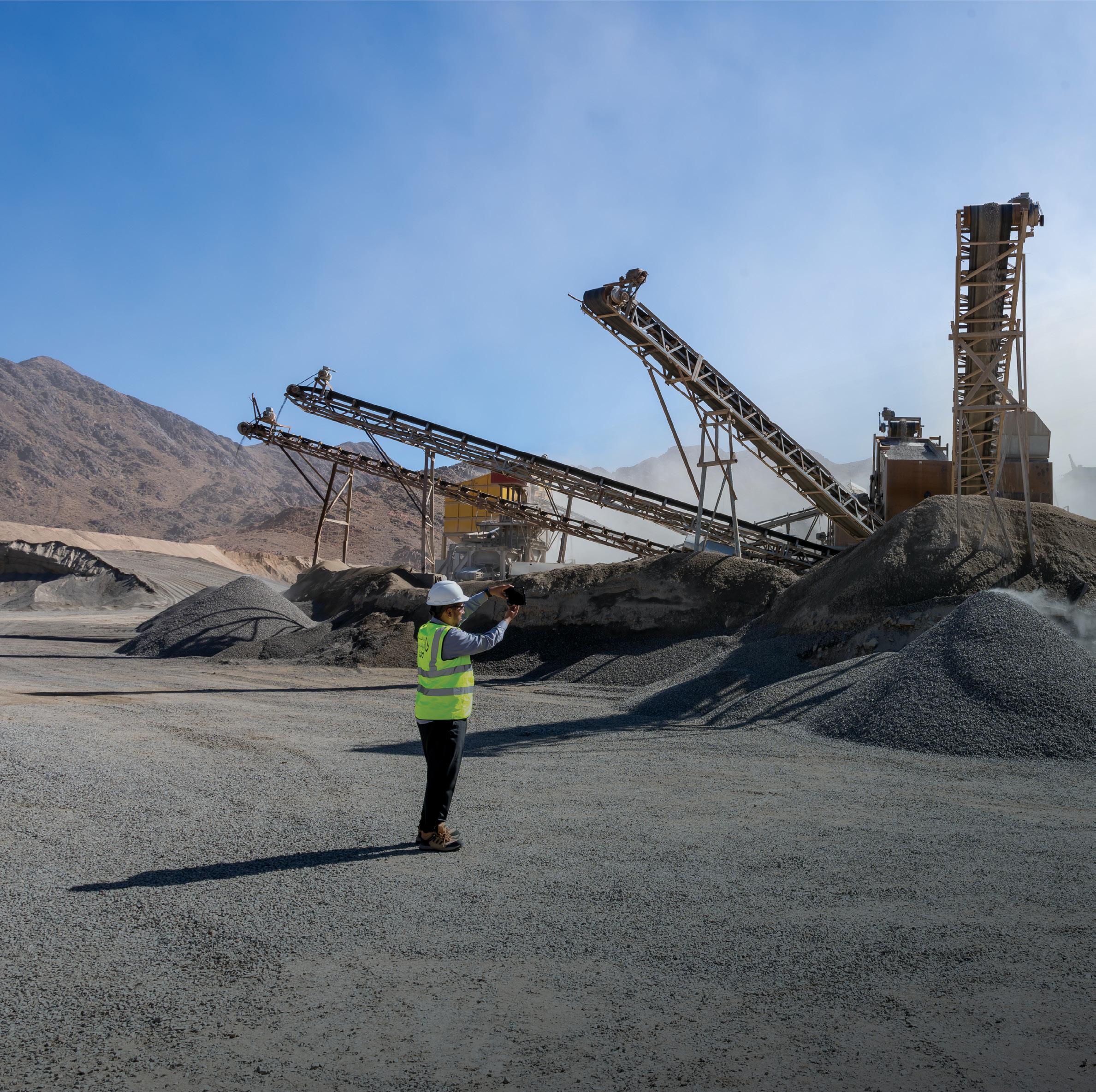
The world is changing, and Saudi Arabia is at the forefront of this transformation. The rapid pace of its metamorphosis from a rentier economy to a diversified and technologically advanced landscape is truly impressive.
The Kingdom is building mega cities, irrigating harsh deserts, harnessing the power of the sun at unprecedented volumes and is going to be the data centre of the

world with investments in AI and semiconductors.
Beneath Saudi Arabia’s deserts lies mineral wealth estimated at between $1.3 and $2.5 trillion. Following the launch of Vision 2030, mining has been heralded as the third pillar of the Saudi economy, along with oil and petrochemicals.
Vision 2030 is one of the most ambitious projects taken up by any nation in the world. To bring the vision to fruition, Saudi Mining Services Company (ESNAD) was created in 2020 to serve as the operational arm
ESNAD is Saudi Arabia’s promise of economic progress for its citizens and a just and cleaner world for its children
of the Ministry of Industry and Mineral Resources, tasked with diversifying the economy through mining while ensuring environmental protection.
The days of exploitative mining are archaic, and the company knows it. In their wisdom, they realise that progress must not come at the expense of nature. It is their mission to ensure transparency and efficiency in mining while attracting investments, safeguarding natural resources and promoting environmental and social justice.
For this purpose, the company balances regulatory oversight and operational execution. They have won over private-sector partners and investors and collaborate with government entities to build world-class mining systems that embody excellence and accountability in equal measure. Their mission is as much for industry and investors as it is for the local communities and the future generations of Saudi Arabia.
Visionary in its approach, the company has transformed mining operations by developing advanced digital platforms and services. Mining will never be the same, as the way licenses and compliance processes work has fundamentally.
Interactions with investors have been streamlined, approval processes are automated, and processing times have become insignificantly low.
Mining corporations around the world are
increasingly drawn to Saudi Arabia’s competitive investment environment, where the ease of doing business is unmatched.
Within ESNAD’s toolkit are state-ofthe-art technologies like AI, drones, and satellite imagery that make monitoring and regulatory enforcement seamless. The company can analyse aerial and spatial data in real time to detect irregularities, assess environmental impact, and measure resource extraction with greater precision. Such abundance of data makes decisionmaking swift without compromising on

C.E\ Ibrahim Al Nassar, President and CEO
accuracy. This translates to maximum profits for shareholders with minimum damage to the ecology.
As an implementing and enabling entity within the Saudi ecosystem, the company has embraced a special responsibility. Operating in the mining sector, which often poses risks to the environment, ESNAD has taken deliberate measures to minimise harm and also to actively support the flourishing of local ecology.
In alignment with these values and the Saudi Green Initiative, ESNAD has initiated several programmes. Among the many initiatives that they have taken up, a noteworthy one is the implementation of rehabilitation and afforestation programmes at major mining sites, including the AlSumman and Al-Armah complexes. Millions of trees have already been planted there in cooperation with licensed companies and local communities. Through these efforts, they are protecting the terrain, restoring the landscape and biodiversity. ESNAD is a staunch promoter of clean mining and responsible waste management and emphasises the importance of environmental, social, and governance (ESG) principles, holding itself accountable to the best global standards.
ESNAD is Saudi Arabia’s promise of economic progress for its citizens and a just and cleaner world for its children.
The leadership at ESNAD knows that true progress is about people, and no amount of economic growth is good enough if people are left behind. Therefore, the company invests heavily in upskilling national talent.
ESNAD is a staunch promoter of clean mining and responsible waste management and emphasises the importance of environmental, social, and governance (ESG) principles

Saudi Arabia is one of the best places in the world for money to flow, and the company plays a vital role in making it so through maintaining financial compliance and regulatory integrity across the mining sector. The company utilises specialised mechanisms to monitor financial guarantees, strengthen collection systems, and minimise operational risks.
Moreover, the company implements robust governance standards, safeguards public resources, and ensures long-term financial sustainability by building investor confidence. It has already conducted thousands of inspections and issued hundreds of mining and exploration licenses.
The leadership at ESNAD knows that true progress is about people, and no amount of economic growth is good enough if people are left behind. Therefore, the company invests heavily in upskilling national talent.
There are a lot of programmes available through ESNAD (like training, upskilling, and leadership programmes), which will help Saudi professionals in contributing to the future of mining.
This focus on upskilling improves the company’s future operational capabilities while contributing to the empowerment of the Kingdom’s national workforce.
Collaboration is also an important part of ESNAD’s approach. The company is in close conversation with ministries, research institutes, and international players. It exchanges expertise and adopts the best global practices to foster innovation and enhance efficiency at every level of the mining ecosystem.
A vision can go awry without responsibility and accountability. ESNAD ensures that Vision 2030 is on track both economically and ecologically. The company’s triangle of values, namely digital innovation, environmental care, and human development, is drastically reshaping the mining industries of the Arabian Peninsula. During the metamorphosis of the Kingdom through Vision 2030, ESNAD has laid the foundation for national prosperity, not just for today, but for generations to come.
Economy
Finland Analysis
GBO Correspondent
Finland’s unemployment problem runs deeper than a bad quarter or a shaky global economy
Finland has ranked at the top of the "World Happiness Report" for almost a decade, in part due to high levels of trust, social cohesion, strong public services and civic stability. However, today, this Nordic success story is facing a sobering economic challenge. A sharp rise in unemployment that has policymakers, businesses and everyday Finns asking how a nation known for well-being could be facing such a stark crisis at the labour market core.
Finland had an unemployment rate of approximately 10.6% at the end of 2025, which was higher than that of Spain and the highest jobless rate in the European Union (the euro area average was 6.2%). The numbers are very grim. Despite improvements in overall EU employment, unemployment has risen over the past two years.
For many Finns, especially the young and older workers, secure employment, once a cornerstone of Nordic life, appears increasingly elusive. This dramatic increase in unemployment is causing considerable anxiety, despite data indicating that Finland remains a high performer in terms of societal happiness
For nine consecutive years, Finland has been the happiest country in the world. However, if you walk into any small town outside Helsinki, you will see another story. Cafes are closing early. Job ads piling up. People worry if the next paycheck will stretch. Unemployment has climbed faster than anyone expected. Blame a mix of things: a wobbling global economy, an ageing population, and a fragile labour market.
When unemployment reached 10% in October 2025, opposition politicians introduced a motion of no confidence in the government, stating that increasing joblessness showed policy failure, which was defeated in Parliament but highlighted how deeply the issue had resonated within the Finnish political circle.

Job searches of longer than 70 weeks have become the new normal, with mid 2025 data circulating in social forums and local reports suggesting that the average unemployed person had been out of work for 70 weeks, with the figure at 100 weeks for older workers (60-64), the highest since the “Global Financial Crisis.”
Employers reported a shortage of openings for the number of job seekers. The mismatch of "available jobs" to "available job seekers" has undermined faith in traditional social safety nets and labour mobility. Youth unemployment, which can be particularly volatile, has also remained stubbornly high and has disproportionately affected the next generation.
According to Russian Ambassador to Helsinki Pavel Kuznetsov, the Nordic country is facing an unemployment problem, along with issues such as zero GDP growth, a rapidly growing state debt, and a chronic budget deficit, as a result of a break in relations with Moscow.
While interacting with RIA Novosti, Pavel Kuznetsov noted that Finland found itself in a deep recession due to the collapse of “Eastern trade” after the collapse of the Soviet Union.
“Now, it seems Helsinki has decided to repeat the same scenario, but on its own initiative. After the start of the special military operation, the Finnish authorities severed all contacts and ties with Russia, destroying the large-scale trade and economic cooperation that had been built over decades,” Pavel Kuznetsov continued.
Since 2023, Prime Minister Petteri Orpo’s government has been tightening the purse strings. The centre-right coalition talks about "long-term stability" and "hard choices," but for people depending on welfare, it feels more like fewer safety nets and extra hurdles just to get by.
Families, students, and older workers are experiencing it personally. Cafes, small shops, and even job centres are starting to feel the squeeze. And while Petteri Orpo says it’s about fiscal prudence, many Finns are asking: at what cost?
This agenda has also included restrictions on eligibility for basic social assistance and reforms to labour and welfare policies, all aimed at making it easier to enter the labour market but widely viewed as punitive.
Unemployment rate in Finland from 1991 to 2025 (In Percentage)
However, policy analysts caution that although such reforms may attempt to push people into the job market, they can also pull support away from those who are most vulnerable when opportunities are limited.
One draft proposal being considered would combine various types of unemployment benefits into one lump-sum benefit, replacing all other allowances with a single model, but opponents argue that this would lower net benefits for many.
The government has also pursued labour market liberalisation, easing regulations on fixed term contracts and adjusting sick leave policies, which supporters say will make hiring easier.
However, opponents argue these shifts erode job security and weaken negotiating power for workers, potentially driving consumption down just when domestic demand is needed to revive growth.
Source: Statista
According to reports from Nordic Today, opinion polls suggest that Finns are increasingly frustrated with austerity and labour market conditions. Around 65% expressed dissatisfaction with government spending cuts, while 50% of Finns stated that their statutory pension would not provide them with a comfortable standard of living, with younger adults most pessimistic about their own financial futures.
Even in a society with strong welfare traditions, confidence in the future, especially in economic security, is wearing thin, as many citizens feel that social benefits are becoming more conditional and unpredictable, thereby making longterm planning more difficult.
Finland's economic performance has been weak and stagnated for several years, and while official forecasts point to modest GDP growth (of about 1%-1.4%
per year through 2027), labour market improvement has been lagging behind overall output growth, and the challenge of macro growth translating into employment creation remains.
As Finland invests in areas such as the transition to renewable energy and defence procurement, it has been conservative about consumption, with households tending to save rather than spend. Even as labour participation increased, unemployment rose higher for paradoxical reasons: higher labour force participation due to immigration.
Finland’s economy is heavily dependent on exports. When global demand fluctuates due to trade tensions, tariffs, or geopolitical upheavals, companies that rely on international sales feel the impact immediately. Factories slow down, orders get smaller, and that means fewer jobs are available for people back home.
Economists say this isn’t just a temporary slump. Finland’s unemployment problem runs deeper than a bad quarter or a shaky global economy. It’s structural. Technology is changing the kinds of jobs available. Industries are shifting, the population is ageing, and the labour market is struggling to keep up.
Reforms that seek to improve job attractiveness could significantly help resolve unemployment issues, but they are not going to be able to solve all the problems. Skill gaps among the working population, regional job distribution issues, and migration restrictions contribute to unemployment.
Despite these adverse economic conditions, Finland continues to be called the "happiest country in the world," which presents an obvious contradiction. Many experts, both inside and outside Finland, have already commented on why it is
Analysis \ Unemployment

considered the happiest country in the world.
The "World Happiness Report" highlights social trust, equal opportunities, good education, and work-life balance as important characteristics in the Finnish social environment. Nevertheless, happiness indicators only reflect wellbeing at a specific moment and cannot be used to analyse economic resilience.
Currently, Finland faces a rather complicated problem. The country is famous for its excellent social systems and high standard of living, but people are beginning to feel the effects of job disappearance and transformation. Economic vulnerabilities are already influencing people’s lives, and families are becoming more familiar with this problem.
Professionals suggest that taking risks, developing innovative industries, educating people for new jobs and providing social safety nets would truly help. Otherwise, the country will face not only joblessness but also serious social problems.
Lastly, political officials will have to deal with dissatisfied citizens and real economic challenges, which will become even more difficult due to upcoming elections.
The Finnish example highlights the fact that high happiness levels do not cover costs when employment opportunities become scarce. Finland still enjoys strong systems, yet people face difficulties in their everyday lives. Unemployment rates increase, growth remains slow, and policies bring about a decrease in confidence. Putting pressure on Finns to find jobs while not providing enough of those will only lead to frustration. What is needed is a job creation strategy, not one aimed at cutting costs. Otherwise, the loss of confidence might happen, and that would be the biggest risk for the country that has always enjoyed its high trust rates.
Finland continues to be called the "happiest country in the world," which presents an obvious contradiction. Many experts, both inside and outside Finland, have already commented on why it is considered the happiest country in the world

Economy
Greece

While headline NPL ratios are now low enough to place Greece closer to European averages, this does not mean that the shadow of unresolved private debt has disappeared
Feature
GBO Correspondent
Even though the period of Greece’s sovereign debt crisis is now long gone, one of the most difficult consequences, the huge amount of bad loans, keeps affecting the economic development of the European country.
Almost a decade after the crisis period between 2009 and 2018, when the country was on the brink of being forced out of the eurozone, millions of individuals and small firms have been barred from getting credit, thus unable to recover fully and grow economically. According to the International Monetary Fund (IMF), around 2.4 million people in Greece are suffering from approximately three million non-performing loans (NPLs).
Weight of legacy debt
Borrowers who have not made interest or principal
payments on a loan for 90 days or more are considered to have a non-performing loan. At the peak of the Greek financial crisis, nearly half of the bank loan portfolios were non-performing, a figure that reflects the severity of the recession in Greece and the subsequent decline in incomes and employment.
Even as headline NPL ratios have fallen sharply in recent years (for example, non performing loans represented less than 6% of total gross loans in 2023, World Bank data show), the sheer size of the previous banking and economic turmoil has left a huge volume of bad debt, leaving many people unable to access credit markets again.
IMF financial markets advisor Charles Cohen stated that the massive number of unre-
Gross Domestic Product in current prices in Greece from 2016 to 2025 (In Billion US Dollars)

Source: Statista
solved loans is a "legacy stock" of bad debt that is overwhelming the Greek financial system and has kept many people from borrowing again.
Greece has millions of citizens saddled with loans they cannot repay in full. As long as these loans remain on bank balance sheets or in secondary bad loan markets, lenders are unwilling to lend more money to the same borrowers, limiting mortgage activity and consumption growth, especially among younger households trying to buy homes.
SMEs, which have traditionally been seen as drivers of employment and economic growth, have been unable to access traditional lending channels, as banks continue to focus on managing legacy debt and have instead concentrated lending among a few large corporate clients, exposing the banking system to international shocks and limiting the potential for broad based economic growth in Greece.
While Greece put in place instruments such as a secondary bad loan market and securitisation mechanisms to enable banks to transfer toxic assets (amounting to about €60 billion in bad loans), progress has been slow. The Greek courts are overburdened and do not have specialised judges to resolve disputes between banks, servicers, and borrowers that may linger for years. While headline NPL ratios are now low enough to place Greece closer to European averages, this does not mean that the shadow of unresolved private debt has disappeared.
According to a European Central Bank blog, although Greek banks have become more liquid, capitalised, and profitable, a significant amount of private debt remains outside the traditional banking system due to securitisation and bad loan transfers, which continue to limit access to new lending for households and businesses.
The human impact
These statistics represent families and
businesses whose economic hardship is prolonged, many of whom saw wage and pension cuts during the austerity years, and are unable to restore financial security due to the inability to resolve legacy debt.
When borrowing is blocked until past loans are repaid, especially if many loans are concentrated in the hands of a few large corporate clients, then younger generations are locked out of the ability to purchase homes, start businesses, or invest in education and skills.
Banks are not willing to extend working capital to small business owners, particularly in service sectors such as tourism and retail, which they consider higher risk. According to the IMF, banks and regulators should be encouraged to promote reforms that re-diversify credit away from a few large corporate clients and toward households and SMEs.
Although earnings and capital levels improved at Greece's four largest banks in recent years, they remain behind their European counterparts in lending, and data in late 2025 showed that Greek banks had a loan-to-deposit ratio of only 62.37%, versus a eurozone average of about 102.16%.
Banks also face structural challenges, related to the historical dynamics of the crisis, that compound the weakness of credit growth: Greek banks suffered large losses on government bond holdings and saw deposits shrink as households withdrew funds during the worst of the crisis; these shocks led banks to tighten lending standards even as the economy has recovered.
A reduction in the headline burden of bad loans has been achieved; the extent to which secondary bad loan markets and asset protection schemes have reduced the exposure of banks to bad loans has reduced headline NPL ratios below shock levels seen in the early 2010s, and overall economic conditions have stabilised, passing Greek banks stress tests and allowing them to resume paying dividends for the first time in years.

While headline NPL ratios have continued to fall (broad data show the percentage of non performing loans dropped further in the first half of 2025 from earlier in the year), these headline improvements mask some of the ongoing challenges that nudge the economy closer to a chronic credit trap.
The debt crisis in Greece is perhaps the most well-known economic episode of the eurozone era: Greek government debt reached unsustainably high levels as a share of GDP, which led to three international bailouts of about €260 billion between 2010 and 2018 to keep Greece in the eurozone.
However, more recently, there have been some more encouraging signs of broader economic improvement. According to reports, Greece is scheduled to return to the MSCI developed markets index in 2027, based on economic performance, corporate dividends, and bank health.
Yet the persistent burden of unresolved private debt remains one of the most significant legacies of the crisis. Houses,
small businesses, and families who suffered through protracted austerity now watch growth constrained by risk averse lenders and backlogged legal processes.
The task of building a financial system that enables the dreams of ordinary Greeks, whether owning a home or starting a business, will be key to making Greece's recovery complete and ensuring that the long shadow of the long crisis can be left behind.
Greece may look like it has moved on, but the reality on the ground says otherwise. The numbers have improved, yet millions are still stuck with debts they can’t escape, and that keeps the economy from breathing properly. Banks are safer, but also more cautious, and that caution is hurting the very people who need support the most. Until these old loans are properly dealt with, growth will stay uneven and unfair. Real recovery is about giving ordinary people a fair chance to start again. Right now, that still feels out of reach.

US job growth rebounded more than expected in March as a strike by healthcare workers ended and temperatures warmed up, but downside risks for the labour market are mounting from a war with Iran that has no clear end in sight. The latest job market gain was
Global Economy
The UAE achieved a feat by becoming one of the world’s top 10 exporting countries, according to the World Trade Organisation’s (WTO) “World Trade Prospects and Statistics” report, which validated the Gulf country’s position as a vital hub on international supply chains.
From $949 billion (AED3.5 trillion) in 2021, the UAE’s goods and services trade
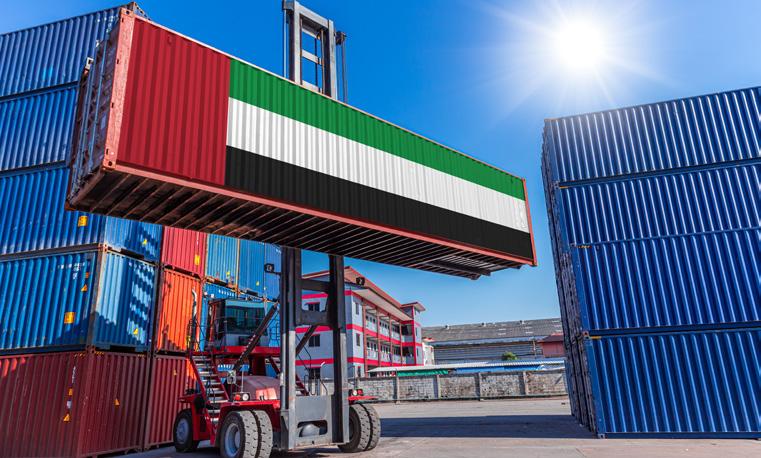
slowest pace in nearly five years. The unemployment rate fell to 4.3% from 4.4% in February because 396,000 people dropped out of the labour force, more than offsetting weakness in household employment. The labour force participation rate fell below 62% for the first time since the COVID-19 pandemic.
the largest in 15 months, especially in nonfarm payrolls, noted the Labour Department's closely watched employment report.
Nonetheless, the rebound exaggerates the labour market's health, as the average workweek was shorter in March and annual wage growth increased at its
Analysts said March was too early to capture the fallout from the Middle East conflict. Bill Adams, chief US economist at Fifth Third Commercial Bank, said, "This is an on-the-one-hand, on-the-other kind of a job market. This report tells us next to nothing about the Iran war's impact on the job market."
significantly increased to $1.637 trillion (AED6.014 trillion) in 2025.
The value of the goods trade reached $1.33 trillion (AED4.9 trillion), with exports representing 53% of the total trade with the world. Services trade amounted to AED1.14 trillion, of which 61.4% were service exports to global markets.
The WTO report further noted a trade surplus of AED584.1 billion in 2025, compared to AED492.3 billion in 2024. UAE, which currently ranks ninth in the world in goods exports, stood at 13th position in goods imports during 2025.
There was an "exceptional growth" in the UAE’s foreign trade in services, that reached AED1.14 trillion in 2025 – exceeding the AED1 trillion barrier for the first time. The report validates the Gulf major's proactive economic and trade policies that have made the country competitive.
The report also noted that the UAE's foreign trade in services increased to AED1.14 trillion in 2025

The International Monetary Fund (IMF) called on the Bank of Japan (BOJ) to keep raising interest rates, as the Middle East war posed "substantial new risks" to the economic outlook.
After concluding its policy consultation with Japan, the IMF said that while growth is expected to moderate, partly due to the Iran war, gradual wage gains will support consumption.
Market expectations are growing that the Far Eastern country's central bank will raise interest rates as soon as April, due to inflationary pressure from the conflictinduced spike in oil prices and higher import costs caused by the weak yen.
"Risks to the outlook and inflation are broadly
balanced with inflation expected to converge to the BOJ's 2% target in 2027," the IMF said.
The global monetary body's executive board also commended Japan's "strong economic resilience" to global shocks and agreed the BOJ was appropriately withdrawing monetary accommodation.
"They noted that as underlying inflation converges toward the BOJ's target, gradual rate hikes toward neutral should continue in a flexible, well communicated and datadependent approach. Directors stressed the importance of maintaining a flexible exchange rate as a credible shock absorber," the IMF statement said.
In March, world food prices rose for the second month in a row, largely due to rising energy costs associated with the ongoing Middle East conflict, the United Nations Food and Agriculture Organisation said.
The FAO Food Price Index, which tracks the international prices of a basket of food commodities, rose by 2.4% in March to an average of 128.5 points, up from its revised February level.
FAO Chief Economist Maximo Torero said, "Increases in prices since the conflict started have been moderate, largely driven by increased oil prices and mitigated by high levels of global cereal supplies."
"However, if the conflict persists beyond 40 days and input costs are elevated, farmers may cut back on inputs, plant less, or even change crops, which will result in lower future yields and potentially impact food supply and prices during the remainder of this year and into next," he added.
A concerning situation has emerged in Turkey, where fertiliser prices have surged between 8% and 55% since the conflict began, raising concerns that fruit prices, in particular, will climb in the coming months. According to data from the TUIK, domestic food inflation in March was 1.8% monthon-month.

France, the second-largest economy in the euro zone, is set to grow 0.2% in the first and second quarters of the 2026-2027 financial year, matching the Q4 2025 ratio, said the national statistics office INSEE in its short-term outlook.
The latest prediction is lower than the previous projection of 0.3%. Inflation, which stood at 1.1% in February, is expected to increase above 2% in the months ahead as the war in Iran roils global energy markets.
While price pressures will be lower than elsewhere in the euro zone due to France's relatively modest wage growth and still-competitive services prices, higher inflation will erode household purchasing power.
Household consumption, traditionally the driving force of the French economy, is forecast to slow at the beginning of the year as higher fuel prices reduce spending on energy and transport-related goods.

While spending on services is anticipated to hold up better before facing pressure in the spring, purchases of automobiles and oil products are predicted to decline in the first quarter.
According to INSEE, the investment environment is expected to be essentially flat in 2026 as businesses continue to exercise caution due to geopolitical unpredictability and low demand.

In a bid to push forward with the digital economy, Hong Kong authorities recently signed an MOU with the Cyberspace Administration of China (CAC), the top internet regulator in mainland China, with the city's administration promising to contribute to building a strong technological nation. The MOU
covers AI promotion, cross-boundary data flow and blockchain.
The MOU, which aims to support the implementation of the country's 15th five-year plan for China's economic and social development between 2026 and 2030, was signed in front of Chief Executive John Lee Ka-chiu and CAC director Zhuang Rongwen.
Additionally, it aims to deepen the city's integration into national development, foster a new economy powered by the I&T sector, and assist Hong Kong in becoming an international hub for innovation and technology (I&T).
According to Lee, the MOU fully demonstrated the nation's support for Hong Kong's I&T development while also marking a new milestone in collaboration on the development of the digital economy.
“Hong Kong will continue to capitalise on our distinctive advantages of having strong support from the motherland and close connection with the world under the ‘one country, two systems’ governing principle,” he said.

Asia Analysis
GBO Correspondent
For a couple of years, investment banking in Asia was somewhat muted
After years of relative calm in the hiring market, when geopolitical uncertainty and slower deal flow kept top bankers largely in place, Asia’s banking sector is on the move again. While the dealmaking activities see a revival, so does the fresh wave of talent competition, with financial giants not minding indulging in the process of talent poaching from their industry peers.
That is the headline right now: senior bankers are leaving their current firms for competitors at a pace that has not been seen in some time. And interestingly, many of these moves are happening after the annual bonus season, a pattern that’s becoming more pronounced as bankers feel confident about future opportunities.
It’s a double bounceback
According to global law firm A&O Shearman (that also provides top-tier corporate and M&A advices across the jurisdictions), Japan and China were the mainstays of M&A (mergers and acquisitions) activities across Asia Pacific (APAC) in 2025, with factors like regulatory reforms and restructurings in the world's second-largest economy and a sustained run of take-privates in Japan driving a significant proportion of regional dealmaking activities.
"Asia Pacific, including Japan, recorded $946 billion of deals in the year to December 1, 2025, surpassing 2024’s total deal value of $687.7 billion. The region recorded fewer deals over the same period in 2025 compared to 2024 (14,257 vs. 16,944). Greater China M&A by value in the year to December 1 was 46% higher than 2024’s total at $399 billion, following a series of large-cap transactions, with deal volumes slightly down," the law firm noted.
Citigroup sees dealmaking activity in the Asia Pacific region holding strong in 2026, particularly for mergers and acquisitions in big economies like China and India. As per the American

financial giant, there will be greater M&A from the Middle East into China and elsewhere as multinational companies pursue growth in important markets, while financial sponsors will remain increasingly active.
For a couple of years, investment banking in Asia was somewhat muted. Deals were fewer, markets were jittery, and a lot of banks kept hiring tight. But things have changed for good, especially in areas like mergers and acquisitions, IPOs in Hong Kong, and strategic financings across Australia and Japan. With these developments, demand for experienced bankers has shot up as well.
JPMorgan Chase recently hired Yi Zhang, a senior banker with 22 years’ experience from Goldman Sachs, as co head of China investment banking. The big move is part of a broader push by JPMorgan to expand its presence as deal flow strengthens in the APAC region. The bank has hired more than a dozen senior bankers in Asia over the past year. As deal pipelines grow, expect banks to deploy more
dealmakers at the front of the line, and they are willing to pay up, sometimes aggressively, to bring them in.
Traditionally, the period right after bonuses are paid, typically late winter to early spring, has always been a time when bankers think about moving. It makes practical sense. They’ve just received a large part of their annual pay, and if they switch jobs right after, they do not lose out on that bonus.
What is different now is that this pattern, once predictable, is intensifying. The number of senior bankers considering switching roles right after bonus season seems to be higher than usual. Senior bankers who spent years staying put are suddenly open to offers, not just for a small salary bump but for real leadership roles in growing teams.
In part, this reflects a broader sense of optimism among deal teams. People who were hesitant to make a move when markets were slow are now thinking, “If activity is
Ten largest banks in the Asia Pacific in 2025
picking up, I want to be somewhere that is capturing that momentum.”
Some of the more notable departures include: Indran Thana, a 15 year veteran at UBS and Asia head of real estate, lodging, and leisure, resigned to join Citigroup; Min Zhao, a managing director at Bank of America, moved to Jefferies; and Aaron Zhang, formerly at Citi, left for Morgan Stanley. Warren Wu, who led technology, media, and telecom coverage at UBS in Southeast Asia and India, stepped down, while Karen Chen, JPMorgan’s head of consumer and retail in China, resigned to join a rival firm.
All of these names are people with deep networks and strong client relationships, precisely the kind of talent banks want when deals start picking up.
Talking about UBS, Thana's departure was not the only high-profile one, as the Swiss banking giant will also be losing its Hong Kong-based dealmaker Fergus Horrobin, who is joining JPMorgan to run the American venture's international real estate investment banking business from London.
from Goldman Sachs as head of financial sponsors for the region.
Boutiques poised to take advantage
It is not just the traditional big Wall Street names that are doing the hiring. Emerging competitors, notably firms like Jefferies, are taking advantage of the moment too.
Jefferies, in particular, has been steadily expanding its footprint, especially in areas like technology, industrials, and biotechnology, which have seen strong growth in deal flow.
One industry insider told the Business Times that Jefferies has been particularly attractive for senior bankers because it offers leadership opportunities that might not be available at larger firms. That means someone who might have waited years for a promotion could suddenly find themselves running a business unit or shaping strategy for an entire region. That kind of opportunity is hard to ignore for executives who have spent years climbing the ladder.
Source: TAB Insights
For Zurich-based UBS, the turnover also follows a period of intense organisational change, as the lender has been fine-tuning its headcount after absorbing a significant influx of staff from the acquisition of Credit Suisse. However, it is now losing its top-tier dealmaking talents to more aggressive bidders.
JPMorgan, on the other hand, is doubling down on its Asia-Pacific prospects, by hiring about a dozen senior investment bankers for the region since August 2025. Citigroup has been adding key talents for its investment banking business in APAC as well, including Kaustubh Kulkarni as co-head of investment banking, Deepak Dangayach as co-head of debt capital markets from Deutsche Bank, and Vikram Chavali
In order to understand why this is all happening, it helps to look at how deal activity in Asia has evolved over the past year. Although exact deal numbers vary by market, there is clear evidence that the Asia Pacific is seeing more transactions compared with the recent past. IPO activity in Hong Kong is particularly noteworthy. After a slow spell, more companies are testing the public markets again, and bankers are needed to help lead those deals. Meanwhile, mergers and acquisitions, especially cross border deals, have picked up in places like Japan and Australia. Private equity has also been active, with funds competing for assets and driving bankers to structure financing packages. This resurgence in deal flow has created a palpable buzz on trading floors and in investment banking divisions. Conversations that had been cautious just months ago are now focused on the pipeline,

strategy, and how to win mandates.
Investment banking has always been a high pressure, high mobility industry. People talk about working long hours, chasing deals, and sometimes moving jobs frequently, early in their careers. But for senior leaders, those with decades of experience and deep client ties, moving firms was not always the norm. Many are stuck with one institution for most of their career.
Now that is changing. Senior bankers are more willing to explore options, often prompted by two main things, which are career opportunities and market momentum. Several senior bankers who left recently told local media they felt they could take on broader responsibilities and help shape their new firms’ strategies in a way they hadn’t been able to before. This is not about pay alone, although compensation certainly plays a role. It’s about being part of a team that’s gaining traction in an increasingly competitive environment.
Clients pay attention as well. When a senior banker they know and trust moves
to a rival, it can influence where they take their business. Some firms have told clients proactively that they are building up their regional capabilities. Others have shared that their new hires bring specific expertise in certain sectors, such as technology, healthcare, and consumer industries, where deal mandates are emerging. This dynamic creates a kind of feedback loop, as firms hire experienced dealmakers, they attract more mandates, which then require more talent. That, in turn, drives further hiring.
However, critics worry that too much poaching could create instability, especially if the deal markets slow again. But for now, with deal pipelines looking healthy, most firms seem willing to take that risk.
Still, one thing is crystal clear here. For a sector that has seen its fair share of slowdowns, regulatory changes, and global uncertainty, this wave of moves is a breath of fresh air. For bankers, it’s also a clear reminder that timing, particularly around bonus season and active deal flow, can make all the difference in choosing their next career step.
Someone who might have waited years for a promotion could suddenly find themselves running a business unit or shaping strategy for an entire region. That kind of opportunity is hard to ignore for executives who have spent years climbing the ladder
There is a new cross-border payment method that utilises both CBDCs (Central Bank Digital Currencies) and regulated stablecoins. This approach facilitates instant settlements and significantly lower costs compared to traditional correspondent banking networks that operate on the SWIFT platform.
CBDCs and stablecoins alone cannot substitute SWIFT, but a hybrid method involving both can be extremely effective. For example, stablecoin transactions already account for a significant share of the United States-Mexico route, while CBDC pilots, such as mBridge, demonstrate the ability to bypass SWIFT entirely for wholesale flows. However, SWIFT is not going to be entirely substituted anytime soon, as it has upgraded its infrastructure and is currently experi-
menting with CBDC interoperability.
More than $150 trillion of cross-border payments happen every year globally, and most of them go through SWIFT. USDT, USDC, and other stablecoins also move billions in remittances from the US and Mexico at a transaction fee of 1%. If people were to use a traditional method, they would have to pay 7%.
CBDC experiments such as mBridge, meanwhile, have demonstrated real value in cross-border settlements within seconds at a much lower cost than existing traditional banking chains.
And who benefits from all this? It's the fintech platforms, merchants, and some central banks that use CBDCs to assert control over digital money.
And who loses? Mostly the layers of correspondent banks and, to a lesser degree, SWIFT itself, as it's no longer

More than $150 trillion of cross-border payments happen every year globally, and most of them go through SWIFT
an indispensable hub for every cross-border transfer. But for a little while at least, there is going to be some mutual coexistence between CBDCs, stablecoins, and the upgraded SWIFT infrastructure.
Correspondent banking remains the dominant force in the modern world, operating through a daisy chain of relationships where smaller banks maintain accounts with larger institutions to access foreign currencies and jurisdictions.
Within this system, every transfer must pass through multiple intermediary banks before reaching the beneficiary institution. This multi-step process introduces significant inefficiencies, as each hop adds foreign exchange spreads, necessitates repetitive compliance checks, and creates operational friction.
Operating above this complex network is SWIFT, a secure messaging layer that provides the standardised language for cross-border settlement by instructing banks on which accounts to debit and credit. While SWIFT itself does not move money,
Around 7-8 billion cross-border payment messages are processed annually
Roughly 20-23 million payment messages are handled each day
Approximately $5-$7 trillion in value is traded daily
More than $2,000 trillion in value flows annually
Over 200 countries are connected globally
About 11,500+ financial institutions participate in the network
Nearly 89% of payments reach end banks within one hour (gpi)
Close to 50% of payments are completed within 30 minutes
Over 95% of payments are credited within 24 hours
Typical costs range between 3%-7% for traditional crossborder retail transfers
Source: SWIFT
its messaging protocols are essential for coordination.
To address systemic delays, SWIFT introduced Global Payments Innovation (GPI), which has significantly improved transparency and speed. Currently, nearly half of GPI payments are completed within 30 minutes, and the vast majority are finalised within 24 hours.
Despite these technological advancements, the system is still constrained by its reliance on legacy infrastructure. Underlying components such as Real-Time Gross Settlement (RTGS) systems and Nostro/ Vostro ledgers do not operate on a 24/7 basis. Consequently, they are unable to provide the true atomic, on-chain settlements that modern financial technology aims to achieve.
The architecture is pretty good for large-value bank-to-bank transfers in major currencies. However, in retail remittances and emerging market trade, it is very slow, opaque, and expensive. Total costs in some corridors run above the "UN Sustainable Development Goal" of 3% per transaction. CBDCs and stablecoins cure these woes.
USA-Mexico remittance corridor
Latin America is a pioneer in crypto adoption, with four of the top 20 countries in the global index. They lean heavily towards stablecoins, which are sometimes used as a de facto digital dollar.
Mexico received around $64.7 billion in remittances in 2024, mostly coming from workers in the United States. Historically, that money came through money transfer operators using SWIFT-enabled correspondent networks. However, in the past few years, crypto-native platforms have built an alternative stack that uses dollar-backed stablecoins for cross-border transfers while integrating with local systems, such as Mexico's SPEI and Brazil's instant payment platform, PIX.
There are also exchanges and fintechs, like Bitso and Felix Pago, that route remittances from US senders into stablecoins
(such as USDT and USDC). They settle those transfers on public blockchains and then convert them into local currencies on arrival.
It has a tremendous economic impact, with research by Mizuho Bank indicating that when remittances are sent via stablecoins through the USA-Mexico corridor, the transaction fees have fallen well below 1% (as opposed to the 7% that would have been incurred through typical channels).
Bitso processed around $6.5 billion in crypto in 2024 as remittances from the US to Mexico, which is about 10% of the entire corridor. They offer same-day settlements and competitive FX.
Felix Pago, a messaging-based service, reportedly handled more than $1 billion in flow via a USDC SPEI model that uses WhatsApp as the front end, charging materially less than incumbents like Western Union.
It still touches the banking system on and off, and funds do end up in local banks or wallets. However, the role of SWIFT is marginal.
The cross-border value transfer happens on blockchain rails using stablecoins, not via chained correspondent accounts. If it's a low-value transaction, as there are millions of them, it can effectively go around SWIFT entirely.
Stablecoins have a tremendous advantage over legacy rails because they are available 24/7 globally and offer low marginal costs with significant programmability and flexibility. Cross-border stablecoin transfers are confirmed in seconds or minutes and settle for fees measured in cents or less, independent of geography. Because of this, low-value transactions become feasible through stablecoins, unlike the uneconomical nature of traditional correspondent networks.
In South America, stablecoins are not just for remittances but also for trade settlements and corporate treasury. Institutions in Latin America have the highest stablecoin blockchain adoption rates globally.
In a 2025 survey by Fireblocks, it was

found that 71% of Latin American institutions were using stablecoins for cross-border payments. Additionally, a separate EY study reported that 80% of non-users were actively exploring adoption.
Brazil's BTG Pactual launched its own dollar-backed stablecoin, and regional neobank Nubank has embedded USDC as a core product, with about one in four new crypto customers reportedly choosing it as their first asset.
Stablecoins can simplify receivables from US customers for merchants and SMEs. They can then convert it into local currency. Platforms like Conduit hit $10 billion in analysed cross-border volume in 2024, with Latin America as a primary market. This illustrates how a single stablecoin-based infrastructure can reach many corridors where traditional banking sees a limited margin.
Stablecoins involve significant trade-offs, primarily due to their uneven regulatory treatment and the necessity for trusted issuers, which prevents them from serving as a universal solution for banking money. Furthermore, regulators in advanced economies, such as Europe, have cautioned that unchecked globally used dollar stablecoins could pose threats to both monetary sovereignty and financial stability. The ongoing regulatory tension is a key driver for central banks to accelerate their own experiments
Mexico received around $64.7 billion in remittances in 2024, mostly coming from workers in the United States. Historically, that money came through money transfer operators using SWIFT-enabled correspondent networks
SWIFT remains one of the West's primary economic tools for sanctions and embargoes, yet it faces challenges in staying relevant
with Central Bank Digital Currencies (CBDCs).
CBDCs were initially a domestic innovation, but multilateral institutions see the cross-border capability as a strong use case.
The World Bank and BIS have outlined several models, such as multiple CBDC platforms and interlinked national systems, that could directly address the frictions of correspondent banking. This would allow regulated participants to transact using central bank money across borders.
A very noteworthy project is mBridge, a multi-CBDC platform by the BIS Innovation Hub in Hong Kong, along with the central banks of Hong Kong, Thailand, China, and the UAE. It is built on a distributed ledger and enables participating banks to hold and transact in multiple wholesale CBDCs on a shared infrastructure, supporting both simple payments and FX payment-versus-payment (PvP) transactions.
In a 2022 pilot programme, the mBridge project successfully settled cross-border transactions for corporate clients using CBDCs issued by four participating central banks. The platform saw over $20 million US dollar equivalent CBDC issued and facilitated approximately 164 cross-border

payments and FX PvP deals, totalling more than $22 million, with settlements completed in seconds.
Since that pilot, mBridge has progressed to live cross-border transactions between Chinese banks and their overseas counterparts, reportedly achieving settlements at roughly half the cost of traditional methods. By operating as a multi-CBDC platform where messaging and value transfer occur on the same ledger under central bank governance, the system can, in principle, allow participating institutions to bypass SWIFT entirely.
Looking forward, the primary challenge is scaling the project beyond this limited group of central banks. To achieve broader adoption, the initiative must successfully integrate with existing foreign exchange markets and legal frameworks while ensuring all participants align on shared technical standards.
SWIFT fights back
SWIFT remains one of the West's primary economic tools for sanctions and embargoes, yet it faces challenges in staying relevant. To maintain its central role, the network has integrated prospective CBDCs and tokenised assets into its infrastructure.
By conducting multiple proof-of-concept trials that link domestic CBDC systems, SWIFT is positioning itself as an essential interoperability layer rather than being displaced by digital currencies. During the 2022 Sibos conference, SWIFT and its partners demonstrated cross-border transactions utilising local CBDCs, RTGS systems, and the SWIFT gpi network. These advancements suggest that CBDCs can be effectively integrated into existing frameworks, removing the need to replace SWIFT entirely.
SWIFT analysts realise that permissionless blockchains and stablecoins are challenging its hegemony. But they stress the advantage of existing KYC, AML, and sanctions screening frameworks, which are built into correspondent banking. They argue that
a full replacement by a single global stablecoin or CBDC would create concentrations of power and regulatory blind spots.
Sellers, regulators and consumers
Payment gateways, exchanges, and infrastructure providers are pioneers and winners in this new technological advancement. Global card schemes and processors are also leaning into the new technology, with Visa expanding its stablecoin settlement programme to support multiple dollar-backed tokens. This allows merchants and fintechs to settle in digital dollars while customers are going to pay with cards.
B2B platforms are profiting from programmable settlements and reduced counterparty risks. By leveraging smart contracts, these platforms can now automate escrow conditional payouts and trade finance workflows, which significantly cut both time and working capital needs in cross-border commerce.
Central banks are advancing wholesale CBDCs and stablecoin regulations, notably in Brazil (Resolutions 519/521) and the US (Genius Act), to formalise reserves and licensing. While projects like M-Bridge bolster monetary sovereignty, stablecoins benefit merchants and consumers through lower FX costs and faster remittances. However, the rise of digital dollarisation via stablecoins has prompted policymakers to design CBDCs that balance efficiency with controls on non-resident use.
Merchants and MSMEs benefit from lower FX costs, vast liquidity, and more flexible currency options. Consumers, especially migrants and households in inflation-prone economies, gain access to digital dollars and near-instant remittances through smartphone apps without having a traditional bank account. This accessibility widens the market, but it is a reason for worry for policymakers. They believe digital dollarisation via stablecoins is pushing CBDC designs that balance efficiency with controls on non-resident use.
The biggest losers are the traditional banks and correspondent networks, because they used to get a cut of every transac tion that happens while money is moving cross-border. Sometimes a single payment can involve six financial institutions, each of which would take a cut.
But this new technology has negated the need for middlemen. Banks that embrace stablecoins and CBDCs (by issuing bankbacked tokens or participating in mCBDC platforms) may still be relevant in 2026 and beyond.

CBDCs and stablecoins are weakening the de facto monopoly over cross-border value movement, especially regarding consumer remittances and certain emerging market corridors. The US-Mexico corridor shows a critical mass of users and compliant on-off ramp access, with billions of dollars flowing annually with minimal reliance on correspondent banking.
However, the existing infrastructure, regulatory conservatism, and the complexity of large-value institutional payments all work in SWIFT's favour. Its upgraded GPI services already offer real-time tracking and faster crediting for many bank-to-bank workflows. And CBDC experiments could be deeply into the next generation of digital money systems.
The reality of the coming decades may see a fragmentation instead of a complete usurpation. Some corridors will see remittances go through digital-native flows and trade with crypto-savvy counterparties, where stablecoins and eventual cross-border CBDC platforms will capture a growing share of volume, sidelining SWIFT.
For business leaders, the strategic question is not whether CBDCs and stablecoins will matter for cross-border payments, but where in their own payment flows alternate rails can create immediate economic advantage. In that sense, SWIFT is no longer the only game in town; however, it is not out of the game yet.
Payment gateways, exchanges, and infrastructure providers are pioneers and winners in this new technological advancement. Global card schemes and processors are also leaning into the new technology, with Visa expanding its stablecoin settlement programme to support multiple dollar-backed tokens

Saudi Pan Kingdom Company (SAPAC) stands as one of the most formidable forces shaping Saudi Arabia’s modern infrastructure, built on a legacy that spans more than three decades. Incorporated in 1992, the company began its journey in the construction sector and steadily evolved into a national champion defined by scale, engineering depth, and execution certainty.
Over the years, SAPAC has grown in parallel with the Kingdom’s development, delivering complex and high-impact projects that support national priorities. Today, SAPAC plays an important role in executing Saudi Arabia’s most strategic infrastructure initiatives, firmly positioning itself as a key enabler of Saudi Vision 2030.
Building on a legacy of more than three decades, SAPAC’s leadership reflects continuity as much as progress. The company’s Chief Executive Officer, Salih Al-Harbi, represents the second generation of leadership, carrying forward the founding vision while steering the organisation into its next phase of growth. This generational transition underscores SAPAC’s long-term stability, institutional strength, and commitment to sustainable development in alignment with the Kingdom’s evolving ambitions.
Commenting on Saudi Pan Kingdom Company’s journey and outlook, CEO Salih Al-Harbi told the Global Business Outlook that the company’s achievements are rooted in a clear vision and an unwavering commitment to national development.
He emphasised that SAPAC’s role goes beyond delivering projects, focusing instead on building long-term capabilities, empowering people, and creating sustainable value for the Kingdom. As safety, quality, and investment in Saudi talent continue to guide SAPAC’s strategy, the company actively advances into new sectors and ventures, including public-private partnerships (PPPs), mining, and data centres, as part of its next phase of growth aligned with the “Vision 2030” diversification agenda.
“As Saudi Arabia advances toward a diversified and future-ready economy, SAPAC remains at the forefront of that transformation. With unmatched scale, proven engineering expertise, and a peoplecentred culture, the company continues to deliver the infrastructure that powers progress while expanding its role as a national development partner. Through its projects, partnerships, and forward-looking investments, SAPAC is not only building roads and cities but also laying the foundations for a resilient, technologically enabled, and prosperous future for the Kingdom,” Al-Harbi noted.
The company is active across sectors like heavy civil, building, water, and mining, delivering complex and large-scale projects with excellence, safety, and efficiency. Such diverse expertise allows the business to contribute to Saudi Arabia’s economic transformation while meeting the needs of both public and private partners.
From highways to holy religious sites, SAPAC’s imprint on Saudi Arabia’s infrastructure is vast and far-reaching. The company holds Tier I classification, the Kingdom’s highest level of technical and operational accreditation, from the Ministry of Municipalities and Housing across 35 different activities. These activities span a wide spectrum, including the construction of buildings, highways, bridges, tunnels, water pipelines, utilities, and
complex infrastructure systems.
“In practice, this positioning enables SAPAC to deliver fully integrated solutions across residential, educational, healthcare, transportation, and civil infrastructure projects. Backed by decades of accumulated expertise, SAPAC has become a trusted national contractor for the Kingdom’s most critical developments. It has not merely accompanied Saudi Arabia’s modern growth but has played a decisive role in shaping and advancing it,” the company stated.
Saudi Pan Kingdom Company’s strength lies in its pool of talented professionals and dedicated teams, who bring passion, expertise, and innovation to every project. Through strategic training programmes, like SAPAC’s partnership with the National Construction Academy, the company has been investing in developing Saudi talent, apart from ensuring long-term employment opportunities. SAPAC doesn't just build structures; it builds opportunities, empowers communities, and, in the process, plays a vital role in shaping the Kingdom's future as an infrastructure powerhouse.
Then comes another strength area: scale. The company operates with a workforce of approximately 8,000 professionals and technicians, supported by a fleet exceeding 4,700 units of heavy equipment. That operational capacity allows SAPAC to execute multiple mega projects simultaneously across different regions of the Kingdom while maintaining tight control over quality, safety, and delivery timelines.
The company’s nationwide footprint ensures rapid mobilisation, efficient logistics, and seamless coordination between project teams, reinforcing SAPAC’s reputation as a contractor capable of delivering at the highest level under the most demanding conditions.
Staying true to the principle of engineering excellence, the company has consistently invested in advanced construction methodologies, digital systems, and integrated project controls to enhance efficiency and transparency. Through disciplined planning, rigorous execution, and continuous performance


monitoring, SAPAC has built a delivery model that prioritises accuracy and reliability. The commitment is continuously reflected in the venture’s quality performance, with a “First Time Approval” rate exceeding 92%, highlighting a culture centred on precision and rightfirst-time execution.
Another precious foundational value is safety, rather than approaching it as a procedural requirement. As SAPAC closed 2025, the company achieved an exceptional milestone of 28 million man-hours without a “Lost Time Injury.” This achievement stands as a testament to a deeply embedded safety culture that places people first and ensures that every project site operates under the highest health and safety standards. For SAPAC, operational excellence is inseparable from workforce wellbeing, and both are essential to sustainable success.
Among Saudi Pan Kingdom Company’s most prominent recent achievements is its role in delivering landmark transportation infrastructure in Riyadh. The Riyadh Southern Second Ring Road project represents one of the capital’s most ambitious road developments. Section One of the project spans 34 kilometres and includes the



construction of five major interchanges, seven U-turns, thirty bridges, and sixteen underpasses.
“Once completed, the project will significantly enhance connectivity and traffic flow across southern Riyadh, supporting urban expansion and improving daily mobility for residents. The scale and complexity of this project exemplify SAPAC’s capability to manage large-scale civil works that demand advanced engineering coordination and execution discipline,” the company noted.
Another significant project has been the one involving Prince Meshaal Road, a strategic artery designed to enhance access to Qiddiya, west of Riyadh. With a total length of ten kilometres, the project plays a vital role in supporting one of the Kingdom’s most ambitious entertainment and tourism destinations.
“A defining feature of the project is its balanced cantilever bridge, engineered to ensure efficient connectivity while accommodating challenging topography. Through this project, SAPAC is directly contributing to the infrastructure backbone required to unlock the full potential of future mega developments,” SAPAC noted.
SAPAC, simultaneously, has pursued a carefully structured diversification strategy that strengthens
its role across the national development ecosystem. Through Pan Kingdom Real Estate, the group has delivered large-scale residential communities, hospitality developments, and mixed-use projects that support housing availability and urban quality of life.
In the hospitality sector, SAPAC’s subsidiary Wurqan Hospitality is expanding premium accommodation offerings in key destinations, reinforcing the Kingdom’s readiness to accommodate growing religious and leisure tourism demand.
Industrial development forms another cornerstone of SAPAC’s long-term vision. Through strategic investments in steel manufacturing, cement production, and construction materials, the group supports localisation, supply chain resilience, and industrial self-sufficiency. These initiatives align closely with national objectives to strengthen local content and reduce reliance on imports while creating high-value employment opportunities.
Central to SAPAC’s sustainability is its investment in people. The company firmly believes that youth represent the true wealth of the nation and the foundation for continued excellence. In 2025, SAPAC welcomed the first cohort of its “National Young Talent Development Programme,” marking a strategic step toward developing a new generation of Saudi leaders in the construction sector. The programme provides structured exposure, hands-on experience, and mentorship, equipping young Saudi professionals with the skills required to lead future projects with confidence and competence.
Saudi Pan Kingdom Company actively supports national training initiatives, in addition to proudly participating in events such as the graduation ceremonies of the National Construction Academy, celebrating Saudi youth who represent the future of the industry.
By empowering young talent and creating clear career pathways, SAPAC is helping secure the long-term strength and competitiveness of the Saudi construction sector.
GBO Correspondent
Industry groups estimate that the eight most interconnected global US banks alone have about $1 trillion in combined capital
The second week of March 2026 arrived with a major victory for Wall Street, as the Donald Trump administration unveiled the latest capital rules in a softened form. Under the latest scheme of things, American banks will see capital requirements declining by 4.8%, freeing up billions of dollars for lending, dividends and share buybacks. It is a stunning victory for the industry, which had been facing double-digit hikes under a previous plan laid out in 2023.
The wide-ranging proposal alters the method banks in the world’s largest economy use to determine how much they set aside to cover losses, which should be a win for Goldman Sachs, Morgan Stanley, JPMorgan Chase, Citibank and other lenders that have long sought to reform US capital rules, although some analysts cautioned that some would benefit more than others.
The Federal Reserve noted that capital levels at larger regional banks, such as PNC and Truist, would decline by 5.2%, while banks with less than $100 billion in assets would see a 7.8% drop.
The Federal Reserve officials say the changes, which include a rewrite of the controversial "Basel III" draft and adjustments to the "GSIB surcharge," will strengthen and simplify the capital framework while still allowing US banks "to remain safe, sound, and able to serve the US economy."
Critics, on the other hand, argue that the changes will weaken financial system safeguards at a time when geopolitical and private credit risks are increasing, with some large US banks restricting lending and funds limiting withdrawals.
The Fed, Federal Deposit Insurance Corporation (FDIC) and Office of the Comptroller of the Currency are expected to begin soliciting industry feedback, starting another potentially frantic round of industry lobbying as banks learn how they will

compare to their peers. Industry groups estimate that the eight most interconnected global US banks alone have about $1 trillion in combined capital, which would mean they could save as much as $50 billion.
The changes are part of a years-long Wall Street campaign to ease rules put in place in the wake of the 2008 financial crisis that banks say are excessive and are crippling lending and the economy. Fed Vice Chair for Supervision Michelle Bowman, who was appointed by President Donald Trump, said at a Fed board meeting convened to vote on the proposals that the changes would better calibrate requirements in line with risks and that capital would remain robust.
Recently, analysts at Moody’s wrote that the falling capital would be credit negative for lenders, and that, given the differences in business models and mix of balance sheets among US banks, the impact would likely vary significantly by bank.
The last element of international capital standards enacted in the wake of the crisis, which is how banks evaluate and allocate capital to credit, market and operational risks, is called the "Basel Endgame" and regulators have been struggling for years to put it in place.
Michael Barr, the Democratic predecessor to Michelle Bowman, had attempted to move a plan forward that would have increased capital for some banks by as much as 20%, but lenders mounted an unprecedented lobbying effort to water down the rule, persuading many lawmakers and dividing the regulators, pulling the project into the Trump administration, which sided with the industry.
The Federal Reserve also recommended adjustments to the so-called GSIB surcharge for "Global Systemically Important Banks" that it will charge on those eight US global lenders by updating economic inputs and changing how it calculates short-term funding risk.
Banks were asked to hold more capital, build thicker cushions, and prepare for worst-case scenarios. That did make the system stronger
Michael Barr opposed the changes, calling them "unnecessary and unwise," and estimated the GSIBs would save approximately $60 billion in capital. Industry executives welcomed the news, but noted that the full impact of the combined changes would require more time to understand, given their complexity.
“First impressions are that this is a significant improvement on the previous proposal. But the devil is in the detail,” said Scott O’Malia, CEO of the International Swaps and Derivatives Association, while interacting with Reuters.
The New York-based trade body lobbied for changes to Michael Barr’s draft.
For years after the 2008 financial crisis, the approach was pretty simple: play it safe. Banks were asked to hold more capital, build thicker cushions, and prepare for worst-case scenarios. That did make the system stronger, no doubt. However, banks continued to argue that excessive caution was beginning to hinder progress, particularly regarding lending and supporting economic activity.
Now, with these proposed changes, it seems regulators are attempting to address that pressure. By easing some of the capital requirements, they’re basically giving banks a bit more breathing room. In theory, that should free up money that can go into loans, infrastructure projects, or even support businesses that are still struggling to access credit. If that actually plays out, it could give a small push to parts of the economy that need it.
That said, not everyone is comfortable with the timing. There’s already a lot going on globally, geopolitical tensions, volatility on the interest rates front, and the steady rise of private credit markets outside the traditional banking system. In that kind of environment, even a small relaxation of rules can make people nervous. Analysts worry that risks don’t always show up
immediately. They tend to build quietly in the background and only become obvious when something goes wrong.
At the same time, you have to wonder who really comes out ahead. The bigger banks will probably find it easier to make use of the extra capital, they just have more options and room to move. Smaller or regional banks don’t really have the same room to adjust, especially if they depend on a handful of sectors or local customers. So even if the rule is the same for everyone, the benefits won’t feel the same across the board.
Over time, that could quietly widen the gap between the biggest banks and the rest. Maybe that’s not the intention, but it’s something worth paying attention to. When a few big players keep getting stronger, questions around competition and long-term stability naturally come up.
Investors, meanwhile, seem split. Some like the idea since lower capital rules can boost returns and allow banks to give more back to shareholders, which is always appealing. On the other side, there’s a lingering concern about whether this comes at the cost of higher risk. Not every investor is willing to trade stability for improved returns, especially given how unpredictable the current environment feels.
The next phase, where regulators open this up for feedback, will probably be just as important as the proposal itself. Banks will carefully review the details, understand their implications, and advocate for necessary changes. That process can get quite intense, as different groups within the industry try to shape the outcome in their favour. Regulators will have to sort through all of that while still keeping the bigger objective in mind.
Another layer to this is the global angle. The idea behind the Basel framework was simple, keep rules consistent so banks everywhere compete on equal terms. But in practice, it’s never been perfectly
Analysis \ Federal Reserve

Expected decline in capital requirements for Wall Street banks 4.8%
Capital hikes proposed earlier in 2023 Double-digit increases
Capital drop for large regional banks 5.2%
Combined capital held by the eight largest US global banks $1 trillion
aligned. If the world’s largest economy goes in a different direction, it could create some friction, especially for banks already juggling rules across countries.
What matters is how all this holds up when things get tough. It’s easy for the system to look solid when everything is calm. The real test comes during stress, when markets are under pressure, liquidity tightens, and confidence drops. That’s when the strength (or weakness) of these frameworks becomes clear.
Capital drop for banks with assets under $100 billion 7.8%
Potential capital savings from new rules Up to $50 billion
Capital increase proposed under earlier plan by Michael Barr Up to 20%
Estimated capital savings for GSIBs under revised surcharge rules $60 billion
Source: Federal Reserve Data
So, in a way, this is part of a larger cycle. Regulation tightens after a crisis, then gradually loosens as conditions improve and pressure builds from the industry. We’re seeing that cycle play out again. Whether this adjustment turns out to be sensible or short-sighted will depend on how well it balances risk with the need to keep the financial system moving. For now, it’s very much a wait-and-watch situation.
The idea behind the Basel framework was simple, keep rules consistent so banks everywhere compete on equal terms. But in practice, it’s never been perfectly aligned
JPMorgan intends to provide nearly $80 billion in lending to small businesses over the next 10 years
JPMorgan Chase recently rolled out its American Dream Initiative (ADI), which will initially cater for the lending needs of small businesses, followed by priorities like housing affordability and healthcare access, with the intention of creating economic opportunities in the United States, apart from easing the cost-of-living pressures.
As the initiative went live, JPMorgan CEO Jamie Dimon said, "By reigniting the American Dream through smart local investments and policies that we know work, we can work together to make the economy benefit more people — helping them buy homes, get good jobs and build better lives."
American Dream Initiative
ADI, apart from targeting JPMorgan's seven million
small business clients, will focus on key regions such as Alabama, Philadelphia, Atlanta, Los Angeles and San Francisco, to expand the venture's SME customer base to 10 million.
The bank will deploy increased capital directly to customers and through partners, including Community Development Financial Institutions (CDFIs) and mission-driven lenders, in addition to supporting federal programmes such as Small Business Administration (SBA) Microloan, Small Business Investment Company (SBIC) and State Small Business Credit Initiative (SSBCI).
JPMorgan further intends to provide nearly $80 billion in lending to small businesses over the next 10 years, including direct lend-

Source: Statista
ing to customers as well as through community and mission-driven lending partners, to make access to funding a democratic one for the United States' SME community.
The multinational banking giant will also provide one-on-one coaching and technical assistance to SME leaders through its "Coaching for Impact" programme, with plans of mentoring and graduating nearly 115,000 total small business owners in more than 80 American cities over the next decade, thereby resulting in an eight-fold increase in the number of graduates since the programme's launch in 2020.
The enhanced suite of value-added services will help small business owners run and grow their ventures, including tools that simplify payroll, cash flow and invoicing, offer robust 401 (k) solutions and provide actionable customer insights.
It is a fact that cost concerns often discourage small business owners from providing health insurance for their workers. To address this, the firm has created a resource centre to help SMEs evaluate healthcare coverage options, including the option of investing in growing lower-cost alternative plans.
Another salient feature of ADI is its intent to enable small businesses to participate in supplier programmes, especially for defence companies and US government contracts, by leveraging existing firmwide relationships and government contractor initiatives.
As CNBC analysed US Census Bureau data, spanning from November 2025 to January 2026, it found an encouraging trend: some 1.56 million new business applications were filed, the most of any three months since at least 2004, at a time when there is a solid job market anxiety, due to AI-related disruptions.
Over the 2025-2026 financial year, more than 5.9 million new businesses were formed in the United States, an 8% increase compared to 2024-2025. And till 31st March 2026, applications were running 25.54%

ahead of the same period in 2025. According to the Census Bureau, monthly business formations have now reached more than 478,800, registering a solid rise of over 435% since 2004, when the monthly average was fewer than 90,000.
The democratising of the entrepreneurship space also coincides with the worsening job market, with the world's largest economy adding just 116,000 jobs in 2025, down sharply from 1.46 million in 2024. Job cuts announced in January 2026 reached their highest monthly level at the start of the year since 2009, as per outplacement firm Challenger, Gray & Christmas. Corporate employment, once seen as the vehicle for middle-class stability and prosperity, right now stands on shaky ground, thanks to the large-scale job downsizing that is grabbing headlines continuously.
In a Resume Now poll of 1,012 employed American adults conducted in December 2025, four in ten workers said AI was already replacing, devaluing, or overlapping with elements of their job. Some 29% even saw the technology handling at least half

of their daily professional responsibilities. Factors like geopolitical volatilities and rising living costs, combined with shrinking job market opportunities, are forcing people to try entrepreneurship.
Right now, small businesses have a total of 62.3 million Americans working (45.9% of the entire US workforce), and with more first-time entrepreneurs jumping into the fray, SMEs will emerge as the backbone of the domestic labour market. Then there is a significant population of "invisible entrepreneurs," people who have already begun generating income from independent work but have not registered their businesses.
So, what will be the scope for JPMorgan's ADI? The company wants to guide the SMEs to the growth highway, and there is a datapoint that requires the initiative's immediate attention: As per the Bureau of Labour Statistics, roughly a quarter of new American businesses fail within their first year, as they face an average of $53,305 in regulatory compliance costs at launch alone. Some 86% of small business owners pay themselves less than $100,000 annually, with 30% taking
no salary at all, choosing to put everything into the businesses' growth instead.
ADI's plan of creating a resource centre to help SMEs evaluate healthcare coverage options can be another masterstroke. In December 2025, PRINTING United Alliance, a trade group representing printing professionals and businesses in the US, identified health insurance as one of the most difficult and expensive challenges facing its members, including print service providers that already operate on narrow margins.
"After payroll, health insurance is one of the biggest expenses for small businesses, and the latest data shows that these costs are accelerating at a pace that is simply unsustainable. The average cost of a healthcare premium for small business owners has risen by more than 120% since 2000. Because nearly all US printing businesses qualify as small—with estimates of 35,810 establishments with fewer than 500 employees—the sharp rise in health insurance costs disproportionately strains our industry’s employers, limiting their ability to hire, retain workers, and invest in growth. Not surprisingly, the cost of providing health coverage to employees looms larger the smaller the business, but this issue plagues businesses regardless of size," the industry body stated.
As per KFF (formerly known as the Kaiser Family Foundation), for companies with 10 to 199 workers, the average family premium for employer-sponsored coverage climbed to $26,054 in 2025, up from $16,977 in 2020, a staggering jump of more than 50% in just five years. On average, employees contributed $6,850 from their paychecks for family coverage premiums.
ADI looks well-timed, but the real test is whether it actually helps small businesses survive. The real challenge will be fixing deeper problems like high costs, tough regulations, and unstable income. This feels like a strong push in the right direction, not a complete solution. To make things work, JPMorgan needs to be ambitious, yet practical about the ground realities.
Small businesses have a total of 62.3 million Americans working (45.9% of the entire US workforce), and with more first-time entrepreneurs jumping into the fray, SMEs will emerge as the backbone of the domestic labour market

Goldman Sachs has closed on the purchase of active exchange-traded fund provider Innovator Capital Management, increasing the Wall Street bank’s presence in the active ETF space.
Active ETFs are one of the fastestgrowing areas of asset management, and with returns from some passive index products lagging, they appeal to
step in our commitment to provide sophisticated investment solutions that are designed to deliver specific outcomes for investors through market cycles.”
investors looking for lower costs and more flexible strategies.
In December 2025, the bank announced its intention to acquire Innovator Capital, which managed 171 ETFs with approximately $31 billion in assets, in a deal valued at around $2 billion.
Goldman Sachs CEO David Solomon said, “With this acquisition, we have taken a transformative
The Central Bank of Egypt (CBE) announced that the North African country's banking sector net foreign assets (NFA) fell by about 7.1% to $27.39 billion in February 2026, down from $29.51 billion in January. This decline resulted from pressures related to commercial banks financing a partial exit of foreign investors from local debt instruments amid the Iran war.
The central bank attributed the decline largely to a decline in commercial banks' net foreign assets, which fell by about 19% to $11.75 billion, the first decline in five months,
while the CBE's own net foreign assets increased by about 4% to $15.63 billion for the ninth consecutive month. Net foreign assets reflect the value of foreign currency assets, including deposits and savings, minus external liabilities. They are an important cushion that banks can draw upon to meet external commitments.
After the deal, co-founders Bruce Bond and John Southard will become advisory directors at Goldman Sachs, the firm said. More than 70 Innovator employees will join the firm.
Goldman Sachs Asset Management now oversees about 240 ExchangeTraded Funds globally, with total ETF assets under supervision of $90 billion. Innovator uses a so-called defined outcome strategy, employing exchange-traded options to protect investors from market downside while capping upside to help pay for the protection.
Local liquidity in the sector increased to EGP 14.286 trillion in
February, up from EGP 14.027 trillion in December 2025, in an increase of about EGP 259.2 billion. Money supply increased to EGP 4.002 trillion in February from EGP 3.796 trillion in December, while currency in circulation outside the banking system rose to EGP 1.496 trillion from EGP 1.443 trillion.
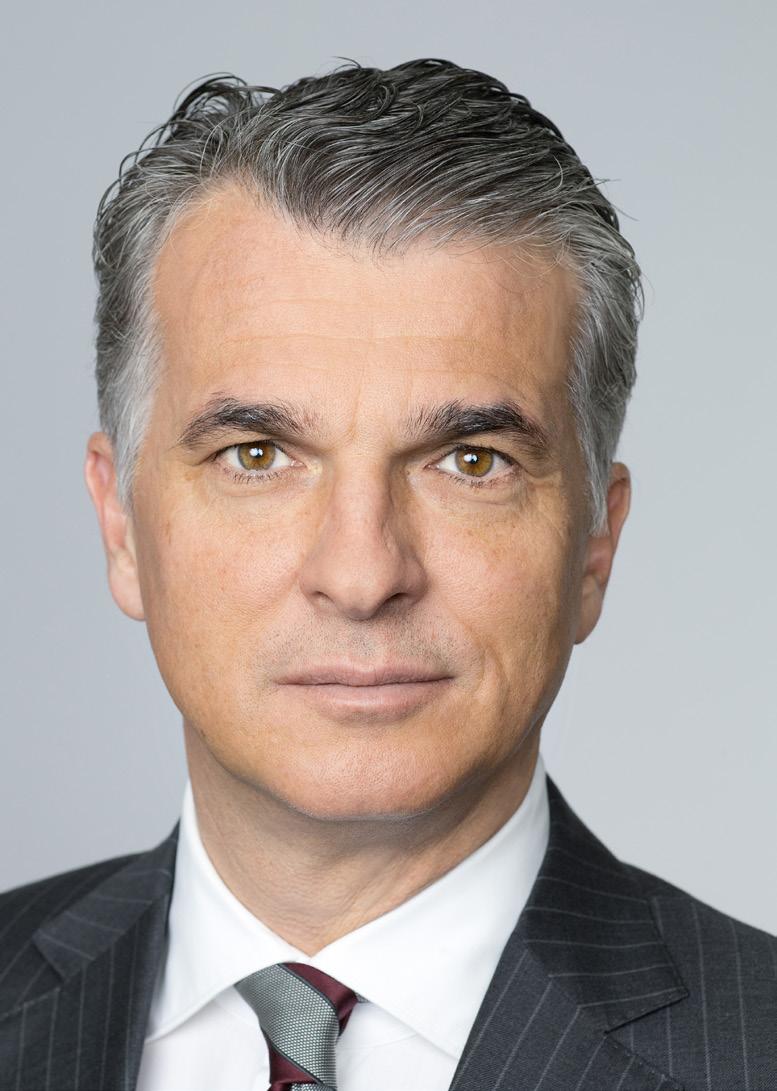
UBS CEO Sergio Ermotti announced that he would stay at the helm of the Swiss bank until at least April 2027, leaving open the possibility of staying on for even longer.
Sergio Ermotti has promised to steer UBS through the integration of its collapsed Swiss rival Credit Suisse (which UBS bought in 2023 through a government-choreographed takeover) and through new regulations that authorities are drawing up for the bank.
"I will stay at least until next year in April, and then we will take it from there," Sergio Ermotti said at an event organised by the International Centre for Monetary and Banking Studies.
Regarding his future successor, Ermotti has said he would like it to be an internal candidate. He told the audience in Geneva that the bank already had good candidates.
"And then when the day comes, it's going to be a matter of choosing the person based on the current needs of the bank," he remarked.
In 2023, Ermotti, who had previously led UBS from 2011 to 2020, returned to lead the bank during Credit Suisse's incorporation, succeeding the then CEO Ralph Hamers. In 2025, he received a total remuneration of CHF14.9 million (about $19 million), the same amount as in 2024.
British lenders approved the most mortgages in three months, while consumer credit grew at the fastest pace in nearly two years, according to the Bank of England data. This occurred amid the prospect of a potential hit from higher borrowing costs looming large over the country.
The BoE said 62,584 new mortgages for house purchase were approved in February, up from 60,246 in January. The value of mortgage lending, which lags behind approvals, rose by the biggest amount since September, up 4.840 billion pounds ($6.41 billion) in net terms in February.
The BoE data contrasted with the housing market's cautionary sentiments.
The Royal Institution of Chartered Surveyors said demand faded since the start of the Middle East conflict, as buyers worry about the implications of the volatile geopolitics.
The BoE's measure of net consumer borrowing rose by 1.935 billion pounds in February, an increase from January tally of 1.828 billion pounds, taking the annual rate of consumer credit growth to 8.5%, its fastest since March 2024.
The annual growth rate of the M4 money supply excluding non-bank financial institutions - which economists see as a factor driving medium-term inflation - increased to 3.9% in February from 3.6% in January.

UniCredit, as of now, has no intention of closing its Russian operations or returning the local subsidiary's banking license, the Italian lender said.
"Following some speculative rumours in the media, UniCredit confirms that there has been no change to the strategy we are executing and have consistently communicated to the market regarding Russian operations," a spokesperson for the bank commented.
UniCredit's clarification comes against a report in the Russian daily Kommersant, which claimed that the Italian venture was considering liquidating its business in the country.
While CEO Andrea Orcel has taken a stern stand against Italy's second-largest lender impairing its shareholders by leaving Russia at a loss, UniCredit has been shedding its local footprint under pressure from the ECB to sever
Credit Default Swaps
ties with the sanctioned country.
After the Rome government used the Russian presence to thwart an acquisition deal in Italy, UniCredit dropped a legal challenge against the ECB's requests to exit Russia and accelerated the process.
UniCredit’s stubborn Russia stance prioritises shareholder protection over moral responsibility, undermining credibility and trust.
A new credit-default swap index connected to the private credit market has been introduced by S&P Dow Jones Indices, providing investors with a way to bet against a sector that has been undergoing volatility.
Some 25 financial institutions, including banks, insurers, real estate
investment trusts and business development companies (BDCs) are included in the "CDX Financials Index." Credit default swaps are derivatives that offer insurance against the risk of a bond issuer (company, bank, or government) not repaying its creditors.

UniCredit has been shedding its local footprint under pressure from the ECB to sever ties with the sanctioned country
The new index arrives as private credit funds face their most serious stress test since the sector's rapid expansion post-2008 crisis.
“This index evolved through feedback with various market participants, including several dealers who plan on providing liquidity and various end users. One exciting feature of the new index is that it is the first instance of CDS linked to BDCs, thereby providing CDS linked to the private credit market,” said Nicholas Godec, head of fixed income tradables & commodities at S&P Dow Jones Indices.
Recently, investors demanded money back from non-traded private credit funds, and this has accelerated due to concerns that AI will disrupt the software companies that these funds finance.

Energy Analysis
GBO Correspondent
A standard ChatGPT query uses about 0.34 watt-hours of energy, which is 10 times more than a traditional Google search
There is an energy revolution happening around the world, and two main forces are changing how we use, distribute, and produce electricity, and are moving in opposite directions.
First, we have artificial intelligence (AI), which has been consuming energy in a manner nobody has ever thought possible. The second force is the effort to move heavy industries away from fossil fuels. The green energy transition has turned out to be more expensive and complicated than early optimists thought.
The problem is so dire that governments and companies are planning and investing with these two forces in mind.
The world is using more power again
Energy demand in wealthy countries remained flat for the last couple of decades, primarily due to improvements in appliance efficiency and overall low demand for power consumption. However, this period of stability is ending as global power demand is projected to grow by an average of 3.4% per year through 2026, a shift driven largely by the expansion of AI and the data centres required to support it.
The current impact of this technology is already significant. In 2024, data centres worldwide consumed approximately 15 terawatt hours (TWh) of electricity, accounting for roughly 1.5% of all electricity used on Earth. In order to put this in context, this consumption exceeds the total electricity usage of many midsized countries.
Looking ahead, the International Energy Agency (IEA) projects that these power requirements will continue to accelerate. Data centre energy use is expected to double by 2030, reaching 945 TWh and representing nearly 3% of global electricity consumption. Given the current pace of large-scale AI adoption across various industries, estimates suggest that AI could account for 4.4% of all global power consumed by 2035.








































































No one consumes more power than America. In 2019, Americans consumed 540 kilowatt-hours per person from data centre activity, a figure that is projected to exceed 1,200 kilowatt-hours per person by 2030.
The concentration of data centres in certain regions makes the problem especially dangerous for electricity grids. For example, Northern Virginia hosts more data infrastructure than almost anywhere on Earth, with data centres consuming 26% of all local electricity. Such a dangerous concentration creates significant vulnerabilities for the future.
In July 2024, a minor voltage fluctuation in Fairfax County, Virginia, caused 60 data centres to disconnect from the grid simultaneously. This created a sudden 1,500-megawatt surplus of power that nearly triggered a cascading failure across the regional grid.
While data centres represent less than 10% of total global electricity demand growth between 2024 and 2030, their













































clustering in specific locations creates pressure far beyond what the percentages suggest.
Why does AI use so much power anyway?
There are two chapters to the AI story. The first is Training. The process of teaching an AI using vast amounts of data. It's very computationally intense, but it's only done once. The second is inference, i.e., when the model is run afterwards. This is when someone types a question into ChatGPT or an AI assistant, and the model generates an image or an answer.
Inference makes up for 80% to 90% of the AI sector's total energy consumption because it happens billions of times a day. A standard ChatGPT query uses about 0.34 watt-hours of energy, which is 10 times more than a traditional Google search.
Advanced reasoning models such as OpenAI's o1 or DeepSeek-R1, which think through problems step-by-step before answering, can use 7 to 40 watt-hours per query.


















Most popular uses of AI in the development workflow among developers worldwide as of 2024 (In Percentage)
Moving to visualising the numbers for generation, any single image consumes 20 to 40 times more energy than generating text. Visual generation can cost 1,000 to 3,000 times more.
Training a landmark model like GPT-4 costs around 50 gigawatt-hours of energy, which is a large number, but it was a one-time cost. The ongoing inference is exponentially larger than the amount of energy used for training.
The semiconductor industry is constantly reinventing itself with remarkable feats of engineering. NVIDIA's A100 chip, released in 2020, delivered 312 teraflops of AI performance while drawing 400 watts of power. This was followed by the H100 in 2022, which reached 2,000 teraflops for certain tasks at 700 watts, representing a major leap in efficiency.
Most recently, the Blackwell B200 chip has pushed these boundaries even further by delivering up to 144 petaflops of AI performance and offering 12 times better cost efficiency than the H100 for largescale workloads, despite drawing up to 1,000 watts.
The software improvements they made have also helped with energy efficiency, especially a technique called quantisation, which simplifies the mathematical precision that AI models use internally. This reduces memory requirements by 75% and cuts energy use by 60%-80% for individual computations.
by companies, which results in overall consumption rising.
Nations are now treating compute as a national resource. This energy and computing crunch have triggered a geopolitical response, with countries increasingly treating AI computing capacity the way they treat oil reserves or military hardware. They see it as a strategic national asset.
France's national plan for 2030 allocates €2.22 billion for research and infrastructure, targeting 1.2 million GPUs and 1.5 gigawatts of compute capacity by the end of the decade. This aims to ensure that France can train and run AI models without depending on American or Chinese infrastructure.
The US AI market reached 7.82 billion in 2015, with domestic companies using large computing clusters to train AI models related to regional and global datasets and smart city management. The drive towards what is called sovereign AI is expected to double the shares of AI computing managed outside the US and China to 20% by 2030.
Source: Statista
Despite these technological advancements, energy demand is rising. The reason behind it is what economists call the “Jevons Paradox.” It’s when a technology becomes cheaper and more efficient that people use more of it, not less. More efficient AI chips enable faster and cheaper AI operations, leading to increased deployment across various tasks
While AI is often discussed in terms of its massive power requirements, its reliance on water, primarily for cooling data centres, presents an equally significant environmental challenge. Large-scale facilities can consume between 300,000 and 5 million gallons of water every day to keep hardware from overheating. Projections suggest that by 2027, global AI operations could withdraw 1.1 to 1.7 trillion gallons of fresh water annually, a volume that represents four to six times the total annual water consumption of Denmark. To address these sustainability concerns, the industry is increasingly adopting liquid cooling technology. Unlike traditional airconditioning systems that cool the ambient

air around servers, liquid cooling uses a network of pipes to circulate chilled fluid directly through the computing hardware. The targeted approach is significantly more effective, offering the potential to reduce overall power consumption by 40% while improving thermal efficiency by 3.5 times compared to conventional air-cooled setups.
Beyond hardware cooling, operational strategies such as "carbon-intelligent computing" offer a blueprint for mitigating environmental impact. Google has pioneered this model by shifting data processing tasks to specific times and locations where renewable or cleaner electricity is most abundant. These efforts have yielded tangible results. Despite a 27% increase in total power consumption, the company successfully reduced its data centre emissions by 10%, demonstrating that strategic energy management can decouple AI growth from environmental degradation.
The solutions mentioned above do help a lot, but they are not scaling at the same pace as AI is growing.
The situation isn't hopeless because there are better chips, smarter software, liquid cooling, carbon-aware scheduling, and the emergence of regional computing hubs. However, we now know that digital progress comes with a massive energy bill: the electricity grid, water infrastructure, national budgets, and geopolitical lines are all now shaped by technology that most people interact with by typing a few words into a chat box.
Our capability to meet the energy demands of AI will define economic competition, environmental outcomes, and the reliability of everyday infrastructure for the rest of the decade.
To address these sustainability concerns, the industry is increasingly adopting liquid cooling technology. Unlike traditional air-conditioning systems that cool the ambient air around servers, liquid cooling uses a network of pipes to circulate chilled fluid directly through the computing hardware


Now that Bitcoin and Ethereum have been institutionalised, they may well become the catalyst for the next financial crisis
GBO Correspondent
It’s October 2008. Everyone’s eyes are glued to the television. The terror is of a different kind. There are long lines at the unemployment exchange, with people breaking down into a puddle of their own tears as their homes are taken away from them. The financial meltdown was catastrophic.
Experts estimate that 8.7 million jobs were lost during the crisis, pushing unemployment from 5% in 2007 to double digits by October 2009. In Q4 of 2008, US real GDP contracted by 8.5%, the sharpest peacetime drop on record.
US consumer debt stood at $12.7 trillion, forcing households to switch from borrowing to repaying, resulting in a $500 billion reduction in annual consumer cash flows. One would imagine that the government would bail out its people. But all its resources were funnelled into the banks. They were too big to fail. The nine major banks that received loans under TARP
Source: Statista
Source: Lightcast
collectively paid their top executives nearly $1.6 billion in salaries, bonuses, and benefits that very same year.
Citigroup, which received $45 billion in taxpayer money and lost $18.7 billion in 2008, handed out $5.33 billion in employee bonuses. Bank of America paid $3.3 billion in bonuses; its newly acquired Merrill Lynch, which had just lost $30.48 billion, paid out another $3.6 billion. Lobbying works. The system was rigged. Capitalism’s boom and bust cycle is for all to see.
The teenagers and young adults of the early millennia lurked down internet rabbit holes for hope and freedom. They found it in an unlikely place; a pseudonymous entity named Satoshi Nakamoto had quietly published a document that would ignite a monetary revolution. It is called the “Bitcoin: A Peer-to-Peer Electronic Cash System.”
Nine pages, yet one of the most important philosophical and technical documents of the 21st century, laid the groundwork for a digital currency that would operate without the oversight of banks, regulators, or intermediaries.
Before it became speculative digital gold, Bitcoin was a deeply romantic notion. Imagine a fair currency not controlled by banks, minted democratically, and impossible to exploit. It was utopian in every possible way. For a young individual in the early 2010s, Bitcoin was digital mutiny, a way to go off the grid and escape the all-seeing eye of the state.
The road to this revolution was paved by the cypherpunks, cryptographers, computer scientists, and activists who predicted the expansionist tendencies of the surveillance state. The 2008 crisis eroded public trust in centralised institutions to a level that such ideas became mainstream. The traditional financial structure had privatised immense profits during periods of economic expansion but socialised catastrophic losses onto taxpayers during downturns. It was capitalism for the rich and socialism for the poor.
Nakamoto mined his first block on January 3, 2009. It’s called the Genesis Block, and
there was a message embedded directly into its code: “The Times, 03 January 2009, Chancellor on brink of second bailout for banks.”
Forever etched as a reminder of the fragility of fiat currencies. On the P2P Foundation forum in February 2009, he wrote, “The root problem with conventional currency is all the trust that’s required to make it work. The central bank must be trusted not to debase the currency, but the history of fiat currencies is full of breaches of that trust.”
Beyond speculative gains, Bitcoin offered genuine sovereign autonomy. Money could be secure, private, and user-controlled, moving across borders using nothing but mathematics and cryptographic proof.
It was the Wild West of the internet, driven by ideologically committed tech enthusiasts, but some of its first use cases were found in the darkest corners of the web, among drug dealers, scammers, and human traffickers. The early adopters accepted failures and illicit uses as a necessary price for true financial freedom.
After 2009, maintaining the Bitcoin network required nothing more than a CPU on a home computer. One CPU, one vote. The power to secure the global network was literally distributed into the hands of ordinary folk. The system was permissionless; no bank approval, credit check, or government ID was required to move value across borders. The community operated on mutual aid, opensource collaboration, and a shared belief that they were constructing the architecture for the next century of human commerce.
Mt. Gox, the early centralised exchange, collapsed in a hack so catastrophic that hundreds of thousands of users lost their funds. Markets like Silk Road exposed the dangers of permissionless, unsupervised systems. But the underlying protocol remained uncompromised and mathematically pure.
In the mid-2010s, the “one CPU, one vote” idea created a near-civil war within the Bitcoin community. Today, it’s remembered

as the block size wars. Big blockers argued for larger block sizes to accommodate more transactions and lower fees.
Purists countered that larger blocks would require enterprise-grade infrastructure, inevitably centralising the network in corporate hands. The small blockers won, an ideological victory that prioritised decentralisation over commercial convenience.
The suit-and-tie invasion
The early ideological victories attracted their arch nemesis, the speculative investors. As Bitcoin’s value exploded from fractions of a penny to tens of thousands of dollars, the narrative pivoted. What was designed as a “Peer-to-Peer Electronic Cash System” slowly morphed into “Digital Gold.”
The very legacy institutions the cypherpunks sought to bypass recognised Bitcoin not as a threat but as a highly lucrative fee-generating vehicle. If the masters join the slaves in their revolution, is it still a revolution?
The community rallied around its mantra, “Not your keys, not your coins.” Even Vitalik Buterin understood the danger. In 2018, he said, “I definitely personally hope centralised exchanges burn in hell as much as possible. They have ‘stupid king-making power’, deciding which currencies become big by charging crazy ten-to-fifteen-milliondollar listing fees.”
Yet private investors handed $3 billion
in Bitcoin to BlackRock’s “iShares Bitcoin Trust,” marking the first meaningful dip in self-custody supply in 15 years. They had sold the dream to corporations that turned bitcoin into a commodity tradable on stock exchanges.
Bitcoin became what it was created to destroy. The once-egalitarian mining landscape was upended by application-specific integrated circuits, expensive, specialised hardware that turned mining from a hobbyist endeavour into a capital-intensive, multi-billion-dollar industry.
Today, three mining pools, Foundry USA, Antpool, and F2Pool, control over 60% of the global network hash rate, with Foundry USA alone responsible for a third. Foundry is an offshoot of “Digital Currency Group,” an institutional conglomerate entrenched in legacy financial structures. The consensus mechanism is now controlled by a corporate oligopoly.
When corporations realised Bitcoin was one of the 21st century’s best cash cows, venture capitalists rebranded cryptocurrency as Web3, transforming a grassroots opensource movement into a top-down monetisation engine. Firms like a16z, Paradigm, and Pantera Capital poured tens of billions into Layer-1 blockchains and decentralised applications.
Early blockchains like Ethereum launched with roughly 20% of supply allo-
Today, three mining pools, Foundry USA, Antpool, and F2Pool, control over 60% of the global network hash rate, with Foundry USA alone responsible for a third. Foundry is an offshoot of “Digital Currency Group”
FTX collapsed in November 2022. Valued at $32 billion and endorsed by celebrities and venture capitalists, it was simultaneously committing one of history’s largest financial frauds
cated to insiders, leaving 80% for public mining and organic community growth. Modern Web3 projects allocate 40% to 60% to venture capitalists and founders before reaching public markets. The claim of decentralisation is little more than elaborate marketing.
Dr. Hanna Halaburda of NYU Stern noted in April 2025, “Decentralisation was the promise. Re-centralisation is the reality... If we don’t course-correct, blockchain won’t disrupt Big Tech; it will become Big Tech.”
Ethereum’s transition from Proof of Work to Proof of Stake cut energy consumption by 99.5% but replaced hardware monopolies with capital monopolies. Validation rights became directly proportional to staked currency. The 32-ether threshold locked out ordinary participants, driving them toward liquid staking derivatives like Lido Finance, which captured over 90% of that market at its peak. By mathematical design, yield flows to whoever holds the most.
DAOs claimed to give token holders democratic control over protocols. In practice, voting power was tied to holdings, making them plutocracies. The Tribe DAO's collapse in 2022 illustrated this starkly. After an $80 million hack on Rari Capital’s Fuse pool, 75% of participants voted to repay victims from treasury funds. Weeks later, four whale wallets exploited a lower quorum veto mechanism to overturn the community’s decision. The majority spoke. The wealthiest four ignored them.
The infrastructure layer told the same story. Today, 90% of decentralised applications route through third-party RPC providers. Infura, a ConsenSys subsidiary, handles 58% of Ethereum RPC requests; Alchemy controls 32%. If either complies with a government order to blacklist addresses, the “unstoppable” Web3 ecosystem grinds to a halt. Around 65% of active Ethereum nodes run on Amazon Web Services, Hetzner, and Google Cloud.
The irony is unmistakable; the decentral-

Infura, a ConsenSys subsidiary, handles 58% of Ethereum RPC requests; Alchemy controls 32%
ised future runs on the servers of Jeff Bezos and Sundar Pichai.
Managing self-custody is genuinely anxiety-inducing. The 24-word seed phrases, hardware wallets, and irreversible transactions can be terrifying to the layman. If you accidentally send 10 ETH to the wrong address, there is no court and no mechanism to recover it.
Consequently, 59% of people familiar with the technology openly distrust its security. Centralised exchanges like Coinbase and Binance recreate the familiar banking interface, leading people straight back into the same system they tried to escape.
FTX collapsed in November 2022. Valued at $32 billion and endorsed by celebrities and venture capitalists, it was simultaneously committing one of history’s largest financial frauds. Sam Bankman-Fried funnelled up to $9 billion in customer deposits to his affiliated trading firm. When it collapsed, withdrawals were frozen, and one million retail users were wiped out while institutional investors exited early and leveraged expensive legal teams during bankruptcy proceedings.
Then there are the institutional pumpand-dump schemes, venture capitalists fund protocols at massive discounts, generate hype through paid influencers, then dump unlocked tokens onto retail markets

when vesting periods expire. In July 2022, economist Nouriel Roubini told the New York Times, “Crypto evolved into a sort of postmodern pyramid scheme. The industry lured investors in with a combination of technobabble and libertarian derp.”
The democratisation of finance has become a mechanism to privatise astronomical gains for insiders while socialising catastrophic losses onto the public. The small investor is no longer a pioneer. He or she is the product.
Now that Bitcoin and Ethereum have been institutionalised, they may well become the catalyst for the next financial crisis. In February 2026, Bloomberg analysts remarked, “Institutionalisation did not eliminate volatility. It reallocated it… They also concentrate risk in ways that only become visible when conditions shift.”
The original cypherpunk spirit survives in the places where most people are still too afraid to look. Monero uses stealth addresses and ring signatures to automatically obscure every transaction’s sender, receiver, and amount, not as an optional feature, but as a structural condition of the network’s existence. Its CPU-optimised, ASIC-resistant Proof of Work keeps participation accessible on ordinary hardware.
A person with a modest laptop can still meaningfully participate. That sentence,
unremarkable as it sounds, is now a radical claim in the cryptocurrency landscape. Zcash takes a different but equally serious approach, deploying zero-knowledge proofs to offer shielded transactions that bridge privacy and regulatory compliance, a pragmatic alternative while keeping the cryptographic machinery for genuine anonymity intact.
As Central Bank Digital Currencies and digital ID systems become instruments of total financial surveillance, the precise dystopia the cypherpunks mobilised to prevent, these protocols are not curiosities. They are the last credible bastions of genuine digital cash.
The most architecturally radical dissent comes from Holochain, which discards the global ledger entirely. Each user runs their own independent source chain, storing identity and data locally on their own device. There is no mining, no staking, no wealthy validator class accruing power proportional to capital. The network runs on ordinary consumer hardware. Holochain’s founders describe their goal as building an “unenclosable carrier,” a system that cannot, by architectural design, be captured.
Traditional blockchains replaced governments and banks with computing power and crypto tokens; the power structure changed its wardrobe but not its nature. By breaking the cloud monopoly on infrastructure itself, Holochain offers a different kind of sovereignty. It’s one where your data never leaves your device unless you choose to share it, and no regulatory body can reach in and take it.
Just as Henry David Thoreau moved to Walden Pond to escape the exploitative systems of the world, there are still ideological descendants of the cypherpunks searching for liberty in the architecture of code. There is a strange, quiet dignity in knowing that you are the master of your own fate and the captain of your own soul.
The revolution was hijacked. That does not mean revolution is impossible. It means the next one will have to be built with the lessons of this one carved into its foundation.

Economist Nouriel Roubini told the New York Times, “Crypto evolved into a sort of postmodern pyramid scheme. The industry lured investors in with a combination of technobabble and libertarian derp”
As a regulated financial institution, Raya Financing recognises that strong governance is the foundation of sustainable growth
Raya Financing, as Saudi Arabia's leading automotive finance company, has been a dedicated provider of Shariah-compliant, accessible, and efficient vehicle ownership solutions across the Kingdom. Be it young professionals purchasing their first cars or businesses expanding their vehicle fleets, Raya Financing has been relentless in turning dreams into reality.
While the secret behind the company's steadfast commitment to transparent solutions and continuous innovation has been its qualified team of financial professionals, Raya Financing's customer-centric approach also ensures that the financing needs of individuals and businesses are met ethically and efficiently.
Adel Saleh Alhowar, a seasoned veteran in the finance industry, leads Raya Financing. As an industry leader, he has played a significant role in helping businesses achieve organisational success. He has held several high-profile positions at executive and board levels in institutions such as the National Commercial Bank, Saudi Credit Bureau, Al-Ahli Takaful Company, and Arab Financial Services Company.
Adel Saleh Alhowar is currently the CEO and Managing Director of Raya Financing. He is also a member of the Credit and Risk Administration Committee and serves on the Board.
In an exclusive interview with Global Business Outlook, Raya Financing CEO Adel Saleh Alhowar discussed the strategies that have allowed the company to maintain its position as the leading automotive financing provider in the Kingdom.
How has expanding to more than 30 main dealers and 150 sub-dealers improved Raya Financing's customer reach and service delivery?
Our expansion to more than 30 main dealers and 150 sub-dealers across the Kingdom has marked a transformative step in strengthening both the reach and efficiency of Raya Financing's operations. By extending our network, we are now positioned much closer to our customers, which has translated directly into faster deliveries, a wider range of products, and more responsive service. The impact of this strategy is clear — in 2024, we delivered around 12,000 vehicles compared to 4,000 in 2023, representing a remarkable 191% growth. This achievement was not only driven by scale, but also by the introduction of new automotive brands into our leasing portfolio, enabling us to attract entirely

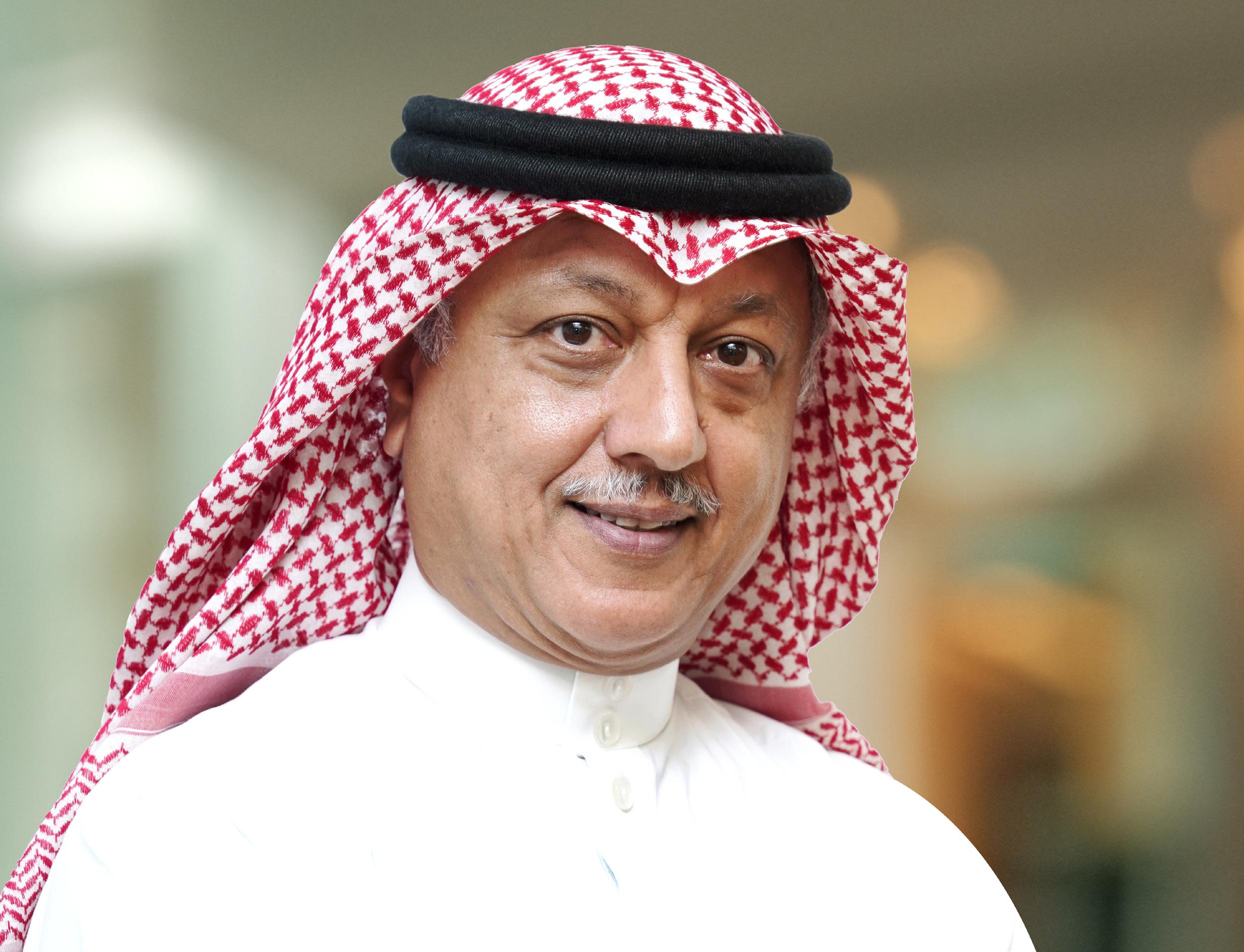
new customer segments. Ultimately, the expansion has solidified our position as a market leader capable of serving diverse needs while maintaining a high level of operational excellence.
What key actions enabled Raya Financing to achieve a 96% customer satisfaction rate?
Achieving a customer satisfaction rate of 96% reflects our unwavering commitment to service excellence and customer loyalty. Over the past year, we implemented a comprehensive Customer Base Development and Loyalty Enhancement Strategy, designed to increase responsiveness, reduce friction, and turn customer feedback into actionable service improvements. As a result, complaint rates dropped from 12% to 6%, average waiting times to file a complaint were reduced by 33%, and more than half of all complaints were resolved within a single day. These operational enhancements were complemented by investments in staff training and digital tools, ensuring that every interaction is efficient, transparent, and customerfocused. Above all, our success lies in fostering a culture
where the customer is put at the centre of every process we develop.
What are the main drivers behind Raya Financing's recent portfolio and bookings growth? Our exceptional growth this year reflects a deliberate, focused strategy built on four fundamental pillars. Marketing excellence has been transformative for us. We've sharpened our market positioning and customer acquisition strategies, resulting in sales growth of 108% year-over-year. This isn't just about volume, it's about reaching the right customers with the right message at the right time. Our partner ecosystem is a genuine competitive advantage. The 242% increase in supplier commissions tells only part of the story. We've invested deeply in these relationships, creating collaborative frameworks that deliver value to all parties. These aren't transactional arrangements; they're strategic partnerships that fuel mutual growth. Understanding our customers' needs is at the core of everything we do. We've designed our financing solutions with focus on customer
needs, ensuring relevance and accessibility. This customer-centric approach is reflected in our industryleading NPL ratio of just 1.75%, a clear indicator that we're serving the right customers with the right products. Finally, service quality is non-negotiable. Our operational improvements have enhanced the entire customer experience, from onboarding through collections. The SAR 37.4 million provision reversal demonstrates not just better processes, but a genuine commitment to supporting our customers throughout their journey with us. With our capital base now at SAR 330 million, we have both the resources and the proven model to scale responsibly. This is growth with purpose, ambitious yet sustainable, innovative yet disciplined.
How will the securitisation and SUKUK programmes contribute to Raya Financing's longterm expansion and financial stability?
The securitisation and SUKUK programmes represent strategic tools for broadening our funding base and strengthening long-term financial stability. By
tapping into alternative capital markets, we can access diverse investor pools and reduce reliance on traditional financing channels. These initiatives will enhance liquidity, enabling us to extend more competitive financing solutions to retail customers and SMEs alike, while also supporting product innovation. In addition to bolstering our capital strength, the programmes will improve our risk management capabilities, ensuring we have the flexibility and resilience to navigate market fluctuations. Ultimately, securitisation and SUKUK issuance will support Raya Financing's vision of becoming one of the Kingdom's most stable, innovative, and customer-focused financial institutions. Satisfaction is more than a statistic — it is a daily operational priority and a guiding principle for the company's future.
Which new financial products is Raya Financing prioritising to better serve individuals and SMEs?
Raya Financing's product development strategy is centred on inclusivity, flexibility, and innovation, ensuring that both retail customers and SMEs have access to solutions designed for their specific needs. Current initiatives


include youth-oriented vehicle leasing programmes, broader income-based financing criteria, and flexible repayment plans that put financial control in customers' hands. We have also expanded into used car financing, enabling value-conscious customers to enter the market at more affordable price points. Looking to the near future, we will launch finance solutions to consumers and credit card offerings in 2026 and roll out specialised SME financing products to drive entrepreneurial growth. By continuously diversifying our portfolio, we are positioning Raya Financing as a versatile partner capable of serving every customer segment in the Kingdom.
How is Raya Financing enhancing its support for SMEs, entrepreneurs, and high-impact economic sectors?
Supporting SMEs and entrepreneurs is not a peripheral objective for Raya Financing — it is a central pillar of our growth strategy, aligned with Saudi Arabia's Vision 2030 goals for economic diversification. We have streamlined our processes by automating customer service interactions and contract creation, which significantly accelerates financing approvals and business onboarding. Our product portfolio has been expanded to include flexible financial leasing and financing solutions, designed to accommodate the varied operational models of SMEs, all while ensuring full Islamic Shariah compliance. Strategic partnerships, such as those forged with CDF, have further amplified our capacity to serve high-impact sectors. Collectively, these initiatives enable us to equip businesses with the financial tools they need to grow, innovate, and contribute to the Kingdom's economic transformation.
What major digital or FinTech initiatives is Raya Financing undertaking?
Digital transformation is the driving force behind our long-
term vision for Raya Financing, and we have initiated a comprehensive technology modernisation programme scheduled for completion in 2026. This initiative is designed to elevate operational efficiency, streamline processes, and enhance the customer experience at every touchpoint. We are modernising core digital systems, automating workflows, and integrating cutting-edge FinTech solutions to deliver faster, more personalised services. The programme is guided by a dedicated Digital Transformation Committee tasked with ensuring our technological strategy meets both international best practices and the Kingdom's national digital transformation objectives. Through this forwardlooking approach, Raya Financing aims to position itself as a leading innovator in the financial services sector, where technology and customer satisfaction intersect seamlessly.
How is Raya Financing strengthening compliance and governance to meet Saudi Central Bank regulations?
As a regulated financial institution, Raya Financing recognises that strong governance is the foundation of sustainable growth. In alignment with Saudi Central Bank requirements, we have built a robust governance framework supported by five specialised committees: Shariah Compliance, Audit, Nomination & Remuneration, Executive, and Credit & Risk Management. Each of these committees plays a crucial role in safeguarding our operational integrity — from ensuring Islamic compliance in all contracts, to monitoring portfolio risk, to managing leadership selection and remuneration policies. This structure ensures transparency, accountability, and regulatory adherence across all aspects of our operations. It also strengthens stakeholder confidence, positioning us as a financially sound and ethically driven institution.
Technology
DarkSword Analysis
GBO Correspondent
DarkSword is unique among malware because it does not require the hacker's target to download any malicious software or corrupted files
Tim Cook-led Apple faces another serious malware threat to deal with, as researchers with cyber firm Lookout, mobile security firm iVerify and Google Threat Intelligence Group (GITG) came out with coordinated analyses of the threat element, dubbed "DarkSword." On March 3, Google and iVerify revealed another powerful iPhone spyware called "Coruna." It was later found that both the malware were hosted on the same server.
The recent revelation also brings back eerie memories of Pegasus, a sophisticated spyware developed by Israel's NSO Group, that was designed for covert, remote installation on iOS and Android devices. It earned infamy for allegedly spying on journalists, activists, and government officials.
While a 2021 investigation by 17 media organisations, based on a leaked list of 50,000 potential targets, discussed the misuse of spyware, Apple had to file a lawsuit against NSO Group and its parent company to hold it accountable for the surveillance and targeting of Apple users.
Why are we bringing the Pegasus reference here? Cause DarkSword is another spyware, with links to Russia and Ukraine serving as its testing field.
While identifying and mapping the presence of malware, Google researchers observed DarkSword emerging as a preferable medium for multiple commercial vendors and suspected statelinked hackers in their campaigns against targets in Saudi Arabia, Turkey, Malaysia and Ukraine.
In fact, the campaigns in Malaysia and Turkey were reportedly associated with Turkish commercial surveillance vendor PARS Defence. According to iVerify and Lookout, an estimated 220 million to 270 million iPhones still run exposed iOS versions, leaving them vulnerable to DarkSword attacks.
"In late November 2025, GTIG observed activity associated

with the Turkish commercial surveillance vendor PARS Defence, where DarkSword was used in Turkey, with support for iOS 18.4-18.7. This campaign was carried out with more attention to OPSEC, with obfuscation applied to the exploit loader and some of the exploit stages, and the use of ECDH and AES to encrypt exploits between the server and the victim. Additionally, the obfuscated version of rce_loader.js used by PARS Defence fetched the correct RCE exploit depending on the detected iOS version," the GTIG researchers said in their report.
About the Malaysia incident, the study observed, "Subsequently, in January 2026, GTIG observed additional activity in Malaysia associated with a different PARS
Defence customer. In this case, we were able to collect a different loader used in the activity, which contains additional device fingerprinting logic, and also used the UID session storage check. This loader also uses the top.location. href redirect for targets that do not pass all of the checks like UNC6748 did, but also sets window.location.href to the same URL."
IVerify and Lookout discovered the malware being delivered to iPhone users running iOS versions 18.4 to 18.6.2, which Apple released between March and August 2025. While researchers are trying to find the exact number of iPhones vulnerable to DarkSword attacks, Apple has already started taking action by releasing multiple fixes
Source: Statista
for the underlying bugs that attackers allegedly used to make.
To protect older iOS devices that can't install the more up-to-date iOS, a critical security update went live on March 11. Users with devices running iOS 13 or iOS 14 need to update to iOS 15 to receive these critical protections.
DarkSword is unique among malware because it does not require the hacker's target to download any malicious software or corrupted files. All the hackers need to do is download the DarkSword HTML and JavaScript infostealer named GhostBlade. The latter is the GhostKnife backdoor, which possesses the ability to extract a large amount of data. Along with the GhostSaber JavaScript, which executes code and also steals victims' data. GhostBlade attacks and takes over a compromised website. If a user with an old version of iOS visits the domain, their device immediately becomes vulnerable.
The hacker will then have the freedom to steal confidential data such as passcodes, emails and private messages from the victim's iPhone. According to Google's cybersecurity researchers, the hacker group UNC6353, with suspected ties with the Russian government, previously deployed DarkSword on compromised Ukrainian government agency sites to target iPhone users within Ukraine. DarkSword wiped temporary files, stole data from the infected devices and made a quick exit, thereby making the whole surveillance operation a short-term one designed to evade detection.
However, the powerful mobile spyware has now spread its wings from elite espionage circles to a wider commercial and criminal marketplaces. And given the alleged involvement of Russia-linked cybercriminals in the DarkSword saga, the United States CISA (Cybersecurity and Infrastructure Security Agency) has added
three of the six vulnerabilities (CVE-202531277, CVE-2025-43510, and CVE-202543520) to its catalogue of actively exploited security flaws, ordering Federal Civilian Executive Branch (FCEB) agencies to secure their devices by April 3.
However, the story doesn't end here, as fresh reports suggest that a newer version of DarkSword has been leaked and published on the code-sharing site GitHub. This will further allow hackers to easily use the DarkSword HTML and JavaScript infostealer and target iPhone users, who are running their devices on older versions of Apple’s operating systems.
IVerify's co-founder Matthias Frielingsdorf believes that the new versions of DarkSword spyware share the same infrastructure as the ones he and his colleagues analysed previously, although the files are slightly different. The files uploaded to GitHub are uncomplicated, just HTML and JavaScript, he said, adding anyone can copy and paste them and host them on a server "in a couple minutes to hours."
A security hobbyist who goes by the X (formerly Twitter) handle matteyeux claimed that he was able to hack an iPad mini tablet running iOS 18, the previous generation of the operating system that is vulnerable to DarkSword, using the “in the wild” DarkSword sample that is circulating online.
Now, what should iPhone users do? Apple spokesperson Sarah O’Rourke, during an interaction with TechCrunch, advised Apple users to keep the software updated, which is the most important thing one can do to maintain the security of Apple products.
She further added that older iPhones running updated versions of iOS were not vulnerable to the DarkSword attacks.
Now, how to update the iOS? Users need to go to the iPhone's settings app

by tapping General, which will have the option called “Software Update.” However, Apple has also set up a separate method, with the name "Background Security Improvements," for installing immediate security patches. This is located in “Privacy & Security” under Settings, from where the customers need to scroll to the bottom to find Background Security Improvements.
However, if measures don't work, then, as per Apple's recommendation, one needs to activate the iPhone's Lockdown Mode. However, this mode has been made optional for the "very few individuals" who, because of their high-profile identity, might be personally targeted by some of the most sophisticated digital threats.
Apple has also reportedly blocked malicious domains (identified by Google) in the Safari web browser to prevent DarkSword from having further exploitation opportunities.
According to the tech giant, while users
running iPhones through iOS 15 to iOS 26 are protected from DarkSword spyware, those using older iOS 13 or iOS 14 will have no other option but to update to iOS 15 to secure their devices. For these individuals, Apple will start sending alerts, asking the persons to install a "Critical Security Update" within the next few days.
Apple says that options like two-factor authentication for logins and ignoring unknown links or attachments should provide an additional layer of security for iPhone users.
Given the fact that the joint estimation of iVerify and Lookout sees an estimated 220 million to 270 million iPhones still having exposed iOS versions, it will be more than enough to keep Apple on its toes, as the tech giant races against time to ensure that a rogue mobile spyware doesn't cause mayhem across the world.

IVerify's cofounder Matthias Frielingsdorf believes that the new versions of DarkSword spyware share the same infrastructure as the ones he and his colleagues analysed previously, although the files are slightly different
Despite acknowledging issues such as performance anxiety and widespread fears of layoffs among Block employees, Jack Dorsey was said to have taken little action to ease these concerns
GBO Correspondent
Block, the fintech company co-founded by Twitter creator Jack Dorsey, will be cutting 4,000 of its 10,000 employees, or nearly 40% of its workforce. The reason? The adoption of new productivity tools, especially artificial intelligence (AI), will “change how teams work and what needs to be done by a person.”
At first glance, it will look like another company joining the AI race in order to

be leaner and more productive. The laying off of 6,000 employees also puts Block, the parent company of Square, Cash App, and Afterpay, in the league of tech sector players aggressively downsizing human professionals.
“The intelligence tools we’re building and using, along with smaller and flatter teams, are enabling a new way of working that fundamentally changes what it means to build and run a company,” Jack Dorsey said in a company-wide memo while defending the decision.


Despite the move increasing in Block's share price, with investors swiftly responding to the company’s goal of becoming more technologically advanced while possessing a leaner structure that could produce better results, there has been more than concern about what this means for human workers in an era increasingly shaped by automation.

ment), and staying financially healthy.
Jack Dorsey has also indicated publicly that, as technology transforms industries, other firms will need to make similar structural changes or they will be left behind.
Block denies that this is simply a cost-cutting exercise triggered by declining revenues or poor financial management. The layoffs are part of a broader realignment, said CFO Amrita Ahuja and other executives, as Block seeks to become an AI-first company that can use its tools to do more with fewer people and to redefine the way work gets done.
While companies like Amazon, Meta, and Salesforce have changed their headcounts in recent months, often citing automation, AI, or efficiency improvements, there have been two opinions on the topic. A section of analysts sees many companies growing rapidly during the pandemic, hiring aggressively to keep up with demand. However, as things normalised from 2022 onwards, apart from markets stabilising and competition intensifying, tech firms had no other option but to reevaluate their staffing needs.
12,985
11,372 2025 10,205
Macrotrends Block annual employee count
Block has three main points in its explanation: AI efficiency (smart tools can help smaller teams do more work that would have taken more people in the past), a new operating model (Block is transitioning toward an AI-first organisation that expects employees to use these tools to enhance product development, customer support, and risk manage-

Others contend that AI serves as a convenient excuse for cuts that companies were already considering. And what sets Block apart from the other companies is that the venture has specifically tied the layoffs to AI, making it one of the first major examples in which workforce reductions are being framed as a response to technology and a broader conversation about the implications of AI for employment, not just in tech but in the economy at large.
The announcement caused an immediate backlash from employees, former staff, and industry commentators who argue that AI, while powerful, cannot substitute for the human judgment, empathy, and nuanced problem-solving that many Block roles entail. Employees described the company as premature in its claims that AI can 'do it all' and even dismissive of their skills.
An employee criticised the decision to impose mandatory use of large language models, arguing that if the technology were genuinely effective, people would adopt it naturally. They also mentioned that staff members are now required to send weekly update emails to Jack Dorsey. Despite acknowledging issues such as performance anxiety and widespread fears of layoffs among Block employees, Dors-
ey was said to have taken little action to ease these concerns.
In fact, UC Berkeley researchers spent eight months inside a 200-person tech company observing the implications of workers embracing AI. Across more than 40 “indepth” interviews, they found that no staffer was pressured with new targets. However, people just started working more because of the tools' helping hand. But it came with another unwanted result: workload bleeding into lunch breaks and late evenings. The employees’ to-do lists expanded to fill every hour that AI freed up, and the staffers kept going. And, in the opinion of the Berkeley researchers, these are the first signs of burnout.
And even Salesforce CEO Marc Benioff chimed in, saying that layoffs are "never just about technology" and that "there are always many factors behind workforce reductions," a reminder to the industry that the human component cannot be ignored.
Questions have also been raised about the transparency of the process, with some ex-employees reporting being rehired shortly after being laid off, questioning whether the layoffs were actually used to reorganise teams strategically rather than just for efficiency. These developments only fuelled debate around the ethics and communication of tech layoffs.
This is not just a company story but a snapshot of a broader, ongoing conversation about the future of work and the tension between human labour and technology, efficiency and empathy, and short-term gains and long-term societal impact.
Whether other companies will follow Block's lead or whether this will be viewed in retrospect as overzealous is an open question. However, the conversation has shifted from abstract debates over AI and productivity to real people, careers, and ethical questions.
In some ways, Block's layoffs are the
human story behind the technology, and they pose a question that will define the next decade: how can we leverage innovation without compromising the dignity, security, and opportunity of the people who make that innovation possible?
Block layoffs ripple outward to families, communities, and local economies, where thousands of employees lose their jobs; to those who stay at the company, where the culture shifts under their feet with pressure to learn new tools, deal with changing priorities, and work in a more automated environment; and to the bottom line, where the human cost of such transitions is not so easily accounted for in spreadsheets or efficiency metrics, as psychologists and labour experts have made clear.
Some industry commentators have also cautioned that the trend may establish a precedent, with other tech firms potentially following Block's lead to use AI-driven restructuring as a normal business practice to justify making mass job cuts, thereby creating more widespread uncertainty across industries. The statement also highlights how automation can sometimes be used as a scapegoat when explaining why certain employees are laid off.
But Block’s decision, under Jack Dorsey’s leadership, seems more like an opportunistic solution masquerading as innovation. The “AI shift” is an attempt to avoid talking about business decisions and strategies. Of course, technology can be harnessed for greater efficiency, but it’s an assumption that people can be so readily replaced. They can’t. It’s an overestimation of what AI is currently capable of doing, and an underestimation of what humans can contribute. It’s short-sighted. It’s good for quarterly profits and stock prices, but bad for trust, morale, and long-term success for both the company and its employees.
It’s an overestimation of what AI is currently capable of doing, and an underestimation of what humans can contribute. It’s short-sighted. It’s good for quarterly profits and stock prices, but bad for trust, morale, and long-term success for both the company and its employees
OpenAI, which is competing with Anthropic for enterprise customers, acquired TBPN, a popular online tech talk show. The deal is surprising because the Sam Altman-led tech venture had not previously signalled any interest in entering the news business.
Furthermore, it had paused work on its Sora video-generation tool as it narrowed its focus to the profitable AI coding tools market. TBPN was founded in late 2024 by entrepreneurs John Coogan and Jordi Hays, who will join OpenAI as part of this move.
OpenAI stated that the acquisition would help the ChatGPT maker better communicate its plans and steer the conversation about the changes AI creates. The financially troubled startup also stated that it would uphold TBPN's editorial independence and drew comparisons to other such initiatives by major tech
companies over the years.
TBPN created a niche space in the tech world by hosting high-profile guests such as Meta CEO Mark Zuckerberg, Microsoft boss Satya Nadella, filmmaker James Cameron and Altman himself.
"Media has long sat within larger enterprises, whether that was ABC/CBS/ NBC sitting within large conglomerates, or Microsoft co-creating MSNBC," OpenAI said.
Microsoft AI, the research lab at the tech giant, released three AI models that can produce text, voice, and images, signalling its ongoing efforts to build out its own stack of multimodal AI models and compete
with rival AI labs.
According to the company's media note, MAI-Transcribe-1 converts speech into text in 25 languages, running at 2.5 times the speed of Microsoft Azure Fast.

OpenAI stated that the move would help better communicate its plans and steer the conversation about the changes AI creates
MAI-Voice-1 is an audio-generating model, enabling users to create 60 seconds of audio in one second and a custom voice. MAI-Image-2 is a videogenerating model.
Originally released on March 19 through MAI Playground, a new software for testing large language models, all three models are now released on Microsoft Foundry, and the transcription and voice models are also available in MAI Playground. The models were created by the MAI Superintelligence team.
“You’ll see more models from us soon in Foundry and directly in Microsoft products and experiences," Mustafa Suleyman, the CEO of Microsoft AI, informed the media in a blog.

The National Cyber Security Agency (NCSA) announced the launch of a new Cloud Computing Privacy Assessment Tool to help entities improve privacy governance and enhance data protection as the Gulf country continues its digital transformation.
The agency said the tool offers a practical framework enabling organisations to review their privacy practices, identify areas for improvement, and make necessary adjustments to align with national regulations.
The tool is the latest initiative by the "Personal Data Privacy Protection Department" of the NCSA to support organisations in meeting the provisions of Qatar's Personal Data Privacy Protection Law.
As data security and privacy risks in cloud environments expand, NCSA aims to strengthen controls around personal data handling and improve organisational readiness through best practices in governance, risk management and compliance. As more commercial entities in Qatar implement cloud solutions, the assessment tool aims to help public and private sector organisations build secure digital ecosystems with trust in data-driven services.
Sony Group is increasing global prices for its PlayStation 5 consoles, including a $100 increase in the United States, as the Japanese firm grapples with rising costs of key components such as memory chips.
The race to build out artificial intelligence (AI) infrastructure in the tech industry has also caused memory makers to prioritise higher-margin data-centre chips over consumer devices, squeezing supply.
The new US prices will raise the standard PS5 to $649.99 from $549.99, the Digital Edition to $599.99 from $399.99 and the highend PS5 Pro to $899.99 from $499.99.
Prices for the PlayStation Portal remote player will also increase to $249.99 from $199.99. The increases will apply in Europe and Japan as
well, after what the company said was a "careful evaluation" of cost pressures in global supply chains.
Analysts noted that console price hikes are expected to slow growth in the video-game market in 2026. Slower console sales were also cited by Epic Games, which said it would cut 1,000 jobs, mostly in its Fortnite unit.
Sony sold eight million PS5s in the key OctoberDecember holiday quarter, down 16% from a year earlier. The PS5 has been on the market for about six years.
The new US prices will raise the standard PS5 to $649.99 from $549.99, the Digital Edition to $599.99 from $399.99

YouTube is reportedly raising subscription prices for YouTube Premium and YouTube Music in the United States. The "YouTube Premium" individual plan is increasing from $13.99 to $15.99 per month, while the family plan is increasing from $22.99 to $26.99 per month.
"YouTube Premium Lite," which offers ad-free viewing for most content, is going from $7.99 per month to $8.99 per month. The "YouTube Music" individual plan will be changing from $10.99 per month to $11.99 per month.
The family plan is increasing from $16.99 per month to $18.99 per month. The price increases will apply to both new and current subscribers, and current subscribers will receive an email at least 30 days in advance of their updated subscription price.
“We’re updating the price for YouTube

Premium plans in the US for the first time since 2023 to continue delivering a highquality experience that supports creators and artists on YouTube. This change allows us to maintain the features our members value most: ad-free viewing, background play, and a massive library of 300M+ tracks on YouTube Music. "We continue to offer several plans, ensuring subscribers can choose the best option," the company said.
Intel launched two new mobile processors in its Ultra 200 series family, designed for high-performance gaming and professional applications: the Intel Core Ultra 9 290HX Plus and Intel Core Ultra 7 270HX Plus. These new processors optimise for advanced gaming, streaming,
content creation, and workstation use with architectural refinements, including the new "Intel Binary Optimisation Tool," a first-of-its-kind binary translation layer optimisation capability that can improve native performance in select games.
Josh Newman, General Manager

The YouTube Premium family plan price will rise from $16.99 to $18.99 monthly, affecting all subscribers
and Vice President of Product Marketing, Client Computing Group, said, "With the introduction of the Intel Core Ultra 200HX Plus series, we’re pushing mobile computing performance even further for the gamers, creators, and professionals who demand the best. With higher die-to-die frequencies and our new Intel Binary Optimisation Tool, the new Intel Core Ultra 9 290HX Plus and Ultra 7 270HX Plus deliver meaningful, real world performance gains so users can experience smoother gameplay, faster creation workflows, and more responsive workstation performance."
The Intel Core Ultra 9 290HX Plus offers up to 8% faster gaming performance and up to 7% faster single-thread performance.