
DEFINING DECADE THE BUSINESS OF SUSTAINABILITY: WHAT THE NEXT DECADE DEMANDS LEADER’S OPINION REIMAGINING TALENT: THE HUMAN EDGE IN THE AGE OF AI
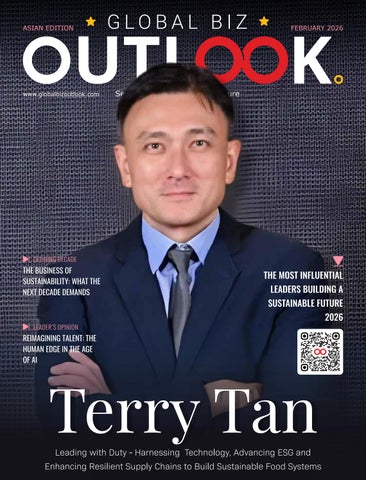
THE MOST INFLUENTIAL LEADERS BUILDING A SUSTAINABLE FUTURE

DEFINING DECADE THE BUSINESS OF SUSTAINABILITY: WHAT THE NEXT DECADE DEMANDS LEADER’S OPINION REIMAGINING TALENT: THE HUMAN EDGE IN THE AGE OF AI
THE MOST INFLUENTIAL LEADERS BUILDING A SUSTAINABLE FUTURE
Leading with Duty - Harnessing Technology, Advancing ESG and Enhancing Resilient Supply Chains to Build Sustainable Food Systems






Designer
Distributor
In an age defined by climate urgency, resource constraints, and rising social accountability, leadership is being reimagined. Sustainability is no longer a trend or a corporate checkbox—it has become a defining principle of credible, future-ready leadership. The leaders shaping tomorrow are those who understand that lasting progress must align economic growth with environmental responsibility and social impact.
The Most Influential Leaders Building a Sustainable Future 2026 edition of Global Biz Outlook recognizes visionaries who are moving beyond rhetoric to create meaningful, measurable change. These leaders are redesigning business models, strengthening supply chains, advancing clean technologies, and embedding ESG principles into the core of their organizations. Their work reflects a shared understanding that sustainability is not an initiative—it is a long-term commitment that shapes strategy, culture, and decision-making at every level.
True influence in sustainability leadership is measured by responsibility, not visibility. The leaders featured in this edition operate with a deep sense of stewardship, balancing innovation with ethics and ambition with accountability. They challenge short-term thinking, invest in resilient systems, and prioritize people and the planet alongside profit. Their leadership extends across industries and borders, shaping policies, empowering communities, and redefining what responsible success looks like in the modern world.
At the heart of this edition is our cover story, Terry Tan, CEO of Country Foods Pte Ltd and a leader driving integrated global supply chains for the food business at SATS Ltd, headquartered in Singapore. In a world where sustainability is often reduced to slogans and scorecards, Terry’s approach stands apart. His leadership is grounded in duty—shaped by decades of experience and an unwavering

Editor-in-chief
Sugandha Sharma

Leading with Duty - Harnessing Technology, Advancing ESG and Enhancing Resilient Supply Chains to Build Sustainable Food Systems


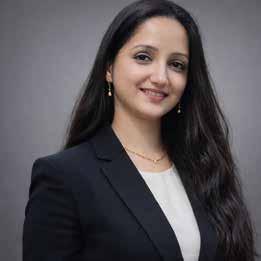
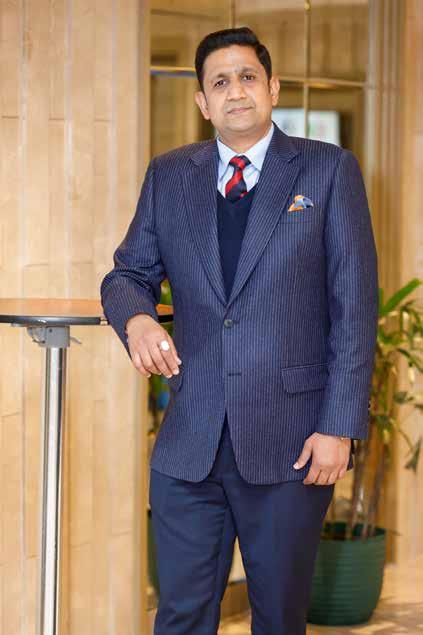
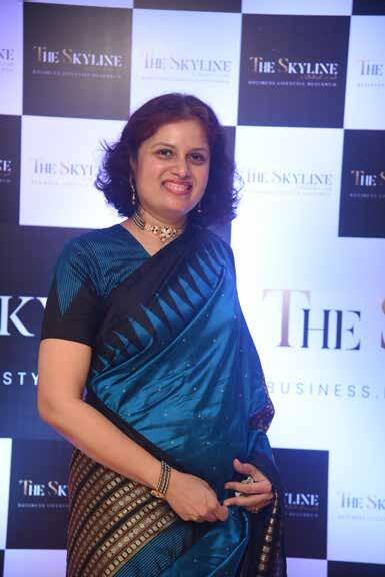


Leading with Duty - Harnessing Technology, Advancing ESG and Enhancing Resilient Supply Chains to Build Sustainable Food Systems
CEO Country Foods Pte Ltd.
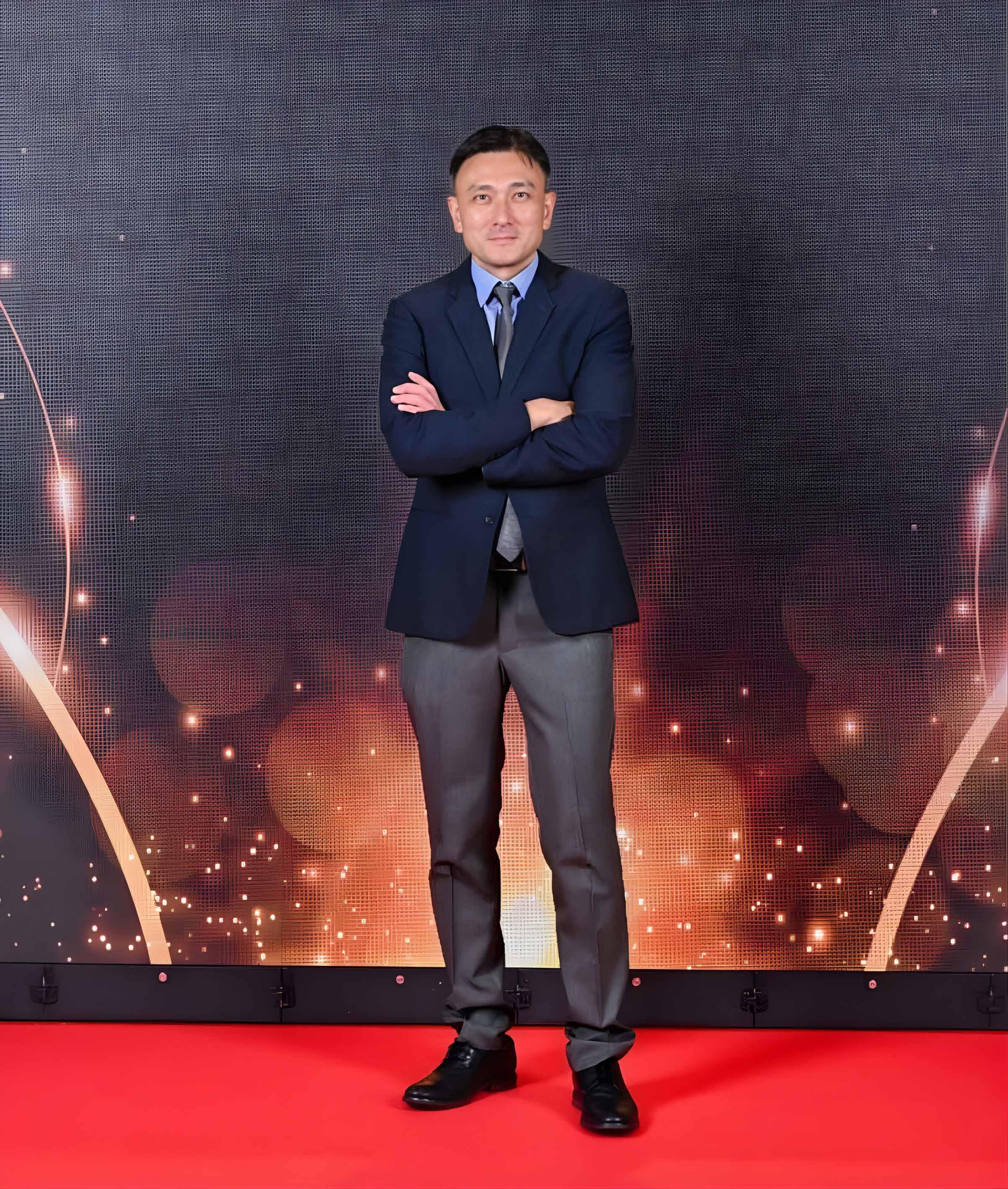
In an era where sustainability is often reduced to slogans and scorecards, Terry Tan approaches it with the quiet conviction of someone who has lived responsibly long before it became fashionable. As CEO of Country Foods Pte Ltd and also leading Integrated Global Supply Chain for the food business at SATS Ltd, headquartered in Singapore, Terry leads not with rhetoric, but with duty—an ethic shaped over decades of service, leadership, and unwavering accountability to people, planet, and future generations.
Founded in 2015, Country Foods operates at the critical intersection of food security, global supply chains, and ESG responsibility. Under Terry’s stewardship, technology and sustainability are not an adjunct strategy—it is embedded across the enterprise, shaping decisions, systems, and outcomes from end to end.
Honors & Recognition
Terry Tan’s contributions have been recognised through numerous national and professional honors, including:
▪ Chartered Fellow, Chartered Institute of Logistics & Transport, Singapore (2024)
▪ Pioneer Fellow, Singapore Leaders Network (2024)
▪ COVID-19 Resilience Medal (2023)
▪ Public Administration Medal (Gold) (2023)
▪ Public Administration Medal (Silver – Military) (2020)
▪ Minister for Defence Award (CSSCOM) (2021 & 2022)
▪ Australian Biosecurity Award (Team) (2010)
▪ Defence Technology Award (Team) (2010)
▪ State Commendation Medal (Military) (2013)
In addition to these personal and public-service distinctions, organisations under his leadership have also received significant regional recognition for innovation and sustainability, including:
▪ Country Foods received the Asian Business Review – Asian Innovation Awards 2025, the SATS PCEO Awards 2025 for Innovation Excellence, and the Singapore Business Review Innovation Award 2024.
▪ Country Foods was honoured with the LogiSYM Best Sustainability Initiatives Award 2025, recognising its leadership in advancing sustainable practices across the supply chain.
Terry Tan’s leadership identity is deeply rooted in more than two decades of public service and military experience. His career in uniform spanned operations, training, technology, engineering, human capital, supply chain, and transportation—disciplines that demand long-term thinking, precision, and collective responsibility.
That foundation carried seamlessly into the corporate world. Terry transitioned into a startup initiative with Temasek and SATS and subsequently led Country Foods, a wholly-owned subsidiary of SATS. Alongside this role, he concurrently oversaw the Integrated Global Supply Chain for the SATS food business—placing him at the helm of
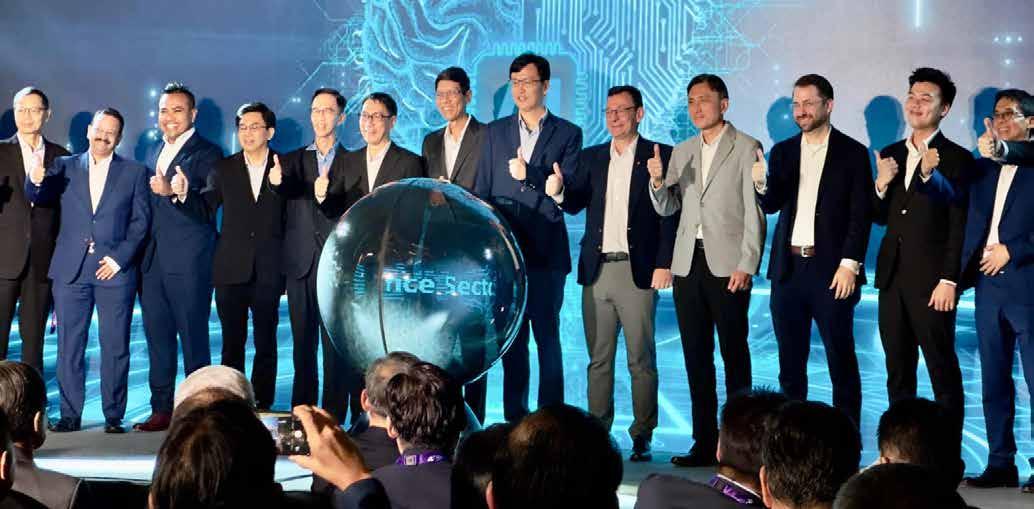
some of the most complex and mission-critical food operations in the region.
Beyond titles, Terry is also a husband and father of three teenage children—two already in university and one preparing for junior college. Recently, beyond his daily runs, Terry has developed a passion for trekking, and he also values spending quality time at home with his family.
Terry defines himself as a technology-driven leader embracing sustainability as a mandated duty. It is not a “nice to have,” not a branding exercise, and not a line item at the P&L level. It is a responsibility that leaders must uphold—consistently and without compromise.
The military shaped Terry’s instinct to look beyond immediate wins toward long-term consequences. He led sustainability efforts during his years in the Army, long before ESG became a national agenda or a global priority. That experience instilled in him a deep belief that leadership, like sustainability, is inseparable from responsibility.
Rather than limiting sustainability to environmental metrics alone, Terry frames it through an integrated ESG lens. The Social and Governance dimensions are inseparable from the Environmental mandate and must be addressed collectively as one responsibility.
“I believe the greatest existential threat to our world and our societies lies within ESG challenges. We only need to look at what is happening globally and here in Singapore to understand the consequences of inaction,” he says.
For Terry, environmental and social outcomes must become the second and third “P&L,” standing alongside financial
performance for all companies and enterprises.
“I view leadership as a duty, just as I view ESG as a duty—one that serves our people, our communities, our planet, and our future. It is our responsibility to protect the planet, strengthen our communities, and invest in the next generation. Regardless of what we do, where we are, or who we are, leaders must take responsibility and be accountable for doing our part—big or small—to deliver a better world: one that is more secure, more united, more prosperous, happier, and more sustainable,” says Terry.
“In the corporate and commercial world, ESG should carry the same status and emphasis as the pursuit of financial P&L. It is a mandate that must be embedded and anchored across everything we do throughout our end-to-end business,” he adds.
“I did not pursue a career in sustainability; instead, I anchor sustainability in everything I do throughout my career. First, the planet is suffering, as evidenced by the increasing
frequency and severity of climate disruptions worldwide.
Second, our children and future generations care deeply about the environment and the planet they will inherit.
Third, the corporate and commercial world plays a significant role, beyond that of governments and non-profit organizations. Businesses contribute materially to the strain on our planet and communities—and therefore must be part of the solution,” says Terry.
When Terry entered the food business, this responsibility became even clearer. Global and regional food supply chains—particularly cross-border systems—are highly inefficient. Food standards and protocols remain largely non-standardised, and food is often not distributed efficiently from agricultural-producing countries to the regions that need it most. As a leader within a food and supply chain enterprise, Terry recognised that he was in a position to act.
Across education, early roles, and leadership positions, Terry’s experiences reinforced the importance of purpose, mission, leadership, and team.
At Country Foods, clarity begins with purpose—defined simply, communicated consistently, and reinforced daily. A clear, actionable mission guides decision-making across the organization, from strategic planning to frontline execution. Leadership capability is the critical enabler. Leaders must understand why they are doing what they do, believe in it, embrace it, and truly walk the talk. Equally vital is the ability to rally teams across functions and geographies toward shared objectives—turning intent into execution.
At the heart of Country Foods lies a fundamental belief: food is a public good. It is an essential commodity and an existential necessity for humanity and the world.
This belief shapes the company’s purpose—“Connect and create a better world through foods”—and its mission to
“Deliver safe, affordable, quality, and tasty foods through innovation, sustainable efforts, partnerships, and resilient supply chains.” These are not aspirational statements; they define how Country Foods operates and why it exists.
The ultimate goal is food security for all—making food

accessible everywhere: ensuring access in good times, during disruptions, and in moments of crisis, across every corner of the world, regardless of geography, economics, politics, or culture.
Embedding Technology and ESG into the Core
At Country Foods, ESG is embedded across every aspect of the business. From manufacturing and food waste management to renewable energy transition, sustainable packaging, green procurement, and supply diversification, sustainability is operational, measurable, and accountable.
Technology plays a central role. The company leverages data, automation, and AI to transform operations and build resilient, efficient supply chains. A flagship example is the Emporion Control Tower—an end-to-end, AI-driven supply chain intelligence platform. It anticipates, tracks, and manages operations across the entire value chain, from AI-enabled demand and supply sensing to end-to-end freight tracking and last-mile distribution.
This system is supported by fully integrated, digitalised corporate functions spanning procurement, sales and marketing, shipment, inventory management, and distribution—creating a single source of truth across the enterprise.
The path to technology-driven transformation is not without obstacles. One of the most significant challenges has been consolidating, cleaning, and structuring data into a unified, reliable source. System integration, people upskilling, and re-profiling teams to embrace digital tools require sustained investment of time, resources, and cost.
Equally challenging is the translation of insights into tangible business outcomes and impacts—enabling better decisions and improved performance—which remains a critical hurdle.
Terry’s approach is grounded and disciplined: start with leadership, keep plans simple, execute rigorously, bring people along, adapt continuously, and never give up when obstacles arise. Celebrate small wins, fight on, and persevere.
EMPORION by Country Foods: Revolutionizing Supply Chain Management
EMPORION is Country Foods’ first AI-powered, end-to-end Digital Control Tower, designed to transform
supply chain resilience, intelligence, and agility. More than a technology tool, EMPORION is a strategic platform that enables Country Foods and the SATS Food Solutions Group to see first, know better, and act smarter across the entire value chain—from sourcing to last-mile delivery.
EMPORION stands for Enterprise Management Platform for Operations, Real-time Intelligence & Oversight Network. It integrates real-time risk intelligence, global shipment visibility, and AI-driven logistics optimization into a single, connected system, strengthening decision-making, responsiveness, and sustainability.
▪ Upstream: AI-powered risk monitoring anticipates geopolitical, diseases, climate, health, and logistics disruptions, enabling proactive mitigation and stronger food security.
▪ Midstream: Real-time global shipment visibility improves planning, reduces delays and costs, and delivers significant long-term savings.
▪ Downstream: AI-optimized last-mile logistics cut transportation costs, lower emissions, and improve delivery performance and customer satisfaction.
Built on Microsoft Dynamics 365, Blue Yonder S&OP, and Power BI, EMPORION creates a single source of truth across operations—enabling faster, coordinated, and data-driven responses.
EMPORION enhances operational resilience, drives efficiency and cost savings, elevates customer experience, and supports sustainability and national food security. Through partnerships with Everstream Analytics, Tramés, and A*STAR, it represents innovation through collaboration.
EMPORION is not just a control tower—it is a future-ready strategic enabler, redefining how Country Foods manages supply chains in an increasingly complex world.
For Terry, leadership responsibility begins with preparing leaders to lead technology and ESG—and enable them to embrace technology and data to support this journey and protect the planet as a duty. Build collaborative teams that work across boundaries to create new value.
Country Foods actively leverages public–private–people partnerships, harnessing ecosystem-wide expertise and resources to drive meaningful technological and ESG outcomes. Internally, Terry fosters a sense of citizen ownership—encouraging people and the next generation to see ESG and driving technology adoption as a shared responsibility.
Innovation follows a clear philosophy: start small, fail fast, and scale at speed when ready. For accountability, set clear targets at the individual, functional, departmental, and organisational levels, and embed them into business balanced scorecards (BSCs) and KPIs.
“Ultimately, empower our people to contribute meaningfully to ESG—preserving the planet, caring for society, and doing the right thing,
always,” says Terry. And enabling our people to partner with technology and AI to make work more meaningful, productive and smarter.
Terry does not subscribe to the idea of work-life balance. Instead, he believes in harmony. Daily runs, time with friends and colleagues, and weekends dedicated to family provide rhythm and renewal. Travel, reading, and trekking across mountains around the world offer perspective.
“I enjoy spending time on the ground, engaging with my people. This allows me to understand their daily challenges, appreciate their contributions, and make better-informed decisions for the
business. This simple routine energizes me, keeps me updated, and sustains my motivation in everything I do,” he shares.
Looking ahead, Terry envisions a purpose- and technology-driven Country Foods over the next three to five years—supporting SATS Food Solutions’ transformation through a one-stop, integrated, end-to-end, efficient, and resilient supply chain, supported by agile sourcing and procurement capabilities.
“I look forward to Country Foods aggregating and procuring proteins at scale and distributing them seamlessly across the region to support SATS Food Solutions, while also contributing to Singapore’s food security,” he assures.
“I am confident we will build agile leaders and collaborative teams to guide Country Foods in delivering not only stakeholders’ interests and enduring financial performance, but also our shared duty to care for society, protect the
planet, and create a better future for the next generation,” he added.
the Next Generation: Leadership Is a Duty, Not a
Terry’s clear-eyed message for emerging sustainability leaders and entrepreneurs
For emerging sustainability leaders and entrepreneurs, Terry offers a clear-eyed message. The journey will be challenging, as profit must be balanced with responsibility to society, the planet, and those who come next. And partnership with technology and AI will be a critical enabler to this journey.
Success lies in anchoring on people, leveraging technology and ecosystem partnerships, embracing innovation, remaining disciplined, and persevering together. Sustainability, like leadership, is not a trend—it is a duty.

Managing Director, Intandid

Rooted in cultural diversity and shaped by lived experience across continents, Marion Campan’s approach to sustainability begins where most leadership conversations end—with people. Creating a world where nobody hates going to work is not just a vision for Marion Campan—it is the work of her life. As the Founder of R.E.D. – The Peer Group Forum for HR Directors, Marion partners with CEOs and HR leaders across APAC to design outstanding, human-centered workplaces. Grounded in cultural insight and driven by a deep understanding of motivation, her leadership journey is reshaping how organizations think about sustainability, engagement, and what it truly means to thrive at work.
Marion Campan’s understanding of sustainability did not begin in boardrooms or strategy decks—it began in Tahiti. Growing up in a deeply multicultural environment, she was immersed daily in Polynesian traditions while forming her earliest friendships across French and Chinese backgrounds. From a young age, she noticed something that would later become central to her work: people can share the same place, yet live entirely different realities.
That early realization—that culture shapes how we think, behave, and feel—sparked a lasting curiosity about human motivation, psychology, and the invisible forces that drive behavior. It shaped not only how Marion sees people, but also how she understands organizations, leadership, and sustainability itself.
Ten years ago, that curiosity carried her to China, a country she now calls home. There, she witnessed growth on a scale and at a speed that continuously redefines workplaces, leadership expectations, and human resilience. China did not just challenge her professionally—it sharpened her lens on what sustainable leadership truly requires in fast-moving, high-pressure systems.
“I originally wanted to study psychology, but I ended up in business school. At the time, I thought it was a compromise. In hindsight, it gave me the perfect foundation to understand both people and systems,” shares Marion.
In 2015, Marion was a first-time manager in China, and she burned out badly within the first six months.
She loved her job too much, took everything too seriously, and didn’t realize how overworked and overstressed she was—until her body shut down. She ended up in the
hospital, under morphine, and that moment changed everything. It taught her that motivation has extremes: too little leads to disengagement, while too much leads to burnout.
From that point on, she invested heavily in coaching, leadership training, and personal development. She learned to lead as a coach, not just a boss, and applied that mindset from day one. Over the years, she saw the impact on her teams, their engagement, and their results. That experience became the foundation of R.E.D.: sustainable performance starts with self-awareness and balance.
If Marion Campan had to define herself in one word, it would be motivation—not as a buzzword, but as a living system, both a driver and a result.
Motivation, in her view, shapes performance, innovation, and outcomes. Yet it is also shaped by the environments leaders create. When systems are unfair, overly critical, or unbalanced, motivation erodes quietly. And when motivation fades, people stop bringing their ideas, energy, and creativity to work.
For Marion, sustainability is not about extracting more effort from people. It is about designing conditions where motivation can exist, recover, and regenerate over time. Without motivated people, organizations cannot thrive—and when organizations fail to thrive, the consequences ripple outward into economies and society itself.
Her philosophy is simple but demanding: not more for more, but better for better.
A defining shift in Marion’s leadership philosophy came in 2020, at the onset of the COVID outbreak, when she became a Gallup Strengths–certified coach. By then, coaching was already part of her leadership DNA—she had worked closely with leadership coaches and applied coaching practices from her very first management role. But this certification gave her a structured, powerful lens: focus on amplifying what works, rather than fixing what’s broken.
This strengths-based approach reshaped how she viewed organizations. Energy, engagement, and sustainability grow faster when leaders invest in existing potential rather than deficiencies.
Her thinking is also influenced by global voices in leadership and psychology—Erin Meyer, Carol S. Dweck, Adam Grant, the Gottman Institute, and Simon Sinek—thinkers who share a belief Marion holds firmly: performance and humanity are not opposites; they reinforce each other.
Alongside these thinkers, personal mentors played a decisive role. Stéphane embodied sustainability even in difficult leadership moments. Josh consistently challenged her vision and understanding of China and scale. Morgan brought brand clarity and long-term strategic thinking. Together, they reinforced a core truth Marion lives by: sustainability is not a concept—it is a daily leadership practice.
“I don’t see sustainability only through an environmental lens. I see it through a development lens. Humans need to be kinder, smarter, more engaged, and better supported at work. Otherwise, disengagement grows, resources are wasted, and systems slowly collapse. I don’t pretend to have the solution, but I deeply believe in collective intelligence,” says Marion.
One question drives her sense of responsibility: How do people feel on Monday morning? Too many wake up with a knot in their stomach, trapped in workplaces that do not fit who they are. Marion believes work should serve more than financial goals—it should support dignity, growth, and meaning.
This belief reached a wider audience through her TED Talk on helping people ask better questions before choosing a workplace. The response confirmed what she already knew: sustainability starts with the environments we create—not with forcing individuals to endlessly adapt to broken systems.
“My work today focuses on building those environments—through leaders, HR teams, and communities—so motivation can exist and regenerate over time. For me, a responsible future isn’t built through quick wins or surface-level initiatives. It’s built by designing workplaces where people
can stay engaged, human, and aligned for the long term,” says Marion.
“That’s where R.E.D. comes in. If HR leaders are supported, developed, and surrounded by the right peers, their impact on companies is massive. One HR leader applying better leadership practices can influence thousands of employees. Sustainability, for me, is about building these positive domino effects over time—not quick wins, but long-term transformation,” she adds.
R.E.D. The HR Community was born from a clear frustration. Too often, HR is seen as tactical and operational rather than strategic—executing decisions instead of shaping them. Marion wanted to change that.
Having experienced the power of confidential peer spaces through the Entrepreneurs’ Organization, she envisioned a similar platform for HR leaders. When R.E.D. launched in 2024, the feedback was immediate and revealing: “We don’t have anywhere else to talk about real HR challenges.”
R.E.D. evolved around three deliberate pillars: Relationships, Engagement, and Development. Trust comes first. Engagement means active participation, not passive listening. Development follows naturally.
R.E.D. is not an event series—it is a community with intention.
“Building something values-driven is never easy. For us, the word ‘value’ has two meanings. The first is our core values: Relationships, Engagement, and Development. The second is the value we bring to our members,” says Marion.
“One of the biggest challenges was intentionality. I quickly realized how deliberate you have to be when building a community—who it’s for, how people engage, and what
behaviors you reinforce. R.E.D. is not for everyone, and that was a hard but necessary realization,” she continues.
“Another challenge was asking busy HR leaders to actively contribute instead of passively attending. At R.E.D., members are expected to bring topics, share challenges, and engage in discussions. That level of involvement can feel uncomfortable at first—but it’s also what makes the experience powerful. Staying true to our values helped us build trust and long-term commitment,” she adds.
What sets R.E.D. apart is its design around participation, not consumption. Members don’t come to sit quietly and listen to experts—they come to exchange, challenge, and co-create solutions with peers.
One moment stands out for Marion: a member replicated R.E.D.’s meeting format within her own leadership team and immediately saw greater openness, better listening, and more efficient discussions. Her organization employs thousands of people in China. The ripple effect of that single change is enormous and embodies everything R.E.D. stands for.
As a sustainability leader, Marion sees her primary responsibility as designing spaces where people can think clearly, speak honestly, and grow together—while taking responsibility for ensuring that the platform remains safe, confidential, and deeply human.
For R.E.D., accountability comes from clarity—clear expectations, clear formats, and clear values. Innovation stems from curiosity and a commitment to continuous improvement. The team constantly asks how they can go deeper, be more useful, and create more meaningful conversations.
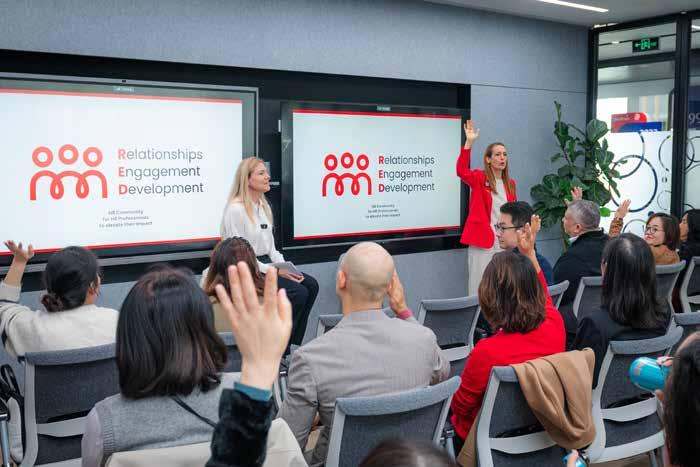
Each of the HR heads who have joined R.E.D. has had multiple conversations with the team, helping shape a platform that increasingly reflects their real needs.
“I also feel a strong responsibility to embody the leadership I advocate. If I speak about sustainable leadership while exhausting my own team, the message loses all credibility. Leadership is not defined by what we say, but by what we consistently practice. This is why I chose to offer more days off than required by labor law—I’ve seen that when people are trusted and cared for, they become more engaged, effective, and committed,” shares Marion.
Away from work, Marion plays underwater hockey with her Shanghai team, Kool-Puck—a sport that is intense, technical, and deeply collective.
“It’s also a way for me to train at a high level, spend time with friends, and practice Chinese—all at once. It mirrors entrepreneurship perfectly: intensity, focus, teamwork, and trust,” she shares. “Beyond sport, I challenge myself to learn from every interaction. I constantly ask: How else could I see this situation? What am I missing? How much deeper can we go? Curiosity keeps me energized.”
“I’ve learned the hard way that sustainability starts with the body and the mind. Today, balance is not a luxury for me—it’s a condition for leadership,” she adds.
“In the next three to five years, I see R.E.D. growing as a reference platform for HR leaders who want to shape better workplaces—not just locally, but globally. I want R.E.D. to be a space where ideas travel across companies, industries, and cultures,” says Marion.
“I’m not working for short-term wins. I want to contribute to shaping a generation of leaders who understand that performance and humanity go together. If HR leaders are aligned, heard, and developed, their impact on organizations—and on society—is exponential,” she asserts. “Sustainability, for me, is playing the long game. And I’m committed to it.”

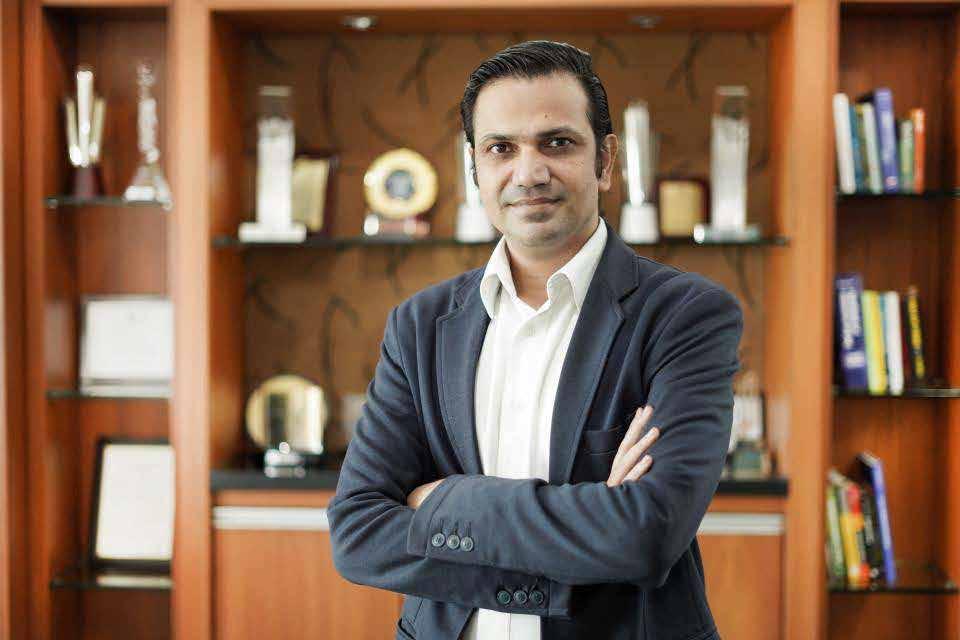
Dr. Richard Lobo Global Head Innovation, R&D, Business Excellence and Chief Ethics Counsellor
Who could have foreseen that bicycle mechanics would unravel the mysteries of flight and create a precedent for the invention of the aeroplane? The bicycle even today to me, provides the liberated sense of flying, making it easy to see how the earliest cycles inspired aviation pioneers.
In many respects, Innovators generally don’t wake up one morning seeking to do something radically new. They remain obsessed with a vision that no one else can fathom and they use strategies such as drawing inspiration from one or more remarkable inventions onto their own, or sometimes, well by chancing upon the solution by sheer accident, but in either case not before having toiled away for years. “The fault, dear Brutus, is not in our stars, but in ourselves that we are underlings.” Cassius says to Brutus in Act 1 of the Shakespearean play JULIUS CAESAR. In many ways, the new age adaptation of the great bard’s words - “it is not in the stars to hold our destiny but in ourselves” -captures well the spirit of determination and passion that drives most discoveries.
Today’s fast-paced business environments are demanding Innovation - not only for market-place success but also as culture and a way of life. There are clarion calls for strong leadership that encourages creativity, empowers employees to think differently, and drives the development of groundbreaking solutions. At the same time, how does one balance the very definition of innovation for different spheres of the business, while ensuring respect for traditional values even as we progress towards future ones? How does one create a culture where incremental innovations lead to confidence in delivering radical and disruptive innovations? All the while bearing in mind that incremental innovations are quicker to achieve than radical and disruptive innovations which often follow longer gestation periods of creative thinking.
Throughout history, certain innovations have not only revolutionized life when they first appeared but have continued to shape human progress for centuries. The wheel, invented over 5,000 years ago, remains the backbone of transportation and machinery even today. Writing systems, born in ancient Mesopotamia, still underpin communication in the digital age. Paper, first crafted in China, continues to be indispensable despite the rise of screens. Roman concrete laid the foundation for enduring architecture, while the compass opened the doors to global exploration and trade. The printing press democratized knowledge in the 15th century and remains vital for education and publishing. I suspect, the ancient Greeks would have experienced the same circa 800-300 BC, when the earliest notions of philosophy, logic, empirical medicine, and a monetised economy began taking prominence. These timeless innovations remind us that true breakthroughs are not fleeting—they become pillars of civilization, evolving with time yet never losing their relevance. They are proof that when human ingenuity meets necessity, the impact can echo across millennia.
Our world today faces a deep and urgent need for radical innovation, more so now than ever before. We have exhausted the planet’s 2025 resources by July 24, Earth Overshoot Day, using 1.8 times the Earth’s regenerative capacity. This strain is weakening the essential foundations that sustain life, industry and development. The pressures facing humanity today do not appear in isolation. They feed into one another in ways that shape the future with a speed that is hard to ignore. When water becomes scarce, agriculture falters and public health weakens. When climate patterns shift, ecosystems lose balance and communities face new vulnerabilities. When soil degrades, food security is threatened. When waste accumulates, ecosystems and economies both feel the strain. These realities demand more than incremental fixes. They call for scientific thinking that is practical, grounded and built to withstand long-term stress.
This is where the pursuit of radical innovation becomes a true lever for change.
Scientific work today is not limited to labs or models. It plays a tangible role in strengthening resilience by developing materials that can endure harsher conditions, processes that reduce environmental pressure and systems that help industries use resources responsibly. It advances water security through purification and reuse technologies that are both accessible and scalable. It supports farmers through tools that improve soil nutrition, crop health and planning accuracy. It helps protect public health by improving safety standards and reducing harmful exposures.
More importantly, research enables development that is fair. Good science creates solutions that support livelihoods, expand opportunities and reduce day-to-day risks for communities. It encourages industries to rethink processes, to develop circularity as part of design and not part of end-of-life approach, to adopt resource-efficient methods and to minimise waste. It brings together people across disciplines, cultures and geographies to solve shared problems. Every meaningful breakthrough, whether modest or large, strengthens the social and ecological systems we rely on.
It is not just about staying competitive in a changing world, though, without compromise on business profits. It is about innovating in all spheres of business while continuing to keep
true to our purpose and ethos which is to remain impactful, generations on and beyond, to improve the lives of customers, employees and importantly communities, AND to constantly remain a Leader in core areas, Disruptor in the new, and a Challenger in the most crucial of times.
And finally, as we stand on the brink of remarkable possibilities, driven by the unexplored potential of AI & ML, we are also deep in the throes of ever transforming to stay relevant – with the reimagination of products, services and business models, the shifting of consumer patterns, urgent call to action on Sustainability, the essential commitment to Human Rights and heralding change through Corporate Citizenship.
Possibly, a few lessons for us to reflect on for continuing to achieve radical innovations would be:
▪ Strengthen the Purpose while establishing Trust, backed by frameworks, philosophy, and appropriate recognitions. Invest in the moral compass.
▪ Nurture the culture especially for experimentation in line with the Purpose and embrace failures as much as we would celebrate successes.
▪ Provide a voice to the transformation. Silence is a killer in the journey of radical innovations in the wake of fear
of change, as are “Not invented here” syndromes or over-emphasis on complying with control systems (in-tolerance to audit gap findings).
▪ View crisis, unsurmountable challenges, and disruptions as opportunities to innovate and transform, especially through strategic collaboration and open innovations.
▪ Formulate business models and spirit of innovation to impact humanity, philanthropy, and ethics beyond profits.
▪ Manage risks and strike a balance between incremental and radical innovation as necessary to ensure long term sustainable growth.
People will always be at the centre of our transformations, braving the challenges of tomorrow. The need to innovate will never cease, the need to create will always find the light, the need to leave the world a better place will always awaken our souls. Our purpose and values should serve as the North Star as we empower people and the generations ahead to innovate radically and thoughtfully. As rightly said by Rumi, the renowned 13th century Sufi saint, scholar, and Persian poet, “The earth turns to gold, In the hands of the wise”.


In today’s fast-changing world, sustainability is no longer a buzzword — it’s a business imperative. Companies that once treated environmental and social responsibility as optional extras now face growing pressure from customers, investors, regulators, and employees to embed sustainable practices into their core strategies. As we enter the next decade, the business of sustainability will redefine how companies operate, innovate, and grow. But what exactly does this future demand?
In this article, we explore the evolving landscape of sustainability in business, the strategic opportunities it presents, and how companies can thrive while advancing environmental stewardship and social impact.
Sustainability is rooted in the idea that economic growth should happen in harmony with environmental protection and social equity. But recent global trends have accelerated its importance:
▪ Climate urgency: With extreme weather events on the rise and carbon levels at record highs, businesses are under increased scrutiny to reduce their environmental footprint.
▪ Consumer demand: Modern consumers prefer brands that are transparent and environmentally responsible. According to multiple market studies, sustainability influences purchasing decisions across age groups — especially among Gen Z and Millennials.
▪ Investor focus: ESG (Environmental, Social, Governance) investing has moved mainstream. Companies with strong sustainability metrics tend to attract capital more easily and often trade at higher valuations.
▪ Regulatory pressure: Governments around the world are tightening regulations on emissions, waste management, and corporate reporting — making compliance a key strategic consideration.
These forces are converging to make sustainability a bottom-line issue — not just a moral one.
For many leaders, the challenge isn’t just to “be sustainable” but to leverage sustainability as a growth driver. Forward-thinking companies are already recognizing that sustainability enhances competitiveness in these ways:
Companies are designing products with recycled materials, developing zero-waste manufacturing processes, and investing in renewable energy. These innovations do more than reduce impact — they create new market opportunities. From biodegradable packaging to electric vehicles, sustainability-driven innovation is reshaping entire industries.
Energy efficiency, waste reduction, and optimized supply chains aren’t just eco-friendly; they also cut operational costs. For example, energy savings through solar installations or smart systems can significantly reduce long-term expenses and improve profit margins.
Today’s consumers aren’t easily impressed by empty
promises. They want integrity. Transparent sustainability initiatives — backed by measurable results — build trust, attract repeat customers, and fuel word-of-mouth growth.
To succeed in the business of sustainability, companies must be responsive to emerging global trends. Below are the core areas that will define sustainable business models in the coming decade.
A growing number of corporations are pledging net-zero emissions. But meaningful climate action requires measurable targets, transparent reporting, and a roadmap to reduce emissions across operations and supply chains. Carbon offsetting alone won’t suffice — companies must prioritize reduction first.
Traditional linear economies (take, make, dispose) are giving way to circular models that emphasize reuse, recycling, and regeneration. Businesses are rethinking product lifecycles — from design and sourcing to end-of-life recovery — to minimize waste and preserve resources.
Global supply chains are complex and often opaque. The next decade will demand rigorous sustainability standards from suppliers, including responsible sourcing, labor rights compliance, and carbon tracking. Supply chain resilience will become synonymous with ethical and sustainable sourcing.
The food and agriculture sector is facing intense pressure to reduce emissions, conserve water, and protect biodiversity. Regenerative farming, plant-based alternatives, and smart food systems are gaining traction as sustainable pathways that also enhance food security.
Financing sustainability initiatives requires innovative financial instruments. Green bonds, sustainability-linked loans, and impact investing are empowering companies to fund large-scale transformations while giving investors measurable impact metrics.
Sustainability isn’t just about technology and metrics — it’s about people. Whether it’s leadership commitment, employee engagement, or community partnerships, people are at the heart of effective sustainability strategies.
Business leaders must champion sustainability with clarity, action, and accountability. A strong sustainability vision cascades throughout the organization and inspires employees to contribute meaningfully.
Employees — especially younger generations — are increasingly motivated by purpose-driven work. When companies invest in sustainability training, empower green teams, and recognize eco-innovators internally, they unlock higher morale and retention.
Sustainability isn’t confined within corporate walls. Partnerships with NGOs, communities, and government agencies amplify impact. Shared sustainability goals — such as clean water access or waste reduction initiatives — create value beyond profits.
Measuring What Matters: Accountability and Transparency
One of the major criticisms of early sustainability efforts was a lack of measurement. Companies often made bold claims without backing them up with data. The next decade demands rigorous sustainability measurement supported by technology and transparent reporting.
Here’s how companies can improve their accountability:
1. Adopt Standardized Metrics
Frameworks like GRI (Global Reporting Initiative), SASB (Sustainability Accounting Standards Board), and TCFD (Task Force on Climate-related Financial Disclosures) enable consistent and credible reporting. Standardized metrics make it easier for stakeholders to compare performance across companies and industries.
2. Leverage Technology for Tracking
IoT sensors, blockchain logistics, and AI analytics allow real-time monitoring of emissions, energy consumption,
waste streams, and supply chain footprints. Data-driven insights help companies make smarter decisions and prove results to stakeholders.
3. Transparent Reporting and Communication
Public sustainability reports should be honest, clear, and accessible. Transparency isn’t just about compliance — it builds trust with customers, partners, and investors.
While the trajectory toward sustainability is clear, the journey isn’t without obstacles:
▪ Cost pressures — Initial investments in clean technologies can be high.
▪ Regulatory complexity — Compliance across global markets requires careful navigation.
▪ Greenwashing risks — Misleading claims can damage reputation and invite legal scrutiny.
▪ New revenue streams from sustainable products and services.
▪ Enhanced brand equity with purpose-driven marketing.
▪ Resilient operations positioned for long-term growth.
Companies that embrace sustainability holistically — rather than as a compliance checkbox — will emerge stronger, more resilient, and better equipped to lead in a world where environmental and social health matter as much as financial performance.
Conclusion: Sustainability as the New Business DNA
The next decade will be defined by how well companies integrate sustainability into their DNA. Organizations that see sustainability as a strategic advantage — not a cost center — will outpace competitors, attract loyal customers, and secure long-term value.
Sustainability isn’t a destination but a continuous evolution — one shaped by innovation, transparency, ethics, and human ingenuity. As businesses navigate this new era, those that align purpose with profitability will lead the charge toward a more equitable, resilient, and thriving future.

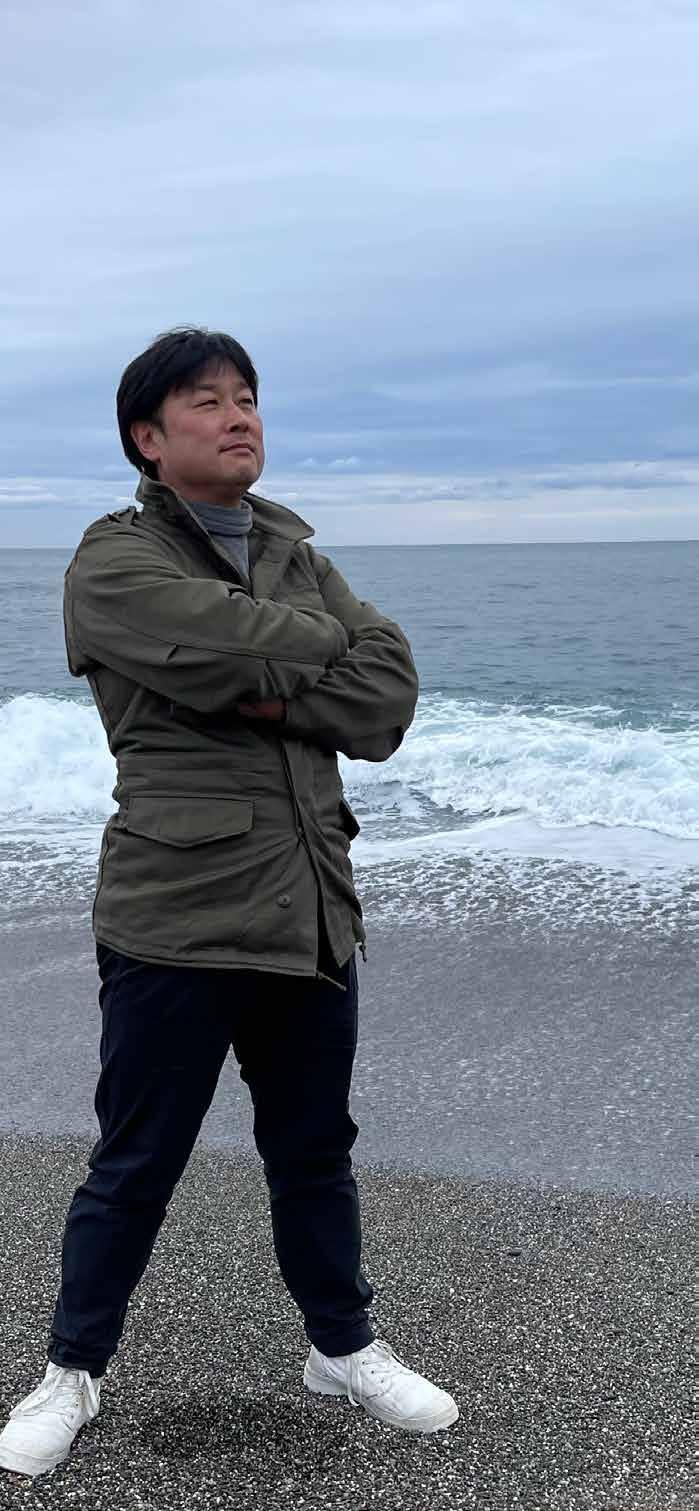
Before sustainability became a strategy and technology became an obsession, Hideki Tominaga, CEO of Socialis Inc. (operating as SOZ Corporation), was already asking a quieter, more dangerous question: what happens when progress forgets the human soul? From transforming a child’s block toy into museum-worthy art to reimagining technology as an extension of human wisdom, Hideki’s journey is not about building faster systems—it is about restoring meaning, perspective, and humanity at the heart of innovation.
Some leaders are shaped by systems. Others are shaped by the courage to look at the same thing differently. Hideki Tominaga’s belongs unmistakably to the latter.
Long before sustainability became a headline or climate consciousness entered boardroom vocabulary, Hideki was already practicing its most fundamental principle: transformation without excess. His professional journey began in 2004 with the founding of SOZ CORPORATION, where he entered the fiercely competitive assembly block toy market. Surrounded by industry giants and constrained by conventional definitions of value, Hideki chose an unconventional response—not reinvention of the product, but reinvention of perspective.
By redirecting the application of what was considered a simple children’s block toy into the interior design world, he elevated its design sophistication and cultural relevance. What had once been dismissed as “not cool” was reimagined as interior art. Without altering the product itself, it crossed an invisible boundary—one that separates commodity from culture—and was acquired for the permanent collection of the Louvre Museum of Decorative Arts in Paris. It was a quiet but profound validation: value is not always created by addition, but often by vision.
This experience would become the philosophical backbone of everything that followed. For Hideki, sustainability is not restraint—it is intelligence. It is the ability to shift perspective and unlock latent potential already present.
Hideki’s sustainability mindset was not born in adulthood, nor did it emerge from policy papers or data-driven forecasts. Its roots lie much earlier, in childhood, with Fabre’s Book of Insects.
That book taught him something enduring: the power of honest observation. Nature, when observed deeply and without bias, offers wisdom that surpasses volumes of analysis. This principle—learning from what already exists rather than endlessly dissecting it—continues to inform his leadership philosophy.
His intellectual influences span civilizations and centuries. Eastern historical texts from China and Japan shape his sense of continuity and responsibility. Western figures such as Alexander the Great inform his understanding of ambition and strategic vision. In the corporate realm, the founders of Sony and Apple stand as examples of how belief, creativity, and courage can reshape industries. And in art, Beethoven embodies the indomitable fighting spirit—the refusal to surrender one’s inner voice.
Together, these influences converge into a leadership style that values depth over speed, conviction over trend, and humanity over automation.
Hideki’s calling toward sustainability was not triggered by a single dramatic moment, but by a persistent sense of discomfort. As society increasingly tilted toward technology-first and efficiency-first mentalities, he felt something essential was being overlooked.
He respects nature deeply and loves everything born from it. Watching services and systems drift further away from human warmth and creative spirit, he began asking himself a recurring question: Can this be brought closer to nature? Can it be brought back to humanity?
These questions became inflection points. Rather than criticize from the sidelines, Hideki chose to build. Sustainability, for him, is not opposition to technology—it is a refusal to let technology erase what makes us human.
The lessons learned during the transformation of block toys into interior art were not isolated successes; they were preparation. They taught Hideki how to create value without compromise, how to innovate without waste, and how to remain aligned with a larger purpose.
This ability to shift perspectives—to find new meaning without abandoning foundational integrity—became the cornerstone of his later ventures, including Socialis.inc. Sustainability, in this context, is not a department or a checklist. It is a way of seeing.
The origin of Hideki’s current vision is rooted in a simple belief: humans are born from nature, and business must remember this truth.
As he observed the rise of services built on shallow efficiency and hollow optimization, his discomfort deepened. Approaches that disregard humanity and creativity, he believes, are fundamentally unsustainable—not ethically, and not economically. End-users are human beings, after all, and systems that forget this will inevitably fail.
Hideki’s evolving philosophy of sustainable business rests on three pillars: respect for nature, faith in humanity, and closeness to people. These are not slogans. They are design principles.
Building a sustainability-driven organization comes with unique resistance—particularly in the current investment climate. Hideki speaks candidly about this challenge.
Many investors and venture capital firms, he observes, chase surface-level trends. Sustainability becomes a label rather than a question, a buzzword rather than a responsibility. Following these fleeting currents often leads away from what truly matters.
Hideki has refused to dilute his philosophy to fit popular narratives. As a result, institutional investment has not come easily. Yet this restraint has proven its own form of resilience. Support has arrived through angel investors who share a belief beyond technology-first thinking—investors who understand that depth, not speed, builds lasting value.
At the heart of Socialis.inc lies an ambitious undertaking: a next-generation search and exploration engine designed unlike anything currently in use. Its defining feature is not raw speed or automation, but a grand visual interface that encourages multidimensional thinking.
The goal is to dissolve biased perspectives and allow people to approach a single piece of information from diverse angles. Rather than replacing human intelligence, the platform is designed to enhance it—to show the splendor of technology when it serves creativity and understanding.
Hideki is confident that the final form of this service will surprise people. Not because it mimics humans, but because it trusts them.
For Hideki, leadership begins with belief—belief in the depth and preciousness of human beings. In an era that often reduces people to metrics and outputs, he considers it his responsibility to demonstrate a heart and vision that recognizes what is frequently forgotten.
Within his organization, this belief translates into action. He entrusts his team with grand projects, offering not just roles, but opportunities for lifelong business creation. Accountability, innovation, and environmental consciousness emerge naturally when people are trusted with purpose rather than managed through fear.
Hideki understands that shaping a sustainable future requires inner sustainability as well. His
grounding practices are reflective and timeless.
He studies the lives of historical figures who shaped the world through aspiration, visualizing their journeys to gain perspective. Classical music serves as a personal sanctuary—a noble universe that heals, expands imagination, and restores the soul. Nature remains his constant companion, offering a sense of time unmeasured by deadlines.
These rituals are not escapes; they are recalibrations.
Looking ahead three to five years, Hideki envisions growth with ambition and realism. Becoming a listed company is part of the plan—but it is a method, not a destination. Going public is a tool to demonstrate that great projects can be realized within existing systems without sacrificing values.
The ultimate goal is far more expansive: to free the human mind from bias, to help humanity reclaim its role as a symbol of wisdom, and to stand as proof that profit and purpose are not opposites.
Hideki Tominaga’s journey is a reminder that sustainability is not about doing less—it is about seeing more. And in a world rushing toward artificial intelligence, his work insists on something quietly radical: faith in human intelligence itself.


Yogita Tulsiani Co-founder & Director, iXceed Solutions
In the midst of a technological revolution that is redefining industries, business models, and even human potential, the talent ecosystem is undergoing its own silent transformation. The world of work is no longer bound by borders, titles, or even traditional qualifications. In this post-digital era—where artificial intelligence, automation, and analytics dominate the conversation—the real differentiator for organizations lies not in how advanced their tools are, but in how thoughtfully they use them to empower people.
As someone deeply immersed in the global HRTech and talent mobility landscape, I’ve seen firsthand how AI is disrupting recruitment, how hybrid work is reshaping engagement, and how organizations are being called to do more than just “hire fast.” They must now hire right, hire fairly, and hire with foresight. And that shift, at its heart, demands a leadership approach that blends purpose with performance, and technology with trust.
The Great Talent Paradox
Today’s global workforce is both more connected and more fragmented than ever before. On one hand, we have a vast digital talent pool accessible through platforms, networks, and gig marketplaces. On the other, companies still struggle to fill critical roles, manage attrition, and ensure skill alignment. We call this the talent paradox: a world overflowing with resumes, but starving for relevance.
The reasons for this paradox are structural. Traditional hiring systems still rely heavily on past roles, degrees, and linear career paths. But innovation doesn’t follow a straight line. What today’s economy needs is not just credentialed candidates, but adaptable problem-solvers—many of whom exist outside conventional filters.
At iXceed, we challenged this paradigm by actively sourcing and reskilling non-engineering graduates for tech roles. With the right training, these candidates often outperformed their peers in adaptability and
retention. This experience transformed our global talent strategy: we began hiring not for what a candidate had done, but for what they could become.
HRTech has traditionally focused on speed and scale. And yes, those are important. But speed without empathy, and scale without purpose, lead to transactional hiring—where candidates are numbers, not narratives.
In a post-digital world, where automation can screen millions of profiles in seconds, the human layer becomes the value layer. How we engage with talent, the experience we offer them, the transparency we uphold—all these become strategic levers.
Purpose-driven hiring means:
▪ Prioritizing diverse, inclusive, and equitable pipelines
▪ Measuring success not just in time-to-hire, but in time-to-impact
▪ Designing roles that support employee growth, well-being, and autonomy
Purpose is no longer a branding tool—it’s a business imperative. Candidates today care about who they work for and what their work stands for. And so do clients.
Let’s address the elephant in the interview room—AI is here, and it’s here to stay.
At iXceed, we’ve implemented AI to automate resume parsing, skill matching, interview scheduling, and even early-stage communication. This has reduced hiring cycles by up to 40% for our enterprise clients.
But here’s the nuance: we don’t use AI to replace recruiters. We use it to amplify them. Technology handles the volume, while our consultants handle the value—engaging candidates, understanding context, and assessing cultural fit.
In this model, AI is the co-pilot, not the captain. And that distinction is crucial. The future of recruitment isn’t algorithmic—it’s augmented
Ethical AI is another area where leadership must step up. Bias in algorithms is a real risk, especially when trained on biased historical data. We audit our recruitment tech for fairness and maintain human oversight in every decision that impacts a person’s career. Because when you automate hiring, you also automate responsibility.
We are now truly operating in a borderless talent economy Remote work, cross-border employment platforms, and cloud-based collaboration have enabled companies to hire from anywhere. But global hiring is not just about tapping into cheaper labor or larger pools—it’s about accessing diverse thinking and market-specific insight
For example, when expanding our operations to India and the Middle East, we localized our delivery models to reflect cultural, regulatory, and linguistic nuances. This created deeper client empathy, faster delivery, and higher candidate engagement
However, cross-border hiring comes with its own challenges: compliance, payroll, taxation, and—perhaps most importantly—trust. In my view, trust is the new currency in global
talent strategy. Building it requires transparent onboarding, ethical data use, and consistent delivery—regardless of geography.
One of the biggest shifts I’ve seen in the last five years is a move from output-driven to outcome-driven leadership Clients no longer want vendors who fill roles—they want partners who enable results.
To lead in this environment, we need:
▪ Agility: to pivot with changing skill needs and workforce models
▪ Resilience: to build systems that can absorb shocks, from economic downturns to AI disruptions
▪ Integrity: to do what’s right for clients and candidates, even when it’s not the easy path
At iXceed, our most successful projects weren’t the ones with the biggest budgets—but the ones where we were deeply embedded in the client’s vision. Where we co-created solutions, shared accountability, and treated every hire as a strategic investment, not a transaction.
For those entering the HRTech space today, the opportunities are
enormous—but so are the responsibilities. Here’s what I tell every founder, innovator, and dreamer in this space:
1. Lead with purpose. Let your “why” guide your “how.”
2. Solve for people, not just process. Tech is a tool, not a strategy.
3. Build trust through action. Ethical hiring, data privacy, and fairness aren’t features—they’re foundations.
4. Stay curious. The workforce is evolving daily; so must your thinking.
5. Be bold, but be kind. The world doesn’t just need smart leaders. It needs good ones.
The future of work is not just about automation or globalization. It’s about re-humanizing work in a world of machines. It's about creating ecosystems where talent thrives, innovation flows, and leadership is measured not by how many people you manage—but by how many lives you impact.
At iXceed, we remain committed to that vision. And I believe that with the right mindset, tools, and purpose, we can build a future of work that’s not just efficient, but truly extraordinary.

Executive Vice President of RD, Far Eastern New Century

Redefining Sustainable Polyester Through Science, Leadership, and ESG Innovation
Plastic was never meant to become permanent—but neither was the way we chose to use it. In a world grappling with waste, emissions, and accountability, one scientist quietly began rewriting the chemistry of responsibility. Dr. Fanny Liao, EVP of Research and Development at Far Eastern New Century (FENC), one of the world’s leading polyester and PET manufacturers, is advancing visionary research in sustainable polyester/PET at a defining moment when the industry must answer to impact. At the rare intersection where chemistry, leadership, and ESG converge, she is redesigning materials at the molecular level to serve both progress and the planet.
In the evolving language of global business, sustainability is no longer an aspiration—it is a matter of accountability. At the heart of ESG—environmental responsibility, social stewardship, and governance integrity—sits a question industries can no longer defer: How do we grow without costing the planet its future?
For Dr. Fanny Liao, sustainability is not a trend to follow but a scientific, operational, and moral imperative to execute. As Executive Vice President of Research and Development at Far Eastern New Century (FENC), one of the world’s leading polyester and PET manufacturers, she stands at the intersection of chemistry and consequence, transforming one of the most widely used materials on earth into one of the most responsibly reimagined.
Dr. Liao’s journey began with chemistry, but it was shaped by choice. She earned her bachelor’s degree from Fu-Jen Catholic University in Taiwan and later completed her Ph.D. at the State University of New York at Stony Brook. While pursuing her doctorate, she also undertook a patent law internship at a New York patent law firm—an early signal of her instinct to bridge science with real-world application and protection of innovation.
After postdoctoral research, she faced a defining crossroads: academia or industry. Despite receiving an offer for a professorship, Dr. Liao chose the chemical industry, drawn by the scale, immediacy, and impact it could offer. She began her professional career in the petrochemical industries, working across commodity and specialty chemicals, grounding her scientific expertise in industrial reality.
Her trajectory deepened when she joined the Far Eastern Group (FEG), a global conglomerate whose subsidiary, Far Eastern New Century, produces millions of tons of polyester and PET annually. Within this ecosystem, Dr. Liao became involved in chemicals related to polyester feedstock, placing her at the core of materials that shape everyday life—from packaging to textiles.
Over 28 years at FEG, her experience expanded across an extraordinary spectrum: specialty chemical project management, medical device research and manufacturing, PET bottle recycling operations, biotechnology venture capital investments in the United States, joint venture management in Canada, brewery construction and operations in China, and billion-dollar mergers and acquisitions in the U.S. Along the way, she built a reputation not only as a scientist, but as a negotiator and business leader adept at navigating complex global partnerships.
Today, she carries dual leadership roles—as President of Oriental Resources Development Ltd., overseeing medical device manufacturing, and as EVP of R&D at FENC, managing research facilities across Taiwan, Shanghai, and the United States, with a team of more than 150 professionals dedicated to sustainable polyester/PET and next-generation materials.
In 2008, Dr. Liao entered the medical device operations at a time of challenge. The business unit was operating at a loss. Under her leadership, it was not only turned around—it became the highest-profit-margin business unit within the Group for more than a decade.
At the same time, she took charge of the PET bottle recycling operation, which had suffered losses for ten years. Amid the global financial crisis, she reversed its fortunes within two years. That experience sharpened her realization: PET recycling was not merely a business challenge—it was an environmental responsibility. From that moment, sustainability moved from concept to conviction.
Dr. Liao initiated FENC’s bio-based PET research using agricultural waste—rice straw and corn stover—rather than edible sugar sources. This distinction mattered. Sustainability, in her view, must not compete with food security.
Through leadership and partnership with U.S.-based Virent, FENC produced the world’s first batch of 100% bio-based PET bottles for Coca-Cola, showcased at the Milan Expo in
2015. A year later, the collaboration yielded the world’s first 100% bio-based polyester shirt, earning the 2016 European Bioplastic Award. These milestones marked her first decisive step toward PET sustainability—and set global benchmarks.
For decades, only transparent PET bottles were recycled into polyester. FENC pioneered bottle-to-bottle recycling in the 2010s, but Dr. Liao pushed further. Colored bottles, previously unrecyclable through mechanical processes, became her next frontier.
Her team developed chemical recycling through depolymerization, breaking PET down to raw materials and re-polymerizing it into virgin-quality bottles. The world’s first chemically recycled colored PET bottles were commercially launched for Coca-Cola beverages in Japan—another global first.
She then addressed what others ignored: colorful PET labels, typically incinerated and responsible for additional CO₂ emissions. Partnering with Coca-Cola Japan, her team achieved the world’s first label-to-label recycling via chemical processes, closing another loop in PET packaging.
With packaging solutions advancing, Dr. Liao turned to textiles, which account for roughly 60% of PET is used for textile applications, and 40% is used for packaging worldwide. Textile waste posed a greater challenge—mixed fibers, dyes, and materials demanded chemical recycling rather than mechanical solutions.
After years of research and multi-step development, FENC unveiled the world’s first polyester shirt made entirely through textile-to-textile recycling at the Taiwan Innovation Textile Application Show (TITAS). The innovation is now scaling toward ten-thousand-ton commercial capacity—signaling a new era for circular fashion.
Could polyester clothing be made from steel mill waste gas? For Dr. Liao, this was not science fiction—it was chemistry with purpose.
Through a partnership with U.S. biotechnology company LanzaTech, FENC commercialized polyester derived from captured steel mill waste gas, supplying global fashion brands including Zara, Lululemon, and H&M. By capturing and fixing carbon emissions into wearable materials, the innovation dramatically reduced polyester’s carbon footprint and opened a new chapter in sustainable fashion.
Mechanical and chemical recycling were not endpoints. Dr. Liao expanded sustainability further through collaboration with French biotech company Carbios, whose enzymes enable the biological recycling of polyester. Together, they achieved another world first: new polyester shirts made through the biological recycling of waste polyester.
Her vision continued into thermoplastic polyester elastomers (TPEE). Through chemical transformation, waste PET rigid bottles were converted into soft TPEE shoe midsoles. The world’s first recycled TPEE midsole was launched with French brand Salomon for Solamphibian shoes—offering a sustainable alternative to high-carbon,
hard-to-recycle TPU and EVA materials.
Perhaps most transformative is Dr. Liao’s work using CO₂ itself as a feedstock. Polyurethane, among the highest carbon-footprint plastics, traditionally relies on toxic isocyanates derived from phosgene. By replacing isocyanates with captured CO₂, her team developed non-isocyanate polyurethane (NIPU), significantly reducing emissions and toxicity.
This breakthrough earned the 2nd Prize at Germany’s 2025 Best CO₂ Utility Award—global recognition of chemistry applied with conscience.
Leading the Way Forward
Dr. Fanny Liao’s legacy is defined by execution as much as vision. From 100% bio-based PET and waste-gas-derived polyester to chemical and biological recycling, recycled TPEE, and CO₂-based NIPU, she has authored multiple world-firsts in sustainable plastics.
She is not merely advancing materials science—she is redefining what responsible industrial leadership looks like in the ESG era. With her team and global partners, Dr. Liao continues to lead the way toward a greener, more accountable future—one molecule, one breakthrough, and one decision at a time.


Minds Search and M Capital
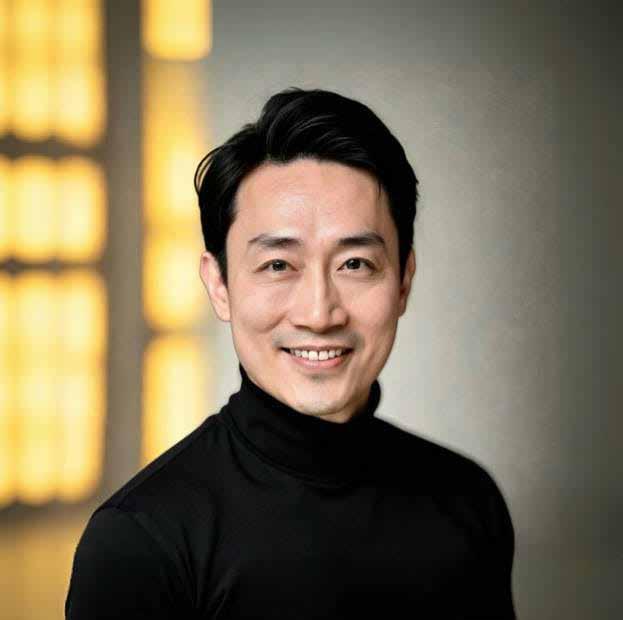
he numbers tell a sobering story. A 2025 Fortune survey revealed that 87% of founders grapple with anxiety, depression, or burnout. Across the global workforce, 66% of professionals report feeling overwhelmed by relentless pace and pressure. These aren't isolated incidents. They're symptoms of modern business ecosystems moving faster than the humans powering them. While companies chase exponential growth and technological advancement, leadership teams fracture under weight they were never designed
to carry. Strategic plans remain flawless on paper, yet execution crumbles because the people at the helm are running on empty.
This is the paradox Gavin Ng has spent nearly two decades dismantling. The founder of Minds Search and M Capital operates from a conviction that challenges conventional Silicon Valley wisdom: sustainable leadership isn't a soft advantage; it's the hardest competitive edge a company can build. Where most executive search firms chase speed and credentials, Ng
architects human infrastructure. Where traditional investors measure quarterly returns, he measures founder resilience. His philosophy is deceptively straightforward yet radically different: companies don't collapse from lack of strategy; they collapse from lack of sustainable leadership.
Growing up in Hong Kong shaped Ng's early understanding of speed, ambition, and relentless reinvention. But his most profound lesson came from observing what research now confirms about modern work systems: they're built for efficiency and output, not human sustainability. The teacher was his father, a man who belonged to a generation where hard work meant survival, where personal wellbeing was perpetually postponed to a "later" that rarely arrived.
"I didn't learn sustainability from a perfect role model. I learned it from contrast," Ng reflects. That childhood absence became foundational insight: unsustainable living doesn't just exhaust individuals—it reshapes families, connections, entire life trajectories.
The pattern followed him into management consulting and entrepreneurship. When he founded Minds Search in 2007, he found himself immersed among founders, investors, and senior leaders across Asia. He watched companies scale at breathtaking speed while people burned out at the same pace. Leadership teams misaligned under pressure. Cultures stretched thin as growth accelerated. Talented individuals crumbling because systems demanded more than humans could healthily give.
Then came his own reckoning—a quiet burnout early in his career that forced a fundamental question: What's the point of building something that cannot support the person building it?
That inflection point rewired everything. Ng began viewing clarity, wellbeing, and alignment not as luxuries but as strategic resources. When leaders are depleted, creativity narrows, relationships weaken, decision-making becomes reactive. No amount of capital compensates for an exhausted leadership core.
Minds Search was born from frustration with an industry rewarding speed over depth, credentials over character. Traditional recruitment filled roles; Ng wanted to build ecosystems. Harvard Business Review estimates a single failed executive hire costs up to 15 times their salary, but financial damage pales beside cultural and human fallout.
His approach diverges sharply from convention. Instead of chasing surface-level qualifications, Minds Search assesses behavioral indicators, adaptability to new technology, decision-making maturity, and capacity to grow with companies—not just perform on day one. The firm evaluates whether leaders can endure, not merely execute.
"You cannot build anything sustainable if you ignore the human being at the center of it," Ng states plainly.
This philosophy extends into Leadership Sustainability Audits—diagnostic deep-dives exposing where structures are unclear, where decisions bottleneck, where emotional load silently drains teams. A fast-scaling AI company in Southeast Asia exemplifies this work. The founder juggled multiple roles, decisions stalled at the top, the leadership team neared breaking point. Rather than reactive hiring, Ng redesigned their entire Leadership Architecture—clarifying responsibilities, installing a sustainable COO-CPO model, placing resilient leaders with AI literacy and
long-term capacity. Within months, strategic clarity returned. The company regained its rhythm.
Another case involved a Series B startup in Singapore hemorrhaging senior leaders annually. The issue wasn't talent scarcity, it was operational chaos. Meetings dominated schedules, decisions lacked clarity, leaders felt paralyzed. After redesigning their leadership operating system, unnecessary meetings dropped nearly 50%, decisions accelerated, and the team finally felt supported. The founder's realization was stark: "We didn't need more people, we needed more clarity."
By 2023, Ng recognized that sustainability doesn't depend solely on talent decisions—it hinges equally on capital decisions. The type of capital companies accept shapes culture, pace, expectations. Misaligned capital accelerates burnout as rapidly as misaligned leadership.
M Capital emerged from this insight, backing mission-driven founders building in AI and transformative technologies. But investment here means more than writing checks. Post-investment, Ng continues supporting founders with leadership advisory, organizational design, and sustainable scaling frameworks.
The investment in a European growth venture exemplifies this philosophy—a virtual co-working platform enhancing focus, wellbeing, and sustained performance through deep-work sessions, structured support, and remote-work systems. It's a business model protecting mental clarity, strengthening human capacity, building resilience—precisely what's critical as AI and hybrid work place unprecedented demands on attention and endurance.
"Sustainability in investment means choosing leaders and businesses who
understand the balance between innovation, people, and pace," Ng explains.
Ng's cross-cultural experience across Hong Kong, China, Singapore, Thailand, and Southeast Asia informs his models profoundly. Asian leadership often carries multi-generational responsibility, to family, community, team, with decisions made through lenses of long-term continuity. Traditional expectations position leaders as figures who stay strong, work harder than everyone else, carry pressure quietly.
Introducing leadership sustainability in these contexts initially felt countercultural. "Talking about sustainability at that time felt unusual, because many founders believed success meant pushing through, not slowing down to build foundations that last," he recalls.
External shocks—market downturns, financial crises, industry upheavals—tested this philosophy repeatedly. Companies with clear structures and stable leadership bounced back significantly faster than those built around chaos. Crisis revealed who had built sustainably and who hadn't.
The rise of AI added fresh complexity. A 2024 global survey found over half of leaders don't feel ready for AI-driven change. Technology evolves exponentially; humans don't. Without sustainable leadership, the gap widens and organizations fracture. This reality pushed Ng to emphasize adaptability, emotional stability, and learning speed in leadership assessments, traits now essential for the AI era.
Ng's approach to personal sustainability anchors in a core principle: clarity gives energy; chaos takes it away. He moves daily doing
activities like strength training, cardio, tennis, or yoga for 45-90 minutes, because exercise resets his mind and returns him to presence. Nutrition follows disciplined simplicity: high-protein meals, daily greens, hydration, sunlight, strong sleep hygiene. These practices provide a stable physiological base enabling good decisions and emotional availability.
For mental clarity, he relies on journaling and meditation. Writing slows thinking, processes complexity, transforms signal noise into structure. Intentional solitude, even 15-20 minutes daily, gives space to reset emotionally and reconnect with his inner compass beyond momentary urgency.
One boundary he holds firmly: "I do not lead from depletion." When feeling unclear, tired, or emotionally stretched, he pauses and recalibrates. Leaders often push through exhaustion, but he's learned that when depleted, organizations absorb consequences including rushed decisions, reactive communication, unnecessary tension.
Regular self-audits keep him anchored. Monthly or quarterly, he asks: Am I aligned or operating on autopilot? Am I moving from clarity or pressure? Does this work energize or quietly drain me?
"Your business cannot be healthier than you," he tells founders consistently.
The vision for the next three to five years is ambitious yet grounded. Minds Search will evolve beyond hiring into next-generation leadership design, helping companies build structures, cultures, and teams thriving amid AI, complexity, and constant reinvention. M Capital will strengthen its position as a sustainability-first investment firm, backing founders approaching growth with clarity,
emotional maturity, and responsible ambition.
A centerpiece of this evolution is Founders' Circle, a wellbeing platform for founders across Asia. Too many experience pressure in isolation, facing higher anxiety and burnout rates than the general workforce. Founders' Circle provides space for strengthening resilience, gaining clarity, learning sustainable operating habits. It will grow into a regional community equipped for AI-era demands—a place for meaningful conversations, shared wisdom, emotional grounding, and strategic clarity.
Ng's long-term vision is ecosystem-level: leaders sustaining themselves, organizations growing with integrity, innovation advancing without sacrificing human wellbeing. His work sits at the intersection where business performance meets human endurance, where ambition meets responsibility, where the future of work must reconcile with the limitations of those building it.
If one word defines Ng within the sustainability lens, it's Purposeful, because purpose creates direction, determines how leaders hire and build systems, and forms the foundation of sustainability in business, leadership, and self.
The companies that endure won't just be those with the strongest technology. They'll be those with the strongest people, the clearest systems, the most sustainable foundations. Gavin Ng is building the architecture that makes that endurance possible.
“Sustainability in investment means choosing leaders and businesses who understand the balance between innovation, people, and pace.”



In an era defined by disruption, rapid technological advancement, and evolving workplace values, leadership is no longer about authority alone. It is about clarity, consciousness, and purpose. The most impactful leaders today are not those who merely react to change, but those who lead with intent—shaping the future through deliberate vision, ethical decision-making, and people-first strategies.
Welcome inside the mind of a modern business visionary—where ambition meets empathy, and success is measured not just in profit, but in progress.
Traditional leadership models were built on hierarchy, control, and predictability. But the modern business landscape has rewritten those rules. Today’s visionary leaders understand that purpose is power. They lead not to command, but to inspire.
Leading with intent means knowing why you do what you do—and ensuring that purpose permeates every decision, from boardroom strategy to frontline culture. These leaders recognize that organizations with a clear mission outperform those driven solely by metrics. Purpose fuels resilience, attracts top talent, and builds trust with stakeholders in an increasingly values-driven economy.
Intentional leadership transforms companies from transactional entities into living ecosystems—adaptive, human, and future-ready.
At the heart of modern visionary leadership lies clarity. In times of uncertainty, employees don’t expect leaders to have all the answers—but they do expect direction.
Visionary leaders articulate a compelling narrative of where the organization is headed and why it matters. This clarity aligns teams, reduces friction, and
empowers individuals to act with confidence. Instead of micromanaging, intentional leaders create frameworks that allow autonomy within alignment.
Clarity also extends to personal leadership philosophy. Modern visionaries are deeply self-aware. They understand their values, biases, and strengths, and they lead from that authentic core. In a world saturated with noise, clarity becomes a strategic advantage.
Fast decisions are celebrated in today’s business culture—but intentional leaders prioritize thoughtful decisions over impulsive ones.
Leading with intent requires the discipline to pause, reflect, and consider long-term consequences. Visionary leaders balance data with intuition, logic with empathy. They ask better questions: Who will this impact? Does this align with our values? Will this decision still matter five years from now?
This depth of thinking enables sustainable growth. It also builds credibility. Teams trust leaders who act with consistency and integrity, even when decisions are difficult.
Intentional decision-making is not about perfection—it is about responsibility.
Perhaps the most defining trait of a modern business visionary is a people-first mindset.
Today’s leaders understand that innovation does not come from processes alone—it comes from people who feel seen, heard, and valued. Leading with intent means investing in employee well-being, psychological safety, and professional growth.
Visionary leaders foster cultures where diversity of thought is encouraged, failure is reframed as learning, and collaboration replaces competition. They listen actively, communicate transparently, and lead with empathy—especially during moments of change or crisis.
By putting people at the center, intentional leaders unlock loyalty, creativity, and collective excellence.
Success in the 21st century is no longer one-dimensional. Modern business visionaries are redefining what winning looks like.
Yes, financial performance matters—but so does social impact, environmental responsibility, and ethical governance. Leading with intent means aligning business objectives with broader societal goals.
These leaders embrace ESG principles not as compliance checklists, but as strategic imperatives. They recognize that long-term value creation depends on sustainable practices and responsible leadership.
True success is measured by legacy—the positive footprint an organization leaves on its people, its industry, and the world.
Change is constant, but intentional leaders know that adaptability should not come at the cost of identity.
Modern visionaries are agile thinkers. They embrace innovation, leverage technology, and continuously evolve their business models. Yet, they remain grounded in core values that act as a compass during transformation.
Leading with intent means knowing what should change—and what must never change.
This balance allows organizations to pivot without losing trust, scale without losing culture, and innovate without losing purpose.
Authenticity is no longer optional—it is expected. Modern business visionaries lead as real humans, not polished personas. They share their stories, acknowledge their challenges, and show vulnerability when appropriate. This authenticity creates connection and credibility.
Leading with intent means aligning words with actions. Employees and stakeholders can sense when leadership is performative versus principled. Authentic leaders build trust not through grand gestures, but through consistent behavior.
In a digital world craving human connection, authenticity becomes one of the most powerful leadership tools.
What truly separates a modern business visionary from a manager is vision—the ability to see beyond immediate outcomes and imagine what’s possible.
Intentional leaders think in decades, not quarters. They invest in innovation, talent, and relationships that may not yield instant returns but will define future success. They challenge the status quo and encourage bold thinking, even when it’s uncomfortable.
Visionary leadership is not about predicting the future—it is about shaping it.
Leading with intent is not a title or a trend—it is a daily practice. It shows up in how leaders listen, decide, communicate, and act. It is reflected in the cultures they build and the values they protect.
In a world hungry for meaning and direction, modern business visionaries stand apart not because they have more power—but because they lead with purpose, clarity, and conscience.
As organizations navigate an increasingly complex future, one truth remains clear:
The leaders who will matter most are those who lead with intent—mindfully, courageously, and humanly.

Leader’s Opinion

Sanjay Agrawal Executive Director, Ramesh Corp., Nepal
Leadership Lessons from Nepal’s Growth Journey by Sanjay Agrawal, Executive Director, Ramesh Corp.
IIn emerging economies, sustainability is often discussed through the lenses of climate action, governance, or corporate social responsibility. While these dimensions are critical, my experience suggests that sustainable development begins even earlier—with the creation of stable, trustworthy, and inclusive markets
Markets that fail to deliver quality, accessibility, or continuity cannot sustain growth, no matter how advanced policies or technologies become. Over the past decades, Nepal’s economic evolution has reinforced a fundamental leadership lesson: long-term sustainability is built by leaders who focus on institutions, ecosystems, and people—not just products or profits.
Ramesh Corp. began its journey more than fifty years ago as a trading business in a nascent economy. As Nepal evolved, so did the expectations from businesses. Consumers began demanding quality, reliability, and accountability, while the nation required infrastructure, connectivity, and industrial maturity.
Our transformation into a diversified business group—spanning mobile technology, consumer electronics, home appliances, building materials, and industrial products such as wires and cables, ceramics & vitrified tiles—was driven by a consistent leadership philosophy: growth must be meaningful, durable, and widely shared
Rather than chasing short-term trends, we focused on sectors that directly contribute to daily life, national infrastructure, and long-term economic resilience.
One of the most transformative forces in emerging economies is affordable technology. In Nepal, access to smartphones and digital tools has reshaped how people learn, communicate, transact, and build livelihoods.
Our engagement in the mobile and consumer electronics sector has been guided by a simple belief: technology should empower the many, not the few. By building nationwide distribution networks, strengthening after-sales service, and ensuring availability beyond major urban centers, we helped make reliable digital access a reality for millions.
This approach reflects a broader sustainability principle—accessibility is impact. When technology reaches smaller towns and rural communities, it catalyzes entrepreneurship, education, and financial inclusion, creating long-term economic momentum.
Economic growth is ultimately anchored in physical infrastructure—homes, workplaces, and public spaces that must endure for generations. Through our involvement in tiles, wires, and cables, we have learned that sustainability in construction is not just about aesthetics or cost efficiency; it is about safety, durability, and compliance with standards
High-quality wiring reduces fire risks. Durable tiles reduce renovation cycles. Standardized materials improve long-term urban resilience. These are not abstract benefits; they directly impact quality of life and national safety.
For business leaders, engaging in such sectors carries a responsibility to uphold standards, educate the market, and resist compromises that may yield short-term margins but long-term societal costs.
Sustainable markets cannot be built in isolation.
Leaders must participate in industry platforms and policy dialogue to strengthen the overall business ecosystem. My involvement with organizations such as the Nepal Italy Chamber of Commerce and Industry and the Mobile Phone Importers’ Association reflects this responsibility.
These institutions act as bridges—between private enterprise and policymakers, between domestic markets and international partners. Strong chambers and associations enhance transparency, encourage fair competition, and promote best practices, all of which are essential for sustainable economic growth.
Leadership, in this sense, is not about dominance but about contribution to shared systems.
CSR as an Extension of Leadership Values
At Ramesh Corp., corporate social responsibility is not treated as a parallel activity—it is an extension of leadership values. Through the Ramesh Gupta Memorial Trust, our focus on healthcare, particularly childhood cancer support, reflects a deeper belief: business success is incomplete if it does not improve human outcomes.
Consistent engagement, rather than episodic philanthropy, has taught us that empathy and impact are inseparable. CSR, when driven by purpose rather than visibility,
reinforces the moral foundation upon which sustainable enterprises are built.
Key Leadership Lessons from an Emerging Economy
Nepal’s business landscape offers several insights relevant across Asia and other emerging regions:
1. Sustainable markets are built, not captured –ecosystem health matters more than market share.
2. Product quality is a social responsibility – especially in sectors that affect safety and daily life.
3. Accessibility defines impact –growth must reach beyond metropolitan centers.
4. Institutions amplify leadership – chambers and associations create scale for ethical influence.
5. Values compound over time – trust becomes a strategic advantage during uncertainty.
These principles apply whether one is building technology platforms, consumer brands, or infrastructure solutions.
As global markets move toward 2026, leaders in emerging economies will face increasing pressure—from climate expectations, digital disruption, and shifting consumer values.
Navigating these complexities requires more than innovation; it requires discipline, patience, and institutional thinking
For me, sustainable leadership is measured not by expansion alone, but by continuity—of markets, of trust, and of opportunity for future generations. Businesses that endure are those that embed responsibility into their products, processes, and partnerships.
Sustainability is not a destination; it is a leadership practice. In emerging economies, where businesses often shape markets before regulations do, leaders carry a heightened responsibility to act with foresight and integrity. By building inclusive technology access, delivering reliable consumer products, strengthening infrastructure quality, and remaining anchored in social responsibility, businesses can become long-term partners in national development.
Ultimately, the most influential leaders are not those who grow the fastest—but those who build systems that last.

Leader’s Opinion

Doug Clark Business Leader, Consultant & Author
In many organizations, confusion starts with language. Teams say they are “transforming” a process and then assume the initiative is therefore a “transformation”. In practice, the label should be based on the scope and operating model's impact, not the intensity of change within a single area.
By mislabeling, change, and transformation are not just semantic issues. It shapes expectations, drives the wrong delivery approach, and leads teams to measure the wrong things. A well-bounded operational improvement gets elevated into “transformation”, the narrative inflates, fatigue grows, and people become numb to the next initiative. In other cases, leaders face work that genuinely requires a shift in capabilities and identity, but they manage it like a standard rollout with a project plan and communications calendar.
The label is not cosmetic. It determines the design, the leadership posture, and the metrics. This article aims to illustrate the importance and to offer practical diagnostic guidance. Change and transformation in the business world are not interchangeable; they are distinct and should be handled very differently. Within both lies a third reality that leaders often underestimate: transition.
The three-layer leaders must separate
1. Change is the visible work
Change is what you can point at: a new process, a system rollout, a restructuring, a revised policy, a new cadence of meetings. It is a visible shift from A to B and is often manageable through structured implementation discipline” (Lewin, 1947; Kotter, 1996).
Change can be significant. However, it tends to remain compatible with the organization’s existing logic: how decisions get made, how power flows, what “good” looks like, and what gets rewarded.
2. Transition is the human reorientation
Although transition is a distinct layer, it sits
underneath both change and transformation. It is the human process people move through, regardless of the size of the initiative. Transition is the psychological and social process of letting go of an old way of being competent, moving through uncertainty, and rebuilding confidence in the new state (Bridges, 2009).
This is where many “successful” implementations quietly fail. The process is live, the tool is launched, the training is complete, yet the behavior does not stick because the psychological transition has not yet been completed. People comply, but they do not commit to the long term and often revert to the old way of doing things.
3. Transformation is a shift in organizational identity and capability
Transformation occurs when the organization’s underlying assumptions must change: what it sells, how it creates value, the capabilities it relies on, how it is structured, and how it learns (Burke & Litwin, 1992; Schein, 2010; Teece, 2007).
Transformation cannot usually be delivered solely through adoption tactics. It requires changes to the organizational system: incentives, governance, decision rights, talent choices, leadership behavior, and cultural reinforcement mechanisms (Schein, 2010).
Questions a diagnostic leader can use tomorrow morning
If you want to avoid “transformation theatre”, ask these five questions, but note that no single question provides a perfect classification; taken together, these signals help you diagnose whether you are dealing with change or transformation in most organizational situations.
Question 1: Are we improving performance, or changing how “value” is created?
▪ If it is performance improvement within the same process and value stream, then you are most likely experiencing a change.
▪ If the value proposition, customer promise, or business model must evolve, you are likely facing transformation (Teece, 2007).
Question 2: Can we fully specify the target state now?
▪ If the destination is clear and definable, it is typically a change.
▪ If the destination must emerge through learning, iteration, and sensemaking, it is more likely a transformation (Weick, 1995).
Question 3: What must people learn and unlearn?
▪ Change often requires training and learning something new.
▪ Transformation actually requires us first to unlearn what previously made the organization and people successful, which is psychologically harder and politically riskier (Schein, 2010).
Question 4: Do incentives and decision rights need to change, and at what scale?
If you can succeed with limited, local KPIs or incentive adjustments within the current operating logic, it is usually a change.
If success requires redesigning decision rights, governance, and incentives across functions, you are likely dealing with a transformation, because authority and reward mechanisms reside within the organization’s structure and systems (Burke & Litwin, 1992).
Question 5: Is this complex change within the current operating model, or an operating model shift?
If multiple teams are involved and the work can be integrated into the current operating model, it is usually a change, even when complex.
If success depends on redesigning the operating model and coordinating a portfolio of interdependent initiatives over time, it is more likely a transformation (Burke & Litwin, 1992; Schein, 2010).
The most common trap: confusing a “big change” with transformation
A significant change is not automatically a transformation.
A multi-country system rollout can be enormous, complicated, and seem to be impacting the entire organization. However, if the business model, decision logic, and the organization's long-term strategy remain intact, it is still fundamentally a change.
The opposite is true of transformation; it can seem small at first, especially when it has only a minimal impact on the organization’s operating logic. The difference is whether they remain local improvements or trigger shifts in capabilities, governance, the definition of success, and the overall strategy over time.
The real test is not the size, but the depth.
A practical warning sign is the increasing number of “patch”-type changes being made to solve symptoms, but that do not resolve the underlying constraint. When you find yourself stacking changes on top of changes, it is worth
rerunning the diagnostic and checking whether the operating model still aligns with the strategy.
What changes once you name it correctly
Correct labelling is not semantic. It determines the approach, the leadership posture, and the metrics.
If it is a change:
Focus on adoption and operational stability.
Define “what good looks like”, remove friction, and reinforce the new way of working until it becomes routine (Lewin, 1947; Kotter, 1996). Measure adoption and performance outcomes, including usage, compliance, cycle time, error rates, and service levels.
If it is “transition” heavy: When people are letting go of an old way of doing things, communication alone is not enough. Leaders need to acknowledge the uncertainty; the people involved may even doubt their competency. You have to create space for questions, boost confidence through visible support, offer training, and celebrate early wins (Bridges, 2009). It is not enough to focus solely on compliance; if commitment is absent, the transition or change is incomplete.
If it is a transformation:
Focus on the operating model and capability.
Transformation requires more than adoption tactics and training. It will generally lead to a new strategy, often affecting who or
where decisions are made. The organizations, governance, incentives, and KPIs will, in most cases, be completely redone. Transformation requires capability-building so the new assumptions are reinforced by the system itself (Schein, 2010; Burke & Litwin, 1992). Measurement and incentives should shift toward the desired state. Leading indicators of becoming different, such as decision speed and quality, cross-functional throughput, customer outcomes, and capability maturity (Teece, 2007).
A simple warning sign is a measurement mismatch. In change, adoption metrics such as training completion can be a meaningful part of the measurement set. In transformation, training metrics may still matter. However, they are not sufficient unless paired with system-level and outcome indicators that demonstrate whether the organization is actually operating differently.
A final thought
If leaders mislabel change or transformation, the work inevitably gets mismanaged. When leaders call everything a transformation, they create fatigue and cynicism. When they treat transformation like change, they rely on plans and communications while leaving the operating model untouched. The point of this diagnostic is simple: name the work correctly, then lead and measure it accordingly.
One final cause of confusion is perspective. A department can undergo a significant overhaul and experience it as “transformational”, especially when it has autonomy over its own processes. However, if it continues to function as part of a broader value stream, it constitutes an organizational change, and not a transformation.
Transformation occurs when the operating model needs to evolve or shift direction entirely, which alters how multiple “parts” work together.
External expertise can support transformation through analysis, facilitation, and capability-building. However, you cannot outsource ownership, accountability, and visible leadership, nor can it be delegated. If senior leaders keep behaving like the old organization while asking everyone else to become the
new one, people will follow what is seen and done, not what is announced (Schein, 2010).
Doug Clark is a business leader, consultant, and author with 25+ years’ experience across operations, project delivery, general management, and organizational change and transformation. His career spans retail, technology, software, personal security, and manufacturing, with leadership experience across Africa, Latin America, and the Middle East. He is known for building practical execution systems that turn strategy into results, including operating rhythms, cross-functional governance, and performance frameworks that strengthen accountability and decision quality.
He writes at the intersection of leadership and management, with a particular interest in how organizations distinguish change from transformation and avoid “hero leadership” dynamics that create dependency and fragility. His work blends hands-on delivery experience with evidence-informed insight, translating complex ideas into actions leaders can apply immediately. Based in the UAE, Doug holds an MBA and is a Black Belt in Lean Six Sigma, and he is currently preparing for the PMP certification.
He supports organizations through consulting and delivery engagements and is currently open to senior leadership opportunities.
“Leadership and management are too often taught as theory without practical application. I write to bridge that gap with actions leaders can use.”
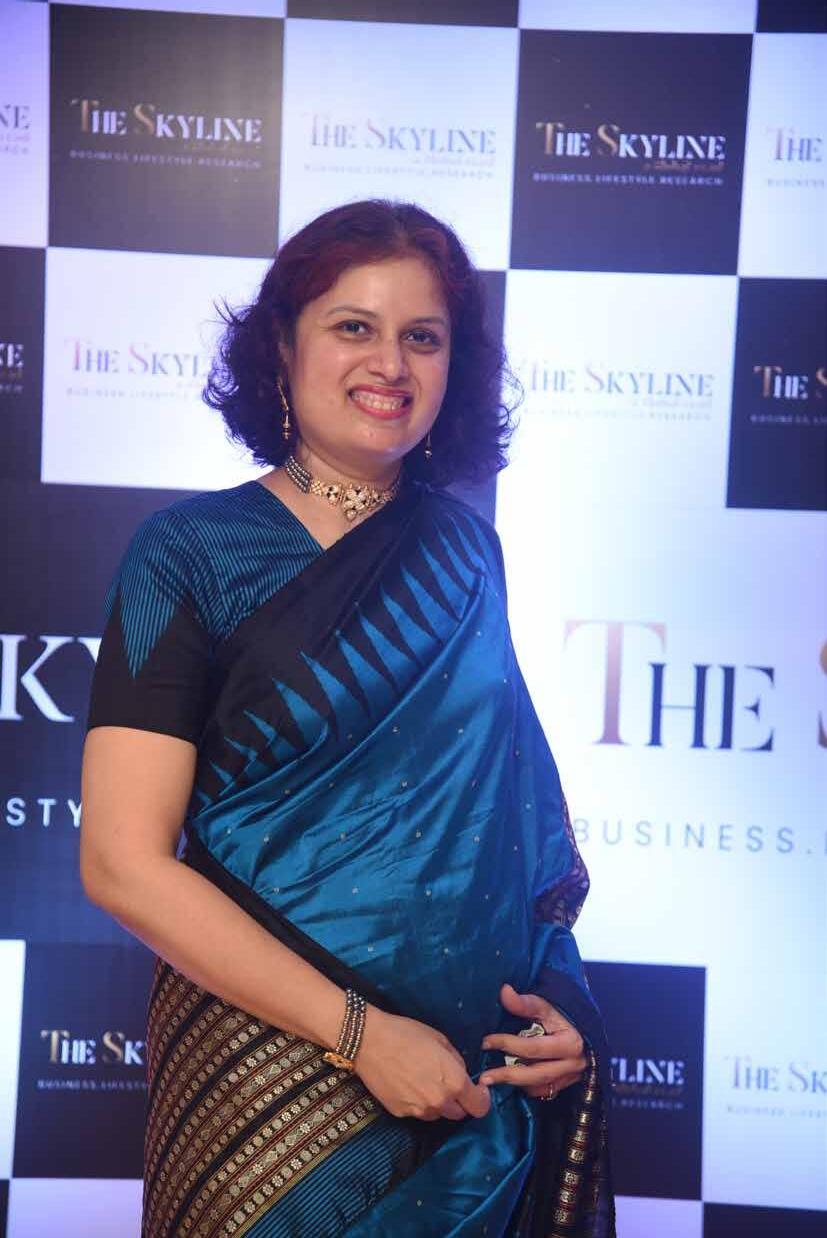
Pallavi Salgaocar
Chartered Accountant &Finance Director, Geno Pharmaceuticals Pvt. Ltd.
he day is not far when India will be the hub of industrial manufacturing, and the world will be looking towards us.” These words of Hon. PM Narendra Modi (15 August 2024) stayed with me at the MSME Adhiveshan in Goa, organised by Laghu Udyog Bharati.
At the programme, Director CSIR–NIIST, Dr. C.
Anandharamakrishnan, spoke about how CSIR (Council of Scientific and Industrial Research) can help power the next phase of growth for MSMEs. What I appreciated was the practicality. The focus was not on complex theory but on solutions that can be implemented on the ground.
India’s manufacturing base is already significant. Manufacturing contributes about 17% to India’s GDP, accounts for 17.5% of industrial production, and provides employment to over 273 million people. The manufacturing ecosystem is broad—chemicals and materials, electronics and energy, agri-food and biotech, heavy engineering and automobiles, textiles, and healthcare all contribute in different ways. This breadth is a strength, but it also means we need multiple “tools” to improve productivity, reduce waste, upgrade quality, and keep costs under control.
And then there are MSMEs—2.32 crore of them across the country—creating jobs, building supply chains, and supporting exports. The real question is: how do we equip them to compete in a world where markets are demanding not just quality and price, but also responsible production?
A key idea discussed was the direction in which manufacturing is headed. We have moved from traditional manufacturing to ‘Lean’ manufacturing (which focuses on cutting waste), and we are now steadily moving towards green, sustainable manufacturing. In simple words, “lean” is about reducing waste—waste of material, time, movement, inventory, or effort. “Green” is about environmentally responsible processes, anchored in the basics of reducereuse- recycle. “Sustainable” goes a step further: it builds long-term competitiveness while keeping resources, people’s health and safety, and the environment in mind.
This shift is not optional. India’s energy consumption growth is projected at 129% between 2015 and 2035—the highest among major economies—and India is also the world’s fourth-largest emitter of carbon dioxide. Globally, the objective highlighted is to limit warming to ideally 1.5°C, with 2°C as the maximum threshold. For MSMEs,
these are not distant numbers. They will show up as real expectations—from customers, global buyers, lenders, and even within supply chains—around energy use, waste management, and carbon footprint.
So where do MSMEs begin? They begin with access—access to practical science that can be adopted, adapted and scaled. That is exactly where CSIR becomes relevant.
One strong example shared was second-generation (2G) ethanol under the Biomass-to-Fuel programme (Pradhan Mantri JI-VAN Yojana). The core idea is simple: convert biomass into fuel. What makes it important is that it demonstrates the “how” in a real facility—showing steps like pretreatment, fermentation and distillation, along with careful water management through recycling and minimal discharge. For MSMEs, the lesson is encouraging: clean fuel solutions can be built around Indian conditions, and industry can participate through supply, fabrication, services, and local innovations around the value chain.
Another powerful concept presented is the CSIR–NIIST Hydrogen Valley Innovation Cluster. It shows an integrated ecosystem—from renewable inputs and electrolysis to ammonia production and storage, to hydrogen-powered public transport. It also links this to green ammonia and green urea for agriculture, and points to the movement of ammonia via Vizhinjam Port. The takeaway for me was the “systems approach”. A green transition doesn’t happen in silos. It happens when energy, transport, industry and agriculture move together.
Sustainability is not only about big plants and large infrastructure. It is also about everyday spaces—how we handle waste and how we keep the air cleaner. One example given to quote was an NIIST biodigester at Thiruvananthapuram International Airport converting food waste into bioenergy, and the airport being recognised for a zero-waste-to-landfill milestone. Alongside were self-powered environmental sensors and air-quality monitors designed to work even with indoor light. These may appear like small interventions, but they represent a very important point: when technology becomes practical and easy to deploy, sustainability becomes doable—at homes, campuses, hospitals, airports, and workplaces.
On the topic of air quality, the message was easy to understand: solutions are being developed and tested in real settings to improve indoor air and reduce harmful pollutants. The emphasis was on real-world performance, not lab-only claims. This matters because it creates a pathway for
MSMEs to participate—not only as users of technology, but also as manufacturers and service providers who can assemble systems, supply components, install units, and maintain them across multiple sites such as schools, offices and semi-indoor public spaces.
The discussion also reminded us that sustainability is equally about food and health. The food industry is described as growing at 10%, with a market size of 800 billion, and 98% of the industry belonging to MSMEs. With lakhs of small food processing enterprises—many unorganised and unregistered—the need for technical, financial and market support is real. This is an area where MSMEs can grow rapidly, but only if they upgrade quality, shelf life, safety, and nutrition.
Two examples stood out. One was fortifying rice kernels using protein, fibre and micronutrients—linked to concerns like anaemia and rising diabetes—so nutrition improves without changing everyday eating habits. Another was the concept of “designer hollow salt”, which improves the perception of saltiness while reducing sodium, with up to 86% reduction noted. These ideas show how innovation can meet people where they are: in everyday kitchens, daily meals and familiar staples. For MSMEs, such ready research can open up new product lines, better branding, and stronger acceptance in health-conscious markets.
In environmental solutions, CSIR’s footprint across 37 cities is significant because it signals reach and capability. The examples mentioned include municipal solid waste treatment and “waste to wealth” biodegradable products made from agro residues. There are also solutions for biomedical waste, sewage and faecal sludge treatment, and modular onsite
wastewater treatment technologies that can recover clean water, bioenergy and manure. This is where sustainability becomes local and immediate—cleaner neighbourhoods and healthier workplaces, with practical models that can be replicated.
And finally, packaging—because packaging is where sustainability becomes visible to every consumer. Packaging is described as the fifth-largest sector in the Indian economy, and the scale of plastic waste is striking: an estimated 15,000 multilayered packs are purchased and dumped every minute. This is not just an environmental problem; it is also a business problem, because regulations, consumer preference and global buyers are shifting towards safer and greener packaging.
CSIR’s work here includes alternatives to PET bottles and single-use plastics, including 100% bio-compostable bottles (including the lid) that can compost in about six months. There is also mention of improved coatings for paper cups to reduce sticking and enable reuse. Packaging security—such as QR codes and inks to prevent tampering—was highlighted too, which is increasingly important in fast-moving markets. For MSMEs, packaging innovation can be a clear competitive advantage: it builds brand trust, supports compliance, and helps products stand out in both domestic and global markets.
When I step back and connect all these threads, one message becomes clear: the future will reward industries that can grow without growing waste. MSMEs are the real delivery vehicles of that future. With access to science and technology—whether in clean fuels, hydrogen ecosystems, waste-to-energy, cleaner air, food
innovation, wastewater treatment, or sustainable packaging—MSMEs can move faster, take smarter risks, and build products that the world increasingly wants.
The future of the Indian economy will be spearheaded by MSMEs. With strong marketing and Govt support through initiatives like Make in India, and the larger idea of Viksit Bharat@ 2047—with a focus on innovation, sustainability and entrepreneurship—the Indian MSMEs can propel India to become the “World’s Workshop”.
Pallavi Salgaocar is a Chartered Accountant and Finance Director of Geno Pharmaceuticals Pvt Ltd. A first-generation entrepreneur, she founded Goa’s bakery chain Desserts N More, operating through self-run outlets, franchisees, express counters, and supermarkets, and is also the author of the cookbook Desserts First.
She serves as the Goa State President of Laghu Udyog Bharati (a national MSME industry association) and is on the Managing Committee of GCCI (Goa Chamber of Commerce & Industry). An IICA-certified independent director, she is also a Goldman Sachs 10,000 Women alumna, has completed Stanford’s Innovation & Entrepreneurship Professional Certificate, and writes regularly as a columnist, with multiple recognitions as a woman entrepreneur and community leader.

Leader’s Opinion
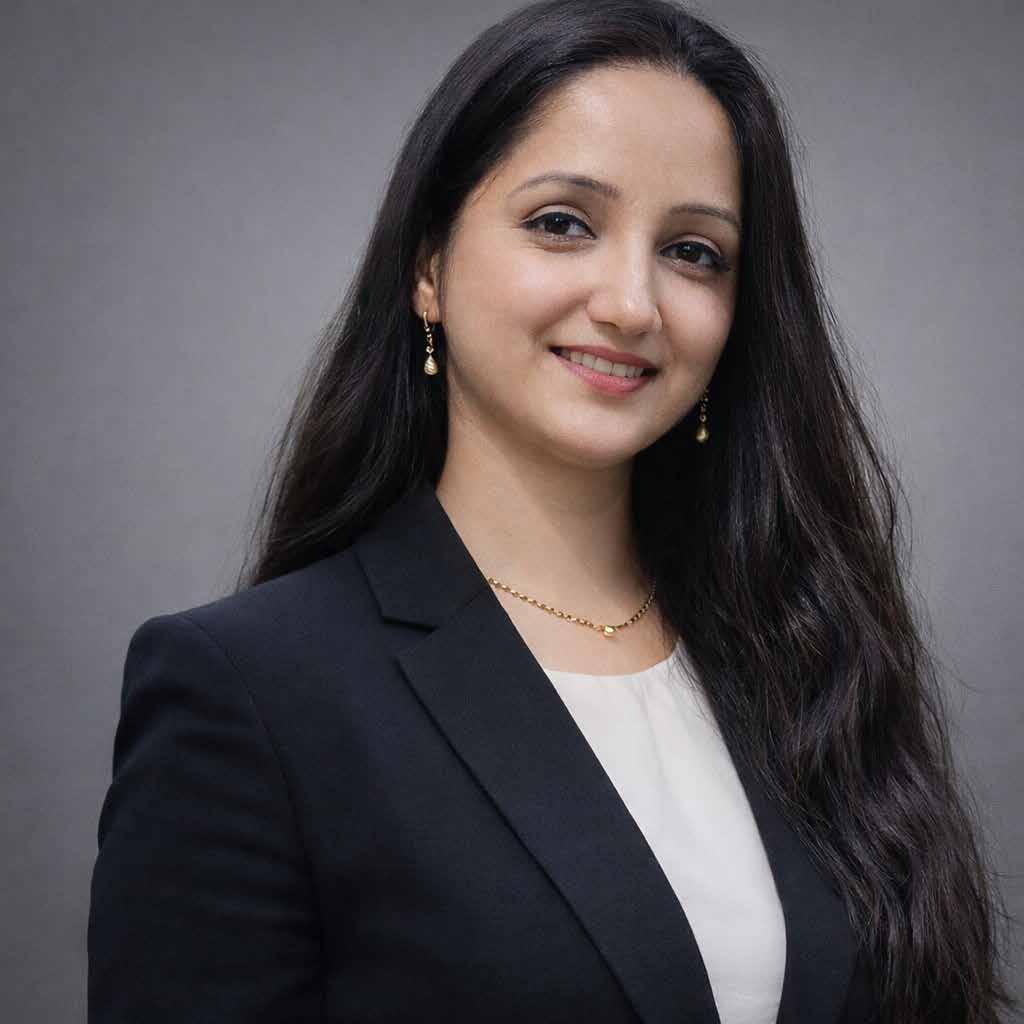
Meenakshi Chauhan Associate Director
ESG, Process & Performance Enhancement
MGC Global Risk Advisory
Redefining ESG for a Fact-Checked, High-Accountability Future
ESG is at an inflection point. What was once treated as a disclosure obligation has become a defining test of corporate credibility. In 2026, sustainability claims are assessed with the same skepticism and rigor applied to financial performance. Regulators, investors and boards are aligned around a single expectation: ESG assertions must be grounded in auditable, decision-grade data.
This shift represents a fundamental change in corporate governance. ESG has moved beyond compliance checklists and reputational positioning into the core of enterprise accountability. Sustainability is being re-engineered from narrative to evidence, from intent to execution and from voluntary transparency to institutional responsibility.
For more than a decade, ESG operated in a substantiation gap. Organizations made claims such as “carbon neutrality”, “ethical sourcing” or “net-zero alignment” without data architectures capable of supporting regulatory scrutiny or external assurance. While often well intentioned, these commitments lacked verification depth and increasingly exposed companies to legal, financial and reputational risk.
That gap is now being systematically closed. Regulatory frameworks including the EU Corporate Sustainability Reporting Directive (CSRD), the Green Claims Directive and India’s Business Responsibility and Sustainability Reporting (BRSR) mandate structured disclosures of ESG risks, controls and outcomes. Sustainability statements are treated as regulated representations with implications comparable to financial reporting.
As a result, ESG disclosures are increasingly governed with board oversight, internal controls and external assurance. The shift is clear:
▪ From promotional claims to provable outcomes
▪ From narrative disclosures to traceable evidence
▪ From symbolic assurance to audit-level scrutiny
Publishing sustainability reports is insufficient in a high-accountability environment. Leading organizations are building ESG truth systems: enterprise-wide data infrastructures where sustainability metrics flow through ERP platforms, risk frameworks, internal controls and audit processes.
Legacy ESG Approach
Evolved ESG Architecture
Manual surveys and spreadsheets Automated, integrated data pipelines
Isolated sustainability teams CFO, CRO and Audit Committee ownership
Static annual reports Continuous dashboards and regulatory feeds
Self-attestation Independent reasonable assurance
ESG governance is converging with financial governance. Sustainability performance is increasingly evaluated alongside capital allocation, enterprise risk and strategic resilience.
Across markets and sectors, organizations leading the ESG transition are operationalizing credibility rather than amplifying ambition.
▪ Linking executive remuneration to sustainability outcomes and disclosing progress transparently, including underperformance
▪ Embedding supplier emissions, labor audits and responsible sourcing into procurement and risk systems with third-party validation
▪ Indian listed entities strengthening BRSR disclosures through structured data and assurance
▪ European companies integrating CSRD-aligned sustainability metrics into statutory filings and audit scopes
Capital markets are responding to demonstrated transition capability rather than aspirational targets. Measurable emissions reduction verified labor compliance and accountable governance increasingly influence valuation and access to capital.
The most complex credibility challenge sits within Scope 3 impacts, embedded across value chains. Traditional reliance on supplier questionnaires, industry averages and sampling-based audits does not meet contemporary accountability expectations.
Leading organizations are replacing these approaches with:
▪ Digital product passports linking materials to verified environmental and social attributes
▪ Supplier-level emissions accounting embedded within procurement systems
▪ Satellite and geospatial monitoring for land use, deforestation and extractive risk
▪ AI-driven labor analytics identifying forced labor, wage violations and safety risks
Scope 3 accountability is transforming sustainability into a supply-chain and operating-model discipline rather than a reporting exercise.
Assurance as the New ESG Currency
Independent assurance has emerged as the defining signal of ESG credibility. Sustainability information is increasingly evaluated through the same trust mechanisms that underpin financial markets.
Frameworks including BRSR, CSRD, International Sustainability Standards Board (ISSB), and Global Reporting Initiative (GRI) are accelerating the shift toward assured disclosures covering emissions, workforce metrics, safety, water and supply-chain practices. This evolution is driving:
• Reduced exposure to greenwashing and misstatement risk
• Higher data quality and stronger internal controls
• Increased investor confidence in ESG-adjusted decision making
In a fact-checked environment, flawless performance narratives undermine trust. The organizations that command credibility are those that disclose performance gaps with clarity and accountability.
They communicate:
▪ Where targets were missed
▪ Why outcomes diverged from expectations
▪ What corrective actions are underway and how progress will be measured
This transparency creates an authenticity premium. Stakeholders place greater confidence in organizations that demonstrate learning, adaptation and governance maturity rather than perfection.
Conclusion: ESG has Become a Credibility Mandate
The next chapter of ESG will be defined by systems, controls and verified outcomes rather than messaging. Sustainability performance is being embedded into financial governance, enterprise risk management and board oversight as a core measure of organizational resilience.
Organizations that succeed will distinguish themselves through evidence, not aspiration. Traceable data, assured metrics, transparent disclosures and accountable governance will determine trust, valuation and long-term legitimacy.
In a high-accountability economy, credibility is not claimed. It is proven.
For further information on strengthening ESG credibility, assurance and governance, please write to us at: talk-to-esg@mgcglobal.co.in

Take advantage of every single edition, and get Global Biz Outlook Magazine in Print and digital at www.globalbizoutlook.com.
Subscribe to Global Biz Outlook Magazine, and Read It Now.
Global Subscription
1 Month (1 Issues): $ 253 Months (3 Issues): $ 70
Subscription Form
6 Months (6 Issues): $ 1501
Year (12 Issues): $ 250
Kindly fill out the form below and email/courier it in favor of Global Biz Outlook Magazine. Fill out this form, and we will call you.
Name:
Address:
Company:
Contact Number: Email:
City: State:
Zip: Country:
Global Biz Outlook Magazine
1330 Valley Lake Dr Apt 305 Schaumburg 60195 Illinois, United States info@globalbizoutlook.com +1-847-852-4574
For more information, click on www.globalbizoutlook.com