Global Banking & Finance Review Issue 81 - Business & Finance Magazine
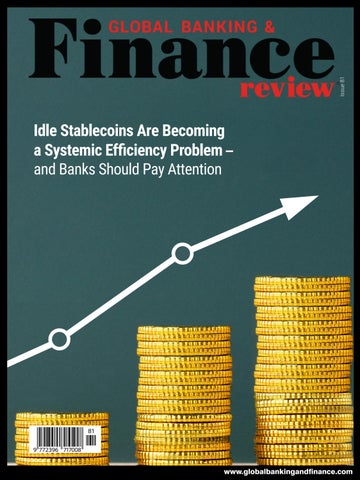
Idle Stablecoins Are Becoming a Systemic Efficiency Problem — and Banks Should Pay Attention
CEO & Editor In Chief
Varun SASH
Managing Director
Mayha Das
Managing Director
Martin Murphy
Editor
Barnali email: editor@gbafmag.com
Editor Regional
Shaharban T
Project Management
Megan S | Raj G
Executive Operations and Client Relations
Anupama KU
Head of Advertising
Robert M
Director of Operations
Babitha G
Digital Sales
Rohit D
Nominations
Adam L | Sarah F
Research
Varshitha K | Jyothi P
Video Production & Journalism
Phil Fothergill
Graphic Design
Shiva K
Advertising
Phone: +44 (0) 208 144 3511 marketing@gbafmag.com
GBAF Publications, LTD
Alpha House
100 Borough High Street London, SE1 1LB United Kingdom
Global Banking & Finance Review is the trading name of GBAF Publications LTD Company Registration Number: 7403411 VAT Number: GB 112 5966 21 ISSN 2396-717X.
The information contained in this publication has been obtained from sources the publishers believe to be correct. The publisher wishes to stress that the information contained herein may be subject to varying international, federal, state and/or local laws or regulations.
editor
Dear Readers’
Welcome to Issue 81 of Global Banking & Finance Review.
DAs we progress through 2026, the global financial landscape continues to evolve rapidly—shaped by geopolitical shifts, regulatory developments, and accelerating innovation in digital finance. In this environment, our mission remains clear: to highlight the trends that matter, showcase the leaders driving change, and provide clarity in a fast-moving industry.
This issue’s cover feature spotlights Arvin Jawa, Vice President – Marketing & Strategy at Diebold Nixdorf, who shares new consumer research revealing why trust, reassurance, and seamless connected journeys across digital and physical banking channels will be defining factors in customer engagement this year.
We also feature Ricardo Ferreira, CEO of Access Bank Angola, who explores how the bank is pursuing responsible, long-term growth through strong governance, digital transformation, and a continued focus on SMEs and youth empowerment—supporting Angola’s national development priorities.
In another key feature, Jalal Douame and Igor Sopcak examine a large-scale CRM transformation, highlighting how a shift from fragmented communication to a centralised, data-driven engagement model is strengthening personalisation, omnichannel delivery, and long-term organisational agility.
Finally, Aditya Laroia, CEO of Maybank Securities Singapore, discusses how the firm continues to deliver resilient capital markets execution and integrated advisory solutions, leveraging Maybank’s regional scale to support clients across Singapore and the wider ASEAN region.
As always, the articles in this edition are grounded in rigorous analysis and enriched by diverse perspectives from across global financial markets.
Thank you for reading, and we hope you enjoy the latest issue.
Editor, Global Banking
& Finance Review
The purchaser or reader of this publication assumes all responsibility for the use of these materials and information. However, the publisher assumes no responsibility for errors, omissions, or contrary interpretations of the subject matter contained herein no legal liability can be accepted for any errors. No part of this publication may be reproduced without the prior
Stay caught up on the latest news and trends taking place by signing up for our free email newsletter, reading us online at http://www.globalbankingandfinance.com/ and download our App for the latest digital magazine for free on Google Play and the Apple App Store
Arvin Jawa, Vice President Strategy & Marketing, Diebold Nixdorf
Consumers and Financial Technology in 2026: Why Connected Journeys Will Define the Next Era of Banking
by Arvin Jawa, Vice President Strategy & Marketing, Diebold Nixdorf
Abstract
Drawing on new proprietary consumer research conducted with YouGov®, this article examines how financial behaviors and expectations are evolving in 2026 — and why banks must prioritize consumer centric journeys across all channels. My background in retail technology, global retail strategy and retail store operations has shown me that when consumers feel confident, supported, and understood, they engage more deeply. The same truth applies in financial services and in retail banking: winning institutions design journeys that balance digital convenience with human assurance.
Digital First — But Far from Digital Only
For years, many predicted banking would become almost entirely digital. The reality, however, is more nuanced. Even as digital adoption grows, people still seek connection, reassurance, and guided support — especially when the stakes feel high.
Digital native consumers are the perfect example. One might assume that Gen Z and Millennials — raised on smartphones — would prefer fully digital banking. Yet the data tells a different story:
• 51% of U.S. Gen Z and Millennial consumers hesitate to make financial decisions without trusted human input.
• In Italy, 42% of digital native consumers share that same hesitation.
In retail, we learned long ago that behavior rarely maps cleanly to demographics. What matters is confidence — and confidence is built through well designed, human supported journeys. The same patterns now shape financial decision making.
Research also confirms that consumers who actively use multiple banking channels tend to be younger, educated, and higher income. Their motivation is not necessarily convenience alone. Many value the trust and quality of personal relationships, or the financial upside of expert, personalized advice. When banks fail to maintain these connections, they risk losing not only trust — but long term value.
Why Personal Connections Still Matter When Things Go Wrong
Across the United States, Spain, Germany, Italy, and the United Kingdom, more than 70% of consumers prefer to visit a branch when friction arises.
Friction comes in many forms:
• Service limitations like withdrawal or transfer caps
• Uncertainty about completing a digital transaction correctly
• Anxiety triggered by high value transfers or complex decisions
In retail, we’ve seen that consumers may adopt digital tools enthusiastically — until something feels unfamiliar or high risk. At that moment, they want reassurance, not automation. Financial consumers behave the same way.
And not everyone is comfortable with digital channels to begin with:
• 50% of German consumers lack full digital confidence
• 34% of Italian consumers feel the same
My colleague, Joe Myers articulated this well in his 2026 outlook²: even as digital adoption accelerates, the need for a trusted human guide remains. Banks must ensure every channel — physical and digital — feels connected, consistent, and human.
Branches Must Become Homes to Higher Value Interactions
Despite declining routine traffic, branches remain essential for large portions of society. Depending on the market, 16% to 31% of consumers rely heavily on branch services.
Even in highly digitized markets like the UK, fewer than 20% of consumer survey respondents say they could fully do without the services offered at the branch. Business owners, in particular, value branches for their reliability and personal reassurance.
But today, branch employees spend too much time on low value, repetitive tasks — the same issue retailers faced a decade ago. When we applied automation and journey orchestration in retail, stores – and the work that associates conducted inside them – became more valuable, not less.
Banks can unlock the same opportunity. For instance:
• ATM transaction limits drive up to 45% of UK consumers and 33% of Italian consumers to a teller.
• Yet 51% of Italians and 41% of UK consumers would use their mobile app to request a limit increase ahead of time.
This is journey design at its core: anticipate friction, offer a proactive solution, and elevate the role and productivity of your staff.
Payment Choice Remains Non Negotiable
Consumers rarely abandon old payment methods — they simply add new ones. In Italy, among consumers under 40:
• 55% used mobile payments at a physical point of sale in the past three months
• 51% of these young mobile payment users also used cash Choice is the constant.
Across markets, access to cash still influences bank selection:
• 84% of UK consumers
• 89% of German consumers would avoid a provider that fails to offer cash access.
This mirrors trends we’ve seen in retail: until digital solutions provide complete confidence, consumers demand flexibility. Banks must support a broad spectrum of payment options while modernizing infrastructure not designed for today’s complexity.
Why Scalable Platforms Are Now a Strategic Imperative
European financial institutions increasingly view the ATM channel not just as a cash access point, but as a consumer convenience platform More than 56% cite the value of additional transactions as a primary reason for maintaining ATM networks ³.
Yet in markets with reduced cash usage, infrastructure gaps are changing behavior. In the UK, consumers now use out of network ATMs slightly more often than their own bank’s. Some institutions, like Nationwide, have turned this into a competitive advantage by emphasizing proximity and reliability 4
Whether banks pursue greater self service capabilities or broader payment rail innovation, one requirement is universal: platforms must scale across channels, integrate new services, and enable innovation without disrupting the consumer journey
This is how retail leaders built omnichannel ecosystems — and it is how banking must evolve next.
AI: Transformational, Powerful, and Human Dependent
A recent travel disruption reminded me of both the promise and the limitations of fully automated journeys. After a flight was canceled, I chose an AI enabled chatbot over waiting in a phone queue. The process was fast and efficient — I received rebooking options within minutes.
But afterward, I felt a familiar question: What if something had gone wrong? Digital efficiency is remarkable, but consumers still want reassurance that a human — or at least a traceable interaction — is available when needed.
Our research shows this tension clearly:
• Roughly half of U.S., UK, and Italian consumers express concern about AI risks
• Younger consumers are not uniformly optimistic; many are cautious
Conclusion: The Future Belongs to Institutions That Master the Journey
The data is clear: while consumers embrace digital tools, they also crave human connection, reassurance, and thoughtful design. This mirrors what we learned in retail — customers don’t think in channels; they think in journeys.
The biggest opportunity for banks is not to replace human engagement with AI, but to use AI where consumers want it:
• Fraud detection
• Security alerts
• Risk monitoring
As cyber threats grow more sophisticated, AI becomes essential to delivering the core consumer value no digital journey can replace: the feeling of being protected.
Banks that bring together scalable platforms, human supported guidance, and smart use of AI will create experiences that feel intuitive, personalized, and secure.
In 2026, the most successful financial institutions will be the ones that understand a simple truth: technology may drive efficiency, but trust drives behavior. And trust is earned through connected journeys that put consumers at the center — every time.
Arvin Jawa, Vice President Strategy & Marketing, Diebold Nixdorf
1031 Exchanges and Delaware Statutory Trusts: What Investors Need to Know
When you buy a Delaware Statutory Trust (DST) as part of a 1031 exchange, you unlock one of the most effective ways to defer capital gains taxes while staying invested in real estate. A 1031 exchange is a powerful strategy if you want to keep more of your money working for you, especially if you plan to grow your portfolio or simplify your holdings.
DSTs let you own a fractional share of institutional-grade properties with none of the landlord duties. For investors seeking steady income and diversification, DSTs offer a streamlined, taxefficient alternative that complies with IRS rules.
The Basics of a 1031 Exchange
A 1031 exchange involves deferring capital gains taxes by reinvesting sale proceeds into a “like-kind” property. Usually, selling investment real estate triggers a taxable event, but if the swap meets IRS requirements under Section 1031, you may owe little to no tax at the time of the exchange. That said, the process comes with strict deadlines. You must identify potential replacement properties within 45 days and close on one or more of them within 180 days.
These compressed timelines often create pressure, especially when you try to find high-quality, qualifying properties that align with your financial goals. Many investors struggle with limited inventory or mismatches in property type or value. Structured options like DSTs can provide access to pre-qualified assets that meet IRS rules while reducing the burden of searching.
What Is a DST?
When you buy a DST, you open the door to institutional-grade real estate opportunities without the burden of active management. This trust is a legal structure that qualifies as replacement property in a 1031 exchange, allowing you to defer capital gains taxes while enjoying passive income. Instead of owning an entire property yourself, you own a fractional interest alongside other investors, with day-to-day operations handled by experienced asset managers.
This model makes high-value assets more accessible, since the financial commitment is much lower than full ownership. Feeonly fiduciaries like Sera Capital help clients identify and invest in DSTs that align with their goals without earning commissions on products they recommend. For investors seeking diversification and tax efficiency, Sera Capital (change to: the wealth management firm) offers clear, unbiased guidance at every step.
How DSTs Fit Into 1031 Exchanges
A 1031 exchange using a DST begins when you sell your investment property and reinvest the full proceeds into DST shares. DSTs are prepackaged and ready for closing, eliminating the stress of property tours and negotiations.
For example, suppose you sell a rental home for $800,000. Instead of buying another property and managing tenants, you allocate the proceeds across three DSTs — maybe a multifamily complex, a distribution center and a medical office — all professionally managed and producing monthly income. This satisfies IRS timelines, diversifies your portfolio and reduces risk. Many investors choose DSTs for these reasons, and advisors like Sera Capital help match you with vetted options aligned with your goals and risk profile.
DSTs vs. Direct Property Ownership
When you buy a DST, you step away from the hands-on demands of managing a rental property and into a passive investment model that prioritizes simplicity and diversification. Unlike direct ownership, where you’re responsible for maintenance and financing decisions, DSTs are professionally managed, giving you time back and reducing stress. They also allow you to spread your investment across different regions and property types, helping to cushion against market volatility.
For example, refinancing or selling a property can become difficult if the economy slows down or interest rates rise. However, with a DST, your exposure is spread out, which can soften the impact of declining property values in one sector. For many investors, especially those approaching retirement or simplifying their portfolios, DSTs offer a strategic way to maintain real estate income without the operational headaches.
Who Benefits Most From DST 1031 Exchange Strategies?
DSTs are especially useful for investors who are ready to transition out of active property management. If you sell a rental property and no longer want to handle maintenance or tenants, DSTs offer a tax-efficient way to stay invested in real estate. Retiring landlords often use DSTs to reduce their workload while still generating income during retirement.
Estate planners also find value in DSTs because fractional ownership can be divided easily among heirs, and the structure eliminates the hassle of jointly managing a single property. DSTs are ideal when the goal is to preserve wealth or streamline a legacy plan. With Sera Capital’s guidance, investors can build a DST portfolio that fits their current needs and long-term goals.
Who Should You Buy a Delaware Statutory Trust From?
When you’re considering where to buy a DST, it’s critical to work with a fiduciary rather than someone earning commissions from DST sales. A fiduciary is bound to act in your best interest, so they can’t put their own financial gain ahead of your goals. In contrast, some DST providers may steer clients toward products that pay them the highest commissions, even if better-suited options exist.
Firms such as Sera Capital, which operate on a fee-only fiduciary basis, support investors navigating these structures.
As a fee-only fiduciary, it doesn’t receive product-based compensation and focuses entirely on aligning investment strategies with your specific needs. Over 90% of its business is dedicated to DST and 721 exchange planning, providing you with deep expertise and customized advice. Fee-only advisory models are often preferred by investors seeking alignment and clarity in product selection that puts your financial strategy at the center of every recommendation.
Common Misconceptions About DSTs
The IRS has officially recognized DSTs as a valid replacement property for 1031 exchanges since 2004. Still, it’s important not to mistake
recognition for guaranteed safety. Like any real estate investment, DSTs carry inherent risks, including market shifts and economic downturns. They’re not immune to interest rate hikes or declining property values. It’s also a mistake to assume all DSTs are created equal, as manager experience, property type and market location all influence performance.
When you buy a DST, you need to look beyond the surface and evaluate what you’re really getting. That’s why advisory support matters. A trusted fiduciary can help you filter out biased product pushes and guide you toward DSTs that align with your specific goals and risk tolerance.
Making the Most of Your 1031 Exchange With a DST Investment
A DST pairs seamlessly with a 1031 exchange, which helps you defer capital gains taxes while generating steady, passive income from professionally managed real estate. When you buy a DST, you gain access to high-quality assets without the stress of hands-on ownership. Working with fiduciary advisors ensures you receive expert, conflict-free guidance so you can explore your DST and 1031 options with clarity and long-term alignment.
Shaping Angola’s Financial Future: A Conversation with Ricardo Ferreira, CEO of Access Bank Angola
1- How would you describe Access Bank Angola’s long-term vision, and what distinguishes the bank’s strategic direction within the Angolan financial sector?
R: Access Bank Angola’s long-term vision is to be a trusted financial institution that contributes meaningfully to Angola’s economic transformation, while operating to the highest standards of governance, risk management and customer service. Our ambition is to support sustainable revenue growth by mobilizing capital efficiently, facilitating trade, and enabling businesses and individuals to participate more fully in the formal economy.
What distinguishes our strategic direction within the Angolan financial sector is our deliberate focus on long-term value creation rather than short-term expansion. We are building a resilient bank anchored in strong compliance, prudent capital management and digital innovation, while leveraging the broader Access Bank Group’s international network to connect Angola more effectively to regional and global markets.
2- What do you see as the most significant opportunities for growth in Angola’s banking industry, and how is Access Bank Angola positioned to capture them?
R: The most significant opportunities for growth in Angola’s banking industry lie in regional integration, deepening USD correspondent banking re-entry, diversification of economy projects, credit that allows financial inclusion, advancing digital transformation, and supporting sectors that are pivotal to economic diversification. There is substantial potential to bring previously unbanked and underserved segments of the population into the formal financial system. Moreover, the adoption of digital and mobile banking platforms presents a transformative opportunity to deliver financial services more efficiently and inclusively.
Access Bank Angola is well-positioned to capture these opportunities through a combination of strategic focus and operational capability. Our deep understanding of the local market, supported by the strength and expertise of the Access Bank Group, enables us to tailor solutions that address specific client needs.
Furthermore, our commitment to capacity building and long-term client relationships allows us to support business growth across value chains, particularly for SMEs, which are essential engines of job creation and economic diversification. By aligning our strategic priorities with national development goals and international best practice, Access Bank Angola aims not only to grow responsibly, but also to contribute meaningfully to the broader economic progress of Angola.
3- How is digital innovation reshaping your operating model, and which advancements are most critical to improving customer experience and financial inclusion?
R: Digital innovation is fundamentally reshaping our operating model by enabling us to deliver services more efficiently, securely and on a scale, while placing the customer firmly at the center of our strategy.
The most critical advancements include the expansion of secure digital and mobile banking platforms, which allow customers to transact, save, pay and access to informational menus with greater convenience and transparency. These platforms are particularly important in advancing financial inclusion, as they reduce geographical and cost barriers and make banking services accessible to individuals and small businesses that have traditionally been underserved.
At the same time, we recognize that digital progress must be underpinned by robust cybersecurity, strong governance and regulatory compliance. Our approach is therefore measured and disciplined, ensuring that innovation enhances trust and resilience. Ultimately, digital innovation enables Access Bank Angola to scale inclusion, improve customer experience and support sustainable growth, while maintaining the integrity of the financial system.
4- How do you build a performance-driven and ethically grounded culture across the bank, particularly as you expand and evolve?
R: Building a performance-driven and ethically grounded culture is a deliberate and continuous process, particularly as the organization expands and evolves. At Access Bank Angola, we start with clarity of purpose and values. Ethical conduct, accountability and professionalism are not treated as compliance requirements alone, but as core principles that guide decision-making at every level of the bank.
Leadership plays a critical role in setting the tone. We place strong emphasis on visible, value-led leadership, ensuring that performance expectations are clearly defined and aligned with responsible behavior. Our performance management framework rewards not only financial results, but also risk discipline, customer outcomes and adherence to our code of conduct.
Equally important is investment in people. We prioritize continuous learning, leadership development and succession planning, creating an environment where employees are empowered to perform, innovate and take ownership, while operating within a robust risk and control framework. Open communication and a culture of constructive challenge are actively encouraged, reinforcing ethical judgement and sound governance. Additionally, we have the “Apanhei-te a Fazer Bem” (Caught
You Doing Well) programme, an initiative designed to recognize employees who demonstrate exemplary behaviors and attitudes that stand out positively beyond the usual standard.
As we grow, we maintain consistency through strong internal controls, clear policies and ongoing engagement, ensuring that our culture scales alongside the business. Ultimately, by embedding ethics into performance and aligning individual incentives with long-term value creation, we build a resilient institution that earns trust and delivers sustainable results.
5- In what ways is Access Bank Angola contributing to national development priorities such as entrepreneurship, SME support, and youth empowerment?
R: Access Bank Angola is deliberately aligned with Angola’s national development priorities, particularly in the areas of entrepreneurship, SME support and youth empowerment, which are essential to sustainable and inclusive economic growth. We view our role not merely as a financial intermediary, but as a partner in development.
In supporting entrepreneurship and small and medium-sized enterprises, we provide tailored financial solutions that combine access to credit, cash management and advisory support. Beyond funding, we work closely with clients to strengthen financial literacy, governance and operational capacity, enabling SMEs to scale responsibly and integrate more effectively into formal value chains.
Youth empowerment is another strategic focus. The bank includes paid interns within its workforce structure, ensuring that young professionals gain meaningful, practical experience while contributing directly to the organization. In addition, selected young individuals have participated in an internship programme in Nigeria, providing them with international exposure, skills transfer and a broader understanding of best practice within the Access Bank Group. Alongside this, our digital banking platforms enable us to engage younger demographics more effectively and lower barriers to entry into the formal financial system.
Furthermore, we collaborate with public institutions, development partners and industry stakeholders to support priority sectors, all of which contribute to job creation and economic diversification. By aligning our commercial objectives with national development goals, Access Bank Angola aims to generate long-term value for our customers, communities and the wider Angolan economy.
6- How does corporate responsibility fit within your broader leadership agenda, and how do you ensure CSR initiatives strengthen the bank’s strategic objectives?
R: Corporate responsibility is an integral part of our broader leadership agenda and is embedded within the way Access Bank Angola defines sustainable success. We do not view CSR as a parallel activity or a philanthropic afterthought, but as a strategic discipline that reinforces our purpose, strengthens stakeholder trust and supports long-term value creation.
Our approach is to ensure that CSR initiatives are closely aligned with the bank’s strategic priorities and with national development objectives. We focus on areas such as education, environment, health and entrepreneurship where we can generate measurable impact while
also reinforcing our core business — notably financial inclusion, education and skills development, youth empowerment and community resilience. This ensures that our social investments are relevant, credible and sustainable.
From a governance perspective, CSR is guided by clear frameworks, accountability and performance measurement. Initiatives are evaluated not only on social outcomes, but also on how effectively they enhance our reputation, deepen customer relationships and support a strong risk and compliance culture. Leadership involvement is deliberate and visible, reinforcing the message that responsible conduct is inseparable from performance.
Ultimately, by integrating corporate responsibility into strategy, culture and decision-making, we ensure that Access Bank Angola contributes positively to society while strengthening the resilience, relevance and long-term competitiveness of the institution.
7- Your recent environmental initiative in the Mussulo Peninsula mobilized community, staff, and partners. What does this initiative demonstrate about the bank’s approach to collaboration and long-term impact?
R: Our recent environmental initiative in the Mussulo Peninsula exemplifies Access Bank Angola’s commitment to collaboration and creating sustainable, long-term impact. The project brought together staff, local communities and strategic partners, reflecting our belief that meaningful change is achieved when multiple stakeholders work together with shared purpose and accountability.
This initiative demonstrates that our approach to collaboration is both inclusive and pragmatic. We engage with communities to understand their needs, mobilize internal resources and expertise, and leverage partnerships to scale outcomes. By doing so, we ensure that initiatives are not only impactful in the short term but also build local capacity and foster environmental stewardship over the long term.
Moreover, the Mussulo project reinforces our broader philosophy that corporate responsibility and business strategy are interconnected. Initiatives of this kind strengthen our relationships with clients, employees and regulators, enhance community resilience, and contribute positively to Angola’s sustainable development goals. It underscores that Access Bank Angola is committed to generating value that extends well beyond financial performance, embedding responsibility and sustainability at the heart of our operations.
8- Access Bank Angola’s CSR portfolio spans education, health, the environment, and entrepreneurship. How do you determine which areas require the highest level of investment and longterm focus?
R: At Access Bank Angola, the prioritization of our CSR portfolio is guided by the principle of strategic alignment — ensuring that our investments address areas where we can deliver the greatest social and economic impact, while reinforcing the bank’s long-term objectives. We assess potential initiatives based on several criteria: the scale of need within communities, alignment with national
development priorities, potential for sustainable impact, and synergy with our core competencies and expertise.
Education, health, environment, and entrepreneurship have emerged as priority areas because they address fundamental drivers of socioeconomic progress. Within each pilar, we deploy resources where they can catalyze measurable, enduring outcomes. For example, in education, we focus on initiatives that improve access and quality, while in entrepreneurship, we emphasize programmes that support SME development and financial literacy, creating long-term capacity for economic growth.
Crucially, our approach is evidence-based and iterative. We regularly evaluate the outcomes of our initiatives, engage with stakeholders to understand evolving needs, and adjust our focus to maximize effectiveness. By combining strategic intent with rigorous monitoring and collaboration, we ensure that Access Bank Angola’s CSR investments are purposeful, impactful and sustainable, reinforcing both societal benefit and the bank’s broader mission.
9- Looking ahead, what emerging trends or challenges do you believe will most influence the bank’s strategy over the next three years?
R: Looking ahead, several emerging trends and challenges are likely to shape Access Bank Angola’s strategy over the next three years. Firstly, our client leading strategy will drive consistent results, but digital transformation will continue to redefine customer expectations and service delivery. The acceleration of mobile and online banking, fintech collaboration, and data-driven decision-making will require us to invest in scalable technology platforms and enhance cybersecurity, while ensuring financial inclusion for under-served populations.
Secondly, the regulatory and macroeconomic environment will remain a key influence. As Angola continues to implement reforms to diversify the economy, banks will need to navigate evolving compliance requirements, manage currency and liquidity risks, and support sectors critical to sustainable growth, such as SMEs, agribusiness, and infrastructure.
Thirdly, environmental, social, and governance (ESG) considerations are increasingly integral to banking strategy. Investors, clients and regulators are demanding greater transparency and sustainability. This presents both a challenge and an opportunity to integrate ESG principles into lending, investment, and operational practices, creating long-term value for stakeholders.
Finally, talent development and workforce transformation will be essential. As the banking landscape evolves, we must attract, retain and upskill professionals who are adept at leveraging technology, driving innovation, and embedding a performance-driven, ethically grounded culture.
By proactively responding to these trends and challenges, Access Bank Angola aims to remain resilient, innovative and purpose-led, positioning the bank for sustainable growth and meaningful contribution to Angola’s economic development.
Ricardo Ferreira, CEO, Access Bank Angola
From Recession Survivor to Industry Pioneer: Ed Lewis's Data Revolution From Recession Survivor to Industry Pioneer: Ed Lewis's Data Revolution
Ed Lewis, a native Houstonian and the founder of Industrial Info Resources (IIR), was stranded on the West Coast when Hurricane Harvey hit in 2017. Back in Houston, IIR’s head office was offline, but the market didn’t pause. “My researchers’ phones were ringing red-hot,” Lewis recalls, as customers demanded specifics—where damage had occurred, when plants might be back online, and what could be hit next. In response, IIR’s team went straight to the source, validated what was actually happening at the asset level, and delivered answers customers could act on.
Harvey also exposed a new need for his company. IIR already had the plant and asset database and the human network, but customers needed a way to map facilities while tracking the storm’s path. That pressure became a catalyst. Working across IIR’s technology team, a third-party weather service provider, and its researchers, the company built the IIR Disaster Impact Tracker.
That crisis-tested standard—verify first, publish second—wasn’t something Lewis discovered in 2017. It was the reason he founded Industrial Info Resources in the first place. In 1983, the recession left him unemployed while he was married with a young family. “It was very much a case of sink or swim. I chose to swim,” he said.
Lewis had been involved in construction, where unemployment rose to over 24% at its height, and he brought a background in selling construction and project management solutions. Instead of guessing at what the market needed, he visited old clients and asked what blocked them from pursuing new business. The consistent answer he got was a lack of verified information they could trust and rely on.
For Lewis, value was never about more information. It was about information people could use with confidence. “Successful innovation comes from innovating things that have value,” he says.
Looking back, IIR began with only five people and grew to over 500 staff across continents, with offices in every major region of the world.
What Makes IIR Different
Lewis calls the IIR model “surveillance-grade” because it is active and asset-level. Their researchers connect directly with owners, operators, and engineers, then double-verify details before publishing changes in what is being constructed, added, delayed, or decommissioned across energy, power, chemicals, manufacturing, data centers, mining, and infrastructure. Information may be plentiful, but for Lewis, trust is a rare commodity, and IIR has earned its reputation through the hard work of validation.
That same insistence on doing it right shows up in how he leads: progress requires constant adjustment, or “trimming one’s sails.” He believes that excellence only happens when the people closest to the work have a voice.
“There is no point in hiring the best people you can, but then holding them back from coming forward with their ideas,” he says. And when conditions get hard, Lewis believes leadership must be practical, not performative. “Don’t ask others to do what you wouldn’t be willing to do yourself.”
Those principles weren’t formed in comfort. They were sharpened in the early years, when innovation cost money IIR didn’t always have. Lewis admits they spent more than they made at first, which forced a hard financial rule into place: “Don’t spend what you don’t have.” Over time, he learned to favor small, incremental improvements over radical, expensive swings, and he built a culture that takes missteps as fuel rather than failure.
“We’ve built a culture where mistakes are just opportunities to learn little lessons,” he says. “Innovation is the father of necessity.”
How Trust Scaled IIR From Being a Regional Leader to Global Provider
Global expansion was Lewis’s biggest strategic leap, and it came as the world emerged from the Great Recession of 2008–2009. IIR was already a respected regional brand then, but customers needed a truly global provider at the same standard. Many were still with IIR some 40plus years later. “Our customers needed us to grow, and we knew we would get the support from them once we did,” Lewis shares.
Now, IIR is exploring AI, and Lewis draws two lines. First, intent. He says, “We are not using AI to reduce our work staff — we are using AI to empower them.” Second, inputs: IIR trains specialized models on proprietary intelligence, not generic data. That matters in markets where projects are announced, revised, delayed, or shelved, and where capacity shifts constantly. “Trusted data is to AI as gasoline is to an engine — without it, performance falls flat,” Lewis notes. “Even the most advanced AI is only as strong as the data that feeds it.”
He frames the shift as three distinct eras. The information age was about collecting and distributing data. The knowledge age raised the bar by forcing organizations to interpret that data and understand what it means. Now, Lewis argues, we’ve entered the answer age, where the goal isn’t more inputs but more decision-ready direction.
In markets where projects are revised midstream, supply chains ripple across regions, and policy or geopolitical shocks can change economics overnight, companies need to know what’s changing, why it matters, and what move to make next.
Real-World Impact: The Geospatial Innovation
The IIR’s Disaster Impact Tracker reflects that answer-age requirement. It maps verified facility updates against a storm’s path, and it supports traders who track supply-side interruptions, industrial teams that spot
service opportunities, and insurers that feed risk models. Lewis values geospatial analytics because it turns location-based data into visual, actionable insight.
Moreover, customers use IIR to make timing calls, with heat maps, regional investment views, data feeds for analysis tools, and reporting that surfaces signals early.
Why This Matters Now
Lewis puts the stakes plainly: “In a world where market conditions can shift overnight and uncertainty is the only constant, data is no longer just a commodity — it’s a strategic imperative.” In capital-intensive markets, weak intelligence creates delayed visibility, costly mistakes, and decisions built on the wrong foundation.
As AI continues to lower barriers to access, quality assurance still decides outcomes. “For finance professionals globally, this is not a theoretical but a practical distinction. It’s a matter of market responsiveness and forecasting,” says Lewis.
The IIR Philosophy
Lewis still starts with what launched IIR: listen to clients, solve what matters, and keep earning trust. According to him, “We started from humble beginnings and have never forgotten where we came from. But we definitely don’t take our success for granted, and complacency is not in our DNA.”
This message returns to the storm metaphor that shaped IIR’s innovation from Hurricane Harvey: “We help our customers find those waves of opportunities that will help them weather any storm that might come their way.”
How Commercial Lending Software Platforms Are Structured and Utilized
Commercial lending has always been complex, involving multiple stakeholders and varying risk profiles. As consumer and regulator expectations around speed and transparency have grown, the software supporting commercial lending has had to evolve just as quickly.
Core Structures of Lending Platforms
The global commercial lending industry is continuously growing, reaching a market value of approximately $10.9 billion in 2025 Each platform uses an underlying software architecture that affects how a platform adapts to new products or workflows.
While user interfaces and features may look similar, structural differences explain why some platforms scale smoothly while others struggle.
The Monolithic Model
The monolithic model represents the traditional foundation of commercial lending technology. In this structure, all core functions are processed and delivered through a single integrated system, which provides institutions with significant predictability and control.
Monolithic platforms offer consistency across teams and centralized data storage, which was especially valuable in highly regulated lending environments. With one system governing the entire lending cycle, it’s easier to enforce standardized processes and minimize discrepancies across departments.
However, as commercial lending becomes more specialized and featurerich, monolithic models have struggled to keep up. Their consistency also comes with rigidity, making it challenging to adjust workflows without incurring high costs and effort. Adapting to new features or standards can require significant IT involvement.
The Fragmented Model
The fragmented model emerged as a reaction to the rigid legacy platforms. Instead of relying on a single system, lenders adopted multiple microservices or specialized tools to handle different parts of the lending process. One application might manage origination, while another handles underwriting or reporting.
This approach offers greater flexibility, enabling companies to select tools that closely align with specific operational needs. Teams could easily experiment with new technologies without waiting for a core system update.
Despite its benefits, this type of arrangement also has its own challenges. Data silos tend to occur across different platforms, making it difficult to maintain a consistent and updated view of borrowers and portfolios. Integrations become complex and costly to build and maintain. As a lender’s client base grows, it can be risky to work with highly disconnected systems.
The Modern Hybrid
The modern hybrid model combines the unified experience of a monolithic platform with the adaptability of modular or microserviceoriented systems. In this structure, lenders operate on a single end-to-end platform that accommodates integrations and can evolve alongside the institution.
Many modern commercial lending platforms are adopting hybrid architectures to combine stability with flexibility such as AIO LOGIC that exemplify this approach.
They allow financial institutions to manage the full lending life cycle within a single system while still tailoring workflows and decisions to specific processes. Instead of forcing lenders to adapt to software constraints, these platforms accommodate real-world needs and processes.
This hybrid structure allows companies to maintain a single, updated source of information while ensuring flexibility and innovation.
Key Use Cases of Modern Lending Platforms
In commercial lending, modern platforms support institutions in these critical areas.
Loan Origination and Application
Loan origination can be operationally intensive due to the volume of information involved. Modern platforms streamline this process by centralizing borrower data collection and initial screening within a single workflow. Instead of juggling emails, spreadsheets, forms and other disconnected systems, managers can guide borrowers through a structured application process.
With configurable workflows, platforms like AIO LOGIC allow lenders to tailor application processes based on deal complexity or risk profile. This flexibility helps simplify processes for both internal teams and borrowers while maintaining consistency and compliance.
Underwriting and Risk Assessment
Underwriting helps lenders set fair terms that can benefit both the borrower and the company. Modern platforms leverage AIpowered analytics to glean insights that support better decisionmaking.
Modern platforms like AIO LOGIC assist underwriters in identifying risk signals or highlighting trends. This enables lending teams to focus more on interpretation and strategy over manual data organization.
Portfolio Management and Servicing
Visibility is essential once the borrower receives the loan. Portfolio management and servicing require continuous monitoring of performance and compliance. Modern platforms provide real-time insight into active loans, compliance, payment activity and other relevant details.
These hybrid platforms can centralize information from different tools, helping teams access live, contextual information. This level of visibility supports risk management and more informed decision-making.
Attributes of a Top-Rated Platform for Managing Commercial Lending Operations
A top-rated software platform for commercial lending operations brings significant ease and advantages to one’s workflow. The strongest solutions often come with these defining characteristics.
Seamless End-to-End Integration
A top platform minimizes fragmentation throughout the lending process. From initial contact with the borrower to underwriting, risk assessment, portfolio management and reporting, all data and processes should live within a single system.
This level of integration reduces errors and provides a complete view of each client relationship. AIO LOGIC uses this principle, ensuring that every stage connects to the next and that teams can access relevant information when necessary.
Actionable Intelligence
Automation can be helpful, as it improves efficiency, especially with repetitive, mundane tasks. However, automation alone lacks the judgment and intelligence necessary to handle financial workflows.
Actionable intelligence involves using AI and analytics to support better decisions in real time. These tools can thoroughly evaluate datasets and identify performance trends and risk indicators in the early stages of the lending life cycle, enabling lenders to respond proactively.
Many companies, including AIO LOGIC, have adopted these new tools to further streamline lending processes. As of 2024, around 80% of financial services companies have launched at least one AI initiative.
Adaptability and Scalability
Commercial lending environments have changed significantly over the years. New regulations and market conditions demand systems that can evolve with minimal disruptions. A top-rated platform must adapt to the institution and its needs, not the other way around.
Low-code and no-code configurability combined with robust built-in integrations allow lenders to evolve without large-scale IT overhauls, making hybrid platforms like AIO LOGIC a scalable, long-term solution.
Platform Design as Advantage
The evolution of commercial lending software reflects a shift in how financial institutions operate. The structure behind a financial service matters, as it influences efficiency and long-term profitability. For lending companies wanting to perform well amidst changing regulations and market expectations, hybrid solutions like AIO LOGIC demonstrate how the right architecture can transform commercial lending into a cohesive, insight-driven operation.
CRM Transformation in RBI Group
Introduction
RBI Group has undergone a major CRM transformation aimed at building scalable, datadriven, and customercentric engagement across its network banks. In this interview, we discuss the inspiration behind the journey, key achievements, challenges, and how the CRM community is driving innovation at scale.
1. What inspired your organization to embark on a CRM transformation journey?
At RBI Group, the key driver was a fundamental shift in how customers interact with banks. We operate across multiple countries and markets, and it became clear that fragmented tools and local solutions were no longer sufficient to deliver consistent, personalized, and timely customer experiences.
Our ambition was to move from productcentric communication to customercentric engagement, powered by data, analytics, and scalable platforms. CRM transformation was not about implementing a single system – it was about changing how we think, decide, and act across the entire customer lifecycle.
2. What were some of the biggest challenges you faced during this transformation?
One of the biggest challenges was managing scale and diversity. RBI operates across multiple countries with different levels of digital maturity, regulatory environments, and customer behaviors. Designing a CRM model that is globally consistent yet locally adaptable required strong coordination between group and local teams.
Another major challenge was adoption. CRM transformation is not only about technology, but about changing ways of working. To address this, we established the CVM Academy — a progressive learning and enablement program designed to accelerate adoption of CRM tools, analytics, and new operating models across the group.
The academy played a critical role in building capabilities, aligning teams, and creating a common language around customer value management. It has since won multiple industry awards and was recognized by Gartner as a global best practice in employee upskilling, validating both its impact and scalability.
By combining strong governance, structured capability building, and continuous learning, we were able to turn one of the biggest challenges of transformation into a long-term strength.
3. What key achievements are you most proud of so far?
One of our most important achievements has been the introduction of digital commerce capabilities within our CRM
ecosystem. This enabled us to engage customers directly through mobile banking applications, perform systematic A/B testing, and continuously optimize customer journeys. As a result, we significantly improved customer experience and made a decisive step toward a true omnichannel architecture.
We have also seen a substantial increase in customer interactions, both in volume and relevance. CRM has evolved from a campaign tool into a central engagement engine that connects digital channels, data, and business decisions in real time.
Another major milestone has been advanced customer profiling and personalization. By leveraging data and analytics, we are now able to communicate with customers in the context of their life situations and needs, rather than isolated products. This has fundamentally changed the quality and effectiveness of our customer communication.
Importantly, CRM has become a key growth driver for retail business, with a measurable and significant impact on Gross Income growth. What started as a transformation initiative has now become a strategic capability that directly supports commercial outcomes.
Equally critical to this success has been the creation of a strong CRM community across RBI. Teams actively learn from each other, share experiences, and continuously raise the bar together. Without this culture of collaboration and knowledge sharing, the scale and impact of our CRM transformation would simply not have been possible.
4. How does RBI balance group-wide strategy with local market needs?
Our operating model is built on the principle: centralize what makes sense, localize what matters.
We provide groupwide platforms, data models, standards, trainings and governance, while enabling local banks to adapt journeys, offers, and communications to their specific market realities.
This approach ensures economies of scale without compromising local relevance.
5. How does this CRM transformation position RBI for the future?
Our CRM transformation positions RBI as a future ready organization. With strong foundations in place, we can scale personalization, integrate new digital channels, and leverage emerging technologies like conversational and agentic AI more effectively.
Most importantly, it allows us to stay close to customers and continuously adapt in a rapidly changing market environment.
6. What advice would you give to other financial institutions starting a similar journey?
Start with a clear vision and business ownership. CRM transformation should be treated as a strategic business initiative, not an IT project.
Igor Sopcak Head of Customer Engagement Platforms & Products
Jalal Douame
Head of Digital Banking & Conversational AI
Invest early in governance, data quality, and people. And think in terms of capabilities and outcomes, rather than tools. The most successful programs align strategy, technology, and culture from the beginning.
7. Looking ahead, what are the next priorities for CRM at RBI?
Our next steps focus is on the smart targeting in digital communication, deepening personalization, and A/B testing
We also see strong potential in automation and AIdriven use cases to enhance both customer experience and operational efficiency on business and IT side.
8. What has been most effective in fostering a shared culture of innovation across the RBI CRM community and enabling reuse of complex journeys at scale?
The most effective enabler has been creating a true community across our network banks, rather than a collection of isolated project teams. We established agile teams with shared governance, and regular CRM community learning sessions for exchanging use cases, lessons, and ideas.
Equally important, we built platforms and processes that make reuse simple — including standardized data models, journey frameworks, and reusable assets. This allows banks to adopt proven, complex customer journeys in weeks instead of months.
But the real differentiator is mindset. Teams now view innovation as a collaborative advantage, where progress in one market accelerates progress for many. This culture of openness and cocreation has become one of our strongest competitive advantages.
Igor SOPCAK: Our CRM transformation created a strong foundation for sustainable growth by aligning strategy, technology, and a collaborative culture across RBI's network banks.
Jalal Douame:
As the recipient of this year’s Most Innovative Transformation Leader award, what are you most proud of when you reflect on your work at Raiffeisen so far?
“Over the past two years, our transformation journey has been recognized by several independent industry bodies, which has been a strong validation of both our strategy and our execution. This award is especially meaningful in that context, because it reflects sustained impact rather than a single moment.
I’m truly happy and grateful to receive this recognition, but it belongs to the exceptional teams across our group. Their expertise, commitment, and willingness to challenge the status quo are what made this transformation possible. This award is ultimately a reflection of the high-quality talent, collaboration, and shared ambition that define our organization.”
Idle Stablecoins Are Becoming a Systemic Efficiency Problem — and Banks Should Pay Attention
Stablecoins have grown far beyond a niche trading instrument. With more than $300 billion now in circulation, and annual settlement volumes widely estimated to exceed $20 trillion, stablecoins are increasingly functioning as the operational cash layer of the digital asset economy. They facilitate payments, trading, settlement, and treasury operations for exchanges, fintechs, and, increasingly, financial institutions exploring on-chain settlement and liquidity management.
But despite their growing role, a surprising amount of this capital simply does not move. Large portions of stablecoin balances sit idle on exchanges, in wallets or across institutional treasury accounts. Recent analysis from P2P.org, combined with broader market data, suggests that in some environments more than half of all stablecoin holdings remain inactive. They earn nothing. They perform no economic function. They operate like digital cash sitting in a desk drawer.
In traditional finance, this type of idle capital has long been recognized as a structural inefficiency. Before automated liquidity management and sweep accounts became standard, banks routinely left customer deposits dormant. Over time, institutionsbuilt tools and practices that put otherwise idle balances to work in safe, transparent ways. That evolution was not about speculation; it was about financial hygiene — improving liquidity, operational efficiency, and the overall health of the system.
The stablecoin market is approaching a similar turning point. As stablecoins proliferate across payments and settlement use cases, the volume of idle balances is growing alongside adoption. That creates inefficiencies familiar to bankers: reduced liquidity, declining transactional velocity, and increased opportunity costs for the institutions responsible for managing customer balances. It also introduces operational challenges for platforms that must hold and supervise these assets without clear mechanisms for activating them responsibly.
The core obstacle is that most stablecoin holders today face a limited choice set. Many “earn” products that emerged in earlier market cycles were built on lending, rehypothecation, or opaque balance-sheet practices. When several of these models failed, trust in anything resembling an “earning” mechanism collapsed with them. As a result, even more transparent and risk-contained forms of on-chain participation have often been overshadowed by the legacy of fundamentally different approaches.
For regulators and financial institutions, there is an important distinction between credit-based lending models and protocol-level participation mechanisms. Not all on-chain activity involves extending credit or transferring balance-sheet risk. Some blockchain networks include built-in mechanisms that allow asset holders to support transaction processing and network security — for example, through validator participation or stakingbased infrastructure models — in exchange for a protocol-defined return.
These mechanisms operate transparently on-chain, according to open and auditable rules. They do not necessarily transfer ownership of assets or introduce third-party credit exposure. In many ways, they are closer in spirit to predictable, rules-based market infrastructure than to the opaque lending practices that failed in recent years.
Separating protocol-level participation from credit-based lending matters because stablecoins are now too large — and too widely used — to remain economically inert. Corporates are using them for settlement. Asset managers hold them as operational cash. Payments firms rely on them for speed and cost efficiency. Yet much of this digital liquidity still functions like non-interest-bearing deposits in a world that has long since moved beyond accepting that kind of inefficiency.
Financial institutions therefore face a familiar choice. They can bring long-established treasury discipline into this emerging environment, or allow stablecoin balances to remain operationally idle by default. Doing so does not require embracing unfamiliar risks. It requires distinguishing between models that introduce counterparty exposure and those that do not; between opaque balance-sheet practices and transparent protocollevel mechanisms; between chasing yield and restoring the basic financial principle that large pools of operational cash should not sit idle indefinitely.
Banks have navigated similar transitions before. They built the tools that turned dormant balances into productive assets in traditional markets. They established the guardrails that made liquidity management safer and more predictable. They helped regulators understand the difference between prudent capital activation and excessive risk-taking. Stablecoins present a parallel challenge — and an opening for the financial services sector to help shape the next phase of digital asset infrastructure.
If institutions do not actively engage with this challenge, capital inefficiency will continue to grow. Hundreds of billions of dollars in stablecoins will remain operationally idle despite supporting critical payment and settlement flows. Stablecoins will become more deeply embedded in treasury
operations, yet the capital underpinning those functions will remain underutilized.
That outcome benefits no one: not consumers, not institutions, and not the broader digital economy that increasingly depends on these instruments for everyday operations.
The data is clear: tokenized dollars now circulate globally at scale, and a significant share is not being used in ways that enhance liquidity, stability, or economic utility. Financial leaders face the same choice their predecessors confronted in earlier eras of cash management: allow large volumes of idle capital to persist, or build the frameworks that ensure these balances serve a productive role in the system.
Stablecoins were designed to be programmable, yet they are still often managed as if programmability were a liability rather than a feature. Allowing large pools of digital dollars to remain idle is neither conservative nor sustainable.
The path forward is practical, not speculative. Institutions should focus on defining acceptable participation models, aligning custody and treasury operations with transparent on-chain mechanisms, and working with regulators to establish clear supervisory frameworks.
Taking these steps now will help determine whether stablecoins mature into a resilient layer of financial infrastructure — or remain a persistent source of systemic capital inefficiency.
About the Author
Betsabe Botaitis is a finance leader with experience across banking, fintech, and blockchain. She has held senior roles at Citigroup and LendingClub, and most recently served as CFO and Treasurer at Hedera, overseeing billions in digital assets and leading key governance initiatives. Recognized as a CoinDesk Top 50 Woman in Web3 & AI and a Fortune Most Powerful Women Ambassador, she now leads finance, treasury, and operations at P2P.org, supporting institutional growth in a changing regulatory landscape.
Industry 4.0 in 2025: The Intelligent Transformation Reshaping Global Industry and Financial Value
As global manufacturing progresses through 2025, Industry 4.0 has firmly shifted from theory to execution. What began as a framework centred on automation and connectivity has evolved into a comprehensive transformation reshaping productivity, competitiveness, and long-term value creation across the industrial economy. For financial institutions, investors, and corporate leaders, Industry 4.0 is no longer a peripheral technology theme. It is a strategic force influencing capital allocation, operational resilience, and financial performance on a global scale.
Industry 4.0 refers to the integration of digital intelligence into industrial operations through advanced automation, data analytics, artificial intelligence, cloud computing, and interconnected systems. Together, these technologies are redefining how manufacturing organisations operate, enabling real-time insight, adaptive decision-making, and continuous optimisation across the value chain. In 2025, Industry 4.0 is increasingly viewed not as an innovation initiative, but as a core component of modern industrial strategy.
From Automation to Intelligent Operations
Earlier phases of industrial automation focused primarily on efficiency gains and cost reduction through mechanisation. Industry 4.0 represents a more profound shift, moving from automation toward intelligence. Production systems are now designed to generate insights, learn from data, and adjust performance dynamically in response to internal and external conditions.
This transition has been enabled by advances in computing power, connectivity, and software platforms, allowing digital technologies to move beyond isolated applications into fully integrated industrial ecosystems. Manufacturing operations are increasingly connected across departments, locations, and supply-chain partners, creating continuous data flows that support faster and more informed decision-making. For financial stakeholders, this shift enhances transparency, improves predictability, and strengthens long-term operational stability.
Connected Manufacturing and Data-Driven Performance
At the heart of Industry 4.0 is the smart factory, where physical production assets are integrated with digital platforms that enable machines, systems, and people to communicate in real
time. These connected environments continuously monitor performance, detect inefficiencies, and respond automatically to changing conditions.
The Industrial Internet of Things plays a central role in enabling this connectivity. Sensors and intelligent devices embedded across equipment and production lines generate real-time operational data that supports predictive maintenance, energy optimisation, quality control, and production planning. The growing use of edge computing allows data to be processed closer to its source, reducing latency and improving system responsiveness.
Artificial intelligence further amplifies the value of this data. AI systems analyse large and complex data sets to identify patterns, forecast outcomes, and recommend actions across industrial operations. Applications range from demand forecasting and production scheduling to automated quality inspection and supply-chain risk analysis. Machine learning models continuously refine their outputs, allowing organisations to move from reactive management to predictive and prescriptive decision-making. Rather than replacing human expertise, AI enhances it by automating routine analysis and freeing skilled professionals to focus on strategy, innovation, and continuous improvement.
Flexible Automation, Digital Infrastructure, and the Workforce
Automation remains a cornerstone of industrial productivity, but within Industry 4.0 it has become more flexible and adaptable. Collaborative robots are increasingly deployed alongside human workers, supporting repetitive or physically demanding tasks while maintaining safety and precision. These systems are easier to implement and reconfigure than traditional industrial robots, allowing manufacturers to respond quickly to changing product requirements and market conditions.
Cloud computing has become an essential element of this flexible industrial environment. Cloud platforms integrate operational and enterprise data, providing a unified foundation for analytics, reporting, and performance management. Modular digital architectures allow organisations to expand capabilities incrementally, aligning technology investments with evolving business needs while maintaining financial discipline.
At the same time, Industry 4.0 is reshaping the industrial workforce. While automation reduces reliance on certain manual
tasks, demand is increasing for digital, analytical, and technical skills. In 2025, workforce strategies increasingly emphasise continuous learning, reskilling, and collaboration between humans and intelligent systems. Organisations that invest in people alongside technology are better positioned to achieve sustainable productivity gains and long-term resilience.
Supply Chains, Sustainability, and Financial Implications
Industry 4.0 extends beyond factory walls into global supply chains. Integrated data platforms and advanced analytics provide end-to-end visibility across procurement, logistics, and distribution networks. This visibility supports more accurate forecasting, improved inventory management, and faster identification of potential disruptions, enhancing both resilience and cost efficiency.
Sustainability has also become an integral consideration for modern industry, and Industry 4.0 technologies provide powerful tools to support it. Intelligent systems enable precise measurement and optimisation of energy use, material consumption, and waste generation. By improving resource efficiency and reducing environmental impact, manufacturers can align operational performance with long-term sustainability objectives, an increasingly important factor for investors and financial institutions.
From a financial perspective, Industry 4.0 is emerging as a key differentiator in industrial competitiveness and valuation. Companies that successfully integrate intelligent manufacturing technologies tend to demonstrate stronger operational performance, greater adaptability, and more predictable cash flows. Indicators of Industry 4.0 maturity include integrated data systems, scalable digital infrastructure, workforce readiness, and clear alignment between technology initiatives and business strategy.
Conclusion
In 2025, Industry 4.0 stands as a defining force shaping the future of global manufacturing and industrial finance. Its impact extends well beyond efficiency gains, influencing how organisations operate, how supply chains are managed, and how economic value is created and sustained.
For manufacturers, investors, and financial leaders, Industry 4.0 is no longer optional. It is a strategic imperative that will continue to shape industrial performance and financial outcomes in the years ahead.
Maybank Securities Singapore –Building Momentum in Singapore’s Capital Markets
In a year marked by macroeconomic uncertainties and heightened market volatilities, Maybank Securities Singapore (MSSG) has continued to reinforce its position as a trusted capital markets partner in Singapore and the region.
Backed by the scale, balance sheet strength and crossborder network of Maybank—ASEAN’s fourth-largest bank by assets—MSSG is deepening its role as a conduit between global investors and Southeast Asia’s vibrant markets. With a steady pipeline of transactions and consistent execution across market cycles, the firm is strengthening its role as the capital market partner of choice for both investors and issuers.
In 2025 year to-date, MSSG has been involved in more than 11 key equity capital market (ECM) transactions, including three notable IPO listings: Coliwoo Holdings, Soon Hock Enterprise and Centurion Accommodation REIT. This deal momentum propelled the firm into the number two spot in Singapore’s ECM league table by number of deals as at end November 2025, underscoring its rising presence in the market.
A Regional Franchise Built on Connectivity and Depth
MSSG draws on the strength of the Maybank Investment Banking Group (Maybank IBG), leveraging on the Group’s regional scale, longstanding investor relationships and consistently strong performance on the ASEAN investment banking league table. With a network spanning ASEAN, North Asia, the UK and the US, the firm is well-positioned to facilitate seamless capital flows and enable meaningful cross-border investor engagements.
Anchored in Singapore as a key regional centre for Maybank IBG, MSSG provides an integrated suite of capabilities across sales, trading and capital markets. Its capabilities include global market access, advanced trading tools, award-winning research and industry-leading service standards. As a full-service investment
bank, MSSG supports retail and institutional investors, corporates and issuers seeking comprehensive capital markets and advisory solutions.
Growing ECM Momentum in a Challenging Market
With growing momentum in the ECM space, MSSG has demonstrated resilience even amid market volatility—executing complex transactions and securing strong investor participation across IPOs and equity placements. This progress builds on Maybank IBG’s broader ECM credentials, which maintained a steady pace in FY2024 with activity broadly in line with previous years. Strong institutional connectivity, robust distribution and deep market insights continue to underpin the Group’s ability to drive capital formation under challenging conditions.
Against this backdrop, MSSG continues to secure meaningful deal flows across sectors, providing issuers with steady access to investors through well-managed market engagement.
IPO Highlights: Clear Market Demand and Effective Execution
MSSG’s recently completed IPOs highlight its ability to navigate market volatility while achieving strong investor traction.
The listing of Coliwoo Holdings, Singapore’s largest co-living operator, marked the country’s largest company IPO then in the past three years. Strong cornerstone participation and broad-based oversubscription reflected confidence in both the company’s market leadership and the long-term fundamentals of the co-living sector. The shares debuted at a premium to issue price, underscoring disciplined bookbuilding and targeted investor engagement.
Similarly, Soon Hock Enterprise—a developer specialising in highspecification industrial properties —achieved robust demand from institutional and retail investors. The book was swiftly covered at launch, supported by solid cornerstone interest and strong appetite for quality industrial real estate exposure. Its positive trading debut further reinforced market confidence in the sector’s fundamentals and positive outlook. Across both deals, MSSG led key work streams including structuring, due diligence, regulatory engagement and investor marketing—reinforcing its position as a trusted adviser for companies seeking to tap public markets.
MSSG also participated in both deals as a cornerstone investor (on behalf of certain high net worth clients), together with Maybank Asset Management.
A Forward-Looking Partner for Corporates and Issuers
Beyond ECM, MSSG offers integrated advisory capabilities across M&A and debt markets, enabling it to design tailored capital solutions for corporates, family businesses and financial sponsors. Its strengths across real estate, consumer, healthcare, logistics, power and natural resources ensure clients receive guidance grounded in relevant market and sector dynamics.
Positioned at the intersection of international capital and vibrant growing ASEAN markets, the firm delivers strategic insights, enables cross-border flows and broadens investor connectivity.
Setting the Pace for the Future of Capital Markets in ASEAN
Looking ahead, MSSG remains focused on sharpening execution, deepening regional coordination and strengthening its ability to support issuers through changing market conditions. Its combination of strong investor relationships, market insights, along with access to Maybank’s extensive regional network positions the firm to play an increasingly influential role in Singapore’s capital markets and the wider ASEAN region.
As companies seek advisers who can deliver clear guidance, effective execution and strong distribution capabilities, MSSG is sharpening its capabilities around these needs—delivering a disciplined, solutionsdriven approach that addresses today’s capital-raising environment.
Aditya Laroia CEO
Maybank Securities
Oil Traders vs. Tech Startups: Surprising Lessons from Two High-Stakes Worlds | Said Addi
At first glance, the worlds of oil trading and tech startups seem poles apart. One thrives in physical barrels, freight spreads, and geopolitical risk, the other in lines of code, user growth metrics, and venture capital rounds. Yet beneath the surface, both are high-stakes arenas defined by uncertainty, rapid iteration, and the relentless pursuit of asymmetric returns.
Having spent over two decades navigating volatile energy markets, from arbitrage to refinery turnarounds in the Middle East, I’ve come to see surprising parallels between the trading floor and the startup garage. More importantly, each camp has the opportunity to grow by learning lessons from the other industry.
What Oil Traders Can Learn from Tech Startups
1. Embrace “Fail Fast” But with Discipline
Tech startups celebrate rapid prototyping and iterative failure. Oil traders, by contrast, are often penalized for any P&L volatility. But in today’s fragmented markets, where regulatory shifts, ESG pressures, and digital disruption redefine value overnight, rigid playbooks become liabilities. Traders can adopt a startup mindset: test small positions as “minimum viable trades,” continue to gather real-time feedback, and scale only when the signal is validated. The key difference? Traders must couple this agility with ironclad risk controls, because unlike a failed app, a mispriced crude cargo can sink a book. If they "fail fast" with a purpose, they might be surprisingly pleased to see what this brings.
2. Productize Insights, Not Just Positions
Startups don’t just sell features, they solve problems. Similarly, top traders don’t just execute deals; they package market intelligence into actionable narratives for stakeholders and clients. Whether it’s explaining how Red Sea disruptions reshape Mediterranean diesel cracks or why Nigerian Bonny Light is mispriced relative to Dated Brent, I find that the best traders act as internal “product managers” of risk-adjusted insight. This builds confidence and trust within C-suite leaders and unlocks strategic partnerships beyond the desk.
3. Leverage Data Without Worshiping It
Tech runs on data, but so does modern trading. Yet while algorithms dominate paper markets, physical trading still hinges on human judgment: a refiner’s maintenance delay, a port official’s discretion, a broker’s whisper. The lesson? Use data to inform, not dictate. Like a savvy founder who joins analytics with customer
intuition, elite traders blend satellite imagery, flow data, and AI-driven forecasts with on-the-ground relationships. The edge lies in synthesis, not substitution.
What Tech Startups Can Learn from Oil Traders
1. Capital Efficiency Is Survival
Startups burn cash chasing growth; traders survive by preserving capital through cycles. In an era of rising interest rates and tighter VC funding, tech founders would do well to adopt a trader’s discipline: every dollar deployed must earn its keep. Think like a trader managing a position, define your max loss upfront, hedge key assumptions, and know when to walk away. Growth without margin is fragility disguised as momentum. Focus and commitment to discipline when investing their funding will reap rewards in the long run.
2. Navigate Real-World Friction
Code deploys in minutes; pipelines take years. Oil traders operate in a world of physical constraints: vessel availability, storage limits, customs delays, force majeure. Tech entrepreneurs often underestimate how messy execution gets outside Silicon Valley. Imagine building a digital tool to track or verify carbon emissions from fuel shipments, you’ll need to understand
how actual barrels move, how contracts are structured, and how compliance is enforced on the ground. A combined approach where you partner with operators, not just pitch to them, turns theoretical solutions into adopted ones.
3. Master Asymmetric Risk/Reward
Great traders don’t win every trade; they win big when they’re right and lose little when they’re wrong. They're also not too proud to admit that they were wrong. This is the essence of optionality: structuring deals with embedded upside (e.g., swing cargoes, storage plays, blending flexibility) while capping downside. Startups can improve if they apply this by designing business models with low fixed costs, variable scalability, in addition to having multiple exit paths (acquisition, licensing, spin-out). Don’t bet the company on one outcome, engineer optionality into your strategy.
The Convergence Is Already Happening
We’re seeing this fusion in real time. Commodity trading services now run proprietary AI teams. Energy startups embed former traders to design realistic go-to-market strategies. And platforms like blockchainbased commodity exchanges or IoT-enabled tank monitoring are blurring the line between physical flow and digital insight.
The future belongs to those who have a presence in both worlds: the trader who thinks like a founder, and the founder who respects the physics of real assets.
Final Thought
Oil trading teaches you to respect reality, because the market settles in cash, not clicks. Tech startups teach you to reimagine what’s possible. Together, they form a powerful dialectic: grounded innovation, forged through resilience.
In an age where energy transition, digitalization, and geopolitical realignment are rewriting the rules, the most valuable skill isn’t coding or cracking, it’s the ability to operate at the intersection of both.
Said Addi brings over 18 years of experience in the global commodities trading industry. Having worked in major hubs including London and Singapore, he is now based in Dubai, where he serves as Global Head of Fuel Oil at E3 Energy. He has held senior roles at leading organisations such as Shell Trading and Gunvor Middle East DMCC (part of the Gunvor Group) and advises executive leadership on strategic market developments.
The Changing Landscape of Small Business Lending: What Traditional Finance Models Miss
The relationship between small businesses and capital providers has undergone a fundamental transformation over the past decade. What was once a straightforward path through traditional banking channels has evolved into a complex ecosystem of funding options, each serving different needs and different borrower profiles. Understanding this shift matters not just for business owners seeking capital, but for anyone interested in the health of small business economies globally.
The Gap That Traditional Lending Created
For generations, small business lending followed a predictable pattern. A business owner would approach their bank, submit extensive documentation, wait weeks or months for a decision, and either receive funding or face rejection based on criteria that heavily weighted credit scores, collateral, and years of established operations.
This model served certain businesses well. Companies with substantial assets, pristine credit histories, and long track records could access capital at competitive rates. The system worked as designed for borrowers who fit the template.
But the template excluded a significant portion of viable businesses. Service companies without hard assets to pledge. Newer businesses without years of financial statements. Owners whose personal credit had been damaged by circumstances unrelated to their business performance. Seasonal operations whose financials looked inconsistent when viewed through traditional underwriting lenses.
The result was a persistent funding gap. Businesses that could productively use capital, that had the revenue to support repayment, and that represented reasonable credit risks were nonetheless shut out of traditional lending channels.
Quantifying the Access Problem
The scale of this gap has been documented repeatedly in research on small business finance.
The Federal Reserve Banks' Small Business Credit Survey consistently reveals the disparity between funding needs and funding access. Their 2024 report found that only 53% of small business applicants received the full amount of financing they
sought from traditional sources. Among businesses with lower credit scores, approval rates at large banks dropped dramatically compared to applicants with stronger credit profiles.
Perhaps more telling, the same research found that 43% of small business loan applicants with credit scores below 620 were approved for at least some financing when they applied to online lenders, compared to just 15% at large banks. The difference represents not a gap in credit quality, but a gap in how different lenders evaluate risk.
A separate study from the JPMorgan Chase Institute examining small business cash flows found that the median small business holds only 27 days of cash reserves. This finding highlights why access to credit matters so acutely. When the typical business operates with less than a month of financial cushion, the ability to access capital quickly during cash flow disruptions becomes essential to survival.
How Alternative Lending Approaches Risk Differently
The growth of alternative lending has been driven largely by a different philosophy toward risk assessment.
Traditional bank underwriting relies heavily on backward-looking indicators. Credit scores reflect years of financial history. Collateral valuations depend on appraised asset values. Financial statement analysis examines historical performance over multiple years.
Alternative lenders, by contrast, often emphasize real-time business performance. Bank statement analysis reveals current cash flow patterns. Deposit consistency indicates ongoing revenue health. The focus shifts from what happened three years ago to what is happening now.
This approach doesn't eliminate risk. It reframes how risk is evaluated. A business owner with a 520 credit score due to a medical bankruptcy five years ago but consistent monthly deposits of $40,000 today presents a different risk profile than traditional scoring suggests. Alternative underwriting methods can capture this distinction.
The trade-off is cost. Lenders taking on borrowers that traditional banks decline must price for higher uncertainty. Interest rates and fees in alternative lending typically exceed what conventional bank
loans charge qualified borrowers. This premium represents the cost of accessibility and speed.
Speed as a Functional Requirement
Beyond credit access, the alternative lending sector has reshaped expectations around funding timelines.
Traditional business loans can take weeks or months to close. The application process involves extensive documentation gathering. Underwriting committees meet on scheduled timelines. Collateral requires appraisal. Legal work for secured lending adds additional layers.
Alternative lenders have compressed these timelines dramatically. Providers like Delta Capital Group routinely fund within 24 to 48 hours. Applications that once required stacks of paper now need primarily bank statements and basic business information. Decisions that took weeks happen in hours.
This speed creates genuine economic value. A business facing an equipment failure that halts operations cannot wait six weeks for bank committee approval. A company that needs to purchase inventory before a seasonal window closes needs capital on a timeline that matches the opportunity. The ability to move quickly has functional significance beyond mere convenience.
The Segmentation of Small Business Finance
What has emerged is not a replacement of traditional lending but a segmentation of the market.
Traditional banks continue to serve businesses that fit their criteria well. Established companies with strong credit, substantial collateral, and patient timelines can access the lowest-cost capital through conventional channels. For these borrowers, the traditional model remains appropriate.
Alternative lenders serve the segments that traditional banking underserves. Businesses needing speed. Borrowers with imperfect credit but strong cash flow. Companies seeking smaller amounts that don't justify traditional underwriting costs. Operations that lack conventional collateral.
The market has stratified around different value propositions. Low cost versus accessibility. Thorough evaluation versus rapid decision. Asset-based security versus cash flow analysis.
This segmentation represents a more efficient allocation of capital across the small business landscape. Borrowers can select the funding source that matches their circumstances rather than facing a binary approved or declined outcome from a single lending model.
Implications for Small Business Health
The broader implications of this evolution extend beyond individual transactions.
Access to capital influences which businesses survive and which fail. It shapes which opportunities get pursued and which get passed over. It determines whether temporary cash flow disruptions become terminal events or manageable challenges.
Research consistently links access to credit with small business outcomes. Businesses that can obtain financing when needed grow faster, employ more people, and survive longer than otherwise similar businesses that cannot. The causation runs in both directions, as healthier businesses are more likely to be approved for credit, but access itself enables outcomes that restricted access prevents.
The democratisation of small business lending has almost certainly preserved businesses that would have failed under the
previous regime. Whether this represents efficient capital allocation or merely delayed failure depends on individual cases. But the expansion of options has changed the calculus for businesses navigating financial challenges.
Looking Forward
The small business lending landscape continues to evolve. Technology enables more sophisticated risk assessment using data sources beyond traditional credit reports. Regulatory frameworks are adapting to address new lending models. Competition among alternative lenders pushes toward better terms and faster service.
What seems unlikely to reverse is the fundamental shift toward a more diverse funding ecosystem. The single-channel model of small business finance has given way to a multi-channel reality. Business owners today have options their predecessors lacked.
Understanding these options, their costs and benefits, their appropriate applications and limitations, has become a necessary competency for business leadership. Capital strategy is no longer simply about whether to borrow but about how to construct a funding approach that matches business needs across different circumstances and stages of growth.
The transformation of small business lending reflects a broader truth about financial services. When traditional models leave significant demand unmet, innovation eventually addresses the gap. The reshaping of small business finance demonstrates both the limitations of legacy approaches and the capacity of markets to develop alternatives when the need exists.
The Intelligent Bank – How AI Is Reshaping Global Financial Services From Digital to Intelligent Banking
The global banking industry is entering a decisive phase of structural transformation. Over the past decade, digitalisation initiatives focused on migrating services online, modernising payment infrastructure, and improving user experience through mobile and web platforms. While these efforts delivered efficiency gains and greater customer accessibility, they did not fundamentally alter how banks made decisions. Today, that is changing. Artificial intelligence (AI) is shifting banking from a rules-based, reactive model to one that is increasingly predictive, adaptive, and intelligence-driven.
This shift is taking place amid sustained macroeconomic uncertainty, elevated interest rate volatility, geopolitical risk, and growing regulatory scrutiny. At the same time, competition from fintechs, big technology firms, and non-bank platforms has intensified pressure on traditional institutions to innovate while maintaining trust and stability. Customers now expect personalised, real-time financial services comparable to those offered by digital-native companies.
AI offers banks a powerful response to these challenges. By processing vast volumes of structured and unstructured data at speed, identifying patterns beyond human capability, and supporting faster, more consistent decision-making, AI has the potential to reshape profitability, risk management, and customer engagement. However, its adoption also introduces new risks related to model governance, bias, explainability, operational resilience, and accountability.
This article examines how AI is being deployed across the global banking value chain, highlights real-world use cases and data points, and outlines the strategic, regulatory, and cultural considerations banks must address to become truly intelligent institutions.
AI Adoption in Global Banking: The Current Landscape
AI adoption in banking has accelerated significantly in recent years. According to industry estimates, global spending on AI solutions in financial services now runs into tens of billions of dollars annually, with banks accounting for the largest share. Surveys of global banking executives consistently indicate that AI is viewed as a top strategic priority, not only for innovation but also for cost control and risk mitigation.
Large international banks have moved beyond pilot programmes, embedding machine learning models into core systems such as credit decisioning, transaction monitoring, treasury optimisation, and customer engagement platforms. At the same time, mid-sized and regional banks are increasingly adopting cloud-based AI solutions to remain competitive without incurring prohibitive infrastructure costs.
Regulators have also acknowledged the permanence of AI in banking. Supervisory guidance in multiple jurisdictions now explicitly references model risk management, algorithmic accountability, and the need for explainable outcomes in automated decision-making.
Enhancing Customer Experience Through Intelligence Personalised and Predictive Banking
Customer experience is one of the most mature and visible applications of AI in banking. Machine learning models analyse transaction histories, behavioural data, and contextual information to deliver personalised recommendations and proactive insights. Rather than reacting to customer requests, intelligent systems anticipate needs.
For example, AI-driven personal financial management tools can identify emerging cash-flow shortfalls and alert customers before problems arise. Spending categorisation models help customers understand consumption patterns, while predictive analytics suggest savings or investment actions aligned with individual goals.
In wealth management, AI supports portfolio optimisation by analysing market data, risk profiles, and investment objectives. Many institutions now operate hybrid advisory models, where AI-generated insights support human relationship managers. This approach improves scalability while preserving trust and personalised advice.
Conversational Banking and Service Automation
Natural language processing (NLP) underpins the rapid expansion of conversational banking. AI-powered chatbots and virtual assistants handle millions of customer interactions each day across retail and corporate banking. These systems can resolve routine queries, initiate transactions, and escalate complex issues to human agents.
Banks report measurable benefits, including reduced call centre volumes, faster response times, and higher customer satisfaction scores. Importantly, service automation also improves consistency and reduces the risk of human error in routine processes.
AI in Credit, Lending, and Risk Decisioning
Smarter Credit Assessment
Credit underwriting is one of the most impactful applications of AI in banking. Traditional scorecards and rules-based models rely heavily on historical data and static assumptions. AI models, by contrast, can incorporate real-time transaction data, cash-flow dynamics, and alternative indicators to generate more nuanced risk assessments. This capability has proven particularly valuable for small and mediumsized enterprises (SMEs), where traditional financial statements may be outdated or incomplete. AI-enabled cash-flow lending models allow banks to assess creditworthiness based on actual business performance, improving access to finance while managing risk.
In consumer lending, AI has dramatically reduced approval times, with some digital lenders delivering decisions in minutes rather than days. However, speed must be balanced with responsibility. Regulators increasingly require banks to demonstrate that automated credit decisions are fair, explainable, and free from unlawful bias.
Explainability and Fairness
As AI models grow more complex, explainability has become a critical requirement. Explainable AI (XAI) techniques allow banks to understand which factors influence model outputs and to provide clear justifications for decisions. This is essential not only for regulatory compliance but also for maintaining customer trust.
Banks are investing heavily in governance frameworks that combine technical validation with ethical oversight, ensuring that AI-driven credit decisions align with regulatory expectations and institutional values.
Combating Financial Crime With Advanced Analytics Fraud Detection in Real Time
Financial crime continues to evolve in sophistication, frequency, and scale. AI has become an essential tool in fraud prevention, particularly in payments and digital channels. Machine learning models analyse transaction behaviour in real time, identifying anomalies that may indicate fraud.
Compared with traditional rules-based systems, AI-driven models significantly reduce false positives, lowering operational costs and minimising disruption to legitimate customers. Banks report improvements in detection rates while simultaneously enhancing the customer experience.
Anti-Money Laundering and Compliance
In anti-money laundering (AML), AI enables more effective transaction monitoring and alert prioritisation. By identifying patterns associated with genuine risk, advanced analytics reduce the volume of low-quality alerts and allow compliance teams to focus resources where they are most needed.
Given the rising cost of financial crime compliance, these efficiencies have become strategically important. At the same time, regulators expect banks to maintain strong oversight of AI-enabled compliance systems, reinforcing the need for robust governance.
Driving Efficiency Through Intelligent Automation
Operational efficiency remains a core driver of AI investment. Intelligent process automation (IPA) combines robotic process automation (RPA) with AI technologies such as computer vision and NLP to automate complex workflows.
Common use cases include account onboarding, trade finance processing, reconciliations, and regulatory reporting. AI-powered document processing tools can extract and validate data from unstructured documents, reducing manual effort and error rates.
At scale, these capabilities translate into meaningful cost reductions and improved operational resilience. For large, multinational banks, automation also supports greater consistency across jurisdictions and business units.
Data as a Strategic Asset
AI performance is fundamentally dependent on data quality, availability, and governance. Many banks continue to struggle with fragmented data architectures and legacy systems. Recognising this, leading institutions are investing heavily in modern data platforms, cloud infrastructure, and enterprise-wide data governance.
Treating data as a strategic asset enables banks to unlock greater value from AI while meeting regulatory expectations around privacy, security, and lineage. As open banking and ecosystem models expand, disciplined data management becomes even more critical. Governance, Regulation, and Ethical Considerations The rapid deployment of AI has intensified regulatory scrutiny. Supervisors are focused on model risk management, accountability, bias, and systemic resilience. Several jurisdictions are developing or implementing AI-specific regulatory frameworks that will directly affect financial institutions.
Key governance priorities include:
• Clear ownership of AI models and outcomes
• Ongoing monitoring and validation of model performance
• Transparent escalation processes for adverse events
• Ethical oversight to prevent discriminatory or harmful outcomes
Banks that embed these principles into their AI strategies are better positioned to scale innovation responsibly.
Talent, Culture, and Organisational Readiness
AI adoption is as much a cultural transformation as a technological one. Competition for skilled data scientists, AI engineers, and model risk specialists remains intense. However, success also depends on upskilling existing employees and fostering collaboration across technology, risk, compliance, and business teams.
Institutions that invest in education, change management, and crossfunctional governance are more likely to realise sustainable value from AI.
Defining the Intelligent Bank
AI is no longer a peripheral innovation in banking; it is a strategic imperative. Institutions that successfully integrate intelligence across customer engagement, risk management, operations, and decisionmaking can enhance efficiency, resilience, and competitiveness.
However, becoming an intelligent bank requires disciplined execution. Robust data foundations, strong governance, ethical oversight, and cultural alignment are essential. As AI continues to reshape financial services, banks that balance innovation with responsibility will define the next era of global banking.
The ‘Invisible’ Bank: How Embedded Finance is Redefining Customer Loyalty and the Global Financial Architecture
I. The Great Unbundling and the Rebirth of Utility
For the better part of the 20th century, banking was defined by its friction. The physical vault, the mahogany desk, and the three-page paper application were not just operational necessities; they were signals of gravity and trust. However, as we navigate the financial landscape of 2026, the industry is witnessing the final stages of a "Great Unbundling."
What began in the 2010s as fintech startups peeling away individual services—payments, lending, FX—has evolved into a total atmospheric integration. Banking is no longer a destination; it has become a background utility, as ubiquitous and unnoticed as the electricity that powers our homes. This "Invisible Bank" model is not merely a technological shift; it is a fundamental reconfiguration of the $25 trillion global financial services market.
The $7 Trillion Opportunity
Estimates for the total addressable market (TAM) of embedded finance have been revised upward consistently. As of early 2026, the market is on track to facilitate $7.2 trillion in annual transactions globally. This growth is driven by a simple economic reality: the cost of customer acquisition (CAC). For a traditional bank, acquiring a new credit card customer can cost between $250 and $350. For a retail platform like Amazon or Mercado Libre, that cost is near zero because the customer is already there.
II.
The Architecture of Invisibility: BaaS and API Orchestration
To understand the invisible bank, one must look at the "plumbing." The rise of Banking-as-a-Service (BaaS) has allowed traditional institutions to "export" their regulatory licenses and balance sheets via APIs (Application Programming Interfaces).
The Three-Layer Stack:
1. The License Holder (The Bank): Provides the regulatory umbrella, capital adequacy, and AML/KYC frameworks.
2. The Orchestrator (The Middleware): Companies like Treasury Prime, Unit, or Solaris that translate complex banking core languages into developer-friendly code.
3. The Front-End (The Brand): The Uber, Apple, or IKEA that integrates the financial product into their user journey.
This modularity allows for "Contextual Banking." Instead of a consumer realizing they need a loan and going to a bank, the bank finds the consumer at the precise moment of "intent." Whether it is travel insurance offered the second a flight is booked or a working capital line of credit offered to a merchant when their inventory drops below 10%, the financial product is no longer sold—it is "found."
III. Sector Deep-Dive: From Consumer Retail to Industrial B2B
While early embedded finance was dominated by BNPL (Buy Now, Pay Later), the 2026 landscape is far more sophisticated.
1. The Revolution in SME Productivity
Small and Medium Enterprises (SMEs) have historically been underserved by Tier-1 banks due to the high cost of manual underwriting. Today, embedded finance is solving this through Vertical SaaS.
• Example: A specialized software for hair salons now manages bookings, payroll, and supply orders. Because the software sees the salon’s real-time cash flow, it can offer an instant "rainy day" credit line with no paperwork.
• The Data: In the UK and EU, B2B embedded finance is growing at a 42% CAGR, outpacing the consumer segment as businesses seek to consolidate their "fin-ops" into a single dashboard.
2. Mobility and the ‘Wallet on Wheels’
The automotive sector has become a primary laboratory for embedded services. Modern EVs (Electric Vehicles) are essentially mobile payment terminals.
• The Use Case: Tolls, charging stations, and drive-thru retail are now settled via the car’s native identity.
• Example: Tesla’s integrated insurance product uses real-time driving behavior data to adjust premiums monthly. This is the ultimate "Invisible Bank"—the customer never interacts with an insurance agent; the car manages the risk and the payment autonomously.
IV. The Loyalty Paradox: Who Owns the Customer?
This is the most contentious issue in the GBAF boardroom today. If the bank’s brand is hidden, does the bank become a commodity?
The Death of Brand Equity?
Traditional loyalty was built on "stickiness"—the difficulty of moving a direct deposit or a mortgage. In the embedded world, stickiness belongs to the platform. If a user has their salary deposited into their Coinbase or Revolut account because of the integrated crypto-rewards, the traditional bank becomes a "dumb pipe."
The New Loyalty: Resilience and Speed
Banks that are winning in 2026 have stopped fighting for the front-end. Instead, they are building loyalty with their partners (the platforms).
• Reliability as a Premium: In a world of 24/7 instant payments, a bank whose API goes down for 10 minutes can cost a retail partner millions.
• Data Enrichment: Banks are now providing "Data-as-aService." By giving the platform deeper insights into consumer creditworthiness, the bank makes itself indispensable to the platform's ecosystem.
V. Regional Frontiers: The Rise of the MEASA Region
While the US and Europe pioneered BaaS, the Middle East, Africa, and South Asia (MEASA) region is currently the fastest-growing theater for embedded finance.
The UAE: A Global Sandbox
Under the guidance of the DFSA and ADGM, the UAE has created a regulatory environment that encourages "Open Finance."
• The Impact: With a population that is 90% expatriate, embedded remittance services within messaging apps have disrupted traditional money transfer operators.
• The Data: Digital payment volumes in the UAE are projected to reach $35 billion by the end of 2026, with a significant portion originating from non-banking apps.
VI. Risk, Regulation, and the ‘Shadow’ Perimeter
The "Invisible Bank" is not without its ghosts. Regulators are increasingly concerned about the "compliance gap" between the bank and the end-user.
1. The BaaS Crackdown
In 2024 and 2025, several high-profile BaaS providers faced "Consent Orders" from the OCC and FDIC. The lesson was clear: You can outsource the technology, but you cannot outsource the responsibility.
• Regulatory Requirement: Banks must now prove they have real-time oversight of their partners' KYC (Know Your Customer) processes.
• The Solution: The rise of RegTech. Banks are deploying AI-driven monitoring tools that "audit" every transaction happening on a partner's platform in real-time, rather than waiting for monthly reports.
2. Ethical AI and Algorithmic Bias
When credit is "embedded" and decided by an algorithm in milliseconds, how do we ensure fairness?
• The Challenge: If a retail platform’s algorithm inadvertently discriminates based on delivery zip codes, the underlying bank is legally liable.
• The 2026 Standard: Leading GBAF institutions are now adopting "Explainable AI" (XAI) frameworks to ensure that every embedded credit decision can be audited for bias.
VII. Future Outlook: The Programmable Economy
By 2030, we expect to move from Embedded Finance to the Programmable Economy. This involves "Smart Contracts" on distributed ledgers where money moves automatically based on preset conditions without any human intervention.
• Scenario: A shipping container arrives at a port. The IoT (Internet of Things) sensor confirms the temperature remained stable. The smart contract automatically releases payment to the supplier, triggers a tax filing to the local government, and purchases a currency hedge—all in one invisible, atomic transaction.
VIII. Conclusion: The Strategic Pivot
For the C-suite readers of Global Banking & Finance Review, the message is clear: The walls of the bank have fallen. You are no longer protecting a fortress; you are managing a network.
The most successful banks of the next decade will be those that embrace their "invisibility." They will focus on:
1. High-Speed Core Banking: Moving away from batch processing to real-time ledgers.
2. Regulatory Supremacy: Making compliance their most valuable product.
3. Partner Ecosystems: Curating a portfolio of high-growth nonfinancial partners.
The bank is not disappearing. It is becoming the oxygen of the digital economy—unseen, but entirely vital for life.
Key Data Summary: The State of
Embedded Finance
The Key to Unlocking ROI from GenAI
The Key to Unlocking ROI from GenAI
Unified Data Layer + Hybrid Search Engine Conquering a common issue that causes financial service AI deployments to fall short
By Steve Mayzak
With every paradigm-shifting technology comes a reality check, and artificial intelligence is no exception.
In a report released in August 2025, MIT found that despite collectively investing $30 to 40 billion in generative AI, 95% of organizations are getting zero return on their investments. All told, 60% of organizations have evaluated enterprise-grade genAI copilots, according to the report, yet just 20% of those deployments reached pilot stage and just 5% reached production. “Despite high-profile investment and widespread pilot activity [involving genAI], only a small fraction of organizations have moved beyond experimentation to achieve meaningful business transformation,” the authors of the report assert.
That lack of ROI from AI is an issue for most industries, financial services included; tech and media are the only two segments where genAI is showing clear signs of structural disruption, according to MIT. What’s more, as McKinsey noted in a separate 2025 report, significantly increased technology spending specifically by asset management organizations (almost 9% annually over the past five years) has yet to deliver ROI. McKinsey blames this “tech ROI challenge” on fragmented systems, siloed data environments and the lack of a comprehensive, fit-forpurpose, front-to-back platform for integrating diverse data sources.
Why So Many GenAI Deployments Fail to Deliver ROI
These findings offer two important messages to financial services firms. First, as much value-creation potential as AI shows, there are limits to its transformative powers — limits that have much to do with the data feeding AI models. The quality of output from AI, and the quality of the overall outcomes that AI implementations produce, depend largely on the quality of the data inputs supporting those implementations.And second, financial services companies that are able to harness the transformative power of AI at scale position themselves to seize a measurable competitive advantage over their peers. AI shows great promise in a wide range of financial services use cases across the back, middle and front offices.
For a financial services firm to realize strong ROI and a competitive edge from their AI implementations, then, it must have a strong data foundation that includes a unified layer of structured and unstructured data, plus a genAI search tool that can consistently cull reliable, fresh and contextually appropriate insight from both types of data (a hybrid search tool). In many genAI use cases that fail to deliver ROI, the culprit is two-fold: a search engine that struggles to handle both structured and unstructured data, as well as a fragmented or siloed IT landscape in which data is scattered across platforms, databases and systems — trading platforms, CRM systems, finance systems, risk management and compliance systems, even regulatory filings, call transcripts and email. It’s the old garbage-in, garbage-out dynamic at work.
But when all that data is accessible to a search engine that knows how to normalize and process it, that gives the engine the raw material it needs to produce consistently valuable, actionable outputs. Rather than relying on data that has been moved from its original location into some type of data lake, which can strip data of important context, the search engine instead takes data that resides in its original source systems, then indexes it with its context preserved, yielding fast, accurate and relevant results. Ifyour company’s data is a book, think of the search engine as that book’sindex.
The result: a comprehensive view across an organization's entire IT ecosystem, minus the siloed data blind spots. That in turn enables the genAI search engine to produce faster, richer and more reliable insights, and to scale with growing data volumes, new data sources and use cases.
Unleashing GenAI
This combination of a unified, ready-to-indexdata layer and hybrid AI search can be a powerful one for a financial services firm, opening up all kinds of possibilities for value-creating, ROI-generating genAI use cases, including:
Automating manual tasks. Look for low-hanging fruit: tasks that are normally performed by human beings to get internal and customer questions answered or to deliver a service. Many of these tasks could be candidates to automate with GenAI. In the front office, that could mean using a hybrid AI search engine as an AI agent to conduct daily market research and analysis on behalf of your wealth managers. The AI search tool and agent essentially become a digital extension of those wealth managers, performing time-consuming tasks to enhance their productivity and free them for higher-value work.
Ultimately, this can save wealth managers hours of work each week. Whether your firm has dozens, hundreds or even thousands of wealth managers, these hours can quickly translate into significant efficiency and productivity gains. If you start to measure the ROI of AI in terms of revenue per employee, as I believe financial services firm could and perhaps should, the payback on an enterprise-level genAI use case like this is compelling.
Fraud detection and diagnosis. Fraud detection during onboarding of new clients is another area where the combination of genAI and agentic AI can be a true difference-maker for a financial services firm. A client onboarding team could task AI to scan and validate the authenticity of onboarding documents, then report back with any red flags, including seemingly harmless anomalies (mismatched fonts, odd document formatting, minor data inconsistencies, etc.) that suggest a potential customer may not be who they say they are and thus warranting additional screening. Not only can the AI agent provide an alert about such a customer, it can diagnose the issue and recommend appropriate remediation steps. Eventually — though we’re not there yet given valid concerns related to compliance and the trustworthiness of AI —a firm might even entrust the AI agent to execute the steps it recommends, with humans in the loop to sign off on those actions. More on that in a moment.
Identifying opportunities with new fee structures, business models, and markets. A simple plain-language query and dialogue with a genAI assistant could provide valuable strategic insight about how a potential fee change or a re-bucketing of customers could impact revenue. Drawing from modeling and analytics applied to historical data, that digital assistant could also provide insight into how a potential move into a new geographic market might play out in terms of cost (expected vs. actual), regulatory ramifications and HR impacts.
As much as search-related use cases like these can move the needle for a financial services firm, they only scratch the surface of genAI’s potential to deliver ROI back to the business
The Foundation for Successful GenAI Implementations
To tap that immense potential, a few critical foundational pillars have to be in place, starting with a data layer capable of handling both structured and unstructured data, along with a hybrid search engine that can combine keywords and semantic search to deliver outputs with consistently high relevancy.
Ensuring relevancy is a big issue with many AI search engines. So you also want to be sure the search engine you’re using has built-in relevancy tuning capabilities so it provides the most probabilistically true answers. Observability is also critical with whatever genAI search capabilities you’re using, so you can actively monitor the output of those capabilities, and, for compliance purposes, report transparently on how they’re being used.
With any and all AI use cases, it’s vital to have an AI governance program with systems and processes that put human beings squarely in the loop as the ultimate decider in evaluating the behavior of AI and the quality of its output. Ultimately, AI should be judged on the value it provides back to your organization. And that value depends on consistently high-quality output.
Steve Mayzak has been a developer, architect, dev manager and global presales VP in his 25+ years in the technology industry.He went from building eCommerce websites for Nike and Roland in the late 1990s through the early 2000s to building world-class technical presales teams at companies like Elastic, Pivotal and Grafana.In the last few years, Steve has been focused on AI and ML and currently leads a team of genAI Specialists at Elastic. Steve’s curiosity has driven him to stay on the cutting edge of technology, be it in software development build/deploy techniques with Pivotal, bringing search to observability and security at Elastic, and bringing two disparate worlds together through ML/AI.
U.S. Mortgage Lending Conditions Tighten as Approval Rates Shift
Mortgage access remains a key topic within the U.S. housing finance environment, particularly as lending standards adjust to current economic conditions.
Some industry indicators suggest that underwriting conditions have become more selective compared with the low-rate period of 2020–2021. Borrowing costs are higher, lenders are scrutinizing qualifications more closely, and affordability remains an issue.
So is it genuinely more difficult to get a mortgage in the US right now? The short answer is yes, but it's worth delving a bit more into why.
Mortgage Accessibility
So how bad is it? Some borrower surveys have reported higher denial experiences in recent periods, reflecting tighter underwriting conditions. This is a shift from the low-rate, high-liquidity environment of the pandemic era, reflecting a far more cautious outlook for lenders.
An Increase in Home Loan Rejections
Yes, home loan rejections are on the rise, and several factors point to it definitively:
Mortgage rejection rates have increased compared to pre-2022 levels, especially for first-time buyers. Higher interest rates mean less borrowing power, which means some applicants get pushed above their allowable debt-to-income ratio (DTI), even if their
income hasn't changed. Data from national surveys shows denial rates are climbing most sharply among lower-income borrowers and those with less impressive credit histories.
In short, lenders aren't refusing to lend, necessarily; they're just being more selective about who they lend to.
Why Lenders are Tightening Up
It's no secret that lenders tend to tighten up their standards in times of economic uncertainty or stress, and today's economic environment certainly qualifies. Higher interest rates are increasing monthly repayment risk and inflation is driving up cost of living (thus reducing disposable income). Economic uncertainty makes future income less predictable, and regulatory pressure is increasing for many lenders.
As a result, many lenders are more closely scrutinizing applications, with greater emphasis on income stability, employment history, credit scores, debt-to-income ratios, and cash reserves.
Regional Variations in Mortgage Approvals
One thing to note is that mortgages aren't equally difficult to obtain everywhere. Regional housing costs and economic factors play a major role.
For example, Mississippi, Louisiana and West Virginia have some of the highest denial rates in the country. Why? Mostly it has to do with high home prices relative to local incomes, higher household debt levels, and volatile labor markets. Markets with particularly high costs of living also tend to see more denials, while lower-cost regions generally report higher approval rates.
Why Mortgage Approvals are Getting More Difficult
Now let’s take a broader view of why it’s becoming harder to secure a mortgage. It comes down to several factors converging at once.
First, home prices are outpacing income growth. Wage growth in the United States has lagged for years, and even modest price increases can push homes outside many buyers’ affordability limits. Higher borrowing costs further restrict access, as a loan that qualified at 3% may no longer qualify at 6%, even when a borrower’s income hasn’t changed. Buyers navigating this environment often turn to lenders like Lower.com to better understand their options.
In addition, many households have seen their credit profiles weaken due to inflation and broader economic strain, leading to increased reliance on credit cards and personal loans. Finally, some lenders have become more conservative, building in additional buffers to protect against potential future economic shocks.
Taken together, these factors raise the barriers to entry for many prospective homebuyers.
Key Underwriting Metrics Used in Mortgage Assessment
Industry data and lending standards reveal several factors that commonly affect mortgage approval outcomes. According to lenders and housing industry analysts, the following elements typically play a role in application success:
Credit profile strength: Lenders typically evaluate credit history, existing debt exposure, and recent credit activity as part of standard underwriting.
Debt-to-income ratio: Debt-to-income ratios remain one of several core affordability measures used in mortgage underwriting.
Documentation: Mortgage origination processes generally require documented income and asset verification in line with regulatory standards.)that can affect processing times and outcomes.
Cash reserves: Liquidity and reserve considerations may form part of underwriting assessments, depending on loan structure.
Lender variation: Approval criteria vary across institutions, and different loan products carry different qualification thresholds.
Market Implications
The current lending environment has observable effects on housing market dynamics. Transaction volumes have declined in many regions, and properties are spending longer on the market in some areas. Meanwhile, some buyers are exploring alternative financing arrangements. Despite tighter standards, mortgage lending continues, though the qualification threshold has risen compared to recent years.
World Premiere of Midnight in the War Room to be Hosted at Black Hat Vegas
Cybersecurity’s premier global event series partners with the producers of Midnight in the War Room to debut a first-of-itskind feature-length cyberwar documentary—told from inside the cybersecurity community, not from the outside looking in.
LAS VEGAS AND HOBOKEN, NJ, January 14, 2026 1pm GMT –
Black Hat, the cybersecurity industry’s most established and indepth security event series, and Semperis, the identity-driven cyber resilience and crisis management company, today announced that the world premiere of the groundbreaking cyberwar documentary Midnight in the War Room will take place Wednesday, August 5, 2026, during Black Hat USA, at the Mandalay Bay Convention Center in Las Vegas.
Founded in 1997, Black Hat has grown from a small gathering of security researchers to the global platform where the cybersecurity community convenes, bringing together practitioners, CISOs, policymakers, academics, and business leaders to confront the world’s most pressing security challenges. That same evolution—from a “technical problem” to a board-level and societal issue—is at the heart of Midnight in the War Room, which chronicles the escalating cyber conflict among nation states, criminal groups, and the defenders on the front lines.
The film features leading voices in cybersecurity and national security who have long shaped conversations on Black Hat stages, including Chris Inglis, first U.S. National Cyber Director; Jen Easterly, former Director of the Cybersecurity and Infrastructure Security Agency (CISA); Joe Tidy, Cyber Correspondent at the BBC; and John Hammond, cybersecurity educator and influencer.
Additional contributors include General (Ret.) David Petraeus, former Director of the Central Intelligence Agency (CIA); Marcus Hutchins, the security researcher who helped stop WannaCry; and Professor Mary Aiken, world-renowned cyber psychologist—alongside more than 50 global experts, defenders, journalists, and reformed hackers. Together, they reflect the same diverse and influential community that has defined Black Hat for nearly three decades.
“For almost 30 years, Black Hat has been the place where the world’s most respected security voices challenge assumptions and push the industry forward,” said Suzy Pallett, President, Black Hat. “Partnering with the producers of Midnight in the War Room for the world premiere of the film builds on that legacy—amplifying the stories of intelligence leaders, CISOs, journalists, victims, and reformed hackers whose work and lived experiences have shaped the conversations on our stages. Together, we’re shining a light on the people whose expertise, vigilance, and refusal to back down underpin our collective resilience.”
Midnight in the War Room places particular focus on the emotional and psychological toll of cyber defence, especially for Chief Information Security Officers (CISOs) responsible for safeguarding essential infrastructure. The film also offers rare insight from former attackers—some of whom served prison sentences—providing an unfiltered look into the adversarial mindset. The result is an unvarnished portrait of cyberwar as a deeply human struggle marked by courage, burnout, moral complexity, and an unrelenting sense of responsibility.
“This project is unlike anything our industry has seen,” said Thomas LeDuc, Chief Marketing Officer at Semperis and Executive Producer of the film. “Cybersecurity is full of powerful, cinematic stories—but, for too long,
they’ve gone untold. Midnight in the War Room tells the story of our industry from the inside, through the voices of the CISOs and defenders living it every day, not from the outside looking in. It shows what’s really at stake—the human toll, the pressure, and the responsibility—and gives the people on the front lines something they can point to and say, ‘This is why I do it.’ We’re honoured to partner with Black Hat on the world premiere, and grateful to Suzy and her team for their dedication to the cyber community.”
Midnight in the War Room is produced by Semperis Studios and filmed across North America and Europe. In addition to the Black Hat world premiere, Semperis is partnering with leading cybersecurity and professional organisations—including the Cyber Future Foundation (CFF), the Institute for Critical Infrastructure Technology (ICIT), (ISC)², and Women in CyberSecurity (WiCyS), among many others—to cohost private preview screenings and expert panels, raise community awareness, and champion cyber resilience. For information on becoming an action partner, contact Sarahs@semperis.com.
About Black Hat
Black Hat is the cybersecurity industry’s most established and indepth security event series. Founded in 1997, these annual, multi-day events provide attendees with the latest in cybersecurity research, development, and trends. Driven by the needs of the community, Black Hat events showcase content directly from the community through Briefings presentations, Trainings courses, Summits, and more. As the event series where all career levels and academic disciplines convene to collaborate, network, and discuss the cybersecurity topics that matter most to them, attendees can find Black Hat events in the United
States, Canada, Europe, Middle East and Africa, and Asia. For more information, please visit blackhat.com.
About Semperis
Semperis is the identity-driven cyber resilience and crisis management company trusted by the world’s largest enterprises and government agencies to protect critical identity systems. Purpose-built for multicloud and hybrid identity environments—including Active Directory, Entra ID, and Okta—Semperis helps organizations prevent, detect, respond to, and recover from identity-based cyberattacks.
Modern cyberattacks are won or lost at the identity layer, where failures now escalate into full-scale business crises. Semperis’ AI-powered platform unifies identity lifecycle defense and crisis management— hardening identity infrastructure, detecting and containing active threats, enabling rapid, trusted recovery, and supporting secure, out-ofband coordination when core systems are disrupted—all reinforced by a world-class identity forensics and incident response team.
As part of its mission to help organizations achieve true cyber resilience, Semperis supports the broader cyber community through the award-winning Hybrid Identity Protection (HIP) Conference and Podcast, and free identity security tools including Purple Knight and Forest Druid. More than 1,000 organizations—over 25% of the 100 largest U.S. companies—rely on Semperis. The company is privately held, headquartered in Hoboken, New Jersey, and serves customers in more than 40 countries.