1
Sep-Oct Edition
AUTOMOTIVE
BUSINESS & LEADERSHIP MONA ATAYA The Empire Built on Trust
AUDI NUVOLARI 987 Horsepower, Just 499 Cars
ARTIFICIAL INTELLIGENCE PENG XIAO The Rise of Sovereign AI
HOROLOGY
PARMIGIANI FLEURIER The Sound of Time
CITIZENSHIP
6 297000 388007
ARGENTINA RISING Latin America’s next great growth story
TECHNOLOGY
SPACEX & GOOGLE The $30 Billion Deal Between Rivals
DESTINATION
VELAA PRIVATE ISLAND The Maldives, Made Personal
LUXURY & LIFESTYLE
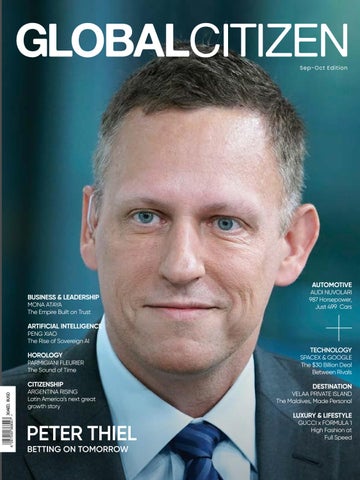
PETER THIEL BETTING ON TOMORROW
GUCCI x FORMULA 1 High Fashion at Full Speed
A BOLD NEW RESIDENTIAL ICON AT PA L M J U M E I RA H
INSPIRED BY TIDES. SHAPED BY WIND. DESIGNED TO MOVE YOU. PASSO is BEYOND’s waterfront landmark on Palm Jumeirah, conceived as a sculptural expression of contemporary coastal living.
Comprising the twin towers Bella and Avita, the development unites architecture, nature, and emotion through light, movement, and the rhythm of the sea. It offers over 600 curated residences from one- to four-bedroom homes, complemented by sky-level penthouses and 6 exclusive Beach Mansions on the shoreline, all designed with fluid layouts, panoramic glazing, and sweeping views of the Arabian Gulf, the Palm, and Dubai’s skyline.
PASSO offers 5 distinct residential collections, from wellness-led homes with private gardens and plunge pools to elite residences, penthouses, and beach mansions. A sculptural arrival piazza, cascading pools, landscaped paths to 250 metres of private beachfront, and curated wellness, family, and leisure amenities complete the experience. More than a destination, PASSO reflects BEYOND’s vision for design-led waterfront living, where architecture, nature, and emotion flow as one.
E N QUIRIE S@ BEYO N DPRO PERT IES . A E
BEYONDDEVE LOPME NTS .AE
+971 4 61 1 60 0 0
NEW FRONTIERS BEYOND LIMITS. BEYOND BORDERS.
2 0 27 Q 1 BU E N OS A I R E S , A RG E N T I N A
Step into a dynamic and inspiring world shaped by a remarkable global community of heads of state, visionary thought leaders, exceptional talent, and bold changemakers. Join the conversation redefining the future of global citizenship, where meaningful connections evolve into lasting opportunities and transformative collaborations.
GLOBALCITIZENFORUM.ORG
X
INTRODUCING
THE
GLOBAL CITIZEN CLUB EMPOWERING ACCESS. REDEFINING FREEDOM.
In a world where true wealth is measured by freedom, Arton Capital and The VIP Global unite to offer an unparalleled membership, reserved for the world’s most discerning. A seamless fusion of global mobility, sovereign freedom, and bespoke luxury, crafted exclusively for those who command the extraordinary.
This is your invitation to life without boundaries.
ARTONCAPITAL.COM | THEVIPDUBAI.COM | BY INVITATION ONLY
HENRY CAVILL
HYDROCONQUEST
CONTENTS
COVER 22 THINKING DIFFERENTLY
FEATURE 32 THE POWER BROKER
FEATURE 26 BLUEPRINT FOR TOMORROW
34 COMMANDING THE SKIES
Inside Peter Thiel’s architecture of influence
Marco Arcelli’s infrastructure legacy at ACWA Power
30 THE MOTHER MARKET
How Mona Ataya made trust scalable
Peng Xiao’s blueprint for intelligent nations Sir Tim Clark’s instinct for altitudes
36 BANKING ON TRUST
Christoph Koster on making finance worthy of confidence
HOROLOGY 40 THE SOUND OF TIME
Parmigiani Fleurier’s Carillon Tourbillon
44 PASTELS WITH PUNCH Hublot gives high-tech ceramic a lighter attitude 48 TIME ON THE ROAD
Chopard keeps pace with motoring historye
50 BUILT FOR MORE How the OMEGA Speedmaster outgrew its original brief 54 COLOUR, CUT, CALIBRE
Rado turns mechanics into graphic design
22
30
34
40
44
50
16 SEP-OCT EDITION
Your new beginning starts here.
ARGENTINA CITIZENSHIP BY INVESTMENT
The next chapter in global mobility is being written in South America. Argentina opens a new route for global citizens. Register your interest and be among the first to move.
Become a Global Citizen® MONTREAL · LONDON · PARIS · SOFIA · BUDAPEST · SAINT JOHN'S · PODGORICA · ISTANBUL · DUBAI · SINGAPORE · BEIJING · ARTONCAPITAL.COM
BOULEVARD PLAZA TOWER 1 SUITE 2004 BURJ KHALIFA DISTRICT DUBAI UAE
INFO@ARTONCAPITAL.COM +971 4 456 9220
AUTOMOTIVE 56 THE FLYING MANTUAN RETURNS
INNOVATION 90 GUCCI TAKES THE GRID
The first luxury house to claim a Formula One title
THIS GOOD Bang & Olufsen Beoplay H95
58 A QUESTION OF LIGHT Ferrari’s first electric car divides the faithful
92 RENTING FROM A RIVAL How Google ended up paying Elon Musk to keep up
110 BREATHE BEAUTIFULLY Five That Earn Their Place in Your Daily Rotation
Audi’s 987hp Nuvolari, just 499 to be built
60 THE HARLEY THAT OUTLIVED
ITS ENGINE A Dubai atelier reinvents the Giotto
62 THE GRAND TOURER REBORN
Kia’s Vision Meta Turismo
64 CHINA’S LARGEST ELECTRIC SUV Inside the NIO ES9 CITIZENSHIP 66 ARGENTINA, RECONSIDERED
A new world of opportunity 9
72 CRICKET MEETS CITIZENSHIP 78 SAINT LUCIA’S BEST-KEPT FINANCIAL SECRET
84 THE DOORS YOU OPEN BEFORE THEY’RE 18
DESTINATION 94 THE ISLAND THAT REFUSES TO
BE ORDINARY Velaa Private Island, Maldives
100 BUDAPEST’S BEAUTIFUL
DEFIANCE A city that turned survival into style
STYLE 102 A CASE FOR ALUMINIUM
GADGETS 108 SILENCE HAS NEVER SOUNDED
112 THE TRIKE THAT LEANS
Germany’s carbon-fibre All Road Racer
114 THE BEAUTIFUL MACHINES This season’s most covetable technology
118 LET THE ROBOT HANDLE IT Shark PowerDetect NeverTouch Pro
Marc Newson reinvents the Louis Vuitton trunk
104 THE WRITE STUFF
Why the luxury pen became the new status symbol
106 EAU DE LAMBORGHINI
Xerjoff bottles the supercar in three fragrances
58
84
96
100
108
126
18 SEP-OCT EDITION
The world in your pocket.
Unleash your travel freedom. Enable your global mobility. Apply Now
PASSPORTINDEX.ORG
EDITOR’S LETTER Dear Readers,
W
elcome to our September/October edition, where we turn our attention to the people, ideas and innovations shaping what comes next. Our cover belongs to Peter Thiel, one of the technology world’s most influential and unconventional thinkers — a man who has built a career by asking unfashionable questions, then placing extraordinarily consequential bets on the answers. Around him we gather a remarkable group of leaders: Marco Arcelli, wiring the energy transition into the ground at ACWA Power; Mona Ataya, who turned trust into a scalable business; Peng Xiao, quietly drawing the blueprint for sovereign AI; Sir Tim Clark, still commanding the skies after four decades at Emirates; and Christoph Koster, who believes the most radical thing a bank can do is earn confidence and keep it. There is plenty here for lovers of craftsmanship. Our horology pages carry new work from Parmigiani Fleurier, Hublot, Chopard, OMEGA and Rado — from a five-piece Carillon Tourbillon to a Speedmaster that long ago outgrew its brief. In motoring, we range from Audi’s 987-horsepower Nuvolari, of which just 499 will be built, to Ferrari’s divisive first electric car, by way of a reborn Kia grand tourer and China’s largest electric SUV. Travel takes us to Velaa Private Island in the Maldives and to a defiant, endlessly glamorous Budapest, while our citizenship features consider how the right decisions today can open doors for the next generation. Elsewhere you’ll find high fashion at full speed as Gucci takes the Formula One grid, a thirty-billion-dollar deal between supposed rivals, statement luggage, the quiet revival of the luxury pen, and some seriously impressive machines for the home and beyond. It is a packed edition, with plenty to discover. We hope you enjoy it.
GLOBAL CITIZEN PUBLISHER Tarek Al Kaaki EDITOR IN CHIEF Andrea Antal COPY EDITOR Sameer Denzi CREATIVE Fierce International Art Team PRINTING Masar Printing www.global-citizen.com www.issuu.com/global-citizen www.facebook.com/GlobalCitizenMag www.instagram.com/GlobalCitizenMagazine www.globalcitizenforum.org www.facebook.com/globalcitizenforum.org www.instagram.com/globalcitizenforum
FIERCE INTERNATIONAL FZ LLC PUBLISHER Fierce International Dubai Internet City Dubai Media City - DQuarters - Level 1 T: +971 4 421 5455 - F: +971 4 421 0208 tarek@fierce-international.com Copyright 2026 Fierce International. All rights reserved. Neither this publication nor any part of it may be reproduced, stored in a retrieval system, or transmitted in any form or by any means electronic, mechanical, photocopying, recording or otherwise, without the permission of Fierce International. Where opinion is expressed it is that of the author and does not necessarily reflect the editorial views of the publisher or Global Citizen. All information in Global Citizen is checked and verified to the best of the publisher’s ability, however the publisher cannot be held responsible for any mistake or omission enclosed in the publication.
Andrea Antal Editor-in-Chief, Global Citizen
Peter Thiel
20 SEP-OCT EDITION
Global Citizen is made of 100% recycled paper
GC COVER STORY
THINKING DIFFERENTLY Inside Peter Thiel’s architecture of influence 22 SEP-OCT EDITION
COVER STORY GC
P
eter Thiel has built a career by asking unfashionable questions, then placing extraordinarily consequential bets on the answers. While much of Silicon Valley chases scale, speed and the next consumer obsession, Thiel has remained preoccupied with something more fundamental: whether technology is advancing civilisation or merely distracting it. His record makes the question difficult to dismiss. Thiel co-founded PayPal, led it as chief executive and took it public before its US1.5$ billion sale to eBay in 2002. He was Facebook’s first outside investor, providing US500,000$ in 2004, and became an early supporter of LinkedIn and Yelp. Through Founders Fund, the venture capital firm he co-founded, he backed companies including SpaceX, Airbnb, Stripe, OpenAI, Neuralink and defence technology group Anduril. Yet Thiel’s influence is not measured solely by his ability to spot valuable companies. He has helped change what venture capital considers worth financing. His celebrated provocation, “We wanted
flying cars, instead we got 140 characters”, captured his frustration with an industry producing digital conveniences while progress in transport, energy, medicine and manufacturing appeared to slow. That argument now feels newly relevant. Artificial intelligence is attracting unprecedented investment, but Thiel remains sceptical of treating it as a complete answer to technological stagnation. In a 2025 interview, he described AI as “more than a nothing burger” but less than a total transformation of society. The distinction is characteristically Thiel: he recognises the scale of the opportunity while questioning the mythology surrounding it. Palantir Technologies, which he co-founded in 2003 and still chairs, reflects the harder edge of that worldview. Its software helps governments, militaries and businesses integrate complex data into operational decisions. The company’s growing role in defence and public administration has made it both commercially formidable and politically contentious, raising wider questions about surveillance, security and
23 SEP-OCT EDITION
GC COVER STORY
24 SEP-OCT EDITION
COVER STORY GC
the concentration of technological power. Thiel rarely shies away from controversy. His libertarian politics, support for conservative candidates and criticism of conventional higher education have made him one of technology’s most polarising figures. The Thiel Fellowship, founded in 2011, challenges the university route directly, offering young people aged 22 or under US250,000$ to leave formal education and spend two years building ambitious projects. Across payments, social media, space exploration, national security and artificial
intelligence, a consistent pattern emerges. Thiel is drawn to founders who reject inherited assumptions and pursue positions others consider improbable, premature or uncomfortable. That instinct has made him wealthy. More significantly, it has given him unusual reach across technology, capital and politics. Whether regarded as a far-sighted investor, an ideological provocateur or both, Peter Thiel has spent his career refusing to accept the world as fixed. His greatest wager is that progress begins with the courage to imagine it differently.
25 SEP-OCT EDITION
BLUEPRINT FOR TOMORROW Marco Arcelli’s infrastructure legacy at ACWA Power
T
he global energy transition will not be won through ambition alone. It will be determined by whether companies can finance, build and operate the vast infrastructure required to turn climate commitments into reliable power, water and fuel. During his three-year tenure as chief executive of ACWA Power, Marco Arcelli helped demonstrate what that execution can look like at scale. Arcelli joined the Riyadh-headquartered company as CEO in March 2023, bringing more than two decades of international experience across energy, infrastructure and technology. By the time he stepped down in March 2026, remaining as an adviser, ACWA Power’s portfolio had expanded to 108 assets across 15 countries. Together, these represented 93 gigawatts of power-generation capacity, 9.2 million cubic metres of desalinated water per day and SAR437.5 billion, or approximately US116.7$ billion, in total investment value.
The figures reveal more than corporate growth. They reflect a broader shift in how emerging economies are approaching energy and water security. Rather than treating renewables as peripheral additions, ACWA Power has placed solar, wind, battery storage, desalination and green hydrogen at the centre of its development strategy. Under Arcelli’s leadership, the company advanced some of the world’s most ambitious clean-energy projects. Among them is the NEOM Green Hydrogen Project in Saudi Arabia, designed to integrate four gigawatts of renewable power and produce up to 600 tonnes of carbon-free hydrogen each day. Once converted, this could yield as much as 1.2 million tonnes of green ammonia annually, with the potential to avoid five million tonnes of carbon emissions each year.
Beyond Saudi Arabia, ACWA Power deepened its presence in Central Asia, particularly Uzbekistan. Its investments there span large-scale solar and wind farms, battery storage and the country’s first green-hydrogen project, which entered its initial operational phase during 2025. This combination of technologies illustrates the company’s evolving role: not simply as a power producer, but as an integrated developer of the systems on which future industries will depend. Arcelli’s contribution was ultimately one of acceleration. He helped connect Saudi Arabia’s Vision 2030 ambitions with international capital, long-term purchasing agreements and disciplined project development.
In a sector where complexity can delay progress for years, his tenure was defined by converting opportunity into bankable infrastructure. That may be his most important legacy at ACWA Power. The transition to cleaner energy is often discussed in terms of targets and technologies. Arcelli’s record offers a more pragmatic lesson: transformation happens when vision is matched by financing, partnerships and relentless execution.
GC FEATURE
THE MOTHER MARKET How Mona Ataya made trust scalable
30 SEP-OCT EDITION
FEATURE GC
I
n 2011, buying baby essentials online in the Middle East was rarely straightforward. Product choice was limited, prices were difficult to compare and useful information was not always available in Arabic. For Mona Ataya, a mother of three, these were not minor inconveniences. They revealed a significant commercial opportunity. Together with co-founder Leena Khalil, Ataya launched Mumzworld, the region’s first online retailer dedicated entirely to mothers, babies and children. The premise was simple but timely: give parents one dependable place to research, compare and purchase everything their families might need. Ataya brought valuable experience to the venture. Before Mumzworld, she had worked at Procter & Gamble and Johnson & Johnson and was part of the founding team at Bayt.com, one of the Middle East’s earliest online recruitment platforms. She understood both established consumer brands and the realities of introducing digital services to a market still learning to trust them.
alongside regional brands, while suppliers gained a direct route into a highly specific and influential consumer market. The concept resonated. Over the next decade, Mumzworld grew to offer more than 250,000 products from approximately 5,500 brands. By 2021, it had cultivated a community of 2.5 million mothers and was serving customers across 20 countries. The company also raised US$50 million from investors, becoming one of the region’s most heavily funded women-led e-commerce businesses. A pivotal moment came in 2021, when Saudi Arabia’s Tamer Group acquired a majority stake for an undisclosed sum. Ataya and Khalil remained shareholders and board members. The transaction, described by Mumzworld as the Middle East’s first woman-led e-commerce deal, paired the platform’s digital expertise with Tamer Group’s extensive distribution, logistics and consumer-goods network.
That trust became Mumzworld’s most valuable currency.
“This is just the beginning for us,” Ataya said at the time. “We are better positioned than ever to accelerate growth, drive wider geographic expansion and continue to build a tech footprint serving customers better than ever.”
Rather than operating as a vast, impersonal marketplace, the company focused closely on the concerns shaping mothers’ purchasing decisions. Its bilingual platform combined a carefully selected product range with detailed descriptions, customer reviews, price transparency and practical parenting content. Mothers could find familiar international names
Ataya’s achievement is not simply that she identified a gap before larger competitors did. It is that she understood the emotional stakes behind the shopping basket. Parents were not merely purchasing nappies, car seats or feeding products. They were making decisions about their children, often with limited time and an overwhelming number of choices.
31 SEP-OCT EDITION
GC FEATURE
THE POWER BROKER Peng Xiao’s blueprint for intelligent nations 32 SEP-OCT EDITION
FEATURE GC
A
rtificial intelligence may be built in laboratories, but its future will be determined by power, infrastructure and trust. Few executives sit at the intersection of all three as decisively as Peng Xiao, Group Chief Executive Officer of Abu Dhabi-based G42. Since G42’s establishment in 2018, Xiao has helped turn the company into one of the most consequential technology groups to emerge from the Middle East. Its interests now extend across cloud computing, advanced data centres, healthcare, geospatial intelligence, energy and large language models. The ambition is not simply to join the global AI race, but to give nations greater control over the technology reshaping their economies. That vision secured a defining endorsement in April 2024, when Microsoft announced a US1.5$ billion strategic investment in G42. The agreement placed Microsoft President Brad Smith on G42’s board and introduced an intergovernmental assurance framework focused on security, safety and responsible deployment. The partnership has since expanded to include a planned -200megawatt increase in datacentre capacity in the UAE, strengthening access to sovereign cloud and AI services. Xiao’s influence is most visible in his ability to convene organisations that might otherwise compete. G42 has forged relationships with Microsoft, OpenAI, NVIDIA, Oracle, Cisco and Cerebras, creating an unusually broad network of expertise, computing power and commercial reach. In 2025, that collaborative model produced Stargate UAE, a planned one-gigawatt
computing cluster within the wider five-gigawatt UAE-US AI Campus in Abu Dhabi. G42 will build the cluster, with OpenAI and Oracle operating it. For Xiao, such projects are as much about international confidence as technical capacity. He described Stargate UAE as “building a bridge, rooted in trust and ambition”, language that captures the diplomatic dimension of his role. At a time when access to advanced chips and computing infrastructure is increasingly shaped by national security concerns, trust has become one of AI’s most valuable currencies. Yet G42’s work is not confined to vast computing campuses. Its Inception subsidiary helped develop Jais, an opensource Arabic large language model designed to give hundreds of millions of Arabic speakers better access to generative AI. A partnership with NVIDIA has also produced high-resolution weather-modelling technology intended to improve regional forecasting and understanding of extreme conditions. These initiatives reveal the substance behind G42’s “Intelligence Grid”: an interconnected foundation of computing, data, models and applications that can serve countries without stripping them of control over sensitive information. Xiao’s real achievement, then, is not predicting where artificial intelligence is heading. It is positioning Abu Dhabi among the places with the infrastructure, alliances and confidence to shape where it goes next.
33 SEP-OCT EDITION
GC FEATURE
COMMANDING THE SKIES Sir Tim Clark’s instinct for altitude 34 SEP-OCT EDITION
L
ong before Dubai became synonymous with global aviation, Sir Tim Clark saw what it could be: a natural meeting point for a world increasingly eager to move. He joined Emirates’ founding team in 1985 as Head of Airline Planning, when the fledgling carrier operated just two leased aircraft. Since becoming President in 2003, he has helped transform that modest beginning into the world’s largest international airline, connecting more than 130 cities across six continents.
Emirates could not escape the upheaval, but Clark resisted treating it as a permanent change in the balance of global aviation.
Clark’s great contribution has been his understanding that geography alone does not create a hub. Connectivity must be designed. Emirates built its network around Dubai’s position between Europe, Asia, Africa and the Americas, combining long-haul aircraft with carefully timed connections. The model changed international travel, opening new routes between cities that had previously required awkward itineraries through traditional European gateways.
Clark said Emirates would introduce incentives beyond discounted fares to reassure concerned travellers, including measures addressing the fear of becoming stranded. The airline also continued discussions with governments and regulators about restrictive travel warnings and access to regional airspace. Crucially, short-term turbulence has not weakened Emirates’ appetite for longterm investment. Its aircraft retrofit programme, now backed by US5$ billion, reached its 100th completed wide-body jet in July 2026. Meanwhile, new Airbus A350 deliveries and extensive orders for next-generation Boeing aircraft are preparing the fleet for another era of growth.
Four decades after its launch, Emirates has become an economic force in its own right. In 2025, the airline carried 55.6 million customers on nearly 180,600 flights. For the financial year ending March 2026, it reported a record pre-tax profit of AED22.8 billion, or US6.2$ billion, making it the world’s most profitable airline for the reporting period. That strength was tested when the Iran conflict disrupted Middle Eastern aviation in early 2026. Airspace closures and security restrictions forced widespread cancellations, diversions and temporary suspensions, stranding passengers and placing fresh pressure on fuel costs.
Speaking at the Berlin Air Show in June, he warned competitors hoping to capture displaced traffic: “Be careful what you wish for. We will be back very hard and fast.” The confidence was characteristically direct, but it was supported by action.
Clark’s legacy is therefore larger than route maps or balance sheets. He helped prove that an airline from the Gulf could redraw the hierarchy of global travel, then defended that position through financial crises, a pandemic and geopolitical shocks. In aviation, confidence is only valuable when passengers share it. Clark’s enduring skill has been turning a bold proposition into one the world continues to board.
29 SAINT LUCIA EDITION
GC FEATURE
BANKING ON TRUST Christoph Koster isn’t trying to disrupt banking. He’s trying to make it worthy of confidence, and ready for what comes next. 36 SEP-OCT EDITION
FEATURE GC
T
here is a particular kind of leader who resists the vocabulary of disruption. One who understands that in financial services, the most radical thing you can do is earn trust and keep it. Christoph Koster, CEO of ruya, is that kind of leader. His career has moved across consulting, government, investment, and banking. A trajectory that sounds conventional until you notice the thread running through it. In every sector, Koster was watching how people respond to new ideas, and what it takes for institutions to deserve the right to offer them. “When you work across sectors, you notice a common pattern,” he says.
“People accept innovation when they understand it and when accountability is clear.” That observation, refined over years, has become the operating principle behind ruya, a UAE-based digital Islamic bank positioning itself at the intersection of ethical finance, embedded banking, and the next generation of financial infrastructure. Bank-grade, not just app-grade When Koster stepped into the CEO role, his ambitions for ruya went well beyond building a sleek digital product. “Digital-first should mean removing friction and increasing transparency — but not removing responsibility,” he says.
“That›s why we talk about building a bank people can rely on, not just an app people download.” It is a distinction that matters more than it might seem. In a market flooded with fintech propositions competing on speed and interface, Koster is deliberately anchoring ruya in something heavier: governance, operational rigour, and what he calls a “partnership-minded” architecture. In his view, banks are evolving into platforms, enabling financial experiences through APIs inside other customer journeys. That shift demands an organisation designed for collaboration and control from day one. Big print, not fine print Ask Koster how ethical banking moves from mission statement to operating reality, and his answer is disarmingly practical. “Ethical banking becomes real when it is operationalised,” he says.
“Decisions are explainable, tradeoffs are documented, and customer impact is explicitly considered.” At ruya, that translates into a commitment to transparency he summarises with characteristic directness: “We don’t do fine print. We do big print.” Customers should understand what they are getting, what it costs, and what the risks are, without needing professional expertise to decode the terms. Beyond individual transactions, the bank is built to optimise for outcomes rather than acquisition metrics:
LUCIAEDITION EDITION 29 37SAINT SEP-OCT
GC FEATURE
financial resilience, responsible wealth-building, and inclusive access. It is the kind of language that could sound aspirational if it weren’t grounded in the structural choices ruya has made, from its Shari’ah governance framework to its approach to product design and disclosure. Control-forward innovation The tension between innovation and regulation is a familiar narrative in financial services. Koster reframes it entirely. In his model, strong frameworks are not constraints on progress. They are what make progress sustainable.
“In emerging areas like embedded finance, Banking-as-a-Service, and digital assets, the quickest path to sustainable scale is to be control-forward,” he says. Clarity of oversight and access to records are not, in his words, “a technical nuisance but a fundamental safety requirement.” This philosophy was tested most visibly in ruya’s move into Shari’ah-compliant digital assets, a category carrying what Koster calls “a global reputation problem: complexity, volatility, and uneven consumer outcomes.” His approach was to separate the technology from the behaviour. The underlying infrastructure can be useful, he argues, but only when offered in a way that is transparent, Shari’ah-aligned, and shaped for responsible participation rather than speculation. Governance, Shari’ah oversight, product safeguards, and rigorous partner due diligence, including
38 SEP-OCT EDITION
ruya’s partnership with Fuze for digital asset infrastructure, are the mechanisms through which innovation is made to feel like banking: clear rules, clear accountability, clear protections. The platform horizon Where Koster’s vision becomes most forward-looking is in his assessment of what banking infrastructure needs to become. Two forces, he argues, are accelerating the platform model’s relevance. The first is stablecoins as a settlement rail. He points to the International Monetary Fund’s estimate of approximately $1.5 trillion in stablecoin cross-border flows in 2024, alongside Visa reporting more than $3.5 billion in annualised stablecoin settlement volume as of late 2025. That trajectory increases demand for regulated on- and off-ramp infrastructure, precisely the kind of plumbing ruya is building. The second is AI agents. As agent-to-agent commerce protocols develop, the banking front end may shift away from apps toward secure, permissioned APIs. “If that happens,” Koster says, “being API-addressable is the bank’s future relevance.” It is a bold claim: that the institutions which survive the next cycle will not necessarily be those with the best consumer apps, but those that can be accessed securely and programmatically without compromising oversight. Experience as confidence For all the infrastructure thinking, Koster
FEATURE GC
remains rooted in a customer-first instinct honedoveryears.Heiscriticalofdigitalmodels that equate experience with feature velocity.
. “In financial services, the real drivers of experience are simpler: clarity, responsiveness, and consistent outcomes,” he says. ruya operates as digital-first but not digital-only, combining a modern app-led journey with physical community touchpoints for more complex needs. It is a hybrid model reflecting Koster›s conviction that the best banking relationship is, ultimately, about confidence. “The customer knows what›s happening, feels respected, and can get help quickly when life gets complicated.” Calm, coherence, and the courage to pause Leading at the pace fintech demands requires a particular temperament. Koster describes his approach to pressure with the same precision he brings to everything else: “In high-pressure situations, people look for calm and coherence. I’ve learned to create that by being explicit about what we know, what we don’t know yet, and what we are doing next.” He is equally candid about the discipline required to resist momentum when something is not right. “In difficult decisions, I ask: are responsibilities clear, can we evidence what happened, and are controls strong enough to protect customers? If the answer is not yes, we pause, fix, and then move forward.”
Built for what comes next The UAE, Koster argues, is uniquely positioned for the era ahead, given both its openness to new financial models and its tightening expectations around compliance and operational integrity. As stablecoin settlement scales and AI agents reshape how people access financial services, markets with robust digital identity, API frameworks, and clear supervisory direction will adapt fastest. It is in this context that Koster frames ruya’s next chapter. Success, he says, has two layers. The first is direct customer trust, delivering ethical Islamic banking with excellent service and genuine community relevance, consistently. The second is platform relevance, building API-led capability that enables others to innovate on top of regulated rails. “If bank apps become less central,” he says,
the banks that remain relevant will be those that can be accessed securely via APIs without compromising governance. That’s the future I’m building toward.” It is not the language of disruption. It is the language of stewardship, applied with precision to an industry that, for all its talk about the future, still runs on something older and far harder to build. Trust.
39 SEP-OCT EDITION
GC HOROLOGY
THE SOUND OF TIME
A landmark in independent haute horlogerie
P
armigiani Fleurier’s Carillon Tourbillon brings together three of watchmaking’s most demanding complications: a minute repeater, a four-gong carillon and a 60-second tourbillon. Limited to five pieces, it represents the expertise and design philosophy that have defined the independent Maison since its foundation. The watch draws inspiration from an early nineteenth-century Perrin Frères pocket watch from the Sandoz Collection, restored by Parmigiani Fleurier’s workshops in 2000. Rather than recreating the historic timepiece, the Maison studied its construction and translated key elements into a modern wristwatch. Most notable are the four serpentine gongs visible beneath the glass-box sapphire crystal. Their long, curved forms reference the original pocket watch while also giving the Carillon Tourbillon its distinctive appearance. Working with the dial-side hammers, they produce four separate notes: a low tone for the hours, a higher tone for the minutes and two additional notes for the quarter-hours. At the centre is the manually wound PF950 manufacture calibre. Made from 456 components and 42 jewels, it operates at a frequency of 3Hz and provides a power reserve of at least ten days.
40 SEP-OCT EDITION
A third barrel is dedicated to the striking mechanism and is rewound when the minute-repeater slide is activated. An integrated regulating flywheel helps maintain an even tempo throughout the chime. Despite its mechanical complexity, the dial remains balanced and easy to read. Crafted from -18carat white gold, it has a hand-hammered Morning Blue finish that shifts between silver and pale blue as it catches the light. The tourbillon and power-reserve display are positioned on the reverse, allowing the chiming mechanism to take visual priority on the front. The polished 41.6mm white-gold case features vertical gadroons inspired by classical columns, while the crown is set with a blue sapphire. An Akoya Grey, hand-stitched alligator strap completes the watch. The Carillon Tourbillon demonstrates Parmigiani Fleurier’s distinctive approach to haute horlogerie: learning from historic mechanisms without directly reproducing them. It is both a technically ambitious chiming watch and a clear expression of the Maison’s commitment to restoration, craftsmanship and independent watchmaking.
41 SEP-OCT EDITION
GC HOROLOGY
42 SEP-OCT EDITION
HOROLOGY GC
43 SEP-OCT EDITION
GC HOROLOGY
PASTELS WITH PUNCH
Hublot gives high-tech ceramic a lighter attitude
P
astel may suggest restraint, but Hublot has never been interested in blending quietly into the background. With the Big Bang Summer collection, the Swiss watchmaker applies a playful Mediterranean palette to one of contemporary horology’s most recognisable silhouettes. Mint green, soft pink and sky blue meet across the multi-coloured ceramic case, bezel and dial, creating a combination that feels closer to resort fashion than traditional watchmaking. Yet beneath the cheerful colour scheme is some serious technical substance. The 42mm Big Bang Summer MultiColoured Ceramic houses Hublot’s HUB1280 Unico manufacture movement, an integrated self-winding flyback chronograph with a column wheel. Comprising 354 components, it
44 SEP-OCT EDITION
offers a power reserve of approximately 72 hours and allows the chronograph to be reset and restarted instantly. Limited to 200 pieces, the watch pairs a pink-andmint ceramic case with a sky-blue bezel and a matte two-tone dial. For a more exclusive interpretation, the 44mm version is limited to just 10 pieces. Its transparent pink sapphire dial reveals the HUB6035 automatic tourbillon movement, complete with a dial-side micro-rotor and -72hour power reserve. The open construction gives the pastel design a sharper, more architectural character. Both models come with sky-blue, mintgreen and pink rubber straps, each lined in white and fitted with Hublot’s OneClick system The ability to change colours in seconds makes the watch feel less like
45 SEP-OCT EDITION
HOROLOGY GC
a fixed accessory and more like part of a wardrobe. The broader Big Bang ceramic line continues the colour story with monochrome 33mm models in peach, mint and petrol blue. Presented without diamonds for the first time at this size, their polished ceramic surfaces and matching dials allow colour to take centre stage. A 42mm titanium and peach ceramic flyback chronograph offers a sportier alternative.
46 SEP-OCT EDITION
The softer shades do not mean softer performance. Hublot’s coloured hightech ceramic is engineered for exceptional hardness, scratch resistance and lasting brilliance. It is a typically Hublot contrast: light-hearted in appearance, uncompromising in construction. Bold, technical and deliberately fun, the Big Bang proves that serious watchmaking need not take itself too seriously.
HOROLOGY GC
47 SEP-OCT EDITION
TIME ON THE ROAD
Chopard keeps pace with motoring history
I
n the Mille Miglia, winning is only part of the appeal. The real reward lies in the journey: a thousand miles of Italian roads, historic automobiles and the particular excitement that comes from seeing rare machines doing what they were built to do. More than 400 classic cars travel between Brescia and Rome before returning to their starting point. Inspired by the original races held from 1927 to 1938, the modern event combines timed competition with a moving celebration of automotive culture. Its route takes drivers through historic cities, mountain passes and some of Italy’s most striking landscapes. Chopard has accompanied the rally as World Sponsor and Official Timekeeper since 1988, creating one of the longest-running partnerships between a watchmaker and a motorsport event. The relationship is more than a branding exercise. Both worlds rely on mechanical expertise, accuracy and an appreciation for objects designed to perform over time. That connection is personified by Chopard Co-President Karl-Friedrich Scheufele. A committed classic-car collector, he has participated in the rally on almost every occasion since the partnership began. He frequently shares the cockpit with racing driver and Chopard Ambassador
48 SEP-OCT EDITION
Jacky Ickx, piloting the Scheufele family’s Mercedes-Benz 300 SL Gullwing, a car every bit as elegant and mechanically significant as the finest timepiece. Precision remains central to the Mille Miglia. Rather than racing solely for outright speed, competitors must maintain prescribed averages through a series of timed sections. Success depends upon concentration, consistency and accurate timekeeping, making the connection with horology especially relevant. Chopard translates this shared mechanical spirit into its Mille Miglia watch collection. The Mille Miglia GTS Power Control – 2026 Racing Edition, limited to 250 pieces, reflects the technical character of the competition, while the Mille Miglia Classic Chronograph Raticosa takes its name from one of the rally’s renowned mountain passes. The route may provide the spectacle, but it is the details that give the Mille Miglia its character: analogue instruments, carefully judged corners, engines echoing through old towns and seconds measured with purpose. For Chopard, the event represents a natural meeting point between watchmaking and motoring, two disciplines in which precision matters, heritage is respected and mechanical objects are meant to be used, not simply admired.
HOROLOGY GC
49 SEP-OCT EDITION
GC HOROLOGY
BUILT FOR MORE How the Speedmaster outgrew its original brief
T
he OMEGA Speedmaster began with a straightforward assignment: help racing drivers measure speed. Introduced in 1957, it was the first wristwatch chronograph to place its tachymeter scale on the bezel rather than the dial, making calculations clearer at a glance. It was practical, legible and firmly designed for life on the ground. Then NASA changed its trajectory. In the 1960s, the American space agency subjected a selection of chronographs to punishing tests involving temperature extremes, vibration, shock, pressure and humidity. The Speedmaster survived and was declared flight-qualified for manned space missions. On 20 July 1969, it reached the lunar surface on the wrist of Apollo 11 astronaut Buzz Aldrin.
50 SEP-OCT EDITION
That moment secured its place in popular culture, but the Speedmaster’s appeal has never depended on history alone. Its design remains remarkably easy to recognise: a black dial, three chronograph counters, a tachymeter bezel and an asymmetric case developed to protect the crown and pushers. Functional decisions made decades ago have become lasting visual signatures. The mechanics are equally important. Early Moonwatch models were powered by the hand-wound calibre 321, valued for its robust construction and closely associated with the Apollo missions. OMEGA has since continued to develop the collection through new movements, materials and technologies while retaining its essential identity.
HOROLOGY GC
51 SEP-OCT EDITION
GC HOROLOGY
Some interpretations stay close to the original formula. Others take a more experimental route. The X-33 introduced digital functionality for professional spaceflight, while the ceramic Dark Side of the Moon offered a contemporary tribute to the Apollo 8 astronauts, the first people to see the far side of the Moon directly. That range has allowed the Speedmaster to move comfortably between professional instrument, luxury chronograph and cultural symbol.
52 SEP-OCT EDITION
It can be appreciated for its connection to space exploration, its motorsport roots or simply the strength of its design. Many watches are created around a compelling story. The Speedmaster is different because its story was largely written after the watch itself. It was designed for the racetrack, selected for space and tested under conditions its creators could not have anticipated. The result is a working classic that continues to evolve without losing sight of where it began.
HOROLOGY GC
53 SEP-OCT EDITION
GC HOROLOGY
COLOUR, CUT, CALIBRE Rado turns mechanics into graphic design
F
orget quiet luxury. Rado’s DiaStar Original Skeleton Limited Editions are designed to be noticed, with vivid colour, unconventional proportions and exposed mechanics sharing equal billing. The collection presents three distinct combinations: blue with yellow accents, green and gold with flashes of red, and red with luminous green details. Each uses colour as part of the watch’s architecture, drawing the eye from the outer case towards the skeletonised movement at its centre. That layered effect suits the DiaStar. The original model built its identity around an unusual case shape rather than tradi
54 SEP-OCT EDITION
tional watchmaking codes, and the latest interpretations retain its broad, convex oval bezel in Rado’s signature Ceramos. A faceted square sapphire crystal sits above the movement, while the circular dial elements create a deliberate mix of curves and angles. The blue edition offers the coolest composition, pairing a polished Ceramos bezel with a blue annular dial, rhodium-coloured hands and yellow Super-LumiNova. The green model is warmer and more extravagant, with a gold-coloured PVD finish, matching hands and indices, and sharp red luminous accents. The red version delivers the strongest contrast, combining a radially brushed bezel with
HOROLOGY GC
rhodium-coloured details and bright green Super-LumiNova. Matching rubber straps keep each design relaxed and contemporary. Fitted with Rado’s EasyClip system, they also reinforce the uninterrupted use of colour from dial to wrist. Behind the visual energy is the automatic Rado calibre R808. The -25jewel, three-hand movement provides an -80 hour power reserve and incorporates an antimagnetic Nivachron hairspring. Skeletonisation exposes the movement’s structure and horizontal brushed
decoration, allowing the mechanics to become part of the overall design rather than remaining hidden beneath the dial. Each watch measures 38mm wide, 45mm long and 11.9mm thick. Sapphire crystal case backs provide another view of the movement, alongside an engraving confirming that each colour is limited to 555 pieces. The result is an open-worked watch without the usual air of formality. Bright, graphic and slightly unconventional, the DiaStar Original Skeleton treats precision mechanics as something to display, frame and enjoy in full colour.
55 SEP-OCT EDITION
GC AUTOMOTIVE
THE FLYING MANTUAN RETURNS
A 987 horsepower hybrid announces Ingolstadt’s return to glamour
T
here is a certain theatre to the way the very rich are shown new toys, and Audi has learned the choreography fast. The invitation to see the Nuvolari arrived by phone, never email, never WhatsApp, two weeks before a select audience gathered on the eve of the Monaco Grand Prix. Secrecy, it turns out, is the newest luxury.
56 SEP-OCT EDITION
What they were shown is the most powerful production car Audi has ever built: a 987-horsepower plug-in hybrid named for Tazio Nuvolari, the fearless Italian who drove for Auto Union, Audi’s ancestor, in the late 1930s. Enzo Ferrari called him his favourite driver. The homage feels earned.
AUTOMOTIVE GC
The numbers do their own seducing. A top speed of 217 miles per hour. Zero to 62 in 2.6 seconds. At its heart sits a four-litre twin-turbo V8 that revs to a dizzying 10,000 rpm, flanked by three axial flux electric motors and a modest battery tucked into the transmission tunnel. The bones are borrowed from Lamborghini’s Temerario, a fellow citizen of the Volkswagen empire, yet Audi has tuned the whole thing toward composure rather than tantrum. Only 499 will be built, with prices starting near 500,000 pounds and deliveries beginning in the first half of 2027. This is Audi vaulting upmarket, trading on the fresh credibility of its Formula 1 programme, which joined
the grid for the 2026 season and clearly lit a fire under the entire enterprise. The design is the real surprise. Where rivals festoon their supercars with ducts and snarl, the Nuvolari is cleanly surfaced, all geometric rigour and considered drama, the work of a team led by the Tuscan creative chief Massimo Frascella, late of Jaguar Land Rover. The doors conceal their releases inside black side intakes. The cabin favours gorgeous materials over a wall of screens. It is the R8 reborn for the hybrid age, and proof that Europe can still move at speed when vanity and engineering align. The Flying Mantuan, one suspects, would have approved.
57 SEP-OCT EDITION
GC AUTOMOTIVE
A QUESTION OF LIGHT Ferrari’s first electric car divides Maranello loyalists and design critics
58 SEP-OCT EDITION
AUTOMOTIVE GC
W
hen Ferrari pulled the covers off the Luce in Rome earlier this year, the reaction was instant and ferocious. The marque’s first fully electric car, its name the Italian word for light, has been engineered to do many things. Pleasing everyone was apparently not among them. The loudest objections came from within the family. Luca di Montezemolo, the former chairman, declared the styling so unloved that even Chinese rivals would decline to copy it. The market seemed to agree, wiping as much as four billion pounds off Ferrari›s share price the day after the unveiling. James May, the broadcaster, offered a rare defence, praising the design as modern and contemporary, qualities he argued Ferrari has always chased.
A -122kilowatt-hour battery forms the structural floor, lending the chassis far greater rigidity than the Purosangue. Engineers devised a torque shift system worked through the steering wheel paddles, an attempt to restore drama to electric acceleration. The motors› real vibrations are amplified inside and out, a gesture towards the noise that has always defined the brand. The interior has drawn near-universal praise, with all-milled aluminium, Gorilla Glass, and a launch handle that descends from the roof. The chairman, John Elkann, framed the gamble in a single line at the unveiling, insisting that Ferrari has always been defined by feeling rather than by whatever powers it.
The Luce is a deliberate provocation. It has four doors and five seats, a first for Maranello, and a teardrop passenger cell that LoveFrom, the creative collective founded by Jony Ive and Marc Newson, calls the glasshouse. That shell helped deliver the lowest drag coefficient of any Ferrari yet built. The collaboration ran for roughly seven years, with LoveFrom designers practically embedded inside Ferrari, though nothing reached production without sign-off in Maranello. The numbers reassure the faithful. Four electric motors produce a combined 1,035 horsepower, sending the Luce from rest to 62 miles per hour in 2.5 seconds.
59 SEP-OCT EDITION
GC AUTOMOTIVE
THE HARLEY THAT OUTLIVED ITS ENGINE How a Dubai atelier reinvented its most famous custom motorcycle
T
here are custom motorcycles, and then there are machines that seem determined to escape every category assigned to them. The Giotto Altre, built by box39, belongs firmly in the latter camp. Its origins trace back to the HarleyDavidson V-Rod, the muscle cruiser introduced in 2001 and powered by the Revolution engine developed in collaboration with Porsche Engineering. Even after Harley discontinued the model in 2017, the V-Rod remained one of the most influential foundations in modern custom motorcycling. box39 had already achieved international attention with the original Giotto, a radical V-Rod transformation. The Altre takes the idea much further. The company developed its own chassis to recreate the dramatic proportions that made the first bike so memorable, then built the machine around a Harley-Davidson Breakout. The silhouette is striking. A stretched front end, a -21inch front wheel, an -18inch rear wheel, a 280mm rear tyre
60 SEP-OCT EDITION
and a remarkably low stance create a presence that feels closer to sculpture than transportation. Underneath sit a Softailstyle single-sided swingarm, air suspension at the rear and bespoke bodywork in milled aluminium and fibreglass. The real change is in what powers it. With the Revolution engine no longer available, box39 turned to Harley-Davidson’s Milwaukee-Eight V-twin, the powerplant that anchors much of the company’s current line-up. The Altre keeps the Breakout’s controls and instruments too. Despite its dramatic appearance, the Giotto Altre was designed to be ridden. It retains a passenger seat, touring-friendly ergonomics and practical fuel capacity. The result is a motorcycle that still carries Harley-Davidson DNA while looking like it belongs to an entirely different species.
AUTOMOTIVE GC
61 SEP-OCT EDITION
GC AUTOMOTIVE
THE GRAND TOURER REBORN Kia’s Vision Meta Turismo fuses sixties glamour with gamingage theatre.
I
nMilan, where design pilgrims gather each spring, Kia drew the crowds with its most theatrical electric concept yet. The Vision Meta Turismo, an electric grand tourer first revealed in Korea in late 2025, made its global debut at Milan Design Week, holding court at the Salone dei Tessuti. The silhouette is low, wide and cab-forward, clad in what the brand calls a «soft geometric» surface that looks both machined and molten depending on the light. Designers borrowed from jet aircraft, lending the body a canard-inspired structure that houses cameras and lamps. A blade of LED light wraps the rear. Under a wide glass canopy, a slim internal frame is left visible, strength worn as ornament. The cabin is the headline act. The driver gets a cockpit built for concentration; the passenger gets a lounge seat that rotates
62 SEP-OCT EDITION
a full 180 degrees when stationary, turning the interior into a salon. Karim Habib, Kia›s global design chief, frames the project as proof that the marque›s «Opposites United» philosophy can shape mobility itself. The theatre is in the controls. A joystick gear shifter recreates the drama of changing gears, complete with virtual engine sounds and vibration. A boost button promises sudden acceleration. A dial tunes the car’s mood. The steering wheel, modelled on a gaming controller, switches between three modes named Speedster, Dreamer and Gamer. It is a manifesto with wheels, a wager that the electric age can still feel visceral. Whether any of it reaches a driveway is, for now, beside the point.
AUTOMOTIVE GC
63 SEP-OCT EDITION
GC AUTOMOTIVE
64 SEP-OCT EDITION
AUTOMOTIVE GC
THE NIO ES9 IS CHINA’S LARGEST ELECTRIC SUV NIO’s flagship wraps a swappable battery and 4.3-second launches in Escalade-size sheetmetal.
C
hinese automakers have a habit of skipping the warm-up lap, and the NIO ES9 is the latest to floor it from a standstill. This is a three-row electric SUV that measures 5365 mm nose to tail, which makes it the largest electric SUV China has built and leaves it just 17 mm shy of a Cadillac Escalade. The wheelbase, at 3250 mm, actually beats the standard Caddy’s, and NIO has spent every inch of it on people rather than cargo. The hardware reads like a spec-sheet flex. Dual motors serve up 520 kW, or 697 horsepower, and 516 pound-feet, enough to hustle this big EV to 100 km/h in a claimed 4.3 seconds. A -900volt architecture supports 5C fast-charging, and if you would rather not wait at all, NIO›s party trick remains the battery swap, which trades a depleted -102 kWh pack for a full one in about three
minutes. An active -48volt suspension and rear-wheel steering shrink the turning circle to 5.4 meters, so the thing parks like something half its size. Range lands at 620 km on China›s optimistic cycle. Inside is where the pitch gets interesting. NIO builds a rolling boardroom: six seats, dual 16-inch screens, a conferencing system, a magnetic tea tray, and second-row thrones with a 42-point massage and electrochromic windows that go opaque in milliseconds. Yao Ming, all 7-foot-6 of him, signed on as “chief experience officer,” which is one way to prove the headroom claim. The target buyer is clear enough. NIO is hunting executives who think a BMW iX is predictable and a Mercedes EQS looks a little ordinary.
65 SEP-OCT EDITION
GC ARTICLE
ARGENTINA RISING
Latin America’s next great growth story 66 SEP-OCT EDITION
GC
A
rgentina has never lacked admirers. What it lacked, for decades, was a reason to commit. That reason may have just arrived. For decades, globally mobile families have looked to Europe for second residency, to the Caribbean for second passports, and to the Gulf for tax efficiency. Argentina has watched from a distance, a country of extraordinary depth, a passport of genuine power, and an economy perpetually on the edge of its own potential. That is changing. Under President Javier Milei, Argentina signed Decree 2025/524 in July 2025, formally establishing the legal framework for the country›s first ever Citizenship by Investment program. It is the first of its kind in South America, and it is unlike anything else currently on the market. But before we talk about what Argentina offers the globally mobile investor, it is worth asking the more fundamental question: why Argentina at all? A Country That Has Always Been More Than Its Economy Argentina has one of the most complex and compelling histories in the Western hemisphere. Shaped by waves of European immigration from Italy, Spain, Germany and Eastern Europe, it developed a culture that is simultaneously deeply Latin American and intimately European. That duality is visible everywhere: in the architecture of Buenos Aires, in the names of its families, in the food on its tables, and in the passion with which its people engage with art, sport, politics, and life.
The country stretches across 2.8 million square kilometers, the eighth largest in the world, encompassing subtropical jungle, high-altitude Andean desert, glacial Patagonia, and some of the most productive agricultural land on earth. It is a country of genuine scale, and of genuine contrast. For centuries it has attracted both the ambitious and the adventurous. Today, it is beginning to attract a new kind of global citizen: one who understands that a country with this much to offer deserves a second look. Buenos Aires: The City That Never Fully Reveals Itself No conversation about Argentina begins anywhere other than Buenos Aires. Often called the Paris of South America, it is a city that earns the comparison, though it resists any single label. Buenos Aires received its first Michelin Guide in 2024, a recognition that its dining scene had already earned. Don Julio, its most celebrated steakhouse, is ranked among the finest restaurants in the world, not merely for the quality of its grass-fed Argentine beef, but for the entire ritual of the meal. Aramburu, the country’s only two-Michelin-starred restaurant, offers multi-course tasting experiences that reframe what Argentine cooking can be. But Buenos Aires is not only about food. It is a city of theatre, of psychoanalysis, of football, of protest, and of extraordinary bookshops. It rewards those who stay long enough to move past the obvious and into the particular. And for families
67 SEP-OCT EDITION
considering a second base in South America, it offers world-class private schooling, a bilingual international community, and a cultural life that rivals any city in Europe. Mendoza: Where the Andes Meet the Vine Four hours from Buenos Aires by air, the Mendoza region sits at altitude along the eastern flank of the Andes and produces some of the finest Malbec in the world. The wine here is not a product, it is a landscape, a season, and a way of life. High-altitude vineyards run along the Luján de Cuyo and Valle de Uco valleys, where dry desert air, dramatic temperature swings between day and night, and snow-melt irrigation from the Andes create conditions that produce grapes of extraordinary concentration. Luxury wine estates, such as Zuccardi, Catena Zapata, and Achaval Ferrer offer private tastings, harvest experiences, and boutique lodge stays that place guests inside the winemaking process rather than observing it from a distance. The Michelin Guide’s arrival in Mendoza has elevated its culinary profile globally. The region now draws wine tourists from Europe, Asia, and North America who come not simply to drink, but to understand the land that produces what they are drinking. For investors and second-home owners, Mendoza is increasingly attractive: a relaxed lifestyle at altitude, direct international connections, and real estate
68 SEP-OCT EDITION
that still represents genuine value by European or North American standards. Patagonia: The Last Great Wilderness At the southern end of the continent, Patagonia operates on a different scale entirely. Torres del Paine. Perito Moreno. El Chaltén. These are names that experienced travelers invoke with reverence. The Patagonian landscape with glaciers calving into turquoise lakes, granite towers rising vertically from the steppe, and condors circling on thermals above valleys that see almost no human presence, is among the last truly wild places accessible to the private traveler. San Carlos de Bariloche, the region’s alpine gateway, has developed into a serious luxury destination: world-class ski terrain, artisanal food culture, and private lodge experiences at a fraction of equivalent Icelandic or Norwegian pricing. Those who know Patagonia tend to return. It has the rare quality of making the world feel genuinely large again. The Essentials: Safety, Education, and Healthcare For families considering a second home or long-term base, the practical fundamentals matter as much as the lifestyle appeal. Argentina performs well across all three. Safety Buenos Aires, Mendoza, and Bariloche are well-established international destinations with mature visitor and resident
infrastructure. Like any major city, Buenos Aires requires standard urban awareness, but it is broadly comparable to other large Latin American capitals and significantly safer than many of its regional peers. The government’s ongoing focus on economic stabilization and regulatory reform under the current administration has contributed to a more predictable security environment, and the international community of residents and long-term visitors in cities like Palermo and Recoleta is large, well-connected, and settled. Education Argentina has one of the highest literacy rates and most developed education systems in Latin America, with a long tradition of public university excellence stretching back more than a century. Buenos Aires is home to several internationally accredited private and bilingual schools catering to the expatriate and globally mobile community, offering IB curricula and instruction in English, French, and other languages. The Universidad de Buenos Aires consistently ranks among the leading universities in Latin America. For families with children, the educational offering, combined with the cultural richness of the city, provides
an environment that is both academically rigorous and genuinely formative. Why Now Investment migration programs do not stay still. Caribbean citizenship by investment programs are under mounting pressure to close, even as residency by investment and golden visa routes remain widely available across Europe. What is narrowing is the number of programs offering genuine citizenship rather than residency, and Argentina’s program arrives directly into that gap. Argentina’s program arrives at a moment when the market needs new options, and offers something no other program currently provides: a G20 economy, a passport with genuine global power, access to one of the world’s largest free movement blocs, a clean tax position for non-resident holders, and a country that offers a standard of living, cultural depth, and natural beauty that few destinations on earth can match. The window for first movers is open. It will not remain so indefinitely. To register your interest in Argentina’s Citizenship by Investment program and speak with a dedicated Arton Capital advisor, visit artoncapital.com.
69 SEP-OCT EDITION
70 SEP-OCT EDITION
71 SEP-OCT EDITION
GC ARTICLE
CRICKET MEETS CITIZENSHIP
Antigua and Barbuda’s Cricket West Indies Campus Signals a New Frontier for Investment Migration 72 SEP-OCT EDITION
ARTICLE GC
A
ntigua and Barbuda has approved one of the most ambitious sports infrastructure projects the Caribbean has seen in years, and the investment migration industry is taking notice. On April 10, 2026, the nation’s Cabinet gave the green light to the Cricket West Indies (CWI) Campus, a 20-acre, fully integrated cricket and sports tourism development that positions the country as a high-performance hub for the region’s most storied sport. While the project itself is a government-led initiative, its scale and ambition have opened a conversation within the citizenship by investment (CBI) sector about whether a sports-anchored funding channel could eventually support developments of this kind. The timing is notable given where Antigua and Barbuda already sits in the investment migration landscape. As one of the founding members of the Caribbean’s citizenship by investment community, the twin-island nation has operated its program since 2013, making it one of the more established and closely watched jurisdictions in the region. Citizenship is currently available through a non-refundable contribution to the National Development Fund starting at 230,000 dollars, a contribution to the University of the West Indies Fund, an approved real estate purchase, or a qualifying business investment, with successful applicants gaining visa-free or visa-on-arrival access to more than 150 destinations, including the Schengen Area. That existing infrastructure, an operational program, an established due diligence framework, and a government accustomed to managing large-scale foreign investment, is part of what makes Antigua and Barbuda a plausible testing ground for the kind of sector-specific investment channel now being discussed.
A Landmark National Investment The CWI Campus, endorsed under Prime Minister Gaston Browne and Sports Minister Daryl Matthew, is designed as a single, integrated ecosystem combining elite training, sports science, tourism, and commercial activity. The approved plan includes a stateof-the-art High-Performance Centre with indoor training nets, advanced analytics, and a sports science and recovery lab, along with a refurbished venue to be renamed the 4 Knights Oval. It also calls for a West Indies Cricket Experience Museum, administrative headquarters for both Cricket West Indies and the Caribbean Premier League, a remote television production facility, a fulltime Cricket Academy and High School, a cricket-themed business hotel, and a suite of recreational sports courts. The project also envisions CWI Performance Pods deployed across the region to extend training and data capabilities beyond the main campus. Prime Minister Browne called the approval a defining moment for the nation, describing it as a step toward a modern, diversified economy built on Antigua and Barbuda’s existing strengths. Those strengths, according to the Cabinet’s own assessment, include year-round outdoor training conditions, established tourism infrastructure, and a cricketing heritage that runs deep in the national identity. The project is expected to roll out in phases through 2030, with outcomes including higher sports tourism arrivals, new employment, and expanded foreign direct investment, contingent on continued funding and partnership arrangements. That framing fits a pattern that has defined much of Antigua and Barbuda’s economic planning in recent years. Like many of its
73 SEP-OCT EDITION
GC ARTICLE
Eastern Caribbean neighbors, the twin-island nation has historically leaned heavily on tourism and financial services, and its government has been vocal about the need to build additional pillars beneath that foundation. A campus that combines a museum, a broadcast facility, an academy, and a hotel under one roof is as much a tourism and media play as it is a sports one, and it reflects an appetite in St. John’s for projects that generate revenue across multiple channels rather than a single seasonal industry. Antigua and Barbuda’s climate and geography, long a draw for the yachting and resort crowds that anchor its tourism sector, translate just as naturally into a year-round training environment for elite athletes, which is very much the wager the Cabinet is making here. A Sport Woven into Caribbean Identity To understand why a cricket campus carries this much national weight, it helps to understand what cricket means in the Caribbean in the first place. The sport arrived with British colonial rule in the 19th century, but it was the Caribbean that transformed it into something distinctly its own. The West Indies cricket team, unique in international sport, represents not a single nation but a federation of islands, Antigua and Barbuda, Barbados, Jamaica, Trinidad and Tobago, Guyana, and several smaller territories among them, competing together under one flag. For much of the 20th century, that shared team became one of the clearest expressions of regional identity the Caribbean had, a source of unity across islands that otherwise had little formal political connection to one another. That identity reached its fullest expression
74 SEP-OCT EDITION
during the sport’s golden era, roughly 1976 to 1995, when the West Indies became the most dominant force cricket had ever seen. The team won the first two Cricket World Cups, in 1975 and 1979, and went unbeaten in Test series play for fifteen consecutive years between 1980 and 1995, a run built on a production line of fast bowlers and fearless batsmen that few nations, let alone a federation of small islands, have matched before or since. For a region still establishing its footing after independence from Britain, that dominance carried meaning well beyond the boundary rope. It became a symbol of what Caribbean nations could achieve on the world stage. It is that inheritance, a small nation that produced a cricketing dynasty out of proportion to its size, that gives the CWI Campus its resonance at home. The project is not simply a sports facility. It is a bet on a form of national identity that Antigua and Barbuda has spent half a century building and one it is now looking to convert into a modern, revenue-generating industry. Why the Investment Migration World Is Watching Cricket carries genuine commercial weight. The sport ranks as the second largest in the world by fan base, with figures cited in recent industry analysis placing global cricket followers north of two billion people, concentrated heavily among audiences in India, Pakistan, the United Kingdom, the United States, and Canada. The broader sports economy has been valued at roughly 2.3 trillion dollars today, with projections placing it near 3.7 trillion by 2030. Within that landscape, sports academies, highperformance centers, and recovery facilities
ARTICLE GC
have emerged as a fast-growing asset class in their own right, and cricket specific infrastructure has historically clustered in the Gulf region. Industry observers have noted that alternative locations are increasingly being sought as training hubs diversify beyond that traditional base. There is also a demographic dimension that is difficult to ignore. Technology has been the single largest wealth creation sector globally since the mid-1990s, and a meaningful share of the millionaires it has produced, both in the United States and worldwide, trace their heritage to South Asia, the same region where cricket commands its deepest cultural following. For a firm like Arton Capital, whose client base spans the full spectrum of globally mobile, wealth-conscious individuals, the overlap between cricket›s fan base and the profile of prospective CBI applicants is a genuinely interesting data point, not a coincidence to be dismissed. Looking Ahead Whether or not a formal cricket-linked CBI
option ever materializes, Antigua and Barbuda’s CWI Campus stands on its own as a serious statement of intent. It reflects a broader pattern across the Caribbean of governments looking beyond traditional tourism and real estate to diversify their economic base, and it places sports infrastructure squarely within the conversation about the next generation of national development financing. For a jurisdiction that has spent more than a decade building credibility as a citizenship by investment destination, tax neutral, visa-friendly, and increasingly diversified in how it puts investor capital to work, and one that has already given the cricketing world one of its greatest champions, the campus adds another dimension to the national story that prospective citizens are buying into, well beyond passport access alone. Arton Capital will continue to monitor how this project, and any related investment migration proposals, develop over the coming phases through 2030.
75 SEP-OCT EDITION
76 SEP-OCT EDITION
77 SEP-OCT EDITION
GC ARTICLE
SAINT LUCIA’S BEST-KEPT FINANCIAL SECRET The Caribbean’s Most Underrated Citizenship Investment 78 SEP-OCT EDITION
ARTICLE GC
I
n the world of Caribbean citizenship by investment, the conversation tends to revolve around real estate and donations. Which villa development has government approval this year. Which donation threshold has just been raised. Which island offers the fastest processing time at the lowest cost. Saint Lucia quietly offers something none of its Caribbean counterparts do: a government bond option. It is the only active Caribbean citizenship by investment program that allows qualifying investors to obtain citizenship through a sovereign debt instrument, a structured and returnable investment backed by the full faith and credit of the Saint Lucian state. It is not the most talked about route. For a specific kind of investor, it is the most fitting one. The Only One of Its Kind The five Eastern Caribbean CBI nations, Saint Lucia, Antigua and Barbuda, Grenada, Dominica, and Saint Kitts and Nevis, have collectively built the most mature investment migration ecosystem in the world. Between them they offer a range of investment routes covering donations to national development funds, approved real estate, and enterprise investment. Each route serves a different investor profile, and each has earned its place in the market. Only Saint Lucia offers a bond. The Saint Lucia Citizenship by Investment Bond Option requires a minimum investment of USD 300,000 in government issued bonds, held for a period of five years. At the end of the holding period, the
principal is returned in full. There is no interest paid during the holding period. The return on the investment is the citizenship itself and everything that comes with it: a passport with visa-free or visa-on-arrival access to 138 countries, full family inclusion, and the right to hold a second nationality without renouncing the first. For an investor who understands the mechanics of sovereign debt, this is a familiar and comfortable structure. For one who has spent years navigating real estate markets or charitable contributions, it represents something genuinely different: a citizenship investment where the principal comes back. Bonds as an Investment: The Case and the Considerations Government bonds are among the oldest and most widely understood financial instruments in the world. At their core they are a loan from the investor to the government, with the government committing to repay the principal at a defined future date. In the case of Saint Lucia’s CBI bond, the holding period is five years. The advantages of a bond structure in this context are considerable. First, there is capital preservation. The USD 300,000 invested today is USD 300,000 returned at the end of the five-year period. The investor is lending to a sovereign government and getting their money back at the end of the term. Second, there is simplicity. A bond investment involves no property management, no rental income complications, no maintenance costs, and no coordination with local
79 SEP-OCT EDITION
GC ARTICLE
agents thousands of miles away. The investment is made, held, and returned. The citizenship exists independently of the investment’s ongoing performance. Third, there is clarity. The terms of a government bond are defined at the outset. There are no market fluctuations to monitor and no decisions to make during the holding period. For a high-net-worth investor managing a complex global portfolio, the Saint Lucia bond route offers something genuinely valuable: certainty. The considerations are equally worth acknowledging. The five year lock up means the capital is not immediately accessible, which matters for investors with liquidity requirements during that period. There is no interest earned, meaning the opportunity cost of the capital, what it could have generated elsewhere during those five years, is a real consideration each investor should weigh against the value of the citizenship obtained. And as with any sovereign debt, the investment is subject to the fiscal position of the issuing government, though Saint Lucia’s sovereign credit history is considered stable within the Eastern Caribbean context. For investors who weigh these factors and conclude that capital preservation, simplicity, and certainty align with their priorities, the bond route is a compelling proposition. Choosing a Route: Bond, Real Estate, and Donation Side by Side Each Caribbean CBI investment route is built for a different kind of investor. The right choice depends on what an individual values most, whether that is speed, cost efficiency, capital return, or a deeper personal connection to the country. Here is how the
80 SEP-OCT EDITION
three routes compare across the factors investors weigh most. Speed. The donation route is typically the fastest path to citizenship, with government processing built around a simple contribution model. Real estate and bond investments involve additional due diligence on the underlying asset or instrument, which can add some time, though processing across all three routes in Saint Lucia remains competitive by regional standards. Cost. The donation route carries the lowest minimum entry point, starting at USD 240,000 to Saint Lucia’s National Economic Fund for a single applicant. Real estate and the bond both start at USD 300,000, though the nature of that outlay differs significantly between them. Capital return. This is where the bond distinguishes itself most clearly. The donation is a contribution to the state with no financial return. Real estate offers the potential for value appreciation and rental income, though this depends on the specific development, market conditions, and ongoing management. The bond is the only route where the full principal is contractually returned at the end of the term, independent of market performance. Risk and effort. The donation requires no ongoing management. Real estate requires attention to property management, maintenance, and eventual resale, which for an approved CBI unit means finding a buyer within a specific pool of eligible purchasers. The bond requires no ongoing management at all. It is held for five years and returned, with no asset to maintain or market to monitor.
ARTICLE GC
Family inclusion. All three routes offer full family inclusion under Saint Lucia’s CBI program, extending citizenship to a spouse, dependent children, and in many cases parents and siblings, regardless of the investment route chosen. Belonging. This is a dimension worth considering on its own. A donation is a single transaction, complete the moment it clears. Real estate can build a tangible connection to the country over time, particularly if the investor visits or uses the property. The bond option is distinctive here too: because the capital remains invested in the country for a full five years, it creates an ongoing financial relationship between the investor and the state throughout the entire holding period. The investor is not just a citizen from day one, they remain a stakeholder in the country’s finances for half a decade, a form of belonging that a single donation does not carry in the same way.
The Verdict Saint Lucia has built one of the Caribbean’s most credible and well-regarded citizenship by investment programs over the past decade. Its donation and real estate routes remain excellent options for investors who prioritize speed or an appreciating asset. Its bond option is a genuinely distinctive third path, the only one of its kind in the Caribbean, built for the investor who values capital return, simplicity, and a sustained connection to the country they are joining. The capital comes back. The relationship lasts the full five years. The citizenship does not expire. To learn more about Saint Lucia’s Citizenship by Investment Bond Option and whether it is the right pathway for your situation, speak with an Arton Capital advisor at artoncapital.com.
81 SEP-OCT EDITION
82 SEP-OCT EDITION
83 SEP-OCT EDITION
GC ARTICLE
THE DOORS YOU OPEN BEFORE THEY’RE 18 Why the Best Time to Build Your Child’s Global Citizenship Strategy Is Before They Become an Adult 84 SEP-OCT EDITION
ARTICLE GC
F
rom the moment a child is born, parents begin making decisions meant to widen their world. The school they choose. The languages spoken at home. The trips taken together, the books read, the conversations that plant the idea that the world is larger than the street they grow up on. Every one of these decisions is an attempt to hand a child more doors than the parents themselves had.
another, in service of the same underlying goal every parent already has: giving a child more options than they started with. Parents typically have the greatest influence over these opportunities while their children are still minors. That influence fades as adulthood approaches.
Citizenship is one of those doors, and it may be the widest one a family can offer.
Many families are surprised to discover they already hold citizenship opportunities without realizing it.
A second citizenship is not just a document. It is a standing invitation, quietly held, to a different education system, a different labor market, and a different set of freedoms. Unlike most of what parents give their children, it does not depend on a single decision made in adulthood. It depends on decisions made now, while a child is still young enough for the widest range of options to remain open. Once a child turns 18, some of those doors narrow. Others close outright. The years before that birthday are not just early childhood. They are the planning window. More Than a Passport Citizenship determines far more than where someone can live. It shapes where a person can study, work, own property, start a business, and access healthcare or social benefits. It offers optionality precisely when a family may need it most, during periods of geopolitical uncertainty or shifting immigration policy elsewhere. The strongest strategies are rarely built around a single passport. They combine multiple multiple pathways that complement one
Start With What You Already Have
Citizenship by descent remains one of the most efficient ways to secure an additional nationality. Parents who qualify through their own parents or grandparents may be able to extend that same right to their children, provided it is claimed in time. Timing matters here more than most families expect. In many jurisdictions, registering or obtaining citizenship before a child’s birth determines whether that citizenship can pass automatically to the next generation. As governments continue reviewing and tightening nationality laws, waiting can mean losing an opportunity that exists today but may not exist tomorrow. Birthplace Still Opens Doors Where a child is born continues to determine citizenship in several countries that recognize unconditional birthright citizenship. Most of these countries are concentrated in the Americas, including the United States, Canada, Brazil, Argentina, and several Caribbean nations. For internationally mobile families, birthplace can also create
85 SEP-OCT EDITION
GC ARTICLE
additional immigration opportunities for parents. Brazil, for example, offers one of the fastest family based pathways from permanent residence to citizenship for parents of Brazilian born children. While birth tourism remains politically debated in some countries, birthright citizenship continues to exist under established legal frameworks in many jurisdictions. Families considering this option should weigh both the opportunities and the long-term obligations involved, just as they would with any decision made on a child’s behalf. Residence Builds Roots Early One of the most underestimated components of citizenship planning is simply establishing lawful residence early. Children who grow up in a country accumulate years of legal residence, education, language proficiency, and social integration that cannot easily be replicated later in life. Governments increasingly place greater emphasis on genuine connection to a country rather than the minimum administrative requirements. Portugal illustrates this trend. Recent changes have extended the naturalization timeline for most applicants while increasing the residence requirements tied to eligibility. For families already considering relocation or residency, beginning this process while children are young creates significantly greater flexibility over the long term, the same way starting a child in a new school young makes the transition easier than doing so at sixteen.
86 SEP-OCT EDITION
Education Is Already Doing This Work Choosing where a child studies is often viewed purely as an educational decision. It is increasingly also a citizenship decision. Years spent in local schools help establish meaningful ties to a country through language, cultural integration, and long-term residence. They can also carry practical financial benefits. Children who already hold citizenship often qualify for domestic university tuition, expanded scholarship access, and unrestricted employment rights that international students do not receive. For globally mobile families, education and citizenship planning work best when considered together, since a school choice made today can quietly become a citizenship advantage a decade from now. Language Is a Long-Term Investment, Too Language proficiency has become an increasingly common requirement for naturalization across many countries. Adults often spend years preparing for language examinations. Children raised in multilingual environments frequently develop fluency naturally, without ever experiencing it as effort. Parents who introduce additional languages early are not only expanding a child’s future career options, they may also be simplifying a citizenship application that has not even been filed yet. Investment Programs Can Round Out the Strategy Citizenship by Investment and Residencey
ARTICLE GC
by Investment programs remain among the most efficient ways for families to expand their global mobility, particularly when a family has no ancestral claim and no existing residence pathway to build on. One of their greatest advantages is family inclusion. Many programs allow dependent children to be included within a single application, often at a significantly lower cost than applying independently in adulthood. For families without ancestral claims or immediate residence opportunities, investment migration can complement an existing citizenship portfolio, adding geographic diversification and greater international flexibility. The objective is never to collect passports for their own sake. It is to support clearly defined family goals, whether that is education planning, business expansion, asset protection, or a future relocation the family has not yet had to make.
Planning Early Creates Options for Life Global citizenship has become an increasingly important part of wealth preservation and legacy planning, standing alongside education as one of the most enduring gifts a parent can offer. No family can predict exactly how governments, borders, or immigration policies will evolve over the coming decades. What parents can do is make sure their children have the flexibility to respond when they do, whether through ancestry, residence, investment, education, or a strategy that draws on all four. The goal was never simply another passport. It is the same goal parents have always had: to send a child into adulthood with more doors open than the ones they were born with. To explore a global citizenship strategy for your family, speak with an Arton Capital advisor at artoncapital.com.
87 SEP-OCT EDITION
88 SEP-OCT EDITION
89 SEP-OCT EDITION
GC ARTICLE
GUCCI TAKES THE GRID
The first luxury house to claim a Formula One
T
here are partnerships, and then there are coronations. When Gucci confirmed that it would become title partner of the Alpine Formula One team from 2027, the announcement carried the weight of both. The Enstone squad will race as the Gucci Racing Alpine Formula One Team, swapping its blue-and-pink livery for the house’s storied green and red stripe, and becoming the first luxury fashion house to serve as a title partner in Formula One. It is, by any reading, a statement of intent. Gucci
90 SEP-OCT EDITION
has used the moment to launch Gucci Racing, a new business and experiential platform built around performance, precision, discipline and the meeting of luxury and sport. Behind the deal sits a familiar architect: Luca de Meo, the former Renault chief now running Gucci›s parent company, Kering, reportedly steering an agreement worth roughly 55$ to 60$ million a season. The timing flatters everyone. Alpine, near the
ARTICLE GC
bottom of the standings barely a year ago, has clawed its way to fifth in the 2026 Constructors› Championship, recording its highest-ever points total to start a season. Gucci, meanwhile, gets a vehicle on the rise
and an audience that grows younger and richer by the race. Fashion has flirted with the paddock for years. Now it owns a seat at the table.
91 SEP-OCT EDITION
GC ARTICLE
RENTING FROM A RIVAL
How Google ended up paying Elon Musk to keep up
92 SEP-OCT EDITION
ARTICLE GC
T
here is a particular kind of corporate theatre that only Silicon Valley can stage, and the latest production has Google handing Elon Musk a cheque large enough to make Wall Street blink. A regulatory filing on Friday confirmed that the search giant has agreed to pay SpaceX $920 million every month, from October 2026 through June 2029, for the privilege of borrowing its computing power. The arithmetic is dizzying. Across its -32month run, the agreement is worth roughly 30$ billion. In exchange, Google gains access to about 110,000 Nvidia graphics processing units, along with the central processors, memory and assorted hardware that keep a modern artificial intelligence running. The machines sit inside data centres that once belonged to xAI, the chatbot company Musk folded into SpaceX in February in a merger that valued the combined business at 1.25$ trillion. Google is hardly short of computing muscle. By some estimates it owns more AI infrastructure than any other single company on earth, which makes the decision to rent all the more curious. The official explanation is demand. Customers have flocked to Gemini Enterprise, the firm›s agent platform, faster than anyone in Mountain View anticipated, and the SpaceX arrangement buys what a Google spokesperson called bridge capacity to see the company through.
walk away at once, or accept whatever hardware has materialised at a discount. After this year, either party can end the deal with 90 days› notice. This is a marriage of convenience, and both sides have kept the exits clearly marked. For Musk, the timing could scarcely be better. SpaceX is expected to begin trading on the Nasdaq next week at a target valuation north of 1.75$ trillion, in what would rank among the largest public offerings ever staged. The Google contract is the second compute deal he has secured in a matter of weeks. Anthropic agreed in late May to pay 1.25$ billion a month for the entire output of Colossus 1, the facility near Memphis that xAI originally built for its own chatbot, Grok. Letting rivals rent that silicon has become a tidy way to brighten the prospectus. The figures underneath are less flattering. SpaceX›s AI division posted an operating loss of 2.5$ billion last quarter on revenue of just 818$ million, while capital expenditure topped 10$ billion. Selling capacity to competitors helps the story considerably. There is a pleasing symmetry to it all. Back in 2021, Google was the landlord, hosting Starlink ground stations inside its own data centres to carry SpaceX›s satellite traffic. Five years on, the roles have flipped, and the tenant now collects the rent.
The fine print betrays a certain wariness. Should SpaceX fail to deliver the promised GPUs by 30 September 2026 , Google may
93 SEP-OCT EDITION
GC DESTINATION
94 SEP-OCT EDITION
DESTINATION GC
THE ISLAND THAT REFUSES TO BE ORDINARY
At Velaa Private Island in the Maldives, “beyond luxury” is more than a tagline. It shapes everything from the coral nurseries beneath the lagoon to the redesigned residences overlooking it.
T
here is a moment, as the seaplane banks over the Indian Ocean and Velaa Private Island appears in the turquoise waters of the Noonu Atoll, when the word “resort” begins to feel inadequate. From above, the island resembles a turtle, with the overwater villas extending from its lush green centre like a head. The shape is intentional and offers an early indication of Velaa’s approach: every detail has been carefully considered. Velaa means “turtle” in Dhivehi, the Maldivian language. The resort began as a passion project for Czech couple Jiří and Radka Šmejc, who wanted to create a private retreat for their family and friends. Their vision eventually became an exclusive island resort for travellers seeking privacy, space and highly personalised service.
Designed by award-winning Czech architect Petr Kolar, Velaa combines elements of Maldivian culture with contemporary luxury. It has 47 private villas, houses and residences, including 18 built over the water. One of them, the Romantic Pool Residence, can only be reached by boat, offering guests a level of privacy that is difficult to match. Forbes Travel Guide awarded Velaa its Five-Star rating in 2020, placing it among the world’s leading hotels, restaurants and spas. The recognition reflects the island’s strong focus on service, but it is the breadth and quality of the overall experience that make Velaa stand out.
95 SEP-OCT EDITION
GC DESTINATION
Residences Reimagined Velaa has undertaken an extensive programme of redesign and renewal, working with several internationally recognised architects and designers. The NIKA Private Residence is a two-storey, -1,350square-metre retreat accommodating up to 10 guests. It was redesigned by Spanish architect and designer Patricia Urquiola, who was named Designer of the Decade by Wallpaper magazine and has received the Spanish Government’s Gold Medal in Fine Arts. Urquiola’s approach was informed by the surrounding landscape. Higher ceilings emphasise the tall windows and
96 SEP-OCT EDITION
uninterrupted ocean views, helping the interior and exterior spaces feel more closely connected. Natural materials, including raffia, wood and earthy textiles, give the residence warmth without distracting from its setting. The Kuredhi Residence, a secluded fourbedroom villa positioned between dense vegetation and white sand, was redesigned by London-based Winch Design. The studio’s interpretation of barefoot luxury uses fine woods, soft linens, shell-inspired lacquer finishes and patinated metals that reflect the island’s coastal environment.
DESTINATION GC
A Minotti Hamilton sofa anchors the main living area, while sculptural works by Linda Bird add character throughout the residence. Textile wall pieces by Anne Kyyrö Quinn introduce texture to the bedrooms, and an installation from the Phillips Collection follows the staircase, echoing the movement of the ocean. According to General Manager Wayne Milgate, the collaboration has established a new benchmark for private villa luxury in the Maldives. The Ocean Pool House takes a different approach. Conceived by Joy Alexandre Harb, principal architect of JYH International Architects, it combines contextual architecture with furniture by
Eva Szumilas, artisanal pieces curated by L’ATELIER under Aziz Moussawer and bespoke carpets from BM HOME. Pierre Frey’s distinctive Litho chair provides a sculptural focal point. The result is an elegant villa designed to feel closely connected to the water around it. For couples, the redesigned Romantic Pool Residence offers a one-bedroom retreat above the lagoon, accessible only by boat. It includes a super king-size bed, a private gym and spa treatment room, a jacuzzi, an infinity pool and direct lagoon access. A dining gazebo sits on a floating jetty, where meals can be prepared and served by a private chef and butler.
97 SEP-OCT EDITION
GC DESTINATION
Furniture and lighting by designers including Paola Lenti and Davide Groppi complete the interiors.
rooted in Kyoto traditions, and the science-led skincare formulations of Dr Burgener.
Wellness as a Way of Life
Beneath the Surface
Wellness at Velaa extends well beyond a conventional spa menu. Suspended above the lagoon, Velaa Spa focuses on four connected areas: body, nutrition, fitness and mind.
Some of Velaa’s most important work takes place below the water. The island is home to what may be the largest coral regeneration project in the Indian Ocean. Over eight years, Velaa’s resident marine biologists have transplanted more than 11,000 nursery-grown corals, which now cover approximately 25 per cent of the house reef. Six on-site nurseries can hold more than 1,200 corals, with an average survival rate of 80 per cent.
Its signature experiences include three and five-day programmes centred on detoxification, relaxation, rejuvenation and fitness. Each programme combines tailored massage treatments, personalised nutrition, meditation and physical training, guided by specialist therapists and qualified practitioners. The spa also hosts visiting experts throughout the year, including hypnotherapists, nutritionists and other wellness professionals. These residencies allow guests to access specialist knowledge and treatments without leaving the island. Among the more distinctive treatments is the Green Caviar Facial, which uses antioxidant-rich green caviar from Okinawa with ultrasound technology to support skin repair and rejuvenation. Other facilities and treatments include the Cloud 9 light and therapy pod, a snow room, G5 bodycontouring treatments and HIFU sculpting programmes. The skincare selection is similarly specialised. Velaa Spa is the first and only resort in the Maldives to offer both Kotoshina, an organic Japanese brand
98 SEP-OCT EDITION
The island’s Biorock™ project, developed in collaboration with scientist Tom Goreau, uses low-voltage electrified steel structures to encourage coral growth. The method can accelerate growth by up to ten times while supporting greater species diversity and improving the reef ’s resilience to future bleaching events.
DESTINATION GC
Guests can take part in the project themselves. After an educational presentation from the marine team, they can adopt and attach a coral to the nursery while snorkelling or scuba diving. They then receive updates on its growth after returning home. Children can join the Young Marine Biologist Programme through the Kids Club, gaining practical experience in coral transplantation, turtle nesting and marine laboratory work. Velaa also partners with the Olive Ridley Project and Manta Trust to identify and monitor turtles and manta rays in the surrounding waters. Its wider work includes environmental festivals and awareness workshops involving local communities.
At Velaa, sustainability is supported by measurable results, scientific expertise and longterm investment in the marine environment. An Island Without Equal Velaa offers one of the most extensive selections of land and water activities in the Maldives. Facilities include a nine-hole golf course, a panoramic padel court, advanced hydro-flight equipment, the waterjetpowered Flyride and a private submarine for exploring deeper waters. Velaa Private Island is located in the Noonu Atoll, Maldives. For enquiries, visit velaaprivateisland.com.
99 SEP-OCT EDITION
GC DESTINATION
BUDAPEST’S BEAUTIFUL DEFIANCE
Empires came to conquer the Hungarian capital and left it more glamorous than they found it, a city that turned survival into a style. 100 SEP-OCT EDITION
DESTINATION GC
T
here is a particular kind of beauty that belongs only to places that should, by rights, have vanished long ago. Budapest has it in abundance. The Hungarian capital has been besieged, partitioned, occupied and shelled with a regularity that would have flattened the spirit of a lesser city. The Mongols arrived, the Ottomans stayed a century and a half, the Habsburgs gilded everything in sight, and the twentieth century delivered two world wars and four decades of Soviet grey. Yet Budapest greets the visitor today with the composure of a hostess who has simply changed for dinner. The Danube does the introductions and then choreographs everything that follows. To the west rises Buda, hilly and aristocratic, crowned by the Royal Palace and the white turrets of Fisherman›s Bastion. To the east sprawls Pest, flat, busy and entirely sure of itself, its boulevards lined with belle époque apartment houses and coffee houses where an afternoon is still considered a unit of time worth wasting. Binding them is the Széchenyi Chain Bridge, completed in 1849 and the structure that
helped knit Buda and Pest into a single city in 1873. Recently restored and now closed to private cars, it has become a promenade, a place to walk slowly and feel, briefly, like the protagonist of someone else›s film. Hard by its Pest end stands the Four Seasons Hotel Gresham Palace, an Art Nouveau confection of wrought iron and stained glass raised in 1906 for a London insurance company. Its peacock gates and lobby floor of some two million tiles capture Budapest›s particular genius: extravagance held just short of vulgarity. That genius surfaces everywhere once you start looking for it. It lives in the ruin bars of District VII, where, beginning with the legendary Szimpla Kert in the early 2000s, enterprising bohemians filled condemned courtyards with mismatched chairs, fairy lights and salvaged bathtubs, and accidentally invented one of Europe›s most imitated nightlife formats. Decay, it turns out, can be decorated. Budapest asks only that you stay a little longer, order another coffee, and let the afternoon run long.
101 SEP-OCT EDITION
GC STYLE
A CASE FOR ALUMINIUM
Marc Newson reinvents the Louis Vuitton trunk in metal
M
arc Newson has a way with aluminium. The Australian industrial designer shaped the Lockheed Lounge, a chair that bent the metal into a curve so improbable it became the most expensive object ever sold by a living designer, fetching around $3.2 million in 2015.
He has since lent his hand to the Apple Watch and a Ferrari. Now, a decade into his partnership with Louis Vuitton, he has applied the same material to the most pedestrian of luxuries: the suitcase. Horizon Aluminum marks ten years of the Horizon travel range Newson first designed for the house in 2016, and it is the brand’s first case built entirely from the metal. The headline feat is what is missing. Where hard luggage has always relied on rivets to hold its panels together, this shell is formed from a single full-depth
102 SEP-OCT EDITION
mould, rivet-free, its hinges tucked out of sight and its frame slimmed to the point of near invisibility. The effect is of something machined rather than assembled. The Monogram earns its keep. Embossed into the surface, the famous pattern is no longer mere decoration; the relief stiffens the shell and spreads the strain of a thousand baggage carousels across the metal. Leather covers the handles and corners, the few places where the house allows the material to soften, and a TSA combination lock sits flush against the body.
STYLE GC
A matching Vanity Case follows the same logic, down to the concealed hinges and slim frame, with a removable divider within. Both interiors are lined flat to wring every centimetre of packing space from the form.
It is, in the end, a very Newson object: obsessively engineered, discreetly radical, and made for the traveller who packs nothing more than is necessary and expects it to arrive intact.
103 SEP-OCT EDITION
GC STYLE
THE WRITE STUFF
In an age of disappearing handwriting, luxury pens have become the new status symbol, investment piece and modern heirloom.
T
here was a time when success was measured by the watch on your wrist. Today, increasingly, it is measured by the pen in your hand.
Not the disposable plastic one abandoned in the bottom of a tote bag, but the kind that lives in a leather case, is filled by hand and might one day be passed to your children. The global luxury pen market continues to grow, fuelled by a younger generation of collectors who see
104 SEP-OCT EDITION
fine writing instruments less as office supplies and more as wearable art, mechanical marvels and alternative investments. In a world of voice notes and AI-generated emails, choosing to write by hand has become an act of quiet rebellion.
STYLE GC
The fountain pen, once threatened by the typewriter and then the smartphone, has returned as the analogue luxury object of the moment. Think of it as the vinyl record of the executive suite. Like haute horlogerie, the finest pens reward obsession. A nib is adjusted to microscopic tolerances. Precious resins are polished by hand. Layers of Japanese urushi lacquer can take months to cure. Some limited editions require years to complete and sell for more than a luxury apartment.
peace treaties, billion-dollar mergers and bestselling novels. Its handcrafted 18-karat gold nib and unmistakable black resin silhouette have become shorthand for achievement. In the UAE, the classic model retails for around AED 4,700, making it one of the most accessible icons in luxury. Caran d’Ache Léman
Montblanc Meisterstück 149
Swiss precision extends well beyond watchmaking. The Léman collection pairs flawless engineering with richly lacquered finishes inspired by the changing colours of Lake Geneva. It is the discreet choice— the pen equivalent of a perfectly tailored navy blazer—and typically retails from AED 3,500.
If the luxury pen world has a Rolex Daytona, this is it. Introduced in 1952, the cigar-shaped Meisterstück 149 has signed
When almost everything exists in the cloud, perhaps the ultimate luxury is leaving a mark that cannot simply be deleted.
For serious collectors, these are the six names worth knowing.
105 SEP-OCT EDITION
GC STYLE
EAU DE LAMBORGHINI
Two Italian houses bottle the supercar in three fragrances
I
talian luxury has always understood that desire travels. Now Automobili Lamborghini, of Sant’Agata Bolognese, has handed its mystique to Turin-based haute perfumer Xerjoff, and the result is a trio of eau de parfums that invite you to wear a supercar rather than park one.
106 SEP-OCT EDITION
The collection runs to three scents, each named for a value the houses claim to share. Avanguardia, in cobalt blue, opens on mandarin, davana and cherry before settling into black violet and tonka bean. Fierezza, dressed in red, leads with pink pepper, davana and Sichuan pepper, then turns to suede, amber and myrrh.
STYLE GC
Perseveranza, the green of the group, moves from ginger, cedrat and pimento berry through vetiver to a base of tonka and cistus. Read in sequence, the three narrate a story of anticipation, adrenaline and fulfilment, the sensation of driving the marque distilled into stages. The design does the talking elsewhere. The
Automobili Lamborghini shield appears on the front plaque of the Xerjoff bottle, the first time it has graced any fragrance, while hexagonal motifs and cockpit detailing run across the packaging. Each coffret also hides a leather cutting taken directly from the Lamborghini upholstery department, the workshop that trims every interior leaving the factory.
107 SEP-OCT EDITION
GC GADGETS
SILENCE HAS NEVER SOUNDED THIS GOOD The Bang & Olufsen Beoplay H95 brings comfort, control and premium sound together
T
he Beoplay H95 is Bang & Olufsen’s refined take on premium over-ear headphones. Designed for long listening sessions, it combines detailed sound with soft materials, intuitive controls and a comfortable, close-fitting design. Adjustable active noise cancellation allows listeners to control how much of the outside world they hear, whether working, travelling or relaxing at home. The headphones are available in four understated colourways: Black, Gold Tone, Chestnut and Navy.
108 SEP-OCT EDITION
GADGETS GC
Each option reflects the brand’s familiar focus on clean Scandinavian design and high-quality finishes. sound quality, comfort and thoughtful design in equal measure. Available at bang-olufsen.com/en/ae.
109 SEP-OCT EDITION
GC GADGETS
BREATHE BEAUTIFULLY The Dyson HushJet Purifier Compact combines effective air purification with a space-saving design
T
he Dyson HushJet Purifier Compact is designed to improve indoor air quality without taking up too much room or creating unnecessary noise. Available in Black and Teal, it has a clean, contemporary finish that fits easily into modern interiors. Inspired by jet-engine aerodynamics, its star-shaped HushJet nozzle projects a focused stream of purified air around the room. The electrostatic filtration system captures 99.97 per cent of particles as small as 0.3 microns, while the filter is engineered to last for up to five years. In Sleep mode, the purifier operates at 24dB, allowing it to run quietly overnight. Through the MyDyson app, users can monitor air quality, create schedules and adjust settings remotely. It can also be controlled using Alexa, Siri or Google Assistant.
110 SEP-OCT EDITION
GADGETS GC
111 SEP-OCT EDITION
GC GADGETS
THE TRIKE THAT LEANS Germany’s carbon-fibre answer to cornering arrives on three wheels
T
here is a certain theatre to the recumbent trike, that low-slung machine beloved of long-distance romantics and engineering obsessives. The Allroadracer TriX raises the curtain further still. Conceived by German mechanical engineer Ahmad Omari and unveiled this spring at the Spezi International Special Bikes Show, this preproduction marvel does something its three-wheeled cousins rarely manage: it leans. Where a conventional trike sits stubbornly flat through every bend, the TriX tilts its front wheels by as much as 27 degrees, carving into corners with the conviction of a motorcycle. A linkage handles the choreography; suspension supplies the comfort. Each front wheel travels independently by up to 260mm, while a rear shock contributes a further 120mm, smoothing rough ground into something approaching civilised. The real flourish is the frame. A telescoping carbon-fibre tube extends to fit riders of varying proportions and conceals the chain within, an arrangement of genuine elegance. That chain feeds a 250-watt mid-mounted motor producing a brisk 90Nm of torque, paired with an Enviolo AutomatiQ continuously variable hub. Buyers choose between a 500 or 800Wh battery tucked behind the seat, delivering a claimed range of 70 to 100km.
112 SEP-OCT EDITION
GADGETS GC
Aluminium fills in where carbon does not. The result measures a compact 185cm long, and promises, when it reaches production, to turn heads on any road it graces.
113 SEP-OCT EDITION
GC GADGETS
THE BEAUTIFUL MACHINES This season’s coveted technology, from levitating turntables to weightless chairs.
G
adgets once arrived in black plastic and blinking diodes. The most desirable machines being made now are different: they come dressed as furniture, sculpture and jewellery, built by houses that give a circuit board the attention a design studio gives a silhouette. This edition’s selection gathers the objects worth coveting, the ones made to be displayed as much as used. Audio-Technica Hotaru Unveiled at Milan Design Week and limited to one thousand units worldwide, the Hotaru takes its name from the Japanese word for firefly, and the reference is literal: the acrylic platter illuminates in time with the music, drawing from a palette of twenty shades of colour. The engineering beneath the light is the greater feat. The entire upper assembly, platter, and tonearm, included, levitates on magnetic repulsion, isolating the cartridge from vibration as it floats in mid-air. Primare Allt-i-Ett The name translates plainly to All-in-One, and the ambition is to replace an entire separate system in favour of a single blackwood box. Inside sits amplification, six woofers and a streaming engine that draws from Ethernet, Wi-Fi, or Bluetooth, while an HDMI eARC connection lends it to film as readily as music. A motorised information screen rises from the top panel on command.
114 SEP-OCT EDITION
GADGETS GC
Focal Bathys MG The Bathys MG pairs a magnesium and aluminium frame with genuine leather cushions and a newly developed magnesium driver, the component that earns the suffix. The French house claims thirty hours of playback over Bluetooth with noise cancellation engaged, and a fast charge that returns five hours of listening from fifteen minutes at the cable. Reviewers have praised the fidelity while noting that the battery life and noise cancellation are unremarkable for such a premium pair. Bang & Olufsen Beoplay H95 Bang & Olufsen built the H95 to mark its ninety-fifth year, and the headphone wears its age as pedigree. A frame of brushed aluminium carries oval cushions of lambskin laid over memory foam, while a pair of machined dials, their fine linear texture borrowed from the focus rings of high-end camera lenses, fall beneath the fingers: one governs volume, the other the balance between noise cancellation and the world outside. Two forty-millimetre titanium drivers supply the sound, and the Danish house rates the battery at thirty-eight hours with cancellation engaged and fifty without. DavidHugh Aiora The most unusual entry has no screen at all. Made by the Cambridge studio DavidHugh, the Aiora is a recliner engineered around what its makers call Floatation technology: a system of planar motion mechanics, free of motors, springs and batteries, tuned so finely that the sitter’s own breathing sets it in motion. It comes in the wool-blend Monochrome, the colourful Soul and the full-leather Signature editions.
115 SEP-OCT EDITION
GC GADGETS
Plaud Note Pro The Note Pro answers a more practical brief. Slim enough to ride on the back of a phone in its magnetic leather sleeve, the recorder captures meetings, calls and conversations, then produces a transcription, a summary and a set of action points, labelling each speaker as it goes. A press of its button marks a moment as worth keeping. Transcription is managed through a tiered subscription. Fujifilm X100VI The X100VI looks like a rangefinder from the middle of the last century and behaves like nothing of the kind. Beneath the milled dials and the magnesium top plate sit a forty-megapixel sensor and, for the first time in the line, stabilisation built into the body itself, paired to a fixed prime lens and a hybrid viewfinder that switches between optical and electronic at the nudge of a lever. Demand has outrun supply since launch, and the waiting lists have become part of the camera’s mythology. DJI Osmo Pocket 3 Smaller than a television remote, the Osmo Pocket 3 hides a three-axis mechanical gimbal and a one-inch sensor behind a two-inch screen that rotates to meet the eye, turning the camera from upright portrait to wide landscape with a single twist. It records in four-K at up to a hundred and twenty frames a second, holding the horizon level while the hand that carries it does not. For travel footage that needs no rig, it asks only a pocket.
Shark SpeedStyle Hair Dryer System The SpeedStyle answers the luxury blow-dryer at a fraction of its price. Air leaves the nozzle at speeds reaching a hundred miles an hour within a second of switching on, while a sensor reads the temperature a thousand times each second and holds it below the point at which heat begins to damage hair. A scalp setting, developed with dermatologists, drops the temperature for comfort at the root. 116 SEP-OCT EDITION
GADGETS GC
Goovis G3 Max Built for cinema in solitude, the G3 Max is a head-mounted display fitted with dual OLED panels that produce a screen the apparent size of an IMAX projection viewed from twenty metres. The fuller bundle adds an Android TV player, earbuds and a pressure-free headband. Samsung Galaxy Z Fold 6 Folded, the Z Fold 6 is a slim handset; opened, it becomes a seven-point-six-inch tablet, the hinge engineered to fold flat and all but vanish into the spine. Samsung has pared the sixth generation thinner and lighter than the one before, squared its edges and sealed it against water, while the flagship silicon inside keeps pace with the larger canvas. It is the rare object that changes its shape to suit the task in hand. Nothing Phone 3 Nothing builds phones to be looked at from behind. The Phone 3, the London company’s first true flagship, keeps the semi-transparent back that made its name, the internals arranged into a deliberate three-column grid, and in the upper corner it retires the old light strips in favour of the Glyph Matrix, a cluster of four hundred and eighty-nine micro-LEDs that renders notifications, countdowns and small games as pixelated symbols. A button concealed beneath the glass cycles through them. Dyson HushJet Purifier Compact HJ10 Dyson turned to the jet engine for the HushJet, and the borrowing is more than decorative. A star-shaped nozzle at the crown smooths the turbulence that makes most purifiers roar, drawing unclean air in through the sides and sending it back out cleaned and straight upward, so the machine runs at a whisper, as low as twenty-four decibels in its sleep setting. 117 SEP-OCT EDITION
LET THE ROBOT HANDLE IT The Shark PowerDetect NeverTouch Pro takes care of vacuuming, mopping and much of its own maintenance
T
he Shark PowerDetect NeverTouch Pro is designed to reduce the daily effort of keeping floors clean. It vacuums and mops while using intelligent sensors to identify dirt, floor type, edges and stained areas, adjusting its cleaning accordingly. Its NeverStuck system helps the robot move across thresholds and around obstacles. When mopping, it lifts itself to keep the wet pad away from carpets and rugs. After cleaning, the robot returns to its base, where it automatically empties collected debris, refills its water tank, then washes and dries the mopping pad. The base can hold debris for up to 60 days and water for up to 30 days, reducing regular maintenance while keeping the robot ready for its next scheduled clean.
118 SEP-OCT EDITION
The world in your pocket.
Unleash your travel freedom. Enable your global mobility. Apply Now
PASSPORTINDEX.ORG