We are a Catholic society of priests and Brothers who, along with numerous coworkers, establish the Catholic Church in small-town and rural America. Founded in 1939 by Father William Howard Bishop, Glenmary is the only religious community devoted exclusively to serving the spiritually and materially poor in the rural US home missions. Today, supported entirely through freewill offerings, we staff missions and ministries throughout Appalachia and the South.
Glenmary missioners serve in areas where frequently less than one percent of the population is Catholic, a significant percentage have no church affiliation, and the poverty rate is often twice the national average. Glenmary is known for respecting the many cultures encountered in the home missions. Our missionary activity includes building Catholic communities, fostering ecumenical cooperation, evangelizing the unchurched, social outreach, and working for justice.
GLENMARY CHALLENGE
Our quarterly magazine has three goals: to educate Catholics about the US home missions, to motivate young men to consider Glenmary priesthood or brotherhood, and to invite all Catholics to respond to their baptismal call to be missionary by partnering with Glenmary as financial contributors, prayer partners, professional coworkers, and/or volunteers.
Glenmary Challenge is sent to all donors, to US diocesan clergy, and to anyone who requests it. (To begin receiving issues, use the contact information below.)
GLENMARY HOME MISSIONERS P.O. Box 465618 · Cincinnati, OH 45246-5618
Let me start off by saying that it is an absolute honor to be writing this message as the new director of communications and marketing for the Glenmary Home Missioners.
I come into this role as a longtime supporter and friend of Glenmary. Having worked in Catholic communications for quite some time, I am well acquainted with past Glenmary editors and even several missioners.
For more than a decade I worked for another religious congregation, learning both the joys and hardships of missionary work. During some of that time, I also served on the Glenmary Challenge editorial board, which taught me so much about this mission society and their life-changing work.
When the Glenmary Communications Department experienced some unexpected changes last fall, our incredibly talented team kept everything running seamlessly, making sure you received the winter magazine on time. I am proud to join this hard-working and dedicated team.
As an adult convert to the Catholic faith, I am well versed in the need for ecumenism across all Christian denominations. This is one of the many things that attracted me to Glenmary — their desire to reach and connect with others. This can be seen in Brother Craig Digmann’s bicycle ministry, which you’ll read about on page 14.
Reaching out to those different from us can be intimidating. Father Aaron Wessman has been working hard to break down the walls built up by years of polarization. You’ll learn more about this on page 11.
There are so many incredible stories to tell, and I can’t wait to share them with you. I am excited to work for this wonderful organization, helping to build the Kingdom of God.
Lindsay Braud, editor
lbraud@glenmary.org
GlenmaryChallen e
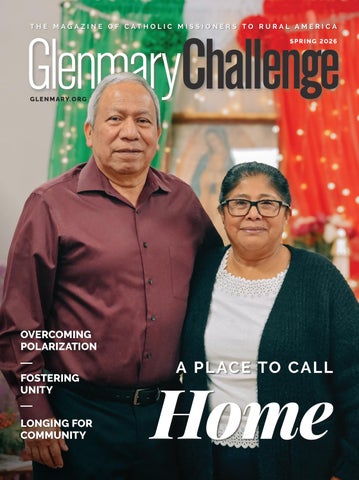
A PLACE TO CALL HOME
By Theresa Nguyen-Gillen | PAGE 08
OVERCOMING DIVISION IN A POLARIZED SOCIETY
Last fall Glenmary co-hosted a conference encouraging unity in an increasingly polarized society. By Lindsay Braud
BRIDGING DIVIDES IN WASHINGTON COUNTY
In a county where Catholics represent less than 1% of the population, Brother Craig Digmann fosters unity through "ecumenical evangelization." By Omar Cabrera
YOUNG MEN LONG FOR TRADITION, COMMUNITY, AND REAL-LIFE EXPERIENCES
More and more, young men discerning priesthood seek out community and real-life experiences. By Father Aaron Wessman
Chris Phelps, Lucy Putnam, Father Vic Subb, Father Richard Toboso, Father Aaron Wessman
Glenmary’s mission in Overton County finds a new location, deepening faith and fellowship for the community.
Nicolasa Aju,
Photo by Brother David Henley
Photo by Omar Cabrera
Photo by Theresa Nguyen-Gillen
One of my favorite movies is Apollo 13, starring Tom Hanks. It tells the story of the ill-fated lunar mission of April 11–17, 1970. What was intended to be the third moon landing instead became a dramatic struggle for survival.
In the midst of a catastrophic failure aboard the spacecraft, the Flight Control team in Houston scrambled to solve what seemed like an “unfixable” problem.
Flight Director Gene Kranz famously declared, “ Failure is not an option,” expressing an unwavering commitment to bring the crew home safely.
While that phrase embodies extraordinary determination in high-stakes situations, some argue that it can also be counterproductive. Often, embracing failure as a teacher is essential for growth, innovation, and resilience.
As missioners and missionary disciples, we might ask ourselves: What does it mean to fail? What does it mean to succeed? And how do we measure either?
Most of us have experienced significant failure in life — and perhaps tasted success as well. Many missionaries would say they experience failure far more often than visible success.
During the Lenten and Easter seasons, these questions are especially worth pondering as we gaze upon the crucified One. What must Mary Magdalene have been thinking as she approached the tomb? What went through her heart as she questioned the garden-
Success and Failure IN THE LIFE OF A MISSIONER
from the president Father Dan Dorsey
er, unaware that she was speaking to the risen Lord? Recall, too, the road to Emmaus. Cleopas and his companion walked with heads down and hearts broken when they encountered the risen Christ, though they did not recognize him. Their words reveal deep disappointment:
“We had hoped that he was the one who was going to redeem Israel” (Lk. 24:21).
Hope deferred. Failure assumed. Yet resurrection stood right beside them.
As missionary disciples, our success is not measured in finances, numbers, fame, or status, but in love and charity. As Glenmary missioners, this means leaving the 99 and searching for the one lost sheep. Jesus and the writers of the Old Testament constantly remind us of this truth.
Over the past 50 years, I have learned several lessons on this journey:
• You are the one sent, not the sender.
• You are the servant; Jesus is the master.
• In every person you encounter, see Jesus Christ and the inherent dignity of every human being — regardless of who they are.
I recall an instance a few summers ago when I was covering the weekend Masses at one of our local churches here in Cincinnati. One of my responsibilities was to hear confessions for two hours on Saturday
by John Feister
Photo
afternoon before Mass. For the first 90 minutes, I sat there alone. As the minutes slowly ticked away toward the two-hour mark, my patience was wearing thin.
Suddenly, someone entered the confessional, closed the door, knelt behind the screen, and began sobbing uncontrollably. After a few minutes, she muttered that it had been 20 years since her last confession. She had not attended Mass during all those years. Now her daughter was entering her teenage years, and she and her husband had decided to return to the Church.
When she finally paused in her recitation of sins, I said, “Welcome home. Our Lord Jesus welcomes you and embraces you with joy and love today.”
As I drove home that evening, I realized what a blessing-filled afternoon it had been. Embarrassed and ashamed of my earlier attitude, I reflected that I could be a Glenmary missioner for another 50 years, and this single encounter on a summer afternoon in a confessional would be enough to view my life as a success.
So, again, we ask: What does it mean to fail? What does it mean to succeed?
St. Paul reminds us:
“And whatever you do, whether in word or deed, do it all in the name of the Lord Jesus, giving thanks to God the Father through him” (Col 3:17).
As people of faith and missionary disciples, we follow Christ, who is our way, our truth, and our life. And in following him, we come to know deep in our hearts that failure is never the final word, and success is often found in the most unexpected places and in those people who cross our paths.
Glenmary News & Notes
PARISH / Youth Faith Formation
Mission Hosts Trivia Tournament
What is a fun way to get children and teenagers excited about the faith? The youth ministry team at Glenmary’s St. Joan of Arc mission knows: a trivia competition.
On Saturday, November 8, the North Carolina mission hosted its first ever Saints Showdown tournament. Youth, ages 7 to 17, participated from three parishes — St. Joan of Arc, Glenmary’s Holy Trinity mission, and St. Ann’s in Edenton.
“It’s always been a dream of mine to have some sort of tournament for the youth,” says Kim Thao, youth director at St. Joan of Arc. “It’s been in the works for several months.”
The children took the competition seriously, showing up in matching team t-shirts and studying in between the four rounds of trivia.
“Healthy competition is fun, but for our youth to be proud that they’re Catholic, to learn more about the faith,” says Kim, “that was shown.”
One of the teams from St. Joan of Arc took home the winning prize: a 2-foot trophy, $100 cash, and, of course, bragging rights. The tournament was such a resounding success that they plan to host one for adults in the spring and another for the kids in the fall this year.
Photo courtesy of St. Joan of Arc mission
Fr. Cavine Okello celebrates with the winning St. Joan of Arc team, which beat out four others to win the trivia tournament.
CONNECTION / National Catholic Youth Conference
A Weekend of Faith, Community, and Mission
In November, the Glenmary Vocations Department traveled to Indianapolis to take part in the National Catholic Youth Conference (NCYC), one of the largest gatherings of Catholic youth in the United States. The event welcomed more than 15,000 attendees from across the country for several days of prayer, worship, catechesis, and fun hats!
The vocations team connected with youth on the conference floor, sharing the mission of Glenmary and inviting conversations about discernment, service, and what it means to be a missioner.
Several mission parishes joined the event, including groups from St. John Paul II (Grainger County, Tennessee), St. Michael the Archangel (Erwin, Tennessee), and St. Teresa of Kolkata (Union County, Tennessee). The youth of these mission parishes were able to attend various talks, Mass, and sessions that encouraged them to make connections and listen to how God may be calling them. Pope Leo XIV also joined the event via video, answering questions from the youth. For many attendees, NCYC was a powerful reminder that they are part of a vibrant and mission-driven Church.
ECUMENISM / Praying for Unity
Ecumenical Prayer Service
The third week of January is set aside each year to celebrate a Week of Prayer for Christian Unity. Glenmary joined this global movement with an ecumenical prayer service on Thursday, January 22, at the Our Lady of the Fields Chapel in Cincinnati, Ohio. Several Cincinnati-area pastors, ministers, and Christian leaders joined the celebration.
Nathan Smith, director of ecumenism for Glenmary, led and organized the event. Father Aaron Wessman led the liturgy and Joshua Lenon, pastor of Red Door Church, delivered the sermon that focused on unity and the Nicene Creed.
“The creed allows Protestants, Catholics, or any other Christian to say what I believe is what you confess to believe,” Joshua says. “We have a holy work to do together.”
This global movement is supported by the World Council of Churches and the Pontifical Dicastery for the Promotion of Christian Unity, with materials published by Graymoor Ecumenical & Interreligious Institute.
Fr. Fid Levri talks to Joshua Lenon, pastor of Red Door Church, after the ecumenical prayer service.
Teens from St. Michael the Archangel mission stop by Glenmary's Vocations booth at NCYC.
Photo by Glenmary Home
Missioners
Photo by Lindsay Braud
Glenmary students and Fr. Steven Pawelk celebrate Mass on the feast day of St. Charles Lwanga and the Ugandan martyrs.
Change in Visa Policy
Gives Hope to Religious Workers
A change in the immigration processing for religious worker visas (R-1) is a hopeful sign for the Glenmary community and many foreign-born religious workers in the United States.
Previously, religious workers who reached the maximum stay of five years on an R-1 visa would be required to leave the country for at least one year before reapplying for the visa while awaiting permanent residency. The change, announced mid-January, would not require a minimum time before they could return to
around the missions
VISIT THE PRISONERS
Father Francois Pellissier spent several months last year visiting residents at Blountville Jail in East Tennessee. On October 17, he celebrated the very first Mass there, where one resident received the Sacraments of Baptism, Confirmation, and first Communion. A second Mass was held in November, where another resident received Confirmation and first Communion.
the US, provided they meet all other requirements. This important change will positively affect several Glenmary priests and students, in addition to the rural communities they serve.
“This rule change will allow Glenmary to more effectively do our missionary work, which means greater fullness of life to those we serve in the missions,” says Father Aaron Wessman, first vice president and director of vocations. “In particular, this means continuity in the service and leadership we provide to the missions. This rule change also means that Glenmary can begin dreaming once again of possibly expanding to other mission counties and offering greater ministry for the Kingdom of God and the Church.”
COUNSEL THE DOUBTFUL
Linda Crisostomo, Glenmary's lay evangelizer in North Carolina, became a volunteer client advocate at a pregnancy center last year. In this role, Linda educates, supports, and empowers women facing unplanned pregnancies with compassion. The pregnancy center serves five counties in North Carolina, three of which are Glenmary mission areas.
SHELTER THE HOMELESS
During a time of cold weather, days before Christmas, Father Samuel Mungai and his parishioners from St. Teresa of Kolkata mission traveled to downtown Knoxville and served the homeless. They provided hot soup and coffee, warm clothes, gloves, and blankets to those in need.
Photo by Glenmary Home Missioners
A PLACE TO CALL
Home
Glenmary’s mission in Overton County finds a new location, deepening faith and fellowship for the community.
By Theresa Nguyen-Gillen
It’s December 12. In a building on the aptly named Church Street, the Catholic community of Overton County, in Middle Tennessee, is gathering to celebrate.
They have two reasons to celebrate. First, it’s the feast of Our Lady of Guadalupe, a special day of devotion for a community that is mostly Latino. Second, it’s one of the first times outside of Sunday Mass that they are gathering at their new building.
They moved in less than a month prior, on November 17, and celebrated their first Sunday Mass there on the first weekend of Advent.
“It's a blessing because we need it, all of us who live here,” says Guillermina, a parishioner of their new location.
Nicolasa Aju agrees. “This place is a blessing to the community,” she says. “The people are very happy. They feel at home.”
Finding a new location
Before having their own building, the community rented space at the First Methodist Church for two years.
“In June, we started looking for a place,” says Lorenzo Aju, “because I received a letter from the Methodist church that they encouraged us to find a place for our community.”
Lorenzo is a seasoned Glenmary lay missioner who moved to Overton County with his wife, Nicolasa, in 2022 to begin building up the community. He’s worked at Glenmary missions in the past, but at missions that had existing buildings and parish offices.
“This is a new experience for me,” says Lorenzo, of finding a new location to meet. In a county with a population of about 22,000 people, open rentals are few and far between. Lorenzo enlisted the help of the community, asking for everyone to keep their eyes open for possible locations.
by
Fr. Mike Kerin blesses the seven women who consecrated themselves to Our Lady of Guadalupe on her feast day.
Photo
Theresa Nguyen-Gillen
“The first day of October, we found this place available where we are now,” says Lorenzo. He remembers driving by the building that same morning and there was no “for lease” sign. “But in the afternoon, somebody send me a message and say, ‘Look, there's a place available.’”
He toured the building and found it was exactly what the community needed: one big open space, two smaller rooms, and a kitchen. In the open area, one side is dedicated to worship with an altar and chairs, while the other side is set up for community gatherings.
“When I told everyone we had a place, everyone cheered, ‘Yes!’” says Lorenzo. “Everyone is happy.”
Gathering together
The benefits of having a place to call their own showed immediately. The Methodist church was nice, but the community was often limited in the times and days that they could gather there.
Previously, they only had 30 minutes after their monthly Masses for potlucks and fellowship. Now at their new building, “everybody takes time to talk and there’s no hurry to leave,” Lorenzo says.
Being able to spend time together, unrestricted, is part of what makes this community so close-knit. “We don’t have the same last name,” says Ramon, a parishioner, but “everyone’s like family.”
The celebration of Our Lady of Guadalupe is another example of why having their own place was so needed. For the nine days leading up to December 12, the community gathers for a novena and potluck each night. In 2024, the 30 or so members who participated met at a parishioner’s home. This time, they were able to pray every night at their new building.
And for the first time, the community was able to celebrate a Christmas Mass together.
Educating the youth
In addition to searching for a new building this summer, Lorenzo undertook another big first for the community: preparing for their first year of religious education classes.
Previously, children were preparing for their sacraments at the churches where they attended Sunday Mass. When the community started celebrating Sunday Mass together last April, the next step was adding religious education classes.
by
In their first year of religious education classes, 16 children gather weekly to learn about the faith.
About 30 parishioners celebrated the feast of Our Lady of Guadalupe, the first event in their new location outside of Sunday Mass.
Photo by Theresa Nguyen-Gillen
Photo
Theresa Nguyen-Gillen
“For me,” says Lorenzo, “it’s very important to have the education for the children.” So while he looked for open properties, he also began getting volunteers and preparing the curriculum.
“I need to start the program and not waiting for the building,” Lorenzo says of his mindset at the time. “Now we have the building and so it’s more easy to have the program.”
Sixteen children are enrolled for the first year of classes, from first communicants to young adults.
“There are many children,” says Guillermina, “so we also want these children who are small now, that in the future they will also have more faith, so that faith continues to be here, in our church.”
time this story has been published. It is a hope that this milestone will help the community grow in both number and faithfulness.
“I expect to grow in number,” says Lorenzo, who is already planning the community’s second Baptism, “but this group, we are growing also as a community, as members of this community and how they support each other.”
We have a place to come to, to welcome us, so that we feel happy, joyful, that we are in a place of peace and happiness.
In May, the community will have more reasons to celebrate when two children receive their first holy Communion, and one teenager receives the Sacrament of Confirmation.
Growing in faith
—GUILLERMINA
“I'm very happy, very happy that we have this place to give thanks to God,” says Guillermina. She shared with the community during the Mass for Our Lady of Guadalupe about her faith and devotion.
“And that we also feel welcomed with so many problems that are happening these days, right? With immigration authorities, family problems, or things that our family is going through,” she says, it is a blessing “that we have a place to come to, to welcome us, so that we feel happy, joyful, that we are in a place of peace and happiness.”
A sign on the building, that the Catholic community of Overton County gathers here, will be up by the
Assistant Editor Theresa Nguyen-Gillen holds a bachelor’s degree in journalism from the University of Missouri.
Every parishioner helped with the move into the new location, says Fr. Mike Kerin, from mopping the floors to setting up the chairs and tables.
“OVERCOMING Division IN A POLARIZED SOCIETY
BY LINDSAY BRAUD PHOTOS COURTESY OF SAINT MEINRAD ARCHABBEY
Fr. Aaron Wessman offers opening remarks at the conference "Deepening Communion in a Polarized World" which Glenmary co-hosted last fall.
A conference co-hosted by Glenmary last fall sparks reflection on the reality of polarization and how to overcome it.
Being missioners in the United States, we know firsthand the effects of divisions in our country, and we have ample experience seeking to build unity between groups of people that do not always agree or even engage each other,” says Father Aaron Wessman, Glenmary’s first vice president, reflecting on the need for grace and charity in an increasingly polarized society.
To address this challenge of polarization — toxic divisions in the US and between Christians in the Church — Saint Meinrad Seminary and School of Theology and the Glenmary Home Missioners cosponsored “Deepening Communion in a Polarized World,” a conference held November 4–6, 2025, at Saint Meinrad.
This conference drew from Father Aaron’s own research on polarization, as outlined in his book The Church’s Mission in a Polarized World. In it, Father Aaron explains the complexity of polarization, while offering practical advice on how people can move past
their divisions and, hopefully, strive to live in a more united and understanding society.
Bishops, priests, deacons, seminarians, religious, and lay Catholics from across the country participated in this three-day event. Father Del Staigers, pastor of St. Mary Magdalene Parish Family in Cincinnati, Ohio, attended the conference because he recognized the importance of this work.
“As a pastor I have to negotiate polarization every day in ministry. Society is deeply fractured, and the church, as a microcosm of the world, is also profoundly affected by polarization,” says Father Del.
“As a pastor I have to negotiate polarization every day in ministry.”
—FATHER DEL STAIGERS
The conference focused on four topics: episcopal leadership, the implementation of Vatican II, liturgy, and Catholic media. For each topic, several experts delivered opening remarks. Afterward they were invited to have a truthful, respectful conversation on what was shared.
In each panel people were asked to focus on the question: “What wisdom can you share with the group for the present moment we are living in?”
The conference “really renewed my spirits, particularly to keep working on depolarization and peacemaking,” says Polly Duncan Collum, director of Justice, Peace and Integrity of Creation for Glenmary. After the panels, attendees were encouraged to discuss what they had learned. “That’s where depolarization, or building communion, starts.”
Understanding Polarization
example, there is this notion that rural folk and city folk have very little in common, or that ‘traditional’ Catholics and ‘progressive’ Catholics are always at odds with each other.
If it were not for our common belief in Jesus Christ, we would have no reason to be together.
—FATHER DEL
Divisions in communities, and even the Church, are often rooted in broader societal and political trends.
Polarization occurs when people silo themselves into like-minded groups and remain firmly entrenched inside that one worldview. We can see this played out across cultures and personalities. For
“It’s easy to think that the Church is a homogenous group of people who understand our faith in exactly the same way. The reality is that if it were not for our common belief in Jesus Christ, we would have no reason to be together,” says Father Del.
This can leave people feeling defensive and angry, ultimately closing themselves off from the broader world.
“When we experience fear and uncertainty in life, we as humans tend to become somewhat rigid in our thinking and hold on to our groups for dear life,” adds Father Aaron.
Overcoming Fear and Division
Building unity starts with oneself. Rather than focus on what differentiates us, people should do an examination of conscience asking, “How much have I contributed to division and toxic polarization,” explains Father Aaron.
“One of the best ways to overcome polarization, after one continues to do an examination of conscience, is to 'cross over,' to engage a group to which they are
Br. Jason Muhlenkamp and Polly Duncan Collum talk between sessions during the conference.
“In short, we learn to build the Kingdom of God.”
not a part,” says Father Aaron. He acknowledges that this can be difficult to do, however.
We can cross over by occasionally attending a different parish or church, attending an ecumenical “deepening communion” event, or — for the extroverts of the world — simply striking up a conversation with a stranger. In online spaces we can engage in healthy discussions with people or take in news and media outside our regular sources.
In his book, Father Aaron suggests for those that do choose to cross over, to practice flexibility, curiosity, and prudence. Keep an open mind but be mindful of your physical and mental wellbeing.
“Curiosity is essential to our Catholic faith. 'Catholicity' ultimately means seeing, or relating to, the whole. To be Catholic is to be open to truth, beauty, or goodness, no matter where these exist or are found,” says Father Aaron.
When confronted with a situation that challenges your perspectives, it’s helpful to ask a curious question such as
“What am I missing?” or “Can you tell me more?”
During his talk at the conference, Cardinal Joseph W. Tobin of Newark, New Jersey, suggested a nuanced approach when overcoming divisions. “My experience tells me that polarization is not an issue that you can come at head-on. You have to come at it at a 45-degree angle, because if we come at it head-on, conversation is entirely defensive,” he said.
He also encouraged people to practice synodality, an approach promoted by the late Pope Francis and now Pope Leo XIV, and something that Father Del practices in his parishes.
“Synodality is the path that we are all invited to take in listening and understanding one another. By putting aside preconceived ideas and judgments we can critically assess how the Gospel, and not the political sphere, challenges the way we can dehumanize and dismiss ‘the enemy’ who can lead us to Christ,” says Father Del.
At the conference Archbishop Paul D. Etienne of Seattle, Washington, issued a reminder to always be mindful of Christ, the common denominator. It is through Jesus that Christians will learn to be attentive, merciful, and compassionate.
“In short, we learn to build the Kingdom of God,” he said.
Lindsay Braud is director of communications and marketing for Glenmary.
Fr. Del Staigers, pastor of the St. Mary Magdalene parish family in Cincinnati, Ohio, attended the conference.
Cardinal Joseph W. Tobin takes questions during a discussion on overcoming polarization.
ARCHBISHOP PAUL D. ETIENNE
Photo courtesy of Fr. Del Staigers
Bridging Divides
IN WASHINGTON COUNTY
Pedaling one relationship at a time, Br. Craig serves as connecting glue to the community.
Predominantly African American, the community of Washington County embraces the Glenmarian.
In a county where Catholics represent less than 1% of the population, Brother Craig Digmann fosters unity through "ecumenical evangelization."
Brother Craig Digmann was taking one of his usual bicycle rides in the small town of Plymouth, North Carolina, when he recognized a young man washing his car in his driveway. Sitting at the front porch of the house were two women: the boy’s cousin, Cornese Debrew, and her elderly mother. Brother Craig stopped to greet them, as he often does with people around town. Just like that, it marked the beginning of a friendship the two women and the boy cherish to this day.
After Brother Craig left, Cornese recalls, “I asked my cousin ‘How do you know him?’ He said that one day he and some friends were playing at the basketball court and it was hot in the summer, and he said Brother Craig came with his bike and he brought them cold bottles of water.”
Those small acts of generosity, when intentionally repeated, can go a long way, the Glenmary Brother says. “If you see a person at their church on Sunday, that’s great. But, if you see them at the post office, then at the grocery store, then sitting at a basketball game with them, those multiple places make the relationship much deeper.”
TEXT AND PHOTOS BY OMAR CABRERA
Brother Craig serves in Washington County reaching out mainly to non-Catholics to foster unity among people regardless of their religious affiliation, ethnicity, socioeconomic background, or any other difference. He ties all he does to the “Great Commission that Jesus left to us, his disciples: to go preach the Gospel to all nations.” He calls his ministry “ecumenical evangelization.”
A friend at school
Three days a week, Brother Craig begins his day greeting students at the Washington County school. “I give a lot of fist bumps,” the Glenmarian says.
“He meets and greets students as they come in, with a warm smile. Sometimes, he would say ‘Oh, you had a good game last night!’” says Denise Harris, career development coordinator for Washington County Schools.
Brother Craig is able to connect with students in this way because he also attends their basketball and baseball games. That presence is especially important given that “some students may not have any parental support there because their parents may be absent in their family, or may be at work,” Denise adds.
Glenmary also supports students at Washington County with scholarships for seniors who are starting college. Brother Craig, along with a committee, chooses the winners from a pool of applicants, based on economic need and the desire and commitment to continue their education. An anonymous and generous Glenmary donor has made these grants possible for the past two years. This summer, two $1,000 scholarships and two $500 scholarships will go directly to the students’ colleges to help with tuition.
Work for Christian unity
Brother Craig also strives to foster unity among Christians from different denominations. On weekends, he visits non-Catholic churches, oftentimes by invitation, and other times, taking the initiative to reach out to those groups.
Denise, the school official, explains that she also serves as a youth minister and participates in an initiative called Faith and Blue, which strives to build bridges by connecting law enforcement, faith leaders, and the community. “We visit different churches often, and I’ve seen him (Brother Craig) at different churches.”
Brother Craig says that sometimes he even gets invited to preach and to sing at Protestant churches. This is not an easy task, adds Father Aaron Wessman, Glenmary’s first vice president. “As a Catholic who deeply loves the Mass, what he encounters is not his usual style of worship. The hymns are different, the sermons are usually longer [. . .] But Digmann bows his head, listens attentively, and sings,” writes Father Aaron in his book
The Church’s Mission in a Polarized World.
Glenmary serves in counties where Catholics are a minority. “Less than 1 percent,” Brother Craig says. “Do we just ignore the other 99 percent in the county? No! We go to the lost and forgotten.”
As for the two women that Brother Craig met at the front porch, they enjoy his visits. “My mother is 82. When she sees Brother Craig, she gets happy and she says ‘Oh, here comes my friend on the bike!’” Cornese says. “He’s a wonderful asset to our community and to our children especially, because he really loves our children.”
“Mission means to go out, to go forth. And that’s what the Lord has called me to do,” the Glenmarian says.
Assistant Editor Omar Cabrera holds an MA in journalism from the University of Colorado at Boulder. He is editor of El Reto Glenmary.
Br. Craig works for civil rights, along with Vanessa Joiner and others.
Br. Craig attends Mass at St. Joan of Arc parish in Plymouth, NC.
Young Men Long for TRADITION,
COMMUNITY, AND REAL-LIFE EXPERIENCES
Father Aaron helps vocation prospects seek IRL (in real life) mission experiences as they discern their calling.
BY FATHER AARON WESSMAN
I’m well into my second year now as Glenmary’s vocation director. During this time, I have had the opportunity to meet and accompany many men interested in exploring a vocation to Glenmary as a priest or Brother. This has been a rewarding ministry. Listening to these men, here are some things I’ve learned.
The Love of Tradition
Many discerners view tradition, broadly speaking, as a blessing and not a burden. For sure, this translates into a desire to connect with ancient liturgical and devotional practices. But a love of tradition often means, as well, a comfortability with inheriting the grand moral and theological framework of Catholicism. There is a sense that contemporary society — and their own personal, sometimes misguided decisions — have not provided them with a strong moral formation. Catholicism does just that, and this tradition is for many of these men a source of freedom and life.
It is not always initially evident to vocation prospects
that Glenmary and our ministry offers the kinds of “traditional elements” they are looking for. Certainly, Glenmarians locate themselves within the heart of Catholicism. But our ministry emerges in rural contexts without ecclesial structures, parishes, or a visible, established kind of Catholicism. Our liturgies are more often likely to take place in storefronts or barns because there is no Catholic church where we serve or in small, crowded churches because of rapid growth.
With a closer look, men who are attracted to Glenmary see in our missionary charism one of the most ancient traditions of the Church: a desire to go to all the nations to share the good news. And the heart of this good news is Christ ever ancient, ever new, in the Eucharist. This leads to my second observation.
A Desire for IRL Experiences
Many vocation prospects have never known a time without a smartphone or social media. Others encounter life almost exclusively online, particularly for those involved in gaming, or those who are from the “Zoom Generation” who, during the pandemic, experienced most of high school and college online. Socializing, for them, has been done with a headset, a game controller, scrolling through videos, or online classes and meetings. Even though these young men are not ready to put aside online reality completely, they have a very keen understanding about how unfulfilling online reality can be.
More than a dozen young people attended a vocations retreat led by Fr. Aaron Wessman and Br. David Henley.
Photo by Glenmary Home Missioners
“Our liturgies are more often likely to take place in storefronts or barns because there is no Catholic church where we serve”
FATHER AARON WESSMAN
To counteract this, many desire “IRL experiences.” Being of an older generation, I had to learn that this meant in real life. Prospects are consciously looking for ways to put aside their smartphones and computers and work with their hands and feet. In fact, many interested in Glenmary have some experience building, repairing, fixing, creating, and tinkering, whether with houses, cars, tractors, or art.
Glenmary’s “blue-collared” ministry and spirituality are attractive to these men. We work with our hands and feet, repair and build, are pragmatic, and spend much time out of the church office or rectory in the homes of parishioners or frequenting the businesses of our towns. It is no surprise to me that those working or interested in more traditional, “blue-collared jobs” are contacting us. Like one of them said: “I don’t want a life relegated to a cubicle looking at a screen.”
The young men I’m in contact with find the Glenmary-IRL adventure attractive! But they also don’t want to live these experiences alone. This brings me to my final point.
Looking for Community
Young men, in general, are not doing great in con-
temporary, American culture. Countless studies have documented this challenge. I’ve seen it in my vocation visits. I hear of it from friends and family members.
Young adult males report fewer friends and mentors than they used to, some have none. More men are struggling in college or universities, if they even attend, have rising rates of suicidal ideation, and are more likely today to indicate that they feel isolated and alone. These are major concerns.
Of course it seems reasonable that these young men are looking for community. They want fellowship with their peers, they desire mentors, and they want to succeed and contribute to society and the Church. Even as they want these things, though, they have not necessarily come equipped with the skillsets to cultivate friendships or sustain community due to the challenges previously mentioned. Some admit that they have not learned how to socialize well and need to ask for help.
When young men today hear that they don’t need to enter Glenmary perfectly ready to be a missioner on day one and that many folks are ready to accompany and mentor them, they feel encouraged.
Glenmary is a community of missioners, and we wrestle with the tension between serving mission needs (which are many) and sustaining community life (which is tough). But today, more Glenmarians are recognizing that our way of life envisions us dedicated to community so that we can accomplish our mission. The more we support and love each other in community, the more effective we are as missioners in rural, Mission Land, USA.
During formation, Joseph Mandau and Cavine Okello graduated from Saint Meinrad. Both were ordained last spring.
Donna Turchi, Fr. Dan Dorsey, and Br. Jason Muhlenkamp talk to students at the SEEK 2026 conference.
Photo by Fr. Richard Toboso
Photo by Glenmary Home Missioners
Joy
IS NOT IN THINGS, BUT IN US
BY FATHER VIC SUBB
Read the full version of this story online at glenmary.org/joy.
On the wall of my bedroom is a banner from Kenya that reads, “Joy is not in things, but in us.” I seek to live that joy.
We all have experiences that help us become more joyful people. In my years of being a Glenmary missioner, I have been blessed with many such experiences.
As a priest, one of my greatest joys is the ability to share the sacraments. There is joy of new life in Baptism, with parents glowing with love. The same is true for adult Baptisms, whose faces reflect peace and deep joy. There is the first Communion child who stands tall with hands folded, a little nervous as they receive Jesus for the first time. They are great examples to me of the sacredness of the sacraments.
There is joy in teens and adults who prepare for months to receive Confirmation. There is great relief in the Sacrament of Reconciliation, where sins are forgiven, and people begin anew. There is love dwelling within marriage: saying yes to forever, not
knowing the future. Relief and joy mixed as we hear the words “I do.” I also had the honor and great challenge to help build three church buildings — Peebles, Ohio; Crossett, Arkansas; and Lafayette, Tennessee. All three communities needed a new church. We were not building the church for ourselves, but for those who would use the church in the future.
On dedication days, I beamed with great joy, grateful for the sacrifices of many people. The fruits of that hard work would allow many to have a church home for years to come.
The joy in us comes from the author of joy — Jesus Christ. We are Easter people. Through the Resurrection, Jesus offers us life eternal and joy that lasts a lifetime.
Father Vic Subb is a retired Glenmary priest living in Cincinnati, Ohio.
“Love is the vocation that includes all others.” —ST. THÉRÈSE OF LISIEUX
The sun sets over farmland near Plymouth, NC, where migrant workers sustain the land.