Glebe Report - April 2026

Page 1


What’s the future for development along Isabella and Chamberlain Streets?

Residents of the Glebe may not be aware of development activity along the Isabella and Chamberlain street corridors on the neighbourhood’s northern edge. These streets form a key connection to Centretown and downtown and are now the focus of several development proposals that could bring meaningful change in the coming years.

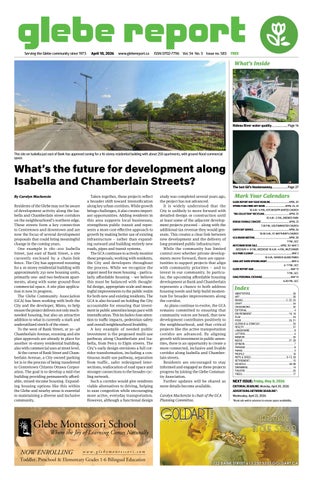
One example is 180–200 Isabella Street, just east of Bank Street, a site currently enclosed by a chain-link fence. The City has approved rezoning for a 16-storey residential building with approximately 250 new housing units, primarily one- and two-bedroom apartments, along with some ground-floor commercial space. A site plan application is now in progress.

The Glebe Community Association (GCA) has been working with both the City and the developer, Minto, to help ensure the project delivers not only muchneeded housing, but also an attractive addition to what is currently a stark and underutilized stretch of the street.

To the west of Bank Street, at 30–48 Chamberlain Avenue, rezoning and site plan approvals are already in place for another 16-storey residential building, also with commercial uses at street level.

At the corner of Bank Street and Chamberlain Avenue, a City-owned parking lot is in the process of being transferred to Centretown Citizens Ottawa Corporation. The goal is to develop a mid-rise building providing permanently affordable, mixed-income housing. Expanding housing options like this within

Taken together, these projects reflect a broader shift toward intensification along key urban corridors. While growth brings challenges, it also creates important opportunities. Adding residents in this area supports local businesses, strengthens public transit and represents a more cost-effective approach to growth by making better use of existing infrastructure – rather than expanding outward and building entirely new roads, pipes and transit systems.

The GCA continues to actively monitor these proposals, working with residents, the City and developers throughout the process. While we recognize the urgent need for more housing – particularly affordable housing – we believe this must be balanced with thoughtful design, appropriate scale and meaningful improvements to the public realm for both new and existing residents. The GCA is also focused on holding the City accountable for ensuring that investment in public amenities keeps pace with intensification. This includes close attention to traffic impacts, pedestrian safety and overall neighbourhood livability.

A key example of needed public investment is the proposed multi-use pathway along Chamberlain and Isabella, from Percy to Elgin streets. The City’s early design envisions a full corridor transformation, including a continuous multi-use pathway, separation from traffic, safer redesigned intersections, reallocation of road space and stronger connections to the broader cycling network.

Such a corridor would give residents viable alternatives to driving, helping

study was completed several years ago, the project has not advanced.

It is widely understood that the City is unlikely to move forward with detailed design or construction until at least some of the adjacent development projects proceed – along with the additional tax revenue they would generate. This creates a clear link between new development and the delivery of long-promised public infrastructure.

While the community has limited control over whether private developments move forward, there are opportunities to support projects that align with community priorities – and to invest in our community. In particular, the upcoming affordable housing development at Bank and Chamberlain represents a chance to both address housing needs and help build momentum for broader improvements along the corridor.

As plans continue to evolve, the GCA remains committed to ensuring that community voices are heard, that new development contributes positively to the neighbourhood, and that critical projects like the active transportation corridor are advanced. By aligning growth with investment in public amenities, there is an opportunity to create a more connected, inclusive and livable corridor along Isabella and Chamberlain streets.

Residents are encouraged to stay informed and engaged as these projects progress by joining the Glebe Community Association.

Further updates will be shared as more details become available.

NEXT ISSUE: Friday, May 8, 2026

EDITORIAL DEADLINE: Monday, April 20, 2026

ADVERTISING ARTWORK DEADLINE*: Wednesday, April 22, 2026 *Book ads well in advance to ensure space availability.

Rideau River water quality
The last Gil’s Hootenannny
This site on Isabella just east of Bank has approved zoning for a 16-storey residential building with about 250 apartments, with ground-flood commercial space.

The Magic of the Mutchmor Book Sale:

How books become trees, benches and more

Each spring, the Mutchmor Book Sale brings neighbours together to browse approximately 25,000 gently used books – about the same number found in the Sunnyside library. For many families in the Glebe and Old Ottawa South, the sale has become a much-anticipated community tradition.

The sale opens to the general public on Thursday, April 30 at 4 p.m. and runs through Sunday, May 3. Everyone in the community is warmly invited to attend. Past sales have drawn hundreds of neighbours, so be sure to come early to browse the best selection of books, games and puzzles!

Organized by parent volunteers, the annual sale raises funds that go directly back into the school community. Last year’s sale raised an impressive $22,000.

One of the most visible results of this community support is the recently completed outdoor classroom, which opened last summer. The new space provides teachers and students with a dedicated area for outdoor learning, allowing classes to gather outside for lessons, reading time and group activities.

Funds from the book sale have also paid for new benches in the junior yard, enjoyed by students and the wider community. New trees are also on the way and are scheduled to be planted this fall, providing much-needed shade.

Crucially, the book sale also provides significant funding to the school library, helping to update both the French and English collections. Each year, proceeds

are used to purchase new books for the Mutchmor school library, keeping the collection fresh, engaging and reflective of students’ interests. Teachers also take free books for their classroom collections.

“My school has two libraries,” says a Mutchmor Grade 1 student. “The normal one upstairs and the magic one in the basement!”

While the sale is open to everyone, the first day is just for the kids. Children’s Day – when Mutchmor students get to shop the sale before the grand opening – is one of the Mutchmor Book Sale’s longest-standing and most beloved traditions.

Come and experience the magic for yourself. Visitors can expect a wide variety of items available for purchase, including gently used children’s and adult fiction and non-fiction books, games, puzzles, colouring books, unused activity books and kits, CDs and DVDs.

And be sure to return on the closing day, Sunday, May 3, for some unbelievable bargains.

Jessie Wilson is a member of the Mutchmor Book Sale Committee and has been participating in the book sale since 1988.

Mutchmor

Donations:

In the weeks leading up to the sale, the organizing committee will be collecting donations from the community. Residents are invited to drop off items at the front doors of Mutchmor Public School, 185 Fifth Avenue, during the following times: Donation Drop-Off Hours: April 13–17: 8:45 – 9:15 am April 20–24: 8:45 – 9:15 am and 7 – 8:30 pm

The Mutchmor Public School’s outdoor classroom was funded from the proceeds of the Mutchmor Book Sale. PHOTO: TANI NISBET-JONES

Park clean-up a chance to meet neighbours

Imagine a beautiful, sunny May morning in the Glebe.

It’s 10 a.m. on the day of the Spring Clean Up of the park near you. Children, their parents, grandparents and folks from the neighbourhood begin streaming in. You’ve helped spread the word – a flyer your kids delivered to mailboxes the week before, or maybe by more modern means – and the turnout is pretty good!

Many are people you already know through the kids’ school, sports, GNAG and various other community activities. Some are people you’ve never met

Rockcliffe Park Spring Book Sale

because they’re new to the Glebe or don’t have the same opportunities in the neighbourhood to connect. All hold the promise of being new or renewed friends and acquaintances thanks to the laughs and the hour or so of work you anticipate will be shared together this morning.

Participants have brought along their rakes, work gloves, a container (like a sealable jar) and a few smaller, compostable bags to help consolidate (and safely store) any garbage you find into one garbage bag’s worth (or hopefully much less to minimize your use of larger single-use plastic bags).

The job itself is taking no more than that one hour you had expected. Turns out the park is in pretty good shape, and many hands are making light work.

The main goal is to pick up litter. A couple of parents also rake the sand beneath the swings and other play structures to make sure they are free of anything sharp and dangerous going into this new season of play. Wearing their gloves, they carefully remove these items, safely containing them in the sealable glass jar they brought along, just in case.

You generally “leave the leaves,” letting nature do that heavy lifting for you while it fertilizes the grass. They may also provide great habitats for pollinators and other wildlife this spring. However, when crew members notice patches where the leaves are really wet and threatening to smother the grass longing for sunlight, they may decide to rake and bag them.

Play, conversation and laughs ensue, lasting well beyond the final piece of garbage being picked up.

And maybe this day of gathering together has just begun. One of your crew has a bigger backyard and has planned a BBQ at their place for later.

The afternoon makes its weekend transition to another Happy Hour, where more than a few people from the morning show up again.

When it’s all over, you look back at your Saturday. You’ve all done a little bit to do your part. And you’ve further demonstrated to the kids how fun simple acts of community service can be.

Perhaps this is the year a neighbourhood tradition is born or renewed. And given your children are just getting started, this one may catch on with your cohort of parents and neighbours for a good decade of springs to come.

As we say goodbye to the many outdoor joys of our winter city and neighbourhood (our volunteer-maintained ice rinks and parks), we once again renew our spring efforts to keep the Glebe’s 13 beautiful city parks safe, clean, green, healthy and fun for residents young and old.

The Glebe Community Association’s annual park clean-ups, part of the City of Ottawa’s Spring Cleaning the Capital program, will take place this year on Saturday, May 2 starting at 10 a.m. (pouring rain date: Sunday, May 3). The Glebe Annex Community Association will be leading the cleanup of the Dalhousie South Park on the same date.

Above is a listing of GCA Parks Committee contacts who plan to be on hand at the parks that morning. Always feel free to contact us at parks@glebeca.ca to get involved.

Note re: garbage collection: Bring your cleanup garbage home whenever possible. If you have collected large quantities of waste or litter, please leave it all at the cleanup project site and follow the instructions on ottawa.ca/clean to request on-site garbage pickup.

Angus McCabe is the chair of the GCA Parks Committee.

Neighbours pitch in at last year’s spring clean-up at Glebe Memorial Park: Left to right: Lady Calamity (Iain), Anne and Darren Boomer with children Julia and Lauren PHOTO: ANGUS MCCABE

Business Buzz

Evermore Books at 857B Bank Street opened on March 21. “Evermore Books celebrates the power of love stories and the readers who cherish them. Our mission is to create a warm, inclusive and inspiring space where romance enthusiasts can discover thoughtfully curated books, connect with the community and experience meaningful storytelling.” evermorebooks.ca.

Next Golf coming soon to 200 Marché Way in Lansdowne. “Your new home club for year-round golf.” nextgolf.ca. Open 24/7, 365 days a year.

Nuovo Artistic Studios coming soon to 106 Marché Way in Lansdowne. “Empowering artistic photography.” “Dare to love yourself – world-class photography studios.” nuovophotography.com

Golf Town will open soon at 125 Marché Way, Lansdowne, upstairs in Sporting Life. “Canada’s golf superstore” golftown.com.

Contributors this month

STEPHEN ACKER

NATALIE ANTHONY

JOHN BOND

SUSAN BULLER

MARY CROOK

JOHN CRUMP

JOHN DANCE

NADINE DAWSON

KEVIN DORSE

CLIVE DOUCET

ELLYN DUKE WATSON

TAMARA GLAVINOVIC

PAT GOYECHE

ROLAND GRAHAM

DANNY HANDELMAN

TRISTANO IAFELICE

CATHERINE JOHNS

KATHY KENNEDY

LINDSAY LARWILL

DAVE LONGBOTTOM

COOPER LOVE

CAROLYN MACKENZIE

ANGUS MCCABE

DARCELLE MCCUTCHEON

IAN MCKERCHER

SHAWN MENARD

CHARLOTTE MORGAN

ISABELLE MYERS

YASIR NAQVI

TANI NISBET-JONES

MONICA OLNEY

LORRAINE PIGEON

SUE REIVE

MARISA ROMANO

SARAH ROUTLIFFE

ANNA RUMIN

ADAM SCOTTI

SUE STEFKO

KYLIE TAGGART

CONNIE TEN BRUGGENKATE

MARGARET TERRETT

CECILE WILSON

JESSIE WILSON

TONY WOHLFARTH

LAURA ZAK

ZEUS

A Glimpse of the Glebe

Parking predicament

Parking on Bank Street has raised its head once again as a source of contention, because of city proposals to cut 17 parking spots on Bank Street to make way for a number of short bus lanes, some full-time, others during rush hour only.

The divide is clear. Many (possibly most) Bank Street businesses want to keep on-street parking for their customers, many of whom, they believe, come by car. When I asked my Bank Street haircutter about the loss of parking spots, she immediately pursed her lips and muttered, “Ooh, that’s bad for me.”

But a considerable number of people take the contrary view, arguing that improving Bank Street for pedestrians and transit riders will benefit more people, and that businesses overestimate their need for and value of parking.

The arguments on both sides are laid out in a couple of Glebe Report opinion pieces, one in the March issue by Darrell Cox, Executive Director of the Glebe BIA, who represents the interests of Glebe businesses, and two rebuttals in the current issue, by Tristano Iafelice and Anthony Abato, who present the arguments from the perspective of transit riders and pedestrians.

Those on bikes are more or less on the sidelines here, as Bank Street has been deemed to be too narrow to accommodate a bike lane, and the City intends to look east and west to find suitable biking space.

The problem is that Bank Street is just not big enough. Over the years, it has become many things – a through street bringing speeding commuter cars into and out of Centretown; a main street for local residents to meet and shop; a destination street for visitors to come and soak up the vibe; a major transit route for buses; and a venue for major events such as CityFolk and hockey games (now replaced by construction).

Bank Street is just not up to the many jobs it’s been handed.

Someday, in the far distant future, the City may find a more radical but enduring solution, such as relieving Bank Street of some of its roles (like moving commuter traffic to another north-south route, or removing bus routes, or removing cars), any of which would be a source of major upheaval and controversy. But where is the city politician who will want to tackle that?

Correction

In the article “Is your neighbour into Something Rotten!??” in the March 2026 Glebe Report, p. 27, the author of the article is Rod Hagglund, not Clare Davidson Rogers. Apologies to both. Rod Hagglund is a playwright and a member of the Something Rotten! musical theatre troupe.

Established in 1973, the Glebe Report, published by the Glebe Report Association, is a monthly not-for-profit community newspaper with a circulation of 7,500 copies It is delivered free to Glebe homes and businesses Advertising from merchants in the Glebe and elsewhere pays all its costs, and the paper receives no government grants or direct subsidies The Glebe Report is made available at select locations such as the Glebe Community Centre, the Old Ottawa South Community Centre and Brewer Pool, and is printed by Winchester Print www.glebereport.ca

EDITOR............................ Liz McKeen editor@glebereport.ca

COPY EDITOR.................... Roger Smith

LAYOUT DESIGNER............. Jock Smith layout@glebereport.ca

GRAPEVINE EDITOR............ Lesie Siu grapevine@glebereport.ca

WEBSITE EDITOR............... Kayleigh Osborne website@glebereport.ca

ADVERTISING MANAGER...... Judy Field advertising@glebereport.ca 613-858-4804

BOOKKEEPER.................... Susanne Ledbetter accounting@glebereport.ca

DISTRIBUTION MANAGER.....

COMMERCIAL DISTRIBUTORS Murray Kronick circulation@glebereport.ca Teddy Cormier, Eleanor Crowder

PROOFREADERS................ Mrtha Bowers, Jennifer D’Costa

AREA CAPTAINS................. Martha Bowers, Bob Brocklebank, Judy Field, Deb Hogan & Dave Yurach, Lynn & Dave Johnston, Elena Kastritsa, Brenda Perras, Julie Stephens, Della Wilkinson

The Glebe Report strives to be inclusive and to represent the full diversity of the community we serve.

Ackerman-Katz Family, Jennie Aliman, Lawrence Ambler, Nico Arabackyj, Aubry family, Alessandra & Stefania Bartucci, Selena Beattie, Adrian Becklumb, Joanne Benoit, Carolyn Best, Daisy & Nettie Bonsall, Martha Bowers, Bowie family, Bridgett family, Bob Brocklebank, Ben and Oliver Campbell-Rosser, Nico Cauchi, Bill Congdon, Chiu-Panczyk Family, Sebastian, Cameron & Anna Cino, Henry, Abigail and Matthew Campbell, Claypool Family, JJ Comptois, June Creelman, Marni Crossley, Olivia, Maisy and Mark Dance, Dawson family, Richard DesRochers, Davies Family, Roslyn Demarsh, Marilyn Deschamps, Diekmeyer-Bastianon family, Dingle family, Delia Elkin, Patrick Farley, James & Oliver Frank, Judy Field, Federico Family, The Foo Family, Liane Gallop, Joann Garbig, Camilo Velez Gorman, Barbara Greenwood, Marjolein Groenevelt, Ryleigh and Hayden Hendy, Oliver, Martin, Sarah & Simon Hicks, Cheryle Hothersall, Jennifer Humphries, Sandiso Johnston, Tani, Pete & Bryce Nisbet-Jones, Jungclaus Family, Elena Kastritsa, Harrow Kelterborn, Michael Khare, Lambert family, Lisa, Fenton & Cora Hui Litster, Leith and Lulu Lambert, Kathleen Larocque, Brams and Jane Leswick, Alison Lobsinger, Aanika, Jaiden and Vinay Lodha, Andy Lunney, Vanessa Lyon, Pat Marshall, Catherine McArthur, Ian McKercher, John and Helen Marsland, Matthew McLinton, Josephine & Elise Meloche, Julie Monaghan, Vivian Moulds, Karen Mount, Diane Munier, Benjamin Munter-Recto, Rafi & Ellie Naqvi, Imogen & Maddy North, Xavier and Heath Nuss, Sachiko Okuda, Nicholas & Reuben Ott, Matteo and Adriano Padoin-Castillo, Finn Pedersen, Miles Persohn-Hough, Brenda Perras, Brenda Quinlan, Annabel and Joseph Quon, Kalia and Elijah Quon, Beatrice Raffoul, Frederick and Kasper Raji Kermany, Bruce Rayfuse, Kate Reekie, Thomas Reevely, Mary & Steve Reid, Jacqueline ReillyKing, Anna Roper, Frank Schreiner, Short family, Cathy Simons, Andrew Soares, Heidi Stelzl, Stephenson family, Elsie Sutherland, Cameron & Quinn Swords, Ruth Swyers, Tomlin Boys, John & Maggie Thomson, Tom Trottier, Trudeau family, Will, Georgie & Blaire Turner, Zosia Vanderveen, Carina and Matteo Vella, Nick Walker, Vanessa Wen, Paul Wernick, Hope, Jax and Ash Wilson, Howard & Elizabeth Wong, Berkan Yazici, Martin Zak.

WELCOME TO: Hope, Jax and Ash Wilson Harrow Kelterborn Lisa

Brown’s Inlet PHOTO: LIZ MCKEEN

Nuisance mail suggestion

Editor, Glebe Report

Re: ‘Urgent’ message to charities, Glebe Report, March 2026.

I understand Anant Nagpur’s dismay at receiving so much nuisance mail. I have a suggestion that may help. Many years ago, I started putting all the material into the provided return envelope and enclosed a note that said: “Please take my name off your mailing list and refrain from sending me unsolicited mail.” I haven’t received any of this kind of mail in a very long time.

I hope this helps!

Susan Buller

Editor, Glebe Report

I would like to thank Anant Nagpur for their letter in the March Glebe Report. I fully agree!

I have enough address labels and greeting cards to last my lifetime. I do not need a wallet-sized calendar. My phone has a calendar, and I can use it to record appointments. Nor do I need a wallet-sized card reminding me how long I have been a donor.

I would greatly appreciate it if my donations are used for the cause, rather than for sending me copious quantities of stuff I don’t need and which may contribute to landfill.

Catherine Johns

O’Connor Confectionary – the early years

Editor, Glebe Report

Re: “The Glebe’s last corner store has closed,” Glebe Report, February 2026, p. 3

I am very pleased that the O’Connor Confectionary will be given a new life. I certainly plan to enjoy it.

I also recognize the long hours and hard work put into keeping it open these many years. Thank you. For seniors needing milk, bread or other basic food, it was a true convenience store. In the fall of 1952, my family moved back to the Glebe. I was nine years old and the fourth Mary to be enrolled in Miss Stowel’s Grade 5 class at First Avenue Public School. As children, we were much more interested in the penny candy and later the five-cent, chocolate-covered donuts offered by Mr. and Mrs. Ross, who ran the store throughout my childhood. Families in this area did most of their shopping at corner stores and at the McKeen corner store at O’Connor and First.

As children, we would often go with a list for needed groceries, which would then be added to a family bill. Times have changed, but I am glad the O’Connor Confectionary, although given a new name, will still be there.

Mary McEwen Crook

It’s how you play the game!

Editor, Glebe Report

Re: “Hockey as metaphor,” Glebe Report, March 2026

Regarding the “Hockey as metaphor” editorial in the March 6 Glebe Report

The sports cliché that speaks most strongly to me is: “It doesn’t matter whether you win or lose, but how you play the game.” I know, I know. That’s what mom always says to us after we’ve just taken a drubbing. That doesn’t make it any less true.

Those women’s and men’s Canadian Olympic hockey teams gave it their all. (We can roll the Toronto Blue Jays into this summary as well.)

Did they get beaten by a better team? Maybe. Did a lucky bounce defeat them? Maybe. Was each team’s performance a masterful display of effort,

Surprise shofarblowing trio

Editor, Glebe Report

Re: “Remembering Walter Hendelman,” Glebe Report, March 2026

I wanted to congratulate Roger Smith on his beautiful obituary about Walter Hendelman in the last issue of the Glebe Report. I did not know Walter well, but I did run into him at a number of venues and events over the years and perhaps most memorably at an outdoor shofar-blowing gathering during the pandemic. It’s a mitzvah (good deed/commandment) for Jews to hear the shofar during the high holidays. Since synagogues were closed during the pandemic, several of them, including mine and Walter’s, banded together to meet in the Experimental Farm. I had been led to believe I would be the only blower and so practised assiduously so as not to screw up, though the odd mistake can sometimes be welcomed as possibly confusing satan. (Our satan is a far less imposing figure than the Christian one and takes a small “s”.)

Imagine my surprise when arriving at the chosen spot to learn that two other aging shofar blowers would share the honours with me: Walter and another fellow I had known for decades, who was a member of the reconstructionist synagogue that Walter had founded and then, as often happens in synagogues of all kinds, led a group out of it.

No matter. We put small “p” politics aside and made up a very good trio. Probably the first time any of us had done so. Doubtless we made a number of small mistakes (to satan’s discomfort) and had a great time blowing the various blasts, ending with the longest and loudest one. I don’t recall any competition as to who could last the longest. We warmly shook hands when it was over.

Walter was a great guy in so many respects, and Roger’s piece covered many of them beautifully. If there’s ever a second edition of the obituary, he might want to work in Walter’s shofar-blowing expertise. Thanks for marking his demise so comprehensively and so well.

Stephen Acker

stamina and dedication? No maybe there. The games were incredibly entertaining. I was proud of what our teams accomplished.

Every player can look anyone in the eye and honestly say: “I put it all on the table out there.” Can we ask more than that of anyone?

We all face many competitions in life, for a job, for a love, for a trophy. In every competition, there will be one winner out of many competitors. The probability of winning every time is small. If winning is all that matters, life is lived shadowed by disappointment.

But if you can say to yourself, “I played the game. I reached into my soul and gave it my very best shot,” then I say, “Bravo!” That’s what matters.

Ian McKercher

BIA needs to engage constructively on parking

Editor, Glebe Report

I attended the city committee meeting on March 30 where the Bank Street Active Transportation and Transit Priority Feasibility Study was debated, and the pilot project was ultimately approved. By organizing a slate of speakers focused almost exclusively on preserving parking, the Glebe BIA presented itself as reactive and unwilling to engage constructively with a modest transit proposal.

A walker, 62 missing ball bearings, and teamwork in the Glebe

Editor, Glebe Report

Winter walking in the Glebe can be treacherous. Snow hides ice, ice hides under slush, and even careful pedestrians can find themselves suddenly horizontal. I know this: about a month ago, on my way to visit my mother, I took a spill on one of our neighbourhood sidewalks.

So, when my friend Derek’s walker began behaving suspiciously near Second Avenue and Bank Street, it quickly became a matter of neighbourhood concern.

At Bridgehead Café, our mutual friend Russ magically produced four handy tools, and we began an impromptu diagnosis. It turned out the wheels were loose. The walker was inverted (releasing a surprising quantity of slush onto the pavement). The real culprit soon became clear – the bearings were gone. We estimated no fewer than 62 ball bearings had made their escape.

Using one of the tools as a measuring device, we determined the diameters – 9 mm, 22 mm and 7 mm. An internet search suggested model 608-RHS ball bearings would do the trick.

Another neighbour, Gary, volunteered to order a package of ten through an account he just happened to have. During the process, a few components dropped onto the ground at least once, but Carol kindly stepped in to clean up the accumulating slush and keep things orderly.

Two days later, Russ installed the new bearings, and Derek’s walker was rolling again.

The episode was a small reminder that while winter in the Glebe has its hazards, it also reveals the quiet strengths of our neighbourhood: practical know-how, willing hands and a café table that can turn into a repair shop when the situation calls for it.

This impression was reinforced by the claim that removing 17 parking spaces would result in $2.5 million in lost annual revenue. When questioned by council, this figure could not be substantiated by City staff and its origin remains unclear. Such assertions undermine the credibility of the argument. Opposing a pilot over 17 spaces – a tiny fraction of the more than 2,000 available on and near Bank Street – is disproportionate and out of step with broader community needs.

Like many Glebe residents, I value local businesses. But I left the meeting with the sense that the BIA is not fully aligned with the neighbourhood it represents. It was disappointing to see some businesses I regularly support adopt an inflexible stance, which has inevitably changed how I view them. City staff, for their part, appeared to make a genuine effort to balance competing priorities, and I welcome the pilot as an effort to improve a challenging corridor. The BIA stood largely alone in rejecting that effort.

I hope the BIA reflects on this and engages more constructively. Many residents support thoughtful improvements to Bank Street – for those who live here and those who rely on it.

Metro’s role in recycling bags

Editor, Glebe Report

For years our family has been in the habit of collecting plastic bags for recycling at the neighbourhood Metro. The bin they have at the front of the store is a fantastic service and a good way to acknowledge that most of the single-use plastic bags we collect are from products purchased at Metro. When I went to drop off some bags last week, I was surprised to find the bin was gone. A nearby cashier was no wiser than me of its whereabouts.

Plastic bags are not permitted in municipal recycling, and while some retailers will accept plastic bags for reuse, that doesn’t address damaged bags or plastic wrapping for products like toilet paper.

Recognizing their role in the proliferation of plastic, I hope Metro’s management will consider bringing this service back to the neighbourhood.

Tulip Festival parking

Reminders for our neighbourhoods

With winter finally over and the Canadian Tulip Festival, from May 8 to 18, just weeks away, our neighbourhoods will soon be dealing with an influx of visitors, vehicles and bylaw enforcement officers. Here is a reminder of key City of Ottawa regulations regarding on-street parking – helpful for avoiding an unexpected and unwanted ticket.

Distances to be observed when parking:

• Fire hydrants: no parking within three metres (approximately 10 feet) on either side of a hydrant.

• Driveways: no parking within 1.5 metres (approximately five feet) of any driveway.

• Intersections: no parking within nine metres (approximately 30 feet) of an intersection. (This one catches many people off guard because there is often no sign indicating the restriction.)

• Unsigned residential streets:

Parking is limited to three hours between 7 a.m. and 7 p.m. on weekdays. On weekends and holidays, the limit is six hours. If posted signs show different time limits, the posted signage always takes precedence.

Accessible Parking Permits (APPs)

An Accessible Parking Permit allows people with disabilities special parking privileges. The permit is issued to the person, not the vehicle. The holder must be the driver or a passenger.

An APP allows:

• Parking in a No Parking zone for up to four hours.

• Free parking in Pay and Display zones.

• An APP does not allow stopping or parking in a No Stopping zone.

Other restrictions to remember

• Streets may not be used to display a vehicle for sale.

• It is prohibited to change tires, grease or otherwise repair a vehicle on the street unless it is an emergency.

All the above restrictions are always in effect but with inconsistent enforcement by the City. However, in order to ensure the safety of our residents and streets during the Tulip Festival, with its added pedestrian and vehicle traffic, the City ramps up enforcement in the Dow’s Lake area, the Glebe, the Glebe Annex and the Preston Street area. Forewarned is forearmed!

Monica Olney is a director in the Dow’s Lake Residents’ Association.

WANTED TO RENT OR LEASE

Long time Glebe residents, planning to downsize, are seeking:

• Well appointed bright apartment on one level (1100 – 1250 sq ft)

• 2+ bedrooms

• Decent-size kitchen

• Multi-year lease

• Desired availability: May 1 or later

• Location: Glebe, Golden Triangle, Centretown Contact: Peter (613) 292-3473

YOUR Credit Union wants to contribute to YOUR future with $2,000 in contributions to either your Registered Retirement Savings Plan (RRSP) or Tax-Free Savings Account (TFSA).

ENTERING IS EASY

Just establish an RRSP or TFSA at YCU with a recurring monthly deposit of $25 or more before September 1, 2026, and you are eligible to win the grand prize of a $2,000 contribution to your account. OR transfer your existing RRSP or TFSA to YCU and maintain the minimum monthly contribution to be entered.

Visit any YCU branch or call 1-800-379-7757 to book an appointment.

BANK STREET PARKING

Bank Street parking is proving to be a contested issue. CBC reported that 50 members of the public had signed up to speak at the March 30 meeting of the city’s Public Works and Infrastructure Committee on the city’s Bank Street proposals, which include reducing the number of parking spaces by 17.

The opinion piece in the March Glebe Report, “On-street parking and main street vitality: finding the right balance for Bank Street,” by Darrell Cox of the Glebe BIA, put forward arguments for keeping parking spaces on Bank. The peice generated responses from readers. Here are two of them.

Good public transit is good for business

The fundamental issue is the assumption that improving transit, by removing just 7 per cent of parking spaces in the Glebe, is bad for business. This is a complete misunderstanding of the value of that space on Bank Street as well as the role of public transit in a healthy local economy.

Cox puts forth two issues with dedicated transit lanes instead of parking: deliveries and customer access. Dedicated bus lanes would not create these perceived issues. The piece claims transit improvements will be detrimental to businesses, but without any data supporting these claims, we can’t know for sure. We at Strong Towns Ottawa want to create real world data in the form of a year-long pilot project of dedicated transit lanes on Bank in the Glebe. We can collect data on sales, traffic flow, foot traffic and ridership. Afterwards, the City can review the data and make adjustments. Nothing needs to be permanent.

No one can deny that deliveries are essential. The piece puts forth the idea that the on-street parking spaces are frequently and easily used as loading zones, but this isn’t true. If the space in front of a business isn’t available because an empty car is there, deliveries need to go to a side street, where there is often a designated loading zone for them off Bank Street.

The solution to this “problem” is to allow for deliveries for a few hours in the middle of the day in the transit lanes. It’s

not an issue for a few buses to change lanes in the middle of the day for a block or two. It is the constant lane changing we need to solve. As long as private vehicles can’t park, the bus lanes will function. This also makes it easier for bylaw officers to enforce these loading zones – they only need to check on the few places with loading zones. It also makes the rules clearer to everyone.

“Access for customers” is an understandable concern; however, the Glebe BIA greatly overestimates how many customers drive and park on Bank itself. The BIA also has no data on how much that type of customer spends. In a November 2025 report “Retail Market & Gap Analysis,” research done for the BIA indicates that “customers…favour walking to the BIA (62%), and the top two identified customer barriers are the ‘Lack of motor vehicle parking’ (370 respondents) and ‘Too many motor vehicles’ (254 respondents).”

Later in that same report, we can see that “lack” of parking is not an issue, it’s only an issue of perception. “Analysis concluded that even if on-street park-

commissioned and released does not support the claim that there isn’t enough parking in the area, just that the offstreet garage is underutilized.

The “problems” put forth in the piece by Darrell Cox and the “barriers” listed in the BIA’s own data are all solved by the same thing: make transit more viable with dedicated bus lanes. Riding the bus means not needing to find and pay for parking. It also means fewer people taking spaces from those who need them more. Keeping the outermost lanes free of private cars means we can allocate a few hours of the day for loading without rendering the bus lanes useless. This is not even going into the environmental positives, the operational savings for OC Transpo or the improved experience for pedestrians with fewer cars on the road. Lastly, there is a lack of understanding that improving transit enables more potential customers to come to Bank Street. We hear an outcry from those who perceive they have the most to “lose,” but we don’t get to hear from those who have the most to gain. There is unrealized potential we can’t even

Objective studies are needed

Mr. Cox argues for more on-street parking in part for these reasons:

1. On-street parking provides more foot traffic because “customers with mobility challenges, families with young children, and seniors…may find longer walks from off-street lots difficult.”

2. It “contributes to the overall feel and safety…[as] research…has shown that parked cars act as a buffer between moving traffic and sidewalks, helping to create a more comfortable pedestrian environment.”

3. It provides “visible signs of activity and turnover, reinforcing the perception of a safe community and that businesses are accessible and open for quick visits.”

I’m no scientist, but I don’t think Cox did research to support these claims. I would challenge him to walk Bank Street and talk to people about their experience. My two young kids love to walk and ride their bikes through the Glebe’s residential streets, and they would do it on Bank Street too if it had less car traffic. I’m sure people with mobility challenges would say that replacing parking spots with wider, less congested sidewalks could better accommodate strollers and wheelchairs. And I doubt anyone would say that they wished for more parked cars because it would make them feel more “comfortable” or “safe.”

No, I have not done my own independent research (though I did read with interest the research about Saint-Denis in Montreal, which improved foot traffic by 65 per cent after making it more pedestrian friendly (see the 2023 Active Transportation Study in the Glebe on the GCA website)). I would welcome more objective studies on how to improve foot traffic for the benefit of local businesses. My suspicion is that foot traffic increases with

Bank Street parking continues to be a contested issue. PHOTO: LIZ MCKEEN

A Tale of two cities and two parks

In this time of backyard wars and gunboat diplomacy as Donald Trump tries to make his country great again, it is difficult to think about anything else. One of the many ways he is compromising all our lives is by making it impossible to focus on anything but dealing with his latest crazy behavior, but we need to focus on other problems because they won’t go away. One of Ottawa’s ongoing problems is Lansdowne Park.

I have discovered that the land for San Diego’s famous Balboa Park was designated in 1868, the same year three farmers gave some of their land to the City of Ottawa to create Ottawa’s first

In the Glebe

Exhibition Park, named after Lord Lansdowne, a British governor general. Balboa is much bigger than Lansdowne at over 1,000 acres, most of it remaining protected as wild land. The heart of the park is about 40 acres, about the same size as Lansdowne. In that 40 acres, San Diego has created and is still improving an arts district with museums, art galleries, theatres, a pedestrian promenade, cafés. It is here the city’s youngsters can join a youth orchestra, learn about theatre and visual art. Oldsters can play chess and throw horseshoes. It is a park for everyone. Balboa Park has become a wonderful green force for the entire city.

The horticulture building at Balboa looks magnificent primarily because of

the setting, the reflecting pool and trees. The building itself is actually much less impressive than the Cattle Castle – Aberdeen Pavilion – at Lansdowne. You might remember that Lester Johnson, the architect who worked for those who opposed the privatization of Lansdowne, proposed a much grander reflecting pool, running from Bank Street to the front doors of Aberdeen Pavilion with a turning basin open to the canal on the other side, so the building would have been framed by water on both sides.

As I walked around the heart of Balboa Park, I couldn’t help but feel a sense of sadness for what has happened to Lansdowne. It has become a monument to the spinelessness of three different mayors and many city councils. There’s a part of me which will always regret that instead of running for mayor to oppose the evil forces which turned Lansdowne from a public asset into a public debt that I had stayed on City Council as the councillor for Capital Ward and begun each speech with “where is the revenue neutrality?”

For those who don’t remember, when the developers came after Lansdowne, they promised a no-cost, “revenue-neutral” redevelopment instead of the costly open public-design competition process that I proposed for the redevelopment. This was approved by Council until the developers came up with their “revenue neutral” idea. Revenue neutrality was a very successful public relations strategy because it was the only reason that could have justified giving the park away for a CFL team, even though the CFL team didn’t even require a stadium

at Lansdowne. It could have been anywhere, but the developers required it to be at Lansdowne because they needed the profit they hoped to generate from a commercial redevelopment of the park’s 40 acres.

Today, their “revenue neutral” proposal is distinguished by costing more money every time the developers approach City Hall. No one knows the full cost because the price goes up with each deal, and there have been many little “adjustments” along the way. City auditors now say at least a half a billion. I suspect it’s much closer to a billion for nothing much at all. The arena will be even smaller than the present one. The mall is a failure, and excepting the Aberdeen Pavilion, there are very few public spaces. Most of it has been condo-ed.

As I walked around Balboa Park with thousands of other happy Saturday afternoon visitors, I found its art galleries, museums and public spaces to be wonderful, but they were also this unhappy reminder that my hometown had a wonderful, historic legacy in Lansdowne Park, the equal of Balboa’s centre, but instead of investing in it and making it something that would embellish the city and generations would love, we threw it away – and paid millions for the discard. Where is the revenue neutrality? Why did we allow City Hall to run away with our park?

Clive Doucet is a former Ottawa City Councillor for Capital Ward. He lives now in Cape Breton where he keeps bees and writes poetry.

San Diego’s Balboa Park horticulture building in the evening light – an example of what Lansdowne could have been, had it not been turned into a mall and condos.

GNAG

N 613-233-8713

GNAG rings in spring

What a long winter that was! By the time you read this, my hope is that we are enjoying the warmer temperatures and regaining that spring in our steps!

The change of seasons often brings with it a renewal of energy and enthusiasm to get out of the house, try something new or enjoy a familiar course in our community. Below is a collection of program ideas for children and families of every age.

Early Years Programs

Build your child’s fine motor skills in our parent-and-tot “Get Messy with Me” art class or get moving with a variety of Sportball multi-sport programs. New parents looking to connect with the community can try a “Little Rebels” music class or drop into our weekday morning playgroup in the incredible Main Hall. Participants often tell us it’s the best playgroup in the city.

It’s always wonderful to see the relationships that form between parents and children in these programs. We often notice new friends heading out for coffee after class or groups of parents planning to join the next session together.

Children’s Programs

Get your children moving with one of our many active programs throughout the week: Mondays: Try a mix of tennis and outdoor sports in our Sports Crash Course Tuesdays: join Overtime Athletics Wednesdays: Build confidence and learn self-defence with Imad in Martial Arts Thursdays: Develop strength and flexibility in Acro

We are also excited to welcome a new children’s dance instructor, Rebecca Spiteri, who will be leading classes on Tuesdays and Saturdays. Rebecca began dancing with GNAG at the age of 8 and

developed a lifelong passion for dance. She continued training through university and remains active in Ottawa’s dance community. She is excited to return to GNAG and share her love of dance with the next generation.

Youth Programs

Bring your friends and join GNAG Youth Night for epic activities, challenges and time to hang out.

From mystery box cooking competitions to neighbourhood manhunts and a trip to a BlackJacks game on Thursday, May 21, it’s the place to be.

The full session includes the BlackJacks trip and VIP access to the spring youth dances on April 24 and June 12. Drop-in spots are also available each Friday for $25. Youth Night runs Fridays from April 10 to June 12, open to youth in Grades 5-8.

Youth can also join a Tuesday cooking program to learn hands-on skills from professional chef and Dreamland Café owner Coco De Leo. This class is for youth in Grades 6-9.

GNAG Arts

GNAG will be transformed into an art gallery this spring, and you’re invited to the Vernissage (opening night) on May 6!

The halls of GNAG will be adorned with local artwork from emerging artists, with all proceeds from the sales going to the artists themselves. Last year, I bought my first piece from this show, a fantastic watercolour that is hanging proudly in my hallway. Please come to our opening night to see some of the beautiful art for sale in this building.

Submission Dates: April 27–May 1 Vernissage (Opening Night): May 6,

6:00–7:00 p.m.

Exhibition: May 6–June 19

GNAG’s Perennial Exchange

Thursday, May 14 | 6:30–8:00 p.m. | Second Avenue steps

All gardeners, great and small, are welcome to join our Perennial Exchange on the Second Avenue steps of the Glebe Community Centre. Bring extra plants, seeds, compost, and ideas to share. Even if you don’t have anything to exchange this time, there is always plenty to go around.

Dance class at GNAG PHOTO: ADAM SCOTTI

GCA tackles local issues

Changes on Bank Street

By the time you read this, Ottawa City Council may have made a decision about the Bank Street Active Transportation and Transit Priority Feasibility Study. This study has been reported on before, but it’s worth summarizing some of the changes coming to transit from the 417 to Aylmer Avenue in Old Ottawa South.

The study recommends creation of four permanent 24-hour, bus-only lanes:

• Northbound between Regent Street and Fourth Avenue (~100 metres)

• Southbound between Fourth Avenue and Thornton Avenue (~100 metres)

• Southbound between Holmwood Avenue and Wilton Crescent (~190 metres)

• Northbound south of Aylmer Avenue (~70 metres)

This means there will be 24-hour, bus-only lanes (no parking or driving) for part of the blocks on either side of the Bank and Fifth intersection, as well as across from Lansdowne and in front of the Sunnyside library. These changes will result in the removal of 17 parking spaces. There will also be a 15-month pilot project in summer 2027 with busonly lanes extended in peak hours – 7 to 10 a.m. and 3 to 6 p.m. The pilot will be assessed at the end of 2028.

The Glebe Community Association does not object to the study recommendations but asked for additional cycling and pedestrian improvements. So, we’re pleased there will be further study of ways to improve north-south cycling routes parallel to Bank Street along Percy, Craig, Lyon and O’Connor.

www.glebeca.ca

Street parking concerns

The GCA has been working with the Glebe BIA and Councillor Shawn Menard’s office to change the existing one-hour parking limit on Fourth Avenue between Bank and Percy. Menard and a staff member knocked on doors on the street and found there was a lot of support for the change. This is the first step in a larger parking strategy which, it is hoped, will bring some consistency to the different parking time limits throughout the community.

The board also heard concerns by representatives of Abbotsford House about the rules prohibiting parking or stopping on Monk Street between Holmwood and Wilton Crescent. People using services at Abbottsford often have mobility issues and the lack of parking and dropoff zone is a long-standing problem. The Transportation Committee will add this to its list of issues to be discussed. We are still looking for a chair for this important committee; if you’re interested, please contact June Creelman (vp@glebeca.ca).

Climate & Your Cash –and a tiny forest

The board heard about the final report for the successful Climate & Your Cash events sponsored by the

Your GCA Membership Matters: Join or Renew Today

The Glebe Community Association works to protect and enhance the neighbourhood we all care about — from planning and development to parks, traffic, heritage, housing, and community events like the Great Glebe Garage Sale.

But it’s not cost free — we can only do this with the support of residents.

Membership is just $10 per person per year.

Join or renew today at glebeca.ca/membership or by scanning the QR code.

Or mail this form with a $10 cheque, payable to the Glebe Community Association, to the Glebe Community Centre, 175 Third Avenue, Ottawa, ON K1S 2K2

Name:

Street Address:

Phone Number:

Email Address:

GCA Environment Committee and held over the last few months. A total of 191 people participated in the three events, including volunteers and speakers. Of attendees who completed a survey, 95 per cent found the events of value and are planning to act on the information presented.

The GCA Tiny Forest team has a commitment from Forêt Capitale Forests to provide technical support, a willing principal at First Avenue, a team of enthusiastic volunteers and funds to proceed with a Tiny Forest at the school. Volunteer gardener Tara Beauchamp is talking to the school board about the project which would be a pilot for the soon-to-be released Tiny Forest in Schools program.

May

membership campaign

In advance of this year’s annual May membership campaign, the GCA communications team ran a community survey and is advertising in this edition of the Glebe Report. Your association works to protect and enhance our neighbourhood – from planning and development to parks, traffic, heritage, housing and community events like the

Great Glebe Garage Sale. But it’s not cost free – we can only do this with the support of residents. Membership is a bargain at $10 per person per year. Join or renew today at glebeca.ca/membership.

Speaking of communications

Following a recent meeting between the GCA and Glebe Report, the board passed a motion on ways to collaborate more closely with our neighbourhood newspaper since both have a common interest in community building. Ideas include more cross promotion, a shared presence at community events and co-hosting a speakers’ series or panel discussions on issues relevant to the neighbourhood. Stay tuned for more information.

Crossing guards

You see them in their bright reflective vests carrying red stop signs and often a bag of treats for neighbourhood dogs. Crossing guards are part of every community in Ottawa. They play a vital role in ensuring students of all ages get safely across busy streets at the height of rush hour. The week of the GCA meeting, a crossing guard died after he was hit by a pickup truck while on duty in Barrhaven. It was a painful reminder that the priority must always be the safety of children, not the needs of drivers who are trying to shave a few seconds off their commute.

The next GCA Board meeting takes place Tuesday, April 28 at 7 p.m. in the Preschool Room, Glebe Community Centre. Everyone is welcome.

We'll be with you throughout the process, from the first day your home is listed, to the day you move back.

Parking time limits, Bank Street and Lansdowne Park

Fourth Avenue parking limitations

In recent years, we have been hearing about frustrations from residents, visitors and businesses about the parking time limits in the Glebe. Some streets have one-hour limits, some two-hour and others three-hour.

People are frustrated by how unpredictable the time limits are. Further, many feel the one-hour limits in some areas do not give enough time for guests, personal support workers or patrons of local businesses to park.

Our office has been in discussions with residents, city staff, the Glebe Community Association and the Glebe BIA about addressing these concerns.

To begin with, we have a motion going to the April Public Works and Infrastructure Committee meeting to extend the parking time limit on Fourth Avenue between Chrysler and Lyon Street South from one hour to two hours, similar to Clemow, Glebe, First and Second avenues.

We’ve been hearing about issues on this street and from Blessed Sacrament, and my staff and I knocked on doors there in March to talk to people about this.

If this is successful, we will have further discussions about other changes that may be needed in the neighbourhood.

Bank Street Active Transportation and Transit Priority Feasibility Study

For the past couple of years, city staff have been consulting with the public

and working on plans to help improve transportation along Bank Street in the Glebe, looking especially at transit improvements and safety enhancement as well as pedestrian and bicycling improvements.

At the time of writing this, staff have released a pilot project proposal to be reviewed and voted on by the city’s Public Works and Infrastructure Committee and City Council.

To improve transit service, staff are proposing:

• Four small sections of 24/7 bus lanes in the curb lane, with cars using the middle lane.

• Peak-period transit-only bus lanes.

• A raised bike lane extension from the Bank Street bridge to Marché Way

• Pedestrian crosswalk improvements with ladder markings and tactile walking improvements for people who are visually impaired

• Bus advance light at Exhibition Way

Staff are also recommending that city transportation staff seek improvements to the O’Connor and Percy bicycle routes. With these changes, 17 of the 143 parking spaces along Bank Street in the Glebe would be lost.

Staff are proposing to implement these changes in 2027.

It has taken a lot to get to the point we’re at. This is a fairly significant change for Bank Street, but we are confident that these changes will improve it.

Bank Street is a relatively narrow street for all the demands placed on

it. It’s a commercial district, a residential street, a destination and an important transportation route. There was no single solution that would satisfy everyone, but this is a balanced plan. Importantly, because it is a pilot, the plan will be informed by data, and we will be able to make informed changes and improvements in the future.

Lansdowne 2.0 update

With construction work beginning on the redevelopment of Lansdowne, this summer is going to look a lot different at the park. The Great Lawn is currently being used for a construction staging area, and it is scheduled to remain so until August 2028. When planning the construction schedule, city staff wanted to minimize the disruption on the Great Lawn, but with work on the new arena occurring there, it was unavoidable that the lawn would have to be closed for a period of time.

Because of this, events that had been hosted on the Great Lawn in the past have been forced to find other locations.

Last year, the Escapade Music Festival moved to the RA Centre, and we anticipate it returning there this year. As well, we understand that CityFolk is looking at the RA Centre as a possible site for its festival.

Rehabilitation work is also planned for the Aberdeen Pavilion. The schedule hasn’t been finalized yet, but staff anticipate the work to begin sometime between July and September. The pavilion will be closed during construction.

City staff at Lansdowne have begun discussions with the Ottawa Farmers’ Market and 613Flea to find alternate accommodation during the work on the Aberdeen Pavilion. Staff are looking at the Horticulture Building and outdoor spaces at the park as potential locations.

The project has also seen disruptions, with the Ottawa Atletico forced to play a home playoff game in another city and heavy truck traffic over the Bank Street Bridge and Wilton. We will continue to ensure transparency and accountability on this file.

Rehabilitation work is planned for the Aberdeen Pavilion. PHOTO: JOCK SMITH

N 613-946-8682

E yasir.naqvi@parl.gc.ca

Building our economy by diversifying our trade

Canada’s political landscape has changed dramatically over the past year and a half. We can no longer rely on past assumptions such as depending on our powerful neighbour or on a north-south economy built on familiar supply chains. Instead of looking back, we need to focus on what we can control by building trade relationships with new partners around the world and attracting investments that will make our economy stronger and more resilient.

As your Member of Parliament, my work is focused on creating economic opportunities that help our community to thrive and prosper. That is why I am grateful for the chance to serve as the Parliamentary Secretary to the Minister of International Trade. With my background as a trade lawyer, I am using my experience to make a meaningful difference for Canadians.

I want to offer a clearer sense of my role as Parliamentary Secretary and share some of the work I have been focusing on. Serving in this position has underscored how essential it is for Canada’s long-term economic prosperity to diversify our trade beyond the United States and strengthen partnerships around the world. This is why I am working every day to build and reinforce strong international economic relationships that support Canadian businesses and the good jobs they create – including right here in Ottawa Centre.

the urgent need to expand Canada’s international trade. It is also good to see that, despite the Conservative obstruction on important legislation, the Trade Committee has been working across party lines to take a real Team Canada approach to support Canadian trade and economic prosperity.

Recently, I have been working on two important pieces of legislation, which will implement important trade agreements with the United Kingdom and with Indonesia. These agreements will increase market access and commercial opportunities for Canadian businesses, from the agriculture and resource sectors to technology, energy and aerospace. The hard work of our team on the Trade Committee has resulted in both bills being passed quickly, and I hope to see deals facilitating the flow of trade as soon as possible.

I have also been travelling abroad to promote Canadian trade, including trips to Poland and Malaysia and more recently to the United Kingdom. On these trips, I work closely with Canadian embassies and businesses to champion Canadian goods, services and expertise around the world. I have found particular interest for Canada’s nuclear energy technology, which leads the world in safety, and will be an essential tool in reducing global emissions and combatting energy insecurity.

Part of this role includes leading our government’s team on the International Trade Committee, where I am hearing first-hand from businesses and other stakeholders across the country about

Each week, I also meet with diplomats from countries around the world who are based here in Ottawa to promote trade and economic partnerships with Canada and Canadian businesses. By building these relationships here at home, we are reinforcing Canada’s reputation as a stable and reliable trading partner and showing the world that we are a country worth investing in.

Prime Minister Mark Carney has set the goal to double our non-U.S. exports within a decade. Our government’s tireless work to diversify trade is about expanded economic opportunities for Canadians and is tied directly to the work that we are doing to bring down costs and create good paying jobs here in Canada. You can be confident that our government’s work on this and every issue is guided by one clear purpose: delivering real economic benefits to more communities at home.

Yasir Naqvi with U.K. Prime Minister Kier Starmer and others

THE EVOLVING PLANS FOR BRONSON AND CAMBRIDGE SOUTH

Another turn in a long journey

The proposed residential development at Bronson and Carling is getting a makeover – it appears largely unchanged on the outside, but there will be big changes inside, with about 22 per cent more housing units.

According to revised plans filed with the City last month, the developer Katasa Group wants to drop student housing and increase the number of residential units to 340 from 278. Building heights and the development’s footprint remain the same as in the previous plan, and the overall massing appears generally consistent.

After more than a decade of failed attempts at developing the land at 770 and 774 Bronson Avenue and 557 Cambridge Street South, Katasa purchased all three parcels and in 2021 proposed a 26-storey tower and a large podium stretching across the full site. The scale of the development – 328 units on a site zoned for six to 12 storeys – prompted significant neighbourhood concerns around height, density, traffic and lack of green space.

In response, the developer came back in 2023 with a revised plan. The tower was reduced to 22 storeys and the single large building was split into two, allowing more open space and larger setbacks along both Bronson and Cambridge. The number of units was reduced to 278 and parking was scaled back.

The increase in units in the most recent revision appears to be achieved through an internal reconfiguration of the tower in Phase 1, the taller building facing Bronson. The 2023 plan included a large block of student-housing suites, including 71 multi-bedroom units ranging from two to five bedrooms. The newest proposal abandons the student-housing model and replaces it with a fully residential building. The updated design introduces a broader mix of unit sizes, from studio up to three-bedroom. While the total number of units increases, the overall layout shifts toward smaller households (more one-bedroom units) and a more conventional rental market. Phase 2, the building facing Cambridge, is largely unchanged, with the same proposed unit numbers and unit types.

A chart showing the change in units in the overall project is shown to the right.

Neither the Katasa Group nor planning firm

Fotenn responded to requests to explain the reasons for the proposed changes, although some of it may be explained by changing market conditions. While Ottawa’s student-rental market remains strong, particularly near campuses, it is no longer the guaranteed high return it was during the 2020–23 surge. Rising supply, federal limits on international students and higher operating costs have made the market more competitive and less lucrative.

Katasa also owns The Clemow, the apartment building across Carling, which is at the centre of a dispute over noise from its rooftop air conditioners. While efforts continue to find a solution, some community members want assurances that a similar situation will be avoided in the new development – and that any other concerns would be promptly addressed.

The parking configuration appears unchanged, with access from Bronson and exit toward Cambridge, although parking increases from 133 to 162 spaces to accommodate the increase in units. As with the last plan, the site’s location on two busy mainstreets may make site access challenging, particularly for vehicles travelling northbound on Bronson and those wishing to travel west on Carling. The plan also sees bike spaces increase from 221 to 291.

The revised proposal significantly increases amenity space from about 1,500 square metres to nearly 2,200, bringing it from below to above the required levels. Much of this comes from larger communal rooms and additional terraces throughout Phase 1, along with some expanded shared spaces in Phase 2. Although the 2026 plan adds several new shared terraces throughout both buildings, the number and distribution of private balconies appear largely unchanged, with balconies still limited to the upper floors of the Bronson tower and none provided in the Cambridge building. The updated proposal retains the planned commercial space.

After years of proposals, revisions and community negotiations, plans appear to be moving towards construction. However, these recent changes show how profoundly a site can change – even when the building appears largely unchanged from the outside.

Sue Stefko is vice president of the Glebe Annex Community Association and a frequent contributor to the Glebe Report.

A view of the proposal looking Southwest at Bronson and Carling
A view of the proposal from Carling looking east, with the Cambridge Street building in the foreground and the tower at Bronson in the rear. (SOURCE: APPLICANT’S SITE

Rideau River water quality safe

More swimming just a bridge away?

The National Capital Commission (NCC)’s remarkable creation of a Glebe swimming dock in Dow’s Lake was one of the local delights of the past summer, but now there is also the prospect of safe swimming in the Rideau River, just a bridge and short walk or bike ride away from the Glebe.

Thanks to the exceptional research done last summer by Carleton University professor Banu Örmeci and Richard Kibbee, a senior research associate in her lab, it’s clear that the E. coli levels at Springhurst, Brantwood, Windsor and Brewer parks in Old Ottawa East and South consistently meet the stringent provincial standard.

Ironically, Mooney’s Bay, the city’s only Rideau swimming beach, occasionally failed to meet the standard, whereas both the other Rideau parks consistently had safe levels of E. coli.

“We are frequently asked why the water quality at Mooney’s Bay is worse than that at other locations,” Örmeci noted on her website. “Mooney’s Bay is an artificial bay formed during the construction of the Rideau Canal. It has stagnant waters, and the water quality is affected by many factors, including the size of the crowds, birds and other wildlife, warmer temperatures and rain events. In summary, test results from Mooney’s Bay are specific to that location and do not indicate the broader condition of the Rideau River.”

Proud of water quality

The generally excellent water quality of the Rideau River is “something we should be proud of,” she says. She attributes the good results to the city’s success in greatly limiting waste-water discharge into the Rideau, and how neither the industrial nor the agricultural sector seriously pollutes the Rideau River, unlike in the past.

She further notes that the provincial safe swimming threshold is more than

twice as stringent as it is in Europe. For example, before swimming was allowed in the Seine for the Paris Olympics, the E. coli parts per 100 millilitres could not exceed 500; in Ontario, the threshold is 200.

Last summer, the City of Ottawa reduced the amount of testing at Mooney’s Bay and its beaches along the Ottawa River, so the city’s information on changing water quality has become

less useful and comprehensive.

Furthermore, the City does no testing of the Rideau River quality anywhere other than Mooney’s Bay. In the absence of the vital information provided by Örmeci and Kibbee, consideration of the decades-ago closure of the Brewer Pond, Brighton, Brantwood and Duchy’s Hole (Sandy Hill) beaches would be less likely.

The Carleton research was done by

Örmeci after she had been approached by Old Ottawa East park and river advocate Rick Burrowes. She financed the work in part because she is the Jarislowsky Chair in Water and Global Health, a position funded by 100-yearold Canadian philanthropist Stephen A. Jarislowsky.

What now?

Now that she has finished her research, she asks, “What now?” and answers her own question with “It is very important that the City looks at it,” the “it” being satisfying the demand and need for cool swimming in an urban environment that is getting increasingly hot and uncomfortable in the summer.

As André Picard, the Globe and Mail’s health columnist, recently wrote: “We have to invest in better urban design… more trees, more parks and other green spaces as a way of mitigating the effects of soaring temperatures and cooling our lives, indoors and out.” One means of doing this is providing additional swimming facilities on what are now clean waterways.

Örmeci compliments the leadership of the NCC that promotes swimming at its River House on the Ottawa River and at the large swimming dock on Dow’s Lake.

“There needs to be more opportunities for all levels of swimming,” she notes, suggesting that the City of Ottawa should find excellent spots for safe swimming along the Rideau River.

A great thanks to Örmeci and Kibbee – but now the challenge is to convince politicians and bureaucrats that swimming should again be facilitated along the shores of the Rideau River.

The ball is now in the court of the NCC and the City of Ottawa to figure out where Ottawans living in the core can safely swim in the Rideau River.

John Dance is a resident of Old Ottawa East and a regular writer on city affairs for local newspapers. This article was first published in The Mainstreeter and is reprinted with consent of the author and editor.

Given the safe water quality of the Rideau River at Brantwood Park and elsewhere along the Old Ottawa East and South shoreline, paddleboarders and others may be tempted to have a refreshing swim in summers to come. PHOTO: LAURA ZAK
Carleton professor Banu Örmeci completed water testing of the Rideau River last summer. She’s pictured here taking a water sample near Carleton University. PHOTO: JOHN DANCE

A Workshop of discovery for the newly, or nearly, retired

Your last day of work has arrived. You say your farewells, pocket your gold watch, and step out into Freedom. That’s it, you cry. I’m retired! But then a little voice whispers, Now what? and it occurs to you that maybe this retirement thing is going to be a bit more complicated than you first thought.

The truth is, retirement can test our mettle.

Statistics will tell you that many people’s happiness actually drops during the first two years of retirement. Wait, what? True. Research shows that many retirees end up spending their days with their new best friends – the couch, the TV and the fridge. Ha! you think, not me. But if you retire younger than your peers, or in poor health, or from a workaholic job…or if you find your social contacts, like your finances, are tighter than expected, or the hours in the day longer, quite unexpectedly you may find yourself drifting – bored, lonely and decidedly unhappy

Before you give up on retirement and scurry back into the workforce, consider this: with a little knowledge, a little patience and a few well-placed resources, you too can retire happy, wild and free!

Yes, yes, you exclaim. That is what I want! That is exactly what I want!

Good news! The Glebe Community Centre is offering a one-day, interactive workshop this spring for the newly or nearly retired.

The purpose is to bring together new

retirees to discuss what it means to make the transition into retirement, explore ways to reinvent ourselves for our new role, and consider how we might structure our time to better serve our health and happiness. Additionally, we will consider ways to make meaningful connections in the community, so that we remain vital, connected members of society.

How did this workshop come about, you ask? My former colleague, Kathy Bol, and I have sampled the panoply of emotions that retirement has to offer –from the early confidence of thinking, we got this, to the dawning realization

that January in Ottawa is dark and cold and long when you’ve got no particular place to be. Thus began a search to discover how to be more happily retired. We can speak personally about parttime work and volunteer work, physical activity and routine, creativity and identity and travel and play.

Turns out, as retired teachers, not only do we still love to learn, we also still love to share what we learn, so we created a workshop for people to meet, exchange ideas and move forward in retirement with greater awareness and personal direction.

If you want to make the most of your retirement but are not exactly sure how, or if you would like to connect and share experiences with other newly, or nearly, retired people, please join us for a workshop on Saturday, May 16 as we playfully consider the questions: Where have I come from? Who am I? Where am I going? and What is my purpose? We can’t guarantee you will have a long and purposeful retirement, but we can help you dream dreams in the good company of others travelling alongside you.

For further inquiries or to register, please contact the Glebe Community Centre at 613-233-8713 or check out gnag. ca for more information.

Nadine Dawson is an artist of fickle loyalties who lives in Old Ottawa South. She is the almost completely unknown author of Lavender, Longing, Love: A Choose-Your-Own-Adventure Memoir and the facilitator of the OSCAR column, This Creative Life

Join us at the Glebe Report AGM

Building community together

At the heart of every thriving neighbourhood lies connection – a shared sense of belonging, a platform for voices and a space where ideas meet action. This is precisely what the Glebe Report has been over the years: a bridge linking neighbours, stories and aspirations.

We are delighted to invite all friends and neighbours to our Annual General Meeting on Wednesday, May 13 at 7 p.m. at the Glebe Community Centre. It will be a celebration of community as well as a chance to reflect on the past year and to help shape the future of a publication that belongs to all of us. We will be electing a new board of directors, and your participation is vital to guide the newspaper’s direction, mission and financial health. Non-profit community newspapers do more than report – they connect. They highlight the triumphs and challenges of our neighbours, spark dialogue and strengthen the shared identity that makes a community resilient. Every article, photograph and letter in the Glebe Report represents a piece of our collective life.

Join us – because the strength of a community lies not in its buildings or streets but in the people who show up and engage. Let’s shape the next chapter of our community story together.

Glebe Report AGM

Wednesday, May 13, 7 p.m.

Glebe Community Centre 175 Third Avenue

Reflourishment, by Nadine Dawson

Legends from Lord Lansdowne

Meet Monique, world traveller

If you live in the Glebe, you’ve likely walked by the Chartwell Lord Lansdowne Retirement Residence hundreds of times. Have you ever wondered what goes on inside, when’s the next event or who lives there? Meet Monique Krulick.

Krulick loves asking questions and being asked questions, so we’re grateful that she shared many of her responses with us in the form of a book that she wrote for her family, Symphony of Bridges. Here are some snippets from Krulick’s symphonic story. Born in the same house as her “meman” in Alfred, Ontario, Krulick was the first of nine siblings. Her life’s journey has taken her from Alfred to Hawkesbury to Cornwall to Galt and then back to Eastern Ontario. Krulick now lives at Lord Lansdowne in the Glebe and is the proud mother of a daughter who also lives in Ottawa.

She knew from the age of five that she wanted to be a teacher, and she did become one – Krulick taught elementary school throughout her career. Being a teacher brought her joy. Her students adored her and sometimes gave her somewhat unexpected gifts, including a white shoe full of festive red flowers!

Her family and teaching career inspired Krulick to explore Ontario and the world beyond. “My favourite subject at school was, and still is, geography. I even considered becoming a flight attendant but was told that I was too short!”

Krulick nurtures her passion for exploring the world by travelling – a lot. Sleeping in the straw in barns in Switzerland, exploring the pristine horizons in Iqaluit, hiking over 800 km of the Bruce

Trail from Niagara-on-the-Lake to Tobermory (over a period of three years) and participating in an archaeological expedition in Israel are just a few of her adventures.

Krulick has travelled to 35 countries and taken 15 cruises. Her travels certainly aren’t done yet; however, she does look forward to spending time with her friends and family whenever she is back in town. As the saying goes: “Make new friends but keep the old. One’s silver and the other gold.”

In March 2024, Monique Krulick walked into her next adventure and new home at Lord Lansdowne, and we are glad she did. In the words of our general manager, she is the kind of senior we all want to be “when we grow up.”

So, the next time you’re walking by Lord Lansdowne, please feel free to come in. If you don’t see Krulick in her fantastic red glasses, it’s likely because she’s on her next travel adventure, but we look forward to welcoming her home soon. In the meantime, Krulick leaves us with these powerful sentiments from Danielle Steel:

“May life be good and gentle with you.

May you be safe and loved.

May you be kind to everyone.

May you be compassionate and merciful to others. May you be blessed with many blessings and endless happiness, always.”

Chartwell Lord Lansdowne’s next open house is on April 24 and 25. We hope to see you there!

Natalie Anthony is the retirement living consultant at Chartwell Lord Lansdowne Retirement Residence, where she meets and works with many inspiring residents.

Monique Krulick, a resident of the Lord Lansdowne, loves to see the world and has travelled to 35 countries. PHOTO: NATALIE ANTHONY

of making relations in the Glebe

“There are a lot of old trees there,” I’d conceded. This time last year my partner had been trying to convince me to move to the Glebe. We had been living a short walk from the Kichi-Zibi (Ottawa River) and I was loathe to give up my access to the dances of the waters on the rocks. It seemed to me then that the only possible consolation I could accept in being separated from the stunning, powerful being of the river would be proximity to the stunning, powerful beings of the old trees in this neighbourhood.

After almost a year of living in the Glebe, I can say that year-ago me was right and wrong. I was right about the capacity of the old trees here to provide consolation, especially when I wrap my arms around one and look up, as a distraught child would embrace a doting giant grandparent. I was wrong thinking that I could be consoled once separated from the river, especially when they would wrap themselves around me as I enter their waters. Between the old trees and the giant river, however, I feel an abundance of relatives to hold and be held by.

In the four years I have been in Ottawa, I have had the great privilege of being relatively close, at all times, to a body of water – be it Dow’s Lake, the Ottawa River, Rideau River, Canal or Brown’s Inlet – and to communities of trees, big and small. Perhaps it was this reliable intimacy with magnificent more-thanhuman beings that made it possible for me to readily appreciate the weight of the Indigenous principle of “all my relations.” Nothing could be more true than the interconnectedness of all that exists. From the molecules of our cells to the stars in the sky, we all are the recycling of the same ingredients of the universe. I have since sought to deepen and broaden my understanding and honouring of this principle through reading and listening to teachings shared by Indigenous authors, elders and knowledge keepers.

Living on Anishnabe territory, I have come to learn about just some of the ways that the Anishnabeg of these lands recognize and honour their historical and ongoing relationships with the Kichi

Zibi (Ottawa River). I am saddened that I had been drinking the tap water in this city for a year and a half before I visited the Ottawa River where it comes from. The cells of my body were already being nourished by those waters before I had a chance to express my gratitude. The Ottawa River was already my relative before I recognized that relationship.

As the Ottawa River courses through my veins, dancing with the DNA of my ancestors who were nourished by other rivers further away, it is joined by molecules of tree relatives. I learned recently that we humans share 60 per cent of our DNA with plants, so tree grandparents quite literally live within me. The oxygen molecules that give me life are so generously shared by trees in my yard, on my street, in the Glebe and beyond. I, in turn, nourish them with every carbon-dioxide carrying exhale. With every breath I draw, I become more tree, and my tree neighbours become more me –each breath deepening the family ties. In moments of sadness, I come back frequently to the words of Cree poet BillyRay Belcourt who writes, “relations… are plentiful and you are hungry.” This abundance of relatives feels most imminent when I am in the company of trees.

The idea to write this article first occurred to me on a recent morning walk to work along the Queen Elizabeth Driveway across the street from the Canal. I had chosen that route intentionally for the closeness to the trees it provided for most of my walk. Looking back, it seems to me, the tree relatives, inside and outside, were offering encouragements, and perhaps an assignment. I have benefited immeasurably – biologically, spiritually, emotionally, psychologically and intellectually – by the relationships offered to me by these tree relatives. I have had the further privilege of recognizing some of these benefits. “Pay it forward,” whisper the tree-kin, “share the recognition of relatives.” And so, I offer this piece of writing as a first step in honouring these relations we all share.

Sadia Khan works at a First Nations organization and spends her free time learning to deepen and extend relations to human and non-human kin.

Beech tree relative at Sylvia Holden Park, fall 2025 PHOTO: SADIA KHAN

Celebrate Earth Day with us

A number of St. Matthew’s Anglican Church parishioners dedicated to highlighting environmental issues in the parish and the wider community are planning an Earth Day celebration on Sunday, April 26 with a service focused on the environment. People are encouraged to bring their non-fossil-fuel mode of transport to the 10:30 a.m. service. Bicycles, tricycles, scooters, walking shoes and bus passes will be blessed for the year. Everyone is invited to join in the service.

The service is just one way the church’s Creation Matters group brings environmental concerns front and centre. During the Advent season, we had an Aboriginal gifting ceremony that helped us be closer to our Indigenous Canadian neighbours and to understand their cultural practices. Church members Debora and Marc Fleming gave several books

to parishioners in hopes people would read them, pass them on to others and discuss the contents.

Work is underway to make the church building itself more “green.” Lights have been changed. More vegetarian meals are being served at parish events. Water First, a non-profit group that helps with First Nations water issues, has been supported financially. Perhaps you have noticed the new racks that were installed to keep parishioners’ bicycles safe while at the church. There are also the Salad Garden Project and the Cycle Fitness morning.

Or maybe you are fortunate enough to have received a jar of the crab-apple jelly made from foraged fruit. Our belief is that many small steps will have a big effect on helping the environment.

Margaret Terrett is a member of St. Matthew’s Anglican Church.

FREE TREES FOR OTTAWA RESIDENTS

The City of Ottawa’s Plant Your Place! program is returning in 2026, offering free trees to Ottawa residents.

Trees do more than beautify our neighbourhoods – they help clean our air, store carbon, manage rainwater and cool our city. With nearly 40 per cent of Ottawa’s urban land privately owned, residents play a key role in growing our tree canopy. Trees will be offered through two program streams.

City-Wide Tree Distribution – Open to all Ottawa residents

• Choose your tree, pick it up and plant it yourself!

• Multiple species to choose from

• Registration opened March 2 for residents in wards containing priority areas for tree planting and March 9 city-wide.

Full-Service Tree Planting — Available to residents in designated priority areas only

• Free tree, site visit and professional planting

• Go to www.plantyourplace.ca. to learn more about the priority areas. Eligibility will be verified when booking your site visit.

• Registration opened April 8.

Plant Your Place! is delivered in partnership with EnviroCentre. To find out more and to apply, visit www.plantyourplace.ca. If you have questions, contact EnviroCentre by email at plantyourplace@envirocentre.ca or by phone at 613-656-0100 ext. 7.

Members of St. Matthew’s Anglican Church parish make crab-apple jelly with fruit foraged from local trees as one small step in addressing environmental issues.
Ironwood

Climate trash talk

Dealing with trash is a long-term, everpresent project, so it makes sence to initiate practices that permanently reduce how much we generate. We have plenty of room for improvement.

The cost of waste

According to Ecology Ottawa, solid waste services will cost about $117 million this year. A waste audit from 202324 indicated that about 55 per cent of the trash collected by the City of Ottawa was either compostable or recyclable. Ideally, we should be able to divert 75 per cent of our solid waste by making full use of our green bins and recycling bins. If we can achieve this goal, we will only need about 41 per cent of the space we are currently using at the Trail Road Landfill. That would reduce our financial costs and climate-disrupting

POETRY QUARTER

Call for submissions for May 2026

All the colours of the spectrum

Colour dictates what we perceive and feel. It is the lens we use to explore and understand our world. We perceive a warning in the scarlet of a berry, feel peace in the emerald of a forest canopy or wonder at the light of a star-drenched sky. Whether you write about the blue of grief, a golden moment or the infrared of things unseen, we want to read your poems about colour, the silent animator of our environment. We are looking for poetry that reflects the complexity of the human experience of colour – poems that bleed, poems that glow or poems that speak volumes on the absence of colour.

As usual, poems should be:

• Original and unpublished in any medium (no poems submitted elsewhere, please);

• No more than 30 lines each;

• On any aspect of the theme within the bounds of public discourse; and

• Submitted on or before Monday, April 20, 2026. Poets in the National Capital Region of all ages welcome (schoolage poets, please indicate your grade and school). Please send your entries (up to five poems that meet the criteria) to editor@glebereport.ca. Remember to send us your contact information and your grade and school if you are in school.

Deadline: Monday, April 20, 2026

emissions as well as extending the life of the landfill beyond its current estimated closure between 2034 and 2036.

Our biggest challenge is food waste, commonly referred to as ‘organics.’ In 2017, the National Zero Waste Council’s Benchmark Study on Food Waste calculated that 63 per cent of the food thrown away in Canadian homes could have been eaten. In 2017, that food was worth about $1,300 for a family of four; in today’s dollars that’s almost $1,650 –no small amount given current challenges with affordability.

In addition to making a significant dent in the family budget, food tossed in the garbage is a waste of the land use, water, energy and labour that went into growing, storing and transporting it. And that waste contributes to greenhouse gas (GHG) emissions without any benefits. In Ottawa, solid waste emissions account for 12 per cent of GHG emissions, up 5.5 per cent from 2021. We are moving in the wrong direction.

Anaerobic digestion versus aerobic composting

When organic waste is mixed with trash, it decomposes without the presence of oxygen. This is referred to as anaerobic digestion. Certain microorganisms break down complex food molecules, producing methane and carbon dioxide (CO2) as by-products. Methane is a more potent greenhouse gas than CO2 in the short term – estimates of its potency range from 28 to 84 times more powerful, so it is a major contributor to GHG emissions.

Methane is also a highly flammable gas that poses the risk of an explosion. For this reason, Ontario has regulations that require modern landfills to capture methane and either burn it or convert it into ‘renewable natural gas.’ Burning methane converts it into CO2, which is less damaging to the climate in the short term. Since ‘natural’ gas is itself mostly methane, the methane captured from a landfill can be fed into a gas pipeline

Spring “big collection” of recyclables

Brewer Park

Saturday, April 25, 10 a.m. to 2 p.m.

The Enviro Crew of Old Ottawa South and the Glebe Environment Committeee are holding their twice-yearly “big collection” of items that we can recycle, reuse or repurpose. Here’s the current list.

• Egg cartons

• Milk bags (outer only, clean please)

• Bread bags (no crumbs)

• Dry cleaner bags

• Bread & milk bag tabs

• Pull tabs (from cans)

• Markers, pens, etc.

• Crayons

• Printer cartridges

• Batteries

• Razors, blades & packaging

• Plastic plant pots & trays

• Plastic mesh (fruit & veg. bags)

• Reusable shopping bags

• Fluorescent bulbs and tubes, LEDs (no incandescent)

• Scrap metal

• E-waste (smart phones, tablets, video and audio equipment)

• Old socks (any material)

• Usable mitts & gloves (odd or pairs)

• Contact lenses & packaging (ask for ziploc bags in advance: envirocrewoos@gmail.com)

• Small glass jars with lids (250 mL)

• Meal insulators

Please save these items for our spring collection and drop them at Brewer Park (corner of Cameron and Seneca) on collection day. Please feel free to contact us with any questions you may have about waste reduction. envirocrewoos@gmail.com and environment@glebeca.ca

and used as fuel for heating or transportation. Although using methane is not ideal, it makes use of an existing fuel and reduces extraction of new sources of ‘natural’ gas. Various studies indicate capturing methane is less harmful than burning it (a topic for another day.)

At the Trail Road site, methane retrieved from the landfill is used by PowerTrail Inc. to power five internal combustion reciprocating engines. These engines are linked to generators that produce electricity which power about 6,000 homes a year. One part of the City’s Solid Waste Master Plan is to significantly invest in the expansion of the Trail Road facility and in anaerobic digestion over the next 10 years. At the same time, the plan advocates for a focus on reduced waste production and “aggressive promotion and education” to achieve that goal.

What you can do

Make sure all your food waste goes into your green bin so it can be turned into compost at the city’s aerobic

composting site. Aerobic composting heats the waste to 55°C to destroy pathogens and avoids the production of methane. In addition to heat, its by-products are carbon dioxide, water and compost. Check out www.circularmaterials. ca/resident-communities/Ottawa/ for details on what items you can recycle and how to ready them for pick up to maximize diversion from trash. Bring a wide range of recyclables to Brewer Park on Saturday, April 25 from 10 a.m. to 2 p.m. Contact envirocrewoos@gmail.com or environment@ glebeca.ca if you have any questions.

Cecile Wilson is a Glebe resident and a member of the Glebe Community Association’s Environment Committee and CAFES’ Climate Misinformation Project.

LIGHT OF INDIA’S KEY TO SUCCESS IS FAMILY – AND FLAVOUR!

Light of India is an Ottawa institution and a pillar of the Glebe food scene.

These are not terms to be tossed around loosely, but surely a restaurant that boasts 46 years of continuous operation is worthy of such accolades. The continued quality of the food only adds to the Bank Street restaurant’s credit.

The doors were opened by the Deb brothers in January 1980, and they have been treating friends and neighbours in the Glebe and beyond to delicious and nutritious Bengali cuisine ever since.

It has always been, and remains, a family business in the truest sense. The second generation now keeps the light on, with Alok (“Al”) Deb at the helm. He is seen in the front of house greeting regulars and newcomers, serving dishes and pouring cool pints of local beer, while his head chef and brother-in-law Sanjoy runs the ample kitchen at the back.

Light of India is set in the heart of the Glebe at 770 Bank, between First and Second avenues. Over almost a half century of operation, it has expanded twice into adjacent retail spaces, reflecting the steady growth of its popularity and business.

Like all successful restaurants, in order to prosper it needs the perfect blend of delicious and unique food, warm and welcoming service and a pleasant atmosphere. The Deb family has built all these pillars of quality. The other hallmarks of successful restaurant operators are tenacity and perseverance. That this may seem an understatement in Light of India’s case becomes clear as Al reflects on an operating history that includes four significant fires, an18month closure of Bank Street for construction and a global pandemic that

shuttered almost all restaurants.

The family has also endured personal challenge, with the loss of the family’s dear matriarch in August 2019.

She was a fixture in the front of house and, as a regular, I fondly remember her warm and welcoming smile. Her passing was a time of great challenge, when neither Al, nor his usually effervescent dad (Baba) could properly function.

In true family-business fashion, Al’s brother-in-law stepped up, and the business continued to operate. Forward to today, and Light of India continues to shine with a range of dining options including fabulous a la carte dining, a generous daily lunch buffet and tasty takeout as well as a catering arm.

They also have some of the most amazing and addictive chili ginger hot sauce I have ever tasted – a recipe that I have been trying to reverse engineer/extract from Al for years!

The future looks bright. With Baba largely retired and with second generation Al at the helm, I happened to visit during March break to find Al’s 15-yearold son bussing tables and folding fresh linen napkins. He’s getting a taste of the family business – a sign of things to come?

I have been to Light of India many times, and I always cannot wait to return. You’ll find me there very soon, as I plan to attend a special brunch on April 18 where they will showcase dishes from a classic Indian wedding feast, including fish pakora, curry goat, chicken roast, jalebi, shrimp bhoona, paneer masala and more. Call the resto (613-563-4411) to book your table!

Dave Longbottom is owner of Flora Hall Brewing and a regular at many Glebe establishments. florahallbrewing.ca

Alok (Al) Deb, at the helm of Light of India, is the second generation in this family business that opened in 1980. PHOTOS: DAVE LONGBOTTOM

Comfort with cozy quilts and classic casserole

When unwell or under emotional stress, we find relief in comfort food. Comfort food is more than just food; it is consolation, reassurance and contentment. It brings us back to happy memories, familiar smells and rich flavours.

For Judy Wolanski, comfort food is a homey, creamy and hearty tuna casserole, a classic of American cuisine and one of the most popular recipes of the 20th century. Although the idea of a dish with tuna and creamy sauce traces back to the 1940s, the classic version with canned mushroom soup was launched by Campbell’s in 1952 when the company included the casserole recipe in its Condensed Soup Handbook. Soon after, the quick, easy, affordable and convenient dish reached the top of popularity charts, together with rock-and-roll, hula hoops and television. It became a frequent entrée on family dinner menus and a regular addition to potlucks. It was also served in cafeterias, diners and at church suppers. Although no longer so popular, Wolanski still makes it for her family now and then for comfort and just because everyone likes it.

Tuna casserole is not the only comfort that Wolanski offers to others. For many years now, she has been donating her time and sharing her passion for cutting, piecing, stitching and binding fabrics to make quilts for people in need of support and reassurance.

Wolanski’s home on Second Avenue is

a quilter’s haven. Her bright back room, tucked behind the kitchen, is where she stitches her magic and creates dazzling blankets: her daily pursuit and pleasure. A leisure course taken at the YMCA years ago gave her the basic skills and when later she picked up from where she had left off, she completed her first quilt, inspired by the one her grandmother had stitched years earlier. Shortly after, she joined Victoria’s Quilts Canada, the organization that provides quilts to people living with cancer in the hope of bringing them physical comfort and spiritual support. She has been a volunteer with the organization ever since. Inspired by the U.S. organization named after Victoria, the founder’s sister-in-law who had lost her battle with cancer, Ottawa’s Betty Griffin gathered a small group of quilters who in a few months completed and delivered the first 16 blankets to cancer patients.

That was 1999. The following year, Victoria’s Quilts Canada was incorporated as a charity, and the organization has grown steadily. Today, Victoria’s Quilts Canada counts more than 1,500 volunteers stitching away in more than 25 communities across the country. In 2023, they celebrated the delivery of their 100,000th quilt, and the staggering number of completed projects keeps growing. In this United Nation’s International year of volunteers, Victoria’s quilters can also celebrate the difference that they have made, and continue to make, in the life of so many people. Some quilters work independently; others like Wolanski meet in groups, some working together, similar to the quilting bees of times past. I met the quilters of Ottawa’s Group 19 at their monthly meeting, busy helping each other to set their work in progress for final quilting and happy to show the quilts completed

during the previous month and ready for delivery. All of them were unique and marked by a heartfelt message: “Be strong and of good courage, do not be afraid or dismayed, for the Lord your God is with you wherever you go.”

Anyone can request a quilt for a friend or loved one by simply visiting the Victoria’s Quilts Canada website; there is no cost to the persons who request or receive it. All quilts identified as Victoria’s Quilts are welcomed in hospitals where they can comfort patients during treatment.

Tuna Casserole

This classic recipe for tuna casserole is a creamy mix of egg noodles, canned tuna, peas and mushroom soup with a crunchy topping. Make your own by adding cheese to the mix or other vegetables like sautéed mushrooms. Replace the canned soup with creamy béchamel or cheese sauce. Potato chips or shredded cheese can be used as a topping.

Ingredients:

4 cups egg noodles, cooked as directed on the package

2 cans Campbell’s Condensed Cream of Mushroom Soup

2 cans tuna, drained

2 cups frozen peas, defrosted

1 cup milk

¼ cup breadcrumbs

2 tablespoons melted butter

Directions:

In a large bowl, mix cooked noodles, mushroom soup, peas and tuna. Transfer to a casserole dish. Combine breadcrumbs and melted butter and spread on top. Bake at 425° F for about 20 minutes. Makes 8 servings.

Marisa Romano is a Glebe resident who loves food and the people who make it.

Members of Ottawa’s Group 19 of Victoria’s Quilts Canada, with the quilts they completed in a month. Front row: Nancy, Celine, Judy and Heather T. Back row: Rota, Renee, Pearl, Ann, Heather M., Scott. Some group members are not shown. PHOTO: LORRAINE PIGEON

Glebe writer Tamara Miller’s second novel The Weight of Glass

Tamara Miller’s second novel, The Weight of Glass, opens with a warm scene. A boisterous family of Italian Canadians gather for a holiday feast, kids and doggies running around and so much food that the kitchen counters groan. The warmth is inside; outside is deep winter in White Falls, a fictional town on the shores of Lake Superior.

But as the chaos of a family Christmas carries on, hostess Emma Meadows wonders how much she knows her husband’s family. “Each of us has parts of ourselves we hide away,” she thought. “The only question was how much and how deep.” And therein is launched a central theme of this page turner: secrets. Not an uncommon theme in the suspense genre, but Miller goes deeper, examining the long-term implications and impacts of hiding details of the past from family and friends.

On that Christmas day a parcel arrives for Emma. Inside is a lovely glass music box with a cryptic note. The next day, Emma disappears. Her 21-year-old daughter Jaden is sure the two events are linked, even if the local police believe Emma just walked away. Jaden begins her search for answers, and we learn more about her unassuming mother’s past.

The depths of winter are not so far away that we forget its power, and so the dread surrounding a woman disappearing on the eve of an ice storm is visceral. The family’s grief and confusion over Emma’s disappearance cloaks the first few chapters, and it’s a credit to Miller’s writing how real it all feels. Sensitive readers should know to anticipate a small shift of gears after a few chapters, as Miller transports the reader back in time to a student’s view of university in the late 1990s. It’s a vivid picture of optimism and conceit, and it contrasts nicely with Jaden’s student life in the present day.

The reader hears from multiple characters throughout the novel, each voice revealing a little bit more detail as everyone tries to solve the puzzle. Despite this,

Jaden alone understands the weight of the glass music box, and the story is laid out in sections like parts of a song: intro, verse, chorus, bridge, finale.

While Miller examined secrets in a marriage in her first novel, Into the Fall, larger family dynamics and their many intricacies play a big role in this foray. The big family full of aunts, uncles and cousins fades away, and the drama focuses on Jaden and her father. Miller asks: How much do we tell our children about our past? How do we deal with an adult child’s new independence and all the parental worries that come with it? Friend dynamics are also featured, as Miller explores where loyalties lie when someone new enters the group.

Miller sets the drama in a small community, where everyone knows each other and secrets seem unfathomable. It’s obvious who knows the landscape and who doesn’t. There’s talk of wearing proper winter boots and knowing that the key to driving on icy roads is to “steer into the slide.” In a recent conversation, Miller said she played with the idea of setting the story south of the border, but it just didn’t work. She lives in the Glebe but grew up in Winnipeg, and her knowledge of Canadian landscapes, icestrewn or pine-covered, is a prime selling point in both her novels.

Miller unspools the story with some beautiful line-level word crafting, like when Jaden goes into her parents’ bedroom where Emma’s scent still lingers, and Jaden “wiped the familiarity across her like a salve.”

The over-use of italics in some chapters is tricky on the eyes and the brain, but the story otherwise trips along as the reader tries to solve the mystery. There’s also a lovely golden retriever named Winnie, and who doesn’t enjoy a book with a dog?

The Weight of Glass is published by Thomas & Mercer. It is available at Octopus Books.

Kylie Taggart is a Glebe resident who likes books.

WHAT YOUR NEIGHBOURS ARE READING

Here is a list of some titles read and discussed recently in various local book clubs:

Springtime at Sunnyside

At this time of year, we are all hoping for warmer spring weather and saying goodbye to winter. If even the mention of the word spring puts a smile on your face like it does on mine, then check out items in the Ottawa Public Library’s collection with spring titles. At the time of writing, I found more than 1,000 titles in our adult collection. Here are a few highlights with varying themes and subject matter.

Spring Fling, by Annie England Noblin

This romance novel features two characters drawn to each other after being apart for many years and leading very different lives. Ben returns to his hometown one spring to handle his family’s estate. His arrival reconnects him with Mylie, his childhood best friend. As they start spending more time together, they begin to look at a future together, despite Ben wanting to leave once he gets his estate settled and Mylie wanting to stay put. The two of them have to face their differences in lifestyle as well as their feelings for each other.

Spring Rain – A Life Lived in Gardens, by Marc Hamer

Professional gardener Marc Hamer writes a memoir about his childhood and his present life while planning to plant his new garden near Cardiff, Wales. He weaves in gardening knowledge to illustrate the joys of owning and maintaining your own garden and finding joy in the smaller things in life.

Signs of Spring – Mindful Optimism for Modern Times, by Luke Boyes

In this collection of poems, Luke Boyes focuses on exploring the inner self and how we can engage with the outside world in new ways. He writes about themes of self-reflection, changing seasons and intentions to contribute to more positive energy in the world.

Spring Chicken, by Bill Gifford

Journalist Bill Gifford examines the science of aging. He examines lab research, popular mythologies and ancient wisdom to try to find out how we can live longer and better. He also uncovers deceptive practices and scams in the anti-aging industry and offers information on what to do and what not to do to lead long, healthy lives.

Spring, Summer, Asteroid Bird – the Art of Eastern Storytelling, by Henry Lien

Speculative-fiction author Henry Lien believes diversity in Western stories should extend beyond creating different characters and identities of writers. He argues that diverse structures, themes and values should also be discussed and incorporated into these stories. He introduces ideas such as Eastern Asian structures, collective values rooted in Eastern cultures and how they form a story.

Spring: Season of Cherry Blossoms

The Kyoto Broadcasting System produced this film highlighting springtime in Kyoto, Japan. Viewers will see the various displays of cherry blossoms and other flowers throughout the region and learn about traditional seasonal events. These include Miyako-odori and Kamogawa-odori dances, a Mibu Kyogen performance, a Kyokusui-no-Utage poetry reading and the Shinko-sai, Aoi and Mifune festivals. This film was made in 2006. Library cardholders can stream it through the Access Video on Demand online resource.

Wild Kingdom – Spring

Wild Kingdom shows how nature and wild animals come to life in the spring. Watch trees blossoming, birds filling the air with song while building nests, seahorses courting each other in the ocean, and young animals preparing to live life on their own. Library cardholders can stream this BBC video through the Access Video on Demand online resource.

Happy spring!

Larwill is a public service assistant at the Sunnyside branch of the Ottawa Public Library

Lindsay

Screen suggestion

Nuisance Bear a moving story

Directors: Gabriela Osio Vanden and Jack Weisman (Canada, 2026)

A remarkable Canadian feature-length film about polar bears, Nuisance Bear, won the Grand Jury Documentary Prize at the 2026 Sundance Film Festival.

The filmmakers, Gabriela Osio Vanden and Jack Weisman, devoted 10 years to making this beautiful film. The cinematographers used wide-screen video and drones to film the bears in their habitat in the remote north. Working with 700 hours of footage alongside their film editor, Andres Landau, the duo created a colourful and moving story. Their previous film of the same title was a short (14 minutes), and it premiered at the Toronto International Film Festival in 2021.

Climate change figures prominently in this documentary. It forced the bears off the sea ice to feed on the land – they were attracted by human garbage.

Nuisance Bear is set in Churchill, Manitoba and in Arviat, Nunavut. Churchill is considered the polar bear capital of the world. Tourists take massive tundra buggies to see the magnificent wild animals.

Filmed in English and Inuktitut. For further information, see festival.sundance.org/program/film.

Running time:1 hr, 30 mins

Distribution not yet arranged

Tony Wohlfarth is a Glebe resident and freelance film writer. He covered the 2026 Sundance Film Festival virtually.

Stay connected

Subscribe to the Lansdowne 2.0 newsletter to receive monthly updates delivered to your inbox - featuring project highlights, timelines and ways to stay informed.

Subscribe here: ottawa.ca/LansdowneRenewal

Behind the scenes at Something Rotten!

When you come to see Something Rotten! you will experience not one Broadway hit but many. This rollicking, witty piece of theatre isn’t just a compelling story of professional rivalry and young love; it simultaneously pokes fun at and pays homage to the world of theatre in general and musicals in particular. Whether it’s the script, the musical score, the choreography or the costumes, there’s a subtle – and not-so-subtle – game of imitation and subversion on stage.

It starts with the text. You don’t have to be an avid theatre goer to recognize some of Shakespeare’s most famous lines, here in completely different and very funny context. “To be or not to be,” for example, becomes “Toby or not Toby.” In a similarly cheeky manner, the script weaves both titles and images from well-known musicals into the snappy dialogue. In one sublimely ridiculous scene, allusions from The Lion King, The Sound of Music and Cats abound.

The score continues the game of borrowing from tradition. “The music contains stylistic references drawn from notable musicals and Broadway eras,” says musical director Lauren Saindon. “For those who are in the know, it’s fun, catchy and at times touching. For musical theatre aficionados, the show plays like a big inside joke!”

You might recognize the familiar chords of Jesus Christ Superstar or the Seventy-Six Trombones tune from The Music Man, but even if you don’t catch these references, the music is “fun, approachable, and genuinely clever,” says Saindon. In addition to the usual piano accompaniment, she incorporates live percussive elements to add rhythmic texture and create a high energy Broadway feel.

The musical theatre references carry over into the choreography. To give one example, the dance number A Musical, choreographed by assistant choreographer Helena Forbes, is packed with playful nods to Broadway classics like Chicago, Annie, A Chorus Line, West Side Story, Sweet Charity and more.

Forbes, a self-confessed musicaltheatre nerd, admits, “I definitely wanted to pay tribute to musical theatre history. There are little quotes of choreography everywhere.” It’s fun, she notes, both for the dancers and for the audience, so if you catch yourself thinking you’ve seen that before, you probably have.

“The choreography doesn’t copy these shows exactly,” explains lead choreographer Mary Tsai, “it playfully exaggerates and stylizes them as a loving homage. You’ll see moments that feel like classic

Broadway kick lines, sharp Fosse-inspired shapes or dramatic storytelling through movement and gestures.”

The costumes, too, reflect different periods and styles. The sumptuous Elizabethan costumes in warm hues of ochre, mossy green and gold have mostly been sourced from director Eleanor Crowder’s private collection. Many were made decades ago by a talented young costume designer, James Lavoie, who now collaborates with the Cirque de Soleil. Other costume elements, including the Rockettes’ flashy attire, are created by the

costume team.

“We custom make pieces when necessary, but we obtain costumes from many places,” explains costume mistress Mellisa Boicey. “Thrift shops are great for fabric, we borrow items from other theatres, and we are fortunate to have a large collection of costumes from other GNAG shows in storage.”

When crafting outfits, Boicey and her team of 10 volunteers often resort to unexpected materials to add structure or dimensionality. “This year we’ve used several collapsible mesh hampers,” she says. “See if you can figure out how we used them when you see the show! And we use yoga mats for all kinds of things.” The biggest challenge this year? Making Elizabethan ruffs. You’ll have to see the show to learn the trick.

With echoes from musical hits, clever lyrics and high-octane dance numbers, what is it like bringing Something Rotten! to life at GNAG? In a word, it’s joyous. “I love the potential and enthusiasm of our cast,” says musical director Saindon. “Hard work, good training and a supportive atmosphere produces results beyond the normal expectations for community theatre!”

In terms of dancing, Mary Tsai admits working with 40 people on stage, not all of them doing the same thing, is a challenge. “It’s this giant moving puzzle of spacing, timing and storytelling,” she says. “The energy of that many performers moving together is electric. When it works, it’s magic.”

Or, as the characters of Something Rotten! aptly sing, “There’s nothing as amazing as a musical.”

Carol Martin is an enthusiastic cast member who plays both a Rockette and a Falstaffian character in Something Rotten! It is her third GNAG theatre production.

Something Rotten! is a sly inside joke of a musical, featuring clever lyrics, sumptuous costumes and riotous choreography.

The Hands of artists: two exhibitions

In hard times, how does anyone get through one day and the next? Remember the pandemic's early days? We were told to wash our hands, keep on singing? Unfettered viruses are one thing –so too are bullets, bombs, air raid sirens. Whatever is bad here is worse over there, somewhere.

Those days are background for two Ottawa area exhibitions: A Stitch in Time and 2026 Karsh Continuum. Both exhibitions greet us with the image of an upright hand.

A Stitch in Time:

The Palestinian History Tapestry

“ A Stitch in Time ” at the Mississippi Valley Textile Museum in nearby Almonte is a display of 64 finely embroidered textiles. All of the work has been stitched by Palestinian women from refugee camps. The artists are identified by their names, present-day locations and homes of family origin.

“The Hand of Fatima/Mary/Miriam” honours three women: Fatima, daughter of Muhammed, wife to Ali; Mary, mother of Jesus; and Miriam, sister of Moses and Aaron. All three extend their hands in protection of others. Who stitched this work? Iman Shehaby of Tabariyah, now living in Lebanon in the Ain al-Hilweh refugee camp.

Several compositions refer to contemporary events. “Faris Odeh, Standing Alone, 8 November 2000,” for example, is sourced from a journalist's photograph. The small boy throwing stones

at a very big tank is Faris Odeh. Ten days later, he was dead. Nawal Ibrahim al-Ahmad of Tabariyah embroidered this work. She lives in Lebanon in the Ain a-Hilweh refugee camp.

“Boys on the Beach, Gaza Assault 16 July 2014” was also inspired by an image, one created by Amir Schiby and posted on Facebook. Four boys played soccer on a beach. They, too, are dead. Only their shadows remain, pulsing in the memory of those who remember, as sea waters roll in and out. Sha-imaa Hasanain of Gaza drew the tapestry's design. It was embroidered by Mayyada Abu Sitta of Gaza, a refugee from Bir Sab'a.

The embroidery of all 64 tapestries has been done with a fine hand, using

one or two threads, most of it in tatreez, a minute, traditional cross-stitch of silk or cotton thread on linen or cotton cloth. There is a bit of shai-stitch, as well as couching and stem-stitch.

What are the thoughts of the women stitching these threads? In the tension of needle and thread, do hands holding fast to detail become crippled?

2026 Karsh Continuum

Over at Ottawa City Hall, inside the first-floor Karsh-Masson Gallery, is 2026 Karsh Continuum, an exhibition curated by Christine Fitzgerald, herself the 2023 Karsh Award laureate. In this work, Fitzgerald brings together the lens-based work of Ottawa artists Angelina Barrucco, Barry Pottle and Laura Taler. Here, too, we see the artist's hand holding fast to detail.

Near the entry of the exhibition is “Hand,” upraised and photographed by Angelina Barrucco. That particular “Hand” is her own hand, its fingers no longer straight. For nearly six years, Barrucco has been documenting light sources, inside and out, as seen in soap bubbles and plant growth. She began her ongoing documentation in the early, hard days of COVID. “The Hand That Weeds Sows the Seeds,” 2020, for example, is composed of 55 silver gelatin prints and one inkjet.

The 18 vertical rows of “Pandemic Soap,” 2020-ongoing, are comprised of 1,440 individual silver gelatin negative chemigrams, each the soapy marker of a day spent handwashing. To date, Barrucco has compiled 2,181 chemigrams in this work. Any moment spent with their lights and darks, curved forms and hypnogogic shapes takes the viewer further. It is all still here. Remember.

Along two walls of the exhibition hang six framed digital photographs by Barry Pottle, self-described urban Inuit artist. Pottle, originally from Nunatsiavut,

Labrador, arrived in Ottawa in 1986. He walks shorelines. “Bytowne III,” 2019 is from his series focused on dead zones, dead waters and debris. Looking down from a dock late one afternoon, he saw the deep blues of “Rockport Ice,” 2023. Cracks in its ice appear to outline a handgun, someone's slipper, a flower. Are they actually there in the river?

The gallery's back alcove hosts a teaser. Here, screened continuously, are disconnected excerpts from “Karanfil/Carnation,” 2026, a work by Laura Taler. Soon, the tale will be told in full backstage on May 4 at the National Arts Centre. That is where it all began. What is the work of a hand? To reach, hold, signal, to be of use in some way. In both exhibitions, artists' hands point to our truths, seen and unseen.

Maureen Korp is a writer, historian, independent scholar. Her most recent book, THERE and HERE, a small collection of poetry, is available in Ottawa bookstores.

CONTINUING EXHIBITIONS

A Stitch in Time: The Palestine History Tapestry

Continuing until April 19

Mississippi Valley Textile Museum 3 Rosamond St. E. Almonte, Ontario

Open: Wed.–Sun. 1–4 p.m. Entry by donation

2026 Karsh Continuum

Continuing until May 17 Karsh-Masson Gallery Ottawa City Hall, 1st floor 110 Laurier Ave. W.

Open daily: 9 a.m.–5 p.m. Free. Wheelchair Accessible

“Boys on the Beach, Gaza Assault, 16 July 2014”, embroidered by Mayyada Abu Sitta, designed by Sha-imaa Hasanain, The Palestine History Tapestry
“The Hand That Weeds Sow the Seeds,” Angelina Barrucco, 2020, inkjet print
PHOTO COURTESY OF THE ARTIST

Open House

The Last Gil’s Hootenanny

If you’ve always wanted to participate in Gil’s Hootenanny, this is your last chance. May 1 will mark the 17th annual and final concert in this beloved Ottawa tradition. Over the years, thousands of Ottawans have attended the hootenanny, joining the musicians in an engaging and entertaining sing-along of songs of hope and songs of protest.

The 2026 headliner will be one of Canada’s finest musicians, Ken Whiteley. Whiteley has been playing blues, gospel and folk music for decades. He has performed or recorded with a who’s who of musical luminaries including Stan Rogers, Mose Scarlett, Jackie Washington, Pete Seeger and Tom Paxton.

A seven-time Juno nominee, Whiteley will be accompanied by string bass player par excellence Gord Mowat. Gord has been part of the celebrated Dust Poets, Das Macht Show, his own original jazz groups and, for the last 10 years, Whiteley’s Beulah Band and other projects. Together, Whiteley and Mowat will bring their vast experience to the hootenanny to encourage the audience to experience connection through the power of song.

Gil’s Hootenanny was first presented in 2010. It has welcomed a wide range of performers, many with ties to social justice or the labour movement: Sharon & Bram, James Keelaghan, Eve Goldberg, Rebecca Campbell, Coco Love Alcorn, the Moonfruits, Maria Dunn, Maria Hawkins, Tony Turner, Arthur McGregor, Chris White, Mark Evenchick and other fine musicians.

The Hootenanny is inspired by the legacy of Gil Levine, who spent his life working for social justice and was the founding director of research at the Canadian Union of Public Employees (CUPE). Gil loved folk music and was an enthusiastic supporter of folk musicians. He and his wife Helen hosted hootenannies and May Day celebrations at their home for decades. Gil would be proud that his name has become linked to a wide range of musical outreach projects that create connections with the community.

From its humble beginnings as a small, impromptu event at Ottawa’s Elmdale Tavern following Gil’s death in 2009, Gil’s Hootenanny became a catalyst for other contributions to Ottawa’s and Canada’s music scene. Ever bigger audiences joined the headliner and other featured artists in singing along with new and traditional songs of hope and protest.

For several years, Gil’s Hootenanny sponsored song writing workshops to

inspire novice and experienced songwriters to create new sing-alongable songs. The contest spawned wonderful songs, most notably Tony Turner’s catchy tune “Harperman,” the 2015 Gil’s Hootenanny winner. The song, coupled with Turner’s suspension from his federal public service job, propelled the songwriter into the international spotlight for his courage and honesty as well as his stellar song-writing skills. It garnered him a Spirit of Folk Award from Folk Alliance International in 2016.

In 2018, Gil’s began co-sponsoring Big Sing Ottawa featuring community choir leader Evemarie Brunelle of Allez Chante! in Montreal. This annual workshop inspires singers at all levels to bring their voices together in unison and harmony. This event always sells out and will be held again in the fall of 2026.

Members of the Gil’s volunteer team, which include several musicians, have brought protest-music history to students in several high school classes as part of their history curriculum.

Gil’s Hootenanny is particularly proud of its connection to working people and the labour movement. Gil’s has been honoured to have the support of many national and regional labour unions, including CUPE, PSAC/NCR, CUPW, PIPSC, CAPE, UNIFOR and the CLC.

“Union sponsorship helped us keep the ticket price low and pay the performing artists decently,” says Gil’s daughter, Tamara Levine. “It also allowed us to collect and create an archive of audio, video and print material.”

The Gil’s team is currently discussing what shape future endeavours might take, perhaps reshaping Gil’s Hootenanny into sing-along events in smaller venues. Details will be announced in the fall of 2026.

Gil’s Hootenanny will wrap up its 17-year run with a poignant mixture of satisfaction, sadness and pride: satisfaction from the success of bringing the joy of singing together for change; sadness that this beloved annual event is ending, even on its own terms; and pride for the hootenanny’s impact on Canada’s cultural and political landscape.

Gil’s Hootenanny will take place at 7 p.m. on Friday, May 1 at the campus of the First Unitarian Congregation of Ottawa, 30 Cleary Avenue. The venue is accessible, has ample parking and is serviced by OC Transpo. Tickets for Gil’s Hootenanny are $20. Kids are welcome to attend free of charge.

Kathy Kennedy and John Bond are on the organizing team for Gil’s Hootenanny.

Ken Whiteley to headline this year’s Gil’s Hootenanny, the last in its 17year run.

Doors Open for Music at Southminster continues its 14th season with concerts through June

Ottawa’s Doors Open for Music at Southminster (DOMS) continues its 14th season with a vibrant spring lineup through June, featuring chamber music, Baroque repertoire, jazz, vocal music and solo piano recitals.

DOMS presents weekly Wednesday noon-hour concerts at Southminster United Church, 15 Aylmer Avenue. Admission is by freewill offering, with a suggested donation of $20, supporting accessible, high-quality live music in the community. Concerts are also livestreamed via the DOMS YouTube channel, extending the series’ reach beyond the hall.

Each week, DOMS welcomes audiences of approximately 120 attendees in person, with a comparable number joining online, reflecting the series’ growing and engaged listenership.

DOMS has become a longstanding fixture in Ottawa’s cultural landscape, presenting over 500 concerts to date and offering a consistent platform for both established and emerging artists. The series continues to connect local audiences with a wide spectrum of live music in an intimate and welcoming setting.

From Bach to jazz and beyond

On April 15, Bach to Blues introduces Berlin-based violinist Albert Steinberger and Montreal pianist Dane Ko in their Canadian debut. Prizewinners of the 2023 Prix Ravel, they perform French and German sonatas, including their acclaimed interpretation of Ravel’s jazz-inflected Sonata in G.

April 22 brings A Baroque Feast! with trumpeter André Massicotte and organist-composer Gilles Leclerc in a vibrant program of works by Torelli, Handel, Bach and Purcell, along with one of Leclerc’s own compositions, showcasing Southminster’s Casavant organ.

Closing out April on the 29th, East Meets West features JUNO-winning trumpeter Ed Lister and guitarist Alex Moxon leading a five-piece ensemble in an adventurous modern jazz program shaped by global influences and virtuosic improvisation.

A rich and varied May and June lineup

May opens on the 8th with No Surprises! as soprano Ellen McAteer accompanied by me on the piano present an imaginative program pairing works by Strauss, Ravel, Poulenc and Orff with contemporary selections by Pärt, Radiohead and Rufus Wainwright.

On May 13, pianist Jui-Sheng Li offers Childhood Memories, an evocative recital inspired by the fairy-tale worlds

of the brothers Grimm and Hans Christian Andersen, featuring music by Bortkiewicz, Debussy, Schumann and Earl Wild.

Composer-guitarist Andrew Paul MacDonald takes the stage on May 20 with Lyric Études, performing his own recent works for solo archtop guitar alongside refined arrangements of classical and jazz favourites.

The series continues May 27 with Miniatures, as Duo Cecilia – flutist Gertrude Létourneau and pianist Catherine Donkin – present a colourful program of works by Gaubert, Widor, Saint-Saëns, Rutter, Taffanel and others.

The season concludes in June with additional concerts, culminating in a performance by the Capital Youth Jazz

Orchestra following their appearance at the Ottawa International Jazz Festival. As DOMS looks ahead to its 15th season, plans are underway to build on this momentum and further expand the series’ reach and impact. The continued vitality of the series depends on the generosity of its audience and supporters, whose contributions make possible both its ongoing presentation and future growth.

DOMS on Youtube: www.youtube. com/@doms613.

Roland Graham is the DOMS artistic director, an Ottawa impresario and former music director of the Southminster church.

Berlin-based violinist Albert Steinberger and Montreal pianist Dane Ko.

One year later, a different path, and saving OSAP

Just over one year ago, on February 27, 2025, you put your trust in me to be your champion at Queen’s Park. It remains an incredible honour to get to represent this wonderful community every day as its Member of Provincial Parliament.

In the year since the election, I have been using my role as shadow minister for Housing to push for a government that takes the housing crisis seriously, with a real plan to end chronic homelessness, bring back rent control, and build good quality, affordable housing.

In March, Ontario’s Financial Accountability Office (FAO) released a report on the province’s subsidized housing programs. The FAO projects that the number of households receiving rentgeared-to-income and financial assistance continues to drop, at a time when housing has never been more unaffordable. Ontarians are struggling to keep a roof over their heads while the province builds housing at an historic low rate, and the federal government fails to fill the gaps.

We have a different plan for housing:

• A diversion strategy to stop neighbours from falling into homelessness.

• Stronger tenant protections, like a maximum temperature law, and an end to unjust above-guideline rent increases.

• Real rent control and rent stabiliza-

N

E

finance and deliver hundreds of thousands of permanently affordable, publicly built homes.

Unfortunately, Doug Ford has shown little interest in accepting the real change needed to fix this crisis. Nevertheless, we keep fighting.

Recently, my office held a “Budget and Legislative Priorities Townhall” to give community members a chance to flag issues of concern for them and propose ideas for our team to bring forward in the spring session at Queen’s Park. Those who joined shared concerns about housing, affordability, healthcare, food insecurity, education, skilled trades, the environment and public transit.

They also proposed great solutions to these concerns. A public builder to house our neighbours, community gardens to combat rising grocery costs, an intercity bus network to make travel more affordable, investing in the skilled trades to build Ontario and create job opportunities for young people.

It can be easy to criticize all that this premier has gotten wrong, but part of holding this government to account is proposing a different path for our province. A stark contrast that inspires Ontarians to fight for hope and change. I am glad that so many in Ottawa Centre share that outlook and are ready to contribute to solutions-oriented politics.

Another chief concern we had raised at our Legislative Priorities Townhall –Doug Ford’s heartbreaking cuts to the Ontario Student Assistance Program (OSAP). For young people in our community, Doug Ford’s OSAP cuts couldn’t

Aisling Boomgaardt and Bram Boomgaardt Telephone: 613-746-2367

Email: GreentreeCo@sympatico.ca www.GreentreeOttawaRentals.ca

have come at a worse time. Youth unemployment is sky-high, the cost of living is out of control, and now students will be burdened with thousands of dollars of debt just to get a degree. The government says that OSAP funding was unsustainable, but the truth is that their underfunding of our colleges and universities is unsustainable. The sector has been chronically under-resourced for decades, and now the next generation is being handed the bill.

The good news? Students, families and advocates are rising up, and they won’t let this attack stand. We can still build a better future for Ontario’s youth – one where education is affordable for everyone.

Want to get involved in the fight to Save OSAP, or interested in what other actions we can take to tackle the housing crisis? Don’t hesitate to reach out to my office by phone at 613-722-6414 or by email at CMcKenney-CO@ndp.on.ca.

Make this summer one to remember with Elmwood Discovery Camps, where girls aged 4 to 13 explore bold ideas, build lasting f riendships, and grow through joyful, hands-on learning With exciting weekly themes, expert-led workshops, and a warm, joyful environment, every day sparks creativity, conf idence, and connection Whether your daughter is diving into science, painting a masterpiece, or racing through outdoor challenges, she will be supported, celebrated, and inspired, all summer long

MPP Catherine McKenney and students talking about OSAP cuts.

Bring out your treasures

When spring gets you excited about cleaning and downsizing, please think about donating what you are planning to get rid of to Abbotsford at the Glebe Centre.

Throughout the year, our dedicated volunteers work on sorting, pricing, packing and selling your treasures. Abbotsford is eternally grateful to these volunteers and to the community, who generously drop off donations of jewels, art, flea market items and elegant treasures. We sell these items in our “nearly new” shop and at the Great Glebe Garage Sale, on May 23.

People often ask: “What do you accept?” We accept almost everything! The Great Glebe Garage Sale attracts buyers from all over the city and beyond. Folks are looking for things, and we are looking to sell things to them.

You might want to donate musical instruments, varied visual art, craft supplies, sports equipment, books, garden pots and tools, whimsical items, kids’ toys, linens and kitchen items.

We sell beautiful China dish sets, ornaments and vases as well as silver, brass and copper adornments. We gratefully accept all these types of donations. Whether you donate or want to buy, Abbotsford is the place to be.

Abbotsford needs to fundraise to keep our programming and services vibrant and affordable because we are not fully funded. When you donate items to us, you are helping to keep these programs and services thriving in your community.

Looking for faux fur

Our Teddy Bear group has been hand-stitching faux-fur bears for well over 25 years as part of our fundraising efforts. These volunteers are always looking for donations of clean faux fur to create their fuzzy friendly friends (no real fur, thanks).

What we do at Abbotsford

Community programing refers to the fitness, art, language and varied recreational classes and clubs that are on offer at Abbotsford for adults 55+. Check out a full list of spring programming on our website: glebecentre.ca/programs/ member-recreation-programs/

Community Support Services are also available at Abbotsford. If you are a senior looking for medical transportation, housekeeping, specialized day programming and other essential services look no further than us at glebecentre.ca/ programs/community-support-services.

The Glebe Centre Community Programs and Services at Abbotsford are part of a registered charity, The Glebe Centre Inc., which includes a 254-bed, long-term-care home. Find out more about our services and programming by dropping by 950 Bank Street (the old stone house) Monday to Friday, 8:30 a.m. to 4:30 p.m., telephoning 613-230-5730 or by checking out all The Glebe Centre facilities and seniors’ services on our website www.glebecentre.ca.

Pat Goyeche is coordinator of community programs at Abbotsford.

Sunday May 31 2026 3 pm

Centretown United Church 507 Bank Street

Tickets $30 until May 30 or $35 at the door. Free for children 12 and under.

Tickets from choir members or through EventBrite. Visit atlanticvoices.ca for more info, or scan the QR code.

Abbotsford volunteers get ready for the Great Glebe Garage-Sale on May 23. PHOTO: PAT GOYECHE

The Ghastly groin strain

Changing temperatures with freezing and thawing create a lot of ice. Unfortunately, some people slip and pull muscles. A strain of the groin muscles is common with slips and when participating in sports such as hockey, football and soccer. Physiotherapy can help with recovery.

The groin muscles include the lower abdominal muscles, the deep hip flexor muscles (iliopsoas) and the hip adductor muscles. A common injury is a hip adductor muscle strain, when the leg suddenly moves out sideways and gets pulled. Repetitive strain and muscle overload can also cause muscle damage.

The hip adductor muscles consist of the adductor brevis, longus and magnus muscles, the gracilis and the pectineus muscle. They originate from the pubic bone of the pelvis and insert onto the inner femur (thigh bone), except for the gracilis muscle which attaches just below the knee onto the tibia. They function to pull the leg inward to the midline (adduction), and some of the muscles also flex the femur and rotate it. The hip adductor muscles stabilize the hip and pelvis during gait. The adductor magnus muscle is the largest muscle of the group and the most commonly injured.

Symptoms of adductor muscle strain include pain when bearing weight, lifting a leg to put your sock on, crossing your leg, climbing stairs and walking. Patients

report sudden twinges of pain and muscle spasm with a twisting motion like getting in and out of the car. Hip mobility and strength reduce, and there is pain on palpation of the affected muscle. Usually the patient will limp while walking and will have to climb stairs one step at a time leading with their good leg. There are three grades of muscle strains. Grade one is mild and usually resolves in four to six weeks. Grade two is a moderate strain with more visible bruising and swelling and requires six to eight weeks to resolve. A grade three strain is a significant tear in the muscle which sometimes requires surgery if the muscle has pulled off the bone. A grade three strain will require a minimum of three months to heal. An ultrasound diagnostic test and/or an MRI can visualize the muscle/ tendon and confirm the extent of injury.

Treatment of an adductor muscle strain includes the RICE regime initially – Rest, Ice, Compression, Elevation – to help alleviate the swelling and allow healing. A cane or crutches are sometimes required to reduce the load on the muscle when walking. Gentle mobility and stretching exercises are incorporated when the pain has reduced sufficiently, followed by strengthening exercises. These usually begin with isometric muscle contractions, such as squeezing a pillow between the knees, and progress to isotonic muscle contractions, such as leg lifts. Weight-bearing exercises begin when the pain has diminished sufficiently in standing and include squats, lunges, step ups and resistance-band exercises. The return to sport is gradual.

Sue Reive is a physiotherapist at Ottawa Physiotherapy and Sport Clinics, Glebe.

30 Years Ago in the Glebe Report

Volunteers honoured

A record crowd of more than 300 people attended the fourth annual Whitton Awards on March 18. Councillor Jim Watson initiated the awards, named after former Capital Ward alderman Charlotte Whitton, who went on to become Ottawa’s first female mayor. Fourteen of the 32 award recipients were from the Glebe or Dow’s Lake areas.

Glebe artist Ian Van Lock (Bhat Boy) received an Arts & Culture Award for masterminding the annual Art in the Park festival. Barbara Hicks received an Environment Award for improving and revitalizing the local Planter Box Program. John Zvonar was honoured for guiding the Central Park replanting project. A Community Activism Award went to Jim Foster, past president of the GCA and organizer of the Great Glebe Garage Sale.

Girl Guides recycle

Glebe area Girl Guides volunteered to run the plastics and cardboard recycling depot at First Avenue School on April 20. This semi-annual event was initiated in 1992 by former Ottawa mayor

Jacquelin Holzman. In 1995, hundreds of Girl Guide volunteers across the city collected 44.16 tonnes of cardboard and plastics to divert it from landfill.

PERC open house

The Peace and Environment Resource Centre (PERC) at 174 First Avenue was holding an open house on April 25. PERC was a charitable organization committed to educating the public on peace and environmental issues while volunteering on tangible goals to help create a healthier community.

Lansdowne strategy

GCA President Diane McIntyre noted in her column that the City was to host a “charette” in the salons at Lansdowne Park to consider possible futures for the park. Councillor Watson gave assurances that the community play areas, ball fields and designated green space were safe, and the brainstorming would be directed at other areas of the park, looking for “realistic ideas that are compatible with the neighbourhood.”

This retrospective is filed bi-monthly by Ian McKercher of the Glebe Historical Society. The society welcomes the donation or loan (for copying) of any item documenting Glebe history (photographs, maps, surveys, news articles, posters, programs, memorabilia, etc.). Contact Ian at 613-235-4863 or ian.s.mckercher@gmail.com. Note: All back issues of the Glebe Report to June 1973 can be viewed on the Glebe Report website at www.glebereport.ca under the PAST ISSUES menu.

Across

1 Bulbous spring-blooming perennial (8)

5 Exclamation of excitement (6)

9 Mantra expressed in the practice of 2-Down (2)

11 Father of Luke (6)

12 Common cereal grain used in soups (6)

14 Put another on the fire (3)

15 Snacking outside on a blanket (6)

16 Cut into small cubes (5)

19 Some people get them in spring (9)

21 Onomatopoeia for electricity (3)

22 Fabric sheared from sheep (4)

24 Sugar present in milk (7)

26 These in April bring flowers in May (7)

29 Cooling function in summer (2)

32 Germination (6)

35 Organic prefix (3)

36 Zero waste grocer in Old Ottawa East (2)

37 Soft colours (7)

38 Keep calm and carry... (2)

39 Novel written by Sylvia Plath (4,3)

43 Negatively charged particle found in an atom(8)

44 A place to sit in a place of worship (3)

45 A mental state of peace (3)

Down

2 Physical, mental, spiritual practice originating in India (4)

3 This chilly word can be an adjective, noun, verb, or slang depending on the context (4)

4 Last name Lecter (8)

5 Hairy, horned cattle (3)

6 Sudden sensation of fear (5)

7 Large bird of prey, sometimes bald (5)

8 Opposite of low (4)

10 Field of flowers (6)

12 To glitz something up (8)

13 Summary, debrief (5)

17 Chickens lay this (3)

18 Currency in Mexico (5)

20 Store that sells bath bombs (4)

23 Used at the end of a sentence to indicate more, similar items (3)

25 The last car of a train (7)

27 Someone who lacks confidence (4)

28 Japanese noodle dish (5)

30 Often triggers 19-Across in spring time (6)

31 One who always goes along (3-3)

32 Protruding portion of an animal’s face (5)

33 Joke (3)

34 Used in the bathroom, abbr. (2)

35 Soft cheese named after the region of France (4)

39 Former Blue Jays player Bichette (2)

40 Acronym for a full-length album (2)

41 Personal pronoun in French (2)

42 Expression of adoration or disappointment (2)

The Glebe according to Zeus

Rump calls special meeting at White Hutch!

In a flurry of confusion, Rump called a last-minute meeting at the White Hutch. Rumours are swirling that he desperately sought assistance from Neighbourhood Alliance Treat Organization (NATO) because he faced insurmountable reading.

“I don’t read it, it’s a lot of paper,” offered Rump to the press. “I have others for that. Others do that. Read. I’m busy. Very busy. Running the world.” Indeed, Rump allegedly relies on others to break down complex situations into McBite-size nuggets.

But his call for help from NATO was apparently a disappointment if not an outright embarrassment, with only two allies showing up: Chili Con Carne, Governor of the Glebe, and the King of Petrie Island Beach, not even a NATO member.

As an elite who studied Thucydides, the art of covert contradiction, money and hockey, Con Carne turns out to be a natural ally to Rump. Indeed, Rump enjoys people of small stature and an array of window signage at the ready. “Rump has taken some unorthodox actions that prima facie seem against international law, logic and ethics. But one has to take things as they are. It’s fine to support him – as long as one concurrently articulates

regret,” offered a grinning Con Carne to the press. By contrast, the King of Petrie Island Beach is simply a longtime personal friend and confidante of Rump, sharing a rich past of bankruptcies and beach parties. “We spent much time together on Petrie Island,” said the King, adding that he has many fond memories – and photos. As for the actual content discussed during Rump’s urgent meeting, there seems to be little direct knowledge. Pundits on Hoax News and Power & Propaganda debated possibilities, but they agreed in the end that while many things remained unclear, the price of gas and groceries is definitely up, and houses remain unaffordable – though not for the elite – regretfully.

Spring Fibre Fling Art Show

Fibre art is a living artform that experiments with imaginative ideas and raw materials using ancient and modern techniques. The artform’s creative innovations evolve and grow while remaining rooted in the core traditions of fibres, yarns and threads, first seen in string, knotting and rudimentary loomed weaving from long ago.

The local fibre artists of Out of the Box celebrate the cultural heritage embedded in these eons-old traditions by practising – and expanding – diverse fibre-related skills. Inherited traditions live anew in the wide-ranging artistry, techniques and methods that continue to be passed forward, generation by generation.

On Friday, April 24 and Saturday, April 25, from 10 a.m. to 4 p.m., Out of the Box is hosting our popular Spring Fibre Fling Art Show at Kitchissippi United Church, 630 Island Park Drive. Admission is free, with monetary donations gratefully accepted for the Ottawa Food Bank.

The two-day art show and sale features the original fibre artworks of nearly 100 artists from Ottawa and surrounding areas, with a range of works for sale, including basketry, embroidery, felting, wall hangings, dolls, silk scarves and beautiful cards. The outstanding quality of our group’s artworks is evident in the many treasures to be found on the sales tables. The raffle’s fibre art items donated by our members are worthy of the consistent attention they attract –just ask any of the winners!

On both days, three demonstrations will give visitors insights into the skills and methods used to create our varied works. And our artist-volunteers

(docents) are always available to answer your fibre arts questions. It’s your chance to meet weavers, felters, doll makers, embellishers, silk painters, beaders, botanical dyers and mixed-media creators. A demonstration schedule will be posted on the Out of the Box website at outoftheboxfibreartists.ca where our social media links are also available.

Our group’s varied backgrounds and diverse skills are reflected in the works we create. The potential that lives in fibre inspires our artmaking; by all accounts, that potential also inspires the visitors who return to our shows repeatedly.

“I am continually amazed by the creativity and artistry of our members,” muses Sandy Goldsmith, co-chair of Out of the Box. “Each year there is beauty,

Spring Fibre Fling Art Show

Friday, April 24 and Saturday, April 25 10 a m –4 p m

Kitchissippi United Church

630 Island Park Drive

Admission free Donations gratefully accepted for the Ottawa Food Bank Hosted by Out of the Box

whimsy and emotion for our visitors to see and experience.”

Goldsmith’s own whimsy is reflected in her imaginative costume designs sewn for the Orpheus Musical Theatre company. “The costume’s purpose in theatre is to represent the character in a way that helps the actor assimilate into the role,” she explains. The orange dress in the photo reflects whimsy, softness and kindness, while the purple shows hardness, evil and cruelty. Both these were designed and sewn by Goldsmith. She also stitched the pink dress, designed by Hannah Gorham-Smith. The intense, stiff pleating demonstrates what is true of them all – “All three costumes included construction and engineering challenges,” says Goldsmith.

These fascinating character costumes portray one specialty area of fibre and textile artistry from among the limitless potential set within expanding circles of impact, including international ones. Fibre artworks are now being openly welcomed into major international museums and galleries and actively embraced in festivals like the

Venice Biennale.

In Ottawa, for instance, our own National Gallery hosted Woven Histories: Textiles and Modern Abstraction, from November 2024 to March 2025. This was the third (and only Canadian) stop of a major travelling exhibition. Woven Histories is representative of many other fibres arts shows, including ones in London, Paris and Germany. Fibre arts and artists are becoming more widely recognized as worthy of public regard and respect – that is long overdue. This change is based on the evident skills and mastery of the tools, techniques and inventive methods being used. Out of the Box fibre artists work within these larger, artmaking currents. This will be our 18th exhibition as we continue to showcase fibre arts in Ottawa. We hope you will visit, bring some friends and experience the delights and beauty of fibre artistry.

Sharon Johnson, a 35-year Glebe resident, is a writer, a bead and fibre artist and a 20-year member of Out of the Box.

JAMES McCULLOCH LAWYER IN THE GLEBE

James provides legal services to Glebe residents, offers home visits and welcomes new clients. 613 565-5297 mccullochlawyer@rogers.com

The April 2025 Fibre Fling gives a sense of the creative range of exhibit pieces and sale items.
PHOTO: CONNIE TEN BRUGGENKATE
Character costumes from Orpheus Musical Theatre, created by Sandy Goldsmith

School lessons

“Do not destroy other people’s forts was the first item on the agenda,” laughed Nora, putting her book bag down, settling in and ordering a glass of wine. “It isn’t easy,” she continued, “to run an elementary school, particularly when the snow arrives.” I leaned back and listened as she described the principal’s address at assembly that morning.

As she spoke, I found myself drifting back to what feels like a million years ago when I taught at an elementary school and the predictable chaos that ensued when the snow arrived. The bell would ring and the rush of students to get outside would result in missing boots, mittens and hats, hair getting snagged in zippers and at least one student insisting that lying on the floor was necessary in order to get a snowsuit on. Then the chorus of stop pulling off my hat, gross – blow your nose, you smell would begin and by the time everyone was dressed they were always hot and sweaty and practically wilting. The door would open, the merciful cold air would hit us and we’d tumble out together into pure joy.

Is there anyone who is immune to the magic of a first snowfall? Who doesn’t want to run outside, put their head back, stick out their tongue and feel the snowflakes land and melt? Ok, maybe not everyone has this same visceral reaction but walk by a schoolyard after a first snow fall and I challenge you not to reconnect with your 10-year-old self.

Nora and I continue to share stories, me of the past, she in the present but not much has changed. Kids roll and make snow angels, throw snow up in the air, and if nobody is looking, they fling it at each other. They mold, model and shape snow into creatures and even the old classic snowman (are we allowed to call them that?). They build forts; they carve out doorways, they make snowballs hoping they aren’t being watched. And then there is the predictable outdoor chorus.

They won’t let us in! It’s not fair!

You’re taking all our snow!

OW! You are not allowed to throw snowballs I’M TELLING!

There’s pushing and shoving until someone falls on the fort or stampedes the fort or procures a bucket or branch or broom and demolishes the fort. A straw hut stands a better chance of survival in the schoolyard.

The bell rings, and now the floor is covered in puddles, Jasmine is crying because Branch put snow down her back, Mo has lost his mittens, and Jay’s glasses are bent. But their cheeks are ruddy, their noses mostly blown, and they settle in for what comes next.

Nora continues to describe how quickly the hands shoot up when the principal asks what they should do if they accidently fall on a fort.

Say you are sorry!

Help build a new one!

Invite them to your fort!

However, and she laughs, they are silent when the principal ends the assembly bringing it full circle.

Remember, do not destroy other people’s forts.

The guilty ones look down and maybe even snicker but things, miraculously, get better in the schoolyard.

I take a sip of my cabernet and look outside where the snow has started to fall again. There’s only so much snow to go around in the early days of winter, those days when it teases us with what is around the corner. I remember how they knew that the first ones out are the first to claim their ground. It doesn’t seem fair but it’s just the way it is. They’d trudge back in, some filled with victory, others filled with fatigue and some just wet. We’d talk about current events – what’s happening here in our community, in our country and all over the world. They’d do math and science and poetry and the day would always end with me reading aloud. Then, they’d pack up their water bottles and books and backpacks and head back outside, most likely tossing those backpacks into the snow to play in the moments before they had to get on a bus or hold a hand or group together and walk home.

Nora and I pay our bill, button up on our coats, hug goodbye and head out. Il est entre chien et loup, I think, it’s that time of day that is neither a dog nor a wolf. The streetlights turn on and I begin walking home veering away from the cars braking too near the curb, looking into windows filled with people huddled around tables, or standing in line behind grocery carts. Eventually I turn into my neighborhood and am greeted by three little snow people. It is snowing hard now, covering the grass around the snow creatures, and I lean over to blow the snow off the turquoise tuque on the largest one.

I live across the street from a school that is next to a park. I walk down the path and stop next to a massive mound of snow propped up against the fence of the school: the doorway gives away the unmistakeable beginnings of a fort. I cross the street, open my door where Dora leaps on me and then launches into the snowy outside where she can’t stop rolling in the snow. Eventually her thick black coat has been transformed into what looks like the wool of a sheep.

In the morning, I take Dora for her walk and see that the fort is still there. I stop to let her roll and wriggle to her heart’s content. She finally flops onto her stomach, staring at me her pink tongue hanging out, thoroughly content.

Don’t destroy other people’s forts.

It’s a school rule, but actually, it’s a good rule for life.

Anna Rumin is a writer and teaches memoir writing locally.

News from Glebe Collegiate Institute

This year’s CHEO Drive

CHEO Drive is a one-night event hosted by Glebe Collegiate Institute that happens across the city. This year’s event is being held on the evening of May 5 with a rain date of May 6.

Students from Glebe canvass doorto-door for donations in support of the Children’s Hospital of Eastern Ontario (CHEO). This event gives back to our community by funding future projects at CHEO to advance research in treatment options for children in need.

CHEO Drive is a fantastic volunteer opportunity for students at the school to earn their required volunteer hours and to support their local children’s hospital. In 2025, more than 200 student volunteers went door-to-door in multiple neighbourhoods, raising money for CHEO. The Drive is an incredibly engaging evening with students signing up to a specific teacher team and working to raise the most money within their group.

Not only does CHEO Drive involve the students and teachers, but neighbours in the community are welcome to become a volunteer drivers once they have completed the OCDSB volun-

The night of CHEO Drive, students come to the school, sign in, pick up some BBQ, connect with their team to get a route and head out for canvassing.

To understand why CHEO Drive is so important, first look at the impact it has on our community and what makes it stand out as one of Glebe’s biggest fundraising events. It has raised thousands of dollars annually, with over $31,000

volunteers and staff come together with the common goal of supporting CHEO.

Most of us have connections to the Children’s Hospital of Eastern Ontario, which serves an enormous community of children under 18. CHEO Drive’s impact is not just bringing the community together, it also raises money to support our local hospital and allow it to fund more research, new programs, new equipment, new infrastructure and specialized research.

In addition, CHEO Drive has an incredibly positive impact on the students at Glebe Collegiate by uniting the students and teachers in a competitive spirit to raise as much money as possible for

each team. The impact makes CHEO Drive an important yearly tradition at our school. Glebe’s CHEO Drive raises money, spreads awareness and inspires others to help an amazing cause that supports so many people in their time of need.

All this would not be possible without the communities around Glebe Collegiate Institute which have continued to support our fundraising program and help it to achieve such great success over the years. We hope to see you on May 5.

Isabelle Myers and Charlotte Morgan are students at Glebe Collegiate Institute and CHEO Drive leads.

Glebe students Isabelle Myers and Charlotte Morgan with a cheque from last year’s Glebe Collegiate CHEO Drive, which garnered $31,000 in support of children’s health research. This year’s drive will take place on May 5.
PHOTO: DARCELLE MCCUTCHEON

Spring at the Glebe Coop Nursery School

It’s been a particularly busy and joyful time at the Glebe Cooperative Nursery School (GCNS).

Valentine’s Day was a highlight across both the toddler and preschool classrooms. The children took great care in preparing crafts for their classmates, working patiently and with pride as they created small tokens of friendship. There was excitement in the air as the valentines were handed out, each child waiting their turn with anticipation.

The classroom was alive with Valentine’s-themed activities throughout the week. A sensory bin filled with shredded paper and heart-shaped items became a favourite gathering spot, where the children explored textures, colours and hidden treasures. The children delighted in digging, sorting and discovering, often working side by side and narrating their findings to one another. Baking also took centre stage, as the children honed their culinary skills by making heart-shaped cookies. With guidance, they mixed, rolled and cut the dough, watching closely as their creations took shape. These cookies were

proudly displayed and “sold” at a small baking station, turning the activity into an imaginative exercise in both creativity and community interaction.

The toddlers created beautiful works of art during a marble painting activity. By rolling marbles through paint across paper, they produced vibrant, swirling designs full of movement and colour. These artworks were later cut into heart shapes and shared with parents.

In the preschool classroom, a strong interest in jobs has taken hold. Firefighters, police officers, doctors and builders have all come to life through the

medical instrument. Their care for one another, though playful, reflects a genuine attentiveness and empathy.

The firefighters approach their work with dedication, rushing to imaginary emergencies and dousing unseen flames with enthusiasm. Meanwhile, the police officers ensure that everyone remains safe and accounted for, bringing a sense of order to the classroom. Builders measure, hammer and construct with focus and purpose, often narrating their work as they go. One of the most delightful developments has been the mixing and matching of costumes, leading to entirely new and unexpected “occupations” — firefighter-doctors, builder-police officers and other creative combinations.

Small groups have been restructured as one of the teachers is taking a temporary leave. The children have adapted with resilience and openness, continuing to explore themes of friendship, love and teamwork within these groups. They are practising taking turns, listening to each other and finding ways to work together – skills that are quietly but meaningfully taking root in their daily interactions.

Outdoors, winter lingered, and the playground offered a snowy landscape for exploration. The children made the most of it, carving out snow slides, creating winding paths and enjoying the unique kind of play that only winter allows.

In March, we were delighted to host our open house, which was a great success. Many new families joined us to explore the space, meet the staff and experience firsthand the welcoming and collaborative spirit that defines GCNS. We were thrilled with the turnout and encourage any families interested in learning more to visit glebepreschool.com.

As time progresses, a subtle but unmistakable shift is underway. The days are growing longer, and the weather is slowly warming. With the official arrival of spring came one of our most charming seasonal traditions: the waking of the bears. After their long winter hibernation, the bears were finally awakened by our toddlers and preschoolers, marking the transition into this new season.

well-loved “occupation centre,” where costumes and props invite endless imaginative play. The doctors, equipped with stethoscopes and an abundance of confidence, tend to their patients. Bandages are applied generously, diagnoses are delivered with certainty, and all ailments are resolved with impressive efficiency – sometimes with the help of a toy drill repurposed as a very effective

To celebrate, the children came to school in their pyjamas on March 26 and 27 – a cozy and playful way to honour the end of winter and the beginning of spring. It is a small tradition, but one filled with excitement, comfort and a sense of shared celebration.

Tamara Glavinovic is responsible for communications at Glebe Cooperative Nursery School.

A sensory bin filled with shredded paper was popular with the toddlers.
Cookie-making at Glebe Coop Nursery School

This space is a free community bulletin board for Glebe residents Send your GRAPEVINE message and your

Messages without complete information will not be accepted. FOR SALE items must be less than

advise readers to exercise due caution and best judgment when responding to the notices

COMMUNITY CONNECTIONS

CALLING GLEBE ARTISTS! THE GLEBE ART IN THE GARDEN TOUR 2026 will be held July 4 and 5 We are accepting applications from local artists who live, work or have studios in the Glebe and are looking for a variety of high-quality, original artwork from painters, potters, sculptors, photographers We also have a few spots available for guest artists who may exhibit their work in the garden of a Glebe resident The deadline for submission is April 30 For info and an application form, contact glebearttour@hotmail ca or visit our website glebearttour ca

PLANTING POLLINATORS IN POTS: The ornamental gardening industry is shifting from purely aesthetic spaces to eco-friendly havens that support nature Instead of fearing insects, it’s time to embrace our role as environmental stewards – even in small spaces like balconies, patios, and backyards Join Lana Doss, nativeplant expert, as she guides you through this horticultural evolution Tues , Apr 14, 7–9 p m at the Old Ottawa South Community Centre (The Firehall), 260 Sunnyside Avenue

OTTAWA BUSINESS REFERRAL AND NETWORKING GROUP: A monthly networking evening open to local business owners and professionals Thurs Apr 16 at 7 p m at Milestones, Lansdowne Tickets from $10

CACHA’S 25TH ANNIVERSARY GALA: The Caribbean and African Community for Health and Advocacy (CACHA) celebrates its 25th anniversary with a gala evening Sat Apr 18 at 6:30 p m at the Horticulture Building, Lansdowne Park Tickets from $200 For more information, visit cacha ca

PROBUS OTTAWA: PROBUS Ottawa is welcoming new members from the Glebe and environs Join your fellow retirees, near retirees and want-to-be retirees for interesting speakers and discussions, not to mention relaxed socializing See our website: www probusoav ca for more detailed information about the club and its activities as well as contact points and membership information We will be meeting on Wed Apr 22 at 10 a m at Gloucester Presbyterian Church, 91 Pike Street for a presentation by Neil Cochrane, a retired Canadian immigration official who will offer an inside look at Canadian immigration services based on his experiences from 1982 to 2005, as discussed in his memoir Beyond Numbers

GNAG ART SHOW & SALE, May 6-June 19, Glebe Community Centre Vernissage (opening night) May 6, 6 p m The halls of GNAG will be adorned with local artwork from emerging artists, with all proceeds of the sales going to the artist themselves Art submission dates: April 27-May 1

GNAG’s Perennial Exchange, Thurs May 14,| 6:30-8 p m , Glebe Community Centre, Second Avenue steps All gardeners, great and small, are welcome to join our Perennial Exchange Bring extra plants, seeds, compost and ideas to share Even if you don’t have anything to exchange this time, there is always plenty to go around

BACK TO BLACK: A TRIBUTE TO AMY WINEHOUSE: Renée Landry & The Cool return to Irene’s Pub with their renowned tribute to Amy Winehouse Two nights only: Fri Apr 24 and Sat Apr 25, 9:30 p m at Irene’s Pub, 885 Bank Street Tickets $25

DANZE FOR AUTISM: An inspiring evening of dance performances in support of autism awareness Sat Apr 25, 3 p m at the Horticulture Building, Lansdowne Park Tickets from $38 95

CAREGIVER EVENING OUT: Hospice Care Ottawa offers a welcoming monthly program for caregivers to connect with others who understand the joys, challenges and complexities of caring for someone with a life-limiting illness Each evening includes a shared dinner and, at times, guest speakers on topics such as advance care planning and navigating the health care system Held monthly at 114 Cameron Avenue, May Court Hospice, from 4-7 p m No need to be accessing other Hospice Care Ottawa services to attend To register, call 613-591-6002 ext 243 or

email liam macdonald@hospicecareottawa ca

JANE’S WALK will take place Fri May 1 to Sun May 3 Jane’s Walk, named after noted urbanist Jane Jacobs, is a festival of free neighbourhood walking tours that help put people in touch with their city, the things that happen around them, the built environment, the natural environment and especially with each other The walks are led by local people who care about where they live, work and play Jane’s Walk is a pedestrian-focused event that offers insights into local history, planning, design and civic engagement through the simple act of walking and observing Find out more at www janeswalkottawa ca/en/walks/ current

LANSDOWNE FARMERS’ MARKET: Support local at the Ottawa Farmers’ Market at Lansdowne! Find the best fresh produce, baked goods, pantry staples, crafts, hot meals and more from friendly producers in the Ottawa region The Ottawa Farmers’ Market is a producer-only organization featuring over 85 local vendors Every Sunday in April (Apr 5, 12, 19, 26) 9 a m -3 p m at the Aberdeen Pavilion, 1000 Exhibition Way

613FLEA: A massive, free-admission, indoor market featuring over 140 local vendors selling vintage finds, handmade goods, artisan crafts and unique treasures Sat Apr 4 and Sat Apr 18, 10 a m -4 p m at the Aberdeen Pavilion, 1000 Exhibition Way

SEOPLUS+ RUN CLUB: A free weekly run club meeting at the Aberdeen Pavilion at Lansdowne Fridays starting Apr 10 at 7 a m Free to join – all paces welcome FOR SALE

OAK WHISKY BARREL: Authentic oak whisky barrel with secured steel rings Perfect for the upcoming planting season! $65 each Can be delivered within the Glebe and Ottawa South Call

613-261-4504

FLAGPOLE: 18 ft galvanized steel, 2 sections Heavy duty, complete, and easy to install in sand or soil $185 Call 613-261-4504

LARGE MAHOGANY DISPLAY EASEL: Magnificent, hand-carved mahogany display easel, 85” high x 26” wide Perfect for displaying a special painting or a restaurant menu $325 Call 613-261-4504

HELP AVAILABLE

HOUSEKEEPING AVAILABLE: Independent Indigenous housekeeper with over 20 years of experience in the Glebe is now accepting new clients in the Glebe and Old Ottawa East A wide variety of services available Please note: unable to work in homes with cats Contact Celeste at celeste larocque13@gmail com or 613-8508452

For a very long time, time, these shoes have dangled from a telephone line at Bank and Second Avenue. Whose are they? How many years have they been there? These are certainly amongst the most critical questions facing the Glebe today. PHOTO: CAROLINE SHEPARD
“ A Spring Walk in the Glebe ,” by Lucianne Poole

Turn static files into dynamic content formats.

Create a flipbook
Glebe Report - April 2026 by Glebe Report - Issuu