
James Doran-Webb: Evolution

Page 1


james doran - webb

james doran - webb : evolution

James Doran-Webb was raised in Devon, amongst a family of artisans. His earliest experiences were of helping within the family antiques restoration business, where dismantling and repairing historic furniture demanded an intimate understanding of internal structure. From a young age, he developed a practical awareness of how objects mellow and endure over time, underpinned with how they have been created. Long before sculpture became his primary focus, the logic of how form is sustained, and how it eventually fails, had already become central to his thinking.

Now based in Cebu in the Philippines, Doran-Webb has developed an internationally recognised sculptural language centred on animals, working almost exclusively with decades-dead reclaimed molave wood, responsibly sourced from private land along riverbeds and coastal environments. Molave, one of the most resilient hardwoods in the world, bears the marks, grooves and sculpted textures of more than half a century of exposure to sun, salt and sea. These weathered surfaces are not hidden, but actively create the form and expression found in his work. This exhibition marks Doran-Webb’s first one-man presentation in America, staged during Scottsdale Art Week.

Every sculpture begins with a concealed stainless-steel armature, engineered specifically for scale, balance and long-term stability, permitting extended wingspans, elevated group formations and weight-bearing limbs to project confidently into space. Around these frames, thousands of timber fragments are assembled incrementally, building anatomy through accumulation rather than modelling. Muscle, joint and mass are articulated through the alignment of grain and natural fracture, allowing structure to remain visible and legible throughout the work. Nothing is applied to disguise construction; the method of assembly remains integral to the finished form.

Yet this exacting approach is never purely mechanical. Animal subjects provide Doran-Webb with a means to introduce humour and individuality into an otherwise disciplined process. His practice encompasses a wide range of species and scales, from the vertical alignment and collective alertness of meerkats to the muscular propulsion of galloping horses and the extended suspension of eagles in flight.

The Barn Owl Respite XXXV
Varied Size
Driftwood on Stainless Steel

Moonstruck IV

100 x 42 x 42 cms

39¼ x 16½ x 16½ inches

Driftwood on Stainless Steel

The fox is a recurring subject within Doran-Webb’s practice, not for symbolic reasons but for its physical and behavioural qualities. Its narrow stance, elongated limbs and alert posture lend themselves naturally to vertical compositions that test balance and proportion. At the same time, the fox carries an inherent sense of watchfulness and wit, qualities that register through small adjustments of head tilt, ear position and stance. The choice of a spherical base introduces a pronounced structural challenge, anchoring the sculpture while allowing the animal to appear poised at the edge of imbalance.

Ideas for works such as this are developed through extensive study. Doran-Webb begins with drawings and research into the animal’s anatomy and behaviour, often focusing on moments of tension, pause or interaction rather than overt movement. Once proportions are resolved on paper, he produces a full-scale plywood template, which guides the fabrication of the stainless-steel armature. Only when the frame is fully resolved does the assembly of driftwood begin, starting with large structural elements and progressing to secondary layers selected to follow the flow of muscle and bone. This process can extend over thousands of hours, yet the finished work retains an air of effortlessness, balancing rigour with a sense of play.

Left: James Doran-Webb with Moonstruck IV

Meerkats occupy a distinctive place within Doran-Webb’s practice, returning repeatedly as a subject through which he can explore verticality, posture and group dynamics. Their upright stance and pronounced curvature of spine lend themselves naturally to elongated compositions, allowing the figure to rise from its base with minimal contact. In these works, the animals are rarely isolated; instead, they appear as a loosely ordered group, each figure aligned yet subtly differentiated.

Doran-Webb has often spoken of his affection for these forms, drawn to what he describes as their haughty, inquisitive expressions. Small variations in head angle, gaze and stance allow each meerkat to communicate a distinct character without departing from a shared template. Each figure is built with recycled stainless steel claws welded directly onto the frame to secure the point of contact. These claws grip timber supports fashioned from late nineteenth-century sugarcane steam railroad sleeper ties, introducing an additional layer of material history. Once industrial infrastructure, the sleepers now function as vertical plinths, their weathered surfaces grounding the figures above.

Left: The Meerkats Varied Size Driftwood on Stainless Steel
The Bust of the Longhorn Bull
220 x 100 x 280 cms
86½ x 39¼ x 110¼ inches
Driftwood on Stainless Steel

Solaris the Galloping Horse

240 x 360 x 80 cms

94½ x 141¾ x 31½ inches

Driftwood on Stainless Steel

Mercury the Fire Horse

240 x 400 x 140 cms

94½ x 157 x 55 inches

Driftwood on Stainless Steel

220 x 80 x 100 cms

86½ x 31½ x 39¼ inches

Bust of the Warhorse
Driftwood on Stainless Steel
The Wobble Series Varied Size
Driftwood on Stainless Steel
The Flight of the Great Horned Owl
180 x 50 x 75 cms
70¾ x 19¾ x 29½ inches
Driftwood on Stainless Steel
The Bust of the Elk
280 x 90 x 140 cms
110¼ x 35½ x 55 inches
Driftwood on Stainless Steel

409 x 244 x 159 cms

161 x 96 x 62½ inches

The Bald Eagles
Driftwood on Stainless Steel

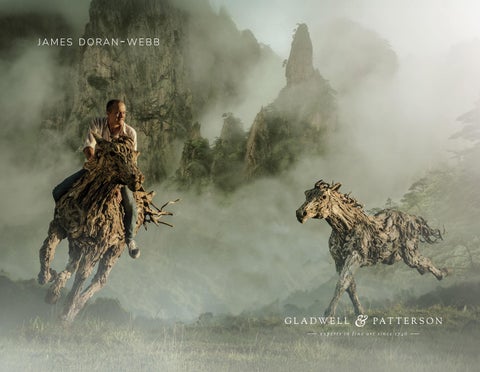
Thoroughbred horses recur throughout James Doran-Webb’s work as a long-standing interest from his childhood. At an early age he was drawn to the horse not simply as an emblem of speed or power, but as a complex anatomical structure in which weight, muscle and momentum are held in constant negotiation. This fascination developed alongside his formative years spent working with wood, where understanding how forces travel through a structure became second nature. The horse, with its extended limbs, suspended gait and shifting centre of gravity, offers a subject uniquely suited to this way of thinking. Across Doran-Webb’s wider oeuvre, horses function as both technical challenge and personal touchstone. They allow him to test the limits of balance and suspension, while returning repeatedly to a form that has accompanied him from childhood fascination through to mature practice. In their galloping poses, often shown skimming water or breaking through open space, the horse becomes a vehicle for exploring forward motion held momentarily in tension. Presented in this collection, these maquettes sit comfortably within that lineage, underpinning his more ambitious equine works seen in private collections and public spaces across the world.

Upper: Maquette of Solaris
Lower: Maquette of Mercury
Varied Size
Driftwood on Stainless Steel

Turn static files into dynamic content formats.
Create a flipbook
James Doran-Webb: Evolution by Gladwell & Patterson - Issuu