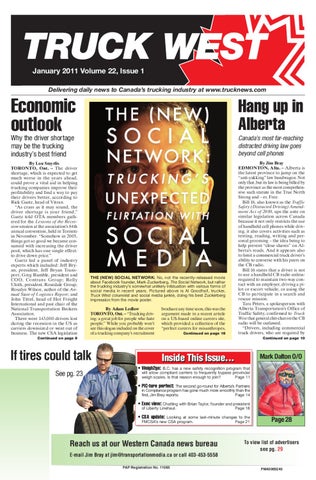
January 2011 Volume 22, Issue 1 Delivering daily news to Canada’s trucking industry at www.trucknews.com
Economic outlook
The (new)
Social
Why the driver shortage may be the trucking industry’s best friend
By Lou Smyrlis TORONTO, Ont. – The driver shortage, which is expected to get much worse in the years ahead, could prove a vital aid in helping trucking companies improve their profitability and find a way to pay their drivers better, according to Rick Gaetz, head of Vitran. “As crass as it may sound, the driver shortage is your friend,” Gaetz told OTA members gathered for the Lessons of the Recession session at the association’s 84th annual convention, held in Toronto in November. “Somehow in 2005, things got so good we became consumed with increasing the driver pool, which has one single effect: to drive down price.” Gaetz led a panel of industry experts which included: Jeff Bryan, president, Jeff Bryan Transport; Greg Rumble, president and COO, Contrans Group; Rolly Uloth, president, Rosedale Group; Rosalyn Wilson, author of the Annual State of Logistics Report; and John Tittel, head of Hot Freight International and past chair of the National Transportation Brokers Association. There were 143,000 drivers lost during the recession in the US as carriers downsized or went out of business. The new CSA legislation
Hang up in Alberta Canada’s most far-reaching distracted driving law goes beyond cell phones
Network:
By Jim Bray EDMONTON, Alta. – Alberta is the latest province to jump on the “anti-yakking” law bandwagon. Not only that, but its law is being billed by the province as the most comprehensive such statute in the True North Strong and – er, Free. Bill 16, also known as the Traffic Safety (Distracted Driving) Amendment Act of 2010, ups the ante on similar legislation across Canada because it not only restricts the use of handheld cell phones while driving, it also covers activities such as texting, reading, writing and personal grooming – the idea being to help prevent “close shaves” on Alberta’s roads. And it appears also to limit a commercial truck driver’s ability to converse with his peers on the CB radio. Bill 16 states that a driver is not to use a handheld CB radio unless: required to maintain two-way contact with an employer, driving a pilot or escort vehicle, or using the CB to participate in a search and rescue mission. Tara Peters, a spokesperson with Alberta Transportation’s Office of Traffic Safety, confirmed to Truck West that general chit-chat on the CB radio will be outlawed. “Drivers, including commercial truck drivers, who are required by
trucking’s
unexpected f l i r tat i o n w i t h
social m e d i a The (new) social network: No, not the recently-released movie about Facebook founder, Mark Zuckerberg, The Social Network, but rather the trucking industry’s somewhat unlikely infatuation with various forms of social media in recent years. Pictured above is Al Goodhall, trucker, Truck West columnist and social media junkie, doing his best Zuckerberg impression from the movie poster.
By Adam Ledlow TORONTO, Ont. – “Trucking driving: a great job for people who hate people.” While you probably won’t see this slogan included on the cover of a trucking company’s recruitment
brochure any time soon, this was the argument made in a recent article on a US-based online careers site, which provided a collection of the “perfect careers for misanthropes, Continued on page 16
Continued on page 9
If tires could talk See pg. 23
Continued on page 10
Inside This Issue...
Mark Dalton O/O
• Weigh2go: B.C. has a new safety recognition program that
will allow compliant carriers to frequently bypass provincial weigh scales. Is that reason enough to join? Page 11
• PIC-ture perfect: The second go-round for Alberta’s Partners in Compliance program has gone much more smoothly than the first, Jim Bray reports. Page 14
• Exec view: Chatting with Brian Taylor, founder and president of Liberty Linehaul.
• CSA update:
Page 18
Looking at some last-minute changes to the FMCSA’s new CSA program. Page 21
Reach us at our Western Canada news bureau E-mail Jim Bray at jim@transportationmedia.ca or call 403-453-5558 PAP Registration No. 11065
Page 28
To view list of advertisers see pg. 29
PM40069240
Page 4 TRUCK WEST
January 2011
Monthly Class 8 Sales - Oct 10 The 1,981 Class 8 trucks sold in October this year, continued the pattern of considerable sales increases over the previous year and was also higher than the October total back in 2001. Looking at Canadian truck sales over the entire decade, however, it’s clear there is little to be excited about. The sales numbers are still far below the five-year average with the North American economy slowing down. It’s also interesting that Freightliner once again posted higher sales than market leader International although Kenworth’s monthly sales suffered a significant setback.
OEM
Historical Comparison - Oct 10 Sales
This Month
Last Year
Freightliner
630
257
International
458
449
Kenworth
294
248
Mack Peterbilt
98
68
193
161
Sterling Volvo Western Star TOTALS
0
43
220
104
88
75
1981
1405
Historical Comparison - YTD Oct 10
Class 8 Sales (YTD Oct 10) by Province and OEM OEM
BC
ALTA
SASK
MAN
ONT
QUE
NB
Freightliner
204
302
163
159
1,617
509
263
Kenworth
301
925
141
173
623
811
100
53
62
81
49
458
147
44
International
184
449
65
174
1,744
939
162
103
Peterbilt
140
463
125
161
274
445
86
38
Sterling
28
55
24
3
17
70
0
0
Volvo
59
81
64
103
776
342
79
41
0
Mack
Western Star TOTALS
NS
PEI
137
NF
CDA
9
17
3,300
0
0
0
3,074
19
0
1
914
10
86
3,916
0
0
1,732
0
0
197
11
1,556
142
260
40
26
187
157
54
79
0
15
960
1,111
2,597
703
848
5,696
3,420
788
417
19
130
15,729
During the first nine months of 2010, there were 15,729 trucks sold in the Canadian market. That’s a considerable improvement over last year but that’s about it. In 2009, truck sales fell 44% from the previous year. So far, sales are up 38% from that. As Daimler North America’s Martin Daum told the media during a briefing at the American Trucking Associations conference, “We would not be smiling if we didn’t have 2009 to match against.” Sales figures now are more than 7,000 units below the 7-year average.
12 - Month Sales Trends Market Share Class 8 – Oct YTD
2,000 1,900 1,800 1,600 1,400 1,200 1,000 800 600 400 200 0 Sales
November December
1,131
1,380
January
February
March
April
May
June
July
August
September
October
1,031
1,149
1,734
1,801
1,574
1,545
1,531
1,536
1,712
1,981
After dropping for three consecutive months, Class 8 sales rebounded by ever so slight a margin in August with sales for the month coming in just a handful of units above the sales posted in July. September saw a much more robust increase and October has come in with a similarly sized increase. Can the monthly increases continue to the end of this year? Sixty percent of fleet owners and 27% of owner/operators responding to our annual Equipment Buying Trends Survey indicated they would be purchasing new iron this year.
Source: Canadian Motor Vehicle Manufacturers Association
International, the only truck manufacturer not to adopt SCR engine technology, continues to drop in market share as the year draws to a close, but it remains the market share leader. Both Freightliner and Kenworth posted higher sales for August and September and Freightliner did so for October as well. International captured the market share crown in the Canadian Class 8 market in 2009, ending up with a commanding 29% share of the market. It remains the market leader this year with a 25% share. Kenworth has been the story of the year so far in 2010 and now enjoys a 20% market share, just behind second place Freightliner.
YOU DEPEND ON YOUR PARTS. YOUR PARTS DEPEND ON DELO.
®
You put a lot into your truck – including trust. You trust that it won’t let you down; that its parts will keep you driving toward your goal. And they will – if you give them the advanced protection of Delo products. From our premium lubricants formulated with ISOSYN® Technology to our industry-leading extended life coolants and synthetics, Delo helps maximize uptime and gives you the confidence to succeed. Some of the world’s largest fleets and Original Equipment Manufacturers (OEMs) depend on our Delo family of products with ISOSYN Technology. To learn more about The Delo® Performance Advantage™, visit us at www.deloperformance.com. A
company product
© 2010 Chevron Lubricants Canada Inc. All rights reserved. All trademarks are the property of Chevron Intellectual Property LLC.
®
DELO DELIVERS CONFIDENCE
TM
January 2011
TRUCK WEST Page 5
Changes are coming and they won’t be in your favour
January 2011, Volume 22, Issue 1 Canada Post Canadian Publications
ISSN 0700-5016 – Truck West (Print) ISSN 1923-3531 – Truck West (Online) Mail Sales Product Agreement No. 40069240 “Return Postage Guaranteed” 12 Concorde Pl., Suite 800, Toronto, Ont., M3C 4J2 Sales: 416-510-6892 / Editorial: 416-510-6896 Fax: 416-510-5143 Truck West, USPS 017-178 is published monthly by BIG Magazines L.P., a div. of Glacier BIG Holdings Company Ltd., a leading Canadian information company with interests in daily and community newspapers and B-2-B information services. US office of publication: 2424 Niagara Falls Blvd, Niagara Falls, NY 14304-5709. Periodicals Postage Paid at Niagara Falls, NY. US postmaster: Send address changes to Truck West, PO Box 1118, Niagara Falls, NY 14304. SENIOR PUBLISHER – Rob Wilkins ASSOCIATE PUBLISHER – Kathy Penner EXECUTIVE EDITOR – James Menzies MANAGING EDITOR – Adam Ledlow CIRCULATION MANAGER – Vesna Moore CIRCULATION ASSISTANT – Anita Singh CREATIVE– Carolyn Brimer, Beverley Richards V.P. PUBLISHING – Alex Papanou PRESIDENT – Bruce Creighton Circulation inquiries: 416-442-5600 ext. 3553 Change of address: Please include subscription number from mailing label. Subscription rates: Canada (Includes GST) – One year $40.60; U.S. – one year $66.95; foreign – one year $66.95
Send subscription orders, address changes (incl. mailing label from latest issue) to above address. On occasion, our subscription list is made available to organizations whose products or services may be of interest to readers. If you prefer not to receive such information, please write to us. Please allow 8 weeks for changes or corrections.
PAP Registration No. 11065 We acknowledge the financial support of the Government of Canada, through the Canada Magazine Fund, towards our editorial costs. We acknowledge the financial support of the Government of Canada, through the Publications Assistance Program, towards our mailing costs.
Advertising inquiries
Kathy Penner (416) 510-6892 Fax: (416) 510-5143
Rob Wilkins
Kathy Penner
Publisher
Associate Publisher
rwilkins@trucknews.com
kpenner@trucknews.com
(416) 510-5123
Brenda Grant
National Account Sales
(416) 494-3333 bgrant@istar.ca
(416) 510-6892
Don Besler
National Account Sales Manager
(416) 699-6966
donbesleris@rogers.com
Doug Copeland
Regional Account Manager
(416) 510-6889
dcopeland@trucknews.com
Laura Moffatt Research Director
TRUCK WEST is a proud member of the following trucking associations: ALTA. MOTOR TRANSPORT ASSN.
SASK. TRUCKING ASSN. MAN. TRUCKING ASSN.
B.C. TRUCKING ASSN.
The publisher does not assume any responsibility for the contents of any advertisement and all representations or warranties made in such advertising are those of the advertiser and not of the publisher. The publisher is not liable to any advertiser for any misprints in advertising not the fault of the publisher and in such an event the limit of the publisher's liability shall not exceed the amount of the publisher's charge for such advertising. No portion of this publication may be reproduced, in all or in part, without the written permission of the publisher.
From time to time, we make our subscription list available to select companies and organizations whose product or services may interest you. If you do not wish your contact information to be made available, please contact our privacy officer via one of the following methods: Phone: 1-800-668-2374 Fax: 416-442-2200 E-mail: jhunter@bizinfogroup.ca Mail: Privacy Officer. Business Information Group, 12 Concorde Place, Suite 800, Toronto, Ont., M3C 4J2 PUBLICATIONS MAIL AGREEMENT NO. 40069240 RETURN UNDELIVERABLE CANADIAN ADDRESSES TO CIRCULATION DEPT. – TRUCK NEWS, 12 CONCORDE PL., SUITE 800, TORONTO, ON M3C 4J2
By putting off writing this column as long as I possibly could, I was hoping the US FMCSA would have by now published its proposed changes to the US hoursof-service rules. However, the Dec. 6 edition of the Federal Register contained no such information. Truck West has not missed a printing deadline in its 22-year history, and it’s not going to happen on my watch, so I’ll have to address the issue without knowing exactly what the proposed rules will be. One thing is for certain: they will not be favourable to the US trucking industry, nor to Canadian fleets that operate there. The breadth of the changes is the only thing that remains unknown, but it’s widely expected the proposals will call for a reduction in daily driving time by one or two hours and a lengthening of the mandatory 34-hour reset period. This is a big deal. At the Commercial Vehicle Outlook Conference in August, American Trucking Associations (ATA) chairman Tommy Hodges said “The hoursof-service rewrite is a political football and it will have nothing to do with good science. It’s a political football that is going to get passed over our heads. There’s a good possibility we will lose one to two hours of driving time and there’s a strong possibility we’ll lose the 34-hour restart.” He went on to say losing two hours of driving time per day would reduce truck productivity by 18-19%. What’s worse, it comes at a time when emissionsdriven changes to engine technology is driving up costs of new trucks by about $10,000. As Jim O’Neal, president of O&S Trucking so eloquently said at the same conference, “When
Editorial Comment James Menzies
you see productivity decline and you see inflation rise, you can head for the hills.” And there are other repercussions as well. A reduction in daily driving time would redefine the term ‘day trip.’ The average length of haul is shortening, but a 600-mile haul will no longer be feasible in one day if driving time is reduced. And what about longhaul? Will any fleet be able to afford having its truck parked at the truck stop for more than 12 hours a day? In North America, professional drivers are the Sherpas of commerce. They do the heavy lifting while everyone else – trucking company owners, shippers and consumers – benefit. And now we’re go i n g t o l i m it thei r productivity and the hours they can work beyond the existing framework, which incidentally was in place while the US trucking industry reduced its crashrelated injuries and fatalities to historic lows? Consider these stats, circulated by the American Trucking Associations via a white paper on hoursof-service that was written in advance
of the release of the new proposal: “The industry’s safety performance while operating under the current HOS rules since January 2004 is remarkable. Truckinvolved highway crash fatalities in 2009 were down 33% from the 2003 level and are at their lowest level since USDOT began keeping records in 1975. Crash-related injuries have also dropped dramatically since 2003, and the fatality, injury and property-damage-only crash rates for large trucks (crashes per 100 million miles travelled) are at their lowest point since the USDOT began keeping records three decades ago.” So tell me again, why do the rules need to be changed in the first place? n – James Menzies can be reached by phone at (416) 510-6896 or by e-mail at jmenzies@trucknews.com. You can also follow him on Twitter at Twitter.com/JamesMenzies.
Remember, shippers are not the enemy Is it me or are tempers becoming as frayed lately as profit margins? I’ve been to a number of events and hosted several others over the past couple of months and that’s the distinct impression I’m getting. Whether it’s fleet executives discussing the outlook for next year at OTA’s annual convention or industry stakeholders commenting on their relationship with government or shippers at several of the panels I’ve moderated, it seems everyone is on edge and the discussion is considerably more raw than in years past. Trucking has been in a freight recession for four long years now and, as Richard Gaetz, head of Vitran, and moderator for the OTA outlook session, pointed out people are tired. Tired and rather grumpy it would seem. As you read this, you will be just a couple of weeks away from closing out the year. True, 2010 was a better year than the disaster of 2009 but nowhere near as good as we may have hoped. Had we not gone through 2009, I doubt 2010 would have looked like much. Is there good reason to believe
The view with Lou Lou Smyrlis
2011 will be better? Carriers are particularly incensed about the precipitous drop to what they’ve been able to charge for their services. One prominent TL carrier told me earlier this year he figured rates had dropped 18-25% over the recession. And carriers are not too shy to mention that shippers have abandoned long-term relationships based on quality service in favour of short-term deep rate cuts. But they also admit that, as Norm Sneyd of Bison Transport put it at our annual Shipper-Carrier Issues Roundtable, our industry sometimes takes “great aim to shoot itself in the foot.” Carriers desperate to make payroll for one more week are a large part of the reason for the downward pressure we’ve seen on rates. Lest you think otherwise, shippers are not exactly a happy bunch these days either – despite the significant price concessions they’ve
been able to wring from carriers. Their own transportation budgets and staff have been cut and they’re forced to do more with less. And as Eric Warren of LTL carrier Hercules Freight pointed out at the Roundtable, some shippers trying to get the lowest possible price are ending up with 10 carriers showing up in the yard all at once when the shipper only has five doors. The detention and other ancillary charges that result make the total rate not quite what they thought they had achieved. And there is also the reliability factor as desperate carriers wade into areas where they may have little expertise. From all the economic data I’ve seen, I think we’ve got at least six more months of painfully slow growth ahead of us. It’s going to require patience and a steady hand to ensure rash decisions aren’t made. Shippers after all are not the enemy; they’re the customer. n – Lou Smyrlis can be reached by phone at (416) 510-6881 or by e-mail at lou@TransportationMedia.ca. You can also follow him on Twitter at Twitter.com/LouSmyrlis.
Page 6 TRUCK WEST
January 2011
in brief
Truck-friendly Saskatchewan gets more truck-friendly with new regs REGINA, Sask. – Saskatchewan continues to remove barriers for trucking companies, most recently amending its Vehicle Weight and Dimensions Regulations to allow B-trains to operate at 63,500 kgs on more roadways. The new weight limit matches that in Alberta and B.C. and adds about 1,000 kg of payload, the province announced. This will improve productivity by 2.5%. “This is just one of many changes we’ve introduced to harmonize rules for commercial carriers across Western Canada, keeping the goals of the New West Partnership very clearly in mind,” Highways and Infrastructure Minister Jim Reiter said. “These and other amendments are aimed not only at harmonization but at increasing the profitability of shippers and making Saskatchewan an even more competitive place to do business.” Highways that can now accommodate 63,500 kg B-train loads include: Hwy. 6 from Regina to Melfort; Hwy. 9 from Hwy. 1 to Yorkton; Hwy. 13 from Manitoba to its junction with Hwy. 39; Hwy. 18 from Manitoba to its junction with Hwy. 39; Hwy. 39 from Hwy. 6 to Hwy. 1; and Hwy. 40 from its junction with Hwy. 4 to its junction with Hwy. 29. Saskatchewan also has approved the use of tridem-drive trucks and truck tractors, allowing them to be used without special single-trip or term permits. And it also amended the regulations to allow the wider use of aerodynamic evices, wide-base tires, lift axles that automatically deploy and other features that lower emissions and reduce operating costs. For a complete list, visit www.highways.gov.sk.ca. n
AMTA fights 125% increase in tire recycling fees CALGARY, Alta. – The Alberta Motor Transport Association (AMTA) is speaking out against a proposed 125% increase in tire recycling fees in that province. The Alberta Recycling Management Authority (ARMA) recently said it will be hiking the fee to dispose of used tires from $4 to $9 per tire. “This amounts to a 125% increase,” AMTA executive director Mayne Root said in the association’s newsletter. “That translates into Alberta’s road transport industry shelling out a hefty $2.5 million in the first year alone.” “At a time when the industry is still experiencing financial difficulty as the result of the struggling economy, this increase will inflict a significant hardship,” Root added. “The transportation industry experiences very low profit margins and, in our experience, our customers will
We Deliver Thanks to You! Challenger Motor Freight is currently hiring: • Company Single and Team Drivers • Owner-Operators Call today and put your career on the path of your choice
Enjoy all the rewards Challenger has to offer, including: • State-of-the-art maintenance facility • Top of the line equipment • Excellent Renumeration – Great Benefits!
We go the distance. Call today and put your career on the path of your choice:
T 1 800 334 5142 F 1 888 876 0870 E recruiting@challenger.com W www.challenger.com
not accept any rate increase to cover this type of expense.” The AMTA has asked the ARMA to provide a cost breakdown to justify the increase. “Being in the transportation industry, we can appreciate the cost of collection and transportation of the tires but are unclear as to the process after that,” Root said. “What, if any, are the additional costs to the program and what revenue is generated from the resulting products?” n
Search is on for AMTA Road Knights CALGARY, Alta. – The Alberta Motor Transport Association (AMTA) is searching for professional truck drivers to serve as Road Knights. AMTA Road Knights are professional transport drivers with firstclass driving records who meet with community groups to share their knowledge about how to safely share the road with trucks. AMTA officials say their mission is to make roadways safer by encouraging all road users to be partners in safety. They also make presentations about careers in trucking and the importance of the industry to Canada’s economy. “Participating as a Road Knight is an exciting opportunity for transport drivers to speak on behalf of the industry’s best drivers, and an excellent way for carriers to demonstrate their commitment to road safety education,” says Mayne Root, executive director of the AMTA. “The time requirement is about one or two days each month.” As official AMTA Road Knights, drivers will appear at driving schools, business clubs, primary, junior and senior high schools, and social clubs, among others, to help get the word out about how to safely share the road with a truck, to increase awareness of trucking’s economic importance and to promote the industry as a viable career choice. Team members will also be available to the media for interviews. AMTA will provide media-relations and public-speaking training, and will arrange speaking opportunities and public appearances for drivers. Team members will also be supplied with supporting brochures and videos to help communicate the message of road safety. Each team member serves for two-years and will be provided with an outfit to wear – emblazoned with the program’s crest – while making presentations. “We’re not looking for professional speakers,” Root says. “Were looking for drivers who like meeting people, are eager to communicate with the public about the industry, have a strong commitment to road safety, and who project a professional image.” Nominees must be Alberta-based full-time company drivers or owner/ operators with a solid safety record and good communications skills. The nominating company must be a member in good standing with the AMTA. The deadline for nominations is Dec. 31. To obtain an application kit, visit www.amta.ca. For more information, call Dr. William Raccah at 403214-3428 or williamr1@amta.ca. n
PRECISION. WE’RE BIG BELIEVERS IN IT. How do you stretch your operating dollars mile after mile? Get precisely the right truck tires. At Bridgestone, our passion for precision never rests. We constantly seek true performance on things like tread wear, fuel economy and casing durability. So you can trust your fleet is rolling on the best performing tires for your operations. Get real answers to what the road calls for with Bridgestone tires. Visit us at Bridgestonetrucktires.com.
Precisely The Right Tire.
Our passion for the very best in technology, quality and service is at the heart of our commitment to you wherever you are in the world. Bridgestone wants to inspire and move you.
For your nearest Bridgestone Authorized Dealer, visit our website at bridgestonetrucktires.com Š2010 Bridgestone Canada, Inc. All Rights Reserved.
Bridgestone Corporation
January 2011
TRUCK WEST Page 9
canada
Shippers are expecting rate increases, analyst says Continued from page 1
may remove another 10-15% of the current driver force, according to Wilson. As a result, by 2012 the US market could be in need of 400,000 drivers. In Canada, research conducted on behalf of the Canadian Trucking Human Resources Council during the previous economic expansion found that almost half the carriers surveyed had to idle trucks because of the shortage of personnel while 42% noted the shortage affected their ability to move freight. Bryan concurred with Gaetz’s remarks, adding: “This driver shortage is going to present an excellent opportunity to grow our business organically with great customers and great rates.” And so did transportation specialist Walter Spracklin from Royal Bank of Canada, who spoke right after this session. “Don’t fix the driver shortage problem. It will allow you to fix your rates,” Spracklin told trucking executives. What should also aid trucking companies is that a great deal of capacity has been removed from the market place. There were 3,000 trucking company failures since 2009 in the US with 1,085 of them since the start of this year, according to Wilson. The American Trucking Associations estimates there has been a 12.5% loss of capacity as a result. In Canada, the bankruptcies have not been as pronounced. There were 513 trucking company bankruptcies in 2008 and 352 in 2009, according to data provided by Statistics Canada. (In comparison, bankruptcies were higher back at the turn of the decade when fuel prices skyrocketed and many carriers were caught without fuel surcharges in place). “Looking ahead, as capacity tightens, it will enable carriers to gain some pricing control by mid2011, which will herald very significant rate hikes,” Wilson said. “If you are a shipper, you want to guarantee capacity. Right now (service) reliability is one of the biggest issues we face.” But Gaetz reminded the audience how far trucking’s fortunes have fallen during a freight recession that started back in 2006 and did not lift till this year, and how long it may take to get things back to where they used to be. “We have a long, long way to go before we get prices to where they have to be,” Gaetz said. Not that the audience needed much reminding. Wilson, who spoke first, said logistics costs as a share of US GDP dropped to 7.7% in 2009, which was the lowest over the past 30 years. This was caused by rapid declines in shipments combined with cut-throat rate pricing. “Make no mistake about it. Our goal is to provide a product that is what shippers need or better, while providing for acceptable reinvestment and growth…public companies are fed up with their returns. This recession has probably been the most difficult since the Great Depression. It has been a long four years. There are a lot of tired people. It can’t take four years to recov-
er,” Gaetz said, adding that Vitran has already started to raise rates for its US service. Spracklin said his own company research shows that almost two out of three shippers are expecting rate increases in the 1-6% range. Only about a quarter of shippers surveyed thought likewise the previous year. Wilson, however, cautioned she does not see the economy perking up much till the mid-point of 2011 and even then she thought the recovery would be bumpy and slow. It may be 2012 till truck freight rates show significant recovery. That fit in with Rumble’s outlook. “I think it’s going to be slow progress. As the opportunities (to raise rates) present themselves, we have to take them,” he said, adding there are pockets already in the US economy where higher rates will stick. Rumble and several others also cautioned against entering into any long-term contracts because the market is about to change and carriers should not be tying themselves down under the wrong circumstances. Another trucking executive warned that long-term shipper contracts are dangerous because they may assign too many liabilities to carriers with very little increase in rates. Another carrier pointed out that long-term shipper deals that commit carriers to high service and capacity levels often don’t include freight volume guarantees. Wilson disagreed with the opposition to long-term contracts, being in favour of a more collaborative relationship with shippers. “I think you have a good chance of getting where you want to be,” she told carriers. “If you are relying on tight capacity and the driver shortage to get rates up, you are running risks.” But Rumble said there needs to be a compromise between long-term
contracts that favour shippers and short-term deals that provide carriers with the most flexibility. “I’m not against long-term contracts,” he clarified. “It’s the timing of it and if they are willing to put some guarantees in place in terms of freight volumes and price increases.” Uloth said it’s more an issue of growing with the right customers. “We try to search out the better shipper. I’m not interested in just sales volumes,” Uloth said. And Tittel, who acknowledged his company saw “some crazy rate requests” during the recession from its shipper clients, added that carriers have to be extra careful with whom they do business, whether it be a shipper or an intermediary. The panel also discussed the impact of current debt levels, utilization of assets and whether carriers have stretched themselves too thin in trying to secure new business during the downturn. Rumble, whose company started out the downturn as an income trust, spoke about the importance of having cash flow available during the recession. He moved quickly to restructure his company’s debt load so that a sizeable amount of debt did not kick over into liabilities during the height of the recession. Instead it will come due in a few years when the economy should be stronger. He said that had he waited to act, the company’s rates would probably have had to be 2-3% higher in the midst of a recession with cut-throat pricing. “In a recession, you better understand the covenants you have in place. They can move very, very quickly and you can’t stop it. No matter what, control your destiny. Manage your covenants. Start early,” Rumble advised. Bryan’s contribution to surviv-
ing the recession was being creative when it came to better utilizing existing company assets. His company ended up renting unused space at its new terminal to another carrier. “It’s not something we would have thought of before,” Bryan acknowledged. Bryan also moved dispatch operations from the US to Canada to reduce costs and moved early to remove excess capacity from the fleet. “If you are not going to use (equipment), you don’t need it. So get rid of it. We got a fairly good dollar for it and it helped with cash flow,” he said. Uloth, however, pointed to the benefit of staying the course during a recession, which is the path that Rosedale Group took, spending $8 million towards equipment renewal and expanding in Vancouver and Winnipeg with new facilities as well as beefing up its Montreal operation. “We did this because we knew the recession would not last forever and we wanted to be ready. We also invested heavily in people. We didn’t lay anybody off and we continued to train our people. We gave our drivers an adjustment of 3% this March,” Uloth said. Spracklin said the publically traded companies he tracks did an “excellent” job of weathering the economic storm, despite the hardships. “Smart players turned away from bad business. A lot of these companies were quick in cutting costs and reducing capacity,” Spracklin said. And there is a real silver lining to this cloud. Wilson said that for those who have survived the recession and who can manage through the slow and turbulent road to recovery, the future is really bright. “For those who have emerged much weaker, you have to find a way to differentiate yourselves,” she added. n
The story for 2011? No straight line to prosperity By Lou Smyrlis TORONTO, Ont. – Can the global economy stay in drive? That’s the question concerning most as we head into 2011 with an economy showing considerably less umph than it did at the start of the year, and what Dawn Desjardins, assistant chief economist with Royal Bank of Canada, addressed at the recent Ontario Trucking Association annual convention. Although the economy has been in recovery for a full year now, Desjardins acknowledged in some industries (trucking would certainly be among them) it may not feel that way. “We have a lot of room to go to get to pre-recession levels and it’s not going to be a straight line to prosperity,” she warned. The need to start regrowing inventories, which had been significantly reduced during the recession, drove much of the growth of the final quarter of 2009 and first quarter of 2010 but inventory growth has since slowed considerably, Desjardins said, adding “we don’t see it continuing at an
aggressive pace.” The sluggish American economy has much to do with the muted economic outlook. Americans lost 25% of their wealth from 2007 and only about a third has been recovered to date. As a result, consumer spending in the US, although finally on an upward trajectory after two years of declines, is only expected to grow by 2% this year and next. Historically, consumer spending increases at double this pace. Home sales in the US are also considerably below peak levels since unemployment remains high and fiscal tax rebate programs have expired. The situation is not as dire on this side of the border. Canadian consumer spending accelerated this year and will account for about half the economic growth in 2010. The recession did take way about 400,000 jobs but they were quickly recovered, Desjardins said. She expects the unemployment rate to drop from the current 7.9% down to 7% by 2012.
The trade sector, thanks to our high dollar, however, is acting as a weight on future growth and the rising debt levels among Canadian families also bears watching. Canadian housing is in decline following the strong activity shown in 2009 when interest rates became particularly attractive but Desjardins said “we are not in the camp that Canada’s housing market is headed the way of the US.” And there are good reasons for hope for the US too, Desjardins said. “We are seeing the work week being extended. Overtime has peaked and there is a rise in temporary hiring. We are sowing the seeds of future growth,” she said. What will drive this growth? Business spending for one, if the corporate sector on both sides of the border can overcome its nervousness. “It’s a glass half full scenario,” Desjardins said. “This is a story of patience and being accepting of the fact we are not going back to very strong growth any time soon.” n
Page 10 TRUCK WEST
January 2011
alberta
Alberta’s distracted driving law appears to limit CB usage Continued from page 1
their employer to maintain two-way radio communication, for example via a CB radio, may use a hand-held two-way radio communication device for the purposes of contacting their employer while acting within the scope of that individual’s employment,” she told Truck West. “Recreational use of a hand-held two-way radio communication device is not permitted under Bill 16.” When asked to confirm that a truck driver will be in violation of the law when using the CB radio for conversational purposes, she confirmed: “Yes, the bill specifies that hand-held two-way radios can only be used by drivers who are required by their employer to maintain two-way radio communication for the purposes of contacting their employer while acting within the scope of that individual’s employment.” “This is a great day for traffic safety in our province,” Minister of Transportation Luke Ouellette said upon announcing the new law, calling the legislation a “bold approach” in that it goes beyond the mere restricting of cell phones by dealing also with the broader issue of distracted driving. “Our message is clear: Keep your hands on the wheel and your eyes on the road,” he says. Not surprisingly, the legislation is being greeted positively by its sponsor, former police officer and current MLA for Calgary-Hays Art Johnston. “I have witnessed the terrible consequences of distracted driving and I am glad we are taking action,” he says, adding that “anything we can
do to improve safety provides tremendous benefits to Albertans.” The legislation is also being lauded by Mayne Root, outgoing executive director of the Alberta Motor Transport Association (AMTA). Root, who is also an ex-police officer, says “Just bringing it to the attention of people, and not just commercial drivers but everybody out there, will be a good thing.” Ah, but is a new law required, or could the existing legislation merely be tightened or have its focus changed or expanded? Root thinks the new legislation is a good idea, saying the issue of distracted driving has been talked about for years, but there hasn’t been a lot of positive change over that time. “Making something very specific probably does have some merit in this case,” he says. Root notes the new law makes it very specific to the public what the enforcement people will be looking for and what people should be aware of. And that, he thinks, means the new law has the potential to be beneficial in increasing traffic safety. On the other hand, he says, “I guess all we can do is wait and see.” And though Root admits cell phone bans in other jurisdictions don’t seem to have helped solve the problem, the fact that Alberta’s legislation also covers driving sins such as applying make-up and eating means it could make it easier to prove an infraction than it was when only the broader statute was in effect. “It used to be that police could pull a driver over and charge them with driving without due care and attention,” he says, “but there had to be proof that there was some sort of
driving issue – that the person was actually driving in an unsafe manner.” Now, the driver only has to be seen glued to his or her phone – or newspaper or whatever – for police to have a case. And where are all these enforcement officers going to come from? Will they be yanked from their gang fighting or murder solving duties to cruise the roads looking for farding females or dining dudes to fine? “I don’t think it will take any extra manpower,” Root says. “I think it just gives the police another way to look for things they need to deal with.” The new legislation still permits the use of hands-free phones, which probably means Bluetooth device sales will jump in the province. And the law has no effect on the official duties of emergency service personnel including law enforcement, fire and medical services. These and other exemptions lead Root to conclude that responsible truckers shouldn’t have anything to worry about. “The legislation talks specifically about the fact that emergency services vehicle drivers and commercial drivers are exempted,” he says. “They can still use their CBs for commercial or emergency use.” Root has interpreted the legislation differently than Truck West, and feels professional truck drivers will still be able to use their CBs –for commercial use, that is. “The way I see the legislation worded is that as long as it was for commercial use
THIS MONTH’S CROSSWORD PUZZLE TN-91 Jan © 2011 M. Jackson
AMTA hires new executive director
CLASS ONE DRIVER
For Dry van and Deck work. Must be able to cross border. Based in Pincher Creek. Competitive Pay and Benefits. Please fax or e-mail resumes, references and abstracts Attention Christy 403-627-3420 • christy@higginbotham.com
Answers on page 10
CALGARY, Alta. – The Alberta Motor Transport Association (AMTA) has named Don Wilson its new executive director, effective immediately. Wilson replaces longtime executive director Mayne Root. AMTA officials say Wilson has a long history of working with the industry, beginning as a driver and terminal manager. He spent 32 years working with Alberta Transportation Driver Programs and Licensing Standards. While there, he worked with the AMTA on the Professional Driver Improvement Course and long combination vehicle certification. Also during this time, Wilson was involved with the Driver of the Month selection committee, the regional meetings, and volunteered at the Provincial Truck Driving Championships. Wilson is a native Albertan and longtime Calgary resident. He volunteers with the Calgary Stampede Promotions Committee and Heritage Park as a locomotive fireman. n
Now HiriNg Drivers
they would still be exempted as well,” he says. And while the legislation does appear to create a kind of “two tiered” system on Alberta roads, separating professional drivers from the great unwashed, the public does have one consolation besides shelling out for a Bluetooth gadget: they can use their hand-held devices to contact emergency services such as 911. Other than that, however, they will soon face a $172 fine if police perceive them prattling when they should be steering instead. And like a photo radar ticket, the fine isn’t accompanied by an demerit points, which may lead some to wonder whether it’s really about safety or merely another cash grab on the part of government. Distracted drivers could also face other charges if their phone-based peccadillo is accompanied by another violation – running a red light or making an improper lane change, for example. Such charges can bring a penalty of $402 and six demerit points, which could add up. The legislation came into effect when it was proclaimed in November and will be accompanied by an awareness campaign coordinated with traffic safety stakeholders and law enforcement. The province anticipates a temporary grace period that could mean the hammer won’t fall on distracted drivers before mid-2011. After that, of course, the roads will be perfectly safe. n
Across
Down
1. 4. 9. 10. 11. 12. 13. 18. 20. 22. 23. 24.
1. 2. 3. 5. 6. 7. 8. 14. 15. 16. 17. 19. 21.
The TCH crosses it Ubiquitous cargo platform Reduce tire pressure International ProStar trim level State with “Famous Potatoes” plates Ambassador Bridge city Tractors’ diesel repositories (6,5) Rejuvenate a failed component Palindromic disc-brake item Rig’s custom artwork, perhaps Shift-lever selection Given name, truck-driving “Movin’ On” star Akins 25. Shock absorber or piston travel
Links’ load carrier Canada-US-Mexico trade treaty International-emblem shape Truck-insurance contact Driver’s daily diary Location, on the CB Hauling an empty trailer Home of “Wild Rose Country” plates Dashboard channel (3,4) Calgary-based carrier Cooling-air passage at truck’s front Burned fuel pointlessly Power-boosting engine adjunct
Try it online at www.trucknews.com
January 2011
TRUCK WEST Page 11
British columbia
B.C. says ‘Weigh to Go’ to its best carriers By Jim Bray LANGLEY, B.C. – As Alberta’s Partners in Compliance program continues to grow, a similar concept is blossoming in British Columbia, where a program has been initiated by the provincial government to recognize BC’s top truckers. While not as comprehensive as PIC, “Weigh2GoBC” does appear similar in concept, if not execution, to PIC’s ‘scale bypass’ benefit that in Alberta gives member carriers a 98% bypass on the province’s weigh scales. Instead of actually bypassing the scales in B.C., however, Weigh2GoBC offers truckers a network of Weigh-in-Motion (WIM) facilities across the province that weigh commercial vehicles for compliance remotely, without forcing them to slow down from highway speed. The system simultaneously displays the particular carrier’s safety performance record to the inspectors within the scale office. In a nutshell, here’s how it works: Carriers who have enrolled in the program, which costs nothing to join so far, carry a registered transponder and as they approach a WIM-enabled station, it sends the necessary information to the inspectors – while weigh pads in the road measure the vehicle’s
axle weights. If all is tickety-boo, a light on the driver’s transponder illuminates green and the truck can continue on without stopping at the scale. Naturally, if all is not ticketyboo, the transponder lights up red and the driver has to pull in. Another difference from PIC is that participating vehicles only have a limited time benefit: after a vehicle receives a thumbs-up at a Weigh2GoBC-enabled station, it can only be given a bypass at Automatic Vehicle Identification (AVI) equipped inspection stations for a maximum of 12 hours. The idea, says B.C. Transportation and Infrastructure Minister Shirley Bond, is to help “improve the efficiency of goods moving throughout the province, while reducing the unnecessary idling of commercial vehicles. By allowing those who operate within the regulations to bypass our weigh and inspection stations, our Commercial Vehicle Safety and Enforcement staff can focus on those carriers who warrant closer scrutiny.” Carriers participating in Weigh2GoBC are still subject to random inspections, with each carrier assigned a “random report percentage rate” based on their safety performance record. Top carriers get lower random report rates, which also means it
pays to be on the leading edge of compliance. So far, Weigh-in-Motion facilities have been set up at Laidlaw (near Hope, in the Lower Mainland), Golden, and Red Rock (on Hwy. 97 south of Prince George). Automatic Vehicle Inspection facilities are in operation at Hunter Creek (near Hope), Kamloops and at Nordel in the Delta area. According to Louise Yako, the BCTA’s vice-president of policy, communications and partnerships, the Weigh2GoBC concept has actually been operating for most of the past year and a half, but mostly as a pilot project. And while her organization is fully supportive of it, there’s no official relationship. “We made our members aware of it and encouraged them to participate,” she says, “but we actually weren’t part of the development
and, other than a communications role, we don’t really have any involvement.” Yako says the BCTA has apprised its members about the program’s availability and will provide feedback to the government “If we get any feedback from members about it. So far, the carriers who are participating seem quite pleased about it.” The program is available to all commercial vehicles registered in B.C. and will soon be expanded to include vehicles registered in Alberta’s Partners in Compliance Program (PIC). The BC government is also working with Washington State to share commercial vehicle data, at which time Washington-registered vehicles would also be allowed to register in the Weigh2GoBC program and Weigh2GoBC registered vehicles would be enrolled automatically in the Washington State pre-screening program. For more information go to www.Weigh2GoBC.ca. n
Vancouver container haulers protest over rates
DELTA, B.C. – Vancouver container haulers are once again growing ornery over rate slashing and restrictions they say are affecting their livelihoods. About 400 truckers protested in Delta on Nov. 27, according to local media. The protest was organized by the Vancouver Container Truckers’ Association. Container truckers complain that B.C. ports are not living up to minimum rates and other conditions outlined by government following an ugly work stoppage in 2005. They are also upset by new fees, such as a $300 licensing fee for drivers, the lifting of a ban on new licences and an impending ban of older trucks, according to the Vancouver Sun. n
Premium Carrier Program honours cream of the crop By Jim Bray LANGLEY, B.C. – B.C. has introduced a Premium Carrier Program designed, according to the province, to enhance road safety by recognizing and rewarding carriers that show an exceptional commitment to safety. And unlike Weigh2GoBC, this one not only has the blessing of the BCTA but had its active participation as well in helping it get up and running. “We have been advocating the development of a Premium Carrier Program,” BCTA’s Louise Yako says, noting that the program was one of the recommendations come up with two years ago by a provincial government-initiated truck safety compliance panel on which BCTA CEO Paul Landry sat. “Since then we’ve been working with government to develop the program.” Honourees get a certificate and a watermark they can use on their company stationery and Web site. They’re also included on a list of recommended carriers on the Ministry’s Commercial Vehicle Safety and Enforcement Web site and can take part in the province’s Weigh2GoBC program. To help facilitate the latter, they receive free Weigh2GoBC transponders for their fleet as well as being assigned the program’s lowest random report percentage. The first two Premium Carriers, Lomak Bulk Carriers Corporation and Bandstra Transportation Systems Limited, were honoured at
special kick-off: British Columbia’s first Premium Carrier Program members are presented their certificates at the October 16th opening of the Red Rock Inspection Station south of Prince George. (Pictured L-R): Art Kaehn, chair of the Regional District of Fraser-Fort George, Cariboo-Prince George MP Dick Harris, John Bandstra, president of Bandstra Transportation Systems, Transportation and Infrastructure Minister Shirley Bond, Prince George-Mackenzie MLA Pat Bell, BCTA CEO and president Paul Landry, and David Livingstone, president of Lomak Bulk Carriers.
the opening of the province’s Red Rock Inspection Station south of Prince George in October. To qualify for the Premium Carrier designation, a carrier must meet or exceed program standards based on the carrier’s National Safety Code safety rating and their WorkSafeBC and ICBC history. “High ratings in these three areas,” says Transport Minister Shirley Bond, “indicates a culture of safety that we believe will make our roads safer
overall.” The program is available to truck and bus operators with more than 20 B.C. base-plated commercial vehicles who have operated for at least three years continuously in the province. Yako, however, says the BCTA would like to see the program expanded. “There’ll be an informal review at the six month period and a more formal review at the end of one year,” she says, pointing out that “eventually we’d like
that program to be available to anyone who qualifies regardless of the size of their fleet.” That could include owner/operators, though Yako doesn’t think the current benefits would be appealing enough to entice O/Os to jump on-board. To that end, she’d like to see the benefits improved as well. “We’ve made several other recommendations in terms of additional benefits that the government is now considering,” she says, “and we’re hoping that at some point they’ll be able to tell us if they accept those recommendations.” As for how close these two British Columbia programs are to Alberta’s PIC, Yako says the only real similarity is that they both recognize safe carriers. “The way we identify safe carriers in British Columbia is based on information that is already available,” she says, “so it doesn’t involve having the carriers do any additional administrative work.” P rog ra ms such as Weig h2GoBC, the Premium Carrier Program, and Alberta’s Partners in Compliance may not look the same, but the bottom lines are similar: safety. Says BCTA CEO Landry, “We’re proud of the fact that most trucking and motor coach companies in the province are safe operators. The Premium Carrier Program is designed to identify and reward those outstanding companies that adhere to the highest standards our association promotes throughout the trucking industry.” n
Page 12 TRUCK WEST
January 2011
over the road
A new year provides opportunities for a fresh start Living a healthy lifestyle as a truck driver isn’t easy, but it is possible
Over the Road Al Goodhall
tion sizes that were far too large. I learned that all the stuff that is good for us has far fewer calories in it and you can eat a lot more of it. Think fruits and vegetables – this became my new snack food. We know that we put on weight when we eat more calories in a day than we burn off. To lose weight we need to burn off more than we eat. So we can
sticking to my program. Often in the dead of winter I would end up putting on five or 10 pounds. This is where the trucking lifestyle really can drag you down. It’s tough to find the motivation to go out for a walk when it’s -30 C in Winnipeg and the wind is blowing and it’s dark to boot. Such is the life we lead. So if your New Year’s resolution is to get healthy this year it’s well worth the effort. Keep your intention in mind and you’ll always move forward. n – Al Goodhall has been a professional long-haul driver since 1998. He shares his experiences via his 'Over the Road' blog at http://truckingacrosscanada.blogspot.com. You can also follow him on Twitter at Twitter.com/AlGoodhall.
UR YO R T PE GE PA
Less than a year after I started driving for a living, I recognized that my health was on a downward spiral and picking up speed. I was sucking back two packs of smokes a day, there was always a munchie of some sort next to my seat and the meal of choice always seemed to be the all-you-can-eat buffet at the truck stop. Heavy smoker, obesity, little or no exercise, elevated blood pressure, and a family history of cardiac problems; I was a walking time bomb before I had reached my 40th birthday. There was a good possibility that if I stuck to this track I may not reach my 50th birthday, let alone retirement. I found the motivation to make some changes in my life. I quit the tobacco on my 40th birthday and by my 50th birthday, I’d dropped 75 pounds. I’ve thought about writing about this a number of times but have always shied away from it. It’s not for me to say how anyone should eat, exercise, or whether or not they should smoke. Our personal choices are just that – personal. I’m a truck driver, not a nutritionist, dietician, doctor, personal trainer or life coach. As a truck driver I know that the cards are stacked against us when it comes to coping with these issues. It’s not impossible but it’s not easy. For me, success did not come in the first week, the first month or the first year. There were numerous times in the first couple of years when I would slip back into old habits for a few months. I started by quitting smoking and decided for the first year I was not going to worry about eating or diet or exercise. Coping with not smoking was enough. One thing at a time. I ended up putting on some weight that first year but didn’t let it get to me. The second year when I started to focus on weight loss it was much easier to do because the whole smoking thing was behind me. I also had the confidence that if I could give up a 20-plus year two-pack-a-day smoking habit then I could get a handle on my diet and lose some weight. There is no doubt about the fact that to drive a truck and lose weight is difficult. I chewed a lot of gum those first couple of years. The best motivator I came across was calorie counting. Sounds boring, anal maybe, I know. I don’t remember how long I did it for but it was at least four months and no more than six. I kept track of the caloric value of everything I ate and became an expert at reading food value labels. I was amazed at how many calories are in some of the crap that we eat. I also learned I was eating por-
eat less, exercise more, or eat the same amount and exercise more. Weight loss isn’t any more complicated than that. The problem is that it is easy to understand but not so easy to put into practice. It didn’t take me long to realize that I needed to add a daily walk to my regimen to burn off a few extra calories in addition to cutting down on my caloric intake. This is when I really noticed the weight coming off. I was now three or four years in to this program and had lost about 30 pounds. I settled into walking every second day for 40-60 minutes as a minimum and I was energized like I had not been for many years. I still had times, especially in the winter, when I had difficulty
Western Canada’s Trucking Newspaper and Equipment Buyer’s Guide
SUBSCRIBE NOW! MOVING? REQUALIFY!
READING SOMEONE ELSE’S COPY?
Send us your new address in writing on this form.
Have your own!
Company ___________________________________________________________________________________________ Name ________________________________________________Title___________________________________________ Address ____________________________________________________________________________________________ City ________________________________________________________________________________________________ Province ______________________________________Postal Code___________________________________________ Telephone: (
) __________________________________ Fax: (
)___________________________________________
E-Mail ___________________________________________________
CHANGE OF ADDRESS ONLY
1
1
4 Serial # from code line on mailing label
Canada $ 41.28
1 Year
USA $
Foreign $
99.95
99.95
(38.95 + 2.33 GST)
65.66
2 Years
(61.95 + 3.71 GST) NB, NS & NF Add 14% HST to Price / Quebec Residents Add QST (7.5%) To Total
DO YOU WISH TO RECEIVE OR (CONTINUE TO RECEIVE)
■ YES
Signature
Date
■ NO
Charge Card
Cheque Enclosed
Visa No Mastercard No Amex No Expiry Date Signature
PLEASE ANSWER THE FOLLOWING QUESTIONS 1) How many vehicles are based at or controlled from this location? Please indicate quantities by type: — No. of Straight Trucks _____ No. of Trailers _____ No. of Buses — No. of Truck-Tractors _____ No. of Off-Road Vehicles 2) Does this location operate, control or administer one or more vehicles in any of the following Gross Vehicle Weight (GVW) categories? Please check YES or NO: ■ YES ■ NO 14,969 kg. & over (33,001 lbs. & over)... 11,794-14,968 kg. (26.001-33,000 lbs.). ■ YES ■ NO 8,846-11,793 kg. (19,501-26,000 lbs.)... ■ YES ■ NO ■ YES ■ NO 4,536-8,845 kg. (10,000-19,500 lbs.)..... Under 4,536 kg. (10,000 lbs.)................ ■ YES ■ NO 3) This location operates, controls or administers: ■ YES Diesel powered vehicles.......................... Refrigerated vehicles............................... ■ YES Pickups or Utility Vans............................. ■ YES ■ YES Propane powered vehicles...................... 4) Do you operate maintenance facilities at this location? .................................... IF YES, do you employ mechanics?........
■ NO ■ NO ■ NO ■ NO
■ YES ■ NO ■ YES ■ NO
5) Indicate your PRIMARY type of business by checking ONLY ONE of the following: a) ■ For Hire/Contract Trucking (hauling for others) b) ■ Lease/Rental c) ■ Food Production / Distribution / Beverages d) ■ Farming e) ■ Government (Fed., Prov., Local) f) ■ Public Utility (electric, gas, telephone) g) ■ Construction / Mining / Sand & Gravel h) ■ Petroleum / Dry Bulk / Chemicals / Tank i) ■ Manufacturing / Processing ji) ■ Retail jii) ■ Wholesale k) ■ Logging / Lumber b) ■ Bus Transportation m) ■ Other (Please specify) _______________________ 6) Are you involved in the purchase of equipment or replacement parts? . . . . . . . . . . . . ■ YES ■ NO 7) Are you responsible either directly or indirectly for equipment maintenance? . . . . ■ YES ■ NO
Date
CLIP and MAIL With Payment to
12 Concorde Place, Suite 800, Toronto, Ontario M3C 4J2
TODAY!
HOW ABOUT
5% BETTER
FUEL EFFICIENCY?
©2010 Volvo Group North America LLC
VOLVO 2010 SCR ENGINES CAN DELIVER 5% BETTER FUEL EFFICIENCY FOR A BETTER BOTTOM LINE. By creating an SCR engine that knocks NOx down to near-zero levels, Volvo was the first truck manufacturer to earn 2010 certification from both the EPA and CARB. But there’s more good news for your fleet. Testing shows that under everyday driving conditions, this new generation of Volvo engines can deliver 5% better fuel efficiency than our highly efficient EPA ’07 engines. Our No Regen* engines with advanced SCR technology allow optimized engine calibration for better performance and lower fuel consumption. Which makes our EPA 2010 solution the best choice for your bottom line. Volvo. Ahead of everyone’s engines. Including our own. For more information visit www.volvoscr.com or call 1.800.444.RSVP. *With Volvo No Regen engines, passive regeneration happens automatically. For normal on-highway operation, active regeneration is eliminated.
Page 14 TRUCK WEST
January 2011
alberta
Partners in Compliance program gaining steam By Jim Bray CALGARY, Alta. – It started once and failed, but the second coming of Alberta’s Partners in Compliance program appears to be off to a flying start. So says program director Lane Kranenburg who notes that, after a year-and-a-bit of existence, the program has now grown to include some 30 companies, including two that run school buses, consisting of over 7,000 vehicles province-wide. A big part of the growth, Kranenburg says, is because of the benefits the program offers, chief among them being the “excellent” rating on the carrier’s profile. Sweetening the deal is the ability of PIC carriers to access their Alberta Transportation carrier profiles at no charge, even should they want to do so daily. The third major benefit is the waiving of the $11 fee for driver’s abstracts. “We’ve made an arrangement with a registry office in Airdrie to put a maximum of five bucks on it,” Kranenburg says, noting that private registries have the right to charge a fee. Then there’s the elimination of the $250 per year fee for each CVIP-licensed shop. Kranenburg says the fee is not only waived, but “I think there’s also an easier access to permits for PIC members.” That particular feature isn’t written in stone, he says, but rather is assumed because of a PIC carrier’s reputation. “If a company is asking for a permit and they identify themselves as a PIC carrier,” he says, “a lot of the homework that’s usually done goes away.” The other major benefit is a 98% scale bypass for PIC carriers with transponder-equipped vehicles, a major time-saver for trucks that ply the major highways of Alberta. “When a PIC truck goes by the scale,” Kranenburg says, “the officer has a picture of that truck, its unit number and company on his screen – and also a green bar. If the 2% callin is due, the green bar turns red and the driver’s transponder fails to give the green bypass signal, informing
the driver that the unit is subject to a Level 1 CVSA inspection.” Kranenburg says even that doesn’t necessarily mean the driver will be called in, though. The officer has the power to wave the driver through or to do a Level 3 or 4 inspection, which he says amounts to “a check of papers – driver’s licence, truck looks good, thanks a million see you later I’m busy right now-type of thing.” The transponders aren’t mandatory for a carrier to participate in the program. Kranenburg notes that some companies, for example those whose vehicles spend the bulk of their time servicing oil rigs and don’t go on the highway much, may not need the expense of a transponder. “But the daily truckers up and down the highway, 98% of the time, they get a green light and a beep and they stay on the highway,” he says. There also appear to be some more intangible benefits to PIC membership. According to PIC administrator Lorri Christensen, “Drivers appreciate knowing that the company works with them on safety and compliance and companies tell us about a shift in driver attitude, where the drivers feel like part of a team.” Christensen recounts a story she heard where a driver said that being part of PIC means “I’m better than somebody else and I’m part of something that’s bigger than just me and just this company.” Being a PIC carrier, she says, is another whole culture inside the driving system. “What we’re hoping,” Christensen says, “is that at some point in time, a driver will look at two different companies and choose the PIC carrier to work for as opposed to the other carrier.” Christensen also says they’re now starting to get the same type of questions from shippers curious about the program and what it could mean to them. “They want to know why they should choose a PIC carrier to haul their load,” she says. “We tell them PIC carriers are going to get their load from A to B in a safer manner
because they’ve already implemented a lot of training and safety programs with their drivers.” With the PIC program up and running, Kranenburg and his team’s efforts can turn more toward marketing it. This can be a challenge, especially since there appears to be a bit of a bad taste out there from the earlier, failed version. “The first PIC program was designed badly, but the intent was really good,” Kranenburg says. “There was really cumbersome monthly reporting and no follow-up from the administrator.” He says when it came time to begin marketing PIC, the sequel, he sought the advice of a former director of the program, who told him to “Just look at the list (of PIC carriers); they’re the most profitable companies in the industry and they’re profitable because they invest in safety and they invest in compliance.” That gives them a powerful marketing tool, Kranenburg says. “It’s simple math.” It’s also a mindset, thinking of PIC compliance as other than just another cost of doing business. “It’s never classified in my mind as an expense,” Kranenburg says. “You’re investing in your company.” Kranenburg says before a carrier is given membership, the company goes through a COR (Certificate of Recognition) audit, and a National Safety Code audit, both of which must have been done externally within the 24 months previous. “We have a fairly strict criteria and ‘R’ factor,” he says, explaining an ‘R’ factor as a rating on the carrier profile that’s a combination of collisions, convictions and out-of-service rate. “The R factor – and this is fairly new with the province – is also categorized by the size of the company and has to be below .33 for trucking and .30 for buses.” A carrier is also required to send an electronic report to the PIC office every 90 days and must supply PIC with a full-year, previous year carrier profile. “We monitor that,” Kranenburg
A Carrier Who Cares About Your
FAMILY and HOME TIME
y Happ ys a Holid ! ll to A
Mississauga, ON
Looking for Professional Owner Operators Hiring for our Mississauga, Montreal & Ottawa Terminals
(905) 670-0057 x 4612 1-877-588-0057 recruiting@rosedale.ca
says, “and if there are issues, we go and meet with the people and outline the problem, be it convictions or outof-service (violations), and if it’s severe, we say we need an action plan – what are you doing about this?” Kranenburg says a mechanism is in place for PIC to turn off the transponders and take the carrier out of the program if necessary, which suspends their PIC privileges immediately. Such suspensions can be done for a period of up to 150 days, though Kranenburg says such drastic action hasn’t been necessary yet. It wasn’t always the case, though. “When we had the old program,” he says, “we were about 23 carriers in and I took some of them off.” He says he paid each of the offending carriers a visit, met with their people and, together, they decided whether or not they wanted to stay with the program. “Some of them said no,” he says, “but others wanted to see what we were going to do with PIC.” He says that some decided to return, but others didn’t. “I’m not comfortable with that, but that was their choice.” Fortunately, the sailing is a lot smoother now, at least so far. “Being able to be reactive for a change is nice,” Kranenburg admits. The PIC boss says it has reached the point now where they have some companies, even some who don’t bypass scales at all and didn’t become PIC participants before for that reason, who are now looking at the other benefits and rethinking their position. “We’ve had companies phoning and e-mailing us and asking how they can get involved,” he says. And if they do decide to get involved, “We make sure the audits are in place and that they get an 85% score or better,” says Kranenburg. “And we make sure that we visit the site and meet with executives, maintenance, safety.” It’s not only to ensure PIC’s high standards, he says, but because “we don’t want to have a company join and then fail, because if that happens then s fail.” To date, Kranenburg says, PIC hasn’t had to remove a company because it didn’t remain in compliance. “We’re very proud of that,” he says. “In fact in one quarter earlier this year we didn’t have any out-of-services among our members. I think that’s a pretty good indicator.” Despite the increasing interest being shown by carriers, Kranenburg says some companies simply don’t want to put that much care and attention into their operations. “There are companies out there that just don’t qualify and aren’t going to go to the trouble,” he admits. “All we can do is outline to them what the program is and show them that they’ll benefit like crazy, but you still have companies who think they can save money by cutting corners.” Now that PIC is known, Kranenburg is expanding his horizons, hoping to either take the program beyond Alberta’s borders or to help other jurisdictions set up similar programs of their own. “Right now, it’s limited to Alberta and I don’t want that,” Kranenburg says. “I would like other provinces to pick up on it. They can call it anything they want.” British Columbia has already premiered its “Weigh2GoBC” program (see story pg. 11), though Kranenburg doesn’t think its standards go far enough.
January 2011
“I think they’re setting up for failure,” he says, “because they’re giving transponders away and I’ve always maintained that if something’s free it’s usually worthless.” Another possible snag he can see is that B.C. is allowing 95% scale bypass. “The volume they’re going to get for mandatory inspections is going to far exceed the capacity of their officers to maintain,” he claims. Kranenburg says the differences between the two programs could stand in the way of Alberta offering reciprocity to B.C. carriers, even though B.C. currently offers such a privilege for Alberta’s PIC carriers. That could change, however. “I told the B.C. Minster all about our program,” he says, “and she’s all excited about it – so now I’m dealing with her bureaucrats and explaining to them that to get reciprocity they have to meet our standards. I will not allow a B.C. truck bypass privileges otherwise.” As for Saskatchewan, “Saskatchewan’s a little different,” he says, noting that the insurance industry there is involved as well. But he’s hoping to set up a meeting with the various parties involved to talk about the program. “I think it would be an excellent thing for both the Saskatchewan Trucking Association and B.C. Trucking Association to implement,” he says, “but somehow, provincial idiosyncrasies are such that they want to do their own thing.” PIC administrator Christensen says the concept and its supporting information has also been given to Manitoba’s trucking association to look over, with the hope that they’ll also adopt something like it. She acknowledges, however, that those “provincial idiosyncrasies” are a bit of a speed bump on the road to reciprocity. “Part of the problem in talking to other provinces,” she says, “is that some of them may already have in place some of the benefits Alberta didn’t have.” Examples Christensen cites include B.C.’s current policy of letting driver’s abstracts be pulled for next to nothing, while Ontario and Manitoba pull their carrier profiles for free. The recognition factor, the “excellent” rating PIC carriers earn, can be used as a legitimate marketing tool they can use to drum up business from shippers. “In my opinion, it’s the biggest bonus of the program,” Kranenburg says. “You take that rating to a customer, and it speaks volumes. The PIC program is the only one we know of in Canada that offers an excellent rating, let alone the other tangible benefits.” That “excellent” rating, Kranenburg says, is leading some companies that are already doing the things required by the program but haven’t come on-board to look at PIC as a way to show off their stuff. “They’re saying ‘Maybe we want that recognition, maybe we want to put that yellow plate on the front of the truck’,” Kranenburg says. Such recognition can go beyond being a showcase used for marketing a carrier’s services, too, helping lead to efficiencies in operation. “What’s happening at scales,” Kranenburg says, “is that when they see that yellow plate, if it’s a nontransponder-equipped truck, they’ll usually just wave them through any-
TRUCK WEST Page 15
way. They know that company is in compliance so why waste time on them?” Kranenburg’s sights aren’t set merely on expanding the program – or at least its standards and the “excellent” rating – to other Canadian jurisdictions. He also envisions a day when programs like NORPASS (North American Pre-clearance and Safety System, which has 11 states and provinces involved currently) can increase their standards to PIC’s level to help create a much larger “free trucking zone.” In the meantime, PIC continues to expand across Alberta. “Our aim is to identify more carriers,” Kranenburg says – and he’s getting marketing assistance beyond the staff with whom he works. “What’s happening now is our members are our best salesmen,” he says, “Because they talk to the other companies about the program and the benefits.” And that’s letting Kranenburg and his associates breathe a bit easier than they could this time last year. n
THE NUMBER ONE SELLING USED-OIL FURNACE OF ALL TIME Escalating energy costs make your used-oil more valuable than ever before. On-site recycling can drastically reduce your energy costs while immediately increasing your cash flow.
INSIDE THE RED BOX What you see makes it a Clean Burn. What you don’t see makes it “burn clean.” Our patented Clean Burn heat exchanger provides you with more heat from less oil. Only “The Red Box” includes 250 percent more surface area for greater heat transfer than any typical blast tube. The result: More heat per gallon of oil. The #1 Waste Oil Furnace In Customer Satisfaction
TM
DSI Installation and After Sales Support will ensure maximum savings for years to come
www.deonsupply.com 1-800-824-4115
ve to ha g n i s.” m go ike I' wo week e?” l s k im oo rt this t y, it l nothe d “Mar tay out a problem again an e n h ll t w to s a o 's what k broke d truck stop nt y h ”W he truc spe he t g at t rt is I’ve inball l n l i t e t i W een s the p rst pa I've b nd the wo y playing eans m e a day, my mon no miles in.” f d g o n a a most achine. A ue once uld have o q m yche ou sh es.” no pa ld you, y Resourc heir o at’s t t uman ry I t “Lar d KEE H now. Wh pm righ k 0 e I 0 l : l e . a 6 c ary yon t’s ry? I ve an ow M “I kn again Ma k they ha s?” ne er rs hin numb Do you t their pho le 24 hou now. nswering re availab ek.” a e a they days a w , y r r a 7 Yes L a day and
“Your Goals Are Our Priority”
Tired of waiting around at Truck Stops and not making enough money?
Call KEE – We can HELP!!! We are currently hiring for AZ CDN ONLY • AZ CDN/US • AZ/DZ LOCAL Also looking for OWNER/OPERATORS
Call Us Today 1-800-661-0377 Visit us at www.keetransport.com Join the Kee Team by Dec. 15 and get a paycheque before Santa comes to town.
Page 16 TRUCK WEST
January 2011
social media
Social media allows truckers to connect like never before Continued from page 1
introverts, and curmudgeons.” Appearing on the list, nestled comfortably between Software Analyst and Zookeeper, was none other than Trucker. “Spend your days – and even your nights – alone in your truck,” the article quips. While a few of the occupations mentioned, and indeed the article itself, were obviously intended for laughs, (ie. Undertaker, because “dead people don’t give boring PowerPoint presentations or talk loudly on their cell phones all day”), truckers seemed oddly out of place. For a group that – allegedly – hates people, truckers can be a remarkably social bunch. Despite their longstanding fondness for the CB, truckers of late have been immersing themselves in what is, perhaps, a more unlikely social network: social media. For the novice, the term “social media” refers to the use of Web-based technologies for social interaction. Some of the more familiar (and popular) examples include Facebook, Twitter, MySpace, and YouTube – though the list continues to grow and diversify by the day. On the surface, the use of social media may seem like an activity more suited for techno-geeks and 14-yearolds, and truckers, for their part, may not seem likely followers of technological trends. But a quick search on Twitter provides ample evidence to the contrary. Trucking companies, manufacturers and truckers alike have all found their niche on the social networking site, which encourages its users to answer the question “What are you doing?” in 140 characters or less. One such trucker is Allen Smith, a Dunnellon, Fla.-based driver and an avid proponent of Twitter and other social media sites. “Social media is a tremendous tool for people who want to either maintain contact with friends and family, build friendships, network, create contacts or get a message or announcement out to a mass group
about issues and topics which you’re passionate about,” Smith told Truck West. “One of the most important aspects of social media to me is the fact that it brings likeminded people together, allowing them to share their thoughts and ideas, while informing each other of things that are going on that they may not have been aware of otherwise. It also creates transparency and accountability in a public atmosphere. When you want your voice to be heard, there is no better way than using social media to get the
istration who requested Smith take part in a phone meeting with government officials concerning the CSA 2010 safety rating system. “The communication lasted over a period of months, where we were able to express the needs and concerns for the drivers of this country,” Smith said. “I believe these conversations had a major impact in addressing many of the areas of CSA 2010 which would have unfairly and negatively affected drivers (and) FMCSA listened. It is these types of happenings, which
‘(Social media) needs to be recognized by truck drivers as a very powerful tool for initiating change and ideas within our industry.’ @Al_Goodhall word out virally, to thousands, possibly millions.” Smith’s current exposure via social media is considerable, with two Twitter accounts (@AskTheTrucker and @TruckerApp), four Facebook accounts (including www.facebook. com/askthetrucker, Truth About Trucking fan page, Truckers with iPhones, and the AskTheTrucker Blog), a YouTube page (www.youtube.com/truthabouttrucking), a MySpace page, and even a LinkedIn account to his credit. Such a far-reaching scope has afforded Smith thousands of fans and followers, and has provided opportunities for him to give a voice to the industry. One such example saw Smith contacted by TV news program Dan Rather Reports to provide details on commercial driver’s licence training issues in the US. The show’s producers found Smith via his AskTheTrucker blog, and one phone call eventually led to a four-part series on the trucking industry. Smith was also contacted via Facebook by a representative from the Federal Motor Carrier Safety Admin-
many times go unnoticed, that mean the most: knowing you’ve made a difference and have possibly made life better for others. Again, exposure is a vital element and it’s led to so many people contacting me, both in the business world and on a personal level. It has allowed us to get our messages out and be a voice for so many within trucking. This is the most important part for me, representing those who are not heard and giving them a voice and value in the world.” Another trucker giving a voice to the voiceless in the industry is Desiree Wood, known in the Twittersphere as @TruckerDesiree. Wood came to Twitter to raise awareness of violence against women entering the trucking industry and also to address poor driver training. Her efforts, much like Smith’s, have earned Wood a loyal following (at point of interview she had more than 6,600 followers on Twitter), and, also like Smith, she sees the value of using social media as a tool to further her cause. “I use Twitter as a tool; not to socialize, but being interactive is very important to develop relationships
and reputation,” she says. “It’s more effective if you have a purpose than just setting up an account to use it as a CB like some do, but if you have something you are promoting and you can show that and interact also, this is effective. I discuss events I suppose that most people would not expect from the stereotypical trucker. I talk about things that concern me as a human living on this planet trying to get along with one another without labelling it with political affiliations or religious affiliations, because I think those things are often misused to conceal bad behaviour.” Wood has also been featured on Dan Rather Reports and has been the subject of documentaries and articles related to social media. But despite her own success, Wood says the trucking industry itself, specifically recruiters, carriers, and even politicians, have not found a way to use social media effectively – or honestly – just yet. “I think Facebook and Twitter are very good social media platforms for trucking, but the problem with trucking is that they are not used to being questioned, so they go silent. That is ‘unsocial media’ and this is why it has not been applied effectively in the trucking industry yet,” Wood told Truck West. “Recruiters and carriers are not having an easy time because they are not changing their strategy and have not embraced transparency. Putting out misleading information and not responding to criticism…shows they do not care, they do not value the intelligence of others and they are rigid to change. This is hurdle that the trucking industry needs to decide how they will proceed.” Trucking industry OEMs, suppliers and service providers are also getting in on the social media game, like Brampton, Ont.-based Blower Tech Solutions, which has Amy Harrison frenetically working her thumbs behind the scenes of the company’s Twitter account (@Blower_Tech). “I am seeing more and more transportation industry-involved companies making use of social media – via Twitter and Facebook primarily – and I am very impressed by it,” Harrison told Truck West. “I guess the rule of thumb is, if your competition is doing it, you better be too. With social media, the costs are minimal so there really isn’t a huge excuse to not get involved.” Harrison says that the variety and scope of social media sites can be a bit daunting for new users, and admits to personally using Twitter, LinkedIn, and Facebook accounts, as well as having a blog. She encourages clients to think of social media and the Internet this way: “Your Web site is your home/head office, Facebook is your permanent trade show booth, and Twitter is your spokesperson who is literally everywhere in the company and can update you instantly,” she says. “Does it get a bit confusing? Yes, sometimes, but this is what works for me.” As for the value it brings to her business, Harrison says social media’s role as the great equalizer has been beneficial for Blower Tech. “Anyone can do it and you are all equals. Volvo, Hino, Cummins, they
January 2011
are all on equal footing with me (@ Blower_Tech), or anyone else. The value of getting involved is that you can use social media to build relationships with your client base and post-recession this has become key in determining who gets your valued dollars. It is instantaneous, which again adds to the value. In a lot of cases, the big companies don’t need to write a press release or time a press conference: they can put out a message on Twitter immediately and address issues directly.” Some truckers have seen the entertainment potential of social media – and a least one driver has used it to great success. Canadian trucker Sean Sutherland, (aka @EskimoSean on Twitter), boasts one of the most popular trucking-related YouTube channels around, with more than 6.7 million views to date, offering a combination of comedy and information for his many fans. The channel’s popularity soared once Sutherland’s homemade training videos went viral, and he has since used his status as a YouTube partner to promote his intentionally stereotypical – and funny – trucker alterego, Eskimo Sean, in a series of skits. “I use the combination (of Twitter, YouTube and Facebook) to stay in touch with family and friends, both at home and on the road. My YouTube (channel) has been a structure for not only that reason, but to inform the general public of the truth about trucking, (to) try to show them we are not the stereotype they all picture truckers to be, as well as answer questions entry-level drivers may have about how to drive, and what to expect once starting a career in trucking,” he says. “Sites like Twitter are bringing back some of the brotherhood that has disappeared. I’m ‘following’ trucker friends all over the country, meeting up with them, and building friendships and a brotherhood with them I may not have had any other way. These sites are starting to give truckers a feeling of togetherness, and I’m finding we are starting to find a voice again. We can use these tools on the Web to further ourselves and the industry.” Though his status as a YouTube partner has helped him earn money every time one of his videos is viewed, Sutherland says the feedback he’s received from fellow drivers has brought him the most value from using social media. “What I hold close is the countless e-mails I receive from entry-level drivers. Knowing that I’ve helped them understand the industry, or how to drive better, and knowing that I’ve helped make them a professional driver, and not a steering wheel holder, is worth the time and effort put forth.” That said, Sutherland warns users that while there is much good that can come from social media, reckless tweeting or blogging can often spell trouble – both personally and professionally. “Be careful of what you say and do. Giving too much information on what you do, where you’re going, and anything else company-related can get you fired or worse. I’ve had my battles with companies over this issue and have seen their side. But companies don’t fully understand the good that can come of social media. Just remember, we all have bad days, and need to vent – just
TRUCK WEST Page 17
watch what you say.” Another driver running the gamut of the social media scene is Al Goodhall (@Al_Goodhall), a long-haul trucker since 1998 and a recent addition to Truck West’s team of columnists. And how did the aptly named Goodhall come to Truck West’s attention? Through Twitter, of course. “Before (writing for Truck West), my writing appeared regularly (and still does) in our company newsletter,” Goodhall said in an interview. “This is very cool for me as it has opened many discussions with my fellow drivers at my place of work about industry issues and attitudes. Social media helps me tap into what’s going on within the industry as well as my family and social circles when I am away for extended periods. It’s just nice to know what is going on outside of my cab. It’s a way of feeling connected that we have not had available to us in the past.” But Goodhall admits that the use of social media is a supplementary source of information and has its limits. “You can never replace social interaction that takes place in person; whether it be one-on-one or in a group situation. My preference is to have a conversation over coffee or a couple of beers. Face-to-face contact is, by far, the best way to communicate and share ideas. I don’t believe that social media will ever replace that.” But the immediacy of social media, especially when one is on the road for days on end, coupled with the information to be shared and contacts to be made at the click of a button is an undeniably valuable tool, Goodhall says. “(Social media) needs to be recognized by truck drivers as a very powerful tool for initiating change and ideas within our industry. You can communicate with everyone from family to politicians to industry lobby groups to enforcement personnel to fellow drivers and your own company executive. You can do all of that in real-time,” Goodhall said. “In this day and age, we can’t use the excuse that nobody listens to us. We now have the ability to provide feedback via the various social networks. I can’t think of anything that is more valuable than that.” n
Social media defined By Adam Ledlow Facebook (feis-buk), noun: 1. A popular social networking site that allows the exchange of pictures, status updates, messages and links among “friends.” Subject of the recent film, The Social Network. 2. The Web site where “friend” became a verb, ie. “I got a Facebook invite from Gus. Should I ‘friend’ him?” 3. A place to poke someone without fear of lawsuits. follower (fol-oh-er), noun: 1. A person or thing that follows. 2. A user that subscribes to another user’s tweets on Twitter. 3. How Twitter users measure their life’s worth.
Tube. 2. God’s gift to procrastinators everywhere. tweeps (tweeps), slang: 1. A conjunction of the words Twitter and peeps (people). Used by Twitter users to refer to their group of followers, ie. “To all my tweeps in the Twittersphere, I just ate an awesome bologna sandwich. You guys jealous?” 2. A term a man should never use. tweet (tweet), noun: 1. The sound a bird makes. 2. A user’s message on Twitter. 3. The sound a bird makes on Twitter. Twitter (twit-er), noun:
1. To regard with favour; have a kindly or friendly feeling for. 2. To agree with a user’s comment on Facebook. 3. To become a fan of a Facebook group, ie. Truck News has more than 250 likes on Facebook. 4. It’s like, liking something, y’know?
1. A state of tremulous excitement. 2. A Web site that offers a social media service where users answer the question, “What are you doing?” in 140 characters or less. 3. A Web site that allows people to alert a group of friends and strangers to their breakfast cereal preferences and bowel movement frequency, ie. ‘Hey tweeps. I just ate a huge bowl of raisin bran. About to blow the roof off the joint. TTYS!’
MySpace (mahy-speys), noun:
twittersphere (twit-er-sfeer), slang:
1. A social networking site where users create personal profiles comprised of photos, videos and personal information. Unseated as the top social networking site in the US by Facebook in 2008. 2. Not your space. Mine.
1. Typically refers to the total universe of Twitter users and their habits. May also refer to a less total universe, ie. the Twittersphere of a individual, country or other group. 2. See #2 under “Tweeps”
like (lahyk), verb:
social media (soh-shuhl mee-deeuh), noun: 1. Web-based technologies that allow the user to interact socially. Popular examples include Facebook, Twitter, MySpace and You-
YouTube (yoo-toob), noun: 1. A video-sharing Web site where users can upload, share and view videos. 2. A popular vehicle used to become famous regardless of actual talent. See Justin Bieber. n
BETTER TOGETHER Canada Cartage System specializes in dedicated contract services, providing commercial operators with a full range of rewarding career opportunities, and a healthy balance of home time.
Opportunities Team Runs – Canada and/or US LCV (Rockies & Pikes) north, south, east & west Regional Highway (pin to pin or P&D) City P&D – Class 1, 3, & 5 Flat Deck – local/short haul Each of these careers have excellent earning potential, and our 24/7 operations provides unlimited growth and advancement opportunities. CONTACT US Edmonton: tyler_blair@canadacartage.com Fax: 1.780.454.3188 Calgary: cheryl_mcdonald@canadacartage.com Fax: 1.403.236.0069
Have A Safe Holiday Season
Page 18 TRUCK WEST
January 2011
executive view
Brian Taylor, Liberty Linehaul
On bringing a small fleet perspective to OTA, shipper-carrier relations and lessons learned from a run-in with a border guard By James Menzies AYR, Ont. – Brian Taylor, founder and president of Liberty Linehaul, was elected chairman of the Ontario Trucking Association (OTA) in November – a lofty chair indeed, which has been traditionally occupied by an industry leader with far more licence plates under his watch. We caught up with Taylor recently to discuss what he hopes to bring to the position as well as some of the greatest challenges faced by his own company, which runs 48 trucks hauling LTL and truckload shipments across Canada and the US. • TW: Congratulations on being elected chair of the OTA. Looking ahead, what do you see being the biggest issues on the agenda? Taylor: I think obviously EOBRs (electronic on-board recorders). The US is looking at using it as a deterrent for carriers that have excessive hours-of-service penalties and requiring them to go with EOBRs. But our understanding is that the Obama Administration would like to see that over a larger group of carriers and Canada is talking about the same thing. From the OTA perspective, our concern is that, like photo radar, it’s supposed to be a deterrent and we don’t want it to become a revenue generator. We want to see implementation of that type of legislation brought in fairly and equitably across all sizes of fleets – private or for-hire. TW: Do you use EOBRs at Liberty Linehaul? Taylor: No. We monitor hours-ofservice against satellite times, but we’ll be putting them on a few trucks in the next year or so and running a pilot on it to get drivers more used to it. We’ve talked about it with drivers already and I think there’s a bit of reluctance on their part, but I understand from other carriers that some drivers really like them. It’s a matter of getting it out to some of our drivers, getting them used to it and then using that positive experience to get it out to the
rest of the fleet. TW: You’ve been a driver and you still drive occasionally. How important is that as the company president? Taylor: I think it’s really important. It’s great for me to keep in touch with what goes on at the border. I got in a lot of crap the last time at the border. I pulled into the lane a bit too quick, I guess. I idled into the laneway but the officer felt I compromised his safety zone. He never left the booth but had he wanted to check the doors of the trailer ahead of me, he felt I compromised his zone. I wasn’t any closer than 75 feet from the back of the trailer and I apologized no less than five times. He was irate. I said ‘Sir, you’re right, it won’t happen again,’ but he went on and on. I thought, as I was apologizing, that it’s no wonder we have trouble with driver retention and attracting people to this industry when they’re so disrespected by the people they come into contact with. It can be customers, the general public, Customs. Those types of scenarios are great for me (to experience). I drove for eight years and I try to get out three or four times a year. TW: You said in your first remarks as OTA chair, that you’d like to see relations improve between carriers, shippers and 3PLs. How does a carrier begin to redefine its relationship with its customers? Taylor: I’m not sure. Part of it comes down to, the trucking landscape has changed. There are a lot of 3PLs – the Ryders and Penskes of the world that were into rental trucks are now managing freight for large corporations and many large corporations have gone that route, and it adds another dimension to the industry. A percentage of the gross number is taken off the table between the customer and the carrier. Sometimes – depending on who that third party is – there’s value in that and sometimes there’s not. What we’ve seen, given that’s gotten more popular and where
the economy is, is there are some pretty distorted contracts out there. The 3PL has been able to limit their customers’ liability with a carrier and change the conditions of carriage and do a lot of things the carrier can’t live with. I think some carriers have signed things where the company is not even aware of the liability they’ve accepted. In some cases, they know very well what they accepted but they needed the volumes of freight and were backed into a corner. It was tough for guys to walk away from that business on those principles. I think we need some education for carriers on what a uniform contract should look like. A little bit of education would go a long way. TW: At the OTA convention, everybody was saying the right things about the impending driver shortage and how it could help the industry get its pricing fixed and to increase driver pay. Do you think this industry has the discipline to practice what it preaches when push comes to shove? Taylor: I’m still of the mind set that we need to attract young people to our industry. A lot of people have the idea that more freight will be pushed to rail but I don’t believe that – for one, they don’t have the capacity and I don’t think they have the service levels. I don’t think the industry in general has the discipline to control the capacity we produce. Everybody is motivated to grow and it should be growing with good, profitable customers but that’s not necessarily how it happens. So, I think the shortage of drivers in our industry is what’s going to create the discipline. We don’t always look at our customer base close enough and at who’s paying us quickly enough. We’ve really been trying to do that and really determine where our profitability comes from. I think with this whole driver shortage, companies are going to have to pay drivers more. I tell my own guys, I would love to pay them more, right now it’s not available but going forward, I think we’re going to have that opportunity. Part of the scenario in attracting drivers to the industry is money, but it’s not all about money. A lot of times money is fifth or sixth on the list. It’s
about equipment, safety, they want to be respected and valued in the chain. There are places we go to, places our customers ship to, where drivers are not allowed to use the washroom. That’s just despicable. For the most part, we don’t take loads into there unless we’re stuck, because I don’t want my drivers subjected to that. TW: Liberty Linehaul seems to have a core of loyal drivers without a lot of turnover. Is that true and if so, what’s your secret to retaining drivers? Taylor: To be honest with you James, this year we’ve had more turnover than in other years. I think a lot of carriers are seeing that. The economy is coming back slower than we’d like and they think it’s gotta be better at another place. Owners are more dissatisfied with running the company because it’s not coming back quickly enough for them, drivers are feeling it, a lot of people are feeling it in different walks of life. I think from our guys, most of our people that are in management have driven and I try to get each of those guys in a truck at least once a year. The other day, there were three of us from the office out in trucks delivering freight. I’m involved in every aspect of the company. The size of the company makes it easier for me to do that, I realize that, but it’s a people business and even in larger companies some guys are in tune and other guys are far more removed. I have a great passion for trucking and I’m not the brightest star in the sky obviously, because it’s not where you migrate to if you want to make tonnes of money. I like the people and as tough as it is, I still love trucking. I think it’s dynamic, exciting, it changes every day and there are great people in this industry. I think that managers and owners of trucking companies that don’t get that and don’t embrace their people and understand why they’re in it, I think that’s where complications come in, in terms of driver turnover. n – To read the complete interview with Brian Taylor, visit Trucknews.com, where you can find it in the Feature Stories section.
Guess Who Found A New Job? Getting a new job is life-affirming! Are you stuck in a job, and looking for something NEW?
Cell bill more than
Well, you too can find a job in 2010 on www.truckops.ca, a job website for transportation and supply chain professionals.
$140/mo.? Reduce it by
www.truckops.ca
www.truckops.ca is brought to you by:
Attention Employers – Job Postings Are FREE! Your ad will appear simultaneously on three jobs websites:
Motortruck
Fleet Executive C A N A D A ’ S
B U S I N E S S
M A G A Z I N E
F O R
F L E E T
O W N E R S
www.truckops.ca, www.transportplanet.com and www.hirelogistics.ca
30% to 65%
without changing your carrier (incl. data and long distance)
Let us show you how!
Contact: roger@lowermycellbill.ca
LowerMyCellBill.ca
WHEN YOUR ENGINE PARTS ARE PROTECTED WITH DELO® ELC, EVERYTHING’S COOL.
Sometimes, all you need to hear is: everything’s cool. With Delo® Extended Life Coolants, not only do you get cool, but you get the technology leadership, protection and confidence you need to focus on your business. Delo ELC is formulated to reduce maintenance and inventory costs by delivering 1.2 Million km of worry-free protection without the need for any additional additives. Whether you’re running newer EGR or ACERT ™ technology engines, or running engines using various fuel types, Delo ELC delivers complete cooling system protection. When you consider the value of using Delo ELC, you may find that the most important part of your engine isn’t a part at all, but the fluid that keeps it cool. Learn more about Delo ELC and The Delo® Performance Advantage™ online at www.deloperformance.com.
A
company product
A
company product
A
company product
A company product © 2010 Chevron Lubricants Canada Inc. All rights reserved. CHEVRON and DELO are trademarks owned by Chevron Intellectual Property LLC. All other trademarks are the property of their respective owners.
DELO® DELIVERS CONFIDENCE
TM
Chevron Products are available from the following locations: CHEVRON CANADA LTD
HUSKY ENERGY CORPORATION
UNITED FARMERS OF ALBERTA
CHRIS PAGE & ASSOCIATES
RED-L DISTRIBUTORS LTD
1500-1050 Pender St. West. Vancouver, BC V6E 3T4 Tel: (604) 668-5735
707-8th Ave. S.W. Calgary AB T2P 1H5 Tel: (403) 298-6709
4838 Richard Road SW, Suite 700 Calgary AB T3E 6L1 Tel: (403) 570-4306
14435-124 Ave. Edmonton AB T5L 3B2 Tel: (780) 451-4373
9727-47 Ave. Edmonton AB T6E 5M7 Tel: (780) 437-2630
OAK POINT OIL DISTRIBUTORS
THE UNITED SUPPLY GROUP OF COMPANIES
TRANSIT LUBRICANTS LTD
R. P. OIL LTD
LUBRIFIANTS SAINT-LAURENT
5 Hill St. Kitchener ON N2G 3X4 Tel: (519) 579-5330
1111 Burns St. East Unit 3 Whitby ON L1N 6A6 Tel: (905) 666-2313
2310 rue de la Province Longueuil, QC J4G 1G1 Tel: (450) 679-8866
33-A Oakpoint Hwy. Winnipeg MB R2R 0T8 Tel: (204) 694-9100
2031 Riverside Dr. Timmins ON P4R 0A3 Tel: (705) 360-4355
Page 20 TRUCK WEST
January 2011
opinion
A Christmas poem Publisher’s Comment Rob Wilkins
Fleet Management
• Customers • Locations • Carriers • Drivers • Trucks • Trailers • Safety and Compliance • Maintenance Plan
Order Management
• Quotations • Order Status • Build, Split, Re-plan Trips • Consolidation • Driver/Carrier Confirmation Sheet • Outsourcing • PC*Miler Mileage
Accounting
• Invoices • Receipts • Aging Report • Driver/Carrier Settlements • Driver Payments • Profit/Loss Statement • Export to QuickBooks
Setup
• Company Setup • User Profiles • Configure Database • Maintenance Type • License Tool • Product Support
Years ago, my predecessor Ted Light wrote his own version of ’Twas the Night Before Christmas. It was a touching account of a trucker trying to make it home to his family on Christmas Eve. This month, I thought I’d bring back that special poem: ’Twas the run before Christmas, in the cab of my truck, A hundred miles from home, I’m in need of some luck. The kids hung their stockings, but are feeling quite sad, They must go to bed now, and they wonder, “Where’s Dad?” With a kiss and a hug, all will be right, But alone in the kitchen, Mom grows more uptight. Earlier that day, the children were grinning, As they speckled the tree, with bright balls and trimming. Then sipping hot chocolate, and playing Christmas songs, And talking about Daddy, who’s been gone too long. And now I can see her, her brow creased with fret, As the children start dreaming, there’s no presents yet. Curled on the couch, running a hand through her hair, In the glow of the tree lights, hoping I’ll be there. Then I imagine the morning, with my love at my side, In tumbling our children. I must finish this ride. Howling winds, blowing snow, and
The Truck West Staff would like to wish all our valued customers, readers and friends...
ahead all is white, Doubts creeping in. Will I make it tonight? Beside me in the cab, with the wind unforgiving, Pretty packages sit waiting, for sweet Christmas giving. I’ve a truckload of wishes, and I must deliver, But the storm keeps on roaring, as my old engine shivers. It’s hardy and stubborn, and it’s taken me miles, And I’ll need it tonight, to see my kids’ smiles. Rolling over the drifts, rubber gripping the snow, My big rig keeps moving, but ever so slow. I’m gripping the wheel, and grinding her gears, And that fierce wind’s just whistling, and I can’t hardly steer. And great gusts are blowing me, to the side of the road, And I’m fighting my fear, as I steady my load. What was that I noticed, with a glance to the sky, Could the weather be clearing, did a star catch my eye? And then, in a heartbeat, not a moment too soon, The night sky emerges, twinkling stars and bright moon. With clear road ahead, I quickly arrive, The children peek from the window, as I pull in the drive. I pat the door of my rig, as my feet touch the ground, For on this special night, it brought me home safe and sound. With a heart full of joy, and a smile on my face, I open our door, to a loving embrace. The gifts round the tree, make a beautiful sight, Happy Christmas to all, and to all a good night! n – Rob Wilkins is the publisher of Truck West and can be reached at 416-510-5123.
e
d
d
f
e
d
e ...a Safe and Happy Holiday Season!
e
January 2011
TRUCK WEST Page 21
border
Is CSA just days away? FMCSA forges ahead with new safety measurement system as lawsuit threatens to set it back
By James Menzies WASHINGTON, D.C. – If all goes according to plan, and in government that’s never guaranteed, the US Federal Carrier Safety Administration’s new carrier safety measurement system CSA will be in place any day now. The program was supposed to be launched Dec. 6, but it was pushed back to “no earlier than Dec. 12” as Truck West was going to press after a lawsuit was launched by a coalition of small carrier groups including the National Association of Small Trucking Companies. The gist of the lawsuit, Sloan Morris, director of client services with Vigillo said during a recent Webinar, was that publishing percentile rankings would result in a public branding of carriers as unsafe, which is ultimately for the FMCSA – not the public – to decide. Lawsuit aside, the FMCSA is still forging ahead with the new safety measurement system (SMS). And when it finally goes live, five of the seven BASICs measured under CSA will be made public. The FMCSA recently said it would withhold from the public scores related to the Crash Experience and Cargo-Related BASICs, which had both been of concern to industry stakeholders. The decision not to publicize CargoRelated scores came just weeks ago, since it was decided certain types of trucking companies – such as flatdeck haulers – may be subjected to higher scrutiny due solely to the nature of their business and the fact their loads are more visible. “There was a concern the BASIC (Cargo-Related) was over-representing certain industry segments,” Sloan explained. “Open deck haulers in particular were getting a lot more cargo violations, simply because if it’s easy to see, it’s easier to give violations as compared to a closed van situation… What we’re currently seeing is that if you have a significant percentage of open deck vehicles, you’re going to be higher in Cargo than everyone else and that’s not the intent of the system.” When CSA goes live, it’s not yet clear how long the current SafeStat system will continue to operate before being completely abolished. It’s expected SafeStat ratings will remain visible for some time, at least. “Initially FMCSA had indicated SafeStat would be taken down the day the new SMS went up,” said Annette Sandberg, former FMCSA administrator and now CEO of TransSafe Consulting, who also spoke during Vigillo’s Webinar. “However, in the last two weeks I know a number of shippers and brokers have requested to have SafeStat run in parallel for at least 60-90 days to give shippers and brokers the same opportunity that carriers had to see how the scores compare to the old SafeStat system.” While CSA will come with new carrier rating terminology (Unfit, Marginal and Continue to Operate), those safety fitness determinations will not take effect for some time, since they still need to be approved by Congress and put to the public for comment,
Sloan said. Meanwhile, it’s likely the current definitions of Satisfactory, Conditional and Unsatisfactory will continue to be used in the immediate future. There are other language details being worked out as well. In response to concerns raised by shippers and carriers, CSA will not label carriers as “Deficient” in certain BASICS, as originally planned, but will now use the more friendly term “Alert.” Also new will be tiered speeding penalties. For instance, travelling one to 10 mph over the limit will net just one point whereas speeding by 15 mph or more will result in 10 points. Sloan said the number of tiered speeding points assigned to Vigillo’s customers doubled from September to October, so “I’d get ready for those.” This also means being cognizant of which states have the most aggressive speed enforcement, he pointed out, (read Ohio). CSA will also come with a new formula for determining which trucks to inspect. Dubbed ISS 2010, carriers will fall under one of three categories as they pass the scales: inspect; optional;
clock is ticking: If you’re a cross-border carrier, you have little time left to prepare for CSA.
get more violations so you have to get out of that spiral.” Both Sloan and Sandberg agreed that shippers and brokers are paying close attention to CSA and will use it as a valuable tool when choosing carriers to haul their freight. However, a poll of Webinar attendees showed 45% said none of their customers have asked them about CSA to date and 47% said only a few have engaged them in discussions on the topic. Sandberg, however, who works with carriers as well as shippers and brokers, says the latter group has every reason to be interested in CSA. She pointed to the case of Schramm vs Foster in which a broker was successfully sued for US$23.7 million for con-
‘Shippers and brokers have been paying attention (to CSA) and if you’re a motor carrier, you need to engage in dialogue.’ Annette Sandberg, TransSafe Consulting or no inspection required. The goal is to identify carriers with a pattern of non-compliance or with serious violations. It will also hone in on carriers that have not yet accrued sufficient data to produce a CSA score, Sloan pointed out, so Canadian fleets with limited miles in the US may be near the top of the list to get waved in. Records of “Serious Violations” will be assigned to carriers that have screwed up royally, and must be uncovered during an investigation under CSA. Serious violations include things like failing to implement a drug and alcohol program. The Serious Violation label will stick to a carrier for a year and there are 113 such violations. They are posted at Vigillo’s Web site (www.vigillo.com) and Sloan suggests “I would strongly urge you to review that list.” Keeping a low ISS 2010 number and staying off enforcement’s radar is extremely important under CSA in order to avoid what Sloan describes as the “vicious cycle.” He noted 60% of Vigillo customers receive at least one violation for every inspection, so naturally fewer inspections should translate to fewer violations and a more favourable CSA ranking. “If you have an inspection, you are more likely than not to have a violation so you want to focus on reducing violations but even more so, you want to focus on reducing inspections. Because when you have an inspection, you’re playing against the house,” he said. “Once you’re sucked into a high ISS score, you’re going to continue to
tinuing to use a carrier that had high SafeStat scores. “That got the attention of plaintiff attorneys and it also got the attention of the shipper and broker community,” she said. Now, more than ever, shippers and brokers must perform due diligence when choosing a carrier to pull their
freight and with CSA scores easily-accessible, failure to do so is asking for trouble, Sandberg pointed out. “What the courts have said, and there have been a number of cases that point to this, is they expect that in this information age where a lot of information is available on the Internet, for shippers and brokers at minimum to do a public records review,” said Sandberg. Which begs the question, what can a carrier to do to ensure its CSA score works in its favour and not as a dealbreaker? Sandberg said the time to begin communicating with shippers is now. “Shippers and brokers have been paying attention (to CSA) and if you’re a motor carrier, you need to engage in dialogue with your shippers and brokers,” she said. “Ask them how they plan on using the new data. If you have good data, I recommend you offer that data up and let them see you’re operating safely and that you’re a good risk and a good carrier. A number of carriers are advertising that they have good SMS scores. If you don’t have good scores but have taken steps to correct those scores, such as removing bad drivers, you may want to have that initial dialogue with your shippers and brokers on the steps you’ve taken to remediate some of the scores that may not look that good when the system goes live.” n
No matter which hat you wear… There’s strength in numbers. Whether you’re an owner/operator, an affiliate or a friend of the Alberta construction trucking industry, become a member and make your voice heard with ACTA. To find out more, visit
www.myacta.ca
Page 22 TRUCK WEST
January 2011
canada
ATDynamics asks Canadian regulators to ease trailer tail restrictions By James Menzies TORONTO, Ont. – Canadian trucking companies and US carriers that operate here could save $2.2 billion in fuel over a 10-year period if Canadian regulators would ease restrictions on trailer tails. That was the message Andrew Smith, CEO of ATDynamics brought to the Council of Ministers Responsible for Transportation and Highway Safety’s Task Force on Vehicle Weights and Dimensions Policy during a national meeting here recently. In an interview with Truck West following the meeting, Smith said current Canadian regulations are ineffective, since they allow aerodynamic devices to extend just two feet off the rear of the trailer. Canadian officials have expressed concern about the devices, and particularly the carnage they could impose on a passenger vehicle in the event of a rear-end collision. Those concerns prompted ATDynamics to go back to the drawing board and redesign the original aluminum honeycomb trailer tail it introduced in 2008. Just weeks ago, the company came out with its ‘next generation’ TrailerTail 2011 which is a “non-rigid” design that collapses on impact without damaging so much as a car windshield at highway speeds. Smith said the new design actually improves highway safety, since it causes motorists to stay further behind the steel rear frame of the trailer while travelling down the highway and as a bonus it reduces road spray,
improving visibility. “It’s a safety-enhancing piece of equipment,” Smith said. “We believe that over the next year, there’s the right momentum to get the regulations modified to allow non-rigid trailer tails in Canada.” Some Canadian fleets aren’t willing to wait, he told Truck West. Without dropping names, Smith said about six Canadian fleets have committed to deploying the new trailer tails by the first quarter of 2011 – they’ll simply have to close the tails while travelling in Canada. Collapsing the fairings is a one-man job that takes just four seconds, Smith noted. So why the sudden interest in trailer tails? Smith said independent SAE Type II tests have shown they can save fuel by 6.6% at 65 mph all on their own. When combined with trailer side fairings, a savings of 9-12% can be achieved. “Any high-mileage fleet that wants to be highly-profitable should have both tails and skirts,” Smith said. While the trailer side skirt market is cluttered with providers, ATDynamics is the furthest ahead (and the first to get DoT-approved, Smith noted) in developing and implementing trailer tails. It has partnered with Canadian side skirt provider Transtex Composites to offer a complete trailer fairing solution. The trailer tails on their own cost about $2,000 and installation is about a two-hour job for two experienced installers, however a new
record was recently set with installation taking two guys just 32 minutes, Smith said. In the US, where trailer tails are allowed without restriction, there are still less than 1,000 systems on the road but that’s about to change rapidly, after US mega-fleet Mesilla Valley Transportation inked a deal to retrofit all 3,500 of its trailers with ATDynamics’ new TrailerTail 2011 system. Currently, Mesilla Valley is retrofitting 10-14 trailers a day, Smith said. “They’re trying to get them out there as fast as possible,” he said. The hardware is constructed of stainless steel and able to hold up to harsh Canadian weather, Smith said.
and strategic experience to Canada Cartage. We are extremely confident that he will reinforce Canada Cartage’s position as Canada’s largest and most experienced provider of fullyoutsourced, specialized transportation and warehousing services,” said Jeff Lindsay, president and CEO of Canada Cartage. “We look forward to David joining our company and adding his experience and network to strengthen our executive team.” • Kathy Kropf has been named vicepresident of supply chain for transportation recruitment firm Reimer Associates. Reimer officials say Kropf has a
wealth of transportation and supply chain experience, having worked in senior roles in both sales and operations for Roadway Express, FedEx and most recently as the managing director of global air sales for Schenker Logistics. “Kathy’s expertise within the industry combined with her business development skills and exceptional people skills make her an excellent fit with Reimer Associates,” said Ross Reimer, president of Reimer Associates. Kropf can be contacted at 905337-3550 or by visiting www.reimer.ca. • Trimac Transportation Services has named Edward Malysa its new presi-
The panels are constructed of thermoplastic composite and the entire system weighs about 175 lbs. They’re compatible with all makes of van and reefer trailers (including drop decks) but they’re not yet available from the factory, something Smith said will soon change. Having adequately addressed the safety concerns of Canadian rulemakers, Smith is optimistic the stage is set for the more widespread use of the fuel-saving device here in Canada. “Over the next year, I think a handful of provinces will take the lead to provide exemptions for the technology, eventually resulting in a national upgrading of the regulatory framework,” Smith predicted. n
CTHRC’s expertise sought in Europe OTTAWA, Ont. – European professional drivers will be receiving some improved training, thanks in part to work done on this side of the pond by the Canadian Trucking Human Resources Council (CTHRC). The CTHRC is sharing its expertise with training providers, research institutes and trade associations from Germany, Great Britain, Italy, the Netherlands, Austria, Spain and Hungary as the only North American group involved with the European Union’s ProfDRV initiative. “The European partners looked around the world to identify best practices, and were impressed with what we have accomplished in Canada,” said CTHRC executive director Linda Gauthier. ProfDRV is aiming to define the knowledge, skills and competencies required of professional drivers and to improve the image of the career. The CTHRC has already developed National Occupational Standards that outline the skill sets required by professional drivers and has created training programs to meet those standards. The ProfDRV program is funded entirely by the European stakeholders, the CTHRC notes. n
people Canada Cartage has announced David Bacon has joined the company as senior vice-president, finance and chief financial officer. Bacon boasts a varied background of more than 20 years’ business experience with public and private companies, focusing mostly on strategy, corporate finance, governance and financial management. Most recently, he served as chief financial officer of SkyPower Corp., helping build the company from startup to its place as one of Canada’s largest renewable energy developers, Canada Cartage announced. “David is a highly talented individual who brings a wealth of financial
dent and chief operating officer. Malysa has worked for Trimac in various capacities for more than 30 years, the company says, most recently serving as executive vice-president and chief operating officer. Prior to that, he was vice-president and chief financial officer. Malysa replaces Maurice McCaig, who is stepping down as president but remaining on as director and a trustee of Trimac Income Fund. “I would like to acknowledge the outstanding contributions of Maurice throughout his 56 years with Trimac and welcome his ongoing involvement as a continuing director and trustee,” announced Jeff McCaig, Trimac chairman and CEO. n
MTA hands out industry awards WINNIPEG, Man. – The Manitoba Trucking Association (MTA) held its sixth annual awards banquet last month, recognizing some of the industry’s most deserving members. The event was held at The Gates on Roblin on Nov. 18 and featured guest Steve Ashton, Minister of Infrastructure and Transportation. Ashton was given a portrait commissioned by the MTA that was meant to represent trucking in the province from its rural roots through to the major economic role it plays today. Awards included: Volvo Trucks Manitoba Driver of the Year, Bill Gagnon, Big Freight Systems; Payne Transportation LP Associate of the Year, Chris Fredrickson, Peterbilt Manitoba; MTA/ Shaw Tracking Distinguished
Member Award, YRC Reimer Express Lines; and MTA/RBC Royal Bank Service to Industry Award, Cameron Mayor, Goodyear Tire. There were also two inductees into the Pioneer Club: R.J. Garroni, Garroni International Logistics; and Tom Stumpf, General Steam. “We are delighted to be hosting this event for the sixth year now, and each year it becomes more difficult to pick just one recipient for these awards,” said MTA executive director Bob Dolyniuk. “With so many deserving members to choose from, the selection process is very tight. It’s great to see so many members out supporting this banquet tonight.” The evening wrapped up with comedian Matt Falk. n
riding in style: Truck West advertisers have been asking for updates on Bill Gallagher, long-time sales rep who retired last year. He’s been working the Harley Davidson shown and shine circuit and has a lot of hardware to show for his efforts. He has won: Best Cruiser, Harley Owners Group Provincial Rally, Niagara-on-theLake; Best American Bike, Bikefest, Wellesley; Best Chrome, Blues & Jazz Festival, Orangeville; Best Stock Bike, Mt. Forest Summerfest, Mt. Forest; Best American Bike, Abate, The Last Frontier, Durham; Best Use of Chrome, Kinsman Cystic Fibrosis, Orangeville; and Best Cruiser, Iron Horse Festival, St. Thomas. n
January 2011
TRUCK WEST Page 23
tires By James Menzies TORONTO, Ont. – If you’ve got a stack of scrap tires taking up space in your yard, you just may be sitting on a goldmine of information that can help you make better decisions on choosing and using new tires. Every one of those tires has a story to tell; information that can be gleaned to make smarter tire choices. And with the prices of new tires escalating, there’s good reason to take the time to determine what you can learn from your throwaways. “A lot of fleets are now doing scrap tire analysis because it’s something we as the tire industry have been stressing as the price of tires increases,” says Doug Jones, customer engineer support manager with Michelin Americas Truck Tires. An effective scrap tire analysis begins the moment a tire is removed from the vehicle. “When a tire comes out of service, you need to indicate on the tire what vehicle it came off of, identify the mileage that is on that tire and the wheel position,” Jones advises. “It would certainly help if you know what vehicle a tire was taken from and the axle position,” agrees Tim Miller, commercial tire marketing communications manager with Goodyear. “Knowing the side of the tire that was outside and inside would be valuable, too,” he adds, noting very few fleets take the time to record this information at the time of removal. Inspecting the tire immediately upon its removal provides a couple of advantages. “If you inspect every tire that comes off the same day it comes off, you have two things,” explains Greg McDonald, engineering manager with Bridgestone America’s Tire Operations. “One, if it was a simple road hazard that caused the removal, you can repair it right away so it doesn’t sit out in the weather and allow moisture to destroy the tire. And two, if there’s a problem with the vehicle you can get the vehicle fixed before you put it back on the road. If all you do is replace the tires, you’ve guaranteed you’re going to ruin another set of tires.” Good record keeping is imperative to any effective scrap tire analysis program, says McDonald. “The main thing is to have records. To go do a scrap tire analysis may give you an idea of what was in that pile, but it may not be representative of what you see day in or day out, year-round. You have to keep records to be able to compare what goes on throughout the year and get a full picture of what is causing tires to come off. And if a fleet changes maintenance procedures due to what they’ve seen in a scrap tire analysis, they have to be able to refer back to see if it made any difference,” he says. Tire experts Truck West spoke to say a simple Excel spreadsheet is sufficient for record keeping and in some cases even a pad and pencil will suffice. In most cases, costly tire tracking software programs are unnecessary, they agree. If you neglected to record tire information at the time of removal, tire failures caused by vehicle-re-
If tires could talk What your used tires can tell you about how to better choose and use new tires
teamwork: Ideally, scrap tire analysis is a two-person job. One person can read out observations while the other records the information.
lated issues may be harder to trace back to the source, Michelin’s Jones points out. “You can still glean a lot of information (from scrap tires), but not as much as if you do your pre-work up front,” he says. When looking at tires that have been sitting around collecting cobwebs, one of the first things to look for is a tire’s retread history. This is indicated by the DOT-mandated branding of the tire’s sidewall that indicates the retreader, retread date and other pertinent information. The number of retread stamps alone is a good indicator of tire casing longevity. “Every retreader has to put a stamp on the tire that tells you who he is and when he retreaded that tire,” Goodyear’s Miller explains. “If a tire has four retread brands on the sidewall, you know it’s been retreaded four times and that’s a good indication the casing did a good job for you. If you see a lot of tires in your scrap pile that are not getting a retread or having one retread, there’s something you need to look into there.” This is especially true if you’ve switched tire suppliers to save on up-front costs. “If you save $20 on the front end and never get to the retread state, you’re losing more at the back end than you’re saving at the front end,” McDonald points out.
irregular wear: Extreme cases of irregular wear, such as this, are easy to identify. But do you know what the cause may be?
Every fleet has its own retread policy, but a decent casing should achieve at least three or four retreads. Another thing to look for is any obvious cause of a tire failure. If you find many tires with punctured treads, Miller suggests performing a cursory inspection of your yard to see if that’s the source of your problems. If your own yard is free of debris, then it may be worth having drivers keep an eye out at customers’ facilities to see if some simple sweeping can solve some puncture-related tire woes originating from their sites. If punctures are originating along
Need help with scrap tire analysis? If you’re looking for expert advice to help you set up a scrap tire analysis program, most reputable tire suppliers will be happy to provide it. You can also find a wealth of information online at the various manufacturers’ Web sites: Bandag: www.Bandag.com Bridgestone: www.BridgestoneTruckTires.com Firestone: www.FirestoneTruckTires.com Goodyear: www.Goodyear.com Hankook: www.HankookTire.ca Michelin: www.MichelinTruck.com Tire Retread Information Bureau: www.retread.org Yokohama: www.YokohamaTire.com n
the sidewall or if there is evidence of curbing, some driver training may be in order. Another driver-related issue that can be discovered when analyzing scrap tires is a lack of routine maintenance. If tires are failing with no signs of punctures, Miller said it could be due to improper inflation pressures. Miller suggests looking for the telltale sign of a bluish hue along the inside of the tire, which usually indicates there’s been excessive heat buildup. Another indication of incorrect tire pressure is irregular wear. According to Michelin’s Jones, overinflation will usually result in rapid wear at the center of the tread while underinflated tires will cause irregular wear along the shoulders. “The most damaging thing as far as the tire is concerned is overinflation,” Jones says. But just because signs of irregular wear are present, don’t go blaming the drivers without first investigating possible equipmentrelated causes. A misaligned vehicle is often a culprit when it comes to irregular wear, says McDonald. Different types of irregular wear are indicative of different alignment issues. For instance, McDonald says “cupping” suggests the beads may be improperly seated or the tire improperly mounted. Other mechanical sources of irregular wear could include defective shocks and suspensions or maladjusted wheel bearings. To connect the dots between cause and effect, most tire experts speak highly of the TMC’s Radial Tire Conditions Analysis Guide, which is available through the American Trucking Associations’ online store: www.atabusinessolutions.com. Colour photos allow you to easily identify your scrap tires’ symptoms and determine the likely causes of the problems. “Every fleet should have a copy of it,” Jones emphasizes. If you find that there are widespread issues among your scrap tires, it may be time to reevaluate whether you’re using the right tire for the application, Jones points out. “For a lot of fleets, their core application may change. Maybe they were primarily long-haul but they end up being regional or vice-versa,” he points out, noting many fleets fail to change their tire selection accordingly. The good news about all of this is that if you’re using tires from a reputable supplier, there’s expert help available. Most tire dealers and suppliers have professionals that get genuinely excited about climbing around piles of scrap tires and looking for problems to solve. Before setting out on a scrap tire analysis program, however, Miller has one final piece of advice: “Don’t find two tires and call it a trend,” he warns. “You need to find a lot of tires. If you’re a small fleet, it’s going to be hard to find something that’s statistically valid in just one viewing. It might take a couple of visits to find something. For a large fleet that’s got a lot of scrap tires, looking at a couple hundred tires will probably give you a good idea about some trends.” n
Page 24 TRUCK WEST
January 2011
oem/dealer news
A bigger, bolder Hino for 2011
Hino’s answer to costly emissions-related up-charge was to load the truck up with features
scr: Hino designed its own SCR system, which is packaged neatly underneath the passenger side step.
By James Menzies WOODSTOCK, Ont. – For medium-duty truck buyers, the cost of EPA2010 emissions compliance is steep and unavoidable. But Hino has taken much of the sting out of the up-charge by loading its 2011 models up with standard features that were previously optional or altogether unavailable. Heated power mirrors, power locks, keyless entry, tilt steering, cruise control and air-conditioning are among the new standard features on Hino’s flagship Model 358, a 35,000-lb GVW offering that’s technically a ‘baby’ Class 8 but geared more towards Class 7 applications. It’s also a more comfortable truck to operate, thanks to wider seat bases designed to accommodate North America’s naturally larger drivers and a previously overlooked armrest, which customers had been asking for. In addition to all that, 2011 model year Hinos come with a standard Clarion in-dash stereo featuring GPS, a DVD player and Bluetooth functionality that can be easily upgraded to include a back-up camera. Combined, the new offerings may be nearly enough to make a truck buyer forget about the emissions-driven purchase price increase – an increase that gets easier to swallow when you consider the EPA2010-compliant models will ultimately get better fuel mileage thanks to their use of selective catalytic reduction (SCR) exhaust aftertreatment. Fuel mileage may not be top of mind for a lot of medium-duty truck buyers, but with an anticipated improvement of 3-5%, the difference should be evident on the bottom line. Hino designed its own SCR system that comes with a standard 19-litre diesel exhaust fluid (DEF) tank that can get about 4,000 kilometres between refills, Norbert Felso, Hino’s technical field service manager said during a recent walkaround at the company’s Canadian assembly plant in Woodstock, Ont. The entire SCR system has been neatly packaged underneath the passenger side steps in what is one of the cleanest SCR system installations we’ve seen. Body build-
ers will be pleased to know it does not occupy a significant amount of frame rail space and a clean chassis is still available thanks to the clever relocation of several components. The fuel tank, battery box and fuel filter have all found new homes and a new integrated Bendix air dryer that doesn’t require a separate wet tank is now tucked between the frame rails to free up more frame space. All this means the operator will have no trouble finding a home for a chassismounted toolbox or other specialty equipment. Hino has also made its 2011 models more body builderfriendly by adding more connectors and control functions for increased versatility. All things considered, the SCR system is about as unobtrusive as it could be. And it shouldn’t pose much of a learning curve for drivers. A new gauge on the dash – and another on the DEF tank itself – provide plenty of warning when the fluid needs to be replenished. If the tank does run dry, the truck will suffer a power downgrade in accordance with EPA requirements. DEF freezes at about -11 C but the EPA provides a 75-minute grace period before the system must be fully operational. Hino uses recirculated engine coolant to get the fluid flowing in just 25 minutes when starting the engine at temperatures as low as -30 C, Felso noted. EPA2010 emissions rules do not require a further reduction in particulate matter (PM), so little has changed with the diesel particulate filter that made its debut on Hino trucks in 2007. However, Hino now has a burner unit at the front of the aftertreatment system that provides the heat required for DPF regeneration, taking the load off the engine. The Hino 358 is powered by a 260-hp Hino motor with 660 lb.ft. of torque and it rides on a beefier 14,000-lb front axle. It can be spec’d with either a six-speed Allison automatic or Eaton manual transmission. The Eaton manual comes with a new ‘Economy Running’ mode that Felso said limits acceleration and requires the driver to shift at lower rpm to improve fuel mileage. The Hino engine has been
optimized for improved fuel economy with higher injection pressures. The extra heat this creates required a bigger radiator and the hood was raised about four inches to accommodate that larger rad, giving the Model 358 a bigger, bolder appearance. The 358 comes with standard dual aluminum fuel tanks and a new cooler to control fuel temperatures. The truck is backed by what Hino calls its 1-3-5 Customer Care Program, including one year/50,000 kms of recommended maintenance, three years of roadside assistance and up to five years’ protection for the engine and transmission. It’s hard to find better coverage than that. What is likely to impress customers the most about the new Hino offerings, however, are the driver-friendly amenities that have made this work truck more comfortable and enjoyable to operate.
Hino 358: Hino’s flagship Model 358 could pass as a Class 8 but is intended for rigorous Class 7 applications.
The slick new interior provides a passenger car driver environment that will be especially appreciated in applications such as tow and recovery, where a lot of time can be spent waiting around. It’s tough to find fault with any aspect of the new Hino’s design, but one might wish for a more commercial-grade interior door handle. The handle on the 358 would look more at home on a Toyota Yaris than on a work truck driven by someone who’s likely to be wearing gloves much of the time as he climbs in and out of the truck. It’s a minor complaint, and with all the extras Hino has given customers in its 2011 models, one that’s easy to live with. n
Hino chugs along as Canadian medium-duty market languishes By James Menzies WOODSTOCK, Ont. – Just how soft is the Canadian medium-duty truck market? Consider that Hino controls about 20% of the Canadian market and built just north of 1,100 units last year and you get the idea. Still, the company is forging ahead with a new model and plenty of upgrades on its existing trucks in 2011. Hino held an open house at its Woodstock, Ont. assembly plant to show off its 2011 models, including the all-new light-duty Model 198. The 198 is aimed at landscaping, light construction, courier and service vehicle applications and is powered by a six-cylinder, 220-hp Hino engine. “That new model will fit in well for us at the top end of the Class 5 segment and give us the added power we were looking for,” said Eric Smith, national sales manager with Hino Motors Canada. In the Class 6 category, the Model 258LP (low profile) and Model 268 fit the bill for towing, beverage, landscaping and delivery applications. Class 7 needs are met with the Models 338 and 358, the latter of which is truly a Class 8 at 35,000 lbs GVW but more suitable for demanding Class 7 applications, Smith noted. This year’s Model 338 was given a power boost (260 hp, 660 lb.-ft. torque) and comes with hydraulic disc brakes while the Model 358 boasts a 14,000-lb front axle and comes with air brakes, a stronger frame and an available air suspension. All the trucks sold into the Canadian market are assembled at Hino’s Woodstock plant and 53%
of the parts are sourced from within North America. Hino officials said the goal is to grow that to 65% as soon as possible. The remaining components, including the cab and engine, are imported from Japan. Cab painting is done on-site at the Woodstock facility’s modification centre. While the medium-duty market remains sluggish, Hino has been busy improving processes at its plant. The company retrofit all the lights at its plant to fluorescent bulbs, saving about $11,000 a year in energy costs. It now recycles 90% of the water it uses to ‘shower test’ its cabs, saving another $3,000 per year and it has reduced its garbage output by 12 tonnes a year by recycling plastic materials that were previously trashed. Currently, about 32 Hino workers are building six trucks a day at the Canadian plant. It has the capacity to build 2,000 trucks per year using one shift. Hino Motors Canada president Shin Nakamura, said the goal is to increase Canadian market share to 30% this year. But while medium-duty sales continue to be slow, don’t expect Hino to go jumping into the Class 8 market anytime soon. Nakamura said while Hino offers Class 8 trucks in Japan and elsewhere, it’s not suitable for North America because the engine is just 450 hp. He also said the EPA2010 emissions rules are the most stringent in the world, so unless Hino sees demand for at least 30,000 Class 8 units in North America, it’ll continue to focus solely on its core business serving the Classes 4-7 segments. n
January 2011
TRUCK WEST Page 25
tax talk
Lessons from a tax cheat Throughout the year, the Canada Revenue Agency posts summaries of tax fraud cases on its Web site. The success of our tax system depends on honest reporting, and these stories show in a highly publicized way that it doesn’t pay to cheat. And that if you cheat, you’re gonna pay. When individuals or corporations are convicted of tax evasion, they have to pay the full amount of tax owing, plus interest, and any penalties CRA assesses. In cases of gross negligence, the Income Tax Act and Excise Tax Act allow CRA to assess a penalty of up to 50% of the unpaid tax or the improperly claimed benefit. In addition, the court may fine them 50% to 200% of the tax evaded and sentence them to a jail term of up to two years. As you can read in these recent case summaries, each of these people deliberately tried to cheat you, me, and every other honest taxpayer in Canada, and it’s darned near impossible to find anything redeeming about their behaviour. But there are a few practical lessons to remember as you prepare your own return this year: Someone is documenting your income Richard John Rafter of Kitchener, Ont., pleaded guilty to two counts of tax evasion and was fined $15,865 for failure to report taxable income of $109,332 earned in 2006 and 2007. Auditors found that the business income Rafter reported on his T1 income tax returns for 2006 and 2007 was significantly smaller than the amounts reported on subcontractor annual income information slips (similar to employee T4 slips) that general contractors are required to submit to CRA. International income counts Laurier Chabot of Saskatoon pleaded guilty to tax evasion for the 2003 year and was fined $68,000. Chabot owned a business that bought and resold used fur coats on eBay, and earned an estimated 90% of his income from international sources. The CRA investigation revealed that he deliberately failed to report international income received from the United States, Europe, and Asia in the amount of $250,041. Keep accurate records and legitimate receipts Bea MacDonald of Halifax was fined $ 25,126 after pleading guilty to three charges of tax evasion after an investigation revealed that she falsified business expenses totaling approximately $68,000 on tax returns for 2004 and 2005. The Crown Attorney carefully described the great lengths that MacDonald took to cover up her tracks after she was first approached by CRA auditors in 2006. She requested to have
Tax Talk Scott Taylor
original invoices re-issued from a vendor, in her name only, even though she shared the expense amounts equally with her real estate partner. She also cut off the top of over 100 receipts to conceal the locations and claimed personal expenses as business expenses. Make sure your expenses are deductible Arnold MacLean of Sydney, N.S., pleaded guilty to one count of tax evasion and one count of obtaining GST refunds to which he was not entitled and was fined $ 123,0 45. MacL ean claimed
fraudulent and non-deductible employment expenses totaling $263,669 on his 2000 to 2004 personal income tax returns. At the time the offences were committed, he was employed as a salesmen at a ventilation equipment company. A CRA investigation revealed that, in support of his employment expense claims, MacLean prepared false Declaration of Conditions of Employment forms, which included the forged signature of his employer’s controller. It also revealed that MacLean was reimbursed by his employer for all employment expenses incurred in each of the tax years noted, and that he knew he was not entitled to claim employment expense deductions on his tax returns. That kind of scheme takes work, and I wonder how many hours MacLean spent trying to pull it off. Imagine what he could have accomplished by putting that effort into making an honest living – and pre-
paring an honest tax return. January is a time to make sure your invoices, income slips, bank statements, and receipts are in hand so you can report all of your income and take advantage of any credits, deductions, and exemptions to which you’re entitled. It’s also a good time to talk to your accountant about how to minimize your tax obligation. After all, you want to pay the right tax bill, not the wrong one. There’s a difference between being aggressive and being creative. “Aggressive” may get you re-assessed while “creative” will get your name published by CRA. n – Scott Taylor is vice-president of TFS Group, a Waterloo, Ont., company that provides accounting, fuel tax reporting, and other business services for truck fleets and owner/operators. For information, visit www.tfsgroup.com or call 800461-5970.
Page 26 TRUCK WEST
January 2011
safety
Six issues that will dominate 2011 The holiday season always presents a great opportunity to relax, and I certainly hope everyone has the chance to recharge their batteries. After all, the trucking industry will need plenty of energy to face the issues of the coming year. To be specific, the Markel Safety and Training Services team believes that six issues will dominate the business of trucking during 2011. Cargo crime Canada’s trucking industry has seen a recent explosion in cargo crime, and a growing number of these crimes are occurring right under the noses of fleet employees. Thieves are pulling into loading docks with fraudulent documents such as a bills of lading or certificates of insurance, hooking up to the trailer and then hauling everything into the sunset. Rather than targeting valuable consumer goods such as electronics, these thieves are also
Ask the Expert Rick Geller
seeing the value in food products that are hard to identify, easily disposed and quickly resold. But many of the threats could be addressed with a handful of updated procedures. Dock employees, for example, can begin to ask drivers for identification, contact a trucker’s employer, and confirm the certificates of insurance. They can even check the validity of an address by typing information into Google Street View, and making sure that the picture of a fleet yard emerges. The economy and rates While freight volumes are beginning
to rise once again, many shippers are unlikely to entertain rate increases in the early days of an economic recovery. This requires fleets to find other ways to improve profitability. Given that a fleet would need to raise $170,000 in revenue to offset a $5,000 insurance deductible, many operations have found the value in a renewed focus on reducing collisionrelated losses. One carrier recently discovered that almost 46% of its sideswipe and rear-end collisions happened within two miles of the terminal – all because drivers were racing to secure loads under a first-in-first-out dispatch system. The threat of these losses and the related costs were reduced with a change in the dispatching philosophy. CSA 2010 Most US-bound fleets will likely need to address shortcomings in at
And the award goes to...
Trucknews.com! nl i
ne Publ i sh Awards
alist 200
9
F
in
Finalist/Best Overall Web Site Finalist/Best E-newsletter
ing
Canadian O
Winner/Best Video
The Canadian Online Publishing Awards, presented by MastheadOnline, recognize excellence in online editorial and innovation by Canadian magazine and Web site publishers.
Congratulations TO The trucknews.com TeAM!
least one of the seven measured areas of the new safety measurement system known as CSA 2010. Regulators have changed their rules retroactively, and that means the first reports will be generated with inspection data that has been collected over the past two years. The good news is that these detailed reports – measuring unsafe driving, fatigued driving, driver fitness, the use of controlled substances and alcohol, vehicle maintenance, cargo-related issues, and a crash indicator – are already available for review. This gives fleets unprecedented insight into safety-related challenges before the issues have a chance to turn into collisions and losses. The need for strong industry voices Everyone from government agencies to shippers, customers, insurers and financial institutions are placing carriers under added scrutiny. That will make membership in trusted industry associations more important than ever before. The trucking industry’s voice needs to be heard, particularly as topics such as hours-of-service are discussed in the year to come. Regulators need to know that spikes in crashes actually occur in a driver’s first hour behind the wheel, rather than the hours which follow. And they need to understand the operational realities of trucking as the rules evolve into a new area of fatigue management and tests for medical conditions such as sleep apnea. Driver shortage Discussions about the shortage of qualified drivers always come to the forefront as freight volumes begin to increase, but the underlying issue is often related to a struggle with retention. Even though drivers often leave their existing jobs in the search for more money, it is often the search for more respect and recognition that will lead them to look for another job in the first place. Proactive fleets are already enhancing the strategies to keep the drivers that will help them to take advantage of emerging business opportunities. Shipper contracts When business does begin to increase, fleets need to be aware that today’s shippers are looking to protect their own businesses in new ways, and one tactic involves using contracts to offload potential liabilities. The fleet managers who review these documents can help to protect against related losses by consulting with brokers or insurers to make sure that insurance policies cover any possible gaps. It is all about preparing for the opportunities that emerge, and being up to the challenges which exist. What issues will dominate your business in 2011? Markel wants to know. Please provide your feedback on this – or any other trucking topic – to letstalk@markel.ca. n – This month’s expert is Rick Geller. Rick is the director of safety and signature services for Markel Insurance Company of Canada and has more than 25 years experience providing loss control and risk management services to the trucking industry. Send your questions, feedback and comments about this column to info@markel.ca.
January 2011
TRUCK WEST Page 27
opinion
This holiday season, remember to say ‘thanks’ As we approach the Christmas season, I thought it would be a good time to give thanks to some very important people in our lives. Unfortunately, we often take them for granted and don’t reward them nearly enough for their dedication and commitment to service and the good will they provide to our society. To the men and women in our military, who defend our rights and freedoms every day. We can’t do enough for these men and women who sacrifice everything for us. We owe them so much for their sacrifice and service to us and our country. My family and I attended the Remembrance Day ceremonies in Calgary on Nov. 11 to show our support and to honour our troops and the fallen. We have family members who served in the Second World War and died for our country. Attending the ceremonies was the least we could do to show our respect and appreciation for their sacrifice. We were so proud to see all levels of the military (Army, Navy, Air Force, Cadets) dressed in their best uniforms – it was a glorious sight to see. The ceremonies were packed with
Constructive Dialogue Ron Singer
Calgarians showing their respect. Our troops are an example for us to follow. This should be a wake-up call for the rest of us who are sitting on the fence with no commitment, respect or appreciation for anything. To the men and women who serve and represent the best interests of the trucking industry. We take them for granted as well and don’t value their contributions nearly enough. Take the time to thank them for their contributions to our industry. Show your respect to them – they will soon be gone. Most of the moulds are broken and many of them will never be replaced. To the men and women who deliver the goods and freight to the grocery stores, retail stores, home builders’ warehouses, pharmacies, department stores and everywhere else. How we take them for granted. Without them, the world would stop.
To the men and women who employ the personnel to dispatch the trucks, maintain the equipment, sell the parts and supplies and all others connected to the endless supply chain. The trucks couldn’t move without them. To the men and women who maintain our roads and clear the snow from them after a storm. And to the power line personnel who repair the electrical grid after a storm. We would freeze in the dark without them. To the road construction crews that build and repair our highways and infrastructure. There would be no progress without them. To the doctors, nurses, pharmacists and medics that keep us healthy and tend to us when we are sick. To Stars air ambulance (in Calgary) crews and others who attend accident scenes and have saved the lives of many victims. To the police, firemen and DoT personnel who keep our society secure and keep our homes and roads safe. To the truck drivers and emergency crews that clean up the accident sites on our roads and highways to keep
traffic flowing smoothly. And to the volunteers of our society who work tirelessly at the food banks, Salvation Army, drop-in centres, homeless shelters, community events and functions. Our society would be weaker without them. This is the time of year that we all need to be thoughtful of the needs of the men and women mentioned above and of each other. Please take your time to show your appreciation and respect for the work they do for all of us. On behalf of our members, family, friends and the trucking industry, we all wish to show our respect and appreciation to all of these important people. We also would like to wish everyone a Merry Christmas and a prosperous New Year! n – Ron Singer is owner of Ron Singer Truck Lines and president of the Alberta Construction Trucking Association. He can be reached at 403-244-4487 or by e-mail at ronsing@telus.net. ACTA’s Web site is www.myacta.ca.
fleet news
Rosenau adds Fort Nelson terminal FORT NELSON, B.C. – In its continuing efforts to expand service into the north, Rosenau Transport has announced it has recently completed construction of a 10,000 sq.-ft. terminal here. The new terminal is located on three acres of paved and fenced yard and will enhance the marshalling of freight destined for the many gas project sites in the area, the company announced. “This shows our commitment to the community and to the Horn River project,” said Rosenau Transport president Carol Rosenau, adding Fort Nelson is serviced overnight from the company’s Calgary, Red Deer and Edmonton terminals. “This is another piece to the puzzle of our expansion into the north.” n
Vitran sells off US truckload firm
TORONTO, Ont. – Vitran has announced it has sold its US owner/operatorbased fleet Frontier Transport to Online Transport out of Indianapolis, Ind. “For the last few years, Vitran has been focusing on its two core segments, LTL and Supply Chain Operations,” said Rick Gaetz, CEO of Vitran. “Frontier, our small owner/operator truckload operation, took a back seat. Therefore, we are extremely pleased with this transaction as the majority of our associates will continue to serve our many valued truckload customers, and our sole focus will be on our two core operations.” As part of the deal, Online Transport purchased 794 trailers while Vitran will keep 174 of its newest trailers, which will be redeployed in its LTL operation, the company announced. Steve Cook, president of Frontier, will stay on as the leader of Online. n
This month’s
CROSSWORD SOLUTION
is brought to you by
UPS Freight offers faster LTL service to Calgary, Edmonton from US DENVER, Col. – UPS Freight, the heavy freight arm of UPS, says it has improved transit times from several US cities to Calgary and Edmonton. UPS’s LTL division says it is focusing on improving service from the southwest and western US to Western Canada. It now offers two-day service from Denver and Las Vegas to the Calgary and Edmonton markets, the company announced. UPS Freight is also offering three-day service to Calgary and Edmonton from the Dallas Me-
troplex and southern California. “These lane enhancements further reinforce UPS Freight’s strong commitment to improving the overall value proposition for cross-border LTL shipments,” said UPS Freight president Jack Holmes. “These latest moves bring the total number of lane improvements across the Canadian/US border to more than 1,100 in just the last two years, all backed by our no-fee delivery guarantee for customers shipping on our current 525 tariff.” n
MISSING NANCY LIOU 5469-U
D.O.B.: Nov. 03, 1983 Missing since: January 27, 1999 Missing from: Toronto, Ontario Height: 5' 5" Weight: 120 lbs. Eyes: Black Hair Colour: Dark Brown Characteristics: Small black birthmark on left cheek. Nancy was last seen on the security camera of her apartment building. She left without taking any belongings with her. She was wearing a white bomber-style jacket and black platform shoes. The police and her parents fear for her safety. www.ontario.childfind.ca Anyone with information please contact:
Try it online at www.trucknews.com
All Calls Confidential – No Name Required
CHILD FIND 1-800-387-7962
Part 2 Part 2
FICTION FICTION
Mark Dalton: Dalton:Owner/Operator Owner/Operator Mark
Licence renewed
A Merry Dalton Christmas By Edo van Belkom By Edo van Belkom
The story so far… Feeling at Christmas time and withThe storylonely so far… out a long-haul Mark Mark is lookingload for available, a load. Bud hasde-a cides to put his skills to work for a good sweet one to California that won’t be cause and volunteers to help deliver toys ready for a few days. In the meantime, collected in a local toy drive. After a full Bud asks Mark to help an older driver, day of collecting toys, he parks at a nearby Charlie Knowles, rehotel and treats himselfget to ahis nicelicence dinner and newed. Charlie’s a real character and a room for the night. When he wakes up Mark to he help out. that someone the nextagrees morning, realizes has stolen the load of toys – and Mother • Load as well… • to help prepare Mark had agreed Mark went back inside hotel called Charlie Knowles fortheall theand tests he police. At first they treated it like just another needed to complete in order to get his report of a stolen vehicle, asking him to file commercial driver’s licence renewed, a report at the nearest community station. but once whatthey thatrealized meant, the Mark didn’t But trailer hadhave cona clue. Other than a physical every tained the season’s entire load of donated few years, Mark on toys, they told himhadn’t to staybeen wheretested he was his driving ability reand they would comesince to him.he’d Four first cruisers showed minutes,and including two detecceived up hisinlicence that had been tives Criminal Bureau somefrom 15 the years ago. Investigation How could he preand duty inspector in a white he shirtdidn’t who pareasomeone for something looked pretty displeased know anything about? that the toys had been stolen on her watch. So he logged onto the Internet and Mark showed the investigating officers checked the Ontario of where he’dout parked the truck, Ministry which room Transportation’s Web site, but was unhe’d spent the night in and provided picableoftoMother find anything driver litures Load. Then,about when they were cenceatrenewals for commercial drivers done the hotel, they brought him to a police to askAlthough him even Mark more questions. 65 station and over. wasn’t a “How could a professional truck driver computer genius, he’d used the Internet like yourself leave your truck unlocked overbefore and could usually find what he night?” the detective asked. Mark figured was looking for, so his results were this guy was playing the bad cop role in a puzzling. There was a section for drivgood cop/bad cop scenario, since he was their aers littlerenewing more angry thanlicences the other over cop in80, the and all kinds of help with renewing exroom, but not by much. pired licences and booking “I told you before…I was soappointworried ments the for trailer new tests, nothing about about I mustbut have forgotten to lock truck.”wanted to know. Mark whatmyMark “That,” said the officer, “orsomething you arranged wondered if he’d missed on for someone to take the truck.” the site, but to the best of his abilities of all,” Mark said. “I’ve hauled he “First couldn’t find anything about the loads worth hundreds of thousands of dolMTO’s licensing policy regarding oldlars, if not millions... and second, my truck commercial drivers. my home, and –erwhich is my livelihood, Mark had hoped the Web site just about everything inthat the world to me – would helptoo.” him understand the reasonwas stolen ing“Yeah, behind the with policy, buttoys.” the fact that along all our that’s find the way it went –foreven two using hours heAnd couldn’t anything until they finally let him–go. the site’s own decided search to engine made “Don’t gothat anywhere,” he the was program warned. him think perhaps “No problem. My truck was stolen, rewas too new, or the ministry wasn’t member?” very proud of it, or it was just another But the detectives ignored him, already tax-grab kind of program like Drive busily talking amongst themselves. Clean. There had to be some real “Why didn’t you leave the truck in reaour sons drivers jump lot here?” said awere voice.required Mark was to about to through of hoops just that because snap backallatsorts whoever had said since he’d answered the question doztheiralready most recent birthday wasatheir en times. But before heto could saywhat anything 65th? Mark wanted know they he realized thedecided voice belonged Liz, who were, so he to calltothem up had been waiting for him to finish with the and ask. police. It took a while before he got con“I didn’t want you to know I lived out of nected human being whodown. could my truck,”tohea said softly, his head answer his questions, but when the “But I already knew that,” she said. right woman “Bud’s niece toldfinally me.” came on the line she was was bothall pleasant and profession“Oh,” Mark could say as the Christmas spirit he’d been feeling had been al. replaced embarrassment. “Howby can I help you?”He had a hard timeMark looking Liz in the think I had decided to eye. start“They slowly. “Yeah, something to do with the theft.” my dad is a truck driver and he’s 64 “They always think that way,” she said
with a wave of her hand. “Now that they’re done with you they’ll be looking elsewhere.” right now,do butwe hisdobirthday’s “What now?” coming up Liz said. is investigating.” in “Nothing,” a month, and he’s“CIB scared to death of “CIB?” losing his licence. That isn’t going to “Criminal Investigation Bureau.” happen is it?” “But you’re cop too.” “Not if he arenews his licence.” “I’d love to help investigate, but I’m not “This year?” assigned to the case. I’ve got to see about “And every yeartoys.” after 65.” replacing the stolen “Thatme?” doesn’t seem fair. He hasn’t “And had problem“I’ll in take years…in fact he’s Sheashrugged. you back to your neverand hadyou ancan accident in his hotel wait until theylife.” find your truck.” “That’s admirable sir, but research “You seemthat so confident.” has shown older drivers are more “It’ll turn up. Somebody will find it...In the likely to develop medical conditions meantime, try to relax.” that affect their ability to drive. After • 65, drivers are Mark one-and-a-half times Back at the hotel, realized why the more likely to have an accident than police were so upset over the theft. News of drivers andthe 64.” the stolenbetween toys was 45 all over news. TeleviShe knew her stuff, that was sure. sion, radio, newspapers, even thefor Internet Andabuzz Mark of could concede the fact that was the ‘Real Life Grinches,’ as the In his as robbers drivers were got now olderbeing theycalled. had more room, called insurance company healthMark issues. Sohisan eye test and a to see about filing a claim for Mother physical were probably a good Load. idea, He recording at first, thenofafter 15 but got thatadidn’t explain the rest it. “So minutes of waiting, a real-live person told whythere do would they have to beinroad-tested him be no-one the office to too?” process his claim until Jan. 3. She paused, as then?” if thinking. “The li“What do I do till he asked. cence renewal devel“There’s not aprocess lot you has canbeen do, except oped with the help and consultation of wait.” Mark hanging up phone. the“Right,” people in said the industry tothe enhance This was withoutThat a doubt, the worst Christtruck safety. includes re-assessmas ever, but he’d be damned if he ment of a person’s driving ability.”was going to sit back and do nothing about it. Mark sighed, knowing he probably Mark headed out. wasn’t going to get with this His first stop was theanywhere Tim Horton’s at Huwoman. “You know, a lot of drivers rontario and Derry. He could use a coffee havesomething to rent trucks trailers to take and to eat,and but what he wanted theirmore tests,was costing them as money andhisa even information, in, where day off justwho to keep truck waswork at and stole their it. Helicence.” ordered a coffee and a breakfast sandwich and sat “That’s unfortunate.” down nextiftoaa man reading the news. “And driver has been on The the paper was open to the story about thewhy storoad 40 years without a problem, len toys and Mark used it to break the ice. should he have to prove he can still “Isn’t that terrible?” he said. drive? That seems like age discrimina“Eh?” tion to truck me.”that was stolen,” he said, point“The ing“The to theministry paper. regularly reviews the renewal If you have con“Crazy,”requirements. the man said. “What’s the world cerns –to?” as you obviously do – then I coming “I wonderwriting where thetopolice start suggest the would Ontario to look for something likeyour that.”member of Transport Minister, or The man parliament.” just grumbled. provincial “You have any ideas where they should “Write a letter?” look?” “Yes, sir.” Mark was greeted by an icy stare. Mark the phone. ‘So be it,’ “What arehung you, up a cop?” thought Mark. If there’s “No, just a truck driver.” a test, then it was his ifjob to you make sure itCharlie “Well, I were I’d keep down. passedaround it. People here don’t like cops much.” “Thanks,” Mark said, finishing his food • and leaving without another word. He was on the right track, just going about lot it the Mark met Charlie in the parking of wrong way. He walked up Kennedy Road a truck yard out by the airport. Charlie until he came across another Tim’s and went was sitting his to pick-up at the far end inside. After ainvisit the bathroom to mess of the yard and when Mark pulled up his hair and clothes a bit, he orderedin, a he wasted no timewith getting his small coffee, paying nickelsout andofpentruckThen andhe hopping Load. nies. sat downinto andMother tried to look... He scaled the cab so easily and sad. A woman cameopen by first and innocently slipped in the passenger side said, how are you?” door“Hi, so effortlessly, Mark would have She’dhave opened the door and was Marka never guessed the man stepped right through. “Lousy,” he said.
“My truck was stolen, I’m out of work and I don’t know how I’m going to buy the kids presents this year.” “Sorry to hear that,” she said, a look of concern on her face. “Can I get you something to eat? A muffin, maybe?” Mark shook his head. “No thank-you. I need toys for my kids.” And so it went all day long. Mark nursed his coffee for hours telling his tale of woe to anyone who would listen. “Little Amy just wants a doll,” he’d say. “Not much, just a doll and how can I tell her she can’t have one?” By mid-afternoon people were coming to him without prompting and patting him on the shoulder telling him, “Merry Christmas,” and “Things will turn around.” When an older couple gave him money for dinner he felt the spirit of Christmas warming inside him once more. And then it happened. “You’re the guy looking for toys, right?” said a young man barely of his teens. “Yeah.” “Well, there’s a guy in the lot around the corner selling toys out of the back of his truck for five bucks a piece. Anything you want, five bucks.” “Hey thanks, that sounds perfect.” Mark left the Tim’s and nearly ran to the parking lot in an industrial area on the east side of Kennedy Road. As he neared, he could see Mother Load hooked up to the short-bed trailer. The bansenior citizen. ner was gone and the truck looked a little “You Mark Dalton?” Charlie asked ordinary sitting there in the empty lot. The in his thick Scottish man standing behind accent. the rig wore a hood“You don’t remember ed sweatshirt and sported me?” a full beard. It looked at he him wasCharlie late in the day, but stillstrangely. wore sun“ShouldtoI?” glasses hide what little of his face was exposed. “What do want?”the hestory said as Mark smiled andyou related of Mark approached. the early days of his truck driving ca“A when guy athe’d the Tim’s I coulddivorced get toys reer beensaid recently for my kids here.” and he’d let his personal appearance “That’s right,” he said with a slight clap get out of hand. He’d looked like a of his hands. “What do you want?” bum, Charlie hada called himBarbie a los“Mybut daughter wants Downtown er. “Do you remember that?” and my son is hoping for a Robot Assassin.” Charlie’s eyes narrowed asglarhe The man stared at Mark, probably looked Mark “Aye, I remember. ing at him fromover. behind his shades. “This look a toy store to you,You pal?”still could You like were a loser then. Mark shrugged. “That’s what they you.” want. be. I don’t know that much about I’ll pay extra if you got’em.” Mark had considered thanking the Thefor man thoughthim about then opened man shaking up it, enough to get up the rear of the trailer. “I’ll get you a doll his life back on track, but it didn’t seem and a robot, how ‘bout that?” the“My right time fortheir it now. kids have hearts set.” “How much you gonna charge With a sigh, he climbed up into the back me?” of the trailer and began rummaging through Mark said. the“What?” boxes of toys. Mark knewHe he’dhadn’t be in there a while since he just made thought to charge anything. As up farthe as names of the took he knew he toys. was That’s doing why BudMark a favour. his time when grabbed hold oftothe trail“Did Bud tell he you you’d have pay?” er door and swung it closed...then locked “He didn’t, but I’ve called around to it tight. the schools and some of them charge “Hey, what are you doing?” came the $3,000... and that’s just for a refresher muffled voice from inside. course.” Mark laughed. “Finding out who’s been “That’s lot of money.” naughty or anice!” “You let betme it’soutta a lot here! of money, “Hey, Lemmeespecialout!” the cries coming from the ly Mark whenignored I’ve been driving truck twice back of the and walkedboy up beside as long as trailer the snot-nosed who’ll Mother Load. me Thehas spare keyon he the keptplanhidbe teaching been den under the gas tank was still there and et.” he was inside the cab in minutes. A quick Mark was aware of the insult, but he look around told him most everything was couldn’t helpDespite but smile. Charlie was still in its place. the job they’d done such a character. Who else could insult on the ignition, the key still turned over the someone waslater doing something engine andwho seconds Mother Load’s niceCummins for them? “Bud asked me to do big roared to life. “Ho, ho, ho!” Mark “Merry this. I wasn’t going to laughed. charge you anyfreakin’ thing.” Christmas!” He put his rig infor gear, then took out his What passed a smile appeared cell phone to call the police. When he had
them on the line, he did his best to explain the situation, but his message just wasn’t getting through. “I have the truck with the stolen toys,” he said. “It’s my truck. I’m bringing it back.” The call-taker asked his location and he told her. Moments later he could hear the wail of police sirens in the distance, growing louder. “A police escort,” he said, grinning. “How cool is that?” it wasn’tface. any police There onBut Charlie’s “Thenescort. the price is were police cars – marked and unmarked right,” he said, continuing to stare at – in front and behind him, boxing him in Mark through narrowed and forcing him over to the sideeyes. of the “And road. what about using your truck the The street too was suddenly clear offor traffic. test? aYou’ll be charging metwo for heavily that, I Then black van pulled up and suppose?” armed officers exited with their guns drawn. “Show your hands,” a voice over Again,usMark hadn’tsaid thought about awhat loudspeaker. truck Charlie would use. “Oh,” Mark under Obviously thesaid man hadhis nobreath. truck “They of his think I’m the thief…“ He opened the to door own and would have to rent one do and climbed out. the test. Renting a truck was a costly “Get down on the ground!” everyone endeavour, especially when it would shouted at once. beMark for just a few “I guess looked uphours. and could see Iacould halflet youguns usepointed my truck.” dozen at him. Then he looked “For down at free?” his own body and saw three red dotsMark shining on him, set right didn’t likeone thesquarely word free. He between his legs. was doing a favour for Bud and that “Get. Down. Ground!” said the the implied that On. BudThe. would return loudspeaker. favour some day. But as far as Charlie Mark got downthe onuse all of fours, was concerned, trucksmiling. would What a way to celebrate Christmas. indeed be free. “Yes,” he said at last. • “Free.” Mark entered the police station through the Charlie “Good. you betback door innodded. handcuffs, but leftBut through the ter get a atrailer. I can’t front door few hours later,exactly a hero. drop Liz wasa there him. trailerwaiting on thefor day of the test if there isn’t “That was a crazy do,” can she said. one attached to the thing trucktonow, I?” “Maybe a little, everyone worSpeaking of but tests, Mark was hadsobeen ried about the toys,” he said. “Someone interacting with Charlie for all of had five to get myand truckhe back.” minutes felt like he was the one She smiled and shook her head a bit and who was being – mostthat of all his Mark figured she’dtested just realized everypatience. “I’ll make sure,” he sighed at thing Bud’s niece had told her about him last.true. “They’ll probably need your truck was ■ then! get started.” for “Right a day or two.Let’s You know, for evidence.” “No problem.” whereDalton will you be staying?” next – “So, Mark returns “My room’s booked hotel.” month in still Part 3 atofthe Licence She hesitated, then said. “Why not stay Renewed. at my place? I could use the company, and I’ve got a turkey in the freezer that’s big enough forknow two.” Did you that there are two full-length Mark started laughing. novels featuring Mark Dalton?: Mark Dalton “What’s so funny?” “SmartDriver” andheMark Dalton “Troubleload.” ”It’s just that,” said, thinking – there’d been no work, truck with hadecoENERGY been stolen, For your free copyhisregister for guns were pointed at his head, he’d been Fleets (Fleet Smart) at fleetsmart.gc.ca thrown in jail, and still – “This has been the best Christmas, ever!” n
The continuing adventures of Mark Dalton: Owner/Operator brought to you by
MICHELIN NORTH AMERICA (CANADA) INC.
January 2011
TRUCK WEST Page 29
Customs needs to act on cabotage violations Dear Editor:
got cold feet and told me his supervisor would not let him follow up on this case because it was a “sensitive area.” Go figure. The guy unloaded and got away without incident, leaving me to believe that Canada Customs is too afraid to pinch the ass of the US elephant. It is my solemn belief that Canada Customs is not interested in upholding Canadian laws when it comes to US cabotage and that it simply pays lip service to the entire issue. Get hired to do a job only to find out you are restricted by your superiors from actually carrying out your responsibilities so you continue to take a paycheque and do nothing in return. Typically Canadian, wouldn’t you agree? n Wally Horodnyk, TFX International Specialized Vehicle Transport
Re: Cabotage concerns, Truck West, December 2010 Great article, however I have for years complained to Canada Customs about illegal activities and actually had a US competitor’s bill of lading showing pick-up in Halifax and delivery to my yard. The driver was American, the tractor and trailer were both plated out of Michigan. I called my Canada Customs port superintendent at the Dixie Road Sufferance warehouse in Mississauga, Ont. He was nice enough to give me the name of the guys at the investigations unit. I called them and told them when and where this truck was arriving so that they could come over and nail this guy and guess what? At the last moment, the investigator
List of Advertisers Alberta Construction Trucking Association ................. 21 Avaal Technologies ................................................ 20 Bison Transport ................................................ 2,3,25 Bridgestone ............................................................8 Canada Cartage .................................................... 17 Career Opportunities ............... 2,3,6,10,14,15,16,17,25 Castrol/Wakefield Canada ....................................... 31 Challenger Motor Freight ...........................................6 Chevron Global Lubricants ................................... 4,19 Child Find ............................................................ 27 Crossword ....................................................... 10,27 De-On Supply ....................................................... 15 Higginbotham Trucking ........................................... 10
Cabotage concerns disconcerting
HWT .................................................................... 16
Dear Editor:
Kee Human Resources ........................................... 15
International Trucks ............................................... 32
Re: Cabotage concerns, Truck West, December 2010 This article is upsetting. If we tried this in the US it would become a national incident. It appears that the rules of enforcement are not being monitored well by the very people that are asked to do so. If carriers are having this issue, then it would be up to them to be part of the solution would it not? Being held hostage by shippers is ridiculous. Maybe they (shippers) need to be better educated but I believe the onus is on the CBSA to do its job. Who is going to protect our jobs in Canada if we don’t ourselves? n
On-line Recruitment Centre POWERED BY Enter your resume directly at www.trucknews.com This information is entered on an online database which is viewed by companies looking for drivers. Finding the best carrier to work for isn’t easy but maybe we can help.
First Name
Shell Canada ..........................................................7 The Rosedale Group .............................................. 14 Truck-Ops ........................................................... 18 Truck West/Driverlink ........................................... 29 Truck West – Subscription ..................................... 12
City
Prov/State
Home Tel
Cell
Best way to contact me: ■ Home Tel ■ Cell ■ E-Mail ■ Other Work Preferences: ■ Owner Operator ■ Hwy Team ■ Hwy Single/Company Driver ■ Local ■ Lease Purchase ■ Driver Trainer ■ Moving ■ Other Owner Operator? Manufacturer
Year/Model
Engine/Size
Preferred Trailer Type (check all that apply):
Trailer Type Experience (check all that apply)
■ Flatbed ■ Heavy Hauling/Specialized ■ Moving Van ■ Tanker ■ Straight Truck ■ Super B ■ Reefer ■ Van ■ Other
■ Flatbed ■ Heavy Hauling/Specialized ■ Moving Van ■ Tanker ■ Straight Truck ■ Super B ■ Reefer ■ Van ■ Other
Current Drivers License: Do you have a Commercial License? ■ Yes ■ No Exp. Date
Prov/State Issued
Has your license ever been suspended? ■ Yes ■ No
Largest database of Driver and Owner Operator jobs in Canada
FREE
Last Name
Address
License #
Natural Resources Canada ...................................... 30
Volvo Trucks ......................................................... 13
Brent Ellis - CLP Wills Transfer Limited
Postal/Zip
Lowermycellbill.ca ................................................. 18
Type
Total Truck Driving Experience
Thank you, I found the job that I was looking for and it pays really well. Your company provides an excellent service! I was surprised when I started to receive calls in 1 week, 6 calls!! Keep up the good work! Quote from Sam Actual Driverlink user
/yrs
Last Employer Name
Company City
Prov/State
Tel
Start/End Date
Job Description
Reason for Leaving
Certification/Training: ■ Doubles/Triples ■ Air Brake Adjustment ■ Over-Size Loads ■ Hazmat ■ Air Brake (Drive) ■ Tankers Name of School City
Name of Course Completed Prov/State
Start/End Date
Can you lift 50lbs? ■ Yes ■ No Cross Border Travel: I am able to cross the Canada/U.S. border to haul International loads ■ Yes ■ No I am willing to cross the border ■ Yes ■ I am FAST approved ■ Yes ■ No Would you like to contacted by driver agencies? ■ Yes ■ No By filling out and signing this application, I agree to abide by Driverlinks’s terms and conditions and consent to the use of personal information according to the Driverlink privacy policy.
Signature
Date
Driverlink is proud to protect the privacy of your personal information as required under federal privacy laws. If you would like to see a copy of our privacy policy, please go to www.driverlink.com/privacy. If you would like a printed copy of our privacy policy, please call us at 1-800-263-6149 and we will be happy to mail one to you.
y l p p A ay! Tod
www.driverlink.com 1.800.263.6149
On-Line www.trucknews.com Careers Careers On-line www.trucknews.com
Phone: By Mail: 6660 Kennedy Road, Suite205, 205, ByByPhone: By Mail: 6660 Kennedy Road, Suite 800-263-6149 Mississauga, L5T 2M9 Mississauga, ONONL5T 2M9 800-263-6149
By ByFax: Fax: 866-837-4837 866-837-4837
Page 30 TRUCK WEST
TSQ MILTON, Ont. – The holiday season is finally here and with it comes a group of uniquely Canadian traditions: sappy Tim Horton’s commercials to tug at your heartstrings, Christmas music at the mall on Halloween, moving weekend barbecues from the backyard to the garage, and, of course, the inevitable 10-car pile-up on the evening of the first snowfall. There’s nothing quite like a little of the white stuff in the air to make drivers lose all sense of, well, good sense. With that in mind, we stopped by the Fifth Wheel Truck Stop in Milton, Ont. to ask drivers to give their top tips for safe winter driving. • Vincent Vineuve, a driver with LFO Transport in Valley Junction, Que., has only been driving for about a yearand-a-half, but has already learned something with his brief experience driving a truck in winter. “When you drive on the snow, do not jerk the wheel. This is a risk to do a jackknife. Your wheels on the front
January 2011
?
Truck Stop Question
What are your top tips for safe winter driving?
adam ledlow
Vincent Vineuve
will lose traction and you will do a jackknife on the road and crash your truck,” he told Truck West. For car drivers, Vineueve says their poor driving habits around big trucks are not limited to just the winter sea-
son. “Sometimes they pass in front of me in my blind side on the right side of the truck and you can’t see them if they are too close. Just look and make sure you are seen by the driver. You have to see the driver, and the driver needs to see you.” • Vasu Moray, a 19-year veteran driving with Burnac Produce out of Vaughan, Ont., urges caution for truckers this winter. “You have to have space because you cannot follow vehicles too closely, and other vehicles should also not follow too closely to a big truck,” he says. “Always put your truck in a low gear in winter when you’re loaded heavy. We
Vasu Moray
have to be very cautious, otherwise, when it is icy, you can turn the wheel and put on the brakes, but the truck will keep going. New drivers, mostly, have to be cautious in winter when driving during bad weather. Take lots of time to reach your destination.” •
William Jukes
William Jukes, a driver with McConnell Transport, Woodstock, N.B., says speed is the main factor truckers should consider when driving in snowy conditions. “Just slow down. Do not let your RPMs get up too high because then you’d start spinning. As long as you are not in too high or too low a gear you’ll be fine,” he said. As for car drivers, Jukes would like to see them lay off the handheld devices during the holiday season. “I would like to see them not texting or using their cell phone while they’re driving. That is the biggest problem because they don’t pay attention to where they’re going or what they’re doing and they get into all kinds of trouble.” •
Robert Barnes
Robert Barnes, a driver with Celadon Transport out of Detroit, Mich., warns that black ice can be deadly in the winter, so he has a trick he tries to use whenever possible. “It’s better to drive during the day than the night because at least in the daytime they don’t have the salt trucks out there and you can see what’s going on. That is what I normally do,” Barnes said. “I look at the weather report. If I can beat the storm, that’s fine, but if you can’t beat the storm then you’ve got to slow down or you’ll wind up in the ditch.” Barnes also reminds car drivers that 4WD doesn’t make you invincible in stormy weather. “When it is snowing, with fourwheel-drive it still doesn’t make a difference: you have to slow down and you have to give each other enough space that you can stop. If not, then you’re going to run into people.”
Get the Castrol Hypuron 15W40 CJ4 Synthetic Blend Advantage! At the core of any high performance diesel engine oil is the base stock. Castrol Hypuron starts with premium semi–synthetic base oils to provide natural advantages over traditional mineral base oils. Hypuron far exceeds the demands of current diesel engine oil specifications API CJ–4 and CI–4 Plus as well as those of Caterpillar, Cummins, Detroit Diesel, MACK, MBE, Volvo and others. Formulated to exceed the latest industry specifications and your expectations: Improved deposit control Better soot management Improved wear protection Better low temperature performance Improved volatility Reduced piston deposits Decreased oil consumption Advanced oxidation control Reduced valve train wear
ON E f i N d s a way t O squEEzE mOrE prOductivity Out Of EvEry truck
International® introduces ProStar®+. We took the ProStar,® our best-in-class long haul truck, and made it more productive than ever. Thanks to lighter components and no added after-treatment equipment, ProStar+ weighs up to 700 lbs. less than ProStar. Add a MaxxForce® Big Bore engine, and you can save up to 600 lbs. more vs. competitive 15-litre engines. That means up to 1,300 lbs. more payload. ProStar+ also comes with a standard bumper seal, optional full-length chassis skirts on sleeper cabs and a new roof fairing on day cabs. Because less wind resistance means increased fuel economy. Then there’s MaxxForce Advanced EGR, the only no-hassle solution for 2010 emissions, which lets you focus on getting there and back. A more productive truck helps keep your business operating at its best. That’s what results when all of us—fleet managers, owner/operators, drivers— work together as ONE.
internationaltrucks.com *Based on R. L. Polk & Co. U.S. & Canada registration data, International® ProStar® is the #1 selling class 8 for the 12 month period ending January, 2010. International® is a registered trademark of Navistar, Inc.