Page 9
Page 15
Page 19
Trucking’s future
NTEA president
ELD panel
MTA panel discussions tackle future of technology and HR.
Newly-appointed NTEA president to continue working on Canada-US relationship.
AMTA safety panel discusses impact of future ELD mandate in Canada.
MAY 2017 VOLUME 28, ISSUE 4
Reach us at our Western Canada news bureau Contact Derek Clouthier Derek@Newcom.ca or call 403-969-1506
WWW.TRUCKWEST.CA
RETAIL ING IS ADVERT 9PAGES 2
38
Rural roads need some love too STA welcomes highways and infrastructure spending, but concern for rural roads remain By Derek Clouthier
Get ready to be blitzed CVSA focuses on cargo securement during 2017 International Roadcheck By Derek Clouthier VICTORIA, BRITISH COLUMBIA The Commercial Vehicle Safety Alliance (CVSA) will hold its 30th annual International Roadcheck this year from June 6-8 and will be focusing on cargo securement to remind drivers of its importance to highway safety. Cole Delisle, acting deputy director of Commercial Vehicle Safety and Enforcement (CVSE) for B.C.’s Ministry of Transportation and Infrastructure, said officers in all jurisdictions will be conducting a full North American standard Level 1 inspection, which is the most comprehensive inspection, a 37-step procedure that includes both driver operating requirements, such as proper documentation and hours-ofservice (HOS), as well as vehicle mechanical fitness. “In addition to the cargo securement emphasis,” said Delisle, “inspectors will be checking such items as brakes and brake systems, coupling devices, exhaust systems, frames, fuel systems, lighting devices, steering components, suspension, tires, wheels, rims and hubs, windshields and wipers.” Delisle admitted that the inspection is not an exhaustive list, but rather a thorough visual inspection where CVSE officers have no tools other than a flashlight, chalk, a brake-chamber measuring device and a ruler.
He also said that this being the only random roadcheck of the year, any truck, regardless of year, make, model or condition, could be selected for an inspection. “The best advice for avoiding infractions is to follow the regulatory requirements of completing a thorough trip inspection every day, and doing your due diligence with the defects that you find,” Delisle said, adding that if something affects the safe operation of the vehicle or driver, it must be addressed. “Our officers are not looking for perfection, they are looking for well maintained and safe vehicles and drivers who take care of issues effectively when they arise.” Will Schaefer, director of safety programs for CVSA, said cargo securement violations are typically one of the Top 5 out-of-service categories after brakes, tires/wheel and lighting devices. During International Roadcheck 2016, there was a reduced rate of cargo securement violations – 6.1% of out-of-service violations – but it remained in the Top 5. “Shifting cargo can result in loss of control and items falling from trucks can have tragic consequences,” Schaefer said. “While checking for compliance with safe cargo securement regulations is always part of roadside inspections, CVSA is highlighting cargo securement safety this year as a reminder of its importance.” Continued on page 11
Continued on page 27
Careers: 22-26 Ad Index: 45
PM40063170
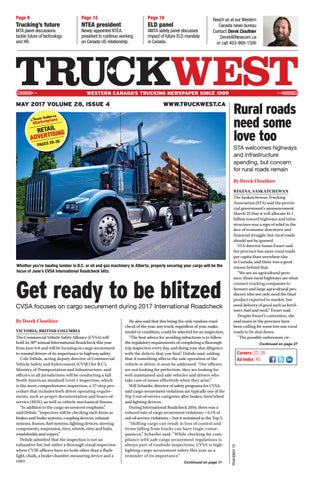
Whether you’re hauling lumber in B.C. or oil and gas machinery in Alberta, properly securing your cargo will be the focus of June’s CVSA International Roadcheck blitz.
REGINA, SASKATCHEWAN The Saskatchewan Trucking Association (STA) said the provincial government’s announcement March 22 that it will allocate $1.1 billion toward highways and infrastructure was a sign of relief in the face of economic downturn and financial struggle, but rural roads should not be ignored. STA director Susan Ewart said her province has more rural roads per capita than anywhere else in Canada, and there was a good reason behind that. “We are an agricultural province; those rural highways are what connect trucking companies to farmers and large agricultural producers who not only need the final product exported to market, but need delivery of good such as fertilizers, fuel and seed,” Ewart said. Despite Ewart’s contention, she said many in the province have been calling for some low-use rural roads to be shut down. “The possibly unforeseen cir-
Available exclusively in the Freightliner M2 106. DDC-EMC-ADV-0031-0217. Specifi cations are subject to change without notice. Detroit Diesel Corporation is registered to ISO 9001:2008. Copyright © 2017 Detroit Diesel Corporation. All rights reserved. Detroit™ is a brand of Detroit Diesel Corporation, a subsidiary of Daimler Trucks North America LLC, a Daimler company.
Driven by the best.
— THE FREIGHTLINER M2 106 WITH THE NEW DETROIT ™ DD5 ™ ENGINE. —
The maker of legendary heavy-duty engines, now makes one for your business. The new Detroit DD5 engine. Available exclusively in one of the best-selling medium-duty trucks on the road, the versatile Freightliner M2 106. The DD5 is specifically designed to keep businesses like yours on the move and profitable with an industry-leading maintenance schedule. Featuring oil change intervals up to 3X better than the competition. Backed by our extensive service network, and equipped with Detroit™ Connect Virtual Technician remote diagnostic service SM
for maximum uptime. The legend continues with the new Detroit DD5 engine. Freightliner.com/M2-DD5
INSIDE THE NUMBERS
Big challenges Trucking has many challenges but for Western Canada’s carriers managing maintenance expenses tops them all Many motor carriers from Manitoba to British Columbia are employing a variety of electronic devices to aid them in staying on top of maintenance expenses, our latest research indicates. Eighty percent of those who do use electronic devices, rely on onboard connectivity, either provided by the truck OEM or by an aftermarket provider. Biggest challenge in managing business 17%
Managing fuel expenses
Types of electronic devices on fleet trucks
of respondents
39%
Managing maintenance expenses
Follow Lou on Twitter @LouSmyrlis.
Onboard connectivity from truck OEM
40%
Onboard connectivity from aftermarket provider
40%
GPS/vehicle location unit
60%
Recruitment of drivers
14%
Tire pressure monitoring system
25%
Recruitment of technicians
2%
Automatic tire inflation
17%
Training and retaining staff
12%
Electronic onboard recorder
23%
Fleet management system 5%
8%
New technology in trucks
Safety devices (in-cab video cameras, etc)
25%
Customer satisfaction
7%
Cargo/load monitoring equipment
10%
Main reasons for not using electronic monitoring equipment
Size of heavy duty vehicle fleet
16%
1-4 vehicles
11%
5-9 vehicles
19%
10-14 vehicles
23%
25-99 vehicles
28%
100-499 vehicles
14%
500 or more vehicles
5%
Not reliable
65%
Too costly
19%
Too complicated
Lease some or all of vehicles
NO 63%
YES
37%
#DeloDrives PERFORMANCE
Introducing the Next Generation of Heavy Duty Diesel Engine Oil
Delo 400 with ISOSYN Advanced Technology ®
®
Up to 35% Better Oxidation Control*
Up to 68% Better Wear Protection*
Up to 46% Better Piston Deposit Control*
Up to 60% Better
Component Durability*
ChevronDelo.com *As compared to previous generation HDMO product test limits.
© 2017 Chevron Canada limited. All rights reserved. All trademarks are property owned by Chevron Intellectual Property LLC or their respective owners.
4 Truck West • May 2017
Contents
ISSN 0700-5016 (Print) ISSN 1923-3531 (Online)
Lou Smyrlis Director Business Development 416-510-6881 lou@newcom.ca Kathy Koras Associate Publisher 416-510-6892 kathy@newcom.ca A. (Tony) Hohenadel Publisher - truckandtrailer.ca 416-614-5800 tony@newcom.ca EDITORIAL Derek Clouthier Editor 403-969-1506 derek@newcom.ca Sonia Straface Associate Editor 416-510-6890 sonia@newcom.ca James Menzies Contributing Editor 416-510-6896 james@newcom.ca DESIGN AND PRODUCTION Carolyn Brimer, Beverley Richards, Michael Chimienti, Tim Norton ACCOUNT MANAGERS Delon Rashid Western Accounts Manager 403-713-1054 delon@newcom.ca Anthony Buttino National Accounts Manager 416-458-0103 anthonyb@newcom.ca Nickisha Rashid National Accounts Manager 416-614-5824 nickisha@newcom.ca Denis Arsenault Quebec Accounts Manager 514-938-0639 ext. 2 denis@newcom.ca
ALBERTA
MANITOBA
Page 18 Carrier Services helps transporters take a step in the right direction when it comes to safety.
Page 9 Panelists discuss future of technology and HR in trucking during MTA AGM.
Page 19 Panel advises carriers to be prepared for impending Canadian ELD mandate. Page 23 AMTA Safety Conference and Trade Show presenter knows how to deal with difficult people.
BRITISH COLUMBIA Page 20 New B.C. truck parking facility among government announcements aimed at helping industry.
SASKATCHEWAN TRUCKING ASSOCIATION
Cover Story
Each generation is unique. Millennials are no different, and they bring a diverse set of skills to the workplace.
41
Al Goodhall Who would be attracted to a profession that is moving toward automation?
43
Safety Bison shares how it has created its award-winning safety culture.
45 6
14
What I learned moderating my first pair of panel discussions.
Whle his desire to continue being a nomad remains, Mark Lee outlines benefits to staying put.
Editorial
11
Cover story International Roadcheck blitz this June to focus on cargo securement.
13
Sandy Johnson Avoiding a major disaster when it comes to fuel taxes and IFTA reporting. We acknowledge the financial support of the Government of Canada through the Canada Periodical Fund of the Department of Canadian Heritage.
27
Business
Chairman & Founder: Jim Glionna President Joe Glionna Vice - President Melissa Summerfield Director of Circulation Pat Glionna
B C T R U C K I N G A S S O C I AT I O N
What does an accountant know about taxes anyway? Just the alternative facts.
40
Newcom Business Media Inc.
MANITOBA TRUCKING ASSOCIATION
Scott Taylor
If you haven’t been in the market for a medium-duty truck lately, a lot has changed.
Truck West is published monthly by
TRUCK WEST is a proud member of the following trucking associations:
25
Marketplace
Paul Beelien Regional Accounts Manager 416-614-5806 paul@newcom.ca
PUBLICATIONS MAIL AGREEMENT NO. 40063170 CUSTOMER NO. 4006214
A cautionary tale to not march in lockstep with cap-and-trade stage show.
28
Doug Copeland Regional Accounts Manager 905-715-9511 doug@newcom.ca
RETURN UNDELIVERABLE CANADIAN ADDRESSES TO: CIRCULATION DEPARTMENT, TRUCK NEWS 451 ATTWELL DR., TORONTO, ON M9W 5C4
Roger McKnight
STA pleased with government spending on highways and infrastructure, but rural roads need love too.
Tony Jelicic Regional Accounts Manager 416-614-5813 tonyj@newcom.ca
Subscription Inquiries Lilianna Kantor Phone: 416-614-5815 Fax: 416-614-8861 Email: lily@newcom.ca
17
Mark Lee
15
Cross-border New NTEA president excited to continue growing relationship between Canada and US.
16
Mail Respecting road safety; and liking the new, sleek look of Truck West and Truck News.
In-brief Tremcar’s newly-designed milk tank-trailer; Maxim’s prison break-in.
In Every Issue 42 Mark Dalton in… Truckers without borders
44 Newland Transport 46 Last Word: Still working hard after 60 years.
May 2017 • Truck West 5
EDITORIAL Derek’s deliberation
In 25 years we’ll be having same conversation as we do today All those theatre classes in university appear to have paid off. I moderated my first panel discussion – with the help of the magazine’s director of business development, Lou Smyrlis, I should add – during the Manitoba Trucking Association’s AGM April 7 in Winnipeg, Man., two in fact, and if I do say so myself, I think they went pretty well. I’m fairly comfortable up on stage, which, as I mentioned, all those theatre classes at Laurentian University managed to have shed at least a large chunk of the nervousness most people experience in front of an audience. But that fear was tested when my co-moderator turned to me about an hour prior to us heading up on stage and said, “You may have to do these panels on your own” because he was feeling under the weather. Thankfully, Lou managed to pull things together, but talk about keeping me on my toes. The first panel addressed the ongoing advancements in technology and how that has reshaped, and will continue to reshape, the trucking industry. The takeaway I got from this dis-
only going to have a rough time, you might not make it at all. The second panel tackled the human side of this progress, specifically the changing of the guard that the industry is experiencing as we speak, and will continue to for the next decade or so. One of the keywords of 2017 – Millennials – was uttered more than once during this discussion, and panelists pretty much agreed that the younger generation would certainly change the face of trucking in the years to come (I think in a way they already have) and given the way technology is a primary factor in that change, it’s a good thing Millennials make up the largest portion of the workforce in Canada and the US today. In general, they are more equipped than any other generation to deal with technology and the fast and furious pace it changes. Sure, there are plenty of things Baby Boomers and other generations can teach our country’s youth – how to talk to a person face-to-face, overall people skills, the value of hard work in all forms and in building relationships with others – but there are also a lot of skills Millennials can teach older
cussion was simple – technology is great if the right thing is used and used properly. Whether it’s in our personal lives with smartphones, GPS devices, smart TVs, or some kind of tablet, or part of our work life to try and streamline and make our daily tasks more efficient, technology is not only here to stay, it’s progressing faster than most of us can keep up with. So to be blunt, whether you’re an engineer, dispatcher, HR worker, or driver, get used to it, or you’re not
generations, such as adapting to change, embracing new technologies that make work easier if used properly and not just dismissed, and how to work in a collaborative manner instead of incessantly adhering to the I’m-older-so-Ialways-know-best mentality. The average 50 year old has a much different set of skills than your everyday 25 year old. But that’s a good thing. Combined, they are unstoppable if they work in harmony instead of in opposition. And in 25 years, when today’s Millennials become the old guard, the same conversation will rage on. TW
Derek Clouthier can be reached by phone at (403) 969-1506 or by e-mail at derek@newcom.ca. You can also follow him on Twitter at @DerekClouthier.
Mark Your Calendar! SEPTEMBER 25-28, 2017
NORTH AMERICAN COMMERCIAL VEHICLE SHOW
Georgia World Congress Center, Atlanta, Georgia, USA
www.nacvshow.com
SURFACE TRANSPORTATION SUMMIT
OCTOBER 11, 2017 International Centre Toronto, Ontario, Canada surfacetransportationsummit.com
6 Truck West • May 2017
APRIL 18, 2018
APRIL 19-21, 2018
International Centre Toronto, Ontario, Canada www.trucksummit.ca
International Centre Toronto, Ontario, Canada www.truckworld.ca
INTRODUCING THE INTERNATIONAL® A26 ENGINE. A NEW BREED WITH UPTIME IN ITS DNA. When we set out to create an engine that would lead the industry in uptime, we launched Project Alpha. Led by a new team of engineers, it fundamentally changed how we build engines. We set our sights on a more simplified, modern design built from proven components, then tested it beyond ordinary limits. In the end, the International A26 engine was born—lightweight, fuel efficient and ready to set a new standard in uptime.
in t ern at ion a lt rucks.com /A 26
© 2017 , Inc. All rights reserved. All marks are trademarks of their respective owners.
May 2017 • Truck West 7
Provincial Classifieds! • Reach customers in your own back yard! • Truck West has the largest reach to buyers in the western Canada. • Post your ad or business listing in the Provincial Classifieds in Truck West.
Call today to post your listing! Delon Rashid, Sales and Marketing – Western Canada (403) 713 -1054 •delon@newcom.ca
Truck West Classified (NET) 1x
2x
3x
4x
$989
$940
$915
$890
2/3
791
752
732
712
1/2 isl
692
658
640
623
1/2
618
587
572
556
1/3
445
423
412
401
1/4
346
329
320
312
1/6
247
235
229
223
1/8
198
188
183
178
1/12
173
164
160
156
Full Page
Business Listing $100
MANITOBA
Using technology correctly MTA panel says training, education, and proper data collection key to seeing benefits Stories by Derek Clouthier WINNIPEG, MANITOBA With the ever-evolving technological landscape in the trucking industry, training and education have never been more important than it is today, and it isn’t about to change any time soon. During a discussion at the Manitoba Trucking Association (MTA) AGM in Winnipeg April 7, a panel that included five professionals from various industry leaders concurred that technology, though challenging, made people’s lives better. “I think these technologies are coming to the forefront to make life better for society,” said Randy Fleming, district sales manager for Volvo Trucks Canada. “The trucking industry is the backbone of society…and we are in a position as an industry within society to influence positively and make life better for society.” Fleming pointed out that thousands of people are killed on North American highways every year, and some of those incidents involve commercial vehicles. But with the
“There are a lot of fleets that are not taking advantage of the data that’s available.” – Steve Matson, Detroit Diesel implementation of new technologies, commercial drivers are able to operate vehicles in safer manner. Collision mitigation systems were one example Fleming highlighted, saying the technology had enabled brake time to be reduced from a 1.5 second response time to .03, something that will inevitably save lives. Trent Siemens, director of maintenance at Paul’s Hauling and general manager of Oak Point Service, said with new technology comes the need for continued education and training. “We need to educate ourselves on the technology, we need to understand it a lot more so than in the past. We’re finding that we need to quickly gain knowledge on how (something) works and what it’s going to do for us,” Siemens said. “You have to assess it as quick as you can because by the time you’ve made a decision whether this is going to apply or be a benefit, the technology has changed and you’re starting over again, and this seems to be happening faster in the last five to eight years.”
From left: Randy Fleming, Trent Siemens, Steven Orbanski, Robert Friesen, Steve Matson, Derek Clouthier and Lou Smyrlis. Siemens cautioned that trucking companies need to do their due diligence to weed out the snake oil and understand which technologies work best for each individual company. He also did not mince any words voicing his opinion on the ultimate technological advancement, autonomous trucks. Siemens said even the simpler advancement of the past few years, such as aftertreatments, have not gone as smoothly as some believed they would, and that it was in fact an “abysmal failure” for many. “It really was for us fleets,” he said. “We suffered right from EGR (exhaust gas recirculation) through DPF (diesel particulate filters) filters and DEF (diesel exhaust fluid). It was and is a significant challenge for us.” Siemens said the challenges of aftertreatments would not even compare to those that autonomous trucks would pose. “I don’t think society will ever accept (autonomous trucks) without a pilot,” Siemens said, “and if you have to have a pilot then where’s our savings?” Siemens said automated transmissions, anti-idling devices and something as simple as LED lights have made a huge impact on his company’s bottom line. Bison Transport equipment acquisitions and innovation manager Steven Orbanski said when it comes to investing in technologies, carriers could look at something simple, like LED lights and rust inhibitors, or could opt for something more complex, like automated transmissions, which could cause additional costs, but also eventually pay off with less driver fatigue and better fuel economy. “You can’t always look at that bottom line on fuel and tires, it’s that balance right across on what you’re trying to do as a fleet and a company.” Robert Friesen, on-highway business representative for Cummins, said he believed fuel economy will continue to be the driving factor for technological advancement in the industry. “We’re being forced as a manufacturer to meet certain fuel
economy numbers and so are the OEMs,” Friesen said, “and I think that’s driving a lot of what’s happening with the technology we’re looking at.” Friesen said Cummins was looking at what is called a heat recovery system, where the engine uses a component to recapture the 60% of heat loss it generates through its operation to help power the vehicle. Steve Matson, technical sales
support manager for Daimler Trucks Canada’s Detroit Diesel, said he believes the diesel engine is going nowhere anytime soon unless something drastic occurs to the price of diesel fuel. From a personal standpoint, Matson said electro-locomotive technology, where the engine drives a generator with electric drive wheel-end motors, was something that could pop up in the near future, but predicting what would happen in the next decade was difficult given the swift pace of technological advancements. As for how to manage all the data available in today’s advanced world, Friesen and Fleming agreed that the right information has to get into the hands of the right people for it to be used properly. “There are a lot of fleets that are not taking advantage of the data that’s available,” added Matson, saying data collection is not a sideline job. TW
Changing of the guard WINNIPEG, MANITOBA If there was one area that was agreed upon during a panel discussion on the future of technology in the trucking industry it was that no one knew what the future would hold, other than the fact that Millennials would make up a substantial portion of the pie. During the Manitoba Trucking Association’s (MTA) 85th annual AGM, a pair of panel discussions addressed the future of trucking both from a technology and human resources standpoint. And though there was a consensus that technologies available to the industry are a benefit, there was apprehension to predict what the future would hold. Confidence in the ability of the younger generation to cope with whatever advancements were on the horizon was strong, and Ryan Mitchell, president of Wildwood Transport, was certain of the change. “The world is going to be completely different,” Mitchell said, “and what trucking companies and carriers offer to customers is to take what is an incredibly complex industry and try to simplify it and make the shipping process easier.” Mitchell said business is becoming more automated, something that will continue in the future and result in less face-to-face interaction, and companies must try to find ways to interface with their customers’ technology. Dylon Hall, a technology and scholarship student who works as a trailer technician for Maxim Truck and Trailer, said new technology was exciting, but proper training
was vital. “Growing up with (technology) certainly helps,” he said. “You look at a computer and you know where to go and run a program.” It is the new crop of workers, people like Hall, who will change the trucking industry, according to Cindy Harrison, director of human resources for Arnold Bros. “We have to promote further education for them to grow and develop into the roles that we want them to be in,” Harrison said, “and help them develop the skills that we need in our industry.” John Wallis, director of training and organizational development for Emergent Biosolutions, agreed, saying Millennials “want to be more collaborative, they don’t really want to participate in a structure that tells them what to do, they want to participate in helping us decide what we should do and help solve problems.” For Trucking HR Canada executive director Angela Splinter, the changing of the guard from today’s trucking landscape to the next, is going to be significant, and it will be important to ensure the proper transfer of knowledge. “When we look at knowledge transfer, yes, we have a lot of young people coming in and there are all these new things that are happening,” Splinter said, “but there’s still a lot of corporate knowledge and a lot of corporate history that needs to be maintained and you want to make sure you have ways of passing that on to the younger ones who are coming in.” TW
May 2017 • Truck West 9
SURFACE TRANSPORTATION SUMMIT
OCTOBER 11, 2017 International Centre
6900 Airport Road, Mississauga, ON
PLEASE PLAN ON JOINING CANADA’S TOP TRANSPORTATION EXECUTIVES FOR A DAY OF EDUCATION & NETWORKING. We have created an agenda that truly addresses the many challenges facing both Shipper and Carrier executives.
2017 Summit Agenda The Donald Trump Effect and The Economy in 2018: What trends will impact your business? Brought to you by:
Fast Forward – an inside look at the Future of Transportation Shipper-Carrier Roundtable Effective Strategies to Improve the Profitability of your Trucking Business Bridging the Generational Gap Table Topics:
Association Partners:
Our Sponsors: GOLD
Bridging the Gap between Shipper Expectations and Carrier Profitability Best Practices in Cross-Border Freight Transportation Best Practices in Recruiting, Developing and Training Top Talent for your Business Preparing for Changes to NAFTA and Border Policies How to successfully Navigate a Rail Claim with the Canadian Transportation Agency
Best Practices in Developing a Driver Recruitment and Retention Strategy Major Issues in Transportation Across Canada Motivational Speaker - How to Build a Successful Business and Brand
SILVER SPONSORS
• REGISTRATION: 7:30 am • PRESENTATIONS: 8:20 am sharp
REGISTER NOW AT
www.surfacetransportationsummit.com AND QUALIFY FOR THE EARLY BIRD RATE
10 Truck T uck West Tr West stt • May May ay 2017 20117 201 20 7
#sts17
COVER STORY Continued from page 1
Of the 37-step procedure inspectors will conduct during the roadcheck blitz, Schaefer said there are 15 critical vehicle item areas: brake systems; coupling devices; exhaust systems; frames; fuel systems; lighting devices; securement of cargo; steering mechanisms; suspensions; tires; van and open-top trailer bodies; wheels, rims and hubs; windshield wipers; and for buses and motorcoaches, emergency exits and/or electrical cables and systems in engine and battery compartments. In addition to proper documentation and HOS, drivers will also be asked for their driver’s license and medical card information. Schaefer said pre-trip inspections are key to avoiding getting dinged for a violation. “Conducting a pre-trip inspection before hitting the road is critical in identifying items that need addressing before they become critical violations,” he said. “It’s not just about avoiding violations; we want to make sure that the commercial motor vehicles traveling on our roadways are safe.” Schaefer added that when a driver does find an issue that needs addressing, it is important that carriers are supportive and encourage proactive approach to maintenance and safety. Schaefer echoed Delisle when it came to the most common issues for out-of-service violations during the year, saying the Top 5 violations, in order, were brake system, brake adjustments, tires, lighting, and cargo securement. Violations have been on a steady decline, however, dropping from over 30% in the early ‘90s to approximately 20% now. “But with a 20% out-of-service rate, we all still have work to do to reduce violations and truck and bus crashes,” said Schaefer. Scott McCloy of WorkSafeBC said the main purpose of WorkSafeBC’s involvement in the International Roadcheck blitz is to inspect logging trucks, mobile cranes and vehicle mounted lifts, crew transportation vehicles, and electrical and plumbing vans. “For logging trucks we primarily look at load securement,” McCloy said, such as wrappers around the load of logs. They also look at the condition of bullboards, the barrier behind the cab that protects the driver. For cranes and elevating work platforms, WorkSafeBC officers will be looking for evidence of recent inspections and any obvious damage. Drivers of crew vehicles must have the proper license, not be carrying too many passengers, and all must be properly buckled in. “Our plans in the Fraser Valley are to have two of our officers at the westbound scales along Highway 1
Pre-trip inspections are key when it comes to avoiding safety violations. in Hope and two officers at the eastbound scales,” said McCloy. “We also have officers working the checks up north, as well.” Schaefer believes the
“If your instincts tell you that something isn’t right, it probably isn’t.” – Cole Delisle International Roadcheck blitz is a good way to get drivers to ensure they are making every effort to operate their trucks safely. “If knowledge of our impending inspection blitzes results in drivers and motor carriers checking their
vehicles to ensure they are in good working order before the blitz, then we have been successful,” said Schaefer. “Likewise, if we find violations, and drivers and carriers are informed about what they need to fix, then we have been successful.” Delisle feels the same. “Anytime there is awareness to make sure everything is in order is a good thing,” he said, “and this event specifically, due to it being a consistently conducted check across the entire continent, is like no other in bringing awareness to safety in commercial transport.” Delisle said the blitz provides a good “state of the industry” snapshot of general compliance, which helps guide where education and enforcement needs to go.
Nearly 17 trucks and buses are inspected every minute in Canada, the US and Mexico during the 72-hour International Roadcheck blitz, with more than 1.5 million inspected since it began 30 years ago. The campaign is a partnership between the Canadian Council of Motor Transport Administrators, Transport Canada, the US Federal Motor Carrier Safety Administration, and the Mexico’s Secretariat of Communications and Transportation. “We know that no one starts their workday thinking to themselves, ‘I think I’m going to cause crash today’, but tragically, it happens,” said Delisle. “If your instincts tell you that something isn’t right, it probably isn’t.” TW
THE BEST TANK LEASING EXPERIENCE IN NORTH AMERICA
KEVIN QUICK
VP, BUSINESS DEVELOPMENT, WESTERN CANADA kquick@transcourt.com 1 888-407-3830
20th
anniversary
Chemical
Crude Oil
Food Grade
Hot Products
Compressed Gas
Dry Bulk
FRP/412
Petroleum
Transcourt supplies equipment uipment all across C Canada and the United States. We e have a large fleet flee et of tankers tanke s available a availab ble e for for Petroleum, Crude, Chemical, Food grade / Sanitary, Dry Bulk, Propane/LPG and FRP/412.
www.transcourt.com
May 2017 • Truck West 11
NORTH AMERICAN COMMERCIAL VEHICLE SHOW
Where the
leaders of today,
share their ideas for tomorrow. Join the industry’s most influential executives at the first truck show of its kind. Leading manufacturers of commercial vehicles and parts will announce and showcase their newest technologies and innovations. This is a show you’ll want to be at.
September 25th by invitation only September 26th - 28th Atlanta, GA
REGISTER TODAY
at www.nacvshow.com
Show Organizers: Confirmed 2017 Exhibitors: Bendix, Cummins, Detroit, Eaton, Freightliner, Hendrickson, Mack, Meritor, Navistar, SAF Holland, Volvo, Western Star and more…
COMPLIANCE Permits & Licensing
Sending out an SOS How to avoid catastrophe when it comes to fuel taxes and IFTA reporting It was 105 years ago last month that the RMS Titanic struck an iceberg and sank in the North Atlantic, sending more than 1,500 people to their doom. To me, the most amazing thing about the Titanic disaster wasn’t the hull’s fatal design flaw. It’s the fact that there were only enough lifeboats for 1,178 people, about one-third of Titanic’s total capacity. Simple math, common sense, and more lifeboats could have helped avert catastrophe. For truck fleets, there are regulatory icebergs everywhere you go. When you can’t avoid them, your survival depends on math, common sense, and a lifeboat. Let’s look at fuel taxes and IFTA reporting.
“You are the captain of your own ship and with fuel tax you have to make sure the math adds up and you call for help when it doesn’t.” Do you ever sit down and think about how much fuel tax you actually pay in a month or a year? Let me tell you, it’s a boatload. Let me give you a couple of examples. Company A is in oilfield services. Last year on 59 pieces of equipment it paid $166,248.16 in fuel taxes – $2,817.77 per unit per year and $234.81 per unit per month. To give you some context, that works out to about 24 cents per mile traveled or 14 cents per kilometer traveled. This carrier would burn a lot of fuel off-road, but with IFTA it doesn’t matter. Alberta did away with its off-road rebate program in 2011, so all fuel in IFTA-qualified vehicles is taxable. Company B is a cattle hauler that travels the three western provinces plus Washington, Idaho, and Montana. On four trucks last year it paid $30,269.46. So for every kilometer it hauled those little doggies, the carrier paid 7 cents per kilometer in fuel tax.
Sandy Johnson has been managing IFTA, IRP, and other fleet taxes for more than 25 years. She is the author of the free book 7 Things You Need to Know About Fleet Taxes and operates North Star Fleet Solutions, which provides vehicle tax and license compliance services for trucking operations. She can be reached at 1-877-860-8025 or northstarfleet.com.
No audit situation is ever the same because no two carriers are ever the same. But think about Company A and its $166,248.16 in fuel tax. For arguments sake, let’s say it was missing some fuel receipts or had underreported distance and the error factor ended up at 10%. That equates to $16,624.82 for a single year. Multiply that by three years and the total is just under $50,000 – a financial disaster of Titanic proportions for any company. If the same thing happened to the cattle hauler, it would have to pay just over $9,000 in additional tax. Worse yet, it would be like paying tax twice, and who wants to do that? It isn’t enough to just look at your IFTA return and think that because you got a credit you paid less fuel tax. If you have a credit, you bought fuel in high-tax jurisdictions and consumed it in lower-tax jurisdictions. The same is true if you owe money at the end of the quarter. All that means is that you bought fuel in low-tax jurisdictions and consumed it in high-tax jurisdictions. Whether you pay it at the pump or you pay it when you file your IFTA return, the amount you owe is the same. You are the captain of your own ship and with fuel tax you have to make sure the math adds up and you call for help when it doesn’t. Otherwise you can end up like Leonardo, shivering in the water. Worse yet, I’ve never met an auditor who looked anything like Kate Winslet. TW
TOTAL RUBIA OPTIMA CK-4 & FA-4 HEAVY-DUTY ENGINE OILS TO TAKE YOU FURTHER. EVERY DAY
TOTAL RUBIA OPTIMA 1100 15W-40
TOTAL RUBIA OPTIMA 2100 XFE 10W-30
TOTAL RUBIA OPTIMA 1100 FE 10W-30
Follow us on
Total Canada
www.total-canada.ca
Energizing performance. Every day
May 2017 • Truck West 13
OPINION You say tomato, I say tomahto
Checking items off the bucket list one mile at a time The temptation to move on is there, but the benefits of sitting tight are hard to ignore This week, I had to re-sit my dangerous goods course, which means I have been at my carrier for three years. That’s about the time I start getting restless and looking for the next adventure. I’ve been this way my entire career. I started out on local deliveries in a little puddle jumper, then started long distance, then moved on to continental runs around Europe. I then went on to big trucks and the whole process started again,
local to long distance to continental. At first, I started running between England and Germany and I would sit on the ferry listening to other drivers talking about their trips to other countries, which would then be added to my bucket list. Often, going to a different country involved changing jobs as companies tend to focus on a particular destination, so a company running to Germany wouldn’t have a run to Italy, for example.
Once I had ticked all the country boxes off my list, I switched companies to do different types of work. I moved from general freight to reefers, from produce to hanging meat then to frozen. And I managed all of that before I embarked on the owner-operator path. I started working for one company providing their transport, then started adding to my customer base, first by subcontracting and
Unreserved public equipment auctions Fast, flexible financing available – up to 100%, $0 down
2014 Peterbilt 367, 2013 & 2012 Peterbilt 388 | Edmonton
2015 Kenworth T800 | Edmonton
2 – 2015 Kenworth T800 & 2 – 2013 Midland MG36MX3500 | Edmonton
2014 Peterbilt 367 Winch | Edmonton
1 of 2 – 2014 Kenworth T800 | Prince George
2009 Kenworth T800 w/Tulsa Winch | Saskatoon
2014 Peterbilt 367 | Edmonton
33,800 items in 155+ auctions including Edmonton, AB Prince George, BC Toronto, ON St. John's, NL Montreal, QC Chilliwack, BC Thunder Bay, ON
Apr 25–28 May 2 May 10–11 May 16 May 24–25 May 31 Jun 7
Bid in person or online
Financing & leasing available
▸ No minimum bids or reserve prices ▸ Test and inspect on-site ▸ Open to the public, free registration
Up to 100% financing, with no money down.
More items added daily Call about selling:
1.800.211.3983
See full auction & equipment listings at rbauction.com Auction Company License #303043, MV Dealer #10541 *Limited-time offer. OAC. Terms & conditions apply.
14 Truck West • May 2017
A fourth generation trucker and trucking journalist, Mark Lee uses his 25 years of transcontinental trucking in Europe, Asia, North Africa and now North America to provide an alternative view of life on the road.
later by gaining direct work from customers. Then I started to grow my fleet and the whole cycle began again. And then I got bored, sold everything and moved to Canada to start all over again. My bucket list at that time was simple; I wanted a longnose truck dripping in lights and chrome and I wanted to cover all the provinces and 48 states. I got the truck and worked for a fantastic company, but didn’t quite manage all the provinces and states. I’ve yet to tick the boxes for Newfoundland, P.E.I., the Northwest Territories, Vermont, New Hampshire, Maine and Oregon – and I would still like to get to them at some point. However, I’ve got a problem. I only run west of Winnipeg now and don’t cross the border, and for the first time since I started out in 1986, I’m not bothered. I have no real desire to change anything about what I do. I’m not looking for a new truck, a new destination, or a different type of freight. I’m quite content plodding along the same roads I’ve been running week in and week out for the past three years, even when I’m talking to a friend who is complaining about it being too hot to sleep comfortably in California or Texas and there I am running my truck to avoid freezing to death. Or when they’re posting photos of their trip through some spectacular scenery or resetting in New York City or Vegas and I’m getting my fillings shaken out as I navigate around the potholes of the Trans-Canada Highway in the landscape of Manitoba or Saskatchewan. I did wonder if I had lost my sense of adventure, but I don’t think so. I think that I’m just very comfortable where I am. Moving on may satisfy my wanderlust, but it would also bring about a loss of the nice balance I have between home time and work. Compensation doesn’t come into it and it never has. I’ve always bettered myself in that respect, even if I moved for other reasons, so that would not be a factor as I wouldn’t consider going elsewhere unless I could at least equal my current package. But I just don’t feel the need to change anything. I’m hoping that the next chapter in my career is a re-run of the past three years, with the appropriate rate increases to account for inflation, of course! TW
CROSS-BORDER
Boosting Canada-US relations New NTEA president excited to continue growth of Canada-US trucking relationship By Derek Clouthier INDIANAPOLIS, INDIANA Newly-appointed National Truck Equipment Association (NTEA) president Adam Keane understands the important link between the Canadian and US trucking industries, and believes that relationship is about to get even stronger. Keane said work trucks are a vital cog in the North American economy, and though Canada and the US have always been each other’s greatest trading partners, that relationship must continue to grow with what he called ongoing globalization. “With the globalization of vehicle platforms, there is a need to better align North American regulations so that we have a strong voice as it relates to OEMs and regulatory issues that come from outside of North America,” Keane told Truck West. Keane, who in addition to his role with the NTEA is executive vice-president of Seattle’s Allied Body Works, said even though the NTEA has long had Canadian-based members, opening an office in Ottawa, Ont. in 2014 made sense. The NTEA head office is located in Farmington Hills, Mich., and it has government relations departments at satellite locations in Washington and Ottawa. Both the Washington and Ottawa offices are tasked with protecting and advancing NTEA member interests by actively working with the Canadian and US governments. Keane said the NTEA is currently working with Transport Canada on the Canadian version of rear backup camera regulations, and held an educational session and conformity demonstration of the US variety during the Work Truck Show in March. The NTEA is also working with Environment and Climate Change Canada (ECCC) on its proposal for Phase 2 of the greenhouse gas regulations for trucks. “The US version was released in 2016 and contained provisions helpful to the work truck industry, as described by the Environmental Protection Agency at a Green Truck Summit 2017 session,” said Keane. “We hope to include similar opportunities through our efforts with ECCC for Canadian members.” Keane said the NTEA could not speak to how the relationship between Canadian Prime Minister Justin Trudeau and US President Donald Trump could impact the industry, but that the association
hopes the new administrations in both countries will offer opportunities for trucking. “Our experience so far in working with both the new Canadian and American administrations is that they have been open to listening to our interests and concerns,” Keane said. “We have found a mutual interest in working together to harmonize regulations.” Finding ways to reduce fuel consumption is another key focus for the NTEA, which the association addresses during its Green Truck Summit each year, which runs prior to the Work Truck Show. “(We are) very interested in advancing sustainable technologies in the work truck industry that will reduce fuel use and increase productivity,” said Keane. “We are actively working to engage industry, government and academia in these efforts. The NTEA will also continue to provide its members with advice on cross-border issues through its Ottawa office, as well as its CrossBorder Compliance Guide, and visit
Adam Keane, president of the NTEA, speaks during the Work Truck Show in Indianapolis March 16. with Canadian members to garner feedback on their specific concerns. Another focus of the NTEA will be finding qualified employees with a passion for the industry. “The NTEA is focused on developing resources to help educate people entering the work force regarding
career opportunities in the work truck industry,” said Keane. Keane stepped into the position of NTEA president at the conclusion of the Work Truck Show March 17, taking over for the outgoing Matthew Wilson, who served as the association’s 52nd president. TW
ACRO CANADA, ACROSS FOR DURABILITY AND AN QUALITY, TRUS TRUST TREMCAR
PETROLEUM B-TRAIN TC-406
TRI AXLE CRUDE
CRUDE TC 407 B-TRAIN
TRI AXLE DRY BULK
CALL US TODAY!
SERVICE CENTRES SASKATOON, SK (306) 931-9777 WEYBURN, SK (306) 842-6100 EDMONTON, AB (780) 371-1579
LEASING & TRADE-INS
www.tremcar.com
Darren Williams
Gilles Rondeau
Ken Smelski
Marlene Chalmers
VP Sales williamsd@tremcar.com
Manitoba & SK Sales Manager rondeaug@tremcar.com
Alberta & BC Sales Manager smelskik@tremcar.com
Tank Leasing Manager chalmersm@tremcar.com
May 2017 • Truck West 15
Respect will help improve road safety Dear editor: Re: Fatal collision numbers spike on Manitoba roadways. I agree with Ward Keith that people need to think safety when getting behind the wheel. The unfortunate reality is that most do not. Buckling up, driving to road and weather conditions and not driving while impaired are critical factors in avoiding collisions. Mr. Keith forgot one critical point: use common sense, respect fellow citizens, and respect large vehicles. Since I began trucking in January 2005, I have seen a rapid decrease in respecting other motorists. This includes not giving the right-of-way to emergency vehicles. It may be ‘old school thinking,’ but there needs to be a return to respecting others, which includes common sense. Yes, it’s a reflection of society; however, people should be made aware of the risks and responsibilities of operating a vehicle, especially when it involves tractor-trailers. Scott Goobie Edmonton, Alta.
Like the new look Dear editor: I can honestly say in brief, that I do find the approximately one inch narrower and 1.5-inch shorter version of Truck News ( and Truck West) much more compatible to read when opened up in a space that’s a tad confining. There’s not too much different with the new design. But I’m sure if I was wearing a Truck News cap on my 70-year-old head, my buddies would smile and say ‘That Dean features a new look!’ Dean Butterfield Kilburn, N.B.
Have an opinion? We’d like to hear it. Please send letters to the editor to derek@newcom.ca. Letters should not exceed 200 words and are subject to editing for length and style.
16 Truck West • May 2017
OPINION Petrol Points
Cap-and-trade’s first stage show Some may consider this an Ontariocentric report, which may be true for all the wrong reasons. It’s offered as a commentary, meekly disguised as a warning so that the rest of this country doesn’t march in lockstep with the meandering permanent student crowd – the loyal sheeple of Kathleen (just call me Chuckles) Wynne, the premier of Ontario – in the basket weaving capital of Canada, if not the world. It was with panic of a goldfish, “Get me out of this bowl, now,” frustration that I read the results and commentaries on the first Ontario cap-and-trade auction, which looks suspiciously akin to a cattle auction where only a select few understand what the auctioneer is saying or what is being sold. As I get it, emitters like electricity importers, natural gas distributors, and fuel suppliers participate in this road show. These industry sectors have caps placed on them by the cappers by some mathematical formulae that would have Einstein reaching for Tylenol 3. If the sinners exceed the cap, then they can buy credits from those who fly carbonless under the radar limits. This week’s auction was announced as a success, as all the allowances were sold to the tune of about $470 million. If all the allowances were sold, does this then mean that those emitters who over-emitted have decided to carry on emitting, and just buy credits from the secret, unknowing and innocent? The consumer is the one who gets ripped off, as the cap-and-trade tax has been, and always will be charged at the pump, while the fuel suppliers can afford to just buy the allowances, which the consumer has made no allowances for. But wait, things get worse. In and around the trumpeting conquest of the Ontario Liberal’s tax grab conquest of not just provincial, but national, if not global GHG emissions, Chuckles and
Prime Minister Justin-time Trudeau announced a $200 million federally and provincially funded subsidy to the Ford Motor Company to produce V8 engines for the for the top-selling, gas-guzzling F-150. This will, they say, result in 300 new jobs, which works out to $680,000 for each new position. But this is diluted if we count the number of Liberal seats in Southwestern Ontario. Take that, oil sands workers in Alberta! But not you, consumers in Manitoba and Saskatchewan – you are carbon tax free…so far. TW
Roger McKnight is the chief petroleum analyst with En-Pro International Inc. Roger has more than 25 years of experience in the oil industry. He is a regular guest on radio and television programs, and is quoted regularly in newspapers and magazines across Canada.
May 2017 • Truck West 17
ALBERTA
Taking transportation safety seriously By Derek Clouthier
info@kingtec-canada.com www.kingtec-canada.com 1-800-309-8155
If you’re there, we’re there... coast to coast
The most trailers. The most locations.
Ready to go when you are! 1 855 327 9757 trailerwizards.com 18 Truck West • May 2017
EDMONTON, ALBERTA Caitlin Berg of Carrier Services told attendees of the Alberta Motor Transport Association (AMTA) Safety Conference and Trade Show not to overlook transportation safety in the workplace, and that employing a designated safety professional is a step in the right direction. Berg provided an overview of Carrier Services, which is responsible for the coordination and delivery of the National Safety Code (NSC) standards for more than 25,000 truck and bus carriers in Alberta. This responsibility includes the issuance of Safety Fitness and Operating Authority certificates, as well as safety permits. Carrier Services also conducts audits and compliance investigations, monitors, and intervenes with carriers that pose an unacceptable risk to the motoring public, and promote awareness of the safe operation of commercial vehicles. NSC standards are used as a guideline for developing transportation safety legislation, while balancing industry needs with highway safety and regulatory compliance. The standards apply to carriers operating commercial trucks registered for a weight of more than 4,500 kg within and outside Alberta, trucks weighing 11,794 kg or more only within Alberta and commercial buses with an 11 person or more capacity. Berg highlighted that in 2014/15, the province’s NSC carriers were involved in a total of 112,167 collisions in Canada, 1,667 of which were fatal. She said the average first time audit score a carrier receives from Carrier Services is 47.61%, while after garnering a better understanding of the rules, falls to 18.63% – the lower the score, the better. Berg said designated safety professionals should align a company’s safety and maintenance programs to meet the needs of the specific carrier. Bryan Egan, chairman of Certified Transportation Safety Professional, reiterated Berg’s emphasis of the importance of hiring a designated safety professional. Egan provides two types of safety officer certifications – certified transportation safety coordinator, an entry-level pre-requisite for the second type of certification, and the certified transportation safety professional, the next level of education developed by the AMTA in collaboration with industry, the Alberta government and educational institutions. TW
Preparing for ELDs AMTA panel discusses looming Canadian ELD mandate during Safety Conference and Trade Show By Derek Clouthier EDMONTON, ALBERTA Though there is not yet a definitive date for when electronic logging devices (ELDs) will become a legal requirement in Canada, it will certainly happen sooner rather than later, and a recent group of panelists urged carriers to be prepared. Speaking during the Alberta Motor Transport Association (AMTA) Safety Conference and Trade Show March 31, Andrew Barnes, director of compliance and regulatory affairs for the AMTA, said consultation on the federal government’s ELD draft is expected to begin this July, with the mandate becoming law sometime between December 2017 and 2018, which would be followed by a 24- to 48-month implementation period. Barnes said with ELDs presently voluntary in Canada – and with the device becoming law in the US this December – 67% of carriers in Canada use some form of ELD to keep track of drivers’ hours-of-service (HoS), and 86% employ the use of GPS. The Canadian Trucking Alliance (CTA) sent out a draft technical standard of the proposed ELD mandate, and Barnes said it pretty much mirrors the US version. Some of the key inclusions in the draft include a technical performance-based standard for suppliers of ELDs; the Canadian version does not have to mirror the US’s, but cannot be in conflict; must be consistent with existing HoS regulations; must synchronize with the engine control module; and you must be able to view the ELD while outside the cab. Yard miles, certification, and a final technical standard are three areas that have not been finalized or addressed at this point. Barns said a cost-to-benefit study on the use of ELDs found a benefit ratio of 2:1 because of the time savings per driver each year, reduction in HoS violations, leveling the playing field and the elimination of forms and logbook violations. A panel discussion – that included Kevin Taylor, SLH Transport, Dan McCormack, Commercial Vehicle Enforcement inspector, Tom Hanna, Grimshaw Trucking, Barnes, and moderated by Jane Douziech, AMTA manager of business development – recommended carriers not only start looking for an ELD vendor before a law is in place, but also ensure each staff member is properly trained on how to use the device.
Taylor said SLH Transport is using the Shaw tracking system, and that training for the device took around two to two-and-a-half hours, after which he gives drivers another two weeks where they use both the ELD and paper log to get used to the new technology. “I wouldn’t hold off with the US starting this December,” Taylor said. “We wanted to get our drivers
“We wanted to get our drivers up to speed before the deadline for compliance.” – Kevin Taylor, SLH Transport up to speed before the deadline for compliance.” Hanna agreed, adding the fear of losing drivers with the implementation of an ELD policy did not come to fruition at Grimshaw Trucking.
Kevin Taylor, Dan McCormack, Tom Hanna, Andrew Barnes, and moderator Jane Douziech discuss ELDs during the AMTA Safety Conference and Trade Show March 31 in Edmonton. “We’ve lost nobody,” he said. “Once our drivers got onto it, they liked it.” Grimshaw Trucking uses PeopleNet devices, and when it came to training, Hanna said there were some challenges in getting the company’s operations personnel to accept the fact it was their job to check the drivers’ ELDs and HoS to ensure compliance. Hanna advised companies looking to train staff on an ELD to have someone who understands the process lead the way for all employees. McCormack said one of the challenges for CVE officers is knowing how each of the ELD devices work, as there are several different models on the market, as well as
apps that can be used on a driver’s smartphone. During an inspection, CVE policy is to have the driver e-mail or fax their HoS records to the officer, who is equipped with a device that can accept the data. Drivers can still maintain paper logs in addition to using their ELDs, and can produce those as a backup. McCormack said there is no issue with drivers keeping two sets of logs – ELD and paper – as long as the HoS are the same and in compliance. McCormack said in 2016 there were just over 6,000 HoS violations in Alberta, down from 8,000 the year prior and 10,000 in 2014. In the end, McCormack said, it’s all about safety. TW
May 2017 • Truck West 19
BRITISH COLUMBIA
B.C. government announces new truck parking facility and other measures to support industry
A Cool Engine is a Happy Engine. And a happy engine has its benefits: peak performance, more power and less maintenance. Howes Oil Enhancer lowers operating temperature keeping your engine cool. It not only extends the life of your oil – it also reduces metal-on-metal wear and protects internal engine components. Use it at every oil change as part of the ultimate Howes preventive maintenance program.
From the trusted makers of Howes Diesel Treat and Meaner Power Kleaner.
1-800 GET HOWES (438-4693) www.howeslube.com
20 Truck West • May 2017
NORTH SURREY, B.C. The B.C. government has committed $17 million toward a new parking facility for truckers on Hwy. 17 under the Port Mann Bridge, and plans to streamline the commercial truck permitting system, as well as evaluate new technology improvements. The new parking facility is expected to open in the winter of 2018, and will have room for up to 150 trucks, have washrooms, showers, fencing, lighting and other security measures. The province committed $17 million towards the overall $30 million commercial truck permitting system and technology evaluation effort, with partnership funding from the federal government being sought. “We are always looking at ways that we can help the commercial trucking industry carry out their business in a more cost-effective manner,” said Surrey-Fleetwood MLA Peter Fassbender, on behalf of transportation and infrastructure minister Todd Stone. “By constructing truck parking facilities such as this, and by streamlining permitting and adopting new technologies, we’re helping keep B.C.’s trucking industry operating safely and efficiently.” “The B.C. Trucking Association appreciates the provincial government taking a leadership role in creating a new truck parking facility, as well as the other improvements announced today,” said B.C. Trucking Association president and CEO Louise Yako. “These initiatives not only eliminate red tape and improve safety, but will help the industry to be more efficient and reduce greenhouse gas emissions. Ultimately, consumers will benefit because a more efficient trucking industry means cost-effective goods movement.” The Ministry of Transportation and Infrastructure said it is committing to a number of measures to reduce red tape and improve industry efficiency, including working to replace permit requirements for low-risk oversize and overweight commercial trucks with regulation, as well as increasing the maximum weight permitted on 10-axle container trucks. TW
ALBERTA
Dealing with difficult people AMTA conference speaker advises how to avoid conflict in the workplace By Derek Clouthier EDMONTON, ALBERTA You may not come across a situation where you have to negotiate a hostage situation in the workplace, but for Gary McDougall, it’s just one aspect of his expertise when it comes to dealing with difficult people, both in life and at work. The Alberta Motor Transport Association (AMTA) held its first Safety Conference and Trade Show of 2017 in Edmonton March 31, and McDougall kicked off an impressive list of presenters who addressed an array of issues facing the trucking industry. McDougall, a retired police officer whose specialization is in the area of personnel development and communication, and is now the facilitator for Conflict Solutions, said when it comes to dealing with difficult people in the workplace, perception is a theme to keep in mind. “The reality is that we perceive that we are doing things right, but it doesn’t always happen that way,” McDougall explained, saying that multiple people can look at the same piece of data and perceive it in several different ways. McDougall highlighted three components of every human interaction: issue, position and interests. The issue is the general basis for the conversation, while position is the stance each person involved in the interaction takes on the issue at hand, and this is what can potentially lead to a conflict. “People who are very positional are very opinionated,” said McDougall, adding that a person’s position can make them oppositional. “Let’s not have positional conversations.” Interests, however, is where people can avoid getting into a conflict during an interaction, as these are the reasons behind a person’s position and why they hold the opinion they do on a particular issue. McDougall said if people take the time to understand another’s interests and why they are taking the stance they are, several conflicts can be avoided, and a better understanding can be the result, which is the reason he feels asking “why?” and being mindful of your tone is so important. “Your professionalism is your power,” McDougall said, underscoring how a person’s tone during a conversation can be the difference between it heading toward a resolution or a conflict. McDougall said there is professional language and natural
language, professional leading to positive outcomes or voluntary compliance, and natural – what a person really wants to say to someone they are in conflict with – leading somewhere very different. There are also three levels of conversation – information, emo-
style or choices. When dealing with difficult people in the workplace, McDougall said the more problematic it becomes, the more professional a person should become. Holding an appropriate face and tone is also keys to being professional.
Gary McDougall says there is huge value in doubting your perceptions. tional and identity – of which, identity can lead to a conflict, as they express a person’s opinion and can attack another’s identity by questioning their values, life-
“It’s not exactly what they said to me, it’s how they said it,” McDougall said, quoting the famous phrase that addresses tone.
Another tip McDougall bestowed upon those in attendance at the safety conference was to avoid becoming angry during a conflict, as anger tends to get people into trouble and can lead to defensive and reactive behavior. “We don’t get angry primarily, we get angry secondarily,” McDougall said, adding that the primary emotions that lead to anger are frustration, embarrassment, fear and vulnerability. “When we get angry, when someone lights our fuse, we stop listening.” During a conflict in the workplace or elsewhere, McDougall said we should always try to acknowledge the other person’s point, as this type of acknowledgement is one of the most basic human needs. To be an effective communicator in the workplace, McDougall said conversations need to be 50/50, also called an inquiry conversation rather than an advocacy conversation, where one person simply tries to relay their side of the story in an effort to change the other’s view. TW
thank you to those who make the miles count Siemens Transportation Group Inc.
In honour of North American Occupational Health and Safety Week, we would like to extend a Thank You to our Employees and Contractors for making safety the number one priority. We would like to take this opportunity to congratulate our staff on receiving Safe Driving and Health and Safety Awards. It is the policy of Siemens Transportation Group Inc. to perform work in the safest manner possible. As a company, we strive to raise health and safety awareness by educating our Employees and Contractors through our top quality health and safety program. To find out how you can become part of our team, contact us at driver.recruitment@siemenstransport.com or 1.888.878.9585. Courier - Van - Flat Deck - Heavy Haul
May 2017 • Truck West 23
OPINION Tax Talk
Just the alternative facts So here I am in April, researching the deductibility of life insurance because one of our clients just bought a benefits package that includes medical, dental, health, disability, and life insurance. The insurance salesman told our client it was all 100% deductible. That’s 100% wrong in this case, but the client wants proof. As I scour the Canada Revenue Agency (CRA) website the words “the salesman said” just keep ringing in my ears. Of course the salesman is right. Why would he stretch the truth? And of course the accountant is wrong. What would he know about taxes? The fact is, you can deduct all ordinary commercial insurance premiums you incur on any buildings, machinery, and equipment you use in your business. Insurance costs related to your service vehicle have to be claimed as motor vehicle expenses. Insurance costs related to business use of a work space in your home have to be claimed as business-use-of-home expenses. In general, you cannot deduct your life insurance premiums. However, if you use your life insurance policy as collateral for a loan related to your business, you may be able to deduct a part of the premiums you paid. So to expense life insurance it must be payable directly to the finance company or you must be incorporated and have your corporation listed as the beneficiary on your policy so it will have the money to pay loans and other business debts. If the life insurance is payable to your friends and family, it is not deductible. Employee benefits Under “employee benefits” the CRA site speaks to employer-paid life insurance premiums as a taxable benefit and explains how to calculate the income tax to be paid. Remember, your corporation is the employer and you are the employee. Tax guidelines for disability insurance are similar. Generally, premiums paid by an employer to a non-group plan for sickness or accident insurance, disability insurance, or income maintenance are a taxable benefit. Employer-paid premiums for short-term or long-term disability on a group plan are not taxable benefits. However, when your employer pays any amount toward your short-term or long-term disability coverage, any benefits you may collect in the future will be taxable. Since proceeds from life insurance are not taxable, CRA
is not going to allow you to expense the premiums and cost of buying it. With disability, you have a choice: expense it and pay tax later if you ever collect, or don’t expense it and don’t pay tax if you ever collect. Taxable benefits Here are some other items your employer (that’s you) should be considering for your employee (also you): Companies frequently provide employees with smartphones plus a voice and data plan. Even if you use your phone for both work and pleasure, CRA will generally not consider the pay-
ments as a taxable benefit as long as the cost of the cellphone plan is reasonable and you do not incur costs for personal use (ie., additional long-distance charges) beyond the basic fee for the plan. If your employer gives you noncash gifts or awards for performance worth less than $500, the value of the award is not a taxable benefit. Similarly, non-cash awards for length of service worth less than $500 are not considered taxable if you have worked for the organization for at least five years and are not eligible for such an award more often than every five years. So let’s get back to that expert
Scott Taylor is vice-president of TFS Group, providing accounting, bookkeeping, tax return preparation, and other business services for owner-operators. Learn more at www.tfsgroup.com or call 1-800-461-5970.
salesman’s advice. It’s easy to believe what you want to hear in a world of fake news and alternative facts. But there are still a few truths in life: death, taxes, don’t pee into the wind, and don’t believe everything a salesman tells you. TW
May 27th | 10 AM - 2 PM
- AYR TERMINAL 2616 Cedar Creek Rd. | Ayr, Ontario 401 & Hwy 97 @ exit 268
Come Celebrate With Us!
O PEN H O U S E + J O B FA I R
BBQ Lunch, Kids Entertainment, Facility Tours, and Prizes
At Hyndman, you can achieve a good work/life balance that allows you to work smart, earn a good dollar and get back home to your family, friends, and community. Choose Hyndman today!
(800) 499-4997 | DriveHyndman.ca
May 2017 • Truck West 25
COVER STORY Continued from page 1
“We are an agricultural province; those rural highways are what connect trucking companies to farmers and large agricultural producers…” Susan Ewart, STA
year with decisions being made to get Saskatchewan back into the black,” said Ewart. “With the decisions made, the government reiterated its dedication to building and maintaining roadways and infrastructure that will allow exports to be moved to market safely and efficiently.” Despite the hit to rural roads and the current financial state of the province, the STA said the Saskatchewan Party did make good on its promise to invest in the province’s roadways and infrastructure. However, a 1% increase in PST will be a moderate hit to the industry, according to the STA, as it will have an effect on a trucking company’s capital expenditures, but will mainly impact its customer base. The introduction of PST on insurance premiums was also introduced in the budget. “The PST increase on insurance is an increase to their bottom line costs and when premiums are
PRINCE GEORGE, B.C. Following one arrest, RCMP continue to ask for the public’s assistance locating a vehicle police say is related to numerous shootings at commercial vehicles over an eight-hour period in late March. Between 8:30 p.m. March 24 and 2:45 a.m. March 25, police say they received numerous calls about a vehicle on Hwy. 97 shooting out radiators and windows of semi-trucks while they were being operated. Shots were fired near Houston, Burns Lake, Vanderhoof, Clucuz Lake, Prince George, Quesnel and 100 Mile House. The suspect’s vehicle was last seen traveling southbound on Hwy. 97 at 93 Mile. There were no injuries. “North District Major Crime is leading the investigation and resources from around B.C. are assisting all efforts to locate the suspect. Police are urging the public to report any information or sightings as soon as possible to 9-1-1,” said Cpl Madonna Saunderson. Truckers who were in the area are being asked to inspect their vehicles for suspicious damage. The vehicle is a four-door blue 2009 Dodge Caliber with the Ontario licence plate CAVM918. TW
THIS MONTH’S CROSSWORD PUZZLE
Answers on page 45
Trucks shot at on Highway 97
large they are hit with tax on the plate portion of the insurance as well as their insurance policies in Saskatchewan, so they are getting hit twice,” explained Ewart, who has a background in insurance services. “A large fleet, say 70 trucks, can pay $500,000 in insurance premiums annually, so a sudden 6% tax is a large figure.” Anyone with questions regarding the PST can contact HAL Insurance at 306-569-2150 or e-mail regina@halinsurance.ca.
The STA have also been pushing for better harmonization on weights and dimensions as part of the New West Trade Partnership, and the association could work with the Saskatchewan Association of Rural Municipalities on the issue pertaining to the road ban system. They also would like to see progress made on extended wheel bases on B-trains to accommodate environmental efficiency equipment. “The government is willing to work with us on many of industry’s requests, but change comes very slowly,” said Ewart, “and that is also something we would like to see changed. “The goals of the trucking industry and goals of the government are well aligned here in Saskatchewan: moving goods to end users as efficiently and effectively as possible. Better, stronger, safer roads are the path to a prosperous and resilient economy.” The STA will be holding a panel discussion May 18 in Regina to discuss this and a variety of issues facing the trucking industry today. Policy makers from the Ministry of Highways and Infrastructure and SGI (driver’s licensing and vehicle registration) will be on hand to answer questions. Visit www. sasktrucking.com to register. TW
TW-167 May © 2017 M. Jackson
cumstance of that call to action is that it would potentially cut the artery of a family farm, or multiple family farms, by making it more difficult and more expensive to get supplies to them and for the finished product to be sold,” Ewart said. “Agriculture and trucking go hand in hand, it’s where much of the trucking revenue in Saskatchewan is generated.” The STA also said weight restrictions on rural roadways are a “thorn in the side of the industry”, which are necessary due to the current condition of the roads. All-in-all, however, the STA is pleased with the announced funding for the province’s highways and infrastructure. “The Saskatchewan Party has always made it very clear that highways are of key importance to our economy; we cannot be a landlocked exporter without trucking,” said Ewart. “Without the proper roadway infrastructure for trucks to travel on, Saskatchewan risks losing its competitive edge on many of its exports. The government fully understands this and makes it possible for trucks to operate and keep our economy moving.” The government’s highways and infrastructure budget includes funding for the Regina bypass (which is 40% complete), $53 million for Northern Saskatchewan infrastructure and $342.9 million for capital investments, but neglected to fully address the alternative truck route agreement funding, decreasing the amount by $500,000, which the STA said could risk increased damage to the province’s rural roadways. The Saskatchewan Ministry of Highways and Infrastructure 2017 budget was just below its record-setting budget last year. “This was a difficult budget
Across 1 4 8 9 10 11 13 15 17 18 21 22 23 24
Behind wheel danglers Two trailer rigs Oversize rig companion vehicles International ProStar trim level Emergency services radio monitors Chicken ____, a.k.a. weigh station “Keep the ____ side down!” Liquid hauling trailer “Highway Thu ____” TV series Ultra-aggressive driving behavior (4,4) Rental truck company Rental car rubbernecker, perhaps Cat and Detroit products Electronic 6-Down devices, briefly (1,4)
Down 1 2 3 4 5 6 7 12 14 16 19 20
Freight cost component, perhaps (4,9) Aluminum wheel brand Mercedes-Benz commercial van Nevada roadside terrain Truck dealer’s “pre-owned” Trucker’s daily diary (3,4) Driver’s beds, sometimes (7,6) Terminal tractor, in other words (4,4) Mack mascot Alberta border crossing village ’90s Isuzu trucklet for a pal Cast engine-block material
May 2017 • Truck West 27
MEDIUM DUTY
Big changes for medium-duty trucks Infrequent truck buyers may be surprised at how much has changed in the medium-duty truck market
Customers of medium-duty trucks are encouraged to work closely with dealer experts to understand how much has changed in the design of the vehicle.
By James Menzies The butcher, the baker, and yes, even the candlestick maker. Those are some of the buyers of medium-duty trucks. They aren’t truckers, they don’t know much about trucks and they may not even like trucks. But the truck to them is a tool needed for them to conduct their core business. You can add to this list the landscaper, dry cleaner, and general contractor. They often run their trucks for a decade or more, so when it comes time to update a medium-duty truck, it’s best to consult a dealer sales rep, who has the expertise in spec’ing an appropriate vehicle for the job. “We try to minimize any errors made when spec’ing the truck, by having trained sales staff at our dealerships. They are trained to ask certain questions and to get a thorough understanding of what the customer’s requirement is,” said Eric Smith, senior vice-president of sales and customer support for Hino Motors Canada. “Sometimes a customer may approach our dealership with an existing vehicle and they just want to have a new vehicle that follows the same spec’ as the old vehicle. That’s where problems can start. Products have changed over time, which may affect weight distribution, axle loading and that sort of thing. So don’t automatically assume the selected wheelbase that
28 Truck West • May 2017
worked for a certain model of truck 10 years ago is the right application today.” Customers who have been operating a truck for a decade or more may be surprised by the amount of exhaust aftertreatment found on a medium-duty truck today. These systems have taken frame rail space, added weight and even require additional maintenance and fluids. “I think there is a certain element that misunderstands how it operates,” Smith said of today’s exhaust aftertreatment systems. Hino dealers address this during the delivery of the vehicle and will often involve dealer service managers in that process to ensure the end-user understands any new requirements. A full-service lease is a nice option for buyers of medium-duty trucks who may be unfamiliar and uncomfortable with the new equipment. “In the medium-duty market, I really think that’s the best value right now,” said Rick Kader, director, sales and marketing with International and Isuzu dealer Tallman Group. “A full-service lease takes the stress of ownership away. We worry about the maintenance. We worry about the substitution if that truck goes down. We take all that maintenance stuff away.
If you buy a truck and don’t take advantage of a full-service maintenance package and you neglect maintenance, it’s going to cost you in the end.” Smith agrees. “Everyone has their own reasons why they’re (leasing),” Smith said. “I think there’s a trend towards full-maintenance leasing, where customers just don’t want to have the responsibility for the maintenance aspect of the vehicle. They want that looked after and I think
“A full-service lease takes the stress of ownership away.” – Rick Kader, Tallman Group we’re seeing a shift that is continuing in that direction.” Medium-duty truck buyers in Ontario must also consider whether or not they’ll require a commercial vehicle operator’s registration (CVOR) certificate. This is required for commercial vehicles with a gross vehicle weight rating of greater than 4,500 kgs. Steve Kljajic, truck sales manager with GMC and Isuzu dealer Humberview Trucks, has found
medium-duty truck operators who have traditionally rented are surprised to learn they need a CVOR when they decide to buy their own truck. It can take up to four months to receive the certificate. “It’s a big shock to many customers that they need a CVOR and how the long the process is to get it,” Kljajic warned. As a result, some of these single truck operators continue to rent while they wait for their CVOR application to be approved. Another surprise greeting medium-duty truck buyers who are returning to the market for the first time in a while is how much fuel-efficiency and the torque and power ratings have improved. It’s often possible to spec’ a smaller engine today to do the same work that required a larger engine in the past, Kljajic noted. “The trend is, people going to a four-cylinder diesel,” he explained. “That, in itself, is helping fuel efficiency.” Kljajic also advises buyers to consider how much payload they’re hauling. Many customers, he said, buy too much or too little truck just because they don’t fully understand their payload requirements. Some even have the option of spec’ing gasoline engines and eliminating the need for the exhaust aftertreatment systems required by diesel engines. Another option worth considering, noted Kader, are automatic and automated transmissions. “We have seen a major shift from manual transmissions to semi-automatic and full-automatic transmissions,” he explained. Fully automatic transmissions, such as those supplied by Allison, feature a torque converter for seamless power shifting. Automated transmissions, such as those supplied by Eaton, are built upon a traditional manual gearbox but feature electronics that handle the shifting. Both contribute to better fuel economy and ease of operation, Kader said. “I think those manufacturers have done a lot of homework on improving fuel economy with their electronics and just better products,” he said. A newer option is the Eaton Procision dual clutch transmission, which through the use of a second clutch replicates the smooth power shifting associated with Allison automatics but at a lower price point. “They’re performing well and I think you’ll see that market share grow as we move along,” Kader said of the Procision. TW
29
May 2017
Kenworth Dealer Serving the Canadian Prairies & Beyond Great Selection of New Trucks!
2017 KENWORTH T370 FEED/GRAIN TRUCK PACCAR ENG; PX-9, 350 HP, 6 SPD TRANS; 16K/41K AXLE(S), 3.57 RATIO, HAS402 SUSP; 228" WHEELBASE, WHITE IN COLOR, RED 20' NEUSTAR GRAIN BOX, ELECTRIC ROLL TOP TARP, STK#HM988329 -502028
2017 KENWORTH T800 DAYCAB TRACTOR CUMMINS ENG; ISX15, 550 HP, ULTRASHIFT TRANS; 14.6K/46K AXLE(S), 4.10 RATIO, AG460 SUSP; 205" WHEELBASE, WHITE IN COLOR, EXTENDED DAY CAB, BLACK SPLENDOR INTERIOR, DUAL AMBER REVOLVING BEACONS, DUAL EXHAUST STK#HJ989110. 554130
2018 KENWORTH T880 HIGHWAY TRACTOR 40" LRFT SLEEPER, CUMMINS ENG; X15, 565 HP, 18 SPD TRANS; 14.6K/46K AXLE(S), 4.10 RATIO, AG460 SUSP; 220" WHEELBASE, WHITE IN COLOR, 40" INTEGRAL FLAT TOP SLEEPER, GRAY VANTAGE INTERIOR, 11R24.5 TIRES, STK#JJ989901 -693675
2018 KENWORTH T370 FEED/GRAIN TRUCK PACCAR ENG; PX-9, 350 HP, 14.6K/40K AXLE(S), 5.57 RATIO, HENDRICKSON HAS402 SUSP; 220" WHEELBASE, WHITE IN COLOR, CIM 20' RED GRAIN BOX, ELECTRIC ROLL TARP, REMOTE HOIST & CHUTE OPENER, STK#JM989779. -778755
2015 KENWORTH C500 CRANE TRUCK 42" MOD SLEEPER, CUMMINS ENG; ISX, 550 HP, 18 SPD TRANS; 40K/69K AXLE(S), 4.30 RATIO, NEWAY ADZ369 SUSP; 315" WHEELBASE, WHITE IN COLOR, 4596T MANITEX CRANE, TWIN FRONT AXLE, TRI REAR AXLE. STK#FR973998 -91878
The Custom Truck Sales Advantage Over 50 Years of Customer Satisfaction
All Used Retail Trucks Include:
Custom Truck vs Public Sales Auctions • CTS Multi-Point Mechanical Inspection • Saskatchewan or Manitoba DOT Safety • Full Engine Download • Full Service - Including Oil Sample
All Used Retail Trucks Include:
Custom Truck vs Public Sales Auctions • After Treatment Inspection • Detailed and Polished • Limited Extended Warranty Available
4 S IT
UN
2012 KENWORTH T800 FEED/GRAIN TRUCK DAY CAB SLEEPER, PACCAR ENG; MX, 455 HP, AUTOSHIFT TRANS; 12K/40K AXLE(S), 3.55 RATIO, AG380 SUSP; 244" WHEELBASE, BLACK IN COLOR, NEW LOAD LINE GRAIN BOX, 11R22.5 TIRES, 861,455 KMS, STK#CJ954463. -359839 $97,500
2013 KENWORTH T660 HIGHWAY TRACTORS 72" ACAD SLEEPER, PACCAR ENG; MX, 455 HP, 18 SPD TRANS; TANDEM AXLE(S), 3.73 RATIO, AG 400 SUSP; 232" WHEELBASE, BLUE IN COLOR, BLUE DIAMOND VIT INTERIOR. MOOSE BUMPER 721,308 $65,000 KMS, STK#DJ964131. -458998
2013 KENWORTH T800 HIGHWAY TRACTOR 86" STUDIO SLEEPER, CUMMINS ENG; ISX15, 600 HP, 18 SPD TRANS; 20K/46K AXLE(S), 4.30 RATIO, AG460 SUSP; 240" WHEELBASE, WHITE IN COLOR, 86" STUDIO SLEEPER, RED DIAMOND VIT INTERIOR, 385/65R22.5 11R22.5 TIRES, 4 WAY LOCKS, 543,052 KMS, $113,500 STK#DJ963062. -782244
2012 KENWORTH T660 HIGHWAY TRACTOR 62" ACFT SLEEPER, PACCAR ENG; MX, 485 HP, 18 SPD TRANS; 13.2K/40K AXLE(S), 3.91 RATIO, AG400 SUSP; 228" WHEELBASE, WHITE IN COLOR, 62" ACFT SLEEPER, GRAY SPLENDOR INTERIOR, 4 WAY LOCKS, 11R22.5 TIRES ( 3 UNITS AVAILABLE EARLY MAY) 757,404 $59,900 KMS, STK#CJ956161. -782263
2 UNIT
2012 KENWORTH T800 HIGHWAY TRACTOR 62” ACDN SLEEPER, CUMMINS ENG; ISX15, 500 HP, 18 SPD TRANS; 12K/46K AXLE(S), 3.91 RATIO, AG400 SUSP; 217" WHEELBASE, WHITE IN COLOR, GRAY SPLENDOR INTERIOR, 4 WAY LOCKS, 11R22.5 TIRES, 706,689 KMS, STK#CJ955879. -793946 $69,000
2009 PETERBILT 386 HIGHWAY TRACTOR 63” ULTRA SLEEPER, CATERPILLAR ENG; C-13, 470 HP, 13 SPD TRANS; 12K/41K AXLE(S), 232" WHEELBASE, WHITE IN COLOR, 1,382,215 KMS, STK#9D788491. -502263 $37,500
2004 PETERBILT 330 DUMP TRUCK DAYCAB SLEEPER, CATERPILLAR ENG; C-7, 275 HP, 6.50 RATIO, 236" WHEELBASE, WHITE IN COLOR, ASPHALT PAVING PATCHING TRUCK, PLOW ATTACHMENT & 11' DUMP BOX, PINTLE HITCH WITH ELECTRICS, FRESH MANITOBA SAFETY, LOW MILEAGE, ALLISON AUTO 6 SPEED TRANS. DRIVE AND RUNS VERY WELL, 153,402 KMS, $35,500 STK#4M821132. -502330
S
2015 KENWORTH T800 HIGHWAY TRACTORS 38" ACFT SLEEPER, CUMMINS ENG; ISX15, 550 HP, 18 SPD TRANS; 20K/69K AXLE(S), 4.30 RATIO, NEWAY ADZ369 SUSP; 260" WHEELBASE, WHITE IN COLOR, TRI-DRIVE, 38" ACFT SLEEPER , BLACK SPENDOR INTERIOR, 4 WAY LOCKS, PRODUCT PUMP, 385/65R22.5 11R24.5 TIRES. CONSIGNMENT TRUCK 318,845 KMS, STK#FJ976972.
$167,500
-785903
Manitoba Doepker Trailers Sales: Contact Brandon or Winnipeg Locations
2017 DOEPKER LEGACY SUPER B BULKER 11R22.5, TIRE MAXX PRO INFLATION SYSTEM, STAINLESS STEEL FENDERS, BLACK, STK#AL20211 -693677
2017 DOEPKER TRIDEM LEGACY 2 HOPPER 11R24.5, 45' LEGACY TRIDEM 2 HOPPER BULKER, POLY BLACK FENDERS, BLACK TARP, STK#AL20132 -693678
2014 DOEPKER 45' TRIDEM PICKER TRAILER 11R22.5 TIRES, 2" X 6" T&G FIR DECK, 2 STROBE LIGHTS, STK#E1031647 -693679
BRANDON
ESTEVAN
WINNIPEG
REGINA
1240 Highland Ave.
89 Escana St.
357 Oak Point Hwy
520 Park Street
1-888-979-5692
1-866-332-2121
1-888-979-0957
1-888-979-0394
Dave Mantei - New/Used Sales Cory Nakonechny - New/Used Trailers & Used Truck Sales Todd Border - Bus. Mgr.
TRUCK PARTS & SERVICE CENTER Lenny Janz - New/Used Sales
Jim Bednar, Andy Willerton, Richard Prokopich - Sales Bryan Johnson – New Truck Mgr. (MB) Todd Border – Bus. Mgr.
2015 DOEPKER 40 TON SCISSOR-NECK TRIDEM 52', ROLL-OFF TRAILER, 275/70R22.5, KICKER ROLLER AND BEAVERTAIL, STK#SN17008 -693683
SASKATOON SWIFT CURRENT 2410 Northridge Drive
175 Industrial Dr.
1-888-979-2615
1-888-297-8191
Bob Wirtz, Lenny Janz, Chad Kemp, Guy Tatlow, Erin Found - Sales Vince Boechler - Sales Gordon Wood - Bus. Mgr. Gordon Wood - Bus. Mgr. Bert Downton - Regional Used Truck Mgr (SK & MB)
WWW.CUSTOMTRUCK.CA
Erin Found - Sales Gordon Wood - Bus. Mgr.
30
May 2017
Search
FAST Online
Using Airtabs™ will add stability to your tractor and/or trailer… ... improve tractor and trailer handling in crosswinds and improve your mirror visibility in wet conditions.
ands of new Thousa & used trucks and e fo ound trailers can be quickly online!
info@truckandtrailer.ca www.truckandtrailer.ca
Follow us Technical information www.airtab.com To purchase 970-663-9075 or www.buyairtab.com
&
DID YOU O KNOW? When purchasing a used truck, one quarter of Canadian FLEETS now look for an automatic? Type of transmission f leets prefer when purchasing used trucks manual 18 speed
_ 40Â’ 53Â’ TRIDEM CHASSIS READY TO ROLL AT A MOMENTÂ’S NOTICE
As one of CanadaÂ’s leaders in trailer rental, leasing and repair, we
VANS – REEFERS – CHASSIS – SPECIALIZED – SHUNT Visit our new Calgary location! 234125 Wrangler Rd., S.E. Rocky View County
44%* manual 13 speed 21% manual 10 speed 1% automatic 25% *
percentage of respondent s
Source: Equipment Buying Trends Sur vey 2015, Newcom Trucking Group
May 2017
• Curtainsider Trailer Packages • Truck Bodies • Replacement Curtains Design and Build of Specialized Curtainsider Trailers and Bodies
31
Your #1 Choice for Flexible Financing Options Choose the vehicle that’s right for Your Business and let Riordan customize a Lease to Own Program
• Trucks • Trailers
• Equipment • New or Used
S
ONLINE PART STORE
Jim Kranendonk, President jim@curtainsider.ca
www.curtainsider.ca
ut Check eOw Our N e! We b s i t
Canada’s Largest On-Line Source for Heavy Trucks and Trailers!
Follow us #
WE MOVE IRON
519-753-8686
RIORDAN LEASING INC 1-800-572-0562 or (519) 579-8193 1158 King St. E., Kitchener, ON N2G 2N4
32
May 2017
Sales, Service & Parts 15210 Yellowhead Trail, Edmonton, Alber ta T5V 1A1
(780) 447-1970 Edmonton Calgary British Columbia Manitoba Saskatchewan
www.canadianloadshare.com
• Full Service Repair Facility • 24/7 Mobile Repair Service • CVIPs (Trucks & Trailers) • Large Parts Inventory • Fleet Maintenance
Ross Sloat - 780-266-1096 Dave Hull - 403-801-5642 Wesley Schneider - 604-360-9051 Dave Hull - 204-230-5749 Ron Gurski - 306-230-6688
Loadshare® Air Helper Springs for Trucks & Trailers
Tom Procinsky - 780-446-8810 Shawn Brush - 403-703-5334 Tom Taylor - 604-805-0648
Maximizes weight transfer directly from chassis to front axle. (up to 8,000 lbs.) ADDITIONAL BENEFITS
NEW HYUNDAI DRY VANS AND REEFERS
• maintain proper ride height • increase vehicle stability • improve handling and steering • reduce leaf spring wear and drive train maintenance
-198645
• maintains correct steering geometry • improve ride quality in both conventional and cabover trucks • adjust to varying load requirements or road conditions with the help of convenient in-cab controls
I D E A L A P P L I C AT I O N S I N C L U D E • refuse compactors • snowplows/wing plows • utility trucks • buses
• concrete mixers • dump trucks
• lift axle equipped trucks • highway tractors
for more information contact: r ibuto “Distr ies Inquir e” m Welco
NEW
Canadian Loadshare® 79 Bessemer Road, Unit 15, London, Ontario, Canada N6E 1P9
Tel: (519) 649-7420 Fax: (519) 649-7421 USA Inquiries - www.fsip.com
ALUMINUM FLATS, STEP DECKS AND DUMPS
Selling some iron? You’ve got options! &
TOLL FREE: 1-800-661-5960 Visit us at www.kingpintrailers.ca
TMTV TMT TM MTV
New online episode every Thursday
500,000+ views
May 2017
33
RYDER’S SPRING CLEARANCE SALE
2012 Peterbilt 386, 485 Hp Paccar MX10 Engine, 18 Speed, 12/40 Axles, Locking Diffs, 3.55 Ratio, 240 w/b, 750-900 Km’s, from $46,999
2009 Freightliner M2 Tandem straight trucks, MBE 4000 engine, 26 ft, tailgate, 10 spd, 14 & 40 axles, from $39,999
2013 Freightliner Cascadia sleepers DD15, 18 Spd Manual Trans, from $ 57,988
2012 Freightliner Cascadia Day Cabs, Detroit Engine DD15, 500 HP, 18 spd Manual Trans, Low kms, from $62,500
Get $500 cash back with extended warranty and financing through Meridian
Full Maintenance History
ryderusedtrucks.ca 1.888.995.2459 Ryder and the Ryder logo are registered trademarks of Ryder System, Inc. Copyright ©2017 Ryder System, Inc. Ever Better is a trademark of Ryder Systems, Inc.
Flexible Financing
34
May 2017
IN STOCK INVENTORY 2017 MACK PINNACLE CXU613 HIGHWAY TRACTOR 70" MR SLEEPER, MACK ENG; 445 HP, 18 SPD TRANS; 12/40 AXLE(S), 3.55 RATIO, AIR RIDE SUSP; STK#81157. -482204
2008 MACK CXU613 HIGHWAY TRACTOR MP8, 485 HP, 13 SPD, 70" MR, 12/40 AXLES, AIR RIDE, 233” WB, 3.55 RATIO , DUAL EXHAUST, POWER WINDOWS, LOCKS, MIRRORS, LOCKS, NEW DPF SYSTEM, APPROX.1,300,000 KM. -615768 $34,900
2018 MACK CXU613 – HIGHWAY TRACTOR MACK MP8-505C, MDRIVE, FRONT AXLE: 14.6, REAR AXLE: 46, 221” WB. STK# 35696. -693651
2017 MACK CXU613 – DAY CAB TRACTOR MACK MP8-505C, MDRIVE, FRONT AXLE: 12, REAR AXLE: SUPER 40, 197” WB. STK# 35722. -793951
2016 CXU614 – HIGHWAY TRACTOR MACK MP8-505C+, MDRIVE, FRONT AXLE: 14.6, REAR AXLE: RZ52, 265” WB. STK# 35743. -793952
2016 MACK MRU613 MACK MP7-325M, ALLISON 4500, FRONT AXLE: 20.0, REAR AXLE: 46, 197” WB. STK# 35711. -693668
2017 MACK GU813 STRAIGHT TRUCK (CAB AND CHASSIS) MACK ENG; 425M HP, AUTOMATIC TRANS; 18,000 FA 40,000 RA AXLE(S), 3.70 RATIO, AL461 SUSP; 193" WHEELBASE, BLACK IN COLOR, STK#38012. -458960
2017 MACK CHU613 DAYCAB TRACTOR MACK ENGINE; MP8, 505 HORSEPOWER, 18 SPD TRANSMISSION; 14,600 FA 46,000 RA AXLE(S), 3.73 RATIO, AL461 SUSPENSION; 213" WHEELBASE, BLACK RED PEARL IN COLOR, RAWHIDE PACKAGE, GRAND TOURING INTERIOR, STK#25909. -164834
CELEBRATING 30 YEARS IN BUSINESS
2017 MACK PINNACLE CXU613 HIGHWAY TRACTOR MID ROOF SLEEPER, MACK ENG; 505 HP, 18 SPD TRANS; 12/40 AXLE(S), 3.73 RATIO, AIR RIDE SUSP; STK#81156. -482203
EDMONTON:
GRANDE PRAIRIE:
RED DEER:
18110 – 118 Avenue, T5S 2G2 11401-96 Avenue, T8V 5M3 262 Burnt Park Drive, T4S 2L4 2013 MACK CHU613 HIGHWAY TRACTOR 70" MR SLEEPER, 505 HP, 18 SPD TRANS; 12/40 AXLE(S), RATIO, AIR RIDE SUSP; 237" WHEELBASE, 731,000 KMS, STK#17003. -797452
TOLL-FREE (855) 866-0841
WWW.NORTRUX.COM
It’s a great time to buy a MACK 2010 MACK CXU613 DAYCAB TRACTOR 10 SPD AUTO TRANS; 12/40 AXLE(S), 3.90 RATIO, AIR RIDE SUSP; 174" WHEELBASE, 632,000 KMS, STK#17004. -797454 $39,000
2017 MACK CXU613 – DAY CAB TRACTOR MACK MP8-445E, MDRIVE, FRONT AXLE: 12.0, REAR AXLE: 40, 180” WB. STK# 35727. -716486
2008 MACK CXU613 HIGHWAY TRACTOR 70" MR SLEEPER, 485 HP, 10 SPD AUTO TRANS; 12/40 AXLE(S), 3.55 RATIO, AIR RIDE SUSP; 233" WHEELBASE, LOADED, NEW SAFETY, NEW THERMOKING UNIT, DUAL EXHAUST STK#17001. -797451
2016 MACK GU713 DAYCAB MACK MP8-505C, MACK 18, FRONT AXLE: 18.0, REAR AXLE: S462, 291” WB. STK# 35410. -95683
1L EF T!
2017 MACK GU813 MIXER TRUCK MACK ENG; MP7, 395 HP, 6 SPD TRANS; 20/46 AXLE(S), 4.19 RATIO, HM460 SUSP; 301" WHEELBASE, WHITE IN COLOR, STK#37058. -278348 $199,000
Mack Manitoba Ltd.
2015 MACK GU812 – STEAMER UNIT MACK MP7-325M, ALLISON, FRONT AXLE: 12.0, REAR AXLE: 23, 230” WB, STK# 35247. -526096
1-888-535-1792 MACK SALES & SERVICE OF MANITOBA LTD.
Winnipeg
Brandon
385 Eagle Drive, Grp 200 R7C 1A9
1874 1st Street Nor th, R7C-1A9
Phone: 204-772-0316
Phone: 204-727-2549
www.mackmanitoba.com
* PLUS LICENSE, REGISTRATION AND TAXES
2016 GU714 MIXERS MACK MP7’s-405M, MACK & ALLISON TRANSMISSIONS, FRONT AXLES: 20, REAR AXLES: 50 & 52, 237” WB’s. PLENTY IN STOCK.
35
May 2017
ver it takes to HAUL. Whatever
2017 CHU613 48” FT MP8-505C+ Eng., mDRIVE, 12000 lb F/A, 46000 lb R/A, 237” W/B, Stk: 020098 -526107
00
$225,0 2015 MACK GU714 TANK TRUCK MACK ENG; MP8, 425 HP, 18 SPD TRANS; 20/50 AXLE(S), AIR RIDE SUSP; TRUCK HAS AN ADVANCE ENGERING PRODUCTS 22,500 LITRE/ONE COMPARTMENT DIVIDED INTO TWO SECTIONS ALUMINUM TC407 CHASSIS MOUNTED TANK. STOCK #50039 -101662
2016 MACK GU713 SNOW PLOW MP8-455M ENGINE; 6 SPEED AUTOMATIC ALLISON TRANSMISSION; FXL20 20,000 LB, R S440 44000LB; TENCO SLIDE-IN SANDER WITH REAR DISCHARGE, TENCO PLOW,15 FOOT MIDLAND GRAVEL BOX. STK#50257 -
2015 GU714 36” FT Vac Spec MP8-505M Eng., 18 Sp., 20000 lb F/A, 50000 lb R/A, 312” W/B, Stk: 013363. -532397
112681
$3 MAN 000 UFA DISC CTURE OUNT
2016 MACK GU714 MACK ENG; MP8 - 1760, 505 HP, 18 SPD TRANS; 20,000 LB - 50,000 LB AXLE(S), AIR SUSP; FUEL TANK SPEC, TWO UNITS AVAILABLE. $149,000 STK#50258. -101986
2015 GU714 Vac Truck MP8-505M Eng., 18 Sp., CanAm/Arctic series DOT 4800 gallon aluminum vac tank, Stk: 013014 -354181
2016 GU714 Tandem Mixer MP7-405M Eng., 6 Sp., 20000 lb F/A, 50000 lb R/A, 8.5m³ London Machinery mixer, Stk: 015641 -526110
2017 MACK CXU613 DAYCAB TRACTOR MACK ENG; MP8, 505" WHEELBASE, WHITE IN COLOR, JUST ARRIVED AND READY TO GO TO WORK! STK#50405 -592023
2017 CXU613 Daycab MP7-395C Eng., mDRIVE, 12000 lb F/A, 40000 lb R/A, 197” W/B, Stk: 018916. -532394
2013 CHU613 Tank Truck MP8-415C Eng., 18 Sp., 14600 lb F/A, 46000 lb R/A, TC406 aluminum 16000L tank, Stk: 005829 -354182
2 CH TO OO FRO SE M
2017 MACK CXU613 HIGHWAY TRACTOR 70" MIDRISE SLEEPER, MACK ENG; MP8-505C, 505 HP, 3.36 RATIO, BLACK IN COLOR, STK#50403 -501994
2017 CXU613 Daycab MP8-505C Eng., mDRIVE, 12000 lb F/A, 40000 lb R/A, 197” W/B, Stk: 022978 -532419
-604583
2018 MACK CXU613 DAYCAB TRACTOR MACK ENG; MP8-445C, 445 HP, 12 SPD TRANS; 3.40 RATIO, 185" WHEELBASE, WHITE IN COLOR, STK#50419. -739410
2015 GU714 Combo Vac Truck MP8-505M Eng., 18 Sp., CanAm/Arctic series DOT 4200, gallon stainless steel combo vac unit, Stk: 013016 -354184
2017 MACK CXU613 HIGHWAY TRACTOR 60" MIDRISE SLEEPER, MACK ENG; MP8-505C, 505 HP, 3.40 RATIO, 221" WB, STK#50376. -501913
2018 CHU613 60” MR HD MP8-505C Eng., 18 Sp., 12000 lb F/A, 46000 lb R/A, 243” W/B, Stk: 022820.
2018 MACK CXU613 HIGHWAY TRACTOR 48" FLAT TOP SLEEPER, MACK ENG; MP8-445C, 445 HP, 12 SPD TRANS; 3.40 RATIO, WHITE IN COLOR, FRONT AXLE 13,200 LB, REAR AXLE 40,000 LB, STK#50414. -751691
2017 CHU613 Grain Truck MP8-415C Eng., mDRIVE, 14600 lb F/A, 46000 lb R/A, 20’ NeuStar grain box, Stk: 022057. -604581
Jon Whalley
2018 MACK GU813 DAYCAB TRACTOR MACK ENG; MP8-505M, 505 HP, OTHER TRANS; WHITE IN COLOR, GRANITE INTERIOR, POWER WINDOWS/LOCKS STK#50416. -713277
Stuart Rude 5555 - 80 Ave SE, Calgary, AB T2C 4S6
403-279-3000 TransWesternTruck.com
36
May 2017
Trailer & Truck Parts & Service
New And Used Trailer Sales & Leasing
Gold Sponsor:
Platinum Sponsor:
Endorsed by:
www.expocam.ca The Meeting Place for
Canada’s Trucking Industry April 20 -22, 2017 Place Bonaventure Montreal, QC, Canada See more than 225,000 sq ft of new trucks, trailers and equipment New Products
An official ExpoCam event
www.scef.ca
April A pril 19 19
37
May 2017
CANADA’S #1 DISTRIBUTOR OF ONE-PIECE PLASTIC LINERS 16’ WID THS NOW AVAILA BLE
LER /INSTAL DEALER S IE IR INQU ME WELCO
“CUSTOMIZED TO SUIT YOUR NEEDS” • UP TO 16’ WIDTHS • VARIOUS LENGTHS & THICKNESSES • TRIED & TESTED with GRAIN & GRAVEL ORDER YOUR “FACTORY WELDED” UHMW DUMP LINER KIT TODAY! INSTALLATIONS AVAILABLE!
For Western Canada Sales and Installations Call Your Local Fort Garry Location or Call Bruce Smith @ 519-977-4614
“GREASE FREE” 5TH WHEEL SLIP PLATES
ASK FOR BRUCE SMITH
ONLY
CALL
135.00 EA
$
CASH & CARRY
(519) 977-4614
TMTV DRIVING TRUST®
OUR MISSION Provide first- class, industry leading transportation solutions to the commercial vehicle market in Manitoba. Build Value for Our customers by delivering timely and cost effective products and services. We accomplish this mission through teamwork, staff dedication and passion for the business.
WHY CHOOSE US? Four locations across Manitoba dedicated to helping our customers in times of need. Elite Support/Express Assessment. The commitment to diagnose service issues, check parts availability, Provide an estimated cost and repair time within two hours of arrival. Large Parts inventory, parts delivery and competitive pricing. Participating in the Truck Bucks program to promote savings on parts and service. Educated sales staff dedicated to helping you find the right truck for the job.
New online episode every Thursday www.trucknews.com/videos/
VISIT US AT WWW.FLMB.CA
New Management in Sales, Service and Parts.
2058 LOGAN AVENUE WINNIPEG, MANITOBA R2R 0H9 204-694-3000 | 1-800-663-3565
1731 MIDDLETON AVENUE BRANDON, MANITOBA R7C 1A7 204-726-0000 | 1-800-440-3522
380 TRANSPORT ROAD SPRINGFIELD, MANITOBA R2C 2Z2 204-661-3000 | 1-800-663-3565
500,000+ views
M A I N T E N A N C E - R E PA I R S DRIVING TRUST®
424 LUCAS AVENUE WINNIPEG, MANITOBA
424 4 2 24 4L LU UCA C AV VEN ENU E N NU UE LUCAS AVENUE W WIN IN INNIPEG, MANITOBA OB OB WINNIPEG,
Selling some iron? You’ve got options! &
38
May 2017
Western Canada’s Trailer Specialist.
Rentals, Leasing, Sales, Service, and Parts Delta Calgary (800) 891-8858 (877) 720-7171
Edmonton (800) 610-1019
Winnipeg (866) 397-5524
Nanaimo (877) 878-5979
New Utility 53’ Tandem Reefers
UT1 Under Tray One Row of Etrack 36 month long term rental 1200.00 per month OAC, Available now at all Ocean locations. Contact any Ocean branch for full spec. and details. In Stock now for immediate delivery. We also have Tridem and Multi temp units available for immediate delivery.
T
I
T
A
N
T
R
A
I
L
E
R
S
Take A Turn For The Better At Ocean Trailer Turn into Ocean Trailer for everything you need to build your business: a proven record of quality, sales and service plus today’s best in custom-built trailers exclusively from Titan Trailers. • KEITH WALKING FLOOR trailers • KEITH V-FloorTM extreme-duty trailers • THINWALL tippers and possum belly trailers • Semi-dumps, tub dumps and hoppers • Flatbeds and specialty trailers
Titan End Dump Trailers • 80 yd3 and 90 yd3, 39.5 ft long • Barn or Gate door configuration • Air ride suspension
www.OCEANTRAILER.COM
Buy, Sell, Prosper Thousands of trucks, thousands of trailers. Whether you’re buying or selling, you need to use Truck and Trailer. You don’t have to take our word for it, ask our customers why they keep coming back.
truckandtrailer.ca 1-877-682-7469
Canada’s #1 Source for Heavy Trucks and Trailers
BUSINESS
Flooding the workforce Millennials have unique character traits, just like every generation before them By Derek Clouthier CALGARY, ALBERTA What to do with this new generation we call Millennials? It’s a question many more mature generations have asked themselves on more than one occasion, but it could be for the wrong reasons. It’s also a question that was addressed during an educational session at this year’s Work Truck Show in Indianapolis to help an aging trucking demographic find the next crop of employees to take the wheel. With a panel that included five Millennials, all employed in the industry, the special session What the industry needs to know about recruiting and keeping millennials…from Millennials aimed to shed the stereotype that has followed this young generation, which, as of 2015, is now the largest age group in today’s workforce. One of the stark differences between Millennials (those born between 1982 and 2000) and other generations – Traditionalists, Baby Boomers and Generation X – is what motivates them when it comes to employment, and what factors into their decision to stick with a job or look elsewhere. “The number one reason people leave is lack of appreciation,” said Amy Dobrikova, president of Intelligent Fleet Solutions, adding that companies need to show their employees that they are valued in more ways than simply giving them a pay raise. Andrew Dawson, manager of marketing and advertising for
Muncie Power Products, said Millennials need to see a path they can work toward, and if no path is visible, they could leave for another company that provides them with an opportunity to progress and grow. But as Dobrikova pointed out, the size of a person’s paycheck is still a big motivator, and can be a valid reason for leaving one position for another. Dobrikova said the times when she left one job in favor of another, a “huge pay increase,” at times doubling her salary, came along with it, whereas her mother, who stayed with the same company most of her life, received her 1% raise each year. Unlike Traditionalists and Baby Boomers, which, according to moderator Amy Hirsh-Robinson of the Interchange Group, tend to value things like authority, hard work, honor, professional identity and material wealth in the workplace, Millennials are likely to gravitate toward teamwork, morality and civic duty, constant feedback, as well as diversity, something Hirsh-Robinson said was not a major factor in the lives of some older generations. “I love you all dearly, but this is not the most diverse group,” HirshRobinson said, looking out to those in attendance, who included mostly Baby Boomers looking to find ways to bring the new generation into the transportation industry. Hirsh-Robinson said Millennials are a unique age group, one that grew up in the most diverse society ever and during a time of unprecedented economic volatility. With
Millennial panelists (from left) Nathan Gibson, Jennifer Pellersels, Melissa Bergkamp, Andrew Dawson and Amy Dobrikova.
40 Truck West • May 2017
many young people having graduated during the Great Recession, Hirsh-Robinson said Millennials have dealt with extreme debt and have had to take uncommon measures to deal with that debt, such as moving back in with their parents. “There are some things that you can’t control and it’s not always about you,” said Nathan Gibson, vice-president of sales for Canfield Equipment Service, of the reason why the younger generation has been viewed as fickle when it comes to company loyalty. “It’s not always the job, it’s just life.” Another difference, perhaps an obvious one, between Millennials and Traditionalists/baby boomers is their ability to work with technology. “I had to teach my dad how to use a cellphone,” said Jennifer Pellersels, customer relations manager for Altec Industries. Pellersels was answering the question, “What is one of the biggest adjustments young people have to make when working with older generation workers?” and the technology gap was the clear consensus of the young group of panelists. Melissa Bergkamp, marketing manager with DewEze/Harper Industries, said she feels older generations often expect younger people to change the way they do things in the workplace when they are asked, but turn things around and they are resistant to do the same, and often use the excuse: this is the way I’ve always done things. Dawson said, unlike older gen-
eration workers, there is one thing he does not want on his desk, and that’s paperwork. “I do everything I can to avoid a paper trail,” he said. “I can’t stand it.” On the contrary, many Traditionalists and Baby Boomers simply don’t trust technology to retain important documents, and feel the only surefire way to ensure they are safe is to preserve a paper copy. “One thing that frustrates me is when I’m asked to send a fax,” joked Gibson, who was the most critical on the panel toward Millennials, saying they are often financially illiterate and always just want to be on vacation. Gibson said young people could learn a lot if they spent more time with experienced workers. “There’s one thing that can’t be taught, and that’s experience,” Gibson said. “Just being around (older employees) makes me smarter.” Dobrikova agreed, saying young people should be “learning by example, so being partnered with someone who’s done it for a while is great.” But networking can sometimes be an issue for Millennials, who are often more likely to respond positively to communicating through social media and texting, and make decisions based on crowd-sourcing rather than independent or autocratically. Hirsh-Robinson said Millennials are typically incredible working in teams and that operating in a silo does not compute with the younger age group. She added that Millennials, of which there are 75 million in the US – compared to 46 million Generation Xers, 80 million Baby Boomers and 55 million Traditionalists – want to make a difference in the world and, from their first day on the job, find meaning in their professional lives. Gibson said a challenge in hiring Millennials in the trucking industry is that there aren’t enough who attended trade schools, but rather acquired college degrees that have turned out to be “useless unless they decide to run for mayor.” “You have to catch them early to get them excited,” said Pellersels, agreeing that one does not need a college degree to get a good job. “The scope of opportunity is huge in this industry,” added Dawson, saying there is more to trucking than driving, but admitted that when it comes to technology and innovation, the industry is a little bit behind. Dawson said it is important for trucking industry employers to recognize that the generalities surrounding Millennials is not a blanket that covers all, and that each individual, despite their generation, is unique. TW
OPINION Over the Road
We can’t attract more drivers while automating the profession Is it really as bad as it looks on the surface? No, not from the perspective of drivers who work for progressive companies that recognize the value of the synergy between well-trained professional drivers and emerging technology. This is where I pick up the drum I’ve been beating for the past several months. Training, certification, and a universal apprenticeship program. It’s time to realize the free market isn’t the be all and end all for solving the human resource problems that exist at the driver level. The way to attract new blood
Al Goodhall has been a professional long-haul driver since 1998. He shares his experiences via his blog at www.truckingacross canada.blogspot.com. You can follow him on Twitter at @Al_Goodhall.
a way that will minimize disruption across the trucking industry while defining the job of the truck operator in a rapidly changing market. That’s what we need to attract new blood. TW
CONFERENCE
JUNE 15 & 16, 2017
WŚŽƚŽƐ ďLJ͗ &ƌĞĞƉŝŬ ǀĞŶŝŶŐͲƚĂŽ
If we are going to attract young people to a career in the trucking industry, we need more than just a new marketing plan preaching a set of motherhood values based on past performance and the freedom of the open road. ‘When robots take bad jobs’ is the headline of an article written in The Atlantic and published online Feb. 27. It is worth a read. It highlights everything that is wrong with the trucking industry in the US from the perspective of a new hire. Our employment standards here in Canada are not the same as they are for our neighbors to the south. Broadly speaking, we have more protections in place for individuals entering the industry but the push towards contractors over employees continues to bleed across the border. This article paints a picture of an industry that wouldn’t be a young person’s first career choice. I recently read that Celadon now allows its lease-operators to haul for other carriers. Although the news was written from the perspective of enabling owner-operators and giving them more choice, it is not difficult to read between the lines and see how this is a first step towards combating the uberization of the freight market. It moves dispatching into the driver’s seat - a different twist on automation. Over at Techcrunch.com on Feb. 28, there was a report on Starsky Robotics. This is a trucking company that is operating trucks remotely. Experienced drivers are operating trucks from the office. Capabilities are limited at present, but they have been in business for two years, have serious funding, and are expanding their operation. They have already done some driverless highway hauls and have plans to get drivers out of some trucks by the end of 2017. This is an example of using automation to have individual, experienced drivers control multiple trucks from a central location. These three examples highlight the multitude of changes the trucking industry is embroiled in at the moment. We have a push from the top chasing after greater returns on investment through mergers and acquisitions, adoption of new technologies, and driving down employee costs. At the same time there is constant messaging about attracting new blood to the industry. So, we’re telling people how great this industry is to work in while we continue to undermine driver compensation and look for new ways to make a driver’s job redundant.
into our industry is to market a clear career path to prospective drivers. That means bringing together government, training institutions, trucking companies, and equipment manufacturers under the same roof. That’s a big ask, but it has to be done and requires leadership from government to put forward legislation focused on long-term growth rather than short-term return on investment. Technology is not going to replace drivers. It will reduce the number of drivers required. It will create specialized operators of heavy equipment on our roads that will require a higher level of training. The job of the driver is going to change. A universal method of training and certification is the only way to manage this change in
REGISTER ONLINE - WWW.PMTC.CA NETWORKING TRAINING ƪ
EXHIBITS
AWARDS
MORE INFORMATION: info@pmtc.ca / 905-827-0587
May 2017 • Truck West 41
FICTION Mark Dalton: Owner-Operator By Edo van Belkom THE STORY SO FAR Mark agrees to take on a student driver as a favor to his Aunt Mary. When Mark meets the young man, Kevin, he’s unimpressed by what he sees.
The Mark Dalton Project, Part 3
A
fter a short walk back to Mother Load, Mark opened the door, reached inside and handed a brand new logbook to Kevin. “What’s this?” Kevin asked. “It’s your logbook. Start getting into the habit of filling it out.” “But I don’t even have an A/Z license yet.” “No, but you’ll be driving, so you’ll need to keep track of your hours.” Kevin flipped through the book. “You’re being a real stickler, eh?” Mark just looked at him. “It happens to be the law. And before you think I’m being hard on you, just realize you’re actually lucky to be training with me now rather than later. After July of this year you’ll need to take a course and train for over 100 hours before you can even take the test for your A license.” “Thanks, I guess.” Mark sighed. “Let’s just say training with me is saving you about $5,000.” “Oh, okay,” Kevin said, this time sounding genuinely grateful. He cracked open the logbook again and began filling it out, starting with his name, the date, the name of his co-driver, and all the other information that was necessary for a proper log. When he looked up at Mark after filling out what he could, Mark said, “Now let’s start the circle check.” “The what?” “A circle check is a daily inspection of our truck to make sure everything is safe and operating as it should.” “But you just drove it here. If something was wrong, you would know.” Mark sighed under his breath. “Maybe, but that’s not the point. I did a circle check this morning, but that doesn’t mean everything will be fine the rest of the day. Things break down all the time – at any time. A circle check is required by law every 24 hours, but checking the truck more often is just a good safety practice.” “Wow, there sure seems to be a lot of rules.” “Plenty more, too.” “When do I get to drive the truck?” “Patience,” Mark said. “You might think all of this is boring and unnecessary, but the logbook and circle check is where truck driving starts.” “If you say…” Mark wasn’t happy with Kevin’s attitude, so he said, “Let me put it to you this way. If you don’t
Illustration by Glenn McEvoy
do these things right, you could face a fine anywhere from $250 to $50,000.” They had been on the Trans-Canada for a dayand-a-half when Mark slowed Mother Load for a stretch, then slowly eased her off the highway and onto the shoulder. “What’s the matter?” Kevin asked. “Nothing,” Mark said. “You want to drive, right?” “Of course I want to drive. But here? Now?” “Why not now? The road is long, straight and boring. It’s perfect for a beginner like you.” “Well, alright. Let’s do this.” “Take it easy…” Mark began to say, but was cut off by Kevin opening his door and jumping out of the truck. “At least he’s eager,” Mark said, slipping out of his safety belt and getting out from behind the wheel. A moment later they had switched positions and Mark found himself a bit uncomfortable in the passenger seat. “What first?” “Adjust the seat and the safety belt to where you’re comfortable behind the wheel.” Kevin fiddled with the seat – up, down…up, up, down – then clicked the belt into position. “Okay.” “Armrest too,” Mark said. “And the steering wheel.” Kevin touched both in turn, but did nothing to change their position. “Got it.” “What about your mirrors?” “I can see them both.” “But what can you see?”
“Oh, okay…” Kevin adjusted each mirror then nodded in Mark’s direction. Mark had already checked, but asked the question anyway. “Is there anything coming up the highway behind us?” Kevin glanced at his mirror. “No.” “Then depress the clutch, shift into first and slowly release.” Kevin did all three smoothly. “You’ve driven a standard before?” “A four-speed.” “Well, this truck has more than 10. Take your time to figure out where the clutch catches. It shouldn’t take you long to get comfortable.” In no time, Kevin had shifted up into third and was ready to pull onto the highway. Mark sat quietly, but keenly focused on the young man’s actions. He was leery of letting someone with almost no truck driving experience at all behind the wheel of his livelihood, but Kevin seemed to be doing well. His shifts were smooth, his eyes kept moving from the road ahead to his mirrors in a constant cycle. And he seemed to have a handle on the speed limit…for a while, at least. “Hey, slow down,” Mark said, when he realized they were creeping over the speed limit. “But everything’s running smooth, the road is straight and flat and there’s no one around us. We could get there early.” “No,” Mark said sternly. “We will stay under the speed limit and arrive on time.” “If you say,” Kevin said, easing his foot off the accelerator. Mother Load slowed. “You’re just learning and everything’s great,” Mark said. “But what if we lose a tire while we’re going over the speed limit, is my insurance company going to cover me if they find out I wasn’t obeying the posted limit?” Kevin said nothing. “And it’s a nice sunny day, but what if it wasn’t? What if it were raining, or snowing, or bumper to bumper? If we’re speeding whenever things are clear, how are we going to dial it back when conditions are less than ideal?” “Okay.” “Not to mention fuel. If you drive this thing like you’re in a race you’ll end up burning through thousands of dollars a year in fuel. And for what? Just to arrive a few minutes earlier? This is a business and part of good business is to cut down on expenses, like fuel, and traffic and speeding tickets which can take a deep bite of the bottom line.” “Alright, okay. I get it.” Mark wondered if he did. TW Mark Dalton returns next month in the conclusion of The Mark Dalton Project.
BECAUSE YOUR LOADS COUNT,
RELY ON MICHELIN CONTACT YOUR LOCAL REPRESENTATIVE OR VISIT MICHELINTRUCK.COM.
SAFETY
Three ways Bison Transport created its award-winning safety culture By Sonia Straface NASHVILLE, TENNESSEE Last year was a particularly good one for Bison Transport’s director of safety and driver development, Garth Pitzel. In 2016, he got to honor the company’s first ever driver to complete three million consecutive accident-free miles. Bison also reached 39 drivers in total to hit two million consecutive accident-free miles and for the sixth year in a row, it won the Truckload Carriers Association’s (TCA) National Safety Award grand prize. As an organization, Bison is one that isn’t faking its safety success. It has won more safety awards than any other carrier in Canada and the US and is widely known as the safest fleet in North America. So how does Bison do it? That was the focus of Pitzel’s educational session at this year’s TCA convention that ran from March 26-29. He took attendees through how Bison has cultivated an unrivaled safety culture over the years, and how other fleets can do the same.
Counseling vs. training “There’s a big difference between counseling and training,” Pitzel said. “Counseling is teaching someone something they already know and training is teaching someone something they don’t know.” Understanding this difference is one of the main reasons why Bison stands out from the competition, Pitzel explained. “We don’t have operations people dealing with safety stuff. We have our own counselors that deal with safety,” he said. Bison’s counselors are there to help drivers be the best they can be. They learn things like motivational interview techniques, so they don’t discourage drivers or make a safety discussion feel uncomfortable, Pitzel said. “Sometimes safety discussions can be a bit hot under the collar, but we don’t have those discussions,” he said. “It really is, here’s the scenario, what occurred, and what are we going to do to change that behavior?” From there, the counselors identify the root cause of the issue and determine whether the driver needs counseling or needs new training. “That has been an absolute important part of what we do,” he said. “We’ve had many drivers come in and talk to the counselors, and now they’re telling us over the phone about issues even before we go to them with a problem.” Retention Bison doesn’t believe in a “three strikes and you’re out policy,” Pitzel said. Instead, it focuses on retention and keeping those drivers around, because they are better from a risk perspective. “If you’re talking about people, you should support a person when they’re in the worst situation,” he said. “We have drivers who have had major accidents and they’re still with us. I always say to my staff, ‘We know this driver, we know their strengths and their weaknesses but if I don’t have that driver here, I have to hire a new driver and I don’t know their strengths and
Cheryl Hanson Missing Since: May 31, 1974 Date of Birth: July 25, 1966 Missing From: Aurora, Ontario
Patrick Kuehl (left) presents National Fleet Safety Award to Bison’s Garth Pitzel at this year’s TCA convention. It is the seventh year in a row Bison has won the award. weaknesses’.” To prove that, Pitzel told a story of a Bison driver who had a negative attitude and how Bison went about changing it. “It was 11 years ago and I’m direct – I told him, ‘You’re not going to make one million accident-free miles.’ He told me he’d prove me wrong. And I said ‘I hope you do.’ And he did. But then 20,000 miles later he got into a major rear-end collision. I called him into my office and I said, ‘Okay what do we need to do for you?’” Pitzel said. “And he was shocked. But just a year-and-ahalf ago I got to phone him congratulating him on his second million-mile award. And he told me, ‘The first million was by luck, the second million I earned.’ And if it wasn’t for that continual discussion and commitment to retention, we wouldn’t have that million-mile driver in our business today.” Recognition Recognition is the simplest part of creating a safety culture, Pitzel said. “If you look at when we made all of these changes, that’s what we started first. In 1999 we started recognizing safe driving miles.” And when you hit one million accident-free miles with Bison, they make a big deal out of it. “We give them a personal phone call, a certificate, a jacket,” he said. “At two million, we bring them into the office for a special presentation. And again, those phone calls are the best thing that I get to do because the impact those personal calls have is unbelievable.” Pitzel advised that adding a personal touch doesn’t go unnoticed either. “I do not stamp those certificates,” he said. “I personally take the time to sign each and every one. I’ve had many drivers see me at 8 p.m. in my office signing the certificates. Those are the little things that support the safety culture and make our drivers excited to be safe and that’s them just doing their job well.” TW
LIFT YOUR BUSINESS TO A NEW LEVEL!
Build: Thin - 4’0” Eye Colour: Blue Hair Colour: Blond
IF YOU HAVE ANY INFORMATION ABOUT THIS MISSING CHILD,
PLEASE VISIT OUR WEBSITE
missingkids.ca
OR CALL US TOLL-FREE
1-866-KID-TIPS (1-866-543-8477)
OR YOUR LOCAL POLICE DEPARTMENT. ALL CALLS CONFIDENTIAL missingkids.ca is a program of and trade-mark of
Child Find (Ontario) Inc. is an affiliate of the Canadian Centre for Child Protection Inc. Together, they provide missing children services in the Province of Ontario.
www.premiertruckbody.com www pre • info@premiertruckbody.com May 2017 • Truck West 43
FICTION ic is detained at the US border at Fort Erie. When he was asked if he’d ever been to Somalia and Sudan by a US customs officer, he answered, “Yes.” That’s because he was employed as a truck driver in his native country of Ghana and had visited just about every African nation on the continent at one point or another. And so, while he was not Muslim, not a native of any banned country, and was a permanent resident of his new country – Canada – he was detained at the border.
V By Edo Van Belkom o make things worse, the load he was hauling was gun barrels destined for a US government depot in Syracuse, New York.
T
“So, why were you trying to bring gun “It’s how I make my parts into the US?” living. I’m a truck driver.”
News of Vic’s detention and the nature of his load quickly spread and in no time there were reporters at the border asking questions.
“That many times?” “No. I have no idea. Last week I was hauling a truck full of bubble gum to Connecticut. Another time I had brought beer to Buffalo. And once, I drove 12 horse statues to a farm in South Carolina.” “You remember those, but not the guns?” “Yes, I remember those three out of hundreds of loads I’ve driven to US destinations in the last six months. I’ll remember this one now, too.”
Inside, border officials continue asking Vic questions. “What should we do about this truck driver held up at the border?” asked the PM
“How many times have you brought weapons across the border?” “I have no idea.”
“Yes, Mr. President. It was a shipment destined for a military base in Syracuse.”
“You mean WE ordered those guns from Canada?”
“Nothing sir. Those gun barrels were destined for a US military supply depot. I say we just wait and see.”
“Should we blame Obama or Hillary for this one?”
Finally, a man in a suit Vic hasn’t seen before enters the room and sits down at the table across from Vic. “Sir,” he says. “This has all been a terrible misunderstanding.” Vic smiles. “Yes, it has.” “We’ve decided to let you enter the United States and complete your delivery as if this never happened.” “But it did happen,” Vic says. LIVE
“Yes, you were stopped and your shipment held, but only because your paperwork was incorrect.” “But there is nothing wrong with my paperwork.” “We believe otherwise.” “Then why are you letting me go?” “Let’s just say... alternative facts.”
Detained Canadian driver allowed to complete delivery to US military base.
Driver was detained due to improper customs papers, not so-called travel ban.
D Dependability made affordable: ® Uniroyal on/off road commercial U ttruck tires. Get the grip you need!
© 2017 MNA(C)I. All rights reserved. (C14959)
uniroyaltrucktires.com
Illustration by Glenn McEvoy
V
ic has been detained for several hours and the number of people and reporters outside the customs office is growing. Travelers going in both directions – no doubt aware of the situation through various forms of social media are driving past Vic’s truck slowly, honking their horns and shouting out their open windows. Some are in support of Vic. Others congratulate customs agents for doing a good job.
IN-BRIEF
Prison walls no match for Maxim PRINCE ALBERT, SASKATCHEWAN Most people look to bust out of prison, but Maxim Truck and Trailer recently broke in. Coming to the aid of Hipperson Construction, which was performing some updates to the Prince Albert, Sask. penitentiary kitchen and cooler system, Maxim delivered some reefer trailers that ended up being too large to fit through the prison’s entry gates. But after arrangements were made with the penitentiary and Hipperson, a local crane company was able to lift the four units over the jail walls where a Maxim driver waited and moved them to their proper location talk about a jail break. TW
Advertiser’s Index
Airtab ...................................... 30 Canadian Loadshare Suspensions... 32 Curtainsider .............................. 31 Custom Truck Sales .................... 29 Equilease ................................. 30 EZ Repair ................................. 37 Fleetstop Trailers ........................ 36 Freightliner Manitoba................... 37 Kingpin Trailers .......................... 32
Mack Sales & Service of Manitoba .. 34 Nortrux .................................... 34 Ocean Trailer ............................. 38 Redhead Equipment .................... 35 Riordan Leasing ......................... 31 Ryder ...................................... 33 Transwestern Truck Centres .......... 35 Truck Liner 2000 ........................ 37
Accutrac Capital Solutions ........... 17 Advanced Tank Production ........... 19 Alberta Motor Transport Association ... 16 APNA Truck Show ...................... 21 BF Goodrich – The Last Word ........ 46 Caravan Logistics Inc.................. 26 Castrol/Wakefield Canada ............ 17 Challenger Motor Freight ............. 22 Chevron – Class 8 sponsorship .......4 Child Find-Missing Kids .............. 43 Crossword Puzzle/Solution ....... 27,45 Detroit Diesel .......................... 2,3 Fast Forward............................ 45 First Truck Centre. ..................... 16 Howes Lubricator Products .......... 20 Hyndman Transport .................... 25 Kindersley Transport................... 23 Mack ..................................... 47 Michelin Tires (Canada) Ltd. ..... 42,48
NACVS ................................... 12 Navistar ...................................7 Newcom Events ..........................6 PMTC .................................... 41 Polar Mobility Research ............... 18 Premier Truck Body.................... 43 Provincial Classified .....................8 Ritchie Bros. Auctioneers Cda........ 14 Safety Driven – Trucking Safety Council of BC ....................................9 Surface Transportation Summit ..... 10 Total Canada Inc........................ 13 Trailer Wizards.......................... 18 Transcourt Tank Leasing .............. 11 TransX Group of Companies ......... 24 Tremcar Inc. ............................ 15 TruckandTrailer.ca ..................... 39 TruckPro ................................. 20 Uniroyal – Newland Transport ....... 44
Tremcar to show off new milk tank at IMHA conference in Calgary CALGARY, ALBERTA During this year’s International Milk Haulers Association (IMHA) conference in Calgary, Tremcar is inviting milk haulers to come see recent innovations the company has made to its transport and farm pickup tank trailers. The tank and trailer manufacturing company has configured new features to its standard farm pickup tanks, merging different applications so drivers do not have to climb up on the tanks to change from a direct load tank to a pickup tank. For the pickup tank, Tremcar has constructed the hut style cabinet to fit the dog houses air tight, and the outer frame was modified to create the flat surface that seals against the pads at the direct loading facilities. The direct load tank is equipped with two valves enabling direct load with an automatic shut-off system when full, and there is a dual probe system to let haulers and farm management know when the tank is full. With the company’s patented cable system sealing the manhole and all opening ports at one seal point at ground level, spill dams and Lumenite probes reduce the frequency of having to climb up on the tanks, and only receivers must do so when unloading and cleaning the tankers. The conception for this new multi-use tank was made in collaboration with Tremcar’s milk tank technical specialists and Gavin Nephew, co-owner of Nephew and Son Hauling. “I’m very excited that Tremcar is going to put this new design out there for everybody,” said Nephew. “It is very motivating to have the opportunity to help design a tool based on our needs…a tool that will increase the efficiency and safety of the milk hauling industry.” The IMHA conference will be held May 21-23 at the Sheraton Suites Eau Claire in Calgary, with a Tremcar reception the evening of May 22. TW
This month’s
CROSSWORD SOLUTION is brought to you by
FAST
Brought to you by the editors of Newcom Trucking Group, in partnership with Imperial Oil – Mobil Delvac™
FORWARD PART II
A DEEPER LOOK INSIDE THE FUTURE OF TRUCKING
DOWNLOAD YOUR FREE COPIES IN THE KNOWLEDGE CENTRES SECTION OF
www.trucknews.com
May 2017 • Truck West 45
THE LAST WORD
After 60 years running, Dafoe Trucking keeps its pedal to the metal By Derek Clouthier CALGARY, ALBERTA It’s been a long time since Dafoe Trucking made the move from B.C. to Alberta in search of bigger and better things, but 60 years later, the Calgary-based company is projecting this will be its best year yet. Dafoe Trucking is primarily a gravel company, hauling bulk products throughout Canada and the US, and with a new CEO at the helm, the company is stretching its wheels in more ways than one. Brent Jespersen, CEO and co-owner of Dafoe Trucking, told Truck West the company is growing its highway fleet with contracts hauling bulk products out of the US and into Canada. Fertilizer is Dafoe’s bread and butter, hauling around 1,000 loads per year, and it is the largest Canadian carrier for cement, concrete, and aggregate company Lafarge. Dafoe also now has a sibling, a numbered company that hauls in Canada and the US – Dafoe Trucking is an intraprovincial hauler within Alberta. This is just the beginning of what Dafoe is providing its customers, and for a young CEO, it’s a career that has come full circle. “I’ve got trucking in my blood and I couldn’t get it out,” said Jespersen, who spent seven years with the company when he first entered the industry after planning on staying on for just a year. At the age of 26, Merv Dafoe – who also owns the company along with his brother Tim Dafoe and Debbie Moore – pulled Jespersen, who was a driver at the time, into his office and told him he was destined for something bigger. So Jespersen, who had been working for Dafoe since he was 19, returned to school to get his business degree. After graduating, Jespersen worked for a handful of trucking companies before rejoining Dafoe this past year, investing in the company and taking over the CEO role, allowing the ownership group to take a step back and focus solely
on running the fleet, maintenance and shop, and away from the operational side. Along with 35 gravel trucks, ranging from tandems, quad-wagons and end-dumps, Dafoe boasts a total of 42 vehicles, but Jespersen wants to see that number rise to more than 50 by the end of 2018. This is a lofty goal compared to the company’s humble beginnings in Kitimat, B.C. in 1957 as C & D Trucking, for Carter and Dafoe; Carter soon being bought out by
us a little bit more in our pockets, and it’s hard to justify sending that back to our customers.” Jespersen said in addition to safety and service, pricing is huge in an industry as competitive as trucking, and that swallowing the carbon tax gives Dafoe a leg up on those who have decided to pass it on to their customers. “We adjust our rates very slightly to try and offset it so that (our customers) don’t see a huge increase in rates,” said Jespersen, “but I did go
From back to front: Brent Jespersen (CEO and co-owner), Bryan Bean (logistics and safety manager), Tim Dafoe (co-owner), Irene Park (controller), Merv Dafoe (co-owner), and Debbie Moore (co-owner). Merv and Tim’s father before moving to Calgary with his four trucks. Merv and Tim’s father passed away shortly after relocating to Calgary, leaving Merv to run the company with his uncle. In 2004, Tim joined the growing family business. As the company has expanded from four trucks to six, then 10 trucks to what it has now, the size of land they occupy has also grown, now encompassing a 12,000 sq.-ft. building and four acres of land. But as with any business, there have been hurdles along the way, the most recent being Alberta’s newly-implemented carbon tax, a cost Dafoe Trucking does not pass on to its customers. “We’re paying such a huge tax on our fuel, which our customers don’t acknowledge as something that they need to reimburse us for by any means, so we take the full hit on that,” Jespersen said. “It’s been tough to maintain the current numbers and rates that we work with, while keeping that in mind. Now with the carbon tax, it’s hitting
Get the traction that keeps you going with the
to our customers and say this is a huge tax for a company of our size to endure, and is there any opportunity to negotiate, and everybody said absolutely not…it’s the nature of the game. So that was one tough situation.” One area Jespersen is particularly proud of during his tenure as Dafoe CEO is safety, an emphasis on which has been cemented within all employees. “With all of our employees here I use the word ‘culture,’ said Jespersen. “I come from an oil patch environment where safety was ingrained into everyone’s daily routine, so I think when I came into this seat I thought that same culture was going to be there, and what I found in gravel hauling is that they are about 10 steps behind the oil patch on safety.” Instead of looking at this as a hindrance, Jespersen saw it as an opportunity for Dafoe to lead the way when it came to safety, hiring a safety officer, implementing new regulations and using these
®
BFGoodrich
ST576 tire TM
Take control today at bfgoodrichtrucktires.com
measures as a selling feature to customers. “A lot of this was really unheard of and we thought implementing a really big, extensive safety program, our drivers would say, ‘I don’t want to work here anymore, this is getting too crazy,’” said Jespersen. Dafoe even went as far as to project a 5% turnover rate based on the new approach to safety training, believing some would not buy in. “In fact, it was the complete opposite,” Jespersen said. “At the safety meeting we held when we introduced all this, 90% of the drivers said this was required and it was something they were going to embrace because it was only going to make Dafoe stronger and more attractive for customers to hire.” Dafoe has also embraced technology, outfitting all its trucks with GPS, which Jespersen said is worth the cost. “Everyone loves to complain about truckers,” he said, “and we now have the evidence to back (an incident) up, and we’ve had to use this at least once every couple of weeks to either prove that it wasn’t us or where our truck was.” The future certainly looks bright for Dafoe. “We are forecasting 2017 to be the company’s best year in history,” Jespersen said, due in part to the company’s highway fleet growth and the upcoming completion of Calgary’s ring road. So what could Dafoe possibly do get even bigger? Well, it plans to create a side project that will act as a third-party mechanical company. TW
Derek Clouthier can be reached by phone at (403) 969-1506 or by e-mail at derek@newcom.ca. You can also follow him on Twitter at @DerekClouthier.
90% of all consumer freight won’t deliver itself.
Let’s Move.
Nearly everything in Canada gets there by truck. And to tackle a job of this scale, you’ve got to have the right tools. With sleepers and day cabs designed by and for drivers, customizable 24/7 uptime solutions including GuardDog® Connect, and lightweight and high-performing powertrains featuring the mDRIVE™ AMT transmission, Mack keeps your deliveries on-time and on-budget. So drive on, Canada, because the freight won’t move itself. See more at MackTrucks.com/LetsMove
Pinnacle® AB Sleeper
Pinnacle® AF DayCab
Pinnacle® AB DayCab
CHOOSE MICHELIN X ONE TIRES ®
®
FOR INCREASED FUEL EFFICIENCY, PAYLOADS AND UPTIME.
LOWER OPERATING COSTS Switching to MICHELIN® X One® wide-base single tires can save you up to 10% in fuel1 and 1,410 pounds in payload. That’s why more than two million X One® tires have worked hard for customers across North America. To learn more, visit michelintruck.com.
1 Based on industry standard rolling resistance testing of comparable tires and retreads. Actual results may vary, and may be impacted by many factors, to include road conditions, weather and environment, driver performance, etc. © 2017 MNA(C)I. All rights reserved. The “Michelin Man” is a registered trademark licensed by Michelin North America, Inc. (C14959)