Page 9
Page 13
Page 41
Going green
Eyeing the future
A smarter way
Transport Canada touts truck technology to reduce greenhouse gas emissions.
Omnitracs tackles ELDs, autonomous trucks, and Donald Trump at Outlook 2017.
National Research Council aims to verify benefits of fuel reducing technologies.
APRIL 2017 VOLUME 28, ISSUE 3
Reach us at our Western Canada news bureau Contact Derek Clouthier Derek@Newcom.ca or call 403-969-1506
WWW.TRUCKWEST.CA
RETAIL ING IS ADVERT 9PAGES 2
39
Purpose remains the same After 80 years, the STA’s challenges may have changed, but its purpose has not By Derek Clouthier
A level playing field CTA, STA would like to see new rules apply to all who transport livestock, not just commercial carriers By Derek Clouthier REGINA, SASKATCHEWAN The Canadian Trucking Alliance (CTA) applauded the Canadian Food and Inspection Agency’s (CFIA) plan to modernize the rules for transporting livestock, but concerns remain over certain aspects of the proposed regulations. Susan Ewart, executive director of the Saskatchewan Trucking Association (STA) and regional vice-president of the CTA, said a key contention was what she called the exclusion of certain livestock transporters, which limit the reach of some of the regulations to commercial carriers. “As written, this would exclude from key training and record-keeping provisions producers and processors who claim ownership of the animals or poultry during transportation and do not charge a
fee for transportation services,” Ewart said. “Further, the CTA is concerned this could result in a competitive imbalance between for-hire carriers and private carriers from both operational and enforcement perspectives.” Ewart said the STA believes both commercial and private carriers should have no differentiation in the regulations that apply to them. Other areas the CTA would like to see addressed in the modernization for the transport of livestock include the transport of unfit and/or compromised animals, saying though it agrees with the effort to prohibit loading unfit animals, as well as special provisions for moving compromised animals, drivers prefer not to be put in a position to make the decision on whether an animal is unfit or compromised, which should be the responsibility of the consignor. Continued on page 7
Continued on page 8
Careers: 16-21, 24-25 Ad Index: 45
PM40063170
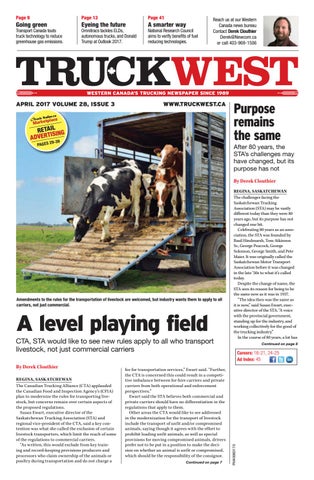
Amendments to the rules for the transportation of livestock are welcomed, but industry wants them to apply to all carriers, not just commercial.
REGINA, SASKATCHEWAN The challenges facing the Saskatchewan Trucking Association (STA) may be vastly different today than they were 80 years ago, but its purpose has not changed one bit. Celebrating 80 years as an association, the STA was founded by Basil Hindmarsh, Tom Atkinson Sr., George Peacock, George Solomon, George Smith, and Pete Maier. It was originally called the Saskatchewan Motor Transport Association before it was changed in the late ’50s to what it’s called today. Despite the change of name, the STA sees its reason for being to be the same now as it was in 1937. “The idea then was the same as it is now,” said Susan Ewart, executive director of the STA. “A voice with the provincial government, standing up for the industry, and working collectively for the good of the trucking industry.” In the course of 80 years, a lot has
Engineered with the help of the top consultants in the business. Our customers.
Competitive financing available through Daimler Truck Financial. For the Freightliner Trucks dealer nearest you, call 1-800-FTL-HELP. FTL/MC-A-1453. Specifications are subject to change without notice. Copyright Š 2017 Daimler Trucks North America LLC. All rights reserved. Freightliner Trucks is a division of Daimler Trucks North America LLC, a Daimler company.
Why do we look to you, our customers, for inspiration? Simple. We only succeed if you succeed. You asked for the new CascadiaŽ to be equipped with an easy-to-remove bumper for quicker maintenance. We made it happen. You asked for a better way to access electrical components. We gave you eVault. You challenged us to boost fuel economy, even though we already are a leader in the industry. We improved it by up to 8%*. When it comes to knowing what your business needs to succeed, there’s no better expert than you. freightliner.com/new-cascadia
*Compared to previous Cascadia model with similar specifications.
INSIDE THE NUMBERS
A USEful approach Western Canada’s owner/operators overwhelmingly consider buying used a viable option for updating their trucks Almost 9 in 10 owner/operators in Western Canada have purchased used when renewing their trucks, according to our annual Equipment Buying Trends Survey. Almost a fifth have plans do so again this year. Purchased used truck(s) in the past
NO
Plan to purchase used truck(s) in 2017
YES
Follow Lou on Twitter @LouSmyrlis.
Type of transmission most likely to prefer when selecting used truck(s)
YES
NO
Automatic
20%
Manual 18-speed
of respondents
Manual 10-speed
2%
66%
12% Manual 13-speed
11%
89%
17%
83%
of respondents
of respondents
Most important factors in selecting a used truck (scale of 1 to 5)
Main reasons plan to purchase used
Brand
4.10
Current trucks have reached replacement mileage
33%
of respondents
Age of truck/mileage
4.17 GVW/payload capacity
Increasing costs of repairs on current vehicles
43%
Looking to avoid new engine emissions standards
30%
3.84 Type of transmission
4.10 Availability of preferred engine brand
3.98 Axle ratio
Adding to fleet due to growth projections
3%
Looking to improve fuel economy
27%
4.37 Availability of parts
4.35
#DeloDrives PERFORMANCE
Introducing the Next Generation of Heavy Duty Diesel Engine Oil
Delo 400 with ISOSYN Advanced Technology ®
®
Up to 35% Better Oxidation Control*
Up to 68% Better Wear Protection*
Up to 46% Better Piston Deposit Control*
Up to 60% Better
Component Durability*
ChevronDelo.com *As compared to previous generation HDMO product test limits.
© 2017 Chevron Canada limited. All rights reserved. All trademarks are property owned by Chevron Intellectual Property LLC or their respective owners.
4 Truck West • April 2017
ISSN 0700-5016 (Print) ISSN 1923-3531 (Online)
Lou Smyrlis Director Business Development 416-510-6881 lou@newcom.ca
Contents
Kathy Koras Associate Publisher 416-510-6892 kathy@newcom.ca A. (Tony) Hohenadel Publisher - truckandtrailer.ca 416-614-5800 tony@newcom.ca EDITORIAL Derek Clouthier Editor 403-969-1506 derek@newcom.ca Sonia Straface Associate Editor 416-510-6890 sonia@newcom.ca James Menzies Contributing Editor 416-510-6896 james@newcom.ca DESIGN AND PRODUCTION Carolyn Brimer, Beverley Richards, Michael Chimienti, Tim Norton
17 ALBERTA
SASKATCHEWAN
Cross-border
Page 23 Western Canadian regional manager for Trailcon; PMTC back in Alberta.
Page 7 STA celebrates its 80th birthday and its purpose has always remained intact.
Omnitracs panel says small-fleet trucking companies shouldn’t be intimidated by ELDs.
Anthony Buttino National Accounts Manager 416-458-0103 anthonyb@newcom.ca
Page 26 Thanks to Trucking HR Canada and AMTA, Women with Drive event migrates west.
Page 8 New livestock tramsportation rules effect commercial carriers, but not private.
Nickisha Rashid National Accounts Manager 416-614-5824 nickisha@newcom.ca
Page 27 Rosenau Transport employees throw their support behind Mazankowski Alberta Heart Institute.
CANADA
ACCOUNT MANAGERS Delon Rashid Western Accounts Manager 403-713-1054 delon@newcom.ca
Denis Arsenault Quebec Accounts Manager 514-938-0639 ext. 2 denis@newcom.ca
Page 41 National Research Council of Canada puts today’s trucking technology to the test for SmartWay program.
Just because it’s sunnier and warmer doesn’t mean you should neglect necessary services on your truck.
45 In-Brief Doepker adds the Edmonton Trailer Manufacturing line to its portfolio; DTNA adds to its aftermarket and operations teams.
Chairman & Founder: Jim Glionna President Joe Glionna Vice - President Melissa Summerfield Director of Circulation Pat Glionna
B C T R U C K I N G A S S O C I AT I O N
SASKATCHEWAN TRUCKING ASSOCIATION
6
12-13
Editorial
Cross-border
What will really get autonomous vehicles on the road?
Second phase of EPA’s GHG standards takes a lot more into account than tires; today’s hot topics – ELDs, autonomous trucks, and Donald Trump – open Omnitracs Outlook 2017.
9 Cross-border Transport Canada takes part in Green Truck Summit panel discussion on how government can abet truck technology.
10-11 Business We acknowledge the financial support of the Government of Canada through the Canada Periodical Fund of the Department of Canadian Heritage.
To service your truck, do you go for the expertise of a dealer or the familiarity of a small independent shop?
Maintenance
Newcom Business Media Inc.
MANITOBA TRUCKING ASSOCIATION
Mark Lee
28
Truck West is published monthly by
TRUCK WEST is a proud member of the following trucking associations:
21
The reality of building your brand so it separates you from the competition.
Paul Beelien Regional Accounts Manager 416-614-5806 paul@newcom.ca
PUBLICATIONS MAIL AGREEMENT NO. 40063170 CUSTOMER NO. 4006214
Can you trust your smartphone to double-duty as your ELD?
Rebecka Freels
Doug Copeland Regional Accounts Manager 905-715-9511 doug@newcom.ca
RETURN UNDELIVERABLE CANADIAN ADDRESSES TO: CIRCULATION DEPARTMENT, TRUCK NEWS 451 ATTWELL DR., TORONTO, ON M9W 5C4
Sandy Johnson
22
Tony Jelicic Regional Accounts Manager 416-614-5813 tonyj@newcom.ca
Subscription Inquiries Lilianna Kantor Phone: 416-614-5815 Fax: 416-614-8861 Email: lily@newcom.ca
19
Daimler’s Martin Daum takes on new challenge to lead company’s truck and bus division.
14-15 Cross-border Omnitracs addresses in-cab video at Outlook 2017; FMCSA director advises companies not to wait on ELD implementation.
In Every Issue 42 Mark Dalton in… The Mark Dalton Project
44 Newland Transport 46 Last Word: Weathering the storm and never saying die.
April 2017 • Truck West 5
EDITORIAL Derek’s deliberation
Accepting that no one is to blame could be hard pill for public to swallow While I was at Omnitracs Outlook 2017 in Phoenix recently, I was part of a media luncheon that included a handful of representatives from US media outlets – I was the lone Canadian at the table – and various executives from Omnitracs, including CEO John Graham. Graham had opened the conference a day prior with the resounding theme of moving forward, embracing new technologies, and even welcoming futurist Jim Carroll to place an exclamation point on the topic. During the lunch, we discussed several technology-driven topics, including the notion that perhaps the idea of autonomous trucks – which was one of the most talked about subjects during the three-day conference – has been overhyped; a question Graham posed to the table. No one denies that autonomous trucks are coming. Where people tend to differ is when it comes to timing. Some good points were raised during the lunch when it comes to timing and what could get in the way of autonomous trucks hitting the road sooner rather than later. Government regulation was one, as was the extent to which autonomous trucks would be used. Are they really going to be able to travel
down any and all roadways in North America, or will they be limited to certain primary networks? But what about public acceptance? According to the Association for Safe International Road Travel
(ASIRT), 3,287 people die every day as a result of road collisions, and in the US, 37,000 people die each year, with an additional 2.35 million injured or disabled. In Canada, there were 1,834 motor vehicle fatalities in 2014, according to Transport Canada. Road collisions rank as the ninth leading cause of deaths
globally, and it is estimated that it could be the leading cause by 2030. These collisions cost US$518 billion annually. So, if there are 1,440 minutes per day, which there are, that’s 2.3 people who die every minute as a result of a vehicle collision. Needless to say, as you are reading this column, someone, somewhere, died in a car accident...more than one person in fact. I say all of this for one reason: the public tends to accept the fact that accidents happen, and people die as a result of those accidents. And why are they accepted? Because human error is acceptable, and when an accident happens, it’s easy to place blame on one or more human beings who were responsible, and say, ‘It was their fault.’ But what about when an accident happens and it involves an autonomous truck, and ‘it’ is to blame? If someone dies as a result of this collision, it will not be quite as easy for the public to accept. There will be no person they will be able to point the finger at and say, ‘It was his/her fault.’ Instead, there will have to be some kind of inquiry to determine what went wrong, and in many occasions there will be no one or two people who will be respon-
sible for the accident. It would be a technology glitch, having to do with the vehicle itself, GPS co-ordinates, or software…who knows? Which is exactly the point…who knows? This new reality will be much more difficult for the public to get used to. When a person dies in a car accident, someone must be held accountable. Granted, I do believe with autonomous vehicle technology, collisions will drop drastically. I would go so far as to say they will be almost non-existent. Hence, the push from many to get autonomous vehicles on the road. But when something does happen, the ramifications will be much more severe. TW
Derek Clouthier can be reached by phone at (403) 969-1506 or by e-mail at derek@newcom.ca. You can also follow him on Twitter at @DerekClouthier.
Mark Your Calendar!
APRIL 19, 2017 Marriott Chateau Champlain Montreal, Quebec, Canada www.sommetentretienflotte.com
NORTH AMERICAN COMMERCIAL VEHICLE SHOW
APRIL 20-22, 2017
SURFACE TRANSPORTATION SUMMIT
SEPTEMBER 25-28, 2017
OCTOBER 11, 2017
Georgia World Congress Center, Atlanta, Georgia, USA www.nacvshow.com
International Centre Toronto, Ontario, Canada surfacetransportationsummit.com
Place Bonaventure Montreal, Quebec, Canada
www.expocam.ca
6 Truck West • April 2017
APRIL 18, 2018
APRIL 19-21, 2018
International Centre Toronto, Ontario, Canada www.trucksummit.ca
International Centre Toronto, Ontario, Canada www.truckworld.ca
SASKATCHEWAN
Determining pre-existing conditions not driver’s jobs Continued from page 1
The CTA would also like to see the transfer of responsibility amended to include a provision mandating the physical presence of the party loading an animal. The proposed regulations state that the receiving party must be present upon the animal’s arrival, but, as the CTA points out, the condition of the animal on arrival is largely dependent on the condition they were in when they were loaded onto the truck. “Placing the onus on a driver to know whether an animal is unfit or compromised for transport should not fall to the carrier and/ or driver to determine whether an animal’s condition has deteriorated during transport,” Ewart said. “Some of the current wording around the transporting of unfit and/or compromised animals could result in unfair and unwarranted penalties being brought against the carrier and/or driver.” Alberta Beef Producers (ABP) was another organization that provided feedback into the proposed changes to the rules for transporting livestock. Some of ABP’s key areas of emphasis were the necessity for regulations to be science- and outcome-based, rather than prescriptive requirements; the need for flexibility within the regulatory framework to deal with unforeseen circumstances that arise during long-distance livestock transportation; an assessment of Canada’s transportation infrastructure, including rest areas; and its opinion on the requirement that the receiving party be present during arrival. “The proposal for transfer of responsibility that would require a person or persons to be physically present to accept incoming loads of cattle is unrealistic and impractical for the beef industry,” said Karin Schmid, beef production specialist with ABP. Schmid cautioned that when making amendments to what she called ‘fairly robust’ regulations that protected beef cattle welfare during transport, it is important to do so in a positive manner. “When making changes to these types of regulations,” she said, “it is important to ensure that unintended consequences of regulatory changes do not negatively impact the positive welfare outcomes currently experienced by beef cattle during transport.” To accentuate this point, Schmid pointed to research by Agriculture and Agri-Food Canada, which was conducted on more than 9,000 loads and close to half a million cattle on short and
long hauls. The finding showed that 99.95% of long-haul and 99.98% of short-haul cattle arrived at their destinations injury free. “We take all aspects of animal welfare very seriously, including transportation,” said Schmid. “The vast majority of beef cattle transported arrive at their destination in good condition.” The CTA also indicated that it welcomed the move to an outcome-based regulatory framework, saying it was appropriate for the provisions under ‘knowledge and skills.’ “In general, the CTA supports efforts to strengthen the rules
that govern the transportation of livestock in Canada, and understands and accepts that societal expectations regarding farmed animal welfare, which extends to transportation, is becoming more of a concern for Canadians,” said CTA’s policy analyst director, Lak Shoan. “We support further clarifying expectations for all parties involved in livestock transportation, including those that load and unload livestock as part of the transportation process.” Ewart said the STA is also a strong supporter of updating the transportation of livestock rules,
as well as the association’s ability to provide input, but stressed the importance of not putting undue responsibility on the for-hire carrier and driver, as many issues may not be apparent to a driver. “Liability should not be assumed by the carrier and/or driver to determine and be responsible for the pre-existing condition and health of the animal prior to loading,” Ewart said. She added that the STA was also pleased to see documentation requirements around feed, water, and rest, and that it should apply to all who transport animals, not just commercial carriers. TW
A Cool Engine is a Happy Engine. And a happy engine has its benefits: peak performance, more power and less maintenance. Howes Oil Enhancer lowers operating temperature keeping your engine cool. It not only extends the life of your oil – it also reduces metal-on-metal wear and protects internal engine components. Use it at every oil change as part of the ultimate Howes preventive maintenance program.
From the trusted makers of Howes Diesel Treat and Meaner Power Kleaner.
1-800 GET HOWES (438-4693) www.howeslube.com
April 2017 • Truck West 7
SASKATCHEWAN
What’s the most rewarding career decision you’ll ever make? Earning the CCLP® designation is easily the single best thing you can do to boost your career prospects. It can set you up for better pay, more advancement opportunities, and a range of management pathways and options across the sector. Plus, you’ll develop and demonstrate cross-functional capabilities that can deliver better business results—and more personal job protection. Depending on your background, your CCLP designation might be only FRXUVHV DZD\ &DOO RU FOLFN WR ¿QG RXW LI \RX TXDOLI\ IRU advanced standing. Or just get started. Your best choice for complete career-long OHDUQLQJ FHUWLÀFDWLRQ in supply chain logistics
www.citt.ca t 416.363.5696 ®CC CLP &,77 &HUWLÀHG /RJLVWLFV 3URIHVVLRQDO LV D UHJLVWHUHG WUDGHPDUN R RI &,77
8 Truck West • April 2017
STA’s 80th Continued from page 1
changed, especially in the world of trucking, but as Ewart points out, today’s challenges do not overshadow those the STA faced in the past, such as the Great Depression, Dirty Thirties, the Second World War, and the Wheat Pool collapse. But that doesn’t mean that 21st century issues are a cake walk. “Today there are more highways, larger companies and more technology,” said Ewart. “Life may be easier now, but the trucking industry can still be difficult to navigate. Technology is a major factor that did not exist back then, and it plays a role in regulations issues.” Ewart said one of the STA’s founding member’s businesses was built on a single Model-T truck, while today, road tests are being done on 80,000-kg vehicles, even some that drive themselves. Asked to pinpoint a turning point for the STA over its eight decades, Ewart underscored its finding of Highway Agencies Limited in 1955, something that changed everything for the association. “We had a new name and a trucking-specific insurance company that generated revenue, making the STA more powerful for its members,” said Ewart, adding that many trucking associations must have a backup plan for funding, a reality for nonprofit organizations. “The early members who had the vision to establish Highway Agencies set the STA up to not have to rely on government funding to keep running. This will ensure the STA is always looking out for its member’s interest first and foremost.” Sixty years later, Ewart said the STA is fully independent and can dedicate itself to applying political pressure on behalf of its members without fear of having funding taken away. Along with the STA, the British Columbia Trucking Association, Alberta Motor Transport Association and Manitoba Trucking Association, work collaboratively as part of the New West Trade Partnership, something Ewart believes was a natural progression to have the four Western Canadian associations work together more often. To mark its 80th anniversary, the STA thanks its long-serving and most recent members, as well as all who have made the milestone possible. “Our current membership and current board are a mere fraction of the people who made it possible for the STA to reach this point,” Ewart said. “To our members who have been with us from day one, to the ones who joined yesterday; from industry experts to industry sales people – we thank you for choosing to provide your time, your intelligence, dedication and dollars to create and maintain the STA.” TW
CROSS-BORDER
Getting ZEVs on the road Green Truck Summit panel addresses how government tackles greenhouse gas emissions from transportation By Derek Clouthier INDIANAPOLIS, INDIANA Jodi Proctor, director of clean air policy analysis for Transport Canada, said when it comes to zero emission vehicles (ZEVs), “Range anxiety is one of our biggest concerns that needs to be addressed.” Both the Canadian and US governments touted the measures each are taking to encourage the use of ZEVs during the Green Truck Summit March 14 in Indianapolis. Proctor was part of a panel discussion, and she highlighted how Canada’s government has placed a high emphasis on climate change and reducing greenhouse gas emissions. Proctor also underscored the close relationship between Canada and the US. “Policy decisions taken on one side of the border have an impact on the other side,” she said, adding that despite the importance of work trucks to the North American economy, there is still a need to make improvements for the sake of the environment. Each day, 10 million trucks cross the Canada/US border, with approximately two-thirds of the countries’ trade moved by a truck. Canada’s climate change agenda is based on estimates that a changing climate could cost the country $21-$43 billion per year by 2050. The government focus, therefore, is to concentrate on accelerating innovation and supporting clean technology. Proctor said transportation accounts for 24% of total GHG emissions, of which, heavy-duty vehicles make up 32%, with a projected increase of 20% by 2030. “In short, transportation really needs to be part of our climate change efforts,” said Proctor. The Canadian government has set a floor price for carbon emissions of $10/ton in 2018, rising to $50/ton by 2022. Provinces and territories have a choice to use a carbon levy or cap and trade, with all revenues staying in the province where they are generated. Proctor said new technologies will play a major role in the longterm reduction of GHG emissions, highlighting ecoTechnology for vehicles, such as the 6x2 axle technical assessment program, vehicle cooperative truck platooning study, which Canada is conduction with the US, and the heavy-duty vehicle tire market study to help discover lower rolling resistance options.
“It’s clear government has an important role to play,” Proctor said of ZEV technology and adoption. Also part of the panel was Jack Kitowski, division chief of mobile source control division for the California Air Resources Board, and Reuben Sarkar, deputy assistant secretary of transportation for the US Department of Energy. Each underscored the importance of zero emissions technology and how each work to bring options to the market. TW
ANY ROAD ANY LOAD
CBX SUSPENSIONS. LIGHTER. STRONGER. MORE BRAKE OPTIONS. OPTIONAL
TM
CBX Suspensions available with advanced P89 disc brakes and industry standard drum brakes.
Series
AIR DISC BRAKES
CBX Series top mount and underslung fixed frame air-ride suspensions are engineered to cover more applications than ever before. From grueling highway miles, to brutal off-road work, and with models ranging from 23,000 to 30,000 lbs.,* there’s no road that can’t be traveled, and no load that can’t be hauled, with SAF CBX and CBXu suspensions.
Available with smaller 121⁄4˝ x 71⁄2˝ drum brake configurations with 5˝ axles.
* CBX25/30 model – 30,000 lbs. capacity at creep speed only.
LEARN MORE ABOUT P89 SERIES DISC BRAKES
www.safholland.us 1-888-396-6501 © 2017 SAF-HOLLAND, Inc. All rights reserved.
April 2017 • Truck West 9
BUSINESS
Martin Daum to lead Daimler’s global truck and bus division In one-on-one interview with Truck West, Daum credits team with his advance By James Menzies PORTLAND, OREGON When Martin Daum got the call from Stuttgart, Germany, asking him to take the recently vacated
global position of Member of the Board of Management responsible for Daimler Trucks and Buses, he felt a sense of responsibility to accept. The position was vacated unexpectedly by Dr. Wolfgang
Bernhard, who said he was leaving Daimler for personal reasons. “This was a difficult one,” Daum said of the decision to accept the promotion in a one-on-one interview with Truck West. Daum has
Martin Daum, former head of DTNA, is returning to Germany to lead Daimler’s global truck and bus operations. led Daimler Trucks North America since 2009 and the company soared to new heights under his leadership. During his time in that role, he spoke often of his love for the North American market and life in the US. “I would say it was the responsibility I feel,” he continued. “It started with a huge vote of confidence from (chairman of the board) Dr. Zetsche and the supervisory board. They said ‘You’re a natural candidate, you have the experience’.” Daum’s varied background includes roles in truck sales, production, engineering, and finance. But what he’s most proud of is the team he assembled in Portland and he credits those people with the growth Daimler achieved in North America under his watch. “We were able to form a really high performing culture in the US and we want that around the globe,” Daum explained. When offered the top job, Daum saw an opportunity to give back to the organization that has entrusted him with so much responsibility over the years. “I worked my entire life for Daimler and I owe the company,” Daum said. “I was given responsibilities, I wondered why they did that at the time. I never failed them so they had confidence in me, but that was pretty courageous. I owe the company; I’m a good soldier.” Most important, however, was the support of Daum’s family. “My wife completely understood,” he said of the opportunity. “I wouldn’t have done it without her full support.” Asked what he was most proud of accomplishing as head of DTNA, Daum said it’s about the “high octane” team he assembled. “Every single person, I would hire again,” he said.
10 Truck West • April 2017
Daum also credited the people involved in DTNA’s dealer network. “When I took over, it was a pretty tense relationship (with dealers),” he acknowledged. “They agreed they would have to ramp up their game as we were going to ramp up our game.” He added being on the edge of technology was another contributor to the brand’s growth. “Daimler is uniquely positioned today to be a global powerhouse,” he said, “because we have the strong local brands in every single location – Japan, Brazil, Europe, and North America – with their own strong engineering bases. In every one of those four regions, we could live completely independently. But how much more can we do if we link those four individual powerhouses together and benefit from each other, where not every one has to invent everything at the same time?” He cited the US launch of the DT12 automated manual transmission as an example. But while much of the engineering that went into the design of the transmission occurred elsewhere, Daum was adamant production occur on these shores. “That was a huge discussion,” he said about the decision to bring production to Detroit. “It took my whole authority to say, I’m not doing it for the US if I have to import, I want it localized, I want that US label.” At the time, some thought US demand would not exceed 12,00015,000 units. “I think our capacity at the moment is north of 60,000 and we will need every single one for the North American market. We would love to export it to other Daimler markets but we need it here in our own market,” Daum said. The success of the DT12 rollout is a source of pride for Daum, as it involved taking a technology developed by Daimler in Europe and quickly and effectively bring-
ing it to the North American market. “It’s a singular event, but it’s a basic example of what we can do with technology,” he said. “We do it in other areas as well and you’ll see more of that. That’s the true power of Daimler globally, to have these strong local branches that can be so much stronger if they work together on a global scale.” Asked about the unprecedented market share DTNA achieved under his leadership, Daum said it was the result of focusing on all
areas of the business. If it was just a matter of pounding the table and demanding higher market share, Daum joked, every CEO would just beat the table harder. “For me, market share is the result of great product, of listening to the customer, and giving them great service in the market,” Daum said. “To have market share at that level, you have to be good at everything in every market. When I started, I remember in Germany people asking me, where should we attack? I said everywhere. Every
place, every segment – vocational, on-highway, day cab, specialized, Canada, Mexico – everywhere. That is the secret. We are not done yet.” As for the transition, Daum took his seat on the board March 1. His replacement in North America has not yet been named, but Daum said the company has many worthy successors to consider. “I can say for sure, we have such an incredibly strong bench that I’m sure we’ll have an incredible and great successor,” Daum said. TW
THE BEST TANK LEASING EXPERIENCE IN NORTH AMERICA
KEVIN QUICK VP, BUSINESS DEVELOPMENT, WESTERN CANADA kquick@transcourt.com 1 888-407-3830
20th
anniversary
Chemical
Crude Oil
Food Grade
Hot Products
Compressed Gas
Dry Bulk
FRP/412
Petroleum
Transcourt supplies equipment uipment all across C Canada and the United States. We e have a large fleet flee et of tanke tankerss availab a available ble for for Petroleum, Crude, Chemical, Food grade / Sanitary, Dry Bulk, Propane/LPG and FRP/412.
www.transcourt.com
THE FUTURE OF TRUCKING: An inside look at the start of a new era Game changing technologies echnologie es umultuouss sh hiffts in in combined with tumultuous shifts graphics will w so oon workplace demographics soon m our industry. indusstrry. greatly transform
Find out during two engaging panel sessions, moderated by Truck West editors, and a keynote luncheon address from Trucking HR Canada’s Angela Splinter. A All at MTA’s 85th Annual General Meeting.
What strategies and practic practices cess will will n ed tto o Manitoba’s motorr carriers nee need n the futur re?? adopt to thrive in future?
April 7, 2017 RBC Convention Centre, 375 York Ave, Winnipeg
Also join us for a night of comedy and dance at the Spring Gala.
To find out more and to register call: 204-632-6600
April 2017 • Truck West 11
COM
E SE E US BOOT AT EXP O H #4 563 CAM
CROSS-BORDER
Taking more into account More technology taken into consideration in Phase 2 of EPA emission standards By Derek Clouthier
TOTAL RUBIA OPTIMA CK-4 & FA-4 HEAVY-DUTY ENGINE OILS TO TAKE YOU FURTHER. EVERY DAY
TOTAL RUBIA OPTIMA 1100 15W-40
TOTAL RUBIA OPTIMA 2100 XFE 10W-30
TOTAL RUBIA OPTIMA 1100 FE 10W-30
Follow us on
Total Canada
Energizing performance. Every day
12 Truck West • April 2017
www.total-canada.ca
INDIANAPOLIS, INDIANA With Phase 2 of the US Environmental Protection Agency’s (EPA) greenhouse gas emission standards currently being ironed out, for the first time, upfitters will see opportunities to gain emissions credits. During a panel discussion at the Green Truck Summit March 14, Matthew Spears, center director of heavy-duty diesel standards for the EPA, outlined the differences between the first and second phases of the fuel efficiency rules, saying Phase 2 reaches much further into the technology pot to include such items as the chassis (tires, light-weight materials and inflation systems), powertrain (engine, transmission, and axle), idle reduction (automatic engine shutdown, stop-start, and hybrids), as well as additional credits for aerodynamic and all-electric options. The chassis manufacturer will also provide the upfitter with delegated assembly instructions for technology installation, which Spears said will create a compliance responsibility for the manufacturer, as well as the upfitter. Delegated assembly allows an OEM to claim emission credits to the EPA for upfitter installed technologies. On the other hand, an upfitter can work out an agreement with a chassis manufacturer to retain the emissions credits for the installation of a fuel-reducing technology, such as aerodynamic fairings. Tires were the lone item included in the first phase of the GHG emissions standards for vocational vehicles, a point of contention for Ken McAlinden, manager for on-board diagnostics and regulatory compliance for the Ford Motor Company, who said it was too narrow in scope and failed to take other factors into consideration. McAlinden said GEM, which is a computer simulation of the technology used on a truck to determine emission credit value of any given technology, is better used in the second phase, as it takes more into account when looking at a vehicle’s emission curbing efforts. Rob Stevens, vice-president of strategy and engineering for upfitter Roush CleanTech, said although Phase 2 is a more complex model, it presented an avenue and path for upfitters to get to where they need to be. “It really does spell opportunity for all of us,” said Stevens, adding
that upfitters will be able to work more closely with OEMs and be more a part of the entire process of meeting the new EPA standards. Stevens said that in the end, what customers really want to see from the EPA rules is a benefit to them, and that when fleets see a reduction in their fuel usage, it is the benefit they are looking for. Spears said the EPA does not require any specific type of technology to be used in its first two phases of the GHG rules, just that a certain standard be achieved. He added that there were several changes to Phase 2 from its original proposal due to the amount of stakeholder feedback
“We tried to make it a very interactive process.” –Matthew Spears, EPA the EPA garnered leading up to the drafting of the new rules. “We tried to make it a very interactive process,” said Spears. In the process of establishing a pathway to meet the new emission standards, Spears said the EPA did not assume an OEM would have to use delegated assembly with an upfitter, but if they did and it works out cheaper to get there, it would benefit both parties. Full implementation of Phase 1 will be achieved by 2018 and was first introduced in 2014. The ruling on Phase 2 is not yet final. TW
IMMIGRATION LEGAL SERVICES
WITH CONVENIENCE AND CULTURAL UNDERSTANDING • Study and Work Permits • Temporary Visas • Express Entry Applications • Permanent Residence • Family Sponsorship & Appeals • Detention Reviews Rebecca J. Lockwood >à > iÝV Õà Ûi >vw >Ì Ü Ì Ì i >Ü "vwVià v ` > i ] vviÀ } iÝÌÀ> >Ãà ÃÌ> Vi v À V i Ìà L>Ãi` ` >°
> >`>\ ³£ È{Ç Î ää£ä v J V Ü ` i}> °V> ` >\ ³ £ Ç£ Ó{ x£ÎÇ v J >Ü vwVià w ` >°V
www.lockwoodlegal.ca
ATA president says Trump administration will empower trucking industry By Derek Clouthier PHOENIX, ARIZONA American Trucking Associations (ATA) president and CEO Chris Spear opened Omnitracs Outlook 2017 by telling attendees that he wants to be a partner, not an impediment, to the newly-elected Donald Trump administration. Spear said he believes Trump will be a catalyst of innovation who will empower the trucking industry, and not be a president who will favor additional mandates. “He’s going to create an environment that empowers all of us to step up, to lead – not follow – and provide an opportunity to help him achieve those lofty goals,” Spear said of President Trump. “It’s our obligation and our responsibility to step up and do something.” Spear said the trucking industry, and the general public, must wade through the distractions surrounding the new president and focus on his actual policies, which he said are what truly matter. “This president has gotten into power and taken a much different approach, very unorthodox,” he said. “I’m not talking about the 140 characters, I’m not talking about the war on the media, I’m talking about the fact that he is the first president that I can recall in history who’s going to walk into Washington owing nobody anything. This president is pretty much a freelancer.” Spear told the audience that people should not worry about Trump’s tweets or battles with the media, but concentrate on his agenda and what it means to trucking as an industry. “If we can take the time to filter all that noise out and focus on the opportunities that lie ahead with this president, and the fact that he is not loyal to anybody in Washington, we could put some pretty big wins on the board,” Spear said. “And that excites me and my team. We have an opportunity to do some really amazing things.” One of those amazing things Spear highlighted was Trump’s proposal to put $1 trillion on the table toward infrastructure, something Spear said has not been done since former President Eisenhower’s administration. “As he takes more time to provide that detail, we need to be a part of that dialogue,” Spear said, adding that Trump’s motivation is not just about trucking, but overall job growth and what’s good for the American economy. “We’re the catalyst for all of that,” he said. “Our story resonates better than probably anybody else’s in Washington.” Spear said widespread adoption of autonomous vehicles is still 20 to 25
years away, but that industry has a role to play in its development. “The discussion of how that looks, the framework of how that feels, is happening right now,” he said. “Trucking has got to be a part of that…we cannot be left aside and leave the auto industry to define the parameters of how that looks and feels. This technology is here, it’s now, it’s real. And this industry has to take its seat or it’s going to get left behind.” After acknowledging the importance of the North American Free Trade Agreement (NAFTA) to the trucking industry, Spear said there were three tools that must be used to get things done in the coming
years. The first was continued calls on Washington to get the ball rolling on issues important to the industry; second was the building of coalitions; and third was Truck PAC, an ATA initiative that aims to help get candidates who understand the industry’s needs and objectives elected. Omnitracs CEO John Graham echoed Spear’s theme of looking to the future of trucking and not getting left behind. Graham pointed to platooning, saying it will make trucking safer and more fuel efficient, and that testing of today’s various technologies was happening all over the world. When it comes to platooning and the distance trucks can safely travel from each other, Graham said when you take out the human factor of recognition and reaction time and only have to concentrate on brake lag, it
provides the opportunity for trucks to safely operate at a much closer distance. “This is about getting efficiency of workflow,” said Graham, adding that the aerodynamics of trucks traveling closer together is beneficial. Graham said the lead truck in a platooning formation achieves 4.5% fuel savings, while the trailing truck sees a 10% reduction. Graham also addressed issues around driver fatigue, including what he called “wearables,” which help detect driver alertness and overall health. He said alert drivers not only drive more safely, but also more efficiently, so the use of today’s technology helps the driver, fleet, general public and environment. “Who knows where this might go?” Graham said of wearables. “But the technology is there.” TW
If you’re there, we’re there... coast to coast
The most trailers. The most locations.
Ready to go when you are! 1 855 327 9757 trailerwizards.com April 2017 • Truck West 13
CROSS-BORDER
A silent witness Use of in-cab video helps, does not hinder drivers, says Omnitracs
info@kingtec-canada.com www.kingtec-canada.com 1-800-309-8155
PHOENIX, ARIZONA Andrew Schimelpfenig of Omnitracs Safety Center of Excellence said employing the use of an in-cab video solution is an essential “reliable witness” in the event of an incident. According to Schimelpfenig, in-cab video, both facing the driver and those that provide a driver perspective, display the benefits of improved safety scores, save money due to the prevention of collisions, create additional driver accountability, collects data before, during and after an incident, and reduces fleet liability exposure. “When something bad does happen, you want to be able to see what your driver saw,” explained Schimelpfenig, adding that video should be used to exonerate a driver and help train new, incoming drivers. Though he said many truckers are reluctant to accept a driver-facing camera, Schimelpfenig underlined the fact that the video can help determine if a driver did everything they could have during a particular incident, which not only provides a valuable tool to companies, but also relieves the conscious of the driver themselves, who may question if their own job performance following an incident. Omnitracs’ in-cab video solution does not broadcast live video, but is rather viewed only when an incident occurs or foul play is suspected.
“When something bad does happen, you want to be able to see what your driver saw.” – Andrew Schimelpfenig Some of the statistics Schimelpfenig revealed to those attending the Omnitracs Outlook 2017 session included the fact that in the US, each injury that results from an on-road incident costs trucking companies an average of $240,000; a highway fatality costs $11 million; and 81% of vehicle collisions are caused by passenger vehicles. “You should be very proud of the trend we are seeing in this industry,” Schimelpfenig said to those in attendance. He added that fleets using an in-cab video solution see a 35% reduction in vehicle-related incidents, 11% for those using electronic logging devices (ELDs). TW
14 Truck West • April 2017
Don’t get left behind FMCSA director stresses the importance of planning ahead of impending ELD mandate By Derek Clouthier PHOENIX, ARIZONA With the US electronic logging device (ELD) mandate set to come into effect this December, being prepared, knowledgeable, and compliant with hours-of-service (HoS) are what carriers should be focusing on now. This was the message from Federal Motor Carrier Safety Administration (FMCSA) director Joe DeLorenzo during his address at Omnitracs Outlook 2017, who gave an overview of what to expect in the next eight months leading up to the new ELD rule. DeLorenzo said the number one issue to ensure the transition to ELDs goes smoothly is to plan accordingly and avoid the human tendency to procrastinate. “If you’re a driver who fills out a logbook, then you need an ELD,” DeLorenzo said, adding that one of the biggest mistakes people make is to take a new rule like the ELD mandate for granted until it sneaks up and bites you. In addition to the mandatory use of an ELD, major components of the rule include the minimum performance and design standards of the device, measures to prevent harassment, and requirements for HoS supporting documents. DeLorenzo said ensuring drivers are compliant with their HoS will be the key focus moving forward. “Make sure your drivers know what they have and know how to use it,” DeLorenzo said of the use of ELDs and what will make the process easier when a driver is inspected by an enforcement officer. “The more a driver knows, the easier it is for the law enforcement officer.” Of the possible exemptions to the ELD rule, the one that concerned DeLorenzo the most was for “those using paper records of duty status (RODS) for not more than eight days during any 30-day period.” DeLorenzo said the last thing he wants to happen is to have a driver be asked to do a job on day seven and realize that they must now start using an ELD for their HoS or risk not being in compliance with the use of a paper log. Data transfer was another issue DeLorenzo discussed. In addition to electronic transfer via e-mail and web services, when a driver must produce their RODS to an enforcement officer roadside, the driver can do so in one of two ways: a printout or by direct screen display. Electronic data transfer can also be done via USB or Bluetooth. The data transferred to the officer is filtered through eRODS to be ana-
lyzed, which is intended to shorten the inspection process, and violations identified are manually confirmed by the enforcement official. If no violations are detected, the data transferred to the officer is then deleted. Only when a violation is confirmed is the data retained as supporting documentation. Some technical requirements included in the ELD mandate are that dates and times must be automatically obtained without external input, the speed threshold must not exceed 5 mph, vehicle location must be within no less than one mile of accuracy when on duty and 10 miles when operating under personal conveyance and upon powering up the truck, and the ELD must monitor engine hours and vehicle miles. “The key to this whole thing is going to be how are we all communicating?” DeLorenzo said.
ment, with employers, consortia/ third-party administrators, and medical review officers reporting on drug and alcohol violations and substance abuse professionals reporting on the rehabilitation process. Employers will be required to query the Clearinghouse for two purposes: pre-employment screening and annual verification. There will be no cost to the driver for their data being entered into the Clearinghouse, but there will be a charge to carriers that utilize the system; the amount is yet to be determined. TW
bring the matter to the attention of Outlook 2017 attendees. The mandate will create a database that will essentially act as a driver background check for carriers, indicating whether the driver has any previous incidents involving drugs or alcohol and whether they went through the mandatory return-to-duty drug and/or alcohol rehabilitation process. This was something DeLorenzo said is currently not available and will help carriers better determine which drivers they want to bring on board. The Clearinghouse will have a reporting and querying require-
LIFT YOUR BUSINESS TO A NEW LEVEL!
Coming down the pike Another piece of regulation coming to the US transportation industry is the Drug and Alcohol Clearinghouse. The legislation is not set to see implementation until 2020, but DeLorenzo wanted to
www.premiertruckbody.com • info@premiertruckbody.com ww
ACRO CANADA, ACROSS FOR DURABILITY AND AN QUALITY, TRUS TREMCAR TRUST
PETROLEUM B-TRAIN TC-406
TRI AXLE CRUDE
CRUDE TC 407 B-TRAIN
TRI AXLE DRY BULK
CALL US TODAY!
SERVICE CENTRES SASKATOON, SK (306) 931-9777 WEYBURN, SK (306) 842-6100 EDMONTON, AB (780) 371-1579
LEASING & TRADE-INS
www.tremcar.com
Darren Williams
Gilles Rondeau
Ken Smelski
Marlene Chalmers
VP Sales williamsd@tremcar.com
Manitoba & SK Sales Manager rondeaug@tremcar.com
Alberta & BC Sales Manager smelskik@tremcar.com
Tank Leasing Manager chalmersm@tremcar.com
April 2017 • Truck West 15
CROSS-BORDER
Getting ahead of the ELD mandate Panel advises small carriers not to be intimidated by ELDs By Derek Clouthier PHOENIX, ARIZONA If you’re a small carrier that operates in the US, there are certainly concerns when it comes to preparing for the electronic logging device (ELD) mandate set to come into effect this December. Compared to most larger carriers, which often operate with a significantly larger staff – each dedicated to a specific area of interest for the company – smaller businesses get by with much less, both in terms of employees and budget. Tess Wegier, manager of Trupath Systems, recognized these concerns when it comes to ELDs during a panel discussion at Omnitracs Outlook 2017, saying some smaller carriers see the new rule as a financial burden that will take a lot of time and effort to implement into their business operations. “People are often afraid of what they don’t know,” Wegier said of ELDs. “Everyone is afraid of change. Something like this can rattle a driver’s world when they’ve been doing the same thing for 30 years.” But Wegier is confident that once drivers and companies see the benefits of ELDs, that attitudes will brighten. “Often times, the biggest resisters become the biggest cheerleaders,” she said. Trupath is one company that can help with that transformation, as Wegier said, as it aims to help companies make the transition from paper logs to ELDs, holding the company’s hand through each and every step to make the process as easy as possible. Wired Truck is another company that helps with that process, CEO Jimmy Lee explained. Lee said ELDs help companies become better businesses, eliminating many of the unknowns and risks that come with the use of paper logs, as well as improving the bottom line. “(ELDs) are a tool that needs to be trained into our lives,” Lee said. Lee stressed the importance of carriers being ahead of the game when it comes to ELDs, and not waiting until the last minute to integrate them into their business model. One of the best ways to speed up that process, Lee said, is to identify a ‘driver champion’ to lead the initiative, and others will surely follow. Bobby Shanholtzer, president of GoRoadSmart, agreed that waiting will prove to be a mistake. “It’s a fact that those last three months are just going to explode,” Shanholtzer said of the countdown to the ELD mandate becoming law. Shanholtzer said he often equates
companies that are nervous about making the change to e-logs as a child going to the doctor to get a shot – they worry about for the entire time leading up to the shot, but in the end, it’s never as bad as they thought it would be. Lee admitted some smaller carriers that deal with niche custom-
ers could see some negative effects moving to ELDs, as it will be difficult for them to tailor their service the way they have in the past for their unique needs. But he added that using ELDs would eventually bring more business to a carrier, which should be every company’s main goal.
WE'RE GROWING
Wegier told attendees that there were far more positives to ELDs than negatives, and praised attendees saying that each were already brilliant business people, and they wouldn’t be in their current positions if they weren’t. “So trust yourself to adopt this new technology,” she said. TW
> GREAT PAY > GREAT BENEFITS > GREAT COMPANY
AND NEED DRIVERS AND OWNER OPERATORS!! PROFESSIONALS NEEDED FOR SPECIALTY WORK Hauling Bulk Liquids and Haz Mat materials
> Call Tom or Ravi (604) 882-1518 > Email Resume to: drivers@ascteam.ca
Tanker Experience, Super B Mountain Experience and Fast Cards an Asset
www.alchemistspecialtycarriers.ca
accept the challenge Siemens Transportation Group Inc.
Hiring Company Drivers and Owner Operators for our Domestic & U.S. Fleets Benefits beyond the paycheck include: Upgraded Fleet, Achievable Safety Bonus, Referral Program - $1,000 and Rider Policy We work hard to be the best and so do our drivers! Contact us at driver.recruitment@edgetransport.com or 1.888.878.9585 to see how we are different from the rest
April 2017 • Truck West 17
COMPLIANCE Permits & Licensing
ELDs on a smartphone: smart or not? With a smartphone, you don’t have to wonder about anything anymore. All the answers are at your fingertips. How tall was John Wayne? 6 foot 3. Who won the 1942 World Series? The St. Louis Cardinals. No discussion, no arguments, no fun. But you know what smartphones aren’t always good at? Phone calls. You can make the same comparison between an electronic logging device (ELD) and a full-blown fleet management system. ELDs are intended to do one thing: track the driver’s activity so it’s easier to comply with hours-ofservice rules. A fleet management system is focused on the vehicle’s activity. For many fleets, these sophisticated tools are indispensable for running the whole business, from dispatch to compliance to maintenance to billing. Can a fleet management system include an ELD? Sure. Many fleet management systems now have ELD functions that meet FMCSA requirements. Since the fleet management system has hardware and software on board for monitoring the truck, it’s not a huge leap to use the same basic technology to record driving time, location, and other data about the driver. But some people just need the ELD. What could be simpler than logging HOS on a smartphone? It makes sense because the device stays with the driver, which is what the HOS legislation is written to track. Well, the smartphone, as amazing as it is, has some limitations as an ELD. Here are some things to consider: • Does it meet the ELD standard? FMCSA makes it crystal clear that requirements for an ELD on a smartphone are the same as a dedicated device, including the fact that it has to sync up with the engine control module to automatically record engine power status, vehicle motion status, and other data. • What if something happens to the phone? If your ELD lives on your phone, you need to understand the consequences of moving the truck when your phone is dead because you forgot a charging cable, dropped it on the pavement, or left it at home. • As a fleet owner, should you supply the phone? If the driver supplies his own device, and it functions as his ELD, he’s responsible for making sure that the bill is paid and the data plan can accommodate all the information
the device needs to capture and communicate. • Can you take ELD data from your smartphone app and use it for IFTA and IRP? HOS and distance-based tax reports are very different. One focuses on the driver, the other on the truck. IFTA requires licensees to preserve all records used to create quarterly tax returns and/or annual tax returns for four years from the tax return due date or filing date, whichever is later. IRP requires fleets to preserve records for three years after the close of the registration year. If you also use GPS data for IRP licensing, you’re obligated to keep it
for five-and-a-half years. Most people don’t keep a smartphone for that long. Where is all that distance data kept? How do you get it when the IFTA auditor calls? • Everyone has an app on their phone that they never open because it’s buggy and the developer isn’t around to support it. An ELD is too important to fall into that category. Beware of opportunists looking to cash in on desperate truckers. Before you ask Siri which app is best, review the ELD rule at www.FMCSA.dot.gov and talk to the service bureaus that handle
Sandy Johnson has been managing IFTA, IRP, and other fleet taxes for more than 25 years. She operates FleetTaxPro.com, which provides vehicle tax and licence compliance services for trucking operations. She can be reached at 1-877-860-8025 or www.FleetTaxPro.com.
your logbooks or IFTA and IRP filings for advice. Just make sure you have good cell reception when you call. TW
At Hyndman, you can achieve a good work/life balance that allows you to work smart, earn a good dollar and get back home to your family, friends, and community. Choose Hyndman today!
(800) 499-4997 | DriveHyndman.ca
April 2017 • Truck West 19
OPINION You say tomato, I say tomahto
Choosing a maintenance service provider Do you go for the familiarity of a small independent shop, or the expertise of a specialized dealer? I spend a considerable sum on preventive maintenance on my trucks. In the long run, it’s the best way to avoid unnecessary bills. It’s very easy to spend a dollar trying to save a penny, except when it comes to trucks. It’s never just a dollar, but lots and lots of dollars. The implications are far greater than a hit to the back pocket, too. Breakdowns at the side of the road or out-of-service violations could land you in hot water with your carrier or customer, so it’s essential to have a proper preventive maintenance program in place. However, that’s not as easy as it sounds. First, you need to find somebody to do the work. The whole idea is to ultimately save money, so giving somebody carte blanche to change out parts that may fail is not going to achieve that. It may almost guarantee that you never break down or have an issue with the DoT, but it won’t be saving you money. This is where it gets difficult; do you use a main dealer or a smaller shop? There are positives to both. A main dealer will have lots of experience with your particular truck model and will know what needs to
I thought I had found the best of both worlds when I used a small shop franchised to a main dealer, but that turned out to be a complete nightmare and I’m still dealing with some of the issues arising from it. be looked at, but they’re also pretty busy guys and it’s difficult to build a relationship when you’re dealing with a different person each time you go to the service desk. At dealerships, there are always any number of different technicians that could be assigned to work on your truck. Using a smaller shop will give you that ‘part of the family’ feeling. The same face greets you as you approach the service desk and the same guy will be turning wrenches on your truck. But, they won’t know the intricate details of your particular truck model as well as the stranger at the main dealer who
works on them all the time. It’s something to consider. We’re not just talking about bits of metal wearing out, those days have long gone. Now, it’s sensors and modules that need attention. You can’t just look at a part and see that it’s on its last legs, so you need an expert. Which basically means that you need two different shops to properly take care of your truck – a smaller shop to take care of it in general and a main dealer shop to deal with the electronic wizardry. That’s the conclusion I’ve arrived at. I thought I had found the best
of both worlds when I used a small shop franchised to a main dealer, but that turned out to be a complete nightmare and I’m still dealing with some of the issues arising from it. Instead of getting the best of both worlds, I ended up getting the worst of both and it definitely didn’t save me any money. Not only were they more expensive than a main dealer shop – despite a cheaper hourly rate – but I’ve ended up having to pay another shop to double-check everything they’ve done, with very disappointing results.
A fourth generation trucker and trucking journalist, Mark Lee uses his 25 years of transcontinental trucking in Europe, Asia, North Africa and now North America to provide an alternative view of life on the road.
My trucks are in decent shape, so even though it worked out at a higher cost than I first hoped, in the long run it will still be cheaper than leaving things to chance. That’s the most expensive preventive maintenance strategy of all. TW
PUT YOUR CAREER IN DRIVE! Join our award-winning culture and see why Drivers choose Bison! NOW HIRING: ∙Canada/US Lanes ∙Company Drivers
∙Owner Operators ∙Team Drivers
CONTACT US TODAY! 1.800.462.4766 | drive@bisontransport.com | bisondriving.com Bison Transport is committed to Employment Equity & Diversity
April 2017 • Truck West 21
OPINION Communicating strategically
The reality of building a brand When business leaders talk about rebranding, they often think a makeover will fix whatever ails their operation. But charismatic and iconic brands are meticulously crafted from self-knowledge. But let’s start with what a brand really is. A brand is whatever differentiates you from your competition. It’s not just a logo, product or the color of your packaging –
it’s a set of perceptions and images that represent a company. It’s the essence or gut feeling a person has about your product, service, or organization. Motivator Jim Rohm put it very simply: successful communication (and that includes branding) is 20% what you know and 80% how you feel about what you know. Amazing brands resonate with both customers and employees
CHRISTINE WOOD Missing Since: August 19, 2016 Date of Birth: February 17, 1995 Missing From: Winnipeg, MB Height: 5’6” Build: Average build Eye Colour: Brown Hair Colour: Brown Additional Christine may have dyed Information: her hair a different colour
IF YOU HAVE ANY INFORMATION ABOUT THIS MISSING CHILD,
PLEASE VISIT OUR WEBSITE
missingkids.ca
OR CALL US TOLL-FREE
1-866-KID-TIPS (1-866-543-8477)
OR CONTACT YOUR LOCAL POLICE DEPARTMENT. ALL CALLS CONFIDENTIAL. missingkids.ca is a program of and trade-mark of
Child Find (Ontario) Inc. is an affiliate of the Canadian Centre for Child Protection Inc. Together, they provide missing children services in the Province of Ontario.
because they are clear in what they deliver. Brands that work do so because the entire organization – from the shop mechanic, to the dispatcher to the fleet drivers – know exactly who the organization is and how their function helps deliver that experience. Branding is so much more than having a nice logo, in
Branding/ rebranding requires a great deal of hard work. There simply are no short cuts. an attractive color, typeface, and so on. To be truly ‘on brand’ means all the people in the organization know exactly what the brand values are and deliver the brand promise every single time. Research, research, research Organizations that delve into branding (or rebranding) often
Canada’s Largest Inventory of Isuzu Truck Chassis. We stock a variety of Dry Freight Vans, Dump Bodies, Landscape Tippers, Hooklifts, Flatdecks & Reefer Vans. We are a National All Make Lease Company. Check out our “Ready To Work” Inventory at
www.goldkeyisuzutrucks.com 19545 No 10 Hwy, Surrey/Langley, BC, V3S 6K1
604-534-7431 • Toll Free: 1-800-811-1838 22 Truck West • April 2017
Rebecka Freels, former CTA and OTA communications director, operates a Calgary-based marketing, communications, and events practice with clients in the transport industry. Reach her at Rebecka@beyondwordscommunications.com.
fail because they don’t bother to do their homework. Leaders mistakenly believe that a fresh coat of paint is all that is required. They too quickly jump into picking a color and typeface for their logo and then dream up a new tagline or slogan. Branding/rebranding requires a great deal of hard work. There simply are no short cuts. The first step involves deep reflection. What is it you want the organization to be – what is the organization now? Then you need to conduct extensive research – and that means lifting up every rug and opening every closet door and looking inside. How do internal and external audiences currently view your brand? You need to ask your employees what they think the brand is. Ask them how they think the company’s customers view the brand. Then go ask your stakeholders (customers, even regulators and competitors) what they think you are. Then talk to the people who aren’t doing business with you and ask them what they think your brand is. The only way you are going to obtain this information is from research conducted on your behalf via a third-party. Surveys and focus groups administered by a neutral party are critical. Just asking your board, your staff, and your existing customers doesn’t cut it. These groups are inherently biased. Possibly because they don’t want to damage an existing relationship or they want to be kind – only a third-party will unearth the real truth about how your organization is perceived. This is no time to take shortcuts. Your brand is at the core of your organization. If you skip doing the in-depth research required, chances are you will miss uncovering meaningful insight that will lead to a great new brand. TW
ALBERTA
Trailcon appoints a regional manager for Western Canada Brian Jones to oversee sales, operations, administration for company’s western markets BRAMPTON, ONTARIO Trailcon Leasing Inc. has named Brian Jones as its regional manager for Western Canada, overseeing sales, operations, and administration for the Calgary, Edmonton and Surrey markets. “My objectives within the new role will be to strengthen our relationships among the three branches in Alberta and B.C., and offer a more comprehensive service package to our western accounts,” said Jones. “With the new shop in Surrey, I’ll be able to review the successful growth attributes of both our Calgary and Edmonton locations, as they went through similar experiences of start-ups in the recent past.” Jones joined Trailcon in 2015 as branch manager in Surrey, B.C.,
playing a role in Trailcon’s acquisition of the former Stewart Trailers last September. “Since (Jones) joined Trailcon two years ago, he has worked tirelessly to develop and service our accounts in B.C.,” said Trailcon president Al Boughton. “He will now be able to build upon this success, and provide our customers in Alberta with service offerings that are the best in the industry. As Trailcon celebrates 25 years in business, (Jones) and his team are well positioned to propel us into the next 25.” Dave Ambrock will continue his management duties at Trailcon’s Edmonton location, as will Nick Reid in Calgary, combining with Jones to grow the company’s business in Western Canada. TW
PMTC to address marijuana, ELDs, and sleep apnea at Calgary seminar CALGARY, ALBERTA The Private Motor Truck Council of Canada (PMTC) will be returning to Alberta this May to bring its regional seminar series again to Western Canada. Topic will include the ongoing analysis of marijuana in the workplace, as well as sleep apnea and the impending electronic logging device (ELD) mandate. Dr. Melissa Snider-Adler, chief medical review officer for DriverCheck, will address the ‘Canadian cannabis craze’ and its impact on the workplace safety. “DriverCheck fields calls daily regarding concerns of cannabis use in the workplace,” Snider-Adler said. “Employers understand the need to respect human rights, but safety must not be compromised. Employers want to be educated about what they legally can and cannot do.” Topics will include medical marijuana applications for usage,
impairment factors, testing capabilities and company policy considerations. Snider-Adler will also speak about sleep apnea to help attendees learn about workplace fatigue and its effect on drivers. Finally, with the ELD mandate coming into effect in the US Dec. 18, Mike Millian, PMTC president, will discuss how Canadian fleets can ensure they are compliant with American regulations. The PMTC has also been involved in consultations with Transport Canada on a Canadian ELD law, something Millian will also address during the seminar. The seminar will take place May 17 from 8:30-11:30 a.m. with the location being provided upon registration. PMTC and DriverCheck members pay $50 for the session, while for non-members the cost is $125. E-mail Vanessa Cox at info@ pmtc.ca to register. TW
SURFACE TRANSPORTATION SUMMIT
MAKE YOUR COMPANY
SAFER! A Free in-house visit by our health and safety advisor
SAFETY
EVALUATION
A confidential assessment A report with action plan
Free non-judgmental support and mentoring Topic specific training
MENTORSHIP PROGRAM
Tools, tips, templates, and other safety resources
Get Started Now! Call: or visit:
1.877.414.8001 www.safetydriven.ca
#sts17
R
BE OCTO
MARK YOUR CALENDAR
2017
11
April 2017 • Truck West 23
TEAMS THAT WORK 21 DAYS A MONTH, WILL BE GUARANTEED 18,000 MONTHLY MILES CALL RECRUITING TODAY
ALBERTA & BRITISH COLUMBIA
QUEBEC, ONTARIO & CENTRAL CANADA
Weekdays – 1-800-567-7266 Weekends – (403)-870-3776
Weekdays – 1-877-349-3801 Weekends – (204)-930-7007
GUARANTEED MILES
WORK/LIFE BALANCE
FINANCIAL SECURITY
GIVE US YOUR TIME WE’LL GUARANTEE YOUR MILES Teams that make themselves available no less than 21 days a month will be guaranteed 18,000 monthly miles, paid in full even if the available team isn’t fully utilized. There will also be a mileage guarantee for single company drivers. LMIAs available!
Visit 10500miles.com to learn more.
ALBERTA
Western women have drive By Derek Clouthier
Unreserved public equipment auctions Fast, flexible financing available – up to 100%, $0 down
2014 Peterbilt 367, 2013 Peterbilt 388 & 2012 Peterbilt 389 | Edmonton
2015 Arnes 55 Ton 24 Wheel | Edmonton
2 – 2015 Kenworth T800 & 2 – 2013 Midland MG36MX3500 | Edmonton
2011 Deloupe 55 Ton | Edmonton
2014 Western Star 4900SA | Grande Prairie
2011 Kenworth T800 Winch | Grande Prairie
2014 K-Line 55 Ton | Grande Prairie
2 of 9 – Lode King | Grande Prairie
53,500 items in 145+ auctions including Grande Prairie Edmonton Prince George
Apr 12–13 Apr 25–28 May 2
Bid in person or online
Financing & leasing available
▸ No minimum bids or reserve prices ▸ Test and inspect on-site ▸ Open to the public, free registration
Up to 100% financing, with no money down.
More items added daily Call about selling:
1.800.211.3983
See full auction & equipment listings at rbauction.com Auction Company License #303043, MV Dealer #10541 *Limited-time offer. OAC. Terms & conditions apply.
26 Truck West • April 2017
CALGARY, ALBERTA Trucking HR Canada and the Alberta Motor Transport Association (AMTA) have partnered to bring the popular Women with Drive event to the west. The Western Women With Drive Leadership Conference will take place May 10 in Calgary and is aimed at shedding some light on and empowering female employees in the industry, which as the AMTA points out, despite making up 48% of workers in Canada, only comprises 3% of those in trucking. “The goal with the Women with Drive initiative is to raise awareness of the need for more women in the trucking workforce, and to support employers in this regard,” said Angela Splinter, CEO of Trucking HR Canada. “The western event enables us to broaden the conversation and to reach more people.” This will be the first year the conference will be held in Western Canada, and as Splinter pointed out, it’s not always convenient or financially possible for people to leave the office and travel across the country for a one-day event. “It just made sense to bring the event west, and AMTA is the lead on this,” she said. “It was their suggestion and they approached us to partner on the event.” Women With Drive has been held for three years in Toronto. Splinter said through two surveys conducted by Trucking HR Canada, the issues facing women in the industry appear to be uniform across the country, and perhaps the upcoming Western Women With Drive event will shed some light on whether there are any regional differences. The AMTA has put together a list of speakers and panelists for the event, and they include Jacquie Daumont, commercial vehicle enforcement, Grant Mitchell, Westcan Bulk Transport, Cindy Clark, Western Star, Linda Young, Bison Transport, and Dan Finley, Pacific Western Transportation, for the ‘Road to Leadership’ panel, facilitated by Splinter. The ‘Women in Industry’ panel will include Deborah Gee, Gibson Energy, Judy Lynn Archer, president of Women Building Futures, Chelsea Herr, Mullen Trucking, and Sue Timmermans, director of transportation for the Black Gold Regional school division, which will be facilitated by Dan Duckering of Duckering’s Transport. Western Women With Drive will take place at Delta Calgary Airport from 8 a.m. to 3:30 p.m. May 10. Visit www.amta.ca for more information and to register for the conference. TW
THIS MONTH’S CROSSWORD PUZZLE
Trucking company employees support fundraiser for western Canadian heart institute
By Derek Clouthier EDMONTON, ALBERTA It doesn’t take a miracle for something special to happen, just a handful of people who are willing to show you their heart. And that’s what employees at Rosenau Transport did recently when they volunteered their time and opened their pockets to support the Mazankowski Alberta Heart Institute (Maz), one of the leading heart facilities in Western Canada. Tamara Armstrong, donor relations officer for the University Hospital Foundation (a charity for the University of Alberta hospital, Kaye Edmonton Clinic and Mazankowski Alberta Heart Institute), said Rosenau Transport has been a sponsor of 630 CHED Heart Pledge Day since 2011, which is a campaign to raise money for the institute. “In addition to their financial support, volunteers from Rosenau Transport also donate their time and enthusiasm by manning the phone bank at the event,” Armstrong said. This year, Rosenau Transport also committed $50,000 to match donations made during the month of February, which is also known as Heart Month. The Maz Institute opened its doors to patients in 2009, with 25 cents from every dollar required to build the facility coming from donors. The institute provides life-saving care to more cardiac patients, and across a larger geographic area, than any other heart facility in Canada. Armstrong said 630 CHED Heart Pledge Day is a partner-
ship between radio station 630 CHED and the University Hospital Foundation, and since 2004, the 12-hour fundraising effort has raised more than $1.6 million, both to help the Maz Institute and to support the purchase of advanced equipment and technology. TW
Answers on page 45
Carl and Grace Rosenau, walking with their grandchildren, have been supporters of the Mazankowski Alberta Heart Institute fundraising campaign since 2011.
TW-166 April © 2017 M. Jackson
Rosenau Transport shows its heart
Across
Down
“Front doors” in other words (6,7) Heavy duty ’70s Kenworth November 11th honouree Snowbelt windshield tools Drum brake footwear Clean the chrome Pacific Car & Foundry Company, today Semitrailer brand, ____ King Cargo containment leverage tool (5,3) ’90s Peterbilt combo sleeper/cab system 23 Truck showroom agreements 24 Seasonal snowbelt vehicles (4,9)
1 2 3 4 5 6 7 12 13 15 16 18 20 21
1 8 9 10 11 13 14 17 19 22
Engine displacement, slangily Shifter selection Highway-spanning structure Shifting devices Transmission type, briefly Utah’s “Greatest Snow on ____” plates Castrol synthetic transmission lube Aerodynamic Freightliner Multi-vehicle collisions Taxi cost (3,4) Adopt-a-Highway target Really boring hand tool Flowers on Alberta plates Truck auction offers
April 2017 • Truck West 27
MAINTENANCE
Warmer weather is a welcome sign for a truck driver, and staying on top of spring and summer maintenance is key to avoiding unforeseen roadblocks.
Spring and summer maintenance simple, but necessary Maintenance tips for transitioning from winter to spring and summer driving By Derek Clouthier It may seem like the transition from winter driving into spring and summer is a welcome one – which in many ways it is – but that doesn’t mean key maintenance issues can be ignored. On the contrary, preparing your truck and its components for operation during the warmer time of year is equally important as it is entering winter, but as the service team at Cervus Equipment Peterbilt in Saskatoon, Sask. point out, most people view spring and summer as safer for equipment. “However, this does not mean drivers can get away with skipping seasonal maintenance,” said Debbie Werezak, marketing advisor for Cervus Equipment, Peterbilt Saskatoon. Cervus Equipment’s service team said cracks and damage to the body or suspension components of a truck are common during the winter months, which can bring about quite a few issues and result in riskier driving if not properly addressed. Some of the truck components highlighted by Cervus Equipment that should be serviced prior to the transition from winter to spring and summer driving include: the air conditioning system to ensure driver comfort; air dryers to eliminate moisture in the air system, which can build up inside air brake and anti-lock brake components creating corrosion; radiators, which require fins to be blown or washed out; and the inspection of fan hubs to make sure they will operate properly in the summer to transfer heat
28 Truck West • April 2017
through the radiator and A/C. Brian Lawrence of JJK Enterprises, said one component that is often forgotten is the battery-powered, no-idle air-conditioning system, which he said, like traditional A/C systems, if down, increases operating costs. In the case of an original equipment A/C system, Lawrence said a truck driver will not drive a truck with a broken factory system, which means they must be assigned to another truck while it is repaired. But with no-idle systems, it’s a different story because the truck can still run and complete its trip. “The problem is that the no-idle A/C system was purchased to reduce overnight or stopover idling,” said Lawrence. “So, the driver or fleet has two choices, one is to idle the truck during the stopover, using fuel and increasing engine-related wear, or to put the driver in a motel.” Lawrence said neither option is desirable, as costs increase with both. Like factory-installed A/C systems, battery powered, no-idle systems require both preventive and seasonal maintenance to ensure performance, longevity, and to reduce service costs. But he claims no-idle systems, like the Fresco 9000MaXX, demand much less maintenance than traditional A/C systems. “On the preventive maintenance side, it is all about tying the no-idle A/C system’s preventive maintenance to the truck’s maintenance schedule,” said Lawrence. “The
addition of the no-idle A/C system’s maintenance to the truck’s regular maintenance will not really impact the allotted time to perform the scheduled maintenance.” Three issues must be addressed with no-idle A/C system preventive maintenance: start the system and allow it to operate for a minimum of 20 minutes; inspect the auxiliary batteries, battery wire connections and terminals and the system’s power wires; and complete a visual inspection of the system’s components. Seasonal maintenance should occur in early spring, prior to the system being heavily used during the summer months. There are four items that should be focused on in early spring: the first being the same as preventive maintenance, inspecting the auxiliary batteries, battery wire, connections, and terminals; next, use a water hose to wash out dust build-up in the condenser core, usually located in the rear wall of the sleeper; then, run the system for a minimum of 20 minutes; and finally, complete a visual inspection of the system and its components. If the no-idle A/C system does not operate properly, Lawrence said a qualified technician should service the unit. “The most common problem we face in ensuring the operation of no-idle A/C systems is related to the auxiliary battery pack,” Lawrence explained. “Too often it happens, once the no-idle A/C system is installed and the batteries are closed away in the battery
box, the batteries are forgotten about. It is kind of like, out of sight out of mind. This is why preventive and seasonal maintenance is so important.” Bert Downton, regional used truck/trailer sales manager for Custom Truck Sales in Regina, Sask. agreed that seasonal maintenance of a truck going into spring and summer is vital. Downton said something as simple as antifreeze strength can cause issues. “Some operators have a tendency to increase the strength of antifreeze over the winter period, especially in -40 C degree weather,” he said. “As we come into warmer weather, the cooling efficiency is lowered and could possibly cause overheat.” Downton also said to check for debris in the radiator, air-toair and A/C components, inspect drive belts, fan hubs, the cab filter, engine hoses for chaffing, rubbing, or bulging, tire pressure, and replace fuel filters, as winter fuel can sometimes cause issues on the changeover to summer fuel. As for the differences between new and used trucks, Downton said older models didn’t have aftertreatment systems like the newer ones do today. “I always suggest that if the truck has two drivers or high mileage, do a simple aftertreatment visual check and replace the (diesel exhaust fluid) DEF filter, as this filter may need replacing twice a year,” Downton said. Oil change intervals have also doubled, even tripled, according to Downton, with today’s new synthetic products. “I suggest a periodic engine oil sample to check soot content and other imperfections, as oil change intervals may have to be done sooner,” Downton recommended, adding the engine breather filter should also be checked if one is installed, as well as the air filter, battery terminals and voltage, as battery malfunctions can cause the check engine lamp to come on prematurely. The service department at Cervus Equipment finds the most commonly overlooked maintenance issue coming out of winter driving is the inspection of air filters, which can suffer dirt build-up. Simple items like washer fluid and wiper blades must also be looked at, as do windshields. “Replacing truck windshields will reduce glare from any chips and the thousands of tiny scratches on the outside of the windshield from winter road sand picked up during winter,” the company said. “This is not only bad for eyes, but also a potential safety hazard.” TW
April 2017
29
30
April 2017
Freightliner Manitoba Ltd. www.freightliner.mb.ca
“Since 1991”
QUALITY RECONDITIONED TRUCKS
2014 FREIGHTLINER CASCADIA HIGHWAY TRACTOR
2012 VOLVO 630 HIGHWAY TRACTOR 61" SLEEPER, D13 ENG, 500 HP, 13 SPD TRANS; 12/40 AXLE(S), THREE TO CHOOSE FROM! -508250
72" RR SLEEPER, DD 15 , 13 SPD TRANS; 13/40 AXLE(S). 604605
2013 FREIGHTLINER CASCADIA HIGHWAY TRACTOR DD13 ULTRA , ULTRA 72” RR, JUST OFF LEASE, CHOOSE FROM 4 MATCHED. -508251
2013 SPRINTER CUBE VAN DIESEL AUTO ENG; 16 FOOT VAN. -604607
2010 KENWORTH T800 HIGHWAY TRACTOR
2008 PETERBILT 388 HIGHWAY TRACTOR
60" SLEEPER, 485 HP, 18 SPD TRANS; 12/46 AXLE(S). -604609
63" SLEEPER, CUMMINS ENG; ISX , 485 HP, 18 SPD TRANS; 12/40 AXLE(S). -604608
(32) 2014 FREIGHTLINER CASCADIA HIGHWAY TRACTORS
2016 FREIGHTLINER CASCADIA HIGHWAY TRACTOR
72" TALL SLEEPER, DD13 AND DD15 ENG; 13 SPD TRANS; 13/40 AXLE(S).
72” RR SLEEPER, DD15 , 13 SPD TRANS; LOW MILEAGE. -508275
-604610
NEED GREAT USED TRUCKS FOR YOUR CONTRACT? ... WITH FLEXIBLE PAYMENT TERMS? .... PLEASE CALL TODAY!! Winnipeg /Head Office
Winnipeg /East
Fax: 204.694.3001
Fax: 204.224.4933
2058 Logan Avenue,
380 Transport Road., Wi i MB R2C 2Z2
Brandon
• Sales • Service •Parts
Fax: 204.726.0018
All Locations
1731 Middleton Avenue,
1-877-627-0560
Brandon MB R7C 1A7
TMTV • Easy Financing • Sales/Leasing • Truck Equipment • Parts & Service
NEW & PRE-OWNED EQUIPMENT
2015 STEEL TRIDEM OIL FIELD FLOATS
GOOD INVENTORY OF 40, 42, 45, 53 LENGTHS. 15" KING PIN SETTING, SLIDING AXLES, 24.5 ALUMINUM WHEELS, 3 BAR WELD ON WINCHES, J HOOKS OPPOSITE OF WINCHES, 7" LIVE ROLL AT REAR, ABS BRAKES, AUTO SLACKS, LED LIGHTS, STROBE LIGHTS REAR BOLSTER, SWING OUT WIDE LOAD LIGHTS, PRICED TO MOVE.
2017 LODE-KING ALUMINUM FLAT DECK
EXTENSIVELY TESTED FOR MORE THAN 8 YEARS, THE ALL-ALUMINUM PFR HIGHBOY FLAT DECK BRINGS THE LATEST IN LIGHTWEIGHT TRAILER DESIGN AND MANUFACTURING TECHNIQUES TO THE OPEN ROAD. IF YOU’RE LOOKING FOR STRENGTH AND LONGEVITY IN A LIGHTWEIGHT, LOW-MAINTENANCE TRAILER, LOOK NO FURTHER THAN LODE KING’S LINE OF ALL-ALUMINUM FLATBEDS. -288140
2017 DURALIFT ROLL-OFF BODIES
FGI OFFERS THE DURABAK LINE TO MEET ALL YOUR LIFTING AND HAULING EQUIPMENT NEEDS. CABLE HOIST SYSTEMS AND HYDRAULIC HOOK LIFT SYSTEMS IN A VARIETY CAPACITIES UP TO 65,000 LBS. ASK ABOUT THE SPRINTER LINE OF REFUSE HAULERS TOO!
WINNIPEG: BRANDON: REGINA: SASKATOON: LLOYDMINSTER: LETHBRIDGE:
1-800-282-8044 1-866-883-6120 1-800-552-8044 1-800-772-4599 1-800-661-9709 1-866-865-3962
CALGARY: RED DEER: EDMONTON: GRANDE PRAIRIE: LANGLEY, BC:
1-800-661-3126 1-866-297-0022 1-800-663-9366 1-866-424-5479 1-800-663-4115
New online episode every Thursday www.trucknews.com/videos/
500,000+ views
April 2017
31
RYDER’S SPRING CLEARANCE SALE
2009 Freightliner M2 Tandem straight trucks, MBE 4000 engine, 26 ft, tailgate, 10 spd, 14 & 40 axles from $39999
2011 to 2012 Freightliner Cascadia sleepers, DD15, automatic trans, double bunk from $29999
2010 International Prostar day cabs, Cummins ISX 450 hp, 10 spd from $23999
2010 Hino 185 reefers, 16 ft box, Tk V520 reefer, automatic from $21999
Get $500 cash back with extended warranty and financing through Meridian
Full Maintenance History
ryderusedtrucks.ca 1.888.995.2459 Ryder and the Ryder logo are registered trademarks of Ryder System, Inc. Copyright ©2017 Ryder System, Inc. Ever Better is a trademark of Ryder Systems, Inc.
Flexible Financing
32
April 2017
CANADA’S #1 DISTRIBUTOR OF ONE-PIECE PLASTIC LINERS 16’ WID THS NOW AVAILA BLE
LER /INSTAL DEALER IES INQUIR ME WELCO
“CUSTOMIZED TO SUIT YOUR NEEDS” • UP TO 16’ WIDTHS • VARIOUS LENGTHS & THICKNESSES • TRIED & TESTED with GRAIN & GRAVEL ORDER YOUR “FACTORY WELDED” UHMW DUMP LINER KIT TODAY! INSTALLATIONS AVAILABLE!
For Western Canada Sales and Installations Call Your Local Fort Garry Location or Call Bruce Smith @ 519-977-4614
“GREASE FREE” 5TH WHEEL SLIP PLATES
ASK FOR BRUCE SMITH
ONLY
135
$
.00
EA
CASH & CARRY
CALL
(519) 977-4614
New And Used Trailer Sales & Leasing
Trailer & Truck Parts & Service
Selling some iron? You’ve got options! &
April 2017
Kenworth Dealer Serving the Canadian Prairies & Beyond Great Selection of New Trucks!
2017 KENWORTH T370 FARM TRACTORS PACCAR ENG; PX-9, 350 HP, 6 SPD TRANS; 16K/41K AXLE(S), 3.57 RATIO, HAS402 SUSP; 228" WHEELBASE, WHITE IN COLOR, RED 20' NEUSTAR GRAIN BOX, ELECTRIC ROLL TOP TARP, STK#HM988329 -502028
2017 KENWORTH T880 HIGHWAY TRACTOR DAYCAB SLEEPER, PACCAR ENG; MX-13, 500 HP, 18 SPD TRANS; 14.6K/46K AXLE(S), 4.10 RATIO, AG460 SUSP; 205" WHEELBASE, WHITE IN COLOR, STK#HJ988842. -502279
2018 KENWORTH T880 HIGHWAY TRACTOR 40" LRFT SLEEPER, CUMMINS ENG; X15, 565 HP, 18 SPD TRANS; 14.6K/46K AXLE(S), 4.10 RATIO, AG460 SUSP; 220" WHEELBASE, WHITE IN COLOR, 40" INTEGRAL FLAT TOP SLEEPER, GRAY VANTAGE INTERIOR, 11R24.5 TIRES LOCATION: WINNIPEG, MB STK#JJ989901 -693675
2017 KENWORTH T680 HIGHWAY TRACTOR 76" INTEGRAL MID-ROOF AERODYNE SLEEPER, CUMMINS ENG; ISX15, 500 HP, 13 SPD TRANS; 13.2K/40K AXLE(S), 3.70 RATIO, AG400L SUSP; 244" WHEELBASE, WHITE IN COLOR, STK#HJ989293. -505388
2015 KENWORTH C500 CRANE TRUCK 42" MOD SLEEPER, CUMMINS ENG; ISX, 550 HP, 18 SPD TRANS; 40K/69K AXLE(S), 4.30 RATIO, NEWAY ADZ369 SUSP; 315" WHEELBASE, WHITE IN COLOR, 4596T MANITEX CRANE, TWIN FRONT AXLE, TRI REAR AXLE. STK#FR973998 -91878
The Custom Truck Sales Advantage Over 50 Years of Customer Satisfaction All Used Retail Trucks Include:
Custom Truck vs Public Sales Auctions • CTS Multi-Point Mechanical Inspection • Saskatchewan or Manitoba DOT Safety • Full Engine Download • Full Service - Including Oil Sample
All Used Retail Trucks Include:
Custom Truck vs Public Sales Auctions • After Treatment Inspection • Detailed and Polished • Limited Extended Warranty Available
5 S IT
UN
2012 KENWORTH T800 FEED/GRAIN TRUCK DAY CAB SLEEPER, PACCAR ENG; MX, 455 HP, AUTOSHIFT TRANS; 12K/40K AXLE(S), 3.55 RATIO, AG380 SUSP; 244" WHEELBASE, BLACK IN COLOR, NEW LOAD LINE GRAIN BOX, 11R22.5 TIRES, 861,455 KMS, $98,900 STK#CJ954463. -359839
2013 KENWORTH T800 HIGHWAY TRACTOR 62" ACFT SLEEPER, PACCAR ENG; MX, 430 HP, 10 SPD TRANS; TANDEM AXLE(S), 3.70 RATIO, AG 400 SUSP; 236" WHEELBASE, WHITE IN COLOR, 10 SPEED, BLUE DIAMOND INTERIOR, CONSIGNMENT TRUCK 404,553 KMS, STK#DJ960898. -458979 $85,000
(5) 2013 KENWORTH T660 HIGHWAY TRACTORS 72" ACAD SLEEPER, PACCAR ENG; MX, 455 HP, 18 SPD TRANS; 13.2K/40K AXLE(S), 3.73 RATIO, AG400 SUSP; 232" WHEELBASE, BLUE IN COLOR, 11R225 TIRES, BLUE DIAMOND VIT INTERIOR, 4 WAY LOCKS, ENG HOURS 9,408 707,773 KMS, STK#DJ964129. -438052 $68,500
2012 KENWORTH T370 STRAIGHT TRUCK (CAB AND CHASSIS) DAYCAB SLEEPER, PACCAR ENG; PX-8, 270 HP, 6 SPD TRANS; 12K/22K AXLE(S), 5.57 RATIO, HENDRICKSON HAS210L SUSP; 272" WHEELBASE, WHITE IN COLOR, LOCATION: REGINA, SK 266,083 KMS, $59,900 STK#CM952440. -515432
2012 KENWORTH T700 HIGHWAY TRACTOR 75" ACDN SLEEPER, CUMMINS ENG; ISX15, 500 HP, 13 SPD TRANS; 13.2K/40K AXLE(S), 4.11 RATIO, AG400L SUSP; 221" WHEELBASE, WHITE IN COLOR, 4 WAY LOCKS, 11R22.5 TIRES, BLUE SPLENDOR $55,000 INTERIOR. 785,043 KMS, STK#CJ959167. -438043
2009 PETERBILT 386 HIGHWAY TRACTOR 63” ULTRA SLEEPER, CATERPILLAR ENG; C-13, 470 HP, 13 SPD TRANS; 12K/41K AXLE(S), 232" WHEELBASE, WHITE IN COLOR, LOCATION: WINNIPEG 1,382,215 KMS, STK#9D788491. -502263 $37,500
2004 PETERBILT 330 DUMP TRUCK DAYCAB SLEEPER, CATERPILLAR ENG; C-7, 275 HP, 6.50 RATIO, 236" WHEELBASE, WHITE IN COLOR, ASPHALT PAVING PATCHING TRUCK, PLOW ATTACHMENT & 11' DUMP BOX, PINTLE HITCH WITH ELECTRICS, FRESH MANITOBA SAFETY, LOW MILEAGE, ALLISON AUTO 6 SPEED TRANS. DRIVE AND RUNS VERY WELL. LOCATION: WIN$37,500 NIPEG, MB 153,402 KMS, STK#4M821132. -502330
2012 KENWORTH T700 HIGHWAY TRACTOR 75" ACDN SLEEPER, CUMMINS ENG; ISX15, 450 HP, 13 SPD TRANS; 13.2K/40K AXLE(S), 3.70 RATIO, AG400 SUSP; 224" WHEELBASE, WHITE IN COLOR, 75" ACDN SLEEPER, BLUE SPLENDOR INTERIOR, POWER DIVIDER, 11R22.5 TIRES, MOOSE BUMPER LOCATION: $36,500 REGINA 1,141,096 KMS, STK#CJ957946. -693676
Manitoba Doepker Trailers Sales: Contact Brandon or Winnipeg Locations
2017 DOEPKER LEGACY SUPER B BULKER 11R22.5, TIRE MAXX PRO INFLATION SYSTEM, STAINLESS STEEL FENDERS, BLACK, LOCATION : BRANDON, MB, STK#AL20211 -693677
BRANDON
2017 DOEPKER TRIDEM LEGACY 2 HOPPER 11R24.5, 45' LEGACY TRIDEM 2 HOPPER BULKER, POLY BLACK FENDERS, BLACK TARP, LOCATION: WINNIPEG, MB, STK#AL20132 -693678
ESTEVAN
2014 DOEPKER 45' TRIDEM PICKER TRAILER 11R22.5 TIRES, 2" X 6" T&G FIR DECK, 2 STROBE LIGHTS,LOCATION: BRANDON, MB, STK#E1031647 -693679
WINNIPEG
REGINA
1240 Highland Ave.
89 Escana St.
357 Oak Point Hwy
520 Park Street
1-888-979-5692
1-866-332-2121
1-888-979-0957
1-888-979-0394
Dave Mantei - New/Used Sales Cory Nakonechny - New/Used Trailers & Used Truck Sales Todd Border - Bus. Mgr.
TRUCK PARTS & SERVICE CENTER Lenny Janz - New/Used Sales
Jim Bednar, Andy Willerton, Richard Prokopich - Sales Bryan Johnson – New Truck Mgr. (MB) Todd Border – Bus. Mgr.
2015 DOEPKER 40 TON SCISSOR-NECK TRIDEM 52', ROLL-OFF TRAILER, 275/70R22.5, KICKER ROLLER AND BEAVERTAIL,LOCATION: BRANDON, MB. STK#SN17008 -693683
SASKATOON SWIFT CURRENT 2410 Northridge Drive
175 Industrial Dr.
1-888-979-2615
1-888-297-8191
Bob Wirtz, Lenny Janz, Chad Kemp, Guy Tatlow, Erin Found - Sales Vince Boechler - Sales Gordon Wood - Bus. Mgr. Gordon Wood - Bus. Mgr. Bert Downton - Regional Used Truck Mgr (SK & MB)
WWW.CUSTOMTRUCK.CA
Erin Found - Sales Gordon Wood - Bus. Mgr.
33
34
April 2017
IN STOCK INVENTORY 2017 MACK PINNACLE CXU613 HIGHWAY TRACTOR 70" MR SLEEPER, MACK ENG; 445 HP, 18 SPD TRANS; 12/40 AXLE(S), 3.55 RATIO, AIR RIDE SUSP; STK#81157. -482204
2008 MACK CXU613 HIGHWAY TRACTOR MP8, 485 HP, 13 SPD, 70" MR, 12/40 AXLES, AIR RIDE, 233” WB, 3.55 RATIO , DUAL EXHAUST, POWER WINDOWS, LOCKS, MIRRORS, LOCKS, NEW DPF SYSTEM, APPROX.1,300,000 KM. -615768 $34,900
2016 MACK GU714 – STRAIGHT TRUCK MACK MP8–505C, RTLO-18, FRONT AXLE: 20.0, REAR AXLE: 50, 332” WB, STK# 35396. -693624
2016 MACK GU713 – DAYCAB MACK MP8–505C, RTLO-18, FRONT AXLE: 18.0, REAR AXLE: S440, 215” WB. STK# 35400 -646317
2016 MACK CXU614 – HIGHWAY TRACTOR MACK MP8-505C+, T318LR, FRONT AXLE: 14.6, REAR AXLE: RZ50, 265” WB. STK# 35527 -646324
2016 MACK GU813 GRAVEL TRUCK MACK MP8-505C, RTLO-18, FXL 18 FRONT, REAR AXLE: MACK S440, 205” WB, 15’ STEEL BOX. STK# 35397 -441217
2017 MACK GU813 STRAIGHT TRUCK (CAB AND CHASSIS) MACK ENG; 425M HP, AUTOMATIC TRANS; 18,000 FA 40,000 RA AXLE(S), 3.70 RATIO, AL461 SUSP; 193" WHEELBASE, BLACK IN COLOR, STK#38012. -458960
2017 MACK CHU613 DAYCAB TRACTOR MACK ENGINE; MP8, 505 HORSEPOWER, 18 SPD TRANSMISSION; 14,600 FA 46,000 RA AXLE(S), 3.73 RATIO, AL461 SUSPENSION; 213" WHEELBASE, BLACK RED PEARL IN COLOR, RAWHIDE PACKAGE, GRAND TOURING INTERIOR, STK#25909. -164834
2017 MACK CXU613 HIGHWAY TRACTOR MACK ENG; MP8, 445C HP, AUTOMATIC TRANS; 13,200 FA 40,000 RA AXLE(S), 3.55 RATIO, AL461 SUSP; 203" WHEELBASE, WHITE IN COLOR, STK#83152. -458961
CELEBRATING 30 YEARS IN BUSINESS
EDMONTON:
GRANDE PRAIRIE:
RED DEER:
18110 – 118 Avenue, T5S 2G2 11401-96 Avenue, T8V 5M3 262 Burnt Park Drive, T4S 2L4 TOLL-FREE (855) 866-0841 2017 MACK CXU613 DAYCAB TRACTOR MACK ENGINE; MP8, 445 HORSEPOWER, 18 SPD TRANSMISSION; 12,000 FA 40,000 RA AXLE(S), 3.55 RATIO, AL461 SUSPENSION; 203" WHEELBASE, WHITE IN COLOR, STK#81169. -164832
WWW.NORTRUX.COM It’s a great time to buy a MACK
2017 MACK CHU613 HEAVY-HAUL DAYCAB MACK ENGINE; MP8, 505 HORSEPOWER, 18 SPD TRANSMISSION; 12,000 FA 46,000 RA AXLE(S), 3.58 RATIO, AL461 SUSPENSION; 213" WHEELBASE, WHITE IN COLOR, RAWHIDE PACKAGE, GRAND TOURING INTERIOR, STK#25910. -164831
! FT
E 1L
(2) 2017 MACK CXU613 DAYCAB TRACTORS MACK ENGINE; MP8, 505 HORSEPOWER, 18 SPD TRANSMISSION; 13,200 FA 46,000 RA AXLE(S), 3.73 RATIO, AL461 SUSPENSION; 203" WHEELBASE, WHITE IN COLOR, STK#80285. -164837
2016 MACK GU713 DAYCAB MACK MP8-505C, MACK 18, FRONT AXLE: 18.0, REAR AXLE: S462, 291” WB. STK# 35410. -95683
2015 MACK GU812 – STEAMER UNIT MACK MP7-325M, ALLISON, FRONT AXLE: 12.0, REAR AXLE: 23, 230” WB, STK# 35247. -526096
1L EF T!
(2) 2017 MACK GU813 MIXER TRUCKS MACK ENG; MP7, 395 HP, 6 SPD TRANS; 20/46 AXLE(S), 4.19 RATIO, HM460 SUSP; 301" WHEELBASE, WHITE IN COLOR, STK#37058. -278348 $199,000
Mack Manitoba Ltd.
2016 GU714 MIXERS MACK MP7’s-405M, MACK & ALLISON TRANSMISSIONS, FRONT AXLES: 20, REAR AXLES: 50 & 52, 237” WB’s. PLENTY IN STOCK.
2017 MACK CXU613 HIGHWAY TRACTOR MACK MP8-445C, MDRIVE 12 SPEED, FRONT AXLE: 13.2, REAR AXLE: 46, 221” WB. STK #35632 -693641
1-888-535-1792 MACK SALES & SERVICE OF MANITOBA LTD.
Winnipeg
Brandon
385 Eagle Drive, Grp 200 R7C 1A9
1874 1st Street Nor th, R7C-1A9
Phone: 204-772-0316
Phone: 204-727-2549
www.mackmanitoba.com
* PLUS LICENSE, REGISTRATION AND TAXES
2016 MACK GU813 MACK MP7-405M, ALLLISON, FRONT AXLE: 14.6, MACK REARS, LONDON TRI-AXLE TRAILER MIXER, STK# 35533. -193063
April 2017
Whatever ver it takes to HAUL.
2017 CHU613 48” FT MP8-505C+ Eng., mDRIVE, 12000 lb F/A, 46000 lb R/A, 237” W/B, Stk: 020098 -526107
2015 GU714 36” FT Vac Spec MP8-505M Eng., 18 Sp., 20000 lb F/A, 50000 lb R/A, 312” W/B, Stk: 013363. -532397
2015 GU714 Vac Truck MP8-505M Eng., 18 Sp., CanAm/Arctic series DOT 4800 gallon aluminum vac tank, Stk: 013014 -354181
2016 GU714 Tandem Mixer MP7-405M Eng., 6 Sp., 20000 lb F/A, 50000 lb R/A, 8.5m³ London Machinery mixer, Stk: 015641 -526110
2017 CXU613 Gravel Truck MP7-345C Eng., mDRIVE, 14600 lb F/A, 40000 lb R/A, 16’ NeuStar gravel box, Stk: 018915 -526108
2017 CXU613 Daycab MP8-505C Eng., mDRIVE, 12000 lb F/A, 40000 lb R/A, 197” W/B, Stk: 022978 -532419
2017 MACK GU713 GRANITE B.C. TANDEM TANDEM CONCRETE MIXER
MP7-405 HP, FULLER RTLO16909LL, DUAL 20,000 FRONT AXLES, MERITOR RT46-164EH ON HENDRICKSON HAULMAX WITH DUAL LOCKERS, LONDON BRIDGEMASTER (3) MIXER …..IN STOCK AND AVAILABLE IMMEDIATELY QUALIFIES FOR FREE 5 YEAR ENGINE & EMISSIONS WARRANTY. -455755
2017 MACK GU813 GRANITE DUMP TRUCK MP8-505HP ( 1850 FT LBS ) FULLER RTLO18918B, 20,000 FRONT, MERITOR RT46-164EH ON HENDRICKSON PAX460 PRIMAX AIR RIDE WITH DOUBLE LOCKERS, LOADED CAB INTERIOR, LANGFAB 16’6” HARD-OX BODY, AIR TARP, WET KIT, 60 GALLON HYDRAULIC TANK, QUALIFIES FOR FREE 5 YEAR ENGINE & EMISSIONS WARRANTY! -455756
2015 MACK GU814 TRI-DRIVE CAB / CHASSIS MP8-505HP, FULLER RTLO18918B, 20,000 FRONT AXLE, MERITOR REARS, TRIPLE LOCKERS, 69,000 PRIMAX AIR-RIDE, SINGLE HD FRAME RAILS, DELUXE CAB INTERIOR, 260” WHEELBASE. -116397
2017 MACK CXU614 PINNACLE “TRI-DRIVE” TRACTOR
2013 CHU613 Tank Truck MP8-415C Eng., 18 Sp., 14600 lb F/A, 46000 lb R/A, TC406 aluminum 16000L tank, Stk: 005829 -354182
2015 GU714 Combo Vac Truck MP8-505M Eng., 18 Sp., CanAm/Arctic series DOT 4200, gallon stainless steel combo vac unit, Stk: 013016 -354184
RENTALS AVAILABLE Make downtime a thing of the past with rentals flexible to your budget.
35
MP8-505HP ( 1860 FT LBS ) 12 SPEED M-DRIVE, 14,600 FRONT, MERITOR RZ-166P REARS ON HENDRICKSON 69,000 PRIMAX AIR-RIDE, 261” WHEELBASE, 11R22.5 TIRES, DELUXE CAB INTERIOR AND QUALIFIES FOR “FREE OF CHARGE” 5 YEAR / 805,000 KMS EXTENDED ENGINE & EMISSIONS WARRANTY ! -455757
2017 MACK CXU613 PINNACLE B-TRAIN TRACTOR WITH 70” MIDRISE SLEEPER MP8-505 HP ( 1860 FT LBS ) MACK 12 SPEED M-DRIVE, MERITOR RT46-160P ON MACK 46,000 AIR-RIDE AND DUAL LOCKERS, DELUXE CAB AND SLEEPER WITH WEBASCO, FRIDGE AND DELUXE CABINETS, 234” WHEELBASE, ALSO QUALIFIES FOR FREE 5 YEAR / 805,000 KMSENGINE AND EMISSIONS WARRANTY !!!! CALL FOR DETAILS. -455758
WEEKLY/MONTHLY RENTAL CXU613 D/C WITH WET KIT FOR END DUMP GRAVEL TRAILER -
Mack Sales & Service of Nanaimo Ltd. 2213 McCullough Rd. Nanaimo B.C. V9S 4M7
Toll Free 1-866-758-0185 Contact: Brian Burgoyne cell 250-616-1233 or Richard Mayer cell 250-616-1241
Victoria Branch Office 6792 Kirkpatrick Cres. Saanichton B.C. V8M 1Z9
Ph: 778-426-0185 Contact: Dan Sarauer cell 778-677-0185
36
April 2017
Your #1 Choice for Flexible Financing Options Choose the vehicle that’s right for Your Business and let Riordan customize a Lease to Own Program
• Trucks • Trailers
Using Airtabs™ will add stability to your tractor and/or trailer… ... improve tractor and trailer handling in crosswinds and improve your mirror visibility in wet conditions.
• Equipment • New or Used
RIORDAN LEASING INC 1-800-572-0562 or (519) 579-8193 1158 King St. E., Kitchener, ON N2G 2N4
Technical information www.airtab.com To purchase 970-663-9075 or www.buyairtab.com
DID YOU O KNOW? When purchasing a used truck, one quarter of Canadian FLEETS now look for an automatic? Type of transmission f leets prefer when purchasing used trucks manual 18 speed 44%* manual 13 speed 21% manual 10 speed 1% automatic 25% *
percentage of respondent s
Source: Equipment Buying Trends Sur vey 2015, Newcom Trucking Group
_ 40Â’ 53Â’ TRIDEM CHASSIS READY TO ROLL AT A MOMENTÂ’S NOTICE
As one of CanadaÂ’s leaders in trailer rental, leasing and repair, we
Search
FAST Online
Thousands of new & used trucks and trailers can be found quickly online!
VANS – REEFERS – CHASSIS – SPECIALIZED – SHUNT Visit our new Calgary location! 234125 Wrangler Rd., S.E. Rocky View County
info@truckandtrailer.ca www.truckandtrailer.ca
Follow us &
April 2017
37
Sales, Service & Parts 15210 Yellowhead Trail, Edmonton, Alber ta T5V 1A1
(780) 447-1970 Edmonton Calgary British Columbia Manitoba Saskatchewan
• Full Service Repair Facility • 24/7 Mobile Repair Service • CVIPs (Trucks & Trailers) • Large Parts Inventory • Fleet Maintenance
Ross Sloat - 780-266-1096 Dave Hull - 403-801-5642 Wesley Schneider - 604-360-9051 Dave Hull - 204-230-5749 Ron Gurski - 306-230-6688
Tom Procinsky - 780-446-8810 Shawn Brush - 403-703-5334 Tom Taylor - 604-805-0648
2008 Peterbilt 388, 1.1km, Rebuilt 485HP ISX (Deleted), 18sp, 3.55, 4 Way Locks, 12&40's, 244", 70" Bunk, Fridge, $83,900 Nav, All Power Options, Loaded. -690350
2011 Peterbilt 388, 977km, Cat C15 505HP, 18sp, 3.55, 244", 4 Way Locks, 63" Dbl Bunk, Dual Webastos, $78,900 Polished, Detailed. -640971
2014 Peterbilt 389 1.2Km, 500HP Paccar MX-13, 18sp, 12&Super 40's, 4.11, 4 Way Locks, 244", New DOC Filter, $112,500 48" Bunk, Polished, Detailed, Loaded. -615759
2015 Kenworth T370, 131Km, Paccar PX9@350HP, 6SPD Allison Auto, 3 Way Locks, 15FT Box, Tarp, $129,900 Beacons, New Tires. -502242
2000 KW T800 15' GRAVEL TRUCK, NEW Cat C12 @ 430HP, 10sp, 4.11, Diff Lock, 200"wb, New Clutch, New Steers Tires, New Starter, 15' Box, $59,900 Electric Tarp, Pintle Hitch. -502584
2014 Kenworth W900, 615Km, 500HP Paccar MX-13, 18sp, 4.11, 4 Way Locks, 244", 12&46's, Flat Top Bunk, Dual Webastos, Magnum Bumper & Fenders, Polished, $125,000 Detailed. -502244
NEW HYUNDAI DRY VANS AND REEFERS
-198645
NEW ALUMINUM FLATS, STEP DECKS AND DUMPS
TOLL FREE: 1-800-661-5960 Visit us at www.kingpintrailers.ca
• SALES • CONSIGNMENTS • RENTALS • SERVICE
306-533-6397
TMTV TMT TM MTV
New online episode every Thursday
500,000+ views
38
April 2017
ut Check eOw Our N e! We b s i t
Canada’s Largest On-Line Source for Heavy Trucks and Trailers!
Follow us #
WE MOVE IRON SURFACE TRANSPORTATION SUMMIT
#sts17
BER OCTO
MARK YOUR CALENDAR Selling some iron? You’ve got options!
&
2017
11
April 2017
Find out first hand why
MAC TRAILER is the leader in DUMP & FLATBED TRAILERS.
MAC DUMP TRAILERS
TRADITIONAL ALUMINUM DUMP MAC “MVP” SMOOTH SIDE MACSIMIZER ALUMINUM HALF ROUND MAC STEEL MAC STEEL LITE MULTI AXLE TRAINS RENDERING
MAC PLATFORM & DROP DECK TRAILERS
TANDEM: M-52 (52K-48’), M-60 (60K-48’), M-72 (72K-48’), M-80 (80K-48’) various lengths and axle combinations available
DROP DECK: Available in tandem, single Axle slide and tri-axle configurations
MLP-6/MLP-8: With or without Aluminum Curtainside System
ROAD WARRIOR X-TENDER
MAC – Alliance Facility
MAC – Salem Facility
MAC LTT – Kent Facility
Service Department
Parts Department
MAC LTT – Billings, MT
800-795-8454
800-297-7986
855-884-2252
800-647-9424
855-662-2588
www.MACtrailer.com
406-252-7163
39
Provincial Classifieds! • Reach customers in your own back yard! • Truck West has the largest reach to buyers in the western Canada. • Post your ad or business listing in the Provincial Classifieds in Truck West.
Call today to post your listing! Delon Rashid, Sales and Marketing – Western Canada (403) 713 -1054 •delon@newcom.ca
Truck West Classified (NET) 1x
2x
3x
4x
$989
$940
$915
$890
2/3
791
752
732
712
1/2 isl
692
658
640
623
1/2
618
587
572
556
1/3
445
423
412
401
1/4
346
329
320
312
1/6
247
235
229
223
1/8
198
188
183
178
1/12
173
164
160
156
Full Page
Business Listing $100
CANADA
Putting technology to the test
Brian McAuliffe and his team at the National Research Council of Canada have conducted several tests in an effort to help reduce fuel consumption for partners of the SmartWay program.
By Derek Clouthier OTTAWA. ONTARIO The success of Canada’s SmartWay Transport Partnership is not exclusive to the transportation companies taking part to reduce their emissions and help the environment. It’s also important that those companies are provided the proper tools to facilitate that success, which is where the National Research Council of Canada steps in. Brian McAuliffe, senior research officer and group leader of the National Research Council’s (NRC) aerospace program in its engineering division, has been working primarily on the resources and knowhow of two major industry sectors in Canada – aerospace and automotive and surface transportation – which plays a significant role in the SmartWay program. “We at NRC are here to help the Canadian transportation industry reduce their costs and environmental footprint,” said McAuliffe, “whether it be to help OEMs that are looking to test and optimize their vehicle systems, help technology developers design their products and test them to meet regulations and certification requirements, or help owners and operators find the technologies that will work best for their particular operations.” The NRC provides that help in two ways: informational and in the technology-verification process. SmartWay – a program designed to help businesses reduce fuel costs while transporting goods in the cleanest, most efficient way possible – has benefited from more than 40 years of experience the NRC has in truck aerodynamics, which has helped a number of the council’s partners to take their ideas to market. When it comes to its informational role, the NRC provides updates on its most recent truck aerodynamics research through a webinar series, providing three to date, with an additional one planned for later this year.
The technology verification process is administered by the US Environmental Protection Agency (EPA), and the NRC uses its nine-meter wind tunnel to help aerodynamic device manufacturers acquire data based on the EPA’s standardized test procedures so they can attain SmartWay-verified status. “We performed our first SmartWay-verification test in December 2016 and we’re in discussions with other manufacturers to perform similar testing in the near future,” said McAuliffe. McAuliffe said the NRC’s contribution to help transportation companies reduce their carbon footprint has primarily been through its support of fuel efficiency and climate change mitigation programs of other federal government departments, such as its partnership with Natural Resources Canada, the Canadian Trucking Alliance, and the US Department of Energy. “That test program, conducted on a full-scale tractor-trailer in the NRC nine-meter wind tunnel, demonstrated the potential for fuel savings in excess of 3,000 liters per year for some technologies,” McAuliffe said. “Concepts like side skirts, boat tails, side extenders, and gap reduction were predicted to provide a reliable return on investment given rising fuel prices.” Another NRC collaboration was with Transport Canada in 2012 on its ecoTechnology for Vehicles program, investigating the potential of current and emerging aerodynamic technologies for tractor-trailer combinations, focusing on trailer technologies. “The previous work done at full-scale was limiting because we couldn’t use a full length 53-ft. trailer in the wind tunnel,” McAuliffe explained, “so we built a 30% scale tractor-trailer model for the wind tunnel with spinning wheels and used it with our rolling-road simulator (essentially a large treadmill on the wind tunnel floor) to properly replicate the
motion of the wind and the ground relative to the vehicle.” McAuliffe said they also built a system to simulate wind gusts to better represent what a vehicle would experience on the road. “From all of this work, we showed the potential fuel savings of 8,000 liters per truck per year were possible with a combination of technologies already on the market,” said McAuliffe, pointing to side skirts, boat tails, gap fillers and gap reduction as examples. In another partnership with Transport Canada, the NRC has also worked to support the development of greenhouse gas regulations for heavy vehicles by Climate Change Canada and the EPA. “We’ve helped considerably with the development of aerodynamic test methods on the road and in the wind tunnel to ensure that vehicles are being designed in the most efficient manner possible to meet the fuel savings and emissions reduction targets now and into the future,” McAuliffe said. This effort indirectly helps transportation companies, according to McAuliffe, who said it provides fuel efficient vehicles right off the assembly line. “Trailer regulations set to come into effect in the US for model year 2018,” said McAuliffe, adding that a similar regulation is expected in Canada around the same time, “will mean transportation companies will buy trailers already outfitted with certified fuel saving technologies, including aerodynamic devices.” Since 2012, the NRC has taken what McAuliffe called a phased approach to the problem of developing fuel reduction technologies, moving from a focus on advancing measurement technologies to developing enhanced wind tunnel, road test and simulation technologies. “These new measurement technologies have allowed us to understand what areas of the truck have the most potential for fuel efficiency improvements from aerodynamic technologies, such as the underbody and the aft end,” said McAuliffe. “To date, we’ve seen that trailer side skirts have the greatest potential for fuel savings, compared to other under-trailer technologies by preventing air from flowing into the underbody and impinging on the trailer bogie.” Boat tails came in a close second by guiding air around the back edges of the trailer, creating a smaller low-pressure air-wake. “One major finding of our work is that side skirts and boat tails, when combined, shows a greater drag reduction that the sum of their
individual performance measurements, indicating that the changes these devices make to the wind patterns around the vehicle interact in a manner that creates a mutual benefit to the truck as a whole,” McAuliffe said. McAuliffe acknowledged that it was somewhat of a surprise to see the beneficial interactions between side-skirts and boat-tails. “I had to make sure we didn’t make a mistake in our measurements,” McAuliffe confessed, “so I scoured the literature and have found other research that has highlighted similar findings, and also performed follow-up tests to confirm the findings, so I’m confident it is a real phenomenon.” Looking at the effect of removing the landing gear from a trailer and smoothing the underbody in an effort to eliminate exposure of the wind to the ribs and beams, results were not what the NRC expected, as the vehicle’s drag increased. “It turns out that reducing the aerodynamic resistance in this area allowed more high speed air to become entrained in the underbody that subsequently impinges on the trailer bogie creating a higher drag force,” explained McAuliffe. “One of the challenges of aerodynamics is that a change in one location can inadvertently and adversely affect another location.” Truck West contacted Natural Resources Canada’s SmartWay Partnership and a representative said the program has benefited greatly from the research and testing done by NRC. In its effort to find new ways to help its partners reduce their fuel consumption, SmartWay said the work done by NRC provides quantifiable data that demonstrate the type of savings from various technologies. The NRC has started investigating the fuel savings associated with truck platooning, which has also brought about its share of surprises. “From the three-truck platoon project, what was most surprising was that the trailing vehicle saved the most fuel,” said McAuliffe. “The middle vehicle was anticipated to save the most fuel because it was expected to experience the shielding of the wind from the lead truck and the pushing effect from the high air pressure region in front of the trailing truck.” The NRC worked with numerous partners on a three-truck platooning system, and measurements indicated that even with vehicle separation distances of 143 feet, average fuel savings for each vehicle in the platoon was 5%. Aside from enhancing information in its webinar series, at present, the NRC is not working directly with the SmartWay program. TW
April 2017 • Truck West 41
FICTION Mark Dalton: Owner-Operator By Edo van Belkom THE STORY SO FAR Mark agrees to take on a student driver as a favor to his Aunt Mary…
A
fter delivering his load in Toronto, Mark headed for Scarborough in the east end of the city where his Aunt Mary had her home. Parking Mother Load on a residential street wasn’t allowed, so he parked his truck at a nearby shopping plaza a few minutes’ walk from her home. By the time he arrived, his Aunt Mary and her sister – the mother of the young man he was going to be helping – were both waiting for him at the front door. “So nice to see you, Mark,” his aunt said. “This is my sister Darla.” Mark gave his aunt a hug and shook the other woman’s hand. “I’ve heard so much about you,” she said. “All of it good.” Mark liked her already. He followed the women into the house and was fully expecting to see the young man sitting in the living room waiting, but there was no one there. “Where is he?” Mark asked. “He should have been here by now,” Aunt Mary said. “We’ve called his cellphone a bunch of times but it goes directly to voicemail.” Not a good sign, Mark thought. But he wasn’t about to dampen his mood. “That’s alright,” he said. “I’ve got time for a visit if you don’t mind some company.” The faces of both women lit up and the somber mood changed in an instant. “I’ll put some coffee on,” his aunt said as she left the living room headed for the kitchen. “So, you’ve been a truck driver for how many years?” Darla asked. Mark had to think about it. “Close to 20 years now,” he said, thinking has it really been that long? “I can only begin to imagine the places you’ve been to and the things you’ve seen.” There was a hint of envy in her voice, and perhaps a bit of envy for all of his travels. “I guess so,” Mark said. “I never really thought of truck driving in that way. Usually I’m just looking at roadway, but yeah, I have been a lot of places.” In minutes Aunt Mary returned with coffee and cookies and the conversation began to flow. “Never mind the places he’s been to,” said Aunt Mary. “Tell her about the time you helped the police uncover an international smuggling ring.” “Which one?” Mark said. He realized his response made it sound like he had a big head, but he didn’t really – it’s just that there were two rings he helped break up. “Or the time there was a hitman out to kill you because you were going to testify against a mob boss.” Mark smiled and let out a nervous laugh.
The Mark Dalton Project, Part 2 I BRAKE FOR BOOBS
Illustration by Glenn McEvoy
“I didn’t know truck driving was such a dangerous job,” Darla said. “Maybe this isn’t the right thing for my son.” “Aunt Mary’s just being dramatic,” Mark said. “Most of the time the most interesting thing that happens is I make it to my destination on time without any problems.” Darla smiled, only slightly reassured. Just then, the front door opened and a young man carrying a duffle bag over his shoulder stepped inside. Great, Mark thought. He was probably in his early to mid-20s with a slim build and the outlines of several elaborate tattoos on both arms between the wrist and elbow. He was unshaven and his hair was long and dishevelled, but that wasn’t the worst of it. No, the thing that struck Mark the most was the black T-shirt he was wearing that read: “I brake for boobs.” “Hello,” he said. Mark gave a little wave, prompting Aunt Mary to jump out of her chair and make introductions. “Mark, this is my nephew Kevin. Kevin, this is Mark Dalton, the man who is going to teach you to drive trucks.” “Dude,” Kevin said. “Nice shirt,” Mark said. “You like it?” Kevin said, nodding. “No, I don’t.” “Well,” Kevin continued. “I’m going to be driving a truck, right. I thought I might as well look the part.” “You don’t look like a trucker in that,” Mark
said. “Not at all. Don’t you have something with a collar?” “No.” “Then you can wear one of my shirts for now.” A shrug. “Okay.” “And about the hair?” “What about it?” Mark hesitated. Long hair wasn’t a problem…if it was clean and well kept. Truck driving was a profession, after all. “When was the last time you combed it?” “Yesterday, maybe. I dunno.” Mark was about to say something else, but his aunt broke in and said, “Kevin, would you like some coffee?” “Sure.” Mark decided to ease up on the young man a bit and give him the benefit of the doubt. After all, he probably had no idea what he was getting into and there was no use in going too hard on him all at once. Kevin put down his duffle bag and entered the living room, taking a chair on the opposite side of the room from Mark. As Aunt Mary poured a fresh cup of coffee, Darla leaned toward Mark and put a hand on his knee. “Be as hard on him as you see fit,” she said. Then, she turned to look at her son while she continuing to speak to Mark. “Kevin knows this is his very last chance and if this doesn’t work out he knows he’ll be on his own. Period.” The young man’s head dropped and his eyes looked to the carpet. “Isn’t that right, Kevin?” “Yes, mom.” Wow, thought Mark. It looked like this really was Kevin’s last chance. Still, it put Mark in a difficult spot, holding the young man’s future in the palm of his hand. “You know,” he said, “I’m not sure if this is the right thing to do. I’ve trained new drivers before, but they were usually motivated to get into truck driving. They all wanted to be truck drivers. You sound as if you have no choice in the matter.” “Oh, I have a choice in the matter,” Kevin said. “I either learn to drive a truck with you, or I go to jail and wait for my trial in custody.” It was a choice of sorts, but not exactly what Mark had meant. He was about to say something when Aunt Mary came out of the kitchen with a big plastic container in her hands. “Here you go,” she said. “What’s this?” Mark asked. “My special chocolate chip cookies for both of you to enjoy on the road.” Mark sighed. Kevin wasn’t the only one who had no real choice in the matter. TW Mark Dalton returns next month in Part 3 of The Mark Dalton Project.
THE SINGLE BEST WAY
TO IMPROVE YOUR BOTTOM LINE
42 Truck 42 Trru T uc ck West ck We W est st • Ap A April pri ril 20 2 2017 0117 7
FICTION
V
ic’s latest load is a shipment destined for a government depot in Syracuse, New York. He’s happy for a nice load that’s not too far from home, but he’s unsure about accepting it.
“Why not?” his dispatcher asks. “You’ll be back in a day and a half.” So, Vic explains that things aren’t normal at the border these days and he thinks it’s a bad idea for someone like him to take loads into the US right now.
By Edo Van Belkom
“But we ship to the US all the time. You’ve been across the border dozens – maybe even hundreds of times before.”
“But there is a travel ban.”
“Maybe that will help.” Illustration by Glenn McEvoy
“That’s for Muslims,” his dispatcher says. “You’re not Muslim are you?” “No.” “And you’re a permanent resident of Canada, right?” “Yes.” “Alright, then. Pick up the load today. They’re waiting for it already.” Vic puts off picking up the load and takes a trip to a dollar store and buys some items for his truck.
V
ic picks up the load and heads for the border. He’s glad that the border’s so close because if something is going to happen, it will happen sooner rather than later.
“W
hy are you bringing gun barrels into the United States?” “Is that what is in my truck?”
W
hen Vic finally reaches the border, he is interviewed by a young customs officer who seems very enthusiastic about his role and expanded powers under the government’s new administration.
“What’s with all the flags?” “I am a proud Canadian.” “Is that right? You born there?” “No.” “Then where?”
Vic hesitates, but his home country was not part of the ban. “Ghana.” “That’s in Africa, right?” “Yes.” “Have you ever been to Somalia?” “Yes.” “Sudan?” “Yes.” “Why?” “I was a truck driver there as well.”
“Yes it is. Now, why are you trying to bring these items into our country?”
The young officer takes a long look at all the flags inside Vic’s cab and says, “Get out of the truck!”
Vic shrugs, feeling the answer is obvious. “Probably because some American bought them from a Canadian company and that company needed them to be delivered to the customer.” “Very funny,” the officer says. “Too bad there’s nothing funny about terrorism.”
Canadian truck driver detained at the border.
TERROR ALERT. Canadian with ties to banned countries stopped trying to smuggle arms into US.
Save fuel with these dependable, affordable Uniroyal Commercial truck tires
© 2016 MNA(C)I. All rights reserved. (C14032)
uniroyaltrucktires.com 44 Truck West • April 2017
IN-BRIEF
Daimler names five new executives to its aftermarket and operations organization PORTLAND, OREGON Daimler Trucks North America (DTNA) has made five appointments to its aftermarket and operations teams. Effective June 1, Rich Simons will take on the role of general manager of aftermarket parts sales; general manager of central service will be Paul Romanaggi; Carsten Kirchholtes assumes the role of general manager of supplier management and launch chain management; general manager of procurement will be the responsibility of
Christoph Mertens; and Sungsoo Lee will be general manager of operations planning and quality management. Simons will take over for Jeff Wallis, who be retiring after 35 years with DTNA and Detroit Diesel. “Through (Wallis’) leadership, the aftermarket parts sales area evolved in significant ways, delivering profitable aftermarket sales performance that greatly exceeded our business goals,” said Friedrich Baumann, senior vice-president of aftermarket at DTNA.
Advertiser’s Index
Airtab ...................................... 36 Custom Truck Sales .................... 33 Equilease ................................. 30 EZ Repair ................................. 32 Fleetstop Trailers ........................ 32 Fort Garry Industries Inc. .............. 30 Freightliner Manitoba................... 30 Kingpin Trailers .......................... 37 Mac Trailer................................ 39 Mack Sales & Service of Manitoba .. 34
Nanaimo Mack .......................... 35 Nortrux .................................... 34 Ocean Trailer ............................. 29 Redhead Equipment .................... 35 Riordan Leasing ......................... 36 Ryder ...................................... 31 Tayson Truck & Equipment ............ 37 The Minimizer ........................... 38 Train Trailer ............................... 36 Truck Liner 2000 ........................ 32
Accutrac Capital Solutions ............. 9 Advance Engineered Products Group... 27 Alchemist Specialty Carriers ..........17 AMTA ......................................26 APNA Truck Show .......................43 B.F. Goodrich .............................46 Bison Transport ..........................21 Caravan Logistics .......................18 Career Opportunities ...... 16-21, 24-25 Castrol/Wakefield Canada .............. 8 Challenger Motor Freight ..............16 Chevron Global Lubricants ............. 4 Child Find-Missing Kids................22 (CITT) LBC Capital........................ 8 Crossword Puzzle & Solution .... 27,45 Eberspaecher ............................10 Edge Transportation Services.........17 Fast Forward .............................45 First Truck Centre .......................14 Freightliner .............................. 2,3 Gold Key Isuzu ...........................22
Great Dane Trailers .....................47 H&R Transport ...................... 24,25 Howes Lubricator Products ............ 7 Hyndman/A Celedon Company .......19 Michelin ...................................42 MTA AGM .................................11 Newcom Events .......................... 5 Polar Mobility Research Ltd ...........14 Premier Truck Body Ltd. ...............15 Ritchie Bros ..............................26 SAF Holland ............................... 9 Safety Driven – Trucking Safety Council of BC ..........................23 Surface Transportation Summit ......23 Total Canada ..............................12 Trailer Wizards ...........................13 Transcourt Tank Leasing ...............11 TransX Group of Companies ............20 Tremcar ...................................15 Uniroyal – Newland Transport ........44 Volvo .......................................48
Romanaggi will lead the truck and powertrain service throughout the US and Canada. “(Romanaggi’s) experience leading DTNA’s warranty, pricing, service and parts distribution is an ideal fit for the position of general manager, central service,” continued Baumann. Kirchholtes succeeds Romanaggi in his new role, driving targets and continuous improvement in all aspects of supplier management and launch change management. “(Kirchholtes) is a seasoned exec-
utive who has proven himself in the oversight of the complex area of sourcing and procurement,” said Roger Nielsen, chief operating officer, Daimler Trucks North America. “His solid knowledge base of the commercial vehicle supply network will facilitate his success in his new role.” Kirchholtes will be succeeded by Mertens, who will be taking on his new role in Stuttgart, Germany. Lee moves from his current role as plant manager of Saltillo Truck Manufacturing. TW
Doepker adds new line to its selection of semi-trailers ANNAHEIM, SASKATCHEWAN Doepker Industries has added the Edmonton Trailer Manufacturing line to its portfolio, which include sliding tilt decks, low beds, crane dollies, jeeps, and boosters. Dirk Woestenenk, previous general manager of Edmonton Trailer Manufacturing, has joined Doepker as the companies heavy haul division manager. “This is a great fit within the strategic growth plan of Doepker,” said Evan Doepker, president and CEO of the company. “We have been
looking for ways to grow our capabilities and this addition enables us to supply a proven design to both new and existing customers. Dirk brings many years of experience in the industry. Having him join the Doepker team adds to our bench strength and will ensure that the integration process is successful.” Doepker Industries is a manufacturer of semi-trailers in Canada for the agriculture, commercial, gravel, logging, heavy haul, and energy sectors and has a head office in Annaheim, Sask. TW
This month’s
CROSSWORD SOLUTION is brought to you by
FAST
Brought to you by the editors of Newcom Trucking Group, in partnership with Imperial Oil – Mobil Delvac™
FORWARD PART II
A DEEPER LOOK INSIDE THE FUTURE OF TRUCKING
DOWNLOAD YOUR FREE COPIES IN THE KNOWLEDGE CENTRES SECTION OF
www.trucknews.com
April 2017 • Truck West 45
THE LAST WORD
‘We never say die’ Alberta trucking company weathers the oil and gas storm, learning a lot along the way By Derek Clouthier AIRDRIE, ALBERTA There’s more to running a successful trucking company than meets the eye. It’s not just about how many trucks you have in your fleet, how many drivers you employ or moving freight from one point to another. There are permits, regulations, conflicting laws from region to region, and sales goals that must be attained if the bills are to be paid. For Daryl and Sandra Medd, starting their own trucking company 20 years ago was a natural progression – or perhaps, came out of necessity. “The reason we got into business for ourselves is because I am unemployable,” Daryl joked. “So, I just started out with one truck, independent, and never imagined that it would grow any more than that.” But it did grow. And it wasn’t because the Medds went out and bought more equipment or hired more employees. Daryl knew they wouldn’t be able to meet his financial goals unless they took a different approach. “It really took off when we were able to get serious about the sales side of this business,” Daryl said. “We’ve always been a good trucking company, we haven’t always been good at sales.” Despite their sales efforts, 2016 was a rough year for Airdrie, Alta.based Rangeland Truck and Crane, one that Daryl will not miss. “I’m glad 2016 is behind us… it was a really tough year,” Daryl admitted. “In that year, we did everything we could to diversify, mostly geographically.” Rangeland primarily services the oil and gas industry, having started on the exploration side of the business, and evolving into doing more oilfield facility construction. “Those facilities have just gotten bigger over the years,” said Daryl. “From hauling out a pop tank and
a separator we went to hauling out oil batteries and now we can do the biggest gas plant there is…we can haul every component to the site to build a new gas plant.” To offset some of the losses in 2016, Rangeland began hauling cross-border just over a year ago, where a strong American dollar has helped in the face of falling Canadian rates.
equipment…and that’s tough.” Rangeland currently has 112 trailers, and as Daryl put it, around 700 tires on the ground. “That’s typically the way we measure ourselves in this industry is how we compare ourselves to our competitors. I don’t like that measure, I like to look more at what our capabilities are,” he said. Even though projections have indicated Alberta will pull itself from the bottom of the economic barrel in 2017, Daryl isn’t counting his chickens quite yet. “Although we’re hearing a lot of positive statistics on the number of
Rangeland’s flagship piece of equipment, a 96-wheel platform trailer. “You put the exchange rate on it, and really our American competitors haven’t seen the price reductions that we have seen,” Daryl explained, “so we’re very competitive there and we realize there are better revenues for the same loads.” Rangeland stretches into the Southern US, to the Eastern Seaboard and Ontario and the Great Lakes region. “We’re not limiting ourselves on anything, we’re having to learn a lot,” Daryl said. “Especially because we don’t do very many legal loads, so there’s a lot to learn about permitting and compliance in every state as we go.” Many trucking companies in Alberta that have not been able to diversify their operations have been met with hard times since the drop in oil and gas prices. But as Daryl points out, it’s easier said than done. “It’s easy to say diversify, but when you’re faced with a fleet of equipment that serves a niche, when that niche is hurting, that’s not a time to divest that equipment and go buy different equipment,” he said. “So you have to find work that you can do with your existing
Fight back with a tire that works as hard as you
wells drilled and rigs working, that means that the exploration drilling departments are working,” he said, “but it takes a long while to get permitting in place for new gas plants, to engineer them, to manufacture the modules and then the trucking starts. And that’s, realistically, a year or two, so it will probably be January of 2018 before we really are going to feel like we are back to normal.” Luckily for Rangeland, they have learned a lot in the last couple of years, particularly when it comes to major corridors to Southern US ports. “We have the confidence to tackle loads anywhere in North America now that we didn’t have a year ago,” Daryl said. “A year ago, we were really nervous about expanding beyond Western Canada…it was just a lack of experience.” Learning the market helped with that confidence. “Once we have the job, we can figure out how to move it, and we learn as we go,” Daryl said. “We never fail, we always figure out a way, and we never say die.” Some regions put that poise to the test, like Ontario, a province
®
BFGoodrich
ST565 tire TM
46 Truck West • April 2017
Take control today at BFGoodrichTruckTires.com
Daryl said, from experience, is the most difficult to move the kind of freight Rangeland specializes in. “We learned that we weren’t special, it wasn’t because we had Alberta plates,” he said. “We learned that the Ontario Ministry of Transport is equally unreasonable will all truckers. “They made a very arbitrary decision that cost us tens of thousands of dollars, and when we asked what we should have done differently… they didn’t have an answer for us.” Alberta, on the other hand, sits atop Daryl’s list. “Alberta is probably the best jurisdiction in the developed world for moving heavy and high loads,” said Daryl, adding that Alberta has designated corridors for high loads, clear-cut bridge capacities that are published, and a permitting system that is nearly instantaneous. “In other jurisdictions, we have waited for up to a month for an engineer to look at a fairly standard configuration.” Electronic logging devices (ELDs) are another issue Daryl has not backed away from, and has embraced the new technology for a decade. Scott McWade, who is currently the estimating manager for Rangeland but started as a driver, echoed Daryl’s sentiment on ELDs. “It was just so much easier to be able to manage our own hours with these electronic logs, and it took some of the pressure off for sure,” said McWade. “You’re able to concentrate on the work because the satellite system was managing your time.” TW
Derek Clouthier can be reached by phone at (403) 969-1506 or by e-mail at derek@newcom.ca. You can also follow him on Twitter at @DerekClouthier.
You Can’t Be In 100 Places At Once. But We Can. Great Dane’s AdvantEDGE program connects you to a nationwide parts and service network with more than 100 locations—giving you a single point of contact for ordering and invoices, a fixed pricing model and 24-hour emergency road service for your trailer. Together, we can ensure the safe and efficient delivery of your goods. Let’s go.
Enroll for free today: GreatDaneTrailers.com/AdvantEDGE
❯ Visit us at booth 4672 and 7011 at ExpoCAM Place Bonaventure • April 20-22 • Montréal, QC
MAXIM TRUCK AND TRAILER Thunder Bay, ON Brandon, MB Winnipeg, MB Prince Albert, SK Regina, SK Saskatoon, SK Calgary, AB Edmonton, AB Vancouver, BC NOVA ENTERPRISES LTD. Truro, NS
GREAT DANE AND THE OVAL ARE REGISTERED TRADEMARKS OF GREAT DANE LLC. 701 DMD 0317
GLASVAN GREAT DANE Alliston, ON Mississauga, ON Putnam, ON Whitby, ON GREAT DANE OF MONTREAL Montreal, QC
Innovation that moves you.
JOIN US! EXPOCAM BOOTH
4733
Volvo Trucks’ new SuperTruck concept vehicle offers a glimpse into the future of fuel savings, achieving a remarkable 88 percent freight efficiency improvement with fuel economy topping 12 mpg. Many of the innovative aerodynamic solutions featured in this project can already be found in the Volvo VNL. And our new powertrain will offer additional fuel savings by featuring the SuperTruck’s wave piston design, common-rail fuel injection system and turbo compounding. Learn more: Supertruck.VolvoTrucks.ca
Fuel Efficiency
Volvo Trucks. Driving Progress