Page 12
Page 15
Page 16
Going electric
Volvo VNL
Stepping down
Cummins releases its fully electric truck.
‘Why has nobody done that before?’
Yako to pass baton to next BCTA president at year’s end.
OCTOBER 2017 VOLUME 29, ISSUE 9
Reach us at our Western Canada news bureau Contact Derek Clouthier Derek@Newcom.ca or call 403-969-1506
WWW.TRUCKWEST.CA
RETAIL ING IS ADVERT 9PAGES 3
48
Getting the right training Choosing the best driver training school can be a daunting task for wannabe drivers By Derek Clouthier
Learning from the past Trucking’s younger generation learns from the past, tailors lessons for future By Derek Clouthier WINNIPEG, MANITOBA The older people get the more resistant to change they become, but there is one area where this adage may not hold true. Across Canada, a younger generation of workers is stepping into key roles in trucking companies, and for the most part, they knew it would happen eventually, it was just a matter of time.
*** Ryan Chambers is president of The Chambers Group of Companies, and he is 35 years old. Overseeing every facet of the organization – which in addition to The Chambers Group includes DCT Chambers Trucking, Glen Transport, LFL Chambers, and Western-Midstream – Chambers never had any doubt what he wanted to do with his life. “I always wanted to work for the family business,” Chambers said. “I used to beg my dad to get him to take me to work when I was in elementary school.” Chamber’s grandfather, Art Chambers, started the company in 1964 with his son Danny, hauling a bit of everything, from lumber, logs, and heavy equipment. When Danny sold his shares to his parents in 1978, Art’s younger son, David (Ryan’s father), left the RCMP to help run the business.
Though David maintains his role as company chairman and is currently in a semi-retired position as CEO, Ryan brings much more than family ties to the table as the company’s president. Growing up around the business, Ryan graduated from Victoria University in 2005 with a degree in business, and gained some much-needed on-the-job experience with Tolko Industries before joining DCT Trucking as a business analyst in the mid-2000s. His father taught him a lot over the years about how to run a successful business, including how to recognize his strengths and weaknesses, and ensure that he surround himself with quality employees “who are better than him in a lot of ways” to bring the company success. “Critical things in being successful in business are often simplistic things, but they are often overlooked,” Ryan said, pointing to customer interaction and trying to do the little things a bit better as examples. And sometimes those “simplistic things” are more important than one might realize. “I try to remember a lot of the things that I think (my father’s) generation brought to the table that maybe we’re losing now,” Ryan said. “There was an attitude (with the older generations) that refused to give up and refused to quit. I’m not saying I come from a generation of quitters, but there was definitely a lot of tenacContinued on page 26
Continued on page 25
Careers: 32-36 Ad Index: 51
PM40063170
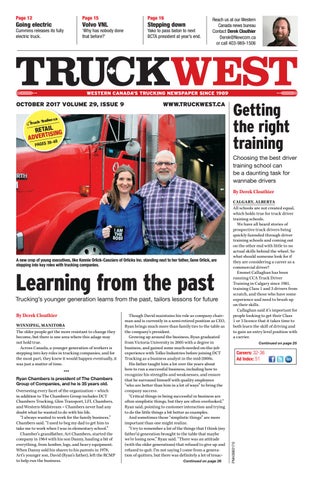
A new crop of young executives, like Kennie Orlick-Casciaro of Orlicks Inc. standing next to her father, Gene Orlick, are stepping into key roles with trucking companies.
CALGARY, ALBERTA All schools are not created equal, which holds true for truck driver training schools. We have all heard stories of prospective truck drivers being quickly funneled through driver training schools and coming out on the other end with little to no actual skills behind the wheel. So what should someone look for if they are considering a career as a commercial driver? Emmet Callaghan has been running CCA Truck Driver Training in Calgary since 1981, training Class 1 and 3 drivers from scratch, and those who have some experience and need to brush up on their skills. Callaghan said it’s important for people looking to get their Class 1 or 3 licence that it takes time to both learn the skill of driving and to gain an entry level position with a carrier.
We are Mack. This is our Anthem.
Introducing Anthem, the next-generation highway truck from Mack. Born of the American spirit, Anthem comes standard with a bold design that delivers serious aerodynamics, and a new interior that keeps drivers comfortable and productive.
Designed for the driver. Anthem’s cab design and sleeper environment are built around the way work gets done, providing the comfort, storage and function drivers need to stay focused on the road.
Anthem’s generous ceiling height lets drivers stand up in the cab and walk right through to the sleeper. Driver model shown at 5'10."
COMMAND THE ROAD
COMFORT FOR THE LONG HAUL
UTILITY FROM TOP TO BOTTOM
Anthem’s intuitive instrument panel and steering wheel give drivers total confidence and control in the cockpit.
A spacious interior and American craftsmanship give drivers the comfort they need to feel at home.
Configure Anthem’s best-in-class storage for as much or as little as you need to store.
Built for your business. Efficient in every sense of the word, Anthem™ saves on fuel and reduces maintenance costs while maximizing uptime—and your bottom line.
By displacing air to the sides, as well as over the hood and roof, Anthem cuts wind resistance and improves fuel economy by up to 3%.
EFFICIENT DESIGN
THE STRENGTH OF A LEGEND
DEPENDABLE SUPPORT
Anthem’s advanced aerodynamics and purpose-built design put function at the forefront and reduce day-today costs.
Anthem runs on our legendary integrated powertrain, combining power with ease of operation from mDRIVE™ and the fuel-efficiency of MP®8-TC.
From parts and service to 24/7 uptime management, Mack takes your business to a whole new level.
4 Truck TTrrruc uucck News Ne ew wss • October Oc O cto tob be er 20 2 2017 017 17
Experience Anthem in virtual reality. MackTrucks.com/NewAnthem
INSIDE THE NUMBERS
Revival realities Western Canada’s fleets looking more optimistically at truck replacements for 2018 Almost three quarters of Western Canada’s motor carriers are planning to update their heavy duty trucks in 2018, according to the results from our just completed annual Equipment Buying Trends Survey. The survey indicates that carriers from the Manitoba to British Columbia are feeling more optimistic about their economic prospects and investing in new equipment. The majority (45%) are looking to replace up to 10% of their fleet.
Percentage of heavy duty fleet anticipate replacing in 2018
Main brand of heavy duty truck currently in fleet
Current trade-in cycle for heavy duty vehicles
0% of fleet
Freightliner
10 years or more
37% of respondents
24% of respondents
12% 21%
12%
45%
4-5 years
20%
8-9 years
19%
10% 6-7 years
Trucking industry sector Other Forestry
56% of respondents
Construction
30% of respondents
5%
0%
Government fleet
Peterbilt
7%
Sterling
0%
Volvo
7%
Western Star
7%
NA
2%
21%
Kenworth
12%
5%
5%
International
7% Lease/rental fleet
Mack
Freightliner
Long haul (600+ km from terminal
9%
43%
Brand most likely to consider when purchasing new heavy duty trucks
Fleet activities
For-hire fleet
Urban
37%
40% Private fleet
of respondents
5%
Kenworth
12%
19%
24%
International
2-3 years 30% or more
Follow Lou on Twitter @LouSmyrlis.
Regional
of respondents
5% 40%
Mack
5%
Peterbilt
12%
Volvo
5%
Western Star
12%
NA
2%
#DeloDrives PERFORMANCE
Introducing the Next Generation of Heavy Duty Diesel Engine Oil
Delo 400 with ISOSYN Advanced Technology ®
®
Up to 35% Better Oxidation Control*
Up to 68% Better Wear Protection*
Up to 46% Better Piston Deposit Control*
Up to 60% Better
Component Durability*
ChevronDelo.com *As compared to previous generation HDMO product test limits.
© 2017 Chevron Canada limited. All rights reserved. All trademarks are property owned by Chevron Intellectual Property LLC or their respective owners.
4 Truck West • October 2017
Contents
ISSN 0700-5016 (Print) ISSN 1923-3531 (Online)
Lou Smyrlis Director Business Development 416-510-6881 lou@newcom.ca Kathy Koras Associate Publisher 416-510-6892 kathy@newcom.ca A. (Tony) Hohenadel Publisher - truckandtrailer.ca 416-614-5800 tony@newcom.ca EDITORIAL Derek Clouthier Editor 403-969-1506 derek@newcom.ca Sonia Straface Associate Editor 416-510-6890 sonia@newcom.ca James Menzies Contributing Editor 416-510-6896 james@newcom.ca DESIGN AND PRODUCTION Carolyn Brimer, Beverley Richards, Michael Chimienti, Tim Norton ACCOUNT MANAGERS Delon Rashid Western Accounts Manager 403-713-1054 delon@newcom.ca Anthony Buttino National Accounts Manager 416-458-0103 anthonyb@newcom.ca Nickisha Rashid National Accounts Manager 416-614-5824 nickisha@newcom.ca Denis Arsenault Quebec Accounts Manager 514-938-0639 ext. 2 denis@newcom.ca
25
ALBERTA
Cover story
Page 11 AMTA holds driver appreciation during National Trucking Week.
Finding the right driving school can be a daunting task.
BRITISH COLUMBIA Page 16-17 Outgoing BCTA president/CEO Louise Yako sits down with Truck West.
26-27
MANITOBA
A new, younger generation is stepping up to the plate.
Cover story
Page 53 MTA holds grand opening of its newly-renovated facility.
30
Cross-border
Tony Jelicic Regional Accounts Manager 416-614-5813 tonyj@newcom.ca
Trump Administration puts brakes on sleep apnea screening.
Doug Copeland Regional Accounts Manager 905-715-9511 doug@newcom.ca
Mark Lee
33
Learning to repair your own truck saves time and money.
35
Paul Beelien Regional Accounts Manager 416-614-5806 paul@newcom.ca
Scott Taylor CRA’s push to go paperless should not result in lack of communication.
Truck West is published monthly by
36
Newcom Business Media Inc.
Roger McKnight Severe weather and its impact on petroleum prices.
Chairman & Founder: Jim Glionna President Joe Glionna Vice - President Melissa Summerfield Director of Circulation Pat Glionna Subscription Inquiries Lilianna Kantor Phone: 416-614-5815 Fax: 416-614-8861 Email: lily@newcom.ca RETURN UNDELIVERABLE CANADIAN ADDRESSES TO: CIRCULATION DEPARTMENT, TRUCK NEWS 451 ATTWELL DR., TORONTO, ON M9W 5C4 PUBLICATIONS MAIL AGREEMENT NO. 40063170 CUSTOMER NO. 4006214 TRUCK WEST is a proud member of the following trucking associations:
MANITOBA TRUCKING ASSOCIATION
SASKATCHEWAN TRUCKING ASSOCIATION
B C T R U C K I N G A S S O C I AT I O N
37
Al Goodhall A lot has changed since 1998, and a lot has stayed the same.
7
18
38
Old dog has some new tricks; small businesses in B.C. can get support.
Rising costs of fuel, labor, and equipment affecting industry.
Steel wheels versus aluminum, each have their benefits.
9
19
Reduced speed limits for trucks won’t work; four-lane highways key to split speed limit success.
How ELDs, and the data they collect, can help your business.
Editorial
Letters
12-13
Electric trucks
Guest column
Sandy Johnson
50 Mark Dalton in… Dalton has a breakdown.
In-brief Smokin’ Gun sets a new record; Train Trailer purchases Canadian Transport Trailer.
15
22-23
Spending some quality time in the new driver-centric Volvo VNL.
In Every Issue
21
Cummins surprises with unveiling of its fully electric Class 7 truck.
Equipment
Marketplace
52 Newland Transport 54 Last Word: Doing business his own way.
Equipment Paccar designs its very own transmission.
October 2017 • Truck West 5
Door becomes unhinged CYPRESS AVE.
Brakes hit the skids MAIN ST.
Jack gets jacked GRANT ST.
You Can’t Be There To Rescue Every Trailer In Distress. But We Can. With Great Dane’s AdvantEDGE program, every trailer emergency is swiftly met with 24-hour roadside assistance. Whether it’s your tires, a mechanical issue or a reefer repair, you can rest assured that your drivers will get the help they need no matter when or where they need it. In addition, our partnership with Love’s Travel Stops gives you access to 425 more service trucks and 245 U.S. locations—getting you back on the road and ensuring the safe and efficient delivery of your goods. Let’s go.
Enroll for free today: GreatDaneTrailers.com /AdvantEDGE
NOVA ENTERPRISES LTD. Truro, NS GLASVAN GREAT DANE Alliston, ON Mississauga, ON Putnam, ON Whitby, ON GREAT DANE OF MONTREAL Montreal, QC GREAT DANE AND THE OVAL ARE REGISTERED TRADEMARKS OF GREAT DANE LLC. 720 DMD 0417
MAXIM TRUCK AND TRAILER Thunder Bay, ON Brandon, MB Winnipeg, MB Prince Albert, SK Regina, SK Saskatoon, SK Calgary, AB Edmonton, AB Vancouver, BC
EDITORIAL Derek’s deliberation
There is no substitute for experience in the engine manufacturing game By now you’ve all heard that Cummins has released a concept fully-electric heavy-duty truck, beating Tesla past the finish line in this market. I was down in Columbus, Ind. for the unveiling in August – so if you haven’t heard the news, turn to pages 12-13 for the full story – and though there was a lot of excitement over the electric truck, Cummins made a point that it was not transitioning to electric trucks, but rather adding the option to its list of offerings, which will continue to include diesel and natural gas. Cummins has been doing this for a long time, and even though the company is not a truck manufacturer but rather the engines that power those vehicles, it knows a thing or two about getting a product to market. The event certainly focused around its Aeos electric truck, but because the company made a point of highlighting that diesel and natural gas was going nowhere anytime soon, some of the grandiose that would normally surround such an
announcement seemed missing. This is not a bad thing, but quite the opposite. I believe the reason I got this feeling during the event – which included a tour of the company’s technical center – is a compliment to Cummins and the work the company has done for nearly a century. Unlike Tesla, there was no hype surrounding the Cummins release of a fully-electric heavyduty truck, in fact, most people hadn’t heard anything about such an announcement. This is not to say that Tesla will not produce a fantastic product when all is said and done – I’d be willing to bet that it will. But what it does show is that the old saying
“actions speak louder than words” remains to be true today. Cummins went out and did its job, which is to meet the demand of the marketplace and offer a product it wants. No hype, no talk, just action. Though Tesla has done well creating a stir around what it plans to create, fact is, it hasn’t shown us anything yet with the exception of speculation and some wellplanned media coverage. And I’d also be willing to bet that the folks over at Tesla are a little miffed that the wily veterans over at Cummins beat them to the punch. B.C. wildfires Media coverage of the B.C. wildfires has lessened of late, but that doesn’t mean help is no longer needed. In addition to those who have been displaced from their homes, or worse, have lost their homes or have sustained significant damage, the Canadian Red Cross through funding from the Province of B.C. is offering a $1,500 emergency grant to eligible small businesses and organizations impacted by the wildfires.
Those that qualify include sole proprietors, partnerships, and franchises, not-for-profit organizations, and First Nations and cultural livelihoods on reserves. Among other criteria, the business must have 50 employees or less, have been in operation on or before July 7, 2017, and have a net income of less than $250,000. Local groups and community organizations can also receive funding through the Community Partnerships Program, which will initially allocate $5 million to support community-driven efforts for recovery and resiliency. Call the small business helpline at 1-855-999-3345 or visit www.redcross.ca for more information. TW
Derek Clouthier can be reached by phone at (403) 969-1506 or by e-mail at derek@newcom.ca. You can also follow him on Twitter at @DerekClouthier.
Mark Your Calendar! SURFACE TRANSPORTATION SUMMIT OCTOBER 11, 2017 International Centre, Toronto, Ontario, Canada surfacetransportationsummit.com
NORTH AMERICAN COMMERCIAL VEHICLE SHOW
SEPTEMBER 25-28, 2017
APRIL 18, 2018
APRIL 19-21, 2018
Georgia World Congress Center, Atlanta, Georgia, USA www.nacvshow.com
International Centre Toronto, Ontario, Canada www.trucksummit.ca
International Centre Toronto, Ontario, Canada www.truckworld.ca
October 2017 • Truck West 7
8 Truck West • October 2017
LETTERS
Dancing on my nerves Dear editor: Your column on reducing speed limits for trucks kind of danced on one of my nerves. This is a lesson of history that you were never told about or had no interest in listening to. You mention the two speed limits for cars and trucks when you were on holidays – where cars can travel at 130km/hr and trucks at 90km/hr., and what joy you had in this concept and Canada should adopt this idea. Surprise…we had that many years ago, like in the ‘60s. It didn’t work then and sure as heck it won’t work now. When cars could do 65mph and trucks 55mph, all hell broke loose when people were losing loved ones and the RCMP were recording a ridiculous amount of accidents and fatalities. The governments at that time decided to make the speed limits for both types of vehicles the same, which reduced the number of accidents that were associated with cars passing trucks, and everyone was happy with this result.
Divided highways are key to success of split speed limits Dear editor: I agree with you on having valid points for an argument to have lower speed limits for trucks on Canadian highways. In the U.S., as you suggest, split speed limits work. Take note, however, that they aren’t on two lane highways. If they were, they would be the biggest cause of congestion and driver frustration for passenger vehicle drivers. This is where impatience kicks in and somebody does something dumb because they are in a hurry.
On a divided highway that has multiple lanes it would work, but an artificially slow speed for trucks wouldn’t because no one would adhere to it. If the speed for passenger vehicles was 110km/hr and trucks were at 100km/hr that could be OK. I think the biggest problem today is that regular driver’s licenses are handed out to some very unqualified people. You would be amazed at the quality of some of the drivers that I see on the road on a daily basis. That is worth looking into as well.
“I think the biggest problem today is that regular driver’s licenses are handed out to some very unqualified people.” And as for the transport driver in your column, there are bad apples in every barrel. Please don’t paint us all with the same brush.
Kyle Reid
If you’re there, we’re there... coast to coast
“It didn’t work then and sure as heck it won’t work now.” One would guess that on your holidays you traveled the Interstate highways I-15, I-10, I-5… all nice four-lane highways where this two speed posting works very well, just like a square dance, “Speeders to the left, slowpokes to the right.” Back in the day, there were no four-lane highways in Canada to speak of, so the one speed limit was the Band-Aid. The only way this can work is if all the highways are four-lane. If a slower speed is to be beneficial to the trucking industry more has to be done, like cutting down a number of hills so trucks aren’t climbing 6% grades all the time – a plus for smaller vehicles as well – straightening out the road so there isn’t a 60 or 70km/ hr curve every couple of miles – which would help reduce excessive acceleration for both types of vehicles – and realistic demands on shippers and receivers as to scheduling so trucks don’t have to drive too fast.
The most trailers. The most locations.
Ready to go when you are! 1 855 327 9757 trailerwizards.com
Dave Patraschuk
October 2017 • Truck West 9
YOU MAY TAKE A BREAK. BUT YOUR DREAMS DON’T. Even on a coffee break, you’re dreaming up ways to grow your business. And you won’t rest until you do. Neither will we. That’s why Shell ROTELLA makes products that help your hard work go further. Shell ROTELLA T6 Full Synthetic Heavy Duty Engine Oil gives you improved protection in extreme temperatures, the engine cleanliness and wear protection you expect from Shell ROTELLA , and up to1.5% in fuel economy savings*. All to help your engine work sun up to sun down, and then some. So you can work harder to bring your dream closer. Find out more at www.shell.ca/rotella ®
®
THE ENGINE OIL THAT WORKS AS HARD AS YOU. *As demonstrated in 2009 on-the-road field testing in medium-duty trucks, highway cycles, compared to Shell ROTELLA® T Triple Protection® 15W-40.
®
ALBERTA
Celebrating drivers AMTA highlights need for more rest areas for drivers in Alberta
The AMTA held a driver appreciation day at the Airdrie weight scales Sept. 7 to celebrate the contributions drivers make to the industry.
AIRDRIE, ALBERTA The Alberta Motor Transport Association (AMTA) held a driver appreciation day in Airdrie, Alta. Sept. 7 in an effort to shine a light on the difficult job drivers do on a daily basis. “Drivers spend time away from their family and homes to provide services to all Canadians ensuring their shelves are stocked and there is food on the table,” said AMTA president Lorraine Card. “Driver appreciation days are important to celebrate those drivers and the work they do daily.”
Meet the new definition of efficiency in long haul trucking The New Cascadia’s are here See us at www.firsttruck.ca
The event was held during National Trucking Week, which begins on the first Sunday of September and celebrates the important contributions made by the more than 400,000 Canadian men and women who transport freight across the country. In the spirit of National Trucking Week, Card highlighted that a key issue facing today’s drivers is a lack of rest stops in Alberta, a concern that will soon become even more urgent. “Currently, there are a number of large vehicles parked on the highway and on on- and off-ramps to accommodate drivers requiring rest,” Card said. “When electronic logging devices are fully integrated into the industry, it will be imperative there are enough rest stops throughout the province, and the rest of Canada. TW
October 2017 • Truck West 11
ELECTRIC TRUCKS
Power move Cummins surprises with unveiling of electric-powered Class 7 urban tractor By Derek Clouthier COLUMBUS, INDIANA Cummins pulled the curtains back on its first fully electric Class 7 demonstration urban hauler tractor Aug. 29, taking a leap forward in the race to offer a zero-emissions electrified powertrain, and potentially stealing the thunder of Tesla, which had promised to introduced its own heavyduty electric truck later this fall. The concept truck design, called AEOS, is a 4x2 day cab tractor that features full high energy Li-ion battery electric power with zero emissions, and boasts a range of 100 miles on a single charge, extendable to 300 miles with an optional engine generator. Current charge time is one hour plugging into a 140 kWh charging station, which Cummins hopes to shorten to 20 minutes by 2020. Intended for vocational applications such as urban delivery, port drayage, and terminal container handling, AEOS comes with a Cummins-integrated electrified powertrain and is built by Roush with a design inspired by Cummins. Julie Furber, executive director of electrification business development for Cummins, said transit buses have been the first to move on the electric powertrain offering, but several other applications are following, such as marine, underground mining, mobile cranes, and material handling. Furber believes there are four market drivers that will dictate how quickly electric-powered vehicles penetrate the industry: the total cost of ownership (TCO) calculation; charging infrastructure being in place; how quickly the technology itself advances; and regulations. “Ideally, you want them all to converge,” said Furber. “So the technology works, the charging infrastructure is in place, the TCO is great, and the regulations are there. That’s the ideal scenario, but we’ll see them moving at different paces and for different markets.” Furber said charging infrastructure is critical, and that the markets most interested in electrified power today fall under the “return to base” umbrella, where vehicles operate within a smaller area, such as the downtown core of a city, and return to their home base at end of day to charge overnight. With the current infrastructure that is in place, Furber said the “return to base” scenario is what is best suited for today, but she is hopeful it will expand in the near future. “I think companies will start to invest and put money in, whether
it’s municipalities or government, or even utility companies that will start moving toward putting charging infrastructure in,” she said. “But I think that will take a little time.” Cummins has not yet made a decision on whether it will get involved in the development of charging infrastructure, but Furber added that it was not its intention to supply charging stations for customers, as there are several companies already addressing the need. As for over-the-road trucks, Furber said several steps need to be taken before that idea comes
12 Truck West • October 2017
Media and other guests gathered for a surprise unveiling of a new electric powertrain from Cummins. to fruition, such as increased energy density in batteries, lower battery costs, and added charging infrastructure. The cost of batteries has reduced over the past five years, but Furber
said prices need to come down even further for electric vehicles to be a viable option for long-haul carriers. In the near future, Cummins will launch a pair of electric vehicles in Montreal, where electricity costs are low.
On October 11th 2017, please plan on joining Canada’s Top Transportation Executives for
SURFACE TRANSPORTATION SUMMIT We have created an agenda that truly addresses the many challenges facing both Shipper and Carrier executives.
KEYNOTE SPEAKER David Segal Co-Founder, DAVID’s TEA
2017 SUMMIT AGENDA X The Donald Trump Effect and The Economy in 2018: What trends will impact your business? X Fast Forward – an inside look at the Future of Transportation X Shipper-Carrier Roundtable X Effective Strategies to Improve the Profitability of your Trucking Business X Bridging the Generational Gap X Best Practices in Developing a Driver Recruitment and Retention Strategy X Major Issues in Transportation Across Canada X Keynote Speaker - How to Build a Successful Business and Brand GOLD SPONSOR
TABLE TOPICS:
X Shipper Carrier Collaboration X Best Practices in Cross-Border Freight Transportation X Best Practices in Recruiting, Developing and Training Top Talent for your Business X Preparing for Changes to NAFTA and Border Policies X How to successfully Navigate a Rail Claim with the Canadian Transportation Agency
SILVER SPONSORS
BRONZE SPONSORS
ASSOCIATION PARTNERS
MORNING COFFEE BREAK SPONSOR
AFTERNOON COFFEE BREAK SPONSOR
LANYARD SPONSOR
“This is not wholesale,” Furber said of Cummins’ electric-powered product. “You’re going to get spots of the country where electricity – because it’s hydroelectricity – is really cheap, so for them the economic payback is already there for some of their applications.” Montreal will see a Class 4 electric pickup and delivery van soon hit the streets, as well as a range-extended transit bus. “There is a lot of interest in Canada,” Furber said, adding she is presently trying to drum up more awareness in Western Canada, having met with Cummins’ regional sales team in the west. Other features of the AEOS tractor include 25-35% faster acceleration than an 11- to 12-liter diesel-powered equivalent vehicle, a 44,000-lb maximum payload, direct
drive/drive by wire with continuous acceleration, low rolling resistance tires, and an aerodynamic design. Srikanth Padmanabhan, president of engine business for Cummins, said the company’s electric vehicles will come in three forms: purely electric; range extended; and a hybrid option. Range extended electric vehicles are powered by a battery, which is recharged by a combustion engine. Hybrid vehicles, on the other hand, use a battery and a combustion engine to move the vehicle. Despite the hoopla around its fully-electric truck, electrified power was not the only topic of discussion during the Cummins media event at its technical center in Columbus. Touting itself as a technology company, Cummins executives provided insight into the company’s direction into the
future and how they were best positioned for that growth. “At this point in time, there is a place for a wide range of technologies, from diesel, to natural gas and electric,” said Jennifer Rumsey, vice-president and chief technical officer for Cummins. “And expect that these technologies will evolve in the coming years. These new technological innovations build on our 100-year legacy of bringing the best solutions to our customers, driving their success and meeting the evolving demands of their industries and markets.” Brett Merritt, executive director of EBU on-highway business, said Cummins has the largest range of on-highway products to offer the marketplace, from a 2.8-liter to 15-liter engine, as well as natural gas, diesel, and electric power-
For more information and to register, please visit
a day of Education & Networking.
www.SurfaceTransportationSummit.com BROUGHT TO YOU BY:
OCTOBER 11, 2017 INTERNATIONAL CENTRE 6900 Airport Road, Mississauga, ON
Mike Ludwick
Ryan Ernst
Chief Administrative Officer, Bison Transport
Supply Chain Partner, Deloitte Inc.
REGISTRATION: 7:00 AM PRESENTATIONS: 8:20 AM SHARP
Justin Yang
Isabelle Hétu
Marco Beghetto
Victoria Armour
Doug Munro
Tracy Clayson
Vice President, HanM Transportation Management Services Ltd.
Program Manager, Trucking HR Canada
VP of Communications & New Media, OTA & CTA
VP of Home Delivery & White Glove Services, Armour Transportation Systems
President and Owner, Maritime-Ontario Freight Lines Limited
Managing Partner, In Transit Personnel Inc.
Ross Reimer
Paul Kudla
President, Reimer Associates Inc.
Regional Vice President, Canada, Volvo Trucks North America
Sylvie Messier CCS, Corporate Transportation & Customs Manager, IPEX
Tim Hindes CEO & Co-Founder, Stay Metrics
Carlos Gomes
Rob Nichols, P. Log
Ray Haight
Eric Warren
Gérald Gauthier
Tony Kermally
Hugh MacDonald
Walter Spracklin
Senior Economist, Scotiabank
Managing Director, Domestic Intermodal Sales & Marketing, Canadian Pacific Railway
Co-Founder & Partner, StakUp Inc.
Vice President Business Development, Hercules
Vice President and Corporate Affairs, RAC
Partner/VP, Freightcom Inc.
Director, Logistics and Distribution, Wajax
CFA, Equity Research Analyst – Transportation Sector, RBC Capital Markets
Robert H. Ballantyne, P.Eng.
Stephen Laskowski
Anna Petrova
John G. Smith
John Tenpenny
President, CTA / President, OTA
Associate Director, Supply Chain,
Editor, Today’s Trucking
Editor, Canadian Shipper
Ian MacKay
John Corey
John Larkin
Transportation Lawyer
Team Leader of Mediation Services, Canadian Transportation Agency
Managing Director\Head, Transportation Capital Markets Research,
Stifel Financial Corp.
President, Freight Management
Ferrero Canada Ltd.
Association of Canada
Kevin Huntsman
Wesley Armour
Mike McCarron
Sean Waters
Brian Abel
Senior Vice President, Mastio & Company
Chief Executive Officer, Armour Transportation Systems
Chairman of the Board, Trucking HR Canada
Director, Compliance and Regulatory Affairs Daimler Trucks North
Freight Network Engineer, KSM Transport Advisors, LLC
America
Robert Armstrong, CITP, CMILT President, Armstrong Trade and Logistics Advisory Services Inc.
Mike Buck
Joy Nott
President, MCB Fleet Management Consulting
President and CEO Canadian Association of Importers and Exporters
trains, and has proven this success with an 80% market share in medium-duty vehicles in North America and over 37% share of the Class 8 heavy-duty market. “Whether it be diesel combustion, emission catalysis, or controls integration, world-renowned technical leaders sit within these two buildings,” Merritt said of those working at the Cummins Technical Center. “We’ll continue to build on this technical expertise, as we’ll invest over US$700 million a year into research and development.” With no intention of putting the brakes on its popular X12 and X15 diesel engines, Cummins plans to unveil a new lightweight X12 in March next year, which, in addition to being plugged as 600 lbs lighter than any other engine in the 10- to 13-liter class, will target regional haul and vocational markets where weight is an important factor. Cummins will also release a new heavy-duty engine in 2022 for Class 8 linehaul trucks. Rob Neitzke, president of Cummins Westport, was on hand to shed some light on the company’s endeavor into natural gas. Starting in 2001 as a joint venture, Cummins Westport has developed approximately 70,000 natural gas engines since its inception. Neitzke said the transition from diesel to natural gas, including investing in a fuel station, is an all-in effort for fleets, but one that could pay off in long run. “You can have electric-like emissions today (with natural gas),” Neitzke said, adding transit bus and mail carrier applications are a good fit for the alternative fuel. “Bottom line for me is that you get electric-like emissions with diesel-like performance.” Padmanabhan underscored that Cummins has been there many times before when it comes to offering new technologies to its customers, and he has seen many of them first-hand. “We introduced diesel engines to the U.S. marketplace when the whole world was with V10 gasoline engines,” he said. “More recently, we have been talking about the emissions solutions business in terms of what we did with growing technology that mattered and we were able to take a leadership position in North American heavy-duty market as well as medium-duty market.” Padmanabhan said there are three key factors that have been contributing to the company’s success: being a technology-driven company; the powertrain leader for its customers; and the intention to capitalize on the emergence of electrified power and vehicle connectivity. “We will do the right thing in terms of making sure the right technology for our customers matter,” he said, “not just technology for the sake of technology.” TW
October 2017 • Truck West 13
BOOST UPTIME.
EVERY TIME.
Since 1927, eet owners have trusted Prestone to boost uptime by protecting engines regardless of their heavyduty demands. For protection against heat, cold, and corrosion, Prestone works!
www.PrestoneCommand.com
EQUIPMENT
Driving the new Volvo VNL Volvo’s driver-centric approach to the design of the new VNL has resulted in a truck that’s incredibly comfortable to operate, and spend time in By James Menzies GREENSBORO, NORTH CAROLINA The smartly designed new Volvo VNL has so many ‘why has nobody done that before?’ features, it’s little wonder that most of them were inspired by professional drivers. But Volvo’s global footprint also contributed to a redesign that’s comprehensively better, with ideas such as a reclining bunk and sway bar, brought to this market for the first time from Europe. I recently had the chance to drive a Volvo VNL 740 on a 65-mile route near Greensboro, N.C., and it was the sway bar and the vastly improved cab ride it delivered that immediately grabbed my attention. With its new VNL series trucks, Volvo has taken the next step forward in cab ride, thanks to the addition of a sway bar offered on trucks with large sleepers. The sway bar is common in Europe, due to the high center of gravity of the cabover trucks preferred there, and their tendency to lean when cornering.
The new VNL was designed with plenty of input from drivers, and you can see evidence of this extensive consultation everywhere. But the sway bar is evidently useful on conventional trucks as well, and provides a noticeable improvement in how cabs with large sleepers perform. I’m surprised Volvo didn’t make a bigger deal out of its sway bar, being the first OEM to bring the technology to this side of the pond. On my recent drive over a combination of Interstate and secondary, twolane roads, the sway bar provided a remarkably smooth ride. This cab simply does not lean. It evened out the bumps, made sharp lane changes feel more controlled, and eliminated the buffeting effect normally experienced when large vehicles pass in the opposite direction. The end result is an amazingly smooth ride, and will ensure drivers who experience a sway barequipped cab begin asking for one. Volvo has made the sway bar standard on VNL-series trucks with large sleepers, but it’s deleteable for those cost-conscious fleets who don’t want to splurge for the improved ride. But it’s a fairly inexpensive feature, and
one that drivers will appreciate – maybe even demand – once they’ve experienced it. In addition to the sway bar, the new VNL also offers better visibility than the truck it replaces, thanks to a hood that better hugs the engine compartment and provides better sightlines to the ground. I drove a VNL 740, powered by a Volvo D13 engine rated at 425 hp and 1,750 lb.-ft. of torque, a typical fleet spec’. I was pulling a loaded flatdeck trailer, with a gross vehicle weight of about 77,000 lbs. The 12-speed Volvo I-Shift automated manual transmission was set up with adaptive gearing, meaning it operated in overdrive while in top gear at highway speeds, and seamlessly dropped down to 11th gear on secondary roads where I got the additional fuel economy benefits of direct drive. It’s a versatile transmission, ideal for running different types of highways or handling a combination of heavy and lightly-loaded – or empty – trips.
Another immediate improvement in the new VNL is the sound quality while cruising at highway speeds. It’s incredibly quiet, thanks to a combination of the low cruising rpms we enjoyed due to downspeeding, and new removable, rubber floor inserts that mute sound from the road and engine compartment underneath the cab.
These new floor mats also make access to the engine compartment much easier; it used to take more than an hour to access the hatch, because the passenger seat had to first be removed. Now, the floor mats can be pulled out, and a technician can access the engine from inside the cab in about 12 minutes. Continued on page 24
THE BEST TANK LEASING EXPERIENCE IN NORTH AMERICA
KEVIN QUICK
VP, BUSINESS DEVELOPMENT, WESTERN CANADA kquick@transcourt.com 1 888-407-3830
20th
anniversary
Chemical
Crude Oil
Food Grade
Hot Products
Compressed Gas
Dry Bulk
FRP/412
Petroleum
Transcourt supplies equipment uipment all across Canada C and the United States. We e have a large fleet flee et of tankers tanke s available a availab ble for for o Petroleum, Crude, Chemical, Food grade / Sanitary, Dry Bulk, Propane/LPG and FRP/412.
www.transcourt.com
October 2017 • Truck West 15
BRITISH COLUMBIA
Moving on BCTA president and CEO Louise Yako moves on to next chapter in her life By Derek Clouthier LANGLEY, BRITISH COLUMBIA After six years at the helm of the British Columbia Trucking Association (BCTA), president and CEO Louise Yako has announced she will step down at the end of 2017. Though she is not calling her exodus a retirement, Yako is transitioning from a full-time position to a less regimented environment. The BCTA has appointed a recruiting committee, headed by chairman Trevor Sawkins, to find Yako’s replacement, and will bring
forward a recommendation later this fall for the person who will replace Yako, expected to commence their duties Jan. 1, 2018. Truck West caught up with Yako to discuss her more than 20 years with the BCTA, and what the next president should expect. TW: Tell us the story of your time with the BCTA...when you started, in what position, progressing through the years to when you took over the role of CEO and president. Yako: I started on Jan. 2, 1996 as manager of government and interagency affairs. In 2000, I became
director of policy and communications and then vice-president in 2008 (I think). I became president and CEO in June 2011. TW: What drew you to the trucking industry in the first place? Yako: It was total serendipity. My goal was to do meaningful work in the public policy arena, but I knew I wasn’t cut out for government and that it would take me years to be able to actually influence government policy. I knew that associations often had a public policy focus, so I thought a business or trade association
A Cool Engine is a Happy Engine. And a happy engine has its benefits: peak performance, more power and less maintenance. Howes Oil Enhancer lowers operating temperature keeping your engine cool. It not only extends the life of your oil – it also reduces metal-on-metal wear and protects internal engine components. Use it at every oil change as part of the ultimate Howes preventive maintenance program.
From the trusted makers of Howes Diesel Treat and Meaner Power Kleaner.
1-800 GET HOWES (438-4693) www.howeslube.com
16 Truck West • October 2017
might be a fit for me. I was encouraged to apply for the position at BCTA by one of my professors in graduate school. I didn’t really think much about the fact that it was in “trucking” – I was more attracted by the description of the work. The ad talked about an evidence-based, thoughtful approach to developing positions, which really appealed to me. TW: How has your passion for the industry evolved over the years? Yako: It’s been stoked by the people I’ve had the privilege to meet and to work with and, in some cases, become friends with – both on the industry side and the government side. Most of the people I have come to know well are down-toearth, practical, resilient, humble, and hard-working. From a public policy perspective, it’s been (and continues to be) a stimulating environment in that the trucking industry is affected by so many different ministries, agencies, crown corporations, and other levels of government. TW: If you had never worked in the trucking industry, what career path would you have chosen? Yako: I think I would have been working in public policy in some capacity. TW: What were your Top 3 achievements during your time with the BCTA? Yako: We very deliberately rounded out and built up our training offerings for members – in terms of content, level, and delivery method. We offer short, on-line, on-demand courses for front-line staff, as well as more traditional in-person courses. In addition, we branched out to offer a certificate course for supervisors and Next Generation Leadership training. We’re doing all of this in partnership with experienced, reputable firms that have the expertise we can’t have in-house. In 2016, we measured our effectiveness by asking government, crown corporations, agencies, and partner organizations how they rated BCTA. This was done by a third-party consulting firm. We were very pleased with the results. In summary, the consultant reported these results: responsiveness: 93%; being a trusted source of information about the industry: 88%; fairness and transparency: 85%; timely and useful communication: 85 %; providing evidence-based recommendations: 76 %. From a public policy perspective, our most far-reaching accomplishment is reform of the National Safety Code (NSC) as it’s applied in B.C. We worked with government
not need it today, but you’ll be happy you have it when something goes wrong. But associations also provide breadth and scope – expertise you might not necessarily have on staff, but want to be able to tap into as well as contacts – by opening doors to people and agencies you don’t have the time to cultivate. On the public policy side, B.C. has a minority government, which is a challenging environment to achieve change. B.C. also is beginning to suffer from a reputation that we’re not “open for business� because there is too much uncertainty in approval processes for major projects. B.C., like the rest of Canada, still relies on the resource sector as a major economic driver. Since the trucking industry is a barometer of the health of the economy, if these projects don’t move forward, our sector will suffer.
to develop about 30 recommendations that touched every aspect of NSC including the application process and standard, the audit standard, and points for contravention. Reform has had a major effect on the number of NSC certificates that are issued and cancelled, as well as the type and number of interventions that take place. TW: Why are those accomplishments important to the industry in B.C.? Yako: There is continual talk about the need for industry to be or become more professional. You can’t develop professionals or a professional culture without rigorous training. We’re offering our members the opportunity to provide quality training to their staff at reasonable rates. BCTA’s main “product� or “service� if you will, is our ability to influence government. BCTA focuses on developing reasonable, evidence-based solutions to problems. If we’re recognized for that by government, and it seems we are judging by our survey, then we will be able to influence government to make needed changes to regulation and legislation. Creating and maintaining a safe working environment is important for many reasons – for employee morale; for reduced injuries and, therefore, costs; for the industry’s public image – but most importantly because it’s the right thing to do. I’m convinced the NSC changes BCTA spearheaded have and will save lives.
TW: Is there something you would have liked to get done before you left that will have to wait for the next BCTA president? Yako: Ask me that question on Dec. 31. I’m committed to getting everything major done before I leave. That said, I do regret that I will not see the first year of the Commercial Driver Training Program in a high school in B.C. get off the ground. That’s slated for 2018.
“I do regret that I will not see the first year of the Commercial Driver Training Program in a high school in B.C. get off the ground. That’s slated for 2018.� TW: What will the next BCTA president have on their plate that will need to be addressed in the next few years? Yako: On the business side, growing the membership and diversifying revenues will always be a challenge. Associations always have to be ready with a good answer to the “value� question. Being a member is very much like buying insurance – you may
TW: Have women become better represented in the industry since you first started, and what more needs to be done on that front? Yako: I’ve never thought in those terms, so I’m not sure that I’m qualified to answer this question. Thinking back 20 years, it seems to me that I do interact more with women, but I’m often still the only woman or one of a few in a room, so we’ve still got a ways to go if you believe the appropriate representation is 50/50. TW: If we were to asked your coworkers to describe you in one word, what do you think that word would be? Yako: I’m not sure I should answer that question, but I will say “firm.� TW: Now that you are semi-retired, what will the average day in the life of Louise Yako look like? Yako: I don’t know, but I’m looking forward to finding out. TW
" ! $ ! ! $
! ! ! ! # !
### $ " October 2017 • Truck West 17
GUEST COLUMN Louise Yako
Rising fuel, labor, and equipment costs affecting trucking companies With National Trucking Week in the rearview mirror, it is important for the industry to continue celebrating its workforce and take a brief bow for the efficient and reliable service it provides to everyone who makes a purchase, visits a hospital or clinic, or puts their garbage out weekly at the curb. We all take part in activities that are made possible or easier because of trucking companies and their employees. Despite the hype around automated trucks, the nuts and bolts of this industry haven’t changed much over the years. However, trucking companies are facing ever-increas-
ing costs, which means even though transportation is a small component of the price of most goods, consumers should expect somewhat higher prices. “Free shipping” is good marketing, but the cost of transportation is buried in the overall price. For trucking companies, costs fall into three broad categories: equipment, fuel, and labor. All of these categories are experiencing increases. The cost of equipment is rising as truck engines become more technologically advanced and emissions-reduction features add additional complexity and weight. Because a truck’s weight is regulated, heavier equip-
18 Truck West • October 2017
ment means it must carry less cargo, which lowers a truck’s productivity and revenue. Maintenance on more advanced equipment is also more time consuming and therefore costlier. Diesel fuel costs continue to increase, although price alone is not the only reason fuel costs add up. Any idling time due to both planned (construction) or unplanned (highway closures) delays raises the cost of transport. Congestion in major centers, where more and more Canadians are choosing to live, is also adding to costs. For example, according to the Canadian Chamber of
Louise Yako is the president and CEO of the BCTA. She started with the trucking association in 1996 managing government and inter-agency affairs, moving to director of policy and communications, then vice-president in 2008 before stepping into her current role in 2011.
Commerce, the Top 20 bottlenecks in Canada (including four in Vancouver) cause commuters to spend an additional 10 million hours per year sitting in traffic. Embedded in that gridlock are trucks trying to deliver cargo. Many trucking companies are spending more time recruiting and training workers, which requires resources. And, electronic logging devices, which are required in the majority of trucks by year end in the U.S. and projected for 2019 in Canada, will record truck drivers’ time more accurately, accounting for every minute of their work day. Even though truck drivers have a generous allotment of work time (14 hours per shift, maximum, in Canada) and driving time (up to 13 hours within that shift), unproductive time like waiting to load or unload, or unexpected delays will shorten a driver’s day. As a result, more drivers and more equipment will be needed to do the same amount of work. Costs are going up for many industries, not just trucking. But trucking is a highly competitive industry that operates on very low margins. In order not to lose business, companies have been poor at communicating cost increases and, historically, have simply handed over any efficiency gains they’ve made to shippers – their immediate customers – and, finally, to us, the end consumers of their services and the goods they carry. The Conference Board of Canada reached that conclusion when it compared the cost of trucking services over time to the price companies charge their customers for those services. However, the opportunity to improve efficiency (through equipment or practices that reduce fuel usage) and mitigate increasing costs into the future is limited. It will no longer be sustainable for the industry to shelter its customers from rising costs in order to retain their business. Instead, trucking companies will need to price their services to better reflect the cost of new equipment, fuel and competitive compensation and training for their workers. And that will affect all of us, as the ultimate beneficiaries of their services. A few extra dollars will be a small price to pay in trade for the many comforts the trucking industry delivers. TW
COMPLIANCE Permits & Licensing
What The Beverly Hillbillies can teach you about ELDs Come listen to a story ’bout a man named Jed, Poor mountaineer barely kept his family fed… If you grew up in the 1960s, you’ll recognize the theme song to The Beverly Hillbillies, the classic TV sitcom where Jed Clampett strikes oil on his land and moves his kin to Beverly Hills. He sets stakes in a mansion right next door to his highfalutin banker, Mr. Drysdale, who is forever scheming to keep Jed and his money from moving back to the Ozarks. I’ve seen a few Milburn Drysdales in the ELD market—people who will say anything to sell their systems. I’ve seen my fair share of Jed Clampetts—fleet managers who are a bit stymied by new technology. But ol’ Jed knew that Mr. Drysdale worked for him, not the other way around, and his straightforward, practical approach to life always worked out for the best. If you’re trying to understand what data is collected and how ELDs can benefit your business, here’s a heapin’ helpin’ of advice for ya. The basics An ELD—electronic logging device—is designed to sync up the
truck’s activity with the driver’s in order to help monitor hours-of-service compliance. There are four basic questions every ELD provider should be able to answer: 1. How do you collect engine and driver data? 2. How do you marry the two? 3. How do you display information in the cab of the truck? 4. How does data get from the truck to a) my dispatcher, and b) law enforcement when requested to send it in? You should also ask how the data gets from the truck to you because there are different ways to do it. Let’s look at the various combinations so you do not have to come up with your own idea of what something is for and how it should work. Hardwired connections These are dedicated fleet management systems with a proprietary display inside the truck where the driver can see and enter his duty status; a physical connection to the engine; a GPS receiver; and a satellite or cellular modem (of Wi-Fi) to transmit data to the ELD vendor’s servers where you can access it anywhere you have an Internet connection.
Wireless connections If you have a smartphone or tablet, you’re probably familiar with Bluetooth as a wireless network. Suppliers that incorporate on a phone or tablet in their ELD will use Bluetooth to move data from the truck’s engine bus (or OBD II) to the mobile device, which the driver also uses to update his duty status. Typically, the smart device sends the engine and driver data over a cell network to the vendors’ servers, where you can log in and see it with a web browser. Who supplies the device and plan? This raises the question as to whether you should supply devices to your drivers or they should bring their own. On one hand, drivers live and die by their cellphones, and they’re more likely to take good care of their own device. But what if they don’t pay their bill or use up their data? If you supply drivers with a “company phone,” you can be sure the bill gets paid and the data plan is sufficient to handle ELD data transmissions—as long as no one is streaming movies or downloading large files.
Sandy Johnson has been managing IFTA, IRP, and other fleet taxes for more than 25 years. She is the author of the free book 7 Things You Need to Know About Fleet Taxes and operates North Star Fleet Solutions, which provides vehicle tax and license compliance services for trucking operations. She can be reached at 1-877-860-8025 or www.northstarfleet.com.
Who has the data? ELDs are meant to improve compliance with hours-of-service rules, which have very different record keeping requirements compared to distance-based taxes. What does your ELD supplier know about IFTA and IRP record keeping? Will you be able to access the data when you need it? The bottom line here is that the relationship between you and your ELD provider should be a longterm one. As Jed once said, “They had a happy marriage; it was all that living together afterwards that caused the trouble.” Keep those lines of communication open. TW
CANADIAN LEADER IN
Aluminum Flatbed Trailers Tel: (418) 728-2415 • Toll Free: (877) 631-2600
www.alutrec.com
UNITS READY FOR IMMEDIATE DELIVERY • 2, 3 & 4 AXLE FLATBEDS • 2 & 3 AXLE STEPDECKS
The Unique Aluminum Flatbed Built For You ... Here In Canada Tom Armes (519) 878-4051 Ontario / Western Canada
Andre Beaulieu (418) 952-1341 Quebec/Maritimes
October 2017 • Truck West 19
ADVERTORIAL
CONNECT THE DOTS TO REAP THE REWARDS:
taking telematics data to the next level
T
he trucking industry runs on fuel, but it rests on data. Mileage, diesel, delivery times, hours – you name it, we probably track it. It’s no surprise that telematics has enjoyed a big rise in the quality and quantity of data over the last few years; what might surprise you is how you’re failing to harness it. Data may be crucial, but it’s not always inviting. When a spreadsheet of telematics information arrives in your inbox, do you give it your undivided attention or let it fall down in the queue? What if that data contained clues to predicting and preventing an expensive loss? Telematics data has a big role to play in your fleet management, but numbers are nothing until they’re compared, considered, and applied in a productive fashion. This is why better benchmarking practices can help your trucking business thrive.
Data patterns, positioning, and performance “Measurement is the first step that leads to control and eventually to improvement. If you can’t measure something, you can’t understand it. If you can’t understand it, you can’t control it. If you can’t control it, you can’t improve it.” H. James Harrington¹ When we work with companies on their safety management systems, we always ask what type of benchmarking they use – how they measure and apply the data available to them. The most common answers revolve around hours of service, or collisions per power unit or million miles. Sometimes we’ll see dollar-zero costing linked to power units or mileage, or “driver’s report cards” to show drivers their individual safety performance in a given time frame. We don’t often see the telematics data considered against, and linked to, data points from non-telematics sources. However, some companies are starting to use this combined data in interesting ways. Looking at telematics data that goes beyond what the drivers are doing, you may discover patterns that could be affecting the company’s overall safety and operational performance.
Finding patterns, finding solutions Patterns are at the heart of better risk management. For instance, if a company was to look closely at their hard-braking frequency and locations, comparing related data to their loss history, they may notice a large loss close to an area with above-average hard brake notifications. A closer look using the street view feature on Google Maps could reveal a very blind corner in the problem area, and the drivers and operation teams may confirm that this is the most commonly used route into a customer’s site. Once a company spots this pattern of poor visibility, frequent use, and significant hard braking, they could conclude that the area is highrisk for truck drivers. While there may be no good way to avoid the route, the company could alert all the drivers to be more aware when heading into the area. Moreover, this exercise can lead the company to review other areas that appear to have a higher frequency of alerts, and investigate the history of incidents at or near those locations. ¹ H. James Harrington, quoted by Joseph I. Levy, CIO, Sept 1999, p. 10
By Dave Nawton
Linked data is powerful data It’s important to look at data in different ways, but don’t stop there – you also need to link it back to your business’ current practices. I’ve heard from company owners that it’s not very helpful to know they have one crash per 12 trucks; they need to know which of those trucks is going to be next. Your data needs to show you the reality of your business operations, but it should also help you predict where and when problems could arise. Working with the safety coordinator to retrieve the data on which trucks were involved in alerts, what the alerts were, and where they were happening can uncover specific information about the likelihood of collision. You may begin to notice patterns relating to the time of day and certain drivers. After comparing that data to loss history and the company’s near-miss log, you can narrow down a shortlist of drivers with multiple alerts, losses, or near misses. Do the drivers work out of one specific terminal? Perhaps they all have the same dispatcher. Upon further investigation, you might find that load planning is too tight. Linking all of this data can quickly improve your company’s operations. Make a few smart changes, and you could very well see the number of alerts drop steadily over the following weeks and months.
Mine your resources Not everyone is going to be an expert in data analysis, but I’ve yet to see a company that doesn’t employ someone who loves digging through numbers to find answers. Locate and engage that person: with some time and the right tools, you might be surprised at what you can accomplish with their help. To determine what data is valid and usable, your company needs to take the time to work out the average number of alerts by unit, driver, and mileage. Once those average baselines are established, the next step is to look for rates above the average, and then consider the who, what, where, when, and why of those higher rates. Search for patterns in the same way you would conduct a root cause analysis. Once you find the answers you’re looking for, engage your drivers, the safety department, and operations staff to arrive at the best solution. Keep in mind that your review may not return conclusive results, but this isn’t an all–or-nothing effort. If one pattern is found, that could lead to one less incident, and that one less incident could represent considerable savings in terms of direct and indirect costs. It can be difficult to accept that you’ll never know whether or not you’ve prevented a loss, but if the process was well-documented, the results were tracked, and the minimum response was deployed, you’ll be able to answer confidently when the loss control representative visits and asks, “Do you benchmark?” Your positive reply could be worth a lot in an insurance review, compliance review, or even in court.
Dave Nawton is Manager of Risk Services, Transportation and Logistics, Western Region, for Northbridge Insurance. For more information about risk management in the truck and transportation industry, please visit www.nbins.com/telematics-trucking
Northbridge Insurance and Northbridge Insurance Logo are trademarks of Northbridge Financial Corporation, licensed by Northbridge General Insurance Corporation (insurer of Northbridge Insurance policies). This article is provided for information only and is not a substitute for professional advice. We make no representations or warranties regarding the accuracy or completeness of the information and will not be responsible for any loss arising out of reliance on the information.
IN-BRIEF
Cooper and Smokin’ Gun set new world record
Gord Cooper and the Smokin’ Gun set a new hot rod world record at 119.34mph. BILLINGS, MONTANA Gord Cooper and the Smokin’ Gun showed trucking fans who was boss Aug. 25-26, taking home two race wins and setting a new world record while they were at it. Cooper won both the hot rod semi class and big rig brackets during the National Hot Rod Diesel Association (NHRDA) 2017 Championship Series Big Sky Truck Fest, setting a new world record in the hot rod category at 119.34mph. In the big rig bracket, Cooper unhooked his tow rig and received his second victory, defeating Mike Keeler in the final round. The event took place at the Yellowstone Drag Strip in Billings, Mon. The NHRDA will head to the Texas Motorplex for the 2017 World Finals Sept. 29-30, and will feature the top competitors in the Hot Shot’s Secret Diesel Drag Racing Series and the NHRDA Diesel Sled Pulling Series. TW
Train Trailer purchases Canadian Transport Trailer CALGARY, ALBERTA Trailer and equipment leasing and rental company Train Trailer has acquired Canadian Transport Trailer (CTT), increasing its dry van, heater, reefer, flatbed, and chassis inventory. Train Trailer will continue to serve its Calgary clients with existing personnel, while Dean and Jeff Kohut of CTT will maintain their operation within a niche, specialized category. “Being part of TIP trailer services gives us the resources to take advantage of opportunities like the CTT purchase,” said Train Trailer president Rick Kloepfer. “We’ve wanted to expand in Calgary and with the Kohut brothers looking to focus on other parts of their business, this was a perfect fit for CTT and Train Trailer. It translates to immediate growth for us and gives Train Trailer a much larger footprint in this major Alberta market.” TW
NOTHING BEATS A DRUM
LIKE A DISC
THE P89 DISC BRAKE SERIES—THE NEW BEAT FOR FLEETS TO FOLLOW.
SAF-HOLLAND—the world’s leader in innovative trailer air disc brake technology—introduces the P89 series. Two models, perfectly timed to meet the beat of your fleet. Disc brakes simply provide better performance than drum brakes. They stop shorter for increased safety and reduce maintenance for lower total cost of ownership.
www.SAF-P89.com
WATCH THE P89 DISC BRAKES VIDEO
New P89 Disc Brakes— Proven Design Quality at the Right Price.
P89 Plus Disc Brakes— Premium Performance Plus Maintenance Free Design.
All at a price point that makes sense for commercial fleets of any size.
Features the INTEGRAL® Rotor/Hub and premium sealed bearings.
The New P89 and P89 Plus disc brake systems can be specified with SAF CBX air and ULX spring ride suspensions.
www.safholland.ca 519.537.3494 © 2017 SAF-HOLLAND, Inc. All rights reserved.
October 2017 • Truck West 21
EQUIPMENT
Paccar debuts proprietary transmission The new Paccar automated transmission completes its powertrain puzzle By James Menzies MT. VERNON, WASHINGTON There’s nothing quite like driving a truck with a completely dialed in powertrain, each component communicating fluently with the others as one cohesive system. And that’s exactly what Paccar has gone to great lengths to achieve through the design of its own transmission, to complete the integration puzzle that until now lacked one of the most critical components. The manufacturer launched its own MX-series engine in 2010 and a 40,000-lb tandem drive axle last year. But the transmission is a
vital piece of the powertrain, which until now, has been sourced from Eaton, and maybe not optimally designed from the ground up to work specifically with the Paccar MX engines and axle. That now has changed. Paccar Powertrain on Aug. 22 took the wraps off its new automated transmission, three years in the making and designed in close collaboration with Eaton engineers, some of whom were embedded at the Paccar Technical Center here, where much of the development took place. But don’t call it an automated manual transmission (AMT),
Paccar officials emphasized. Unlike AMTs, which are typically built upon a manual gearbox foundation with electronics installed to automate the shifting, the Paccar transmission was built from a clean sheet design, to function as a purely automated transmission right from the start. “This was never intended to be a manual transmission and that is significant and key in explaining many of its features,” explained Carl Hergart, director, advanced technology at the Paccar Technical Center. One thing the clean sheet design allowed, was for the reduction of weight. Hergart said the Paccar
®
Over 160 new and u trucks in stock. W sed e have what you need!
The T680 - Kenworth’s most aerodynamic truck ever. • • • •
76” high-roof sleeper ISX or MX engine (455-500 hp) 1650 or 1850 torque Standard or auto transmission
• • • •
13,000lbs front axle 40,000lbs rear axle Bunk heater Nav-plus HD
&KHFN RXW RXU XVHG WUXFN OLQH XS :DUUDQW\ DQG LQ KRXVH ´ QDQFLQJ RSWLRQV DYDLODEOH
INLAND-GROUP.COM
22 Truck West • October 2017
transmission weighs 657 lbs, making it up to 105 lbs lighter than comparable automated transmissions and about 200 lbs lighter than the Eaton UltraShift Plus AMT. It’s a 12-speed design, with the widest gear ratio coverage in the linehaul market, Hergart added, for excellent performance at cruise speed and also low-speed maneuverability. No oil cooler is required, and the oil drain interval has been stretched out to 750,000 miles. When a lubrication change is required, only 16 pints of fluid are required – nearly half that required by AMTs, Hergart said. Working with Eaton, Paccar was able to adopt some of the best features from its existing products, such as a precision lubrication system that was first launched in the Fuller Advantage Series AMT, and neutral coast, which maximizes fuel economy on hilly terrain by coasting down certain downhill grades. The Paccar transmission also employs hill start aid, which prevents rollback (or forward) on hills when the brake pedal is released. Other features carried over include urge to move, which allows the truck to crawl forward when the brake is release – just like a passenger car – and creep mode, which allows for smooth, controlled low-speed backing and crawling maneuvers. But other elements of the transmission are completely new, including the control stalk, which is mounted to the steering column and integrates with the engine brake controls. This is an intuitive, well designed control, and sturdy, too. I got to drive two trucks equipped with the new Paccar transmission along the rolling hills between the Paccar Technical Center in Mt. Vernon, Wash., and Bellingham, about 28 miles towards the Canadian border. I drove a Kenworth T680 with 76-inch sleeper and a Peterbilt 579 with 72-inch bunk. The powertrains were nearly identically spec’d: MX-13 engines rated at 455 hp and 1,650 lb.-ft. of torque, the new 12-speed Paccar automated transmission, and Paccar 40K rear tandem axles. The only difference was the rear axle ratio: 2.64 in the Kenworth for slightly lower cruising rpms, and 2.79 in the Pete. What I noticed on the drive was how well this transmission has been dialed in with the engine, and even active driver assistance systems such
as Bendix Wingman Fusion and its adaptive cruise control. At 60 mph, I set the trucks in cruise and enjoyed the ride. The truck maintained a safe following distance, activating the engine and foundation brakes as required, all while keeping me within a couple mph of the set cruise speed. This was a nice way to drive, once I came to trust the system, which didn’t take long despite some steep grades. I was particularly impressed with the Wingman Fusion’s ability to determine the speed at which vehicles that crossed into my space were traveling, avoiding unnecessary braking when those cars were quick to accelerate out of my way. The transmission itself was easy to use. The control stalk is the
beautifully. Quick, precise shifting, skipping gears with ease. The transmission itself was a nice piece of equipment, but where it really shines, Paccar Powertrain officials said, is in how it’s integrated with the rest of the powertrain. “It’s not about offering an individual component that’s opti-
mized, it’s about offering a system that’s optimized,” explained Patrick Dean, chief engineer, Kenworth. “That’s what this transmission development has allowed us to do.” The MX-13 engine’s available power rating has been upped this year to 510 hp and 1,850 lb.-ft., a
rating the Paccar transmission is approved to handle. Engine enhancements – including new variable speed coolant and oil pumps, and changes to the combustion and air handling processes – have yielded a 4% fuel economy improvement. The new Paccar 40K rear tandem axle contributes another 1% improvement, thanks mostly to reduced parasitic losses resulting from a pinion throughshaft design that eliminated some gearing and reduced energy losses. Laserwelded components reduced the need for bolts, trimming weight, and also reducing oil churn-related losses. The new transmission is available for order in Kenworth and Peterbilt trucks beginning this October. TW
“It’s not about offering an individual component that’s optimized, it’s about offering a system that’s optimized.” – Patrick Dean, Kenworth feature drivers will interact with the most, and it’s very logically designed. A small lever on the end of the stalk can be set to the desired gear. The stalk also serves as the engine brake: pull it down to select your desired stage – first, second, third, or max engine braking. Work the stalk like a paddle shifter for manual gear changes. This is a nice way to handle traffic jams. With urge to move, the truck will creep forward when the brakes are released and you can adjust your speed by manually working through the four lowest gears. Predictive cruise is a nice feature that offers fuel savings by continuously referencing GPS maps of the upcoming terrain, and making minor adjustments to the truck’s speed to best take advantage of the vehicle’s momentum. This can reduce the number of gear changes made by as much as 20%. It will also allow the truck to coast down certain grades to reduce fuel consumption, but won’t allow it to exceed the set cruise speed by any egregious amount. A small yellow wedge appears on the cruise icon to indicate when this feature is at work. It’s very subtle, but can contribute up to a 1% fuel economy improvement. I was pulling a 53-ft. van trailer behind both trucks, loaded to a gross weight of about 77,000 lbs. The transmission handled the job
October 2017 • Truck West 23
EQUIPMENT Continued from page 15
Sway bar provides ultra-smooth ride The new VNL was designed with plenty of input from drivers, and you can see evidence of this extensive consultation everywhere. Power outlets are located all over the place, including atop the dash where drivers tend to store their devices – eliminating the spaghetti effect of cords hanging from the dash to the area below, where power outlets have traditionally been placed. There are even power outlets placed within reach of the upper bunk. Storage trays in the new truck come with removable inserts, making them easier to clean of spills or crumbs. Storage has been added throughout the cab, and a larger 70-inch sleeper has allowed Volvo to increase the size of cabinets, as well as the fridge and freezer. Seven different seats can be ordered in any trim level, with heated, cooled, and massaging seats available. The truck I drove had an NTL heated seat with back cycler, and was very comfortable. Everything about the truck was comfortable. The steering wheel now comes with head tilt functionality, and can be set exactly to the driver’s liking to afford the best sightlines to the new driver information display, as well as general comfort. The adjustability of the steering wheel will allow drivers
of all statures to get comfortable. Some 21 buttons have been placed on the steering wheel, so drivers can access frequently needed controls without taking their hands off the wheel. The leather-wrapped steering wheel itself is comfortable to grasp. Orange stitching gives it a stylish, sporty look. The new dash is less industrial looking than what’s often found in a commercial vehicle, and more automotive-inspired. It’s less cluttered and easier to find the gauges or switches you’re looking for. This interior is nearly infinitely customizable. A modular frame rail allows for the placement of cupholders – big enough to accommodate a large Gatorade bottle, but adaptable enough to firmly grip a small Styrofoam cup – storage bins, or ram mounts. The door panel controls are more automotive-feeling; including the addition of single-touch window down functionality. All interior lighting is LED, and comes in various colors for different tasks – ie., a soft blue light for consulting credit cards or paperwork, and a brighter light for reading. A puddle lamp at the bottom of the door shines down on the area below the steps when the door is opened, so drivers are less likely to slip or step into a puddle when exiting the cab.
24 Truck West • October 2017
The living environment has been completely remodeled, and can be ordered with a dinette set or a reclining bed. The two options can’t be combined at this time, but Volvo hasn’t ruled it out for the future. The reclining bed is a comfortable option for spending time in the sleeper watching TV, reading, or doing work. The dinette set may be preferred by drivers who want a formal dining area and don’t like the idea of snacking in bed. The cab comfort controls have been moved to the back wall of the sleeper, where they’re more accessible from a lying position. The truck I drove had a 70-inch mid-roof sleeper, which was spacious and well laid out. “The living environment was designed to improve a driver’s lifestyle while in the back of the
truck,” Brian Balicki, chief interior designer, told me during a tour of a cutaway cab. When working on the interior design, he and his team consulted thousands of drivers, and also looked to the airline industry for inspiration. A direct result of this collaboration can be seen in the form of airplane-style window shades that can be quickly lifted or lowered, in the place of cumbersome snap-on covers. The new sleeper design also allows customers to spec’ a skylight, an option that wasn’t previously offered. The D13 that powered the VNL I drove was one of the first to feature turbocompounding. It’s a waste heat recovery system that takes heat previously lost out the exhaust stack, and puts it to work powering the truck. It’s not noticeable to the driver, as the additional horsepower generated is used to lessen the load on the engine and improve fuel economy, rather than to add power and performance. Volvo says turbocompounding allows extreme downspeeding, with cruise speeds of 1,000-1,200 rpm and peak torque available all the way down to 900 rpm. This provides up to a 6.5% fuel economy improvement when combined with 2.47 rear axle ratios, compared to a previous generation D13 with no turbocompounding, and 2.64 rear axle ratios, according to John Moore, product marketing manager. The new D13 can be ordered with or without turbocompounding, but you can expect to see about a 3% difference in fuel economy if you choose the TC version. Moore said the D13 with turbocompounding is “the most fuel-efficient engine Volvo has ever produced.” It’s available with either 425 or 455 hp. A new common rail fuel system in the 2017 engines also contributes to the quieter driving experience. Volvo’s driver-centric approach to the design of the new VNL has resulted in a truck that’s incredibly comfortable to operate, and spend time in. Evidence of its consultation with thousands of professional drivers can be found throughout the vehicle. And if fleets are equally attentive to the needs and demands of their drivers, I expect Volvo will sell a lot of these new VNLs. TW
COVER STORY Continued from page 1
Proper equipment vital “I would recommend that a prospective student visit each school they are considering training at to check out the location of the school and its yard, and ask about the types of trucks and trailers the school has available to train on,” Callaghan advised. “Prospective students should ask training schools what percentage of their students are gaining employment in the industry after completing training with them.”
“Carriers are aware that there are many people out there seeking employment who took the minimum hours of training to get their Class 1.” Emmet Callaghan, CAA Truck Driver Training
Bulldog Driver Training that they will be ready, fit and able to drive and not under the influence of any substances. “We don’t say that we can get their Class 1 in 12 hours,” McCulley said, as jus the air brake class takes 10 hours. “No empty promises. We like to do a two-hour evaluation to see where you’re at and then we’ll sit with you.” Though he admitted that price is always a consideration when determining which school to go through, Callaghan would caution against picking a school based on price alone. “For most schools, the hourly rate runs between $100 and $135 an hour for truck time, so often the less expensive courses are just less time behind the wheel,” he said. “Ultimately, prospective stu-
dents need to do some leg work and find out what they need to get from the training they are buying.” Callaghan said he would also look to see if there will be any restrictions on your commercial licence indicating whether you tested on an automatic or manual transmission. McCulley said there remains to be driver training schools that do not properly prepare drivers for a career behind the wheel, and they often come knocking on his door to complete their education, which ends up costing the student even more. He also said business is good at the moment, with several people looking to get their Class 1 licence and head up to Northern Alberta for work. TW
THIS MONTH’S CROSSWORD PUZZLE TW-172 Oct. © 2017 M. Jackson
Answers on page 51
Callaghan said proper equipment and a variety of training programs are an important factor when trying to make a decision on which school to attend, and be cautious of any school that tries to sell you the shortest, cheapest program to get a Class 1 licence. “Carriers are aware that there are many people out there seeking employment who took the minimum hours of training to get their Class 1,” said Callaghan. “However, for the most part these individuals do not make good entry level candidates, as the carrier would have to do a great deal of additional training in-house to ensure they are putting safe and competent drivers on the road, which adds to the cost of hiring a new driver.” Callaghan pointed to CCA’s Advanced Transport Driver Operations Program, which provides 60 hours of behind-thewheel training, as well as 41 hours of classroom courses covering all essential information for new drivers. In Red Deer, Dwight McCulley has been running Bulldog Driver Training with his partner John Umpherson since March 20, but brings seven years of driver training experience while with Cameron Driver Education, which was in business for 39 years in Alberta. Bulldog does a lot of work with oil field, First Nations, immigrants, and Hutterite communi-
ties, training drivers for Class 1, 3, 4, and 5 licences. The school trains on 13- and 18-speed manual trucks, but also has an automatic in its fleet. “We request that they learn to drive an 18-speed,” McCulley said. “Yes, the automatics are coming on strong now, but the thing is, we want them to go out and be able to drive (an 18-speed).” Students do have the choice to take their final road test in the manual or automatic vehicle, and McCulley said some companies are now allowing perspective drivers to test in the automatic, partly because most trucks these days are automatic and they would be driving this type of transmission anyway, but also because it keeps costs down, as there is a $180 permit fee each time a driver takes a final driving test. “All the big guys are all going with automatics,” McCulley said of trucking companies. “Maintenance-wise it’s way cheaper and they can put anybody behind the wheel.” McCulley said training takes anywhere from 20 to 26 hours (plus a 10-hour in-class air brake endorsement), depending on how much experience the student brings to the table, and can often include ridding a seasoned driver of bad habits they have acquired over the years. “Backing up, lane changes, and being aware of people around them,” McCulley said are some of the more common bad habits that he sees in experienced drivers. “When you’re driving a big rig, people in cars have no idea how it takes longer for that vehicle to stop…it’s a long unit. Our trailers are 53 feet long, you have tractor in front of that, that’s another 20 feet on top of that.” Pre-trip inspections are another vital aspect of a driver’s job that gets overlooked at times. “We really focus on that pretrip,” McCulley said. “You’ve got to know what’s happening on that truck and do your walk-around every day and check all your stuff.” McCulley echoed Callaghan’s sentiment that equipment is key to any good driver training school – is the equipment serviced, is it clean, and does the staff fully explain what is expected of the student. He also cautioned against any school that tries to sell a student empty promises. “We do not promise people something and not return,” McCulley said. “Our pass rate is 96% in our cars and trucks.” McCulley said part of the reason for Bulldog’s high success rate is that they establish a contract with those who register for the program
Across 1 8 9 10 11 13 14 18 20 22 23 24
Down
Semi stoppers, sometimes (3,4,6) Great Dane product Driver’s hand protection Canadian police force, briefly (1,1,1,1) Puts the pedal to the metal (6,2) Truck alternator output unit Water-draining road surface inclination Slope-nosed tractor, slangily City street pattern, often Wooden shipping container Home of “Heart of Dixie” tags Moving company; Oakville Canadian HQ (5,3,5)
1 2 3 4 5 6 7 12 15 16 17 18 19 21
’99 -’09 Sterling medium-duty model Rand McNally atlas constituent No throttle engine speed Pre-trip ____ check Neither local nor long haul, delivery-wise Shift lever toppers Nasty winter precipitation CBers asking to chat Used truck buyer’s quest Certain truck tires Home of “The Silver State” tags Aluminum wheel brand Cabot ____, scenic Cape Breton route Carry cargo
October 2017 • Truck West 25
COVER STORY Continued from page 1
Each generation brings strengths to the table ity back then. Always searching for that way to make something work or make it work better, always relentlessly finding a way to keep things going.” Using the financial crises in the 1980s as an example, Ryan said
“I don’t really think anything can replace even a phone call, certainly not a face-to-face meeting,” Ryan said. “The written word can be interpreted in so many different ways, and email exacerbates that problem, whereas with
The Chambers family.
he feels those running businesses in Canada during that time faced tougher challenges than his generation did during the 2008 Great Recession, which for him, was the first eye-opening experience to a legitimate business challenge. “They faced those tasks head on, and a lot of times it was just sheer will and determination that carried some companies through versus others,” Ryan said. “That’s certainly something that I try to remember and keep in the forefront of my mind.” Today’s use of technology is another facet of company management that has changed the way people do business. Though David was always a believer and supporter of new technology, Ryan said things like email and cellphones have offered more mobility to run a business, but he worries too many people hide behind their devices and use it as an excuse to avoid face-to-face communication with customers.
a phone call you can have difficult conversations or you can have positive conversations with people and they certainly understand and appreciate where you’re coming from and you can accomplish a lot more.” *** Kennie Orlick-Casciaro is the operations manager for Orlicks Inc., and she is 32 years old. How Orlick-Casciaro came to find herself in the position she is today was a journey filled with both tragedy and the comforting feeling of coming home. While attending the University of Alberta in Edmonton in the hopes of attaining a bachelor of science degree, Orlick-Casciaro was involved in an ATV accident in 2003, suffering several injuries, including traumatic brain injury, which changed everything for the young student. “I found after attempting a
couple of years of university that learning was very different than before my accident and I had to change the direction that I wanted to go,” Orlick-Casciaro said, who moved back home to Calgary and started working for Orlicks Inc. in the summer of 2006. “It was a hard pill for a young person to swallow, but all things considered it was the best decision for me.” She started working in the warehouse and reception, then moved into customer service and dispatch, and eventually to operations management. But Orlick-Casciaro missed being in school, and talking with her father, Gene Orlick, who had completed the Canadian Institute of Traffic and Transportation (CITT) program, she decided to continue her studies, and is currently working toward her CITTCertified Logistics Professional designation. “I am doing well and feel like I’ve got a little bit of my old self back,” she said, adding that being a new mother to an eight-monthold daughter also poses challenges going back to school and working. “It can be challenging, as working full time and finding time for homework is not always easy, but I’m in the same boat as everyone else in the program.” In addition to motivating his daughter to return to her studies, Orlick-Casciaro’s father has taught her a lot about business and life – don’t sweat the small stuff; put your best people on your biggest problems; surround yourself with positive people; honesty is the best policy. “I am my father’s daughter. I am very passionate, sometimes to a fault,” Orlick-Casciaro said. “I can let both issues and even personalities get to me, which can then lead to having difficulties using your learned skills to manage a
FAST
Kennie Orlick-Casciaro, Orlicks Inc. situation. You can’t reason with unreasonable people and you can’t change what is out of your control. All you can do is focus on the bigger picture by making sure you are using and trusting what you know to work for you, and the rest will take care of itself.” As for differences between her and her father, Orlick-Casciaro believes they come more from their distinct backgrounds rather than the generation they are a part of. Gene comes from a sales background, whereas his daughter more from operations. And their communication styles also differ. “I tend to be a good multi-tasker and Pops is a better delegator,” she said. “Both of those skills can help you, but they can also hurt you, so I think we complement each other in working together.” And work together is something the father-daughter duo do well, which is why Orlick-Casciaro has found more similarities recently than differences. “I’ve learned so much over the
Brought to you by the editors of Newcom Trucking Group, in partnership with Imperial Oil Limited
FORWARD PART III
ADAPTING TO A
DISRUPTIVE FUTURE
DOWNLOAD YOUR FREE COPIES IN THE KNOWLEDGE CENTRES SECTION OF
www.trucknews.com 26 Truck West • October 2017 2
“I am my father’s daughter. I am very passionate, sometimes to a fault.”
last 10 years and I work so closely with him on a day-to-day basis,” she said. “I guess you could say the apple doesn’t fall far from the tree, and I am proud of that.” Being a young woman in the trucking industry can come with its own set of hurdles, and that was no different for Orlick-Casciaro, who had no problem demonstrating her value. “I learned that I had to get a little dirty and earn some stripes in order to gain respect,” she said. “That’s what I did, I put on coveralls, shadowed mechanics and drivers, and learned what they did and helped when I could.” Helping cross-dock trailers, thawing brakes with a tiger torch in -35C weather, taking service calls to fix lights, airlines, and shunting trailers around the yard in the single-axle Mack truck were all part of Orlick-Casciaro’s early days with the company. “Basically anything and everything that would help me learn and allow people to notice that I was here because I wanted to be,” explained Orlick-Casciaro. “I think I even surprised Pops once, coming around the back of the shop with a trailer behind me...I just smiled, hit the horn, and carried on. He hadn’t seen me do that before at that point.” *** Ryan Mitchell is president of Wildwood Transport, and he is 35 years old. With a background in finance and having been with Wildwood for seven years now, working for the family business was not the only option for Mitchell. He had been pursuing a career in the investment banking and private equity field, but in doing so, became intrigued by how that background could help Wildwood. “My brother was very involved in the operations side of the business, so it was a perfect fit to join and bring some expertise in finance, analytics, and strategic
planning,” Mitchell said. Today, along with Mitchell acting as president, his brother, Kevin Mitchell, is the operations manager and each hold a 50% share in the company after purchasing it from their father in 2013. Like any good business person, Ryan has tried to learn what he can from his father, who had an uncanny ability to build and maintain relationships. “He was always positive and knew lots of little personal information about everyone, their families, their backgrounds,” Ryan said. “I always thought I understood, but it wasn’t until working a number of years in the business until I truly appreciated the importance, and the meaning of truly investing in people.” Ryan carries his desire to invest
neurial, acting on opportunities and figuring them out later. “This is definitely more like my brother, which is great for the day-to-day decision making that happens in dispatch and operations,” Ryan said. “I have always been someone who prefers to analyze alternatives, discuss the risks, and make a calculated decision based on logic and sound financial management. Everyone in our office knows I would make a terrible dispatcher.” Over the past few years, Wildwood has become more of a structured office setting when it comes to departments and the roles and responsibilities of each, which Ryan said is quite different than the way his father ran the business. “Neither approach is bad necessarily,” Ryan said, “but my opinion
times figure it out yourself before you can get other people involved. “We’re always looking for the next way to automate a process, or get access to more data and information about our business.” Ryan believes the industry as a whole is making headway into becoming more compliant, and trucking businesses must follow the rules if they are to run legitimately, something he said would have been difficult 25 years ago. Pointing to electronic logging devices (ELDs), Ryan said they may not be perfect, but they do solve a lot of issues. “To run a successful business in this environment, you have now lost the ability to cheat the rules in order to cover up the other inefficiencies of your operation,” Ryan said. “The true good effective operators will thrive in this new world.
“I always thought I understood, but it wasn’t until working a number of years in the business until I truly appreciated the importance, and the meaning of truly investing in people.” Ryan Mitchell, Wildwood Transport in people like a badge, and understands he must make sure he is proactive in that investment with his time, energy, and resources. “This includes training of course, but it also includes having open, candid conversations about performance, sharing your vision for the direction of the business, and even helping work through personal issues that may arise,” he said. “It’s also about listening, trying to understand someone’s perspective and putting yourself in their shoes, rather than being stubborn and spending your time ‘convincing’ rather than working together.” Comparing himself to his father, Ryan said he focuses more on planning, while is father was entrepre-
is that the old way is not sustainable, and doesn’t lend itself well to achieving the consistency that we’re looking for.” Ryan also said his comfort level with technology is much different than his father’s. Though Wildwood was an early adopter of in-cab satellites, software systems and more, things have been kicked up a notch since he and his brother took over. “Where Kevin and I are different from my dad is in the degree to which we have completely integrated every aspect of our business around these technologies,” Ryan said. “It takes 100% commitment to rebuild your business processes around the technology you have. You have to dive right in and often
The cowboys will eventually fail.” It may not be the sentiment you’d hear from generations past, but Ryan is unapologetic for his passion for embracing the future, and making sure his company is ready, an approach his father is proud his two sons have not shied away from. “You have to erase yesterday from your mind, commit to a plan for the future, and work your butt off until you get there,” Ryan said. “There are challenges every day, and (our father) has lived through more years of that than we have, so I think knowing how hard it can be at times, he is proud that we have been committed, don’t take the easy way out, work hard to get to where we want, and most of all, treat people with respect.” TW
THE FUTURE OF TRUCKING: An inside look at the start of a new era Game changing technologies echnologie combined with tumultuous umultuous shifts in workplace demographics will soon graphics w greatly transform m our industry. indus
Find out during an engaging panel session, moderated by Truck West editors, at STA’s Annual General Meeting.
What strategies and practices will Saskatchewan’s motor carriers need to adopt to thrive in the future?
Delta Marriott Regina
October 21, 2017 Presenting Sponsor
Also join us for the 80th GALA Awards Banquet and the theatre style murder mystery, set in the 1930s presented by the Saskatoon Soaps.
To find out more and to register Email: ctaylor@sasktrucking.com • Call: 800-563-7623
October 2017 • Truck West 27
Ever notice that the well-connected always seem to get ahead?
Competitive financing available through Daimler Truck Financial. For the Freightliner Trucks dealer nearest you, call 1-800-FTL-HELP. FTL/MC-A-1492. Specifications are subject to change without notice. Copyright Š 2017 Daimler Trucks North America LLC. All rights reserved. Freightliner Trucks is a division of Daimler Trucks North America LLC, a Daimler company.
Meet your new business associate with all the right connections—the new Freightliner Cascadia TM
®
SM
with Detroit Connect Virtual Technician remote diagnostic service to maximize uptime. Remote over-the-air updates to optimize performance without disrupting the run. And a new easy-to-access portal to view real-time insights into fleet health, fuel economy and safety performance. So no matter where the truck is, it’ll be well-connected for success on the road. To see how the new Cascadia can benefit your business, go to www.freightliner.com.
CROSS-BORDER
Proposed sleep apnea rule canceled Commercial drivers in the U.S. will not have to be screened for disorder to streamline and shorten the process of diagnosing and treating sleep apnea in the transportation industry, the withdrawal is causing even more confusion in the trucking industry. “What we’re finding so far on this side of the border is that fleet managers and drivers are getting confused with the headlines about the proposal withdrawal,� he said. “We’ve actually had some of our driver patients call us and say, ‘I read the news, so does this mean that I don’t have to wear the CPAP machine anymore?’ And we have to tell them no, that the treatment still has to be used and that’s not what the proposal withdrawal means.�
By Sonia Straface WASHINGTON, D.C. The Donald Trump Administration has withdrawn a proposed regulation that would clear up the confusion on how truck drivers should be diagnosed and treated for obstructive sleep apnea (OSA). The withdrawal was announced in early August by the U.S. Department of Transportation’s Federal Motor Carrier Safety Administration and the Federal Railroad Administration. The proposal would have screened truck drivers and train operators for the disorder that has been linked to nodding off behind the wheel. And while some in the trucking industry generally oppose excess regulations in the trucking space, surprisingly, few were against this proposal and many were actually hoping for the rule to go through. According to the U.S. Department of Health, sleep apnea is a disorder that causes one to stop breathing during sleep. These pauses in breath can last from a few seconds to
a few minutes. As a result, the body moves from a state of deep sleep to light sleep as normal breathing resumes. This movement to a lighter sleep, which is often accompanied by snorting or choking sounds, makes sleep apnea sufferers more tired during the day, as they don’t get quality rest each night. Typical treatment for the condition is the use of a continuous positive airway pressure (CPAP) machine at night, which provides the user with continuous air pressure while sleeping. More alarming, a recent study by the American Transportation Research Institute of the American Trucking Associations found that close to a third (28%) of commercial truck drivers have some form of sleep apnea. As it stands in the U.S., everything will remain unchanged for now, since the proposal has been withdrawn. But even though nothing is changing, according to Steven Garrish the senior vice-president of safety and regulatory compliance at SleepSafe Drivers, an organization that helps
“It really would have brought some order to what is generally an unchecked area in terms of driver fatigue.� – Steven Garrish Garrish, who spent more than two decades in the industry as a trucking executive, said that without a clear rule about sleep apnea screening, the process is like the “wild, wild west.� “Without a clear rule, we have found that medical professionals are all over the board,� he said. “Some will send anyone and everyone for testing and others will send none because they don’t even know the signs and symptoms of OSA. There’s so much inconsis-
tency across the board so we felt that a rule in this particular case was a good one. It really would have brought some order to what is generally an unchecked area in terms of driver fatigue.� In fact, Garrish believes that even though sleep apnea is a major risk, it will be and is being eclipsed by the electronic logging device (ELD) debate in the U.S. “It’s unfortunate most fleets don’t know a lot about the rule and the impact this will cause,� he said. “Fleets down here have just been focused on ELDs instead of fatigue, so this rule has really been on the back burner. Now, things will just keep going the way they are and it’ll keep fleets on the sidelines. The end result of this rule not passing will be a continued delay and expense for the drivers, and a continued risk on the roadways.� The only thing that will change that risk of future crashes caused by fatigue would be a “well put together regulation that would level the playing field for everyone,� Garrish said. And until then, he believes the industry will suffer. Brandon Leininger, the director of risk management at American Central Transport, a family-run trucking company based in Kansas City, Mo., agreed with Garrish saying he too was disappointed at the rule withdrawal. “Even though it’s business as usual for now, it would have been nice to have this in black and white,� he said. “I think the industry needs a regulation on this so that it’s standard across the country. Driver health is a huge thing. Certainly, I would like to know if I have a driver who is prone to falling asleep at the wheel, with the potential to Continued on page 51
26th Annual Fleet Safety Council Educational Conference Friday October 20th, 2017 Centre for Health and Safety Innovation 51100 Creekbank Rd., Mississau Mississauga L4W 0A1 Canada
Registration cost: $150.00
Master of Ceremonies: John G. Smith, Editor of Today’s Trucking EARLY BIRD SPECIAL Register before July 31 for A Chance to Win a Flat Screen TV
Download the registration form and agenda at:
www.eetsafetycouncil.com 30 Truck West • October 2017
– Promoting Diversity & Understa Understanding General Inuence in the Trucking Industry – Easy as 123: Creating Memorable Presentation Content Workshop – Medical Marijuana - How do you roll? – Not Legalese but Legal T’s: Legal Panel - Trump, Trudeau, Trials and Tribulations
Discover what more than 900,000 visitors did last year
WE DELIVER
MORE BLOGS
MORE VIDEOS
MORE NEWS
truck news.com
STAY UP TO DATE ON INDUSTRY NEWS, TRENDS AND EQUIPMENT RELEASES Visit the industry's most popular website
T
EC H
IT W U S
• Competitive Rates Plus Benefits • Regional and Long Haul Lanes Available
N
Join one of Canada’s premier transportation companies today and get the pay and miles you deserve!
N O C
Your life Your lane
ASK US ABOUT OUR TRACTOR LEASING PROGRAM
• Assigned d Late L t M Model d l Peterbilt Tractors
Let TransX help drive your success! To apply, visit drivetransx.ca or call 1-877-787-2679 for more info.
OPINION You say tomato, I say tomahto
Doing it yourself Maintaining and repairing your own truck means more time spent on the road As you’re aware, trucking is not a nine to five operation. This has implications on many aspects of both your personal and business life, including trying to schedule routine maintenance of your truck or trucks. It’s not easy to get an appointment with a shop at a moment’s notice, so you try to plan ahead, then Murphy’s Law comes along and all your plans fly out of the window. Is there a solution? Well, yes there is: good old-fashioned DIY. Doing it yourself isn’t for everybody, but for those with a little mechanical knowledge who don’t mind getting their hands dirty, working on your truck can be very rewarding, both in terms of time management and knowing that a job is done right. Let’s cover time management first. Instead of fitting loads around your maintenance schedule, you can fit your maintenance into your work schedule. If you’re approaching your chassis lube interval, you don’t need to take a short run to get back – you just pull into to a truck stop or rest area and pull on the coveralls, break out the grease gun and in less than 30 minutes you can be on your way with a freshly greased truck. You can even do it as part of your pre-trip inspection; not only will this allow you to be more productive, it also gives you the knowledge that the job has been done properly. There is no better way to get to know a truck than crawling around underneath it. When you’re under there, you can check other things that a regular pre-trip will miss: loose or chafing wiring or air lines, and rust streaks that are a telltale of loose bolts and cracks. Spotting these things as they start to develop can significantly reduce cost and downtime, and that is just as important as putting miles under the bumper. Another bonus to this approach is that you will need tools. On the surface, it may appear cheaper to just roll into a shop and pay the $50 for a chassis lube, but the tools you buy will last a long time and in the long run it will be far more economical to splash out in the big boy toy shop. You can also put them down as a business expense and get the relevant tax break on them, so they are a very good investment. What about if you don’t really know what you’re doing? Well, nobody is born with mechanical knowledge; it’s all learned, so learn. You can use social media sites to ask questions. You’ll find groups specific to different trucks, engines, etc. Some have video tutorials, which are useful. You can learn a lot very easily.
One other thing that DIY has an impact on is your bank balance. Every hour you spend on the truck is going to save you at least $100 in labor costs. Add that to less time spent waiting for appointments when you can be out there earning money, and it starts to make even more sense. As I said, it’s not for everybody. You need to do the work properly or you could end up costing yourself a fortune. A grease job is pretty simple, but something that looks easy often isn’t, like changing belts for example. The old worn ones come off with a sharp knife, yet the new ones will need to be threaded
over the fan. This can leave your hands looking as though you stuck them in a blender and if something goes wrong, your only option is a call-out, so you need to feel confident before starting a job. I started driving trucks when they used to fall apart on a daily basis. I was often in a European country where they spoke a different language, so fixing things myself was often my only option. So far, I’ve always managed to get myself home, or to a place where I could get a proper repair, but some of the things I’ve done in the past would land me in hot water with the DOT nowadays. In today’s
A fourth generation trucker and trucking journalist, Mark Lee uses his 25 years of transcontinental trucking in Europe, Asia, North Africa and now North America to provide an alternative view of life on the road.
world, the only way to do a job is to do it right. The idea is to save money and do it properly; just because you can do a job, doesn’t mean you should. Sometimes the best option is to leave it to the professionals. TW
knOws
YOUR TIME IS VALUABLE
And we know home time is precious. So at Hyndman, we make sure your time on the road really counts.
WE Pay fOR ExPerience
You’ve earned the skills, and we reward that.
WE Pay fOR PerfORMANCE
Productivity and safe driving is recognized.
WE PAY FOR Benefits
Starting day 1, we’ve got you and your family covered.
tOP SOLO pAY EARN UP TO
$0.535 / MILE tOP TEAM pAY SPLIT UP TO
$0.65 / MILE
800-499-4997 October 2017 • Truck West 33
“MY WHEELS KEEP TURNING SO I KEEP EARNING.” We know you’re only making money when you’re moving. We help keep you on the road with fuel and tire discount programs, and insurance deductible buy downs. Just three of the reasons it pays to drive with us.
versacold.com/drivewithus
Call or email today!
1 (833) DVR-COLD drivers@versacold.com
versacold.com
OPINION Tax Talk
Inbox or mailbox? Either way, make sure your CRA notices get noticed My, how things have changed. With CRA’s push to go paperless they hardly ever mail out statements or payment forms anymore. They want more contact to happen electronically. Actually, they don’t always do a good job of that, either. For example, we filed a couple’s tax returns on April 30 this year. CRA processed the returns and issued notice of assessments (NOAs). The wife had signed up for paperless notifications and got an e-mail from CRA around May 11 letting her know her NOA was available online. The husband got his paper NOA in the mail a week or so later. It wasn’t until late July that the wife received not an e-mail but a mailed letter from CRA looking for payment of tax owed. Isn’t bigger-better-faster the whole point of electronic correspondence? At least she got a notice. The husband never received anything. They went online on Aug. 1 to confirm their account balances, as obviously 60-some days of interest had been added to their debt. They paid CRA in full through online banking. Neither one received a confirmation of payment or a statement showing zero balances. Nothing. Frankly, I think that’s wrong. I’m all for saving trees by going paperless but that doesn’t mean you should be communication-less. There is no reason for CRA not to send monthly statements or notices through e-mail for those who have signed up for their “e-services.” It’s another reminder that sometimes you have to take matters into your own hands and see for yourself whether you need to resolve a forgotten debt or some other issue. Self-serve online You still have to go online but CRA’s “My Account” services is a good way to see where you stand. With My Account for Individuals you can view your past 11 years of tax returns. You can see information about your personal tax refund, balance owing, and payments on your account; set up or revise banking info for direct deposit of your refund; check your RRSP limits; and get details about any payments from Canada Child Tax Benefit, GST/HST credit, and related programs. You can also change your address and phone numbers so your CRA mailings will update properly.
Business owners can use My Business Account to interact electronically with CRA on their GST/HST, payroll, and corporate income tax accounts. Not sure if your accountant filed your GST/HST return? You can see when it was filed and when the money will be direct-deposited into your bank account once the return has been processed. Now that’s handy information!
“I’m all for saving trees by going paperless but that doesn’t mean you should be communicationless.” You can also file returns, check account payments and balances, view correspondence from CRA, update bank info, request a CPP/EI ruling, and register a formal dispute. Tax preparers can use “Represent a Client” to access almost all of your information once you’ve authorized it. One service that has saved us and our clients tons of time and aggravation is that we are able to get info on tax information slips–T4, T4A, T4A(P), T4A(OAS), and T4E. If you misplace a slip we can simply go download it from CRA.
NOW HIRING
Class 1A Drivers Company & Owner Operators
Here’s another common use of this service: if a client is at the bank getting a loan or re-financing and needs the latest NOA, we access it online and send it electronically or by fax – a huge convenience. In order to use My Account for Individuals or My Business Account, you have to register with CRA and get a user ID and password. You’ll have to provide some personal information, know some details about some past tax filings, and create security questions and answers.
Scott Taylor is vice-president of TFS Group, providing accounting, bookkeeping, tax return preparation, and other business services for owner-operators. Learn more at www.tfsgroup.com or call 1-800-461-5970.
Every time you log on you’ll be asked if you are ready to go totally paperless. I always check “no” but I’m getting there. Hopefully CRA will improve their routines and services. TW
Just Drive Gardewine! Hiring Company & Owner Operators Flat Deck – Linehaul – Bulk – LCV WHAT WE OFFER 10K – 13K Miles/Month Profit Sharing Pension Plan Canada Only Ontario Runs Only Fuel Cards Extended Health Care with STD & LTD RRSP Plan* Deck Mileage Bonus* *Select/Optional
CONTACT RON J. (Toronto) TOM P. (Northern Ontario) MEL B. (Manitoba) RAYMOND B. (Saskatchewan) JIM P. (Alberta)
905-614-1484 705-692-3000 204-631-3705 306-525-1351 403-569-4011
WWW.GARDEWINE.COM/CAREERS
$3500 SIGNING BONUS
Send resumes to johnk@threestartrucking.ca – or – robj@threestartrucking.ca For more information contact John at 306-485-8372 – or – Rob at 306-485-8405 Office: 306-443-2424
October 2017 • Truck West 35
OPINION Petrol Points
The power of Mother Nature affects all things – even petroleum The power of Mother Nature is mysterious and frightening. Hurricane Harvey showed little patience and no mercy for the city of Houston, and the people who are the city. The media coverage of this disaster has been emotionally overwhelming throughout the footage and stories they present, and the heartfelt commentary they paint. So full kudos to them – a rare
gesture on my part because I just don’t kudo. What I find equally mysterious and frightening are the callous and insensitive questions directed my way, in which some, not all, consumers ask with doe-eyed innocence, “Why should this problem in the Gulf of Mexico mean anything to us great white northerners?” In
- JOIN OUR - JOURNEY PNEUMATIC BULK COMPANY DRIVERS & O/O’s NEEDED!
Our Team Wants YOU!
hiring@triline.ca or Fax: 403-723-3333 Requirement: 1-2 years of bulk pneumatic experience @trilinecarriers
other words, “Why are our gasoline pump prices going up when we are refining our crude in our own refineries?” I believe I have run this narrative three times, so here goes number four. By the way, five strikes and you’re out. Pump and rack prices for refined products in this country are not made, fabricated, or colluded in this country, but follow the published for all-to-see rack price changes at benchmark U.S. locations with the partner links as follows: Halifax-NYH; MontrealAlbany; Toronto-Rochester/ Syracuse; Prairies and Northern Interior B.C.-Minneapolis; and Vancouver and Lower Mainland-Seattle. Although Western Canada tends to follow crude more than rack changes, if the U.S. racks move radically, then the emphasis switches from crude to rack prices. If U.S. prices move up or down, why then should those in Canada follow? If prices move up in the U.S., then those in Canada move up as well because if they didn’t then
make more for your miles Siemens Transportation Group Inc.
Hiring Class 1A Drivers for our Cross Border Fleet We Offer: Border Crossing Pay, Company Paid FAST Cards & Great Pay If you are looking to join a busy company with high miles, Edge is what you are looking for! Contact us at driver.recruitment@edgetransport.com or 1.888.878.9585
36 Truck West • October 2017
Roger McKnight is the chief petroleum analyst with En-Pro International Inc. Roger has more than 25 years of experience in the oil industry. He is a regular guest on radio and television programs, and is quoted regularly in newspapers and magazines across Canada.
U.S. buyers would come across the border to purchase gasoline or diesel, creating domestic shortages here and price spikes. Matching the U.S. increase therefore ensures that product remains in Canada with prices not being subject to outside influences. That is what is happening now but to the nth degree – 20% of U.S. refinery capacity is now offline and will be until damage assessment and repairs can be completed. Flooding causes power outages. Refineries need power to pump crude into their refineries and then to pump refined products out into pipelines that also need power to pump these same products along pipelines to market.
“If prices move up in the U.S., then those in Canada move up as well because if they didn’t then U.S. buyers would come across the border to purchase gasoline or diesel…” So, refineries are down and gasoline production is down. This means the two key pipelines that carry gasolines (diesel as well as jet fuel) – the Colonial from Houston to Camden, New Jersey, and the Explorer from Houston to Chicago – are running at reduced rates due to lack of product to ship and questionable power capabilities. This also means that the end and spur point wholesale prices for both lines are spiking, which means all of the U.S. East Coast to New York and Ohio, and all of the Midwest Chicago orbit. And to top it all off, rack and pump prices will move upwards in tandem at mirror geographical locations in Canada. The combined refinery systems in the U.S. and Canada are a highly complex cooperative chain of supply – and right now the linchpin in the chain needs repair. But repair it they will. If Houston has a problem, then Houston will find a way. TW
OPINION Over the Road
The real issues behind the driver retention problem Trucking’s tough and only those who get the ‘bug’ will stick around takes to earn it, you won’t survive. That fact remains the same. Is breaking into this business different than it was in 1998? I’m not sure that it is. I worked for a number of companies in my first four years. The majority of them aren’t in business today. I was hired as an independent contractor for an owner-operator and told after being “hired” that I was financially responsible for any damages and insurance deductibles. As an employee for another carrier, I never received one cent of vacation pay for statutory holidays or otherwise. I had a union job for a car hauler but was laid off four months after starting and never went back. The irony with the union job was that I was referred by my co-workers to a temp agency for drivers, and most of the work was scab work. I continue to hear experiences along these lines from new drivers today. In 2003 with a clean driving record and a wide array of driving experience under my belt, I decided
I’ve been thinking about what’s different in the trucking industry today compared to the autumn of 1998, when I decided to take the plunge into this trucking career. I don’t mean from a hardware or a systems perspective, but from a human perspective. My motivator was money and a steady job. I needed to support my family and dig myself out of a financial hole. I don’t think this basic fact has changed. Most people are attracted to trucking as a source of financial support, but many people find in a short period of time that life on the road is no cakewalk and not worth the money. They never become infected with the trucking bug. I was. If you’ve been driving for more than a couple of years, you have too. Despite all the talk of promoting trucking as a career to young people – that all we need to do is talk it up, dress it up, and call it a profession – it all comes down to money and time. If you like the money but despise the time and effort away from home it
it was make it or break it time. I started a job search and didn’t want to work for any company that didn’t start with an in-depth interview that focused on me. The driver shortage has been constant throughout my career and I was sick of faxing in a resume and getting a response that said: ‘Can you start Monday?’ No questions asked. I don’t think this has changed much either. As drivers, we make our own bed. Most of the time. There are plenty of good companies out there, mostly small to mid-sized, that are run by people with integrity. You have to find a company that is a good fit for you and that you are a good fit for. It takes a little time and it takes a good deal of patience. Building loyalty and trust doesn’t come in the space of a few weeks or months. You may not always succeed on your first try. This definitely has not changed over the past 20 years. There is a lot more corporate trucking now than there was 20
Al Goodhall has been a professional long-haul driver since 1998. He shares his experiences via his blog at www.truckingacross canada.blogspot.com. You can follow him on Twitter at @Al_Goodhall.
years ago. Empires are built by absorbing the smaller companies I described above. That is a definite change. But it is not unique to trucking. That’s a change we’ve seen across our society as a whole. The “all for profit” approach is fueling the adoption of technology that drains a driver’s potential rather than fuel their passion. It’s a dead-end road, in my opinion. The true leaders are passionate about their business, practice good business ethics, are savvy in their business dealings, and treat their employees well. That hasn’t changed. My boss has the trucking bug in his blood. As do I. I’m not going anywhere. TW
Make
a part of your
Total Circulation:
Mailed/Bulk:
18,554*
9,804/8,750
Recruitment Strategy - Leverage Western Canada’s largest audited circulation
– more than 18,500
- Cost effective pricing – pricing starts as low as $303 TERRITORIES
55 / 90
- Value-added Web advertising on trucknews.com
– the industry’s most popular website BRITISH COLUMBIA ALBERTA
MANITOBA EASTERN CANADA
SASKATCHEWAN
ONTARIO
2,813 / 2,235 3,511 / 3,400
200
310
1,582 / 1,305
1,333 / 1,720
WE SPECIALIZE IN RECRUITMENT, TRAINING AND CORPORATE VIDEOS
Call Kathy Koras today 416-510-6892 kathy@newcom.ca
October 2017 • Truck West 37
MARKETPLACE
Reinventing the wheel
and fleet owner and if that driver can afford to spend money on aluminum wheels.”
Wheels are getting lighter, brighter, and smarter
By Sonia Straface The phrase “don’t reinvent the wheel” is a funny term to wheel manufacturers in the trucking industry. Because while some think reinventing the wheel is just an idiom for wasting time, to them, it’s a career. Engineers in the commercial wheel industry have spent decades trying to reinvent what it means to have the best commercial wheel in North America by figuring out how to create a wheel that is lightweight, rust-proof, and can handle the tough job required of it.
Watch your weight It’s no surprise that the biggest wheel trend is the increased interest in aluminum wheels over steel wheels. And the number one reason for that, according to the manufacturers we spoke to, is the weight savings aluminum provides. “The number one trend we are seeing in the market today is the increased penetration of aluminum wheels for tractors and trailers,” said Chris Putz, principal engineer at Maxion Wheels. “And we have seen that trend grow over the last several years and we do see it continuing in the future mainly because aluminum wheels are lighter in weight versus steel, in between 35-40% lighter, in fact.” That weight savings on a typical 18-wheeler can equate to more than 500 lbs on just one vehicle simply by changing your wheels, said Rafael Gonzalez, the director
of international business development at Accuride. “Five hundred pounds is huge,” said Thomas McGann, global marketing director for Arconic, a division of Alcoa Wheels. “If a fleet is able to load to full capacity, then that weight savings of 500 lbs can just be replaced with freight. And if you’re a private fleet, that means you can reduce the number of trips you’re making to haul your freight. If you’re a for-hire fleet, you will automatically have a built-in competitive advantage where you can haul more freight than a competitor who’s using steel wheels. So, from a payload perspective, that goes right to your bottom line. And then if you’re not weight-sensitive or if you’re not loaded to capacity, you get the benefits of the fuel efficiency from the weight loss.” Unsurprisingly, this trend has started a wheel war between manufacturers who are competing to create the lightest – while at the same time, the strongest – wheel possible. “We remove the weight through the aluminum we use,” said McGann. “You can’t take the weight out without doing something different, so we’ve been using a different, proprietary alloy that strengthened the wheel, it allowed us to redesign the wheel – where we’ve shaved aluminum off in many parts making it thinner, making the hand holds slightly bigger, so there’s less material and less weight.” And while aluminum wheels are winning over their steel counterparts, customers do have to pay close to three times as much to reap the weight and fuel savings they provide. So sometimes, fleets still prefer steel wheels. “Steel wheels do make sense in a lot of applications,” said Brandon Uzarek at Accuride. “Especially for use in trailers. But really it comes down to the preference of the driver
38 Truck West • October 2017
Lookin’ good Another reason aluminum wheels win out over steel in the debate is the aesthetics that aluminum provides. Aluminum wheels are brighter and have a better shine and finish on them than traditional steel wheels, which bodes well with proud owner-operators and image-conscious fleet owners. “Drivers like the look of an aluminum wheel a lot more than steel wheels,” said Gonzalez. “And so, having aluminum wheels actually helps with driver retention, something that is a big problem in the trucking industry today. Drivers like to drive trucks that look nice, so having aluminum wheels can help with that.” Putz agreed, adding aluminum won’t rust as easily and become an eye sore on your rig.
“If a fleet is able to load to full capacity, then that weight savings of 500 lbs can just be replaced with freight. And if you’re a private fleet, that means you can reduce the number of trips you’re making to haul your freight.” –Thomas McGann, Alcoa “Aluminum wheels have better anti-corrosive properties than steel wheels would,” he said. “So, you won’t have that red rust on an aluminum wheel like you would on a steel wheel.” Plus, aluminum wheels don’t need as much maintenance to keep that shine. “As far as maintenance is concerned, to combat the rust on a steel wheel, you have to refinish and refurbish that wheel every so often,” said McGann. “And every fleet is different, so some will do it a few times a year…where they’ll strip it down and refurbish it and some are doing it in-house and others are outsourcing it, but even if you’re doing that twice a year, that cost will certainly add up. However, with an aluminum wheel, you don’t have to maintain it that way. If you get the Dura-Bright EVO (Alcoa wheel with a surface treatment) you do not even have to polish it, all it needs is soap and water and it will maintain its shine for the vehicle’s lifetime.” Trading up Aluminum wheels hold their value a lot better than steel wheels as well, added McGann.
“The icing on the cake, as we like to say about aluminum wheels, is that they have a higher resale value than steel wheels,” he said. “It has been estimated that when you go to sell aluminum wheels, you will get 75% of what you paid for them back. And today the education of fleet owners and drivers is much higher and they recognize that spending that extra money on aluminum wheels will benefit them when they go to sell, and that’s why you’re seeing the doubling of the penetration rate of aluminum wheels in the marketplace. That resale value is driving it.” Get smart Looking into the future, Maxion knows that all things are moving to the cloud and online, and this includes wheels. In late 2016, the company revealed the trucking industry’s first connected wheel, dubbed MaxSmart. MaxSmart combines the company’s steel wheel with sensor technology to capture and communicate wheel data to the driver and fleet manager. “Our MaxSmart project supports the kind of mega-trend in the trucking industry of connectivity,” Joe Wolf, the manager of global advanced engineering at Maxion Wheels said. “In so much a way that it is a connected wheel. It would be a wheel that can communicate back and forth with the vehicle it is mounted to. It will apply critical informational to the truck to help it make better decisions on its most optimal operating condition. MaxSmart will make intelligent decisions on what to do, such as adjusting the brakes.”
According to Maxion, MaxSmart will help fleets and drivers prevent accidents and collisions as well as avoiding expensive wheel and vehicle repairs. Wolf said the connected wheel is still in its testing and prototype phase, and the launch date is not yet decided. However, Wolf hinted that MaxSmart’s roll-out will be “in conjunction with a vehicle roll-out.” TW
October 2017
Visit us at the North American Commercial Vehicle Show (NACV) Atlanta, GA • Sept 25-28, 2017 • Booth #850
MAC – Alliance Facility 800-795-8454
Service Department 800-297-7986
MAC – Salem Facility
MAC LTT – Kent Facility
Parts Department
MAC LTT – Billings, MT
855-884-2252
800-647-9424
www.MACtrailer.com
855-662-2588
406-252-7163
39
40
October 2017
TMTV • Easy Financing • Sales/Leasing • Truck Equipment • Parts & Service
NEW & PRE-OWNED EQUIPMENT
2017 LODE KING STEEL B-TRAIN FLATDECK
LODE KING’S FAMILY OF FORCELINE STEEL FLATBEDS WERE DESIGNED FOR TOUGHNESS, DURABILITY AND YEARS OF DEPENDABLE SERVICE. AVAILABLE IN NORMAL CONFIGURATIONS FOR GENERAL FREIGHT AS WELL AS EXTREME DUTY AND COIL HAULING APPLICATIONS WHERE SPECIAL DESIGN CONSIDERATIONS MUST BE TAKEN INTO ACCOUNT. -1256950
2017 MIDLAND SLX3 END DUMPS A FULL FRAME END DUMP TRAILER, THE SLX FEATURES A SMOOTH CONCAVE FLOOR FOR ENHANCED STRUCTURAL INTEGRITY WHILE USING LIGHTER GAUGE STEELS FOR REDUCED WEIGHT AND LOWER CENTER OF GRAVITY. INTRAAX 25K AIR RIDE, TARP, MUD FLAP PACKAGE, SELF-ADJUSTING GATE TRIP MECHANISM, AND MORE.
-1256946
-1256945
2017 LANDOLL DETACHABLE AG TRAILERS
835D AG DETACHABLES FEATURES 32' OF USEABLE DECK SPACE WITH AN INNOVATIVE FOUR-BEAM FRAME AND HYDRAULIC GOOSENECK TO SAFELY LOAD AND LEGALLY TRANSPORT TODAYS HEAVY, OVERSIZED EQUIPMENT. OPTIONAL FLIP THIRD AXLE IS AVAILABLE TOO. -900804
WINNIPEG: BRANDON: REGINA: SASKATOON: LLOYDMINSTER: LETHBRIDGE:
1-800-282-8044 1-866-883-6120 1-800-552-8044 1-800-772-4599 1-800-661-9709 1-866-865-3962
CALGARY: RED DEER: EDMONTON: GRANDE PRAIRIE: LANGLEY, BC:
ACT NOW AND GET $250 OFF ALL WESTERN SNOWPLOWS AND SANDERS INSTALLED IN OUR SHOP OR $150 CASH-N-CARRY DISCOUNT. PLUS, NO-MONTHLY-PAYMENTS FOR 90 DAYS! LIMITED TIME OFFER. CALL YOUR LOCAL FGI BRANCH FOR DETAILS. -1256951
1-800-661-3126 1-866-297-0022 1-800-663-9366 1-866-424-5479 1-800-663-4115
Search FAST Online
Thousands of new & used trucks and trailers can be found quickly online!
New online episode every Thursday www.trucknews.com/videos/
500,000+ views
Follow us
October 2017
41
RYDER’S FALL SPECIAL 2011 Chevrolet 3500, 16’ Cube Vans, Duramax Diesel Engine, Auto Transmission, Ramp, 134 Km’s, from $22,999
2012 Ford F450, 16’ Cube Vans, 6.7L Diesel, Auto Transmission, 4.3 Ratio, Ramp, 224 Km’s, from $34,499
2012 Freightliner Cascadia Highway Tractor Condo Sleeper, Detroit Eng., 505 HP, Autoshift Trans; 12 and 40 Axles, 3.90 Ratio, Air Ride Susp; Wheelbase 228 inches, Full Lock Ups, 980,000 Km’s, from $49,500
2010 Freightliner Cab and Chassis, M2 106, ISC Cummins Engine 330 HP, 6 Speed Auto Trans, 265,000 Km’s, Air Ride Susp, Cab to Axle 150 inches, Wheelbase 216 inches, 54,000 lb GVW from $49,800
2 YEAR ENGINE AND AFTERTREATMENT WARRANTY INCLUDED ON EVERY RYDER CERTIFIED INTERNATIONAL TRUCK
ryderusedtrucks.ca 1.888.995.2459 Ryder and the Ryder logo are registered trademarks of Ryder System, Inc. Copyright ©2017 Ryder System, Inc. Ever Better is a trademark of Ryder Systems, Inc.
Full Maintenance History Flexible Financing
42
October 2017
SURFACE TRANSPORTATION SUMMIT
R U O Y MARKNDAR CALE ing n on join Please pla ountry’s top the c N AND ORTATIO TRANSP EXECUTIVES G of SHIPPIN for a day N NA D EDUCATIO RKING NETWO
R CTOBE
O
#sts17
2017
11
Trailer & Truck Parts & Service
New And Used Trailer Sales & Leasing
WE’VE GOT WHAT YOU’RE LOOKING FOR
1-866-599-3533 VISIT OUR NEW WEBSITE: WWW.FLEETSTOPTRAILERS.COM
REFRIGERATED TRAILERS
FLATBED TRAILERS
SPECIALIZED TRAILERS
DRY VANS CALGARY
8010 - 44th. ST SE CALGARY, AB T2C 4L2
AT T US VISI NEW OUR TON ON EDM NCH BRA
EDMONTON NEW
18410- 118A AVE. AND 3904 - 78 AVE. EDMONTON, AB
SURREY
WINNIPEG
17276 - 104A AVE. 1650 OAK POINT HWY. SURREY, BC PO BOX 18 WINNIPEG, MB V4N 5M3 R3C 2E6
BELLY DUMP
ED & US NEW TORY N INVE OCK! IN ST
TAG TRAILERS GRANDE PRAIRIE 8401 - 99TH ST CLAIRMONT, AB T0H 0W0
END DUMP
DROP DECK TRAILERS LETHBRIDGE
KAMLOOPS
4005 - 9TH AVE N. 575 ATHABASCA ST. KAMLOOPS, BC LETHBRIDGE, AB V2H 1C5 T1H 6H6
October 2017
Kenworth Dealer Serving the Canadian Prairies & Beyond Manitoba Dealer Permit # 0471
Great Selection of New Trucks!
2018 KENWORTH T370 PACCAR ENG; 6 SPD TRANS; TANDEM AXLE(S), 5.57 RATIO, HENDRICKSON SUSP; WHITE IN COLOR, CIM BROWN 20' GRAIN BOX, ELECTRIC ROLL TARP, ELECTRIC CHUTE OPENER /W REMOTE CONTROLS STK#JM989779. -874033
2018 KENWORTH T880 PACCAR ENG; MX-13, 455 HP, 13 SPD TRANS; 12.5K/40K AXLE(S), 3.70 RATIO, AG400L SUSP; 189" WHEELBASE, WHITE IN COLOR, STK#JJ992041. -927090
2018 KENWORTH W900L 62" ACFT SLEEPER, CUMMINS ENG; X15, 565 HP, 18 SPD TRANS; 3.91 RATIO, 13.2K/40K SUSP; 244" WHEELBASE, GREY IN COLOR, 62" ACFT SLEEPER, BLACK DIAMOND INTERIOR STK#JJ991214. -1256300
2018 KENWORTH T680 76" MID ROOF SLEEPER, PACCAR ENG; MX-13, 510 HP, 13 SPD TRANS; 12.5K/40K AXLE(S), 3.55 RATIO, AG400L SUSP; 217" WHEELBASE, BLUE IN COLOR, 76" MIOD ROOF SLEEPER, GRAY VANTAGE INTERIOR STK#JJ991226. -1216647
Manitoba Doepker Trailers Sales: Contact Brandon or Winnipeg Locations
2017 NEVILLE STEEL DROP-FRAME/STEP-DECK FLAT 255/70R22.5, STK#HK175568. -944414 $46,000
2004 DOEPKER STEEL SUPER B HOPPER DUMP/TRAINS 11R22.5, BLUE STK#1016335. -1114262 $40,000
2015 DOEPKER 40 TON SCISSORNECK TRIDEM 52' ROLL-OFF TRAILER 275/70R22.5, KICKER ROLLER AND BEAVERTAIL,LOCATION: BRANDON, MB STK#SN17008. -693683
2016 DOEPKER IMPACT END 34' DUMP BODY, 11R22.5, LIFT AXLE MANAGEMENT SYSTEM, SEALED END GATE, STK#SG19314. -995436
Used Trucks
2008 MACK CXU613 60" MID RISE SLEEPER, MACK ENG; MP8, 485 HP, 18 SPD TRANS; 4.11 RATIO, 208" WHEELBASE, RED IN COLOR, 60" MID RISE SLEEPER, 11R22.5 TIRES, ALUMINUM WHEELS 991,001 KMS, STK#8N002567. $37,500 1119913
2013 KENWORTH T660 72 ACAD RAISED ROOF SLEEPER, PACCAR ENG; 455 HP, 18 SPD TRANS; TANDEM AXLE(S), 3.73 RATIO, AG 400 SUSP; BLUE IN COLOR, 773,724 KMS, STK#DJ964134. -874028 $59,900
2015 KENWORTH T800 FLAT TOP SLEEPER, CUMMINS ENG; 550 HP, 18 SPD TRANS; TRI AXLE(S), 4.3 RATIO, NEWAY SUSP; WHITE IN COLOR, TRIDRIVE, 318,843 MILES, STK#FJ976972. $149,000 874027
2009 PETERBILT 386 DAY CAB WITH NEW 20FT GRAIN BOX WITH ELECTRIC TARP AND REMOTE, PINTLE HITCH WITH AIR AND ELECTRIC. NEW PAINT THROUGHOUT, VERY CLEAN UNIT. CAT 470 HP, AUTOSHIFT TRANS 1,449,859 KMS STK#9D788489. -1192424 $79,900
Full List of Used Inventory 2015 KENWORTH C500 45 Ton Manitex Crane, Twin Steer, 42 Modular Sleeper with Gray Interior, Call for all the details on this great truck. 2015 KENWORTH T800 Tri-Drive, 4.5 T&E Pump w/ 2 Manual Bypass, Black Splendor Interior, Moose Bumper 2015 KENWORTH T680 Day Cab, Ratio 3.91, 4 Way Locks 2014 KENWORTH T680 76 ACAD Sleeper, Gray Vantage Interior 2014 KENWORTH W900 72 ACAD Sleeper, Gray Diamond VIT Interior. Consignment Truck 2013 KENWORTH T660 72 ACAD Sleeper, Blue Diamond VIT Interior, Moose Bumper,Super 40 rear ends with full locking differentials 2013 FREIGHTLINER CASCADIA 125 60 Mid Rise Sleeper 2008 MACK PINNACLE CXU613 60 Mid Rise Sleeper 2015 KENWORTH T800 Tri-Drive, 4.5 T&E Pump w/ 2 Manual Bypass, Black Splendor Interior, Moose Bumper 2015 KENWORTH T680 Day Cab, Gray Interior, 4 Way Locks 2015 KENWORTH T370 Day Cab, Gray Pinnacle Interior, CIM Gravel Dump Box, Pintle Hitch, Allison 3000RDS Transmission. Consignment Truck 2015 KENWORTH T800 Very clean well maintained heavy spec double bunk sleeper, this truck is CTS Kenworth Certified and has gone through multi point inspection, fully serviced and fresh DOT safety. Finance available OAC. Additional limited extended warranty available
2015 PETERBILT 389 2014 KENWORTH T680 76 ACAD Sleeper, Gray Vantage Interior 2014 KENWORTH T680 76 ACAD Sleeper, Gray Splendor Interior 2013 KENWORTH T660 72 ACAD Sleeper, Blue Diamond VIT Interior, Super 40 rear ends with full locking differentials 2013 KENWORTH T660 T660 72 ACAD, Blue Diamond VIT Interior.Super 40 rear ends with full locking differentials 2013 KENWORTH T660 72 ACAD Sleeper, Blue Diamond VIT Interior, Moose Bumper, Super 40 rear ends with full locking differentials. Financing Available O.A.C. 2013 KENWORTH T800 62 ACAD Sleeper, Black Splendor Interior, 10 Speed Autoshift Transmission. Consignment Truck 2013 KENWORTH T680 76 ACAD Sleeper, Gray Diamond VIT Interior. Consignment Truck 2013 KENWORTH T660 72 ACAD Sleeper, Gray Splendor Interior 2012 FREIGHTLINER BUSINESS CLASS M2 112 Day Cab, Gray Interior, Dump Box 2012 FREIGHTLINER BUSINESS CLASS M2 112 Day Cab, Gray Interior, Dump Box 2012 FREIGHTLINER BUSINESS CLASS M2 112 Day Cab, Gray Interior, Dump Box 2009 PETERBILT 386 with new 20FT grain box, Cat C13 470, Eaton 13 speed ultra shift automatic, ,40,000 rears. Unit has a 20 ft grain box with electric tarp and remote, Pintle hitch with air and electric, new
paint throughout, very clean unit. Farm Credit finance available OAC, call for more info 2009 PETERBILT 386 with new 20FT grain box, Cat C13 470, Eaton 13 speed ultra shift automatic, ,40,000 rears. Unit has a 20 ft grain box with electric tarp and remote, Pintle hitch with air and electric, new paint throughout, very clean unit. Farm Credit finance available OAC, call for more info 2009 PETERBILT 386 63 Ultra Sleeper, Prestige Interior 2009 PETERBILT 386 with new 20FT grain box, Cat C13 470, Eaton 13 speed ultra shift automatic, ,40,000 rears. Unit has a 20 ft grain box with electric tarp and remote, Pintle hitch with air and electric, new paint throughout, very clean unit. Farm Credit finance available OAC, call for more info 2009 MACK PINNACLE CXU613 Heavy spec day cab with 18 speed auto shift transmission Finance available OAC Additional limited power train warranty available. 2008 MACK PINNACLE CXU613 60 Mid Rise Sleeper 2007 KENWORTH W900L Super 40's, 72 ACAD Sleeper, Gray Diamond VIT Interior, Beacon Lamps Consigned Truck 2007 WESTERN STAR 4900EX 2006 KENWORTH T300 T300 White Dump Box w/ Flip Tarp, Allison 3000 RDS Transmission, Gray pinnacle Interior 2004 PETERBILT 330 Plow Attachment &11 ft Dump Box, Low Mileage, Cat C-7 275 hp Allison MD3066 Automatic 6 speed Transmission
BRANDON
ESTEVAN
WINNIPEG
REGINA
1240 Highland Ave.
89 Escana St.
357 Oak Point Hwy
520 Park Street
1-888-979-5692
1-866-332-2121
1-888-979-0957
1-888-979-0394
Dave Mantei - New/Used Sales Cory Nakonechny - New/Used Trailers & Used Truck Sales Todd Border - Bus. Mgr.
TRUCK PARTS & SERVICE CENTER Lenny Janz - New/Used Sales
Jim Bednar, Andy Willerton, Richard Prokopich - Sales Bryan Johnson – New Truck Mgr. (MB) Todd Border – Bus. Mgr.
SASKATOON SWIFT CURRENT 2410 Northridge Drive
175 Industrial Dr.
1-888-979-2615
1-888-297-8191
Bob Wirtz, Lenny Janz, Chad Kemp, Guy Tatlow, Erin Found - Sales Vince Boechler - Sales Gordon Wood - Bus. Mgr. Gordon Wood - Bus. Mgr. Bert Downton - Regional Used Truck Mgr (SK & MB)
WWW.CUSTOMTRUCK.CA
Erin Found - Sales Gordon Wood - Bus. Mgr.
43
44
October 2017
2017 MACK CXU613 HIGHWAY TRACTOR 60" MID-RISE SLEEPER, MACK ENG; 505 HP, AUTOSHIFT TRANS; 46,000 LBS AXLE(S), AIR RIDE SUSP; SILVER IN COLOR.
Tom Cameron
Stuart Rude
Jon Whalley
ALSO: 2017 MACK CXU613 SUPER B SPEC SLEEPER TRACTORS
Harman Brar
505HP, 12SPD MDRIVE, 46,000LB MERITOR REAR AXLES W/FULL LOCKERS. DELUXE LOADED INTERIORS WITH ALL OPTIONS. 1207688
CALL FOR PRICING AND FURTHER DETAILS
2014 MACK CHU614 TRI-DRIVE DAYCAB TRACTOR 2018 MACK CXU613 HIGHWAY TRACTOR 70" HI-RISE W/BUNK SLEEPER, MACK ENG; MP8505C, 505 HP, 12 SPD TRANS; 3.56 RATIO, 227" WHEELBASE, WHITE IN COLOR, KEYLESS ENTRY, AM/FM, CD, MP3, COBRA CB RADIO, 40 LITRE FRIDGE, 12,000 LB FRONT AXLE, 40,000 LB REAR AXLE, STK#50451, 50452. -822788
2018 MACK GU813 DUMP TRUCK MACK ENG; MP8-505, 505 HP, OTHER TRANS; 3.58 RATIO, 209" WHEELBASE, WHITE IN COLOR, GRAVEL TRUCK STK#50447. -869855
2016 MACK CXU613 HIGHWAY TRACTOR 70" HI-RISE SLEEPER, MACK ENG; MP8-445C, 445 HP, 3.36 RATIO, 212" WHEELBASE, WHITE IN COLOR, 12,000 LB FRONT40,000 LB REAR AIR RIDE SUSP769,733 KMS, STK#90115. -1213515
0 $97,50
MACK ENG; 505 / 1850 FT LBS HP, AUTOMATIC TRANS; 14,600 / 69,000 AXLE(S), 3:73 RATIO, TRI-DRIVE HENDRICKSON 69,000 AIR-RIDE SUSP; 260" WHEELBASE, WHITE IN COLOR, IMMACULATE CONDITION, SOLD AND SERVICED HERE WITH ALL RECORDS AVAILABLE. MANY RECENT REPAIRS INCLUDING NEW CYCLINER HEAD AND INJECTORS JUST COMPLETED WITH NO MILEAGE! MACK ENG AND EMISSIONS EXTENDED WARRANTY TO 805,000 KMS! NEW B.C. MVI CERTIFICATE! 751,000 KMS. -502396 $62,500
2012 KENWORTH T800 HEAVY-HAUL TRACTOR 62" MIDRISE DELUXE SLEEPER, CUMMINS ENG; 525 HP, 18 SPD TRANS; 12,000 / 46,000 AXLE(S), 3:90 RATIO, 46,000 AIR-RIDE SUSP; 227" WHEELBASE, BLUE IN COLOR, EXCELLENT COSMETIC & MECHANICAL CONDITION! REBUILT ENG UNDER CUMMINS WARRANTY @ 380,000 KMSDELUXE BUTTON TUFT INTERIOR, DOUBLE LOCKERS, 22,5 RUBBER ALL 80% NEW BC INSPECTION, 802,000 KMS. -502394 $76,500
2015 MACK GU714 TANK TRUCK MACK ENG; MP8, 425 HP, 18 SPD TRANS; 20/50 AXLE(S), AIR RIDE SUSP; TRUCK HAS AN ADVANCE ENGERING PRODUCTS 22,500 LITRE/ONE COMPARTMENT DIVIDED INTO TWO SECTIONS ALUMINUM TC407 CHASSIS MOUNTED TANK. STOCK #50039 -101662
2017 MACK GU713 GRANITE B.C. TANDEM TANDEM CONCRETE MIXER
2014 MACK CXU613 HIGHWAY TRACTOR 60" MIDRISE SLEEPER, MACK ENG; MP8-445, 445 HP, 18 SPD TRANS; WHITE IN COLOR, 12,000 LB FRONT40,000 LB REAR, AIR RIDE SUSP; MOOSE BUMPER, GREY/BROWN INTERIOR, POWER WINDOWS 774,065 KMS, STK#90113. -1213510
2018 MACK CXU613 HIGHWAY TRACTOR 48" FLAT TOP SLEEPER, MACK ENG; MP8-445C, 445 HP, 12 SPD TRANS; 3.40 RATIO, WHITE IN COLOR, FRONT AXLE 13,200 LB, REAR AXLE 40,000 LB, STK#50414. -751691
MP7-405 HP, FULLER RTLO16909LL, DUAL 20,000 FRONT AXLES, MERITOR RT46-164EH ON HENDRICKSON HAULMAX WITH DUAL LOCKERS, LONDON BRIDGEMASTER (3) MIXER …..IN STOCK AND AVAILABLE IMMEDIATELY QUALIFIES FOR FREE 5 YEAR ENGINE & EMISSIONS WARRANTY. -455755
0
$38,00
2017 MACK MULTICAT MC-15 AGGREGATE SPREADER
2015 VOLVO VNL64T 670 HIGHWAY TRACTOR 70" HI-RISE SLEEPER, D13, 445 HP, AUTO TRANS, COME DOWN TO SEE THIS UNIT TODAY! STK#90098 -840797
SILVER IN COLOR, BAYLYNX MULTICAT MATERIAL SPREADER, IN STOCK! MC-15 FOR TANDEM CHASSIS AVAILABLE TO BE INSTALLED ON YOUR CHASSIS! DELUXE OPTIONS INCLUDING RADIO REMOTE CONTROLS. CALL FOR DETAILS! STK#MC-15. -85385
2004 STERLING L9500 TANK TRUCK 18 SPD TRANS; BLUE IN COLOR, USED WATER TANK TRUCK HAS ARRIVED, REAR AXLE 46,000 LBS, AIR RIDE PRIMAX SUSP; 18 SPEED EATON FULLER, LINED WATER TANK 370,088 KMS, STK#90116. -1119919
2018 MACK GU533 STRAIGHT TRUCK W/FLAT DECK CUMMINS ENG; ISL9-D 350, 350 HP, AUTOMATIC TRANS; WHITE IN COLOR, FRONT AXLE 16500 LB, REAR AXLE 40,000 LB, MERITOR 6 SPD ALLISON GEN5, STK#50425 -1256948
Mack Sales & Service of Nanaimo Ltd. 5555 - 80 Ave SE, Calgary, AB T2C 4S6
403-279-3000 TransWesternTruck.com
2213 McCullough Rd. Nanaimo B.C. V9S 4M7
Toll Free 1-866-758-0185 Contact: Brian Burgoyne cell 250-616-1233 or Richard Mayer cell 250-616-1241
Victoria Branch Office 6792 Kirkpatrick Cres. Saanichton B.C. V8M 1Z9
Ph: 778-426-0185 Contact: Dan Sarauer cell 778-677-0185
October 2017
45
Whatever ver it takes to HAUL.
2018 CXU613 Dump Truck MP7-345C Eng., mDRIVE, 14600 lb F/A, 40000 lb R/A, 16’ NeuStar gravel box Stk: 023216 -998672
2017 CHU613 48” FT MP8-505C+ Eng., mDRIVE, 12000 lb F/A, 46000 lb R/A, 237” W/B, Stk: 020098 -526107
2018 MACK CXU613 MACK MP8-505C, MDRIVE, FRONT: 14.6, REAR: 46, 221” WB. STK# 35696. -693651
2018 MACK CHU613 MACK MP8-505C, T318LR, FRONT: 14.6, REAR: S440, 241” WB, BLACK CHERRY PEARL, STK# 35732. -826370
2018 MACK CHU613 MACK MP8-505C, MDRIVE 12 SPD, FRONT: 14.6, REAR: S440, 241” WB, 56” FT. STK# 35700. -693655
2018 MACK GU813 - WITH 15’ BOX MACK MP8-505M, MDRIVE-13, FRONT: 18, REAR: S440, 210” WB, STK# 35737
2018 CHU613 70” MR MP8-505C Eng., mDRIVE-HD, 13200 lb F/A, 46000 lb R/A, 243” W/B, Stk: 023877 -1041484
2015 GU714 36” FT Vac Spec MP8-505M Eng., 18 Sp., 20000 lb F/A, 50000 lb R/A, 312” W/B, Stk: 013363 -532397
-893642
CELEBRATING 30 YEARS IN BUSINESS
EDMONTON:
GRANDE PRAIRIE:
RED DEER:
18110 – 118 Avenue, T5S 2G2 11401-96 Avenue, T8V 5M3 262 Burnt Park Drive, T4S 2L4 2015 GU714 Vac Truck MP8-505M Eng., 18 Sp., ITI/Arctic series DOT 4800 gallon aluminum vac tank, Stk: 013014 -354181
2016 GU714 Tridem Mixer MP7-405M Eng., 6 Sp., 20000 lb F/A, 50000 lb R/A, 8.5m³ London Machinery mixer, Stk: 015641 -526110
2018 CHU613 60” MR MP8-505C Eng., mDRIVE, 13200 lb F/A, 40000 lb R/A, 237” W/B, Stk: 023894 -1041511
2015 GU714 Combo Vac Truck MP8-505M Eng., 18 Sp., ITI/Arctic series DOT 4200, gallon stainless steel combo vac unit, Stk: 013016 -354184
TOLL-FREE (855) 866-0841
WWW.NORTRUX.COM
It’s a great time to buy a MACK
2017 MACK CXU613 DAY CAB TRACTOR MACK MP8-445E, MDRIVE, FRONT: 12.0, REAR: 40, 180” WB. STK# 35727. -716486
2018 CHU613 48” FT MP8-505C Eng., mDRIVE-HD, 12000 lb F/A, 46000 lb R/A, 243” W/B, Stk: 023163 -1041488
2017 CHU613 Grain Truck MP8-415C Eng., mDRIVE, 14600 lb F/A, 46000 lb R/A, 20’ NeuStar grain box, Stk: 022057 -604581
2018 MACK CHU613 MACK MP8-505C, T318LR21, FRONT: 14.6, REAR: S440, WB 241, 70” HR. STK# 35730. -1128618
2018 MACK GU714 – TANDEM STEER, TRI-AXLE MIXER MACK MP7-425M, MDRIVE 14 SPD, LONDON MIXER, WB 328”, STK# 35708. -693665
2016 GU714 MIXERS MACK MP7-405M, MACK 10 SPD OR ALLISON TRANSMISSIONS, FRONT: 20.0, TRI-DRIVES, 237” WB. PLENTY IN STOCK.
46
October 2017
CANADA’S #1 DISTRIBUTOR OF ONE-PIECE PLASTIC LINERS 16’ WID THS NOW AVAILA BLE
LER /INSTAL DEALER IES INQUIR ME WELCO
“CUSTOMIZED TO SUIT YOUR NEEDS” • UP TO 16’ WIDTHS • VARIOUS LENGTHS & THICKNESSES • TRIED & TESTED with GRAIN & GRAVEL ORDER YOUR “FACTORY WELDED” UHMW DUMP LINER KIT TODAY! INSTALLATIONS AVAILABLE!
For Western Canada Sales and Installations Call Your Local Fort Garry Location or Call Bruce Smith @ 519-977-4614
“GREASE FREE” 5TH WHEEL SLIP PLATES
ASK FOR BRUCE SMITH
ONLY
150.00 EA
$
CASH & CARRY
CALL
(519) 977-4614
Sales, Service & Parts 15210 Yellowhead Trail, Edmonton, Alber ta T5V 1A1
(780) 447-1970 Edmonton Calgary British Columbia Manitoba Saskatchewan
Check Out Our New Website!
• Full Service Repair Facility • 24/7 Mobile Repair Service • CVIPs (Trucks & Trailers) • Large Parts Inventory • Fleet Maintenance
Ross Sloat - 780-266-1096 Dave Hull - 403-801-5642 Wesley Schneider - 604-360-9051 Dave Hull - 204-230-5749 Ron Gurski - 306-230-6688
Tom Procinsky - 780-446-8810 Shawn Brush - 403-703-5334 Chris Nizalik - 778-847-3545
NEW HYUNDAI DRY VANS AND REEFERS
-198645
NEW ALUMINUM FLATS, STEP DECKS AND DUMPS
Canada’s Largest On-Line Source for Heavy Trucks and Trailers!
Follow us TOLL FREE: 1-800-661-5960 Visit us at www.kingpintrailers.ca
Selling some iron? You’ve got options!
WE MOVE IRON &
October 2017
47
Your #1 Choice for Flexible Financing Options Using Airtabs™ will add stability to your tractor and/or trailer… ... improve tractor and trailer handling in crosswinds and improve your mirror visibility in wet conditions. Technical information www.airtab.com To purchase 262-394-5752 or www.buyairtab.com
We D eliver We Deliver Change “EEach a year e r, Habitat Foor Huumanitty Caanada helps oveer 200 harrddw work o ing ng Canadian a faamilies reealizze the drreeam of afforrddable homeownership while prroviding a safe and decent place for theirr childrren e to grrow. Trrucks For o Change Network o member carriers havve helped makke this happ ha en by significantly reeducing our logistics costs and expanding our reesourrce capacit a ty at our o over e 90 Habitat for Humanitty ReSttor orees in Canada a ”. Rob Voisin, Vice President, ReStore and Product Support, Habitatt For Humanity Canada
Thank you to these generous industry industry sponsors who are helping us help our communities:
TTrucks rrucks For For Change Network is a registered non-profit organization endorsed by these leading industry associations:
Join Us Us Today! Tooday! trucksforchange.org 905.844.8658 • trucksforchange.org
Choose the vehicle that’s right for Your Business and let Riordan customize a Lease to Own Program
• Trucks • Trailers
• Equipment • New or Used
RIORDAN LEASING INC 1-800-572-0562 or (519) 579-8193 1158 King St. E., Kitchener, ON N2G 2N4
48
October 2017
Western Canada’s Trailer Specialist.
Rentals, Leasing, Sales, Service, and Parts Delta Calgary (800) 891-8858 (877) 720-7171
Edmonton (800) 610-1019
Winnipeg (866) 397-5524
Nanaimo (877) 878-5979
Ocean Trailer Flat deck Madness 2015 and 2016 Flat decks
All steel, tridem axle flats are available in all locations. We're offering a Long term rental deal with 50% of monthly payments going towards the purchase price.
$750 per month for 2015 units
$800 per month for 2016 units
Sign up for a 36 month term and your purchase price could be less than $30,000. Also offering other great purchase and leasing options. Conditions apply.
Call us today for more information.
www.OCEANTRAILER.COM
Buy, Sell, Prosper Thousands of trucks, thousands of trailers. Whether you’re buying or selling, you need to use Truck and Trailer. You don’t have to take our word for it, ask our customers why they keep coming back.
truckandtrailer.ca 1-877-682-7469
Canada’s #1 Source for Heavy Trucks and Trailers
FICTION Mark Dalton: Owner-Operator
Dalton has a breakdown
By Edo Van Belkom THE STORY SO FAR
L
– Part 4 –
Illustration by Glenn McEvoy
Mark is transporting a load of high-end farm tractors to P.E.I. and has a major breakdown at the junction of Hwys. 400 and 401. He gets off the highway and pulls onto a side street only to have Mother Load unable to move. A mobile mechanic can’t get him going and a tow’s not available until the next morning. He’s forced to spend the night in a rough part of the city. In the early evening Mark is contacted by a Toronto Police officer wanting him to move. The convenience store owner comes to Mark’s rescue telling the officer Mark was making a delivery to his store. Later that night, a bunch of thugs try to steal what’s in Mark’s trailer, but go away when they realize they can’t get rid of his cargo in the city. In the morning, the tow truck arrives and takes first Mother Load and then the trailer to a nearby truck yard. Mark goes for some breakfast and when he gets back to the yard he finds that the trailer has been stolen… • ater that day, Mark visited the police station serving that part of Toronto and was met in the lobby by an officer working in the division’s Commercial Auto Crimes bureau. “So, your trailer was stolen, eh?” the officer asked. “Yes,” Mark answered. “And…” The officer cut him off. “Fill out these forms and write out an account of what happened to the trailer.” “Fill out forms?” “Yes.” “And write down my statement?” “Yeah. Take your time and make sure you include all the information you have.” “Alright,” Mark said. He hadn’t counted on doing paperwork, but if this was the way the police wanted his information, he was willing to oblige. Mark took his time with the forms, making sure he didn’t leave out anything that could be important. When he was done, he asked for the officer to return and proudly handed over the papers. “So,” he said. “Do you want to interview me now?” “No,” the officer said, holding up the forms. “We have all your information. That should be enough.” “Alright,” Mark said, unsure. “When will you be going by the truck yard?” “No real need to. I’m sure your trailer will turn up in a day or two.” “What?” Mark said. “No investigation? No interviews? What about video evidence? Eye witnesses?” “Sir. We’re investigating...our way. With respect, we don’t tell you how you should drive your truck.
Don’t tell us how to investigate a crime.” The officer did have a point. They were the pros, especially in a bureau specializing in auto crimes. But Mark had been a private investigator for many years before becoming a truck driver and it just didn’t seem like they were putting much effort into finding a trailer containing hundreds of thousands of dollars worth of merchandise. “Will you at least call me when you find something out?” “Absolutely.” “But nothing till then?” The officer shook Mark’s hand. “All we ask is that you be patient.” • Mark left he police station and went back to the truck yard to pick up his truck and ask a few more questions. The police could investigate the crime any way they wanted but to Mark’s way of thinking, what was needed here was a proper nose to the ground investigation. And if the police weren’t going to conduct such an investigation, then maybe he would. He thought about that a moment. How cool would that be if he could track the missing trailer all by himself while the police sat around and waited for something to happen? At the truck yard, Mark spoke to the mechanics again, but each of them said the same thing they’d said before and were beginning to get annoyed by Mark’s persistence. “Don’t you have a truck to drive?” asked one of the mechanics. “It’s been fixed, you know? Are you waiting for us to put fuel in it for you?” Mark left the garage and went inside the office to speak with the security guard and watch the tapes recorded by the yard’s close-circuit cam-
eras. He asked the security guard if he could see the video again and the guard obliged, not only letting him see the video he’d seen before, but other videos recorded at the same time showing the theft from several different angles. Mark made himself comfortable in the office and studied all the recordings, watching each one forward and back, in slow motion and then frame-by-frame. Over time his initial excitement over his investigation began to wane. What all the videos showed was a dark-colored tractor – maybe a Freightliner, maybe a Sterling – driving into the lot and a middle-aged man getting out of the truck. The poorly lit figure hooked up the trailer and drove away. Just like that. Mark was disheartened. Even though he had video evidence of the crime being committed, he was no closer to finding his trailer than he was the day before. “This video was no help at all,” he said with a sigh. “Don’t worry,” the security guard said. “Your trailer will turn up eventually.” “That’s what everyone keeps saying.” “Because they always do,” said the guard. “Whatever is inside the trailer might not be in the trailer when they find it, but the trailer will be found somewhere...and soon.” “So I should just sit around and do nothing?” Mark said, throwing his arms up in the air. Just then, Mark’s cell phone rang. It was an unknown number...quite possibly the police. “Hello?” “Mark Dalton?” “Who wants to know?” The voice on the other end identified herself as a Toronto police constable. She was calling to ask if Mark wouldn’t mind coming by and picking up his trailer. “You found it?” Mark asked, dumbfounded. “How?” “It wasn’t all that hard,” she said. “Each of the tractors on the trailer have a GPS system on them. We contacted the manufacturer and asked them to turn them on, which they did for us remotely. After that we just needed to wait for the truck to stop moving long enough so we could arrest the drivers and seize the trailer without much risk.” Mark was slack-jawed, unable to speak a word. After a long silent pause, the officer pressed him. “So, when can you come by and get the trailer?” She gave him the location and some details on how to get there. “Within the hour,” he said, vowing to hang up his investigator hat and leave solving crimes to the professionals...at least for a little while. TW Mark Dalton returns next month in another adventure.
THE NEW MICHELIN X MULTI D TIRE ®
®
TM
NEXT-GENERATION REGIONAL DRIVE TIRE TECHNOLOGY michelintruck.com/XMultiD
50 Truck 50 Truc Tr ruc ck West West We esstt • Oc O October cto tob be er 2017 20 2 0117 7
CROSS-BORDER Continued from page 30
Proposed sleep apnea rule nixed injure or kill him or herself and others on the roadways.” In late August, SleepSafe Drivers sent a letter to the Transportation Secretary’s office explaining its support for a rule to be put in place. “When it comes to identification and treatment for OSA, the current guidelines and recommendations are insufficient and leave room for interpretation
and misinformation. A clear rule will help commercial drivers, rail operators and others in safety sensitive roles feel more rested, less fatigued, healthier and ultimately safer behind the controls of their equipment,” said Garrish in a release. “Financially, we’ve seen the companies we serve actually save money in their costs associated with liability, health care, and turnover.”
Advertiser’s Index
Airtab ...................................... 47 Custom Truck Sales ...................... 43 EZ Repair Loan ............................ 46 Fleetstop Trailers .......................... 42 Fort Garry Industries Ltd.................. 40 JM Turbo Technology Inc. ................ 42 Kingpin Trailers............................ 46 Mac Trailer................................. 39 Nanaimo Mack............................ 44
Nortrux ..................................... 45 Ocean Trailer .............................. 48 Redhead Equipment...................... 45 Riordan Leasing........................... 47 Ryder....................................... 41 The Gear Centre .......................... 40 The Minimizer ............................. 47 Transwestern Truck Centres ............. 44 Truck Liner 2000.......................... 46
Accutrac Capital Solutions ........... 11 Advanced Engineered Products...... 24 Alutrec ................................... 21 AMTA .................................... 13 BF Goodrich – The Last Word ........ 54 Career Opportunities ............. 32-36 Castrol/Wakefield Canada ............ 23 Chevron – Inside the Numbers........ 4 Child Find-Missing Kids ............... 53 Crossword Puzzle/Solution ....... 25,51 Detroit ................................... 55 Eberspaecher ........................... 18 Edge Transportation ................... 36 Fast Forward ........................... 26 First Truck Centre ...................... 11 Fleet Safety Council ................... 30 Freightliner ..........................28,29 Gardewine .............................. 35 Great Dane Trailers ..................... 6 Howes ................................... 16 Hyndman /A Celadon Company ...... 33 Inland Kenworth ........................ 22
Luber-finer ............................... 8 Mack Trucks ........................... 2,3 Michelin .............................50,56 Newcom Events ......................... 7 Northbridge Insurance ................ 12 Prestone ................................. 14 SAF Holland ............................. 13 Safety Driven Trucking Safety Council of BC .................................. 17 Shell Products Canada Ltd............. 10 STA ....................................... 27 Surface Transportation Summit. 12,13,51 Three Star Trucking ................... 35 Trailer Wizards........................... 9 Transcourt Tank Leasing.............. 15 TransX Group of Companies .......... 32 TriLine Carriers LP ..................... 36 TruckandTrailer.ca ..................... 49 Truck News.com ....................... 31 Truck West – Subscription............ 53 Uniroyal – Newland Transport ....... 52 Versacold Logistics Services ......... 34
SURFACE TRANSPORTATION SUMMIT
When Truck West went to press, the secretary’s office had not responded. Currently there is no rule in Canada for how to screen drivers, either. Commercial drivers in Canada require doctors to refer them for a sleep study if they suspect they may suffer from the disorder. And in Canada, researchers at the Toronto Rehabilitation Institute believe the proposal’s withdrawal isn’t the worst thing to happen. According to Dr. Douglas Bradley, the director of the sleep research laboratory at Toronto Rehab, the link between sleep apnea and risky driving doesn’t have much research and data to back it up. “The proposal to screen drivers with a certain body mass index was not really based on much information about the actual risk that sleep apnea poses to drivers in terms of accidents,” he said. “So, putting this on hold is not necessarily a bad thing because it does allow researchers like us here at Toronto Rehab to test drivers and see if their sleep apnea really does relate to their accident records.”
Currently, the institute is conducting a massive study with 1,000 long-haul truck drivers in Ontario to see if there is a correlation between sleep apnea and poor accident records. Researchers will be testing drivers for sleep apnea and then comparing results to their driving records and insurance claims. “The research will help us see whether the presence of sleep apnea is associated with higher accident rates or higher insurance payouts,” Dr. Bradley said. “That will provide solid evidence on if we should be screening or not and if so, who? If the evidence shows a relationship, then by all means we should be screening to increase road safety and reduce cost of accidents and injuries and death. But if the relationship doesn’t occur, then we can spare a lot of people the trouble of not having to treat them if they don’t need it.” The institute says the study is still ongoing and results won’t be known for the next few years. You can learn more about the study at www.tritruckingstudy.com. TW
This month’s
CROSSWORD SOLUTION is brought to you by
#sts17
BER
OCTO
MARK YOUR CALENDAR
2017
11
October 2017 • Truck West 51
FICTION
V
ic has managed to find a good spot to park his truck overnight. It’s close to his home, not too expensive and it’s very well lit. It’s been weeks without any incident and everything seems to be going great.
Illustration by Glenn McEvoy
Until one morning when Vic arrives at his truck to discover it had been vandalized overnight.
By Edo Van Belkom
V
ic is saddened by what he finds. He and his family are fully Canadian now and everyone should be past this kind of racism and harassment. All he wants to do is work hard, raise a family and so far this country has let him do that. He reports the event to the police and to his insurance company.
T
he insurance company says they could try to have the graffiti cleaned off the truck, but before they do that they want a bunch of forms filled out and they want to see where it happened to make sure it wasn’t partially Vic’s fault for parking his truck in a place that would invite people to damage his truck. “My fault?” Vic asks. “We have to make sure it’s a good claim.” “What am I supposed to do while you are making up your mind?” “That’s up to you, sir. We’ll get back to you as soon as we can.” Vic is frustrated. He doesn’t want to drive his truck in its present condition, but he has no choice. But then he thinks, why not drive around with his truck the way it is? Why not let everyone see what happened to him and what he see has to deal with in this country in this day and age? So, he drives the truck the way he always has.
A
fter a few days Vic has grown used to the way his truck looks and now everyone in the neighbourhood knows what has happened to him.
“...sorry...”
Even a reporter from the local newspaper comes to talk to him and there is later an article in the paper about Vic and his truck.
A
fter the article appears, Vic gets a knock on his door. A man is standing there with two teenage boys with him. “My son and his idiot friend are here to apologize to you and clean your truck for you... inside and out.”
Meet the
Uniroyal LD10 ®
TM
A dependable, affordable, long-lasting, drive tire optimized for long haul applications.
© 2017 MNA(C)I. All rights reserved. (C14959)
uniroyaltrucktires.com
“...sorry...”
MANITOBA
MTA celebrates new facility
DEVON MOLDOWAN Missing Since: June 13, 2009 Date of Birth: February 21, 1984 Missing From: Jasper, Alberta Height: 6’1” Weight: 187lbs Eye Colour: Blue Hair Colour: Reddish/Brown
IF YOU HAVE ANY INFORMATION ABOUT THIS MISSING PERSON,
PLEASE VISIT OUR WEBSITE
missingkids.ca MTA president Gary Arnold speaks during the grand opening of the association’s newly-renovated office space in Winnipeg, while Terry Shaw, MTA executive director, looks on.
OR CALL US TOLL-FREE
1-866-KID-TIPS (1-866-543-8477)
OR CONTACT YOUR LOCAL POLICE DEPARTMENT. ALL CALLS CONFIDENTIAL. missingkids.ca is a program of and trade-mark of
Child Find (Ontario) Inc. is an affiliate of the Canadian Centre for Child Protection Inc. Together, they provide missing children services in the Province of Ontario.
By Derek Clouthier WINNIPEG, MANITOBA The Manitoba Trucking Association (MTA) officially unveiled its upgraded head office, showcasing a facility better equipped to serve its members and run its RPM Trucking Safety Program. “Our building had served our members very well in its current state but the MTA was expanding our membership and our service offerings so space was very limited,” said Terry Shaw, executive director of the MTA. “Once our board agreed on the creation of our RPM Trucking Safety Program, we knew that we would need more space for staff and classes.” Having looked at other locations for a possible change of location, the MTA settled on the expansion of its current building, which hadn’t seen any significant upgrades since 1980. Since launching the RPM program in 2015, Shaw said there has been a lot of interest in the service. An acronym for Risk, Professionally Managed, the RPM program is hosted by the MTA, funded through a levy paid by the industry, and administered by SAFE Work Manitoba. The program provides workplace health and safety services to the trucking industry in Manitoba. In addition to needing more space for staff, the new facility offers MTA members enough breathing room to act as a remote office space when needed. “The building doesn’t exist simply to house MTA staff, it belongs to our members and we encourage them to use it accordingly,” said Shaw. “For some of our non-Winnipeg based members who find themselves in Winnipeg needing meeting or presentation spaces, they are welcome to use the facility.” TW
SUBSCRIBE NOW!
READING SOMEONE ELSE’S COPY?
MOVING? REQUALIFY?
Have your own!
Call (416) 614 5815
Company ______________________________________________________________________________________________ Name ______________________________________________ Title ______________________________________________ Address _______________________________________________________________________________________________ City ________________________________________ Province ________________________ Postal Code ____________ Phone: (
) ____________ Ext. ______ Fax: (
CHANGE OF ADDRESS ONLY
) ____________ Email _____________________________________
1
1
4 Serial # from code line on mailing label
Canada 1 Year 2 Years
USA
$43.95 { { $109.95 (+ applicable taxes)
Foreign
{ $109.95
{ $66.95 { $8.00
{ $10.00
{ $10.00
Quebec Residents Add 7.5% QST; AB, MB, PE, SK, QC & Territories Add 5% GST; BC, NF, NB & ON Add 13% HST; NS 15%.
DO YOU WISH TO RECEIVE OR CONTINUE TO RECEIVE TRUCK WEST
Signature Date
R NO
{ Visa { Mastercard { Amex Expiry Date: ______________________________________ Signature:_______________________ Date: ____________
PLEASE ANSWER THE FOLLOWING QUESTIONS 1) How many vehicles are based at or controlled from this location? Please indicate quantities by type: ___ No. of Straight Trucks ___ No. of Trailers ___ No. of Buses ___ No. of Truck-Tractors ___ No. of Off-Road Vehicles 2) Does this location operate, control or administer one or more vehicles in any of the following Gross Vehicle Weight (GVW) categories? Please check YES or NO: 8,846-11,793 kg. (19,501-26,000 lbs.) R YES R NO Under 4,536 kg. (10,000 lbs.) R YES R NO 14,969 kg. & over (33,001 lbs. & over) R YES R NO 4,536-8,845 kg. (10,000-19,500 lbs.) R YES R NO 11,794-14,968 kg. (26,001-33,000 lbs.) R YES R NO 3) This location operates, controls or administers: Diesel powered vehicles R YES R NO Refrigerated vehicles R YES R NO 4) Do you operate maintenance facilities at this location?
R YES
{ Cheque Enclosed
No: _____________________________________________
(+ applicable taxes)
Single Copy
{ Charge Card
R YES R NO
Pickups or Utility Vans R YES R NO
Propane powered vehicles R YES R NO
IF YES, do you employ mechanics?........ R YES R NO
5) Indicate your PRIMARY type of business by checking ONLY ONE of the following: a) R For Hire/Contract Trucking (hauling for others) e) R Government (Fed., Prov., Local) b) R Lease/Rental f) R Public Utility (electric, gas, telephone) c) R Food Production / Distribution / Beverages g) R Construction / Mining / Sand & Gravel d) R Farming h) R Petroleum / Dry Bulk / Chemicals / Tank
i) j i) jii) k)
R R R R
Manufacturing / Processing Retail Wholesale Logging / Lumber
b) R Bus Transportation m) R Other (Please specify)
6) Are you involved in the purchase of equipment or replacement parts? R YES R NO 7) Are you responsible either directly or indirectly for equipment maintenance? R YES R NO
Send payment to: Truck West, 80 Valleybrook Drive, Toronto, Ontario M3B 2S9 Today
October 2017 • Truck West 53
THE LAST WORD
Embracing the future, and not ashamed to admit it By Derek Clouthier ORMISTON, SASKATCHEWAN Like a naïve child with a longing to see the world through the looking glass of a “big truck”, Jadran Svestka was unaware what the life of a truck driver would entail. But after 30 years behind the wheel, Svestka has found his stride, and has seen and learned a lot about the industry. Before launching Jadran Svestka Global Transportation – one of the more recent members of the Saskatchewan Trucking Association – the Dutchman went to school for something much different than truck driving, to be a journalist. But if there was one thing he learned from his studies, it was that working in an office setting was not for him. “Working in factories, I saw the big trucks, and the little boy in me wanted to drive such a big machine,” said Svestka. “I had read stories about drivers going all the way to Afghanistan, and oh yes, I wanted to be an adventurer.” Despite his desire to be the Indiana Jones of the trucking industry, Svestka realized after getting his license that for someone lacking a technical mindset, driving a truck was scary. And even now, after so many years in the industry, he still looks up to those he refers to as “real drivers.” Svestka never made it to Afghanistan, but his driving took him across Europe and into Africa, and he often reminisces about what he called his adventurous years, when he drove old trucks that lacked the comforts of today’s, and living an independent life filled with a sense of freedom. Those days ended for Svestka after losing his job due to downsizing, but it’s also when Canada first became a possibility to progress in his career. “The only available jobs were supermarket distribution for agencies,” Svestka said of the European market. “I was done and needed something new, another horizon. I
started thinking of Canada.” He got a job with Rockport Carrier in Saskatchewan, but soon wanted to branch out and so something more. “I arranged my departure in strange and intense months, wondering if I was doing the right thing and feeling like I was betraying my family and girlfriend,” Svestka admitted, who still hauls for Rockport but as an owner-operator. It was then, that a Western Star 5700 with long, dark solar panels caught his eye, and everything came together. Today, things are going well for Svestka. The months of planning and preparation had paid off, and he not only looks after his fuel-efficient truck, but takes what he does very seriously. Svestka hauls mostly food in a dry van, a lot of potash, and anything else that he can into the U.S. and back into Canada. Svestka is now building a shop that he can use to do aftermarket work on his truck, and save a few bucks in labor while he’s at it that can be better used to fly home a couple of times a year to visit family and friends. Despite “the lousy salary he pays himself,” Svestka’s next endeavor is to see what it’s like to be an employer. “My profit is big enough to pay a driver,” he said, adding that he had a chat with one of the owners of Rockport and was given the green light to pursue hiring an additional driver. “I am his best performing owner-operator. He finds me to be a weird man, but respects the way I operate.” Svestka has yet to dig deep into the idea of hiring a new driver and has not done the math on whether it would work, but he has spoken to some old-school drivers who had some rather unexpected insights into the industry. “Much to my surprise, both said that we have to get rid of combustion engines,” Svestka said. “The technology is completely outdated.” Svestka said he rarely sleeps
Jadran Svestka is not shy about his desire for the industry to move on from the combustion engine. anymore at truck stops, as the noise and fumes from diesel engines bother him too much, and points out how truck manufacturers like Volvo and Nikola Motor Company are providing alternatives to the traditional combustion engine. “I think the momentum is there… the technology is also there,” he said. “We don’t need to dig holes, pump up liquefied dead material in order to burn it to get power to get wheels rolling. It is time for something new.” Svestka’s Western Star is a step in that direction. It enabled him to go idle-free without having to use an auxiliary power unit (APU). Svestka found Mid Prairie Body Centre to install a solar panel on the hood and two on the roof that power a deep-cycle battery bank which powers all his in-cab components, such as the fridge, inverter, roof vent, and Webasto heating, cooling, and roof system. “I can switch off the main power switch when I’m parked and have power for a few days,” Svestka said. “It’s wonderful…no fuel, no smells, no noise.” Other features of his Western Star 5700 include an integrated driveline, downsped engine, automatic gearbox, and a self-installed single fuel tank. Though it only boast 400 hp, the truck packs 1,750 lb.-ft. of torque, more than enough, Svestka says, for 80,000lbs gross vehicle weight. He also wanted to go with a 6x2 single drive axle, but pointed out that they are not
Get maximum fuel efficiency with the ®
BFGoodrich
DR454 tire TM
Take control today at BFGoodrichTruckTires.com
yet legal, something he hopes will change in the near future. Svestka’s favorite feature, however, is adaptive cruise. “The thing knows the grades, and shifts into e- coast when possible, sometimes even before reaching the summit,” he said. “Imagine, shifting your engine in idle, going upgrade, and it is always exactly the right moment.” One thing that cannot be denied is that Svestka has embraced what technology the industry has at its disposal. And others have noticed. “Virtually always when I park up at a truck stop somebody comes to me for a chat about the truck,” he said, “but mainly because of the panels. The interest is clearly there. Quite a few colleagues told me they were thinking about putting them on, and I think they should. “A shipper once thanked me for trying to make the world for his children a little cleaner.” TW
Derek Clouthier can be reached by phone at (403) 969-1506 or by e-mail at derek@newcom.ca. You can also follow him on Twitter at @DerekClouthier.
Drivers. There’s nothing on board more valuable. — DETROIT ASSURANCE ® 4.0 SUITE OF SAFETY SYSTEMS. — We know you care about your drivers and the communities you operate in. Detroit cares too. That’s why we’ve innovated one of the most advanced safety systems in the industry— Detroit Assurance. Delivering exceptional control and protection. Because we understand in every driver’s seat is someone’s loved one. And there’s nothing in the world more precious. demanddetroit.com/Assurance
DDC-EMC-ADV-0034-0917. Specifications are subject to change without notice. Detroit Diesel Corporation is registered to ISO 9001:2008. Copyright © 2017 Detroit Diesel Corporation. All rights reserved. Detroit™ is a brand of Detroit Diesel Corporation, a subsidiary of Daimler Trucks North America LLC, a Daimler company.
BECAUSE YOUR BOTTOM LINE COUNTS,
RELY ON MICHELIN.
®
You can carry more while saving fuel, which helps you to reduce your costs and increase your income. For reliable traction in all seasons, adopt the MICHELIN X One XDN 2 tire today. ®
®
®
©2017 MNA(C)I. All rights reserved. The “Michelin Man” is a registered trademark licensed by Michelin North America, Inc. (C14959)