Page 8
Page 23
Page 29
Needing your input
Funding autonomous
Canadian history
University group aims to improve driver health.
Transport Canada funds Vancouver autonomous pilot.
Pacific Truck an important piece of B.C. history.
OCTOBER 2018 VOLUME 29, ISSUE 9
Reach us at our Western Canada news bureau Contact Derek Clouthier Derek@Newcom.ca or call 403-969-1506
WWW.TRUCKWEST.CA
RETAIL ING IS ADVERT 3PAGES 3
41
Western Canadian roads With winter approaching, Western Canada has its fair share of roads in need of upgrading By Derek Clouthier
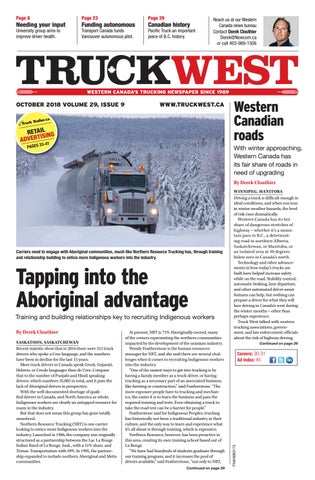
Tapping into the Aboriginal advantage Training and building relationships key to recruiting Indigenous workers By Derek Clouthier SASKATOON, SASKATCHEWAN Recent statistic show that in 2016 there were 315 truck drivers who spoke a Cree language, and the numbers have been in decline for the last 15 years. More truck drivers in Canada speak Greek, Gujarati, Hebrew, or Creole languages than do Cree. Compare that to the number of Punjabi and Hindi speaking drivers, which numbers 35,085 in total, and it puts the lack of Aboriginal drivers in perspective. With the well-documented shortage of qualified drivers in Canada, and North America as whole, Indigenous workers are clearly an untapped resource for many in the industry. But that does not mean this group has gone totally unnoticed. Northern Resource Trucking (NRT) is one carrier looking to entice more Indigenous workers into the industry. Launched in 1986, the company was originally structured as a partnership between the Lac La Ronge Indian Band of La Ronge, Sask., with a 51% share, and Trimac Transportation with 49%. In 1995, the partnership expanded to include northern Aboriginal and Metis communities.
At present, NRT is 71% Aboriginally-owned, many of the owners representing the northern communities impacted by the development of the uranium industry. Wendy Featherstone is the human resources manager for NRT, and she said there are several challenges when it comes to recruiting Indigenous workers into the industry. “One of the easiest ways to get into trucking is by having a family member as a truck driver, or having trucking as a necessary part of an associated business, like farming or construction,” said Featherstone. “The more exposure people have to trucking and mechanics, the easier it is to learn the business and pass the required training and tests. Even obtaining a truck to take the road test can be a barrier for people.” Featherstone said for Indigenous Peoples, trucking has historically not been a traditional industry in their culture, and the only way to learn and experience what it’s all about is through training, which is expensive. Northern Resource, however, has been proactive in this area, creating its own training school based out of La Ronge. “We have had hundreds of students graduate through our training program, and it increases the pool of drivers available,” said Featherstone, “not only to NRT, Continued on page 28
Continued on page 26
Careers: 30-31 Ad Index: 45
PM40063170
Carriers need to engage with Aboriginal communities, much like Northern Resource Trucking has, through training and relationship building to entice more Indigenous workers into the industry.
WINNIPEG, MANITOBA Driving a truck is difficult enough in ideal conditions, and when you toss in winter weather hazards, the level of risk rises dramatically. Western Canada has its fair share of dangerous stretches of highway – whether it’s a mountain pass in B.C., a deteriorating road in northern Alberta, Saskatchewan, or Manitoba, or an isolated area at 40 degrees below zero in Canada’s north. Technology and other advancements in how today’s trucks are built have helped increase safety while on the road. Stability control, automatic braking, lane departure, and other automated driver assist features can help, but nothing can prepare a driver for what they will face driving in Canada’s west during the winter months – other than perhaps experience. Truck West talked with western trucking associations, government, and law enforcement officials about the risk of highway driving,
Ever notice that the well-connected always seem to get ahead?
Competitive financing available through Daimler Truck Financial. For the Freightliner Trucks dealer nearest you, call 1-800-FTL-HELP. FTL/MC-A-1540. Specifications are subject to change without notice. Copyright Š 2018 Daimler Trucks North America LLC. All rights reserved. Freightliner Trucks is a division of Daimler Trucks North America LLC, a Daimler company.
Meet your new business associate with all the right connections—the new Freightliner Cascadia TM
®
SM
with Detroit Connect Virtual Technician remote diagnostic service to maximize uptime. Remote over-the-air updates to optimize performance without disrupting the run. And a new easy-to-access portal to view real-time insights into fleet health, fuel economy and safety performance. So no matter where the truck is, it’ll be well-connected for success on the road. To see how the new Cascadia can benefit your business, go to www.freightliner.com/connected.
INSIDE THE NUMBERS
Purchasing Plans Canadian motor carriers share their plans for fleet replacement Almost two thirds of Canada’s carriers are planning replacements to their fleets this year, our latest annual Equipment Buying Trends Survey reveals. The survey also found that three quarters are planning replacements for 2019. Twenty three percent of survey respondents are on 4-5 year truck replacement cycles while another 23% are replacing their vehicles every 6-7 years. It’s interesting to note that almost 40% are hanging on to vehicles for 10 years or more.
Trade in cycle for heavy duty vehicles
Fleet activities Other
Construction
7%
39%
10 years or more
29%
1%
23%
9% 12% 10%
8%
34%
Urban haul
Freightliner
33% of respondents
International
12%
Kenworth
15%
Mack
9%
Peterbilt
10%
Volvo
12%
Western Star
4%
Other/NA
6%
of respondents
of respondents
Forestry
Main brand of HD vehicles in fleet
2-3 years
Long haul
17%
Follow Lou on Twitter @LouSmyrlis.
23%
8-9 years
Regional haul
4-5 years
6-7 years
Percentage of heavy duty vehicle fleet anticipate replacing by end of year
Percentage of heavy duty vehicle fleet anticipate replacing next year More than 30%
More than 30%
10% 30% of fleet
0% of fleet
30% of fleet
35%
of respondents
Main brand of HD vehicles most likely to consider purchasing
4% 5%
25%
of respondents
7% 20% of fleet
13%
Freightliner
23% of respondents
International
7%
Kenworth
14%
Mack
13%
Peterbilt
14%
Volvo
12%
Western Star
6%
Other/Don’t Know
11%
0% of fleet
27%
20% of fleet
39%
36%
10% of fleet
10% of fleet
#DeloDrives PERFORMANCE
Introducing the Next Generation of Heavy Duty Diesel Engine Oil
Delo 400 with ISOSYN Advanced Technology ®
®
Up to 35% Better Oxidation Control*
Up to 68% Better Wear Protection*
Up to 46% Better Piston Deposit Control*
Up to 60% Better
Component Durability*
ChevronDelo.com *As compared to previous generation HDMO product test limits.
© 2017 Chevron Canada limited. All rights reserved. All trademarks are property owned by Chevron Intellectual Property LLC or their respective owners.
4 Truck West • October 2018
ISSN 0700-5016 (Print) ISSN 1923-3531 (Online)
Contents
Lou Smyrlis Director Business Development 416-510-6881 lou@newcom.ca Kathy Koras Associate Publisher 416-510-6892 kathy@newcom.ca A. (Tony) Hohenadel Publisher - truckandtrailer.ca 416-614-5800 tony@newcom.ca EDITORIAL Derek Clouthier Editor 403-969-1506 derek@newcom.ca Sonia Straface Associate Editor 416-510-6890 sonia@newcom.ca James Menzies Contributing Editor 416-510-6896 james@newcom.ca DESIGN AND PRODUCTION Michael Chimienti, Beverley Richards, Tim Norton ACCOUNT MANAGERS Nickisha Rashid National Accounts Manager 416-614-5824 nickisha@newcom.ca Anthony Buttino National Accounts Manager 416-458-0103 anthonyb@newcom.ca Denis Arsenault Quebec Accounts Manager 514-938-0639 ext. 2 denis@newcom.ca Tony Jelicic Regional Accounts Manager 416-614-5813 tonyj@newcom.ca Doug Copeland Regional Accounts Manager 905-715-9511 doug@newcom.ca
SASKATCHEWAN
20-22
Page 8 University group studies Alberta truck driver health and wellness.
PeopleNet’s in.sight User Conference addresses technology, safety, state of industry.
Cross-border
24-25
BRITISH COLUMBIA Page 23 Vancouver gets funding for autonomous vehicle pilot project.
Cross-border New Sprinter plant opens in South Carolina to serve North American market.
Page 29 Pacific Truck is an important piece of Canadian truck manufacturing history.
26-27
Cover story Western Canada has its fair share of dangerous roads in need of upgrading.
Paul Beelien Regional Accounts Manager 416-614-5806 paul@newcom.ca
28
Changing Face of Trucking
Truck West is published monthly by
Industry needs to do more to entice Aboriginals into trucking.
Newcom Media Inc.
31-45
Chairman & Founder: Jim Glionna President Joe Glionna Vice - President Melissa Summerfield Director of Circulation Pat Glionna Subscription Inquiries Lilianna Kantor Phone: 416-614-5815 Fax: 416-614-8861 Email: lily@newcom.ca RETURN UNDELIVERABLE CANADIAN ADDRESSES TO: CIRCULATION DEPARTMENT, TRUCK NEWS 5353 DUNDAS STREET WEST, SUITE 400, TORONTO, ONTARIO M9B 6H8 PUBLICATIONS MAIL AGREEMENT NO. 40063170 CUSTOMER NO. 4006214 TRUCK WEST is a proud member of the following trucking associations:
Business Demand for Mack’s Anthem boosts on-highway market share as new company president takes the helm.
32
Marketplace Putting the brakes on brake violations.
7
15
The changing face of trucking.
Diminishing oil reserves could affect fuel prices this fall.
Editorial
12
In-brief MANITOBA TRUCKING ASSOCIATION
SASKATCHEWAN TRUCKING ASSOCIATION
Mack video series features western Canadian drivers; STA hands out scholarship money.
14
In-brief Unique way to honor Humboldt victims; successful Ritchie Bros. auction.
Roger McKnight
17
Sandy Johnson Make sure you read the fine print.
19
Dave Earle Guest column urges industry to use disruption to its advantage.
In Every Issue 42 Mark Dalton in… Greatness is in the eye of the beholder.
44 Newland Transport 46 Last Word: Finding good drivers is no ‘speedee’ process.
October 2018 • Truck West 5
You Can’t Be In 100 Places At Once. But We Can. Great Dane’s AdvantEDGE program connects you to a nationwide parts and service network with more than 100 locations—giving you a single point of contact for ordering and invoices, a fixed pricing model and 24-hour emergency road service for your trailer. Together, we can ensure the safe and efficient delivery of your goods. Let’s go.
Enroll for free today: GreatDane.com/AdvantEDGE
GLASVAN GREAT DANE Alliston, ON Mississauga, ON Putnam, ON Whitby, ON GREAT DANE OF MONTREAL Montreal, QC
MAXIM TRUCK AND TRAILER Winnipeg, MB Prince Albert, SK Regina, SK Calgary, AB Edmonton, AB NOVA ENTERPRISES LTD. Truro, NS
EDITORIAL Derek’s deliberation
Understanding the changing face of the trucking industry Much like women, Aboriginal Peoples are under-represented in the trucking industry. This is not the case for all visible minorities in Canada. This month marks the launch of our Changing Face of Trucking project, which goes alongside the acquisition of Road Today and the creation of Newcom South Asian Media. The project – which spans several publications, including Truck News, Today’s Trucking, and the one you’re reading now – is a wonderful endeavor to highlight how many of the faces that can be seen in trucking today are not always like the ones you would have seen 25 years ago and beyond. But despite the desperate need for qualified drivers across North America, there are certain communities within Canada that have not flocked to the industry in the same way others have. There are various reasons for this, of course: opportunity, cost, connections to the industry, and preconceptions. South Asians – Punjabi and Hindi speaking people – have been getting behind the wheel for years now in large numbers. The Indigenous community, however, has not. As I documented in our cover story this month – “Tapping into the Aboriginal advantage” – the numbers are beyond low for Indigenous
workers in the trucking industry, despite some carriers making valiant efforts to turn that trend around. The solution to the qualified driver shortage in Canada and the U.S. is to entice these under-represented groups into the industry, but there is an unfortunate repercussion to an influx of immigrants and visible minorities into the industry. As we have seen with South Asians, underlying feelings of resentment from some – not all – Canadians who are not descendants of another country has been all too common in the trucking industry. Stereotypes and assumptions surrounding the “immigrant driver” contribute to this hostility, something that has unfortunately mirrored many societal views in our world today. Viewed as untapped resources, groups like Aboriginals, and more successfully, South Asians, have been targeted by carriers for a few years now. Though we may not have seen numbers in the Indigenous community grow in the trucking industry like they have with South Asians, those who do chose to start a career in our industry need to be welcomed and treated with the same kind of
respect as anyone else who made that difficult choice. In reality, though it may not seem this way from the outside looking in, trucking is a very culturally diverse industry. There are roughly 181,000 truck drivers in Canada, approximately 59,000 are immigrants. Several of the younger drivers come from the South Asian community, as few young Canadians are choosing trucking as a career. There are also 1.5 million Aboriginal People in Canada, nearly half of which are under the age of 24 and more than half live in cities where demand for truck drivers is strong.
Of those who live off-reserve, 72% have a high school diploma and 43% have acquired postsecondary credentials. Misconceptions, myths, assumptions, and lack of knowledge of several of these minority groups is exactly why we believe it is important to do projects like The Changing Face of Trucking. The reality of the industry is that if we are to combat the driver shortage – or find more qualified drivers, as many believe is the case – then we need to look beyond our borders, as well as within, for the segments that make up our working population yet go unnoticed. So look across our family of magazines this October and leading up to the holiday season and check out how the trucking industry has and will continue to change. TW
Derek Clouthier can be reached by phone at (403) 969-1506 or by email at derek@newcom.ca. You can also follow him on Twitter at @DerekClouthier.
Mark Your Calendar! SURFACE TRANSPORTATION SUMMIT OCTOBER 10, 2018 International Centre, Mississauga, Ontario, Canada surfacetransportationsummit.com
NORTH AMERICAN COMMERCIAL VEHICLE SHOW
APRIL 6, 2019
APRIL 11-13, 2019
SEPTEMBER 14, 2019
OCTOBER 28-31, 2019
International Centre, Mississauga, Ontario, Canada
Place Bonaventure Montréal, Quebec, Canada
International Centre, Mississauga, Ontario, Canada
Georgia World Congress Center, Atlanta, Georgia, USA
www.rttnexpo.com
www.expocam.ca
www.rttnexpo.com
www.nacvshow.com
FREE ENTRY • FREE PARKING
FREE ENTRY • FREE PARKING
October 2018 • Truck West 7
SASKATCHEWAN
Study conducted on Alberta long-haul drivers SASKATOON, SASKATCHEWAN Alberta truck drivers recently had the chance to provide insight into their health and working conditions for a new study. The University of Saskatchewan’s School of Public Health traveled across Alberta looking for long-haul truck drivers to participate in a study that collected information on their health and wellness, lifestyle, and working conditions. Dr. Alexander Crizzle, a faculty member of the School of Public Health, led the effort and has been interested in road safety for some time. The majority of Crizzle’s
research over the years has been conducted on private vehicles, but in 2014, he was asked to be part of a project examining the health and wellness of commercial drivers, a project funded by Transport Canada, which included an environmental scan consisting of a literature review and stakeholder consultations. “We were also asked to provide recommendations for how to improve the health and wellness of commercial motor vehicle drivers, such as collecting baseline information on Canadian drivers, as there is very limited information in Canada,” said Crizzle. “Since 2014, we have taken
gradual steps to build on our recommendations.” Alberta’s Ministry of Labour provides grants focused on improving occupational health. Because Crizzle and his team secured funding from an Alberta agency, they focused their research on truck drivers from the Wild Rose province. The study consisted of three components: a survey, a few objective health measurements, such as height, weight, and blood pressure, and ultimately an interview. Crizzle was hoping to have approximately 400 drivers participate in the study, which wrapped up Sept. 16.
Unreserved public equipment auctions TR UC KS
VA CU UM
TR UC KT RA CT OR S
95 +
20 15 +
Special limited-time financing offer! No payments for 120 days*
2 of 10 – 2015 & 2016 Western Star 4900SA Grande Prairie TR AIL ER S
42 25 +
Mack Granite w/Vactor 2100 | Chilliwack
“We are trying to get information on several things,” said Crizzle. “The general health and wellness of long-haul truck drivers. This includes the number of drivers with medical conditions, but also those who may have risk factors for poor health, such as access to poor foods, lack of exercise, fatigue, and obesity.” The study also looked to evaluate truck drivers’ environment, such as where they stop for gas, food, showers, to access the internet, and other services. “We are asking questions on a wide range of issues,” said Crizzle, “including the use of electronic logs, parking, and rest areas, access to food, truck driver training, and even potential issues related to marijuana use.”
“Typically, it is difficult to find support for any type of change, particularly in the government, without a large enough sample of drivers that can provide their thoughts and perspectives.” – Dr. Alexander Crizzle
1 of 2 – Mack Vision CXN613 Saskatoon
PL OW
VA NT RU CK S
TR UC KS
20 0+
2017 Kenworth W900 Grande Prairie
70 0+
2018 Royal Cargo CGT70-824-78 24 Ft Recycling | Edmonton
2 – 2014 International 4300 DuraStar | Saskatoon
2011 Freightliner M2 Business Class | Chilliwack
59,630 items in 100+ auctions including Toronto, ON Grande Prairie, AB Chilliwack, BC Saskatoon, SK Brandon, MB Edmonton, AB
Sep 25–26 Oct 2–3 Oct 10 Oct 11 Oct 16 Oct 23–25
Bid in person or online ▸ No minimum bids or reserve prices ▸ Test and inspect on-site ▸ Open to the public ▸ Free registration
Financing & leasing available Up to 100% financing, with no money down.
More items added daily Call about selling: 1.800.211.3983
See full auction & equipment listings at rbauction.com Auction Company License #303043, MV Dealer #10539, MV Dealer No. 4585592, Dealer License 69767, Auction Company License #309645 | *Limited-time offer. OAC. Terms & conditions apply.
8 Truck West • October 2018
All three aspects of the study took around an hour to complete. The collection of data began Aug. 5 in Lloydminster, Alta., and moved to Edmonton Aug. 10. Crizzle and his research team then moved to Red Deer Aug. 24, before heading to Calgary Aug. 29-31 and again Sept. 4-8 at the Flying J truck stop. Their last stop was at the Husky truck stop in Medicine Hat Sept. 9-15. Drivers who partook in the study received $20 to complete the survey, $10 for the health measurements, and another $20 for the interview. “It’s important for long-haul truck drivers to participate,” said Crizzle. “Typically, it is difficult to find support for any type of change, particularly in the government, without a large enough sample of drivers that can provide their thoughts and perspectives.” TW
OUR MOST AGGRESSIVE DRIVE TIRE FOR EXTREME CONDITIONS
THE NEW MICHELIN X WORKS GRIP D ®
®
DESIGNED BY DRIVERS OF THE WORLD’S MOST DEMANDING ROADS*
Saw-tooth lugs with 800+ serrated edges for maximum grip on ice and packed snow Optimized snow chain housing for maximum uptime Continuous stone ejectors for excellent casing protection
michelintruck.com/XWorksGripD ©
2018 MNA(C)I. All rights reserved. The “Michelin Man” is a registered trademark licensed by Michelin North America, Inc. *The MICHELIN® X® Works Grip D tire was designed using direct feedback from Alberta’s energy fleet drivers and industry professionals.
Introducing the Kenworth W990. When the open road called, we answered.
IN-BRIEF
Mack’s sixth RoadLife episode features pair of drivers from Western Canada GREENSBORO, NORTH CAROLINA Mack Trucks’ sixth episode of its RoadLife series titled “Long Way From Home” features two western Canadian long-haul truck drivers. Bill Flynn, originally from Newfoundland, has spent the last 14 years working in Edmonton, Alta., as a driver for bulk transport company FL Carriers. Hauling raw materials for the concrete industry, Flynn’s truck weighs in at up to 63,500 kg when fully loaded. “When you look at a truck driver, it’s a lot of sacrifice. It’s long hours,” Flynn said. “Your social life is not what a normal person’s social life is. I don’t think people realize how much you have to do to make it all work.” Dawson Creek, B.C.’s Dwayne Hamann is the second driver featured in the series. Hamann is a driver for Peace Country Petroleum, which serves portions of B.C., Alberta, and the Yukon, delivering shipments of diesel and gasoline and traveling up to 1,000 km each day. “Everything that comes to your town comes on trucks,” Hamann
said. “Guys are working 24/7 just to make sure the shelves are full and your gas tank is full.” RoadLife shines a light on drivers who work long hours and spend significant time away from home to ensure goods are delivered across North America. “Not being home, that’s the biggest challenge for me,” Hamann said, who carries a reminder with him at all times: the names of his daughters tattooed on his forearms. “You look at those some days and you remember what you’re doing it for.” Flynn embraces the life of a truck driver, and couldn’t see himself doing anything else for a living. “How many people do you know who have worked a job all their life, and they get up every morning with a lump in their stomach because they don’t like their job and they really don’t want to go to work?” Flynn said. “That’s stressful. I’ve never felt that way. I never once wished that I was doing something else.” RoadLife’s “Long Way From Home” is available on roadlife.
tv and Amazon Prime Video. Viewers can also access RoadLife bonus content from Mack Trucks’
social channels – Facebook, Twitter, Instagram, LinkedIn, and YouTube. TW
STA hands out $5,000 in scholarships REGINA, SASKATCHEWAN The Saskatchewan Trucking Association (STA) doled out its annual scholarships recently, with three students receiving a combined $5,000. The recipients must have a family member who owns or is employed by a Saskatchewan trucking company. Emily Galey of Swift Current was awarded a $3,000 scholarship; Liam Kerr of Moose Jaw, and Zoe Selimos of Regina both received $1,000. Scholarships are handed out each year. In addition to being a dependent of an owner or employee of an STA member company, applicants must be a high school graduate, have applied to a post-secondary institution, submit transcripts, and complete the scholarship application no later than June 30. TW
THIS MONTH’S CROSSWORD PUZZLE TW-184 Oct. © 2018 M. Jackson
Answers on page 45
Across 1 5 8 9 10 12 13 16 19 21 22 23
12 Truck West • October 2018
’06-debut International tractor Labour’s repair-invoice partner Axle and leaf spring connector (1,4) Gear _____ (clumsy shifter) Carrier based in Vittoria, ON (8,5) Bean Town Canadian nickel critter Diesel fuel reservoirs, frequently (4,4,5) Documents processed by Customs Arlo Guthrie song restaurateur Windshield crack cause, commonly 11-Down reefer line
Down 1 2 3 4 5 6 7 11 12 14 15 17 18 20
Winnipeg bulk transporter, ____ Hauling Mullen Group’s Alberta HQ town Really wrecked, in other words (5,4) DPF soot cleanses, briefly Tire gauge abbr. (1,1,1) CB or scanner Snowbelt windshield cleaning tool Trailer brand with Chicago corporate HQ (5,4) Truck auction participants Allied or Atlas (3,4) Big name in rental rigs GMC’s Chevy Titan clone Nasty winter precipitation Slippery Snowbelt surface
Designed with the world’s best drivers in mind, the new Kenworth W990 combines our classic grille and chrome details with modern features like a well-appointed, special edition interior, improved “view over the hood” visibility and lighting, plus the state-of-the-art powertrain choices that will get your heart pounding. No other truck offers the performance and comfort your drivers deserve, along with rugged Kenworth styling that simply can’t be ignored. The W990: it’s what you’d expect from—and for—The World’s Best®. See the whole W990 story at Kenworth.com/trucks/W990
Ask your Kenworth dealer about excellent leasing and financing options. ISO 9001:2000 © 2018 Kenworth Truck Company. A PACCAR company.
IN-BRIEF JAMES CANDY Missing From: Vegreville, AB Missing Since: August 7, 2017 Date of Birth: May 11, 2000 Height: 5’8” Weight: 122lbs Hair Colour: Blond Eye Colour: Blue
IF YOU HAVE ANY INFORMATION ABOUT THIS YOUTH, VISIT
OR CALL
missingkids.ca
1-866-KID-TIPS (543-8477)
OR CALL VEGREVILLE RCMP AT 780-632-2223
Humboldt victims to have stars named in their honor HUMBOLDT, SASKATCHEWAN The International Star Registry’s Canadian office has agreed to name a star after each person who died as a result of the Humboldt Broncos bus collision last April with a tractor-trailer, thanks to Saskatchewan truck driver Blaine Davies. Davies, an avid Broncos fan and former hockey commentator, advocated for the stars to be named in their honor, with team players, the coach, assistant coach, statistician, athletic therapist, broadcaster, and the bus driver all being recognized. The 16 stars are located in the same section of the Ursa Minor
Blaine Davies’ tattoo. (Little Dipper) constellation, which is visible year-round in Canada. International Star Registry packages were presented to the families of each person who lost their lives when Washington Capitals’ forward and Saskatoon native Chandler Stephenson brought the Stanley Cup to Humboldt this Aug. 24. TW
Ritchie Bros.’ Edmonton auction breaks $78 million in sales EDMONTON, ALBERTA Ritchie Bros. Auctioneers held another successful auction in Edmonton this week, selling more than $78 million of equipment. “We continued to see strong pricing for equipment and trucks in this week’s auction,” said Trent Vandenberghe, regional sales manager for Ritchie Bros. “Transportation pricing remains solid and bidding on heavy construction equipment was very active, showcasing depth in the market for this equipment right now.” The auction took place from Sept. 4-6 and attracted more than 9,000 bidders from 49 countries, including more than 6,850 people registered online. Approximately 88% of the equipment was sold to Canadian buys, 56% of which in Alberta. International buyers included those from the U.S., Singapore, and New Zealand, and online buyers purchased around 67% of all the assets sold. “The auction was great, prices exceeded our expectations,” said Jason Weinberger, president of W Corporation, which sold more than 75 items as part of a complete dispersal of his company’s trucking and drilling division. “We chose Ritchie Bros. because of the size and scope of their audience. I saw our equipment get bids from across Canada, as well as Mexico, and Colombia.” TW
14 Truck West • October 2018
OPINION Petrol Points
Concern over diminishing oil reserves I am a believer that things go backward because it makes no sense to go forward. But if you keep looking backward you can’t see where you’re going. Take that Confucius! Confusion would be an appropriate word to describe or explain the hazards lurking in the murky logic pool of taking a futures position in crude oil or its refined derivatives. I have expressed concern lately over the diminishing crude oil inventories in Cushing, Okla., which, as we all know, is the pricing fulcrum for the WTI futures contracts. Current inventories are at 23.4 million bbls, which is 60% below the level a year ago and nearing the minimum operating level, which is in the range of 15 to 20 million bbls. So, why not just fill up the tanks and quell the fears? Enter the magic of futures trading. Crude is not going into storage as the market is in “backwardization” – meaning the futures price is higher than the spot. Therefore, it makes no sense to put the crude into storage, but better to buy now and release it to the open market. This tells me that there is a feeling within the fraternity of traders that prices in the short term are set to increase. I see some reasons to agree with this pricing emotion. U.S. refinery runs are at pedalto-the-metal levels due to record exports, a continuing healthy demand for transportation fuels supported by a strong U.S. economy backed by positive consumer confidence and record high crack spreads, or refining margins. The question is: how long can the refining industry run at 98% capacity? Gasoline inventories are 5% above the five-year average, but the driving season is over, and has been for over two weeks as far as the refiners are concerned. Futures traders should not be looking with glassy-eyed awe at gasoline supply and demand, but the distillate equation, which is out of balance and is the reason for the rumbling thunder on my pricing horizon. We are entering the period of semi-annual refinery maintenance, as preparations are made for the upcoming heating oil season. This will reduce refinery outputs and lower inventories of both crude (due to lower refinery demand) and refined products, including distillates – a family of products that includes diesel. This is a problem, as diesel demand jumps in late September and October to cope with the harvest season, and the stocking of warehouses for the Christmas holidays.
Roger McKnight is the chief petroleum analyst with En-Pro International Inc. Roger has more than 25 years of experience in the oil industry. He is a regular guest on radio and television programs, and is quoted regularly in newspapers and magazines across Canada.
To top it off, we have the U.S. sanctions on Iranian crude starting in November, next to zero supply from Venezuela, and Mexican crude is diminishing to drip levels. So, when we get into fall, consumers may look back to August in envy, not in anger. Leave the anger for this winter as there will be a lot of that around. TW
Always Capture the True Story
ISAAC InView integrates perfectly with ISAAC’s Internet of TrucksTM. Its forward-facing and auxiliary cameras complete ISAAC’s undisputable data with undeniable videos to protect your drivers and your company’s reputation.
LEARN MORE AT www.isaac.ca/events-video 1 888 658-7520 October 2018 • Truck West 15
ADVERTISEMENT
Four factors that may leave your cargo at greater risk of theft
By Garry Robertson
C
argo theft is on the rise across Canada, and this should come as no surprise to carriers: With the increasing value of goods being transported across the country every day, it’s a relatively low-risk crime with the potential for very high returns. In fact, cargo theft has become so lucrative that it’s attracted the attention of large criminal enterprises to fund other illegal activity.
on an advanced logistical framework that requires coordination and investment: criminals are enticed by the fact that meat can be unloaded quickly, but it also needs to be. Spoiled meat is worthless, so refrigerated trucks are needed to transport the stolen load, and networks of people must be at the ready to sell and deliver the product to customers. All of this takes time, money, and practice.
Over the past decade, cargo theft has evolved from a crime of opportunity to a much more complex endeavor. Criminal circles are becoming highly sophisticated in their organization and approach, leveraging new technology to target loads with a greater payout and developing networks that quickly move stolen goods through the black market economy. And cargo itself isn’t the only target: carriers and owner-operators are at risk of losing their very means of transportation as well, with some thieves now stealing the entire trailer to sell as scrap metal.
WHEN IT’S TRAVELLING
So what do you need to know to stay better protected? Here are four factors that may impact the safety of your cargo, based on current theft trends that we’re tracking across Canada.
WHAT YOU’RE CARRYING Mixed load cargo that contains a variety of generic goods (i.e., household items or clothing) is often a primary target for theft. Since there are no distinguishing marks to look for, such as serial numbers or other tracking characteristics, it’s often the hardest to trace. This ensures that these products are also the easiest to offload to nearby buyers such as local flea markets or inconspicuous neighborhood shops, where they can be sold immediately, reducing thieves’ risk of exposure. Consider a product like laundry detergent: the load can be split up quickly, sold almost anywhere, and will often blend seamlessly with the rest of a store’s inventory. Other types of cargo seem to be garnering more attention these days, too. Aside from mixed loads, grocery and food products are notoriously tempting for thieves, as they’re even more difficult to track and relatively easy to resell.
WHERE IT’S HEADED Cargo being targeted for theft varies significantly across the country, and even within the same province. Certain places are historically more vulnerable than others; for instance, Ontario and Quebec have been identified as the riskiest provinces, especially major cities like Montreal and the Greater Toronto Area. These regions see higher rates of theft for specific goods. In Eastern Ontario and Western Quebec, auto parts and metal are attracting more cargo thieves this year. And in the west, lumber loads have become targets.
Cargo that’s not moving is always more vulnerable – especially when it’s kept in an unsecured yard – so there are certain times of year that require extra vigilance. For instance, long weekends and holidays are prime time for cargo theft, because thieves gain a full day to transport and unload their stolen goods; the crime can be carried out on a Friday and go unnoticed until work starts back up on Tuesday. A good way to keep cargo safer is to keep it moving, ensuring it gets to its destination as quickly as possible. Any extra time spent between point A and point B is an opportunity for theft.
HOW YOU’RE TRACKING IT In many cases, theft comes down to a weak link in the system. More than ever before, identity theft is being used to steal cargo loads. Thieves visit online load broker sites and target specific loads that are scheduled to be picked up. Then they create false documents and pick up the load early using the stolen identity of an existing logistics company, effectively posing as their agent. Unless a real-time asset tracking system is in place, no wrongdoing is suspected until someone goes to retrieve the load – only to find out it has already been picked up. Although this information is enough to worry carriers of all sizes, there are ways to help mitigate your cyber-related risks – like the implementation of fleet management tools and the use of an asset tracking system like BlackBerry® Radar. With the help of an experienced risk management professional, it’s possible to develop a strategic approach that will help minimize losses related to cargo theft. At Northbridge, we’re working to protect our customers by educating industry groups, working closely with law enforcement, and raising awareness of this issue with the public so that they can make informed buying decisions. To learn more about how to set up a risk management program, call us at 1-855-620-6262 and ask to speak to a Northbridge Insurance Risk Services manager in your area.
In Southern Ontario, one possibly surprising type of food that’s rising in popularity is meat products. Moving perishable goods relies
Garry Robertson is Manager of the Claims Special Investigations Unit for Northbridge. A Certified Fraud Expert, Garry has over thirty years of experience in insurance and corporate fraud investigations.
Northbridge Insurance and Northbridge Insurance Logo are trademarks of Northbridge Financial Corporation, licensed by Northbridge General Insurance Corporation (insurer of Northbridge Insurance policies). This article is provided for information only and is not a substitute for professional advice. We make no representations or warranties regarding the accuracy or completeness of the information and will not be responsible for any loss arising out of reliance on the information.
COMPLIANCE Permits & Licensing
The fine print is no small matter Disclaimers. They’re everywhere. Every product, contract, and service comes with a warning these days. Want to change lanes on the freeway? Your mirror will tell you that objects may be closer than they appear. As someone who works with fuel taxes, vehicle registration, and other trucking regulations, I need bifocals for my bifocals in order to read the fine print. But I’m glad I have them. Case in point: let me tell you about Lloydminster. Lloydminster has the geographic distinction of straddling the border of Alberta and Saskatchewan. The main street, 50 Avenue, runs right through the middle of town. Business names like the Lloydminster Border Market and the Best Western Plus Meridian Hotel connote a border city. Charming. But for truckers, the border creates distinctly different sets of rules for operating commercial vehicles. For example, Saskatchewan regulations state that an Alberta-plated commercial vehicle can be driven within 16 km of the border without penalty with respect to registration. The Alberta Operator Licensing and Vehicle Control Regulation says differently. It specifies that an Albertabased carrier can operate a commercial vehicle within an area not more than 17 km from the AlbertaSaskatchewan border without a Saskatchewan vehicle-licence permit as long as the vehicle is properly registered and insured in Alberta. This exemption does not impact a carrier’s requirement to obtain a Safety Fitness Certificate (SFC) with federal operating status. Legally, Alberta-based carriers with provincial operating status are considered to be within the authority of their SFC under two conditions: they’re within the city limits of Lloydminster on either side of the Alberta or Saskatchewan border, or on Hwy 17, provided the trip starts and ends in Alberta and no services are received or provided in Saskatchewan. Sounds good. But in the fine print, “Services received or provided” include fuel, accommodation, vehicle loading/ unloading; meals, vehicle repair/ maintenance, other work activities, etc. It does not include any such service received or provided wholly within the city limits. Therefore, if you’re an Alberta carrier and fill up with food and fuel or have a nap in Saskatchewan, boom, your operating status is federal. You can pick up a hot dog at the 7-Eleven on the Saskatchewan side, but you’d better not drop a load there.
In the end, whether you actually pay a penalty for your transgression comes down to enforcement. One block into either jurisdiction, would law enforcement tag you? Probably not. But they could, especially if they see you there often enough. Maybe you’ll never come within a day’s drive of Lloydminster, but it shows how regulatory details can trip you up if you’re not careful. If you’re unsure about fuel tax or licensing rules in the jurisdictions where you operate, or may operate, the simplest way to reduce your risk is to register your vehicles with the International Fuel Tax Agreement (IFTA) and International
Registration Plan (IRP). These agreements were established to make it easier for jurisdictions to collect fees and taxes on a prorated basis. They supersede provincial legislation and their exemptions. Want to stay a provincial carrier for National Safety Code and not a federal carrier? Be careful of your area of operation. But if you’re already a federal carrier, just license your trucks under IRP and/or IFTA. When you operate a commercial vehicle in places other than your home state or province, you probably owe those jurisdictions a portion of your fuel taxes and vehicle registration fees.
Sandy Johnson has been managing IFTA, IRP, and other fleet taxes for more than 25 years. She is the author of the book, 7 Things You Need to Know About Fleet Taxes, and operates northstarfleet.com, which provides vehicle tax and license compliance services for trucking operations. She can be reached at 1-877-860-8025 or info@northstarfleet.com.
You don’t have to read the regulatory fine print to know that they’re going to want their fair share. But you should anyway. TW
®
Over 16 0 new a nd u trucks in stock. W sed e have what yo u need!
The T880 One of the most proven & versatile work trucks ever conceived. • • • •
Up to 76” Sleeper Cummins or PACCAR Engines (405-605 hp) 1450 - 2050 Torque Eaton manual or auto transmission
• • • • •
12-20,000lb front axle Tandem & Tridem rear axles VIP Interior NAV + HD Remote diagnostics
Check out our used truck line-up! :DUUDQW\ DQG LQ KRXVH ´QDQFLQJ RSWLRQV DYDLODEOH
• Burnaby • Campbell River • Chilliwack (Parts Only) • Cranbrook • • Dawson Creek (Parts Only) • Fort St. John • Kamloops • Kelowna • Langley • Nanaimo • • Pentiction • Prince George • Quesnel • Terrace • Vernon • Whitehorse • Williams Lake •
INLAND-GROUP.COM
October 2018 • Truck West 17
Your bottom line doesn’t care if it’s cold. The new Mobil Delvac 1™ range of synthetic engine oils helps protect your fleet and your business.
See our new products at mobildelvac.ca
GUEST COLUMN Dave Earle
From disruption, a new road for trucking We live in times of turmoil and change. Climate, technology, demographics, and population growth all influence our lives. We can be overwhelmed by these changes or choose to redefine how we live and work. The trucking industry must continue to be flexible and open to the opportunities disruption presents. National Trucking Week was a great time to consider where to go from here. Wildfires, flooding, and other catastrophic weather events are forcing us to confront the effect of excessive greenhouse gas (GHG) emissions. Transportation generally is a scapegoat, and heavy trucks bear part of the blame. But trucks are also a testing ground – largely successful – for devices and strategies that reduce GHG emissions. Fewer emissions mean increased fuel efficiency, and no one likes that more than trucking. The industry has been developing and adopting efficiency measures for years. Some are ubiquitous, like the aerodynamic profile of most highway truck tractors. Others have become more common in the past decade, such as trailer side skirts, boat tails, and wide-base single tires. We’re also witnessing a race to introduce new electric or hybrid zero-emission Class 8 tractors, the highway workhorse that makers from Kenworth to Volvo and newcomers like Tesla, Nikola, and others are working to develop and launch across North America and globally. These changes, along with automation and truck platoons, are rebranding trucking as “futuristic” and could do what the industry’s old-school roots cannot: attract a young cohort of drivers and technicians who want hands-on time with clean, sustainable, high-tech equipment. Addressing licensing restrictions to allow 18-year-old high school grads access to commercial certification (currently only available to 19 year olds in B.C.) is a step out of the industry’s hands, but makes sense as newer, safer, better-tracked equipment reaches the market and the industry. The commercial driver shortage, a demographic challenge, could become less of a threat as a result. On the horizon for years, the driver shortage is now a reality trucking companies are scrambling to address. The industry is changing the way it does business, not only in terms of its equipment, but also its HR practices. Companies are increasing truck driver salaries as a way to attract new drivers, but salaries alone are not an incentive for recruitment. Given accurate tracking by ELDs, companies need to safeguard a truck driver’s time, and many are.
Shippers need to work with the industry on scheduling and wait time expectations. And, where possible, companies should re-examine the long days permitted by hoursof-service regulations (in Canada, a maximum of 14 hours on duty/13 of those driving; in the U.S., 14 hours on duty/11 driving). Imagine asking the rest of the workforce to extend an eight-hour day to meet those standards, and, as long-haul service providers do, to spend the majority of their time away from their families and communities. Companies are developing individual solutions for their operations. Ideally, they need to engage their
current and prospective drivers in a meaningful conversation to ask what they need to balance their working and personal lives. The job of a truck driver requires a level of professionalism that employers need to demand and support. That could mean calling for a truck driver training standard, requiring new hires to have adequate training and experience, and mentoring entry-level drivers. Truck drivers who take pride in what they do already operate with professionalism and skill – expertise we should respect and acknowledge. Times of turmoil and change can be exciting for the industry, for
Dave Earle is the president and CEO of the British Columbia Trucking Association. In addition to his industry experience, Earle was vice-president of government relations and HR services for the Construction Labour Relations Association of B.C. and was an adviser, manager, and executive director with the provincial Ministry of Labour’s Employers’ Advisers Office.
trucking companies, and for the women and men willing to drive for a living. Thank you to everyone who’s already leading the way. TW
Make
a part of your
Recruitment Strategy
- Leverage Eastern Canada’s largest audited circulation – more than 40,000
- Cost effective pricing – pricing starts as low as $665
- Value-added Web advertising on trucknews.com – the industry’s most popular website
Call Kathy Koras today 416-510-6892 kathy@newcom.ca
October 2018 • Truck West 19
CROSS-BORDER
The state of Canadian fleets discussed during in.sight User Conference By Derek Clouthier HOUSTON, TEXAS Several issues affecting the Canadian trucking industry were addressed in Houston Sept. 10, including the idea of mandating on-board video for fleets. Discussed during the PeopleNet and TMW Systems in.sight User Conference and Expo, several attendees, who either owned or were employed by a Canadian carrier, were already using on board cameras, both forward and in-cab facing, in an effort to protect their operations, but more importantly, their drivers in the event of an incident. Jason Gould, director of operations for PeopleNet Canada, said the Canadian Trucking Alliance (CTA) is looking at how video is used for fleets, and posed the question if those in the room would support a mandate on cameras. Bill Shannon, logistics and transportation manager for Shandex Truck out of Pickering, Ont., said he would support a mandate for the use of on board cameras, partly
because his company has already employed their use. Shannon said video evidence can be used to protect drivers from being blamed for collisions where they are not at fault, and can also be used to ensure company drivers are operating their equipment in a safe manner. Whether insurance companies would recognize fleets that use cameras to prove or disprove driver error by lowering premiums, Gould said it’s not just about having video proof of an incident. “You can install an on-board computer, but that doesn’t mean it’s going to solve your company’s problems,” he said, adding that several insurers he has spoken to have indicated that a carrier’s use of cameras could mean no increases in rates, but not necessarily a decrease. Shannon said carriers using cameras would see cost savings down the line, particularly if it gets them out of paying a large settlement where a driver was not at fault for an incident. Driver retention was also discussed during the state of
20 Truck West • October 2018
Canadian fleets roundtable, and the consensus in the room was that increasing pay is the best way to keep drivers around. Shannon said his company has bumped up driver pay around 22% in the last few years, which has had a positive impact. Other incentives to keep drivers from walking out the door include good equipment, automatic transmissions, and other driver comfort accessories in the cab. Technology also plays a role in driver retention, as well as hiring. Some carriers in the room said they use technology as a recruitment tool, as they have found that the easier they make the job for the driver, the happier they are. The upcoming Canadian ELD mandate will soon result in more uniformity between Canada and the U.S., which is coming up on a year since implanting its e-log regulation. Canadian fleets have seen mostly a positive impact with the U.S. ELD mandate, according to those in the discussion. Increased rates of up to 25%, better driver pay for less miles,
and making HOS compliance that much easier to follow were reasons many said “it’s a great time to be a truck driver.” Attendees felt the Canadian ELD mandate would result in the retirement of some older drivers who simply do not want to make the switch at such a late time in their careers, while younger drivers would welcome the change. Ongoing negotiation between Canada and the U.S. over the North American Free Trade Agreement (NAFTA) was an issue for cross-border carriers. Some believe failure to reach an agreement would result in significant cost increases with added surcharges, and have even seen costs rise with uncertainty surrounding NAFTA negotiations and freight coming into Canada from the U.S. decline. ELD update By far, the session with the most attendees in the first day of the conference was the ELD update from FMCSA director of the Office of Enforcement Joe DeLorenzo.
If, however, you are moving your vehicle in order to get rest, which is required by law, because you have reached your max HOS, it can be classified as personal conveyance given you stop at the nearest, more reasonably safe location.
Alan Hooper, research associate for ATRI. The good news since the implementation of the U.S. ELD mandate is that HOS violations have declined dramatically, which DeLorenzo said is not a big surprise. But there remain several areas of the regulation that continue to confuse people and have caused issues during inspections. DeLorenzo touched on three key aspects of the mandate that needed clarification, the first being what he called a simple one: make sure your driver know what device they are using. Whether an ELD or AOBRD, a driver’s lack of knowledge of what they are using has caused issues during roadside inspections and dragged the process out. “It’s maybe the most important thing you can do as a company,” DeLorenzo said of properly training drivers on the use of ELDs and AOBRDs. “If they know what device they have, it will make process go a lot smoother.” How to transfer data during an inspection was another area drivers need to have a good handle on. With U.S. officers focusing on HOS compliance during the early stages of the ELD mandate, DeLorenzo said there are times when e-log devices malfunction, and when this occurs, drivers can use the display screen, a PDF, or printout form the ELD as proof of compliance. Drivers must make a note when a device malfunctions and carriers must maintain paper logs generated during the malfunction. One of the most common causes of a malfunction is incorrect odometer readings. FMCSA also urges drivers to use an ELD’s edits and annotations feature. DeLorenzo said drivers would routinely make edits or an annotation on paper logs when something happened on the road, but few do the same with e-logs. When drivers make an annotation, which are required to explain an edit, DeLorenzo said it is much easier for drivers to explain to an officer during an inspection. The last topic DeLorenzo addressed was the usage of a truck for personal conveyance. Unlike Canada, where there is a 75-km maximum on driving a commercial truck for personal reasons,
there is no limit in the U.S. Drivers, however, must remember that they are still subject to regulations when driving for personal conveyance. Determining whether a truck is being used for personal conveyance or for work purposes can be tricky. DeLorenzo underscored some common scenarios where it is not personal conveyance, such as any movement of a truck in order to enhance the operational readiness of a motor carrier; continuation of a trip in interstate commerce in order to fulfill a business purpose; time spent driving a passenger-carrying commercial vehicle while passengers are on board; driving to have the vehicle maintained; and driving to a motor carrier’s terminal after loading or unloading from a shipper or receiver.
Top issues The ELD mandate is the top concern for drivers, according to the most recent list by the American Transportation Research Institute (ATRI), and it’s not far behind for motor carrier executives. Rounding out the Top 10 list of industry concerns for drivers were parking, HOS, economic impact of trucking regulations, driver distraction, CSA, health, driver retention, infrastructure, and autonomous vehicles. For executives, the top issue is the driver shortage, which did not make the drivers’ list. ELDs were second, with driver retention, CSA, HOS, economic impact of regulations, infrastructure, driver distraction, parking, and tort reform rounding out the Top 10. One of the main causes of the driver shortage, explained Alan Hooper, research associate for ATRI, is age, with the average age of today’s driver being around 45 and only one in five under the 35 years old.
“We’re facing a demographic cliff,” Hooper said of the high age demographic of truck drivers. Hooper said the American Trucking Associations predicts a shortage of approximately 51,000, and could reach 174,000 by 2026. Though commonly pointed to as a culprit in the driver shortage, wages have been on the rise for several years, and is now the highest cost center for carriers, with an average cost per mile of $0.523, significantly high than any other factor, including fuel at $0.336. ATRI also released its Top 10 most common predictors of why drivers get into collisions. Reckless driving habits was top, making drivers 114% more likely to be in an accident. Failure to yield to rightof-way was second, proper lane conviction, improper signal conviction, a past crash, lane location, improper pass conviction, negligent driving conviction, erratic lane changes, and improper lane conviction made up the remainder of the Top 10. “You really want to be aggressive with your coaching so you can reduce their likelihood of getting into a crash,” said Hooper. “If you coach your drivers effectively, you can really mitigate whether your driver will be in a crash further down the road.” Statistically, men are 20% more likely to get into a collision than women. TW
October 2018 • Truck West 21
CROSS-BORDER
Put me in, coach When implementing change, coaching and training is a process that should not end By Derek Clouthier HOUSTON, TEXAS Change is inevitable, and as a professional, if you approach it like Oakland A’s executive Billy Beane, you will find success. That’s according to Laura Long, project manager, professional services for Trimble Transportation Mobility, who showed a clip of the movie Moneyball to highlight how to manage change in the workplace. In the movie – which is based on a true story – there is significant change happening within the A’s organization by building an entire new way to manage the baseball team. The way Beane handles the change is the way Long believes
everyone should approach the challenge. “Change your game,� said Long. “We all know none of this is easy, especially in our industry.� Long’s presentation during the PeopleNet in.sight User Conference in Houston Sept. 11 focused on how carriers can make the change to ELDs a smooth process, one that has already begun in the U.S. with last year’s mandate and soon to occur in Canada when it follows suit. Long addressed operational change management, specifically the ADKAR method for implementing change – awareness, desire, knowledge, ability, and reinforcement.
5HDG\ WR 2IIHU WKH %HVW" .,1*7(& &$1$'$ LV ORRNLQJ IRU 6HUYLFLQJ 'LVWULEXWRUV IRU RXU 7UDQVSRUW 5HIULJHUDWLRQ SURGXFW OLQH LQ WKH %ULWLVK &ROXPELD ORZHU PDLQODQG
Contact us if \RX¡UH LQWHUHVWHG LQIR#NLQJWHF FDQDGD FRP
NLQJWHF FDQDGD FRP 22 Truck West • October 2018
Tim Hindes, CEO of Stay Metrics, says recognizing, rewarding, and listening to your drivers is the best way to ensure they stick around. With regards to awareness, those going through the change need to ask themselves why they have to make the changes being asked of them. For ELDs, there is the mandate, which requires carriers to make the change, and the benefits ELDs provide. Desire poses the question, why would I want to do things differently. Do you want to continue your career as a professional driver? Look at the ways an ELD can help you do your job, and do you have any thoughts on how to better use the device? Whenever a change is made in a company, training is a must to ensure all staff has the knowledge necessary to be successful. Ability addresses how staff will perform their tasks differently after the change. Training, assistance, and being made aware of the change prior to its implementation are vital. “As we go along the peaks of the mountain, we require more and more coaching,� said Long of the process. Finally, ongoing reinforcement will make sure the change continues to be utilized. Drivers must receive daily, weekly, and monthly assessments to establish accountability. “Most fleet managers can identify the drivers who are going to need that extra help,� said Long, adding that it can often be employees who have been with the company the longest who are most reluctant to the change, and can be transformed into leaders in the effort. Retaining drivers Recognizing, rewarding, and listening to your drivers is the best way to keep them from walking out the door. Tim Hindes, co-founder and CEO of Stay Metrics, is a big believer in this mantra, saying it could make a significant difference in a carrier’s driver retention efforts.
“Reward your drivers more than you ever did in the past,â€? said Hindes, adding that the driver shortage is indeed a real issue and not one that has been exaggerated in the media. “We’re not getting kids picked up from school, we’re not getting loads picked up. It’s real.â€? In a time when drivers are so difficult to come by, retaining drivers is all that much more important. Hindes showed research from the American Transport Research Institute that in 1994, the largest age demographic for drivers as between 20-34 at 39.6% and the smallest was over 55 at 11%. In 2003, the largest group was between the ages of 35-44, the smallest still over 55. However, by the year 2013, the largest age group for drivers was aged 45-54 at 29.3%, and the smallest group had shifted to those aged 20-34. Drivers over the age of 55 jumped to 26.2%. Another trend Hindes underscored was that 57% of drivers leave a company within the first six months. Some of the predictors of why a driver leaves were that orientation did not prepare them for the reality of the job, a lack of respect from the carrier, the recruiter misled the driver about the job duties, and compensation was not what the driver expected. “Pay is not a predictor of turnover for drivers‌that was true up until about a year ago,â€? said Hindes. “We’re starting to see some carriers move the needle on the rate of pay and pay some bonuses.â€? In order to keep new drivers, carriers must align their recruiter’s message with the actual experience working for the company. Conducting regular driver surveys has also shown to help retain drivers, according to Hindes. Surveys should be done regularly, with a larger 125-word version conducted every year. Exit surveys are also important, but should be done by a third party to ensure honesty. TW
BRITISH COLUMBIA
Funding automation Federal government providing grants for automated vehicle research By Derek Clouthier VANCOUVER, BRITISH COLUMBIA Thanks to federal grant funding, the City of Vancouver will be looking to expand its use of autonomous vehicles, including vocational trucks used for city services. In collaboration with Vancouver’s Fire and Rescue Services, Police Department, and the Board of Parks and Recreation, the city will use the $386,000 it received from Transport Canada to prepare for the wider use of connected and automated vehicles on its streets. The city will also allocate funds for research to inform future infrastructure requirements and autonomous vehicle types, as well as prepare for a pilot program that is expected to be implemented with future additional funding. Sabrina Scalena, corporate communications for the City of Vancouver, said the funding, which is through the federal government’s Program to Advance Connectivity and Automation in the Transportation System (ACATS), will include research and collaboration with civic operations and input from the University of British Columbia and other experts with experience in connected and automated technologies. “Through this work,” she said, “we will examine a variety of autonomous vehicle types and the infrastructure needs to answer questions like, how will connected and autonomous technologies integrate with our streets and public realm? How should autonomous vehicles be enforced and regulated? How can we ensure we the benefits of these technologies support our mobility and safety goals while mitigating potential risks?” Vancouver mayor Gregor Robertson said he is pleased the federal government is supporting these kinds of initiatives and how they fit into the future of the transportation network. “Thanks to this funding,” he said, “we will learn more about how automated vehicles can help make our cities safer, less congested, and 100% renewably powered.” Vancouver is not the only city in Canada to receive funding for autonomous research and testing. Under the ACATS program, Transport Canada is providing $2.9 million in funding to help jurisdictions prepare for connected and autonomous vehicles. Pierre Manoni, media relations with Transport Canada, pointed out several municipalities and
Trucks like those used by Vancouver’s Board of Parks and Recreation will work collaboratively to prepare the city for wider use of autonomous vehicles. organizations that have received ACATS funding. In Alberta, the City of Calgary was granted $290,000 to establish a connected vehicle test bed and another $50,000 to test an automated shuttle connecting light rail transit with the Calgary Zoo and the Telus Spark Science Centre. The University of Alberta received $500k for technologies to enhance the privacy of connected vehicles.
“Thanks to this funding we will learn more about how automated vehicles can help make our cities safer, less congested, and 100% renewably powered.” –Vancouver mayor Gregor Robertson In Saskatchewan, the City of Saskatoon got $25,000 to help support capacity building on connected and automated vehicles. Funding has also been allocated for several initiatives in Ontario, Ottawa, and nationally. Transport Canada is currently looking at a number of connected and autonomous vehicle technologies, including those for light truck and long-haul applications. On-board sensors, cameras, global positioning systems, and telecommunications technologies are a few examples of where the government is doing its research. “Many of today’s vehicles, including some commercial vehicles, already feature partial automation, including speed control, braking, and conditional steer-
ing,” said Manoni. “Transport Canada has been assessing some of the components of automated vehicles for many years, including the safety performance of automated-braking, forward-collision-warning, and lane-keeping technologies.” Transport Canada has also conducted “extensive testing” of truck platooning systems. Over the last two years, the government has collaborated with the University of California Partners for Advancing Transportation Technology and the National Research Council of
Canada to test truck platooning on a closed test track. Last year, testing focused on various separation distances, aerodynamic configurations, speed, and weight. This year, they have looked closer at separation distances, as well as passenger vehicle cut-ins, speed variations, and mismatched vehicles. In June 2017, Transport Canada published a regulation to mandate electronic stability control in heavy trucks and buses – a crash avoidance technology it says will improve driver control and help prevent rollovers. Canada’s minister of Transport, Marc Garneau, said connected and automated technology will have a tremendous impact on the country’s transportation system, including in Vancouver where the most recent funding has been allocated. “This funding will help our stakeholders improve their understanding of connected and automated vehicle technologies,” said Garneau, “and how to safely and securely integrate them into our road system in order to capture their many benefits.” TW
Invest in the Best Fuel Fired Engine Preheater & Cab Heater in the World!
Reduce Your Fuel Consumption and Mechanical Wear & Tear!
INCREASE YOUR PROFITS Invest in the Best!
Decrease your carbon footprint Idle No More! CANADA’S #1 MSD DI STRIBUTOR OF FUEL FIRED HEATING SYSTEMS FOR
35+ YEARS!
1 (800) 309 - 8155 POLARMOBILITY.COM info@polarmobility.com October 2018 • Truck West 23
CROSS-BORDER
Amazon makes big commitment during grand opening of U.S. Sprinter plant By Derek Clouthier CHARLESTON, SOUTH CAROLINA The Sept. 5 grand opening of the new Sprinter plant in North Charleston was met with some added good news for MercedesBenz Vans, with Amazon announcing it will take delivery of 20,000 units over the course of the coming year. Pricing for the 2019 Sprinter vans was also released, with starting costs ranging from US$33,790 for a four cylinder, 2.0-liter gasoline option to the 4x4 crew van, six cylinder, 3.0-liter turbo diesel Sprinter at US$56,790. Mercedes-Benz Vans invited media from Canada, the U.S., and overseas to Charleston, S.C., for a tour of the newly opened manufacturing plant, as well as a test drive of the new Sprinter. The 2019 VS30 Sprinter will for the first time be built in the U.S. for the American market, which, as Volker Mornhinweg, head of Mercedes-Benz Vans pointed out, is the van’s second largest market in the world. Of the approximate
400,000 units the company sold worldwide last year, around 44,000 were destined for the U.S. and Canada. Mornhinweg said North American demand for the Sprinter was a big factor into why the company chose to call South Carolina home for the new plant. “Building a full-scale production plant in this market makes perfect sense,” said Mornhinweg during the grand opening ceremony. “With the new, state-of-the-art production site in South Carolina, we will be able to supply our customers in North America even faster and with more flexibility in the future. The new plant in North Charleston combines our global expertise and experience resulting in a state-ofthe-art facility in every respect. It is a valuable asset that completes our global production network. Our priority at Mercedes-Benz Vans during the planning process for this facility was maximum flexibility. This enables us to react in an agile and anticipatory manner to current developments and customer desires. Additionally, it guarantees
Amazon announced it will need 20,000 new Sprinter vans over the next 12 months during a grand opening ceremony of the new Sprinter plant in North Charleston, S.C., Sept. 5.
Inside the Sprinter manufacturing plant.
ACRO CANADA, ACROSS FOR DURABILITY AND AN QUALITY, TRUST TREMCAR TRUS
TRI AXLE CRUDE
PETROLEUM B-TRAIN TC-406
CRUDE TC 407 B-TRAIN
TRI AXLE DRY BULK
CALL US TODAY!
SERVICE CENTRES SASKATOON, SK (306) 931-9777 WEYBURN, SK (306) 842-6100 EDMONTON, AB (780) 371-1579
LEASING & TRADE-INS
www.tremcar.com 24 Truck West • October 2018
Darren Williams
Ken Smelski
Marlene Chalmers
VP Sales williamsd@tremcar.com
Alberta & BC Sales Manager smelskik@tremcar.com
Tank Leasing Manager chalmersm@tremcar.com
excellent quality within our proven, standardized production system.” The company invested approximately US$500 million into building the plant. Currently, more than 900 people are employed at the location, with the number expected to rise to 1,300 by 2020. Amazon’s need for 20,000 Sprinter vans comes on the heels of the company’s announcement of its new Delivery Service Partner program, where anyone can apply to become an Amazon-branded delivery driver and can lease up to 40 vans to deliver packages from warehouses to homes. “We’re proud to partner with Mercedes-Benz Vans to contribute to local economies through the order of Amazon-branded Sprinter vans produced at their new plant in North Charleston,” said Dave Clark, Amazon’s senior vice-president of worldwide operations. “Thanks to the tremendous response to Amazon’s new Delivery Service Partner program, we are excited to increase our original order of branded Sprinter vans to 20,000 vehicles so new small businesses will have access to a customized fleet to power deliveries of Amazon packages.” Clark said the program, which was announced last June, is expanding to more U.S. cities, but at this time has not been rolled out in Canada. The 222-acre Sprinter plant site includes a multitude of facilities, including a body shop, paint shop,
Test driving the 2019 Sprinter van in Charleston. final assembly, autonomous transport systems, paperless documentation with RFID technology, and onsite training. New features In addition to the gasoline option for 1500 and 2500 cargo, crew, and passenger vans, the 2019 Sprinter offers several new features, including an increased GVWR on the 2500 and 4500 models, a seven-gear transmission standard on six-cylinder diesel models, increased cargo space and usability with loadable wheel arches, interior roof rack, and shelf above roof rim, and the Mercedes-Benz User Experience with optional seven- or 10.25-inch touchscreen multimedia display.
“Building a full-scale production plant in this market makes perfect sense.” – Volker Mornhinweg, Mercedes-Benz Another optional piece of technology is Mercedes Pro Connect with three bundles available – optimized assistance, efficient fleet management, and data interfaces for vans. Test drive Two years ago, I was in Charleston for the groundbreaking ceremony of the new Sprinter plant. Late last year, I was invited to Germany to learn about what MercedesBenz had in store for the 2019 Sprinter. And now, I’ve revisited South Carolina to finally test drive a vehicle the company has been touting for some time. As you would imagine, driving a Mercedes-Benz vehicle is a joy for someone more used to less costly makes. It is a smooth ride, and a comfortable one at that. The navigation system – from what I have heard from those
who test drove the vehicle in Amsterdam a few months back – has been improved. My drive was just shy of an hour-and-a-half, and the navigation system was responsive and gave fair warning when I needed to make a turn. The turning radius on the van is impressive, which makes it easier to maneuver around corners and fit into parking spaces. If I could change something on the 2019 Sprinter, it would be the distance the dashboard gauges are from the driver. I am just over six feet tall and still had to stretch out to reach the on-board display to use the map and adjust the air temperature. The interior also seemed to lack an obvious place to rest your phone while driving. Several vehicles these days have a rubber, no-slip spot on the dash where cellphones can be charged or used as a navigation device. On the driving side of things, though the ride was smooth, on two occasions the active lane keeping assist kicked in – and I really don’t think it needed to, as I was well within my lane at all times, but I digress – which felt strange on the steering wheel. The best way to describe it is that it vibrates when activated and made me feel like I had lost traction with the road, which was not to my liking. Almost like driving on icy roads and starting to slip…not fun. I’m sure this is something you would get used to, however. Other than that, the new Sprinter really focuses on driver comfort, as well as versatility for various applications. The particular model I was driving was the six-cylinder diesel offering, set up as a passenger van. With a top speed of 90 mph, it had 190 hp, 324 lb-ft of torque, a max GVWR between 9,050-9,480 lbs, and a towing capacity of 5,000 lbs. Following the test drive, we were given a safety demo that highlighted three key features – rear cross-traffic assist and distronic cruise control, both optional features, and brake assist, a standard on all new Sprinters. Rear cross-traffic assist comes in handy when backing out of a parking space with limited vis-
ibility. The vehicle recognizes objects in its path and will come to a halt when another vehicle passes by when it’s backing out of a parking space. Distronic cruise control maintains a safe traveling distance from other vehicles while in cruise control – approximately four vehicle lengths during our demo, but depends on speed. This helps take some of the stress away from driving, as the driver will always know the Sprinter will maintain a safe distance from the vehicle in front. The standard brake assist feature is useful when driving in urban or heavy traffic areas, particularly when a driver is looking for an address or business and may not be paying full attention to the road. The feature will recognize a vehicle in front and brake or stop to avoid a collision.
From a technology standpoint, the Sprinter is fully equipped. In addition to the features mentioned above, the vehicle boasts assistance with blind spots, parking, traffic signs, crosswind, driver attention, and offers internet in the car. I’m well aware how all of these functions are intended to increase safety, but for me, it does take some getting used to. As I mentioned, the lane keeping assist function felt strange, as did the crosswind assist. Driving over several bridges in the Charleston area, when a crosswind blew, I could feel the Sprinter make a correction. Experienced drivers are used to making these kinds of adjustments on their own, and it is still strange to feel the vehicle do it for you. But this is the way of the future. TW
October 2018 • Truck West 25
COVER STORY
Dangerous roads Continued from page 1
and which roads are most in need of upgrades to make a truck driver’s job safer. British Columbia B.C. could very well fill a list of most dangerous highways in Canada, given the number of mountain passes, steep grades, and sheer sense of peril if you were to go off the highway. Global News even did a list of B.C.’s 12 deadliest highways, with the stretch on Hwy 1 from Revelstoke to Golden topping the list with 38 fatal collisions between 2004 and 2013. Shelley McGuinness, communications specialist with the B.C. Trucking Association (BCTA), said the Trans-Canada through the province poses its challenges because of geography, including steep grades and sharp turns. “Highway 1 has been on BCTA’s advocacy list for years for improvements, and we are fortunate that B.C. governments have agreed and committed to four-laning between Kamloops and the Alberta border,” she said. “In sections, it is still a two-lane highway with inadequate shoulder room.” McGuinness even pointed out that the provincial government’s
website states: “There are more kilometers of two-lane highway between Kamloops and Alberta than there are between the B.C.Alberta border and Ontario.” The BCTA has also advocated for better winter highway maintenance standards, with more stringent conditions now in place. Service Area 11 (East Kootenay) is the first to be subject to these new standards, and two areas on Vancouver Island followed. McGuinness said there are still two portions of Hwy 1 that need attention – the Brunette Ave. interchange with Hwy 1 in New Westminster and Coquitlam, which is one of the Top 10 crash intersections in the Lower Mainland, and Langley to Hope. “Because of extreme congestion and the crash risk this represents, we would like to see Hwy 1 from 216th Street in Langley six-laned all the way to Hope,” said McGuinness. “This is a fourlane, divided highway, but traffic can crawl between Langley and Chilliwack and further east in both directions.” According to the Insurance Corporation of B.C. (ICBC), collisions involving heavy vehicles average 13,000 per year (a five-year average from 2012-16). From those accidents, 58 people on average are killed.
The brunt of those incidents (9,000 on average) occurs in the Lower Mainland. Alberta Hwy 63 north of Edmonton has the distinction of being nicknamed the “Highway of Death.” Recent twinning of the highway will likely lower the number of collisions that occur on the section of road that stretches from Edmonton up to Fort McMurray. But that doesn’t take away from its notorious past. In 2017, the Wildrose Party (which has since merged with the province’s PC party to form the United Conservative Party) created an interactive map of Alberta’s deadliest highways. Hwy 44 from west of Edmonton up to Westlock topped the list of deadliest stretches of highway in the province with 22 fatal collisions between 2005-14. Second on the list was Hwy 3 (Crowsnest Highway) between Lethbridge and Fort MacLeod with 20 fatalities during that same time frame. Chris Nash, president of the Alberta Motor Transport Association, pointed to Hwy 40 between Grande Prairie and Hinton as high up on the list of roads that need upgrading. “This two-lane highway is not built for commercial traffic due the
lack of road shoulders and a lack of places available for commercial vehicles to pull over to rest, or even to pull over at all,” said Nash. “This is most prevalent with the commercial traffic from Grande Prairie with the oilfield and lumber industry on the northern portion of that road.” Saskatchewan The fatal collision between the Humboldt Broncos bus and tractor-trailer this past April made international news and highlighted the dangers of driving in certain areas of Saskatchewan. The National Post did an article shortly after the collision, and its title said it all – “The most dangerous road in Canada: Why it’s so deadly to drive in Saskatchewan.” The story claims that since 2008 Saskatchewan has suffered double the national average of fatality rates every year from collisions. Susan Ewart, executive director of the Saskatchewan Trucking Association (STA), said the province’s northern roads are in desperate need of attention. “Trucks are a lifeline for many of those communities and make the goods (more) affordable, as the only other option is float planes which carry much less cargo,” Ewart said. “We have come a long way with northern infrastructure, but there is still a very long way to go.”
- We Are Transportation Insurance Experts -
DELIVERY YOU CAN COUNT ON Dedicated service team, dedicated claims handling, strong access to insurance markets.
With over 30 years of insuring the evolving industry of transportation, we know your business and the kind of road bumps you can hit along the way. We are always at your side, and when the time comes, our in-house claims team will act as your advocate.
We are your local team of transportation insurance specialists. Talk to us!
BFL CANADA INSURANCE SERVICES INC. Good People. Great Coverage. Peace of Mind. 1 833 229-3770 | bflcanada.ca
26 Truck West • October 2018
Winter driving conditions and deteriorating highways in Western Canada can be stressful for drivers. Ewart pointed out that until recently there were no communication services for businesses and trucks operating in the north, which put drivers in danger should they break down or need other assistance. “This is typically why northern folks have such a good perception of our industry because truck drivers have saved many lives by picking up stranded people who had no means to call for help,” she said. The provincial government announced this year its intention to build a highway to replace an ice road to access the north. But that’s not the only need for Saskatchewan’s northern “highway” system. Ewart said Hwy 155 – the only road in and out of La Loche and only highway north of Meadow Lake, was voted Canada’s worst road last year.
“It is not only an access issue, it is a safety issue,” said Ewart. “Highway 2 is the only highway to connect the mid and east portions of the northern part of the province. There is a vast amount of resources in the north, including timber and uranium, which generate revenue for the province.” Russ Turgeon, membership development and service coordinator for the STA, said the provincial government does have a plan to address highway upgrades, but more needs to be done. “I would like to see an initiative where Highway 16, the Yellowhead Highway, is twinned from its current spot east of Saskatchewan to the Manitoba border,” he said, “and Saskatchewan and Manitoba governments work together to twin this highway from the border to where it intersects with Highway 1 in Manitoba.”
Manitoba Accidents along the South Perimeter Highway, on the south edge of Winnipeg, continue to rise, so much so that Manitoba Trucking Association (MTA) executive director Terry Shaw said the government is taking short-term steps to remedy the problem while they look at longterm solutions. “Our concern with the short term steps is that they remove access, meaning problems are possibly just moved down the road with significant extra miles for all road users,” said Shaw. “If the ‘short term’ really is short term then that shouldn’t be an issue. However, the longer term plan is fully expected to cost $1 billion plus and the province is currently, and dramatically, reducing road infrastructure budgets.” Shaw would also like to see improvements to Hwy 17 in Northwestern Ontario. Though not in Manitoba, several MTA members use the highway regularly, and Shaw says the road is “treacherous.” Another road that needs improvement to ensure the safety of truck drivers and the public, according to Shaw, is Hwy 75 through St. Norbert leading to the Emerson/ Penbina port, the fifth busiest port in Canada. “There are literally crosswalks on that road so citizens can get from
a community center to residential areas,” said Shaw. “It’s crazy.” Northern Canada If it’s not deteriorating roads, the isolation, lack of services, or abundance of wildlife that causes issues for motorists in Canada’s north, it will undoubtedly be the weather. RCMP officer Marie York-Condon in the N.W.T. echoed the number of hazards commercial driver face in her region, adding that driver need to plan their route carefully. “Research your route, understanding there can be vast stretches of road without cell phone coverage,” she said. “This can affect the response times for emergencies and should be taken into consideration using extra caution. Check weather before departing, and be prepared for unexpected delays due to changing road and weather conditions.” Between 2010 and 2017 there were 474 collisions involving commercial trucks in the Yukon, resulting in 125 injuries and five fatalities. Hwy 1 (Alaska Highway) is the by far the busiest highway in the Yukon, with 143 of the 474 truck collisions occurring here. Hwy 2 (Klondike Highway) accounted for 43 collisions, and Hwy 4 (Robert Campbell Highway) 16. Non-highway incidents involving trucks numbered 250. TW
October 2018 • Truck West 27
THE CHANGING FACE OF TRUCKING
Build relationships Continued from page 1
but to other companies in northern Saskatchewan, as well.” Deb Steel, news director for the Aboriginal Multi-Media Society of Alberta, said the most important thing when it comes to attracting Indigenous Peoples to industries like trucking is relationship building, as well as knowing which groups are already working with those communities. “If there is a need in an Indigenous community, there is a group trying to fill that need,” said Steel. “Take for instance, Women Building Futures, a company that trains women in the trades and industry professions. From the grassroots to the corporate level, like the Canadian Council for Aboriginal Business, a simple call will get you a referral to the right source and qualified, trained and experienced staff. And that call might just open up other opportunities for your business.” Steel said there are huge networks of companies working together to employ Indigenous workers, as well as Aboriginal businesses as sub-contractors and experts in their field. “Let’s remember that 60% of First Nations people live off reserve, and Indigenous Peoples also include Metis, Inuit, and non-status peoples too,” she said. “That’s 1.4 million people across the country. That’s a lot of potential.” A lot of potential indeed. A study completed by Trucking HR Canada this past May indicates that 46% of Canada’s Aboriginal Peoples are under the age of 24, and more than half live in cities. Canada’s Aboriginal communities are made up of 60.8% First Nations, 32.3% Metis, and 4.2% Inuit. The study says some of the barriers in recruiting Aboriginal workers include assumptions about the industry, a lack of understanding of what kind of jobs exist in the industry, and on the employer side, a misconception of what Indigenous
Carriers that provide in-house training can gain an upper hand when it comes to recruiting Indigenous workers, which helps when drivers are in high demand. Peoples look for in a career. Terry Shaw, executive director of the Manitoba Trucking Association (MTA), said his association shares and promotes Trucking HR Canada’s research with its members. Trucking HR Manitoba submitted an application for the Manitoba industry sector council, and one of the four targeted objectives was to solicit partnerships with the Aboriginal community, an effort that is not new to the MTA. “The MTA has previously partnered with the Centre for Aboriginal HR Development and we applied for program funding for a Class 1 training program,” Shaw pointed out, adding that they also recently met with representatives from the Aboriginal Business Council and the Aboriginal Chamber of Commerce. Shaw said there is a large Aboriginal population in Manitoba, a younger population, which means partnering with the community makes sense for the industry. Arrow Transportation Systems out of Kamloops, B.C., is another carrier that offers a professional driver training program for Indigenous Peoples. A partnership between Arrow, BCT Projects, Thompson River University, and Columbia Transport Training, the effort is an attempt to combat the driver shortage in the industry and high unemployment in First Nations communities.
“We have a history of building long-standing working relationships with First Nations communities based on trust, respect, and cooperation,” said Kevin Gayfer, regional manager of Arrow. “Our partnerships with First Nations groups have been established through formal joint ventures and informal collaborative initiatives. Arrow plans to build on these unique partnerships while providing employment opportunities for First Nations communities.” The program provides training and education through Thompson River University to acquire a Class 1 licence. Graduates then do on-thejob training with Arrow’s driver mentor program. Dave Earle, president and CEO of the B.C. Trucking Association, said his association does not have any specific policies to address the hiring of more Indigenous workers, but recognize the need to engage this under-represented group. “Engaging Canada’s Indigenous Peoples is important for the continued success of our industry,” said Earle. “We have begun working with public and Aboriginal training centers to better understand the needs of Indigenous persons and the obstacles that they face entering our industry.” Earle said the price tag attached to provincial licensing programs can be a barrier to individuals looking to acquire a commercial licence.
LEARN THE
ABCs
of ELDs 28 Truck West • October 2018
“The expense of quality training and a lack of financial supports is another issue we are working with government to mitigate,” he said. Featherstone said her company’s ability to train its own drivers has been the key to their success. “The routes that we travel are directly through some of our partnership communities,” she said. “No one knows the roads or the needs of the communities better than those members, so it makes sense that we direct our training there.” Featherstone said other carriers have also benefited from NRT’s training program. “Our graduates and drivers are in high demand from not just other trucking companies, but other industries as well,” she said. “We have had our graduates move on to successful careers in mining, milling, policing, construction and countless other careers. The key to the success of our drivers, both with us and elsewhere seems to be the training and the safety standards that are in place.” Steel said relationship building with Aboriginal communities has been happing for some time. “They won’t be starting from scratch or inventing the wheel,” Steel said. “There are huge benefits to this relationship building. If your head is in the place where you are willing to learn about working with Indigenous populations, then there are plenty of folks who will help guide that effort.” TW
WEBINAR COMING
OCTOBER 11TH
BRITISH COLUMBIA
Biggest and baddest Pacific trucks were uniquely Canadian with their power and strength By Derek Clouthier VANCOUVER, BRITISH COLUMBIA There’s a piece of Canadian trucking history that many people have forgotten, and several newcomers to the industry never realized. A few decades ago, Vancouverbased truck manufacturer Pacific Truck built the biggest and baddest rigs on the road. Launched in 1947 by three men who departed another truck builder from Vancouver – Hayes Manufacturing Company – Pacific trucks were built for off-road applications, especially for B.C.’s logging industry. Because a group of former Hayes employees started the company, Pacific produced trucks that looked similar to counterpart, but with the same attention to detail. “Hayes and Pacific have a shared DNA,” said Larry McNutt, Pacific Truck Manufacturing’s proprietary parts, export parts sales. “They were all hand-built, and are still handbuilt...no assembly line work.” Hayes closed its doors in 1975. McNutt is a wealth of knowledge when it comes to Pacific Truck, having worked for the company for several years. He started with Pacific in North Vancouver stacking heavy steel wheel rims in the yard, and then got into material handling, moving raw materials to various work stations, which gave McNutt insight into several aspects of the business. “It exposed a lot,” he said, “and then I was asked if I wanted to come up into the front office into parts sales.” Now managing the export desk, and much of the Pacific division of its parent company, they no longer manufacture trucks, but they were a common sight in the ’70s and ’80s, hauling logs in B.C. The main aspect of the business today is building parts and pieces for maintaining Pacific trucks. “Anything on the Pacific is designed in-house, blueprinted in-house, and built in-house,” said McNutt. The parts you would find on a Pacific are similar to what you would see on a Kenworth or Hayes truck, but, as McNutt described, are “bigger and beefier.” “Especially on what we call the ‘fat trucks,’” said McNutt. “The big P12s and P16s, the big off-road loggers, everything was Pacific.” During the ’70s and ’80s, Navistar (then referred to as International Harvester, or IH) owned Pacific Truck. It was during that time that IH released a highway model of a Pacific – the P500. Some were made of fiberglass, which McNutt said didn’t work out so well because they
Pacific Truck, as well as Hayes, was the pride of Canadian truck manufacturing for decades. shook and bounced on the road. “Anyone at Pacific, it was not our favorite,” admitted McNutt. “We were all about the big steel and the big iron. Putting a Pacific on the highway, it would out haul anything, but not legally…the truck is too heavy. Our trucks were built to last forever and they were built for off-road.” Pacific trucks were always intended for off-road, with the cream of the crop being the P12 and P16, and its highway model never took off.
“Clients in our business hate those (new) engines. They have nothing good to say.” – Larry McNutt “That’s what we built our reputation on,” said McNutt, “so when IH bought us and had us do this smaller version, for the diehard Pacific guy, there was some friction.” Dave Stewart is the owner of Coast Powertrain, which owns the heritage side of Pacific Truck, meaning anything that deals with the trucks that were manufactured back from day one of the company. Pacific Truck and Trailer still exists and is located in Edmonton, Alta. Stewart’s father started Coast Powertrain, originally called Stewart Truck Parts, in 1973. He took on a group of partners in the mid’80s (changing the name to Coast Powertrain), bought them out in 1990, and purchased the Pacific Truck division in 2001.
At the time, Pacific was winding down the manufacturing side of the business and propping up the parts distribution division, focusing primarily on parts by early 2000. Pacific Truck is a small portion of Coast Powertrain’s business, which manufactures transmissions, drivelines, differentials, and the entire powertrain on predominantly heavy trucks. “Unfortunately, (Pacific trucks) are a bit of an extinct dinosaur,” said Stewart. “But they sure did the yeoman’s work on the island. There were unbelievable weights they were carrying.” Stewart’s father emigrated from Ireland and quickly realized that large, heavy-duty trucks were where the money was. He was heavily involved in the lumber industry on the powertrain side in the 1970s. “He loved the Pacific and the Hayes (trucks),” said Stewart. “That’s where he cut his teeth back in his youth. He was the heartbeat around here for the heavy trucks, and that’s why he was interested in picking the Pacific project up when it became available.” Stewart’s father passed away in 2008 at the age of 63. “We kept it going in his honor,” said Stewart, “and Larry does a great job.” Doing rebuilds is a big part of what Pacific Truck does today, and McNutt said they will only work on trucks that are worthwhile. Some customers – which come from all over the world – look for rebuilds that will enable them to show their Pacific truck, while others want them restored to full working condition. “Some of our rebuilds are well over 15 years, and pushing 20 on the rebuilds,” said McNutt, adding that the average lifespan of a new Pacific truck is around 40 years.
Pacific trucks were in high demand in Western Canada, Quebec, and overseas, with the U.S. a smaller market for the heavy-duty hauler. Because they are hand-built, Pacific trucks could take up to three months to finish. They could also be tailor-made for a customer’s needs. “We did a lot of one-of-a-kind (trucks),” said McNutt. “We built a pair of trucks for Boeing Aerospace and shipped them to (F.E.) Warren Air Force Base in ’86, designed to haul silo missiles around.” Still located in Vancouver, Pacific Truck Manufacturing is the only location in the world for genuine Pacific parts. “I get calls from people saying, ‘Oh, you’re still around, thank goodness,’” said McNutt. One thing McNutt said Pacific truck owners don’t want is new technology. “Clients in our business hate those (new) engines,” he said. “They have nothing good to say. If you’re pulling a hundred tons on log or more, you’re on an 8% grade, and you fire it up, you need to go up. “If we build brand new, with a new VIN number, by law we have to put in tier four engines, DEF exhaust, computer controls, and emission controls. On the old VINs, we can grandfather the old power plans.” Today’s logging trucks are built differently for an ever-changing industry. They are manufactured for second growth trees, all around the same size, smaller than first growth, which is what Pacific and Hayes trucks were hauling. Times change, and the trucks have changed as well. But Canada, particularly B.C., can take pride in knowing that at one time it produced the toughest trucks on the market. TW
October 2018 • Truck West 29
NEW PER MILE RATE AS OF 2018*
“MY WHEELS KEEP TURNING SO I KEEP EARNING.” We know you’re only making money when you’re moving. We help keep you on the road with fuel and tire discount programs and insurance deductible buy-downs. Just three reasons it pays to drive with us.
versacold.com/drivewithus Call or email today! 1 (833) DVR-COLD drivers@versacold.com
versacold.com
BUSINESS
Mack to continue playing offense Martin Weissburg takes the helm as Anthem demand boosts on-highway market share ǁǁǁ͘ĂƌŶŽůĚďƌŽƐ͘ĐŽŵ
FIND YOUR PERFECT BALANCE Martin Weissburg.
By James Menzies ALLENTOWN, PENNSYLVANIA As he settles into his new role as president of Mack Trucks, Martin Weissburg is well aware he has taken the reins during a surging truck market and he’s grateful for the groundwork that’s been laid by his predecessor. “Smoking” and “explosive” are a couple of the terms Weissburg used to describe the current truck market during an introductory roundtable discussion with the trucking press here Aug. 20. The key to building on Mack’s success in the wake of the launch of its new Anthem highway tractor, is to continue playing offense, added Weissburg, who stepped into the role June 1. “Mack’s newest member of the family (the Anthem), couldn’t have come at a better time,” he said. “We ramped up production in the first quarter of this year and demand for this product has greatly exceeded our expectations.” Weissburg said Mack has grown its on-highway segment market share with the launch of the Anthem. He said customers are using it as a tool to attract and retain drivers, or to reward top-performing drivers. Some fleets are parking it out front of their facilities during recruitment fairs, he said of the distinctive Anthem.
THE BISON ADVANTAGE • Consistent weekly pay • No resets on the road • Advanced planning
1.800.462.4766 BisonTransport.com Bison Transport is committed to Employment Equity & Diversity
Continued on page 45
October 2018 • Truck West 31
MARKETPLACE
Breaking down brakes Four ways to reduce brake violations By James Menzies Brakes continue to be the trucking industry’s greatest pain point when it comes to vehicle-related out-ofservice defects. However, there are steps fleet managers, maintenance departments, and even drivers can take to greatly reduce a carrier’s brake-related defects. It starts with PM Having a good preventive maintenance (PM) schedule in place is critical to identifying brake-related defects early, says Joseph Kay, director of brakes with Meritor. “I’d start with making sure that preventive maintenance is being conducted at regularly-scheduled times,” he explains. “It’s really important for the fleet manager to know the vehicle, and the duty cycle those vehicles are subjected to.” He reminds that the wheel-end is on the unsprung side of the suspension, meaning pot holes and other bumps can contribute significant fatigue to wheel-end components, including brakes. They’re also subject to all the corrosive de-icing agents being sprayed on the roads. “There are some pretty nasty contaminants out there that can play havoc on the parts,” Kay says, adding technicians should regularly grease wheel-end components to protect against these corrosive agents. Kevin Pfost, technical services coordinator, Bendix Spicer Foundation Brake, agrees that technicians should be inspecting the brakes every time the truck visits the shop. “If you bring a truck into a garage, it takes about 10 minutes to go through and actually measure the brake’s stroke,” Pfost says. “Most maintenance departments will tell you they don’t have enough time. But if they bring the truck in for any reason, take that extra five or 10 minutes to measure brake stroke while you have the truck in there.” Understanding slack adjusters Kerri Wirachowsky, director of roadside inspection programs for the Commercial Vehicle Safety Alliance (CVSA), says some fleets continue to use manual slack adjusters on trucks built after 1994, not realizing that it’s illegal to do so. In one instance, she recalls, a fleet stocked up on manual slack adjusters because they were on sale, and placed them on all its vehicles. “Don’t do that,” she emphasized on a recent brake safety webinar hosted by ERoad. “When you do that, you are subject to violations.” She says manual slack adjusters are easily identified because they have three holes in them instead
of just one. They’re currently only allowed on trucks built prior to 1994. Also, automatic slack adjusters should never be manually adjusted. And if a brake is out of adjustment, don’t assume the slack adjuster is to blame, points out Meritor’s Kay. “If the brake is out of adjustment, it could be the adjuster that’s bad or it could be something else,” he says. “Air chambers, bushings, bearings, camshafts – different components can create out-of-adjustment conditions, so just going and adjusting the brakes could be masking a bigger problem.” Pfost says technicians should be reminded to lubricate the automatic slack adjusters during PMs, but he said manually adjusting an automatic slack adjuster can cause internal damage to the component. Drivers need to do their part Wirachowsky says roadside inspectors are regularly frustrated when they find obvious brake defects that should have been discovered during a proper pre-trip inspection. “I’m not suggesting drivers can find them all, but I’m suggesting, in most cases, they can find more than they do,” she says. “I’ve seen drivers do trip inspections and check their tires, rims, wheels, but I don’t see them looking underneath the truck at the pushrod stroke and the broken springs and other things they could potentially find before I, as an inspector, find them. We all want a safe truck on the road and if they can find it before an inspector, great, because that is what we are trying to do and then they can get it repaired at a facility rather than at the side of the road where it costs carriers thousands of dollars more.” Drivers, during their pre-trip inspection, should also look for air hose chafing, which Wirachowsky notes is the second most common brake violation outside of adjustment, and something a driver can easily see. This is often a problem when the air host is laid across the catwalk or deck. “A crack in the spring brake housing is an automatic out-of-service violation, and the driver just needs to bend at the waste to be able to see that,” she adds. From behind the wheel, there are other symptoms of brake issues that drivers should be aware of, Pfost says. “You may have a brake pull when you apply the brakes,” he explains. “You can get pull from one side to the other. The other thing you could be looking at is you have to apply more brake pressure to get the vehicle to stop under normal stopping. Grinding noises. Even friction smell. Let’s say you have a brake that’s hanging up, you can smell
32 Truck West • October 2018
Ontario enforcement officer Samantha Sarasin inspects a truck at roadside, where brake violations continue to be the leading cause of vehicles being placed out of service.
A Bendix technician inspects automatic slack adjusters. that friction burn. It’s not a good smell. So, those are a couple things that a driver if he is listening and paying attention, would notice.” Switching to air disc brakes One way to greatly reduce t he risk of brake violations is to switch to air disc brakes, where the individual brake components are contained out of sight. But that doesn’t mean disc brakes are maintenance-free, or that they don’t have to be inspected. “With a disc brake, your inspection is visual. You’re looking for cracks, or you look up between the wheels and the caliper. You’re looking where the pads sit and you look for mismatched pad thickness,” Pfost explains. “Then you’ll move the caliper and you’ll check caliper movement and you want to make sure there’s running clearance. People get it in their heads that disc brakes are maintenance-free, but you still have to visually inspect this.”
Kay agrees, suggesting drivers and technicians carefully inspect disc brakes for road damage. Disc brakes continue to be standardized by more truck manufacturers and more fleets are making the switch to reduce roadside violations as well as to provide better stopping performance. They’re even being touted as a driver benefit, according to a new white paper from Haldex. “Fleets today are looking for any way they can get a leg up in recruiting and retaining good drivers and having vehicle equipped with air disc brakes sends a message that they are serious about their safety,” the Haldex white paper said. “There is also an argument to be made that the pedal feel of a truck with air disc brakes is similar to that of a passenger car might open up the driver pool similar to how automated transmissions drew more people to the vocation.” TW
October 2018
Kenworth Dealer Serving the Canadian Prairies & Beyond Manitoba Dealer Permit # 0471
Great Selection of New Trucks!
2019 KENWORTH T800 HIGHWAY TRACTOR 38" ACFT SLEEPER, CUMMINS ENG; X15, 565 HP, 18 SPD TRANS; 14.6K/46K AXLE(S), 4.10 RATIO, AG460 SUSP; 220" WHEELBASE, WHITE IN COLOR, BLACK SPLENDOR INTERIOR, 11R24.5 TIRES, ALUMINUM RIMS, STK#KJ995730 -1270607
2019 KENWORTH T880 DAYCAB TRACTOR CUMMINS ENG; X15, 565 HP, 18 SPD TRANS; 14.6K/46K AXLE(S), 410 RATIO, AG460 SUSP; 205" WHEELBASE, DAY CAB, GRAY VANTAGE INTERIOR, 11R24.5 TIRES, ALUMINUM RIMS, 4 WAY LOCKS, STK#KJ950720 -1271357
2019 KENWORTH T880 HIGHWAY TRACTOR 76" MID ROOF SLEEPER, PACCAR ENG; MX-13, 510 HP, 18 SPD TRANS; 13.2K/40K AXLE(S), 3.91 RATIO, AG400 SUSP; 232" WHEELBASE, BLACK IN COLOR, 4 WAY LOCKS, 11R24.5 TIRES, ALUMINUM RIMS, STK#KJ997220 -1265485
2018 KENWORTH T800 HIGHWAY TRACTOR 62" ACFT SLEEPER, CUMMINS ENG; X15, 565 HP, ULTRASHIFT TRANS; 13.2K/40K AXLE(S), 3.91 RATIO, AG400L SUSP; 224" WHEELBASE, BLUE IN COLOR, STK#JF995664 -1261863
2018 KENWORTH T800 STRAIGHT TRUCK (CAB AND CHASSIS) EXTENDED DAY CAB SLEEPER, CUMMINS ENG; X15, 450 HP, 10 SPD TRANS; 20K/69K AXLE(S), 4.10 RATIO, NEWAY ADZ369 SUSP; 280" WHEELBASE, STK#JJ991651. -
2019 KENWORTH T880 HIGHWAY TRACTOR CUMMINS ENG; X15, 565 HP, 18 SPD TRANS; 14.6K/46K AXLE(S), 4.10 RATIO, 205" WHEELBASE, BLACK IN COLOR, DAY CAB, GRAY VANTAGE INTERIOR, 4 WAY LOCKS, 11R24.5 TIRES, ALUMINUM RIMS STK#KJ997237 -1265484
2019 KENWORTH T800 HIGHWAY TRACTOR 38" ACFT SLEEPER, CUMMINS ENG; X15, 565 HP, 18 SPD TRANS; 14.6K/46K AXLE(S), 4.10 RATIO, AG460 SUSP; 220" WHEELBASE, WHITE IN COLOR, 38" ACFT SLEEPER, BLACK SPLENDOR INTERIOR, 4 WAY LOCKS, 11R24.5 TIRES, STK#KJ995731 -1263930
2019 KENWORTH T800 DAYCAB TRACTOR CUMMINS ENG; X15, 565 HP, 18 SPD TRANS; 14.6K/46K AXLE(S), 4.10 RATIO, AG460 SUSP; 207" WHEELBASE, WHITE IN COLOR, EXTENDED DAY CAB, BLACK SPLENDOR INTERIOR, 11R24.5 TIRES, ALUMINUM RIMS, STK#KJ945937 -
1053213
1270603
Manitoba Doepker Trailers Sales: Contact Brandon or Winnipeg Locations
2019 GLOBE LOWBOY 55 TON 10' WIDE, LOWBOY 55T80, BLUE, HONDA ENG, APITONG DECK, SWING OUTS, TRIDRIVE READY, 2 DROP KING PINS, FLIP FOR JEEP STK#KB336428. -1270357
2019 DOEPKER TANDEM BULKER STEEL HOPPER DUMP GRAY WALLS, ALUMINUM CHECKER PLATE FENDERS11R24.5 TIRES WHITE RIMS, WIRELESS CHUTE OPENERS C/S, STK#K2037661. -1270371
2019 GLOBE 8.5' 50 TON LOWBOY 8.5' WIDE, 10 YEAR STRUCTUAL WARRANTY, 63" AXLE SPREAD, BLACK, APITONG DECK, SWING OUTS, 1 DROP KING PIN, 275/70R22.5 TIRES, STK#KB336427 -1270605
2016 DOEPKER LEGACY SUPER B-TRAIN ALUMINUM HOPPER DUMP LEGACY BULKER, NEW 22.5 RUBBER, ALUMINUM RIMS, GREAT, PRICED TO SELL, STK#G1033649A. -1269427
Used Trucks 7 OSE TO CHO FROM
2013 KENWORTH T800 HIGHWAY TRACTOR 62" ACFT SLEEPER, PACCAR ENG; MX, 485 HP, 13 SPD TRANS; 13.2K/40K AXLE(S), 3.73 RATIO, AG400 SUSP; 244" WHEELBASE, WHITE IN COLOR, 11R22.5 TIRES, ALUMINUM RIMS, 4 WAY LOCKS 879,401 KMS, STK#DJ963341A. -1271327 $72,500
2011 MACK CXU613 HIGHWAY TRACTOR MACK ENG; MP8, 18 SPD TRANS; WHITE IN COLOR, 976,367 KMS, STK#BM017059. -1270876
$32,500
2015 PETERBILT 367 DAYCAB TRACTOR CUMMINS ENG; ISX15, 550 HP, 18 SPD TRANS; 13.2K/46K AXLE(S), 3.91 RATIO, AIR TRAC SUSP; 228" WHEELBASE, YELLOW IN COLOR, EXTENDED DAY CAB, TAN PLATINUM INTERIOR, ENGINE WORK, 11R22.5 TIRES, ALUMINUM RIMS 1,004,752 KMS, STK#FD273482. -1270404 $89,900
4 OSE TO CHO FROM
2 OSE TO CHO FROM
3 OSE TO CHO FROM
2012 KENWORTH T800 FEED/GRAIN/SILAGE TRUCK PACCAR ENG; MX, 430 HP, ULTRASHIFT 10 SPD ULTRA-SHIFT TRANS; 3.70 RATIO, 12K/40K SUSP; 230" WHEELBASE, WHITE IN COLOR, w/ NEW 20' RED GRAIN BOX. -1269360 STARTING @ $102,500 CALL FOR DETAILS
2012 VOLVO VNL670 HEAVY-HAUL TRACTOR 70" INTEGRAL HI-RISE SLEEPER, CUMMINS ENG; ISX15, 450 HP, 13 SPD TRANS; 13.2K/40K AXLE(S), 3.70 RATIO, VOLVO AIR RIDE SUSP; 215" WHEELBASE, WHITE IN COLOR, 3 WAY LOCKS, 55" AXLE SPREAD, 11R22.5 TIRES, ALUMINIUM RIMS 1,069,807 KMS, STK#CN556756. -1270835 $32,500
2012 KENWORTH T660 HIGHWAY TRACTOR 72" ACAD SLEEPER, PACCAR ENG; MX, 455 HP, ULTRASHIFT TRANS; 12K/40K AXLE(S), 3.55 RATIO, AG380 SUSP; 224" WHEELBASE, BLACK IN COLOR, STK#CJ954475. -1261826 STARTING @ $46,000
BRANDON
ESTEVAN
WINNIPEG
REGINA
1240 Highland Ave.
89 Escana St.
357 Oak Point Hwy
520 Park Street
1-888-979-5692
1-866-332-2121
1-888-979-0957
1-888-979-0394
Dave Mantei - New/Used Sales TRUCK PARTS Cory Nakonechny - New/Used Trailers & SERVICE CENTER & Used Truck Sales Lenny Janz Todd Border - Bus. Mgr. - New/Used Sales
Jim Bednar, Andy Willerton, Richard Prokopich, Al Mowat - Sales Bryan Johnson – New Truck Mgr. (MB) Todd Border – Bus. Mgr.
2013 KENWORTH T800 HIGHWAY TRACTOR 72" ACFT SLEEPER, PACCAR ENG; MX-13, 455 HP, ULTRASHIFT TRANS; 12K/40K AXLE(S), 3.55 RATIO, AG380 SUSP; 244" WHEELBASE, BLACK IN COLOR, GRAY SPLENDOR INTERIOR, 11R22.5 TIRES, 3 WAY LOCKS 876,553 KMS, STK#DJ960025A. -1261821 $59,900
2013 KENWORTH T800 DUMP TRUCK PACCAR ENG; MX-13, 455 HP, ULTRASHIFT 13 SPD TRANS; 12K/40K AXLE(S), 3.55 RATIO, AG380 SUSP; 244" WHEELBASE, GREY IN COLOR, NEW LOADLINE GRAY DUMP BOX WITH FLIP TARP, 11R22.5 TIRES, ALUMINUM RIMS, 3 WAY LOCKS. -
1270845
STARTING @ $104,900
SASKATOON SWIFT CURRENT 2410 Northridge Drive
175 Industrial Dr.
1-888-979-2615
1-888-297-8191
Lenny Janz, Chad Kemp, Guy Tatlow, Erin Found, Terry Breehn - Sales Vince Boechler, Gordon Wood - Bus. Mgr. Steve Shmigelsky - Sales Bert Downton - Regional Used Gordon Wood - Bus. Mgr. Truck Mgr (SK & MB)
WWW.CUSTOMTRUCK.CA
Erin Found - Sales Gordon Wood - Bus. Mgr.
33
34
October 2018
Your #1 Choice for Flexible Financing Options Choose the vehicle that’s right for Your Business and let Riordan customize a Lease to Own Program
• Trucks • Trailers
• Equipment • New or Used
RIORDAN LEASING INC 1-800-572-0562 or (519) 579-8193 1158 King St. E., Kitchener, ON N2G 2N4
Canada’s #1 Source for Heavy Trucks and Trailers
NEED HELP? 1-866-612-5811 1-416-510-5237 or info@truckandtrailer.ca
We Drive Traffic to You
... More for Your Money!
October 2018
35
36
October 2018
2019 MACK GR64B “SLINGER” MP7-425 HP, MACK M-DRIVE, 20,000 FRONT, 40,000 REARS, HAULMAX, LOCKERS, MULTICAT MC-15 WITH RADIO REMOTE CONTROLS, ARRIVING AUGUST 15, 2018!
Tom Cameron
Jon Whalley
Stuart Rude
Harman Brar
-1269571
2018 MACK GU813 CAB / CHASSIS MP-425 HP, MACK 12 SPEED M-DRIVE, 20,000 FRONT AXLE, 44,000 LBS MACK REARS, CAMELBACK SPRINGS, DOUBLE FRAME, 300” WHEELBASE, EXCELLENT CRANE & DECK CHASSIS! IN STOCK! -1269570
2019 ANTHEMS ARE ARRIVING NOW. CALL OR VISIT US TO RESERVE YOURS!
2018 MACK GU813 DUMP TRUCK MACK ENG; MP8-505, 505 HP, OTHER TRANS; 16,500 LB / 46,000 AXLE(S), 3.58 RATIO, 209" WHEELBASE, WHITE IN COLOR, GRAVEL TRUCK ON DISPLAY AT NEIL MACKINNON MECHANICAL SERVICES LTD. 807 23 ST SW, MEDICINE HAT, STK#50447 -869855
2018 MACK GU713 GRANITE B.C. TANDEM TANDEM CONCRETE MIXER MP7-425 HP, FULLER RTLO16909LL, DUAL 20,000 FRONT AXLES, MERITOR RT46-164EH ON HENDRICKSON HAULMAX WITH DUAL LOCKERS, LONDON BRIDGEMASTER (3) MIXER ….. AVAILABLE FALL 2018 -455755
2019 MACK PINNACLE HIGHWAY TRACTOR 48" FLAPTOP SLEEPER, MACK ENG; MP8-505, 505 HP, M-DRIVE TRANS; 13,200 LB / 44,000 LB AXLE(S), 3.56 RATIO, AL461 - MACK AIR SUSP; 231" WHEELBASE, WHITE IN COLOR, PENDING SALE, STK#50608. -1270612
2014 MACK CHU613 RAWHIDE EDITION HIGHWAY TRACTOR 70" DELUXE MID-RISE SLEEPER, MACK ENG; MP8, 505 HP, 12 SPEED M-DRIVE TRANS; 46,000 MERITOR REAR AXLE(S), AIR-RIDE SUSP; VERY CLEAN "RAWHIDE" LOCAL TRUCK WITH ENG AND EMISSIONS WARRANTY REMAINING! NEW DRIVE TIRES AND NEW CVI ! 702,000 KMS.
2019 MACK ANTHEM HIGHWAY TRACTOR 70" STANDUP DOUBLE BUNK SLEEPER, MACK ENG; MP8-445, 445 HP, M-DRIVE TRANS; 12,000 LB / 40,000 LB AXLE(S), 3.08 RATIO, 3.08 SUSP; 227" WHEELBASE, WHITE IN COLOR, STK#50626. -1271774
-1266807
2018 MACK GU813 DUMP TRUCK MACK ENG; MP8-505, 505 HP, M-DRIVE AUTOMATED TRANS; 3.58 RATIO, 209" WHEELBASE, BLACK IN COLOR, GRAVEL TRUCK SPEC, STK#50446 -869854
2018 MACK MULTICAT MC-21 AGGREGATE SPREADER SILVER IN COLOR, BAYLYNX MULTICAT MATERIAL SPREADER, IN STOCK! MC-21 FOR TRI-DRIVE CHASSIS AVAILABLE TO BE INSTALLED ON YOUR CHASSIS! DELUXE OPTIONS INCLUDING RADIO REMOTE CONTROLS. CALL FOR DETAILS! STK#MC-15 (MC-21). -85385
Mack Sales & Service of Nanaimo Ltd. 2213 McCullough Rd. Nanaimo B.C. V9S 4M7
Toll Free 1-866-758-0185 Contact: Brian Burgoyne cell 250-616-1233 or Richard Mayer cell 250-616-1241
2019 MACK ANTHEM DAYCAB TRACTOR MACK ENG; MP8-445, 445 HP, 12,000 LB / 40,000 LB AXLE(S), 3.08 RATIO, MAXLITE 40 EZ SUSP; 180" WHEELBASE, WHITE IN COLOR, STK#50531. -1265884
Langford Branch Office 2920 Amy Rd., Langford B.C. V9B 0B2
Ph: 778-426-0185 Contact: Giovanni Aliperti cell 250-883-3059
2019 MACK ANTHEM HIGHWAY TRACTOR 70" STAND UP DOUBLE BUNK SLEEPER, MACK ENG; MP8-445, 445 HP, M-DRIVE TRANS; 12,000 LB / 40,000 LB AXLE(S), 3.08 RATIO, MAXLITE 40 EZ SUSP; 227" WHEELBASE, WHITE IN COLOR, STK#50627. -1271784
5555 - 80 Ave SE, Calgary, AB T2C 4S6
403-279-3000 TransWesternTruck.com
October 2018
37
FEATURED NEW & USED TRUCKS
NOW AVAILABLE!
RENTAL & FULL SERVICE LEASE OPTIONS CONTACT US FOR DETAILS
AMVIC-Licensed Business
2019 MACK ANTHEM 64T DAYCAB TRACTOR 70" HR SLEEPER, MACK ENG; MP8, 445C HP, M-DRIVE TRANS; 12/40 AXLE(S), 3.36 RATIO, MAXLITE AIRRIDE SUSP; 233" WHEELBASE, WHITE IN COLOR. -1266639
2018 MACK CXU613 HIGHWAY TRACTOR 70” MID RISE SLEEPER, TMD12AFO TRANS; 12 & 40 AXLE(S), 3.58 RATIO, MAXLITE SUSP; 227" WHEELBASE, STK#JM085940. -1265895
2018 MACK CXU613 DAYCAB TRACTOR MACK ENG; 445 HP, TMD12AFO TRANS; 12 & 13.2 AXLE(S), 3.55 RATIO, AL461 SUSP; 197" WHEELBASE, STK#JM087869 -1265894
2018 MACK CXU613 DAYCAB TRACTOR MACK ENG; 445 HP, TMD12AFO TRANS; 12 & 13.2 AXLE(S), 3.73 RATIO, AL461 SUSP; 203" WHEELBASE, STK#JM088030. -1265892
2018 MACK CHU614 – Winch Rig-Up! MACK MP8-505C, MDRIVE 13 SPD, FRONT AXLE: 14.6, REAR AXLE: RZ50-166, 265” WB. STK # 35754 -1029880
2019 MACK GR64B – New Granite Model MP8-505, MDRIVE 13 SPD, FRONT AXLE: FXL18, REAR AXLE: S440, 213” WB. STK# 35847 -1257945
2018 GU813 - LONDON 13M TRAILER MIXER MACK MP7-425H, MDRIVE 13 SPD, FRONT AXLE: 14.6, REAR AXLE: S402R, 186” WB., STK# 35787 -1032753
2018 MACK CXU613 MACK MP8-505C, MDRIVE 12 SPD, FRONT: 14.6, REAR: RT46-160, 221” WB. STK# 35696 -1261799
2014 MACK CHU613 HIGHWAY TRACTOR 2018 MACK CXU613 60" MR SLEEPER, 505 HP, 18 SPD TRANS; 12,000 FA, HEAVY-HAUL DAYCAB MACK ENG; 445 HP, AUTOMATIC TRANS; SILVER IN 46,000 BA AXLE(S), AIR RIDE SUSP; 231" WHEELBASE, COLOR, STK#JM087611. -1262862 $152,600 WHITE IN COLOR, 1 KMS, STK#17017. -1261115 $59,000
2019 MACK AN64T – New Anthem Model MACK MP9-445C, MDRIVE 12 SPD, FRONT: FXL12, REAR: S38R, 209” WB. STK# 35908 -1269044
2018 MACK GU813 – 15’ RENN BOX
MACK MP8-505C, MDRIVE 13 SPD., FRONT: 18.0, REAR: S440, 211” WB., STK# 35783 -1029941
2012 MACK PINNACLE CXU613 HEAVY-HAUL TRACTOR MACK ENG; 485 HP, OTHER TRANS; TANDEM AXLE(S), 3.7 RATIO, AIR RIDE SUSP; WHITE IN COLOR, 650,000 KMS, $46,000 STK#16009. -482213
2008 MACK CXU613 HIGHWAY TRACTOR 70" MR SLEEPER, 485 HP, 10 SPD AUTO TRANS; 12/40 AXLE(S), 3.55 RATIO, AIR RIDE SUSP; 233" WHEELBASE, LOADED, NEW SAFETY, THERMOKING UNIT, DUAL EX$24,000 HAUST STK#17001. -797451
1-888-535-1792 I Sales@MackManitoba.com www.mackmanitoba.com WINNIPEG, MB • BRANDON, MB
2018 MACK CHU613
MACK MP8-505C, MDRIVE 12 SPD., FRONT: 14.6, REAR: S440, 241” WB., STK# 35700 -1265653
2018 MACK GU814 – Logging Rig-Up! MACK MP8-505, MDRIVE 14 SPD, FRONT: 20.0, REAR: RZ48, 265” WB. STK # 35709 -693666
2018 MACK CXU613 MACK MP8-505C, MDRIVE 12 SPD HD, FRONT: 12.5, REAR: S440, 197” WB. STK# 35719 -1017092
38
October 2018
$ $
$ #$ " $ ! "$
$ $ $ $ $ $ $
caterpillar
detroit
> +Ò6 ºÂÒ|Ë¡®Ò|ź µÒ 11 Ò Ò Ò > +Ò6 ºÂÒ|Ë¡®Ò|ź µÒ 11 Ò Ò Ò d ²ÎÒ>  º¸ ¤¤ ºÒº ¸¤ ª ®ÂÒÂź µ¾Ò ®Ò d ²ÎÒ>  º¸ ¤¤ ºÒº ¸¤ ª ®ÂÒÂź µ¾Ò ®Ò ¾Âµ £ Ò> +Ò&) .I Ò&) .; >Ò Ò> &ÒÂź µÒ¸ ºÂ¾ Ò ¾Âµ £ Ò> +Ò&) .I Ò&) .; >Ò Ò> &ÒÂź µÒ¸ ºÂ¾ Ò > "Ò Ò>0Ò > "Ò Ò>0Ò >3 Ò& . & ".Ò >3 Ò& . & ".Ò
{º ¾Ò. Ò ) _ÒIUrÒ Ò + Ò {º ¾Ò. Ò ) _ÒIUrÒ Ò + Ò w º ¾Ò w º ¾Ò. Ò ) _ÒÂƺ µ¾ÒÌ Â Ò ¥ ºµ® Ҿξ ªÒ . Ò ) _ÒÂƺ µ¾ÒÌ Â Ò ¥ ºµ® Ҿξ ªÒ w º ¾Ò. Ò " 0_Ò w º ¾Ò. Ò " 0_Ò + Ò + Ò B ºµ ÂÒBB +ÒJ® ¡® Ò B ºµ ÂÒBB +ÒJ® ¡® Ò X ++ÒÂǺ µÒ X ++ÒÂǺ µÒ
cummins
subaru
INTERNATIONAL
ClDVKÒv9eÑÒ, 4` '#·Ò Ò '¿¶Ò E}*//Ò ClDVKÒv9eÑÒ, 4` '#·Ò Ò '¿¶Ò xÈ ¼ÈÒ}ȼ ·Ò ·¼Òa Ï ÒmÈÄ ¢ Ò xÈ ¼ÈÒ}ȼ ·Ò ·¼Òa Ï ÒmÈÄ ¢ Ò E}*//Ò (!(ÒÃȼ ·ÒÍ Ã Ò (!(ÒÃȼ ·ÒÍ Ã Ò Q* Ò P*/ Ò P-$Ò Y (-Ò ÒY * Ò}Ƚ ·Ò ±ÒÀ÷ ¢Òf ³ÏÒ ¦ ļ·° ÒÀÏÀà ¬Ò Q* Ò P*/ Ò P-$Ò (! Òȹ Ò (! Òȹ Ò Y (-Ò ÒY * Ò}Ƚ ·Ò ±ÒÀ÷ ¢Òf ³ÏÒ ¦ ļ·° ÒÀÏÀà ¬Ò ! - Ò ! - Ò ¨«¹¼ Ð Ò s Òx} Ò Ò ¹ ¼ ÀÒ ?É´ÁÒs ¹¦ « ¯ÃÒP·»Òh!*Ò h Ê Àà ¼ÒE}*//MÒ ¨«¹¼ Ð Ò s Òx} Ò Ò ¹ ¼ ÀÒ ?É´ÁÒs ¹¦ « ¯ÃÒP·»Òh!*Ò h Ê Àà ¼ÒE}*//MÒ Ò Ò P*2Ò *! Ò Y~/ Ò Òf©§ÒY --Ò ÒY§?Ò P*2Ò *! Ò Y~/ Ò Òf©§ÒY --Ò ÒY§?Ò P·¼ ÀÄ ¼Ò~E *Ò %55Ò @È®ÀÒ[x ÒsLf:Ò~ȼ ·Ò P·¼ ÀÄ ¼Ò~E *Ò %55Ò @È®ÀÒ[x ÒsLf:Ò~ȼ ·Ò
Follow us:
in \ ZÒ o tÒot\W\j7bÒ t<oÒ in \ ZÒ o tÒot\W\j7bÒ t<oÒ p7t Òj g<Nt Ò p7t Òj g<Nt Ò NÒA7jÒAtoyyÒ tNRNtNjANÒ7jFÒ S\jGÒ NÒA7jÒAtoyyÒtNRNtNjANÒ7jFÒ S\jGÒ o Ò7ÒAottNA Òp7t Ò Ò o Ò7ÒAottNA Òp7t Ò Ò l uÒ u=lÒ]kH z u ÒqulTOzz^lk8cz Ò l uÒ u=lÒ]kH z u ÒqulTOzz^lk8cz Ò
Canada’s Largest On-Line Source for Heavy Trucks and Trailers!
! " ( ( ( %&'&( ( ( ! # ( ! " ( ( ( %&'&( ( ( ! # ( ( $ ( " ( ( ( ( $ ( " ( ( (
2018 LODE KING RENOWN DROP DECKS
COMBINE THE STRENGTH OF STEEL WITH THE LOW MAINTENANCE & WEIGHT SAVINGS OF ALUMINUM FOR A TRAILER THAT IS AS LIGHTWEIGHT AND STURDY AS ANY ON THE ROAD TODAY. 53'X102", INTRAAX A/RIDE, 3 BAR WINCHES, CHAIN PULL OUTS, TARP HOOKS, FIR DECKING. -1269369
2018 MIDLAND TW3000 SIDE DUMP
36' TRIDEM, INTRAAX AIR RIDE, AR200 STEEL BODY, 2 WAY TIPPING HINGE, TWO SPEED LANDING GEAR, UNIMOUNT STEEL WHEELS, POWER TARP, TWO WAY DUMPING. -1265927
WESTERN SNOW PLOWS ASK ABOUT PRE-SEASON DISCOUNTS AND SAVINGS ON MODELS FOR ALL MAKES INCLUDING HEAVY WEIGHT VERSIONS FOR TRUCKS UP TO 27,000 GVW AND THE PRO PLUS® LINE FOR PROPERLY EQUIPPED F250 TO F550 SIZE TRUCKS. WESTERN PLOWS FEATURE • UNIQUE POWER BAR CONSTRUCTION • HEAVY DUTY TUBULAR QUADRANT • MASSIVE PIVOT POINT WITH 1" PIVOT BOLT. -1259775
2018 ABS LIVE-BOTTOM TRAILER IN STOCK NOW!
TRIDEM AIR-INSULATED BIN LIVE BOTTOM TRAILERS, THE BEST CHOICE FOR CONFINED SPACE AND REDUCED SEGREGATION. LIVE BOTTOM TRAILERS OFFER QUICK UNLOADING AND ADDED SAFETY OVER END DUMPS. AVAILABLE IN 36' OR 41' FOR HIGH CAPACITY AND SHORT OR LONG DISTANCE HAULING. -1263982
Thousands of New & Used Trucks and Trailers can be found quickly online!
WE MOVE IRON AS STEEL & ALUMINUM INPUT COSTS CONTINUE UPWARDS, CHOOSE YOUR LODE KING GRAIN TRAILER OFF OUR LOT FOR THE BEST DEAL AND SECURE YOUR 2018 PRE-TARIFF PRICING. -1271753
info@truckandtrailer.ca www.truckandtrailer.ca
October 2018
39
40
October 2018
1-888-995-2459 $58,422
$59,348
2013 FREIGHTLINER CASCADIA 125 HEAVY-HAUL TRACTOR 60" MR SLEEPER, CUMMINS ENG; ISX, 500 HP, 18 SPD TRANS; 3.91 RATIO, AIRLINER 46 AIR RIDE SUSP; 244" WHEELBASE, 638,886 KMS, STK#503063. -1269421 CALGARY
$19,242
2013 VOLVO VNL64T HEAVY-HAUL TRACTOR VOLVO ENG; D16, 550 HP, 12 SPD TRANS; ROCK TANDEM AXLE RT-46-160 AXLE(S), 3.58 RATIO, AIR RIDE SUSP; RED IN COLOR, ENG BRAKES, ALUMINUM WHEELS. 807,608 KMS, STK#503494. -1270582 CALGARY
$62,426
2010 HINO 185 STRAIGHT TRUCK W/VAN HINO ENG; J05D-TA 175/2700, 175 HP, 6 SPD TRANS; LEAF SPRINGS SUSP; 201" WHEELBASE, WHITE IN COLOR, 353,231 KMS, STK#439012. -1266937 VANCOUVER/SURREY
NEW EXTENDED WARRANTY COVERAGE AVAILABLE
Financing Available
Engine,Trans, Diff. Turbo, Inj, DPF, EGR and more!
MULTIPLE UNITS
2015 VOLVO VNL64 HIGHWAY TRACTOR 66" CONDO SLEEPER, VOLVO ENG; D13, 455 HP, VOLVO 12 SPEED TRANS; ROCK REAR TANDEM AXLE MT-40-14X4D AXLE(S), 3.36 RATIO, 40,000 AIR RIDE SUSP; WHITE IN COLOR, DOUBLE BUNK, ENGINE BRAKE, 853,705 KMS, STK#306232. -1270584 VANCOUVER/SURREY
2015 FREIGHTLINER CASCADIA125 HIGHWAY TRACTOR 88" SLEEPER, DETROIT ENG; DD5, 505 HP, AUTOSHIFT TRANS; AIR RIDE SUSP; 228" WHEELBASE, CALL FOR PRICE. -1265886 CALGARY
Alberta - Calgary
B.C. - Surrey
4535 8A Street NE (Mike Abbott)
9697 - 190th Street (Ryan Martin)
Up to 24 months/400,000 km’s
CANADA’S #1 DISTRIBUTOR OF ONE-PIECE PLASTIC LINERS 16’ WID THS NOW AVAILA BLE
Semi Trailer Sales & Service Northern Alberta Saskatchewan Southern Alberta Ross Sloat - 780-266-1096 Ron Gurski - 306-230-6688 Dave Hull - 403-801-5642 Wayne Schneider - 780-512-5480 Manitoba Wayne Schneider - 780-512-5480 Willem Kuyt - 780-966-9962 Dave Hull - 204-230-5749
British Columbia Sunny Kular - 604-715-1534 Tom Procinsky - 780-446-8810 Wes Schneider - 604-360-9051
LER /INSTAL DEALER S IE IR U INQ ME WELCO
“CUSTOMIZED TO SUIT YOUR NEEDS” • UP TO 16’ WIDTHS • VARIOUS LENGTHS & THICKNESSES • TRIED & TESTED with GRAIN & GRAVEL ORDER YOUR “FACTORY WELDED” UHMW DUMP LINER KIT TODAY! INSTALLATIONS AVAILABLE!
For Western Canada Sales and Installations Call Your Local Fort Garry Location or Call Bruce Smith @ 519-977-4614
NEW
TRAIL KING TRAILERS, ALL MODELS ARRIVING SOON!
NEW
“GREASE FREE” 5TH WHEEL SLIP PLATES
ASK FOR BRUCE SMITH
ONLY
150
$
.00
EA
CASH & CARRY
CALL
(519) 977-4614
FLAT DECKS, STEP DECKS, PNEUMATIC TANKS AND DUMP TRAILERS NOW IN STOCK! Canada’s #1 Source for Heavy Trucks and Trailers
NEED HELP? 1-866-612-5811
TOLL FREE: 1-800-661-5960 Visit us at www.kingpintrailers.ca
1-416-510-5237 or info@truckandtrailer.ca
We Drive Traffic to You
... More for Your Money!
Canada’s Largest Inventory of New and Used Trucks and Trailers Visit us on the web at truckandtrailer.ca 1-877-682-7469
October 2018
41
Western Canada’s Trailer Specialist.
Rentals, Leasing, Sales, Service, and Parts
NEW
Canadian Made
Delta Calgary (800) 891-8858 (877) 720-7171
Edmonton (800) 610-1019
Winnipeg (866) 397-5524
Nanaimo (877) 878-5979
Steel Flat Decks, Step Decks, and Super B's
In Stock at All Ocean Trailer Branches Now!
53' Flat decks
$45,700 CDN
We're proud to have this high quality Canadian product for Sale, Lease, and Rental in all Ocean Locations now Also offering other great purchase and leasing options. Conditions apply.
Call us today for more information.
www.OCEANTRAILER.COM
FICTION Mark Dalton: Owner-Operator By Edo Van Belkom
Greatness is in the eye of the beholder THE STORY SO FAR Mark travels to New Mexico for a load back to Canada. While he’s there, another driver shows up for a load to Los Angeles. The driver looks Mexican and the shipper was expecting someone white, and tells the driver there is no longer any load. Mark offers his load to the man, and the shipper ends up giving the man his original load. On a return trip to the U.S., Mark is in Texas and decides to see what would happen if he flew a gay pride flag on his truck. He’s questioned by the shipper, and is almost refused the load. Finally, the shipper removes the flags for Mark’s own safety. Later, even with the flags removed, he is pulled over and questioned by police… After two days of driving, Mark was able to cross the border into Canada without incident and by mid-afternoon of the third day, he was pulling into the warehouse to deliver his truckload of Texas-made pet food. As he was backing Mother Load up to a loading dock, he saw a bunch of drivers hanging around at one end of the yard. Of the four drivers, at least two looked familiar to him and he decided he’d join the group once his delivery was accepted and unloaded. Within minutes of the loading dock door being rolled up, receivers were lined up with a pair of forklifts and a third man was on the ground to coordinate the unload. That left Mark free to wander over to where the other drivers were and shoot the breeze. As he approached the group, Mark recognized one of the men as one of Bud’s drivers, and another with whom he had spent plenty of time in the waiting line up at the railway depot in Vaughan, Ont. “Well, well, well,” said the driver dispatched by Bud, a native of Guyana who came to Canada as a teenager and who had been driving for some 20 years. “If it isn’t the trouble-magnet himself, Mark Dalton.” “Hey Leon!” Mark said, shaking the man’s hand. “I recognize you,” said the container driver who knew him from Vaughan. “You bought me a coffee once.” Mark waved hello and then was quickly introduced to the other two drivers in the group. “This guy’s famous,” said the first man. “My
Illustration by Glenn McEvoy
– Part 3 –
dispatcher has told me all kinds of stories about you.” “What kind of stories?” “Like busting up an international smuggling ring, or solving a murder, or reuniting lost teenagers with their families.” The other men all stared at Mark as if he were a movie star or action hero. “Yeah,” Mark nodded. “Those are all true stories.” The group chuckled. Then the man said, “So what fantastic adventure are you coming from now?” “Well, it’s funny you ask. I picked up a load in Texas and was driving through the deep south and...” Mark went on to tell the story of how a shipper tried to take a load away from a driver with Mexican heritage when he’d expected the driver to be white, and then how he was hassled for flying gay pride flags on his truck, even after they’d been removed. “That sounds like what’s happened to me,” said one of the drivers Mark didn’t know. “I’m from Peru and probably look like a Mexican to anyone who sees me near the southern U.S. border. And whenever a cop sees me behind the wheel of an older truck with some miles on it… they always say it’s to do a safety inspection, but they never spend as much time looking over my truck as they do asking me where I’m from and
III PART
FAST
PART III VOLUME 3
ME 3 VOLU
ADA TO A UPTIVE DISRURE FUT
Trucking com of New Limited editors erial Oil Imp by the t to you rship with Brough in partne Group,
42 Truck West • October 2018
Mark Dalton returns next month in another adventure.
Brought to you by the editors of Newcom Trucking Group, in partnership with Imperial Oil Limited
FORWARD
FASTRWARD FO PTING
what I’m doing there. It doesn’t ever seem to matter much that there are Ontario plates on my truck and I have a Canadian passport.” “You think that’s bad,” said Leon, the driver originally from Guyana. “One time I was stopped for driving through a yellow light. I wanted to stop for it, but it was just safer to go on through. Well, there was a cop at the intersection and he pulled me over. He was polite enough, but after he searched me and the inside of my truck, he began asking me if the truck was stolen. He kept it up even after he’d seen the ownership and insurance was all in my name.” A pause. “I think he just couldn’t get his head around the fact that I had a nice rig and was running a profitable business.” The gathered men all nodded in agreement as if they’d felt the same thing many times before. At that moment Mark’s cell phone rang. A quick look at the ID told Mark it was Bud calling, probably with another load. “Hey Bud,” Mark said. “If you don’t mind I’m going to put you on speaker phone.” “Why, what’s going on?” “Nothing much,” Mark answered. “Just standing around chatting with Leon and a couple other drivers.” “Leon,” Bud asked. “Leon, who?” Leon just shook his head. “That joke is like you, Bud. Old and lame.” “Oh, that Leon,” Bud said. “He knows who you are now,” Mark said, then held the phone close to his ear. “What’s up, Bud?” “Well, I’ve got a couple of loads for you to choose from,” he said. “One is a long haul to Houston and the other is a shorter load that pays less going to Winnipeg.” “Big money to the southern U.S., or less money to stay in Canada,” Mark said, summing up his choices. “That’s right.” “I choose Canada,” Mark said. Together, the gathered drivers all gave mark a nice long slow clap of approval. TW
ADAPTING TO A
DISRUPTIVE FUTURE
DOWNLOAD YOUR FREE COPIES IN THE KNOWLEDGE CENTRES SECTION OF
www.trucknews.com
th ANNIVERSARY
SURFACE TRANSPORTATION SUMMIT
Drive Results for Your Business OCTOBER 10, 2018 International Centre 6900 Airport Road, Mississauga, ON
GET Expert insights on the state of the industry and future trends Actionable strategies to increase efficiencies and productivity Networking with supply chain leaders Inspired with enlightening keynote speakers
Economic outlook | Freight transportation technologies | Shipper - Carrier roundtable | Last mile delivery | ELD mandate | Managing budgets | Small Carrier strategies | Freight brokerage & management | And more‌
Association Partners
Produced by
Media Sponsors
MEDIA INC.
www.surfacetransportationsummit.com
FICTION
V
ic is at the airport to meet his cousin, Jacob, who has finally received his papers to immigrate to Canada. It is a joyful reunion.
By Edo Van Belkom
“Hey Bud, I’ve got another driver for you.”
“If he’s as good as you he can start working for me tomorrow.”
ike Vic, Jacob had been a truck driver in Africa, taking over Vic’s job from him when Vic had moved to Canada. Vic had told Jacob that when he came to Canada and got his licence to drive a truck, Vic would do his best to get him some work.
L
A couple of months after his arrival, Jacob earned his AZ licence in Ontario and contacted Vic about getting him a job.
Illustration by Glenn McEvoy
V
ic agrees to drive his cousin to see Bud and offers to let him use his truck to show Bud what he can do. They drive to Bud’s yard and Vic introduces his cousin to his future dispatcher and employer.
With just a few questions, Bud finds out that Jacob has been driving trucks in Africa ever since Vic came to Canada. “Well, he’s got plenty of experience,” Bud says. “Let’s see if he’s any good.” While the two men walk over to Vic’s truck to do a circle check and test Jacob’s driving skills, Vic grabs a coffee from a nearby Timmies. When he returns Vic watches as Bud and Jacob continue doing a circle check on Vic’s truck.
bout 20 minutes later, Jacob walks across the yard without ever getting into the truck or driving it anywhere. As Jacob nears, Vic is able to see that he is down with a sad and dejected look on his face. Vic thinks, this can’t be good.
“What happened?”
A
“He said... ‘How can you tell if the lights are working if they’re not even switched on?’ ” ic realizes in an instant that Jacob, even though he had an Ontario driver’s licence, was not prepared at all to drive a truck in Ontario.
V nance e t n i a M Practices Best
Driving Uptime DOWNLOAD YOUR FREE COPY IN THE DIGITAL EDITIONS ARCHIVE ON
www.trucknews.com
ptime U g n i v i Dr Newcom n tors of h Chevro by the edi rship wit t to you Brough in partne Group, Trucking
44 Truck uck West • October 2018
Brought to you by the editors of Newcom Trucking Group, in partnership with Chevron
BUSINESS
Demand high Continued from page 31
“It’s a driver’s truck,” he said. “The timing is good and demand is super high.” To put the demand into perspective, Weissburg said Mack has taken twice as many orders for on-highway trucks so far this year than its total retail sales in the segment all of last year. Demand
also remains strong in its other core segments, including refuse and construction, but it’s the on-highway segment that’s seeing the strongest growth. But with this strong demand comes challenges, including managing a stretched supply chain and staying on top of suppliers to ensure they can continue meeting such high demand. “We have our share of challenges with a stretched supply chain as well. The whole industry is facing that,” said Weissburg. “There’s no
Advertiser’s Index
Curtainsider .................................. 34 Custom Truck Sales ......................... 33 Dealer Co-Op Ad With Mack Trucks Canada .................................36, 37 Fleetstop Trailers ............................ 34 Fort Garry Industries Ltd. ................... 38 Gincor Werx .................................. 35 Global Leasing & Finance Group .......... 38 JM Turbo Technology Inc. (Canada) ....... 38 Kingpin Trailers .............................. 40
Mac Trailer ................................... 39
Accutrac Capital Solutions ............. 15
Kenworth Truck Company ....10-11,13
Alberta Motor Transport Association .. 12
Mack Trucks Canada ................. 47
Arnold Bros. Transport ............... 31
Maintenance Best Practices ......... 44
BFL Canada ............................ 26 BF Goodrich – The Last Word ....... 46 Bison Transport ........................ 31 Chevron – Inside the Numbers ....... 4
Mack Sales & Service Of Manitoba ....... 37 Mack Sales & Service Of Nanaimo........ 36 Nortrux ........................................ 37 Ocean Trailer ................................. 41 Riordan Leasing ............................. 34 Ryder.......................................... 40 Transwestern Truck Centre................. 36 Truck-Liner 2000 Inc. ....................... 40
Michelin Tires (Canada) ............... 9
Crossword Puzzle/Solution ...... 12,45
Northbridge ............................. 16
Detroit ................................... 48
Omnitracs – Webinar ................... 28
Eberspaecher Climate Control
Polar Mobility Research Ltd. ....22,23
Fast Forward ............................ 42 Great Dane Trailers..................... 6 Haldex ................................... 20
This month’s
Meritor................................... 25
Newcom Events .......................... 7
Freightliner Trucks ................... 2,3
making it as little time as possible for those wheels to not be turning earning revenue.” Weissburg added one customer told him the fleet’s not making money if its windshield isn’t killing bugs. “We want to keep killing bugs,” he quipped. For Weissburg, taking the top job at Mack is a homecoming of sorts. He has overseen Mack Financial Services and later served as the head of Volvo Construction Equipment – a US$9-billion business that saw him relocate to Europe for the past four years. Weissburg wanted to move back to the U.S. to be closer to family and the Mack job was a perfect fit. The time spent in Europe only reinforced his appreciation for the iconic Mack brand. “For me, Mack is like the cherry on top,” the 56-year-old Maryland native said of his career, all of which was spent in the truck, trailer and equipment industries. “It’s the dream job. To join as leader of this iconic brand and with this great team is a wonderful opportunity for me.” And while he knows he’s taking over while business is booming, he’s optimistic the bottom won’t fall out anytime soon. “Every indication is that 2019 will be another strong year, and we’re planning accordingly,” he said. TW
Management Best practices......... 45
Child Find-Missing Kids .............. 14
Systems Canada ................... 14
single major point of pain. Just right when you fix one, another point of pain pops up. I’m close with our suppliers, I empathize with their challenges.” One of the greatest challenges facing suppliers, said Weissburg, is finding enough employees in a low-unemployment environment. “A lot of them have the ability and capacity from a fixed asset standpoint, but from a labor standpoint it’s very stretched,” he said. Mack has been heavily investing in its own facilities, and its dealers have followed suit. Weissburg said the company has invested more than $80 million into its Lehigh Valley plant over the past few years, where 2,400 employees now work. It has also been focusing on uptime, with the launch of its Greensboro, N.C.based Uptime Center and new services such as over-the-air software updates. The latter allows fleets to save significant time when updating powertrain software by doing so remotely without taking the truck out of service. It is being rolled out gradually with certain fleets to ensure a smooth deployment. “This is the backbone of what we do – transportation solutions,” said Jonathan Randall, senior vice-president of sales and marketing for Mack. “It’s all about limiting breakdowns, and when downtime or dwell time occurs,
CROSSWORD SOLUTION is brought to you by
Recruitment – Careers ............... 19 Ritchie Bros.............................. 8 Surface Restoration Solutions ...... 27 Surface Transportation Summit ....... 43
Imperial Oil Resources................ 18
Transcourt Tank Leasing ............. 21
Inland Kenworth ....................... 17
Tremcar ................................. 24
Isaac Instruments ..................... 15
Versacold ............................... 30
ent ManagPerm ices Best act VOLUME 3
SPILL RESPONSE Download your free copy in the Digital Editions Archive on
SPILL SE ON RESP p a plan to Develo r the worst prepare fo
www.trucknews.com
20
th
anniversary
Brought to you by the editors of Newcom Trucking Group, in partnership with Transcourt Tank Leasing
Trucking Newcom editors of sing you by the Tank Lea Brought to Transcourt hip with in partners
Group,
th
20
anniv
ersar
y
October O t b 2018 • Truck T k West W t 45
THE LAST WORD
Looking overseas to help ease Canada’s lack of young qualified drivers By Derek Clouthier BURNABY, BRITISH COLUMBIA For Daryl Ee, finding and recruiting new drivers shouldn’t be a “speedee” process. Ee is the CEO of Speedee Transport, a thriving transportation company out of Burnaby, B.C., with a motto that centers on being Western Canada’s “absolute best customer service experience ever – no excuses.” For Ee, that involves more than simply being there for its customers – it means helping all those in the industry, no matter the situation. Driving back to Vancouver from visiting a customer in B.C.’s Okanogan Region, Ee came across a driver hauling a 53-foot tri-axle trailer who he said was tailing other vehicles and taking turns too fast. After pulling over for some food, Ee found the truck about 10 kilometers down the highway rolled on its side. He pulled over to check on the driver. He was OK, but shaken from the incident. “I sat with him for about a half hour talking to him to try to calm his nerves as we waited for a rescue team,” said Ee. “During our conversation, I realized he just got his Class 1 licence two weeks ago and this was his first trip to the Okanogan. I should have been shocked, but this is typical.” Ee is not naïve. He knows people need their freight delivered, and truck drivers and carriers need to haul that freight or they will lose customers and money. He also believes carriers need to start hiring experienced, qualified drivers. If they don’t, more incidents like the one he described will occur. Ee’s solution to the “qualified driver shortage” is to make the process of recruiting drivers from other countries simpler, less costly, and quicker. “We of course believe it’s best to hire local first, but when there is not enough experienced talent to fill the demand, we need to act
The growing Speedee family is all about providing its customers with the best service experience possible – no excuses. with a sense of urgency,” said Ee. “There are thousands of experienced drivers who are from other parts of the world who are used to winter conditions and mountain driving who would love to have an opportunity to drive in Canada. Why not open the channels up to make it easier to recruit drivers, or even better yet, provide incentives for companies to do this instead of charging the company fees for this?” Speedee Transport is a carrier that owes its success to a driver from another country. Speedee was established in 1976 by Eric Ee, Daryl’s father, who immigrated to Canada from Malaysia in 1969. He launched the company with one truck and one driver – himself. Speedee was initially an arm of that original company, becoming its own division several years ago due to its rapid growth. Today, Speedee specializes in temperature-controlled LTL and FTL services to markets in B.C., Alberta, Saskatchewan, and Seattle. They also boast over 60,000 square feet of warehouse space in Vancouver, Calgary, and Toronto. Speedee prides itself on being a family-oriented business. “We believe that people come to work to make a life, not just
a living,” said Ee. “Everyone is important and we are always willing to help each other out. These are two of our values we share with all of our stakeholders and it’s lived out every day.” Over the past decade, Speedee has grown from a family-run operation of 25 employees to over 150 current team members in its three divisions – temperature-controlled LTL overnight express service, temperature-controlled LTL road service, and dedicated and FTL temperature controlled road or rail. “We’ve become more sophisticated about how we approach running the business,” said Ee. “We continually look for ways to become more effective at creating high value for our customers by providing the absolute best customer experience without any excuses.” And when it comes to recruiting drivers from overseas, Ee knows Canada’s growing population is not looking to make excuses either. “Canada’s economy and population continues to grow, and we will continue to be required to transport more goods,” said Ee. “With an aging driver population and a lack of fresh-blooded Canadians coming out of college or university wanting to become truck drivers, I believe it would be beneficial to move this
initiative forward with speed.” Ee said Canada has made efforts to bring more qualified drivers into the country to help ease the shortage, but more needs to be done, including ensuring that those coming over are treated fairly. “As Canada does open up the channels further, I would suggest increasing the auditing of companies that have participated in the program to ensure drivers are being fairly compensated, have safe working conditions, and know their rights,” he said. “We wouldn’t want companies taking advantage of drivers. It really needs to be a triple win-win-win for this to work well – communities get their goods transported, people have good jobs, and companies have drivers to operate their business.” TW
Derek Clouthier can be reached by phone at (403) 969-1506 or by email at derek@newcom.ca. You can also follow him on Twitter at @DerekClouthier.
W O R K H A R D . P L AY H A R D . R E P E AT.
© 2018 MNA(C)I. All rights reserved. (C15898)
46 Truck West • October 2018
See more of the action at RoadLife.tv/Watch
ALL-NEW MACK ANTHEM®
Break the mold.
Making the unexpected legendary. “Killer” has been driving trucks for more than 5 years, but now she has one that lives up to her big personality. The Mack Anthem shatters expectations of aerodynamics with a bold new look that not only turns heads, but improves fuel efficiency by up to 9.5%. Discover what it can do for your business, and how it keeps your drivers happy with the performance and comfort they want. Learn more at MackTrucks.com/Anthem
Drivers. There’s nothing on board more valuable. — DETROIT ASSURANCE ® 4.0 SUITE OF SAFETY SYSTEMS. — We know you care about your drivers and the communities you operate in. Detroit cares too. That’s why we’ve innovated one of the most advanced safety systems in the industry— Detroit Assurance. Delivering exceptional control and protection. Because we understand in every driver’s seat is someone’s loved one. And there’s nothing in the world more precious. demanddetroit.com/Assurance
DDC-EMC-ADV-0034-0917. Specifications are subject to change without notice. Detroit Diesel Corporation is registered to ISO 9001:2008. Copyright © 2018 Detroit Diesel Corporation. All rights reserved. Detroit™ is a brand of Detroit Diesel Corporation, a subsidiary of Daimler Trucks North America LLC, a Daimler company.