SUMMER 2019
Read the Need
The secrets of today’s diagnostic tools
Tread Tests
How to track and test ƼŅƚų āååƋűŸ ƋĜųå ÏĘŅĜÏåŸ
Up the Voltage
Canada Post Publications Mail Agreement No. 40063170
Are 12-volt systems yesterday’s technology?
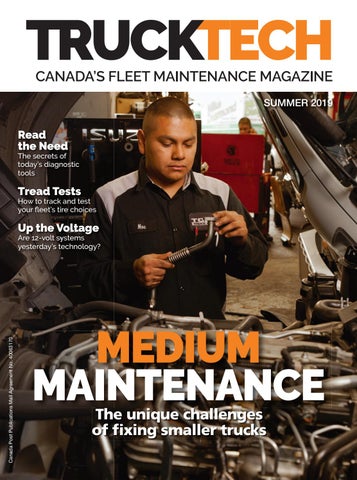
MAINTENANCE The unique challenges of fixing smaller trucks
Updates anytime anywhere À9 ¡Ú9 ¸Á¡SÁ e S À9/9P 9É å¹Úe 9
Taking a vehicle out of rotation to perform software and parameter updates decreases productivity. Remote Programming changes the way those updates are performed. Connect to the Volvo Uptime Center from virtually anywhere in the US and Canada and the upgrade is done while the truck is parked in as little as 20 minutes. Now you can download before sun up. Learn more at volvotrucks.ca
Uptime through Connectivity
is written and published for owners, managers and maintenance supervisors of those companies that operate, sell and service trucks, truck trailers, and transit buses.
SUMMER 2019 VOL. 4 NO. 2 Vice President, Editorial Rolf Lockwood rolf@newcom.ca • (416) 614-5825 Contributing Editors Eric Berard, Derek Clouthier, James Menzies, John G. Smith, Sonia Straface Managing Director Trucking and Supply Chain Group Lou Smyrlis lou@newcom.ca • (416) 510-6881 Creative Director Tim Norton tim@newcom.ca • (416) 510-5223 Production Manager Alicia Lerma alicia@newcom.ca • (416) 510-6845
TIRES
TREAD TESTS NEWCOM MEDIA INC. 5353 Dundas Street West, Suite 400 Toronto, ON M9B 6H8 416/614-2200 • 416/614-8861 (fax) CHAIRMAN AND FOUNDER Jim Glionna PRESIDENT Joe Glionna VICE PRESIDENT, PUBLISHING Melissa Summerfield CHIEF FINANCIAL OFFICER Peter Fryters DIRECTOR OF CIRCULATION Pat Glionna Truck Tech is published by Newcom Media Inc. The contents of this publication may not be reproduced or transmitted in any form, either in part or full, including photocopying and recording, without the written consent of the copyright owner. Nor may any part of this publication be stored in a retrieval system of any nature without prior written consent.
Servicing medium-duty trucks takes a special skillset, and close communication with cutomers who are typically not truckers.
How to conduct a reliable, accurate tire test
Features Tools of the Trade Diagnostic tools are evolving as much as the trucks they service
8
Editorial ................................................... 5 Quick Fix ............................................. 6-7 Equipment Watch ............................ 26-28
Small Trucks, Big Challenges Servicing medium-duty trucks requires close communication with customers
14
In for a Shock 22 Higher-voltage 24- and 48-volt systems are the future, but the transition won't be simple TECHS TALK: Fresh Faces A pair of young techs from Maxim Truck and Trailer discuss what drew them to the trade
8 trucknews.com
Departments
Techs Talk............................................... 30
26
30
14
22 SUMMER 2019 TRUCKTECH 3
There’s no such thing as a slow summer in the trucking business. The Mobil Delvac 1™ range of synthetic engine oils helps protect your fleet and your business by extending oil drain intervals.
See all of our oils at mobildelvac.ca
Editorial
Corrosion is a Big Deal, Right? The rust challenge may deserve a spot on next spring’s Canadian Fleet Maintenance Summit agenda
Illustration: bubaone, iStockimages.com
By Rolf Lockwood
What’s your biggest maintenance headache? I actually do want to know because, believe it or not, planning for next spring’s Canadian Fleet Maintenance Summit on April 15 is already underway. At a preliminary stage, for sure, but we’re already at it. We haven’t yet held a meeting of the dozen or so members of the advisory council that helps us devise the program, but individually we’re creating short lists of subjects to cover. A few weeks back I had occasion to spend a little time with Jim Pinder, corporate fleet director at the Erb Group of Companies in New Hamburg, Ont., and I asked him that ‘biggest headache’ question. He’s been around the maintenance world for years and years, and there can’t be many folks who understand the truck and trailer shop and its issues as well as he does. Way back in 1998 he received the Canadian Fleet Maintenance Manager of the Year award sponsored by Volvo Trucks. I’m happy to say he’s a key advisor on the CFMS team. And what’s his biggest maintenance pain? Corrosion, he said with no hesitation at all, somewhat to my surprise. Corrosion where, I asked? Everywhere, he said. Wiring, body, brakes, you name it. There’s a small irony here because as we planned the 2018 Summit, he urged us to put corrosion on the program. He was outvoted at the time, the general feeling being that it might be a little boring, might give rise to yet another PowerPoint presentation that nobody really wants to sit through. Instead, we decided, as we had for the initial CFMS (the new version, that is) in 2016, we’d like to study issues like technician retrucknews.com
“What’s his
biggest maintenance pain? Corrosion, he said with no hesitation” cruitment and retention or look ahead and discuss coming technologies. We didn’t, and still don’t, want a series of PowerPoint presentations that put people to sleep. We’re looking instead for animated discussions by three- or four-person panels or keynote speakers. That formula has worked well in the first two iterations of the Sum-
mit and I see no reason to change the formula. That said, I’m re-thinking that corrosion idea and ways to make it interesting, maybe even entertaining. The thing is, if Jim Pinder answered my question as firmly and quickly as he did, then the subject must be a worthy one. Our conversation wasn’t long, and I wasn’t in a position to be taking notes, so it’s one we’ll have to continue soon. In the meantime I’ve been cruising around the web looking for information on rust, its sources, and possible preventive actions. Oddly, there’s not really that much out there, though the Technology and Maintenance Council (TMC) has it covered pretty effectively. Does the scarcity of info imply that we’re resigned to watching metal disappear and wheel fasteners fail to fasten? Among the interesting facts I found is that corrosion costs the U.S. trucking industry some US$4 billion a year (no idea about Canada) in damaged truck and trailer parts, and it’s getting worse, not better. That’s largely because newer – and cheaper – de-icing agents used by road-maintenance departments are particularly brutal on metal. Salt in various forms is still broadly used, of course, and it’s just as deadly as ever. I also discovered that Pepsi has an aggressive anti-corrosion program in its sizeable fleet in both the U.S. and Canada but still succumbs to rust despite those efforts. I was a little shocked to learn that, of all work orders in Pepsi shops, 25% are related to rust. That’s enormous. So what do you think? Does corrosion soak up a substantial part of your budget too? If not rust, what else would you like to see on our CFMS agenda? Please give me your thoughts by e-mail – rolf@newcom.ca TT SUMMER 2019 TRUCKTECH 5
QUICK FIX
Aluminum, steel tariffs to end Several industry associations applauded an end to steel and aluminum tariffs this spring, marking the end of an international trade dispute that affected equipment manufacturing prices. The Canadian Transportation Equipment Association (CTEA) announced it was cause for a “Happy Victoria Day” when news broke just ahead of the May holiday weekend. “Trucking and trade are synonymous, and this decision by President Trump is a huge step toward achieving a vital national priority – ratification of the United States-Mexico-Canada Agreement,” said American Trucking Associations president Chris Spear, referring to the trade deal meant to replace the North American Free Trade Agreement. “Resolving this trade issue is very important to support the competitiveness of the Canadian automotive manufacturing industry and its suppliers,” the Canadian Vehicle Manufacturers’ Association (CVMA) added.
New paint facility to be finished in 2021 Kenworth is officially breaking ground on a new paint facility for its Class 8 truck assembly plant in Chillicothe, Ohio – representing a US $140-million investment that will support higher production volumes and better finishes alike. The 120,000 sq.-ft. facility to open in 2021 will be 25% larger than the existing painting area within today’s manufacturing facility and will increase capacity by 50%. While the manufacturing operation currently runs on two shifts per day, the existing paint facility needs to run on three shifts to keep up. Kenworth currently offers trucks in almost 20,000 different colors, and a color-matching system can meet just about any request, said plant manager Rod Spencer. In a typical year, the trucks that roll off the line could come in 1,300 to 1,500 different shades and tones.
6 TRUCKTECH
SUMMER 2019
Ontario reworking emissions tests Ontario continues to rework its emissions testing program for heavy-duty vehicles following a decision to cancel Drive Clean tests on light-duty models. The light-duty tests came to an end April 1, as the provincial government cited broad improvements in emissions controls. Just 5% of passenger cars failed the tests in 2017, compared to the 16% that failed when the program was introduced in 1999. In announcing the change, regulators stressed that heavy-duty diesel vehicles have not fared as well because mandatory standards have not been as stringent. Trucks at least seven years old, and with gross weights above 4,500 kg (9,900 lb.), are still required to pass annual Drive Clean emissions tests before registrations are renewed. But this testing regime is set to change. “In the near future we’ll be starting to roll out both the increased inspection — which will incorporate Ministry of Transportation as well as the Ministry of Environment — and then working with the industry as well as with other stakeholders around what the standards will be,” Environment Minister Rod Phillips told Truck Tech. “Our plan is again to try to get out of the way of the kind of duplication and look at all the inspections that are happening, and all the inspections that the trucking industry is required to look at,” he added.
But there will be a difference in the coatings to come. The latest generation of rotary spray guns will atomize the paint and deliver thinner coats with less overspray, Spencer said. “The customers will see the difference in the gloss.”
Allison purchases electrified businesses Allison Transmission has purchased Vantage Power and AxleTech’s electric vehicle systems division to complement a broad electrification strategy. The company says both acquisitions will help to advance propulsion technology and the broader adoption of electrification. Vantage Power specializes in developing electrified propulsion and connected vehicle technologies for medium- and heavy-duty manufacturers. AxleTech designs, engineers, manufactures, sells and services axles and
integrated electrified axles for on- and off-highway heavy-duty commercial vehicles.
Hendrickson unveils new plant plans Hendrickson has acquired 35 acres in northeastern Ohio, where it plans to build its sixth trailer suspension plant. “This $50-million, state-of-the-art facility will support local and Canadian customers as well as other Hendrickson divisions. It is our 11th manufacturing site in the United States and will have the capacity to manufacture axles and suspensions for heavy-duty Class 8 vehicles,” said Gary Gerstenslager, president and CEO. “When completed and fully operational, this 180,000 sq.-ft. facility will employ a full-time workforce of nearly 300 associates. Hendrickson anticipates completion
trucknews.com
of the facility to come in the first quarter of 2020.”
Transtex acquires SmartTruck assets Transtex has acquired the TopKit and LeadEdge Top Fairing aerodynamic trailer products from SmartTruck. The TopKit is EPA SmartWay-verified, and redirects air towards the rear of the trailer to reduce drag. It can be used by dry vans, reefers and straight trucks. The LeadEdge improves airflow between the truck and trailer or two tandem trailers, according to the company. “By leveraging our engineering expertise, we’ll develop new products and refine our solutions so these innovations can build on our long-term growth strategy,” said Mathieu Boivin, president and CEO of Transtex.
PacLease Edmonton is Franchise of the Year PacLease has named its Edmonton location the 2018 North American Franchise of the Year. PacLease Edmonton Kenworth received the honor during the parent company’s awards dinner in Orlando, Fla., with Jim Callaway, general manager of the Edmonton facility, accepting the award.
PacLease also named its top Canadian and U.S. franchises during the event. Peterbilt Manitoba was named the Peterbilt Franchise of the Year for Canada, while Location de Camions Eureka in Quebec was the Kenworth Franchise of the Year for Canada. Southland PacLease and Western Truck Leasing were named U.S. Franchises of the Year for Kenworth and Peterbilt.
Geotab acquiring BSM Technologies
Continental increasing retread production
Geotab is acquiring BSM Technologies, a telematics provider installed in more than 165,000 vehicles across government and private fleets in the U.S. and Canada. The acquisition would add to the more than 1.5 million fleet telematics subscribers using Geotab globally, the company said. BSM is strong in the government sector, helping to optimize and manage winter road maintenance fleets.
Continental plans to triple production at its pre-cured tread manufacturing plant this year, citing growth in retread sales. The company added a second shift at its plant in Mount Vernon, Ill., to prepare. “Continental saw a double-digit percent increase in demand for our retreads in North America last year,” said Tom Fanning, vice-president of sales and marketing for commercial vehicle tires. “We expect that growth to continue.”
Parts for Trucks expands westward
Bendix breaks patents record
Parts for Trucks has acquired Malmberg Truck Trailer Equipment located in Ottawa and Gatineau, Que. The deal makes Dartmouth-headquartered Parts for Trucks Inc. one of the largest truck and trailer service providers and parts distributors in North
Bendix says it received 52 U.S. patents in 2018, establishing a new record for the company. The company honored its inventors at an annual patent dinner. “The patents are a testament to their passion for finding solutions to even the most complex problems,” said Richard Beyer, vice-president of engineering and R&D. “Together, these innovators are helping Bendix shape tomorrow’s transportation, and contributing to a safer future on our highways.”
Fort Garry opens new Saskatoon site Fort Garry Industries has a new home in Saskatoon, Sask., celebrated with a grand opening May 9. A provider of aftermarket parts, as well as truck and trailer equipment and repair services, Fort Garry’s new building has 40,000 sq.-ft. of space, a significant increase from its previous location that fit in 27,000 sq.-ft. As part of its new open concept, the new location boasts a parts showroom, sales counter area, three drive-thru service bays, and a large display yard for trailers, equipment and truck parking. Customers can find the new location at 3426 Faithful Ave., around the corner from its old facility.
trucknews.com
America, with 19 warehouses, six service facilities and three mounted-equipment shops. The three Malmberg locations will operate under the Malmberg brand, with all operational staff staying with the business. Earlier in March, the company celebrated 100 years in business.
Meritor to acquire AxleTech Meritor is set to acquire AxleTech for about US $175 million in cash. AxleTech’s offerings include a full product line of independent suspensions, axles, braking and drivetrain components. It generated $248 million in revenue in 2018. Once the deal is finalized, the business will operate within Meritor’s aftermarket, industrial and trailer segment. TT
SUMMER 2019 TRUCKTECH 7
DIAGNOSTICS
READ THE NEED Truck sensors offer valuable snippets of information, but in-shop diagnostic tools are still responsible for telling the whole story By John G. Smith
M
odern trucks are not known to keep problems to themselves. If temperatures or pressures stray beyond a particular range, the dash begins to light up like a Christmas tree. Telematics systems fire warnings to fleet managers and OEMs alike, sometimes before the wheels stop turning. But in most cases, the insights are limited to snippets of information. Full stories – the details that are needed for a lasting repair – largely remain the domain of in-shop diagnostic tools. Consider a warning that draws attention to low boost pressure, explains Dustin Carnes, training manager at Diesel Laptops, a supplier of diagnostic software. “There’s 20 different things that could be causing that low boost.” Maybe the root cause is a bad turbocharger actuator, or a biased sensor. To compound issues, the warnings are not always triggered one at a time. “You’ve got to be able to find who started it, who started squawking first,”
says JPRO’s chief technology officer, Dave Covington, referring to multiple warnings that can be triggered almost simultaneously. “All these ECUs on these new trucks are very reliant on one another. Your transmission and your engine are no longer separate entities. Your transmission can affect your engine and vice versa. And, of course, your brakes affect everybody and everything on the truck.” But the latest generation of diagnostic tools can log multiple data items and observe all the electronic control units at the same time. And the benefits don’t end there. “If you have a cell device or a wifi device or satellite device that’s not functioning properly, you can’t talk to the truck,” Covington adds, referring to one limitation of telematics. “The good thing about a [diagnostic tool’s] wired connection is you can go in and patch a wire, fix a wire, crimp a new pin on, and always talk to that truck.” Telematics systems do a “phenom-
enal” job when it comes to letting fleet managers monitor their vehicles, but there are limits to the amount of data that will be transferred, agrees Kristy LaPage, business manager of Mitchell 1’s commercial vehicle group. “It’s just too much data on the vehicle being read for it to be transmitted.” She has heard telematics systems described like Fitbit personal fitness trackers. Using a similar analogy, in-shop diagnostic tools are more like the monitors left in the hands of medical specialists. Monitoring your pulse during a workout is one thing. Identifying the need for a bypass is something altogether different.
Evolving tools
“OEMs have gotten very specific with the types of tests that need to be performed.” – Dustin Carnes, Diesel Laptops 8 TRUCKTECH
SUMMER 2019
Still, increasingly complex vehicles and their growing number of sensors have also required the tools themselves to evolve. “The days where a technician can use trucknews.com
DIAGNOSTICS
Training on diagnostic tools is essential, especially for seasoned techs who may not have worked with laptops in the past.
connectors ... sometimes without telling those who develop the third-party tools. It’s just one example of the challenge suppliers face in the push to ensure their tools continue to advance.
Freeze frames
a cheap handheld scanner to diagnose complicated electrical issues is gone,” Carnes says. “OEMs have gotten very specific with the types of tests that need to be performed, and the types of information that must be monitored is very trucknews.com
control module-specific.” “Just getting the data off the truck is a hassle,” says JPRO product manager Jason Hedman, referring to the way some manufacturers moved the pins and protocols on J1939 Type 2 green
One of the key features to emerge in the race to address ghosts in the machine – codes and warnings that appear and disappear for no particular reason – comes in the form of “freeze frames” that can capture a moment in time, comparing pending and active codes alike. “With scan tools I can hook the vehicle up and I can see where the different fault codes are happening, and at what time, and from there I can kind of start identifying different parameters around when the fault code happened. ” LaPage says. “The fact the vehicle talks back to us so much better now, that is one of the most amazing things.” Carnes worked at an International Continued on page 10 SUMMER 2019 TRUCKTECH 9
DIAGNOSTICS
dealership for 12 years, and can remember trucks that would arrive along with a half dozen inactive fault codes and reports about a specific driver complaint. “There’s no active code telling you to go to a specific area,” he says. But freeze frames can report when a code was first logged, helping to track down a root cause. It’s all about a process of elimination. If a driver reports that a code is activated when a vehicle reaches a specific operating temperature, for example, a code that emerged when coolant temperatures were sitting at around 90 degrees likely isn’t the information that will guide the necessary repair. “It’ll help you narrow down certain issues when you don’t have a lot of other data,” Carnes says. Of course, there’s a difference between data and information that shop teams can act upon. “It’s [about] more than giving a technician a wall of data and a wall of faults and saying, ‘Here, go figure it out,’” Covington says of the ultimate goal, 10 TRUCKTECH
SUMMER 2019
Diagnostic tools level the playing field between OEMs and independent shops, but unfortunately they also come at a steep cost for the independent operation.
referring to the layers of data that can be accessed in an advanced tool. While measuring the levels of soot in an aftertreatment system is important,
shops also need to know what the levels mean within a particular system, and ultimately what actions are required, he says. trucknews.com
DIAGNOSTICS
“The way of thinking has had to change. It’s no longer just turning a wrench.” – Kristy LaPage, Mitchell 1
“It’s not just the repair that you’re looking to do. It’s the preventive stuff. When to run a regen and when not to run a regen,” Hedman agrees. It’s why he found himself cringing as he sat through a presentation where a fleet manager discussed regens that were completed every time a diagnostic tool touched a truck, whether the lamp was lit or not. “That’s a waste of time, fuel and money right there ... at least in my eyes.” Advanced diagnostic tools require extra training While diagnostic tools can deliver deeper insights than ever before, mechanics still require training in how to use them to their full potential. “There’s a huge gap of skill level when it comes to that area,” Carnes says. “Today’s trucks are getting more and more complicated pretty quick, and you’ve got a generation of technicians that have not had to use a computer.” Some of them even avoided such tools until the last possible minute. LaPage remembers the “mass exodus” of automotive mechanics who left to work on diesel equipment tools when digital diagnostic tools became the norm in light-duty shops. “You can’t do this job anymore without having an electronic background, or learn it as you go,” LaPage says. “The way of thinking has had to change. It’s no longer just turning a wrench. Now it really is sitting in front of a computer or laptop or scan tool and being able to read what that vehicle is saying to you.” It all places a greater emphasis on related training into how to use the tools. “Knowledge of the vehicle systems to get connected, run tests, changing settings, and overall usage is paramount,” Carnes says. But shop personnel have been known to complain about missing features on a diagnostic tool only to distrucknews.com
cover that they simply didn’t understand how to access all the different functions. Diesel Laptops tries to fill the gaps with weekly webinars that illustrate steps such as how to complete a connection, while a support team of retired diesel technicians is on hand to walk teams through the challenges. “You’ve got to have as many avenues to reach them as possible,” Hedman says, referring to the training approaches that shops should look for when deciding on a supplier of diagnostic tools. “Tools need to be intuitive to begin with. You want people to want to use it. You also want to have tools that have capabilities built in to help train them.” Videos, slides, user guides, and “virtual trucks” built into the tool in the name of offering hands-on training can all help.
The small shop challenge The right diagnostic tools can certainly put an independent shop or small fleet on a level playing field with a dealership network when it comes to diagnostic work. But it will be difficult to find all the tools that are necessary without breaking the bank. “Dealers absolutely have a huge advantage over the smaller thirdparty shops and smaller fleets,” Carnes admits. “The more advanced these vehicles are becoming, the more proprietary each system is getting. And unfortunately, OEMs are trying their best to keep proprietary information to themselves.” Many high-end tools will still bring the shops “very close” to the dealer experience, he says. Operations deal with remaining gaps by deciding the nature of specific work that might be sent elsewhere. But for the work that remains within their domain, there are tools to help. TT
727$/ $Ζ5 6<67(0 3527(&7Ζ21 ELIMINATES
:Ζ17(5 FREEZE UPS
800.766.4243 expelloairproducts.com
SUMMER 2019 TRUCKTECH 11
THE FLEET TECHNOLOGY SHOWCASE October 28-31, 2019 • Georgia World Congress Center, Atlanta, Georgia
nacvshow.com
KEEP YOUR FLEET IN
THE FAST LANE CAN’T-MISS NEW SHOW FEATURES
³ Connectivity Zone ³ ‘Ask the Expert’ Workshops ³ 3 On-Floor Education Theaters ³ Off-Floor Conference Programs
REGISTER NOW with code
TTECH19
for your free expo hall pass!
The biggest class 4-8 vehicle manufacturers in one place 500+ exhibitors 530,000 sq. ft. of exhibitors expanded to two halls Enhanced educational programming
MEDIUM-DUTY
MEDIUM MAINTENANCE The smaller trucks that roll into a service bay can still represent big maintenance challenges. By Eric Berard
D
The stop-and-go environment takes a toll on medium-duty truck brakes. Special attention should also be paid to wheel bearings. 14 TRUCKTECH
SUMMER 2019
on’t let the size of a truck fool you. Medium-duty trucks are dwarfed by their Class 8 counterparts, but such equipment can present some of the biggest challenges for a repair facility. Chief among them is the fact that many of these trucks are owned and operated by businesses that often treat trucks as an afterthought. The people at the wheel might be bakers, carpenters, electricians or landscapers. They don’t think of themselves as truckers. The trucks are simply seen as a way to deliver tools of the trade. It’s up to technicians and mechanics to be able to draw out the information they need, even if the customers are not as familiar with truck components. “The more skilled the technician is and understands our truck, the easier it is for him to work with the customer to diagnose what the issues are. The key thing is really communication,” says Andy Craig, director of Canada operations for Isuzu Commercial Trucks, stressing the importance of continuous training. Still, the discussions that lead to accurate diagnostics can be complicated by the fact that many medium-truck users are not dedicated to the trucking business at large. They can struggle to explain how a vehicle feels when they’re behind the wheel.
MEDIUM-DUTY
The key to accurate diagnostics is communication with customers, for whom trucking often isn’t their core business.
“Their core business isn’t making deliveries. They purchased something to help get the product there,” says Robbie McLellan, director of service operations at Altruck, a multi-store International dealer headquartered in Guelph, Ont. The lack of familiarity with the truck can also be the source of trouble, says Fred Lafleur, owner of four Mecamobile multi-brand service shops, operating in the Montreal area under the TruckPro banner. trucknews.com
“Their core business isn’t making deliveries. They purchased something to help get the product there.” – Robbie McLellan, Altruck
“It’s common that the medium-duty user doesn’t really know what his truck can and can’t do,” he says, referring to weight capacities that can be stretched to the limit by an occasional excessive payload.
Overloaded damage Extra weight takes a toll on components including the suspension, tires and steering system alike. And those already face unique stresses in the Continued on page 16 SUMMER 2019 TRUCKTECH 15
MEDIUM-DUTY
“A tiny leak is enough for oily matter to accumulate on radiators and dust to stick to it, potentially leading to engine overheating issues and premature wear.” – Fred Lafleur, Mecamobile
midst of urban routes where potholes and tight turns are part of the daily routine, compounded by regular contact with curbs. Even a reasonable payload can lead to maintenance challenges if the weight is badly distributed. Think of a plumber who carries all his pipes and fittings on the same side of a cube or panel truck. In a case like that, maintenance teams will need to pay special attention to the suspension and uneven brake wear. “Brakes would be a big one for sure,” McLellan says, observing how Classes 3-7 trucks usually find themselves in a constant stop-and-go environment. While some medium-duty equipment can come with exhaust brakes to help preserve service brakes, their bark tends to be silenced in the urban areas where these vehicles tend to operate. Steering systems present another maintenance challenge, since many of the front ends in these vehicle classes are non-greaseable, Lafleur adds. Other components such as wheel bearings can be serviced more easily, but are too often neglected on medium-duty trucks, he says. “These trucks are not built to run 200,000-plus kilometers without the wheel bearings being disassembled, adjusted, lubricated or replaced if needed. That can be a real problem for a truck driven mostly in urban settings.”
Lack of maintenance awareness “Awareness of the importance of pre16 TRUCKTECH
SUMMER 2019
ventive maintenance is the big issue within the segment,” says Isuzu’s Craig. Thoughts about a truck’s condition often take a back seat to other business demands. It’s why many medium-duty truck dealers focus on coaching customers about preventive issues – particularly when it comes to the warning lights linked to complex aftertreatment systems. For a non-trucker who ignores the check engine light in their car for weeks on end, just how important is the regen supposed to be? “You can do it for a couple of hours until you get to a shop, but if you ignore it for a week,” Lafleur says, “you probably have damaged all your DPF system and you get stuck on the side of the road because regens didn’t occur, and everything [in the aftertreatment system] got clogged.” Excessive idling tends to be common in many mediumduty applications as well, causing its own harm to the aftertreatment systems. It’s why McLellan thinks technicians should pay particular attention to them. “You create soot, dirt, and things like that internally that you wouldn’t create if you were running down the highway,” he says. That’s one of the reasons why Isuzu dealers often focus on operating hours rather than mileage when assessing a truck’s health. “The truck maybe starts up at 8:00 and goes until 6:00 and never shuts off,” Craig says, referring to long idle periods.
Some buyers dodge the need for diesel exhaust fluid by selecting a gasoline-powered model. There are no regens in those. But you still have emissions-related issues to manage, and maintenance needs for components like injectors, Lafleur says. “Gasoline engines have been using EGR valves forever and still do. They also need to calculate fuel pressure, they have a canister system for gasoline fumes, and they also have a catalyst. It’s not as advanced as on a diesel, but it’s still there.”
Maintaining electrical connections While electrical malfunctions can be a nightmare to address on any truck, medium-duty models also introduce the added challenge of bodies or vocational equipment that was introduced by a body builder after the truck rolls off the assembly line. If the body wasn’t properly connected to the chassis, there will be wiring issues to address. Most truck manufacturers have addressed such challenges by adopting plug-in, ready-to-use harnesses rather than requiring splices. “We provide all the body builders with wiring diagrams and information on alterations, what to touch, what not to touch,” Craig says.
Electrical connections need to be sturdy to handle urban settings.
“The old style was, you searched through the dash and found a power wire and you found a ground wire and you found the signal wire,” McLellan says. “All manufacturers have done a really good job for the body builders.”
Fighting grime and corrosion But even the best connections will face attacks from de-icing compounds and
MEDIUM-DUTY
the repeated splashes of standing water on city streets. To compound matters, urban driving tends to expose the units to plenty of road dust and airborne particles that might otherwise blow off a Class 8 tractor at highway speeds. It means rads can require regular cleaning to keep the cooling system operating as it should. Lafleur notes that some pickup based medium-duty trucks are equipped with as many as seven different radiators that all need to be taken care of. “A tiny leak is enough for oily matter to accumulate on radiators and dust to stick to it, potentially leading to engine overheating issues and premature wear,” he says. All that dust and road grime can also play a role in shortening the lives of fuel filters, requiring careful attention for the equipment that tends to run at low speeds in heavy city traffic. Many truck owners adopt rust-proofing treatments as a barrier against the corrosive threats, and Lafleur recommends the work. “We can see by the floor, lower body panels or radiator supports’ level of corrosion if the owner had it treated. The difference is huge. After 10 years, rust hasn’t eaten away the vehicle,” he says.
port alternative fuels or battery-electric operations. But technicians know that a truck is more than the powertrain. Eliminating the internal combustion engine still leaves plenty of maintenance demands,
Lafleur says. There are still the brakes, the suspension, steering and lighting to contend with. That will all need a level of specialized repair. And that will require savvy truck techs. TT
Spare parts and know-how Given their low mileage, it’s not unusual for medium-duty trucks to stay in service for 10-15 years, sometimes more. This means shop managers need to secure access to a particularly wide selection of spare parts, and ensure technicians are trained in equipment with a wide range of model years. It’s one of the reasons why some shops that service medium-duty trucks like to hire personnel from the car business. “If you’re a truck guy, you may not have worked on hydraulic brakes for the last 10 years. It might have always been on air brakes,” McLellan adds. In the meantime, they require some of the earliest training on advanced technologies, since the trucks travel distances that are more likely to suptrucknews.com
SUMMER 2019 TRUCKTECH 17
TIRES
A tire test should start out with more than 30 tires, because some will inevitably fail during the test.
TESTS
Tracking and testing tire choices can be more involved than you think By James Menzies
R
unning an accurate tire test isn’t a matter of simply throwing on new rubber and tracking fuel receipts. A true test requires at least 30 wheel positions to remain at the end of the test, and the use of a control fleet. Peggy Fisher, president of Tire Stamp, shared some best practices for running tire tests at this year’s spring meetings of the Technology and Maintenance Council. “In the real world, conducting tire 18 TRUCKTECH
SUMMER 2019
tests is a challenge and can be a real pain in the butt,” she acknowledged. “It’s hard. There are so many variables you have to be concerned about.” Just a few of these include: vehicle model; routes; weather; loads; and drivers. “All these things can affect test results, and stuff happens,” Fisher said. “Tires get damaged. They’re repaired. They just magically disappear. And when you ask the driver or technician what happened to the tire on his truck, you get ‘I dunno.’”
Fisher said to get a 90% confidence factor in the test results, at least 30 tires must remain at the end of the test. She advised starting with more than that, as some will be lost due to damage. “You’re probably going to lose 10-15% of them and they’ll fall out of the test,” she said. “You can use smaller sample sizes but the results won’t be as accurate.” She also suggested using broken-in vehicles with 15,000-30,000 miles on the odometer. The trucks used in a test should be identically spec’d and loads should be about the same. Drivers chosen for the test should be free of unusual driving habits and represent the average driver within the fleet – don’t include the best or worst drivContinued on page 21
TIRES
FEEL THE PRESSURE
Why managing inflation pressures is more important than ever
Use a tire gauge to accurately measure inflation pressures.
T
he importance of maintaining proper tire inflation pressures cannot be overstated. The Technology and Maintenance Council of the American Trucking Associations has indicated running a tire that’s as little as 10% underinflated hurts fuel economy by 1.5%. And a 20% underinflation can reduce tire life by 30%. Simply put, maintaining proper inflation pressures is the single most effective way to reduce tire-related costs in your fleet. “Proper tire inflation will substantially impact your tire and ultimately your vehicle’s performance,” Jon Intagliata, Bendix product manager for tire pressure monitoring systems (TPMS), said during National Tire Safety Week May 20-27. “Fuel consumption can increase, stopping distances can increase, and tread life can decrease if the tires run on significantly different psi than what is recommended by the manufacturer – all of which can dramatically affect a fleet’s total cost of ownership over the long haul, too.” Another cost associated with poor tire maintenance is roadside service calls, with some industry studies suggesting 90% of which are caused by underinflation. Frequent inflation pressure checks should be conducted using a tire gauge. Whacking the tire with a hammer will only identify tires that are severely over- or underinflated. Another option is to adopt technology that measures tire inflation pressure in real-time and notifies the driver when a tire’s pressure is incorrect. Or, take it a step further and employ a system that automatically adjusts air pressure as needed when the truck is in motion. “Gradual tire pressure loss can be difficult to detect, and you
nances II e t n i a M ractice Best P
could be quite a way down the road before you have a chance to notice it at the next spot check,” Intagliata said. Technicians should also be checking to ensure tires are evenly matched, when it comes to both tread depth and inflation pressure. Bendix cites that it takes as little as a 5 psi difference between dual-mounted tires to create problems including irregular or accelerated wear. As trucks are increasingly equipped with newer safety technologies – such as disc brakes and collision mitigation systems – it’s more important than ever to ensure the tires are in good condition and properly inflated, to get the optimum performance from those safety systems. “Today’s integrated vehicles mean you need to equip the best set of tools on your tractor and trailer to maximize performance,” Intagliata said. “TPMS can play a critical role to guarantee your advanced safety systems – including air disc brakes and advanced driver assistance technologies – are functioning at the optimal levels.”
Fluid Thinking DOWNLOAD YOUR FREE COPY IN THE DIGITAL EDITIONS ARCHIVE ON
www.trucknews.com inking on Fluid th oil life, g in d n te tion, ex ic lubrica automat d more an ty safe Newcom n tors of Chevro by the edi rship with t to you Brough in partne Group, Trucking
Brought to you by the editors of Newcom Trucking Group, in partnership with Chevron
SUMMER 2019 TRUCKTECH 19
Discover what more than 900,000 visitors did last year
We deliver
MORE BLOGS
MORE
MORE
truck news.com
STAY UP TO DATE ON INDUSTRY NEWS, TRENDS AND EQUIPMENT RELEASES Visit the industry's most popular website
TIRES
“Product evaluations are hard.” – Randy Patterson, Bridgestone
ers. Trucks should be aligned before the test begins – even if they’re new. Retreads that are tested should have the same casing, manufactured by the same supplier, and be within one year’s manufacture of each other. All test tires should be identified and technicians and drivers notified about the test, so that the tires are retained if they fail on the road. “Make sure the tires themselves are identified and I also highly recommend stenciling the wheels with ‘TEST’ so people don’t miss it. Label the vehicles so that technicians and drivers are alerted to the fact there are test tires on that vehicle,” Fisher advised. Rim sizes must also be matched, as do the wheels. Test tires should all be installed within 30 days of each other to minimize the impact of weather. Tire pressures should be checked at least monthly, and alignment should be checked several times over the course of the test, Fisher said. Tread depths should be measured and recorded at regular intervals. “Take them consistently at the same spot in a major tread groove,” Fisher advised. “Use the valve stem as a reference point and take it consistently at the same spot.” An initial analysis can be conducted when the tires are 50% worn. Randy Patterson, senior field engineer with Bridgestone, said communication throughout the fleet – and outside it – is crucial to running an effective test. Some of the people who need to be involved in the discussions include: the parts manager; maintenance manager; shop supervisor; technicians who will be touching the tires; drivers; and even dispatchers. Outside the fleet, the dealer service personnel, tire manufacturer representative, and truck sales manager should all be looped in. Some of the biggest mistakes Patterson has seen fleets make when running tire tests are: failing to track the test tires; failing to track the tires once they’re removed from the vehicle; not using a control group; not doing enough inflation pressure checks during the test; using mismatched vehicles; and pulling the tires too soon. “Product evaluations are hard,” he acknowledged. “They take a lot of time to do, a lot of effort. The more effort you put in up-front and the more communication you have, the better off you are. If you collect bad data, you’re going to have bad data as a result.” Lee Long, director of fleet services with Southeastern Freight Lines, has 95,000 tires on the road on any given day. “Everything we do is driven by data,” he said. He urged fleets to work with their tire supplier to use their facilities for testing. He took two trucks to a tire company test track to conduct coast-down testing. Long also noted calibrated tire gauges should be used to measure inflation pressures. TT trucknews.com
Dayco Heavy Duty. Your Global Partner from OE to the Aftermarket.
www.DaycoAftermarket.com
SUMMER 2019 TRUCKTECH 21
ELECTRICAL
UP THE VOLTAGE Manufacturers explore the options for higher equipment voltages By Jim Park
V
ehicle electrical engineers are like kids in a sandbox these days. The transition to 48-volt vehicle architecture represents nearly endless potential for improvement in efficiency and functionality of electrical components. It’s almost like starting from scratch – in more ways than one. Less than a year ago, Craig Jacobs, Eaton’s director of engineering and program management for controls and protection, transportation, military and aerospace division had this to say about transitioning from the current 12-volt architecture to either 24- or 48-volt: “I don’t think the industry has converged on 24 or 48 volts at this point. There are a couple of different camps on this. The 24-volt supporters point to Europe where 24-volt systems are used, so there’s already some standardization, and components are readily available. The 48-volt camp says if we’re going to make a change, let’s go all the way.” Jacobs also noted that 24-volt systems might take us out 10 or 15 years, but then we’d be up against a wall again, with limited potential for expansion. “Going right to 48 volts would last longer before we’d see the need to upgrade again,” he said. “It also gives OEMs a lot more flexibility in how they design vehicles.” This year’s annual meeting of the ATA’s Technology and Maintenance Council (TMC) featured a panel discussion examining the advantages and challenges of converting to 48-volt vehicle systems from 12. The lists are long on both sides of the ledger. 22 TRUCKTECH
SUMMER 2019
Jim Bevan, manager of eMobility Engineering at Daimler Trucks North America, said switching to 48 volts opens all kinds of doors that we currently consider impractical or unfeasible, such as a fully beltless engine. “With 48 volts, we simply have more power that we can do more things with,” he said. “When you start taking the auxiliaries off the engine, you could potentially put them in a full variable mode so they can be always in their efficiency sweet spot where you get the least amount of losses. We’ve had 12volt systems on trucks for so long that we’ve gotten comfortable with what that configuration can accomplish. But if you start talking about 48-volt, and you have more power, more power capability, you can start looking at really feasibly electrifying different systems – air conditioning for example.” Upping the system voltage from 12 volts to 48 volts will enable all sorts of new on-board capabilities. Among the more obvious are the many engine components and systems that could be driven electrically rather than with a belt tethered to the engine, such as air compressors, cooling fans, oil and water pumps, etc. In addition to the efficiency gains Bevan mentioned, off-boarding such components would eliminate the need to position them near the front of the engine for geartrain access. As Jacobs pointed out, “If you take a lot of that stuff away from the front of the engine, it would give the OEMs a lot of freedom they never had before to redesign the front of the truck.” Bevan also spoke of the potential for
New tools will be required for technicians to assess high-voltage power systems.
mild hybridization of certain drive systems on heavy trucks, similar to the systems offered by Hyliion at present. “By rethinking certain components, such as the starter, alternator and transmission, integration possibilities open up where, for example, the alternator and starter could become the same device and be built into the transmission,” he said. “It could also be like an entire flywheel housing that’s retrucknews.com
ELECTRICAL
Beltless vehicles are just one possibility that 48-volt power offers.
placed with an electric motor/generator that could add assistive power to the drivetrain on demand or reduce the load on the alternator by recouping energy from vehicle momentum while coasting, rolling downhill or braking.”
12-volt is here to stay But there are some practical hurdles to all this creative engineering; the basic vehicle electrical system. Obviously, the trucknews.com
basic in-cab electrical architecture and the truck-trailer interface will need to stay at 12 volts, but Jeff Williams, senior power electronics engineer at Volvo Trucks says the industry has identified six other interface points on the truck where multiple voltages will need to be considered, including the battery/charging system access and the body-builder interface. “Trailers vastly outnumber power
units in this country, and they also have a longer lifespan,” says Williams. “The J-560 connector has served the industry well for over 60 years, even when ABS was added to it. I see us needing to support 12 volts essentially forever; this will not be a step event or a cliff event where all of a sudden we’re immediately at multi-voltage and 12-volt vehicles cease production. We will have to support 12volt trailers and body-upfits for the foreseeable future.” At this stage, 24-volt starting and charging systems are common in Europe and fairy easily integrated into a modern vehicle with 48-volt architecture. Williams spoke of several devices that will need to be incorporated to successfully step down or step up voltage as required, such as equalizers, which are really just “fancy DC to DC converters.” Such technologies eliminate the need for old and troublesome series/parallel switches when incorporating 24-volt starting and charging systems. As for the batteries themselves, the Group 31 battery is not going away, but we’ll likely see different battery chemistry and configurations, including series connections rather than parallel connections to get up to 24 or 48 volts. It remains to be seen which systems on board the truck will get to 24 volts and which will see 48, but there are a multitude of design advantages to increasing the voltage. It might seem counter intuitive to those unfamiliar with the basic principles of electricity, but thinner wire and smaller components can be used with 48 volts as opposed to 12. When you double the voltage, you reduce the SUMMER 2019 TRUCKTECH 23
ELECTRICAL
“There are going to be some real challenges for our industry. We can do it, but is it going to be easy? No. One of the things you're going to have to look at is your parts inventory.” – Bruce Purkey, Purkey's Fleet Electric
current by half, which allows for a thinner gauge of wire. If you quadruple the voltage, you cut the current by a factor of four, etc. For example, with thinner windings in starters and alternators, you can make the entire assembly physically smaller and lighter. As a result, you get the same power output from a smaller motor or additional power output if you maintain the size of the unit. “In the case of a 24-volt starter, you can drop down to the next smaller casting size, saving room with the installation as well as some copper, steel and aluminum,” Williams says. “Or, if you keep the casting the same size but stuff it with 24volt windings, you can get an additional few horsepower of cranking power. In most cases, motors designed for higher voltages are more electrically efficient, which in the long run saves fuel.” All of this talk of transition begs the question, how will we standardize it all? This wouldn’t be the first time we’ve seen one or two OEMs or major suppliers head down a particular path on their own leaving fleets to deal with the inconsistencies. This time, The Society of Automotive Engineers and TMC are getting involved early to stay ahead of this rather significant change. “SAE and TMC are already looking at this through SAE Truck and Bus Electrical Systems Committees and the S.1 task force at TMC as well as OEMs and suppliers,” said panelist, Fred Kelley, director of engineering at Prestolite Wire and chairman of the SAE Truck and Bus Electrical Systems Committees. “There have been lots of discussions already and SAE recently created a multi-voltage task force to identify what was missing and recommend how to move forward.” In December 2018, the group created a 24 TRUCKTECH
SUMMER 2019
roadmap outlining the steps required to move forward and identified standards that would have to be updated, revised, left alone or created. “We identified eight SAE standards that will have to remain 12-volt standards, including the SAE J-560 [trailer interface],” Kelley said. “This work also identified 16 current standards that will need to be reviewed and revised to ensure they satisfy 12-volt systems as well as high, multi-voltage systems. We also found that we will need as many as 10 new standards to accommodate multi-voltage systems.”
Trouble in the shop? Trouble might not be the right word, but changes in the shop from procedures to the tools used and how parts are identified and inventoried will be profound, said Bruce Purkey, founder and chief creative engineer at Purkey’s Fleet Electric. “There are going to be some real challenges for our industry. We can do it, but is it going to be easy? No,” he said. “One of the things you’re going to have to look at is your parts inventory. Those circuit breakers, relays and fuses that you don’t even think about anymore? Well, just wait until somebody puts a 4-volt relay in a 48-volt plug. You’re going to get a 'hi ho, Silver' and a cloud of smoke. Twelve-volt parts are not going to work on 48-volt systems. We’re going to have to start thinking about getting ready for this transition.” Purkey talked about labeling and identifying parts by voltage, perhaps with color-coding or separate storage areas to avoid confusion. He talked about the need to develop and acquire the proper tools for working on higher voltage systems, pointing specifically to basic wiring repair.
“Wire repair will become critical,” he said. I’ve been told that as we go from 12 to 48 volts corrosion will worsen by a factor of 10. So, if you can’t maintain wire now, what are you going to do on a high voltage system? I still go into shops where I see technicians using those hard plastic butt connectors. How can you seal those? “It’s going to be the little things that make a big difference, like requiring technicians to have their own crimpers and their own strippers. That’s not going to work anymore. If you want consistency in the repair process, the fleet will have to supply the proper tools and insist the technicians use them and follow procedures.” Much will change for technicians, including the need for additional training, in things as basic as reading wiring diagrams to understanding the newer devices like equalizers and more advanced electrical system analyzers, Purkey indicated. “We’ve had some big changes in the past. I can remember electronic controls. Everybody cried the blues but guess what: it got us the fuel economy we wanted, so we lived with it,” Purkey said. “Do you remember when we went from English to metric sized hardware? It didn’t change how we tightened the bolt did it? We just had different tools, and that’s what’s going to happen this time around.” The migration to multi-voltage systems has already begun in the passenger car space, and heavy trucks won’t be far behind. Whether it’s mild hybridization or beltless components like air compressors and cooling fans, 48-volt motors will make it possible. “It’s very exciting to think about what we can do if we start adding extra power and with it the extra capability,” said Bevan. “What can we do that we haven’t thought of quite yet? How can this impact and improve efficiency and design of the vehicle, the operation? How can this be integrated into fleets in terms of body builders? What systems are out there that could be electrified as well?” It’s a whole new world of possibilities. TT
CFMS
‘IT WAS OUR FAULT’ There is blame to share for the shop labor shortage. Can we turn it around? By Nicolas Trepanier
R
ecruitment and retention challenges took center stage at the Canadian Fleet Maintenance Summit in Montreal this year. According to Bernard Boulé, general manager of Camo-Route, there are currently 1,485 vacant heavy vehicle mechanic positions in Quebec. About 400 students graduate each year, and some of them will eventually change careers. “It’s not enough,” said Boulé, adding that the situation was even more worrying for truckers. “This is a major challenge for the industry.” Women are still largely underrepresented in trucking, despite efforts to attract more. “Seventy per cent of academics are girls,” says Patrice Lagarde, president of Virus 1334, the agency behind a Quebec Trucking Association (ACQ) recruitment campaign. “And there is clearly a problem of reception, integration, and perception of women in this environment.” Camo-Route has given itself a mandate to increase the share of women in Quebec’s transportation industry to 10%, up from today’s 3%. The employer-employee balance of power has also changed somewhat in recent years, as many potential candidates now wonder what the company can do for them. Marco Girardin, director of safety, compliance and fleet for TYT Group, admits that the shortage of manpower has led personnel to change its hiring criteria. “Promote your employment brand to appeal to young people,” Lagarde suggested. “You do not know what the employment brand is? Call in human resources and speak with a specialist.” According to Lagarde, millennials like to travel, live new experiences, and change their jobs to try to improve their lot in life. “It’s going to happen more and more often, and companies will have to learn to adapt. In particular, by training employees to perform a variety of tasks.” Many career counselors are unaware of the job categories that exist, Lagarde said. “There are enough people in Quebec to fill all the positions to be filled. But it’s a bit like Tinder. You have to be the most beautiful to attract them into the industry,” he said, referring to the popular dating app. “We have to think outside the box and develop initiatives,” said Boulé, citing as an example the mechanics who traditionally have to bring their own tools to work, unlike an office worker who does not have to pay for their own chair and computer. trucknews.com
“It was our fault. We saw the shortage come and we did not do anything as an industry,” said Luc Fortier, head of vehicle maintenance, Central Canada at Agropur. “Now we have to work to become more attractive.” During the panel’s question period, two well-known industry personalities took the floor to offer additional advice to participants. “It is essential to stand out as an employer,” said Jacques DeLarochellière, president of Isaac Instruments. “Then you’ll see all that word-of-mouth can do for you.” And it is important to know that millennials are more interested in flexibility than in compensation, added jessica Joyal, president of jessicajoyal.com, during a related discussion. TT
SUMMER 2019 TRUCKTECH 25
EQUIPMENT WATCH Platform, Noregon partner in diagnostics Platform Science is partnering with Noregon to add remote fault code information to a connected vehicle open platform. Platform Science’s Vehicle Fault Diagnostics presents diagnostic information about all electronic components on any make and model of vehicle. Detailed fault descriptions and action plans to manage active issues offer information to reduce unexpected breakdowns and increase uptime, the company says. Instead of providing real-time insights into a single powertrain component, Vehicle Fault Diagnostics monitors all electronic control units and provides actionable information through internet connections.
Haldex unveils Midland air, electrical accessories Haldex has unveiled a lineup of Midland 3IN1 ConnectSets, seven-way cable assemblies, tractor-trailer jumper air lines, tender kits, and a wider array of brake hose assemblies, including dual live swivel fitting configurations. In 2016, the company relaunched the Midland value line, which also includes actuators, air tanks, air coils and air tubes, electrical coils, clutches, fittings, gladhands, and water pumps
Electric powertrain for Classes 2-6 trucks Dana’s TM4 Sumo LD direct-drive electric powertrain combines a motor and inverter for Classes 2-6 vehicles. The end result offers a modular package for e-axle platforms. And when integrated with a Dana electrified axle, the TM4 Sumo 26 TRUCKTECH
SUMMER 2019
Volvo expands over-the-air updates Volvo Trucks added more parameter updates to its Parameter Plus subscription package, now offering more than 250 paramaters that can be changed over the air. The Parameter Plus package allows for up to 50 parameter updates per year. Volvo says nearly 17,000 of its trucks are benefiting from over-the-air update capabilities. Parameter categories include: road speed; cruise control; transmission settings; idle shutdown; and fuel economy. A new offer is comfort shift, a software package that provides smoother launches when load shifting must be minimized, offering drivers a smoother smart and gentler drive, Volvo claims. Parameter updates can generally be done remotely in less than 10 minutes, while over-the-air software updates take less than 20 minutes.
LD can be used in light-commercial, minibus, medium-duty truck and bus, and even heavy-duty Class 8 hybrid vehicles. The TM4 Sumo lineup already powers more than 12,000 electric vehicles on the road. Three models are available, offering up to 250 kW of continuous power and 1,200 Nm of torque. New windings, combined with a permanent internal magnet rotor design, means a 10% reduction in magnets and a lighter, more compact design for smaller vehicle envelopes. The Sumo LD is matched with a threephase CO150 inverter.
Alternator designed for heavy-duty demands Military and mining vehicles are receiving some extreme support with a Leece-Neville IdlePro alternator with a 600-amp output at 6,000 rpm. The 24-volt alternators are virtually idle-free, the company says, and it’s up to 24 lb. lighter than comparable models. Features include Prestolite Isolated Ground Technology, which reduces stray voltage and electrical noise by maintaining a closed loop of electric current. The IdlePro Extreme 600-amp alternators
also run at a 78% efficiency rate, and in certain applications will deliver a minimum of 66% of their rated maximum output at engine idle speeds. Heavy-duty housings help to protect against vibration, while the high-performance brushless design reduces weight and size.
Reyco Granning suspension updated for electric vehicles Reyco Granning Electric Vehicle Solutions is producing a new drive axle air suspension designed for electric commercial vehicles. Part of the WorkMaster product family, the new 240AR-EV is based on an existing Model 240AR, but makes room for e-axle packages. Low-profile frame brackets leave room for body mounts or fifth wheel angles, the company says. And the curved spring beam eliminates a traditional lower air spring mount to increase ground clearance, lower weight, and accommodate different frame widths. The 240AR-EV has a gross axle weight rating of 17,000 to 23,000 lb., and can trucknews.com
be used for single- or tandem-drive axle arrangements. Ride heights range from 8.5 to 10 inches.
all-weather performance and advanced engine protection, the company adds. They’ve been proven to extend oil drain intervals up to 1,000 hours with the support of an oil analysis program.
Mack attacks battery sulfation Dana training expands JSV IPIGXVMǻIH ZILMGPIW Dana has expanded its Driveline Forensic training series to include videos that address safety and maintenance tips for electrified vehicles. The new videos offer overviews on electric vehicle architecture and maintenance, as well as vehicle servicing safety tips. The architecture overview includes charging instructions and a review of electric components, as well as a maintenance overview that includes pre-operation maintenance inspections, maintenance schedules, and service after impacts or water submersion. The safety tips cover caution around high voltage, personal protective equipment, primary shutdown methods, and damaged battery procedures.
Mack Trucks is adding a battery refresher as a standard feature on all truck models beginning in the second quarter of 2019. The refresher, mounted in the battery box, helps reduce and reverse the effects of sulfation, giving lead-acid batteries a longer life and supporting performance. Sulfate crystals build up on a battery’s lead plates during normal operation, limiting the battery’s ability to accept energy and reach a full charge, Mack explains. High-frequency energy pulses from the refresher help to remove the crystals. The refresher can increase battery life by up to two times and help prevent nostart conditions, Mack says. Fully charged batteries help to reduce the wear and tear on other electrical system components like alternators and starters.
Bendix enhances air disc brakes Bendix Spicer Foundation Brake is improving its ADB22X air disc brake. A new adjustment mechanism has been designed for increased vibration robustness, while improving the running clearance between the friction and rotor, the company says. The new disc brake also boasts longer pad life and reduces residual brake drag, extending service life. The brake has been coupled with Bendix’s longest-life friction, the BX276 air disc brake pad. It includes an additional two millimeters of thickness over its predecessor, the BX275. This gives it an 8% increase in wearable volume. The wear rate has been increased by up to 40%, Bendix claims.
Petro-Canada oils for natural gas Petro-Canada’s updated Duron GEO LD product line includes 15W-40 and 10W-30 CK-4 oils that meet the CES 20092 specification for Cummins natural gas engines. They’re also backwards compatible to meet CES 20085 standards. Offering further support for mixed fleets, Duron GEO LD is also approved to be used in Cummins, Detroit Diesel, Mack, and Volvo engines. The oils are formulated to extend oil drain intervals and offer superior trucknews.com
CERTIFIED
John Bean accessories for wheel aligners John Bean’s V6200 heavy-duty wheel aligner has been updated with a pair of accessories designed to support vehicles with additional axle configurations and to expand coverage where a combined truck and trailer is longer than a standard bay. The three-piece aluminum V6200 Trailer Bar sits on a stand to create a stable setting for repeatable alignment readings. And an extra set of aluminum wheel clamps can be mounted to a wide range of wheels, supporting inside and outside clamping.
Applications: > Motor Mounts > Fuel Tank Straps > Torque Nuts > Seatbelt Bolts
> > > >
U-Bolts Brakes Exhaust Bolts Graphics
Contact us today for more information. p
www.theinductor.com 877-688-9633 SUMMER 2019 TRUCKTECH 27
You have options You receive Today’s Trucking in print (obviously). Well, we like giving you options and now you can read the Magazine wherever you want. Check it out on any device, even subscribe to receive a monthly email, letting you know that your next issue has been delivered. Canada Post can’t do that!
todaystrucking.com/magazine.cfm
EQUIPMENT WATCH
Mitchell 1 updates TruckSeries with 1Search Mitchell 1 launched enhancements to its TruckSeries truck repair software suite, adding 1Search Plus for more precise searching capabilities. At the spring meetings of the Technology and Maintenance Council, the company showed an easy-to-use graphical design and consolidated information to help technicians streamline repairs. New search technology scans Mitchell 1’s database content and returns only the information the technician needs to make a diagnosis and repair. 1Search Plus features include: a graphical card format that is intuitive and easy to use; results that are more targeted, so technicians spend less time scrolling, as data is now categorized into more specific cards; and cards populate only if there is relevant information, so techs only see information for the results they need. Actual photographs of components are displayed, giving technicians a real-world view of what they’re working on. Another new feature is Top Lookups, which will display the Top 10 most frequently looked up information related to a given product. Also new is Quick Links, a feature that allow users to find information quickly without pulling up the complete card by selecting the desired Quick Link.
Road Ready increases mounting options Truck-Lite has unveiled an updated master control unit for its Road Ready trailer telematics system, creating new options for those who want to use the system on
chassis, flatbeds, and more. The new unit measures just 13.25 x 5.5 inches, with an optional solar panel measuring 8.25 x 14.25 inches. Previously, the combination of solar panel and control unit measured 11.5 x 21.24 inches. Hard-wired versions can be connected to the blue line through a trailer’s nose box. The Road Ready system gives fleets the power to monitor third-party components from the likes of Stemco, Haldex, Air Weigh, Hendrickson, Purkeys, and Stemco, delivering real-time information when issues emerge. Equipped trailers will even deliver the information when untethered, drawing on a battery to run up to 60 days without a charge.
Endurant introduces new dual PTO Eaton Cummins Automated Transmission Technologies has unveiled a new dual Power Takeoff (PTO) version of the 12-speed Endurant automated transmission. The option includes two PTO mounting locations – an eight-bolt bottom mount and a four-bolt rear mount, offering a combined capability of 85 hp. A single PTO model with an eight-bolt bottom mount location is also available. Since the launch of the 12-speed overdrive model in 2017, the Endurant portfolio has added an 11-speed direct-drive model calibrated for linehaul and regional fleets that typically operate at lower cruise speeds and on flatter terrain. Transmission features include internal electrical system routing, prognostics that notify when a clutch needs to be replaced, and a transmission fluid pressure sensor
to notify drivers about low oil levels. There’s also a maintenance-free 430-mm self-adjusting clutch that doesn’t require grease, a 1.2 million km lubricant change interval in linehaul applications, and a replaceable input shaft sleeve for quicker repairs. It’s capable of handling up to 510 hp and 1,850 lb-ft of torque.
Trimble, Decisiv partner on TMT ServiceConnect Trimble has partnered with Decisiv to launch TMT ServiceConnect, allowing TMT customers to connect to more than 4,500 service centers. The new add-on module gives TMT users direct connectivity to streamline repairs and improve communication with service providers. The new module helps fleets and heavy-duty repair shops to more seamlessly: schedule repairs and maintenance; track service status; record service, parts replaced and labor; and create invoices for services performed. TMT ServiceConnect allows fleet managers to see the status of all equipment being worked on across service locations, and to communicate directly with service providers. The new service was made available in the second quarter as an add-on to TMT Fleet Maintenance software.
New lighting for lift platforms Stertil-Koni’s Skylift platform lift and a four-post lifting system are both being fitted with an enhanced LED lighting system. The new lighting system is anchored by pre-assembled 40-inch light tubes with transformer and mounting brackets. It draws just 24 volts and offers the water resistance (IP 65) that is suitable for Skylift wash-bay applications. The lift is certified by the American Lift Institute. TT SUMMER 2019 TRUCKTECH 29
TECHS TALK
A Promising Journey Maxim journeymen discuss industry’s promise and modern-day challenges BY DEREK CLOUTHIER
T
echnology and innovation has changed the role of the modern technician, but for two young journeymen in Calgary it was the past that inspired their future. Tanner McEwan and Shane Hawkins have trucking in their blood. Having gone through the apprenticeship program at Maxim Truck and Trailer, it was the advice of a family friend, who runs a trucking company, that piqued Hawkins’ interest in the industry. “When I was still in high school the two of us were talking one afternoon and he made the point to me that everything we own, eat, or use comes off of a semi-truck,” said Hawkins. “He pointed out to me that linehaul made up the economic backbone of our society and that the industry would never disappear despite the rapid increase in technology in our society that has made other industries weak or obsolete.” McEwan, whose family has long been involved in trucking, also saw firsthand the importance of the industry. Both his grandfathers and several uncles were truck drivers, and held various other positions as well. Wanting to learn a trade, McEwan started his apprenticeship with Maxim in 2006. “I had no real expectations when I started as an apprentice mechanic through RAP [registered apprenticeship program] in high school,” said McEwan. “Maxim has a very good training program for apprentices and journeymen in place to set us up for success.” McEwan also completed four years of apprenticeship training at SAIT Polytechnic, earned his Navistar Diamond Certification, and has been through Carrier Reefer and Eaton training. Hawkins also attended SAIT – a school he says has one of the best transportation and mechanical programs in 30 TRUCKTECH
SUMMER 2019
Maxim Truck and Trailer technicians Shane Hawkins (left) and Tanner McEwan can thank family connections for piquing their interests in trucking.
Tanner McEwan says long-tenured technicians can still struggle with today’s diagnostic tools.
the world, thanks to the quality of the program’s instructors and the materials available to students. Like McEwan, Hawkins entered the RAP program in high school, which helps get young people interested and involved in the trades. At the age of 17, Maxim hired Hawkins out of high school, and he completed his apprenticeship with the company. All of their training and education have been invaluable, but there are still lessons to learn, especially when it comes to the advent of multiplexing an onboard diagnostics. “The biggest challenge I would say in the last five to 10 years has been staying current with continually changing technology, especially when it comes to the more recent emission control systems,” Hawkins said. Ask McEwan what he thinks of the contention that today’s technicians have it easier because they get to work with new diagnostic technologies, and he will provide a straight answer. “If you ask the old boys in the shop to go pick up a computer and diagnose what sensor has malfunctioned on the engine, 99% of the time you’re going to get the deer in the headlight look,” he said. “I don’t think it’s any easier being a mechanic now. It’s just different.” Hawkins is hard-pressed to say which
era is more trying for a technician. “Our diagnostic aids do allow us a clearer picture of what is happening to a unit, but trucks now have so many more systems than they did previously, with ABS, traction and stability control, and emission control systems,” said Hawkins. “That said, older units have more complicated mechanical systems like ones we see in old high-pressure fuel pumps. I'd say it depends on your inclination as to which you would find more difficult to work on.” Old equipment or new, Hawkins and McEwan are up for the task, and they are in it for the long haul. “My future is with Maxim and the International product,” said McEwan. “I've put a lot of time and effort into getting to know International and doing the best I can to satisfy our customers. The crew that has been built here is doing some good stuff.” Hawkins said, in his heart, he will always be a mechanic. But he keeps an open mind given the many career paths in trucking. “I would like to try working in just about every position in the industry for a point in time, if for no other reason than simply the experience and understanding of each role in the trade,” he said. “But I will always feel most at home with my feet on the shop floor.” TT trucknews.com
One of the reasons we’ve gone with Castrol is the ability to do oil samples every oil change. LabCheck is one of the primary reasons we’ve been able to extend the operational life of our vehicle. Fred LaRue, President, LaRue’s Haulage
SCAN, OR SEARCH CASTROL HEAVY DUTY CUSTOMER TESTIMONIAL FOR THE FULL VIDEO!
WHEN YOU'RE ON THE JOB, EVERY MOMENT COUNTS. • Extended service intervals and less time in the shop • Limited aeration enables longer engine life • Resists oxidation for 30% longer than previous formulations for fewer costly repairs
ASK US ABOUT HOW WE CAN HELP YOUR BUSINESS AT
1-888-CASTROL
ERE.
U TH
E T AR WHA
EAC
R YOU
XT?
R NE
FO HING
T YO L GE WE’L
te e r ver s ll ne s’ cars, i w s r i l te r s. ® ome I X F u r c u st d o - o v e r W , o e y — o lv r e n o o v s i f d r g to te c t i o n s a n r they d o tryin e turn u’re imate pr h n o r e r, howev o y t em ult drive t wi ro b l the m e n d every e r p e o f fe r p v i e u t n Wha rong. W r o a d e q ehicle a s. om w ry v offcce s ers.c you ixfilt a n d t for eve ad to su w s k duc truc h e ro a pro on t With eep you lk we’l