INSIDE
The Millenial Man
David Coletto believes trucking is a good fit for his generation
PIONEERS CHANGE
CANADIANS WHO CHALLENGE THE STATUS QUO IN TRUCKING
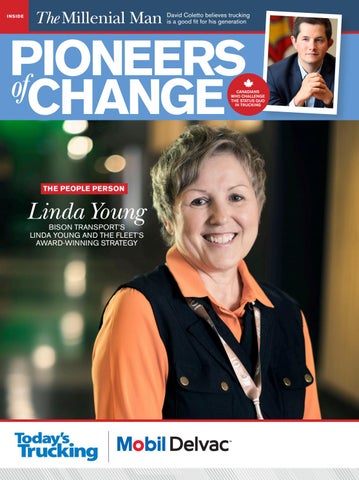
THE PEOPLE PERSON
Linda Young BISON TRANSPORT’S LINDA YOUNG AND THE FLEET’S AWARD-WINNING STRATEGY
HUMAN RESOURCES TRAINING
PHOTO BY COLIN CORNEAU
‘I train them [technicians] and we “This is a place that hires smart tell them how to do things right people,” Young says. “We are and the next time I’m in that shop open to people who want to I’m watching them and they’re create their own opportunity, to doing things wrong again,’” stretch themselves, go beyond the boundaries of their job description.”
“People here treat it more than a job, more than a career. “Thelike best regulations It’s a family here.”have come from fully engaged consultations” Rolf VanderZwaag Linda Young
The
People Person Bison Transport’s Linda Young and the fleet’s award-winning strategy
BY EMILY ATKINS
If there’s one company in Canada that stands out for its ability to hire and retain good drivers, it has to be Bison Transport. And one of the key players making the secret sauce that leads Bison to awards for safety, driver performance, and as an employer of choice – year after year – is Linda Young. She is Bison’s vice-president of human resources and people development, and also serves as chairwoman of Trucking HR Canada. For the past 13 years she has been a proponent of the programs and philosophies that help Bison recruit and retain its 2,900 staff across Canada, even in the face of stiff competition for drivers. Young credits Bison’s success to the values that founder Duncan Jessiman built into the company’s DNA from its beginnings in 1969. He believed in hard work and treating people with respect — values that have endured to this day. “People here treat it more than a job, more than a career. It’s like a family here,” she says. “And that helps the company to maintain the values Jessiman set out.” In practice that means being flexible, being open to feedback, hiring well and developing the staff you have. “This is a place that hires smart people,” Young says. “We are open to people who want to create their own opportunity, to stretch themselves, go beyond the boundaries of their job description.” They are valued and recognized by the company. To attract driver talent, Bison has about 30 different types of driver jobs. These range from full time to part time, truck sharing, four-days-on/four-days-off, regular routes, and regional routes, just to name a few. “It’s tough recruiting right now,” Young says. “Our approach has always been to build a flexible, lifestyle type of job. What we’re able to do is look at an applicant and say, ‘Just tell us what you’re looking for and we will try to figure out where that freight is in our network and run it that way’.” Something must be working, because Bison has a 50% referral rate. Half of their new hires this year have been as a result of another driver saying, “Yes, this is a good place to work.” The company’s retention efforts are based on responding to feedback coming from the front lines. From dispatchers and managers listening to drivers’
suggestions and making adjustments accordingly, to a review committee that works with anyone resigning or at risk of leaving, they have a good handle on how people are feeling. On-the-job training and professional development also figure highly. Bison University allows employees to study on company time to perfect leadership skills, developing customer service acumen – its focus is on core business skills, Young says. Drivers get training and coaching as they arrive, and refreshers are always available for those who may have had an incident, or at key times of the year, like in preparation for winter driving. There’s also formal and informal mentorship available. New drivers get an in-cab coach for the first 13 weeks of employment, and after that there is a network of in-house experts on tap for questions about specifics like crossing the border, for example. All this hinges around the core philosophy “that you do the right thing”, Young says. “Whether it’s an investment situation or we’re going to turn on this program or turn off a program, we ask: ‘Is that the right thing to do for the business, for the people?’” She adds that it has to fit the company culture. “I can serve it up, but if it doesn’t really resonate with people or there isn’t the culture behind it that we believe in, we kind of fall down.” Being open to suggestions is key, she says. Ideas that will improve the business are always welcome. “Across the organization we have a very big, continuously open attitude. It’s about getting the right outcome and putting your own personal agenda aside.” Compared to other organizations in the many industries where she’s worked before, Young says it’s a refreshing attitude. In keeping with the ethos of putting the personal aside, Young won’t take credit for Bison’s HR success. But she does say it’s been a delight to see her “fingerprints” on so many successful programs. And she’s looking forward to work in the future on recruiting more diverse workforce to include women, people with disabilities, the aboriginal community. “We really feel like the investment we make in people programs, driver programs, are really what are going to stand the test,” Young notes. “We are very fortunate and we certainly do not look lightly on that. It’s really important.”
DEMOGRAPHICS
PHOTO BY DAVE CHAN
‘I train them [technicians] and we tell them how to do things right “There are fundamental and theof next time I’m that shop principles research to in stick them and they’re by. I’m We watching can always learn from the things again,’” waydoing things werewrong done hundreds, thousands of years ago. That still has relevance today.”
“Put yourself in the shoes of other people who are not like you.” David Coletto
The
Millenial Man David Coletto believes trucking is a good fit for his generation BY ERIC BERARD
A large share of Canada’s truck drivers are on the road to retirement. Research by the Canadian Trucking Alliance has determined that the average Canadian trucker is 48, meaning they’re making them older than a typical Canadian worker overall. Against the backdrop of an intensifying driver shortage, some new blood is clearly needed. Attracting candidates born after 1980, however, can be a challenge. David Coletto, the CEO of Abacus Data, falls squarely within that demographic group at the age of 38 – and his insights about fellow millennials are drawing attention during trucking-focused presentations for organizations like Trucking HR Canada. Admittedly, he’s not that comfortable delivering such details from the podium. If given the choice, he would let the numbers speak for themselves. Coletto describes himself as an introvert, an observer of people, and is most interested in hearing what they have to say. “I hate small talk,” he admits. But he’s sharing some big ideas despite that. He thinks any efforts that fleets make to understand millennials will be a step in the right direction. “All I’m suggesting is to put yourself in the shoes of other people who are not like you, who don’t have the same experience, did not have the same opportunities, or don’t look at the world through the same eyes that you do,” he says, stressing that such an open attitude is actually a sign of great leadership skills. Opening a business to millennials involves being open to other underrepresented groups, too — such as women, Indigenous communities, people with different cultural backgrounds, he adds. It would be a mistake to think of millennials as a single group, though. Coletto says the environment in which someone is raised can still have a major influence on the way they approach life, regardless of the demographic group they represent. “They’re not robots, they don’t all think the same way.” Look no further than one of Abacus Data’s most prominent research projects for proof. It explored the differences between American and Canadian millennials. “The economic, political and social environment in Canada and the United States is different,” he explains. As an example, student debt levels are much higher in the U.S. “That has an impact on their ability to buy a
home, their ability to think about their future, the choices that they make.” Through a series of focus groups and surveys, he’s confident that millennials would be a good fit for trucking – even if some fleets would need to change their approach to human resources in the process. Consider how a job offer might need to be structured. While millennials want to make a decent living, just like any other workers, they will be attracted more by messages that focus on the things that the money will empower them to do. Since millennials want their jobs to be meaningful, they can also be attracted by the chance to work in an industry that literally keeps the Canadian economy rolling forward. And longhaul trucking can certainly offer some of the flexibility and independence that they covet in the workplace. According to Trucking HR Canada, an estimated 12% of millennials – roughly 1 million people – could be considered, warm, leads who are interested in such work. “You are sort of managing your own time, own effort. That’s your own experience in a way,” Coletto says, referring to the draw of life on the open road. Above all, he believes the trucking industry should be promoting itself more aggressively than it has in the past. There is no option but to change. He likes to use Blockbuster as an example of organizations that didn’t change quickly enough, as compared to Netflix, which saw the entertainment revolution coming. One is now a multi-billion dollar company. The other is a textbook failure. He’s always careful to anchor advice in numbers, too. “We use research, we use data to help our clients make better decisions,” Coletto says, referring to the way that Abacus Data research has influenced product pricing and design. The very name of the company reflects that. “An abacus is a tool that has been used for centuries to count and to analyze,” he says. Obviously, Coletto and his team use much more innovative methods to collect and analyze data in a modern era, but they “never forget that there are fundamental principles of research that we need to stick by. We can always learn still from the way things were done hundreds, thousands of years ago. That still has relevance today.” The tools used for the calculations may change, but he’s confident that the power of data remains. When carefully considered, it can steer an industry in new directions.
The gold standard in engine oil. Mobil Delvac™ diesel engine oil is technology redefined. It’s a full suite of products that help protect your engine and maximize the uptime of your fleet. Its proven protection goes beyond OEM-recommended ODI’s, making your business more efficient and your life a little easier. Discover our API CK-4 diesel engine oils at mobildelvac.ca
© 2019 ExxonMobil. All trademarks used herein are trademarks or registered trademarks of Exxon Mobil Corporation or one of its subsidiaries. Imperial Oil, licensee.