INSIDE
The Futurist
Fleet Complete’s Sandeep Kar tracking telematics, automation and more
PIONEERS CHANGE
CANADIANS WHO CHALLENGE THE STATUS QUO IN TRUCKING
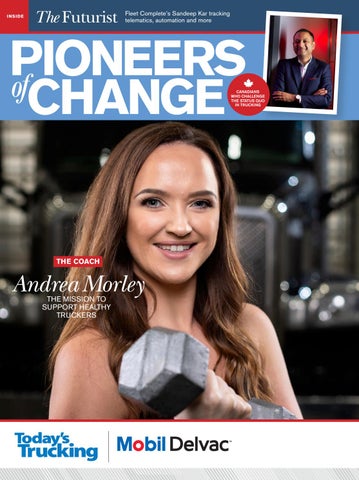
THE COACH
Andrea Morley THE MISSION TO SUPPORT HEALTHY TRUCKERS
DRIVER HEALTH TRAINING
PHOTO BY PETER POWER
‘I train them [technicians] and we “There are many that right tell them how drivers to do things have been careI’m ofin their and the taking next time that shop health for years them and years. I’m watching and they’re We’re simply trying to help more doing things wrong again, ’” drivers do the same.”
“Health a matter ofhave life and people need to realize it.” “The bestisregulations comedeath. from More fully engaged consultations” Rolf VanderZwaag Andrea Morley
The
Coach
Andrea Morley and the mission to support Healthy Truckers
BY EMILY ATKINS
If you’ve ever sat behind the wheel on the road all day, whether in a big rig or a car, you know how drained and lethargic you can feel. Andrea Morley’s mission is to help truckers conquer the energy drain by making healthy lifestyle choices along the way. She is the lead nutritionist and health coach with Healthy Trucker, an organization dedicated to providing health and fitness advice to truckers. Fleets and individuals sign up for coaching that teaches about nutrition, exercise and healthy habits. Truckers expose themselves to huge health risks if they follow an unhealthy regimen of driving all day and then eating truck stop food before watching TV and falling asleep. “The biggest risk, of course, is going to be an untimely death as a result of things like heart attacks and other health issues,” Morley says. “But then other risks include compromised safety on the road. That’s mainly due to decreased reaction times, fatigue, falling asleep at the wheel, or just not being as focused as they should be. Then there are even distractions related to mental health.” She notes that certain health problems, like insulincontrolled diabetes – which is closely linked to obesity and inactivity – can mean the loss of driving privileges, while long-term inactivity can result in poor balance that may end up in a lost time injury from a slip and fall. “Health is a matter of life and death. More people need to realize it,” Morley says. “A lot of drivers think, ‘You know what? I don’t need to worry about my health. I’ve been eating the same way that I have for the last 50 years, why do I need to change now?’ But that’s just because those health issues haven’t caught up with them yet and they don’t realize the severity of what is to come.” But truck drivers are gradually coming around. Morley says people in general are more focused on their health than ever before, and it’s reflected in the trucking industry. “There are many drivers that have been taking care of their health for years and years. We’re simply trying to help more drivers do the same. And as we’re spreading more awareness, it’s a slow but steady improvement.”
Morley counsels drivers to just start moving. A quick walk, some bicep curls, or even jumping jacks are all it takes to get started. “Whatever it may be that helps you to get the blood pumping to increase circulation and to get some more oxygen in” will make you feel better, she says. After doing this just a couple times a week, drivers start to feel better and have more energy, which motivates them to keep going. She stresses that although there are guidelines about the amount of exercise people should get, it doesn’t need to be prescribed. “It just means getting active for a few hours each week. It really depends on the type of exercise, on the person’s goals, and their current fitness level.” The other piece of the equation is food. Morley suggests drivers take small steps like starting to prepare their own meals. Sometimes this means making food at home and keeping it in the fridge or a cooler on the road, but since this isn’t always possible she also teaches drivers to look for the healthy options at truck stops – like fresh fruits and vegetables or nuts – and to ask for plain veggies or salads that might not be on the menu. It doesn’t take long for drivers to see results. Morley notes that your body responds to healthy food immediately, so if you eat properly you’ll be a healthier version of yourself the next day. “They can start getting results within a week, and then a month down the road they’re really going to notice how much better they feel. A year from now, their life can be completely transformed if they make the commitment today to make those changes,” she notes. To make the commitment easier, Healthy Trucker sets up challenges like counting steps, or weight loss that stretches over a month or two. Morley says the real focus is to challenge people to set and meet their own health goals, whatever they may be. It holds them accountable, educates, and provides tools and resources to meet the goals. She estimates that since the program began, Healthy Trucker has helped thousands of drivers adopt a healthier lifestyle. “It has challenges and it’s not easy to get anyone to change their lifestyle,” she says. “But it’s a lot more simple and attainable than the media and the [health] industry make it seem.”
TRENDS
PHOTO BY PETER POWER
‘I train them [technicians] and we “With thishow technology, truckright tellall them to do things drivers can next generate more and the time I’m in that shop income and be less stressed. I’m watching them and they’re Telematics is enabling ” ’” doing things wrong that. again,
“When you add it all together, that truck is going to be a smart truck.” Sandeep Kar
The
Futurist
Fleet Complete’s Sandeep Kar tracking telematics, automation and more
BY EMILY ATKINS
The future of trucking is smart, and drivers will be along for more than just a ride. So says Sandeep Kar, Fleet Complete’s chief strategy officer and longtime analyst of the trucking business. He is watching how technological developments in trucks and telematics are disrupting the freight transport business model. Momentous changes are already happening, he says, and their adoption throughout the industry is only a matter of time. As a purveyor of telematics services, that technology is naturally on his radar, but there’s much more on offer in the developing ecosystem of smart trucks, communications and software. “The industry is going towards a very interesting kind of truck,” he says. It will be green, safe, and connected. “When you add it all together, that truck is going to be a smart truck. And the truck will be really smart when that truck’s purpose in life is not only to reduce cost but also to create more income-generating opportunities for businesses.” Part of this equation is enabling autonomous driving. Kar is keen to point out that this future is not without drivers. It is one where the driver has a new job, and still in the truck’s cab. When not attending to final-mile driving duties, this new-age driver will be seeking more freight, or doing tasks that might previously have been done at HQ, like dispatch or scheduling. “A truck driver buys the truck, maintains the truck, inspects the truck, delivers the freight, and on delivery signs paperwork, refuels the truck. So the truck driver’s not going away anyway,” Kar says. “In fact, with all this technology, truck drivers can generate more income and be less stressed. Telematics is enabling that.” Along with autonomous trucks, the technology is there, he says, to also let the truck itself communicate to identify freight that’s nearby and ready for pickup. Using telematics technology in conjunction with this sharing economy model will not only keep trucks full, it will reduce costs and speed things up for shippers. It will reduce empty miles, cut pollution and congestion, and will accelerate the payment cycle for carriers. “It’s winwin-win for everybody,” Kar says. We are not yet at the point where these uses are common, however. Kar points to the limited penetration of telematics so far – at 25 to 30% of heavy-duty trucks – as a hindrance to the development of this
new ecosystem. The value of telematics technology for fuel reduction, safety, regulatory compliance, and uptime maximization is well understood, he says. Fleets understand how the technology reduces operating costs. And change is afoot. With more trucks coming equipped with telematics technology direct from the OEM, he expects that the market penetration will climb to close to 80% by 2025. The brave new world Kar envisions down the road will entail a holistic approach where the truck itself is seen as a solution to the day-to-day business challenges a fleet might face: “How do I make that truck operate at peak condition? How do I deliver power to the truck on demand? How do I reduce the propensity of that truck getting into an accident or an incident? How do I generate freight opportunities for that truck? How do I make sure that the truck driver is rested, is fed, gets health and wellbeing benefits while driving that truck? How do I ensure that the truck is clean and green for the environment?” This is where new, advanced technologies are going to come together with the benefit of communication and connectivity, he says. Preventive maintenance, autonomous driving, electronic logbooks – all these existing features and more will be brought together through collaboration among OEMs, telematics providers, dealerships, regulators, and the finance industry to create opportunities and savings. “My role is to rally these disparate parties around that common goal. The end result of those synergies and those partnerships is creation of vehicles and technologies that help dramatically improve the industry, reduce downtime, and reduce the likelihood of incidents that might have impact on human life or on property. Doing so generates more opportunities for people who continue to look at the commercial vehicle as the industry in which they operate.” Ultimately, Kar says, the truck cannot go away. He recounts his daughter asking why he loves trucks so much. “I said, ‘When you think of a truck you don’t think from a heart, you think from your mind because trucks, at the end of the day, move stuff. Today if all the cars in the world disappear, the world will feel the impact, but the impact will be more esoteric in nature. But if you take all the trucks away, everything will stop,’” he says. “That’s how important trucks are to our economies, to our societies, to our existence.”
The gold standard in engine oil. Mobil Delvac™ diesel engine oil is technology redefined. It’s a full suite of products that help protect your engine and maximize the uptime of your fleet. Its proven protection goes beyond OEM-recommended ODI’s, making your business more efficient and your life a little easier. Discover our API CK-4 diesel engine oils at mobildelvac.ca
© 2019 ExxonMobil. All trademarks used herein are trademarks or registered trademarks of Exxon Mobil Corporation or one of its subsidiaries. Imperial Oil, licensee.