INSIDE
The Woman with drive
Shelley Uvanile-Hesch looks to close trucking’s gender gap
PIONEERS CHANGE
CANADIANS WHO CHALLENGE THE STATUS QUO IN TRUCKING
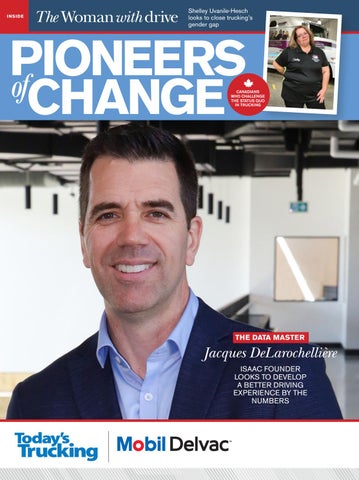
THE DATA MASTER
Jacques DeLarochellière ISAAC FOUNDER LOOKS TO DEVELOP A BETTER DRIVING EXPERIENCE BY THE NUMBERS
TELEMATICS TRAINING
PHOTO COURTESY OF ISAAC INSTRUMENTS
‘I train them [technicians] and we As a former race car driver he tell them how to do things right speaks about goals to be the and the next time I’m in that shop largest telematics provider in I’m watching them and they’re Canada. “You have no idea how doing things wrong again,’” much I hate being second.”
“In trust. Others data.” “TheGod bestwe regulations havebring comeusfrom fully engaged consultations” Rolf VanderZwaag Jacques DeLarochellière
The
Data Master Isaac founder looks to develop a better driving experience by the numbers
BY ERIC BERARD
“To serve you better, please enter your account number using the telephone keypad.” We’ve all responded to synthesized voices asking us to do that very thing. And once we get to speak to a customer service representative, the first thing they ask for is ... the very same account number. Truck drivers understand the frustrations all too well. Once they pick up a given trailer from a yard, they can be required to enter the same identifying information time and again. Missing pieces of information in a logbook can lead to the “form and manner” violations that come with unwanted fines. “The system already knows that information, it doesn’t need the driver to repeat it,” insists Jacques DeLarochellière, president and founder of Isaac Instruments, headquartered in the Montreal area. Yet today’s drivers are often left to “drive a little and manage a lot,” he says, referring to time-wasting administrative tasks such as reporting on hours of service or pre-trip inspections, or dealing with Customs or fuel tax documents. Capturing data, and using it to better manage a fleet, can make the difference. “In God we trust, others bring us data,” is a phrase DeLarochellière likes to use. He also prefers to reference telemetry rather than telematics. Telematics is any form of communication between a human and a truck, he explains, referring to telemetry as “high-intensity telematics.” Before Isaacs Instruments opted to focus on the trucking industry, it was a consultant for vehicle manufacturers that were testing equipment on proving grounds, tracking up to 1,000 pieces of information per second across hundreds of different parameters. “In the transportation industry, we’re sometimes seen as extraterrestrials with a hundred samples per second on 40 parameters,” he says. Conventional truck telematics can involve measuring around four or five parameters every 10 seconds. The push to make powerful connections hasn’t stopped there. Isaacs Instruments has also developed a hot spot wifi zone around the trucks equipped with its technology, enhancing communication capabilities for the machine
and the driver in an environment dubbed the “Internet of Trucks”. The interest in data-driven performance can be traced to DeLarochellière’s late teen years, when he was driving race karts. His entrepreneurial bent came early in life as well, when he bought cars at auctions, fixed them, and resold them for a profit. By the time he was 15 he had secured a job at a Montreal garage, eager to drive cars back into the garage when the work day was done. Then came an education to earn a bachelor’s degree in mechanical engineering. But despite the lifelong love of cars, DeLarochellière rejects any suggestion that a tractor-trailer might be less interesting than a racing machine. “Both are beautiful beasts and a challenge to tame,” he says. The entrepreneur is proud of the business that has come about. He says Isaac has secured more than half of the truck telematics business available in Quebec. And along with vice-presidents David Brillon and JeanSébastien Bouchard, they have grown the business organically, self-financing everything along the way. As important as the organic growth has been, the former race car driver emerges when he speaks about goals to be the largest telematics provider in Canada. “You have no idea how much I hate being second,” he says. That’s particularly true as Isaac monitors Canada’s plans to mandate electronic logging devices (ELDs) for federally regulated carriers as of June 2021. It was among the suppliers that learned a few lessons as American customers were pushed to comply with a similar – but different — mandate in the U.S. “ELD supplier self-certification was a complete fiasco,” DeLarochellière says, contrasting the American approach to Canada’s requirement to have devices certified by an independent third party. He even questions whether half of the U.S. devices would actually meet the technical requirements established by the U.S. Federal Motor Carrier Safety Administration (FMCSA). Carriers bear the consequences if they’re cited for a violation or involved in a collision while using a noncompliant ELD, he says. “Ultimately, it’s always the vehicle user who’s responsible for compliance, not a device manufacturer,” It is not the last of the truck-related technologies in his sights. DeLarochellière is interested in the promise of platooning, autonomous trucks, and systems that would manage available parking spaces. But for now, the focus is on truck telemetry. There are plenty of things to track along the way.
WOMEN IN TRUCKING
‘I train them [technicians] and we tell them how to do things right and the next time I’m in that shop I’m watching them and they’re doing things wrong again,’”
PHOTO BY JOHN G. SMITH
“I’m an outside-of-the-box thinker,” I attend women’s functions that are non-trucking related, because I believe that women empowering each other, regardless of the industry you are in, makes us stronger as a whole.”
“I’m truly 24/7, just like the trucking industry.” Shelley Uvanile-Hesch
The
Womanwith drive Shelley Uvanile-Hesch looks to close trucking’s gender gap
BY EMILY ATKINS
Shelley Uvanile-Hesch is a woman on a mission. From the cab of her Western Star 5700XE she works tirelessly to promote women in trucking. Uvanile-Hesch is CEO of the Women’s Trucking Federation of Canada (WTFC), an organization she founded three years ago to empower women in the industry as well as expand opportunities for them through education, training and mentoring. The organization has more than 300 members in a mentor group including drivers and office staff as well as police and government transport department staff. Almost a quarter are men, which Uvanile-Hesch points out with pride. “It’s a very rounded group. Everybody helps everybody, regardless of what company they work for,” she says. “We have quite a few guys – they are so awesome, they would do anything for any of the ladies.” But there’s still a big gender gap in the trucking business. Uvanile-Hesch focuses on the big issues like unequal pay and women being passed over for promotion as well as the more practical day-to-day challenges like personal safety and access to washroom facilities. She is frustrated by the inequity. Women are more patient and therefore safer behind the wheel, she says. Employing more women is not only good for them, but is also an obvious step to addressing the driver shortage. The challenge is getting through to the old-school thinkers, as well as making senior managers realize that empowering women — employing women — is a solution, not a problem. “I’m a truck driver so I’m not used to dealing with higher level executives,” she says. “They always seem to put a value on everything. It’s got a price tag. But people are people. One person is not more valuable than the next. Everybody contributes something. We have a slogan, it’s, ‘In the office, under the hood, or behind the wheel, we’re all pieces of the puzzle’.” Addressing the issues is a huge task, and one that Uvanile-Hesch tackles daily. With a Facebook following of more than 12,000, her routine – after driving the night shift – is to spend a couple hours posting inspiring messages and news before getting some sleep. In the afternoon she’s back on again, checking email and following up on the lively, and polite, conversations sparked by her posts. “I’m truly 24/7, just like the trucking industry,” she says. “It’s my baby.” Beyond the daily feeds, Uvanile-Hesch works at
spreading the word beyond the trucking industry. “I’m an outside-of-the-box thinker,” she asserts. “I attend women’s functions that are non-trucking related, because I believe that women empowering each other, regardless of the industry you are in, makes us stronger as a whole.” She’s getting lots of support for her efforts. Besides the growing social media following and burgeoning membership in the federation, she has the support of corporations like Western Star, which sponsored a WTFC wrap over her Sharp Transportations Systems truck. Ontario-based The Thompson Band recently recorded a music video called “Behind the Wheel” that was written for and dedicated to the WTFC. Many WTFC members were involved in the video recording, Uvanile-Hesch recounts, spending a weekend working on it in June. It was an intense and wonderful experience she says. “We have a lot of women who want to build each other up. They want to share. They want to help women grow.” Afterwards, she says the three most common words used to describe the event were “exciting, powerful and sisterhood”, reflecting the WTFC’s objectives of building community and solidarity. What these women don’t want is to be singled out, however. Uvanile-Hesch believes it’s important for them to be treated like any other driver, even though they may have to do things a little differently. A woman may not load a flatbed exactly the way a man would because she’s shorter and may have less upper body strength, but in the end does that matter? “We do the job just as well, if not better, than our male counterparts,” she says. “So accept the truth of who we are.” Ultimately men and women want the same things – safe parking, facilities, being healthy on the road, sufficient home time and the ability to do their job for equal pay. When women ask for bathrooms, or private showers, or small accommodations to their trucks, they’re not asking to be “treated like princesses up on a pedestal”, Uvanile-Hesch says. They just want to do their jobs. She has no doubt she’s making progress, but there is definitely room for improvement. She’d like to see trucking companies bring back the camaraderie, the social and charity events, support the rodeos, and make them inviting and inclusive for all truck drivers. “The trucking industry needs to get back to the basics,” she says.
The gold standard in engine oil. Mobil Delvac™ diesel engine oil is technology redefined. It’s a full suite of products that help protect your engine and maximize the uptime of your fleet. Its proven protection goes beyond OEM-recommended ODI’s, making your business more efficient and your life a little easier. Discover our API CK-4 diesel engine oils at mobildelvac.ca
© 2019 ExxonMobil. All trademarks used herein are trademarks or registered trademarks of Exxon Mobil Corporation or one of its subsidiaries. Imperial Oil, licensee.