INSIDE
The Social Referee
SAAQ’s Gino Desrosiers brings a personal voice to government social media posts
PIONEERS CHANGE
CANADIANS WHO CHALLENGE THE STATUS QUO IN TRUCKING
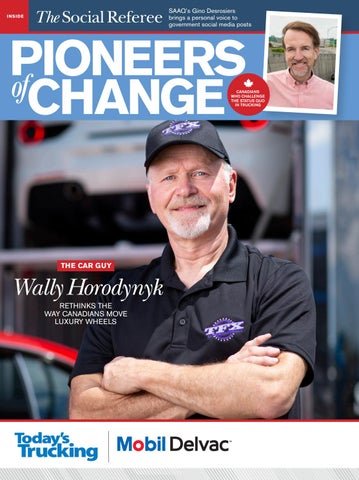
THE CAR GUY
Wally Horodynyk RETHINKS THE WAY CANADIANS MOVE LUXURY WHEELS
TRAINING
PHOTO BY PETER POWER
‘I train them [technicians] and we “We don’t move pig feet. We move tell them how to do things right cars. Cars are the second most and the next time I’m in that shop expensive things people buy and I’m watching them and they’re they just love them to death. doing things wrong again,’” It’s their little babies.”
“We’ve invented so many on our trailers thatconsultations” are now standard.” “The best regulations havethings come from fully engaged Rolf VanderZwaag Wally Horodnyk
The
Car Guy Wally Horodynyk rethinks the way Canadians move luxury wheels
BY EMILY ATKINS
One way to get your hands on a fancy car if you don’t have the money to buy it is to be the guy who moves them. Wally Horodnyk, the founder of TFX International, which specializes in hauling luxury autos, says that’s one of the reasons he started the business. “I always wanted to be around fancy cars. But I didn’t have any money in my early years. I said to myself, ‘goodness gracious, what a great way to get the keys to that Bugatti’.” Now Horodnyk and his company dominate the car-hauling market in Canada, moving about 11,000 vehicles a year for every luxury brand and major collector-car auction houses like Barrett-Jackson, along with private collections. Horodnyk has had the pleasure of moving and caring for some of the world’s most unique vehicles, from the Batmobile to $40 million worth of Shelby Cobras. Since its beginnings in 1987, when Horodnyk discovered there was almost nobody able to move cars, TFX has grown from five to 30 trucks thanks to innovations in car protection alongside an unswerving commitment to customer service. “We’re a concierge service,” Horodnyk says. “We don’t move pig feet. We move cars. Cars are the second most expensive things people buy and they just love them to death. It’s their little babies.” Making sure the cars were protected has been Horodnyk’s obsession since Day 1. As a former home mover his first load of one car was wrapped up tight in moving blankets to ensure it wouldn’t get damaged on the open trailer ride from Detroit. And while that Honda turned out to be destined for a crash test, the objective of providing the best protection possible inspired Horodnyk to many innovations in vehicle hauling. “We’ve invented so many things on our trailers that are now standard because our builder likes it so much” he says. “They sell it to everybody. We didn’t patent it.” Level loading is key for low-slung luxury and racecars, so Horodnyk developed a box that lifts the car into the trailer without need for ramps. He also developed a “Ferrari floor” for trailers with a drop. Instead of driving it down a slope, the level floor lowers by 18 inches once the car is loaded in, avoiding scratching or damaging the paint or carbon fiber on a million dollar auto.
In a business where a chin rub on a Ferrari can cost $30,000 and a new clutch is about $20,000, being able to drive a car flat into what’s essentially a parking spot reduces risk and increases customer satisfaction. “We have to make sure everything is done right,” Horodnyk says. That includes steering wheel covers, floor mats, custom-designed seat covers with furniture blankets sewn in, and door pads and plastic covers on the outside to protect against other cars leaking. “It’s more expensive for us. The customer service is going through the roof here,” he adds. As Canada’s dominant player in car hauling, Horodnyk says everyone knows what’s in the TFX trailers they pass on the road. But he’s not worried about security. After being robbed at home and on the road, in 2000 he introduced remotely controlled locking and geofencing security for his trucks. “I swore that would never happen to me again,” he says, and it doesn’t. He’s also very particular about hiring. Possibly one in 10 applicants has what it takes to be a TFX driver, Horodnyk notes. They’ve got to have at least five years of driving experience including in the mountains, they have to love cars, and they have to be outgoing. As well, “you cannot work here unless you take a test on a 13-speed manual,” he says. Once a driver is hired there’s usually at least three months of training, often with Horodnyk riding shotgun. TFX came about because of Horodnyk’s ability to see the market opportunity in car hauling at a time when nobody else was doing it, but the company’s overwhelming success is the result of the way his creativity combined with his drive to ensure the best for his customers. “We have one focus. A client comes in, you drop everything else.” He credits the company’s success to that fact that his staff loves what they do. “Everybody can see the customer service you have to offer. You just want to take care of the client. That’s all you want to do.” His family runs the company now, but Horodnyk is always around “welding and doing all kinds of things. I’m just a little cog in the bigger wheel.” “I’ve got 30 trucks. Everybody knows me. I might be really small, but when you think about car transport, you think about TFX,” he says. “We think on our feet. That’s why I think our customers love us.”
SOCIAL MEDIA
PHOTO BY CLAUDE MATHIEU
‘I train them [technicians] and we telldiscussions them how to dogenerate things right “Our that thereactions next time I’mthose in that shop theand most are I’m watching themsharing and they’re where we talk about again, ’” thedoing road, things they’rewrong the topics that quickly become emotional, too.”
“People are smart enough to understand when you’re transparent with them.” Gino Desrosiers
The
Social Referee SAAQ’s Gino Desrosiers brings a personal voice to government social media posts BY ERIC BERARD
Social media has the power to connect, but the trolls always seem to be lurking, looking for ways to tear down any information that might be posted on a wall. It’s a challenge that can sideline virtually any message, no matter what the original intent may be. “Our discussions that generate the most reactions are those where we talk about sharing the road,” says Gino Desrosiers, a media relations and social network community manager for the Société de l’Assurance Automobile du Québec (SAAQ). They’re the topics that quickly become emotional, too. But Desrosiers’ work on the provincial transportation department’s social media pages has been cited as a textbook example of how to manage a crisis when it comes to keeping Facebook discussions civil and on track. This was especially true when it came to posts about ways that trucks can interact with vulnerable road users like cyclists. “My answers to comments were often very far from ‘public administration beige’. It was more direct, more colorful,” Desrosiers says, referring to the importance of giving social media managers the leeway to adopt a voice, and the ability to respond quickly as any discussions progress. The end result was a direct and respectful tone, but also a genuine interaction. It often means posting comments in the first person, rather than adopting a distant and bureaucratic “we”. Those who participate in the online conversations are often able to tame each other, he says, but there is still the need for a referee. “For instance, a truck driver will tell about his reality, and a cyclist navigating city streets among trucks will tell his side of the story. I sometimes act as a referee to make sure the debate remains constructive and I will contribute by bringing additional examples, points of regulations, etc.” It’s the same approach that he established while training to become a journalist, and applied while working in a media relations role before he added social media tasks to the job responsibilities in 2013. According to Desrosiers, those who manage social media discussions always need to be aware that there’s a silent audience witnessing the conversations. For every closeminded troll, there are still those who absorb the information without typing a word. And the otherwise
silent group can still share the details with tens or hundreds of their own friends and followers, he says. Another piece of advice from his experience is to keep the lines of communication open, even if you don’t have an answer to offer at first. Saying you’re going to verify details with an expert, that a given topic involves a little research before an official answer can be released, shows the user that they aren’t forgotten. “People are smart enough to understand when you’re transparent with them,” Desrosiers says. Clear facts can be particularly important when opening discussions with the trucking industry, too. “We’re extra careful at being clear and concise when discussing regulations or regulatory changes because there can be [financial and safety] impacts. In trucking, a couple of centimeters or kilos can make a difference, so we don’t want to mislead anybody.” Rumors that relate to regulations can certainly take on a life of their own in the social media space if they’re left unchecked. “We need to act fast to end any false rumor by answering questions as clearly as possible — especially if a regulation involves equipment purchases,” he says. The SAAQ has kept that in mind when managing comments about issues ranging from load securement to the legalization of recreational marijuana. Remarks on social media can even lead to changes in communication strategies. The SAAQ uses them to identify whether messages were clear enough, or if they needed fine tuning. Even casual posts about frustrations with those who fail to use their turn signals can inspire the regulator to establish messages to reinforce different ideas. “Our goal is that the communication flows in both directions. We give information but the feedback we get can help us carry the message differently,” he says. The reward comes in the form of online friends who form a connection with the professional communicators. He recognizes those who return to the Facebook page to offer comments and thoughts. An open mind helps to demonstrate empathy when it’s needed, too. Maybe it’s the victim of a collision who needs some guidance when filing an insurance claim. “The people who write to us live real stories,” Desrosiers says. And they share those stories as followers and friends.
The gold standard in engine oil. Mobil Delvac™ diesel engine oil is technology redefined. It’s a full suite of products that help protect your engine and maximize the uptime of your fleet. Its proven protection goes beyond OEM-recommended ODI’s, making your business more efficient and your life a little easier. Discover our API CK-4 diesel engine oils at mobildelvac.ca
© 2019 ExxonMobil. All trademarks used herein are trademarks or registered trademarks of Exxon Mobil Corporation or one of its subsidiaries. Imperial Oil, licensee.