INSIDE
The Electrician
Lion Electric’s Marc Bédard taps into the growing interest in electric trucks
PIONEERS CHANGE
CANADIANS WHO CHALLENGE THE STATUS QUO IN TRUCKING
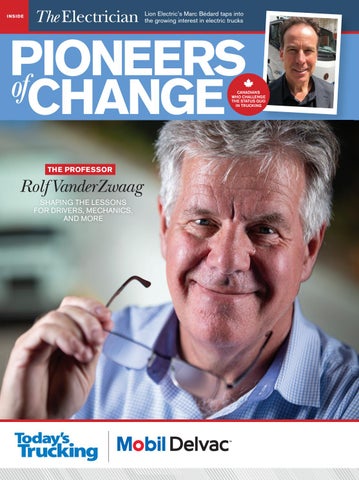
THE PROFESSOR
Rolf VanderZwaag SHAPING THE LESSONS FOR DRIVERS, MECHANICS, AND MORE
TRAINING
PHOTO BY PETER POWER
‘I train them [technicians] and we ‘‘I train them [technicians] and we tell them how to do things right tell them how to do things right and the next time I’m in that shop and the next time I’m in that shop I’m watching them and they’re I’m watching them and they’re doing things wrong again,’” doing things wrong again.”
“The best regulations have come from fully engaged consultations.” consultations” Rolf VanderZwaag
The
Professor Rolf VanderZwaag is shaping the lessons for drivers, mechanics, and more
BY ERIC BERARD
You can almost see the wheels turning whenever Rolf VanderZwaag discusses any particular technical issue. Each reference to a piece of equipment is accompanied by layers of information about what people need to know, or discussions about the cause and effect of various actions and decisions. Forget about the way things have always been done. He’s more interested in exploring the ways things should be done – and how to convey the details to those responsible for doing the work. The president of Techni-Com, and a long-time consultant with the Ontario Trucking Association, is widely recognized as one of Canada’s leading voices on technical training. His first exposure to trucking’s broader regulatory issues came in the mid-‘90s, as Ontario was looking to tackle a spate of runaway truck wheels that had caused fatal collisions. The curriculum that he developed for a mechanic’s program at Toronto’s Centennial College became a foundation for training wheel installers across the province, responding to a call for such guidance from a coroner’s inquest. In recent years he played a leading role in helping Trucking HR Canada to update the National Occupational Standards (NOS) that define what truck drivers are expected to know and do. It’s a document that serves as a touchstone for developing training material and job descriptions alike. VanderZwaag thinks federal and provincial governments should tap more frequently into the private sector’s expertise when preparing new regulations, just like they did with the NOS. “Having worked with government staff for many years, many of them get to a position of power without necessarily having knowledge of the things that they have power over,” he says. “The best regulations have come from fully engaged consultations.” He also challenges the trucking industry to rethink the way some training is conveyed, especially in the context of “train the trainer” work. “The instructors often tell me: ‘I train them [technicians] and we tell them how to do things right, and the next time I’m in that shop I’m watching them and they’re doing things wrong again,’” he says.
Far too many drivers and mechanics still rely too much on word of mouth when it comes to sharing information, and it’s all too easy for inaccuracies to take root. “Many of these people,” he says, “get a filtered version of the law.” The goal is to repeat information that’s accurate and digestible, and VanderZwaag thinks this is one of his strengths. “I knew I had the capacity to break things down and to synthesize a bunch of information into messages that people would understand,” he says, referring to early technical columns he was given the chance to write about 20 years ago. He never considered becoming a writer. “When I was in high school, English was my worst subject,” he admits. But the chance to be a technical columnist for Truck News gave him the confidence to tackle projects like the training manuals he now publishes through Techni-Com. One of the most extensive training programs he’s been involved with has come in the form of plans for mandatory entry-level training (MELT) for truck drivers. As important as the content will be, however, he warns that MELT will only address pre-licensing needs. “It is not pre-employment training. There’s a bunch of additional work that needs to be done to take this person with a class of license that allows them to drive a truck and make them a professional truck driver.” It’s why he believes there should be a harmonized standard across Canada, rather than a patchwork of training programs from one jurisdiction to the next. The nation’s transportation ministers have committed to that very thing. VanderZwaag feels that rules for mechanics or technicians certifications could also benefit from an update. “The way that skilled trades are structured is antiquated. The way we define what a mechanic does and what they’re permitted to do with their mechanic licence is based on antiquated mechanical definitions of how vehicles are built,” he says. For example, he wouldn’t dare touching some of the systems on emerging electric trucks, even if he legally can. He cites the recent Quebec government’s initiative to fund mechanics’ training on electric vehicles as an example that could be followed by other provinces. He has been involved in training around long combination vehicles (LCVs), too, although he is careful to discuss the limitations. The doubled 53-foot trailers are not a cure-all for the driver shortage. They’re still going to be limited to specific routes, and a relatively small number of customers who all need large amounts of freight in the same place and at the same time. “By the time you’ve got the second trailer full, the customers are usually screaming for the freight in that first trailer — so you tend to send it out when it’s ready,” he says. And the people who do such work, any work, will only be ready with the proper training.
ELECTRIC VEHICLES
PHOTO BY JOHN G. SMITH
‘I train them [technicians] and we tell them doinnovative things right “Bringing uphow newto and and the next time I’m in that shop technologies doesn’t mean I’m overboard. watching them and going We try tothey’re keep doing things wrong again, ’” customers in their comfort zone. We call it controlled innovation.”
“There’s no more concern about the feasibility of electric trucks.” Marc Bedard
The
Electrician Lion Electric’s Marc Bédard taps into the growing interest in electric trucks BY ERIC BERARD
A little more than three years ago, Marc Bédard was invited to deliver a keynote speech on whether the electrification of heavy trucks was possible. This year, the same organization invited him back to discuss how profitable an electric truck could be. “There’s no more concern about the feasibility of electric trucks. Now the focus is on the business aspect,” says the president of Lion Electric Co., which recently unveiled the prototype for a Class 8 truck known as the Lion 8. Early interest in the underlying business case has attracted orders from none other than CN. Now he’s competing head to head for a share of the emerging electric vehicle market coveted by established and emerging original equipment manufacturers alike. The manufacturer based in St-Jérôme, Qué. — with branches in California and New York State — was founded in 2008, shortly after Bédard left his role as a merger and acquisitions specialist at PricewaterhouseCoopers (PwC). It originally focused on building electric school buses. But the idea of creating electric trucks aimed at local and regional applications was inspired by suggestions from truck fleet managers who saw those buses in action. Bédard says he wants to provide the market with efficient, ready-to-work electric trucks that “don’t look like flying saucers.“ “Bringing up new and innovative technologies doesn’t mean going overboard. We try to keep customers in their comfort zone. We call it controlled innovation,” he says. Switching from diesel to electric power is already a big enough leap for many trucking professionals without shaking up their entire vision of what road transportation is and should be, Bédard adds. Something as simple as the steering wheel location in Lion trucks is the result of extensive consultations, looking at factors such as whether it made sense to move the wheel to the center of the cab. “They’re used to driving on the left and want to keep it that way,” he says, referring to the types of insights that emerged through a survey of more than 500 drivers. Familiar work environments could even play a role in helping to retain drivers, he suggests. Bédard and his 150-member team – including 70 engineers – want to apply the same principle when it comes to meeting the needs of technicians.
Conventional components will be used in Lion’s electric trucks wherever possible. Against the backdrop of emerging technologies like the battery packs, the Dana axles and antilock braking systems might seem familiar, even comforting. While he’s a chartered accountant by trade, Bédard is an amateur mechanic himself. “When I was younger, I used to dismantle and reassemble motorcycles. That’s how I learned. I always loved engineering and new technologies,” he says. “I’m more the manufacturing type than cufflinks and office on the 35th floor.” He likes to interact with products that roll off the Lion assembly line. Bédard’s interest in electric vehicles even extends to his personal car. He likes the feel of that driving experience, and the retarding forces that kick in when he releases the throttle. And he knows that such forces in an electric vehicle also deliver maintenance-related benefits, such as a longer lifespan for foundation brakes. Lion’s electric trucks promise to do that very thing. “The brakes last three times longer on an electric truck. The brake lights turn on the moment you release the acceleration pedal. Otherwise, you could get rearended,” he says. Bedard also believes many components could last longer on a truck that’s purpose-built to be electric, rather than coming in the form of a retrofitted platform that normally runs on diesel power. Suspensions or tires, for example, could benefit from the optimized weight distribution that flexible motor and battery locations allow. But some habits die hard in the trucking industry, and Bédard finds himself sharing a challenge that’s also faced by conventional truck makers when it comes to spec’ing powertrain components. Customers who tend to pick an oversized diesel engine on a conventional truck are the same ones who are tempted to stack too many costly and payloadrestricting battery packs on an electric vehicle, he says. “You don’t rent a five-bedroom apartment when you need only three.” Then there are the questions about how the vehicle batteries will work in a Canadian climate. According to Lion’s president, extreme heat is more of a challenge in terms of battery management. “Electric power doesn’t fear cold. In fact, cold helps save batteries’ life,” Bédard says. He claims that correctly plugged-in battery packs will never fail to start a well-designed electric truck, no matter how cold it is outside. What really drains a battery’s power is the energy used to heat a cab, he says. That’s why Lion suggests using small auxiliary diesel heaters to heat cabs during winter months. “The solution works just fine on our electric school buses that have 40-feet long cabs.” His success will involve challenging misconceptions, and keeping an eye on future opportunities. Electric longhaul trucks are likely still five years away, Bédard says, but heavy electric trucks of other sorts will be road-ready before that. Lion plans to make sure of it.
The gold standard in engine oil. Mobil Delvac™ diesel engine oil is technology redefined. It’s a full suite of products that help protect your engine and maximize the uptime of your fleet. Its proven protection goes beyond OEM-recommended ODI’s, making your business more efficient and your life a little easier. Discover our API CK-4 diesel engine oils at mobildelvac.ca
© 2019 ExxonMobil. All trademarks used herein are trademarks or registered trademarks of Exxon Mobil Corporation or one of its subsidiaries. Imperial Oil, licensee.