Positive Results?
Dynamic Support
A year of ‘legal’ weed PG.10
Volvo Dynamic Steering PG. 42
Canadian Mail Sales Product Agreement #40063170. Return postage guaranteed. Newcom Media Inc., 5353 Dundas Street West, Suite 400, Toronto, Ontario M9B 6H8.
The Business Magazine of Canada’s Trucking Industry
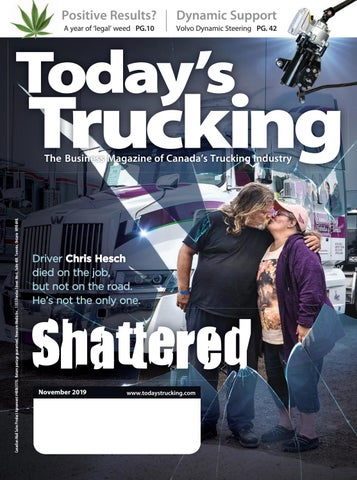
Driver Chris Hesch died on the job, but not on the road. He’s not the only one.
November 2019
www.todaystrucking.com
TO CANADA’S 181, 300 TRUCK DRIVERS: THANK YOU. FOR YOUR COMMITMENT. DEDICATION. AND OF COURSE , YOUR DRIVE .
The World’s Best® ISO 9001:2000 © 2019 Kenworth Truck Company. A PACCAR company.
Contents
November 2019 | VOLUME 33, NO.11
7 9 27 29 31
John G. Smith Rolf Lockwood
18
32
36
46
Alan S. Cofman Heather Ness Mike McCarron
NEWS & NOTES
Dispatches
10 Positive Results? Recreational marijuana has been legal for a year, but fleets apply different limits
21 22 23 24 25 26
Truck Sales Stat Pack Pulse Survey Logbook Heard on the Street Trending
In Gear
Features 18 Driving Demand Driver unemployment is low. Job vacancies are up. By John G. Smith Not everyone sees this as a driver shortage.
32 Shattered Driver Chris Hesch died on the job, but not the road. He’s not the only one.
By John G. Smith
36 Data Mining for Gold Productivity and efficiency gains are there for the taking, if you leverage the power of an ELD
40 Trucking by Numbers Transportation management system insights are not limited to the biggest fleets
43 Product Watch
By Jim Park
46 Military Man Big Freight’s Robert Pigeau, Manitoba’s Driver of the Year, served country and community
By Derek Clouthier
For more visit www.todaystrucking.com NOVEMBER 2019
3
Your bottom line doesn’t care if it’s cold. The new Mobil Delvac 1™ range of synthetic engine oils helps protect your fleet and your business.
See our new products at mobildelvac.ca
Letters The Business Magazine of Canada’s Trucking Industry
PUBLISHER Lou Smyrlis lou@newcom.ca • 416/510-6881 VICE PRESIDENT, EDITORIAL Rolf Lockwood, MCILT rolf@newcom.ca • 416/614-5825 EDITORIAL DIRECTOR, TRUCKING AND SUPPLY CHAIN John G. Smith johng@newcom.ca • 416/614-5812 CONTRIBUTORS: Steve Bouchard, Derek Clouthier, Alan S. Cofman, Mike McCarron, Heather Ness, Jim Park. DESIGN / LAYOUT Tim Norton, Frank Scatozza production@todaystrucking.com • 416/614-5818 SALES AND MARKETING CONSULTANT Anthony Buttino anthonyb@newcom.ca • 514/292-2297 SALES AND MARKETING CONSULTANT Nickisha Rashid nickisha@newcom.ca • 416/614-5824 QUÉBEC ACCOUNTS MANAGER Denis Arsenault denis@newcom.ca • 514/947-7228 CIRCULATION MANAGER Pat Glionna 416/614-2200 • 416/614-8861 (fax) PRODUCTION MANAGER Alicia Lerma alicia@newcom.ca • 416/510-6845
Kenneth R. Wilson Award Winner
MEDIA INC.
5353 Dundas Street West, Suite 400, Toronto, Ontario M9B 6H8 416/614-2200 • 416/614-8861 (fax) CHAIRMAN AND FOUNDER Jim Glionna PRESIDENT Joe Glionna VICE PRESIDENT, PUBLISHING Melissa Summerfield CHIEF FINANCIAL OFFICER Peter Fryters DIRECTOR OF CIRCULATION Pat Glionna
Today’s Trucking is published monthly by NEWCOM MEDIA INC., 5353 Dundas Street West, Suite 400, Toronto, Ontario M9B 6H8. It is produced expressly for owners and/or operators of one or more straight trucks or tractor-trailers with gross weights of at least 19,500 pounds, and for truck/trailer dealers and heavy-duty parts distributors. Subscriptions are free to those who meet the criteria. For others: single-copy price: $5 plus applicable taxes; one-year subscription: $50 plus applicable taxes; one-year subscription in U.S: $90 US; one-year subscription foreign: $180 US. Copyright 2019. All rights reserved. Contents may not be reproduced by any means, in whole or in part, without prior written consent of the publisher. The advertiser agrees to protect the publisher against legal action based upon libelous or inaccurate statements, unauthorized use of photographs, or other material in connection with advertisements placed in Today’s Trucking. The publisher reserves the right to refuse advertising that in his opinion is misleading or in poor taste. Postmaster: Address changes to Today’s Trucking, 5353 Dundas Street West, Suite 400, Toronto, Ont., M9B 6H8. Postage paid Canadian Publications Mail Sales Agreement No.40063170. ISSN No. 0837-1512. Printed in Canada.
Member
Dispatch skills involve more than keyboards I firmly believe the driver shortage has a lot to do with companies that hire techies to dispatch drivers, that have no real-life experiences, and no personalities that drivers can respect. At the company that I drive for, remuneration is less important than how we are treated. I personally don’t listen to the rants and raves of computer-techie dispatchers. Any hacker that goes to school to dispatch a truck does not necessarily understand factors such as weather, highway construction, border crossings, local and international laws, hours of service, heavy truck weights and dimensions, or driver fatigue. They may be able to operate a keyboard extremely well, but struggle when dealing with real-life situations. This causes many drivers to move to a company that is far more driver-friendly. — Mark Hanover By email
Email: johng@newcom.ca
SEND YOUR LETTERS TO: Newcom Media Inc., 5353 Dundas Street West, Suite 400, Toronto, Ontario M9B 6H8
Drug testing, zero tolerance is welcome I believe there should be zero tolerance for drugs in our industry whatsoever. I think we should be just like the U.S., and every single driver should be drug tested in Canada. Enough of the crap. Get the drugs out of the system. Get these drivers out from behind the wheels of the trucks. I don’t care if it screws up the industry. At least we could go down the road with our heads held high. I’ve been doing this for 38 years and I don’t do drugs. Want nothing to do with them. I don’t drink on the job and I do my job properly. Unfortunately, you got so many that cannot cross the border because they have been involved in drugs, and now they’re running across Canada and doing local work and smoking their pot. — David Bradbury By email
Let’s learn from the tragedy Re: Driver safety risks (online) [The death of Chris Hesch] was a horrible accident, but I’m glad you both are sharing the story. Things can go wrong so quickly. We need everyone to understand the risks and stay safe. — Brett Tremblay Driver, Turk Enterprises
Open the highways for wide loads My husband and I live in Thunder Bay, Ont. This year we tore down our home and rebuilt our basement. We purchased a modular home from Kent Homes located in New Brunswick. We have been awaiting our home since July 31, and it is now Oct. 1. However, highways 11 and 17 are not allowing any wide load permits to go through. Kent Homes has repeatedly tried to get the permits but gets turned down repeatedly. How can two major highways in Canada not be open for wide loads? If we lived in B.C., this might not be a problem. But we live in northern Canada and it is getting cold. We are living in a camper since the last week of April. My husband, Murray, works as a truck driver and he believes we can’t be alone. He believes others must be getting frustrated with getting denied permits. — Brenda Janssens Thunder Bay, Ont. NOVEMBER 2019
5
NTRY COU R O UNTY Y, CO THERE. T I C THE YOU ROSS E’LL GET C A G ELIN ITY, W TRAV ROSPER E R ’ P YOU LED THER ACE CAL E H W L OAP OR T
nd up a eet l f ne i l r you duct keep oad pro raulics o t g yd a br tryin el, h g e. has n, fu nd slud ou’re ® Filters o i y s s n a i e t m X h I s o w n o W ant irt, s r, tra me. m d ou w il, ai wnti ng y sary do es o icles fro . i d h u t l ess ces last t inc our veh succ unne Th e y s tha d to a ng is ty filter protect i o r n .com n ru the ill -du lters g on at w eavy wixfi of h olant th s runnin co hicle and ur ve o y Keep
Editorial By John G. Smith
Safety Begins at Home We can do more to protect truck drivers in fleet yards. We have to.
F
leet yards are designed to be safe, secure spaces. It’s where the activities of trucking can be segregated from the outside world. There are no commuters to be found, no members of the general public to walk or cycle in and out of a truck’s blind spots. There are still dangers, though. Four separate fatalities have reminded us of this in recent months. (See Shattered, page 32.) Three of the losses occurred in fleet yards. Another happened within view of a fuel island. There is a reason why many safety-related policies and investments tend to focus on the open road. The trucking industry shares its workplace with people who often seem blissfully unaware about the limits of what truck drivers can see, or the space required to stop. It is why fleets invest in supplementary mirrors and collision mitigation systems, review telematics data to identify surges in hard-stopping events, and deliver training in defensive driving techniques. The commitment to safety can’t begin and end outside the yard gates, however. The threats that exist close to home are no less real than those found on the open highway. No fleet is immune. One of the most jarring facts associated with all three of the recent yard fatalities is that they were connected to fleets known for strong commitments to safety – Bison Transport, Kriska Transportation, and Sharp Transportation. Each has formally documented safety policies and procedures in place, upgraded facilities, and more. I would go so far as to suggest they have been recognized as some of the safest fleets in Canada. Their records back up that assertion. But no strategy is perfect. No matter what policies are in place, there are always examples of unforeseen circumstances, and even well-trained people have been known to slip into bad habits.
Visit any yard, anywhere, and you will see the examples. Personnel walk around tractor-trailers while reflective vests sit unworn in the cab or on an office chair. We see people bypass defined pathways to save a few steps while walking through a warehouse or back to the truck. Drivers nudge beyond posted speed limits in the rush to get equipment on its way as quickly as possible. And where did the last guy put the cones, tags and signs that were ordered to warn coworkers about imminent threats? Following the death of driver Chris Hesch, Sharp Transportation president Shawn Baird is scouring his location for things that could be done differently. The fleet’s yard truck was destroyed after it was found to have mechanical defects, even though the defects were not deemed to be a factor in Hesch’s death. A late-model day cab moves the trailers now. Existing policies about wearing reflective vests, on the books for several years, are now strictly enforced. The lines that guide foot traffic through the shop have been repainted. And he wonders if more can be done. Maybe physical barriers need to be erected between the building wall and the trailers that are parked against it, he suggests. Just to be safer. Because no matter what steps the drivers take to protect the general public, their personal safety begins at home. TT
“The commitment to safety can’t begin and end outside the yard gates.”
John G. Smith is the editorial director of Today’s Trucking. You can reach him at 416-614-5812 or johng@newcom.ca. NOVEMBER 2019
7
Take the wheel À9ü¡ æÚe¡ ÁĊ #¡ ÚÁ¡ Ú Ċ¡æÁ P S9ÁÚe¹É
Volvo Dynamic Steering makes driving easier. Driving strain is reduced because steering requires less effort. It compensates for sidewinds and removes vibrations from rough roads. Backing is simpler as well, thanks to the automatic return to center. With Dynamic Steering, it’s good to be in the driver’s seat. Learn more at volvotrucks.ca
Dynamic Steering
Lockwood By Rolf Lockwood
One Nasty Scam We must crack down on the poorly policed Temporary Foreign Worker Program
S
ometimes I’m ashamed of Canada. Ours is a very fine country and I’m mighty proud to call it home, but our imperfections are obvious and many. One of the current worst is a horror story of the first order. An almost unbelievable tale as told by Kathy Tomlinson in the Oct. 5 Globe and Mail: How an immigration scheme steers newcomers into Canadian trucking jobs – and puts lives at risk. We now have unscrupulous immigration consultants feeding equally unscrupulous trucking companies with innocent newbie drivers who pay as much as $30,000 for the chance to become a Canadian. By first becoming a truck driver. Experience? Not important. Training? Not supplied. That scam is often perpetrated under the auspices of the federal Temporary Foreign Worker Program, designed to fill the many gaps in our workforce, not just in trucking. But to call that program and its implementation faulty is to understate the case in a big way. Don’t get me wrong. I applaud its intent. We need immigrants badly, which is by no means a new story. The thing is, we’re a big country with a small population. We have always needed immigration, from Day 1. Always will. In trucking our labor shortages – not just at the steering wheel – began with an ever-expanding demand for trucking services, not to mention the brutal demographic realities of an aging population. And then we faced a crisis. We kept dipping deeper into the Canadian gene pool and coming up empty of suitable driving talent. Or perhaps more to the point, coming up empty of Canucks willing to do an increasingly unattractive job, which has only gotten worse over time in a lot of eyes. Looking abroad, we couldn’t continue counting on Poland and other such places for the volume we needed. So India popped up, particularly the Punjab region. There’s no shortage of young men there who are desperate for a better life in Canada. Which makes them easy marks for the vile immigration consultants and opportunistic little trucking businesses detailed in the Globe article, which focused only on B.C.
“The dangerous scheme has been allowed to flourish partly because there is no systemic [sic] integration between provincial regulators for the trucking industry and those overseeing the immigration system at the federal level,” Tomlinson wrote. “The Globe investigation has revealed,” she went on, “that immigration authorities let trucking companies hire newcomers through the Temporary Foreign Worker Program, even when the carriers have a proven history of multiple-injury accidents, serious safety violations, or exploitative labor practices.” The fatal disconnect here is that the feds are only interested in the immigration angle. Has the hiring company tried to find locals before looking overseas? They don’t care that the company may have a lousy safety record. That’s provincial territory. And at least in B.C., but it’s really the same everywhere, there’s apparently a dangerously lax level of inspection and enforcement that might otherwise prevent poorly trained rookie drivers from trying to negotiate winter mountain roads when they’ve never seen ice or snow. Trans-Canada highways 11 and 17 through northern Ontario are no easier. We absolutely must crack down on a system that allows this to go on, obviously in B.C., but I think no province is immune to letting untrained drivers loose. And not just immigrants working for barely legal trucking companies. A few years back someone very close to me signed on to a fairly large, established carrier right after he graduated from a solid driving school. A good Canadian country boy, just two weeks later he found himself pulling flatdeck B-trains into those nasty hills northeast of Montreal. Was he ready? No way. Was he scared? You bet. Did he kill anyone? Luckily, no. But, clearly, luck should have no part in any of this. TT
“We have always needed immigration, from Day 1.”
Rolf Lockwood is vice-president, editorial, at Newcom Media Inc. You can reach him at 416-614-5825 or rolf@todaystrucking.com. NOVEMBER 2019
9
Positive Results? Recreational marijuana has been legal for a year, but fleets continue to debate acceptable limits By John G. Smith Recreational marijuana has been legal in Canada for a year, but the related rules that apply to truck drivers continue to vary by routes and employers alike. The drug’s use among truck drivers also appears to be on the rise, as it is among Canadians as a whole. Sixteen percent of Canadians used cannabis in the second quarter of 2019, Statistics Canada reports. And almost 2/3 of the positive drug tests recorded by the DriverCheck medical testing and assessment service are now associated with THC – the psychoactive ingredient in marijuana. The rates of positive test results for THC were up a respective 16.8%, 17.1% and 21.2% in the first three quarters of this year when compared to the same periods in 2018, says Dr. Melissa SniderAdler, DriverCheck’s chief medical review officer. But the positive test results had already been rising for sev-
10
TODAY’S TRUCKING
eral years. Some of the increase could simply be linked to a surge in reasonable-cause testing because workplaces are more educated about the effects of marijuana, she adds. “It’s not like everything was stable and all of a sudden we legalized it and everything jumped up.” Aside from the positive tests, fleets appear to disagree on what levels are acceptable. Those that haul cross-border freight must comply with the zero tolerance established by the U.S. Department of Transportation. Things are trickier when dealing with domestic operations, especially since individual provinces vary in the on-road requirements for commercial drivers. Jurisdictions like Ontario, Quebec and Saskatchewan set a zero tolerance. Other provinces like British Columbia restrict drivers of every sort to the limit of 2 nanograms per milliliter of blood, as defined by federal Bill C-46. The Conference Board of
Canada’s recently released Acting on the Cannabis Act found that 67% of transportation and warehousing businesses have adopted zero-tolerance policies. But Snider-Adler has seen workplace policies that tell drivers to abstain from using marijuana for 28 days, 24 hours, or as little as eight hours before beginning work behind the wheel. “For non-DOT it is a little all over the place,” she says, referring to fleets that limit themselves to domestic operations. “It’s unfortunate that, in the industry as a whole, there’s no sort of standard.” Regardless, those who say drivers are cleared to work within eight hours of consuming the drug are “really below that standard of safety-sensitive,” Snider-Adler says. The Occupational and Environmental Medical Association of Canada recommends a wait of at least 24 hours before returning to safety-sensitive work such as
operating motor vehicles or equipment. It stresses that the timing and duration of marijuana-related impairment can vary. Some fleets may worry that an overly strict policy could lead job candidates or existing drivers to look for work elsewhere, Snider-Adler says. “There are certain industries where they know there’s a significant use of cannabis, and it’s kind of hard to deal with because you’re balancing the need to have employees.” A majority of Canadian businesses now appear to have updated substance use policies, however. The Conference Board’s Acting on the Cannabis Act found that 76% of employers have adjusted their alcohol and drug policies to reflect the new legal status of cannabis. And 70% have implemented a fit-for-duty policy that requires employees to come to work unimpaired. As little as six months before legalization, 45% of those surveyed by the Human Resources Professional Association didn’t believe their existing policies addressed potential new issues that might arise with legalization. “A lot of employers have been learning as they go, and they did their due diligence
Kriska Acquires PG. 12
Ferry Fees PG. 14
Driving Demand PG. 18
Canada has given the green light to recreational marijuana, but the related rules in trucking vary widely.
before legalization to set themselves up in a good position,” says Nancy Norton, the lead researcher on the Acting on the Cannabis Act report. “Employers have done a really good job of dotting their I’s and crossing their T’s.” Establishing such workplace policies and procedures was no small task, however. “It’s tricky in Canada because we can’t really take the experience from U.S. jurisdictions. Their federal law still sees cannabis as a quite-serious narcotic,” she says. The work continues. Cannabis products such as
edibles, beverages, topicals and extracts will be legally available as of mid-December. And users of edible products could be exposed to higher concentrations of THC that maintain impairment for a longer period of time. “The edibles is really, really interesting because it’s sort of harder to detect impairment,” Norton explains. Workers won’t smell like the drug, and the related impairment can actually last longer than it would if someone smoked a joint. Certain drug tests, especially a urinalysis, might trigger positive results even when someone hasn’t consumed
the products for weeks. “It’s not necessarily the most useful,” she said of the urine tests. “We don’t need to know if you have ever used cannabis.” Therein lies one of the biggest challenges. Police swab oral fluids at the roadside to detect recent use. There is still no established way to demonstrate that a driver is actually impaired. “To the average person, the government’s legal THC limits are meaningless,” the Conference Board of Canada says. “THC can accumulate in the tissues of the body and slowly release over time. This
means that frequent consumers of cannabis, like those who consume cannabis daily for medical purposes, can test positive for cannabis even after 30 days of abstinence.” A legislative backgrounder from the Department of Justice agrees: “Establishing a drug per se limit does not imply all drivers below this limit are not impaired and all drivers above this limit are impaired.” Recreational marijuana is not the only factor to consider, either. Medical marijuana also continues to increase in popularity even though the drug is available over the counter, Snider-Adler says. That could be driven by factors such as available insurance coverage or tax write-offs linked to medical expenses. Provinces that set a zero tolerance for roadside tests might treat those with a prescription differently, she adds. “It is too early to tell what the long-term effects [of legalized recreational marijuana will be,” the Conference Board concludes. “What is clear is that Canada’s citizens, employers and policymakers are breaking new ground and setting the example for the rest of the world.” TT
NOVEMBER 2019
11
Dispatches > NEWS BRIEFS
Kriska acquires Alliston, Ont. fleets Kriska Transportation Group (KTG) has acquired Trailwood Transport and Nexus Freight, both operating out of Alliston, Ont. “Trailwood’s expertise in the automotive industry brings further diversifica-
tion to our industry mix. The addition of Nexus gives us the local capacity to help supplement our current network needs,” said Kriska CEO Mark Seymour. Trailwood, founded in 1984, runs 112 power units and 385 dry van trailers. Nexus has 20 power units and 12 trailers. The fleets will continue to be led by general manager Lorie Thompson.
B.C. loggers take to streets More than 100 trucks formed a protest convoy in Vancouver on Sept. 25, drawing attention to job losses in the forestry sector. David Elstone, executive director of the Truck Loggers Association (TLA), said though his organization played no role in organizing the convoy, he did thank drivers who passed by his Vancouver office. In a message to industry, Elstone said more American forest products are staying in the U.S. in the face of Chinese tariffs. This means less Canadian lumber is needed south of the border. Sawmill costs are also on the rise, and the U.S. continues to impose a 20% tariff on Canadian softwood lumber imports.
Ontario’s WSIB focusing on Driver Inc. Ontario’s Workplace Safety and Insurance Board (WSIB) is reportedly taking a closer look at carriers that misclassify employees as independent contractors, in a business model that has become known as Driver Inc. “The WSIB has already conducted audits of two trucking companies, each of which has had corrective debit adjustments of over $200,000,” the Ontario Trucking Association says. “Not everyone is playing by the rules and paying their fair share, leaving some drivers vulnerable,” said association chairman David Carruth. “We are encouraged WSIB has recognized this is a major problem, and is focusing on making sure that businesses are paying what they should be for covering their drivers.”
Waste Management goes with gas trucks Waste Management is deploying natural gas refuse trucks that serve routes in London, Ont. Eight front-end loaders are already on the streets, while an equal number of roll-off trucks will arrive along with a rear-loader in the fourth quarter. “This is the 139th CNG [compressed natural gas] fueling station we are christening across North America, and
12
TODAY’S TRUCKING
NEWS BRIEFS
the 11th in Canada,” said Aaron Johnson, area vice-president, Waste Management of Canada. About half of the company’s fleet operating in eastern Canada is now powered by natural gas. Waste Management itself produces enough renewable natural gas to power 40% of the CNG fleet. It has nine renewable natural gas sites in production, and more are scheduled to come online this year.
No truck driver or cab for Scania AXL
Swedish-based Scania’s AXL concept vehicle has been designed to roll ahead without a driver – or a cab – in a controlled environment. “With the Scania AXL concept truck, we are taking a significant step toward the smart transport systems of the future, where self-driving vehicles will play a natural part,” said president and CEO Henrik Henriksson. “We continue to build and pilot concepts to demonstrate what we can do with the technology that is available today.”
widely different rates based on their own actual performance when it comes to health and safety,” OTA says.
Stemco sells off Georgia brake biz Stemco and its parent company – EnPro Industries – have sold a Rome, Ga. brake
< Dispatches
business to MAT HD, a subsidiary of MAT Holdings. The sold business produces brake shoes, brake kits and lined shoes for medium- and heavy-duty truck and bus applications. It will now become part of the brake products group at MAT, which manufactures and distributes products for the automotive, hardware, and power
POWERFUL, EASY-TO-USE ELD SOLUTION A robust solution your team can rely on. Thanks to automatic synchronization between their logbook and trip sheet, drivers can focus on what they love: driving!
WSIB premiums drop, but not for everyone The Ontario Trucking Association (OTA) is stressing that the streamlined framework for Workplace Safety and Insurance Board (WSIB) premiums will not apply to all carriers. The provincial agency announced that, as of 2020, trucking will be classified under a new F1 category, along with railways, water and postal service. The related premiums will drop 12.5% to $4.27 per $100 of insurable payroll. Still, that figure is a class average. “In essence, starting in 2020, carriers within the trucking industry could have
LET’S START A PROJECT TOGETHER!
www.isaac.ca/eld-solution 1 888 658-7520
NOVEMBER 2019
13
Dispatches > NEWS BRIEFS equipment sectors. Stemco – a producer of commercial wheel end, braking and suspension components as well as tire and mileage solutions – has facilities in Texas, Michigan, Kentucky, Tennessee, Ohio, Canada, Australia, China and Mexico. EnPro manufactures sealing technologies and engineered products.
Haldex chairman happy with ZF sale Haldex chairman Jorgen Durban seems more than happy with ZF’s move to sell stock in the company. “I might go so far as to call it an early Christmas present to both Haldex and our customers. If I could wish for
Weigh Faster. WEIGH. PAY. GET GOING.
You know your drivers can trust CAT Scale for guaranteed accurate weights. They can get that same guarantee even faster by using the Weigh My Truck app. Weigh and pay all from a mobile device without leaving the cab. We know time is money, and this app gets your drivers back on the road faster. 1-877-CAT-SCALE (228-7225) catscale.com | weighmytruck.com Now accepting:
14
TODAY’S TRUCKING
another, it would be that Knorr-Bremse should now be inspired by the message and begin the process of selling its stake as well,” he said in a press release. “We knew that ZF was very anxious to remove everything that was in the way of getting [its acquisition of Wabco] approved by the competition authorities, but I am still surprised that they have moved with such high pace to solve this in only one week.”
Cummins takes hydrogen stake Cummins has announced that it will buy a stake in Loop Energy, a maker of hydrogen fuel cells, just days after acquiring Ontario-based Hydrogenics, a provider of hydrogen production technologies. “We look forward to working with Loop Energy to further validate the provision of zero-emissions fuel cell range extenders,” said Thad Ewald, Cummins vice-president of corporate strategy.
ACT: Prepare for a Class 8 correction ACT Research expects the Class 8 truck market to face a significant correction next year. “Our Class 8 outlook remains basically unchanged, with current inventory levels a major negative factor,” said ACT president and senior analyst Kenny Vieth. Year-to-date orders through August have come at a fraction of the pace seen during the same period in 2018, he said. “It’s pretty clear that the next chapter of this story will not be a happy one, and it will also impact equipment demand in adjacent sectors, such as construction, oilfield and gas, farm machinery, and industrial.”
B.C. Ferries fees on the rise Rates for the use of B.C. Ferries could go up by a maximum of 2.3% per year between April 1, 2020 and March 31, 2024. The Office of B.C. Ferries Commissioner confirmed that trucks will be subject to the same price cap increase as all other fares, and that the cap applies to the average of all fares.
NEWS BRIEFS
“This final price cap decision confirms the preliminary decision announced on April 1 of this year,” said commissioner Sheldon Stoilen. “We believe these increases are in the public interest – affordable to ferry users and taxpayers, while sufficient to allow B.C. Ferries to meet their financial targets, barring any extraordinary situation.”
FTR’s Trucking Conditions Index sits at a neutral level, and its Loadings Index predicts flat trucking activity for the remainder of the year before it leads into a gradual recovery. Active truck utilization may sit below a 10-year average, but it continues to climb, too. The good news might be a surprise to some fleets, depending on the markets
< Dispatches
they serve. “It’s sort of ugly, especially if you’re in the industrial sector,” Vise told an audience at FTR’s annual meeting, referring to the Institute for Supply Management (ISM) Index. Then again, even that isn’t as bad as it could be. “It’s almost more flat than it is declining,” he said. “That’s not a horrible place to be.”
Alberta ideal for fuel cells: Researcher Alberta is the perfect place to test, produce and operate trucks that run on hydrogen fuel cells, according to one of the lead researchers involved in the Alberta Zero-Emissions Truck Electrification Collaboration (AZETEC). Speaking to attendees during the Private Motor Truck Council of Canada (PMTC) Western Education Seminar, the University of Calgary’s Jessica Lof said Alberta is capable of producing hydrogen at an extremely low cost from a variety of sources, including natural gas, coal, bitumen, and wind power. She also said the province already has the technical expertise to stay in the transportation fuel business for the foreseeable future. “Alberta has all the ingredients to be successful,” she said.
FTR projects stable trucking
Spot rates are down, freight demand has slowed, and there’s been a surge in fleet bankruptcies in the U.S. Overall truckload rates are expected to be down 7% this year and down 1.3% in 2020. Avery Vise, FTR’s vice-president – trucking, is hardly sounding the alarm. Digging deeper into economic indicators, he sees a trucking environment that is relatively stable.
ANY ROAD ANY LOAD SAF CBX Self-Steering Axle Suspension
SPEC CBX SUSPENSIONS FOR MULTI-AXLE APPLICATIONS CBX Series Suspensions provide the complete package for SPIF compliant multi-axle trailer applications. With models ranging from 23,000 to 30,000 lbs. along with a liftable self-steer option, there’s no road that can’t be traveled and no load that can’t be carried with a SAF CBX suspension.
OPTIONAL AIR DISC BRAKES
Series
• Lightweight Suspension Beam Design • Self-Steer Axles: 20˚-30˚ Wheel Cuts Follow us on
www.safholland.ca 519.537.3494
© 2019 SAF-HOLLAND, Inc. All rights reserved.
NOVEMBER 2019
15
BREAK NEW GROUND. Tradition is good. Tradition helps us become who we are and who we’re going to be. But tradition also holds us back. To get ahead you have to try something new. Something better. Something different. It’s time to try something you’ve never tried before. To not do what you’ve always done. To not drive what you’ve always driven. It’s time for a truck with a rugged past and a rugged future. So break free. Break the rules. Break from the expected. And break new ground with Western Star.
Western Star - A Daimler Group Brand WS/MC-A-598 Specifications are subject to change without notice. Western Star Truck Sales, Inc. is registered to ISO 9001:2008 and ISO 14001:2004. Copyright © 2019 Daimler Trucks North America LLC. All rights reserved. Western Star Truck Sales, Inc. is a subsidiary of Daimler Trucks North America LLC, a Daimler company.
Dispatches
Driving Demand Driver unemployment is low. Job vacancies are up. Not everyone believes that’s a shortage. By John G. Smith Cries of a looming – or existing – truck driver shortage are echoed on both sides of the border. They regularly emerge in employer surveys that identify trucking’s biggest challenges, and the positions taken by various industry lobby groups. Kristen Monaco isn’t concerned. The associate commissioner at the U.S. Bureau of Labor Statistics’ Office of Compensation and Working Conditions challenges several long-held beliefs about the demand for new truck drivers. “If I had a dollar for every time I heard ‘truck driver shortage’, I wouldn’t be here today,” she quipped during an annual conference hosted by the FTR consultancy, referring to her two decades of related experience. Talk of a truck driver shortage is simply a cyclical issue, she told the crowd. These days the concerns are voiced against the backdrop of an increasing regulatory burden placed on drivers, while discussions about the promise of autonomous trucks raise questions about long-term career opportunities. But the
18
TODAY’S TRUCKING
demand for labor always tends to return to an “equilibrium”, Monaco said, adding that there is little evidence of a broken labor market.
Studies of a truck driver shortage Recent research by the American Trucking Associations (ATA) begs to differ. As 2018 came to a close, the U.S. trucking industry was short 60,800 drivers when looking at the number of personnel needed to haul freight, the lobby group said this summer. Related projections suggest the industry could be short 160,000 drivers by 2028 if things don’t change. Such dire predictions are not limited to the southern side of the border. A study commissioned by the Canadian Trucking Alliance suggests we’ll be short at least 34,000 truck drivers by 2024 – reflecting 25,000 truck drivers needed to address increasing demand, and 9,000 to offset those who leave the trucking industry through retirements and other factors.
Last year just 3.8% of Canada’s truck drivers were unemployed, down from 6.6% in 2016, says Angela Splinter, CEO of Trucking HR Canada. About 22,000 job openings were unfilled, and the job vacancy rate of 6.6% was almost double the 3.2% seen in workplaces as a whole. Monaco says there’s a difference between an industry segment’s struggle to find employees and a true labor shortage. “If you’re a carrier who doesn’t always have your trucks filled, that’s not evidence that there is, and of itself, a shortage,” she said. “If you want to attract more drivers into the market, they will react to wage increases.” But wages in Canada’s trucking industry have been rising, Splinter counters, referring to feedback from the group’s Top Fleet Employers program. “We’re seeing this steady upward pressure on wages and other compensation for drivers, particularly over the past couple of years.”
Truck driver turnover rates There is a difference between driver turnover and a driver shortage, Monaco added, suggesting that annual truck driver turnover rates of 5-20% – like those experienced by LTL carriers in the U.S. – are typical among workers with relatively similar skill sets. Private carriers report turnover rates of 3-15%, too. Even among truckload carriers, who
Dispatches report annual turnover rates of around 100%, many of those drivers remain in trucking. They’re simply attracted by another carrier. “Companies are using turnover as a way of filling trucks,” she said, referring to carriers who begin actively recruiting as the economy heats up and more freight needs to move. And when drivers realize that the annual pay isn’t as high as promised, they simply jump again. “In the aggregate, you have nearly enough drivers, but they’re always switching companies.” Splinter has heard the argument before, but doesn’t believe it holds true – at least in Canada. “People have made an assumption that there’s a supply of workers out there that we’re simply not tapping into,” she says. “There’s an assumption that’s been made that if someone has that licence … that these people had an interest in being a truck driver or have an interest in being a truck driver. It’s a qualification required for other industries.” Not only that, there is no direct link between a licence and the actual competency to perform the job or fit into a specific workplace, Splinter adds. The kind of worker trucking companies want has admittedly changed over the past 20 years, Monaco agrees. Although the minimum level of formal education is not that high, there are demands for more prior experience, on-the-job training, and additional time to become licensed. The drivers of heavy trucks and tractor-trailers need 50% more vocational preparation than they did 20 years ago, she said. Then again, there are still fleets that are willing to accept someone who merely has a CDL.
While those ages look older than the past, they’re simply climbing along with the age of a typical male worker, Monaco said, stressing that new drivers often turn to trucking after working in another occupation. That means they’ll naturally enter the driver pool later in life. Splinter, however, stresses that 32% of Canada’s truck drivers are 55 or older,
compared to 21% of the nation’s overall workforce. “We have younger workers who are in the industry now and we have research showing that they’re planning on leaving … also, there are less young people interested in joining it,” she says. “I do think it’s different in the U.S. and Canada.” TT
PREMIUM BRANDS. LOCAL EXPERTS. THE RIGHT PEOPLE. THE RIGHT PARTS. THE RIGHT PLACES. There’s no beating the ease of doing business with your trusted local truck parts distributor. As part of North America’s Leading Truck Parts Network®, your local VIPAR Heavy Duty Parts Professional offers the brands you want and the expertise you need, with the strength and resources of a network of over 620 locations throughout the U.S., Canada, Mexico, and Puerto Rico.
A demographic shift Monaco even challenges those who raise concerns that the average truck driver is older than a typical worker. There’s a perception that driving a truck was once an occupation for young people, she said. “Historically, it never was.” In the U.S., the median age of an overthe-road truck driver is 46, the ATA said earlier this year. For private fleet drivers, the median is closer to 57.
FIND A VIPAR HEAVY DUTY PARTS AND SERVICE PROFESSIONAL AT VIPAR.COM
NOVEMBER 2019
19
OPTIMIZE EVERY MILE
iVÌ `À ÛiÀÃ] Ì i L>V vwVi] > ` VÕÃÌ iÀÃ Ì À Õ} À LÕÃÌ Ã ÕÌ Ã that integrate over the only enterprise-grade mobility platform backed by Ì ÀÌÞ Þi>Àà v `ÕÃÌÀÞ iÝ«iÀ i Vi° "«Ì âi Ü À y Üà > ` VÀi>Ãi ivwV i VÞ Ü Ì ÕÌ VÀi>à } ÛiÀ i>` with Omnitracs One.
Learn more at www.omnitracs.com/one ©2019 Omnitracs, LLC. All rights reserved.
Dispatches
Class 8 truck sales match 2018 totals Canadian buyers accounted for 2,607 Class 8 truck sales in August, bringing yearto-date totals up to 22,295 units. The numbers essentially match the 22,301 Class 8 trucks sold by August 2018. The latest figures from Wards Auto show Freightliner securing 30.4% of the yearto-date market share on this side of the border, slightly lower than the 36.5% it has secured in the U.S. While equipment orders at the factory level have declined sharply in recent months, the forecasters at FTR remain unalarmed. Four of North America’s top seven production years have occurred within the past six years, said vice-president of commercial vehicles Don Ake, during the company’s recent annual conference. “If you looked at it in a vacuum, you’d think things are horrible,” Ake said. But if the monthly 2018 and 2019 orders were averaged out, they would still be higher than the seven-year average. “The market is trying to get back to normal,” he said.
Canada – August 2019 SALES CLASS 8
U.S. – August 2019
MARKET SHARES
SALES
Aug.
YTD
Aug. %
YTD %
CLASS 8
Freightliner Kenworth Volvo Truck International Peterbilt Western Star Mack Other Total CLASS 7
763 391 298 398 364 232 161 0 2,607 Aug.
6,781 3,567 3,106 2,903 2,575 1,919 1,444 0 22,295 YTD
29.3 15.0 11.4 15.3 14.0 8.9 6.2 0.0 100.0 Aug. %
30.4 16.0 13.9 13.0 11.5 8.6 6.5 0.0 100.0 YTD %
International Peterbilt Freightliner Hino Kenworth Ford Total CLASS 6
798 68 163 56 39 6 1,130 Aug.
2,242 1,320 1,030 685 379 50 5,706 YTD
70.6 6.0 14.4 5.0 3.5 0.5 100.0 Aug. %
Freightliner Hino International Ford Peterbilt Isuzu Kenworth GM Total CLASS 5
66 35 19 7 2 1 0 0 130 Aug.
411 345 224 53 49 14 14 0 1,110 YTD
584 105 136 53 23 0 0 0 0 1 902
2,876 1,116 869 691 52 20 0 0 1 1 5,626
Ford Hino Dodge/Ram Isuzu International Freightliner Mitsubishi Fuso GM Kenworth Peterbilt Total
Source: WardsAuto
www.total-canada.ca
MARKET SHARES
Aug.
YTD
Aug. %
YTD %
Freightliner Peterbilt Kenworth International Volvo Truck Mack Western Star Other Total CLASS 7
7,535 3,684 3,889 3,402 2,563 1,773 620 0 23,466 Aug.
66,937 27,619 27,238 26,635 17,787 12,924 4,322 0 183,462 YTD
32.1 15.7 16.6 14.5 10.9 7.6 2.6 0.0 100.0 Aug. %
36.5 15.1 14.8 14.5 9.7 7.0 2.4 0.0 100.0 YTD %
39.3 23.1 18.1 12.0 6.6 0.9 100.0 YTD %
Freightliner International Peterbilt Kenworth Ford Hino Total CLASS 6
2,306 2,980 719 446 262 299 7,012 Aug.
18,433 13,119 5,032 3,604 1,818 1,502 43,508 YTD
32.9 42.5 10.3 6.4 3.7 4.3 100.0 Aug. %
42.4 30.2 11.6 8.3 4.2 3.5 100.0 YTD %
50.8 26.9 14.6 5.4 1.5 0.8 0.0 0.0 100.0 Aug. %
37.0 31.1 20.2 4.8 4.4 1.3 1.3 0.0 100.0 YTD %
Ford International Freightliner Hino Kenworth Isuzu Peterbilt GM Total CLASS 5
1,420 1,571 1,735 672 269 110 1 153 5,931 Aug.
15,892 15,408 13,812 5,025 1,950 797 47 1,009 53,940 YTD
23.9 26.5 29.3 11.3 4.5 1.9 0.0 0.0 100.0 Aug. %
29.5 28.6 25.6 9.3 3.6 1.5 0.1 0.0 100.0 YTD %
64.7 11.6 15.1 5.9 2.5 0.0 0.0 0.0 0.0 0.0 100.0
51.1 19.8 15.4 12.3 0.9 0.4 0.0 0.0 0.0 0.0 100.0
Ford Dodge/Ram Isuzu Freightliner Hino GM International Kenworth Peterbilt Mitsubishi Fuso Total
4,721 1,783 487 251 279 354 73 0 1 0 7,949
35,032 10,588 3,650 2,793 1,773 1,219 262 25 7 0 55,349
59.4 22.4 6.1 3.2 3.5 4.5 0.9 0.0 0.0 0.0 100.0
63.3 19.1 6.6 5.0 3.2 2.2 0.5 0.0 0.0 0.0 100.0
NOVEMBER 2019
21
Dispatches
StatPack $598 CHAIN FINES $101 million AUCTION Ritchie Bros. Auctioneers sold about $101 million worth of equipment during its recent five-day auction in Edmonton. Over 14,350 people from 49 countries – including more than 11,600 online bidders – took part in the Sept. 10-14 event, buying about 10,700 items in all. More than 1,150 owners sold equipment during the auction.
Truck drivers traveling in B.C. now face stiffer fines if they do not chain up their tires – $196 for failing to carry chains during the time they are required, and $598 for not installing chains during mandatory chain-ups. Base level fines during previous winters were set at $121. The winter chain-up period in B.C. runs from Oct. 1 to April 30, with vehicles over 11,794 kg required to carry tire chains, and those under 11,794 kg having to use winter tires or carry chains.
37,000 sq.ft. FOR ISAAC INSTRUMENTS Isaac Instruments is clearly in the midst of a growth mode, and a new 37,000-sq.ft building in Saint-Bruno-de-Montarville, Que. is just a sign of things to come. The business – one of Canada’s largest telemetry and telematics providers – has made room for 133 seats inside its newly established headquarters. All but one of those will be accounted for as early as January. That’s when planning will begin moving forward on the second of four construction phases.
1,454 SPEEDING CITATIONS Canadian and U.S. enforcement teams handed out 17,556 speed-related citations during this year’s Operation Safe Driver Week, in a blitz that targeted the drivers of commercial and passenger vehicles alike. Commercial vehicle drivers accounted for 1,454 of the speed-related citations along with 2,126 warnings. Another 954 commercial vehicle drivers were cited for not wearing a seatbelt, 426 for failing to obey a traffic control device, and 249 for using a handheld phone or texting.
US $250 million TRUCK PLANT Navistar will build a US $250-million truck manufacturing facility in San Antonio, Texas. Once complete, the facility will support about 600 jobs and produce Class 6-8 vehicles. The news of that facility builds on Navistar’s recent announcement that it will invest $125 million into its engine plant in Huntsville, Ala.
22
TODAY’S TRUCKING
130,000 sq.ft. BENDIX EXPANSION Bendix Spicer Foundation Brake has broken ground on a 130,000-sq.ft. expansion of its wheel-end manufacturing facility in Bowling Green, Ky. The $65-million addition will increase air disc brake production capacity. The facility currently employs more than 400 people, up from 133 in 2007. The upgraded plant is expected to be completed by the end of 2020.
Dispatches
Pu se Reader Survey Tell us your thoughts on ... Congestion Congested highways and traffic bottlenecks can be frustrating for anyone who works behind the wheel. This month, Today’s Trucking asked readers to share their thoughts about traffic.
How do you view traffic congestion on the routes you travel for work?
74 % }
Traffic congestion is a significant issue all year long
}
Traffic congestion is a significant issue during peak periods
}
Traffic congestion is not a significant issue on the routes I drive
15
%
11
%
YES
77 % 23 %
(i.e. holidays, special events)
Do you travel toll routes for business purposes, specifically to avoid congestion on other routes?
YES
49 %
When did you last miss a scheduled appointment or delivery because of traffic congestion? 8% 22% 34% 9% 27%
NO
Would you accept higher taxes or tolls to fund infrastructure maintenance or new highways if they helped to reduce congestion?
YES
Is traffic congestion noticeably worse today than a year ago?
NO
51 %
36 % NO
Today This week This month 2-6 months 6 months +
Where do you turn for information on traffic congestion? 68% Radio reports 61% Smartphone apps (i.e. Waze) 29% Fellow drivers/CB 15% Online traffic cameras 12% Fleet dispatchers 8% TV reports 6% Other
64 % TRAFFIC AHEAD
Today’s Trucking Pulse surveys are conducted once per month, covering a variety of industry issues. To share your voice in future surveys, email johng@newcom.ca.
Next month: Health & Safety NOVEMBER 2019
23
Dispatches
L gbook2019 NOVEMBER 1 Manitoba Trucking Association Fall Awards Gala The Metropolitan Entertainment Centre Winnipeg, Man. www.trucking.mb.ca
6 -7 Ontario Trucking Association Executive Conference Ritz Carlton Toronto, Ont. www.ontruck.org
14 Hamilton Transportation Club 94th annual dinner Liuna Station, Hamilton, Ont. www.hamiltontransportationclub.com
14 Women with Drive Hits the Road GroupHEALTH Benefit Solutions, Surrey, B.C. www.bctrucking.com
29 Toronto Trucking Association annual Christmas dinner dance The Old Mill, Toronto, Ont. www.torontotrucking.org
DECEMBER 12 Atlantic Provinces Trucking Association Awards Dinner Delta Beausejour Hotel Moncton, N.B. www.apta.ca
2020 FEBRUARY 24 -27 ATA Technology and Maintenance Council (TMC) Annual Meeting Georgia World Congress Center Atlanta, Ga. www.trucking.org
APRIL 15 Canadian Fleet Maintenance Summit (CFMS) Mississauga, Ont. www.truckworld.ca
16 -18 Webasto Heaters Make a Difference. Reduce
idling cold starts Reduce face plugging Fuel savings Improve DPF reliability Reduce
Air Top 2000 STC
ALL NEW Thermo Top Evo
Visit Idle-Reduction.com to see the results of a recent study and see how Webasto can improve DPF performance. 877-9NO-IDLE
24
TODAY’S TRUCKING
International Centre Mississauga, Ont. www.truckworld.ca
17-18 Alberta Motor Transport Association leadership conference Banff, Alta. www.amta.ca
Dispatches
Heard Street on the
Ashim Bose
Rahn leading Peterbilt sales in Canada Peterbilt Motors has named Kate Rahn, a former BlackBerry executive, as its regional sales and marketing manager in Canada. Rahn has for the last two years been the vice-president of sales for BlackBerry, and accumulated more than 20 years of experience in sales, marketing and operations experience at Omnitracs/Shaw Communications. She will be based in Peterbilt’s Canadian headquarters in Mississauga, Ont., manage the Canadian sales team, and work with dealers.
Kate Rahn
Omnitracs names Bose to leading data role Omnitracs has named Ashim Bose its chief data scientist and vice-president of artificial intelligence/machine learning and data. In this role, Bose will oversee Omnitracs’ data and AI offerings and operations. The AI market in transportation is estimated to grow close to 20% annually, reaching US$10.3 billion by 2030, according to Omnitracs.
Wabco secures Wabash win
Deborah Sparks
Wabco Holdings has secured Wabash National’s 2019 Pinnacle Award, recognizing the trailer maker’s supplier of the year. Wabco has supplied Wabash with components including antilock braking systems for more than 15 years. This was Wabco’s first Pinnacle Award and ninth Wabash supplier award overall.
Kent Jones
Jones named SAF-Holland president – Americas
Sparks to succeed Voie
SAF-Holland has named Kent Jones its new president – Americas, replacing Steffen Schewerda, who has stepped down from the role. Jones was previously vice-president of commercial vehicle steering systems and advanced driver assistance systems with ZF Commercial Steering USA. Prior to that, he worked for Remy International.
Deborah Sparks has been named vice-president of the Women in Trucking Association, with plans for her to replace outgoing president and CEO Ellen Voie. Sparks will assume the lead role in January, but until that time will also serve as director of transportation and community outreach at Wreaths Across America. Voie founded the Women in Trucking Association in 2007. It now counts more than 5,000 individual and corporate members in 10 countries.
Mulroney meets with trucking reps Ontario Transportation Minister Caroline Mulroney recently met trucking representatives in Sudbury, in the search for ways to streamline government programs. Ontario Trucking Association (OTA) representatives at the meeting included Jeff King, president of Manitoulin Transport, as well as association chairman David Carruth and president Stephen Laskowski.
NOVEMBER 2019
25
Dispatches
Trendingg on Special convoy reaches $1 million The inaugural Southern Ontario Truck Convoy for Special Olympics featured 59 trucks and raised $30,000 for the cause in 2005. The 15th running of the event this year saw 133 trucks raise $133,000, bringing this convoy’s total lifetime contribution to $1.063 million. This year’s convoy, not including police escorts and emergency vehicles, was more than two miles long and took 25 minutes to marshal out of the fairgrounds parking lot. It also saw a record number of first-time drivers and fleets, including 11 trucks from KimTam Leasing (Samuel Steel) Hamilton, and eight trucks from P&H Milling of Cambridge. Challenger Motor Freight had the best fleet representation with 18 trucks – one driven by company owner and president Dan Einwechter. He wasn’t the only industry executive to participate. Mike Millian, president of the Private Motor Truck Council of Canada, also showed off his driving skills, steering and gearing a loaner truck through the convoy route. The Top 15 drivers this year brought in more than $49,000, with the Top 3 drivers – Brian Busch, Kent Dowling and Brian Hilton – accounting for nearly $20,000 of that.
@todaystrucking Your go-to social media source
.com
Each year, roughly 100 drivers collect pledges and sponsorships from friends, family, neighbors, co-workers, people standing on street corners, and anyone else they can cajole into a donation. Those contributions go directly to Special This year’s convoy also saw a record number of first-time drivers and fleets. Olympics athletes in the form of training, equipment, and funds to cover travel and other expenses. Earlier this year, the Special Olympics World Games were held in Abu Dhabi, United Arab Emirates. Two southern Ontario athletes attended those games and came home with gold medals: Barry Green, for doubles bowling, and Jason Gordy in singles bowling. Similar convoys are hosted across Canada. The first truck convoy event of the season was held in Prince Edward Island, where drivers brought in over $12,000 on Aug. 25. — Jim Park
26K
FOLLOWERS
If you’re not following us on Twitter, you’re missing out on some interesting discussions in the world of trucking. From regulations to product news, we have you covered.
HERE ARE A FEW EXAMPLES OF TWEETS POSTED BY TODAY’S TRUCKING THIS MONTH
KEEP IN TOUCH facebook.com/ TodaysTrucking
Sept. 12
Sept. 11
Sept. 9
Spot rates are down. Trucking companies are shutting down. But @FTRIntel’s @AveryVise says thre’s no cause for alarm. Many factors point to a steady #trucking environment, he reported during #2019FTR. Todaystrucking.com/ ftr-offers-ste…
Costs and battery weights are dropping, and regulators want lower emissions. Whether you believe in #climatechange or not, #ElectricTrucks are coming, says @Meritor CTO. Todaystrucking.com/ electric-truck … #2019FTR
BREAKING NEWS: @TIPservicesEU signs deal to acquire @TrailerWizards, a leading trailer rental and leasing service. TIP first came to Canada in 2016 with purchase of @traintrailer. #trucking
26
TODAY’S TRUCKING
@todaystrucking
TodaysTrucking1
Legal
Avoid the pitfalls of double logs in an ELD world By Alan S. Cofman
E
lectronic logging devices (ELDs) are not yet mandatory in Canada, but many operators have attempted to stay ahead of the curve by implementing them. One issue that may arise in the conversion process, however, is the problem of “double logs”. To prevent fraudulent recordkeeping, there has been a longstanding rule that drivers may not keep two copies of their daily logs. Section 190(5) of the Ontario Highway Traffic Act says: “No driver shall make or have more than one daily log that records the same time period ….” The laws of other provinces are similar. I know of at least one instance in southwestern Ontario where an operator was charged because their driver had completed an electronic log as well as a paper backup for his own peace of mind. The paper logs and the electronic logs matched perfectly. Supporting documentation was forwarded to the operator, but not the paper logs. Despite the driver’s honesty and candor with Ontario Ministry of Transportation (MTO) officers, the company was charged under Section 190(6) of the Ontario Act for permitting a person to drive other than in accordance with the applicable rules and regulations. In effect, the company was charged with permitting its driver to keep
double logs. Following the court’s disclosure process, the MTO’s prosecutor was no more sympathetic, steadfastly refusing to even negotiate a plea arrangement. The law itself is a bit unclear. It seems to allow someone to make a copy of an electronic log – either by printing it out or making a handwritten copy. However, it is silent on the reverse situation, where a paper copy is prepared prior to, or along with, the electronic record. Section 21(3) of the Hours of Service Regulation says, “If a driver prints a daily log from the computer or prepares a handwritten daily log from the information stored in the computer, he or she shall date and sign each page, attesting to the accuracy of the information recorded on it.” Pursuant to Section 24(1), the paper log and the supporting documents should be for-
warded to the operator within 20 days. Thus, duplicate copies of electronic records can be made, so long as they are signed and submitted to the operator in a timely way. If they were not dated, signed, or submitted to the operator, the driver would technically be breaching his obligations. Whether electronic logs can be produced from handwritten notes or logs is less clear. However, I would suggest the electronic and handwritten recordkeeping that occurs at the same time should be permitted. It’s a shame that the operator in this case pleaded guilty only to avoid the costs and trouble of fighting a trial, so there is no jurisprudence on the point. Drivers can protect themselves by only submitting electronic logging information once they have moved over to ELDs, or by signing and
dating any copies and sending them to their operators in a timely way, together with all supporting documentation. Operators can also partially insulate themselves from this “double log” problem in their rollout of ELDs by addressing the issue in any implementation protocols. Even in a situation like the one faced in southwestern Ontario, an operator may be able to run a “due diligence” defence, showing that it had taken reasonable steps to avoid a technical breach. In most instances, this will likely be in the form of a rule that paper should be done away with altogether. TT Alan S. Cofman is a partner with Fernandes Hearn LLP in Toronto, and can be reached at 416-203-9500. This article is intended for information purposes only and does not constitute legal advice.
NOVEMBER 2019
27
© 2019 Penske. All Rights Reserved.
Compliance
Drug clearinghouse queries, costs and effects By Heather Ness
C
ross-border carriers with drivers who are subject to U.S. drug and alcohol testing requirements are also subject to the Federal Motor Carrier Safety Administration’s (FMCSA) new Drug and Alcohol Clearinghouse program. Related online user accounts can now be established, and will be needed to access the clearinghouse once it’s implemented on Jan. 6. But the information will come at a cost. Motor carriers – including Canada-based carriers subject to the U.S. drug and alcohol testing requirements – will need to pay a fee when using the system to learn about a driver’s possible U.S. DOT drug and alcohol testing violations, evaluation or treatment, return-to-duty testing, and follow-up testing. The related queries are electronic checks used to determine if current or prospective employees are prohibited from performing safety-sensitive functions – such as operating a commercial motor vehicle – due to unresolved drug and alcohol program violations. Limited queries satisfy annual requirements, and full queries include all pre-employment queries. If further details are required after performing a limited query, a carrier can perform a full version without incurring an extra fee. Each query will cost US$1.25 per driver. Before
making a request, carriers must also purchase a set number of queries (a bundle) or an unlimited plan. The bundles will not expire. High-volume clearinghouse users will be charged a single payment of US $24,000 for unlimited queries, but an unlimited plan of this nature will expire after 12 months. As of Sept. 30, the FMCSA has given carriers and drivers the go-ahead to start registering for their portal accounts, and carriers can now begin to select query plans. Carriers should be sure to select a bundle that’s large enough to cover all the drivers they currently employ. Not every piece of information carries a fee, however. If any information about a
driver is entered into the clearinghouse during the 30 days immediately following a carrier’s pre-employment query, FMCSA will notify the carrier at no charge. And there is no fee for registering for the clearinghouse or uploading data. Here are some key pointers on how to prepare for the Jan. 6 start date. Start registering – Make sure you, your drivers (subject to U.S. DOT testing) and service agents are registered with the clearinghouse. Purchase a query bundle – You’ll first need to determine how many queries you’ll require. Be sure to update your policy – Carriers will need to update drug and alcohol testing policies to accommo-
date the new clearinghouse responsibilities. Ensure your drivers enroll, but be careful – Drivers will need to sign up for access to the clearinghouse portal and authorize carriers to view their information. Just remember that only those drivers subject to U.S. DOT drug and alcohol testing are subject to queries. Drivers only need a portal account for full queries. In other words, this only affects drivers applying for a safety-sensitive function with a U.S. DOT-regulated carrier, and those existing drivers who have a record in the database. Communicate responsibilities to everyone involved – This includes drivers subject to the clearinghouse; your medical review officer (MRO) and substance abuse professional (SAP); and your company’s safety, operations and human resources departments that may be involved in reporting violations or running queries. Planning is the key, not only for the clearinghouse registration and policy changes, but also for the fees that you’ll incur because of them. Without a plan, you run the risk of not being prepared when the time comes. Visit the clearinghouse site at clearinghouse.fmcsa.dot. gov. TT Heather Ness is the editor of Transport Operations at JJ Keller and Associates. Contact her at transporteditors@jjkeller.com.
NOVEMBER 2019
29
Prospect . Meet . Connect . April 16-18, 2020 International Centre 6900 Airport Road, Mississauga, ON
• The #1 Trucking Industry Event in Canada • 500 + Suppliers and Leading OEMs • 15,000 + Attendees • Over 350,000 sq.ft. of Exhibit Halls • NEW Trucks, Trailers, Parts, Technologies...
www.truckworld.ca
Platinum Sponsor:
Endorsed by:
Official Media:
Produced in partnership by:
TRUCK NEWS
Producers of the NACV (North American Commercial Vehicle) Show in Atlanta, GA
Open Mike
Bad ink shouldn’t be a permanent stain By Mike McCarron
T
he first weekend in October started like every other weekend: my chair, an espresso, and TSN SportsCentre. Then I picked up the Saturday Globe and Mail. The headline jumped off the page: “How an immigration scheme steers newcomers into Canadian trucking jobs – and puts lives at risk.” The article, on the abuse of the Temporary Foreign Worker Program, was appalling. The program is intended to allow carriers to hire temporary labor when qualified Canadian citizens or permanent residents are not available. However, some idiots, predominantly in British Columbia, have figured out a way to abuse the system by making people pay for jobs and then put up with dangerous working conditions. The stories of lives lost and families destroyed were particularly disturbing. After digesting this front-page news, here are my thoughts on the Temporary Foreign Worker Program and the people who abuse it.
Criminals, not truckers My initial reaction to the article was that once again the underbelly of the industry has stolen the headlines and hurt our brand. But let’s be clear: Criminals, not truckers, are running this immigration scam. Human traffickers are using trucking as a means to
sell the Canadian dream. It’s an insult to anyone reading this magazine to call these scumbags “truckers”. The article did remind me how easy it is to get a trucking licence. The federal government has to figure out a higher standard than “nothing” before allowing any Tom, Dick or Lakhwinder to put people behind a wheel. The insurance industry can’t do it alone.
Industry needs it We can’t allow this piece of bad press to taint the importance of the Temporary Foreign Worker Program. Without it, the industry can’t fill enough seats. Our 6.6% vacancy rate has doubled in the past three years. Maybe the Globe and Mail exposé could have given a little coverage to the compliant, responsible carriers using the program to help keep the economy moving.
Government bumbling You’re bound to have problems when the federal government is doling out the cash, but the provinces enforce this program. Efforts must be stepped up (maybe begun) to ensure this essential program doesn’t get shut down (as the Green Party would like), and to ensure participants are truckers and not immigration fraudsters. How does a legitimate carrier get more temporary permits than they have trucks?
They should also eliminate the red tape surrounding the Labor Market Impact Assessment (LMIA) required to prove there are not enough Canadian drivers in the region. Last I checked, Mr. Government, every region in the country needs truck drivers. The fact that temporary workers are restricted to one employer is also problematic. It gives immigrants zero leverage. Their choice is, “Help my criminal enterprise, or here’s a ticket for the next boat home.”
Truckers or Canadians? I’m still trying to understand if the Temporary Foreign Worker Program will produce career truck drivers and Canadian citizens. I’m sure there are immigrants who are only in the program to obtain permanent residency status. At the same time, I also worry that immigrant drivers will come to hate the job and
leave the industry as soon as they can. We need better enforcement to prevent abuse and help immigrants see that driving a truck is a good way to make a living. Speaking of foreign drivers, many of them have to take responsibility, too. Frankly, it’s hard to believe that anyone with $10,000 to pay an immigration consultant is completely oblivious to the possibility of a scam. In the short term, the Globe article may have hurt the industry’s brand. But here’s hoping that it exposed how the Temporary Foreign Worker Program can be fixed so it can attract the quality drivers (and people) that Canada so badly needs. TT Mike McCarron is the president of Left Lane Associates, a firm that creates total enterprise value for transportation companies and their owners. He can be reached at mike@ leftlaneassociates.ca, 416-551-6651, or @AceMcC on Twitter.
NOVEMBER 2019
31
Driver Chris Hesch died on the job, but not on the road. He’s not the only one.
C
— By John G. Smith —
hris Hesch was always quick to offer a helping hand. It’s one of the things his wife loved the most about him. “He didn’t care if we were in our own yard, at a truck stop, at a shipperreceiver,” says Shelley Uvanile-Hesch, his co-driver and partner in life. “He’d help anybody.” She shares the example of a run to Texas when they came across a driver who was clearly struggling at a scale. Hesch jumped out of the cab to help slide the trailer bogies, but also took the time to show how the pins worked and explain the relationship between axle positions and weights. Their Western Star wasn’t even waiting for a turn to be weighed. Things were no different at the Sharp Transportation yard in Cambridge, Ont. The couple had plenty to do on Aug. 18. Their truck still had to be dropped off at a local dealership to address a leak in the air conditioning system. But there was no specific rush. She was chatting with a mechanic in the shop. Hesch stepped outside for a cigarette. “The next thing we know, that driver comes running in and says, ‘There’s been an accident. Call the boss. Somebody else is already on the phone with 911.’ I said to him, ‘Accident? What do you mean accident?’ “He said, ‘It’s Chris’. And I went running over.” Hesch had been crushed between a reversing trailer and the building. “I knew the odds of my husband being alive were slim to none,” she says. “Five minutes before the accident I was talking to him.”
Baird arrived to see Hesch collapsed at the base of an outside wall. He and a contractor administered what first aid they could. “Ambulance, police and fire were record fast,” Baird says. “They were here in probably four minutes …” His voice trails off. The timing didn’t matter. Hesch was dead before he reached the hospital. An internal investigation, which federally regulated fleets must submit to Employment and Social Development Canada (ESDC), identifies how a series of seemingly unrelated decisions led to that moment. Sharp Transportation trailers had all been parked along the street to make way for a sweeper that morning, but the work was called off after a rainstorm. The driver-trainer, a 22-year fleet veteran, climbed behind the wheel of a yard truck and set about the task of repositioning the first trailer against the building’s wall. The video camera shows Hesch watching the work, stepping around a railing, and then walking behind the trailer. He gestures with his hand, showing that he’s ready to serve as a spotter. “He never saw Chris back there,” Baird says, referring to the
10:36 a.m. Sharp Transportation president Shawn Baird continues to agonize over the morning’s events, much of them pieced together from a video camera aimed at the fleet yard. He had been talking to both drivers only minutes before, and was sitting in his office when a fleet mechanic burst through the door. “Shawn, something bad’s happened. We need you out back.”
32
TODAY’S TRUCKING
Sharp Transportation is reinforcing existing workplace safety policies and procedures. It’s also exploring the option of physical barriers between the facility’s wall and trailers. (Photo by John G. Smith)
‘Shattered’
Sharp Transportation drivers Chris Hesch and Shelley Uvanile-Hesch were partners in life and on the road. But Hesch was recently killed in a yard accident. He wasn’t the only trucking industry employee to be killed in a setting like that. (Photo by: David Benjatschek)
‘My world has been shattered. I lost my best friend, my soulmate, my husband.’ — Shelley Uvanile-Hesch
tractor’s driver. The sound of the rattling reefer was enough to mask any voices, too. The plan was to park the trailers tighter together than usual, to fit a few extra units along the wall. But Hesch wouldn’t have known that. The trailer rolls tight against the railing, blocking a potential escape route. And while Sharp employees usually leave about eight feet of space between parked trailers and the back wall, there are no other trailers to serve as a point of reference. Hesch steps towards the driver’s side of the trailer and out of the camera’s field of view. The trailer continues to roll steadily backward. Until the wall pushes back. Most people learned about the loss through Uvanile-Hesch’s Facebook page. “My world has been shattered. I lost my bestfriend, my soulmate, my husband yesterday in a tragic workplace accident,” she wrote the next day, in a post next to a picture of the pair. “Please know I am surrounded with family and not alone as I struggle to deal with my loss, I have no words.”
The in-yard threat Sharp Transportation hasn’t recorded a fatality or serious at-fault accident in 22 years, Baird says. “That’s what keeps me awake at night. How can that happen here?” But the Cambridge, Ont. fleet isn’t the only one to record a yard-related fatality in recent months. A Kriska Transportation employee was struck and killed by a truck in a Mississauga, Ont. yard on July 29. A Bison Transport driver was killed in a Calgary yard just before Christmas, as his co-driver was coupling to the trailer. All three fleets have strong safety ratings, and fleet yards are designed as controlled environments that limit everything from speeds to access points. The low-speed hazards don’t end in fleet-owned yards. On June 9, a National Auto Transit driver was killed while working under his truck at a fueling station in Pickering, Ont. A co-worker hopped into the cab and began to move the truck without knowing anyone was underneath it. The exact number of yard-related injuries and fatalities is NOVEMBER 2019
33
‘Shattered’
6 ways to make your yards safer
difficult to determine. Ontario’s Ministry of Labour tracks injuries among fleets that work entirely within the province; ESDC is responsible for tracking events that involve federally regulated fleets that cross provincial borders. Ontario’s Workplace Safety and Insurance Board doesn’t include claims involving self-insured fleets. But the risks there. Last year, the Ontario Infrastructure Health and Safety Association (IHSA) counted 33 lost time injuries associated with Ontario workers who, in the words of statisticians, contact machinery. “Wherever you’ve got exposed people with moving equipment, you’re going to be at risk,” says Michelle Roberts, IHSA’s director – stakeholder and client engagement. On-road accidents may get more attention because they occur at higher speeds and can involve the general public, but the risks at lower speeds are no less real. There are ways to minimize such risks.
Thorough site assessments can help to minimize the risks associated with a fleet yard, the Infrastructure Health and Safety Association (IHSA) says. Various controls can help to make a difference. Yard layout – Manage the flow of traffic and limit speeds, while leaving designated spaces for trucks to load, maneuver and park. Physical barriers and designated areas can separate vehicles and pedestrians, while lighting can be used to highlight structures and people alike. Vehicles – Consider extra mirrors or other technologies to reduce blind spots, as well as devices like backup alarms that identify reversing vehicles. Formal policies, procedures and best practices – Identify speed limits, and situations in which a spotter would be required. Training and communication – Improve the awareness of hazards, and steps to be followed when communicating with drivers, pedestrians and signalers. Drivers should also understand how to check surroundings before reversing. Supervision, communication and enforcement – Policies need to be communicated to everyone in the workplace, including employees, contract employees, temporary workers, and visitors. Engage with workers – Discuss near misses and close calls, and use those as opportunities to investigate contributing factors and potential controls. Also take the time to evaluate existing controls to see how effective they are. Policies and procedures can limit speeds, posted signs can remind drivers what those speeds should be, and physical barriers can segregate walking traffic, IHSA says in safety materials. And there always needs to be steady communication between drivers and spotters alike.
“The most tragic circumstances tend to happen when the vehicle is reversing,” Roberts says, referring to the value of everything from spotters to reflective apparel, extra mirrors, warning devices and backup alarms. “Workplace policies and procedures are only as strong as
GET TO KNOW THE NEW INDUSTRY STANDARD
11 or 12
1,850 LB.-FT.
750,000 MILES
SPEEDS
TORQUE CAPACITY
LUBE CHANGE INTERVAL
The Groundbreaking Endurant™ Automated Transmission A clean sheet design allowed us to produce the lightest heavy-duty transmission on the market, yet give you the ability to haul up to 110,000 pounds Gross Vehicle Weight. Available in 11-speed direct drive or 12-speed overdrive models and with single or dual PTO mounts, Endurant protects your investment with breakthrough innovations like a transmission fluid pressure sensor and clutch life prognostics. And uptime is maximized thanks to the industry’s longest lube change interval and IntelliConnect™ Remote Diagnostics.
Learn more at eatoncumminsjv.com/endurant
©2019 Eaton Cummins Automated Transmission Technologies. All rights reserved.
34
TODAY’S TRUCKING
‘Shattered’ what’s communicated to everybody, and is it being enforced,” she adds. Policies and related enforcement are top of mind at Sharp Transportation, Baird says. Everyone is expected to wear personal protective equipment in the yard. The rule has always been there, but now it’s more tightly enforced. Trailers are now repositioned using a late-model day cab, too. The old yard tractor wasn’t seen as a factor in Hesch’s death, but it did have mechanical defects. It wasn’t even plated. Then again, what yard tractor is, Baird asks. “All of us fix them when they break.” “I don’t think a lot of companies give attention to their yards,” he says. “A lot of trucking operations can learn from this.”
Spreading the word Uvanile-Hesch is clearly committed to spreading the word. As the founder and CEO of the Women’s Trucking Federation of Canada, she was already an advocate for driver safety. It was a central theme to the group’s second annual conference, held just weeks after Hesch was killed. She has also been involved in Ontario Ministry of Labour focus groups looking to identify the top risks to truck drivers, no matter where they might occur. She says Hesch had become increasingly discouraged about the trucking industry’s safety practices. Ongoing training and retraining were embraced as a fact of life when he worked at a cheese factory, before he earned his licence 18 years ago so they could spend more time together. He didn’t see the same level of commitment in trucking, Uvanile-Hesch says. “That really bothered him.” “Carriers still don’t have the health and safety of drivers up high enough … as an industry we’ve become complacent,” she says. “There’s not enough yard training, and there are a lot of people who assume, ‘Why do I have to wear a safety vest?’” Uvanile-Hesch doesn’t know when she will climb back behind the wheel. Or if she will. But she knows one thing for certain: “I plan to get very vocal on these safety issues.” TT
DISCOVER OUR BRAND NEW
TRANSACTIONAL WEBSITE Visit traction.com and get access to 500,000 products at your fingertips.
YOUR TRUCK. OUR PRIORITY. YOUR ADVANTAGE. OUR NETWORK. Our specialized mechanics provide you with a high level of expertise and professionalism for these services:
Engine
Alignment
Suspension
Differential
Truck General Repair
Air Conditioning
Electrical Repair
Exhaust System
PMP
Welding
Mobile Service
Oil Change
Transmission
Brakes • ABS
Trailer General Repair
Electronic
Driveline
Clutch
AND MUCH MORE! www.truckpro.ca
NOVEMBER 2019
35
DATA MINING for GOLD Productivity and efficiency gains are there for the taking, if you leverage the full power of an ELD By Jim Park Those who believe that electronic logging devices (ELDs) are productivity killers have yet to exploit the technology’s full potential. When combined with a transportation management system, the devices can provide insights and planning possibilities that reduce or eliminate the need for, well, let’s call it an “elastic” approach to time management. Consider a situation where traffic congestion adds 45 minutes to a trip. Prior to electronic logging, drivers would continue the journey and then make the necessary adjustments to the paper logbook. While ELDs do not allow that sort of flexibility, the underlying systems can alert a driver or trip planner to the bottleneck and reroute the truck. Historic congestion-related data can even be used to plan a completely different trip. These devices, already required by law in the U.S., generate data that is pure gold for fleet managers. It’s gold for drivers as well, once drivers accept that the devices can help them earn more money, and as long as their fleet takes advantage of all the information an ELD provides. There are so many elements contributing to a trip’s success that it’s impossible to manage it all with a pencil and paper. Automated business processes offer vast new insights that just weren’t previously possible. And the best thing is, all this visibility and potential for oversight is readily available to fleets of any size. “A lot of carriers are coming to realize the true definition of capacity in this industry is available driver hours,” says
36
TODAY’S TRUCKING
Mark Cubine, vice-president of marketing and enterprise systems at McLeod Software. “Better planning leads to greater productivity, and that goes straight to the bottom lines of the fleet and the driver.” Cubine believes detention time is now the biggest productivity killer in the trucking industry. Reports and studies suggest it’s getting worse. Data collected by carriers can help reduce losses due to detention, or at least steer fleets out of harm’s way. If detention is inevitable, he asks, can you effectively negotiate and collect money for it? “Shippers put up a lot of barriers and hoops you have to jump through in order to collect, so have you done everything possible – such as proving the driver arrived on time, and warning the customer before the charges begin to kick in?” If that doesn’t work, customers with poor track records can be avoided, or face surcharges because of poor performance. “One of our refrigerated carrier customers now has what they call the ‘Dirty 30’ list of particularly egregious detention offenders. They just won’t go in there anymore, or they charge extra for the load upfront,” Cubine says. “We have also heard from
Data Mining for Gold ELD data can be used to track recurring congestion points – and enhance trip planning.
some carriers with strong records for [detention-related] billing that customers will unload them first because they don’t want to be charged for detention. The ability to successfully fight detention is dependent on having good data from your ELD or some other mobile communication device integrated with a management system.”
Driver retention Driver retention has become a leading priority for all fleets, which means they can’t even afford to lose under-performing personnel. However, these drivers can be coached into shape using data from the logging devices. Andrew Page, a logistics specialist at Turk Enterprises – a 45-truck reefer fleet based in St. Andrews, Man. – notes wryly that you couldn’t learn much by scrutinizing paper log sheets because they all looked the same. “For years we tried to figure out why some drivers were so much more productive than others, and of course try to improve the weaker performers,” says Page. “Once you have their ELD data, it’s very easy to see the differences.”
Productivity à la Carte Electronic logging devices (ELDs) serve two simple tasks. They provide precise vehicle location through their GPS functionality, and track on-duty and driving time. At any moment you can reach out through a telematic interface and see exactly where a driver is and how far along the weekly timeline he or she might be. Transport management software can couple that information to real-time weather and traffic reports, predicting a driver’s arrival time within a few minutes. Armed with that information, the driver’s next move is much easier to assign, and there’s much less guesswork involved. Historic data can also help predict dwell times at customer locations, so the likelihood of additional delays can be factored into the next business decision. A decade ago, operations staff would need to look up this information. Now it’s all instantly available, can lead to better decision making, and can free up staff time for other functions. Here are a few examples of actionable data that’s now available to fleets thanks to the integration of ELDs, telematics and transportation management software. Built-in analytics provide the insight to make better decisions. Planners and dispatchers no longer need to rely on phone calls and guesses. Trip planning can be based on historic and live traffic conditions, road conditions, and forecasted weather. This offers opportunities for rerouting or declining certain loads that could put drivers at a disadvantage. Timely alerts make it easier to be proactive rather than reactive. Customers can be notified of potential early or late arrivals, so appointments can be rescheduled in advance. Accurate dwell time data provides indisputable evidence of unreasonable delays. Carriers can take historic delays into account in trip planning, or use the data to segregate poor customers – or maybe even blacklist troublesome shippers and consignees. Use hours of service data to keep drivers happier by maximizing their productivity and minimizing the potential for delays and inopportune downtime. Or track poorly performing drivers and coach them to better manage their time. Collecting fuel tax data, and even billing activities, can be completely automated using features such as time-stamped proof of deliveries and image/document transfers. Continuous and automatic trip monitoring compares truck positions to planned routes, helping to reduce unapproved miles. When integrated with electronic driver vehicle inspection reports, some aspects of vehicle maintenance management can be automated. Follow-ups and alerts can be distributed to various departments at the press of a button.
How does this driver structure his day versus the other guy? Where and when does he or she take breaks? Does he leave enough time to get through cities without getting caught up in traffic? “You can see how much more time some drivers take to do the same job,” he notes. “Obviously these are coaching opportunities that will help those drivers earn more by making them more productive. Once you frame it that context, they are much more willing to embrace change.” Information that flows from the ELD through the manageNOVEMBER 2019
37
$ 15,000 IN
CASH+PRIZES
AND A CHANCE FOR YOUR FLEET TO SHINE
Nominate Your Highway Star
OF THE YEAR • 2020
We’re looking for one driver who embodies the term “professional”. A driver with that certain outlook on life and the industry that sets them apart from the rest. A driver who gives to the community, operates with the highest regard for other road users, and who generally sits tall in the saddle. In short, we’re looking for a driver with STAR quality to be the 2020 Highway Star of the Year. The Highway Star of the Year award is open to ALL drivers – company drivers and owner-operators alike. If you know someone worthy of such an honor, please submit your nomination as soon as you can. We’ll be presenting the award during Truck World 2020 in Toronto, ON., on Saturday, April 18, 2020.
FORMS ARE AVAILABLE ONLINE + 2020 HlGHWAY STAR OF THE YEAR + BEFORE YOU
+ START!
www.todaystrucking.com/highwaystar
Save Nomination Form To Your Desktop. Open PDF in Adobe Acrobat Reader.
$15,000 in Cash and Prizes! Plus a trip for two to Truck World in Toronto
NOMlNATlON FORM Nominate yourself or a driver you know. It’s easy and free. Candidates can be owner-operators or company drivers. Simply fill out this form and submit it to our judges.
STEP 1: Who are you nominating? Name: Company Driver?
T
Having a winning driver on your team pays huge dividends. There’s free publicity. It’s a morale boost, a proud flag to fly, and just entering somebody’s name shows you care.
Current employer/contracted to: Candidate’s day-to-day supervisor: Or Owner-Operator?
T
The winning driver and his or her carrier are often used as expert sources in subsequent magazine stories. Nominate as many drivers as you want.
WINNER WILL RECEIVE...
$10,000 IN CASH + Special-edition leather jacket with winner’s name and Highway Star of the Year logo
+ Travel and accommodations for two to Toronto for Truck World 2020
www.truckworld.ca
Data Mining for Gold ment software touches nearly every part of the operation – from “quote to cash”, as Cubine says. Load and trip planning can be improved using records from previous trips that establish things like travel time, dwell times, and opportunities for backhauls. Planners’ jobs have been greatly simplified by automation that can at the press of a button reveal exactly what a trip will cost in terms of fuel, wages and repositioning possibilities. And with accurate and up-to-the-minute hours of service information, planners will know in advance whether a particular load is good for a particular driver or not. There’s nothing more irritating to a driver than having to take a reset on the road when they could have been home. Want to improve retention? Pay more attention to drivers’ available hours and upcoming scheduled downtime.
Automated tasks Productivity is obviously a big deal for drivers, but there’s so much more you can now do with ELDs, telematics and management systems. Proof of delivery can instantly pass from the cab to the billing department and right through to the customer. The invoice for a load can now be on the customer’s desk before the driver has even left the parking lot. That won’t render the billing department redundant, but it will leave more time to pursue problem accounts and shake down more customers for detention time. Even optimized routing and fuel purchases can be automated, with the additional benefit of live weather and traffic updates for both the driver and the planners. It’s a small feature, but Isaac Instruments’ fleet management solution can create temporary geofences based on address details. This data can be used to automatically alert dispatchers and the customer when the truck breaks into fenced location, or when it breaks out of the fence when leaving the customer’s yard. Alerts are sent to designated parties and it’s all done with messages. “That’s just one less button to press for the driver,” says Isaac Instruments vice-president of marketing, JeanSebastien Bouchard. “That doesn’t sound
like much, but Isaac worked hard to minimize the potential for driver distraction when designing their system. The driver, of course, can still send alerts as to when the unload begins and ends.” There are, sadly, no silver bullets when it comes to improving productivity. Just a multitude of small elements that can now be successfully managed because they
are much more visible. The ELD set it all into motion for the smaller fleets that did not want to be burdened with complex and expensive satellite-based fleet management systems. Even fleets of five or 10 trucks can now enjoy the benefits of the data that was there all along but remained stubbornly elusive. Embrace your ELD and improve productivity. TT
ANY MORE CONNECTED AND WE’D BE RELATED. Our technology monitors our trailers’ schedules, reefer hours and service requests. In real time. It’s like stalking, but less creepy. And more helpful.
YOU WANT TECHNOLOGY. YOU GOT IT. Go to trailcon.com or call 855. ROAD. RPR
NOVEMBER 2019
39
In Gear
42 Volvo Dynamic Steering 43 Product Watch
EQUIPMENT NEWS, REVIEWS, AND MAINTENANCE TIPS
Trucking by the Numbers Transportation management systems and their insights are not limited to the biggest fleets By Jim Park Trucks produce an enormous amount of data every day. An exact number would be difficult to determine, but the individual files are tiny, on the order of a couple of dozen bytes per file. We have heard it said that a typical truck can produce up to 4 gigabytes of data per day. That’s 4 billion bytes. Telematics and mobile communications systems transmit all sorts of data such as the vehicle’s location, of course, but there’s also engine performance data, tire pressure and temperature sensors, cargo-related sensors (temperature readings, door open/shut, etc.), cruise control and collision avoidance data, and trailer locations. The list goes on, and naturally includes electronic logging device (ELD)
40
TODAY’S TRUCKING
data. Transport management systems (TMS) sort all that data and offer it up in a fashion that’s readable and useable by its human masters. As we lurch into the ELD age, the sort of transparency offered by TMS is no longer an optional luxury. Mistakes and poor planning can no longer be made to disappear by adjusting paper log sheets. “Having access to all that information has helped us immensely,” says Andrew Page, a logistics specialist at Turk Enterprises of St. Andrews, Manitoba. “No longer do we run into the 8 p.m. phone calls from drivers saying they are out of hours. We can now see that coming much earlier in the day or even the day before, so we can plan
deliveries much more effectively. “And all this new information has also helped us educate our customer base,” Page adds. “Some of them were budgeting for 1,100-1,200 kilometers a day, but with ELDs the best we can budget for is about 1,000 – on a clear sunny day when nothing goes wrong. We show them the trip reports and they get it.” The beauty – and challenge – of TMS is that it can be overwhelmingly comprehensive. The software can do so much, it can be difficult deciding what you want it to do for you. There’s the basic ELD functionality, tracking and location data, as well as maintenance and vehicle condition reports, electronic vehicle inspection reports, and so much more. All the data can also be routed to a specific part of the company: the shop, accounting, safety and compliance, for example. It would take the better part of this page to list all the possible functionality, and the options you might choose really depend on the operation. Trimble, for example, offers four separate TMS platforms and many different versions of its TMS tailored for different types of carriers, such as LTL or truckload, fuel haulers, highway or local, refrigerated, private or for-hire. Each one has functionality geared to the application. “No TMS will do 100% of everything that every customer could ever hope for,” says Jay Delaney, senior director of product management for Trimble
With data from the ELD, operations knows when the truck arrives and leaves the customer. Detention charges and excessive dwell times can be tracked by customer and location.
In Gear Transportation. “There’s just too much variability for one provider to do it all. That’s why integration with third-party systems and vendors is critical. Trimble has over 400 vendors that we can integrate with, and that number seems to be growing every day.” As well as integrating with the on-board telematics and ELD systems, TMS can also be extended to the customer to help with ordering, tracking and billing. “Historically, EDI [electronic data interchange] has been the standard by which our customers talk to their customers,” Delaney says. “It’s a longstanding, wellknown and very stable form of integration, but it costs money. However, some new technologies have come out in recent years to help reduce that cost.”
Not just for big fleets Fleet management software on such a scale is no longer the exclusive domain of the mega-carrier. Not surprisingly, fleets with more on-road activity might see a faster return on investment, but fleets with a couple of dozen trucks will see the benefits, too. “We see companies starting to take advantage of the TMS capability at around 25-30 tractors,” says Mark Cubine, vice-president of marketing and enterprise systems at McLeod Software. “That seems to be the point at which they have enough back-office staff time to gain some real benefits from all this stuff. “Fleets of that size are usually in a better position to be able to adjust to the operating conditions, repowering loads, or reassigning drivers, etc. – all stuff TMS can help with. For the five-to-10-truck fleet, they are probably too small to take advantage of it,” Cubine adds. “If all their trucks are out on loads, they may not have anything else to repower a late load with. It’s just going to be late.” That’s not to say smaller fleets can’t take advantage of all the convenience TMS offers. In fact, in a one- or two-person operation, administration and monitoring functions can suck up a lot time.
The learning curve Turk Enterprises, with 75 trucks, started with a basic TMS and is still growing
TELEMATICS MAKE IT HAPPEN
T
elematics is both a mechanism and a medium for gathering data from around the truck and beaming it back to a fleet or OEM. In addition to vehicle data, other devices connected to the vehicle’s CAN bus may be integrated into the telematics network. These include safety technologies like vehicle stability and collision mitigation systems; devices that detect hard braking, accelerating and cornering; as well as on-board cameras. Once integrated, their respective pieces of output data can be transmitted to the fleet over cellular networks or satellite connections for review or monitoring, or for distribution throughout the fleet’s in-house transportation management system (TMS). The telematics ecosystem onboard the vehicle is a management system unto itself. It need not be affiliated or related to the TMS software the fleet uses, but the two platforms must at least be capable of integrating. The adoption of telematics was slow at first, but the U.S. electronic logging device (ELD) mandate – which required live two-way communication between the vehicle and the terminal – basically kicked open a telematics gateway in every truck that required an ELD. The number of applications available for on-board use exploded and continues to grow exponentially, with everything from on-board cameras to applications that monitor driver behavior, fuel economy, tire pressure, and much more. Now that the gateway exists, fleets are using the data to improve driver retention and equipment utilization, optimize routes and available driving hours, improve safety and compliance, and reduce vehicle downtime. “The TMS needs to be integrated with the telematics, but the actual level of integration with the telematics can vary,” says Jean-Sebastien Bouchard, Isaac Instrument’s vice-president of marketing. “At the very least you should integrate everything that has to do with the operations and dispatch – the full circle of service – and automate as many of those functions as possible. For example, alerts when the driver arrives and leaves a customer, any on-route delays, mechanical problems, and that sort of thing.” There is practically no limit to the different applications for fleet telematics solutions. As the world becomes more connected new uses for location-based information are being developed constantly, especially when it comes to vehicle-based businesses. Essentially, telematics has made the truck a mobile extension of the in-house TMS.
into it. It does not use the payroll functionality, for example, because there’s so much variability in how drivers are paid. But it’s beginning to use some of the maintenance functions and is now beginning to implement electronic vehicle inspection reporting. “I haven’t enough experience with e-DVIRs yet, but I can already see where the efficiency is,” Page says, referring to the driver vehicle inspection reports. “Different parts of our operation are adopting at different speeds.” The TMS learning curve can be daunting, Page warns. “Because the admin work, processing [proof of deliveries], invoicing, that sort of thing, can be automated more easily, the back-office staff can adjust to it more easily than
somebody in a front-line position who is taking calls from drivers and customers all day long. They just don’t have as much time to sit with it and learn it.” The TMS vendors can help you get up and running and working confidently with their systems, but that should be a consideration when planning a purchase. Support will be critical, especially when it comes to integrating data from systems you may already have up and running. Take possible compatibility issues into account when choosing a supplier. Regardless of the hoops you have to jump through to make it work, TMS will start to pay dividends quite quickly, maybe as soon as the first late delivery is avoided. TT NOVEMBER 2019
41
In Gear
Dynamic Support Volvo Dynamic Steering lessens steering effort, reduces road shock By Jim Park Volvo’s 2020 Model Year lineup will feature some extra support in the form of Volvo Dynamic Steering (VDS). It’s an electric-over-hydraulic steering assistance system designed to improve maneuverability and lessen low-speed steering effort by up to 85% while maintaining a stiffer feel at highway speeds. The VDS is also said to reduce driver fatigue through the reduced steering effort, while reducing the road shock transmitted through the steering column and steering wheel. It’s an active steering system that uses an electric motor mounted on top of the hydraulic steering gear. The motor provides additional torque when needed, but also helps absorb the steering column torque originating at the wheels. Drivers will immediately notice the absence of shocks and abrupt wheel movements when driving on rough surfaces. Volvo believes VDS will help reduce driver irritation and injuries resulting from the repetitive strain associated with stiff steering and shock loads, too. “Providing state-of-the-art features that improve drivers’ physical working conditions and comfort is an important aspect of driver satisfaction, as well as increasing overall productivity and road safety,” said Chris Stadler, product marketing manager at Volvo Trucks North America. First launched by Volvo Trucks in Europe in 2013, VDS is ideal for diverse and changing terrain, and automatically adjusts to handle any roadway condition. From rough roads to tight maneuvers in urban environments, VDS can help drivers navigate unexpected situations such as potholes and rapid tire deflations. It provides up to 9 lb-ft of torque in the steering column. But VDS, made for European cabover trucks and their unique steering geometry and heavier axle loads, had to be
42
TODAY’S TRUCKING
Volvo Dynamic Steering (VDS)
adapted for North America. Don’t confuse the technology with an active steering system. Rather than actually steering the truck it helps the driver with the task. But Stadler told reporters the VDS mechanism could be a stepping stone to active steering functionality, such as lane keeping assist and lane departure prevention, which will likely be added at some later date. Should the system fail or malfunction, the steering reverts to standard hydraulic steering in the absence of the electric assist. Drivers will also be notified through the driver display, alerting them to the system’s status. “Nothing with VDS short of a hydraulic system failure will disable the truck or put it down,” said Stadler. “The truck will be completely safe to operate without VDS.” With more controlled steering, VDS also helps reduce operational fatigue by filtering road vibration and noise that comes up through the steering wheel. Repetitive motions due to varying roadway conditions and maneuvering actions could cause physical discomfort, which can be lessened when using this system. In fact, testing has shown that VDS has
the potential to cut muscular strain by up to 30%, and for some specific motions the strain can be reduced up to 70%. “With the VDS system, we see increased productivity for our customers and decreased fatigue for drivers,” said Stadler. “In addition, it contributes to improved stability and control of the vehicle, thereby increasing road safety.” Key VDS features include: Vehicle Stability Control – leads to increased directional stability on the highway, which offers a more relaxed and safe driving experience with full control at all speeds. Return-to-Center, or Zero Return – enables the steering wheel to return to the center position when the vehicle is in motion, making it easier to reverse the vehicle and maneuver in tight areas. Dampening – allows the steering system to filter inputs from the road surface and, based on feedback from multiple sensors, helps improve handling and vehicle stability. Lead/Pull Compensation – provides a torque offset within the steering system to compensate for crowned roads, steady crosswinds, and other short-term conditions that can affect handling.
A quick spin At low speeds, the steering is car-like and the wheel is extremely easy to turn. It stiffens up as speed increases to a point where the VDS is probably not contributing to the steering effort at all. While backing, the system will selfcenter the wheels (something truck steering will not normally do) to aid in steering precision. A related demonstration included a trip across a series of offset bumps. Without VDS the steering tugged hard right and left as the wheels rode over the bumps. With VDS on, the bumps couldn’t even be felt. VDS dramatically reduced the effort required to turn the steering wheel at low speeds, and nearly eliminated the shock and vibration felt through the wheel by the driver. Volvo will start taking orders for Dynamic Steering beginning in this fall. It will go into production in April 2020. TT
PRODUCTWATCH
NEW FROM SUPPLIERS REEFER
Vector 1550 adds space, sheds weight Carrier Transicold’s Vector 1550 domestic intermodal refrigeration system is a third thinner than a traditional transportation refrigeration unit – freeing up 7% more cargo space. In other words, a domestic intermodal container equipped with the Vector 1550 can accommodate an extra row of pallets. The unit is about 570 lb. lighter than a competitive standard-size refrigeration system, and about 200 lb. lighter than a competitive slim-profile design, the company says. Efficiency has hardly been sacrificed. The Vector 1550’s lower engine run speeds produce as much as 27% more cooling per hour per rpm, Carrier Transicold adds. It all leverages E-Drive technology, which features a high-output generator that’s directly coupled to a diesel engine to power an all-electric refrigeration system. Individual components like compressors and fans will automatically turn on and off when needed, thanks to intelligent controls. www.transicold.carrier.com TIRES
Continental unveils a smarter tire
km. It will be mounted to the inner liner on all third-generation Conti construction tires, and can also be retrofit into existing tires. The data can be monitored several ways. Fleets can install the ContiConnect Yard Reader, which will read tire temperatures and inflation pressures when the trucks return to the yard, while an
in-cab ContiPressureCheck monitor will display the same data. The new tires themselves – the Conti HSC 3, HAC 3, and HDC 3 – also feature a new tread compound to support a larger footprint, added sidewall protection, and torqued tread blocks to repel stones. Matching retreads will also be offered. www.continentaltire.ca
Canada’s Largest Inventory of New and Used Trucks and Trailers Visit us on the web at truckandtrailer.ca • 1-877-450-6416
Continental has come to market with a new line of intelligent construction tires, which come equipped with a sensor that reads temperatures and inflation pressures. The sensor was designed by Continental to last six years or 644,000
Canada’s #1 Source for Heavy Trucks and Trailers
NOVEMBER 2019
43
PRODUCTWATCH
Meritor MTA
SUSPENSIONS
Meritor suspension with MTec6 axle Meritor’s MTA-Tec6 trailer suspension delivers a 23,000-lb. capacity for tankers, flatbeds and other vocational applications – and in a lightweight package. The standard fully dressed top-mount
version is 39 lb. lighter than competitive models, while the fully dressed lowmount offering is up to 53 lb. lighter, the company says. The new design is built with the MTec6 axle, which promises 21% more stiffness – delivering better contact between the tire and road, and saving 40 lb. when compared to traditional five-inch axles.
REACH CANADIAN SHIPPERS
The MTA-Tec6 trailer suspension features a plug-and-play design that’s interchangeable with other trailing arm air ride suspensions, and it fits within the narrow hanger footprint found in current trailer configurations. A proprietary bolton cam bushing design makes it possible to service the camshaft without removing the hub, saving about 30 minutes per wheel end. www.meritor.com/driveforce TRUCKS
International HV model adds visibility ADVERTISE IN
MAGAZINE
Get your message in front of those who have freight to move. Advertise in Canadian Shipper magazine — the most-trusted and widest-reaching Canadian publication for shippers.
International Truck is improving the visibility and maneuverability of its all-wheel-drive International HV Series trucks, adding a high-visibility hood and set-back axle to the available spec’s. The features are seen as especially important for vocational applications, especially for utility companies that work in remote areas that require both a 4×4 chassis and maximum maneuverability. www.navistar.com LUBRICANTS
Petro-Canada adds to Duron, Traxon
NATIONAL ADVERTISING Delon Rashid Director of Business Development 416-459-0063
QUEBEC ADVERTISING Anthony Buttino Director of Business Development 514-292-2297
canadianshipper.com
44
TODAY’S TRUCKING
Petro-Canada Lubricants has added the low-viscosity Duron Advanced 5W-30 and Traxon Synthetic 75W-85 to its product lines. Duron Advanced 5W-30 is a fully synthetic engine oil that meets or exceeds FA-4 requirements, and has also been approved by Cummins and Detroit Diesel. The Traxon Synthetic 75W-85, meanwhile, promises to deliver easier start-ups and better cold-weather shifting for manual transmissions, hypoid gears, and rear axles. It meets Gear Lubricant Service GL-5 and MT-1 gear lubricant standards, Mack’s GO-J for heavy-duty manual transmissions, and the SAE J2360 global standard. It can be used where Volvo 1273,12 (97312) and Meritor 0-76-J specifications are required. www.lubricants.petro-canada.com
National Advertisers Canadian Shipper 44 www.canadianshipper.com CAT Scale 14 www.catscale.com Eaton 34 eatoncumminsjv.com/endurant Eberspächer 12 www.eberspaecher-na.com Great Dane 47 www.GreatDane.com Highway Star of the Year 38 todaystrucking.com/highwaystar Imperial Oil 4 www.mobildelvac.ca ISAAC Instruments 13 www.isaac.ca
Kenworth 2 www.kenworth.com Mann+Hummel Filtration (Wix Filters) 6 www.wixfilters.com Omnitracs 20 www.omnitracs.com/one Penske 28 www.gopenske.ca Peterbilt back cover www.peterbilt.com SAF-HOLLAND 15 www.safholland.ca Total Canada 21 www.total-canada.ca
Trailcon Leasing 39 www.trailcon.com Truck and Trailer 43 www.truckandtrailer.ca TruckPro 35 www.truckpro.ca Truck World 30 www.truckworld.ca Vipar 19 www.vipar.com Volvo Trucks North America 8 www.volvotrucks.ca Webasto 24 www.Idle-Reduction.com Western Star 16-17 www.westernstar.com
COMPANIES IN THE NEWS B B.C. Ferries . . . . . . . . . . . . . . . . . . . . . . .14 Bendix Spicer Foundation Brake . .22 Big Freight . . . . . . . . . . . . . . . . . . . . . . .46 Bison Transport . . . . . . . . . . . . . . . . . . . 7 C Carrier Transicold . . . . . . . . . . . . . . . .43 Conference Board of Canada . . . . .10 Continental . . . . . . . . . . . . . . . . . . . . . .43 Cummins. . . . . . . . . . . . . . . . . . . . . . . . .14 D DriverCheck . . . . . . . . . . . . . . . . . . . . . .10 E EnPro Industries. . . . . . . . . . . . . . . . . .13 H Haldex . . . . . . . . . . . . . . . . . . . . . . . . . . .14 I International Trucks . . . . . . . . . . . . . .44 Isaac Instruments . . . . . . . . 22, 39, 40
K Kriska Transportation . . . . . . . . . . . . . 7 Kriska Transportation Group . . . . .12 L Loop Energy . . . . . . . . . . . . . . . . . . . . .14 M MAT HD . . . . . . . . . . . . . . . . . . . . . . . . . .13 McLeod Software . . . . . . . . . . . . 36, 40 Meritor . . . . . . . . . . . . . . . . . . . . . . . . . . .44 N Navistar . . . . . . . . . . . . . . . . . . . . . . . . . .22 Nexus Freight . . . . . . . . . . . . . . . . . . . .12 O Omnitracs . . . . . . . . . . . . . . . . . . . . . . . .25 P Peterbilt. . . . . . . . . . . . . . . . . . . . . . . . . .25 Petro-Canada Lubricants . . . . . . . . .44 R Ritchie Bros. . . . . . . . . . . . . . . . . . . . . . .22
S SAF-Holland. . . . . . . . . . . . . . . . . . . . . .25 Scania . . . . . . . . . . . . . . . . . . . . . . . . . . . .13 Sharp Transportation . . . . . . . . . 7, 32 Stemco . . . . . . . . . . . . . . . . . . . . . . . . . . .13 T Trailwood Transport . . . . . . . . . . . . .12 Trimble Transportation . . . . . . . . . .40 Turk Enterprises . . . . . . . . . . . . . . 36, 40 V Volvo Trucks North America . . . . .42 W Wabco Holdings . . . . . . . . . . . . . . . . .25 Waste Management. . . . . . . . . . . . . .12 Z ZF . . . . . . . . . . . . . . . . . . . . . . . . . . . . . . . .14
NOVEMBER 2019
45
Faces Robert Pigeau has been honored as the 2019 MTA-Volvo Trucks Canada Manitoba Driver of the Year.
Military Man Big Freight’s Robert Pigeau is Manitoba Driver of the Year By Derek Clouthier Every driver has a story about how they got into the trucking industry, and for Manitoba’s 2019 Driver of the Year, the “how” is just the beginning of what has been quite a journey. Robert Pigeau comes from a military background, having served for more than 21 years as a chef. Driving a truck and hauling a kitchen trailer, much like a modern-day food truck chef catering to the hungry masses, was part of his job. During his time in the Canadian Armed Forces, Pigeau was posted all over the country and abroad, including a stint in Bosnia and Croatia. His jacket weighted down by the medals he has received over the years, Pigeau eventually retired from the military and found a home in the trucking industry. “When I retired, I didn’t want to be stuck in a building,” said Pigeau. “I decided I wanted to go out on the road.” On that road, Pigeau has made his mark, not just as a driver, but as someone who puts community ahead of himself – a trait engrained within those who choose to serve their country.
46
TODAY’S TRUCKING
In 1996, Pigeau launched his trucking career by first going through Reimer Express Lines’ driving school, which the carrier provided during that time. With an overall score of 98.6 – second only to one other student who also entered the course with driving experience – Pigeau was ready to make his new career a reality. Military training can be tough, and for those looking to attain their DND 404 driver’s licence it’s no different. Active service members must complete defensive driving courses and a week-long class to acquire their air brake endorsement. “The training in the military is pretty intense,” said Pigeau. “When I started pulling a 53-foot trailer it was actually easier than pulling my kitchen trailer… especially backing up.” A year later, Pigeau started driving for Big Freight Systems out of Winnipeg, where he remains to this day. Driving longhaul, Pigeau covers all of North America, from the Northwest Territories to south of the border, moving everything from dangerous goods to Harley Davidson motorcycles.
To say his second career as a truck driver has been a success would be an understatement. Pigeau was honored with this year’s Manitoba Trucking Association (MTA)-Volvo Trucks Canada Manitoba Driver of the Year, and was one of 10 MTA Inland/Custom Trucks Sales Kenworth Truck Company Industry Excellence Award recipients in 2018. With a strong sense of company loyalty, he has remained with Big Freight for over 20 years, tallying several million accident free kilometers during that time. Rob Cooper, operations manager for Big Freight, said Pigeau takes enormous pride in what he does, and always shows meticulous attention to detail in his work. But career satisfaction is not the main driver in Pigeau’s life. Having turned 60 this past March, Pigeau, along with his wife, continue to be pillars in their community. Whether it be for the MS Society of Canada, the Truck Convoy for Special Olympics, or the Ride for Dad for prostate cancer, the couple continues to be an example of what it means to give back to the city. Pigeau even went so far to say he is eyeing retirement so that his time can be freed up to volunteer more often. Big Freight has been in Pigeau’s corner when it comes to raising awareness of Canada’s veterans, a cause near and dear to his heart. “I was going to Big Freight for many years to try and get something to recognize all veterans,” Pigeau said, whose company truck boasts a military wrap to honor those who have served. Pigeau helps Big Freight by being a trustworthy contact for veterans looking to get into the trucking industry. He created a Facebook page called “Life as a Canadian Veteran Over the Road Driving Truck,” and several former and active military personnel have taken notice. “I have a lot of military who follow me, as well as truck drivers,” he said. Cooper says he has never come across anyone who has been prouder of their country or more honored they had the chance to serve. TT
goes the distance For some, going the extra mile is a rarity. But for others, it’s what makes us great. Over a century ago, we made a commitment to stand by our customers and our products, on and off the road. Because for us, going the extra mile isn’t an exception, it’s the rule. Great Doesn’t Stop. GreatDane.com
Peterbilt’s distinctive Model 579 combines class-leading performance and unparalleled comfort. The 579 Day Cab is available with the fuel-efficient, dependable PACCAR Powertrain in a wide range of applications. It features a shorter wheelbase for greater maneuverability. The 579 is equipped with numerous driver assistance safety systems including lane departure warning, collision mitigation and object detection. Inside, the 579’s spacious cab surrounds the driver in comfort while providing amenities that improve productivity. The Peterbilt 579 delivers day after day. Powered by
To find your nearest dealer, visit peterbilt.com
CLASS PAYS