Ballot Questions
Bigger, Baby
CTA’s election wish list PG. 12
Test driving the Hino XL PG. 46
The Business Magazine of Canada’s Trucking Industry
Canadian Mail Sales Product Agreement #40063170. Return postage guaranteed. Newcom Media Inc., 5353 Dundas Street West, Suite 400, Toronto, Ontario M9B 6H8.
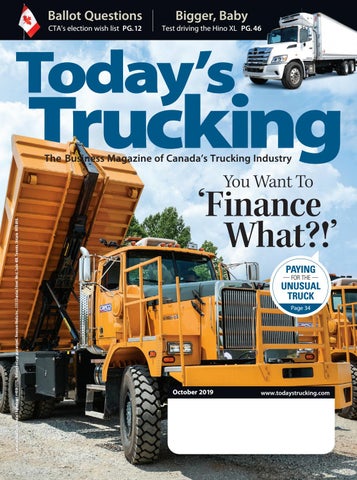
You Want To
‘Finance What?!’ PAYING
— FOR THE —
UNUSUAL TRUCK Page 34
October 2019
www.todaystrucking.com
We’re not just transporting valuable cargo. We’re helping to safeguard everyone else’s.
With innovations like the Detroit® Assurance® suite of safety systems, we’re not just making the roads safer for truck drivers, we’re making them safer for everyone. Learn more about all of our safety innovations at Freightliner.com/Safety. 8/19. FTL/MC-A-1594. Competitive financing available through Daimler Truck Financial. For the Freightliner Trucks dealer nearest you, call 1-800-FTL-HELP. Freightliner Trucks is registered to ISO 9001:2008 and ISO 14001:2004. Specifications are subject to change without notice. Copyright © 2019 Daimler Trucks North America LLC. All rights reserved. Freightliner Trucks is a division of Daimler Trucks North America LLC, a Daimler company.
Discover the future of safety at N AC V Atlanta, Georgia Oct 28-31
Freightliner
VISIT US AT NACV BOOTH #6645
BARRIER DOOR® ONE-PIECE GASKET
Rear door gasket design optimizes thermal performance. The light weight Utility Barrier Door is designed to seal better than any other door in the industry. Utility’s one-piece gasket is fabricated from dual durometer rubber and is designed to eliminate more potential entry points for heat and moisture to enter the reefer. In tandem with Utility’s industryleading foam-in-place insulation, the 3000R® delivers the industry’s highest level of thermal performance. Find a dealer at UtilityTrailer.com
© 2 019 Utilit y Tr a ile r M a nu fac tu r ing C o.
Contents
October 2019 | VOLUME 33, NO.10
9 11 25 27
John G. Smith Rolf Lockwood
30
34
38
46
Carole McAfee Wallace Mike McCarron
NEWS & NOTES
Dispatches
12 Ballot Questions The Canadian Trucking Alliance has a wish list for this federal election
19 20 21 22 23 24
Truck Sales Stat Pack Pulse Survey Heard on the Street Logbook Trending
In Gear
Features 30 Navistar’s Vision Navistar says it’s emerging from ‘survival mode’, and setting a new direction
By John G. Smith
34 Financing the Unusual Do you have the ‘financial strength’ to finance unusual equipment?
By Jim Park
38 Boom Times 43 Frigid Financing There’s no ‘don’t pay a cent event’ when financing reefers
51 Product Watch
Mobile concrete pumps are on the move at a job site near you
By John G. Smith
46 Test Drive: Bigger, Baby Hino’s Baby 8 – the Hino XL – will go head to head with any competitor
By Jim Park
For more visit www.todaystrucking.com OCTOBER 2019
5
Letters Mismatched tires a cause for concern The Business Magazine of Canada’s Trucking Industry
PUBLISHER Lou Smyrlis lou@newcom.ca • 416/510-6881 VICE PRESIDENT, EDITORIAL Rolf Lockwood, MCILT rolf@newcom.ca • 416/614-5825 EDITORIAL DIRECTOR, TRUCKING AND SUPPLY CHAIN John G. Smith johng@newcom.ca • 416/614-5812 CONTRIBUTORS: Eric Berard, Steve Bouchard, Mike McCarron, Jim Park, Carole McAfee Wallace DESIGN / LAYOUT Tim Norton, Frank Scatozza production@todaystrucking.com • 416/614-5818 SALES AND MARKETING CONSULTANT Anthony Buttino anthonyb@newcom.ca • 514/292-2297 SALES AND MARKETING CONSULTANT Nickisha Rashid nickisha@newcom.ca • 416/614-5824 QUÉBEC ACCOUNTS MANAGER Denis Arsenault denis@newcom.ca • 514/947-7228
Re: Fire Down Below (August 2019) The cause of tire failures and heat is much misunderstood. Mismatched or incorrect tire inflation is a major cause of tire failures. If the tires do not travel the same distance per revolution, you will have what is called tire wind – causing the tires to scuff as they contact the road. When the tires fight each other over the variable travel distance per revolution, the results are accelerated tire wear, powertrain wear, increased fuel consumption, wasted horsepower, and eventually, tire failure. The generated heat transfers through the tire rim, to the brake drum, to the hub, causing failures like Jim Park mentions in his article. A tire with a 42-inch diameter, inflated correctly, wants to travel approximately 131.96 inches or 11 feet per revolution. A mating dual that is sitting one inch lower wants to travel only 125.68 inches or 10.47 feet. This is 6.28 inches less per revolution. In a 1,000-mile round trip, this is equal to dragging your tire for 47.5 miles. This is a major cause of heat and failures. — Joe Cindrich British Columbia
CIRCULATION MANAGER Pat Glionna 416/614-2200 • 416/614-8861 (fax) PRODUCTION MANAGER Alicia Lerma alicia@newcom.ca • 416/510-6845
Kenneth R. Wilson Award Winner
MEDIA INC.
5353 Dundas Street West, Suite 400, Toronto, Ontario M9B 6H8 416/614-2200 • 416/614-8861 (fax) CHAIRMAN AND FOUNDER Jim Glionna PRESIDENT Joe Glionna VICE PRESIDENT, PUBLISHING Melissa Summerfield CHIEF FINANCIAL OFFICER Peter Fryters DIRECTOR OF CIRCULATION Pat Glionna
Today’s Trucking is published monthly by NEWCOM MEDIA INC., 5353 Dundas Street West, Suite 400, Toronto, Ontario M9B 6H8. It is produced expressly for owners and/or operators of one or more straight trucks or tractor-trailers with gross weights of at least 19,500 pounds, and for truck/trailer dealers and heavy-duty parts distributors. Subscriptions are free to those who meet the criteria. For others: single-copy price: $5 plus applicable taxes; one-year subscription: $50 plus applicable taxes; one-year subscription in U.S: $90 US; one-year subscription foreign: $180 US. Copyright 2019. All rights reserved. Contents may not be reproduced by any means, in whole or in part, without prior written consent of the publisher. The advertiser agrees to protect the publisher against legal action based upon libelous or inaccurate statements, unauthorized use of photographs, or other material in connection with advertisements placed in Today’s Trucking. The publisher reserves the right to refuse advertising that in his opinion is misleading or in poor taste. Postmaster: Address changes to Today’s Trucking, 5353 Dundas Street West, Suite 400, Toronto, Ont., M9B 6H8. Postage paid Canadian Publications Mail Sales Agreement No.40063170. ISSN No. 0837-1512. Printed in Canada.
Member
This isn’t the industry our reader admired As a nine-year-old, I watched BJ and the Bear, wanting to be a truck driver. I ended up a truck mechanic. In the last year I’ve been reading about truckers killing and johng@newcom.ca injuring motorists. This isn’t the industry I once admired. We switch from professional drivers to guys getting licences in a truck with an automatic transmission. They don’t understand, when hauling more than 50,000 lb., that SEND YOUR this isn’t like a car. The industry needs to change. Let’s make new drivers learn LETTERS TO: on a standard transmission. Remember the old days? You go Newcom up a hill in one gear and you stay in that gear to go downhill. Media Inc., The company I work for had a driver go down a hill and he 5353 Dundas ran into three cars. He injured six people. Then, on the same Street West, day on the QEW, a poor lady lost her life because a truck put Suite 400, her in the barrier. Last year a little six-year-old girl was killed Toronto, Ontario on Highway 10 northbound, just before Orangeville, when a M9B 6H8 tractor-trailer going up a steep hill ran over the back of her dad’s car. I go down Highway 10 every day I to go to work, and they have a memorial for her. All I think about is what if she was my daughter? I’ve also read articles about how the truck insurance is too high. Don’t people realize that premiums go up because of accidents? My dream career is being destroyed right in front of me. — Mark Waschke Ontario
Email:
OCTOBER 2019
7
NOR 23 HOURS OF DARKNESS NOR THE FAILED MISSIONS OF TRUCKERS’ PAST NOR ACTS OF GOD. . . SHALL STAY ME AND THESE CHAINED-UP WHEELS FROM REACHING THE FINAL OUTPOSTS OF THIS VAST FRONTIER. Lisa Kelly on History® Network’s Ice Road Truckers®
Delo® user since 2005
UNCOMMON JOBS REQUIRE UNCOMMON TOUGHNESS
Chevron Products are available from the following locations :
CHEVRON CANADA LIMITED 500-5th Ave. S.W. Calgary AB T2P 0L7 Toll Free: 1 (800) 822-5823 chevronlubricants.ca
CATALYS LUBRICANTS 7483 Progress Way Delta BC V4G 1E7 Toll Free: 1 (855) 946-4226 catalyslubricants.ca
NORTHERN METALIC SALES (GP) 9708-108 St. Grande Prairie AB T8V 4E2 Tel: (780) 539-9555 northernmetalic.com
UFA 4838 Richard Rd. S.W. Suite 700 Calgary AB T3E 6L1 Tel: (403) 570-4306 ufa.com
CHRIS PAGE & ASSOCIATES LTD 14435-124 Ave. Edmonton AB T5L 3B2 Tel: (780) 451-4373 chrispage.ca
RED-L DISTRIBUTORS LTD 9727-47 Ave. Edmonton AB T6E 5M7 Tel: (780) 437-2630 redl.com
49 NORTH LUBRICANTS 1429 Mountain Ave., Unit 2 Winnipeg MB R2X 2Y9 Tel: (204) 694-9100 Fax: (204) 775-0475 49northlubricants.com
CASE ’N DRUM OIL INC 3462 White Oak Road London ON N6E 2Z9 Toll Free: 1 (800) 265-7642 cndoil.ca
TRANSIT LUBRICANTS LTD 5 Hill St. Kitchener ON N2G 3X4 Tel: (519) 579-5330 transitpetroleum.com
R. P. OIL LTD 1111 Burns St. East Unit 3 Whitby ON L1N 6A6 Tel: (905) 666-2313 rpoil.com
MACEWEN PETROLEUM INC 18 Adelaide St. Maxville ON K0C 1T0 Toll Free: 1 (800) 267-7175 macewen.ca
CREVIER LUBRIFIANTS 2320, Rue de la Métropole Longueuil (QC) J4G 1E6 Tél : (450) 679-8866 crevier.ca
NORTH ATLANTIC REFINING LTD 29 Pippy Place St. John’s NL A1B 3X2 Tel: (709) 570-5624 northatlantic.ca
A Chevron company product © 2019 Chevron Canada Limited. All rights reserved. All trademarks are the property of Chevron Intellectual Property LLC or their respective owners.
NEITHER RAIN, NOR SNOW
Editorial By John G. Smith
Shortages and Shortcomings The industry says it’s short truck drivers, but some fleets appear unwilling to change
S
houldn’t Canada be running out of truck drivers by now? Reports of a critical driver shortage have been echoed for decades. Surveys of fleet owners and managers continue to identify the issue as a top concern. Research conducted on behalf of the Canadian Trucking Alliance estimates Canada will be short 34,000 truck drivers as early as 2024. The average age of a truck driver creeps ever higher as well. There are plenty of critics, including a senior U.S. economist (see Lockwood, page 11), who suggest there’s no real shortage. They point to the cries of concern that ebb and flow with every economic cycle – and the cries are undoubtedly the loudest when freight volumes are on the rise. But the concern is always there if you listen closely. Trucking, just like every other industry, must continue to renew and grow its workforce if it wants to thrive in the future. There are initiatives that can help. Industry advocates echo strategies like the need to reach kids in school at a young age, highlight potential career paths beyond the truck cab, and clear immigration channels for eager workers from other shores. As important as these strategies are, however, they all focus on the many positive things that trucking has to offer. Make no mistake about it. There are plenty of opportunities to be had. Look no further than the thousands of Canadians who enjoy long careers at the wheel, or combine that experience with an entrepreneurial drive to become owner-operators or fleets. But these discussions often overlook systemic problems and shortcomings that force the all-important truck drivers to hand in their keys. There isn’t a shortage of truck drivers. There’s a growing shortage of people willing to do the jobs as they exist. The point was punctuated as I moderated a recent panel during a Women’s Trucking Federation of Canada conference. Legal and insurance experts were offering insights about what
drivers should do if they’re told to drive unsafe equipment (find another employer), or if fleets refuse to cough up the proof of insurance needed to apply for another job (ask the insurer for a copy). We wonder why it can be hard to find drivers, quipped Mike Millian, president of the Private Motor Truck Council, who shared the stage with that panel. Should we be surprised by the challenge of finding good truck drivers given that concerns like these continue? He’s right. Good drivers don’t hand in their keys because of a lack of opportunities. They leave when legitimate challenges and concerns are unaddressed. Sometimes they leave for good. Some fleets don’t seem to think it matters. They continue a never-ending race to the bottom as they chase freight at any cost. They leave their drivers to live with issues like long dwell times without pay, shippers who treat those at the wheel like third-class citizens, and the challenges of any added workloads that accompany changing regulations. Worst of all, new drivers who have yet to refine the skills they need are left to their own devices. As if everybody should be born with the skills needed to be successful on the job. I guess fleets like these are confident that there will always be more truck drivers to be had, always someone new to fill the seat and fog a mirror no matter what the working conditions and pay are like. Until there isn’t. TT
“Good drivers don’t hand in their keys because of a lack of opportunities.”
John G. Smith is the editorial director of Today’s Trucking. You can reach him at 416-614-5812 or johng@newcom.ca. OCTOBER 2019
9
© 2019 , Inc. All rights reserved. All marks are trademarks of their respective owners.
EVERYTHING YOU NEED TO CONQUER YOUR DAILY GRIND Engineered to set new standards for quality, body integration and driver appeal. Now designed with a spacious new interior crafted from driver input for optimal comfort and control. The MV™ Series offers the choice between the Cummins® B6.7 or Cummins® L9 engine and is equipped with the industry-leading intelligence of the Diamond Logic® electrical system to help protect your equipment and operate more efficiently. The MV™ Series is built to work harder for you – all day, every day. LEARN MORE AT INTERNATIONALTRUCKS.COM/MVSERIES
Lockwood By Rolf Lockwood
Driver Shortage: Yes or No? An American economist says there’s no driver shortage. I don’t buy it.
D
rivers, drivers, drivers. Is any subject more talked about in our industry? Nope. Of the seven issues recently cited as the biggest concerns of Canadian Trucking Alliance (CTA) members, six of them concerned drivers in one way or another, and the only other issue identified was carbon pricing. No mention of freight rates or aggressive enforcement or lousy roads or a zillion other possibilities. Just drivers. Like the American Trucking Associations, the CTA talks with some alarm about a driver shortage that’s getting worse as time wears on. One prominent American, like just about every Canadian truck driver I’ve ever talked to about it, says that’s a myth. There is no shortage of truck drivers, at least not in the U.S., according to a senior American economist. Kristen Monaco, the associate commissioner at the U.S. Bureau of Labor Statistics’ Office of Compensation and Working Conditions, says it’s really a matter of turnover, or so-called “churn”. But it’s really a factor only in the truckload sector. She was speaking at the recent FTR annual conference in Indianapolis. In the U.S. truckload world, the turnover rate is always around the 100% mark. LTL carriers see annual turnover rates of 5-20% while private carriers report turnover rates of 3-15%. Canadian truckload turnover rates are nowhere near those south of the border, but I haven’t found a recent figure to compare. The closest comes from a 2016 report by the CTA – Understanding the Truck Driver Supply and Demand Gap – which suggests that turnover rates in Canada are generally in the 20-30% range. Monaco said there’s a difference between driver turnover and a driver shortage, suggesting that annual LTL turnover rates of 5-20% are typical among workers with relatively similar skill sets in other industries. Who am I to argue with an experienced economist, but I don’t buy the argument. Churn happens when seven drivers are lured away from Carrier A because Carrier B is offering more money or better benefits. Suddenly Carrier A has a shortage but Carrier B added seven bodies and now has a full roster. Overall the shortage remains the same. It just shifts from one fleet to another. Monaco
does say that those shifting drivers tend to stay in the industry. My logic may be too simplistic, in which case, somebody please correct me. This is, after all, complex stuff, and I am most definitely not an economist. I do believe there’s a driver shortage in Canada. Or, as drivers themselves will tell you, a shortage of jobs worth having in an industry that gets increasingly less driver-friendly. Trucking HR Canada’s Millennials Have Drive report, published in 2017, indicated that 75% of truck drivers between 22 and 38 years old and 46% of drivers from other generations planned to leave the industry within the next five years. One of the top reasons cited by those looking to leave the industry was wages. In fact, 66% of drivers from the millennial generation and 65% of drivers from other generations said that wages were one of the top three challenges they faced in the industry. The gross wage figures typically aren’t horribly bad, until you factor in that a lot of driving jobs – and all longhaul posts – don’t involve a simple eight-hour work day. And they might well feature the joys of tarping a load in the rain, chaining up on a cold winter’s day, or dealing with abusive shippers who refuse to let drivers use the can just inside the warehouse door. And that’s not to mention the idiocy of misguided hours-of-service rules now made worse by ELDs. Remember, trucking competes with mining, oil and gas, forestry or construction for qualified employees. They often pay better and don’t track an employee’s every move like trucking increasingly does. We really do have a driver shortage and I’m afraid it may only get worse. TT
“One of the top reasons cited by those looking to leave the industry was wages.”
Rolf Lockwood is vice-president, editorial, at Newcom Media Inc. You can reach him at 416-614-5825 or rolf@todaystrucking.com. OCTOBER 2019
11
Ballot Questions The federal election is underway, and the CTA knows what it wants for trucking By John G. Smith The federal election writ has dropped. If your phone rings or there’s a knock at your door, there’s likely a message about a political hopeful at the other end. The Canadian Trucking Alliance (CTA) has a message for them. Canada’s largest trucking lobby group is looking to inject several trucking-specific topics and positions into the election, distributing a wish list to the leaders of Canada’s largest political parties. And it’s calling on carrier members to add their individual voices to the debate. Driver Inc., a tax-avoidance scheme that involves misclassifying fleet employees as independent contractors, is the leading topic that the alliance wants to see emerge in the mandate letters that guide cabinet ministers in their jobs. The Canada Revenue Agency recently calculated a federal corporate income tax gap of $9.4-$11.4 billion for the 2014 tax year, before audit
12
TODAY’S TRUCKING
results. The CTA says Driver Inc. accounts for at least $1 billion of that. “If the next Government of Canada prioritizes business tax revenue leaks, it should start first by stamping out the growing practice of Driver Inc.,” CTA president Stephen Laskowski said in a recent release. “Driver Inc. is clearly a scam, and not about a few companies being ignorant or misinformed about the law.” Carbon pricing, often referred to a carbon tax, is also questioned. “CTA has supported Environment Canada’s heavy truck regulations which have added billions in direct costs for the industry. The logic to adding a carbon charge on top of this is questionable,” the alliance’s document for political parties says. “Currently, there are very few wholly-viable and widely available alternatives to the diesel engine.” The CTA’s full list of election priorities largely draws from a
recent Nanos Research survey of 32 industry executives, combined with previous positions that were already established. They include:
n Establish a level playing field – Tackling Driver Inc. tops the list of steps needed to ensure there’s an even playing field for operations. “Many of the companies and drivers involved in this scheme are knowingly avoiding many of their tax responsibilities, including paying the appropriate source deductions (CPP, EI, etc.) among other taxes. From the driver’s perspective, many are knowingly and unknowingly taking advantage of small business tax advantages not otherwise available to them,” CTA says. Noting that most trucking companies are small businesses, the alliance has also asked for more guidance and support so these businesses can be aware of new regulations and have the capacity to implement timely changes.
o Reducing carbon emissions – Environment Canada believes heavy trucks will reduce their carbon emissions by 3 Megatons between 2018 and 2030, with the changes costing the trucking industry $4.1 billion. Including the Phase 1 emissions changes introduced in 2014, the trucking industry has already reduced its carbon footprint by 6 megatons at a cost of $8.3 billion, CTA says. If a carbon tax is to exist, the alliance is asking for the revenue to be redistributed through the trucking industry, supporting programs that incentivize the purchase of new and greener trucking equipment, or retrofitting equipment that is already on the road.
p Access to immigration channels – While Canada’s trucking industry is increasing wages and better-marketing career opportunities, it needs more access to immigration programs to meet labor needs, the CTA says.
q ‘Recognized employer’ status for the Temporary Foreign Worker Program – Trucking HR Canada led a series of roundtables on Canada’s Temporary Foreign Worker Program (TFWP)
Labour Code Exemptions PG. 14
Roadcheck Results PG. 15
Daimler Experience PG. 33
The Canadian Trucking Alliance is supplying members with a series of related talking points and contact information for political leaders.
earlier this year. One of the key recommendations to emerge from that was the need for a “trusted employer” vetting process to expedite related Labor Market Impact Assessments. That process ensures employers have exhausted every opportunity to hire Canadians for a job.
r More access to programs that support better and effective training – Citing plans to introduce a national Mandatory Entry-Level Training (MELT) standard for truck drivers, the CTA is proposing a pilot program
with enhanced training, offered through select schools and by employers with proven track records.
s Labour Code exemptions – Recent changes to the Canada Labour Code pose a “serious threat” to the trucking industry, the CTA notes. New Interpretations, Policies and Guidelines used by enforcement teams actually exempt truck drivers and warehouse workers from the new rules for federally regulated workers. Otherwise these individuals would require 96 hours of written
notice about work schedules, and 24 hours of notice about shift changes. The CTA wants the exemptions listed in the Labour Code itself.
t Support to improve road safety – “Most trucking companies and truck drivers embrace a culture of safety by going well beyond minimum safety standards. However, events over the past few years have shown what can happen when carriers and drivers do not embrace a ‘safety first’ culture,” the alliance says.
It points to a 10-point safety action plan the lobby group released in the wake of a fatal truck crash involving a bus carrying members of the Humboldt Broncos hockey team. That list called for mandated electronic logging devices by the fall of 2019, research into requiring forward-facing cameras on federally regulated commercial vehicles, assessing the feasibility of in-cab technologies to monitor drivers, and studying advanced driver assistance systems (ADAS). The alliance also called on the federal government to encourage provinces to introduce mandatory entry-level training (MELT), incorporate a distracted driving module into that training, expand the use of pre-clearance technologies, and better focus on-road enforcement on human factors that contribute to collisions. Rounding out the list was a call for governments to develop a proactive system to identify companies and drivers that pose a risk to public safety, and supply those who buy transportation services a ‘best practices’ guide to help identify unsafe operators. Canadians go to the polls Oct. 21. TT OCTOBER 2019
13
Dispatches > NEWS BRIEFS
Drivers exempt from Labour Code updates ... for now Canada’s trucking industry appears to have secured a reprieve from wide-reaching changes to the Canada Labour Code, which took effect Sept. 1. A need to give federally regulated work-
ers 96 hours of written notice about work schedules – and 24 hours’ notice about shift changes – exempts truck drivers, courier drivers, material handlers, warehouse workers, and shipper-receivers, according to the Interpretations, Policies and Guidelines used by enforcement teams. The Canadian Trucking Alliance (CTA) expects that it will be business as usual
until further notice, and says it’s working with Employment and Social Development Canada (ESDC) to address outstanding concerns affecting other job titles. Other changes to the Labour Code include the right to refuse overtime due to family obligations, a 30-minute break for every five hours of work, and a minimum eight-hour break between work shifts. “The federal government is trying to apply a one-size-fits-all, 9-5 business model to industries where that just doesn’t work,” said Dan Kelly, president of the Canadian Federation of Independent Business (CFIB). “Our trucking members in particular have been clear that these labor standard changes will be devastating.”
Trucking HR unveils new labor survey Trucking HR Canada is partnering with the Conference Board of Canada in a survey designed to put the industry’s hiring, training and retention issues into perspective. “Trucking HR Canada’s labor market information project – which is the largest and most comprehensive labor market study ever conducted for the industry – will help us get a better handle on the industry’s labor challenges,” said Angela Splinter, CEO of the organization that promotes best practices in HR. To take the survey, visit www. truckinghr.com/truckingsurvey.
Dana acquires Quebec’s Nordresa Dana has acquired Quebec-based Nordresa Motors, a business that focuses on commercializing electric powertrains for commercial vehicles. The acquisition combines Dana’s lineup of motors, inverters, chargers, gearboxes, and thermal management products, with Nordresa’s battery management system, electric powertrain controls, and integration expertise. “There has been substantial collaboration between the organizations over the last several years, and this acquisition allows for more strategic cooperation,” says Ryan Laskey, Dana’s vice-president –
14
TODAY’S TRUCKING
NEWS BRIEFS
commercial vehicle and corporate driveline engineering. “Nordresa has nearly two decades of electrification knowledge and experience, but many fleet and OEM customers are reluctant to source business from small start-ups.” The acquisition also comes on the heels of Dana’s majority investment in Quebecbased TM4, now Dana TM4, which designs and manufactures motors, power inverters, and control systems.
Roadcheck blitz grounds 19.9% Canadian inspectors placed 19.9% of vehicles out of service during this year’s annual Roadcheck inspection blitz, run from June 4-6. There were 7,014 Level 1, 2 and 3 inspections completed on this side of the border. The U.S. conducted 60,058 inspections and recorded a 17.7% out-of-service rate. In terms of driver-related violations, 2% of inspected drivers were placed out of service in Canada, while 4.4% were parked in the U.S. The annual enforcement initiative also placed a special focus on steering components and suspension systems this year. The 408 recorded steering violations represented 2.5% of the vehicle violations, while 703 issues with suspension systems accounted for 4.3% of the total. Braking systems remain the top source of vehicle-related out-of-service violations, representing 28% of the issues. Tires and wheels followed at 19.3%, and brake adjustment rounded out the Top 3 violations at 17.1%.
The PrePass bypassing services are also available in the U.S.
Feds funding green assessments Natural Resources Canada will offer up to $10,000 toward a third-party green freight assessment that will help carriers iden-
< Dispatches
tify ways to lower fuel costs and reduce greenhouse gas emissions. The funding is available through Phase 1 of the Green Freight Assessment Program, as part of a 50% cost-sharing deal with carriers. Applications can be submitted through the NRCan website until Nov. 1, or until funds are depleted.
POWERFUL, EASY-TO-USE ELD SOLUTION A robust solution your team can rely on. Thanks to automatic synchronization between their logbook and trip sheet, drivers can focus on what they love: driving!
B.C. carriers secure weigh scale bypass Carriers traveling through Canada’s westernmost province now have access to weigh scale bypass services using PrePass. The PrePass transponders can now be used at 11 B.C. locations through the Weigh2GoBC service – letting drivers bypass scales while electronically verifying weight, safety ratings, and credentials. Users need to register for a B.C. electronic ID (BCeID) through the Weigh2GoBC website and enrol for a transponder. There are no additional fees.
LET’S START A PROJECT TOGETHER!
www.isaac.ca/eld-solution 1 888 658-7520
OCTOBER 2019
15
BREAK NEW GROUND. Tradition is good. Tradition helps us become who we are and who we’re going to be. But tradition also holds us back. To get ahead you have to try something new. Something better. Something different. It’s time to try something you’ve never tried before. To not do what you’ve always done. To not drive what you’ve always driven. It’s time for a truck with a rugged past and a rugged future. So break free. Break the rules. Break from the expected. And break new ground with Western Star.
Western Star - A Daimler Group Brand WS/MC-A-598 Specifications are subject to change without notice. Western Star Truck Sales, Inc. is registered to ISO 9001:2008 and ISO 14001:2004. Copyright © 2019 Daimler Trucks North America LLC. All rights reserved. Western Star Truck Sales, Inc. is a subsidiary of Daimler Trucks North America LLC, a Daimler company.
goes the distance For some, going the extra mile is a rarity. But for others, it’s what makes us great. Over a century ago, we made a commitment to stand by our customers and our products, on and off the road. Because for us, going the extra mile isn’t an exception, it’s the rule. Great Doesn’t Stop. GreatDane.com
›
Visit us at IFDA Show • Booth # 706 • Oct 28-29 Orange County Convention Center • Orlando, FL
Dispatches
Heavy truck production expected to drop ACT Research expects heavy truck production to begin a drop as early as the fourth quarter of this year – with August representing the 15th month of peak-level production counts. “Carrier profitability and production peaks always lag the freight cycle, so capacity building always accelerates relative to freight growth at exactly the wrong time, every time,” said Kenny Vieth, ACT’s president and senior analyst. “Large new inventories and deteriorating freight and rate conditions suggest erring on the side of caution.” In terms of retail truck sales, Canadians purchased 2,703 Class 8 trucks in July, Wards Auto reports. Freightliner continues to dominate that category with 713 sales for the month. Canadian Class 7 sales amounted to 654 units, with Class 6 at 103 trucks, and Class 5 at 987 units.
Canada – July 2019 SALES CLASS 8
U.S. – July 2019
MARKET SHARES
SALES
July
YTD
July %
YTD %
CLASS 8
Freightliner Kenworth Volvo Truck International Peterbilt Western Star Mack Other Total CLASS 7
713 485 407 337 300 242 219 0 2,703 July
6,018 3,176 2,808 2,505 2,211 1,687 1,283 0 19,688 YTD
26.4 17.9 15.1 12.5 11.1 9.0 8.1 0.0 100.0 July %
30.6 16.1 14.3 12.7 11.2 8.6 6.5 0.0 100.0 YTD %
International Peterbilt Freightliner Hino Kenworth Ford Total CLASS 6
145 170 204 71 59 5 654 July
1,444 1,252 867 629 340 44 4,576 YTD
22.2 26.0 31.2 10.9 9.0 0.8 100.0 July %
Freightliner Hino International Ford Peterbilt Isuzu Kenworth GM Total CLASS 5
13 36 18 7 21 2 6 0 103 July
345 310 205 46 47 13 14 0 980 YTD
Ford Hino Isuzu Dodge/Ram Freightliner International Mitsubishi Fuso GM Kenworth Peterbilt Total
542 148 102 179 0 16 0 0 0 0 987
2,292 1,011 638 733 20 29 0 0 1 0 4,724
Source: WardsAuto
www.total-canada.ca
MARKET SHARES
July
YTD
July %
YTD %
Freightliner Peterbilt International Kenworth Volvo Truck Mack Western Star Other Total CLASS 7
8,875 3,710 3,713 4,042 2,486 1,722 616 0 25,164 July
59,402 23,935 23,233 23,349 15,224 11,151 3,702 0 159,996 YTD
35.3 14.7 14.8 16.1 9.9 6.8 2.4 0.0 100.0 July %
37.1 15.0 14.5 14.6 9.5 7.0 2.3 0.0 100.0 YTD %
31.6 27.4 18.9 13.7 7.4 1.0 100.0 YTD %
Freightliner International Peterbilt Kenworth Ford Hino Total CLASS 6
2,017 2,469 748 526 220 206 6,186 July
16,127 10,139 4,313 3,158 1,556 1,203 36,496 YTD
32.6 39.9 12.1 8.5 3.6 3.3 100.0 July %
44.2 27.8 11.8 8.7 4.3 3.3 100.0 YTD %
12.6 35.0 17.5 6.8 20.4 1.9 5.8 0.0 100.0 July %
35.2 31.6 20.9 4.7 4.8 1.3 1.4 0.0 100.0 YTD %
Ford International Freightliner Hino Kenworth Isuzu Peterbilt GM Total CLASS 5
2,672 1,456 1,539 701 231 147 6 126 6,878 July
14,472 13,837 12,077 4,353 1,681 687 46 856 48,009 YTD
38.8 21.2 22.4 10.2 3.4 2.1 0.1 0.0 100.0 July %
30.1 28.8 25.2 9.1 3.5 1.4 0.1 0.0 100.0 YTD %
54.9 15.0 10.3 18.1 0.0 1.6 0.0 0.0 0.0 0.0 100.0
48.5 21.4 13.5 15.5 0.4 0.6 0.0 0.0 0.0 0.0 100.0
Ford Dodge/Ram Isuzu Freightliner Hino GM International Kenworth Peterbilt Mitsubishi Fuso Total
4,081 1,762 372 318 226 236 86 0 1 0 7,082
30,311 8,805 3,163 2,542 1,494 865 189 25 6 0 47,400
57.6 24.9 5.3 4.5 3.2 3.3 1.2 0.0 0.0 0.0 100.0
63.9 18.6 6.7 5.4 3.2 1.8 0.4 0.1 0.0 0.0 100.0
OCTOBER 2019
19
Dispatches
StatPack 1.8 million INSPECTIONS
750,000th TRUCK Daimler Trucks North America has produced its 750,000th truck – a Freightliner Cascadia – at its production facility in Cleveland, N.C. Freightliner acquired the plant in 1989, to assemble medium-duty models. Today the facility also produces the Western Star 4700, 4900 and 5700XE, and right-hand-drive Freightliner Coronados and Columbias for Australia and New Zealand.
The Commercial Vehicle Safety Alliance reported 1.8 million inspections during the first half of 2019, and brakes continue to dominate out-of-service issues. Of the total, 86,296 brakes were out of adjustment, 45,594 units built after October 1994 had automatic brake adjusters that failed to compensate for wear, and another 37,737 vehicles had chafing or kinking brake hoses or tubing. ABS malfunction indicator lamps were missing or defective on 37,343 trailers built after March 1998.
MAXIMIZING TO 96,000-sq.ft. You could say that Minimizer is maximizing – purchasing a 13-acre site in Owatonna, Minn., which will eventually house 83 personnel who are currently working out of three buildings in Blooming Prairie. The new 96,000-sq.ft. facility will be substantially larger than the existing 54,000 sq.ft of operating space for the company that produces poly semi-truck fenders and integrated bracket kits. The move is to be completed early in 2021.
25.6% MORE TONNAGE The American Trucking Associations expects the tonnage moved by the U.S. trucking industry to grow 25.6% by 2030. The number emerges from an annual report on the state of the freight economy. The report also estimates overall freight tonnage to grow to 20.6 billion tons by 2030, revenues to increase by 53.8% over the next 10 years, and for trucking’s share of total freight tonnage to drop to 68.8% in 2030, down slightly from 71.1% this year.
$75 million FOR HIGHWAYS The federal and provincial governments are pledging more than $75 million in joint funding to improve highways in Saskatchewan. The projects involve building four sets of passing lanes on Highway 4 and repaving 220 kilometers of Highways 1, 3, 4, 5, 6, 7, 8, 14, 20, 21, 55 and 102.
20
TODAY’S TRUCKING
60 COOL YEARS Erb Transport, a fleet that promotes its refrigerated shipments as “another cool move”, recently celebrated its 60th anniversary at the company’s hub in Baden, Ont. Vernon Erb started the business with a single truck, but the fleet now employs about 1,500 people including owner-operators.
Dispatches
Pu se Reader Survey Tell us your thoughts on ... Security Delivering a load from Point A to Point B is important, but fleets and drivers are also expected to watch over the cargo in their care. In this month’s Pulse Survey, we want to know your thoughts on security.
What do you see as the biggest security threat to Canada’s trucking industry?
Do you feel your loads are completely secure against cargo theft?
TARGETED CARGO THEFTS 45 % } Thieves know what they’re after
23
%
}
CRIMES OF OPPORTUNITY Thieves will take anything they can find
18
%
}
INSIDE JOBS Employees play an active role in cargo thefts
14
%
}
DATA BREACHES/ COMPUTER VIRUSES Information as valuable as cargo
Have you ever lost a commercial vehicle to theft?
What are today’s best tools or strategies to protect against cargo thefts? (Pick 3) 66% 44% 40% 34% 32% 32% 20% 19% 18%
GPS tracking Physically fenced parking Security cameras Secure warehouses/docks Employee screening/ background checks Trailer locks and seals Security guards Geofencing Driver strategies (i.e. drive minimum distance before stopping)
YES
NO
31 %
69 %
Have you ever lost a load to cargo theft?
15% 11% 10% 6%
Regular check-ins by drivers Password-protected data Motion sensors Other
Do you believe truck drivers are as safe as the general population when on the road?
YES
53
YES
34
NO %
66
YES %
34 %
NO %
47 %
NO
66 %
Today’s Trucking Pulse surveys are conducted once per month, covering a variety of industry issues. To share your voice in future surveys, email johng@newcom.ca.
Next month: Traffic OCTOBER 2019
21
Dispatches
Heard Street on the
John Caseley
Wesselius tops Navistar competition Brandon Wesselius of Lewis Motor Sales in Owen Sound, Ont., secured first place in the 2019 Navistar Technician Rodeo’s truck category. The competition involved 20 technicians from International and IC Bus dealers from across the Americas. Nine hundred technicians completed an online test to determine the finalists. IRL International Truck Centres in B.C. participated in the bus competition, while Alberta’s Diamond International Trucks participated in the global competition.
Obituary: John Caseley, 73 John Caseley of Trendway Transportation Services died
Ellen Voie named ‘Cinderella to CEO’ Women In Trucking Association president and CEO Ellen Voie is among nine women to be named Cinderella to CEO of the Year. The award recognizes women who have
Ellen Voie
overcome obstacles to change businesses. The inaugural award, presented in New York, is inspired by a book of the same name. “I am especially thrilled to be recognized by an organization outside the trucking industry, which makes the award even more special,” she said.
suddenly at the age of 73 on July 29. Before retiring he had spent many years working in transportation, focusing largely on heavy-haul and specialized logistics. He was a long-time board member of the Ontario Trucking Association.
Don Daseke
Linde leads Canadian inspectors Sgt. Benjamin Schropfer of the Nebraska State Patrol earned top honors during the recent North American Inspectors Championship (NAIC), but his Canadian peers secured top honors in several individual categories. Brittany Linde of the British Columbia Ministry of Transportation and Infrastructure secured the Sean McAlister High Points Canada Award, as well as first place in the category devoted to hazardous materials, dangerous goods, and cargo tank/bulk packaging inspections. Alberta Justice and Solicitor General’s Delaney Malsbury secured first place for the 37-step Level 1 inspections.
Don Daseke retires Don Daseke has retired from
Obituary: Brian Kurtz, 72 Brian Kurtz, a man who turned a single truck into a significant fleet, passed away on Aug. 9 at the age of 82. He became an owner-operator in the early 1970s before forming Brian Kurtz Trucking in 1980. Today, the fleet runs more than 70 trucks and 130 trailers, and employs more than 100 people.
Brian Kurtz
Burningham to lead Triple Diamond Bryan Burningham, a 25-year industry veteran, has been named president of Triple Diamond Truck and Trailer in Mississauga, Ont. Before joining Triple Diamond, he held leadership positions at fleets including Challenger Motor Freight and Schneider National.
22
TODAY’S TRUCKING
the roles of chief executive officer and board chairman at the company that bears his name. Daseke Inc., a consolidator of flatbed and specialized transportation services, now includes 16 operating companies with more than 5,200 trucks and 11,000 flatbed and specialized trailers. Chris Easter, who became the fleet’s chief operating officer in January, is now the interim CEO. Brian Bonner has been named executive chairman.
Dispatches
L gbook2019 SEPTEMBER 30-Oct. 2 Canadian Transportation Equipment Association 56th Annual Manufacturers’ Conference Mont-Tremblant, Que. www.ctea.ca
OCTOBER 1 PMTC Western Regional Seminar Delta Hotels Marriot Edmonton South Conference Center Edmonton, Alta. www.pmtc.ca
23 Canadian Trucking Alliance Fall Tour Red Tail Landing Golf Course, Edmonton, Alta. www.amta.ca
24 Canadian Trucking Alliance Fall Tour Glenmore Inn & Conference Centre Calgary, Ont. www.amta.ca
28-31 North American Commercial Vehicle Show Georgia World Congress Center, Atlanta, Ga. www.nacvshow.com
NOVEMBER 1 Manitoba Trucking Association Fall Awards Gala The Metropolitan Entertainment Centre Winnipeg, Man. www.trucking.mb.ca
25
DECEMBER 12
STA Annual General Meeting and Gala Awards Regina, Sask. www.sasktrucking.com
Atlantic Provinces Trucking Association Awards Dinner Delta Beausejour Hotel, Moncton, N.B. www.apta.ca
1 Winter Maintenance Conference Coast Langley City Hotel and Convention Centre Langley, B.C. www.bctrucking.com
5-9 American Trucking Associations Management Conference and Exhibition San Diego Convention Center San Diego, Calif. www.trucking.org
Webasto Heaters Make a Difference.
8 Atlantic Provinces Trucking Association AGM Marriott Harbourfront Halifax, N.S. www.apta.ca
16 Surface Transportation Summit Mississauga, Ont. surfacetransportationsummit.com
Reduce
idling cold starts Reduce face plugging Fuel savings Improve DPF reliability Reduce
Air Top 2000 STC
ALL NEW Thermo Top Evo
Visit Idle-Reduction.com to see the results of a recent study and see how Webasto can improve DPF performance. 877-9NO-IDLE
OCTOBER 2019
23
Dispatches
Trendingg on
In most fleets, dispatchers, logistics teams, mechanics, and material handlers work a typical 40-hour week. The truck drivers, however, work 52.5 hours per week. Drivers tend to see premiums for pick-ups and deliveries, dwell times, or travel within certain regions such as New York, too. Other bonuses are offered to team leaders and for referring job candidates. Almost all the surveyed businesses (89%) apply the same holiday policy to all employees, typically offering three weeks of vacation after four weeks on the job. Seventy-five percent offer a fourth week of vacation, and 60% offer a fifth week. Half of the surveyed companies offer paid leave in addition to public holidays and annual holidays. In some organizations, the length of paid leave varies depending on seniority. The majority of mechanics and handlers are eligible for overtime, with half of the pay in cash, and the remaining half paid in lieu time. — Steve Bouchard
Quebec study highlights driver pay, compensation A typical longhaul truck driver based in Quebec makes $67,000 per year, while local haulers are paid $56,000, according to research conducted on behalf of the HR specialists at Camo-route. The survey of 126 Quebec companies was completed by the PCI Perreault Conseil consulting firm and also offered insights into everything from benefits programs, to pension plans, vacation policies, and training. “The survey reveals that several companies have put in place measures that meet the expectations of the new workforce and are in line with the new reality of the labor market,” says Bernard Boule, managing director of Camo-route. A typical longhaul driver based in Quebec secures a third week of vacation after four years of service, while their employers usually pay half the cost of group insurance, the survey found. Several fleets were also shifting to an hourly pay model rather than paying per mile. In contrast, the average local driver makes $20.60 per hour and works 52.5 hours per week. Overtime is paid after 60 hours, and a third week of vacation is added after four years of service.
@todaystrucking Your go-to social media source
.com
25.9K FOLLOWERS
If you’re not following us on Twitter, you’re missing out on some interesting discussions in the world of trucking. From regulations to product news, we have you covered.
HERE ARE A FEW EXAMPLES OF TWEETS POSTED BY TODAY’S TRUCKING THIS MONTH
KEEP IN TOUCH facebook.com/ TodaysTrucking
24
Aug. 9
Aug. 15
Aug. 21
Day and Ross is breaking ground on a new Moncton terminal, scheduled to open in the summer of 2020. Trucknews.com/transportation ... #trucking @DayRoss_Recruit
@krietegroup is showing off recent investments including a new paint booth in Racine, Wisconsin. #BrightLightsBigTrucks @MackTrucks
@DaimlerTrucksNA hands over the keys for its first Class 8 #ElectricTrucks in the form of two eCascadias – part of an innovation fleet to be tested by @PenskeNews and #NFI.
TODAY’S TRUCKING
@todaystrucking
TodaysTrucking1
Legal
Are you in an ‘exclusive’ relationship? By Carole McAfee Wallace
M
any companies engage independent contractors to perform services. And when the relationship turns sour, the parties often fight over whether the independent contractor is actually an employee who’s entitled to notice of termination and other benefits. In 2009, the Ontario Court of Appeal confirmed that there is an intermediate category between employees and independent contractors. A “dependent contractor” relationship exists where a worker – who was labelled an independent contractor – can show a certain minimum economic dependency on the company, demonstrated by complete or near-complete exclusivity. If someone is found to be a dependent contractor, the company can’t terminate services without providing reasonable notice, equal to what an employee would receive. In 2016, in a second key decision, the Court of Appeal said a “high level of dependency and exclusivity” is needed to establish the dependent contractor relationship, and that exclusivity can’t be determined by a snapshot. The full work history must be considered. One recent court case can help to guide businesses looking to assess such working relationships. On July 31, the Ontario Court of Appeal’s decision in Thurston. v. Ontario (Children’s Lawyer) offered
particular insights into the concepts of “exclusivity” and “dependency” when it comes to dependent contractors. Barbara Thurston, a sole practitioner lawyer, provided legal services to Ontario Children’s Lawyer (OCL) between 2002 and 2015. She was a member of the OCL panel of 380 lawyers, and provided services through a series
were for OCL. In the last three years they accounted for a respective 62.6%, 47.5%, and 50.1%, and the overall annual average during the 13 years was 39.9%. The motions judge focused on the continuous 13-year relationship, the fact that Thurston performed work that was integral to OCL’s services, and that OCL had a great
of fixed-term contracts, each of which required reappointment by OCL. The contracts didn’t restrict her ability to work for others, and some of the contracts expressly required her to state that her practice included work for others. The contracts also didn’t guarantee a minimum volume of work. When OCL didn’t renew Thurston’s contract in 2015, she sued – claiming she was a dependent contractor and entitled to 20 months’ termination pay. The OCL said she was an independent contractor. Key evidence in this case included a chart that tracked her billings from 2002-2015. Over 13 years, between 14.8% to 62.6% of her overall billings
deal of control over her work and working conditions. But considering the permanent nature of the relationship, and the fact that the work was so integral to OCL, the scales tipped in favor of a dependent contractor status. OCL appealed. Relying on earlier decisions, the Ontario Court of Appeal confirmed that a certain minimum economic dependency may be demonstrated when it comes to extending entitlements for termination notice. The court went on to say that “near-complete” exclusivity can’t be reduced to a specific number that determines dependent contractor status, and that additional factors may be relevant. Having
said that, the court also said near-exclusivity requires substantially more than 50% of the billings. Otherwise, exclusivity – the hallmark of dependent contractor status – would be rendered meaningless. When examining the entire relationship, only 39.9% of Thurston’s earnings came from OCL. So this wasn’t a “near-exclusive” relationship. While additional factors may be relevant, this recent case suggests that a longstanding “independent contractor” with only one source of income could be seen as a “dependent contractor”. Businesses should ensure that their contractors are permitted to work for others, and do in fact work for others. These businesses should also include express provisions in agreements, where the workers can confirm they perform work for others. If exclusivity and dependency is a realistic risk, the contracts should also include a termination provision that meets the employment standards for termination, or provides a formula to calculate the notice of termination that meets those minimums. Details like these could help to avoid costly legal battles in the future. TT Carole McAfee Wallace is a partner at Fernandes Hearn LLP, and can be reached at 416-203-9551. This column is intended for information purposes only and does not constitute legal advice.
OCTOBER 2019
25
© 2019 Penske. All Rights Reserved.
Open Mike
What’s behind the recent U.S. trucking bankruptcies? By Mike McCarron
T
he first six months of 2019 were tough on truckers south of the border. According to transportation analyst Donald Broughton of Broughton Capital in St. Louis, 640 trucking companies shut their doors in the first half of the year. That’s a big spike compared to 175 companies that closed during the same period in 2018. Trucking is cyclical, but what’s interesting this time around is that you can’t attribute these closures to one single factor. Broughton does acknowledge that costs are higher and pricing power has dipped, but there’s been no economic downturn, regulatory change, or spike in fuel prices to take down a lot of carriers all at once. I looked into the sudden increase in U.S. trucking closures to see what lessons we can learn in Canada. Here’s what I found:
Too many trucks Trump, tariffs and other business disruptions are coming from all angles, and many people believed these factors had contributed to a downturn in freight. So I was surprised to learn that truckload volumes in the U.S. were actually 7% higher during the first half of 2019 compared to the same period last year. The problem isn’t a lack of freight. It’s too many trucks. It seems that U.S. truckers expected the boom of 2018 to
last forever, forgot the lessons of 2008, and used last year’s record profits to increase the size of their fleets. With more trucks chasing the same freight, control over pricing has shifted back to the shippers, and rates are down. It’s tough managing your own capacity, let alone an entire industry.
Customer concentration Last February, 101-year-old New England Motor Freight – the nation’s 19th-largest LTL carrier – was taken out after one of its biggest contracts, Amazon, squeezed the business. In July, Youngstown, Ohio-based Falcon Transport, a 700-truck fleet, closed when its largest customer shuttered two plants. It’s risky to have a lot of business with a few customers, but in trucking this is incredibly common. When I owned MSM Transportation, I had many sleepless nights fretting over the loss of a big customer. There is no magic formula to combating customer concentration, other than maintaining a vibrant sales funnel and continually attracting new business. In today’s market, that’s easier said than done.
Spot markets and small carrier peril According to Broughton, the average size of the U.S. carrier that failed in 2019 is 30 trucks.
With pricing power back in the hands of shippers, spot van rates in August were down 15% year over year, according to DAT. The real problem for small carriers is that the spot market, on which many rely so heavily, is down a whopping 62% this year, according to Business Insider. Unfortunately, small carriers don’t have the same leverage as their bigger counterparts when it comes to getting higher contract rates. They’re also dealing with the reality that many larger carriers used their surge in 2018 profits to raise driver pay or invest in technology to make operations more efficient.
closures in Canada this year, I could find only one: FTI Transportation. Even that should be listed with an asterisk because FTI’s demise can be linked to Denver-based HVH Transportation, which shut down in August. To what can we chalk up our improved survival rate? One reason is that Canada has a far more rigid lending environment, which makes capital tougher to access. It’s the same reason the 2008 economic meltdown was far less severe in Canada. The only other conclusion I can draw is that Canadians are now simply better than Americans in both hockey and trucking. TT
Kudos to Canadians Whenever I compare statistics in Canada and the U.S., I use the 1/10 ratio — and it’s almost always bang on. I was over-the-moon ecstatic to see that instead of the expected 64 trucking
Mike McCarron is the president of Left Lane Associates, a firm that creates total enterprise value for transportation companies and their owners. He can be reached at mike@ leftlaneassociates.ca, 416-551-6651, or @AceMcC on Twitter.
OCTOBER 2019
27
THEY ARE 181,300 STRONG. LOGGING HOUR AFTER HOUR. MILE AFTER MILE. WORKING DAY AND NIGHT TO DELIVER. SO THE FREIGHT WE ALL DEPEND ON IS THERE WHEN WE NEED IT. THEY ARE CANADA’S TRUCK DRIVERS. AND TO EACH AND EVERY ONE WE SAY THANK YOU. FOR YOUR COMMITMENT. DEDICATION. AND OF COURSE, YOUR DRIVE.
The World’s Best®
ISO 9001:2000 © 2019 Kenworth Truck Company. A PACCAR company.
NAVISTAR’S
VISION OEM emerging from ‘survival mode’, setting a new direction with Vision
Navistar is exploring ways to deliver parts quicker than ever, and that involves better predicting what customers will require.
By John G. Smith
N
avistar International has a vision for the future of its dealer and aftermarket experience – and it’s taking shape in what’s known internally as the Vision 2025 strategy. A recent agreement with Love’s Travel Stops, a new parts distribution center, and an increasing focus on telematics data are just a few examples of the changes being made. The manufacturer is looking to establish a common experience from one dealership to the next, better predict when and where parts will be needed, and slash the time trucks spend in service bays. “While many future actions are still in the works, the foundation of Vision 2025 is already in place, and is starting to provide significant benefits to our customers, who are at the center of this strategic direction,” says Friedrich Baumann, president – aftersales and alliance management. Navistar completed a new partnership with Love’s Travels
30
TODAY’S TRUCKING
Stops on Aug. 1, authorizing most Love’s and Speedco service locations to perform standard, extended, and used warranty work on all International Class 6-8 trucks, with service repair times of three hours or less. Loves has more than 1,000 locations across North America, making this the commercial transportation industry’s largest service network, Navistar says. The OEM also opened a new 300,000-sq.-ft. Memphis parts distribution center (PDC) in Olive Branch, Miss., on Aug. 26. It will serve the region’s dealers with stock and emergency orders. But proximity to the nearby FedEx World Hub in Memphis will also enable next-day parts deliveries to more than 95% of dealer service locations, while also extending order cut-off times to 11 p.m. (EST). “Not every parts service emergency is going to happen during an average 9 a.m. to 5 p.m. workday. Filling the time-sensitive gap of parts delivery is our main goal, and Memphis is the key to getting there,” said Josef Kory, senior vice-president – parts. The work will hardly end there. Prestige standards are being developed to ensure a consistent experience from one dealership to the next, right down to the condition of the restrooms. Navistar also plans to expand its private-labeled Fleetrite and ReNEWed brands to include more products. Fleetrite itself already accounts for 96 different product lines. Later this year, a new system will be publicly launched to support customers who prefer to order their parts online, too. But there will even be other channels for those customers who don’t necessarily return to dealers, thanks to businesses that sell Fleetrite products without the stamp of a Navistar diamond on the door. Those locations will compete against businesses such as FleetPride, Kory says. And they’ll focus on multiple daily parts deliveries and shorter order-to-delivery times. Four of these location have already been launched. More are planned this year. Baumann says he saw a company going through “significant change” when he joined Navistar in April 2018, following a role as the head of the aftermarket business unit at Daimler Trucks North America. A focus on “survival mode” in the wake a failed emissions strategy was gradually shifting to a focus on business growth and innovation. While many changes have been realized, Navistar executives are not shy about the challenges that remain. Baumann, for
Navistar’s Vision example, refers to the brand’s score of 7.7 out of 10 during an ATD survey released at the end of 2018. Some competitors have been scoring more than nine out of 10 in the customer rankings of their dealership experiences. The unflinching approach has extended deep into the head office, even restructuring things like the traditional dealer council. “We have to change it so that we’re working together,” says Mark Belisle, vice-president – distribution. Justin Fink of the Summit Truck Group, headquartered in Texas, remembers what such meetings used to be like. There were no agendas delivered in advance. Sessions typically involved hours of powerpoint presentations, and were often bogged down in topics like prices rather than broader strategies. The eight-member board guiding Vision 2025 initiatives – an equal number of dealers and corporate personnel – now come to their meetings with a focus on the measures that are meant to reach the broader goals. Each session ends with a clear action plan, and any related decisions have to be published within 48 hours. Dealer and corporate personnel alike have recently been exploring an array of goals – and the steps needed to reach them – while huddled around something that could be described as a giant illustration, or maybe the playing surface of a board game. It’s used to lead discussions about targets such as improved uptime, various pillars to support the business, and challenges to come. The drawing, discussion cards, and facilitators have anchored 39 Vision 2025 workshops that have reached more than 1,000 people. A virtual half-hour experience has reached 6,500 more, about 3,000 of whom are connected to dealerships. Those involved in the strategy also acknowledge that the relationship between dealers and the manufacturer has struggled in the past, in part because of a top-down management style. Navistar executives typically outlined a particular strategy, and told dealers what had to be done. “We had an issue, number one, on how to work better with one another,” says Terry Minor of Cumberland International Trucks, based in Nashville. Any real gains moving forward will rely on a commitment to being open – right down to the sharing of data. Says Minor, “We’ve opened up the gates and we’re letting them in.” Information such as telematics data is clearly a key to the broader gains Navistar wants to make. Some of them are already being realized. Minor, for example, refers to a project that involved replacing 547 clutches. He knew where his customer’s trucks were before the fleet itself did. The more data is shared, the more predictive decisions
can become, adds Kory. Data from sources like Navistar’s OnCommand Connection telematics systems is gradually being integrated into e-commerce systems and everything else that drives the aftermarket experience. “We’re in the middle of this journey today,” he says. “Later this year we’re going to announce the launch of a tool that integrates fleets, dealers and Navistar together, that provides real-time visibility.” It’s not the only way that time has become a focus. Since the first quarter of 2018, Navistar has improved the share of repairs completed within 24 hours by 73%, says Chintan Sopariwala, vice-president – uptime. “Gone are the days when fleet customers are talking about 48 hours and 72 hours of downtime.” The goal is to complete 80% of repairs within 24 hours. Today the industry average is between 40% and 50%, he says. Seven locations in Canada and the U.S. have also piloted a Dealer Inventory Alliance management system that reduced unplanned parts orders by double digits. Since March alone, the volume of emergency parts orders has dropped 40%, while the number of SKUs stocked at dealer parts counters has increased 21%, Sopariwala says. In other words, the company is doing a better job at predicting the parts that need to be available at a dealership before a customer’s truck rolls into the service bay. Lean management techniques, traditionally associated with manufacturing, have also been applied to 117 high-volume dealer locations. There, accelerated service lanes ensure drivers are greeted within two to three minutes of arriving, and diagnostics are to be completed within two hours. Team huddles are run twice a day to keep everything on track. Discussions about Vision “It’s incredibly important 2025 goals and strategies for us to get feedback from the have involved huddles dealers,” Belisle adds, referring around this illustration to two-minute online surveys – a road map of sorts for that will now reach out to 20,000 the things to come. employees four times a year. The goal here is to discuss who they interacted with in the last 90 days, and identify the experience. Results will be shared during the annual dealer meeting at the NACV Show. Using a service known as CallBox, mystery shoppers are reaching out to dealerships and their competitors in top markets, too, checking things such as the number of rings before a phone is answered, and whether they collect a customer name. “Quite frankly, service sells trucks as much as trucks sell trucks,” Baumann says. “I’m very proud of what we’ve accomplished as a team so far, and it’s just the beginning.” TT OCTOBER 2019
31
The gold standard in engine oil. Mobil Delvac™ diesel engine oil is technology redefined. It’s a full suite of products that help protect your engine and maximize the uptime of your fleet. Its proven protection goes beyond OEM-recommended ODI’s, making your business more efficient and your life a little easier. Discover our API CK-4 diesel engine oils at mobildelvac.ca
© 2019 ExxonMobil. All trademarks used herein are trademarks or registered trademarks of Exxon Mobil Corporation or one of its subsidiaries. Imperial Oil, licensee.
Daimler CX Paul Romanaggi leads the new team as chief customer experience (CX) officer.
ADDED
EXPERIENCE C X
New Daimler group looks to enhance customer experience Brand loyalty is shaped by more than products alone. It’s influenced by every customer interaction, whether that involves buying a truck, arranging for service, or filing a warranty claim. Daimler Trucks North America (DTNA) is looking to refine such interactions, introducing an internal group that’s dedicated to improving customer experience in every area of the organization. It’s no small task. The work will touch everything from new truck sales, to used truck acquisitions, and aftermarket service. And it will align diverse departments including aftermarket fleet service, warranty, call centers, aftermarket service products, and service systems. “We put a lot of horsepower behind delivering customer experience, to move it from a buzzword into a real live experience,” said Stefan Kurschner, senior vice-president – aftermarket, during a press briefing in California. Paul Romanaggi, a 34-year company veteran, is responsible for overseeing
the work as the newly appointed chief CX officer – a role that will drawn on his previous experience in “customer advocacy” management positions where he was responsible for parts, service, warranty, quality, production supply chain, logistics, PDI centers, and new product launches and changeovers. “It doesn’t matter where the issue lies within our organization,” Romanaggi said. The internal group builds on annual customer experience (CX) days, which were first established in 2017 and give internal teams a full day to dedicate themselves to nothing but refining customer experiences through better processes, systems and policies. “Our issues are not just centered in one department. They’re across the full organization,” Romanaggi explained. When equipment issues do emerge, for example, engineers in Portland and Detroit will be responsible for containing the challenges as quickly as possible. But they will also continue to identify
“more-elegant” solutions that can tackle root causes. “We want to have our finger on the pulse, our ears on the mouth, to understand very quickly, very thoroughly, where we have opportunity for improvement,” Romanaggi said. A group of 21 field representatives, meanwhile, will focus solely on meeting the needs of the Top 100 fleets, although other personnel will be dedicated to operations of every size. “No customer goes unaccounted for,” he said. A one-stop warranty program will also be re-established to help address the many layers of warranty coverage available through individual component suppliers. Daimler will now pay warranty claims upfront, and deal with supplier-related filing requirements behind the scenes. A wide array of other initiatives will be anchored in the data from trucks and dealers alike. “Daimler Trucks North America is the only OEM who has 100% connectivity [in] real time with all of our dealers’ service systems,” Romanaggi explained. “We know exactly the status of every truck.” “Everybody’s got big data, but a lot of companies – to be frank about it – don’t know what to do about it,” he added. Daimler is working with outside firms that specialize in the Internet of Things to establish the algorithms, tools and models that will make a difference. “We’re taking that information and we’re turning it into strategy, and we’re taking that strategy and turning it into decisions,” Romanaggi said, suggesting the trucking industry is barely scratching the surface of what big data can accomplish. Tackling a broad issue like the customer experience is no small task. But priorities are being set by simply listening to customers, and determining the biggest pain points that exist, Kurschner said. The successes of the CX group will be tracked with data of its own, too. “What gets measured,” Kurschner said, “gets improved.” TT OCTOBER 2019
33
Do you have the ‘financial strength’ to finance especially expensive equipment? By Jim Park
Y
ou want half a million dollars for what?! Depending where you are in trucking’s strata, half a million dollars can sound like an awful lot of money. To some, it’s 10 years’ earnings. To others, it’s a deal made over a morning latte. When it comes to government spending, half a million dollars can be a rounding error. When considering the price of highway tractors, half a million will probably get you three decent trucks – two if they are top-ofthe line 2020 Model Year large cars – with money left over for a couple of trailers. In the oil and gas sector, where highly specialized heavy-haul equipment is the norm rather than the exception, half a million dollars is almost the price of admission to the game. Vacuum trucks and picker trucks with onboard cranes routinely sell for $550,000 to $600,000. One ad we saw in researching this story listed a seven-year-old tri-drive, twin-steer picker truck with a 45-ton crane at $299,500. Earlier this summer, Jason MacLean, commercial finance manager at Edmonton Kenworth, wrote a deal for a $1.3 million oilfield wireline truck. Those trucks house tons of instrumentation including electronic and seismic equipment used in oil well drilling operations. The truck itself isn’t spectacular; it’s the instrumentation on board that drives the cost. MacLean also financed a heavy wrecker truck worth $680,000. “The wireline truck and the wrecker were a little unique,” MacLean admits. “More common here in Alberta’s and Saskatchewan’s oil and gas sectors are trucks in the range of the three- to four-hundred-thousand dollars up to five- and six-hundred-thousand.” How do you finance something like that? To people more at home in the on-highway side of trucking, figures like MacLean tosses around are guaranteed to raise eyebrows. Those struggling under the weight of a $150,000 truck with $3,500 payments would find it difficult believing it’s possible to tote a $250,000 note on a truck on which they just dropped $50,000 down. But that’s reality in some sectors where highly specialized equipment is the norm. According to MacLean, the structure of the commercial loans remains the same as in the on-highway sector. It may even be a bit tighter in some cases. “The standard structure for the strongest customers –
FINANCING the
UNUSUAL
34
TODAY’S TRUCKING
doesn’t matter if it’s $250,000 or $600,000 – is 10% down and 60 months,” he says. “If it doesn’t quite make sense, that 10% can climb to 15 or 20%. As soon as we hit the threshold where we’d require 25% down, the lender will usually decline the deal. “We don’t care how much the buyer can put in. We’re just not going to finance some transactions. At 25%, most lenders would be comfortable with the equity the customer is bringing in, but then it comes down to whether the customer has the financial strength for the other 75% or not.”
Financing the Unusual First-time owner-operators need not apply. The most creditworthy customers will have to plop down $25,000 to $50,000 on highly specialized vocational trucks.
getting into one of those units,” MacLean says. “We are looking for someone with some experience in a straight tractor first before we’ll give them half a million dollars to buy something this highly specialized.” Basically, the best prospects for financing of this magnitude would be established companies that have been around for a while – someone who had started out with a couple of tractors and then moved into a $200,000 to $250,000 truck or two. These would be established businesses with established balance sheets and proven payment histories on smaller amounts. “No first-timer is getting into a half-million-dollar loan unless they are coming up with half the money and their credit is absolutely stellar,” says MacLean. From the lender’s perspective, the deal has to make sense. Given the special nature of this kind of equipment, or any other specialized and expensive equipment, most lenders of this sort are familiar with the industries in which they work. What might sound like a real stretch in the on-highway market could be normal in the oil field. “It doesn’t really matter if you’re buying a big large commercial piece of property or a big, large commercial piece of equipment if it makes business sense to the lender,” says Ron Chrysler, finance manager at Western Star (North) in Edmonton. Heavy specialized “If you have experience, a solid equipment is very business plan and good credit, you expensive, but lenders should be able to get financing for still see such trucks as just about anything.” good risks because they The truth is, there are not a lot depreciate much slower of tire kickers in these kinds of than highway trucks. businesses. You really need to have been around a while, and have some experience with the equipment, and the wherewithal to dive in and become a business before buying vacuum trucks and taking on that level of debt.
Equipment makes a difference
The buyer’s position makes a difference in how they are seen by lenders. The financiers like to see someone with some time and experience in the industry, and a successful track record. Maybe they have moved after a few years from the highway or the logging industry into the oil field and have worked there for a while and have a good handle on how that business operates. It’s good, too, to have some financial track record to show the lender. “If you’re a first-time buyer, you’re going to have trouble
Maclean says lenders actually like units like these, even if they are high-dollar items. “They make a very a good piece of collateral,” he says. “They are secure trucks that will depreciate over a much longer timeframe and provide a good security for lenders.” If you compare a typical highway truck in normal longhaul service, it will run pretty reliably for five years or so, maybe 1 million km before it starts getting a little rickety. If you are faced with a major repair on a highway truck at 800,000 km, you’d need to weigh carefully the decision to put $30,000 or $40,000 into a new engine or a rebuild. Depending on the financing, adding the cost of a major repair to the remaining monthly installments would likely put you upside down – owing more than the asset is worth in the market. Oil field trucks, vacuum trucks, sewer cleaning equipment, OCTOBER 2019
35
A little goes a long way ÙæÁ ¡ "¡ ¹¡æ /e S ¡þ /9 eü9ÁÉ æ¹ Ú¡ ƈƈƾ e ¹Á¡ü9/ Mæ9 9MP#e9 #Ċ
ƈƈƾ É üe SÉ É9/ ¡ #¡ ¹ ÁeÉ¡ þeÚ_ ƉƇƈƌ ¡/9 Ċ9 Á ÚÁæ# Éʼn
The next generation D13 Turbo Compounding engine is our most fuel-efficient solution ever. It features an improved wave piston design and is perfect for a wide variety of applications. This D13TC is 6% more fuel efficient than our current D13 engine. And up to 11% more efficient compared to 2015 truck models. Choose a Volvo VNL with Turbo Compounding and watch the fuel savings add up, whatever the load. Learn more at volvotrucks.ca
The new D13TC
Financing the Unusual The price of trucks isn’t coming down, and trucking expenses are always rising. Rates, too, are trending upward, but they are subject to market conditions and the health of the economy. Lenders will still be loaning money for trucks, no matter how much they cost, but it seems that prospective buyers, owner-operators and small to mid-sized
fleets will have to prove themselves creditworthy to be eligible for one of the higher-priced pieces of equipment. “It doesn’t matter if you’re buying one truck or a small fleet,” says Chrysler. “You have to have a business plan and be able to show you have the customer base to make enough revenue to keep your business viable.” TT
DEPENDABLE QUALITY
At home or on the road, you’ve come to depend on quality parts from the industry’s leading brand names to keep you moving. Visit one of our national network of locally owned and operated TruckForce® Service Centers for the quality parts you expect installed RODUC YP T IT
DS
AD
N
E
S
QUA L
by skilled technicians.
L
concrete pumpers, etc. – while enormously expensive – have 10-15-year lifespans. If something major comes apart after five years, you don’t think twice about the repairs. In many cases, particularly with the specialized equipment, it’s the body you’re paying for. A crane or a stainless steel tank body with hydraulic pumps will likely outlive the chassis, adding more value to the asset. In such a case, a major repair is just a speed bump in the vehicle lifecycle. Sure, it hurts, but the unit is still worth more than the remaining payments and the repairs. That’s the lender’s security. And speaking of payments, if you haven’t had your calculator out yet, payments on a $580,000 hydro-vac truck with 10% down ($58,500) would be about $10,000 a month, MacLean told us quite matter-of-factly. Payments on a $1.3 million wireline truck are about $20,000 a month. While five years is still the standard borrowing term for oil field trucks, the more expensive equipment can be adjusted to improve cash flow and keep the payment a little more reasonable. These special deals usually only apply to buyers “with good credit and established credit,” MacLean emphasizes. “In some cases, we can look at six years or seven years [72 or 84 months]. A lender might be willing to do that for an expensive piece of oil field equipment, but would probably not be willing to extend the terms for a standard highway tractor. Over that period of time, they are looking at a heavier spec’d truck that will hold its value.” Here in Canada, we are starting to see highway trucks coming in at more than $200,000. Some of the premium models carry such a price tag, but all the old rules still apply – 10% down for new trucks and terms over 60 months or sometimes 72 months. If the cost of the truck goes up and the rest remains the same, the variable becomes the downstroke or the trade-in. Few first-time truck buyers could qualify for such a truck and keep the payments manageable, but second- or third-time buyers with good credit could probably swing it if they have some equity in their trade-in.
IN G BR
A
Find your nearest TruckForce® Service Center in the US or Canada by visiting www.truckforceservice.com Supported by these and other quality brands:
For information on becoming a TruckForce® Service Center, call 800.494.4731 TruckForce® Service Center is a registered mark of VIPAR® Heavy Duty
OCTOBER 2019
37
In Gear
43 Reefers 46 Hino XL review 51 Product Watch
EQUIPMENT NEWS, REVIEWS, AND MAINTENANCE TIPS
Jonathan Randall of Mack Trucks views the controls for a concrete pumper manufactured by Schwing America.
Boom Times Mobile concrete pumps are more popular on job sites than ever By John G. Smith The interest in truck-mounted concrete pumps continues to grow amid the push for ever-higher productivity gains on modern construction sites. Maybe you could call these the boom times. Forty-five percent of concrete is still poured directly off trucks, in a process referred to as tailgating, but 34% of the
38
TODAY’S TRUCKING
material is now pumped into place, Concrete Pumping Holdings reports. The rest is left to move by old-school buckets and wheelbarrows. Barely two decades ago, concrete pumps accounted for 20% of such work. It means the business of pumping concrete is annually worth an estimated US
$1.75 billion south of the border, and it’s expected to be worth $2.3 billion by 2021. There is now a market for about 1,000 mobile concrete pumps in North America per year, say officials with Putzmeister, a global supplier of the equipment. Around 10% of those are destined for job sites in Canada. “These,” says Jonathan Randall, “are the toys we love at Mack Trucks.” The OEM’s senior vice-president of North American sales and marketing has a good reason to love such equipment. Trucks with bulldogs on their hood serve as the underlying platform for a significant share of concrete pumps.
In Gear The engineering These are impressive pieces of machinery. Picture a truck like a Mack Granite or TerraPro with a giant arm – sometimes more than 60 meters long – that unfolds and stretches out to the precise location where concrete needs to be poured. Concrete is fed into a hopper at the rear, while an S-tube shifts back and forth to push the building material up the length of a corresponding five-inch pipe. Putzmeister America president and CEO Jonathan Dawley says sales of these concrete pumps grew steadily between 2013 and 2019, as fleets replenished equipment that was shed during the last economic downturn. It’s a global business, too. The company he oversees, which produces North American concrete pumps at a facility in Wisconsin, was purchased in 2012 by Sany Heavy Industries, which produces pumps for China. Other facilities are located as far afield as India, Germany, and Turkey. Just across the border in Minnesota, Schwing America produces competing concrete pumps along with truck mixers, truck-mounted loop conveyors, batch plants, and reclaimers. It has seven global manufacturing facilities, and a presence in China’s Xushou Construction Machinery Group (XCMG). Concrete pumps of one form or another have been behind some of the
This Schwing America concrete pumper is destined for Montreal. But the construction sector is still more robust south of the border.
A member of the Putzmeister production team removes the wraps from a freshly painted concrete pump destined for Pompages De Beton in Quebec.
most widely recognized construction projects in the world. Putzmeister refers to its equipment used to build locks for the Panama Canal, and a bypass for the Hoover Dam. It actually set a Guiness World Record in February 2014 when pumping 21,200 cubic yards of concrete for the Wilshire Grand Center’s foundation in Los Angeles. Schwing projects include New York City’s Freedom Tower, which required a pair of high-pressure
stationary pumps to push concrete over 1,600 vertical feet. But the mobile truck-mounted equipment requires advanced engineering in its own right. Putzmeister is currently placing the finishing touches on an eight-axle truck with a 63-meter boom destined for Quebec’s Pompages De Beton TPG, once the loads are equalized on axles in the fourth, fifth and sixth positions. The final piece will weigh in at 128,900 lb. A similar unit is destined for Pompes a Beton Tremblay. Schwing America, meanwhile, is preparing to ship a truck of its own to Montreal. That unit will feature a 61-meter boom and weigh in at 113,000 lb. “The rigidity of the product, the durability of the product is paramount,” Dawley says, referring to the trucks that can push 238 cubic yards of concrete per hour, up to 70 meters in the air. Concrete pumps can last 10-15 years with the right care, too, and they can be profitable despite price tags that sometimes reach above US $1 million.
Maintenance It doesn’t mean the work is easy, though. Pouring concrete involves a race against the clock. A load of ready-mix concrete OCTOBER 2019
39
©2019 Huayi Tire Canada, Inc.
Proven to be a Better Long-Term Value In recent fuel efficiency tests conducted by a neutral, independent research firm, Double Coin went head-to-head against two leading TBR tire brands. We finished second. Even though we didn’t finish first, our success proves one thing—our tires deliver more value to the customer—and it makes the simple point that the Smart Money is still on Double Coin. Read about it at: www.HuayiTireCanada.com/fuel-efficiency
To find your local dealer, visit: www.HuayiTireCanada.com
In Gear Cutting the metal for parts at Schwing America.
has a shelf life of just 90 minutes, says Tom O’Malley, Schwing America’s senior vice-president of sales and marketing. To compound matters, new additives and accelerators continue to shrink the available timelines, which can already vary depending on everything from the time of year to concrete temperatures. “It’s not just sand, water and rock,” says Tom Inglese, general manager for Pioneer Concrete Pumping, headquartered in Atlanta, Ga. “Concrete pumping is tricky business. Concrete don’t wait for anybody.” His observation is especially true when it comes to any concrete that remains in the pipe. Left to harden, the building material can cause expensive and irreversible damage. Once a pour is completed, hard rubber plugs known as “go devils” need to be forced through the pipe under the power of compressed air, squeezing through curves known as the “candy cane” until they emerge. That’s when everything goes as planned. Teams are sometimes left to manually knock and shake the pipes to try to clear any blockages. “It can be a really stressful thing at times,” Inglese says. If the pipes are not cleared? “You’ve got really expensive fence posts.” Ongoing maintenance support makes the difference when it comes to the all-important uptime, too. This equipment moves undeniably abrasive material, and the S-tubes themselves are a source of metal-onmetal wear.
The pipes themselves, traditionally the biggest wear items, typically last two to three years. The booms, meanwhile, are moving mechanisms that require care of their own. “That boom tip can be damaged, either hitting things or doing things it wasn’t meant to do,” Dawley says. And there are clearly plenty of
bearings to grease. While automatic lubricating systems are available, most operations choose to apply their grease manually. “The takeup on that option might be 10% of sales,” Dawley says. But no matter what process is followed, the goal is to keep everything on the move. TT
Never stop evolving. It’s time to future-proof your fleet. For more than 20 years, the companies of Trimble Transportation have been helping fleets across the country stay ahead of the technology curve. Now PeopleNet, 10-4 and TMW are evolving together under one purpose: To make the movement of freight and goods all throughout the supply chain safer and more efficient than ever before. Take it from all of our real customers. To maximize the performance of your business – you should never stop evolving. And with Trimble, you never will. See how we are helping our customers evolve at transportation.trimble.com/evolve.
“If you’re doing it the same way you were five years ago, you’re doing it wrong.” - Robert Hoehler Schwerman Trucking
OCTOBER 2019
41
TM
ULTRAA-K
®
Lightweight, low-maintenance air slider system
COME SEE US AT
NACVS
www.ULTRAA-K.com
REDUCED MAINTENANCE
E Engineered for efficiency, ULTRAA-K® is a lightweight, low-maintenance air slider system from Hendrickson. ULTRAA-K comes standard with reduced-maintenance features like ZMD® ride technology, pivoting mud flap brackets and a 10-year structural corrosion warranty* to enhance maintenance savings. *Contact your local Hendrickson representative for complete warranty terms, conditions and limitations.
©2019 Hendrickson USA, L.L.C. All Rights Reserved. All trademarks shown are owned by Hendrickson USA, L.L.C., or one of its affiliates, in one or more countries.
In Gear
Frigid Financing There’s no such thing as a don’t-paya-cent event when buying reefer trailers By Jim Park When it comes to financing reefers, they are just like any piece of equipment. Yes, they obviously cost more than dry vans, but they will usually generate more revenue. But your financing options, interest rate, and payment terms are based on your credit rather than the quality of your relationship with the dealer. You’ve probably heard the term "subject to credit approval?" That’s the fine print in any financing deal. Weak credit always means you’ll pay more. Good credit opens some doors for negotiation. Lenders look at borrowers as risks to their financial wellbeing. Buyers with really strong credit history represent less of a risk to the lender’s capital, so the interest rate – or the insurance – on the loan can be a little lower. Some lenders may not even require a downpayment when dealing with strong borrowers. As credit becomes weaker, the downstroke usually goes up. Lenders look to protect their money. Moving down into the riskier borrowers, perhaps with a bankruptcy in the
past or a poor repayment track record, the rates can turn downright ugly. For example, one small fleet we spoke with recently is borrowing money at 2% over prime through a major chartered bank. He has been in business for more than 20 years and has a long and very good relationship with his bank. Compare that to the 14% or more some lenders charge risky borrowers. To the rejected borrower, the system may not seem fair, but that’s the way it works. If the buyer’s record is poor, the downpayment and the interest rate will be higher than for a strong borrower. Once that trailer goes to work, its debt service cost will be higher than that of a stronger fleet. That can put the weaker borrower at a bit of a disadvantage in the market. “It all depends on your quality of credit,” says George Cobham Jr., vice-president of sales and marketing with Mississauga, Ont.-based Glasvan. “The higher the quality of the credit, the less likely the lender is to ask for a significant downstroke.
Typically, if you have weaker credit, they’ll want more money down, anywhere from 10 to 20%.” Any new buyer should do their research to find out what they can get approval to buy. Can they get approval for two trailers? Five? Even if you’re approved for four or five trailers, maybe the prudent thing is to start by buying a couple. Sometimes it’s best to ease into it. If you get approval for five, start with two and see how it goes. If you have the finance approval waiting for the balance, you can add them when the time is right. “Buyers need to know where they stand in the market and work on getting credit approval before committing to purchasing the equipment,” says Cobham.
The leasing option Rather than tie up capital in an outright purchase, several rental and leasing options exist that can provide fleets with some flexibility. On an open-ended trailer rental, for example, fleets can manage peaks in business or experiment with different pieces of equipment for different customers. Young fleets and fleets that are expanding and branching out into new service areas can ease the pain of learning those markets by renting trailers rather than taking on long-term commitments. “Instead of investing in a prolonged OCTOBER 2019
43
ʿ˜˚˛˧˘˥ʡ Stronger. ˆˠ˔˥˧˘˥ʡ
PROLAM introduces the lightest composite Ђˢˢ˥ ˔˩˔˜˟˔˕˟˘ ˜ˡ ˧˛˘ ˜ˡ˗˨˦˧˥ˬʔ ˃˥ˢ˟˔ˠ ˛˔˦ ˗˘˩˘˟ˢˣ˘˗ ˊʼˁʺ˂ʿʼˇʸ̀ʟ ˔ ˖ˢˠˣˢ˦˜˧˘ Ђˢˢ˥ ˧˛˔˧ ˢˣ˧˜ˠ˜˭˘˦ ˪˘˜˚˛˧ ˦˔˩˜ˡ˚˦ ˪˜˧˛ˢ˨˧ ˖ˢˠˣ˥ˢˠ˜˦˜ˡ˚ ˢˡ Ђˢˢ˥ ˦˧˥˘ˡ˚˧˛ʟ ˦˧˜˙˙ˡ˘˦˦ ˔ˡ˗ ˗˨˥˔˕˜˟˜˧ˬʡ
&ODVVLF
OPTION 1
ˇˢ ˠ˔˫˜ˠ˜˭˘ ˧˛˘ ˪˘˜˚˛˧ ˦˔˩˜ˡ˚˦ ˔ˡ˗ʢˢ˥ ˦˧˥˘ˡ˚˧˛ ˢ˙ ˬˢ˨˥ ˗˥ˬ ˩˔ˡ Ђˢˢ˥˦ ˙ˢ˥ ˛˘˔˩ˬ ˖˔˥˚ˢ ˟˜˞˘ ˣ˔ˣ˘˥ ˥ˢ˟˟˦ʟ ˔˨˧ˢˠˢ˧˜˩˘ ˣ˔˥˧˦ʟ ˕˘˩˘˥˔˚˘˦ʟ ˘˧˖ʡ
+\EULG
OPTION 2
ˆˢˠ˘˧˜ˠ˘˦ʟ ˜˧ ˠ˔ˬ ˕˘ ˕˘˧˧˘˥ ˔ˡ˗ ˦ˠ˔˥˧˘˥ ˧ˢ ˥˘˜ˡ˙ˢ˥˖˘ ˢˡ˟ˬ ˦ˣ˘˖˜Ё˖ ˔˥˘˔˦ ˢ˙ ˧˛˘ Ђˢˢ˥ʟ ˧˛˘˥˘˕ˬ ˥˘˗˨˖˜ˡ˚ ˧˛˘ ˧ˢ˧˔˟ ˖ˢ˦˧ ˔ˡ˗ ˪˜˧˛ˢ˨˧ ˖ˢˠˣ˥ˢˠ˜˦˜ˡ˚ ˜˧˦ ˗˨˥˔˕˜˟˜˧ˬʡ
˃˥ˢ˧˘˖˧ ˬˢ˨˥ ˜ˡ˩˘˦˧ˠ˘ˡ˧ ˪˜˧˛ ˃˅˂ʿʴˀʔ ʼ˙ ˬˢ˨Ϟ˥˘ ˣ˟˔ˡˡ˜ˡ˚ ˢˡ ˔˗˗˜ˡ˚ ˖ˢˠˣˢ˦˜˧˘ Ђˢˢ˥˦ ˧ˢ ˬˢ˨˥ Ђ˘˘˧ ˢ˙ ˗˥ˬ ˩˔ˡ ˧˥˔˜˟˘˥˦ ˔ˡ˗ ˪˔ˡ˧ ˧ˢ ˠ˔˞˘ ˦˨˥˘ ˬˢ˨ ˚˘˧ ˧˛˘ ˠˢ˦˧ ˕˔ˡ˚ ˙ˢ˥ ˬˢ˨˥ ˕˨˖˞ʟ ˖ˢˡ˧˔˖˧ ˃˅˂ʿʴˀ ˧ˢ˗˔ˬʔ
100% SFI Certified Floors Available Only From Prolam
ˣ˥ˢ˟˔ˠЂˢˢ˥˦ʡ˖ˢˠ
In Gear purchase or finance agreement, fleets can come to us just for a short term, rent and experiment with that business model to see if it’s profitable or something they want to do,” says Dale Scoles, national credit manager at Trailer Wizards. “That level of financing is very appealing to a large number of businesses out there, large and small.” There are actually three different types of trailer leases out there. What’s commonly referred to as a rental, is called a true lease. Then there’s an operating lease, which is a fixed-term non-purchase lease. And then there’s the finance lease. Each one has its own merits and many fleets use combinations of all these options. An operating lease offers the fleet the benefit of a fixed payment over the term of the lease and usually includes service and maintenance of the asset. There can be certain tax advantages to this sort of a lease, which are best left to the discretion of the fleet’s accountant or financial advisers. “The fees charged for such arrangements just become an expense, and it’s literally just a throughput on your business accounting module,” says Scoles. The final type, the finance lease, is where at the end of the term fleets have the option of buying it out. Under these arrangements, fleets can negotiate maintenance and service plans, but most do not. “Typically fleets do not opt for maintenance plans,” says Stan Chan, Trailer Wizards’ chief financial officer. “Most prefer to go lean on it because they want to keep their financial commitment to a minimum. They want to treat it like a loan with the lowest-possible payments and perform their own maintenance on the equipment.”
Not everyone qualifies All the talk so far assumes the buyer is qualified to take on the debt or financial obligation, but that’s not always so. Buyers might be turned down for any of three main reasons: horrible credit, high debt-to-service ratio, or misrepresentation on the credit application. There are people out there who for whatever reason haven’t been able to maintain their current or recent obliga-
WHAT DO YOU NEED? HOW MUCH WILL IT COST?
C
redit approval notwithstanding, buying a reefer trailer is much more complicated than a dry van. There are tons of options to consider, and each will add cost, but might save you money over the life of the trailer. Should you go long and spec’ a 10-year trailer or minimize the spec’ to keep the upfront cost down? Phil Langevin, president of P.A. Langevin Transport based in Carleton Place, Ont. takes the long view. He spec’s his trailers to last 10 years or more and they operate between Quebec and western Canada, where the trailers take a real beating. The company specializes in fresh, frozen and dry commodities. He spec’s multi-temp reefer units, stainless steel bodies, disc brakes and crossmembers on eight-inch centers, for example. “Those trailers cost almost as much as a tractor now,” he says, “But they will outlive my trucks. In my lanes, a cheaper, less-durable trailer just won’t last.” Obviously, going long has financial implications, but Langevin recommends buying the best trailer your financing will allow. Russ Polack of Ocean Trailers in Delta, B.C. has been spec’ing and selling trailers for 28 years, so he knows a thing or two about what works and what doesn’t. He says many buyers don’t really know what they need when they are starting out or taking on new business. He suggests some serious discussion about spec’ing the trailer for the job, and then a financial evaluation to see if the buyer’s expectations match their financial wherewithal. “I often suggest a rental unit in the short-term to see if it’s the right trailer for the job,” says Polack. “It’s easier to fix mistakes before you commit to owning the trailer.” In order to get the customer into the right reefer trailer, the dealer needs to know what the buyer has planned for the unit. “Even if you’re planning to keep the trailer for a shorter three- to five-year period, there are always good reasons to buy the best equipment: reliability, warranty, for example,” says Glasvan’s vice-president of sales and marketing, George Cobham Jr. “But even the shortest horizon can mean that you should buy the best equipment you can afford because you can get smoked on resale.”
tions. Most individuals in such a situation are aware of their standing and shouldn’t be surprised when they are rejected. Many lenders will tolerate “bad” credit, but the borrower will sometimes pay extraordinarily high interest rates or face substantial downpayment demands. A high debt-to-service ratio, or DSR, can be a problem, too. Scoles says a lot of businesses, especially small to medium-sized businesses, carry a lot of debt and then can struggle with cash flow. “The DSR is a simple, mathematical calculation between debt expenses and income and revenue, and it breaks down to a percentage. The smaller that number gets, the higher the risk until you get to a certain point when you know asset lending becomes too high a risk for some lenders.”
Inaccurate, vague or generalized information in a credit application can sink you, too. It’s one thing to report that you have 12 trucks in the fleet, but it won’t work out in your favor if a lender discovers two of those trucks are sitting on the back of the lot without engines. “Clear, straightforward and accurate information is what lenders are looking for,” says Scoles. “Making sure that your financials are true and correct really helps, too. Unfortunately, when we see information like that coming in, it weighs heavily in our risk evaluation.” If you’re seeking financing for a reefer trailer, do a lot of research into the financial options, not just the equipment options. TT OCTOBER 2019
45
In Gear
SPEC’ SHEET 2020 Hino XL8 6x4
24-ft Kidron refrigerated body, Thermo King T-880R TRU
Engine: A09 8.9 L 300 hp/1,150 lb-ft Trans: Allison 3000 RDS 6-speed Driveline: Dana Spicer SPL 170 Front End Dana Spicer E-Series E-1462RW 14.6 K 14.6 K tapered leaf springs ZF TRW TAS 85 power steering Bridgestone M870 315/80R22.5
Rear End Dana Spicer DSH40 40 K axles; 5.29:1 ratio Hendrickson HaulMaax 40 K Bridgestone M760 11R22.5
The Hino XL8 we drove was equipped with a 24-foot Kidron refrigerated cargo box with a Thermo King T-880R TRU.
Bigger, Baby Hino’s Baby 8 – the XL 8 – will go head-to-head with any competitor, and often come out ahead By Jim Park We waited nearly a year and a half for a ride in one of Hino’s new XL Series trucks – specifically, for the chance to drive one of the Class 8 straight trucks configured with a 24-foot reefer box. After all that time, I have to say it was worth the wait. According to Glenn Ellis, Hino’s senior vice-president for customer experience, the OEM had been toying with the idea of getting into the heavy Class 7 and Baby 8 markets for 10 years, and finally got down to serious work on the project in 2015. Three years later, in March 2018, Hino launched the XL at the Work Truck Show in Indianapolis. We hadn’t heard much about the XL Series since then, but Hino offered us a test drive a day before the official grand opening of its new million-square-foot manufacturing facility Mineral Wells, West Virginia. “The truck will be offered in a 4x2 straight truck and tractor configuration as well as 6x2 straight truck and tractor,”
46
TODAY’S TRUCKING
Ellis said during its premiere at the Work Truck Show. “We are targeting the 33,000to 60,000-pound gross vehicle weight and the 66,000-pound gross combination weight segments, which have historically been voids in our product lineup.” Ellis says he sees the XL in segments such as construction, utility, beverage, reefer box, roll-off, and towing and recovery. “The XL represents an opportunity for Hino to expand our presence into a much larger customer base than we have had in the past, especially in the food and retail delivery in urban environments,” he says. All XL Series trucks are powered by the A09 turbo-diesel engine. It’s new to North America, but more than 50,000 of them are already working in other markets around the world. It has been in production since 2007 and makes its North American debut with 24 billion real-life kilometers behind it. The 8.9-liter inline-six engine produces 300-360 hp
Standard equipment: Drum brakes, LED headlamps, cab air suspension, air-ride driver’s seat, cruise control, air conditioning, Wabco On-Lane lane departure warning with suspend switch, Wabco OnGuard collision mitigation, Hino Insight telematics (one year free), Hino Insight remote diagnostics and case management (five years free)
Wheelbase: 261 inches Vehicle weight rating: 54,600 lb. and 900-1,150 lb-ft of torque. The A09 also features common-rail fuel injection, a variable geometry turbocharger, and Jacobs engine brake. Hino claims a B10 life rating of 1.6 million kilometers. (The B10 life measures the point at which 10% of a product line will have failed.) The tall, squarish cab is a trademark of sorts with Hino’s conventional models, but the XL interior is a fresh design. It has
The A09 engine fits rather tightly under the hood. All the driver inspection points are on the left side. But reaching for the engine oil dipstick was a tight squeeze.
In Gear an automotive style to it, and the driver command center is grouped with the priority instruments and controls front and center. The less-used bits are pushed off to the right but still well within reach. The speedo and tachometer surround an LED driver display that offers a selection of menus, from current and historical fuel economy to various engine parameters. I found the display a bit dim, but it was extremely bright outside, so it might have just been a question of contrast. The controls for the display menus are on the left side of the steering wheel for easy manipulation with your thumb. The cruise control switches are on the right side of the steering wheel. While the steering wheel has some fore-and-aft and up-and-down adjustment, it’s fairly limited. Sitting high up in the seat as I do, I found the top of the tach and speedo were obscured by the wheel. Not a big deal, really. And curiously, the primary and secondary air reservoir gauges are calibrated in 10-lb./sq.in. increments, so when the tanks are at full pressure, the gauges read 12, rather than 120. On the sides of the dash A-panel are two large heat and AC vent openings, which provided terrific cooling airflow around the driver. Just to the right of the A-panel is a card slot that serves no purpose here in North America, but I suspect is a requirement in Europe and other markets where they use driver smartcards with electronic tachographs. The near side of the B-panel holds the radio, and directly beneath that are the HVAC controls. Further to the right is a space that could be fitted with several devices. Our test truck had the controls for the reefer unit in that spot. It’s a moreconvenient location for those controls than outside at the front of the cargo box. Our test truck had a National air ride driver’s seat with a right-hand arm rest. The passenger seat was a two-person bench seat. The cab upholstery is decent and did a good job of keeping engine and road noise out of the cab. I found it compared favorably to other city trucks I’ve driven recently, but it’s not as quiet as some of the newer on-highway trucks I’ve driven – which are now approaching passenger car noise levels.
The two features I like most were the abundance of glass and the amazing door arm-rest and grab bar for pulling the door closed. The windshield is massive at 2,385 sq.in., and the side windows are cut low at the front for astonishing visibility close in around the truck. It was really the first thing I noticed when I climbed in: I sat up nice and high in the seat and
I could see everything around the truck. It’s definitely something you want in a truck that’s working in the close confines of an urban environment. The slope of the hood helped here, too. There was really nowhere for stray pedestrians to hide. The doors boast an 80-degree opening, making it easy to climb into the cab. The
Weigh Faster. WEIGH. PAY. GET GOING.
You know your drivers can trust CAT Scale for guaranteed accurate weights. They can get that same guarantee even faster by using the Weigh My Truck app. Weigh and pay all from a mobile device without leaving the cab. We know time is money, and this app gets your drivers back on the road faster. 1-877-CAT-SCALE (228-7225) catscale.com | weighmytruck.com Now accepting:
OCTOBER 2019
47
In Gear steps and grab bars on the A- and B-pillars are well placed and the steps are nicely engineered, especially the top step. It’s more like a landing platform. It’s big and square and flat, which is a huge safety feature for drivers who will be entering and exiting the cab dozens of times a day. Getting the hood open for the trip inspection is light work and the hood
latches are big and easy to manipulate. Under the hood is the pretty tightly packed A09 engine. Fluid levels like coolant and power steering fluid are easy to check, while the transmission fluid dip stick is a bit of a reach. The oil dipstick is tucked down low and nestled in amongst a bunch of pipes and hoses. It might be a bit hard for a driver to grab it when wear-
YOU CALL FOR SUPPORT. YOU GET SUPPORT. In the middle of nowhere or the middle of the night. We’re here to help.
SORRY FOR RAMBLING. Go to trailcon.com or call 855. ROAD. RPR
48
TODAY’S TRUCKING
ing big gloves, but it was easy enough to reach bare-handed. All these inspection points are on the left side of the engine compartment, while the windshield washer reservoir is on the right. That’s no big deal since you have to walk around and inspect that side anyway. A couple of other points worth mentioning are the three-piece front bumper and the jump-start posts – which are located under the driver’s door beside a lockable battery lockout switch. Bumpers obviously can take a beating in the city, so Hino is helping to minimize repair costs with the three-piece design.
Driving the XL A few features of the XL are immediately obvious as you climb aboard and strap in. First, the trip up into the cab is probably one of the best I have encountered. The steps are evenly placed and are big and grippy. The door opens wide enough for even the largest driver, and there’s a lot of belly room behind the wheel – way more than I needed. I didn’t measure anything, but I had the impression the XL features one of the tallest cabs (and driver positions) around today. The mirrors are well placed and hardly compromise lateral visibility at all. They are mounted slightly forward, so you still have a clear view of traffic approaching from the right. The mirrors are door-mounted and jiggle a bit when you go over a good bump, but they do not vibrate at all when idling. The six-speed Allison 3000 RDS was wired with Fuelsense 2.0, and that makes for comfortable, lower-rpm shifts with a smoother launch and a quieter ride up through the gears. Our test truck was equipped with a 24-foot box, tandem drive axles, and a 14.6 K front end, but it was surprisingly smooth and maneuverable for its size. The truck had a 50-degree wheel cut, making it possible to complete a right-hand turn from the right lane without crossing over into the next lane, except on some of the narrower streets on our route. Standard width lanes posed no problems right or left. The steering was firm, but not stiff, and just right on the highway. We crossed over a really narrow
In Gear bridge driving through Parkersburg, West Virginia – one that makes drivers watch both mirrors to make sure there’s a little space on the right and the left. The confident steering and the generally well-engineered feel of the truck let me cross the bridge without once feeling unnerved by the tight lanes. I drove around Parkersburg for about an hour, negotiating the city streets, traffic lights, bridges and railroad tracks, and never felt the truck fighting back. We had about 10,000 pounds in the box, hardly a match for A09, but it was enough to keep the drive wheels on the ground when going over bumps. Even with that bit of weight, the beefy front suspension felt smooth and sturdy, not bone-jarring. And for a rubber-block drive axle suspension, the 40,000-pound Hendrickson HaulMaax was surprisingly unobtrusive. I covered about 15 kilometers on Interstate 77 and about the same distance on some winding West Virginia back roads between Parkersburg and Mineral Wells. I give the XL top marks for handling in both these environments with the added bonus of getting up to speed on the interstate pretty quickly. The Dana rear axles had a drive ratio of 5.29:1, so we were running at 1,700 rpm or so at 60 mph (about 95 km/h). That’s a little fast for optimal fuel efficiency, but a ratio like that gives it the gradeability and startability you need in the city. Hino trucks are often seen as pricier than some of the competitive models, but they come with an impressive list of
The dash in the XL8 is nicely styled, functional, and thoughtfully laid out with everything the driver uses frequently placed front and center.
standard features and warranty coverage that that you pay extra for with other brands. For example, all conventional models, including the XL Series, come standard with five-year/400,000-km extended warranty coverage, including key components such as fuel injectors, the fuel injection supply pump, and the turbocharger. On top of that, Class 6-8
trucks now come standard with a fiveyear, unlimited mileage transmission warranty on all Allison transmissions. Hino will build all the XL Series trucks at the new Mineral Wells plant. Production began earlier this year and the company say it plans to build 2,500 XL7 and XL8 trucks before year’s end. TT
PREMIUM BRANDS. LOCAL EXPERTS. THE RIGHT PEOPLE. THE RIGHT PARTS. THE RIGHT PLACES. There’s no beating the ease of doing business with your trusted local truck parts distributor. As part of North America’s Leading Truck Parts Network®, your local VIPAR Heavy Duty Parts Professional offers the brands you want and the expertise you need, with the strength and resources of a network of over 620 locations throughout the U.S., Canada, Mexico, and Puerto Rico.
FIND A VIPAR HEAVY DUTY PARTS AND SERVICE PROFESSIONAL AT VIPAR.COM
OCTOBER 2019
49
THE
FUTURE OF TRUCKING STARTS
HERE
October 28-31, 2019, Atlanta, Georgia
Register at nacvshow.com Use code TODAY19 for a free expo hall pass* *not valid for non-exhibiting suppliers
PRODUCTWATCH
NEW FROM SUPPLIERS ENGINES
SLEEPERS
Cummins updates X15 engine portfolio
Gel-infused foam mattress for sleepers
Cummins is expanding its 2020 portfolio of X15 engines to include new X15 Efficiency Series and X15 Productivity Series models. The 2020 X15 Efficiency Series betters the fuel economy of its predecessor by 5%, while maintaining attributes like oil drain intervals of up to 120,000 km, Cummins says. Engine hardware enhancements include better air handling and lower friction, delivering up to 3.5% fuel economy improvements to the base engine offering. And the modified liner geometry in the power cylinder is reducing oil consumption. Valves have also been adjusted in the name of added durability. The X15 Efficiency Series’ new EX rating – available when the engine is paired with an Endurant transmission – can deliver another 1.5% increase in fuel efficiency on top of the improvements in the base engines. In addition to all prior ADEPT features, it offers new capabilities like predictive gear shifting, predictive braking, on-ramp boost and dynamic power. The X15 Productivity Series, meanwhile, will offer six new ratings in 2020 and include four former Performance Series ratings. It includes two different engine hardware sets, common with either the 2020 X15 Efficiency Series or the X15 Performance Series. The 2020 X15 Performance Series contains seven ratings, with four former Performance Series ratings moving to the Productivity Series offering. www.cummins.com
Lippert Components’ new somnum Escape 10-inch gel-infused foam mattress is ready to support a more restful night in the sleeper. The mattress features a premium
Euro-top design, and a two-inch gelinfused foam top layer, to create a cool surface. That sits on a high-density
Digital Tire Monitoring Increasing Uptime, Decreasing g Costs Why Invest in Tire Pressure & Temperature mperature Monitoring? Improve Tire Runout Minimize irregular wear, one of the primary reasons for early tire removal. Save Fuel How much do you spend per month on fuel? What would 1% savings mean to your bottom line?
ContiConnect ® Yard Reader Digital Tire Monitoring with Web Portal
Save Labor and Tire Maintenance Costs Reduce time spent on manual tire pressure checks and repairing tire issues caused by underinflation. Reduce Roadside Breakdowns Avoid downtime, late deliveries, and cost of approximately $800 per incident. Improve Safety Help protect your drivers and other road users. Learn more about our complete line of Digital Solutions offerings at www.continental-truck.com.
GENERATION 3 CONSTRUCTION TIRES ARE NOW AVAILABLE: Conti HSC 3
Conti HAC 3 Conti HDC 3
Our Generation 3 Construction Line is engineered specifically to meet the needs of the construction environment and its tires come pre-equipped with sensors. The only cost to the fleet is to add a receiver solution, such as ContiConnect® or ContiPressureCheck®, allowing fleets to monitor their tire data and improve tire runout. Matching retread available for Conti HSC 3 and Conti HDC 3.
Lowest Overall
Driving Cost
One of the largest automotive suppliers and tire manufacturers in the world, Continental develops pioneering technologies to make fleets safer, more efficient, and more connected. With innovative tire technology and digital fleet solutions, Continental optimizes tire lifecycle management for the Lowest Overall Driving Cost.
Commercial Vehicle Tires | www.continental-truck.com
Contact Your Continental Representative Today! Need a Representative? Call 1 (800) 450-3187
OCTOBER 2019
51
PRODUCTWATCH seven-inch foam base. And it’s all encased in a quilted cover that features an added inch of comfort foam. It’s available through all Freightliner and Western Star dealers, as well as independent somnum distributors, and comes in four sizes: 35×79, 36×76, 38×80, and 42x 80 inches. www.somnum.com
COMMUNICATIONS
Bluetooth headset adds voice control Blue Parrott’s latest B350-XT noisecanceling Bluetooth headset comes with Voice Control, giving users the power to answer or reject calls with their voice alone.
REACH CANADIAN SHIPPERS
REEFERS
ADVERTISE IN
MAGAZINE
Get your message in front of those who have freight to move. Advertise in Canadian Shipper magazine — the most-trusted and widest-reaching Canadian publication for shippers.
NATIONAL ADVERTISING Delon Rashid Director of Business Development 416-459-0063
QUEBEC ADVERTISING Anthony Buttino Director of Business Development 514-292-2297
canadianshipper.com
52
TODAY’S TRUCKING
Other features include the ability to block out 96% of background noise, and customizable Parrot Buttons that offer onetouch access to favorite features and applications. The headband has also been enhanced, while the headset itself has an IP54 rating to protect against dust and moisture. And the unit can be paired to Bluetooth devices up to 300 feet away. It delivers more than 24 hours of talk time and 500 hours of standby time. www.blueparrot.com
Thermo King updates ConnectedSuite Thermo King has added two features to its ConnectedSuite software platform to better manage temperatures, Food Safety Modernization Act (FSMA) compliance, and asset utilization. TracKing integrates with fleet management systems, where data can be used to monitor critical cargo temperatures, trailer locations, reefer settings and alarms – watching everything from pickup to delivery. New features include a TK Notify App, which offers a quick snapshot of unit status when an event occurs. Through this, users can access information such as the setpoint, return air, discharge air, sensor temperature, door status, operation mode, location, and the time a problem emerged. Maintenance-related notifications can be fed to drivers, service technicians or dealers. The Connect and Share data-sharing service, meanwhile, can be used by fleets that use third-party telematics systems. No third party hardware is required to tap into things like temperature, position, and operational information. Twoway commands are even possible depending on system capabilities. www.ThermoKing.com
National Advertisers Canadian Shipper www.canadianshipper.com CAT Scale www.catscale.com Chevron canada.deloperformance.com Continental www.continental-truck.com Eberspächer www.eberspaecher-na.com Freightliner Freightliner.com/Safety Great Dane www.GreatDane.com Hendrickson www.ULTRAA-K.com Hino www.hinocanada.com Huayi Tire Canada www.HuayiTireCanada.com
52 47 8 51 14 2-3 18 42 6 40
Imperial Oil 32 www.mobildelvac.ca International Truck & Engine 10 Internationaltrucks.com/MVseries ISAAC Instruments 15 www.isaac.ca Kenworth 28-29 www.kenworth.com Mack 55 MackTrucks.com/FullTilt North American Commercial Vehicle Show 50 www.nacvshow.com Penske 26 www.gopenske.ca Peterbilt back cover www.peterbilt.com Prolam 44 www.prolamfloors.com
Total Canada 19 www.total-canada.ca Trailcon Leasing 48 www.trailcon.com Trimble 41 transportation.trimble.com/evolve TruckForce 37 www.truckforceservice.com Utility Trailer 4 www.UtilityTrailer.com Vipar 49 www.vipar.com Volvo Trucks North America 36 www.volvotrucks.ca Webasto 23 www.Idle-Reduction.com Western Star 16-17 www.westernstar.com
COMPANIES IN THE NEWS A Amazon . . . . . . . . . . . . . . . . . . . . . . . . . .27 B Blue Parrott . . . . . . . . . . . . . . . . . . . . . .52 Brian Kurtz Trucking . . . . . . . . . . . . . .22 C Challenger Motor Freight . . . . . . . . .22 Cumberland International Trucks. .31 Cummins . . . . . . . . . . . . . . . . . . . . . . . . .51 D Daimler Trucks North America . . . . . . . . . . . . 20, 24, 33 Dana . . . . . . . . . . . . . . . . . . . . . . . . . . . . .14 Dana TM4 . . . . . . . . . . . . . . . . . . . . . . . .15 Daseke Inc. . . . . . . . . . . . . . . . . . . . . . . .22 Day & Ross . . . . . . . . . . . . . . . . . . . . . . .24 E Edmonton Kenworth . . . . . . . . . . . . .34 Erb Transport . . . . . . . . . . . . . . . . . . . . .20 F Falcon Transport . . . . . . . . . . . . . . . . .27 FleetPride . . . . . . . . . . . . . . . . . . . . . . . .30
Freightliner . . . . . . . . . . . . . . . . . . . . . . .20 FTI Transportation . . . . . . . . . . . . . . . .27 G Glasvan. . . . . . . . . . . . . . . . . . . . . . . . . . .43 H Hino . . . . . . . . . . . . . . . . . . . . . . . . . . . . . .46 K Kriete Group. . . . . . . . . . . . . . . . . . . . . .24 L Lippert Components . . . . . . . . . . . . . .51 Love’s Travel Stops . . . . . . . . . . . . . . .30 M Mack Trucks . . . . . . . . . . . . . . . . . . . . . .38 Minimizer . . . . . . . . . . . . . . . . . . . . . . . .20 N Navistar . . . . . . . . . . . . . . . . . . . . . . 22, 30 New England Motor Freight. . . . . . .27 NFI . . . . . . . . . . . . . . . . . . . . . . . . . . . . . . .24 Nordresa Motors. . . . . . . . . . . . . . . . . .14 O Ocean Trailers . . . . . . . . . . . . . . . . . . . .43 Ontario Children’s Lawyer . . . . . . . .25
P PA Langevin Transport . . . . . . . . . . .43 PCI Perreault Conseil. . . . . . . . . . . . . .24 Penske . . . . . . . . . . . . . . . . . . . . . . . . . . .24 Pompages de Beton TPG. . . . . . . . . .39 Pompes a Beton Tremblay . . . . . . . .39 PrePass . . . . . . . . . . . . . . . . . . . . . . . . . . .15 Putzmeister . . . . . . . . . . . . . . . . . . . . . .38 S Schneider National . . . . . . . . . . . . . . .22 Schwing America . . . . . . . . . . . . . . . . .39 Summit Truck Group. . . . . . . . . . . . . .31 T Thermo King . . . . . . . . . . . . . . . . . 46, 52 Trailer Wizards. . . . . . . . . . . . . . . . . . . .43 Transport Herve Lemieux . . . . . . . . .54 Trendway Transportation Services . . . . . . . . . . . . . . . . . . . . . . . . . .22 Triple Diamond Truck and Trailer .22 W Western Star (North) . . . . . . . . . . . . . .35
OCTOBER 2019
53
Faces Guy Lemieux (Photo by Annie Bigras/Pure Perception)
the way they viewed equipment. Where Richard treated trucks like a passion, Guy always took more of a pragmatic approach. “He saw a truck. I saw an income,” the younger Lemieux says. “I reminded him every now and then that chrome bumpers are fine, but will customers pay more because we have chrome trucks everywhere?” As different as they were, he says they complemented each other, particularly when it came to discussing business strategies. But his brother’s voice is now a memory. The fleet continues to move forward. “Richard is no longer with us, but the road continues,” he says. Guy was hardly shielded from any aspects of the business. He worked in the garage, drove for 10 years, and began his focus on administration by pricing trips and managing deadlines. Work on a succession plan had actually begun before Richard’s illness, but the plan clearly had to be implemented more quickly than expected. The latest version of that plan now includes family children, but it reaches beyond them as well. Vice-president Jean-Francois Page is one of the keys to the fleet’s future, Lemieux says as an example. “He is my overseeing the 12th-largest for-hire fleet right arm, he is the link between me and in Quebec. But he says the dedicated the children. carrier that runs between Ontario and “We work with the team in place in the northeastern U.S. remains true to the all areas of the business. We encourage family values on which the business was their participation, established. and we give them the “What we keep latitude and opportuof [Richard] is the nity to implement their closeness he had ideas and innovations. with employees and We are preparing the customers,” Lemieux next few years.” explains, from a seat Guy Lemieux The focus on growth in a fleet boardroom continues, too. now named after his “We will take the time to look at the late brother. “Mutual respect between opportunities,” he says. “We will seize customers and employees, commuthe opportunities that are good for us nication, are important values of the TT and allow us to grow.” company.” Their leadership styles and approaches – Quotes in this article were translated are undeniably different, though. One from comments originally made of the biggest examples of that came in in French.
The Quiet Man
Guy Lemieux remains the steady hand behind Transport Hervé Lemieux By Steve Bouchard The Lemieux brothers had been inseparable for decades. They were more than family. They were business partners at the helm of Transport Herve Lemieux. They were clearly different. Richard, an extrovert and the oldest of the two, was president. His younger brother Guy was more of a discreet administrator. But together they worked as a team to grow the business that their father, Herve, founded in 1947. By 2012 they had acquired JR Richard, a Vercheres, Que. flatbed fleet, expanding beyond the South Shore of Montreal and into the Montreal-Toronto corridor. There was organic growth and more acquisitions, always part of the plans they drafted together. Then Richard became ill, and passed away in July 2017. Guy now serves as president,
54
TODAY’S TRUCKING
“Richard is no longer with us, but the road continues.”
Full Tilt Logistics has drivers lined up to work with them. Designed by drivers for drivers, the Mack Anthem® not only powers through tough jobs, but looks good doing it. Keeping drivers happy is one way we earned Full Tilt’s trust, and we’ll work hard to do the same for you. Because Mack delivers pride and horsepower to get the job done. See how Mack does more, so your business earns more at MackTrucks.com/FullTilt
Peterbilt’s distinctive Model 579 combines class-leading performance and unparalleled comfort. The 579 Day Cab is available with the fuel-efficient, dependable PACCAR Powertrain in a wide range of applications. It features a shorter wheelbase for greater maneuverability. The 579 is equipped with numerous driver assistance safety systems including lane departure warning, collision mitigation and object detection. Inside, the 579’s spacious cab surrounds the driver in comfort while providing amenities that improve productivity. The Peterbilt 579 delivers day after day. Powered by
To find your nearest dealer, visit peterbilt.com
CLASS PAYS